





HOW TO BEAD A ROGUE ELEPHANT: The Musings Of A Jewelry Designer: CRITICALITY
Posted by learntobead on September 5, 2024
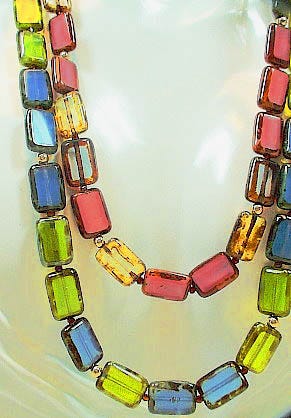
How to navigate the tensions between other people’s expectations and your own sense of personal authenticity. This is what Criticality is all about.
KIT AFTER KIT
I designed kit after kit with some highlighted core design or architectural principle, or technique variation in mind, hoping that in the process of making each particular piece of jewelry, the maker would also learn a lot of new insights they hadn’t been exposed to before. I wrote the instructions in sections — inspirations, design considerations, material and technique selection, points of vulnerability, workspace, step-by-step, dealing with contingencies. For each section, I approached it as a ‘think-aloud.’ That is, I wanted to explain the critical why’s and wherefore’s of each and every design choice I made, and in the order I made them, so the kit-maker could gain insight into how I made my each of my choices. And subsequently, be able to critically evaluate my choices with respect to their own sense of authenticity as a jewelry designer.
My efforts were in response to how virtually everyone learned jewelry making. [Which I consider mis-learning.] They learned to follow a set of steps. After the very last step, they completed something. It didn’t matter if that something was appealing. Or durable. Or wearable. Or comfortable. Or context appropriate. It didn’t matter if the steps were written out correctly. It didn’t matter whether you could apply those steps to any other situation, let alone situations which were unfamiliar or otherwise problematic. What mattered was the ”Look, Ma” feeling you got when you finished doing all the steps.
This isn’t learning. This is basic mechanics. I wanted to create a set of instructions and procedures which were insightful. Were tools which could be used to resolve other jewelry making goals and situations. Were a set of coherent ideas which could be built upon and expanded. Which empowered people with fix-it strategies for them to resort to whenever they needed. But most people saw my efforts as forcing them to review lots of text, images and diagrams, when they just wanted quickly to get to the point — something they could show and tell.
The sales were so-so. I adapted somewhat. I added summaries of steps so people could skip the explanations. I condensed things by creating 3-column layouts, where directions, images, diagrams and annotations sat side-by-side. Sales remained so-so. I was unwilling to make any more compromises.
Criticality
People fear getting criticized. So they avoid it. At all costs. Yet, at costs to themselves.
Criticism is not something you want to avoid. It is not meant to be harmful. And though I recognize, at times, you have probably experienced others using criticism to hurt you in some way, this isn’t what it is meant to be for. Criticism is there to bring clarity to what is working and what is not. What other possibilities might offer. What things you are doing that suggest you are on the right track … keep following it.
Criticality is something you want to build into your Practice. It is not something to avoid or minimize. It is one of your most useful tools as you begin to move your piece of jewelry from your workbench into the public sphere of sales, collectors, exhibitors, students, colleagues, you get the point.
Criticality is about making choices. It is about separating and confronting and going beyond your piece in order to build in that relevance jewelry needs as it gets exposed to the public.
Criticality helps you close the distance between the jewelry you create and the person it has been created for.
Criticality aids you in revealing the implications and consequences of all your choices. About materials. About techniques. About colors and patterns and textures and forms. About construction. About architectural and mechanical considerations. Each form of jewelry requires endless and constant adjustments, and you should be very critically aware of what, why and how. Preferably not waiting until you have finished your piece, but rather all along the way of your design process — inspiration to aspiration to implementation.
Criticality is necessary for you to continue to grow and develop as a professional jewelry designer.
Criticality is not a put-down of the jewelry designer. Rather it is a way of reflecting, evaluating and being very metacognitive of all the choices made in design and construction, and a lot of what-if envisioning and analysis of possible alternative choices. It is an exploratory thing. It adds understanding and comprehension.
Criticality assists in creating a dialog between designer and all the various audiences with whom the designer interacts. Towards that end, it is helpful to actively bring others into that criticality discussion, where we now have the prospects of many voices merging into a form. It can be difficult to be objective about your own work. It is equally as hard to anticipate its reception. And you may not be aware of how the quality of your work stacks up with others, and where it needs to be.
For the jewelry designer, criticality enters into the design process in several ways. These include,
- (1) Cultural and Social Critique: Jewelry can serve as a means of socio-cultural commentary. Jewelry can challenge norms. It can highlight tensions related to gender, identity and inequality. It can provoke thinking, dialog and response.
- (2) Material Exploration: Materials can be selected for different reasons. Their strengths can be leveraged and weaknesses minimized. They can be experimented with. They can be repurposed, such as with found objects. Their associated traditional uses can be challenged. Contradictions about ideas about value can be brought to the fore.
- (3) Taking Design Beyond Ornamentation And Embellishment: Jewelry tells stories, holds meanings, reveals content, triggers dialog. As such, it is more than ornamentation and embellishment. Jewelry is expressive. It can be political. It forces reflection.
- (4) Interdisciplinary Collaborations: Criticality in jewelry design often involves collaboration with other disciplines, such as fashion, art, or technology. As such, boundaries between disciplines become blurred or redefined. New ideas, materials, techniques and technologies emerge.
- (5) Challenges Standards Of Beauty, Fashion, Style, Taste and Art: Jewelry imposes questions on traditions, refocuses discussions about cultures and cultural appropriation, and points out alternative ways to appreciate different body types and forms of beauty.
- (6) Shared Understandings: Jewelry is a vehicle for understanding how the desires and values of the designer must interact / coordinate / be cohesive with the desires, values, assumptions, expectations and perceptions of the various audiences which interact with the jewelry once introduced publicly. All their interactions during (and after) the design process is a veritable volleyball game of back and forth criticality.
- (7) Appeal and Functionality: Jewelry is something to be worn, else it is merely sculpture. There are critical elements underlying any piece which relate in successful (or not) tradeoffs between appeal and functionality, art and architecture, object and intent.
By adopting a persistent, ever-present critical approach, jewelry designers can push the boundaries of design, explore new concepts, and create innovative pieces that go beyond mere adornment.
The Social Movement Gallery
When I was director of the Tennessee Primary Care Association, I had the opportunity, when moving our offices to a new location, to design a series of multi-use spaces. I put in a conference room which could double as a focus-group room for marketing studies. I put in a row of small spaces which could double as office spaces for temporary interns and display or storage spaces. And I organized the center of our space into a large, open space, with our staff offices bordering it on all four sides, and opening up into this space. This space was designed as an art gallery, with special lighting, furnishings, wall treatments. The space itself doubled for meetings, press conferences, gallery visitors, small work desks throughout.
Why an art gallery in the Primary Care Association offices?
The goals were part marketing, part meeting state and federal expectations of our health clinic members, and part forming or improving relationships with various power players throughout Tennessee.
The full conceptual powers and understandings underlying the idea of criticality were, pardon the repetition, critical to what we were trying to accomplish as an association — expanding access to health care services. These services were broadly defined to include basic primary care, prenatal and postnatal care, elderly care, homeless (now referred to as unhoused) care, veterans care, prisoners care, among other categories. Our member clinics were responsible for demonstrating that they were working in all these areas. And that was impossible. These clinics definitely did not have enough staff and not enough money and not enough time in the day.
The Gallery had national calls for submissions. I organized a nonprofit board of influential members, in one way or another, associated with the arts or the use of arts in program and economic development. The first exhibit was from Amnesty International. They had a traveling curated exhibit of works by Picasso, Pollock, Chagall, and others. This set the tone for the Gallery and got us a lot of free press and TV coverage.
Subsequent exhibits were organized by my new board. For each exhibit, we coordinated with one or two social service agencies directly responsible for providing services in line with the them. We formed a partnership. We used each exhibit to garner visibility, and allowed our partner agencies to take the lead in introducing the exhibit to the public.
For example, the homeless exhibit resulted in an oversized book, including images from the exhibit and articles by key people in the field. Tipper Gore (former Vice President Al Gore’s wife) held a press conference in the Gallery, introducing a new bill to expand mental health services across the nation. The two nonprofit organizations we worked with raised considerable funds for new grants and services. And all our member clinics were able to indicate to the state and to the federal government that they had met the requirement for providing expanded access to the homeless.
An exhibit on the elderly showcased two artists, one a painter and one a photographer. Both of them focused considerable attention on the hands of their elderly subjects. We introduced the world to the cover art for the book When I Am An Old Woman, I Shall Wear Purple. Again, we partnered with two nonprofit organizations, coordinating marketing and promotion. We triggered the development of two trial programs. And all our member clinics were able to indicate to the state and to the federal government that they had met the requirement for providing expanded access to the elderly.
Access to Prenatal Care was the focus of another exhibit. We displayed the incredible and powerful photographic works of two California artists. We coordinated several different programs with both nonprofit and state agencies in Tennessee. We held a reception for the artists in our Gallery. This resulted in over 6 weeks of TV exposure — news casts, repeated over and over every day, TV program coverage, newspaper articles. Everyone wanted to use these powerfully presented images highlighting the issues of access to prenatal care. We provided the opportunity for them to do so. And all our member clinics were able to indicate to the state and to the federal government that they had met the requirement for providing expanded access to women who needed prenatal care.
We had an exhibit of art works done by Vietnam vets. Some were artistic, but most were crude, haunting, perhaps mostly meaningful only to other Vietnam vets. Every day over 6 weeks, three or four or ten veterans would come into the Gallery. Most homeless. Many had walked 10–20 miles to come. They were kind of scary to look at, and definitely not the types of people who would normally frequent our offices. They would stare at the works of art and sit in our Gallery for hours. Otherwise, it was the usual routine for us. Coordinate with other agencies with their marketing and development needs. And indicate to the state and the feds that our clinics were expanding access to services for this underserved population.
My Gallery was not without its detractors. They sat on the Association’s board of directors. In spite of all this positive activity, they did not see the benefit of a Gallery within their mists. To them, art meant buying a blue painting to hang over a blue couch. Social and political art was something uncomfortable for them, no matter how much they benefited from it. They did not comprehend arts relationship to health care. And, predictably, we had very few sales. In crass money terms, the Gallery was a cost center for the Association. The benefits, while extremely large, were primarily intangibles. Luckily for me, my Association board stalemated on this issue.
I defended the Gallery until I left the Association. I believed it was critical to our operations and those of our member clinics. It triggered partnerships and visibility and awareness. It increased the accessibility of services throughout the state without burdening the limited resources of our member clinics. Major foundations in Tennessee, which had had the Association on their Do-Not-Deal-With Lists, took us off those lists.
But, when I left the Association, I closed the Gallery down at that point. There was no one at the Association to take over the reins. It was not self-sufficient financially.
My next career move was to sell jewelry and eventually design it.
And ventured into new worlds of criticality. Or, if I think about it, perhaps the same worlds, but different words, different scale.
Legitimacy
Coping with criticality goes hand in hand with developing a sense of legitimacy as a designer. Criticality gives you insights on how to become legitimate. Legitimacy gives you the fortitude for listening to, understanding, and responding to criticality.
Your legitimacy as a jewelry designer, your reputation, your visibility, your opportunities, to some degree, flow from this process of criticality. Legitimacy comes from both local and more general validation. Validation results from these processes of critical observation and analyses of your work and of how you conduct yourself within your practice.
Your legitimacy encompasses several aspects which are determinative of it, including:
- (1) Qualifications: formal education, training, certification
- (2) Experience: projects you’ve worked on, skills you possess, your portfolio
- (3) Reputation: reviews, client recommendations, industry recognition
- (4) Ethics: how you professionally interact to meet your client needs
- (5) Authenticity: how your original work differentiates you from other jewelry designers, given your values and desires, your craftsmanship, your creativity
Your various audiences that view your work critically, in turn, bring your work in contact with the external world, what is referred to as contagion. They look for a high level of coherence within the design and its execution. They describe it critically as to its qualifications for matching desire, establishing appeal, having personal or general value and meaning. For successful jewelry designers, this contagion continues, diffuses, and grows.
Legitimacy engenders a deeper level of confidence among designer, wearer and viewer. The relationships are stimulated, enriched, given more and more value. Jewelry is more than a simple object; it is a catalyst for interaction, for relationships, for engagement, for emotion. Legitimacy results in trust and validation.
With globalization and rapid technological changes, the jewelry designer is confronted with additional burdens, making the effort to achieve legitimacy ever more difficult. That is because these larger forces bring about more and more standardization of jewelry, and with it, a diminished need for criticality. These forces rapidly bring fashions and styles to the fore, only to scrap them, in the seemingly blink of an eye, for the next hot thing. They channel images of jewelry pieces around and around the world taking on a sameness, and lowering people’s expectations to what jewelry could be about.
If the products around the world are essentially the same, then the only thing the customer will care about is price. They won’t care who made it. They won’t care about quality. There will be no critical evaluation or assessment of designer legitimacy. Jewelry design and the jewelry designer would, in effect, become meaningless — merely a tool of production.
Innovation begins to disappear. With its disappearance, the role of the jewelry designer diminishes. The jewelry designer becomes more a technician with no professional identity or concerns. No need for authenticity or design fluency or originality. The jewelry simply becomes the sum of its parts — the market value of the beads, metals and other components. There are few, if any, pathways to legitimacy.
That’s not what we want. And that makes it ever more important that jewelry designers see themselves as professionals, and develop their disciplinary literacy — fluency, flexibility and originality in design. Aspects of design which cannot be globalized. Or standardized. Or accomplished without the work, knowledge, skills, understandings and insights of a professional jewelry designer.
You can’t achieve this without a framework for criticality in the jewelry design process.
Questioning and analyzing.
Challenging assumptions and values.
Finding contradictions or weaknesses in perspectives.
Going beyond norms.
Exploring alternatives.
The fluent designer.
The legitimate one.
Criticism can be used to suppress legitimacy in design. It can be used to force the designer into a particular incompatible or undesirable framework or system. This kind of criticism needs to be challenged.
However, criticism can also be used to overcome suppression, allowing for a more professional, purposeful, innovative, responsible and authentic jewelry designer to emerge.
A designer who has ownership over his or her own designs.
_______________________________________________________
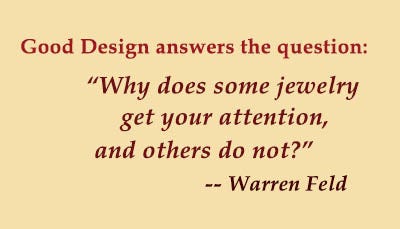
I have set up a space for our community of jewelry designers — Warren Feld Jewelry’s PATREON HUB — to learn, to interact, and to provide and/or get feedback on what they are working on. Please join here.
Be part of a community of jewelry designers who recognize that we have a different way of thinking and doing than other types of crafters or artists. Access more articles and other resources not included in my medium.com site.
Visit my website www.warrenfeldjewelry.com
Feel free to add your comments.
Shop with us at Land of Odds.


Discover more from Warren Feld Jewelry
Subscribe to get the latest posts sent to your email.

Leave a comment