

Guiding Questions?
1. How do I write a Biographical Sketch or Profile?
2. Does a biographical sketch replace or compliment a person’s resume?
Keywords:
biographical sketch
profile
resume
connection
avatar
1st person vs. 3rd person voice
The Biographical Sketch or Profile
Your customers, your sales venues, your clients all love stories, and they want to know yours. Your story might be a profile on a social media site. It might be a synopsis on the back of your portfolio or print book on demand. It might be part of a grant or art show application.
You will want to create several versions of varying lengths, but all basically highlighting the same information. I suggest creating versions which are 25 words, 50 words, 100 words, 250 words, 500 words. Your first 25 words should sound fun, intriguing, exciting, enticing, creating wonder and curiosity … you get the point.
Do not follow a template. You want your bio or profile to feel authentically your own.
Write your bio for a portfolio in the 3rd person. Write your profile for a social media site (think Facebook) targeted at family and friends in the 1st person. Write your profile for a social media site (think LinkedIn) targeted at potential employers in the 3rd person.
Within your Sketch or Profile, you will want to anticipate what people will be curious about. When someone first sees your jewelry, they will try to understand it, categorize it, emotionally connect to it. The greater the connection, the more likely the sale. How well has your bio helped them?
Your bio or profile is not your resume. It is not a listing of things. It will only touch on some things, and not all things, you might include in a resume. It is a story about you and your work. You might highlight a particular product, achievement or contribution as a way of illustrating the points you are making in your bio or profile.
Things to help people make that connection will include,
· Your name
· How you got started
· Where you are from
· How long you have been making jewelry
· Your style preferences
· Where can they find and buy your work
· Your inspirations and aspirations
· Techniques and technologies
· Materials used
· Who taught you; where did you learn your craft?
· Your career development
· Awards won, certifications, exhibitions, where to find your work
· Reviews, testimonials, what others think about your work, collectors
Avoid vague statements like “innovative approach” or “original” without context — use specific influences, techniques, and themes instead.
An Avatar
An Avatar is a digital image that represents you. Avatars are relatively small and usually are placed at the top left or right corner of web pages which represent your work, such as an article you have written or a video tutorial you offer.
The Avatar may be an image of yourself, typically a head shot. It might be an image of a favorite piece of jewelry. It might be your logo. It might be an animation representative of you and your business.
Remember that the space is limited in size. It may be a circle or an oval, rather than a square or rectangle. This means you will need to center the image to its advantage.
There are avatar generators online. Or you can make your own from scratch.
_________________
FOOTNOTES
Patkar, Mihir. The 8 Best Avatar Maker Sites for Profile Pictures. 4/27/22.
As referenced in:
https://www.makeuseof.com/tag/make-cool-avatars-profile-pictures-easiest-sites/
For more articles about CONQUERING THE CREATIVE MARKETPLACE, click over to our Jewelry Designers’ Hub
Get more from Warren Feld Jewelry on Patreon
Taking Jewelry Beyond Craftwww.patreon.com
_______________________________________________________
Thanks for being here. I look forward to sharing more resources, tips,
sources of inspiration and insights with you.

WarrenFeldJewelry.com
Shop.warrenfeldjewelry.com
School.warrenfeldjewelry.com
Coaching by Warren Feld
Add your name to my email list.
~~~~~~~~~~~~~~~~~~~~~~~~~
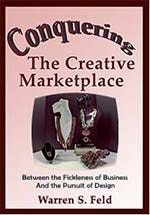
CONQUERING THE CREATIVE MARKETPLACE:
Between the Fickleness of Business and the Pursuit of Design
548pp, many images and diagrams
Kindle or Ebook or Print
This guidebook is a must-have for anyone serious about making money selling jewelry. I focus on straightforward, workable strategies for integrating business practices with the creative design process. These strategies make balancing your creative self with your productive self easier and more fluid.
Based both on the creation and development of my own jewelry design business, as well as teaching countless students over the past 35+ years about business and craft, I address what should be some of your key concerns and uncertainties. I help you plan your road map. Whether you are a hobbyist or a self-supporting business, success as a jewelry designer involves many things to think about, know and do. I share with you the kinds of things it takes to start your own jewelry business, run it, anticipate risks and rewards, and lead it to a level of success you feel is right for you, including
• Getting Started: Naming business, identifying resources, protecting intellectual property
• Financial Management: basic accounting, break even analysis, understanding risk-reward-return on investment, inventory management
• Product Development: identifying target market, specifying product attributes, developing jewelry line, production, distribution, pricing, launching
• Marketing, Promoting, Branding: competitor analysis, developing message, establishing emotional connections to your products, social media marketing
• Selling: linking product to buyer among many venues, such as store, department store, online, trunk show, home show, trade show, sales reps and showrooms, catalogs, TV shopping, galleries, advertising, cold calling, making the pitch
• Resiliency: building business, professional and psychological resiliency
• Professional Responsibilities: preparing artist statement, portfolio, look book, resume, biographical sketch, profile, FAQ, self-care