





FLUENCY IN JEWELRY DESIGN: The Bead Store
Posted by learntobead on December 23, 2024
I own a bead store
In the 1990s, my partner and I decided we wanted to set up a training program, but something different than what already existed. It was obvious to us that what already existed wasn’t working.
It came down to this: our bead store customers and our jewelry making students were not challenging us. They were not pushing us to seek out new materials. They were not demanding that we more critically evaluate the quality, usefulness, and long term staying power of various stringing materials and jewelry findings options. They were not wondering why some things broke or didn’t come together well. They were not encouraging us to explore the craft, improve upon it, search for more variations on existing methods and more ideas about new methods, and see where we could take it.
The typical customer, at that time, would learn one technique, apply it to one pattern, and do this pattern over and over again, perhaps only varying the colors. They would make at least 10 or 12 of the exact same pieces, again, typically only varying in color choices, and carry them around in zip lock plastic bags secured in their purses. They rarely deviated from using the same materials, the same clasps, the same jewelry findings. They never asked questions about what else they could do. They never varied their techniques. They never challenged themselves. They never questioned why things broke, or didn’t come together well, or why people liked or didn’t like the pieces they were making.
Students wanted us to tell them, step-by-step, how to do it. They didn’t want to think about it. They just wanted to make something quickly, that looked good on them, matched what they were wearing, and could be worn home. Uninterested in whether there were better stringing materials for the project. Or a more clever way to construct the clasp assembly. Or better choices of colors, patterns, textures or materials. Or things they could do to make the piece move better, drape better and be more comfortable to wear. Or even take the time to consider the appropriateness of the technique or the appropriateness of the piece itself, given where and when and how the piece was intended to be worn.
We began to see that this was not a customer or student problem. It was not any personal characteristics. Or motivations. Or experiences. Or skill level. This was a problem about what they learned and how they were taught and their level of expectations about what to assume and what to anticipate. They weren’t learning or getting taught that disciplinary way of asking questions, solving problems and day-to-day thinking unique to jewelry designers. They were not learning how to become literate in design. Their expectations about what was good, acceptable, finished, successful — you get the idea — were low. Bead and jewelry magazines, video tutorials, craft and bead stores, jewelry design programs set these low bars and reinforced them. As a result, they convinced their readers and students and practitioners to understand jewelry merely as an object to be worn, not inhabited. And not part of any kind of public interaction or dialog.
Jewelry design, at the time we began in business, was considered more a hobby or an avocation than an occupation or a profession. There was the assumption that no special knowledge was required. You were either creative or you were not. And all it took to make a piece of jewelry was to reduce a project to a series of steps where jewelry making was basically paint-by-numbers.
Art and Design concepts were dumbed down for jewelry makers, rather than elaborated and reinforced. It was assumed that everyone universally used the same criteria for judging a piece as finished and successful. As a consequence, there was a lot of standardization in jewelry designs, materials and construction. Too much sameness. Not enough variation and originality. Too much focus on fashion and product consumption. Too much diminishing of individuality and the reflection of the artist’s hand in design. And with all this standardization, an increasing risk that the jewelry artist was no longer a necessary and critical part of jewelry making and its design.
Around this time, the art world seemed to want to make a big push to encompass jewelry, as well. Jewelry was defined as a subset of painting or sculpture. And this lent an air of professionalization to the field. Jewelry making here became a beauty contest. But jewelry design was divorced from the materials it was made from, the constructive choices necessary for it to function, and the person who was to wear it.
Before designing jewelry, I had been a painter. For several years when I began designing jewelry, I approached jewelry projects as if I were painting them. This was very frustrating. I couldn’t get the color effects I wanted to achieve. Or the sense of line and shape and dimension. To compensate for my repeated feelings of failure, I actually pulled out my acrylic paints and canvas and painted my creations as I had visualized them in my mind. I could paint jewelry well. But, stuck as I was in this painter-as-designer-rut, I could not satisfactorily translate my vision into a satisfying piece of jewelry.
It finally began to dawn on me the things which needed to be learned and needed to be taught. I needed to approach jewelry from the jewelry’s standpoint. I needed to understand the components and beads used in jewelry on their own terms — how they asserted themselves within each of my projects. Beads and related components were not paints. I needed to understand what happened to all these components over time. I needed to understand how the placement of each component, as well as clusters of components, affected people within the situations they found themselves. I needed to understand much more about light and shadow and reflection and refraction. I needed more insight into how things moved, draped and flowed, all the while keeping their shape. Starting with a merely mechanical view of making jewelry wasn’t cutting it. Nor was starting with an artistic view of the aesthetics of jewelry. We needed to incorporate aspects of design, as well.
My partner and I began organizing our evolving ideas and values about the designing of jewelry into something we called The Design Perspective. These ideas and values form a sort of Design Manifesto. They are principles at the core of any jewelry design discipline. These principles take the designer beyond craft. They integrate art with function and context. These principles were, and continue to be, as follows, and it is my hope, as you read through the book, that these become yours, as well.
For more articles about Fluency in Design, click over to our Jewelry Designers’ Hub
_______________________________________________________
Thanks for being here. I look forward to sharing more resources, tips,
sources of inspiration and insights with you.

WarrenFeldJewelry.com
Shop.warrenfeldjewelry.com
School.warrenfeldjewelry.com
Coaching by Warren Feld
Add your name to my email list.
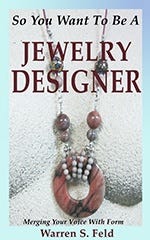
SO YOU WANT TO BE A JEWELRY DESIGNER
Merging Your Voice With Form
So You Want To Be A Jewelry Designer reinterprets how to apply techniques and modify art theories from the Jewelry Designer’s perspective. To go beyond craft, the jewelry designer needs to become literate in this discipline called Jewelry Design. Literacy means understanding how to answer the question: Why do some pieces of jewelry draw your attention, and others do not? How to develop the authentic, creative self, someone who is fluent, flexible and original. How to gain the necessary design skills and be able to apply them, whether the situation is familiar or not.
588pp, many images and diagrams Ebook , Kindle or Print formats
The Jewelry Journey Podcast
“Building Jewelry That Works: Why Jewelry Design Is Like Architecture”
Podcast, Part 1
Podcast, Part 2
Discover more from Warren Feld Jewelry
Subscribe to get the latest posts sent to your email.

Leave a comment