




The Design Manifesto
First (and foremost):
Jewelry is art only as it is worn.
Second:
Jewelry should reflect the artist’s intent Creativity is not merely Doing. It’s Thinking, as well.
Third:
Jewelry is something affected by, and in return, affects the contexts within which it is introduced. The purpose of jewelry design is to communicate a designer’s idea in a way which others understand and will come to desire. Jewelry is not designed in a vacuum; rather, it results from the interaction of the artist and his or her various audiences, and is communicative at its core.
Fourth:
Jewelry design should be seen as a constructive process involving the balancing act of maintaining both shape (structure) as well as good movement, drape and flow (support); jewelry should be seen as more architectural than craft or art alone.
Fifth:
Design choices are best made and strategically managed at the boundary between jewelry and person, where the artist can best determine when enough is enough, and the piece is most resonant.
Sixth:
Jewelry must succeed aesthetically, functionally, and contextually, and, as such, jewelry design choices must reflect the full scope of all this, if jewelry is to be judged as finished, successful and, most importantly, resonant.
Seventh:
Everyone has a level of creativity within them, and they can learn and be taught how to be better and more literate jewelry designers.
Eighth:
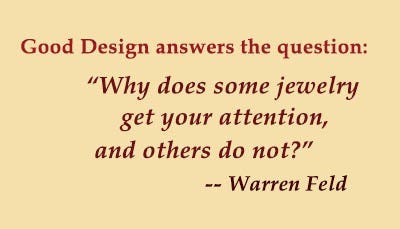
Students need to learn a deeper understanding about why some pieces of jewelry attract your attention, and others do not. Successful teaching of jewelry design requires strategies leading students to be more literate in how they select, combine and arrange design elements, and to be fluent, flexible and original in how they manipulate, construct, and reveal their compositions.
Ninth:
Successful jewelry designing can only be learned within an agreed upon disciplinary literacy. That is, jewelry design requires its own specialized vocabulary, grammar and way of thinking things through and solving problems in order to prepare the designer to be fluent, flexible and original.
Tenth (and final):
Disciplinary literacy should be learned developmentally. You start at the beginning, learn a core set of skills and how they are inter-related and inter-dependent. Then you add in a second set of integrated and inter-dependent skills. Next and third set, and so forth, increasing the sophistication of skills in a developmental and integrative sense. The caveat, if you have been making jewelry for a while, it is particularly helpful to go back and relearn things in an organized, developmental approach, which can be very revealing, even to the experienced designer, about how your design choices impact your pieces and your success.
Our curriculum emerged from our understandings about disciplinary literacy in jewelry design and our attempts to implement what we learned from it. This curriculum evolved into this book.
Here you will begin to understand
- The challenges jewelry designers face
- How to channel your excitement
- How to develop your passion
- How to cultivate your practice
- How to understand what jewelry means and how jewelry is used by various audiences
- The variety of materials, techniques and technologies you might want to explore and incorporate into what you do
- The creative process, and the things involved in translating inspirations into aspirations into designs
- What it means to develop a passion for design
- The role desire plays in how people come to recognize and understand whether a piece is finished and successful, and how values are set and imposed on any piece of jewelry
- Principles of composition, construction and manipulation, and the intricacies and dependencies of various design elements, such as color, point, line, plane, shape, forms, themes, among others
- Creating and using components
- The architectural bases of jewelry design
- What the ideas underlying “good design” are, as well as those associated with “good contemporary design”
- How design concepts are applied in real life
- The psychological, cognitive and sexuality underpinnings of jewelry design
- Your professional responsibilities as a jewelry designer
- Entering the creative marketplace and threading the business needle
- Self-care
- In fact, the book covers the full range of things you need to learn (or teach others) in order become fluent, flexible and original in jewelry design
Sadly, the field of jewelry design has little academic scholarship relative to the ideas which must support it. This is mostly because jewelry design is not thought of as a discipline apart from art or craft. And this is a disservice to we designers.
Most description and analysis focus on the accomplishments of various successful designers. These texts detail their biographies, their use of artistic elements and techniques, and their influence over styles and fashions. This information is important, but insufficient to support jewelry design as a profession all its own, relevant for today and tomorrow, and inclusive of all of us who call ourselves jewelry designers.
This book covers the bases of those critical professional, think-like-a-designer skills jewelry designers need to develop and at which to become proficient.
Join our Jewelry Designers’ Hub at
www.patreon.com/warrenfeldjewelry
_______________________________________________________
Thanks for being here. I look forward to sharing more resources, tips,
sources of inspiration and insights with you.

WarrenFeldJewelry.com
Shop.warrenfeldjewelry.com
School.warrenfeldjewelry.com
Coaching by Warren Feld
Add your name to my email list.
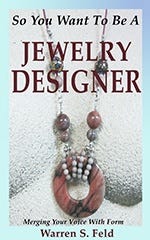
SO YOU WANT TO BE A JEWELRY DESIGNER
Merging Your Voice With Form
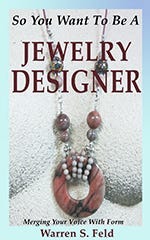
So You Want To Be A Jewelry Designer reinterprets how to apply techniques and modify art theories from the Jewelry Designer’s perspective. To go beyond craft, the jewelry designer needs to become literate in this discipline called Jewelry Design. Literacy means understanding how to answer the question: Why do some pieces of jewelry draw your attention, and others do not? How to develop the authentic, creative self, someone who is fluent, flexible and original. How to gain the necessary design skills and be able to apply them, whether the situation is familiar or not.
588pp, many images and diagrams Ebook , Kindle or Print formats
The Jewelry Journey Podcast
“Building Jewelry That Works: Why Jewelry Design Is Like Architecture”
Podcast, Part 1
Podcast, Part 2
