Most people, when they get started beading or making jewelry, don’t have this overwhelming urge to become star jewelry designers. On the contrary, fame and fortune as a designer are some of the furthest things from their minds. Most people look to jewelry making and beading to fulfill other needs.
Over the years I’ve seen many people pick up beading and jewelry making as a hobby. They are drawn to these for many reasons, but most often, to make fashionable jewelry at a much lower cost than they would find for the same pieces in a Department store, or to repair jewelry pieces they especially love. When you start with the parts, and the labor is all your own, it is considerably less expensive than the retail prices you would find in a store for the same pieces.
Some people want to make jewelry for themselves. Others want to make handmade gifts. Giving someone something of great value, that reflects a personal expression of creativity, and a labor of love — you can’t beat it. And everyone loves jewelry.
When people get into beading and jewelry making, they discover it’s fun. Even addictive. They tap into their inner-creative-self. They see challenges, and find ways to meet them. They take classes. They buy books and magazines. They join beading groups and bead societies and jewelry making collaboratives. They have beading and jewelry making parties with their friends. They scour web-sites on-line looking for images of and patterns for jewelry. They comb the web and the various beading, jewelry-making and craft magazines, looking for sources and resources. They join on-line jewelry and bead boards, on-line forums, on-line web-rings, on-line ezines, groups, and on-line blogs. They take shopping trips to malls and boutiques and like little good Agatha Christies and Sherlock Holmes, they spy, looking for fashions, fashion trends, and fashionistas. They attend traveling bead shows. And every town they visit, they schedule some free time to check out the local bead stores and boutiques.
As people get more into beading and jewelry making, some discover that these avocations are not only sources of artistic self-expression, but also have many meditative qualities. They are relaxing. They take your mind off the here and now, and transport you to a very calming place.
Still, for others, beading and jewelry making become a way to earn some extra income. They might be to supplement what you’re making now. They might be ways to generate some extra dollars after you retire. They might be the start of your own business as a designer of jewelry. They might be a sense of independence and self-reliance. Having someone pay you for something you made is often the hook that gets people addicted to beadwork and jewelry making.
Most people, however, are content just to make jewelry. There are no professional Design paths to pursue. They may realize that they are out there somewhere, but don’t particularly care. Or sometimes they are unfamiliar with or can’t see all the possibilities. Perhaps they get stuck. No mentor, no book, no magazine, no project to entice them or spark an interest in something more than what they are doing now. But it suffices. Beading and jewelry making relaxes them, gives them a creative outlet, things to enjoy, other like-minded people to be with.
For those fewer people, however, who get a whiff of what it means to design jewelry, and jewelry which resonates, well, what a trip they are in for.
SO YOU WANT TO BE A JEWELRY DESIGNER Merging Your Voice With Form
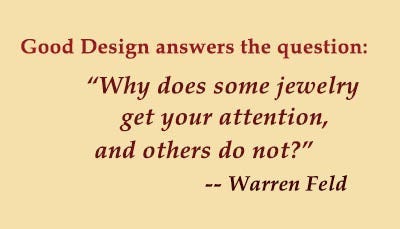
So You Want To Be A Jewelry Designer reinterprets how to apply techniques and modify art theories from the Jewelry Designer’s perspective. To go beyond craft, the jewelry designer needs to become literate in this discipline called Jewelry Design. Literacy means understanding how to answer the question: Why do some pieces of jewelry draw your attention, and others do not? How to develop the authentic, creative self, someone who is fluent, flexible and original. How to gain the necessary design skills and be able to apply them, whether the situation is familiar or not.
Some Updates and Things Happening. (Please share this newsletter)
In this Issue: 1. Juried Art Services — You Should Be Registered Here! 2. To Keep People On Your Website, Follow These Tips 3. Extraordinary price increases on gold seed beads! +85%! 4. Film and photograph your design process, suggested once every hour! 5. Humanae — A pantone map of skin tones 6. Tips for balancing portfolios for retail and gallery shops vs. online sales 7. Is it jewelry or sculpture? 8. 3 Austrian crystal bead and rhinestone colors have been discontinued Some articles you may have missed Featured
Juried Art Services is a comprehensive online application and jurying system for art shows, galleries, and museums. We provide a seamless and efficient platform for managing your art show, gallery, or museum. We have been in business for over 20 years and have worked with some of the largest art shows in the world.
Here is a central place to create a “portfolio” for yourself, and find out about and submit applications to various art and craft shows. Each show has its own special requirements and fees, and this site structures each application accordingly.
VIDEO LINK Creating an application has never been easier. With Juried Art Services, you have tons of creative options for uploading and editing your artworks. Get started with this quick tutorial video on how to create your first application.
2. To keep people on your website, I suggest you follow these tips:
When your website gets ranked by search engines, one of the key things they measure is how long visitors who have clicked over to your site remain on your site. The longer you keep them there, the higher your rank.
To keep people on your website, improve readability & contrast:
Avoid light-colored text on light backgrounds — it reduces readability.
Use a background effect or contrast to make text stand out.
Increase font size for key text to ensure easy reading.
Keep design consistent — spacing and formatting should be uniform.
Prioritize clear, high-contrast text for a polished and professional look.
By enhancing contrast and legibility, visitors will have a better browsing experience.
Simplify your website’s navigation to improve user experience.
Shorten menu titles — use single words like “Teaching” instead of “Workshops & Classes.”
Group similar pages — place sales and classes together for logical flow.
Move secondary pages (About, Contact) to the right side of the menu.
Reduce menu clutter — only include essential categories to avoid overwhelming visitors.
Keep navigation intuitive so users can find what they need quickly.
A cleaner menu layout makes browsing effortless and keeps visitors engaged.
Showing visuals of your work/classes can help you sell more.
Show images of students making jewelry in workshops or displaying their finished pieces. Feature completed commissions to help potential clients imagine their own.
Capture behind-the-scenes moments of your creative process, from sketch to final piece. Include action shots of yourself making jewelry to add a personal and engaging touch.
Make the experience feel real so visitors can clearly see what they’ll gain.
By integrating more visuals, your site will feel more immersive and persuasive.
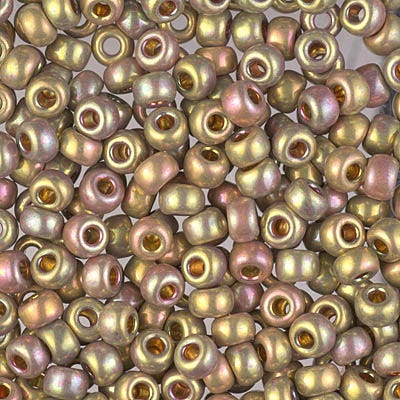
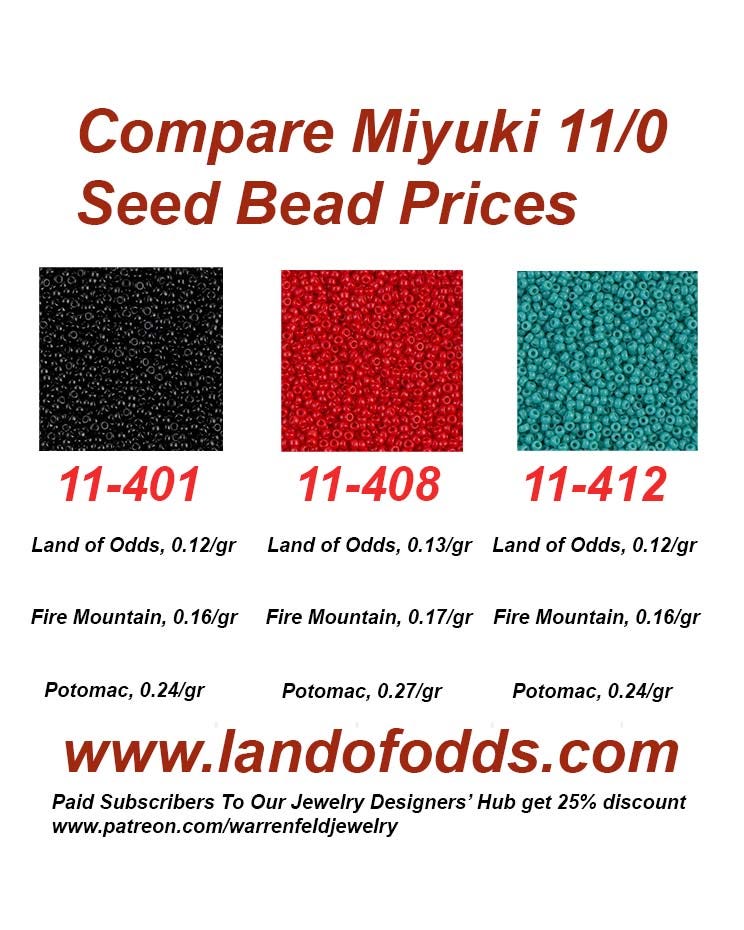
3. Price increases, some extraordinary (+85%) on Miyuki seed beads
First, expect at least 6% increase in prices on all Miyuki seed and delica beads.
Second, can be a 85% increase on beads with gold plating or with colors that use gold to make the colors
From the US distributor: :Over the last year and a bit, Miyuki has charged a surcharge on beads which contain gold. This means not just gold-plated beads, but any bead which has gold in the glass-making process. Gold is extra expensive right now, and the additional fee is to cover the materials cost for making those beads. The surcharge is currently hovering about 85% and has been in that vicinity for about a year.
Until now we have dragged our feet on re-ordering these items because the cost is almost doubled, but we’ve decided to simply re-price them because the cost doesn’t seem to be going down. If it does go down, we’ll redo our prices on these beads and you’ll be the first to know!
Here is the long list of items that are affected:”
4. Film and photograph your design process, I suggest once every hour!
Always have your cell phone handy.
Anticipate the kinds of image and video materials you might need for any marketing you will do once you have completed your project. It is important to recognize up front that “sharing your process” is one of the strongest marketing messages you can develop.
Do you forget to film/photograph your process often? Set an alarm.
I recommend filming yourself working once an hour (for about 5 seconds). If you get very into your work/forget, set an alarm or timer when you start.
You can decide whether you set just one, or several (if you plan on working for a while). For example: if you’ll be painting from 5 pm to 8 pm, set alarms at:
6:00 pm
7:00 pm
8:00 pm
This way you can fully focus on your work and still get the footage you need.
Store your images and videos in a place you can easily find them again after you finish your project.
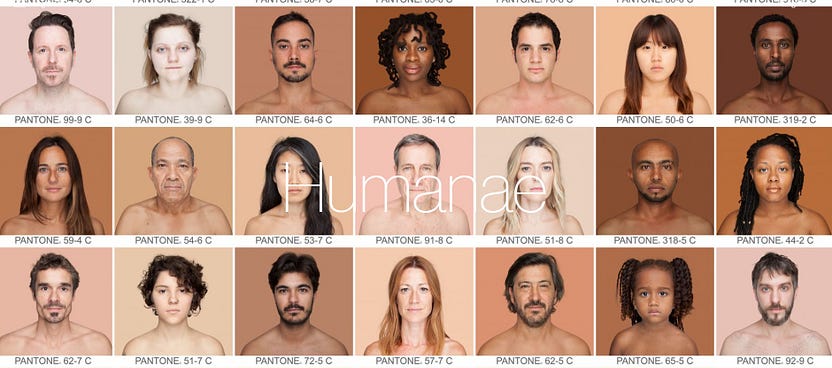
5. I found this extraordinary project called Humanae which is photographically documenting skin tones and relating each to pantone colors
Humanæ is a photographic work in progress by artist Angélica Dass, an unusually direct reflection on the color of the skin, attempting to document humanity’s true colors rather than the untrue labels “white”, “red”, “black” and “yellow” associated with race. It’s a project in constant evolution seeking to demonstrate that what defines the human being is its inescapably uniqueness and, therefore, its diversity. The background for each portrait is tinted with a color tone identical to a sample of 11 x 11 pixels taken from the nose of the subject and matched with the industrial pallet Pantone®, which, in its neutrality, calls into question the contradictions and stereotypes related to the race issue.
More than just faces and colors in the project there are almost 4,000 volunteers, with portraits made in 20 different countries and 36 different cities around the world, thanks to the support of cultural institutions, political subjects, governmental organizations and non-governmental organizations. The direct and personal dialogue with the public and the absolute spontaneity of participation are fundamental values of the project and connote it with a strong vein of activism.
Currently more than 4000 images exist in the project. They have been taken in 36 cities, in 20 different countries: Arteixo, Madrid, Barcelona, Getxo, Bilbao and Valencia (Spain), Paris (France), Bergen (Norway), Winterthur, Chiasso (Switzerland), Groningen, The Hague (Netherlands), Dublin (Ireland), London (UK), Tyumen (Russia), Gibellina and Vita (Italy), Vancouver, Montreal (Canada), New York, San Francisco, Gambier, Pittsburgh and Chicago (USA), Quito (Ecuador), Valparaíso (Chile), Sao Paulo and Rio de Janeiro (Brazil), Córdoba (Argentina), New Delhi (India), Daegu (South Korea) Wenzhou and Shanghai (China), Ciudad de México, Oaxaca (Mexico) and Addis Abeba (Ethiopia).
6. Tips for balancing portfolios for retail and gallery shops vs. online sales
To balance your website for store/gallery vs. online sales…
Use a digital portfolio to showcase your work professionally — galleries especially expect a polished presentation.
If adding an online store, ensure pricing matches what stores/galleries display to avoid conflicts.
Communicate openly with stores/galleries — let them know you prioritize selling through them and will refer clients back.
Focus on store/gallery relationships first — building online sales takes time, so establish a strong presence before investing heavily in ecommerce.
If you enable an online shop, manage it carefully and address concerns with transparency to maintain good store/gallery partnerships
You should correctly assume that potential clients will, after seeing your physical store/gallery representation, then go online to check you and your jewelry out as well
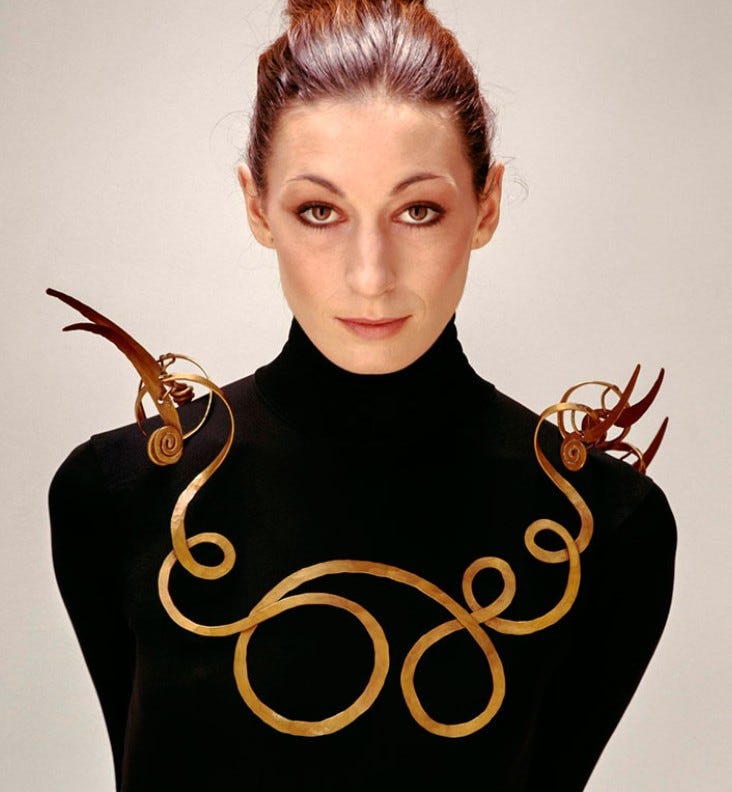
The question of whether jewelry is sculpture has been debated for over a century. The key distinction often comes down to context. An unknown sculptor attempting to position their jewelry as sculpture faces a challenge. Likewise, an unknown jeweler claiming to be a sculptor must overcome substantial hurdles.
However, when an artist deliberately blurs these lines, the results can be extraordinary. Many Patina Gallery exhibitions began as And & Both ideas — concepts that walked the lines of nuance and risked failure but ultimately thrived. Ivy Ross has built her career on this delicate balance. She consistently reminded me that the story must always support the idea.
Most people know my thinking: Jewelry is only art as it is worn. It is not sculpture.
8. 3 Austrian crystal bead and rhinestone colors have been discontinued
Swarovski has shared some unforeseen news regarding three colors in their crystal line:
Smoked Amber
Light Amber
Golden Topaz
Due to technical difficulties, they can no longer be produced and have been discontinued.
While Swarovski no longer distributes directly to the general public, they are the manufacturing source of distributors that handle their products. The distributor I use is call Star Bright.
WARREN FELD JEWELRY (www.warrenfeldjewelry.com) Custom Design, Workshops, Video Tutorials, Webinars, Coaching, Kits, Group Activities, Repairs ~~~~~~~~~~~~~~~~~~~~~~~ Join our community of jewelry designers on my Patreon hub Be part of a community of jewelry designers who recognize that we have a different way of thinking and doing than other types of crafters or artists. One free downloadable Mini-Lesson of your choice for all new members! ~~~~~~~~~~~~~~~~~~~~~~~
Hey there! Check out my book about Pearl knotting.
My name is Warren Feld. I am a jewelry designer with 40+ years of experience. In my book, I teach you the basic steps in Pearl Knotting. I’ll walk you through how to start your piece, tie knots between pearls, and how to end your piece. Simple instructions. Lots of diagrams and images.
What you will learn
In this book, i teach a non-traditional pearl knotting technique which is very easy for people to learn and do, does not use special tools, includes step-by-step instructions, a simple way to tie knots, shows clearly how to attach your clasp and finish off your cords, and achieves that architectural perfection we want in our pearl strung pieces,
Why This Class Is Important
There are many, many variations in technique.
They all work.
Yet most are very difficult for the beginner — especially those traditional techniques which rely on tools for making and positioning the knots.
Over the years, Ihave seen how students, when following traditional pearl knotting methods, or methods which utilize some more traditional techniques and approaches, become dissatisfied with their results.
And give up.
Pearl knotting doesn’t need to be this hard.
Warren’s Way
After many, many years, enduring many concerns, debates, demonstrations and arguments about which way is best, I came up with my own preferences —
o Using ideas, goals and parts of techniques from several established methods o Adjusting them, based on my experiences with students and teachers o And my knowledge of good design o And how to balance artistic concerns with functional ones.
The Book
I used these ideas and techniques, which I reached and put them to many test, to create a non-traditional pearl knotting technique which i call “Warren’s Way”.
4 variations
The book covers 4 different variations for starting and finishing your piece, including 1. Attaching directly to the clasp 2. Using French wire bullion 3. Using clam shell bead tips 4. Making a continuous piece without a clasp
I also present the steps for adding cord.
Kit and Supplies, Tools
You may purchase an accompanying PEARL KNOTTING KIT, as well as supplies and tools, at www.landofodds.com