

HOW DO YOU LEARN?
Many people who begin to bead and make jewelry want to rush to the finish line. They want to learn everything at once. They buy beads and parts indiscriminately. They try to use stringing and other materials insufficient to meet their design goals. They fail to anticipate how to finish off the clasp assembly. Their choices of colors often less than appealing. They don’t have the right tools. They purchase every book they can find. They take classes and view video tutorials on anything that interests them or catches their eye, no matter what the skill levels involved. They want to create those perfect, elaborate pieces Now. Not later. Now.
Beading and jewelry making are not things to rush into, however. These are not things to learn haphazardly. Not everything is something you can easily pick up without having someone else show you.
This is a hobby and avocation and even a career which requires you to know a lot of things. You need to know a lot about materials. You need to know a lot about quality issues underlying these materials, and what happens to these materials over time. You need to be mechanical and comfortable using tools to construct things. You need to learn many basic techniques. You need to understand physical mechanics and what happens to all these materials and pieces, when jewelry is worn. You need to be familiar with art theories and design theories and their applications. You must be aware of some architectural basics and physical mechanics which inform you how things keep their shape and how things move, drape and flow. You need to understand people, their psychology, the dynamics of the groups they find themselves in, and their cultural rules which get them through the day.
There is so much to learn, that you can’t learn it all at once. And there is so much to bring to bear, when making a piece of jewelry, that it is difficult to access all this information, if you haven’t learned how everything is interrelated and interdependent.
Where can you learn jewelry making skills?…
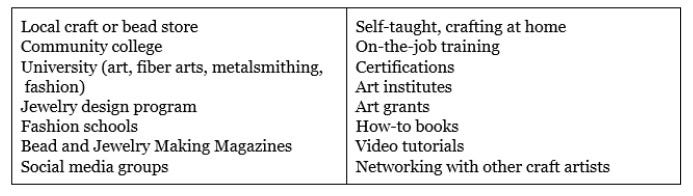
It’s important to learn in an organized, developmental way. You want to be always asking how things are interrelated. What depends on what? You want to pose what-if questions so that you can train yourself to anticipate the implications and consequences of making one choice over another. What happens If? What happens When? What enhances? What impedes? What synergizes? What can be leveraged, and toward what objective? You want to reflect on your outcomes.
Towards this end, you learn a core set of integrated and inter-dependent skills. Then learn another set of integrated and inter-dependent skills, perhaps at a slightly higher skill level, and how these link back to the core. Then learn yet another set of skills, again, increasing the skill level, how they link back to the first set, and then link back to the core. And so forth. Only in this way will you begin to know if you are learning the right way, and learning the right things.
There Are Many Ways To Learn
People apply different learning styles, when developing their beading and jewelry-making knowledge, skills and understandings. Each has pros and cons. Different people come to learn with different strategies or combinations of strategies. What is your preferred learning style? These learning styles and strategies include:
(1) Rote Memory
(2) Analogously
(3) Contradictions
(4) Assimilation
(5) Constructing Meanings
Most people learn by Rote Memory. They follow a set of steps, and they end up with something. They memorize all the steps. In this approach, all the choices have been made for them. So they never get a chance to learn the implications of their choices. Why one bead over another? Why one stringing material over another? How would you use the same technique in a different situation? You pick up a lot of techniques, but not necessarily many skills.
Other people learn Analogously. They have experiences with other crafts, such as sewing or knitting or woodworking or other craft, and they draw analogies. Such and Such is similar to Whatnot, so I do Whatnot the same way I do Such and Such. This can work to a point. However, beading and jewelry making can often be much more involved with composition, construction and manipulation, requiring making many more types of choices, than in other crafts. And there are still the issues of understanding the quality of the pieces you use, and what happens to them, both when jewelry is worn, as well as when jewelry is worn over time.
Yet another way people learn is through Contradictions. They see cheap jewelry and expensive jewelry, and analyze the differences. They see jewelry people are happy with, and jewelry people are not happy with, and analyze the differences. They see fashion jewelry looked down upon by artists, and art jewelry looked down upon by fashionistas, and they analyze the differences.
Assimilation is a learning approach that combines Analogous Learning and Learning Through Contradictions. People pursue more than one craft, keeping one foot in one arena, and another foot in the other. They teach themselves by analogy and contradiction. This assumes that multiple media and multiple techniques mix, and mix easily. Often, however, this is not true. Philosophies of design and technique differ. That means, the thinking about how a media and technique assert needs for shape and drape will have a different basis, not necessarily compatible. Usually one medium (or technique) has to predominate for any one project to be successful. So assimilative learning can lead to confusion and poor products, trying to meet the special concerns and structures of each craft simultaneously. It is challenging to mix media and/or techniques. Often the fundamentals of each particular craft need to be learned and understood in and of themselves.
The last approach to learning a craft is called Constructing Meanings. In this approach, you learn groups of things, and how to apply an active or thematic label to that grouping. For example, you might learn about beading threads, such as Nymo, C-Lon and FireLine, applying each one separately to accomplish the same project. In this way you begin to learn to evaluate each one’s strengths and weaknesses, especially in terms of Managing Thread Tension or allowing movement, drape and flow. You might learn about crystal beads, Czech glass beads, and lampwork beads, and then again, concurrently and in comparison, learn the pros and cons of each, in terms of achieving good color blending strategies. You might learn peyote stitch and Ndebele stitch, and how to combine them within the same project.
In reality, you learn a little in each of these different learning styles and strategies. The Constructing Meanings approach, what is often referred to as the Art & Design Perspective, usually is associated with more successful and satisfying learning. This approach provides you with the tools for making sense of a whole lot of information — all the information you need to bring to bear to make a successful piece of jewelry, one that is both aesthetically pleasing and optimally functioning.
The Types of Things You Need To Learn
There is so much to know, and so many types of choices to make. Which clasp? Which stringing material? Which technique? Which beads? Which strategy of construction? What aesthetic you want to achieve? How you want to achieve it? Drape, movement, context, durability.
Types of Beading and Jewelry Making
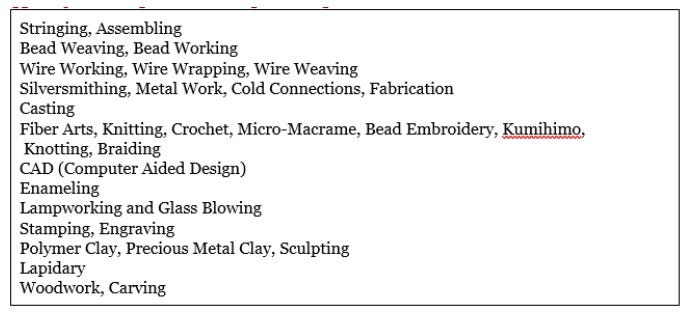
Lots to know. One mistake most people make is that they learn everything randomly. Some things on their own. Some from books. Some from friends. In no special order. Without any plan.
And because there are so many things that you need to bring to bear, when creating a piece of jewelry, that it is difficult to see how everything links up. How everything is inter-related and mutually dependent. And how to make the best, most strategic and most satisfying series of inter-related choices.
Types of Tasks Jewelry Makers and Beaders Do
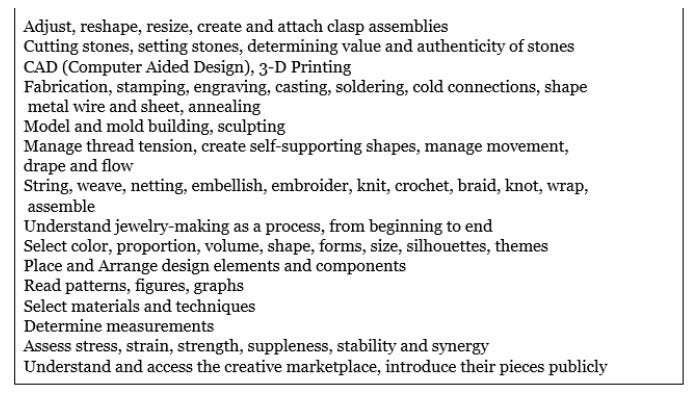
And this is the essence of this book — a way to learn all the kinds of things you need to bring to bear, in order to create a wonderful and functional piece of jewelry. When you are just beginning your beading or jewelry making avocation, or have been beading and making jewelry awhile — time spent with the material in these segments will be very useful. You’ll learn the critical skills and ideas. You’ll learn how these inter-relate and are mutually inter-dependent. And you’ll learn how to make better choices — fluent, flexible and original.
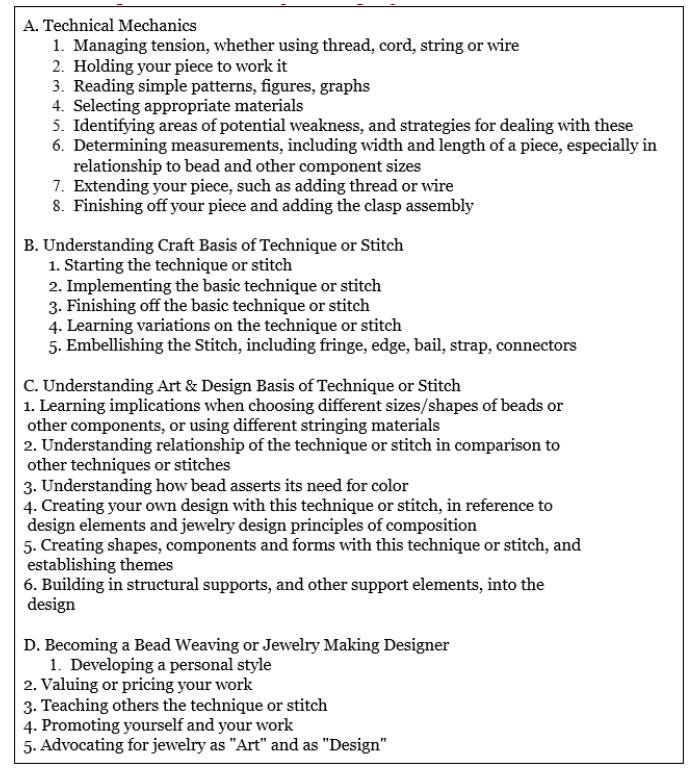
In the class curriculum I teach,
students are guided to learn the following objectives:
_______________________________________________________
For more articles about FLUENCY IN DESIGN, go to the JEWELRY DESIGNERS’ HUB
https://www.patreon.com/collection/613906?view=expanded
_______________________________________________________
Thanks for being here. I look forward to sharing more resources, tips,
sources of inspiration and insights with you.

WarrenFeldJewelry.com
Shop.warrenfeldjewelry.com
School.warrenfeldjewelry.com
Coaching by Warren Feld
Add your name to my email list.
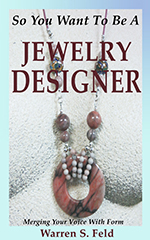
SO YOU WANT TO BE A JEWELRY DESIGNER
Merging Your Voice With Form
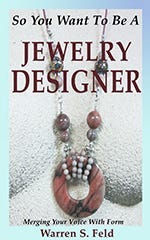
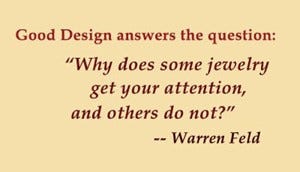
So You Want To Be A Jewelry Designer reinterprets how to apply techniques and modify art theories from the Jewelry Designer’s perspective. To go beyond craft, the jewelry designer needs to become literate in this discipline called Jewelry Design. Literacy means understanding how to answer the question: Why do some pieces of jewelry draw your attention, and others do not? How to develop the authentic, creative self, someone who is fluent, flexible and original. How to gain the necessary design skills and be able to apply them, whether the situation is familiar or not.
588pp, many images and diagrams Ebook , Kindle or Print formats
The Jewelry Journey Podcast
“Building Jewelry That Works: Why Jewelry Design Is Like Architecture”
Podcast, Part 1
Podcast, Part 2