Use a catchy phrase to summarize your business and get people’s attention…
Create A Tag Line
On written documents, brochures, stationery, envelopes and on online documents with titles, headings and the like, you have an opportunity to present more “words”, that is “meanings”, about your business. This gives you a second opportunity to convey things about your business that perhaps your specific business name falls short on, or needs more emphasis.
After you’ve come up with a business name, return to your lists of key words, and not-so-key words, and think of a tag line. Think of it as a “subtitle”.
Your Tag Line is a marketing opportunity, and should be worded in a catchy way. A great tag line captures the essence of the value you provide to your customer in one or two concise sentences.
Great tag line for taxidermy business: “the only game in town”
For my shop, Be Dazzled, “Don’t Be Frazzled, Be Dazzled!”
For my shop, Land of Odds, “Your Partner In Design”
First write a 9 words or less tag line. You need to be able to tell someone, in 1-sentence, preferably seven to nine words, who you are as a jewelry designer. What’s your style? What’s your approach? What’s your uniqueness? What’s your competitive advantage?
No qualifiers. No further supporting detail and elaboration. 1-Sentence.
It might be helpful to fill in this blank: “You want to buy/sell my jewelry because….(blank)….”
Or, “My jewelry is different and more relevant and better than everyone else’s because… (blank) …. “
A tagline doesn’t need to be overly clever or cute to be effective. A good tagline is primarily functional. It should explain the unique value that your business offers as clearly as possible.
Sure, many classic taglines are pretty smart. “Let your fingers do the walking” is a clever play on words. But it also clearly evokes the value that the Yellow Pages offers: easy access to reliable information.
Don’t Worry About Being Too Cute
Make It Memorable
Inject a Little Personality
Settle on a final draft.
GUIDELINES TO CREATE A GREAT SLOGAN
1. Identification. A good slogan must stay consistent with the brand name either obviously stated or strongly implied. It’s better to include the name of your business to it.
2. Memorable. Some of the best taglines or slogans are still being used today, even though they were launched several years ago.
3. Beneficial. Reveal your purpose and benefits of the product by conveying the message in consumer language. Turn bad into good. Suggest the risk of not using the product. Create a positive feeling for the consumers.
4. Differentiation. In an overcrowded market, companies in the same industry need to set themselves apart through their creative and original tagline or slogan.
5. Keep it simple. Use proven words and short keywords. One word is usually not enough.
Some examples of tag lines / slogans:
A diamond is forever. Beyond precision. Crystal gets closer to the body than ever before. Diamonds by the Yard. Every kiss begins with Kay. Live the moment. Perpetual spirit. Quality is Remembered Long After the Price is Forgotten. The crown jewellers for 150 years. The Jeweller of Kings. The right time for life. The added value of the first impression. Where Maryland gets engaged. For those who want more. Honesty, my addiction. Getting rid of headaches since 1888. Ring on your finger, necklace on your neck, and men on their knees. Diamonds. Divas. Desire. Love’s embrace. Want honesty? She only has two things on her list. Unleashing the beauty of the stone. Unstoppable. Our reputation shines as brightly as our diamonds. Beautiful, masterful design never goes out of fashion. Walk down our aisles first. Hearts on fire. The ultimate in luxury and style.
For more articles about Conquering The Creative Marketplace, click over to our Jewelry Designers’ Hub
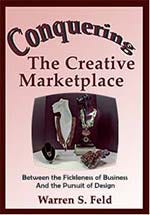
Many people learn beadwork and jewelry-making in order to sell the pieces they make. Based both on the creation and development of my own jewelry design business, as well as teaching countless students over the past 35+ years about business and craft, I want to address what should be some of your key concerns and uncertainties. I want to share with you the kinds of things (specifically, a business mindset and confidence) it takes to start your own jewelry business, run it, anticipate risks and rewards, and lead it to a level of success you feel is right for you. I want to help you plan your road map.
I will explore answers to such questions as: How does someone get started marketing and selling their pieces? What business fundamentals need to be brought to the fore? How do you measure risk and return on investment? How does the creative person develop and maintain a passion for business? To what extent should business decisions affect artistic choices? What similar traits to successful jewelry designers do those in business share? How do you protect your intellectual property?
The major topics covered include,
1. Integrating Business With Design
2. Getting Started
3. Financial Management
4. Product Development, Creating Your Line, and Pricing
5. Marketing, Promotion, Branding
6. Selling
7. Professional Responsibilities and Strategic Planning
8. Professional Responsibilities and Gallery / Boutique Representation
9. Professional Responsibilities and Creating Your Necessary Written Documents
Materials establish the character and personality of jewelry. They contribute to understandings whether the piece is finished and successful. However, there are no perfect materials for every project. Selecting materials is about making smart, strategic choices. This means relating your materials choices to your design and marketing goals. It also frequently means having to make tradeoffs and judgment calls between aesthetics and functionality. There are three types of materials — Stringing, Aesthetic, and Functional. Each material has three types of properties — Mechanical, Physical and Chemical. Materials differ in quality and value. They differ in the associational and emotional connections which they evoke. They differ in their functional efficiency and effectiveness to lend pieces an ability to retain a shape, while at the same time, an ability to move, drape and flow. They differ in cost and durability. Last, materials may have different relationships with the designer, wearer or viewer depending on how they are intended to be used, and the situational or cultural contexts.
MATERIALS: Knowing What To Know The materials I use are alive
The world of jewelry design and the materials used can be complex, especially for jewelry designers just starting out in their careers. The novice, but also the more experienced designer, as well, often run up against some terms and properties of materials they have not dealt with before. Materials affect the appeal of the piece. They affect its structural integrity. They affect the cost. They affect how people view, sense, desire and understand the piece, its coherence, its relationship to the designer, and its value.
If you wanted to gain an understanding of materials, You Would Be Very Aware Of…
You would be very aware of where they came from, how they were described, sold and marketed. You would be very aware of the beads and jewelry findings and stringing materials and tools, their qualities, when they were useful and when they were not, and what happened to them when they age. You would be very aware of what country the material was made or found in, how the material was manufactured, synthesized or gotten at, if it was modified or changed in any way, and how it came to market. You would be very aware if the product was sold at different levels of quality, even if this was not differentiated on the product’s label. It would also be important to be very aware how any of these aspects of the material have changed over time, or might change over time in the future.
You would be very aware that there was no such thing as the perfect material. There are only better materials, given your situation and goals. There is no perfect bead for every situation. No perfect clasp. No perfect stringing material. Every choice you make as a jewelry designer will require some tradeoffs and judgment calls. The more you understand the quality of the materials in the pieces you are working with are made of, and the clearer you are about your design goals, and if you are selling things, your marketing goals, as well, the more prepared you will be to make these kinds of choices.
You would be very aware that materials have different values and life spans, and this must relate to your project goals. The choices you make for fashion jewelry will rely on very different criteria than the choices you make for investment quality pieces. You would not want to use metalized plastic beads, for example, in a piece you call an heirloom bracelet. Metalized plastic beads are a metal shell around a milky white plastic bead. The shell will chip easily. On the other hand, when doing fashion jewelry, these very inexpensive beads, and which have a short life-span, would be perfect. Not only are they cheap, but because they are cheap, there are lots and lots more styles and shapes and textures.
If your goal is to create more investment quality pieces, then you would not want to buy lampwork beads which have not been appropriately annealed (that is, if not cooled down correctly, they will fracture and break easily). You would buy appropriately annealed ones, but which are considerably more expensive. This may affect the look of your pieces. For an inexpensive, fashion oriented piece, your necklace made up entirely of lampwork beads which have not been appropriately annealed might be very affordable. It would have that great handmade, artisan look. It might sell for only $60.00. If the necklace was made up of all quality lampwork beads, — it would have the exact same look and style as its inexpensive cousin, but it might have to retail for $600–800.00. Usually, with more investment quality lampwork beads, you might just use one, or perhaps three of these considerably more expensive lampwork beads, and have a lot of cord showing, or a lot of filler beads, to keep the piece affordable. This would be a very different design look and style.
Again, for an investment quality piece, you would want to use crystal beads manufactured in Austria or the Czech Republic, and not ones manufactured elsewhere. And you would not let yourself be fooled when the front of the package says “Austrian Crystal” when the back says “Made In China”. Crystal beads made in China are not as bright, there are more production issues and flaws in the beads, and the holes are often drilled off-center when compared to their “Made In Austria” counterparts. But crystal beads more appropriate for that investment quality piece might be overkill for a fashion piece where you want to add a pop of brightness without a lot of additional cost. Often the cheaper cousins have some interesting colors or shapes not available in the more expensive lines.
You would want to be very aware of the different treatments of beads and metals. Some things are radiated, heated, reconstituted, partly synthesized, lacquered, coated or dyed. Sometimes this is a good thing and these treatments enhance the quality of materials in appearance and durability. Othertimes this is a bad thing, negatively affecting the quality or look and sensibility of the materials.
You would be very aware that many of the materials you use are described in ways that do not provide you with sufficient information to make a choice. Take the material gold-filled. The definition of gold-filled is that the material is a measurable layer of real gold fused to brass, sometimes copper. But the legal definition does not tell you how thick the gold has to be over the brass for the material to be called gold-filled. So in the market, some gold-filled has very little gold and will lose its gold very quickly, and other gold-filled has a thicker layer and will keep its gold, its shine, its shape for decades.
Or sterling silver. Sterling silver is supposed to be 92.5% silver (marked .925). The alloy, that is the remaining 7.5%, is supposed to contain, by law, a lot of copper. However, many manufacturers substitute some nickel for the copper to keep the cost down. The addition of nickel in the alloy makes the sterling silver less expensive, yes, but it also makes it more brittle. It is the difference between being able to open and close the loop on an ear wire, off of which to hang the dangle, many, many times or only two or three times before the wire loop breaks.
Lots of sterling silver items get marked .925. And in jewelry making, many of the pieces we use are so small, there is no .925 stamp on them. Besides a change of what is in the alloy affecting the usefulness and value, many other things happen in the marketplace, as well. Many sterling silver items have been cast. What frequently happens is that some of the silver is lost in the casting process, so it is no longer at 92.5%. Manufacturers are supposed to make note of this, but many just stamp .925 on these items. Some shops label items as sterling silver, but in reality, are selling you pieces that are nickel. And some places will sell you something silver plated, but attach a sterling silver .925 tag to it and which is marked .925 on it off the clasp. The tag is sterling; the jewelry is not. I’ve seen some major craft stores, many chain stores in the malls, and some major jewelry stores sell metalized plastic jewelry and jewelry components and label it .925.
Flexible, nylon coated cable wires are one of the primary types of stringing materials. The measure of cable wire strength is called tensile strength. This has to do with what the wires are made of, what the nylon sheathing is made of, and how thick and nonporous that nylon sheathing is. What makes the wire strong is the nylon sheathing’s ability to maintain the twist in the wire. As soon as the integrity of the nylon sheathing is violated, the wire untwists and immediately breaks. You will not see tensile strength referenced on the labels of these products. The information which is referenced (number of strands, wire thickness) gives you some information needed to make a choice, but insufficient information to make an actual choice. Even when they list the number of strands, this doesn’t give you enough factual information to depend on. One brand’s high-end, 7-strand is stronger and more supple than that same brand’s 49-strand middle range product. This same brand’s middle range 49-strand product is stronger and more supple than another brand’s high end 49-strand product.
You would also be very aware that you cannot assume that there is consistency and uniformity for any given product. There are many production issues that arise in the manufacture of glass beads, for example. Some beads are perfect. Some have flaws. These flaws might include some flat surfaces when everything should be rounded. The color not going all the way through. Holes drilled off-centered. Bead sizes and hole sizes inconsistent from bead to bead. Some bead holes that are especially sharp. Some beads which have coated coloration which is poorly applied and chips off quickly. In clothing, these beads with flaws would be labeled irregulars, but they are not so labeled in beads. Some companies specialize in selling you perfect manufactured glass beads; other companies specialize in selling you the irregulars. They don’t advertise that fact. Either quality looks the same when you buy it; they just don’t hold up the same in close examination or from wear.
You would be aware that fabricated and stamped metal pieces are more durable than cast metal pieces, but a lot more expensive, and with a smaller palette of designs for the artist. You would be aware that the measure of pound strength on any label is the weakest piece of information to grab onto. The law only defines how pound strength should be measured. Since most products are manufactured abroad, little care is taken to guarantee the validity of this information.
You would be aware that materials which are dyed may be a different color from batch to batch. The color of the material is affected by the barometric pressure outside the manufacturing facility the day they are dyed. The factory cannot control for this.
You would be aware that there are a lot of things to know about the materials used in jewelry design.
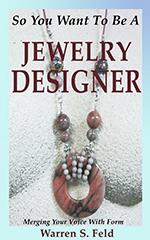
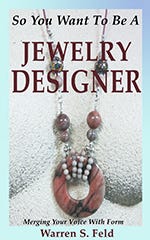
SO YOU WANT TO BE A JEWELRY DESIGNER Merging Your Voice With Form
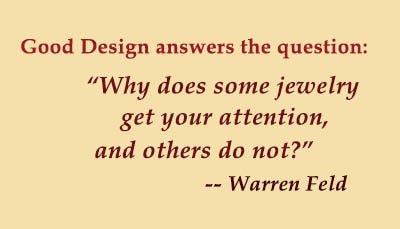
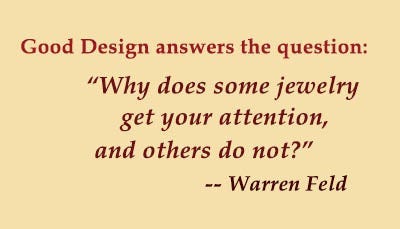
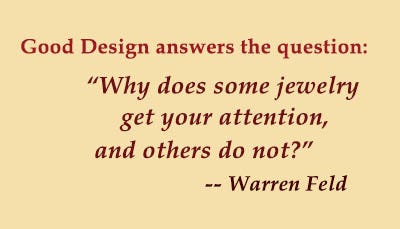
So You Want To Be A Jewelry Designer reinterprets how to apply techniques and modify art theories from the Jewelry Designer’s perspective. To go beyond craft, the jewelry designer needs to become literate in this discipline called Jewelry Design. Literacy means understanding how to answer the question: Why do some pieces of jewelry draw your attention, and others do not? How to develop the authentic, creative self, someone who is fluent, flexible and original. How to gain the necessary design skills and be able to apply them, whether the situation is familiar or not.
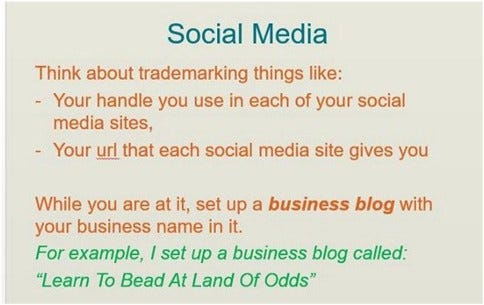
Besides your personal pages on various social media sites, you will want to have separate business pages. You would each business page to be keyed off you unique, registered and/or trademarked business name.
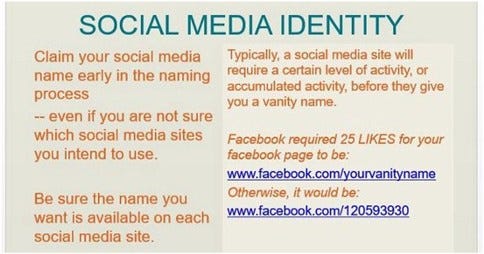
It’s a good idea to claim your social media name early in the naming process — even if you are not sure which sites you intend to use. A name for your Facebook page can be set up and changed, but you can only claim a vanity URL or custom URL once you’ve got 25 fans or “likes.” This custom URL name must be unique, or un-claimed.
Along with the URL for the business name, you’ll want to check and make sure there are places on Facebook, LinkedIn, Twitter, and Instagram (at the minimum) to claim early on.
You will want your business listed as a business in various search engines, like Google and Bing, Google Maps, Google Business, and various directories, like Yelp.
Being active on public social media platforms such as Facebook, Instagram, LinkedIn, BlueSky, and Twitter in addition to your own business blog, is almost an essential part of any business marketing toolkit. These tools can have enormous benefits, but they also have their dangers.
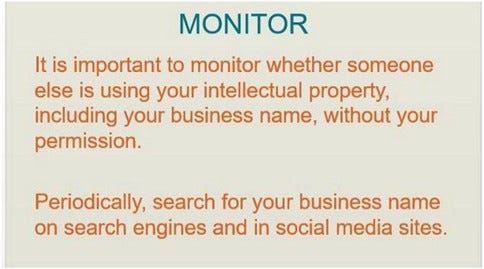
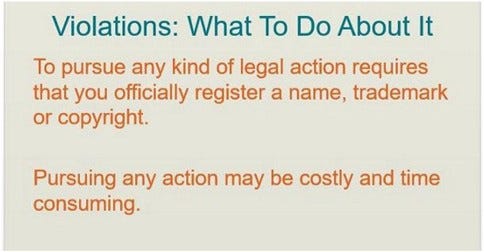
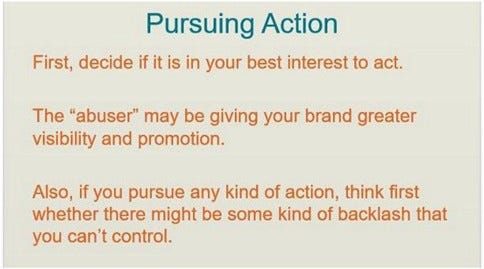
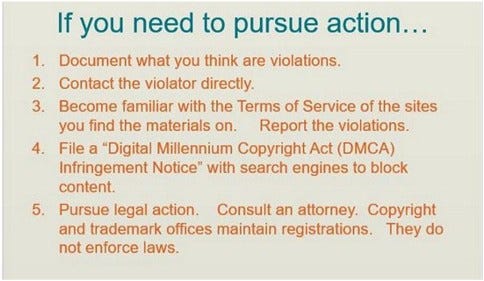
For example, some businesses jump on social networking sites only to discover that someone has already registered their company or product names on Facebook and Twitter and is misrepresenting their brand as a consequence. Likewise someone might be out there reproducing your copyrighted web copy, blogs, photographs and videos (all that good multi-media stuff that social networks love to propagate) — without your knowledge.
For more articles about Conquering The Creative Marketplace, click over to our Jewelry Designers’ Hub
Many people learn beadwork and jewelry-making in order to sell the pieces they make. Based both on the creation and development of my own jewelry design business, as well as teaching countless students over the past 35+ years about business and craft, I want to address what should be some of your key concerns and uncertainties. I want to share with you the kinds of things (specifically, a business mindset and confidence) it takes to start your own jewelry business, run it, anticipate risks and rewards, and lead it to a level of success you feel is right for you. I want to help you plan your road map.
I will explore answers to such questions as: How does someone get started marketing and selling their pieces? What business fundamentals need to be brought to the fore? How do you measure risk and return on investment? How does the creative person develop and maintain a passion for business? To what extent should business decisions affect artistic choices? What similar traits to successful jewelry designers do those in business share? How do you protect your intellectual property?
The major topics covered include,
1. Integrating Business With Design
2. Getting Started
3. Financial Management
4. Product Development, Creating Your Line, and Pricing
5. Marketing, Promotion, Branding
6. Selling
7. Professional Responsibilities and Strategic Planning
8. Professional Responsibilities and Gallery / Boutique Representation
9. Professional Responsibilities and Creating Your Necessary Written Documents
Jewelry comforts us as we age in place. The bracelet we got for graduation still worn on an occasion when we are 65. The ring he bought her when she was in her 20’s still worn on the day she passed away.
With jewelry, we will never feel alone as we grow older. As our body changes in pallor and texture. As we gain weight or lose weight. As we change our styles of clothing or hair or activity.
This constellation of material objects, distributed across the human body, reflects transformation, movement, growth, and behavior. These reflect the life we live, and how we lived it. These are stories of how we performed our lives over time. They reveal an otherwise unseen perspective on life as the body ages, and we live through time. They show that not all lived lives have been ad lib’ed.
The jewelry will also show its age over time. Changes in color, perhaps fading, perhaps becoming duller or spotty. A clasp may have been replaced. The piece may have been restrung. It may have been shortened or lengthened. It may have been worn a lot. Or lost for a while. Or given away. Its associative or symbolic value may have changed.
Jewelry is life performed. Both are observable. Both indicative of our place – our aura – in the world around us as time goes on. Both an experience – often changing – of a point of view from the hand that crafted the piece in the first place, and the desires of the person who wore the piece over time. We possess it and wear it so it reminds us that we are not alone.
SO YOU WANT TO BE A JEWELRY DESIGNER Merging Your Voice With Form
So You Want To Be A Jewelry Designer reinterprets how to apply techniques and modify art theories from the Jewelry Designer’s perspective. To go beyond craft, the jewelry designer needs to become literate in this discipline called Jewelry Design. Literacy means understanding how to answer the question: Why do some pieces of jewelry draw your attention, and others do not? How to develop the authentic, creative self, someone who is fluent, flexible and original. How to gain the necessary design skills and be able to apply them, whether the situation is familiar or not.