Warren Feld Jewelry

Taking Jewelry Making Beyond Craft

Archive for the ‘Entrepreneurship’ Category

BUILDING YOUR BRAND: What Every Jewelry Designer Needs To Know!

Posted by learntobead on September 16, 2022

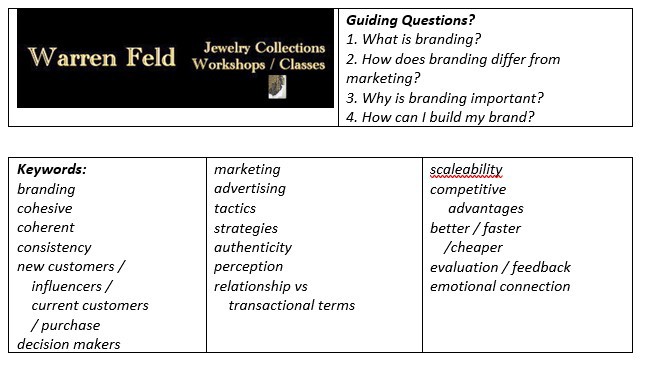
Branding

The ultimate goal and priority for any successful business is branding. Here your clients have an emotional connection to your work as a designer. They immediately recognize your style. Your choices in design. Your sensibilities. Your value and desirability for them. Branding is about what your customers perceive about you, and how you make them feel.

Your brand has ingredients; many moving parts which consist of the following:

  • The quality of your product or service
  • How it offers more value (for example, better quality, easier access, and/or lower price) than your competition
  • The speed at which you deliver it
  • The support you give your existing customers
  • The tone/look/feel of your product, copy, and advertising
  • How many different contexts and situations in which it is used

Jewelry designers who are successful know how to build your brand. In this chapter, I discuss this in more detail.

What Is Branding?

Branding is your product’s personality. You. Your voice. Your message. Your commitment. Your look. Your artist’s hand. But always remember, with branding, consistency is the real driving force behind it.

Your jewelry will have a personality. It may project one or more of these characteristics: handcrafted, artistic, sophisticated, human, enduring, novel, playful, versatile, fashionable, well-constructed, noticeable, enviable. These are the kinds of things you think your customer wants, desires or needs. These are the kinds of things customers buy jewelry for — to make their life a little better, a little bit more fun, a little bit more authentic. These are the kinds of things your customers want to feel when purchasing and wearing your jewelry.

Your brand is the name, term, design, symbol, or any other feature that identifies your product as distinct from those of others. Brand is often the most valuable asset of a company. As such, it needs to be groomed and managed carefully. Good branding will result in higher sales and greater longevity for the business. Good branding can make it easier to introduce new products. Good brand management seeks to make your product or service relevant to your target audience.

Your brand will be used in several contexts — in a store, on stationery, on websites, in posts, as signatures in email, with image captions. As such, it should be what is called scale-able — that is, it is flexible and adaptable enough to function in many contexts.

I am often asked: What if you want to make a lot of different kinds and styles of jewelry? If they are so different that they feel like they are different brands, you will either have to narrow your interests, or develop separate branding strategies for each set of products.

If you want to sell other types of products along with your jewelry, if they feel like a part of the same brand, then your branding strategy should be something that encompasses all the variations in products available. If they feel like separate brands, then you need a unique branding strategy for each one.

How Does Branding Differ From Marketing?

Businesses often make the mistake of talking about marketing, advertising and branding interchangeably. So people often confuse them. This confusion is unfortunate.

Marketing is what you do. Marketing efforts make people aware of you.

Advertising is a tool or technique. It is one of the many, many things marketers do.

Branding is what you are. Branding efforts create an emotional and enduring connection to you.

You cannot do effective marketing without a clear idea of your brand, and the words, look and feel needed to convey it. Branding should both precede and underlie any marketing effort. The brand is bigger than any particular marketing effort. The brand is what sticks in your customer’s mind about your product or company, whether they purchased your product or not.

Marketing may convince someone to buy. Branding will convince someone to be loyal.

Marketing will unearth buyers. Branding will make them advocate for you.

Why Is Branding Important?

Everything you do will have the effect of either inspiring or deterring your customer. Every thought, price, design choice, marketing promotion, merchandising decision, product placement — all of these lead up to your customer recognizing (or not) you and your jewelry as a brand. Branding is the essential foundation to a successful jewelry design business.

You should be in brand-building-mode from day 1!

Your Successful Branding Campaign

What drives you? Passion? Values? Purpose? People who create great brands are usually seeking to fulfill some inner longing of their own, some dream of how they want to live their lives.

How do you want your customer to perceive you? What is your long-term vision? What will your business look like when you are done? Can you track your progress? Can you create clear milestones to help you know if you are on tract? Why would someone do business with you rather than someone else?

Most successful brands use very human strategies in their communication and relationship building. You need to see and understand your business in relationship terms, not transactional ones. Give you brand an aura. Inspire your customer. How will you serve them? How will you solve their problems through the jewelry you design? What do you stand for? What differentiates you from your competition? What types of products and services can your customers expect from you?

A successful jewelry designer would not merely say “I make jewelry.” She would be more focused, more specific and more enthusiastic. She might say, “I create beautiful works of art to adorn people.” She might say, “I make people ooh and aah!” She might say, “I help people find that right décor accent they have been looking for.”

Your customer needs to know:

1. What you have to sell

2. How your jewelry changes something in their lives, and

3. What they have to do to get one of those

Try to emphasis specificity and avoid generic statements.

Who Are You Targeting
With Your Branding Campaign?

You want to target four key audiences with your branding campaign. These include:

1. New Customers

2. Influencers

3. Current Customers

4. Purchase Decision Makers

Your Business Name
Should Reflect Your Brand

How does your business name relate to your product and brand identity? Does your tag line support your brand identity?

If you plan on selling more products than just jewelry, you do not need the word jewelry in your name. Anticipate the future of your business as best as you can.

Before you select that name,

· Settle on a tone.

· Research that brand names you want are available.

· English is not the only language option for you.

· Getting feedback is your best friend.

The Names Your Call Your Jewelry And Lines Of Jewelry
Should Reflect Your Brand

Giving names to your jewelry and jewelry lines allows you to amplify your company name and brand, as well as their impacts and effects. But you must tie your naming strategies back into your primary brand identity.

Your LOGO and Other Graphics Designs
Should Reflect Your Brand

Does your logo relate to your products and values? Does the logo help people remember you?

You want effective visual brand identity. Fonts, colors, images, packaging, displays, use of particular visual elements to create distinction all should support your brand.

Your ELEVATOR PITCH and TAG Lines
Should Reflect Your Brand

Your Elevator Pitch and your Tag Line make it easier not only for your audience to understand exactly what your product is, but also gives them something easy and simple to share. Shareable information is spreadable. It can be posted, tweeted, texted and talked about. These give your brand a voice.

The Look of Your Pieces
Should Reflect Your Brand

You play with shapes, colors, sounds, scents, tastes, movements, textures, patterns, compositions, silhouettes, packaging, displays, constructions — are all of these supporting your brand?

Your Website and Online Social Profiles
Should Reflect Your Brand

Your website and online social profiles should look like your work — similar in look, feel and tone. Your work and your presence need to reflect on one another and be compatible.

Always include CALLS TO ACTION and/or LESSONS LEARNED throughout.

Your Portfolio
Should Reflect Your Brand

If you have a varied set of pieces to include in your Portfolio, organize them in such a way that your brand identity still shines through. This might involve placement, naming, descriptive text, sizing and layout.

Delivering Your Message Clearly

It goes without saying that you can have a lot of things organized and in place, but the crux comes in how you deliver your brand message clearly.

Think about: Why do things catch on? Why do people talk about you? How do you generate a buzz?

Developing your marketing message, pretesting it, pretesting again, testing, testing again is very important. Your message needs to be consistent and coherent and resonate with people. Your customer should be able to anticipate that your brand is going to deliver the same essence of a thing each and every time.

It is very tempting to try to be everything to everyone. And you may have different kinds of customers. But, at the end of the day, they all should have the same impression of your values and your products.

Your core message needs to have both an emotional side and a rational side.
Example: You make jewelry that lasts.

Your core message needs to be believable.
Example: Your jewelry is worn by the queen. [True or not true?]

Your core message needs to be relevant.
Example: I sell wedding jewelry. [Only relevant for people who need jewelry for a wedding; if that’s not your customer, this message won’t work.]

Your core message needs to be simple. If your customer cannot understand, remember or repeat your one thing, it is too complicated. It won’t stick in the person’s mind.

Give people things to talk about. Make things fun.

You will be using a multi-method approach towards getting your branding messages out. Advertising. Social Media. Attending events. Sponsorships. Selling in stores. Website. Donations. Packaging. Displays. You want your message to be reinforced over and over again from many angles and points of view.

Your marketing message should promise what you know you can actually deliver. Authenticity reconfirms actions, and in term, resonates well with customers.

Confirming Your Credibility

Tell and share your story in a way that creates a connection with your customer. Think about how things in your life led up to your success, how this relates to the brand identity you are trying to create, and, last, how the customer will relate to your story. You may find you have to re-write your story to meet your branding goals, and this is OK.

Your jewelry can be explained by your values and beliefs, your experiences and lifestyle. Put into words who you are, what your values and beliefs are, also your goals and how you approach the jewelry design process.

Show and tell the customer, in simple words and phrases, what the consequences (positive and/or negative) for them might be if they bought and wore your jewelry, and what the likelihood of any of these consequences occurring.

Offer any evidence that your assessment of consequences and their likelihood of occurring will happen.

People always trust word-of-mouth, so generating this is always important.

Commit to serving your customer over and over again, and they will learn to trust and rely on you.

Connecting To Your Clients Emotionally

Always work to market that emotional connection with your customers. Inspire affection. Create fantasy.

People need to see your business as a solution to their problems. So you want to make your competitive advantages (over all your other competitors) very visible and apparent. Show and tell them how you intend to minimize their risk should they choose your products to solve their problems. Not generic problems, but the actual concerns of your real and potential customers.

Customer concerns and problems may be one or more of the following:

· Want peace of mind

· Want to feel a part of a group or family

· Want to feel they make good choices

· Want to make life easier

· Want their questions answered

· Want to minimize any sense of risk or consequences

· Want to be the focus of attention

· Want to fit into a particular situation, context, event

· Want power and influence

· Want reassurance about something

· Want greater self-esteem

· Want meaning in their life

Listen to feedback. What are your better customers saying about your brand — positive, negative and everything in between? Show them that you hear what they are saying.

Always respond in meaningful ways. Follow-up on everything. The more you can repeat your customer’s first name in your follow-ups, the better their response.

Motivate Your Buyer, and
Secure Your Customer’s Loyalty

Recognize loyalty. Reward and cultivate. Give them access to new products and services first. Involve customers in your business. Let them test your products. Turn them into brand ambassadors and encourage them to spread word of mouth. Get feedback on your marketing strategies. Give them a sense of brand ownership. Engage in conversations. Respond to needs. Make them feel good. Give out referral rewards. Encourage them to post reviews online, and then thank them for these. Feature them on your website or blog. Follow-up after purchases.

SUCCESSFUL BRANDING STRATEGIES

There are many types of branding strategies, and you will be using several of these. These include,

1. Making new rules

2. Marketing a belief

3. Creating connection and belonging

4. Enabling expression

5. Creating culture

6. Leveraging tension

7. Using scarcity

8. Encouraging play

Since a lot of your business will occur online, you will be doing a lot of social media marketing.

Anticipate Problems

Your brand loyalty can disappear in almost an instant. You have to be diligent in anticipating or dealing with after the fact, things like

· Service interruptions

· Too many options diluting the brand

· Mixed messages confusing customers

· Negative publicity or negative word-of-mouth

· New competitors or existing competitors upping their game

The jewelry market is always big enough to attract new competitors as well as provide opportunities for existing competitors to deliver better, faster, cheaper. Face the challenge to elevate your marketing and branding strategies and tactics and deliver more value.

Brands Evolve

As time goes on, things come in and go out of fashion. Styles, colors, silhouettes. Your customers might begin to get bored or even dislike your brand. Stay relevant and flexible. A well-managed brand is always making adjustments.

You want to be ready to deal with this kind of thing before it happens. That means, it is important to be ready to re-brand. It is important to seek out and enter new markets. It is critical that you be in touch at all times with your customers’ goals and values.

Periodically, reality test.

For instance, visualize someone else taking over your business. Could they succeed at maintaining your brand?

Did your product deliver the experience the customer was looking for?

Have you maintained quality standards?

Did your employees and sales staff and sales agents understand your brand and sound like they know what they are talking about when interacting with customers?

Did you respond to phone calls and emails in a timely manner?

Do you customers believe you have their best interests at heart?

Measure Your Effectiveness

It is always important to build in evaluative and feedback components to all your business activities. Branding is no exception.

How well is your business (you and your employees) inspired to execute all your proposed marketing and branding activities?

Given the time and money you are spending, are you getting that Return On Investment (ROI)?

Does your brand resonate with your customers? Does this translate into sales and profitability?

Plan to do some experimenting by testing out different ideas before settling on one. Be sure your ideas fit your brand authenticity and align with your strategies.

_______________________________

Thank you. I hope you found this article useful.

Also, check out my website (www.warrenfeldjewelry.com).

Enroll in my jewelry design and business of craft Video Tutorials online. Begin with my ORIENTATION TO BEADS & JEWELRY FINDINGS COURSE.

Follow my articles on Medium.com.

Subscribe to my Learn To Bead blog (https://blog.landofodds.com).

Visit Land of Odds online (https://www.landofodds.com)for all your jewelry making supplies.

Check out my Jewelry Making and Beadwork Kits.

Add your name to my email list.

_________________________________

Other Articles of Interest by Warren Feld:

Saying Good-Bye! To Your Jewelry: A Rite Of Passage

The Jewelry Design Philosophy: Not Craft, Not Art, But Design

What Is Jewelry, Really?

The Jewelry Design Philosophy

Creativity: How Do You Get It? How Do You Enhance It?

Disciplinary Literacy and Fluency In Design

Becoming The Bead Artist and Jewelry Designer

5 Essential Questions Every Jewelry Designer Should Have An Answer For

Getting Started / Channeling Your Excitement

Getting Started / Developing Your Passion

Getting Started / Cultivating Your Practice

Becoming One With What Inspires You

Architectural Basics of Jewelry Design

Doubt / Self Doubt: Major Pitfalls For The Jewelry Designer

Techniques and Technologies: Knowing What To Do

Jewelry, Sex and Sexuality

Jewelry Making Materials: Knowing What To Do

Teaching Discplinary Literacy: Strategic Thinking In Jewelry Design

The Jewelry Designer’s Approach To Color

Point, Line, Plane, Shape, Form, Theme: Creating Something Out Of Nothing

The Jewelry Designer’s Path To Resonance

Jewelry Design Principles: Composing, Constructing, Manipulating

Jewelry Design Composition: Playing With Building Blocks Called Design Elements

Contemporary Jewelry Is Not A “Look” — It’s A Way Of Thinking

__________________________________

SO YOU WANT TO BE A JEWELRY DESIGNER
Merging Your Voice With Form

588pp, many images and diagrams Ebook or Print

PEARL KNOTTING…Warren’s Way
Easy. Simple. No tools. Anyone Can Do!
184pp, many images and diagrams Ebook or Print

SO YOU WANT TO DO CRAFT SHOWS

16 Lessons I Learned Doing Craft Shows

198pp, many images and diagrams Ebook or Print

___________________________________________
Posted in bead weaving, beads, beadwork, business of craft, craft shows, Entrepreneurship, jewelry design, jewelry making, pearl knotting, professional development, wire and metal | Tagged: , , , | Leave a Comment »

MARKETING / PROMOTION / POSITIONING:

Posted by learntobead on September 4, 2022

About Marketing Strategies For Jewelry Designers

Abstract:

As a marketer, you will be developing and organizing a series of communication strategies and tactics. You will also be combining things into coherent marketing campaigns with defined goals and methods for collecting evidence from which you can evaluate success. This article discusses the importance of spreading word-of-mouth and some ideas towards this end. Also discussed are some additional marketing ideas workable for the designer.

Marketing Strategies

As a marketer, you will be developing and organizing a series of communication strategies and tactics. You will also be combining things into coherent marketing campaigns with defined goals and methods for collecting evidence from which you can evaluate success.

Your strategies will hone in on the 4 P’s: product, price, promotion and place.

· Product: serves a need not being met or provides a novel experience

· Price: set a fair price both to you as well as your customer

· Promotion: your marketing message and how you get the word out

· Place: where your product is available and your distribution arrangements

Whatever marketing strategies and tactics you resort to, remember this.

· You need to be different and refreshing.

· You need to do something your target audience(s) will talk about.

· You need to make your product approachable, accessible, and memorable.

· You need to enhance the emotional connection among client, product and designer.

· You need to be patient and focused.

· You need to be creative.

· You need to be authentic.

· You need to be market-driven, not product-driven. [It might be a great product, but there needs to be a market for it.]

Some marketing tasks you will direct and take charge of yourself. With some, you will work with an agency and turn over responsibility to them. You might rely on online influencers and bloggers. Some things will be in print. Some will be images and/or posts online. Some will be messages to your email followers. You might coordinate your marketing with similar or complimentary products of other businesses (called co-marketing). You might donate items to organizations which will publicize your donations. You will have business cards, brochures, jewelry name cards, guest books, packaging, letterhead stationery, websites, domain names. You might be able to get articles written about you or invitations to participate in podcasts.

You will find that, with jewelry, you will need to use a multi-method approach to your marketing. Any one particular approach won’t be sufficient to reach enough potential clients and influence enough buying decisions to keep you in business.

The Importance of Word of Mouth:
The Biggest Source of New Customers

If your client has had a positive experience with you and your products, it is highly likely they will share this with someone else. This is called word of mouth. Word of mouth might result from a conversation. It might result from an online or print review. It might be generated from comments to an online post. It might be a mention in an article. Word of mouth usually accounts for 3 of every 4 jewelry sales in the United States.

Things which drive word of mouth:

· Thanking your customer

· Asking your customer if they get compliments on your pieces they wear, and if so, can they mention that in a review or post online

· Ask your customers to talk about you, such as mentioning you on Facebook.

· Offer a discount to a customer who refers another to you.

· Image and Video posts on Instagram and other social media sites, and concurrently responding to all LIKES and COMMENTS. Note: Always repeating the person’s first name in our response comments.

· Join social media sites groups, and comment on various posts.

· Hold a customer appreciation event.

· Do some co-marketing with similar businesses in town.

· Follow-up on sales to make sure customers are happy.

· Bring a friend campaign.

· Give out business cards.

· Show something special to clients which I know they will want to tell others about.

· In-store giveaways.

· Be involved in the community.

· Supporting nonprofit fund-raising events, usually by offering a gift certificate or a showy piece of jewelry

· Create how-to handouts and/or post videos online (or other educational content) you can give to customers for free.

Some Marketing Ideas

1. Educate with your content

2. Personalize your marketing messages

3. Be data driven

4. Keep your messages and content updated

5. Be visible in your community and online

6. Manage active and frequent email campaigns, along with implementing strategies to expand your email list

7. Rely on credible influencers

8. Concentrate on one, perhaps two, social networks only, and give it your all

9. Create opt-in offers

10. End all your marketing and promotional messages with a call to action

11. Be a strategic user of key works in webpage designs and promotions

12. Teach

13. Do repairs

14. Survey, listen and learn

15. Sponsor a charitable event

16. Donate products or services to a charity event

17. Co-market with other small businesses

18. Do presentations or webinars to enable your audience to get to know, like and trust you

19. Provide free consultations or demonstrations

20. Write articles

21. Build a website optimized for search

______________

FOOTNOTES

Coursera. The 4 Ps of Marketing: What They Are and How to Use Them. 8/10/2022.

As referenced in:
https://www.coursera.org/articles/4-ps-of-marketing

Hill, Andrea. When Marketing, Be Clear Who You Want To Reach and What You Want To Sell. Digital Marketing Decisions, 2/11/2021

As referenced in:
https://instoremag.com/when-marketing-be-clear-who-you-want-to-reach-and-what-you-want-to-sell/?oly_enc_id=8486A9291356F6C

Koshy, Vinay. 18 Powerful Marketing Stategies To Grow Business Faster, 1/14/2022.

As referenced in:
https://www.engagebay.com/blog/powerful-marketing-strategies/

Less Everything. Unconventional Marketing With No Money, Chapter 5: Business Guide: Run Your Business. Don’t Let Your Business Run You.

As referenced in:
http://lesseverything.com/business-advice/unconventional-marketing/

Main, Kelly. 18 Jewelry Marketing Ideas to Drive Sales Without Spending a Fortune, 12/13/2021.

As referenced in:
https://fitsmallbusiness.com/jewelry-marketing-ideas/

Smith, Lisa. The 16 Best Marketing Strategies to Try This Year.

As referenced in:
https://www.wordstream.com/blog/ws/2020/01/07/best-marketing-strategies

_______________________________

Thank you. I hope you found this article useful.

Also, check out my website (www.warrenfeldjewelry.com).

Enroll in my jewelry design and business of craft Video Tutorials online. Begin with my ORIENTATION TO BEADS & JEWELRY FINDINGS COURSE.

Follow my articles on Medium.com.

Subscribe to my Learn To Bead blog (https://blog.landofodds.com).

Visit Land of Odds online (https://www.landofodds.com)for all your jewelry making supplies.

Check out my Jewelry Making and Beadwork Kits.

Add your name to my email list.

_________________________________

Other Articles of Interest by Warren Feld:

Saying Good-Bye! To Your Jewelry: A Rite Of Passage

The Jewelry Design Philosophy: Not Craft, Not Art, But Design

What Is Jewelry, Really?

The Jewelry Design Philosophy

Creativity: How Do You Get It? How Do You Enhance It?

Disciplinary Literacy and Fluency In Design

Becoming The Bead Artist and Jewelry Designer

5 Essential Questions Every Jewelry Designer Should Have An Answer For

Getting Started / Channeling Your Excitement

Getting Started / Developing Your Passion

Getting Started / Cultivating Your Practice

Becoming One With What Inspires You

Architectural Basics of Jewelry Design

Doubt / Self Doubt: Major Pitfalls For The Jewelry Designer

Techniques and Technologies: Knowing What To Do

Jewelry, Sex and Sexuality

Jewelry Making Materials: Knowing What To Do

Teaching Discplinary Literacy: Strategic Thinking In Jewelry Design

The Jewelry Designer’s Approach To Color

Point, Line, Plane, Shape, Form, Theme: Creating Something Out Of Nothing

The Jewelry Designer’s Path To Resonance

Jewelry Design Principles: Composing, Constructing, Manipulating

Jewelry Design Composition: Playing With Building Blocks Called Design Elements

Contemporary Jewelry Is Not A “Look” — It’s A Way Of Thinking

__________________________________

SO YOU WANT TO BE A JEWELRY DESIGNER
Merging Your Voice With Form

588pp, many images and diagrams Ebook or Print

PEARL KNOTTING…Warren’s Way
Easy. Simple. No tools. Anyone Can Do!

184pp, many images and diagrams Ebook or Print

SO YOU WANT TO DO CRAFT SHOWS

16 Lessons I Learned Doing Craft Shows

198pp, many images and diagrams Ebook or Print

___________________________________________
Posted in bead weaving, beads, beadwork, business of craft, craft shows, Entrepreneurship, jewelry design, jewelry making, pearl knotting, professional development, wire and metal | Tagged: , , , | Leave a Comment »

MARKETING / PROMOTION / POSITIONING:

Posted by learntobead on September 4, 2022

Enhancing The Designer’s Influence and Persuasion

Abstract:

Marketing is about creating persuasive arguments which can influence a person’s beliefs, attitudes, motivations, intentions and behaviors. Influence comes with knowing what the best outcome that the marketer should seek. Persuasion includes the tools you use to get there. Persuasion can take many forms. The marketer’s success depends on a handful of persuasive factors. Marketing strategies follow one or more of eight universal principles of persuasion. Information within any successful persuasive argument is best presented in a certain order.

Influence and Persuasion

Marketing is about creating persuasive arguments which can influence a person’s beliefs, attitudes, motivations, intentions and behaviors. The marketer wants to be able to persuade the client to focus their attention on the jewelry product line, to approach it, touch it, try it on, buy it, exhibit it, share it with others, then, moreover, to further persuade these others (thus making the marketing message contagious) to want to buy it. Influence comes with knowing what the best outcome that the marketer should seek. Persuasion includes the tools you use to get there.

When we are trying to persuade someone, we might be trying to get them to change their mind about something. We might want them to change the weight, ranking or priority they give one thing over another. We might want them to see the interrelationship among two or more otherwise unrelated things. We might want them to re-evaluate the cost and reward calculus they use when deciding to make a purchase.

When trust is present, influence increases and persuasion ends in more positive outcomes.

Persuasion can take many forms. It can be…

· Coercive, done aggressively through direct commands, threats, fear mongering, shaming.

· Informational, spread as biased in some way towards a particular position or idea.

· Leveraging a belief by appeals to logic and reasoning.

· Leveraging a belief by appeals to feelings and emotions.

· Establishing a high level of credibility or character.

A marketer or jewelry designer is not born as persuasive. It is something to be learned, practiced, applied and applied again. The strength of the marketer’s influence centers on a handful of persuasive factors, such as:

1. Commonalities: People like people like themselves.

2. Logic and Rationality: When you see data, it tells a recognizable story.

3. The Target Audience’s Needs, Wants, Values and Desires: It is important to pay attention and hone in on these.

4. Attractiveness: Attractive people are more persuasive.

5. Confidence / Charisma: Confident /Charismatic people are more persuasive.

6. Preparation: Learning, Practicing and Preparing are how you place yourself in a powerful, persuasive position.

Persuasion and Marketing

Persuasion in marketing involves the ability not just to influence people’s actions, but their attitude as well.

Persuasion is a matter of establishing mutual trust or shared understandings. You develop that sense of trust in your client. That means, they believe that you will deliver on any and all your promises, and that your product will solve their problems, needs and/or desires. The marketer presents some type of evidence which the client must interpret as relevant and valid for themselves, whatever that might mean.

Marketing campaigns are various strategies attempting to influence, direct or change client behaviors by eliciting reactions. Marketing campaigns rely on imagery and word associations tied to emotional responses.

To be persuasive, the marketing message must have value and relevance for your target client. She or he might see a reward or a minimization of costs and agree to change their behavior. She or he might be trying to shield themselves from anything which refutes their sense of self and self-esteem. She or he might derive pleasure when they can align their self-concept with that of the emotional message associated with the product. She or he might find that they can meet their needs for understanding and control by finding out more information about your product.

In response to any marketing campaign, the client can do one of three things:

1. Accept

2. Non-commit or remain indifferent

3. Reject

And it is important to think of persuasion as a continual process. You might be able to persuade someone to purchase your product once, but will they purchase your product again?

The Marketer Should Have A Detailed Familiarity
With Everything Involved With Consumer Behavior

What causes clients to purchase certain products and brands, and reject others? It is important to begin to document client shopping behaviors, motivations and their psychological and sociological underpinnings.

The marketer will want to get a handle on the target audience in terms of

· Psychological Factors: How assumptions, perceptions, understandings, values and desires affect responses to the marketing message.

· Personal Factors: How demographic characteristics, such as age, culture, profession, gender play roles in forming responses to the marketing message.

· Social Factors: How socio-cultural groups, such as income, geographic residence, education level, affect shopping behaviors and responses to the marketing message.

How Can Marketing Affect Client Shopping Behaviors?
The Eight Universal Principles of Persuasion

Persuasion works when the client feels that, by purchasing your product, you and your product have made a positive contribution to their life. There are different ways or principles marketers follow for establishing that sense of positivity.

There are eight universal principles of persuasion the marketer can resort to in order to influence client shopping behaviors. These are,

1. Reciprocity

2. Commitment

3. Consensus

4. Authority

5. Affinity

6. Scarcity

7. Visibility of Consequences

8. Information Exposure

Reciprocity

If you do this for me, I’ll do this for you.

People tend to feel the need to return the favor. You offer or remove incentives and play with client’s natural tendency to be grateful and want to do something for you in return. You might offer them discounts or a free sample. You might put them in a frequent shopper rewards program. You might do a special customization. You might offer them a gift. You might offer something special to first time buyers or to clients who register for your email list.

Commitment

I am a loyal customer.

Once someone is engaged with something, they are more likely to stick to it and commit. They become loyal to the designer, the designer’s business and the designer’s brand. The marketer would do those things which enhance customer loyalty. You might have a special showing or trunk show. You might include them on your email list. You might make them aware a way ahead of time of some deals or opportunities.

Consensus

If it’s OK with them, it’s OK with me.

Sometimes this is referred to as the herd response. If the client sees others doing it, they are more likely to do it as well. The marketer here would demonstrate the popularity of their products with other clients and client groups.

Authority

If such-and-such expert tells me it’s OK, I’ll think it’s OK.

Clients are more likely to listen to an expert they trust, than anyone else. The marketer would have the marketing message put forth by trusted experts who could be seen as authority figures. These authority figures are seen as having already established proof of their knowledges and beliefs. Authority might be actual or implied. Thus, their advice is recognized as trustworthy. You might seek endorsements from well-known figures. You might create an ad where the expert is delivering the message. You might rely on influencers online to spread your marketing message.

Affinity

She bought it, and she’s a lot like me, so I’ll buy it as well.

The client is more willing to follow through on the marketing message and goal if she or he knows someone who is similar to themselves who bought the product. Similarly might be by gender or age or economic class. Similarly might be people who belong to the same church or shop at the same store or attend the same events. The marketer would emphasize shared interests. The marketer would present reasons why conformity is the best choice here.

Scarcity

I better get it right away, if I’m to get it at all.

People tend to want what they think they might not be able to have. When something is scarce, clients tend to assign it more value. Defining the context becomes very important for this principle of persuasion. It might be something that is exclusive. It might be in limited supply. It might have some sense of rarity. It might be subtle clues provided in how the products are displayed to make it seem like you are running out of stock (such as, a very large container with a few items left in the bottom). The product might not be available from any other competitor. The product might be temporarily on sale or only available for a limited amount of time. The marketer might emphasize that this product does what no other product can do. The marketer might emphasize that if the client doesn’t act quickly, the likelihood that they could ever purchase the product will be very low.

Visibility of Consequences

I know what will happen when I purchase and use this product.

The client is more likely to purchase a product if they can anticipate the consequences of their choice. Every purchase is a risk. Will it work? Will it hold up? Will it be appropriate? Will I get the reactions I want? Here the marketer would highlight evidence which makes the consequences obvious, and then more evidence which minimizes the likelihood that any risk and uncertainty might occur. The marketer might emphasize the positive results, and minimize any negative ones. They might point to past successes of this or similar products. They might present the pros and cons and comparative imaging of future outcomes. They might present the pros and cons by comparing antecedents. They might explain that the client will have emotion regrets of they don’t make the purchase.

Information Exposure

I was told it was important now to act.

Clients often have to make choices when they have more limited information upon which to rely. How and when the client is exposed to certain information, prompts, triggers and cues may affect their choice whether to buy a product or not. The client might be distracted. There might be time / timing / seasonal considerations where they pay more attention, say to holiday merchandise during Christmas season, than at other times of the year. Some information may have increased salience, depending on the context. For example, what the jeweler says when standing behind the jewelry counter may have more salience than what that same person says about the same product when randomly meeting that person on the street.

The marketer might present or withhold information based on timing considerations. The message might be different presented during the day from presented during the evening. It might be different in the Spring from the Fall. The marketer might try to connect positive emotional information the client already holds to the product the marketer is trying to sell. This could be a positive memory such as a song or image or experience. The marketer might stress how even with this limited information the client can still anticipate a level of success. The marketer might emphasize negative information about a competitor or competitor’s products. The marketer might use popular phrases and words that have a particular emotional or cognitive association with the target audience.

The Persuasive Argument

Whatever principle of persuasion the marketer follows, the presentation of information in their persuasive argument follows a pattern. That is, informational content, when presented in a certain order, makes for a more persuasive argument. This order is presented in the table below.

A Few Cautions

When marketing your products, you have a professional responsibility not to cross the line between influence and manipulation. You might be successful in manipulation in the short term, but this will probably spell disaster for you mid- and long-term. People are willing to be influenced and persuaded, but resent getting manipulated. And if manipulated, they usually find out.

Don’t present yourself falsely in any way. Don’t claim to be an expert when you are not, for example.

Last, don’t over emphasis economic factors — price, discounts, and the like — in your marketing messages. Rely more on one or more of the universal principles of persuasion where you play towards emotions, perceptions and desires.

_________________

FOOTNOTES

Abelson, Herbert I. Persuasion: How Opinions and Attitudes are Changed.
Spring Publishing, 1965.

Clements, Jon. The Power Of Influence and Persuasion in Business.

As referenced in:
https://metamorphicpr.co.uk/power-of-influence-and-persuasion- in-business/

Davis, Suzanne. 7 Sensational Hooks That Grab Readers’ Attention,
7/14/2022.
As referenced in:
https://www.academicwritingsuccess.com/7-sensational-essay-hooks/

DeFalco, Nicole. Influence vs. Persuasion: A Critical Distinction For Leaders, 10/30/2009.

As referenced in:
https://www.socialmediatoday.com/content/influence-vs-persuasion-critical-distinction-leaders#:~:text=Influence%20is%20having%20a%20vision,earning%20their%20sincere%20buy-in.

Druckman, James N. “A Framework for the Study of Persuasion,” Annual
Review of Political Science, 2022.

Feld, Warren. Health Planner Influence. 1979.

Miller, Michael. The Art of Influence and Persuasion in Business.

As referenced in:
https://www.mindwhirl.com/entrepreneurship/business-mindset/the-
art-of-influence-and-persuasion-in-business/

Peek, Sean. The Science of Persuasion: How To Influence Consumer
Choice, 8/3/2022.

As referenced in:
https://www.businessnewsdaily.com/10151-how-to-influence-
consumer-decisions.html

Vatz, Richard E. The Only Authentic Book of Persuasion. Kendall Hunt,
2013.

Wikipedia. Persuasion.
As referenced in:
https://en.wikipedia.org/wiki/Persuasion

_______________________________

Thank you. I hope you found this article useful.

Also, check out my website (www.warrenfeldjewelry.com).

Enroll in my jewelry design and business of craft Video Tutorials online. Begin with my ORIENTATION TO BEADS & JEWELRY FINDINGS COURSE.

Follow my articles on Medium.com.

Subscribe to my Learn To Bead blog (https://blog.landofodds.com).

Visit Land of Odds online (https://www.landofodds.com)for all your jewelry making supplies.

Check out my Jewelry Making and Beadwork Kits.

Add your name to my email list.

_________________________________

Other Articles of Interest by Warren Feld:

Saying Good-Bye! To Your Jewelry: A Rite Of Passage

The Jewelry Design Philosophy: Not Craft, Not Art, But Design

What Is Jewelry, Really?

The Jewelry Design Philosophy

Creativity: How Do You Get It? How Do You Enhance It?

Disciplinary Literacy and Fluency In Design

Becoming The Bead Artist and Jewelry Designer

5 Essential Questions Every Jewelry Designer Should Have An Answer For

Getting Started / Channeling Your Excitement

Getting Started / Developing Your Passion

Getting Started / Cultivating Your Practice

Becoming One With What Inspires You

Architectural Basics of Jewelry Design

Doubt / Self Doubt: Major Pitfalls For The Jewelry Designer

Techniques and Technologies: Knowing What To Do

Jewelry, Sex and Sexuality

Jewelry Making Materials: Knowing What To Do

Teaching Discplinary Literacy: Strategic Thinking In Jewelry Design

The Jewelry Designer’s Approach To Color

Point, Line, Plane, Shape, Form, Theme: Creating Something Out Of Nothing

The Jewelry Designer’s Path To Resonance

Jewelry Design Principles: Composing, Constructing, Manipulating

Jewelry Design Composition: Playing With Building Blocks Called Design Elements

Contemporary Jewelry Is Not A “Look” — It’s A Way Of Thinking

__________________________________

SO YOU WANT TO BE A JEWELRY DESIGNER
Merging Your Voice With Form

588pp, many images and diagrams Ebook or Print

PEARL KNOTTING…Warren’s Way
Easy. Simple. No tools. Anyone Can Do!

184pp, many images and diagrams Ebook or Print

SO YOU WANT TO DO CRAFT SHOWS

16 Lessons I Learned Doing Craft Shows

198pp, many images and diagrams Ebook or Print

___________________________________________

Posted in bead weaving, beads, beadwork, business of craft, craft shows, Entrepreneurship, jewelry making, pearl knotting, professional development, wire and metal | Tagged: , , , | Leave a Comment »

Success or Failure? Some of my jewelry design students’ experiences at business

Posted by learntobead on July 29, 2022

I’d estimate that 25–30% of my students are in the jewelry making /design hobby to make some extra money. Some see a way to supplement their income. Some see it as a retirement strategy. Others see it as a career transition. Whatever their goals, some have been successful, and others less so. Here are some of their stories.

Cindy

Cindy saw it as a career transition. She made and sold jewelry, went to craft shows and church bazaars, put her stuff on consignment all over the metropolitan area, did home shows, whatever.

After about two to two-and-a-half years, she took the giant leap and quit her full-time legal aid job to be a full-time jewelry artist/entrepreneur. She was successful because she knew how to promote herself, and was very comfortable at this.

Her designs were fashion-current, but not bizarre. One business that had her stuff on consignment told me how great she was to work with.

My only concerns were that she often short-changed some of the quality of materials, and perhaps pushed the pricing a bit too high. But I marvel at her success. if you stick to it, and are confident in yourself, you’ll get there.

Mona

Mona refurbished old pieces into new. She took old brooches, fixed them up, restored missing stones, polished or colored damaged edges. She turned them into pendants, and then created necklaces with the same sensibilities, colors, textures, bulk, and patterns to go with them.

Sold like hot-cakes. She took old, gaudy belt buckles, glued on Austrian crystal rhinestones, found leather belts to go with them, fashioned some tpe of bail, and voila! She had great stories to go with each piece. She also was great at self-promotion. She was very confident. And she got her pieces into all the major stores in the area. She also formed great connections to power-fashion-players, including many people in the music business.

Sharon

Sharon made lampwork beads, and turned these into necklaces and bracelets. She was shy. She tried to sell them to friends and family. She tried to get them into one store on consignment. She tried selling them on EBay. She’s still trying.

Yanxi

Yanxi made Native American style earrings mostly, but some chokers and bracelets, as well. She relied on traditional bead weaving styles of Peyote and Brick. She used traditional materials including Czech seed beads, beading thread, sinew. She used traditional colors and designs. She sold in stores. She sold at markets. She was doing very well for many years.

Until around the later 1990s. Chinese businesses began copying Native American jewelry, and selling their pieces at prices so low, that Native Americans could no longer afford to make a living at making jewelry.

Yanxi’s business faded away to nothing. She was unable to adapt to the changes in the business environment. She could have gone more upscale in the choice of materials and the elaborateness in the designs. But she did not recognize that as a pathway.

Veronica

Veronica made high-end clothing with an edge to her designs. At one point, with her clothing, she decided to create accessories, including jewelry. Necklaces out of old men’s ties. Bracelets out of leather suspender straps from Germany. Odd beads which always catch your eye dangling from old, antiqued, large-linked chain.

She had an acute sense of what jewelry women — of all shapes, ages, sizes, body shapes — could wear to empower themselves. Attract that kind of attention which borders on admiration.

At first, she sold her jewelry pieces to individual stores in various cities she visited. They sold her pieces very quickly. In response, she began working in more of a production mode. She sent these stores boxes of her pieces to be sold as special trunk shows. That idea worked well.

She then worked on setting up a shop-within-a-shop. Several stores were eager to have her store-within-a-store. She envisioned taking over a 6’x8′ area. She created display cabinets, display pieces, and an organizational plan for displaying her pieces. She went to hotel foreclosure sales and purchased old odds and ends to use for displays, such as old wooden clothes hangers which had the hotel logo or name etched in them.

Her jewelry lines overtook her clothing lines.

Debby

Debby made beautiful, elegant, dainty jewelry from bracelets to necklaces to eyeglass leashes. She put them in a few stores. She had been an airline stewardess, and frequently brought her jewelry with her to sell at get-togethers and conventions with past and current airline employees.

Everyone loved her pieces. Everything she made sold. She was reluctant, however, to place them in many stores. She was afraid people would copy her designs. One person, in fact, had copied some of her designs.

Debby wanted to mass-market her pieces to high end boutiques and department stores. She spent years making contacts and connections, which she was very successful at. But she couldn’t reel in the opportunities. Her fears overcame her — people would copy her designs, or they would not manufacture her pieces to her quality expectations, or the manufacturers wanted to make pieces with more mass appeal.

There was always something that got in the way of her making a living by making jewelry. She built walls. She couldn’t climb over them.

Larry

Larry approached Barneys New York about his line of jewelry. He had a personal connection there. He had a marketing strategy for them, which included explaining why the lines of jewelry they currently carried, were not working for them.

He showed them a very full line — jeweler’s tray after jeweler’s tray after jeweler’s tray of jewelry.

With each tray he showed them photographs of jewelry which were carried by their major competitors in New York, as well as fashion spreads in major magazines.

He kept making the point: His jewelry is better, and this is why. His jewelry is better, and this is why. His jewelry is better, and this is why.

Success!

Kiki

Kiki wanted to sell on-line. She knew she needed a web-site with a shopping cart. But she shied away from the $50.00 per month price tag. She knew she would have to hire someone to design her website, but again, the $500.00 quoted price seemed daunting to her. She spent year after year researching web-hosts and web-designers, each time finding something that made her more and more uncertain.

Virtual jewelry, virtual business.

Rosie

Rosie lived in the wealthiest part of town — Belle Meade. She custom made jewelry for the rich for them to wear at special occasions. Her biggest obstacles to overcome: many of her clients were not sure that anyone could actually make jewelry. Jewelry was something that you bought in New York. Not Nashville. Somehow it could only be made in New York and probably by machine. Her clients hesitated, not sure how anyone, let alone anyone local, could actually make jewelry for them.

She took their naivete in stride. She made the making of jewelry seem straightforward. She made the custom designing seem specialized and right up her alley.

She made a necklace and earring set for someone to wear at the Swan Ball.

She made a very unattractive, yet very appreciated by the customer, necklace to wear at a horse race. the colors had to match the specific colors in the horse’s blanket — navy, white and rose. The rose was a special color rose associated with some Queen’s rose somewhere. On the face of things, navy, white and rose don’t usually result in something rich, elegant and status’y looking. But Rosie did a fabulous job. She would not, however, have ever worn this particular necklace herself.

She made a lariat for someone to wear on a cruise. Plus, 5 different sets of earrings, each coordinating with the lariat. Plus, 10 different bracelets, each having a different clasp, and again, coordinating with the lariat.

Rosie’s willingness to adapt to the peculiar needs of her customer base made her a success. And to her customer base, money was no object.

Alejandro

Alejandro didn’t want to design jewelry per se. He wanted to find jewelry designed by others and find places that might sell this jewelry. His mom had gotten breast-cancer (she’s a survivor). And he had this brainstorm.

He visited the Dallas Merchandise Mart. He found about a dozen vendors who represented lines Alejandro thought would do well in the various fundraising events the state’s Breast Cancer Society sponsored.

From these vendors, he gathered information about the products, the minimum units which needed to be purchased at a time, the unit cost, and the suggested retail price.

He determined what kind of commission he needed to make this work and wanted to get.

He sat down with the marketing executives at the Breast Cancer Society. He showed them pictures of the various products and the numbers. He negotiated a deal and a plan.

This is what you call a Win-Win-Win. The vendor wins. The client wins. and Alejandro wins.

Getting Started In Business

You need to look yourself in the mirror, and be very, very, very honest with yourself. Getting started in business is a big step. It’s not all fun and games. There’s paperwork, repetition, tradeoffs to be made. Be honest with yourself.

Ask yourself:

o Why do I want to start a business?

o What type of business do I want?

o What kinds of things do I want to sell?

o What kind of time and energy commitments do I want to commit?

o Where will the money come from to get started?

o Where will I work — kitchen table? craft studio? at a store?

o What will I name my business?

o Where will I get my jewelry making supplies?

o Do I want to do this alone, or with a partner(s)?

There are many different kinds of jewelry you can sell. Necklaces. Bracelets. Earrings. Eyeglass leashes. Name badge jewelry. Rings. Anklets. Ear cuffs. Body jewelry. Jewelry for dogs and cats. Jewelry representing social causes. Beaded jewelry. Wire jewelry. Polymer and metal clay jewelry. Fabricated jewelry, such as with silver smithing techniques. Lampwork jewelry. Blown glass jewelry. Micro macrame and hemp jewelry. Jewel-decorated objects like pillows, lampshades, dinner ware.

There are many different approaches and venues for selling jewelry. these include selling to friends, co-workers and family. Selling at home shows. Selling at craft shows or trunk shows. Selling online. Selling in stores and galleries, either retail, consignment or wholesale. Selling in a truck, driving from city to city, parking, and opening your truck doors for people to come into your mini-showroom. Selling in print catalogs. Designing and/or selling for promotions and events, such as a fund-raiser for breast cancer. Doing repairs.

Whatever the approach and venue, you need to step back, and be sure it is on a solid business basis. This means delving into some bureaucracy and administrivia. You can’t get around this.

Yes, you can make money selling jewelry. But you have to be smart about it.

_______________________________

Thank you. I hope you found this article useful.

Also, check out my website (www.warrenfeldjewelry.com).

Enroll in my jewelry design and business of craft Video Tutorials online. Begin with my ORIENTATION TO BEADS & JEWELRY FINDINGS COURSE.

Follow my articles on Medium.com.

Subscribe to my Learn To Bead blog (https://blog.landofodds.com).

Visit Land of Odds online (https://www.landofodds.com)for all your jewelry making supplies.

Check out my Jewelry Making and Beadwork Kits.

Add your name to my email list.

_________________________________

Other Articles of Interest by Warren Feld:

Saying Good-Bye! To Your Jewelry: A Rite Of Passage

The Jewelry Design Philosophy: Not Craft, Not Art, But Design

What Is Jewelry, Really?

The Jewelry Design Philosophy

Creativity: How Do You Get It? How Do You Enhance It?

Disciplinary Literacy and Fluency In Design

Becoming The Bead Artist and Jewelry Designer

5 Essential Questions Every Jewelry Designer Should Have An Answer For

Getting Started / Channeling Your Excitement

Getting Started / Developing Your Passion

Getting Started / Cultivating Your Practice

Becoming One With What Inspires You

Architectural Basics of Jewelry Design

Doubt / Self Doubt: Major Pitfalls For The Jewelry Designer

Techniques and Technologies: Knowing What To Do

Jewelry, Sex and Sexuality

Jewelry Making Materials: Knowing What To Do

Teaching Discplinary Literacy: Strategic Thinking In Jewelry Design

The Jewelry Designer’s Approach To Color

Point, Line, Plane, Shape, Form, Theme: Creating Something Out Of Nothing

The Jewelry Designer’s Path To Resonance

Jewelry Design Principles: Composing, Constructing, Manipulating

Jewelry Design Composition: Playing With Building Blocks Called Design Elements

Contemporary Jewelry Is Not A “Look” — It’s A Way Of Thinking

__________________________________

SO YOU WANT TO BE A JEWELRY DESIGNER
Merging Your Voice With Form

588pp, many images and diagrams Ebook or Print

PEARL KNOTTING…Warren’s Way
Easy. Simple. No tools. Anyone Can Do!

184pp, many images and diagrams Ebook or Print

SO YOU WANT TO DO CRAFT SHOWS

16 Lessons I Learned Doing Craft Shows

198pp, many images and diagrams Ebook or Print

___________________________________________
Posted in Art or Craft?, bead weaving, beads, beadwork, business of craft, craft shows, creativity, Entrepreneurship, jewelry design, jewelry making, Learn To Bead, pearl knotting, professional development, wire and metal | Tagged: , , , , , | Leave a Comment »