Warren Feld Jewelry

Taking Jewelry Making Beyond Craft

Archive for the ‘Stitch ‘n Bitch’ Category

Any expression of stitching or bitching that doesn’t fit any other existing category

So, You Want To Do Craft Shows…

Posted by learntobead on April 14, 2020

In this article, I discuss critical choices jewelry designers need to make when doing craft shows. That means, understanding everything involved, and asking the right questions.

[Pardon the all capital letters used below in the article. This is a script of a webinar I do.]

Learn How To…
 …Find, Evaluate and Select Craft Shows Right For You
 …Set Realistic Goals
 …Compute a Simple Break-Even Analysis
 …Best Way to Develop Your Applications and Apply
 …Understand How Much Inventory To Bring
 …Best Promote and Operate Your Craft Show Business

Doing craft shows is a wonderful experience. You can make a lot of money. You meet new people. You have new adventures. And you learn a lot about business and arts and crafts designing. That’s how I got started at Land of Odds. We made up a lot of jewelry. We put together some glass covered display boxes. We set up for the public, hoped for great weather, and prayed that our spread-the-word campaign would pay off. And it did. We repeated our success over and over again, with only a few exceptions — what we call “learning experiences.”

16 LESSONS I LEARNED DOING CRAFTSHOWS
 How To Find Them

 Lesson 1: Not Every Craft Show Is Alike
 Lesson 2: Research All Your Possibilities
 Lesson 3: Know Which Craft Shows Are For You, and, Which Are NOT For You
 Lesson 4: Set Realistic Goals — Breakeven Analysis
 Lesson 5: Get Those Applications In Early

How To Operate At Them
 Lesson 6: Promote, Promote, Promote
 Lesson 7: Set Up For Success
 Lesson 8: Bring Enough Inventory To Sell
 Lesson 9: Sell Yourself And Your Craft At The Show
 Lesson 10: Make A List Of Things To Bring
 Lesson 11: Be Prepared To Accept Credit Cards
 Lesson 12: Price Things To Sell, Minimize Discounting and Haggling
 Lesson 13: Keep Your Money Safe — Record Keeping
 Lesson 14: Focus Your Strategies For Generating Follow-Up Sales
 Lesson 15: Take Care Of Yourself
 Lesson 16: Be Nice To Your Neighbors

i. Final words of advice
 ii. Resource links
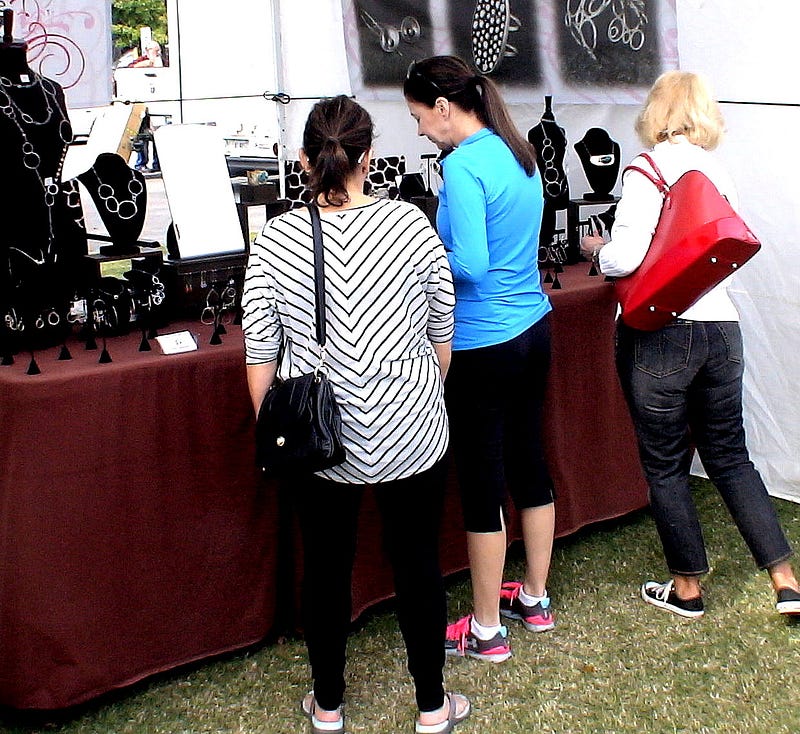
Lesson 1: Not Every Craft Show Is Alike

IT IS VERY IMPORTANT FOR ANYONE THINKING ABOUT SELLING AT CRAFT SHOWS, FESTIVALS, BAZAARS, MARKETS, OR SIMILAR SETTINGS TO BE SMART ABOUT IT. THAT MEANS, UNDERSTANDING EVERYTHING INVOLVED, AND, ASKING THE RIGHT QUESTIONS.

THERE ARE MANY ADVANTAGES TO DOING CRAFT SHOWS. YOU CAN MAKE GOOD MONEY. YOU CAN JUMP-START AND ENHANCE YOUR REPUTATION YOU CAN LEARN A LOT OF GOOD BUSINESS TRICKS AND FIND OUT ABOUT A LOT OF GOOD RESOURCES IF,…
 AND THAT’S A BIG, “IF”!
 YOU KNOW WHAT YOU’RE DOING.

ALL TOO OFTEN, JEWELRY DESIGNERS WHO WANT TO DO CRAFT SHOWS HAVE NOT DONE THEIR HOMEWORK. THEY HAVE NOT RESEARCHED AND EVALUATED WHICH SHOWS TO DO, AND WHICH NOT TO DO. THEY HAVE NOT FIGURED OUT HOW BEST TO SET UP THEIR BOOTHS AND DISPLAYS. THEY ARE CLUELESS ABOUT WHAT INVENTORY TO MAKE, AND TO BRING, AND HOW TO PRICE IT. THEY ARE UNPREPARED TO PROMOTE, TO MARKET AND TO SELL.

MEET ROLAND AND ROLANDA. NEW TO THE JEWELRY DESIGNING TRADE.

WHEN THEY STARTED, THEY DECIDED TO APPLY TO EVERY LOCAL CRAFT SHOW AND FESTIVAL AND FLEA MARKET THEY COULD FIND. THEY SET UP AT THE ST. BERNARD’S FESTIVAL. AND THE METRO ARTS COMMISSION “IN THE PARK” PROGRAM, AND THE SOUTH 2ND STREET FLEA MARKET. AND THE FLEA MARKET AT HOUSER LAKE. AND THE TENNESSEE ARTS COMMISSION FAIR. AND THE CRAFT SHOW OF THE AMERICAS.

ROLAND AND ROLANDA DID NOT UNDERSTAND THAT EVERY CRAFT SHOW WAS NOT ALIKE. THEY WERE NOT PREPARED FOR THE CONFLICTING DEMANDS. AND THEIR BUSINESS SUFFERED FOR IT.

CRAFT SHOWS AND SIMILAR VENUES ARE PLACES WHERE YOU CAN BRING YOUR MERCHANDISE, SET UP SOME KIND OF DISPLAY AND SELL TO PEOPLE WALKING BY. CRAFT SHOWS ARE A GREAT WAY TO MAKE MONEY. PEOPLE COME TO CRAFT SHOWS TO BUY. CRAFT SHOWS ARE A GREAT WAY TO GET BROAD EXPOSURE TO A LARGE CUSTOMER BASE. THEY ARE A GREAT WAY TO JUMP-START, RE-START AND RE-ENERGIZE YOUR JEWELRY DESIGN BUSINESS. AND, SOMETIMES YOU WILL MEET PEOPLE THERE WHO OWN BUSINESSES WHERE THEY WANT TO BUY YOUR ITEMS FOR RE-SALE.
 
 CRAFT SHOWS ALLOW YOU TO HAVE LITTLE INVESTMENT IN OVERHEAD, LIKE RENT, INSURANCE AND THE LIKE THAT COMES WITH A PHYSICAL STORE. CRAFT SHOWS MEANS YOU DO NOT HAVE TO SHARE YOUR PROFITS WITH A STORE OR GALLERY.

NOT EVERY CRAFT SHOW IS ALIKE. THERE ARE:
 ARTS AND CRAFTS SHOWS
 FLEA MARKETS AND BAZAARS
 FESTIVALS AND FAIRS
 JURIED VS. OPEN
 INDOOR VS. OUTDOOR
 HOLIDAY OR THEMED
 LARGE VS. SMALL OPERATIONS
 WALK-BY-BOOTH SETUPS VS. WALK-IN-BOOTH SETUPS
 MIXED MERCHANDISE VS. JEWELRY ONLY SHOWS

ARTS AND CRAFTS SHOWS
 
ONE TYPE IS AN ARTS AND CRAFTS SHOW. THESE ARE PROFESSIONALLY PRODUCED SHOWS WHICH PROMOTE THE SALES OF HANDCRAFTED ART AND OTHER CRAFT ITEMS. THESE CAN BE INSIDE OR OUTSIDE. YOU FIND THEM IN A WIDE ASSORTMENT OF SETTINGS, FROM PARKS TO COMMUNITY CENTERS TO SHOPPING MALLS. SOME FOCUS ON ART TO THE EXCLUSION OF CRAFT. OTHERS HAVE A BROADER FOCUS.

THIS TYPE OF SHOW WORKS WELL FOR JEWELRY ARTISTS. ARTS AND CRAFTS SHOWS ATTRACT A LOT OF PEOPLE WHO EXPECT TO PAY FOR QUALITY AND WHO COME TO BUY. BUT BE CAREFUL THAT THESE SHOWS ARE NOT “TOP-HEAVY” WITH JEWELRY VENDORS, UNLESS, OF COURSE, IT IS A JEWELRY-ONLY SHOW. THE APPLICATION PROCESS IS OFTEN FORMAL, AND SOMETIMES JURIED. SOME ENTRY FEES ARE VERY LOW. OTHERS ARE VERY HIGH.

FLEA MARKETS AND BAZAARS
 
FLEA MARKETS AND BAZAARS ARE TYPICALLY ORGANIZED BY CHURCHES, SCHOOLS, CLUBS OR ORGANIZATIONS, OFTEN WITH A FUND-RAISING PURPOSE IN MIND. THERE ARE ALSO BUSINESSES IN MANY COMMUNITIES THAT, FOR A SMALL FEE, OFFER A PLACE FOR ANYONE TO COME TO SELL THEIR WARES. THERE ARE FEW RULES FOR ENTRY, AND FEES TEND TO BE VERY LOW.

THE MIX OF WHAT IS FOR SALE CAN BE VERY HAPHAZARD. PEOPLE OFTEN COME LOOKING FOR BARGAINS, OR TO BROWSE. IN MANY CASES, THE ATTENDANCE WILL HAVE HIGHS AND LOWS DURING EACH DAY

THIS TYPE OF SHOW WORKS WELL FOR THE CRAFTER OR HOBBYIST WHO MAKES THINGS DURING THE YEAR, AND WANTS A ONCE-A-YEAR SALES OUTLET. USUALLY, I FIND THAT THE RETURN-ON-INVESTMENT FOR THESE KINDS OF SHOWS IS NOT VERY GOOD. HOWEVER, IT DEPENDS ON HISTORY, TIMING, WEATHER AND LOCATION.

FOR EXAMPLE, A BAZAAR SETS UP EVERY TWO MONTHS AT A LOCAL UNIVERSITY WHERE I LIVE, THEY CHARGE $25.00 FOR A WEEKEND BOOTH RENTAL.AND PEOPLE DOING THE BAZAAR USUALLY MAKE A KILLING.

FESTIVALS AND FAIRS
 
FESTIVALS AND FAIRS ARE “SPECIAL EVENTS”, SPONSORED BY TOWNS, CIVIC GROUPS, OR NEIGHBORHOOD ASSOCIATIONS, AND OFTEN PUT ON BY A SPECIAL PROMOTER. THESE ARE WELL-ORGANIZED, WELL-PUBLICIZED AND ATTRACT LOTS OF PEOPLE. SOMETIMES THESE WILL TAKE THE FORM OF AN ARTS AND CRAFTS SHOW, AND THAT WILL BE THEIR CENTRAL PURPOSE. OTHERTIMES, THE MAIN PURPOSE IS SOME KIND OF ENTERTAINMENT, AND THEY HAVE AN AREA SET ASIDE FOR PEOPLE TO SELL THEIR WARES.

IF THE PROMOTERS EMPHASIZE THE ARTS AND CRAFTS PART OF THE FESTIVAL, THEN YOU CAN DO WELL HERE. PEOPLE AT FESTIVALS ARE TYPICALLY WILLING TO SPEND AT MID-RANGE PRICES. IF THERE IS VERY LITTLE PROMOTION OF ARTS AND CRAFTS, OR, IF THAT AREA SET ASIDE FOR ARTS AND CRAFTS SALES IS FAR FROM THE MAIN ACTION, THEN THIS MAY NOT WORK OUT WELL FOR YOU.

JURIED OR OPEN ADMISSION
 
SOME SHOWS ARE OPEN TO ALL TAKERS WHO PAY THE ENTRY FEE. OTHER SHOWS ARE JURIED. THAT IS, THEY REQUIRE THAT YOU SUBMIT IMAGES OF YOUR WORK, AND PERHAPS, SOME KIND OF ARTIST STATEMENT A PANEL OF JUDGES REVIEWS YOUR WORK, AND DECIDES WHOM TO ADMIT TO THE SHOW. JURIED SHOWS MAY ALSO REQUIRE THAT YOU SUBMIT IMAGES OF YOUR BOOTH AND DISPLAY SET UP.

JURIED SHOWS HAVE GOOD CONTROL OVER THE QUALITY OF VENDORS, AS WELL AS THE MIX OF MERCHANDISE AVAILABLE FOR SALE. THE FEES CAN BE STEEP. IF THESE JURIED SHOWS HAVE A GOOD REPUTATION AND HISTORY, THEY CAN BE VERY LUCRATIVE. THEY ARE BIG REPUTATION BUILDERS.

INDOOR OR OUTDOOR
 
SOME SHOWS ARE HELD INDOORS. HERE YOU HAVE SOME PROTECTION FROM THE WEATHER. OTHER SHOWS ARE HELD OUTDOORS, WHERE YOU DO NOT. ON GOOD WEATHER DAYS, PEOPLE LIKE TO BE OUTDOORS. ON BAD WEATHER DAYS, PEOPLE LIKE TO BE INDOORS.

WHAT YOU BRING AND HOW YOU SET UP WILL VARY A BIT BETWEEN INDOOR AND OUTDOOR. YOU CAN OFTEN SPREAD OUT A LITTLE MORE, WHEN OUTDOORS. YOU WILL HAVE DIFFERENT SPECIAL LIGHTING NEEDS INDOORS THAN OUTDOORS. IF THE INDOOR SHOW IS VERY WELL ATTENDED, IT CAN GET VERY CLAUSTROPHIC, DUSTY AND HOT. IF THE WEATHER GETS REALLY BAD OR UNPREDICTABLE, YOU MIGHT HAVE A POOR SHOWING AT AN OUTDOOR SHOW. BE SURE TO ASK THE SHOW PROMOTERS WHAT THEIR POLICY IS FOR INCLEMENT WEATHER, IF THE SHOW IS OUTDOORS.

HOLIDAY, THEMED OR TIMING SENSITIVE SHOWS
 SOME SHOWS HAVE A STRONG THEME WHICH SETS A VERY IMPORTANT TONE AND DIRECTION FOR THE SHOW. YOU NEED TO PAY CLOSE ATTENTION TO THIS THEME. THERE ARE CHRISTMAS SHOWS AND WESTERN SHOWS AND NATIVE AMERICAN SHOWS. THERE ARE SUMMER CELEBRATIONS AND WINTER CELEBRATIONS. THERE ARE ETHNIC FESTIVALS. TOWN HISTORY FESTIVALS. HISTORICAL RE-ENACTMENTS.

LOTS OF SHOWS AND FESTIVALS AND BAZAARS WITH A HOLIDAY OR OTHER THEME, OR SOMETHING WHICH ARE TIED TO A SPECIFIC TIME OR EVENT. MAKE SURE THE MERCHANDISE YOU BRING, AND HOW YOU SET UP YOUR DISPLAYS AND SIGNAGE, AND EVEN THE WAY YOU PRESENT YOURSELF AS AN ARTIST AND CRAFTSPERSON, COORDINATES WELL WITH THE THEME.

LARGE VS. SMALL OPERATION
 
SOME OPERATIONS ARE LARGE, OTHERS ARE SMALL. OBVIOUSLY, THE LARGER THEY ARE, THE MORE PEOPLE THEY WILL ATTRACT AND THE MORE LIKELY THEY WILL SUSTAIN THEMSELVES OVER TIME. THAT MEANS LESS RISK FOR YOU. HOWEVER, IF THE OPERATION IS SMALL,SUCH AS 
 A SMALL NUMBER OF VENDORS,
 OR, A LIMITED RANGE OR QUANTITY OF MERCHANDISE,
 OR, A SMALLER EXPECTED ATTENDANCE,
 OR, MINIMAL ADVERTISING AND PROMOTION,

THEN, IT POSES MORE RISK, FROM A BUSINESS SENSE, SO, WHEN SETTING UP AT A SMALL OPERATION, BE SURE THERE ARE SOME OTHER COMPENSATING FACTORS. SUCH AS A SPECIAL LOCATION OR THAT IT IS LINKED TO A VERY SPECIAL EVENT OR THAT THE ATTENDEES ARE PRIMED TO SPEND, AND SPEND A LOT.

WALK-BY OR WALK-IN BOOTHS
 
SOME SHOWS LET YOU SET UP SOME KIND OF BOOTH, WHERE CUSTOMERS CAN WALK INTO, WE CALL THIS A WALK-IN SETUP. OTHER SHOWS LINE UP ROWS OF TABLES. YOU RENT ONE OR MORE TABLES. THE TABLES, FROM VENDOR TO VENDOR, USUALLY MERGE WITH ONE ANOTHER. CUSTOMERS WORK THEIR WAY PAST THE FRONT OF THESE ROWS OF TABLES. WE CALL THIS A WALK-BY SETUP.

I PREFER WALK-IN SET-UPS. THESE GIVE YOU MUCH BETTER CONTROL AND MANAGEMENT OF CUSTOMERS AND THE BUYING SITUATION. THEY MORE CLEARLY DELINEATE THE BOUDARIES OF YOUR BOOTH, FROM THOSE OF YOUR NEIGHBORS.

IF DOING A WALK-BY SET-UP, THEN IF YOU CAN SECURE A CORNER SPACE, OR A CENTRAL AISLE INTERSECTION OR A SPOT NEAR THE MAIN ENTRANCE, THESE WORK BETTER. THEY GIVE YOU MORE VISIBILITY.

IF YOU CAN AFFORD TO RENT MORE THAN 1 TABLE AND HAVE THE INVENTORY TO DISPLAY ON MORE THAN 1 TABLE, THIS GIVES YOU EVEN MORE VISIBILITY. THE MORE VISIBILITY YOU HAVE, THE BETTER YOUR SALES.

JEWELRY ONLY VS. MIX OF MERCHANDISE
 
MOST SHOWS SHOWCASE A MIX OF MERCHANDISE. HOWEVER, SOME SHOWS ARE JEWELRY ONLY. WHEN IT IS JEWELRY-ONLY, THE SHOW ATTRACTS BUYERS SPECIFICALLY INTERESTED IN JEWELRY BUT WILL ATTRACT A SMALLER NUMBER OF BUYERS. IF YOU ARE SELLING AT A JEWELRY ONLY SHOW, BE SURE SOMETHING ABOUT YOUR WORK SETS YOU APART FROM THE CROWD.

WHEN IT IS A MIX OF MERCHANDISE, IT MAY BE A LITTLE MORE DIFFICULT TO LINK UP TO YOUR TARGET CUSTOMER. HOWEVER, THERE WILL BE MORE POTENTIAL CUSTOMERS OVERALL. SHOWS WHICH HAVE A MIX OF MERCHANDISE OFTEN HAVE TO LIMIT THE NUMBER OF JEWELRY VENDORS — JEWELRY IS AN ESPECIALLY POPULAR CATEGORY.

LARGE MARKETING, ADVERTISING AND PROMOTION BUDGETS VS. SMALL BUDGETS
 
AT THE SHOW, YOU ARE DEPENDENT ON ATTENDANCE. THAT MEANS, YOU ARE DEPENDENT ON HOW WELL THE SHOW PROMOTERS DELIVER THE GOODS. HOW MUCH MONEY DO THEY SPEND ON ADVERTISING AND MARKETING
 … TO GET THE WORD OUT? 
 … HOW MUCH EFFORT ARE THEY MAKING TO EARN A GOOD REPUTATION?

SO, SHOWS WITH LARGE MARKETING BUDGETS DO BETTER THAN THOSE WITH SMALL ONES ESTABLISHED SHOWS DO MUCH, MUCH BETTER THAN 1ST YEAR SHOWS. IN FACT, I WOULD AVOID DOING SHOWS IN THEIR 1ST OR 2ND YEARS, UNTIL I SAW THAT THEY WERE SUCCEEDING ON SOME LEVEL.

I WOULD ALSO CLOSELY EXAMINE THE SHOW’S MARKETING BUDGET. IT MAY BE LARGE, BUT THEY MAY BE PLANNING TO SPEND ALL THEIR MONEY ON A SINGLE BILLBOARD ALONG THE INTERSTATE HIGHWAY. THIS IS NOT ENOUGH. YOU WANT TO SEE THE SHOW PROMOTERS UNDERTAKING A MULTIMETHOD MARKETING PLAN.

WHOLESALE TRADE VS. RETAIL TRADE
 
FINALLY, WHILE MOST SHOWS WOULD BE CONSIDERED “RETAIL” SHOWS, THAT IS, TARGETED AT THE GENERAL PUBLIC. SOME SHOWS ARE FOR THE WHOLESALE TRADE. THAT IS, BUSINESSES WHO SHOP WHOLESALE SHOWS ARE LOOKING FOR LINES OF MERCHANDISE TO CARRY. THESE BUSINESSES HAVE THEIR OWN RETAIL OUTLETS FOR RE-SELLING YOUR WORK. THE FEES FOR THESE SHOWS ARE USUALLY VERY STEEP. YOU NEED TO BE PREPARED TO ACCEPT AND DELIVER ON LARGE ORDERS. OFTEN, TWO OR MORE BUSINESSES WILL SHARE THE COSTS OF A SINGLE BOOTH.
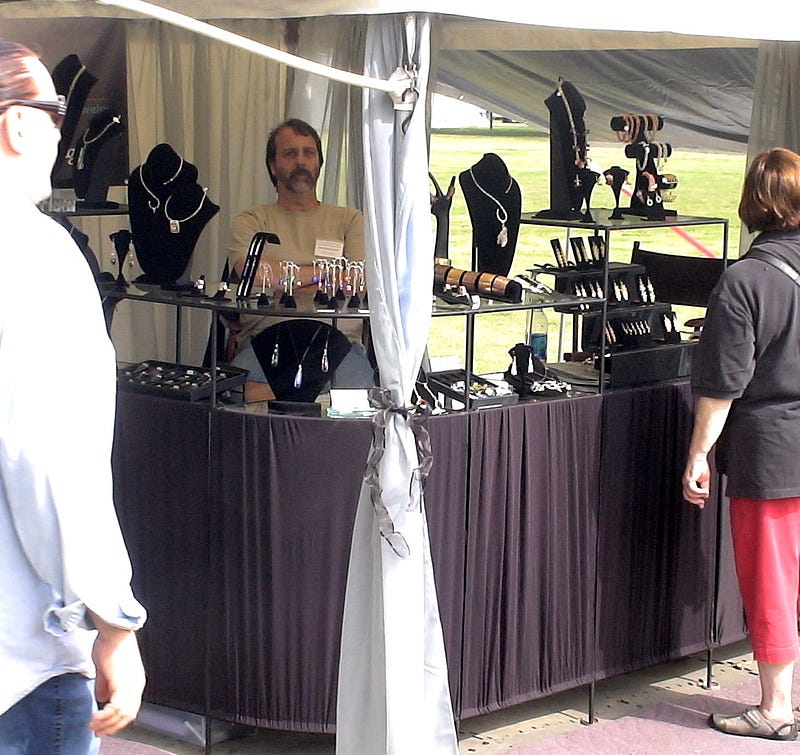
Lesson 2: Research All Your Possibilities

“I HEARD IT THROUGH THE GRAPEVINE”

THAT SHOULD BE IMOGENE MCALLISTER ROSENSTEIN’S SONG. BECAUSE THAT’S HOW SHE FINDS HER CRAFT SHOWS. BY WORD OF MOUTH BY TWEET BY FACEBOOK POST FROM FRIENDS AND FRIENDS OF FRIENDS AND FAMILY OF FRIENDS OF FRIENDS. LIKE I SAID, SHE HEARD IT THROUGH THE GRAPEVINE.

SHE KEPT SAYING TO ME, “I HEARD SUCH AND SUCH A SHOW WAS GREAT,” “HAVE YOU HEARD ANYTHING ABOUT IT?” RARELY EVER. SHE WOULD SIGN UP FOR THINGS IN PARTS OF TOWN THAT NONE OF HER CUSTOMERS WOULD GO TO. SHE WAS LITERALLY ALL OVER THE PLACE.

THERE ARE PLENTY OF TOOLS AND RESOURCES FOR FINDING OUT WHICH CRAFT SHOWS ARE RIGHT FOR YOU. YOU JUST HAVE TO MAKE YOURSELF AWARE OF THESE…AND USE THEM.
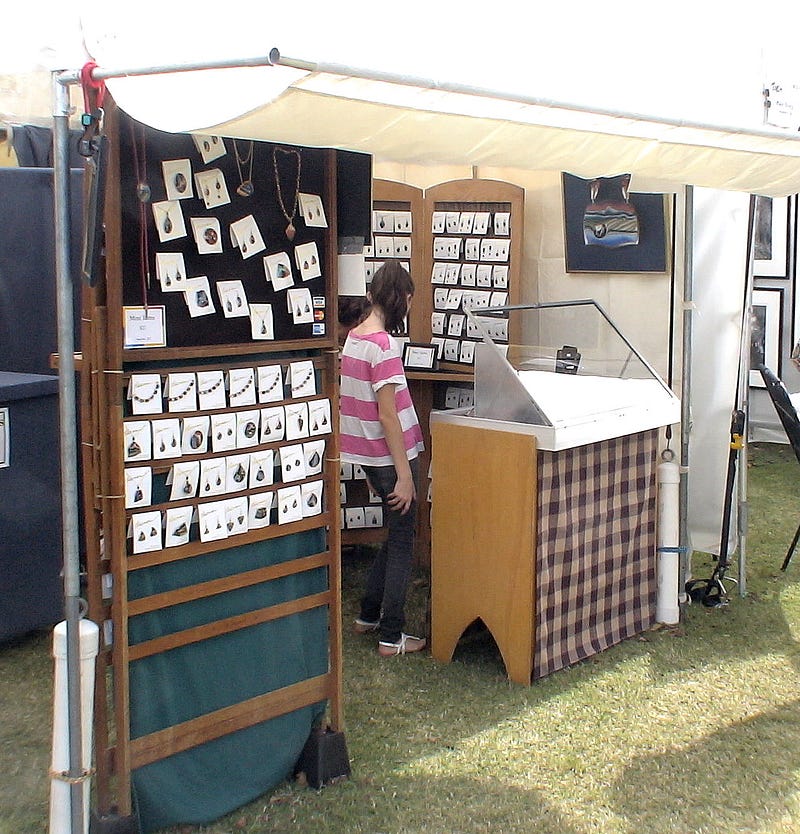
FINDING THEM: CRAFT SHOW DIRECTORIES

At the end of this handout, is a list of on-line craft show listings and databases. You can search these databases to see what shows are available where and when. You can determine what application rules and fees exist. You should follow up on this research by trying to find and talk with vendors who’ve attended these shows before. See if you can uncover an exhibitors/vendors list. If you can visit the show and check it out beforehand, that would be great.

Examine the mix of items offered at the show. Will your inventory complement and fit in? You want to be unique and different, yet you also want your products to have a good fit with whatever else is there. It’s the synergistic effect of all the vendors together which brings the crowds in, and this effect is greater when there are a lot of related things there for sale. Does the show’s style or theme fit well with that of your merchandise and your business? If you’re selling fashion jewelry, you don’t necessarily want to be set up at a country crafts show.

Find out the general attendance at the show, and the number of vendors exhibiting there. Evaluate the numbers with a critical eye. For example, a show without an admission fee might have a large attendance, but many of those attending might not necessarily be there to buy. Another example, all the booths might be full, but many of the vendors might be somehow associated with the event promoters and primarily there to give the appearance of filling up the spaces. Ask questions that get to the core issue: What are the qualities of the customers? What are the qualities of the vendors?

Find out how long the show has been in existence, and how it seems to have fared over time. Shows in their first year or two may not do well, because many people may be unfamiliar with the show. A show’s long-time staying power might reflect on its strength. Conversely, it might reflect on people needlessly holding onto tradition.

Ask about what kinds of marketing the show operators plan to do, and how systematically they’ve evaluated the strengths and weaknesses of past marketing strategies. Hopefully, they plan to do more than putting up a few signs. Successful show marketing requires a multi-method approach, lot of sustained effort and follow-through.

Critically assess the location of the show. Would your customers venture out to this location? Are there parking issues, finding-the-place issues, or related concerns? What are your specific options for a booth location within the show itself? Very often, newcomers start in the least desirable areas. Will customers at the show still find you? Will you be near complementary booths — ones with items that will attract customers you want to attract to your own booth?

Is the show held in conjunction with other activities? Are there entertainment or educational activities? Are there food concessions? Are there adequate bathroom facilities?

If possible, talk with other exhibitors who have done the show. Has it met their expectations? What kinds of people attend the show, and what types of products do they seem to buy? How much does a typical person spend at a booth? How is the traffic flow, and what, if any, peculiarities are there? What is the quality of the merchandise at the show?

If you determine that a particular show is a good fit for you, you should give it more than one chance. You might not do well your first time out because your own marketing efforts or inventory selection might be deficient. Sometimes even a good show has an off year.

THERE ARE MANY ONLINE CRAFT SHOW DIRECTORIES

– CONSUMER CRAFT AND BEADING MAGAZINES

– CRAFT AND ART ORGANIZATIONS, ASSOCIATIONS AND CLUBS IN THEIR NEWSLETTERS, ON THEIR WEBSITES AND FACEBOOK PAGES

– SOMETIMES CRAFT SHOWS WILL TAKE OUT ADS IN LOCAL PAPERS LOOKING FOR VENDORS

YOU CAN ALSO ATTEND LOCAL SHOWS AND TALK WITH MANAGEMENT YOU CAN TALK TO VARIOUS VENDORS AT LOCAL SHOWS. YOU CAN CONTACT LOCAL CRAFT AND FINE ARTISTS.

THERE ARE ALSO SERVICES ONLINE WHICH HELP CRAFT SHOWS FIND YOU. FOR EXAMPLE, JURIED ART SERVICES OR ZAPPLICATION. THESE DIGITAL JURIED AND APPLICATION SYSTEMS ALLOW YOU TO POST A PROFILE WITH IMAGES ONLINE. THEY SEND OUT EMAIL CALLS FOR APPLICATIONS FROM CRAFTS SHOWS THEY REPRESENT. AND THEY ALLOW YOU TO TAILOR FIT YOUR APPLICATION TO THE REQUIREMENTS OF THAT SPECIFIC SHOW.

YOU REGISTER WITH THESE ONLINE, UPLOADING IMAGES OF YOUR WORK, IMAGES OF YOUR BOOTH AND DISPLAY, AND VARIOUS WRITE-UPS.

LESSON 3: NOT EVERY CRAFT SHOW IS FOR YOU

ROWENA STARLIGHT LIKED TO TELL EVERYONE SHE LIVED ON LIGHTHOUSE ROAD.

SHE MIGHT AS WELL HAVE BEEN LIVING IN OUTER MONGOLIA. SHE WAS DETERMINED TO SELL HIGH-END JEWELRY IN LOW-BROW SETTINGS. SHE SPENT SO MUCH TIME MAKING EACH PIECE OF JEWELRY, AND SO LITTLE TIME RESEARCHING WHERE TO SELL IT. SHE RARELY SOLD ANYTHING, SAD FOR HER, SHE COULDN’T FIGURE OUT WHY.

NOT EVERY CRAFT SHOW WILL BE FOR YOU.
 
WHEN YOU RESEARCH SHOW OPPORTUNITIES, ASK YOURSELF: IS THERE A GOOD FIT WITH

= YOUR MERCHANDISE, 
 = YOUR GOALS, 
 = YOUR EXPECTATIONS, “
 = YOUR CUSTOMERS?

EVALUATE ALL YOUR SHOW OPTIONS BEFORE SELECTING ONE OR MORE OF THEM. MAKE SITE VISITS. SCOPE IT OUT BEFORE COMMITTING TO IT. IF YOU CAN’T ATTEND A SHOW PRIOR TO APPLYING, ASK THE PROMOTER FOR NAMES AND PHONE NUMBERS OR EMAIL ADDRESSES OF A FEW OF THE EXHIBITORS THAT HAVE DONE THE SHOW BEFORE, AND ARE RETURNING AGAIN.

YOU WANT TO ASK AND HAVE ANSWERED A SERIES OF QUESTIONS. QUESTIONS TO ASK YOURSELF. QUESTIONS TO ASK OTHER VENDORS. QUESTIONS TO ASK THE SHOW PROMOTERS.

WHEN YOU ARE ON YOUR SITE VISIT…
 
CAREFULLY OBSERVE AND ASK YOURSELF THESE QUESTIONS?
— IS THE VENDOR AREA THE FOCUS OF THE SHOW, OR A PART OF A LARGER ENTERTAINMENT VENUE?
 — IS THERE ENTERTAINMENT?
 — ARE THERE FOOD VENDORS?
 — WHO IS THE CUSTOMER?
 — IS THERE GOOD ATTENDANCE?
 — IS THERE AN ADMISSION CHARGE?
 — IS THERE ADEQUATE CUSTOMER PARKING?
 — ARE THE CUSTOMERS BUYING OR BROWSING?
 — WHAT IS THE MERCHANDISE MIX, AND HOW MUCH IS JEWELRY?
 — WHAT IS THE QUALITY OF THE MERCHANDISE LIKE?
 — IS THE MERCHANDISE HAND-CRAFTED ONLY, MOSTLY HAND-CRAFTED, OR NOT?
 
 SPEAK WITH THE VENDORS, AND ASK THEM:
— HOW WELL DOES THIS SHOW WORK FOR THEM?
 — HOW DID THEY FIND OUT ABOUT THE SHOW?
 — ARE THEY SATISFIED WITH THE MANAGEMENT AND MARKETING OF THE SHOW?
 — ARE THERE OTHER VENDORS, PERHAPS TOO MANY OTHER VENDORS, SELLING THE SAME KIND OF THING?
 — WHAT ARE THE BEST SHOWS THEY HAVE DONE, AND HOW DOES THIS ONE COMPARE?
 — WOULD THEY RETURN TO THIS SHOW AND DO IT AGAIN?

IF YOU CAN, SPEAK WITH THE PROMOTERS.
— HOW LONG HAVE THEY BEEN DOING SHOWS, AND THIS SHOW IN PARTICULAR?
 — WHAT ARE THEIR GOALS FOR THE SHOW?
 — WHAT KIND OF MARKETING AND PROMOTION DO THEY DO?
 — WHAT IS THE AVERAGE ATTENDANCE?
 — WHAT AMOUNT DOES THE TYPICAL CUSTOMER SPEND?
 — WHAT ARE THE FEES? 
 — DO YOU TAKE ANY ADDITIONAL COMMISIONS, SUCH AS A PERCENT OF SALES?
 — ARE THERE ANY INSURANCE REQUIREMENTS?
 — WHAT IS INVOLVED WITH THE APPLICATION PROCESS?
 — TELL THEM WHAT YOU SELL, AND ASK THEM IF THEY THINK YOU WOULD FIT IN?
 — IF YOU WANT TO DO THE NEXT SHOW, WHEN SHOULD YOU APPLY?
 — CAN YOU CHOOSE YOUR BOOTH LOCATION?
 — CAN YOU DO DEMONSTRATIONS IN YOUR BOOTH?
 
 ASK THEM TO ADD YOUR NAME TO THEIR MAILING LIST.

THEN, CHECK FOR SHOW REVIEWS, RATINGS AND EXPERIENCES ONLINE. DO SOME SOCIAL NETWORKING. AND THINK!

THINK ABOUT…
 
HOW COMFORTABLE ARE YOU WITH THE LOCATION,
 THE SETTING,
 THE LAY-OUT?
 THE OPPORTUNITY?
 THE POSSIBILITIES TO MAKE A PROFIT?
 HOW DOES YOUR MERCHANDISE STACK UP AGAINST THAT WHICH YOU HAVE SEEN?

TRY TO VISUALIZE THE EVENT IN YOUR MIND WITH AS MUCH INFORMATION YOU HAVE GATHERED. IS THIS PARTICULAR EVENT FOR YOU? DOES THIS SHOW ATTRACT THE TYPES OF CUSTOMERS MOST LIKELY TO BUY WHAT YOU MAKE?

craft show traffic flow

LESSON 4: SET REALISTIC GOALS

MAKING MONEY AT FAIRS AND SHOWS ISN’T AS EASY AS IT SEEMS.

AS ROLAND AND ROLANDA QUICKLY FOUND OUT. THEY THOUGHT ALL IT TOOK WAS TO RENT A TABLE AT ANY SHOW OR FAIR LAY OUT THEIR JEWELRY, WAIT FOR CUSTOMERS TO COME BY AND PURCHASE THEIR STUFF.
 
 ALL THROUGH THE SHOWS, THEY SAT ON CHAIRS READING BOOKS, WAITING FOR PEOPLE TO COME BY. THEY SPENT MORE MONEY ON INVENTORY, PACKING, DISPLAYS AND TRAVEL THAN THEY EVER MADE. AND THEY NEVER DEVELOPED ANY KIND OF PLAN OF ACTION.

ROLAND AND ROLANDA NEEDED TO SET REALISTIC GOALS:

(1) HOW MUCH MONEY DID THEY HAVE TO GET STARTED AND SUSTAIN THEMSELVES?

(2) WHAT WAS THEIR BREAK-EVEN POINT?

(3) WHAT DID THEY NEED TO PREPARE THEMSELVES TO “SELL”?

  • (4) WHAT AMOUNT OF REPEAT BUSINESS AND FOLLOW-UP SALES WERE THEY LOOKING FOR?
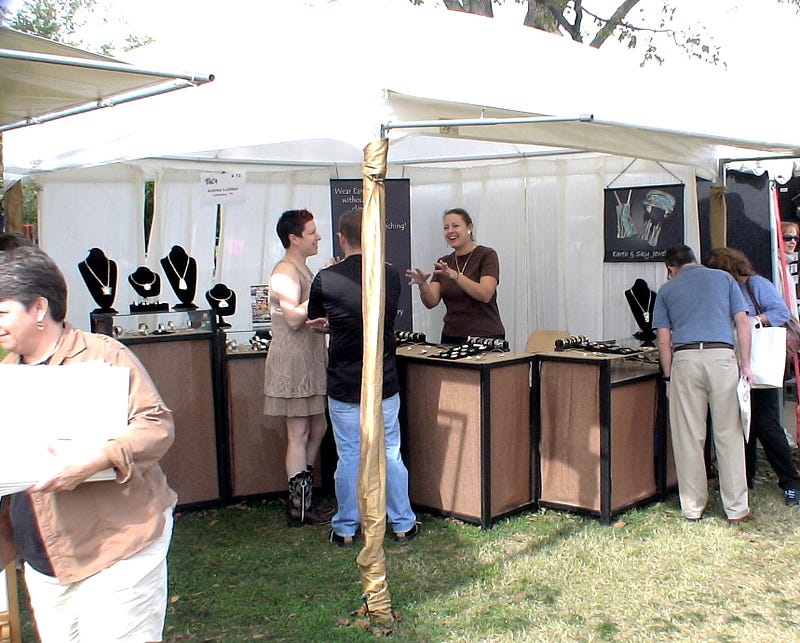
Defining Your Business / Setting Your Goals / Getting Started

Before you get started in your craft business, you need to do some thinking and reflecting. You need to have a clear idea of the types of products you want to sell, and what you think people will be willing to pay for them.

Then you need to research craft show opportunities. We suggest you start small, and start locally. Check out crafts fairs sponsored by local Arts and Park Commissions, churches and synagogues, non-profit organizations and schools. Your local craft and bead stores may know of craft shows, as well. YOU OBVIOUSLY WANT TO KEEP YOUR EXPENSES TO A MINIMUM, AND THERE CAN BE SOME STEEP UP-FRONT COSTS, SUCH AS CREATING A SUFFICIENT INVENTORY.STARTING SMALL GIVES YOU A CHANCE TO TEST OUT YOUR IDEAS ABOUT COSTS. WHEN YOU START, YOU MIGHT BE ABLE TO SHARE BOOTH SPACE WITH ANOTHER FRIEND WHO HAS A BUSINESS. AND SHARE SOME OF THOSE OTHER FIXED COSTS, LIKE TRAVEL AND FEES.

Next, set some business goals. How much are you willing to spend to be included in a Craft Show? How much money do you want to make? To what degree is it important that you make a profit at your first craft show(s)? In what ways can you leverage your efforts to increase your business later on — such as, strategies for getting repeat business, or increasing your mailing list, or finding information from other vendors about other show opportunities or other sources of craft supplies?

Then think about yourself, your personality, energy levels, levels of patience. Is there a good fit, and if not, what kinds of self-improvement things do you need to do to get that good fit? IT REQUIRES AN ABILITY TO KEEP UP A GOOD “RETAIL PERSONALITY” WHILE STANDING ON YOUR FEET FOR LONG HOURS, SOMETIMES WHEN IT’S TOO HOT OR TOO COLD OR TOO WINDY AND DUSTY. “SELLING JEWELRY” REQUIRES A DIFFERENT MIND-SET THAN “CREATING JEWELRY.” IF YOU DON’T HAVE THE PERSONALITY FOR “SELLING”, YOU MIGHT BRING A FRIEND WITH YOU WHO DOES.

Set goals about WHAT AMOUNT OF REPEAT BUSINESS AND FOLLOW-UP SALES SHOULD YOU LOOK FOR? A GOOD GOAL TO SET IS TO GENERATE REPEAT BUSINESS EQUAL TO 25%.SO, IF YOU HAD 10 SALES AT THE SHOW, YOUR GOAL WOULD BE TO GET 3 REPEAT SALES. THESE COULD OCCUR WHEN THE CUSTOMER CONTACTS YOU BETWEEN SHOWS. THESE COULD ALSO OCCUR AT THE NEXT SHOW YOU DO, WHEN THE CUSTOMER BUYS FROM YOU AGAIN. YOU WILL MAKE A MUCH HIGHER PROFIT AND EXPERIENCE BETTER LONG-TERM OUTCOMES, THROUGH REPEAT BUSINESS. WITH REPEAT BUSINESS, YOU CAN CONSIDERABLY LOWER YOUR VARIABLE COSTS, PARTICULARLY THOSE ASSOCIATED WITH MARKETING.BECAUSE OF THIS, THAT 2ND OR FOLLOW-UP SALE IS OFTEN MORE IMPORTANT THAN THAT 1ST SALE AT THE SHOW.

BREAKEVEN ANALYSIS

HOW MUCH MONEY WILL YOU NEED?

MAKE A LIST OF ALL POSSIBLE COSTS. THERE ARE THE OBVIOUS LIKE TRANSPORTATION, LODGING AND MEALS. AND THE COSTS OF DISPLAYS, PACKING AND MARKETING. AND THE COSTS OF THE PARTS USED TO MAKE THE PIECES WHICH SELL.
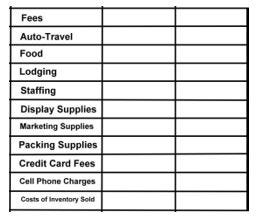
ENTRY FEES WILL VARY WIDELY FROM SHOW TO SHOW. THEY COULD COST $25/DAY UP TO $400 AND UP PER DAY. THEY COULD GO AS HIGH AS $5000 PER DAY.
 
 IF YOU HAVE A SPECIFIC CRAFT SHOW IN MIND, REVIEW THEIR RULES, AND WHAT THEIR ENTRY FEES COVER, AND DO NOT COVER. WHAT ARE THE COSTS OF EXTRAS, LIKE ELECTRICITY, TABLES, SPECIAL LIGHTING? DO THEY ALSO COLLECT A PERCENT OF SALES? DO THEY OFFER SPECIAL SERVICES, LIKE BOOTH SITTING, FOR EXTRA FEES? IS PARKING FREE, OR DO THEY CHARGE? DO YOU NEED TO PROVIDE ADDITIONAL INSURANCE? WILL YOU NEED TO PURCHASE SPECIAL LICENSES, REGISTRATIONS AND PERMITS, SUCH AS AN OUT OF STATE WHOLESALE LICENSE?

YOU NEED TO PREPARE A PLAN AND A BUDGET…
 
…TO BE SURE YOU CAN PAY FOR WHAT YOU ARE COMMITTING YOURSELF TO.

(1) Understand different types of costs and how to account for them

(2) Learn to apply simple Breakeven Analysis Formula

(3) Set revenue goals

(4) Determine how much inventory you need to bring with you

(5) Think about reinvestment

4.1. Types of Costs

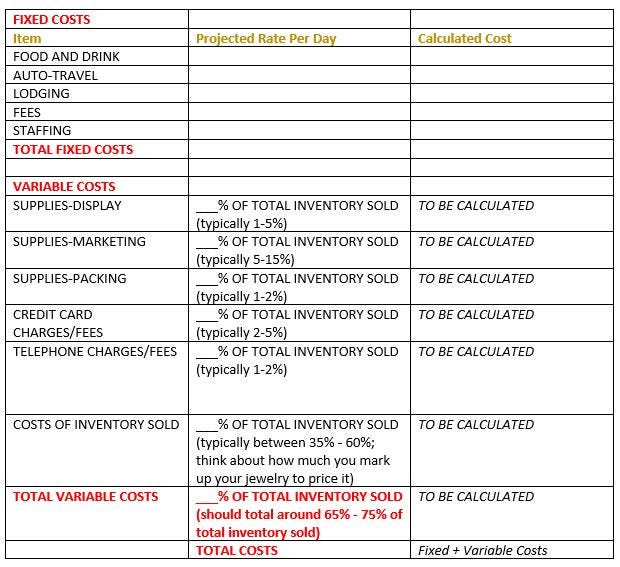
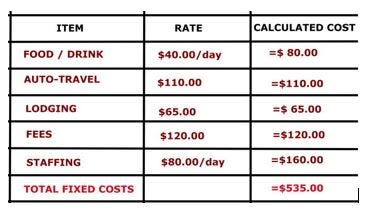
FIXED COSTS: FIXED COSTS ARE COSTS THAT REMAIN THE SAME, REGARDLESS OF HOW MANY ITEMS YOU SELL AT YOUR CRAFT FAIR.

FIXED COSTS INCLUDE THINGS LIKE FEES, TRAVEL, FOOD, AND STAFFING. AGAIN, YOU HAVE TO LAY OUT THIS MONEY FOR FIXED COSTS, WHETHER YOU MADE NO MONEY AT ALL, OR MADE A BUCKET FULL OF MONEY AT YOUR CRAFT FAIR.
VARIABLE COSTS: VARIABLE COSTS ARE COSTS THAT GET INCURRED WHEN EACH UNIT IS SOLD.

THUS, VARIABLE COSTS FLUCTUATE BASED ON THE NUMBER OF UNITS SOLD. IF YOU SELL VERY FEW PIECES, YOUR VARIABLE COSTS ARE SMALL, IF YOU SELL A LOT OF PIECES, YOUR VARIABLE COSTS WILL BE MUCH HIGHER.

VARIABLE COSTS INCLUDE SPECIAL PACKAGING AND DISPLAYS, BROCHURES AND BUSINESS CARDS HANDED OUT WITH EACH SALE, CREDIT CARD FEES YOU ARE CHARGED BY THE BANKS AFTER EACH SALE, AND THE COST OF THE PARTS USED TO MAKE EACH PIECE THAT HAS SOLD.

WE ESTIMATE VARIABLE COSTS USING SOME INDUSTRY STANDARDS ABOUT THE PERCENT OF TOTAL SALES (USING RETAIL PRICES) THESE COSTS ARE ASSOCIATED WITH.
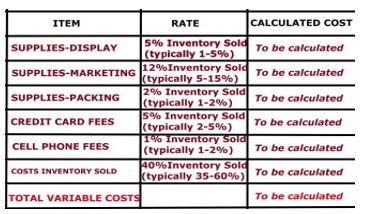
WHEN WE CALCULATE THE COST OF INVENTORY, WE DIFFERENTIATE BETWEEN THE COST OF THOSE PIECES WHICH WE HAVE SOLD FROM THE COST OF THOSE PIECES WE DID NOT SELL.

FOR PURPOSES OF DEVELOPING A BUDGET AND CALCULATING A BREAK-EVEN ANALYSIS, TO HELP US DECIDE WHETHER A PARTICULAR CRAFT SHOW IS WORTH THE RISK, WE FOCUS ONLY ON THE ESTIMATES BASED ON WHAT WE SELL.

NOTE: There are two other costs we do not deal with in a breakeven analysis, but have big impacts on your business decisions:
 1. INVENTORY COSTS. Breakeven Analysis deals with the costs of your inventory which has sold. But you have to bring a lot more pieces with you, and will only sell a proportion of them, typically 25% is a good goal. You will still have to come up with enough cash to cover the full cost of putting together an inventory.

2. REINVESTMENT COSTS. Out of your profits, you will want to reserve some money to buy more jewelry making supplies beyond what you already have and beyond what you need to replace the items sold. You will also want to invest in new displays, packaging, additional marketing and the like. For new businesses, these reinvestments are usually 20–25% or more of your profit. If you think you need to make $100.00 to cover your business and personal costs, perhaps, with an eye on reinvestment, you need to up that goal to $125.00.

4.2 Learn to apply simple Breakeven Analysis Formula

BREAKEVEN ANALYSIS
 

 I WANT TO INTRODUCE YOU TO A QUICK AND DIRTY BREAKEVEN ANALYSIS. I CALL THIS “QUICK AND DIRTY” BECAUSE WE ARE USING IMPERFECT INFORMATION. HOWEVER, THIS IMPERFECT INFORMATION IS GOOD ENOUGH TO HELP US MAKE A DECISION WHETHER A PARTICULAR CRAFT SHOW IS WORTH THE RISK.

YOUR BREAKEVEN POINT IS WHERE YOU HAVE SOLD ENOUGH INVENTORY TO COVER YOUR FIXED AND VARIABLE COSTS. WE EQUATE “INVENTORY” WITH THE TOTAL RETAIL DOLLARS TAKEN IN.

WE USE OUR QUICK AND DIRTY BREAKEVEN ANALSIS TO ANSWER THE QUESTION:
 HOW MUCH INVENTORY DO I NEED TO SELL IN ORDER TO BREAK EVEN?

LET’S FAMILIARIZE OURSELVES MORE WITH THE COMPONENTS OF THE FORMULA, AND THEN REVIEW THE MATH.

EXAMPLE: 2-Day Craft Show, 200 miles away, and you need 1 extra person
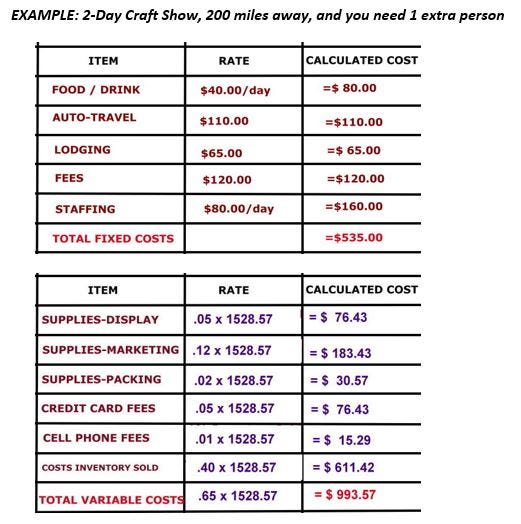
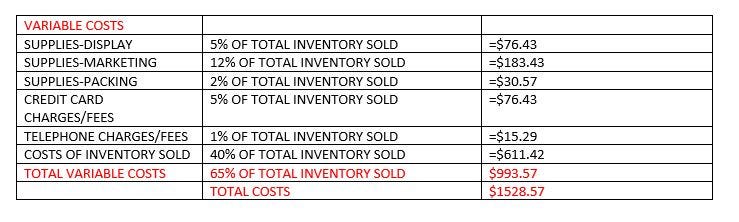
SAY YOU WILL BE DOING A 2-DAY CRAFT SHOW OUT OF TOWN, 200 MILES AWAY FROM HOME. AND YOU WILL NEED TO HIRE 1 PERSON TO HELP YOU. LET’S LOOK AT OUR BUDGET FOR DOING THIS PARTICULAR CRAFT SHOW. YOU HAVE BUDGETED FOR YOUR FIXED AND VARIABLE COSTS AS SHOWN IN THE TABLE. I HAVE PLUGGED IN SOME TYPICAL NUMBERS INTO THIS BUDGET TABLE.

OUR FIXED COSTS ARE RELATIVELY EASY TO FIGURE OUT.

OUR VARIABLE COSTS, HOWEVER, WILL HAVE TO BE ESTIMATED.

THESE VARIABLE COSTS ARE KEYED OFF THE ESTIMATED SALES DATA (KEYED OFF OF RETAIL PRICES YOU SET FOR YOUR JEWELRY). In the chart above, $1528.57 is the estimated sales we think we will get at the craft show, stated in total retail prices. [We can estimate our sales because we expect to sell 25% of the total inventory brought. In this case, we would have brought 4*1528.57 or $6114.28 (at retail pricing). ]
 [So, if we marked up our inventory by 3, in this case, our wholesale costs for these sales would have been $1528.57/3 or $509.52, but the cost to us of all the inventory we brought with us would be $6114.28/3 or $2038.09.]

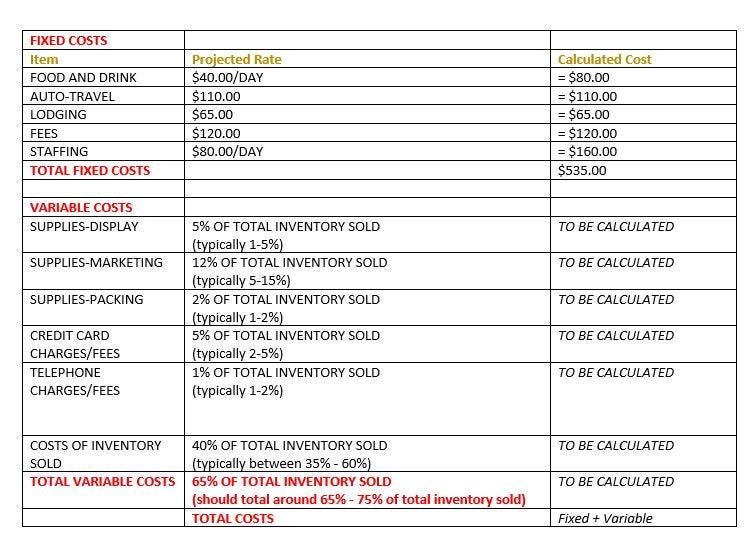
WE WILL USE SOME INDUSTRY PERCENT OF ITEMS SOLD PRICE STANDARDS, These are usually stated as some percent of every dollar sold (at retail pricing). AS WELL AS OUR BREAKEVEN ANALYSIS FORMULA TO HELP US FIGURE OUT THE “TO BE CALCULATED” VARIABLE COSTS IN OUR BUDGET TABLE.

FOR EXAMPLE, 
 
I HAVE USED 12% AS THE PROPORTION OF THE TOTAL RETAIL PRICE THAT WOULD BE SPENT ON MARKETING COSTS. THE COSTS WOULD INCLUDE BROCHURES, BUSINESS CARDS, A POST CARD MAILING, SOME PROMOTIONAL ADS, AND SOME EFFORT TO CONTACT PREVIOUS CUSTOMERS TO LET THEM KNOW YOU WILL BE AT THIS CRAFT SHOW. THE INDUSTRY STANDARD FOR MARKETING RANGES BETWEEN 5 AND 15 PER CENT. IF YOU ARE GETTING STARTED, YOU CAN USE MY NUMBERS PRESENTED IN THIS TABLE. AFTER YOU HAVE DONE A FEW CRAFT SHOWS, YOU CAN BEGIN TO ANALYZE YOUR OWN SALES AND COST DATA, TO DEVELOP WHAT ARE CALLED MULTIPLIERS FOR EACH VARIABLE LINE-ITEM CATEGORY.
BREAKEVEN FORMULA
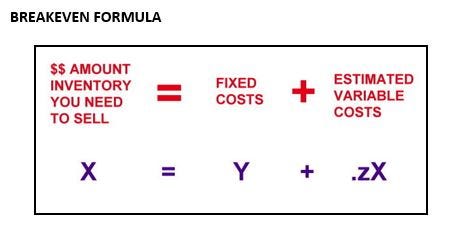
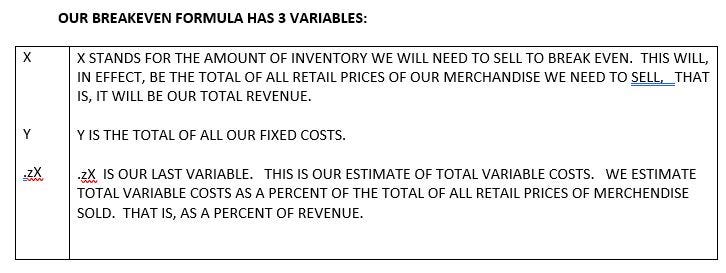
OUR BREAKEVEN FORMULA HAS 3 VARIABLES:
LET’S TRY SOME MATH:

LOOK BACK AT OUR DEVELOPING BUDGET TABLE.

Y, WHICH IS OUR FIXED COSTS TOTAL = $535.00
 .z IS THAT PERCENT OF REVENUE REPRESENTING TOTAL VARIABLE COSTS.

.z= .65 (.65 IS SUM OF OUR MULTIPLERS IN OUR BUDGET TABLE 
 .05+.12+.02+.05+.01+.40)

SOLVE FOR X

NEXT, USING OUR BREAKEVEN FORMULA, WE SOLVE FOR X

TO SOLVE FOR X, WE NEED TO RE-ORGANIZE OUR FORMULA SO THAT THE X VARIABLE, WHICH OCCURS TWICE IN OUR FORMULA, IS ALL PUT ON ONE SIDE OF THE EQUATION.

THIS IS HOW WE SOLVE THIS FORMULA:

a. WE START WITH:
 X = 535.00 + .65X

b. WE MOVE THE .65X TO THE LEFT SIDE, BY SUBTRACTING IT FROM BOTH SIDES
 X-.65X = 535.00

c. WE COMBINE BOTH X VARIABLES, WHICH IN EFFECT, LET’S US SUBTRACT THE .65X FROM 1X, LEAVING US WITH .35X
 .35X = 535.00

d. WE DIVIDE BOTH SIDES OF THE EQUATION BY .35, TO GIVE US 1X
 X = 535/.35

e. AND WE GET OUR BREAKEVEN POINT
 X = $1528.57 (total inventory at retail price we need to sell to break even, given our fixed and variable costs)

SO, TO BREAK EVEN,
 
WE WOULD NEED TO SELL A RETAIL TOTAL OF $1528.57 OF MERCHANDISE AT OUR 2-DAY SHOW.
 TO SELL THAT MUCH INVENTORY, WE WOULD NEED TO BRING ABOUT 4 TIMES THAT MUCH, OR $6,000.00 OF INVENTORY WITH US.

LET’S LOOK AT OUR RESULTING VARIABLE COSTS CALCULATIONS.
NOW, LET’S REVIEW OUR BREAKEVEN ANALYSIS WITH ANOTHER EXAMPLE.

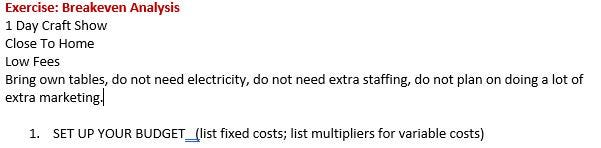
SAY YOU ARE DOING A 1-DAY CRAFT SHOW CLOSE TO HOME, LOW FEES, YOU BRING YOUR OWN TABLES, DON’T NEED ELECTRICITY, AND DON’T NEED EXTRA STAFFING. YOU DON’T PLAN ON DOING A LOT OF MARKETING.

FIRST, YOU BEGIN TO SET UP A BUDGET.

HERE WE HAVE FIXED COSTS EQUAL TO $70.00.
 OUR VARIABLE COSTS WE ESTIMATE TO BE 54% OF OUR TOTAL REVENUES.

NEXT, WE CALCULATE OUR BREAKEVEN POINT, USING OUR QUICK AND DIRTY FORMULA.

WE SEE OUR BREAKEVEN POINT IS $152.17.
 AND, USING OUR RULE OF THUMB ABOUT HOW MUCH INVENTORY TO BRING,
 WE NEED TO BRING 4 X $152.17, OR ABOUT $600.00 OF INVENTORY.
4.3 Set Revenue Goals

First, you do a BREAKEVEN ANALYSIS to determine the minimum amount of revenue you need to generate, in order to cover all your fixed and variable costs.

After you reach your Breakeven Point, you begin to generate a Profit. At this point, you have already covered all your fixed costs. For each additional piece of jewelry you sell, you mostly will only have to cover the variable costs. If your fixed costs in your breakeven analysis were 35% of your sales, then your profit will be roughly 35% of your sales, above this breakeven point.

HOW MUCH OF A PROFIT GOAL YOU WANT TO SET IS YOUR PERSONAL CHOICE. HOWEVER, I LIKE TO TELL STUDENTS THAT BREAKING EVEN AT THE SHOW ITSELF IS OK, IF YOU ALSO HAVE STRATEGIES IN PLACE TO GENERATE FOLLOW-UP SALES, EITHER THROUGH REPEAT SALES BETWEEN SHOWS, OR REPEAT SALES AT THE NEXT SHOW.

4.4 Determine How Much Inventory You Need To Bring

A GOOD RULE OF THUMB FOR FIGURING OUT HOW MUCH INVENTORY TO BRING IS THIS: 
 YOU WILL NEED TO BRING WITH YOU, AT A MINIMUM, 4 TIMES THE INVENTORY YOU HOPE TO SELL.

FOR EXAMPLE, IF YOU NEED TO SELL $200.00 OF MERCHANDISE TO BREAKEVEN, YOU WILL NEED TO BRING $800.00 OF MERCHANDISE WITH YOU. AGAIN, $800.00 IS THE TOTAL OF ALL THE RETAIL PRICES OF WHAT YOU BRING.

CONTINUE THIS EXAMPLE: IF YOU WANT TO TAKE IN ANOTHER $100.00 OF SALES ON TOP OF YOUR BREAKEVEN, THEN YOU WILL NEED TO SELL $300.00 OF MERCHANDISE, THEN, YOU WILL NEED TO BRING A TOTAL OF $1200.00 OF INVENTORY. THIS IS $400.00 MORE INVENTORY THAT YOU WOULD NEED TO BRING TO MAKE ONE HUNDRED MORE DOLLARS OVER YOUR BREAKEVEN POINT. AGAIN, $1200.00 IS THE TOTAL OF ALL THE RETAIL PRICES.

WE ARE GOING TO TALK ABOUT INVENTORY IN TERMS OF RETAIL PRICES, NOT IN TERMS OF NUMBERS OF ITEMS, AND NOT IN TERMS OF WHOLESALE COSTS.. OUR TOTAL INVENTORY WOULD EQUAL THE TOTAL OF ALL RETAIL PRICES, IF EVERY PIECE SOLD.
 
 
 4.5 Think about reinvestment

AS WE GO BEYOND OUR BREAKEVEN POINT, AND BECOME PROFITABLE
 

 WE COULD HAVE USED THAT REMAINING 35 CENTS OUT OF EACH DOLLAR OF ADDITIONAL REVENUE TO PAY FOR SOME OF OUR INVESTMENT COSTS, AS WELL AS PAY OURSELVES SOMETHING.

INVESTMENT COSTS ARE THINGS YOU PAY FOR WHICH EITHER HAVE TO LAST A VERY LONG TIME, AND WHICH YOU WILL USE AT MANY, MANY CRAFT SHOWS, OR WHICH INVOLVE EXPANDING YOUR CORE JEWELRY MAKING SUPPLIES INVENTORY BEYOND WHAT YOU NEED TO REPLACE THE PARTS REPRESENTED BY THE ITEMS SOLD.

THESE INCLUDE “LONG TERM ASSETS”, SUCH AS BUYING TABLES AND CHAIRS, A TENT, AND DISPLAY CASES. THESE ALSO INCLUDE “LONG TERM LIABILITIES”, SUCH AS PAYING DOWN LOANS AND CREDIT CARD CHARGES.

WE DO NOT INCLUDE THESE INVESTMENT COSTS IN OUR BREAK-EVEN ANALYSES.

application form example

LESSON 5: GET THOSE APPLICATIONS IN EARLY

JOHN JACOB THOUGHT HE COULD SET UP ANYWHERE AND ANYTIME.
SO HE MISSED THE APRIL 30TH DEADLINE FOR THE RED HILLS FAIR. AND HE SENT IN AN INCOMPLETE APPLICATION WITHOUT THE REQUIRED PICTURES TO NAPA SWEETS FESTIVAL.

AND HE DIDN’T TAKE SERIOUSLY THE FACT THAT NAPLES SYMPHONY DAYS WAS A JURIED COMPETITION. AND HE COULDN’T UNDERSTAND HOW ADDING ONE MORE JEWELRY VENDOR TO THE ROCKY MOUNTAIN SHOWROOM WOULD MAKE MUCH OF A DIFFERENCE.

HE HAD CALCULATED THAT HE NEEDED TO DO 4 SHOWS A YEAR TO MAKE A LIVING. BUT FOR SEVERAL YEARS NOW, ALTHOUGH HE HAD APPLIED TO AT LEAST 12 SHOWS EACH YEAR, HE RARELY WAS APPROVED FOR MORE THAN 2.

Application/Acceptance Process

Read ALL THE FINE PRINT. COMPLETE the Application forms COMPLETELY. Be sure to meet all DEADLINES. Include your CHECK/MONEY ORDER for all required PREPAYMENTS and DEPOSITS.

If you need special arrangements, be sure to negotiate these up front. Do you need electricity or special lighting or special access? Do you prefer to have a particular location or table arrangement? Will your displays conform to the show’s expectations, requirements and limitations? If you will be doing demonstrations, will all your equipment and tools meet show requirements or not? Do you need to be on a corner?

Is this a juried show?
 Are there additional costs besides the booth rental, such as required advertising expenses, parking fees, electricity fees, tables and chairs, insurance requirements, and the like?
 Are there are restrictions as to the type of merchandise allowed, such as a requirement that all merchandise be hand-crafted by the artist.
 Are promotional materials such as brochures or postcards provided to exhibitors?
 Be sure to find out ahead of time,

– what times you have to be ready and fully set up in your booth

– what time you have to wait until before you can take down your booth

how early you can begin to set up your booth
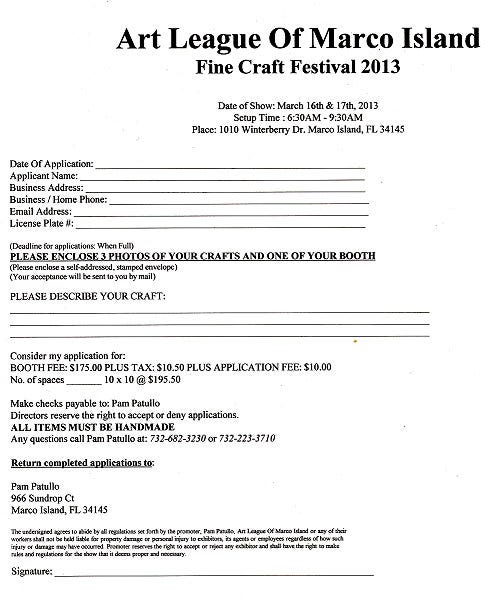
Application form example 2

THE APPLICATION

1. PREPARE A GENERIC APPLICATION

2. UNDERSTAND THE JURIED SELECTION PROCESS

3. SUBMIT APPLICATIONS AND FOLLOW-UP ON THEM

4. SCHEDULE YOURSELF FOR THE YEAR

5.1. PREPARE A GENERIC APPLICATION

SOME ORGANIZATIONS HAVE A FORMAL, PRINTED APPLICATION FORM TO FILL OUT. MORE AND MORE, HOWEVER, ORGANIZATIONS ARE USING ON-LINE APPLICATION SERVICES. I SUGGEST CREATING A GENERIC APPLICATION FORM, FROM WHICH YOU CAN CUT AND PASTE INTO THESE PRINTED OR ONLINE APPLICATION FORMS.
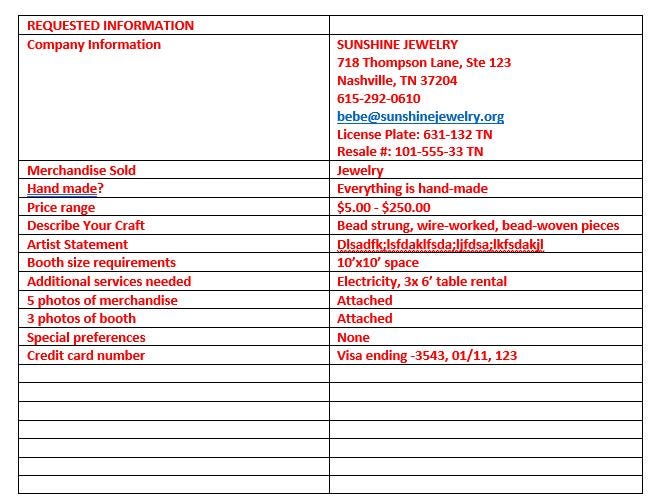
THEY MAY ASK YOU FOR THESE TYPES OF INFORMATION:

1. COMPANY INFORMATION, ADDRESS, PHONE, EMAIL, CONTACT PHONE, ONSITE-CONTACT PHONE, WEBSITE, 
 LICENSE PLATE #, RE-SALE OR TAX NUMBER AND STATE WHICH ISSUED IT

2. TYPE OF MERCHANDISE TO BE SOLD

3. HAND-MADE?

4. HIGH AND LOW PRICE RANGE OF MERCHANDISE

5. DESCRIBE YOUR CRAFT (TECHNIQUES, MATERIALS, DESIGNS)

6. ARTIST STATEMENT (ABOUT 150–250 WORDS)

7. BOOTH SIZE REQUIREMENTS (WILL YOU NEED MORE THAN ONE 10’X10’ BOOTH SPACE?)

8. REQUIREMENTS FOR ADDITIONAL SERVICES, SUCH AS ELECTRICITY, TABLE AND CHAIR RENTAL, TENT

9. 5 (five) PHOTOS OF YOUR CRAFTS (BE SURE YOUR PHOTOS ARE SHARP AND ATTRACTIVE, AS IF THEY WERE PUBLISHED IN A BOOK. NO DARK PHOTOS.) WITH PHOTOS, YOU MIGHT NEED SLIDES, OR YOU MIGHT NEED .jpg IMAGES THAT ARE 72–96 dpi, OR YOU MIGHT NEED HI-RESOLUTION .jpg IMAGES WHICH ARE 300 OR 600 dpi. They may need to be in 8-bit color or 16-bit color. They may need to use a RGB color scale or another color scale. They might specify a specific width and height in pixels. BE PREPARED WITH EACH OF THESE.

10. 3 (three) PHOTOS OF YOUR BOOTH SET-UP (THEY WANT VISUALLY APPEALING, CUSTOMER ENTICING, USER FRIENDLY BOOTH SET-UPS. AGAIN, NO DARK PHOTOS.)

11. LIST OF SPECIAL PREFERENCES, SUCH AS “CORNER BOOTH, IF AVAILABLE”

12. CREDIT CARD NUMBER, EXPIRATION DATE, SECURITY CODE NUMBER (THEY WILL PROBABLY WANT THIS NUMBER TO KEEP ON FILE)

5.2. UNDERSTAND THE JURIED SELECTION PROCESS

AT THIS POINT, YOU HAVE SELECTED SHOWS WHICH YOU FEEL ARE A GOOD FIT WITH YOUR BUSINESS.NOW, DETERMINE IF YOU ARE ELIGIBLE FOR THEM. DO THEY PUT ANY LIMITATIONS ON WHO CAN AND CANNOT APPLY? DO THEY REQUIRE THAT YOUR CREATIVE WORK BE JURIED?

MOST CRAFT SHOWS MAKE SIMPLE ACCEPTANCE DECISIONS BASED ON
 — SUBMITTING AN APPLICATION FORM, AND
 — PAYING THE FEE

SOME MAY RESTRICT THE NUMBER OF JEWELRY VENDORS THEY ACCEPT, BECAUSE THEY WANT A BALANCE OF TYPES OF MERCHANDISE, AND OFTEN, TOO MANY JEWELRY VENDORS APPLY.

OTHER SHOWS WANT TO MAINTAIN SOME LEVEL OF MERCHANDISE QUALITY STANDARDS. THEY SUBJECT THE APPLICANT TO A MORE INTENSIVE JURY-REVIEW PROCESS. THE JURY PROCESS IS PROBABLY WHAT YOU WOULD EXPECT. USUALLY A FEW PEOPLE REVIEW ALL THE APPLICATIONS AND SCORE THEM AGAINST A SET OF CRITERIA. THEY CHOOSE THE ONES WHICH SCORE HIGHEST.

SOME TYPICAL CRITERIA THEY USE:

– PRODUCTS CONSIDERED BEST FOR THE SHOW

– AETHETICS AND VISUAL APPEAL

– FUNCTIONALITY

– CREATIVITY

– ORIGINALITY

– TECHNIQUE

– MARKETABILITY

– QUALITY OF WORK

– BOOTH DESIGN

THEY WANT TO END UP WITH VENDORS WHOSE WARES WILL SELL, WHERE THERE WON’T BE MUCH DUPLICATION, AND WHOSE PRESENCE AND SET-UP IS EXCITING FOR THE PEOPLE WHO ATTEND THE SHOW. YOUR SHORT WRITE-UP AND SUBMITTED PHOTOGRAPHS NEED TO MAKE YOUR CASE.
 
 
WHAT DOES IT MEAN WHEN A JUROR SAYS “NO!”?
 
MOST REJECTIONS ARE BASED ON THE LIMITED NUMBER OF OPENINGS 
 — PARTICULARLY FOR JEWELRY VENDORS. ANOTHER MAJOR REASON FOR REJECTIONS IS THE POOR QUALITY OF PHOTOS SUBMITTED. LOOK AT YOUR PHOTOS. SHARE THEM WITH SOME FRIENDS. JUDGE THEM ACCORDING TO THE PREVIOUSLY DISCUSSED JUDGING CRITERIA. HOW WELL DO THEY MAKE YOUR CASE? ARE THEY CLEAR, FOCUSED, BRIGHT?

5.3. SUBMIT APPLICATIONS AND FOLLOW-UP ON THEM

YOU HAVE CREATED YOUR LIST OF POSSIBLE SHOWS, BASED ON YOUR SENSE OF FIT, THE GOALS YOU HAVE SET FOR YOURSELF, AND YOUR BUDGET, GIVEN THE COSTS INVOLVED. YOU HAVE DETERMINED WHETHER YOU ARE ELIGIBLE FOR THEM. DECIDE ABOUT HOW MANY SHOWS YOU WANT TO DO A YEAR. SELECT 5–10 MORE SHOWS IN ADDITION TO THE NUMBER YOU WANT TO DO. ANOTHER RULE OF THUMB IS TO SELECT 3 EVENTS TO APPLY TO FOR EACH WEEKEND YOU WANT TO WORK.

GET THEIR APPLICATION FORMS, AND REVIEW THE RULES AND APPLICATION DEADLINES. READ ALL THE RULES!

DETERMINE HOW LONG THEIR REVIEW PROCESSES ARE, AND FIGURE OUT WHEN YOU SHOULD KNOW WHETHER YOUR HAVE BEEN ACCEPTED.

CALL OR EMAIL EACH ONE, AND VERIFY THAT ALL THE INFORMATION YOU HAVE — DATES, FEES, APPLICATION REQUIREMENTS, DEADLINES — ARE TRUE.

  • **NOTE: THINGS CHANGE. THINGS GET PRINTED WRONG.

5.4. SCHEDULE YOURSELF FOR THE YEAR

ORGANIZATION IS CRITICAL HERE. GET A GOOD 3-YEAR CALENDAR. MAP EVERY DATE OUT. APPLICATION DEADLINE. APPLICATION ACCEPTANCE NOTIFICATION. DEADLINE FOR NOTIFYING THEM, CONFIRMING YOUR ACCEPTANCE, AND SUBMITTING ANY UP-FRONT FEES. SHOW DATES, INCLUDING SET-UP AND BREAK-DOWN DATES AND TIMES. REMEMBER, FOR MANY CRAFT SHOWS, YOU WILL BE APPLYING 6–12 MONTHS AHEAD OF TIME.

IT TAKES A LOT OF COORDINATED EFFORT TO KEEP EVERYTHING ON TRACK.YOU MIGHT SET UP A SPREAD-SHEET OR DATA-BASE. I USE THE ONLINE CALENDAR APPLICATION THAT COMES WITH MY EMAIL PROGRAM. I SET UP AUTOMATIC REMINDERS, SO THEY POP UP WHEN I NEED TO TAKE ACTION.

AFTER YOU SEND IN YOUR FEES, FOLLOW-UP IN 2 WEEKS TO BE SURE THEY RECEIVED YOUR APPLICATION AND PAYMENT.

5.5. BEFORE SAYING YES!…

RE-REVIEW YOUR

  • FIT WITH THE SHOW
     — BREAK-EVEN ANALYSIS
     — CALENDAR SCHEDULE
     — THE MONEY NEEDED UP-FRONT
     AND,
     — WHETHER THERE ARE ANY CANCELLATION PENALTIES OR RULES
     — WHAT KINDS OF LOCAL AND STATE LICENSES, CERTIFICATES AND PERMITS YOU WILL NEED,AND IF THE SHOW PROMOTERS ASSIST YOU IN OBTAINING TEMPORARY ONES FOR THE DURATION OF THE SHOW
LESSON 6: PROMOTE, PROMOTE, PROMOTE

YOU NEED TO ACTIVELY PROMOTE YOURSELF BOTH BEFORE AND AFTER THE SHOW. DO NOT RELY ON THE SHOW PROMOTERS TO DO ALL THE MARKETING.

ABOUT 2–4 WEEKS BEFORE THE SHOW:
 
a. CONTACT YOUR EXISTING CUSTOMERS — EMAIL, MAIL, SOCIAL NETWORK SITES
 
 b. PROMOTE YOUR MESSAGE TO POTENTIAL CUSTOMERS. LEAVE FLYERS AND BROCHURES AT RELEVANT BUSINESSES OR ORGANIZATIONS/ POST MESSAGES ON SOCIAL NETWORK SITES/ POST MESSAGES ON YOUR OWN WEBSITE OR BLOG/ GET LISTED ON COMMUNITY CALENDARS/ TELL PEOPLE YOU INTERACT WITH. IN YOUR PROMOTIONS, BE SURE YOU HAVE ALL THE DETAILS LISTED CORRECTLY. IN A SHORT, CATCHY PHRASE OR SENTENCE, TELL WHY THIS EVENT WOULD BE OF PARTICULAR INTEREST TO THEM. YOU MIGHT OFFER SPECIAL DISCOUNTS, IF THEY PRESENT YOUR CARD OR EMAIL NOTICE.
 
 c. BE SURE YOU ARE GOING TO LOOK PRESENTABLE. IF YOU NEED A HAIR-CUT, GET IT. BE SURE YOU HAVE ALL THE CLOTHES YOU NEED. CHECK YOUR SUPPLY OF BUSINESS CARDS, BROCHURES, OTHER PROMOTIONAL MATERIALS. PRACTICE SAYING YOUR SELLING POINTS. BE STRATEGIC ABOUT WHICH PIECES OF JEWELRY YOU ARE GOING TO WEAR AT THE SHOW.

AT THE SHOW:
 
HAVE YOUR BUSINESS CARDS, AND ANY BROCHURES, IF YOU HAVE THEM, OUT FOR THE TAKING. IT HELPS IF YOUR BUSINESS CARDS HAVE AN IMAGE OF YOUR JEWELRY ON THEM. TO HELP PEOPLE REMEMBER YOU.

HAVE A BOOK OR SIGN-UP SHEET WHERE PEOPLE CAN LIST THEIR NAMES, MAILING AND EMAILING ADDRESSES.

AFTER THE SHOW:
 
UPDATE YOUR CUSTOMER DATABASE. STAY IN TOUCH WITH YOUR NEW CUSTOMERS, SUCH AS WITH A FOLLOW-UP MAILING OR EMAILING. DIRECT YOUR NEW CUSTOMERS TO YOUR WEBSITE OR OTHER WAYS OF CONTACTING YOU AND SEEING YOUR PIECES WHICH ARE FOR SALE.

LESSON 7: SET UP FOR SUCCESS

IMOGENE MCALLISTER ROSENSTEIN. REMEMBER SHE HAD NO PLAN OR STRATEGY FOR CHOOSING SHOWS. AND, GUESS WHAT, SHE HAD NO PLAN OR STRATEGY FOR SETTING UP AT SHOWS, EITHER.

IMOGENE, BLESS HER HEART, LOVED PLAIDS. SHE WOULD SET UP A TABLE, AND COVER IT WITH A DARK, PLAID CLOTH, AND LAY HER JEWELRY ONTO THE CLOTH. SHE LIKED TO PUSH HER TABLE UP TO THE FRONT OF THE BOOTH, AND SIT IN A CHAIR BEHIND IT.

HER BOXES OF SUPPLIES AND INVENTORY, WERE STACKED UP AGAINST THE BACK OF HER BOOTH, NO EFFORT TO DISGUISE OR HIDE THEM.

YOUR BOOTH IS YOUR SHOP.IT SHOULD BE COHESIVE, VISUALLY INTERESTING, FUNCTIONAL. YOU DO NOT WANT YOUR BOOTH TO BE DISORGANIZED, DIS-INVITING, INTIMDATING.

SETTING UP FOR SUCCESS MEANS HAVING A GOOD UNDERSTANDING OF

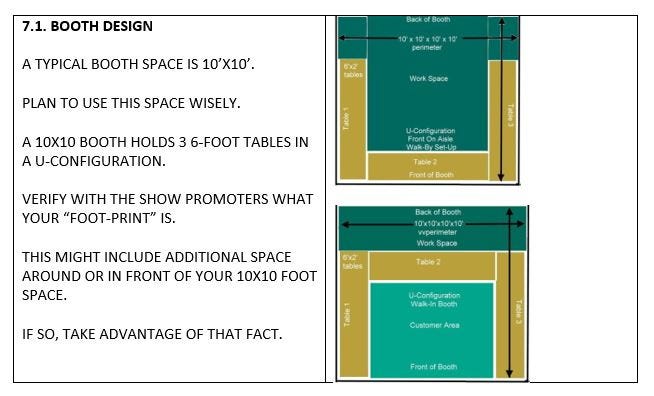
7.1. BOOTH DESIGN
 7.2. LAY-OUT AND TABLE SET UP 
 7.3. MERCHANDISE DISPLAY
 7.4. SIGNAGE
 7.5. LOADING AND UN-LOADING
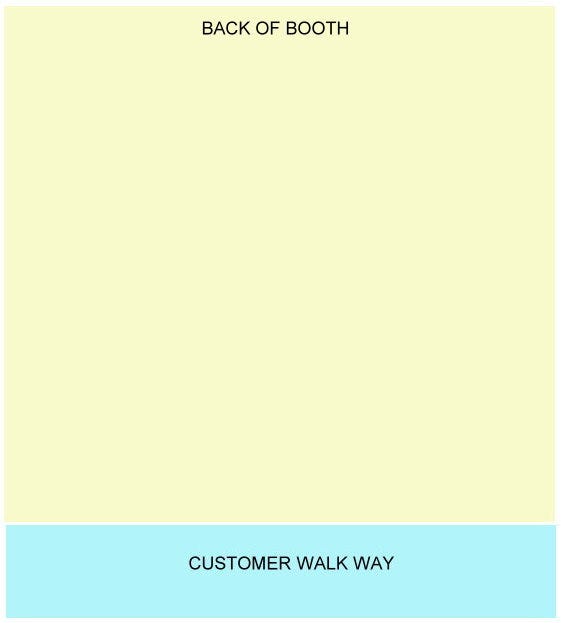
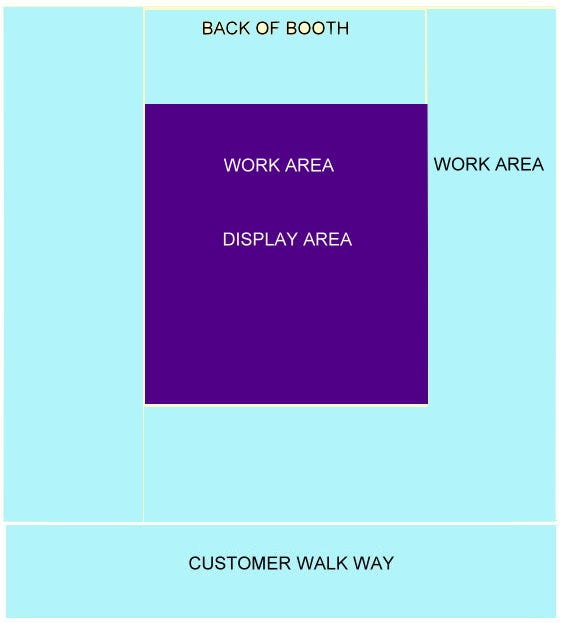
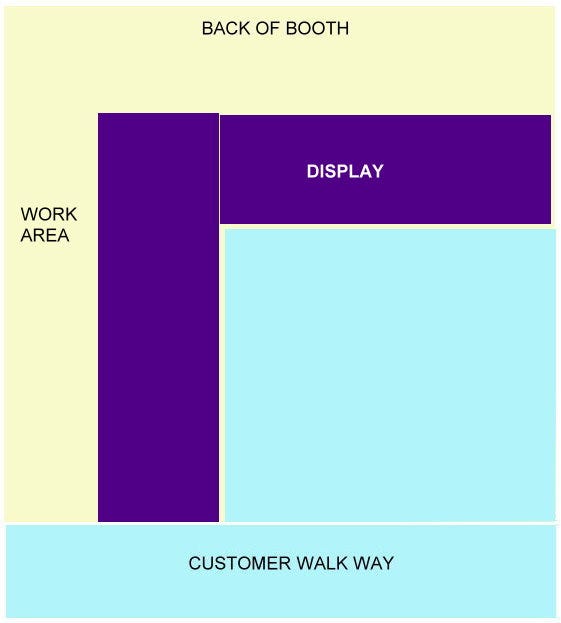
front-loaded
island
L-shape
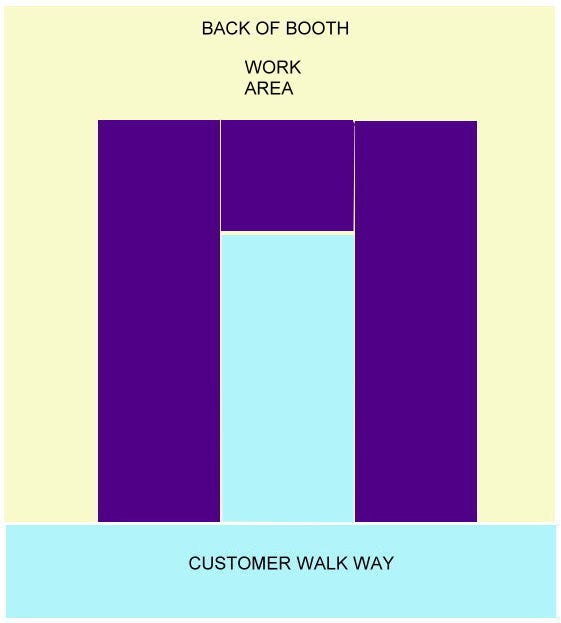
U-shape

WALLS: FIRST, WILL THIS SPACE BE ENCLOSED IN SOME WAY — WALLS, PARTITIONS, INSIDE A TENT?

DO YOU WANT TO HAVE WALLS? DO THE WALLS NEED TO BE FABRIC, WOOD, WIRE GRIDS OR CHICKEN WIRE? WHAT ARE YOU GOING TO DO WITH THE WALLS? CAN THINGS BE HUNG. HOW DO THESE WALLS AFFECT THE VISIBILITY OF YOUR BOOTH SPACE AND YOUR INVENTORY?

AS BEST AS I CAN, I LIKE TO USE MATERIALS AND FURNISHINGS WHICH WILL NOT DIMINISH THE VISIBILITY OF MY BOOTH, AND WHICH CAN DO DOUBLE-TIME. I OFTEN USE WINDOW SHUTTERS OR WIRE GRIDS FOR WALLS AND RACKS, SO THAT I CAN HANG THINGS FROM THEM.
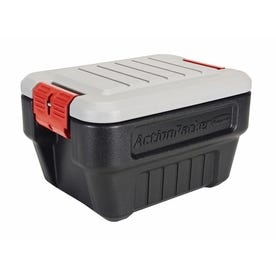
THE CONTAINERS I USE TO TOTE MY INVENTORY AND SUPPLIES GET USED FOR DISPLAYS, OR AS SUPPORT COLUMNS FOR DISPLAYS.

TENT: IF YOU NEED A TENT, SOME SHOWS PROVIDE THEM OR RENT THEM. SOME SHOWS HAVE DETAILED REQUIREMENTS FOR WHAT TENTS SHOULD LOOK LIKE. SOMETIMES THEY WANT ALL TENTS TO BE WHITE. YOU CAN FIND ONLINE SOURCES FOR BUYING TENTS. YOU WANT A TENT WHERE YOU CAN ROLL THE WALLS UP AND DOWN. BE SURE YOU HAVE TENT WEIGHTS, TO DEAL WITH WINDY WEATHER. SOMETIMES, IF THE AIR IS HOT AND HUMID, AND THE TENT WALLS ARE DOWN, THE AIR IN YOUR BOOTH BECOMES STALE AND HEAVY. DON’T LET THIS HAPPEN.
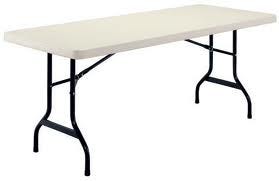
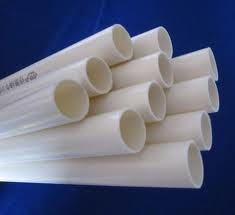
TABLE: SECOND, IF YOU ARE TO BE PROVIDED WITH TABLES, HOW MANY AND OF WHAT SIZE WILL THEY BE? I FIND 6’ BY 2’ TABLES TO BE ESPECIALLY EASY TO MANEUVER AND MANAGE.

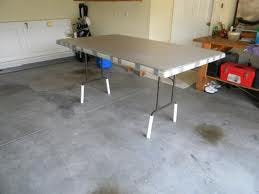
FOR EACH TABLE, I HAVE CUT UP PVC PIPE
 — TO STICK THE LEGS OF MY TABLES IN, AND TO ALLOW ME TO RAISE THE HEIGHT OF THE TABLES ABOUT 6–9” SO CUSTOMERS DO NOT TO HAVE TO BEND DOWN SO FAR TO VIEW THE INVENTORY.

I DON’T LIKE TABLES FLUSH WITH THE AISLE. IN SOME SETTINGS, THIS IS YOUR ONLY CHOICE. BUT THIS MAKES IT UNCOMFORTABLE FOR PEOPLE TO STAND THERE AND LOOK AT YOUR STUFF. THEY ARE TOO CONCERNED THEY MAY BLOCK SOMEONE IN THE AISLE. IF POSSIBLE, MOVE THE TABLES INWARD, SO YOU GET THEM TO FEEL LIKE THEY HAVE STEPPED INTO YOUR BOOTH.

ADDITIONAL FURNISHINGS: THIRD, WHAT KINDS OF ADDITIONAL FURNISHINGS WILL YOU NEED TO BRING? DO THINGS NEED TO GO ON SHELVES? IS THERE ROOM FOR SOME KIND OF RACK? DO YOU WANT TO PUT A RUG ON THE FLOOR, OR IN FRONT OF YOUR BOOTH? DO YOU WANT TO BRING BOX FANS (OR SPACE HEATERS)? WHAT WILL YOU USE TO STORE THINGS YOU NEED ACCESS TO DURING THE SHOW? BRING A MIRROR FOR YOUR CUSTOMERS.

LIGHTING: FOURTH, WHAT IS YOUR LIGHTING PLAN, AND TOWARDS THIS END, WILL YOU HAVE ACCESS TO ELECTRICITY? HAVING LIGHTING MAKES A BIG DIFFERENCE IN YOUR SALES RESULTS. BRIGHT LED LIGHTS, AT 4100k TO 5500k, ARE BEST. THIS KELVIN MEASURE WILL GIVE YOU A BLUISH WHITE LIGHT. BRING POWER STRIPS AND LONG EXTENSION CORDS. THERE MAY BE ELECTRICITY, BUT THE SOURCE OF THIS POWER MAY BE LOCATED FAR FROM YOUR BOOTH. IF THERE IS NO ELECTRICITY, YOU CAN PURCHASE BATTERY OPERATED LED LIGHTS

OPTIMUM FLOOR PLAN: FIFTH, GIVEN THE SPACE, WHAT IS THE OPTIMUM FLOOR PLAN FOR YOUR BOOTH? IF POSSIBLE, I PREFER TO ALLOW MY CUSTOMERS TO WALK INTO PART OF MY BOOTH. TOWARDS THIS END, AGAIN IF POSSIBLE, I LIKE TO SET THE TABLES UP EITHER IN AN “L-SHAPE” OR A “U-SHAPE”.

People don’t like to stand in a place where they feel someone might brush against their behind while walking by.

PRACTICE PRACTICE PRACTICE: LAST, PRACTICE SETTING EVERYTHING UP. PRACTICE PACKING YOUR THINGS, TRANSPORTING YOUR THINGS, AND UN-PACKING YOUR THINGS. IF YOU WILL BE USING A TENT, PRACTICE SETTING THIS UP. CAN YOU DO ALL THIS BY YOURSELF? GIVEN THE DISTANCE BETWEEN WHERE YOU WILL HAVE TO PARK, AND WHERE YOUR BOOTH IS, CAN YOU MANAGE TRANSPORTING ALL YOUR STUFF THIS DISTANCE.

ANTICIPATE THE TRAFFIC FLOW BOTH IN FRONT OF YOUR BOOTH, AS WELL AS INSIDE YOUR BOOTH, IF YOU CAN SET UP TO ALLOW PEOPLE TO COME INSIDE. REMEMBER: YOUR SPACE AND CUSTOMER FLOW GO BEYOND THE BOUNDARIES OF YOUR TABLE. REMEMBER: VISUALIZE HOW TRAFFIC WILL FLOW TO AND FROM EACH OF YOUR NEIGHBORS.

AS SHOPPERS WALK BY YOUR BOOTH, HOW MUCH OF IT CAN THEY SEE? ARE THERE THINGS, AND ENOUGH THINGS, TO CATCH THEIR EYE, AND ENTICE THEM TO STOP AND LOOK?

BE SURE THE DÉCOR OF YOUR BOOTH COORDINATES WELL WITH THE JEWELRY YOU ARE SELLING. IT MUST COORDINATE WITH THE SHOW, AS WELL. YOU DON’T WANT BEACH DÉCOR AT A CHRISTMAS HOLIDAY SHOW.

CAN CUSTOMERS…

– ENTER AND EXIT EASILY

– SHOP EASILY

– PAY EASILY

– NOT FEEL TRAPPED, WHEN A LOT OF PEOPLE ARE IN YOUR BOOTH

PREVENT THE “SCRATCHED TUSH” SYNDROME. CUSTOMERS AVOID STANDING WHERE THEY FEAR SOMEONE WILL BRUSH AGAINST THEIR BACK-SIDES.

SET UP A PAYMENT STATION WHERE CUSTOMERS CAN MAKE THEIR PURCHASES OUT OF THE WAY OF OTHER SHOPPERS BUT WHERE YOU CAN STILL KEEP AN EYE ON THINGS. AT YOUR PAYMENT STATION, YOU WILL NEED TO ACCEPT PAYMENT AND MAKE CHANGE, AND YOU WILL NEED TO BE ABLE TO WRITE SOME KIND OF CUSTOMER RECEIPT. YOU MAY NEED TO WRAP UP OR PACKAGE AN ITEM,

SOME ADDITIONAL QUICK POINTERS:

– COVER YOUR TABLES WITH FABRIC

– DON’T USE DARK COLORS. 
 THESE BRING THE MOOD DOWN, AND OFTEN DON’T ENHANCE YOUR JEWELRY IN THESE VERY OPEN SETTINGS.

– CHOOSE COLORS WHICH ADD TO YOUR PRODUCT, BUT DO NOT COMPETE WITH THEM

– CUSTOMERS LIKE TO USE ALL THEIR SENSES WHEN THEY SHOP: SEE, TOUCH, THINK

– SUBTLY USE PROPS AND MIRRORS TO HELP THE CUSTOMER VISUALIZE HOW THE PRODUCT MIGHT USED OR WORN

– I LIKE TO MAKE MY BOOTH FEEL HOMEY.

– I LIKE TO HAVE RUGS INSIDE AS WELL AS IN FRONT OF MY BOOTH

– I LIKE TO HAVE CHAIRS OR A BENCH NEAR THE FRONT OF MY BOOTH, TO ATTRACT PEOPLE TO SIT AND LINGER, AND SO IT ALWAYS LOOKS LIKE PEOPLE ARE LOOKING AT MY BOOTH

– IN HOT WEATHER, I LIKE TO HAVE A FAN CIRCULATING AIR WHERE THE CUSTOMERS ARE STANDING, NOT JUST ON ME.

– IN COLD WEATHER, I HAVE A HEATER GOING.

– NO GARBAGE SHOULD BE VISIBLE.

– EVERYTHING SHOULD BE STORED AND NEAT

– HAVE ENOUGH SIGNAGE TO GET PEOPLE’S ATTENTION, AND EDUCATE THEM ABOUT YOUR PRODUCTS

  • DISPLAY YOUR PRICES CLEARLY

ANTICIPATE THE WEATHER
 
IS IT…

– HOT AND HUMID

– COLD

– RAINY OR STORMY

– WINDY

– DUSTY

HAVE DROP CLOTHS TO PROTECT YOUR MERCHANDISE AND DISPLAYS. I KEEP LARGE PIECES OF CARDBOARD THAT I CAN LAY ON WET GROUND, WHEN MY BOOTH IS OUTSIDE. SOMETIMES I TAKE A BALE OR TWO OF STRAW THAT I PURCHASED AT THE LOCAL HARDWARE STORE OR GARDEN CENTER, TO COVER WET GROUND. I HAVE PLENTY OF CLEANING AIDS, TO KEEP THE MERCHANDISE LOOKING FRESH AND SALEABLE ALL DURING THE SHOW.

I WEAR LAYERS OF CLOTHING. I BRING SUNGLASSES, GLOVES, HATS, A BATTERY-POWERED HAND-HELD FAN, WHATEVER IT TAKES TO KEEP ME PERKY, HAPPY AND COMFORTABLE.

DISPLAYING YOUR MERCHANDISE: SOME POINTERS

COVER YOUR TABLES WITH ATTACTIVE FABRIC, IN A SOLID COLOR WHICH COMPLEMENTS YOUR PIECES. IN CRAFT SHOW SETTINGS, YOU WILL FIND THAT LIGHTER COLORS WORK BETTER THAN DARKER ONES. I THINK IT IS BETTER TO COVER THE FULL FRONT OF THE TABLE WITH A CLOTH, NOT JUST THE TOP OF THE TABLE.

HAVE PRETTY CONTAINERS TO HOLD YOUR WARES.

THINK OF DISPLAY IN TERMS OF LEVELS. YOU DO NOT WANT EVERYTHING LYING FLAT ON A TABLE. IN YOUR BOOTH, YOU MIGHT HAVE A MIX OF LOW TABLES, HIGHER TABLES, TALL HEIGHTS, STANDS, PEDESTALS, HANGING ITEMS

COORDINATE YOUR USE OF COLOR WITH THE COLORS PROMINENT IN YOUR BUSINESS CARDS, BROCHURES AND SIGNAGE.

A WARM, AIRY FEELING IS MUCH BETTER THAN A DARK, CAVE FEELING.

OPEN BOOK CASES WORK BETTER THAN ONES WITH CLOSED BACKS.

BE CAREFUL, IF USING DISPLAYS WHICH ARE GLASS ENCLOSED, THAT THE GLASS REFLECTION DOES NOT DIMINISH THE ABILITY TO VIEW JEWELRY INSIDE THESE DISPLAYS.

KEEP THINGS CREATIVE, BUT NOT COMPLEX OR CLUTTERED. DON’T LET THINGS GET BARREN, EITHER, — WHAT I CALL A “TOOTHLESS LOOK”

YOUR DISPLAYS SHOULD BE ATTRACTIVE, BUT SHOULD NOT COMPETE FOR ATTENTION WITH YOUR JEWELRY.ITH THIS IN MIND, YOU DO NOT NECESSARILY HAVE TO PUT ALL YOUR INVENTORY OUT AT ONCE.

CREATE NATURAL PLACES FOR THE CUSTOMER’S EYE TO SETTLE. BUILD DISPLAYS AROUND THESE NATURAL FOCAL POINTS.

CLEAN. KEEP YOUR GLASS CLEAN. KEEP YOUR JEWELRY SHINY. KEEP YOUR BOOTH TIDY. YOU WANT THAT CUSTOMER AT 4PM SUNDAY TO BE AS EXCITED AS THAT CUSTOMER WAS AT 1PM THE DAY BEFORE.

7.4. SIGNAGE

FIRST AND FOREMOST, FOLLOW THE SHOW PROMOTER’S RULES ABOUT SIGNAGE.

Signs should generate interest and help sell your products. Don’t use “superlatives” like best, most, cheapest, largest and the like. In as few words as possible, tell the customer how your product will solve his or her problem, or meet his or her needs. Be positive and diplomatic in your wording. Writing “unruly kids will be sold as slaves” makes the point much better than “No Kids”.

Explain that which is not obvious. What’s it made of? When using the product, what must be avoided — such as getting it wet? Are there any disclaimers or conditions? What are the advantages of your product over others?

Use colors, typefaces, and images on your sign which have the same feel as your merchandise. Don’t overdo your signage, so that the signs overwhelm your inventory.

Be sure you have a clear, prominent sign that includes the name of your business. If your booths are number, this number should appear on the sign.
YOUR SIGN OR SIGNS SHOULD BE VISIBLE FROM ALL SIDES OF YOUR BOOTH FROM WHICH CUSTOMER WILL BE APPROACHING. IF THE BACK OF YOUR BOOTH WILL BE VISIBLE, PUT A SIGN THERE. PUT A SIGN ON THE INSIDE OF YOUR BOOTH. I LIKE TO HANG A POSTER-SIZED IMAGE OF SOMEONE WEARING A PIECE OF MY JEWELRY. I IMPRINT MY BUSINESS NAME ON THE POSTER.

YOUR SIGNS SHOULD BE SIMPLE, CLEAN AND WITH A CLEAR FONT. THE COLORS RED AND YELLOW ARE SEEN FROM THE FURTHEST DISTANCE AWAY.

YOUR SIGN SHOULD SAY WHAT YOU SELL, NOT NECESSARILY YOUR BUSINESS NAME FOR EXAMPLE: “JEWELRY TO LOVE” IS MUCH BETTER THAN “IMOGENE’S CREATIONS”

EVERYTHING IN YOUR BOOTH SHOULD BE TAGGED, LABELED, PRICED AND IDENTIFIED FOR THE CUSTOMER. INFORMATION IS IMPORTANT.

YOU MIGHT HAVE FRAMED LITTLE WRITE-UPS SITTING WITH VARIOUS DISPLAYS AND TELLING THE CUSTOMER SOMETHING ABOUT YOURSELF, YOUR TECHNIQUE OR YOUR JEWELRY.

WITHOUT GOOD AND PROMINENTLY VISIBLE INFORMATION, CUSTOMERS OFTEN WALK AWAY WITHOUT ASKING FOR HELP.

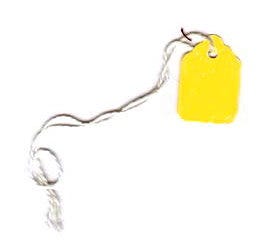
PRICE TAGS ARE A MUST. IF YOU HAVE THE TIME AND CAN AFFORD IT,USE PROFESSIONALLY-PRINTED PRICE TAGS.YOU CAN BUY LABEL MAKERS NOW AT STATIONERY STORES AND WITH WHICH YOU CAN GENERATE PRINTED PRICE TAGS. PRICE TAGS GIVE CREDANCE TO THE PRICE, AND REDUCE THE TIMES CUSTOMERS MAY TRY TO HAGGLE.
HAVE BUSINESS CARDS, POSTCARDS, BROCHURES, AND NEWSLETTERS EASILY AVAILABLE.

PUT OUT A SIGN-UP BOOK OR SIGN-UP SHEETS TO EXPAND YOUR MAILING AND EMAILING LISTS.

7.5. LOADING AND UN-LOADING

ALLOW YOURSELF PLENTY OF TIME TO UNLOAD AND SET UP YOUR BOOTH. IF ALLOWED TO DRIVE INTO THE VENUE TO UNLOAD, BE COURTEOUS AND UNLOAD AS QUICKLY AS POSSIBLE. THEN MOVE YOUR VEHICLE BEFORE CONTINUING TO SETUP.

I LIKE TO MODULAR-IZE EVERYTHING. THAT IS, I LIKE TO USE SIMILAR SIZED AND SHAPED CONTAINERS TO CARRY EVERYTHING IN. THEY ARE STURDY, EASY FOR ONE PERSON TO CARRY. THE CONTAINERS ARE STACKABLE. EACH CONTAINER IS CLEARLY LABELED ON THE OUTSIDE TO WHAT IS ON THE INSIDE. SOME OF MY CONTAINERS DO DOUBLE-TIME AS PEDESTALS OR SUPPORTS FOR DISPLAYS. I USE OTHER CONTAINTERS FOR ACTIVE STORAGE DURING THE SHOW.BUT EASILY STORABLE, OUT OF SIGHT OF THE CUSTOMERS.

IF YOU NEED A VAN OR TRUCK, AND DON’T OWN ONE, THESE ARE EASILY AND VERY INEXPENSIVELY RENTABLE AT A LOCAL U-HAUL OR SIMILAR BUSINESS.
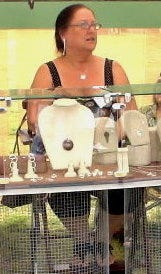
LESSON 8: BRING ENOUGH INVENTORY TO SELL
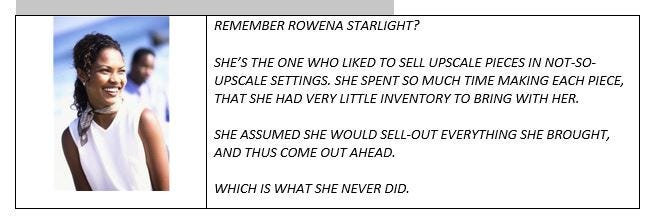
INVENTORY

1. BRING ENOUGH INVENTORY TO SELL, TYPICALLY 4X WHAT YOU HOPE TO SELL.THUS, IF YOU WANT TO SELL $200.00 OF STUFF, YOU WOULD WANT TO BRING $800.00 OF MERCHANDISE.

2. DON’T NECESSARILY PUT EVERYTHING OUT AT ONCE.YOU WANT YOUR BOOTH TO LOOK FULL, ABUNDANT AND COMPLETE, BUT NOT CLUTTERED OR OVERWHELMING. AT THE SAME TIME, YOU DON’T WANT “EMPTY SPACES” WHERE IT LOOKS LIKE YOU HAVE RUN OUT OF THINGS TO SELL. IF YOU STARTED WITH A LARGE BOWL OF LOOSE ITEMS, AND YOU HAVE SOLD OUT HALF OF THEM, REPLACE THAT BOWL WITH A SMALLER BOWL.

3. HAVE MERCHANDISE WITH A VARIETY OF PRICE POINTS. YOU WILL WANT TO HAVE A MIX OF IMPULSE ITEMS, AS WELL AS MORE EXPENSIVE THINGS, AND PERHAPS 2 OR 3 VERY HIGH END ART PIECES.

THINK WHAT KINDS OF JEWELRY SELLS THE MOST, AND WHAT SELLS THE LEAST. USUALLY EARRINGS AND BRACELETS SELL THE MOST, AND NECKLACES AND SPECIALIZED ITEMS SELL THE LEAST. BUT THIS ALL DEPENDS SOMEWHAT ON CURRENT FASHIONS.

PEOPLE CARRY AROUND WITH THEM $1 BILLS, $5 BILLS, $10.00 BILLS, $20’S, $50’S AND $100’S. THE IMPULSE BUYER IS MORE LIKELY TO PURCHASE SOMETHING IN THESE DENOMINATIONS.

4. SELL THINGS YOU LOVE.

LESSON 9: SELL YOURSELF AND YOUR CRAFT AT THE SHOW

AT THE SHOW, YOU ARE NOT ONLY SELLING YOUR PRODUCTS. YOU ARE SELLING YOURSELF. YOURSELF AS A JEWELRY DESIGNER. YOUR CREATIVITY. YOUR PERSONALITY. THE ESSENCE OF YOUR ARTISTIC SOUL.

YOU SELL YOURSELF TO MOTIVATE YOUR CUSTOMERS. YOU WANT TO MOTIVATE PEOPLE TO STOP BY YOUR BOOTH AND LINGER. YOU WANT TO MOTIVATE PEOPLE TO BUY. YOU WANT TO MOTIVATE THEM TO REMEMBER YOU AND YOUR WORK. YOU WANT THEM TO PURCHASE FROM YOU AGAIN.

ALL THIS MOTIVATING WILL TAKE A LOT OF WORK ON YOUR PART.

(1) BODY LANGUAGE

(2) TELLING YOUR STORY

(3) DEMONSTRATING YOUR SKILLS

(4) MAKING THE SALE WORK FOR THEM

(9.1) BODY LANGUAGE
 
THE WAY YOU SIT,
 THE WAY YOU STAND,
 YOUR FACIAL EXPRESSIONS,
 HOW YOU GREET CUSTOMERS,
 HOW YOU CONVERSE WITH CUSTOMERS,
 HOW YOU DESCRIBE YOUR WORK, AND YOUR TECHNIQUE,
 THESE ALL SUBTLY AFFECT THE SHOPPING EXPERIENCES AND BEHAVIORS OF YOUR CUSTOMERS.

PART OF THE SELLING PROCESS IS PURE THEATER. YOU NEED TO PUT ON A GOOD SHOW. AFTER ALL,YOU WANT TO ATTRACT CUSTOMERS TO YOUR BOOTH. YOU WANT THEM TO LINGER. YOU WANT THEM TO ASK FOR HELP, AND ASK OTHER QUESTIONS. YOU WANT THEM TO REMEMBER YOU AND WHAT YOU SELL.

FIRST, STAND, DON’T SIT. IF YOU DO NEED TO SIT, SIT AT AN ANGLE TO YOUR BOOTH OR DISPLAY TABLE. RATHER THAN SITTING DIRECTLY CENTERED, FACING FORWARD. IN THIS WAY, PEOPLE CAN APPROACH YOUR DISPLAY WITHOUT FEELING YOU ARE WATCHING THEIR EVERY STEP AS THEY MAKE THEIR WAY TO YOUR BOOTH. IF IT’S GOING TO BE A LONG DAY AND A LONG WEEKEND, YOU MIGHT RESORT TO A HIGHER DIRECTOR’S CHAIR OR STOOL, AS A SORT OF COMPROMISE BETWEEN STANDING AND SITTING TO TAKE SHORT BREAKS.

YOUR FACIAL EXPRESSIONS ARE IMPORTANT. DON’T LOOK BORED. DON’T STARE OFF INTO SPACE. DON’T LOOK LIKE YOU WOULD RATHER BE SOMEWHERE ELSE. DON’T STAND WITH YOUR ARMS FOLDED, OR YOUR HANDS IN YOUR POCKETS. DON’T LOOK LIKE YOUR PRIMARY MISSION IS TO GUARD YOUR BOOTH. LOOK HAPPY. LOOK EAGER TO MEET NEW PEOPLE, GREET FAMILIAR FACES, AND SHARE YOUR STORIES AND YOUR WORK.

BE VISIBLE, DON’T HIDE.

LOOK BUSY. WHEN IT’S SLOW, DO BUSINESS-RELATED ACTIVITIES: CLEAN, DUST, RE-ARRANGE, CHANGE OUT MERCHANDISE, PRICE, MAKE SOME MORE JEWELRY, INVENTORY THINGS, TAKE PICTURES.

ENGAGE PEOPLE AS THEY WALK BY OR APPROACH YOUR BOOTH. CATCH THEIR EYES. SAY “GOOD DAY”, OR “BEAUTIFUL DAY OUT TODAY” COMPLMENT PEOPLE, LIKE SAYING “LOVE THAT NECKLACE,” OR “BEAUTIFUL SHOES.” IF YOU HAVE DIFFICULTY TALKING WITH PEOPLE, HIRE SOMEONE TO WORK WITH YOU WHO CAN.

GIVE YOUR CUSTOMERS SOME SPACE TO SHOP. YES, YOU DO HAVE TO WORRY ABOUT SHOP-LIFTING, BUT YOU DON’T WANT TO MAKE EVERY CUSTOMER FEEL LIKE YOU THINK THEY ARE A CROOK. DON’T HOVER OVER THEM. DON’T FORCE CONVERSATIONS ON THEM. DON’T TAKE AWAY THEIR FUN OF SHOPPING.

BUT ALSO, DO NOT IGNORE THEM. GREET THEM. ASK THEM IF THEY NEED ASSISTANCE. ASK THEM IF THEY WOULD LIKE TO TRY A PIECE ON. ASK THEM HOW THE SHOW HAS BEEN GOING FOR THEM.

DRESS THE PART. BE WELL-GROOMED. BE PRESENTABLE. SMELL GOOD. BUT DON’T BATH YOURSELF IN COLOGNE.DON’T GET CAUGHT WITH BAD BREATH. AND, IN A SIMILAR VEIN, DON’T EAT THINGS WHICH RESULTS IN BAD BREADTH, LIKE ONIONS AND TUNA FISH.

WEAR YOUR JEWELRY.

WEAR A NAME BADGE.

DON’T EAT IN YOUR BOOTH.

DON’T TALK ON THE PHONE.

DON’T TEXT.

DON’T SMOKE.

DON’T DRINK ALCOHOLIC BEVERAGES.

DON’T READ OR SLEEP.

DON’T GET LOST IN CONVERSATION WITH YOUR PARTNER OR STAFF, TO THE EXCLUSION OF YOUR CUSTOMERS.

DON’T BLOCK THE ENTRANCE TO YOUR BOOTH

IT’S A GOOD IDEA TO TAKE BREAKS ABOUT EVERY 4 HOURS. BUT DON’T LEAVE YOUR BOOTH FOR MORE THAN 20 MINUTES AT A TIME. PEOPLE WANT TO MEET THE ARTIST. YOUR PRESENCE IS ONE OF YOUR MAIN SELLING POINTS.

WHEN IT’S CROWDED, AND YOU HAVE CUSTOMERS COMPETING FOR YOUR ATTENTION, ACKNOWLEDGE EACH ONE, LET THEM KNOW ABOUT HOW LONG IT WILL BE BEFORE YOU FINISH WITH YOUR EXISTING CUSTOMER, AND CAN WAIT ON THEM.

PRIORITIZE.THE PERSON YOU MAY BE HELPING MIGHT REQUIRE A LOT OF TIME. THE NEXT PERSON MIGHT REQUIRE JUST A FEW MINUTES. EXCUSE YOURSELF FROM THE FIRST PERSON, AND WAIT ON THE SECOND.

IF YOU HAVE A CHATTY CUSTOMER, LEARN HOW TO POLITELY INTERRUPT, AND RE-DIRECT THE CONVERSATION, SO THAT YOU CAN SMOOTHLY TRANSITION TO THE NEXT CUSTOMER.

THANK YOUR CUSTOMERS FOR COMING OVER TO YOUR BOOTH.

BE SURE THEY SIGN A GUEST REGISTER. BE SURE THEY LEAVE WITH SOME PROMOTIONAL MATERIAL. BE SURE THEY KNOW HOW TO CONTACT YOU AFTER THE SHOW.

IF SOMEONE HAS PURCHASED SOMETHING FROM YOU, THANK THEM, THEN SAY SOMETHING LIKE, “THAT NECKLACE WILL LOOK GREAT ON YOU,” OR, “THAT’S SUCHA THOUGHTFUL GIFT YOU ARE BUYING,” WHICH REINFORCES THE GOOD FEELINGS THEY HAVE ABOUT THE PURCHASE, AS THEY HAND YOU THE MONEY.

(9.2) TELL YOUR STORY

WHEN YOU ESTABLISH A VERY PERSONAL CONNECTION WITH YOUR CUSTOMER,YOU WILL MORE LIKELY MAKE THE SALE.

PEOPLE ARE NOT JUST BUYING YOUR WORK. THEY ARE BUYING AN EXPERIENCE. THE MORE THEY KNOW ABOUT YOU, YOUR TECHNIQUES AND THE PARTICULARS OF THE WORK, THE MORE LIKELY THEY ARE TO BUY SOMETHING. YOU, IN EFFECT, ARE BUILDING A BRAND.THE BRAND IS YOU. YOUR STORY SHOULD BE REAL, RELEVANT TO WHAT YOU ARE SELLING, AND REPEATABLE.

SO, YOUR STORY COULD INCLUDE

– IMPORTANT MILESTONES IN YOUR DEVELOPMENT AS AN ARTIST

– HOW YOU GOT STARTED

– HOW YOU LEARNED YOUR “CRAFT”

– WHO TAUGHT YOU

– THE REASONS YOU ARE PASSIONATE ABOUT YOUR WORK

– DO YOU MAKE THINGS FULL TIME OR PART TIME

– YOUR INSPIRATIONS

– INTERESTING FACTS ABOUT THE MATERIALS YOU USE, and WHERE YOU FIND THEM

– SOME HUMOROUS TALES OF THINGS THAT HAPPENED TO YOU, IN THE CONTEXT OF YOUR WORK

– THE KINDS OF THINGS WHICH DIFFERENTIATE YOURSELF FROM OTHER JEWELRY DESIGNERS

– THE KINDS OF THINGS WHICH ARE CRITICAL TO YOUR SUCCESS

– HOW YOU MANAGE A REGULAR JOB AND YOUR “CRAFT”

– WHERE ELSE DO YOU SELL YOUR PIECES

IF YOU ARE UNCOMFORTABLE TALKING ABOUT YOURSELF AND YOUR JEWELRY, PRACTICE, PRACTICE, PRACTICE. WRITE UP A STORY. MAKE THIS WRITE-UP PART OF YOUR PROMOTIONAL MATERIALS. TELL YOUR STORY TO FRIENDS AND RELATIVES. EVENTUALLY TELLING YOUR STORY WILL BECOME SECOND-NATURE.

(9.3) DEMONSTRATING YOUR SKILLS
 
IF THE SHOW PROMOTERS ALLOW DEMONSTRATIONS, FIND OUT THEIR RULES.

DEMONSTRATIONS ARE GREAT MARKETING TOOLS. THEY ALWAYS ATTRACT CUSTOMERS. THEY GET PEOPLE TO LINGER. THEY SHOW YOU REALLY DO MAKE YOUR OWN PRODUCTS.

(9.4) MAKE THE SALE WORK FOR THEM

HELP THE CUSTOMER JUSTIFY THE PURCHASE. MAKE IT WORK. HAVE TOOLS HANDY TO TAKE OUT A LINK OR ADD A LINK TO SHORTEN OR LENGTHEN THAT PIECE OF JEWELRY.

YOU MAY NOT HAVE EXACTLY WHAT THEY WANT. PERHAPS YOU HAVE IT IN YOUR INVENTORY AT HOME, AND YOU CAN MAIL ORDER THE SALE.

OR, IF YOU DO COMMISSION WORK, LET PEOPLE KNOW ABOUT THIS. EXPLAIN TO THEM WHAT COMMISSION WORK MEANS, AND WHAT YOUR TERMS ARE.

Children
 CHILDREN CAN DISRUPT THE SALES PROCESS. THEY CAN COMPETE FOR THE ATTENTION OF YOUR CUSTOMER THEY CAN SOMETIMES REEK HAVOK WITH YOUR MERCHANDISE AND YOUR DISPLAYS. I ALWAYS HAVE SOME SMALL ITEMS TO DISTRACT THEM, OR SOMETHING THEY CAN FIDDLE OR PLAY WITH.

body language

LESSON 10: MAKE A LIST OF THINGS TO BRING
MAKING LISTS IS ONE OF THE ONLY WAYS I KNOW TO KEEP UP WITH ALL THE DETAILS.

MAKE LISTS OF THINGS TO BRING FOR EACH OF THE FOLLOWING:

1. PACKING AND UNPACKING: storage bins, hand-trucks, bubblewrap

2. BOOTH SET-UP
 INCLUDING FURNISHINGS AND EQUIPMENT, LIGHTING AND EXTENSION CORDS

3. INVENTORY

4. MERCHANDISE DISPLAYS
 INCLUDING, STANDS, RACKS, SHELVING, EASELS, TRAYS, TABLECLOTHS, MIRROR

5. MERCHANDISE PACKAGING SUPPLIES
 SUCH AS BAGS AND TISSUE PAPER

6. MARKETING AND PROMOTION
 INCLUDING SIGNAGE, BUSINESS CARDS, BROCHURES

7. PERSONAL COMFORT NEEDS
 SUCH AS DRINKS, FOOD, CHANGES OF CLOTHES

8. FIRST AID
 INCLUDING BAND-AIDS, ASPIRIN, HAND LOTION

9. CUSTOMER COMFORT NEEDS

10. OFFICE SUPPLIES
 LIKE PENS, PAPER, STAPLER, TAPE, PRICE TAGS, CALCULATORS

11. MONEY, CREDIT CARD AND SALES MANAGEMENT
 INCLUDING CASH AND CHANGE, FORMS, CELL PHONE, CREDIT CARD EQUIPMENT
 CREDIT CARD AUTHORIZATION PHONE NUMBERS, SALES TAX CERTIFICATE, BUSINESS LICENSE

12. WEATHER AND OTHER CONTINGENCIES SUPPLIES 
 SUCH AS SAFETY PINS, BUNGEE CORDS, ZIP TIES, SCISSORS, TWINE, TAPE, TENT WEIGHTS, PLASTIC DROP CLOTHS OR TARPS,
 TOOL KIT FOR REPAIRS, BUG SPRAY, HAT, SUNGLASSES

13. CLEANING SUPPLIES
 INCLUDING PAPER TOWELS, GLASS CLEANER, JEWELRY CLEANER, GARBAGE BAGS

14. SHOW RELATED
 SUCH AS COPY OF ALL CORRESPONDENCE WITH SHOW PROMOTER, YOUR APPLICATION FORM

15. DEMONSTRATION SUPPLIES
 INCLUDING TOOLS, SUPPLIES, SAMPLES
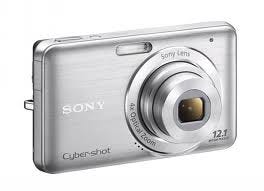
CAMERA: BE SURE TO BRING A CAMERA.TAKE PICTURES OF YOUR FINAL BOOTH SET-UP. TAKE PICTURES OF YOUR MERCHANDISE DISPLAYS.TAKE PICTURES OF ITEMS THAT SEEM TO BE SELLING WELL.
LESSON 11: BE PREPARED TO ACCEPT CREDIT CARDS
YOU WILL DEFINITELY LOSE SALES, IF YOU DO NOT HAVE A WAY TO ACCEPT CREDIT CARDS.

TODAY, THERE ARE SEVERAL SYSTEMS THAT ALLOW YOU TO PUT A SMALL ATTACHMENT ONTO YOUR CELL PHONE. THEY ALLOW YOU TO RUN CREDIT CARDS WITH VERY SMALL FINANCE CHARGES TO YOU. IT IS VERY QUICK AND EASY TO GET APPROVED. YOUR CELL PHONE COMPANY MAY HAVE A PRODUCT FOR YOU. OR YOU CAN RUN CHARGES DIRECTLY ON YOUR CELL PHONE OR TABLET.

ALSO, THERE ARE COMPANIES WITH SIMILAR PRODUCTS LIKE 
 SQUARE
 GOPAYMENT
 PAYANYWHERE

LESSON 12: PRICE THINGS TO SELL

CUSTOMERS WHO ATTEND DIFFERENT KINDS OF SHOWS HAVE DIFFERENT KINDS OF EXPECTATIONS ABOUT PRICE. PEOPLE EXPECT TO PAY HIGHER PRICES AT ARTS AND CRAFTS SHOWS, AND LOWER PRICES AT FLEA MARKETS AND BAZAARS.

YOU ALWAYS BEGIN BY SETTING FAIR AND REASONABLE PRICES

AT HIGHER END SHOWS, YOU WANT TO MINIMIZE ANY DISCOUNTING OR HAGGLING.AT FLEA MARKETS, BE PREPARED TO HAGGLE. WHEN YOU HAGGLE ON PRICE, IN ANY SETTING, YOU WOULD TYPICALLY BE PREPARED TO SELL FOR ABOUT 15% LESS THAN THE MARKED PRICE.

IT’S OK TO SAY “NO”, TO A CUSTOMER IF THE CUSTOMER ONLY SEEMS WILLING TO PAY A VERY LOW AMOUNT. YOU WOULD BE OUT OF BUSINESS IF YOU SOLD ALL YOUR STUFF BELOW WHAT IT COSTS YOU TO MAKE.

LESSON 13: KEEP YOUR MONEY SAFE
YOU NEED TO MANAGE YOUR TRANSACTIONS.

KEEP YOUR MONEY SAFE

SET UP AN EFFICIENT PAYMENT STATION.

HAVE ENOUGH MONEY ON HAND TO MAKE CHANGE — 1 AND 5 DOLLAR BILLS, AND QUARTERS, DIMES, NICKELS AND PENNIES.
WITH ALL THE PEOPLE AROUND, COMPETING FOR YOUR ATTENTION, IT GETS TOO EASY FOR SHOP-LIFTERS TO STEAL YOUR MONEY BOX, OR TO STEAL YOUR PURSE, BEFORE YOU NOTICE IT.

I LIKE TO WEAR AN APRON WITH POCKETS. I KEEP ENOUGH MONEY IN THE APRON POCKETS TO HANDLE A FEW HOURS WORTH OF SALES. I KEEP THE REST OF THE MONEY IN PANTS POCKETS OR A MONEY BELT OR FANNY PACK ON MY PERSON.

BE ESPECIALLY ALERT AT SET-UP AND BREAK-DOWN, WHEN THERE IS A LOT OF COMMOTION.

ACCEPTING CHECKS
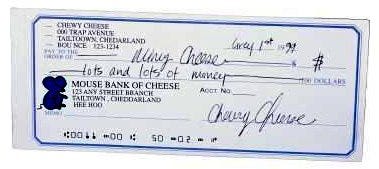
 LOTS OF PEOPLE PASS BAD CHECKS. SOME PEOPLE MAKE A CAREER OF THIS. BECAUSE OF THIS, I AM ALWAYS LEERY OF ACCEPTING CHECKS. LUCKILY TODAY, MANY PEOPLE USE THEIR DEBIT CARDS, IN LIEU OF CHECKS, AND THESE ARE MUCH SAFER. IF SOMEONE ASKS IF THEY CAN WRITE A CHECK, I TRY TO DISCOURAGE IT. I ASK THEM IF THEY CAN USE A DEBIT OR CREDIT CARD, INSTEAD.

OCCASIONALLY I DO ACCEPT CHECKS. IF ACCEPTING CHECKS, SOME YELLOW FLAGS TO WATCH OUT FOR:

– CHECK SEQUENCE NUMBERS BELOW 300

– ANY CHECK FROM ANYONE IN THE MILITARY

– STARTER CHECKS, WHERE THE ADDRESS IS NOT IMPRINTED

– OUT OF STATE CHECKS

– WHERE THE WRITER SHOWS A COLLEGE ID, OR THE ADDRESS IS A COLLEGE DORM

VERIFY THE CUSTOMER’S PHONE NUMBER, AND WRITE THIS ON THE CHECK.
 ALSO, CHECK THE CUSTOMER’S DRIVER’S LICENSE, WITH PICTURE AND SIGNATURE. AND WRITE DOWN THE CUSTOMER’S DRIVER’S LICENSE ON THE CHECK.

MOST BANKS NO LONGER ALLOW YOU TO VERIFY WHETHER THE CUSTOMER HAS ENOUGH MONEY IN THEIR ACCOUNT TO COVER THE CHECK. THE FEW BANKS THAT STILL PROVIDE THIS SERVICE, OFTEN CHARGE YOU $5.00 TO $10.00 PER VERIFICATION.

SHOPLIFTING
 
CRAFT SHOWS ATTRACT SHOPLIFTERS. THERE ARE LOTS OF PEOPLE, LOTS OF COMMOTION, AND LOTS OF DISTRACTIONS. YOU FIND YOURSELF IN A NEW, UNFAMILIAR ENVIRONMENT. THESE KINDS OF THINGS MAKE SHOPLIFTING EASIER TO GET AWAY WITH.

SHOPLIFTERS COME IN ALL SIZES, SHAPES, AGES, GENDERS AND COLORS. THEY MAY TRY TO STUFF SOME JEWELRY INTO A LARGE PURSE OR BAG OR COAT POCKET, AND WALK AWAY WITH OUT PAYING. THEY MAY TRY A PIECE OF JEWELRY ON, AND WALK AWAY WITHOUT PAYING. THEY MAY GRAB AND RUN. OFTEN, THEY WORK IN PAIRS, ONE PERSON TO DISTRACT YOU, AND THE OTHER PERSON TO STEAL YOU BLIND WHILE YOU ARE NOT LOOKING.
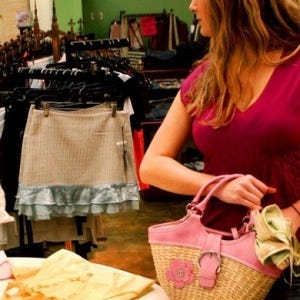
TELL-TALE CHARACTERISTICS OF SHOPLIFTERS:
 — SEEM NERVOUS, REFUSE OFFERS OF ASSISTANCE
 — SPEND AN INORDINATE AMOUNT OF TIME WATCHING SALES STAFF, RATHER THAN LOOKING AT MERCHNDISE
 — MAKE AN ESPECIALLY HURRIED EXIT
 — WEAR OVERCOATS, BAGGY CLOTHES, CARRY OVERSIZED PURSES
 — GROUPS OF TEENAGERS OR TWEEN-AGERS SHOPPING TOGETHER
 — LOITER
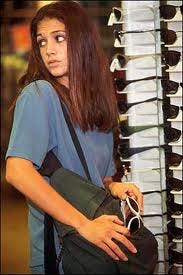
SHOPLIFTERS REQUIRE SOME LEVEL OF PRIVACY IN ORDER TO CONCEAL MERCHANDISE. So…
 — MAXIMIZE VISIBILITY
 — MINIMIZE BLIND SPOTS
 — FROM WHERE YOU ARE STANDING OR SITTING, YOU SHOULD HAVE GOOD SIGHT LINES THROUGHOUT THE AREAS IN YOUR BOOTH YOUR CUSTOMER HAS ACCESS TO

LOCK UP SHOPLIFTER ATTRACTIVE MERCHANDISE, OR KEEP IT BEHIND THE COUNTER

AS A GENERAL RULE, THE SMALLER AND MORE VALUABLE AN ITEM, THE MORE ATTRACTIVE TARGET IT IS

WHAT PROPORTION OF MERCHANDISE SHOULD YOU KEEP UNDER GLASS? THERE IS NO RULE OF THUMB HERE. YOU HAVE TO USE YOUR JUDGMENT.

KEEP EVERYTHING IN ITS PLACE. THIS MAKES IT EASIER TO MONITOR THINGS, BECAUSE, IF EVERYTHING HAS ITS PLACE, AND YOU KEEP PUTTING THINGS BACK IN THE SAME PLACE, YOU ARE MORE LIKELY TO NOTICE, AND NOTICE MORE QUICKLY, IF THINGS ARE OUT OF ORDER.

IF YOU PUT ITEMS IN A BAG, STAPLE IT CLOSED. STAPLE THE RECEIPT TO THE BAG. YOU CAN EVEN STAPLE ONE OF YOUR BUSINESS CARDS TO THE BAG.

REQUIRE A RECEIPTS FOR ALL RETURNS.
 — ONE THING SOME SHOPLIFTERS LIKE TO DO IS STEAL SOMETHING, AND THEN RETURN IT FOR CASH.

THE MOST EFFECTIVE THING YOU CAN DO TO PREVENT SHOPLIFTING IS TO PROVIDE EXCEPTIONAL CUSTOMER SERVICE.
 — ACKNOWLEDGE EACH CUSTOMER
 — ASK IF THEY NEED ASSISTANCE

IF YOU SUSPECT OR CATCH A SHOPLIFTER, IMMEDIATELY NOTIFY THE SHOW’S SECURITY. YOU WANT TO DESCRIBE THE SUSPECT, WHETHER YOU THINK HE OR SHE IS STILL PRESENT, WHETHER THEY MIGHT BE CAUSING TROUBLE, AND WHAT THE SUSPECTS LOOKS LIKE AND IS WEARING.

JEWELERS SELLING FINE JEWELRY, PARTICULARLY WITH GOLD AND PRECIOUS STONES, NEED TO TAKE SPECIAL PRECAUTIONS. DON’T WORK ALONE. YOU SHOULD HAVE ONE OR MORE PEOPLE WITH YOU IN THE BOOTH AT ALL TIMES. IF YOU FEEL THAT ANYONE IS CASING YOU, ALERT THE SHOW AUTHORITIES.
 
 YOU MIGHT TAKE A PICTURE OF ANYONE SUSPICIOUS WITH YOUR CELL PHONE OR DISPOSABLE CAMERA.

DON’T REGISTER AT THE HOTEL USING YOUR BUSINESS NAME. DON’T TAKE A FIRST FLOOR ROOM. DON’T TAKE A ROOM NEAR AN ELEVATOR OR STAIRS.

WHEN YOU CHECKOUT OF THE HOTEL, YOU WANT TO DRIVE A LONG DISTANCE BEFORE STOPPING FOR FOOD OR GAS.
 SO BE SURE YOUR HAVE A FULL GAS-TANK BEFORE THAT LAST DAY AT THE SHOW.

KEEP YOUR MONEY ON YOUR PERSON. IF YOU HAVE VALUABLE MERCHANDISE OR MONEY IN CONTAINERS, KEEP THESE CHAINED TO SOMETHING IMMOVABLE, LIKE A SUPPORT COLUMN IN THE ROOM.

ABOUT HIRING HELP
 
BE CAREFUL ABOUT HIRING NON-SHOW PEOPLE, WHO HAPPEN TO BE AROUND THE SHOW AT SET-UP, AND OFFER TO HELP FOR MONEY.

IF YOU NEED TO HIRE EXTRA HELP, TRY TO ARRANGE THIS AHEAD OF TIME. DOES THE SHOW PROMOTER KEEP OF LIST OF LOCAL PEOPLE TO CONTACT? CAN YOU CONTACT LOCAL CRAFT, BEAD OR JEWELRY STORES TO ASK FOR RECOMMENDATIONS? HOW ABOUT A LOCAL CRAFT ASSOCIATION OR BEAD SOCIETY? HOW ABOUT OTHER VENDORS — DO THEY KNOW SOMEONE LOCALLY THAT THEY USED BEFORE?

YOU CAN ALSO CONTACT SOME LOCAL TEMPORARY SERVICES

OTHER SECURITY CONCERNS:
 
DON’T LEAVE TEMPTING ITEMS IN YOUR BOOTH OVERNIGHT.

LOCK YOUR VEHICLE. BE SURE ALL THE DOORS ARE LOCKED — FRONT, BACK, SIDES

RECORD KEEPING
 RECORD KEEPING
IS VERY IMPORTANT. KEEP GOOD RECORDS OF YOUR SALES. KEEP GOOD RECORDS OF CUSTOMER MAIL, EMAIL ADDRESSES. KEEP GOOD RECORDS AND RECEIPTS OF EXPENSES INCURRED AND OTHER ASSOCIATED COSTS. KEEP GOOD RECORDS OF CAR MILEAGE ASSOCIATED WITH YOUR SHOW RELATED TRAVEL.

IF YOU WILL BE COLLECTING SALES TAXES, BE SURE YOU ARE COLLECTING ALL THE INFORMATION YOU NEED TO FILL OUT ANY GOVERNMENT SALE TAX FORMS.

IF YOU ARE SELLING WHOLESALE, BE SURE YOUR CUSTOMERS ARE PRESENTING YOU WITH THE CORRECT TAX ID NUMBERS AND DOCUMENTATION.

IF YOU ARE IN A STATE THAT COLLECTS SALES TAXES, YOU WILL NEED TO COLLECT SALES TAXES AT THE SHOW. YOU MAY HAVE A PERMANENT RE-SALE NUMBER IN THAT STATE. SOME STATES CALL THESE TAX NUMBERS OR WHOLESALE NUMBERS. IF SO, YOU WOULD PAY THE SALES TAXES YOU HAVE COLLECTED TO THE STATE, AS YOU ALWAYS DO.

IF YOU HAVE A TEMPORARY STATE RE-SALE LICENSE THAT COVERS YOUR TIME AT THE SHOW, YOU WILL BE GIVEN A FORM BY THE STATE WITH WHICH TO TRANSMIT PAYMENT FOR COLLECTED TAXES.

SOMETIMES, STATE OFFICIALS WILL BE AT THE SHOW, GOING BOOTH TO BOOTH, TO COLLECT YOUR SALES TAXES.
 IF SO, THEY EXPECT YOU TO HAVE COMPLETED YOUR FORM, MEANING YOU HAVE CALCULATED ALL YOUR TAXABLE AND NON-TAXABLE SALES, AS WELL AS THE TOTAL SALES TAXES OWED AS YOU ARE CLOSING DOWN YOUR BOOTH, AND BEGINNING TO PACK UP.

OTHERTIMES, YOU ARE EXPECTED TO SUBMIT THAT FORM WITH PAYMENT USUALLY WITHIN 2–4 WEEKS OF THE SHOW. NOWADAYS, A LOT OF THIS PROCESS IS DONE ONLINE. BE SURE YOU HAVE THE INSTRUCTIONS ABOUT WHAT YOU NEED TO DO WHEN.

LESSON 14: ALWAYS THINK OF WAYS TO GENERATE FOLLOW-UP SALES

YOU MAKE YOUR REAL MONEY THROUGH REPEAT BUSINESS. MUCH OF THIS REPEAT BUSINESS OCCURS BETWEEN SHOWS. SOME OF IT OCCURS WHEN PEOPLE, WHO BOUGHT FROM YOU AT ONE SHOW, RETURN TO YOUR BOOTH AT THE NEXT ONE.

BEFORE THE SHOW…

– NOTIFY YOUR EXISTING CUSTOMERS WHERE YOU WILL BE WHEN EITHER EMAILING THEM OR MAILING OUT POSTCARDS WORKS FINE. FOR REGULAR OR VERY GOOD CUSTOMERS, YOU MIGHT TRY PHONING THEM.

ALSO, YOU SHOULD HAVE SOME KIND OF WEB PRESENCE WHERE THE CUSTOMER CAN EASILY FIND YOU BETWEEN SHOWS.

DURING THE SHOW…

– HAVE A GUEST REGISTER OR SIGN-UP SHEET, TO GENERATE MAIL AND EMAIL ADDRESSES

– HAVE AT LEAST 2–3 TAKEAWAY PROMOTIONAL ITEMS, SUCH AS BUSINESS CARDS, BROCHURES, POSTCARDS

BE SURE, ON EACH OF YOUR PROMOTIONAL HANDOUTS, YOU CLEARLY LIST HOW THE CUSTOMER CAN GET IN TOUCH WITH YOU BETWEEN SHOWS.

ALSO, I LIKE TO HAVE SOME KIND OF GIVE-AWAY, WHERE PEOPLE FILL OUT A FORM WITH THEIR ADDRESS INFORMATION,SAY TO WIN A FREE PIECE OF JEWELRY.

SOME PEOPLE LIKE TO GIVE AWAY PROMOTIONAL ITEMS WITH THEIR BUSINESS NAMES IMPRINTED ON THEM.

AFTER THE SHOW…

– UPDATE YOUR MAILING AND EMAILING DATABASES

– FOLLOW UP AT LEAST WITH THOSE CUSTOMERS WHO MADE A PURCHASE, USING EMAIL OR MAIL, AND THANKING THEM

– DO SOME EVALUATION. WRITE DOWN WHAT THINGS TO KEEP OR KEEP DOING, AND WHAT THINGS DID NOT SELL THAT WELL. ASK YOURSELF WHY AND WHY NOT?

  • RETURN TO YOUR BREAKEVEN ANALYSIS. HOW MUCH MONEY DID YOU ACTUALLY MAKE? WAS IT WORTHWHILE? IF YOU SPENT $1,000, DID YOU MAKE AT LEAST $1,000 BACK?

LESSON 15: TAKE CARE OF YOURSELF
TAKE CARE OF YOURSELF AT THE SHOW. SHOWS ARE EXCITING, BUT ALSO CAN BE PHYSICALLY AND EMOTIONALLY EXHAUSTING.

IF IT’S POSSIBLE TO BRING SOMEONE ALONG TO HELP YOU,
 DO SO.

BE SURE YOU WORK OUT THE DETAILS FOR FOOD BREAKS AND BATHROOM BREAKS.

BRING FOOD TO SNACK ON, WATER TO DRINK, ANY MEDICATIONS YOU NEED, AT THE LEAST, SOME ASPIRIN.

ANTICIPATE THE WEATHER, AND WHETHER IT WILL CHANGE DURING THE DAY, OR OVER THE DAYS OF THE SHOW.

AND BRING CLOTHES, HATS, SUNGLASSES, SWEATERS, SUN-BLOCK, BUG-SPRAY — WHATEVER.
ALWAYS THINK IN TERMS OF LAYERS OF CLOTHING.

YOU MAY WANT DIFFERENT CLOTHES TO WEAR WHEN SETTING UP, THAN WHEN STAFFING YOUR BOOTH.

I CAN’T EMPHASIZE ENOUGH: WEAR COMFORTABLE SHOES.

YOU MAY WANT A CHANGE OF CLOTHES, PARTICULARLY IF THE DAYS ARE HOT AND HUMID.

LESSON 16: BE NICE TO YOUR NEIGHBORS

MAKE FRIENDS WITH YOUR NEIGHBORS. YOUR NEIGHBORS MAY BECOME SOME OF YOUR BEST BUSINESS RESOURCES. ASK ABOUT THEIR PRODUCTS. ASK ABOUT THEIR EXPERIENCES WITH CRAFT SHOWS. SEND CUSTOMERS THEIR WAY. EXCHANGE BUSINESS HINTS AND CRAFT SHOW OPPORTUNITIES. OFFER TO WATCH THEIR BOOTHS WHEN THEY NEED TO TAKE A BREAK. LISTEN TO HOW THEY MANAGE SALES AND CUSTOMERS. AS YOU WALK AROUND THE SHOW, PAY ATTENTION TO GOOD BOOTH AND DISPLAY IDEAS.

FOLLOW CRAFT SHOW RULES:
 
OPEN YOUR BOOTH ON TIME.
 DON’T START PACKING UP AND CLOSING YOUR BOOTH UNTIL THE SHOW OFFICIALLY CLOSES.
 BE SENSITIVE TO THE NEEDS OF THE HANDICAPPED.
 STICK WITHIN THE “LINES” OF YOUR SPACE
 BE SURE YOU HAVE CONFORMED TO LOCAL, STATE AND FEDERAL RULES.
 RESPECT LIMITS ON SMOKING, DRINKING, EATING AND PLAYING MUSIC.

Booth Etiquette / Following Event Guidelines

If you sign a contract to do a show, you are agreeing to follow all the guidelines and stipulations. Don’t whine or complain. The show owners have a lot to deal with. You don’t want to get yourself banned from future shows.

Stay within your space. If you need a slightly large space, either “buy it” ahead of time from the show promoters, or negotiate an arrangement with your neighbor. You don’t want to make enemies with your neighbors. You don’t want to make it difficult and uncomfortable for your customers to view your merchandise. You don’t want to alienate the show’s promoters.

Don’t pack up early. Wait until the very end of the show.

Be aware of any restrictions about smoking and eating in your booth, or in the general exhibit area.
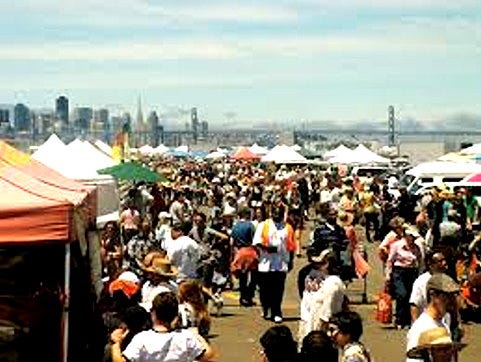
i. SOME FINAL WORDS OF ADVICE

DOING CRAFT SHOWS IS A WONDERFUL EXPERIENCE. YOU CAN MAKE A LOT OF MONEY AT CRAFT SHOWS, YOU MEET NEW PEOPLE, YOU HAVE NEW ADVENTURES. YOU LEARN A LOT ABOUT BUSINESS AND ARTS AND CRAFTS DESIGNING.

IF… YOU DO YOUR HOMEWORK WHEN SELECTING THEM, AND VERIFY ALL INFORMATION,
 AND, IF… YOU ARE VERY ORGANIZED IN PREPARING FOR THEM, SETTING UP, SELLING AND RE-PACKING UP,
 AND, IF… YOU PROMOTE, PROMOTE, PROMOTE.

ONE OF THE FIRST THINGS I TELL ANYONE WHO WANTS TO GET INTO THIS BUSINESS IS TO GIVE IT 3 YEARS. IF YOU ARE STILL STRUGGLING AFTER 3 YEARS, PERHAPS CRAFTS SHOWS ARE NOT FOR YOU.

EACH YEAR, YOU WILL DO SOME SHOWS, AND SOME WILL WORK, AND OTHERS MIGHT NOT.

AVOID FIRST TIME EVENTS. I USUALLY AVOID SHOWS IN EXISTENCE LESS THAN 3 YEARS.

TRY TO DO EVENTS OTHERS HAVE TOLD YOU HAVE BEEN SUCCESSFUL FOR THEM.

I GIVE MANY SHOWS A SECOND CHANCE IF I FEEL THE MAJOR ISSUES FOR SLOW SALES, WERE TIMING OR WEATHER.

DON’T FEEL DISAPPOINTED IF YOU DIDN’T MAKE A FORTUNE YOUR FIRST TIME OUT.

REMEMBER, IT’S THAT REPEAT BUSINESS WHERE YOU MAKE THE MOST MONEY.

ii. HELPFUL RESOURCES:

Other Articles of Interest by Warren Feld:

Should I Set Up My Craft Business On A Marketplace Online?

The Importance of Self-Promotion: Don’t Be Shy

Are You Prepared For When The Reporter Comes A-Calling?

A Fool-Proof Formula For Pricing And Selling Your Jewelry

Designer Connect Profile: Tony Perrin, Jewelry Designer

My Aunt Gert: Illustrating Some Lessons In Business Smarts

Copyrighting Your Pieces: Let’s Not Confuse The Moral With The Legal Issues

Naming Your Business / Naming Your Jewelry

Jewelry Making Materials: Knowing What To Do

To What Extent Should Business Concerns Influence Artistic and Jewelry Design Choices

How Creatives Can Successfully Survive In Business

Getting Started In Business: What You Do First To Make It Official

I hope you found this article useful. Be sure to click the CLAP HANDS icon at the bottom of this article.

Also, check out my website (www.warrenfeldjewelry.com).

Subscribe to my Learn To Bead blog (https://blog.landofodds.com).

Visit Land of Odds online (https://www.landofodds.com)for all your jewelry making supplies.

Enroll in my jewelry design and business of craft video tutorials online.

Add your name to my email list.
Posted in Stitch 'n Bitch | Tagged: , , , , | Leave a Comment »

5 Essential Questions Every Jewelry Designer Should Have An Answer For

Posted by learntobead on April 14, 2020

5 Essential Questions Every Jewelry Designer
 Should Have An Answer For

Interested in trying your hand at jewelry design? 
 
 Before you begin, consider the following 5 questions I pose for you…

  1. Is what you do Art, Craft or Design?
  2. How do you decide what you want to create?
  3. What materials (or techniques) work well together, and which do not?
  4. What things do you do so that your finished piece evokes an emotional response?
  5. How do you know when your piece is done?

Many people begin to explore jewelry designing as a hobby, avocation, business or career. This requires, not only strong creativity skills, but also persistence and perseverance. It means understanding that jewelry can only be judged as finished and successful as the piece is worn. Jewelry design is more than the application of a set of techniques; it is a mind-set, as well. It is a way of thinking like a designer.

A lot of the achievement and accomplishment in this pursuit of jewelry design comes down to ability to make and follow through on many artistic and design decisions. Some have to do with managing a process, which can take an extended period of time. It also comes down to being fluent, flexible and original in your thinking through design. The greater your disciplinary literacy, the more empowered and confident you become in your design work.

Susan is one example of what happens when uncertainty — that paralysis or deer-in-the-headlights feeling that we so often face — sets in. Susan felt very unsure of herself. And unsure of her jewelry. Would people like it? Was the color mix appropriate? Was the construction secure? Was the price smart and fair? She allowed all this uncertainty to affect her design work — she had difficulty finishing pieces she was working on, starting new projects, and getting her work out there.
 
 
Like many of my jewelry design and beadwork students, Susan needed to be fluent as a designer. With fluency comes empowerment, confidence and success.

Fluency and Empowerment

The fluent jewelry designer is able to think like a designer. The jewelry designer is more than a craftsperson and more than an artist. The jewelry designer must learn a specialized language, and specialized way of balancing the needs for appeal with the needs for functionality. The jewelry designer must intimately recognize and understand the roles jewelry plays for individuals as well as the society as a whole. The designer must learn how art, architecture, physical mechanics, engineering, sociology, psychology, context, even party planning, all must come together and get expressed at the point where jewelry meets the boundary of the person.

And to gain that fluency, the designer must commit to learning a lot of vocabulary, ideas and terms, and how these imply content and meaning through expression. The designer will need to be very aware of personal thoughts and thinking as these get reflected in all the choices made in design. The designer will have to be good at anticipating the understandings and judgements of many different audiences, including the wearer, viewer, seller, exhibitor, client, and collector.

With fluency comes empowerment. The empowered designer has a confidence that whatever needs to be done, or whatever must come next, the designer can get through it. Empowerment is about making and managing choices. These choices could be as simple as whether to finish a piece or not. Or whether to begin a second piece. The designer will make choices about how to draw someone’s attention to the piece, or present the piece to a larger audience. She or he may decide to submit the piece to a magazine or contest. She or he may want to sell the piece and market it. The designer will make choices about how a piece might be worn, or who might wear it, or when it might be worn, in what context.
 
 
And for all these choices, the jewelry designer might need to overcome a sense of fear, boredom, or resistance. The designer might need to overcome anxiety, a sense of giving up, having designer’s block, feeling unchallenged, and even laziness.

In order to make better artistic and design choices, the Fluent and Empowered Jewelry Designer should have answers to these 5 critical questions:

Question 1: Should BEADWORK and JEWELRY MAKING be considered ART or CRAFT or DESIGN?

The jewelry designer confronts a world which is unsure whether jewelry is “craft” or “art” or its own special thing I’ll call “design”. This can get very confusing and unsettling. Each approach has its own separate ideas about how the designer should work, and how he or she should be judged.
 
 
When defined as “craft,” jewelry is seen as something that anyone can do — no special powers are needed to be a jewelry designer. As “craft”, there is somewhat of a pejorative meaning — it’s looked down upon, thought of as something less than art. The craft piece has functional value but limited aesthetic value.
 
 
But as “craft”, we still recognize the interplay of the artist’s hand with the piece and the storytelling underlying it. We honor the technical prowess. People love to bring art into their personal worlds, and the craftsperson offers them functional objects which have some artistic sensibilities.
 
 
When defined as “art”, jewelry is seen as something which transcends itself and its design. It is not something that anyone can do without special insights and training.
 
 “Jewelry as art”
evokes an emotional response. Functionality should play no role at all, or, if an object has some functional purpose, then its functional reason-for-being should merely be supplemental. For example, the strap on a necklace is comparable to the frame around a painting, or the pedestal for a sculpture. It is not included with nor judged as part of the art work.

When defined as “design”, you begin to focus more on construction and functionality issues. You often find yourself making tradeoffs between appeal and functionality. You incorporate situational relevance into your designs. You see “choice” as more multidimensional and contingent. You define success only in reference to the jewelry as it is worn.

How you define your work as ART or CRAFT or DESIGN will determine what skills you learn, how you apply them, and how you introduce your pieces to a wider audience. [The bias in this book is to define jewelry as DESIGN, with its own disciplinary-specific, specialized knowledge and skills base, where jewelry is judged as art only at the point it is worn, and where jewelry-making is seen as a communicative process.]

QUESTION 2: How do you decide what you want to create? What kinds of things do you do to translate your passions and inspirations into jewelry? What is your creative process?

Applying yourself creatively can be fun at times, but scary at other times. It is work. You are creating something out of nothing. There is an element of risk. You might not like what you end up doing. Your friends might not like it. Nor your family. You might not finish it. Or you might do it wrong. It may seem easier to go with someone else’s project.

Applying creativity means developing abilities to generate options and alternatives, and narrowing these down to specific choices. It means developing an ease and comfort generating fix-it strategies when approaching unknown situations or problematic ones. It means figuring out how to translate inspiration into design in a way that inspires others and taps into their desires. It means differentiating yourself from other jewelry designers as a measure of your originality.
 

 Creative people…

Set no boundaries and set no rules. They go with the flow. Don’t conform to expectations.
 
 Play.
They pretend they are kids again.
 
 Experiment.
They take the time to do a lot of What Ifs and Variations On A Theme and Trial and Error.
 
 Keep good records.
They make good notes and sketches of what seems to work, and what seems to not work.
 
 Evaluate.
They learn from their successes and mistakes.

As jewelry designers gain more and more creative experiences, they begin to assemble what I call a Designer’s Tool Box. In this virtual box are a set of thinking routines, strategies and fix-it strategies that have worked well in the past, are very workable in and of themselves, and are highly adaptive when used in unfamiliar situations. Every jewelry designer should develop their own Tool Box. This vastly contributes to success in creative thinking and application.

QUESTION 3: What kinds of MATERIALS work well together, and which ones do not? This applies to TECHNIQUES as well. What kinds of TECHNIQUES (or combinations of techniques) work well when, and which ones do not?

The choice of materials, including beads, clasps, and stringing materials, and the choice of techniques, including stringing, weaving, wire working, glassworks, metalworks, clayworks, set the tone and chances of success for your piece.

There are many implications of choice. There are light/shadow issues, pattern, texture, rhythm, dimensionality and color issues. There are mechanics, shapes, forms, durability, drape, flow and movement issues. There are positive and negative space issues.

It is important to know what happens to all these materials over time. It is important to know how each technique enhances or impedes architectural requirements, such as allowing the piece to move and drape, or assisting the piece in maintaining a shape. Each material and technique has strengths and weaknesses, pros and cons, and contingencies affecting their utilization. The designer needs to leverage the strengths and minimize the weaknesses.

All of these choices:
 
… affect the look
 … affect the drape
 … affect the feel
 … affect the durability
 … affect both the wearer’s and viewer’s responses
 … relate to the context

Question 4: Beyond applying basic techniques and selecting quality materials, how does the Jewelry Designer evoke an emotional and resonant response to their jewelry? What skill-sets do Designers need in order to think through powerful designs?

An artistic and well-designed piece of jewelry should evoke an emotional response. In fact, ideally, it should go beyond this a bit, and have what we call “resonance”. The difference between an emotional response and resonance is reflected in the difference between someone saying, “That’s beautiful,” from saying “I need to wear that piece,” or, “I need to buy that piece.” 
 
 
Quite simply: If no emotional response, and preferably, resonance, is evoked, then the jewelry is poorly designed. Evoking an emotional and resonant response takes the successful selection and arrangement of materials, the successful application of techniques as well as the successful management of skills.
 
 
Unfortunately, beaders and jewelry makers too often focus on materials or techniques and not often enough on skills. It is important to draw distinctions here.
 
 
Materials and techniques are necessary but not sufficient to get you there. You need skills.
 
 
The classic analogy comparing materials, techniques and skills references cutting bread with a knife. Material: bread and knife. Technique: How to hold the knife relative to the bread in order to cut it. Skill: The force applied so that the bread gets cut successfully.
 
 
Skills are the kinds of things the jewelry designer applies which enhance his or her capacity to control for bad workmanship and know when the piece is finished. Skills, not techniques, are what empower the designer to evoke emotional and resonant responses to their work.

These skills include:
 
— Judgment
 — Presentation
 — Care and dexterity
 — Knowing when “enough is enough”
 — Understanding how art theory applies to the “bead” and to “jewelry when worn”
 — Understanding the architectural underpinnings of each technique, and how these enhance, or impede, what you are trying to do
 — Taking risks
 — Anticipating the desires, values, and shared understandings all client audiences of the designer have about when a piece should be considered finished and successful
 — Recognizing that jewelry is art only as it is worn

QUESTION #5: When is enough enough? How does the jewelry artist know when the piece is done? Overdone? Or underdone? How do you edit? What fix-it strategies do you come up with and employ?

In the bead and jewelry arenas, you see piece after piece that is either over-embellished or under-done. Things may get too repetitive with the elements and materials. Or the pieces don’t feel that they are quite there yet.
 
 
For every piece of jewelry there will be that point of parsimony when enough is enough. We want to find that point where experiencing the “whole” is more satisfying than experiencing any of the parts. That point of parsimony is where, if we added (or subtracted) one more thing, we would detract from the whole of our design.

Knowing that point of parsimony is also related to anticipating how and when others will judge the piece as successful. And what to do about it when judged unfinished or unsuccessful.

There is no one best way — only your way

The fluent and empowered jewelry designer will have answers to these 5 essential questions, though not every designer will have the same answers, nor is there one best answer.
 
 
Yet it is unacceptable to avoid answering any of these 5 questions, for fear you might not like the answer.
 
 
The fluent and empowered jewelry designer will have learned the skills for making good choices. He or she will recognize that jewelry design is a process of management and communication. The fluent and empowered designer manages how choices are made. These choices include making judgments about selecting and combining materials, both physical and aesthetic, and techniques, both alone or in tandem, into wearable art forms and adornment, expressive of the desires of self and others. The artist’s hand will be very visible in their work.
 
 
This is jewelry making and design.

This is at the core of how jewelry designers think like jewelry designers.

This is the substantive basis which informs how the designer introduces jewelry publicly.

Other Articles of Interest by Warren Feld:

The Jewelry Design Philosophy: Not Craft, Not Art, But Design

What Is Jewelry, Really?

The Jewelry Design Philosophy

Creativity: How Do You Get It? How Do You Enhance It?

Disciplinary Literacy and Fluency In Design

Becoming The Bead Artist and Jewelry Designer

5 Essential Questions Every Jewelry Designer Should Have An Answer For

Getting Started / Channeling Your Excitement

Getting Started / Developing Your Passion

Getting Started / Cultivating Your Practice

Becoming One With What Inspires You

Architectural Basics of Jewelry Design

Doubt / Self Doubt: Major Pitfalls For The Jewelry Designer

Techniques and Technologies: Knowing What To Do

Jewelry, Sex and Sexuality

Jewelry Making Materials: Knowing What To Do

Teaching Discplinary Literacy: Strategic Thinking In Jewelry Design

The Jewelry Designer’s Approach To Color

Point, Line, Plane, Shape, Form, Theme: Creating Something Out Of Nothing

The Jewelry Designer’s Path To Resonance

Jewelry Design Principles: Composing, Constructing, Manipulating

Jewelry Design Composition: Playing With Building Blocks Called Design Elements

Contemporary Jewelry Is Not A “Look” — It’s A Way Of Thinking

I hope you found this article useful. Be sure to click the CLAP HANDS icon at the bottom of this article.

Also, check out my website (www.warrenfeldjewelry.com).

Subscribe to my Learn To Bead blog (https://blog.landofodds.com).

Visit Land of Odds online (https://www.landofodds.com)for all your jewelry making supplies.

Enroll in my jewelry design and business of craft video tutorials online.

Add your name to my email list.
Posted in Stitch 'n Bitch | Tagged: , , , , | Leave a Comment »

Oy Ve! The Challenges of Custom Work

Posted by learntobead on April 14, 2020

CANYON SUNRISE for music artist attending awards ceremony. Piece had to reflect nature.

I am a jewelry designer, and have been doing custom jewelry design for over 30 years. It’s challenging. It’s fun. But it can be a headache. Here are some lessons I have learned which I want to share with you.

When I began my jewelry making career, one of the smartest things I did was take on repairs. I learned so much. With each repair, I was able to re-construct in my mind the steps the jewelry designer made when creating this piece of jewelry — choices about stringing materials, clasps, beads, and how to connect everything up. And at the same time, I could see where these choices were inadequate. I could see where the piece broke or wore down. I could question the customer about how the piece was worn, and what happened when it broke.

And with each repair, I gained more knowledge from yet another jewelry designer’s attempt to fashion a piece of jewelry.

All these repairs resulted in more self-confidence about designing jewelry and designing jewelry for others. And, just as important, it led to more custom work.

28 COINS NECKLACE for poker player, includes coin pearls and jade good fortune carving

When you do custom work, I think you need an especially steeled personality to deal with everything that can go awry.

First comes the fitting. You take some initial measurements, but after the piece is made, the perspective changes, and so do the desired measurements.

Then comes a lot of customer indecision — colors, lengths, beads, silhouettes, overall design. They have a sense of what they want, but often have difficulty articulating the specifics.

Or they want to use several gemstones, but want them all to have the exact same markings and coloration.

Or they want to use several colors which really don’t harmonize well with each other.

Or they want to use components which are not easily available.

And not to forget to mention the sometimes questionable taste.

Or the possibilities of infringement of other jeweler’s designs, when the customer wants you to re-produce something they saw in a magazine or on-line. Identically.

And then time-frame. Can I finish the piece by the time the customer wants it done?

SOUNDTRACK::Color for folk musician who wanted something similar to a piece worn by Alanis Morissette. Client wanted all these colors (with raspberry as the dominant color) incorporated into this micro-macrame piece.

We discuss pricing, where all-to-often many customers seem resistant to paying anything for my time, which for custom designed pieces, is considerable. I walk them through the detailed process ad nauseum so they get the gist of all the work involved.

And last, payment. It’s not so easy to get some people to pay.

I still do a lot of custom work. But I delay a bit, sitting down and actually constructing the piece. I have a lot of discussions with the client. If there are color or materials questions, I usually present the client only 3 colors or materials at a time, and ask them to choose which they prefer. Then another 3-at-a-time forced-choice exercise, until things get narrowed down.

I photo-shop a lot of images — different colors, designs, beads — with the client, and get a lot of feedback. As I assemble all the information, I sketch/photo-shop what a final piece might look like. I superimpose this image on a mannequin to show the customer what it might look like. I have the customer formally sign-off on a final design. And only then, do I begin to construct the piece.

I try to develop in my mind a type of behavioral profile on each client. I pay attention to the styles of clothing they wear, the colors, how much jewelry they wear, and what that looks like. I spend time asking where, when and how they will be wearing the jewelry. I ask if they any expectations about the reactions they want or expect from others, when wearing the jewelry. I try to elicit the reasons why they are purchasing this custom piece, and whether it is filling any gaps they perceive in their wardrobe. I try to get a sense of how elaborate or simple they want the finished piece to be.

I give the client a realistic deadline. If the client needs the piece sooner, we discuss right up front where I will need to make process changes, in order to meet the reduced deadline.

It’s important to make everything about the design process and my management steps which I need to take predictable and clear right up-front. I don’t want to present the client with any surprises.

I require a 50% deposit up front.

I agree to make some adjustments for 6 months after the customer has the piece in hand.

I have a .pdf Certificate of Authenticity which I sign and give to the client. I name each piece (and if it is part of a series, that series will have a name as well), and this information is included in the Certificate. The Certificate also states my 6-months of adjustments policy.

Other Articles of Interest by Warren Feld:

Oy Ve! The Challenges of Custom Work

The Importance of Self-Promotion: Don’t Be Shy

Are You Prepared For When The Reporter Comes A-Calling?

Don’t Just Wear Your Jewelry…Inhabit It!

Two Insightful Psych Phenomena Every Jewelry Designer Needs To Know

A Dog’s Life by Lily

Copyrighting Your Pieces: Let’s Not Confuse The Moral With The Legal Issues

Jewelry, Sex and Sexuality

Jewelry Design: An Occupation In Search Of A Profession

Teaching Discplinary Literacy: Strategic Thinking In Jewelry Design

Contemporary Jewelry Is Not A “Look” — It’s A Way Of Thinking

Beads and Race

Were The Ways of Women or of Men Better At Fostering How To Make Jewelry

The Bridesmaid Bracelets

I hope you found this article useful. Be sure to click the CLAP HANDS icon at the bottom of this article.

Also, check out my website (www.warrenfeldjewelry.com).

Subscribe to my Learn To Bead blog (https://blog.landofodds.com).

Visit Land of Odds online (https://www.landofodds.com)for all your jewelry making supplies.

Enroll in my jewelry design and business of craft video tutorials online.

Add your name to my email list.
Posted in Stitch 'n Bitch | Tagged: , , , , | Leave a Comment »

What Is Your Learning Style?

Posted by learntobead on November 17, 2019

There Are Many Ways To Learn

There are many ways to learn beading and jewelry making.

  • Rote Memory
  • Analogously
  • Contradictions
  • Assimilation
  • Constructing Meanings

Most people learn by Rote Memory.    They follow a set of steps, and they end up with something.  They memorize all the steps.   In this approach, all the choices have been made for them.    So they never get a chance to learn the implications of their choices.    Why one bead over another?  Why one stringing material over another?   How would you use the same technique in a different situation?   You pick up a lot of techniques, but not necessarily many skills.

Other people learn Analogously.    They have experiences with other crafts, such as sewing or knitting or other craft, and they draw analogies.   Such and Such is similar to Whatnot, so I do Whatnot the same way I do Such and Such.    This can work to a point.  However, beading and jewelry making can often be much more involved, requiring making many more types of choices, than in other crafts.    And there are still the issues of understanding the quality of the pieces you use, and what happens to them, both when jewelry is worn, as well as when jewelry is worn over time.


Yet another way people learn is through Contradictions.    They see cheap jewelry and expensive jewelry, and analyze the differences.   They see jewelry people are happy with, and jewelry people are not happy with, and analyze the differences.    They see fashion jewelry looked down upon by artists, and art jewelry looked down upon by fashionistas, and they analyze the differences.

Assimilation is a learning approach that combines Analogous Learning and Learning Through Contradictions.      People pursue more than one craft, keeping one foot in one arena, and another foot in the other.    They teach themselves by analogy and contradiction.      This assumes that multiple media mix, and mix easily.   Often, however, this is not true.    Usually one medium has to predominate for any one project to be successful.   So assimilative learning can lead to confusion and poor products, trying to meet the special concerns and structures of each craft simultaneously.   It is challenging to mix media.  Often the fundamentals of each particular craft need to be learned and understood in and of themselves.

The last approach to learning a craft is called Constructing Meanings.   In this approach, you learn groups of things, and how to apply an active or thematic label to that grouping.   For example, you might learn about beading threads, such as Nymo, C-Lon and FireLine, and, at the same time, learn to evaluate each one’s strengths and weaknesses in terms of Managing Thread Tension or allowing movement, drape and flow.   You might learn about crystal beads, Czech glass beads, and lampwork beads, and then, again concurrently and in comparison,  learn the pros and cons of each, in terms of achieving good color blending strategies.     You might learn peyote stitch and ndebele stitch, and how to combine them within the same project.


In reality, you learn a little in each of these different learning styles.    The Constructing Meanings approach, what is often referred to as the Art & Design Tradition, usually is associated with more successful and satisfying learning.    This approach provides you with the tools for making sense of a whole lot of information – all the information you need to bring to bear to make a successful piece of jewelry, one that is both aesthetically pleasing and optimally functioning.

Posted in Art or Craft?, art theory, bead weaving, beadwork, design management, design theory, jewelry design, jewelry making, Learn To Bead, Stitch 'n Bitch | Leave a Comment »

What Is Your Ambition/Motivation Type For Why You Became A Jewelry Designer?

Posted by learntobead on November 16, 2019

Not Just One Type Of Person

There is not just one type of person who becomes a jewelry designer.    There are many, many types of people who find jewelry design a common passion.    They may have different ambitions.   They may prefer to use different techniques and materials.    They may have different levels of financial success.    They may have different compulsions for creating jewelry.

We can differentiate people who become jewelry designers by their aspirations (1 Neuendorf, 2016) – why they became jewelry designers.    Some jewelry designers fit one type of aspiration; others, more than one.

Social Interactants

Creatives often seek out other creatives and form a social network.    They may be makers.   They may be sellers or exhibiters or collectors.     But they look for ways to interact and meet and share close-knot social ties.     Part of the reason is to learn new ideas.   Another part is to get feedback and critique.   The social group and network will offer support, advice, career and business opportunities and direction.   These are people you can lean on when times get tough.   There might even be some shared glamour and celebrity, depending on the artists and their group.

Social Interactants typically seek recognition for their efforts and their works.   The success of any piece of jewelry depends on the judgements of the various audiences which interact with it.     Social interactants allocate a good deal of their time anticipating how others will understand and react to any piece of jewelry.   They spend time seeking out opportunities to display their works publicly.


Compulsive Creators

There is this innate, compulsive, don’t-fight-it desire that some jewelry designers have for creating jewelry.    Composing, constructing and manipulating design elements is intrinsically rewarding.    There is a strong, profound commitment to jewelry design, and this directed energy is often associated with productivity and success.

Compulsive Creators love what they do.    It allows them to think creatively.    They allocate a lot of their time towards achieving a high level of quality and sophistication.


Lifestyle of Freedom Seekers

These designers like to set their own pace, establish their own routines, work when the spirit moves them.   A regular 9 to 5 job is not for them.   They like to make their own rules and be self-directive.       Any financial insecurity and uncertainty that comes with this is worth the price to pay for a lifestyle of freedom.

These designers believe that this freedom allows them to experience the world around them in a greater depth and to a greater degree.    In turn, they have more understandings for how to find and then turn inspirations into finished jewelry designs.


Financial Success Achievers

Successful jewelry designers can do quite well for themselves, but it takes a lot of drive, organization and business and marketing sense.    Jewelry design can be a lucrative career with such determination, gaining visibility, and a little bit of being in the right place at the right time.

But many designers primarily look for money to supplement their income or retirement.    Some look to make enough money to pay for their supplies.

Sometimes, designers make jewelry to seek wealth, rather than income.    They accumulate many pieces of jewelry and many unusual supplies and components to achieve wealth as success.

Financial Success Achievers typically try to create a business around their jewelry.


Happenstance and Chance

Not everyone who becomes a jewelry designer aspired to be one.   Sometimes people fall into it.   They need a piece of jewelry to match an outfit and decide to make something themselves, then get hooked.    They watch someone make jewelry, then get intrigued.    They try to repair a broken piece of jewelry by themselves.   They accompany a friend to a jewelry making class, then want to try it out.


Aspirations and ambitions vary.   There is no best way or right way.   It becomes a matter of the designer finding that balance of design, self, and other-life which works for them, and drives their passion.

Jewelry designers were motivated to become designers for many different reasons.    But motivations are only a start.   These make up only a small part of what it truly takes to be a successful designer.     Designers need to develop skills and techniques, creative thinking, design process management, and disciplinary literacy, to continue on their pathway to success.

Posted in Art or Craft?, art theory, bead weaving, beadwork, design management, design theory, jewelry design, jewelry making, Stitch 'n Bitch, wire and metal | Leave a Comment »

JEWELRY DESIGN: An Occupation In Search Of A Profession

Posted by learntobead on November 12, 2019

JEWELRY DESIGN:  An Occupation In Search Of A Profession

Jewelry design is an activity which occupies your time.   

How the world understands what you do when you occupy that time, however, is in a state of flux and confusion, and which often can be puzzling or disorienting for the jewelry artist, as well.

Is what you are doing merely a hobby or an avocation?    Is it something anyone can do, anytime they want, without much preparation and learning?

Is what you do an occupation?   Does it require learning specialized technical skills?   Is it something that involves your interaction with others?     Is it something you are paid to do?

Or is what you do a profession?    Is there a specialized body of knowledge, perspectives and values, not just mechanical skills, to learn and apply?    Do you provide a service to the public?    Do you need to learn and acquire certain insights which enable you to serve the needs of others?

Are you part of another occupation or profession, or have your own?     Is jewelry design merely a craft, where you make things by following sets of steps?

Is jewelry design an art, where your personal inspirations and artistic sense is employed to create things of aesthetic beauty for others to admire, as if they were sculptures?    Is the jewelry you create to be judged as something separate and apart from the person wearing it?

Or is jewelry design its own thing.    Is it a design activity where you learn specialized knowledge, skills and understandings in how to integrate aesthetics and functionality, and where your success can only be judged at the boundary between jewelry and person – that is, only as the jewelry is worn?

The line of demarcation between occupation and profession is thin, often blurred, but for the jewelry designer, this distinction is very important.     It feeds into our sense of self and self-esteem.    It guides us in the choices we make to become better and better at our craft, art and trade.    It influences how we introduce our jewelry to the public, and how we influence the public to view, wear, exhibit, purchase or collect the things we make.


What does it mean to become a professional?

At the heart of this question is whether we are paid and rewarded solely for the number of jewelry pieces that we make, or for the skill, knowledge and intent underlying our jewelry designs.

If the former, we do not need much training.   Entry into the activity of jewelry design would be very open, with a low bar.     Our responsibility would be to turn out pieces of jewelry.     We would not encumber ourselves too much with art theory or design theory.

If the latter, we would need a lot of specialized training and experience.    Entry into the activity of jewelry design would be more controlled, most likely staged from novice to master.     Our responsibility would be to translate our inspirations into aspirations into designs.    It would also be to influence others viewing our work to be inspired to think about and reflect and emote those things which have excited the artist, as represented by the jewelry itself.    And it would also be to enable others to find personal success and satisfaction when wearing or purchasing this piece of jewelry.

To become a professional jewelry designer is to learn, apply and experience a way of thinking like a designer.     Fluent in terms about materials, techniques and technologies.   Flexible in the applications of techniques and the organizing of design elements into compositions which excite people.    Able to develop workable design strategies in unfamiliar or difficult situations.    Communicative about intent, desire, purpose,  no matter the context or situation within which the designer and his various audiences find themselves.   Original in how concepts are introduced, organized and manipulated.

The designs of artisans who make jewelry reflect and refract cultural norms, societal expectations, historical explanations and justifications, psychological precepts individuals apply to make sense of themselves within a larger setting.    As such, the jewelry designer has a major responsibility, both to the individual client, as well as to the larger social setting or society, to foster that the ability for the client to fulfill that hierarchy of needs, and to foster the coherency and rationality of the community-at-large.

All this can happen in a very small, narrow way, or a very large and profound way.    In either case, the professional roles of the jewelry designer remain the same.    Successfully learning how to play these roles – fluency, flexibility, communication, originality – becomes the basis for how the jewelry designer is judged and the extent of his or her recognition and success.

Posted in Art or Craft?, art theory, bead weaving, beadwork, design management, design theory, jewelry design, jewelry making, Stitch 'n Bitch | Leave a Comment »

Disciplinary Literacy and Fluency In Design

Posted by learntobead on November 10, 2019

DISCIPLINARY LITERACY AND FLUENCY IN DESIGN

Jeremy thought that the only thing he could do in life was design jewelry.    He loved it.   So it was not a question of “if” or “when” or “how”.    But he told me it was always important not to get tricked by fashion.    It was mandatory not to seek the trendy object.    Not to turn away from that odd thing.    And to pay very close attention to the details of how jewelry designers think, act, speak and reflect.

I thought about his advice a lot over the years of my own career as a jewelry designer.    The disciplined designer needs to be attuned to the discipline way of seeing the world, understanding it, responding to it, and asserting that creative spark within it.

Yet jewelry design does not yet exist as an established discipline.    It is claimed by art.   It is claimed by craft.  It is claimed by design.    And each of these more established disciplines offer conflicting advice about what is expected of the designer.    How should she think?  How should she organize her tasks?   How should she tap into her creative self?   How should she select materials, techniques and technologies?   How should she assert her creativity and introduce her ideas and objects to others?   How much does she need to know about how and why people wear and inhabit jewelry?   What impact should she strive to have on others or the more general culture and society as a whole?

In this book, I try to formulate a disciplinary literacy unique and special and legitimate for jewelry designers.    Such literacy encompasses a basic vocabulary about materials, techniques, color and other design elements and rules of composition.    It also includes the kinds of thinking routines and strategies jewelry designers need to know in order to be fluent, flexible and original.   These routines and strategies are at the heart of the designer’s knowledges, skills and understandings related to creativity, elaboration, embellishment, reflection, critique and metacognition.

At the heart of this disciplinary literacy are the strategies designers use to think through and make choices which optimize aesthetics and functionality within a specific context.     These enable the designer to create something out of nothing, to translate inspiration into aspiration, and to influence content and meaning in context.

There are four sets of routines and strategies which designers employ to determine how to create, what to create, how to know a piece is finished and how to know a piece is successful.    These are,

  • Decoding
  • Composing, Constructing and Manipulating
  • Expressing Intent and Content
  • Contextual Analysis of Shared Understandings as these relate to Desire, and in line with that, Determining Value and Worth


You don’t become a jewelry designer to be something.

You become a jewelry designer to do something.

The question becomes: How do you learn to do something?

How do you learn to be fluent, flexible and original in design?     And develop an automaticity?   And self-direction?

We call this ‘literacy’.     For the jewelry designer, literacy means developing the abilities to think like a designer.    These include,

  • Reading a piece of jewelry. Here you the designer are able to break down and decode a piece of jewelry into its essential graphical and design elements.   This aspect of fluency and literacy is very descriptive.
  • Writing a piece of jewelry. Here you the designer are able to identify, create or change the arrangement of these design elements within a composition.     Fluency and literacy are very analytical.
  • Expressing a piece of jewelry. Here you the designer use the design elements and principles underlying any arrangement to convey content and meaning.     Fluency and literacy are very interpretive.
  • Expressing a piece of jewelry in context. Here you the designer are able to anticipate, reflect upon and incorporate into your own thinking the reactions of various client groups to the piece, the degree they desire and value the piece, and whether they see the piece as finished and successful.    The designer comfortably moves back and forth between the objective and subjective, and the universal and the specific.   Fluency and literacy are very judgmental.


Everyone knows that anyone can put beads and other pieces together on a string and make a necklace.      But can anyone make a necklace that draws attention?   That evokes some kind of emotional response?    That resonates with someone where they say, not merely “I like that”, but, more importantly, say “I want to wear that!”?    That wears well, drapes well, moves well as the person wearing it moves?     That is durable, supportive and keeps its silhouette and shape?    That doesn’t feel underdone or over done?    That is appropriate for a given context, situation, culture or society?

True, anyone can put beads on a string.    But that does not make them artists or designers.    From artists and designers, we expect jewelry which is something more.    More than parts.  More than an assemblage of colors, shapes, lines, points and other design elements.   More than simple arrangements of lights and darks, rounds and squares, longs and shorts.    We expect to see the artist’s hand.   We expect the jewelry to be impactful for the wearer.    We expect both wearer and viewer, and seller and buyer, to share expectations for what makes the jewelry finished and successful.

Jewelry design is an occupation in the process of professionalization.    That means, when the designer seeks answers to things like what goes together well, or what would happen if, or what would things be like if I had made different choices, the designer still has to rely on contradictory advice and answers.    Should s/he follow the Craft Approach?  Or rely on Art Tradition?    Or take cues from the Design Perspective?    Each larger paradigm, so to speak, would take the designer in different directions.    This can be confusing.  Frustrating.   Unsettling.

As a whole, the profession has become strong in identifying things which go together well.   There are color schemes, and proven ideas about shapes, and balance, and distribution, and proportions.     But when we try to factor in the individualistic characteristics associated with the designer and his or her intent, things get muddied.   And when we try to anticipate the subjective reactions of all our audiences, as we introduce our creative products into the creative marketplace, things get more muddied still.     What should govern our judgments about success and failure, right and wrong?   What should guide us?   What can we look to for helping us answer the what would happen if or what would things be like if questions?

Posted in architecture, Art or Craft?, art theory, beadwork, design management, design theory, jewelry design, jewelry making, Learn To Bead, Stitch 'n Bitch | Leave a Comment »

JEWELRY DESIGN: An Occupation In Search Of A Profession

Posted by learntobead on November 7, 2019

JEWELRY DESIGN:  An Occupation In Search Of A Profession

Jewelry design is an activity which occupies your time.

How the world understands what you do when you occupy that time, however, is in a state of flux and confusion.

Is what you are doing merely a hobby or avocation?    Is it something anyone can do, anytime they want, without much preparation and learning?

Is what you do an occupation?   Does it required learning specialized skills?   Is it something that involves your interaction with others?     Is it something you are payed to do?

Or is what you do a profession?    Is there a specialized body of knowledge, perspectives and values to learn and apply?    Do you provide a service to the public?    Do you need to learn and acquire certain insights which enable you to serve the needs of others?

Are you part of another occupation or profession, or have your own?     Is jewelry design merely a craft, where you make things by following sets of steps?

Is jewelry design an art, where your personal inspirations and artistic sense is employed to create things of aesthetic beauty for others to admire, as if they were sculptures?    Is the jewelry you create to be judged as something separate and apart from the person wearing it?

Or is jewelry design its own thing.    Is it a design activity where you learn specialized knowledge in how to integrate aesthetics and functionality, and where your success can only be judged at the boundary between jewelry and person – that is, only as the jewelry is worn?

The line of demarcation between occupation and profession is thin, often blurred, but for the jewelry designer, this distinction is very important.     It feeds into our sense of self and self-esteem.    It guides us in the choices we make to become better and better at our craft, art and trade.    It influences how we introduce our jewelry to the public, and how we influence the public to view, wear, exhibit, purchase or collect the things we make.


What does it mean to become a professional?

At the heart of this question is whether we are paid and rewarded solely for the number of jewelry pieces that we make, or for the skill, knowledge and intent underlying our jewelry designs.

If the former, we do not need much training.   Entry into the activity of jewelry design is very open, with a low bar.     Our responsibility is to turn out pieces of jewelry.     We do not encumber ourselves too much with art theory or design theory.

If the latter, we need a lot of specialized training and experience.    Entry into the activity of jewelry design is more controlled, most likely staged from novice to master.     Our responsibility it to translate our inspirations into aspirations into designs.    It is also to influence others viewing our work to be inspired to think about and reflect and emote those things which have excited the artist, as represented by the jewelry itself.    And it is also to enable others to find personal success and satisfaction when wearing or purchasing this piece of jewelry.

To become a professional jewelry designer is learn, apply and experience a way of thinking like a designer.     Fluent in terms about materials, techniques and technologies.   Flexible in the applications of techniques and the organizing of design elements into compositions which excite people.    Able to develop workable design strategies in unfamiliar or difficult situations.    Communicative about intent, desire, purpose,  no matter the context or situation within which the designer and his various audiences find themselves.   Original in how concepts are introduced, organized and manipulated.

The designs of artisans who make jewelry reflect and refract cultural norms, societal expectations, historical explanations and justifications, psychological precepts individuals apply to make sense of themselves within a larger setting.    As such, the jewelry designer has a major responsibility, both to the individual client, as well as to the larger social setting or society, to foster that the ability for the client to fulfill that hierarchy of needs, and to foster the coherency and rationality of the community-at-large.

All this can happen in a very small, narrow way, or a very large and profound way.    In either case, the professional roles of the jewelry designer remain the same.    Successfully learning how to play these roles – fluency, flexibility, communication, originality – becomes the basis for how the jewelry designer is judged and the extent of his recognition and success.

Posted in Art or Craft?, art theory, design management, design theory, jewelry design, jewelry making, Learn To Bead, Stitch 'n Bitch | Tagged: , , , , | Leave a Comment »

BECOMING THE BEAD ARTIST AND JEWELRY DESIGNER: The Ongoing Tension Between Inspiration and Form

Posted by learntobead on November 7, 2019

BECOMING THE BEAD ARTIST AND JEWELRY DESIGNER:
The Ongoing Tension Between Inspiration and Form

As a jewelry designer, you have a purpose.  Your purpose is to figure out, untangle and solve, with each new piece of jewelry you make, how both you, as well as the wearer, will understand your inspirations and the design elements and forms you chose to express them.   Not as easy as it might first appear.

You will want the piece to be beautiful and appealing.    So you will be applying a lot of art theories about color, perspective, composition and the like.     You will quickly discover that much about color use and the use of lines and planes and shapes and so forth in art is very subjective.    People see things differently.    They may bring with them some biases to the situation.   Many of the physical materials you will use may not reflect or refract the color and other artistic effects more easily achieved with paints.

You want the piece to be durable.    So you will be applying a lot of theories and practices of architects and engineers.   You will need to intuitively and intrinsically understand what about your choices leads to the jewelry keeping its shape, and what about your choices allows the jewelry to move, drape and flow.    You also will be attentive to issues of physical mechanics, particularly how jewelry responds to forces of stress, strain and movement.

You want the piece to be satisfying and accepted by various wearing and viewing audiences.    So you will have some understanding of the role jewelry plays in different people’s lives.   Jewelry is more than some object to them; jewelry is something they inhabit —  reflective of soul, culture, status, aspiration.    You will recognize that people ascribe the qualities of the jewelry to the qualities of the person wearing it.    You will bring to the forefront ideas underlying psychology and anthropology and sociology, and even party planning, while designing your jewelry or introducing it publicly.


BECOMING THE BEAD ARTIST AND JEWELRY DESIGNER

Sometimes becoming a designer begins by touching some beads.   Or running a strand of pearls through your hand.   Or the sight of something perfectly worn around the wrist, upon the breast, or up near the neck.

Jewelry designers are extraordinarily blessed to do what they love for a living.   For many, they have turned a hobby into an avocation into a lifestyle.

But it’s not like a regular job.    There are many intangibles.    Such as, what exactly is creativity?    What are all the things that have to come together to recognize that creative spark when it hits you in your heart, groin or head, and how to translate that into something real, with beauty, with function, and with purpose?    How do you mesh your view of aesthetics and functionality with those of your many audiences – wearer, viewer, buyer, seller, collector, exhibiter, teacher and student?

What exactly does it mean to design jewelry, and how do you know it is the right path for you?    This is a tough question.    You may love jewelry, but not know how to make it.   You may get off on creative problem solving or be a color addict but not know what specific techniques and skills you need to learn, in what organized way, with what direction, leading you towards becoming that better jewelry designer.    You may feel the motivation, but not know what the jewelry designer really has to do each day.

You may be taking classes and getting some training, but how do you know when you have arrived?  How do you know when you have emerged as a successful professional jewelry designer?    And what are your responsibilities and obligations, once you get there?


THERE IS SO MUCH TO KNOW

There is so much to know, and so many types of choices to make.    Which clasp?  Which stringing material?  Which technique?   Which beads?   Which strategy of construction?    What aesthetic you want to achieve?   How you want to achieve it?    Drape, movement, context, durability?    How to organize and manage the design process?

And this is the essence of this book – a way to learn all the kinds of things you need to bring to bear, in order to create a wonderful and functional piece of jewelry.   When you are just beginning your beading or jewelry making avocation, or have been beading and making jewelry awhile – time spent with the material in these segments will be very useful.    You’ll learn the critical skills and ideas.  You’ll learn how these inter-relate.   And you’ll learn how to make better choices.

Everyone knows that anyone can put beads and other pieces together on a string and make a necklace. But can anyone make a necklace that draws attention? That evokes some kind of emotional response? That resonates with someone where they say, I want to wear that!? That wears well, drapes well, moves well as the person wearing it moves? That is durable, supportive and keeps its silhouette and shape? That doesn’t feel underdone or over done? That is appropriate for a given context, situation, culture or society?

True, anyone can put beads on a string. But that does not make them artists or designers. From artists and designers, we expect jewelry which is something more. More than parts. More than an assemblage of colors, shapes, lines, points and other design elements. More than simple arrangements of lights and darks, rounds and squares, longs and shorts. We expect to see the artist’s hand. We expect the jewelry to be impactful for the wearer.

We want to gauge how the designer grows within the craft, and takes on the challenges during their professional lives.    This involves an ongoing effort to merge voice with form.     Often this effort is challenging.   Sometimes paralyzing.    Always fulfilling and rewarding.

Jewelry design is a conversation.   The conversation in ongoing, perhaps never-ending.   The conversation is partly a reflection about process, refinement, questioning, translating feelings into form, impressions into arrangements; life influences into choice.    It touches on desire.   It reflects value and values.   Aesthetics matter.   Architecture and function matters.   Context and situation matter.

Jewelry focuses attention.    Inward for the artist.  Outward for the wearer and viewer.    In many directions socially and culturally.     Jewelry is a voice which must be expressed and heard, and hopefully, responded to.

At first that voice might not find that fit with its audience.   There is some back and forth in expression, as the jewelry is designed, refined, redesigned, and re-introduced publicly.   But jewelry, and its design, has great power.   It has the power to synthesize a great many voices and expectations into something exciting and resonant.

Posted in Art or Craft?, art theory, design management, design theory, jewelry design, jewelry making, Learn To Bead, Stitch 'n Bitch | 1 Comment »

THE JEWELRY DESIGNER’S APPROACH TO COLOR

Posted by learntobead on February 16, 2019

THE JEWELRY DESIGNER’S APPROACH TO COLOR

by Warren Feld, Jewelry Designer


Abstract
Color is the single most important Design Element, whether used alone, or in combination with other Design Elements.    Yet jewelry creates a series of dilemmas for the colorist not always anticipated by what jewelry designers are taught in a typical art class.    This article reviews the basic concepts in color theory and suggests how to adapt each of these to the special requirements of beads and jewelry.   Special attention is paid to differentiating those aspects of color use we can consider as objective and universal from those which are more subjective.    The fluent designer is one who can maneuver between universal understandings and subjective beliefs when selecting and implementing colors, color combinations and color blends.  This involves managing the sensation of color light value (balance), the sensation of color contrasts (proportion), and the sensation of simultaneous color contrasts (context) among designer, wearer and viewer.

RETHINKING THE TEACHING OF “COLOR” IN JEWELRY DESIGN
You cannot paint with beads and other jewelry components.
I am going to repeat this:   You cannot paint with beads and other jewelry components.
When you take color class after color class rooted in art, they are teaching you how to paint.    You can’t do this with jewelry and beads.

As frustrating as this can be, you cannot ignore the fact that Color is the single most important Design Element.   Colors, their selection, use and arrangement, are believed to have universal powers to get people to see things as harmonious and appealing.   Color attracts attention.   A great use of color within and object, not only makes that object more coherent, it can be contagious, as well.    Using colors that do not work well together, or using too many colors or not enough colors, or using colors which look good on paper but distort in reality can put people off.

Designers can learn the artistic basics of Color concepts and theories.   They can reference this visual language of color to influence how they go about making choices, including those about picking and using colors.    However, jewelry artists who are fluent in design will be very aware of the limitations this artistic, painterly language imposes on them.    They will have to learn how to decode, adjust and leverage their thinking to anticipate how the bead and other related and integrated materials assert their needs for color, and how to strategically compose, construct and manipulate them.

Jewelry, unlike painting or sculpture, has certain characteristics and requirements which rely on the management and control of color, its sensation and its variability with a slightly different emphasis than learned in a traditional art class.  Jewelry is a 3-dimensional object, composed of a range of materials.  Jewelry situates, moves and adjusts in relation to the human body and what that body is doing at the moment.   To get the attention their jewelry deserves, jewelry artists must become fluent with color selection and application from their own disciplinary perspective.    We must understand color in jewelry as the jewelry is worn, and worn in a particular context or situation.

Beads  [here I use ‘beads’ as a stand-in for all the component parts and stringing materials used in a piece of jewelry]  are curved or faceted or otherwise shaped, and the shape and texture and material and dimensionality affect the color, its variation and its placement and movement on the beads surface.  They affect how light reflects and refracts, so depending on the angle at which you are standing, and how you are looking at the bead, you get some unexpected, unanticipated, sometimes unwanted colors in your piece of jewelry.

Additionally, you need to anticipate how the bead, when worn, can alter its color, depending on the source of light, the type and pace of movement of the wearer, and how the eye interacts with the bead at any point of time or positioning.   There are many gaps of light between each pair of beads, and you can’t paint these in.  The colors don’t blend, don’t merge, don’t spill over, don’t integrate.    You can’t create the millions of subtle color variations that you can with paint.

I’m not suggesting that beaders and jewelry makers be afraid of colors.    Rather, they should embrace them.  They should learn insights into understanding colors.  They should be inspired by colors.   They should express their artistic and creative selves through color.    They should use color palettes to their fullest.    They should recognize how their various audiences see and claim and interact with color.

It is most important that jewelry designers understand color, its use and application from their own disciplinary standpoint.   In some sense, however, the approaches of most bead artists and jewelry designers too often remain somewhat painterly – too routed in the Art Model.    The Art Model ignores things about functionality and context.    It diminishes how the individuality of the designer, and the subjective responses of the wearer and viewer affect each other.  In many respects, these are synergetic, mutually dependent and reciprocal.  The Art model understands the success of jewelry as if sitting on an easel, not as it is worn.

As a result, color theories get oversimplified for the jewelry artist.   “Value” is barely differentiated from “Intensity”.   Color selection focuses too much on harmony, and too little on resonance and edginess.  Color training too often steers jewelry designers towards a step-by-step, paint-by-number sort of approach to color selection and application.   The co-dependent relationship between Color and other Design Elements is downplayed and glossed over.    This is a major disservice.

So, I’ve tried to re-think how we could and should think about and teach “color” to jewelry artists.     Not easy.   Art and Design Theory suggests that, in order to teach designers to make good choices, we need to break down color concepts and theories into teachable and digestible groups of skills.    And then show how the next set of skills builds upon the first.

We need to show jewelry artists what kinds of color choices they will be making as they create pieces of jewelry, and then put them in situations where they are forced to make these kinds of choices.     We need to think of colors as “building blocks”, and the process of using colors, as one of creative construction.   Creative construction requires focusing on how color (and multiple colors) is (are) sensed, and sensed by various audiences which include the artist him- or herself, and the wearer and the viewer, and the exhibitor, collector, and the seller, if need be.

So, that’s where I’ll begin with color:   Delineating the types of choices that the jewelry artist needs to make, starting with choices about picking colors.

Picking Colors
As a design element, color is used to attract attention.   It aids in grouping some objects and setting boundaries between others.   It can emphasize and focus.   It conveys meaning and value.   Usually color enhances the aesthetics and appeal.    Color can be used as an organizing tool and create segments, components, rhythms, movement, dimension and hierarchical arrangements within your jewelry composition.   Color can affect the figure/ground relationship of the composition.

There are many different kinds of choices involved, when using Color:

Choices about colors based on our understanding of…
– Personal strategies for picking colors or finding inspirations for colors
– Color theories and concepts
– How the bead (and related jewelry materials) asserts its (their) needs for color
– How color affects the viewers of color
– The process for designing jewelry with color
– The situation or context within which the jewelry is to be worn

Part of picking colors is very personal and subjective.   And part of this is very strategic and must be managed.    That is, part of picking colors is about anticipating more universal understandings about how various audiences will sense and pick colors.     How do you actually go about picking your colors, and then deciding on your final colors for your piece?   What kinds of things influence you in choosing colors?   What inspires you?   Where do you look for inspiration?    Do you have favorite colors and color combinations?    Or colors and color combinations that you detest?    How do you anticipate how others will view and evaluate the colors you pick?

Choosing Colors is an involved exercise.     Most people avoid this kind of exercise, and settle for a set of colors that match.    But, in design terms, Colors are used by the designer to clarify and intensify the effects she or he wants to achieve.

What does it mean to “clarify and intensify” the effects you might want to achieve?   For example, the artist may use color to clarify and/or intensify any of these kinds of things…
– delineation of segments, forms, themes, areas
– expressions of naturalism or abstraction
– enhancing the sense of structure or physicality (forward/recede; emphasize mass or lines or surfaces or points)
– playing with light (surprise, distort, challenge, contradict, provoke)
– altering the natural relationship between the jewelry and the situation it is worn in (context, clothing, setting)

Color is the primary Design Element designers choose to express their intent, establish unity, create rhythm, set movement and dimensionality in place, enhance shape, make points, lines and planes come alive, and the like.    Alas, too few people apply this kind of thinking and make this kind of effort when choosing colors.

For myself, I know that as I start to play with my design arrangements, I also begin to identify potential color issues.    Designs are imperfect.   Beads are imperfect.  Colors are imperfect.   With each issue, I try to figure out solutions – other things I can do with colors to make everything work.   My choices begin with scientifically proven color theories – shared universals that virtually everyone has about picking colors.

In literacy terminology, this is called decoding. Then I begin to personalize my choices so that my results show more of my individuality as an artist.   Some of these latter choices do not necessarily reflect shared universal understandings about color, its sensation and its use.   In literacy terminology, my ability to move back and forth between the objective and subjective is called fluency.

Bead Choices
The bead – its very being – creates as series of dilemmas for the colorist.    And each dilemma is only overcome through strategically making and managing choices about color and design.
Such dilemmas include things like… 

  • Beads are not the same as using paints
  • Can’t blend beads
  • Boundary issues
  • Issues associated with shapes, faceting, edges, crevices
  • Jewelry reflects and refracts light, and this may change as the wearer moves, or lighting changes, or perspective and angle of vision changes, or materials or material mixes change
  • Limits in the range of colors (and color tones) you can pick from
  • Issues associated with the fact that jewelry as worn, takes many shapes/positions, as the person moves, and the color appearance may change or vary
  • Beads are parts in whole compositions, and juxtaposition of 2 or more beads may change or vary the colors’ appearance
  • Jumping from bead to bead within the composition, means the viewer’s mind has to fill in where there are gaps of color to give the illusion there is a continuance of color throughout the composition

Yet most people do not recognize or anticipate these kinds of dilemmas.

Emotions, Moods and Choices
The emotional and psychological effects of color are undeniable.  These effects are usually felt through processes of color comparisons and contrasts.   The better designer anticipates the goals of the wearer, and what emotions and moods the wearer wants to evoke in all that see the jewelry as worn.    This might be appeal, beauty, trust, power, wealth, intelligence, and the list goes on.


Designing With Color – Many Choices
The jewelry designer must be strategic with color, which comes down to..

  1. Selection
  2. Placement
  3. Distribution
  4. Transition
  5. Proportion

Designers must be intentional, not only with the selection of colors, but in the placement of color within the piece, as well.     The designer achieves balance and harmony, partly through the placement of colors.    The designer determines how colors are distributed within the piece, and how colors transition from one color to the next.   And the designer determines what proportions of each color are used, where in the piece, and how.   These kinds of choices affect movement and rhythm, dimensionality, and resonance.

Subjective or Objective Choices?
SOME TOOLS FROM ART THEORY

Many people are often skeptical that you can choose colors with any basis of rationality.     Choosing colors is intuitive, subjective, personal.    You can’t teach people to be better users of colors, because you’re either born with a sense of color, or you are not.

People seem to have cultural or social expectations about the meanings of some colors.   When Vanderbilt students see black and gold, they associate it with school colors.   When others see black and gold, they associate it with something else.    The same goes for University of Tennessee Orange, and so forth school to school.

If we are to be able to teach jewelry makers and beaders to be more scientific in their choices of colors, and be able to anticipate how their various audiences respond to colors, then we would need to have some objective rules, rules that refer universally to just about everyone.  Rules that inform people what colors are best.   What colors go together, which ones do not.   Rules that show how to manipulate color and its expression in perfect and predictable ways.

But everything seems so subjective.

When people see colors on the vertical, they may respond very differently than when they see these same colors on the horizontal.

Look at flags of countries around the world.   Many flag colors are red, white and blue.

If you look at France’s flag, you have red/white/blue on the vertical.

Russia’s flag has red/white/blue on the horizontal.

You frequently find that people might like a color arrangement in a vertical organization, but feel very uncomfortable, or have much disdain for those same colors, when found in the horizontal.

COLOR TOOLS AND THEIR THEORETICAL BASIS
Sensation Management

Color research over the past 100 years or so suggests that there are many universals in how people perceive, understand and respond to colors.   These universals provide the basis for several “sensation-management-tools” jewelry designers might use to help them manipulate various design elements and their arrangements within a jewelry composition.    Some of the most useful color tools are those which designers use to control how to make one color relate to another.     These have to do with creating and managing…

A. Sensations of Color Balance (Light Values)
B. Sensations of Color Proportions (Color Contrast)
C. Sensations of Simultaneous Color (Simultaneous Color Contrasts)

As jewelry designers, we need to know…

  • What these color TOOLS are, and with which we can play
  • What the special demands beads (and all other materials) place on our use of these TOOLS
  • How we can push the limits of these TOOLS to achieve harmony, variety and emotional responses
  • How Far We Can Push the limits of these TOOLS to achieve parsimony and resonance

Toward this end, we need to know a little bit about the research and theories these tools are based upon.We need to understand some things about perception and cognition.That is, we need to understand, as people interact with our jewelry, how the brain comes to see color, recognize color, and interpret color in context.

Theory / Research Underlying These Color-Sensation Management Tools
My favorite book on the research into the theoretical bases of these kinds of color management tools is by Johannes Itten [2] called The Elements of Color.    The most important theories about color universals for jewelry designers, as detailed in his book, include,

  1. After Images
  2. Use of the Color Wheel
  3. Color Schemes
  4. Color Proportions
  5. Simultaneity Effects

As a design element in and of itself, Color (and its attributes) are universally understood as if they were objective facts which comprise a visual grammar.  It is important to understand how to employ universal understandings about color.

Universality, in and of itself, however, is necessary but not sufficient for understanding why some color use draws your attention, and others do not.  Here aspects of subjective interpretations and reactions, given the context, have great influence.The fluent, successful jewelry designer should understand both those universal and subjective aspects of color.

The initial discussion below, however, primarily concerns itself about color as a design element – that is, as something universal and objective.

(1) After Images
The first research had to do with After Images.    If you stare at a particular color long enough, and close your eyes, you’ll begin to see the color on the opposite side of the color wheel.   So, if you stare at red, close your eyes, and you’ll see green.

I know you want to do this, so stare away:


So our first color-sensation tools are based on LIGHT VALUE.    Each color has its own energy signature.  This seems to be universally perceived, and perceived in the same way.

Some colors have a positive energy signature; other colors have a negative energy signature.   The brain wants to balance these out and harmonize them into some kind of zero-sum outcome.    Everyone seems to see after images and see the same after images.    It seems that the eye/brain wants somehow to neutralize the energy in color to achieve some balance or 0.0 point.      The brain always seeks a balanced energy in light and color.   The human eye is only “satisfied” when the complementary color is established.

[This is the basis underlying the various color schemes below. ]

If red had an energy of +10  (I’m making up this scale), and the eye/brain then convinced your psyche to see green, then I would suppose that green would have an energy of -10.   Hence, we reach a 0.0 point (+10 – 10 = 0).

Again, the brain wants balance, harmony, beauty, non-threatening situations.   The brain does not want edginess, tension, anxiety, fear, or ugliness.   So, when you perceive red, your brain, in knee-jerk fashion, and in the absence of other information which might lead to a different interpretation of the situation, tries to compensate for the imbalance by also seeing green.

And we can continue to speculate that your eye/brain does Not want you the designer to overly clarify and intensify, should this result in a more resonant, perhaps edgy, composition.   This takes you too far away from 0.0 energy, and starts to become threatening.   It might excite you.   It might revolt you.   In either case you would react, feel, sense the power of color, but maybe not in a more balanced way the eye/brain would prefer.

But all jewelry designers need to know, and this is important, that their guiding star is “Resonance”, and this can take you a little beyond the harmony the brain seeks.     Creating a little “edginess” in your jewelry can’t hurt, and might better help in achieving finish and success.   But creating too much “edginess” might strike too forcefully at the heart of our pre-wired anxiety response, and our brain will not let us go there.   Your eye/brain does Not want you to push yourself and your jewelry too far to the edge with color.  This countervailing force might create tensions with your artistic and design intentions.

The eye/brain wants balance, harmony, monotony.     Red and green can seem so much fun at Christmas time.    But if you put your red and green necklace on a copy machine, and took a photocopy of it, it would all look like one color of black.    Red and green will always copy as the same color and shade of black.

And that is how we perceive them.    And cognate them.   We see red and green as the same.   As the same color black.    And if we assign red a +10 score, and green a -10 score, the eye/brain is happy to end up with a 0.0 score.  This combination can be boring and monotonous.   Combinations of red and green can feel unified and appear varied, yet somehow fail as choices in our jewelry designs.

And it is important to recognized that if, your composition only uses red, that in reality, when something doesn’t balance off the color red, in this case, the brain will create its own after image – some sensation of green —  to force that balance.   The brain wants to feel safe and in harmony and balance.    Everyone’s brain seems to operate similarly so that this aspect of perceiving color is universally employed.

How far the jewelry designer should fight this universal tendency is up for debate.    However, when initially picking colors to combine in a piece, we might try to achieve this 0.0 balance score (thus, a point of harmony and balance), and then, by clarifying and intensifying, deviate from it a little bit, but always with an eye on that 0.0 – what anyone’s eye/brain is driving it to do.    We want the eye/brain to feel satisfied and “safe”, but as a designer, we also want to give the jewelry a punch, a wow, an edge.    There are many color tricks and techniques that the designer can apply here.


(2) The Color Wheel: A Spectrum of Light Values
Science and Art Theory have provided us with tools to help us pick and combine colors.    One tool is the Color Wheel.    With almost every book about color, there is a Color Wheel.   Some are more detailed than others.   Some are easier to turn and manipulate.    They all have different colors at the North, South, East and West points, but it is the same series of colors, ordered in the same way, color to color.

It is important to understand how to use the Color Wheel.  This curtain of color provides the insights for selecting and arranging colors that might go together well.   The color wheel helps us delineate what color choices we can make, and which combinations of colors might work the best together, to achieve a perceived harmony and balance.

The Color Wheel is a tool and a guide.   It’s not an absolute.   Beads don’t always conform to the colors on the wheel; nor do they reflect light and color in ways consistent with how these colors appear on the wheel.

Look at this color wheel:

Get some color pencils, and color in all the colors around the wheel.

On the Color Wheel, there are 12 colors arranged into three families of color.

The Primary Color [3] family includes three colors:   yellow, blue and red.     These colors present the world as Absolutes.  They are definitive, certain, and steady.   They convey intelligence, security, and clarity.

The Secondary Color family includes those colors you can make by mixing any two primary colors.   These three colors are:  green, orange and violet.    These colors present the world as Contingencies.  They are situational, dependent on something, and questioning.   They convey questioning, inquiry, risks assessed against benefits.

The Tertiary Color family includes six colors.    Each of these colors is a mix of one of the primary colors and one of the secondary colors.  These include:  red-violet, yellow-orange, blue-green, blue-violet, yellow-green, red-orange.   These colors show Transitions.   These colors are useful for transitioning from one primary or secondary color to the next.    They bridge, integrate, tie things together, stretch things out.   They give a sense of before and after, lower then higher, inside and outside, betwixt and between.    They convey ambiguity or a teetering on the fulcrum of a scale.

As you begin to pick colors, you will also want to manipulate them – make them lighter or darker, brighter or duller, more forward projecting or more receding, and the like.   Expressions of color are referred to as attributes.  Expressive attributes are the ways you use color as building blocks in design.   So, here are some important building block/color terms/attributes and vocabulary.


(3) Color Schemes – Rules for Balancing Light Values
Color schemes are different, universally recognized and proven ways to use and combine colors, in order to achieve a pleasing or satisfying result.

Good color combinations based on color schemes have balanced, harmonious tonal values – their light energy levels balance out at the zero-zero (0.0) point.    Better designers like to tweak these combinations a bit, in order to evoke an emotional and resonant response to their work.

Color Schemes, then, as represented in a Color Wheel, are based on harmonizing (e.g., zero-sum) combinations of colors.   Color schemes – like the split complementary scheme of violet, yellow-green and yellow-orange – are different combinations of colors the Light Values of which add up to zero, and achieve harmony.

You can place geometric shapes inside the Color Wheel, and rotate them, and where the points hit the wheel, you have a good color combination.    For example, if you place an equilateral triangle (all sides are equal length) within the circle, as in the diagram below, the points touch Yellow, Red and Blue.   If you rotate it two colors to the right, it touches Orange, Violet and Green.

Different color schemes are associated with different geometric shapes that you can overlay within the wheel, and rotate, thus helping you select colors that work well together.


With color schemes, you always need to think about things like:

  1. Whether one color should predominate, or all colors should be more or less equal
  2. Whether there should always be a “splash of color”, as interior designers like to say — a “drama” color to achieve exciting, focal, look at me first effects
  3. If symmetry works with or against your color choices
  4. If you need to adjust intensity (brightness) or value (lightness) in each color, to get a better sense of satisfaction
  5. If you need to adjust the proportions or distributional patterns or arrangements of each color used; that is, experiment with same colors, different placement or different sizes or different quantities or different shapes or mixes of shapes

Let’s look at the three most popular, often-used Color Schemes – Analogous, Complementary, and Split Complementary.

Analogous
The analogous color scheme is where you pick any 3 hues which are adjacent to one another on the color wheel.   For example, you might pick yellow-green, yellow, and yellow-orange.   This scheme is a little trickier than it seems.    It works best when no color predominates.    Where the intensity of each color is similar.   And the design is symmetrical.   I also think this scheme works best when you have blocks of each color, rather than alternating each color.   That is, BETTER:  color 1, 1, 1, 1, 1, 2, 2, 2, 2, 3, 3, 3, 3 rather than WORSE: color 1, 2, 3, 2, 1, 2, 3, 2, 1, 2, 3, 2, 1.

Complementary  (also known as “true complementary” or “dyadic”)
The complementary color scheme is where you pick any 2 colors which are the direct opposite on the color wheel.   For example, you might pick yellow and violet.   To use this color scheme effectively, you would balance the contrast of the colors by value (lightness/darkness) and/or intensity (brightness/dullness).   In this color scheme, one color has to predominate.

Split Complementary
This is the most popular color scheme.  Here you choose three colors:  a hue and the hues on either side of its complement.   For example, you might choose yellow and blue-violet and red-violet  (thus, the two colors on either side of Violet – the complement).   In this scheme, one color needs to predominate.   This scheme works well with both symmetrical and asymmetrical designs.  You can use an isosceles triangle (has two sides with equal length) within the Color Wheel to pick colors.

One thing I like to do with this scheme is arrange all my beads, then replace one color with one of the others, and vice versa.    Let’s say you had 20 blue-green (aqua), 10 orange, and 5 red beads, which you had laid out in a satisfactory arrangement.    You could change it to 20 orange, 10 blue-green, and 5 red beads, and it would look just as good.

A lot of people have difficulty using the color orange in jewelry designs, but find it easy to use blue-green.   Here’s a nifty way to trick them into using orange, and liking it.   Do the composition with blue-green dominant, then switch out all the blue-green for orange, and any orange you used for blue-green.

There are many other color schemes.   Some examples:

Analogous Complementary
.(3 analogous colors, and one complement of one of these 3).             Example:  blue-violet, violet, red-violet with yellow-green.

Triadic
:  (3 tertiary hues equidistant on the color wheel.)             Example:  red-violet, yellow-orange, and blue-green.  You can use an equilateral triangle within the color wheel to help you pick choices.

Tetradic:
   (Using 4 colors, a double complementary scheme).   Example:   Yellow-green, orange, red-violet, and blue.   You can use a square or rectangle within the color wheel to help you pick choices.

Hexadic:   (Using 5 colors).   Can use a pentagon within the color wheel to select your colors.

Monochromatic:   (A single hue, though with different intensities, tints and shades)

Achromatic:  (black and white and gray  (without color))

Neutrals:   (mixes of hues to get browns (or grays))

Clash:  (combines a color hue with a color on either side of its complement).

Example:   blue w/red-orange or orange-yellow

There are many books, as well as free on-line color scheme designer apps to check out and play with.

(4) Color Proportions and the Sensation of Color Contrasts
Just because the colors picked conformed to a Color Wheel, doesn’t mean that they will be successful within your jewelry composition.   It turns out that making color choices based on Light Values alone are less than perfect.   Colors do not occur in a vacuum.    They appear next to other colors.   They appear within a situation or context.   They reflect and refract light and shadow differently, depending on setting, lighting, and context.

That means, perceiving and recognizing one or more colors is important information to have, but not enough information for the brain to determine if the object is satisfying or not, or safe or not.    People do not yet have enough information to make an absolute choice whether to wear or buy a piece of jewelry, at this point.

This bring us to the sensation of Color Contrasts.   Colors appear together in different proportions.   This also affects the brain’s processes of trying to harmonize them – that is, achieve a light value of zero.

Another series of color research focused on the effects of color proportions.   These scientifically derived proportions show the joint effect of 2 or more colors, if the brain is to score their sum as a value of 0.0.   (Again, I’ve made up this scoring, but you get the point about reaching equilibrium).     The brain would like to know, not only what color it is, but what proportion relative to other colors, we have before us.

As designers, to achieve a sense of harmony and balance, we are going to mimic what the brain does when seeing more than one color – we are going to vary the proportions so that, in combination, the sense of that perceptual and cognitive zero-sum game is still maintained.

And again, I’ll make the point that not all compositions have to be perfectly harmonious.

Itten has a picture of the ideal and relative proportions of colors in harmony and balance.

Yellow to purple, 1:4   (This is read as “1 in 4”, and means that given 4 parts, 1 should be yellow and the remaining 3 should be purple.  )

Orange to blue, 1:3
Red to green, 1:2
Yellow to orange: 1:1.3

Choreographing Color Blending and Transitioning:
Playing With Proportions

ColorBlock Bracelet, Warren Feld, 2017   (playing with progressive proportions)

Every so often, you might want to create a rainbow, or some sequencing of colors, say from light to dark, where all the colors seem to emerge from the last, and bleed into the next.    This is much more difficult with beads than with paints for all the usual reasons discussed above.

A “Random” selection or placement of colors doesn’t usually work as well as selecting and placing based on some more mathematical formula.  “Alternating” or “graduating” colors doesn’t always work as well, either.    You must create a more complex, involved patterning.   You must choreograph the layout of colors, so that, from a short distance, they look like they are blending, and gradually changing across the length of your piece.

Monet’s Garden Bracelet, Kathleen Lynam, 2013  (using math formula)

One of the easier mathematical formulas to come up with as a way to choreograph things, is to play with color proportions.   Go bead by bead or row by row, and begin with the ideal proportionate relationship between two colors.    Gradually manipulate this down the piece by anticipating the next ideal proportionate relationship between the next two colors that need to follow.

In fact, any kind of statistical or mathematical formula underlying an arrangement will work better than something random or intuitive, when managing color blending and transitions.

(5) Simultaneity Effects and the Sensation of Simultaneous Color Contrasts
It turns out there is even more to how the brain recognizes and tries to harmonize colors.  Knowing (1) the color (light value) and (2) the relative proportions (contrasts) of color within the piece of jewelry is necessary, but still not enough for the brain to decide whether the piece of jewelry will be satisfying, finished and successful, or somewhat ugly, not buy-able or unwearable.

Some colors, when sitting on or near a particular color, are experienced differently, than when sitting on or near a different color.    The line of research we are focusing on here deals with what are called Simultaneity Effects.   Colors can be affected by other colors around them (simultaneous color contrasts).    Colors in the presence of other colors get perceived differently, depending on the color combination.

Simultaneity Effects are a boon to the jewelry designer.   They are great tools for such things as… 

  • Filling in the gaps of light between beads
  • Assisting in the blending of colors or the sense of movement of colors along a line or plane
  • Assisting in establishing dimensionality in a piece that otherwise would appear flat
  • Harmonizing 2 or more colors which, on as a set, don’t quite match up on the color wheel
  • Establishing frames, boundaries or silhouettes
  • Re-directing the eye to another place, or creating sense of movement

For example, a White Square on a Black background looks bigger than a Black Square on a white background.  White reaches out and overflows the boundary; black contracts.


Gray always picks up some of the color characteristics of other colors around it.


Existence of these simultaneity effects is a great piece of information for the designer.  There will be gaps of color and light between beads.   Many bead colors are imperfect, particularly in combination.    Playing with what I call “grays” [thus, simultaneity effects] gives the designer tools to overcome some of the color limitations associated with the bead.

Simultaneity effects trick the brain into filling in those gaps of light between beads.  Simultaneity effects trick the brain into believing colors are more connected and blended and mutually-supportive than they would, if separately evaluated.    Simultaneity effects trick the brain into seeing satisfying arrangements, rhythms, and dimensionality, where, without them, things would be unsatisfying instead.

A final example of simultaneity effects has to do with how people sense whether colors are warm or cool.   In one composition, depending on the color mix, a particular color might be felt as “warm”.   In a second composition, with a different color mix, that same color might be felt as “cool”.

Here the yellow square surrounded by white feels lighter, brighter and a different temperature than its counterpart.    The red square surrounded by the black feels darker, duller, and a different temperature than its counterpart.

Again, simultaneity effects give tools to the jewelry designer for intensifying and clarifying the design, without disturbing the eye/brain pre-wired fear and anxiety responses.    These allow you to “blend” and build “bridges” and create “transitions.”   You have a lot of tricks to use here which enable you to push the envelop with your designs.   And still have your piece be judged as beautiful and appealing.

Simultaneity Effects are some of the easiest things the jewelry artist can control and manipulate, to fool the brain just a little bit.    They let you bring in unexpected colors, and fool the brain into seeing color coordination and color blending.   They let you convince the brain that the color proportions are correct when, in reality, they are not.  They let you convince the brain to jump the cliff, which the gap between beads presents.

For the brain, gaps between beads – that is, areas with undefined colors, creates work for the brain, and is fraught with danger.  The brain has to actually construct a color and meaning to fill in this gap.  Without any clues or rules or assistance, it is more risky for the brain to jump the cliff, so to speak, and fill in the gaps with color, than it is for the brain to follow an easier pathway and simply define the jewelry as ugly or boring and reject it and move on.   Similarly, simultaneity effects convince the brain to look around corners, go into crevices, explore and move around the whole piece from end to end.

It is at this point in the design process where the jewelry artist must be most fluent, creative and strategic in using color.     It is primarily and most often through establishing, and then managing, the sensation of simultaneous color contrasts where the artist begins to build that connection between audience and self, wearer and resonance, the wearing-of and the context, coherency and contagion.

With Simultaneity Effects, colors begin to take on meanings and emotions.    These can be as simple as sensations of warm and color, close and far, approaching and fleeing, soft and harsh.   Or they can be much more complex, even thematic and symbolic.


The Use of “GRAYS” (simultaneity effects) to tie things together – Blending and Bridging

With beads, the eye often needs to merge or coordinate colors, as it scans any piece.  And then there are the gaps of light between beads.  The eye needs help in spanning those gaps.   The Artist needs to build color “bridges” and “transitions”, so that the eye doesn’t fall off a cliff or have to make a leap of death from one bead, across the gap, all the way to the next.

One easy technique to use is to play with simultaneity effects.  One such effect is where gray takes on the characteristics of the color(s) around it.

In beads, there are many colors that function as “grays” – gray, black diamond, alexandrite, Montana blue, prairie green, fuchsia, Colorado topaz – colors that have a lot of black or gray tones to them.    Most color lined beads result in a gray effect (where the class encasing distorts the inside color).  Metallic finishes can result in a gray effect.

Aqua/peach lined Antique rose Teal iris

In one piece I made, for example, I used 11/0 peach lined aqua beads as a “gray” to tie in larger teal and antique rose beads together.    While aqua is different than teal and the peach is different than the antique rose, in combination, the aqua/peach-lined beads acted like a gray.  When close to the teal iris beads, the aqua took on the teal color; when close to the antique rose beads, the peach took on the antique rose color.   Gray colors pull from one bead, and transition to the next in a very subtle way, that tricks the brain, but does not disturb it.


Expressive Attributes of Color and Color Contrasts:
Important Color Terms and Vocabulary

Each color on the wheel is called a HUE.     Hues are pure colors – any color except black or white.    And if you look again, there is no black or white on the Color Wheel.

BLACK
is the absence of color.   We consider black to be opaque.   Usually, when people see black, they tend to see shadows.   With black, designs tend to feel older, more antique’y, richer, more traditional and solid, and seem to have a patina around them.

WHITE is all the colors merged together.    When all colors in “light” merge, you get White.  When all the colors in paints or pigments are merged, you get a neutral gray-black or beige.   With White, designs tend to feel sharper, brighter, more contemporary.

INTENSITY and VALUE.  Better jewelry designers are those who master how to play with INTENSITIES and play with VALUES.   This means they know and are comfortable with manipulating bright and dull (intensity), and light and dark (value).    They know the subtle differences among red, pink and maroon, and how viewers react to these.    They know how to punctuate – BAM! – with Yellow, and EASE – with purple, and CALM – with blue.

The contrasts between Bright and Dull or Light and Dark are not quite the same.    Bright and Dull (intensity) has to do with how much white, gray or black underlay the Hue or pure color.    Low intensity is duller; high intensity is brighter.    Think of a Stop Sign.   It could have just as easily been Red, Pink or Maroon.    Red is the most intense – the brightest of the 3 – and hence the sign is Red.   You can see red from the farthest distance away.    Red is “Bright (intensity)”, but not necessarily “Lighter (values)” than Pink or Maroon.

The contrasts between Light and Dark are called VALUES.  A lower value is darker, though not necessarily duller (intensity).   Pink has a higher value than maroon, because it is lighter.   Yellow is the lightest color; violet is the darkest.    Yellow has a higher value than violet.

Unfortunately, in many texts and guides written by Bead Artists and Jewelry Designers, they combine the concepts of intensity and value into a single concept they refer to as “Values”.   Bead Artists and Colorists often write that the “secret” to using colors is to vary “values”.     When they refer to “values”, they are actually combining these two color theory concepts – “values” and “intensities”.    Both are really different, so this combined meaning is a disservice to the bead artist and jewelry designer trying to learn to control color choices and color expression.

INTENSITY AND VALUES EXERCISE
Intensity Exercise:

Use your Blue Pencil, as well as your White, Gray and Black Pencils, to color in the 2nd column.   Start by coloring in all the squares with a medium shade of blue.

Using your white, gray and black pencils, now vary the darkness of the blue to approximate the darkness of the grays in the 1st column. 

Values Exercise:

Using your Blue Pencil only, color in each cell in the table below, making the top cell the lightest (highest value), subsequent cells darker than the previous ones, and the last bottom cell, the darkest (lowest value).   [Press lightly on the pencil when coloring in the first cell, and then harder and harder as you go down the column.]

So, as you work with people to create jewelry for them, you make choices about, and then manipulate:

– colors
– balance and harmony (distribution, placement, and proportions)
– intensities
– values
– simultaneity effects

Let’s say you wanted to design a necklace with blue tones.   If you were designing this necklace for someone to wear at work, it would probably be made up of several blue colors which vary in values, but Not in intensities.   To give it some interest, it might be a mix of light blue, blue, dark blue and very dark blue.    Thus, the piece is pretty, but does not force any power or sexuality issues on the situation.

If you were making this same necklace for someone to go out on the town one evening, you might use several blue colors which vary in intensity.    You might mix periwinkles and Montana blues and cobalt blues and blue quartzes.     You want to make a power or sensual statement here, and the typical necklace someone would wear to work just won’t do.

Let’s continue with some more important color building blocks or concepts.

TINT, SHADE and TONE are similar to values and intensities.    They are another way of saying similar things about manipulating color Hues.    TINTS are colors with white added to them.  Pink is a tint of Red.    SHADES are colors with black or gray added to them.   Maroon is a shade of Red.    And TONES define the relative darkness of a color.    Violet is a dark tone and yellow is a light tone.    Red and green have the same tonal value.   “Tones” are what copy machines pick up, and the depth of the black on a photocopy relates to the tonal value of the colors on the original paper you are copying.   Red and green photocopy the same black color.   They have the same tonal value.

TEMPERATURE.  Colors also have Temperature.   Some colors are WARM.   The addition of black tends to warm colors up.   Warm colors are usually based in Red.   Red-Orange is considered the warmest color.   Warm colors tend to project forward.

COOL
colors are usually based in Blue.   Green-blue is the coldest color.   Addition of white often cools colors.   Cool colors tend to recede.

Given the other colors which surround them, however, usually warm colors may appear cold, and vice versa.

Juxtaposing colors creates MOVEMENT and RHYTHM.   By creating patterns, you guide the brain/eye in its circuitous route around the piece, as it tries to make sense of it.   Juxtaposing Warm with Cool colors increases the speed or sense of movement.


Some colors tend to PROJECT FORWARD and others tend to RECEDE.   Yellow is an advancing color.  Black recedes.     You can play with this effect to trick the viewer into seeing a more MULTI-DIMENSIONAL piece of jewelry before her.   By mixing different colors and different finishes, you can create a marvelous sense of dimensionality.


  • Faceted, Glossy beads will tend to look closer and capture the foreground
  • Smooth, Glossy beads will tend to capture the middle ground
  • Matte, Dull, Frosted, or Muted beads will tend to fall into the background


To Reiterate Some of The Key Ideas and Understandings
The color research begins to open up ideas about how the brain processes color, and which of these processes might be seen as universal, and which more subjective.

The brain first perceives, then tries to understand the color as a color.    It senses Light Values.

The brain perceives, then tries to understand the color relative to other colors around it.    It senses Color Contrasts.

At the same time, the brain perceives and tries to understand the color within some context or situation, to gauge more meaning or emotional content.   It interprets Simultaneous Color Contrasts within the boundaries of a context, situation, personal or group culture.

The END RESULT is simple:
Should we consider the jewelry to be finished and successful?
Should we like the jewelry or not like it?
Should it get and hold our attention, or not?
Should we approach it, or avoid it?
Should we get excited about it, or not?
Should we comment about it to others?
Should we buy it?
Should we wear it?

All this perceptual and cognitive and interpretive activity happens very quickly, but somewhat messy.  Some of it follows universal precepts.   Some of it is very subjective.   Our brain is trying everything it can to make sense of the situation.   It tries to zero-sum the light values.   It has to take in information about a color’s energy signature.  It has to take in information about how much of one color there is in relation to other colors.   It has to take in information about emotional and other meaningful content the juxtaposition of any group of colors within any context or situation represents.

With any piece of jewelry, the artist and designer is at the core of this all.    It is the designer, in anticipation of how others perceive, recognize and interpret colors in their lives, who establishes how color is used, and manages its expression within the piece.    The jewelry designer is the manager.    The designer is the controller.   The designer is the influencer.   The designer establishes and conveys intent and meaning.

DECODING COLOR AS A DESIGN ELEMENT


A composition in orange and blue.

Art and design theory informs us how to objectively use color.    That means, there are universally accepted shared understandings and expectations about what makes a piece of jewelry more satisfying (or dissatisfying) in terms of choices about color.

So, when we refer to our lessons above about color use, and examine the orange and blue necklace above, we can recognize some problematic choices about color.

The first is about color proportions.      The most satisfying proportionate relationship between orange and blue is 1:3.    That means, for every 3 parts, one should be orange and two should be blue.    In our illustrated composition, the relationship is more 1:2 or half orange and half blue.   To make this piece more attractive and satisfying, we would need to reduce the amount of orange and increase the amount of blue.

The second is about color schemes.    Here we have a 2-color, complimentary color scheme.   To make this piece more attractive and satisfying as a complimentary color scheme, we have learned that one of the two colors should predominate.   Either we have to add more orange, or have to add more blue.

So, we have decoded our Color Design Element and we see that the proportions are less than optimal, and the color scheme chosen is less than optimal.    To make the necklace more appealing, and in conformance with universally agreed upon understandings about good color use, we will need to increase the amount of blue and decrease the amount of orange, so that we get a 1:3 (orange to blue) proportionate outcome, and we allow one color to predominate.

Let’s look at another example:


Composition in green, white and red.

First, white is not considered a color.   We can ignore it.

Second, proportionately, there should be equal amounts of green to that of red.   The relationship is 1:2, meaning for every 2 parts, 1 should be green and 1 should be red.    Proportionately, in this piece, we are close to this proportionate relationship.

Third, we have, in effect, since we ignore white, a 2-color complimentary color scheme.    We have learned that in this scheme, one color should predominate.

That means, in this composition, the current use of color will not and cannot work.  It results in an unacceptable and unsatisfying use of color.    Proportionately, both colors need to be equal.   Color Scheme wise, one color needs to clearly predominate.    We can’t conform to both universally-accepted shared understandings about the use of green and red in a 2-color scheme.


DESIGNING JEWELRY WITH COLOR
Always remember that your choice of color(s) should be secondary to the choices you make about concept, theme, arrangement and organization.    Color should be used to enhance your design thinking.    Color should not, however, be the design.

When we study color from a design standpoint, we think of color as part of the jewelry’s structure.  That means, color is not merely a decorative effect or object.    It is more like an integral building component which has been organized or arranged within a larger composition.   As a component, it is a “Design Element”.    Color is the most important Design Element.      It can both stand alone, as well as easily be combined with other Design Elements.  There are some universal aspects when color is objectively understood as an element of design.   As part of an arrangement, we begin to treat color in terms of Principles of Composition, Construction and Manipulation.   Color takes on some subjectivity.    Its effects become much more dependent on the artist’s intent and the situation in which the jewelry is worn.

Color is used to express meaning and enhance meaningful expressions.   We use color to express elements of the materials used, like glass or gemstone.   We use color to express or emphasize elements of the forms we are creating.   We use color to enhance a sense of movement or dimension.   We use color to express moods and emotions.   We use color to influence others in sharing the artist’s inspirations and aspirations.

As designers, we…
– Anticipate how the parts we use to make a piece of jewelry assert their needs for color
– Anticipate shared universal understandings among self, viewer, wearer, exhibitor and seller about color and its use
– Think through how colors relate to our inspirations and how they might impact our aspirations
– Pick colors
– Place and arrange colors
– Distribute the proportions of colors
– Play with and experiment with color values and color intensities
– Leverage the synergistic effects and what happens when two (or more) colors are placed next to one another
– Create focus, rhythm, balance, dimension and movement with color
– Create satisfying blending and transitioning strategies using color
– Anticipate how color and the play of color within our piece might be affected by contextual or situational variables
– Reflect on how our choices about color affect how the piece of jewelry is judged as finished and successful by our various client audiences
– Use color to promote the coherency of our pieces, and the speed and extent to which attention by others continues to spread

Fluent designers can decode color and its use intuitively and quickly, and apply color in more expressive ways to convey inspiration, show the artist’s strategy and intent, and trigger an especially resonant, energetic response by wearers and viewers alike.

Don’t get into a Color Rut
And a last piece of advice.

Don’t get into a color rut.    Experiment with different colors.   Force yourself to use colors you usually do not use or avoid.     If it’s too psychologically painful, make a game of it.

————————————————————————————


WARREN FELD, Jewelry Designer
warren@warrenfeldjewelry.com
615-292-0610

For Warren Feld, Jewelry Designer, (www.warrenfeldjewelry.com), beading and jewelry making have been wonderful adventures. These adventures have taken Warren from the basics of bead stringing and bead weaving, to wire working, wire weaving and silversmithing, and onward to more complex jewelry designs which build on the strengths of a full range of technical skills and experiences.

Warren leads a group of instructors at Be Dazzled Beads (www.bedazzledbeads.com).  He teaches many of the bead-weaving, bead-stringing, wire weaving, jewelry design and business-oriented courses. He works with people just getting started with beading and jewelry making, as well as those with more experience.    Many of his classes and projects have been turned into kits, available for purchase from www.warrenfeldjewelry.com  or www.landofodds.com.     He conducts workshops at many sites around the US, and the world.

Join Warren for an enrichment-travel adventure on Your World Of Jewelry Making Cruises.

His pieces have appeared in beading and jewelry magazines and books. One piece is in the Swarovski museum in Innsbruck, Austria.

He is probably best known for creating the international The Ugly Necklace Contest, where good jewelry designers attempt to overcome our pre-wired brains’ fear response for resisting anything Ugly.

He is currently writing a book – Fluency In Design:   Do You Speak Jewelry?

_________________________________________________________

FOOTNOTES
[1] Pantone website   https://www.pantone.com
[2]  Itten, Johannes.  The Elements of Color: A Treatise on the Color System of Johannes Itten, NY: John Wiley & Sons, 2001

[3] In reality, the selection of primary colors is arbitrary.    The primary colors depend on the light source, the color of the background, and the biology of the color-sensing components of the eye.    We choose red-yellow-blue when referencing painting or coloring on white background, like paper.   We choose red-green-blue when referencing color placed on a black background, such as a TV or computer screen.   We choose cyan-maroon-yellow-black when using overlapping inks to create color on a white background, and better reproduce true colors.    We understand that the eye sees red-greenish yellow-blue-violet most clearly.


Color References Worth Checking Out
Rockport Publishers, Color Harmony Workbook, Gloucester, MA: Rockport Publishers,
1999.
Deeb, Margie.  The Beader’s Guide to Jewelry Design, NY: Lark Jewelry & Beading,
2014.


Posted in Art or Craft?, art theory, bead weaving, beads, beadwork, color, design management, design theory, jewelry collecting, jewelry design, jewelry making, Stitch 'n Bitch | Tagged: , , , , , | Leave a Comment »

CONTEMPORIZING TRADITIONAL JEWELRY

Posted by learntobead on February 11, 2019

CONTEMPORIZING TRADITIONAL JEWELRY:

Transitioning From Conformity To Individuality

by Warren Feld, Jewelry Designer


Etruscan Collar and Inspired Contemporary Pieces

Abstract

Many people, jewelry designers among them, draw inspirations from traditional jewelry styles.   The common inspirational thread here is a feeling of connectedness, coupled with a desire to feel connected.   But the core issue for jewelry designers today, striving to achieve jewelry which is more contemporary than merely a replay or reworking of traditional preferences and styles, is how to contemporize it.      That is, how to construct ideas into objects, challenge history and culture, produce that which is in opposition to standardization and monotony.    Contemporizing Traditional Jewelry has to do with how designers take these particular traditional forms and techniques, and both add in their personal style, as well as make them more relevant to today’s sense of fashion, style and individuality or personal expression. The challenge for the designer, when contemporizing traditional jewelry, is how to marry personal artistic intent with traditional ideas, keeping the jewelry design essential and alive for today’s audience.


CONTEMPORIZING TRADITIONAL JEWELRY:
Transitioning From Conformity To Individuality

Many people, jewelry designers among them, draw inspirations from traditional jewelry styles.   These styles could be ancient, like those of Egypt, Peru, Persia, India and China.    These styles could be more recent, like those of Art Deco, Art Nouveau, and Modern.    These styles could be primitive, like those of tribal cultures in the rain forests of Brazil or the savannas of Africa or the Native American traditions in North, Central and South America.

The common inspirational thread here is a feeling of connectedness, coupled with a desire to feel connected.    These styles strongly reflect particular premises, cultures, moralities, characters, and perspectives.    People not only identify and connect with these, but use these style traits – almost ideologies – to explain and position themselves within the larger social contexts in which they find themselves.

Traditions represent reasons.    Reasons justify everyday life.   These reasons are the conditions and shared understandings necessary to regulate ideas, to generate opportunities for success, and to minimize the risk that comes from making choices about what to do next.    Traditions justify thought and action, and because many people share these traditional understandings, living life becomes safer, easier, clearer.    Traditions help people to understand each other and predict their behaviors.  Traditions are often expressed within the designs of jewelry.

Jewelry, then, often signifies certain traditions through imitation or reference, and when mirroring them, reaffirms the wearer’s thoughts, actions, self-identity, and self-reflection.   Jewelry design which recognizes tradition feels more understandable.   It feels safer and less risky to say out loud that it is beautiful, knowing that others will think so, too.   It is no wonder that many jewelers resort to traditional forms and themes of expression, traditional techniques, traditional materials, traditional uses of color, texture, pattern, point, line, plane and shape.    It feels like a short-cut to success.

But the issue for jewelry designers today, striving to achieve jewelry which is more contemporary than merely a replay or reworking of traditional preferences and styles, is how to contemporize it.      That is, how to construct ideas into objects, challenge history and culture, produce that which is in opposition to standardization and monotony.    Contemporizing Traditional Jewelry makes sense because this mirrors how most people live their lives today.   They adhere less rigidly to societal and cultural norms, and moreso create their own.  Jewelry, and its identify-reconfirming role it plays for the wearer, should reflect this.

The contemporary jewelry designer who wants to incorporate traditional elements or styles in some way, must come to grips with…

  1. How Traditional jewelry differs from Contemporary Jewelry
  2. Why so many people draw inspirations and connectedness to traditional styles
  3. How literal the designer should be when contemporizing a traditional piece


Contemporizing Traditional Jewelry

Contemporizing Traditional Jewelry has to do with how you take these particular traditional forms and techniques, and add both your personal style to the pieces, as well as make them more relevant to today’s sense of fashion, style and individuality or personal expression. The challenge for the designer, when contemporizing traditional jewelry, is how to marry personal artistic intent with traditional ideas, keeping the jewelry design essential and alive for today’s audience.

This may be trickier than it might first appear. To what degree should you reference the traditional design elements in your contemporary piece? Just the colors? The colors and the pattern? The materials?  The stitching, stringing or other techniques? The structural components, as well? How do you break down the traditional piece, in order to better understand it? And how do you use this understanding to figure out how and what you should manipulate, as you design and construct your contemporary piece?

If you walked into a Museum of Contemporary Art, you would find some things that were abstract, but other things that were realistic or impressionistic or surrealistic. You would find a lot of individualized expression – works associated with a particular artist, rather than a particular culture. You would find a wide use of modern materials and techniques and technologies. You would find unusual or especially noteworthy assemblages of pieces or materials or colors or textures. You would find pieces that in some way reflect modern culture and sensibilities – fashions, styles, purposes, statements. The exhibits would change on a regular basis, and you would also find something new and different to experience and marvel at each time.

Traditional Art, on the other hand, suppressed individualized expression. Instead, whatever the art form, traditional art emphasized a restatement of its cultural narrative. That is, artists, working within that cultural tradition, would use similar materials, similar designs, and similar motifs. The artwork was a symbolic representation of that culture’s values and self-image. The “doing of the artwork” was a reaffirmation of one’s place within that culture. Simply, if you did the same kinds of things in the same kinds of ways as everyone else, this reaffirmed your membership within that group and culture. And if you visited a Museum of Traditional Art, there would be many displays of wonderful, sometimes elaborate, pieces, but the exhibits would never have to change.

Approaches To Contemporizing Traditional Jewelry

There are many approaches jewelry designers use to contemporize traditional jewelry.   Some approaches rely on mimicking traditional visual styles, techniques and materials.   Some approaches rely on modifications.   Still others seek to reinterpret traditional elements or introduce new elements into traditional designs.    And yet other approaches attempt to create a completely different aesthetic starting from some traditional core.

I want to develop a very narrow, legitimate lane for what should be called “Contemporized”.   I want to differentiate the thinking and practice that underlies Contemporizing, from other things artists do when addressing traditional design in contemporary pieces.

The way these different approaches get defined in the literature can get very muddied, so I want to begin with some simple categorization before elaborating more on ideas about contemporizing traditional jewelry.    It is important to know how literal the artist should be.    It is equally as important to know how much of the artist’s hand should be reflected in the new piece.

APPROACHES TO ADDRESSING TRADITIONAL DESIGN IN CONTEMPORARY PIECES
APPROACH DESCRIPTION DEGREE NOW FROM THEN IS DIFFERENTIATED RISK FOR THE CONTEMPORARY DESIGNER
ARCHAEOLOGICAL Preserving the style and techniques of historic artisans, characterized by attention to duplicating and mimicking period styles, craftsmanship, and materials. All about what existed then, and what should be preserved. No risk
HISTORICISM Imitating or recreating the work of historic artisans, characterized by attention to accurate period detail and thinking.  Very literal.   If new elements are added, these do not compete with or overshadow the historic vernacular. Primarily about what was relevant then, and what should be imitated or copied now. Very little risk
REVIVAL (sometimes referred to as CLASSICAL) Begins with an existential or sentimental romanticism of feelings about lifestyles, beliefs, imagery, symbols, cultures strongly associated with a particular historic group, society or period.    Characterized by use of traditional themes, materials and styles based on inspirations from the past.   Mostly literal with opportunities for reinterpretation and expression. Often emphasizes some contrast between antiquity and modernity, industrial and hand-crafted, power now vs. power then, then and now. Some risk, but does not create a barrier or roadblock to design
DECONSTRUCTIVE Here the artist begins with traditional pieces, components and materials, and breaks them up to form new pieces, components and materials.   The new piece results from the parts of the old piece, but that is the only connection.   Nothing is literal; everything is reinterpreted. Emphasizes the now, not much of the then. High risk
CONTEMPORIZED The artist imbues the design with inspirations from a rich cultural past, but creates a piece that has the sense it belongs in contemporary time.   Characterized by how tradition is leveraged to conceive new ideas and forms. Emphasizes the now, sometimes with reference to the then, but not really a matter of differentiating now from then. Considerable risk, where artist substitutes his/her ideas and values for those extending from various traditions.


Archaeological Approach


Zoe Davidson recreated this Pictish Necklace (circa 600 AD) using original techniques and materials


The Archaeological Approach seeks to replicate and preserve the original ways of making jewelry and the original materials used to make them.   The goal is to bring to life how things were thought about and constructed back then for a new contemporary audience.    New techniques, technologies and materials are not introduced.   There is a purity of belief in the traditional craftsmanship, norms and values reflected in these pieces of jewelry.

Often the Archaeological Approach requires years of detective work.   There is a sense of urgency to rescue the past before it decays or fades away.

There is an accompanying assumption that this is what people who make and wear jewelry want to see happen today.    This assumption seems to bear out because so many people express some kind of connectedness to these pieces and how they were originally crafted.    They draw a line from the past to the present, and the clearer and cleaner that line is, the more legitimate the present seems to be.


Historicism

Castellani Jewelry Company, Italian, circa 1927, reproduction of Roman piece to commemorate historic occasion


Historicism seeks to recreate or imitate the work of artisans in past periods of time, culture and society.    There is great attention to accuracy of period detail.     They might use new materials or modern equipment and technique, but these should never replace or overshadow the historic visual vernacular and grammar.

Historicism may draw parallels between the then and the now, but these are not sentimentalized or romanticized, as in Revival or Classicism approaches.    In Historicism, the emphasis is on thoughts and reasons.   History is presented as an analogy between then and now.   It creates a logical linkage.  Characteristics are specific and shared.  (This is in contrast to Revival or Classicism, where the emphasis is on feeling).   In Historicism, the past is presented as metaphor for now.   As it was then, so it is now.   It creates a meaningful, felt linkage.   Characteristics are not necessarily literal, but are to be interpreted and experienced.   Again, in contrast to Historicism, Revival styles (discussed below) more easily and powerfully evoke emotions, which is one of the primary goals of artists.

Revival or Classicism

Isadoras, Etruscan Earrings, 2015, created with the look and flourishes of gold, metal work, granulation, turquoise stones strongly associated with Etruscan style and culture, but befitting current earring styles, as well


Revival or Classicism approaches reflect the influences of pivotal fashion eras.    The goal in Revival or Classicism styles is to evoke a personal emotional experience, rather than something that is learned from afar or as part of an intellectual exercise.   The romanticized experience is like a call to conversion or rebirth, with a radical change in one’s sense of identity and existence.   There is a sense of a revived spirit in relation to the standard, dull, repetitive and boring jewelry seen all over.   Often revival jewelry evokes a reaction against modern technology, materials and ways.   Sometimes there is a call or push to connect the present day to some glorious past.

Revival approaches begin with inspirations from traditional themes and jewelry.   The past is felt as a simpler and purer time, where the individual was much closer to the earth and the earth’s spirit.   Inspiration is coupled with the natural curiosity of peoples around the world, their events, and their pasts.    The jewelry is not only an opportunity to express a personal identify and emotion, but a chance to explore something other than the everyday mundane and routine.   There is always this underlying tension of comparison and contrast between the past and the present, the current situation and situations faced by others, the advantages and disadvantages of modern life and antiquity.

The use of hand-craft, rather than machine-craft, is highlighted, even when the pieces are actually manufactured by machine.   Jewelry is defined as art-centered and artist-centered, one-of-a-kind, again, in spite of the fact that it is often machine made and mass produced.

Revival approaches often capitalize on the use of representative motifs and symbols.   These are evocative elements.    Often they are anti-Industrial.   As often, they are used to either impose or ease restrictions upon the female form and expressions of sensuality.

Deconstructivism

    
Pieces by Walid, for CoutureLab, 2009


Deconstructivism tears apart old pieces, and repositions all the parts into a new design.    It is a play on evoking those feelings of connectedness and recognizability in the wearer, but forcing that wearer to redefine or somehow rethink those feelings in terms meaningful for this individual and at the moment or within a context.

Deconstructivism anticipates the shared understandings of its various audiences about what contemporized jewelry should reflect, which include,


a. An appreciation for hand-craft

  1. Equating things of wealth and value with elegance and status
  2. Disengagement from, then a new re-engagement with ideas and values
  3. Sense of eccentricity and individuality – uniqueness in a cookie-cutter era
  4. Ephemeral – Here today, gone tomorrow


Contemporizing

Etruscan Collar and Inspired Contemporary Pieces (Feld, 2012)

 Contemporizing traditional jewelry really has nothing to do with nostalgia for a bygone era.   It might reinterpret tradition, but not preserve it.    It may strategically utilize tradition and leverage something about it in the current context.    While contemporized jewelry designs may be imbued with inspirations and symbolism from a rich cultural past, the design is kept contemporary.   That means, the piece is seen as belonging in a contemporary time.

The contemporized traditional piece is conceived as a new idea with new forms emerging from the inspirations of an individual artist and with aspirations to be judged by various contemporary audiences as finished and successful.    The jewelry designer, in effect, is bringing together modern aesthetics with traditional craftmanship, to give a fresh outlook on contemporary individual and/or group culture.    The jewelry designer is using a visual grammar, partly rooted in tradition, to portray or reveal a different narrative.

The difficulty for the contemporizing artist is how to disconnect or divorce the wearer from the memories and traditions of the past, while still representing inspirations and influences of tradition within the piece.  The past provides a visual alphabet and a strong and established sense of legitimacy of meanings that is difficult to compete with and overcome.

The jewelry designer must address and manage all the identify issues people have when viewing and experiencing traditional designs, or contemporary designs with traditional components.    The ultimate goal is for the jewelry designer, through the design and implementation of the piece, to establish new ideas and meanings about identity, history, culture, the present, perspectives, challenges, moralities, values, and characterizations.    This involves recognizing and managing the shared understandings among various client groups.

Contemporizing Etruscan Jewelry:

Process and Application

Etruscan Collar (circa 300 B.C.)

I was contracted to do a series of workshops in Cortona, Italy regarding Contemporizing Etruscan Jewelry.    I began with examining several pieces of Etruscan jewelry.    For the Etruscans, jewelry was a display of wealth and a depository of someone’s wealth maintained and preserved as jewelry. Jewelry tended to be worn for very special occasions and was buried with the individual upon her or his death.  One piece, an Etruscan Collar, (see above), was one I immediately connected with.

The challenge, here for me, was to create a sophisticated, wearable, and attractive piece that exemplified concepts about contemporizing traditional jewelry.    I began to interpret and analyze it.

I first broke it down in terms of its Traditional Components.

The use of Traditional Components serves many functions. When the whole group uses the same design elements — materials, techniques, colors, patterns and the like — this reinforces a sense of membership and community. Often Traditional choices are limited by what materials are available and the existing technologies for manipulating them. Traditional choices also reflect style and fashion preferences, as well as functional prerequisites.

If you were contemporizing a traditional piece, the first thing you would need to do would be to re-interpret the piece – that is, decode it — in terms of its characteristics and parts.These are the kinds of things you the designer can control:colors, materials, shapes, scale, positioning, balance, proportions, # of elements, use of line/plane/point, silhouette, etc.

Traditional Components in our Traditional Etruscan Collar included:

Gold metal plates, pendants and chain. The use of metal, especially precious metal was important to the Etruscans. They had a strong preference for gold.

Linearity. In traditional work, there is often a regimented use of line and plane, with a greater comfort for simple straight lines and flat planes. The Etruscans did not often use many variations of the line, such as a wavy-line or spiral.

Predictable, regular, symmetrical sequencing and placement of rectangular metal objects, pendant drops, centered button clasp, and chain embellishment. Balance and symmetry are always key.

Flat. The surface is flat, and there is little here that intentionally pushes any boundaries with dimensionality.

Rigidity – seemed that, while it definitely makes a power statement, it would be uncomfortable to wear

Silhouette.  Brings attention to the wearer’s face. Traditional silhouettes were often drawn to the face.

Focal Point.   Often resorted to clearly defined and centered focal point.

Wire and metal working techniques. There were not many choices in stringing materials. Wire working, by creating links, rings, rivets, chains and connectors secured individual metal components.  The metal plates were created using repousse.

The designer would also try to surmise who, why and when someone might wear the piece.    A final assessment would be made about how finished and successful the Traditional piece would have been seen at the time it was made.

I researched what jewelry meant to the Etruscans, and how their jewelry compared to other societies around them.

There is considerable artistry and craftsmanship underlying Etruscan jewelry. They brought to their designs clever techniques of texturing, ornamentation, color, relief, filigree, granulation and geometric, floral and figurative patterning. While their techniques were borrowed from the Greeks and other Mediterranean cultures, the Etruscans perfected these to a level of sophistication not seen before, and not often even today.

While Roman law outlawed the wearing of more than one ring or more than ½ ounce of jewelry at any one time, the Romans loved their jewelry, and wore many pieces, in spite of this. Most Roman jewelry designs were rigid interpretations of Greek and Etruscan jewelry.

I reflected on what might it mean to contemporize these Etruscan and Roman pieces? In other words, how would we manipulate the design elements to end up with something that was contemporary, paid some kind of reference or homage to the traditional piece, and was also a satisfying work of art?

I designed each of these two contemporized pieces, each taking me in a slightly different direction in what it means to Contemporize Traditional Jewelry.   The Vestment is definitely more literal, with a mix of Revival and Contemporized approaches.    The Collar is more Contemporized.

Vestment, Feld, 2012

Materials: Japanese seed beads, cube beads, delicas, Swarovski 2mm rounds, 14KT findings, Lampwork glass bead, fireline cable thread

Two overlapping and staggered layers of Ndebele stitched strips

Etruscan Collar, Feld, 2012

Materials:  Japanese seed beads, cube beads, delicas, Swarovski 2mm rounds, 14KT findings, fireline cable thread

Two overlapping and staggered layers of Ndebele stitched strips

Detail


Detail


To contemporize the traditional Etruscan Collar, I wanted to:

Simplify design.  Reference the overall sense of the design, but simplify the overall appearance a bit. Contemporary pieces find that point of parsimony — not too many elements, not too few — that best evokes the power of jewelry to resonate.

Use contemporary materials. I wanted to use glass seed beads and cable threads, with the addition of gold ornamentation and clasp.

Make it more feminine. I wanted my piece to have a sexy-ness about it.

Give it a curvilinearity, rather than a flatness and straightness. Dimensionality and curvilinearity are very characteristic of Contemporary design.   Here two Ndebele bead woven strips are layered, overlapping and staggered to get a curved edge.

Coordinate color choices, but not feel forced to match them.

Challenge strict linearity.  Keep the general symmetry, but with a lighter hand – for example, overlapping, staggered layers that don’t conform as tightly to an outline boundary. I wanted less social conviction and more artistry and the representation of the artist’s hand.

To break the sense of rigidity and predictability, I used the Ndebele Stitch, which is very fluid with an unexpected patterning, and stitched two overlapped, staggered layers of beadwork together.

Use of simultaneity color effects.    The application of more involved color theories and tricks to create more of a sense of excitement, as well as more multi-dimensionality. There is a complex interplay of colors within either strip of Ndebele bead work, as well as between each strip, as one lays on top of the other.

Use of contemporary techniques.  The use of bead weaving techniques which result in a soft, malleable, piece that drapes well and moves well. The result with bead weaving is something much more cloth-like.

_____________________________________________________________

WARREN FELD, Jewelry Designer

warren@warrenfeldjewelry.com

615-292-0610

For Warren Feld, Jewelry Designer, (www.warrenfeldjewelry.com), beading and jewelry making have been wonderful adventures. These adventures have taken Warren from the basics of bead stringing and bead weaving, to wire working, wire weaving and silversmithing, and onward to more complex jewelry designs which build on the strengths of a full range of technical skills and experiences.

Warren leads a group of instructors at Be Dazzled Beads (www.bedazzledbeads.com).  He teaches many of the bead-weaving, bead-stringing, wire weaving, jewelry design and business-oriented courses. He works with people just getting started with beading and jewelry making, as well as those with more experience.    Many of his classes and projects have been turned into kits, available for purchase from www.warrenfeldjewelry.com  or www.landofodds.com.     He conducts workshops at many sites around the US, and the world.

Join Warren for an enrichment-travel adventure on Your World Of Jewelry Making Cruises.

His pieces have appeared in beading and jewelry magazines and books. One piece is in the Swarovski museum in Innsbruck, Austria.

He is probably best known for creating the international The Ugly Necklace Contest, where good jewelry designers attempt to overcome our pre-wired brains’ fear response for resisting anything Ugly.

He is currently writing a book – Fluency In Design:   Do You Speak Jewelry?

_________________________________________________________

COPYRIGHT, FELD, 2019


Posted in Art or Craft?, art theory, bead weaving, beads, beadwork, design theory, jewelry design, jewelry making, Stitch 'n Bitch | Tagged: , , , , , , , | Leave a Comment »

BEAD & BUTTON SHOW REGISTRATION BEGINS 1/8/19

Posted by learntobead on January 7, 2019

BEAD AND BUTTON SHOW
June 2-9, 2019
Milwaukee, Wisconsin
 
Registration opens at NOON CST on January 8th, 2019 http://www.beadandbuttonshow.com/store
 
 
Join jewelry designer Warren Feld, who will be teaching these three classes:
ETRUSCAN SQUARE STITCH BRACELET
JAPANESE GARDEN BRACELET
COLORBLOCK BRACELET


Posted in bead weaving, beads, beadwork, craft shows, jewelry design, jewelry making, Learn To Bead, Stitch 'n Bitch, Travel Opportunities, Workshops, Classes, Exhibits | Tagged: , , , , | 1 Comment »

What Is Jewelry, Really?

Posted by learntobead on December 30, 2018


WHAT IS JEWELRY, Really?

by Warren Feld, Jewelry Designer

“Tibetan Dreams”, Feld, 2010

  • ABSTRACT

    We create and wear jewelry because we do not want to feel alone.  But “not wanting to feel alone” can mean different things to different people.   The jewelry artist must have insight here.    The artist needs to understand what jewelry really is in order to make the kinds of successful choices about forms, materials, design elements, inspirations, techniques, arrangements, public presentations and exhibitions and the like.  There are different frameworks from which the artist might draw such understanding, including the sensation of jewelry as OBJECT, CONTENT, INTENT or DIALECTIC.  All these lenses share one thing in common – communication.    Although jewelry can be described in the absence of communicative interaction, the artist can never begin to truly understand what jewelry really is without some knowledge about its creation and without somehow referencing the artist, the wearer, the viewer and the context.    

WHAT IS JEWELRY, Really?

Simply put, we create and wear jewelry because we do not want to feel alone.

But “not wanting to feel alone” can mean different things to different people.   The jewelry designer, in order to make the best choices and the most strategic choices throughout the process of designing a piece of jewelry, requires some detail and clarity here.    What does it mean to say that we create and wear jewelry so we do not want to feel alone?

We might want to reaffirm that we are similar (or different) than someone else or some other group or culture.   We might want to signal some connection (or disconnection or mal-connection) with a higher power or mystical source or sense of well-being or with some idea, concept or meaning.  We might want to express an intent or feeling or emotion.

We might want to differentiate what it means to be yourself relative to something else, whether animate or inanimate, functional or artistic, part of a dialectic conversation with self or other.   We might want to signal or differentiate status, intelligence, awareness, and resolution.   We might want to separate ourselves from that which is sacred and that which is profane.

Whatever the situation, jewelry becomes something more than simple decoration or adornment.   It becomes more than an object which is worn merely because this is something that we do.   It becomes more than a functional object used to hold things together.    It is communicative.   It is connective.   It is intentional.      And concurrently, it must be functional and appealing and be seen as the result of an artist’s application of technique and technology.

The word jewelry derives from the Latin “jocale” meaning plaything.    It is traditionally defined as a personal adornment or decoration.     It is usually assumed to be constructed from durable items, though exceptions are often made for the use of real flowers.    It is usually made up of materials that have some perceived value.    It can be used to adorn nearly every part of the body.

Prehistoric Necklaces 40000 B.C

One of the earliest evidences of jewelry was that of a Neanderthal man some 115,000 years ago.     What was it – and we really need to think about this and think this through – which made him craft the piece of jewelry and want to wear it?    Mere decoration?   Did it represent some kind of status?   Or religious belief?   Or position or role?   Or sexuality and sensuality?    Or was it symbolic of something else?   Was this a simplified form or representation of something else?

Did this Neanderthal have concerns about craft and technique?   Did the making of it require some special or innovative technology?   Did the cost of materials come into play?    Was this an expression of art?  Self?  Power?  A show of intelligence and prowess?   A confirmation of shared beliefs, experiences and values?    Was it something he made himself, or was it something given to him as a gift or token of recognition?

Picture yourself there at this very moment.    What happened at the point this Neanderthal man put this piece of jewelry on?   Did this reduce or increase social and cultural barriers between himself and others?    Did this define a new way of expression or a new way of defining the self?    Did this impact or change any kind of outcome?    Did this represent a divergence between craft and art?    Was this piece of jewelry something that had to be worn all the time?     Were the purposes and experiences of this Neanderthal man similar to why and how we design and adorn ourselves with jewelry today?

We know that jewelry continued in importance.    Jewelry mattered.   It was an object we touched.   And it was an object we allowed to touch our bodies.    The object had form.   The form encapsulated meaning.    We allowed others to view the jewelry as we wore it, and when we did not.

Making and wearing jewelry became very widespread about 5,000 years ago, especially in India and Mesopotamia, but worldwide as well.    While some cultures banned jewelry or limited its forms and uses (see medieval Japan or ancient Rome, for example), they could not maintain these restrictions over time.     People want to support the making of jewelry, the wearing of it, the exhibiting of it in public, and the accumulating of it.   People want to touch it.  Display it.   Comment about it.  Talk about it with others.    Collect it, trade it, buy it, sell it.

As jewelry designers, we need to understand the why’s … Why make jewelry at all?     Why develop different techniques and use different materials and come up with different arrangements?

We observe that jewelry is everywhere, worn by all types of people, on various parts of the body, in many different kinds of situations.   Jewelry must possess a kind of inherent value for the artist, the wearer, the viewer and the society as a whole.

So we have to continue to wonder, Why is jewelry so coveted universally?   Why is it important?   How is understanding what jewelry is really necessary for making the kinds of successful choices about forms, materials, design elements, inspirations, techniques, arrangements, public presentations and exhibitions and the like?

Let us review the range of definitions and justifications for jewelry before fine-tuning any ideas and conclusions.      Each understanding leads us in different directions when filling in the blanks of this constructive phrasing:

Jewelry means to me …..… therefore,

These are the types of choices I need to make as a designer

to know my pieces are finished and successful,

including things like ………

These different definitional frameworks about jewelry are things characterized by the:

SENSATION OF JEWELRY AS OBJECT:

  1. ROUTINE: Something that we do with little or no reflection
  2. MATERIAL: Objects that we use as materials characterized or sorted by design elements, such as color, pattern, texture
  3. ARRANGEMENT AND FORMS: Materials are sorted by various Principles of Composition into arrangements and forms, expressing things like rhythm, focus, and juxtaposition of lines and planes
  4. TECHNIQUE: Techniques we use to assemble and construct
  5. FUNCTIONALITY: Things which have a useful purpose and functionality

SENSATION OF JEWELRY AS CONTENT:

  1. MEANING: Things to which we assign meaning(s) and such meaning(s) transcends materials, functions and techniques
  2. VALUE: Things to which we assign monetary and economic value, particularly materials

SENSATION OF JEWELRY AS INTENT:

  1. ORDER OUT OF CHAOS:  A sense-making attempt to control and order the world
  2. SELF-IDENTITY: An agent of personality

SENSATION OF JEWELRY AS DIALECTIC:

  1. INTERACTION AND SHARED UNDERSTANDINGS: A way to create, confirm and retain connections through interaction and shared understandings

Yet, no matter what the framework we use to try to makes sense about what jewelry really is, all these lenses share one thing in common – jewelry is more than ornament and decoration; it is communication, as well.Although we can describe jewelry in the absence of knowledge about its creation, we cannot begin to understand what jewelry really is without somehow referencing the artist, the wearer, the viewer and the context.

SENSATION OF JEWELRY AS OBJECT

Too often, ideas about communication and meaning and intent get too messy and complicated.     We seek a simpler framework within which to understand what jewelry is all about.    We try to fit the idea of jewelry into the confines of a box we call “object”.    It is decoration.     Jewelry succeeds as “object” to the extent that everyone everywhere universally agrees to what it is, how it is made, what it is made from, why it was made, and in what ways it is used.

Jewelry As Something That We Do.    Wearing jewelry might simply be something that we do.   We put on earrings.   We slip a ring onto a finger.    We clasp a necklace around our neck or a bracelet around our wrist.    It is habit.  Routine.   Not something to stop and ask why.      A necklace is a necklace.  An earring is an earring.    We mechanically interact with decorative objects we call jewelry.

Jewelry As A Material.   Sometimes we want to get a little more specific and describe what this object or ‘box’ is made of.    It is some kind of material.    Jewelry encompasses all types of stones and metals, in various shades and colors, which the artist has taken tools to them to shape and sharpen.     Sometimes we want to further delineate the character of materials within and around this box.    We refer to this as selecting various design elements such as color, pattern, texture.

Jewelry As Arrangements and Forms.    Sometimes we want to even further elaborate on our placement in terms of Principles of Composition which refers to arrangements and organized forms to create movement, rhythm, focal point, balance, distribution.       We apply this framework in a static way.    Jewelry is reduced to an object, somehow apart from its creator and disconnected from any wearer or viewer.

Jewelry As The Application of Technique(s).  We can also understand jewelry as object in a more dynamic sense.     It is something which is created by the application of one or more techniques.    The techniques are applications of ideas often corralled into routines.    The object is seen to evolve from a starting point to a finishing point.    As object, it is reduced to a series of organized steps.    These steps are disconnected from insight, inspiration, aspiration or desire.     There is no human governance or interference.

Jewelry As Function.   In a similar dynamic way, the object may be seen to have function.   It may hold up something, or keep something closed.     It may, in a decorative sense, embellish a piece of clothing.    It may assist in the movement of something else.    It is not understood to have any meaning beyond its function.   As it coordinates the requirements of form to the requirements of function, it plays a supportive, practical role, not a substantive role.  As such, it is unimportant.  It might allow the wearer to change position of the necklace on the neck.    It might better enable the piece to move with the body.    But it should not demand much insight or reflection by creator, wearer, or viewer.

SENSATION OF JEWELRY AS CONTENT

However, as we get closer to defining the object as one that is sensed and experienced and which evokes an emotional response, it becomes more difficult to maintain that the object does not reflect meaning, does not result from some kind of thought process and intent, and does not communicate quite a lot about the designer, the wearer, the viewer and the situation.     Jewelry when worn and which succeeds becomes a sort of identifier or locator, that can inform the wearer and the viewer about particular qualities or content, such as where you belong, or what you are about, or what your needs are.

Jewelry without content, after all, can skew to the superficial, boring,  monotonous and unsatisfying.   Without meaning and value, jewelry has little to offer.

Jewelry As Meaning.   Jewelry when worn signals, signifies or symbolizes something else.    It is a type of recognizable short-hand.   It is a powerful language of definition and expression.    By representing meaning, it takes responsibility for instigating shared understandings, such as membership in a group or delineating the good from the bad.     It might summarize difficult to express concepts or emotions, such as God, love, loyalty, fidelity.   It might be a stand-in marker for status, power, wealth, connection and commitment.    It might visually represent the completion or fulfillment of a rite of passage – puberty, adulthood, marriage, birthing, and death.

Sometimes, the sensation of jewelry as meaning derives from energy and powers we believe can transfer from the meaning of the materials the jewelry is made of to ourselves.  These might be good luck, or good fortune, or good health, or good love, or good faith or protection from harm.   Various gemstones, metals and other materials are seen to have mystical, magical and supernatural qualities that, when touching the body, allows us to incorporate these powers with our own.

Jewelry As Value.   When we refer to meaning as having power, sacredness, respect, significance, we are beginning to assign a value to it.    A sensation of value may emerge from how rare the item is – its material rarity or the rarity of how it was constructed or where it came from or who made it or who was allowed to wear it.    It may emerge from how bright it is or the noteworthy arrangement of its elements.     Its value may emerge from how pliable or workable the material is.   Its value might be set from how tradable it is for other materials, objects, access or activities.

By assigning value, we determine things like importance, uniqueness, appeal, status, need, want, and demand.     We establish control over how and how often a piece of jewelry will change hands.    We establish some regulation over how individuals in a group, culture or society interact and transact with one another.

SENSATION OF JEWELRY AS INTENT

Someone has to infuse the object with all this content, and this proactive act leads us to the idea of intent.    Often this imposition of meaning begins with the jewelry artist.   Jewelry becomes a means of self-expression.    The artist, in effect, tells the world who the artist is, and what the artist wants to happen next.    The artist might be subdued or bold, colorful or monochromatic, simple or complex, extravagant or economical.     The artist might be direct or indirect in how meanings get communicated.     It is important, in order to understand the meaning of an object, to begin by delineating the artist’s inspiration, aspiration and intent.

The jewelry artist begins with nothing and creates something.    The unknown, the unknowable, the nothingness is made more accessible.

The artist fills in a negative space with points, lines, planes, shapes, forms and themes.     Color, pattern and texture are added.     Things get organized and arranged.

Though often unstated, it becomes obvious that of all the possible choices the artist could have made in design, that some choices were ignored and excluded, while others were not.

The question becomes, what influences that artist’s selections?   Successful jewelry reveals the artist’s hand.

Jewelry As Creating Order Out Of Chaos.    Partly, what the artist does is attempt to order the world.   The artist looks for clues within him- or herself (inspiration and intent).    The artist formulates concepts and a plan for translating inspiration and intent into a design.  The artist determines whether to take into account the expectations of others (shared understandings) about what would be judged as finished and successful.

Jewelry is an object created out of chaos and which has an order to it.    The order has content, meaning and value.    It has coherency based on color and texture and arrangement.

Jewelry as an organized, ordered, coherent object reflects the hypotheses the artist comes up with about how to translate inspiration into aspiration, and do this in such a way that the derived jewelry is judged positively.    The artist anticipates how others might experience and sense the object on an emotional level.

It reflects the shared understandings among artist, wearer and viewer about emotions, desires, inherent tensions and yearnings and how these play out in everyday life.

The artist makes the ordered chaos more coherent, and this coherence becomes contagious through the artist’s choices about creative production and design.     The artist lets this contagion spread.    To the extent that others share the artist’s ideas about coherence, the more likely the work will be judged finished and successful.   And no one – not the artist, not the wearer, not the viewer – will feel alone.

The process of bringing order to chaos continues with the wearer.    The wearer introduces the piece of jewelry into a larger context.    We have more contagion.    The jewelry as worn causes more, ever-expanding tension and efforts at balance and resolution.    There is an effort to figure out the original artist intent and ideas about coherence as reflected in design.

Unsuccessful efforts at design, where the artist’s intent becomes obscured,  reverse the process, and the object – our piece of jewelry – then brings about decoherence.    Decoherence may come in the forms of bad feedback, inappropriate feedback, less than satisfying feedback, or no feedback at all.

Decoherence means the wearer may not get that sense of self s/he seeks.    S/he may feel less motivated to wear the piece.    S/he may store the piece or give the piece away.    As this decoherence filters down to the level of the artist, any necessary support in design may be lost.    There will be fewer clients, fewer opportunities to display the works publicly, and fewer sales.    The artist’s motivation may diminish.

Jewelry As An Agent of Personality.  People wear jewelry because they like it.   It becomes an extension of themselves.    It is self-confirming, self-identifying and self-reconfirming.    Liking a piece of jewelry gets equated with liking oneself, or as a strategy for getting others to express their like for you.    Jewelry makes us feel more like ourselves.    We might use jewelry to help us feel emotionally independent, or we might come to rely on jewelry for emotional support and feedback, leading us down the path to emotional dependency.

Jewelry may have personal significance, linking one to their past, or one to their family, or one to their group.     It may be a way to integrate history with the present.   It is a tool to help us satisfy our need to affiliate.

Jewelry may help us differentiate ourselves from others.   It may assist us in standing out from the crowds.    Conversely, we may use it to blend into those multitudes, as well.

Jewelry fulfills our needs.   If we look at Maslow’s Hierarchy of Needs, after meeting our basic physiological needs such as for food and water, and our safety needs, such as for shelter, we can turn to jewelry to meet our additional social needs for love and belonging and self-esteem.   Designing and creating jewelry can form an additional basis for our needs for self-actualization.

We may derive our personality and sense of soul and spirit from the qualities we assign the jewelry we wear.    If ruby jewelry symbolizes passion, we may feel passion when wearing it.   We may use jewelry as an expressive display of who we feel we are and want to be seen as in order to attract mates and sexual partners.     We use jewelry in a narcissistic way to influence the alignment of the interests and desires among artist, weaver, viewer, collector, exhibiter, and seller.

In similar ways, we may derive our sense of belief, devotion and faith to a higher power or spiritual being or God from wearing jewelry.   It may help us feel more connected to that religious, spiritual something within ourselves.    It may remind us to stay on our religious path.

As an agent of our psychological selves, jewelry is used to resolve those core conflicts – Who are we?     Why do we exist?    How should we relate to other people around us?      Jewelry orients us in coming to grips with our self-perceived place within critical contradictions around us.     Trust and mistrust.  Living and dying.   Good and evil.  Pleasure and pain.   Permission and denial.   Love and hate.  Experience and expectation.   Traditional and contemporary.   Rational and reasonable.

SENSATION OF JEWELRY AS DIALECTIC

Jewelry As Interaction and Shared Understandings

Jewelry is a two-way street.  It is a way to create, confirm and retain connections.    At its very core, it is communicative.   It is more an action than an object.   Jewelry can start a conversation.  Jewelry encapsulates a very public, ongoing matrix of choices and interactions among artist, wearer and viewer, with the purpose of getting responses.   It is a dialectic.

The optimum position to view jewelry is on a person’s body, where and when its dialectical power is greatest.   Again, it is very public, yet concurrently, very intimate.   We exhibit jewelry.    It forces reaction, response and reciprocity.    Jewelry helps us negotiate, in relatively non-threatening ways, those critical tensions and contradictions in life, not merely define them.

It very publicly forces us to reveal our values, delineate tensions and contradictions which might result, and resolve all those betwixt and between qualities which occur as the artist, wearer, viewer, marketer, seller, exhibitor and collector try to make sense of it all.    Conversely, jewelry, as worn, may signal that any negotiation would be futile, but this is a dialectic, communicative act, as well.

Jewelry expresses or implies things, the relevance of which emerges through interactions.    There is an exchange of meaning.    There is some reciprocity between the artist expressing an inspiration with the desire for a reaction, and the wearer evaluating the success of the piece and impacting the artist, in return.

Jewelry is persuasive.   It allows for the negotiation of influence and power in subtle, often soft-pedalled ways.    It helps smooth the way for support or control.    Compliance or challenge.    Wealth and success or poverty and failure.   High or low status.   Social recognition.   An expression of who you know, and who might know you.     Jewelry is a tool for managing the dynamics between any two people.

Jewelry is emotional and feeling, with attempts by the artist to direct these, and with opportunities for others to experience these.  It is not that we react emotionally to the beauty of an object.  It is not mechanical or fleeting.   It is more of a dialectic.    The jewelry is an expression of an artist’s inspiration and intent.    We react emotionally to what we sense as that expression as it resonates from the object itself.    This resonance ebbs and flows, waxes and wanes, over time as the object is worn in many different situations.

Jewelry draws attention.   It becomes a virtual contract between artist and wearer.     The artist agrees to design something that will call attention to the wearer and that wearer’s preferred sense of self.   The wearer agrees to wear something that reaffirms the artist’s insights for all to witness and experience and draw support.

Jewelry may cue the rules for sexual and sensual interactions.   Nurturing and desire.   Necklaces draw attention to the breasts.   Earrings to the ear and neck.     Rings to the hands.    Jewelry, such as a wedding band, may confirm a relationship, and signal permission for various forms of touching that otherwise would not be appropriate.    The silhouettes and placements of jewelry on the body indicate where it may be appropriate for the viewer to place his gaze, and where it would not.

Knowing What Jewelry Really Is

Translates Into Artistic and Design Choices

Knowing what jewelry really is better connects the artist to the various audiences the artist seeks to reach.    It results in better outcomes.   More exhibits.  More sales.  More collections.   Better self-esteem.   Better representation of self in various contexts and situations.

Jewelry asks the artist, the wearer and the viewer to participate in its existence.     In a somewhat subtle way, by allowing communication, dialog, evaluation, and emotion, jewelry allows each one not to feel alone.   It allows each one to express intent, establish a sense of self, and introduce these intents and self-expressions into a larger social context.

Jewelry judged as finished and successful results from these shared understandings among artist, viewer and wearer, and how these influence their subsequent choices.     These choices extend to materials and arrangements.   They extend to how the artist determines what is to be achieved, and how the work is talked about and presented to others.    These anticipate the reactions of others, beliefs about saleability, assumptions about possible inclusions in exhibitions, knowing what is appealing or collectible.

The artist is always omnipresent in the jewelry s/he creates.    The artist, through the jewelry, and how it is worn on the body, to some extent, arbitrates how other sets of relationships interact, transfer feelings, ideas and emotions, reduce ambiguity, influence one another, and make sense of the world around them.

These sets of relationships, through which jewelry serves as a conduit, include:

artist and wearer

wearer and viewer

artist and seller

seller and client

artist and exhibiter

artist and collector

exhibiter and collector

In the abstract, jewelry is a simple object.   We make it.   We wear it.   We sell it.  We exhibit it.  We collect it.    But in reality, jewelry channels all the artist’s and wearer’s and viewer’s energy – the creative sparks, the tensions, the worries, the aspirations, the representations, the assessments of risks and rewards, the anticipations of influence and affect.  Jewelry becomes the touchstone for all these relationships.   It is transformational.   It is a manifestation of their internal worlds.     An essence resonant in context.

The better jewelry designer is one who anticipates these shared understandings about what makes a piece of jewelry finished and successful, and can incorporate these understandings within the jewelry design process s/he undertakes.

________________________________________________________

WARREN FELD, Jewelry Designer

warren@warrenfeldjewelry.com

615-292-0610

For Warren Feld, Jewelry Designer, (www.warrenfeldjewelry.com), beading and jewelry making have been wonderful adventures. These adventures have taken Warren from the basics of bead stringing and bead weaving, to wire working, wire weaving and silversmithing, and onward to more complex jewelry designs which build on the strengths of a full range of technical skills and experiences.

Warren leads a group of instructors at Be Dazzled Beads (www.bedazzledbeads.com).  He teaches many of the bead-weaving, bead-stringing, wire weaving, jewelry design and business-oriented courses. He works with people just getting started with beading and jewelry making, as well as those with more experience.    Many of his classes and projects have been turned into kits, available for purchase from www.warrenfeldjewelry.com  or www.landofodds.com.     He conducts workshops at many sites around the US, and the world.

Join Warren for an enrichment-travel adventure on Your World Of Jewelry Making Cruises.

His pieces have appeared in beading and jewelry magazines and books. One piece is in the Swarovski museum in Innsbruck, Austria.

He is probably best known for creating the international The Ugly Necklace Contest, where good jewelry designers attempt to overcome our pre-wired brains’ fear response for resisting anything Ugly.

He is currently writing a book – Fluency In Design:   Do You Speak Jewelry?

_________________________________________________________

_________________________________________

FOOTNOTES

Grosz, Stephen, The Examined Life: How We Lose and Find Ourselves, NY: W.W.Norton & Company, 2014.

COPYRIGHT, 2019, FELD, All Rights Reserved
warren@warrenfeldjewelry.com


Posted in Art or Craft?, art theory, bead weaving, beadwork, design management, design theory, jewelry collecting, jewelry design, jewelry making, Stitch 'n Bitch | Tagged: , , , , | Leave a Comment »

So You Want To Do Craft Shows… A Free Video Tutorial For You

Posted by learntobead on November 30, 2018


SO YOU WANT TO DO CRAFT SHOWS…

A Free Video Tutorial for You
by Warren Feld, Jewelry Designer
Land of Odds-Be Dazzled Beads
www.landofodds.com

PREVIEW

View the full video tutorial online (1 hour and 45 minutes). Found on top of home page of Land of Odds-Be Dazzled Beads.

In this class, I discuss critical choices jewelry designers need to make when doing craft shows.  
That means, understanding everything involved, and asking the right questions.

Learn How To…
…Find, Evaluate and Select Craft Shows Right For You
…Set Realistic Goals
…Compute a Simple Break-Even Analysis
…Best to Develop Your Applications and Apply
…Understand How Much Inventory To Bring
…Best Promote and Operate Your Craft Show Business

Doing craft shows is a wonderful experience.  
You can make a lot of money. 
You meet new people. 
You have new adventures.  
And you learn a lot about business and arts and crafts designing.


Jewelry design is a life lived with wearable art.

My name is Warren Feld.
And I am here to share some of my life experiences and insights with you about beading and jewelry making.

In this class, I discuss critical choices jewelry designers need to make when doing craft shows.

It is very important for anyone thinking about selling at craft shows, festivals, markets or similar settings to be smart about it.
That means, understanding everything involved, and asking the right questions.


Many years ago, I started my business with my partner Jayden, by doing flea markets and craft shows. Eventually, our business evolved into one store, then a second store, and an online business. But you never forget your roots.

You can learn a lot of good business tricks and find out about a lot of good resources if,… And that’s a big, “IF”! you know what you are doing. All too often, jewelry designers who want to do craft shows, have not done their homework. They have not researched and evaluated which shows to do, and which not to do. They have not figured out how best to set up their booths and displays. They are clueless about what inventory to make, and to bring, and how to price it. They are unprepared to promote, to market and to sell.

I developed this online tutorial to help prepare you for doing this kind of craft show homework.

I discuss:
– What information you need to gather
– How to set personal and business goals
– How to find, evaluate and select craftshows
– How best to promote and operate your business at these craftshows

In fact, I go over 16 lessons I learned for successfully doing craftshows.

There are two groups of lessons.

First, I discuss lessons about finding and selecting craft shows, and determining how well your business will fit in.

In the second group of lessons, I discuss how to promote and operate your business at these craft shows.

Last, I offer some final advice.

At the end of the tutorial, I have a list of resources for you to explore in more detail.

You will find the full 1 hour and 45 minute tutorial
at the top of the Land of Odds-Be Dazzled Beads website.


And yes, One More Thing…

We are so Excited to offer an Awesome, fun Enrichment-Travel opportunity!

Find out more about our YOUR WORLD OF JEWELRY MAKING CRUISE!

Join us, Miami – Cozumel, Mexico – Key West, Florida, an unforgettable, 5-nights, February 29th thru March 5th, 2020

Jewelry Making Classes, Skills Development, Design Seminars, Fun Get-Togethers and Mixers
Unwind, Make New Friends, Learn New Skills

Sponsored by Land of Odds-Be Dazzled Beads, Be Well Travel, and Celebrity Cruise Lines

Posted in Art or Craft?, bead weaving, beads, beadwork, business of craft, craft shows, cruises, enrichment travel, jewelry collecting, jewelry design, jewelry making, Learn To Bead, Resources, Stitch 'n Bitch, Travel Opportunities, Workshops, Classes, Exhibits | Tagged: , , , , , , , , , , , , , , , , , | Leave a Comment »

I Will Be Teaching At Bead & Button This Year

Posted by learntobead on November 26, 2018


What’s New…What’s Happening

BNBShow_logoHoriz_pink.jpg


BEAD AND BUTTON SHOW

June 2-9, 2019

Milwaukee, Wisconsin

Since its humble origins during the 20th century’s final year, this annual event has swiftly transformed from small trade show to “the largest consumer bead show event in the world.” Hosted by Bead & Button Magazine, which is the crown jewel of Waukesha-based Kalmbach Publishing Company.

Hope you will be able to join us in Milwaukee to kick off your summer for great jewelry-making classes and shopping. Beads, metal, enamel, wire, polymer, gems, stones, fiber and more!

Classes are offered in a huge variety of techniques, skill levels and price points. The Expo had all the supplies and materials you need to make your own jewelry, plus so much unique finished jewelry directly from the artists.


warrenFeld-atdesk.jpg

Join jewelry designer Warren Feld,
who will be teaching these three classes:


JAPANESE GARDEN BRACELET

Saturday, 6/8, 9am-Noon
kitjapFragrance-moneyShot5.jpg


ETRUSCAN SQUARE STITCH BRACELET

Friday, 6/7,6-9pm
kitEtruscanSquare-brassgreenFull.jpg


COLORBLOCK BRACELET

Saturday, 6/8, 1-4pm
kitColorBlock-RSP1.jpg


Show Catalog (download .pdf file)

Online Browsing opens on December 11th, 2018

Registration opens at NOON CST on January 8th, 2019


Join our NASHVILLE BEADING AND JEWELRY DESIGN meetupLogo.png GROUP on line
to get announcements about our Wednesday afternoons
and once-a-month Saturday beading/jewelry making get-togethers.
No fees.


THE
JEWELRY DESIGN DISCUSSION GROUP

Please
join our group on facebook at:
https://www.facebook.com/groups/jewelrydesign/

LooBdLogoImage1.png

Land of Odds – Be Dazzled Beads

718 Thompson Lane, Ste 123

Nashville, TN 37204

PHONE: 615-292-0610

FAX: 615-460-7001

EMAIL: warren@bedazzledbeads.com

=”” “=””>Unsubscribe me from this list

Posted in Art or Craft?, bead weaving, beads, beadwork, design theory, jewelry design, jewelry making, Learn To Bead, Stitch 'n Bitch, Travel Opportunities, Workshops, Classes, Exhibits | Tagged: , , | Leave a Comment »