

Land of Odds – What’s On Sale
| Land of Odds |
||||||||||||||||||
|
||||||||||||||||||


**********************
 Learn To Bead…At Land of Odds


Powered by WebRing.
|
Posted by learntobead on November 25, 2013
Land of Odds – What’s On Sale
| Land of Odds |
||||||||||||||||||
|
||||||||||||||||||
**********************
Posted in beads | Leave a Comment »
Posted by learntobead on November 8, 2013
THE COST OF BEING AN ARTIST
The New York Times today published an opinion/discussion column asking whether the costs of being an artist today have become so high, as to make it prohibitive from becoming an artist.
http://www.nytimes.com/roomfordebate/2013/11/07/the-cost-of-being-an-artist?gwh=4DC5618F6E6E85FBEF04A494BD2A041B
What are your views?
Some headings of some of the responses:
“Don’t quit your day job”
“For Millenials, it’s not practical”
“Being a lawyer is easier”
“You need a support system”
“Cheap rent and side gigs minimize risk”
“Instead of exploiting artists, pay them”
It has gotten very expensive. For me, that often means trying to leverage the same product in many formats — finished jewelry, kits/instructions, workshops and classes, similar pieces at different skill levels.
It means doing more networking to find opportunities. Unfortunately, the time used to network is less time used to create.
Posted in jewelry making | Leave a Comment »
Posted by learntobead on October 27, 2013
THE CHALLENGES OF CUSTOM WORK
QUESTIONS:
How do you handle the challenges of doing custom work?
What lessons have you learned, that you might share with others?
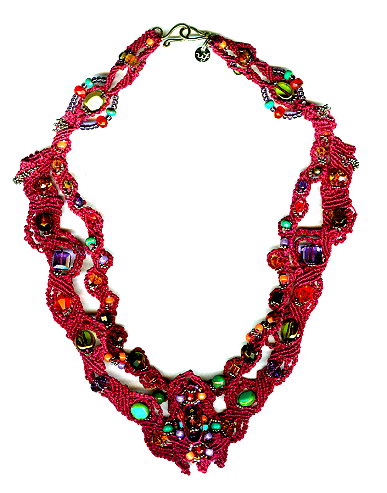
When I began my jewelry making career, one of the smartest things I did was take on repairs. I learned so much. With each repair, I was able to re-construct in my mind the steps the jewelry designer made when creating this piece of jewelry – choices about stringing materials, clasps, beads, and how to connect everything up. And at the same time, I could see where these choices were inadequate. I could see where the piece broke or wore down. I could question the customer about how the piece was worn, and what happened when it broke.
And with each repair, I gained more knowledge from yet another jewelry designer’s attempt to fashion a piece of jewelry.
All these repairs resulted in more self-confidence about designing jewelry and designing jewelry for others. And it led to more custom work.
When you do custom work, I think you need an especially steeled personality to deal with everything that can go awry.
First comes the fitting. You take some initial measurements, but after the piece is made, the perspective changes, and so do the desired measurements.
Then comes a lot of customer indecision – colors, lengths, beads, silhouettes, overall design.
Or they want to use several gemstones, but want them all to have the exact same markings and coloration.
Not to mention the sometimes questionable taste.
Or the possibilities of infringement of other jeweler’s designs, when the customer wants you to re-produce something they saw in a magazine or on-line. Identically.
And then time-frame. Can I finish the piece by the time the customer wants it done?
We discuss pricing, where many customers seem resistant to paying anything for my time.
And last, payment. It’s not so easy to get some people to pay.
I still do a lot of custom work. But I delay a bit, sitting down and actually constructing the piece. I have a lot of discussions with the client. If there are color or materials questions, I usually present the client for 3 colors or materials at a time, and ask them to choose which they prefer. Then another 3-at-a-time forced-choice exercise, until things get narrowed down.
I photo-shop a lot of images – different colors, designs, beads – with the client, and get a lot of feedback. As I assemble all the information, I sketch/photo-shop what a final piece might look like. I superimpose this image on a mannequin to show the customer what it might look like. I have the customer formally sign-off on a final design. And only then, do I begin to construct the piece.
I require a 50% deposit up front.
I agree to make some adjustments for 6 months after the customer has the piece in hand.
Posted in jewelry design | Tagged: custom artwork, custom jewelry design, jewelry design | 1 Comment »
Posted by learntobead on October 16, 2013
Friday, October 18, 2013 is Flat Cathy Day!
Sponsored by Bead & Button and Kalmbach Press
Come Visit Be Dazzled Beads to take your pictures!
It’s your opportunity to share Flat Cathy’s adventures at your favorite bead shop, and reveal exciting tips you’ve learned with the beading community. Plus, you’ll have a
chance to win prizes!
Cathy Jakicic is the author of the new book Jewelry Projects from a Beading Insider. Cathy knows firsthand what stumps beaders, what they’re curious about, and what excites them. She generously shares 200+ tips, tricks, and secrets to creating fun and wearable jewelry in this all-new collection of 30 original designs. She offers beaders lots of options with project alternatives, matching accessories, and budget-friendly choices.
Print out a copy of Flat Cathy (there are 2 versions) and take her to your favorite bead shop on October 18th to help celebrate Visit Your Local Bead Shop Month.
GO HERE: http://links.mkt746.com/servlet/MailView?ms=MTc5NjE4MjkS1&r=NjY2MDQ5NjkzNDcS1&j=MjMzNjE1MjU1S0&mt=1&rt=0

Snap a photo of Flat Cathy with your favorite bead shop employee, your favorite section of beads, attending a class, or just enjoying the store, and we will post it on our Facebook page and our Pinterest page!
We would like to post images of Flat Cathy’s fun travels to bead shops across the U.S., so make sure that your favorite bead shop is represented! Flat Cathy is also a fun way to share fun tips from the “Beading Insider.”
Creative photos along with a fun tip and the bead shop name should be emailed to
jzimdars@kalmbach.com .
Along with submitting your pictures comes a drawing for a chance to win prizes!
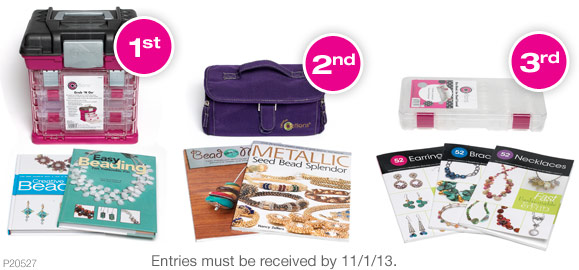
Deadline: 11/1/13
COME VISIT BE DAZZLED BEADS
in Nashville, TN
to take your pictures
for this contest!
Posted in Stitch 'n Bitch | Leave a Comment »
Posted by learntobead on October 13, 2013
DOES TODAY’s WORLD AFFECT YOUR DESIGNS IN ANY WAY?

I recently read an article about Paul Klee, a prominent modern artist in the early 1900’s. In 1914, in an interview, Klee noted that as the world became a scarier, less organized place, art became more and more abstract.
That got me thinking. To what extent does the outside world affect my jewelry design decisions? Has it changed my choice of materials? Colors? Patterns? Silhouettes?
My initial thought, frankly, was not that much.
Except that I began to think of the image I had of the “woman” wearing my jewelry and I definitely have a very feminist view of that “woman”. She’s empowered and self-assured. She plays both gender-specific as well as gender-neutral roles.
And when I picture the contexts in which this “woman” will be wearing my piece, I picture the kinds of places an assured business woman would be, and how that woman would present herself.
I also want most of my pieces to transition well between formal and informal settings, and with the woman wearing informal and more formal attire.
I have difficulty designing for the traditional Southern woman. Or the woman who only wants something blue for a blue dress. Or the woman for whom jewelry plays a supplemental function, rather than a supporting role.
My jewelry tends to be very architectural, yet my color palette and its application is very impressionistic. An urban vs. rural Or modern vs. vintage tension always resonant in my pieces. I feel this thrust towards modernity that needs to be tempered by some kind of emotion, the roots of which I often find in vintage and ancient designs.
So, there might be some of this outside world influence seeping into my design process. But I think for me, this jewelry design process is more often an escape from the realities of our world today. My pieces need to be powerful enough to allow my “woman” to escape these realities, as well.
How about you? Does today’s world affect your designs in any way?
Posted in jewelry design | Leave a Comment »
Posted by learntobead on September 26, 2013
KEEPING YOUR FINGERS, HANDS, ARMS, EYES AND MIND
IN GOOD WORKING ORDER
QUESTION:
What kinds of things do you do to keep your fingers, hands, arms, eyes and mind focused, nimble and in good working order?

Beading and Jewelry Making require lots of mind-body coordination. This takes work. It is work.
You have to control your stringing material. With needle and thread, you have to be able to get from your fingers to the needle to the beads, back along the thread to the needle to the fingers, hands, arms, eyes, mind. And then again. And again. Over and over, one more time. You need to get into a rhythm. All these working parts need to be working. No time for cramping. No time to get tired. No time to lose concentration.
A rhythm. Needle, pick up bead, pull down along thread, check the tension, pick up a bead, pull down along thread, check the tension, pick up a bead….
I noticed that different instructors had various techniques and strategies for maintaining this rhythm. Yes, music was involved sometimes. Othertimes simple meditation or creative reading and discourse. Some people had some stretching exercises that they did. Others tested themselves before proceeding with their big project. Still others did small things to reconfirm their learning.
I adapted some of their techniques into a workshop I do on Beading Calisthenics. Here is Exercise # 1.

BEADING CALISTHENICS #1: 5-Finger Stretchies
This exercise is used to prevent your fingers from cramping. Often, when beading, you are holding your hand and fingers in a very tight, controlled, sometimes unnatural or uncomfortable position. You should stop periodically, and do 5-Finger Stretchies. This is a wonderful exercise which relaxes the muscles in your hands.
Take one hand and hold it arm out, palm forward. Your arm is parallel to the floor. Your palm, fingers up, is perpendicular to the floor. Tighten every muscle in every finger, and pull each finger inward and downwards towards the point they meet the palm, but don’t touch the palm. Picture making a claw with your pulled back fingers.
Squeeze the tension, release. Squeeze, release. Squeeze, release. Do this rapidly, perhaps 4 squeeze/releases a second. Do this for 10 seconds.
Now do this with the other hand. 10 seconds.
Do this a couple times with each hand.
Then return to your beading.

Posted in beadwork, jewelry making | Tagged: exercise | Leave a Comment »
Posted by learntobead on September 25, 2013
PEARL KNOTTING WITH WARREN FELD
Our class now a video tutorial online at CraftArtEdu.com .
http://www.craftartedu.com/warren-feld-pearl-knotting-with-warren-feld
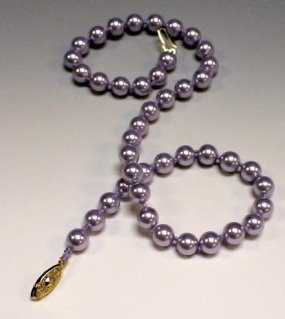
Classic Elegance! Learn a simple Pearl Knotting technique anyone can do. No special tools. Beautiful. Durable. Wearable.
Everything you need to know for successfully designing with pearls, including knotting – traditional vs non traditional methods, attaching clasps, finishing, care of your pearls, repair and types of pearls, the nature of the pearl. Jewelry designer Warren Feld will lead you through this comprehensive CraftArtEdu class that is all about pearls. 6 Broadcasts. Downloadable handout.
Price: $40
Level: All Levels
Duration: 106:17 minutes
Posted in beadwork, jewelry making | Tagged: hand knotting, pearl knotting, pearls | Leave a Comment »
Posted by learntobead on September 16, 2013
|
Now at Land of Odds – Beading and Jewelry Land of OddsFor Fun! To Learn! As Gifts!
NEW KITS! Bead Weaving Curriculum Bead Embroidery Intermediate Level
Bead Weaving Curriculum Petersburg Chain, Ndebele Advanced Level
Bead Weaving Curriculum Netting Intermediate Level
Bead Brick Stitch Advanced Beginner Strut Lower Manhattan! Learn how much shaping, interest and dimensionality you can achieve with the simple, basic Brick Stitch.
Now, also available on CraftArtEdu.com
Learn to Use Cable Wire and the Crimping Technique Beginner Level Strut show-case your jewelry-making talents. Learn Bead Stringing using cable wire
Bead Weaving Curriculum Right Angle Weave Stitch Intermediate Level No Construct your own colony of barnacles using right angle weave and peyote
Learn to Use Needle and Thread Beginner Level A remembrance picked up along the dunes and water’s edge, strung on thread. Learn to Bead String using needle and thread.
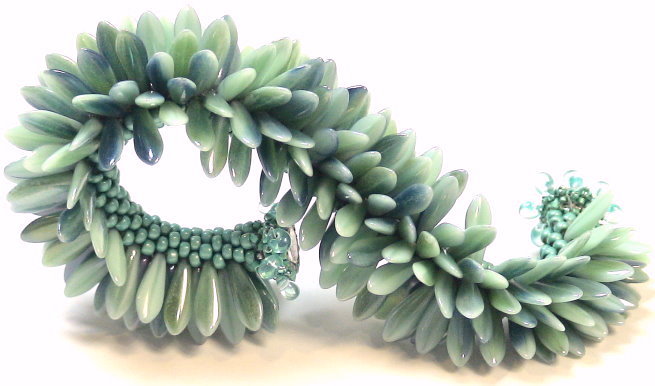
Bead Bead Crochet Intermediate Level Daggers – one side using size 8/0 seed beads and the other all glass daggers.
|
Posted in bead weaving, jewelry making | Tagged: beading kits, beading projects, beadwork kits, jewelry making kits | Leave a Comment »
Posted by learntobead on September 12, 2013
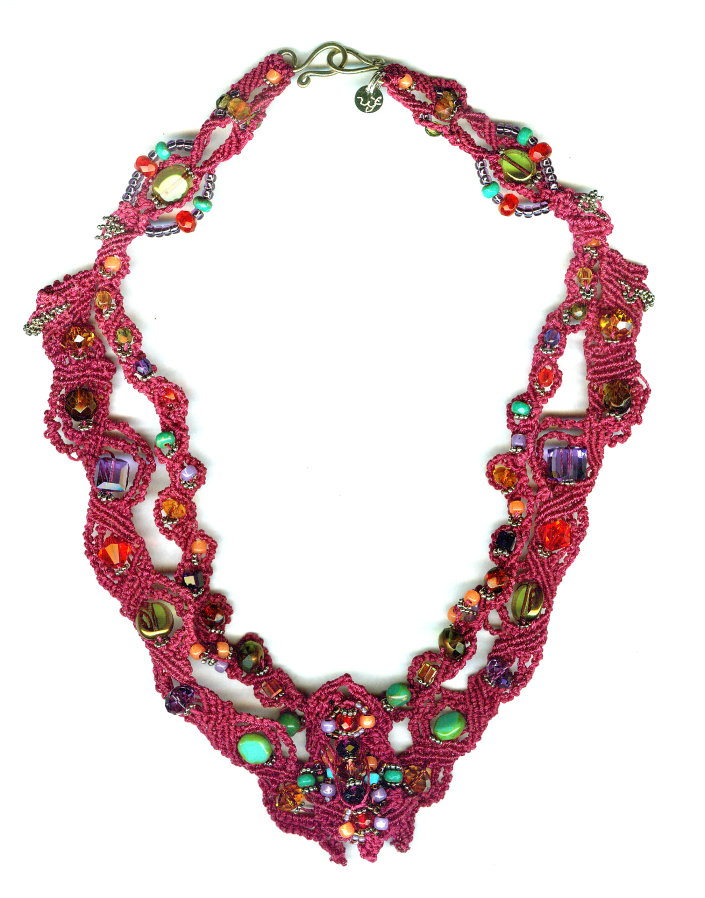
QUESTION: Can choices about jewelry design ever be truly objective? Or are they primarily subjective?
Is good jewelry design more a matter of “taste”, or is there some scientific basis which underlies it?
What do you think?
Do you think there are “universal” rules and understandings that good jewelry designers would be wise to adopt, or is each and every designer on their own?
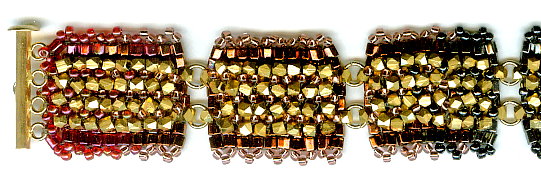
I think, that if we observed and measured the jewelry design process, that much of it is very subjective, that is a matter of personal taste. Much appreciation of design and color and color combinations seems very subjective.
People have certain social and cultural preset notions about what they prefer. Some people have a personal preference for browns, others for purples, and so forth. So people like a lot of fringe; others are minimalists.
Psychologists have found that some people will like a color or combination of colors or design elements if arranged vertically. If arranged horizontally, they then don’t like them. And vice versa. Some people like things, when horizontally arranged, but dislike these same things when vertically arranged.
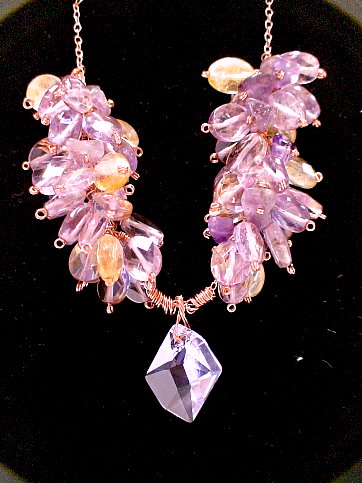
People respond in very different ways to how design elements and colors, as well as shading, highlighting and tinting, are distributed throughout the piece. They might like the components, when distributed in a certain way, but dislike the piece, when the components are re-arranged and re-distributed.
Some people get very excited when the colors or elements in their jewelry have very sharp boundaries and clear demarcations. Others hate this. They prefer a blurring or blending or smudging up of things.
When confronted with a very monochromatic piece, or one with little rhythm, some people feel relieved, and others bored or anxious.
Some people prefer pieces that exude a lot of power; others prefer their pieces subdued.
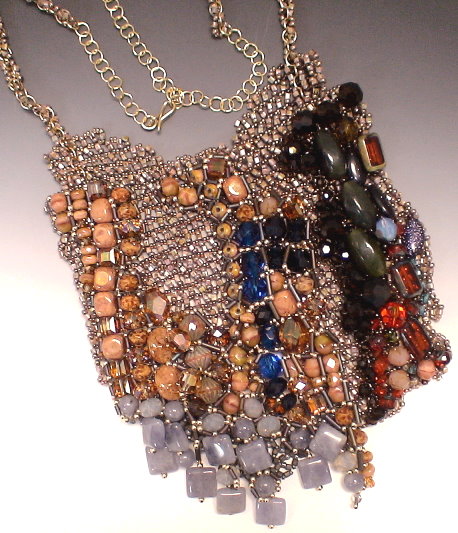
As a designer, if things are mostly a matter of personal taste, style, and perspective, it gets more confusing about how to design things. What kinds of things should be included and which excluded? What strategies can you employ for choosing and combining colors and design elements? What things should you learn, if anything at all?
Without proven, universal, objective, grammatical set of rules for using and combining things, how do we design things? How do we know which things are better, smarter and more satisfying, and which are not?
Yet, as we page through the bead magazines, and click through the various jewelry-themed web-pages, I find that a lot of people agree on what is good, and what isn’t. On what is satisfying, and what isn’t. On what works, and what doesn’t. When there is a lot of agreement, perhaps, there are some universal understandings – OBJECTIVE rules – operating here. What might these be?
Is Design purely subjective, or can you see some objective framework that may be at play, as well?
What do you think?
Warren
Land of Odds (www.landofodds.com)
Warren Feld Jewelry
Posted in jewelry design | Tagged: objective design, subjective design | 1 Comment »
Posted by learntobead on September 11, 2013
AUTUMN’S END BRACELET
http://www.landofodds.com/store/kitsautumnsabout.htm

Bead Weaving Curriculum
Petersburg Chain, Ndebele
Advanced Level
The last flower of the season! The blooms will explode as they burst open with Ndebele, Petersburg, peyote and brick stitches.
Posted in Stitch 'n Bitch | Leave a Comment »
Posted by learntobead on September 11, 2013
~ HELP US WIN BIG! ~
Go to:
http://www.beadandbutton.com/cjs
Type in:
BE DAZZLED BEADS, NASHVILLE, TN
10/31/2013 Deadline
During September and October 2013, Bead & Button is selecting one store to win a $5000.00 shopping spree at CJS SALES in New York City, a source of lots of unusual stuff for us to sell.
Posted in Stitch 'n Bitch | 1 Comment »
Posted by learntobead on September 3, 2013
MIXED MEDIA BEADWORK
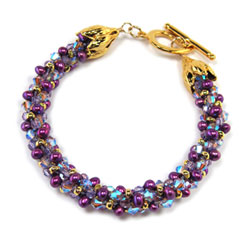
It’s my belief that you cannot combine two different media to make a piece of jewelry without letting one of them predominate over the other.
Agree or disagree?
kumihimo
Whether combining fiber with beads or metal with beads or paint and sculpture with beads, it is difficult to have a successful, satisfying outcome, without letting one of the media be dominant over the other.
Each media has its own set of structural rules and requirements. Each interacts with light and shadow very differently; that is, the materials and techniques associated with a particular media reflect, absorb and refract light differently.
These kinds of things make the viewer’s experience and interaction with the media and its resulting products different, from media to media.
kumihimo
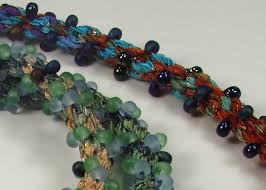
So, you can have a “knitting” project that incorporates some beads, or a “beading” project that uses a knitting stitch. In the former, knitting would predominate, with more focus on the fibers; in the latter, beading would predominate, with more focus on the beads. You can have a wire project that incorporates some beads, or a beading project that incorporates some wire elements.
But it is rare that you can look at a project, and say it concurrently meets the criteria for success of both media – so, both a successful, satisfying knitting AND beading project, and both a successful wire AND beading project. It is difficult to preserve the integrity of either media if you force them to be co-equals.
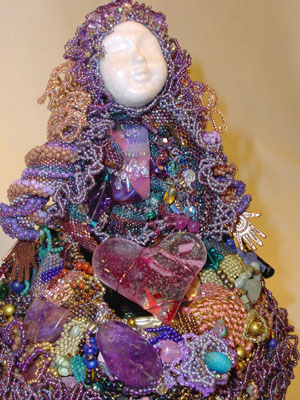
beaded art doll
And you can draw parallels across media to situations crossing materials, as well. It is difficult to mix materials within the same project. For example, it is difficult to mix glass and acrylic beads, or glass and gemstone beads….Unless, you let one material become predominant over the other.
But all of this is very challenging, almost off-putting, to the jewelry designer who wants to combine media techniques and materials.
How can techniques and materials in other craft and art disciplines be combined with beads to make jewelry? And, how can other art and craft disciplines incorporate beads or traditional beading techniques to make jewelry?
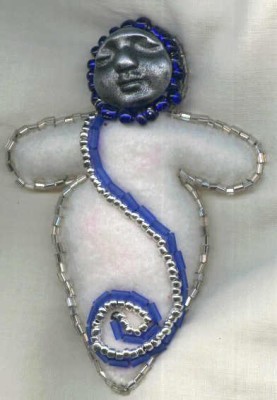
beaded art doll
If you have created mixed media projects, or enjoy viewing them,
What do you think?
Share them by posting them to our group.
Warren
Land of Odds (www.landofodds.com )
Warren Feld Jewelry
Center for Beadwork & Jewelry Arts
Posted in Art or Craft?, beadwork, jewelry design | Tagged: beaded art dolls, fiber and beads, fiber arts, kumihimo, metalwork, mixed media art, wirework | Leave a Comment »
Posted by learntobead on August 26, 2013
HOW HAS TECHNOLOGY IMPACTED YOU AS A JEWELRY DESIGNER?
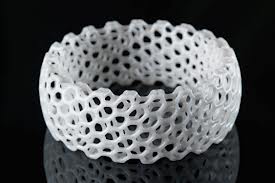
The impact of technology on work and jobs was the focus of a recent opinion piece in the New York Times by David H. Autor and David Dorn. And, as jewelry designers, we are living through and with all the positives and negatives that arise through this technological change.
How has technology affected what we do as designers?
How has it affected what we do to survive and thrive as designers?
Have we mechanized and computerized the jewelry design business into obsolescence?
How have you had to organize your jewelry designer lives differently?
given the rise of
-the internet,
-Ebay, Etsy and Amazon.com
-blogs, facebook, twitter, pinterest, instagram
-new technologies and materials like precious metal clay, polymer clay, crystal clay, 3-D printing
What has happened to your local bead stores?
What has happened to bead magazines?
If you teach classes for pay, or sell kits and instructions, how do you compete against the literally millions of online tutorials, classes, instructions and kits offered for free? How does this affect what you teach or design to sell as kits?
If you sell jewelry, how do you compete against the 60,000,000 other people who sell jewelry online? How does this affect your marketing, your pricing, your designs?
If you make part of your living doing a arts and crafts show circuit, will there still be a need for this in the future?

The authors in this NYT article pose the questions raised by several prominent authors and scholars:
Are we in danger of losing the “race against the machine?” (M.I.T. scholars Erik Brynjolfsson and Andrew McAfee)
Are we becoming enslaved to our “robot overlords,?” (journalist Kevin Drum warned in Mother Jones)
Do “smart machines” threaten us with “long-term misery?” (economists Jeffrey D. Sachs and Laurence J. Kotlikoff)
Have we reached “the end of labor?” (Noah Smith in The Atlantic)

Let me paraphrase these a bit in terms more specific to jewelry design and beadwork.
Does the reach of technology, through such vehicles as the Internet, make things so productive and efficient, that we no longer need so many people making jewelry, or teaching jewelry making, or marketing businesses / products or selling the parts to make jewelry?
If we do not need so many people to design / teach / market / or sell, and there happen to be a lot of people doing this anyway, does this necessarily make the relative worth and price for any of these activities “$zero”?
Does all this technological efficiency diminish the act of “creativity”? Now so many things can be standardized that everything – even the manufacture of complex pieces of jewelry through 3-D technology – can be reduced to a set of how-to instructions – mere recipes?
Has this technology reduced the need for bead magazines, and bead stores, and traditional classes?
On the other hand, technology has made jewelry design, and good jewelry design, more and more accessible to more and more people.
It has opened up a myriad of possibilities for people to explore their creative selves.
It has let jewelry designers reach a broader audience with their wares, their knowledge and their endeavors.
With new materials and technologies have come many new possibilities for creating jewelry.
It has made it easier for more people to get into the various jewelry design-related businesses.
It has made it easier to stay current and learn.
It has made it easier to meet and learn with fellow jewelry designers.
It has made it easier to mine big data, identify the most relevant target customers, and to market to them in very specific, cost-effective ways.
It has made it easier for retail outlets to find the merchandise they need to sell.

Some quick observations from my own professional life:
– We have an elaborate curriculum of classes that we teach. However, many of the beginning classes are becoming obsolete, in the sense that students can find similar classes on YouTube, in bead magazines, and throughout the internet, now for free. The issue for us is how to adapt, given that one of our goals is still to charge money for these classes, and make money. And a concurrent goal is to offer the student a learning opportunity worth the price paid.
– Each year, we used to have 1 or 2 national level instructors do workshops at our store. But it has become difficult to attract students. There are so many projects easily available – including from these national-level instructors – that students started to indicate that their interests in these workshops had diminished. They could do these same or similar projects on their own.
– When we opened our store in 1991, there were few places for people to acquire what we sell. Now there are almost 100 million places for people to go. It is obvious that most of our in-store customers purchase more of their supplies online or through catalogs than they do in the store.
– We used to do craft shows a long time ago. But the cost of travel got very expensive, and, with the internet, people had more opportunity to find what we sold without going to the craft shows.
– It used to be that the crux of our advertising dollars were spent with bead magazines. No longer. Bead magazines get a very small part of our advertising dollars. I can remember when all our customers read the bead magazines to get all their information. Now very few do. Most have organized themselves into small groups in various social media sites. To get your marketing message across, you have to spend a lot of time doing this online, and you can no longer market with a “broad brush”. That is, it has become ever-more-difficult to reach people.
– Our online business – Land of Odds – has been in existence since 1995. It has gone through 6 technology upgrades/re-designs since then. The e-commerce and website design technology moves and evolves so incredibly fast. Personally this constant updating has been grueling. The site needs more re-design, but my motivation to learn and cope with yet another computer language and new sets of tasks has diminished. Land of Odds was a pioneering online business. But the very large bead companies have gotten their acts together online, and are much better capitalized to expand their operations.
Technology has been a dauntingly mixed bag for us. On the negative side, the rapid advance and spread of technology has overwhelmed the various activities we do. On the positive side, it has forced us to become ever more creative and ever more efficient in what we do. It forces us to constantly re-define who we are and what we want to do. And it forces us to constantly re-define how we do things.
What do you think?
Posted in bead weaving, beadwork, business of craft, jewelry design, jewelry making, Stitch 'n Bitch | Tagged: 3-d jewelry making, 3-d printing, crystal clay, impact of technology on jewelry design, internet and jewelry, jewelry design, technology | Leave a Comment »
Posted by learntobead on August 21, 2013
THE IMPORTANCE OF SELF-PROMOTION
If you are a jewelry designer who has ambitions to have your work publicized in books or magazines, or to be accepted into a juried show or exhibit, or to sell your things in a store or gallery, you need to be able to promote your work. Often, I have found, creative-types can be shy when it comes to self-promotion and marketing.
What insights, from your own experiences, can you offer your fellow jewelry designers about self-promotion?
What kinds of things help you to overcome any fears about marketing your work?
How do you handle criticism and other rejection like getting the dreaded “No”?
From an article I wrote….
Jewelry designers often find a self-satisfaction in working intensely on a project, often in isolation or solitude. But when it comes to tooting their own horns – this is not as easy or satisfying for them. There is a discomfort here. You might want to show your pieces to others, perhaps submitting them for review or a juried competition, or perhaps wanting a store or gallery to accept your pieces for sale.
Then humility kicks in. Or perhaps a lack of confidence in yourself. Or a fear of criticism. Or a rejection. Hearing: No, we don’t want your pieces.
We don’t want to appear desperate for a sale, or too eager for acceptance.
But, if you don’t believe in yourself and your products, no one will. Your fantasy of striking out on your own will never materialize, if you don’t find it within yourself to do some self-promotion.
And the first step is understanding and recognizing that to promote yourself means promoting your value.
Your jewelry has VALUE to them, why….? If something has value to someone, then they typically want to know about it. Your jewelry has value to them because it solves a problem for them. It might make them happier, more beautiful, more enriched, more satisfied, more powerful, more socially accepted, more understanding of construction or technique or art and aesthetics. It might be better than other jewelry they see or wear or think about buying.
For a store or gallery, your jewelry might be more saleable, more attractive as displayed, better constructed, more artistic, more stylish or fashionable, a better fit with their customer base, with good price points.
You promote the value of your jewelry to your audience. You do not have to brag. You do not have to be shameless. You do not have to do or say anything embarrassing. Just speak the truth about value. Share examples of your work and what you have done, not your ego.
And that brings up the second point – speaking. People who are more comfortable speaking about themselves and their products tend to be more successful in their careers.
Products don’t sell themselves. People need to be nudged.
This “speaking-about-themselves and their products” is a basic communication process. This communication process is a process of sharing information. You want to educate the right people, in the right way at the right time. You want to speak about who you are, and what you make. The values your jewelry has to offer them. And how you would like to develop your relationship – whether designer/client or designer/retailer or designer/jury – so that you may both benefit.
Fundamentally self-promotion is about communication. Communicators frame the narrative. Communicators start the conversation. They begin on favorable terms. They would not say: Would you like to see my jewelry? Instead, they would say: I have jewelry you are going to love.
And this brings up the third point – be relevant.
Know your audience, what their needs are, what their problems are that need solving. You may have created the original piece to satisfying some personal yearning and desire. But if you want someone to buy the piece, wear the piece or sell the piece, you need to anticipate why. Why would they want to buy, wear, review or sell your piece of jewelry?
Do not assume they will figure all this out on their own. You will need to help them along in this process. You will need to communicate about the value your jewelry will have for them. You will need to do some self-promotion.
The last point – inspire people to spread your message.
Your best marketing and promotion will be what is called “word-of-mouth”. So you want to create supporters and fans and collaborators and colleagues. And you want them to be inspired enough about you, your creativity and your jewelry, so that they tell others about you. You inspire your current network of family and friends. You might make a presentation or teach a class. You might share images of your work on social media like FaceBook or Instagram or Twitter or Pinterest. You want to regularly connect with people, so that you and your work are frequently in their thoughts.
There are many self-promotion strategies that you can do. You don’t need to do everything at once. You might try one or two ideas first, and do those, then pick a third, and so on.
Some Self-Promotion Strategies That Have Worked Well For Others
Posted in business of craft | Tagged: beading, jewelry making, marketing crafts, marketing jewelry, self-promotion, selling your jewelry | Leave a Comment »
Posted by learntobead on August 9, 2013
ODDS or EVENS…
What’s Your Preference?
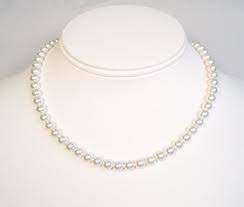
Sometimes, jewelry must conform to a type of numerology – odds or evens or multiples of some number, like the number 3 – related to the numbers of beads or the numbers of strands or the numbers of drops.
Do you have a personal preference for ODDS or EVENS? Such as,
— The number of strands in a necklace or bracelet?
— Or the number of bangle bracelets you wear on one arm?
— Or the number of beads you use to begin a peyote stitch project?
— Or the number of drops you include in your piece, or dangles you include in an earring?
— Or the number of colors or elements repeated in a pattern or jewelry segment?
Is this ODDS/EVENS preference consistent all the time?
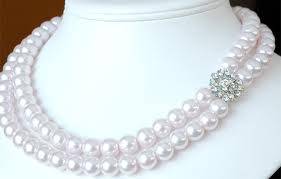
Or is it situational? That is, in certain circumstances you prefer ODDS, and in others, EVENS.
Is there any experiential, aesthetic or hypothetical basis for your preferences?
If you have a preference for one over the other, has does that affect your design process?
Do you get more compliments, when you are wearing one- or three-strand necklaces, than when you are wearing a two-strand necklace?
Historically in Europe, it was considered bad luck and inappropriate to have an EVEN number of strands in a necklace. If you had a very long necklace that you would occasionally wrap around your neck multiple times, then it had to be long enough so that you could wrap it around an ODD number of times – such as tripled, never doubled. Even today, in etiquette books, such as “Miss Manners”, the rule is “Always Wear Odd Numbers of Strands of Pearls.” No explanation is given.
Russians even believe that you should never give an even number of flowers to your wife or girlfriend!
In ancient Babylon, even numbers were believed to be unlucky and somewhat demonic. To them, something should never be repeated an even number of times.

An ODD number of beads lets you define a specific center and focus. Cognitively we prefer things with clear pointers and with clear symmetry.
But we also like balance and harmony and things to be distributed EVENLY.
Where do you come down in this ODDS vs. EVENS debate?
Posted in jewelry design | Tagged: numbers, numerology, odds vs evens | 2 Comments »