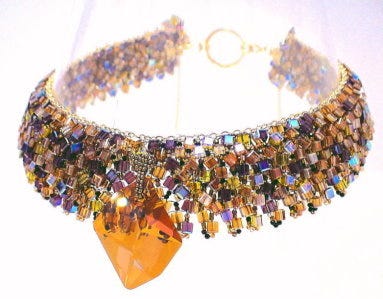
In the 1990s, my partner and I decided we wanted to set up a training program, but something different than what already existed. It was obvious to us that what already existed wasn’t working.
It came down to this: our bead store customers and our jewelry making students were not challenging us. They were not pushing us to seek out new materials. They were not demanding that we more critically evaluate the quality, usefulness, and long term staying power of various stringing materials and jewelry findings options. They were not wondering why some things broke or didn’t come together well. They were not encouraging us to explore the craft, improve upon it, search for more variations on existing methods and more ideas about new methods, and see where we could take it.
The typical customer, at that time, would learn one technique, apply it to one pattern, and do this pattern over and over again, perhaps only varying the colors. They would make at least 10 or 12 of the exact same pieces, again, typically only varying in color choices, and carry them around in zip lock plastic bags secured in their purses. They rarely deviated from using the same materials, the same clasps, the same jewelry findings. They never asked questions about what else they could do. They never varied their techniques. They never challenged themselves. They never questioned why things broke, or didn’t come together well, or why people liked or didn’t like the pieces they were making.
Students wanted us to tell them, step-by-step, how to do it. They didn’t want to think about it. They just wanted to make something quickly, that looked good on them, matched what they were wearing, and could be worn home. Uninterested in whether there were better stringing materials for the project. Or a more clever way to construct the clasp assembly. Or better choices of colors, patterns, textures or materials. Or things they could do to make the piece move better, drape better and be more comfortable to wear. Or even take the time to consider the appropriateness of the technique or the appropriateness of the piece itself, given where and when and how the piece was intended to be worn.
We began to see that this was not a customer or student problem. It was not any personal characteristics. Or motivations. Or experiences. Or skill level. This was a problem about what they learned and how they were taught and their level of expectations about what to assume and what to anticipate. They weren’t learning or getting taught that disciplinary way of asking questions, solving problems and day-to-day thinking unique to jewelry designers. They were not learning how to become literate in design. Their expectations about what was good, acceptable, finished, successful — you get the idea — were low. Bead and jewelry magazines, video tutorials, craft and bead stores, jewelry design programs set these low bars and reinforced them. As a result, they convinced their readers and students and practitioners to understand jewelry merely as an object to be worn, not inhabited. And not part of any kind of public interaction or dialog.
Jewelry design, at the time we began in business, was considered more a hobby or an avocation than an occupation or a profession. There was the assumption that no special knowledge was required. You were either creative or you were not. And all it took to make a piece of jewelry was to reduce a project to a series of steps where jewelry making was basically paint-by-numbers.
Art and Design concepts were dumbed down for jewelry makers, rather than elaborated and reinforced. It was assumed that everyone universally used the same criteria for judging a piece as finished and successful. As a consequence, there was a lot of standardization in jewelry designs, materials and construction. Too much sameness. Not enough variation and originality. Too much focus on fashion and product consumption. Too much diminishing of individuality and the reflection of the artist’s hand in design. And with all this standardization, an increasing risk that the jewelry artist was no longer a necessary and critical part of jewelry making and its design.
Around this time, the art world seemed to want to make a big push to encompass jewelry, as well. Jewelry was defined as a subset of painting or sculpture. And this lent an air of professionalization to the field. Jewelry making here became a beauty contest. But jewelry design was divorced from the materials it was made from, the constructive choices necessary for it to function, and the person who was to wear it.
Before designing jewelry, I had been a painter. For several years when I began designing jewelry, I approached jewelry projects as if I were painting them. This was very frustrating. I couldn’t get the color effects I wanted to achieve. Or the sense of line and shape and dimension. To compensate for my repeated feelings of failure, I actually pulled out my acrylic paints and canvas and painted my creations as I had visualized them in my mind. I could paint jewelry well. But, stuck as I was in this painter-as-designer-rut, I could not satisfactorily translate my vision into a satisfying piece of jewelry.
It finally began to dawn on me the things which needed to be learned and needed to be taught. I needed to approach jewelry from the jewelry’s standpoint. I needed to understand the components and beads used in jewelry on their own terms — how they asserted themselves within each of my projects. Beads and related components were not paints. I needed to understand what happened to all these components over time. I needed to understand how the placement of each component, as well as clusters of components, affected people within the situations they found themselves. I needed to understand much more about light and shadow and reflection and refraction. I needed more insight into how things moved, draped and flowed, all the while keeping their shape. Starting with a merely mechanical view of making jewelry wasn’t cutting it. Nor was starting with an artistic view of the aesthetics of jewelry. We needed to incorporate aspects of design, as well.
My partner and I began organizing our evolving ideas and values about the designing of jewelry into something we called The Design Perspective. These ideas and values form a sort of Design Manifesto. They are principles at the core of any jewelry design discipline. These principles take the designer beyond craft. They integrate art with function and context. These principles were, and continue to be, as follows, and it is my hope, as you read through the book, that these become yours, as well.
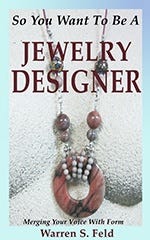
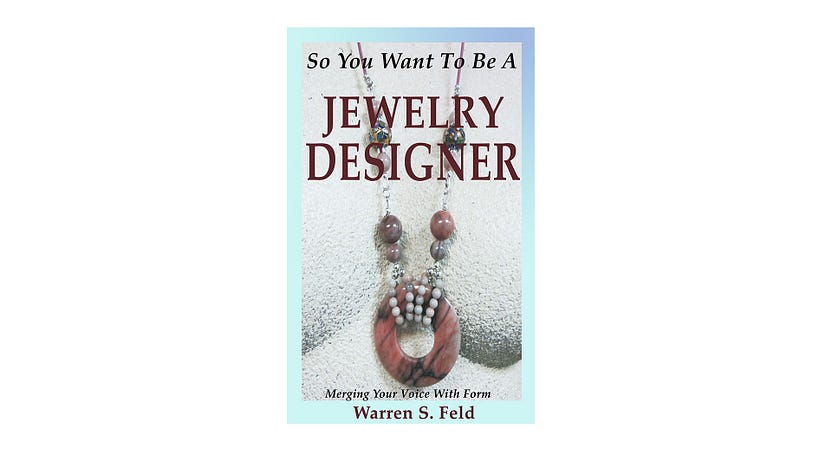
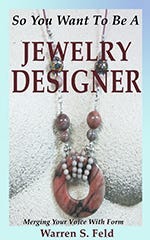
SO YOU WANT TO BE A JEWELRY DESIGNER Merging Your Voice With Form
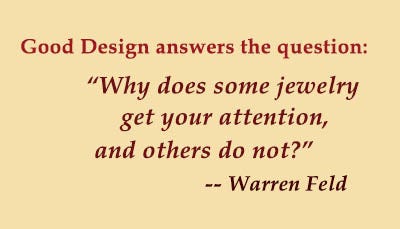
So You Want To Be A Jewelry Designer reinterprets how to apply techniques and modify art theories from the Jewelry Designer’s perspective. To go beyond craft, the jewelry designer needs to become literate in this discipline called Jewelry Design. Literacy means understanding how to answer the question: Why do some pieces of jewelry draw your attention, and others do not? How to develop the authentic, creative self, someone who is fluent, flexible and original. How to gain the necessary design skills and be able to apply them, whether the situation is familiar or not.
Abstract Color is the single most important Design Element. Most artists and jewelry designers learn about how to use and control for color in art schools. They learn about how colors are perceived. How to combine colors and maximize the appealing effects of such combinations. How the perceptions of color vary, given the context, and how to anticipate these variations. These art theories work well for those who paint. But not so well for those who design jewelry.
How Artists and Jewelry Designers Respond Differently To The Use Of Color
The artist is concerned with achieving harmony, balance and evoking an emotional response. Color theories point the way. The artist wants to be guided by these and conform to them. To the artist, color theory is more about objectives and universals. They tap into the brain’s propensity to balance things out. People are prewired with an anxiety response. Our brains have some presets so that we avoid snakes and spiders. When things get too unbalanced and too unharmonious, the brain gets edgy. We begin to interpret things as not as interesting, perhaps somewhat unsatisfying, even ugly.
Color schemes show what colors in combination yield a balance in energy and wave length signatures. For example, and with a lot of oversimplification, color theory points out that in any project, the proportion of red should equal the proportion of green. If red has an energy signature of +1, then the energy signature of green would be -1. Added together, they equal zero. The brain wants things to equal zero. Balanced. Harmonious. And artists who follow the theories about color are secure in this. They recognize that all people want the colors in front of them to balance out to zero. Color theory leads the way. Artists want to be guided and conform to it.
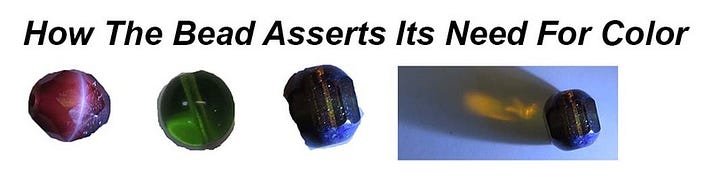
For the jewelry designer, however, color theories are a starting point, but quickly break down. This is because jewelry is only art as it is worn. That means the jewelry will move with the person, shift from one type of light to another as the person moves from room to room or from inside to outside. The materials used in jewelry do not come in every color of the rainbow. You cannot crush them up and blend them. Even with a simple round bead, the color will vary across the bead, becoming lighter or darker, sometimes even changing the color as presented, as you move around the curved surface, perceive the hole piercing through the bead, at the hole’s end with added shadows. Many beads will even cast a color shadow extending well beyond the boundary of the bead, but changing scope and direction as the wearer pivots or the lighting changes. The silhouette of any piece of jewelry will shift in shape as the jewelry shifts in position in responses to the forces of movement, stresses and strains. Unlike a painting, jewelry is never static. The perceived colors keep changing. If from any one position, the jewelry appears less than appealing, this is awkward for the wearer. People viewing jewelry attribute the qualities of the jewelry to the qualities of the person wearing it. This situation is unacceptable to the professional jewelry designer. The wearer should always look good. So color, as a design element with all its attributes of expression, must be managed differently.
The artist manages the perception of color. The jewelry designer manages its sensation. Perceptions may be managed as objective, universal responses to color. Sensations result from designers manipulating, exploiting, challenging and violating theories of color, because sensations are more subjective, less predictable and are context specific. The artist seeks an emotional response. The jewelry design seeks something a little bit more, a slight edginess beyond harmony, what I call resonance. An emotional response to jewelry would be I like it. A resonant response to jewelry would be I want to wear it, or I want to buy it.
PAINTS vs. BEADS
How one becomes fluent in art is by necessity different than how one becomes fluent in jewelry design. Jewelry designers must learn to think differently than artists when working with colors. They must learn to be able to anticipate and control the sensation of colors by wearer AND viewer, as the jewelry is worn.
With artists, color is applied. With jewelry designers, color is arranged. Because color is not applied per se, the bead — its very being — creates a series of dilemmas for the colorist.
(1) Availability of Colors Beads do not come in every color. The perceived color on any bead has a lot of variation due to the shape, curvature and faceting of beads, as well as the effects of the hole and its drilled channel. Some beads will cast a shadow past their boundary. Some beads have striations or other similar effects where different colors are strewn within and throughout the bead. The perception of color may differ as the bead is viewed under different light sources, or indoor or outdoor, or different casts of shadows. Different types of bead finishes reflect, absorb or refract light differently from each other. The perceived color of the bead might vary based on the colors of the clothing, skin tone, hair style and color, and makeup of the person wearing the jewelry.
With paint, you can construct any color and can create many coloration effects. But, once completed, the painting is static as is the lighting. There will be a more consistent perception of colors and colorations.
(2) Position Painting is observed in fixed position with fixed lighting with a viewer standing in front of it. Jewelry is observed as it moves, with varying light and shadow conditions by someone who wears it and others who view it. Jewelry will also shift positions as it is worn.
(3) Appeal and Functionality Jewelry has to succeed both visually and functionally. The things contributing to function, from canvas to clasp assembly, offer their own complications to the sensation of color.
Paintings are judged by appeal alone.
(4) 2 or more colors in contrast When you have 2 or more colors existing within the same composition, they may affect the perception of color of any one of them. They may blend, exude temperature, feel closer or more distant. The proportion of each color present will affect how they are perceived. The juxtaposition of 2 or more colors has a critical effect on the sensation of colors, moreso, complicated because jewelry moves.
(5) Transitioning from one bead to the next With jewelry, more attention must be given to the transitioning from one bead to the next, one color to the next, because this often is not fluid or natural. There will be gaps of light between beads, or negative spaces not taken up by the volume of each component. With jewelry, as it moves, it is more often the case that perceptions of color will not conform to scientific universals.
(6) Goals The goal for the artist is to evoke emotions based on harmony and balance with a little variety. Evidence of finish and success lie in establishing harmony and balance.
The goal for the jewelry designer is resonance with a little more of an edge to it that takes the viewer slightly beyond harmony and balance. Evidence of finish and success relates to how the designer and the wearer establish some shared understanding that the values and desires of each have been met when the jewelry is worn.
DESIGNING JEWELRY INVOLVES MAKING A WHOLE HOST OF CHOICES
As designers, we…
Select materials and techniques, leveraging their strengths and minimizing their weaknesses
Anticipate how the parts we use to make a piece of jewelry assert their needs for color
Anticipate shared universal understandings among self, viewer, wearer, exhibitor, collector and seller about color and its use
Think through how colors relate to our inspirations and how they might impact our aspirations
Pick colors
Place and arrange colors
Distribute the proportions of colors
Play with and experiment with color values and color intensities
Leverage the synergistic effects and what happens when two (or more) colors are placed next to one another
Create focus, rhythm, balance, dimension and movement with color
Create satisfying blending and transitioning strategies using color
Anticipate how color and the play of color within our piece might be affected by contextual or situational variables
Reflect on how our choices about color affect how the piece of jewelry is judged as finished and successful by our various client audiences
Use color to promote the coherency of our pieces, and the speed and extent to which attention by others continues to spread
PICKING COLORS FOR JEWELRY DESIGNS
The jewelry designer has to pick colors pleasing to the designer, as well as anticipate what colors will be pleasing to the wearer or buyer. This makes picking colors very personal and subjective. We all know that designs are imperfect. Beads are imperfect. Colors are imperfect. So part of picking colors has to be very strategic and well-managed.
Colors are used by the designer to clarify and intensify the effects she or he wants to achieve. They are used to:
Delineate segments, forms, themes, areas
Express naturalism or abstraction
Enhance the sense of structure or physicality (forward/recede; emphasize mass or lines or surfaces or points)
Stimulate the senses (warmth or cold; memories; enlarging or decreasing)
Play with light and shadow (surprise, distort, challenge, contradict, provoke)
Alter the natural relationship between the jewelry and the situation it is worn in (context, clothing, body and face types/skin tones, setting)
The resulting relationships between space and mass, negative and positive areas
Focus attention, particularly providing information about direction, boundaries, permissions
Color Tools At The Designer’s Discretion
Both the artist as well as the jewelry designer have three primary color tools at their discretion. For the artist, these tools are used to control perceptions of color. For the jewelry designer, however, these tools are used to control the sensations and experiencing of color.
TOOL 1: SENSATION OF COLOR BALANCES (Light Values)
Individually, each color is perceived in the same way. Each color is associated with a particular energy and wavelength signature. Both artist and jewelry designer can assume that each color standing fixed and alone is perceived in the same way universally. For the jewelry designer, however, since jewelry is worn and moves, the designer cannot assume that in any one minute, each color will be perceived consistently in the same way.
TOOL 2: SENSATION OF COLOR CONTRASTS (Color Schemes/Color Wheel, Color Proportions)
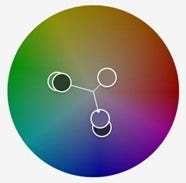
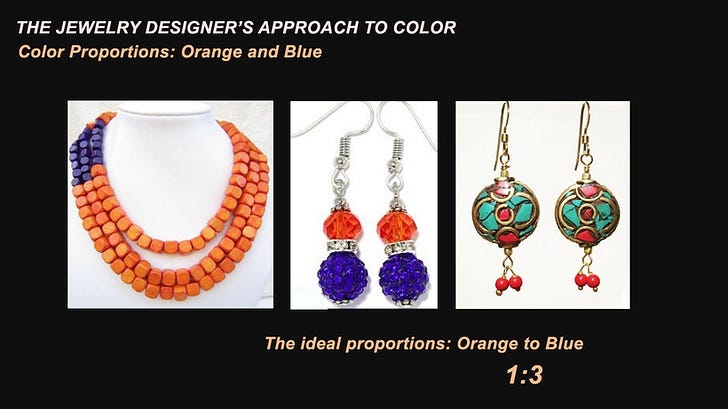
When 2 or more colors co-exist in the same space, they affect each other. Color schemes and information about color proportions have been scientifically derived. These determine, to oversimplify things, a zero-zero point where the positive and negative energy signatures of each color balance out to zero. With a composition of blue and orange, this contrast color scheme indicates that their energy signatures would balance out to zero. When dealing with proportions, color theory determines that there should be one orange for every 3 blues, again to achieve harmony within this zero balance point. In this way, certain combinations of colors are seen as more appealing than others.
For the artist, she or he can achieve these universal understandings about color contrasts within any composition. For the jewelry designer, not so much. Color schemes and color proportions are a good place for the designer to start any project. But because movement and context will continually distort perceptions of these colors as the jewelry is worn, more color management will be called for, if the piece is to feel finished and successful. The jewelry designer literally has to work hard to trick the brain so that it interprets the inevitably resulting imperfections in color use as PERFECTions.
TOOL 3: SENSATION OF COLOR CONTRASTS IN CONTEXT (simultaneity effects, shared understandings)
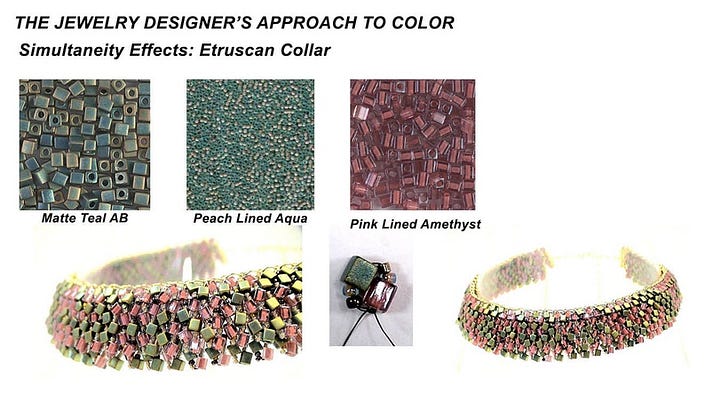
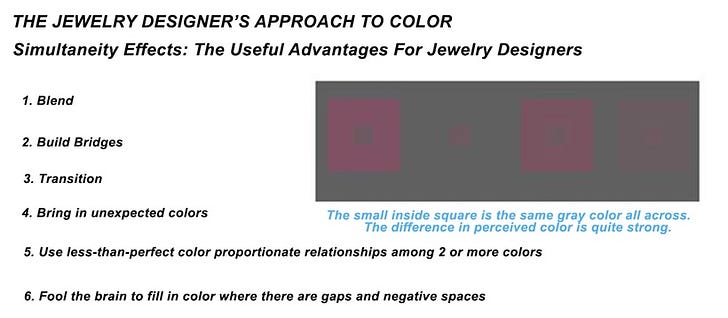
When 2 or more colors are present, and you take into effect more contextual information, you often find that colors experienced simultaneously can affect how each color is perceived apart from what you would predict from things like color light values, color schemes or color proportions.
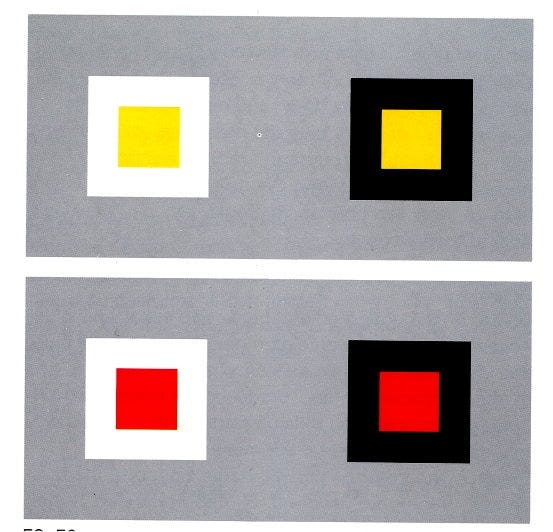
A yellow square inside a white box appears to feel cooler than that same yellow square in a black box. Similarly with the red square. Colors appearing simultaneously can be made to feel to be receding/approaching, warm/gold, blending and bridging, overcoming gaps and negative spaces or paralyzed by them, establishing dimensionality and movement, redirecting attention, blurring or bounding, smaller or larger.
Any color with a gray or black undertone will take on the characteristics of the color beside it. Besides the obvious black diamond color, other colors which have gray or black undertones include prairie green, Montana blue, French rose, purple violet, Colorado topaz.
Other types of beads which allow you to create simultaneity effects: silver, gold, anything with a mirror or foil effect, color-lined beads.
Thus, Simultaneity Effects are a boon to the jewelry designer. They are great tools for TRICKING THE BRAIN and …
Making the variation in color as expressed within the bead or other object as more homogeneous
Filling in the gaps of light between beads
Assisting in the guiding attention along or the sense of movement of colors along a line or plane
Assisting in establishing dimensionality in a piece that otherwise would appear flat
Harmonizing, Blending or Bridging two or more colors which, as a set, don’t quite match up on the color wheel
Establishing frames, boundaries or silhouettes
Re-directing the eye to another place, or creating sense of movement
The Blue Waterfall Necklace
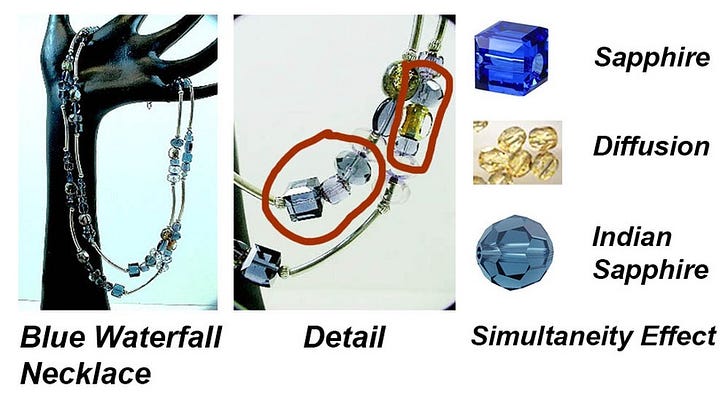
In this Blue Waterfall Necklace, which is one of my designs, I capitalized on the use of simultaneity effects. As you can see in the image above, there are three colors which I lined up together: Sapphire (cube), Crystal Diffusion (cathedral) and Indian Sapphire (which is a rounder shape). Normally, you would not mix sapphire and Indian sapphire in the same piece. They don’t really go together. Using a color in between — crystal diffusion in this case — which acts in a similar way to a gray color bead, I was able to blend the characteristics of the Indian sapphire bead on one side and the sapphire bead on the other. When you look at the finished piece, the colors lined up in each segment appear harmonious.
Some additional examples of strategic color use that I have done:
A. Putting a transparent faceted olivine bead next to a transparent faceted capri blue bead. In bright or direct light, depending on in what direction from the light the person wearing the piece is standing, will cast a color shadow — either an olivine shadow over the capri bead, or a capri blue shadow over the olivine bead. That means, when the person orients their stance in various positions, you will often get a muddy brown look, rather than distinct olivine and capri blue colors.
This arrangement would also be the beginning of an analogous color scheme. In this scheme no color should predominate. If one does, it starts to look less satisfying. If we rely on a different color theory about color proportions, then we want to have 1.5 blue green for every 1 olivine. In this case, we could not meet the criteria for both the color scheme rule and the color proportion rule.
In any event, I would probably first place a sterling silver or gold bead between the olivine and capri. These metal beads will create that simultaneous effect. When a person is wearing the piece, sometimes, depending on the lighting and the person’s stance, the capri and its shadow will take up a greater volume, and vice versa with the olivine. There won’t be that occasional muddy look.
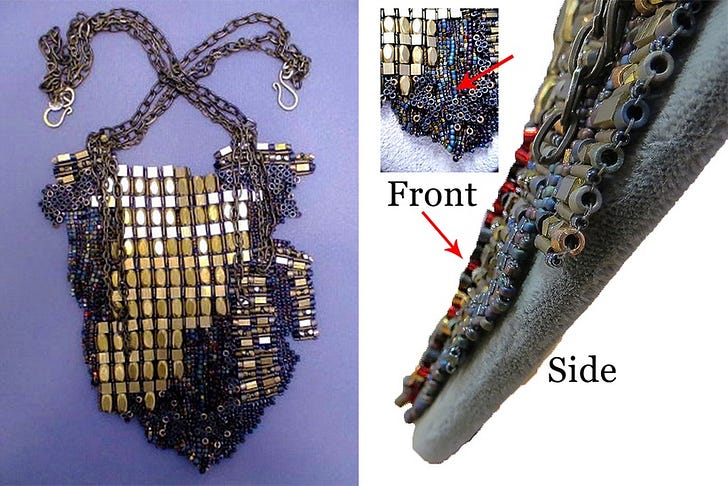
B. In my piece — Little Tapestries: Ghindia — I embedded red crystal beads within a seam. They are not visible if you are standing in front of the person wearing the piece. I wanted the person wearing the piece to subtly catch the eye (bright red flashes of color reflecting the light) of anyone to her side or just behind her.
C. It is difficult to mix materials within the same piece. That is partly because the brain/eye interaction with each type of material is often different, and this is unsettling for the brain. Painful. When the brain is unsettled, the piece gets interpreted as unsatisfactory, unappealing, even ugly. Successfully mixing materials gets very caught up in an understanding of light and shadow. And an understanding of light and shadow is very influenced by and influential in the use of color.
The surface of a material has many characteristics which the jewelry designer leverages within the finished piece. Light might reflect off this surface, such as with opaque glass or shiny metal. Light might be brought into and below the surface before getting reflected back, such as with many gemstones and opalescent glass. Light might refract through the piece at different angles, even creating a prism effect. Light might be absorbed below the surface, as with pearls.
The surface might be a solid color. It might be a mix of colors. It might be matte. It may be flat, have crevices, have matrixing, or have inclusions. It may have fire or flashing coloration effects. There may be tonal differences. There may be pattern or textural differences. It may convey movement. It may convey depth.
One example that comes up a lot: it is difficult to mix gemstone with glass. For most gemstones, the light travels from the eye to the surface of the material, then continues below the surface, before bouncing back. For most glass, the light travels from the eye to the surface of the material, then bounces back; it does not penetrate the surface. When mixing gemstones and glass, if the brain’s interaction with the materials requires a shift in the activity of physical perception, then this is often uneasy and painful for the brain.
If I were to mix glass and gemstone, I would choose glass which mimics the brain/eye/light effect. I would choose a translucent glass bead where this effect is mirrored to that with the gemstone.
Let’s say I created a necklace of opal beads. With opals, the light penetrates below the surface, interacts with movement (fire effect), then bounces back to the eye. I can mirror this effect with silver lined translucent glass beads. The silver lining within the transparent glass mimics the sense of ‘fire’. If I had added a silver lined transparent bead instead, this would not work as well. Here, with the transparent bead, the light hits the surface of the glass and the silver lining intensifies the experience of the particular color of the glass.
Let’s stick with this opal necklace. Say I added an opaque black seed bead in between each opal bead. If small enough, this configuration kicks in the GESTALT cognitive behavior. The brain “sees” a gap between each opal bead, and not a glass bead. The brain fills in the gap with color approximating that of the opal beads. If this seed bead gets too large relative to the opal bead, however, a different cognitive process kicks in. Here the brain has to deal with the perceptual anomaly of light bouncing back and forth in different ways — eye to surface and eye to below surface. Again, painful for the brain.
D. Substituting one material for another will result in a very different experience of the object for the wearer. Take, for example, a Chakra bracelet strung on cable wire with a clasp. Say the beads used are gemstones. Each gemstone has spiritual and healing properties. Each gemstone has a coloration, and each different coloration, too, is associated with certain spiritual and healing properties. Moreover, every individual has their own unique needs for which set of gemstones and which assortment of colorations are best and most appropriate. This can get even more complicated in that each situation and context may have its own requirements.
The designer could have used glass or acrylic beads instead. These would be less spiritual, less healing, less valuable and less durable over time. Only the property of coloration would be the critical variable leading to spiritual and healing properties. The sensations the wearer would have with the gemstone bracelet would differ significantly from those with the glass or acrylic bracelet.
YOU CANNOT SEPARATE THE COLOR FROM THE HOW AND WHY IT WAS CHOSEN
With any art object, the designer and the artist are at the core of it all. Its success depends on the types of choices made. Though both disciplines overlap some, artists and designers have to resort to a different thinking process when making choices about color.
When someone interacts with any art object, the brain tries everything it can to make sense of and harmonize the situation. Should it like it or not? Should it touch it, wear it, buy it, or not? Should it influence you to share your observations and emotions, or not? The brain tries to zero-sum the light values by taking into effect each color’s energy signature. It has to weigh information about how much of one color there is in relation to one or more other colors. It has to evaluate information about emotional and other meaningful content the juxtaposition and placement of any set of colors within any context or situation represents. It has to fill in the blanks — gaps and negative spaces — where it might expect to see some color but does not. It has to determine whether the person should expend the time and energy to attend to the whole object, or stop at just a small part of it. It has to attend to color, whether static or moving.
The artist seeks to anticipate how people perceive color, and based on color theories, can recognize how certain universals come into play. They emphasize these universals. This results in harmony and balance.
The jewelry designer has a different task, more complex, riskier. The designer, in anticipation of how others perceive, recognize and interpret colors in their lives, has to establish within any design a strategy for how color is used to enhance expression within any piece. The jewelry designer must anticipate the effects of movement on color. The jewelry designer is the manager. The designer is the controller. The designer is the influencer. The designer brings to the situation personal values and desires. The designer establishes and conveys intent and meaning resulting from the choices, including and especially about color, she or he has made. Fluent designers can decode color and its use intuitively and quickly, and apply color in more expressive ways to convey inspiration, show the designer’s strategy and intent, and trigger an especially resonant, energetic response by wearers and viewers alike.
The viewer and wearer then must determine whether the designer’s use of color meets and assists them in expressing their own values, needs and desires. They might wear or buy it. They might show it to their friends. They might merely complement the designer. They might walk away.
Jewelry making has aspects of craft to it, but it is so much more. It is art. It is architecture. It is communicative and interactive. It moves with the person wearing it. It is reflective of the jewelry designer’s hand. And it defines and reaffirms the narrative stories of everyone who wears it, views it, buys it, exhibits it, collects it, talks about it.
To go beyond craft, the jewelry designer needs to become literate in this discipline called Jewelry Design. Literacy means understanding how to answer the question: Why do some pieces of jewelry draw your attention, and others do not? How to develop the authentic, creative self, someone who is fluent, flexible and original. How to gain the necessary design skills and be able to apply them, whether the situation is familiar or not.
Craft and art techniques and theories are of little help. These do not show how to make trade-offs between beauty and functionality. Nor how to introduce pieces publicly. These provide weak rules for determining when a piece of jewelry is finished and successful. Often, the desires and motivations of wearers, viewers and buyers are minimized or ignored.
So You Want To Be A Jewelry Designer reinterprets craft techniques, modifies art theories, and introduces architectural, socio-cultural and perceptual-cognitive considerations so that jewelry makers are better prepared to approach design.
By the end of So You Want To Be A Jewelry Designer, established jewelry artisan Warren Feld teaches you how to
· Select materials, techniques and technologies
· Choose, compose, construct and manipulate jewelry design elements
· Anticipate expectations, perceptions, values and desires of client audiences
· Develop those soft skills of creativity, inspiration, aspiration and passion
Warren Feld examines with you all those things which lead to your success as a jewelry designer, and your associated design practice or business.
I have been designing jewelry and teaching classes for over 38 years now.
What excites me is finding answers to such questions as:
What does it mean to be fluent and literate in design?
What are the implications for defining jewelry as an “object” versus as an “intent”?
Why does some jewelry draw your attention, and others do not?
How does jewelry design take you beyond art or craft?
How do you judge a piece as finished and successful?
Why is disciplinary literacy in design important for introducing your works publicly, as well as selling your works in the creative marketplace?
My ideas have developed and evolved over time. These are ideas about jewelry, its design, and the necessary tradeoffs between appeal and functionality. These are ideas which express the why and the how jewelry design differs from art or craft. These are ideas which are embedded in and emerge from the special disciplinary and literacy requirements all jewelry designers need to learn so that they can think and speak and work like designers. These are ideas about how to introduce jewelry into the creative marketplace. These ideas center on fluency, flexibility and originality. And that’s what you want to be as a jewelry designer: fluent, flexible and original.
I teach classes in jewelry design and applications.
I want my students to learn the mechanics of various techniques. This is obvious. But I want them to go beyond the basic mechanics. I want them to be able to have a great degree of management control over the interplay of aesthetic elements. I also want them to have a great degree of insight, strategy and “smartness” in how things get constructed architecturally. Last, I want them, and this is important, to understand and recognize and incorporate into their designs how and why people desire things — why they want to wear things and why they want to buy things and why they want to tell all their friends about the things they are wearing and buying.
Literacy involves all these things: craft, art, design, context. Teaching a disciplinary literacy specific to jewelry design is a lot like teaching literacy in reading and writing. We want our students to comprehend. We want them to be able to be self-directed in organizing and implementing their basic tasks. We want them to be able to function in unfamiliar situations and respond when problems arise. We want them to develop an originality in their work — originality in the sense that they can differentiate themselves from other jewelry designers. We want them to anticipate the shared understandings their various audiences have about whether a piece is inhabitable — that is, finished and successful for them. We want them to think like designers. And, we want a high level of automaticity in all this. The basic jewelry design curriculum does not accomplish this. There is an absence of strategy and strategic thinking.
Hence this book and guide for anyone who wants to become a successful jewelry designer. This book is for someone who wants to develop that strategic kind of thinking and speaking and doing which underly their discipline we call Jewelry Design.
For more articles about Fluency in Design, click over to our Jewelry Designers’ Hub
SO YOU WANT TO BE A JEWELRY DESIGNER Merging Your Voice With Form
So You Want To Be A Jewelry Designer reinterprets how to apply techniques and modify art theories from the Jewelry Designer’s perspective. To go beyond craft, the jewelry designer needs to become literate in this discipline called Jewelry Design. Literacy means understanding how to answer the question: Why do some pieces of jewelry draw your attention, and others do not? How to develop the authentic, creative self, someone who is fluent, flexible and original. How to gain the necessary design skills and be able to apply them, whether the situation is familiar or not.
Some Updates and Things Happening. (Please share this newsletter)
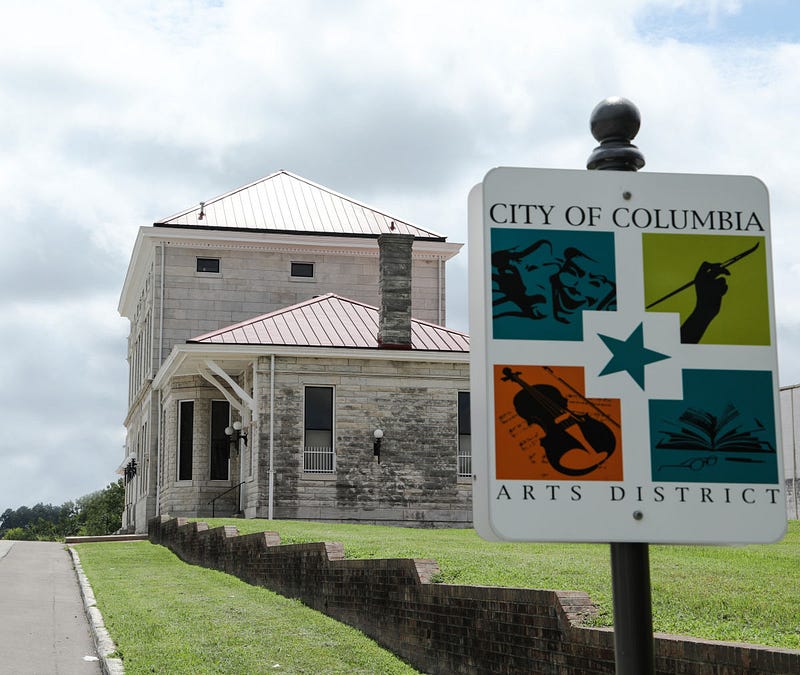
1. I have been participating with the Columbia TN Arts Council over the last several months. Their major tasks are to develop a sense of community among artists (broadly defined), and a sense of place in a several block area off the downtown identified as the Columbia Arts District. I wrote a visioning plan for this District which I want to share, and welcome any feedback and ideas for programs, and community and economic development.
The Columbia ARTS DISTRICT (CAD) was created to provide a haven for artists to live and work. The CAD is located a few blocks from Downtown Columbia in the South Garden/High Street area. The City has established historic zoning overlays to protect historic and cultural assets that include distinct neighborhoods like the ARTS DISTRICT. The area currently comprises several blocks of old warehouses, old houses (some historically significant), mobile homes and manufactured homes, and vacant lots. One warehouse building was turned into a multi-story mix of artist studios, retail spaces, coffee house, some office space. There are some restaurants and specialty shops in the District, but not many. Columbia is a small town of about 45,000 residents, growing 2–3% annually, and is located about 45 miles south of Nashville.
The BIG question for me was whether you can create a community-based Arts District, where the focus and energy emerge from how the community interacts with and finds meaningful experiences within the space, rather than focusing on physical design per se.
My SECONDARY question was whether a District designed to bring artists to live, work and play together can remain competitively viable over time, or will the community either lose interest or will the area become so attractive that gentrification negates its original reason for being. Time will tell, … as will smart thinking, planning, and cooperative partnering.
What makes a space into a place? Placemaking inspires people to collectively reimagine and reinvent public spaces as the heart of every community. Strengthening the connection between people and the places they share, placemaking refers to a collaborative process by which we can shape our public realm in order to maximize shared value. More than just promoting better urban design, placemaking facilitates creative patterns of use, paying particular attention to the physical, cultural, and social identities that define a place and support its ongoing evolution.
Great public spaces are those places where celebrations are held, social and economic exchanges occur, friends run into each other, and cultures mix. They are the “front porches” of our public institutions — libraries, field houses, schools — where we interact with each other and government. When these spaces work well, they serve as the stage for our public lives.
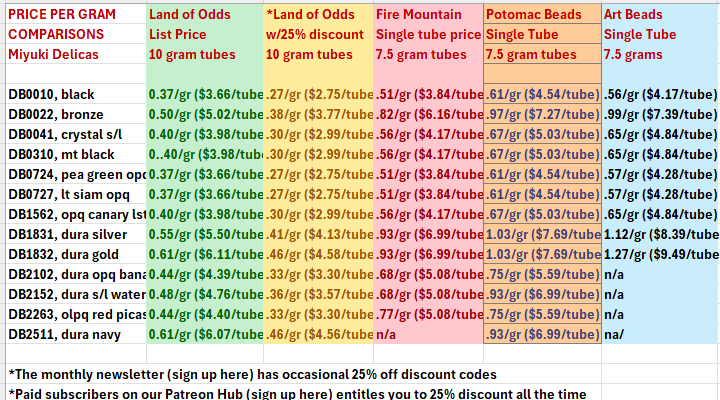
3. I encourage you to take advantage of the very low prices of delica beads on the Land of Odds website.
Compare Our Prices To What You Are Paying:
In this monthly newsletter, occasionally, like in this newsletter, you will find a discount coupon code that you can use on the Land of Odds website.
You can also become a paid subscribing member on our Jewelry Designers’ Patreon Hub, which entitles you to a 25% discount as long as you maintain your subscription.
4. If you have the resources, I strongly suggest you look into furthering your jewelry design education by attending a degree program. Here are the top 30 jewelry design programs in the United States:
Here are some of the leading jewelry design programs in the United States, known for their specialized curriculums, faculty expertise, and facilities. While specific rankings can vary by source, these schools are widely regarded as some of the best for jewelry design.
1. Rhode Island School of Design (RISD) — Providence, RI
Offers a strong focus on metalwork, traditional jewelry techniques, and contemporary design principles.
2. Savannah College of Art and Design (SCAD) — Savannah, GA
Provides a comprehensive approach with state-of-the-art facilities and focuses on various facets of jewelry design and business.
3. Fashion Institute of Technology (FIT) — New York, NY
Known for hands-on learning and access to New York City’s fashion and jewelry industry.
4. California College of the Arts (CCA) — San Francisco, CA
Emphasizes interdisciplinary approaches and sustainable design practices.
5. Parsons School of Design — New York, NY
Offers access to an extensive network in the fashion and luxury sectors, with an emphasis on innovative design.
6. Pratt Institute — Brooklyn, NY
Known for a strong arts program and a metal/jewelry design program focused on both technical skills and creativity.
7. Cranbrook Academy of Art — Bloomfield Hills, MI
Known for a small student body and intensive, personalized instruction.
8. University of the Arts — Philadelphia, PA
Offers a jewelry and metals program that includes contemporary jewelry, metalsmithing, and interdisciplinary work.
9. School of the Art Institute of Chicago (SAIC) — Chicago, IL
Known for an experimental approach that blends traditional and digital techniques.
10. Temple University’s Tyler School of Art — Philadelphia, PA
Focuses on combining creative expression with technical skill development.
11. University of Washington — Seattle, WA
Known for a broad curriculum that includes both traditional metalworking and experimental materials.
12. Virginia Commonwealth University (VCU) — Richmond, VA
Offers a BFA in Craft and Material Studies with a focus on metals and jewelry.
13. SUNY New Paltz — New Paltz, NY
Known for its Metal/Jewelry Design program that integrates both artistic development and technical skill.
14. Massachusetts College of Art and Design (MassArt) — Boston, MA
Offers a program with a focus on metalsmithing, jewelry, and art history.
15. University of Oregon — Eugene, OR
Known for a jewelry program that encourages both traditional and experimental methods.
16. California State University, Long Beach (CSULB) — Long Beach, CA
Offers a BFA in 3D Media focusing on metal and jewelry arts.
17. University of Georgia — Athens, GA
Strong focus on craftsmanship and a broad approach to metal and jewelry design.
18. University of Kansas — Lawrence, KS
The jewelry and metals program is known for its commitment to traditional techniques and design principles.
19. Texas State University — San Marcos, TX
Offers a BFA with a concentration in Metals and Jewelry, focusing on both technique and conceptual development.
20. Indiana University Bloomington — Bloomington, IN
Known for its craft-focused metalsmithing program, including traditional and contemporary approaches.
21. North Bennet Street School — Boston, MA
Provides a specialized training program in jewelry-making with a focus on bench skills and craftsmanship.
22. College for Creative Studies (CCS) — Detroit, MI
Focuses on both jewelry and metalsmithing, providing a solid technical foundation.
23. Kent State University — Kent, OH
Offers a jewelry/metals concentration that emphasizes craftsmanship and innovative design.
24. University of Illinois at Urbana-Champaign — Champaign, IL
Known for an interdisciplinary approach, blending jewelry design with broader art and design disciplines.
25. Rochester Institute of Technology (RIT) — Rochester, NY
The School for American Crafts at RIT is highly regarded for its jewelry and metals programs.
26. Appalachian State University — Boone, NC
Offers a focused jewelry and metals concentration that emphasizes skill development and conceptual work.
27. University of North Texas (UNT) — Denton, TX
Known for a metals and jewelry program that encourages experimentation and craftsmanship.
28. University of Wisconsin-Milwaukee (UWM) — Milwaukee, WI
Provides a curriculum that emphasizes both skill and design in jewelry-making.
29. Arizona State University (ASU) — Tempe, AZ
Offers a robust jewelry program as part of its larger art program, with access to a variety of tools and techniques.
30. Oregon College of Art and Craft (OCAC) — Portland, OR
Although it closed in 2019, its legacy remains influential, and several of its faculty and alumni continue to contribute to the field.
Each program has unique strengths, from technical skills to conceptual approaches and connections to the industry.
5. I wanted to share this email I received from Miguel Mayher at the Professional Artists Assn. We were beginning to discuss the need to be consistent in using Instagram and Emails to promote our businesses. I had brought up that it was difficult to maintain my motivation, especially given the time it takes to use social media.
Hi warren feld,
Yesterday, we talked about feeling overwhelmed.
Overwhelmed by the amount of energy and time that seems required to stay up to date on Instagram & your Email Newsletters.
And how that can hold you back from getting the consistent art income you desire.
Today, I want to dive deeper into why this feeling is SO COMMON in artists and what’s actually causing it.
📱 There are over *2 billion* monthly active users on Instagram. 🤯 And when you open the feed, it can be overwhelming. 🙅🏻♀️ It’s enough to make an established artist yell “nope!”…
…and close the app immediately, never to open it again.
Avoiding Instagram & Email doesn’t just stop you from using the tools, it also affects your entire “sharing your journey” workflow.
Some artists hold their cards close to their chest, but then expect strangers to buy the finished artwork at first glance.
Because when you’re opposed to these tools (and yes, they are just tools), you’re left waiting until you finish every artwork before you share it.
Or even worse — waiting for your next “show” to announce it to the world.
Then your audience doesn’t feel like they were part of that creative process… …they are not invested in your artist journey… …because you are not sharing it with them.
And so surprise, surprise… they are not “bought in”.
Maybe you do end up sending that jam-packed newsletter with a smorgasbord of updates about the last 6 months…
….not QUITE what you wanted, but you settle, “good enough I guess…”.
And a whole world of steady monthly direct sales seems out of reach for you.
Here’s the truth though… it’s not your fault:
Instagram is a hungry beast and the algorithm does reward consistency.
Emails are easy for writers, using WORDS, but not for most visual artists.
So without a good framework to simplify all this, it’s natural to get lost.
The big problem is the time and energy required to keep the Instagram & Email wheels turning…
👨👩👧👦 Competes with your family time 🎨 Competes with your studio time 🤹♀️ Competes with “life’s demands” time
And so how can you justify investing your precious time and energy in them?
You don’t have a simple system to navigate the sea of online art marketing.
If you had a clear system, it’d be hard to get lost, even if you’re an introvert.
I have an amazingly simple framework to share with you at the end of this week, but for now, here’s some encouragement…
❌ You DON’T need to POST EVERY DAY. ❌ You DON’T need to EMAIL EVERY WEEK.
And most importantly… stop thinking of your newsletters as NEWS.
Start thinking of them as Letters, or even better, POSTCARDS.
They are a casual conversation. Ideally one single topic per email. And they either share your journey… or give an opportunity to buy from you.
No middle ground.
I know even this is a lot easier said than done, but don’t worry, over the next few days I’ll be holding your hand and helping you out.
In tomorrow’s email, I’ll share a simple framework that will help you look at your online marketing as an enjoyable documenting of your journey.
Even if you are not a writer.
Talk soon,
Miguel
Director of Education The Professional Artist Association ProfessionalArtist.com P.S. Remember, feeling overwhelmed is normal, but it doesn’t have to stop you.
6. I’ve added additional articles to my collection HOW TO BEAD A ROGUE ELEPHANT. Check these out:
TRANSITIONS A piece of jewelry is a series of sections, each integral to the piece, which must flow together visually and functionally. For example, transitioning from the strap to the centerpiece. How the jewelry designer manages the transitions between each section will determine to a great degree the success of the piece.
DOUBT / SELF-DOUBT For the novice, all that excitement at the beginning, when thinking about making jewelry and making some pieces, sometimes collides with a wall of developing self-doubt. It’s not easy to quiet a doubt. Doubt may hold you back, but it can also be seen as an opportunity.
But the artist appeals to that part of our being which is not dependent on wisdom, to that in us which is a gift and not an acquisition- and, therefore, more permanently enduring. He speaks to our capacity for delight and wonder, to the sense of mystery surrounding our lives; to our sense of pity, and beauty, and pain; to the latent feeling of fellowship with all creation- and to the subtle but invincible conviction of solidarity that knits together the loneliness of innumerable hearts, to the solidarity in dreams, in joy, in sorrow, in aspirations, in illusions, in hope, in fear, which binds men to each other, which binds together all humanity- the dead to the living and the living to the unborn. / Joseph Conrad
8. Now is a good time to begin planning for enrichment travel and skills development opportunities you might take advantage of in 2025. Here are some ideas:
Here are 20 jewelry-related travel and learning opportunities in 2025, perfect for designers and enthusiasts who want hands-on experience, cultural immersion, and networking:
Tucson Gem and Mineral Show — This iconic show offers a variety of workshops in jewelry making and design (Feb 8–11, Tucson, AZ). More information: Tucson Gem and Mineral Show.
Colors of the Stone — Held in Tucson alongside the Gem Show, with classes in bead making, metal clay, enameling, and more (Feb 1–8, 2025). Details: Colors of the Stone
Santa Fe Symposium — An annual jewelry technology conference, ideal for designers interested in advanced techniques and business insights (Santa Fe, NM). Find details at Santa Fe Symposium.
Pasadena Bead & Design Show — Featuring jewelry making and design workshops, Pasadena’s show offers a space for artists and buyers (Jan 17–19, 2025). Learn more: Bead & Design Shows
Studio di Mare — Sogni d’Oro — In Italy, join immersive jewelry retreats that blend cultural exploration with expert-led classes in enameling and stone setting (Summer 2025, San Mango Piemonte). More info: Studio di Mare
Great Bead Escape Retreat — A jewelry workshop retreat in Florida offering classes by skilled instructors, suitable for beginners and experienced crafters alike (April 23–27, 2025, Live Oak, FL). Explore more: The Great Bead Escape
Marin Arts & Crafts Show — A blend of jewelry and fine arts workshops in a scenic setting, ideal for creatives (Mar 7–9, 2025, San Rafael, CA). Details at Marin Arts & Crafts Show.
Jewelry Arts Academy — Florence — Offers jewelry design and goldsmithing programs with Italian artisans in Florence. Contact them at Jewelry Arts Academy.
SNAG Conference — Society of North American Goldsmiths hosts its annual conference with workshops and talks on metalsmithing and jewelry (Spring 2025, Location TBA). Info: SNAG Conference.
Ecole des Arts Joailliers — A prestigious Parisian school offering workshops and courses on traditional French jewelry techniques. Check out L’École Van Cleef & Arpels.
Penland School of Craft — Located in North Carolina, Penland offers workshops in metalworking and jewelry design throughout the year. Discover more: Penland School.
Istanbul Jewelry Show — Workshops and networking in a historic jewelry hub, with thousands of international jewelers (March 2025, Istanbul, Turkey). Info at Istanbul Jewelry Show.
John C. Campbell Folk School — This school in North Carolina provides jewelry and metalsmithing workshops year-round in a peaceful, rural setting. See John C. Campbell Folk School.
Munich Jewellery Week — An annual celebration of contemporary jewelry art in Munich, Germany, with exhibitions, talks, and workshops (March 2025). Visit Munich Jewellery Week.
Craft in America Jewelry Residency — A Los Angeles residency offering workshops, talks, and mentorship for emerging jewelers. Find out more at Craft in America.
Arrowmont School of Arts and Crafts — Tennessee-based school offers multi-day workshops in metals and jewelry design. Learn more: Arrowmont.
American Jewelry Design Council Workshop — A one-day workshop for emerging jewelry artists in the U.S. More details: AJDC.
Jewelry Studies International — Offers annual workshops in Austin, Texas, on topics like CAD jewelry design and hand engraving. See Jewelry Studies International.
Walnut Creek Bead & Design Show — A bead and jewelry show with classes in techniques like chainmaille and wire wrapping (Mar 21–23, 2025). Details: Bead & Design Shows
Jewelry Design Lab NYC — Based in New York City, this lab offers short-term and seasonal classes in modern jewelry-making techniques. Find out more at Jewelry Design Lab NYC.
These programs provide a diverse range of learning, travel, and cultural experiences to enhance skills and deepen your appreciation of jewelry design worldwide.
Some more ideas:
1. Gemstone Mining Experience in Sri Lanka
Travel to Sri Lanka to visit traditional sapphire mines, learn about sourcing gemstones, and attend workshops on stone cutting and polishing.
2. Jewelry Design Retreat in Bali
Join a retreat focused on traditional Balinese silversmithing techniques, including hands-on workshops with local artisans.
3. Italian Goldsmithing Tour in Florence, Italy
Explore Florence’s historic goldsmithing district, including visits to renowned ateliers and classes on classic Italian jewelry techniques.
4. Diamond District Tour in Antwerp, Belgium
Gain exclusive insights into the diamond trade with a behind-the-scenes tour of Antwerp’s Diamond District and attend a masterclass on diamond grading.
5. Native American Jewelry Workshop in Santa Fe, New Mexico
Discover Native American jewelry traditions with workshops led by expert artisans in silver and turquoise jewelry.
6. Gemstone Safari in Tanzania
Participate in a guided tour of Tanzanian tanzanite mines, with sessions on gem selection, sourcing ethics, and jewelry design.
7. Paris Jewelry Week
Attend Paris Jewelry Week, featuring exhibitions, workshops, and networking events with prominent European designers and jewelry houses.
8. Jewelry Design Masterclass in Jaipur, India
Study Indian jewelry design, from enameling to intricate gemstone settings, with local artisans in the “Pink City,” Jaipur.
9. Silversmithing Workshop in Taxco, Mexico
Taxco is famous for silver. Join a workshop to learn silver jewelry crafting techniques from skilled Mexican artisans.
10. Luxury Jewelry Show Tour in Dubai
Tour Dubai’s high-end jewelry markets, attend the International Jewellery Show, and visit the Gold Souk for an insider look at the luxury jewelry industry.
11. Art Deco Jewelry Tour in New York City
A guided tour through New York’s Art Deco landmarks and workshops focusing on jewelry inspired by this iconic style.
12. Lapidary Arts Course in Idar-Oberstein, Germany
Idar-Oberstein is known for its gem-cutting industry. Attend a course on lapidary arts and gem faceting techniques.
13. Pearl Cultivation Workshop in Okinawa, Japan
Learn about pearl farming in Okinawa with tours of pearl farms, plus hands-on sessions in pearl grading and jewelry design.
14. Scandinavian Design Tour in Copenhagen, Denmark
A guided tour focusing on Scandinavian jewelry design, featuring visits to design museums, workshops, and jewelry houses.
15. Thai Gold and Gemstone Tour in Bangkok, Thailand
Explore Bangkok’s gem and gold markets, attend workshops on Thai goldsmithing, and learn about local jewelry design traditions.
16. Russian Enameling and Filigree Workshop in St. Petersburg
Learn traditional Russian techniques of enameling and filigree in a workshop setting in historic St. Petersburg.
17. Artisanal Gold Mining Tour in Colombia
Visit artisanal gold mines in Colombia and attend workshops focused on sustainable and ethical jewelry sourcing.
18. Swiss Watchmaking and Jewelry Workshop in Geneva, Switzerland
Discover Swiss craftsmanship with a combination of jewelry-making and watchmaking workshops and factory tours.
19. African Beadwork and Jewelry Design Tour in Ghana
Join a cultural tour and workshop on traditional African beadwork and jewelry-making in Ghana’s artisan villages.
20. Modern Jewelry Design Course in Barcelona, Spain
Attend a design-intensive course focusing on modern techniques, including 3D jewelry design, hosted in Barcelona.
These trips offer unique learning experiences, hands-on practice, and exposure to global jewelry design techniques and cultures.
That’s it for now! There is a lot of creative expression all around the world right now. Hope you get to experience a lot of it, either first hand, or through social media online.
WSF
SOME POSTS YOU MAY HAVE MISSED:
(1) HOLD THEIR ATTENTION WITH TEXT HOOKS One way of keeping and holding someone’s attention is to use what is called a text hook or verbal hook at the beginning — literally within the first 2 seconds.
(3) How To Bead A Rogue Elephant: DOUBT AND SELF-DOUBT For the novice, all that excitement at the beginning, when thinking about making jewelry and making some pieces, sometimes collides with a wall of developing self-doubt. It’s not easy to quiet a doubt. Doubt may hold you back, but it can also be seen as an opportunity.
(4) How To Bead A Rogue Elephant: TRANSITIONS A piece of jewelry is a series of sections, each integral to the piece, which must flow together visually and functionally. For example, transitioning from the strap to the centerpiece. How the jewelry designer manages the transitions between each section will determine to a great degree the success of the piece.
(6) COLUMBIA ARTS DISTRICT: CASE STUDIES There are many approaches various towns and cities have taken when finding that mix of art and planning necessary for revitalization, and community and economic development.
(7) COLUMBIA TENNESSEE ARTS DISTRICT VISIONING PLAN Establishing an arts identity can take many directions. A vibrant arts scene no longer means a street lined with art galleries. It can include a broader segment of the creative community — theatre, music, writing, crafts, fashion, media arts, applied arts and graphic design, interior design. The specific arts identity for any community is shaped by those arts for which a community has a special affinity for, as well as the types of assets available to support those arts.
Feature your jewelry Here next week In This Newsletter, as well as, on our Jewelry Designer’s Hub!
Promote your current projects, promotional copy, News & Views, videos, reels, tutorials, instructions, social media posts online in this newsletter and on our jewelry designers’ Patreon hub.
No deadlines! Opportunity available all the time. No fees.
But don’t wait to take advantage of this opportunity.
“Our story is rooted in the personal testimony of our founder, B. Batson-Paculabo, which tells of how she overcame a low season of adversity with a God encounter and answered prayers that led to liberation and unlocking gifts from within.”
This copyrighted material is published here with permission of the author(s) as noted, or with Land of Odds or Warren Feld Jewelry. All rights reserved.
Repairs Stumping You? Let Me Take A Look
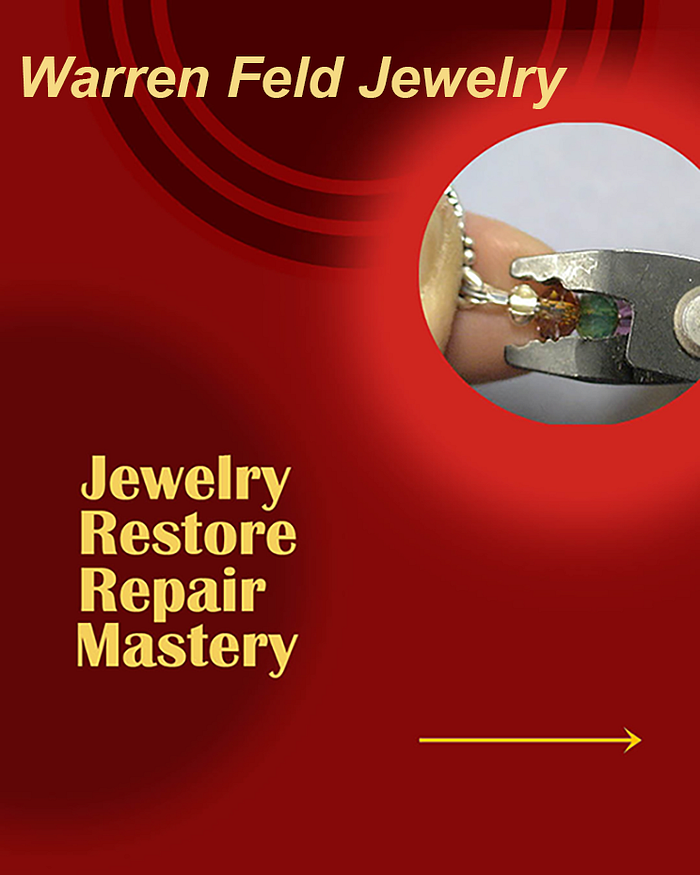
I take in a lot of jewelry repairs. People either bring them to me in Columbia, TN, or, I pick them up and deliver them back in Nashville. I am in Nashville at least once a week. It’s been convenient for most people to meet me at Green Hills Mall. But if not, I can come to your workplace or your home. This is perfectly fine for me. My turnaround time typically is 3–4 weeks.
I do most repairs, but I do not do any soldering. I also do not repair watches. These are the kinds of repairs I do:
o Beaded jewelry o Pearl knotting, hand knotting o Size/Length adjustment o Re-stringing o Wire work/weave/wrap o Micro macrame o Broken clasp replacfement o Earring repair o Replace lost rhinestones or gemstones o Stone setting o Stretchy bracelet o Metal working which does not involve soldering o Bead woven jewelry and purses o Beaded clothing o Custom jewelry design
WARREN FELD JEWELRY (www.warrenfeldjewelry.com) Custom Design, Workshops, Video Tutorials, Webinars, Coaching, Kits, Group Activities, Repairs ~~~~~~~~~~~~~~~~~~~~~~~ Join our community of jewelry designers on my Patreon hub Be part of a community of jewelry designers who recognize that we have a different way of thinking and doing than other types of crafters or artists. One free downloadable Mini-Lesson of your choice for all new members! ~~~~~~~~~~~~~~~~~~~~~~~
Access an ever-expanding library of articles, videos, podcast episodes, charts, and graphs available 24/7. Whether you’re interested in the latest trends in jewelry design and techniques or problem-solving at the bench, we have a wealth of information ready to help you learn, grow, and thrive.
Tons of info about jewelry and every kind of technique of jewelry making.
b. The 2024 Summer Design Challenge Winning Design
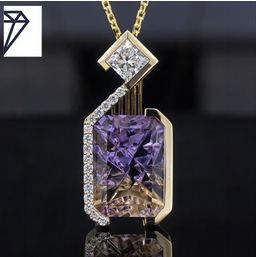
Matthew Piorkowski’s winning piece, “Interstellar”, features a stunning fantasy-cut octagon ametrine showcased in a custom yellow-gold pendant setting. Centered on the bail is a brilliant square-shaped diamond with sixteen accenting diamonds along the left side of the pendant mounting, creating visual interest along the path of the diamonds.
Rio Grande runs a seasonal challenge called For the Love of Jewelers Design Challenge. They haven’t announced winter or spring submissions rules yet. Check on their website: www.riogrande.com
In the ever-evolving world of artificial intelligence, the ability to create photorealistic images has become a groundbreaking achievement. ChatAI‘s Image Generator, powered by advanced Stable Diffusion models, offers users the tools to create images that blur the line between reality and AI-generated art. This article will guide you through the 7 steps to create photorealistic images with Stable Diffusion, focusing on the art of prompting. We’ll start by explaining what photorealistic images are, delve into the concept of Stable Diffusion, and then provide a step-by-step guide to crafting effective prompts. At the end, we will share 15 example prompts to inspire your creativity.
3. I encourage you to take advantage of the very low prices of delica beads on the Land of Odds website.
Compare Our Prices To What You Are Paying:
In this monthly newsletter, occasionally, like in this newsletter, you will find a discount coupon code that you can use on the Land of Odds website.
You can also become a paid subscribing member on our Jewelry Designers’ Patreon Hub, which entitles you to a 25% discount as long as you maintain your subscription.
4. 🎭 As a jewelry designer, it is important to identify your direction, voice, & identity.
Direction is understanding what work you want to make, and why you are making it (your emotional response to your work).
Voice is your unique take on your work’s descriptions and your unique way of portraying messages within your work.
Identity is about what you have experienced: what makes you you, including aspects like your family or where you grew up.
5. I’m always faulting craft show vendors for not having good enough signage for their booths. Recently, I came across this sign, and liked it.
6. What does jewelry sound like, I, for no particular reason, asked myself the other day, so I went to take a look.
To my surprise, there are thousands of jewelry sound effects. There are sounds the jewelry makes when someone wears it. There are sounds the jewelry makes when someone makes it.
7. Sometimes, as jewelry designers, we feel we don’t have the luxury of great access to resources — support, money, materials. There are opportunities available to you. Read the first of what will be a series of articles about this here.
NOTE: The word “artist” is often used in these opportunities, but in most cases, you should take this to be broadly defined, to include jewelry makers and fine craftspersons,
“Often burdened with a bad reputation, an artist’s career is not the easiest path.
It’s true, that unstable income is not particularly reassuring in a world increasingly governed by financial power. After graduation, many young artists leave behind the schools where they had access to resources, mentorship, and time to create, often needing to fully realize how valuable that support was. This transition into the professional world can be daunting as they face the challenge of establishing themselves in a competitive industry.
With this in mind, we have created a series specifically dedicated to programs, grants, residencies and incubators, all aimed at supporting artists in research. This includes selected open calls, formative meetings, articles, and interviews published on Klimt02 to help artists better understand these opportunities and confidently use them as valuable resources to expand and communicate their creative practice.
This series will be continually updated to reflect the latest opportunities, ensuring you, the readers, have access to the most current information and resources published on Klimt02.”
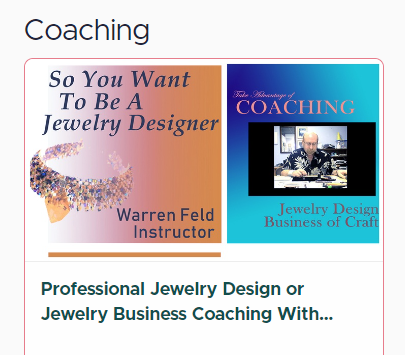
8. Are you wondering if working with me as a coach would be a good fit?
Not sure if you’re ready or if you’re at the right place in your jewelry design journey? But you’re thinking that you want to do something powerful to bring more meaning to your art and start to actually make the pieces your soul is craving (maybe silently, maybe4 LOUDLY) to express?
Jewelry Design is not a simple, easy path. It is full of incredible challenges, and those are different for every designer. You will be confronted with struggle, obstacles will be placed at your feet, you’ll be bowled over by tedium, and frustrated by setbacks, befuddled when introducing your work publicly. Most things you will learn come from the art world or craft world, and don’t fit perfectly with what it means to design jewelry. The thing to remember is that those challenges are yours. They belong to you because you stepped into that world we call design. You have that desire to find and explore what all that means.
So often that first step in working deciding to work with a coach is the most difficult. But it is all about having the right guide through all the barriers and dilemmas and vagaries when designing jewelry.
I’m here to talk if you’re feeling stuck and curious about what it would be like to have the support of my mentorship program with you on the journey. Go ahead and schedule a free consultation to talk about your jewelry and problem solve some ways to jump start your creativity. This is a completely no-pressure opportunity to talk about your work and see if we can bring fresh energy, more meaning, and bitter impact to your art.
I’m here to offer guidance and if you think it’s a good fit to work together moving forward, that is great.
But really, this is a free opportunity, no pressure, absolutely no obligation. Let’s talk about where you’re at.
The easiest way to begin the process is to sign up here: COACHING WITH WARREN FELD You can review what coaching entails. You can submit a form on this web page. When I receive it, I’ll schedule our free initial consultation. Beginning the process does not obligate you to anything.
That’s it for now! There is a lot of creative expression all around the world right now. Hope you get to experience a lot of it, either first hand, or through social media online.
Promote your current projects, promotional copy, News & Views, videos, reels, tutorials, instructions, social media posts online in this newsletter and on our jewelry designers’ Patreon hub.
No deadlines! Opportunity available all the time. No fees.
But don’t wait to take advantage of this opportunity.
This copyrighted material is published here with permission of the author(s) as noted, or with Land of Odds or Warren Feld Jewelry. All rights reserved.
Repairs Stumping You? Let Me Take A Look
I take in a lot of jewelry repairs. People either bring them to me in Columbia, TN, or, I pick them up and deliver them back in Nashville. I am in Nashville at least once a week. It’s been convenient for most people to meet me at Green Hills Mall. But if not, I can come to your workplace or your home. This is perfectly fine for me. My turnaround time typically is 3–4 weeks.
I do most repairs, but I do not do any soldering. I also do not repair watches. These are the kinds of repairs I do:
o Beaded jewelry o Pearl knotting, hand knotting o Size/Length adjustment o Re-stringing o Wire work/weave/wrap o Micro macrame o Broken clasp replacfement o Earring repair o Replace lost rhinestones or gemstones o Stone setting o Stretchy bracelet o Metal working which does not involve soldering o Bead woven jewelry and purses o Beaded clothing o Custom jewelry design
WARREN FELD JEWELRY (www.warrenfeldjewelry.com) Custom Design, Workshops, Video Tutorials, Webinars, Coaching, Kits, Group Activities, Repairs ~~~~~~~~~~~~~~~~~~~~~~~ Join our community of jewelry designers on my Patreon hub Be part of a community of jewelry designers who recognize that we have a different way of thinking and doing than other types of crafters or artists. One free downloadable Mini-Lesson of your choice for all new members! ~~~~~~~~~~~~~~~~~~~~~~~
Access an ever-expanding library of articles, videos, podcast episodes, charts, and graphs available 24/7. Whether you’re interested in the latest trends in jewelry design and techniques or problem-solving at the bench, we have a wealth of information ready to help you learn, grow, and thrive.
Tons of info about jewelry and every kind of technique of jewelry making.
b. The 2024 Summer Design Challenge Winning Design
Matthew Piorkowski’s winning piece, “Interstellar”, features a stunning fantasy-cut octagon ametrine showcased in a custom yellow-gold pendant setting. Centered on the bail is a brilliant square-shaped diamond with sixteen accenting diamonds along the left side of the pendant mounting, creating visual interest along the path of the diamonds.
Rio Grande runs a seasonal challenge called For the Love of Jewelers Design Challenge. They haven’t announced winter or spring submissions rules yet. Check on their website: www.riogrande.com
In the ever-evolving world of artificial intelligence, the ability to create photorealistic images has become a groundbreaking achievement. ChatAI‘s Image Generator, powered by advanced Stable Diffusion models, offers users the tools to create images that blur the line between reality and AI-generated art. This article will guide you through the 7 steps to create photorealistic images with Stable Diffusion, focusing on the art of prompting. We’ll start by explaining what photorealistic images are, delve into the concept of Stable Diffusion, and then provide a step-by-step guide to crafting effective prompts. At the end, we will share 15 example prompts to inspire your creativity.
3. I encourage you to take advantage of the very low prices of delica beads on the Land of Odds website.
Compare Our Prices To What You Are Paying:
In this monthly newsletter, occasionally, like in this newsletter, you will find a discount coupon code that you can use on the Land of Odds website.
You can also become a paid subscribing member on our Jewelry Designers’ Patreon Hub, which entitles you to a 25% discount as long as you maintain your subscription.
4. 🎭 As a jewelry designer, it is important to identify your direction, voice, & identity.
Direction is understanding what work you want to make, and why you are making it (your emotional response to your work).
Voice is your unique take on your work’s descriptions and your unique way of portraying messages within your work.
Identity is about what you have experienced: what makes you you, including aspects like your family or where you grew up.
5. I’m always faulting craft show vendors for not having good enough signage for their booths. Recently, I came across this sign, and liked it.
6. What does jewelry sound like, I, for no particular reason, asked myself the other day, so I went to take a look.
To my surprise, there are thousands of jewelry sound effects. There are sounds the jewelry makes when someone wears it. There are sounds the jewelry makes when someone makes it.
7. Sometimes, as jewelry designers, we feel we don’t have the luxury of great access to resources — support, money, materials. There are opportunities available to you. Read the first of what will be a series of articles about this here.
NOTE: The word “artist” is often used in these opportunities, but in most cases, you should take this to be broadly defined, to include jewelry makers and fine craftspersons,
“Often burdened with a bad reputation, an artist’s career is not the easiest path.
It’s true, that unstable income is not particularly reassuring in a world increasingly governed by financial power. After graduation, many young artists leave behind the schools where they had access to resources, mentorship, and time to create, often needing to fully realize how valuable that support was. This transition into the professional world can be daunting as they face the challenge of establishing themselves in a competitive industry.
With this in mind, we have created a series specifically dedicated to programs, grants, residencies and incubators, all aimed at supporting artists in research. This includes selected open calls, formative meetings, articles, and interviews published on Klimt02 to help artists better understand these opportunities and confidently use them as valuable resources to expand and communicate their creative practice.
This series will be continually updated to reflect the latest opportunities, ensuring you, the readers, have access to the most current information and resources published on Klimt02.”
8. Are you wondering if working with me as a coach would be a good fit?
Not sure if you’re ready or if you’re at the right place in your jewelry design journey? But you’re thinking that you want to do something powerful to bring more meaning to your art and start to actually make the pieces your soul is craving (maybe silently, maybe4 LOUDLY) to express?
Jewelry Design is not a simple, easy path. It is full of incredible challenges, and those are different for every designer. You will be confronted with struggle, obstacles will be placed at your feet, you’ll be bowled over by tedium, and frustrated by setbacks, befuddled when introducing your work publicly. Most things you will learn come from the art world or craft world, and don’t fit perfectly with what it means to design jewelry. The thing to remember is that those challenges are yours. They belong to you because you stepped into that world we call design. You have that desire to find and explore what all that means.
So often that first step in working deciding to work with a coach is the most difficult. But it is all about having the right guide through all the barriers and dilemmas and vagaries when designing jewelry.
I’m here to talk if you’re feeling stuck and curious about what it would be like to have the support of my mentorship program with you on the journey. Go ahead and schedule a free consultation to talk about your jewelry and problem solve some ways to jump start your creativity. This is a completely no-pressure opportunity to talk about your work and see if we can bring fresh energy, more meaning, and bitter impact to your art.
I’m here to offer guidance and if you think it’s a good fit to work together moving forward, that is great.
But really, this is a free opportunity, no pressure, absolutely no obligation. Let’s talk about where you’re at.
The easiest way to begin the process is to sign up here: COACHING WITH WARREN FELD You can review what coaching entails. You can submit a form on this web page. When I receive it, I’ll schedule our free initial consultation. Beginning the process does not obligate you to anything.
That’s it for now! There is a lot of creative expression all around the world right now. Hope you get to experience a lot of it, either first hand, or through social media online.
Promote your current projects, promotional copy, News & Views, videos, reels, tutorials, instructions, social media posts online in this newsletter and on our jewelry designers’ Patreon hub.
No deadlines! Opportunity available all the time. No fees.
But don’t wait to take advantage of this opportunity.
This copyrighted material is published here with permission of the author(s) as noted, or with Land of Odds or Warren Feld Jewelry. All rights reserved.
Repairs Stumping You? Let Me Take A Look
I take in a lot of jewelry repairs. People either bring them to me in Columbia, TN, or, I pick them up and deliver them back in Nashville. I am in Nashville at least once a week. It’s been convenient for most people to meet me at Green Hills Mall. But if not, I can come to your workplace or your home. This is perfectly fine for me. My turnaround time typically is 3–4 weeks.
I do most repairs, but I do not do any soldering. I also do not repair watches. These are the kinds of repairs I do:
o Beaded jewelry o Pearl knotting, hand knotting o Size/Length adjustment o Re-stringing o Wire work/weave/wrap o Micro macrame o Broken clasp replacfement o Earring repair o Replace lost rhinestones or gemstones o Stone setting o Stretchy bracelet o Metal working which does not involve soldering o Bead woven jewelry and purses o Beaded clothing o Custom jewelry design
WARREN FELD JEWELRY (www.warrenfeldjewelry.com) Custom Design, Workshops, Video Tutorials, Webinars, Coaching, Kits, Group Activities, Repairs ~~~~~~~~~~~~~~~~~~~~~~~ Join our community of jewelry designers on my Patreon hub Be part of a community of jewelry designers who recognize that we have a different way of thinking and doing than other types of crafters or artists. One free downloadable Mini-Lesson of your choice for all new members! ~~~~~~~~~~~~~~~~~~~~~~~
I have found Instagram the best social media site for promoting your jewelry sales, and their algorithm has changed for the better for us
Before, Instagram would show new posts to 1% of your followers first and, depending on the response, share further.
This favored accounts with a large following, such as influencers or jewelry designers with especially large followings, since their 1% is a lot more than the 1% of a small account.
Now, every new post will be shown to a random group of users, usually ones with a shared interest in the kind of posts you create. Think: followers of your followers who don’t yet follow you will get prioritized. Aggregators accounts, like influencers, will get diminished a bit. In a similar vein, co-occurring is this situation: If you post an image on your own feed as well as with an influencer’s feed, that image will only appear on your own feed, not on the influencer’s. Instagram’s goal is to reward originality and the creator.
This is great news for smaller accounts: it widens the funnel of potential engagement with each post.
Reels are still important, but they’re no longer the only ones.
Focus on posting a mix of Reels, still images, and carousels. Should NOT be all reels all the time. The important factor is that you are giving your followers value. Make them feel like you are giving them something.
Give people something to read (in the post or the caption)
Provide an insider point of view to your jewelry-making process
Choose an eye-catching cover image for all posts (hook them)
Better lighting often solves many issues of gaining and keeping attention. Also bring people in close to the elements in the image. Focus on a a section of the piece. Show them your hands at work. Don’t pull back for that wide shot of everything necessarily.
Bring people in close, show them what you’re doing.
Give viewers a reason to watch your entire Reel.
NO’s: Instead of simply showing your work, using captions such as:
❌ “Here’s my latest piece of jewelry…”
❌ “I have an event coming…”
❌ “My website is now live…”
YES’s: Capture their attention first, and then make your announcement:
✅ “Here’s how I turned this run-of-the-mill necklace into an exciting one..” finishing with “This piece is now available”
✅ “You won’t believe how this piece turned out…” followed by “Come see this piece live at my next show.”
WARNINGs: Less time-lapse of showing each step after it has been completed, and more showing something actionable, like implementing each step.
Come up with something that will make people hang out until the interesting part. Come up with things to make people stick around. Bring them close-in to the action. Be sure they see you sometime in the images. Be sure, at the end or towards the end, they see the outcome, such as the finished piece or section of the piece, or completed step.
End with a CALL TO ACTION. Such as, direct them to your website where they can purchase the finished piece, or to your website where they can sign up for your newletters.
__________________________________
I hope you found this article useful. Please consider sharing.
SO YOU WANT TO BE A JEWELRY DESIGNER Merging Your Voice With Form
So You Want To Be A Jewelry Designer reinterprets how to apply techniques and modify art theories from the Jewelry Designer’s perspective. To go beyond craft, the jewelry designer needs to become literate in this discipline called Jewelry Design. Literacy means understanding how to answer the question: Why do some pieces of jewelry draw your attention, and others do not? How to develop the authentic, creative self, someone who is fluent, flexible and original. How to gain the necessary design skills and be able to apply them, whether the situation is familiar or not.
I was 4th place finalist, Swarovski jewelry competition
I highly recommend entering many art and jewelry design competitions each and every year. This is a good way to
· Raise your visibility
· Practice your self-promotion skills
· Get feedback on your work
· Gain more legitimacy and credibility
· Promote your value
· Keep aware of current trends and expectations in jewelry design
· Further inspire your clients
Competitions can supercharge your jewelry design growth and career.
The First Competition I Entered
In 2004, I submitted an entry (see image above) to the Swarovski Be Naturally Inspired jewelry design competition. I downloaded a copy of the rules and set to work. The project had to be at least 75% Swarovski Austrian crystal beads, stones, or other components. You had to submit an image of your final piece, an image of your inspiration, an artist bio, and an artist statement about your piece and how you translated your inspiration into the finished piece.
This image of the Grand Canyon at sunrise was my inspiration:
Grand Canyon Sunrise
I set out to work. Created the general design, selected the technique I wanted to use, and with determination and a lot of trial and error, created the finished piece. In the process, I discovered that different Austrian crystal colors, when used together, tended to blur boundaries and lose some of that distinct color sense that I wanted. I had to solve that problem, which I did, by using black 1.8mm delica beads between each crystal bead. This helped create sharper boundaries.
Up until that point, I had not written any kind of bio or artist statement. I was uneasy about how to describe the finished piece, such as what to call attention to. I had to do several drafts of each. Was a great exercise.
Submitted the piece. Heard back that I was a finalist. Then I had to send them the original piece. I had trouble letting go and saying goodbye. I found one package to use, then rejected it. Then another package, and rejected that. The fifth packaging idea was finally satisfying. Then I held onto the ready-to-ship package for almost a week before taking it over to the UPS shop. I had to insure it. The value was priceless to me. But I had to pick a number. And I prayed that the package would not get lost or damaging.
Swarovski emailed me that it had arrived safely.
I was invited to the awards ceremony they held in their offices in New York City.
And said goodbye again to my piece which was headed for their museum in Innsbruck Austria.
You Are Always A Winner
Whether you win or lose, you are, in fact, experiencing a rich source of inspiration and learning. There never really is a setback.
At the very least, you most likely will be included in a publicly presented list of submitters. You have already increased your visibility.
If your submission is accepted, you have something to list on your resume or list of achievements. You can use this as talking points when selling to a client, store or gallery. You can add this information to wherever you showcase the submitted work. You can embellish your descriptions with information from the materials you submitted for contest entry.
You can generate press releases, social media posts, special email announcements. You can send out updates as your submission progresses through the competition process, such as should you become a semifinalist.
As you do these kinds of things to increase your visibility, this builds credibility and brand awareness. Many store and gallery owners watch these contests closely, often making note of the better pieces and their designers, often following the designers over their career.
Whether The Feedback Is Positive or Negative — It Always Gives You A Better Understanding of Yourself As a Designer
Feedback provides clues to why your jewelry has VALUE to them. What do they want to know about it? How does the design help them solve a problem? What key attributes of VALUE should you promote to your clients?
Participating in competitions gives you a great opportunity to practice speaking about yourself and your jewelry, and seeing how others react.
Competitions provide many clues about what is relevant in the moment. They force you to figure out how to relate you and your design sense to a set of competition rules and expectations.
All this public visibility will actually inspire some people to spread the message about you. Generating word-of-mouth is often the most successful type of marketing.
Competitions Are Juried
Periodically do online searches for jewelry and art competitions. If the active link is a newsletter or mailing list of some sort, give them your email address. Some art competitions will allow submissions of jewelry; others will not.