Keep From Letting ‘Doubt’ Paralyze You As A Jewelry Designer
For the novice, all that excitement at the beginning, when thinking about making jewelry and making some pieces, sometimes collides with a wall of developing self-doubt.
It’s not easy to quiet a doubt.
As a jewelry artist, you organize your life around an inspiration. There is some fuzziness here. That inspiration has some elements of ideas, but not necessarily crystal clear ones. That inspiration has some elements of emotions — it makes you feel something — but not necessarily something you can put into words or images or fully explain. You then need to translate this fuzzy inspiration into materials, into techniques, into color, into arrangements, into a coherent whole.
You start to make something, but realize you don’t know how to do it. But you want to do it, and do it now. However, to pick up the needed skills, you realize you can’t learn things all at once. You can’t do everything you want to do all at once. That initial excitement often hits a wall. Things take time to learn. There are a lot of trial and error moments, with a lot of errors. Pieces break. Combining colors and other design elements feels very awkward. Picking the right clasps and rings and connectors and stringing materials is fraught with implications. Silhouettes are confusing. You might get the right shape for your piece, but it is difficult to get the right movement, drape and flow, without compromising that shape.
To add to this stress and strain, you need to show your jewelry off. You might want someone to like it. To want it. To need it. To desire it. To buy it. To wear it. To wear it more than once. To wear it often. To exhibit it. To collect it. To show and talk about it with others. And how will all these other people recognize your creative spark, and your abilities to translate that spark into a wonderful, beautiful, functional piece of jewelry, appropriate for the wearer and appropriate for the situation?
Frequently, because of all this, the artist experiences some sense of doubt and self-doubt. Some paralysis. Can’t get started. Can’t finish something. Avoiding showing your pieces to others. Wondering why you became a jewelry designer in the first place.
Doubt holds you back from seizing your opportunities.
It makes getting started or finishing things harder than they need to be.
It adds uncertainty.
It makes you question yourself.
It blocks your excitement, perhaps diminishing it.
Doubt and Self-Doubt should be useful in forcing you to think about and question your choices. However, for many jewelry designers, it mostly holds them back.
Having doubt and self-doubt is common among all artistic types. After all, for much of what you do and how you spend your time, you’re mostly alone with your thoughts.
What becomes important is how you manage and overcome it. You do not want your doubts to get in the way of your creative process and disciplinary development. You want your doubts, rather, to inform them.
8 Major Ways Doubts Can Force You Into That Abyss
There are 8 major ways in which jewelry designers get caught beginning to fall into that abyss we call self-doubt:
1) What If I’m Not Creative Enough or Original Enough or Cannot Learn or Master or Don’t Know a Particular Technique?
2) What If No One Likes What I Make?
3) What If No One Takes Me Seriously As An Artist And Designer?
4) I Overthink Things and Am A Bit of a Perfectionist.
5) How Can I Stay Inspired?
6) Won’t People Steal My Work?
7) Being Over Confident or Under Confident
8) Role Confusion
1. What If I’m Not Creative Enough or Original Enough or Cannot Learn or Master or Don’t Know a Particular Technique?
Everyone has some creativity baked into their being. It is a matter of developing your way of thinking and doing so that you can apply it. This takes time.
So does originality. The word originality can be very off-putting, but it does not have to be.
At first, when you are getting started making jewelry, originality will mean that you will try different ways of personalizing projects. There are always things you can do to bring some aspects of originality to your pieces. This might be the choice of colors, or using a special clasp, or rearranging some elements in your composition.
Again, as with creativity, the ability to be more and more original will evolve over time. It is helpful to think of originality, not necessarily as coming up with something completely new, but rather as differentiation — how you differentiate yourself from other jewelry designers.
For almost everyone, you don’t begin your design career at the height of your levels of creativity and originality. Yes, if you look around you, other people are more creative and original than you or have more skills than you. Don’t let these observations be a barrier to your own development as a jewelry designer. You get there through persistence and hard work. You handle your inner critic. You may not be there, yet — the key word here is yet. But you will be.
2. What If No One Likes What I Make?
We all have fears about how our creativity and originality are going to be evaluated and judged. We project our self-doubts to the doubts we think we see and feel from others. What if no one wants to wear my pieces, or buy my works?
We can’t let these outsider reactions dictate our lives and creative selves. A key part of successful jewelry design is learning how to introduce what we do publicly. At the least, it is the core nature of the things we create that they are to be worn on the body. Jewelry is a very public thing.
Turn negative comments into positive ideas, motivators, insights, explorations. Allow yourself some give and take, some needs to step back awhile, some needs to tweak. Jewelry design and jewelry making are iterative processes. They in no way are linear. Your outcomes and their success are more evolutionary, than guaranteed.
Distressing about what others may think of your work can be very damaging to your self-esteem. It can amplify your worries. Don’t go there.
Don’t become your worst critic.
3. What If No One Takes Me Seriously As An Artist And Designer?
Jewelry design is an occupation in search of a profession. You will find that a lot of people won’t recognize your passion and commitment. They may think anyone can design jewelry. They may think of jewelry making as a craft or some subset of art, not as something unique and important in and of itself. They may wonder how you can make a living at this.
The bottom line: if you don’t take yourself seriously as a jewelry designer, no one else will.
People will take you seriously as they see all the steps you are taking to master your craft and develop yourself as a professional.
4. I Over Think Things And Am A Bit Of A Perfectionist
Some designers let a sense that their work is not as good as imagined get in the way. They never finish anything. They let doubt eat away at them.
Perfectionism is the enemy of the good. It’s great to be meticulous, but emotionally, we get wrecked when anything goes astray, or any little thing is missing, or you don’t have that exact color or part you originally wanted.
Go ahead and plan. Planning is good. It’s insightful. It can be strategic. But also be sure to be adaptable and realistic. Each piece is a stepping stone to something that will come next.
The better jewelry designer develops a Designer’s Toolbox — a collection of fix-it strategies to deal with the unfamiliar or the problematic.
Overthinking can be very detrimental. You can’t keep changing your mind, trying out every option, thinking that somewhere, someplace there exists a better option. Make a choice and get on with it. You can tweak things later.
Yes, attention to detail is important. But so is the value of your time. You do not want to waste too much time on trivial details.
Be aware when you begin over-analyzing things. Stop, take a breath, make a decision, and move on.
5. How Can I Stay Inspired?
Designing a piece of jewelry takes time, sometimes a long time. That initial inspirational spark might feel like it’s a dying ember.
Don’t let that happen.
Translate that inspiration into images, colors, words, sample designs, and surround your work space with these.
Talk about your inspiration in detail with family and friends.
6. Won’t People Steal My Work?
Many jewelry designers fear that if they show their work publicly, people will steal their ideas. So they stop designing.
Yet jewelry design is a very communicative process which requires introducing your work publicly. If you are not doing this, then you are creating simple sculptures, not jewelry.
Yes, other people may copy your work. See this source of doubt as an excuse. It is a self-imposed, but unnecessary, barrier we might impose to prevent us from experiencing that excitement as a jewelry designer. Other people will never be able to copy your design prowess — how you translate inspiration into a finished piece. That is unique and special to you. It is why the general public responds positively to you and your work.
7. Over Confidence can blind you to the things you need to be doing and learning, and Under Confidence can hinder your development as a designer.
Too often, we allow under confidence to deter us from the jewelry design and making tasks at hand. We always question our lack of ability and technical prowess for accomplishing the necessary tasks at hand. It is important, however, to believe in yourself. To believe that you can work things out when confronted with unfamiliar or problematic situations. It is important to develop your skills for thinking like a designer. Fluency. Flexibility. Originality. There is a vocabulary to learn. Techniques to learn. Strategies to learn. These develop over time with practice and experience. You need to believe in your abilities to develop as a designer over time.
With over confidence comes a naivete. You close off the wisdom to listen to what others have to say or offer. You stunt your development as an artist. You overlook important factors about materials and techniques to the detriment of your final designs and products. You close yourself off to doubt and self-doubt, which is unfortunate. Doubt and self-doubt are tools for asking questions and questioning things. These help you grow and develop as an artist and designer. These influence your ability to make good, professional choices in your career.
8. Role Confusion
Jewelry artists play many roles and wear different hats. Each has its own set of opportunities, requirements, and pressures that the artist must cope with. It’s a balancing act extraordinaire.
First, people who make jewelry wear different hats: Artist and Designer, Manufacturer, Distributor, Retailer, and Exhibitor.
Second, people who make jewelry have different needs: Artistic Excellence, Recognition, Monetary Gain, or Financial Stability.
Third, the artist needs to please and satisfy themselves, as well as other various clients.
Fourth, the artist constructs pieces which need to function in different settings: Situational, Cultural, Sociological, Psychological.
Last, the artist must negotiate a betwixt and between situation — a rite of passage — as they relinquish control over the piece and its underlying inspirations to the wearer and the viewer, who have their own needs, desires and expectations.
This gets confusing. It affects how you pick materials and supplies. Which techniques you use. What marketing strategies you employ. How you value and price things. Anticipating who your audience is. And the list goes on.
It is important to be aware (metacognitive) of what role(s) you play when, and why. Given the role, it is important to understand the types of choices you need to make, when constructing a piece of jewelry. It is critical to understand the tradeoffs you will invariably end up making, and their consequences for the aesthetic, emotional and functional success of your pieces.
Some Advice
While doubt and self-doubt can hinder our development as jewelry designers, some degree of these may be helpful, as well.
To develop yourself as a jewelry designer, and to continue to grow and expand in your profession, you must have a balanced amount of both doubt and self-doubt. Uncertainty leads to questioning. A search for knowledge. Some acceptance of trial and error and experimentation. A yearning for more reliable information and feedback.
Jewelry design uses a great deal of emotion as a Way of Knowing. Emotions cloud or distort how we perceive things. They may lead to more doubt and worry and lack of confidence. But they also enhance our excitement when translating inspirations into designs.
· Don’t let your inner doubts spin out of control. Be aware and suppress them.
· Be real with yourself and your abilities.
· Keep a journal. Detail what your doubts are and the things you are doing to overcome them.
· Create a developmental plan for yourself. Identify the knowledge, skills and understandings you want to develop and grow into.
· Remember what happened in the past the last time doubt got in your way. Remember what you did to overcome this doubt. Remember that probably nothing negative actually happened.
· Talk to people. These can be friends, relatives and colleagues. Don’t keep doubts unto yourself.
· Don’t compare yourself to others. This is a trap. Self-reflect and self-evaluate you on your own terms.
· Worrying about what others think? The truth is that people don’t really care that much about what you do or not do.
· Don’t beat yourself up.
· Get re-inspired. This might mean surrounding yourself with images and photos of things. It might mean a walk in nature. It might me letting someone else’s excitement flow over to you.
I am writing an article about how jewelry designers began their careers/hobbies/avocations.
I would be interested in you sharing your stories.
Some of the questions I want to explore in my article:
1) How did you get started making jewelry? motivations, intentions, whether the start was very dramatic or mundane, whether you thought it was fate, destiny, luck, personal choice. Was there a particular point in time, or some kind of evolution?
2) What was your first moment of validation like? Not when you started making jewelry per se, but when you started telling people and feeling like an ‘artist’ or ‘designer’. It might have been a quiet admission, coming out to yourself as an artist. It might have been something public, like selling a piece, exhibiting it, some reaction from a client. It might have been some kind of break-through or finding newness or inspiration. It might have been a feeling of originality. A lot of people make jewelry, and can be very talented at it, but do not consider themselves as ‘artists’ or ‘designers’.
3) To what extent did beginning as a jewelry artist/designer feel like a response to society or family or local culture? Art doesn’t exist only because of feelings and emotions. There is a complex infrastructure within which the jewelry designer needs in order to survive. How would you describe this infrastructure within which you work and because of it you can survive. To what extent does it help you to enhance your work and vocation? To what extent does it impede you?
4) Were there special circumstances that were critical in your beginning and development as a jewelry artist/designer? Were there specific excitements, anxieties, challenges you faced?
5) For you, was there a beginning, and then a beginning again? Describe how difficult it was to begin again. How did it feel/seem to question or know whether you could create again?
6) What kinds of things have enabled you to keep going as a jewelry artist/designer? What contributed to your ability to survive your creative life?
I may or may not reference what you share in my final article. Unless you specifically tell me it’s OK, I will not use anyone’s real name in my article.
I appreciate you taking the time to share. I know a lot of jewelry designers and would-be jewelry designers can learn a lot from your experiences.
That’s it for now! There is a lot of creative expression all around the world right now. Hope you get to experience a lot of it, either first hand, or through social media online.
From my book: SO YOU WANT TO BE A JEWELRY DESIGNER Merging Your Voice With Form,Ebook , Kindle or Print formats
Abstract:
For some jewelry designs, the incorporation of mixed media or mixed techniques can have a synergistic effect — increasing the appeal and/or functionality of the piece better than any one media or technique alone. It can feel more playful and experimental and fun to mix media or techniques. But there may be adverse effects, as well. Each media or technique will have its own structural and support requirements — that is, its own special characteristics and its own philosophy of technique. Each will react differently to various physical forces impacting the piece when worn. So it becomes more difficult for the designer to successfully coordinate and integrate more than one media or technique.
MIXED MEDIA / MIXED TECHNIQUES
It’s my belief that you cannot combine two different media or two different techniques to make a piece of jewelry without letting one of them predominate over the other.
Whether combining fiber with beads or metal with beads or paint and sculpture with beads, or braiding with beads or metalwork with glasswork or glass beads with gemstone beads, it is difficult to have a successful, satisfying outcome, without letting one of the media or technique be dominant over the other.
Each media and technique has its own set of structural rules and requirements — that is, its own special characteristics and its own philosophy of technique. Each interacts with light and shadow very differently; that is, the materials and techniques associated with a particular media reflect, absorb and refract light differently. Each has different problems with and responses to physical mechanical forces impacting the piece internally and externally with different stresses and strains. Each requires different strategies for managing tradeoffs between aesthetics and functionality. Each triggers differing responses by wearers and viewers as to sensory, sensual and/or symbolic impressions.
These kinds of things make the viewer’s experience and interaction with the media or technique and its resulting products different, from media to media and technique to technique.
So, you can have a “knitting” project that incorporates some beads, or a “beading” project that uses a knitting stitch and/or some yarn. In the former, knitting would predominate, with more focus on the fibers; in the latter, beading would predominate, with more focus on the beads. You can have a wire project which incorporates some beads, or a beading project which incorporates some wire elements.
But it is rare that you can look at a project, and say it concurrently meets the criteria for finish and success of both media — so, both a successful, satisfying knitting AND beading project, and both a successful wire AND beading project. It is difficult to preserve the integrity of either media if you force them to be co-equals.
It is difficult to mix materials within the same project. For example, it is difficult to mix glass and acrylic beads, or glass and gemstone beads…. Unless, you let one material become predominant over the other, or one technique become predominant over the other.
But all of this is very challenging, almost off-putting, to the jewelry designer who wants to combine media techniques and materials.
Types of Mixed Media / Mixed Technique Jewelry Projects
There are four distinct types of mixed media / mixed techniques projects.
Collage: Different materials or techniques are combined in an additive fashion. Often we create a foundation or base out of one material or technique, and embellish on top of it with another material or technique. It is very 2-dimensional.
Assemblage: This is a variant of the collage, where different materials or techniques are used to enhance the dimensionality or movement within a piece. The result is very 3-dimensional, sculptural and is very multiplicative.
Found Object: Various objects which are found and used by jewelry designers within their pieces because of their perceived artistic value.
Altered: An existing piece of jewelry will be reused and altered or modified physically, resulting in a different piece with a different sensibility. The original piece might be added to, cut up and re-arranged, materials changed, different techniques applied to reconstruct the piece.
How Can Two Things Come Together For Artistic Success?
For some jewelry designs, the incorporation of mixed media or mixed techniques can have a synergistic effect — increasing the appeal and/or functionality of the piece better than any one media or technique alone.
It can feel more playful and experimental and fun to mix media or techniques.
But there may be adverse effects, as well. Each media or technique will have its own structural and support requirements. Each will react differently to various physical forces impacting the piece when worn. So it becomes more difficult for the designer to successfully coordinate and integrate more than one media or technique.
Ask yourself,
How will you match tasks and/or materials?
How will you switch between them?
How will you adapt should one restrict or impede the flow of action?
How will you adapt should one alter or otherwise impede a shape or shapes within your piece?
What if it is easier to finish off the piece with one but not the other?
Typically, what works best overall is if you allow one media or technique to predominate. There its conformance to various art and design requirements will shine through without any sense of competition, incompleteness or discordance.
_______________________________
I hope you found this article useful. Please consider sharing.
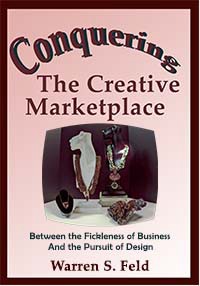
CONQUERING THE CREATIVE MARKETPLACE: Between the Fickleness of Business and the Pursuit of Design
How dreams are made between the fickleness of business and the pursuit of jewelry design
This guidebook is a must-have for anyone serious about making money selling jewelry. I focus on straightforward, workable strategies for integrating business practices with the creative design process. These strategies make balancing your creative self with your productive self easier and more fluid.
Based both on the creation and development of my own jewelry design business, as well as teaching countless students over the past 35+ years about business and craft, I address what should be some of your key concerns and uncertainties. I help you plan your road map.
Whether you are a hobbyist or a self-supporting business, success as a jewelry designer involves many things to think about, know and do. I share with you the kinds of things it takes to start your own jewelry business, run it, anticipate risks and rewards, and lead it to a level of success you feel is right for you, including
· Marketing, Promoting, Branding: competitor analysis, developing message, establishing emotional connections to your products, social media marketing
· Selling: linking product to buyer among many venues, such as store, department store, online, trunk show, home show, trade show, sales reps and showrooms, catalogs, TV shopping, galleries, advertising, cold calling, making the pitch
· Resiliency: building business, professional and psychological resiliency
· Professional Responsibilities: preparing artist statement, portfolio, look book, resume, biographical sketch, profile, FAQ, self-care
SO YOU WANT TO BE A JEWELRY DESIGNER Merging Your Voice With Form
So You Want To Be A Jewelry Designer reinterprets how to apply techniques and modify art theories from the Jewelry Designer’s perspective. To go beyond craft, the jewelry designer needs to become literate in this discipline called Jewelry Design. Literacy means understanding how to answer the question: Why do some pieces of jewelry draw your attention, and others do not? How to develop the authentic, creative self, someone who is fluent, flexible and original. How to gain the necessary design skills and be able to apply them, whether the situation is familiar or not.
The Jewelry Journey Podcast “Building Jewelry That Works: Why Jewelry Design Is Like Architecture” Podcast, Part 1 Podcast, Part 2
PEARL KNOTTING…Warren’s Way Easy. Simple. No tools. Anyone Can Do!
I developed a nontraditional technique which does not use tools because I found tools get in the way of tying good and well-positioned knots. I decided to bring two cords through the bead to minimize any negative effects resulting from the pearl rotating around the cord. I only have you glue one knot in the piece. I use a simple overhand knot which is easily centered. I developed a rule for choosing the thickness of your bead cord. I lay out different steps for starting and ending a piece, based on how you want to attach the piece to your clasp assembly.
SO YOU WANT TO DO CRAFT SHOWS: 16 Lessons I Learned Doing Craft Shows
In this book, I discuss 16 lessons I learned, Including How To (1) Find, Evaluate and Select Craft Shows Right for You, (2) Determine a Set of Realistic Goals, (3) Compute a Simple Break-Even Analysis, (4) Develop Your Applications and Apply in the Smartest Ways, (5) Understand How Much Inventory to Bring, (6) Set Up and Present Both Yourself and Your Wares, (7) Best Promote and Operate Your Craft Show Business before, during and after the show.
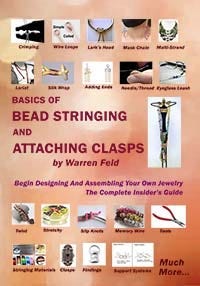
Learning Bead Stringing Is More Than Putting Beads On A String And Tying On A Clasp
There is an art and skill to stringing beads. First, of course, is the selection of beads for a design, and the selection of the appropriate stringing material. Then is the selection of a clasp or closure, appropriate to the design and use of the piece.
You want your pieces to be appealing. You want them to wear well. You want someone to wear them or buy them. This means understanding the basic techniques, not only in terms of craft and art, but also with considerations about architecture, mechanics, and some sociology, anthropology and psychology.
In this book, I go into depth about: (1) Choosing stringing materials, and the pros and cons of each type, (2) Choosing clasps, and the pros and cons of different clasps, (3) All about the different jewelry findings and how you use them, (4) Architectural considerations and how to build these into your pieces, (5) How better designers use cable wires and crimp, as well as, use needle and thread to string beads, (6) How best to make stretchy bracelets, (7) How to make adjustable slip knots, coiled wire loops, and silk wraps, (8) How to finish off the ends of thicker cords or ropes, so that you can attach a clasp, (9) How to construct such projects as eyeglass leashes, mask chains, lariats, multi-strand pieces, twist multi-strand pieces, and memory wire bracelets, (10) How different teaching paradigms — craft vs. art vs. design — might influence the types of choices you make.
452 pp, many images, illustrations, diagrams, Ebook, Kindle or Print
In the beginning, and you know how it goes, created the heavens and the earth. Create. In the first section of Genesis, the word create gets used over and over and over again, as if, not only to emphasize its importance, but to marvel at the concept. A beautiful universe is created. Humankind is created. Animals are created. There’s a flood and a re-creation. Create, create, create.
There are two Hebrew words used in Genesis which hold the idea of create within them: bara, meaning to create, and asah, meaning to make or do. They are used interchangeably. Sometimes reserved to represent God and supernatural powers. Other times to represent the impacts of people creating things and what happens over time. The meaning of one word is not more important than the meaning of the other.
And I think those folks who compiled the various stories into the Bible tried to interrelate the idea of a God with the power to create with the idea of humans having the power to create. Create, create, create. As if they kept writing and writing and writing in an attempt to clarify and come to grips with for themselves what the awesome power of creation was inside themselves, and how to use that power. There is a freedom to be your authentic self, and that was celebrated.
And this is what I spoke about in the first sermon I gave as the unofficial, untrained, never-seeking-to-be, rabbi in Oxford, Mississippi.
The Jewish congregation in Oxford varied between 20 and 40 individuals over the 5 years I was there. Some were Jewish and some only interested in Judaism. Did not matter. Vinnie and Ralph had a beautiful home there, and converted part of their home to a sanctuary. Temples in Memphis and Jackson, Mississippi lent the temple a torah and several other religious items, and a collection of prayer books. The person who was serving as rabbi was a professor who was about to move away the year I came to Oxford. I spoke Hebrew and that was my only qualification. I become the rabbi. I officiated over a wedding, a bar and bat mitzvah, and services once a month.
CREATIVITY ISN’T FOUND, IT’S DEVELOPED
Kierkegaard — and I apologize for getting a little show-off-y with my reference — once described Creativity as “a passionate sense of the potential.” And I love this definition. Passion is very important. It is motivating. Creativity obviously important because it’s a way of thinking through things.
Passion and creativity can be summed up as some kind of intuitive sense made operational by bringing all your capabilities and wonderings and technical know-how to the fore. All your mechanical, imaginative and knowledge and skills grow over time, as do your abilities for creative thinking and applications. Creativity isn’t inherently natural. It is something that is developed over time as you get more and more experience designing jewelry.
You sit down, and you ask, what should I create? For most people, especially those getting started, they look for patterns and instructions in bead magazines or how-to books or websites online. They let someone else make all the creative choices for them. The singular creative choice here is picking what you want to make. And, when you’re starting, this is OK.
When you feel more comfortable with the materials and the techniques, you can begin to make additional choices. You can choose your own colors. You can make simple adaptations, such as changing out the bead, or changing the dimensions, or changing out a row, or adding a different clasp.
Eventually, however, you will want to confront the Creativity issue head on. You will want to decide that pursuing your innermost jewelry designer, no matter what pathway this takes you along, is the next thing, and right thing, to do. That means you want your jewelry and your beadwork to reflect your artistic hand. You want to develop a personal style. You want to come up with your own projects.
But applying yourself creatively is also work. It can be fun at times, but scary at others. There is an element of risk. You might not like what you end up doing. Your friends might not like it. Nor your family. Nor your client. You might not finish it. Or you might do it wrong. It always will seem easier to go with someone else’s project, already proven to be liked and tested — because it’s been published, and passed around, and done over and over again by many different people. Sometimes it seems insurmountable, after finishing one project, to decide what to do next. Exercising your creative abilities can sometimes be a bear.
But it’s important to keep pushing on. Challenging yourself. Developing yourself. Turning yourself into a bead artist or jewelry designer. And pursuing opportunities to exercise your creative talents even more, as you enter the world of design.
That describes me. I look for inspirations in the designs of other jewelry makers, in nature, in art, in tapestries, in textures and patterns which present themselves, usually in unexpected places.
Then I go through the mental gymnastics about how to translate these inspirations into a workable jewelry design. I write out a plan of action, and begin. As I incorporate changes, or reject first ideas, I document these. There is always a notepad and pen next to me as I create. When I come to an intellectual or technical fork in the road, I document this as well, and proceed, first down one leg, then back and down the other. I reflect on what works or works better, and document my thoughts.
I keep updating and improving on my original plan of action. Towards the completion of my project, I seek out the opinion of others. Is it satisfying to look at? To wear? To reconstruct following my notes? Can you see my original inspiration within my piece? To what extent does the piece reflect my style?
I Found Myself In Mississippi
I was a New Jersey boy, educated there and in Boston. My first move to the South was to North Carolina — Chapel Hill and Durham area — for my doctoral work in Public Health. Never thought I’d end up in Mississippi. Glad I did.
As I was finishing up my doctoral work in Public Health Administration, I applied for several jobs. My dream job was to work for a prominent consulting firm in Philadelphia. These people were always at the table with many government agencies to assist them developing requests for proposals. And, as a result, were at the front of the line in applying for and receiving grant funds. Most importantly, they specialized in both physical as well as social planning. I saw this as a chance to get closer to the urban development and physical planning activities I was more interested in than health care.
I got the job. Yeah! But 6 weeks later, they rescinded the offer. Reagan had just gotten elected as President. He immediately cut out many of the social and physical planning programs that this firm specialized in (and for which I had steered my training and education). This consulting firm felt it was not a good time to expand, and in fact, one year later, they closed their doors.
I thought it safest to apply for a teaching job at a university somewhere. I would wait things out. Surely, after Reagan, the next President would bring these programs back. Of course, they never came back. I decided if I was going to teach, which was not something I wanted to do at the time, I would make it into an adventure. I would locate myself in a place that I would not normally reside in. I concentrated on applying to the University of Iowa and to the University of Mississippi. Got offers from both, and I liked both, but I liked Mississippi a little better.
I lived in Mississippi for five years. I loved it!
What Is Creativity?
If you are going to become someone who makes things, then it is of the essence that you be very clear about what the concept of creativity is all about — about for yourself, about for your various audiences, about for anyone else who will critically interact with the objects you make.
We create. Invent. Discover. Imagine. Suppose. Predict. Delve into unknown or unpredictable situations and figure out fix-it strategies for resolution and to move forward. All of these are examples of creativity. We synthesize. Generate new or novel ideas. Find new arrangements of things. Seek out challenging tasks. Broaden our knowledge. Surround ourselves with interesting objects and interesting people. Again, these are examples of creativity.
Yet, creativity scares people. They are afraid they don’t have it. Or not enough of it. Or not as much as those other people, whom they think are creative, have. They don’t know how to bring it to the fore, or apply it.
But creativity shouldn’t scare you. Everyone has some creative abilities within themselves. For most people, they need to develop it. Cultivate it. Nourish it. They need to learn various tools and skills and understandings for developing it, applying it and managing it. Creativity is a process. We think, we try, we explore, we fall down and pick ourselves up again. Creativity involves work and commitment. It requires a lot of self-awareness — what we call metacognition — extremely important for all designers. It takes some knowledge, skill and understanding. It can overwhelm at times. It can be blocked at other times.
But it is nothing to be scared about. Creativity is something we want to embrace because it can bring so much self-fulfillment, as well as bring joy and fulfillment to others. Creativity is not some divine gift. It is actually the skilled application of knowledge in new and exciting ways to create something which is valued. Creativity can be acquired and honed at any age or any experience level.
For the jewelry designer, it’s all about how to think creatively. Thinking creatively involves the integration and leveraging of three different kinds of ideas — insight and inspiration, establishing value, and implementing something.
Insight. You see something out of nothing. You relate mass to space and space to mass. You begin with a negative space. Within this space, you add points, lines, planes and shapes. Forms and themes may emerge. As you add and arrange more stuff, the mass takes on meaning and content.
Value. You make connections which have meaning, purpose and value. All of a sudden there is desire. Desire hits you in the face. You express. Your expressions hit your various audiences in the face.
Implementation. You make something. You refine it. You change it. You introduce it publicly.
Every Little Mississippi Town Celebrates Creativity
Every little town and every city and every person and every business in Mississippi celebrated creativity. Fully engaged in the act of creating. In fact, they worshipped it. I worship it. I felt very connected. Liberated.
Oxford celebrates Faulkner. You go into the supermarket, and there is a Faulkner corner. Dress shop — Faulkner corner. Souvenir shop — Faulkner corner. Talk to any local native, and they can quote Faulkner, just like someone might quote the Bible. And as you travel around the state, you notice that every town has their artist-writer-musician celebrity. And they celebrate that person. They know that person’s biography intimately. Their works as if they had created them themselves. Cleveland has McCarty potters. Jackson has Eudora Welty. Indianola has B.B. King, who gave a free concert at the local high school every year, then took everyone to a local speakeasy for an after hours party. A hoot.
Edwards, Mississippi, between Jackson and Natchez, had the Mississippi Academy of Ancient Music. Tougaloo College decades ago took in a Polish communist academic refugee when no other institution would. In honor of this music professor, several people associated with the college bought an old, run down plantation home. They held chamber music concerts almost daily. In exchange for some southern hospitality, a room to sleep in and some food, musicians donated some strength and resolve to renovate and refurbish various parts of the plantation home. The Academy become a destination point for all the great musicians across America. Usually a chamber music performance every day, most of the day and some of the night. Perhaps taking a break or two to visit the black busy bee (speakeasy) down the block to imbibe, enjoy a different form of music, snooze a little, and dance.
I traveled up and down the Natchez Trace between Tupelo in the north and Natchez in the southeast. Each connected village and town showcased some craft or art or writer. Even a religious Mennonite colony showed that they too appreciate the human act of creation in honeys and cakes. In a sacred way. Not just for commercialization.
Types of Creativity
The idea of creativity gets all entangled with the idea of originality. Artists and designers can be so fickle about the idea of originality. Fickle to the point of not creating anything, for fear it would be seen as a copy of someone else’s work, perhaps someone who inspired them. Or for fear that someone would steal their ideas and designs. But originality is not a fixed idea when it comes to creativity. It is a flexible idea, contingent on the experience level of the designer.
The idea of originality can be off-putting. It doesn’t have to be. The jewelry, so creatively designed, does not have to be a totally and completely new and original design. The included design elements and arrangements do not have to be solely unique and never been done before.
Originality can be seen in making something stimulating, interesting or unusual. It can represent an incremental change which makes something better or more personal or a fresh perspective. It can be something that is a clever or unexpected rearrangement, or a great idea, insight, meaningful interpretation or emotion which shines through. It can include the design of new patterns and textures. It can accomplish connections among seemingly unrelated phenomena, and generate solutions. It can be a variation on a technique or how material gets used. It can be something that enhances the functionality or value of the piece.
Creativity in jewelry design marries that which is original to that which is functional, valued, useful, worthwhile, desired. These things are co-dependent — originality with value — if any creative project is to be seen as successful. For jewelry designers, creativity is not the sketch or computer aided drawing. It is not the inspiration. It is not the piece which never sees the light of day, because then it would represent a mere object, not jewelry.
Creativity requires implementation. And for jewelry designers, implementation is a very public enterprise.
I First Began To Paint
It was in Mississippi where I first began to paint.
I felt safe there. I had been told so many times that I had no artistic talent, or that I should concentrate on things other than art because I would not be able to make a living at it. Part of my brain told me I could not. Another part told me I could. I finally felt safe enough — I was in my early 20s — to try.
I felt the first painting I did was successful. The inspiration was a deteriorating Black Power poster stapled to a telephone pole. I painted what I saw, and embellished it a little to bring in a little more drama. I was pleased with it.
Now I wanted to see how realistically I could draw. Not something I’m great at. If I go very, very slowly, and concentrate deeply, I can draw realistically. But I’m impatient. It’s difficult for me. But I started a second piece. I created a collage of newspaper articles related to pharmacy. Then I drew, in different locations on the canvas, a pharmacist, the plant foxglove, a blood pressure cuff around a shoulder, and a glass mortar and pestle. Using oils, I painted these in. Unless you look closely, these become indistinguishable from the newsprint. Another success.
Several more paintings later, I felt positive that I had talent. But I began to get a little bored with painting. I had gotten into that doing something blue to hang above a blue couch mode. I wanted to have an impact on people. I wanted both to communicate my perspective on life, and see others responding to this. I wanted to respond to others responding to me. To get a deeper understanding of myself. To convey this deeper understanding in my art.
Painting wasn’t accomplishing that.
It didn’t move. It avoided changes in light, shadow, brightness, dimness, saturation, shading that I love so much with jewelry as it is worn.
I wasn’t passionate about painting.
What Shapes Your Creative Process?
Creative people, at least from my perspective, tend to possess a high level of energy, intuitiveness, and discipline. They are also comfortable spending a great deal of time quietly thinking and reflecting. They understand what it means to cultivate emotions, both within themselves, as well as relative to the various audiences they interact with. They are able to stay engaged with their piece for as long as it takes to bring it to completion. They fall in love with their work and their work process.
Creativity is not something that you can use up. To the contrary, the more you use your creativity, the more you have it. It is developmental, and for the better jewelry designer, development is a continual, life-long process of learning, playing, experimenting and doing.
To be creative, one must have the ability to identify new problems, rather than depending on others to define them. The designer must be good at transferring knowledge gained in one context to another in order to solve a problem or overcome something that is unknown. I call this developing a Designer Tool Box of fix-it strategies which the designer takes everywhere.
The designer is very goal-oriented and determined in his or her pursuit. But, at the same time, the jewelry designer also understands and expects that the design process is very incremental with a lot of non-linear, back-and-forth thinking and application. There is an underlying confidence and belief, however, that eventually all of this effort will lead to success.
I found I had all the necessary ingredients to become a very creative person. But I lacked context. Lacked direction. Lacked purpose. Lacked support. I was trying on lots of different contexts, but no Ta Dah’s! It was not until my late 30s, when I met my future partner Jayden, that I discovered jewelry. And it was a few years later after that, that designing and making jewelry tapped into my creative self in a way in which I found my passion. My impact. My context. My creativity. My Rogue Elephant.
How Do We Create?
It’s not what we create, but how we create!
The creative process, at its core, can be reduced to managing the interplay of two types of thinking — Convergence and Divergence. Both are necessary for thinking creatively.
Divergent thinking is defined as the ability to generate or expand upon options and alternatives, no matter the goal, situation or context.
Convergent thinking is the opposite. This is defined as the ability to narrow down all these options and alternatives.
Creativity then is questioning things. Setting things up apart from social norms, and determining whether social norms should apply. Setting things up in line with personal desires, preferences and assumptions, and determining if any of these should still make sense, given the context. Dealing and coping and understanding one’s creativity, as merely questioning and relating, questioning and categorizing, questioning and rejecting, becomes simple. Accessible. Do-able. Not so scary.
The fluent jewelry designer is able to comfortably weave back and forth between divergence and convergence, and know when the final choices are parsimonious, finished, and will be judged as resonant and successful.
Brainstorming is a great example of how creative thinking is used. We ask ourselves What If…? How about…? Could we try this or that idea…? The primary exercise here is to think of all the possibilities, then whittle these down to a small set of solutions.
Creative thinking, first, involves cultivating divergent thinking skills and exposing ourselves to the new, the different, the unknown, the unexpected. It is, in part, a learning process. Then, next, through our set of convergent thinking skills, we criticize, and meld, and synthesize, and connect ideas, and blend, and analyze, and test practicality, as we steer our thinking towards a singular, realistic, do-able solution in design.
Partly, what we always need to remember, is that this process of creative thinking in jewelry design also assists us finding that potential audience or audiences — weaver, buyer, exhibitor, collector, student, colleague — for our creative work. Jewelry is one of those special art forms which require going beyond a set of ideas, to recognizing how these ideas will be used. Jewelry is art only when it is worn. Otherwise, it is a sculptural object.
What Should I Create?
The process of jewelry making begins with the question, What Should I Create?
You want to create something which results in an emotional engagement. That means, when you or someone else interacts with your piece, they should feel some kind of connection. That connection will have some value for them. They might see something as useful. It may have meaning. Or it may speak to a personal desire. It may increase a sense of self-esteem. It may persuade someone to buy it. It may feel especially powerful or beautiful or entertaining. They may want to share it with someone else.
You want to create something that you care about. It should not be about following trends. It should be about reflecting your inner artist and designer — what you like, how you see the world, what you want to do. Love what you are making. Otherwise, you run the risk of burning out.
It is easier to create work with someone specific in mind. This is called backwards design. You anticipate how someone else would like what you do, want to wear it, buy it, and then let this influence you in your selection about materials, techniques and composition. This might be a specific person, or a type of person, such as a potential class of buyers.
Keep things simple and parsimonious. Edit your ideas. You do not want to over-do or under-do your pieces. You do not have to include everything in one piece. You can do several pieces. Showing restraint allows for better communication with your audiences. Each piece you make should not look like you are frantically trying to prove yourself. They should look like you have given a lot of thought about how others should emotionally engage with your piece.
There is always a lot of pressure to brand yourself. That means sticking with certain themes, designs or materials. But this can be a little stifling, if you want to develop your creativity. Take the time to explore new avenues of work.
You want to give yourself some time to find inspirations. A walk in nature. A visit to a museum. Involvement with a social cause. Participation in a ritual or ceremony. Studying color samples at a paint store. A dream. A sense of spirituality or other feeling. A translation of something verbal into something visual. Inspirations are all around you.
Permit Me Some Final Words
I continually am amazed that my passion honed in on the creation of jewelry. I don’t wear jewelry. I find it uncomfortable. I find it becomes a curtain and shield to who I am as a person. It’s an embellishment and I don’t want to be embellished. Yes, I am attracted to gemstones and their powerful emergent energies. But I prefer to touch them and hold them in my hand, much moreso than wearing them around my wrist or neck.
But that creative process of designing and making jewelry makes me feel so connected to other people. Fulfilling desires. Sometimes to the point of healing. This is so inherently satisfying to me. Driving me. Sustaining me for those pieces that take a very, very long time to conceptualize and make into a reality.
I also especially like taking something and making it more contemporary. More relevant to today’s expectations about what is more pleasing, more appealing, more satisfying. This means adding in more dimensionality, more movement, more tension between positive and negatives spaces, more incremental violations of color and other art theories. This means having intimate understandings of both materials and techniques, and how to leverage their strengths and minimize their weaknesses.
I never learned to be creative. I become creative slowly, developmentally, over-coming criticism and complaint. It took a lot of effort to recognize that I had various choices within which to express my creative impulses. It was almost happenstance that jewelry making became my passion. I’m grateful that it did.
CONQUERING THE CREATIVE MARKETPLACE: Between the Fickleness of Business and the Pursuit of Design
How dreams are made between the fickleness of business and the pursuit of jewelry design
This guidebook is a must-have for anyone serious about making money selling jewelry. I focus on straightforward, workable strategies for integrating business practices with the creative design process. These strategies make balancing your creative self with your productive self easier and more fluid.
Based both on the creation and development of my own jewelry design business, as well as teaching countless students over the past 35+ years about business and craft, I address what should be some of your key concerns and uncertainties. I help you plan your road map.
Whether you are a hobbyist or a self-supporting business, success as a jewelry designer involves many things to think about, know and do. I share with you the kinds of things it takes to start your own jewelry business, run it, anticipate risks and rewards, and lead it to a level of success you feel is right for you, including
· Marketing, Promoting, Branding: competitor analysis, developing message, establishing emotional connections to your products, social media marketing
· Selling: linking product to buyer among many venues, such as store, department store, online, trunk show, home show, trade show, sales reps and showrooms, catalogs, TV shopping, galleries, advertising, cold calling, making the pitch
· Resiliency: building business, professional and psychological resiliency
· Professional Responsibilities: preparing artist statement, portfolio, look book, resume, biographical sketch, profile, FAQ, self-care
SO YOU WANT TO BE A JEWELRY DESIGNER Merging Your Voice With Form
So You Want To Be A Jewelry Designer reinterprets how to apply techniques and modify art theories from the Jewelry Designer’s perspective. To go beyond craft, the jewelry designer needs to become literate in this discipline called Jewelry Design. Literacy means understanding how to answer the question: Why do some pieces of jewelry draw your attention, and others do not? How to develop the authentic, creative self, someone who is fluent, flexible and original. How to gain the necessary design skills and be able to apply them, whether the situation is familiar or not.
The Jewelry Journey Podcast “Building Jewelry That Works: Why Jewelry Design Is Like Architecture” Podcast, Part 1 Podcast, Part 2
PEARL KNOTTING…Warren’s Way Easy. Simple. No tools. Anyone Can Do!
I developed a nontraditional technique which does not use tools because I found tools get in the way of tying good and well-positioned knots. I decided to bring two cords through the bead to minimize any negative effects resulting from the pearl rotating around the cord. I only have you glue one knot in the piece. I use a simple overhand knot which is easily centered. I developed a rule for choosing the thickness of your bead cord. I lay out different steps for starting and ending a piece, based on how you want to attach the piece to your clasp assembly.
SO YOU WANT TO DO CRAFT SHOWS:16 Lessons I Learned Doing Craft Shows
In this book, I discuss 16 lessons I learned, Including How To (1) Find, Evaluate and Select Craft Shows Right for You, (2) Determine a Set of Realistic Goals, (3) Compute a Simple Break-Even Analysis, (4) Develop Your Applications and Apply in the Smartest Ways, (5) Understand How Much Inventory to Bring, (6) Set Up and Present Both Yourself and Your Wares, (7) Best Promote and Operate Your Craft Show Business before, during and after the show.
Sometimes I get so sick and tired of this question. I get perplexed. What does it really mean? What are people really telling me when they say I should follow my passion?
What job or career or avocation should I pursue? Do I have an intense interest in anything? Does anything drive me? Motivate me? Capture my undivided attention? What do I wish I would have done? Or should have done? Or could have done? Is something to do with design the answer? Passion! That word is spoken so often.
Follow your passion! Follow your passion! Follow your passion!
You get told this over and over again so many times that you begin to question whether anyone has ever really been successful, or even been substantially motivated, to follow their passions. Especially those people who tell you to do so — surely, they have not actually found their passion. It seems so hard to find. A good goal, but let’s get real. Insurmountable. There are lots of things I like and get very enthusiastic about, but I can’t say I’m passionate about them. And you can’t forget you have to earn a living, whether you are passionate about what you do or not.
You hear and read about finding your passion, so much so, that you feel if you haven’t found yours, something must be wrong with you. And, certainly you think no one else has, either. The pressure, the pressure. Why is it so important to my family and friends and my inner still voice that I be passionate about something?
Their admonitions take different tones, from command, to pleading, to expressing concern and sorrow, to lowering their expectations for you. You see / feel/ know what they are really trying to say to you — sympathy, empathy, pity — by those variations on the memes they throw at you.
You don’t have to make a decision about a career until you find your passion!
Don’t worry, you’ll find something to be passionate about!
Not everyone finds their passion.
You begin to feel like a failure in life for not finding your passion. Or that so-and-so you went to school with found theirs… and you didn’t.
The only way to stave all these folks off is to get a job that makes a lot of money. Pursuing money apparently is seen as a legitimate substitute for following your passion.
And that’s what I did.
For almost 40 years.
I pursued money.
Until I found my passion.
In my late 30’s.
My passion for design.
Specifically, jewelry design.
What Is Passion?
Passion, I have discovered over many years in the design world, is something key to a more fulfilling and successful career.
Passion makes sense for design.
Passion is an emotion.
Passion provides the fuel firing you to action.
Almost in spite of yourself.
Passion is often equated with determination, motivation, and conviction — all moving you in a particular direction. But these three concepts do not adequately capture what passion is all about. Passion challenges you. It is intriguing. It provides the principle around which you organize your life.
Passion is something more than a strong interest. Passion is a bit more energetic, directional. And when you want to change direction, emotionally, passion makes this very difficult. Passion is simultaneously a response somewhat divorced from any reason, but in the service of reason, as well. Once you have it, passion can be very sticky and hard to shake off.
Passion puts you to work. It helps you overcome those times when you get frustrated. Or bored. Or anxious.
Passion reveals what you are willing to sacrifice other pleasures for.
Passion is what helps you overcome those times when you get frustrated when something isn’t working out exactly as you want, or when you are anxious about your ability to do something, or you get bored with what you are trying to do at the moment.
But passion is somewhat amorphous. Intangible. Not something solid enough or clear enough to grab and grip and get ahold of.
Is it Necessary To Have A Passion For Design?
In high school, I decided that my passion would be archaeology. I read books and articles about Middle East history and settlement patterns. I loved the idea of traveling. I loved history. I selected a college that had an excellent and extensive archaeology program.
That first fall semester, I took two archaeology classes. In one of these classes, week after week for 18 weeks, I sat through the examinations and resultant reports looking at the remains of a small grouping of houses in Iran. I saw the partial remains of some walls. An area the remains of which suggested it was a kitchen. And lots of dust and dirt and not much else.
The archaeological reports were each done by teams from different countries. From the scant evidence, the Russian report found the settlement to be communal and socialist. They based their conclusions on the positioning of the walls, the proximity of the kitchen area to the walls, and the remains mostly consisting of chicken bones. The German report found the settlement to be more democratic but still communal. Their evidence was based on the positioning of the walls, the proximity of the kitchen area to the walls, and the remains mostly consisting of chicken bones. And the American report found the settlement to be an early example of democracy and capitalism. Their evidence — can you guess? — was based on the positioning of the walls, the proximity of the kitchen area to the walls, and the remains mostly consisting of chicken bones.
I made a discovery in myself and about myself that first semester of college. Archaeology was not my passion. I changed majors. But still no passion.
I still yearned to be passionate about something, however. A goal. A Task. An activity. A career. Anything. My search took almost another 20 years.
Not having a passion did not affect my ability to work and do my job. But I felt some distance from it. Some disconnection. Something missing and less satisfying.
While it took me a long time to find my passion, for others it happens very quickly. You never know. In either case, passion is not something that falls down from the sky and hits you on the head. It is something that has to be pursued, developed and cultivated over time.
Pursuing your passion has many advantages. When you are passionate about something, you can more easily accomplish things which are difficult and hard. Your work and job and life feel more fulfilling. You feel you are impacting the world around you.
A passion for design enables you to become the best designer you can be. It builds within you a more stick-to-it-iveness, while you develop yourself as a designer over many years, and as you learn the intricacies of your trade and profession. Having a passion for design is a necessity if you are to come to an understanding of yourself as a professional practicing a discipline.
Passion gives us purpose. It attaches a feeling to our thoughts, intensifying our emotions. It is transformative. Empowering. Passion allows us to realize a vision within any context we find ourselves.
A passion for design allows us to navigate those tensions between the pursuit of beauty and the pursuit of functionality. It allows us to incorporate the opinions and desires of our clients into our own design work, without sacrificing our identities and integrities as designers. In a sense, it allows our design choices to reaffirm our ideas and concepts, tempering them with the needs, desires, and understandings of our client and the client’s various audiences. It allows us, through our design decisions, to manage the vagaries in any situation and, ultimately, to get the professional recognition we seek.
Where Did My Passion Come From?
It was always just a whispered aside. Something quiet. A glance in one direction, then back so no one would notice. A comment. And the only comment ever said out loud. But hushed. Always and only in that hushed voice. A voice conveying alarm. Embarrassment. Bravery. Humiliation. Horror. Survival. History. Culture.
“She has a number tattooed on her arm. Did you see it?”
And I had. It was difficult to hide. Everyone spoke with so many gestures and drama, whatever the subject, and the sleeves pulled up on their arms.
And not another word was said about it. It — the situation. The larger situation. I never knew their specific experiences. Nor their views. Nor their feelings. Nor their understandings.
They never shared their terror. Or spoke about their anxiety. Or explained what they thought had happened, or how they had managed to survive.
I could not see anything in their faces. Or their eyes. There was nothing different about their skin. Their height. Their weight. The way they walked. Or talked.
There were those in the room who escaped to America during or immediately after the war. There were those in the room who had escaped similar horrors, but many decades earlier, fleeing Poland and Russia and the Middle East. There were their children. And there were their children’s children, I being one of them.
And while I was only 4 or 5 or 6 years old, I remember the collective feeling — even 60 years later — of the hushed voice and the tattooed numbers. I was never privy to any person’s history. I never heard about anyone’s experience. It was inappropriate to talk about it. But that one memory conveyed it all. The full story. It sparked my curiosity. I had to make sense of things. I wrote the full story in my mind. And attached all the full emotions.
My curiosity grew and drove me to make sense of a lot of things as I grew up. Eventually, I found myself curious about jewelry, and began making jewelry. As many of my creations were less than satisfying and successful, I found myself more curious about design. And more emotionally attached to finding answers. My passion grew from there.
Passion Starts With Curiosity
It is the little things that come up every so often that imbues a curiosity in you. That makes you want to make sense of the world. Find understanding. Make sense of things where you do not know all the details. Or where things are headed. But you fill in the blanks anyway. And keep asking questions. To clarify. To intensify. To soften. To connect with other stories your curiosity has led you to.
Passion starts with curiosity. But not just curiosity. Passion is sparked by curiosity, but goes further. It creates this emotional energy within you to make meaning out of ambiguity. For passion to continually grow and develop, such derived meaning must be understood within a particular context, and all the people, actually or virtually present, who concurrently interact with that context, and your place in it.
Passion involves insights. Passion is about finding connections. Connections to insights and meanings. Connections to things which are pleasing to you. Connections to things which are contradictory. Connections to things which are unfamiliar or ambiguous. Connections to others around you. And finding them again. And reconnecting with them again. And again and again.
Passion requires reflection. It demands an awareness of why you make certain choices rather than others. Why particular designs draw your attention, and others do not. Why you are attracted to certain people (or activities), and others not.
Passion affects how you look at things and people. It is dynamic. It is communicative. It affects all your interactions.
Passion is not innate. You are not born with it. It is not set at birth waiting to be discovered. It is something to find and cultivate.
The elemental roots of my passion were present at a very early age. I was very curious. I tried to impose a sensibility on things. While I wanted people around me to like me, that wasn’t really a part of my motivation. I wanted people to understand me as a thinking human being. And I was always that way.
In some respects, this situation when I was around 5 years old has been an example of the root of my passion. My jewelry designs resonate with that hushed, quiet voice. That voice conveys my intent through the subtle choices I make about color and proportion and arrangement and materials and techniques. I usually start each design activity by anticipating how others will come to understand what I hope to achieve. How they might recognize the intent in my designs. How my intent might coordinate with their desires.
My jewelry design pushes limits. It seeks to find the strengths in materials and techniques and leverage them, while minimizing any weaknesses. Passion sustains the energy it takes to push limits.
My jewelry designs tell stories. They tell my stories. They tell my stories so that other people might be a little curious as well and connect with them. And understand my passion for design.
Are Passion and Creativity the Same Thing?
As designers, we bring our creative assets to every situation. But we must not confuse these with the passion within us. Passion and creativity are not the same thing. We do not need passion to be creative. Nor do we need passion to be motivated to create something.
Passion is the love of design. Creating is making an object or structuring a project.
Passion is the love of jewelry. Creating is making a necklace.
Passion is the love of color. Creating is using a color scheme within a project.
Passion is the love of fashion. Creating is making a dress.
After college, I had some great jobs. Lots of creativity. Not much passion.
I was a college administrator for a year. I was hired to organize the student orientation program. As new students arrived at the university in the fall, I created social activities, like dances and mixers and discussions. I arranged for greet and meets in each of the dorms. I worked with each club to generate their first meetings and some of the marketing materials. I set up religious orientations and services for Jewish, Christian and Islamic students. I set up orientations for women’s affinity groups, black groups, latino groups, and many others. I wrote, photographed and published an orientation handbook and a new faces book. I even planned the food services menus for the first week. I did a lot. I loved it. It was very creative.
But not my passion.
I also had an opportunity to become the Assistant Editor of the American Anthropologist for a year. The regular Assistant wanted to go on a sabbatical. The Editor knew me and asked if I wanted to do her job for a year. I edited and saw to the publication of 2 ½ issues. I worked with anthropologists all over the world in helping them translate their work into publishable articles. I loved this job too. I did a lot. It was very creative.
But not my passion.
I decided to pursue a degree in City and Regional Planning. I was getting an inkling that I liked things associated with the word “design.” I liked the idea of designing cities and neighborhoods and community developments. I was intrigued with transportation systems and building systems and urban development.
I was about to enter graduate training in City Planning, which meant moving from where I lived, but a family crisis came up. Physical planning — buildings, cities, roads, neighborhoods — had captured my interest. But I resigned myself, in order to accommodate family needs, to attend a graduate program close to home which emphasized social and health planning, instead.
I got a job as a city health planner, and worked for a private revitalization agency. I assisted in getting government approval for a rehabilitation center. I developed a local maternal-child health system. I guided a group of health care professionals in developing a health care plan for New Brunswick, New Jersey. I organized a health fair. I loved this job. I did a lot. It was very creative.
But not my passion.
As I have come to believe over many careers and many years, the better designer needs both passion and creativity. They reinforce each other. They accentuate. When both are appropriately harnessed, the joys and stresses of passion fuel creativity, innovation and design. Passion inspires. It is insightful. It motivates. Creativity translates that emotional imaging and feeling into a design. Creativity is opportunistic. It transforms things. It generates ideas. It translates inspirations into aspirations into finished projects.
The design process usually takes place over an extended period of time. There can be several humps and bumps. Passion gets us through this. It is that energizing, emotional, motivating resource for creative work. Passion is that strong desire and pressing need to get something done. Passion helps us, almost forces us, in fact, to build our professional identities around that activity we call design.
Passion reveals an insatiability for self discovery and self development. But this sense of self is always contingent upon the acceptance of others. Sounds a lot like the design process and working with clients. You don’t need to be passionate to do design and do it well. You need passion to do design better and more coherently. You need passion to have more impact on yourself and others.
How Is Your Passion For Design Developed?
I continued working in the health care field, teaching graduate school, doing consulting, government health policy planning, and, my last professional job, directing a nonprofit membership organization of primary health care centers.
Working in health care had become such a hollow experience for me, that I jumped off the corporate ladder when I was 36 years old. With a partner, we opened up a retail operation, in Nashville, Tennessee, where we sold finished jewelry, most of it custom made, as well as selling all the parts for other people interested in making jewelry themselves.
Originally, my partner was the creative one, and the design aspects of the business were organized around her work. I was the business person. I made some jewelry to sell, but my motivation was purely monetary. No passion yet.
During the first few years, it was painfully obvious that my jewelry construction techniques were poor, at best. The jewelry I made broke too easily. This bothered me. I was determined to figure out how to do it better.
This was pre-internet. There were no established jewelry making magazines at that time. In Nashville, there was a very small jewelry / beading craft community. No experience, no support. So I did a lot of trial-and-error. Lots of experimentation.
In these early years in our retail jewelry business, two critical things happened which started steering me in the direction of pursuing my jewelry design passion.
First, our store was located in a tourist area near the downtown convention center. Many people attending conventions lived in areas, especially California, where there were major jewelry making and beading communities. They shopped in our store, and from watching their shopping behaviors, seeing what they liked and did not like, and talking with them, I learned many insights about where to direct my energies.
Second, I began taking in jewelry repairs. It became almost like an apprenticeship. I got to see what design choices other jewelry makers made, and I looked for patterns. I got to see where things broke, and I looked for patterns. I spoke with the customers to get a sense of what happened when the jewelry broke, and I looked for patterns. I put into effect my developing insights about jewelry construction and materials selection when doing repairs, and I looked for patterns.
No passion yet, but I took one more big step. And passion was beginning to show itself on the horizon.
I was developing all this knowledge and experience about design theory and applications. Suddenly, I wanted to share this. I wanted to teach. But I wanted to have some high level of coherency underlying my curriculum. My budding passion for design saw design as a profession, not a hobby. I did not want to teach a step-by-step, paint-by-number class. I wanted to teach a way of thinking through design. I wanted my students to develop a literacy and fluency in design.
I inadvertently cultivated my passion for design over time. I did not really follow one. It was a journey. My passion for the idea of design did not necessarily match a particular job. I coordinated it with the job I had been doing. And over time, my job and my passion became more and more intertwined and coherent. For me, it was a long process. I honed my abilities. I leveraged them to create value — personal satisfaction and some monetary remuneration. My passion became my lifestyle. My lifestyle resonated with me.
Passion involves deep introspection. It requires you to be metacognitive — always aware of the things underlying your choices. It requires talking with people and testing out how different ideas or activities resonate with you. What do you care about? What changes in the world do you want to make? What is driving you? What if this or that? Are you willing to give up something else for this? Would people respect me if…?
During this journey, you will systematically test your assumptions about what you think your personal sense of purpose should be. For the most part, there may not be a single answer or one that will last forever. But you reach progressive levels of clarity which give you a sense of direction and fulfillment.
As a designer, it is more important to focus on personal connections represented in your passion, rather than on creating some material thing. You can steer your job to spend more time exploring the tasks you are passionate about and the people you like to share your passion with. Look for inspirations. Reflect on what you care about. It is a good idea to know yourself as a designer and why you are enthusiastic about it. Self-discipline and management go hand-in-hand with passion so that you maintain perspective and continue to create designs. You won’t necessarily love everything you do, but your passion will keep you motivated to do it.
It’s a cycle of self-discovery. But don’t sit around waiting for the cycle to show up and start rotating. Keep trying new things. Exploring. Taking charge of your life. Revisiting things which interested you when you were younger. Thinking about things you never tire of doing. Thinking about things you do well. Recognizing things you like learning about.
What Are The Characteristics of a Passionate Designer?
A prominent country music star and her six-person entourage entered my store. They had heard about our jewelry design work, and were eager to see what we could make for the singer.
She had some specifics in mind. A necklace. It had to be all black. She wanted crosses all around it. Each cross had to be different. Each cross had to be black.
We accepted the challenge.
We began laying out some different ideas and options on the work table. The singer said No! to each idea. The entourage chimed in like a Greek chorus. (Admittedly a little weird and unnerving.) We weren’t really getting anywhere, so we set another meeting date. We would put together more options, and get their opinions. Agreed.
The color of black was easily accomplished. We could string black beads or use black chain or black cord. It would be a challenge to find or design a lot of black crosses, but not impossible.
We put in a lot of hours gathering materials and developing some more prototype options.
The second meeting was no more fruitful than the first. The artist and her entourage could offer no additional insights about what they wanted. Our mock-ups were unacceptable.
We ended the meeting.
We were not, however, going to throw in the towel. Our passion would not let us.
In fact, we were intrigued by the puzzling puzzle put before us. Our passion energized us to continue the chase and find the solution.
We decided we needed more information about why this country music artist wanted this necklace, what outfit and styling she would wear it with, and why an assortment of differing black crosses was important to her.
We put on our anthropology, psychology and sociology hats and played Sherlock Holmes. We approached members of her entourage individually. Her entourage was made up of her stylists. We were able to fill in a lot of the blanks by talking with them. She was going to wear this piece on the road, performing in several concert venues. We got into some discussions about her religion, more specifically, how she practiced it. The best way to describe this was a pagan-influenced Christianity. We had enough information to go by. This was particularly important in picking out crosses, and arranging them around the necklace.
They loved our prototype, and we only had to do a little tweaking.
Three Types Of Passions For Design
It took awhile, and it was always confusing, but I came to realize that not everyone’s passion is the same.
Some designers are passionate about making things. This designer’s passion is focused on an activity. They believe it is possible to make something out of nothing. Designers do, see, touch, compose, arrange, construct, manipulate. This passion is very hands-on and mechanical. Its drive is orderly, methodical, systematic, and directional.
Other designers are passionate about beauty and appeal. They believe it is possible to do whatever it takes to create or develop something of beauty. Designers select, feel, sense, compose, arrange, construct, manipulate. This passion is very emotional and feeling. Its drive follows the senses, the intuitive, the inspiration with an eye always on the ultimate outcome — beauty and appeal.
Still other designers are passionate about making things make sense — coherency. This designer’s passion is focused on resolving tensions, typically between the need for beauty concurrently with the need for functionality. They believe it is possible to resolve these tensions. Designers think, analyze, reflect, organize, present, resolve, solve. This passion is very intellectual. Its drive is meaning, content, sense-making, conflict resolution and balance. This is the type of passion that drives me.
How Does Being Passionate Make You A Better Designer?
I discovered that not every professional designer is passionate about what they do. Nor do they have to be in order to do a good job and make money.
It is not necessary to pursue your Rogue Elephant in order to do a good job. Part of me hopes that such pursuit is a necessity toward this end, but, alas, it has become clear to me that it is not. And pursuing your Rogue Elephant does not solve any problems at work — the stresses, the difficult interpersonal relationships, the need to find people to pay you for what you do.
Instead, Rogue Elephants guide you to better resolve problems. They make the work extra special. The work becomes less a job, and more a process of continual growth and self-actualization. Pursuing your Rogue Elephant helps you more easily clarify the ambiguous and unfamiliar. More readily overcome obstacles. Assist you in finding that sweet spot between fulfilling your needs and intents, and meeting those of others who work with you, pay you for what you do, critique, evaluate and recommend you.
Having a passion for something, that is, pursuing your Rogue Elephant, does not equate to having a professional career. Careers don’t necessarily happen because you have a passion for them. But it is great to have your career and passion co-align. This imbues you with the freedom to create your own meaning and purpose as reflected in the jewelry you design. Deeper thinking. Liberating. Breaking out of the confines of everyday living. Fully engaged. Your authentic self. Confronting the questions about your existence. You are more ready and able to pursue your design without compromise. Expressing your emotions and experiences through design.
CONQUERING THE CREATIVE MARKETPLACE: Between the Fickleness of Business and the Pursuit of Design
How dreams are made between the fickleness of business and the pursuit of jewelry design
This guidebook is a must-have for anyone serious about making money selling jewelry. I focus on straightforward, workable strategies for integrating business practices with the creative design process. These strategies make balancing your creative self with your productive self easier and more fluid.
Based both on the creation and development of my own jewelry design business, as well as teaching countless students over the past 35+ years about business and craft, I address what should be some of your key concerns and uncertainties. I help you plan your road map.
Whether you are a hobbyist or a self-supporting business, success as a jewelry designer involves many things to think about, know and do. I share with you the kinds of things it takes to start your own jewelry business, run it, anticipate risks and rewards, and lead it to a level of success you feel is right for you, including
· Marketing, Promoting, Branding: competitor analysis, developing message, establishing emotional connections to your products, social media marketing
· Selling: linking product to buyer among many venues, such as store, department store, online, trunk show, home show, trade show, sales reps and showrooms, catalogs, TV shopping, galleries, advertising, cold calling, making the pitch
· Resiliency: building business, professional and psychological resiliency
· Professional Responsibilities: preparing artist statement, portfolio, look book, resume, biographical sketch, profile, FAQ, self-care
SO YOU WANT TO BE A JEWELRY DESIGNER Merging Your Voice With Form
So You Want To Be A Jewelry Designer reinterprets how to apply techniques and modify art theories from the Jewelry Designer’s perspective. To go beyond craft, the jewelry designer needs to become literate in this discipline called Jewelry Design. Literacy means understanding how to answer the question: Why do some pieces of jewelry draw your attention, and others do not? How to develop the authentic, creative self, someone who is fluent, flexible and original. How to gain the necessary design skills and be able to apply them, whether the situation is familiar or not.
The Jewelry Journey Podcast “Building Jewelry That Works: Why Jewelry Design Is Like Architecture” Podcast, Part 1 Podcast, Part 2
PEARL KNOTTING…Warren’s Way Easy. Simple. No tools. Anyone Can Do!
I developed a nontraditional technique which does not use tools because I found tools get in the way of tying good and well-positioned knots. I decided to bring two cords through the bead to minimize any negative effects resulting from the pearl rotating around the cord. I only have you glue one knot in the piece. I use a simple overhand knot which is easily centered. I developed a rule for choosing the thickness of your bead cord. I lay out different steps for starting and ending a piece, based on how you want to attach the piece to your clasp assembly.
SO YOU WANT TO DO CRAFT SHOWS:16 Lessons I Learned Doing Craft Shows
In this book, I discuss 16 lessons I learned, Including How To (1) Find, Evaluate and Select Craft Shows Right for You, (2) Determine a Set of Realistic Goals, (3) Compute a Simple Break-Even Analysis, (4) Develop Your Applications and Apply in the Smartest Ways, (5) Understand How Much Inventory to Bring, (6) Set Up and Present Both Yourself and Your Wares, (7) Best Promote and Operate Your Craft Show Business before, during and after the show.
I could see through the panes in the door this tall man heading towards me. I waited anxiously, obviously her father, to greet me and let me in to wait for his daughter and our date. Excited. Nervous. Eager to see her and lead her to our transportation, some dinner, a movie, perhaps something else. I had prepared for this moment. Though one can never fully prepare. And I heard him turn the knob and begin to open the door.
He opened the door violently. Violently. As if it were very heavy. Or difficult to open, you know, when you add that extra pull or push. His face was stern. Angry. Full of frustration. He was winding up. Something I wasn’t prepared for, and hoped would never happen.
“Get out of here!” “Stay away from my daughter!”
And the door slammed in my face.
This had happened too many times before with other planned-for dates that never materialized. In junior high. In high school.
Arlene, that was her name, had accepted my invitation for a date, I thought, because she wanted to go out with me. I liked her. I thought she liked me. We shared high school classes. We talked often. I felt an attraction. But Arlene, like Anne, and Sue, and Mary, and Ginny before her, had one objective. To get back at her parents by bringing a Jewish boy into their lives.
That Jewish boy. Walking up the front walkway. Up the 3 stairs. Ringing the doorbell. Unsuspecting — the parents that is, not caring whether the boy suspected or not.
Slap. Bang. Slam.
The outcome was always the same.
I crawled back to my car. My mother the driver prepared to take us wherever we wanted to go. She sat there speechless. Quiet. Blinders on. “Let’s go back home,” I said quietly with rejection.
My parents never reacted. They never confronted. Never stood up for me in a very public way. “We live in a Christian society, and have to accept that fact.” That was the rule they lived by. That was the rule they wanted me to live by.
The rule was cruel. I rued it. I resented my parents for it. Yes, they loved me, but never enough to protect me.
Arlene, over the next three years, never spoke to me at school again.
We would all bury this encounter deep within our memories. Hoping it would be forgotten.
Outward Or Inward
Someone once told me, that at the point we are ready to enter the world of life and things, we have to make a choice. A choice between heading outward or inward. We might head for a job in the corporate world. Or do something very singular and private. We might surround ourselves with networks of friends. Or find ourself to be our best, perhaps only friend. We might organize group activities likes sports or shopping or travel with many friends, eager to make new friends and acquaintances, and feeling very comfortable at it. Or we might explore the world on our own, hike the Appalachian Trail, set up a small business, exercise at home, a bit uncomfortable, even fearful, should we have to interact with any human encountered.
In the summer after my 18th birthday, I turned very inward. Inward was an escape. An escape from a world that told me over and over again that, as a Jew, I was ugly. Less than. Dangerous. To be kept at a distance. Not worthy of reward. Not worthy of attention. Uncomfortable to be around. I was tired of trying to fit in. Exhausted competing and defending myself. Wary of getting hurt. Punished for something to which I did not know how to relate.
Left alone, leaving myself alone, I thought about becoming an artist, or at least to explore that side of me. In my freshman year in high school, I took an art class. I needed to see whether what I felt inside of me could actually be channeled into some creative expression. I was sure I had talent, but I never tested this. I knew my parents would disapprove. Because they disapproved.
I remember when one adult — Risa — whom I met through a community program in the next town befriended me. She saw a lot of talent in me. She asked to meet with my parents. She had many connections in the creative community in New York City. She asked their permission to take me to New York and introduce me. My parents said, “No.” That ended that.
Over the next several months, my parents would ask me over and over again, to reaffirm that I believed their decision was right. I succumbed. They told me I couldn’t make a living at art, and I shouldn’t try. I was insecure. I felt unsupported in every other aspect of life, and this would be another one. Art was not to be given a chance. I would not give it a chance. Not then.
Inward. More inward. Ever inward. There had to be something in me that I would discover by turning inward. I was a kid. A young adult. This was too tall a task at the time. To go inward. All that was there were a bunch of emotions. Not well managed. Fear. Anger. Doubt. Disappointment. Rejection. Uselessness. But, as I saw it, turning inward, I had no other choice.
That art class in high school, well, that didn’t help. My art teacher was obsessed with noses — Jewish noses, to be exact. Every figure I drew and every figure I sculpted was never acceptable to him. While I was creating these works of art, he kept asking me why my figures did not have Jewish noses. On the finished works of art, he down-graded me because my figures did not have Jewish noses.
I had a Jewish nose, at least at the time before I thought rhinoplasty would solve all my problems. By the way, it did not. I remember the doctor probing to make sure that the nose job was for cosmetic reasons, not deeply concerning psychological ones. I never let on. Nose job done. I was still Jewish. Same problems. It wasn’t the nose.
In any event, I did not want to draw or sculpt figures with Jewish noses. My Jewish nose was a testament to all my Jewish problems of fitting in, being accepted, getting along with others, finding respect, getting any kind of positive attention. I did not want any of these things reflected in the figures I drew or sculpted.
High school was like that. I suffered what we call micro-aggressions, again and again, from most of my teachers. My guidance counselor. The principal of the school. Other students. Their families. Businesses in town. School was not a safe space. Nor was the town I lived in. Neither was my family.
I never took another art class again. Even in college, I would try to visualize taking some studio art classes, but was always too intimidated, too fretful, too fearful, too angry to register for them.
Inward. I could never find a direction where I felt safe. With meaning. With purpose.
I thought Archaeology would be a good profession. I pictured myself working alone. Spending hours carefully brushing away dirt and sand, hoping to uncover that special object. Out somewhere in a location not close to any other. Inward meant alone. Control. Not in the public eye or sphere. An easy specifiable task with a beginning, middle and rewarding end which no one could refute.
My parents supported Archaeology, but I never really knew why. I guess it sounded important to them. It had to have been, because their plan was doctor or lawyer, perhaps pharmacist. And there was no resistance to Archaeology. But secretly, I wanted Architecture. But I feared it. It seemed so public and outward. It smacked of Art, and I couldn’t bring myself, I had no internal energy, to confront every thing that I imagined I would have to confront if I ever brought my very being close to Art. I couldn’t do it. A choice I’ve always regretted.
I made it through college. Took an Archaeology class, and hated it, and said Goodbye to Archaeology. A good choice, one I have never regretted.
Out into the real world and my own apartment. I was in my early 20’s. I wanted to decorate my apartment. This was the right time, a safer time, less threatening, I thought, to see if I had any artistic talent at all. I wanted to try doing some paintings. Would they have that special appeal, and sufficient appeal, that I would take the risk of hanging them up. Exposing my apartment to something I created. Where other people might see what I created. And react to them. Then react to me. Relate the artworks to me. Relate me to the artworks.
I didn’t think, I just did. I purchased some acrylic paints, some brushes, an easel, some sketch paper and a set of colored pencils and a soft drawing pencil. I set the easel up in front of my couch, to where I could still see the TV.
The inspiration for my very first painting was a deteriorating black power poster that had been stapled to a telephone pole. I sketched what I saw directly onto the canvas with a soft pencil. I painted within the lines. Some areas white, others black. An exact replica. But lacking. There was no anger in the painting. Or a sense of defeat, because I felt their cause was defeated. I was angry. My cause was defeated. Intellectually I was set on making the connection, but it wasn’t coming across.
I propped the painting up against the wall, next to the TV. I pondered. I fretted. I started letting some self-doubt rise within my core. This wasn’t working for me. Failure. I was a Jew and I couldn’t paint. Yes, I could draw. I could illustrate. I could copy. But not enough. Not enough to want to hang this on the wall. To let others see it. They’d reject the painting. They’d reject me. Because I was a Jew, talentless, ugly, awful, unacceptable. It was no good. I was no good.
There it sat. Propped up. For months. I had to see it every time I sat down on my couch. My uncomfortable couch.
I brought the painting back up to my easel. I brushed in, with thickly applied, yet narrow, thin strokes, up and down the sides of the areas which were black. In dark red. Mustard. Black. More texture. More dimension. More randomness. More power. I had added something suggestive of blood and vomit and sweat. My painting was saying something to the world. There was no longer a sense that movement, that effort to sway society toward something else, was defeated. It was a work in progress, and with a sensibility of blood, and vomit and sweat, and with dimension, texture and, yes, direction and purpose, there was a chance. A chance that things could change. For what that poster stood for. For what I wanted for myself.
Inward. But a different inward. Nothing I could articulate about or draw boundaries around it. But a different inward, nonetheless.
I painted the tension between country and city folks because I had to find my way both within the country and within the city. I painted my Aunt Gert, a frenetic, conniving individual, sitting serenely on a city park bench. I painted an abstract rendering of chaos behind two skew lines representing measurement. I painted a furious Greek god against the ravages of AIDS. A pregnant woman within a environment marred by human revenge. A woman’s gloved hand grasping binoculars, staring out in the distance at some romantic encounter, thinking about the fun they would have.
I had lots of paintings with which to decorate the walls of my apartment. Expressive. Appealing. Meaningful. Of which I was happy to share publicly.
And many years later, however, through a confluence of seemingly fateful events, I began making jewelry. Not yet designing, but making. Making jewelry had a special fascination for me, moreso than painting. More real, authentic, touchable, something residing on the body, connected to my inner soul. More expressive and meaningful — what I wanted those drawn and sculpted figures I had created in that high school class to have been. I found myself on a pathway towards finding my Rogue Elephant, inwards or outwards, not sure, and beading him.
CONQUERING THE CREATIVE MARKETPLACE: Between the Fickleness of Business and the Pursuit of Design
How dreams are made between the fickleness of business and the pursuit of jewelry design
This guidebook is a must-have for anyone serious about making money selling jewelry. I focus on straightforward, workable strategies for integrating business practices with the creative design process. These strategies make balancing your creative self with your productive self easier and more fluid.
Based both on the creation and development of my own jewelry design business, as well as teaching countless students over the past 35+ years about business and craft, I address what should be some of your key concerns and uncertainties. I help you plan your road map.
Whether you are a hobbyist or a self-supporting business, success as a jewelry designer involves many things to think about, know and do. I share with you the kinds of things it takes to start your own jewelry business, run it, anticipate risks and rewards, and lead it to a level of success you feel is right for you, including
· Marketing, Promoting, Branding: competitor analysis, developing message, establishing emotional connections to your products, social media marketing
· Selling: linking product to buyer among many venues, such as store, department store, online, trunk show, home show, trade show, sales reps and showrooms, catalogs, TV shopping, galleries, advertising, cold calling, making the pitch
· Resiliency: building business, professional and psychological resiliency
· Professional Responsibilities: preparing artist statement, portfolio, look book, resume, biographical sketch, profile, FAQ, self-care
SO YOU WANT TO BE A JEWELRY DESIGNER Merging Your Voice With Form
So You Want To Be A Jewelry Designer reinterprets how to apply techniques and modify art theories from the Jewelry Designer’s perspective. To go beyond craft, the jewelry designer needs to become literate in this discipline called Jewelry Design. Literacy means understanding how to answer the question: Why do some pieces of jewelry draw your attention, and others do not? How to develop the authentic, creative self, someone who is fluent, flexible and original. How to gain the necessary design skills and be able to apply them, whether the situation is familiar or not.
The Jewelry Journey Podcast “Building Jewelry That Works: Why Jewelry Design Is Like Architecture” Podcast, Part 1 Podcast, Part 2
PEARL KNOTTING…Warren’s Way Easy. Simple. No tools. Anyone Can Do!
I developed a nontraditional technique which does not use tools because I found tools get in the way of tying good and well-positioned knots. I decided to bring two cords through the bead to minimize any negative effects resulting from the pearl rotating around the cord. I only have you glue one knot in the piece. I use a simple overhand knot which is easily centered. I developed a rule for choosing the thickness of your bead cord. I lay out different steps for starting and ending a piece, based on how you want to attach the piece to your clasp assembly.
SO YOU WANT TO DO CRAFT SHOWS:16 Lessons I Learned Doing Craft Shows
In this book, I discuss 16 lessons I learned, Including How To (1) Find, Evaluate and Select Craft Shows Right for You, (2) Determine a Set of Realistic Goals, (3) Compute a Simple Break-Even Analysis, (4) Develop Your Applications and Apply in the Smartest Ways, (5) Understand How Much Inventory to Bring, (6) Set Up and Present Both Yourself and Your Wares, (7) Best Promote and Operate Your Craft Show Business before, during and after the show.
Guiding Questions? 1. What is an Artist Statement? 2. How do I write one?
Your Artist Statement
Simply, your Artist Statement is a description of you, your work and your design philosophy. It is usually 1–2 pages, with the first 3 sentences able to stand on their own and substitute for the longer version. Note: some applications will set a 200–250 word limit.
Your design philosophy is all about how you think through the designing process. You make choices about materials, techniques, styles, silhouettes, colors, patterns, construction. You anticipate the kinds of customers who will wear and purchase your pieces. What are all these choices? Explain what you think about when making these kinds of choices. How does making these kinds of choices lead to pieces which are appealing, wearable, collectible, situationally appropriate, whatever?
When writing your Artist Statement, you do not want to follow anyone’s template. This won’t serve you well. In reality, too many Artist Statements sound the same.
Make the Statement deeply personal. You want the Statement to feel like you are speaking to a client, but maintaining a professional tone of voice. Visually, you want the look to be comparable in relation to your brand identity.
You share your Artist Statement with venues in which you want to sell your jewelry, such as a boutique or gallery. You share it with sales reps and agencies. You share it with your customers and collectors. You share it with the press. You share it in print. You share it online. It can be written from the first person (that is you) or the third person (referring to you).
Your Artist Statement tells your audience who you are, what is significant about your work, your methods and techniques.
As with most things in business, you will probably want to have more than one version of your Artist Statement — one for galleries, one for stores, one for the press, and one for submissions to juried contests, competitions, shows and other venues.
Topics which might be included and get you thinking:
1. How you got started
2. Your inspiration(s)
3. Your design approach and process and philosophy
4. The challenges you face as a designer
5. Artistic influences
6. How people understand you and your work
7. What about you and your jewelry makes you stand out from the crowd
8. The materials you use
9. The techniques and technologies you use
10.What makes your jewelry a collection?
Start by thinking about these topics, and make a long list of keywords that you free-associate with these topics.
If you have difficulty thinking of keywords, write down 5 questions you would like an interviewer or reporter to ask you about yourself as a designer and about your work.
KEYWORDS (generate at least 25–30)
Next, organize these key words into 2–3 sentences.
2–3 Opening Sentences
Next, elaborate on each thought, perhaps over 1–2 written pages.
Last, edit. Remove cliches, any jargon, repetitions, and tangents which do not fit or flow.
Strengthen weakly sounding adjectives and adverbs. Your words should be descriptive, visual, active, colorful, powerful.
Can anything be re-written or expanded up to help your audience even better understand you and your work?
Keep things focused, consistent and coherent.
You want to avoid using words like unique or best or other superlatives.
If your work is very varied, do not try to encompass everything with one particular Artist Statement.
Expect to have to generate multiple drafts before you settle on a finished Statement.
Periodically, review your Artist Statement and revise it to reflect what is currently happening in your artistic life.
CONQUERING THE CREATIVE MARKETPLACE: Between the Fickleness of Business and the Pursuit of Design
This guidebook is a must-have for anyone serious about making money selling jewelry. I share with you the kinds of things it takes to start your own jewelry business, run it, anticipate risks and rewards, and lead it to a level of success you feel is right for you, including Getting Started, Financial Management, Product Development,Marketing, Selling, Resiliency, Professional Responsibilities.
SO YOU WANT TO BE A JEWELRY DESIGNER Merging Your Voice With Form
So You Want To Be A Jewelry Designer reinterprets how to apply techniques and modify art theories from the Jewelry Designer’s perspective. To go beyond craft, the jewelry designer needs to become literate in this discipline called Jewelry Design. Literacy means understanding how to answer the question: Why do some pieces of jewelry draw your attention, and others do not? How to develop the authentic, creative self, someone who is fluent, flexible and original. How to gain the necessary design skills and be able to apply them, whether the situation is familiar or not.
The Jewelry Journey Podcast “Building Jewelry That Works: Why Jewelry Design Is Like Architecture” Podcast, Part 1 Podcast, Part 2
PEARL KNOTTING…Warren’s Way Easy. Simple. No tools. Anyone Can Do!
I developed a nontraditional technique which does not use tools because I found tools get in the way of tying good and well-positioned knots. I decided to bring two cords through the bead to minimize any negative effects resulting from the pearl rotating around the cord. I only have you glue one knot in the piece. I use a simple overhand knot which is easily centered. I developed a rule for choosing the thickness of your bead cord. I lay out different steps for starting and ending a piece, based on how you want to attach the piece to your clasp assembly.
In this book, I discuss 16 lessons I learned, Including How To (1) Find, Evaluate and Select Craft Shows Right for You, (2) Determine a Set of Realistic Goals, (3) Compute a Simple Break-Even Analysis, (4) Develop Your Applications and Apply in the Smartest Ways, (5) Understand How Much Inventory to Bring, (6) Set Up and Present Both Yourself and Your Wares, (7) Best Promote and Operate Your Craft Show Business before, during and after the show.
Before the pandemic, I was trying to arrange some Enrichment Travel tours. One was to Rome. This was part of the itinerary. If any group wants me to lead a Jewelry Discovery Tour to Rome or elsewhere, I would be happy to talk with you about this. — Warren@warrenfeldjewelry.com
Some favorite sites and studios in Instanbul:1. Topkapi Museum, Treasury Section Guided Tour
Once the palace of the Sultans of the Ottoman Empire, Topkapi is a vast treasury of Islamic culture, jewelry, costumes, science and weaponry. This tour is of the Treasury section (7 Halls of Exhibits) of the Topkapi Palace Museum (3rd courtyard) where you will find masterpieces of Turkish art of jewelry from different centuries and exquisite creations from the Far East, India and Europe.(2 hours guided tour of Treasury Section; 1–2 hours free time for guests to wander other parts of museum on their own.) Open every day except Tues, 9am-4:45pm (til 6:45 in april- october) 2015: most of Treasury Section is under restoration and is closed; check back for when work is finished)
WALKING TOUR OF ARTISAN JEWELRY GALLERIES IN NISANTASI / TESVIKIYE AREA Nisantasi / Tesvikiye is one of the best shopping districts of Istanbul. It contains designer label stores, very nice restaurants and cafes, a beautiful mall, and a few outstanding hotels. It is home to several galleries showcasing the best of Turkish jewelry artists and artisan jewelry. The store hours in this district are typically 11–7pm Tuesday through Saturday. Need to verify Monday and Sunday hours.
Urart (abdi ipekci Cad. 18/1)
One of Turkey’s most established jewelry companies, Urart makes re-creations, and also chic interpretations, of ancient Anatolian designs and motifs, Hittite symbols of noblesse and glory, the arabesques of Islamic art speaking to the infinity, Seljuk tiles echoing the dreams of the Silk Road or fluid objects of modern life… Design commits to matter, not only the striking form but also the wisdom that abides at the heart of a culture.
İn her first years, Zeynep Erol was mainly inspired by nature and created forms with her own modern interpretation. İn later years however, her designs have become more geometrical. Zeynep Erol’s Jewelry reflects her spiritual inner world, affections, relations, feelings, desires and change in the philosophy of life. The main materials used by Zeynep Erol in creating her pieces are; green, white and red gold (18k) together with silver (950). The selection of the remaining materials and the precious stones are chosen differently for each particular theme she wants to get across. A wide range of materials such as coconut shells, pearls, brilliants, sapphire, ruby, emeralds, quartz, glass, rose cut and uncut diamonds, sandalwood and feathers are used by her as necessary.
Based in Istanbul, jeweller and sculptor Aida Bergsen creates jewellery with different themes that reflect traces of her hometown and its multi-layered cultural fibre. She Draws inspiration mainly from mythological heroes, organic forms and the human anatomy. Each of her wearable sculptures are meticulously crafted in wax then transformed into timeless jewels using traditional techniques.”I try to re-inerprate traditional crafts and skills in jewellery making in order to create a more contemporary approach. I like to have a play on the contrast between light and shadow as I believe it is key in capturing form at a deeper level.”Aida
Bergsen was awarded with the “étoile de mode” at BIJHORCA in Paris and she was named the first runner- up for the very prestigious Couture Show Las Vegas in 2011 and 2014.
ECNP Gallery is a contemporary jewelry gallery showing the designs and collections of Ela Cindoruk and Nazan Pak. Partners since 1989, Ela and Nazan’s designs and creative process have reflected their philosophy of ‘less is more’. The duo have participated in numerous fairs in Turkey and abroad; their works can be found in many museum shops and galleries. Ela has received the 2012 Red Rot Design Award. Same year, the creative duo was awarded 2012 Jewelry Designer of the Year Award of Elle Style Awards. On September 2014, the designers opened their new showroom and studio, on the 21st year work anniversary. The showroom also has a gallery under its roof, Ela and Nazan’s a long time dream, a reflection of their commitment to design and aesthetic and their ambition to this gallery hosts design exhibits and aims at becoming a meeting point for the design/art world.
SODA, founded in 2010, focuses on contemporary trends in art, particularly of jewelry artists. They are interested in showcasing the use of new materials and design concepts. Some permanent artist representations as well as rotating exhbitis.
7. Alef(Tesvikiye Mh, Haci Emin Efendi Sokak, No:4)
This goldsmith adapts classical goldsmith principles to contemporary techniques and designs. Alef’s founder, jewelry designer Yeşim Yüksek,
BoyBeyi is a family-run business that has been around for more than 100 years, their collection features many traditional rose-cut diamonds, as well as modern and colorful pieces, all inspired by the Turkish culture.
WALKING TOUR OF JEWELRY GALLERIES, JEWELRY AND BEAD SHOPS IN AND NEAR THE GRAND BAZAAR
This walking tour takes you in and around the Grand Bazaar, discovering jewelry galleries displaying works by local artists, as well as a myriad of stores in the Grand Bazaar which sell jewelry, beads and beading supplies.
Tiara(yavuz Sinan mah., rakip gumus pala cad. No; 69)
Antique jewelry, award-winning designs, modern designs that reflect trends in the world, some might find at Tiara Jewelry … Byzantine, Roman and Ottoman cultures, inspired by the collections, since the ancient civilizations in history has produced reflections of jewelry. Traditional hand-made items by craftsmen in the production of valuable, native jewelry lovers to win the admiration of the foreign guests
Widely considered to be one of Istanbul’s top jewellers, with several locations throughout the city. The cuffs are studded with precious stones, the necklaces are vintage-inspired, and the gold rings are topped with enormous yellow diamonds. The Bazaar outpost is Kafkas’ first store, and you’ll often find the owners presiding behind the glittering displays.
Sevan Bıçakçı has started his journey as a jeweler when he was only 12 years old as an intern in Hovsep Çatak’s workshop. His first personal collection that he created in 2002 was inspired by the historical Grand Bazaar — Sultanahmet area where he spends a considerable part of his daily life. Since then his unique designs that require intensive craftsmanship have been attracting the attention of collectors as well as some distinguished stores.
4. Walk up Nuruosmaniye Caddessi Past the heart of jewelry and bead stores in the Grand Bazaar
There are piles and piles of antique rings, bracelets, necklaces, and earrings from Central Asia, as well as walls covered in strands of colorful beads made out of precious and semiprecious stones.
OPTIONAL: 3 block side trip to http://www.haciburhan.com) aka Emin Bead Company, Sterling Silver Handcrafted Turkish Beads. Sell different silver jewelry, beads and accessories for silver jewelry. Wholesale. Eminsinan Mah. Yeniceriler Cad. Evkaf Sok. No: 15 (Formerly 9) Cemberlitas, Fatih (verify store hours)
5. Angel Old Jewellery (kiliccilar sok., cuhaci han No: 36)
When you’re visiting this tiny, poorly lit (the blindingly bright interior doesn’t do their products any justice) store, you will be transformed into a museum where you can purchase anything you want from a collection of princess-worthy jewelry. From tiaras to necklaces, brooches to bracelets, these elegant pieces are bedecked with intricate, precious stones like diamonds. This store has both antique pieces, as well as new jewelry that looks vintage due to a special ageing method they use.
In the Grand Bazaar’s Cevahir Bedestani, Bagus sells the proprietor’s own reasonably priced collection of handmade jewelry made with silver and semiprecious stones as well as intriguing pieces imported from countries including India, Nepal, Thailand, and Indonesia.
How does the wearer or buyer of jewelry know they have made the right aesthetic choice? What are the cues and clues people use when making these consumer choices? How does attention to fashion, taste, style, art and/or design help the wearer or buyer lower the risk for making the wrong choice? This article discusses answers to these questions for the jewelry designer. That designer must be comfortable managing these things as they play out in a process of innovation, adoption, and diffusion. That designer must be sensitive to the fact that the rules underlying good aesthetics may or may not coordinate those rules underlying a person’s desire for pleasure.
How Can We Know We Have Made The Right Aesthetic Choices?
Wearers and buyers of jewelry often look for a socially acceptable way to confirm they’ve made the right aesthetic choices. They may have picked a blue necklace, but was it the right blue? They may have decided upon a 24” necklace, but was this the right length? They may have gone with gemstones, but were they the right gemstones?
What are these cues and clues people use when deciding to wear or purchase a piece of jewelry? They could listen to the jewelry designer, if that person is present at the point of a transaction. But more likely than not, the designer is not. They could look at how this designer’s jewelry was displayed. Or the packaging. Or read the designer’s description. Or look at images on a website. Or check out other people wearing this designer’s jewelry. Yet, even if the designer were present, and all this other information were available, however, why should the wearer or buyer trust the designer? Isn’t there still a high level of risk for making the less than or more than right or wrong choice?
Our wearer or buyer is a consumer of aesthetics, when selecting a piece of jewelry. They are probably not experts in jewelry design or jewelry making materials and techniques. They are looking for something appealing, but concurrently socially and psychologically acceptable. They may want to feel part of a larger group. Or, they may want confirmation about a sense of individual identity and a way to distinguish themselves from the larger group. They may want reassurance that they are living life the way life should be lived, at least according to social and cultural norms. And there is a perceived risk here, should they make the wrong choice. We want to experience aesthetic pleasures, but our insecurities often mean we look for validation from other people around us, when consuming those aesthetic pleasures.
The actual ways and the actual clues and cues we look for to legitimize our aesthetic choices will vary from person to person. But we can look at five different ways to define the consumption of aesthetic expression and pleasure to begin to get a kind of understanding for the dynamics of what is going on here. Each is associated with a set of socio-cultural rules and consequences when acquiring products like jewelry. These five expressive-consumption modes are,
1.Fashion
2.Taste
3.Style
4.Art
5.Design
Let’s settle on some initial ideas about each of these, and then elaborate further through the remainder of this chapter.
Fashion: Often considered the substitution of someone else’s taste for your own, and is assumed to represent Good Taste. Fashion satisfies the needs of the person to feel connected to a group, to imitate a sense of good taste, and to adapt to changes around them. It considerably lowers the risk for any aesthetic choices.
Taste: A person’s ability to recognize beauty in whatever form she or he finds it, in our case here, jewelry. Good Taste is associated with how well principles of beauty and art have been applied.
Style: Will vary with particular cultures or events or historical periods or individual identities. Style communicates an expectation about meaning and its expression and what form it should take within a composition as seen by the outlook of the jewelry wearer or buyer. It might be referenced by terms like classic, modern, religious, Gen-X, casual, and the like. The principal forces in the creation of style are tradition and the experience of other jewelry the person is familiar with. Style on one level is the way a person applies their taste when choosing an aesthetic. Styles change and evolve in response to the influence of contemporary life.
Art: Represents beauty regardless of context. Regardless of whether it is worn or sitting on an easel. There are no pragmatic considerations involved.
Design: Represents the recognition of the most parsimonious relationship between beauty and function within any one piece of jewelry as it is worn. Jewelry requires that the piece not only satisfies the aesthetic needs of the person, but also fulfills a practical need.
AESTHETICS
What is the essence of beauty — what we call aesthetics?
When someone wears or buys a piece of jewelry, the choice of any aesthetic, as represented by that piece of jewelry, can become very problematic. The idea of aesthetics must be thought through by the person as she or he decides to touch or wear or share or part with some money or to walk away from the jewelry item.
But one person’s aesthetic sensibility is not necessarily the same as anyone else’s. There are few universal aesthetic ideas. Most things are so subjective and so context- or situationally-specific. Rules defining personal pleasure and rules defining beauty and appeal may co-exist, but they are not necessarily the same or in harmony. We know this because, from person to person, tastes, styles and fashions differ.
One response, where such differences exist, is to rely on fashion and art to define for us how pleasure and appeal should co-exist at any one moment in time. If we cannot find universally-accepted, common rules of aesthetics, then perhaps, we should let the social group or the social majority define it for us. Beauty, then, becomes not a property of the object per se, but an aesthetic judgment based on a subjective feeling. Our sense of good taste or fashion or style or art or design is a constructed one; it is not inherent in any particular jewelry design.
This brings us back to the idea that people want to minimize their sense of risk when making the right choices about wearing or buying a piece of jewelry. There is this inner need for validation. Part of that need is met by constructing and communicating a feeling or thought about what a consensus about taste might look like. Such a consensus, in reality, does not exist. But an idea of it emerges from preferences, assumptions, expectations, values, and desires. An idea of it emerges from how well the jewelry designer has managed the design process. That is, how well the designer has anticipated shared understandings of the various client audiences the jewelry is meant for, and incorporated these into the content of the design.
CONSUMPTION
Fashion, Taste, Style, Art and Design are each closely linked to the idea of consumption. These represent different ways of identifying preferences for certain types of jewelry and which directly affect the wearer’ or buyer’s choices in the marketplace. These preferences do not, however, necessarily trigger the wearing or purchase of a piece of jewelry. The interaction of these preferences with consumption is more complex and more depending on social interaction or personal motivation and strategy. People tend to emulate others (or distinguish themselves from others) or seek to reconfirm certain ideas which create certain habits and preferences, which in turn influence consumption of one piece of jewelry over another.
Yes, people want agency. They want to be free to choose jewelry that gives them pleasure. But they want validation and acceptance, as well. Most of that results from the understandings about the content of the jewelry. That is, how the content relays meanings through the aesthetic and design choices of the jewelry designer. We want the people around us to know who we are and what we have become. Jewelry makes a big statement here.
FASHION
Fashion is the socially acceptable, culturally-endorsed and safe way to distinguish oneself from others, while at the same time, re-affirming membership in a group. The person is allowed to be both an individual as well as a member of a group. With fashion, the individual can have both a sense of taste of their own as well as expect others to share it. Jewelry, from a fashion perspective, is embedded with the same values as our own. It is assumed that the community of fashion is the real community of universal good taste. That assumption means that the rules of beauty and appeal are understood as directly linked to and in harmony with the rules of finding pleasure.
Fashion may be thought of encompassing two things: (1) the jewelry object itself, and (2) the process of gaining acceptance for that object. That process moves from the designer to a client to that client’s audiences and public acceptance. That process extends from inspiration to aspiration to implementation to early adoption by fashion influencers and the diffusion of the jewelry throughout a particular social network. Eventually, though, there is a decline of acceptance over time.
The fashion object — in this case jewelry — must have discernable characteristics. These must be perceivable. They must anticipate how others will understand them. They must be communicative. These characteristics must show value; that is, something about them must be measurable in either relative (example, it’s better than what I have now) or objective terms (example, it is worth twice as much as my other piece).
Fashion denotes a broad social consensus about good taste. If a piece of jewelry is “not fashionable,” it means that, at least in a particular moment, it would be judged as boring, monotonous, unsatisfying or even ugly.
TASTE
Taste is an individuals’ personal aesthetic choices. Taste is how any individual judges what is beautiful, good and correct. These choices are influenced by social relations and dynamics.
Taste denotes preference. If a piece of jewelry is “not your taste,” this means you don’t like it.
STYLE
Style is about agency and choice. It is strongly influenced by broadly accepted social constructs, such as time period, geography, religion, class, cultural identify. Style suggests that anything can be acceptable as long as it makes you feel good and that you are showing your authentic self.
Style denotes the manner in which something is expressed. If a piece of jewelry is “not your style,” this means it does not present your beliefs in the way you want them expressed.
ART
Everyone wants a little art in their lives. They want beauty around them. It inspires them. It makes them feel good. They do not want to be encumbered with practical considerations in every moment of the day. Great color combinations and component arrangements are reassuring, pleasuring, uplifting. Jewelry communicates a sense of the designer’s hands that have touched it, the imagination that created it, and the work that has gone into it.
Art denotes the way the design elements and composition reflect principles of harmony and variety embedded in art theories. If a piece of jewelry is “not art,” this means it is not sufficiently harmonious.
DESIGN
Jewelry, however, is not a framed painting hanging in a museum. It is something that is worn. It is something that must continue to look good, even as the person wearing it moves from room to room, one lighting situation to another, one context to another.
Design denotes the way tradeoffs are made between beauty and function in the most parsimonious way. If a piece of jewelry is “not design,” this means that if you added (or subtracted) one more element to (or from) the piece, the piece would be judged more finished and more successful.
INFLUENCERS: Fashion Change Agents
Influencers are people positioned at the intersection of fashion, style and taste. They are fashion change agents. They are key to the dynamics of adoption and diffusion, coherence and contagion. They may play out these roles in an ephemeral, non-professional way, or, they may be prominent professionals in a community, a network or online. The jewelry designer is not necessarily positioned or skilled enough to adequately influence who wears or buys their jewelry. Today’s jewelry designer needs to get a good sense of how influence and influencers operate within the creative marketplace for the pragmatic purposes of managing adoption and diffusion of the jewelry she or he has created.
Influencers are one of the backbones of internet culture. Their business model centers on ways to shape everything we do in our lives from how we shop to how we learn to how we dress. Influencers are part micro-celebrity and part entrepreneur. They are opinion leaders and have been able to garner a large audience. They have proven themselves to be able to exploit how people distribute their time and attention.
It is important to get a handle on the change-agent role of the influencer. Specifically,
a) The influencer is probably not one of the earliest adopters of a newly introduced piece or line of jewelry
b) The influencer communicates using both visual and verbal representations of the jewelry, and usually needs some assistance from the designer with content
c) Influencers as people are usually more interested about fashion-style-taste than the general public they are trying to influence; they may not be up-to-date on all the current fashions, but they have the inherent skills to communicate and legitimate and instigate any fashion choice
d) Influencers have the creative skill to aesthetically and artistically assemble stylish jewelry presentations; they can articulate what good taste means in the context the jewelry as presented; they are often creators of accepted standards of good jewelry design and dress behavior
The influencer plays multiple roles from innovator, information transmitter, opinion shaper, knowledge base, social legitimizer.
It is estimated that 50% of the female population and 25% of the male population monitor fashion information on a regular basis, from surfing websites, perusing magazines, shopping, and talking about fashion. But it the influencer who best locks in their attention to any particular fashion item.
APPLIED FASHION: Inhabiting Your Jewelry
The jewelry designer needs to be sensitive to how this all plays out from the wearer’ or buyer’s point of view.
My clients and my students repeatedly ask about what the current fashion colors are? Did I see what so-and-so was wearing on TV or at an awards show? But usually, at least in Nashville, TN, a sense of fashion plays a small part in the day-to-day decisions most people make about the jewelry they want to wear.
Buying a piece of jewelry for yourself — a necklace, a bracelet, earrings, a brooch, something else — isn’t a task easily given to someone else. It’s often not a spur of the moment thing either. You just don’t rush off to the local boutique or the local Wal-Mart, grab whatever you see, and go home. I’m not talking about that impulse buy during your leisurely visit to the mall. I’m referring to purchasing those pieces of jewelry you know will have to do a lot of the hard work to accessorize your wardrobe and help you get the compliments and notice of your family, friends and co-workers you comport with and compete with each and every day.
No, buying a piece of jewelry for yourself is a multi-purposed moment, one which must be thought through carefully and one which must be savored. Lest you buy the wrong piece. That doesn’t really go with what you intend to wear. Or is over-priced. Or poorly made. Or conveys the wrong impression about status. Or is out of fashion. Or something one of your friends already has.
The jewelry you buy has to conform to quite a long list of essential criteria before you could ever think of buying it. It is something you will wear more than once. As such, it is your companion. Your necklace is not merely lying around your neck. Or your bracelet around your wrist. Or your earrings dangling from your ears. Jewelry can cause you to lose face with others. It can irritate or scratch your skin, or get caught up in your hair. It might weigh you down or stretch or tear your ear lobes. Jewelry can break without warning in the most unexpected and embarrassing of places. It can get caught on things, sometimes hurting you in the process.
Jewelry conveys to the world something about who you really are, or think you are. As such, jewelry is very personal. Your private, innermost, most soul searching choices made very public for all to see. As you caress it, as you touch the smooth or faceted or crevice’d beads and metal parts or the clasp or the material the beads are strung on, when you twist and move the piece within your hand, you are confirming to yourself the extent to which your jewelry is doing its job.
When you buy new jewelry, the dilemmas multiply. How will the new compare to the old? Will it be able to handle all these responsibilities — looking good, representing you, fitting in with your wardrobe, meeting the expectations of others? Like divorcing, then remarrying, changing your jewelry can take some time for readjustment. And you do not want to be seen as noncommittal to your jewelry. This would sort of be like going to a hotel, but not unpacking your suitcase while staying in the room.
Conveying some sort of social or psychological distance from your jewelry can be very unsettling for others. So you need to inhabit it. You need to inhabit your jewelry, wear it with conviction, pride and satisfaction. Be one with it. Inhabiting jewelry often comes with a price. There becomes so much pressure to buy the right pieces, given all the roles we demand our jewelry to play, that we too often stick with the same brands, the same colors, the same styles, the same silhouettes.
We get stuck in this rut and are afraid to step out of it. Or we wear too many pieces of jewelry. The long earrings, plus the cuff bracelets on both arms, plus the head band, plus the hair ornament, plus the 7-strand necklace, plus the 5 rings. We are ever uncertain which piece or pieces will succeed at what, so hopefully, at least some combination or subset of what we wear will work out.
In a similar way, we wear over-embellished pieces — lots of charms, lots of dangles, lots of fringe, lots of strands. Something will surely be the right color, the right fit and proportion, the right fashion, the right power statement, the right reflection of me.
And our need to inhabit our jewelry comes with one more price. We are too willing to overpay for poorly made pieces in our desperation to have that right look. The $100.00 of beads strung on elastic string. The poorly dyed stones which fade in the light. The poorly crimped and overly stiff pieces with little ease for accommodating movement and frequent wear. It is OK to inhabit our jewelry. In fact, it is necessary, given all we want jewelry to do for us. But we need to be smart about it. We need to learn to recognize better designs and better designers.
This need not be expensive at all.
Just smarter.
FASHIONS CHANGE
Every jewelry designer should expect that many fashion preferences and desires will change over time, sometimes very quickly. Consumers can be fickle. They can get bored with the old. They search out new novelties all the time. They try to keep up with trends and fads. As the economy moves up and down, so too do consumer abilities to purchase at a particular price.
New materials come out on the market. So do new techniques and technologies. Clothing and hair styles change silhouettes. Seasons change. The climate is changing. Popular culture changes. Social media goes in a different direction. Global trading opportunities change. Corporations come up with a catchy marketing campaign.
In contemporary culture, it also has become more okay for individual to develop their own sense of style and fashion.
THE DANGER OF HOMOGENATION
If fashion, style and taste lead to everyone wearing and buying similar things, we begin to lose the need for the jewelry designer. The designer becomes more a technician. The task of design becomes more mechanical, step-by-step, ritualized. More a the design process can be taken over by machines.
It is incumbent upon the designer to not lose sight of the essence underlying jewelry design. At its core, this is to create pieces which translate the designer’s inspirations in ways which resonate with others to be similarly inspired. Jewelry design is a communicative collaboration of sorts between designer and client. This will always lead to a wealth of variety and variation never diminished by fashion, style or taste.
__________________________________
FOOTNOTES
Firat. Fuat A. 1991. The Consumer in Post-modernity. Advances in Consumer Research 18. 70–76.
Gronow, Jukka. “Taste and Fashion: The Social Function Of Fashion And Style,” Something Curated, Helsinki, 8/16/2017.
Hebdige. D. 1983. Subculture. The Meaning of Style. London & New York: Methuen.
King, Charles W. “The Dynamics of Style and Taste Adoption and Diffusion: Contributions From Fashion Theory,” Advances in Consumer Research Volume 07, eds. Jerry C. Olson, Ann Arbor, MI: 1980.
Noro, A. 1991. Muoto, moderniteetti ja ‘kolmas’. Tutkielma Georg Simmelin sosiologiasta (Form, Modernity and the ‘Third’. A Study of Georg Simmel’s Sociology). Jyvaskyla: Tutkijaliitto.
Simmel. G. 1950. The Metropolis and Mental Life. In K. H. Wolf (ed.), The Sociology of Georg Simmel. Illinois: Free Press.
Simmel. G. 1991. The Problem of Style, Theory, Culture and Society 8. 63–71.
Choosing and Using Other Jewelry Findings:
Preparers
You have to approach the Jewelry Findings with a large measure of respect. “Jewelry Findings” are all the pieces that you use, including clasps, other than stringing materials and beads. They are called “jewelry findings”, because up until about 15 years ago, many of these pieces didn’t exist. People went to sewing notion stores, antique stores, flea markets, hardware stores, cannibalized old jewelry, wherever, and found things and made them work. Because many of these pieces are new, there is not a consensus on what some of these things should be called, so you have a lot of similarly looking pieces that go by different names. I’m sure over time, the name-game will shake out, and there will be more consistency.
Respect these jewelry findings. They are the pieces that get pulled and strained, torn at and squeezed, maligned and misused. These are the pieces that will make or break your piece of jewelry. Understand and respect them.
Many designers fail to make the full range of these pieces available to them. They either don’t know about them, or are afraid of them or think they might use them incorrectly. They too often limit their own design possibilities by relying on the same limited set of findings for everything they make. But the world of possibilities that these jewelry findings open up for us is endless.
Below is a list of other major jewelry findings used in bead stringing. I’ve tried to group them into three categories to make it a little easier to relate to.
PREPARERS:
Things Which Prepare the Ends of Cords and Stringing Materials:
These kinds of jewelry findings are mostly used with thicker cords, like leather and waxed cotton, but also with cable wires. These enable you to create a “loop end” on each side of the cord or cable.
From the two loop ends you have created on each end of your cord, you then continue to create the rest of your clasp assembly. If the loop is big enough (to give you jointedness), or looks substantial enough (like it won’t break from movement), you can attach the clasp directly to the loop. If not, you will want to attach your clasp/ring to jump or split rings, and these, in turn, to your loop ends.
You usually try to match the size of the interior opening on the jewelry finding to the thickness of your cord or cable. For some of these pieces, this match is more important than others.
You always put some glue on your cord or cable before you stick them into the piece. You use glue because all these cords are oily, and some will sweat, as well. They will slip out of the findings — even with tight crimping or clamping — because they are slippery. That’s why you use glue.
I recommend using a glue like E6000 or Beacon 527. Don’t use super glue. Super glue (or the jeweler’s version called G-S Hypo Cement) dries like glass, so the bond will shatter like glass, because all jewelry moves. Also, after it shatters, the bond looks like a broken coke bottle. E6000 and Beacon 527 dry like rubber, so they act as a shock absorber, when the jewelry moves.
CRIMP ENDS
These come very fancy or plain. They come with a small opening to use with cable wires, and wider and wider openings to use with leather or waxed cotton, or even braided leather.
These pieces have a loop at the end of a tube. The tube has 3 bands. The first and third are decorative. The center band is meant to be crushed and crimped. You put some glue on the cord or cable — any glue except super glue — stick it into the tube, and take a pliers and crush the center band as flat as you can get it.
When you crush the middle band, visually, it looks like it is part of a pattern of beads. It doesn’t look like an ugly crushed piece of metal.
Some crimp ends come with a hook, so that you attach a loop on one end and the hook on the other, to create a hook and eye clasp.
These and clamps (see below) work best for preparing the ends of cable wires and thicker cords. Crimp ends tend to be on the pricier side; clamps are very inexpensive. Both hold well, relying on both the glue and the crimp.
CHAIN/CORD ENDS
These pieces have a loop at the end of a split tube. For chain, these are soldered on. For cords or cable, you put some glue on (again never super glue), stick it into the split tube, and take a pliers and crush snug, NOT flat. What’s holding these on is the glue. If you crush flat, you lose the bond. Should tightly match cord thickness to interior diameter.
We need to crush snug because we want the glue to adhere to all the interior surfaces. If there are any gaps where the glue has not adhered, the bond will break.
These are terrible pieces, because it is difficult to achieve that perfect bonding with the glue.
END CAPS
These pieces come in just a few sizes, but many designs. Those pictured are very industrial looking, but they come very decorative, as well. Some pieces have a hole at the end instead of a loop and are labeled “end caps,” but technically, these should be called either a cone or a bead cap. Usually, the interior opening size of the end cap will be listed, such as ID=6mm or ID=8mm or ID=12mm. You coordinate this with the width of whatever you are trying to slip into the end cap. But because of the shape of the end cap, there still may be fit issues.
These pieces have a loop at the end of a hard metal tube. The loop is either an eyelet or a fixed loop. You put some glue (not super glue) on cord or cable and stick in. The glue is all that holds. Should tightly match cord thickness to interior diameter.
Because it is important, for the bond to hold, to get the glue to adhere to all the interior surfaces, and you cannot crush the ends snug, you need to put a lot of excess glue on the cord when you stick it in. And you need to be prepared to wipe away the excess glue that bleeds back out.
You never attach your clasp directly to these pieces. You need an additional intervening ring — jump ring or split ring or soldered ring — between the end cap and your clasp component.
CLAMPS Ribbon or Bar Clamps:
These clamps are folded metal with a loop in the center edge, come in different lengths, and have teeth. These are for ribbons or fabric. You don’t use glue, because the glue will bleed into the ribbon or fabric.
You fold over the end of the ribbon or fabric, making the end pretty, and stick into the clamp, and use a pliers to crush firm. If your material is wider than the clamp you have, you would make several folds in the end, like you would when gift-wrapping a package.
Foldover or Wing Clamps:
These come in a few different sizes, some with square loops, some with round loops. Some have plain backs; some have patterned backs.
These typically are a loop on top of flat metal with two wings that fold over. You put some glue (not super glue) on the cord or cable, sit in the saddle between the two wings, and use a large pliers, and crush the two wings over each other and over the cord. Crush as flat as you can get it. This is not done in one movement because the wings are stiff and strong. You usually take your pliers and move then to one side, then the other, then back, until you get the two wing position over each other, and you can crush them flat.
One mistake people make with this piece is that they crush snug, not flat. Where the wings overlap each other, this leaves an air passage. Again, we want our glue to adhere to all the interior surfaces. If you crush snug, this air passage will weaken the bond, and your cord will pull out. You have to crush as flat as you can get it, to force the glue up into that air passage.
You can use one clamp for multiple strands, if you wish. You can seat multiple strands of cable wire or leather or whatever into the saddle of one clamp.
These and the crimp ends work the best for preparing the ends of cable wires and thicker cords. Crimp ends are pricier; clamps are cheap. Crimp ends have a design impact; clamps are very utilitarian.
COIL ENDS
Coil ends have an open ended loop at the top of a tightly wound coil. I don’t like the way these look after they are crushed onto the cord, and they don’t hold up well. One advantage is that the coil functions as a spring, and absorbs a lot of the excess force place on the piece, that comes from movement.
With coil ends, you put some glue, (but not super glue), on the cord, shove it into the coil. You take a chain-nose pliers and crush the first two rings of the coil onto the cord. If you crush too hard, you’ll slice the cord. If you don’t crush hard enough, the cord will pull out.
The way the loop was designed to work, was that you take a pliers, move the open ring to the side, slip on your clasp or ring, and, using the pliers, move the open ring to a closed position again. DON’T DO IT THIS WAY. When you move the loop back and forth, it breaks off easily. These loops are rather brittle. SO, the way you would use this, is that you would take a jump ring or split ring, and attach this to the loop and your clasp piece. As long as you don’t move this loop wire, it stays strong.
Coil ends come in two sizes in terms of the width of the interior diameter. If your cord is thicker than the smaller size, see if you can make it work with this smaller size, anyway. The larger size is more awkward to use. Say you had leather cord. You can take a single-edge razor blade and cut the end at an angle, put some glue on the cord, and shove it into the smaller piece.
BEAD CAPS
This is a decorative cup-like or bowl-like piece, with a hole in the center. This piece is originally used as a decorative element, to cover one or both sides of a bead, as you string your beads on. However, you can adapt this piece to be an end. You might have multi-strands, where you tie them all off together, and use the bead cap to hide the mess. You might have a bead crocheted rope, and again, use the bead cap to give your piece a decorative end. You glue the bead cap on. Then you take an independent wire or thread, attaching it to your piece about 2–3” from the end, and running it through your piece, through the cap, then finishing off the rest of your clasp assembly.
What’s nice here are that there are hundreds of styles, whereas the more typical jewelry findings look very utilitarian.
BELL CAPS
A bell cap is a bead cap with a loop on it. This is a decorative cup-like or bowl-like piece, with a loop sticking above the center. This piece is originally used to adapt something, like gluing it to the top of a crystal pendant or bead, to be a drop. But it can be adapted to use as a fancy end-cap. Use glue here. Attach the clasp assembly to an additional jump ring or split ring. Again, there are many, many decorative styles in bell caps, so you won’t have to rely on the typical and very plain specialized jewelry findings.
The arms on the bell cap are somewhat independent, and can be pushed into the shape of whatever piece they are attached to. So, for example, you can take a rough stone, position the bell cap at the top, push on the arms to shape them to the stone, then put glue on each arm and attach the bell cap to the piece.
BEAD TIPS (aka, KNOT-COVERS)
These pieces are used to hide knots. One style has a cup with a tongue attached. Another style ends with a loop, not a tongue. The most widely used style — Clam Shell Bead Tip (or double-cup) — has two half cups that close over the knot, and a tongue extending from one end. While some people use these pieces with cable wire, they are primarily designed for use with needle and thread.
These take some practice in learning how to use them. On the first side of your piece, you string on the bead tip, say the clam shell. You tie a bunch of knots in the tail, so your knot is bigger than the hole in the bead tip, and won’t slip out. Cut off the tail. Put a drop of glue on the knot. Here you would use something like superglue. Superglue will make the knot stiff, so it won’t pull through the hole. E6000 will make the knot rubbery, and it will be able to contort and work its way through the hole. Trim the tail. Press the two halves of the clamp together over the knot, so it looks like a bead. Take the tongue, fold it over and through the ring on your clasp, and back to itself, so it forms a loop.
On the other side of your piece, here’s the tricky part. You need to keep your tension on the thread, so the thread doesn’t show when you’re finished. You need to tie a bunch of knots, and complete the rest of the process. This is a 3-hand operation, but you only have 2 hands.
Here you slide the bead tip onto your thread. Use one hand to hold everything tight. Take an awl or a round nose pliers — something where the width graduates into a point, and put the tip where you want your finished knot to end up. Tie an overhand knot over the awl or pliers up high on the wider part of the jaws. Tighten the loop of this knot. Tighten the tension on your thread. Move the loop down the awl or pliers a bit, moving towards the narrow pointed end. Tighten this loop. Check your overall thread tension. Move the loop down a little bit more. Tighten this loop. Check your overall thread tension. When you loop gets to the tip of your awl or pliers, you need to pull your knot tightly, and push the awl or pliers out of the way, AND, you want to maintain the thread tension in your piece. Tie a bunch more knots. Put glue on the knot. Trim the tail. Close the clamp. Loop the tongue into the other part of your clasp. This takes about 5 tries before your body gets that muscle memory to do the task easily and correctly.
When I started in jewelry making, almost every piece used bead tips. I’m not a big fan of this type of piece today. The tongue when bent over to hook and secure the clasp is not jointed enough. It doesn’t leave a big enough loop, so there is tension and these tongues break off. Today, you can tie your piece to the clasp using knots, then slip a crimp cover over the knot, so it looks finished as if there were a bead there. This is both more secure and easier to do.
Some alternatives to tying a globular knot: (1) with needle and thread work, you can tie off an end to an 11/0 seed bead, and have your clam-shell enclose the seed bead, and (2) with cable wire, you can crimp on a crimp bead on the end of your wire, and have your clam-shell enclose the crushed crimp bead.
CONES
Cones come in many shapes and designs, but basically look like a megaphone. These are used to finish off the ends of jewelry, often to hide a lot of messy knots or unfinished ends inside the cone.
One style of cone is called a 3-to-1 cone (also, 2-to-1 up to 11-to-1). This is a flattened cone, with one hole on one side, and 3 holes on the other. This is supposed to help you finish off a 3-strand piece in a decorative way. You pull each of 3 strands through the 3 holes on one side, and out together through the one hole on the other side. For two of the strands, you tie a large knot or double-knot, cut off the excess tail, and let the knot fall back into the box of the cone. I’ve only known one person in my life who could accomplish this, and maintain sufficient string tension so that none of the cable wire showed on the other side of the cone and as part of the bracelet. For the 3rd string, you would continue creating your clasp assembly. This is a good piece in theory, but not practice. Most people end up tying the three strands into this big, globular knot, and then trying to finish off the clasp assembly, only to have the clasp assembly take up 25–30% of their finished bracelet.
Regular cones are used like lampshades to hide some ugliness. With the typical cone style — that megaphone looking piece, the way you are supposed to use this piece is as follows: You take a soldered ring, something small enough so that it will fit far enough back into the cone, that the cone will hide any of the finishing knots or ends. If we start with a 3-strand necklace, you would tie off each strand to one side of the soldered ring. Then you would take a separate, independent cable wire, hard wire or thread, whatever you are stringing with, and tie it off in a knot to the other side of the soldered ring, pull the whole works into the cone, with the stringing material coming out the narrow end. Then you would finish off your clasp assembly.
The soldered ring, in this case, acts as a “support system”, creating jointedness. Otherwise, without this ring or support system, the cone could not support the resulting stress and strain. Since all the pieces are metal — cable wire, cone, clasp, crimp — , and these would be too stiff and would not move easily, and, as you now know very well, when you bend metal back and forth, it breaks.
EYEGLASS HOLDER ENDS
A major category of jewelry are eyeglass leashes. You make an eyeglass leash by attaching an eyeglass holder end to the eyeglasses, making a string of beads, attaching the string of beads to a split ring, and attaching the split ring to the eyeglass holder end. You never attach the beadwork directly to the holder ends. Eyeglass leashes take a huge beating, as they are worn, and you need to create as much jointedness as possible, so you don’t ruin someone’s eyeglasses, have the lenses shift position within the frames, or have the leash break. In fact, we want to use a split ring — about 10mm or 12mm in diameter — that is a little larger visually than you might feel comfortable with.
Eyeglass leash holder ends are made from round rubber thong (usually black or clear), flat vinyl (usually black or clear), or elastic cord (comes in many colors). The round rubber thong is the most durable. Elastic cord is not durable at all. There are various style options. Most come with what is called a “coil center”. When the eyeglass leashes are worn, the rubber, vinyl or elastic cord sweats, both from the humidity found in the air, as well as the wearer’s own body sweat. Coil centers tend to slip, so these don’t work well with narrow arms on eyeglasses. Other eyeglass leashes come with a bead center, usually a 6mm glass roller bead. The beads don’t slip.
The ones with bead centers are a little more expensive than the ones with coil centers. One company bought the ones with the coil centers, slipped these off what is basically a rubber band, and slipped on a 6mm glass roller bead. They took a $0.45 cent piece and sold them for $4.00 a piece. People thought they were magic because the beads didn’t slip, so were willing to pay the premium. You can do the same thing. There are about 300 colors of roller beads, so you can personalize your line.
WATCH BAND COMPONENTS
These pieces are used to adapt watch faces so you can make beaded watch bands off them. They consist of a tube designed to slip over the spring bar on each end of a watch face, and some kind of loop or series of holes that come off the tube. Beaded watch bands have become so popular, that now you can purchase watch faces designed specifically to attach these to them.
CRIMP BEADS, CRIMP COVERS, and HORSESHOE WIRE PROTECTORS
Crimp beads come in many styles, sizes and finishes. These are used to secure cable wires to clasps. The crimping process involves crushing the crimp onto the cable wire, first separating the tail wire from the main wire, then creating a lock, and finally re-shaping it so it looks like a bead again.
Crimp Covers
These are U-shaped beads that slip over the crushed crimp. They are used like a lampshade to hide something that is ugly.
You attach the crimp cover in two steps. First, using the tips of your crimping pliers, you push the two sides of the U together, so you have a pretty bead. These are made of a soft metal, so you don’t want to push too hard, or you will crush them. After you get the two sides to meet, you’ll find that the lip on either side doesn’t meet up perfectly.
So, Second, at this point, you return the crimp cover to your crimping pliers, this time resting it between the top notches (thus, furthest from your hand) in each jaw. This will help preserve the roundness of the crimp cover as you manipulate it. Gently push the jaws to force the lips to meet more perfectly. You can slide crimp covers over your crushed crimps. You can also use these to slide over any knots, to hide the knots.
Horseshoe wire protectors
These serve several purposes. (1) It forces you to leave the correct size loop in the cable wire, so that you have the appropriate support system or jointedness. Without the loop, you would be pushing the crimp all the way to the clasp. This is a No-No. You never push the crimp all the way to the clasp — this creates stiffness with metal parts, and general movement would cause these to break.
(2) The horseshoe also makes the loop more finished looking — better than a bare-wire loop. Most people hate a bare, exposed loop. The horseshoe fools the eye/brain here, making it think that the loop is finished and more organically a part of the whole composition.
(3) The horseshoe prevents the cable wire from folding into a V over a period of time and wear. If the wire were to change from an arched loop to a V-loop, the wire then would more easily bend back and forth and break.
There are many choices to make when selecting crimp beads:
Crimp Beads
– tube vs. round
no difference in “holdability”, but most people prefer the tubes
– THE SILVER COLOR ISSUE: sterling silver vs. silver plated vs. silver plated crimp with sterling silver crimp cover vs. argentium silver crimps
Silver-plated crimps are usually plated over brass. Brass has a very high degree of integrity as a jewelry making metal. The plating wears off relatively quickly, and your crimps will look black — basically tarnished brass. More recently, these plated crimps have been plated over aluminum, which can break from the force of the crimping pliers.
Sterling softens at body temperature. If your crimp is resting on the wrist or the neck, there is some risk of it softening and weakening. This risk is minimal, however. If you’ve crimped correctly, you shouldn’t lose sleep over this. I prefer to use the sterling silver crimps; they are often made better than the other crimps.
You can also use a silver-plated crimp to crimp, and slide a sterling silver crimp cover over it.
Argentium has the same silver content as sterling but does not soften as easily at body temperature. These are a lot more expensive than sterling.
– crushing the crimp and re-rounding it vs. crushing, then using crimp cover
Some people don’ t like the look of the re-rounded crimp, or feel uncomfortable trying to re-round them. The crimp covers add about $0.50 — $1.00 more to each piece.
– plain tube vs. twisted tube
The twisted tubes (sometimes called Tornado or Cyclone crimps) are a little more expensive than the plain ones. When you crush the twisted tubes, they look decorative enough that you don’t have to re-round them. You definitely need to re-round the plain ones.
– Regular or long tube vs. short or half tube
Short tubes or half tubes are primarily used in pieces like illusion necklaces, where you have a cluster of beads, and the cord shows, another cluster of beads, the cord shows, etc. Half tubes are used on either side of the clusters to keep the beads in place. When you crush the half tube, the volume of space it takes up is not noticeable. When you crush the regular sized tube, its volume of space is too noticeable and detracts from the general look of the piece. One mistake people make with the short or half tubes, is that, when they use them to finish off the ends of jewelry, their mind tells them to use 2 or 3 of them so that they will “hold better.” A crimp is a crimp, and if you crimped correctly, there is no difference in holdability between the short and longer tubes. Each crushed crimp you add becomes like a little razor blade. All jewelry moves, so you’re increasing the chances, by using more than one crimp on each end, that one of these crimps will cut through the cable wire. One crimp on either end is enough.
– variations on quality/grade of crimp beads
Basically, you get what you pay for!
Here’s how crimp beads are made: You start with a sheet of metal. You roll the metal into a tube. You buff along the seam where the two sides meet, so that it looks like it’s been soldered together. However, there’s really a seam there.
So often, people come into our shop and tell sad tales of failed crimps and broken bracelets and necklaces. They blame themselves. They blame the pliers. But they never blame the crimp beads. In most cases, the crimp is at fault.
Cheap crimps, usually bought in small packages, usually at craft stores, are not made well. When you crush these, they tend to split along the seam. Sometimes you can see the split. Othertimes, you can’t quite see that the two sides of the tube have started to separate. Your cable wires pull out. Or your crimp edges have cut into the cable wire.
An A-grade crimp, usually costing about 3 times what the cheap crimps cost, can hold up to your initial crushing, as well as another 8 or so clamping down on it during the re-rounding process.
There are heavy-duty or A+ grade crimps. These run about 6–8 times what the cheap crimps do. You don’t have to worry about any splitting, no matter how much you work the crimp bead with your pliers.
– using 1 crimp on each end vs. using more than 1 crimp on each end
Using 1 crimp on each end of your piece is sufficient. Using more than 1 crimp on each end is too risky. Sometimes you mind, or your best friend, thinks that is 1 is good, 2 or more would be better. No! When you crush your crimp onto the wire, it becomes like a little razor blade. All jewelry moves, so your crimp is constantly trying to saw through the cable. Using more than one crimp on each end increases the chances that one will saw through. All you are doing is adding razor blades.
– size of crimp
Manufacturers are inconsistent in how they label the sizes of crimp beads. In general:
2mm is the average size For .014, .015, .018, .019 cable wires
1.5mm is small For .010 and .012 cable wires
2.5mm is slightly more than averg For .019 and .024 cable wires
3.0mm is large For .024 cable wires, or thicker cords, or bringing
more than 1 strand thru at a time
4.0mm and larger For thicker cords, or bringing 2+ strands thru
Choosing and Using Other Jewelry Findings: Controllers and Adapters
You have to approach the Jewelry Findings with a large measure of respect. “Jewelry Findings” are all the pieces that you use, including clasps, other than stringing materials and beads. They are called “jewelry findings”, because up until about 15 years ago, many of these pieces didn’t exist. People went to sewing notion stores, antique stores, flea markets, hardware stores, cannibalized old jewelry, wherever, and found things and made them work. Because many of these pieces are new, there is not a consensus on what some of these things should be called, so you have a lot of similarly looking pieces that go by different names. I’m sure over time, the name-game will shake out, and there will be more consistency.
Respect these jewelry findings. They are the pieces that get pulled and strained, torn at and squeezed, maligned and misused. These are the pieces that will make or break your piece of jewelry. Understand and respect them.
Many designers fail to make the full range of these pieces available to them. They either don’t know about them, or are afraid of them or think they might use them incorrectly. They too often limit their own design possibilities by relying on the same limited set of findings for everything they make. But the world of possibilities that these jewelry findings open up for us is endless.
CONTROLLERS: Things Which Control the Positioning of Pieces or Sections within Your Piece:
SEPARATOR or SPACER BARS
These are multi-hole pieces that are used to keep multi-strand pieces neat and organized. In a bracelet you might use 3–5, spaced evenly along the length of the piece. In a necklace, you might use 5–7, spaced evenly along the length of the piece.. Some of these pieces are very narrow and meant to be “hidden”. Others have a decorative edge that will be seen as part of the overall design. Separators with a broad surface are referred to as Separator Boxes.
END BARS (can also be used for making earring dangles)
These pieces are basically a bar, with one centered loop off one side, and multiple loops off the other. For a 3-loop end bar (which has 4 loops — 1 centered on one side, and 3 on the other) you would finish off a 3-strand piece on the one side, and then use the single loop on the other side to begin your clasp assembly. The bar can be plain, or very decorative. The bar can be straight, curved, or zig-zagged.
On an earring, with the bar positioned horizontally, you can dangle these one from the other, and create a neat cascading effect with dangles.
These come plain, as well as very decorative.
CONNECTORS and LINKABLES
There is a sub-family of jewelry findings originally called “Connectors”, and more recently referred to as “Linkables”. [The word “connectors” didn’t seem to resonate with customers, so they are trying “linkables”, which also doesn’t particularly resonate, because people are unfamiliar with most of these types of parts. That’s unfortunate, because connectors and linkables open up myriad design possibilities.]
Connectors or linkables are pieces that either have a lot of holes in them, or have multiple loops that come off them. They enable the designer to create segments or sections of beads, which are then connected to each other. They enable the designer to re-direct the flow or pathway of the piece, or to start new pathways/directions off the original piece. They allow you to create support systems within your pieces which are very attractive, appealing, and create a higher level of interest on the part of both viewers and wearers.
The most basic connectors or linkables are rings of various sorts.
Jump rings have a gap or split in them. Split rings are like little key rings, in which the wire of the ring goes around twice. Soldered rings or stamped solid rings have no gaps whatsoever.
In making a choice among these, you would first try to use a soldered or stamped solid ring. If this won’t work, because you have to make some kind of jump, your second choice is a split ring. If this won’t work, either functionally or sometimes from a visual-appeal standpoint they are not appealing, you would use a jump ring.
To open and close a jump ring, you move the wire ends, on either side of the gap, sideways just a bit, so that you have an opening wide enough to slip over whatever you need to slip them over on. You never pull the wires out and in, just back and forth. After you have connected your pieces to your ring, you close the ring by moving the two ends side to side until the two ends meet. If you have difficulty doing this with your fingers, or the aid of a chain nose pliers, you can purchase a jump ring pliers. With the jump ring pliers, you close the jump ring as best as you can with your fingers. Then you put the jump ring between the jaws of these pliers, and squeeze to close perfectly.
Bead Attach Rings
These are two rings soldered together, one small and one larger. These are primarily used in beaded charm bracelets. If you strung your charms on with your beads, they would get locked between the beads, and not flow freely. Instead, you string on your beads, and string on (through the smaller hole) a bead attach ring, everywhere you want to place a charm. Then you attach the charms, usually using a jump ring or split ring, to the larger hole.
Rosary and Y-Necklace Components, and other multi-hole or multi-loop pieces (see above) let you segment your pieces, or take the strings in different directions.
Beads
There are some beads that are considered a part of the Connector or Linkable family.
Double beads are either tubes that are soldered together so that the directions of the tubes are different, or you have a tube with one or more rings soldered along its length.
Say you have two tubes soldered together, and one is curved to the left and the other to the right. You take two strings, one through one, and the other through the other tube, add some beads to both, add another 2-tube-double-bead, to twist the strings in the opposite direction, add more beads to each string, another double bead, and so forth. You end up with a bracelet or necklace that looks somewhat like a DNA-strand (double helix).
Say you have a twist tube with two loops soldered to it, one near the top, and the other near the bottom. You can take two of these, and make a long necklace, with one tube+loops positioned on the left side, and a second one positioned on the right side. The wire of this necklace is strung through the tubes. Next, you take another stringing wire from the top loop on the left side and the top loop of the other tube+loops bead on the right side, and make a strand of beads across the chest. Do this again, attaching the lower loops from left to right. You end up with a necklace that also has two strands going across the chest.
Twister beads are round beads that are soldered together, so that the holes go in different directions. Usually these come as two soldered beads or three soldered beads. You place these in 2-strand or 3-strand necklace or bracelet, at each point you want the strands to cross over each other.
The traditional way to make a twist necklace or bracelet is to take two end bars, and attach the strands in the following way:
Twister beads come in handy because problems arise when these multiple strand pieces are done the traditional way and are worn. First, if you flip one of the end bars over to its other side, you lose the twist as you envision it. Second, when people wear these pieces, they often don’t twist at the points you envisioned, either.
By using two twister beads — in this case, a twister bead comprised of 2 beads soldered together — in the example, the piece will always twist in the way the artist envisions.
Tubes with loops.
These are basically a tube with a loop soldered off the middle. You string these on everyone wherever you to add a drop or pendant to your piece.
ADAPTERS: Things Which Help Adapt Something So It May Be Used Within Your Piece:
BAILS
These are basically pieces that enable you to put a loop somewhere along your strung piece of jewelry. You string these pieces on everywhere you want to add a drop or a pendant. Regular bails look similar to tubes or beads with a soldered loop off the end.
Some loops are set horizontally, and some vertically, and this positioning of the loop may affect how useful it is for your piece. PAY ATTENTION to the positioning of the bail’s loop relative to the positioning of the hole on your pendant piece.
Other types of bails: Pinch bail — basically a fancy V-shaped piece. The legs have pointed pinchers at their ends. You push these pinchers into a horizontally drilled drop. Austrian crystal drops, for example, are horizontally drilled. And you end up with a loop to string through.
Pinch bails come in many sizes, and a few different configurations, today. You need to match the pinch bail and its design to the pendant drop you want to combine it with. When you open and close the pinch bail too many times, it breaks. You are basically taking metal and bending it back and forth. When you try to fit the bail onto the drops, often you break the tops of the drops, particularly if your drops are some type of crystal material. A hazard of using these. So, when planning your projects (and also when pricing these), always assume you will need some extra bails and some extra pendant drops.
While not my favorite thing to do, some people put a drop of super glue where each point or beg of the bail enters the drilled hole.
Snap on bail — basically a fancy lanyard clasp. This is used to make your pendant removable. You can snap on the bail over the stringing wire, and then take it off the stringing wire.
Wire bails — basically a triangular shaped jump ring, where the gap is off to the side, rather than at the bottom. The drop or pendant won’t have a gap to pull through, because the gap is on the side. What I like about these is that people often bring things into the shop to have us convert into some kind of pendant drop, and if I can’t find a regular piece to work, I usually can always make a wire bail work.
Donut bail
The donut bail is used to convert a glass or gemstone donut into a drop. You slip one side of the bail through the donut hole, then push the two loops on the end of the bail together. Then you string through the two loops.
Beaver Tail or Beaver Tail Bail
Beaver tails are flat surfaces with a loop or bail loop attached to one end. You glue the flat surface to your piece, say a piece of fused glass, letting the loop or bail loop to stick out over the top of the piece. If a plain loop, you would add a jump ring or similar piece, to finish off the piece.
Leaf or Foldover Bail
This is a long piece of metal with flat, decorative ends on each side, usually a leaf stamping. You carefully fold this over, creating a loop in the middle. Then you glue either flat surface to the surface of your pendant drop, like a piece of fused glass.
To glue the leaf, foldover, beaver tail or beaver tail bail to a piece, first try either E6000 or Beacon 527. If these don’t work, try a 5-minute epoxy that comes in a dual-syringe. If your piece is smooth glass, you might use some sandpaper or a file to rough up the surface a bit before gluing. If you have still having difficulty with a glass piece, try using glass cement.
SCREW EYES
These pieces are a screw-threaded post, with a loop soldered to the top. You put some glue (any glue except super glue) on the post, push it into a bead — they do not screw into anything — , attach a jump ring to the loop and string the bead on to your piece as a drop.
EXTENDER CHAINS
This is a short length of chain, usually with a spring ring clasp on one side, and a bead-drop on the other. You can buy these pre-made, or make your own. These are used to lengthen necklaces. The spring ring clasps onto the existing ring of the necklace; the hook-clasp can clasp into any link on the chain. The bead drop is primarily decorative.
SAFETY CHAINS
These 2 ½” to 3” lengths of chain, have two tiny jump rings, one on each end. These are used to attach to bracelets, to prevent you from losing your bracelet, should the clasp come undone. You can buy these pre-made, or make your own.
HEAD PINS
Head pins are pieces of wire with a flattened or decorative end or head. You put beads on the head pin, and the head stops them from falling off. You make a loop on the other end, and string these on a necklace, or dangle them from an ear-wire or other loop. You need ½” of exposed wire to make a loop. You can make a single loop, a double loop or a triple loop. Each provides a different level of security, a different visual appearance, and a different impact on the resulting silhouette.
Head pins come in different thicknesses (gauges). Regular thickness: 20 gauge Extra Thin: 22 gauge or 21 gauge Ultra Thin: 24 gauge or 26 gauge
Too many people try to use the longest head-pins they can get. They end up with bent dangles and drops on funny looking necklaces, bracelets and earrings. If you want something “long”, consider making a series of links using eye pins, instead.
When you make your loops on the head pin, make them large enough so that they have sufficient jointedness and support, and will easily slip over the stringing material or finding. I can’t tell you how many times I’ve seen women with earring dangles stuck in a 90 degree angle, because the loops were too small.
EYE PINS
Eye pins are pieces of wire with a loop on one end. These are used to make bead-chains, such as in a rosary. You put one or more beads on the eye pin, then make a loop on the other end. You need ½” of exposed wire to make a loop. These come in different thicknesses (gauges). Regular thickness: 20 gauge Extra Thin: 22 gauge or 21 gauge Ultra Thin: 24 gauge or 26 gauge
You can buy head pins and eye pins pre-made. Or you can easily make your own, using simple wire working techniques.
INSPIRATION AND ASPIRATION “In the beginning, there was the idea.”
The words creativity, inspiration and aspiration are often used interchangeably, and I think it’s important that we draw a clearer distinction.
Creative people don’t just sit around and wait for inspiration to strike. Inspiration is not the source of creativity. Rather, inspiration is the motivated response to the creative impulse. Aspiration, in turn, is the motivated response by the artist to actualize inspiration.
Creativity is “a phenomenon where both something new and, at the same time, somehow valuable is created.”
Inspiration is defined as, “the process of being mentally stimulated to do or feel something.”
Aspiration is, “a hope or ambition of achieving something.”
There are many dichotomies. Stimulation versus ambition. Excitement versus action. Idea versus value. And most significantly, external versus internal.
Inspiration is something we seek to ingest from outside. Aspiration is something we cultivate within ourselves.
I have been inspired by an extraordinary number of people over the course of my life. My mentors in college when I was struggling to decide between becoming an archaeologist or a psychologist. In my first job at New Brunswick Tomorrow where I guided a board of health care providers in creating a health plan for the city. In a subsequent job by government officials with a clear vision for health care in Tennessee. Finding inspirations has never been a challenge for me.
But I had never really aspired to be like anyone until I dropped out of the corporate race, and turned to jewelry designing. It had never excited me or got my juices flowing before in the same way. But with jewelry design, I felt I could accomplish these wonderful designs, And, as my aspirations came into fruition, I began to feel that I could shape the field and profession of jewelry design and change the way jewelry makers work in some way. I was filled with aspirations to be heard and to make a difference. The response to my aspirations, from students or people reacting to my written articles, inspired me. If filled me with aspirations, and I had to figure the details out. I had to be very self-directed to continue as a jewelry designer and begin to transform how it is understood as a professional endeavor all its own — apart from craft and apart from art.
INSPIRATION: Becoming One with What Inspires You
Inspirations are sacred revelations you want to share through art and design.
The word inspiration comes from the Latin roots meaning “to breathe into.” But before you can breathe your inspiration into your jewelry, you need to become one with it.
There are these wonderfully exciting, sensually terrific, incredibly fulfilling things that you find as you try to imagine the jewelry you will create. They come from many sources: ideas, nature, images, people, behaviors. They might be realistic or abstract. They may be the particular color or pattern or texture or the way the light hits it and casts a shadow. They may be a need for order over chaos. They may be points of view. They may flow from some inner imagination.
For some reason, these inspirations take on a divine, sacred revelation for you — so meaningful that you want to incorporate them somehow into what you do. A fire in your soul. You want to translate these inspirations into colors, shapes, lines, patterns and textures. You want to impose an organization on them. You want to recapture their energy and power they have had over you. You feel compelled to bring these feelings into ideas, and these ideas into material objects.
There are many challenges to inspiration. That which we call “inspiring” can often be somewhat fuzzy. It might be a feeling. It might be a piece of an idea, or a small spot on an image. You might feel inspired, but, cannot put the What or the Why into words or images. On the surface, it may seem important to you, but unimportant to others. You the artist may not feel in control of the inspiration in that it seems like it is something that is evoked, not necessarily directed, by you.
When inspired, artists perceive new possibilities that transcend that which is ordinary around them. Too often, the artist feels passive in this process. This transcendence does not feel like a willfully generated idea. However, it needs to be.
The successful artist — one who eventually can achieve a level of resonance — is one who is not only inspired by, but also inspired to. This all requires a great deal of metacognitive self-awareness. The artist must be able to perceive the intrinsic value of the inspiring object, and how to extend this value in design, where the piece of jewelry becomes its expression.
Inspiration is motivating. Inspiration is not the source of creativity; creativity does not come from it. Inspiration, instead, should be viewed as a motivational response to creativity. It motivates the artist, through jewelry and its design, to connect this inspiration with others. It serves as a mediator between the self and the anticipated shared understandings of others. The jewelry encapsulates the artist’s ability to make this connection. When the connection is well-made, resonance follows.
But finding inspirations is not only personal, but more importantly, it is an effort to influence others. It is an act of translating the emotions which resonate in you into some object of art which, in turn, will inspire and resonate with others. How does the inspiration occur to you, and how do you anticipate how this inspiration might occur to others?
Too often we lose sight of the importance of inspiration to the authentic performance task of creating jewelry. We operate with the belief that anyone can be inspired by anything. There’s nothing more to it. Moreover, inspiration gets downplayed when put next to the discussion of the effort of making jewelry itself.
But it should not. Inspiration awakens us to new possibilities. It allows us to transcend the ordinary, surface experiences. It propels us to design. In transforms how we perceive what we do and what we can do. Inspiration is not something that should be overlooked just because it is somewhat fuzzy and elusive.
Inspiration is not less important than perspiration. It plays an equal role in the creative process. The artist’s clarity about why something is inspiring, and why this inspiration motivates the artist to respond, will be critical for achieving success, that is resonance.
The Core Aspects of Inspiration
In psychology, inspiration is seen to have three key qualities:
– Evocation
– Transcendence, and
– Approach motivation
Evocation. Inspiration is evoked. It feels spontaneous. Unintentional.
Transcendence: Inspiration transcends the ordinary to the noteworthy. It involves a moment of clarity, or at least a bit of clarity, which makes us aware of new possibilities. The moment itself may be vivid, very emotional, even passionate.
Approach motivation: The person strives to transmit, express or actualize their inspiration. The person, for whatever reason, wants to act on that inspiration.
Inspired people are more open to experience. They are not necessarily conscience about it. It just happens. It isn’t willed. Inspired people appear to be more self-directed. They want to master their work. They do not consider inspiration a competitive sport, at least most don’t. Inspired people focus on the subjective, intrinsic value of an object, not its external, objective worth.
Where Do You Find Inspirations?
Inspirations matter a lot. This may cause you to feel pressure to become inspired and find new topics and projects to work on, and feel helpless when you can’t. But remember, inspirations cannot be willed. They are more spontaneous and transcendent. This does not mean, however, that inspiration is completely out of your control. If you put yourself in situations where you are more likely to find inspiration, you will find inspirations. You always need to be working towards finding it.
1. Look Around You
Notice something different. Focus on something and ask yourself why it exists, in the form that it is in, in the place your find it, in the uses you put to it. What if it wasn’t there? What if it was different? When was the last time you used it? Could something else substitute for it? In your workspace, surround yourself with inspiring images.
2. Go For A Walk
Try to find the things you don’t often see or focus on. Try to declutter your mind, and fill it with new observations. Walk the same path at different times during the day, or when the weather changes. Find other pathways you think are similar or different and walk those, evaluating the similarities or differences.
3. Meet New People
Surround yourself with other inspiring and creative people. Go out of your way to meet them. Talk. Discuss. Dialog. Share an experience. Collaborate. Show genuine interest in what they do, how they do, why they do.
4. Get Lost
Take a wrong turn on the highway. Visit a place you have never been to before. Take it all in. What are your thoughts? Feelings? Emotions? Are you excited, scared, bored, in wonder?
5. Read or Watch Something New and Inspirational
The internet provides all kinds of resources to lose yourself in. Visit a museum. Change the channel on the TV. Check out a bookstore. But deviate from the same-ole, same-ole.
6. Change Your Routine
If you have a schedule, deviate from it. If you are a morning person, try being a night person for a few days. If you like to think and work in one setting, change the setting.
7. Learn Something New
Take a class. Do a tutorial. Try a different technique. Use different materials. Try something you are not good at.
How Does Inspiration Relate To Design?
Jewelry design is an extended process. Some of the process is planned, and some of it is spontaneous. At the beginning of the process we have Inspiration. We make choices, then question our choices, relating inspiration to aspirations to designs. We are critical, in a positive sense, and slowly maintain our attention and work through what is a more extended design process.
What is most important here is that you learn, not only to inspire others by, but how to inspire others to. That is, you want to learn how to translate an inspiration into a design in such a way that the wearer and the viewer are inspired to emotionally connect with the pieces as if they were following and identifying with your own thoughts and feelings.
They don’t simply react emotionally by saying the piece is “beautiful.” The piece conveys more power than that. It resonates for them. They react by saying they “want to touch it“ or want to wear it” or “want to buy it” or “want to make something like it”. They come to feel and see and sense the artist’s hand.
What Is Aspiration?
Aspiration is the motivational basis for wanting to translate your inspiration into a design. To aspire is to rise up to a great plan, an abundance of hope and desire. To aspire is to bring others into this plan, hope and desire. Aspiration is a inspired-related search for possibilities.
There are certain objective aspects to it. The artist is translating the inspiration into concrete concepts, such as color choice, material choice, and the choices of techniques and composition. The concepts are goal-oriented and have universally shared meanings. They are reasonable.
And there are certain subjective aspects to it. It is the artist who wants the thing, and finds pleasure in all this. It is the artist who wants others to experience the emotional content of the inspirations as the artist does. These subjective aspects are rationale.
ASPIRATION: Translating Creativity into A Technical Product Design
Aspiration motivates the artist to actualize inspiration.
Aspiration is where the artist translates inspiration into an expressive design concept. The artist begins to control and regulate what happens next. This involves selecting Design Elements[1] and clustering them to formulate meaningful expressions. The greater value the artist places on resonance, the stronger the aspiration will be to achieve it.
Aspiration is future-oriented. It requires a stick-to-it-ness. The artist must be sufficiently motivated to invest the time, energy and money into designing and making the jewelry that will not necessarily be finished, displayed or sold right away. It may require some additional learning and skills-development time. The artist may need to find a level of creativity within, and discover the kinds of skills, techniques and insights necessary for bringing this creativity to the aspired task at hand.
Aspiration requires the calculus: Is it worth it? It adds a level of risk to the project. It forces the artist to pay attention to the world around her or him. This world presents dynamic clues — what I discuss below as shared understandings — about opportunities, constraints, risks, contingencies, consequences, strategies and goals, and likely successes.
For some artists, motivation primarily is seen as instinctual. Think of seat-of-the-pants. Emergent, not controlled. A search for harmony, balance, rhythm, unity as something that feels right and looks right and seems right with the universe. Expressive, yes. Imaginative, yes. But not necessarily resonant.
Achieving resonance, however, is, for the most part, more than instinctual. It has some deliberate quality to it. It is communicative. It requires a purposeful act on the part of the artist. It is a different type of motivation — intentional. The artist might want to convey a specific emotion. Or advocate for some change. Or illustrate a point of view. The artist may want to entertain or teach. Heal. Attract mates. Propagandize. Where a jewelry’s design is not reflective of an artist’s intent, there can be no resonance.
What Is The Relationship of Aspiration to Resonance?
We achieve Resonance by gaining a comfort and ease in communicating about design. This comfort and ease, or disciplinary fluency, has to do with how we translate our inspirations and aspirations into all our compositional, constructive and manipulative choices. It is empowering. Our pieces resonate. We achieve success.
Resonance, communication, success, fluency — these are all words that stand in place for an intimacy between the designer and the materials, the designer and the techniques, the designer and inspiration. They reflect the designer’s aspirations. They reflect the shared understandings of everyone the designer’s jewelry is expected to touch. They reflect the designer’s managerial prowess in bringing all these things together.
Anticipating Shared Understandings
Shared understandings dictate opportunities, contingencies and constraints.
The question of whether the audience correctly infers the presence of the artist’s inspiration, and the sense of how the artist’s hand comes into play within the design, remains. The answer revolves around a dynamic interaction between artist and audience, as they anticipate understandings they share, and ones they do not.
Abstract: We create and wear jewelry because we do not want to feel alone. But “not wanting to feel alone” can mean different things to different people.The jewelry artist must have insight here. The artist needs to understand what jewelry really is in order to make the kinds of successful choices about forms, materials, design elements, inspirations, techniques, arrangements, public presentations and exhibitions and the like. There are different frameworks from which the artist might draw such understanding, including the sensation of jewelry as OBJECT, CONTENT, INTENT or DIALECTIC. All these lenses share one thing in common — communication. Although jewelry can be described in the absence of communicative interaction, the artist can never begin to truly understand what jewelry really is without some knowledge about its creation and without somehow referencing the artist, the wearer, the viewer and the context.
WHAT IS JEWELRY, Really?
Simply put, we create and wear jewelry because we do not want to feel alone.
But “not wanting to feel alone” can mean different things to different people. The jewelry designer, in order to make the best choices and the most strategic choices throughout the process of designing a piece of jewelry, requires some detail and clarity here. What does it mean to say that we create and wear jewelry so we do not want to feel alone?
We might want to reaffirm that we are similar (or different) than someone else or some other group or culture. We might want to signal some connection (or disconnection or mal-connection) with a higher power or mystical source or sense of well-being or with some idea, concept or meaning. We might want to express an intent or feeling or emotion.
We might want to differentiate what it means to be yourself relative to something else, whether animate or inanimate, functional or artistic, part of a dialectic conversation with self or other. We might want to signal or differentiate status, intelligence, awareness, and resolution. We might want to separate ourselves from that which is sacred and that which is profane.
Whatever the situation, jewelry becomes something more than simple decoration or adornment. It becomes more than an object which is worn merely because this is something that we do. It becomes more than a functional object used to hold things together. It is communicative. It is connective. It is intentional. And concurrently, it must be functional and appealing and be seen as the result of an artist’s application of technique and technology.
The word jewelry derives from the Latin “jocale” meaning plaything. It is traditionally defined as a personal adornment or decoration. It is usually assumed to be constructed from durable items, though exceptions are often made for the use of real flowers. It is usually made up of materials that have some perceived value. It can be used to adorn nearly every part of the body.
Prehistoric Necklaces 40000 B.C
One of the earliest evidences of jewelry was that of a Neanderthal man some 115,000 years ago. What was it — and we really need to think about this and think this through — which made him craft the piece of jewelry and want to wear it? Mere decoration? Did it represent some kind of status? Or religious belief? Or position or role? Or sexuality and sensuality? Or was it symbolic of something else? Was this a simplified form or representation of something else?
Did this Neanderthal have concerns about craft and technique? Did the making of it require some special or innovative technology? Did the cost of materials come into play? Was this an expression of art? Self? Power? A show of intelligence and prowess? A confirmation of shared beliefs, experiences and values? Was it something he made himself, or was it something given to him as a gift or token of recognition?
Picture yourself there at this very moment. What happened at the point this Neanderthal man put this piece of jewelry on? Did this reduce or increase social and cultural barriers between himself and others? Did this define a new way of expression or a new way of defining the self? Did this impact or change any kind of outcome? Did this represent a divergence between craft and art? Was this piece of jewelry something that had to be worn all the time? Were the purposes and experiences of this Neanderthal man similar to why and how we design and adorn ourselves with jewelry today?
We know that this Neanderthal man was not the last person to wear a piece of jewelry. Jewelry continued in importance over time. Jewelry mattered. It was an object we touched. And it was an object we allowed to touch our bodies. The object had form. The form encapsulated meaning. We allowed others to view the jewelry as we wore it, and when we did not.
Making and wearing jewelry became very widespread about 5,000 years ago, especially in India and Mesopotamia, but worldwide as well. While some cultures banned jewelry or limited its forms and uses (see medieval Japan or ancient Rome, for example), they could not maintain these restrictions over time. People want to support the making of jewelry, the wearing of it, the exhibiting of it in public, and the accumulating of it. People want to touch it. Display it. Comment about it. Talk about it with others. Collect it, trade it, buy it, sell it.
As jewelry designers, we need to understand the why’s … Why make jewelry at all? Why develop different techniques and use different materials and come up with different arrangements? Why do people want to wear jewelry and buy jewelry?
We observe that jewelry is everywhere, worn by all types of people, on various parts of the body, in many different kinds of situations. Jewelry must possess a kind of inherent value for the artist, the wearer, the viewer and the society as a whole.
So we have to continue to wonder, Why is jewelry so coveted universally? Why is it important? How is understanding ‘what jewelry is really’ necessary for making the kinds of successful choices about forms, materials, design elements, inspirations, techniques, arrangements, public presentations and exhibitions and the like?
Let us review the range of definitions and justifications for jewelry before fine-tuning any ideas and conclusions. Each understanding leads us in different directions when filling in the blanks of this constructive phrasing:
Jewelry means to me …..… therefore, These are the types of choices I need to make as a designer to know my pieces are finished and successful, including things like ……… .
These different definitional frameworks about jewelry are things characterized by sensations the jewelry evokes in designer, wearer and viewer.
These frameworks for defining what jewelry really is include,
SENSATION OF JEWELRY AS OBJECT:
1.ROUTINE: Something that we do with little or no reflection
2.MATERIAL: Objects that we use as materials characterized or sorted by design elements, such as color, pattern, texture, volume, weight, reflective and refractive properties
3.ARRANGEMENT AND FORMS: Materials are sorted by various Principles of Composition into arrangements and forms, expressing things like rhythm, focus, and juxtaposition of lines and planes
4.TECHNIQUE: Steps or routines we use to assemble and construct
5.FUNCTIONALITY: Things which have a useful purpose and practicality
SENSATION OF JEWELRY AS CONTENT:
6.MEANING: Things to which we assign meaning(s), especially where such meaning(s) transcends materials, functions and techniques
7.VALUE: Things to which we assign monetary and economic value, particularly materials
SENSATION OF JEWELRY AS INTENT:
8.ORDER OUT OF CHAOS: A sense-making attempt to control and order the world
9.SELF-IDENTITY: An agent of personality
SENSATION OF JEWELRY AS DIALECTIC:
10. INTERACTION AND SHARED UNDERSTANDINGS: A way to create, confirm and retain connections through interaction, desires, and shared understandings
Yet, no matter what the framework we use to try to make sense about what jewelry really is, all these lenses share one thing in common — jewelry is more than ornament and decoration; it is sensation and communication, as well. Although we can describe jewelry in the absence of knowledge about its creation, we cannot begin to understand what jewelry really is without somehow referencing the artist, the wearer, the viewer and the context.
SENSATION OF JEWELRY AS OBJECT
“Tibetan Dreams”, detail, FELD, 2010
Too often, ideas about communication and meaning and intent get too messy and complicated. We seek a simpler framework within which to understand what jewelry is all about. We try to fit the idea of jewelry into the confines of a box we call “object”. It is decoration. Sculptural adornment. Jewelry succeeds as “object” to the extent that everyone everywhere universally agrees to what it is, how it is made, what it is made from, why it was made, and in what ways it is used.
This universality in defining and evaluating jewelry helps us not to feel alone.
Jewelry As Something That We Do. Wearing jewelry might simply be something that we do. We put on earrings. We slip a ring onto a finger. We clasp a necklace around our neck or a bracelet around our wrist. It is habit. Routine. Not something to stop and ask why. A necklace is a necklace. An earring is an earring. We mechanically interact with decorative objects we call jewelry.
Jewelry As A Material. Sometimes we want to get a little more specific and describe what this object or ‘box’ is made of. It is some kind of material. Jewelry encompasses all types of stones and metals, in various shades and colors, and light-impacting properties, which the artist has taken tools to them to shape and sharpen. Sometimes we want to further delineate the character of materials within and around this box. We refer to this as selecting various design elements such as color, pattern, texture.
Jewelry As Arrangements and Forms. Sometimes we want to even further elaborate on our placement of materials within our pieces in terms of Principles of Composition. These Principles refer to arrangements and organized forms to create movement, rhythm, focal point, balance, distribution. We apply this framework in a static way. Jewelry is reduced to an object, somehow apart from its creator and disconnected from any wearer or viewer.
Jewelry As The Application of Technique(s). We can also understand jewelry as object in a more dynamic sense. It is something which is created by the application of one or more techniques. The techniques are applications of ideas often corralled into routines. The object is seen to evolve from a starting point to a finishing point. As object, it is reduced to a series of organized steps. These steps are disconnected from insight, inspiration, aspiration or desire. There is no human governance or interference.
Jewelry As Function and Practicality. In a similar dynamic way, the object may be seen to have function. It may hold up something, or keep something closed. It may, in a decorative sense, embellish a piece of clothing. It may assist in the movement of something else. It is not understood to have any meaning beyond its function. As it coordinates the requirements of form to the requirements of function, it plays a supportive, practical role, not a substantive role. As such, it is unimportant. It might allow the wearer to change position of the necklace on the neck. It might better enable the piece to move with the body. But it should not demand much insight or reflection by creator, wearer, or viewer.
SENSATION OF JEWELRY AS CONTENT
“Tibetan Dreams”, detail, FELD, 2010
However, as we get closer to defining the object as one that is sensed and experienced and which evokes an emotional response, it becomes more difficult to maintain that the object does not reflect meaning, does not result from some kind of thought process and intent, and does not communicate quite a lot about the designer, the wearer, the viewer and the situation. Jewelry when worn and which succeeds becomes a sort of identifier or locator, which can inform the wearer and the viewer about particular qualities or content, such as where you belong, or what you are about, or what your needs are.
Jewelry without content, after all, can skew to the superficial, boring, monotonous, and unsatisfying. Without meaning and value, jewelry has little to offer.
These shared recognitions and valuing of meanings helps us not to feel alone.
Jewelry As Meaning. Jewelry when worn signals, signifies or symbolizes something else. It is a type of recognizable short-hand. It is a powerful language of definition and expression. By representing meaning, it takes responsibility for instigating shared understandings, such as membership in a group or delineating the good from the bad. It might summarize difficult to express concepts or emotions, such as God, love, loyalty, fidelity. It might be a stand-in marker for status, power, wealth, connection and commitment. It might visually represent the completion or fulfillment of a rite of passage — puberty, adulthood, marriage, birthing, and death.
Sometimes, the sensation of jewelry as meaning derives from energy and powers we believe can transfer from the meaning of the materials the jewelry is made of to ourselves. These might be good luck, or good fortune, or good health, or good love, or good faith or protection from harm. Various gemstones, metals and other materials are seen to have mystical, magical and supernatural qualities that, when touching the body, allow us to incorporate these powers with our own.
Jewelry As Value. When we refer to meaning as having power, sacredness, respect, significance, we are beginning to assign a value to it. A sensation of value may emerge from how rare the item is — its material rarity or the rarity of how it was constructed or where it came from or who made it or who was allowed to wear it. It may emerge from how bright it is or the noteworthy arrangement of its elements. Its value may emerge from how pliable or workable the material is. Its value might be set from how tradable it is for other materials, objects, access or activities.
By assigning value, we determine things like importance, uniqueness, appeal, status, need, want, and demand. We establish control over how and how often a piece of jewelry will change hands. We establish some regulation over how individuals in a group, culture or society interact and transact with one another.
SENSATION OF JEWELRY AS INTENT
“Tibetan Dreams”, detail, FELD, 2010
Someone has to infuse the object with all this content, and this proactive act leads us to the idea of intent. Often this imposition of meaning begins with the jewelry artist. Jewelry becomes a means of self-expression. The artist, in effect, tells the world who the artist is, and what the artist wants to happen next.
The artist might be subdued or bold, colorful or monochromatic, simple or complex, extravagant or economical, logical or romantic, deliberate or spontaneous. The artist might be direct or indirect in how meanings get communicated. It is important, in order to understand the meaning of an object, to begin by delineating the artist’s inspiration, aspiration and intent.
The jewelry artist begins with nothing and creates something. The unknown, the unknowable, the nothingness is made more accessible.
The artist fills in a negative space with points, lines, planes, shapes, forms and themes. Color, pattern and texture are added. Things get organized and arranged.
Though often unstated, it becomes obvious that of all the possible choices the artist could have made in design, that some choices were ignored and excluded, while others were not. Some negative space is left so. Some positive space has direction, motion, weightiness. Somethings are abstract; other things realistic. These and related choices have implications and consequences.
The question becomes, what influences that artist’s selections? Successful jewelry reveals the artist’s hand.
Our perceptions of the coherence in the artist’s inspiration and intent, as reflected in our interpretations of that artist’s jewelry, helps us not to feel alone. We may see coherence as a subjective thing or a universally understoodthing. It doesn’t matter which. If we believe we can make sense of things, if the jewelry feels and seems coherent in some way, we feel safe, and that we have reduced the risks in life. We do not feel so left alone.
Jewelry As Creating Order Out Of Chaos. Partly, what the artist does is attempt to order the world. The artist looks for clues within him- or herself (inspiration and intent). The artist formulates concepts and a plan for translating inspiration and intent into a design. The artist determines whether to take into account the expectations of others (shared understandings) about what would be judged as finished and successful.
Jewelry is an object created out of chaos and which has an order to it. The order has content, meaning and value. It has coherency based on color and texture and arrangement.
Jewelry as an organized, ordered, coherent object reflects the hypotheses the artist comes up with about how to translate inspiration into aspiration, and do this in such a way that the derived jewelry is judged positively. The artist anticipates how others might experience and sense the object on an emotional level.
It reflects the shared understandings among artist, wearer and viewer about emotions, desires, inherent tensions and yearnings and how these play out in everyday life.
The artist makes the ordered chaos more coherent, and this coherence becomes contagious through the artist’s choices about creative production and design. The artist lets this contagion spread. To the extent that others share the artist’s ideas about coherence, the more likely the work will be judged finished and successful. And no one — not the artist, not the wearer, not the viewer — will feel alone.
The process of bringing order to chaos continues with the wearer. The wearer introduces the piece of jewelry into a larger context. We have more contagion. The jewelry as worn causes more, ever-expanding tension and efforts at balance and resolution. There is an effort to figure out the original artist intent and ideas about coherence as reflected in design.
Unsuccessful efforts at design, where the artist’s intent becomes obscured, reverse the process, and the object — our piece of jewelry — then brings about decoherence. Decoherence may come in the forms of bad feedback, inappropriate feedback, less than satisfying feedback, or no feedback at all.
Decoherence means the wearer may not get that sense of self s/he seeks. S/he may feel less motivated to wear the piece. S/he may store the piece or give the piece away. As this decoherence filters down to the level of the artist, any necessary support in design may be lost. There will be fewer clients, fewer opportunities to display the works publicly, and fewer sales. The artist’s motivation may diminish.
Jewelry As An Agent of Personality. People wear jewelry because they like it. It becomes an extension of themselves. It is self-confirming, self-identifying and self-reconfirming. Liking a piece of jewelry gets equated with liking oneself, or as a strategy for getting others to express their like for you. Jewelry makes us feel more like ourselves. We might use jewelry to help us feel emotionally independent, or we might come to rely on jewelry for emotional support and feedback, leading us down the path to emotional dependency.
Jewelry may have personal significance, linking one to their past, or one to their family, or one to their group. It may be a way to integrate history with the present. It is a tool to help us satisfy our need to affiliate.
Jewelry may help us differentiate ourselves from others. It may assist us in standing out from the crowds. Conversely, we may use it to blend into those multitudes, as well.
Jewelry fulfills our needs. If we look at Maslow’s Hierarchy of Needs, after meeting our basic physiological needs such as for food and water, and our safety needs, such as for shelter, we can turn to jewelry to meet our additional social needs for love and belonging and self-esteem. Designing and creating jewelry can form an additional basis for our needs for self-actualization.
We may derive our personality and sense of soul and spirit from the qualities we assign the jewelry we wear. We do not merely wear jewelry as some object; more specifically, we inhabit jewelry. If ruby jewelry symbolizes passion, we may feel passion when wearing it. We may use jewelry as an expressive display of who we feel we are and want to be seen as in order to attract mates and sexual partners. We use jewelry in a narcissistic way to influence the alignment of the interests and desires among artist, weaver, viewer, collector, exhibiter, and seller.
In similar ways, we may derive our sense of belief, devotion and faith to a higher power or spiritual being or God from wearing jewelry. It may help us feel more connected to that religious, spiritual something within ourselves. It may remind us to stay on our religious path.
As an agent of our psychological selves, jewelry is used to resolve those core conflicts — Who are we? Why do we exist? How should we relate to other people around us? Jewelry orients us in coming to grips with our self-perceived place within critical contradictions around us. Trust and mistrust. Living and dying. Good and evil. Pleasure and pain. Permission and denial. Love and hate. Experience and expectation. Traditional and contemporary. Rational and reasonable.
SENSATION OF JEWELRY AS DIALECTIC Jewelry As Interaction and Shared Understandings
“Tibetan Dreams”, FELD, 2010
Jewelry is a two-way street. It is a way to create, confirm and retain connections. At its very core, it is interactive and communicative. It is more an action than an object. Jewelry can start a conversation. Jewelry encapsulates a very public, ongoing matrix of choices and interactions among artist, wearer and viewer, with the purpose of getting responses. It is a dialectic.
The optimum position to view jewelry is on a person’s body, where and when its dialectical power is greatest. Again, it is very public, yet concurrently, very intimate. We exhibit jewelry. It forces reaction, response and reciprocity. Jewelry helps us negotiate, in relatively non-threatening ways, those critical tensions and contradictions in life, not merely define them.
It very publicly forces us to reveal our values, delineate tensions and contradictions which might result, and resolve all those betwixt and between qualities which occur as the artist, wearer, viewer, marketer, seller, exhibitor and collector try to make sense of it all. Conversely, jewelry, as worn, may signal that any negotiation would be futile, but this is a dialectic, communicative act, as well.
Jewelry expresses or implies things, the relevance of which emerges through interactions. There is an exchange of meaning. There is some reciprocity between the artist expressing an inspiration with the desire for a reaction, and the wearer evaluating the success of the piece and impacting the artist, in return. We have those coherence-contagion-decoherence behavioral patterns discussed above.
Jewelry is persuasive. It allows for the negotiation of influence and power in subtle, often soft-pedalled ways. It helps smooth the way for support or control. Compliance or challenge. Wealth and success or poverty and failure. High or low status. Social recognition. An expression of who you know, and who might know you. Jewelry is a tool for managing the dynamics between any two people.
Jewelry is emotional and feeling, with attempts by the artist to direct these, and with opportunities for others to experience these. It is not that we react emotionally to the beauty of an object. It is not mechanical or fleeting. It is more of a dialectic. The jewelry is an expression of an artist’s inspiration and intent. We react emotionally to what we sense as that expression as it resonates from the object itself. This resonance ebbs and flows, waxes and wanes, over time as the object is worn in many different situations.
Jewelry draws attention. It becomes a virtual contract between artist and wearer. The artist agrees to design something that will call attention to the wearer and that wearer’s preferred sense of self. The wearer agrees to wear something that reaffirms the artist’s insights for all to witness and experience and draw support.
Jewelry may cue the rules for sexual and sensual interactions. Nurturing and desire. Necklaces draw attention to the breasts. Earrings to the ear and neck. Rings to the hands. Jewelry, such as a wedding band, may confirm a relationship, and signal permission for various forms of touching that otherwise would not be appropriate. The silhouettes and placements of jewelry on the body indicate where it may be appropriate for the viewer to place his gaze, and where it would not.
We don’t feel alone because we have opportunities to have a dialectic experience — a dialogue between self and artist, self and others, self and self — all catalyzed by the piece of jewelry, and our sensation of all the choices that had to be made in order for it to exist, in order for it to feel coherent, in order for it for fulfill desire, and in order for all of this to somehow feel contagious and resonant. We don’t feel alone because the jewelry taps into something inside us that makes us want to wear it, buy it and share it.
Jewelry Ages In Place With Us
Jewelry comforts us as we age in place. The bracelet we got for graduation still worn on an occasion when we are 65. The ring he bought her when she was in her 20’s still worn on the day she passed away.
With jewelry, we will never feel alone as we grow older. As our body changes in pallor and texture. As we gain weight or lose weight. As we change our styles of clothing or hair or activity.
This constellation of material objects, distributed across the human body, reflects transformation, movement, growth, and behavior. These reflect the life we live, and how we lived it. These are a story of how we performed our lives over time. They reveal an otherwise unseen perspective on life as the body ages, and we live through time. They show that not all lived lives have been ad libbed.
The jewelry will also show its age over time. Changes in color, perhaps fading, perhaps becoming duller or spotty. A clasp may have been replaced. The piece may have been restrung. It may have been shortened or lengthened. It may have been worn a lot. Or lost for a while. Or given away. Its associative or symbolic value may have changed.
Jewelry is life performed. Both are observable. Both indicative of our place — our aura — in the world around us as time goes on. Both an experience — often changing — of a point of view from the hand that crafted the piece in the first place, and the desires of the person who wore the piece over time. We possess it and wear it so it reminds us that we are not alone.
Knowing What Jewelry Really Is Translates Into Artistic and Design Choices
Knowing what jewelry really is better connects the artist to the various audiences the artist seeks to reach. It results in better outcomes. More exhibits. More sales. More collections. Better self-esteem. Better representation of self in various contexts and situations.
Jewelry asks the artist, the wearer and the viewer to participate in its existence. In a somewhat subtle way, by allowing communication, dialog, evaluation, and emotion, jewelry allows each one not to feel alone. It allows each one to express intent, establish a sense of self, and introduce these intents and self-expressions into a larger social context.
Jewelry judged as finished and successful results from these shared understandings and desires among artist, viewer and wearer, and how these influence their subsequent choices. These choices extend to materials and arrangements. They extend to how the artist determines what is to be achieved, and how the work is talked about and presented to others. These anticipate the reactions of others, beliefs about saleability, assumptions about possible inclusions in exhibitions, knowing what is appealing or collectible.
The artist is always omnipresent in the jewelry s/he creates. The artist, through the jewelry, and how it is worn on the body, to some extent, arbitrates how other sets of relationships interact, transfer feelings, ideas and emotions, reduce ambiguity, influence one another, and make sense of the world around them.
These sets of relationships, through which jewelry serves as a conduit, include:
artist and wearer wearer and viewer artist and self artist and seller seller and client artist and exhibiter artist and collector exhibiter and collector
In the abstract, jewelry is a simple object. We make it. We wear it. We sell it. We buy it. We exhibit it. We collect it. But in reality, jewelry channels all the artist’s and wearer’s and viewer’s energy — the creative sparks, the tensions, the worries, the aspirations, the representations, the assessments of risks and rewards, the anticipations of influence and affect. Jewelry becomes the touchstone for all these relationships. It is transformational. It is a manifestation of their internal worlds. An essence resonant in context. A comforting togetherness, inclusion, reaffirmation.
The better jewelry designer is one who anticipates these shared understandings about what makes a piece of jewelry finished and successful, and can incorporate these understandings within the jewelry design process s/he undertakes. Knowing what jewelry really is forms a critical aspect of what sets jewelry design as a discipline apart from that of art or craft. Knowing what jewelry really is and how it helps us not feel alone forms the basis of the professional identity and disciplinary literacy of the jewelry designer.
_________________________________________
FOOTNOTES
(1) Grosz, Stephen, The Examined Life: How We Lose and Find Ourselves, NY: W.W.Norton & Company, 2014.
(2) Pravu Mazumdar, Jewellery as Performance: on Gisbert Stach’s Experiments with Jewellery and Life, Klimt02, 11/22/2019
While I occasionally use armatures in my beadwork projects, I have a psychological aversion to them as somehow contaminating my beadwork, making it less pure, taking the sacred and making it profane. I think what I viscerally react to is how often, the way people use the armatures, makes the piece look more crafty or less finished.
Nevertheless, when you need your beadwork to hold a shape, what other things can you resort to?
What kinds of experiences do you have with armatures? What kinds of materials have you used, and which to you like to use best?
How do you marry the beadwork with the armature? Camouflage?
About Armature
Armature is used to create and preserve shape within a piece. It is a type of “skeleton” or internal structure.
Your goals, as a bead artist and jewelry designer, are to select an appropriate material and size of the armature, so that it does not compete or detract from your finished piece. You do not want your piece to look or feel “crafty.” You want it to look and feel artistic and well-designed. You do not want your piece to feel weak, or somehow insufficient, given the wearer’s and the viewer’s expectations.
You do not want the essence of the armature’s materials in any way to work against the essence of the material(s) your beads are made of. Usually, but not always, this means hiding the armature inside the piece.
In making your selection of armature, you need to understand the design-relationships between those sections of the piece requiring armature, and why they require it.
One reason is to create or preserve a Shape. In Autumn’s End (pictured), Kathleen Lynam wanted to turn the somewhat soft, floppy and flimsy Ndebele tube into a solid, 3-dimensional tube which maintained a consistence 3-D s cylindrical shape.
A second reason to use an armature is to Pose. In Autumn’s End, she wanted the Ndebele tube to make a circle around a person’s wrist, and, once there, stay in form and place. Thus, our armature needs some degree of flexibility, but at the same time, it must be able to hold the pose, as well.
A third reason has to do with Action. She was concerned with Action, when a part of her piece had to be animated in some way. This is somewhat important with Autumn’s End, in that our wearer will have to pull open and push closed on the wristlet, to get it on and off, and to position it comfortably on the wrist..
There are many types of materials bead artists and jewelry designers use to make armatures. Sometimes this involves stuffing with cotton or fiber fill. It might involve using tin foil. Othertimes, we might use a toothpick, dowel, straw, tubing, wire, or metal rod. We can also create the armature using glue or floor wax to create a solid or stiffened structure. We can also create our armature from sculpted clay, like polymer clay or metal clay or plastic wood.
Given the shape and pose requirements of Autumn’s End, her choices came down to plastic aquarium tubing, a thick-gauge wire, or plumber’s solder. The tubing would not have met her “pose” and “action” requirements anywhere near as well as the solder does. Nor would a thick gauge wire.
In this piece, she used the idea of “Armature” in a secondary way. She painted the flowers and leaves with acrylic floor wax. This stiffened the threads — what would be considered the canvas of the piece — so that these threads, too, turned into a type of armature preserving “shape” and “pose”.
Abstract: Creativity isn’t found, it is developed. Creativity is a phenomenon where both something new and, at the same time, somehow valuable is created. While some people come to creativity naturally, in fact, everyone can develop their creative ability. Thinking creatively involves the integration and leveraging of three different kinds of ideas — insight and inspiration, establishing value, and implementing something. We work through creative thinking through divergence (that is, generating many possibilities), and convergence (that is, reducing the number of these possibilities). There are ten attributes associated with creative problem solving: fluency, flexibility, elaboration, originality, complexity, risk-taking, imagination, curiosity, assessment, and implementation. Last, different strategies are discussed for enhancing creativity and overcoming creative blocks.
CREATIVITY ISN’T FOUND, IT’S DEVELOPED
Kierkegaard — and I apologize for getting a little show-off-y with my reference — once described Creativity as “a passionate sense of the potential.” And I love this definition. Passion is very important. Passion and creativity can be summed up as some kind of intuitive sense made operational by bringing all your capabilities and wonderings and technical know-how to the fore. All your mechanical, imaginative and knowledge and skills grow over time, as do your abilities for creative thinking and applications. Creativity isn’t inherently natural. It is something that is developed over time as you get more and more experience designing jewelry.
You sit down, and you ask, what should I create? For most people, especially those getting started, they look for patterns and instructions in bead magazines or how-to books or websites online. They let someone else make all the creative choices for them. The singular creative choice here is picking what you want to make. And, when you’re starting, this is OK.
When you feel more comfortable with the materials and the techniques, you can begin to make additional choices. You can choose your own colors. You can make simple adaptations, such as changing out the bead, or changing the dimensions, or changing out a row, or adding a different clasp.
Eventually, however, you will want to confront the Creativity issue head on. You will want to decide that pursuing your innermost jewelry designer, no matter what pathway this takes you along, is the next thing, and right thing, to do. That means you want your jewelry and your beadwork to reflect your artistic hand. You want to develop a personal style. You want to come up with your own projects.
But applying yourself creatively is also work. It can be fun at times, but scary at others. There is an element of risk. You might not like what you end up doing. Your friends might not like it. Nor your family. You might not finish it. Or you might do it wrong. It always will seem easier to go with someone else’s project, already proven to be liked and tested — because it’s been published, and passed around, and done over and over again by many different people. Sometimes it seems insurmountable, after finishing one project, to decide what to do next. Exercising your creative abilities can sometimes be a bear.
But it’s important to keep pushing on. Challenging yourself. Developing yourself. Turning yourself into a bead artist or jewelry designer. And pursuing opportunities to exercise your creative talents even more, as you enter the world of design.
What Is Creativity?
We create. Invent. Discover. Imagine. Suppose. Predict. Delve into unknown or unpredictable situations and figure out fix-it strategies for resolution and to move forward. All of these are examples of creativity. We synthesize. Generate new or novel ideas. Find new arrangements of things. Seek out challenging tasks. Broaden our knowledge. Surround ourselves with interesting objects and interesting people. Again, these are examples of creativity.
Yet, creativity scares people. They are afraid they don’t have it. Or not enough of it. Or not as much as those other people, whom they think are creative, have. They don’t know how to bring it to the fore, or apply it.
But creativity shouldn’t scare you. Everyone has some creative abilities within themselves. For most people, they need to develop it. Cultivate it. Nourish it. They need to learn various tools and skills and understandings for developing it, applying it and managing it. Creativity is a process. We think, we try, we explore, we fall down and pick ourselves up again. Creativity involves work and commitment. It requires a lot of self-awareness — what we call metacognition. It takes some knowledge, skill and understanding. It can overwhelm at times. It can be blocked at other times.
But it is nothing to be scared about. Creativity is something we want to embrace because it can bring so much self-fulfillment, as well as bring joy and fulfillment to others. Creativity is not some divine gift. It is actually the skilled application of knowledge in new and exciting ways to create something which is valued. Creativity can be acquired and honed at any age or any experience level.
For the jewelry designer, it’s all about how to think creatively. Thinking creatively involves the integration and leveraging of three different kinds of ideas — insight and inspiration, establishing value, and implementing something.
(1) Seeing something out of nothing (perception). Technically, we talk about this as controlling the relationship of space to mass. You begin with a negative space. Within this space, you add points, lines, planes and shapes. As you add and arrange more stuff, the mass takes on meaning and content. The designer has to apply creative thinking in finding inspiration, choosing design elements, arranging them, constructing them, and manipulating them.
(2) Valuing something (cognition). Connections are made. Meaning and content, when experienced by people, result in a sense of appeal and value. We refer to this as desire and expression. Value can relate to the worth or cost of the materials, the intuitive application of ideas and techniques by the artist, the usefulness or functionality of the piece, or something rare about the piece. Value can center on the power to leverage the strengths of materials or techniques, and minimize their weaknesses. The designer has to apply creative thinking to anticipate how various audiences will judge the piece.
(3) Implementing something (acceptance). Jewelry design occurs within a particular interactive context and dialog. The designer translates inspirations into aspirations. Aspirations are then translated into design ideas. Design ideas are implemented, refined, changed, and implemented again until the finished product is introduced publicly. The design process has to be managed. When problems or road-blocks arise, fix-it strategies and solutions need to be accessed and applied. All this occurs in anticipation of how various audiences will respond to the jewelry, and convey their reactions to the artist, their friends, family and acquaintances, and make choices about wearing it and buying it and displaying it publicly. The designer has to apply creative thinking in determining why anyone would like the piece, want the piece, buy the piece, wear the piece, wear it publicly, and wear it again and again, or give it as a gift to someone else.
Types of Creativity
Creativity has two primary components: (1) originality, and (2) functionality or value.
The idea of originality can be off-putting. It doesn’t have to be. The jewelry, so creatively designed, does not have to be a totally and completely new and original design. The included design elements and arrangements do not have to be solely unique and never been done before.
Originality can be seen in making something stimulating, interesting or unusual. It can represent an incremental change which makes something better or more personal or a fresh perspective. It can be something that is a clever or unexpected rearrangement, or a great idea, insight, meaningful interpretation or emotion which shines through. It can include the design of new patterns and textures. It can accomplish connections between seemingly unrelated phenomena, and generate solutions. It can be a variation on a technique or how material gets used. It can be something that enhances the functionality or value of the piece.
Creativity in jewelry design marries that which is original to that which is functional, valued, useful, worthwhile, desired. These things are co-dependent, if any creative project is to be seen as successful. For jewelry designers, creativity is not the sketch or computer aided drawing. It is not the inspiration. It is not the piece which never sees the light of day, because then it would represent a mere object, not jewelry. Creativity requires implementation. And for jewelry designers, implementation is a very public enterprise.
What Does It Take To Be Creative?
Creative people tend to possess a high level of energy, intuitiveness, and discipline. They are also comfortable spending a great deal of time quietly thinking and reflecting. They understand what it means to cultivate emotions, both within themselves, as well as relative to the various audiences they interact with. They are able to stay engaged with their piece for as long as it takes to bring it to completion. They fall in love with their work and their work process.
Creativity is not something that you can use up. To the contrary, the more you use your creativity, the more you have it. It is developmental, and for the better jewelry designer, development is a continual, life long process of learning, playing, experimenting and doing.
To be creative, one must have the ability to identify new problems, rather than depending on others to define them. The designer must be good at transferring knowledge gained in one context to another in order to solve a problem or overcome something that is unknown. I call this developing a designer tool box of fix-it strategies which the designer takes everywhere. The designer is very goal-oriented and determined in his or her pursuit. But, at the same time, the jewelry designer also understands and expects that the design process is very incremental with a lot of non-linear, back-and-forth thinking and application. There is an underlying confidence and belief, however, that eventually all of this effort will lead to success.
How Do We Create?
It’s not what we create, but how we create!
The creative process involves managing the interplay of two types of thinking — Convergence and Divergence. Both are necessary for thinking creatively.
Divergent thinking is defined as the ability to generate or expand upon options and alternatives, no matter the goal, situation or context.
Convergent thinking is the opposite. This is defined as the ability to narrow down all these options and alternatives.
The fluent jewelry designer is able to comfortably weave back and forth between divergence and convergence, and know when the final choices are parsimonious and the piece is finished, and when the final choices will be judged as resonant and successful.
Brainstorming is a great example of how creative thinking is used. We ask ourselves What If…? How about…? Could we try this or that idea…? The primary exercise here is to think of all the possibilities, then whittle these down to a small set of solutions.
Creative Thinking
Creative thinking first involves cultivating divergent thinking skills and exposing ourselves to the new, the different, the unknown, the unexpected. It is, in part, a learning process. Then next, through our set of convergent thinking skills, we criticize, and meld, and synthesize, and connect ideas, and blend, and analyze, and test practicality, as we steer our thinking towards a singular, realistic, do-able solution in design.
Partly, what we always need to remember, is that this process of creative thinking in jewelry design also assists us finding that potential audience or audiences — weaver, buyer, exhibitor, collector — for our creative work. Jewelry is one of those special art forms which require going beyond a set of ideas, to recognizing how these ideas will be used. Jewelry is only art only when it is worn. Otherwise, it is a sculptural object.
There are 10 aspects to creative thought. Each should be considered as a separate set of skills, both for divergent as well as convergent thinking, which the jewelry designer wants to develop within him- or herself. Initially, the designer wants to learn, experiment with and apply these skills. Over time, the designer wants to develop a level of comprehension and fluency to the point that the application of each of this skills is somewhat automatic.
Fluency: Having a basic vocabulary in jewelry design, and the ability to see how these concepts and design elements are present (decoding) and arranged (composition, construction and manipulation). Divergence: to generate as many possible elements and combinations to increase number of possible designs.
Flexibility: Ability to adapt selections and arrangements, given new, unfamiliar or unknown situations. Divergence: generate a range and variety of possible configurations leading to same solution.
Elaboration: Ability to add to, embellish or build upon ideas incorporated into any jewelry design. Divergence: generate the widest variety of attributes of design elements and combinations which have value-added qualities, given a particular design.
Originality: Ability to create something new or different which has usefulness and value. Divergence: to delineate many ideas and concepts which are both new and have value.
Complexity: Ability to conceptualize difficult, multi-faceted, intricate, many-layered ideas and designs. Divergence: to take a solution and break it down or reinterpret it into as many multiple facets or multiple layers as possible.
Risk-Taking: Willingness to try new things or think of new possibilities in order to show the artist’s hand publicly and stand apart. Divergence: to elaborate the widest possible scenarios for publicly introducing the piece, given various design options, as well as all the ways these potential audiences might interact and use the jewelry, and all the ways these audiences might influence others, as well.
Imagination: Ability to be inspired, and to translate that inspiration into an aspiration. Divergence: to think of many ways an inspiration might be described, interpreted, or experienced physically and emotionally, and to identify the many different ways inspirations might be interpreted into a jewelry design.
Curiosity: Ability to probe, question, search, wanting to know more about something. Divergence: questioning the situation from many angles and perspectives.
Assessment: Ability to anticipate shared understandings, values and desires of various audiences for any piece of jewelry. Divergence: identifying all the possible audiences a piece of jewelry might have, and all the different ways they might judge the piece as finished (parsimonious) and successful (resonant).
Implementation: Ability to translate aspirations into a finished jewelry design and design process. Divergence: delineating all the possibilities an aspiration might get translated into a design, evaluated against all the possibilities the design could be successfully, practically and realistically implemented.
Enhancing Creativity and Overcoming Creativity Block
So, what kinds of creative advice can I offer you about enhancing your creativity? How can you nurture your creative impulses? How can you overcome roadblocks that might impede you?
Here is some of my advice:
Success Stories. While you are fiddling with beads and wire and clasps and everything else, try to be as aware as you can of why your successes are successful. What are all the things you did to succeed? On what points does everyone agree the project succeeds?
Un-Block. Don’t set up any road blocks. Many people, rather than venture onto an unknown highway of creativity, put up walls to delay their path. If they just had the right beads. Or the right colors. Or sufficient time. Or had learned one more technique. Or had taken one more class. Or could find a better clasp. These are excuses. Excuses to avoid getting creative.
Adapt. Anticipate contingencies. It amazes me how many people come into my shop with a picture out of a magazine. We probably can find over half the components, but for the remaining components pictured which we don’t have in stock, we suggest substitutes. But, NO, the customer has to have it exactly like the picture, or not at all. Not every store has every bead and component. Many beads and components are not made all the time. Many colors vary from batch to batch. Many established companies have components especially made up for them — and not available to the general public. The supplies of many beads and components are very limited — not unlimited. Always be prepared to make substitutions and adapt.
Play. Be a kid again. Let your imagination run wild. Try things. Try anything. If the world says your color combination is ugly, don’t listen to them. Do it anyway. Ignore all restrictions. Forget about social and art conventions.
Be Curious. Play “What If…” games. What if a different color? What if a different technique? What if a different width or length? What if a different style of clasp. Re-arrange things. Tweak. Take out a bead board, and lay out beads and findings on the board, and re-order everything — Ask yourself: More or less satisfying?
Embrace the New / Challenge yourself. Don’t do the same project over and over again, simply because you have proven to yourself that you can make it. While you might want to repeat a project, with some variations, to learn more things, too much doing of the same-ole, same-ole, can be very stifling.
Create An Imaginative Working Space / Manage Disruptions and Disruptors. You need comfortable seating, good lighting, smart organization of parts and tools and projects-in-process. Some people like music playing. If family or friends tend to interrupt you, explain to them you need some boundaries at certain times of the day or days of the week.
Evaluate / Be metacognitive. Learn from failures. You have invested time, money and effort into making these pieces. And not everything works out, or works out well. Figure out why, and turn these failed pieces into lessons and insights. Give yourself permission to be wrong. Build up your skills for self-awareness, self-management and self-assessment.
Take a break / Break your daily routine / Incubate it / Sleep on it. And if you suddenly find your productivity interrupted by Bead-Block and Artist-Block and Jeweler’s-Block, put your project down. Take a break. Mull on things awhile. Put yourself in a different environment. Take a walk. Sleep. A period of interruption or rest from a problem may aid creative problem-solving in that it lets us let go of or forget some misleading cues, thoughts, feelings and ideas.
Network / Connect With Other Jewelry Designers and Artists / Collaborate on a Project. Here you want to tap into and absorb someone else’s energy, knowledge and insights. Surround yourself with interesting and creative people. Learn different ways of knowing and doing. Get encouragement. Find a mentor. The fastest way to become creative is to hang around with creative people.
Do something out of the ordinary. Something unexpected. Or something just not done. This will shock your system to think in different ways. To see things in a new light. To recognize contradictions. Robert Alan Black gives great advice. He shouts at the blocked: Break A Crayon. He shouts again: Draw Outside The Lines. And I would add and shout: Stick your hands into a bowl full of mud or jello.
These are all great advice.
Make creativity a habit. Make it routine in your daily life.
– Keep a journal. Write down your thoughts and experiences and insights.
– As you create a new piece, keep a running written log of all the choices you are making.
– Challenge yourself. Change colors, arrangements, sizes and shapes. Create forms and new components. Think of different silhouettes.
– Expand your knowledge base and skills. Look for connections with other disciplines.
-Surround yourself with interesting things and interesting people. Get together regularly. Collaborate. Take a field trip together.
What Should I Create?
The process of jewelry making begins with the question, What Should I Create?
You want to create something which results in an emotional engagement. That means, when you or someone else interacts with your piece, they should feel some kind of connection. They might see something as useful. It may have meaning. Or it may speak to a personal desire. It may increase a sense of self-esteem. It may persuade someone to buy it. It may feel especially powerful or beautiful or entertaining. They may want to share it with someone else.
You want to create something that you care about. It should not be about following trends. It should be about reflecting your inner artist and designer — what you like, how you see the world, what you want to do. Love what you are making. Otherwise, you run the risk of burning out.
It is easier to create work with someone specific in mind. This is called backwards design. You anticipate how someone else would like what you do, want to wear it, buy it, and then let this influence you in your selection about materials, techniques and composition. This might be a specific person, or a type of person, such as a potential class of buyers.
Keep things simple and parsimonious. Edit your ideas. You do not want to over-do or under-do your pieces. You do not have to include everything in one piece. You can do several pieces. Showing restraint allows for better communication with your audiences. Each piece you make should not look like you are frantically trying to prove yourself. They should look like you have given a lot of thought about how others should emotionally engage with your piece.
There is always a lot of pressure to brand yourself. That means sticking with certain themes, designs or materials. But this can be a little stifling, if you want to develop your creativity. Take the time to explore new avenues of work.
You want to give yourself some time to find inspirations. A walk in nature. A visit to a museum. Involvement with a social cause. Participation in a ritual or ceremony. Studying color samples at a paint store. A dream. A sense of spirituality or other feeling. A translation of something verbal into something visual. Inspirations are all around you.
Final Words of Wisdom
We don’t learn to be creative We become creative. We develop a host of creative thinking skills. We reflect and make ourselves aware of all the various choices we make, the connections we see, the reactions we get, and the implications which result.
We need to be open to possibility.
We need to have a comfort level in taking the unknown or unexpected, and bridging the differences. That is, connecting what we know and feel and project to ideas for integrating all the pieces before us into a completed jewelry design. We need to become good translators, managing our choices from inspiration to aspiration to completed design.
We need to be able to hold on to the paradoxes between mass and space, form and freedom, thought and feeling, long enough so that we can complete each jewelry making project. We need to be comfortable while designing during what often become long periods of solitude.
We need to know jewelry and jewelry making materials and techniques inside and out. We need to know how to maximize their strengths and minimize their weaknesses. We need to be able to discover new ways of designing with them. It is critical that we put ourselves on a path towards greater fluency, flexibility and originality.
We must be willing to give and receive criticism.
We must be aware, not only of our desires, goals and understandings, but those of our various audiences, as well.
Be motivated by the design process itself, and not its possible and potential external rewards.
We must be very reflective and metacognitive of how we think, speak and work as jewelry designers.
We need to give ourselves permission to make mistakes.
We must design things we care about.
_________________________________________
FOOTNOTES
Besemer, S.P. and D.J. Treffinger. Analysis of Creative Products: Review and Synthesis. Wiley Online Library, (1981).
Maital, Shlomo. “How IBM’s Executive School Fostered Creativity,” Global Crisis Blog, April 7, 2014. Summarizes Louis R. Mobley’s writings on creativity, 1956.
March, Anna Craft. Creativity in Education. Report prepared for the Qualifications and Curriculum Authority, March, 2001.
Seltzer, Kimberly and Tom Bentley. The Creative Age: Knowledge and Skills for the New Economy. Demos, 1999.
Torrance, E. P. The Torrance Tests of Creative Thinking-Norms-Technical Manual Research Edition- Verbal Tests, Forms A and B-Figural Tests, Forms A and B. Princeton, NJ: Personnel Press, 1966.
Torrance, E. P. The Torrance Tests of Creative Thinking-Norms-Technical Manual Research Edition- Verbal Tests, Forms A and B- Figural Tests, Forms A and B. Princeton, NJ: Personnel Press, 1974.
Turak, August. “Can Creativity Be Taught,” Forbes, May 22, 2011.