Warren Feld Jewelry

Taking Jewelry Making Beyond Craft

Posts Tagged ‘beading’

COLOR BLENDING: A MANAGEMENT APPROACH

Posted by learntobead on April 30, 2013

COLOR BLENDING:
A MANAGEMENT PROCESS
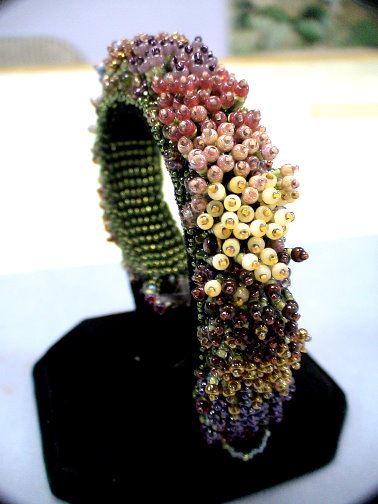
bw2fr1-8-fall-palette-bracelet2 - Copy - Copy

Color blending with beads is always challenging. It is not like paints, where you can merge and blend colors with ease. Beads are physical objects with set colors. You can’t mush them together, The transition from bead to bead in any piece, requires the eye/brain, when interacting and interpreting colors, to literally jump a cliff between the inevitable gaps of light between each bead. You want the viewer to have a satisfying, pleasurable journey as their eye/brain moves along that line of color-transitioning beads.

It is this transition from color to color that must be managed.
bw2fr1-spring-begin-garden-border - Copy (2)

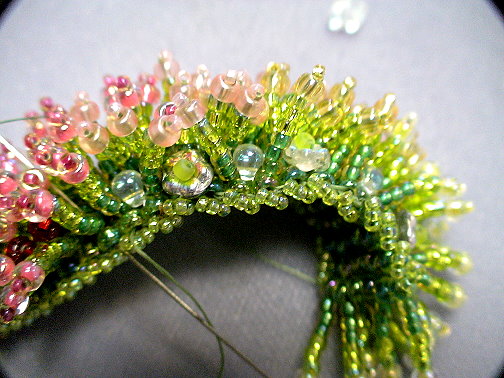
The Monet’s Garden Bracelet by Kathleen Lynam
One Example of a Color Blending Strategy

The Monet’s Garden Bracelet is a fun project that students love. It is for students who have some familiarity with bead weaving. Kathleen had been experimenting with various strategies for blending colors along the length of a bracelet. At about the same time, Beadwork issued a call for project proposals to be used in a book about what to do with your Bead Stash — all those small quantities of lots of different colors you have left over. This was the perfect type of project for color blending.

bw2fr1-spring-fringe-done-1

This bracelet teaches a mathematical approach for organizing several colors within a color blending scheme. Also presented is a simple math formula for personalizing your bracelet — that is, varying the width and length to suit your needs. The techniques here are Square Stitch and Fringing.

In her pieces, Kathleen loves to draw on nature’s inspiration. She gathers flowers and plants and bring them into the bead shop to match their colors as closely as she can. For her Monet’s Garden Bracelet, she developed instructions for both a Spring Palette, as well as a Fall Palette. However, the instructions would be as useful for a monochromatic palette, such as whites to grays to black, or a Southwest palette, such as turquoise to corals to reds. Use your imagination — and use up your bead stash, in the process!

Color Blending

Your goal is to move from one color to the next, in a satisfying way. You have many different kinds of choices to make, when managing a transition like this.

After you have chosen which colors you want to use, you need to decide what the color will look like as a “base” color, and what the color might look like as a “blend” color. With paints, this task is much, much easier, than with beads. It is not easy to blend beads, not least of which is because it is difficult to find the right colors needed to merge a color from base to blend and back to the base of the next color.
In this project, our strategy is to change the proportions of the base color as we move from one row to the next, until the proportions of the base to the blend in the first row are in reverse to the proportions to the blend to the base in the last transitional row. [And then, the blend becomes the new base, etc. along the bracelet.]

Besides varying the proportions, other options of blending that you have as a jewelry artist:

– Varying the brightness and dullness as you move from base to blend, such as finding colors with either more black, more gray, or more white in them

– Graduating the length of your fringes from row to row to create a sense of layering

– Varying the lightness and darkness as you move from base to blend, such as going from red to maroon or from red to pink

When choosing a set of colors, these do not have to match perfectly, but they do need to be coordinated. It is difficult if you vary the finishes of the beads too much. For example, transparent and transparent AB would not work well together in our scheme. Nor would transparent AB and luster finishes. Yet transparent AB, silver-lined and metallic colors do work well together, but only when you allow one of the finishes to be predominant.

Kathleen:”This Monet’s Garden Bracelet project is about color blending, so I went all out in selecting 14 colors. I could have easily used fewer colors or more colors.
Using the color blending strategy presented for this project, with 14 colors, each color would require 4 rows. So, in a bracelet, the base of which consists of 58 rows, the maximum number of colors we could use would be 14 (that is, 58 divided by 4, with 2 extra rows). I decided that when I got to the end with my 14th color, I would blend it with the 1st color, and color an extra row at the beginning and at the end (thus, my two extra rows), both done in the 1st color. [An alternative for treating the end of the bracelet would be to transition back from color 14 to color 13, and finish off the rows.]

I use a formula discussed below in allocating the proportion of each color, row by row. I played with combinations of different finishes. I was not satisfied with plain transparent beads — not enough brightness or dimensionality. Using all one finish, such as an AB finish or luster finish, was interesting, but too monotonous. It didn’t look like “nature”. I settled on using primarily transparent luster-finish colors, with some transparent AB, transparent silver-lined and a couple of metallic and metallic iris finish colors. This mixing of finishes seemed better. These captured and reflected light in different ways, and drew the eye into the bead differently, thus adding considerable interest. Lastly, I used more matte finishes in my Fall palette, than in my Spring.

My transitions from color to color are relatively quick. Each transition from one color to the next takes up 2 rows. With 14 colors, thus 4 rows allocated for each, you would have 2 full color rows and 2 transitional color rows. However, I could have easily come up with a formula-strategy to make the transitions much slower. And I could have come up with a formula-strategy to transition 3 colors at a time, instead of 2.

For this project, I graduated my colors in a way that seeming pleasing to me. The main transition is from reds to purples to golds and topaz’s.

My flower stalks are two sizes. For the first and last stalks, four 11/0 seed beads long and then topped with an 8/0 and a 15/0 seed bead as the flower tips, about 3/8”. For the 2nd through 7th stalks, six 11/0 seed beads long and then topped with an 8/0 and a 15/0 seed bead as the flower tips, about 1/2″. Because I have used Japanese seed beads, the 2nd thru 7th stalks/tips are the same lengths. I tried a sample going longer (8 11/0 seed beads plus the 8/0 and 15/0 tip), but this wasn’t appealing to me. Also, I would not have gone much longer, because the stalks could more likely bend in half, instead of standing more firmly upright. It was important to use 3 color gradations in my flower stalk, rather than a single color. A sense of “movement” is one of the key beauties of this bracelet. As the bracelet is worn, and the fringe move, I want the viewer to have a sense of watching flowers blowing in the wind. To maximize this effect, I vary the colors from darkest near the base to lightest near the flower tip.

For the Fall Palette, I also vary the finishes from luster to color lined, to silver lined, to AB, so that they eye’s interaction with any glass bead will also vary. I want things to feel like that changing of nature during Fall.

I coordinated the colors of the 8/0 and 15/0 seed beads forming the flower and its tip. In many cases, I found colors that were very similar. In a couple of cases, to add a bit of variety and surprise, and I used colors with a little more contrast, yet in the same general color family. “

The pattern underlying Kathleen’s color blending formula:
Determine the color patterns for the non-transitional and the transitional rows of flower stalk tips (the fringe in her bracelet). This pattern is based on playing with the proportions of the two colors, as we transition between them.

In our instructions today, we use the following patterns:
Where,
S=Same or current color
N=Next new color

Non-Transitional Row:
S | S | S | S | S | S | S
First of two Transitional Rows:
S | N | S | N | S | N | S
Second of two Transitional Rows:
N | N | N | S | N | N | N

Color Blending:

It is difficult to blend colors, when using beads. Some people like to make a bead mix of all the beads and colors they want to blend. This “Random” approach to blending works sometimes, but in a random way. Similarly, “Alternating” colors or “Graduating Colors from light to dark, or bright to dull” along your piece, also do not work well.

Usually, to get a great color-blending design, you need to plan, pre-test, plan again, pre-test again, until you work out a more involved, complex patterning.

One way to choreograph things, is to play with color proportions. Go line by line, and begin with the ideal proportionate relationship between two colors. Gradually manipulate this down the line by anticipating the next ideal proportionate relationship between the next two colors that need to follow.
Posted in bead weaving | Tagged: , , , , | Leave a Comment »

Last Chance to Vote OnLine – Beaded Dolls

Posted by learntobead on January 5, 2010

ALL DOLLED UP: Beaded Art Doll Competition
Last Chance To Vote On-Line:

Voting for our 6 semi-finalists ends 1/15/10
http://www.landofodds.com/store/alldolledup2009contest.htm

Artists around the nation were asked to create a Beaded Art Doll by manipulating beads and forms into an imaginative tactile and visual 3-dimensional representation of this year’s theme:Earthen Mother .

And then writing a Short Story (between 1000-2000 words) about your Beaded Art Doll, what it represents, and how it was created, starting with the sentence:

“The mirror reflects more than my hands can feel.
Lines, edges, shadings, a weariness under the eyes, an awkward stance.
Yet, not reflected is a certain vibrancy —
a compassion and wisdom and wonder so many people rely on.
Only you, my beaded art doll,
capture the fullness of me as I age in place .
You embody changes I want to make, so I aptly name you…”

The Fourth Bi-Annual 2009 ALL DOLLED UP: BEADED ART DOLL COMPETITION is offering a first prize of a $1000.00 shopping spree on the Land of Odds web-site (www.landofodds.com), and a Runner-Up prize of a $400.00 shopping spree on the web-site.

Our SemiFinalists:
Kathy Ford, Deep Gap, North Carolina
Vera Fox-Bond, LaVergne, Tennessee
Cathy Helmers, Dayton, Ohio
Ralonda Patterson, Decatur, Texas
Dot Lewallen, Westerville, Ohio
Joan Cromley, Sedro Woolley, Washington

Other programs of interest:
The Ugly Necklace Contest – A Jewelry Design Competition with a Twist
http://www.landofodds.com/store/uglynecklace.htm
THE ILLUSTRATIVE BEADER: Beaded Tapestry Competition
http://www.landofodds.com/store/tapestry.htm
LEARN TO BEAD Blog
http://blog.landofodds.com

Posted in bead weaving, beadwork, Contests | Tagged: , , , , | Leave a Comment »

Do You Know Where All Your Beading Needles Are?

Posted by learntobead on December 18, 2009

Do You Know Where
All Your Beading Needles Are?

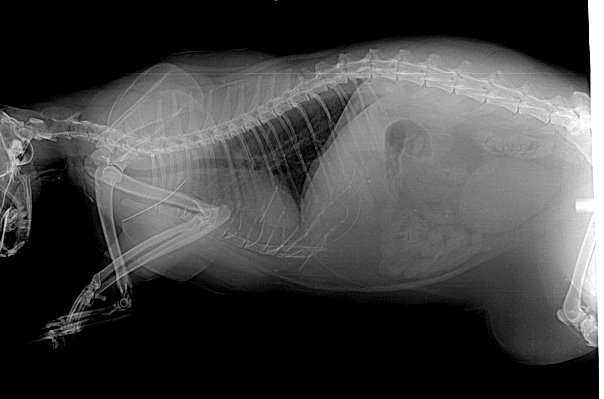
Cleo is a cat owned by one of our customers.     She has a propensity, or is it proclivity, or is it pronounced desire for, or something which attracts her to beading needles.    It turns out that cats especially are attracted to things like beading needles….And they swallow them.

I’m sure they have the mechanical physics wrong in their brains — after all, cats aren’t specifically trained in physics.   Because instead of passing all the way through their digestive systems — like other things they eat that they are not supposed to — beading needles pass through the esophageal walls, and lodge into other organs, muscles and bones.

Here is one of Cleo’s recent X-rays.   You can see the needle on the left side of the image, near her heart.

So, do you know where all your beading needles are today?    Be sure to keep them out of sight of your cat.

Posted in beadwork | Tagged: , , , , | 14 Comments »

Need for Critical Writing About Beading

Posted by learntobead on August 27, 2009

Need For Critical Writing and Dialog About Beading

One of the major gaps in Bead World is the support of more open and frequent critical writing and dialog about beading.   What it is.  Why it is.   It’s relationship to art.   The relationship of current modes and techniques to historical ones.   Contemporizing Traditional Beadwork.    Adding dimensionality.   Why there are numerous ways to work thru the same stitch, like Peyote, Brick, Daisy Stitch or Right Angle Weave.    Design elements and rules of composition underlying beading.    Beading structures.  Documenting beading techniques.  Forms and functions of beading.    Sex and sexuality, wealth and poverty, emotion and no emotion, and other pertinent themes underlying beading.   Comparative analyses of artists works.    Use of color with beads.    The relationship of jewelry as display item and jewelry as item as it is worn.   Why beads have power.   What makes some jewelry resonate.

Bead World lacks an academic center, which would encourage such discussions.   Bead World lacks magazines and journals which support these kinds of discussions.   Bead World is very step-by-step craft focused, and doesn’t tend to raise a lot of questions.     It doesn’t tend to support detailed documenting of beading traditions.   It doesn’t support urgent efforts to document and collect beadwork of rapidly disappearing ethnic groups, such as those in Dafur Africa.   It doesn’t create a clear sense of what is good beadwork, and what is sloppy beadwork. 

We have a recent history of beading in the US that began around 1960, and few people have witnessed the story.   Few people have asked deeper questions of the artists and teachers who first brought about an unbelievable increase in beading in the  1990s.   A lot of information has been lost.  

The information could be used to broaden the field, attract more people into beading, and encourage experimentation, research, deliberation.

Very sad.

At the Museum of Contemporary Craft in Portland, Oregon, they have created exhibits and ongoing discussions about criticality in craft, in general at least.   Beading and jewelry come into play occasionally.  

Their new discussion series — CALL + RESPONSE — is outlined on their web-site:

http://museumofcontemporarycraft.org/call/introduction.html

It’s definitely worth a visit.   Be sure to read the full essays from each participant, as well as view images of the works associated with each essay.

Anya Kivarkis, area head, jewelry and metalsmithing, University of Oregon

Anya Kivarkis, area head, jewelry and metalsmithing, University of Oregon


Namita Gupta Wiggers, curator, Museum of Contemporary Craft
Complaints about a need for critical writing on craft surface with great frequency. Drawing on the musical concept of “call and response,” this exhibition opens a space for critical dialogue and exchange between craft-based artists and art historians. From nearly three years of discussion, studio visits and exchanges of ideas, the resulting exhibition presents artwork and essays by eight pairs of artists and art historians, all of whom currently teach in Oregon colleges and universities.


Kate Mondloch, assistant professor of contemporary art history and theory, University of Oregon on
Josh Faught, assistant professor and program coordinator of fibers, University of Oregon
Knitting was passed down to me from my grandmother. However, I attribute most of my early experiences with craft to my time in summer camp. In fact, I think it’s safe to say that I learned to weave before I learned to draw or paint. It’s a biographical aspect of my work that I still like to talk about since it locates my skill set from a time iconically loaded with issues of identity construction. In college, I studied art history and English but when I graduated I gained a bit more confidence in my creative abilities. 


Abby McGehee, associate professor, Oregon College of Art and Craft on
Anya Kivarkis, area head, jewelry and metalsmithing, University of Oregon

For any student of material culture, objects provide the means for understanding social values, ritual and domestic procedure, and individual artistic development. Objects and structures are proxies for vanished makers and patrons, and remnants of the world they created. But there is always a tension between the substantiality of these physical remains and the absence of their historical context.


Kirsi Peltomäki, assistant professor of art history, department of art, Oregon State University on
Jiseon Lee Isbara, associate professor and fibers department head, Oregon College of Art and Craft

Hand-sewing, whether to join fabric pieces together or make a mark on them by embroidery, remains at the center of Jiseon Lee Isbara’s artistic practice, although she freely makes use of a sewing machine as well, and, on occasion, includes other techniques such as inkjet printing on fabric. A fiber-based artist by training and profession, the material and conceptual dimensions of Lee Isbara’s works simultaneously resonate with contemporary sculpture, particularly work by Eva Hesse and Mona Hatoum, and with the Korean textile tradition of pojagi wrapping cloths. Lee Isbara’s recent work involves pieced fabric stitched into patchwork forms and displayed in three-dimensional installations or two-dimensional wall arrangements. In any configuration, Lee Isbara’s work constitutes mental maps, visualizing territories that are coded and decoded in languages at once familiar and uncharted.


Dawn Odell, assistant professor, department of art and art history, Lewis & Clark College on
Sam Morgan, ceramics instructor and art chair, Cascade Campus, Portland Community College

Although the necessity for a division between the fine and decorative arts has been under assault for decades, the ghost of this separation continues to haunt discussions of contemporary craft. When considering ceramics, for example, the fine/decorative divide is often breeched by emphasizing the sculptural qualities of ceramics, both in terms of the objects’ three-dimensional form and also by assuming that the work is best contemplated from a distance. Sam Morgan’s art resists this conflation of ceramic as sculpture. 


Rob Slifkin, assistant professor of art and humanities, Reed College on
Studio Gorm (John Arndt and Wonhee Jeong), associate professors, product design, University of Oregon

Understood in its most expansive sense, to design is to forge a possibility. Whether one sketches a preliminary study for a painting or sculpture, or draws a plan for a building or a piece of furniture – or outlines a draft for an essay – the act of design entails the projection of a desired future outcome from a present moment. 


Matt Johnston, assistant professor, department of art, Lewis & Clark College on 
Karl Burkheimer, associate professor and head of the wood department, Oregon College of Art and Craft
From Karl Marx to Clement Greenberg and beyond (and probably echoing as a refrain in this collection of essays), both craft and art are portrayed as heroic but losing enterprises within an increasingly pervasive dehumanization of life brought about by the growth of capitalist society. A tool-making species, in this apocalypse of our own creation, we are losing touch with basic hand-eye skills required to fashion, manipulate, and interpret objects; in effect losing the ability to re-imagine and re-make the world, and are instead becoming mere passive consumers of machine-fabricated commodities. 


Anne Marie Oliver, assistant professor of intermedia and contemporary art theory, Pacific Northwest College of Art on
David Eckard, chair of the sculpture department and an instructor in the foundation and intermedia departments, Pacific Northwest College of Art

It would be a mistake, however, to view magic simply as a reenactment of social behavior, the logic of belief, or a mere lure or decoy by which attention is drawn away from some tasks in order for others, often traumatic or violatory, to be accomplished. In the final analysis, magic is far more disturbing than any conjectured relation between duplicity and consciousness, belief and disbelief, distraction and destruction. 


Posted in Art or Craft? | Tagged: , , , , , , , , | 1 Comment »

Winner and Runner Up Announced

Posted by learntobead on July 16, 2009

2009 7th Annual The Ugly Necklace Contest
Winner and Runner-Up Announced

And the Winner is…..

Land of Odds, Be Dazzled Beads, The Open Window Gallery, and The Center for Beadwork & Jewelry Arts are proud to announce the Winner and Runner-Up in this year’s The Ugly Necklace Contest!    These two contestants have succeeded in creating necklaces which were hideous, using clever materials, fashioning a creative clasp assembly, and showing a strong degree of artistic control in their jewelry-making endeavors.   Doing something “Ugly” is easier said, than done!

The Winner of The Ugly Necklace Contest – the Jewelry Designer who demonstrated exceptional jewelry design skills by creating The Ugliest Necklace in the America and the rest of the World in the year 2009, and the winner of a $992.93 shopping spree on the Land of Odds web-site (www.landofodds.com), is:

Lynn Margaret Davy of Wimborne, Dorset, United Kingdom
“The Story Of My Beading Life”

ugly7davyfullsize

MORE DETAILS, Images and her Poem:
www.landofodds.com/store/ugly7davy.htm


The Runner-Up in The Ugly Necklace Contest — the Jewelry Designer who also displayed obvious design talents by creating the 2nd Ugliest Necklace in America and the rest of the World in the year 2009, and the winner of a $399.07 shopping spree on the Land of Odds web-site (www.landofodds.com) is:


Juli Brown of Wells, Minnesota
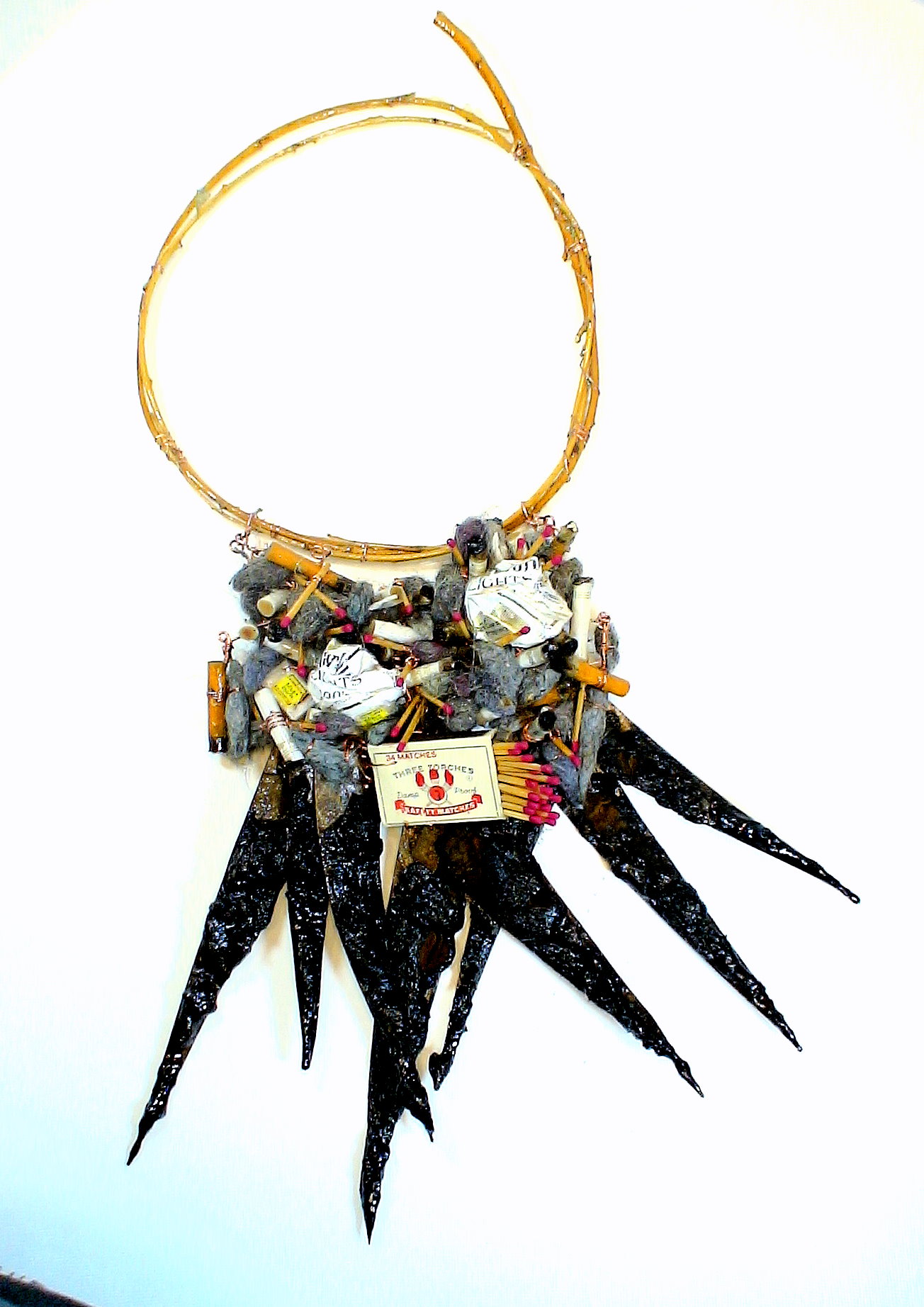
“Coffin Nails Necklace”

ugly7brownfullsize

MORE DETAILS, Images and her Poem:
www.landofodds.com/store/ugly7brown.htm

—– 

These beadwork and jewelry artists have demonstrated their commendable design skills. They have been judged, from among  entrants from across America, Great Britain, and Canada by a distinguished panel of four judges from The Center for Beadwork & Jewelry Arts in Nashville, Tennessee, and voted on by visitors to the Land of Odds web-site.


To view additional images of the necklaces submitted by the winner, runner up and the other semi-finalists of the 7th Annual 2009 The Ugly Necklace Contest, please visit us at www.landofodds.com/store/ugly7contest.htm on-line.


The Ugly Necklace review criteria are discussed on this web-page:
www.landofodds.com/store/ugliestcriteria.htm


Entries for the  Eighth Annual 2010 The Ugly Necklace Contest will be accepted between September 1st, 2009 and March 15th, 2010.   For official rules, and 2010 special requirements, please visit our web-site at www.landofodds.com/store/uglynecklace.htm .


And if you are in the Nashville area, please stop by Be Dazzled Beads, where the 6 selected Ugly Necklaces are on display through September 15th.


The Ugly Necklace Contest is one of the programs of The Center for Beadwork & Jewelry Arts in Nashville, Tennessee, to encourage beadwork and jewelry makers to test their design skills, push the envelope, and learn some fundamentals about jewelry design in the process.   

LIST OF 2009 7th Annual SEMI-FINALISTS:
1.         Lynn Margaret Davy, Wimborne, Dorset, United Kingdom

2.         Juli Brown, Wells, Minnesota

3.         Sarah Allison, Gresham, Oregon
4.         Jolynn Casto, Logan, Ohio
5.         Deborah Eve Rubin, Rockville, Maryland
6.         Lori-Ann Scott, Spokane, Washington


Posted in Contests, jewelry design | Tagged: , , , , , , | 1 Comment »

Beading Needles – What Do You Prefer?

Posted by learntobead on April 29, 2009

4/29/09


Connie posted the following on ALL ABOUT BEADS group, and got some of these responses.   What do you think?


Warren I posted on All About Beads about the needles, and so far these are the answer


At my bead group – we have been discussing beading needles. I know that is a subject with as many opinions as thread. So could you please tell what kind of a needle you use and why you like them.

I will go first – for general beading such as peyote, etc. I use Pony needles, or John James – which ever I grab first. I use long needles 99% of the time, but when I do bead embroidery I use short beading sharp size 12.

CONNIE

I use long size 12 loom needles when I loom (which I haven’t done for a while and should think about), and John James long size 12 or 13 needles for everything else. (What I really need is sewing needles because I keep using beading needles for mending.)

Marilee

  8867.3 in reply to 8867.1 
 
I too prefer John James and size 12.  Carol Perrenoud from BEADCATS in Wilsonville, OR just gave a presentation to our bead society (Bead Society of Northern California) on the History of Beading Needles and it was amazing.  The one thing that she told us that I had NEVER heard before is to match the shape of your needle’s eye to the “thread” you are using.  Most beading needles have skinny oval eyes which is best for NYMO-type threads that compress. BUT if you use FIRELINE which is more rounded and has a coating, to pick a needle that has a more oval eye.  The needle that she had, I had never seen before ~ they are called STRAW NEEDLES. The issue is that the skinny oval eye will squish/remove the coating on the fireline which can cause it to twist, kink, and eventually even break with the coating gone.  I wish I had picked up more packets. marilyn

  8867.5 in reply to 8867.1 
 
When I am doing a pin, or a doll or something “odd” shaped, I use my curved needles.   I do use more thread with them, but the curve allows me to get in to spaces I could not before.katieB

  8867.7 in reply to 8867.1 
 
For embroidery I use my curved needles and for regular beading like peyote I use my Big Eye needles because it is so hard for me to see to thread the dang things :)Dot

Size 12 John James are my standard needle of choice.  If I must stray I’ll use a Size 12 Pony, but I hate how brittle they can be.  And I am super near-sighted so will take my glasses off and bring my work right up to my face to get a “magnified” look.  When those puppies break it is a scary moment for sure!

I also like the Mary Arden needles…they are apparently made in the same factory as the John James, just in a prettier package.

When the project calls for it, I’ll move down to a size 13 John James.

I don’t like Sharps…I can’t seem to get a good grip on them.  But I have noticed over the years that customers with small, thin fingers enjoy working with them better than a standard length.

We were introduced to Straw Needles last fall.
I’m still looking for them.

I am sold out again….much to Thom’s disappointment.  =o/

  8867.13 in reply to 8867.1 
 
I use Pony 11’s most of the time. If I need something smaller, I go to a 12. The only John James I use with any regularity is the curved needles.Arline

  8867.14 in reply to 8867.9 
 
I don’t like Sharps…I can’t seem to get a good grip on them.  But I have noticed over the years that customers with small, thin fingers enjoy working with them better than a standard length.”Hmm, maybe that explains why I like them! :)Maia

Hi, Connie!

Usually I go for Pony or John James, which are the two brands I can find easily in Chicago. I also buy the Coats & Clark ones when I can find them, but I wish they came in bigger sets than just 4 needles as they last a long time – even when they are really bent, the Pony and Coats and Clark ones are still strong, my latest batch of John James ones were rather brittle this time .

I use the long beading needles for bead weaving, and also sharps and tapestry needles for bead embroidery.Most of the beads I use are smaller than size 8/0 so I tend to use 12s or 13 needles and I keep size 15 needles for beads with small holes.I also have twisted wire ones for stringing beads for pearl knotting.

I hope this helps a bit,

Love, Jan


For beadweaving, I prefer the John James 12’s, for dolls I like the John James 12 sharps.  For most other work, I think the John James 13’s are what I use.  I may try some of the straw needles, if I can figure out the sizing.  May have to buy a packet of each of two sizes to see which direction they go… are the large numbers smaller needles, or vice versa?

  8867.17 in reply to 8867.4 
 
I love straw needles. They don’t bend and break easily and they have an easy to thread eye.They are also known as milliner’s needles and I like the size 11.Both Richard Hemmings and John James make these and they are easily available on the internet for about $1.95 to $3.00 a pack.

Highly recommended.

Sylvia
  8867.18 in reply to 8867.1 
 
I prefer short needles unless I am doing fringe.  I don’t like Pony brand, so I stick with John James.  I’ll use the thickest needle that I can get away with for as long as I can, unless I’m beading into leather when I’ll grab the thinnest needle that I have available. 

Some people like the Japanese beading needles because they are stiffer.   Some people think that the John James needles went downhill in quality when they started making them in China, instead of England.   I prefer the John James regular English Beading Needles, and try to use size 10 and size 12.    I like that they are not super stiff.   The sharps needs are too small for my hand — my hand cramps when I use them.  — Warren


8867.19 in reply to 8867.1


I’m like Sandi, in that I like to use the thickest needle I can get away with. I do prefer long needles, though, it seems easier to pick up my beads with a long needle. Most of my things are done using a John James size 10 needle. I keep some JJ 13’s around as well as a couple big eye needles, but I only like the big eye for loom work and sometimes fringe. I’ve never tried a size 12 long or short, but I don’t care for the 13’s as they seem very fragile and never last very long for me.

I tend to muscle up on my needles, so they get very bendy. I can usually straighten them out by rolling them between my big anvil and a slab of steel I keep around. It does make them brittle, but I get a little more life out of them.

Jen

 
I prefer sharps (10?12?) for bead embroidery, unless I’m using charlottes and then I have to use a beading needle. As several people have said, I use the largest needle I can get away with – 10 or 12. For awhile I was using size 15 seed beads a lot and used the 15 needles – crispy critters! I’ve had a bad batch of larger John James needles also. That’s when I tried Pony needles, which I liked. And about the same time a friend who sells historical reproduction items for re-enactors gave me some beading needles – I think they are English, but I don’t know if they are JJ. They might be Japanese. They were great though. I really should get some more from her. The most of JJ needles I bought seem to be fine. I have more problems with losing needles than I do breaking them!Cathy

Fortunately, I don’t often lose needles.  Stepping on a few has made me very careful.  I tend to use JJ 12s and 13s most of the time and the 15s when necessary (for some charlottes and gemstones).  I will occasionally use the cheap Indian needles.  For me, they work as well and last as long as the JJ.  I have some sharps but I don’t care for them.  I’ve tried the big eye needles, but the ones I’ve tried have been too large for the beads I use (mostly 15s and charlottes).  I just accept that the 13s and 15s won’t last that long.  Needles aren’t that pricey, so that’s just the way it is.

8867.23 in reply to 8867.1 
 
I use size 10 Pony needles almost all the time. I can’t stand a bent needle and these stay straight most of the time!


SUZANNE COOPER
8867.23 in reply to 8867.1 
 
I use size 10 Pony needles almost all the time. I can’t stand a bent needle and these stay straight most of the time!


SUZANNE COOPER


8867.23 in reply to 8867.1 
 
  8867.27 in reply to 8867.19 
 
I like my needles getting a gentle curve; I can pick up beads easier that way. My first JJ 12 packet lasted for more than 10 years, and I bought some more from Sandi recently so I may never have to buy more of my regular needles.Marilee

 
I think it interesting that your first packet of needles lasted so long. I’m having a hard time with the finish flaking off the packet of needles I am using right now. It flakes off then gradually the thread snags on the uneven coating. I hope it is only this pack as I’m having to change needles several times for each project.

 
Karen, are they Delica needles?  I have a friend who used them once, and they wore off so quickly she would go through two or three in one small project.  We were thinking it might be something in her skin that caused it.
 
 
I loved my first package of 25 John James size 12 needles. They rarely broke, just got nice and bendy. And if I worked slowly and carefully, I could even gently straighten most of the bends with two pairs of pliers. That package lasted almost two years, and I’ve only used two from a package of 10 JJ size 13 purchased at the same time.About two months ago, I purchased another package of 25 JJ size 12. They are twisted, rough, and break easily, especially near the eye; 12 are already broken. After grumbling and muttering, I read the fine print on the package and see that JJ are now made in China. And JJ is now owned by Entaco Ltd.


from John James Company:


The John James factory was sold to new owners who are Chinese.  They did have a couple of batches of needles that were incorrectly annealed and snapped very easily.  They seem to have gotten that back under control again and are producing quality needles again.  We accepted bad needles back and exchanged them.  We also went through our stock and threw out any bad packages.  We lost a bit of money, but it’s nothing short of frustrating to work with bad tools and we were happy to make sure that the products functioned the way they were supposed to.

Posted in bead weaving, beadwork | Tagged: , , , , , , , , , | 2 Comments »

Selling Your Jewelry In Recessionary Times

Posted by learntobead on March 30, 2009

Selling Your Jewelry
In Recessionary Times

With a financial crisis in full swing, it has become more difficult to sell your jewelry. Fewer stores, fewer customers, fewer craft shows. At the same time, the costs of all the supplies – beads, stringing materials, jewelry findings – have been increasing at much faster rates than inflation. This adds to the problem.

At the same time, it is getting more difficult to get your “message” to your “customer.” With things like blogs, facebook, my space, twitter, other interactive sites and social networks, people are organizing into ever-smaller market niches.   It’s too expensive and too time-consuming to get enough people to be aware of your business, that you can continue to make a living.

They are no longer reading the mainstream magazines and newspapers to get their primary sources of information, to the extent that they have in the past. They are not going to local craft shows or local stores as much, because they have an online world of Etsy and Ebay and 26 million jewelry sites listed on Google.

Perhaps these times and prospects can be reinterpreted as an opportunity to rethink how you approach your jewelry selling business. At the least, perhaps you can better secure your base during these times, in preparation for more growth and expansion as the financial crisis bottoms out, and then gradually improves.

It’s time to take a hard look at your “business model.” You have probably been operating as a one or two person operation. You, or both of you, do everything. You create the designs. You make the jewelry. You market and sell your jewelry. You wear many hats.

“Unbundling” is a strategy where you give up control of some business functions, and rely on the expertise of other companies or organized groups. One obvious thing is to rely on UPS or FedEX for your shipping needs.

I suggest you think about no-cost and low-cost ways to unbundle some of your marketing and promotion. One inexpensive and effective way is to get a regular group together of others who sell hand-crafted jewelry or other hand-crafted items.

As a group,

– develop and share mailing and emailing lists

– try to brand the group with an identify of having quality, affordable hand crafted items for sale

– have a major presence, even a controlling presence, at a local craft show

– generate a logo that everyone includes on their websites and their packaging

– set up your own blog and try to attract potential customers to your blog

– interlink your websites into a web-ring

– have regular discussions about business strategies

– approach suppliers as a group to bargain for group discounts

On one level, you give up some control in managing these aspects of your business. On another, however, you get to leverage the talents and time and resources of these other businesses. This might be the smartest way to continue to reach your customers, and continue surviving and thriving when things are tough, and the business environment keeps changing and evolving.

Posted in business of craft, jewelry making | Tagged: , , , , | 1 Comment »

HOT LINKS by CONNIE WELCH

Posted by learntobead on March 24, 2009

3/24/09

Those of you who have missed BEADS on Wednesday are really missing a good Bead Study. The whole discussion and working of the Shapes is so interesting. Everyone who comes is involved.
 
Look at this – they copied Diane’s necklace
…Bead StudyII  Great job Warren


That should keep you buys for a while. – C

Posted in beadwork, Resources | Tagged: , , , , , , , , , | Leave a Comment »

BEADING APHORISMS

Posted by learntobead on March 22, 2009

Beading Aphorisms

Like the lines in a good country music song, some clever sayings about beads and beaders can bring a smile to your face.    You might see these on T-shirts or mugs or canvas bags and bumper stickers.   


Over the years, we’ve accumulated these “bead aphorisms” and “bead sayings” in the list below.   Call us crazy.    Call us prepared to stencil the next Leading Bead Saying on the next bag, tee-shirt, whatever.


So many beads, so little time.

Bead me up, Scotty.

The person with the most beads when she dies, wins

Let there be BEADS on EARTH, and let them begin with ME!
There’s nothing wrong with me that a few beads won’t cure.

Will work for beads

I bead…Therefor I am

I only stop for beads

This is my brain on beads

Bead Broad

Bead Slut

Bead Queen

Bead-a-holic

Bead Babe

Bead Smart

Bead Goddess

Gold Digger

Craft Chick

Bead Whore

Eat. Sleep. Bead

Certified Bead Crazy

Above and Bead On

Beadiful Dreams

Beading is my Calamine

I didn’t buy my beads.. .I earned them the old fashioned way.

If Momma ain’t beading, Momma ain’t happy…If Momma ain’t happy, ain’t nobody happy

The need to bead

Beadmused
The Itch to Stitch

Bead Ware

Better w/ beads

Bead all you can bead

To bead or not to bead

Bead happy

Bead different

Don’t Worry, Bead Happy!

She’s One Bead Shy Of A Necklace
Beadin’ My Brains Out
You toucha my beads, I breaka yu face.
So many beads, so little time.

Bead Ho

Bead Soup

If you find a bead on a fence post, it didn’t get there by accident.

I never met a bead I didn’t like

Bead envy.

I’m Beadalicious!
Life is Beads!
I’m Bead-a-rific!
My Kingdom for a Bead

Tis better to have beaded and failed, than never to have beaded at all

Bead until it hurts

Beading is its own reward

Don’t bead everything you see

If all else fails, bead

It’s not easy being a bead goddess

Dare to bead great!

Got beads!

Time and beads wait for no one

God could not be everywhere, and therefore He made beaders

A beader cannot fail; it is a success to be one

Beading washes away from the soul the dust of everyday life

Beading holds the universe together

Some of my best friends are beaders

I find I can write much better with beads

Arguments with beads are rarely productive

Beaders of a kind flock together

To thine own beads be true

You never lose by beading

Super-cala-bead-a-licious-expi-alla-docious

Why can’t we all just bead along?

Just let me bead

Bead Nutz

50 Ways To Bead Your Lover


Can you think of any other clever turns of bead-phrases?  If so let us know…. 

Posted in beads | Tagged: , , , , | 1 Comment »

Meet Kathleen Lynam, Bead Weaving Instructor

Posted by learntobead on March 5, 2009

lynam-headshot

Kathleen Lynam is our bead weaving instructor at The Center for Beadwork and Jewelry Arts in Nashville.     She teaches our Stitch of the Month program, as well as intermediate and advanced classes in bead weaving.

Kathleen’s Website

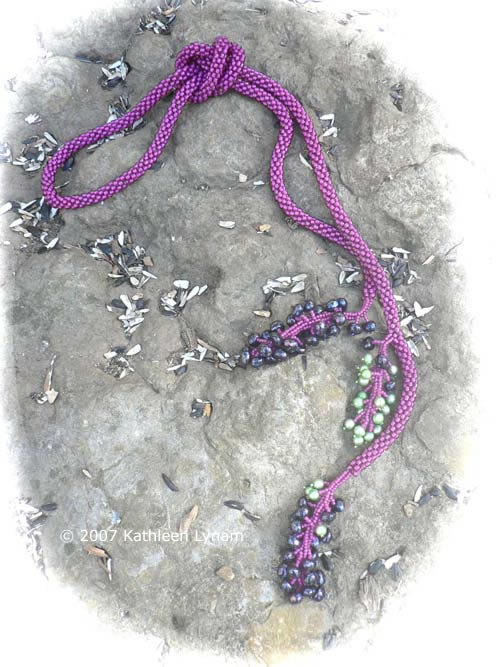
Poke Berry Rope

Poke Berry Rope

Kathleen, by profession, is a puppeteer.    She teaches Head Start teachers and Elementary School teachers how to use puppets to teach concepts, history, health care, among other things.   

The Germ

The Germ

As a teaching artist I am affiliated with several institutions:  The Tennessee Performing Arts Center oversees the regional Wolf Trap Institute for Early Learning through the Arts and ArtSmart programs. I have been a Wolf Trap artist since 1992, working extensively in the preschool classroom providing one week or seven week residencies.  By partnering closely with the classroom teacher, each residency provides original songs, stories, and activities that are developmentally appropriate, educationally sound, and awaken the student’s curiosity for learning. 

Matisse

Matisse

A Master Artist with Wolf Trap since 2001, my workshop, Let Your Voices Be Heard:  Using Puppets to Bring Stories to Life, has been presented to teachers throughout the United States. I became a teaching artist with the ArtSmart program in 2006. This meaningful program prepares students to understand/appreciate a particular performing or visual work of art. A unique partnership with teaching artists, educators, and students creates intense explorations of the work of art.

Beaded Bead

Beaded Bead

Value Plus is a program sponsored by the Tennessee Arts Commission. This five year reform model provides residencies that integrate learning through the arts into non-arts subjects such as math, science and language arts.

Teaching Through Puppetry

Teaching Through Puppetry

As an artist, I am particularly drawn to color, texture, and sculptural design.  I have been commissioned to make puppets by universities, historic homes, and private individuals.  I have designed, sculpted, painted, and dressed all of the puppets used in my shows. I have made hundreds of colorful puppets from simple finger to complex foam puppets that are used in the classroom.  Over 700 hand sculpted finger puppets were sold nationwide by Crizmac Arts Catalog.  In 1999, the Virginia Museum of Fine Arts purchased my Master Artist series of puppets featuring Van Gogh, Gauguin, Picasso, Kandinsky, Monet, and Chagall.

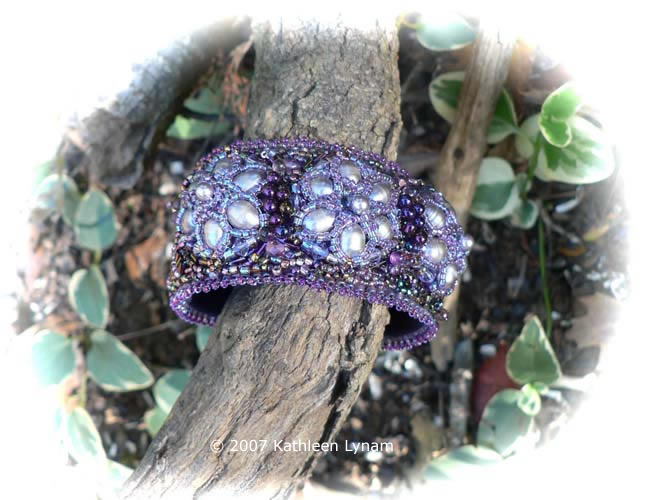
Bead Embroidered Cuff

Bead Embroidered Cuff

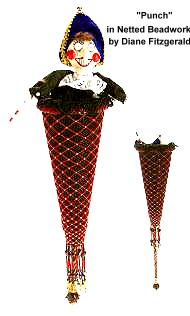
Combing a love of bead art and puppetry resulted in a well-reviewed show at the Appalachian Center for Crafts in Smithville, TN in 2002.  As a bead artist and teacher, my original patterns and designs have been published in Beadwork Magazine and Netted Beadwork by Diane Fitzgerald.  My beadwork is currently on display at the Open Window Gallery in Nashville.

Punch Pop-Up - Netted Beadwork

Punch Pop-Up - Netted Beadwork

I love teaching classes on bead weaving at Be Dazzled Bead Store in Nashville, Tn. My students have proven time and time again that they are brilliant, innovative, and a whole lot of fun! These classes are designated “Stitch of the Month” and are designed to teach 12 major bead weaving stitches/techniques. Each class provides a history of the stitch, how to basics, variations applicable to the stitch such as decreasing/increasing, flat/ tubular, and most appropriate beads. Students will work on mastery of the stitch by creating a bracelet.


Posted in bead weaving, beads, beadwork, Workshops, Classes, Exhibits | Tagged: , , , , | 1 Comment »