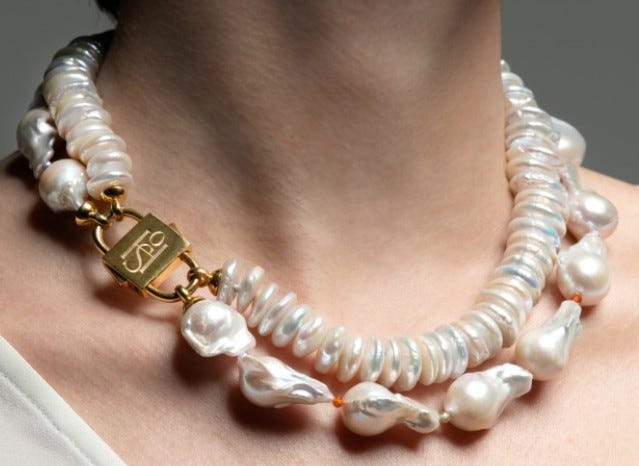
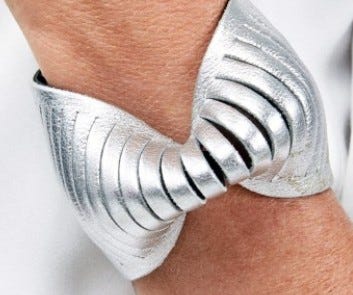
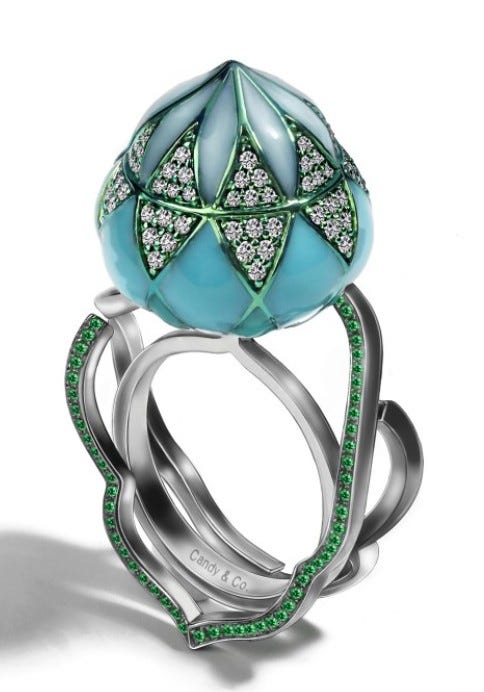
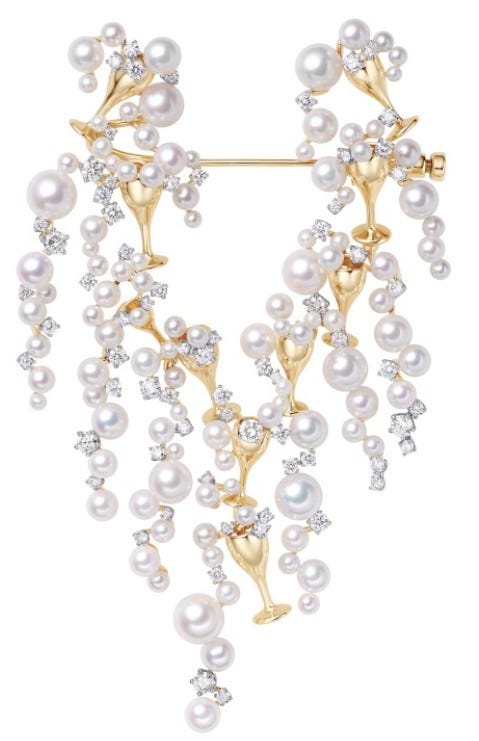
Jewelry comforts us as we age in place. The bracelet we got for graduation still worn on an occasion when we are 65. The ring he bought her when she was in her 20’s still worn on the day she passed away.
With jewelry, we will never feel alone as we grow older. As our body changes in pallor and texture. As we gain weight or lose weight. As we change our styles of clothing or hair or activity.
This constellation of material objects, distributed across the human body, reflects transformation, movement, growth, and behavior. These reflect the life we live, and how we lived it. These are stories of how we performed our lives over time. They reveal an otherwise unseen perspective on life as the body ages, and we live through time. They show that not all lived lives have been ad lib’ed.
The jewelry will also show its age over time. Changes in color, perhaps fading, perhaps becoming duller or spotty. A clasp may have been replaced. The piece may have been restrung. It may have been shortened or lengthened. It may have been worn a lot. Or lost for a while. Or given away. Its associative or symbolic value may have changed.
Jewelry is life performed. Both are observable. Both indicative of our place – our aura – in the world around us as time goes on. Both an experience – often changing – of a point of view from the hand that crafted the piece in the first place, and the desires of the person who wore the piece over time. We possess it and wear it so it reminds us that we are not alone.
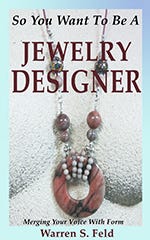
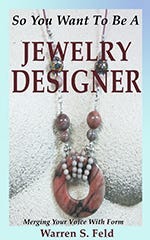
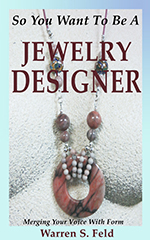
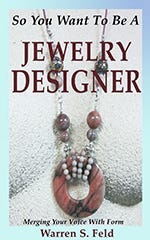
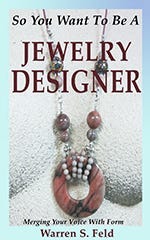
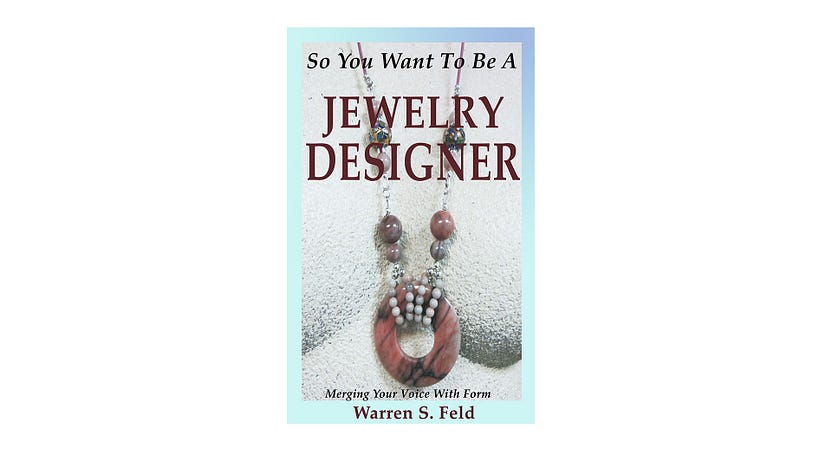
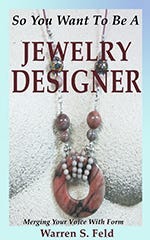
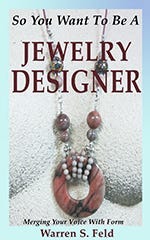
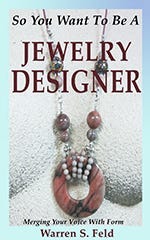
SO YOU WANT TO BE A JEWELRY DESIGNER Merging Your Voice With Form
So You Want To Be A Jewelry Designer reinterprets how to apply techniques and modify art theories from the Jewelry Designer’s perspective. To go beyond craft, the jewelry designer needs to become literate in this discipline called Jewelry Design. Literacy means understanding how to answer the question: Why do some pieces of jewelry draw your attention, and others do not? How to develop the authentic, creative self, someone who is fluent, flexible and original. How to gain the necessary design skills and be able to apply them, whether the situation is familiar or not.
Someone has to infuse the object (jewelry) with all this content, and this proactive act leads us to the idea of intent. Why these choices, what was the motivation? Often this imposition of meaning begins with the jewelry artist. Jewelry becomes a means of self-expression. The artist, in effect, tells the world who the artist is, and what the artist wants to happen next.
The artist might be subdued or bold, colorful or monochromatic, simple or complex, extravagant or economical, logical or romantic, deliberate or spontaneous. The artist might be direct or indirect in how meanings get communicated. It is important, in order to understand the meaning of an object, to begin by delineating the artist’s inspiration, aspiration and intent.
The jewelry artist begins with nothing and creates something. The unknown, the unknowable, the nothingness is made more accessible.
The artist fills in a negative space with points, lines, planes, shapes, forms and themes. Color, pattern and texture are added. Things get organized and arranged.
Though often unstated, it becomes obvious that of all the possible choices the artist could have made in design, that some choices were ignored and excluded, while others were not. Some negative space is left so. Some positive space has direction, motion, weightiness. Somethings are abstract; other things realistic. These and related choices have implications and consequences.
The question becomes, what influences that artist’s selections? Successful jewelry reveals the artist’s hand.
Our senses and perceptions of the coherence in the artist’s inspiration and intent, as reflected in our interpretations of that artist’s jewelry, helps us not to feel alone. We may see coherence as a subjective thing or a universally understood thing. It doesn’t matter which. If we believe we can make sense of things because they have a purpose, if the jewelry feels and seems coherent in some way again because we sense it is purposeful and intentional, we feel safe, and that we have reduced the risks in life. We do not feel so left alone.
INTENT: Jewelry As Creating Order Out Of Chaos. Partly, what the artist does is attempt to order the world. The artist looks for clues within him- or herself (inspiration and intent). The artist formulates concepts and a plan for translating inspiration and intent into a design. The artist determines whether to take into account the expectations of others (shared understandings) about what would be judged as finished and successful.
Jewelry is an object created out of chaos and which has an order to it. The order has content, meaning and value. It has purpose and coherency based on color and texture and arrangement. Mass placed within space.
Jewelry as an organized, ordered, coherent object — something out of nothingness — reflects the hypotheses the artist comes up with about how to translate inspiration into aspiration, and do this in such a way that the derived jewelry is judged positively. The artist anticipates how others might experience and sense the object on an emotional level.
It reflects the shared understandings among artist, wearer and viewer about emotions, desires, inherent tensions and yearnings and how these play out in everyday life.
The artist makes the ordered chaos more coherent, and this coherence becomes contagious through the artist’s choices about creative production and design. The artist lets this contagion spread. To the extent that others share the artist’s ideas about coherence, the more likely the work will be judged finished and successful. And no one — not the artist, not the wearer, not the viewer, not the buyer, not the collector — will feel alone.
The process of bringing order to chaos continues with the wearer. The wearer introduces the piece of jewelry into a larger context. We have more contagion — what we might call viral. The jewelry as worn causes more, ever-expanding tension and efforts at balance and resolution. There is an effort to figure out the original artist intent and ideas about coherence as reflected in design.
Unsuccessful efforts at design, where the artist’s intent becomes obscured, reverse the process, and the object — our piece of jewelry — then brings about decoherence. Decoherence may come in the forms of bad feedback, inappropriate feedback, less than satisfying feedback, or no feedback at all.
Decoherence means the wearer may not get that sense of self s/he seeks. S/he may feel less motivated to wear the piece. S/he may store the piece or give the piece away. As this decoherence filters down to the level of the artist, any necessary support in design may be lost. There will be fewer clients, fewer opportunities to display the works publicly, and fewer sales. The artist’s motivation may diminish.
INTENT: Jewelry As An Agent of Personality. People wear jewelry because they like it. It becomes an extension of themselves. It is sensed as self-confirming, self-identifying and self-reconfirming. Liking a piece of jewelry gets equated with liking oneself, or as a strategy for getting others to express their like for you. Jewelry makes us feel more like ourselves. We might use jewelry to help us feel emotionally independent, or we might come to rely on jewelry for emotional support and feedback — that positive comment about the jewelry we are wearing — , leading us down the path to emotional dependency.
Jewelry may have personal significance, linking one to their past, or one to their family, or one to their group. It may be a way to integrate history with the present. It is a tool to help us satisfy our need to affiliate.
Jewelry may help us differentiate ourselves from others. It may assist us in standing out from the crowds. Conversely, we may use it to blend into those multitudes, as well.
Jewelry fulfills our needs. If we look at Maslow’s Hierarchy of Needs, after meeting our basic physiological needs such as for food and water, and our safety needs, such as for shelter, we can turn to jewelry to meet our additional social needs for love and belonging and self-esteem. Designing and creating jewelry can form an additional basis for our needs for self-actualization.
We may derive our personality and sense of soul and spirit from the qualities we assign the jewelry we wear. We do not merely wear jewelry as some object; more specifically, we inhabit jewelry. If ruby jewelry symbolizes passion, we may feel passion when wearing it. We may use jewelry as an expressive display of who we feel we are and want to be seen as in order to attract mates and sexual partners. We use jewelry in a narcissistic way to influence the alignment of the interests and desires among artist, weaver, viewer, buyer, collector, exhibiter, and seller.
In similar ways, we may derive our sense of belief, devotion and faith to a higher power or spiritual being or God from wearing jewelry. It may help us feel more connected to that religious, spiritual something within ourselves. It may remind us to stay on our religious path.
As an agent of our psychological selves, jewelry is used to resolve those core conflicts — Who are we? Why do we exist? How should we relate to other people around us? Jewelry orients us in coming to grips with our self-perceived place within critical contradictions around us. Trust and mistrust. Living and dying. Good and evil. Pleasure and pain. Permission and denial. Love and hate. Experience and expectation. Traditional and contemporary. Rational and reasonable.
SO YOU WANT TO BE A JEWELRY DESIGNER Merging Your Voice With Form
So You Want To Be A Jewelry Designer reinterprets how to apply techniques and modify art theories from the Jewelry Designer’s perspective. To go beyond craft, the jewelry designer needs to become literate in this discipline called Jewelry Design. Literacy means understanding how to answer the question: Why do some pieces of jewelry draw your attention, and others do not? How to develop the authentic, creative self, someone who is fluent, flexible and original. How to gain the necessary design skills and be able to apply them, whether the situation is familiar or not.
However, as we get closer to defining the object (jewelry) as one that is sensed and experienced and which evokes an emotional response, it becomes more difficult to maintain that the object does not reflect meaning, does not result from some kind of thought process and intent, and does not communicate quite a lot about the designer, the wearer, the viewer and the situation. Jewelry when worn and which succeeds becomes a sort of identifier or locator, which can inform the wearer and the viewer about particular qualities or content, such as where you belong, or what you are about, or what your needs are. So we sense jewelry not so much as an object universally understood, but something with more nuance, interest, meaning, and value, with an element of subjective references.
Jewelry without content, after all, can skew to the superficial, boring, monotonous, and unsatisfying. Without meaning and value, jewelry has little to offer.
These shared recognitions and valuing of meanings helps us not to feel alone.
CONTENT: Jewelry As Meaning. Jewelry when worn signals, signifies or symbolizes something else. It is a type of recognizable short-hand. It is a powerful language of definition and expression. By representing meaning, it takes responsibility for instigating shared understandings, such as membership in a group or delineating the good from the bad. It might summarize difficult to express concepts or emotions, such as God, love, loyalty, fidelity. It might be a stand-in marker for status, power, wealth, connection and commitment. It might visually represent the completion or fulfillment of a rite of passage — puberty, adulthood, marriage, birthing, and death.
Sometimes, the sensation of jewelry as meaning derives from energy and powers we believe can transfer from the meaning of the materials the jewelry is made of to ourselves. These might be good luck, or good fortune, or good health, or good love, or good faith or protection from harm. Various gemstones, metals and other materials are seen to have mystical, magical and supernatural qualities that, when touching the body, allow us to incorporate these powers with our own.
CONTENT: Jewelry As Value. When we refer to meaning as having power, sacredness, respect, significance, we are beginning to assign a value to it. A sensation of value may emerge from how rare the item is — its material rarity or the rarity of how it was constructed or where it came from or who made it or who was allowed to wear it. It may emerge from how bright it is or the noteworthy arrangement of its elements. Its value may emerge from how pliable or workable the material is. Its value might be set from how tradable it is for other materials, objects, access or activities.
By assigning value, we determine things like importance, uniqueness, appeal, status, need, want, and demand. We establish control over how and how often a piece of jewelry will change hands. We establish some regulation over how individuals in a group, culture or society interact and transact with one another.
SO YOU WANT TO BE A JEWELRY DESIGNER Merging Your Voice With Form
So You Want To Be A Jewelry Designer reinterprets how to apply techniques and modify art theories from the Jewelry Designer’s perspective. To go beyond craft, the jewelry designer needs to become literate in this discipline called Jewelry Design. Literacy means understanding how to answer the question: Why do some pieces of jewelry draw your attention, and others do not? How to develop the authentic, creative self, someone who is fluent, flexible and original. How to gain the necessary design skills and be able to apply them, whether the situation is familiar or not.
Abstract: We create and wear jewelry because we do not want to feel alone. But “not wanting to feel alone” can mean different things to different people.People want to feel a connection, and jewelry is an important tool or signifier for them.The jewelry designer must have insight here. The designer needs to understand what jewelry really is in order to make the kinds of successful choices about forms, materials, design elements, inspirations, techniques, arrangements, public presentations and exhibitions and the like. Why do people touch it, wear it, buy it, display it, share it, collect it? There are different frameworks, that is different types of evidence or lenses, from which the designer might draw such understanding, including the sensation of jewelry as OBJECT, CONTENT, INTENT or DIALECTIC. All these lenses share one thing in common — communication. Although jewelry can be described in the absence of communicative interaction, the designer can never begin to truly understand what jewelry really is without some knowledge about its creation and without somehow referencing the designer, the wearer, the viewer and the context.
WHAT IS JEWELRY, Really?
Simply put, we create and wear jewelry because we do not want to feel alone.
But “not wanting to feel alone” can mean different things to different people. People want to feel a connection, and jewelry is an important tool or signifier for them. The jewelry designer, in order to make the best choices and the most strategic choices throughout the process of designing a piece of jewelry, requires some detail and clarity here. What does it mean to say that we create and wear jewelry so we do not want to feel alone?
We might want to reaffirm that we are similar (or different) than someone else or some other group or culture, so that we do not feel alone. We might want to signal some connection (or disconnection or mal-connection) with a higher power or mystical source or sense of well-being or with some idea, concept or meaning, so that we do not feel alone. We might want to express an intent or feeling or emotion, so that we do not feel alone.
We might want to differentiate what it means to be yourself relative to something else, whether animate or inanimate, functional or artistic, part of a dialectic conversation with self or other. We might want to signal or differentiate status, intelligence, awareness, and resolution. We might want to separate ourselves from that which is sacred and that which is profane.
Whatever the situation, jewelry becomes something more than simple decoration or adornment. …
It is so difficult to part with pieces you have made. There is a natural attraction. You have poured time, money, and effort towards completing them. You put off other things you could have done, in order to finish them.
I remember submitting an entry to a Swarovski Create Your Own Style contest. First, all I had to send was a picture and a write-up. This was exciting — the anticipation of winning, connecting on some level to Swarovski — like connecting to a celebrity.
And I waited and waited to hear from them. And I did. One day an email popped up on my computer, indicating that I had made the semi-finals. The next step was to send in the actual piece.
My initial elation soon deteriorated into a type of grief. I had spent over 150 hours and over $1500.00 creating this piece. I did not want to let it go. Once sent, Swarovski kept them. I knew I wouldn’t get it back.
Although I could have wrapped and packaged my piece in a part of a day, it took me a week. I’d wrap and unwrap. Put it in one display box, then decide that wasn’t good enough. Another display box, and didn’t like how it sat in the box. Some reconfiguring the positioning, and then I had to close the box. Wanted to see it one more time, then closed the lid again.
I put the display box into the shipping box, but couldn’t seal it up. I left the shipping box open and sitting on a table in my studio. Had to see the piece several more times.
Then, I didn’t like the way the display box sat in the shipping box. Changed shipping boxes. Tried setting the display box several different ways.
Finally closed the shipping box. Labeled it clearly. Printed the shipping label. Felt I needed more documentation and insurance, should the box get lost.
Took a deep breath. Drove the box to the UPS office. Dropped it off.
And felt like I had lost my best friend. I was scared. Empty. Totally disconnected from the excitement of getting selected as a semi-finalist by Swarovski.
SO YOU WANT TO BE A JEWELRY DESIGNER Merging Your Voice With Form
So You Want To Be A Jewelry Designer reinterprets how to apply techniques and modify art theories from the Jewelry Designer’s perspective. To go beyond craft, the jewelry designer needs to become literate in this discipline called Jewelry Design. Literacy means understanding how to answer the question: Why do some pieces of jewelry draw your attention, and others do not? How to develop the authentic, creative self, someone who is fluent, flexible and original. How to gain the necessary design skills and be able to apply them, whether the situation is familiar or not.
Some Updates and Things Happening. (Please share this newsletter)
In this Issue: 1. How to use AI in your jewelry business 2. Some pointers about the design of your website 3. Take Some Time To Celebrate Yourself! 4. Jewelry in the news 5. Simplify your INSTAGRAM feed — some tips 6. FLUENCY IN JEWELRY DESIGN: Fluency and Empowerment
Here are nine AI-driven strategies to boost your bottom line.
1. Personalized recommendations. AI analyzes customer behavior, such as purchase history, browsing behavior, and interactions with the brand. It then suggests relevant products, such as a “complete your look” feature at checkout, which increases sales and engagement.
2. Virtual try-ons. Augmented reality, powered by AI, is transforming the jewelry shopping experience. Virtual try-ons allow customers to see how a piece of jewelry would look on them without ever visiting the store, offering more confidence in their purchasing decisions.
3. Inventory management. Predictive analytics can take the guesswork out of inventory management by forecasting demand. This ensures you neither overstock nor run out of high-demand items, which leads to better resource allocation and cost savings.
4. Customer service chatbots. AI chatbots provide instant 24/7 support, freeing staff for in-store interactions. It’s important, however, to have a process in place for a smooth handoff to a human representative to resolve more complex issues.
5. Visual search. Customers can upload an image to find similar jewelry in your inventory, making discovery seamless.
6. Dynamic pricing optimization. AI can optimize your pricing strategy by suggesting pricing adjustments, in real-time, based on competitor rates, demand, and sales trends to maximize profits.
7. Product photography enhancement. AI-powered tools can automatically enhance product images, ensuring consistency and high quality across all visuals. Additionally, 360-degree views of jewelry pieces can be created, allowing customers to examine items from every angle.
8. Appraisal assistance. AI streamlines jewelry appraisals with data-driven valuations, reducing errors and increasing accuracy.
9. PRODUCT DESCRIPTIONS. AI can significantly improve the quality of your product descriptions by translating industry jargon into customer-friendly language. Many shoppers are unfamiliar with terms like “14KWG” and would prefer a description that simply says, “14 karat white gold.” Clear, well-crafted descriptions make it easier for shoppers to purchase with confidence
So how can you get started? Identify your business needs (e.g., design, marketing, customer service, logistics) and explore AI tools already integrated into your existing e-commerce, CRM, or design software. Many platforms offer free trials or demos.
2. Some pointers about the design of your website
With the availability of chatgpt and other ai applications, it has become ever more difficult to do a Search Engine Optimization (SEO) on your website and compete. Every new or upgraded website will have done this making it as difficult as ever to depend on someone doing a search engine search and finding you.
This means that the look and feel of your website will become its biggest asset.
Some things to think about:
Use your website as a portfolio, rather than a sales tool.
Keep your website clean and focused on your credibility.
Don’t worry about accommodating Google’s ranking and rating search criteria
Rely more on social media, like Instagram, and on email to drive traffic to your site
Large, high resolution impactful photos on your landing page is ideal
Use larger fonts, black type on white background works best
If listing collections on your landing page, also include a short description with each one
BE SURE: It’s easy to find how to contact you
3. Take Some Time To Celebrate Yourself
When was the last time this year you paused and looked back to celebrate the little wins — or the big ones?
It’s so easy to get caught up on doing, doing, doing… without pause.
At least once a week, sit down in a familiar place, relax, and reflect.
And celebrate yourself!
4. Jewelry In the News
o MUNICH JEWELLERY WEEK TO RELOCATE TO ALASKA IN 2026 In an effort to fight global warming, the biggest global event in art jewelry will be permanently held in Anchorage. There’s a positive side to it: “Big, heavy parkas are a great surface for displaying brooches,” stated Frau Brosche, a press officer from the Internationale Handwerksmesse.
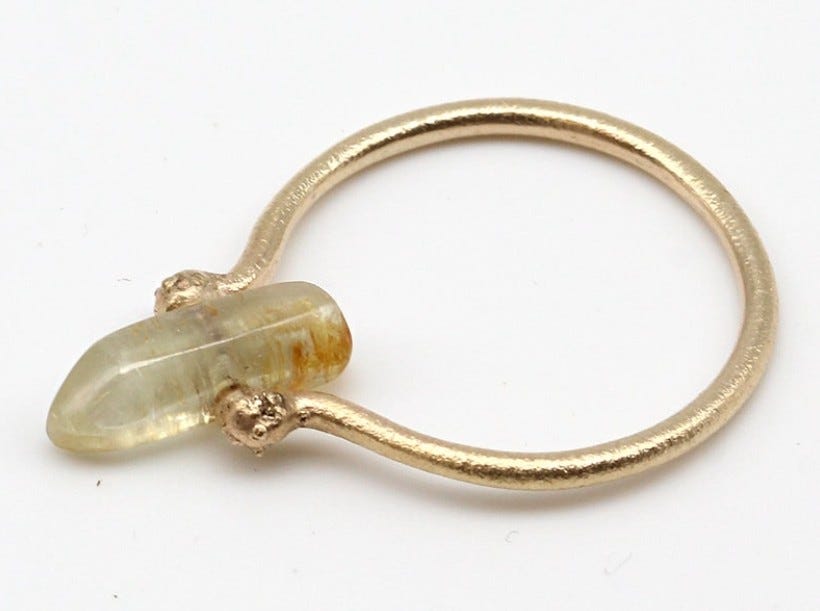
Bespoke abacus yellow gold ring with yellow sapphire, designed and made by Tamara Gomez, photo courtesy of the artist
o SMITHSONIAN TO OPEN MUSEUM OF THE AMERICAN ART JEWELER The institution will join the Air and Space and Hirshhorn museums on the National Mall in Washington, DC. Yvonne Montoya, AJF’s former executive director, has been appointed its director. “Pforzheim and Espace Solidor won’t get all the glory,” vows Montoya.
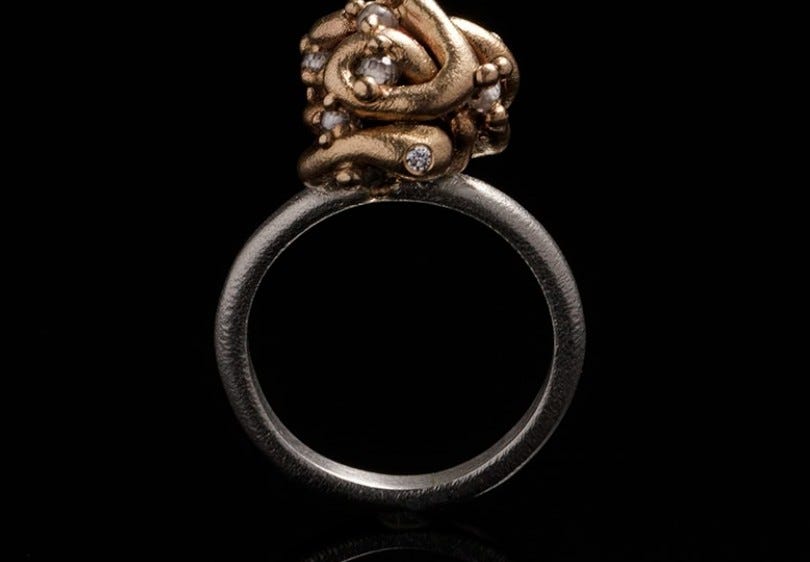
Called Scrambled Head with Glimmer of Hope, this Tamara Gomez statement ring is made with diamond, moissanite, 14-karat yellow gold, and sterling silver, photo courtesy of the artist
o NEW EXHIBITION — FOLLOW YOUR NOSE: SEPTUM RINGS OF THE POWERFUL “With this type of piercing,” said curator Naz Schnozz, “you can wear a retainer that flips up inside the nostrils. That means the public doesn’t know you have a septum ring.” Many are familiar with Madeleine Albright as a diplomat who spoke with her brooches, “but few realize she wore a septum ring in private,” added Schnozz. Besides Albright’s jewelry, the traveling exhibit features pieces worn by Angela Merkel, Emmanuel Macron, and Michelle Obama. Coming soon to a museum near you!
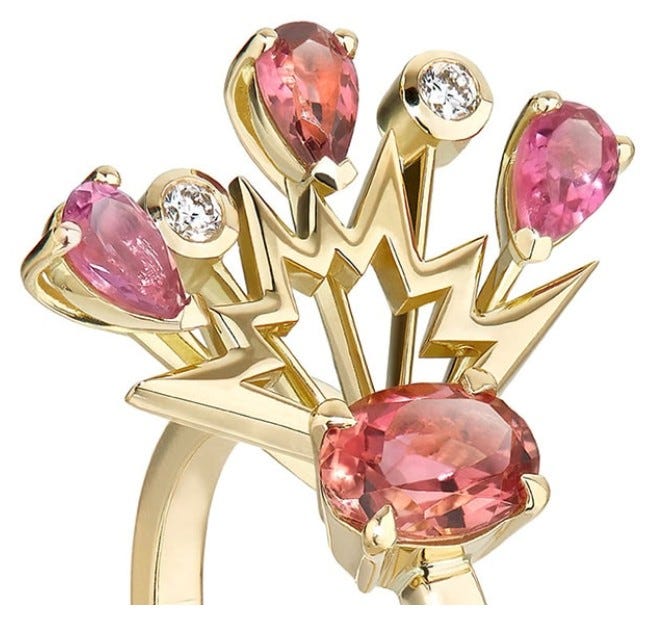
The 18-karat gold Cherrybomb ring with sapphires, diamonds, and tourmalines, designed and crafted by Aishleen Lester, photo courtesy of the artist
o KIM KARDASHIAN APPLIES TO JEWELRY MASTERS PROGRAMS She’s already done shapewear, fragrance, makeup, investing. In 2011 Kardashian launched a line of costume jewelry that let fans accessorize like her at an affordable price, but it flopped. The reality star attributed this to the baubles being kind of “basic.” Enrolling in a master’s jewelry program “will hone my understanding of jewelry theory,” says the influencer, “and help me create designs that are more critical of the beauty industry. That’s what my fans really want.” Kardashian hopes to start classes this fall and looks forward to dialog with instructors and fellow students.
Hugo Luis Johnson’s white gold and silver violin won Silver at the 2021 Goldsmiths’ Craft and Design Council Awards, photo courtesy of the artist
o ADRIAN BRODY DESIGNS LINE OF CONCRETE ART JEWELRY “My stylist has had me wearing brooches on the red carpet,” says the actor, “Her choices are pretty conventional high pieces, but they gave me an interest in jewelry as a medium. Then filming The Brutalist made me want to design my own. I asked a local contractor to show me how to make little molds and mix the cement.” Find the pieces in the MOMA gift shop.
5. Simplify your INSTAGRAM feed — some tips
📱 Simplify your Instagram feed to attract more followers.
Avoid adding text directly on images. Keep your jewelry as the main visual and use captions or separate slides for text.
If you need to include text or promotional material, make it the last slide rather than the cover image.
Promotional content, like event details or newsletter sign-ups, works better in Instagram Stories instead of your feed.
A clean, cohesive feed makes your art look more appealing and increases the likelihood of organic followers staying and engaging with your work.
📈 Boost Instagram engagement by showcasing your process.
While personal moments add depth, prioritize close-up shots of your jewelry making process, selecting materials, implementing techniques, choosing colors and other design elements. These are visually engaging & highlight skill.
Instead of vague captions, explain why your jewelry is unique. Share insights about your techniques, inspirations, and creative decisions to draw in your audience.
Start reels with attention-grabbing text like “This transformed my jewelry making” or “Here’s how I create rythm” to keep viewers watching.
Experiment with a series of reels following the same engaging format, such as “How I make jewelry [subject],” to create familiarity and encourage followers to return.
NOTE: Instagram’s algorithm now prioritizes content discovery through the Explore page and recommendations rather than hashtags.
6. FLUENCY IN JEWELRY DESIGN: Fluency and Empowerment
The fluent jewelry designer is able to think like a designer. The jewelry designer is more than a craftsperson and more than an artist. The jewelry designer must learn a specialized language, and specialized way of balancing the needs for appeal with the needs for functionality. The jewelry designer must intimately recognize and understand the roles jewelry plays for individuals as well as the society as a whole. The designer must learn how art, architecture, physical mechanics, engineering, sociology, psychology, context, even party planning, all must come together and get expressed at the point where jewelry meets the boundary of the person, that is, as the jewelry is worn.
And to gain that fluency, the designer must commit to learning a lot of vocabulary, ideas and terms, and how these imply content and meaning through expression. The designer will need to be very aware of personal thoughts and thinking as these get reflected in all the choices made in design. The designer will have to be good at anticipating the understandings and judgements of many different audiences, including the wearer, viewer, seller, buyer, exhibitor, client, collector, teacher and student.
With fluency comes empowerment. The empowered designer has a confidence that whatever needs to be done, …
9/15/2025–10/15/2025 Art Jewelry Exhibit at Pryor Gallery, Columbia State Community College My pieces will be showcased an this exhibit. In the works is a possible Seminar and a beading workshop.
WARREN FELD JEWELRY (www.warrenfeldjewelry.com) Custom Design, Workshops, Video Tutorials, Webinars, Coaching, Kits, Group Activities, Repairs ~~~~~~~~~~~~~~~~~~~~~~~ Join our community of jewelry designers on my Patreon hub Be part of a community of jewelry designers who recognize that we have a different way of thinking and doing than other types of crafters or artists. One free downloadable Mini-Lesson of your choice for all new members! ~~~~~~~~~~~~~~~~~~~~~~~
It is important up front to ask yourself, as a jewelry artist, what is more important to you: the piece of jewelry itself, or the reason why it was made? The material object? Or the idea?
The idea is about cause and effect. How the inspiration resulted in choices about colors, materials and techniques. How the artist’s intent is revealed through choices about composition, arrangements and manipulation of design elements. How the jewelry relates to the person and to the body? How the artist anticipates how others will understand whether a piece is finished and successful, and whether the piece incorporates these shared understandings into the choices made about design.
As solely a material object, the jewelry so designed shies away from resonance. It becomes something to be judged apart from the wearer. It too often gets co-opted by global forces tending towards standardization and same-old-same-old designs. The designer’s mastery is barely referenced or attended to. The designers voice is reduced to noise. The very real fear is that, with globalization, advances in technology, and standardization, the designer’s voice will no longer be needed.
Jewelry as idea fosters communication and connection between the artist and his or her various audiences. It bridges thinking. It bridges emotion. It bridges social, cultural and/or situational ties. It goes beyond simple adornment and ornamentation. It becomes interactive, and emerges from a co-dependency between artist and audience, reflective and indicative of both.
Analyzing reasons, finding connections, and conceptualizing forms, components and arrangements are the primary functions of jewelry designer survival.
Otherwise, why make jewelry? Why make something so permanent to reflect your inner motivations, efforts, even struggles, to translate inspiration into this object? Why make something wearable, especially when each piece is usually not worn all the time? Why make something that might have such an intimate relationship with the body and mind? Why make something that can have real consequences for the wearer as the jewelry is worn in social, cultural or specific situational settings?
SO YOU WANT TO BE A JEWELRY DESIGNER Merging Your Voice With Form
So You Want To Be A Jewelry Designer reinterprets how to apply techniques and modify art theories from the Jewelry Designer’s perspective. To go beyond craft, the jewelry designer needs to become literate in this discipline called Jewelry Design. Literacy means understanding how to answer the question: Why do some pieces of jewelry draw your attention, and others do not? How to develop the authentic, creative self, someone who is fluent, flexible and original. How to gain the necessary design skills and be able to apply them, whether the situation is familiar or not.
There is so much to know, and so many types of choices to make. Which clasp? Which stringing material? Which technique? Which beads, findings and components? Which strategy of construction? Which silhouette? What aesthetic you want to achieve? How you want to achieve it? Drape, movement, context, durability? How to organize and manage the design process?
And this is the essence of this book — a way to learn all the kinds of things you need to bring to bear, in order to create a wonderful and functional piece of jewelry. Whether you are just beginning your beading or jewelry making avocation, or have been beading and making jewelry awhile — time spent with the material in these segments will be very useful. You’ll learn the critical skills and ideas. You’ll learn how these inter-relate. And you’ll learn how to make better choices.
We want to gauge how the designer grows within the craft, and takes on the challenges during their professional lives. This involves an ongoing effort to merge voice and inspiration with form. Often this effort is challenging. Sometimes paralyzing. Always fulfilling and rewarding.
Jewelry design is a conversation. The conversation is ongoing, perhaps never-ending. The conversation is partly internal and partly external. The conversation is partly a reflection about process, refinement, questioning, translating feelings into form, impressions into arrangements, life influences into choice. It touches on desire. It reflects value and values. Aesthetics matter. Architecture and function matters. People matter. Context and situation matter.
Jewelry focuses attention. Inward for the artist. Outward for the wearer and viewer. In many directions socially and culturally and situationally. Jewelry is a voice which must be expressed and heard, and hopefully, responded to.
At first that voice might not find that exact fit with its audience. There is some back and forth in expression, as the jewelry is designed, refined, redesigned, and re-introduced publicly. But jewelry, and its design, have great power. They have the power to synthesize a great many voices and expectations into something exciting and resonant.
SO YOU WANT TO BE A JEWELRY DESIGNER Merging Your Voice With Form
So You Want To Be A Jewelry Designer reinterprets how to apply techniques and modify art theories from the Jewelry Designer’s perspective. To go beyond craft, the jewelry designer needs to become literate in this discipline called Jewelry Design. Literacy means understanding how to answer the question: Why do some pieces of jewelry draw your attention, and others do not? How to develop the authentic, creative self, someone who is fluent, flexible and original. How to gain the necessary design skills and be able to apply them, whether the situation is familiar or not.
Some Updates and Things Happening. (Please share this newsletter)
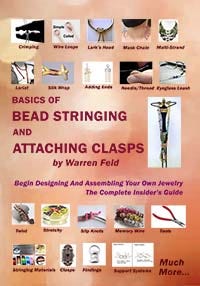
1. My most popular class was called BASICS OF BEAD STRINGING AND ATTACHING CLASPS. I turned this into a book, and expanded the chapters to include some related clinics and classes that I also taught.
In this Issue: 1. Basics of Bead Stringing and Attaching Clasps 2. Promoting Your Jewelry On Social Media: Some Tips 3. How To Market An Open Studios Event 4. Some suggestions about pricing when you have multiple audiences 5. Coreen Simpson Defined the Black Cameo by Black Women for Black Women 6. 2025 A’ Design Award, Jewelry Design Category 7. Latest question from our members — please share your comments 8. Getting that grant application to a Yes! Some articles you may have missed
I pay particular attention to architectural issues — that is, how you deal in your design with the inevitable stresses and strains placed on jewelry when worn.
Learning Bead Stringing Is More Than Putting Beads On A String And Tying On A Clasp
There is an art and skill to stringing beads. First, of course, is the selection of beads for a design, and the selection of the appropriate stringing material. Then is the selection of a clasp or closure, appropriate to the design and use of the piece.
You want your pieces to be appealing. You want them to wear well. You want someone to wear them or buy them. This means understanding the basic techniques, not only in terms of craft and art, but also with considerations about architecture, mechanics, and some sociology, anthropology and psychology.
In this book, I go into depth about: 1. Choosing stringing materials, and the pros and cons of each type 2. Choosing clasps, and the pros and cons of different clasps 3. All about the different jewelry findings and how you use them 4. Architectural considerations and how to build these into your pieces 5. How better designers use cable wires and crimp, as well as, use needle and thread to string beads 6. How best to make stretchy bracelets 7. How to make adjustable slip knots, coiled wire loops, and silk wraps 8. How to finish off the ends of thicker cords or ropes, so that you can attach a clasp 9. How to construct such projects as eyeglass leashes, mask chains, lariats, multi-strand pieces, twist multi-strand pieces, and memory wire bracelets 10. How different teaching paradigms — craft vs. art vs. design — might influence the types of choices you make
TABLE OF CONTENTS
ACKNOWLEDGEMENTS 1. INTRODUCTION 2. MATERIALS AND TOOLS 3. WORKSPACE 4. THREE TEACHING APPROACHES 5. THE DESIGN PROCESS 6. CHOOSING CLASPS 7. CHOOSING STRINGING MATERIALS 8. TWO COGNITIVE PHENOMENA 9. TYPES OF CLASPS 10. TYPES OF STRINGING MATERIALS 11. JEWELRY FINDINGS 12. HOW TO CRIMP 13. STRINGING WITH NEEDLE AND THREAD 14. ELASTIC STRING AND STRETCHY BRACELETS 15. MAKING SIMPLE AND COILED WIRE LOOPS 16. ATTACHING END PIECES TO THICKER CORDS 17. MAKING SIMPLE AND FANCY ADJUSTABLE SLIP KNOTS 18. SILK WRAP 19. EYEGLASS LEASH AND MASK CHAIN 20. LARIAT 21. MULTI-STRAND PIECES 22. TWIST MULTI-STRAND PIECES 23. MEMORY WIRE 24. FINAL WORDS OF ADVICE
2. Promoting your jewelry on social media: Some Tips
🎨 Create buzz on social media for your upcoming projects/shows:
Start sharing as soon as possible: use any existing footage in stories and reels.
Early sharing builds anticipation and allows you to experiment with what resonates.
Add voiceovers to explain why this project matters. Personal insights create emotional connections with viewers.
Natural light is best for recording. If unavailable, invest in an affordable $20 tripod (simple tools can yield beautiful videos).
Take risks with your content — when it goes well, it can go viral. When it doesn’t, you lose nothing. It’s the perfect way to learn and grow your online presence.
📱 If you wish your posts were performing better on IG, remember:
Algorithms prioritize engagement, not frequency — 1 viral post trumps 30 non-viral ones.
Use vertical/portrait format (9:16) for Reels. Avoid landscape; mobile users miss key visuals.
Short, engaging videos with multiple cuts show progression better than time-lapses.
Remove text overlapping artwork; instead, lead with finished work and show process in successive slides.
Use hooks (both visual and verbal) to draw viewers in (e.g., dramatic start or surprising technique).
Keep content dynamic — switch angles, zoom, and close-ups.
Simplify production. Think less like a filmmaker — focus on storytelling in short, direct clips.
📈 Boost your Instagram growth with storytelling…
As mentioned above, instead of polished posts or static images, show how you create your art and share the story behind it.
Process-focused content — like videos of you working on textures or unique techniques — grabs attention and keeps viewers engaged.
Pair this with storytelling or insights about your materials (like nontoxic pigments or unique inspirations) to turn informative content into mesmerizing reels.
This authentic approach will outperform paid promotions for long-term growth.
3. I have a friend who works from a studio he rents in a converted warehouse in Nashville, which also houses many other related artisan businesses. Some insights from him on how to market an open studios event.
🗣️How to market an open studios event and have successful sales conversations with collectors
Use storytelling to highlight the unique aspects of your process, such as working with invasive species leather.
Prepare materials that educate visitors about your mission and the significance of your medium.
Engage collectors with interactive displays showcasing your creative process.
Focus on conversational sales techniques — ask questions about their interests and share personalized recommendations.
Follow up with attendees post-event to nurture relationships and encourage repeat sales.
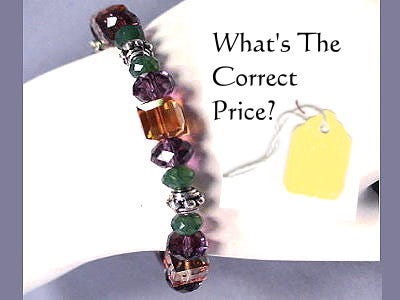
4. Some suggestions for pricing your jewelry if you are targeted multiple audiences at different income and interest points.
💰 How to price your jewelry for different buyer categories to increase overall sales
Offer a range of price points, including smaller, affordable pieces for new buyers.
Create limited edition prints to scale sales and increase accessibility without diluting exclusivity.
Price jewelry that is more “art” or uses unique materials (like leather or feathers or vintage materials and clasps) higher to reflect craftsmanship and rarity.
Consider bundling products or services (e.g., jewelry with donations to relevant causes) to appeal to conscious buyers.
Continuously evaluate pricing strategies based on collector feedback and sales data.
For some pieces, you might turn them into kits.
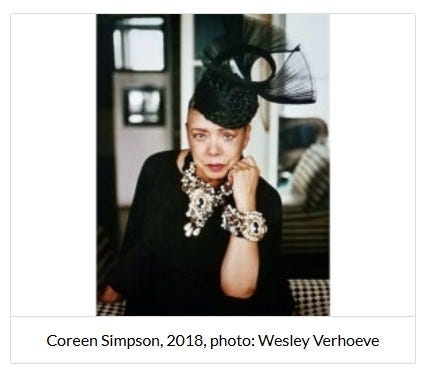
5. Coreen Simpson Defined the Black Cameo by Black Women for Black Women
Cameos have existed since ancient Egypt and play an essential role in the history of jewelry. In materials such as onyx, agate, or mother-of-pearl, which contrast with the color of the gemstone backing, the cameo acted as a miniature canvas to present carved portraits of kings, emperors, or scenes from mythology.
Yet despite the cameo’s ancient origins and its status as a classic jewelry item, the Black community has often had a complicated relationship with these pieces, especially due to a history of racist caricature in the imagery that also became associated with the cameo.
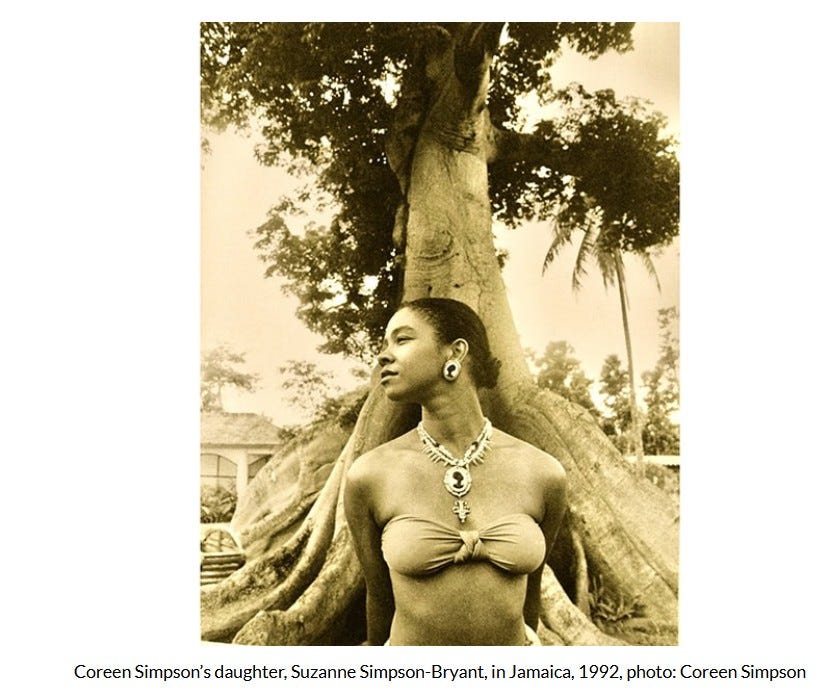
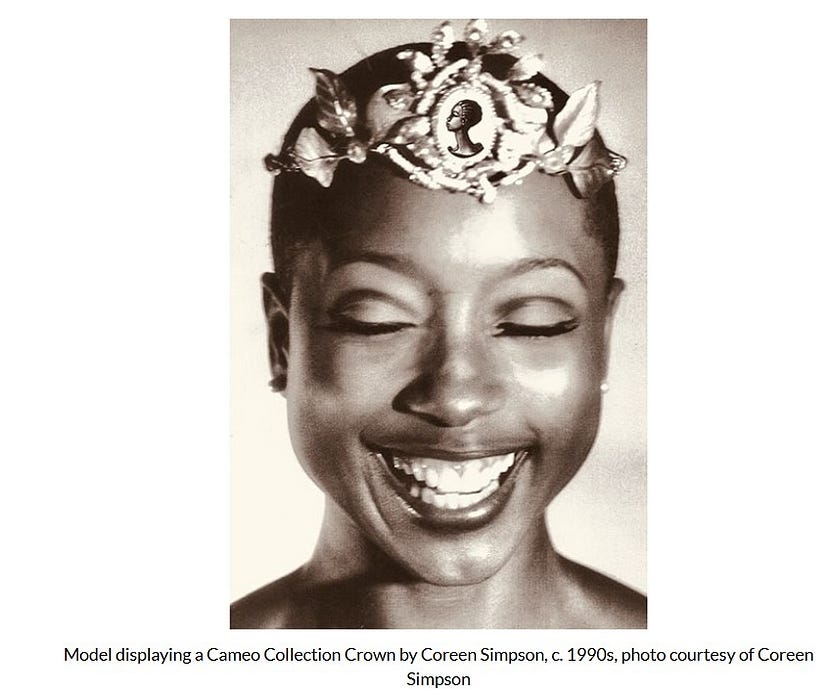
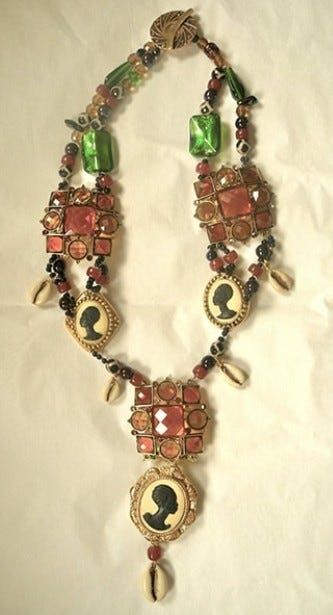
Artist Coreen Simpson wanted to explore this issue of representation by making her own American take on the cameo. In the 1990s, Simpson developed a cameo for modern Black consumers. In so doing, she built a successful company that subverted the negative historical narrative.
Her first foray into jewelry came as a product of necessity. When she tried to find the right pieces to accessorize her outfits in various stores in Paris, she was often disappointed. The jewelry just didn’t fit her aesthetic. Because of this lack of options, Simpson decided to create her own.
Simpson eventually opened a showroom in the Garment District, and she continued to experiment with “unique combinations of stones, metal, and unusual materials.” Simpson got her big break in the late 80s when, one day, as she was selling necklaces on 57th Street and Madison Avenue, close to the Henri Bendel department store, designer Carolina Herrera noticed her work and purchased 11 necklaces, which she featured in her 1988 resort collection. The journalist Renee White has also commented that publications such as Vogue described Simpson’s pieces as power necklaces, thereby cementing her position in fashion jewelry. The New York Times proclaimed her a “style maker.” Stars such as Diahann Carroll and Joan Collins were seen wearing her pieces publicly and privately.
In 1990, all of Simpson’s experimentation in jewelry culminated in the launch of the Black Cameo, her signature collection. Her first encounters with the cameo had started as she paged through fashion magazines. She saw pieces she found beautiful, but she also thought “no Black woman [was] going to wear” them. The cameos may have looked pretty, but they did not represent the cultural diversity of Black women in America.
A’ Design Award, recognizing the excellent and original design work from across the globe, is one of the highest achievements in design, a source of inspiration for award-winning designers, artists, architects, brands and design agencies. Entry and nomination is open to all from all countries. The A’ Jewelry Design Award is open to entries by Jewelry Designers, Jewelry Brands, Jewelers, Goldsmiths, Silversmiths, Gemologists, Lapidarists, Accessory Designers, Metalworkers, Artisan Jewelers, Craftspeople, Contemporary Jewelry Artists, Custom Jewelry Designers, Fine Art Jewelers, Jewelry Manufacturing Enterprises, Jewelry Brand Managers, Fashion Designers, Fashion Brands, Industrial Designers, Luxury Good Manufacturers, Jewelry Innovation, Consultancy, Research and Development Companies worldwide. Enter your work today to highlight Jewelry Excellence.
💰 If you are submitting an application for a public or private art grant…
Keep in mind that these are highly competitive: for you to stand out, you’ll have to be specific about how your work aligns with their criteria.
For your next submission:
Describe how audiences interact with your work — mention workshops, events, or participatory elements.
Clarify your concept: Use vivid language to make your vision tangible. Explain how your art fits into the public or private space your proposal is targeting
Titles and descriptions: Make them concise and impactful to quickly convey the project’s essence.
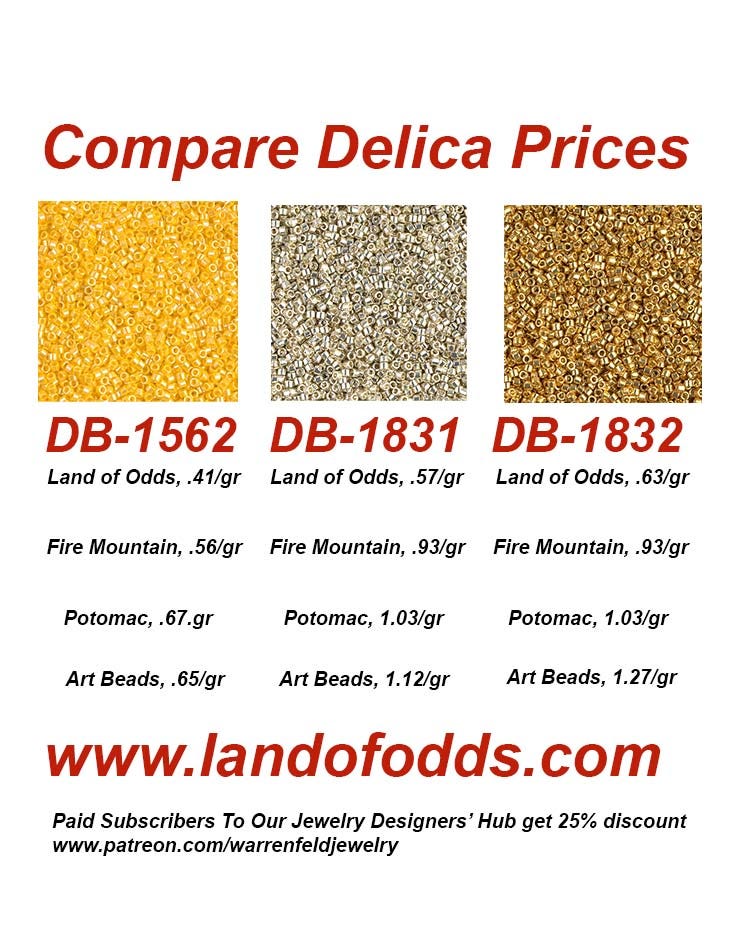
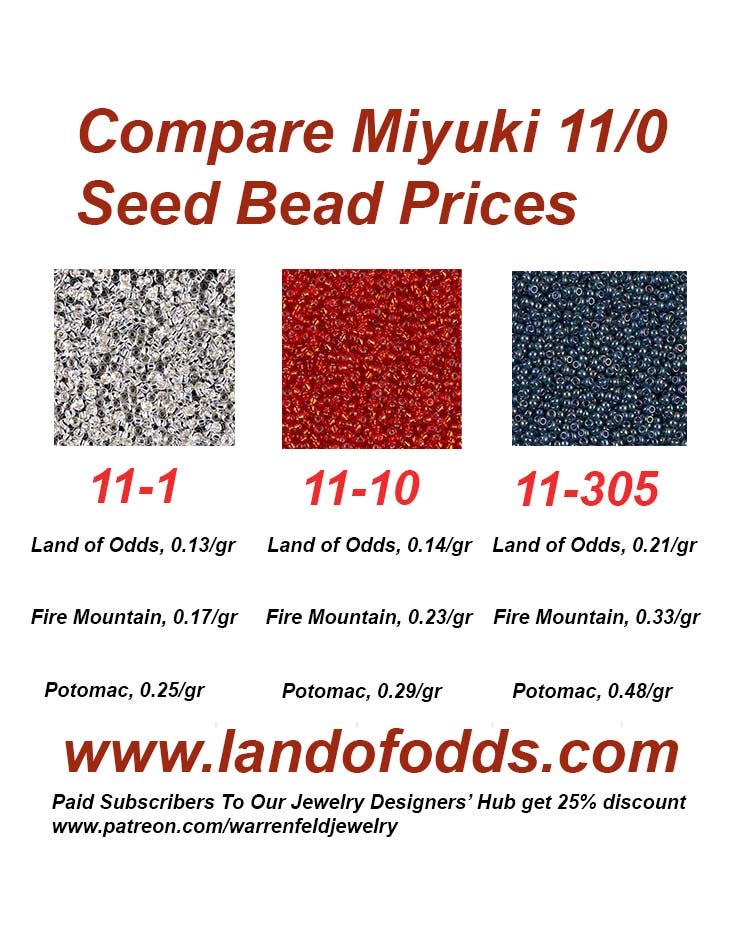
And don’t forget to use this 25% discount code throughout February at Land of Odds!! Use February’s Discount Code For Extra 25% Off @Land of Odds: FEBRUARY25 www.landofodds.com
WARREN FELD JEWELRY (www.warrenfeldjewelry.com) Custom Design, Workshops, Video Tutorials, Webinars, Coaching, Kits, Group Activities, Repairs ~~~~~~~~~~~~~~~~~~~~~~~ Join our community of jewelry designers on my Patreon hub Be part of a community of jewelry designers who recognize that we have a different way of thinking and doing than other types of crafters or artists. One free downloadable Mini-Lesson of your choice for all new members! ~~~~~~~~~~~~~~~~~~~~~~~
Long thought merely a craft, or, sometimes alternatively, a subset of art, painting and sculpture, we have begun to recognize that Jewelry Design is something more. Jewelry making encapsulates the designer’s anticipation, not only of aesthetic requirements, but also those of function and context, as well. Creating jewelry means understanding how to make strategic design choices at the boundary between jewelry and person. Translating inspirations and aspirations into designs and finished products requires an intuitive, integrative sensitivity to shared understandings brought to the design situation by the designer and all the audiences ultimately invested in the product. The better designer is able to bring a high level of coherence and consistency to the process of managing all this — shared understandings, knowledge and skills, evaluative review, and reflection and adjustment. This is called ‘fluency’ in design. For the jewelry designer, there is a defined set of concepts and principles which revolve around this disciplinary literacy — the professional way of thinking through design, production, communication, marketing, selling and critique — and how to be proficient at this. This is what this book is all about.
DISCIPLINARY LITERACY AND FLUENCY IN DESIGN
Jeremy thought that the only thing he wanted to do in life was design jewelry. He loved it. So it was not a question of “if” or “when” or “how”. But he told me it was always important not to get tricked by fashion. It was mandatory not to seek the trendy object. Not to turn away from that odd thing. And to pay very close attention to the details of how jewelry designers think, act, speak and reflect.
I thought about his advice a lot over the years of my own career as a jewelry designer. The disciplined designer needs to be attuned to the discipline way of seeing the world, understanding it, responding to it, and asserting that creative spark within it. Yes, I believe jewelry designers have a special way of thinking through selecting design elements, composing, constructing, and manipulating objects. Different than crafters. Different than artists. Different than other disciplines and their core ways of defining things and thinking things through. Different than what other disciplines use as evidence to determine if their pieces are finished and successful.
Yet jewelry design does not yet exist as an established discipline. It is claimed by art. It is claimed by craft. It is claimed by design. And each of these more established disciplines offer conflicting advice about what is expected of the designer. How should she think? How should she organize her tasks? How should she tap into her creative self? How should she select materials, techniques and technologies? How should she assert her creativity and introduce her ideas and objects to others? How much does she need to know about how and why people wear and inhabit jewelry? What impact should she strive to have on others or the more general culture and society as a whole?
In this book, I try to formulate a disciplinary literacy unique and special and legitimate for jewelry designers. Such literacy encompasses a basic vocabulary about materials, techniques, color and other design elements and rules of composition. It also includes the kinds of thinking routines and strategies jewelry designers need to know in order to be fluent, flexible and original. It includes what the jewelry designer needs to know and do when introducing their pieces publicly, either to have others wear, buy or collect their pieces.
These routines and strategies are at the heart of the designer’s knowledges, skills and understandings related to creativity, elaboration, embellishment, reflection, critique and metacognition. This disciplinary literacy in design is very similar to how sounds are made into music. This literacy is very similar to how words are made into literature. There is an underlying vocabulary and grammar to jewelry design, from decoding to comprehension to fluency. The jewelry designer is dependent upon this disciplinary literacy to the extent that she or he is able to move from inspiration to aspiration to implementation and management towards finish and success.
At the heart of this disciplinary literacy are the tools and strategies designers use to think through and make choices which optimize aesthetics and functionality within a specific context. Again, these literacy tools and strategies enable the designer to create something out of nothing, to translate inspiration into aspiration, and to influence content and meaning in context.
There are four sets of tools, routines and strategies which designers employ to determine how to create, what to create, how to know a piece is finished and how to know a piece is successful. These are,
(1) Decoding
(2) Composing, Constructing and Manipulating
(3) Expressing Intent and Content
(4) Expressing Intent and Content within a Context
You don’t become a jewelry designer to be something.
You become a jewelry designer to do something.
The question becomes: How do you learn to do that something?
How do you learn to be fluent, flexible and original in design? And develop an automaticity? And self-direction? And an ability to maneuver within new or unfamiliar situations? And a comfort when introducing your pieces in public?
We call this ‘literacy’. For the jewelry designer, literacy means developing the abilities to think like a designer. These include,
o Reading a piece of jewelry. Here you the designer are able to break down and decode a piece of jewelry into its essential graphical and design elements. This aspect of fluency and literacy is very descriptive.
o Writing a piece of jewelry. Here you the designer are able to identify, create or change the arrangement of these design elements within a composition. Fluency and literacy are very analytical.
o Expressing a piece of jewelry. Here you the designer use the design elements and principles underlying any arrangement to convey content and meaning. Fluency and literacy are very interpretive.
o Expressing a piece of jewelry in context. Here you the designer are able to anticipate, reflect upon and incorporate into your own thinking the understandings and reactions of various client groups to the piece, the degree they desire and value the piece, and whether they see the piece as finished and successful. The jewelry is introduced publicly, whether for someone to admire or wear or buy or collect. The designer comfortably moves back and forth between the objective and subjective, and the universal and the specific. The designer analyzes contextual variables, particularly the shared understandings as these relate to desire, and in line with that, thus determining value and worth. Fluency and literacy are very judgmental.
Everyone knows that anyone can put beads and other pieces together on a string and make a necklace. But can anyone make a necklace that draws attention? That evokes some kind of emotional response? That resonates with someone where they say, not merely “I like that”, but, more importantly, say “I want to wear that!” or “I want to buy that!”? Which wears well, drapes well, moves well as the person wearing it moves? Which is durable, supportive and keeps its silhouette and shape? Which doesn’t feel underdone or over done? Which is appropriate for a given context, situation, culture or society?
True, anyone can put beads on a string. But that does not make them artists or designers. From artists and designers, we expect jewelry which is something more. More than parts. More than an assemblage of colors, shapes, lines, points and other design elements. More than simple arrangements of lights and darks, rounds and squares, longs and shorts, negative and positive spaces. We expect to see the artist’s hand. We expect the jewelry to be impactful for the wearer. We expect both wearer and viewer, and seller and buyer, and exhibitor and collector, to share expectations for what makes the jewelry finished and successful.
Jewelry design is an occupation in the process of professionalization. Regrettably, this betwixt and between status means, when the designer seeks answers to questions like What goes together well?, or What would happen if?, or What would things be like if I had made different choices?, the designer still has to rely on contradictory advice and answers. Should s/he follow the Craft Approach? Or rely on Art Tradition? Or take cues from the Design Perspective? Each larger paradigm, so to speak, would take the designer in different directions. This can be confusing. Frustrating. Unsettling.
As a whole, the jewelry design profession has become strong in identifying things which go together well. There are color schemes, and proven ideas about shapes, and balance, and distribution, and proportions. But when we try to factor in the individualistic characteristics associated with the designer and his or her intent, things get muddied. And when we try to anticipate the subjective reactions of all our audiences, as we introduce our creative products into the creative marketplace, things get more muddied still. What should govern our judgments about success and failure, right and wrong? What should guide us? What can we look to for helping us answer the What would happen if or What would things be like if questions?
SO YOU WANT TO BE A JEWELRY DESIGNER Merging Your Voice With Form
So You Want To Be A Jewelry Designer reinterprets how to apply techniques and modify art theories from the Jewelry Designer’s perspective. To go beyond craft, the jewelry designer needs to become literate in this discipline called Jewelry Design. Literacy means understanding how to answer the question: Why do some pieces of jewelry draw your attention, and others do not? How to develop the authentic, creative self, someone who is fluent, flexible and original. How to gain the necessary design skills and be able to apply them, whether the situation is familiar or not.
Join my community of jewelry designers on myPatreon hub From Warren and Land of OddsUse January’s Discount Code For Extra 25% Off @Land of Odds: JANUARY25 www.landofodds.comJanuary 1, 2025Hi everyone, Some Updates and Things Happening. (Please share this newsletter)
In this Issue: 1. Trailblazers in the art jewelry scene 2. About mixing materials 3. Drilling pearls 4. Conquering the creative marketplace 5. David Szauder digital reels 6. Getting a letter of recommendation 7. Latest question from our members – please share your comments 8. Types of places which showcase jewelry for sale Some articles you may have missed Featured
1. What It Takes, Art Jewelry Forum Panel Discussion at NYCJW24 Art jeweler, educator, and AJF board member Emily Cobb moderates a panel that spotlights trailblazers in the art jewelry scene who have shaken things up with inventive collaborations and/or daring ventures. The panelists are Funlola Coker, Melanie Georgacopoulos, Roxanne Simone, and Mallory Weston.
2. I have some strong opinions about Mixing Materials. Here’s a synopsis of some of my ideas.
MATERIALS / MIXED MATERIALS
It is difficult to mix materials. The brain/eye interaction with various materials are often different, and this is unsettling for the brain. Painful. When this happens, the piece may get interpreted as unsatisfactory, not appealing, even ugly.
Example: Mixing gemstone and glass With most gemstones, the light travels from eye to surface of the material, and continues below the surface, before bouncing back to the eye. With most glass, the light travels from eye to surface of material, then bounces back. It does not penetrate the surface. When mixing gemstone and glass, if the brain/material interaction requires a shift in physical perception, then this is often painful for the brain. If using gemstones, where the light penetrates below surface before bouncing back, then I’d choose a translucent glass bead where this physical perceptual activity mirrors that of the gemstone.
Let’s continue and take the example of an Opal bead. With opals, the light penetrates below surface, interacts with movement (fire), then bounces back to eye. If adding glass, I’d add silver lined translucent glass beads to mirror this effect. Light penetrates below surface, silver is a mirroring/shimmering effect which creates some of that movement below the surface.
If I had added silver lined transparent glass bead, the light would hit the surface and bounce back, with the silver lining creating a mirroring effect primarily reflecting back the color of the glass, but this would not duplicate the shimmering effect had the glass been translucent.
Now say I added an opaque black bead between each opal bead. The bead would have to be very small in proportion to the opal bead. I call this framing. If small enough, this would kick in the GESTALT cognitive behavior of the brain. It sees a ‘gap’, not a black glass bead, and fills in the space as if something similar to the opal bead were there. The Gestalt overrides the perceptual effects. However, if the black glass bead takes up too much volume relative to the opal bead, then the brain has to deal with the perceptual anomaly of light bouncing back and forth in different ways, which is painful for the brain. The Gestalt effect would not kick in.
Aesthetic Materials: Sensations and Symbolism Materials have sensory and symbolic powers which extend beyond the materials themselves. Obviously, this can be very subjective. It might have psychological roots, sociological roots and/or cultural roots.
Things may feel warm, cold, soft, rough, oily, weighty. Things may represent romance, power, membership, religiosity, status. Vanderbilt University’s colors are gold and black, so using those colors in the Nashville, TN area might evoke a different emotional response than when used elsewhere. And here’s that very-difficult-to-design-with University of Tennessee orange, again, in the Nashville area will evoke a very different response than elsewhere.
Materials like amber and bone and crystal are things people like to touch, not just look at. The sensation extends beyond the visual grammar.
The surface of a material has many characteristics which the jewelry designer leverages within the finished piece. Light might reflect off this surface, such as with opaque glass or shiny metal. Light might be brought into and below the surface before reflected back, such as with many gemstones and opalescent glass. Light might refract through the piece at different angles, even creating a prism effect.
The surface might be a solid color. It might be a mix of colors. It might be matte. It may have inclusions or markings. It may have fired on coloration effects. There may be tonal differences. There may be pattern or textural differences. It may have movement. It may have depth.
Best combine the materialistic qualities with the non-materialistic qualities of the project Every material has two over-arching qualities. The obvious is its physical properties and physicality. Let’s call this materialistic. It is something that is measurable. In the realm of the mystic, it is ordinary or profane.
But the material also has qualities that extend beyond this. They can be sensory. They can be symbolic. They can be psychological. They can be contextual. Let’s call this non-materialistic. It is something that is non-measurable. In the realm of the mystic, it is extraordinary and sacred.
Both properties must be considered when designing a piece of jewelry. They have equal importance, when selecting, placing and arranging materials and design elements within a piece.
Example: Take a Chakra bracelet strung on cable wire with a clasp. The beads used are gemstones. Each gemstone has spiritual and healing properties. Each gemstone has a coloration, and each different coloration, too, is associated with certain spiritual and healing properties. Moreover, every individual has their own unique needs for which set of gemstones and which assortment of colorations are best and most appropriate. This can get even more complicated in that each situation and context may have its own requirements. The person may end up needing several Chakra bracelets for different occasions. The designer could have used glass or acrylic beads, instead, which have less non-materialistic value, and might be less durable over time. The designer could have strung the beads on elastic string without using a clasp, again, less non-materialistic value and durability.
When mixing materials, it is best to let one material predominate.
3. A NOTE ABOUT DRILLING PEARL HOLES TO MAKE THEM LARGERPearls typically have very small holes. Because of how they are often drilled, the hole on one side is slightly larger than the hole on the other. The holes are small because it is too easy to chip and crack the nacre around the holes, when drilling them.You can, however, make the holes a little larger. You could first try to use a hand-held or battery-operated bead reamer to make the holes in your pearls larger. You want your drill bits to be diamond coated. Sometimes this might work, but more often, you need something more powerful.More likely you will want to use a dremel, with carbide steel drill bits.Usually, your drill bits need to be between .5mm (1/50”) and .7mm (3/50”), with .5mm the most common.With some natural pearls, however, you may need drill bits to be between .3mm (1/100”) and .45mm (1.6/100”).For a large hole, you would want drill bits to be between 1.0mm and 2.0mm.I keep a set of carbide drill bills between .4mm and 1.2mm.You want to work slowly but steadily.Wear safety goggles. Pearl dust can adversely affect your eyesight.Until the 1970s, pearl holes were typically drilled by hand. Pearl companies from Japan would often have boys in India drill holes in pearls. They would hire and train boys who were 9 years old. By the time the boys were 14, many had lost their eyesight. Thankfully, with the advent of mechanized ways to drill pearls, this practice no longer continues today.
4. I have advised so many students and clients about taking their jewelry making to the creative marketplace and becoming a successful entrepreneur. In this book, CONQUERING THE CREATIVE MARKETPLACE, I summarized all my advice. 548pp, many images and diagrams Kindle or Ebook or Print
HOW DREAMS ARE MADE BETWEEN THE FICKLENESS OF BUSINESS AND THE PURSUIT OF JEWELRY DESIGN
This guidebook is a must-have for anyone serious about making money selling jewelry. I focus on straightforward, workable strategies for integrating business practices with the creative design process. These strategies make balancing your creative self with your productive self easier and more fluid.
Based both on the creation and development of my own jewelry design business, as well as teaching countless students over the past 35+ years about business and craft, I address what should be some of your key concerns and uncertainties. I help you plan your road map. Whether you are a hobbyist or a self-supporting business, success as a jewelry designer involves many things to think about, know and do. I share with you the kinds of things it takes to start your own jewelry business, run it, anticipate risks and rewards, and lead it to a level of success you feel is right for you, including
• Getting Started: Naming business, identifying resources, protecting intellectual property • Financial Management: basic accounting, break even analysis, understanding risk-reward-return on investment, inventory management • Product Development: identifying target market, specifying product attributes, developing jewelry line, production, distribution, pricing, launching • Marketing, Promoting, Branding: competitor analysis, developing message, establishing emotional connections to your products, social media marketing • Selling: linking product to buyer among many venues, such as store, department store, online, trunk show, home show, trade show, sales reps and showrooms, catalogs, TV shopping, galleries, advertising, cold calling, making the pitch • Resiliency: building business, professional and psychological resiliency • Professional Responsibilities: preparing artist statement, portfolio, look book, resume, biographical sketch, profile, FAQ, self-care
TABLE OF CONTENTS
ACKNOWLEDGEMENTS 1. AN INTRODUCTION: CONQUERING THE CREATIVE MARKETPLACE
2. THREADING THE BUSINESS NEEDLE 3. Where Can I Sell My Jewelry? 4. Can I Make Money? 5. Why Designers Fail in Business
6. DISCIPLINARY LITERACY IN THE CREATIVE MARKETPLACE
7. GETTING STARTED IN BUSINESS 8. Write A Business Audit Memorandum To Self 9. Your Getting Started Story 10. Naming Your Business 11. Protecting Your Business Name and Other Intellectual Property 12. Tag Line, Descriptions, Naming Jewelry, Story, Elevator Pitch 13. What Do I Need To Become Official? 14. What Form of Business? 15. Retail, Wholesale, Consignment 16. Your Business Model 17. Custom Work
18. FINANCIAL MANAGEMENT AND RETURN ON INVESTMENT 19. Understanding Risk and Reward 20. Tracking Costs and Revenues With Bookkeeping and General Accounting 21. Other Record Keeping 22. Fixed and Variable Costs, Budgeting, Break Even Analysis 23. Managing Inventory 24. Efficiency, Effectiveness, Component Design Systems 25. Employees and Independent Contractors 26. Banking, Insurance, Credit Card Processing 27. Getting Terms 28. Getting Paid 29. Developing a Growth Mindset 30. Crowd Funding
31. PRODUCT DEVELOPMENT 32. Product Goals 33. Product Target Market / Market Niche 34. Product Design Management and Design Coherency 35. Build A Distinctive Line Of Jewelry 36. Product Production 37. Product Distribution 38. Product Marketing, Promotion and Positioning 39. Product Pricing 40. Product Launch 41. Product Feedback and Evaluation
42. MARKETING / PROMOTION / POSITIONING 43. Finding Your Target Market 44. Competitor Analysis 45. Fashion and Consumption 46. Influence and Persuasion 47. Marketing Strategies 48. Social Media Marketing 49. Collaborating With Influencers 50. Increasing Credibility and Legitimacy 51. Building Your BRAND 52. Self Promotion and Raising Your Visibility 53. Writing A Press Release and Preparing For Reporters
54. SELLING 55. How Will You Link Up Your Product To Your Buyer? 56. Knowing Your Competitive Advantages 57. Training and Educating The Customer 58. Selling At Art And Craft Shows 59. Selling Online 60. Selling In Local Shops, Boutiques and Department Stores 61. Consignment 62. Selling In Galleries 63. Selling At Home Shows 64. Selling At Trunk Shows 65. Selling At Jewelry Making Parties 66. Selling Through Mail Order Catalogs 67. Selling On TV Shopping Sites and Streamed Web 68. Selling Through A Mobile Truck Business 69. Advertising 70. Cold Calling And Making The Pitch 71. Working with Sales Reps, Agencies, and Show Rooms 72. Selling At Trade Shows 73. Teaching Classes and Selling Patterns and Kits 74. Other Selling Venues 75. About Contracts and Agreements 76. Overcoming Setbacks and Fears of Rejection 77. Relying On Other People To Sell Your Jewelry 78. Saying Goodbye To Your Jewelry 79. Merchandising and Display 80. DesignerConnect – Interview With Tony Perrin
81. RESLILIENCY
82. PROFESSIONAL RESPONSIBILITIES 83. Artist Statement 84. Portfolio and Look Book 85. Biographical Sketch and Profile 86. Resume or Curriculum Vitae 87. Certificate of Authenticity 88. FAQ: Frequently Asked Questions 89. Self Care
About Warren Feld, Jewelry Designer Thank You and Request For Reviews Other Articles and Tutorials
5. Although this has nothing to do with jewelry per se, this guy’s (David Szauder) digital reels on instagram are so phenomenal, I wanted to share them with you. https://www.instagram.com/davidszauder/
6. There will be occasions where you might need a letter of recommendation. There will be occasions where you might need a letter of recommendation. You might be applying for a grant or some other source of funding. You might be trying to get your pieces into a gallery or high-end boutique. You might be submitting a piece to a juried competition. You might be searching for a partnership or collaboration or guidance. You might request this letter from a mentor, a colleague, someone familiar with your work, or a gallery or boutique owner. You want that person, in the context of that letter, to refer to your competitive advantage. That is how you differentiate yourself from other jewelry designers. It suggests that taking a risk on showing/selling your works is worthwhile. Some examples of describing your competitive advantages:innovative, originality, differentiationsells well, clear and predictable client baseexperimenting with new materials, techniques or technologiesresponsible, always timely, communicates well with client during processopen and willing to learn, adaptable, flexibleContinue reading this article on our Jewelry Designers’ Hub.
8. I am often asked where you can showcase your jewelry for sale. There’s the obvious: Boutiques.
Then the less obvious: Beauty parlor (usually the law prevents jewelry sales, except in a separate lobby waiting area) Nail salon (usually the law prevents jewelry sales, except in a separate lobby waiting area) Spa, massage shop, tattoo shop Hotel lobby gift shop Museum, art center gift shop Farmer’s markets Art and craft shows Holiday markets Antique stores Libraries Flea markets Art galleries
Where it becomes worth your while, you want to showcase your jewelry in places your typical “client” would go to, but not where it is stressful, like a doctor’s office.
At the least, you want to maximize your exposure.
Ask the business owner to host a reception where their customers could meet you. This is a win-win. The business gets to build better relationships with their clients, and you get exposure.
Assess how secure your pieces will be, and whether you can live with whatever security there might be.Be sure to post statements about your inspiration and creative process with each piece of art. Have business cards there.
Be sure there are obvious ways a person can find you outside of this business. Be sure it is obvious how someone can purchase any of your pieces.Set a time limit for showcasing at this business. 1-3 months is a good framework. If there is a lot of interest in your work, you can repeat with another exhibit.
Check in on the display regularly to make sure your haven’t run out of promotional materials, like your business cards, and that things are still displayed well.Determine what percent of sales will go to the business and what percent to you. Best arrangements: 60-40, 50-50, 40-60. When the arrangement is outside this range, this is a yellow flag indicating that your exposure (and sales) probably is not worth the risk of your time, resources and energy.
WARREN FELD JEWELRY (www.warrenfeldjewelry.com) Custom Design, Workshops, Video Tutorials, Webinars, Coaching, Kits, Group Activities, Repairs ~~~~~~~~~~~~~~~~~~~~~~~ Join our community of jewelry designers on myPatreon hub Be part of a community of jewelry designers who recognize that we have a different way of thinking and doing than other types of crafters or artists. One free downloadable Mini-Lesson of your choice for all new members! ~~~~~~~~~~~~~~~~~~~~~~~
Add your email address to my Warren Feld Jewelry emailing listhere.
Thanks for being here. I look forward to sharing more resources, tips, sources of inspiration and insights with you.Join A Community Of Jewelry Designers On MyPatreon Hub