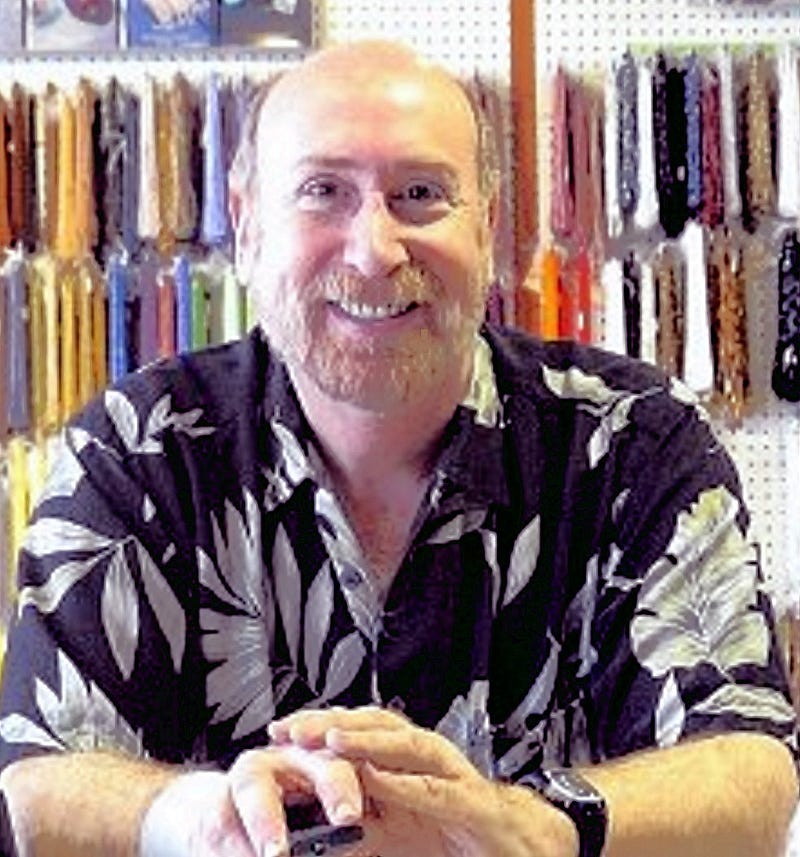
Guiding Questions? 1. How do I write a Biographical Sketch or Profile? 2. Does a biographical sketch replace or compliment a person’s resume?
Keywords: biographical sketch profile resume connection avatar 1st person vs. 3rd person voice
The Biographical Sketch or Profile
Your customers, your sales venues, your clients all love stories, and they want to know yours. Your story might be a profile on a social media site. It might be a synopsis on the back of your portfolio or print book on demand. It might be part of a grant or art show application.
You will want to create several versions of varying lengths, but all basically highlighting the same information. I suggest creating versions which are 25 words, 50 words, 100 words, 250 words, 500 words. Your first 25 words should sound fun, intriguing, exciting, enticing, creating wonder and curiosity … you get the point.
Do not follow a template. You want your bio or profile to feel authentically your own.
Write your bio for a portfolio in the 3rd person. Write your profile for a social media site (think Facebook) targeted at family and friends in the 1st person. Write your profile for a social media site (think LinkedIn) targeted at potential employers in the 3rd person.
Within your Sketch or Profile, you will want to anticipate what people will be curious about. When someone first sees your jewelry, they will try to understand it, categorize it, emotionally connect to it. The greater the connection, the more likely the sale. How well has your bio helped them?
Your bio or profile is not your resume. It is not a listing of things. It will only touch on some things, and not all things, you might include in a resume. It is a story about you and your work. You might highlight a particular product, achievement or contribution as a way of illustrating the points you are making in your bio or profile.
Things to help people make that connection will include,
· Your name
· How you got started
· Where you are from
· How long you have been making jewelry
· Your style preferences
· Where can they find and buy your work
· Your inspirations and aspirations
· Techniques and technologies
· Materials used
· Who taught you; where did you learn your craft?
· Your career development
· Awards won, certifications, exhibitions, where to find your work
· Reviews, testimonials, what others think about your work, collectors
Avoid vague statements like “innovative approach” or “original” without context — use specific influences, techniques, and themes instead.
An Avatar
An Avatar is a digital image that represents you. Avatars are relatively small and usually are placed at the top left or right corner of web pages which represent your work, such as an article you have written or a video tutorial you offer.
The Avatar may be an image of yourself, typically a head shot. It might be an image of a favorite piece of jewelry. It might be your logo. It might be an animation representative of you and your business.
Remember that the space is limited in size. It may be a circle or an oval, rather than a square or rectangle. This means you will need to center the image to its advantage.
There are avatar generators online. Or you can make your own from scratch.
_________________
FOOTNOTES
Patkar, Mihir. The 8 Best Avatar Maker Sites for Profile Pictures. 4/27/22.
This guidebook is a must-have for anyone serious about making money selling jewelry. I focus on straightforward, workable strategies for integrating business practices with the creative design process. These strategies make balancing your creative self with your productive self easier and more fluid.
Based both on the creation and development of my own jewelry design business, as well as teaching countless students over the past 35+ years about business and craft, I address what should be some of your key concerns and uncertainties. I help you plan your road map. Whether you are a hobbyist or a self-supporting business, success as a jewelry designer involves many things to think about, know and do. I share with you the kinds of things it takes to start your own jewelry business, run it, anticipate risks and rewards, and lead it to a level of success you feel is right for you, including
• Getting Started: Naming business, identifying resources, protecting intellectual property • Financial Management: basic accounting, break even analysis, understanding risk-reward-return on investment, inventory management • Product Development: identifying target market, specifying product attributes, developing jewelry line, production, distribution, pricing, launching • Marketing, Promoting, Branding: competitor analysis, developing message, establishing emotional connections to your products, social media marketing • Selling: linking product to buyer among many venues, such as store, department store, online, trunk show, home show, trade show, sales reps and showrooms, catalogs, TV shopping, galleries, advertising, cold calling, making the pitch • Resiliency: building business, professional and psychological resiliency • Professional Responsibilities: preparing artist statement, portfolio, look book, resume, biographical sketch, profile, FAQ, self-care
There will be occasions where you might need a letter of recommendation. You might be applying for a grant or some other source of funding. You might be trying to get your pieces into a gallery or high-end boutique. You might be submitting a piece to a juried competition. You might be searching for a partnership or collaboration or guidance.
You might request this letter from a mentor, a colleague, someone familiar with your work, or a gallery or boutique owner.
You want that person, in the context of that letter, to refer to your competitive advantage. That is how you differentiate yourself from other jewelry designers. It suggests that taking a risk on showing/selling your works is worthwhile. Some examples of describing your competitive advantages:
1. innovative, originality, differentiation
2. sells well, clear and predictable client base
3. experimenting with new materials, techniques or technologies
4. responsible, always timely, communicates well with client during process
5. open and willing to learn, adaptable, flexible
You want to clearly explain to that person, before they write that letter of recommendation, what you personally want to get from the opportunity. It might include such things as new clients, more sales, representation, becoming a part of an agency, test out new ideas, and such.
If the person you are requesting your letter from has never written one before, feel free to show them this template👇
I am very familiar with [your name’s] jewelry design pieces, and I know you will be as excited with them as I am. In discussions over the years with [your name], I have seen (her/him) grow and develop as a designer. I have watched (her/him) explore, investigate and experiment with colors, compositions and techniques. We have discussed various opportunities and their pros and cons for [sales, exhibits, demonstrations, whatever you want to happen at the other end.]
[Your name’s] pieces generate a great interest among [her/his] clients. [She/he] shows an intuitive sense of color and composition, meeting goals both of appeal as well as functionality. [Her/his pieces sell well / are original / other competitive advantage]. [Her/his] workmanship is impeccable. [She or he seeks from the target audience what outcome.] [Working with you / achieving funding / other outcome] would be incredibly beneficial to [her/him], and make a great different in [her/his] continued development as a jewelry designer.
For more articles about CONQUERING THE CREATIVE MARKETPLACE, click over to our Jewelry Designers’ Hub
There are so many different kinds of things you can do business-wise to promote your jewelry designs. Post on every social media site. Conduct several email campaigns. Take out ads. Create websites. However, all these can get overwhelming and begin to impede on your time and energy for creating jewelry. To prevent this, it is important to be organized. It is important to rely on more limited, predictable, easily accessible, repeatable systems of things you need to do to sustain both your jewelry designing and your business.
Some key business-related goals involve:
(1) Impression management
(2) Mentoring
(3) Audience recruitment and retention
(4) Networking and Partnering
(5) Selling
Some caveats:
(a) To create that manageability’ you want to do as much as you can from your computer
(b) In reality, selling actual pieces of jewelry, on average, only covers about 1/3 of your sustainability needs. You may have to take on additional work, and it makes the most sense that the work relate to jewelry designing.
(c) You are in the trust-creating business. You must be able to establish instant trust about the value of your work and the desirability of your work for your core buying audience.
Impression management
What impression does someone get from interacting with you, either online or in-person or through some other point-of-sale? To what degree can you influence and control this impression? Key things to consider:
o Website
o Email Etiquette
o Cold Calling
o Follow Through
Website. You want a professional website. This website will showcase your products. It will be home to lots of well-organized and accessible information, including: your bio, your art statement, your portfolio, testimonials, links to articles you have written, perhaps a creative-focused resume, and images of your work.
It might showcase shorter videos showing you at work, or delving into a particular work.
It will have links to your various social media pages. The layout, design and information presentation across social media sites needs to be very consistent across all your platforms. You should maintain separate pages for each social media for business vs. personal. You do not want anything personal to come up in your business page feed.
It may or may not have a shopping cart system attached. If not, then you need to make clear other alternatives for how people can buy your products from you.
It will have a FAQ page detailing contact information, purchasing and return policies, payment methods, any privacy concerns.
It will have a clear way for people to add their names to your mailing list.
Email Etiquette. It is critical to generate an email list of customers/potential customers. You want them to very formally and visibly opt-in to the list. You can generate sign-up sheets, online forms, and the like towards this end. You can also segment your list into smaller, targeted groups.
Email will be your best, primary and most powerful networking tool.
You can run your own email campaigns, or use an email client like MAILCHIMP (https://mailchimp.com) or CONSTANT CONTACT (https://www.constantcontact.com). I would suggest using an email client. This will prevent your own email address from getting blocked by the internet-powers-that-be as spam.
Each time you get someone’s email address to add to your list, send them a special email, thanking them. Also direct them to your website or online presence, such as on social media, with an active link.
A monthly contact is reasonable.
Caution: many anti-spam programs reject email addresses that begin with Info, Contact, Shop, Store, Help and other very generic terms.
In writing and tone, be professional. Don’t use the kind of quick texts or posts you might use on social media.
You do not want your email to appear that it is wasting anyone’s time. Use a polite greeting and closing. In your first sentence or two be very clear in conveying why you are writing this email specifically to them. Don’t ramble. Get to your points quickly. Don’t use long blocks of texts. Segment/section things and use subheadings throughout. You want the email to be scannable. Don’t use any or many images. None to two images would be more than enough. Wait to share images until after someone requests to see them. Do, however, include an active link to where they might find images of your works online.
To the best you can, personalize things as much as possible. Direct the email to a named person. Make things sound as if you are not sending out the same email to a long list of contacts.
Some examples of personalized phrasing:
o I visited your shop recently, and
o So and so suggested I contact you,
o I visited your website,
o I read about you in such-and-such magazine,
Cold Calling. With cold calling, you have two basic strategies: (a) Shoehorn, or (b) Direct. Whatever approach you use, be sure to have done some research about your target store/gallery, the designers they represent, a sense of preferred style and looks, and the characteristics of their primary customer audience.
With a shoehorn strategy, you begin to ease yourself into the world and universe of a particular store or gallery. You visit as a customer and ask questions. You contact and talk with other artists represented in the store. You participate in open houses and other events. You add your name to their emailing list. You begin to have more and longer conversations with the owner. Gradually you introduce the idea of having your jewelry represented in their venue. Always wear one or more pieces of your jewelry.
With a direct approach, you come into the store unannounced. Hopefully the owner is there then; otherwise, ask the staff when the best time to return is. Always wear one or more pieces of your jewelry. Be prepared with about 20 pieces, nicely organized and displayed in trays, that, if you are making headway, you can bring into the venue with you. It is also OK, if you have the inventory, to have even more pieces in your car that you can bring in, if it seems the owner is interested in purchasing some things.
If you are unable to visit in person, then send a letter. Don’t phone first. It is too easy for the store to ignore you. In your letter, keep it short and to the point. Establish your credibility as a designer, and clearly identify the fit between your work and their customer base. Sound authentic, not sales’y. Write about,
o Who you are
o Your style and design sense
o Why you think your jewelry would be a good fit for their customer base
o The materials and techniques you typically use
o Your previous experience selling your pieces
o Some sheets showing inventory, description, pricing
o End with a phrase like, “I’d like to get together with you to show my work in person. I will call you to set up an appointment, if interested.”
o Add links to your website of places which show your jewelry.
Follow Through. Be very clear about this: You are not an information-sharer. Rather, you are a relationship builder. Sending out emails, posting on line, targeting letters, cold calling are all tools you use to build relationships. Relationships are built up by sharing understandings, not necessarily tid-bits of information. These understandings have to do with values, desires, assumptions, expectations, and perceptions. The more you establish shared understandings — and that does not mean having to have the same opinions — the tighter and more productive these relationships get.
If you are wanting a response to something from someone, and it’s not forthcoming in a reasonable time, follow up with that person.
If you have visited a store/gallery and had some conversation with someone there, follow up with a thank you note or some note that continues something about your conversation.
If someone sends you a comment about you or your work, send them a thank you note.
In your follow-ups, repeat the name of the person you are following up with.
Provide additional valuable information in your follow-up conversations.
Mentoring
Share your art/designer skills for a fee. You can teach classes or one-on-one. You can create instructional projects or tutorials. You can write articles. You can curate shows. You can become a coach. You can conduct online webinars.
Things have synergistic effects — they amplify other things you are doing. Mentoring will result in a larger, more targeted email list. Students will look for all the mentoring activities you do. Students often will buy your pieces. Mentoring will increase the number of topics you can talk about when networking.
Keep your initial goal simple: Aim to attract 5 students, interacting with them 1–4x each month, encouraging them to spend $50–250/student per month on your mentoring activities and product sales.
Audience recruitment and retention
What is most important about recruiting and retaining audience members is not the numbers of contacts, but the quality of your engagement with your contacts. Again, success is a matter of forming and sustaining one-on-one relationships. When you have relationships, it becomes much easier to ask for favors. On a regular basis, you can create content, for free, shared through emails, which helps you connect and form relationships with your core audience.
You don’t necessarily need 1000’s of people in your core audience. More likely, having 30–100 regular buyers of your work would suffice. This allows keeping connected and creating connections with your core audience much more attainable. Know what this limited group of buyers is looking for. Know where they hang out and where to find them. Offer them opportunities to interact with you and your jewelry, such as offering them a first look, or a time to watch you and learn a few design techniques as you work. Turn these buyers into true fans.
Think about:
o What does this core buyer care about?
o What does this buyer read?
o Where do you find this buyer?
o What resonates with this buyer?
Answers to these questions could help you shape your marketing message when explaining how your jewelry could elevate this buyer’s life. Inspiring your buyer. Building trust. Note: you are not creating jewelry for this buyer per se; rather, given the jewelry you are creating and want to create, this assists you in finding that audience who might share your values and understandings as expressed within your designs and by you as an authentic jewelry designer.
Networking and Partnering
When networking and partnering, you uncover more opportunities at less risk and cost to yourself, your creative energy, and your business fundamentals. There’s less effort to find opportunities. Less effort to put plans and projects into effect. Less effort to get visibility. Less effort to make a sale.
It might be useful to set a goal as making 3 networking contacts per week. Use your network to get help in creating these pitches. Make them shared pitches. Use the shared pitches to introduce yourself to their audiences, and conversely their products to your own audience.
Caveat: Always direct people to specific webpages relevant to any pitch. Do not direct them to your home page on your website.
Selling
As a jewelry designer, your self-concept is most likely one as an artist. But when you are in business, you need to expand this a bit and see yourself as both an artist and a salesperson. If this makes you feel a bit uncomfortable, it’s understandable, but you need to get over it. Jewelry doesn’t sell itself.
You want to always have on hand 15–20 coherent pieces available for sale. They need to feel as if they are part of a line of jewelry, with a similar emotional appeal to a defined target audience.
You want to have a list of about 50 places you could approach to carry your jewelry. Then you work the list, perhaps 3 contacts a week. Prioritize your contacts. Begin your process with your lower priority contacts so that you can gain some experience in presenting yourself and your products before approaching your most desired sites.
You do not close a sale. Keeping with a key theme of advice: You create a relationship. You are not selling a product. You are guiding someone, in a caring way, to come to understand how your jewelry might enhance and enrich their lives. You want them to make a buying decision that will be good for themselves. You are not trying to get something from them; rather, you are trying to give them something which will positively impact their lives. Your key skill here when selling is empathy.
Be bold and confident when introducing yourself.
Always ask the person you are talking with what their name is; repeat their name several times while speaking with them.
Ask a lot of questions; show interest in the client or customer. Get them talking about themselves. You should be talking about 25% of the time and your client/customer should be talking about 75% of the time.
A great story about your jewelry will sell it. They are especially interested in your inspiration, as well as your process for creating jewelry.
Don’t let your client/customer get away without at least asking them if they have any interested in purchasing your jewelry. Even if that person says No!, you would be in a better position than if you had not asked.
Final Words
Don’t let the business aspects of succeeding in jewelry design kill your creative spark. Instead, make each broad business goal into a set series of systematic, repeatable activities.
As you can see, much of all this effort can be done from your studio on your computer. This will save you vast amounts of time which you can devote to the creative side of your life. Less time jewelry marketing. More time jewelry making. The end results of these activities should be increased exposure, relationships and engagements.
The most successful designers have
o Step-by-step plans
o Associations with expertise
o Become a part of a peer audience and community
Make your jewelry design journey flourish. Take ownership over it — how you spend your time, energy and the use of resources around you. Put everything to best use to attain your own highest values.
__________________________________
I hope you found this article useful. Please consider sharing.
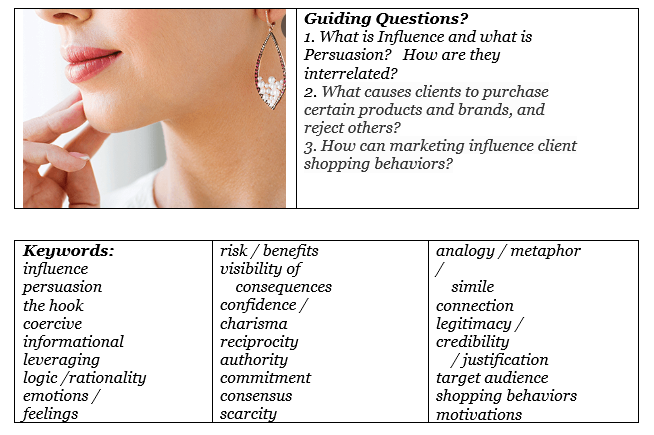
Designers need to get the approval of and payment from their clients. That means the client has to recognize and share the choices the designer made when creating the piece of jewelry. It all comes down to two aspects of marketing: persuasion and influence. Marketing is about creating persuasive arguments which can influence a person’s beliefs, attitudes, motivations, intentions and behaviors. Influence comes with knowing what the best outcome that the marketer should seek. Persuasion includes the tools you use to get there. Persuasion can take many forms. The marketer’s success depends on a handful of persuasive factors. Marketing strategies follow one or more of eight universal principles of persuasion. Information within any successful persuasive argument is best presented in a certain order.
Influence and Persuasion
Marketing is about creating persuasive arguments which can influence a person’s beliefs, attitudes, motivations, intentions and behaviors. The marketer wants to be able to persuade the client to focus their attention on the jewelry product line, to approach it, touch it, try it on, buy it, exhibit it, share it with others, then, moreover, to further persuade these others (thus making the marketing message contagious) to want to buy it. Influence comes with knowing what the best outcome that the marketer should seek. Persuasion includes the tools you use to get there.
When we are trying to persuade someone, we might be trying to get them to change their mind about something. We might want them to change the weight, ranking or priority they give one thing over another. We might want them to see the interrelationship among two or more otherwise unrelated things. We might want them to re-evaluate the cost and reward calculus they use when deciding to make a purchase.
When trust is present, influence increases and persuasion ends in more positive outcomes.
Persuasion can take many forms. It can be…
· Coercive, done aggressively through direct commands, threats, fear mongering, shaming.
· Informational, spread as biased in some way towards a particular position or idea.
· Leveraging a belief by appeals to logic and reasoning.
· Leveraging a belief by appeals to feelings and emotions.
· Establishing a high level of credibility or character.
A marketer or jewelry designer is not born as persuasive. It is something to be learned, practiced, applied and applied again. The strength of the marketer’s influence centers on a handful of persuasive factors, such as:
1. Commonalities: People like people like themselves.
2. Logic and Rationality: When you see data, it tells a recognizable story.
3. The Target Audience’s Needs, Wants, Values and Desires: It is important to pay attention and hone in on these.
4. Attractiveness: Attractive people are more persuasive.
5. Confidence / Charisma: Confident /Charismatic people are more persuasive.
6. Preparation: Learning, Practicing and Preparing are how you place yourself in a powerful, persuasive position.
Persuasion and Marketing
Persuasion in marketing involves the ability not just to influence people’s actions, but their attitude as well.
Persuasion is a matter of establishing mutual trust or shared understandings. You develop that sense of trust in your client. That means, they believe that you will deliver on any and all your promises, and that your product will solve their problems, needs and/or desires. The marketer presents some type of evidence which the client must interpret as relevant and valid for themselves, whatever that might mean.
Marketing campaigns are various strategies attempting to influence, direct or change client behaviors by eliciting reactions. Marketing campaigns rely on imagery and word associations tied to emotional responses.
To be persuasive, the marketing message must have value and relevance for your target client. She or he might see a reward or a minimization of costs and agree to change their behavior. She or he might be trying to shield themselves from anything which refutes their sense of self and self-esteem. She or he might derive pleasure when they can align their self-concept with that of the emotional message associated with the product. She or he might find that they can meet their needs for understanding and control by finding out more information about your product.
In response to any marketing campaign, the client can do one of three things:
1. Accept
2. Non-commit or remain indifferent
3. Reject
And it is important to think of persuasion as a continual process. You might be able to persuade someone to purchase your product once, but will they purchase your product again?
The Designer As Marketer Should Have A Detailed Familiarity With Everything Involved With Consumer Behavior
What causes clients to purchase certain products and brands, and reject others? It is important to begin to document client shopping behaviors, motivations and their psychological and sociological underpinnings.
The marketer will want to get a handle on the target audience in terms of
· Psychological Factors: How assumptions, perceptions, understandings, values and desires affect responses to the marketing message.
· Personal Factors: How demographic characteristics, such as age, culture, profession, gender play roles in forming responses to the marketing message.
· Social Factors: How socio-cultural groups, such as income, geographic residence, education level, affect shopping behaviors and responses to the marketing message.
How Can Marketing Affect Client Shopping Behaviors? The Eight Universal Principles of Persuasion
Persuasion works when the client feels that, by purchasing your product, you and your product have made a positive contribution to their life. There are different ways or principles marketers follow for establishing that sense of positivity.
There are eight universal principles of persuasion the marketer can resort to in order to influence client shopping behaviors. These are,
1.Reciprocity
2.Commitment
3.Consensus
4.Authority
5.Affinity
6.Scarcity
7.Visibility of Consequences
8.Information Exposure
Reciprocity
If you do this for me, I’ll do this for you.
People tend to feel the need to return the favor. You offer or remove incentives and play with client’s natural tendency to be grateful and want to do something for you in return. You might offer them discounts or a free sample. You might put them in a frequent shopper rewards program. You might do a special customization. You might offer them a gift. You might offer something special to first time buyers or to clients who register for your email list.
Commitment
I am a loyal customer.
Once someone is engaged with something, they are more likely to stick to it and commit. They become loyal to the designer, the designer’s business and the designer’s brand. The marketer would do those things which enhance customer loyalty. You might have a special showing or trunk show. You might include them on your email list. You might make them aware a way ahead of time of some deals or opportunities.
Consensus
If it’s OK with them, it’s OK with me.
Sometimes this is referred to as the herd response. If the client sees others doing it, they are more likely to do it as well. The marketer here would demonstrate the popularity of their products with other clients and client groups.
Authority
If such-and-such expert tells me it’s OK, I’ll think it’s OK.
Clients are more likely to listen to an expert they trust, than anyone else. The marketer would have the marketing message put forth by trusted experts who could be seen as authority figures. These authority figures are seen as having already established proof of their knowledges and beliefs. Authority might be actual or implied. Thus, their advice is recognized as trustworthy. You might seek endorsements from well-known figures. You might create an ad where the expert is delivering the message. You might rely on influencers online to spread your marketing message.
Affinity
She bought it, and she’s a lot like me, so I’ll buy it as well.
The client is more willing to follow through on the marketing message and goal if she or he knows someone who is similar to themselves who bought the product. Similarly might be by gender or age or economic class. Similarly might be people who belong to the same church or shop at the same store or attend the same events. The marketer would emphasize shared interests. The marketer would present reasons why conformity is the best choice here.
Scarcity
I better get it right away, if I’m to get it at all.
People tend to want what they think they might not be able to have. When something is scarce, clients tend to assign it more value. Defining the context becomes very important for this principle of persuasion. It might be something that is exclusive. It might be in limited supply. It might have some sense of rarity. It might be subtle clues provided in how the products are displayed to make it seem like you are running out of stock (such as, a very large container with a few items left in the bottom). The product might not be available from any other competitor. The product might be temporarily on sale or only available for a limited amount of time. The marketer might emphasize that this product does what no other product can do. The marketer might emphasize that if the client doesn’t act quickly, the likelihood that they could ever purchase the product will be very low.
Visibility of Consequences
I know what will happen when I purchase and use this product.
The client is more likely to purchase a product if they can anticipate the consequences of their choice. Every purchase is a risk. Will it work? Will it hold up? Will it be appropriate? Will I get the reactions I want? Here the marketer would highlight evidence which makes the consequences obvious, and then more evidence which minimizes the likelihood that any risk and uncertainty might occur. The marketer might emphasize the positive results, and minimize any negative ones. They might point to past successes of this or similar products. They might present the pros and cons and comparative imaging of future outcomes. They might present the pros and cons by comparing antecedents. They might explain that the client will have emotion regrets of they don’t make the purchase.
Information Exposure
I was told it was important now to act.
Clients often have to make choices when they have more limited information upon which to rely. How and when the client is exposed to certain information, prompts, triggers and cues may affect their choice whether to buy a product or not. The client might be distracted. There might be time / timing / seasonal considerations where they pay more attention, say to holiday merchandise during Christmas season, than at other times of the year. Some information may have increased salience, depending on the context. For example, what the jeweler says when standing behind the jewelry counter may have more salience than what that same person says about the same product when randomly meeting that person on the street.
The marketer might present or withhold information based on timing considerations. The message might be different presented during the day from presented during the evening. It might be different in the Spring from the Fall. The marketer might try to connect positive emotional information the client already holds to the product the marketer is trying to sell. This could be a positive memory such as a song or image or experience. The marketer might stress how even with this limited information the client can still anticipate a level of success. The marketer might emphasize negative information about a competitor or competitor’s products. The marketer might use popular phrases and words that have a particular emotional or cognitive association with the target audience.
The Persuasive Argument
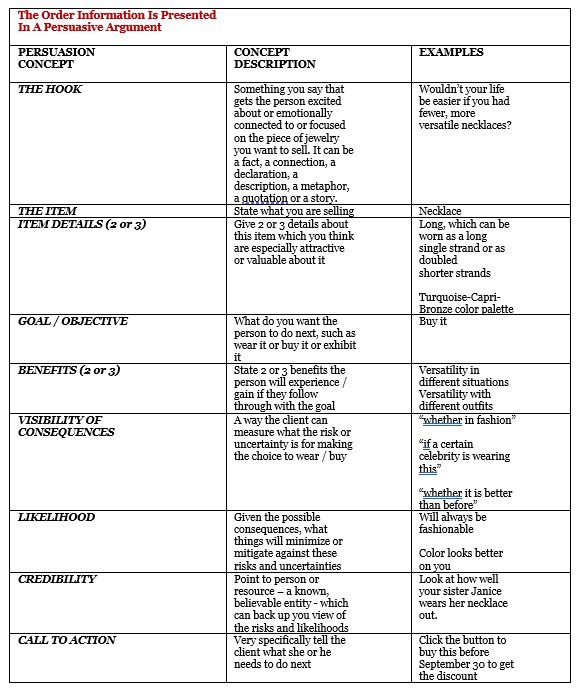
Whatever principle of persuasion the designer follows, the presentation of information in their persuasive argument follows a pattern. That is, informational content, when presented in a certain order, makes for a more persuasive argument. This order is presented in the table below.
A Few Cautions
When marketing your products, you have a professional responsibility not to cross the line between influence and manipulation. You might be successful in manipulation in the short term, but this will probably spell disaster for you mid- and long-term. People are willing to be influenced and persuaded, but resent getting manipulated. And if manipulated, they usually find out.
Don’t present yourself falsely in any way. Don’t claim to be an expert when you are not, for example.
Last, don’t over emphasis economic factors — price, discounts, and the like — in your marketing messages. Rely more on one or more of the universal principles of persuasion where you play towards emotions, perceptions and desires.
_________________
FOOTNOTES
Abelson, Herbert I. Persuasion: How Opinions and Attitudes are Changed. Spring Publishing, 1965.
Clements, Jon. The Power Of Influence and Persuasion in Business.
Marketing is about creating persuasive arguments which can influence a person’s beliefs, attitudes, motivations, intentions and behaviors. Influence comes with knowing what the best outcome that the marketer should seek. Persuasion includes the tools you use to get there. Persuasion can take many forms. The marketer’s success depends on a handful of persuasive factors. Marketing strategies follow one or more of eight universal principles of persuasion. Information within any successful persuasive argument is best presented in a certain order.
Influence and Persuasion
Marketing is about creating persuasive arguments which can influence a person’s beliefs, attitudes, motivations, intentions and behaviors. The marketer wants to be able to persuade the client to focus their attention on the jewelry product line, to approach it, touch it, try it on, buy it, exhibit it, share it with others, then, moreover, to further persuade these others (thus making the marketing message contagious) to want to buy it. Influence comes with knowing what the best outcome that the marketer should seek. Persuasion includes the tools you use to get there.
When we are trying to persuade someone, we might be trying to get them to change their mind about something. We might want them to change the weight, ranking or priority they give one thing over another. We might want them to see the interrelationship among two or more otherwise unrelated things. We might want them to re-evaluate the cost and reward calculus they use when deciding to make a purchase.
When trust is present, influence increases and persuasion ends in more positive outcomes.
Persuasion can take many forms. It can be…
· Coercive, done aggressively through direct commands, threats, fear mongering, shaming.
· Informational, spread as biased in some way towards a particular position or idea.
· Leveraging a belief by appeals to logic and reasoning.
· Leveraging a belief by appeals to feelings and emotions.
· Establishing a high level of credibility or character.
A marketer or jewelry designer is not born as persuasive. It is something to be learned, practiced, applied and applied again. The strength of the marketer’s influence centers on a handful of persuasive factors, such as:
1. Commonalities: People like people like themselves.
2. Logic and Rationality: When you see data, it tells a recognizable story.
3. The Target Audience’s Needs, Wants, Values and Desires: It is important to pay attention and hone in on these.
4. Attractiveness: Attractive people are more persuasive.
5. Confidence / Charisma: Confident /Charismatic people are more persuasive.
6. Preparation: Learning, Practicing and Preparing are how you place yourself in a powerful, persuasive position.
Persuasion and Marketing
Persuasion in marketing involves the ability not just to influence people’s actions, but their attitude as well.
Persuasion is a matter of establishing mutual trust or shared understandings. You develop that sense of trust in your client. That means, they believe that you will deliver on any and all your promises, and that your product will solve their problems, needs and/or desires. The marketer presents some type of evidence which the client must interpret as relevant and valid for themselves, whatever that might mean.
Marketing campaigns are various strategies attempting to influence, direct or change client behaviors by eliciting reactions. Marketing campaigns rely on imagery and word associations tied to emotional responses.
To be persuasive, the marketing message must have value and relevance for your target client. She or he might see a reward or a minimization of costs and agree to change their behavior. She or he might be trying to shield themselves from anything which refutes their sense of self and self-esteem. She or he might derive pleasure when they can align their self-concept with that of the emotional message associated with the product. She or he might find that they can meet their needs for understanding and control by finding out more information about your product.
In response to any marketing campaign, the client can do one of three things:
1. Accept
2. Non-commit or remain indifferent
3. Reject
And it is important to think of persuasion as a continual process. You might be able to persuade someone to purchase your product once, but will they purchase your product again?
The Marketer Should Have A Detailed Familiarity With Everything Involved With Consumer Behavior
What causes clients to purchase certain products and brands, and reject others? It is important to begin to document client shopping behaviors, motivations and their psychological and sociological underpinnings.
The marketer will want to get a handle on the target audience in terms of
· Psychological Factors: How assumptions, perceptions, understandings, values and desires affect responses to the marketing message.
· Personal Factors: How demographic characteristics, such as age, culture, profession, gender play roles in forming responses to the marketing message.
· Social Factors: How socio-cultural groups, such as income, geographic residence, education level, affect shopping behaviors and responses to the marketing message.
How Can Marketing Affect Client Shopping Behaviors? The Eight Universal Principles of Persuasion
Persuasion works when the client feels that, by purchasing your product, you and your product have made a positive contribution to their life. There are different ways or principles marketers follow for establishing that sense of positivity.
There are eight universal principles of persuasion the marketer can resort to in order to influence client shopping behaviors. These are,
1.Reciprocity
2.Commitment
3.Consensus
4.Authority
5.Affinity
6.Scarcity
7.Visibility of Consequences
8.Information Exposure
Reciprocity
If you do this for me, I’ll do this for you.
People tend to feel the need to return the favor. You offer or remove incentives and play with client’s natural tendency to be grateful and want to do something for you in return. You might offer them discounts or a free sample. You might put them in a frequent shopper rewards program. You might do a special customization. You might offer them a gift. You might offer something special to first time buyers or to clients who register for your email list.
Commitment
I am a loyal customer.
Once someone is engaged with something, they are more likely to stick to it and commit. They become loyal to the designer, the designer’s business and the designer’s brand. The marketer would do those things which enhance customer loyalty. You might have a special showing or trunk show. You might include them on your email list. You might make them aware a way ahead of time of some deals or opportunities.
Consensus
If it’s OK with them, it’s OK with me.
Sometimes this is referred to as the herd response. If the client sees others doing it, they are more likely to do it as well. The marketer here would demonstrate the popularity of their products with other clients and client groups.
Authority
If such-and-such expert tells me it’s OK, I’ll think it’s OK.
Clients are more likely to listen to an expert they trust, than anyone else. The marketer would have the marketing message put forth by trusted experts who could be seen as authority figures. These authority figures are seen as having already established proof of their knowledges and beliefs. Authority might be actual or implied. Thus, their advice is recognized as trustworthy. You might seek endorsements from well-known figures. You might create an ad where the expert is delivering the message. You might rely on influencers online to spread your marketing message.
Affinity
She bought it, and she’s a lot like me, so I’ll buy it as well.
The client is more willing to follow through on the marketing message and goal if she or he knows someone who is similar to themselves who bought the product. Similarly might be by gender or age or economic class. Similarly might be people who belong to the same church or shop at the same store or attend the same events. The marketer would emphasize shared interests. The marketer would present reasons why conformity is the best choice here.
Scarcity
I better get it right away, if I’m to get it at all.
People tend to want what they think they might not be able to have. When something is scarce, clients tend to assign it more value. Defining the context becomes very important for this principle of persuasion. It might be something that is exclusive. It might be in limited supply. It might have some sense of rarity. It might be subtle clues provided in how the products are displayed to make it seem like you are running out of stock (such as, a very large container with a few items left in the bottom). The product might not be available from any other competitor. The product might be temporarily on sale or only available for a limited amount of time. The marketer might emphasize that this product does what no other product can do. The marketer might emphasize that if the client doesn’t act quickly, the likelihood that they could ever purchase the product will be very low.
Visibility of Consequences
I know what will happen when I purchase and use this product.
The client is more likely to purchase a product if they can anticipate the consequences of their choice. Every purchase is a risk. Will it work? Will it hold up? Will it be appropriate? Will I get the reactions I want? Here the marketer would highlight evidence which makes the consequences obvious, and then more evidence which minimizes the likelihood that any risk and uncertainty might occur. The marketer might emphasize the positive results, and minimize any negative ones. They might point to past successes of this or similar products. They might present the pros and cons and comparative imaging of future outcomes. They might present the pros and cons by comparing antecedents. They might explain that the client will have emotion regrets of they don’t make the purchase.
Information Exposure
I was told it was important now to act.
Clients often have to make choices when they have more limited information upon which to rely. How and when the client is exposed to certain information, prompts, triggers and cues may affect their choice whether to buy a product or not. The client might be distracted. There might be time / timing / seasonal considerations where they pay more attention, say to holiday merchandise during Christmas season, than at other times of the year. Some information may have increased salience, depending on the context. For example, what the jeweler says when standing behind the jewelry counter may have more salience than what that same person says about the same product when randomly meeting that person on the street.
The marketer might present or withhold information based on timing considerations. The message might be different presented during the day from presented during the evening. It might be different in the Spring from the Fall. The marketer might try to connect positive emotional information the client already holds to the product the marketer is trying to sell. This could be a positive memory such as a song or image or experience. The marketer might stress how even with this limited information the client can still anticipate a level of success. The marketer might emphasize negative information about a competitor or competitor’s products. The marketer might use popular phrases and words that have a particular emotional or cognitive association with the target audience.
The Persuasive Argument
Whatever principle of persuasion the marketer follows, the presentation of information in their persuasive argument follows a pattern. That is, informational content, when presented in a certain order, makes for a more persuasive argument. This order is presented in the table below.
A Few Cautions
When marketing your products, you have a professional responsibility not to cross the line between influence and manipulation. You might be successful in manipulation in the short term, but this will probably spell disaster for you mid- and long-term. People are willing to be influenced and persuaded, but resent getting manipulated. And if manipulated, they usually find out.
Don’t present yourself falsely in any way. Don’t claim to be an expert when you are not, for example.
Last, don’t over emphasis economic factors — price, discounts, and the like — in your marketing messages. Rely more on one or more of the universal principles of persuasion where you play towards emotions, perceptions and desires.
_________________
FOOTNOTES
Abelson, Herbert I. Persuasion: How Opinions and Attitudes are Changed. Spring Publishing, 1965.
Clements, Jon. The Power Of Influence and Persuasion in Business.
I’d estimate that 25–30% of my students are in the jewelry making /design hobby to make some extra money. Some see a way to supplement their income. Some see it as a retirement strategy. Others see it as a career transition. Whatever their goals, some have been successful, and others less so. Here are some of their stories.
Cindy
Cindy saw it as a career transition. She made and sold jewelry, went to craft shows and church bazaars, put her stuff on consignment all over the metropolitan area, did home shows, whatever.
After about two to two-and-a-half years, she took the giant leap and quit her full-time legal aid job to be a full-time jewelry artist/entrepreneur. She was successful because she knew how to promote herself, and was very comfortable at this.
Her designs were fashion-current, but not bizarre. One business that had her stuff on consignment told me how great she was to work with.
My only concerns were that she often short-changed some of the quality of materials, and perhaps pushed the pricing a bit too high. But I marvel at her success. if you stick to it, and are confident in yourself, you’ll get there.
Mona
Mona refurbished old pieces into new. She took old brooches, fixed them up, restored missing stones, polished or colored damaged edges. She turned them into pendants, and then created necklaces with the same sensibilities, colors, textures, bulk, and patterns to go with them.
Sold like hot-cakes. She took old, gaudy belt buckles, glued on Austrian crystal rhinestones, found leather belts to go with them, fashioned some tpe of bail, and voila! She had great stories to go with each piece. She also was great at self-promotion. She was very confident. And she got her pieces into all the major stores in the area. She also formed great connections to power-fashion-players, including many people in the music business.
Sharon
Sharon made lampwork beads, and turned these into necklaces and bracelets. She was shy. She tried to sell them to friends and family. She tried to get them into one store on consignment. She tried selling them on EBay. She’s still trying.
Yanxi
Yanxi made Native American style earrings mostly, but some chokers and bracelets, as well. She relied on traditional bead weaving styles of Peyote and Brick. She used traditional materials including Czech seed beads, beading thread, sinew. She used traditional colors and designs. She sold in stores. She sold at markets. She was doing very well for many years.
Until around the later 1990s. Chinese businesses began copying Native American jewelry, and selling their pieces at prices so low, that Native Americans could no longer afford to make a living at making jewelry.
Yanxi’s business faded away to nothing. She was unable to adapt to the changes in the business environment. She could have gone more upscale in the choice of materials and the elaborateness in the designs. But she did not recognize that as a pathway.
Veronica
Veronica made high-end clothing with an edge to her designs. At one point, with her clothing, she decided to create accessories, including jewelry. Necklaces out of old men’s ties. Bracelets out of leather suspender straps from Germany. Odd beads which always catch your eye dangling from old, antiqued, large-linked chain.
She had an acute sense of what jewelry women — of all shapes, ages, sizes, body shapes — could wear to empower themselves. Attract that kind of attention which borders on admiration.
At first, she sold her jewelry pieces to individual stores in various cities she visited. They sold her pieces very quickly. In response, she began working in more of a production mode. She sent these stores boxes of her pieces to be sold as special trunk shows. That idea worked well.
She then worked on setting up a shop-within-a-shop. Several stores were eager to have her store-within-a-store. She envisioned taking over a 6’x8′ area. She created display cabinets, display pieces, and an organizational plan for displaying her pieces. She went to hotel foreclosure sales and purchased old odds and ends to use for displays, such as old wooden clothes hangers which had the hotel logo or name etched in them.
Her jewelry lines overtook her clothing lines.
Debby
Debby made beautiful, elegant, dainty jewelry from bracelets to necklaces to eyeglass leashes. She put them in a few stores. She had been an airline stewardess, and frequently brought her jewelry with her to sell at get-togethers and conventions with past and current airline employees.
Everyone loved her pieces. Everything she made sold. She was reluctant, however, to place them in many stores. She was afraid people would copy her designs. One person, in fact, had copied some of her designs.
Debby wanted to mass-market her pieces to high end boutiques and department stores. She spent years making contacts and connections, which she was very successful at. But she couldn’t reel in the opportunities. Her fears overcame her — people would copy her designs, or they would not manufacture her pieces to her quality expectations, or the manufacturers wanted to make pieces with more mass appeal.
There was always something that got in the way of her making a living by making jewelry. She built walls. She couldn’t climb over them.
Larry
Larry approached Barneys New York about his line of jewelry. He had a personal connection there. He had a marketing strategy for them, which included explaining why the lines of jewelry they currently carried, were not working for them.
He showed them a very full line — jeweler’s tray after jeweler’s tray after jeweler’s tray of jewelry.
With each tray he showed them photographs of jewelry which were carried by their major competitors in New York, as well as fashion spreads in major magazines.
He kept making the point: His jewelry is better, and this is why. His jewelry is better, and this is why. His jewelry is better, and this is why.
Success!
Kiki
Kiki wanted to sell on-line. She knew she needed a web-site with a shopping cart. But she shied away from the $50.00 per month price tag. She knew she would have to hire someone to design her website, but again, the $500.00 quoted price seemed daunting to her. She spent year after year researching web-hosts and web-designers, each time finding something that made her more and more uncertain.
Virtual jewelry, virtual business.
Rosie
Rosie lived in the wealthiest part of town — Belle Meade. She custom made jewelry for the rich for them to wear at special occasions. Her biggest obstacles to overcome: many of her clients were not sure that anyone could actually make jewelry. Jewelry was something that you bought in New York. Not Nashville. Somehow it could only be made in New York and probably by machine. Her clients hesitated, not sure how anyone, let alone anyone local, could actually make jewelry for them.
She took their naivete in stride. She made the making of jewelry seem straightforward. She made the custom designing seem specialized and right up her alley.
She made a necklace and earring set for someone to wear at the Swan Ball.
She made a very unattractive, yet very appreciated by the customer, necklace to wear at a horse race. the colors had to match the specific colors in the horse’s blanket — navy, white and rose. The rose was a special color rose associated with some Queen’s rose somewhere. On the face of things, navy, white and rose don’t usually result in something rich, elegant and status’y looking. But Rosie did a fabulous job. She would not, however, have ever worn this particular necklace herself.
She made a lariat for someone to wear on a cruise. Plus, 5 different sets of earrings, each coordinating with the lariat. Plus, 10 different bracelets, each having a different clasp, and again, coordinating with the lariat.
Rosie’s willingness to adapt to the peculiar needs of her customer base made her a success. And to her customer base, money was no object.
Alejandro
Alejandro didn’t want to design jewelry per se. He wanted to find jewelry designed by others and find places that might sell this jewelry. His mom had gotten breast-cancer (she’s a survivor). And he had this brainstorm.
He visited the Dallas Merchandise Mart. He found about a dozen vendors who represented lines Alejandro thought would do well in the various fundraising events the state’s Breast Cancer Society sponsored.
From these vendors, he gathered information about the products, the minimum units which needed to be purchased at a time, the unit cost, and the suggested retail price.
He determined what kind of commission he needed to make this work and wanted to get.
He sat down with the marketing executives at the Breast Cancer Society. He showed them pictures of the various products and the numbers. He negotiated a deal and a plan.
This is what you call a Win-Win-Win. The vendor wins. The client wins. and Alejandro wins.
Getting Started In Business
You need to look yourself in the mirror, and be very, very, very honest with yourself. Getting started in business is a big step. It’s not all fun and games. There’s paperwork, repetition, tradeoffs to be made. Be honest with yourself.
Ask yourself:
o Why do I want to start a business?
o What type of business do I want?
o What kinds of things do I want to sell?
o What kind of time and energy commitments do I want to commit?
o Where will the money come from to get started?
o Where will I work — kitchen table? craft studio? at a store?
o What will I name my business?
o Where will I get my jewelry making supplies?
o Do I want to do this alone, or with a partner(s)?
There are many different kinds of jewelry you can sell. Necklaces. Bracelets. Earrings. Eyeglass leashes. Name badge jewelry. Rings. Anklets. Ear cuffs. Body jewelry. Jewelry for dogs and cats. Jewelry representing social causes. Beaded jewelry. Wire jewelry. Polymer and metal clay jewelry. Fabricated jewelry, such as with silver smithing techniques. Lampwork jewelry. Blown glass jewelry. Micro macrame and hemp jewelry. Jewel-decorated objects like pillows, lampshades, dinner ware.
There are many different approaches and venues for selling jewelry. these include selling to friends, co-workers and family. Selling at home shows. Selling at craft shows or trunk shows. Selling online. Selling in stores and galleries, either retail, consignment or wholesale. Selling in a truck, driving from city to city, parking, and opening your truck doors for people to come into your mini-showroom. Selling in print catalogs. Designing and/or selling for promotions and events, such as a fund-raiser for breast cancer. Doing repairs.
Whatever the approach and venue, you need to step back, and be sure it is on a solid business basis. This means delving into some bureaucracy and administrivia. You can’t get around this.
Yes, you can make money selling jewelry. But you have to be smart about it.
The women were so excited about the jewelry. Trying it on. Adjusting it to see if they could wear it a different way. Changing up the silhouettes. Pretending they were wearing different outfits to visualize what the pieces would look like. It was a very versatile line of jewelry, and all the women noticed that very quickly. They could wear necklaces as bracelets. Combine bracelets into necklaces. Take one bracelet, add it to a necklace, and create a longer piece. They could purchase different pendant drops, all as add-ons as they wished or none at all. And the drops easily converted into earrings. Imagine that! And the awe and glee and elation and animation — yes, these women were more than happy to have found this jewelry designer and her custom pieces.
I was there that day. In the store. At this one-day trunk show. I saw it all. These women were purchasing almost every last piece. It was the right aesthetic. Contemporary but conservative as well. An individualized look but not outlandish. Easy to wear. Easy to adapt. Easy to visualize what it would look like with different outfits and in different situations.
The jewelry designer was very attentive. She demonstrated the flexibility of each piece in the line. She, at first, asked the women individually a lot about themselves and how they liked to wear jewelry. Then she subtly shifted the conversation a bit so they were talking about themselves and how they would want to wear her jewelry.
At one point, I slowly looked around this upscale clothing, accessories and jewelry store. There were seven store associates standing around. Standing around. A glazed look on their faces. The enthusiasm and energy before them somehow foreign. After the trunk show, when the designer was no longer there, they would be the ones to represent her and her jewelry.
They stood there with blank faces. As if watching a movie they found uninteresting. None of them stepped in. None of them stepped up. Even though the jewelry designer was mobbed with seven or eight women at any one time. They obviously were unable to empathize with the crowd. They had no clue how to sell the pieces because these were pieces of jewelry they didn’t wear themselves. They were somewhat clueless about how to suggest how these store guests could put things together in a stylish, wearable way.
At the end of the day, the jewelry designer was very happy with her sales. But it hit her. Her jewelry would remain at this store for the next several months. But she would not. She would be leaving that day. And she was worried. She thought that over the 10 hours, her purpose was not only to sell to customers, but her purpose was also to model for the sales staff the smart ways for working with these customers and selling her product.
Had the store associates been reliable deputized partners with the jewelry designer that day, all would have made many more customers happy, and made a lot of money and commissions for store, sales staff and designer. Going forward, the designer now had doubts.
Jewelry Designers Often Have To Rely On Others,
The Designers’ Success Relies On Their Whims
Most jewelry designers do not own their own shops. They rely on other people to sell their stuff. They might put their jewelry in a clothing, accessories or jewelry store on consignment. They might be represented by a gallery or sales representative, with their jewelry spread out in many stores. They might package their jewelry into trunk shows or pick boxes where they send out their jewelry to various stores. These other venues can pick and choose and sell what they want, then return the rest.
The success of sales becomes the whim of who sells it. Their understanding of the designs. Whether they like the pieces or not. Their motivations to keep things clean, neat and displayed well. If they can see themselves or their friends or spouses wearing these. Their sense of style, knowing what things might work well together with what fashions. How well they communicate with their customers. Perhaps even IF they communicate with their customers. If they follow-up with their customers.
Designers Must Take The Lead In Preparing Others To Sell Their Jewelry
The designer must play a leadership role here. The designer as leader must effectively influence, persuade, train and convince whoever will be selling their jewelry how to sell it. As best as possible, the designer must build shared understandings about the product with those who will sell it.
Passive assumptions won’t work here. The designer cannot assume that store owners and their sales staff, because they supposedly want to show a profit, will be good at their jobs. More likely, they are not — particularly when it comes to selling someone else’s stuff. The consequences of poor salesmanship are virtually invisible until many months, even years, later. That’s too late to wait.
To add to the difficulties, the opportunities in terms of time, resources, and follow-up are very limited. The designer may get just one shot to build shared understandings and accomplish several goals. Ideally this should happen in person. Often, it is not. Often it is reduced to shared emails, some printed materials, and some phone calls.
Six Key Shared Understandings
There are six key understandings which the designer must influence others to share. These include,
1. The Key Product Details
2. The Primary Product Benefits
3. The Smart Ways To Use The Products To Build Customer Relationships
4. What Rewards The Sales Staff Should Expect For Themselves, Based On Their Performance
5. At All Times, How To Maintain The Optimum Inventory and Product Mix
6. How To Routinize Timely Feedback
1. The Key Product Details
Think of every line of jewelry as its own culture with a group or tribal identity. Which three to six words or simple phrases encapsulate what that identify is all about? What were the key, primary design choices made which give this line of jewelry its character and resonance? How would anyone know that any piece of jewelry was a part of that group or tribe?
These key words or details might relate to materials and techniques. They might reference fashion, style and taste. They might be things about the designer or about jewelry design in general. There will be lots and lots of details which can be conveyed, but the list of details will need to be severely culled.
People have what is called finite rationality. They can only handle and remember between 4 and 10 pieces of information at a time, with 7 pieces of information usually the upper limit for most people.
Don’t confuse the sales staff. Don’t let them confuse the customers. Limit that descriptive words you use when explaining your jewelry, your design choices, and your design goals. Keep these descriptors simple, un-jargoned, devoid of business babble and clichés.
Keep repeating these 3 to 6 things. Repeat them in ways you want the sales staff to learn them, understand them, and be able to repeat these 3 to 6 things to their customers when you are not around.
2. The Primary Product Benefits
It is not the features of your jewelry that result in sales; it is the benefits people perceive the jewelry will provide for them. People do not focus on what the product is. They focus on what the product means to them.
People buy things to solve problems. These problems might relate to needs and wants. They might relate to achieving status and position. They might resolve emotional desires.
What problems for the potential customer does your jewelry solve? Think carefully about this. Make lists.
Then reflect awhile on how you think your jewelry solves these problems for your customers better than any of your competitors. What are your competitive advantages?
Convey to store owners and sales staff the results of your thinking and synthesis. You do not only want to list for them what customer problems your jewelry solves for them. You do not want your explanation divorced from the actual selling situation. You are not presenting an academic assessment; you want to present a marketing assessment. You want to convey how your jewelry resolves customer problems better than anyone else. This is a little more difficult to do and get the words out, and requires some practice.
And, again, remember that people have finite rationality. Don’t talk about everything. Focus on the couple of primary competitive advantages your line of jewelry has.
As best as possible, make your benefits concrete and specific. Think of which benefits would most readily stick in people’s minds.
3. The Smart Ways To Use The Products To Build Customer Relationships
Any sale is an interaction based on communication. The sale is not the only result. The building of a relationship also results. Too often sales staff performance is rated based on number of sales, and too rarely rated on building relationships. But it is in the building of relationships where we get those repeat sales and bigger sales and broader sales and better word of mouth and more new customers and, you get the idea.
Ideally, if you get the chance, like in the trunk show described above, you can model these relationship building behaviors in front of the sales staff. You can demonstrate how you elicit customer needs, wants and problems to be solved, and how you gain their awareness and trust in how your jewelry will meet these in an advantageous way. If there are other types of products in the store, you can demonstrate how to co-market, such as your jewelry with the store’s clothing.
Absent the in-person approach, you can provide ideas in periodic emails. You might do some simple one-sided-page images and short descriptive content. You might create a fun video that you can share.
You can also work with store staff in developing customer lists detailing the who, how to contact them, the what they bought, the dates, the follow-up sales, customer preferences, any descriptive information about the customer to help future sales.
To help guarantee that sales staff keep these lists and fill them out completely, you can ask to see them periodically to review. You can encourage sales staff to communicate with customers pre-, during, and –post sales. Based on your review, you can suggest specific items in the line that each customer might like to see, and possibly buy. Even though you are not physically present, you can still show how building relationships can generate sales and profits.
4. What Rewards The Sales Staff Should Expect For Themselves,
Based On Their Performance
It is helpful if you not only generate commissions and sales for the store, but also some kind of reward for the sales staff each time they sell one of your pieces. Show you recognize their efforts and appreciate them. If sales staff get paid no matter what they do, they may not give your line of jewelry the attention and promotion it deserves.
Besides some reward, perhaps a thank you note, or giving either a monetary extra commission or a piece of your jewelry, you most likely also want to reward the sales staff’ customer follow-ups, without actual sales, such as sending thank you notes or calling them when you send new pieces to the store.
5. At All Times, How To Maintain The Optimum Inventory and Product Mix
Do not assume that the store will maintain the optimum inventory and product mix of your jewelry at all times. There will always be other companies, other designers and other product opportunities competing for any store’s attention. So you will need to step in and capture that attention on a regular basis.
Create an easily update-able plan for the store that details the ideal mix of product — types of jewelry, price points, color, finishes and textures.
Reduce this to a simple product inventory sheet to give the store.
Contact the store periodically to update the inventory, compare to your plan, and make inventory suggestions accordingly.
6. How To Routinize Timely Feedback
You need to get feedback routinely, say at least every 3 to 6 months. You need regular feedback on your jewelry, on the sales process, on other things you can do to help sales staff become better at selling your jewelry.
If your jewelry is not turning at least twice a year, the particular store is probably not right for you. It might be the inattentiveness of the sales staff. It might be a lack of fit with the store’s customer base. But, if you are not getting a minimum of 2 turns a year, this location is not working either for you or the store.
You might formalize requests for quarterly results. You might call the store or any of its sales staff periodically to get information feedback. You might send a questionnaire to customers who have previously purchased your jewelry.
It helps the feedback process along when you provide rewards. This might be in the form of refreshments, such us sending an evaluation form with a box of cookies. This might take the form of adding some free pieces of jewelry to be sold, or one-time discount on purchases.
______________________________
FOOTNOTES
James, Geoffrey. 6 Ways to Persuade Customers to Buy. Inc.com, 2020.
For the novice, all that excitement at the beginning, when thinking about designing things, sometimes collides with a wall of developing self-doubt. It’s not easy to quiet a doubt.
The designer organizes their life around an inspiration. There is some fuzziness here. That inspiration has some elements of ideas, but not necessarily crystal clear ones. That inspiration has some elements of emotions — it makes you feel something — but not necessarily something you can put into words or images or fully explain. You then need to translate this fuzzy inspiration into materials, into techniques, into color, into arrangements, into a coherent whole.
You start to create something, but realize you don’t know how to do it. But you want to do it, and do it now. However, to pick up the needed skills, you realize you can’t learn things all at once. You can’t do everything you want to do all at once. That initial excitement often hits a wall. Things take time to learn. There are a lot of trial and error moments, with a lot of errors. Pieces break. Projects don’t gel. Combining colors and other design elements feels very awkward. Silhouettes or structural layouts are confusing. You might get the right shape for your piece, but it is difficult to get the right movement, drape and flow, without compromising that shape. Or you might get the right placement of objects, but difficult to get everything into the frame, without compromising the placements. Things take time to do.
To add to this stress and strain, you need to show your designs off. You might want someone to like it. To want it. To need it. To buy it. To wear or use it. To wear or use it more than once. To wear or use it often. To exhibit it. To collect it. To publicize it. And how will all these other people recognize your creative spark, and your abilities to translate that spark into a wonderful, beautiful, functional design, appropriate for the wearer or user and appropriate for the situation? Things need to be shared.
Frequently, because of all this, the designer experiences some sense of doubt and self-doubt. Some paralysis. Can’t get started. Can’t finish something. Wondering why they became a designer in the first place.
Doubt holds you back from seizing your opportunities.
It makes getting started or finishing things harder than they need to be.
It adds uncertainty.
It makes you question yourself.
It blocks your excitement, perhaps diminishing it.
While sometimes doubt and self-doubt can be useful in forcing you to think about and question your choices, it mostly holds you back.
Having doubt and self-doubt is common among all artistic types. What becomes important is how to manage, channel and overcome it, so that doubts do not get in the way of your creative process and disciplinary development.
8 MAJOR WAYS DESIGNERS FALL INTO SELF-DOUBT
There are 8 major ways in which designers get caught beginning to fall into that abyss we call self-doubt:
1)What If I’m Not Creative Enough or Original Enough or Cannot Learn or Master or Don’t Know a Particular Technique?
2)What If No One Likes What I Make?
3)What If No One Takes Me Seriously As An Artist And Designer?
4)I Overthink Things and Am A Bit of a Perfectionist.
5)How Can I Stay Inspired?
6)Won’t People Steal My Work?
7)Being Over Confident or Under Confident
8)Role Confusion
1. What If I’m Not Creative Enough or Original Enough or Cannot Learn or Master or Don’t Know a Particular Technique?
Everyone has some creativity baked into their being. It is a matter of developing your way of thinking and doing so that you can apply it. This takes time.
So does originality. Originality is not an all-or-nothing proposition. Originality grows in stages. At first, you’ll try different ways of personalizing projects. There are always things you can do to bring some aspects of originality to your pieces. This might be the choice of colors, or using a special component or object, or rearranging some elements in your composition. Again, as with creativity, the ability to be more and more original will evolve over time. It is helpful to think of originality, not necessarily as coming up with something completely new, but rather as differentiation — how you differentiate yourself from other designers.
For almost everyone, you don’t begin your design career at the height of your levels of creativity and originality. Yes, if you look around you, other people are more creative and original than you or have more skills than you. Don’t let these observations be a barrier to your own development as a designer. You get there through persistence and hard work. You handle your inner critic. You may not be there, yet — the key word here is yet. But you will be.
2. What If No One Likes What I Make?
We all have fears about how our creativity and originality are going to be evaluated and judged. We project our self-doubts to the doubts we think we see and feel from others. What if no one wants to wear my pieces, or buy my works, or use my projects?
We can’t let these outsider reactions dictate our lives and creative selves. A key part of successful design is learning how to introduce what we do publicly. At the least, it is the core nature of the things we create that they are to be worn on the body. Design is a very public thing.
Turn negative comments into positive ideas, motivators, insights, explorations. Allow yourself some give and take, some needs to step back awhile, some needs to tweak. Design is an iterative processes. It in no way is linear. Your outcomes and their success are more evolutionary, than guaranteed.
Distressing about what others may think of your work can be very damaging to your self-esteem. It can amplify your worries. Don’t go there.
Don’t become your worst critic.
3. What If No One Takes Me Seriously As An Artist And Designer?
Design is an occupation in search of a profession. You will find that a lot of people won’t recognize your passion and commitment. They may think anyone can design. They may think of design as a craft or some subset of art, not as something unique and important in and of itself. They may wonder how you can make a living at this.
The bottom line: if you don’t take yourself seriously as a designer, no one else will.
People will take you seriously as they see all the steps you are taking to master your craft and develop yourself as a professional.
4. I Over Think Things And Am A Bit Of A Perfectionist
Some designers let a sense that their work is not as good as imagined get in the way. They never finish anything. They let doubt eat away at them.
Perfectionism is the enemy of the good. It’s great to be meticulous, but emotionally, we get wrecked when anything goes astray, or any little thing is missing, or you don’t have that exact color or part you originally wanted.
Go ahead and plan. Planning is good. It’s insightful. It can be strategic. But also be sure to be adaptable and realistic. Each piece is a stepping stone to something that will come next.
The better designer develops a Designer’s Toolbox — a collection of fix-it strategies to deal with the unfamiliar or the problematic.
Overthinking can be very detrimental. You can’t keep changing your mind, trying out every option, thinking that somewhere, someplace there exists a better option. Make a choice and get on with it. You can tweak things later.
Yes, attention to detail is important. But so is the value of your time. You do not want to waste too much time on trivial details.
Be aware when you begin over-analyzing things. Stop, take a breath, make a decision, and move on.
5. How Can I Stay Inspired?
Designing something takes time, sometimes a long time. That initial inspirational spark might feel like it’s a dying ember.
Don’t let that happen.
Translate that inspiration into images, colors, words, sample designs, and surround your work space with these.
Talk about your inspiration in detail with family and friends.
6. Won’t People Steal My Work and Ideas?
Many designers fear that if they show their work publicly, people will steal their work and ideas. So they stop designing.
Yet design is a very communicative process which requires introducing your work publicly. If you are not doing this, then you are creating simple sculptures or paintings, not designed work.
Yes, other people may copy your work and co-opt your ideas. See this source of doubt as an excuse. It is a self-imposed, but unnecessary, barrier we might impose to prevent us from experiencing that excitement as a designer. Other people will never be able to copy your design prowess — how you translate inspiration into a finished piece. That is unique and special to you, and why the general public responds positively to you and your work.
7. Over Confidence can blind you to the things you need to be doing and learning, and Under Confidence can hinder your development as a designer.
Too often, we allow under confidence to deter us from the design tasks at hand. We always question our lack of ability and technical prowess for accomplishing the necessary tasks at hand. It is important, however, to believe in yourself. To believe that you can work things out when confronted with unfamiliar or problematic situations. It is important to develop your skills for thinking like a designer. Fluency. Flexibility. Originality. There is a vocabulary to learn. Techniques to learn. Strategies to learn. These develop over time with practice and experience. You need to believe in your abilities to develop as a designer over time.
With over confidence comes a naivete. You close off the wisdom to listen to what others have to say or offer. You stunt your development as an designer. You overlook important factors about materials and techniques to the detriment of your final designs and products. You close yourself off to doubt and self-doubt, which is unfortunate. Doubt and self-doubt are tools for asking questions and questioning things. These help you grow and develop as an artist and designer. These influence your ability to make good, professional choices in your career.
8. Role Confusion
Designers play many roles and wear different hats. Each has its own set of opportunities, requirements, and pressures that the designer must cope with. It’s a balancing act extraordinaire.
First, people who design often wear different hats: Artist and Designer, Manufacturer, Architect and Engineer, Distributor, Retailer, Accountant, Exhibitor, Marketer and Promoter.
Second, people who design have different needs: Artistic Excellence, Recognition, Monetary Gain, or Financial Stability.
Third, the designer needs to please and satisfy themselves, as well as other various clients.
Fourth, the designer constructs things which need to function in different settings: Situational, Cultural, Sociological, Psychological.
Last, the designer must negotiate a betwixt and between situation — a rite of passage — as they relinquish control over the piece or project and its underlying inspirations to the user (and the user’s various audiences), who have their own needs, desires and expectations.
This gets confusing. It affects how you pick materials and supplies. Which techniques you use. What marketing strategies you employ. How you value and price things. And the list goes on.
It is important to be aware (metacognitive) of what role(s) you play, what goals you have, what clients desires you need to satisfy, in what contexts your work will function, when, and why. Given these things, it is important to understand the types of choices you need to make, when constructing an object or a project. It is critical to understand the tradeoffs you will invariably end up making, and their consequences for the aesthetic, emotional and functional success of your designs.
Some Advice
While doubt and self-doubt can hinder our development as designers, some degree of these may be helpful, as well.
To develop yourself as a designer, and to continue to grow and expand in your profession, you must have a balanced amount of both doubt and self-doubt. Uncertainty leads to questioning. A search for knowledge. Some acceptance of trial and error and experimentation. A yearning for more reliable information and feedback.
Design uses a great deal of emotion as a Way of Knowing. Emotions cloud or distort how we perceive things. They may lead to more doubt and worry and lack of confidence. But they also enhance our excitement when translating inspirations into designs.
· Don’t let your inner doubts spin out of control. Be aware and suppress them.
· Be real with yourself and your abilities.
· Keep a journal. Detail what your doubts are and the things you are doing to overcome them.
· Create a developmental plan for yourself. Identify the knowledge, skills and understandings you want to develop and grow into.
· Remember what happened in the past the last time doubt got in your way. Remember what you did to overcome this doubt. Remember that probably nothing negative actually happened.
· Talk to people. These can be friends, relatives and colleagues. Don’t keep doubts unto yourself.
· Don’t compare yourself to others. This is a trap. Self-reflect and self-evaluate you on your own terms.
· Worrying about what others think? The truth is that people don’t really care that much about what you do or not do.
· Don’t beat yourself up.
· Get re-inspired. This might mean surrounding yourself with images and photos of things. It might mean a walk in nature. It might me letting someone else’s excitement flow over to you.
For many people, jewelry design is a career choice that comes later in life. You work hard, continually frustrated or disappointed or unsatisfied in your current job. And you reach a point where you want to find something — a job or hobby or avocation — that makes you happy. That gives you a personal sense of satisfaction and accomplishment. You want to make a change.
That’s what happened to me.
I had been in the health care field for over 25 years. I never really liked health care as a field, but it paid a lot, it was a big source of status and power for me, and I did very well. I reached a point where I was near the top of my field, and no longer could push myself to take the next step.
Money had been one of my prime motivators. But that was less important to me now. I had traveled a lot, had lots of stuff and collectibles, a $10,000 wardrobe of the finest clothes and shoes. Except for the travel, I didn’t care about much of these things anymore.
Proving myself to myself had been another motivator. And I had proved myself to myself. I had accomplished some Herculean tasks and projects, under difficult conditions, with good and not so good people. And, though I hate to say it, I didn’t care about promoting health care and health care access anymore. I had done my part thoroughly and thoroughly well. It was time for someone else to take over these reigns.
I was at the top of my field, and social relationships equated with work relationships. I didn’t have friends outside of work. Many “friendships” were shallow in that they involved the machiavellian maneuverings you have to do when involved with work. My staff were not particularly honest and forthright with me, unnecessarily fearing for their jobs, if they were. And while I was surrounded by people every day, and I talked with people every day, and I played and worked with people every day, I felt very alone and lonely. My social connections were shallow or political or discolored by events. A few years earlier it was fun and challenging to manipulate these relationships. But now I yearned for something more real, more personal.
My life was going to continue to wither on the vine if I didn’t do something more drastic. I had to stop my world, and step off.
I had grown up in retail. My parents owned a pharmacy. They put me to work when I was 11 years old. I did so well, that they never put my younger brother or sister to work. [Still a psychological issue for me, though this is for another story…..]
When I graduated college, I looked for a non-retail pathway, because the money potential wasn’t there, and the social status potential wasn’t there, the hours were terrible, and the stresses that come with the monthly ups and downs in business were unpleasant.
Yet “retail” was in my blood. I always envisioned having a little retail store on the side. And when I was ready to make my change in careers, it was retail to which I jumped.
It wasn’t one big jump. Rather it was a managed transition over a period of two years. I made deliberate decisions. I pretested each of my ideas. I assembled the funds I needed to get started. And I started small.
The retail grew, had set-backs, grew again.
After a few years, I evolved from a passion for selling jewelry to one for making it. A lot of things were trial and error, but gradually I began to define a philosophy of design and build upon some great ideas.
I’m very happy to make a living in the creative arts. And to have some of my income and success flow from my designs for jewelry.
I have to admit that my family and friends were horrified at my decision. The saw it as a come-down. Loss of prestige. A failure.
But that is not what it felt like to me. I was happy, motivated, and reconnected to the world.
It’s less money. Less status. Less opportunity to travel. But every day, I wake up and go to work at something I love.
Some final words of wisdom:
1) Be purpose driven.
2) Surround yourself with other creative people who can be supportive of you as a person and as a designer
3) Be a continual learner. Styles, techniques, technologies and materials constantly change. As do fashions and tastes. And there are always new jewelry designers to admire and gain insights from.
4) Always set aside some time each day for reflection and self-care
My Aunt Gert had, what some people call “Chutzpah” and others “Cajones”. She could always make a business situation work to her advantage. She had no self-doubt, some would say no self-restraint. One time, she came up from Florida to visit us in New Jersey, where I grew up. An A&P grocery store was going out of business. Aunt Gert prepared herself for the kill.
At the beginning of the week, the A&P had a big banner on the outside of the store — “25% OFF EVERYTHING”. My Aunt Gert moved rapidly towards the entrance, grabbing two, not one, but two shopping carts, and rushed to the meat section first. When the carts were both full — a matter of minutes, it seemed — she approached one of the managers, and asked him, since she was getting so much, could he do better on the price.
With little hesitation, the manager agreed. He told her to grab him when she was ready to checkout, and he’d give her another 50% off at the register. My Aunt Gert filled two more shopping carts that day, and at the register, they first took 25% off, then another 50%.
Exciting, great, good deal, almost war-winning. Yes?
No, Aunt Gert wasn’t quite finished. She went back the next day, got her 25% then 50% off. And the next day — 25% then 50% off.
On the fourth day, the A&P now displayed a banner that read “50% OFF EVERYTHING”. This only egged my Aunt Gert to get more eggs and cheese and canned meats and vegetables. Another 2 shopping carts worth. And at the register, they first gave her 50% off, and as she pointed the cashier to look in the manager’s direction, she reminded her that she was to be given another 50% off. And another 50% off it was.
And Aunt Gert went back on the 5th day, and got 50% then 50%, and on the 6th day, and got 50%, then 50% off, and to her glee and the store manager’s dread, she came back once more on the 7th day. But now the banner read “75% OFF EVERYTHING”. And, I’m not sure how she found enough to fill another 4 shopping carts worth of food, but when she got to the cash register, they very reluctantly gave her the 75% off, then her extra special, the-manager-was-very-nice-to-be-giving-her her additional 50% off.
Well, my Aunt Gert lived in Florida, so virtually everything she bought was for us. But she was determined to bring back her 276 cans of tuna fish, that she had paid $0.04 per can, with her back on the plane. She stuffed these into two large leather suitcases.
When we got to the airport, an airport attendant offered to get her two cases out of the trunk. Was he ever surprised? I wish I had a camera to capture his face. And at the ticket counter — the ticket counter lady tried to lift the bags onto the conveyor belt. She’s probably still going to the Chiropractor.
This story doesn’t have anything to do with jewelry, which is my thing, I know, but I love my Aunt Gert, and always love to tell her stories. But, in her week-long grocery shopping business, she does illustrate a point and some lessons about business which can serve you well. Negotiating, price consciousness, and persistence are keys to success. Very often “creative” types are uncomfortable with these more business oriented skills. But these are important to your success.
Whenever I feel uncomfortable in a business situation, I role play. I suppress who I am, and try to become someone else. Very often, I pretend to be my Aunt Gert.