Many people who begin to bead and make jewelry want to rush to the finish line. They want to learn everything at once. They buy beads and parts indiscriminately. They try to use stringing and other materials insufficient to meet their design goals. They fail to anticipate how to finish off the clasp assembly. Their choices of colors often less than appealing. They don’t have the right tools. They purchase every book they can find. They take classes and view video tutorials on anything that interests them or catches their eye, no matter what the skill levels involved. They want to create those perfect, elaborate pieces Now. Not later. Now.
Beading and jewelry making are not things to rush into, however. These are not things to learn haphazardly. Not everything is something you can easily pick up without having someone else show you.
This is a hobby and avocation and even a career which requires you to know a lot of things. You need to know a lot about materials. You need to know a lot about quality issues underlying these materials, and what happens to these materials over time. You need to be mechanical and comfortable using tools to construct things. You need to learn many basic techniques. You need to understand physical mechanics and what happens to all these materials and pieces, when jewelry is worn. You need to be familiar with art theories and design theories and their applications. You must be aware of some architectural basics and physical mechanics which inform you how things keep their shape and how things move, drape and flow. You need to understand people, their psychology, the dynamics of the groups they find themselves in, and their cultural rules which get them through the day.
There is so much to learn, that you can’t learn it all at once. And there is so much to bring to bear, when making a piece of jewelry, that it is difficult to access all this information, if you haven’t learned how everything is interrelated and interdependent.
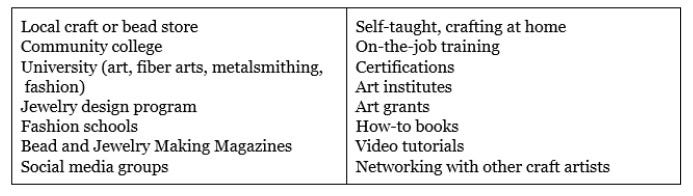
Where can you learn jewelry making skills?…
It’s important to learn in an organized, developmental way. You want to be always asking how things are interrelated. What depends on what? You want to pose what-if questions so that you can train yourself to anticipate the implications and consequences of making one choice over another. What happens If? What happens When? What enhances? What impedes? What synergizes? What can be leveraged, and toward what objective? You want to reflect on your outcomes.
Towards this end, you learn a core set of integrated and inter-dependent skills. Then learn another set of integrated and inter-dependent skills, perhaps at a slightly higher skill level, and how these link back to the core. Then learn yet another set of skills, again, increasing the skill level, how they link back to the first set, and then link back to the core. And so forth. Only in this way will you begin to know if you are learning the right way, and learning the right things.
There Are Many Ways To Learn
People apply different learning styles, when developing their beading and jewelry-making knowledge, skills and understandings. Each has pros and cons. Different people come to learn with different strategies or combinations of strategies. What is your preferred learning style? These learning styles and strategies include:
(1) Rote Memory
(2) Analogously
(3) Contradictions
(4) Assimilation
(5) Constructing Meanings
Most people learn by Rote Memory. They follow a set of steps, and they end up with something. They memorize all the steps. In this approach, all the choices have been made for them. So they never get a chance to learn the implications of their choices. Why one bead over another? Why one stringing material over another? How would you use the same technique in a different situation? You pick up a lot of techniques, but not necessarily many skills.
Other people learn Analogously. They have experiences with other crafts, such as sewing or knitting or woodworking or other craft, and they draw analogies. Such and Such is similar to Whatnot, so I do Whatnot the same way I do Such and Such. This can work to a point. However, beading and jewelry making can often be much more involved with composition, construction and manipulation, requiring making many more types of choices, than in other crafts. And there are still the issues of understanding the quality of the pieces you use, and what happens to them, both when jewelry is worn, as well as when jewelry is worn over time.
Yet another way people learn is through Contradictions. They see cheap jewelry and expensive jewelry, and analyze the differences. They see jewelry people are happy with, and jewelry people are not happy with, and analyze the differences. They see fashion jewelry looked down upon by artists, and art jewelry looked down upon by fashionistas, and they analyze the differences.
Assimilation is a learning approach that combines Analogous Learning and Learning Through Contradictions. People pursue more than one craft, keeping one foot in one arena, and another foot in the other. They teach themselves by analogy and contradiction. This assumes that multiple media and multiple techniques mix, and mix easily. Often, however, this is not true. Philosophies of design and technique differ. That means, the thinking about how a media and technique assert needs for shape and drape will have a different basis, not necessarily compatible. Usually one medium (or technique) has to predominate for any one project to be successful. So assimilative learning can lead to confusion and poor products, trying to meet the special concerns and structures of each craft simultaneously. It is challenging to mix media and/or techniques. Often the fundamentals of each particular craft need to be learned and understood in and of themselves.
The last approach to learning a craft is called Constructing Meanings. In this approach, you learn groups of things, and how to apply an active or thematic label to that grouping. For example, you might learn about beading threads, such as Nymo, C-Lon and FireLine, applying each one separately to accomplish the same project. In this way you begin to learn to evaluate each one’s strengths and weaknesses, especially in terms of Managing Thread Tension or allowing movement, drape and flow. You might learn about crystal beads, Czech glass beads, and lampwork beads, and then again, concurrently and in comparison, learn the pros and cons of each, in terms of achieving good color blending strategies. You might learn peyote stitch and Ndebele stitch, and how to combine them within the same project.
In reality, you learn a little in each of these different learning styles and strategies. The Constructing Meanings approach, what is often referred to as the Art & Design Perspective, usually is associated with more successful and satisfying learning. This approach provides you with the tools for making sense of a whole lot of information — all the information you need to bring to bear to make a successful piece of jewelry, one that is both aesthetically pleasing and optimally functioning.
The Types of Things You Need To Learn
There is so much to know, and so many types of choices to make. Which clasp? Which stringing material? Which technique? Which beads? Which strategy of construction? What aesthetic you want to achieve? How you want to achieve it? Drape, movement, context, durability.
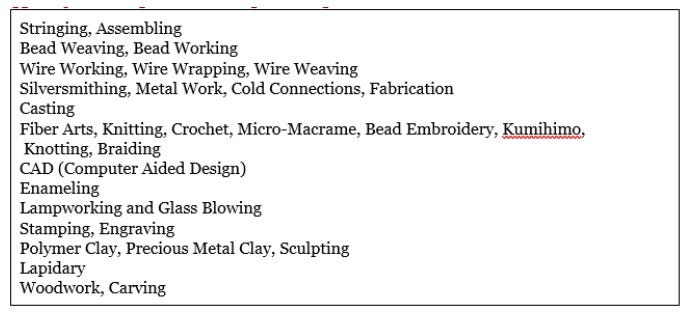
Types of Beading and Jewelry Making
Lots to know. One mistake most people make is that they learn everything randomly. Some things on their own. Some from books. Some from friends. In no special order. Without any plan.
And because there are so many things that you need to bring to bear, when creating a piece of jewelry, that it is difficult to see how everything links up. How everything is inter-related and mutually dependent. And how to make the best, most strategic and most satisfying series of inter-related choices.
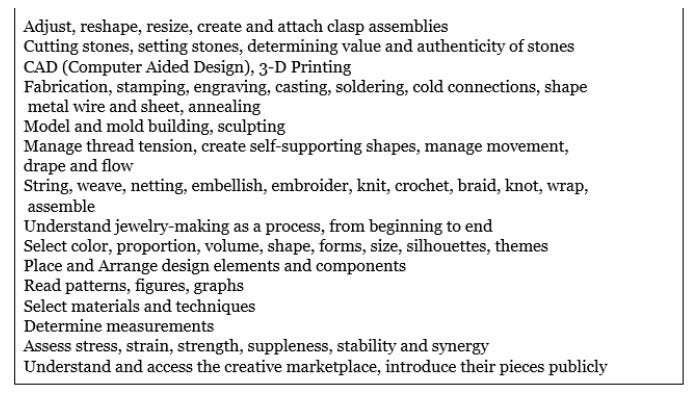
Types of Tasks Jewelry Makers and Beaders Do
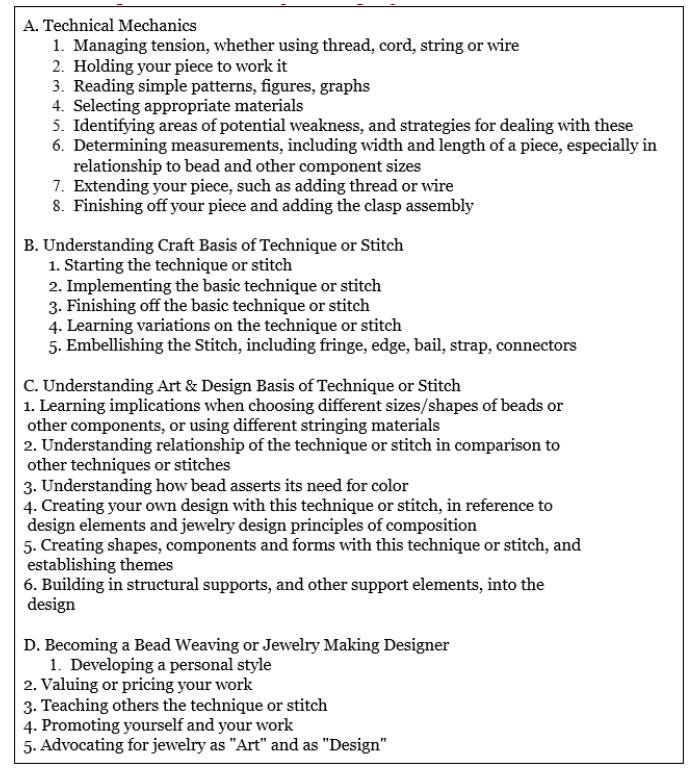
And this is the essence of this book — a way to learn all the kinds of things you need to bring to bear, in order to create a wonderful and functional piece of jewelry. When you are just beginning your beading or jewelry making avocation, or have been beading and making jewelry awhile — time spent with the material in these segments will be very useful. You’ll learn the critical skills and ideas. You’ll learn how these inter-relate and are mutually inter-dependent. And you’ll learn how to make better choices — fluent, flexible and original.
In the class curriculum I teach, students are guided to learn the following objectives:
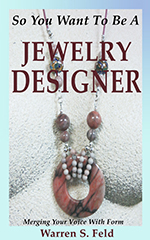
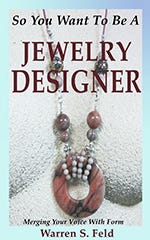
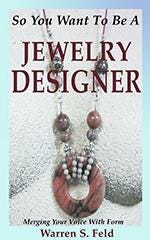
SO YOU WANT TO BE A JEWELRY DESIGNER Merging Your Voice With Form
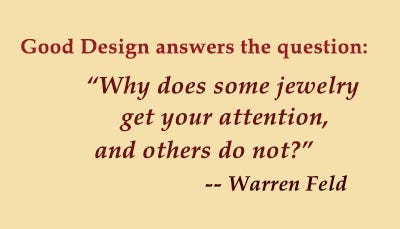
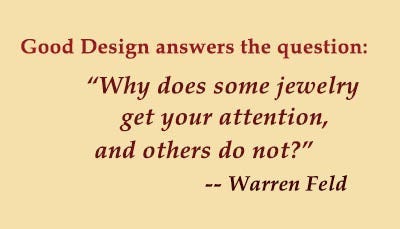
So You Want To Be A Jewelry Designer reinterprets how to apply techniques and modify art theories from the Jewelry Designer’s perspective. To go beyond craft, the jewelry designer needs to become literate in this discipline called Jewelry Design. Literacy means understanding how to answer the question: Why do some pieces of jewelry draw your attention, and others do not? How to develop the authentic, creative self, someone who is fluent, flexible and original. How to gain the necessary design skills and be able to apply them, whether the situation is familiar or not.
There are lots and lots of places for selling your jewelry. These include,
1. Wear It and Sell It
2. To Friends, Family and Work-Mates
3. Retail and Wholesale Stores
4. Consignment Shops
5. Art and Crafts Fairs, Flea Markets, Bazaars
6. Jewelry Parties, Home Shows
7. Trunk Shows
8. Galleries
9. Online
10. Catalogs
As well as through Trade Shows, TV and Radio, Webcasts, Through Sales Reps and Agencies, and many more options for profitable venues.
1. Wear it and Sell It
Yes, people do buy jewelry off your back, so to speak. You might be standing in line at the supermarket. Or attending a concert. Or sitting in the shade at a table in a local park. People will come up to you, marvel at your jewelry, and ask if they can buy it.
So, wear your favorite pieces and flaunt them.
2. To Friends, Family and Work-Mates
Arrange showings of your jewelry with friends, families and people you work with. They know you, and you know them….
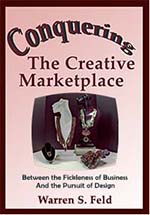
____________________________________________________________________ Conquering The Creative Marketplace
Many people learn beadwork and jewelry-making in order to sell the pieces they make. Based both on the creation and development of my own jewelry design business, as well as teaching countless students over the past 35+ years about business and craft, I want to address what should be some of your key concerns and uncertainties. I want to share with you the kinds of things (specifically, a business mindset and confidence) it takes to start your own jewelry business, run it, anticipate risks and rewards, and lead it to a level of success you feel is right for you. I want to help you plan your road map.
I will explore answers to such questions as: How does someone get started marketing and selling their pieces? What business fundamentals need to be brought to the fore? How do you measure risk and return on investment? How does the creative person develop and maintain a passion for business? To what extent should business decisions affect artistic choices? What similar traits to successful jewelry designers do those in business share? How do you protect your intellectual property?
The major topics covered include,
1. Integrating Business With Design
2. Getting Started
3. Financial Management
4. Product Development, Creating Your Line, and Pricing
5. Marketing, Promotion, Branding
6. Selling
7. Professional Responsibilities and Strategic Planning
8. Professional Responsibilities and Gallery / Boutique Representation
9. Professional Responsibilities and Creating Your Necessary Written Documents
Question 1: Should BEADWORK and JEWELRY MAKING be considered ART or CRAFT or DESIGN?
The jewelry designer confronts a world which is unsure whether jewelry is “craft” or “art” or its own special thing I’ll call “design”. This can get very confusing and unsettling. Each approach has its own separate ideas about how the designer should think, speak, work, and how he or she should be judged.
CRAFT: When defined as “craft,” jewelry is seen as something that anyone can do — no special powers are needed to be a jewelry designer. Design is seen as a step-by-step process, almost like paint-by-number. Designers color within the lines. The craft piece or project has functional value but limited aesthetic value. As “craft”, there is somewhat of a pejorative meaning — it’s looked down upon, thought of as something less than art.
If following the Craft Approach, the designer would learn a lot of techniques and applications in a step-by-step fashion. The designer, based on their professional socialization into Craft, would assume that:
a) The outlines and the goals of any piece or project can be specified in a clear, defined way.
b) Anyone can do these techniques.
c) There is no specialized knowledge that a designer needs to know beyond how to do these step-by-step techniques and applications.
d) If a particular designer has a strong sense of design, this is something innate and cannot be learned or taught.
e) There is little need to vary or adapt these techniques and applications.
f) The primary goal is functionality.
g) There are no consequences if you have followed the steps correctly.
As “craft”, we still recognize the interplay of the artist’s hand with the piece and the storytelling underlying it. We honor the technical prowess. People love to bring art into their personal worlds, and the craftsperson offers them functional objects which have some artistic sensibilities.
ART: When defined as “art”, jewelry is seen as something which transcends itself and its design. It is not something that anyone can do without special insights and training. The goal of any project would be harmony with a little variety, and some satisfaction and approval.
SO YOU WANT TO BE A JEWELRY DESIGNER Merging Your Voice With Form
So You Want To Be A Jewelry Designer reinterprets how to apply techniques and modify art theories from the Jewelry Designer’s perspective. To go beyond craft, the jewelry designer needs to become literate in this discipline called Jewelry Design. Literacy means understanding how to answer the question: Why do some pieces of jewelry draw your attention, and others do not? How to develop the authentic, creative self, someone who is fluent, flexible and original. How to gain the necessary design skills and be able to apply them, whether the situation is familiar or not.
Let Business Concerns Influence Your Artistic Choices
To what extent do (and should) business concerns influence the artistic choices bead and jewelry artists make?
If you want to be in business, then I’d say, “A Lot!” But this isn’t what a lot of designers like to hear. Success in business takes something besides being an excellent jewelry designer.
Jewelry making is not a passive art. You make jewelry for others to wear and buy, and you have to anticipate how they will assess your work and recognize your artistry. It is not the same as painting a painting or sculpting a sculpture in the sense that with paintings or sculptures, the artist does not need to communicate interactively with the viewer in order to create the product and be deemed successful. Jewelry making, instead, is more an interactive art. It is like architecture, where success can only be created through some kind of dialectic with others, and only be defined as successful as the product is introduced publicly and understood by others as finished and successful.
Selling your pieces is merely another phase of this interactive art, but sometimes forces upon you some more limits and refinements. You have to market to audiences. You may have to standardize things to be able to make the same thing over and over again. You may have to work in a production mode and repeat making certain designs, rather than freely creating and designing anew each time. You have to price things so that they will sell, and you have to price things so that you can make a sufficient profit. You do not (which translates as never) undersell yourself, like offering discounts to family, friends and co-workers.
You have to conform to prevalent styles and colors and forms. You have to make things which will photograph well for sale online. You have to make things that local stores want and are willing to buy or put on consignment. You may end up with a lot of “one size fits all,” because producing too much variety in sizes, shapes, colors and sizes could overwhelm you financially.
You find that if you want to make your jewelry design into a successful business, you may have to compromise with yourself, your artistic drives and sensibilities. You may have to limit what you offer. In order to make that sale. In order to make a profit. In order to establish your brand and how it is recognized. And stay in business.
As You Get Started, Ask Yourself These Questions
1. After honestly evaluating my hard and soft skills, am I business-ready?
2. Are there potential customers who will want, need and demand the kinds of jewelry I design?
3. Can I price my products competitively?
4. Where do I want to sell my pieces?
5. Can I get my pieces the visibility and opportunities to get purchased, given where I want to sell my pieces?
6. What are my competitive advantages? How do my works and my business strategies differentiate myself from my competition?
7. Are my pieces consistent and coherent enough to be recognized and understood as a brand, and as a brand designed by me?
8. Do I feel I can organize, manage, control and keep updated all the business functions – Design, Financial Management, Production and Distribution, Marketing and Branding, and Selling, Feedback and Evaluation?
Many people learn beadwork and jewelry-making in order to sell the pieces they make. Based both on the creation and development of my own jewelry design business, as well as teaching countless students over the past 35+ years about business and craft, I want to address what should be some of your key concerns and uncertainties. I want to share with you the kinds of things (specifically, a business mindset and confidence) it takes to start your own jewelry business, run it, anticipate risks and rewards, and lead it to a level of success you feel is right for you. I want to help you plan your road map.
I will explore answers to such questions as: How does someone get started marketing and selling their pieces? What business fundamentals need to be brought to the fore? How do you measure risk and return on investment? How does the creative person develop and maintain a passion for business? To what extent should business decisions affect artistic choices? What similar traits to successful jewelry designers do those in business share? How do you protect your intellectual property?
The major topics covered include,
1. Integrating Business With Design
2. Getting Started
3. Financial Management
4. Product Development, Creating Your Line, and Pricing
5. Marketing, Promotion, Branding
6. Selling
7. Professional Responsibilities and Strategic Planning
8. Professional Responsibilities and Gallery / Boutique Representation
9. Professional Responsibilities and Creating Your Necessary Written Documents
Some Updates and Things Happening. (Please share this newsletter)
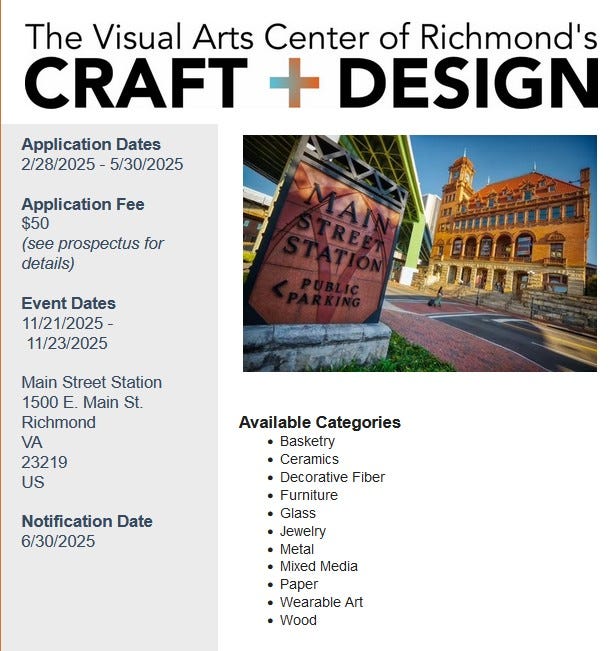
In this Issue: 1. Some highlights from the recent ORNAMENT magazine 2. Mastering the art of talking about your jewelry in public 3. Some advice about self promotion 4. Smithsonian Craft2Wear Show, September 26–28, 2025, APPLY NOW 5. What does it mean to foster a Growth Mindset? 6. Are the days of men’s jewelry worn solely as symbol of power and wealth gone for good? 7. Call for entries: Richmond CRAFT+DESIGN 8. Clever phrases/aphorisms/memes for artists of all kinds Some articles you may have missed
I received my most recent issue of one of my favorite magazines — ORNAMENT. Here are some highlights.
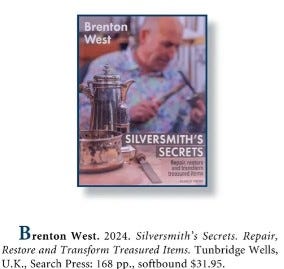
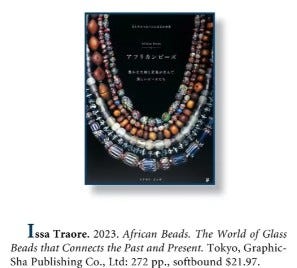
New books:
Articles:
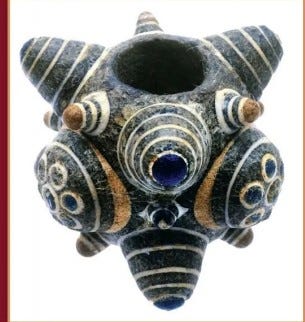
Ancient Craft Skills and the Contemporary Craftsperson
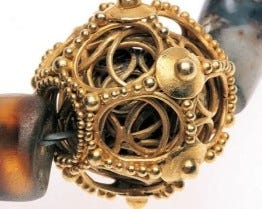
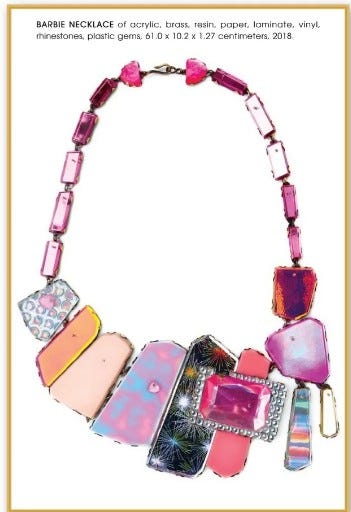
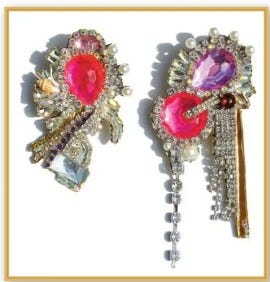
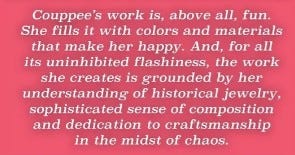
Nikki Couppee Showcase
There are many other jewelry designers highlighted, as is New York City Jewelry Week.
2. Mastering the art of talking about your jewelry in public
Speaking about your work publicly can be both exciting and nerve-wracking. Here are some key tips to confidently and effectively share your work:
a. Know Your Story (Inspirations, getting started, techniques and materials)
b. Develop a Clear 30 second Elevator Pitch (engage in 30 seconds; focus on what makes your jewelry unique)
c. Speak with Passion and Confidence (enthusiasm is contagious; take your time and speak clearly, even if you are nervous)
d. Adapt to your Audience (what do you think your audience wants to hear? focus on process and inspiration; highlight your brand and craftsmanship; be conversational and authentic; tell stories and anecdotes and don’t lecture)
e. Prepare a Narrative (focus on crafting a story that encapsulates your artistic journey, the challenges, triumphs, pivotal moments, struggles, doubts you’ve overcome, mishaps, recurring themes in your work, how your themes relate to your personal story; a compelling narrative evokes emotion)
f. Show and Tell (be prepared to show and tell, whether you have your jewelry with you at the moment, or you share images or your portfolio on your cellphone)
g. Engage, Don’t Just Talk (be interactive; encourage questions; ask what people think, invite them to share their opinions or what they think; get their reactions to a piece of jewelry before you begin to talk about it; style preferences; be conversational; show genuine interest in their responses and respond with some detail to what they say; be patient with responses and allow your audience time to formulate and articulate their thoughts; resist the urge to fill silences too quickly; you can always start the conversation by talking about a question you get asked a lot)
h. Practice, Practice, Practice (outline your remarks or write it out like a script for a play; rehearse in front of a mirror or with a friend; record yourself and refine your delivery; I use a desktop/mobile app called LOOM, which has a free subscription option)
i. Be Ready For Questions (why use these, do this, not do this?; what do you like?; how long does this take?)
j. Provide Takeaways (at the end of your talk, summarize the key ‘learnings’; provide a brochure or postcard or business card that your audience can take with them, as a physical reminder of your work; provide an avenue for them to explore your work further or contact you for potential opportunities, purchases, collaborations)
k. End With A Call To Action (extend the conversation beyond the event; always end with a call to action: visit website; sign up for newsletter; take them on a tour)
l. Follow-Up (you want to build lasting relationships (invite audience to stay connected and give you their email addresses, other contact information; send a personalized thank you note or email shortly after event; repeat highlights of your talk, links to your work, information about where to find you next)
m. Reflect and Adapt (review the event/encounter; what resonated best/least; what feedback did the audience present; adjust previous steps accordingly)
n. Network and Connect (expand your professional circle and foster meaningful relationships with other jewelry designers as well as your client base; engage in one-on-one conversations with clients who seemed interested in your work; exchange contact information with fellow designers and any boutiques, galleries or other businesses that seemed interested in your work; discover new opportunities to keep you and your work visible)
3. I was reading this article about self promotion, and wanted to share this with you. Good stuff.
The Power of Being Yourself Self-promotion often feels like an uncomfortable task for artists, but my first rule is simple: be yourself. There is no one way to self-promote, and the key is to find an approach that aligns with your personality. Authenticity is what draws people in — it’s not about forcing a persona but rather amplifying what makes you unique.
Let’s address social media, the most obvious self-promotional tool. Over the past half-decade, its impact has declined as big businesses have taken over. That doesn’t mean it’s useless — it just means you must use it wisely. Instead of treating social media as an advertising outlet, think of it as a storytelling tool. Show your process, your inspirations, and the personal side of your work. People connect with authenticity, not just finished products.
[His stated philosophy: Art is not something we create, it is who we are.]
4. Smithsonian Craft2Wear Show, September 26–28, 2025, APPLY NOW
The 2025 Smithsonian Craft2Wear Show is an exhibition and sale of wearable contemporary American craft (clothing, accessories and jewelry) held in Washington, DC at the beautiful Smithsonian Arts and Industries Building (AIB) on the National Mall.
Electronic applications are due by Tuesday, April 15, 2025. A non-refundable fee of $30 must accompany each application.
Failure is uncomfortable. Disconcerting. Too often, we do everything we can to keep ourselves out of situations where we might fail. We focus on what could go wrong, instead of what could go right. We think we don’t have the abilities to do the task. We get paralyzed. We do nothing. Or we keep repeating ourselves, producing the same-ole, same-ole, whether there is a continued market for these items, or not. Or we begin to visualize any risk as insurmountable, way bigger than it really is.
But allowing any fear of failure to become some kind of insurmountable wall works against us. If we are trying to make a go of it by selling our jewelry, we can’t build these kinds of walls. Successful business people and successful businesses need to foster a culture which promotes a growth mindset. Simply, a growth mindset is a culture where you have permission and encouragement and confidence to take risks.
Risks are OK because they bring rewards. Rewards allow the business to maintain itself, sustain itself, grow and expand.
Failures are OK, as well, as long as they become learning experiences.
Doubt and self-doubt are OK only if they are used to trigger reflection and new ideas to overcome them.
Not having the skills requisite for the moment is OK because we are all capable of continual learning.
Temporary setbacks are OK because you have had them before and overcame them.
Carol Dweck wrote the seminal book on growth mindsets called Mindset: The New Psychology of Success (2006), with a series of related books to follow. People have either a growth-mindset or a fixed-mindset.
Those with a growth-mindset believe their abilities are developed through continual learning and hard work. They are more willing to experiment and try new things, and see failures as opportunities rather than setbacks.
Those with a fixed-mindset believe that abilities are innate — you’re born with talents or not. They seek out opportunities where specific talents, rather than effort, leads to success. They prefer to repeat tasks and apply skills they are already familiar with.
Developing a growth mindset means such things as…
1. Understanding the power of “Not Yet”.
2. Setting learning and continual learning goals
3. Being deliberate and constantly challenging yourself
4. Asking for honest feedback and criticism
5. Always reflecting on and being very metacognitive about your thoughts and actions, successes and failures
6. Recognizing if you are stuck in a fixed-mindset, and acknowledging your weaknesses
7. Focusing on the process, and less-so on the result
8. Getting comfortable with self-affirmation, rather than needing the affirmation and approval of others
6. Are the days of men’s jewelry worn solely as symbol of power and wealth gone for good?
A look at men’s jewellery at GemGenève
The rebirth of jewellery for men since the 2010s is actually due to another factor altogether: men have changed the way they relate to jewels and jewellery in general, argues GemGenève co-founder Ronny Totah. Today, men account for up to 30% of jewellery purchases from certain collections by brands and independent craftsmen and women.
8. Clever phrases/aphorisms/memes for artists of all kinds
I am a member of the Columbia Arts Council. For an event, we are going to pass out stickers. I generated a sampling of sayings that could go on the stickers, and I’m sharing them with you. Thought you’d get a chuckle out of these.
General Creativity & Art
Create like nobody’s watching.
Messy hands, brilliant mind.
Art: cheaper than therapy.
Make art, not excuses.
Doubt kills more art than failure ever will.
Every artist was first an amateur.
Creativity is intelligence having fun.
I speak fluent paint splatter.
Art is my love language.
Reality is overrated — paint me another one.
The world is my canvas, and I’m out of control.
Perfectly imperfect — just like my art.
Stay weird, stay creative.
Warning: Contains excessive imagination.
Creativity takes courage — and a lot of snacks.
Makers & Hands-On Artists
Handmade with sarcasm and love.
Makers gonna make.
I make things. What’s your superpower?
Handcrafted with reckless precision.
This is what ‘made with love’ looks like.
I turn coffee into art.
Saw dust is my glitter.
I make because I must.
Perfection is boring. Make something weird.
Measure twice, cut once, cry anyway.
My blood type is glue and glitter.
I can’t. I have a project.
Made by hand, heart, and a little bit of chaos.
Mistakes are just creative detours.
Cut. Sew. Cry. Repeat.
Painting & Drawing
Watercolor outside the lines.
Oil paint runs in my veins.
Sketch today, masterpiece tomorrow.
More paint, less perfection.
I draw, therefore I am.
Happy little accidents happen daily.
Smudges are just love marks from my art.
Inking my way through life.
My brush dances to its own tune.
If you see me clean, I’m out of paint.
Jewelry Making & Beading
Bead it like you mean it.
I like big beads and I cannot lie.
Stringing together happiness, one bead at a time.
Jewelry is art you can wear.
Beading: because therapy is expensive.
If lost, check the bead store.
Some collect memories; I collect beads.
Beading is my cardio.
Life is too short for boring jewelry.
More beads, less stress.
Creative Process & Inspiration
Inspiration hits at inconvenient times.
Chaos is just creativity’s warm-up.
Creativity is a work in progress.
Start before you’re ready.
Don’t wait for inspiration — just start.
Creativity thrives in the mess.
Done is better than perfect.
There’s no such thing as too many ideas.
Creativity: where the fun begins and logic ends.
You can’t rush art — but you can procrastinate it.
Art & Business
Starving artist? No, thriving artist.
Yes, it’s handmade. No, it’s not cheaper.
Support artists — buy art, not mass production.
Art is work. Pay accordingly.
Artists don’t work for exposure.
Yes, I make art. No, I won’t do it for free.
DIY: Because hiring professionals costs money.
Just because I enjoy it doesn’t mean I’ll do it for free.
I create. You buy. Everyone’s happy.
Respect the artist. Respect the craft.
Music & Performing Arts
Life’s better with a soundtrack.
Dancers don’t sweat, they sparkle.
Sing like you mean it.
Break a leg — but not my instruments.
Music is what feelings sound like.
The stage is my happy place.
Dance first, think later.
Creativity has no volume control.
When in doubt, just improvise.
Make music, not noise.
Writing & Literature
Write your own story.
Plot twist: I need more coffee.
My brain is 90% plot ideas and 10% snacks.
Poetic soul, chaotic mind.
Editing is just rewriting with regret.
Too many tabs open — some are story ideas.
I write. What’s your superpower?
Procrastinating? No, I’m world-building.
My characters made me do it.
Caution: Writer at work — approach with snacks.
Quirky & Funny
Oops, I arted.
Eat. Sleep. Create. Repeat.
More glue, less stress.
Why fit in when you can stand out?
I make, therefore I am.
Art teachers gave up on me; now they buy my work.
Creativity: The only mess that’s worth it.
Not all who wander are lost… some are just looking for inspiration.
This shirt contains 100% recycled creative energy.
The best ideas come at 2 AM and disappear by 7 AM.
UPCOMING WORKSHOPS by Warren Feld
Sat, 4/12, 2–3, LET’S MAKE EARRINGS, Maury County Library, 211 W 8th St, Columbia, TN Register: Call (931) 375–6502
WARREN FELD JEWELRY (www.warrenfeldjewelry.com) Custom Design, Workshops, Video Tutorials, Webinars, Coaching, Kits, Group Activities, Repairs ~~~~~~~~~~~~~~~~~~~~~~~ Join our community of jewelry designers on my Patreon hub Be part of a community of jewelry designers who recognize that we have a different way of thinking and doing than other types of crafters or artists. One free downloadable Mini-Lesson of your choice for all new members! ~~~~~~~~~~~~~~~~~~~~~~~
People have different motivations and ambitions when making jewelry. These can be as simple as an avocation or hobby, or more involved as a business or career. Jewelry making is an investment in time and materials. It requires, not only strong creativity skills, but also persistence and perseverance to take a project from inspiration to aspiration to implementation. A lot of the success in this pursuit comes down to an ability to make and follow through on many artistic and design decisions. Developing this ability — a fluency, flexibility and originality in design — means that the designer has become empowered to answer these 5 essential questions: (1) Is jewelry making a craft, an art or design? (2) How do you think creatively? (3) How do you leverage the strengths of various materials and techniques, and minimize weaknesses? (4) How do the choices you make in any one jewelry design evoke emotions and resonate? and, (5) How do you know your piece is finished and successful?
5 Essential Questions Every Jewelry Designer Should Have An Answer For
Interested in trying your hand at jewelry design?
Before you begin, consider the following 5 questions I pose for you…
1. Is what you do Art, Craft or Design? 2. How do you decide what you want to create? 3. What materials (or techniques) work well together, and which do not? 4. What things do you do so that your finished piece evokes an emotional response? 5. How do you know when your piece is done?
People have different motivations and ambitions when making jewelry. These can be as simple as an avocation or hobby, or more involved as a business or career. Jewelry making is an investment in time and materials. It requires, not only strong creativity skills, but also persistence and perseverance to take a project from inspiration to aspiration to implementation.It means understanding that jewelry can only be judged as finished and successful as the piece is worn. Jewelry design is more than the application of a set of techniques; it is a mind-set, as well. It is a way of thinking like a designer.
A lot of the achievement and accomplishment in this pursuit of jewelry design comes down to an ability to make and follow through on many artistic and design decisions. Some have to do with managing a process, which can take an extended period of time. It also comes down to being fluent, flexible and original in your thinking through design. The greater your disciplinary literacy, the more empowered and confident you become in your design work.
Susan is one example of what happens when uncertainty — that paralysis or deer-in-the-headlights feeling that we so often face — sets in. Susan felt very unsure of herself. And unsure of her jewelry. Would people like it? Was the color mix appropriate? Was the construction secure? Was the price smart and fair? She allowed all this uncertainty to affect her design work — she had difficulty finishing pieces she was working on, starting new projects, and getting her work out there.
Like many of my jewelry design and beadwork students, Susan needed to be fluent as a designer. With fluency comes empowerment, confidence and success.
SO YOU WANT TO BE A JEWELRY DESIGNER Merging Your Voice With Form
So You Want To Be A Jewelry Designer reinterprets how to apply techniques and modify art theories from the Jewelry Designer’s perspective. To go beyond craft, the jewelry designer needs to become literate in this discipline called Jewelry Design. Literacy means understanding how to answer the question: Why do some pieces of jewelry draw your attention, and others do not? How to develop the authentic, creative self, someone who is fluent, flexible and original. How to gain the necessary design skills and be able to apply them, whether the situation is familiar or not.
STRATEGIC MANAGEMENT: How Do You Start and Run A Business Selling Hand Made Products?
Between Commerce and Art
Many people learn beadwork and jewelry-making in order to sell the pieces they make. In today’s world, people who sell their pieces must become savvy in both regular retail, as well as internet retail. This does not have to be too complex. Nor too overwhelming. Too impossible. Too boring. There are a lot of tensions here between commerce and art. Production and creativity. They parallel the tensions between the creative act and having to introduce your jewelry publicly. But all are manageable.
Conquering The Creative Marketplace is a comprehensive guide for you — someone who wants to start and run a business selling handmade products you love to make. The chapters in this book focus on developing and implementing your road map. This map helps show you how to better understand and relate to the creative marketplace, eventually earning money from your jewelry designs (or other art or craft projects). I go into detail about the things you have to do to start and run a business selling handmade products. I talk about the things you will want to do to manage, evolve and expand your business. These have to do with general accounting and setting up a general ledger. They include things like inventory management, pricing formulas, marketing and branding strategies. Also important is the protection of your designs — your intellectual property. I also discuss in detail key concepts like risk, return on investment, legitimacy, effectiveness, efficiency, consumption, influence, persuasion, coherence and contagion.
Based both on the creation and development of my own jewelry design business, as well as teaching countless students over the past 38+ years about business and craft, I want to address what should be some of your key concerns and uncertainties. I want to share with you the kinds of things (specifically, a business mindset and confidence) it takes to start your own jewelry business, run it, and lead it to a level of success you feel is right for you. Right for you will mean different things to different designers, from a hobbyist selling some pieces to a full-fledged operation. Whatever, your goals and ambitions, you will need to follow a basic road map. I want to help you plan your road map.
I explore answers to such questions as: How does someone get started selling their pieces? What business fundamentals need to be brought to the fore? How do you measure risk and return on investment? How does the creative person develop and maintain a passion for business? To what extent should business decisions affect artistic choices? What similar traits do successful jewelry designers share with those in business? How do you protect your intellectual property? What is your competitive advantage?
The next few chapters are descriptions of the kinds of things it takes for successfully integrating commerce with art. There are literally many full books written on each topic and subtopic, which you can easily access in bookstores or online. This book should be considered a comprehensive introduction to these topics. While all the information in this book is pertinent and necessary for you, it is not a substitute for talking with an accountant and business lawyer familiar with you and the locality, state/province and country you are doing business in.
The advice in these sections is useful for any jewelry designer who wants to sell their pieces. It is useful for the jewelry designer who occasionally wants to sell a few pieces. It is useful for the jewelry designer who wants to supplement their income. It is useful, as well, for the jewelry designer who wants to develop a fully, financially secure jewelry design business.
Many people learn beadwork and jewelry-making in order to sell the pieces they make. Based both on the creation and development of my own jewelry design business, as well as teaching countless students over the past 35+ years about business and craft, I want to address what should be some of your key concerns and uncertainties. I want to share with you the kinds of things (specifically, a business mindset and confidence) it takes to start your own jewelry business, run it, anticipate risks and rewards, and lead it to a level of success you feel is right for you. I want to help you plan your road map.
I will explore answers to such questions as: How does someone get started marketing and selling their pieces? What business fundamentals need to be brought to the fore? How do you measure risk and return on investment? How does the creative person develop and maintain a passion for business? To what extent should business decisions affect artistic choices? What similar traits to successful jewelry designers do those in business share? How do you protect your intellectual property?
The major topics covered include,
1. Integrating Business With Design
2. Getting Started
3. Financial Management
4. Product Development, Creating Your Line, and Pricing
5. Marketing, Promotion, Branding
6. Selling
7. Professional Responsibilities and Strategic Planning
8. Professional Responsibilities and Gallery / Boutique Representation
9. Professional Responsibilities and Creating Your Necessary Written Documents
Most people, when they get started beading or making jewelry, don’t have this overwhelming urge to become star jewelry designers. On the contrary, fame and fortune as a designer are some of the furthest things from their minds. Most people look to jewelry making and beading to fulfill other needs.
Over the years I’ve seen many people pick up beading and jewelry making as a hobby. They are drawn to these for many reasons, but most often, to make fashionable jewelry at a much lower cost than they would find for the same pieces in a Department store, or to repair jewelry pieces they especially love. When you start with the parts, and the labor is all your own, it is considerably less expensive than the retail prices you would find in a store for the same pieces.
Some people want to make jewelry for themselves. Others want to make handmade gifts. Giving someone something of great value, that reflects a personal expression of creativity, and a labor of love — you can’t beat it. And everyone loves jewelry.
When people get into beading and jewelry making, they discover it’s fun. Even addictive. They tap into their inner-creative-self. They see challenges, and find ways to meet them. They take classes. They buy books and magazines. They join beading groups and bead societies and jewelry making collaboratives. They have beading and jewelry making parties with their friends. They scour web-sites on-line looking for images of and patterns for jewelry. They comb the web and the various beading, jewelry-making and craft magazines, looking for sources and resources. They join on-line jewelry and bead boards, on-line forums, on-line web-rings, on-line ezines, groups, and on-line blogs. They take shopping trips to malls and boutiques and like little good Agatha Christies and Sherlock Holmes, they spy, looking for fashions, fashion trends, and fashionistas. They attend traveling bead shows. And every town they visit, they schedule some free time to check out the local bead stores and boutiques.
As people get more into beading and jewelry making, some discover that these avocations are not only sources of artistic self-expression, but also have many meditative qualities. They are relaxing. They take your mind off the here and now, and transport you to a very calming place.
Still, for others, beading and jewelry making become a way to earn some extra income. They might be to supplement what you’re making now. They might be ways to generate some extra dollars after you retire. They might be the start of your own business as a designer of jewelry. They might be a sense of independence and self-reliance. Having someone pay you for something you made is often the hook that gets people addicted to beadwork and jewelry making.
Most people, however, are content just to make jewelry. There are no professional Design paths to pursue. They may realize that they are out there somewhere, but don’t particularly care. Or sometimes they are unfamiliar with or can’t see all the possibilities. Perhaps they get stuck. No mentor, no book, no magazine, no project to entice them or spark an interest in something more than what they are doing now. But it suffices. Beading and jewelry making relaxes them, gives them a creative outlet, things to enjoy, other like-minded people to be with.
For those fewer people, however, who get a whiff of what it means to design jewelry, and jewelry which resonates, well, what a trip they are in for.
SO YOU WANT TO BE A JEWELRY DESIGNER Merging Your Voice With Form
So You Want To Be A Jewelry Designer reinterprets how to apply techniques and modify art theories from the Jewelry Designer’s perspective. To go beyond craft, the jewelry designer needs to become literate in this discipline called Jewelry Design. Literacy means understanding how to answer the question: Why do some pieces of jewelry draw your attention, and others do not? How to develop the authentic, creative self, someone who is fluent, flexible and original. How to gain the necessary design skills and be able to apply them, whether the situation is familiar or not.
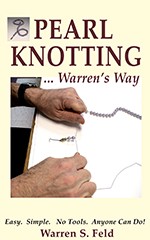
Hey there! Check out my book about Pearl knotting.
My name is Warren Feld. I am a jewelry designer with 40+ years of experience. In my book, I teach you the basic steps in Pearl Knotting. I’ll walk you through how to start your piece, tie knots between pearls, and how to end your piece. Simple instructions. Lots of diagrams and images.
What you will learn
In this book, i teach a non-traditional pearl knotting technique which is very easy for people to learn and do, does not use special tools, includes step-by-step instructions, a simple way to tie knots, shows clearly how to attach your clasp and finish off your cords, and achieves that architectural perfection we want in our pearl strung pieces,
Why This Class Is Important
There are many, many variations in technique.
They all work.
Yet most are very difficult for the beginner — especially those traditional techniques which rely on tools for making and positioning the knots.
Over the years, Ihave seen how students, when following traditional pearl knotting methods, or methods which utilize some more traditional techniques and approaches, become dissatisfied with their results.
And give up.
Pearl knotting doesn’t need to be this hard.
Warren’s Way
After many, many years, enduring many concerns, debates, demonstrations and arguments about which way is best, I came up with my own preferences —
o Using ideas, goals and parts of techniques from several established methods o Adjusting them, based on my experiences with students and teachers o And my knowledge of good design o And how to balance artistic concerns with functional ones.
The Book
I used these ideas and techniques, which I reached and put them to many test, to create a non-traditional pearl knotting technique which i call “Warren’s Way”.
4 variations
The book covers 4 different variations for starting and finishing your piece, including 1. Attaching directly to the clasp 2. Using French wire bullion 3. Using clam shell bead tips 4. Making a continuous piece without a clasp
I also present the steps for adding cord.
Kit and Supplies, Tools
You may purchase an accompanying PEARL KNOTTING KIT, as well as supplies and tools, at www.landofodds.com
“Asheville and its surrounding area in Western North Carolina boast a strong history with the arts. Penland School of Craft was founded in 1929, the Southern Highland Craft Guild started in 1930, Black Mountain College thrived from 1933 to 1957, and the Asheville Art Museum opened in 1948. More recently, Asheville’s River Arts District (RAD) began to develop in the 1990s, growing dramatically in the 2010s. Until late September 2024, it comprised more than two dozen old brick buildings and warehouses—mostly remnants of its time as an industrial hub—painted with bright murals and filled with vibrant studios, galleries, restaurants, and bars. With this rich artistic presence (which had a $3 billion economic contribution to Buncombe County in 2023), it is not surprising that, even amidst the shocking destruction and loss of life caused by Hurricane Helene, the impact on the arts community is keenly felt and widely acknowledged, even by the New York Times and Wall Street Journal. “
“I think the artists will suffer a lot of economic uncertainty. But on the other side of that I think a lot of art inspiration will come out of something so deeply felt by the artists.” —Jessica Blissett
“I feel like a small river pebble being worn round by a constant current of change. And I’m so beyond grateful for all the hugs, and prayers and folks putting in orders on my shop even though I don’t have a studio right now.” —Alice Scott
“While the waters and winds of Hurricane Helene ravaged studios and stalled practices that artists have spent their entire careers building, the tight social networks and a sense of hope remain. Artists have set up online fundraisers and raffles for friends, served meals through the World Central Kitchen (Deb Karash has helped serve tens of thousands of hot meals in downtown Asheville), and shoveled a lot of dirt and debris out of art spaces. Many are expressing optimism and sharing heart-warming experiences of fellow artists supporting one another. Blissett, for example, observed, “Those less affected at their homes donned hazmat suits and threw themselves into the cleanup. Those who lost so much still kept at the tasks at hand.” Foundation Studios conveyed the pervasive feeling of loss mixed with promise, posting on social media, “In the grand scheme of things we are lucky. This is an art gallery & studios, not a home (though it felt like it). These are things, not lives (though souls were put into them). If there’s one thing artists will do, it’s make more art!” “
Treats Studios in Spruce Pine provides a list of artists affected with links to make direct donations or support through direct sales: www.treatsstudios.org/artist-support-helene
Instagram is trying to phase out the use of hashtags.
Artist, social media influencer, and faculty expert Dina Brodsky recommends not focusing too much time on hashtags when you post.
“Honestly, they’re not really a thing anymore and it’s something that Instagram is trying to phase out.”
Unless it is a branded hashtag (when you specifically want a publication, gallery, or brand to see you), or you’re using your own: it doesn’t really matter.
3. Meet the world’s rarest mineral. It was only found once!
A single gemstone from Myanmar holds the title of Earth’s rarest mineral, kyawthuite.
“The kyawthuite crystal was discovered in 2010 by sapphire hunters in the Chaung Gyi Valley, near Mogok, Myanmar. Initially mistaken for an ordinary gem, it was later identified as unique by Dr. Kyaw Thu, a prominent mineralogist. After extensive analysis, the International Mineralogical Association (IMA) officially recognized kyawthuite as a new mineral in 2015. Today, the sole specimen resides in the Natural History Museum of Los Angeles County, where it is safeguarded as a geological treasure.”
4. Pewter. A Most Misunderstood Metal by Ana LopezFrom an article in Metalsmith Magazine 44(3):
“Now that pewter alloys are lead-free, a surprising number of artists are revisiting pewter’s unique qualities and complex history. Pewter is a tin-based alloy. Since tin is brittle, it is combined with other metals to improve its durability and working properties. And because it alloys easily and has a very low melting temperature, it can form a eutectic mixture with other metals, reducing the melting temperatures of each component. For metalsmiths, the nightmare scenario is heating silver that unbeknownst to them has been in contact with pewter, which leads to a meltdown in every sense.”
“Conversely, fans of pewter rave about its accessibility and forgiving nature. For example, welded pewter joints provide a seamless construction without being brittle. Pewter can be formed with wood tools, and can be melted with just a small butane torch. Since no amount of hammering, rolling, or forming will cause it to stiffen, there is no need to stop and anneal the metal. And since it’s a poor conductor, pewtersmiths can hold elements in place with masking tape while soldering with a torch. It can be liqueified in a saucepan on a hotplate and cast into a silicone mold. Scrap metal can be endlessly melted down for reuse, so nothing goes to waste. Finally, it is food safe— and considerably less expensive than silver.”
5. At the shop, I went through 3 pearl knotting instructors, and was never satisfied. Not only could their students not do a consistently good job, particularly when they tried to repeat what they learned after their classes, but also these instructors could not do a consistently good job themselves. So, after a lot of research, I wrote this book: PEARL KNOTTING…Warren’s Way.
Classic Elegance! Timeless! Architectural Perfection! Learn a simple Pearl Knotting technique anyone can do. No special tools. Beautiful. Durable. Wearable.
PEARL KNOTTING Doesn’t Need To Be Hard
In this very detailed book, with thoroughly-explained instructions and pictures, you are taught a non-traditional Pearl Knotting technique which is very easy for anyone to learn and do. Does not use special tools. Goes slowly step-by-step. Presents a simple way to tie knots and position the knots to securely abut the bead. Anticipates both appeal and functionality. Shows clearly how to attach your clasp and finish off your cords. And achieves that timeless, architectural perfection we want in our pearl knotted pieces.
Most traditional techniques are very frustrating. These can get overly complicated and awkward. They rely on tools for making and positioning the knots. When attempting to follow traditional techniques, people often find they cannot tie the knots, make good knots, get the knots close enough to the beads, nor centered between them. How to attach the piece to the clasp gets simplified or glossed over. Fortunately, Pearl Knotting doesn’t need to be this hard.
Pearl Knotting…Warren’s Way teaches you how to: • Hand-knot without tools • Select stringing materials • Begin and finish pieces by (1) attaching directly to the clasp, (2) using French wire bullion, (3), using clam shell bead tips, or, (4) making a continuous piece without a clasp • Add cord • Buy pearls, care for them, string and restring them, store them
By the end of this book, you will have mastered hand-knotting pearls.
Not comfortable showing prices online? Publish a private page.
Create a website page that is only accessible via private link, in which you feature the prices of the pieces you have on sale.
Next to your product information and image, add an INQUIRE Button.
Whenever an interested buyer asks about the prices of certain pieces, send them the private/exclusive link so they can see the works.
Also, include them immediately in your email database. Flag them as more likely to be interested in your work, because they have taken the effort to click on the INQUIRE button.
I was burnt out in my job as Director of a non-profit, health care organization when I met Jayden at a local bar. I was so bored in my job. Bored with the people I worked with. Bored with the tasks. Bored with the goals. I felt so disconnected from the field of health care. I wanted to stop the world and jump off. But into what, I had no idea.
I so much yearned for some creative spark. Some creative excitement. Something that challenged me, was artistic, was fun. And someone to do these things with. And, in 1987, I met Jayden. Jayden epitomizes creativity.
Soon after we met, Jayden moved to Nashville. But she was having difficulty finding a job. There was a recession going on at the time. At one point, I asked her what she could do, and she said that she could make jewelry. I thought we could build a business around that.
And so we did. Land of Odds was born.
Initially the business was oriented around Jayden’s design work. She made all kinds of jewelry from beads to wire to silver fabrication to lampwork. And at first, I had little interest in actually making or designing jewelry. But gradually, very gradually, I began learning the various techniques and the different kinds of materials and components. We took in a lot of repairs. I found it intellectually challenging to figure out why something broke — construction, technique, something about the wearing. I began to formalize some ideas and hypotheses into rules and principles.
Around 1998, Jayden and I wanted to offer jewelry making classes in our shop. But we did not want to repeat and replicate the types of classes already offered at other craft and bead shops in town. We did not want to do the Step-by-Step paint-by-number approach to jewelry making. We wanted to integrate architectural considerations with those of art. While we recognize that all jewelry making has some aspect of craft to it, we wanted to inspire our students to go beyond this. Jewelry beyond craft.
Over the next couple of years, with the help and guidance from many local artisans and craft teachers, we developed an educational curriculum embedded within what is called the Design Perspective. That is, our classes would teach students how to manage both beauty and functionality, and how to make the necessary tradeoffs between these within their finished pieces. Our classes would guide students in developing a literacy and fluency in jewelry design.
Eventually Jayden retired and our business began to revolve around my own designs and my developing understanding of the Design Perspective. After 35+ years in the business, I came away with some strong beliefs about what jewelry designers should be taught and how they should be taught. I’ve encapsulated all this within this text So You Want To Be A Jewelry Designer and its companion book Conquering The Creative Marketplace.
Promote your current projects, promotional copy, News & Views, videos, reels, tutorials, instructions, social media posts online in this newsletter and on our jewelry designers’ Patreon hub.
No deadlines! Opportunity available all the time. No fees. But don’t wait to take advantage of this opportunity. This copyrighted material is published here with permission of the author(s) as noted, or with Land of Odds or Warren Feld Jewelry. All rights reserved.
Repairs Stumping You? Let Me Take A Look
I take in a lot of jewelry repairs. People either bring them to me in Columbia, TN, or, I pick them up and deliver them back in Nashville. I am in Nashville at least once a week. It’s been convenient for most people to meet me at Green Hills Mall. But if not, I can come to your workplace or your home. This is perfectly fine for me. My turnaround time typically is 3-4 weeks.
I do most repairs, but I do not do any soldering. I also do not repair watches. These are the kinds of repairs I do:
o Beaded jewelry o Pearl knotting, hand knotting o Size/Length adjustment o Re-stringing o Wire work/weave/wrap o Micro macrame o Broken clasp replacfement o Earring repair o Replace lost rhinestones or gemstones o Stone setting o Stretchy bracelet o Metal working which does not involve soldering o Bead woven jewelry and purses o Beaded clothing o Custom jewelry design
WARREN FELD JEWELRY (www.warrenfeldjewelry.com) Custom Design, Workshops, Video Tutorials, Webinars, Coaching, Kits, Group Activities, Repairs ~~~~~~~~~~~~~~~~~~~~~~~ Join our community of jewelry designers on myPatreon hub Be part of a community of jewelry designers who recognize that we have a different way of thinking and doing than other types of crafters or artists. One free downloadable Mini-Lesson of your choice for all new members! ~~~~~~~~~~~~~~~~~~~~~~~
Not sure how I got this way. I can remember when I was 10 or 11 years old, my friend Gary and I, and sometimes Ira, who was sometimes a friend, sometimes someone we bullied, used to set fires, and then try to put them out. We would set fire to this field behind the Ford dealership on Rt. 22. We would set fire to homes and businesses under construction. We would set fires, let them burn awhile and then try to put them out by stamping them with our feet, putting blankets over them, pouring water on them.
We set fires until we were caught. By the police. Punished severely by our parents who could not figure out why we were setting fires. The word because was insufficient for them. We did it because we could. The fields and buildings were there waiting to be used. We used them the way we knew how. That gave us some fun. A feeling of power. And that was that.
That was that for Gary and Ira. Actually, not for me. I became mesmerized. The colors. The contrasts. The saturation and vibrancy. The interplay. The movement and rapid color changes. The certainty when it was all over.
My gaze locked in, never wavering, staring as the light tans and beiges of the tall field grasses, very still, began undulating with reds and oranges, some blues, some maroons, the fiery colors taking over, first a small area, then more and more, until the colors were more powerful than the heat generated by the fire. Once the fire was put out, I literally felt the strong juxtaposition between charcoal and beige, at once listless and lifeless, yet exuding a powerful finality.
Color is such a powerful influencer. I never set fires again, but, at the same time, I had no one to share my very personal, very emotional, very primal color experiences with until I was in my late 20’s. In school, I was always tracked with the more intelligent kids. This meant rewards for math and science, and some put downs for art and music. My parents did not want to hear about anything else besides lawyer and doctor.
Soon after Gary and Ira and I were caught, I moved away.
But I doubt color was in their forethoughts as we set fires to things.
The Jewelry Designer Colors Differently Than The Artist
You cannot paint with beads and other jewelry components.
I am going to repeat this: You cannot paint with beads and other jewelry components.
When you take color class after color class rooted in art, they are teaching you how to paint. You can’t do this with jewelry and beads.
I give this warning to all my students. I repeat it frequently in the articles I write. I follow it carefully when designing my own pieces. I have been challenged frequently by people who make jewelry and consider themselves artists. But to create successful jewelry takes you beyond art, its ideas, constructs and precepts. Jewelry has some roots in art, which is true. But it also has roots in craft. It is very comparable to architecture. Its product — the outcome — plays a different role and must conform to different social and physical tensions than paintings and sculptures. I repeat: You cannot paint with beads.
As frustrating as this can be, you cannot ignore the fact that Color is the single most important Design Element. Colors, their selection, use and arrangement, are believed to have universal powers to get people to see things as harmonious and appealing. Color attracts attention. A great use of color within an object, not only makes that object more coherent, it can make it more contagious, as well. Using colors that do not work well together, or using too many colors or not enough colors, or using colors which look good on paper but distort in reality can put people off.
Jewelry Designers can learn the artistic basics of Color concepts and theories. They can reference this visual language of color to influence how they go about making choices, including those about picking and using colors. However, jewelry artists who are fluent in design will be very aware of the limitations this artistic, painterly language imposes on them. They will have to learn how to decode, adjust and leverage their thinking to anticipate how the bead and other related and integrated materials assert their needs for color, and how to strategically compose, construct and manipulate them.
Jewelry, unlike painting or sculpture, has certain characteristics and requirements which rely on the management and control of color, its sensation and its variability with a slightly different emphasis than learned in a traditional art class. Jewelry is a 3-dimensional object, composed of a range of materials. Jewelry situates, moves and adjusts in relation to the human body and what that body is doing at the moment.
To get the attention their jewelry deserves, jewelry artists must become fluent with color selection and application from their own disciplinary perspective. We must understand color in jewelry as the jewelry is worn, and worn in a particular context or situation. Ever-changing directions and intensities of light and shadow, reflection, absorption and refraction. The observation that color may be present, even projected (the color shadow), outside the boundaries of the bead or jewelry component itself.
Beads [here I use ‘beads’ as a stand-in for all the component parts and stringing and canvas materials used in a piece of jewelry] are curved or faceted or otherwise shaped, and the shape and texture and material and dimensionality and even the hole through it affect the color, its variation and its placement and movement on the bead’s surface. They affect how light reflects and refracts, so depending on the angle at which you are standing, and how you are looking at the bead, you get some unexpected, unanticipated, sometimes unwanted colors in your piece of jewelry.
Additionally, you need to anticipate how the bead, when worn, can alter its color, depending on the source and positioning of light, the type and pace of movement of the wearer, and how the eye interacts with the bead at any point of time or positioning. There are many more color tensions that come from the interrelationships between positive and negative spaces. There are many gaps of light between each pair of beads, and you can’t paint these in. The colors don’t blend, don’t merge, don’t spill over, don’t integrate. You can’t create the millions of subtle color variations that you can with paint.
I’m not suggesting that beaders and jewelry makers be afraid of colors. Rather, they should embrace them. They should learn insights into understanding colors. They should be inspired by colors. They should express their artistic and creative selves through color. They should use color palettes to their fullest. They should recognize how their various audiences see and claim and interact with color.
It is most important that jewelry designers understand color, its use and application from their own disciplinary standpoint. In some sense, however, the approaches of most bead artists and jewelry designers too often remain somewhat painterly — too rooted in the Art Model.
The Art Model ignores things about functionality and context. The Art Model does not anticipate all the additional management and control issues which arise with jewelry creation and how /where / when it is worn. The Art Model diminishes how the individuality of the designer, and the subjective responses of the wearer and viewer affect each other. In many respects, these are synergetic, mutually dependent and reciprocal. The Art Model understands the success of jewelry only as if the jewelry were sitting on an easel, not as it is worn. When jewelry is treated as an inanimate object, apart from when it is worn, then traditional art color theories would suffice and apply.
As a result, when the use of color is solely dictated by art theory, then color theories get oversimplified for the jewelry artist. “Value” is barely differentiated from “Intensity”. Color selection focuses too much on harmony and variety, and too little on resonance and edginess. Color training too often steers jewelry designers towards a step-by-step, paint-by-number sort of approach to color selection and application. Color theory seeks to explain the universal, and paintings, given that they are immobile, hung on a wall, give time and space for the viewer to experience these universals.
Jewelry, on the other hand, requires an understanding of how color can be adapted to more subjective experiences. It does not stay in the same place. It is not desired in the same way across individuals who view it and wear it. As such, the co-dependent relationship between Color and other Jewelry Design Elements is downplayed and glossed over. This is a major disservice.
Designers need to think of colors as building blocks, and the process of using colors, as one of Creative Construction. Creative Construction requires focusing on how color (and multiple co-existing colors) is (are) sensed, and sensed by various audiences which include the artist him- or herself, and the wearer and the viewer, and the exhibitor, collector, and the seller, if need be. Creative Construction also requires anticipating how color is sensed within those context(s) and situation(s) the jewelry will be worn. Creative Construction includes an ability to anticipate how the various audiences of the designer use color to assume, perceive, understand, express, value and desire jewelry within any context.
All jewelry designers, including myself, are challenged with tasks like controlling the presentation of color(s) along a jewelry object’s silhouette. Or in blending colors among fixed physical objects awkwardly aligning or misaligning within some positive and negative spaces. Or having two or more colors co-exist within the same space or form which may or may not harmonize, given the reality that beads and other jewelry objects do not come in every possible and desirable color, nor consistently express any particular color over their entire surface.
I have found the use of simultaneity effects especially useful here. The one I use the most is that of grays. Gray takes on the colors around it. If I line up an orange bead, then a gray bead, then a blue bead, the middle gray bead will create the perception of a blended orange to blue form. Any bead with an underlying gray or black tone, strategically placed, will accomplish some color blending otherwise problematic.
I often play with other simultaneity effects. Some colors in combination emphasize warmth, and others cold. A sense of temperature (for example a red square embedded within a white square vs. that same red square embedded within a black square) can sometimes be used to divert the mind’s attention from whether the colors correctly harmonize.
In a similar way, some colors in combination (example a yellow square within a black square vs. within a white square) can create the illusion of either projecting or receding, and this too can be used to divert the mind’s attention from whether the colors correctly harmonize.
In my pieces, you will often find colors which, if not used strategically in combination and placement, would not seem to go together. They don’t fit a color scheme. They do not perfectly conform to a mathematical algorithm. They might even clash. More often, however, they just seem off in some way. But by smartly using simultaneity effects, they feel whole, consistent, coherent, right in some way. But also intriguing as the viewer’s mind tries to make sense of them. The colors resonate and are edgy in some way, yet feel harmonious, and the viewers can never figure out why. I intentionally create an object which lacks inherent meaning in order to trap the viewer into trying to find inherent meaning. Fun stuff. And something which often draws the viewer’s attention to my pieces, and keeps their attention there.
I like to play with color proportions. There are ideal proportions of the presence of any two or more colors. Red should appear in equal proportions to green. There should be one orange for any two blues. In art, we would strive to achieve the perfect proportions. In jewelry design, however, I would want to play with imperfections in proportions to give an edginess to my piece. This edginess, if not gone too far, enhances how the jewelry resonates emotionally for the wearer or buyer. We want our jewelry to have a little bit of edginess, or else it may feel harmonious yet boring and banal.
I believe the jewelry designer needs to be able to apply the careful of consideration of color with the goal of evoking resonance in the viewer. Something beyond harmony. Something represented by the difference of the viewer saying I like it, from the viewer saying I want to wear it, or I want to buy it. The designer is here to perhaps emphasize a little bit of the absurdity in life, some playfulness, some inquisitiveness which result from tensions between order and chaos, meaning and meaninglessness.
The designer is there, in part, to challenge the viewer’s subjective interpretations. This is especially true as the jewelry is worn and the wearer moves from different situations, contexts, and lighting. The use of color in jewelry designer often fails when the designer merely tries to duplicate a perfect color scheme, given perfect lighting and no movement. Jewelry is not a painting or sculpture to be displayed in fixed position. It’s much more. Using color from the designer’s viewpoint, rather than of the artist, is a very useful tool.
All these and similar color tricks I use as a jewelry designer contribute to how my jewelry expresses and reflects my authenticity. They add the cachet to my pieces as contemporary. Uninhibited by social norms encapsulated in art theory rules for the use of color. Creating more of a sense of freedom in my pieces, a sense which affects the feelings of freedom the wearer has. Transcendence. A re-imagining. Revelation, connection, awakening.
That’s what my Rogue Elephant needs, wants, demands. In this chaotic and indifferent universe, that rogue-ness could not have it any other way.
_______________________________
I hope you found this article useful. Please consider sharing. Thank you for clicking the CLAP HANDS icon at the bottom of this article.
It’s important to learn in an organized, developmental way. You want to be always asking how things are interrelated. What depends on what? You want to pose what-if questions so that you can train yourself to anticipate the implications and consequences of making one choice over another. What happens If? What happens When? What enhances? What impedes? What synergizes? What can be leveraged, and toward what objective? You want to reflect on your outcomes.
Some places for learning:
Local craft or bead store Community college University (art, fiber arts, metalsmithing, fashion) Jewelry design program Fashion schools Bead and Jewelry Making Magazines Social media groups Self-taught, crafting at home On-the-job training Certifications Art institutes Art grants How-to books Video tutorials Networking with other craft artists
Types of Beading and Jewelry Making
There is so much to know, and so many types of choices to make. Which clasp? Which stringing material? Which technique? Which beads? Which strategy of construction? What aesthetic you want to achieve? How you want to achieve it? Drape, movement, context, durability.
Sample of Techniques:
Stringing Assembling Bead Weaving Bead Working Wire Working Wire Wrapping Wire Weaving Silversmithing, Metal Work Cold Connections Fabrication Casting Fiber Arts, Knitting, Crochet Micro-Macrame Bead Embroidery Kumihimo, Knotting, Braiding CAD (Computer Aided Design) Enameling Lampworking and Glass Blowing Stamping Engraving Polymer Clay, Precious Metal Clay, Sculpting Lapidary Woodwork, Carving
Types of Tasks Jewelry Makers and Beaders Do
Adjust, reshape, resize, create and attach clasp assemblies Cutting stones, setting stones, determining value and authenticity of stones CAD (Computer Aided Design), 3-D Printing Fabrication, stamping, engraving, casting, soldering, cold connections, shaping metal wire and sheet, annealing Model and mold building, sculpting Manage thread tension, create self-supporting shapes, manage movement, drape and flow String, weave, netting, embellish, embroider, knit, crochet, braid, knot, wrap, assemble Understand jewelry-making as a process, from beginning to end Select color, proportion, volume, shape, forms, size, silhouettes, themes Place and Arrange design elements and components Read patterns, figures, graphs Select materials and techniques Determine measurements Assess stress, strain, strength, suppleness, stability and synergy Understand and access the creative marketplace, introduce their pieces publicly
Learning Objectives
A. Technical Mechanics
1. Managing tension, whether using thread, cord, string or wire
2. Holding your piece to work it
3. Reading simple patterns, figures, graphs
4. Selecting appropriate materials
5. Identifying areas of potential weakness, and strategies for dealing with these
6. Determining measurements, including width and length of a piece, especially in relationship to bead and other component sizes
7. Extending your piece, such as adding thread or wire
8. Finishing off your piece and adding the clasp assembly
B. Understanding Craft Basis of Technique or Stitch
Starting the technique or stitch
Implementing the basic technique or stitch
3. Finishing off the basic technique or stitch
4. Learning variations on the technique or stitch
5. Embellishing the Stitch, including fringe, edge, bail, strap, connectors
C. Understanding Art & Design Basis of Technique or Stitch
1. Learning implications when choosing different sizes/shapes of beads or other components, or using different stringing materials
2. Understanding relationship of the technique or stitch in comparison to other techniques or stitches
3. Understanding how bead asserts its need for color
4. Creating your own design with this technique or stitch, in reference to design elements and jewelry design principles of composition
5. Creating shapes, components and forms with this technique or stitch, and establishing themes
6. Building in structural supports, and other support elements, into the design
D. Becoming a Bead Weaving or Jewelry Making Designer
1. Developing a personal style
2. Valuing or pricing your work
3. Teaching others the technique or stitch
4. Promoting yourself and your work
5. Advocating for jewelry as “Art” and as “Design”
Types of Tools Needed To Get Started
Scissors Chain nose pliers (inside of jaws smooth) Flat Nose Pliers Side Cutters Flush Cutters Tweezers and Awl Assorted sizes of hard wire, cable wire, bead cord and bead, thread, elastic string Ruler Crimping pliers Hammers and mallets Steel block plate Doming block, anvil Sizing cones Hand held torch and fire-proof work surface Bead stoppers / clamps Color wheel Work Surface or Pad Bead board Round nose pliers Ring, Jump Ring, and bracelet mandrels Needles, wax Jeweler’s saw and blades Good lighting Comfortable seating
Finding jobs and pathways utilizing your skills as a jewelry designer…
There are actually many career pathways for people who have backgrounds in jewelry making and bead working. Besides the obvious pathways of making jewelry to sell, or teaching jewelry making, there are still many job and career opportunities for you.
Jewelry maker Illustrator Fashion designer Stylist Metalsmith Teacher Lapidary Gemologist Jewelry repair Wood worker Fiber artist Lampworking and glass blowing Physical and Occupational Therapist Counseling Custom designer Engraver Sales Merchandising Website design Data analyst Grants writer/reviewer Program director Video instructor or host Jewelry assessor Display and Packaging Influencer Writer Business Developer
I am writing an article about how jewelry designers began their careers/hobbies/avocations.
I would be interested in you sharing your stories.
Some of the questions I want to explore in my article:
1) How did you get started making jewelry? motivations, intentions, whether the start was very dramatic or mundane, whether you thought it was fate, destiny, luck, personal choice. Was there a particular point in time, or some kind of evolution?
2) What was your first moment of validation like? Not when you started making jewelry per se, but when you started telling people and feeling like an ‘artist’ or ‘designer’. It might have been a quiet admission, coming out to yourself as an artist. It might have been something public, like selling a piece, exhibiting it, some reaction from a client. It might have been some kind of break-through or finding newness or inspiration. It might have been a feeling of originality. A lot of people make jewelry, and can be very talented at it, but do not consider themselves as ‘artists’ or ‘designers’.
3) To what extent did beginning as a jewelry artist/designer feel like a response to society or family or local culture? Art doesn’t exist only because of feelings and emotions. There is a complex infrastructure within which the jewelry designer needs in order to survive. How would you describe this infrastructure within which you work and because of it you can survive. To what extent does it help you to enhance your work and vocation? To what extent does it impede you?
4) Were there special circumstances that were critical in your beginning and development as a jewelry artist/designer? Were there specific excitements, anxieties, challenges you faced?
5) For you, was there a beginning, and then a beginning again? Describe how difficult it was to begin again. How did it feel/seem to question or know whether you could create again?
6) What kinds of things have enabled you to keep going as a jewelry artist/designer? What contributed to your ability to survive your creative life?
I may or may not reference what you share in my final article. Unless you specifically tell me it’s OK, I will not use anyone’s real name in my article.
I appreciate you taking the time to share. I know a lot of jewelry designers and would-be jewelry designers can learn a lot from your experiences.
That’s it for now! There is a lot of creative expression all around the world right now. Hope you get to experience a lot of it, either first hand, or through social media online.
As I pursue the pathways which have led me to my Rogue Elephant, for the most part, I feel free. I feel I can take responsibilities for the choices I am making, whether to go this way or that. I’m on that road to explore, to critique, to reflect, to ponder, to plan, to strategize, to move on. I feel within myself a purpose in life. This is all good. And right. I feel I have the tools to overcome the unfamiliar and the unknown. Clear. Confident. Not cocky.
However, during most of my childhood, youth and young adult life, my relationships with my relatives sometimes interfered. Irritated. Distracted. Distorted. Got me frustrated. Made me scared. Made me angry.
They are relatives. This is different than relationships with strangers or friends or colleagues. I too easily allowed my relatives to get inside my head. Too easily to be too sensitive and responsive to their own values, beliefs and expectations they placed on me. It made it difficult for me to stay on that path. And search for my Rogue Elephant.
It is that blood connection. That almost primal need for family, clan, tribe. You can’t pull away so easily. Distance yourself from them. Even if you barely know them. Even if you do not share their beliefs and values. Even if you detest them.
The Bridesmaids’ Bracelets
For years, I fretted. I worried, and fretted, and paced up and down, and down and up. I rubbed my hands in the way that worried people rub their hands. I shouldn’t go. I would not go.
To my niece’s wedding.
My only niece.
Of my only sister.
My niece who I had hoped and prayed and prayed some more that she would never get married. Why couldn’t she just live with the guy? Why marry? Marriage is an encumbrance. It’s an outdated, Middle Ages kind of thing that denigrates women under the guise of protecting them. They sign a contract giving themselves over to the man, vowing to obey. Respect. Follow. Bear babies. Cook. Clean. Even earn a living, if he can’t.
Yet the man keeps the power. His voice to God. Her voice through his to God.
Marriage. Not for me.
And I didn’t want to go.
Too afraid I’d say something or do something to upset people.
Because they would be there.
Those cousins.
And their children.
And their children’s children.
Too many of them, and only one of me.
But my cousins had rejected me because I was gay.
And that hurt.
And then that rejection became an idea of rejection and a symbol of rejection, and I thought how often in life, from when I was very young, to when I was much, much older, — how often in life had I been rejected for some label or category or reason having nothing to do with me. Rejected as a Jew. Rejected as gay. Rejected by friends. Rejected by strangers. Rejected by family.
So toxic.
Didn’t want to deal with this.
Preferred avoidance.
Thought over and over again what excuses I could give my sister.
I thought about this when my niece was 13.
I thought about this when she was 18.
Then 20, and 23, and 24 and finally 28, when I had to make a choice.
My sister and her family were very close to these cousins, closer to them in most ways than to me. Years ago, my sister used to invite me for Thanksgiving and for Passover. And she invited all these cousins, as well. She liked to give a party.
Partying with these cousins was too toxic for me, so I made excuses. Too busy at work. Things too slow in business so couldn’t afford it. Had other things scheduled.
For me to feel comfortable, my sister’s choice would have to have been “ME”, not “THEM”. I felt bad. I felt guilty. I didn’t want to put my sister in this situation. It was easier to come up with an excuse.
But year after year, the situation took its toll. Rejection — a symbol, but painful nonetheless. Not because of the act itself, but the symbolic power of the act to affect me — Rejection — put a wedge between my sister and myself. I did not have the self-confidence, and I didn’t value myself enough, to prevent caving in before this symbolically powerful act of rejection because I was gay.
I was always looking for love and connection, but when around my relatives, all I felt was isolated, confused and in despair.
I didn’t have to deal with this as long as I stayed hundreds of miles away from New Jersey and Maryland and Virginia and Florida. Tucked safely in middle Tennessee.
I Had To Go / I Wanted To Go
The wedding was in March.
The previous summer, I decided I would go. Not exactly sure what changed my mind, perhaps a feeling of familial obligation, perhaps putting my sense of self to the test, perhaps wanting to try out all that good food and cake and drink specially prepared for the occasion. My sister plans the best parties.
I offered to make bracelets for all the bridesmaids.
I wasn’t just being a good guy here. Jewelry and design are at the core of my identity. The jewelry I design is the result of my choices. Choices about colors. Choices about the placement of lines, shapes and forms. Choices about the clasp and how to attach it. Choices about materials and techniques.
My inner being. On display. Irrefutable.
My choices have little to nothing to do with the label “JEW”.
Nor do my choices have much to do with the label “GAY”.
They are about me. A Designer.
Reflected in my jewelry.
And would be on display.
Accept or reject my jewelry.
And you accept or reject me.
On my terms.
My own terms.
Me.
My essence.
My resonance.
My jewelry.
This was my chance to shine. I was going to create a special bead woven design for these bracelets. Something frilly and girly for a wedding, but something also indicative of my style. Something that would not take too much work, but would look very rich and substantial.
I designed what I thought would be the perfect bracelet. A mix of stitches. Great looking beads. Had movement and dimension. But I was struggling to find the perfect color palette. The bracelet was made up of 4 colors, and a 4-color color scheme is one of the most difficult to work with — especially when it comes to beads, which are not available in all colors, let alone 4 colors which could specifically work in a specific color scheme in this specific bracelet.
While I was struggling to pick colors, Dara, my niece, had been doing a little online research, as well. She found two bead-strung bracelets on Etsy that she particularly liked, and shared these with me.
No, No, No!!!
My first reaction was Horror! Oh No!, she wants something bead strung and so non-artisan looking. Making these up would not signify to my terrible cousins nor to my good cousins, who I was all about. As Jayden, my partner, said, buy all the parts and do it quick. You’re not close to your niece, so who cares. But to me, although the work involved would be minimal — it would not be enough of a gift for the wedding.
Don’t get me wrong. The two bracelets Dara picked out were very attractive. They were just so out of sync with everything I wanted to do, and everything I wanted to accomplish. And I had to ask myself: give Dara what she wants, or go off in a different direction?
The question was kind of rhetorical. Of course, I’d give Dara what she wanted. But what to do. How can I construe, mold, fashion, arrange the bracelet to be reflective of me? Jewelry designer Me. Bead artist Me. Worthy cousin to be awed and ooh’ed over Me.
Dara’s Bracelet
The bracelet Dara wanted was 3 strands of 6mm round fire polish beads in two coordinating colors which matched the color of her bridesmaid dresses. The beads were staggered in a V-shape like bowling pins, each section separated by a diagonally placed 3-hole spacer bar.
I thought long and hard about how I could make this general design my own.
A few weeks passed. And an idea came to me. I could bead weave the spacer bars. I could alternate right angle weave and flat peyote to create a stable, rectangular shape. The right angle weave sections would be the two sides, which would allow me to build in the holes. The flat peyote would be the top and the bottom, which would allow me to build in a shape-supporting structure. I would embellish the tops of the bars with 2mm round Austrian crystal beads, and I would create bead woven end caps on either side of the bar, to give the bars a finished and polished look. Then I would use needle and thread to string everything up.
That was my answer.
It was a good one.
So, first, I set about coming up with the bead woven pattern for my spacer bars. This did not take very long because I had a clear idea about what I wanted in my head. What was not in my head, however, was how long to make the bars and how many holes each should have. And would they work in the whole composition.
I ended up making 5 test bracelets, each requiring 11 spacer bars, and each with some variety in the design or placement of the spacer bars, and in the attachment strategy for the clasp.
Now I had three key tasks finished: (1) The design of the spacer bars (2) The construction plan for the bracelet (3) The construction plan for attaching the clasp
Next, selecting the right colors of beads.
First off, I wanted to use 6mm round Austrian crystal beads, instead of Czech glass.
There were images of the bridesmaid dresses on line, but the actual color skirted that area between blue teal and green teal, and not every computer screen showed the color exactly. It became critical to the choice of colors, given some limited choices available in the Swarovski line in this range, whether the dress was more on the green side or more on the blue side.
My sister said Blue.
My niece said Green.
My sister was supposed to send me a fabric sample, but she lost it.
I mocked up 3 bracelets, one all blue teal, one a mix of blue and green teal, and one more green teal.
My sister picked the green.
My niece picked the mix of blue and green.
And my gut, from looking at the computer images, was telling me it should be all blue.
Impasse.
I went with my gut, and settled on all blue, actually a mix of capri blue and Caribbean opal.
There were four bridesmaids. I asked my niece to get their wrist measurements. One the bridesmaids had a very, very thin wrist. Would my design work for her? I agonized over it. The sections were very rigidly organized, and I’d have to remove a whole section at a time. Luckily, this worked OK.
The only other hitch that came up had to do with the availability of the parts.
I designed the piece in September. The wedding was in March. In November, I tried to acquire enough clasps and end bars for the clasp assembly, and found out that both the clasp and end bar I had chosen were either out of stock until the following April, or no longer manufactured.
So began the desperate hunt for these parts. The end bars had to be 22mm wide, or very close to that, with 3 holes and 3 holes spaced out evenly across the bar. Most 3-hole end bars were around 15mm wide. Found some in Israel, which while no longer manufactured, the supplier had just the amount I needed left in stock. Easily found a substitute clasp.
Then there were the beads. Again, I’m in November. The capri beads were out of stock from my supplier, and 2 of my alternative suppliers, but due back by December. The Caribbean opal beads were out of stock, and not due back anytime soon. I found a supplier who charged a little bit more for these, but got enough for my needs.
Whew!
Was Standing In The Same Room As My Relatives The Right Choice?
It was a few weeks before the wedding, and I was wondering if my choice to attend was the right one. Over and over and over again, I played out in my head what I would or would not say to my very inconsiderate, selfish, self-centered, inhospitable, unsympathetic, narrow-minded, prejudiced relatives. One part of me wanted me to be pleasant but distant. Another part of me wanted me to say something pointed and ugly.
I asked each of my friends, what they would do. I wanted so badly to be pointed and ugly. I was leaning in that direction. Of course, I didn’t want to upset my sister or my niece.
I thought back on the event that started it all. It was really so insignificant. An expected invitation to a cousin’s wedding never came. But I hadn’t planned on going. I did expect to receive an invitation, however. Because everyone expected me to receive an invitation. We all had been planning vacations and things to do around this invitation. For well over a year at that point. We had been planning. All of us. When we were going to arrive, where we were going to stay, and what we were going to do. And while I didn’t plan on going, I expected the invitation.
Rogue Elephants Are Shy And Hide In The Presence of Self-Doubt And Life Crises
I’m a firm believer that every few years, we each go through a life crisis. When we are babies, we have to resolve a crisis of finding out who to trust, and who not to. A few life crises later, we’re in puberty, having to resolve whether we’re still a kid, or some kind of adult. Several life crises after puberty, we go through the mother of all life crisis — what we call, cue the digital billboard, the Mid-Life Crisis. This crisis is filled with anger, frustration, regret, disappointment, fear.
My mid-life crisis arrived several years before Dara’s wedding. Eventually I came to terms with mid-life. That’s what I did. And then, immediately after my mid-life crisis, as if the mid-life crisis wasn’t traumatic enough, I had a sudden, almost primal, no, yes it was full-on primal, urge to reconnect with my family. I had grown apart from my sister and father and brother. From my first cousins in Florida and those in New Jersey, New York and Maryland. And from their children, my new second cousins. And I was feeling the need to re-connect. Post mid-life I urgently felt the need to re-connect. Like it was life or death. Connection. Affirmation. Completeness.
And I reconnected.
I slowly began to let everyone know I was gay. They kinda knew and suspected already. But I made it official. Pretty much everyone except my sister was supportive at some level. Eventually she got used to it.
I was invited to my cousin Michele’s oldest son’s wedding. And then, over the next few years, to some other weddings and bar and bat mitzvahs and special occasions. I re-connected. I was happy. Soon there were the occasional phone calls and emails. A few of my cousins sent out the periodic mass emails, and I was on their lists. I kept up with their newsy news and not-so-newsy news, their shared successes, their joys in life, and the every-so-often sadnesses. I felt included. Supported.
It was important to everyone, and you could tell, because they spent so much time doing it, to anticipate the next event we’d all attend. The next event was the marriage of my cousin Michele’s middle son.
It was to be a June wedding. I got a phone call sometime in April from my sister. “Did you get your invitation yet?” And a day later, from my cousin Leslie. “Did you get your invitation yet?” And obviously the answer was, No! Not yet. I kept checking the mail for several days, and then it began to dawn on me that I wasn’t invited. I wasn’t going to be invited. And if not getting invited to an event that I wasn’t planning on going to wasn’t enough of a jolt and shock, both my cousins Michele and Paulette dropped me from their almost daily mass email lists.
I was person non-grata. Why?
I asked myself, Why?
And I asked some cousins, Why?
And it became known that the Why was because I was gay.
And that was that.
Excluded again.
Of course, I wanted my sister to make the choice not to go.
She went.
And that put a wedge in our relationship that never really healed, because it was irreconcilable.
And I got very depressed for a few months afterwards.
There Is A Long History
I do not have to think very long or very hard to realize that my relationships with my relatives soured many years ago. There were slights. Special occasions arranged on dates my family could not attend. Arguments over matzah balls (hard or soft) and Thanksgiving dinners (traditional food or non) and inappropriate racist remarks and jokes. It was my uncle Sid, when asked to stop telling black (N-word) jokes, said, OK!, then began telling polish (P-word) jokes.
There were very barbed comments about home décor, kitchen counters, brands of appliances, whether a kitchen island or not. There were my religious cousins who would not visit New Jersey because they believed the ground outside the New York City metropolitan area was unholy. Who would not eat Kosher food prepared by my mom because she could never prepare food Kosher enough. There were the complaints that there was never enough food. And the constant, mean-spirited gossip relatives vomited out of their mouths about other relatives.
If something happened to me or to either of my parents or to my sister or brother, I could never turn to these relatives for practical or emotional support and help. I felt too alienated from them. They alienated me from them.
So I wasn’t invited to a wedding. So my relationship with my sister and her family never became close — at least for a long while. So I no longer kept up with my cousins and second cousins and all their offspring. So I had some issues with my parents and my school and the dominant Christian culture. That’s largely behind me. Not an obsession. But the oncoming wedding of my sister’s daughter forced me to focus on these things again.
Thank God the wedding only lasted a weekend.
Wedding Weekend
True to form, my sister threw a grand event people are probably still talking about.
In the few months leading up to the wedding, I concentrated on designing the bridesmaids’ bracelets. As I determined how I would make the pieces my own, I got very excited. I developed a very clever and professional way to bead weave the 3-hole separator bars. I combined Right Angle Weave and Flat Peyote, using the structural and inherent properties of each in a strategic way. This allowed be to create holes in the sides through when to thread the strands, and structural support to allow the bars to keep their shape.
I kept thinking that, while the bridesmaids would find the bracelets appealing and desirable, they would never appreciate the amount of thought, work and insight involved in their construction. So, I decided I would later turn this piece into a kit and a workshop. This piece was a great example of my evolving ideas and writings about the architectural bases of bead weaving stitches.
The wedding itself was beautiful, and went off without a hitch. The food was terrific. The location romantic. The flowers and bridal gown beautiful. There were over 200 guests. And about 60 of those I was trying to avoid. Relatives!
I arrived a day earlier. One of my cousins, whom I do speak with occasionally, arrived at the airport at the same time. After we checked in at our hotel, we went to lunch and unloaded about all the relatives. She and I have similar opinions about these people.
In the late afternoon, I stopped by the Bridal Suite, where they had set up to greet guests arriving early and staying at the hotel. You walked into the equivalent of a living room. Off to the left were a bedroom, kitchenette and bathroom. Off to the right were a dining room and an outdoor patio. It was in the 30’s and wet and snowy, so no one went out on the patio.
As more and more people gathered in the Suite, I found myself talking to some folks in the dining room. And then, one by one, two by two, three by three, these cousins I wanted to avoid started filling up the center room. And I found myself backing up against the far dining room wall, seemingly pushing myself into the wall and through it, or so it felt to me. My mind left the room and merged into the wall. I desperately looked for an opening where I could run through the living room and out the door. But more and more people came flooding in. I was having trouble catching my breath, slowly going into panic.
At last, an opening. I escaped. Hyperventilating. I went up to my room, and waited until I regained some composure. My panic attack had run its course.
Twenty minutes later, I returned to the Bridal Suite, bridesmaids’ bracelets in hand. I had put each into its own jewelry box, with the name of the bridesmaid written on a card in each box. They were going to take the bridal pictures in the morning, and I wanted to be sure they were wearing their bracelets. And I secretly wanted a lot of these people crowding this Bridal Suite to get a glimpse of what I had made.
As I had thought, they loved the bracelets — they were beautiful — but were clueless about design. That “full” feedback is so very important to me, but often missing.
Luckily the colors of the bracelet perfectly matched the dresses.
My job was done.
It was many years later, that I was able to distance myself emotionally from these people. Underlying, gnawing tensions here led, forced might be a better word for it, the way towards finding new meanings in life for myself. A source of growth and discovery. I eventually found my Rogue Elephant and beaded him. A crutch, perhaps. A diversion from family, maybe. Or a hand-knee-trunk up. A connection. A purpose.
CONQUERING THE CREATIVE MARKETPLACE: Between the Fickleness of Business and the Pursuit of Design
How dreams are made between the fickleness of business and the pursuit of jewelry design
This guidebook is a must-have for anyone serious about making money selling jewelry. I focus on straightforward, workable strategies for integrating business practices with the creative design process. These strategies make balancing your creative self with your productive self easier and more fluid.
Based both on the creation and development of my own jewelry design business, as well as teaching countless students over the past 35+ years about business and craft, I address what should be some of your key concerns and uncertainties. I help you plan your road map.
Whether you are a hobbyist or a self-supporting business, success as a jewelry designer involves many things to think about, know and do. I share with you the kinds of things it takes to start your own jewelry business, run it, anticipate risks and rewards, and lead it to a level of success you feel is right for you, including
· Marketing, Promoting, Branding: competitor analysis, developing message, establishing emotional connections to your products, social media marketing
· Selling: linking product to buyer among many venues, such as store, department store, online, trunk show, home show, trade show, sales reps and showrooms, catalogs, TV shopping, galleries, advertising, cold calling, making the pitch
· Resiliency: building business, professional and psychological resiliency
· Professional Responsibilities: preparing artist statement, portfolio, look book, resume, biographical sketch, profile, FAQ, self-care
SO YOU WANT TO BE A JEWELRY DESIGNER Merging Your Voice With Form
So You Want To Be A Jewelry Designer reinterprets how to apply techniques and modify art theories from the Jewelry Designer’s perspective. To go beyond craft, the jewelry designer needs to become literate in this discipline called Jewelry Design. Literacy means understanding how to answer the question: Why do some pieces of jewelry draw your attention, and others do not? How to develop the authentic, creative self, someone who is fluent, flexible and original. How to gain the necessary design skills and be able to apply them, whether the situation is familiar or not.
The Jewelry Journey Podcast “Building Jewelry That Works: Why Jewelry Design Is Like Architecture” Podcast, Part 1 Podcast, Part 2
PEARL KNOTTING…Warren’s Way Easy. Simple. No tools. Anyone Can Do!
I developed a nontraditional technique which does not use tools because I found tools get in the way of tying good and well-positioned knots. I decided to bring two cords through the bead to minimize any negative effects resulting from the pearl rotating around the cord. I only have you glue one knot in the piece. I use a simple overhand knot which is easily centered. I developed a rule for choosing the thickness of your bead cord. I lay out different steps for starting and ending a piece, based on how you want to attach the piece to your clasp assembly.
SO YOU WANT TO DO CRAFT SHOWS:16 Lessons I Learned Doing Craft Shows
In this book, I discuss 16 lessons I learned, Including How To (1) Find, Evaluate and Select Craft Shows Right for You, (2) Determine a Set of Realistic Goals, (3) Compute a Simple Break-Even Analysis, (4) Develop Your Applications and Apply in the Smartest Ways, (5) Understand How Much Inventory to Bring, (6) Set Up and Present Both Yourself and Your Wares, (7) Best Promote and Operate Your Craft Show Business before, during and after the show.
I thought I heard some swish sound of something moving in the air. Something from the back of the room. Headed toward the front of the room. And a sudden click, perhaps a bounce, then another click, click, perhaps another bounce, another click, a rolling sound, and yes, something hit the guy speaking in the front of the room. That guy was my father. That noise I heard was the sound of a plastic pharmacy bottle and its plastic safety cap making a bee-line towards that guy in the front of the room. And bull’s-eye!
My father, you see, at the time, was President of the New Jersey Pharmaceutical Association. He had higher ambitions to get appointed as a Commissioner of Pharmacy on the New Jersey Pharmacy Board. The Board, knowing that, politely volunteered him to introduce the new safety-capped prescription bottles to the pharmacy association’s members. So here he was.
And it just wasn’t one bottle that came flying. I was so peeved. I had taken the time to go up and down the aisles of this auditorium, handing sample bottles to each and every pharmacist there. Now these bottles, one after one after one after one, were getting thrown to the front of the room. My father dodged most, but not all. Yet, at no time, did my father deviate from his presentation. He kept talking from his notes from start to finish.
The original safety capped bottles were difficult to open, to say the least. The standard was that it should take an adult 3 minutes or less to open, and a child 5 minutes or less. Forget about it if you were elderly. Opening these wasn’t going to happen. And most elderly, once they got the caps off, left them off. When my father quoted this standard, that’s when most of the bottles flew up into the air, along a curved trajectory, and ever-so-slightly towards the dais. Plastic hitting tile or concrete or whatever.
And my father’s final line: Within 3 months’ time, the state will require all pharmacies to use only these new safety capped prescription bottles. You’d have thought the room was filled with cows with slight speech defects. Boooooo…..! Boooooo…..! Boooooo…..!
I internalized all this. My father modeled what it meant to be a professional. I model for my jewelry making and beading students what it means to be a professional. My father stuck to maintaining high expectations and standards. To the chagrin of many of my students, I hold them up to high expectations and standards. Although I don’t get plastic bottles thrown at me, I have had to confront a lot of resistance when trying to have my students, my clients, my customers, my colleagues live up to that label I call professional.
There is a widespread belief that crafters and makers are not professionals. There is no law about this. Or regulation. Or rule. It is more of an assumption. Laziness. Low expectations. Low self-esteem. A lack of understanding of the role of a jewelry designer. I refuse, however, to succumb to anything less.
The very nature of jewelry itself necessitates the designer’s role as professional. Jewelry is made to a quality standard. Since jewelry is to be worn and bought and sold, the needs and desires of both designer and wearer must be taken into account. In fact, each piece of jewelry, introduced publicly in whatever way and in whatever circumstance, by definition, triggers conversation. Defines relationships. Exposes desire. Sets possibilities as well as boundaries on participation.
The designer has key responsibilities here, given all the choices which need to be made, when translating inspiration into aspiration into an actual piece of jewelry. The designer can be nothing but a professional. Whether she or he believes it or not. Or acts like it or not. Designers cannot barricade their doors to their Rogue Elephants. My point: They have to bead them.
The whole prescription bottle thing was a mess. One of the things professionals learn to get good at is in anticipating their client’s needs, then shaping what they say and what they do accordingly. It’s about establishing relationships which help clarify what each other knows, assumes, wants, desires, can or cannot do. As a professional, the preference should not be on relying on the law to force these pharmacists to comply. The preference should be to reach an understanding so that the pharmacists, no matter how skeptical or reluctant, will comply on their own. My father presented his message, but it wasn’t received well. As a professional during this time, my father needed a little more development.
The Audacity
In 1998, I created a school to teach jewelry making and beading using a professional model of education. I was literally ANGRY, and very frustrated, that so many of our shop customers had taken so many classes around town, but still could not really do much on their own. I wanted them to be more informed. To do more than making the same project over and over again. To challenge themselves. To experiment. To play. I knew Rogue Elephants loved to play.
My professional training had been in planning and design. While it was health planning and urban design, and although I hadn’t worked in this particular professional capacity for 20 years, everything I learned seemed very appropriate for jewelry design and beading.
But what I saw around me in Bead World — the types of classes taught and the types of books available and the types of articles in beading and jewelry magazines — none of these things seemed quite on the mark. None of them taught about design. None of them challenged the beader or jewelry maker to step out of some very constricted boundaries and rules. None of them seemed to result in teaching beaders and jewelry makers a set of transferable skills. None of them guided beaders and jewelry makers to develop their Designer Tool Boxes — those sets of hard and soft skills which would allow them to resolve unfamiliar or difficult problems in design.
In the jewelry making world, everything seemed oriented around sets of steps. Buy books with sets of steps. Take classes to learn sets of steps. Take more and more sets of steps. The more steps you complete, the more supposedly you learn. How many steps do you have to climb before you reach the top?
But, no matter how many steps you complete, you really don’t learn how to recognize the kinds of implications and to make the kinds of choices you need to make, in order to decide what to include, and what not to include, how to proceed, and how not to proceed, in your pieces of beadwork and jewelry. You do not learn how to make the necessary tradeoffs between beauty and function, appeal and wearability, shape and movement. You do not learn how to create jewelry with a recognition of how that jewelry sets a tone. Triggers a conversation. Defines a relationship. Fulfills needs and desires.
I kept thinking of an idea of a Jewelry Making and Bead School that provided classes and other learning opportunities more in line with my own professional training in health care and urban design. Not to teach sets of steps. But to teach skills. Not to learn things randomly and at will. But to learn things in an integrated ordering. However, I didn’t have the depth of beading and jewelry making experience to pull this off. It was a BIG project, and I wasn’t sure I wanted to take something like this on.
And there was that headline — Little beading experience, wants to form School. I found that people thought I was very presumptuous. That I was treading into areas I had not earned the right to be in. That whatever I did, was too complex — either why bother, or why struggle? That there were enough classes at the other beading shops in Nashville, and there would not be any measurable demand for something different, more involved, more demanding.
Who did I think I was? This situation I found myself in reminded me of Picasso’s drive to create cubism. It took him 10 years to define it well enough, create enough attractive and desirable examples, and get it accepted as a force in art. I had visited the Picasso Museum in Barcelona, Spain several years ago. Picasso spent his boyhood years in Barcelona. The museum showcased his early-early work through his “blue” period, and up to before the cubism painting style everyone knows him by so well. It showed the development of Picasso’s inner drive to create something great and to be famous.
What the Museum’s story told was that Picasso was basically a shit in search of a reason. Pushy, arrogant, intense. He’d work a color or motif to death. He was intent on fame, or perhaps validation. As a young man, he moved to Paris for awhile, and associated with all the new exciting artists that Paris attracted in the late 1800s, early 1900s. He learned from them, socialized with them, fraternized with them, shared political and artistic views with them, imitated some of their works, and intently developed rules for a new personal artistic style.
At one point, he was determined to create and define a new style of painting. He collaborated with George Braque over 10 years to refine ideas about cubism. At that point, he was discovered, and became the primary focus of cubism as an artistic style.
I don’t mean, in telling the story about our beadwork and jewelry making school, to compare myself to Picasso. The audacity. I don’t think I was a shit. Though I imagine some of the people I worked with thought so. I never thought it would take so long to feel that our program ideas had “clicked.” It took 7–8 years. Or that I would stay the course, despite set-backs and estrangements. Perhaps that’s for posterity to decide, or another writer, like myself, writing about me.
All About Choices and Responsibility
In my father’s drug store, I stood by the register counter one day. My father was in the pharmacy section on the phone. I eavesdropped.
He was trying to get through to a physician. He wasn’t having much luck getting beyond the first line of defense — the nurse receptionist. He was explaining, trying to, sometimes calm, sometimes with anger, often with concern, that the doctor wrote an adult dosage for a baby, and that this dosage would surely kill the baby. He wanted to ask the doctor to change the dosage. The doctor refused. And refused again.
The law in New Jersey at that time forbid pharmacists from questioning any doctor’s orders. Even my father’s phone call to the physician could be a chargeable offense. By law he was required to fill the prescription.
So my father had a difficult choice: follow the law and let the baby die, or break the law.
Although the jewelry designer is not in this kind of precarious situation, there are still choices to be made and responsibilities to be taken for their choices. Jewelry is to be worn. It may be bought. It may be exhibited and collected. In short, the designer serves someone else. The designer makes that person’s life somehow better. More satisfying. More self-affirming. More culturally-affirming. While a miscalculation in design and construction choices will not lead to death, it can still have many negative consequences. As a professional, the designer will want to anticipate, mitigate or alleviate any possibilities for negative consequences.
And what happened to the baby?
My father resorted to a little bit of civil disobedience. He called every pharmacy in a 5-county area. He got every pharmacist to agree not to fill any and all prescriptions written by this doctor. The doctor’s patients were not happy about this. But, the doctor got the message. The medical society in New Jersey got the message. The Medical Board got the message. The state legislature changed the law to give pharmacists more professional responsibility in this kind of situation.
I always wanted — probably may never succeed — in changing how jewelry makers and beaders learn their craft. It’s about high expectations, professionalism, choices, responsibilities — and developing a literacy and fluency in design and building up that Designer’s Tool Box. This makes so much sense to me … why not to everyone else, I ask myself.
I don’t know if I’m copying my father, paying homage to him, genetically predisposed to who he was. But I bring all this insight — some say, baggage — to the design of jewelry. How it is made. How it is sold. How it is taught.
It Takes A Lot Of Push and Determination
I was talking with a nationally prominent jewelry instructor about my ideas for educating jewelry makers and beaders. She thought it was a waste of time. Most students only want to follow a set of steps and end up with something. Given what they want, that’s all the effort she wanted to make into teaching them. If a student wanted to go further, she would gladly answer their questions. But it was not her job or responsibility to instill professional values, expectations, or higher level skills in her students.
I found the same attitude among local teachers. I had an extensive curriculum and needed teachers to teach the courses. I required written instructions for all classes. Teachers refused. I required that teachers provide samples of the projects in each class. Teachers refused. I required that core tasks be taught with one or more variations. Teachers refused. What really gored me was that the few teachers that agreed to create classes according to my requirements, in reality, did not. They told me one thing, and did something else. After several months, I began to notice that students were not learning what was spelled out in the curriculum. As one teacher I fired told me, she could do less work and get paid the same. I said, Goodbye, Good Luck, Good Riddance.
I began to teach many of the classes myself. Had to learn a lot quickly. Over time, I regained the upper hand. I worked individually with each new teacher. I required that they create 4 interrelated, progressive courses. They had to specify how the goals for the next, related to the preceding course. This strategy worked.
At first, it was also difficult to attract students. They could take classes elsewhere that didn’t have prerequisites and requirements. Pay the same amount. End up with a finished project they could take home. Have fun, that was that. Again, over time, I regained the upper hand. I created a local demand for something more. I did not have to lower any curriculum expectations.
For me, it is such a high to learn things. Develop myself. Conquer new challenges in design, manipulation and construction. Leverage the strengths of materials and techniques, and minimize their weaknesses. I will never get it: Why others don’t share this excitement. Yet I am driven. Whether this relates somehow to my father, or not. I am driven.
In the late 1960s, my father was driven, as well. He wanted New Jersey to allow pharmacists to give injectables in the pharmacy. This could be flu shots, vaccinations, things like that. The law prohibited this. Through a lot of political manipulations, and with the support of both the New Jersey Pharmacists Association and the New Jersey Nurses Association, he convinced the Medical Board to allow a pilot test. He pushed the project forward.
A date was set. A number of pharmacies in the county agreed to participate. Pharmacists were trained. Announcements went out.
Three days before, however: another in a long line of road blocks. The Medical Board reneged on their agreement. Pharmacists would not be allowed to administer injectables. My father knew they could not, however, stop nurse practitioners from doing so. A nurse practitioner was lined up for each drug store.
The Medical Board put up another roadblock 2 days before the event. Now, injectables could only be administered in a separate area devoted to the activity, with a detail of space requirements — roughly 6’x 6’. In our store, we took down a display gondola. We took a wooden door and sat it atop two file cabinets to create a desk. A chair on either side. We put into effect all the other little required details.
The event occurred with great success. The legislature changed the professional standards to now allow pharmacists to administer injectables. Every time I walk into a Walgreens pharmacy to get my flu or COVID or whatever shot, this all started with my father, his ambition, his professionalism and his concern for good health care delivery.
The Professional
As I see it, and as I only allow myself to see it, jewelry design is not merely an activity which occupies your time. It is not something that anyone can do. It requires training, development, experience, more experience. It requires learning specialized skills.
Part of the jewelry designer’s development as a professional involves an ability to anticipate and understand how various audiences express desire and how various audiences judge a piece of jewelry to be finished and successful. Jewelry is here to amaze and intrigue. It is here to entice someone to wear it, purchase it, show it around. It is here to share the inspiration and prowess of the designer with those who see, feel, touch and inhabit it.
The more professional designer takes the time to explore how an audience is engaged with the piece. The designer learns insights in how any piece of jewelry evokes emotions and resonates with others. The designer is very sensitive to the experience people have at the point of purchase or gifting. Finish and presentation are very important. Acquiring jewelry is special and unique a process. Jewelry is not something we must have to meet some innate need; rather, it is something we desire because it stirs something within us.
At the heart of my questioning is whether we are paid and rewarded either solely for the number of jewelry pieces which we make, or rather for the skill, knowledge and intent underlying our jewelry designs.
If the former, we do not need to call ourselves professionals. We do not need much training. Entry into the activity of jewelry design would be very open, with a low bar. Our responsibility would be to turn out pieces of jewelry. We would not encumber ourselves too much with art theory or design theory. We would not concern ourselves, in any great depth, and certainly not struggle with jewelry’s psycho-socio-cultural impacts.
If the latter, we would see ourselves as professionals. We would need a lot of specialized training and experience. Entry into the activity of jewelry design would be more controlled, most likely staged from novice to master. Our responsibility would be to translate our inspirations into aspirations into designs. It would also be to influence others viewing our work to be inspired to think about and reflect and emote those things which have excited the designer, as represented by the jewelry itself. And it would also be to enable others to find personal, and even social and cultural, success and satisfaction when wearing or purchasing this piece of jewelry.
To become a professional jewelry designer is to learn, apply and experience a way of thinking like a designer. Fluent in terms about materials, techniques and technologies. Flexible in the applications of techniques and the organizing of design elements into compositions which excite people. Able to develop workable design strategies in unfamiliar or difficult situations. Communicative about intent, desire, purpose, no matter the context or situation within which the designer and their various audiences find themselves. Original in how concepts are introduced, organized and manipulated, and in how the designer differentiates themselves from other designers.
When I think about beading a Rogue Elephant, I think about taking ownership of my own design process. I think about finding personal meaning, and how through jewelry, this affects others. I think of myself as a professional. I think of my Rogue Elephant as something reachable. Attainable. A creative challenge. My muse.
CONQUERING THE CREATIVE MARKETPLACE: Between the Fickleness of Business and the Pursuit of Design
How dreams are made between the fickleness of business and the pursuit of jewelry design
This guidebook is a must-have for anyone serious about making money selling jewelry. I focus on straightforward, workable strategies for integrating business practices with the creative design process. These strategies make balancing your creative self with your productive self easier and more fluid.
Based both on the creation and development of my own jewelry design business, as well as teaching countless students over the past 35+ years about business and craft, I address what should be some of your key concerns and uncertainties. I help you plan your road map.
Whether you are a hobbyist or a self-supporting business, success as a jewelry designer involves many things to think about, know and do. I share with you the kinds of things it takes to start your own jewelry business, run it, anticipate risks and rewards, and lead it to a level of success you feel is right for you, including
· Marketing, Promoting, Branding: competitor analysis, developing message, establishing emotional connections to your products, social media marketing
· Selling: linking product to buyer among many venues, such as store, department store, online, trunk show, home show, trade show, sales reps and showrooms, catalogs, TV shopping, galleries, advertising, cold calling, making the pitch
· Resiliency: building business, professional and psychological resiliency
· Professional Responsibilities: preparing artist statement, portfolio, look book, resume, biographical sketch, profile, FAQ, self-care
SO YOU WANT TO BE A JEWELRY DESIGNER Merging Your Voice With Form
So You Want To Be A Jewelry Designer reinterprets how to apply techniques and modify art theories from the Jewelry Designer’s perspective. To go beyond craft, the jewelry designer needs to become literate in this discipline called Jewelry Design. Literacy means understanding how to answer the question: Why do some pieces of jewelry draw your attention, and others do not? How to develop the authentic, creative self, someone who is fluent, flexible and original. How to gain the necessary design skills and be able to apply them, whether the situation is familiar or not.
The Jewelry Journey Podcast “Building Jewelry That Works: Why Jewelry Design Is Like Architecture” Podcast, Part 1 Podcast, Part 2
PEARL KNOTTING…Warren’s Way Easy. Simple. No tools. Anyone Can Do!
I developed a nontraditional technique which does not use tools because I found tools get in the way of tying good and well-positioned knots. I decided to bring two cords through the bead to minimize any negative effects resulting from the pearl rotating around the cord. I only have you glue one knot in the piece. I use a simple overhand knot which is easily centered. I developed a rule for choosing the thickness of your bead cord. I lay out different steps for starting and ending a piece, based on how you want to attach the piece to your clasp assembly.
SO YOU WANT TO DO CRAFT SHOWS:16 Lessons I Learned Doing Craft Shows
In this book, I discuss 16 lessons I learned, Including How To (1) Find, Evaluate and Select Craft Shows Right for You, (2) Determine a Set of Realistic Goals, (3) Compute a Simple Break-Even Analysis, (4) Develop Your Applications and Apply in the Smartest Ways, (5) Understand How Much Inventory to Bring, (6) Set Up and Present Both Yourself and Your Wares, (7) Best Promote and Operate Your Craft Show Business before, during and after the show.