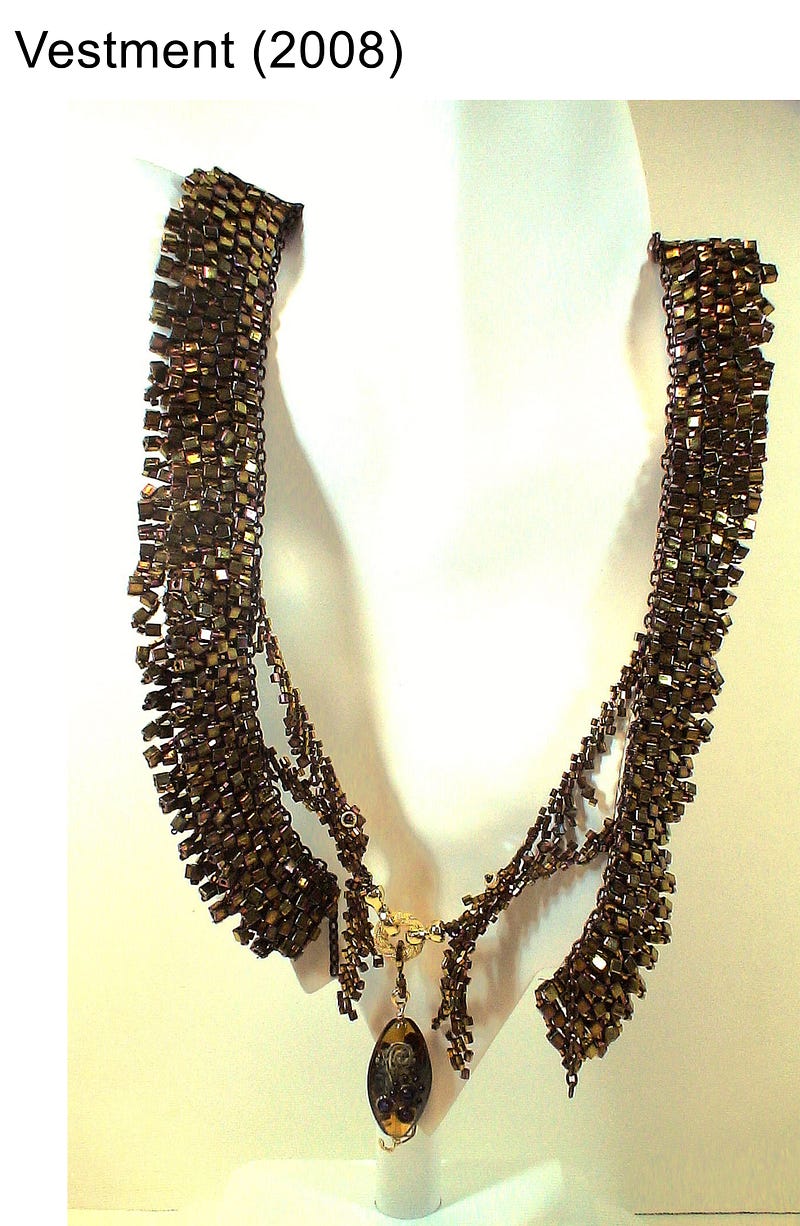
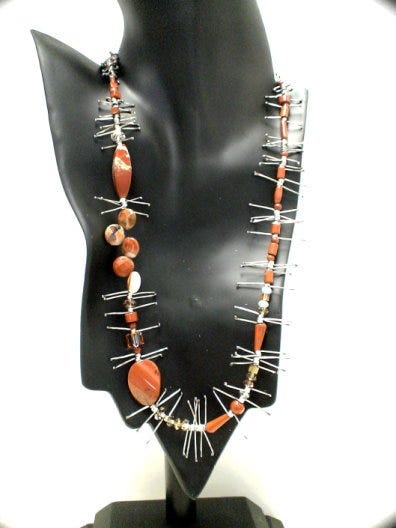
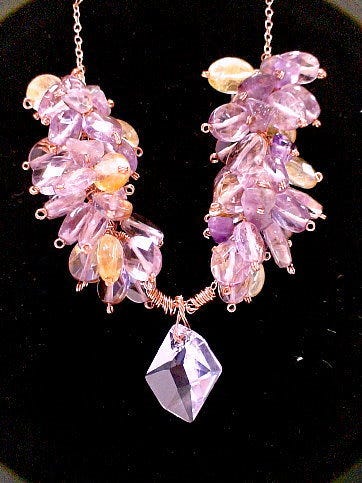
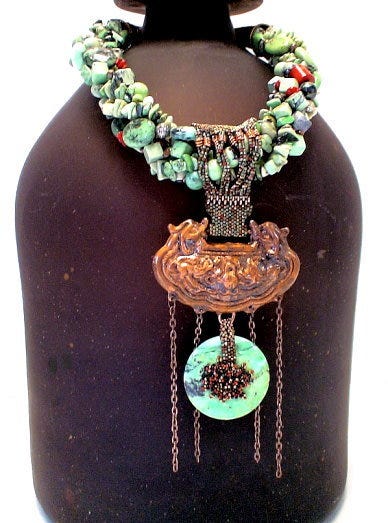
A piece of jewelry, a website landing page, the interior of a room, the public face of a building, all these so designed, are objects of beauty and functionality. But they are more than that. Things which are designed are unique forms of artistic expression. They are not stationery in the sense of paintings hung in a museum. They have a different type of relationship with the user or utilizer. They have a specific relationship to the body. They might move with the person, or have the person move with them or through them. They might adjust positions as the person walks, sits, runs, turns, bends, maneuvers. They might relate to clothing and hair styles and dexterity and maneuverability and body shapes and sizes. They might flow through many contexts, environments and situations. Design is expressive. Relational. Both an object and, more importantly, an intent.
Design represents a commitment to a conversation — between designer and self, designer and client, and less directly, designer and all the various audiences of that client. Otherwise people would not use the design. Or influence others to use and buy it. Or bring it into a public space with them. Or interact with it. Or buy it.
That conversation does not happen all at once. It does not start and stop at the beginning of the design process. It does not fully resolve itself even after the piece or project is finished and then used or bought or shared. That conversation continues as that piece or project is introduced to others and they react to it.
The things we design and make and inhabit and wear speak about ourselves as artists and our clients as persons. The designer can be somewhat alone, but never alone. In his or her head, but simultaneously complicit or perhaps collaborative with others, either in reality, or virtually and in the abstract. Design emerges from this dialogue, imaginative or otherwise. And only emerges with some level of commitment to a conversation.
This commitment to a conversation, centered around any piece of jewelry or other designed product or project, then is progressive. It is perspective shifting. It is reflective. It keeps going as everyone who interacts with the design begins to formulate whether they like it or not. Whether it excites them or not. Whether they would wear it or buy it or inhabit it or utilize it or not. Whether it feels finished. Whether it seems successful. Whether it would suit some purpose, or fulfill some agenda. But the shifting perspectives and emerging collective, shared understandings about the design always reflect back on the authentic performance of the designer. Endlessly reflective.
Some designers are very aware of their thinking during their authentic performance in design; others are not. While the former is a more powerful position to be in, all designers will need to figure out — before, during and after the design process — what criteria these various audiences will use to assess any design as meeting their needs, desires and requirements. How do they evaluate a design as coherent, relevant and resonant for them? How do they determine how much the designer’s own design sense contributed to coherency, relevancy and resonance? How do they share these understandings with others as they use and interact with the design publicly? What makes these understandings contagious so that others get excited about the design, as well?
The better designer anticipates answers to these questions. The designer uses this information as evidence in formulating and judging the smartness of the choices to be made when designing and constructing something. This evidence — good, bad or indifferent — forms the basis for criticality. It is a measurement. It states a position and measures the deviation. That criticality guides the designer all along the way from inspiration to aspiration to design to introducing the piece or project publicly.
Evidence in this knowledge-building experience is assessed, managed and controlled. All designers want to get good at this. It is their way of inspiring their clients to recognize the designer’s power in translating thoughts and feelings into design, that is, to reflect back the designer in their own design. We call this coherency. It is their way to excite their clients on an emotional level. We call this resonance. It is their way of influencing their clients to want to wear and buy and utilize their designs. We call this contagion. As the clients use these designs publicly, we also want to get their audiences to see and experience coherency, resonance and contagion.
Design is both an outcome as well as an instrument for new shared understandings, new relationships, new behaviors, new reflections. It is a two-way mirror. It is a catalyst for exchange. It is a marker of validity. Design is a product of creativity. Design is a tool of engagement. Design is a means toward criticality and legitimacy. Better designs show the designer’s conscious awareness of all these things and how they might play out in any situation. Authentic performances in anticipation of shared understandings and with no apologies. That’s the goal, at least.
Why Shared Understanding Matters
For any design, it is a long journey from idea to implementation. This journey involves different people at different times along the way. The designer’s ability to solve what is, in effect, a complex problem or puzzle becomes a performance of sorts, where the designer ferrets out in various ways — deliberate or otherwise — what the end users will perceive as making sense, having value and eliciting a desire powerful enough to motivate them to wear a design, inhabit it, buy it, utilize it, exhibit it or collect it. The designer, however, wants one more critical thing to result from this performance — recognition and validation of all the creative and managerial choices he or she made during the design process.
People will not use a design if their agendas and understandings do not converge in some way. They will interact with the designer to answer the question: Do You Know What I Know? If they get a sense, even figure out, that the answer is Yes, they share understandings! — they then become willing to collaborate (or at least become complicit) with the designer and the developing design.
Sometimes this convergence of understandings and meanings and intents occurs in a happenstance sort of way. But more often, it won’t happen without some degree of assertive leadership on the part of the designer. It is primarily up to the designer to establish these shared understandings. That is, the designer must take the lead to anticipate how they themselves should relate to their understanding of reality. The designer must invite the client to engage. So the designer, too, will ask the same question of the client that the client has asked of them: Do You Know What I Know?
The answer to this simple question — Do You Know What I Know? — is more than how the designer impresses the client and how the client impresses the designer. It is deeper than that. It is not surface meaning. It is not something descriptive. It is something critical. At its core are ideas about intent and desire. Its vocabulary gets very caught up in ideas about risks and rewards. The conversation to establish these shared understandings — we might call this a dance — proceeds on many levels, some assumptive, some perceptual, some through expectations, some through values and desires.
The designer, in effect, bridges the gap between how the designer sees the risks and rewards within any design process and outcome, and how the client might see these same risks and rewards. Both want to assess ahead of time whether the project will be satisfactory, feel finished, and meet their needs and desires. Both want to assess ahead of time whether there will be consequences, and what these consequences might be, should these communications and shared understandings about risk somehow fail or not meet expectations.
The designer wants to avoid any miscommunication. Any frustration. Any discomfort. So an in-depth, intuitive knowledge about shared understandings, how to anticipate them, and how to incorporate them into the design process is necessary for the success of any design.
The designer should not assume there will be shared understandings. The designer should not assume that there will be a pleasant, conflict-free relationship with the client. The designer should not assume that any disagreement or miscommunication will be worked out at the beginning of the process and not have to be dealt with again. Nor, conversely, should the designer assume that any disagreement about elements of the design would negate shared understandings. The designer and client can agree to disagree as long as they share certain understandings.
Shared understandings are about recognizing intent and risk. They are about
· Getting a sense of where the ideas for the design originate
· How the design process is to unfold
· What the design might be able to accomplish and what it might not
· What happens if conditions or intents and desires change over the course of the process
· How adaptable the designer is
· The chances the final design will feel finished and successful
· What criteria the final design needs to meet
If neither designer nor client understand intent and risk as each other sees it, there will be no shared understandings. The design will be ill-defined and poorly articulated. The designer’s performance will be inauthentic. There will be no trust. No legitimacy. No satisfactory outcome.
While the need for establishing shared understanding in the design process might seem obvious, it does not often occur. Designers too often assume this will happen automatically. They present designs as fait-accompli — their success predetermined and prejudged as successful. They lose some level of management control when the client responds negatively. They fail to adapt or become too inflexible when the situation changes. The designs get implemented imperfectly. When the client takes possession of the design, the relationship ends.
About the Shared Understanding Series…
For any design, it is a long journey from idea to implementation. This journey involves different people at different times along the way. People will not use a design if their agendas and understandings do not converge in some way. They will not buy a design or contract with the designer unless there are some shared understandings about what should happen and when, what will happen, and what the risks and rewards of the finished project will be. Shared understandings are about recognizing intent and risk. Design is both an outcome as well as an instrument for new shared understandings, new relationships, new behaviors, new reflections. As such, any design represents a commitment to a conversation — between designer and self and designer and client. The conversation allows for the management of shifting assumptions, expectations, perspectives and values. Better designs show the designer’s conscious awareness of all the things affecting shared understandings.
Bittner, Eva Alice Christiane, and Leimeister, Jan Marco. Why Shared Understanding Matters — Engineering a Collaboration Process for Shared Understanding to Improve Collaboration Effectiveness in Heterogeneous Teams. Year: 2013, Volume: 1, Pages: 106–114, DOI Bookmark:10.1109/HICSS.2013.608.
Canel, Melissa. The Role of Perceptions in Conflict. April 9, 2016. As referenced:
Learn to Think and Speak and Work
Like a Jewelry Designer!
Making and designing jewelry is fun, awesome, challenging and rewarding. You enter a world full of inspiration, creativity, color, texture, construction, beauty and appeal. With your jewelry, you impact the lives of many people as they go about their day, attend special events, or interact with friends, acquaintances and strangers.
As a jewelry designer, you have a purpose. Your purpose is to figure out, untangle and solve, with each new piece of jewelry you make, how both you, as well as the wearer, will understand your inspirations and the design elements and forms you chose to express them, and why this piece of jewelry is right for them.
Your success as a designer is the result of all these choices you make. Our courses are here to help you learn and apply key insights about materials, techniques and the jewelry design process when making these kinds of choices. We also introduce you to things you need to know when trying to conquer the creative marketplace.
Empower yourself to become fluent, flexible and original in jewelry design.
I have created an updated, extended version of this class online, which you can register for. The class is divided into 18 short video tutorials on such topics of seed and delica beads, metal beads, clasps, stringing materials, adhesives, miscellaneous findings, and the like. There is a downloadable handout that accompanies each video segment.
19 lesson modules. This class is $30.00.
You can find it online and register here.
16 Important Lessons I Learned Doing Craft Shows!
In this SO YOU WANT TO DO CRAFT SHOWS… video tutorial class, I discuss critical choices jewelry designers need to make when doing craft shows. That means, understanding everything involved, and asking the right questions.
Learn How To…
…Find, Evaluate and Select Craft Shows Right For You
…Determine a Set Realistic Goals Right For You
…Compute a Simple Break-Even Analysis
…Best Ways to Develop Your Applications and Apply
…Understand How Much Inventory To Bring
…Best Promote and Operate Your Craft Show Business
Doing craft shows is a wonderful experience. You can make a lot of money. You meet new people. You have new adventures. And you learn a lot about business and arts and crafts designing.
19 lesson modules. This class is $45.00.
You can find it online and register here.
Learn An Easy-To-Use Pricing Formula
and Some Marketing Tips
Especially Relevant for Jewelry Designers!
In order to make better artistic and design choices, the Fluent and Empowered Designer should have answers to 5 essential questions. In this article, I present the first essential question: Is What I Am Doing Craft, Art, or Design?
Jane landed her first real client. She had designed websites and social marketing campaigns for some friends and family. But this was the first real contract. She was excited, as you would expect, and could not wait to begin.
The client was a furniture manufacturing company. They wanted to promote themselves by holding a contest online. It was to take the form of a sweepstakes and furniture give-away. This company had been online for several years, but this was the first contest they had ever done. They wanted this effort to have a huge marketing impact.
The first task was to design a Landing Page for this contest. The page was to coordinate with general look and feel of the company’s website. It should generate excitement about the contest, and persuade people to register their email addresses for future company marketing. It needed to be completed within 6 weeks.
Jane began outlining and sketching some things to share with the client.
· She felt the colors in the client’s logo did not completely work as a harmonious color scheme. So, for the Landing Page, she tweaked them a bit.
· She had posted her draft page on her own website, using her own domain name. She understood that this would be temporary.
· She researched a set of 25 key words relevant to furniture sales. She used these key words to develop three descriptive paragraphs.
· She located the email text-box on the left side of the web-page, and the submit button on the right side, parallel on the page with the text box. The submit button text was SUBMIT.
· She was unfamiliar with responsive web page design, so she did not consider any implications for various browsers and screen sizes.
At the 3-week mark, she met with the client, and presented her work to them. They were not happy. The tweaking of the logo colors did not go over well. They were confused about the domain name. The key words, and subsequent descriptions, did not resonate with them. The look of the Landing Page on a cell phone was very disjointed, and the submit button ended up about 4” below the email text box — not visible without scrolling down.
Jane was at a loss. She did not know what she should do next.
Designers, like Jane, need to learn to think like designers. They need to become fluent in the disciplinary way of defining problems, developing solutions, anticipating the client’s understandings, and introducing these solutions publicly. They need strategies to adapt to changing or unfamiliar circumstances.
However, what all this specifically means, and how all this plays out, gets a bit muddled. There is a lot of advice to sift through. Designers learn what they do from several sources, including teachers to books to online videos. It turns out that what perspective the advisor, teacher, how-to author is coming from affects what they suggest you do. Because of this, and especially because of this, every designer must get straight in their heads that to think like a craftsperson or to think like an artist is notthe same as thinking like a designer.
There are three competing perspectives (or what are called paradigms) for how designers should be taught and practice — (1) The Craft Approach, (2) The Art Tradition, and (3) The Art and Design Perspective. Each provides a different set of advice for telling the designer what to do. Each uses different criteria for judging success.
Had Jane been able to answer the question: Craft, Art or Design?, she may have managed the design process much better. She probably would not have hit this wall with the client. She could have come up with ideas to fix and overcome the problems.
Fluency and Empowerment
The fluent designer is able to think like a designer. The designer is more than a craftsperson and more than an artist. The designer must learn a specialized language, and specialized way of balancing the needs for appeal with the needs for functionality. The designer must intimately recognize and understand the roles design plays for individuals as well as the society as a whole. The designer must learn how art, architecture, physical mechanics, engineering, sociology, psychology, context, even party planning, all must come together and get expressed at the point where the design meets the boundary of the individual.
And to gain that fluency, the designer must commit to learning a lot of vocabulary, ideas and terms, and how these imply content and meaning through expression. The designer will need to be very aware of personal thoughts and thinking as these get reflected in all the choices made in design. The designer will have to be good at anticipating the understandings and judgements of many different audiences, including the user and all the user’s own clients.
With fluency comes empowerment. The empowered designer has a confidence that whatever needs to be done, or whatever must come next, the designer can get through it. Empowermentis about making and managing choices. These choices could be as simple as whether to finish a piece or project or not. Or whether to begin a second piece or project. The designer will make choices about how to draw someone’s attention to the work, or present the work to a larger audience. She or he may decide to submit the work to a magazine or contest. She or he may want to sell the work and market it. The designer will make choices about how the work might be used, or who use it, or when it might be used, in what context.
And for all these choices, the designer might need to overcome a sense of fear, doubt, boredom, or resistance. The designer might need to overcome anxiety, a sense of giving up, having designer’s block, feeling unchallenged, and even laziness.
This makes it critical for any designer, in order to flourish and succeed, to be able to answer these 5 essential questions, beginning with question 1.
Question 1: Should Design work be considered ART or CRAFT or DESIGN?
All designers, whether making jewelry, building buildings, creating interiors, putting together websites and digital marketing plans, confront a world which is unsure whether design is “craft” or “art” or its own special thing I’ll call “design”. This can get very confusing and unsettling. Each approach has its own separate ideas about how the designer should work, and how he or she should be judged.
CRAFT: When defined as “craft,” design is seen as something that anyone can do — no special powers are needed to be a designer. Design is seen as a step-by-step process, almost like paint-by-number. Designers color within the lines. The craft piece or project has functional value but limited aesthetic value.
If following the Craft Approach, the designer would learn a lot of techniques and applications in a step-by-step fashion. The designer, based on their professional socialization into Craft, would assume that:
a) The outlines and the goals of any piece or project can be specified in a clear, defined way. b) Anyone can do these techniques. c) There is no specialized knowledge that a designer needs to know beyond how to do these step-by-step techniques and applications. d) If a particular designer has a strong sense of design, this is something innate and cannot be learned or taught. e) There is little need to vary or adapt these techniques and applications. f) The primary goal is functionality. g) There are no consequences if you have followed the steps correctly.
As “craft”, we still recognize the interplay of the artist’s hand with the piece and the storytelling underlying it. We honor the technical prowess. People love to bring art into their personal worlds, and the craftsperson offers them functional objects which have some artistic sensibilities.
ART: When defined as “art”, design is seen as something which transcends itself and its design. It is not something that anyone can do without special insights and training. The goal of any project would be harmony with a little variety, and some satisfaction and approval.
“Design as art” evokes an emotional response. Functionality should play no role at all, or, if an object has some functional purpose, then its functional reason-for-being should merely be supplemental to the art. For example, the strap on a necklace is comparable to the frame around a painting, or the pedestal for a sculpture. They supplement the art. The borders, and perhaps the footer and side navigation bars, on a website home page would also be understood as supplemental to the design. As supplemental components, these would not be included with nor judged as part of the design work. In an extreme example, from the art perspective, the beauty, balance and harmony of a website’s appearance should be unencumbered by any considerations of user experience and navigatability.
If following the Art Tradition, the designer would learn a lot of art theories and rules about the manipulation of design elements, such as color, movement, perspective, within the piece or project. Then, the designer would keep rehearsing these until their application becomes very intuitive. The designer, based on their professional socialization into Art, would assume that:
a) Whether the piece or project outlines are clear from the beginning, or emergent or process-like, what is most important is that art theories and rules be applied at each little increment along the way. b) The designer as artist must learn some specialized knowledge — art theories and rules — in order to be successful. c) The outcomes — either pieces or projects — would be judged on visual and art criteria alone, as if they were paintings and sculptures on display. d) While everyone has within them the creative abilities to design as an artist, for most people, this must be learned. e) The primary goals are beauty and appeal. Beauty and appeal are typically judged in terms of harmony and variety. f) If you have not applied the theories and rules optimally, the piece or project would be judged as incomplete and unsuccessful.
What is nice about the Art Tradition, is that the goal is Beauty. Beauty is achieved through smart choices and decisions. The designer as artist is not encumbered by having to follow specific steps or patterns. Nor is the designer encumbered by the structural and functional properties of all the pieces or elements she or he uses — only their beauty. The designer does not have to compromise Beauty for Functionality.
DESIGN: When defined as “design”, you begin to focus more on construction and functionality issues. You often find yourself making tradeoffs between appeal and functionality. You incorporate situational relevance into your designs. You anticipate what the client (and the various audiences of the client) understands as something which is finished and successful. You see “choice” as more multidimensional and contingent. You define success only in reference to the design as it is worn, placed, constructed or used.
If following the Art and Design Perspective, the designer would have to learn a lot of things. These would include things in art, architecture, engineering, social science, psychology, behavioral science, and anthropology. The designer would develop those professional skills and insights, what we might call disciplinaryliteracy, so that she or he could bring a lot of disparate ideas and applications to the fore, depending on what the situation warranted.
The designer, based on their professional socialization into Art and Design, would assume that:
a) Whether the piece or project outlines are clear or emergent, what is most important is the ability to bring a wide range of design principles and applications to the situation.
b) The designer must learn a lot of specialized knowledge, some related to art, and some related to several other disciplines, such as architecture and social science.
c) The outcomes — either pieces or projects — must find the best fit between considerations about appeal with concerns about functionality. Functionality is not an add-on. It is an equal, competing partner with beauty and appeal.
d) The designer does not design in a vacuum. She or he must anticipate the shared understandings among self, client and the various audiences of the client about what might be seen as finished and successful. These anticipations must be incorporated into the design process and how it is managed.
e) Anyone can learn to be a designer, but fluency and literacy in the profession involves development of skills and insights over a period of time.
f) The primary goal is to find the best fit between appeal and functionality.
g) The consequences for not finding that best fit is some level of client dissatisfaction.
The Art and Design Perspective is very relevant for the education and training of designers. Here, the designer is seen as a multi-functional professional. The designer must bring a lot of very different kinds of skills and abilities to bear, when constructing a piece or developing a project. The professional has to be able to manage artistic design, functionality, and the interaction of the piece or project with the client as well as that client’s environment. This approach also believes that “Design” should be appreciated as its own discipline — not a subset of sculpture or painting. And that a piece or project as designed can only be understood as these are placed in use.
How you define your work as ART or CRAFT or DESIGN (or some mix) will determine what skills you learn, how you apply them, and how you introduce your pieces to a wider audience. The Craft Approach ignores the need to learn a specialized knowledge and approach. The Art Tradition focuses solely on the artistic merits of the project, and assumes the client will have more passive relationship to it, as if the client were standing in front of the project in a museum. The Art and Design Perspective focuses on how to anticipate shared understandings and incorporate these into how best to make tradeoffs between appeal and functionality.
So, returning to the situation with Jane, she had not yet become fluent in design thinking. She tried to apply art theory to balance the colors in the logo, and that’s not what the client wanted. She had applied the techniques she knew, but did not arrive at an acceptable place. She became stumped about the next steps she needed to take after the client expressed reservations. She was unable to delineate a learning plan for herself so that she could make the web-page responsive. She researched key words without putting them to some kind of reality test with the client.
Many people begin to explore design as a hobby, avocation, business or career. This requires, not only strong creativity skills, but also persistence and perseverance. A lot of the success in this pursuit comes down to an ability to make and follow through on many artistic and design decisions within a particular context or situation. Developing this ability — a fluency, flexibility and originality in design — means that the designer has to become empowered to answer these 5 essential questions: (1) whether creating something is a craft, an art or design, (2) how they think creatively, (3) how they leverage the strengths of various materials and techniques, and minimize weaknesses, (4) how the choices they make in any one design evoke emotions and resonate, and (5) how they know their piece is finished and successful.
Design is more than the application of a set of techniques. It is a mind-set. This fluency and empowerment enable the designer to think and speak like a designer. With fluency comes empowerment, confidence and success.
Continue reading about the Second Essential Question every designer should be able to answer: What Should I Create?
In order to make better artistic and design choices, the Fluent and Empowered Designer should have answers to 5 essential questions. In this article, I present the fifth and last essential question: How Do I Know When My Design Is Finished?
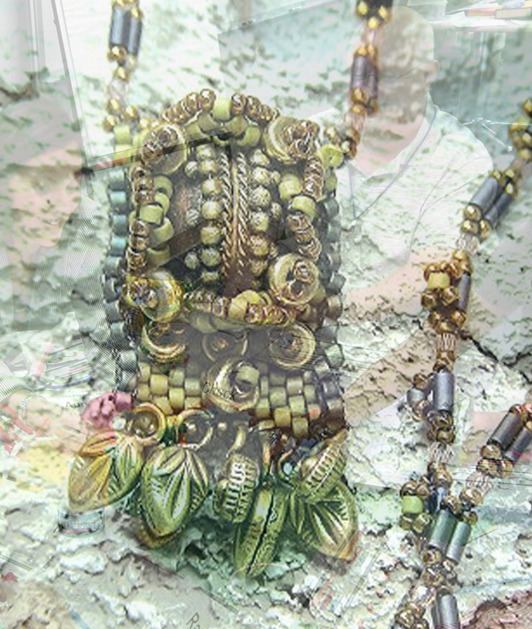
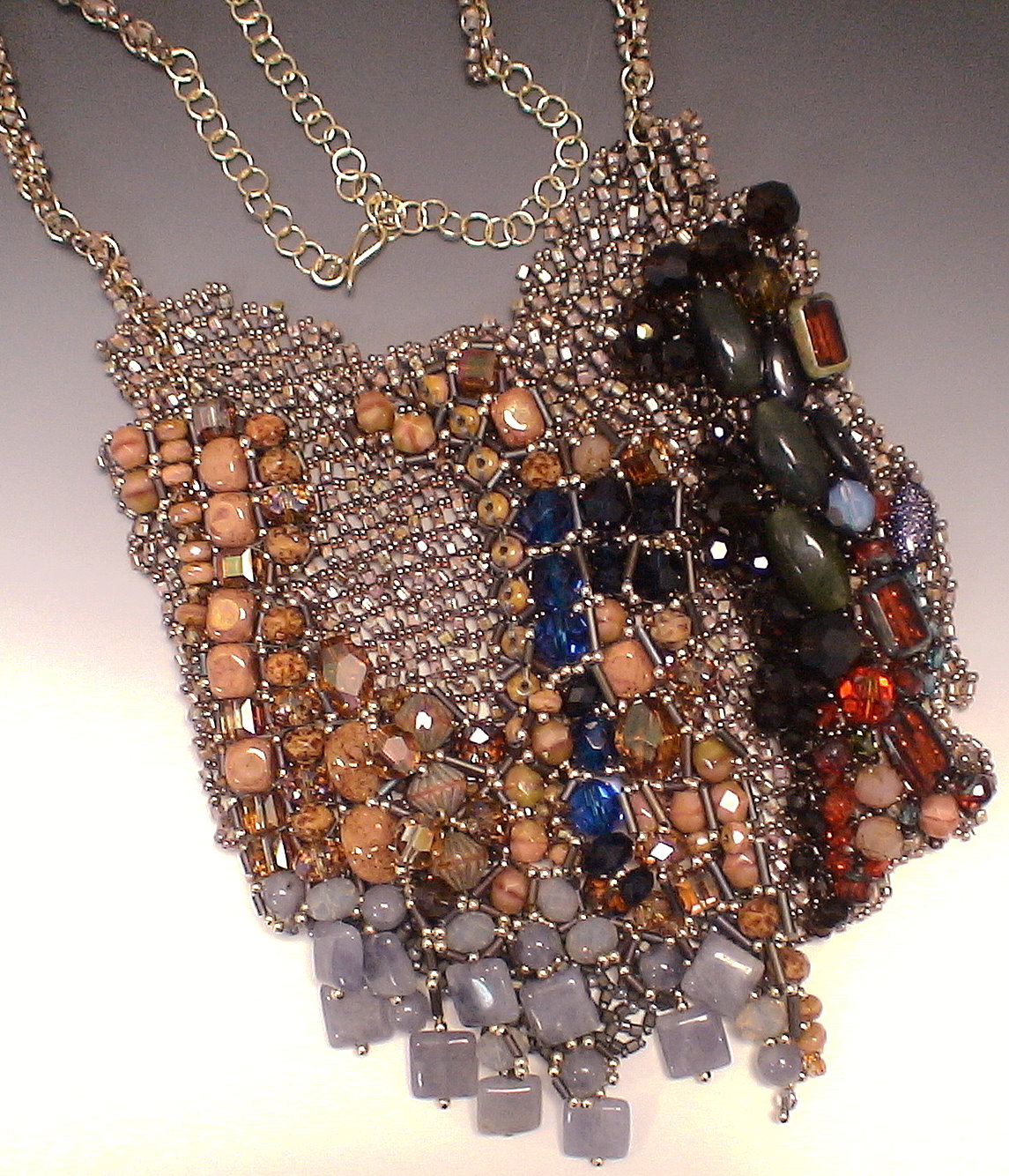
I taught a bead weaving workshop where my students followed a basic pattern to make an amulet bag. When they finished the bag itself, they were then given free rein on making a strap and adding fringe.
And they went to town. They added some fringe. Then some more fringe. Then some longer fringe. And fringe with more beads on it. And bigger beads. And some tiny charms. And some more fringe.
Yes, it’s fun to create fringes. But the star of the piece should have been the design of the amulet bag itself. Not the fringe. The fringe detracted. It competed. It made the piece feel very overdone. Not particularly artistic, or designed well.
My students needed to think about editing. As they continued to build each component of the amulet bag and its fringe, they should have repeatedly asked themselves would the addition of one more thing make the project more or less satisfying. Designers should be able to answer these 5 essential questions, especially question 5: How Do I Know When My Design Is Finished?
QUESTION #5: When is enough enough? How does the designer know when the piece is done? Overdone? Or underdone? How do you edit?
It is the challenge for the designer not to make the piece or project under-done or over-done. Each and every material and component part should be integral to the work as a whole. Things should not get too busy, or not busy enough. Things should not be too repetitive. The work should feel, not merely coordinated and balanced, but coherent, as well. The work should not convey a sense that you are not quite there yet.
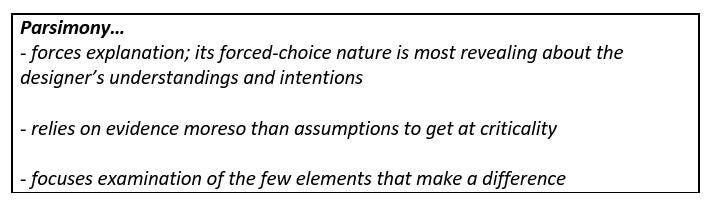
For every design, there will be that point of parsimony when enough is enough. We want to find that point where experiencing the “whole” is more satisfying than experiencing any of the parts. That point of parsimony is where, if we added (or subtracted) one more thing, we would detract from the whole of our design. The design would be less satisfying. Less resonant.
Finding that point of parsimony is also related to anticipating how and when others will judge the piece as finished and successful. And what to do about it when judged unfinished or unsuccessful.
Parsimony vs. Unity/Variety
In art, the traditional measure of completion and success is a feeling or sense of “Unity.” Unity signifies how everything feels all right. All the Design Elements used, and how they were coordinated and placed, are very coordinated, matching, clear, balanced, harmonious and satisfying. I think the idea of unity beginstoget at the place we want to end up. But this concept is not concrete enough for me as a designer.
What bothers me the most is that you can have unity, but the piece still be seen as boring when there is no variety. Criteria provided from the art perspective recognize this. But somehow tempering unity with variety starts to add some ambiguity to our measurements of finish and success. Our work too easily can be judged as lacking coherence. This ambiguity is unacceptable as a principled outcome of construction and design.
Another concern I have, is that you can have unity with variety, but, from the art perspective, these assessments rely too much on universal, objective expectations about design elements and their attributes (for example, the use of color schemes).
A lot of client reactions to our work and a lot of our own design decisions can be very subjective. They can be very culture- and context-related. And sometimes, we intentionally want to violate these universal, objective expectations. We want to give a little edge to our work, or a splash of color, or a shout-out. We may find we have limited material resources, or all the colors / patterns / textures which ideally should be used are unavailable to us. We may want to personalize things so people recognize who the designer is behind the design.
Resonance is not about picking the correct color scheme (or any other design element). It is more about how that color scheme (or design element) is used, manipulated, leveraged or violated within the piece. We must not leave the artist, the user, and the situation out of the equation. We must not minimize the artist’s hand — the artist’s intent, thinking, strategizing, arranging, pushing the boundaries, even violating the universal, objective rules.
Design and the act of creation usually demand a series of judgment calls and tradeoffs. Tradeoffs between aesthetics and functionality. Tradeoffs between artist goals and audience understandings and expectations. Tradeoffs between a full palette of colors-shapes-textures and a very limited one.
Any measure of completeness and success needs to result from the forced choice decisions of the artist. It needs to account for the significance of the results, not just the organization of them. It needs to explain the Why, not just the What.
For me, the Art criteria are insufficient when applied to design. The more appropriate concept here is Parsimony. Parsimony is when you know enough is enough. When the finished and successful piece is parsimonious, the relationship of all the Design Elements and their expressed attributes, as understood by designer and client alike, will be so strong, that to add or remove any one thing would diminish, not just the design, but rather the significance of the design.
Parsimony is sometimes referred to in art and design as Economy, but the idea of economy in art is reserved for the visual effects. Design not only pays homage to the visual, but to the functional, socio-cultural-psychological and situational, as well. The designer needs to be able to decide when enough is enough with all these multi-dimensional cues.
The Traps of Over-Doneness and Under-Doneness
Among designers, you will find a lot of over-doers and under-doers.
· There is a tendency of designers to over-do: — over-embellish the surface — add too much fringe — repeat themes and design elements too often — use too many colors
· Or a fear or self-doubt causing designers to under-do:
– not sure if someone will like it
– hesitant to push forward too far, for fear of a negative reaction
– uncertain if they can learn a new technique
– feeling choosing alternative colors, materials or techniques by be too risky
With over-doneness comes a naivete. The designer shuts him- or herself off from what should be that inner designer voice warning about parsimony. It stunts your development as a designer. You begin to allow yourself to overlook important factors about materials and techniques to the detriment of your final products. You close yourself off to doubt and self-doubt, which is unfortunate. Doubt and self-doubt are tools for asking questions and questioning things. These help you grow and develop as an artist and designer. These influence your ability to make good, professional choices.
On the other extreme is under-doneness. Often this results from a lack of confidence in our design abilities, including the ability to introduce our work publicly. We question our lack of ability and technical prowess for accomplishing the necessary tasks at hand. We fear we cannot work things out when confronted with unfamiliar or problematic situations. Here, doubt and self-doubt become excuses for less than satisfying results, rather than tools for improvement. Doubt and self-doubt become self-imposed, but unnecessary, barriers we impose to prevent us from thinking like a designer, and experiencing the full excitement of design.
Designers need to build within themselves that key sense of parsimony. Keep things simple and parsimonious. Edit your ideas. You do not want to over-do or under-do your pieces. You do not have to include everything in one piece or project. You can do several pieces or projects. Showing restraint allows for better communication with your audiences. Each work you make should not look like you are frantically trying to prove yourself. These should look like you have given a lot of thought about how others should emotionally engage with your piece.
Many people begin to explore design as a hobby, avocation, business or career. This requires, not only strong creativity skills, but also persistence and perseverance. A lot of the success in this pursuit comes down to an ability to make and follow through on many artistic and design decisions within a particular context or situation. Developing this ability — a fluency, flexibility and originality in design — means that the designer has to become empowered to answer these 5 essential questions: (1) whether creating something is a craft, an art or design, (2) how they think creatively, (3) how they leverage the strengths of various materials and techniques, and minimize weaknesses, (4) how the choices they make in any one design evoke emotions and resonate, and (5) how they know their piece is finished and successful.
Design is more than the application of a set of techniques. It is a mind-set. This fluency and empowerment enable the designer to think and speak like a designer. With fluency comes empowerment, confidence and success.
In order to make better artistic and design choices, the Fluent and Empowered Designer should have answers to 5 essential questions. In this article, I present the fourth essential question: How Do I Evoke A Resonant Response To My Work?
Jason seemed to never be able to get past “That’s nice.” His clients always said, “That’s nice,” and that was about it.
His colors were balanced and harmonious. They fit rules about color schemes and color proportions. His placement of shapes and sizes were always pleasing to the eye. The little bit of math he had to do always checked out. His clients liked him.
They had approved the initial sketches. Their comments were positive. They never complained about his approach. But they were never satisfied enough for Jason to make that final sale.
Even though the feedback always seemed positive, he rarely had repeat business.
He was perplexed, and felt a little defeated.
What was it about his work that somehow fell short?
Jason was stuck with the impression that if someone said they liked something, that this would translate into them doing something more, like buying it. All designers need a firm and comprehensive understanding about the differences among like, need, want, demand, and parting with some money for it. Another way to put this is that designers need to recognize the differences between an emotional response and a resonant one. Designers should be able to answer these 5 essential questions, especially question 4: How Do I Evoke A Resonant Response To My Work?
Question 4: Beyond applying basic techniques and selecting quality materials, how do I evoke a resonant response to my work?
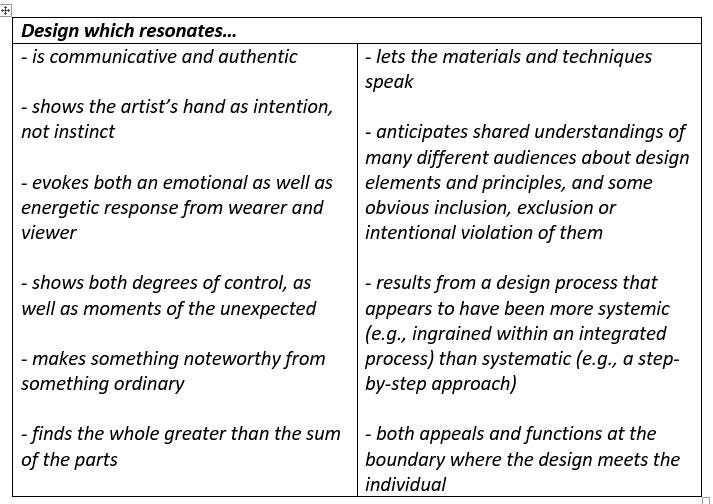
An artistic and well-designed piece or project should evoke, at the least, an emotional response. In fact, preferably, it should go beyond this a bit, and have what we call “resonance”. The difference between an emotional response and resonance is reflected in the difference between someone saying, “That’s beautiful,” from saying “I need to wear that piece,” or, “I need to buy that piece,” or, “I need to implement that project.”
Quite simply: If no resonant response is evoked, then the piece or project has some remaining issues including the possibility that it is poorly designed. Evoking a resonant response takes the successful selection and arrangement of materials or objects, the successful application of techniques as well as the successful management of skills, insights, and anticipating the client’s needs and understandings.
Every designer should have but one guiding star — Resonance. If our piece or project does not have some degree of resonance, we keep working on it. If the process of creative exploration and design does not lead us in the direction of resonance, we change it. If the results we achieve — numbers of pieces made and numbers of pieces sold — is not synced tightly with resonance, we cannot call ourselves designers.
The Proficient Designer specifies those goals about performance which will lead to one primary outcome: To Evoke Resonance. Everything else is secondary.
Materials, techniques and technologies are selected with resonance in mind. Design elements are selected and applied with that idea of Resonance in mind. Principles of Composition, Construction and Manipulation are applied with that idea of Resonance in mind, with extra special attention paid to the Principle of Parsimony — knowing when enough is enough.
People may approach the performance tasks in varied ways. For some this means getting very detailed on pathways, activities, and objectives. For others, they let the process of design emerge and see where it takes them. Whatever approach they take in their creative process, for all designers, a focus on one outcome — Resonance — frees them up to think through design without encumbrance. It allows them to express meaning. It allows them to convey expressions in meaningful ways to others.
This singular focus on resonance becomes a framework within which to question everything and try to make sense of everything. Make sense of what the materials and techniques can allow them to do, and what they cannot. Make sense of what understandings other people — clients, sellers, buyers, students, colleagues, teachers — will bring to the situation, when exploring and evaluating their work. Make sense of why some things inspire you, and other things do not. Make sense of why you are a designer. Make sense of the fluency of your artistic expression, what works, how it works, why it works.
We achieve Resonance by gaining a comfort and ease in communicating about design. This comfort and ease, or what we can call disciplinary fluency, has to do with how we translate our inspirations and aspirations into all our compositional, constructive and manipulative choices. It is empowering. Our pieces resonate. We achieve success.
Resonance, communication, success, fluency — these are all words that stand in place for an intimacy between the designer and the materials, the designer and the techniques, the designer and inspiration. They reflect the designer’s aspirations. They reflect the shared understandings of everyone the designer’s piece or project is expected to touch. They reflect the designer’s managerial prowess in bringing all these things together.
Evoking An Emotional Response vs. A Resonant One
What is the evidence we need to know for determining when a piece or project is finished and successful? What clear and appropriate criteria hone in at what we should look at? What clues has the designer provided to let the various audiences become aware of the authenticity of the performance?
There are different opinions in craft, art and design about what are the most revealing and important aspects of the work, and which every authentic jewelry design performance must meet.
The traditional criteria used in the art world are that the designer should achieve unity with some variety and evoke emotions. These, I feel, may work well when applied to paintings or sculpture, but they are insufficient measures of success when applied to design. Design involves the creation of objects or projects where both artistic appeal as well as practical considerations of use are essential. Unity and variety can feel harmonious and balanced, but yet boring, monotonous and unexciting. Art, in contrast to Design, can be judged apart from its use and functionality. The response to Art can show some positive emotion without the client having to show any strong commitment. Design doesn’t share that luxury.
Finished and successful designed objects or projects not only must evoke emotions, but, must resonate with the user (and user’s various audiences), as well.
Achieving Resonance is the guiding star for designers, at each step of the way.
Resonance is some level of felt energy which extends a little beyond an emotional response. The difference between emotion and resonance can, for example, be like the differences between saying that piece or project is “Beautiful” vs. saying that piece or project “Makes me want to wear it”. Or that “I want to touch it.” Or “My friends need to see this.” Or “I need to implement this at once.”
Resonance is something more than emotion. It is some kind of additional energy we see, feel and otherwise experience. Emotion is very reactive. Resonance is intuitive, involving, identifying. Emotion is very sympathetic. Resonance is more of an empathetic response where artist and audience realize a shared (or contradictory) understanding without losing sight of whose views and feelings belong to whom.
Resonance results from how the artist controls light, shadow, and their characteristics of warmth and cold, receding and approaching, bright and dull, light and dark. Resonance results from how the artist leverages the strengths of materials, objects and techniques and minimizes their weaknesses. Resonance results from social, cultural and situational cues. Resonance results from how the artist takes us to the edge of universal, objective understandings, and pushes us ever so slightly, but not too, too far, beyond that edge.
Many people begin to explore design as a hobby, avocation, business or career. This requires, not only strong creativity skills, but also persistence and perseverance. A lot of the success in this pursuit comes down to an ability to make and follow through on many artistic and design decisions within a particular context or situation. Developing this ability — a fluency, flexibility and originality in design — means that the designer has to become empowered to answer these 5 essential questions: (1) whether creating something is a craft, an art or design, (2) how they think creatively, (3) how they leverage the strengths of various materials and techniques, and minimize weaknesses, (4) how the choices they make in any one design evoke emotions and resonate, and (5) how they know their piece is finished and successful.
Design is more than the application of a set of techniques. It is a mind-set. This fluency and empowerment enable the designer to think and speak like a designer. With fluency comes empowerment, confidence and success.
In order to make better artistic and design choices, the Fluent and Empowered Designer should have answers to 5 essential questions. In this article, I present the third essential question: What Materials (and/or Techniques) Work The Best?
Ferity was determined to make a Kumihimo bracelet. Kumihimo is a braiding technique. You make a braid and attach a clasp. Ferity thought it would be cool to incorporate some beads in her braid. So she strung up a lot of beads on various cords, and braided them. She glued on end caps on either side, and attached a clasp.
But she wasn’t liking her piece. She couldn’t figure out why. All the different colors, widths and materials of the cords she used were very upscale and attractive. She used a mix of crystal, gemstone and hand-made beads in the project — all very expensive and all very attractive.
But braided all together was somewhat unsatisfying. She didn’t think she would wear it very often. She didn’t think she could sell it. And she couldn’t figure out why.
A successful design has character and some kind of evocative essence. The choice of materials often sets the tone. And a choice of techniques cements that tone in place. Techniques link the designer’s intent with the client’s expectations. The successful designer has a depth of knowledge about materials, their attributes, their strengths, their weaknesses, and is able to leverage the good and minimize the bad within any design. The same can be said of techniques.
For some designs, the incorporation of mixed media or mixed techniques can have a synergistic effect — increasing (or decreasing) the appeal and/or functionality of the piece or project better than any one media or technique alone. It can feel more playful and experimental and fun to mix media or techniques. But there may be adverse effects, as well. Each media or technique will have its own structural and support requirements. Each will enable the control of light and shadow, space and mass, dimension and movement in different ways. Each will react differently to various physical forces impacting the piece when worn or the project when used. So it becomes difficult for the designer to successfully utilize any one medium or technique, as well as much more difficult to coordinate and integrate more than one media or technique.
Ferity had little understanding about the materials and their combined use within a Kumihimo technique. All designers need a firm and comprehensive understanding about selecting materials and techniques, and should be able to answer these 5 essential questions, now with question 3: What Materials (and/or Techniques) Work The Best?
QUESTION 3: What kinds of MATERIALS work well together, and which ones do not? This applies to TECHNIQUES as well. What kinds of TECHNIQUES (or combinations of techniques) work well when, and which ones do not?
The choice of materials and the choice of techniques set the tone and chances of success for your piece. Materials and techniques establish the character and personality of your designs. They contribute to understandings whether the piece is finished and successful.
However, there are no perfect materials (or techniques) for every project. Selecting materials (or techniques) is about making smart, strategic choices. This means relating your choices to your design and marketing goals. It also frequently means having to make tradeoffs and judgment calls between aesthetics and functionality. Last, materials may have different relationships with the designer, wearer or viewer depending on how they are intended to be used, and the situational or cultural contexts.
There are many implications of choice. There are light/shadow issues, pattern, texture, rhythm, dimensionality, proportions, placement and color issues. There are mechanics, shapes, forms, durability, drape, flow and movement issues. There are positive and negative space issues. There are user experience issues.
It is important to know what happens to all these materials (or applications of techniques) over time. It is important to know how each material (or technique) enhances or impedes architectural requirements, such as allowing an object to move and drape, or assisting the object in maintaining a shape or allowing a project to adapt to its audience and environment, or utilizing an object to direct navigation or viewing.
Each material or technique has strengths and weaknesses, pros and cons, and contingencies affecting their utilization. The designer needs to be able to leverage the strengths and minimize the weaknesses.
All of these choices: … affect the look … affect the movement … affect the feel … affect the durability … affect both the designer’s and user’s responses … relate to the context
Many people begin to explore design as a hobby, avocation, business or career. This requires, not only strong creativity skills, but also persistence and perseverance. A lot of the success in this pursuit comes down to an ability to make and follow through on many artistic and design decisions within a particular context or situation. Developing this ability — a fluency, flexibility and originality in design — means that the designer has to become empowered to answer these 5 essential questions: (1) whether creating something is a craft, an art or design, (2) how they think creatively, (3) how they leverage the strengths of various materials and techniques, and minimize weaknesses, (4) how the choices they make in any one design evoke emotions and resonate, and (5) how they know their piece is finished and successful.
Design is more than the application of a set of techniques. It is a mind-set. This fluency and empowerment enable the designer to think and speak like a designer. With fluency comes empowerment, confidence and success.
WASTIELS, Lisa and WOUTERS, Ina. Material Considerations in Architectural Design: A Study of the Aspects Identified by Architects for Selecting Materials. July, 2008. As referenced in: http://shura.shu.ac.uk/511/1/fulltext.pdf
In order to make better artistic and design choices, the Fluent and Empowered Designer should have answers to 5 essential questions. In this article, I present the second essential question: What Should I Create?
Selma got by very well in life by asking her teachers, and in subsequent years, her bosses, what she should do. She followed their instructions to the letter, and was particularly good at coloring within all the lines. Everyone was always pleased with her work. So pleased, in fact, that her current boss promoted her into a designer position.
In her new position, she was to work with construction, architectural and interior design firms. She was to assist them and guide them into choosing textiles with which to incorporate into their interior and exterior building plans.
When she met with various clients, she started byasking them to tell her what they wanted. But no one could really articulate much more than general ideas about colors. For Selma, this was disconcerting. She thought she could do a great job, but needed more information and direction. These were never forthcoming.
At the core of Creativity is the ability to generate options, and then narrown them down. Creativity is not innate; it is developed. Creativity is a muscle requiring attention and practice. This is something Selma never really worked on.
This was critical for Selmer, as well as any other designer, in order to flourish and succeed, to be able to answer these 5 essential questions, now with question 2.
QUESTION 2: How do you decide what you want to create? What kinds of things do you do to translate your passions and inspirations into design?
Applying yourself creatively can be fun at times, but scary at other times. It is work. You are creating something out of nothing. There is an element of risk. You might not like what you end up doing. Your friends might not like it. Nor your family. You might not finish it. Or you might do it wrong. It may seem easier to go with someone else’s project.
Applying creativity means developing abilities to generate options and alternatives, and narrowing these down to specific choices. It means developing an ease and comfort generating fix-it strategies when approaching unknown situations or problematic ones. It means figuring out how to translate inspiration into design in a way that inspires others and taps into their desires. It means differentiating yourself from other designers as a measure of your originality. Creative people…
Set no boundaries and set no rules. They go with the flow. Don’t conform to expectations.
Play. They pretend they are kids again.
Experiment. They take the time to do a lot of What Ifs and Variations On A Theme and Trial and Error.
Keep good records. They make good notes and sketches of what seems to work, and what seems to not work.
Evaluate. They learn from their successes and mistakes.
As designers gain more and more creative experiences, they begin to assemble what I call a Designer’s Tool Box. In this virtual tool box are a set of thinking routines, strategies and fix-it strategies whichhave worked well in the past, are very workable in and of themselves, and are highly adaptive when used in unfamiliar situations. Every designer should develop their own Tool Box. This vastly contributes to adaptability and success in creative thinking and application.
Creativity
Creativity isn’t found, it is developed. Creativity is a phenomenon where both something new and, at the same time, somehow valuable is created. While some people come to creativity naturally, in fact, everyone can develop their creative ability.
Thinking creatively involves the integration and leveraging of three different kinds of ideas — insight and inspiration, establishing value, and implementing something.
We work through creative thinking through divergence (that is, generating many possibilities), and convergence (that is, reducing the number of these possibilities).
Kierkegaard — and I apologize for getting a little show-off-y with my reference — once described Creativity as “a passionate sense of the potential.” And I love this definition. Passion is very important. Passion and creativity can be summed up as some kind of intuitive sense made operational by bringing all your capabilities and wonderings and technical know-how to the fore. All your mechanical and imaginative abilities grow over time, as do your abilities for creative thinking and applications. Creativity isn’t inherently natural. It is something that is developed over time as you get more and more experience in design.
You sit down, and you ask, What should I create?
For most people, especially those getting started, the answer to this question is very basic. They look for patterns and instructions in magazines or how-to books or websites online. They let someone else make all the creative choices for them. The singular creative choice here is picking what you want to make. And, when you’re starting, this is OK.
As you grow as a designer, and feel more comfortable with materials and techniques, you can begin to make additional choices. You can choose your own colors. You can make simple adaptations, such as tweaking colors or placements or dimensions or proportions.
Eventually in your designer career, however, you will want to confront the Creativity issue head on. You will want to decide that pursuing your innermost designer, no matter what pathway this takes you along, is the next thing, and right thing, to do. That means you want your projects or objects to reflect your artistic hand. You want to develop a personal style. You want to come up with your own designs.
Sometimes creativity seems insurmountable, after finishing one project, to decide what to do next. Exercising your creative abilities can sometimes be a bear. But it’s important to keep pushing on. Challenging yourself. Developing yourself. Turning yourself into a designer. And pursuing opportunities to exercise your creative talents even more, as you enter the world of design.
Types of Creativity
Creativity has two primary components: (1) originality, and (2) functionality or value.
The idea of originality can be off-putting. It doesn’t have to be. The projects or objects, so creatively designed, do not have to be totally and completely new and original. The included design elements and arrangements do not have to be solely unique and never been done before.
Originality can be seen in making something stimulating, interesting or unusual. It can represent an incremental change which makes something better or more personal or a fresh perspective. It can be something that is a clever or unexpected rearrangement, or a great idea, insight, meaningful interpretation or emotion which shines through. It can include the design of new patterns and textures. It can accomplish connections between seemingly unrelated phenomena, and generate solutions. It can be a variation on a technique or how material gets used. It can be something which enhances the functionality or value of the piece.
Creativity in design marries that which is original to that which is functional, valued, useful, worthwhile, desired. These things are co-dependent, if any creative project is to be seen as successful.
For designers, creativity is not the sketch or computer aided drawing. It is not the inspiration. It is not the piece which never sees the light of day. Creativity requires implementation. And for designers, implementation is a very public enterprise.
How Do We Create?
It’s not what we create, but how we create!
The creative process involves managing the interplay of two types of thinking — Convergence and Divergence. Both are necessary for thinking creatively.
Divergent thinking is defined as the ability to generate or expand upon options and alternatives, no matter the goal, situation or context.
Convergent thinking is the opposite. This is defined as the ability to narrow down all these options and alternatives.
The fluent designer is able to comfortably weave back and forth between divergence and convergence, and know when piece or project is finished, and when the final choices will be judged as successful.
Brainstorming is a great example of how creative thinking is used. We ask ourselves What If…? How about…? Could we try this or that idea…? The primary exercise here is to think of all the possibilities, then whittle these down to a small set of solutions.
Many people begin to explore design as a hobby, avocation, business or career. This requires, not only strong creativity skills, but also persistence and perseverance. A lot of the success in this pursuit comes down to an ability to make and follow through on many artistic and design decisions within a particular context or situation. Developing this ability — a fluency, flexibility and originality in design — means that the designer has to become empowered to answer these 5 essential questions: (1) whether creating something is a craft, an art or design, (2) how they think creatively, (3) how they leverage the strengths of various materials and techniques, and minimize weaknesses, (4) how the choices they make in any one design evoke emotions and resonate, and (5) how they know their piece is finished and successful.
Design is more than the application of a set of techniques. It is a mind-set. This fluency and empowerment enable the designer to think and speak like a designer. With fluency comes empowerment, confidence and success.
Maital, Shlomo. “How IBM’s Executive School Fostered Creativity,” Global Crisis Blog, April 7, 2014. Summarizes Louis R. Mobley’s writings on creativity, 1956.
March, Anna Craft. Creativity in Education. Report prepared for the Qualifications and Curriculum Authority, March, 2001.
Seltzer, Kimberly and Tom Bentley. The Creative Age: Knowledge and Skills for the New Economy. Demos, 1999.
Torrance, E. P. The Torrance Tests of Creative Thinking-Norms-Technical Manual Research Edition-Verbal Tests, Forms A and B-Figural Tests, Forms A and B. Princeton, NJ: Personnel Press, 1966.
Torrance, E. P. The Torrance Tests of Creative Thinking-Norms-Technical Manual Research Edition- Verbal Tests, Forms A and B- Figural Tests, Forms A and B. Princeton, NJ: Personnel Press, 1974.
Turak, August. “Can Creativity Be Taught,” Forbes, May 22, 2011.
Abstract: What you do as an artist and designer may involve several different kinds of tasks. Your Practice, and how you define and live it depends on gaining some clarity in terms of (1) Having a definition of what success as a designer means to you, (2) Developing a production (and marketing) routine, (3) Creating a consistent and coherent body of work, (4) Being very organized, (5) If selling or exhibiting, taking a multi-venue approach, (6) Developing a Criticality where you are reflecting, evaluating, validating, legitimizing, being very metacognitive, (7) Self-Care and finding balance in your life
GETTING STARTED: CULTIVATING YOUR PRACTICE Building that relevance into your work
What Is Your Practice?
What do you (or will you) say to people who ask you what you do for a living? When you say, “Jewelry Designer”, you probably get a “That’s nice” or “Oh, you make jewelry,” and perhaps a far-away look. Most people can’t imagine exactly what you do. Their images and experiences with jewelry and what it can look like, the materials available to use, the techniques applied are somewhat limited. Not everyone knows you can craft jewelry by hand, not just by machine.
It can be difficult to define jewelry design. What you do as an artist and designer may involve several different kinds of tasks. Your process may be conventional or unconventional. And it’s not just the “What do you do” aspect of the question, but the concurrently implied “Can you make a living at this” aspect of the question, as well. It’s almost as if they are about to say, “What do you really do?”
The response you want to come up with is your personal understanding and recognition about your passion for design, and all the things that drive this passion. Your excitement in telling your story will become infectious, and, while they still might not comprehend everything you do or the how and why you do it, they will certainly see that you are a jewelry designer, one who is intent on achieving some level of success within the profession.
Your Practice, and how you define and live and succeed in it depends on gaining some clarity in terms of1…,
(1) Having a definition of what success as a designer means to you
(2) Developing a production (and marketing) routine
(3) Creating a consistent and coherent body of work
(4) Being very organized
(5) If selling or exhibiting, taking a multi-venue approach
(6) Developing a Criticality where you are reflecting, evaluating, validating, legitimizing, being very metacognitive
(7) Self-Care and finding balance in your life
(1) Defining Success
Not every designer is going to define success in the same way. In fact, there will be dramatic differences. Some people may want to focus on applying their creative skills. They search for artistic excellence. Others may want to make money. They want monetary gain and, perhaps, financial stability. Still others may want to be a part of a social network of other creative types. They might want a support network, seek collaboration, or find recognition.
Some people want to do this full time, and others part time. Some want to earn enough money to pay for their habit; others want to make money to supplement their income; still others want to make enough money to be self-supporting.
Success is all about you. What do you want? How much effort and organization will it take to match your ambition and goals? How much time and money do you want to invest in your education and development? Are you aiming to be a crafter, an artist, or a designer?
Success depends on many factors. But key to all, and foremost, is that you brainstorm with yourself, be brutally honest, and list the goals you prefer and want to achieve. Prioritize these. More successful designers find some balance among creativity, business, and recognition. But your ambitions may be different, and just as legitimate in finding success.
Know that achieving any level or definition of success will take time and effort, often sacrifices. The jewelry designer should set expectations and work strategies accordingly.
Periodically, evaluate your process. Are there things you can do to improve your efficiency or effectiveness? Can you better manage your productivity? Do you work better at a certain time of day, or day of the week? Have you programmed in breaks? Is there a comfortable balance between work time and break time? Would it be helpful to take the last 15 minutes of your day to set up for tomorrow?
Plot out your weekly schedule on a calendar or spreadsheet. Set some objectives about how many pieces you want to finish per week or per month. If interruptions, say from friends or family, get too annoying, make them aware of your schedule and ask them to help you protect your creative time and space.
It is important to note here that there is a fundamental tension between productivity and creativity. The former tries to put you in a box. The latter tries to keep you from getting stuck in a box. This can be frustrating.
Yet artists and designers, overall, who are able to provide some structure to their creative time tend to be more successful in their practice. These artists and designers set a routine and schedule for both making jewelry time as well as thinking about designing time. They also structure in time for introducing their ideas publicly as well as reflecting on the efficiency and effectiveness of everything they do — tangible and otherwise.
(3) Creating A Consistent and Coherent Body Of Work
Jewelry designers are free to create whatever they want. And usually, novices would be wise to try out a lot of different techniques, and use a lot of different materials, and create a lot of different designs. Think of this as play and experimentation. It’s how you learn to be a designer.
But as you develop more as a designer, it makes more sense to set some limits and begin to define a personal style, coherency and brand identity.
Your style reflects what you are passionate about. It may focus on a particular technique, material or design. Or it may focus on integrating and combining several things. But with all the things you do, there is some coherence to it. It becomes more associated and identified with you and you become more recognized with it. The consistency ties you to your work.
This doesn’t limit variation and creativity in your work. It primarily means that wearers and buyers and collectors of your jewelry can sense the artist’s hand, that is you, reflected by the pieces you create.
Coherency has several dimensions to it. The designer achieves a level of coherency in how the majority of these dimensions, not necessarily all dimensions, are reflected in any one piece. Thus, the designer still has a lot of room for variation in their work and style.
These dimensions of coherency about which designers are selective include,
– The choice of materials
– The choice of techniques
– How pieces are presented, displayed, organized, situated with other pieces
– How pieces and collections are named
– Packaging
– Color palettes
– The use of forms and themes
– Personalization, differentiation and originality
– The use of negative vs. positive space
– The use of point, line, plane and shape
– Arrangements, placements, distributions of design elements within the piece
– Control over light, shadow, bright, dull
– The marriage and resulting tradeoffs between aesthetics and functionality
– Silhouettes
– Quality in materials, quality in craftsmanship, quality in finish, quality in presentation
(4) Organization
Good organization involves
(a) Inventory (how you organize, track and replenish it)
(b) Work space (how you create productive areas for work, business and creative reflection)
(d) Business logistics, such as researching venues, getting to venues, tracking your pieces, shipping, marketing, web-presence and social media management (how you manage the other business aspects of what you do)
Good organization will help you avoid a lot of frustration and disarray. Learn to use spreadsheets and apps. These will save you a lot of time and minimize a lot of grief and worry. You’ll have more time to create, and need less time to keep things organized and up-to-date.
Think of and treat your inventory of materials, and all that it takes to achieve a satisfactory level of quality in your pieces, as investments, rather than costs. It gets more productive to reflect on What Is Your Return On Investment (ROI)?, rather than on What Does This Cost? This will go a long way in clarifying for you what is important, and what is less so, and how to prioritize things in the face of limits on time and other resources.
Your workspace might be a part of a room, it might be an entire room in your home, or even a complete studio space outside your home.
Divide your “work space” into three distinct areas: where you create, where you handle all the business things, and where you relax, think and reflect.
As you develop your work and related spaces, you should try to anticipate what it will take to scale each of these up, as you get more established as a jewelry designer. Are your spreadsheets and computer apps robust enough to grow with your developing career and business, as well?
(5) A Multi-Venue Approach Towards The Creative Marketplace
Successful jewelry designers are able to get the visibility and legitimacy they want and deserve. They know what to expect when exposing their work publicly within the creative marketplace.
They are good at communicating their ideas and their value, when approaching art and craft show vendors, stores and boutiques, galleries, and buyers and collectors, or applying for art grants or doing demonstrations. They are able to get articles written about them in blogs, newspapers, magazines and jewelry editorials. And, very importantly, they use a multi-venue approach (diversification) when introducing their jewelry into the marketplace. At a minimum, this multi-venue approach will include both an on-line strategy and a bricks-and-mortar strategy.
Legitimacy as an artist requires massive exposure, most often in diverse locations and venues. It is unusual for a single venue or location, whether you are looking for exhibitions or for sales, to be sufficient for a designer to become successful. You will need to have your jewelry pieces in many venues.
There are many online directories and other resources to help you find the wide variety of venues useful to the further development of your jewelry design career.
What To Expect When Exposing Your Work Publicly
No jewelry designer works in a vacuum, and no piece of jewelry is complete until it has been shared with an audience.
No wearer or purchaser of jewelry is going to see the piece as merely an object of adornment. They will interact with the piece in a much more intimate way, and very much so influenced by the jewelry creator and all the choices made in design.
Part of the jewelry designer’s development as a professional involves an ability to anticipate and understand how various audiences express desire and how various audiences judge a piece of jewelry to be finished and successful. Jewelry is here to amaze and intrigue. It is here to entice someone to wear it, purchase it, show it around. It is here to share the inspiration and prowess of the designer with those who see, feel, touch and inhabit it.
The more successful designer takes the time to explore how an audience is engaged with the piece. The designer learns insights in how any piece of jewelry evokes emotions and resonates with others. The designer is very sensitive to the experience people have at the point of purchase or gifting. Finish and presentation are very important. Acquiring jewelry is special and unique a process. Jewelry is not something we must have to meet some innate need; rather, it is something we desire because it stirs something in us.
Approaching Stores and Galleries
Although some jewelry designers may feel uneasy mixing art with business, for most it is a necessity. You do not have to sacrifice wonder for reality. Most designers sell their pieces, so recognizing the things about coordinating art with business become very important.
Typically small stores and boutiques, websites and online sales platforms, and galleries will sell your jewelry, either outright, or on consignment. Their goal is to turn a profit, and they are at greater risk than the artist. It is the venue that displays, promotes, prices, trains employees to talk about your jewelry to customers, and keeps the pieces clean. Available selling-space is always limited. When your jewelry takes up space in these venues, it is an opportunity cost to the business — they lose the opportunity to carry someone else’s work which might be more appropriate to the setting, or might sell better.
There are different types of stores, websites and galleries. Each satisfies a different market niche for jewelry. Each has a different level of understanding about what jewelry really is, and all the choices the jewelry designer has made to design and create each piece.
When approaching stores or galleries to display and sell your pieces, it is critical that the artist understand how these venues function, who their audiences are, and what the attendant risks to them are, should they decide to exhibit and/or sell your pieces.
The first step is to be your authentic, passionate self. Your jewelry will not speak for itself. So, in spite of any feelings of vulnerability you might have when approaching stores and galleries, you will need to talk about yourself and your jewelry. You do not want to feel “salesy” when speaking with business or gallery owners and representatives. You do not want to feel pushy. Or desperate. But you want them to get to Yes.
You speak to them on their terms. They want to know the real you. What excites you. The history behind the design choices you make. Your understanding of yourself as an artist, and your understanding of your virtual client, her desires, wants and motivations. How do you connect to your audience through your jewelry?
o Who are your best customers likely to be? o How would you describe them: demographics, shopping behaviors, wants and desires? o Why are they attracted to your work? o How and where do they find out about you and your work? o What is your Getting Started story? o How would you go about persuading someone to buy a piece of jewelry you made — what’s in it for them? How does it connect with them emotionally? How would it make their lives better?
Do some research ahead of time. The internet has a wealth of information you can pull up. Before you meet with them, get an understanding of the types of jewelry artists and their materials they carry in their venues. These venues are always on the lookout for new talent. They are most likely to say Yes to a jewelry designer whose style and materials fit in, but do not duplicate, what they already are showing.
Also research who their customer base is. They are most likely to say Yes to a jewelry designer whose audience either mirrors their existing customer base, or incrementally adds to and expands it at the margin. They most likely will not want to spend resources (and add risk) by going after a completely new and different customer base.
One more thing. You can either push your way in, or use pull to get in. For most of us, particularly when we are getting started, have only push at our disposal. We might cold call, or set up a formal interview, or initiate a conversation with someone at a gallery opening or art show.
But pull always works better. Here we leverage something or someone to get to the right place or person at the right time. An established designer or academic might set up an appointment for you with one of their contacts, for example.
Influencers
In today’s world, there is a manic competition for attention. Then, also, a frenetic effort to retain and manipulate that attention. Attention creates value. Often, it is difficult for the individual jewelry artist to get a leg up in this world without some significant help. Again, as mentioned above, if you can use pull, you’ll go farther, faster than if you have to rely on push.
Influencers are one of the backbones of internet culture and one way to use pull. Their business model centers on ways to shape everything we do in our lives from how we shop to how we learn to how we dress. Influencers are part micro-celebrity and part entrepreneur. They are opinion leaders and have been able to garner a large audience. They have proven themselves to be able to exploit how people distribute their time and attention.
Influencers typically work on a quid-pro-quo basis. In exchange for some products you give them, they promote them. Sometimes a fee may be involved. They take photos, they interact with audiences, they get your message out on different platforms, they sponsor content.
The Value of Collaboration
It can be so easy for any jewelry designer to get so wrapped up in creating things that they isolate themselves. But this is not the ideal situation.
At a minimum, it is very helpful, and very healthy, to have a support group. People you can talk to and talk things out with. People who can give you good feedback.
It is also very invigorating to collaborate on a project with someone else — A2A, that is, artist to artist. You can get an infusion of new ideas, sensibilities and strategies. You can get challenged. You become more self-aware of your own styles and preferences. You come up with new ideas about coordinating your own authentic, creative self with that of someone else.
Maintaining A Client Base
Much of any jewelry designer’s success comes down to maintaining a high level of visibility. Regularly keeping in touch with your client base is extremely important here.
Keep good documentation about who bought your pieces, when, why, for how much, and their address, email, phone numbers.
Maintain a web presence, either as a unique website, and/or a presence on social media platforms.
Create a mailing/emailing list, and use it frequently.
Have business cards handy at all times.
Do promotions to expand your mailing/emailing lists. Call to actions are very effective, such as offering a ‘discount coupon good for the next 7 days’. Or directing them to see your new pieces online by clicking a link.
Keep them up-to-date about where your pieces may be found, and what you are working on now.
(6) Criticality
Criticality is something you want to build into your Practice. It is not something to avoid or minimize.
Criticality is about making choices. It is about separating and confronting and going beyond your piece in order to build in that relevance jewelry needs as it gets exposed to the public.
Criticality helps you close the distance between the jewelry you create and the person it has been created for.
Criticality aids you in revealing the implications and consequences of all your choices. About materials. About techniques. About colors and patterns and textures and forms. Each form of jewelry requires endless and constant adjustments, and you should be very critically aware of what, why and how.
Criticality is necessary for you to continue to grow and develop as a professional jewelry designer.
Criticality is not a put-down of the artist. Rather it is a way of reflecting, evaluating and being very metacognitive of all the choices made in design and construction, and a lot of what-if envisioning and analysis of possible alternative choices. It is an exploratory thing. It adds understanding and comprehension.
Criticality assists in creating a dialog between artist and all the various audiences with whom the artist interacts. Towards that end, it is helpful to actively bring others into that criticality discussion, where we now have the prospects of many voices merging into a form. It can be difficult to be objective about your own work. And you may not be aware of how the quality of your work stacks up with others, and where it needs to be.
Legitimacy
Your legitimacy as a jewelry designer, your reputation, your visibility, your opportunities, to some degree, flow from this process of criticality. Legitimacy comes from both local and more general validation. Validation results from these processes of critical observation and analysis of your work and of how you conduct yourself within your practice.
Your various audiences that view your work critically, in turn, bring your work in contact with the external world. They look for a high level of coherence within the design and its execution. They describe it critically as to its qualifications for matching desire, establishing appeal, having personal or general value and meaning. For successful jewelry designers, this contagion continues, diffuses, and grows.
Legitimacy engenders a deeper level of confidence among artist, wearer and viewer. The relationships are stimulated, enriched, given more and more value. Jewelry is more than a simple object; it is a catalyst for interaction, for relationships, for engagement, for emotion. Legitimacy results in trust and validation.
With globalization and rapid technological changes, the jewelry designer is confronted with additional burdens, making the effort to achieve legitimacy ever more difficult. That is because these larger forces bring about more and more standardization of jewelry. They rapidly bring fashions and styles to the fore, only to scrap them, in the seemingly blink of an eye, for the next hot thing. They channel images of jewelry pieces around and around the world taking on a sameness, and lowering people’s expectations to what jewelry could be about.
If the products around the world are essentially the same, then the only thing the customer will care about is price. They won’t care who made it. They won’t care about quality.
Innovation begins to disappear. With its disappearance, the role of the jewelry designer diminishes. The jewelry designer becomes more a technician with no professional identity or concerns. The jewelry simply becomes the sum of its parts — the market value of the beads, metals and other components. There are few, if any, pathways to legitimacy.
That’s not what we want. And that makes it ever more important that jewelry designers see themselves as professionals, and develop their disciplinary literacy — fluency, flexibility and originality in design. Aspects of design which cannot be globalized. Or standardized. Or accomplished without the work, knowledge, skills, understandings and insights of a professional jewelry designer.
(7) Finding Balance — Self Care
Making jewelry and living a creative life can wear and tear on both your physical, as well as mental, health. It’s important that you have a plan of self-care and balance that you have thought about and structured ahead of time.
Take breaks. Play. Experiment. Take walks. Don’t isolate yourself. Develop a support system.
Exercise. Take good care of your hands, finger nails, wrists, arms, neck, back and eyes. If you need to read with glasses, then you need to make jewelry with glasses. There are lots of different tools specific to different situations — use them all. Elastic wrist bands, thumb-support gloves, elbow bands do great to preserve your fingers, wrists and elbows. There are lots of ergonomic tools and chairs and lighting. With a lot of metalsmithing and lampworking, you’ll need goggles, perhaps special lenses to filter out the glare of torch flames. Make these your friends.
There will be creative aspects to what you do, and administrative aspects to what you do. Find some balance between your right brain and your left brain.
Spend a lot of time feeding your creative well with ideas, inspirations, motivations and a deep appreciation for what artists do well.
Take some time to explore new materials, techniques and technologies.
There will be slow times and seasonal ups and downs. Plan ahead of time how you will occupy yourself during slow periods.
There will be times you will have designer’s block. You will be stuck, usually difficulty getting started, or if your piece is getting developed over a long period of time, some difficulty staying motivated. Develop strategies you can refer to on how to stay motivated, and on how to stop yourself from sabotaging your progress. It is important to know what you can and cannot control.
Train yourself with a mindset for rejection. Not everyone will like what you do. Not everyone will want to wear or buy the pieces you’ve invested your heart and soul in. That’s not your problem. It’s their problem. Don’t make it yours.
Get involved with your profession.
Finding A Job Which Utilizes Your Jewelry Making Experience
There are actually many career pathways for people who have backgrounds in jewelry making and bead working. Besides the obvious pathways of making jewelry to sell, or teaching jewelry making, there are still many job and career opportunities for you.
You may have to do a little more leg work, and a little more tree-shaking. Don’t assume, however, when the linear pathway is blocked, that all pathways are blocked. They are not.
Some types of jobs/careers which might use your talents….
There are a lot of private companies, nonprofit agencies, government agencies, and foundations and philanthropic agencies that work with disadvantaged groups, and need people to provide technical assistance to these groups. These groups might be inner city. They might be rural. They might be overseas.
Very often, projects these businesses and organizations work on have a craft-angle to them. They may need people to teach crafts, to teach people to transfer their craft skills into marketable skills, or to assist people in applying for loans to start up businesses, usually small loans and usually things associated with selling crafts.
Banks have found it profitable to make “micro-loans”. These loans are very small amounts, and usually given to women in developing countries, to help them leverage their skills — often craft skills — to make a business out of them. Banks need personnel to — develop loan forms, documentation and procedures — find opportunities for making these loans — working with people to teach them how to apply for these loans — working with people to teach them how to be more accountable with loan moneys — working with people to teach them how to translate their craft skills into marketable skills (called transfer of technology). Often this means helping them find resources to get materials, make choices about materials and what would be most cost-effective, and how to market their products — working with people to find markets for, and otherwise promote, their products — helping people form cooperatives so that they can buy materials more cheaply, and sell and market their products cooperatively
Government and International Agencies need people to…. — determine where — what communities, what demographics — they can most likely leverage local talents to better people’s lives. Crafts, particularly beading, provide very useful talents around which to leverage — evaluate local technologies — and these include all craft technologies — in terms of readiness and/or capability for cost-effective technology transfer — do some community organizing to make local people aware of governmental assistance (or other assistance), and to help them complete applications for this assistance — evaluate these kinds of programs to determine success, and make recommendations about how to increase these successes — document craft technologies, particularly among native, tribal, or isolated groups that are in danger of becoming extinct — similarly, to create ways to preserve craft technologies which are in danger of becoming extinct, or which became extinct a long time ago, and which be restored. A good example is how South Korea restored the art of celadon pottery making, or China’s work at preserving Yixing Tea Pot making.
Military Agencies do similar things as governmental ones, except from a slightly different perspective. They want to know, in an anthropological sense, how people value different local technologies — including craft technologies –, and which ones can military and related civilian advisors assist the locals with, to improve their economy and security.
Philanthropic Foundations have many missions. One mission is to improve and secure the health, welfare, and social economy of particular areas or population groups. Crafts are one way of accomplishing this, particularly if working with disadvantaged populations or areas.
Crafts are things people do all the time, that are attractive as products (and services if you are teaching), improve the quality of life, and form the roots of good businesses — especially start-ups.
Another mission of Philanthropic organizations is to pre-test different strategies for social and economic development. Again crafts, and beads especially, can form the basis of many strategies for business development, empowerment of minorities and women, assistance for the elderly, technology transfer, and the like.
Philanthropic organizations need people who can… — develop grants, rules and applications — find community organizations to apply for these grants — evaluate the success of grants — work with academics and consultant experts to generate experimental ideas to be tested through grants — work with local, state and national government agencies to find cost-sharing ways of testing out these “ideas” — in similar way, find and negotiate public-private partnerships towards this end
Information technology and website development companies, with Google a prime example, are in the business of translating reality into tables of data that can easily be accessed and assessed. These types of companies need people who can — translate craft terms and activities into categories for which data can be consistently collected, organized, stored and analyzed — work with museums and galleries which buy, own, exhibit, store or display crafts, to develop ways to collect and categorize routine data on these collections and their importance to different types of people and groups — sell the use of these craft-specific databases to companies or individuals that will use them — work with craft magazines, museums, schools, galleries and the like to help standardize some of the terminologies and valuations associated with various crafts, to make it easier to collect and sort data about them — assist craft artists in development of websites — assist craft artists in marketing their websites, especially through social media sites — develop blogs — develop advertising and marketing materials — develop packaging and branding materials — digitize images of craft items
Museums, Galleries and Libraries employ craft artists to… — catalog and digitize collections — document quality of items — restore aged or otherwise damaged pieces — write brochures and promotional materials — organize exhibits — raise funds for exhibits — advocate for funds among government agencies and philanthropic groups — organize a “crafts” section where none has existed before — promote fine crafts — organize a craft show to raise money and/or awareness
Many museums, galleries and libraries have tons of things in storage that have only loosely been documented, and need much more documentation and organization.
Non-Profit Groups employ all kinds of people with all kinds of backgrounds. They always need help with many fund-raising or program-targeting things. Your craft knowledge can play a very useful role here.
For example, take your local breast cancer society. Think of all the kinds of craft-type things you can make, and for which they can sell, to raise money. You could organize a craft brain trust among your friends, and turn out item after item with breast cancer awareness themes and colors. Or you could scour the internet for breast cancer awareness craft items, and make them work for you. And you could repeat this success for many other local nonprofit groups.
One of my friends went to the Atlanta Gift Show, and identified vendors that had products that could easily be adapted for breast cancer awareness. She worked out with each one what the minimum orders would be, how much lead time would be needed between placing an order and receiving the merchandise, and price. Then she went to local breast cancer groups and presented them with the options. She added 15% to the prices as her commission. These organizations fund raise all the time, and are in major need of new things to sell and promote. My friend had to lay out very little money — basically the cost of a trip to Atlanta, some phone calls and paperwork — and generated a very lucrative business for herself.
I remember spending some time in Sloan Kettering Memorial Hospital in New York City. This hospital specializes in cancer treatment. I was observing patient activities. One of these activities involved volunteers pushing a cart around with various craft activities for patients to do.
Most of the patients in the rooms in the Ward I was on could barely move their bodies, arms and hands. They were very medicated, and had many needles and IV’s stuck into them during their stay. All the craft projects on these carts required considerable manual dexterity — knitting, beading with seed beads, crocheting. The volunteers would cheerily come into the room, announce themselves, and ask if the patient wanted any of these fun crafts to do. The patients would shake their heads No, and grunt. The patients could barely move. And the volunteers left the room, unconcerned.
I took a trip to FAO Schwartz — the toy store — and came back with sets of interlocking building blocks. The blocks were made from different colors of plastic. They were different shapes. A patient could easily hold one or two pieces in their hands without requiring much manual dexterity. The pieces fit together easily by interlocking two pieces, where a slot had been cut out in each. These were a big hit on the Ward. They allowed creativity, without much manual dexterity. The pieces were large enough, that the patient could manipulate them with their hands, and not worry about losing any, if they dropped to the floor.
In hospitals and health care settings, I’ve helped create programs to assist occupational therapists with improving manual dexterity with the elderly, therapists with improving attention spans with children, conducting memory agility tests with patients, and many more programs, utilizing crafts materials and technics.
There are plenty of social and community problems to solve, many different kinds of businesses and organizations responsible for solving these problems, and many solutions which require crafts — materials or technologies which are workable, do-able, saleable, and implementable. There most likely won’t be advertised positions for these kinds of things. But you would be surprised how easy it can be to create your own job opportunities and ones which utilize your craft experiences and knowledge.
When Approaching These Potential Employers and Consultants, Be Sure To…
1. Be able to clearly define how your craft knowledge/experience can help your prospective employer solve some of her/his (NOT YOUR) problematic situations.
2. Research prospective employers, their websites and marketing materials. Identify the key words and buzz words in their materials. Be sure to include these in your written and oral presentations to them.
3. Approach the prospective employer by phone or in person first. Then follow-up with a resume and cover letter. Don’t assume that, because you can make the intellectual link between job and solution, that the employer will see this link when reading a resume. You’ll probably have to educate the employer a bit. This really doesn’t take much effort.
4. Cite examples of what kinds of things you can do. If you can identify other programs or individuals with success stories, do so.
5. If you make your “job search” also a “mission to educate people about crafts”, you’ll be surprised how much energy and excitement you bring to the job interview situation.
_______________________________________
FOOTNOTES
(1) Horejs, Jason. “5 Strategies Successful Artists Follow to Thrive in Their Careers,” RedDotBlog, 2/21/19.
Abstract: While you may be passionate about making jewelry, you are not born with the knowledge, skill and understandings necessary for jewelry design. These must be learned and developed over time. It is through this process of investment in self that the designer’s passions emerge and expand. It is important to know the kinds of things you need to learn, and how you need to guide your education.
GETTING STARTED: DEVELOPING YOUR PASSION Passions Aren’t Found, They Are Developed!
Design is about knowledge, skill and understanding. Knowledge requires time and preciseness. Skill requires care and attention. Understanding requires empathy and insight.
You are not born with the knowledge, skill and understandings necessary for jewelry design. These must be learned and developed over time. Anyone and everyone can learn these. Everyone has a creative capacity within them. There are many different ways to express things creatively. But one has to learn
to express their thoughts and feelings creatively, step by step, developmentally over a period of time. It is through this process of investment in self that the designer’s passions emerge and expand.
It is important not to give up too easily, if designing and making jewelry seems too difficult at first. Difficulty does not equate to a lack of passion. It does not equate to a lack of ability. It does not equate to a lack of creativity. Many things will be difficult, particularly at first.
Nor does any waxing and waning of motivation imply that jewelry design is not for you. It’s natural that jewelry design does not provide an endless, infinite, always-there motivation. This does not mean you have lost your passion for it.
Passions must be cultivated. As do technical abilities and creative thinking. These all must be developed.
HOW DO YOU LEARN?
Many people who begin to bead and make jewelry want to rush to the finish line. They want to learn everything at once. They buy beads and parts indiscriminately. They try to use stringing and other materials insufficient to meet their design goals. They fail to anticipate how to finish off the clasp assembly. Their choices of colors often less than appealing. They don’t have the right tools. They purchase every book they can find. They take classes and view video tutorials on anything that interests them or catches their eye, no matter what the skill levels involved. They want to create those perfect, elaborate pieces Now. Not later. Now.
Beading and jewelry making are not things to rush into, however. These are not things to learn haphazardly. Not everything is something you can easily pick up without having someone else show you.
This is a hobby and avocation that requires you to know a lot of things. You need to know a lot about materials. You need to know a lot about quality issues underlying these materials, and what happens to these materials over time. You need to be mechanical and comfortable using tools to construct things. You need to learn many basic techniques. You need to understand physical mechanics and what happens to all these materials and pieces, when jewelry is worn. You need to be familiar with art theories and design theories and their applications. You must be aware of some architectural basics and physical mechanics which inform you how things keep their shape and how things move, drape and flow. You need to understand people, their psychology, the dynamics of the groups they find themselves in, and their cultural rules which get them through the day.
There is so much to learn, that you can’t learn it all at once. And there is so much to bring to bear, when making a piece of jewelry, that it is difficult to access all this information, if you haven’t learned how everything is interrelated and interdependent.
It’s important to learn in an organized, developmental way. You want to be always asking how things are interrelated. What depends on what? You want to pose what-if questions so that you can train yourself to anticipate the implications and consequences of making one choice over another. What happens If? What happens When? What enhances? What impedes? Why synergizes? What can be leveraged, and toward what objective? You want to reflect on your outcomes.
Towards this end, you learn a core set of integrated and inter-dependent skills. Then learn another set of integrated and inter-dependent skills, perhaps at a slightly higher skill level, and how these link back to the core. Then learn yet another set of skills, again, increasing the skill level, how they link back to the first set, and then link back to the core. And so forth. Only in this way will you begin to know if you are learning the right way, and learning the right things.
There Are Many Ways To Learn
People apply different learning styles, when developing their beading and jewelry-making knowledge, skills and understandings. Each has pros and cons. Different people come to learn with different strategies or combinations of strategies. These learning styles and strategies include:
(1)Rote Memory
(2)Analogously
(3)Contradictions
(4)Assimilation
(5) Constructing Meanings
Most people learn by Rote Memory. They follow a set of steps, and they end up with something. They memorize all the steps. In this approach, all the choices have been made for them. So they never get a chance to learn the implications of their choices. Why one bead over another? Why one stringing material over another? How would you use the same technique in a different situation? You pick up a lot of techniques, but not necessarily many skills.
Other people learn Analogously. They have experiences with other crafts, such as sewing or knitting or other craft, and they draw analogies. Such and Such is similar to Whatnot, so I do Whatnot the same way I do Such and Such. This can work to a point. However, beading and jewelry making can often be much more involved, requiring making many more types of choices, than in other crafts. And there are still the issues of understanding the quality of the pieces you use, and what happens to them, both when jewelry is worn, as well as when jewelry is worn over time.
Yet another way people learn is through Contradictions. They see cheap jewelry and expensive jewelry, and analyze the differences. They see jewelry people are happy with, and jewelry people are not happy with, and analyze the differences. They see fashion jewelry looked down upon by artists, and art jewelry looked down upon by fashionistas, and they analyze the differences.
Assimilation is a learning approach that combines Analogous Learning and Learning Through Contradictions. People pursue more than one craft, keeping one foot in one arena, and another foot in the other. They teach themselves by analogy and contradiction. This assumes that multiple media and multiple techniques mix, and mix easily. Often, however, this is not true. Philosophies of design and technique differ. That means, the thinking about how a media and technique assert needs for shape and drape will have a different basis, not necessarily compatible. Usually one medium (or technique) has to predominate for any one project to be successful. So assimilative learning can lead to confusion and poor products, trying to meet the special concerns and structures of each craft simultaneously. It is challenging to mix media and/or techniques. Often the fundamentals of each particular craft need to be learned and understood in and of themselves.
The last approach to learning a craft is called Constructing Meanings. In this approach, you learn groups of things, and how to apply an active or thematic label to that grouping. For example, you might learn about beading threads, such as Nymo, C-Lon and FireLine, and, at the same time, learn to evaluate each one’s strengths and weaknesses in terms of Managing Thread Tension or allowing movement, drape and flow. You might learn about crystal beads, Czech glass beads, and lampwork beads, and then, again concurrently and in comparison, learn the pros and cons of each, in terms of achieving good color blending strategies. You might learn peyote stitch and Ndebele stitch, and how to combine them within the same project.
In reality, you learn a little in each of these different learning styles and strategies. The Constructing Meanings approach, what is often referred to as the Art & Design Tradition, usually is associated with more successful and satisfying learning. This approach provides you with the tools for making sense of a whole lot of information — all the information you need to bring to bear to make a successful piece of jewelry, one that is both aesthetically pleasing and optimally functioning.
The Types of Things You Need To Learn
There is so much to know, and so many types of choices to make. Which clasp? Which stringing material? Which technique? Which beads? Which strategy of construction? What aesthetic you want to achieve? How you want to achieve it? Drape, movement, context, durability.
Lots to know. One mistake most people make is that they learn everything randomly. Some things on their own. Some from books. Some from friends. In no special order. Without any plan.
And because there are so many things that you need to bring to bear, when creating a piece of jewelry, that it is difficult to see how everything links up. How everything is inter-related and mutually dependent. And how to make the best, most strategic and most satisfying series of inter-related choices.
And this is the essence of this series of articles — a way to learn all the kinds of things you need to bring to bear, in order to create a wonderful and functional piece of jewelry. When you are just beginning your beading or jewelry making avocation, or have been beading and making jewelry awhile — time spent with the material in these segments will be very useful. You’ll learn the critical skills and ideas. You’ll learn how these inter-relate and are mutually inter-dependent. And you’ll learn how to make better choices — fluent, flexible and original.
Progress in our education program is conceptualized in this Learning Rubric we use, and might provide you with a way to steer your learning process:
On My Own, Through Books and Video Tutorials, Or Through Classes?
I always tell people it is easier to start by having someone show you what to do, either with a friend, or in a class, than trying to teach yourself out of a book or video tutorial. Books and videos are good at teaching you basic mechanics. But they are poor in teaching you the artistry and design skills you will need as a jewelry artist and designer. After working with a person, then go back to the books and online tutorials. You’ll get more out of them this way.
Particularly important to learn, and what you pick up best from another human being, include:
– how to hold the piece while working it — how to manage when you need to have firmer tension, and when you need to relax your tension, as you hold the piece — what about the technique allows your project to maintain its shape, and what about the technique allows your project to move, drape and flow — how to attach a clasp assembly or otherwise finish off your project — what materials are most suited to the project, and which are not — whether this, or another technique, is best suited to the project goals — how to prepare your materials, if necessary, before you use them — which tools you should be using, and how to hold them and use them — how to size things — how to read instructions, diagrams, and figures
Try to learn things in a developmental order. Start with beginner projects, graduate to advanced beginner and intermediate, then finally, to advanced. Take your time. Don’t rush to the finish line. You will learn more and be a better designer for it.
Reading Patterns and Instructions
Infuriating! That’s how many people, beginners and advanced alike, feel when they try to understand patterns and instructions.
Know up-front that most diagrams and figures are poorly drawn, and most instructions are poorly written. The instructors who write these often leave out critical steps — especially for new beaders and jewelry makers who are unfamiliar with many of the things these instructors assume that you know. Most often, they leave out critical information showing you the pathway, and how to negotiate that pathway, from where you are to where you are going next. It’s obvious to the instructor. But not so obvious to you.
In patterns, this “where-am-I, where-am-I-going-next” information is frequently unclear or omitted. You did Step 1 OK. You understand what Step 2 is about. But you don’t know how to get from Step 1 to Step 2. Othertimes, the patterns are overly complex, often, in the editorial interest of reducing the number of printed pages. Instead of showing a separate pattern or diagram for each step, the editors frequently try to show you three, four, five or more steps in the same diagram. So you have a bird’s nest of lines, and a spider-web’s road map — and you’re nowhere.
I tell people, that you need to re-write the instructions and re-draw the patterns or diagrams in a way you personally understand. This is very helpful.
Self Esteem — Making Choices
Crafts enhance people’s self esteem. This is good.
You make a piece of jewelry. People like it, and express this to you.
However, sometimes people let the craft substitute for their personal identities. Friends and family praise the jewelry, thus praise the jewelry maker. It’s nice to have your ego stroked. But you need to remember that there is more to you than the pieces you have made.
And you don’t want to put yourself into a tightly bounded box, where you shy away from risks. You don’t want to find yourself making the same piece over and over again, afraid to try something else, should someone not like it. You also don’t want to find yourself making kit after kit after kit, without any personalizing of someone else’s creativity, or better yet, without venturing off to create your own patterns and ideas.
The primary source of “self-esteem” should come from within you. Not external to you. When someone says they don’t like your design, or they don’t like your choice of colors, they are not saying they don’t like you. They like you, or they wouldn’t express an honest opinion about your work.
The true Artist and Designer come from this inner place. They are able to bring their integral sense of self-esteem, a part of their very being, to the fore, when designing and constructing a piece of jewelry as art.
Their choices are informed by a sense of self. And that sense of self is self-validated within each piece of jewelry they create. No matter what anyone else thinks — good, bad or indifferent.
Selling vs. Keeping
It is so difficult to part with pieces you have made. There is a natural attraction. You have poured time, money, and effort towards completing them. You put off other things you could have done, in order to finish them.
I remember submitting an entry to a Swarovski Create Your Own Style contest. First, all I had to send was a picture and a write-up. This was exciting — the anticipation of winning, connecting on some level to Swarovski — like connecting to a celebrity.
And I waited and waited to hear from them. And I did. One day an email popped up on my computer, indicating that I had made the semi-finals. The next step was to send in the actual piece.
My initial elation soon deteriorated into a type of grief. I had spent over 150 hours and over $1500.00 creating this piece. I did not want to let it go. Once sent, Swarovski kept them. I knew I wouldn’t get it back.
Although I could have wrapped and packaged my piece in a part of a day, it took me a week. I’d wrap and unwrap. Put it in one display box, then decide that wasn’t good enough. Another display box, and didn’t like how it sat in the box. Some reconfiguring the positioning, and then I had to close the box. Wanted to see it one more time, then closed the lid again.
I put the display box into the shipping box, but couldn’t seal it up. I left the shipping box open and sitting on a table in my studio. Had to see the piece several more times.
Then, I didn’t like the way the display box sat in the shipping box. Changed shipping boxes. Tried setting the display box several different ways.
Finally closed the shipping box. Labeled it clearly. Ran the shipping on UPS. Felt I needed more documentation and insurance, should the box get lost.
Took a deep breath. Drove the box to the UPS office. Dropped it off.
And felt like I had lost my best friend. I was scared. Empty. Totally disconnected from the excitement of getting selected as a semi-finalist by Swarovski.
Finding Compatriots
While you bead and make jewelry alone a good part of the time, it’s no fun to always bead and make jewelry alone. It’s good to become part of a support network — even build your own.
Some people form informal beading groups and hold meetings once or twice a week at their homes. Others join more formal local bead societies and clubs and collaborations. People take classes and workshops. They find like-minded people in social networks and forums and message groups online, and share images and stories with them.
You will also find compatriots by attending bead and jewelry shows. Some are local. Some are geared to a national audience, like a convention.
There are national societies and guilds for jewelry and beading, which you can join. You can find these listed online.
You learn a lot from compatriots. Everyone does things just a little differently. Everyone’s interests take you places you never thought of before.
_____________________
FOOTNOTES
(1) Olga Khazan, Find Your Passion’ Is Awful Advice, The Atlantic, 7/12/18 As referenced in:
Abstract: Creativity isn’t found, it is developed. Creativity is a phenomenon where both something new and, at the same time, somehow valuable is created. While some people come to creativity naturally, in fact, everyone can develop their creative ability. Thinking creatively involves the integration and leveraging of three different kinds of ideas — insight and inspiration, establishing value, and implementing something. We work through creative thinking through divergence (that is, generating many possibilities), and convergence (that is, reducing the number of these possibilities). There are ten attributes associated with creative problem solving: fluency, flexibility, elaboration, originality, complexity, risk-taking, imagination, curiosity, assessment, and implementation. Last, different strategies are discussed for enhancing creativity and overcoming creative blocks.
CREATIVITY ISN’T FOUND, IT’S DEVELOPED
Kierkegaard — and I apologize for getting a little show-off-y with my reference — once described Creativity as “a passionate sense of the potential.” And I love this definition. Passion is very important. Passion and creativity can be summed up as some kind of intuitive sense made operational by bringing all your capabilities and wonderings and technical know-how to the fore. All your mechanical, imaginative and knowledge and skills grow over time, as do your abilities for creative thinking and applications. Creativity isn’t inherently natural. It is something that is developed over time as you get more and more experience designing jewelry.
You sit down, and you ask, what should I create? For most people, especially those getting started, they look for patterns and instructions in bead magazines or how-to books or websites online. They let someone else make all the creative choices for them. The singular creative choice here is picking what you want to make. And, when you’re starting, this is OK.
When you feel more comfortable with the materials and the techniques, you can begin to make additional choices. You can choose your own colors. You can make simple adaptations, such as changing out the bead, or changing the dimensions, or changing out a row, or adding a different clasp.
Eventually, however, you will want to confront the Creativity issue head on. You will want to decide that pursuing your innermost jewelry designer, no matter what pathway this takes you along, is the next thing, and right thing, to do. That means you want your jewelry and your beadwork to reflect your artistic hand. You want to develop a personal style. You want to come up with your own projects.
But applying yourself creatively is also work. It can be fun at times, but scary at others. There is an element of risk. You might not like what you end up doing. Your friends might not like it. Nor your family. You might not finish it. Or you might do it wrong. It always will seem easier to go with someone else’s project, already proven to be liked and tested — because it’s been published, and passed around, and done over and over again by many different people. Sometimes it seems insurmountable, after finishing one project, to decide what to do next. Exercising your creative abilities can sometimes be a bear.
But it’s important to keep pushing on. Challenging yourself. Developing yourself. Turning yourself into a bead artist or jewelry designer. And pursuing opportunities to exercise your creative talents even more, as you enter the world of design.
What Is Creativity?
We create. Invent. Discover. Imagine. Suppose. Predict. Delve into unknown or unpredictable situations and figure out fix-it strategies for resolution and to move forward. All of these are examples of creativity. We synthesize. Generate new or novel ideas. Find new arrangements of things. Seek out challenging tasks. Broaden our knowledge. Surround ourselves with interesting objects and interesting people. Again, these are examples of creativity.
Yet, creativity scares people. They are afraid they don’t have it. Or not enough of it. Or not as much as those other people, whom they think are creative, have. They don’t know how to bring it to the fore, or apply it.
But creativity shouldn’t scare you. Everyone has some creative abilities within themselves. For most people, they need to develop it. Cultivate it. Nourish it. They need to learn various tools and skills and understandings for developing it, applying it and managing it. Creativity is a process. We think, we try, we explore, we fall down and pick ourselves up again. Creativity involves work and commitment. It requires a lot of self-awareness — what we call metacognition. It takes some knowledge, skill and understanding. It can overwhelm at times. It can be blocked at other times.
But it is nothing to be scared about. Creativity is something we want to embrace because it can bring so much self-fulfillment, as well as bring joy and fulfillment to others. Creativity is not some divine gift. It is actually the skilled application of knowledge in new and exciting ways to create something which is valued. Creativity can be acquired and honed at any age or any experience level.
For the jewelry designer, it’s all about how to think creatively. Thinking creatively involves the integration and leveraging of three different kinds of ideas — insight and inspiration, establishing value, and implementing something.
(1) Seeing something out of nothing (perception). Technically, we talk about this as controlling the relationship of space to mass. You begin with a negative space. Within this space, you add points, lines, planes and shapes. As you add and arrange more stuff, the mass takes on meaning and content. The designer has to apply creative thinking in finding inspiration, choosing design elements, arranging them, constructing them, and manipulating them.
(2) Valuing something (cognition). Connections are made. Meaning and content, when experienced by people, result in a sense of appeal and value. We refer to this as desire and expression. Value can relate to the worth or cost of the materials, the intuitive application of ideas and techniques by the artist, the usefulness or functionality of the piece, or something rare about the piece. Value can center on the power to leverage the strengths of materials or techniques, and minimize their weaknesses. The designer has to apply creative thinking to anticipate how various audiences will judge the piece.
(3) Implementing something (acceptance). Jewelry design occurs within a particular interactive context and dialog. The designer translates inspirations into aspirations. Aspirations are then translated into design ideas. Design ideas are implemented, refined, changed, and implemented again until the finished product is introduced publicly. The design process has to be managed. When problems or road-blocks arise, fix-it strategies and solutions need to be accessed and applied. All this occurs in anticipation of how various audiences will respond to the jewelry, and convey their reactions to the artist, their friends, family and acquaintances, and make choices about wearing it and buying it and displaying it publicly. The designer has to apply creative thinking in determining why anyone would like the piece, want the piece, buy the piece, wear the piece, wear it publicly, and wear it again and again, or give it as a gift to someone else.
Types of Creativity
Creativity has two primary components: (1) originality, and (2) functionality or value.
The idea of originality can be off-putting. It doesn’t have to be. The jewelry, so creatively designed, does not have to be a totally and completely new and original design. The included design elements and arrangements do not have to be solely unique and never been done before.
Originality can be seen in making something stimulating, interesting or unusual. It can represent an incremental change which makes something better or more personal or a fresh perspective. It can be something that is a clever or unexpected rearrangement, or a great idea, insight, meaningful interpretation or emotion which shines through. It can include the design of new patterns and textures. It can accomplish connections between seemingly unrelated phenomena, and generate solutions. It can be a variation on a technique or how material gets used. It can be something that enhances the functionality or value of the piece.
Creativity in jewelry design marries that which is original to that which is functional, valued, useful, worthwhile, desired. These things are co-dependent, if any creative project is to be seen as successful. For jewelry designers, creativity is not the sketch or computer aided drawing. It is not the inspiration. It is not the piece which never sees the light of day, because then it would represent a mere object, not jewelry. Creativity requires implementation. And for jewelry designers, implementation is a very public enterprise.
What Does It Take To Be Creative?
Creative people tend to possess a high level of energy, intuitiveness, and discipline. They are also comfortable spending a great deal of time quietly thinking and reflecting. They understand what it means to cultivate emotions, both within themselves, as well as relative to the various audiences they interact with. They are able to stay engaged with their piece for as long as it takes to bring it to completion. They fall in love with their work and their work process.
Creativity is not something that you can use up. To the contrary, the more you use your creativity, the more you have it. It is developmental, and for the better jewelry designer, development is a continual, life long process of learning, playing, experimenting and doing.
To be creative, one must have the ability to identify new problems, rather than depending on others to define them. The designer must be good at transferring knowledge gained in one context to another in order to solve a problem or overcome something that is unknown. I call this developing a designer tool box of fix-it strategies which the designer takes everywhere. The designer is very goal-oriented and determined in his or her pursuit. But, at the same time, the jewelry designer also understands and expects that the design process is very incremental with a lot of non-linear, back-and-forth thinking and application. There is an underlying confidence and belief, however, that eventually all of this effort will lead to success.
How Do We Create?
It’s not what we create, but how we create!
The creative process involves managing the interplay of two types of thinking — Convergence and Divergence. Both are necessary for thinking creatively.
Divergent thinking is defined as the ability to generate or expand upon options and alternatives, no matter the goal, situation or context.
Convergent thinking is the opposite. This is defined as the ability to narrow down all these options and alternatives.
The fluent jewelry designer is able to comfortably weave back and forth between divergence and convergence, and know when the final choices are parsimonious and the piece is finished, and when the final choices will be judged as resonant and successful.
Brainstorming is a great example of how creative thinking is used. We ask ourselves What If…? How about…? Could we try this or that idea…? The primary exercise here is to think of all the possibilities, then whittle these down to a small set of solutions.
Creative Thinking
Creative thinking first involves cultivating divergent thinking skills and exposing ourselves to the new, the different, the unknown, the unexpected. It is, in part, a learning process. Then next, through our set of convergent thinking skills, we criticize, and meld, and synthesize, and connect ideas, and blend, and analyze, and test practicality, as we steer our thinking towards a singular, realistic, do-able solution in design.
Partly, what we always need to remember, is that this process of creative thinking in jewelry design also assists us finding that potential audience or audiences — weaver, buyer, exhibitor, collector — for our creative work. Jewelry is one of those special art forms which require going beyond a set of ideas, to recognizing how these ideas will be used. Jewelry is only art only when it is worn. Otherwise, it is a sculptural object.
There are 10 aspects to creative thought. Each should be considered as a separate set of skills, both for divergent as well as convergent thinking, which the jewelry designer wants to develop within him- or herself. Initially, the designer wants to learn, experiment with and apply these skills. Over time, the designer wants to develop a level of comprehension and fluency to the point that the application of each of this skills is somewhat automatic.
Fluency: Having a basic vocabulary in jewelry design, and the ability to see how these concepts and design elements are present (decoding) and arranged (composition, construction and manipulation). Divergence: to generate as many possible elements and combinations to increase number of possible designs.
Flexibility: Ability to adapt selections and arrangements, given new, unfamiliar or unknown situations. Divergence: generate a range and variety of possible configurations leading to same solution.
Elaboration: Ability to add to, embellish or build upon ideas incorporated into any jewelry design. Divergence: generate the widest variety of attributes of design elements and combinations which have value-added qualities, given a particular design.
Originality: Ability to create something new or different which has usefulness and value. Divergence: to delineate many ideas and concepts which are both new and have value.
Complexity: Ability to conceptualize difficult, multi-faceted, intricate, many-layered ideas and designs. Divergence: to take a solution and break it down or reinterpret it into as many multiple facets or multiple layers as possible.
Risk-Taking: Willingness to try new things or think of new possibilities in order to show the artist’s hand publicly and stand apart. Divergence: to elaborate the widest possible scenarios for publicly introducing the piece, given various design options, as well as all the ways these potential audiences might interact and use the jewelry, and all the ways these audiences might influence others, as well.
Imagination: Ability to be inspired, and to translate that inspiration into an aspiration. Divergence: to think of many ways an inspiration might be described, interpreted, or experienced physically and emotionally, and to identify the many different ways inspirations might be interpreted into a jewelry design.
Curiosity: Ability to probe, question, search, wanting to know more about something. Divergence: questioning the situation from many angles and perspectives.
Assessment: Ability to anticipate shared understandings, values and desires of various audiences for any piece of jewelry. Divergence: identifying all the possible audiences a piece of jewelry might have, and all the different ways they might judge the piece as finished (parsimonious) and successful (resonant).
Implementation: Ability to translate aspirations into a finished jewelry design and design process. Divergence: delineating all the possibilities an aspiration might get translated into a design, evaluated against all the possibilities the design could be successfully, practically and realistically implemented.
Enhancing Creativity and Overcoming Creativity Block
So, what kinds of creative advice can I offer you about enhancing your creativity? How can you nurture your creative impulses? How can you overcome roadblocks that might impede you?
Here is some of my advice:
Success Stories. While you are fiddling with beads and wire and clasps and everything else, try to be as aware as you can of why your successes are successful. What are all the things you did to succeed? On what points does everyone agree the project succeeds?
Un-Block. Don’t set up any road blocks. Many people, rather than venture onto an unknown highway of creativity, put up walls to delay their path. If they just had the right beads. Or the right colors. Or sufficient time. Or had learned one more technique. Or had taken one more class. Or could find a better clasp. These are excuses. Excuses to avoid getting creative.
Adapt. Anticipate contingencies. It amazes me how many people come into my shop with a picture out of a magazine. We probably can find over half the components, but for the remaining components pictured which we don’t have in stock, we suggest substitutes. But, NO, the customer has to have it exactly like the picture, or not at all. Not every store has every bead and component. Many beads and components are not made all the time. Many colors vary from batch to batch. Many established companies have components especially made up for them — and not available to the general public. The supplies of many beads and components are very limited — not unlimited. Always be prepared to make substitutions and adapt.
Play. Be a kid again. Let your imagination run wild. Try things. Try anything. If the world says your color combination is ugly, don’t listen to them. Do it anyway. Ignore all restrictions. Forget about social and art conventions.
Be Curious. Play “What If…” games. What if a different color? What if a different technique? What if a different width or length? What if a different style of clasp. Re-arrange things. Tweak. Take out a bead board, and lay out beads and findings on the board, and re-order everything — Ask yourself: More or less satisfying?
Embrace the New / Challenge yourself. Don’t do the same project over and over again, simply because you have proven to yourself that you can make it. While you might want to repeat a project, with some variations, to learn more things, too much doing of the same-ole, same-ole, can be very stifling.
Create An Imaginative Working Space / Manage Disruptions and Disruptors. You need comfortable seating, good lighting, smart organization of parts and tools and projects-in-process. Some people like music playing. If family or friends tend to interrupt you, explain to them you need some boundaries at certain times of the day or days of the week.
Evaluate / Be metacognitive. Learn from failures. You have invested time, money and effort into making these pieces. And not everything works out, or works out well. Figure out why, and turn these failed pieces into lessons and insights. Give yourself permission to be wrong. Build up your skills for self-awareness, self-management and self-assessment.
Take a break / Break your daily routine / Incubate it / Sleep on it. And if you suddenly find your productivity interrupted by Bead-Block and Artist-Block and Jeweler’s-Block, put your project down. Take a break. Mull on things awhile. Put yourself in a different environment. Take a walk. Sleep. A period of interruption or rest from a problem may aid creative problem-solving in that it lets us let go of or forget some misleading cues, thoughts, feelings and ideas.
Network / Connect With Other Jewelry Designers and Artists / Collaborate on a Project. Here you want to tap into and absorb someone else’s energy, knowledge and insights. Surround yourself with interesting and creative people. Learn different ways of knowing and doing. Get encouragement. Find a mentor. The fastest way to become creative is to hang around with creative people.
Do something out of the ordinary. Something unexpected. Or something just not done. This will shock your system to think in different ways. To see things in a new light. To recognize contradictions. Robert Alan Black gives great advice. He shouts at the blocked: Break A Crayon. He shouts again: Draw Outside The Lines. And I would add and shout: Stick your hands into a bowl full of mud or jello.
These are all great advice.
Make creativity a habit. Make it routine in your daily life.
– Keep a journal. Write down your thoughts and experiences and insights.
– As you create a new piece, keep a running written log of all the choices you are making.
– Challenge yourself. Change colors, arrangements, sizes and shapes. Create forms and new components. Think of different silhouettes.
– Expand your knowledge base and skills. Look for connections with other disciplines.
-Surround yourself with interesting things and interesting people. Get together regularly. Collaborate. Take a field trip together.
What Should I Create?
The process of jewelry making begins with the question, What Should I Create?
You want to create something which results in an emotional engagement. That means, when you or someone else interacts with your piece, they should feel some kind of connection. They might see something as useful. It may have meaning. Or it may speak to a personal desire. It may increase a sense of self-esteem. It may persuade someone to buy it. It may feel especially powerful or beautiful or entertaining. They may want to share it with someone else.
You want to create something that you care about. It should not be about following trends. It should be about reflecting your inner artist and designer — what you like, how you see the world, what you want to do. Love what you are making. Otherwise, you run the risk of burning out.
It is easier to create work with someone specific in mind. This is called backwards design. You anticipate how someone else would like what you do, want to wear it, buy it, and then let this influence you in your selection about materials, techniques and composition. This might be a specific person, or a type of person, such as a potential class of buyers.
Keep things simple and parsimonious. Edit your ideas. You do not want to over-do or under-do your pieces. You do not have to include everything in one piece. You can do several pieces. Showing restraint allows for better communication with your audiences. Each piece you make should not look like you are frantically trying to prove yourself. They should look like you have given a lot of thought about how others should emotionally engage with your piece.
There is always a lot of pressure to brand yourself. That means sticking with certain themes, designs or materials. But this can be a little stifling, if you want to develop your creativity. Take the time to explore new avenues of work.
You want to give yourself some time to find inspirations. A walk in nature. A visit to a museum. Involvement with a social cause. Participation in a ritual or ceremony. Studying color samples at a paint store. A dream. A sense of spirituality or other feeling. A translation of something verbal into something visual. Inspirations are all around you.
Final Words of Wisdom
We don’t learn to be creative We become creative. We develop a host of creative thinking skills. We reflect and make ourselves aware of all the various choices we make, the connections we see, the reactions we get, and the implications which result.
We need to be open to possibility.
We need to have a comfort level in taking the unknown or unexpected, and bridging the differences. That is, connecting what we know and feel and project to ideas for integrating all the pieces before us into a completed jewelry design. We need to become good translators, managing our choices from inspiration to aspiration to completed design.
We need to be able to hold on to the paradoxes between mass and space, form and freedom, thought and feeling, long enough so that we can complete each jewelry making project. We need to be comfortable while designing during what often become long periods of solitude.
We need to know jewelry and jewelry making materials and techniques inside and out. We need to know how to maximize their strengths and minimize their weaknesses. We need to be able to discover new ways of designing with them. It is critical that we put ourselves on a path towards greater fluency, flexibility and originality.
We must be willing to give and receive criticism.
We must be aware, not only of our desires, goals and understandings, but those of our various audiences, as well.
Be motivated by the design process itself, and not its possible and potential external rewards.
We must be very reflective and metacognitive of how we think, speak and work as jewelry designers.
We need to give ourselves permission to make mistakes.
We must design things we care about.
_________________________________________
FOOTNOTES
Besemer, S.P. and D.J. Treffinger. Analysis of Creative Products: Review and Synthesis. Wiley Online Library, (1981).
Maital, Shlomo. “How IBM’s Executive School Fostered Creativity,” Global Crisis Blog, April 7, 2014. Summarizes Louis R. Mobley’s writings on creativity, 1956.
March, Anna Craft. Creativity in Education. Report prepared for the Qualifications and Curriculum Authority, March, 2001.
Seltzer, Kimberly and Tom Bentley. The Creative Age: Knowledge and Skills for the New Economy. Demos, 1999.
Torrance, E. P. The Torrance Tests of Creative Thinking-Norms-Technical Manual Research Edition- Verbal Tests, Forms A and B-Figural Tests, Forms A and B. Princeton, NJ: Personnel Press, 1966.
Torrance, E. P. The Torrance Tests of Creative Thinking-Norms-Technical Manual Research Edition- Verbal Tests, Forms A and B- Figural Tests, Forms A and B. Princeton, NJ: Personnel Press, 1974.
Turak, August. “Can Creativity Be Taught,” Forbes, May 22, 2011.
5 Essential Questions Every Jewelry Designer Should Have An Answer For
Interested in trying your hand at jewelry design?
Before you begin, consider the following 5 questions I pose for you…
Is what you do Art, Craft or Design?
How do you decide what you want to create?
What materials (or techniques) work well together, and which do not?
What things do you do so that your finished piece evokes an emotional response?
How do you know when your piece is done?
Many people begin to explore jewelry designing as a hobby, avocation, business or career. This requires, not only strong creativity skills, but also persistence and perseverance. It means understanding that jewelry can only be judged as finished and successful as the piece is worn. Jewelry design is more than the application of a set of techniques; it is a mind-set, as well. It is a way of thinking like a designer.
A lot of the achievement and accomplishment in this pursuit of jewelry design comes down to ability to make and follow through on many artistic and design decisions. Some have to do with managing a process, which can take an extended period of time. It also comes down to being fluent, flexible and original in your thinking through design. The greater your disciplinary literacy, the more empowered and confident you become in your design work.
Susan is one example of what happens when uncertainty — that paralysis or deer-in-the-headlights feeling that we so often face — sets in. Susan felt very unsure of herself. And unsure of her jewelry. Would people like it? Was the color mix appropriate? Was the construction secure? Was the price smart and fair? She allowed all this uncertainty to affect her design work — she had difficulty finishing pieces she was working on, starting new projects, and getting her work out there.
Like many of my jewelry design and beadwork students, Susan needed to be fluent as a designer. With fluency comes empowerment, confidence and success.
Fluency and Empowerment
The fluent jewelry designer is able to think like a designer. The jewelry designer is more than a craftsperson and more than an artist. The jewelry designer must learn a specialized language, and specialized way of balancing the needs for appeal with the needs for functionality. The jewelry designer must intimately recognize and understand the roles jewelry plays for individuals as well as the society as a whole. The designer must learn how art, architecture, physical mechanics, engineering, sociology, psychology, context, even party planning, all must come together and get expressed at the point where jewelry meets the boundary of the person.
And to gain that fluency, the designer must commit to learning a lot of vocabulary, ideas and terms, and how these imply content and meaning through expression. The designer will need to be very aware of personal thoughts and thinking as these get reflected in all the choices made in design. The designer will have to be good at anticipating the understandings and judgements of many different audiences, including the wearer, viewer, seller, exhibitor, client, and collector.
With fluency comes empowerment. The empowered designer has a confidence that whatever needs to be done, or whatever must come next, the designer can get through it. Empowermentis about making and managing choices. These choices could be as simple as whether to finish a piece or not. Or whether to begin a second piece. The designer will make choices about how to draw someone’s attention to the piece, or present the piece to a larger audience. She or he may decide to submit the piece to a magazine or contest. She or he may want to sell the piece and market it. The designer will make choices about how a piece might be worn, or who might wear it, or when it might be worn, in what context.
And for all these choices, the jewelry designer might need to overcome a sense of fear, boredom, or resistance. The designer might need to overcome anxiety, a sense of giving up, having designer’s block, feeling unchallenged, and even laziness.
In order to make better artistic and design choices, the Fluent and Empowered Jewelry Designer should have answers to these 5 critical questions:
Question 1: Should BEADWORK and JEWELRY MAKING be considered ART or CRAFT or DESIGN?
The jewelry designer confronts a world which is unsure whether jewelry is “craft” or “art” or its own special thing I’ll call “design”. This can get very confusing and unsettling. Each approach has its own separate ideas about how the designer should work, and how he or she should be judged.
When defined as “craft,” jewelry is seen as something that anyone can do — no special powers are needed to be a jewelry designer. As “craft”, there is somewhat of a pejorative meaning — it’s looked down upon, thought of as something less than art. The craft piece has functional value but limited aesthetic value.
But as “craft”, we still recognize the interplay of the artist’s hand with the piece and the storytelling underlying it. We honor the technical prowess. People love to bring art into their personal worlds, and the craftsperson offers them functional objects which have some artistic sensibilities.
When defined as “art”, jewelry is seen as something which transcends itself and its design. It is not something that anyone can do without special insights and training.
“Jewelry as art” evokes an emotional response. Functionality should play no role at all, or, if an object has some functional purpose, then its functional reason-for-being should merely be supplemental. For example, the strap on a necklace is comparable to the frame around a painting, or the pedestal for a sculpture. It is not included with nor judged as part of the art work.
When defined as “design”, you begin to focus more on construction and functionality issues. You often find yourself making tradeoffs between appeal and functionality. You incorporate situational relevance into your designs. You see “choice” as more multidimensional and contingent. You define success only in reference to the jewelry as it is worn.
How you define your work as ART or CRAFT or DESIGN will determine what skills you learn, how you apply them, and how you introduce your pieces to a wider audience. [The bias in this book is to define jewelry as DESIGN, with its own disciplinary-specific, specialized knowledge and skills base, where jewelry is judged as art only at the point it is worn, and where jewelry-making is seen as a communicative process.]
QUESTION 2: How do you decide what you want to create? What kinds of things do you do to translate your passions and inspirations into jewelry? What is your creative process?
Applying yourself creatively can be fun at times, but scary at other times. It is work. You are creating something out of nothing. There is an element of risk. You might not like what you end up doing. Your friends might not like it. Nor your family. You might not finish it. Or you might do it wrong. It may seem easier to go with someone else’s project.
Applying creativity means developing abilities to generate options and alternatives, and narrowing these down to specific choices. It means developing an ease and comfort generating fix-it strategies when approaching unknown situations or problematic ones. It means figuring out how to translate inspiration into design in a way that inspires others and taps into their desires. It means differentiating yourself from other jewelry designers as a measure of your originality. Creative people…
Set no boundaries and set no rules. They go with the flow. Don’t conform to expectations.
Play. They pretend they are kids again.
Experiment. They take the time to do a lot of What Ifs and Variations On A Theme and Trial and Error.
Keep good records. They make good notes and sketches of what seems to work, and what seems to not work.
Evaluate. They learn from their successes and mistakes.
As jewelry designers gain more and more creative experiences, they begin to assemble what I call a Designer’s Tool Box. In this virtual box are a set of thinking routines, strategies and fix-it strategies that have worked well in the past, are very workable in and of themselves, and are highly adaptive when used in unfamiliar situations. Every jewelry designer should develop their own Tool Box. This vastly contributes to success in creative thinking and application.
QUESTION 3: What kinds of MATERIALS work well together, and which ones do not? This applies to TECHNIQUES as well. What kinds of TECHNIQUES (or combinations of techniques) work well when, and which ones do not?
The choice of materials, including beads, clasps, and stringing materials, and the choice of techniques, including stringing, weaving, wire working, glassworks, metalworks, clayworks, set the tone and chances of success for your piece.
There are many implications of choice. There are light/shadow issues, pattern, texture, rhythm, dimensionality and color issues. There are mechanics, shapes, forms, durability, drape, flow and movement issues. There are positive and negative space issues.
It is important to know what happens to all these materials over time. It is important to know how each technique enhances or impedes architectural requirements, such as allowing the piece to move and drape, or assisting the piece in maintaining a shape. Each material and technique has strengths and weaknesses, pros and cons, and contingencies affecting their utilization. The designer needs to leverage the strengths and minimize the weaknesses.
All of these choices: … affect the look … affect the drape … affect the feel … affect the durability … affect both the wearer’s and viewer’s responses … relate to the context
Question 4: Beyond applying basic techniques and selecting quality materials, how does the Jewelry Designer evoke an emotional and resonant response to their jewelry? What skill-sets do Designers need in order to think through powerful designs?
An artistic and well-designed piece of jewelry should evoke an emotional response. In fact, ideally, it should go beyond this a bit, and have what we call “resonance”. The difference between an emotional response and resonance is reflected in the difference between someone saying, “That’s beautiful,” from saying “I need to wear that piece,” or, “I need to buy that piece.” Quite simply: If no emotional response, and preferably, resonance, is evoked, then the jewelry is poorly designed. Evoking an emotional and resonant response takes the successful selection and arrangement of materials, the successful application of techniques as well as the successful management of skills.
Unfortunately, beaders and jewelry makers too often focus on materials or techniques and not often enough on skills. It is important to draw distinctions here.
Materials and techniques are necessary but not sufficient to get you there. You need skills.
The classic analogy comparing materials, techniques and skills references cutting bread with a knife. Material: bread and knife. Technique: How to hold the knife relative to the bread in order to cut it. Skill: The force applied so that the bread gets cut successfully.
Skills are the kinds of things the jewelry designer applies which enhance his or her capacity to control for bad workmanship and know when the piece is finished. Skills, not techniques, are what empower the designer to evoke emotional and resonant responses to their work.
These skills include:
— Judgment — Presentation — Care and dexterity — Knowing when “enough is enough” — Understanding how art theory applies to the “bead” and to “jewelry when worn” — Understanding the architectural underpinnings of each technique, and how these enhance, or impede, what you are trying to do — Taking risks — Anticipating the desires, values, and shared understandings all client audiences of the designer have about when a piece should be considered finished and successful — Recognizing that jewelry is art only as it is worn
QUESTION #5: When is enough enough? How does the jewelry artist know when the piece is done? Overdone? Or underdone? How do you edit? What fix-it strategies do you come up with and employ?
In the bead and jewelry arenas, you see piece after piece that is either over-embellished or under-done. Things may get too repetitive with the elements and materials. Or the pieces don’t feel that they are quite there yet.
For every piece of jewelry there will be that point of parsimony when enough is enough. We want to find that point where experiencing the “whole” is more satisfying than experiencing any of the parts. That point of parsimony is where, if we added (or subtracted) one more thing, we would detract from the whole of our design.
Knowing that point of parsimony is also related to anticipating how and when others will judge the piece as successful. And what to do about it when judged unfinished or unsuccessful.
There is no one best way — only your way
The fluent and empowered jewelry designer will have answers to these 5 essential questions, though not every designer will have the same answers, nor is there one best answer.
Yet it is unacceptable to avoid answering any of these 5 questions, for fear you might not like the answer.
The fluent and empowered jewelry designer will have learned the skills for making good choices. He or she will recognize that jewelry design is a process of management and communication. The fluent and empowered designer manages how choices are made. These choices include making judgments about selecting and combining materials, both physical and aesthetic, and techniques, both alone or in tandem, into wearable art forms and adornment, expressive of the desires of self and others. The artist’s hand will be very visible in their work.
This is jewelry making and design.
This is at the core of how jewelry designers think like jewelry designers.
This is the substantive basis which informs how the designer introduces jewelry publicly.
It is easy to get distracted. Dagmar sent me an email with a link to a picture of a bead woven piece she liked. At first, I reacted with some resistance, to click the link. I needed to finish up several projects, and didn’t want to cloud my thinking, or add one more image or one more pattern I liked, or color I liked, or technique I liked, to that mix of ideas and tasks and things swirling around and around in my head.
But, you guessed it, I clicked. The piece was beautiful, intriguing, and l discovered many more of this artist’s work on display online. I spent time with each piece. I read the artist’s statement because I wanted to learn more about her inspiration. She had many embedded links in her statement. Which led me to many other websites. One concept was discussed, and I did a Google search on that. And then an images.google.com search on it as well. Which somehow got me over to Amazon, then Wikipedia, and over to some other bead artist’s website.
Three hours later – how does time pass away so quickly? A simple click three hours earlier had led me through the looking glass and down the rabbit hole, through, what must have looked like to others, some torturous pathways, meeting all kinds of strangers.
I am always working on several projects at a time. So in my head, are several sets of instructions, several color palettes, several understandings of inspiration. And I want to keep some focus. And I want to finish all of these projects. And I want to be able to conceptualize and invent my next projects, which involves lots of trial and error experimentation. I want to have the time and clear head space for all this.
And yet, there are so many easily accessible distractions.
I know I’m not alone, so the question I put forward to you:
How do you stay focused?
And perhaps, I should phrase the question differently: Can you stay focused?
Or, in the face of so many great examples of jewelry and bead art, so many evolving changes in styles and fashions, the introduction of many new colors and new bead shapes and new techniques – in the face of so much wonderfully inspiring, so many things to learn and educate yourself about – how do you keep in touch with your inner designer self, and find the time and energy for self-expression?
Warren will be leading this discussion on Bead Chat/Facebook next Tuesday, 10/11, 10:00am central time (11:00am eastern time). Please join us.
EMPOWERING THE JEWELRY ARTIST: 5 Questions Every Jewelry Designer Should Have An Answer For!
Time
Tuesday, October 11 · 10:00am-11:00am Central Timel (11:00am -12:00pm Eastern Time) Location
Bead Chat Room http://www.facebook.com/groups/261514230535263/
Created By
Auntie’s Beads
For Bead Chat (hosted by Auntie’s Beads)
Warren Feld discusses these questions in the context of art vs. craft, passion and inspiration, materials and components, techniques vs. skills, and when is enough enough. There is not one best answer. These are the kinds of things each jewelry designer must define for themselves, in a way satisfying to them, but anticipating their audience’s needs, as well. Join us for live chat with Warren!
About Auntie’s Beads Bead Chat on Facebook
Ask to join if you are interested in group chat discussions about beading and jewelry making topics. Chat is ongoing and informal, but we also post event notices and host these online events via chat…
Has the flow of information on the Internet
affected how we think creatively?
I recently finished reading a compilation of scientific studies on this subject. Some scientists say No, and others say Yes, without any definitive coalescing of ideas on this subject. But the subject is intriguing, nonetheless.
As a Jewelry Designer, do we think through our projects and our artistic lives differently today, than say, we would have 20 years ago before the Internet? Has the Internet changed your way of thinking as a Jewelry Designer?
Here’s what the Internet might do to our thinking:
1. Attention Span
Supposedly out attention spans are shorter, and we expect things to come to us in smaller bits or packages. Do we find, as a Jewelry Designer, it getting more difficult to stay focused on one thing, one theme, one technique, for too long before bopping off to something else? Have our projects become simpler, less embellished, more dependent on a spectacular clasp or a particular gemstone, to the detriment of other “design” possibilities within the rest of the piece?
Or have we learned to be more “liquid” in our thinking, able to take in more facts, more ideas, and organize these more coherently? Do our Jewelry Designs emerge from greater control over more ideas, and ideas coming and changing faster? Is this more intricate complexity? Are we more able to incorporate ideas cross-culturally and cross-nationally? Are we able to design more, for more?
2. Information Overload
The Internet is a chaotic collection of boundless information. Are we too aware of too many styles, materials, techniques, fashions, trends? Is our ability to draw with billions of colors on a computer screen paralyzing when it comes to choosing among the more restrictive colors of available beads? Do we seem to end up with more unfinished projects, because we don’t have enough time to start the next new idea, if we finished? Do we end up buying too many materials and too many types of materials because we’re less and less sure what will be relevant when, and because we keep findings out about new materials and new techniques and new fun things to do and with which to experiment? Do we too often try to mix media within our pieces, to the success of none of the different types of materials? Does all this information become paralyzing to the extent that it halts us from working on our designing and making?
Or, do our designs seem more coherent, more integrated, sexier because we have more information available to make us think, keep us aware, help us integrate complex ideas? Are we more willing to do and more successful in doing multi-media projects? Does mastery over more ideas make us feel more powerful, more motivated, more experimental?
3. Time Wasted on Email, Facebook, Twitter and the Like
We spend more and more time socially interacting on-line. Do you find spending time on emails, message boards, forums, facebook, twitter and the like is time you could have spent on designing and making jewelry? Is a lot of this time redundant, goal-less, wasteful? Does time spent with these online social networks end up pulling you in even more directions, than if you were not so socially connected?
Or, does the time spent here help you design better, or help you sell your pieces better, or make you a better consumer of the parts you use in your pieces? Do you feel you can problem-solve faster with this broader access to more people and more frequently? Does this broader access help you narrow down your choices to a manageable few?
We are used to getting information in small bits, scanning tons of information briefly and superficially, and making choices based on insufficient information — no analysis, no indepth questioning, in very disconnected ways. Are you less interested in finding meaning, history, depth in the designs, techniques or materials that you use? Are your designs becoming more simple or straightforward or less challenging? Do you care less about your pieces beyond following a set of steps and completing your projects? Do you feel that the title “Jewelry Designer” has less credibility, less currency, less status, less importance relative to your work designing jewelry? Do you think less about the place of your jewelry in the world? Is it less important that your jewelry resonate with feeling, or impact people’s lives? Are you less interested in references from the vintage or traditional past, and overly concerned with the “hot” idea of the moment?
Or, do you feel more forced or encouraged to try more difficult and challenging designs? Does the Internet make you ask more questions of your work and find more relevant information – history, culture, personality, fashion – and the like? Are you more likely to contemporize traditional designs, revitalize vintage pieces, or adapt traditional techniques?
5. More Confidence, Less Continued Confidence
The Internet gives us a sense of power and place, but it is very fleeting. Do you feel more important, more established, more credible because you have your own website or are selling on Etsy? But do you, at the same time, feel this confidence and credibility is more fragile, more easily challenged, more here today and gone tomorrow? Does selling your pieces on line make you feel stronger, more powerful, more relevant than selling your pieces in a local store? But at the same time, does selling on line make you feel more vulnerable, less established, more easily and likely to be challenged by many people around the world?
Or, do you see the Internet as opening up new markets for yourself that you can conquer, ad infinitum? Has it motivated you to do things where before you felt stuck or afraid?
6. More Competitive With Time
The speed of information on the Internet is much faster than the ebb and flow of information and time around you. So do you feel, in today’s world, it is much more difficult to keep up? Do fashions, styles and techniques change faster than you can adapt to these changes? Do you feel your competitive market getting further and further from you, at a faster and faster pace? Do you feel your Jewelry Designs, and your strategies for selling these designs, become “yesterdays” all too quickly?
Or, does the rapid pace of the Internet, somehow set a more rapid, directed pace for yourself? Do you see more possibilities, and feel more motivated to keep up with them? Do you see time as a challenge, and go for it? When we see the term “hyperlinked”, are we more apt to focus on the “linked”, rather than the “hyper”?
The Internet may make it seem that the framework for good jewelry design is somehow larger. The information more extensive. And changing. Very rapidly. There seem to be fewer clues on how to weed through all this information, to reject what is irrelevant or unnecessary. It feels too easy to get caught up in this ever-speeding-up whirlwind of stuff.
The Good Jewelry Designer will continue to learn the fundamentals and make choices accordingly. We always want to let in the environmental influences around us. But these influences still need to be managed. As always.