Warren Feld Jewelry

Taking Jewelry Making Beyond Craft

Posts Tagged ‘design thinking’

PART 4:THE FOURTH ESSENTIAL QUESTION EVERY DESIGNER   SHOULD BE ABLE TO ANSWER:   How Do I Evoke A…

Posted by learntobead on August 16, 2020

PRACTICE-BY-DESIGN SERIES

Image by Feld, 2020

In order to make better artistic and design choices, the Fluent and Empowered Designer should have answers to 5 essential questions. In this article, I present the fourth essential question: How Do I Evoke A Resonant Response To My Work?

Jason seemed to never be able to get past “That’s nice.” His clients always said, “That’s nice,” and that was about it.

His colors were balanced and harmonious. They fit rules about color schemes and color proportions. His placement of shapes and sizes were always pleasing to the eye. The little bit of math he had to do always checked out. His clients liked him.

They had approved the initial sketches. Their comments were positive. They never complained about his approach. But they were never satisfied enough for Jason to make that final sale.

Even though the feedback always seemed positive, he rarely had repeat business.

He was perplexed, and felt a little defeated.

What was it about his work that somehow fell short?

Jason was stuck with the impression that if someone said they liked something, that this would translate into them doing something more, like buying it. All designers need a firm and comprehensive understanding about the differences among like, need, want, demand, and parting with some money for it. Another way to put this is that designers need to recognize the differences between an emotional response and a resonant one. Designers should be able to answer these 5 essential questions, especially question 4: How Do I Evoke A Resonant Response To My Work?

Question 4: Beyond applying basic techniques and selecting quality materials, how do I evoke a resonant response to my work?

An artistic and well-designed piece or project should evoke, at the least, an emotional response. In fact, preferably, it should go beyond this a bit, and have what we call “resonance”. The difference between an emotional response and resonance is reflected in the difference between someone saying, “That’s beautiful,” from saying “I need to wear that piece,” or, “I need to buy that piece,” or, “I need to implement that project.” 
 
 Quite simply: If no resonant response is evoked, then the piece or project has some remaining issues including the possibility that it is poorly designed. Evoking a resonant response takes the successful selection and arrangement of materials or objects, the successful application of techniques as well as the successful management of skills, insights, and anticipating the client’s needs and understandings.
 
 
Every designer should have but one guiding star — Resonance. If our piece or project does not have some degree of resonance, we keep working on it. If the process of creative exploration and design does not lead us in the direction of resonance, we change it. If the results we achieve — numbers of pieces made and numbers of pieces sold — is not synced tightly with resonance, we cannot call ourselves designers.

The Proficient Designer specifies those goals about performance which will lead to one primary outcome: To Evoke Resonance. Everything else is secondary.

Materials, techniques and technologies are selected with resonance in mind. Design elements are selected and applied with that idea of Resonance in mind. Principles of Composition, Construction and Manipulation are applied with that idea of Resonance in mind, with extra special attention paid to the Principle of Parsimony — knowing when enough is enough.

People may approach the performance tasks in varied ways. For some this means getting very detailed on pathways, activities, and objectives. For others, they let the process of design emerge and see where it takes them. Whatever approach they take in their creative process, for all designers, a focus on one outcome — Resonance — frees them up to think through design without encumbrance. It allows them to express meaning. It allows them to convey expressions in meaningful ways to others.

This singular focus on resonance becomes a framework within which to question everything and try to make sense of everything. Make sense of what the materials and techniques can allow them to do, and what they cannot. Make sense of what understandings other people — clients, sellers, buyers, students, colleagues, teachers — will bring to the situation, when exploring and evaluating their work. Make sense of why some things inspire you, and other things do not. Make sense of why you are a designer. Make sense of the fluency of your artistic expression, what works, how it works, why it works.

We achieve Resonance by gaining a comfort and ease in communicating about design. This comfort and ease, or what we can call disciplinary fluency, has to do with how we translate our inspirations and aspirations into all our compositional, constructive and manipulative choices. It is empowering. Our pieces resonate. We achieve success.

Resonance, communication, success, fluency — these are all words that stand in place for an intimacy between the designer and the materials, the designer and the techniques, the designer and inspiration. They reflect the designer’s aspirations. They reflect the shared understandings of everyone the designer’s piece or project is expected to touch. They reflect the designer’s managerial prowess in bringing all these things together.

Evoking An Emotional Response vs. A Resonant One

What is the evidence we need to know for determining when a piece or project is finished and successful? What clear and appropriate criteria hone in at what we should look at? What clues has the designer provided to let the various audiences become aware of the authenticity of the performance?

There are different opinions in craft, art and design about what are the most revealing and important aspects of the work, and which every authentic jewelry design performance must meet.

The traditional criteria used in the art world are that the designer should achieve unity with some variety and evoke emotions. These, I feel, may work well when applied to paintings or sculpture, but they are insufficient measures of success when applied to design. Design involves the creation of objects or projects where both artistic appeal as well as practical considerations of use are essential. Unity and variety can feel harmonious and balanced, but yet boring, monotonous and unexciting. Art, in contrast to Design, can be judged apart from its use and functionality. The response to Art can show some positive emotion without the client having to show any strong commitment. Design doesn’t share that luxury.

Finished and successful designed objects or projects not only must evoke emotions, but, must resonate with the user (and user’s various audiences), as well.

Achieving Resonance is the guiding star for designers, at each step of the way.

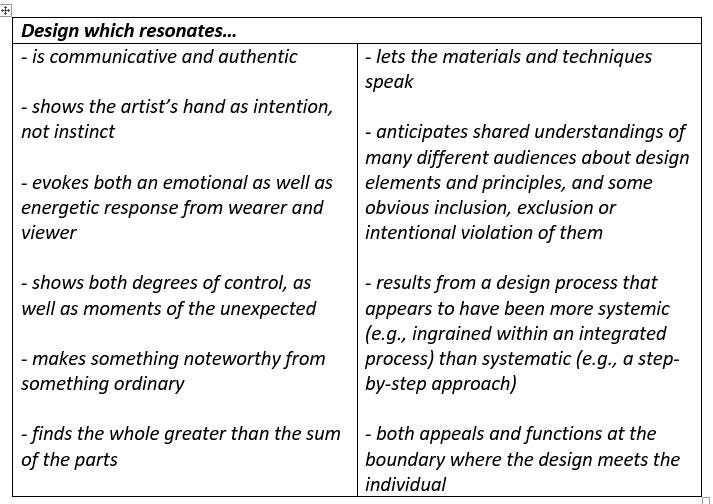
Resonance is some level of felt energy which extends a little beyond an emotional response. The difference between emotion and resonance can, for example, be like the differences between saying that piece or project is “Beautiful” vs. saying that piece or project “Makes me want to wear it”. Or that “I want to touch it.” Or “My friends need to see this.” Or “I need to implement this at once.”

Resonance is something more than emotion. It is some kind of additional energy we see, feel and otherwise experience. Emotion is very reactive. Resonance is intuitive, involving, identifying. Emotion is very sympathetic. Resonance is more of an empathetic response where artist and audience realize a shared (or contradictory) understanding without losing sight of whose views and feelings belong to whom.

Resonance results from how the artist controls light, shadow, and their characteristics of warmth and cold, receding and approaching, bright and dull, light and dark. Resonance results from how the artist leverages the strengths of materials, objects and techniques and minimizes their weaknesses. Resonance results from social, cultural and situational cues. Resonance results from how the artist takes us to the edge of universal, objective understandings, and pushes us ever so slightly, but not too, too far, beyond that edge.
Many people begin to explore design as a hobby, avocation, business or career. This requires, not only strong creativity skills, but also persistence and perseverance. A lot of the success in this pursuit comes down to an ability to make and follow through on many artistic and design decisions within a particular context or situation. Developing this ability — a fluency, flexibility and originality in design — means that the designer has to become empowered to answer these 5 essential questions: (1) whether creating something is a craft, an art or design, (2) how they think creatively, (3) how they leverage the strengths of various materials and techniques, and minimize weaknesses, (4) how the choices they make in any one design evoke emotions and resonate, and (5) how they know their piece is finished and successful.

Design is more than the application of a set of techniques. It is a mind-set. This fluency and empowerment enable the designer to think and speak like a designer. With fluency comes empowerment, confidence and success.

Continue reading about the Fifth Essential Question every designer should be able to answer: How Do I Know My Piece Is Finished?

The 5 Essential Questions:
1. Is What I Am Doing Craft, Art or Design?
2. What Should I Create?
3. What Materials (And Techniques) Work The Best?
4. How Do I Evoke A Resonant Response To My Work?
5. How Do I Know My Piece Is Finished?

Other Articles of Interest by Warren Feld:

Disciplinary Literacy and Fluency In Design

Backward Design is Forward Thinking

How Creatives Can Successfully Survive In Business

Part I: The First Essential Question Every Designer Should Be Able To Answer: Is What I do Craft, Art or Design?

Part 2: The Second Essential Question Every Designer Should Be Able To Answer: What Should I Create?

Part 3: The Third Essential Question Every Designer Should Be Able To Answer: What Materials (and Techniques) Work Best?

Part 4: The Fourth Essential Question Every Designer Should Be Able To Answer: How Do I Evoke A Resonant Response To My Work?

Part 5: The Firth Essential Question Every Designer Should Be Able To Answer: How Do I Know My Design Is Finished?

Doubt / Self-Doubt: 8 Pitfalls Designers Fall Into…And What To Do About Them

Part 1: Your Passion For Design: Is It Necessary To Have A Passion?

Part 2: Your Passion For Design: Do You Have To Be Passionate To Be Creative?

Part 3: Your Passion For Design: How Does Being Passionate Make You A Better Designer?

Part 1: SHARED UNDERSTANDINGS: THE CONVERSATION CENTERED WITHIN A DESIGN What Are Shared Understandings?

Part 2: SHARED UNDERSTANDINGS: THE CONVERSATION CENTERED WITHIN A DESIGN What Does The Designer Need To Know?

Part 3: SHARED UNDERSTANDINGS: THE CONVERSATION CENTERED WITHIN A DESIGN How Assumptions, Perceptions, Expectations and Values Come Into Play?

Part 4: SHARED UNDERSTANDINGS: THE CONVERSATION CENTERED WITHIN A DESIGN How Does The Designer Establish Shared Understandings?

Thank you. I hope you found this article useful.

Also, check out my website (www.warrenfeldjewelry.com).

Subscribe to my Learn To Bead blog (https://blog.landofodds.com).

Visit Land of Odds online (https://www.landofodds.com)for all your jewelry making supplies.

Enroll in my jewelry design and business of craft video tutorials online. Check our my video tutorials on DOING CRAFT SHOWS and on PRICING AND SELLING YOUR JEWELRY.

Add your name to my email list.

____________________________________

FOOTNOTES

Feld, Warren. The Goal Oriented Designer: The Path To Resonance. Art Jewelry Forum, 2018.

Feld, Warren. “Jewelry Design: A Managed Process,” Klimt02, 2/2/18.
Posted in Stitch 'n Bitch | Tagged: , , , , | Leave a Comment »

PART 3: THE THIRD ESSENTIAL QUESTION EVERY DESIGNER   SHOULD BE ABLE TO ANSWER: What Materials…

Posted by learntobead on August 16, 2020

PRACTICE-BY-DESIGN SERIES

Image by Feld, 2020

In order to make better artistic and design choices, the Fluent and Empowered Designer should have answers to 5 essential questions. In this article, I present the third essential question: What Materials (and/or Techniques) Work The Best?

Ferity was determined to make a Kumihimo bracelet. Kumihimo is a braiding technique. You make a braid and attach a clasp. Ferity thought it would be cool to incorporate some beads in her braid. So she strung up a lot of beads on various cords, and braided them. She glued on end caps on either side, and attached a clasp.

But she wasn’t liking her piece. She couldn’t figure out why. All the different colors, widths and materials of the cords she used were very upscale and attractive. She used a mix of crystal, gemstone and hand-made beads in the project — all very expensive and all very attractive.

But braided all together was somewhat unsatisfying. She didn’t think she would wear it very often. She didn’t think she could sell it. And she couldn’t figure out why.

A successful design has character and some kind of evocative essence. The choice of materials often sets the tone. And a choice of techniques cements that tone in place. Techniques link the designer’s intent with the client’s expectations. The successful designer has a depth of knowledge about materials, their attributes, their strengths, their weaknesses, and is able to leverage the good and minimize the bad within any design. The same can be said of techniques.

For some designs, the incorporation of mixed media or mixed techniques can have a synergistic effect — increasing (or decreasing) the appeal and/or functionality of the piece or project better than any one media or technique alone. It can feel more playful and experimental and fun to mix media or techniques. But there may be adverse effects, as well. Each media or technique will have its own structural and support requirements. Each will enable the control of light and shadow, space and mass, dimension and movement in different ways. Each will react differently to various physical forces impacting the piece when worn or the project when used. So it becomes difficult for the designer to successfully utilize any one medium or technique, as well as much more difficult to coordinate and integrate more than one media or technique.

Ferity had little understanding about the materials and their combined use within a Kumihimo technique. All designers need a firm and comprehensive understanding about selecting materials and techniques, and should be able to answer these 5 essential questions, now with question 3: What Materials (and/or Techniques) Work The Best?

QUESTION 3: What kinds of MATERIALS work well together, and which ones do not? This applies to TECHNIQUES as well. What kinds of TECHNIQUES (or combinations of techniques) work well when, and which ones do not?

The choice of materials and the choice of techniques set the tone and chances of success for your piece. Materials and techniques establish the character and personality of your designs. They contribute to understandings whether the piece is finished and successful.

However, there are no perfect materials (or techniques) for every project. Selecting materials (or techniques) is about making smart, strategic choices. This means relating your choices to your design and marketing goals. It also frequently means having to make tradeoffs and judgment calls between aesthetics and functionality. Last, materials may have different relationships with the designer, wearer or viewer depending on how they are intended to be used, and the situational or cultural contexts.

There are many implications of choice. There are light/shadow issues, pattern, texture, rhythm, dimensionality, proportions, placement and color issues. There are mechanics, shapes, forms, durability, drape, flow and movement issues. There are positive and negative space issues. There are user experience issues.

It is important to know what happens to all these materials (or applications of techniques) over time. It is important to know how each material (or technique) enhances or impedes architectural requirements, such as allowing an object to move and drape, or assisting the object in maintaining a shape or allowing a project to adapt to its audience and environment, or utilizing an object to direct navigation or viewing.

Each material or technique has strengths and weaknesses, pros and cons, and contingencies affecting their utilization. The designer needs to be able to leverage the strengths and minimize the weaknesses.

All of these choices:
 
… affect the look
 … affect the movement
 … affect the feel
 … affect the durability
 … affect both the designer’s and user’s responses
 … relate to the context

Many people begin to explore design as a hobby, avocation, business or career. This requires, not only strong creativity skills, but also persistence and perseverance. A lot of the success in this pursuit comes down to an ability to make and follow through on many artistic and design decisions within a particular context or situation. Developing this ability — a fluency, flexibility and originality in design — means that the designer has to become empowered to answer these 5 essential questions: (1) whether creating something is a craft, an art or design, (2) how they think creatively, (3) how they leverage the strengths of various materials and techniques, and minimize weaknesses, (4) how the choices they make in any one design evoke emotions and resonate, and (5) how they know their piece is finished and successful.

Design is more than the application of a set of techniques. It is a mind-set. This fluency and empowerment enable the designer to think and speak like a designer. With fluency comes empowerment, confidence and success.

Continue reading about the Fourth Essential Question every designer should be able to answer: How Do I Evoke A Resonant Response To My Work?

The 5 Essential Questions:
1. Is What I Am Doing Craft, Art or Design?
2. What Should I Create?
3. What Materials (And Techniques) Work The Best?
4. How Do I Evoke A Resonant Response To My Work?
5. How Do I Know My Piece Is Finished?

Other Articles of Interest by Warren Feld:

Disciplinary Literacy and Fluency In Design

Backward Design is Forward Thinking

How Creatives Can Successfully Survive In Business

Part I: The First Essential Question Every Designer Should Be Able To Answer: Is What I do Craft, Art or Design?

Part 2: The Second Essential Question Every Designer Should Be Able To Answer: What Should I Create?

Part 3: The Third Essential Question Every Designer Should Be Able To Answer: What Materials (and Techniques) Work Best?

Part 4: The Fourth Essential Question Every Designer Should Be Able To Answer: How Do I Evoke A Resonant Response To My Work?

Part 5: The Firth Essential Question Every Designer Should Be Able To Answer: How Do I Know My Design Is Finished?

Doubt / Self-Doubt: 8 Pitfalls Designers Fall Into…And What To Do About Them

Part 1: Your Passion For Design: Is It Necessary To Have A Passion?

Part 2: Your Passion For Design: Do You Have To Be Passionate To Be Creative?

Part 3: Your Passion For Design: How Does Being Passionate Make You A Better Designer?

Part 1: SHARED UNDERSTANDINGS: THE CONVERSATION CENTERED WITHIN A DESIGN What Are Shared Understandings?

Part 2: SHARED UNDERSTANDINGS: THE CONVERSATION CENTERED WITHIN A DESIGN What Does The Designer Need To Know?

Part 3: SHARED UNDERSTANDINGS: THE CONVERSATION CENTERED WITHIN A DESIGN How Assumptions, Perceptions, Expectations and Values Come Into Play?

Part 4: SHARED UNDERSTANDINGS: THE CONVERSATION CENTERED WITHIN A DESIGN How Does The Designer Establish Shared Understandings?

Thank you. I hope you found this article useful.

Also, check out my website (www.warrenfeldjewelry.com).

Subscribe to my Learn To Bead blog (https://blog.landofodds.com).

Visit Land of Odds online (https://www.landofodds.com)for all your jewelry making supplies.

Enroll in my jewelry design and business of craft video tutorials online. Check our my video tutorials on DOING CRAFT SHOWS and on PRICING AND SELLING YOUR JEWELRY.

Add your name to my email list.

______________________________

FOOTNOTES

Feld, Warren. Materials: Knowing What To Know. Art Jewelry Forum, 2020.

Feld, Warren. Techniques and Technology: Knowing What To Do. Art 
 Jewelry Forum, 2020.

WASTIELS, Lisa and WOUTERS, Ina. Material Considerations in Architectural 
 Design: A Study of the Aspects Identified by Architects for Selecting Materials. July, 2008. As referenced in:
 http://shura.shu.ac.uk/511/1/fulltext.pdf

Posted in Stitch 'n Bitch | Tagged: , , , , | Leave a Comment »

PART 2: THE SECOND ESSENTIAL QUESTION EVERY DESIGNER  SHOULD BE ABLE TO ANSWER:  What Should I…

Posted by learntobead on August 16, 2020

PRACTICE-BY-DESIGN SERIES

Image by Feld, 2020

In order to make better artistic and design choices, the Fluent and Empowered Designer should have answers to 5 essential questions. In this article, I present the second essential question: What Should I Create?

Selma got by very well in life by asking her teachers, and in subsequent years, her bosses, what she should do. She followed their instructions to the letter, and was particularly good at coloring within all the lines. Everyone was always pleased with her work. So pleased, in fact, that her current boss promoted her into a designer position.

In her new position, she was to work with construction, architectural and interior design firms. She was to assist them and guide them into choosing textiles with which to incorporate into their interior and exterior building plans.

When she met with various clients, she started byasking them to tell her what they wanted. But no one could really articulate much more than general ideas about colors. For Selma, this was disconcerting. She thought she could do a great job, but needed more information and direction. These were never forthcoming.

At the core of Creativity is the ability to generate options, and then narrown them down. Creativity is not innate; it is developed. Creativity is a muscle requiring attention and practice. This is something Selma never really worked on.

This was critical for Selmer, as well as any other designer, in order to flourish and succeed, to be able to answer these 5 essential questions, now with question 2.

QUESTION 2: How do you decide what you want to create? What kinds of things do you do to translate your passions and inspirations into design?

Applying yourself creatively can be fun at times, but scary at other times. It is work. You are creating something out of nothing. There is an element of risk. You might not like what you end up doing. Your friends might not like it. Nor your family. You might not finish it. Or you might do it wrong. It may seem easier to go with someone else’s project.

Applying creativity means developing abilities to generate options and alternatives, and narrowing these down to specific choices. It means developing an ease and comfort generating fix-it strategies when approaching unknown situations or problematic ones. It means figuring out how to translate inspiration into design in a way that inspires others and taps into their desires. It means differentiating yourself from other designers as a measure of your originality.
 

Creative people…

Set no boundaries and set no rules. They go with the flow. Don’t conform to expectations.
 
 Play.
They pretend they are kids again.
 
 Experiment.
They take the time to do a lot of What Ifs and Variations On A Theme and Trial and Error.
 
 Keep good records.
They make good notes and sketches of what seems to work, and what seems to not work.
 
 Evaluate.
They learn from their successes and mistakes.

As designers gain more and more creative experiences, they begin to assemble what I call a Designer’s Tool Box. In this virtual tool box are a set of thinking routines, strategies and fix-it strategies whichhave worked well in the past, are very workable in and of themselves, and are highly adaptive when used in unfamiliar situations. Every designer should develop their own Tool Box. This vastly contributes to adaptability and success in creative thinking and application.

Creativity

Creativity isn’t found, it is developed. Creativity is a phenomenon where both something new and, at the same time, somehow valuable is created. While some people come to creativity naturally, in fact, everyone can develop their creative ability.

Thinking creatively involves the integration and leveraging of three different kinds of ideas — insight and inspiration, establishing value, and implementing something.

We work through creative thinking through divergence (that is, generating many possibilities), and convergence (that is, reducing the number of these possibilities).

Kierkegaard — and I apologize for getting a little show-off-y with my reference — once described Creativity as “a passionate sense of the potential.” And I love this definition. Passion is very important. Passion and creativity can be summed up as some kind of intuitive sense made operational by bringing all your capabilities and wonderings and technical know-how to the fore. All your mechanical and imaginative abilities grow over time, as do your abilities for creative thinking and applications. Creativity isn’t inherently natural. It is something that is developed over time as you get more and more experience in design.

You sit down, and you ask, What should I create?

For most people, especially those getting started, the answer to this question is very basic. They look for patterns and instructions in magazines or how-to books or websites online. They let someone else make all the creative choices for them. The singular creative choice here is picking what you want to make. And, when you’re starting, this is OK.

As you grow as a designer, and feel more comfortable with materials and techniques, you can begin to make additional choices. You can choose your own colors. You can make simple adaptations, such as tweaking colors or placements or dimensions or proportions.

Eventually in your designer career, however, you will want to confront the Creativity issue head on. You will want to decide that pursuing your innermost designer, no matter what pathway this takes you along, is the next thing, and right thing, to do. That means you want your projects or objects to reflect your artistic hand. You want to develop a personal style. You want to come up with your own designs.

Sometimes creativity seems insurmountable, after finishing one project, to decide what to do next. Exercising your creative abilities can sometimes be a bear. But it’s important to keep pushing on. Challenging yourself. Developing yourself. Turning yourself into a designer. And pursuing opportunities to exercise your creative talents even more, as you enter the world of design.

Types of Creativity

Creativity has two primary components: (1) originality, and (2) functionality or value.

The idea of originality can be off-putting. It doesn’t have to be. The projects or objects, so creatively designed, do not have to be totally and completely new and original. The included design elements and arrangements do not have to be solely unique and never been done before.

Originality can be seen in making something stimulating, interesting or unusual. It can represent an incremental change which makes something better or more personal or a fresh perspective. It can be something that is a clever or unexpected rearrangement, or a great idea, insight, meaningful interpretation or emotion which shines through. It can include the design of new patterns and textures. It can accomplish connections between seemingly unrelated phenomena, and generate solutions. It can be a variation on a technique or how material gets used. It can be something which enhances the functionality or value of the piece.

Creativity in design marries that which is original to that which is functional, valued, useful, worthwhile, desired. These things are co-dependent, if any creative project is to be seen as successful.

For designers, creativity is not the sketch or computer aided drawing. It is not the inspiration. It is not the piece which never sees the light of day. Creativity requires implementation. And for designers, implementation is a very public enterprise.

How Do We Create?

It’s not what we create, but how we create!

The creative process involves managing the interplay of two types of thinking — Convergence and Divergence. Both are necessary for thinking creatively.

Divergent thinking is defined as the ability to generate or expand upon options and alternatives, no matter the goal, situation or context.

Convergent thinking is the opposite. This is defined as the ability to narrow down all these options and alternatives.

The fluent designer is able to comfortably weave back and forth between divergence and convergence, and know when piece or project is finished, and when the final choices will be judged as successful.

Brainstorming is a great example of how creative thinking is used. We ask ourselves What If…? How about…? Could we try this or that idea…? The primary exercise here is to think of all the possibilities, then whittle these down to a small set of solutions.

Many people begin to explore design as a hobby, avocation, business or career. This requires, not only strong creativity skills, but also persistence and perseverance. A lot of the success in this pursuit comes down to an ability to make and follow through on many artistic and design decisions within a particular context or situation. Developing this ability — a fluency, flexibility and originality in design — means that the designer has to become empowered to answer these 5 essential questions: (1) whether creating something is a craft, an art or design, (2) how they think creatively, (3) how they leverage the strengths of various materials and techniques, and minimize weaknesses, (4) how the choices they make in any one design evoke emotions and resonate, and (5) how they know their piece is finished and successful.

Design is more than the application of a set of techniques. It is a mind-set. This fluency and empowerment enable the designer to think and speak like a designer. With fluency comes empowerment, confidence and success.

Continue reading about the Third Essential Question every designer should be able to answer: What Materials (And Techniques) Work The Best?

The 5 Essential Questions:
1. Is What I Am Doing Craft, Art or Design?
2. What Should I Create?
3. What Materials (And Techniques) Work The Best?
4. How Do I Evoke A Resonant Response To My Work?
5. How Do I Know My Piece Is Finished?

Other Articles of Interest by Warren Feld:

Disciplinary Literacy and Fluency In Design

Backward Design is Forward Thinking

How Creatives Can Successfully Survive In Business

Part I: The First Essential Question Every Designer Should Be Able To Answer: Is What I do Craft, Art or Design?

Part 2: The Second Essential Question Every Designer Should Be Able To Answer: What Should I Create?

Part 3: The Third Essential Question Every Designer Should Be Able To Answer: What Materials (and Techniques) Work Best?

Part 4: The Fourth Essential Question Every Designer Should Be Able To Answer: How Do I Evoke A Resonant Response To My Work?

Part 5: The Firth Essential Question Every Designer Should Be Able To Answer: How Do I Know My Design Is Finished?

Doubt / Self-Doubt: 8 Pitfalls Designers Fall Into…And What To Do About Them

Part 1: Your Passion For Design: Is It Necessary To Have A Passion?

Part 2: Your Passion For Design: Do You Have To Be Passionate To Be Creative?

Part 3: Your Passion For Design: How Does Being Passionate Make You A Better Designer?

Part 1: SHARED UNDERSTANDINGS: THE CONVERSATION CENTERED WITHIN A DESIGN What Are Shared Understandings?

Part 2: SHARED UNDERSTANDINGS: THE CONVERSATION CENTERED WITHIN A DESIGN What Does The Designer Need To Know?

Part 3: SHARED UNDERSTANDINGS: THE CONVERSATION CENTERED WITHIN A DESIGN How Assumptions, Perceptions, Expectations and Values Come Into Play?

Part 4: SHARED UNDERSTANDINGS: THE CONVERSATION CENTERED WITHIN A DESIGN How Does The Designer Establish Shared Understandings?

Thank you. I hope you found this article useful.

Also, check out my website (www.warrenfeldjewelry.com).

Subscribe to my Learn To Bead blog (https://blog.landofodds.com).

Visit Land of Odds online (https://www.landofodds.com)for all your jewelry making supplies.

Enroll in my jewelry design and business of craft video tutorials online. Check our my video tutorials on DOING CRAFT SHOWS and on PRICING AND SELLING YOUR JEWELRY.

Add your name to my email list.

______________________________

FOOTNOTES

Besemer, S.P. and D.J. Treffinger. Analysis of Creative Products: Review and 
 Synthesis. Wiley Online Library, (1981).

Black, Robert Alan. Blog: http://www.cre8ng.com/blog/

Csikszentmihalyi, Mihaly. Creativity: Flow and the Psychology of Discovery and Invention. Harper Perennial; Reprint edition (August 6, 2013)

Feld, Warren. Creativity: How Do You Get It? How Do You Enhance It? (2020)

Guilford, J.P. Creativity. American Psychologist, 5, 444–454, 1950.

Koestler, Arthur. The Act of Creation. Last Century Media (April 1, 2014).

Lucy Lamp. “Inspiration in Visual Art Where Do Artists Get Their Ideas. As 
 reference in: 
 https://www.sophia.org/tutorials/inspiration-in-visual-art-where-do-artists-get-the

Maital, Shlomo. “How IBM’s Executive School Fostered Creativity,” Global Crisis Blog, April 7, 2014. Summarizes Louis R. Mobley’s writings on creativity, 1956.

March, Anna Craft. Creativity in Education. Report prepared for the 
 Qualifications and Curriculum Authority, March, 2001.

Seltzer, Kimberly and Tom Bentley. The Creative Age: Knowledge and Skills for the New Economy. Demos, 1999.

Torrance, E. P. The Torrance Tests of Creative Thinking-Norms-Technical Manual Research Edition-Verbal Tests, Forms A and B-Figural Tests, Forms A and B. Princeton, NJ: Personnel Press, 1966.

Torrance, E. P. The Torrance Tests of Creative Thinking-Norms-Technical Manual Research Edition- Verbal Tests, Forms A and B- Figural Tests, Forms A and B. Princeton, NJ: Personnel Press, 1974.

Turak, August. “Can Creativity Be Taught,” Forbes, May 22, 2011.

Posted in Stitch 'n Bitch | Tagged: , , , , | Leave a Comment »

“Backward-Design” is Forward Thinking: Design-In-Practice Series

Posted by learntobead on July 9, 2020

Land of Odds homepage detail, Source, Feld, 2020

So often, designers struggle to figure out the reasons why their designs did not feel finished or as successful as they could be. They get so caught up in the here and now of design that they forget to study what was, and fail to sufficiently anticipate what will happen when that design is introduced publicly — to the client, to the client’s client and to the world.

Clients sense this. When the designer does not share, or at least anticipate, the understandings and expectations of the client, the project could go awry. The designer could end up expending many non-billable hours trying to adjust, tweak, re-do, re-conceive the project. And the whole process ends up not feeling good. Unfulfilling. A chore.

Often the core of the problem is the design approach to the project. Designers like to follow a linear process of design. This is an unfortunate remnant of the scientific management philosophy prevalent in the 1930’s. A belief that everything can be reduced to a progressive series of steps, performed in an objective, almost-scientific way. Processed from a beginning, through a middle, and leading to an end. No iteration or back and forth. Little trial and error. Objectively gather information and data. Analyze it. Formulate a hypothesis. Test it. Draw conclusions. Set goals, objectives and activities accordingly. Organize resources. Arrange things in a pleasing manner and implement. Evaluate. Happy client, happy life.

But, as we all know, things aren’t so linear. They aren’t so clear-cut and pat. They are not so perfectly objective and universally understood. We have all felt these things:

  1. Working with imperfect information.
  2. Often inarticulate clients.
  3. Or clients not understanding or appreciating or anticipating what you are trying to do.
  4. Some limits to the access to resources we want and need.
  5. Not fully skilled in every single technique that might come to bear.
  6. Can often get caught up in our heads, sometimes over-thinking, other times not thinking enough.
  7. A fear of failing to know when enough is enough.
  8. A weak sense of what happens when we introduce our designs publicly.
  9. Never fully sure if we have achieved acceptable results.

Design should not be seen as a set of steps per se. Rather, design is a way of thinking. That way of approaching the professional task with fluency, flexibility and comprehension. Here the designer must provide a sense of the underlying intellect in the design of the project, or else others cannot appreciate or anticipate what the designer was trying to accomplish. They need to sense the designer’s thought process all along the way.

Towards this end, we want designers to get socialized into a disciplinary literacy as they pursue design as an occupation and profession. They need to learn how design differs from art. Achieving a harmony and some variety in design — the goal in an art project — often falls short of client expectations. There’s that “It’s nice, but…” or “Where’s the WOW factor I was looking for…” or “I like it, but I’m not sure how I’m going to use it…”.

And professional, experienced designers need to learn how to tell when enough is enough. That is, they need to have this automatic, intuitive sense when if they added or subtracted one more thing from their design, it would not be as good.

One useful type of tool, designers can resort to is called a Thinking Routine (see footnote 2). The Thinking Routine is any structured way of asking yourself questions which help you organize your thoughts. You should have several thinking routines in your designer tool-box. These aid you in applying that disciplinary literacy you are forever developing and improving upon.

One Thinking Routine I want to introduce you to here is called “Backward-Design(see footnote 1).

How the designer begins the process of creating a design is very revealing about the potential for success. One of the things designers more literate in their discipline learn to do is called “Backward-Design.” The designer starts with determining how their finished project will be assessed, then works backward from there in specifying the tasks and methods to be employed.

The designer begins the process by articulating the essential shared understandings and desires against which their work will be evaluated and judged. The designer starts with questions about assessment, and then allows this understanding to influence all other choices going forward. The designer anticipates what evidence others will use in their assessments of what the designer is trying to do.

Given that the more successful designer “backward-designs,” he or she would begin the process by anticipating those understandings about how their work will be assessed. The first assessment is how others, particularly the client, but including the client’s audience(s) as well, will see the design as finished, complete, coherent, and parsimonious. The second assessment is how others will see the design as successful, satisfying, having the desired effect, contagious, and impactful.

The designer then is equipped to make three types of informed, purposeful choices:

1. Choices about composition

2. Choices about construction and manipulation

3. Choices about performance

These choices involve what to include and not include. How to organize and how not to organize. How to mesh things together and not mesh things together. How to introduce things publicly and not introduce things publicly.

Given what the client wants, your choices will be influenced by what evidence they will look for to know you have achieved it. These choices involve evidence about what tasks will be worthy to be accomplished, and the most efficient and effective ways to accomplish them. These choices signal that the designer really gets it and is ready to perform with understanding, knowledge and skill.

In backward-design, these choices emerge through dialect and communicative interaction. Choices about tasks are purposeful. Design is more seen and operated as an action, rather than an object.

When beginning the process of design, the designer thinks about assessment before beginning to think about what and how they will design. Designers do not wait until the end — what scientific management calls the evaluation step — of the process. Thinking backward as a strategy for problem solving really isn’t that difficult. While this may feel illogical or counter-intuitive, in the end it makes more sense.

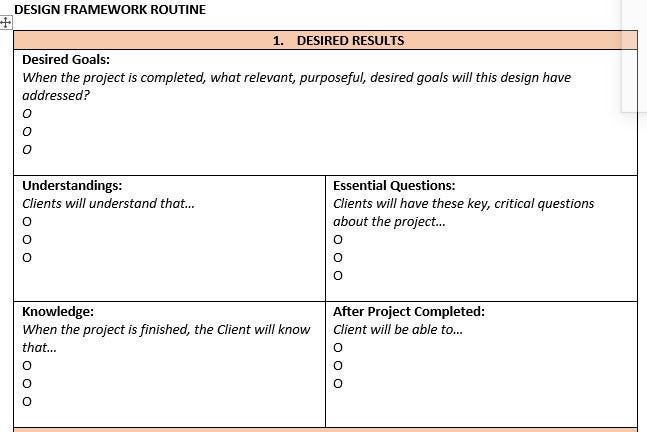
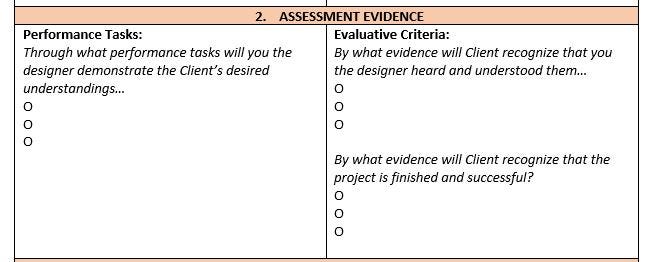
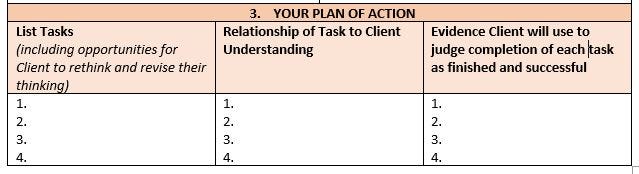
Again, we can set up a backward-design process as a Thinking Routine. A Thinking Routine can help the designer internalize the backward-design process. It can help the designer sharpen their focus. The Routine becomes a way, used informally or formally based on your style, to structure the client intake process. It also becomes a way to force you to prioritize your tasks.

Here is a simple example useful for designers interested in backward-design, and which I call DESIGN FRAMEWORK.

How Do We Elicit This Information From The Client?

Critical here is the designer’s ability to elicit a lot of information from the client. Information about expectations. Past experiences. Things they like and dislike. What they want to happen at the end. Values, desires, worth, risks, rewards. What the client’s various audiences might expect and desire.

Understandings are often revealed through the exercises of comparing and contrasting or summarizing key ideas and images. We can provide pictures. We can take the client on an internet tour. We can ask the client to take us on an internet tour. During all this, we encourage the client to explain, interpret, apply, critique, empathize or reveal prior knowledge about and experience with. This gives us a lot of information to start with.

We can then seek to find specific examples of what the client has done in the past, or has tried to do recently. They can describe certain actions they have taken. They can share with you various products they have designed or had designed for them, and their feelings about these products. They can explain the “facts” as they present them. Or offer up “interpretations”.

We then have to step back from our interactions with the client, and ask ourselves: Does the information we have collected provide enough evidence for us to determine a task plan? Can we see patterns and themes emerging? Hard and fast convictions? Things loosely connected? Are the client’s understanding of the problem(s) to be solved consistent with those of the possible solution(s) which can be implemented?

Or is there still some ambiguity needing clarification? Are any expectations unrealistic? If so, we return to interacting with the client to gather more evidence of their desires and understandings about what they want to be accomplished.

The Successful Designer

The successful designer is one who can generate designs which are engaging and effective, as judged by the client (and perhaps by extension, the client’s various audiences).

The design process should allow the designer to identify and prioritize those tasks which are most relevant to or likely to achieve the end result. And in turn, reject or shorten tasks which do not.

The client should see the design as relevant, provoking, meaningful and energizing. The project should feel finished. It should meet the client’s understandings about what constitutes success. You do not want the client to walk away thinking the design was merely the result of an academic exercise. You do not want the client to think or feel you have sold them a cookie-cutter solution.

The design process itself should impact not only the final product, but the client him- or herself. It should elevate the client’s own sense of design and accomplishment. It should result in a client more competent when interacting with you and securing your services the next time.

____________________________________

FOOTNOTES

(1) Backward-Design. I had taken two graduate education courses; one in Literacy and one in Planning that were very influential in my approach to disciplinary literacy. One of the big take-away from Understanding by Design by Grant Wiggins and Jay McTighe, 2nd Edition, Association for Supervision and Curriculum Development, 2005, was the idea they introduced of “backward-design”. Their point is that you can better teach understanding [and my words, perform professionally] if you anticipate the evidence others will use in their assessments of what you are trying to do. When coupled with ideas about teaching literacy and fluency (see Literacy: Helping Students Construct Meaning by J. David Cooper, M. Robinson, J.A. Slansky and N. Kiger, 9th Edition, Cengage Learning, 2015), you can begin to introduce ideas about managing the design process in a coherent and alignable way.

Understanding by Design by Grant Wiggins and Jay McTighe, 2nd Edition, Association for Supervision and Curriculum Development, 2005.

Literacy: Helping Students Construct Meaning by J. David Cooper, M. Robinson, J.A. Slansky and N. Kiger, 9th Edition, Cengage Learning, 2015

(2) Thinking Routines. There are many different types of Thinking Routines. The Harvard Graduate School of Education has researched, evaluated and categorized these. These routines can be used in your own reflections with yourself, or as active tools when working with clients. They are used to help you understand and manipulate your world.

Project Zero’s Thinking Routine Toolbox. Harvard Graduate School of Education.

_____________________________________________

Other Articles of Interest by Warren Feld:

The Jewelry Design Philosophy: Not Craft, Not Art, But Design

What Is Jewelry, Really?

The Jewelry Design Philosophy

Creativity: How Do You Get It? How Do You Enhance It?

Disciplinary Literacy and Fluency In Design

Becoming The Bead Artist and Jewelry Designer

5 Essential Questions Every Jewelry Designer Should Have An Answer For

Getting Started / Channeling Your Excitement

Getting Started / Developing Your Passion

Getting Started / Cultivating Your Practice

Becoming One With What Inspires You

Architectural Basics of Jewelry Design

Doubt / Self Doubt: Major Pitfalls For The Jewelry Designer

Techniques and Technologies: Knowing What To Do

Jewelry, Sex and Sexuality

Jewelry Making Materials: Knowing What To Do

Teaching Discplinary Literacy: Strategic Thinking In Jewelry Design

The Jewelry Designer’s Approach To Color

Point, Line, Plane, Shape, Form, Theme: Creating Something Out Of Nothing

The Jewelry Designer’s Path To Resonance

Jewelry Design Principles: Composing, Constructing, Manipulating

Jewelry Design Composition: Playing With Building Blocks Called Design Elements

Contemporary Jewelry Is Not A “Look” — It’s A Way Of Thinking

— — — — — — — — — — — — — — — —

Thank you. I hope you found this article useful.

Also, check out my website (www.warrenfeldjewelry.com).

Subscribe to my Learn To Bead blog (https://blog.landofodds.com).

Visit Land of Odds online (https://www.landofodds.com)for all your jewelry making supplies.

Enroll in my jewelry design and business of craft video tutorials online.

Add your name to my email list.

Posted in Stitch 'n Bitch | Tagged: , , , , | Leave a Comment »

Jewelry Design: A Managed Process

Posted by learntobead on June 12, 2020

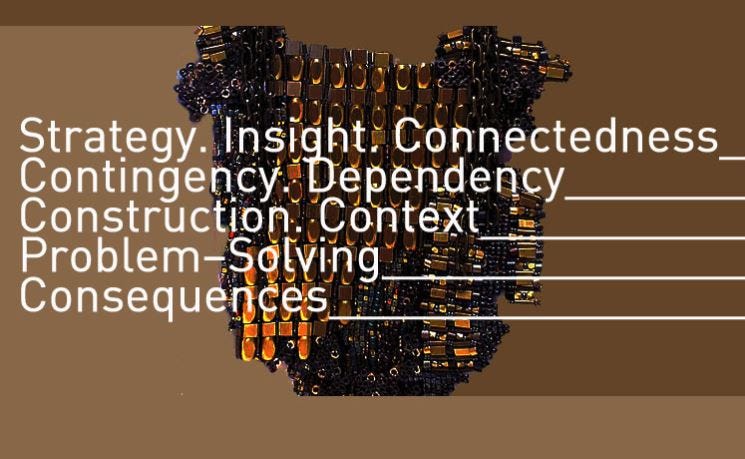
Little Ghindia (tapestry necklace) by Warren Feld, with overwritten text, source, FELD, 2019

“Jewelry is art, but only art as it is worn.”

That’s a powerful idea, — “as it is worn” — but, when making jewelry, we somewhat ignore it. We bury it somewhere in the back of our brains, so it doesn’t get in the way of what we are trying to do. We relegate it to a phrase on the last page of a book we have promised ourselves to read sometime, so it doesn’t put any road blocks in front of our process of creation.

We like to follow steps, and are thrilled when a lot of the thinking has been done for us. We like to make beautiful things. But, we do not want to have to make a lot of choices. We don’t want anything to disrupt our creative process.

We do not want to worry about and think about and agonize over jewelry “as it is to be worn.” Let’s not deal with those movement, architectural, engineering, context, interpersonal and behavioral stuff. We just want to make things.

To most artisans, making jewelry should never be work. It should always be fun.

Making jewelry should be putting a lot of things on a table in front of you, and going for it.

Making jewelry just is. It is not something we have to worry about managing.

It is easy to make, copy or mimic jewelry someone else has designed, either through kits or through imitation.

Making jewelry is doing. Not thinking.

Creating. Not managing.

We prefer to make jewelry distinct from any context in which it might be worn or sold. We don’t want someone looking over our shoulder, while we create. We don’t want to adjust any design choice we make because the client won’t like it, or, perhaps, it is out of fashion or color-shaded with colors not everyone likes. Perhaps our design choices at-the-moment do not fit with the necessities associated with how we need to market our wares to sell them. Our pieces might somehow be off-brand.

All too often, we avoid having to think about the difficult choices and trade-offs we need to make, when searching for balance. That is balance among aesthetics, functionality, context, materials and technique. And balance between our needs as designers and the wearer’s needs, as well. So, too, we shy aware from making any extra effort to please “others” or “them”. Even though this hardly makes sense if we want these “others” or “them” to wear our jewelry or buy our jewelry creations.

Everything comes down to a series of difficult choices. We are resistant to making many of them. So we ignore them. We pretend they are choices better left to other people, though never fully sure who those other people are. We yearn to be artists, but resign ourselves to be craft-persons. We dabble with art, but avoid design.

We hate to make trade-offs between art and function; that is, allow something to be a little less beautiful so that it won’t break or not drape and move well when worn. We hate to make things in colors or silhouettes we don’t like. We hate to make the same design over and over again, even though it might be popular or sell well.

But make these kinds of choices we must! Your jewelry is a reflection of the sum of these choices. It is a reflection of you. You as an artist. You as a creator. You as an architect and an engineer. You as a social scientist. You as a business person. You as a designer.

So, the more we can anticipate what kinds of choices we need to make, and the more experience we have to successfully manage and maneuver within these choices, the more enjoyable and successful our jewelry designs become … and the more satisfying for the people for whom we make them.

JEWELRY DESIGN IS A MANAGEMENT PROCESS

Designers who are able to re-interpret the steps they go through and see them in “process” terms, that is, with organization and purpose, have the advantage.

There are many different kinds of choices to be made, but they are interdependent and connected. Recognizing inter-dependency and connectedness makes it easier to learn about, visualize and execute these choices as part of an organized, deliberate and managed jewelry design process.

I am going to get on my soap box here. We tend to teach students to very mechanically follow a series of steps. We need, instead, to teach them “Process”. Strategy. Insight. Connectedness. Contingency. Dependency. Construction. Context. Problem-Solving. Consequences.

Good jewelry design must answer questions and teach practitioners about managing the processes of anticipating the audience, selecting materials, implementing techniques, and constructing the piece from one end to the other. Again, this is not a mechanical process. Often, it is not a linear step-by-step pathway. There is a lot of iteration — that is, the next choice made will limit some things and make more relevant other things which are to happen next.

A “process” is something to be managed, from beginning to end, as the designer’s knowledge, techniques and skills are put to the test. That test could be very small-scale and simple, such as creating a piece of jewelry to give to someone as a gift. Or creating a visual for a customer. Or when you need to know the costs. Or, that test could be very large-scale and more complex, such as convincing a sales agent to represent your jewelry in their showroom.

Better Jewelry Designers smartly manage their design processes at the boundary between jewelry and person. It is at this boundary where all the inter-dependencies of all the various types of choices we designers make are clearest and have the most consequence.

WELL-DESIGNED JEWELRY MUST BE MANAGED
AT THE BOUNDARY BETWEEN JEWELRY AND PERSON

What exactly does it mean to “manage design at the boundary between jewelry and person?” What kinds of things happen at that boundary?

A person breathes. She moves. She sits at a desk, perhaps fidgeting with her jewelry. She might make sudden turns. She gracefully transitions from one space to another. She has shape, actually many shapes.

Her jewelry serves many purposes. It signifies her as someone or something. It expresses her feelings. Or status. Or future intentions. Or past history. It ties her to people and places, events and times. It suggests power, or lack thereof. It hides faults, and amplifies strengths. It implies whether she fits with the situation.

Jewelry attracts. It attracts seekers of the wearer’s attention. It wards off denigrators. It orients people to the world around them. It tells them a story with enough symbol, clue and information to allow people to decide whether to flee or approach, run away or walk toward, hide or shine.

Jewelry has a feel and sparkle to it. It reminds us that we are real. It empowers a sensuality and a sexuality. It elevates our esteem. Sometimes uncomfortable or scratchy. Sometimes not. Sometimes reflective of our moods. Othertimes not.

Jewelry is a shared experience. It helps similar people find one another. It signals what level of respect will be demanded. It entices. It repels. It offers themes both desirable and otherwise.

Jewelry has shape, form and mechanics. All the components must self-adjust to forces of movement, yet at the same time, not lose shape or form or maneuverability or appeal. If a piece is designed to visually display in a particular way, forces cannot be allowed to disrupt its presentation. Jewelry should take the shape of the body and move with the body. It should not make a mockery of the body, or resist the body as it wants to express itself.

Jewelry defines a silhouette. It draws a line on the body, often demarcating what to look at and what to look away from. What to touch, and what to avoid. What is important, and what is less so.

Managing here at the boundary between jewelry and person means understanding what wearing jewelry involves and is all about. There is an especially high level of clarity at this boundary because it is here where the implications of any choice matters.

The choice of stringing material anticipates durability, movement, drape. The choices of color and shape and silhouette anticipate aesthetics, tensions between light and shadow, context, the viewer’s needs or personality or preferences at the moment. The choice of technique anticipates how best to coordinate choices about materials with purpose and objective. The choice of price determines marketability, and where it’s out there, and whether it’s out there.

You choose Fireline cable thread and this choice means your piece will be stiffer, might hold a shape better, might resist the abrasion of beads, but also might mean less comfort or adaptability.

You choose cable wire and this choice means that your piece might not lay right or comfortably. A necklace will be more likely to turn around on the neck. It might make the wearer look clownish. At the same time, it might make the stringing process go more quickly. Efficiency translates into less money charged, and perhaps more sales.

You choose to mix opaque glass with gemstone beads, mixing media which do not necessarily interact with the eye and brain in the same way. This may make interacting with the piece seem more like work or annoying.

The ends of your wire-work will not keep from bending or unraveling, so you solder them. Visually this disrupts the dance you achieve with wire bending and cheapens it.

You choose gray-toned beads to intersperse among your brightly colored ones. The grays pick up the colors around them, adding vibrancy and resonance to your piece. The gaps of light between each bead more easily fade away as the brain is tricked into filling them in with color.

You mix metalized plastic beads in with your Austrian crystal beads. In a fortnight, the finish has chipped off all the plastic beads.

You construct a loom bracelet, flat, lacking depth or a sense of movement. Your piece may be seen as pretty, but out of step with contemporary ideas of fashion, style, and design.

If we pretend our management choices here do not matter, we fool ourselves into thinking we are greater artists and designers than we really are.

JEWELRY DESIGN MANAGEMENT:
BUILDING A STRUCTURE AND ORGANIZATION 
FOR THINKING THROUGH DESIGN

Design management is multi-faceted. We intuitively know that proper preparation prevents piss poor performance. So let’s properly prepare. This means…

  • PROJECT
    Defining what I do as a “Project To Be Managed” — My Project is seen as a “system”, not merely a set of steps. The “system” encompasses everything it takes that enables creativity and leads it to success. These include things related to art, architecture, engineering, management, behavioral and context analysis, problem-solving, and innovation. For some designers, these also include things related to business, marketing, branding, selling and cost-accounting.
  • INSPIRATION
    Documenting, through image, writing or both, the kinds of things that are inspiring me and influencing my design
  • PURPOSE
    Elaborating on the purpose or mission of my Project — why am I doing this Project as it applies to me, and as it applies to others?
  • SITUATION
    Measuring the context and situation as these will/might/could impact my Project
  • STRATEGY
    Developing a strategy for designing my piece — outlining everything that needs to come together to successfully work through my Project from beginning to end
  • SKILLS
    Verifying, Learning or Re-Learning the necessary techniques and skills
  • SUPPLIES
    Securing my supply chain to get all our materials, tools and supplies needed when I need them
  • CONSTRUCTION
    Applying design principles of composition, form and structure. Paying careful attention to building in architectural pre-requisites, particularly those involved with support, jointedness and movement.
  • SHOWCASE
    Introducing my Jewelry Design to a wider audience. This might involve sharing, show-casing, or marketing and selling
  • REPLICATION
    Anticipating all that it will take to replicate the piece, if it is not a one-off, especially if I am developing kits or selling my pieces
  • REFLECTION
    Evaluating whether I could repeat this or a similar Project with any greater efficiency or effectiveness — The better jewelry artist is one who is more reflective and metacognitive.

DESIGN THINKING

Designing jewelry demands that we both do and think. Create and manage. Experience and reflect.

The better Jewelry Designer sees any Project as a system of things, activities and outcomes. These are interconnected and mutually dependent. Things are sometimes linear, but most often iterative — a lot of back and forth and readjustments.

The better Jewelry Designer is very reflective. She or he thinks about every detail, plays mental exercises of what-if analyses, monitors and evaluates all throughout the Project’s management. She or he thinks through the implications of each choice made. The Designer does not blindly follow a set of instructions without questioning them.

At the end of the day, your jewelry is the result of the decisions you made.

Something to think about.

HOW DO WE TEACH JEWELRY DESIGN THINKING
AS A MANAGEMENT PROCESS

We should teach students to design jewelry, not craft it. Rather than have students merely follow a set of steps, we need to do what is called “Guided Thinking”.

For example, we might encourage students to construct and feel and touch similar pieces made with different materials, beads and techniques, and have them tell us what differences they perceive. We should guide them in thinking through the implications for these differences. When teaching a stitch, I typically have students make samples using two different beads — say a cylinder bead and a seed bead, and try two different stringing materials, say Fireline and Nymo threads.

We also should guide them in thinking through all the management and control issues they were experiencing. Very often beginning students have difficulty finding a comfortable way to hold their pieces while working them. I let them work a little on a project, stop them, and then ask them to explain what was difficult and what was not. I suggest some alternative solutions — but do not impose a one-best-way — and have them try these solutions. Then we discuss them, fine-tuning our thinking.

I link our developing discussions to some goals. We want good thread management for a bead woven piece. We want the beads to lay correctly within the piece. We want the piece to feel fluid. We return to Guided Thinking. I summarize all the choices we have made in order to begin the project: type of bead, size of bead, shape of bead, type of thread, strategy for holding the piece while working it, strategy for bringing the new bead to the work in progress. I ask the students what ideas are emerging in their minds about how to bring all they have done so far together.

At this point, I usually would interject a Mini-Lesson, where I demonstrate, given the discussions, the smarter way to begin the Project. In the Mini-Lesson, I “Think Aloud” so that my students can see and hear how I am approaching our Project.

And then I continue with Guided Thinking as we work through various sections of the Project towards completion. Whatever we do — select materials, select and apply techniques, set goals, anticipate how we want the Project to end up — is shown as resulting from a managed process of thinking through our design.

In “Guided Thinking”, I would prompt my students to try to explain what is/is not going on, what is/is not working as desired, where the student hopes to end up, what seems to be enhancing/impeding getting there.

With guidance, demonstration and repetition, it is my hope that such thinking becomes a series of Thinking Routines my students resort to when starting a new project. As students develop and internalize more Thinking Routines, they develop greater Fluency with design.

And that should be our primary goal as teachers: developing our students’ Fluency with design.

Other Articles of Interest by Warren Feld:

The Jewelry Design Philosophy: Not Craft, Not Art, But Design

What Is Jewelry, Really?

The Jewelry Design Philosophy

Creativity: How Do You Get It? How Do You Enhance It?

Disciplinary Literacy and Fluency In Design

Becoming The Bead Artist and Jewelry Designer

5 Essential Questions Every Jewelry Designer Should Have An Answer For

Getting Started / Channeling Your Excitement

Getting Started / Developing Your Passion

Getting Started / Cultivating Your Practice

Becoming One With What Inspires You

Architectural Basics of Jewelry Design

Doubt / Self Doubt: Major Pitfalls For The Jewelry Designer

Techniques and Technologies: Knowing What To Do

Jewelry, Sex and Sexuality

Jewelry Making Materials: Knowing What To Do

Teaching Discplinary Literacy: Strategic Thinking In Jewelry Design

The Jewelry Designer’s Approach To Color

Point, Line, Plane, Shape, Form, Theme: Creating Something Out Of Nothing

The Jewelry Designer’s Path To Resonance

Jewelry Design Principles: Composing, Constructing, Manipulating

Jewelry Design Composition: Playing With Building Blocks Called Design Elements

Contemporary Jewelry Is Not A “Look” — It’s A Way Of Thinking

I hope you found this article useful.

Also, check out my website (www.warrenfeldjewelry.com).

Subscribe to my Learn To Bead blog (https://blog.landofodds.com).

Visit Land of Odds online (https://www.landofodds.com)for all your jewelry making supplies.

Enroll in my jewelry design and business of craft video tutorials online.

Add your name to my email list.

Posted in Stitch 'n Bitch | Tagged: , , , , | Leave a Comment »