People have different motivations and ambitions when making jewelry. These can be as simple as an avocation or hobby, or more involved as a business or career. Jewelry making is an investment in time and materials. It requires, not only strong creativity skills, but also persistence and perseverance to take a project from inspiration to aspiration to implementation. A lot of the success in this pursuit comes down to an ability to make and follow through on many artistic and design decisions. Developing this ability — a fluency, flexibility and originality in design — means that the designer has become empowered to answer these 5 essential questions: (1) Is jewelry making a craft, an art or design? (2) How do you think creatively? (3) How do you leverage the strengths of various materials and techniques, and minimize weaknesses? (4) How do the choices you make in any one jewelry design evoke emotions and resonate? and, (5) How do you know your piece is finished and successful?
5 Essential Questions Every Jewelry Designer Should Have An Answer For
Interested in trying your hand at jewelry design?
Before you begin, consider the following 5 questions I pose for you…
1. Is what you do Art, Craft or Design? 2. How do you decide what you want to create? 3. What materials (or techniques) work well together, and which do not? 4. What things do you do so that your finished piece evokes an emotional response? 5. How do you know when your piece is done?
People have different motivations and ambitions when making jewelry. These can be as simple as an avocation or hobby, or more involved as a business or career. Jewelry making is an investment in time and materials. It requires, not only strong creativity skills, but also persistence and perseverance to take a project from inspiration to aspiration to implementation.It means understanding that jewelry can only be judged as finished and successful as the piece is worn. Jewelry design is more than the application of a set of techniques; it is a mind-set, as well. It is a way of thinking like a designer.
A lot of the achievement and accomplishment in this pursuit of jewelry design comes down to an ability to make and follow through on many artistic and design decisions. Some have to do with managing a process, which can take an extended period of time. It also comes down to being fluent, flexible and original in your thinking through design. The greater your disciplinary literacy, the more empowered and confident you become in your design work.
Susan is one example of what happens when uncertainty — that paralysis or deer-in-the-headlights feeling that we so often face — sets in. Susan felt very unsure of herself. And unsure of her jewelry. Would people like it? Was the color mix appropriate? Was the construction secure? Was the price smart and fair? She allowed all this uncertainty to affect her design work — she had difficulty finishing pieces she was working on, starting new projects, and getting her work out there.
Like many of my jewelry design and beadwork students, Susan needed to be fluent as a designer. With fluency comes empowerment, confidence and success.
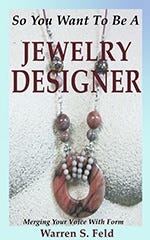
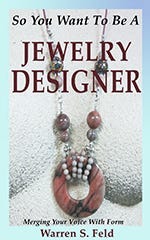
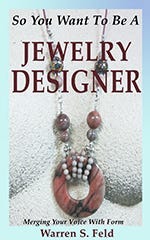
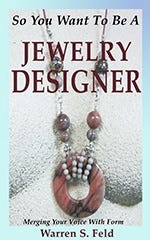
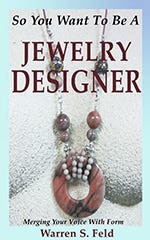
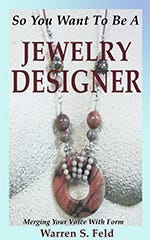
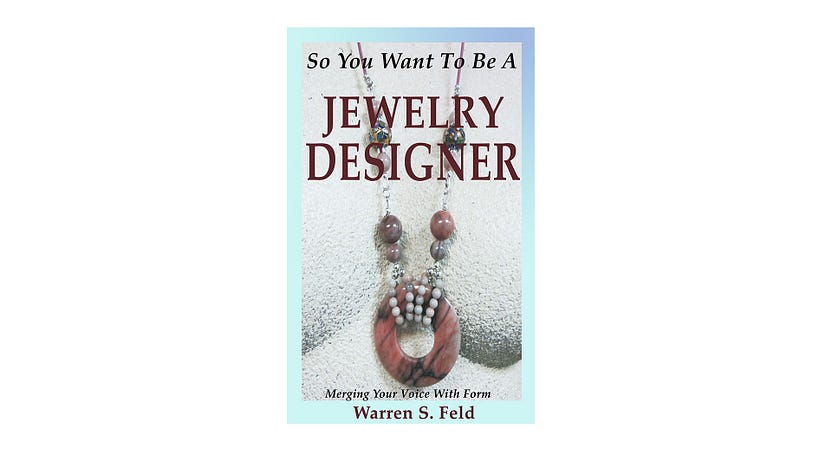
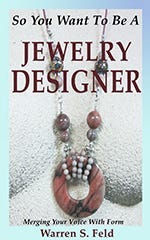
SO YOU WANT TO BE A JEWELRY DESIGNER Merging Your Voice With Form
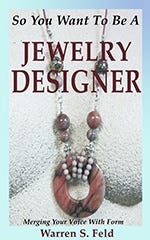
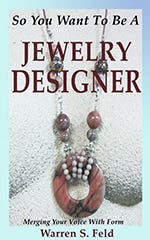
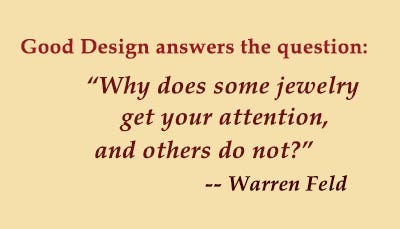
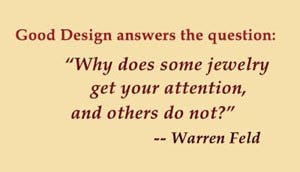
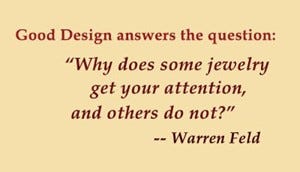
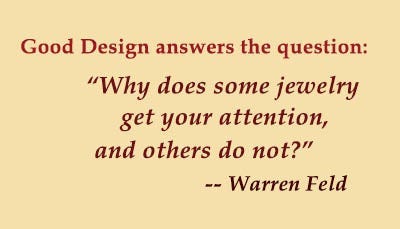
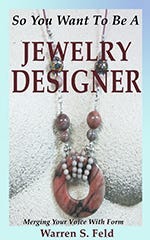
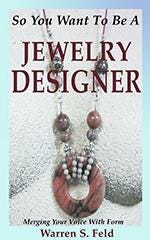
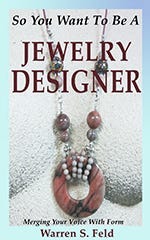
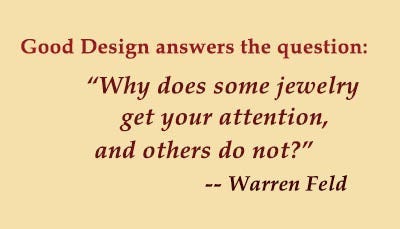
So You Want To Be A Jewelry Designer reinterprets how to apply techniques and modify art theories from the Jewelry Designer’s perspective. To go beyond craft, the jewelry designer needs to become literate in this discipline called Jewelry Design. Literacy means understanding how to answer the question: Why do some pieces of jewelry draw your attention, and others do not? How to develop the authentic, creative self, someone who is fluent, flexible and original. How to gain the necessary design skills and be able to apply them, whether the situation is familiar or not.
Some Bottom-Line Advice For The Newly Emerging Jewelry Designer
Always keep working and working hard. Set up a routine, and do at least one thing every day.
Find a comfortable place to work in your home or apartment. If at all possible, find separate spaces for creative work, business stuff, and reflection.
Develop strategies for organizing your projects, your supplies and your tools, and for keeping things generally organized over time. But don’t overdue the organizing thing. A little chaos can be OK, and even, sometimes, trigger new ideas.
Give yourself permission to play, experiment, go down many paths. Everything you work on doesn’t have to meet the criterion of perfection, be cool, or become the next Rembrandt. A key part of the learning process is trial and error, hypothesis, test, and conclusion. This helps you develop fix-it strategies so that you can overcome unfamiliar or problematic situations, enhancing your skills as a designer.
Don’t let self-doubt and any sense of impending failure take over you, and paralyze you. Designer’s block, while it may happen occasionally, should be temporary. Jewelry projects usually evolve, and involve some give and take, change and rearrangement. Often the time to complete a project can be lengthy, and you have to maintain your interest and inspiration over this extended time period.
Don’t get stuck in a rut. Try new materials. Try new colors. Try new designs. Try new styles. Try to add variation, new arrangements, smart embellishments. Learn new techniques and technologies.
SO YOU WANT TO BE A JEWELRY DESIGNER Merging Your Voice With Form
So You Want To Be A Jewelry Designer reinterprets how to apply techniques and modify art theories from the Jewelry Designer’s perspective. To go beyond craft, the jewelry designer needs to become literate in this discipline called Jewelry Design. Literacy means understanding how to answer the question: Why do some pieces of jewelry draw your attention, and others do not? How to develop the authentic, creative self, someone who is fluent, flexible and original. How to gain the necessary design skills and be able to apply them, whether the situation is familiar or not.
Developing yourself as a jewelry designer has several challenging moments. Learning. Recognizing. Getting Inspired. Creating. Organizing. Constructing. Managing. Presenting. Marketing. Selling. You want to maintain high expectations and goals for yourself, and see these all these challenging moments through.
Some challenging moments include the following:
1. Learning your craft and continually growing and developing within your profession
2. Recognizing how jewelry design goes beyond basic mechanics and aesthetics, thus, differs from craft and differs from art, and then learning and working accordingly.
3. Getting Inspired
4. Translating Inspiration into a design
5. Implementing that design both artistically and architecturally by finding that balance between beauty (must look good) and functionality (must wear well)
6. Organizing your work space and all your stuff
7. Managing a design process
8. Introducing your pieces publicly, and anticipating how others (wearer, viewer, seller, marketer, exhibitor, collector, teacher, student, for example) will desire your pieces, as well as judge your pieces as finished (parsimonious) and successful (resonant)
9. Infusing your pieces with a sense of yourself, your values, your aesthetics, your originality
10. Developing a fluency and flexibility when working with new materials, new techniques and technologies, and new design expectations, including well-established ideas about fix-it strategies when confronted with unfamiliar situations
11. Differentiating your jewelry and yourself from other jewelry designers
12. If selling your pieces, then linking up to and connecting with those who will market and buy your pieces
SO YOU WANT TO BE A JEWELRY DESIGNER Merging Your Voice With Form
So You Want To Be A Jewelry Designer reinterprets how to apply techniques and modify art theories from the Jewelry Designer’s perspective. To go beyond craft, the jewelry designer needs to become literate in this discipline called Jewelry Design. Literacy means understanding how to answer the question: Why do some pieces of jewelry draw your attention, and others do not? How to develop the authentic, creative self, someone who is fluent, flexible and original. How to gain the necessary design skills and be able to apply them, whether the situation is familiar or not.
Some Updates and Things Happening. (Please share this newsletter)
In this Issue: 1. HANDWORK & DESIGN 2025 in Munich this March — take a look! 2. I recently was a guest on a webinar sponsored by the Bead Society of Northern California 3. Clamshells fascinate a Greek jeweler 4. Aging new beads to match old beads 5. To keep your artist statement evolving as you evolve 6. Art Blend — a community of creatives in Columbia, TN 7. Find a great source of bead weaving tutorials from Jill Wiseman 8. Some jewelry galleries of note — must sees on your travels Some articles you may have missed Featured
1. HANDWORK & DESIGN 2025 in Munich this March — take a look!
HANDWORK & DESIGN is an annual international trade fair for crafts of all kinds. It highlights new techniques, award winning designs and new designers.
At the event, masterful technical execution meets a pronounced awareness of good design. Individually, and sustainably produced in local small businesses, the artisanal products incorporate the latest ideas and innovations. Here you can discover things that are not found in any catalogue.
Humans are makers: we have always designed our environment according to our own needs and it is never solely about functionality, it is always equally about beautyorg. The focus of «Handwerk & Design» is entirely on this creative aspect of craftsmanship. Once a year, creators from Germany and abroad showcase their art here. Metal-free unique furniture that relies entirely on centuries-old wood joints, handmade lamps made of glass, fountain pens made of wood, headdresses made of straw or “Suiddys” made of high-quality woollen fabrics, a mixture of jacket and hoody for men: «Handwerk & Design» offers 11,000 square metres full of perfection in craftsmanship and design!
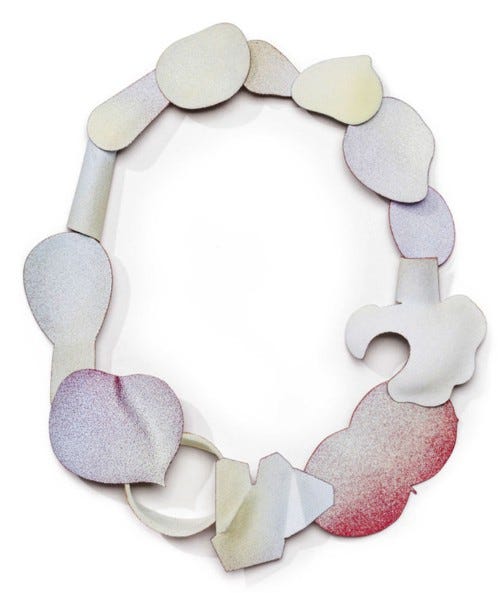
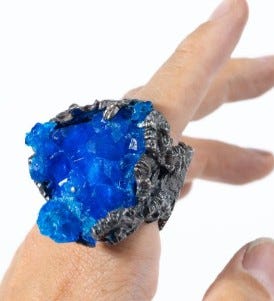
Jewellery is traditionally particularly well represented at «Handwerk & Design». Whether unusual one-off pieces for everyday wear, jewellery made of precious metals and precious stones, or artistic jewellery that tells stories. From personal memories to political statements: there is nothing that cannot be expressed with jewellery. Traditional and contemporary techniques and materials go hand in hand. Unk Kraus makes colourful brooches out of corn starch, Christine Demmel creates delicate flowers out of hand-painted parchment, and Christoph Straube’s illusionist enamel painting is so deceptively real that you can hardly believe your eyes.
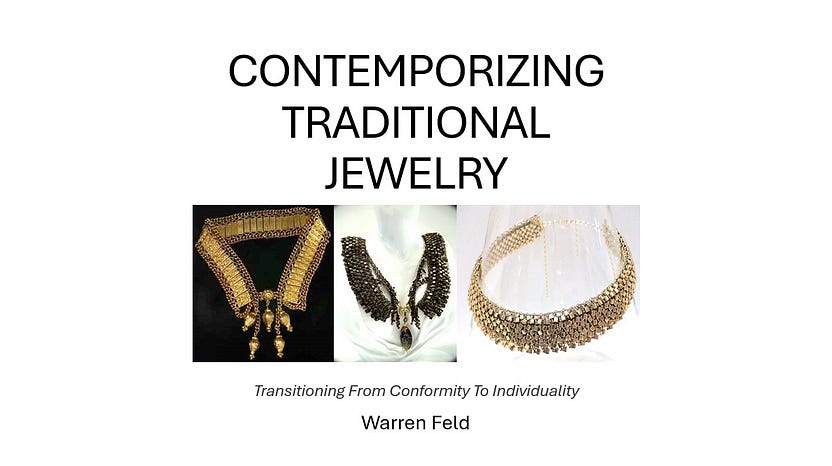
GOALS: Understanding the differences between traditional jewelry and contemporary jewelry. Exploring why people feel connected to traditional jewelry. Comparing a traditional Etruscan necklace design with my attempts to contemporize it. Discussing why developing skills for “contemporizing” is important for jewelry designers.
Guiding Questions (1) How do you marry personal artistic intent with traditional ideas, keeping the jewelry design essential and alive for today’s audience? (2) Why do so many people draw inspiration from traditional pieces? (3) How is contemporary jewelry different from traditional jewelry? (4) To what degree should the contemporary piece reference the traditional piece which inspired it? (5) If the wearer does not feel a connection between the jewelry and society, culture or history, can the piece of jewelry still be successful? (6) What would be considered “good” contemporary jewelry design, and does this conflict with ideas and goals for contemporizing traditional jewelry?
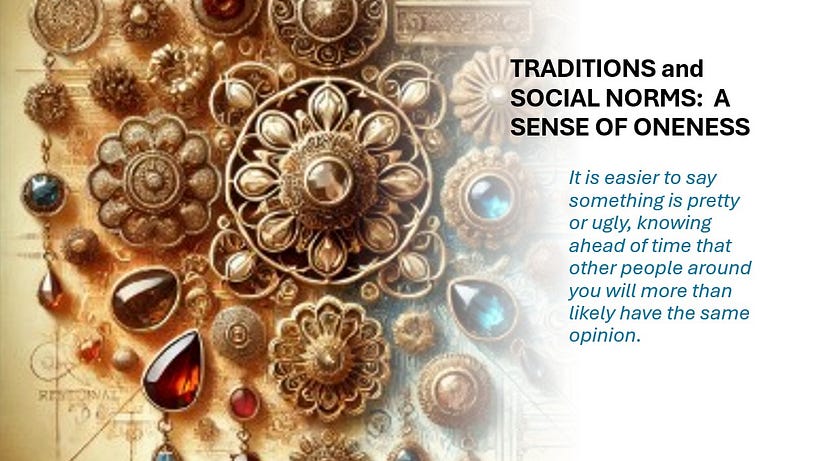
ABSTRACT: Many people, jewelry designers among them, draw inspirations from traditional jewelry styles. One thing they seek to create through jewelry is a feeling of connectedness, coupled with a desire to feel connected. Traditional jewelry provides clear clues about what society and culture consider appropriate, good and even necessary ideas about connectedness.
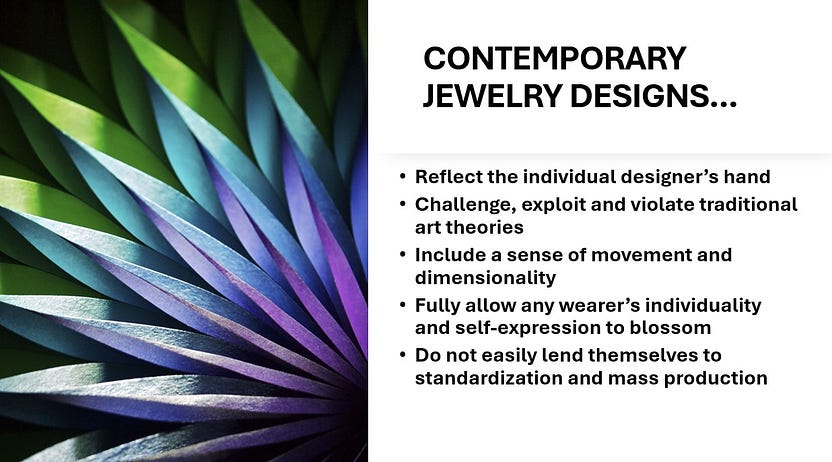
But the core issue for jewelry designers today is how to achieve jewelry design which is more contemporary than merely a replay or reworking of traditional preferences and styles, that is, how to contemporize it. How to construct ideas into objects, challenge history and culture, produce that which typically ignores (or even is in opposition to) socio-cultural norms, standardization and monotony.
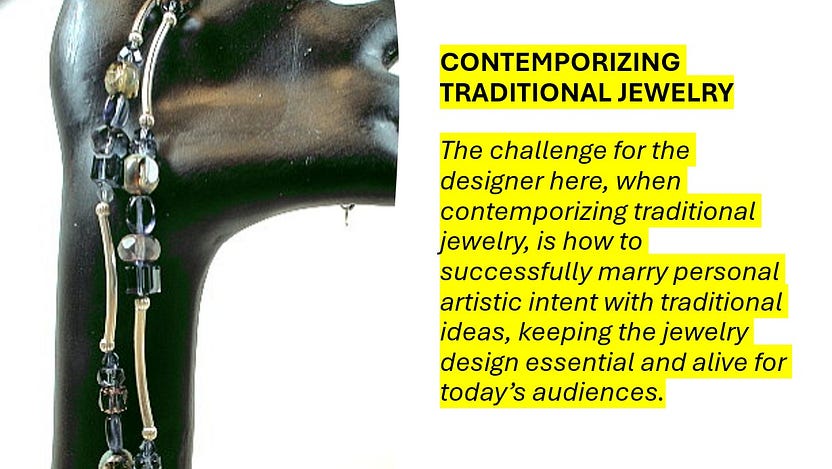
Contemporizing Traditional Jewelry has to do with how designers take these particular traditional forms and techniques, and by substituting their personal values for traditional socio-cultural ones, bring into being jewelry more connected and relevant to today’s sense of fashion, style, individuality and personal expression. The challenge for the designer, when contemporizing traditional jewelry, is how to marry personal artistic intent with traditional ideas, keeping jewelry design essential and alive for today’s audience. What helps here is understanding contemporary jewelry as a way of thinking through the design process, rather than something representative of a particular look.
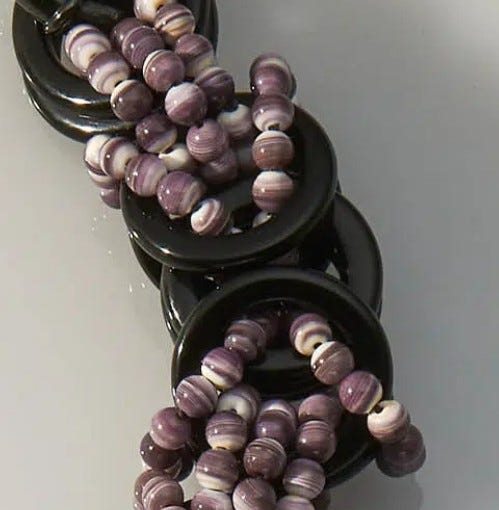
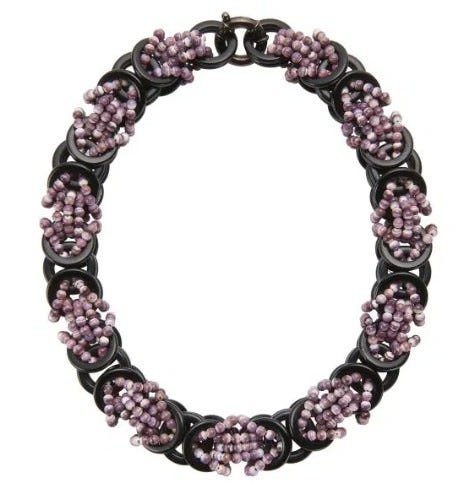
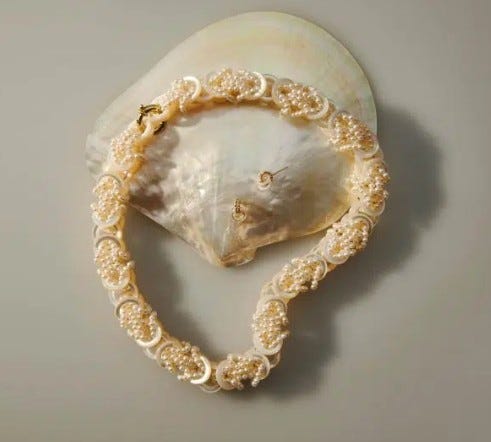
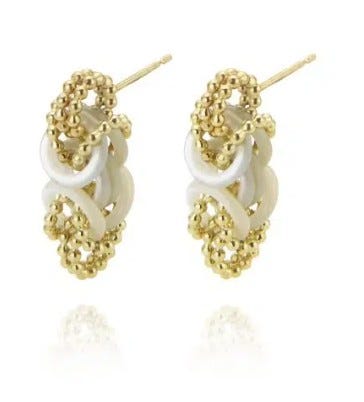
The purplish shells of quahogs, treasured in the past by Native Americans, now appear alongside gold, mother-of-pearl and onyx.
“For centuries Native Americans treasured quahog shells, the purplish hard coverings of clams found along North Atlantic shores, which they fashioned into beads called wampum to adorn ceremonial garments and, later, to use as currency.
Today, however, quahogs are primarily a food source, often found in clam chowders, and their shells are discarded.
Melanie Georgacopoulos, a jewelry designer known for her unconventional use of pearls and shells, had never even heard of quahogs before she began work on her new Katina collection.
“When I saw them, I fell in love with the shells,” said Ms. Georgacopoulos, who was born in Greece and now works in London and Hamburg, Germany. “At first, I was drawn to its beautiful purple color, but after researching, I realized it has a significant history and carries a people’s culture.”
She learned about them when Brendan Breen, an entrepreneur in Boston who has had a lifelong fascination with quahogs, asked if she wanted to buy some shells.”
4. Over the years, I have gotten asked about aging new beads to look like old beads.
Often, someone has an old beaded dress or wedding dress, with a lot of beads missing. Usually these beads are crystal silver lined. The older beads have faded and darkened somewhat. The new beads are very shiny.
Here are some things that you can do: The goal is to slightly darken or tarnish the silver lining inside the beads without damaging the glass exterior.
1. Ammonia Vapor Method (I always try this first. Darkens things slowly).
Spray the beads with Windex with ammonia
Place the beads in a small, sealed container with a few drops of ammonia on a cotton ball (do not let them touch).
Leave them for a few hours or overnight, checking periodically.
This method can give a slightly aged, yellowed effect without darkening too much.
2. Sulfur Exposure (Safe Patina) (Can darken things too quickly).
Place the new beads in a sealed container with a hard-boiled egg (shell removed and mashed) for 24–48 hours. The sulfur in the egg will oxidize the silver lining and darken it. If resorting to sulfur, I’d start with the hard boiled eggs before going to liquid of sulfur.
Check periodically to avoid over-darkening.
Rinse the beads thoroughly and dry them completely before use. You can stop the darkening process at any point by dumping the beads into a bowl of water that has 1 tbsp baking soda in it. But then immediately was the beads in regular water.
3. Liver of Sulfur (Stronger Patina)
Mix a very diluted solution of liver of sulfur (LOS) with warm water. You can used a Liver of Sulfur gel. Put the solution in the microwave for 1 minute. You want the temperature of the solution to be different than the temperature of the beads. The greater the difference, the faster the darkening.
Submerge the beads briefly (10–30 seconds), then rinse immediately. I actually like to put them into a solution of water and 1 tbsp baking soda. This stops the darkening process, and then rinse them in plain water.
If necessary, repeat for a deeper patina.
Buff the exterior glass gently with a soft cloth to remove any residue. You can use a paper towel or 0000 steel wool.
4. Tea or Coffee Staining (Subtle Tinting)
Soak the beads in strongly brewed black tea or coffee for a few hours to add a slight antique warmth.
This won’t tarnish the silver lining but may subtly warm the color of the glass. The resulting color is pretty but brownish, so probably won’t match the older beads in the dress.
5. Diluted Paint or Ink Wash (For Controlled Aging)
Mix a very diluted wash of brown, black, or sepia acrylic paint or alcohol ink.
Apply lightly with a fine brush or dip quickly and wipe off excess.
This can create an aged appearance without chemical reactions.
I have never tried this, but I’m thinking, but do not know, that this will leave a glossy finish on the outside glass of the beads, as if they were painted with clear nail polish.
5. To keep your artist statement evolving as you evolve
📝 To keep your artist statement clear and relevant…
Your statement should evolve alongside your artistic practice. Review it periodically to ensure it reflects your current work.
Even if you’ve explored different mediums, highlight what connects your past work to your present practice. Ex.: “My past work with acrylics taught me blending techniques that I now apply in my current series.”
Keep your biography separate — your statement focuses on your work and process, while your bio should include education and background details.
Review and Revise to keep your content clear, concise and consistent…
Focus on clarity and intentionality. Every sentence should serve a purpose, whether describing your artistic process, inspirations, or themes.
Reinforce a central thread throughout your statement. If you begin with a theme, weave it into the conclusion to create cohesion.
If a word is commonly used in an artistic context, consider if it truly adds value or if a more precise term would be better. Be mindful of overused words.
If your statement already feels focused and intentional, small edits — such as removing a concluding sentence that doesn’t add depth — can make it even more powerful.
Keep the focus on YOU and not your Viewer…
Keep the focus on your experience and process — avoid phrases like “I hope the viewer will feel.” Allow the viewer to find their own connection to your pieces.
Highlight tangible aspects (e.g., techniques, materials) to create a connection between words and visuals.
Maintain a concise and engaging statement; quality matters more than length.
Expand only if something essential feels missing, not just for comparison to others.
6. Art Blend — a community of creatives in Columbia, TN
I had the recent opportunity to attend the monthly get-together of Art Blend — a community, grass-roots group of creatives in Columbia, TN. It was exciting. Lots of synergy in the room.
First, they define ARTISTS very broadly to include all creatives. Visual artists, theater folks, crafters, jewelry designers, wood workers, cake decorators, writers, interior designers, musicians.
They hold their events at local coffee shops, restaurants, and pubs. The first part of the mixer was open-ended. Then, the core of their program was show-and-tell. Visual artists presented one or more of their works and talked about their inspirations, their journey as an artist, their hopes and fears. Musicians and song writers sang songs their wrote. Writers read from pieces they were working on.
The broad representation put an emphasis on commonalities, particularly in terms of the prospects and struggles of tapping into your personal creative spark and translating that into something creative to share with others. It also clearly was a significant support system.
The last part of the evening was time to walk around and view many of the works close-up and talking with each creative. Getting more of the story. Learning more of the insights. Feeling a part of someone’s journey.
7. Find a great source of bead weaving video tutorials from Jill Wiseman
Jill wiseman is a prominent bead weaving author and instructor. On her YouTube Channel (https://www.youtube.com/@JillWisemanDesigns) , you will find many free instructional videos on how-to do various bead weaving techniques. She has many free pattern tutorials for projects you can work on. You even documents some of her bead weaving experiences and travels.
8. Some jewelry galleries of note — must sees on your travels
Pistachios is a contemporary art jewelry and objects gallery in downtown Chicago, curating the most talented and cutting edge artists from around the world.
WARREN FELD JEWELRY (www.warrenfeldjewelry.com) Custom Design, Workshops, Video Tutorials, Webinars, Coaching, Kits, Group Activities, Repairs ~~~~~~~~~~~~~~~~~~~~~~~ Join our community of jewelry designers on my Patreon hub Be part of a community of jewelry designers who recognize that we have a different way of thinking and doing than other types of crafters or artists. One free downloadable Mini-Lesson of your choice for all new members! ~~~~~~~~~~~~~~~~~~~~~~~
When I began making jewelry 35+ years ago, my only interest was in making money. Concerns about design and art, construction and appeal, functionality and emotional engagement were superficial. Probably non-existent is a better word. And yes, this meant I did not care about what any piece of jewelry I made might mean for the person buying it. Or wearing it. Or otherwise putting it on display. There was no consequence for my actions in making jewelry. Except making money. There was a hollowness here which I was, at the time, totally unaware of.
That was a shame.
I missed out on a lot of excitement that emerges from the design process and that special relationship between designer and client.
As I became more proficient in making jewelry, I questioned more and more of myself about what I was doing. Why were some pieces of jewelry I made more successful than others? Why did some sell better than others? Why were some received more warmly than others? Why did some hold up much better from wear than others?
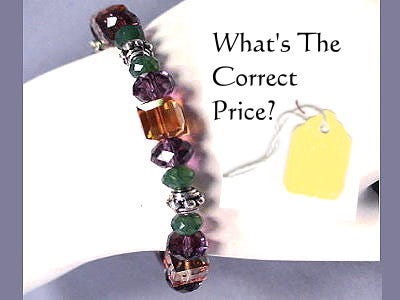
I had had to place a value on the pieces I made. Initially I used a simple pricing formula which related the costs of parts and the costs of labor and the costs of overhead to the price set. But over time, I noticed that some of my pieces were more resonant than others. More desirable. More intriguing. Sexier. Should I increase my prices to reflect these greater, though more difficult to measure, kinds of things? I didn’t know. But I was thinking about it.
Over the years, I thought more and more about what made jewelry more or less successful. How to know when a piece was finished. How to know that I made the best tradeoffs between beauty and functionality. How to know what my jewelry was worth. How to market jewelry. How to sell it. How to sell it in a store. How to sell it at a craft show. How to sell it online. How to organize it into a coherent line of jewelry. How to measure and assess costs, revenues and returns-on-investment.
I share part of my developing knowledge in my book SO YOU WANT TO BE A JEWELRY DESIGNER (https://shop.ingramspark.com/b/084?EenmVM2NMYJGNKaAzr68kaH6GGGSPuNIkGCP1Hfzm3N). In this book, I go over the many hard and soft skills required to become fluent, flexible and original in jewelry design. It is important to understand what jewelry is, how design elements are selected, arranged, constructed and manipulated, how to manage the design process, and how to introduce your designs publicly.
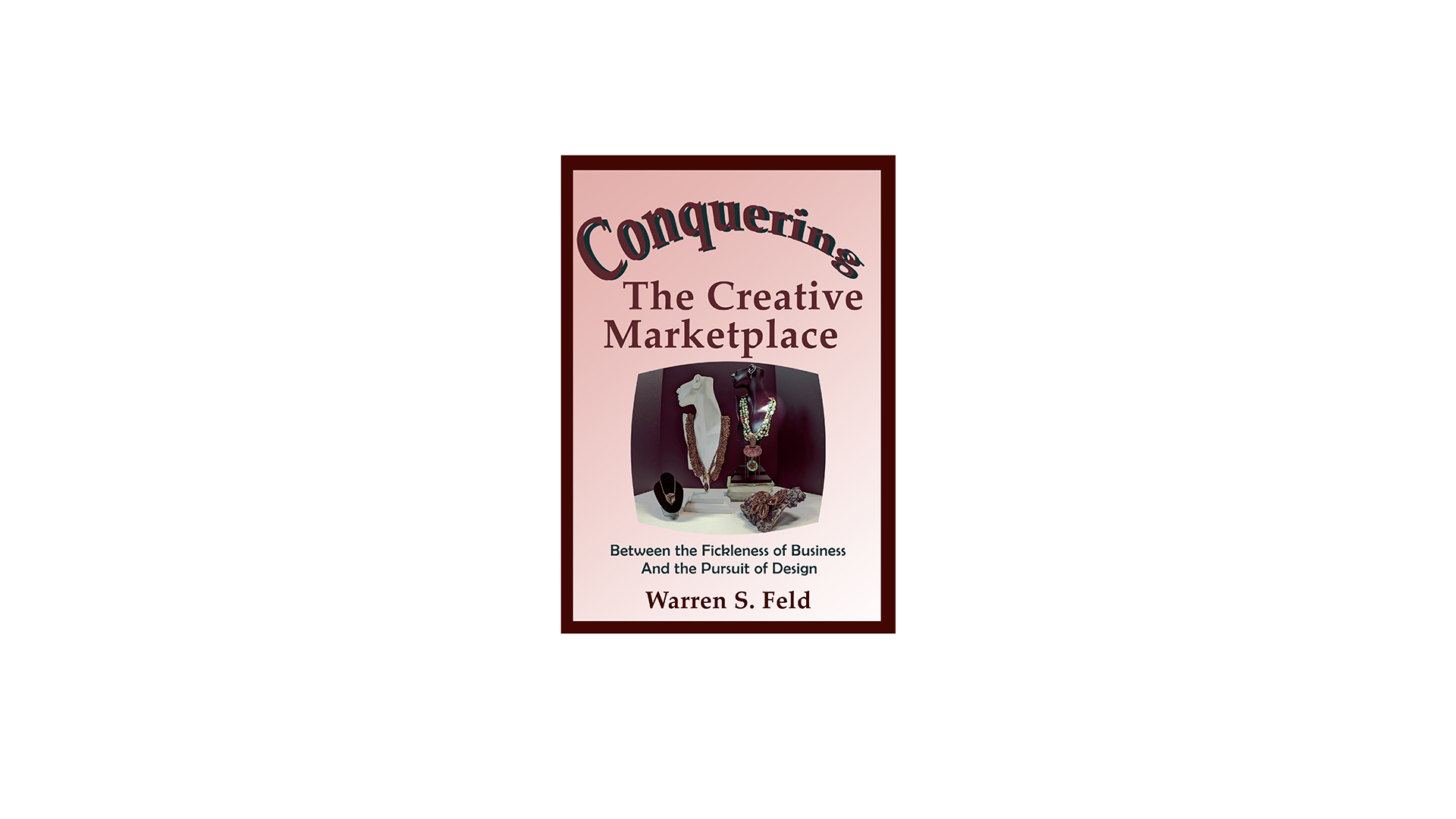
In this book, which is the focus of this series of articles, CONQUERING THE CREATIVE MARKETPLACE, I focus on strategies for integrating business practices with the creative design process — things which can make balancing the creative self with the productive self easier and more fluid. I talk about how dreams are made between the fickleness of business and the pursuit of design.
I go into great detail about all the things you need to think about, know and do when getting started. This begins with basic bookkeeping and accounting as well as developing a business model and also understanding how to protect your intellectual property.
I discuss briefly about how the more literate jewelry designer is more successful in business. Disciplinary literacy involves a set of skills which enable the designer to best relate the jewelry design to client understandings and desires. These skills influence how the client interacts with the piece of jewelry, seeing relevance, value, usefulness, and the designer’s intent.
It is important to understand some basic concepts — Competitive Advantage,Risk, Rewards and Return-On-Investment, and how these play out in all aspects of your business. Also critical is to recognize how what you do in business and what you do creatively affect the Efficiency and Effectiveness of both your design process as well as your business operations.
I have several chapters devoted to product design and development. These range from product goal setting to needs assessment to product distribution, pricing and promotion to managing product launch.
Another section focuses on marketing and branding. You need to create an identify for your business, one that people become aware of and feel positively towards.
This leads to the next section on selling. I review selling strategies important in different settings from retail to craft shows to home shows to online.
I talk about resiliency in business. What kinds of things — emotional, administrative, creative — lead to a greater level of resilience in your business as you face growth, market ups and downs and fashion and taste changes.
Last, I review and present advice for creating the kinds of documents you will need to complement your business goals. These include a creative resume; portfolio; artist statement, biographical sketch, certificate of authenticity and the like.
Many people learn beadwork and jewelry-making in order to sell the pieces they make. Based both on the creation and development of my own jewelry design business, as well as teaching countless students over the past 35+ years about business and craft, I want to address what should be some of your key concerns and uncertainties. I want to share with you the kinds of things (specifically, a business mindset and confidence) it takes to start your own jewelry business, run it, anticipate risks and rewards, and lead it to a level of success you feel is right for you. I want to help you plan your road map.
I will explore answers to such questions as: How does someone get started marketing and selling their pieces? What business fundamentals need to be brought to the fore? How do you measure risk and return on investment? How does the creative person develop and maintain a passion for business? To what extent should business decisions affect artistic choices? What similar traits to successful jewelry designers do those in business share? How do you protect your intellectual property?
The major topics covered include,
1. Integrating Business With Design
2. Getting Started
3. Financial Management
4. Product Development, Creating Your Line, and Pricing
5. Marketing, Promotion, Branding
6. Selling
7. Professional Responsibilities and Strategic Planning
8. Professional Responsibilities and Gallery / Boutique Representation
9. Professional Responsibilities and Creating Your Necessary Written Documents
It is important up front to ask yourself, as a jewelry artist, what is more important to you: the piece of jewelry itself, or the reason why it was made? The material object? Or the idea?
The idea is about cause and effect. How the inspiration resulted in choices about colors, materials and techniques. How the artist’s intent is revealed through choices about composition, arrangements and manipulation of design elements. How the jewelry relates to the person and to the body? How the artist anticipates how others will understand whether a piece is finished and successful, and whether the piece incorporates these shared understandings into the choices made about design.
As solely a material object, the jewelry so designed shies away from resonance. It becomes something to be judged apart from the wearer. It too often gets co-opted by global forces tending towards standardization and same-old-same-old designs. The designer’s mastery is barely referenced or attended to. The designers voice is reduced to noise. The very real fear is that, with globalization, advances in technology, and standardization, the designer’s voice will no longer be needed.
Jewelry as idea fosters communication and connection between the artist and his or her various audiences. It bridges thinking. It bridges emotion. It bridges social, cultural and/or situational ties. It goes beyond simple adornment and ornamentation. It becomes interactive, and emerges from a co-dependency between artist and audience, reflective and indicative of both.
Analyzing reasons, finding connections, and conceptualizing forms, components and arrangements are the primary functions of jewelry designer survival.
Otherwise, why make jewelry? Why make something so permanent to reflect your inner motivations, efforts, even struggles, to translate inspiration into this object? Why make something wearable, especially when each piece is usually not worn all the time? Why make something that might have such an intimate relationship with the body and mind? Why make something that can have real consequences for the wearer as the jewelry is worn in social, cultural or specific situational settings?
SO YOU WANT TO BE A JEWELRY DESIGNER Merging Your Voice With Form
So You Want To Be A Jewelry Designer reinterprets how to apply techniques and modify art theories from the Jewelry Designer’s perspective. To go beyond craft, the jewelry designer needs to become literate in this discipline called Jewelry Design. Literacy means understanding how to answer the question: Why do some pieces of jewelry draw your attention, and others do not? How to develop the authentic, creative self, someone who is fluent, flexible and original. How to gain the necessary design skills and be able to apply them, whether the situation is familiar or not.
Most people, when they get started beading or making jewelry, don’t have this overwhelming urge to become star jewelry designers. On the contrary, fame and fortune as a designer are some of the furthest things from their minds. Most people look to jewelry making and beading to fulfill other needs.
Over the years I’ve seen many people pick up beading and jewelry making as a hobby. They are drawn to these for many reasons, but most often, to make fashionable jewelry at a much lower cost than they would find for the same pieces in a Department store, or to repair jewelry pieces they especially love. When you start with the parts, and the labor is all your own, it is considerably less expensive than the retail prices you would find in a store for the same pieces.
Some people want to make jewelry for themselves. Others want to make handmade gifts. Giving someone something of great value, that reflects a personal expression of creativity, and a labor of love — you can’t beat it. And everyone loves jewelry.
When people get into beading and jewelry making, they discover it’s fun. Even addictive. They tap into their inner-creative-self. They see challenges, and find ways to meet them. They take classes. They buy books and magazines. They join beading groups and bead societies and jewelry making collaboratives. They have beading and jewelry making parties with their friends. They scour web-sites on-line looking for images of and patterns for jewelry. They comb the web and the various beading, jewelry-making and craft magazines, looking for sources and resources. They join on-line jewelry and bead boards, on-line forums, on-line web-rings, on-line ezines, groups, and on-line blogs. They take shopping trips to malls and boutiques and like little good Agatha Christies and Sherlock Holmes, they spy, looking for fashions, fashion trends, and fashionistas. They attend traveling bead shows. And every town they visit, they schedule some free time to check out the local bead stores and boutiques.
As people get more into beading and jewelry making, some discover that these avocations are not only sources of artistic self-expression, but also have many meditative qualities. They are relaxing. They take your mind off the here and now, and transport you to a very calming place.
Still, for others, beading and jewelry making become a way to earn some extra income. They might be to supplement what you’re making now. They might be ways to generate some extra dollars after you retire. They might be the start of your own business as a designer of jewelry. They might be a sense of independence and self-reliance. Having someone pay you for something you made is often the hook that gets people addicted to beadwork and jewelry making.
Most people, however, are content just to make jewelry. There are no professional Design paths to pursue. They may realize that they are out there somewhere, but don’t particularly care. Or sometimes they are unfamiliar with or can’t see all the possibilities. Perhaps they get stuck. No mentor, no book, no magazine, no project to entice them or spark an interest in something more than what they are doing now. But it suffices. Beading and jewelry making relaxes them, gives them a creative outlet, things to enjoy, other like-minded people to be with.
For those fewer people, however, who get a whiff of what it means to design jewelry, and jewelry which resonates, well, what a trip they are in for.
SO YOU WANT TO BE A JEWELRY DESIGNER Merging Your Voice With Form
So You Want To Be A Jewelry Designer reinterprets how to apply techniques and modify art theories from the Jewelry Designer’s perspective. To go beyond craft, the jewelry designer needs to become literate in this discipline called Jewelry Design. Literacy means understanding how to answer the question: Why do some pieces of jewelry draw your attention, and others do not? How to develop the authentic, creative self, someone who is fluent, flexible and original. How to gain the necessary design skills and be able to apply them, whether the situation is familiar or not.
Hey there! Check out my book about Pearl knotting.
My name is Warren Feld. I am a jewelry designer with 40+ years of experience. In my book, I teach you the basic steps in Pearl Knotting. I’ll walk you through how to start your piece, tie knots between pearls, and how to end your piece. Simple instructions. Lots of diagrams and images.
What you will learn
In this book, i teach a non-traditional pearl knotting technique which is very easy for people to learn and do, does not use special tools, includes step-by-step instructions, a simple way to tie knots, shows clearly how to attach your clasp and finish off your cords, and achieves that architectural perfection we want in our pearl strung pieces,
Why This Class Is Important
There are many, many variations in technique.
They all work.
Yet most are very difficult for the beginner — especially those traditional techniques which rely on tools for making and positioning the knots.
Over the years, Ihave seen how students, when following traditional pearl knotting methods, or methods which utilize some more traditional techniques and approaches, become dissatisfied with their results.
And give up.
Pearl knotting doesn’t need to be this hard.
Warren’s Way
After many, many years, enduring many concerns, debates, demonstrations and arguments about which way is best, I came up with my own preferences —
o Using ideas, goals and parts of techniques from several established methods o Adjusting them, based on my experiences with students and teachers o And my knowledge of good design o And how to balance artistic concerns with functional ones.
The Book
I used these ideas and techniques, which I reached and put them to many test, to create a non-traditional pearl knotting technique which i call “Warren’s Way”.
4 variations
The book covers 4 different variations for starting and finishing your piece, including 1. Attaching directly to the clasp 2. Using French wire bullion 3. Using clam shell bead tips 4. Making a continuous piece without a clasp
I also present the steps for adding cord.
Kit and Supplies, Tools
You may purchase an accompanying PEARL KNOTTING KIT, as well as supplies and tools, at www.landofodds.com
Join my community of jewelry designers on myPatreon hub From Warren and Land of OddsUse February’s Discount Code For Extra 25% Off @Land of Odds: FEBRUARY25 www.landofodds.comFebruary 15, 2025
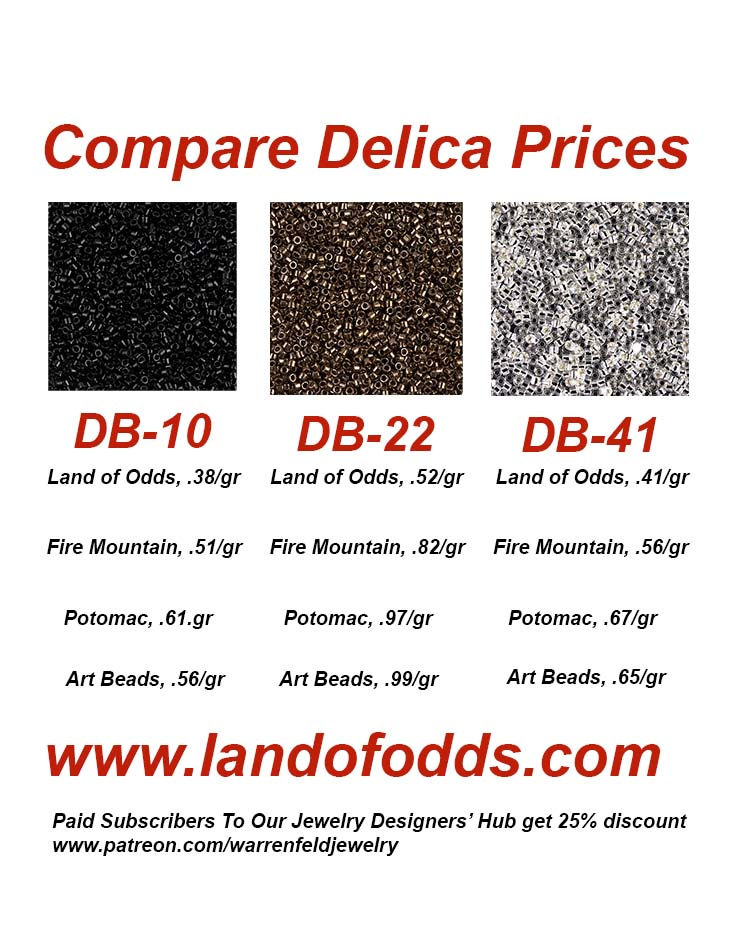
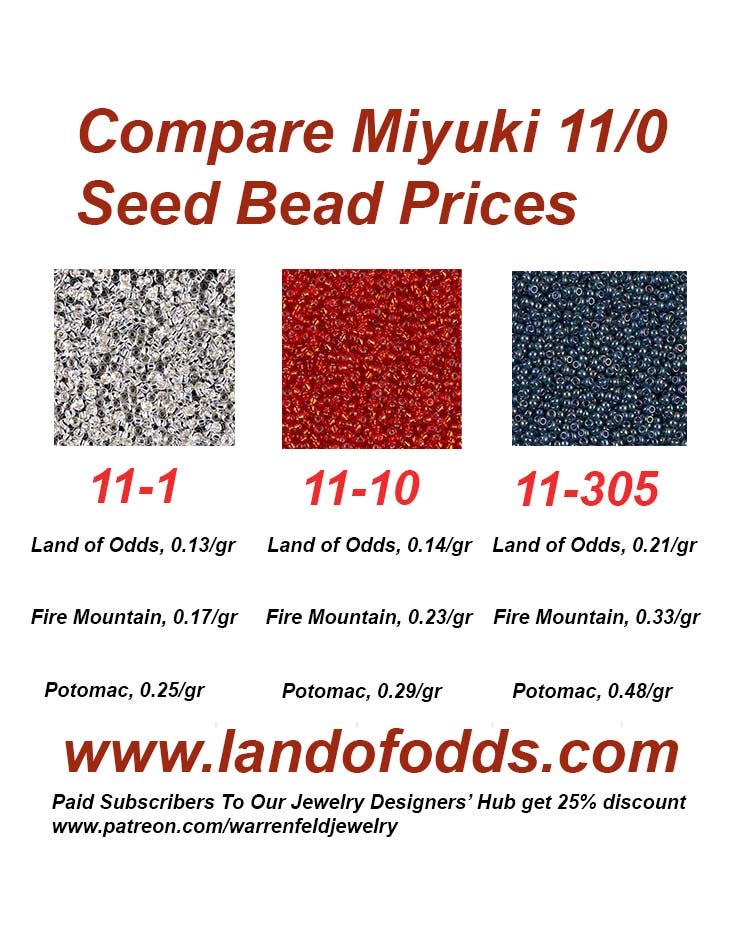
Hi everyone,Some Updates and Things Happening. (Please share this newsletter)**NOTE: Miyuki is now noticeably raising their prices on all seed and delica beadsIn this Issue: 1. Boost Your Instagram Marketing 2. New kit: Catenary Arches Bracelet 3. My 2nd Edition of PEARL KNOTTING…Warren’s Way is now available as ebook, kindle, or print 4. Love this quote 5. Check out The Contrast Club jewelry 6. The Jewelry of Wallace Chan 7. Latest question from our members – please share your comments 8. A book you might like: The Secret Lives Of Colors Some articles you may have missed Featured
1. Posting on Instagram seems to have the greatest return for jewelry designers compared to other social media sites. TIP 1: To boost Instagram engagement, show your process. Don’t post things that look like a commercial ad. It shouldn’t be a wide shot of your jewelry display at a craft fair — “Come see me”; rather, it should be something like you in the process of setting up that display- “Come share my experience”.Your art’s final form may be stunning, but people want to see how it’s made.Instead of just panning over finished pieces, show your creative process: “Show your audience how this work happens.”Use different angles and close-ups to highlight texture and patterns. Keep videos engaging but not too fast—let viewers absorb the details.A mix of casual presentation and behind-the-scenes content can enhance interaction. Give people a reason to stop scrolling by making them feel part of your creation process. TIP 2: Struggling to come up with Instagram content? Keep your audience engaged by not breaking up the “flow” of your posts. Try these tips: You don’t need to post daily, just focus on high-quality, engaging reels.Break your process into multiple reels—each section or stage of the painting can be a post.Show close-ups—let people see the details and textures of your work.Use time-lapses strategically—some parts can be sped up, but also include real-time segments.Film short clips periodically—record a 5-second video every hour and compile them later.No need for constant recording—this prevents distractions and makes content creation easier. TIP 3: Spend less time overproducing to avoid Instagram burnout. Keep things raw, uncomplicated, authentic.1) Skip tools like Canva for Reels – They make content look too polished and decrease engagement. Instagram favors organic, natural-looking posts.2) Don’t Overcomplicate – A heavily edited, structured reel with too much buildup can lose viewers before they reach the main point.3) Keep It Simple & Efficient – The less time you spend overproducing, the more content you can create without burnout.For a lot more tips and tricks with Instagram, visit our social media marketing collection on our Jewelry Designers’ Hub www.patreon.com/warrenfeldjewelry
2. I finally finished this new kit — Catenary Arches Bracelet!
About the CATENARY ARCHES BRACELETI have always been fascinated by the architectural works of Antonio Gaudi in Barcelona, Spain. He builds very organic, undulating forms. These fantastical shapes and spires and walls and rooftops are supported internally by a type of arch called a catenary arch. I knew from experience that creating a beadwoven arch was a difficult proposition, most likely to fail when the piece of jewelry was worn.The typical arch structure would be called a parabolic arch, and this one I knew would not work. In response to weight pressed onto the arch, a parabolic arches channels this stress along its entire length, from base to top to base. The stresses and strains from pushing on parabolic arches, pulling the arches, smashing the arches, would typically end up in a flat and flattened mess.A catenary arch is a type of architectural arch which follows what is called an inverted catenary curve. A catenary arch, in response to weight pressed on to it, centers its response to force at the top of its arch. It does not distribute this force, as in the parabolic arch. As such, it can handle the stresses and strains pushing on it much better. The catenary arch is less likely to fail because of stress and strain. Architecturally, a catenary arch has the ability to withstand the weight of the material from which it is constructed, without collapsing. This catenary arch can be uniformly dense and thick along its entire length. These are strong because they redirect the vertical force of gravity into compression forces pressing along the arch’s curve.This catenary arch has been used in building structures since ancient times. It forms the basis of Gothic cathedrals, Renaissance domes, the St. Louis Gateway arch, for examples. Gaudi faced the same issues in creating building structures. His solution was the catenary arch. My challenge was to see if I could create a beadwoven catenary arch that could hold its shape when the piece was worn.
WHAT YOUR WILL LEARN – Ladder stitch – Coordinating Peyote and Right Angle Weave stitches to optimize support (movement) and structure (shape) – Bookbinding stitch to reposition thread when you need to cross over several beads – Creating a catenary arch using bead weaving strategy – Attaching catenary arch to a foundation base – Using brick stitch to form an edging – Attaching a clasp – Designing and working with a piece that is more 3-dimensional rather than 2-dimensional
3. My 2nd Edition of PEARL KNOTTING…Warren’s Way is now available as kindle, or print
PEARL KNOTTING Doesn’t Need To Be HardIn this very detailed book, with thoroughly-explained instructions and pictures, you are taught a non-traditional Pearl Knotting technique which is very easy for anyone to learn and do. Does not use special tools. Goes slowly step-by-step. Presents a simple way to tie knots and position the knots to securely abut the bead. Anticipates both appeal and functionality. Shows clearly how to attach your clasp and finish off your cords. And achieves that timeless, architectural perfection we want in our pearl knotted pieces.Most traditional techniques are very frustrating. These can get overly complicated and awkward. They rely on tools for making and positioning the knots. When attempting to follow traditional techniques, people often find they cannot tie the knots, make good knots, get the knots close enough to the beads, nor centered between them. How to attach the piece to the clasp gets simplified or glossed over.
Fortunately, Pearl Knotting doesn’t need to be this hard.
Pearl Knotting…Warren’s Way teaches you how to: o Hand-knot without tools o Select stringing materials o Begin and finish pieces by (1) Attaching directly to the clasp, (2) using French wire bullion, (3), using clam shell bead tips, or, (4) making a continuous piece without a clasp o Add cord o Buy pearls, care for them, string and restring them, store themBy the end of this book, you will have mastered hand-knotting pearls. This second edition takes into account a fuller utilization of technical options for the E-book version. Additional information, clarifications and summaries of ideas are added throughout. Instructions for Variation #3: Using Clam Shell Bead Tips is simplified a little bit.
Interpretation is the revenge of the intellectual upon art. / Susan Sontag
5. Check this out: Interactive Fine Jewelry from The Contrast Club The Moth. (The gold wings push aside to reveal the stone)
The Contrast Club is a family run design company located in Southern Finland. The company focuses on merging the worlds of jewellery and engineering, bringing a breath of life to the traditional art of fine jewellery. After spending several years balancing parallel career paths in art and engineering, The Contrast Club was created as a beautiful middle ground where aesthetics are supported by creative technical design. Using this unusual pairing in expertise, the company focuses on the creation of items that go beyond the boundaries of traditional products, pushing the limits of what an object actually is. Together with its network of artisans, jewellery professionals and engineers, each piece goes through a meticulous development process, lasting months, if not years, before it is ready to be presented to the public.
Bracelet (Lay this flat on table, rest your wrist on it, and it automatically curls around your wrist and closes)
6. I wanted to introduce you to the jewelry of Wallace Chan Visit his website
Wallace Chan is a world-renowned Chinese jewellery creator, visual artist and innovator that exhibits internationally and participates in prestigious art fairs. He is renowned for his unworldly jewelry creations and sculptures. He is also the first Chinese contemporary jewelry artist whose work is included in the permanent collection of the British Museum.
The Secret Lives of Color tells the unusual stories of seventy-five fascinating shades, dyes, and hues. From blonde to ginger, the brown that changed the way battles were fought to the white that protected against the plague, Picasso’s blue period to the charcoal on the cave walls at Lascaux, acid yellow to kelly green, and from scarlet women to imperial purple, these surprising stories run like a bright thread throughout history.
In this book, Kassia St. Clair has turned her lifelong obsession with colors and where they come from (whether Van Gogh’s chrome yellow sunflowers or punk’s fluorescent pink) into a unique study of human civilization. Across fashion and politics, art and war, the secret lives of color tell the vivid story of our culture.
WARREN FELD JEWELRY (www.warrenfeldjewelry.com) Custom Design, Workshops, Video Tutorials, Webinars, Coaching, Kits, Group Activities, Repairs ~~~~~~~~~~~~~~~~~~~~~~~ Join our community of jewelry designers on myPatreon hub Be part of a community of jewelry designers who recognize that we have a different way of thinking and doing than other types of crafters or artists. One free downloadable Mini-Lesson of your choice for all new members! ~~~~~~~~~~~~~~~~~~~~~~~
JEWELRY DESIGN: An Occupation In Search Of Professionalization
Jewelry design is an activity which occupies your time.
How the world understands what you do when you occupy that time, however, is in a state of flux and confusion, and which often can be puzzling or disorienting for the jewelry artist, as well.
Is what you are doing merely a hobby or an avocation? Is it something anyone can do, anytime they want, without much preparation and learning? Is it something primarily done by hand or by machine?
Is what you do an occupation? Does it require learning specialized technical skills? Is it something that involves your interaction with others? Is it something you are paid to do?
Or is what you do a profession? Is there a specialized body of knowledge, perspectives and values, not just mechanical skills, to learn and apply? Do you provide a service to the public? Do you need to learn and acquire certain insights which enable you to serve the needs of others?
Are you part of another occupation or profession, or do you have your own? Is jewelry design merely a craft, where you make things by following sets of steps?
Is jewelry design an art, where your personal inspirations and artistic sense is employed to create things of aesthetic beauty for others to admire, as if they were sculptures? Is the jewelry you create to be judged as something separate and apart from the person wearing it?
Or is jewelry design its own thing. Is it a design activity where you learn specialized knowledge, skills and understandings in how to integrate aesthetics and functionality, and where your success can only be judged at the boundary between jewelry and person — that is, only as the jewelry is introduced publicly and is worn?
The line of demarcation between occupation and profession is thin, often blurred, but for the jewelry designer, this distinction is very important. It feeds into our sense of self and self-esteem. It guides us in the choices we make to become better and better at our craft, art and trade. It influences how we introduce our jewelry to the public, and how we influence the public to view, wear, exhibit, purchase or collect the things we make.
SO YOU WANT TO BE A JEWELRY DESIGNER Merging Your Voice With Form
So You Want To Be A Jewelry Designer reinterprets how to apply techniques and modify art theories from the Jewelry Designer’s perspective. To go beyond craft, the jewelry designer needs to become literate in this discipline called Jewelry Design. Literacy means understanding how to answer the question: Why do some pieces of jewelry draw your attention, and others do not? How to develop the authentic, creative self, someone who is fluent, flexible and original. How to gain the necessary design skills and be able to apply them, whether the situation is familiar or not.
There is so much to know, and so many types of choices to make. Which clasp? Which stringing material? Which technique? Which beads, findings and components? Which strategy of construction? Which silhouette? What aesthetic you want to achieve? How you want to achieve it? Drape, movement, context, durability? How to organize and manage the design process?
And this is the essence of this book — a way to learn all the kinds of things you need to bring to bear, in order to create a wonderful and functional piece of jewelry. Whether you are just beginning your beading or jewelry making avocation, or have been beading and making jewelry awhile — time spent with the material in these segments will be very useful. You’ll learn the critical skills and ideas. You’ll learn how these inter-relate. And you’ll learn how to make better choices.
We want to gauge how the designer grows within the craft, and takes on the challenges during their professional lives. This involves an ongoing effort to merge voice and inspiration with form. Often this effort is challenging. Sometimes paralyzing. Always fulfilling and rewarding.
Jewelry design is a conversation. The conversation is ongoing, perhaps never-ending. The conversation is partly internal and partly external. The conversation is partly a reflection about process, refinement, questioning, translating feelings into form, impressions into arrangements, life influences into choice. It touches on desire. It reflects value and values. Aesthetics matter. Architecture and function matters. People matter. Context and situation matter.
Jewelry focuses attention. Inward for the artist. Outward for the wearer and viewer. In many directions socially and culturally and situationally. Jewelry is a voice which must be expressed and heard, and hopefully, responded to.
At first that voice might not find that exact fit with its audience. There is some back and forth in expression, as the jewelry is designed, refined, redesigned, and re-introduced publicly. But jewelry, and its design, have great power. They have the power to synthesize a great many voices and expectations into something exciting and resonant.
SO YOU WANT TO BE A JEWELRY DESIGNER Merging Your Voice With Form
So You Want To Be A Jewelry Designer reinterprets how to apply techniques and modify art theories from the Jewelry Designer’s perspective. To go beyond craft, the jewelry designer needs to become literate in this discipline called Jewelry Design. Literacy means understanding how to answer the question: Why do some pieces of jewelry draw your attention, and others do not? How to develop the authentic, creative self, someone who is fluent, flexible and original. How to gain the necessary design skills and be able to apply them, whether the situation is familiar or not.
Sometimes becoming a designer begins by touching some beads. Or running a strand of pearls through your hand. Or the sight of something perfectly worn around the wrist, or upon the breast, or up near the neck. Or trying to accessorize an outfit. Or finding something for a special occasion.
Jewelry designers are extraordinarily blessed to do what they love for a living. For many, they have turned a hobby into an avocation into a lifestyle.
But it’s not like a regular job. There are many intangibles. Such as, what exactly is creativity and creative thinking? What are all the things that have to come together to recognize that creative spark when it hits you in your heart, gut or head? How do you translate that into something real, with beauty, with function, and with purpose? How do you mesh your views of and desires for aesthetics and functionality with those of your many audiences — wearer, viewer, buyer, seller, collector, exhibiter, teacher and student?
What exactly does it mean to design jewelry, and how do you know it is the right path for you? This is a tough question. You may love jewelry, but not know how to make it. You may get off on creative problem solving or be a color addict but not know what specific techniques and skills you need to learn, in what organized way, with what direction, leading you towards becoming that better jewelry designer. You may wonder what it means and what it takes to be successful as a designer. You may feel the motivation, but not know what the jewelry designer really has to do each day.
You may be taking classes and getting some training, but how do you know when you have arrived? How do you know when you have emerged as a successful professional jewelry designer? And what are your responsibilities and obligations, once you get there?
SO YOU WANT TO BE A JEWELRY DESIGNER Merging Your Voice With Form
So You Want To Be A Jewelry Designer reinterprets how to apply techniques and modify art theories from the Jewelry Designer’s perspective. To go beyond craft, the jewelry designer needs to become literate in this discipline called Jewelry Design. Literacy means understanding how to answer the question: Why do some pieces of jewelry draw your attention, and others do not? How to develop the authentic, creative self, someone who is fluent, flexible and original. How to gain the necessary design skills and be able to apply them, whether the situation is familiar or not.
Some Updates and Things Happening. (Please share this newsletter)
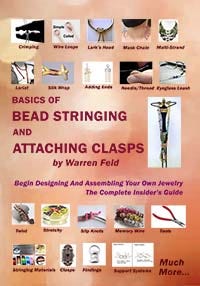
1. My most popular class was called BASICS OF BEAD STRINGING AND ATTACHING CLASPS. I turned this into a book, and expanded the chapters to include some related clinics and classes that I also taught.
In this Issue: 1. Basics of Bead Stringing and Attaching Clasps 2. Promoting Your Jewelry On Social Media: Some Tips 3. How To Market An Open Studios Event 4. Some suggestions about pricing when you have multiple audiences 5. Coreen Simpson Defined the Black Cameo by Black Women for Black Women 6. 2025 A’ Design Award, Jewelry Design Category 7. Latest question from our members — please share your comments 8. Getting that grant application to a Yes! Some articles you may have missed
I pay particular attention to architectural issues — that is, how you deal in your design with the inevitable stresses and strains placed on jewelry when worn.
Learning Bead Stringing Is More Than Putting Beads On A String And Tying On A Clasp
There is an art and skill to stringing beads. First, of course, is the selection of beads for a design, and the selection of the appropriate stringing material. Then is the selection of a clasp or closure, appropriate to the design and use of the piece.
You want your pieces to be appealing. You want them to wear well. You want someone to wear them or buy them. This means understanding the basic techniques, not only in terms of craft and art, but also with considerations about architecture, mechanics, and some sociology, anthropology and psychology.
In this book, I go into depth about: 1. Choosing stringing materials, and the pros and cons of each type 2. Choosing clasps, and the pros and cons of different clasps 3. All about the different jewelry findings and how you use them 4. Architectural considerations and how to build these into your pieces 5. How better designers use cable wires and crimp, as well as, use needle and thread to string beads 6. How best to make stretchy bracelets 7. How to make adjustable slip knots, coiled wire loops, and silk wraps 8. How to finish off the ends of thicker cords or ropes, so that you can attach a clasp 9. How to construct such projects as eyeglass leashes, mask chains, lariats, multi-strand pieces, twist multi-strand pieces, and memory wire bracelets 10. How different teaching paradigms — craft vs. art vs. design — might influence the types of choices you make
TABLE OF CONTENTS
ACKNOWLEDGEMENTS 1. INTRODUCTION 2. MATERIALS AND TOOLS 3. WORKSPACE 4. THREE TEACHING APPROACHES 5. THE DESIGN PROCESS 6. CHOOSING CLASPS 7. CHOOSING STRINGING MATERIALS 8. TWO COGNITIVE PHENOMENA 9. TYPES OF CLASPS 10. TYPES OF STRINGING MATERIALS 11. JEWELRY FINDINGS 12. HOW TO CRIMP 13. STRINGING WITH NEEDLE AND THREAD 14. ELASTIC STRING AND STRETCHY BRACELETS 15. MAKING SIMPLE AND COILED WIRE LOOPS 16. ATTACHING END PIECES TO THICKER CORDS 17. MAKING SIMPLE AND FANCY ADJUSTABLE SLIP KNOTS 18. SILK WRAP 19. EYEGLASS LEASH AND MASK CHAIN 20. LARIAT 21. MULTI-STRAND PIECES 22. TWIST MULTI-STRAND PIECES 23. MEMORY WIRE 24. FINAL WORDS OF ADVICE
2. Promoting your jewelry on social media: Some Tips
🎨 Create buzz on social media for your upcoming projects/shows:
Start sharing as soon as possible: use any existing footage in stories and reels.
Early sharing builds anticipation and allows you to experiment with what resonates.
Add voiceovers to explain why this project matters. Personal insights create emotional connections with viewers.
Natural light is best for recording. If unavailable, invest in an affordable $20 tripod (simple tools can yield beautiful videos).
Take risks with your content — when it goes well, it can go viral. When it doesn’t, you lose nothing. It’s the perfect way to learn and grow your online presence.
📱 If you wish your posts were performing better on IG, remember:
Algorithms prioritize engagement, not frequency — 1 viral post trumps 30 non-viral ones.
Use vertical/portrait format (9:16) for Reels. Avoid landscape; mobile users miss key visuals.
Short, engaging videos with multiple cuts show progression better than time-lapses.
Remove text overlapping artwork; instead, lead with finished work and show process in successive slides.
Use hooks (both visual and verbal) to draw viewers in (e.g., dramatic start or surprising technique).
Keep content dynamic — switch angles, zoom, and close-ups.
Simplify production. Think less like a filmmaker — focus on storytelling in short, direct clips.
📈 Boost your Instagram growth with storytelling…
As mentioned above, instead of polished posts or static images, show how you create your art and share the story behind it.
Process-focused content — like videos of you working on textures or unique techniques — grabs attention and keeps viewers engaged.
Pair this with storytelling or insights about your materials (like nontoxic pigments or unique inspirations) to turn informative content into mesmerizing reels.
This authentic approach will outperform paid promotions for long-term growth.
3. I have a friend who works from a studio he rents in a converted warehouse in Nashville, which also houses many other related artisan businesses. Some insights from him on how to market an open studios event.
🗣️How to market an open studios event and have successful sales conversations with collectors
Use storytelling to highlight the unique aspects of your process, such as working with invasive species leather.
Prepare materials that educate visitors about your mission and the significance of your medium.
Engage collectors with interactive displays showcasing your creative process.
Focus on conversational sales techniques — ask questions about their interests and share personalized recommendations.
Follow up with attendees post-event to nurture relationships and encourage repeat sales.
4. Some suggestions for pricing your jewelry if you are targeted multiple audiences at different income and interest points.
💰 How to price your jewelry for different buyer categories to increase overall sales
Offer a range of price points, including smaller, affordable pieces for new buyers.
Create limited edition prints to scale sales and increase accessibility without diluting exclusivity.
Price jewelry that is more “art” or uses unique materials (like leather or feathers or vintage materials and clasps) higher to reflect craftsmanship and rarity.
Consider bundling products or services (e.g., jewelry with donations to relevant causes) to appeal to conscious buyers.
Continuously evaluate pricing strategies based on collector feedback and sales data.
For some pieces, you might turn them into kits.
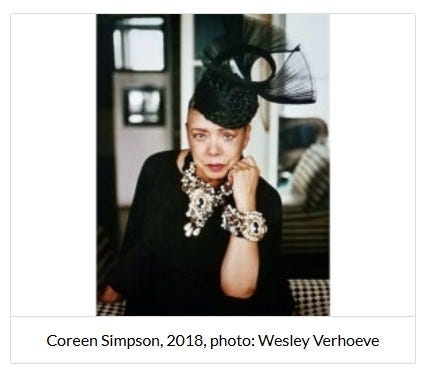
5. Coreen Simpson Defined the Black Cameo by Black Women for Black Women
Cameos have existed since ancient Egypt and play an essential role in the history of jewelry. In materials such as onyx, agate, or mother-of-pearl, which contrast with the color of the gemstone backing, the cameo acted as a miniature canvas to present carved portraits of kings, emperors, or scenes from mythology.
Yet despite the cameo’s ancient origins and its status as a classic jewelry item, the Black community has often had a complicated relationship with these pieces, especially due to a history of racist caricature in the imagery that also became associated with the cameo.
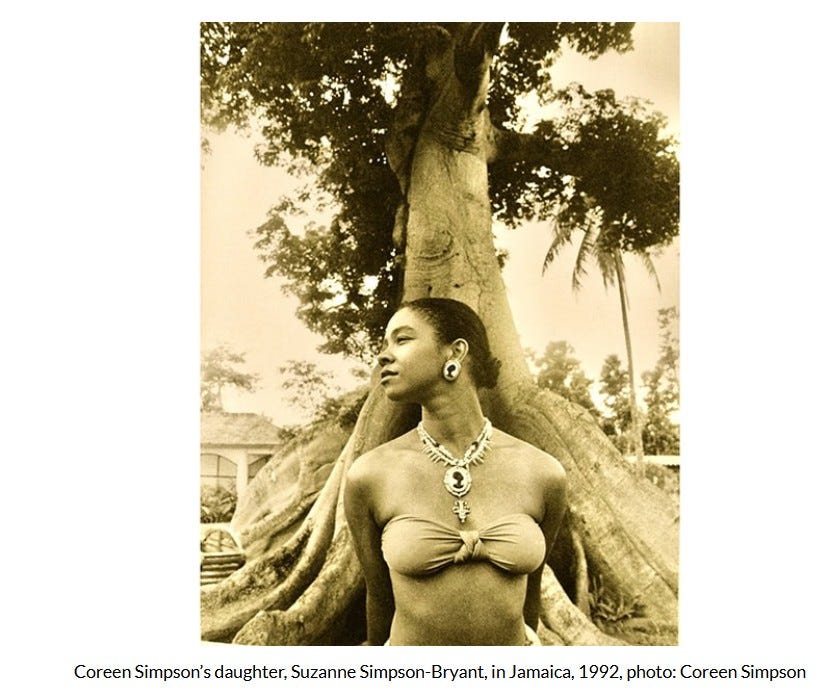
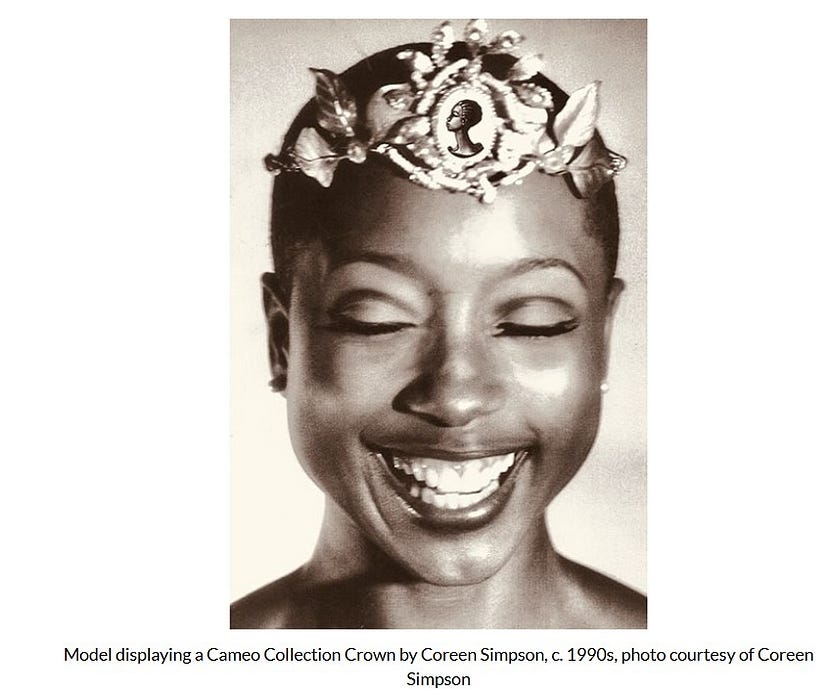
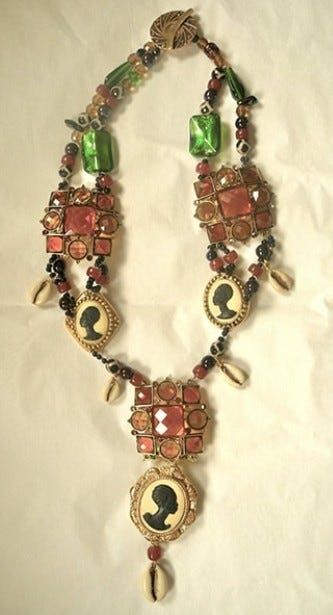
Artist Coreen Simpson wanted to explore this issue of representation by making her own American take on the cameo. In the 1990s, Simpson developed a cameo for modern Black consumers. In so doing, she built a successful company that subverted the negative historical narrative.
Her first foray into jewelry came as a product of necessity. When she tried to find the right pieces to accessorize her outfits in various stores in Paris, she was often disappointed. The jewelry just didn’t fit her aesthetic. Because of this lack of options, Simpson decided to create her own.
Simpson eventually opened a showroom in the Garment District, and she continued to experiment with “unique combinations of stones, metal, and unusual materials.” Simpson got her big break in the late 80s when, one day, as she was selling necklaces on 57th Street and Madison Avenue, close to the Henri Bendel department store, designer Carolina Herrera noticed her work and purchased 11 necklaces, which she featured in her 1988 resort collection. The journalist Renee White has also commented that publications such as Vogue described Simpson’s pieces as power necklaces, thereby cementing her position in fashion jewelry. The New York Times proclaimed her a “style maker.” Stars such as Diahann Carroll and Joan Collins were seen wearing her pieces publicly and privately.
In 1990, all of Simpson’s experimentation in jewelry culminated in the launch of the Black Cameo, her signature collection. Her first encounters with the cameo had started as she paged through fashion magazines. She saw pieces she found beautiful, but she also thought “no Black woman [was] going to wear” them. The cameos may have looked pretty, but they did not represent the cultural diversity of Black women in America.
A’ Design Award, recognizing the excellent and original design work from across the globe, is one of the highest achievements in design, a source of inspiration for award-winning designers, artists, architects, brands and design agencies. Entry and nomination is open to all from all countries. The A’ Jewelry Design Award is open to entries by Jewelry Designers, Jewelry Brands, Jewelers, Goldsmiths, Silversmiths, Gemologists, Lapidarists, Accessory Designers, Metalworkers, Artisan Jewelers, Craftspeople, Contemporary Jewelry Artists, Custom Jewelry Designers, Fine Art Jewelers, Jewelry Manufacturing Enterprises, Jewelry Brand Managers, Fashion Designers, Fashion Brands, Industrial Designers, Luxury Good Manufacturers, Jewelry Innovation, Consultancy, Research and Development Companies worldwide. Enter your work today to highlight Jewelry Excellence.
💰 If you are submitting an application for a public or private art grant…
Keep in mind that these are highly competitive: for you to stand out, you’ll have to be specific about how your work aligns with their criteria.
For your next submission:
Describe how audiences interact with your work — mention workshops, events, or participatory elements.
Clarify your concept: Use vivid language to make your vision tangible. Explain how your art fits into the public or private space your proposal is targeting
Titles and descriptions: Make them concise and impactful to quickly convey the project’s essence.
And don’t forget to use this 25% discount code throughout February at Land of Odds!! Use February’s Discount Code For Extra 25% Off @Land of Odds: FEBRUARY25 www.landofodds.com
WARREN FELD JEWELRY (www.warrenfeldjewelry.com) Custom Design, Workshops, Video Tutorials, Webinars, Coaching, Kits, Group Activities, Repairs ~~~~~~~~~~~~~~~~~~~~~~~ Join our community of jewelry designers on my Patreon hub Be part of a community of jewelry designers who recognize that we have a different way of thinking and doing than other types of crafters or artists. One free downloadable Mini-Lesson of your choice for all new members! ~~~~~~~~~~~~~~~~~~~~~~~
As a jewelry designer, you have a purpose. Your purpose is to figure out, untangle and solve, with each new piece of jewelry you make, how both you, as well as the wearer, will understand your inspirations and the design elements and forms you chose to express them, and why this piece of jewelry is right for them. Not as easy as it might first appear. There are no pre-set formulas here. There are artistic principles of composition, yes, but how you implement them is still up to you. Moreover, your pieces have to wear well, drape well, and connect with the desires of people who will want to wear or buy them. Jewelry design involves an ongoing effort, on many levels, to merge voice and inspiration with form. Often challenging, but very rewarding.
BECOMING THE BEAD ARTIST AND JEWELRY DESIGNER: The Ongoing Tensions Between Inspiration and Form
As a jewelry designer, you have a purpose. Your purpose is to figure out, untangle and solve, with each new piece of jewelry you make, how both you, as well as the wearer or buyer, will understand your inspirations and the design elements and forms you chose to express them, and why this particular piece of jewelry is right for them. Not as easy as it might first appear. There are no pre-set formulas here. There are artistic principles of composition, yes, but how you implement them is still up to you. Moreover, your pieces have to wear well, drape well, and connect with the desires of people who will want to wear or buy them.
You will want the piece to be beautiful and appealing. So you will be applying a lot of art theories about color, perspective, composition and the like. You will quickly discover that much about color use and the use of lines and planes and shapes and so forth in art is very subjective. People see things differently. They may bring with them some biases to the situation. Many of the physical materials you will use may not reflect or refract the color and other artistic effects more easily achieved with paints.
You want the piece to be durable. So you will be applying a lot of theories and practices of architects and engineers and mechanical physicists. You will need to intuitively and intrinsically understand what about your choices leads to the jewelry keeping its shape, and what about your choices allows the jewelry to move, drape and flow. You also will be attentive to issues of physical mechanics, particularly how jewelry responds to forces of stress, strain and movement. This may mean making tradeoffs between beauty and function, appeal and durability, desire and acceptance.
You want the piece to be satisfying and accepted by various viewing, wearing, buying and collecting audiences. So you will have to have some understanding of the role jewelry plays in different people’s lives. Jewelry is more than some object to them; jewelry is something they inhabit — reflective of soul, culture, status, aspiration. You will recognize that people ascribe the qualities of the jewelry to the qualities of the person wearing it. You will bring to the forefront ideas underlying psychology and anthropology and sociology, and even party planning, while designing your jewelry or introducing it publicly. You may find the necessity to compromise part of your vision for something socially acceptable, or in some degree of conformance with a client’s taste or style.
SO YOU WANT TO BE A JEWELRY DESIGNER Merging Your Voice With Form
So You Want To Be A Jewelry Designer reinterprets how to apply techniques and modify art theories from the Jewelry Designer’s perspective. To go beyond craft, the jewelry designer needs to become literate in this discipline called Jewelry Design. Literacy means understanding how to answer the question: Why do some pieces of jewelry draw your attention, and others do not? How to develop the authentic, creative self, someone who is fluent, flexible and original. How to gain the necessary design skills and be able to apply them, whether the situation is familiar or not.
ESSENTIAL QUESTIONS ABOUT JEWELRY DESIGN WORTH ANSWERING
As you work your way through the chapters in this book, it is important to recognize and understand the larger social and professional contexts within which jewelry design is but a part, and your place in it. Towards this end, I have formulated some essential questions every designer needs to have answers for and have deeper understandings about. Another way to look at this is that answers to these questions become your evidence for determining whether you are on the right track for becoming fluent in jewelry design.
(1) Why are there disciplinary conflicts between art and craft, and between art and design?
(2) How do you resolve tensions between aesthetics and functionality within an object like jewelry?
(3) What is jewelry, and what is it for?
(4) Is jewelry necessary?
(5) What does it mean to be successful as a jewelry artist working today?
(6) What does it mean to think like a jewelry designer? How does this differ from thinking like an artist or thinking like a craftsperson?
(7) How does the jewelry designer know when a piece is finished and successful?
(8) How do you place a value on a piece of jewelry?
(9) How do you introduce your jewelry into a public setting, either to wear or to collect or to buy?
(10) Why does some jewelry draw your attention, and others do not?
(11) What does it mean to be a contemporary jewelry designer?
SO YOU WANT TO BE A JEWELRY DESIGNER Merging Your Voice With Form
So You Want To Be A Jewelry Designer reinterprets how to apply techniques and modify art theories from the Jewelry Designer’s perspective. To go beyond craft, the jewelry designer needs to become literate in this discipline called Jewelry Design. Literacy means understanding how to answer the question: Why do some pieces of jewelry draw your attention, and others do not? How to develop the authentic, creative self, someone who is fluent, flexible and original. How to gain the necessary design skills and be able to apply them, whether the situation is familiar or not.








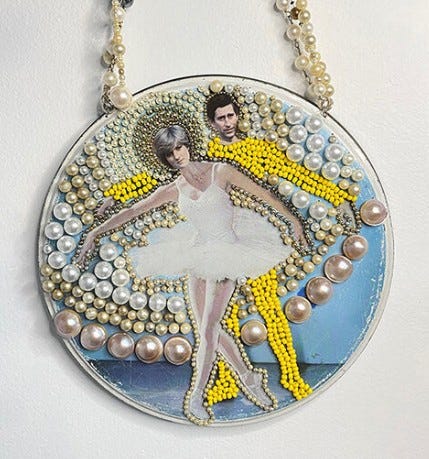
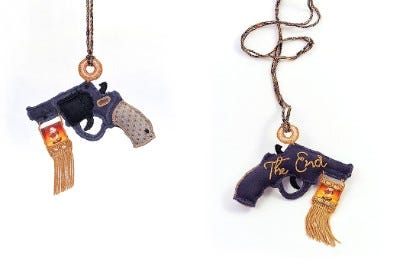

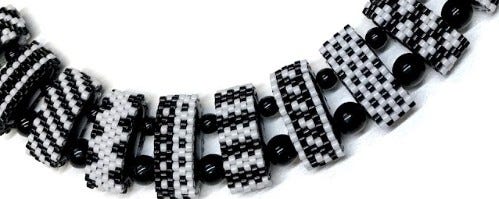

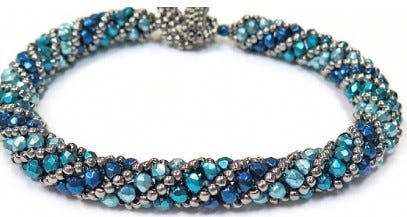

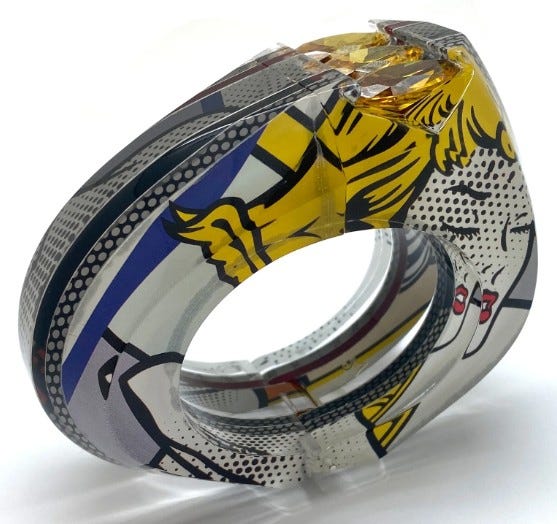
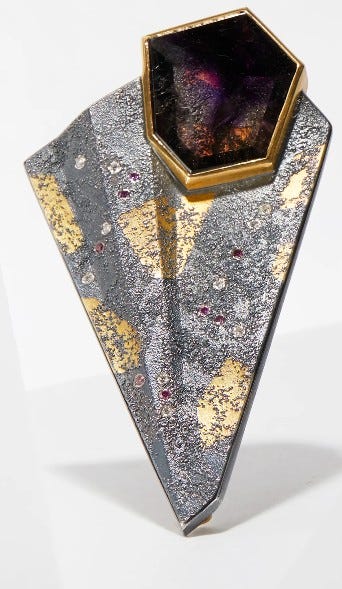










 Wallace Chan is a world-renowned Chinese jewellery creator, visual artist and innovator that exhibits internationally and participates in prestigious art fairs. He is renowned for his unworldly jewelry creations and sculptures. He is also the first Chinese contemporary jewelry artist whose work is included in the permanent collection of the British Museum.