





Apply for Trademark Protection
A trademark protects words, names, symbols, and logos that distinguish goods and services. Your business name is one of your most valuable business assets, so it’s worth protecting. You can file for a trademark for less than $300. Learn how to trademark your business name (http://www.sba.gov/category/navigation-structure/starting-managing-business/starting-business/business-law-regulations/patents-trademarks-copyright).
When it comes to starting a business, there’s often some confusion about the process of business name registration. How are trade names and trademarks different? Does a trade name afford any legal branding protection? Can your trade name be the same as your trademark?
Simply put, a trade name is the official name under which a company does business. It is also known as a doing business as (DBA) name, assumed name, or fictitious name. A trade name does not afford any brand name protection or provide you with unlimited rights for the use of that name. However, registering a trade name is an important step for some — but not all — businesses (more on this below).
A trademark is used to protect your brand name and can also be associated with your trade name. A trademark can also protect symbols, logos and slogans. Your name is one of your most valuable business assets, so it’s worth protecting.
An important reason to distinguish between trade names and trademarks is that if a business starts to use its trade name to identify products and services, it could be perceived that the trade name is now functioning as a trademark, which could potentially infringe on existing trademarks.
NOTE: You cannot trademark adjectives. For example, you can’t trademark the business name “Best Jeweler In Town”.
Registering a Trade Name
Naming your business is an important branding exercise. If you choose to name your business as anything other than your own personal name (i.e. a “trade name”), then you’ll need to register it with the appropriate authority as a “doing business as” (DBA) name.
Consider this scenario: John Smith sets up a painting business and chooses to name it “John Smith Painting.” Because “John Smith Paining” is considered a DBA name (or trade name), John will need to register it as a fictitious business name with a government agency.
You need a DBA in the following scenarios:
• Sole Proprietors or Partnerships — If you wish to start a business under any name other
than your real one, you’ll need to register a DBA name so you can do business under the
DBA name.
• Existing Corporations or LLCs — If your business is already incorporated and you want
to do business under a different name, you will need to register a DBA.
Note that many sole proprietors maintain a DBA or trade name to give their business a professional image, yet still use their own name on tax forms and invoices.
Depending on where your business is located, you’ll need to register your DBA name through either your county clerk’s office, city clerks office, and/or your state government. Note: Not all states require fictitious business names or DBA registration. SBA’s Business Name Registration (http://www.sba.gov/content/register-your-fictitious-or-doing-business-dba-name) page has more information about the process, plus links to the registration authorities in each state.
Registering Your Trademark
Choosing to register a trademark is up to you, but your business name and identity is one of its most valuable assets, so it’s worth protecting.
Registering a trademark guarantees exclusive use, establishes legally that your mark is not already being used, and provides government protection from any liability or infringement issues that may arise. Being cautious in the beginning can certainly save you trouble in the long run. You may choose to personally apply for trademark registration or hire an intellectual property lawyer to register for you.
Trademarks can be registered on both federal and state levels. Federal trademarks can be registered through the United States Patent and Trademark Office (http://www.uspto.gov/main/trademarks.htm). Applications can be submitted online, by using the Trademark Electronic Application System (TEAS) (http://www.uspto.gov/teas/index.html), or by requesting a hard copy application and mailing in a paper form. Although both methods are acceptable, filing online is a faster and more cost-effective process (less than $300).
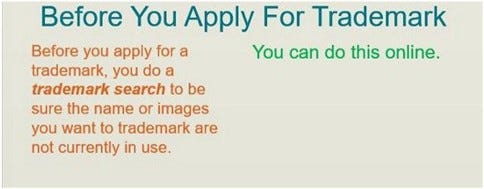
Tip: Before you register, you’ll need to follow these steps:
• Determine whether your product is eligible for a trademark
• Conduct a trademark search (http://tess2.uspto.gov/bin/gate.exe?
f=tess&state=4007:mecvj3.1.1) using TESS (Trademark Electronic Search System)
Because it can be tricky to identify potential infringement or clashes, and the penalties for doing so are high, it’s worth talking to a good intellectual property lawyer to ensure you cover all bases.
As with trade names, registering a trademark at the state level varies from state to state. Check out the USPTO’s State Trademark Information (http://www.uspto.gov/web/menu/statetmoffices.html) page for links to your state’s trademark office.
For a step-by-step guide to filing a trademark application, FAQs and more, refer to SBA.gov’s Small Business Guide to Intellectual Property (http://www.sba.gov/category/navigation-structure/starting-managing-business/starting-business/business-law-regulations/intellectual-property).
A useful free tool called SQUADHELP: https://www.squadhelp.com/check-trademark
TRADEMARKS AND SERVICE MARKS
As you begin to narrow down a name, check with the US Trademark office to be sure no one else has used these names. Go to www.uspto.gov , and search the business names. Your state trademarks office may also have a searchable list.
Protect your business name by registering the name (and logo, if you have one) as a trademark or service mark. Also copyright your brochures and advertising copy, and any sets of instructions, if you create these.
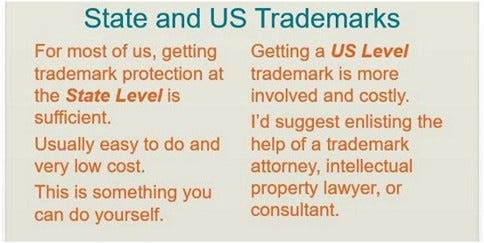
As soon as you pick your business name, register it as a trade or service mark with your state trademark office. Each State you do business in, as well as the US as a whole, offer opportunities to protect your trade or service mark. You can prevent someone else from using your business name, or product name, by registering this name with the state(s), or US. You would put a TM next to the name you’ve trademarked, such as Be Dazzled Beads TM .
In Tennessee, this process is especially inexpensive — around $40.00 per trade or service mark. Your intellectual property would be protected in Tennessee. If you create a strong brand identity, this can prevent businesses outside the state of Tennessee from representing your intellectual property as their own.
Getting a US trademark is expensive and a little more complicated, and I’d strongly suggest using the services of a trademark lawyer in this case. A US trademark would protect your intellectual property anywhere in the United States.
In Tennessee, trademarks and service marks are handled by the Tennessee Secretary of State. For the United States, these are handled by the US Patent and Trademark Office.
Have I conducted a proper trademark search?
A great name is worthless if someone else already has laid claim to it. Start with some free resources like Trademarkia.com or USPTO.gov to do a cursory search to see if the name is already in use. Then, hire a trademark attorney to do a more thorough screening, and if the name isn’t taken, to register it with the U.S. Patent and Trademark Office. “Get it right the first time,” Watkins says. “A third of our business comes from companies who are being threatened with trademark infringement.”
For more articles about Conquering The Creative Marketplace, click over to our Jewelry Designers’ Hub
_______________________________________________________

Thanks for being here. I look forward to sharing more resources, tips,
sources of inspiration and insights with you.

WarrenFeldJewelry.com
Shop.warrenfeldjewelry.com
School.warrenfeldjewelry.com
Coaching by Warren Feld
Add your name to my email list.

Conquering The Creative Marketplace
Many people learn beadwork and jewelry-making in order to sell the pieces they make. Based both on the creation and development of my own jewelry design business, as well as teaching countless students over the past 35+ years about business and craft, I want to address what should be some of your key concerns and uncertainties. I want to share with you the kinds of things (specifically, a business mindset and confidence) it takes to start your own jewelry business, run it, anticipate risks and rewards, and lead it to a level of success you feel is right for you. I want to help you plan your road map.
I will explore answers to such questions as: How does someone get started marketing and selling their pieces? What business fundamentals need to be brought to the fore? How do you measure risk and return on investment? How does the creative person develop and maintain a passion for business? To what extent should business decisions affect artistic choices? What similar traits to successful jewelry designers do those in business share? How do you protect your intellectual property?
The major topics covered include,
1. Integrating Business With Design
2. Getting Started
3. Financial Management
4. Product Development, Creating Your Line, and Pricing
5. Marketing, Promotion, Branding
6. Selling
7. Professional Responsibilities and Strategic Planning
8. Professional Responsibilities and Gallery / Boutique Representation
9. Professional Responsibilities and Creating Your Necessary Written Documents
