For the novice, all that excitement at the beginning, when thinking about making jewelry and making some pieces, sometimes collides with a wall of developing self-doubt. It’s not easy to quiet a doubt.
The jewelry artist organizes their life around an inspiration. There is some fuzziness here. That inspiration has some elements of ideas, but not necessarily crystal clear ones. That inspiration has some elements of emotions — it makes you feel something — but not necessarily something you can put into words or images or fully explain. You then need to translate this fuzzy inspiration into materials, into techniques, into color, into arrangements, into a coherent whole.
You start to make something, but realize you don’t know how to do it. But you want to do it, and do it now. However, to pick up the needed skills, you realize you can’t learn things all at once. You can’t do everything you want to do all at once. That initial excitement often hits a wall. Things take time to learn. There are a lot of trial and error moments, with a lot of errors. Pieces break. Combining colors and other design elements feels very awkward. Picking the right clasps and rings and connectors and stringing materials is fraught with implications. Silhouettes are confusing. You might get the right shape for your piece, but it is difficult to get the right movement, drape and flow, without compromising that shape.
To add to this stress and strain, you need to show your jewelry off. You might want someone to like it. To want it. To need it. To desire it. To buy it. To wear it. To wear it more than once. To wear it often. To exhibit it. To collect it. To show and talk about it with others. And how will all these other people recognize your creative spark, and your abilities to translate that spark into a wonderful, beautiful, functional piece of jewelry, appropriate for the wearer and appropriate for the situation?
Frequently, because of all this, the designer experiences some sense of doubt and self-doubt. Some paralysis. Can’t get started. Can’t finish something. Wondering why they became a jewelry designer in the first place.
Doubt holds you back from seizing your opportunities.
It makes getting started or finishing things harder than they need to be.
It adds uncertainty.
It makes you question yourself.
It blocks your excitement, perhaps diminishing it.
While sometimes doubt and self-doubt can be useful in forcing you to think about and question your choices, it mostly holds you back.
Having doubt and self-doubt is common among all artistic types. What becomes important is how to manage and overcome it, hence, my idea of Channeling Your Excitement, so that doubts do not get in the way of your creative process and disciplinary development, but rather, inform them.
There are 8 major ways in which jewelry designers get caught beginning to fall into that abyss we call self-doubt: …
I believe jewelry designers have a special way of thinking through selecting design elements, composing, constructing, and manipulating objects. Different than crafters. Different than artists. Different than other disciplines and their core ways of defining things and thinking things through.
How should the designer think? How should she organize her tasks? How should she tap into her creative self? How should she select materials, techniques and technologies? How should she assert her creativity and introduce her ideas and objects to others? How much does she need to know about how and why people wear and inhabit jewelry? What impact should she strive to have on others or the more general culture and society as a whole? How should she approach unfamiliar, unknown or problematic designs?
I try to formulate a disciplinary literacy unique and special and legitimate for jewelry designers. Such literacy encompasses a basic vocabulary about materials, techniques, color and other design elements and rules of composition. It also includes the kinds of thinking routines and strategies jewelry designers need to know in order to be fluent, flexible and original. It includes what the jewelry designer needs to know and do when introducing their pieces publicly, either to have others wear, buy or collect their pieces.
These routines and strategies are at the heart of the designer’s knowledges, skills and understandings related to creativity, elaboration, embellishment, reflection, critique and metacognition. This disciplinary literacy in design is very similar to how sounds are made into music. This literacy is very similar to how words are made into literature. There is an underlying vocabulary and grammar to jewelry design, from decoding to comprehension to fluency. The jewelry designer is dependent upon this disciplinary literacy to the extent that she or he is able to move from inspiration to aspiration to implementation and management towards finish and success. …
Why do you want to become (or are already on the way to becoming) a jewelry designer? What drives you? How do you channel your excitement? Is it something to do with what type of person you are? How you view the world? How you want to fill your time? It turns out there are many types of people who become jewelry designers. Although they may have different aspirations and ambitions underlying their excitement about jewelry design, they find common ground and a common way of thinking about making and designing jewelry. But because jewelry design has not yet become a full-fledged, recognizable discipline all its own, it sometimes becomes difficult to get clarity on how to channel your excitement into an avocation or career. Your support group is often made up of a polyglot of crafters and artists, some who do not fully understand jewelry making and design. Advice can be diffuse. Clients have difficulty evaluating the value of your work, frequently expressing misunderstandings about what is good. This can lead to self-doubt, which better designers learn to manage and overcome.
GETTING STARTED: CHANNELING YOUR EXCITEMENT What drives you to pursue your passion for jewelry?
“Why Are You A Jewelry Artist?” As if you had a choice…
It often is difficult for others to understand why you consider yourself a jewelry designer. How did this come to be? How did you get started? Were you always artistic? Is your family crafty? How did you learn these things? Why jewelry? Why do you get so excited about all this? Do you want to make a living out of it? Can you really sell things?
They don’t really feel these things like you do. They don’t feel this pulsing heart, this urge to create, and this passion to make jewelry. When you get started making jewelry, it’s hard to stop. It becomes ingrained in you. What may have begun as a hobby evolves into something you cannot live without. Applying your creative self becomes habit, almost addicting, often relaxing and self-affirming … and painful to do without.
As a jewelry artist, you have a purpose in life. It is something you do because you must do it. It is what helps you function in life. You make new amazing pieces, share these, and make some more new amazing pieces. You have those little conversations with yourself about the various choices you are making, when designing a piece of jewelry, and this can be therapeutic, informative, reaffirming. And, you are ever in search of developing those insightful, smart strategies for merging voice with form, aesthetics with function, your intent with the desires of others. …
From Warren and Land of Odds Join my community of jewelry designers on myPatreon hub MAY 1, 2025 Sign up for a Free or Paid Subscription[Note: Paid Subscribers on Patreon Hub get 25% Off @Land of Odds]www.landofodds.comHi everyone, Some Updates and Things Happening. (Please share this newsletter)
Some Updates and Things Happening. (Please share this newsletter)
In this Issue: 1. Jewels of the Garden 2. HANDWORK: Celebrating American Craft 2026 3. Pearl Knotting…Warren’s Way, 2nd Edition Released 4. 64 Open Courses You Can Apply For 5. Your Artist Statement 6. Call for Entries: Workhouse Arts Center CLAY INTERNATIONAL 7. The Jewelry of Lesley Aine McKeown
Insects and fruits in adornment. What would jewelry be without them?
2. HANDWORK: Celebrating American Craft 2026
To join the celebration, please contact Jen Ruppmann (handwork@craftamerica.org) . Visit www.handwork2026.org for a full listing of participating organizations. 3. Pearl Knotting…Warren’s Way, 2nd Edition Released 184pp, many images and diagrams Ebook, Kindle or PrintClassic Elegance! Timeless! Architectural Perfection! Learn a simple Pearl Knotting technique anyone can do. No special tools. Beautiful. Durable. Wearable.In this very detailed book, with thorough instructions and pictures, you are taught a non-traditional Pearl Knotting technique which is very easy for anyone to learn and do. Does not use special tools. Presents a simple way to tie knots and position the knots to securely abut the bead. Anticipates both appeal and functionality. Shows clearly how to attach your clasp and finish off your cords.Most traditional techniques are very frustrating. These can get overly complicated and awkward. They rely on tools for making and positioning the knots. When attempting to follow traditional techniques, people often find they cannot tie the knots, make good knots, get the knots close enough to the beads, nor centered between them. How to attach the piece to the clasp gets simplified or glossed over.Pearl Knotting…Warren’s Way teaches you how to:· Hand-knot without tools· Select stringing materials· Begin and finish pieces by (1) attaching directly to the clasp, (2) using French wire bullion, (3), using clam shell bead tips, or, (4) making a continuous piece without a clasp· Add cord· Buy pearls, care for them, string and restring them, store themPearl Knotting doesn’t need to be this hard. By the end of Pearl Knotting…Warren’s Way, you will have mastered hand-knotting pearls. RE: Second EditionThis second edition takes into account a fuller utilization of technical options for the E-book version. Additional information, clarifications and summaries of ideas are added throughout. Instructions for Variation #3: Using Clam Shell Bead Tips is simplified a little bit.184pp, many images and diagrams Ebook, Kindle or Print
4. 64 Open Courses You Can Apply ForWhen jewelry making is your passion…
5. Your Artist Statement 📝 Your Artist Statement isn’t about you—it’s about the work.
Curators are looking for clarity, context, and commitment.
A strong artist statement clearly explains what your work is about, what drives it, and why it matters—without over-intellectualizing.
Avoid vague phrases like “exploring the liminal space…” unless you can explain exactly what that means.
Your bio, on the other hand, is your professional snapshot. Lead with location, education, exhibitions, and press—keep it factual and recent.
6. Call for entries, Workhouse Arts Center CLAY INTERNATIONAL
READ THE PROSPECTUS HERE 7. The Jewelry of Lesley Aine McKeownVisit her website “Creating is a process constantly in motion, one that keeps the maker searching for balance. I hope to create work that provokes thought. Bordering between sculpture and jewelry each is thoughtful in design and construction representing a meaning deeper than aesthetics.”“I am fascinated with juxtaposition and fluidity of materials. My work is about exploring the aspects of ephemeral impressions and the urbanity of metal. I use precious metals, stones and alternative materials to explore these expressions.”Using low-tech traditional metal smithing techniques and tools, each piece is created in Lesley’s studio in the tradition of the American Studio Art Jewelry movement of the 1940’s through the 60’s, which dictates that the work is created entirely in the artist’s studio. Her work is hand fabricated using recycled metals and ethically, sustainably-mined gemstones.
Promote your current projects, promotional copy, News & Views, videos, reels, tutorials, instructions, social media posts online in this newsletter and on our jewelry designers’ Patreon hub.
No deadlines! Opportunity available all the time. No fees.
But don’t wait to take advantage of this opportunity. This copyrighted material is published here with permission of the author(s) as noted, or with Land of Odds or Warren Feld Jewelry. All rights reserved.Repairs Stumping You? Let Me Take A Look I take in a lot of jewelry repairs. People either bring them to me in Columbia, TN, or, I pick them up and deliver them back in Nashville. I am in Nashville at least once a week. It’s been convenient for most people to meet me at Green Hills Mall. But if not, I can come to your workplace or your home. This is perfectly fine for me. My turnaround time typically is 3-4 weeks.
I do most repairs, but I do not do any soldering. I also do not repair watches. These are the kinds of repairs I do:
o Beaded jewelry o Pearl knotting, hand knotting o Size/Length adjustment o Re-stringing o Wire work/weave/wrap o Micro macrame o Broken clasp replacfement o Earring repair o Replace lost rhinestones or gemstones o Stone setting o Stretchy bracelet o Metal working which does not involve soldering o Bead woven jewelry and purses o Beaded clothing o Custom jewelry design
WARREN FELD JEWELRY (www.warrenfeldjewelry.com) Custom Design, Workshops, Video Tutorials, Webinars, Coaching, Kits, Group Activities, Repairs ~~~~~~~~~~~~~~~~~~~~~~~ Join our community of jewelry designers on myPatreon hub Be part of a community of jewelry designers who recognize that we have a different way of thinking and doing than other types of crafters or artists. One free downloadable Mini-Lesson of your choice for all new members! ~~~~~~~~~~~~~~~~~~~~~~~
Add your email address to my Warren Feld Jewelry emailing listhere.
Thanks for being here. I look forward to sharing more resources, tips, sources of inspiration and insights with you.Join A Community Of Jewelry Designers On MyPatreon Hub
QUESTION 3: What kinds of MATERIALS work well together, and which ones do not? This applies to TECHNIQUES as well. What kinds of TECHNIQUES (or combinations of techniques) work well when, and which ones do not?
A successful jewelry design has a character of its own as well as some kind of evocative essence. Let’s call this a tone. The choice of materials, including beads, clasps, and stringing materials, and the choice of techniques, including stringing, weaving, wire working, glassworks, metalworks, clayworks, cements that tone into place. Techniques link the designer’s intent with the client’s expectations. The successful designer has a depth of knowledge about materials, their attributes, their strengths, their weaknesses, and is able to leverage the good and minimize the bad within any design. The same can be said of techniques.
The choice of materials and the choice of techniques set the tone and chances of success for your piece. Materials and techniques establish the character and personality of your designs. They contribute to understandings whether the piece is finished and successful.
However, there are no perfect materials (or techniques) for every jewelry project. Selecting materials (or techniques) is about making smart, strategic choices. This means relating your choices to your design and marketing goals. It also frequently means having to make tradeoffs and judgment calls between aesthetics and functionality. Last, materials (or techniques) may have different relationships with the designer, wearer or viewer depending on how they are intended to be used, and the situational or cultural contexts….
Some Updates and Things Happening. (Please share this newsletter)
In this Issue: 1. How to use AI in your jewelry business 2. Some pointers about the design of your website 3. Take Some Time To Celebrate Yourself! 4. Jewelry in the news 5. Simplify your INSTAGRAM feed — some tips 6. FLUENCY IN JEWELRY DESIGN: Fluency and Empowerment
Here are nine AI-driven strategies to boost your bottom line.
1. Personalized recommendations. AI analyzes customer behavior, such as purchase history, browsing behavior, and interactions with the brand. It then suggests relevant products, such as a “complete your look” feature at checkout, which increases sales and engagement.
2. Virtual try-ons. Augmented reality, powered by AI, is transforming the jewelry shopping experience. Virtual try-ons allow customers to see how a piece of jewelry would look on them without ever visiting the store, offering more confidence in their purchasing decisions.
3. Inventory management. Predictive analytics can take the guesswork out of inventory management by forecasting demand. This ensures you neither overstock nor run out of high-demand items, which leads to better resource allocation and cost savings.
4. Customer service chatbots. AI chatbots provide instant 24/7 support, freeing staff for in-store interactions. It’s important, however, to have a process in place for a smooth handoff to a human representative to resolve more complex issues.
5. Visual search. Customers can upload an image to find similar jewelry in your inventory, making discovery seamless.
6. Dynamic pricing optimization. AI can optimize your pricing strategy by suggesting pricing adjustments, in real-time, based on competitor rates, demand, and sales trends to maximize profits.
7. Product photography enhancement. AI-powered tools can automatically enhance product images, ensuring consistency and high quality across all visuals. Additionally, 360-degree views of jewelry pieces can be created, allowing customers to examine items from every angle.
8. Appraisal assistance. AI streamlines jewelry appraisals with data-driven valuations, reducing errors and increasing accuracy.
9. PRODUCT DESCRIPTIONS. AI can significantly improve the quality of your product descriptions by translating industry jargon into customer-friendly language. Many shoppers are unfamiliar with terms like “14KWG” and would prefer a description that simply says, “14 karat white gold.” Clear, well-crafted descriptions make it easier for shoppers to purchase with confidence
So how can you get started? Identify your business needs (e.g., design, marketing, customer service, logistics) and explore AI tools already integrated into your existing e-commerce, CRM, or design software. Many platforms offer free trials or demos.
2. Some pointers about the design of your website
With the availability of chatgpt and other ai applications, it has become ever more difficult to do a Search Engine Optimization (SEO) on your website and compete. Every new or upgraded website will have done this making it as difficult as ever to depend on someone doing a search engine search and finding you.
This means that the look and feel of your website will become its biggest asset.
Some things to think about:
Use your website as a portfolio, rather than a sales tool.
Keep your website clean and focused on your credibility.
Don’t worry about accommodating Google’s ranking and rating search criteria
Rely more on social media, like Instagram, and on email to drive traffic to your site
Large, high resolution impactful photos on your landing page is ideal
Use larger fonts, black type on white background works best
If listing collections on your landing page, also include a short description with each one
BE SURE: It’s easy to find how to contact you
3. Take Some Time To Celebrate Yourself
When was the last time this year you paused and looked back to celebrate the little wins — or the big ones?
It’s so easy to get caught up on doing, doing, doing… without pause.
At least once a week, sit down in a familiar place, relax, and reflect.
And celebrate yourself!
4. Jewelry In the News
o MUNICH JEWELLERY WEEK TO RELOCATE TO ALASKA IN 2026 In an effort to fight global warming, the biggest global event in art jewelry will be permanently held in Anchorage. There’s a positive side to it: “Big, heavy parkas are a great surface for displaying brooches,” stated Frau Brosche, a press officer from the Internationale Handwerksmesse.
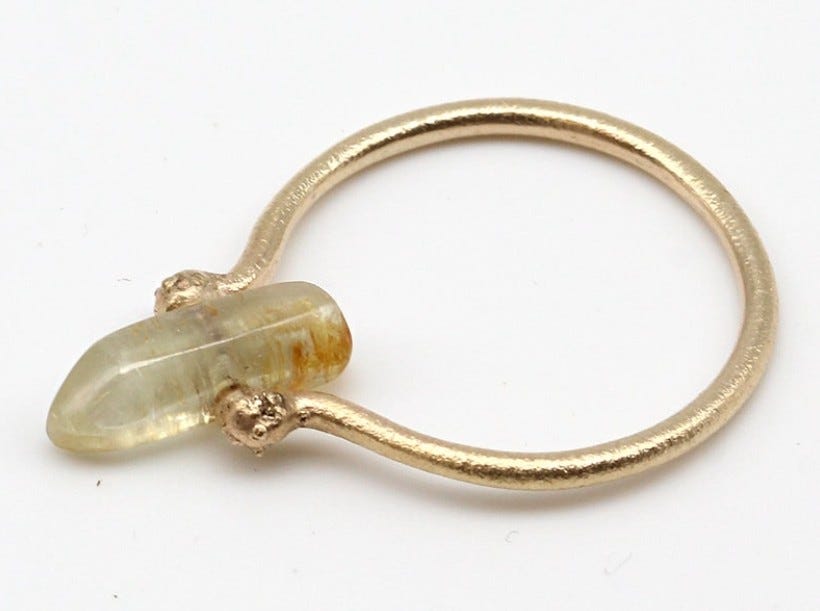
Bespoke abacus yellow gold ring with yellow sapphire, designed and made by Tamara Gomez, photo courtesy of the artist
o SMITHSONIAN TO OPEN MUSEUM OF THE AMERICAN ART JEWELER The institution will join the Air and Space and Hirshhorn museums on the National Mall in Washington, DC. Yvonne Montoya, AJF’s former executive director, has been appointed its director. “Pforzheim and Espace Solidor won’t get all the glory,” vows Montoya.
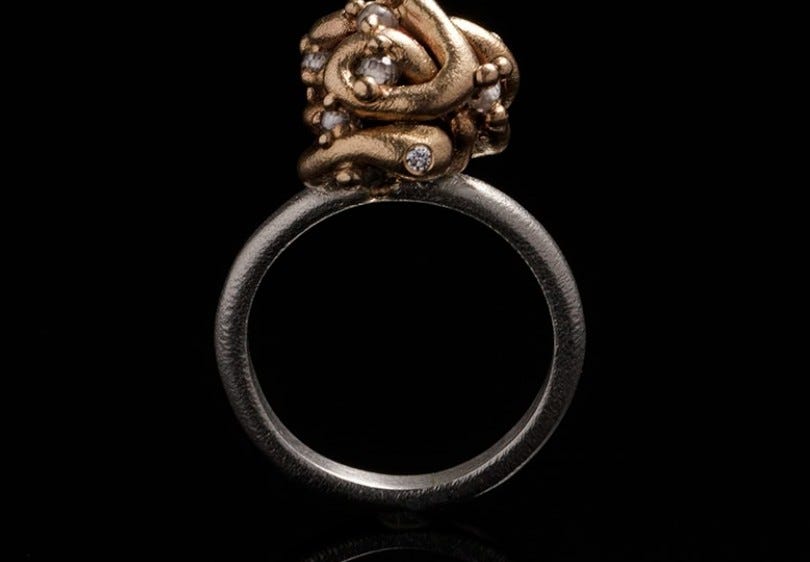
Called Scrambled Head with Glimmer of Hope, this Tamara Gomez statement ring is made with diamond, moissanite, 14-karat yellow gold, and sterling silver, photo courtesy of the artist
o NEW EXHIBITION — FOLLOW YOUR NOSE: SEPTUM RINGS OF THE POWERFUL “With this type of piercing,” said curator Naz Schnozz, “you can wear a retainer that flips up inside the nostrils. That means the public doesn’t know you have a septum ring.” Many are familiar with Madeleine Albright as a diplomat who spoke with her brooches, “but few realize she wore a septum ring in private,” added Schnozz. Besides Albright’s jewelry, the traveling exhibit features pieces worn by Angela Merkel, Emmanuel Macron, and Michelle Obama. Coming soon to a museum near you!
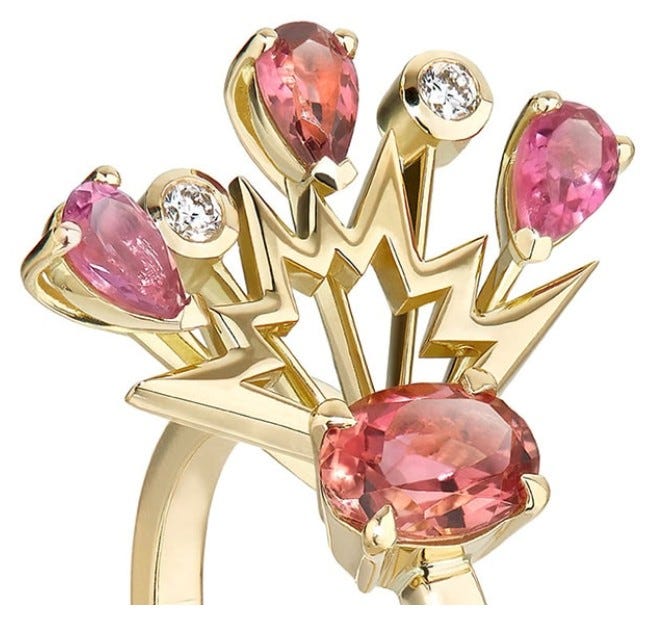
The 18-karat gold Cherrybomb ring with sapphires, diamonds, and tourmalines, designed and crafted by Aishleen Lester, photo courtesy of the artist
o KIM KARDASHIAN APPLIES TO JEWELRY MASTERS PROGRAMS She’s already done shapewear, fragrance, makeup, investing. In 2011 Kardashian launched a line of costume jewelry that let fans accessorize like her at an affordable price, but it flopped. The reality star attributed this to the baubles being kind of “basic.” Enrolling in a master’s jewelry program “will hone my understanding of jewelry theory,” says the influencer, “and help me create designs that are more critical of the beauty industry. That’s what my fans really want.” Kardashian hopes to start classes this fall and looks forward to dialog with instructors and fellow students.
Hugo Luis Johnson’s white gold and silver violin won Silver at the 2021 Goldsmiths’ Craft and Design Council Awards, photo courtesy of the artist
o ADRIAN BRODY DESIGNS LINE OF CONCRETE ART JEWELRY “My stylist has had me wearing brooches on the red carpet,” says the actor, “Her choices are pretty conventional high pieces, but they gave me an interest in jewelry as a medium. Then filming The Brutalist made me want to design my own. I asked a local contractor to show me how to make little molds and mix the cement.” Find the pieces in the MOMA gift shop.
5. Simplify your INSTAGRAM feed — some tips
📱 Simplify your Instagram feed to attract more followers.
Avoid adding text directly on images. Keep your jewelry as the main visual and use captions or separate slides for text.
If you need to include text or promotional material, make it the last slide rather than the cover image.
Promotional content, like event details or newsletter sign-ups, works better in Instagram Stories instead of your feed.
A clean, cohesive feed makes your art look more appealing and increases the likelihood of organic followers staying and engaging with your work.
📈 Boost Instagram engagement by showcasing your process.
While personal moments add depth, prioritize close-up shots of your jewelry making process, selecting materials, implementing techniques, choosing colors and other design elements. These are visually engaging & highlight skill.
Instead of vague captions, explain why your jewelry is unique. Share insights about your techniques, inspirations, and creative decisions to draw in your audience.
Start reels with attention-grabbing text like “This transformed my jewelry making” or “Here’s how I create rythm” to keep viewers watching.
Experiment with a series of reels following the same engaging format, such as “How I make jewelry [subject],” to create familiarity and encourage followers to return.
NOTE: Instagram’s algorithm now prioritizes content discovery through the Explore page and recommendations rather than hashtags.
6. FLUENCY IN JEWELRY DESIGN: Fluency and Empowerment
The fluent jewelry designer is able to think like a designer. The jewelry designer is more than a craftsperson and more than an artist. The jewelry designer must learn a specialized language, and specialized way of balancing the needs for appeal with the needs for functionality. The jewelry designer must intimately recognize and understand the roles jewelry plays for individuals as well as the society as a whole. The designer must learn how art, architecture, physical mechanics, engineering, sociology, psychology, context, even party planning, all must come together and get expressed at the point where jewelry meets the boundary of the person, that is, as the jewelry is worn.
And to gain that fluency, the designer must commit to learning a lot of vocabulary, ideas and terms, and how these imply content and meaning through expression. The designer will need to be very aware of personal thoughts and thinking as these get reflected in all the choices made in design. The designer will have to be good at anticipating the understandings and judgements of many different audiences, including the wearer, viewer, seller, buyer, exhibitor, client, collector, teacher and student.
With fluency comes empowerment. The empowered designer has a confidence that whatever needs to be done, …
9/15/2025–10/15/2025 Art Jewelry Exhibit at Pryor Gallery, Columbia State Community College My pieces will be showcased an this exhibit. In the works is a possible Seminar and a beading workshop.
WARREN FELD JEWELRY (www.warrenfeldjewelry.com) Custom Design, Workshops, Video Tutorials, Webinars, Coaching, Kits, Group Activities, Repairs ~~~~~~~~~~~~~~~~~~~~~~~ Join our community of jewelry designers on my Patreon hub Be part of a community of jewelry designers who recognize that we have a different way of thinking and doing than other types of crafters or artists. One free downloadable Mini-Lesson of your choice for all new members! ~~~~~~~~~~~~~~~~~~~~~~~
There are lots and lots of places for selling your jewelry. These include,
1. Wear It and Sell It
2. To Friends, Family and Work-Mates
3. Retail and Wholesale Stores
4. Consignment Shops
5. Art and Crafts Fairs, Flea Markets, Bazaars
6. Jewelry Parties, Home Shows
7. Trunk Shows
8. Galleries
9. Online
10. Catalogs
As well as through Trade Shows, TV and Radio, Webcasts, Through Sales Reps and Agencies, and many more options for profitable venues.
1. Wear it and Sell It
Yes, people do buy jewelry off your back, so to speak. You might be standing in line at the supermarket. Or attending a concert. Or sitting in the shade at a table in a local park. People will come up to you, marvel at your jewelry, and ask if they can buy it.
So, wear your favorite pieces and flaunt them.
2. To Friends, Family and Work-Mates
Arrange showings of your jewelry with friends, families and people you work with. They know you, and you know them….
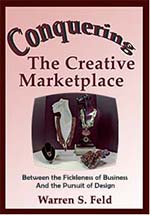
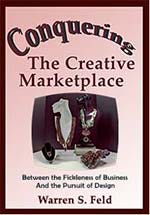
____________________________________________________________________ Conquering The Creative Marketplace
Many people learn beadwork and jewelry-making in order to sell the pieces they make. Based both on the creation and development of my own jewelry design business, as well as teaching countless students over the past 35+ years about business and craft, I want to address what should be some of your key concerns and uncertainties. I want to share with you the kinds of things (specifically, a business mindset and confidence) it takes to start your own jewelry business, run it, anticipate risks and rewards, and lead it to a level of success you feel is right for you. I want to help you plan your road map.
I will explore answers to such questions as: How does someone get started marketing and selling their pieces? What business fundamentals need to be brought to the fore? How do you measure risk and return on investment? How does the creative person develop and maintain a passion for business? To what extent should business decisions affect artistic choices? What similar traits to successful jewelry designers do those in business share? How do you protect your intellectual property?
The major topics covered include,
1. Integrating Business With Design
2. Getting Started
3. Financial Management
4. Product Development, Creating Your Line, and Pricing
5. Marketing, Promotion, Branding
6. Selling
7. Professional Responsibilities and Strategic Planning
8. Professional Responsibilities and Gallery / Boutique Representation
9. Professional Responsibilities and Creating Your Necessary Written Documents
Question 1: Should BEADWORK and JEWELRY MAKING be considered ART or CRAFT or DESIGN?
The jewelry designer confronts a world which is unsure whether jewelry is “craft” or “art” or its own special thing I’ll call “design”. This can get very confusing and unsettling. Each approach has its own separate ideas about how the designer should think, speak, work, and how he or she should be judged.
CRAFT: When defined as “craft,” jewelry is seen as something that anyone can do — no special powers are needed to be a jewelry designer. Design is seen as a step-by-step process, almost like paint-by-number. Designers color within the lines. The craft piece or project has functional value but limited aesthetic value. As “craft”, there is somewhat of a pejorative meaning — it’s looked down upon, thought of as something less than art.
If following the Craft Approach, the designer would learn a lot of techniques and applications in a step-by-step fashion. The designer, based on their professional socialization into Craft, would assume that:
a) The outlines and the goals of any piece or project can be specified in a clear, defined way.
b) Anyone can do these techniques.
c) There is no specialized knowledge that a designer needs to know beyond how to do these step-by-step techniques and applications.
d) If a particular designer has a strong sense of design, this is something innate and cannot be learned or taught.
e) There is little need to vary or adapt these techniques and applications.
f) The primary goal is functionality.
g) There are no consequences if you have followed the steps correctly.
As “craft”, we still recognize the interplay of the artist’s hand with the piece and the storytelling underlying it. We honor the technical prowess. People love to bring art into their personal worlds, and the craftsperson offers them functional objects which have some artistic sensibilities.
ART: When defined as “art”, jewelry is seen as something which transcends itself and its design. It is not something that anyone can do without special insights and training. The goal of any project would be harmony with a little variety, and some satisfaction and approval.
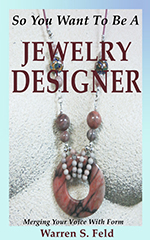
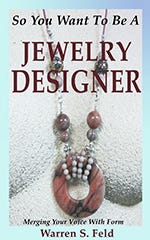
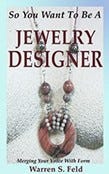
SO YOU WANT TO BE A JEWELRY DESIGNER Merging Your Voice With Form
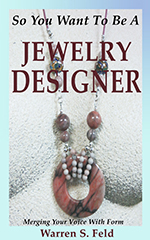
So You Want To Be A Jewelry Designer reinterprets how to apply techniques and modify art theories from the Jewelry Designer’s perspective. To go beyond craft, the jewelry designer needs to become literate in this discipline called Jewelry Design. Literacy means understanding how to answer the question: Why do some pieces of jewelry draw your attention, and others do not? How to develop the authentic, creative self, someone who is fluent, flexible and original. How to gain the necessary design skills and be able to apply them, whether the situation is familiar or not.
Often Unexpected, Always Exciting: Your First Jewelry Sale
How many times have you heard a jewelry artist say…
I can’t bear to part with my pieces.
My jewelry is too precious to me.
I only give a few pieces that I make away as gifts to friends and family.
I’ve never sold anything.
Selling would take the fun out of it.
And then, while you are filling your cart in the grocery store, someone offers to buy a piece you are wearing, and the rest is history. A sale! Sold! They paid so much more than it cost you! Right off your wrist! Gotta make another! That was so fast! That was so easy!
My friend Connie used to make things only for friends. She always wore the things she made. At one point, she was repeatedly approached in various stores around town by women who wanted to buy the pieces around her neck.
At first, Connie quoted them, what she thought were outlandish prices. No one hesitated. Connie was awe-struck, but didn’t say No. I don’t know if she secretly wore a sign on her back — JEWELRY FOR SALE — or, somehow stuck out her cheek in such a way, as if asking to be kissed, that people came over to her, but she was getting quite good at attracting buyers. At TJMAX, at TARGET, at MACY’s, at DILLARDS, at SEARS, at KROGERS and PUBLIX. She kept upping her prices each time, and no one had yet to blink!
Jona had made many things before, but had never sold anything. Then…
Many people learn beadwork and jewelry-making in order to sell the pieces they make. Based both on the creation and development of my own jewelry design business, as well as teaching countless students over the past 35+ years about business and craft, I want to address what should be some of your key concerns and uncertainties. I want to share with you the kinds of things (specifically, a business mindset and confidence) it takes to start your own jewelry business, run it, anticipate risks and rewards, and lead it to a level of success you feel is right for you. I want to help you plan your road map.
I will explore answers to such questions as: How does someone get started marketing and selling their pieces? What business fundamentals need to be brought to the fore? How do you measure risk and return on investment? How does the creative person develop and maintain a passion for business? To what extent should business decisions affect artistic choices? What similar traits to successful jewelry designers do those in business share? How do you protect your intellectual property?
The major topics covered include,
1. Integrating Business With Design
2. Getting Started
3. Financial Management
4. Product Development, Creating Your Line, and Pricing
5. Marketing, Promotion, Branding
6. Selling
7. Professional Responsibilities and Strategic Planning
8. Professional Responsibilities and Gallery / Boutique Representation
9. Professional Responsibilities and Creating Your Necessary Written Documents
Let Business Concerns Influence Your Artistic Choices
To what extent do (and should) business concerns influence the artistic choices bead and jewelry artists make?
If you want to be in business, then I’d say, “A Lot!” But this isn’t what a lot of designers like to hear. Success in business takes something besides being an excellent jewelry designer.
Jewelry making is not a passive art. You make jewelry for others to wear and buy, and you have to anticipate how they will assess your work and recognize your artistry. It is not the same as painting a painting or sculpting a sculpture in the sense that with paintings or sculptures, the artist does not need to communicate interactively with the viewer in order to create the product and be deemed successful. Jewelry making, instead, is more an interactive art. It is like architecture, where success can only be created through some kind of dialectic with others, and only be defined as successful as the product is introduced publicly and understood by others as finished and successful.
Selling your pieces is merely another phase of this interactive art, but sometimes forces upon you some more limits and refinements. You have to market to audiences. You may have to standardize things to be able to make the same thing over and over again. You may have to work in a production mode and repeat making certain designs, rather than freely creating and designing anew each time. You have to price things so that they will sell, and you have to price things so that you can make a sufficient profit. You do not (which translates as never) undersell yourself, like offering discounts to family, friends and co-workers.
You have to conform to prevalent styles and colors and forms. You have to make things which will photograph well for sale online. You have to make things that local stores want and are willing to buy or put on consignment. You may end up with a lot of “one size fits all,” because producing too much variety in sizes, shapes, colors and sizes could overwhelm you financially.
You find that if you want to make your jewelry design into a successful business, you may have to compromise with yourself, your artistic drives and sensibilities. You may have to limit what you offer. In order to make that sale. In order to make a profit. In order to establish your brand and how it is recognized. And stay in business.
As You Get Started, Ask Yourself These Questions
1. After honestly evaluating my hard and soft skills, am I business-ready?
2. Are there potential customers who will want, need and demand the kinds of jewelry I design?
3. Can I price my products competitively?
4. Where do I want to sell my pieces?
5. Can I get my pieces the visibility and opportunities to get purchased, given where I want to sell my pieces?
6. What are my competitive advantages? How do my works and my business strategies differentiate myself from my competition?
7. Are my pieces consistent and coherent enough to be recognized and understood as a brand, and as a brand designed by me?
8. Do I feel I can organize, manage, control and keep updated all the business functions – Design, Financial Management, Production and Distribution, Marketing and Branding, and Selling, Feedback and Evaluation?
Many people learn beadwork and jewelry-making in order to sell the pieces they make. Based both on the creation and development of my own jewelry design business, as well as teaching countless students over the past 35+ years about business and craft, I want to address what should be some of your key concerns and uncertainties. I want to share with you the kinds of things (specifically, a business mindset and confidence) it takes to start your own jewelry business, run it, anticipate risks and rewards, and lead it to a level of success you feel is right for you. I want to help you plan your road map.
I will explore answers to such questions as: How does someone get started marketing and selling their pieces? What business fundamentals need to be brought to the fore? How do you measure risk and return on investment? How does the creative person develop and maintain a passion for business? To what extent should business decisions affect artistic choices? What similar traits to successful jewelry designers do those in business share? How do you protect your intellectual property?
The major topics covered include,
1. Integrating Business With Design
2. Getting Started
3. Financial Management
4. Product Development, Creating Your Line, and Pricing
5. Marketing, Promotion, Branding
6. Selling
7. Professional Responsibilities and Strategic Planning
8. Professional Responsibilities and Gallery / Boutique Representation
9. Professional Responsibilities and Creating Your Necessary Written Documents
Some Updates and Things Happening. (Please share this newsletter)
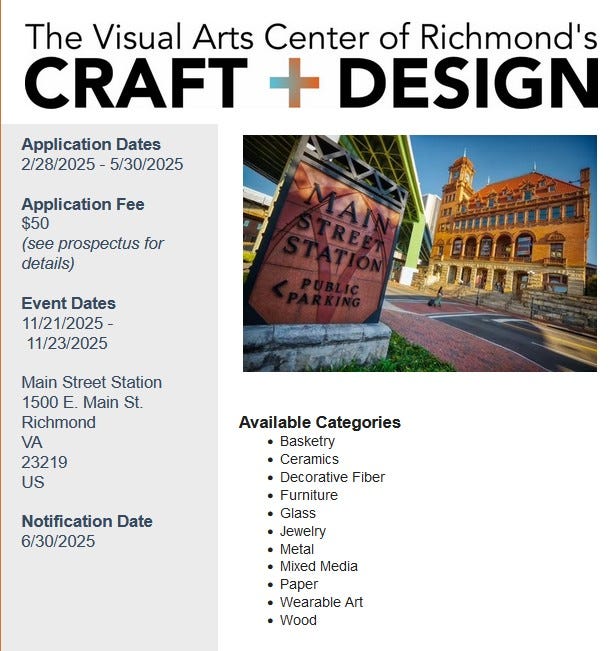
In this Issue: 1. Some highlights from the recent ORNAMENT magazine 2. Mastering the art of talking about your jewelry in public 3. Some advice about self promotion 4. Smithsonian Craft2Wear Show, September 26–28, 2025, APPLY NOW 5. What does it mean to foster a Growth Mindset? 6. Are the days of men’s jewelry worn solely as symbol of power and wealth gone for good? 7. Call for entries: Richmond CRAFT+DESIGN 8. Clever phrases/aphorisms/memes for artists of all kinds Some articles you may have missed
I received my most recent issue of one of my favorite magazines — ORNAMENT. Here are some highlights.
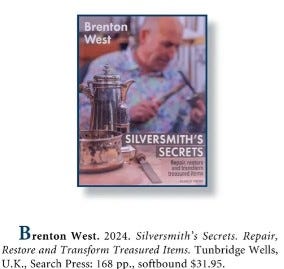
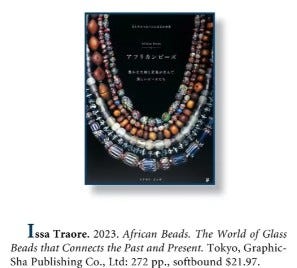
New books:
Articles:
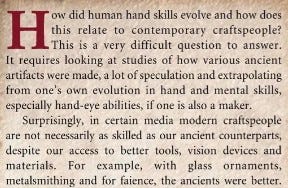
Ancient Craft Skills and the Contemporary Craftsperson
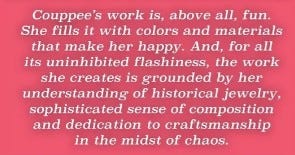
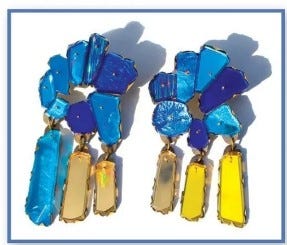
Nikki Couppee Showcase
There are many other jewelry designers highlighted, as is New York City Jewelry Week.
2. Mastering the art of talking about your jewelry in public
Speaking about your work publicly can be both exciting and nerve-wracking. Here are some key tips to confidently and effectively share your work:
a. Know Your Story (Inspirations, getting started, techniques and materials)
b. Develop a Clear 30 second Elevator Pitch (engage in 30 seconds; focus on what makes your jewelry unique)
c. Speak with Passion and Confidence (enthusiasm is contagious; take your time and speak clearly, even if you are nervous)
d. Adapt to your Audience (what do you think your audience wants to hear? focus on process and inspiration; highlight your brand and craftsmanship; be conversational and authentic; tell stories and anecdotes and don’t lecture)
e. Prepare a Narrative (focus on crafting a story that encapsulates your artistic journey, the challenges, triumphs, pivotal moments, struggles, doubts you’ve overcome, mishaps, recurring themes in your work, how your themes relate to your personal story; a compelling narrative evokes emotion)
f. Show and Tell (be prepared to show and tell, whether you have your jewelry with you at the moment, or you share images or your portfolio on your cellphone)
g. Engage, Don’t Just Talk (be interactive; encourage questions; ask what people think, invite them to share their opinions or what they think; get their reactions to a piece of jewelry before you begin to talk about it; style preferences; be conversational; show genuine interest in their responses and respond with some detail to what they say; be patient with responses and allow your audience time to formulate and articulate their thoughts; resist the urge to fill silences too quickly; you can always start the conversation by talking about a question you get asked a lot)
h. Practice, Practice, Practice (outline your remarks or write it out like a script for a play; rehearse in front of a mirror or with a friend; record yourself and refine your delivery; I use a desktop/mobile app called LOOM, which has a free subscription option)
i. Be Ready For Questions (why use these, do this, not do this?; what do you like?; how long does this take?)
j. Provide Takeaways (at the end of your talk, summarize the key ‘learnings’; provide a brochure or postcard or business card that your audience can take with them, as a physical reminder of your work; provide an avenue for them to explore your work further or contact you for potential opportunities, purchases, collaborations)
k. End With A Call To Action (extend the conversation beyond the event; always end with a call to action: visit website; sign up for newsletter; take them on a tour)
l. Follow-Up (you want to build lasting relationships (invite audience to stay connected and give you their email addresses, other contact information; send a personalized thank you note or email shortly after event; repeat highlights of your talk, links to your work, information about where to find you next)
m. Reflect and Adapt (review the event/encounter; what resonated best/least; what feedback did the audience present; adjust previous steps accordingly)
n. Network and Connect (expand your professional circle and foster meaningful relationships with other jewelry designers as well as your client base; engage in one-on-one conversations with clients who seemed interested in your work; exchange contact information with fellow designers and any boutiques, galleries or other businesses that seemed interested in your work; discover new opportunities to keep you and your work visible)
3. I was reading this article about self promotion, and wanted to share this with you. Good stuff.
The Power of Being Yourself Self-promotion often feels like an uncomfortable task for artists, but my first rule is simple: be yourself. There is no one way to self-promote, and the key is to find an approach that aligns with your personality. Authenticity is what draws people in — it’s not about forcing a persona but rather amplifying what makes you unique.
Let’s address social media, the most obvious self-promotional tool. Over the past half-decade, its impact has declined as big businesses have taken over. That doesn’t mean it’s useless — it just means you must use it wisely. Instead of treating social media as an advertising outlet, think of it as a storytelling tool. Show your process, your inspirations, and the personal side of your work. People connect with authenticity, not just finished products.
[His stated philosophy: Art is not something we create, it is who we are.]
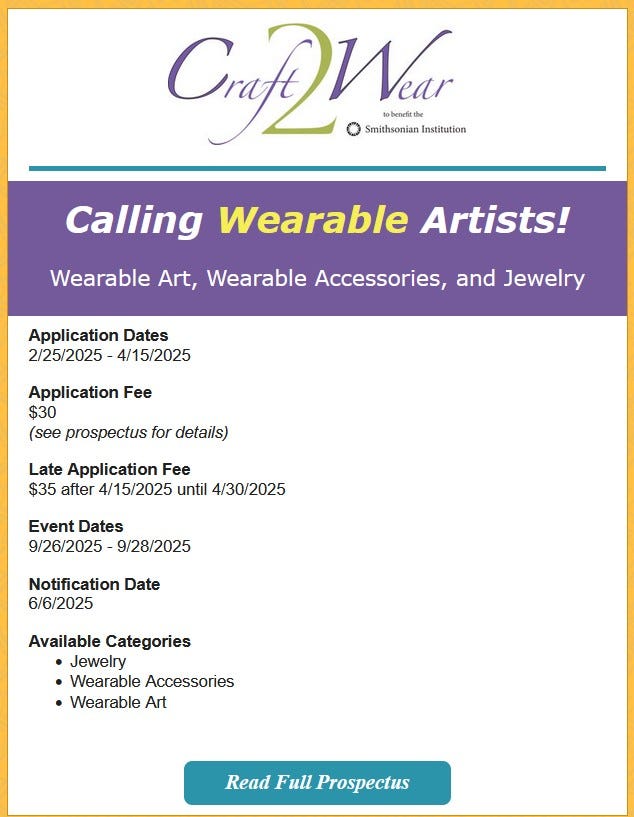
4. Smithsonian Craft2Wear Show, September 26–28, 2025, APPLY NOW
The 2025 Smithsonian Craft2Wear Show is an exhibition and sale of wearable contemporary American craft (clothing, accessories and jewelry) held in Washington, DC at the beautiful Smithsonian Arts and Industries Building (AIB) on the National Mall.
Electronic applications are due by Tuesday, April 15, 2025. A non-refundable fee of $30 must accompany each application.
Failure is uncomfortable. Disconcerting. Too often, we do everything we can to keep ourselves out of situations where we might fail. We focus on what could go wrong, instead of what could go right. We think we don’t have the abilities to do the task. We get paralyzed. We do nothing. Or we keep repeating ourselves, producing the same-ole, same-ole, whether there is a continued market for these items, or not. Or we begin to visualize any risk as insurmountable, way bigger than it really is.
But allowing any fear of failure to become some kind of insurmountable wall works against us. If we are trying to make a go of it by selling our jewelry, we can’t build these kinds of walls. Successful business people and successful businesses need to foster a culture which promotes a growth mindset. Simply, a growth mindset is a culture where you have permission and encouragement and confidence to take risks.
Risks are OK because they bring rewards. Rewards allow the business to maintain itself, sustain itself, grow and expand.
Failures are OK, as well, as long as they become learning experiences.
Doubt and self-doubt are OK only if they are used to trigger reflection and new ideas to overcome them.
Not having the skills requisite for the moment is OK because we are all capable of continual learning.
Temporary setbacks are OK because you have had them before and overcame them.
Carol Dweck wrote the seminal book on growth mindsets called Mindset: The New Psychology of Success (2006), with a series of related books to follow. People have either a growth-mindset or a fixed-mindset.
Those with a growth-mindset believe their abilities are developed through continual learning and hard work. They are more willing to experiment and try new things, and see failures as opportunities rather than setbacks.
Those with a fixed-mindset believe that abilities are innate — you’re born with talents or not. They seek out opportunities where specific talents, rather than effort, leads to success. They prefer to repeat tasks and apply skills they are already familiar with.
Developing a growth mindset means such things as…
1. Understanding the power of “Not Yet”.
2. Setting learning and continual learning goals
3. Being deliberate and constantly challenging yourself
4. Asking for honest feedback and criticism
5. Always reflecting on and being very metacognitive about your thoughts and actions, successes and failures
6. Recognizing if you are stuck in a fixed-mindset, and acknowledging your weaknesses
7. Focusing on the process, and less-so on the result
8. Getting comfortable with self-affirmation, rather than needing the affirmation and approval of others
6. Are the days of men’s jewelry worn solely as symbol of power and wealth gone for good?
A look at men’s jewellery at GemGenève
The rebirth of jewellery for men since the 2010s is actually due to another factor altogether: men have changed the way they relate to jewels and jewellery in general, argues GemGenève co-founder Ronny Totah. Today, men account for up to 30% of jewellery purchases from certain collections by brands and independent craftsmen and women.
8. Clever phrases/aphorisms/memes for artists of all kinds
I am a member of the Columbia Arts Council. For an event, we are going to pass out stickers. I generated a sampling of sayings that could go on the stickers, and I’m sharing them with you. Thought you’d get a chuckle out of these.
General Creativity & Art
Create like nobody’s watching.
Messy hands, brilliant mind.
Art: cheaper than therapy.
Make art, not excuses.
Doubt kills more art than failure ever will.
Every artist was first an amateur.
Creativity is intelligence having fun.
I speak fluent paint splatter.
Art is my love language.
Reality is overrated — paint me another one.
The world is my canvas, and I’m out of control.
Perfectly imperfect — just like my art.
Stay weird, stay creative.
Warning: Contains excessive imagination.
Creativity takes courage — and a lot of snacks.
Makers & Hands-On Artists
Handmade with sarcasm and love.
Makers gonna make.
I make things. What’s your superpower?
Handcrafted with reckless precision.
This is what ‘made with love’ looks like.
I turn coffee into art.
Saw dust is my glitter.
I make because I must.
Perfection is boring. Make something weird.
Measure twice, cut once, cry anyway.
My blood type is glue and glitter.
I can’t. I have a project.
Made by hand, heart, and a little bit of chaos.
Mistakes are just creative detours.
Cut. Sew. Cry. Repeat.
Painting & Drawing
Watercolor outside the lines.
Oil paint runs in my veins.
Sketch today, masterpiece tomorrow.
More paint, less perfection.
I draw, therefore I am.
Happy little accidents happen daily.
Smudges are just love marks from my art.
Inking my way through life.
My brush dances to its own tune.
If you see me clean, I’m out of paint.
Jewelry Making & Beading
Bead it like you mean it.
I like big beads and I cannot lie.
Stringing together happiness, one bead at a time.
Jewelry is art you can wear.
Beading: because therapy is expensive.
If lost, check the bead store.
Some collect memories; I collect beads.
Beading is my cardio.
Life is too short for boring jewelry.
More beads, less stress.
Creative Process & Inspiration
Inspiration hits at inconvenient times.
Chaos is just creativity’s warm-up.
Creativity is a work in progress.
Start before you’re ready.
Don’t wait for inspiration — just start.
Creativity thrives in the mess.
Done is better than perfect.
There’s no such thing as too many ideas.
Creativity: where the fun begins and logic ends.
You can’t rush art — but you can procrastinate it.
Art & Business
Starving artist? No, thriving artist.
Yes, it’s handmade. No, it’s not cheaper.
Support artists — buy art, not mass production.
Art is work. Pay accordingly.
Artists don’t work for exposure.
Yes, I make art. No, I won’t do it for free.
DIY: Because hiring professionals costs money.
Just because I enjoy it doesn’t mean I’ll do it for free.
I create. You buy. Everyone’s happy.
Respect the artist. Respect the craft.
Music & Performing Arts
Life’s better with a soundtrack.
Dancers don’t sweat, they sparkle.
Sing like you mean it.
Break a leg — but not my instruments.
Music is what feelings sound like.
The stage is my happy place.
Dance first, think later.
Creativity has no volume control.
When in doubt, just improvise.
Make music, not noise.
Writing & Literature
Write your own story.
Plot twist: I need more coffee.
My brain is 90% plot ideas and 10% snacks.
Poetic soul, chaotic mind.
Editing is just rewriting with regret.
Too many tabs open — some are story ideas.
I write. What’s your superpower?
Procrastinating? No, I’m world-building.
My characters made me do it.
Caution: Writer at work — approach with snacks.
Quirky & Funny
Oops, I arted.
Eat. Sleep. Create. Repeat.
More glue, less stress.
Why fit in when you can stand out?
I make, therefore I am.
Art teachers gave up on me; now they buy my work.
Creativity: The only mess that’s worth it.
Not all who wander are lost… some are just looking for inspiration.
This shirt contains 100% recycled creative energy.
The best ideas come at 2 AM and disappear by 7 AM.
UPCOMING WORKSHOPS by Warren Feld
Sat, 4/12, 2–3, LET’S MAKE EARRINGS, Maury County Library, 211 W 8th St, Columbia, TN Register: Call (931) 375–6502
WARREN FELD JEWELRY (www.warrenfeldjewelry.com) Custom Design, Workshops, Video Tutorials, Webinars, Coaching, Kits, Group Activities, Repairs ~~~~~~~~~~~~~~~~~~~~~~~ Join our community of jewelry designers on my Patreon hub Be part of a community of jewelry designers who recognize that we have a different way of thinking and doing than other types of crafters or artists. One free downloadable Mini-Lesson of your choice for all new members! ~~~~~~~~~~~~~~~~~~~~~~~
People have different motivations and ambitions when making jewelry. These can be as simple as an avocation or hobby, or more involved as a business or career. Jewelry making is an investment in time and materials. It requires, not only strong creativity skills, but also persistence and perseverance to take a project from inspiration to aspiration to implementation. A lot of the success in this pursuit comes down to an ability to make and follow through on many artistic and design decisions. Developing this ability — a fluency, flexibility and originality in design — means that the designer has become empowered to answer these 5 essential questions: (1) Is jewelry making a craft, an art or design? (2) How do you think creatively? (3) How do you leverage the strengths of various materials and techniques, and minimize weaknesses? (4) How do the choices you make in any one jewelry design evoke emotions and resonate? and, (5) How do you know your piece is finished and successful?
5 Essential Questions Every Jewelry Designer Should Have An Answer For
Interested in trying your hand at jewelry design?
Before you begin, consider the following 5 questions I pose for you…
1. Is what you do Art, Craft or Design? 2. How do you decide what you want to create? 3. What materials (or techniques) work well together, and which do not? 4. What things do you do so that your finished piece evokes an emotional response? 5. How do you know when your piece is done?
People have different motivations and ambitions when making jewelry. These can be as simple as an avocation or hobby, or more involved as a business or career. Jewelry making is an investment in time and materials. It requires, not only strong creativity skills, but also persistence and perseverance to take a project from inspiration to aspiration to implementation.It means understanding that jewelry can only be judged as finished and successful as the piece is worn. Jewelry design is more than the application of a set of techniques; it is a mind-set, as well. It is a way of thinking like a designer.
A lot of the achievement and accomplishment in this pursuit of jewelry design comes down to an ability to make and follow through on many artistic and design decisions. Some have to do with managing a process, which can take an extended period of time. It also comes down to being fluent, flexible and original in your thinking through design. The greater your disciplinary literacy, the more empowered and confident you become in your design work.
Susan is one example of what happens when uncertainty — that paralysis or deer-in-the-headlights feeling that we so often face — sets in. Susan felt very unsure of herself. And unsure of her jewelry. Would people like it? Was the color mix appropriate? Was the construction secure? Was the price smart and fair? She allowed all this uncertainty to affect her design work — she had difficulty finishing pieces she was working on, starting new projects, and getting her work out there.
Like many of my jewelry design and beadwork students, Susan needed to be fluent as a designer. With fluency comes empowerment, confidence and success.
SO YOU WANT TO BE A JEWELRY DESIGNER Merging Your Voice With Form
So You Want To Be A Jewelry Designer reinterprets how to apply techniques and modify art theories from the Jewelry Designer’s perspective. To go beyond craft, the jewelry designer needs to become literate in this discipline called Jewelry Design. Literacy means understanding how to answer the question: Why do some pieces of jewelry draw your attention, and others do not? How to develop the authentic, creative self, someone who is fluent, flexible and original. How to gain the necessary design skills and be able to apply them, whether the situation is familiar or not.
STRATEGIC MANAGEMENT: How Do You Start and Run A Business Selling Hand Made Products?
Between Commerce and Art
Many people learn beadwork and jewelry-making in order to sell the pieces they make. In today’s world, people who sell their pieces must become savvy in both regular retail, as well as internet retail. This does not have to be too complex. Nor too overwhelming. Too impossible. Too boring. There are a lot of tensions here between commerce and art. Production and creativity. They parallel the tensions between the creative act and having to introduce your jewelry publicly. But all are manageable.
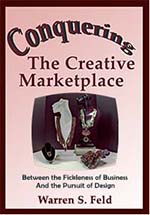
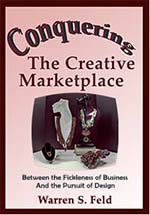
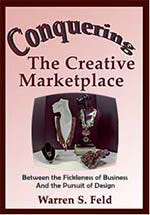
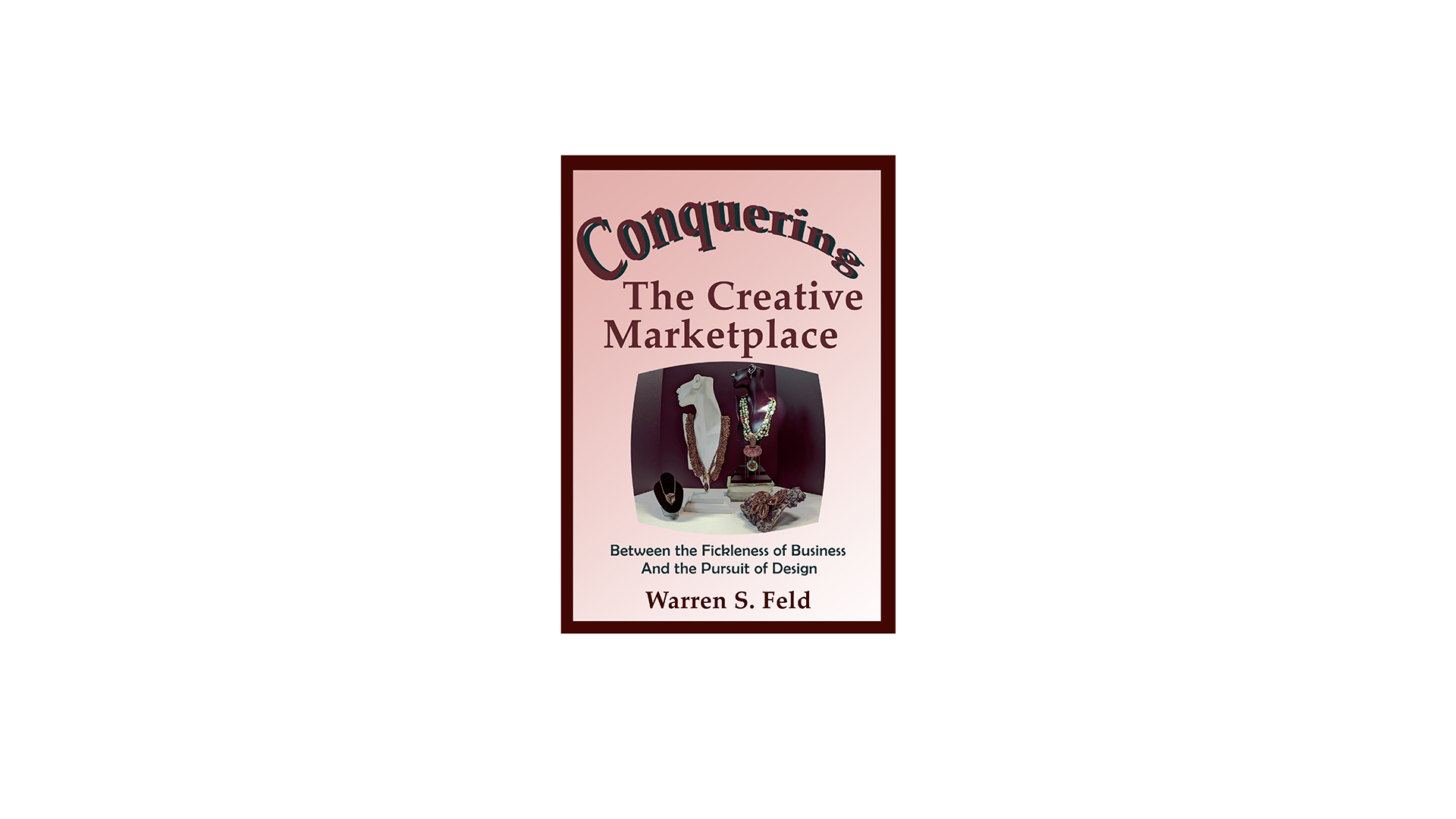
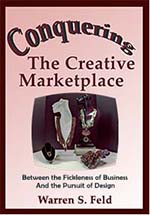
Conquering The Creative Marketplace is a comprehensive guide for you — someone who wants to start and run a business selling handmade products you love to make. The chapters in this book focus on developing and implementing your road map. This map helps show you how to better understand and relate to the creative marketplace, eventually earning money from your jewelry designs (or other art or craft projects). I go into detail about the things you have to do to start and run a business selling handmade products. I talk about the things you will want to do to manage, evolve and expand your business. These have to do with general accounting and setting up a general ledger. They include things like inventory management, pricing formulas, marketing and branding strategies. Also important is the protection of your designs — your intellectual property. I also discuss in detail key concepts like risk, return on investment, legitimacy, effectiveness, efficiency, consumption, influence, persuasion, coherence and contagion.
Based both on the creation and development of my own jewelry design business, as well as teaching countless students over the past 38+ years about business and craft, I want to address what should be some of your key concerns and uncertainties. I want to share with you the kinds of things (specifically, a business mindset and confidence) it takes to start your own jewelry business, run it, and lead it to a level of success you feel is right for you. Right for you will mean different things to different designers, from a hobbyist selling some pieces to a full-fledged operation. Whatever, your goals and ambitions, you will need to follow a basic road map. I want to help you plan your road map.
I explore answers to such questions as: How does someone get started selling their pieces? What business fundamentals need to be brought to the fore? How do you measure risk and return on investment? How does the creative person develop and maintain a passion for business? To what extent should business decisions affect artistic choices? What similar traits do successful jewelry designers share with those in business? How do you protect your intellectual property? What is your competitive advantage?
The next few chapters are descriptions of the kinds of things it takes for successfully integrating commerce with art. There are literally many full books written on each topic and subtopic, which you can easily access in bookstores or online. This book should be considered a comprehensive introduction to these topics. While all the information in this book is pertinent and necessary for you, it is not a substitute for talking with an accountant and business lawyer familiar with you and the locality, state/province and country you are doing business in.
The advice in these sections is useful for any jewelry designer who wants to sell their pieces. It is useful for the jewelry designer who occasionally wants to sell a few pieces. It is useful for the jewelry designer who wants to supplement their income. It is useful, as well, for the jewelry designer who wants to develop a fully, financially secure jewelry design business.
Many people learn beadwork and jewelry-making in order to sell the pieces they make. Based both on the creation and development of my own jewelry design business, as well as teaching countless students over the past 35+ years about business and craft, I want to address what should be some of your key concerns and uncertainties. I want to share with you the kinds of things (specifically, a business mindset and confidence) it takes to start your own jewelry business, run it, anticipate risks and rewards, and lead it to a level of success you feel is right for you. I want to help you plan your road map.
I will explore answers to such questions as: How does someone get started marketing and selling their pieces? What business fundamentals need to be brought to the fore? How do you measure risk and return on investment? How does the creative person develop and maintain a passion for business? To what extent should business decisions affect artistic choices? What similar traits to successful jewelry designers do those in business share? How do you protect your intellectual property?
The major topics covered include,
1. Integrating Business With Design
2. Getting Started
3. Financial Management
4. Product Development, Creating Your Line, and Pricing
5. Marketing, Promotion, Branding
6. Selling
7. Professional Responsibilities and Strategic Planning
8. Professional Responsibilities and Gallery / Boutique Representation
9. Professional Responsibilities and Creating Your Necessary Written Documents
Some Bottom-Line Advice For The Newly Emerging Jewelry Designer
Always keep working and working hard. Set up a routine, and do at least one thing every day.
Find a comfortable place to work in your home or apartment. If at all possible, find separate spaces for creative work, business stuff, and reflection.
Develop strategies for organizing your projects, your supplies and your tools, and for keeping things generally organized over time. But don’t overdue the organizing thing. A little chaos can be OK, and even, sometimes, trigger new ideas.
Give yourself permission to play, experiment, go down many paths. Everything you work on doesn’t have to meet the criterion of perfection, be cool, or become the next Rembrandt. A key part of the learning process is trial and error, hypothesis, test, and conclusion. This helps you develop fix-it strategies so that you can overcome unfamiliar or problematic situations, enhancing your skills as a designer.
Don’t let self-doubt and any sense of impending failure take over you, and paralyze you. Designer’s block, while it may happen occasionally, should be temporary. Jewelry projects usually evolve, and involve some give and take, change and rearrangement. Often the time to complete a project can be lengthy, and you have to maintain your interest and inspiration over this extended time period.
Don’t get stuck in a rut. Try new materials. Try new colors. Try new designs. Try new styles. Try to add variation, new arrangements, smart embellishments. Learn new techniques and technologies.
SO YOU WANT TO BE A JEWELRY DESIGNER Merging Your Voice With Form
So You Want To Be A Jewelry Designer reinterprets how to apply techniques and modify art theories from the Jewelry Designer’s perspective. To go beyond craft, the jewelry designer needs to become literate in this discipline called Jewelry Design. Literacy means understanding how to answer the question: Why do some pieces of jewelry draw your attention, and others do not? How to develop the authentic, creative self, someone who is fluent, flexible and original. How to gain the necessary design skills and be able to apply them, whether the situation is familiar or not.
When I began making jewelry 35+ years ago, my only interest was in making money. Concerns about design and art, construction and appeal, functionality and emotional engagement were superficial. Probably non-existent is a better word. And yes, this meant I did not care about what any piece of jewelry I made might mean for the person buying it. Or wearing it. Or otherwise putting it on display. There was no consequence for my actions in making jewelry. Except making money. There was a hollowness here which I was, at the time, totally unaware of.
That was a shame.
I missed out on a lot of excitement that emerges from the design process and that special relationship between designer and client.
As I became more proficient in making jewelry, I questioned more and more of myself about what I was doing. Why were some pieces of jewelry I made more successful than others? Why did some sell better than others? Why were some received more warmly than others? Why did some hold up much better from wear than others?
I had had to place a value on the pieces I made. Initially I used a simple pricing formula which related the costs of parts and the costs of labor and the costs of overhead to the price set. But over time, I noticed that some of my pieces were more resonant than others. More desirable. More intriguing. Sexier. Should I increase my prices to reflect these greater, though more difficult to measure, kinds of things? I didn’t know. But I was thinking about it.
Over the years, I thought more and more about what made jewelry more or less successful. How to know when a piece was finished. How to know that I made the best tradeoffs between beauty and functionality. How to know what my jewelry was worth. How to market jewelry. How to sell it. How to sell it in a store. How to sell it at a craft show. How to sell it online. How to organize it into a coherent line of jewelry. How to measure and assess costs, revenues and returns-on-investment.
I share part of my developing knowledge in my book SO YOU WANT TO BE A JEWELRY DESIGNER (https://shop.ingramspark.com/b/084?EenmVM2NMYJGNKaAzr68kaH6GGGSPuNIkGCP1Hfzm3N). In this book, I go over the many hard and soft skills required to become fluent, flexible and original in jewelry design. It is important to understand what jewelry is, how design elements are selected, arranged, constructed and manipulated, how to manage the design process, and how to introduce your designs publicly.
In this book, which is the focus of this series of articles, CONQUERING THE CREATIVE MARKETPLACE, I focus on strategies for integrating business practices with the creative design process — things which can make balancing the creative self with the productive self easier and more fluid. I talk about how dreams are made between the fickleness of business and the pursuit of design.
I go into great detail about all the things you need to think about, know and do when getting started. This begins with basic bookkeeping and accounting as well as developing a business model and also understanding how to protect your intellectual property.
I discuss briefly about how the more literate jewelry designer is more successful in business. Disciplinary literacy involves a set of skills which enable the designer to best relate the jewelry design to client understandings and desires. These skills influence how the client interacts with the piece of jewelry, seeing relevance, value, usefulness, and the designer’s intent.
It is important to understand some basic concepts — Competitive Advantage,Risk, Rewards and Return-On-Investment, and how these play out in all aspects of your business. Also critical is to recognize how what you do in business and what you do creatively affect the Efficiency and Effectiveness of both your design process as well as your business operations.
I have several chapters devoted to product design and development. These range from product goal setting to needs assessment to product distribution, pricing and promotion to managing product launch.
Another section focuses on marketing and branding. You need to create an identify for your business, one that people become aware of and feel positively towards.
This leads to the next section on selling. I review selling strategies important in different settings from retail to craft shows to home shows to online.
I talk about resiliency in business. What kinds of things — emotional, administrative, creative — lead to a greater level of resilience in your business as you face growth, market ups and downs and fashion and taste changes.
Last, I review and present advice for creating the kinds of documents you will need to complement your business goals. These include a creative resume; portfolio; artist statement, biographical sketch, certificate of authenticity and the like.
Many people learn beadwork and jewelry-making in order to sell the pieces they make. Based both on the creation and development of my own jewelry design business, as well as teaching countless students over the past 35+ years about business and craft, I want to address what should be some of your key concerns and uncertainties. I want to share with you the kinds of things (specifically, a business mindset and confidence) it takes to start your own jewelry business, run it, anticipate risks and rewards, and lead it to a level of success you feel is right for you. I want to help you plan your road map.
I will explore answers to such questions as: How does someone get started marketing and selling their pieces? What business fundamentals need to be brought to the fore? How do you measure risk and return on investment? How does the creative person develop and maintain a passion for business? To what extent should business decisions affect artistic choices? What similar traits to successful jewelry designers do those in business share? How do you protect your intellectual property?
The major topics covered include,
1. Integrating Business With Design
2. Getting Started
3. Financial Management
4. Product Development, Creating Your Line, and Pricing
5. Marketing, Promotion, Branding
6. Selling
7. Professional Responsibilities and Strategic Planning
8. Professional Responsibilities and Gallery / Boutique Representation
9. Professional Responsibilities and Creating Your Necessary Written Documents




 From Warren and


 “I am fascinated with juxtaposition and fluidity of materials. My work is about exploring the aspects of ephemeral impressions and the urbanity of metal. I use precious metals, stones and alternative materials to explore these expressions.”
 Using low-tech traditional metal smithing techniques and tools, each piece is created in Lesley’s studio in the tradition of the American Studio Art Jewelry movement of the 1940’s through the 60’s, which dictates that the work is created entirely in the artist’s studio. Her work is hand fabricated using recycled metals and ethically, sustainably-mined gemstones.
 SOME POSTS YOU MAY HAVE MISSED:CONQUERING THE CREATIVE MARKETPLACE SERIES:
 Thanks for being here. I look forward to sharing more resources, tips,