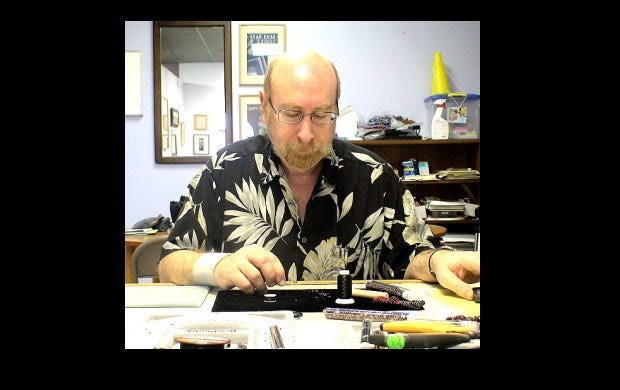
I’ve been seeing more and more vendors at art and craft shows specializing in permanent jewelry. Was always curious about what it was, how it was done, and how permanent it really was. I share this article by Louis Owen, who answered my questions. — Warren Feld
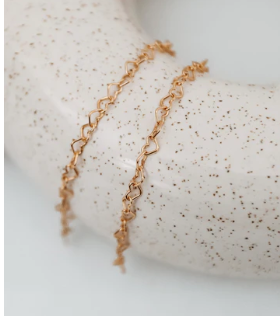
At Land of Odds with Warren Feld Jewelry, we’ve seen our fair share of jewelry trends, from bold statement pieces to the return of vintage classics, but few have made as big a splash as the permanent jewelry craze. This “zapping” trend is everywhere right now, and for good reason. It blends style, sentiment, and craftsmanship into something people truly connect with.
Permanent jewelry isn’t just an accessory; it’s an experience. And in our world of ever-changing fashion, it’s one of the most meaningful shifts we’ve seen in years.
A Trend Years in the Making
Permanent jewelry’s journey started in luxury circles, where custom welding experiences were offered as exclusive events. Over time, its charm spread to boutiques, artisan jewelers, and even pop-up shops at festivals and private parties.
I’ve watched its appeal grow with customers who want more than just something pretty, they want something lasting.
How the “Zapping” Process Works
The process is simple yet special. Using a safe micro-welding tool, the jeweler fuses the chain directly onto the wrist, ankle, or neck, creating a clasp-free piece that fits perfectly. The spark lasts seconds, but the jewelry can last for years.
Many jewelers focus on offering high-quality chain options in solid gold, gold-filled, or sterling silver. Clients often add charms or connectors that make their piece completely unique.
Why Everyone’s Talking About It
Permanent jewelry has the perfect recipe for going viral:
· A visual “zap” moment that photographs well.
· A symbolic meaning that resonates with friends, couples, and families.
· A style that works with any outfit, any day.
Social media is a major driver, but so is word-of-mouth. Customers often say they go in for permanent jewelry in because they saw a friend’s welded bracelet and wanted the same experience.
The Materials Behind the Magic
Of course, quality matters. Many jewelers rely on trusted suppliers like Stella Rose Jewelry Supply for premium permanent jewelry chains. This ensures the finished piece not only looks beautiful but can stand up to daily wear.
If you prefer something with a bit of history, shops like Xtreme Pawn often have vintage gold or silver chains that can be repurposed into permanent jewelry, a creative mix of old-world charm and modern style.
Is It Really “Permanent”?
Yes and no. With care, your bracelet, anklet, or necklace can last years. But it can also be removed with scissors if necessary. That’s part of the charm, it’s long-lasting, not a lifetime sentence.
Our customers appreciate that balance of commitment and flexibility.
Why This Craze Has Staying Power
While some trends fade fast, permanent jewelry may be here to stay. It fits perfectly with the movement toward intentional, sustainable fashion. People want fewer, better pieces, and welded jewelry delivers on that promise.
We’ve seen firsthand how it brings people together, whether it’s two best friends getting matching bracelets or a couple marking an anniversary. It’s more than just a trend; it’s a moment you carry with you.
Final Thoughts
The permanent jewelry craze isn’t just about style, it’s about meaning.
Whether you’re drawn to the sleek look, the sentimental value, or simply the fun of “getting zapped,” there’s never been a better time to try it for yourself. Stop by, see the chains in person, and let us help you create your own little spark of permanence.
From Warren Feld and Land of Odds TAKING JEWELRY BEYOND CRAFT Join my community of jewelry designers on myPatreon hub August 15, 2025 Sign up for a Free or Paid Subscription[Note: Paid Subscribers on Patreon Hub get 25% Off @Land of Odds]www.landofodds.comHi everyone,
Some Updates and Things Happening. (Please share this newsletter)
In this Issue: 1. Jewelry Designer’s Action Exercise 2. How Do You Know When A Piece Is Complete? 3. Eddie Basha Family Collection of Native American Jewelry 4. Primarily Use Instagram To Build Up Your Email List 5. Masriera Art Nouveau Jewellery, 1839 6. How to Know It’s Time to Nudge Prices Up 7. Wearable Poetry
1) Define your 5 jewelry designer friends you would like to most influence you. If you predict your future as a jewelry designer based on the average of those 5, you will find yourself smiling for who you are bound to become.
They can also be part of the “eminent dead” (jewelry designers from the past that you admire).
2) Are they the 5 jewelry designers you spend the most time with, or thinking about, or studying their work? If not, decide what are the necessary changes you want to make so that they become so.
~~~~~~~~~~ 2. How Do You Know When A Piece Is Complete?How Do You Know When a Work of Art is Complete?by Ivan Barnett, Klimt02, 7/28/2025 Read the full article here
“It happens in most studio practices more times than not. Every conversation between artist and mentor, gallerist and collector ask this question. It’s a question that hovers silently over the table or sometimes echoes in the middle of the night when you’re staring at a work: “How do I know when it’s finished? How do I know when to stop?” That wise old saying “sleep on it” can often be the perfect solution. Studying the work when you are fresher can be one of the best solutions. Yet, at the heart of the matter, I have found that “the knowing” comes from the years of “going too far,” because you think the work or exhibition will be better or stronger “if I do more.” That can be the case at times. However, there’s nothing better than going too far too many times to remind us.”
“Completion is not perfection. The quest for perfection is often elusive. The real signal of completion is that final moment when the creative can say with ease that “I wouldn’t move or change one thing.” The piece no longer tugs at your sleeve—it offers us a quiet “yes.””
Basha Sr, the father, moved to the United States via New York City to join his family in 1884. He would move to Arizona in 1910, where he founded a general store in the town of Pima, then called Goodyear. In the 1930s, the Bashas traded extensively with Akimel O’odham (Pima) peoples, who would bring mesquite wood to exchange for groceries. It was a different time, with firewood a valuable and always needed resource for the wood stoves that heated most buildings in those days.
Basha Jr gathered most of this collection in the 1980s and 2000s. What makes it special is the personal relationships Eddie shared with many of the artists. More than objects, these pieces represent the friendships and the respect shared between the Basha family and these master artisans.
Basha Sr moved to the United States via New York City to join his family in 1984. He would move to Arizona in 1910, where he founded a general store in the town of Pima, then called Goodyear. In the 1930s, the Bashas traded extensively with Akimel O’odham (Pima) peoples, who would bring mesquite wood to exchange for groceries. It was a different time, with firewood a valuable and always needed resource for the wood stoves that heated most buildings in those days.
Basha Jr gathered most of this collection in the 1980s and 2000s. What makes it special is the personal relationships Eddie shared with many of the artists. More than objects, these pieces represent the friendships and the respect shared between the Basha family and these master artisans.
4. Primarily Use Instagram To Build Up Your Email List 💻 To get people to register their emails, bring them to your website & sell high-ticket jewelry through Instagram… Focus on building your mailing list, this is where most conversions will happen.Offer a free incentive (lead magnet) to encourage people to sign up.Create a sense of exclusivity and scarcity: emphasize when pieces are one-of-a-kind or produced in limited quantities.Study successful designers/artists in your niche who consistently sell out and observe how they structure their sales funnel and build anticipation.
~~~~~~~~~~ 5. Masriera Art Nouveau Jewellery, 1839
Visit the website to drool over 100s of his pieces, and a more thorough presentation of the jeweler, his work, video demos of enameling, and much more.
Masriera is one of my favorite jewelers. You can still visit his studio and shop in downtown Barcelona.
“Handcrafted, delicate and exquisite jewelry that embodies the world of fantasy and colour of this artistic movement. Its origins are boldly revealed in its iconographic features, strongly inspired by the Mediterranean, where winding floral forms and feminine sensuality breathe life into the mystical fusion of “woman and nature”, dreaming up fairies, nymphs and a whole imaginary universe of figurative art.”
“The roots of this brand date back to the 19th century, when LLuís Masriera, born into a family of artists, painters, enamellers and jewellers firmly linked to the cultural and artistic life of Barcelona, decided to open his first workshop in the city to explore new creative channels of expression of the Art Nouveau style in jewelry.”
“After almost two hundred years, MASRIERA continues to perfect the enamelling technique: a careful and meticulous process in which the translucent enamel is applied in such a way that light passes through it. “
Visit the website to drool over 100s of his pieces, and a more thorough presentation of the jeweler, his work, video demos of enameling, and much more.
~~~~~~~~~~
6. How to Know It’s Time to Nudge Prices Upby Red Dot Blog (a great newsletter to sign up for) https://reddotblog.com/
Read the full article hereHere are a few reliable signs it’s time to raise prices:Your work is selling faster than you can replace it. If pieces are flying off the wall, your prices are likely too low.You’re receiving consistent positive feedback—but from buyers who hesitate to commit. Sometimes a higher price can actually increase perceived value and help buyers take the work more seriously.You’ve built a steady following and repeat buyers. Your collectors believe in you. Gradual increases won’t scare them off—especially if you’re transparent and consistent.Your business is struggling to cover costs despite strong sales. If profit margins are tight and you’re not covering overhead, a pricing adjustment is warranted.He’d also add this: if you find yourself frequently rationalizing your current price structure—“It’s not the right time,” “The economy’s shaky,” “Maybe next year”—those are often signs that a price increase is overdue. A Practical Approach to Raising PricesHere’s how I advise approaching a price increase:Do it gradually. A 10–15% increase annually is usually reasonable and expected. For work that’s in especially high demand, you might consider more, but always weigh consistency and sustainability.Be transparent with returning collectors. Let them know your prices are increasing soon. Some will jump to purchase before the change. Others will appreciate being in the loop.Don’t apologize. Frame your price increase as a natural reflection of your growth and success. Collectors will mirror your confidence.Update everything at once. Be sure your website, portfolio, price lists, and gallery partners are all in sync. Confusion breeds mistrust.
“In “Wearable Poetry”, which received the honorary SMCK ON REEL Audience Award (2) in Munich in March 2025, we – contemporary jewelry artist Neringa Poškutė-Jukumienė and poet Rosana Lukauskaitė – came together to investigate transformation through the confluence of wearable art and language. This collaborative project unfolded during a ten-day creative residency in Lisbon, supported by the “Culture Moves Europe” (3) mobility grant and mentored by Portuguese jewelry artist and researcher Cristina Filipe (4). Our central question asked how poetics could be made wearable – not just metaphorically, but materially – through an embodied, spatial, and interdisciplinary practice where the body becomes both a sensing instrument and a site of inscription. Rather than seeking a final product from the outset, we focused on process-based research, engaging the body, object, voice, and landscape in reciprocal gestures of response and resonance.”
“Throughout the process, we returned often to the question of wearability – not simply as adornment, but as a way of carrying text and gesture on the body. Neringa’s doctoral research, “Body and Jewellery Spaces” (7), informed this aspect of our method. We treated the body as both a sensing tool and a site of inscription. By thinking through the wearable as a porous boundary between interior and exterior worlds, we explored how language, memory, and material could linger on the skin – be absorbed, carried, or shed. Adorment elements, like the black “Widow” lipstick from “Jeffree Star Cosmetics”, were introduced as ritualistic markers – simple, performative objects that could signal transformation without explanation. The lipstick, a cosmetic and symbolic artifact, stood in for both armour and intimacy, linking adornment to self-invention and narrative.”
Sat, 8/16, 9am-Noon, WIRE WRAPPED CABOCHON PENDANT Middle Tenn Gem & Mineral Society, Donelson Fifty Forward Registration begins June 21 http://www.mtgms.org/schools.htm
Sat, 8/16, 1-4pm, WIRE WEAVE 2 and SUN PENDANT Middle Tenn Gem & Mineral Society, Donelson Fifty Forward Registration begins June 21 http://www.mtgms.org/schools.htm
Sat, 8/23, 1-4pm, INTRO TO WIRE WORK and MIX N MATCH BRACELET, Hoamsy, Nashville, LC Goat, Germantown, 1220 2nd Ave N Register: www.hoamsy.com
Sat, 9/20, 9am-Noon, LEARN BEAD WEAVING: RIGHT ANGLE WEAVE and CURVY RAW BRACELET Middle Tenn Gem & Mineral Society, Donelson Fifty Forward Registration begins June 21 http://www.mtgms.org/schools.htm
Sat, 9/20, 1-4pm, INTRO TO EVEN COUNT, FLAT PEYOTE and JUNGLE FLOWER BRACELETMiddle Tenn Gem & Mineral Society, Donelson Fifty Forward Registration begins June 21 http://www.mtgms.org/schools.htm
Sat, 10/25/2025, 9am-Noon, PEARL KNOTTING…WARREN’S WAY Middle Tenn Gem & Mineral Society, Donelson Fifty Forward Registration begins September 20 http://www.mtgms.org/schools.htm
Sun, 10/26/25, 1-4pm, DISCOVER PEARL KNOTTING Register through Hoamsy.com Class held at Cyanide Cider, 410 Woodbine St, Nashville, TN 37211
Sun, 11/16/25, 1-4pm, WIRE WRAPPED CABOCHON PENDANT Register through Hoamsy.com Class held at Cyanide Cider, 410 Woodbine St, Nashville, TN 37211
Sat, 11/22/25, 9am-Noon, WIRE WEAVING INTRO AND MAYAN PENDANT Middle Tenn Gem & Mineral Society, Donelson Fifty Forward Registration begins September 20 http://www.mtgms.org/schools.htm
Sat, 11/22/2025, 1-4pm, INTRO TO WIRE WORK and MIX N MATCH BRACELET Middle Tenn Gem & Mineral Society, Donelson Fifty Forward Registration begins September 20 http://www.mtgms.org/schools.htm
Sun, 12/7/25, 1-4pm, WIRE WEAVING AND MAYAN PENDANT Register through Hoamsy.com Class held at Cyanide Cider, 410 Woodbine St, Nashville, TN 37211
Sat, 12/13/25, 9am-Noon, WIRE WRAPPED CABOCHON PENDANT Middle Tenn Gem & Mineral Society, Donelson Fifty Forward Registration begins September 20 http://www.mtgms.org/schools.htm
Sat, 12/13/25, 1-4pm, WIRE WEAVE 2 and SUN PENDANTMiddle Tenn Gem & Mineral Society, Donelson Fifty Forward Registration begins September 20 http://www.mtgms.org/schools.htm
~~~~~~~~~~
9/15/2025 – 10/15/2025 Solo Exhibit, Warren Feld Art JewelryAt Pryor Gallery, Columbia State Community College Humanities Building (Waymon L. Hickman Bldg), 1665 Hampshire Pike, Columbia, TN 38401 Exhibits are free and open to the public Gallery Hours: Monday – Thursday 8 a.m. to 7 p.m. Friday 8 a.m. to 4 p.m. My pieces will be showcased an this exhibit. In the works is a possible Seminar and a beading workshop.add 11/0 or delicas ad here
Promote your current projects, promotional copy, News & Views, videos, reels, tutorials, instructions, social media posts online in this newsletter and on our jewelry designers’ Patreon hub.
No deadlines! Opportunity available all the time. No fees.
But don’t wait to take advantage of this opportunity. This copyrighted material is published here with permission of the author(s) as noted, or with Land of Odds or Warren Feld Jewelry. All rights reserved.
~~~~~~~~~~ Repairs Stumping You? Let Me Take A Look I take in a lot of jewelry repairs. People either bring them to me in Columbia, TN, or, I pick them up and deliver them back in Nashville. I am in Nashville at least once a week. It’s been convenient for most people to meet me at Green Hills Mall. But if not, I can come to your workplace or your home. This is perfectly fine for me. My turnaround time typically is 3-4 weeks.
I do most repairs, but I do not do any soldering. I also do not repair watches. These are the kinds of repairs I do:
o Beaded jewelry o Pearl knotting, hand knotting o Size/Length adjustment o Re-stringing o Wire work/weave/wrap o Micro macrame o Broken clasp replacfement o Earring repair o Replace lost rhinestones or gemstones o Stone setting o Stretchy bracelet o Metal working which does not involve soldering o Bead woven jewelry and purses o Beaded clothing o Custom jewelry design
WARREN FELD JEWELRY (www.warrenfeldjewelry.com) Custom Design, Workshops, Video Tutorials, Webinars, Coaching, Kits, Group Activities, Repairs ~~~~~~~~~~~~~~~~~~~~~~~ Join our community of jewelry designers on myPatreon hub Be part of a community of jewelry designers who recognize that we have a different way of thinking and doing than other types of crafters or artists. One free downloadable Mini-Lesson of your choice for all new members! ~~~~~~~~~~~~~~~~~~~~~~~
Add your email address to my Warren Feld Jewelry emailing listhere.
Thanks for being here. I look forward to sharing more resources, tips, sources of inspiration and insights with you.Join A Community Of Jewelry Designers On MyPatreon Hub
I’ve always wanted a fuller online space for representing the various things I’ve been involved with. A space to bring all my writings about jewelry making, jewelry design and conquering the creative marketplace. A central place to guide people to opportunities — art and craft shows, beads, findings and other supplies, highlighting new ideas and new designers in jewelry.
My ultimate goal is to contribute a set of ideas, practical steps, and fix-it strategies to stuff into your designer toolbox, which all lead towards becoming a professional in jewelry design. Not a craft. Not only an artist. But a designer with the skills and insights for making tradeoffs between beauty and function, pure art and commercialization, and the intuitive excitement which comes from applying your creativity and the negotiation of shared understandings and desires as you introduce your pieces publicly.
I have set up this space for our community of jewelry designers — Warren Feld Jewelry’s PATREON HUB — to learn, to interact, and to provide and/or get feedback on what they are working on. Please join here.
Be part of a community of jewelry designers who recognize that we have a different way of thinking and doing than other types of crafters or artists.
WHY SUBSCRIBE?
Engage with a community. Benefit from its collective power — insights, reactions, feedback, foresight, and directing you to opportunities.
Never miss an update. You won’t have to worry about missing anything. Every new article of interest, and announcements about kits, workshops and webinars, chat groups, feedback sessions, and special promotions, goes directly to your inbox.
I bring articles, tutorials, and chat-group discussion sessions to you about…
What it means to be fluent and literate in design?
What the implications are for defining jewelry as an “object” versus as an “intent”?
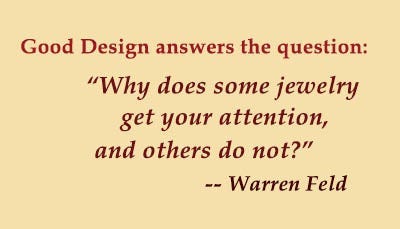
Why some jewelry draws your attention, and others do not?
· Articles. Stay up-to-date. Access each new article up to 3 months. · Advanced Notice. Kits, webinars, workshops, tutorials, promotions, discounts · Free Mini-Lesson Download. One free downloadable Mini-Lesson of your choice
· First view of all articles and kits · Access to all the articles in the archive · 25% Discount on beads, supplies and kits on LandOfOdds.com website · Priority in posting comments · All member chats · + All free-tier member benefits
Infuriating! That’s how many people, beginners and advanced alike, feel when they try to understand patterns and instructions.
Know up-front that most diagrams and figures are poorly drawn, and most instructions are poorly written. The instructors who write these often leave out critical steps — especially for new beaders and jewelry makers who are unfamiliar with many of the things these instructors assume that you know. Most often, they leave out critical information showing you the pathway, and how to negotiate that pathway, from where you are to where you are going next. It’s obvious to the instructor. But not so obvious to you.
In patterns, this “where-am-I, where-am-I-going-next” information is frequently unclear or omitted. You did Step 1 OK. You understand what Step 2 is about. But you don’t know how to get from Step 1 to Step 2.
Othertimes, the patterns are overly complex, often, in the editorial interest of reducing the number of printed pages. Instead of showing a separate pattern or diagram for each step, the editors frequently try to show you three, four, five or more steps in the same diagram. So you have a bird’s nest of lines, and a spider-web’s road map — and you’re nowhere.
I tell people, that you need to re-write the instructions and re-draw the patterns or diagrams in a way you personally understand. This is very helpful.
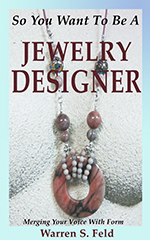
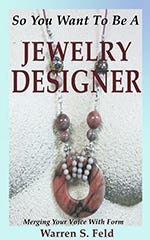
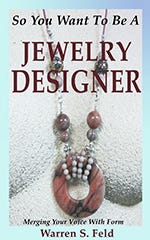
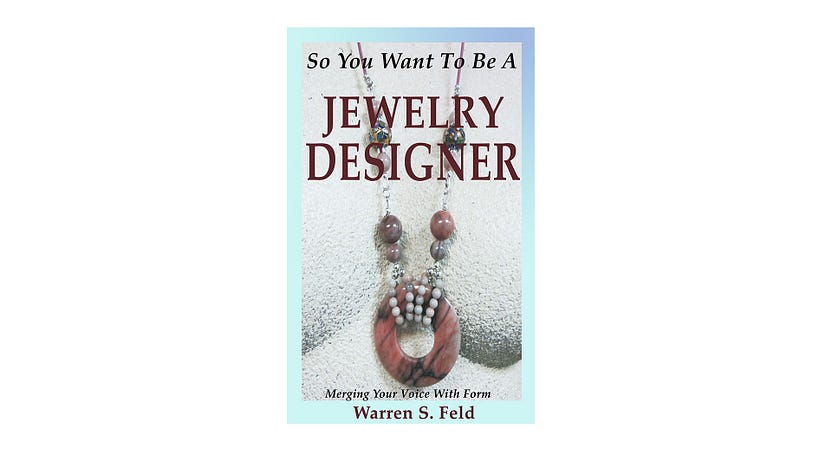
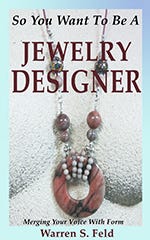
SO YOU WANT TO BE A JEWELRY DESIGNER Merging Your Voice With Form
So You Want To Be A Jewelry Designer reinterprets how to apply techniques and modify art theories from the Jewelry Designer’s perspective. To go beyond craft, the jewelry designer needs to become literate in this discipline called Jewelry Design. Literacy means understanding how to answer the question: Why do some pieces of jewelry draw your attention, and others do not? How to develop the authentic, creative self, someone who is fluent, flexible and original. How to gain the necessary design skills and be able to apply them, whether the situation is familiar or not.
I believe jewelry designers have a special way of thinking through selecting design elements, composing, constructing, and manipulating objects. Different than crafters. Different than artists. Different than other disciplines and their core ways of defining things and thinking things through.
How should the designer think? How should she organize her tasks? How should she tap into her creative self? How should she select materials, techniques and technologies? How should she assert her creativity and introduce her ideas and objects to others? How much does she need to know about how and why people wear and inhabit jewelry? What impact should she strive to have on others or the more general culture and society as a whole? How should she approach unfamiliar, unknown or problematic designs?
I try to formulate a disciplinary literacy unique and special and legitimate for jewelry designers. Such literacy encompasses a basic vocabulary about materials, techniques, color and other design elements and rules of composition. It also includes the kinds of thinking routines and strategies jewelry designers need to know in order to be fluent, flexible and original. It includes what the jewelry designer needs to know and do when introducing their pieces publicly, either to have others wear, buy or collect their pieces.
These routines and strategies are at the heart of the designer’s knowledges, skills and understandings related to creativity, elaboration, embellishment, reflection, critique and metacognition. This disciplinary literacy in design is very similar to how sounds are made into music. This literacy is very similar to how words are made into literature. There is an underlying vocabulary and grammar to jewelry design, from decoding to comprehension to fluency. The jewelry designer is dependent upon this disciplinary literacy to the extent that she or he is able to move from inspiration to aspiration to implementation and management towards finish and success. …
The fluent jewelry designer is able to think like a designer. The jewelry designer is more than a craftsperson and more than an artist. The jewelry designer must learn a specialized language, and specialized way of balancing the needs for appeal with the needs for functionality. The jewelry designer must intimately recognize and understand the roles jewelry plays for individuals as well as the society as a whole. The designer must learn how art, architecture, physical mechanics, engineering, sociology, psychology, context, even party planning, all must come together and get expressed at the point where jewelry meets the boundary of the person, that is, as the jewelry is worn.
And to gain that fluency, the designer must commit to learning a lot of vocabulary, ideas and terms, and how these imply content and meaning through expression. The designer will need to be very aware of personal thoughts and thinking as these get reflected in all the choices made in design. The designer will have to be good at anticipating the understandings and judgements of many different audiences, including the wearer, viewer, seller, buyer, exhibitor, client, collector, teacher and student.
With fluency comes empowerment. The empowered designer has a confidence that whatever needs to be done, or whatever must come next, the designer can get through it. Empowerment is about making and managing choices. These choices could be as simple as whether to finish a piece or not. Or whether to begin a second piece. Or which materials or techniques should be used. The designer will make choices about how to draw someone’s attention to the piece, or present the piece to a larger audience. She or he may decide to submit the piece to a magazine or contest. She or he may want to sell the piece and market it. The designer will make choices about how a piece might be worn, or who might wear it, or when it might be worn, in what context.
And for all these choices, the jewelry designer might need to overcome a sense of fear, boredom, or resistance. The designer might need to overcome anxiety, a sense of giving up, having designer’s block, feeling unchallenged, and even laziness.
In order to make better artistic and design choices, the Fluent and Empowered Jewelry Designer should have answers to 5 critical questions.
SO YOU WANT TO BE A JEWELRY DESIGNER Merging Your Voice With Form
So You Want To Be A Jewelry Designer reinterprets how to apply techniques and modify art theories from the Jewelry Designer’s perspective. To go beyond craft, the jewelry designer needs to become literate in this discipline called Jewelry Design. Literacy means understanding how to answer the question: Why do some pieces of jewelry draw your attention, and others do not? How to develop the authentic, creative self, someone who is fluent, flexible and original. How to gain the necessary design skills and be able to apply them, whether the situation is familiar or not.
It is important up front to ask yourself, as a jewelry artist, what is more important to you: the piece of jewelry itself, or the reason why it was made? The material object? Or the idea?
The idea is about cause and effect. How the inspiration resulted in choices about colors, materials and techniques. How the artist’s intent is revealed through choices about composition, arrangements and manipulation of design elements. How the jewelry relates to the person and to the body? How the artist anticipates how others will understand whether a piece is finished and successful, and whether the piece incorporates these shared understandings into the choices made about design.
As solely a material object, the jewelry so designed shies away from resonance. It becomes something to be judged apart from the wearer. It too often gets co-opted by global forces tending towards standardization and same-old-same-old designs. The designer’s mastery is barely referenced or attended to. The designers voice is reduced to noise. The very real fear is that, with globalization, advances in technology, and standardization, the designer’s voice will no longer be needed.
Jewelry as idea fosters communication and connection between the artist and his or her various audiences. It bridges thinking. It bridges emotion. It bridges social, cultural and/or situational ties. It goes beyond simple adornment and ornamentation. It becomes interactive, and emerges from a co-dependency between artist and audience, reflective and indicative of both.
Analyzing reasons, finding connections, and conceptualizing forms, components and arrangements are the primary functions of jewelry designer survival.
Otherwise, why make jewelry? Why make something so permanent to reflect your inner motivations, efforts, even struggles, to translate inspiration into this object? Why make something wearable, especially when each piece is usually not worn all the time? Why make something that might have such an intimate relationship with the body and mind? Why make something that can have real consequences for the wearer as the jewelry is worn in social, cultural or specific situational settings?
SO YOU WANT TO BE A JEWELRY DESIGNER Merging Your Voice With Form
So You Want To Be A Jewelry Designer reinterprets how to apply techniques and modify art theories from the Jewelry Designer’s perspective. To go beyond craft, the jewelry designer needs to become literate in this discipline called Jewelry Design. Literacy means understanding how to answer the question: Why do some pieces of jewelry draw your attention, and others do not? How to develop the authentic, creative self, someone who is fluent, flexible and original. How to gain the necessary design skills and be able to apply them, whether the situation is familiar or not.
I was burnt out in my job as Director of a non-profit, health care organization when I met Jayden at a local bar. I was so bored in my job. Bored with the people I worked with. Bored with the tasks. Bored with the goals. I felt so disconnected from the field of health care. I wanted to stop the world and jump off. But into what, I had no idea.
I so much yearned for some creative spark. Some creative excitement. Something that challenged me, was artistic, was fun. And someone to do these things with. And, in 1987, I met Jayden. Jayden epitomizes creativity.
Soon after we met, Jayden moved to Nashville. But she was having difficulty finding a job. There was a recession going on at the time. At one point, I asked her what she could do, and she said that she could make jewelry. I thought we could build a business around that.
And so we did. Land of Odds was born.
Initially the business was oriented around Jayden’s design work. She made all kinds of jewelry from beads to wire to silver fabrication to lampwork. And at first, I had little interest in actually making or designing jewelry. But gradually, very gradually, I began learning the various techniques and the different kinds of materials and components. We took in a lot of repairs. I found it intellectually challenging to figure out why something broke — construction, technique, something about the wearing. I began to formalize some ideas and hypotheses into rules and principles.
Around 1998, Jayden and I wanted to offer jewelry making classes in our shop. But we did not want to repeat and replicate the types of classes already offered at other craft and bead shops in town. We did not want to do the Step-by-Step paint-by-number approach to jewelry making. We wanted to integrate architectural considerations with those of art. While we recognize that all jewelry making has some aspect of craft to it, we wanted to inspire our students to go beyond this. Jewelry beyond craft.
Over the next couple of years, with the help and guidance from many local artisans and craft teachers, we developed an educational curriculum embedded within what is called the Design Perspective. That is, our classes would teach students how to manage both beauty and functionality, and how to make the necessary tradeoffs between these within their finished pieces. Our classes would guide students in developing a literacy and fluency in jewelry design.
Eventually Jayden retired and our business began to revolve around my own designs and my developing understanding of the Design Perspective. After 35+ years in the business, I came away with some strong beliefs about what jewelry designers should be taught and how they should be taught. I’ve encapsulated all this within this text So You Want To Be A Jewelry Designer and its companion book Conquering The Creative Marketplace.
SO YOU WANT TO BE A JEWELRY DESIGNER Merging Your Voice With Form
So You Want To Be A Jewelry Designer reinterprets how to apply techniques and modify art theories from the Jewelry Designer’s perspective. To go beyond craft, the jewelry designer needs to become literate in this discipline called Jewelry Design. Literacy means understanding how to answer the question: Why do some pieces of jewelry draw your attention, and others do not? How to develop the authentic, creative self, someone who is fluent, flexible and original. How to gain the necessary design skills and be able to apply them, whether the situation is familiar or not.