Warren Feld Jewelry

Taking Jewelry Making Beyond Craft

Posts Tagged ‘luxury’

FLUENCY IN JEWELRY DESIGN: The Design Manifesto

Posted by learntobead on December 31, 2024

The Design Manifesto

First (and foremost):
Jewelry is art only as it is worn.

Second:
Jewelry should reflect the artist’s intent Creativity is not merely Doing. It’s Thinking, as well.

Third:
Jewelry is something affected by, and in return, affects the contexts within which it is introduced. The purpose of jewelry design is to communicate a designer’s idea in a way which others understand and will come to desire. Jewelry is not designed in a vacuum; rather, it results from the interaction of the artist and his or her various audiences, and is communicative at its core.

Fourth:
Jewelry design should be seen as a constructive process involving the balancing act of maintaining both shape (structure) as well as good movement, drape and flow (support); jewelry should be seen as more architectural than craft or art alone.

Fifth:
Design choices are best made and strategically managed at the boundary between jewelry and person, where the artist can best determine when enough is enough, and the piece is most resonant.

Sixth:
Jewelry must succeed aesthetically, functionally, and contextually, and, as such, jewelry design choices must reflect the full scope of all this, if jewelry is to be judged as finished, successful and, most importantly, resonant.

Seventh:
Everyone has a level of creativity within them, and they can learn and be taught how to be better and more literate jewelry designers.

Eighth:
Students need to learn a deeper understanding about why some pieces of jewelry attract your attention, and others do not. Successful teaching of jewelry design requires strategies leading students to be more literate in how they select, combine and arrange design elements, and to be fluent, flexible and original in how they manipulate, construct, and reveal their compositions.

Ninth:
Successful jewelry designing can only be learned within an agreed upon disciplinary literacy. That is, jewelry design requires its own specialized vocabulary, grammar and way of thinking things through and solving problems in order to prepare the designer to be fluent, flexible and original.

Tenth (and final):
Disciplinary literacy should be learned developmentally. You start at the beginning, learn a core set of skills and how they are inter-related and inter-dependent. Then you add in a second set of integrated and inter-dependent skills. Next and third set, and so forth, increasing the sophistication of skills in a developmental and integrative sense. The caveat, if you have been making jewelry for a while, it is particularly helpful to go back and relearn things in an organized, developmental approach, which can be very revealing, even to the experienced designer, about how your design choices impact your pieces and your success.

Our curriculum emerged from our understandings about disciplinary literacy in jewelry design and our attempts to implement what we learned from it. This curriculum evolved into this book.

Here you will begin to understand

  • The challenges jewelry designers face
  • How to channel your excitement
  • How to develop your passion
  • How to cultivate your practice
  • How to understand what jewelry means and how jewelry is used by various audiences
  • The variety of materials, techniques and technologies you might want to explore and incorporate into what you do
  • The creative process, and the things involved in translating inspirations into aspirations into designs
  • What it means to develop a passion for design
  • The role desire plays in how people come to recognize and understand whether a piece is finished and successful, and how values are set and imposed on any piece of jewelry
  • Principles of composition, construction and manipulation, and the intricacies and dependencies of various design elements, such as color, point, line, plane, shape, forms, themes, among others
  • Creating and using components
  • The architectural bases of jewelry design
  • What the ideas underlying “good design” are, as well as those associated with “good contemporary design”
  • How design concepts are applied in real life
  • The psychological, cognitive and sexuality underpinnings of jewelry design
  • Your professional responsibilities as a jewelry designer
  • Entering the creative marketplace and threading the business needle
  • Self-care
  • In fact, the book covers the full range of things you need to learn (or teach others) in order become fluent, flexible and original in jewelry design

Sadly, the field of jewelry design has little academic scholarship relative to the ideas which must support it. This is mostly because jewelry design is not thought of as a discipline apart from art or craft. And this is a disservice to we designers.

Most description and analysis focus on the accomplishments of various successful designers. These texts detail their biographies, their use of artistic elements and techniques, and their influence over styles and fashions. This information is important, but insufficient to support jewelry design as a profession all its own, relevant for today and tomorrow, and inclusive of all of us who call ourselves jewelry designers.

This book covers the bases of those critical professional, think-like-a-designer skills jewelry designers need to develop and at which to become proficient.

Join our Jewelry Designers’ Hub at
www.patreon.com/warrenfeldjewelry

_______________________________________________________
Thanks for being here. I look forward to sharing more resources, tips,
sources of inspiration and insights with you.

WarrenFeldJewelry.com
Shop.warrenfeldjewelry.com
School.warrenfeldjewelry.com
Coaching by Warren Feld

Add your name to my email list.

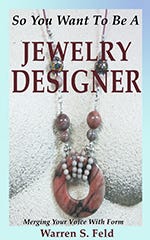
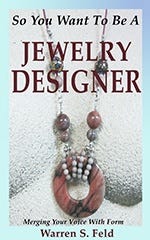
SO YOU WANT TO BE A JEWELRY DESIGNER
Merging Your Voice With Form
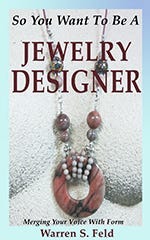
So You Want To Be A Jewelry Designer reinterprets how to apply techniques and modify art theories from the Jewelry Designer’s perspective. To go beyond craft, the jewelry designer needs to become literate in this discipline called Jewelry Design. Literacy means understanding how to answer the question: Why do some pieces of jewelry draw your attention, and others do not? How to develop the authentic, creative self, someone who is fluent, flexible and original. How to gain the necessary design skills and be able to apply them, whether the situation is familiar or not.

588pp, many images and diagrams Ebook , Kindle or Print formats

The Jewelry Journey Podcast
“Building Jewelry That Works: Why Jewelry Design Is Like Architecture”
Podcast, Part 1
Podcast, Part 2

Posted in architecture, Art or Craft?, art theory, bead stringing, bead weaving, beads, beadwork, business of craft, color, Contests, craft, craft shows, creativity, cruises, design management, design theory, design thinking, enrichment travel, Entrepreneurship, handmade jewelry, jewelry, jewelry collecting, jewelry design, jewelry making, Learn To Bead, pearl knotting, professional development, Resources, Stitch 'n Bitch, Travel Opportunities, wire and metal, Workshops, Classes, Exhibits | Tagged: , , , , | Leave a Comment »

FLUENCY IN JEWELRY DESIGN: How To Think, Speak, Work As A Jewelry Designer

Posted by learntobead on December 10, 2024

You make jewelry. That is what you do.

But when you think jewelry and speak jewelry and work jewelry, this is what you become.

Yes, jewelry making has aspects of craft to it. But it is so much more. It is art. It is architecture. It is communicative and interactive. It is reflective of the jewelry designer’s hand. And it defines or reaffirms the self- and social-identities of everyone who wears it, views it, buys it, exhibits it, collects it, talks about it.

To go beyond craft as a jewelry designer, you need to become literate in this discipline called jewelry design. As a person literate in jewelry design, you become your authentic, creative self, someone who is fluent, flexible and original. You gain the skills necessary to design jewelry whether the situation is familiar or not. You are a jewelry designer.

The literate jewelry designer grasps the differences between jewelry as object and jewelry as intent. That is, you recognize how a piece of jewelry needs to be orchestrated from many angles. How jewelry making involves more than following a set of steps. How jewelry, without design, is just sculpture. How jewelry is a very communicative, public and interactive work of art and design. How jewelry focuses attention. How true design enhances the dignity of the person wearing it. And how the success of a jewelry designer, and associated practice or business, comes down to what’s happening at the boundary between the jewelry and the body – that is, jewelry is art only as it is worn.

Read more articles about becoming Fluent in Jewelry Design on our Jewelry Designers’ Hub.

_______________________________________________________

Thanks for being here. I look forward to sharing more resources, tips,
sources of inspiration and insights with you.

WarrenFeldJewelry.com
Shop.warrenfeldjewelry.com
School.warrenfeldjewelry.com
Coaching by Warren Feld

Add your name to my email list.

SO YOU WANT TO BE A JEWELRY DESIGNER
Merging Your Voice With Form

So You Want To Be A Jewelry Designer reinterprets how to apply techniques and modify art theories from the Jewelry Designer’s perspective. To go beyond craft, the jewelry designer needs to become literate in this discipline called Jewelry Design. Literacy means understanding how to answer the question: Why do some pieces of jewelry draw your attention, and others do not? How to develop the authentic, creative self, someone who is fluent, flexible and original. How to gain the necessary design skills and be able to apply them, whether the situation is familiar or not.

588pp, many images and diagrams Ebook , Kindle or Print formats

The Jewelry Journey Podcast
“Building Jewelry That Works: Why Jewelry Design Is Like Architecture”
Podcast, Part 1
Podcast, Part 2

Posted in architecture, Art or Craft?, art theory, bead stringing, bead weaving, beads, beadwork, business of craft, color, Contests, craft, craft shows, creativity, cruises, design management, design theory, design thinking, enrichment travel, Entrepreneurship, handmade jewelry, jewelry, jewelry collecting, jewelry design, jewelry making, Learn To Bead, pearl knotting, professional development, Resources, Stitch 'n Bitch, Travel Opportunities, wire and metal, Workshops, Classes, Exhibits | Tagged: , , , , | Leave a Comment »

FLUENCY IN JEWELRY DESIGN: The Journey Begins

Posted by learntobead on December 3, 2024

The Journey

I was burnt out in my job as Director of a non-profit, health care organization when I met Jayden at a local bar. I was so bored in my job. Bored with the people I worked with. Bored with the tasks. Bored with the goals. I felt so disconnected from the field of health care. I wanted to stop the world and jump off. But into what, I had no idea.

I so much yearned for some creative spark. Some creative excitement. Something that challenged me, was artistic, was fun. And someone to do these things with. And, in 1987, I met Jayden. Jayden epitomizes creativity.

Soon after we met, Jayden moved to Nashville. But she was having difficulty finding a job. There was a recession going on at the time. At one point, I asked her what she could do, and she said that she could make jewelry. I thought we could build a business around that.

And so we did. Land of Odds was born.

Initially the business was oriented around Jayden’s design work. She made all kinds of jewelry from beads to wire to silver fabrication to lampwork. And at first, I had little interest in actually making or designing jewelry. But gradually, very gradually, I began learning the various techniques and the different kinds of materials and components. We took in a lot of repairs. I found it intellectually challenging to figure out why something broke — construction, technique, something about the wearing. I began to formalize some ideas and hypotheses into rules and principles.

Around 1998, Jayden and I wanted to offer jewelry making classes in our shop. But we did not want to repeat and replicate the types of classes already offered at other craft and bead shops in town. We did not want to do the Step-by-Step paint-by-number approach to jewelry making. We wanted to integrate architectural considerations with those of art. While we recognize that all jewelry making has some aspect of craft to it, we wanted to inspire our students to go beyond this. Jewelry beyond craft.

Over the next couple of years, with the help and guidance from many local artisans and craft teachers, we developed an educational curriculum embedded within what is called the Design Perspective. That is, our classes would teach students how to manage both beauty and functionality, and how to make the necessary tradeoffs between these within their finished pieces. Our classes would guide students in developing a literacy and fluency in jewelry design.

Eventually Jayden retired and our business began to revolve around my own designs and my developing understanding of the Design Perspective. After 35+ years in the business, I came away with some strong beliefs about what jewelry designers should be taught and how they should be taught. I’ve encapsulated all this within this text So You Want To Be A Jewelry Designer and its companion book Conquering The Creative Marketplace.

_______________________________________________________

Thanks for being here. I look forward to sharing more resources, tips,
sources of inspiration and insights with you.

WarrenFeldJewelry.com
Shop.warrenfeldjewelry.com
School.warrenfeldjewelry.com
Coaching by Warren Feld

Add your name to my email list.

SO YOU WANT TO BE A JEWELRY DESIGNER
Merging Your Voice With Form

So You Want To Be A Jewelry Designer reinterprets how to apply techniques and modify art theories from the Jewelry Designer’s perspective. To go beyond craft, the jewelry designer needs to become literate in this discipline called Jewelry Design. Literacy means understanding how to answer the question: Why do some pieces of jewelry draw your attention, and others do not? How to develop the authentic, creative self, someone who is fluent, flexible and original. How to gain the necessary design skills and be able to apply them, whether the situation is familiar or not.

588pp, many images and diagrams Ebook , Kindle or Print formats

The Jewelry Journey Podcast
“Building Jewelry That Works: Why Jewelry Design Is Like Architecture”
Podcast, Part 1
Podcast, Part 2
Posted in Art or Craft?, art theory, bead stringing, bead weaving, beads, business of craft, craft, craft shows, creativity, design management, design theory, design thinking, handmade jewelry, jewelry, jewelry collecting, jewelry design, jewelry making, Learn To Bead, pearl knotting, professional development, Stitch 'n Bitch, wire and metal, Workshops, Classes, Exhibits | Tagged: , , , , , , | Leave a Comment »

HOLD THEIR ATTENTION WITH TEXT HOOKS

Posted by learntobead on October 21, 2024

One way of keeping and holding someone’s attention is to use what is called a text hook or verbal hook at the beginning — literally within the first 2 seconds.

So, you have created a reel or a video or a slide show, and you want your viewers to take the time to view the entire piece from beginning to end. In our day and age, people spend about 2 seconds on something, then move onto the next. One way of keeping and holding their attention is to use what is called a text hook or verbal hook at the beginning — literally within the first 2 seconds. These hooks are designed to pique curiosity, make the viewer feel like they’ll gain something valuable, and create a sense of anticipation for what comes next.

Some examples for you:

  • “What if I told you this one trick can improve your jewelry design instantly?”
  • “In just 5 minutes, you’ll see how this technique changes everything.”
  • “Ever wonder how pros create stunning jewelry? Keep watching.”
  • “This one jewelry making hack saved me hours of frustration.”
  • “By the end of this video, you’ll master this powerful jewelry making skill.”
  • “I bet you’ve never seen this jewelry making technique before!”
  • “Get ready to unlock a new level of creativity.”
  • “Stick around for my #1 secret to creating impactful jewelry.”
  • “Here’s what no one tells you about improving your jewelry designs.”
  • “If you’re struggling with (jewelry making technique), this is for you.”
  • “You’ll be surprised at how simple this pro technique really is.”
  • “I’m going to reveal how I overcame this major jewelry making block.”
  • “Watch until the end to see the transformation of this piece.”
  • “This one tool will change the way you approach your jewelry making forever.”
  • “The difference between good and great jewelry? I’ll show you.”
  • “Want to create jewelry which stands out? Don’t skip this video.”
  • “By the end of this video, your perspective on jewelry will shift.”
  • “I used to struggle with this, but then I discovered this simple fix.”
  • “Stay with me — this final step ties the entire piece together.”
  • “If you’ve ever felt stuck as a jewelry artisan, this is what you need.”
  • “Are you ready to take your jewelry to the next level?”
  • “Let me show you how this one technique will transform your work.”
  • “Have you ever wondered how to make your jewelry more dynamic?”
  • “This is something I wish I knew when I first started out.”
  • “What if I told you that you can master this technique today?”
  • “I’m about to show you something that changed the way I create jewelry.”
  • “Stay with me — this tip could save you hours in the studio.”
  • “Here’s how I achieved this effect with just a few simple steps.”
  • “You’re not going to believe how easy this technique is.”
  • “If you stick around, I’ll reveal the secret to my process.”
  • Watch until the end to see the final result
  • Here’s how to …(example/subject) achieve this (result)
  • This is what 30 hours of beading looks like.
  • Here are the materials I used to (technique used)
  • Here’s what I did to (final result)
  • This technique changed my life as a jewelry designer.
  • The best and worst things about (technique)

_______________________________________________________

Thanks for being here. I look forward to sharing more resources, tips,
sources of inspiration and insights with you.

I have set up a space for our community of jewelry designers — Warren Feld Jewelry’s PATREON HUB — to learn, to interact, and to provide and/or get feedback on what they are working on. Please join here.

Be part of a community of jewelry designers who recognize that we have a different way of thinking and doing than other types of crafters or artists. Access more articles and other resources not included in my medium.com site.

WarrenFeldJewelry.com
Shop.warrenfeldjewelry.com
School.warrenfeldjewelry.com
Coaching by Warren Feld

Add your name to my email list.

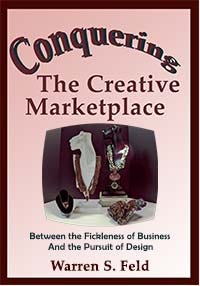
CONQUERING THE CREATIVE MARKETPLACE:
Between the Fickleness of Business and the Pursuit of Design

This guidebook is a must-have for anyone serious about making money selling jewelry. I focus on straightforward, workable strategies for integrating business practices with the creative design process. These strategies make balancing your creative self with your productive self easier and more fluid.

Based both on the creation and development of my own jewelry design business, as well as teaching countless students over the past 35+ years about business and craft, I address what should be some of your key concerns and uncertainties. I help you plan your road map.

Whether you are a hobbyist or a self-supporting business, success as a jewelry designer involves many things to think about, know and do. I share with you the kinds of things it takes to start your own jewelry business, run it, anticipate risks and rewards, and lead it to a level of success you feel is right for you, including

· Getting Started: Naming business, identifying resources, protecting intellectual property

· Financial Management: basic accounting, break even analysis, understanding risk-reward-return on investment, inventory management

· Product Development: identifying target market, specifying product attributes, developing jewelry line, production, distribution, pricing, launching

· Marketing, Promoting, Branding: competitor analysis, developing message, establishing emotional connections to your products, social media marketing

· Selling: linking product to buyer among many venues, such as store, department store, online, trunk show, home show, trade show, sales reps and showrooms, catalogs, TV shopping, galleries, advertising, cold calling, making the pitch

· Resiliency: building business, professional and psychological resiliency

· Professional Responsibilities: preparing artist statement, portfolio, look book, resume, biographical sketch, profile, FAQ, self-care

548pp., KindlePrintEpub

Posted in Art or Craft?, bead stringing, bead weaving, beads, beadwork, business of craft, craft, craft shows, Entrepreneurship, handmade jewelry, jewelry making, professional development | Tagged: , , , , , , , , , , , | Leave a Comment »

HOW TO BEAD A ROGUE ELEPHANT: The Musings of a Jewelry Designer: EXISTENCE

Posted by learntobead on September 20, 2024

A jewelry designer is not born with an inherent essence of being a designer. Rather, they become a designer, and exist as a designer, through the act of designing. The essence with which each jewelry designer conveys when existing as a jewelry designer is some blend of artistic expression, craftsmanship, emotional resonance, and functional ability, and, in some cases, business acumen.

The question we get asked over and over again, and we ask ourselves over and over again, is: Who Are You? / Who Am I?

The obvious answer is You are who you are. Or, You are what you doYou exist.

But, how do you become?

You weren’t born into jewelry design. Jewelry designing may or may not have been on your horizon as you grew up, began some kind of work, and lived your life. At some point, you became a jewelry designer.

Was there a point in time where you felt in your gut that you not only were making jewelry, but you had become a jewelry designer?

Perhaps not. In this case, you might have felt that anyone might make jewelry at any point in time. You made it, you sold it, you gave it away. If we merely exist to make jewelry, then we are a technician. An automaton. Interchangeable with a machine. Easily replaceable and duplicated. The results of our work are repeatable. Universal. Mass appeal. Same ole, same ole. We haven’t become a jewelry designer. We merely implement designs.

Yet, perhaps there is a point in time where we, not only be and do, but become. After all, in this case, not just anyone can design jewelry. A machine can be given instructions on how to design jewelry. But it cannot be inspired. It cannot, on its own, inspire others. It cannot build in meaning and content and power and edginess. It cannot evoke emotions. It cannot, on its own, find that point of conversation between designer and client where both believe the jewelry is finished and successful. It cannot, on its own, understand desire and its driving forces for both designer and client. Nor, where their desires overlap and where they conflict. All these cannots suggest that one more likely becomes a jewelry designer. At some point.

So, how do you become? How do you become a jewelry designer?

And once you become, how do you know you are one?

And, finally, what does it mean to exist as one?

Existence

The idea of existence can sound so pejorative in some ways. A sense of nothingness, an as “is”. Something mechanical that may or may not be self-perpetuating. A tree holding up the sky for no particular reason, but that it does.

I can prefix the idea of existence with one of essence. This sounds a little sexier. The jewelry designer cannot exist as a jewelry designer without some sense of exuding some essence. It is not a smell or perfume. It is not some particular set of tools or techniques. It is more than an idea or fantasy or wish fulfillment.

The essence with which each jewelry designer conveys when existing as a jewelry designer is some blend of artistic expression, craftsmanship, emotional resonance, and functional ability, and, in some cases, business acumen. It is not beauty or functionality, but beauty and functionality. It is not object or intent, but object and intent. It is not mechanically constructed or symbolically constructed, but mechanically constructed and symbolically constructed. It is not the assumptions, expectations, perceptions, values and desires of the designer or the client, but both of designer and client in a shared dialogue about understandings.

The existence of the jewelry designer is one of telling stories. Stories evoke meanings. Meanings lead to emotional and resonant responses. Emotional and resonant responses often lead to public expression. Public expression might lead to contagion or rejection.

To exist as a jewelry designer means encapsulating all these things. Together. At once. But piecemeal, too. Integrated, but contradictory, too. Coherent, yet incoherent concurrently, too. Existence as a jewelry designer takes on multi-faceted meanings. Existence is shaped by creativity, influenced by materials and techniques, affected by someone’s relationship to beauty, oftentimes jarred by architectural issues of functionality, stresses and strains, softened by the impact their pieces have on the client and the situations the client, wearing their works, finds themselves in.

Jewelry design is a process, and the cycle repeats with each new piece. But the essence is the same. The existence has, indeed requires, the same essential parameters.

You Know It When You Know It

I do some coaching from time to time with students who want to exist as jewelry designers, but not sure if they do, if they do yet, and how to know when it happens. It could result from difficulty with a technique. Or the application of art and design principles of composition, construction and manipulation. Or how to make some success in business.

A lot of the coaching boils down to the same thing: the essence of existence.

CONTINUE READING ON MY JEWELRY DESIGNERS’ HUB HERE…

_______________________________________________________

I have set up a space for our community of jewelry designers — Warren Feld Jewelry’s PATREON HUB — to learn, to interact, and to provide and/or get feedback on what they are working on. Please join here.

Be part of a community of jewelry designers who recognize that we have a different way of thinking and doing than other types of crafters or artists. Access more articles and other resources not included in my medium.com site.

Visit my website www.warrenfeldjewelry.com

Feel free to add your comments.

Shop with us at Land of Odds.

Posted in Art or Craft?, art theory, bead stringing, bead weaving, beads, beadwork, business of craft, creativity, design management, design theory, design thinking, handmade jewelry, jewelry, jewelry design, Learn To Bead, pearl knotting, professional development, wire and metal | Tagged: , , , , , , | Leave a Comment »