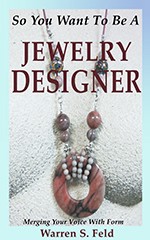
Design and Assemble Your Own Jewelry, The Complete Insider’s Guide
New book by Warren Feld
Learning Bead Stringing Is More Than Putting Beads On A String, And Tying On A Clasp
There is an art and skill to stringing beads. First, of course, is the selection of beads for a design, and the selection of the appropriate stringing material. Then is the selection of a clasp or closure, appropriate to the design and use of the piece.
You want your pieces to be appealing. You want them to wear well. You want someone to wear them or buy them. This means understanding the basic techniques, not only in terms of craft and art, but also with considerations about architecture, mechanics, and some sociology, anthropology and psychology.
In this book, I go into depth about:
1. Choosing stringing materials, and the pros and cons of each type
2. Choosing clasps, and the pros and cons of different clasps
3. All about the different jewelry findings and how you use them
4. Architectural considerations and how to build these into your pieces
5. How better designers use cable wires and crimp, as well as, use needle and thread to string beads
6. How best to make stretchy bracelets
7. How to make adjustable slip knots, coiled wire loops, and silk wraps
8. How to finish off the ends of thicker cords or ropes, so that you can attach a clasp
9. How to construct such projects as eyeglass leashes, mask chains, lariats, multi-strand pieces, twist multi-strand pieces, and memory wire bracelets
10. How different teaching paradigms — craft vs. art vs. design — might influence the types of choices you make
For Warren Feld, Jewelry Designer, (www.warrenfeldjewelry.com), beading and jewelry making have been wonderful adventures over 36+ years. These adventures have taken Warren from the basics of bead stringing and bead weaving, to pearl knotting, micro-macrame, wire working, wire weaving and silversmithing, and onward to more complex jewelry designs which build on the strengths of a full range of technical skills and experiences. http://www.warrenfeldjewelry.com
I’d estimate that 25–30% of my students are in the jewelry making /design hobby to make some extra money. Some see a way to supplement their income. Some see it as a retirement strategy. Others see it as a career transition. Whatever their goals, some have been successful, and others less so. Here are some of their stories.
Cindy
Cindy saw it as a career transition. She made and sold jewelry, went to craft shows and church bazaars, put her stuff on consignment all over the metropolitan area, did home shows, whatever.
After about two to two-and-a-half years, she took the giant leap and quit her full-time legal aid job to be a full-time jewelry artist/entrepreneur. She was successful because she knew how to promote herself, and was very comfortable at this.
Her designs were fashion-current, but not bizarre. One business that had her stuff on consignment told me how great she was to work with.
My only concerns were that she often short-changed some of the quality of materials, and perhaps pushed the pricing a bit too high. But I marvel at her success. if you stick to it, and are confident in yourself, you’ll get there.
Mona
Mona refurbished old pieces into new. She took old brooches, fixed them up, restored missing stones, polished or colored damaged edges. She turned them into pendants, and then created necklaces with the same sensibilities, colors, textures, bulk, and patterns to go with them.
Sold like hot-cakes. She took old, gaudy belt buckles, glued on Austrian crystal rhinestones, found leather belts to go with them, fashioned some tpe of bail, and voila! She had great stories to go with each piece. She also was great at self-promotion. She was very confident. And she got her pieces into all the major stores in the area. She also formed great connections to power-fashion-players, including many people in the music business.
Sharon
Sharon made lampwork beads, and turned these into necklaces and bracelets. She was shy. She tried to sell them to friends and family. She tried to get them into one store on consignment. She tried selling them on EBay. She’s still trying.
Yanxi
Yanxi made Native American style earrings mostly, but some chokers and bracelets, as well. She relied on traditional bead weaving styles of Peyote and Brick. She used traditional materials including Czech seed beads, beading thread, sinew. She used traditional colors and designs. She sold in stores. She sold at markets. She was doing very well for many years.
Until around the later 1990s. Chinese businesses began copying Native American jewelry, and selling their pieces at prices so low, that Native Americans could no longer afford to make a living at making jewelry.
Yanxi’s business faded away to nothing. She was unable to adapt to the changes in the business environment. She could have gone more upscale in the choice of materials and the elaborateness in the designs. But she did not recognize that as a pathway.
Veronica
Veronica made high-end clothing with an edge to her designs. At one point, with her clothing, she decided to create accessories, including jewelry. Necklaces out of old men’s ties. Bracelets out of leather suspender straps from Germany. Odd beads which always catch your eye dangling from old, antiqued, large-linked chain.
She had an acute sense of what jewelry women — of all shapes, ages, sizes, body shapes — could wear to empower themselves. Attract that kind of attention which borders on admiration.
At first, she sold her jewelry pieces to individual stores in various cities she visited. They sold her pieces very quickly. In response, she began working in more of a production mode. She sent these stores boxes of her pieces to be sold as special trunk shows. That idea worked well.
She then worked on setting up a shop-within-a-shop. Several stores were eager to have her store-within-a-store. She envisioned taking over a 6’x8′ area. She created display cabinets, display pieces, and an organizational plan for displaying her pieces. She went to hotel foreclosure sales and purchased old odds and ends to use for displays, such as old wooden clothes hangers which had the hotel logo or name etched in them.
Her jewelry lines overtook her clothing lines.
Debby
Debby made beautiful, elegant, dainty jewelry from bracelets to necklaces to eyeglass leashes. She put them in a few stores. She had been an airline stewardess, and frequently brought her jewelry with her to sell at get-togethers and conventions with past and current airline employees.
Everyone loved her pieces. Everything she made sold. She was reluctant, however, to place them in many stores. She was afraid people would copy her designs. One person, in fact, had copied some of her designs.
Debby wanted to mass-market her pieces to high end boutiques and department stores. She spent years making contacts and connections, which she was very successful at. But she couldn’t reel in the opportunities. Her fears overcame her — people would copy her designs, or they would not manufacture her pieces to her quality expectations, or the manufacturers wanted to make pieces with more mass appeal.
There was always something that got in the way of her making a living by making jewelry. She built walls. She couldn’t climb over them.
Larry
Larry approached Barneys New York about his line of jewelry. He had a personal connection there. He had a marketing strategy for them, which included explaining why the lines of jewelry they currently carried, were not working for them.
He showed them a very full line — jeweler’s tray after jeweler’s tray after jeweler’s tray of jewelry.
With each tray he showed them photographs of jewelry which were carried by their major competitors in New York, as well as fashion spreads in major magazines.
He kept making the point: His jewelry is better, and this is why. His jewelry is better, and this is why. His jewelry is better, and this is why.
Success!
Kiki
Kiki wanted to sell on-line. She knew she needed a web-site with a shopping cart. But she shied away from the $50.00 per month price tag. She knew she would have to hire someone to design her website, but again, the $500.00 quoted price seemed daunting to her. She spent year after year researching web-hosts and web-designers, each time finding something that made her more and more uncertain.
Virtual jewelry, virtual business.
Rosie
Rosie lived in the wealthiest part of town — Belle Meade. She custom made jewelry for the rich for them to wear at special occasions. Her biggest obstacles to overcome: many of her clients were not sure that anyone could actually make jewelry. Jewelry was something that you bought in New York. Not Nashville. Somehow it could only be made in New York and probably by machine. Her clients hesitated, not sure how anyone, let alone anyone local, could actually make jewelry for them.
She took their naivete in stride. She made the making of jewelry seem straightforward. She made the custom designing seem specialized and right up her alley.
She made a necklace and earring set for someone to wear at the Swan Ball.
She made a very unattractive, yet very appreciated by the customer, necklace to wear at a horse race. the colors had to match the specific colors in the horse’s blanket — navy, white and rose. The rose was a special color rose associated with some Queen’s rose somewhere. On the face of things, navy, white and rose don’t usually result in something rich, elegant and status’y looking. But Rosie did a fabulous job. She would not, however, have ever worn this particular necklace herself.
She made a lariat for someone to wear on a cruise. Plus, 5 different sets of earrings, each coordinating with the lariat. Plus, 10 different bracelets, each having a different clasp, and again, coordinating with the lariat.
Rosie’s willingness to adapt to the peculiar needs of her customer base made her a success. And to her customer base, money was no object.
Alejandro
Alejandro didn’t want to design jewelry per se. He wanted to find jewelry designed by others and find places that might sell this jewelry. His mom had gotten breast-cancer (she’s a survivor). And he had this brainstorm.
He visited the Dallas Merchandise Mart. He found about a dozen vendors who represented lines Alejandro thought would do well in the various fundraising events the state’s Breast Cancer Society sponsored.
From these vendors, he gathered information about the products, the minimum units which needed to be purchased at a time, the unit cost, and the suggested retail price.
He determined what kind of commission he needed to make this work and wanted to get.
He sat down with the marketing executives at the Breast Cancer Society. He showed them pictures of the various products and the numbers. He negotiated a deal and a plan.
This is what you call a Win-Win-Win. The vendor wins. The client wins. and Alejandro wins.
Getting Started In Business
You need to look yourself in the mirror, and be very, very, very honest with yourself. Getting started in business is a big step. It’s not all fun and games. There’s paperwork, repetition, tradeoffs to be made. Be honest with yourself.
Ask yourself:
o Why do I want to start a business?
o What type of business do I want?
o What kinds of things do I want to sell?
o What kind of time and energy commitments do I want to commit?
o Where will the money come from to get started?
o Where will I work — kitchen table? craft studio? at a store?
o What will I name my business?
o Where will I get my jewelry making supplies?
o Do I want to do this alone, or with a partner(s)?
There are many different kinds of jewelry you can sell. Necklaces. Bracelets. Earrings. Eyeglass leashes. Name badge jewelry. Rings. Anklets. Ear cuffs. Body jewelry. Jewelry for dogs and cats. Jewelry representing social causes. Beaded jewelry. Wire jewelry. Polymer and metal clay jewelry. Fabricated jewelry, such as with silver smithing techniques. Lampwork jewelry. Blown glass jewelry. Micro macrame and hemp jewelry. Jewel-decorated objects like pillows, lampshades, dinner ware.
There are many different approaches and venues for selling jewelry. these include selling to friends, co-workers and family. Selling at home shows. Selling at craft shows or trunk shows. Selling online. Selling in stores and galleries, either retail, consignment or wholesale. Selling in a truck, driving from city to city, parking, and opening your truck doors for people to come into your mini-showroom. Selling in print catalogs. Designing and/or selling for promotions and events, such as a fund-raiser for breast cancer. Doing repairs.
Whatever the approach and venue, you need to step back, and be sure it is on a solid business basis. This means delving into some bureaucracy and administrivia. You can’t get around this.
Yes, you can make money selling jewelry. But you have to be smart about it.