Use a catchy phrase to summarize your business and get people’s attention…
Create A Tag Line
On written documents, brochures, stationery, envelopes and on online documents with titles, headings and the like, you have an opportunity to present more “words”, that is “meanings”, about your business. This gives you a second opportunity to convey things about your business that perhaps your specific business name falls short on, or needs more emphasis.
After you’ve come up with a business name, return to your lists of key words, and not-so-key words, and think of a tag line. Think of it as a “subtitle”.
Your Tag Line is a marketing opportunity, and should be worded in a catchy way. A great tag line captures the essence of the value you provide to your customer in one or two concise sentences.
Great tag line for taxidermy business: “the only game in town”
For my shop, Be Dazzled, “Don’t Be Frazzled, Be Dazzled!”
For my shop, Land of Odds, “Your Partner In Design”
First write a 9 words or less tag line. You need to be able to tell someone, in 1-sentence, preferably seven to nine words, who you are as a jewelry designer. What’s your style? What’s your approach? What’s your uniqueness? What’s your competitive advantage?
No qualifiers. No further supporting detail and elaboration. 1-Sentence.
It might be helpful to fill in this blank: “You want to buy/sell my jewelry because….(blank)….”
Or, “My jewelry is different and more relevant and better than everyone else’s because… (blank) …. “
A tagline doesn’t need to be overly clever or cute to be effective. A good tagline is primarily functional. It should explain the unique value that your business offers as clearly as possible.
Sure, many classic taglines are pretty smart. “Let your fingers do the walking” is a clever play on words. But it also clearly evokes the value that the Yellow Pages offers: easy access to reliable information.
Don’t Worry About Being Too Cute
Make It Memorable
Inject a Little Personality
Settle on a final draft.
GUIDELINES TO CREATE A GREAT SLOGAN
1. Identification. A good slogan must stay consistent with the brand name either obviously stated or strongly implied. It’s better to include the name of your business to it.
2. Memorable. Some of the best taglines or slogans are still being used today, even though they were launched several years ago.
3. Beneficial. Reveal your purpose and benefits of the product by conveying the message in consumer language. Turn bad into good. Suggest the risk of not using the product. Create a positive feeling for the consumers.
4. Differentiation. In an overcrowded market, companies in the same industry need to set themselves apart through their creative and original tagline or slogan.
5. Keep it simple. Use proven words and short keywords. One word is usually not enough.
Some examples of tag lines / slogans:
A diamond is forever. Beyond precision. Crystal gets closer to the body than ever before. Diamonds by the Yard. Every kiss begins with Kay. Live the moment. Perpetual spirit. Quality is Remembered Long After the Price is Forgotten. The crown jewellers for 150 years. The Jeweller of Kings. The right time for life. The added value of the first impression. Where Maryland gets engaged. For those who want more. Honesty, my addiction. Getting rid of headaches since 1888. Ring on your finger, necklace on your neck, and men on their knees. Diamonds. Divas. Desire. Love’s embrace. Want honesty? She only has two things on her list. Unleashing the beauty of the stone. Unstoppable. Our reputation shines as brightly as our diamonds. Beautiful, masterful design never goes out of fashion. Walk down our aisles first. Hearts on fire. The ultimate in luxury and style.
For more articles about Conquering The Creative Marketplace, click over to our Jewelry Designers’ Hub
Many people learn beadwork and jewelry-making in order to sell the pieces they make. Based both on the creation and development of my own jewelry design business, as well as teaching countless students over the past 35+ years about business and craft, I want to address what should be some of your key concerns and uncertainties. I want to share with you the kinds of things (specifically, a business mindset and confidence) it takes to start your own jewelry business, run it, anticipate risks and rewards, and lead it to a level of success you feel is right for you. I want to help you plan your road map.
I will explore answers to such questions as: How does someone get started marketing and selling their pieces? What business fundamentals need to be brought to the fore? How do you measure risk and return on investment? How does the creative person develop and maintain a passion for business? To what extent should business decisions affect artistic choices? What similar traits to successful jewelry designers do those in business share? How do you protect your intellectual property?
The major topics covered include,
1. Integrating Business With Design
2. Getting Started
3. Financial Management
4. Product Development, Creating Your Line, and Pricing
5. Marketing, Promotion, Branding
6. Selling
7. Professional Responsibilities and Strategic Planning
8. Professional Responsibilities and Gallery / Boutique Representation
9. Professional Responsibilities and Creating Your Necessary Written Documents
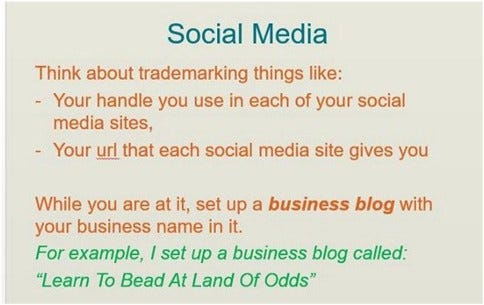
Besides your personal pages on various social media sites, you will want to have separate business pages. You would each business page to be keyed off you unique, registered and/or trademarked business name.
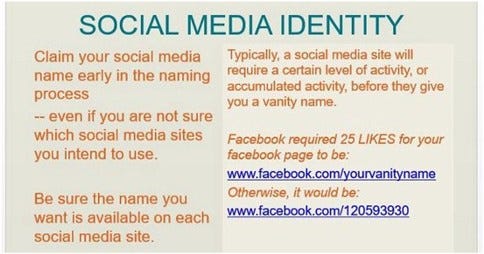
It’s a good idea to claim your social media name early in the naming process — even if you are not sure which sites you intend to use. A name for your Facebook page can be set up and changed, but you can only claim a vanity URL or custom URL once you’ve got 25 fans or “likes.” This custom URL name must be unique, or un-claimed.
Along with the URL for the business name, you’ll want to check and make sure there are places on Facebook, LinkedIn, Twitter, and Instagram (at the minimum) to claim early on.
You will want your business listed as a business in various search engines, like Google and Bing, Google Maps, Google Business, and various directories, like Yelp.
Being active on public social media platforms such as Facebook, Instagram, LinkedIn, BlueSky, and Twitter in addition to your own business blog, is almost an essential part of any business marketing toolkit. These tools can have enormous benefits, but they also have their dangers.
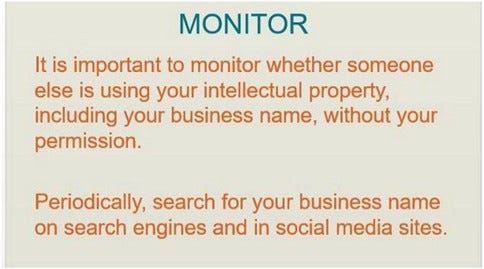
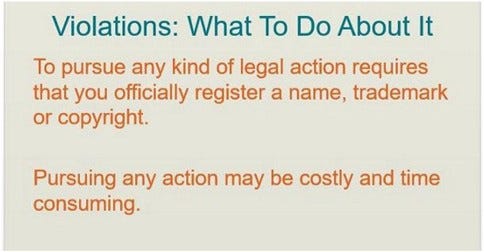
For example, some businesses jump on social networking sites only to discover that someone has already registered their company or product names on Facebook and Twitter and is misrepresenting their brand as a consequence. Likewise someone might be out there reproducing your copyrighted web copy, blogs, photographs and videos (all that good multi-media stuff that social networks love to propagate) — without your knowledge.
For more articles about Conquering The Creative Marketplace, click over to our Jewelry Designers’ Hub
Many people learn beadwork and jewelry-making in order to sell the pieces they make. Based both on the creation and development of my own jewelry design business, as well as teaching countless students over the past 35+ years about business and craft, I want to address what should be some of your key concerns and uncertainties. I want to share with you the kinds of things (specifically, a business mindset and confidence) it takes to start your own jewelry business, run it, anticipate risks and rewards, and lead it to a level of success you feel is right for you. I want to help you plan your road map.
I will explore answers to such questions as: How does someone get started marketing and selling their pieces? What business fundamentals need to be brought to the fore? How do you measure risk and return on investment? How does the creative person develop and maintain a passion for business? To what extent should business decisions affect artistic choices? What similar traits to successful jewelry designers do those in business share? How do you protect your intellectual property?
The major topics covered include,
1. Integrating Business With Design
2. Getting Started
3. Financial Management
4. Product Development, Creating Your Line, and Pricing
5. Marketing, Promotion, Branding
6. Selling
7. Professional Responsibilities and Strategic Planning
8. Professional Responsibilities and Gallery / Boutique Representation
9. Professional Responsibilities and Creating Your Necessary Written Documents
Check to see if anyone has registered your business name online as a registered domain name. Go to http://www.networksolutions.com/ or www.GoDaddy.com and type in the name you want. If the name you want is taken, you can always vary the domain type, such as “.net” or “.biz” instead of “.com”. You can vary a name by adding punctuation like a hyphen or period or deleting a space between words. You can vary a name by making it plural. You can vary the name by playing with the spelling of certain words — even making up your own creative spelling for some words.
Next, register a business domain name, so that you protect your business name from other people who might use it on-line. In translating your business name to an internet domain name, keep in mind that your email address will include that domain name. You want people to be able to easily and quickly type in your email address into an email. You do not want people to confuse the spelling or any added punctuation.
Pointers: The business name does not have to match your domain name The .com extension would be best, even though there are many other choices If possible, the domain name should be rich in key words.
To find out if your business name has been claimed online, do a simple web search to see if anyone is already using that name.
Many people learn beadwork and jewelry-making in order to sell the pieces they make. Based both on the creation and development of my own jewelry design business, as well as teaching countless students over the past 35+ years about business and craft, I want to address what should be some of your key concerns and uncertainties. I want to share with you the kinds of things (specifically, a business mindset and confidence) it takes to start your own jewelry business, run it, anticipate risks and rewards, and lead it to a level of success you feel is right for you. I want to help you plan your road map.
I will explore answers to such questions as: How does someone get started marketing and selling their pieces? What business fundamentals need to be brought to the fore? How do you measure risk and return on investment? How does the creative person develop and maintain a passion for business? To what extent should business decisions affect artistic choices? What similar traits to successful jewelry designers do those in business share? How do you protect your intellectual property?
The major topics covered include,
1. Integrating Business With Design
2. Getting Started
3. Financial Management
4. Product Development, Creating Your Line, and Pricing
5. Marketing, Promotion, Branding
6. Selling
7. Professional Responsibilities and Strategic Planning
8. Professional Responsibilities and Gallery / Boutique Representation
9. Professional Responsibilities and Creating Your Necessary Written Documents
Your story might be 1 to 3 paragraphs long. It should be something you can say out loud to someone within 1 – 4 minutes.
Make this write-up part of your promotional materials. Tell your story out loud to friends and relatives. Eventually telling your story will become second-nature.
Your story will have three parts:
1. INTRODUCTION
Establish a context or situation. Explain why it matters. Identify the various problems or difficulties you had to overcome. The context or situation is something you believe your customer can connect with on an experiential and/or emotional level. If possible, your first sentence should contain a hook – something that captures someone’s attention, curiosity, wonderment, or something that captures a strong connection with the listener.
2. BODY
Detail how you came up with various solutions to the problems or difficulties. Mention your style or design preferences, and why you think they are important or advantageous. Pick 1 or 2 problems that you solved. Keep things simple, short, clear.
3. CONCLUSION
Say something about how your success evolved from how you found solutions to the problems you identified. Indicate how your success guides you now and will guide you into the future.
Practice how you tell your story. Make it impressive!
For more articles about Conquering The Creative Marketplace, click over to our Jewelry Designers’ Hub
Many people learn beadwork and jewelry-making in order to sell the pieces they make. Based both on the creation and development of my own jewelry design business, as well as teaching countless students over the past 35+ years about business and craft, I want to address what should be some of your key concerns and uncertainties. I want to share with you the kinds of things (specifically, a business mindset and confidence) it takes to start your own jewelry business, run it, anticipate risks and rewards, and lead it to a level of success you feel is right for you. I want to help you plan your road map.
I will explore answers to such questions as: How does someone get started marketing and selling their pieces? What business fundamentals need to be brought to the fore? How do you measure risk and return on investment? How does the creative person develop and maintain a passion for business? To what extent should business decisions affect artistic choices? What similar traits to successful jewelry designers do those in business share? How do you protect your intellectual property?
The major topics covered include,
1. Integrating Business With Design
2. Getting Started
3. Financial Management
4. Product Development, Creating Your Line, and Pricing
5. Marketing, Promotion, Branding
6. Selling
7. Professional Responsibilities and Strategic Planning
8. Professional Responsibilities and Gallery / Boutique Representation
9. Professional Responsibilities and Creating Your Necessary Written Documents
Guiding Questions? 1. How do I write a Biographical Sketch or Profile? 2. Does a biographical sketch replace or compliment a person’s resume?
Keywords: biographical sketch profile resume connection avatar 1st person vs. 3rd person voice
The Biographical Sketch or Profile
Your customers, your sales venues, your clients all love stories, and they want to know yours. Your story might be a profile on a social media site. It might be a synopsis on the back of your portfolio or print book on demand. It might be part of a grant or art show application.
You will want to create several versions of varying lengths, but all basically highlighting the same information. I suggest creating versions which are 25 words, 50 words, 100 words, 250 words, 500 words. Your first 25 words should sound fun, intriguing, exciting, enticing, creating wonder and curiosity … you get the point.
Do not follow a template. You want your bio or profile to feel authentically your own.
Write your bio for a portfolio in the 3rd person. Write your profile for a social media site (think Facebook) targeted at family and friends in the 1st person. Write your profile for a social media site (think LinkedIn) targeted at potential employers in the 3rd person.
Within your Sketch or Profile, you will want to anticipate what people will be curious about. When someone first sees your jewelry, they will try to understand it, categorize it, emotionally connect to it. The greater the connection, the more likely the sale. How well has your bio helped them?
Your bio or profile is not your resume. It is not a listing of things. It will only touch on some things, and not all things, you might include in a resume. It is a story about you and your work. You might highlight a particular product, achievement or contribution as a way of illustrating the points you are making in your bio or profile.
Things to help people make that connection will include,
· Your name
· How you got started
· Where you are from
· How long you have been making jewelry
· Your style preferences
· Where can they find and buy your work
· Your inspirations and aspirations
· Techniques and technologies
· Materials used
· Who taught you; where did you learn your craft?
· Your career development
· Awards won, certifications, exhibitions, where to find your work
· Reviews, testimonials, what others think about your work, collectors
Avoid vague statements like “innovative approach” or “original” without context — use specific influences, techniques, and themes instead.
An Avatar
An Avatar is a digital image that represents you. Avatars are relatively small and usually are placed at the top left or right corner of web pages which represent your work, such as an article you have written or a video tutorial you offer.
The Avatar may be an image of yourself, typically a head shot. It might be an image of a favorite piece of jewelry. It might be your logo. It might be an animation representative of you and your business.
Remember that the space is limited in size. It may be a circle or an oval, rather than a square or rectangle. This means you will need to center the image to its advantage.
There are avatar generators online. Or you can make your own from scratch.
_________________
FOOTNOTES
Patkar, Mihir. The 8 Best Avatar Maker Sites for Profile Pictures. 4/27/22.
This guidebook is a must-have for anyone serious about making money selling jewelry. I focus on straightforward, workable strategies for integrating business practices with the creative design process. These strategies make balancing your creative self with your productive self easier and more fluid.
Based both on the creation and development of my own jewelry design business, as well as teaching countless students over the past 35+ years about business and craft, I address what should be some of your key concerns and uncertainties. I help you plan your road map. Whether you are a hobbyist or a self-supporting business, success as a jewelry designer involves many things to think about, know and do. I share with you the kinds of things it takes to start your own jewelry business, run it, anticipate risks and rewards, and lead it to a level of success you feel is right for you, including
• Getting Started: Naming business, identifying resources, protecting intellectual property • Financial Management: basic accounting, break even analysis, understanding risk-reward-return on investment, inventory management • Product Development: identifying target market, specifying product attributes, developing jewelry line, production, distribution, pricing, launching • Marketing, Promoting, Branding: competitor analysis, developing message, establishing emotional connections to your products, social media marketing • Selling: linking product to buyer among many venues, such as store, department store, online, trunk show, home show, trade show, sales reps and showrooms, catalogs, TV shopping, galleries, advertising, cold calling, making the pitch • Resiliency: building business, professional and psychological resiliency • Professional Responsibilities: preparing artist statement, portfolio, look book, resume, biographical sketch, profile, FAQ, self-care
You want to influence someone to establish a 1 to 1 relationship with you, when that someone is not familiar with you and your work. Think about what might motivate them. That thing is your lead magnet.
These days, a lot of business marketing and branding activities occurs through and on the computer. One core aspect of your business depends on attracting “eyeballs”. You might be expanding your email contact list. You might be trying to accumulate fans and followers. You might be trying to expand readers, customers, members and subscribers.
Towards these ends, one of the primary things you will do is expand your email contacts list. One of the most productive and successful ways of doing this is to offer a lead magnet. A lead (pronounced ‘leed’) magnet is a tangible thing you promise to deliver to your audience if and when they register their email address with you.
Crafting The Lead Magnet
Your lead magnet should be concrete, focused and actionable. The less abstract it is, the better.
It should be easy to consume. You do not want to overload the target customer with information.
It should have a recognizable value. Do not be cheap here; do not feel you are giving away secrets.
It should trigger and reconfirm a great impression of you and your work.
Again, make it a clear thing. It could be things like:
· Checklist of supplies and tools to have on hand in your studio
· An e-book, such as jewelry silhouettes vis-à-vis body and face shapes, or guide to getting started on Instagram
· A tutorial or project instructions
· A downloadable
· A ticket to access something else, such as getting into a private showing of your work
· A voucher, like a discount coupon for a piece of jewelry you have made
· A short how-to video
A physical lead magnet will work better than something nonphysical.
Give your benefit a name. The name should confirm that the benefit is a physical thing of value that the customer will get, thus rewarding the customer for sharing their email address with you (or registering on your website).
#’s, capital letters, symbols in messages catch attention.
Be A Generous Giver
You want to influence someone to establish a 1 to 1 relationship with you, when that someone is not familiar with you and your work. Think about what might motivate them. That thing is your lead magnet. Think about the best way to leverage your lead magnet in order to asset your influence.
You establish a sense of reciprocity. Be generous and they will trust you.
Keep their work simple. Ask them to make a micro-commitment — simple to get, little work for them, but a big asset for you.
Build In A Contingency
You can set some kinds of limits to heighten the customer’s motivation to follow through. Create a sense of urgency to comply with your call to action. For example,
· Your ‘benefit’ runs out in 30 days
· If you are the first 10 to sign up, you get a 2nd benefit
Examples of lead magnets:
· Free mini-lesson, ebook or guide on a technique or project or how to get started making jewelry
· Discount coupon for classes, supplies, pieces of jewelry
· Tutorial videos
· Jewelry making supply list, curated favorite jewelry making supplies, and how to use them
· Exclusive access to a webinar
· Printable color wheels
· Exclusive piece of jewelry, like a stretchy bracelet
· Live preview of new pieces you have made (before showing them to the public)
· Jewelry appreciation guide — techniques, materials, history
· Behind the scenes content so that they can see your creative process
· Personalize jewelry recommendations
· Survey their tastes so you can match these to your jewelry pieces which are currently available
· Collector’s guide: how to get started, caring for jewelry, how to determine value
· Jewelry-themed desk top wallpaper; mobile wallpaper: perhaps featuring your work
· Virtual jewelry show ticket — showcase your latest work
· Local Art and craft show calendar, particularly if you will be showing at these
· Various checklists
· Article about how to buy gemstones
· Invite to ZOOM or chat session for a Q&A about jewelry making or problem solving
Delivering Your Lead Magnet
As a jewelry designer, you want to convert exposure into prospects. This means you want to deliver your lead magnets everywhere you think you can get exposure to the types of people you want to stay in touch with you.
You might list it as your E-signature on emails, or on your business cards, in your social media profiles, on your website.
Example: In your Instagram bio: DM me “LIST” to get my upcoming materials checklist when it is ready. Then in response to their DM, return with, “Which email address should I sent it to when ready?”
If you are directly someone to a form for collecting email addresses, instead of heading that form: Join My Email List, focus on the lead magnet. For instance, you might write: Get my free guide to …
If you are creating videos and reels, your last slide my be that call to action: Get my free guide to…
__________________________________
~~~~~~~~~~~~~~~~~
***Be part of a community of jewelry designers who recognize that we have a different way of thinking and doing than other types of crafters or artists.
Engage with a community. Benefit from its collective power — insights, reactions, feedback, foresight, and directing you to opportunities.
Never miss an update. You won’t have to worry about missing anything. Every new article of interest, and announcements about kits, workshops and webinars, chat group, feedback session, and special promotions, goes directly to your inbox.
I have found Instagram the best social media site for promoting your jewelry sales, and their algorithm has changed for the better for us
Before, Instagram would show new posts to 1% of your followers first and, depending on the response, share further.
This favored accounts with a large following, such as influencers or jewelry designers with especially large followings, since their 1% is a lot more than the 1% of a small account.
Now, every new post will be shown to a random group of users, usually ones with a shared interest in the kind of posts you create. Think: followers of your followers who don’t yet follow you will get prioritized. Aggregators accounts, like influencers, will get diminished a bit. In a similar vein, co-occurring is this situation: If you post an image on your own feed as well as with an influencer’s feed, that image will only appear on your own feed, not on the influencer’s. Instagram’s goal is to reward originality and the creator.
This is great news for smaller accounts: it widens the funnel of potential engagement with each post.
Reels are still important, but they’re no longer the only ones.
Focus on posting a mix of Reels, still images, and carousels. Should NOT be all reels all the time. The important factor is that you are giving your followers value. Make them feel like you are giving them something.
Give people something to read (in the post or the caption)
Provide an insider point of view to your jewelry-making process
Choose an eye-catching cover image for all posts (hook them)
Better lighting often solves many issues of gaining and keeping attention. Also bring people in close to the elements in the image. Focus on a a section of the piece. Show them your hands at work. Don’t pull back for that wide shot of everything necessarily.
Bring people in close, show them what you’re doing.
Give viewers a reason to watch your entire Reel.
NO’s: Instead of simply showing your work, using captions such as:
❌ “Here’s my latest piece of jewelry…”
❌ “I have an event coming…”
❌ “My website is now live…”
YES’s: Capture their attention first, and then make your announcement:
✅ “Here’s how I turned this run-of-the-mill necklace into an exciting one..” finishing with “This piece is now available”
✅ “You won’t believe how this piece turned out…” followed by “Come see this piece live at my next show.”
WARNINGs: Less time-lapse of showing each step after it has been completed, and more showing something actionable, like implementing each step.
Come up with something that will make people hang out until the interesting part. Come up with things to make people stick around. Bring them close-in to the action. Be sure they see you sometime in the images. Be sure, at the end or towards the end, they see the outcome, such as the finished piece or section of the piece, or completed step.
End with a CALL TO ACTION. Such as, direct them to your website where they can purchase the finished piece, or to your website where they can sign up for your newletters.
__________________________________
I hope you found this article useful. Please consider sharing.
SO YOU WANT TO BE A JEWELRY DESIGNER Merging Your Voice With Form
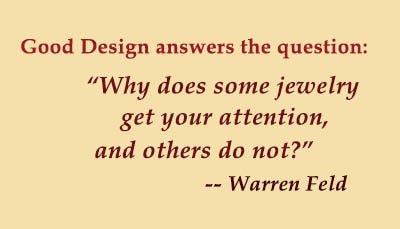
So You Want To Be A Jewelry Designer reinterprets how to apply techniques and modify art theories from the Jewelry Designer’s perspective. To go beyond craft, the jewelry designer needs to become literate in this discipline called Jewelry Design. Literacy means understanding how to answer the question: Why do some pieces of jewelry draw your attention, and others do not? How to develop the authentic, creative self, someone who is fluent, flexible and original. How to gain the necessary design skills and be able to apply them, whether the situation is familiar or not.
There are so many different kinds of things you can do business-wise to promote your jewelry designs. Post on every social media site. Conduct several email campaigns. Take out ads. Create websites. However, all these can get overwhelming and begin to impede on your time and energy for creating jewelry. To prevent this, it is important to be organized. It is important to rely on more limited, predictable, easily accessible, repeatable systems of things you need to do to sustain both your jewelry designing and your business.
Some key business-related goals involve:
(1) Impression management
(2) Mentoring
(3) Audience recruitment and retention
(4) Networking and Partnering
(5) Selling
Some caveats:
(a) To create that manageability’ you want to do as much as you can from your computer
(b) In reality, selling actual pieces of jewelry, on average, only covers about 1/3 of your sustainability needs. You may have to take on additional work, and it makes the most sense that the work relate to jewelry designing.
(c) You are in the trust-creating business. You must be able to establish instant trust about the value of your work and the desirability of your work for your core buying audience.
Impression management
What impression does someone get from interacting with you, either online or in-person or through some other point-of-sale? To what degree can you influence and control this impression? Key things to consider:
o Website
o Email Etiquette
o Cold Calling
o Follow Through
Website. You want a professional website. This website will showcase your products. It will be home to lots of well-organized and accessible information, including: your bio, your art statement, your portfolio, testimonials, links to articles you have written, perhaps a creative-focused resume, and images of your work.
It might showcase shorter videos showing you at work, or delving into a particular work.
It will have links to your various social media pages. The layout, design and information presentation across social media sites needs to be very consistent across all your platforms. You should maintain separate pages for each social media for business vs. personal. You do not want anything personal to come up in your business page feed.
It may or may not have a shopping cart system attached. If not, then you need to make clear other alternatives for how people can buy your products from you.
It will have a FAQ page detailing contact information, purchasing and return policies, payment methods, any privacy concerns.
It will have a clear way for people to add their names to your mailing list.
Email Etiquette. It is critical to generate an email list of customers/potential customers. You want them to very formally and visibly opt-in to the list. You can generate sign-up sheets, online forms, and the like towards this end. You can also segment your list into smaller, targeted groups.
Email will be your best, primary and most powerful networking tool.
You can run your own email campaigns, or use an email client like MAILCHIMP (https://mailchimp.com) or CONSTANT CONTACT (https://www.constantcontact.com). I would suggest using an email client. This will prevent your own email address from getting blocked by the internet-powers-that-be as spam.
Each time you get someone’s email address to add to your list, send them a special email, thanking them. Also direct them to your website or online presence, such as on social media, with an active link.
A monthly contact is reasonable.
Caution: many anti-spam programs reject email addresses that begin with Info, Contact, Shop, Store, Help and other very generic terms.
In writing and tone, be professional. Don’t use the kind of quick texts or posts you might use on social media.
You do not want your email to appear that it is wasting anyone’s time. Use a polite greeting and closing. In your first sentence or two be very clear in conveying why you are writing this email specifically to them. Don’t ramble. Get to your points quickly. Don’t use long blocks of texts. Segment/section things and use subheadings throughout. You want the email to be scannable. Don’t use any or many images. None to two images would be more than enough. Wait to share images until after someone requests to see them. Do, however, include an active link to where they might find images of your works online.
To the best you can, personalize things as much as possible. Direct the email to a named person. Make things sound as if you are not sending out the same email to a long list of contacts.
Some examples of personalized phrasing:
o I visited your shop recently, and
o So and so suggested I contact you,
o I visited your website,
o I read about you in such-and-such magazine,
Cold Calling. With cold calling, you have two basic strategies: (a) Shoehorn, or (b) Direct. Whatever approach you use, be sure to have done some research about your target store/gallery, the designers they represent, a sense of preferred style and looks, and the characteristics of their primary customer audience.
With a shoehorn strategy, you begin to ease yourself into the world and universe of a particular store or gallery. You visit as a customer and ask questions. You contact and talk with other artists represented in the store. You participate in open houses and other events. You add your name to their emailing list. You begin to have more and longer conversations with the owner. Gradually you introduce the idea of having your jewelry represented in their venue. Always wear one or more pieces of your jewelry.
With a direct approach, you come into the store unannounced. Hopefully the owner is there then; otherwise, ask the staff when the best time to return is. Always wear one or more pieces of your jewelry. Be prepared with about 20 pieces, nicely organized and displayed in trays, that, if you are making headway, you can bring into the venue with you. It is also OK, if you have the inventory, to have even more pieces in your car that you can bring in, if it seems the owner is interested in purchasing some things.
If you are unable to visit in person, then send a letter. Don’t phone first. It is too easy for the store to ignore you. In your letter, keep it short and to the point. Establish your credibility as a designer, and clearly identify the fit between your work and their customer base. Sound authentic, not sales’y. Write about,
o Who you are
o Your style and design sense
o Why you think your jewelry would be a good fit for their customer base
o The materials and techniques you typically use
o Your previous experience selling your pieces
o Some sheets showing inventory, description, pricing
o End with a phrase like, “I’d like to get together with you to show my work in person. I will call you to set up an appointment, if interested.”
o Add links to your website of places which show your jewelry.
Follow Through. Be very clear about this: You are not an information-sharer. Rather, you are a relationship builder. Sending out emails, posting on line, targeting letters, cold calling are all tools you use to build relationships. Relationships are built up by sharing understandings, not necessarily tid-bits of information. These understandings have to do with values, desires, assumptions, expectations, and perceptions. The more you establish shared understandings — and that does not mean having to have the same opinions — the tighter and more productive these relationships get.
If you are wanting a response to something from someone, and it’s not forthcoming in a reasonable time, follow up with that person.
If you have visited a store/gallery and had some conversation with someone there, follow up with a thank you note or some note that continues something about your conversation.
If someone sends you a comment about you or your work, send them a thank you note.
In your follow-ups, repeat the name of the person you are following up with.
Provide additional valuable information in your follow-up conversations.
Mentoring
Share your art/designer skills for a fee. You can teach classes or one-on-one. You can create instructional projects or tutorials. You can write articles. You can curate shows. You can become a coach. You can conduct online webinars.
Things have synergistic effects — they amplify other things you are doing. Mentoring will result in a larger, more targeted email list. Students will look for all the mentoring activities you do. Students often will buy your pieces. Mentoring will increase the number of topics you can talk about when networking.
Keep your initial goal simple: Aim to attract 5 students, interacting with them 1–4x each month, encouraging them to spend $50–250/student per month on your mentoring activities and product sales.
Audience recruitment and retention
What is most important about recruiting and retaining audience members is not the numbers of contacts, but the quality of your engagement with your contacts. Again, success is a matter of forming and sustaining one-on-one relationships. When you have relationships, it becomes much easier to ask for favors. On a regular basis, you can create content, for free, shared through emails, which helps you connect and form relationships with your core audience.
You don’t necessarily need 1000’s of people in your core audience. More likely, having 30–100 regular buyers of your work would suffice. This allows keeping connected and creating connections with your core audience much more attainable. Know what this limited group of buyers is looking for. Know where they hang out and where to find them. Offer them opportunities to interact with you and your jewelry, such as offering them a first look, or a time to watch you and learn a few design techniques as you work. Turn these buyers into true fans.
Think about:
o What does this core buyer care about?
o What does this buyer read?
o Where do you find this buyer?
o What resonates with this buyer?
Answers to these questions could help you shape your marketing message when explaining how your jewelry could elevate this buyer’s life. Inspiring your buyer. Building trust. Note: you are not creating jewelry for this buyer per se; rather, given the jewelry you are creating and want to create, this assists you in finding that audience who might share your values and understandings as expressed within your designs and by you as an authentic jewelry designer.
Networking and Partnering
When networking and partnering, you uncover more opportunities at less risk and cost to yourself, your creative energy, and your business fundamentals. There’s less effort to find opportunities. Less effort to put plans and projects into effect. Less effort to get visibility. Less effort to make a sale.
It might be useful to set a goal as making 3 networking contacts per week. Use your network to get help in creating these pitches. Make them shared pitches. Use the shared pitches to introduce yourself to their audiences, and conversely their products to your own audience.
Caveat: Always direct people to specific webpages relevant to any pitch. Do not direct them to your home page on your website.
Selling
As a jewelry designer, your self-concept is most likely one as an artist. But when you are in business, you need to expand this a bit and see yourself as both an artist and a salesperson. If this makes you feel a bit uncomfortable, it’s understandable, but you need to get over it. Jewelry doesn’t sell itself.
You want to always have on hand 15–20 coherent pieces available for sale. They need to feel as if they are part of a line of jewelry, with a similar emotional appeal to a defined target audience.
You want to have a list of about 50 places you could approach to carry your jewelry. Then you work the list, perhaps 3 contacts a week. Prioritize your contacts. Begin your process with your lower priority contacts so that you can gain some experience in presenting yourself and your products before approaching your most desired sites.
You do not close a sale. Keeping with a key theme of advice: You create a relationship. You are not selling a product. You are guiding someone, in a caring way, to come to understand how your jewelry might enhance and enrich their lives. You want them to make a buying decision that will be good for themselves. You are not trying to get something from them; rather, you are trying to give them something which will positively impact their lives. Your key skill here when selling is empathy.
Be bold and confident when introducing yourself.
Always ask the person you are talking with what their name is; repeat their name several times while speaking with them.
Ask a lot of questions; show interest in the client or customer. Get them talking about themselves. You should be talking about 25% of the time and your client/customer should be talking about 75% of the time.
A great story about your jewelry will sell it. They are especially interested in your inspiration, as well as your process for creating jewelry.
Don’t let your client/customer get away without at least asking them if they have any interested in purchasing your jewelry. Even if that person says No!, you would be in a better position than if you had not asked.
Final Words
Don’t let the business aspects of succeeding in jewelry design kill your creative spark. Instead, make each broad business goal into a set series of systematic, repeatable activities.
As you can see, much of all this effort can be done from your studio on your computer. This will save you vast amounts of time which you can devote to the creative side of your life. Less time jewelry marketing. More time jewelry making. The end results of these activities should be increased exposure, relationships and engagements.
The most successful designers have
o Step-by-step plans
o Associations with expertise
o Become a part of a peer audience and community
Make your jewelry design journey flourish. Take ownership over it — how you spend your time, energy and the use of resources around you. Put everything to best use to attain your own highest values.
__________________________________
I hope you found this article useful. Please consider sharing.
Advertising includes all the means of communication for getting your product or service’s marketing message across to potential customers in your target market in order to attract attention, recognition, legitimacy and sales.
There are many types of advertisements. The most obvious are messages you see in print in newspapers and magazines. You also see ads on TV or on computer monitors, or hear them on the radio or streaming web broadcast. You pass by billboards, murals, banners, flags, and people twirling signs along the roadway. You may be reading articles written with subtle but intentional slants about a particular brand.
You may hear a jingle, perhaps staying in your mind as an ear-worm. Or read a slogan, perhaps repeating to yourself because it has some rhythm or metaphor that resonates with you.
Ads may involve some recognition of sponsorship for an event or program. They may be found on signs posted in stores, on lawns, on telephone poles, just about everywhere.
You might come across a social media post or pop-up or review or comment. Or several. Maybe hundreds.
You may have seen product placements in TV programs, movies or on YouTube.
The average person is exposed to over 5,000 advertisements every single day.
Ads communicate.
They influence and persuade.
They remind, reassure, explain, guide.
They focus on customer needs, benefits, problems solved or to be solved.
They may be generally targeted, narrowly targeted, or specially targeted at one individual.
Someone has to have paid for them in some say.
There is no-one-size-fits-all advertisement. In fact, you will probably be using several different kinds of advertising channels to get your message across. Go slow, however. Be deliberate.
Advertising can be expensive. So, similar to all the other business and promotion activities you do, you always want to build in an evaluative component. Given the cost of a particular ad, are you getting a sufficient return on investment? What is the unit cost of an ad — that is, what is the cost per person reached? Per person who responds to the ad? Per person, in response to the ad, actually purchases something?
If you have in any way begun to establish your business as a brand, all advertising becomes much easier and more effective.
Conversion Tunnel
In any of your campaigns, you most likely will want to plan for a series of ads. Collectively, the ads in the series build upon one another. They serve to gradually tighten up the message and narrow the target audience.
The first in the series will be very general, and the last in the series will be a very specific call to action.
Basically, you can’t hit your customer over the head with too much information, and you cannot expect your customer to respond to your ad the first time they see it. Hence, you develop a strategic series.
· Awareness: Your first ad: Gain customer awareness of you and your product.
· Interest: Second ad: Guide the customer into recognizing how you and your product meets one of their major needs.
· Desire: Third ad: Entice the customer to want to buy your product.
· Action: Fourth ad: Turn your potential customer into an actual customer.
Writing Promotional Copy
Your promotional copy should be simple, obvious and direct. It should focus on the benefits to the customer, not the features of your product or service per se. It should validate how your customer thinks about their needs, desires, problems, and potential solutions. Don’t give the customer a laundry list of things. Be sure to anticipate the customer’s level of awareness.
Jewelry purchase needs include,
· Fill out a wardrobe
· Match a dress
· Something for a special occasion
· Feel good about themselves
· Make a power statement
· Compete with someone
· Signal that you are a bona fide member of a group or culture
· A memento
· A reward for a job well done
· Make yourself more attractive
· Connect with a mate
· Wants an heirloom
· Remember a special event, moment, date, occasion
Visualize, as you are creating your promotional copy, that you are talking to a specific customer. Tell them what they need the most, and how you are the right person, business, event to fulfill that need. In your ad, validate their thinking / feelings / understandings / desires.
Next, reinforce what you just wrote. There is an important need. Yes, the customer is thinking about this need. Yes, the possible solution is an idea shared by both you and the customer. Yes, you are there to meet this need when, where, and how the customer needs you to meet this need. Again, you want highlights, not an exhaustive listing.
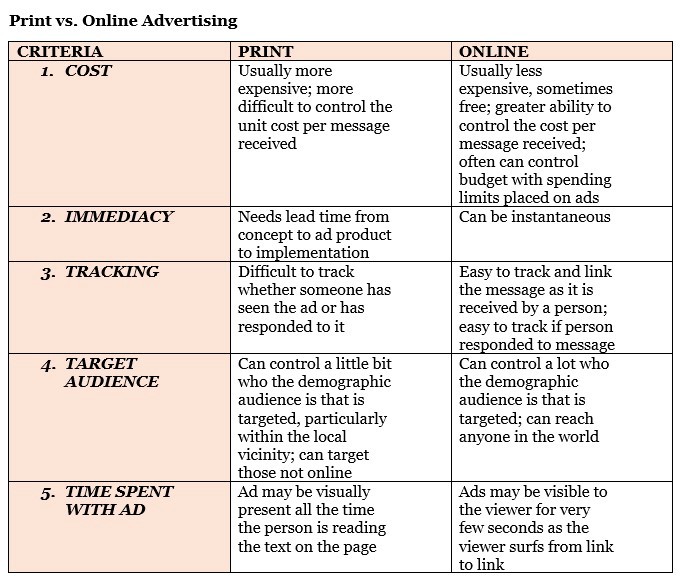
Print vs. Online Advertising
Online Advertising Channels
SEO Optimization
Content Marketing
Social Media Marketing
Affiliate Marketing
Radio and Web Streaming
Influencer Marketing
Email Marketing
Your own website
SEO Optimization
SEO stands for search engine optimization. All the search engines, like Google and Bing, send out robots constantly to search the internet for information that can be categorized — identified, ranked and rated. Your online presence may extend to Facebook, Instagram, a personal website, Etsy, a blog post, a comment on a post, and just about everywhere in cyberspace. But you are nothing — not known, not seen, not heard, not acknowledged — if you don’t get indexed by the various search engines.
You want to be well-indexed. This means you need things wherever you are present online which are indexable. These include things like,
· Keywords and keyword phrases
· Captions for images
· Comments on posts
· When you/your business is tagged or hash-tagged
· Links back to your website
· Listings of your business in directories
· Reviews of your business and your products
This increases the chances that when someone searches for products like you carry or businesses like your own, you are more likely to be found.
71% of online jewelry sales begin with a Google search!
Selecting Keywords and Keyword Phrases. Do some research here. You can plug in a keyword into a search engine search bar. Typically, a drop down menu will appear that shows other words that come up when people look for that keyword. These become keyword phrases. Keyword phrases (2–3 words) will have better visibility outcomes for you than single keywords. That is because as you add words to a phrase, you begin to narrow down the relevant possible sites that might get flagged and presented.
Check the key words your competitor is using. Look at their websites and what words/phrases them emphasize. Plug their name into the search engine search bar, and see what comes up.
Content Marketing
Here you write an article or review or response to an online post, or create images and videos, and place these somewhere online. This might be a social media site, a site specializing in hosting articles, your own website, or a blog. You include somewhere (top, within, or at the end) links back to you and your website or your products listed online.
With this content, you are trying to educate the reader in some way. Your content in some way is providing a solution or answer to a problem or question the reader might have.
The better connection between you and the reader, the more likely the reader is to create a link to your content. More links to your content means greater SEO optimization.
Another type of content is when you are presenting one of your products or a type of jewelry product, and you do a soft-sell. You explain how to wear it, how it was made, interesting facts about it, how it fits with current fashions, or other interesting characteristic about it. Don’t list a price. List a link to where the reader can find more information about it.
As with most things, this is not a one-shot, one-time approach. You want to post content on a regular basis, probably daily.
Social Media Marketing
You can leverage the power of various social media sites, like Facebook, Tik Tok, LinkedIn, Pinterest, YouTube and Instagram.
These sites have
· Pages you can set up a profile on (for your personal page as well as separately for your business page)
· Postings you can place.
· Postings you can respond to.
· Events you can participate in or create.
· Groups you can join or set up.
· Targeted Ad programs you can take advantage of (You might be able to target your audience by location, language, education, work, age, gender, birthday, relationship status, likes and interest).
In some cases, you can tack on a short commercial message or signature to the end of your posts. In other cases, commercial messages may be forbidden, but you can create a signature that generates enough interest and curiosity so that someone might link back to your site.
Some social media sites limit how many places or times you can use the same ad-copy-post. That limit might be 3 places or times. If you want to do more than that, you will have to modify your ad-copy-posts.
A lot of the advertising tactics you use here are free. It just takes a lot of time.
Other tactics will cost you. Targeted ad programs let you send a message to some demographically limited group which you define. You set a budget. You either pay for the number of click-throughs (someone has clicked a link in your ad), or the number of impressions (someone has visited the page where your ad appears). Some jargon: PPC for pay for click or PPI for pay for impression. You may also want to measure the click-through rate (5% is great, below 2% is not great).
You can use both your personal page as well as your business page to tell your story and get your products seen. Soft-pedalling the message will work better than any hard sell. For example, creating seven consecutive posts following you as you create a piece from inspiration to finish — of course with images — will get you better responses than creating what looks like a magazine ad for a specific piece of jewelry. A friend posted an image of her wearing a piece of jewelry she just made with her hair all messed up. She gave the image a simple caption: Bad Hair Day — What Do You Think? And sold 43 pieces in response. People feel more connected when they feel you are sharing your life with them.
Images are important. Short videos are the best.
If someone responds to any of your posts. Thank them. Always repeat their first name in your response.
You can use your personal and business profile pages to have conversations with your customers.
Think about reposting your customers’ pictures wearing your jewelry.
Or, create a branded hashtag (or two or three) and always list this at the bottom of all your posts. Think of something like: #warrensgems, or, #jewelrybywarren, or, #warrendesigns.
You want to post at least one thing every day. Most likely this is physically impossible time-wise to do this for every social media site. So, create a presence on as many social media sites as possible. Then concentrate on two of them with your daily posts.
Keep your ads short, and the messages well targeted to your intended audience.
If paying for ads, the social media site should also have some statistical information you can access to gauge how well your ads are doing.
Affiliate Marketing
Here you invite another party — referred to as third party — to drive sales for your business. This might be an influencer, a thought leader, a celebrity, another shop which sells accessories or clothing. You rely partly on the reputation and networking of some other business to advertise and advocate for your jewelry.
You might work out a co-marketing arrangement and split costs. You might pay them a commission or a percent of the sale.
Radio and Web Broadcast Streaming
Radio has always been an effective channel for advertising jewelry. It is a lot less expensive than TV, and has a loyal audience. It is very targeted at a local audience. Today, however, you might use the internet to place ads similar to the ones you might have used for radio.
Webcasts offer you an on-demand and more targeted connection to your intended audience. They allow you to reach a broader and more internet-savvy audience.
Influencer Marketing
Rely on one of the many influencers in fashion and jewelry to promote your stuff. Most established influencers have media kits to share with you so you can get an idea of the kinds of things they promote and who their target audience is.
Or, make yourself into an influencer. Create an online audience on one or more social media sites which follows you and pays attention to your recommendations. The key to becoming an influencer is to establish a clear brand identify for yourself. Create a branded hashtag. Encourage your customers to use your hashtag when sharing images, videos and advice from your own feed.
Email Marketing
Email marketing is one of the most effective marketing methods in existence. It keeps your business in front of your customers on a regular basis.
The key is to grow your email list. So you need to make your emails special in some way. Your emails might include what is called gated content. They might include special discounts. They might present advanced notice for sales or other special events. They might include content that your customers may want to save, such as explanations about what certain gemstones mean or how to clean sterling silver jewelry. You might give first access to a new product.
Be sure you have secured permissions from each contact on your email list. You can create simple forms that can be posted online on your website or blog, and simple print forms to hand out to people.
Emails are effective, but you do not want to overdo them. People get annoyed if they get too many emails in their box.
I suggest using an email service like MAILCHIMP. Not only do they make creating and sending emails easier, they offer some tracking and analytic services, as well.
Your Own Website
Build a site that supports your business. Be sure it is optimized for search engine indexing. Decide whether your website serves primarily as a billboard — a place to find you. Or decide whether you want to include a shopping cart system and make your website an ecommerce site for your jewelry.
You can have your own domain name, or be part of a larger web-hosting company which may or may not allow you to use your own domain name.
Having your own website gives you credibility. It allows people to more easily find you and contact you. It gives you another channel for selling your jewelry.
Be sure to add an analytics package to your site. Some will be available for free. You always want to build in evaluative components with whatever you do.
____________________
FOOTNOTES
Arias, Aaron. Six Ways to Advertise Your Online Boutique. 12/7/21.
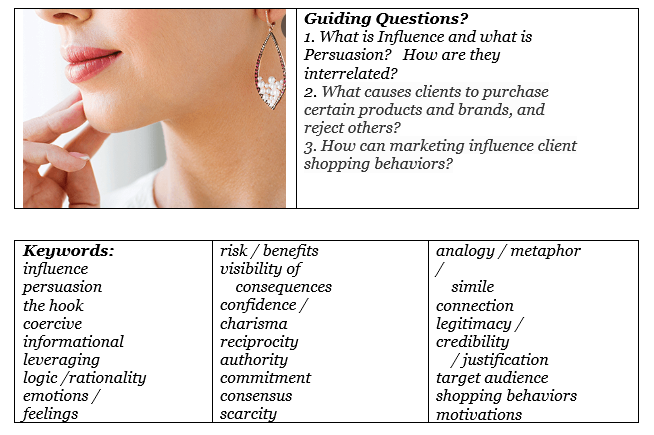
Designers need to get the approval of and payment from their clients. That means the client has to recognize and share the choices the designer made when creating the piece of jewelry. It all comes down to two aspects of marketing: persuasion and influence. Marketing is about creating persuasive arguments which can influence a person’s beliefs, attitudes, motivations, intentions and behaviors. Influence comes with knowing what the best outcome that the marketer should seek. Persuasion includes the tools you use to get there. Persuasion can take many forms. The marketer’s success depends on a handful of persuasive factors. Marketing strategies follow one or more of eight universal principles of persuasion. Information within any successful persuasive argument is best presented in a certain order.
Influence and Persuasion
Marketing is about creating persuasive arguments which can influence a person’s beliefs, attitudes, motivations, intentions and behaviors. The marketer wants to be able to persuade the client to focus their attention on the jewelry product line, to approach it, touch it, try it on, buy it, exhibit it, share it with others, then, moreover, to further persuade these others (thus making the marketing message contagious) to want to buy it. Influence comes with knowing what the best outcome that the marketer should seek. Persuasion includes the tools you use to get there.
When we are trying to persuade someone, we might be trying to get them to change their mind about something. We might want them to change the weight, ranking or priority they give one thing over another. We might want them to see the interrelationship among two or more otherwise unrelated things. We might want them to re-evaluate the cost and reward calculus they use when deciding to make a purchase.
When trust is present, influence increases and persuasion ends in more positive outcomes.
Persuasion can take many forms. It can be…
· Coercive, done aggressively through direct commands, threats, fear mongering, shaming.
· Informational, spread as biased in some way towards a particular position or idea.
· Leveraging a belief by appeals to logic and reasoning.
· Leveraging a belief by appeals to feelings and emotions.
· Establishing a high level of credibility or character.
A marketer or jewelry designer is not born as persuasive. It is something to be learned, practiced, applied and applied again. The strength of the marketer’s influence centers on a handful of persuasive factors, such as:
1. Commonalities: People like people like themselves.
2. Logic and Rationality: When you see data, it tells a recognizable story.
3. The Target Audience’s Needs, Wants, Values and Desires: It is important to pay attention and hone in on these.
4. Attractiveness: Attractive people are more persuasive.
5. Confidence / Charisma: Confident /Charismatic people are more persuasive.
6. Preparation: Learning, Practicing and Preparing are how you place yourself in a powerful, persuasive position.
Persuasion and Marketing
Persuasion in marketing involves the ability not just to influence people’s actions, but their attitude as well.
Persuasion is a matter of establishing mutual trust or shared understandings. You develop that sense of trust in your client. That means, they believe that you will deliver on any and all your promises, and that your product will solve their problems, needs and/or desires. The marketer presents some type of evidence which the client must interpret as relevant and valid for themselves, whatever that might mean.
Marketing campaigns are various strategies attempting to influence, direct or change client behaviors by eliciting reactions. Marketing campaigns rely on imagery and word associations tied to emotional responses.
To be persuasive, the marketing message must have value and relevance for your target client. She or he might see a reward or a minimization of costs and agree to change their behavior. She or he might be trying to shield themselves from anything which refutes their sense of self and self-esteem. She or he might derive pleasure when they can align their self-concept with that of the emotional message associated with the product. She or he might find that they can meet their needs for understanding and control by finding out more information about your product.
In response to any marketing campaign, the client can do one of three things:
1. Accept
2. Non-commit or remain indifferent
3. Reject
And it is important to think of persuasion as a continual process. You might be able to persuade someone to purchase your product once, but will they purchase your product again?
The Designer As Marketer Should Have A Detailed Familiarity With Everything Involved With Consumer Behavior
What causes clients to purchase certain products and brands, and reject others? It is important to begin to document client shopping behaviors, motivations and their psychological and sociological underpinnings.
The marketer will want to get a handle on the target audience in terms of
· Psychological Factors: How assumptions, perceptions, understandings, values and desires affect responses to the marketing message.
· Personal Factors: How demographic characteristics, such as age, culture, profession, gender play roles in forming responses to the marketing message.
· Social Factors: How socio-cultural groups, such as income, geographic residence, education level, affect shopping behaviors and responses to the marketing message.
How Can Marketing Affect Client Shopping Behaviors? The Eight Universal Principles of Persuasion
Persuasion works when the client feels that, by purchasing your product, you and your product have made a positive contribution to their life. There are different ways or principles marketers follow for establishing that sense of positivity.
There are eight universal principles of persuasion the marketer can resort to in order to influence client shopping behaviors. These are,
1.Reciprocity
2.Commitment
3.Consensus
4.Authority
5.Affinity
6.Scarcity
7.Visibility of Consequences
8.Information Exposure
Reciprocity
If you do this for me, I’ll do this for you.
People tend to feel the need to return the favor. You offer or remove incentives and play with client’s natural tendency to be grateful and want to do something for you in return. You might offer them discounts or a free sample. You might put them in a frequent shopper rewards program. You might do a special customization. You might offer them a gift. You might offer something special to first time buyers or to clients who register for your email list.
Commitment
I am a loyal customer.
Once someone is engaged with something, they are more likely to stick to it and commit. They become loyal to the designer, the designer’s business and the designer’s brand. The marketer would do those things which enhance customer loyalty. You might have a special showing or trunk show. You might include them on your email list. You might make them aware a way ahead of time of some deals or opportunities.
Consensus
If it’s OK with them, it’s OK with me.
Sometimes this is referred to as the herd response. If the client sees others doing it, they are more likely to do it as well. The marketer here would demonstrate the popularity of their products with other clients and client groups.
Authority
If such-and-such expert tells me it’s OK, I’ll think it’s OK.
Clients are more likely to listen to an expert they trust, than anyone else. The marketer would have the marketing message put forth by trusted experts who could be seen as authority figures. These authority figures are seen as having already established proof of their knowledges and beliefs. Authority might be actual or implied. Thus, their advice is recognized as trustworthy. You might seek endorsements from well-known figures. You might create an ad where the expert is delivering the message. You might rely on influencers online to spread your marketing message.
Affinity
She bought it, and she’s a lot like me, so I’ll buy it as well.
The client is more willing to follow through on the marketing message and goal if she or he knows someone who is similar to themselves who bought the product. Similarly might be by gender or age or economic class. Similarly might be people who belong to the same church or shop at the same store or attend the same events. The marketer would emphasize shared interests. The marketer would present reasons why conformity is the best choice here.
Scarcity
I better get it right away, if I’m to get it at all.
People tend to want what they think they might not be able to have. When something is scarce, clients tend to assign it more value. Defining the context becomes very important for this principle of persuasion. It might be something that is exclusive. It might be in limited supply. It might have some sense of rarity. It might be subtle clues provided in how the products are displayed to make it seem like you are running out of stock (such as, a very large container with a few items left in the bottom). The product might not be available from any other competitor. The product might be temporarily on sale or only available for a limited amount of time. The marketer might emphasize that this product does what no other product can do. The marketer might emphasize that if the client doesn’t act quickly, the likelihood that they could ever purchase the product will be very low.
Visibility of Consequences
I know what will happen when I purchase and use this product.
The client is more likely to purchase a product if they can anticipate the consequences of their choice. Every purchase is a risk. Will it work? Will it hold up? Will it be appropriate? Will I get the reactions I want? Here the marketer would highlight evidence which makes the consequences obvious, and then more evidence which minimizes the likelihood that any risk and uncertainty might occur. The marketer might emphasize the positive results, and minimize any negative ones. They might point to past successes of this or similar products. They might present the pros and cons and comparative imaging of future outcomes. They might present the pros and cons by comparing antecedents. They might explain that the client will have emotion regrets of they don’t make the purchase.
Information Exposure
I was told it was important now to act.
Clients often have to make choices when they have more limited information upon which to rely. How and when the client is exposed to certain information, prompts, triggers and cues may affect their choice whether to buy a product or not. The client might be distracted. There might be time / timing / seasonal considerations where they pay more attention, say to holiday merchandise during Christmas season, than at other times of the year. Some information may have increased salience, depending on the context. For example, what the jeweler says when standing behind the jewelry counter may have more salience than what that same person says about the same product when randomly meeting that person on the street.
The marketer might present or withhold information based on timing considerations. The message might be different presented during the day from presented during the evening. It might be different in the Spring from the Fall. The marketer might try to connect positive emotional information the client already holds to the product the marketer is trying to sell. This could be a positive memory such as a song or image or experience. The marketer might stress how even with this limited information the client can still anticipate a level of success. The marketer might emphasize negative information about a competitor or competitor’s products. The marketer might use popular phrases and words that have a particular emotional or cognitive association with the target audience.
The Persuasive Argument
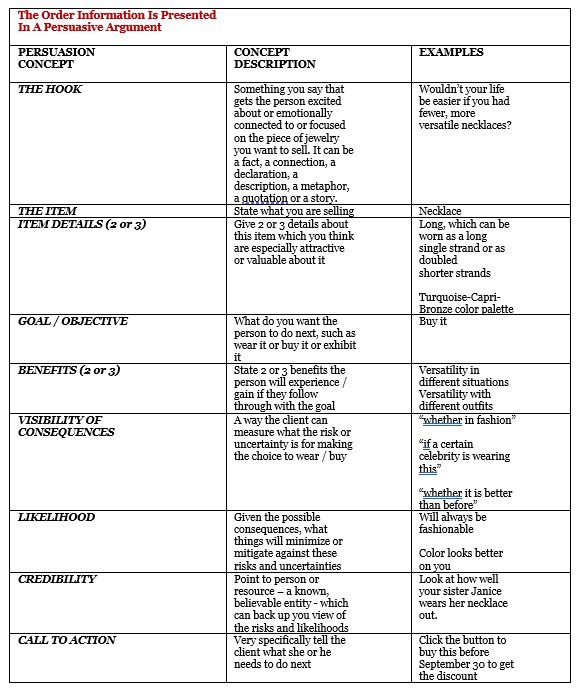
Whatever principle of persuasion the designer follows, the presentation of information in their persuasive argument follows a pattern. That is, informational content, when presented in a certain order, makes for a more persuasive argument. This order is presented in the table below.
A Few Cautions
When marketing your products, you have a professional responsibility not to cross the line between influence and manipulation. You might be successful in manipulation in the short term, but this will probably spell disaster for you mid- and long-term. People are willing to be influenced and persuaded, but resent getting manipulated. And if manipulated, they usually find out.
Don’t present yourself falsely in any way. Don’t claim to be an expert when you are not, for example.
Last, don’t over emphasis economic factors — price, discounts, and the like — in your marketing messages. Rely more on one or more of the universal principles of persuasion where you play towards emotions, perceptions and desires.
_________________
FOOTNOTES
Abelson, Herbert I. Persuasion: How Opinions and Attitudes are Changed. Spring Publishing, 1965.
Clements, Jon. The Power Of Influence and Persuasion in Business.
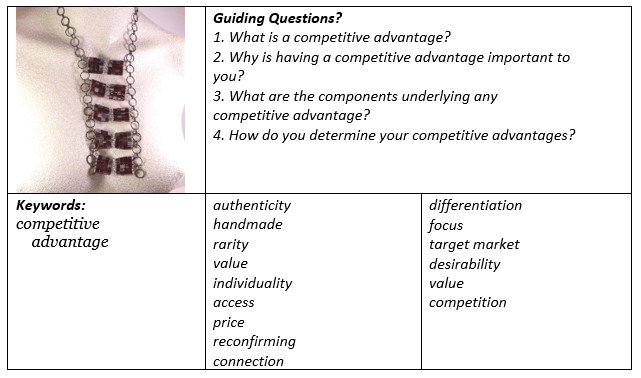
Your competitive advantage (one or more) is what influences someone to buy something from you rather than one of your competitors. Do you make something of higher quality? Or less cost? Or especially noteworthy. Or use rare materials? What is it that sets you apart, or as Heather Bunker puts it, what is your secret sauce?
Competitive advantage is your ability to outperform your competition. It is you way to design, create, produce, distribute, market and/or sell products and services better than anyone else. It is something that cannot be easily replicated, or, if it is at some point, you can build back better.
There are all types of competitive advantages. Businesses might emphasize one, or several. Some examples of competitive advantages that jewelry design businesses might claim:
1. Authenticity and honesty
2. Rarity
3. Individuality, tailor-made, custom
4. Material quality
5. Technical prowess
6. Access, Location, Visibility
7. Timeliness
8. Special occasions (ready for those …weddings, etc.)
9. Financing, payment plans
10. Innovation
11. Extensive knowledge about materials and techniques
12. Environmentally friendly, sustainable
13. Socio-culturally friendly, sensitive
14. Prominence / reputation of designer
15. Mass quantity production
16. Service Orientation: repairs, custom work, style consultation
17. Pricing, discounts
18. Concurrently maintaining both quality and prices
19. Use of technology
20. Unusual designs
21. Brand loyalty
22. Ownership of copyright
23. Where differences from your competitors, such as different product mix or material use or better craftsmanship, might make you appear superior to them
Why Is Having A Competitive Advantage Important To You?
Competitive advantage is what makes your products and services more desirable to customers than any of your rivals. When you customers recognize these competitive advantages, you are more likely to make sales and more likely to be profitable. You are more likely to grow your business and enjoy greater customer loyalty.
The jewelry design business is very saturated worldwide. On Etsy on any day, there are over 6,000,000 (that’s 6 million) pieces of jewelry for sale. Don’t see this as a defeat. See this as a challenge. Your competitive advantage will help get you that edge, and make you more memorable.
Your competitive advantage is something that you can repeat or allude to in your business name, how you name your jewelry and jewelry lines, your tag line, your elevator pitch, your domain name, your marketing and branding strategies. It might influence how you design your products, distribute them, and put boundaries around your target market.
What Are The Components Underlying Any Competitive Advantage?
You use your competitive advantage as a means of communication. As such, to establish any competitive advantage, you must know 3 things:
1.VALUE PROPOSITION
2.TARGET MARKET
3.COMPETITION
1. Value Proposition
You must clearly identify what attributes of your products or services make them desirable to your customers. What is the value to them? Why does this value motivate them sufficiently to touch, wear, buy and/or collect your jewelry? What things might further get them to show off and talk about your jewelry to their friends, acquaintances and relatives?
2. Target Market
Your advantages will not be seen and understood equally by all people. And you don’t really care about all people. You care specifically about your more narrow market audience or market niche focus. What does your advantage look like to them? Why will it motivate them? What evidence are you using to know this?
You might take the time to ask some of your customers why they buy from you and not your competition?
3. Competition
Your competitive advantage is always in reference to some other business or designer. It is comparative. It differentiates you. It influences a choice of you over others. You competition might be traditional. It might be non-traditional. It might be emerging.
How does your competition look like from your customer’s viewpoint?
How Do You Determine Your Competitive Advantage(s)?
First, think about your strengths.
Second, think about the strengths and weaknesses of your major competitors. These competitors might be in your same geographic location, or they may be online.
Search on Google and Etsy for jewelry makers. How do they present themselves? What qualities do they emphasize? What competitive advantages do they claim? Based on what evidence? How do they link their idea of competitive advantage to their assessments of customer needs, wants and desires?
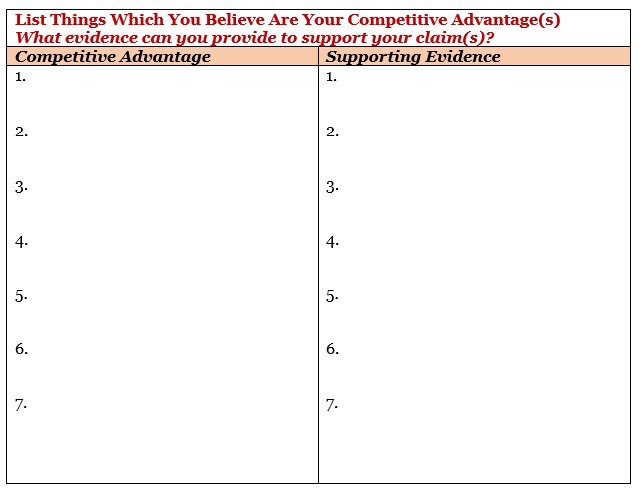
Last, list what things you are better at than your competitors.
____________________
FOOTNOTES
Bunker, Heather. What Is Your Handmade Business’s Secret Sauce — Or Differentiator? 5/6/2020.
The ultimate goal and priority for any successful business is branding. Here your clients have an emotional connection to your work as a designer. They immediately recognize your style. Your choices in design. Your sensibilities. Your value and desirability for them. Branding is about what your customers perceive about you, and how you make them feel.
Your brand has ingredients; many moving parts which consist of the following:
The quality of your product or service
How it offers more value (for example, better quality, easier access, and/or lower price) than your competition
The speed at which you deliver it
The support you give your existing customers
The tone/look/feel of your product, copy, and advertising
How many different contexts and situations in which it is used
Jewelry designers who are successful know how to build your brand. In this chapter, I discuss this in more detail.
What Is Branding?
Branding is your product’s personality. You. Your voice. Your message. Your commitment. Your look. Your artist’s hand. But always remember, with branding, consistency is the real driving force behind it.
Your jewelry will have a personality. It may project one or more of these characteristics: handcrafted, artistic, sophisticated, human, enduring, novel, playful, versatile, fashionable, well-constructed, noticeable, enviable. These are the kinds of things you think your customer wants, desires or needs. These are the kinds of things customers buy jewelry for — to make their life a little better, a little bit more fun, a little bit more authentic. These are the kinds of things your customers want to feel when purchasing and wearing your jewelry.
Your brand is the name, term, design, symbol, or any other feature that identifies your product as distinct from those of others. Brand is often the most valuable asset of a company. As such, it needs to be groomed and managed carefully. Good branding will result in higher sales and greater longevity for the business. Good branding can make it easier to introduce new products. Good brand management seeks to make your product or service relevant to your target audience.
Your brand will be used in several contexts — in a store, on stationery, on websites, in posts, as signatures in email, with image captions. As such, it should be what is called scale-able — that is, it is flexible and adaptable enough to function in many contexts.
I am often asked: What if you want to make a lot of different kinds and styles of jewelry? If they are so different that they feel like they are different brands, you will either have to narrow your interests, or develop separate branding strategies for each set of products.
If you want to sell other types of products along with your jewelry, if they feel like a part of the same brand, then your branding strategy should be something that encompasses all the variations in products available. If they feel like separate brands, then you need a unique branding strategy for each one.
How Does Branding Differ From Marketing?
Businesses often make the mistake of talking about marketing, advertising and branding interchangeably. So people often confuse them. This confusion is unfortunate.
Marketing is what you do. Marketing efforts make people aware of you.
Advertising is a tool or technique. It is one of the many, many things marketers do.
Branding is what you are. Branding efforts create an emotional and enduring connection to you.
You cannot do effective marketing without a clear idea of your brand, and the words, look and feel needed to convey it. Branding should both precede and underlie any marketing effort. The brand is bigger than any particular marketing effort. The brand is what sticks in your customer’s mind about your product or company, whether they purchased your product or not.
Marketing may convince someone to buy. Branding will convince someone to be loyal.
Marketing will unearth buyers. Branding will make them advocate for you.
Why Is Branding Important?
Everything you do will have the effect of either inspiring or deterring your customer. Every thought, price, design choice, marketing promotion, merchandising decision, product placement — all of these lead up to your customer recognizing (or not) you and your jewelry as a brand. Branding is the essential foundation to a successful jewelry design business.
You should be in brand-building-mode from day 1!
Your Successful Branding Campaign
What drives you? Passion? Values? Purpose? People who create great brands are usually seeking to fulfill some inner longing of their own, some dream of how they want to live their lives.
How do you want your customer to perceive you? What is your long-term vision? What will your business look like when you are done? Can you track your progress? Can you create clear milestones to help you know if you are on tract? Why would someone do business with you rather than someone else?
Most successful brands use very human strategies in their communication and relationship building. You need to see and understand your business in relationship terms, not transactional ones. Give you brand an aura. Inspire your customer. How will you serve them? How will you solve their problems through the jewelry you design? What do you stand for? What differentiates you from your competition? What types of products and services can your customers expect from you?
A successful jewelry designer would not merely say “I make jewelry.” She would be more focused, more specific and more enthusiastic. She might say, “I create beautiful works of art to adorn people.” She might say, “I make people ooh and aah!” She might say, “I help people find that right décor accent they have been looking for.”
Your customer needs to know:
1. What you have to sell
2. How your jewelry changes something in their lives, and
3. What they have to do to get one of those
Try to emphasis specificity and avoid generic statements.
Who Are You Targeting With Your Branding Campaign?
You want to target four key audiences with your branding campaign. These include:
1. New Customers
2. Influencers
3. Current Customers
4. Purchase Decision Makers
Your Business Name Should Reflect Your Brand
How does your business name relate to your product and brand identity? Does your tag line support your brand identity?
If you plan on selling more products than just jewelry, you do not need the word jewelry in your name. Anticipate the future of your business as best as you can.
Before you select that name,
· Settle on a tone.
· Research that brand names you want are available.
· English is not the only language option for you.
· Getting feedback is your best friend.
The Names Your Call Your Jewelry And Lines Of Jewelry Should Reflect Your Brand
Giving names to your jewelry and jewelry lines allows you to amplify your company name and brand, as well as their impacts and effects. But you must tie your naming strategies back into your primary brand identity.
Your LOGO and Other Graphics Designs Should Reflect Your Brand
Does your logo relate to your products and values? Does the logo help people remember you?
You want effective visual brand identity. Fonts, colors, images, packaging, displays, use of particular visual elements to create distinction all should support your brand.
Your ELEVATOR PITCH and TAG Lines Should Reflect Your Brand
Your Elevator Pitch and your Tag Line make it easier not only for your audience to understand exactly what your product is, but also gives them something easy and simple to share. Shareable information is spreadable. It can be posted, tweeted, texted and talked about. These give your brand a voice.
The Look of Your Pieces Should Reflect Your Brand
You play with shapes, colors, sounds, scents, tastes, movements, textures, patterns, compositions, silhouettes, packaging, displays, constructions — are all of these supporting your brand?
Your Website and Online Social Profiles Should Reflect Your Brand
Your website and online social profiles should look like your work — similar in look, feel and tone. Your work and your presence need to reflect on one another and be compatible.
Always include CALLS TO ACTION and/or LESSONS LEARNED throughout.
Your Portfolio Should Reflect Your Brand
If you have a varied set of pieces to include in your Portfolio, organize them in such a way that your brand identity still shines through. This might involve placement, naming, descriptive text, sizing and layout.
Delivering Your Message Clearly
It goes without saying that you can have a lot of things organized and in place, but the crux comes in how you deliver your brand message clearly.
Think about: Why do things catch on? Why do people talk about you? How do you generate a buzz?
Developing your marketing message, pretesting it, pretesting again, testing, testing again is very important. Your message needs to be consistent and coherent and resonate with people. Your customer should be able to anticipate that your brand is going to deliver the same essence of a thing each and every time.
It is very tempting to try to be everything to everyone. And you may have different kinds of customers. But, at the end of the day, they all should have the same impression of your values and your products.
Your core message needs to have both an emotional side and a rational side. Example: You make jewelry that lasts.
Your core message needs to be believable. Example: Your jewelry is worn by the queen. [True or not true?]
Your core message needs to be relevant. Example: I sell wedding jewelry. [Only relevant for people who need jewelry for a wedding; if that’s not your customer, this message won’t work.]
Your core message needs to be simple. If your customer cannot understand, remember or repeat your one thing, it is too complicated. It won’t stick in the person’s mind.
Give people things to talk about. Make things fun.
You will be using a multi-method approach towards getting your branding messages out. Advertising. Social Media. Attending events. Sponsorships. Selling in stores. Website. Donations. Packaging. Displays. You want your message to be reinforced over and over again from many angles and points of view.
Your marketing message should promise what you know you can actually deliver. Authenticity reconfirms actions, and in term, resonates well with customers.
Confirming Your Credibility
Tell and share your story in a way that creates a connection with your customer. Think about how things in your life led up to your success, how this relates to the brand identity you are trying to create, and, last, how the customer will relate to your story. You may find you have to re-write your story to meet your branding goals, and this is OK.
Your jewelry can be explained by your values and beliefs, your experiences and lifestyle. Put into words who you are, what your values and beliefs are, also your goals and how you approach the jewelry design process.
Show and tell the customer, in simple words and phrases, what the consequences (positive and/or negative) for them might be if they bought and wore your jewelry, and what the likelihood of any of these consequences occurring.
Offer any evidence that your assessment of consequences and their likelihood of occurring will happen.
People always trust word-of-mouth, so generating this is always important.
Commit to serving your customer over and over again, and they will learn to trust and rely on you.
Connecting To Your Clients Emotionally
Always work to market that emotional connection with your customers. Inspire affection. Create fantasy.
People need to see your business as a solution to their problems. So you want to make your competitive advantages (over all your other competitors) very visible and apparent. Show and tell them how you intend to minimize their risk should they choose your products to solve their problems. Not generic problems, but the actual concerns of your real and potential customers.
Customer concerns and problems may be one or more of the following:
· Want peace of mind
· Want to feel a part of a group or family
· Want to feel they make good choices
· Want to make life easier
· Want their questions answered
· Want to minimize any sense of risk or consequences
· Want to be the focus of attention
· Want to fit into a particular situation, context, event
· Want power and influence
· Want reassurance about something
· Want greater self-esteem
· Want meaning in their life
Listen to feedback. What are your better customers saying about your brand — positive, negative and everything in between? Show them that you hear what they are saying.
Always respond in meaningful ways. Follow-up on everything. The more you can repeat your customer’s first name in your follow-ups, the better their response.
Motivate Your Buyer, and Secure Your Customer’s Loyalty
Recognize loyalty. Reward and cultivate. Give them access to new products and services first. Involve customers in your business. Let them test your products. Turn them into brand ambassadors and encourage them to spread word of mouth. Get feedback on your marketing strategies. Give them a sense of brand ownership. Engage in conversations. Respond to needs. Make them feel good. Give out referral rewards. Encourage them to post reviews online, and then thank them for these. Feature them on your website or blog. Follow-up after purchases.
SUCCESSFUL BRANDING STRATEGIES
There are many types of branding strategies, and you will be using several of these. These include,
1. Making new rules
2. Marketing a belief
3. Creating connection and belonging
4. Enabling expression
5. Creating culture
6. Leveraging tension
7. Using scarcity
8. Encouraging play
Since a lot of your business will occur online, you will be doing a lot of social media marketing.
Anticipate Problems
Your brand loyalty can disappear in almost an instant. You have to be diligent in anticipating or dealing with after the fact, things like
· Service interruptions
· Too many options diluting the brand
· Mixed messages confusing customers
· Negative publicity or negative word-of-mouth
· New competitors or existing competitors upping their game
The jewelry market is always big enough to attract new competitors as well as provide opportunities for existing competitors to deliver better, faster, cheaper. Face the challenge to elevate your marketing and branding strategies and tactics and deliver more value.
Brands Evolve
As time goes on, things come in and go out of fashion. Styles, colors, silhouettes. Your customers might begin to get bored or even dislike your brand. Stay relevant and flexible. A well-managed brand is always making adjustments.
You want to be ready to deal with this kind of thing before it happens. That means, it is important to be ready to re-brand. It is important to seek out and enter new markets. It is critical that you be in touch at all times with your customers’ goals and values.
Periodically, reality test.
For instance, visualize someone else taking over your business. Could they succeed at maintaining your brand?
Did your product deliver the experience the customer was looking for?
Have you maintained quality standards?
Did your employees and sales staff and sales agents understand your brand and sound like they know what they are talking about when interacting with customers?
Did you respond to phone calls and emails in a timely manner?
Do you customers believe you have their best interests at heart?
Measure Your Effectiveness
It is always important to build in evaluative and feedback components to all your business activities. Branding is no exception.
How well is your business (you and your employees) inspired to execute all your proposed marketing and branding activities?
Given the time and money you are spending, are you getting that Return On Investment (ROI)?
Does your brand resonate with your customers? Does this translate into sales and profitability?
Plan to do some experimenting by testing out different ideas before settling on one. Be sure your ideas fit your brand authenticity and align with your strategies.
MARKETING / PROMOTION / POSITIONING: Social Media Marketing For The Jewelry Designer
Social Media Marketing For Very Small Businesses … That Works!
Today’s successful jewelry-designers and other very small business entrepreneurs maintain a very visible presence on the internet. You must have an online way for people to find you and your products. There are many options. These options vary in terms of who controls the site, the costs to be there and update as necessary, and what limitations are imposed on the site or because of how the site operates.
They may have a website that functions simply as a billboard or business card. They may list merchandise on their site, with prices, and information about how to order it. They may present their jewelry on Ebay or other auction houses, or on sites like Etsy or Supadupa. They may let someone else promote their jewelry on-line in exchange for a commission or royalty. They may post images or videos on sites like Instagram and TikTok. They may have a business page on Facebook, Google or Bing. Or they may have a fully functioning shopping cart system on their own dot.com.
Whatever their level of involvement online, they must put into place active and deliberate marketing strategies for creating visibility for their site and their products, and for maintaining and enhancing that visibility over time. It’s all about recruiting and retaining eyeballs, whatever it takes. Take advantage of social medias’ powers for networking.
Digital marketing is not one thing; it is a set of different strategies and pathways for connecting with and influencing people. While initially a lot of what you do will be hit or miss and trial and error, you eventually want to get very organized, developing internet marketing goals, objectives and encapsulating them into a coherent plan. You want to be represented broadly across many platforms, but concentrate your energies narrowly on perhaps 2 platforms only.
You want your website and any web presence to be:
· Optimized for search engines and directories
· Attractive
· Navigate-able and User friendly
· Enticing to first time visitors as well as repeat customers
· As broadly visible and findable as possible
· Broadly bookmarked and linked to
Successful marketing of any kind means:
· Getting Seen
· Getting Known
· Getting Your Competitive Advantage Recognized
· Making the Sale
Make them stop. Make them stay.
To achieve these marketing goals online requires putting into effect various internet marketing strategies, some technical, others not.
Towards this end, I provide insights about the following:
1. Conducting an initial marketing audit of your online presence
2. Optimizing your front door and landing pages
3. Choosing and placing key words and hashtags
4. Optimizing your social profiles
5. Site usability and navigation concerns
6. Intensive site placement and linkages
7. Inexpensive things you can do to get noticed
8. Social media posts marketing
9. On-line advertising
10.Generating an email list and conducting email campaigns
11.Creating visual images and video content
12.Garner online reviews
13.Getting customer feedback
14.Competitor surveillance
15.Establishing baseline site-activity indicators
16.Have a FAQ page which summarizes all your policies and procedures
17.Have a testimonials page
18.Create relationships with online influencers to market your jewelry
You want to choose the right tools and use them in the right way. If the wrong tools, you can waste a lot of time and money and find yourself serving the wrong customers.
1. Conducting An Initial Marketing Audit of Your Online Presence
1. Assessing current marketing materials, brochures, business cards, stationery, listings, keywords, descriptions, click through ad campaigns, email lists, efforts and activities,
2. Assessing current web-site strengths and weaknesses, from a marketing standpoint, that is, how you are in sync with target customer needs, wants, desires and shopping behaviors, and
3. Setting reasonable and attainable online marketing goals and objectives.
Do all your printed materials reference your website and/or your email address?
Is this information prominent and readily accessible, or is it buried?
Does it convey a sense of pride in your online efforts, or shame and embarrassment?
Do you routinely mention your website to your customers or clients?
Do all your emails end with a business signature, that includes your business name, address, phone, fax, and email?
Does your website clearly and concisely express what your business is all about, and how to contact you — particularly in terms of the information on the front page, any other landing pages, near the top, that would appear in the first screen that your customer would see?
Is your navigation bar/system/strategy easy to manipulate by any customer?
Is each link labeled clearly and strategically?
Does the set of all your links clearly and easily get your customer to each section of your website?
Have you minimized the number of links it takes to get to any one of your product pages?
Is your front page indexable by search engine robots?
Is there sufficient information on this page to index?
Is the organization of keywords on your front page presented to your advantage, or disadvantage, given search engine indexing schemes?
Does your front page load relatively quickly?
Have you kept your graphics on your front page to a reasonable amount so they don’t slow down page loading or obscure any keyword information?
Does your website have the kinds of things that will encourage customers to remain on your site more than a few seconds?
Is it relatively easy to keep your website up-to-date, such as changing information, uploading new images, creating new layouts?
Is your website responsive — that is, will load and be easily readable on any browser and any device, no matter screen size or preset layout parameters?
Now, GOOGLE YOURSELF. This way you have a starting point for how visible you are on the internet.
2. Optimizing Your Front Door and Landing Pages
Your front door page (or any landing page) is your most strategic website asset. It should be optimized in form and content so that it anticipates the indexing and ranking schemes (algorithms) of the major search engines. While these schemes get altered on a regular basis, there are some pointers which will be generally helpful all the time.
1. Don’t use frames. Try to use DIV instead of TABLE html commands. Try to use a CSS style sheet along with HTML5 (or most recent version) coding. Make your webpage responsive, so that it will load up perfectly no matter the browser or screen size of the device.
2. Don’t use a visually wonderful, but indexability awful splash page. You should settle for a slightly less visually appealing page, as a tradeoff for making it more indexable and rank-able.
3. You are selling things. The average person will have the average computer system or cell phone setup. That means, you can’t use the most up-to-date, exciting website technology available. Your pages won’t load up for everyone, some may take too long to load up, and some may even lock up your device. Save the best-of-current-tech for your personal home page.
4. If you are using a template-based host’s WYSIWYG (what you see is what you get) website design editor, be sure the final result will be responsive. Also be sure your website will be easy to update and maintain.
5. TITLE: Your title should be about 9 words (not more, not less), with your most important key word first. Don’t repeat the same word twice in a row; separate it by another word. Use lower case letters for your key words.
For example: “beads, jewelry findings, beading supplies — Land of Odds” is better than “Land of Odds — beads, jewelry findings, beading supplies”. [Most important keyword is first.]
For example: “beads, jewelry findings, beading supplies” is better than “Beads, beading supplies, jewelry findings.” [Here bead is capitalized once, and appears as what would be judged as twice in a row.]
6. FIRST TEXT LINE: Your first line of the page (and this will appear after the BODY tag if you are hand coding), should be about 10 words, again repeating your major keywords, not putting the same word twice next to each other, and listing the words from most to least important. Never start the page with a TABLE or Graphic file. Start with words.
7. LINK AND PAGE NAMES: Be strategic in the names you give your active links and webpages. Use your keywords in these LINK DESCRIPTIONS (link-text) and URL ADDRESSES (url-text).
For example: Call your gemstone necklace page “gemstonenecklace.htm” rather than something like “AC402.htm”.
In creating the link descriptions on your page, write something like “Gemstone Necklaces” rather than “Products Page”.
8. PARAGRAPHS: Have about 3 paragraphs of text on your front-door page. Each paragraph might have 3 or so sentences.
Your major keywords should appear in this pattern:
– At the top of paragraph #1
– In the middle of paragraph #2
– Not at all in paragraph #3
If you don’t like the look of all those words on your front door page, you can always put the paragraphs at the bottom of your webpage.
9. IMAGES: For all your images, use the ALT tag. For the ALT tag, use your keywords to describe the image. By using the ALT tag, when someone places the cursor over the image, a yellow box will appear with the ALT tag words appearing. These are also very indexable.
Make your original images into .jpg or .tif or .gif files. The original images should be a minimum of 500 x 500 pixels and 72–96 dpi resolution. Within your webpage, you can adjust image sizes. Preference for using the percent (%) adjustment rather than setting particular pixel width and height sizes.
10.HEADINGS: Set up 2 or 3 heading on your front door page, and use your keywords in the heading text. Sometimes what you code as a heading is the first thing indexed, and sometimes the only thing indexed. On subsequent pages, use more headings, if these make sense for the page.
11.COMMENT TAGS: Put in at least one COMMENT tag using your keywords. In the HTML code, comments start with <! — and end with → . COMMENT tags cannot be seen on your page. They are hidden within the code. There is a 1000 character limit to COMMENT tags. Words in COMMENT tags are very indexable.
12.DOMAIN NAME: If you haven’t already selected a website domain name, you might try to create one using your most important keyword in the URL-text. There are many sites online that sell domain names. Compare their prices which can be all over the place. Compare the amount of space they offer you, any email limits, and whether you can add a shopping cart. For example, “beadsatlandofodds.com” would do far better than “landofodds.com” in search engine indexing.
You can also envision having more than one front-door or landing page for your website. You might have different kinds of customers, and may want to set up an entrance very tailored to each of them. From the search engine’s standpoint, they do not like to see virtually the same page used more than once. You will lose points here if this is your approach. But you can set up differently designed pages as front entrances, and based on how you get your site listed, you can use any of these as the link-reference point.
3. Choosing and Placing Key Words and Hash Tags
Generate a keyword list of 1000 characters. You can use a word processing program like WORD, which has a character counter. In this list, you would include variations on upper case and lower case spellings, as well as common misspellings.
Think about the words and phrases your customers might use to find you, to understand what you do as a jewelry designer, and how your jewelry will satisfy their needs and desires.
To research keywords, you can go to various search engines, plug in the major keywords you’re interested in, and check out what keywords other sites which pop up in the search engines search, have used. On each site’s front door page, review what words they see to use on this page. Also, you can use the browser’s VIEW button to bring up the Source Code image of a page, and check out what keywords other people have listed in their META TAGS (which are otherwise hidden from view). You can use Google’s ad words program to generate keyword lists.
Hash Tags
A hashtag is a word or keyword phrase preceded by a hash symbol (#). It’s used within a post on social media to help those who may be interested in your topic to be able to find it when they search for a keyword or particular hashtag. It helps to draw attention to your posts and encourage interaction.
If you are using a phrase, do not put spaces between the words.
You want to use hashtags that you think people will search on.
You don’t want to be too general and you don’t want to be too obscure. You can check out what influencers in your area of interest are using on their posts.
You should, if possible, include a branded hashtag, such as #yourname, #yourbusinessname, or #nameoflineofjewelry .
Different social media platforms have different expectations for the number of hashtags they view as optimal. Use that number, not more or less, if you can.
Facebook (1 to 2 at most)
LinkedIn (1 to 3 at most; place them within the body of your post, rather than at the end)
Instagram (10 or 11 is best, but you can use up to 30 hashtags)
Tik Tok (100 characters maximum)
Pinterest (1 or 2 at most)
I would suggest using hashtags in all your posts.
4. Optimizing Your Social Profiles
In various social media sites, directories and other places you list your business, you want to have a great, professional social profile about yourself. Think about…
Username: This is the identity of your business in one simple or compound word. If you have the opportunity to verify your name within any site, do so. This builds trust.
Biography: You want a short introduction to yourself and your business. [Refer to your Getting Started Story in an earlier chapter.] List important information about yourself and your business. Tell the reader how you and your design work solved problems for them. Establish some indicators of credibility and legitimacy. Make your business sound approachable.
Photos: Get a good headshot of yourself and another shot of your working at making jewelry. Get another image that defines your business, such as store front, store displays, or a group of employees serving customers. Last take some appealing images of some of the pieces you make and which represent your brand or style. Include photos showing someone wearing your pieces. Photos should be in .jpg format, 500×500 pixels minimum size, and 300dpi (for print) and 72–96dpi (for screen).
Headline or Tag Line: Usually you have an opportunity to add a short line of text after your name or the name of your business. 7–9 words is good. This line should suggest your keywords and hashtag words. This line should be catchy. Test out a few examples and see which ones get the best reactions.
Content: A lot of informative content on your profiles is always a plus. Research what other jewelry designers are posting on blogs and on Facebook for ideas.
When you update your social profile, let all your followers know. This is a good way to keep them engaged with your business.
5. Site Usability and Navigation Concerns
How usable is your website to:
– New customers
– Returning customers
Websites need very clear Navigation systems.
Websites need strategies to keep them from becoming boring. After someone visits a site a few times, and it only takes a few times, the sites become stale and boring to them.
Websites need all your contact information — address, phone, fax, email — right on your first page. Or at least a very visible link/button to CONTACT INFORMATION. Don’t make your customers hunt for contact information.
Navigation System
There is a series of research about the Magical Number 7 plus or minus 3. When people are confronted with 7 or more choices, they psychologically need to re-categorize them, such as into one group of 3 and another group of 4, in order to deal with all this information. Otherwise they get paralyzed and stumped. People can easily handle 4 pieces (7 minus 3) of information, but start to get uncomfortable with 7 pieces, and can also be forced to deal with 10 separate pieces (7 plus 3) information, but that’s pushing it.
From a website design standpoint, you do not want to make someone have to travel more than 4 links to get to the product information they want. As the required number of links to click on gets greater than 4 clicks, your customers will begin to get paralyzed, and not make the next click. Wherever you find you have more than 4 clicks to get to a product, you can re-categorize, so you have fewer links to navigate.
For example, suppose it takes 5 clicks to get from your section on Jewelry to your section on Amethyst Beaded Necklaces:
PRODUCTS — click 1 to — JEWELRY — click 2 to — NECKLACES — click 3 to — BEADED NECKLACES — click 4 to — GEMSTONE BEADED NECKLACES — click 5 to — AMETHYST BEADED NECKLACES.
You might reduce the number of clicks the customer has to travel by reducing the number of webpages they have to traverse:
PRODUCTS/JEWELRY — click 1 to — NECKLACES/BEADED NECKLACES — click 2 to — GEMSTONE BEADED NECKLACES/AMETHYST.
On the PRODUCTS page, you list all your types of products. On your NECKLACES page, you list all your types of necklaces. On your GEMSTONE BEADED NECKLACES page, you list all the types of gemstones.
Avoiding Boredom
Websites get stale fast. Unfortunately, to keep things re-designed and very fresh takes a lot of time and effort. So, you want to come up with some simple, less time-consuming tricks that you can do to keep your website appearing fresh.
One trick is to put something on the page that moves. Build in some kind of “movement” on your front-door page. You can use a .gif animation file, or create mouse-overs and other simple fun things which move using Javascripts.
Another trick is to create a sense of Interactivity — forms, polls, message boards, chat lines, email sign-up, email link, contests, games, ezines, links/resources page listing other sites of interest.
A third trick is to run specials and/or have a What’s New section.
Contact Information
Preferably on the first page, include your address, email, phone, fax, and other important identifying contact information.
If you have a separate CONTACT PAGE, be sure that the link/button to the page is prominently displayed at the top of your front door page.
If you use a CONTACT FORM, I think it is also helpful to list your email address on this same page, as well. If concerned about robots collecting email addresses off websites to use in spam, you can write you email address like this: warren (@) landofodds (dot) com .
Many of your regular customers or clients will begin to use your website like a rolodex entry. Make it easy for them.
Caution: many anti-spam programs reject emails that begin with Info, Contact, Shop and other very generic terms.
6. Intensive Site Placement and Linkages
It is important that you get listed with all the major search engines, directories and social media sites, as well as specialty directories associated with your specific business.
To make this process go as quickly as possible, it is important to have all your information together in one place, where you can cut and paste the information into the online forms, as requested.
Besides having about 12–20 of your most important keywords or keyword phrases handy, also have about 12 hashtags ready. You will also want to create 25-word, 50-word, 100-word and 200-word descriptions of your site, heavy on keywords, but no side-by-side keyword repetitions. One more thing: have a 7 to 9-word part description / part tag line for your business. Make this catchy.
Do NOT pay for or use any of the multiple submission services. Take the time to submit your site to each search engine and directory, one at a time. A site submitted through a multiple submission service can get assigned a low ranking by the search engines.
You can use Yahoo or Google or Bing to find specialized directories. Get listed in as many as these as possible.
Many search engines and some directories now charge you for a listing, either as a flat fee, or as a click-through rate. You may not be able to afford all the opportunities, but you might want to follow through on the major ones.
Some search engines will let you buy key words. When someone searches on a keyword, a link to your site will appear. If someone clicks through on that link, you’re charged a per click fee. Google ad words and Facebook ads work this way.
Also, link up with web-rings, web-malls, and other affinity arrangements online. You might create your own affinity arrangement with others businesses you know.
There are many sites which list local resources. Get listed. Facebook’s Graph Search allows you to search for businesses both by location as well as friend’s recommendations. It shows you which businesses your friends have frequented. Yelp and Trip Advisor are critical for local businesses.
You can do a search on the URL web-address of your competitors, as well as on their names, to see where they are listed.
Some of your suppliers may list you on their websites. Some of your customers or clients may list you on their websites.
To get a high ranking, search engines do three things:
a) CATEGORIZE your site in relation to certain keywords, by indexing words on your site,
b) RATE your link-popularity, by checking how often someone clicks on a link to your site, and
c) RANK the link-relevancy of your site based on how long the person stays on your site, once they’ve clicked on their way there.
So, the more places that maintain a link to your website, the more likely someone is to click through to it. The better designed your website is, the more likely someone is to hang around awhile. The better indexed you are (called SEO optimization), the more visible you are in any search.
7. Inexpensive Things You Can Do To Get Noticed
There are many low-cost or free things you can do to increase your visibility online. Some suggestions:
a. Get reciprocal links — “I’ll list you if you list me.” There are your friends and personal associates; other similar businesses; affinity sites such as shopping malls, specialized directories, awards programs.
b. Create educational and information content. Share it with other sites in exchange for a link back to your site. In fact, there are Free Content sites online that act as a repository and exchange for free content articles. Submit your articles there.
c. Respond to people’s questions in forums, newsgroups, message boards, reviews and the like. Start each of your responses by repeating their first name. Include a business signature with a link back to your site at the end of your response.
d. Write articles for online ezines, newsgroups, forums, specialized portals and the like.
e. Join affinity groups.
f. Include a lot of explanatory and how-to information next to each of your products.
g. Run a contest.
h. Set up a group and form your own community within one or more of the social media sites.
i. Set up a business page on one or more of the social media sites, as well as the major search engines such as Google and Bing.
j. Create your own online newsletter.
k. Post images on all the social media sites.
l. Post short videos to You Tube, as well as other social media sites, particularly Instagram and Tik Tok. Videos will generate more interest than images.
m. Create a blog. Keep it active. You can also use micro-blogging posts to lesson your workload. Micro blog posts are short links to other websites or posts online you find of interest. Here you make a statement about why the reader should pay attention to this link. Write the link. Suggest that the reader come back to your blog and offer some feedback.
n. Create an email campaign for your email-opt-in customers.
o. Send birthday wishes to your followers; include an image of your jewelry; tag the follower.
p. Create both business and personal profile pages on various social media sites.
q. Run promotions and discount offers.
r. Bundle 2 or more pieces of jewelry and run a promotion.
s. Shine a spotlight on your employees.
t. Show off your space.
u. Run a contest.
v. Re-share content from other sites.
w. Recognize loyalty; feature your super customers in blog posts or posts on social media channels; give them first access to new products; create a brand loyalty program.
x. Invite customers to react to and test out new ideas before you implement them.
y. Reward referrals.
z. On social media, position yourself as a subject matter expert.
aa. Use social media to find cross-promotional partners.
One thing I do NOT recommend is to send mass e-mailings where your target audience has not previously opted in to receive emails from you. Mass e-mailings generate a lot of positive responses, but they generate a lot of negative responses, as well, from people overwhelmed with spam.
There will always be new tools every year to take advantage of. Sharing text, image, video and audio will always remain in style.
However, you decide to attract attention and increase your visibility, you will pay with either your time or your money. At first, you will probably take a shot-gun approach — that is, trying everything. But in the interests of time and money, you will want to narrow your efforts.
8. Social Media Posts Marketing
Post everywhere. React to other people’s posts. Answer queries. Suggest how-to solutions. Include an image with your post, 1–3 hashtags, and a link back to your website or online presence.
Create a presence on all social media sites, and post to them all. However, select 2 of them to concentrate your marketing efforts.
Things which improve responses to posts: touches of humor, quality of information, your excitement, something weird, something the evokes an emotional response, a feeling of connection.
Keep your posts short. Yes, you are marketing yourself and your designs, but more subtly. You do not want to sound salesy.
Engage your viewer. For example, ask “Which of these 3 is your favorite?” or “A and B are perfect together — Agree?”.
If at all possible, end each post with either a CALL TO ACTION or a TAKE-AWAY / LESSONS LEARNED.
Share photos of events. Share photos of what’s new?
If someone responds to your post, respond back to them. At a minimum, thank them for their post. Remember to cite their first names in your responses.
Pay attention to the number of responses you get, and whether you get more or fewer responses depending on the site, the day of the week or the time of the day.
Plan to make posts on a regular basis. You might plan to use the same posts on different media sites. If using the same post for placement on the same social media site, say in several interest groups on that site, try to limit the same post to, in this example, 3 interest groups.
Instagram has been especially useful, productive and responsive to jewelry maker posts. With Instagram, I suggest planning to post at least once every single day. Remember that those captions are important and you want to make them clever or very personal in some way.
Quality will matter more than quantity.
9. Online Advertising
There are many opportunities for online advertising. For each opportunity, you want to carefully think through the costs and benefits. How many impressions (# of eyeballs) will your ad achieve? For each impression, how many of those people will follow through (click-thru rate) and link to your site? What words, keywords, terms seem to influence people to click-thru more often? What is a reasonable cost per click through?
The first types of advertising you should do are the basic, cheap and obvious. Include your website address and/or email address on your stationery, business cards, business checks, brochures, other handouts.
You add some marketing highlights, address and email as your “signature” for all the emails you send.
You might send out a Press release to your local papers and magazines, or to regional and national publications pertinent to your business. You will want to approach them with a good angle, that you think would be of interest to their readers.
Many search engines, like Google, directories and social media sites sell keywords. You pay a certain amount of money for each click thru to your site. You can set a limit to how much you want to spend each month. It could be as low as a few dollars, or as high as you want to go. When one of their visitors does a search on the particular keyword (or keyword phrase), your name appears with the search results, with a clickable link back to your site. You pay when someone clicks on that link and visits your site. Using a keyword phrase of 2 or more words, rather than a single word keyword will narrow your target audience, but at the same time increase the chances one of these people will click through.
Instead of using keywords, you might also be able to target customers by demographic data, such as age, gender, and geographic location.
You might purchase a banner ad to place on other people’s sites.
You can also purchase ad space or sponsorship listings on various online ezines, magazine and websites.
You can place classified ads. Many search engines have classified sections. There are many specialized websites hosting classified ads.
In a similar way, you can post several of your products on Ebay or other auction sites. Marketing on Ebay is very similar to taking out an ad, but probably more effective.
Note: Social media sites and search engines tend to favor paid posts and ads. These sites probably have applications which help you narrow your target audience, thus maximizing your costs-per-click-thru.
10. Generating An Email List and Conducting Email Campaigns
It is critical to generate an email list of customers. You want them to very formally and visibly opt-in to the list. You can generate sign-up sheets, online forms, and the like towards this end.
You can segment your email list into smaller, targeted groups.
A monthly contact is reasonable.
Caution: many anti-spam programs reject emails that begin with Info, Contact, Shop and other very generic terms.
11. Creating Visual Images and Video Content
Images: Images get better responses than text. Make your original images into .jpg or .tif or .gif files. The original images should be a minimum of 500 x 500 pixels and 72–96 dpi resolution. Within your webpage, you can adjust image sizes. Preference for using the percent (%) adjustment rather than setting particular pixel width and height sizes.
Show images of your finished pieces. Of you at working making things. Of someone wearing your pieces. Of the inspirations for your pieces. Of works in progress. Of close-up details of your pieces.
Encourage customers to share images of them wearing your jewelry.
Create a slide show of a series of images to tell a story.
Infographics generate lots of discussion.
Write captions for all your images. Don’t just tell them what the image is. Tell them how and why what is photographed will be important to them. Try to use humor and irony. Make the captions authentic. Bring out your personality in the captions. For example: “The bracelet you always wanted to go with that blue dress,” or, “One of a kind necklace which will no longer be available after the 1st.”
More examples:
“My color-picking frustrations paid off this time!”
“Need to finish this ASAP. Didn’t even take the time to brush my hair today!”
“So tribal … What do you think?”
“I think I’ve made a necklace to match the picture I hung in my room. Didn’t even think about that. Or did I?”
“I made all this jewelry today, and now have to leave it to do some vacuuming. I can’t stop looking at it though.”
Videos: Videos are the best way to get attention on the internet. They catch the eye. They can convey emotions. They make demonstrations easy to follow.
There are many formats. The safest one to use is MP4. When you upload to a site, like You Tube, the sites convert your video to their format. Consider purchasing video editing software. For the most part, keep your videos short — either the 1–3 minute version or the 10–20 minute version.
Each social media platform has its own rules and pros and cons for hosting videos. Check out: Facebook, Instagram, Pinterest, You Tube, Twitter, LinkedIn, Tik Tok, Snapchat. Most require a screen resolution of 1920 x1080 pixels, and a widescreen (16:9) format. You would set up a page or channel on each site. It’s a good idea to create a short introduction video explaining what your page or channel is all about.
You Tube: Host all your videos. On You Tube, you can also live stream video. This is useful to make spot announcements, present new products, and the like. Videos available to everyone. People most often look for “how-to”, “demonstrations”, “product reviews.”
Facebook: Videos can only be seen by your friends and followers. People on this site want videos that are entertaining or inspirational. 85% of viewers watch the videos with the sound off. Video size recommended is 1280×720 pixels.
LinkedIn: People like career-oriented videos as well as corporate and business promotions and interviews and conference broadcasts.
Twitter: Videos are very, very short. Usually off-the-cuff remarks shared by cell phone.
Instagram: Videos are square by default. Optimal size: 1080 x 1350 pixels. You want your videos to tell a story, with a beginning, middle, climax, denouement and conclusion.
Pinterest: Similar to You Tube.
Tik Tok: The standard video length is 3 minutes, though you can go up to 10 minutes. Sound is essential. The orientation is vertical, so you want the size of your video to be 1080 x 1920 pixels.
Pointers:
· Keep the viewer in mind. Aim to meet their needs, whether seeking to solve problems, learn something, be entertained, or be inspired.
· In the first 5–10 seconds, be sure the video content is an attention-grabber with a solid hook. Get your name out and your purpose out. Viewership drops dramatically after 10 seconds.
· Make the video mobile-friendly. Make any text large enough to be seen on a small cell phone screen. Make sure there is good contrast between text and the background it is imposed on.
· Always add either a CALL TO ACTION or a TAKE AWAY / LESSONS LEARNED before the video ends.
· Add captions to your video throughout because many people view videos with the sound off.
· Embed all your posted videos on your own website as well.
12. Garner Online Reviews
Online reviews will always be important.
I widely post links throughout my online pages and emails to the various review sites like Google, Yelp, Facebook and Travel Advisor. Periodically I send out an email to my customer list asking them to post a review.
Respond to every single post, positive or negative. Always begin your responses by writing the reviewer’s first name. Real and authentic responses, rather than canned responses, keep the conversation going and allow you to glean more valuable insights from your customers.
Occasionally the reviews might be negative. I know it’s difficult not to take negative comments personally, but it’s only personal if you allow them to be. Still, even negative comments are opportunities for dialog. Respond to them in a sensitive, understanding way, perhaps suggesting something like, (a) a future discount or reward, or, (b) being grateful for calling something to your attention — that this will change your behavior in the future. Thank them for their review.
One contributing factor to a higher search engine ranking is the number of positive reviews for your site.
Make sure you have set up business profiles on Google and Bing so that your customers can see the reviews posted on either search engine site.
13. Getting Customer Feedback
It is important to get customer feedback about your website, your marketing efforts and your products/product mix. Regularly connecting with customers will help you retain them. It will help you keep their information updated. Asking for feedback will get them more invested in your business. It will help you uncover any customer issues which need to be resolved.
When people email or call you, you might ask some evaluative questions of them, while you have their attention. Also ask them how they found you originally.
You can set up a free poll or survey online. There are many websites that offer free online polls and surveys.
Ask your customers for leads.
14. Competitor Surveillance
The internet provides myriad opportunities for you to view your competitors’ marketing strategies. You can analyze specific competitors you know of in your immediate environment. Or you can focus on 3–5 competitors that are prominent in your business.
Think about what they are doing and their performance relative to what you are doing and your performance.
In the search engine locator box, you can:
– Type a keyword, and look more closely at the first 3–5 competitors whose websites pop up
– Type in the name of a specific competitor, and see which websites mention their name
– Type in the URL address of a specific competitor and see which websites maintain active links to them, or have reviews of them
You can:
– Analyze their website and product line
– Determine what keywords are important to them
– Find out who lists them and links to them
– Check their visibility and rankings
What is their business model?
What assumptions do they make about the market for their products?
Where do they think their customers are?
How do they think their customers will find them?
Where do they advertise?
What is their product mix?
What kinds of pricing strategies have they put into action?
Listening tools (from LinkedIn Share): Some online sites which help you monitor competitors, blogs, comments, videos, tips and the like:
Bing: Internet Search
Commentful: Monitors comments on blog postings
BlogPulse: Identifies daily blog post patterns
Complete Blog: Monitors how people use the internet
Cotweet: Monitors discussions about businesses and their brands on Twitter and Facebook
Digg: Members vote on which web content should be shared
Feedky: Scans and indexes video websites
FourWhere: Finds tips and comments on Yelp, Foursquare and Gowalla.
Google News: Highlights news items about businesses and brands
HootSuite: Customized analytics relative to various social media sites
Klout: Rates and ranks brands based on engagement levels in various social media sites
OpenBook: Searches real-time posts in Facebook
SamePoint: Enables you to connect your business to various social media sites
Sideline: Topic search application for Yahoo
Technorati: measures particular position and influence of any website
Trackur: Lets you watch your reputation, mentions, and promotional campaigns
Trendpedia: Monitors social media sites and what people are saying about you and your brand
UserrnameCheck: Find where your username has been registered
Website Grader: Measures the marketing effectiveness of your website
Yahoo Pipes: Helps you aggregate information from all over the internet
It is important to track the activity on your website, and to try to gauge whether this activity level is affected by any marketing effort you might launch.
There should be a statistics package that comes with your website. You can also link to Google Analytics or other available statistical packages online.
From this information, you should gather the following stats:
· # of unique visitors
· Average visitors per day
· Average length on site per vistor
· # of sales per week
· Average doll per sale
· Percent of unique visitors resulting in actual orders
· # of abandoned shopping carts
NOTE: You can easily find out similar information for all your competitors using many apps available online for this purpose.
16. Have a FAQ page which summarizes all your policies and procedures
Create one page, called a FAQ page, which summarizes those policies and procedures relevant to your customer base. Anticipate the kinds of questions your customers will ask you, and provide the answers here.
So, at the least, your customers will ask about:
· Ordering procedures
· Turnaround times
· Shipping time and costs
· Customization
· What to do about lost or damaged merchandise
· Repairs
· Returns and exchanges
· Backorders
· Copyrights, Trademarks
· Disclaimers
· Lead content or other information about materials
· Gift certificates
· Discounts
· Minimum orders
· Exchanging links
· International orders
· Security of site for online payments
· Other payment methods
· Sales taxes
· Wholesale orders or arrangements
17. Have a testimonials page (also can include pages for Press Articles, List of Retailers Who Sell Your Jewelry, Upcoming Events)
Periodically, gather testimonials from your customers who have purchased your product. Set up a webpage listing all these testimonials.
18. Create relationships with online influencers to market your jewelry
There are many people online that function as influencers. Many will market and promote your products in exchange for something. Sometimes this is money. Sometimes this is product. Sometimes this is some other reciprocal arrangement. [See chapter on INFLUENCERS for more details.]
They might share images of your jewelry. They might wear it. They will create a buzz for it.
Start by creating a relationship with an influencer who is relevant to your product line. Follow them everywhere. Interact with their posts. Show that you are interested in what they have to say.
Then pitch a collaboration.
______________
FOOTNOTES
Amin, Arshad. 16 Social Media Optimization Tips You Need To Know, medium.com, 1/18/22.
As a marketer, you will be developing and organizing a series of communication strategies and tactics. You will also be combining things into coherent marketing campaigns with defined goals and methods for collecting evidence from which you can evaluate success. This article discusses the importance of spreading word-of-mouth and some ideas towards this end. Also discussed are some additional marketing ideas workable for the designer.
Marketing Strategies
As a marketer, you will be developing and organizing a series of communication strategies and tactics. You will also be combining things into coherent marketing campaigns with defined goals and methods for collecting evidence from which you can evaluate success.
Your strategies will hone in on the 4 P’s: product, price, promotion and place.
· Product: serves a need not being met or provides a novel experience
· Price: set a fair price both to you as well as your customer
· Promotion: your marketing message and how you get the word out
· Place: where your product is available and your distribution arrangements
Whatever marketing strategies and tactics you resort to, remember this.
· You need to be different and refreshing.
· You need to do something your target audience(s) will talk about.
· You need to make your product approachable, accessible, and memorable.
· You need to enhance the emotional connection among client, product and designer.
· You need to be patient and focused.
· You need to be creative.
· You need to be authentic.
· You need to be market-driven, not product-driven. [It might be a great product, but there needs to be a market for it.]
Some marketing tasks you will direct and take charge of yourself. With some, you will work with an agency and turn over responsibility to them. You might rely on online influencers and bloggers. Some things will be in print. Some will be images and/or posts online. Some will be messages to your email followers. You might coordinate your marketing with similar or complimentary products of other businesses (called co-marketing). You might donate items to organizations which will publicize your donations. You will have business cards, brochures, jewelry name cards, guest books, packaging, letterhead stationery, websites, domain names. You might be able to get articles written about you or invitations to participate in podcasts.
You will find that, with jewelry, you will need to use a multi-method approach to your marketing. Any one particular approach won’t be sufficient to reach enough potential clients and influence enough buying decisions to keep you in business.
The Importance of Word of Mouth: The Biggest Source of New Customers
If your client has had a positive experience with you and your products, it is highly likely they will share this with someone else. This is called word of mouth. Word of mouth might result from a conversation. It might result from an online or print review. It might be generated from comments to an online post. It might be a mention in an article. Word of mouth usually accounts for 3 of every 4 jewelry sales in the United States.
Things which drive word of mouth:
· Thanking your customer
· Asking your customer if they get compliments on your pieces they wear, and if so, can they mention that in a review or post online
· Ask your customers to talk about you, such as mentioning you on Facebook.
· Offer a discount to a customer who refers another to you.
· Image and Video posts on Instagram and other social media sites, and concurrently responding to all LIKES and COMMENTS. Note: Always repeating the person’s first name in our response comments.
· Join social media sites groups, and comment on various posts.
· Hold a customer appreciation event.
· Do some co-marketing with similar businesses in town.
· Follow-up on sales to make sure customers are happy.
· Bring a friend campaign.
· Give out business cards.
· Show something special to clients which I know they will want to tell others about.
· In-store giveaways.
· Be involved in the community.
· Supporting nonprofit fund-raising events, usually by offering a gift certificate or a showy piece of jewelry
· Create how-to handouts and/or post videos online (or other educational content) you can give to customers for free.
Some Marketing Ideas
1. Educate with your content
2. Personalize your marketing messages
3. Be data driven
4. Keep your messages and content updated
5. Be visible in your community and online
6. Manage active and frequent email campaigns, along with implementing strategies to expand your email list
7. Rely on credible influencers
8. Concentrate on one, perhaps two, social networks only, and give it your all
9. Create opt-in offers
10. End all your marketing and promotional messages with a call to action
11. Be a strategic user of key works in webpage designs and promotions
12. Teach
13. Do repairs
14. Survey, listen and learn
15. Sponsor a charitable event
16. Donate products or services to a charity event
17. Co-market with other small businesses
18. Do presentations or webinars to enable your audience to get to know, like and trust you
19. Provide free consultations or demonstrations
20. Write articles
21. Build a website optimized for search
______________
FOOTNOTES
Coursera. The 4 Ps of Marketing: What They Are and How to Use Them. 8/10/2022.
Marketing is about creating persuasive arguments which can influence a person’s beliefs, attitudes, motivations, intentions and behaviors. Influence comes with knowing what the best outcome that the marketer should seek. Persuasion includes the tools you use to get there. Persuasion can take many forms. The marketer’s success depends on a handful of persuasive factors. Marketing strategies follow one or more of eight universal principles of persuasion. Information within any successful persuasive argument is best presented in a certain order.
Influence and Persuasion
Marketing is about creating persuasive arguments which can influence a person’s beliefs, attitudes, motivations, intentions and behaviors. The marketer wants to be able to persuade the client to focus their attention on the jewelry product line, to approach it, touch it, try it on, buy it, exhibit it, share it with others, then, moreover, to further persuade these others (thus making the marketing message contagious) to want to buy it. Influence comes with knowing what the best outcome that the marketer should seek. Persuasion includes the tools you use to get there.
When we are trying to persuade someone, we might be trying to get them to change their mind about something. We might want them to change the weight, ranking or priority they give one thing over another. We might want them to see the interrelationship among two or more otherwise unrelated things. We might want them to re-evaluate the cost and reward calculus they use when deciding to make a purchase.
When trust is present, influence increases and persuasion ends in more positive outcomes.
Persuasion can take many forms. It can be…
· Coercive, done aggressively through direct commands, threats, fear mongering, shaming.
· Informational, spread as biased in some way towards a particular position or idea.
· Leveraging a belief by appeals to logic and reasoning.
· Leveraging a belief by appeals to feelings and emotions.
· Establishing a high level of credibility or character.
A marketer or jewelry designer is not born as persuasive. It is something to be learned, practiced, applied and applied again. The strength of the marketer’s influence centers on a handful of persuasive factors, such as:
1. Commonalities: People like people like themselves.
2. Logic and Rationality: When you see data, it tells a recognizable story.
3. The Target Audience’s Needs, Wants, Values and Desires: It is important to pay attention and hone in on these.
4. Attractiveness: Attractive people are more persuasive.
5. Confidence / Charisma: Confident /Charismatic people are more persuasive.
6. Preparation: Learning, Practicing and Preparing are how you place yourself in a powerful, persuasive position.
Persuasion and Marketing
Persuasion in marketing involves the ability not just to influence people’s actions, but their attitude as well.
Persuasion is a matter of establishing mutual trust or shared understandings. You develop that sense of trust in your client. That means, they believe that you will deliver on any and all your promises, and that your product will solve their problems, needs and/or desires. The marketer presents some type of evidence which the client must interpret as relevant and valid for themselves, whatever that might mean.
Marketing campaigns are various strategies attempting to influence, direct or change client behaviors by eliciting reactions. Marketing campaigns rely on imagery and word associations tied to emotional responses.
To be persuasive, the marketing message must have value and relevance for your target client. She or he might see a reward or a minimization of costs and agree to change their behavior. She or he might be trying to shield themselves from anything which refutes their sense of self and self-esteem. She or he might derive pleasure when they can align their self-concept with that of the emotional message associated with the product. She or he might find that they can meet their needs for understanding and control by finding out more information about your product.
In response to any marketing campaign, the client can do one of three things:
1. Accept
2. Non-commit or remain indifferent
3. Reject
And it is important to think of persuasion as a continual process. You might be able to persuade someone to purchase your product once, but will they purchase your product again?
The Marketer Should Have A Detailed Familiarity With Everything Involved With Consumer Behavior
What causes clients to purchase certain products and brands, and reject others? It is important to begin to document client shopping behaviors, motivations and their psychological and sociological underpinnings.
The marketer will want to get a handle on the target audience in terms of
· Psychological Factors: How assumptions, perceptions, understandings, values and desires affect responses to the marketing message.
· Personal Factors: How demographic characteristics, such as age, culture, profession, gender play roles in forming responses to the marketing message.
· Social Factors: How socio-cultural groups, such as income, geographic residence, education level, affect shopping behaviors and responses to the marketing message.
How Can Marketing Affect Client Shopping Behaviors? The Eight Universal Principles of Persuasion
Persuasion works when the client feels that, by purchasing your product, you and your product have made a positive contribution to their life. There are different ways or principles marketers follow for establishing that sense of positivity.
There are eight universal principles of persuasion the marketer can resort to in order to influence client shopping behaviors. These are,
1.Reciprocity
2.Commitment
3.Consensus
4.Authority
5.Affinity
6.Scarcity
7.Visibility of Consequences
8.Information Exposure
Reciprocity
If you do this for me, I’ll do this for you.
People tend to feel the need to return the favor. You offer or remove incentives and play with client’s natural tendency to be grateful and want to do something for you in return. You might offer them discounts or a free sample. You might put them in a frequent shopper rewards program. You might do a special customization. You might offer them a gift. You might offer something special to first time buyers or to clients who register for your email list.
Commitment
I am a loyal customer.
Once someone is engaged with something, they are more likely to stick to it and commit. They become loyal to the designer, the designer’s business and the designer’s brand. The marketer would do those things which enhance customer loyalty. You might have a special showing or trunk show. You might include them on your email list. You might make them aware a way ahead of time of some deals or opportunities.
Consensus
If it’s OK with them, it’s OK with me.
Sometimes this is referred to as the herd response. If the client sees others doing it, they are more likely to do it as well. The marketer here would demonstrate the popularity of their products with other clients and client groups.
Authority
If such-and-such expert tells me it’s OK, I’ll think it’s OK.
Clients are more likely to listen to an expert they trust, than anyone else. The marketer would have the marketing message put forth by trusted experts who could be seen as authority figures. These authority figures are seen as having already established proof of their knowledges and beliefs. Authority might be actual or implied. Thus, their advice is recognized as trustworthy. You might seek endorsements from well-known figures. You might create an ad where the expert is delivering the message. You might rely on influencers online to spread your marketing message.
Affinity
She bought it, and she’s a lot like me, so I’ll buy it as well.
The client is more willing to follow through on the marketing message and goal if she or he knows someone who is similar to themselves who bought the product. Similarly might be by gender or age or economic class. Similarly might be people who belong to the same church or shop at the same store or attend the same events. The marketer would emphasize shared interests. The marketer would present reasons why conformity is the best choice here.
Scarcity
I better get it right away, if I’m to get it at all.
People tend to want what they think they might not be able to have. When something is scarce, clients tend to assign it more value. Defining the context becomes very important for this principle of persuasion. It might be something that is exclusive. It might be in limited supply. It might have some sense of rarity. It might be subtle clues provided in how the products are displayed to make it seem like you are running out of stock (such as, a very large container with a few items left in the bottom). The product might not be available from any other competitor. The product might be temporarily on sale or only available for a limited amount of time. The marketer might emphasize that this product does what no other product can do. The marketer might emphasize that if the client doesn’t act quickly, the likelihood that they could ever purchase the product will be very low.
Visibility of Consequences
I know what will happen when I purchase and use this product.
The client is more likely to purchase a product if they can anticipate the consequences of their choice. Every purchase is a risk. Will it work? Will it hold up? Will it be appropriate? Will I get the reactions I want? Here the marketer would highlight evidence which makes the consequences obvious, and then more evidence which minimizes the likelihood that any risk and uncertainty might occur. The marketer might emphasize the positive results, and minimize any negative ones. They might point to past successes of this or similar products. They might present the pros and cons and comparative imaging of future outcomes. They might present the pros and cons by comparing antecedents. They might explain that the client will have emotion regrets of they don’t make the purchase.
Information Exposure
I was told it was important now to act.
Clients often have to make choices when they have more limited information upon which to rely. How and when the client is exposed to certain information, prompts, triggers and cues may affect their choice whether to buy a product or not. The client might be distracted. There might be time / timing / seasonal considerations where they pay more attention, say to holiday merchandise during Christmas season, than at other times of the year. Some information may have increased salience, depending on the context. For example, what the jeweler says when standing behind the jewelry counter may have more salience than what that same person says about the same product when randomly meeting that person on the street.
The marketer might present or withhold information based on timing considerations. The message might be different presented during the day from presented during the evening. It might be different in the Spring from the Fall. The marketer might try to connect positive emotional information the client already holds to the product the marketer is trying to sell. This could be a positive memory such as a song or image or experience. The marketer might stress how even with this limited information the client can still anticipate a level of success. The marketer might emphasize negative information about a competitor or competitor’s products. The marketer might use popular phrases and words that have a particular emotional or cognitive association with the target audience.
The Persuasive Argument
Whatever principle of persuasion the marketer follows, the presentation of information in their persuasive argument follows a pattern. That is, informational content, when presented in a certain order, makes for a more persuasive argument. This order is presented in the table below.
A Few Cautions
When marketing your products, you have a professional responsibility not to cross the line between influence and manipulation. You might be successful in manipulation in the short term, but this will probably spell disaster for you mid- and long-term. People are willing to be influenced and persuaded, but resent getting manipulated. And if manipulated, they usually find out.
Don’t present yourself falsely in any way. Don’t claim to be an expert when you are not, for example.
Last, don’t over emphasis economic factors — price, discounts, and the like — in your marketing messages. Rely more on one or more of the universal principles of persuasion where you play towards emotions, perceptions and desires.
_________________
FOOTNOTES
Abelson, Herbert I. Persuasion: How Opinions and Attitudes are Changed. Spring Publishing, 1965.
Clements, Jon. The Power Of Influence and Persuasion in Business.