Warren Feld Jewelry

Taking Jewelry Making Beyond Craft

Posts Tagged ‘Style’

FLUENCY IN JEWELRY DESIGN: Materials: Knowing What To Know

Posted by learntobead on October 16, 2025

https://www.patreon.com/posts/fluency-in-what-117189851?utm_medium=clipboard_copy&utm_source=copyLink&utm_campaign=postshare_creator&utm_content=join_link

Abstract:

Materials establish the character and personality of jewelry. They contribute to understandings whether the piece is finished and successful. However, there are no perfect materials for every project. Selecting materials is about making smart, strategic choices. This means relating your materials choices to your design and marketing goals. It also frequently means having to make tradeoffs and judgment calls between aesthetics and functionality. There are three types of materials — Stringing, Aesthetic, and Functional. Each material has three types of properties — Mechanical, Physical and Chemical. Materials differ in quality and value. They differ in the associational and emotional connections which they evoke. They differ in their functional efficiency and effectiveness to lend pieces an ability to retain a shape, while at the same time, an ability to move, drape and flow. They differ in cost and durability. Last, materials may have different relationships with the designer, wearer or viewer depending on how they are intended to be used, and the situational or cultural contexts.

MATERIALS: Knowing What To Know
The materials I use are alive

The world of jewelry design and the materials used can be complex, especially for jewelry designers just starting out in their careers. The novice, but also the more experienced designer, as well, often run up against some terms and properties of materials they have not dealt with before. Materials affect the appeal of the piece. They affect its structural integrity. They affect the cost. They affect how people view, sense, desire and understand the piece, its coherence, its relationship to the designer, and its value.

If you wanted to gain an understanding of materials,
You Would Be Very Aware Of…

You would be very aware of where they came from, how they were described, sold and marketed. You would be very aware of the beads and jewelry findings and stringing materials and tools, their qualities, when they were useful and when they were not, and what happened to them when they age. You would be very aware of what country the material was made or found in, how the material was manufactured, synthesized or gotten at, if it was modified or changed in any way, and how it came to market. You would be very aware if the product was sold at different levels of quality, even if this was not differentiated on the product’s label. It would also be important to be very aware how any of these aspects of the material have changed over time, or might change over time in the future.

You would be very aware that there was no such thing as the perfect material. There are only better materials, given your situation and goals. There is no perfect bead for every situation. No perfect clasp. No perfect stringing material. Every choice you make as a jewelry designer will require some tradeoffs and judgment calls. The more you understand the quality of the materials in the pieces you are working with are made of, and the clearer you are about your design goals, and if you are selling things, your marketing goals, as well, the more prepared you will be to make these kinds of choices.

You would be very aware that materials have different values and life spans, and this must relate to your project goals. The choices you make for fashion jewelry will rely on very different criteria than the choices you make for investment quality pieces. You would not want to use metalized plastic beads, for example, in a piece you call an heirloom bracelet. Metalized plastic beads are a metal shell around a milky white plastic bead. The shell will chip easily. On the other hand, when doing fashion jewelry, these very inexpensive beads, and which have a short life-span, would be perfect. Not only are they cheap, but because they are cheap, there are lots and lots more styles and shapes and textures.

If your goal is to create more investment quality pieces, then you would not want to buy lampwork beads which have not been appropriately annealed (that is, if not cooled down correctly, they will fracture and break easily). You would buy appropriately annealed ones, but which are considerably more expensive. This may affect the look of your pieces. For an inexpensive, fashion oriented piece, your necklace made up entirely of lampwork beads which have not been appropriately annealed might be very affordable. It would have that great handmade, artisan look. It might sell for only $60.00. If the necklace was made up of all quality lampwork beads, — it would have the exact same look and style as its inexpensive cousin, but it might have to retail for $600–800.00. Usually, with more investment quality lampwork beads, you might just use one, or perhaps three of these considerably more expensive lampwork beads, and have a lot of cord showing, or a lot of filler beads, to keep the piece affordable. This would be a very different design look and style.

Again, for an investment quality piece, you would want to use crystal beads manufactured in Austria or the Czech Republic, and not ones manufactured elsewhere. And you would not let yourself be fooled when the front of the package says “Austrian Crystal” when the back says “Made In China”. Crystal beads made in China are not as bright, there are more production issues and flaws in the beads, and the holes are often drilled off-center when compared to their “Made In Austria” counterparts. But crystal beads more appropriate for that investment quality piece might be overkill for a fashion piece where you want to add a pop of brightness without a lot of additional cost. Often the cheaper cousins have some interesting colors or shapes not available in the more expensive lines.

You would want to be very aware of the different treatments of beads and metals. Some things are radiated, heated, reconstituted, partly synthesized, lacquered, coated or dyed. Sometimes this is a good thing and these treatments enhance the quality of materials in appearance and durability. Othertimes this is a bad thing, negatively affecting the quality or look and sensibility of the materials.

You would be very aware that many of the materials you use are described in ways that do not provide you with sufficient information to make a choice. Take the material gold-filled. The definition of gold-filled is that the material is a measurable layer of real gold fused to brass, sometimes copper. But the legal definition does not tell you how thick the gold has to be over the brass for the material to be called gold-filled. So in the market, some gold-filled has very little gold and will lose its gold very quickly, and other gold-filled has a thicker layer and will keep its gold, its shine, its shape for decades.

Or sterling silver. Sterling silver is supposed to be 92.5% silver (marked .925). The alloy, that is the remaining 7.5%, is supposed to contain, by law, a lot of copper. However, many manufacturers substitute some nickel for the copper to keep the cost down. The addition of nickel in the alloy makes the sterling silver less expensive, yes, but it also makes it more brittle. It is the difference between being able to open and close the loop on an ear wire, off of which to hang the dangle, many, many times or only two or three times before the wire loop breaks.

Lots of sterling silver items get marked .925. And in jewelry making, many of the pieces we use are so small, there is no .925 stamp on them. Besides a change of what is in the alloy affecting the usefulness and value, many other things happen in the marketplace, as well. Many sterling silver items have been cast. What frequently happens is that some of the silver is lost in the casting process, so it is no longer at 92.5%. Manufacturers are supposed to make note of this, but many just stamp .925 on these items. Some shops label items as sterling silver, but in reality, are selling you pieces that are nickel. And some places will sell you something silver plated, but attach a sterling silver .925 tag to it and which is marked .925 on it off the clasp. The tag is sterling; the jewelry is not. I’ve seen some major craft stores, many chain stores in the malls, and some major jewelry stores sell metalized plastic jewelry and jewelry components and label it .925.

Flexible, nylon coated cable wires are one of the primary types of stringing materials. The measure of cable wire strength is called tensile strength. This has to do with what the wires are made of, what the nylon sheathing is made of, and how thick and nonporous that nylon sheathing is. What makes the wire strong is the nylon sheathing’s ability to maintain the twist in the wire. As soon as the integrity of the nylon sheathing is violated, the wire untwists and immediately breaks. You will not see tensile strength referenced on the labels of these products. The information which is referenced (number of strands, wire thickness) gives you some information needed to make a choice, but insufficient information to make an actual choice. Even when they list the number of strands, this doesn’t give you enough factual information to depend on. One brand’s high-end, 7-strand is stronger and more supple than that same brand’s 49-strand middle range product. This same brand’s middle range 49-strand product is stronger and more supple than another brand’s high end 49-strand product.

You would also be very aware that you cannot assume that there is consistency and uniformity for any given product. There are many production issues that arise in the manufacture of glass beads, for example. Some beads are perfect. Some have flaws. These flaws might include some flat surfaces when everything should be rounded. The color not going all the way through. Holes drilled off-centered. Bead sizes and hole sizes inconsistent from bead to bead. Some bead holes that are especially sharp. Some beads which have coated coloration which is poorly applied and chips off quickly. In clothing, these beads with flaws would be labeled irregulars, but they are not so labeled in beads. Some companies specialize in selling you perfect manufactured glass beads; other companies specialize in selling you the irregulars. They don’t advertise that fact. Either quality looks the same when you buy it; they just don’t hold up the same in close examination or from wear.

You would be aware that fabricated and stamped metal pieces are more durable than cast metal pieces, but a lot more expensive, and with a smaller palette of designs for the artist. You would be aware that the measure of pound strength on any label is the weakest piece of information to grab onto. The law only defines how pound strength should be measured. Since most products are manufactured abroad, little care is taken to guarantee the validity of this information.

You would be aware that materials which are dyed may be a different color from batch to batch. The color of the material is affected by the barometric pressure outside the manufacturing facility the day they are dyed. The factory cannot control for this.

You would be aware that there are a lot of things to know about the materials used in jewelry design.

_______________________________________________________
Thanks for being here. I look forward to sharing more resources, tips,
sources of inspiration and insights with you.

WarrenFeldJewelry.com
Shop.warrenfeldjewelry.com
School.warrenfeldjewelry.com
Coaching by Warren Feld

Add your name to my email list.

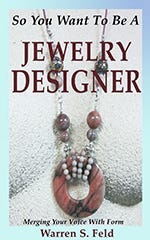
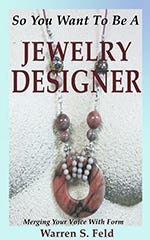
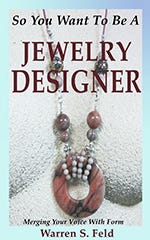
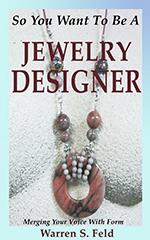
SO YOU WANT TO BE A JEWELRY DESIGNER
Merging Your Voice With Form
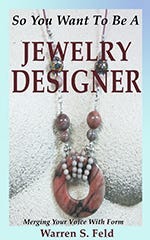
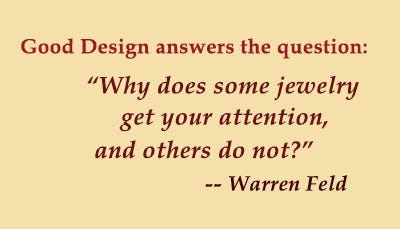
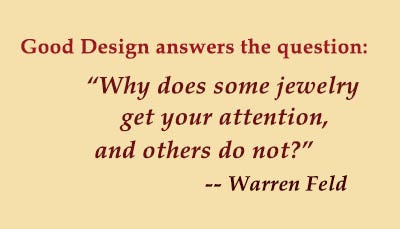
So You Want To Be A Jewelry Designer reinterprets how to apply techniques and modify art theories from the Jewelry Designer’s perspective. To go beyond craft, the jewelry designer needs to become literate in this discipline called Jewelry Design. Literacy means understanding how to answer the question: Why do some pieces of jewelry draw your attention, and others do not? How to develop the authentic, creative self, someone who is fluent, flexible and original. How to gain the necessary design skills and be able to apply them, whether the situation is familiar or not.

588pp, many images and diagrams Ebook , Kindle or Print formats

The Jewelry Journey Podcast
“Building Jewelry That Works: Why Jewelry Design Is Like Architecture”
Podcast, Part 1
Podcast, Part 2

Posted in architecture, art, Art or Craft?, art theory, bead stringing, bead weaving, beads, beadwork, business of craft, color, Contests, craft, craft shows, creativity, cruises, design management, design theory, design thinking, enrichment travel, Entrepreneurship, fashion, handmade jewelry, jewelry, jewelry collecting, jewelry design, jewelry making, Learn To Bead, literacy, pearl knotting, professional development, Resources, Stitch 'n Bitch, Travel Opportunities, wire and metal, Workshops, Classes, Exhibits | Tagged: , , , , | Leave a Comment »

FLUENCY IN JEWELRY DESIGN: Jewelry Ages In Place With Us

Posted by learntobead on October 1, 2025

Jewelry Ages In Place With Us


Jewelry comforts us as we age in place. The bracelet we got for graduation still worn on an occasion when we are 65. The ring he bought her when she was in her 20’s still worn on the day she passed away.

With jewelry, we will never feel alone as we grow older. As our body changes in pallor and texture. As we gain weight or lose weight. As we change our styles of clothing or hair or activity.

This constellation of material objects, distributed across the human body, reflects transformation, movement, growth, and behavior. These reflect the life we live, and how we lived it. These are stories of how we performed our lives over time. They reveal an otherwise unseen perspective on life as the body ages, and we live through time. They show that not all lived lives have been ad lib’ed.

The jewelry will also show its age over time. Changes in color, perhaps fading, perhaps becoming duller or spotty. A clasp may have been replaced. The piece may have been restrung. It may have been shortened or lengthened. It may have been worn a lot. Or lost for a while. Or given away. Its associative or symbolic value may have changed.

Jewelry is life performed. Both are observable. Both indicative of our place – our aura – in the world around us as time goes on. Both an experience – often changing – of a point of view from the hand that crafted the piece in the first place, and the desires of the person who wore the piece over time. We possess it and wear it so it reminds us that we are not alone.

_______________________________________________________

Thanks for being here. I look forward to sharing more resources, tips,
sources of inspiration and insights with you.

WarrenFeldJewelry.com
Shop.warrenfeldjewelry.com
School.warrenfeldjewelry.com
Coaching by Warren Feld

Add your name to my email list.

SO YOU WANT TO BE A JEWELRY DESIGNER
Merging Your Voice With Form

So You Want To Be A Jewelry Designer reinterprets how to apply techniques and modify art theories from the Jewelry Designer’s perspective. To go beyond craft, the jewelry designer needs to become literate in this discipline called Jewelry Design. Literacy means understanding how to answer the question: Why do some pieces of jewelry draw your attention, and others do not? How to develop the authentic, creative self, someone who is fluent, flexible and original. How to gain the necessary design skills and be able to apply them, whether the situation is familiar or not.

588pp, many images and diagrams Ebook , Kindle or Print formats

The Jewelry Journey Podcast
“Building Jewelry That Works: Why Jewelry Design Is Like Architecture”
Podcast, Part 1
Podcast, Part 2

Posted in architecture, art, Art or Craft?, art theory, bead stringing, bead weaving, beads, beadwork, business of craft, color, Contests, craft, craft shows, creativity, cruises, design management, design theory, design thinking, enrichment travel, Entrepreneurship, fashion, handmade jewelry, jewelry, jewelry collecting, jewelry design, jewelry making, Learn To Bead, literacy, pearl knotting, professional development, Resources, Stitch 'n Bitch, Travel Opportunities, wire and metal, Workshops, Classes, Exhibits | Tagged: , , , , | Leave a Comment »

FLUENCY IN JEWELRY DESIGN: Sensation of Jewelry as INTENT

Posted by learntobead on September 15, 2025

SENSATION OF JEWELRY AS INTENT

Someone has to infuse the object (jewelry) with all this content, and this proactive act leads us to the idea of intent. Why these choices, what was the motivation? Often this imposition of meaning begins with the jewelry artist. Jewelry becomes a means of self-expression. The artist, in effect, tells the world who the artist is, and what the artist wants to happen next.

The artist might be subdued or bold, colorful or monochromatic, simple or complex, extravagant or economical, logical or romantic, deliberate or spontaneous. The artist might be direct or indirect in how meanings get communicated. It is important, in order to understand the meaning of an object, to begin by delineating the artist’s inspiration, aspiration and intent.

The jewelry artist begins with nothing and creates something. The unknown, the unknowable, the nothingness is made more accessible.

The artist fills in a negative space with points, lines, planes, shapes, forms and themes. Color, pattern and texture are added. Things get organized and arranged.

Though often unstated, it becomes obvious that of all the possible choices the artist could have made in design, that some choices were ignored and excluded, while others were not. Some negative space is left so. Some positive space has direction, motion, weightiness. Somethings are abstract; other things realistic. These and related choices have implications and consequences.

The question becomes, what influences that artist’s selections? Successful jewelry reveals the artist’s hand.

Our senses and perceptions of the coherence in the artist’s inspiration and intent, as reflected in our interpretations of that artist’s jewelry, helps us not to feel alone. We may see coherence as a subjective thing or a universally understood thing. It doesn’t matter which. If we believe we can make sense of things because they have a purpose, if the jewelry feels and seems coherent in some way again because we sense it is purposeful and intentional, we feel safe, and that we have reduced the risks in life. We do not feel so left alone.

INTENT: Jewelry As Creating Order Out Of Chaos. Partly, what the artist does is attempt to order the world. The artist looks for clues within him- or herself (inspiration and intent). The artist formulates concepts and a plan for translating inspiration and intent into a design. The artist determines whether to take into account the expectations of others (shared understandings) about what would be judged as finished and successful.

Jewelry is an object created out of chaos and which has an order to it. The order has content, meaning and value. It has purpose and coherency based on color and texture and arrangement. Mass placed within space.

Jewelry as an organized, ordered, coherent object — something out of nothingness — reflects the hypotheses the artist comes up with about how to translate inspiration into aspiration, and do this in such a way that the derived jewelry is judged positively. The artist anticipates how others might experience and sense the object on an emotional level.

It reflects the shared understandings among artist, wearer and viewer about emotions, desires, inherent tensions and yearnings and how these play out in everyday life.

The artist makes the ordered chaos more coherent, and this coherence becomes contagious through the artist’s choices about creative production and design. The artist lets this contagion spread. To the extent that others share the artist’s ideas about coherence, the more likely the work will be judged finished and successful. And no one — not the artist, not the wearer, not the viewer, not the buyer, not the collector — will feel alone.

The process of bringing order to chaos continues with the wearer. The wearer introduces the piece of jewelry into a larger context. We have more contagion — what we might call viral. The jewelry as worn causes more, ever-expanding tension and efforts at balance and resolution. There is an effort to figure out the original artist intent and ideas about coherence as reflected in design.

Unsuccessful efforts at design, where the artist’s intent becomes obscured, reverse the process, and the object — our piece of jewelry — then brings about decoherence. Decoherence may come in the forms of bad feedback, inappropriate feedback, less than satisfying feedback, or no feedback at all.

Decoherence means the wearer may not get that sense of self s/he seeks. S/he may feel less motivated to wear the piece. S/he may store the piece or give the piece away. As this decoherence filters down to the level of the artist, any necessary support in design may be lost. There will be fewer clients, fewer opportunities to display the works publicly, and fewer sales. The artist’s motivation may diminish.

INTENT: Jewelry As An Agent of Personality. People wear jewelry because they like it. It becomes an extension of themselves. It is sensed as self-confirming, self-identifying and self-reconfirming. Liking a piece of jewelry gets equated with liking oneself, or as a strategy for getting others to express their like for you. Jewelry makes us feel more like ourselves. We might use jewelry to help us feel emotionally independent, or we might come to rely on jewelry for emotional support and feedback — that positive comment about the jewelry we are wearing — , leading us down the path to emotional dependency.

Jewelry may have personal significance, linking one to their past, or one to their family, or one to their group. It may be a way to integrate history with the present. It is a tool to help us satisfy our need to affiliate.

Jewelry may help us differentiate ourselves from others. It may assist us in standing out from the crowds. Conversely, we may use it to blend into those multitudes, as well.

Jewelry fulfills our needs. If we look at Maslow’s Hierarchy of Needs, after meeting our basic physiological needs such as for food and water, and our safety needs, such as for shelter, we can turn to jewelry to meet our additional social needs for love and belonging and self-esteem. Designing and creating jewelry can form an additional basis for our needs for self-actualization.

We may derive our personality and sense of soul and spirit from the qualities we assign the jewelry we wear. We do not merely wear jewelry as some object; more specifically, we inhabit jewelry. If ruby jewelry symbolizes passion, we may feel passion when wearing it. We may use jewelry as an expressive display of who we feel we are and want to be seen as in order to attract mates and sexual partners. We use jewelry in a narcissistic way to influence the alignment of the interests and desires among artist, weaver, viewer, buyer, collector, exhibiter, and seller.

In similar ways, we may derive our sense of belief, devotion and faith to a higher power or spiritual being or God from wearing jewelry. It may help us feel more connected to that religious, spiritual something within ourselves. It may remind us to stay on our religious path.

As an agent of our psychological selves, jewelry is used to resolve those core conflicts — Who are we? Why do we exist? How should we relate to other people around us? Jewelry orients us in coming to grips with our self-perceived place within critical contradictions around us. Trust and mistrust. Living and dying. Good and evil. Pleasure and pain. Permission and denial. Love and hate. Experience and expectation. Traditional and contemporary. Rational and reasonable.

_______________________________________________________

Thanks for being here. I look forward to sharing more resources, tips,
sources of inspiration and insights with you.

WarrenFeldJewelry.com
Shop.warrenfeldjewelry.com
School.warrenfeldjewelry.com
Coaching by Warren Feld

Add your name to my email list.

SO YOU WANT TO BE A JEWELRY DESIGNER
Merging Your Voice With Form

So You Want To Be A Jewelry Designer reinterprets how to apply techniques and modify art theories from the Jewelry Designer’s perspective. To go beyond craft, the jewelry designer needs to become literate in this discipline called Jewelry Design. Literacy means understanding how to answer the question: Why do some pieces of jewelry draw your attention, and others do not? How to develop the authentic, creative self, someone who is fluent, flexible and original. How to gain the necessary design skills and be able to apply them, whether the situation is familiar or not.

588pp, many images and diagrams Ebook , Kindle or Print formats

The Jewelry Journey Podcast
“Building Jewelry That Works: Why Jewelry Design Is Like Architecture”
Podcast, Part 1
Podcast, Part 2
Posted in architecture, art, Art or Craft?, art theory, bead stringing, bead weaving, beads, beadwork, business of craft, color, Contests, craft, craft shows, creativity, cruises, design management, design theory, design thinking, enrichment travel, Entrepreneurship, fashion, handmade jewelry, jewelry, jewelry collecting, jewelry design, jewelry making, Learn To Bead, literacy, pearl knotting, professional development, Resources, Stitch 'n Bitch, Travel Opportunities, wire and metal, Workshops, Classes, Exhibits | Tagged: , , , , | Leave a Comment »

FLUENCY IN JEWELRY DESIGN: Sensation of Jewelry as CONTENT

Posted by learntobead on September 12, 2025

SENSATION OF JEWELRY AS CONTENT

However, as we get closer to defining the object (jewelry) as one that is sensed and experienced and which evokes an emotional response, it becomes more difficult to maintain that the object does not reflect meaning, does not result from some kind of thought process and intent, and does not communicate quite a lot about the designer, the wearer, the viewer and the situation. Jewelry when worn and which succeeds becomes a sort of identifier or locator, which can inform the wearer and the viewer about particular qualities or content, such as where you belong, or what you are about, or what your needs are. So we sense jewelry not so much as an object universally understood, but something with more nuance, interest, meaning, and value, with an element of subjective references.

Jewelry without content, after all, can skew to the superficial, boring, monotonous, and unsatisfying. Without meaning and value, jewelry has little to offer.

These shared recognitions and valuing of meanings helps us not to feel alone.

CONTENT: Jewelry As Meaning. Jewelry when worn signals, signifies or symbolizes something else. It is a type of recognizable short-hand. It is a powerful language of definition and expression. By representing meaning, it takes responsibility for instigating shared understandings, such as membership in a group or delineating the good from the bad. It might summarize difficult to express concepts or emotions, such as God, love, loyalty, fidelity. It might be a stand-in marker for status, power, wealth, connection and commitment. It might visually represent the completion or fulfillment of a rite of passage — puberty, adulthood, marriage, birthing, and death.

Sometimes, the sensation of jewelry as meaning derives from energy and powers we believe can transfer from the meaning of the materials the jewelry is made of to ourselves. These might be good luck, or good fortune, or good health, or good love, or good faith or protection from harm. Various gemstones, metals and other materials are seen to have mystical, magical and supernatural qualities that, when touching the body, allow us to incorporate these powers with our own.

CONTENT: Jewelry As Value. When we refer to meaning as having power, sacredness, respect, significance, we are beginning to assign a value to it. A sensation of value may emerge from how rare the item is — its material rarity or the rarity of how it was constructed or where it came from or who made it or who was allowed to wear it. It may emerge from how bright it is or the noteworthy arrangement of its elements. Its value may emerge from how pliable or workable the material is. Its value might be set from how tradable it is for other materials, objects, access or activities.

By assigning value, we determine things like importance, uniqueness, appeal, status, need, want, and demand. We establish control over how and how often a piece of jewelry will change hands. We establish some regulation over how individuals in a group, culture or society interact and transact with one another.

_______________________________________________________

Thanks for being here. I look forward to sharing more resources, tips,
sources of inspiration and insights with you.

WarrenFeldJewelry.com
Shop.warrenfeldjewelry.com
School.warrenfeldjewelry.com
Coaching by Warren Feld

Add your name to my email list.

SO YOU WANT TO BE A JEWELRY DESIGNER
Merging Your Voice With Form

So You Want To Be A Jewelry Designer reinterprets how to apply techniques and modify art theories from the Jewelry Designer’s perspective. To go beyond craft, the jewelry designer needs to become literate in this discipline called Jewelry Design. Literacy means understanding how to answer the question: Why do some pieces of jewelry draw your attention, and others do not? How to develop the authentic, creative self, someone who is fluent, flexible and original. How to gain the necessary design skills and be able to apply them, whether the situation is familiar or not.

588pp, many images and diagrams Ebook , Kindle or Print formats

The Jewelry Journey Podcast
“Building Jewelry That Works: Why Jewelry Design Is Like Architecture”
Podcast, Part 1
Podcast, Part 2
Posted in architecture, art, Art or Craft?, art theory, bead stringing, bead weaving, beads, beadwork, business of craft, color, Contests, craft, craft shows, creativity, cruises, design management, design theory, design thinking, enrichment travel, Entrepreneurship, fashion, handmade jewelry, jewelry, jewelry collecting, jewelry design, jewelry making, Learn To Bead, literacy, pearl knotting, professional development, Resources, Stitch 'n Bitch, Travel Opportunities, wire and metal, Workshops, Classes, Exhibits | Tagged: , , , , | Leave a Comment »

FLUENCY IN JEWELRY DESIGN: What Is Jewelry, Really?

Posted by learntobead on August 25, 2025

Abstract:
We create and wear jewelry because we do not want to feel alone. But “not wanting to feel alone” can mean different things to different people.
People want to feel a connection, and jewelry is an important tool or signifier for them. The jewelry designer must have insight here. The designer needs to understand what jewelry really is in order to make the kinds of successful choices about forms, materials, design elements, inspirations, techniques, arrangements, public presentations and exhibitions and the like. Why do people touch it, wear it, buy it, display it, share it, collect it? There are different frameworks, that is different types of evidence or lenses, from which the designer might draw such understanding, including the sensation of jewelry as OBJECT, CONTENT, INTENT or DIALECTIC. All these lenses share one thing in common — communication. Although jewelry can be described in the absence of communicative interaction, the designer can never begin to truly understand what jewelry really is without some knowledge about its creation and without somehow referencing the designer, the wearer, the viewer and the context.

WHAT IS JEWELRY, Really?

Simply put, we create and wear jewelry because we do not want to feel alone.

But “not wanting to feel alone” can mean different things to different people. People want to feel a connection, and jewelry is an important tool or signifier for them. The jewelry designer, in order to make the best choices and the most strategic choices throughout the process of designing a piece of jewelry, requires some detail and clarity here. What does it mean to say that we create and wear jewelry so we do not want to feel alone?

We might want to reaffirm that we are similar (or different) than someone else or some other group or culture, so that we do not feel alone. We might want to signal some connection (or disconnection or mal-connection) with a higher power or mystical source or sense of well-being or with some idea, concept or meaning, so that we do not feel alone. We might want to express an intent or feeling or emotion, so that we do not feel alone.

We might want to differentiate what it means to be yourself relative to something else, whether animate or inanimate, functional or artistic, part of a dialectic conversation with self or other. We might want to signal or differentiate status, intelligence, awareness, and resolution. We might want to separate ourselves from that which is sacred and that which is profane.

Whatever the situation, jewelry becomes something more than simple decoration or adornment. …

CONTINUE READING THE ARTICLE ON THE JEWELRY DESIGNERS’ HUB

Thanks for being here. I look forward to sharing more resources, tips,
sources of inspiration and insights with you.

Warren Feld

Posted in architecture, art, Art or Craft?, art theory, bead stringing, bead weaving, beads, beadwork, business of craft, color, Contests, craft, craft shows, creativity, cruises, design management, design theory, design thinking, enrichment travel, Entrepreneurship, fashion, handmade jewelry, jewelry, jewelry collecting, jewelry design, jewelry making, Learn To Bead, literacy, pearl knotting, professional development, Resources, Stitch 'n Bitch, Travel Opportunities, wire and metal, Workshops, Classes, Exhibits | Tagged: , , , , | Leave a Comment »

The Permanent Jewelry Craze:  Why Everyone’s Getting Zapped

Posted by learntobead on August 17, 2025

By Louis Owen, Brainspin
 and representing Stella Rose Jewelry Supply

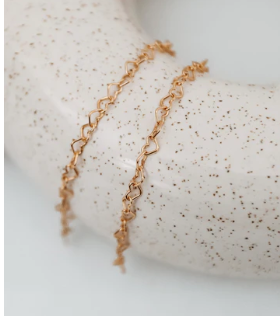
3mm Heart Chain from Stella Rose Jewelry Supply

I’ve been seeing more and more vendors at art and craft shows specializing in permanent jewelry. Was always curious about what it was, how it was done, and how permanent it really was. I share this article by Louis Owen, who answered my questions. — Warren Feld

At Land of Odds with Warren Feld Jewelry, we’ve seen our fair share of jewelry trends, from bold statement pieces to the return of vintage classics, but few have made as big a splash as the permanent jewelry craze. This “zapping” trend is everywhere right now, and for good reason. It blends style, sentiment, and craftsmanship into something people truly connect with.

Permanent jewelry isn’t just an accessory; it’s an experience. And in our world of ever-changing fashion, it’s one of the most meaningful shifts we’ve seen in years.

A Trend Years in the Making

Permanent jewelry’s journey started in luxury circles, where custom welding experiences were offered as exclusive events. Over time, its charm spread to boutiques, artisan jewelers, and even pop-up shops at festivals and private parties.

I’ve watched its appeal grow with customers who want more than just something pretty, they want something lasting.

How the “Zapping” Process Works

The process is simple yet special. Using a safe micro-welding tool, the jeweler fuses the chain directly onto the wrist, ankle, or neck, creating a clasp-free piece that fits perfectly. The spark lasts seconds, but the jewelry can last for years.

Many jewelers focus on offering high-quality chain options in solid gold, gold-filled, or sterling silver. Clients often add charms or connectors that make their piece completely unique.

Why Everyone’s Talking About It

Permanent jewelry has the perfect recipe for going viral:

· A visual “zap” moment that photographs well.

· A symbolic meaning that resonates with friends, couples, and families.

· A style that works with any outfit, any day.

Social media is a major driver, but so is word-of-mouth. Customers often say they go in for permanent jewelry in because they saw a friend’s welded bracelet and wanted the same experience.

The Materials Behind the Magic

Of course, quality matters. Many jewelers rely on trusted suppliers like Stella Rose Jewelry Supply for premium permanent jewelry chains. This ensures the finished piece not only looks beautiful but can stand up to daily wear.

If you prefer something with a bit of history, shops like Xtreme Pawn often have vintage gold or silver chains that can be repurposed into permanent jewelry, a creative mix of old-world charm and modern style.

Is It Really “Permanent”?

Yes and no. With care, your bracelet, anklet, or necklace can last years. But it can also be removed with scissors if necessary. That’s part of the charm, it’s long-lasting, not a lifetime sentence.

Our customers appreciate that balance of commitment and flexibility.

Why This Craze Has Staying Power

While some trends fade fast, permanent jewelry may be here to stay. It fits perfectly with the movement toward intentional, sustainable fashion. People want fewer, better pieces, and welded jewelry delivers on that promise.

We’ve seen firsthand how it brings people together, whether it’s two best friends getting matching bracelets or a couple marking an anniversary. It’s more than just a trend; it’s a moment you carry with you.

Final Thoughts

The permanent jewelry craze isn’t just about style, it’s about meaning.

Whether you’re drawn to the sleek look, the sentimental value, or simply the fun of “getting zapped,” there’s never been a better time to try it for yourself. Stop by, see the chains in person, and let us help you create your own little spark of permanence.

Posted in architecture, art, Art or Craft?, art theory, bead stringing, bead weaving, beads, beadwork, business of craft, color, Contests, craft, craft shows, creativity, cruises, design management, design theory, design thinking, enrichment travel, Entrepreneurship, fashion, handmade jewelry, jewelry, jewelry collecting, jewelry design, jewelry making, Learn To Bead, literacy, pearl knotting, professional development, Resources, Stitch 'n Bitch, Travel Opportunities, wire and metal, Workshops, Classes, Exhibits | Tagged: , , , , | Leave a Comment »

FLUENCY IN JEWELRY DESIGN: Self-Esteem, Making Choices

Posted by learntobead on July 21, 2025

Self Esteem — Making Choices

Crafts enhance people’s self esteem. This is good.

You make a piece of jewelry. People like it, and express this to you.

However, sometimes people let the craft substitute for their personal identities. Friends and family praise the jewelry, thus praise the jewelry maker. It’s nice to have your ego stroked. But you need to remember that there is more to you than the pieces you have made.

And you don’t want to put yourself into a tightly bounded box, where you shy away from risks. You don’t want to find yourself making the same piece over and over again, afraid to try something else, should someone not like it. You also don’t want to find yourself making kit after kit after kit, without any personalizing of someone else’s creativity, or better yet, without venturing off to create your own patterns and ideas.

The primary source of “self-esteem” should come from within you. Not external to you. When someone says they don’t like your design, or they don’t like your choice of colors, they are not saying they don’t like you. They like you, or they wouldn’t express an honest opinion about your work.

The true Artist and Designer come from this inner place. They are able to bring their integral sense of self-esteem, a part of their very being, to the fore, when designing and constructing a piece of jewelry as art.

Their choices are informed by a sense of self. And that sense of self is self-validated within each piece of jewelry they create. No matter what anyone else thinks — good, bad or indifferent.

_______________________________________________________

For more articles about FLUENCY IN DESIGN, visit the JEWELRY DESIGNERS’ HUB

_______________________________________________________

Thanks for being here. I look forward to sharing more resources, tips,
sources of inspiration and insights with you.

WarrenFeldJewelry.com
Shop.warrenfeldjewelry.com
School.warrenfeldjewelry.com
Coaching by Warren Feld

Add your name to my email list.

SO YOU WANT TO BE A JEWELRY DESIGNER
Merging Your Voice With Form

So You Want To Be A Jewelry Designer reinterprets how to apply techniques and modify art theories from the Jewelry Designer’s perspective. To go beyond craft, the jewelry designer needs to become literate in this discipline called Jewelry Design. Literacy means understanding how to answer the question: Why do some pieces of jewelry draw your attention, and others do not? How to develop the authentic, creative self, someone who is fluent, flexible and original. How to gain the necessary design skills and be able to apply them, whether the situation is familiar or not.

588pp, many images and diagrams Ebook , Kindle or Print formats

The Jewelry Journey Podcast
“Building Jewelry That Works: Why Jewelry Design Is Like Architecture”
Podcast, Part 1
Podcast, Part 2
Posted in architecture, art, Art or Craft?, art theory, bead stringing, bead weaving, beads, beadwork, business of craft, color, Contests, craft, craft shows, creativity, cruises, design management, design theory, design thinking, enrichment travel, Entrepreneurship, fashion, handmade jewelry, jewelry, jewelry collecting, jewelry design, jewelry making, Learn To Bead, literacy, pearl knotting, professional development, Resources, Stitch 'n Bitch, Travel Opportunities, wire and metal, Workshops, Classes, Exhibits | Tagged: , , , , | Leave a Comment »

FLUENCY IN JEWELRY DESIGN: Reading Patterns And Instructions

Posted by learntobead on July 15, 2025

Reading Patterns and Instructions

Infuriating! That’s how many people, beginners and advanced alike, feel when they try to understand patterns and instructions.

Know up-front that most diagrams and figures are poorly drawn, and most instructions are poorly written. The instructors who write these often leave out critical steps — especially for new beaders and jewelry makers who are unfamiliar with many of the things these instructors assume that you know. Most often, they leave out critical information showing you the pathway, and how to negotiate that pathway, from where you are to where you are going next. It’s obvious to the instructor. But not so obvious to you.

In patterns, this “where-am-I, where-am-I-going-next” information is frequently unclear or omitted. You did Step 1 OK. You understand what Step 2 is about. But you don’t know how to get from Step 1 to Step 2.

Othertimes, the patterns are overly complex, often, in the editorial interest of reducing the number of printed pages. Instead of showing a separate pattern or diagram for each step, the editors frequently try to show you three, four, five or more steps in the same diagram. So you have a bird’s nest of lines, and a spider-web’s road map — and you’re nowhere.

I tell people, that you need to re-write the instructions and re-draw the patterns or diagrams in a way you personally understand. This is very helpful.

______________

For more articles about FLUENCY IN DESIGN, visit the JEWELRY DESIGNERS’ HUB

______________

_______________________________________________________

Thanks for being here. I look forward to sharing more resources, tips,
sources of inspiration and insights with you.

WarrenFeldJewelry.com
Shop.warrenfeldjewelry.com
School.warrenfeldjewelry.com
Coaching by Warren Feld

Add your name to my email list.

SO YOU WANT TO BE A JEWELRY DESIGNER
Merging Your Voice With Form

So You Want To Be A Jewelry Designer reinterprets how to apply techniques and modify art theories from the Jewelry Designer’s perspective. To go beyond craft, the jewelry designer needs to become literate in this discipline called Jewelry Design. Literacy means understanding how to answer the question: Why do some pieces of jewelry draw your attention, and others do not? How to develop the authentic, creative self, someone who is fluent, flexible and original. How to gain the necessary design skills and be able to apply them, whether the situation is familiar or not.

588pp, many images and diagrams Ebook , Kindle or Print formats

The Jewelry Journey Podcast
“Building Jewelry That Works: Why Jewelry Design Is Like Architecture”
Podcast, Part 1
Podcast, Part 2

Posted in architecture, art, Art or Craft?, art theory, bead stringing, bead weaving, beads, beadwork, business of craft, color, Contests, craft, craft shows, creativity, cruises, design management, design theory, design thinking, enrichment travel, Entrepreneurship, fashion, handmade jewelry, jewelry, jewelry collecting, jewelry design, jewelry making, Learn To Bead, literacy, pearl knotting, professional development, Resources, Stitch 'n Bitch, Travel Opportunities, wire and metal, Workshops, Classes, Exhibits | Tagged: , , , , | Leave a Comment »

FLUENCY IN JEWELRY DESIGN: Learning Technique: Finishing Off The Piece

Posted by learntobead on June 30, 2025

FINISHING OFF THE PIECE

Finishing Off The Piece. We always need to step back and reflect whether the piece as designed and implemented will be judged as finished and successful by each of the myriad audiences we hope to please. Will their judgments confirm or reject our philosophy of the particular technique(s) we used?

It is the challenge for the designer not to make the piece under-done or over-done. Each and every material and component part should be integral to the piece as a whole. In fact, the sensation of the piece as a whole should be greater than the sensation of any of its individual parts.

______________________________________________

For more articles about FLUENCY IN DESIGN, visit the JEWELRY DESIGNERS’ HUB

https://www.patreon.com/collection/613906?view=expanded

______________________________________________

_______________________________________________________

Thanks for being here. I look forward to sharing more resources, tips,
sources of inspiration and insights with you.

WarrenFeldJewelry.com
Shop.warrenfeldjewelry.com
School.warrenfeldjewelry.com
Coaching by Warren Feld

Add your name to my email list.

SO YOU WANT TO BE A JEWELRY DESIGNER
Merging Your Voice With Form

So You Want To Be A Jewelry Designer reinterprets how to apply techniques and modify art theories from the Jewelry Designer’s perspective. To go beyond craft, the jewelry designer needs to become literate in this discipline called Jewelry Design. Literacy means understanding how to answer the question: Why do some pieces of jewelry draw your attention, and others do not? How to develop the authentic, creative self, someone who is fluent, flexible and original. How to gain the necessary design skills and be able to apply them, whether the situation is familiar or not.

588pp, many images and diagrams Ebook , Kindle or Print formats

The Jewelry Journey Podcast
“Building Jewelry That Works: Why Jewelry Design Is Like Architecture”
Podcast, Part 1
Podcast, Part 2
Posted in architecture, art, Art or Craft?, art theory, bead stringing, bead weaving, beads, beadwork, business of craft, color, Contests, craft, craft shows, creativity, cruises, design management, design theory, design thinking, enrichment travel, Entrepreneurship, fashion, handmade jewelry, jewelry, jewelry collecting, jewelry design, jewelry making, Learn To Bead, literacy, pearl knotting, professional development, Resources, Stitch 'n Bitch, Travel Opportunities, wire and metal, Workshops, Classes, Exhibits | Tagged: , , , , | Leave a Comment »

CONQUERING THE CREATIVE MARKETPLACE: Your Getting Started Story

Posted by learntobead on June 27, 2025

Your Getting Started Story

When did you first realize you wanted to make a business out of your passion for making jewelry?

[While you are thinking about this, now is a good time to get out your pen and paper and jot down some thoughts.]

Everyone has a Getting Started Story.

This is a story you tell over and over again. In it, you express your wonderment and passion. You talk about your excitement, your inspirations, your aspirations, your motivations and how you decided to channel them. You go over the steps you went through to discover what it is that drives you to create. You recall who influenced you, when and why. You remember different pathways and crossroads, where you decided to pursue your interests in one direction or another. You reflect on your expectations before you got started, and how these evolved or changed as you began to make and design jewelry.

Sometimes your story begins by touching some beads. Or running a strand of pearls through your hand. Or the sight of something perfectly worn around the wrist, upon the breast, or up near the neck. Other times, it may begin by taking a class, or deciding to make a special pair of earrings to match a particular outfit. Or thinking you want to make a piece of jewelry you saw someone wearing on TV or in a photospread in some magazine.

Your Getting Started Story is a measure of what you have discovered, and what you need to discover still. It is a foil against which to measure your successes, and some not-so-successful things. It represents your insight and foresight when making both personal development and jewelry design choices.

And, it is very important to be cognizant and aware of how your Getting Started Story follows you throughout your career …

… CONTINUE READING ON THE JEWELRY DESIGNERS’ HUB

Posted in architecture, art, Art or Craft?, art theory, bead stringing, bead weaving, beads, beadwork, business of craft, color, Contests, craft, craft shows, creativity, cruises, design management, design theory, design thinking, enrichment travel, Entrepreneurship, fashion, handmade jewelry, jewelry, jewelry collecting, jewelry design, jewelry making, Learn To Bead, literacy, pearl knotting, professional development, Resources, Stitch 'n Bitch, Travel Opportunities, wire and metal, Workshops, Classes, Exhibits | Tagged: , , , , | Leave a Comment »

CONQUERING THE CREATIVE MARKETPLACE: Disciplinary Literacy Underlying Jewelry Designing

Posted by learntobead on May 30, 2025

Disciplinary Literacy Underlying Jewelry Designing

I believe jewelry designers have a special way of thinking through selecting design elements, composing, constructing, and manipulating objects. Different than crafters. Different than artists. Different than other disciplines and their core ways of defining things and thinking things through.

How should the designer think? How should she organize her tasks? How should she tap into her creative self? How should she select materials, techniques and technologies? How should she assert her creativity and introduce her ideas and objects to others? How much does she need to know about how and why people wear and inhabit jewelry? What impact should she strive to have on others or the more general culture and society as a whole? How should she approach unfamiliar, unknown or problematic designs?

In my book
SO YOU WANT TO BE A JEWELRY DESIGNER (https://shop.ingramspark.com/b/084?EenmVM2NMYJGNKaAzr68kaH6GGGSPuNIkGCP1Hfzm3N),

I try to formulate a disciplinary literacy unique and special and legitimate for jewelry designers. Such literacy encompasses a basic vocabulary about materials, techniques, color and other design elements and rules of composition. It also includes the kinds of thinking routines and strategies jewelry designers need to know in order to be fluent, flexible and original. It includes what the jewelry designer needs to know and do when introducing their pieces publicly, either to have others wear, buy or collect their pieces.

These routines and strategies are at the heart of the designer’s knowledges, skills and understandings related to creativity, elaboration, embellishment, reflection, critique and metacognition. This disciplinary literacy in design is very similar to how sounds are made into music. This literacy is very similar to how words are made into literature. There is an underlying vocabulary and grammar to jewelry design, from decoding to comprehension to fluency. The jewelry designer is dependent upon this disciplinary literacy to the extent that she or he is able to move from inspiration to aspiration to implementation and management towards finish and success. …

CONTINUE READING THIS ARTICLE ON THE JEWELRY DESIGNERS’ HUB

Posted in architecture, art, Art or Craft?, art theory, bead stringing, bead weaving, beads, beadwork, business of craft, color, Contests, craft, craft shows, creativity, cruises, design management, design theory, design thinking, enrichment travel, Entrepreneurship, fashion, handmade jewelry, jewelry, jewelry collecting, jewelry design, jewelry making, Learn To Bead, literacy, pearl knotting, professional development, Resources, Stitch 'n Bitch, Travel Opportunities, wire and metal, Workshops, Classes, Exhibits | Tagged: , , , , | Leave a Comment »

FLUENCY IN JEWELRY DESIGN: Channeling Your Excitement

Posted by learntobead on May 12, 2025

Abstract:

Why do you want to become (or are already on the way to becoming) a jewelry designer? What drives you? How do you channel your excitement? Is it something to do with what type of person you are? How you view the world? How you want to fill your time? It turns out there are many types of people who become jewelry designers. Although they may have different aspirations and ambitions underlying their excitement about jewelry design, they find common ground and a common way of thinking about making and designing jewelry. But because jewelry design has not yet become a full-fledged, recognizable discipline all its own, it sometimes becomes difficult to get clarity on how to channel your excitement into an avocation or career. Your support group is often made up of a polyglot of crafters and artists, some who do not fully understand jewelry making and design. Advice can be diffuse. Clients have difficulty evaluating the value of your work, frequently expressing misunderstandings about what is good. This can lead to self-doubt, which better designers learn to manage and overcome.

GETTING STARTED:
CHANNELING YOUR EXCITEMENT
What drives you to pursue your passion for jewelry?

“Why Are You A Jewelry Artist?”
As if you had a choice…

It often is difficult for others to understand why you consider yourself a jewelry designer. How did this come to be? How did you get started? Were you always artistic? Is your family crafty? How did you learn these things? Why jewelry? Why do you get so excited about all this? Do you want to make a living out of it? Can you really sell things?

They don’t really feel these things like you do. They don’t feel this pulsing heart, this urge to create, and this passion to make jewelry. When you get started making jewelry, it’s hard to stop. It becomes ingrained in you. What may have begun as a hobby evolves into something you cannot live without. Applying your creative self becomes habit, almost addicting, often relaxing and self-affirming … and painful to do without.

As a jewelry artist, you have a purpose in life. It is something you do because you must do it. It is what helps you function in life. You make new amazing pieces, share these, and make some more new amazing pieces. You have those little conversations with yourself about the various choices you are making, when designing a piece of jewelry, and this can be therapeutic, informative, reaffirming. And, you are ever in search of developing those insightful, smart strategies for merging voice with form, aesthetics with function, your intent with the desires of others. …

… CONTINUE READING ON THE JEWELRY DESIGNERS’ HUB

Posted in architecture, art, Art or Craft?, art theory, bead stringing, bead weaving, beads, beadwork, business of craft, color, Contests, craft, craft shows, creativity, cruises, design management, design theory, design thinking, enrichment travel, Entrepreneurship, fashion, handmade jewelry, jewelry, jewelry collecting, jewelry design, jewelry making, Learn To Bead, literacy, pearl knotting, professional development, Resources, Stitch 'n Bitch, Travel Opportunities, wire and metal, Workshops, Classes, Exhibits | Tagged: , , , , | Leave a Comment »

THE JEWELERS’ PALLETTE, 4/25/2025

Posted by learntobead on April 11, 2025


From Warren and Land of Odds
Join my community of jewelry designers on my Patreon hub
April 15, 2025
Sign up for a Free or Paid Subscription

[Note: Paid Subscribers on Patreon Hub get 25% Off @Land of Odds]

www.landofodds.com

Hi everyone,

Some Updates and Things Happening.
(Please share this newsletter)

In this Issue:
1. How to use AI in your jewelry business
2. Some pointers about the design of your website
3. Take Some Time To Celebrate Yourself!
4. Jewelry in the news
5. Simplify your INSTAGRAM feed — some tips
6. FLUENCY IN JEWELRY DESIGN: Fluency and Empowerment
 
Some articles you may have missed
Featured


1. How to use AI in your jewelry business

Suggestions from Megan Crabtree
Read her full article in INSTORE MAGAZINE here.

Here are nine AI-driven strategies to boost your bottom line.

1. Personalized recommendations. AI analyzes customer behavior, such as purchase history, browsing behavior, and interactions with the brand. It then suggests relevant products, such as a “complete your look” feature at checkout, which increases sales and engagement.

2. Virtual try-ons. Augmented reality, powered by AI, is transforming the jewelry shopping experience. Virtual try-ons allow customers to see how a piece of jewelry would look on them without ever visiting the store, offering more confidence in their purchasing decisions.

3. Inventory management. Predictive analytics can take the guesswork out of inventory management by forecasting demand. This ensures you neither overstock nor run out of high-demand items, which leads to better resource allocation and cost savings.

4. Customer service chatbots. AI chatbots provide instant 24/7 support, freeing staff for in-store interactions. It’s important, however, to have a process in place for a smooth handoff to a human representative to resolve more complex issues.

5. Visual search. Customers can upload an image to find similar jewelry in your inventory, making discovery seamless.

6. Dynamic pricing optimization. AI can optimize your pricing strategy by suggesting pricing adjustments, in real-time, based on competitor rates, demand, and sales trends to maximize profits.

7. Product photography enhancement. AI-powered tools can automatically enhance product images, ensuring consistency and high quality across all visuals. Additionally, 360-degree views of jewelry pieces can be created, allowing customers to examine items from every angle.

8. Appraisal assistance. AI streamlines jewelry appraisals with data-driven valuations, reducing errors and increasing accuracy.

9. PRODUCT DESCRIPTIONS. AI can significantly improve the quality of your product descriptions by translating industry jargon into customer-friendly language. Many shoppers are unfamiliar with terms like “14KWG” and would prefer a description that simply says, “14 karat white gold.” Clear, well-crafted descriptions make it easier for shoppers to purchase with confidence

So how can you get started? Identify your business needs (e.g., design, marketing, customer service, logistics) and explore AI tools already integrated into your existing e-commerce, CRM, or design software. Many platforms offer free trials or demos.


2. Some pointers about the design of your website

With the availability of chatgpt and other ai applications, it has become ever more difficult to do a Search Engine Optimization (SEO) on your website and compete. Every new or upgraded website will have done this making it as difficult as ever to depend on someone doing a search engine search and finding you. 

This means that the look and feel of your website will become its biggest asset.

Some things to think about:

  • Use your website as a portfolio, rather than a sales tool.
  • Keep your website clean and focused on your credibility.
  • Don’t worry about accommodating Google’s ranking and rating search criteria
  • Rely more on social media, like Instagram, and on email to drive traffic to your site
  • Large, high resolution impactful photos on your landing page is ideal
  • Use larger fonts, black type on white background works best
  • If listing collections on your landing page, also include a short description with each one
  • BE SURE: It’s easy to find how to contact you

3. Take Some Time To Celebrate Yourself

When was the last time this year you paused and looked back to celebrate the little wins — or the big ones?

It’s so easy to get caught up on doing, doing, doing… without pause.

At least once a week, sit down in a familiar place, relax, and reflect. 

And celebrate yourself!


4. Jewelry In the News

o MUNICH JEWELLERY WEEK TO RELOCATE TO ALASKA IN 2026
In an effort to fight global warming, the biggest global event in art jewelry will be permanently held in Anchorage. There’s a positive side to it: “Big, heavy parkas are a great surface for displaying brooches,” stated Frau Brosche, a press officer from the Internationale Handwerksmesse.

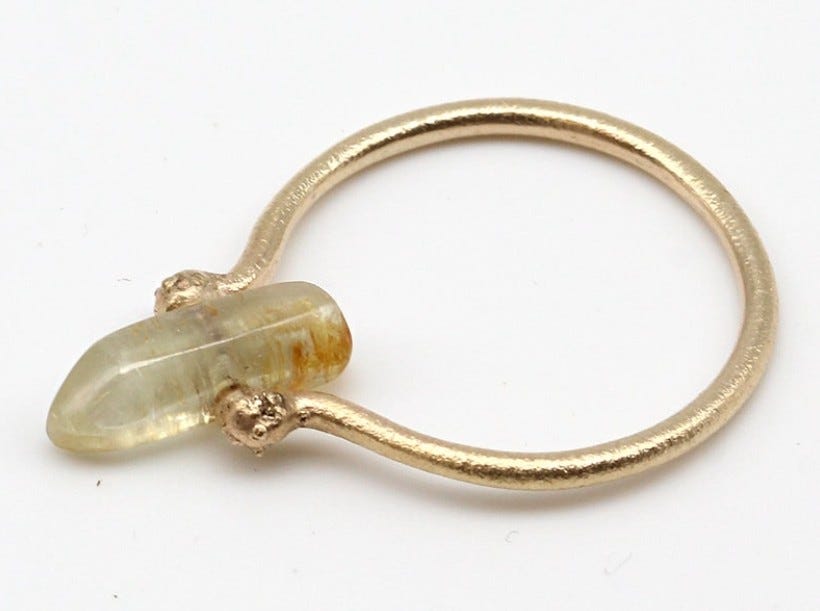
Bespoke abacus yellow gold ring with yellow sapphire, designed and made by Tamara Gomez, photo courtesy of the artist

o SMITHSONIAN TO OPEN MUSEUM OF THE AMERICAN ART JEWELER
The institution will join the Air and Space and Hirshhorn museums on the National Mall in Washington, DC. Yvonne Montoya, AJF’s former executive director, has been appointed its director. “Pforzheim and Espace Solidor won’t get all the glory,” vows Montoya.

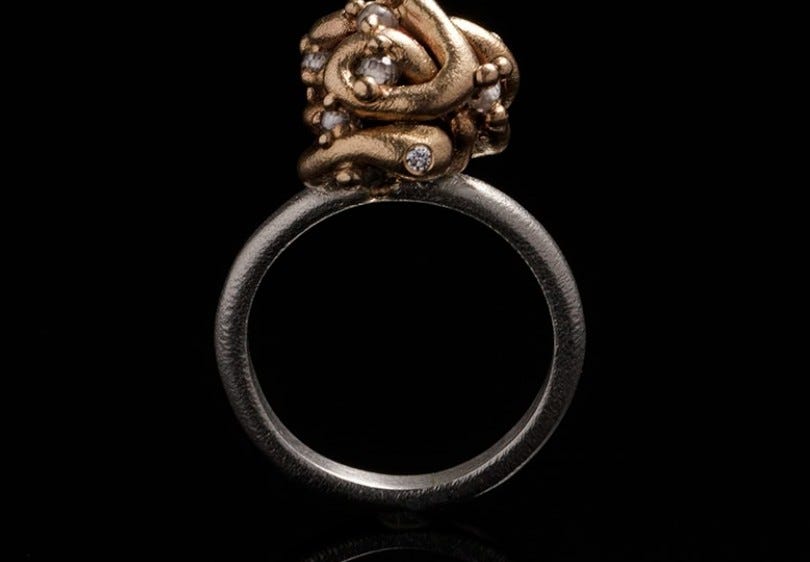
Called Scrambled Head with Glimmer of Hope, this Tamara Gomez statement ring is made with diamond, moissanite, 14-karat yellow gold, and sterling silver, photo courtesy of the artist

o NEW EXHIBITION — FOLLOW YOUR NOSE: SEPTUM RINGS OF THE POWERFUL
“With this type of piercing,” said curator Naz Schnozz, “you can wear a retainer that flips up inside the nostrils. That means the public doesn’t know you have a septum ring.” Many are familiar with Madeleine Albright as a diplomat who spoke with her brooches, “but few realize she wore a septum ring in private,” added Schnozz. Besides Albright’s jewelry, the traveling exhibit features pieces worn by Angela Merkel, Emmanuel Macron, and Michelle Obama. Coming soon to a museum near you!

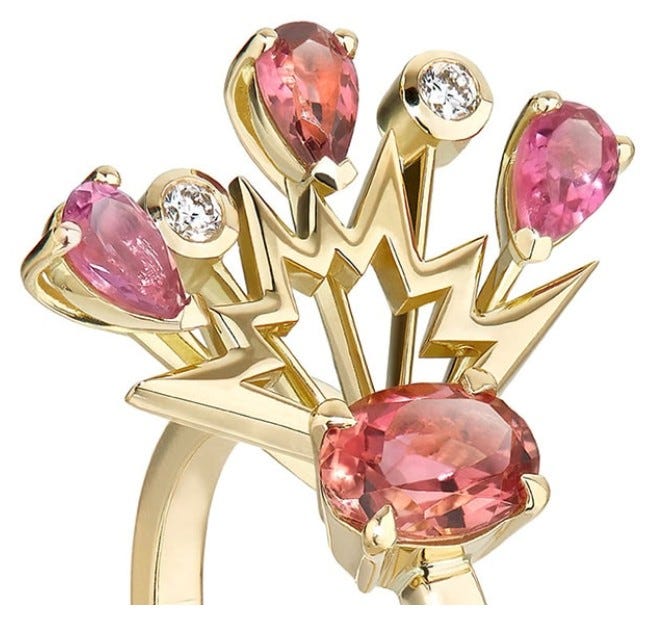
The 18-karat gold Cherrybomb ring with sapphires, diamonds, and tourmalines, designed and crafted by Aishleen Lester, photo courtesy of the artist

o KIM KARDASHIAN APPLIES TO JEWELRY MASTERS PROGRAMS
She’s already done shapewear, fragrance, makeup, investing. In 2011 Kardashian launched a line of costume jewelry that let fans accessorize like her at an affordable price, but it flopped. The reality star attributed this to the baubles being kind of “basic.” Enrolling in a master’s jewelry program “will hone my understanding of jewelry theory,” says the influencer, “and help me create designs that are more critical of the beauty industry. That’s what my fans really want.” Kardashian hopes to start classes this fall and looks forward to dialog with instructors and fellow students.

Hugo Luis Johnson’s white gold and silver violin won Silver at the 2021 Goldsmiths’ Craft and Design Council Awards, photo courtesy of the artist

o ADRIAN BRODY DESIGNS LINE OF CONCRETE ART JEWELRY
“My stylist has had me wearing brooches on the red carpet,” says the actor, “Her choices are pretty conventional high pieces, but they gave me an interest in jewelry as a medium. Then filming The Brutalist made me want to design my own. I asked a local contractor to show me how to make little molds and mix the cement.” Find the pieces in the MOMA gift shop.


5. Simplify your INSTAGRAM feed — some tips

📱 Simplify your Instagram feed to attract more followers.

  • Avoid adding text directly on images. Keep your jewelry as the main visual and use captions or separate slides for text.
  • If you need to include text or promotional material, make it the last slide rather than the cover image.
  • Promotional content, like event details or newsletter sign-ups, works better in Instagram Stories instead of your feed.

A clean, cohesive feed makes your art look more appealing and increases the likelihood of organic followers staying and engaging with your work.

 📈 Boost Instagram engagement by showcasing your process.

While personal moments add depth, prioritize close-up shots of your jewelry making process, selecting materials, implementing techniques, choosing colors and other design elements. These are visually engaging & highlight skill.

Instead of vague captions, explain why your jewelry is unique. Share insights about your techniques, inspirations, and creative decisions to draw in your audience.

Start reels with attention-grabbing text like “This transformed my jewelry making” or “Here’s how I create rythm” to keep viewers watching.

Experiment with a series of reels following the same engaging format, such as “How I make jewelry [subject],” to create familiarity and encourage followers to return.

NOTE: Instagram’s algorithm now prioritizes content discovery through the Explore page and recommendations rather than hashtags.


6. FLUENCY IN JEWELRY DESIGN: Fluency and Empowerment

The fluent jewelry designer is able to think like a designer. The jewelry designer is more than a craftsperson and more than an artist. The jewelry designer must learn a specialized language, and specialized way of balancing the needs for appeal with the needs for functionality. The jewelry designer must intimately recognize and understand the roles jewelry plays for individuals as well as the society as a whole. The designer must learn how art, architecture, physical mechanics, engineering, sociology, psychology, context, even party planning, all must come together and get expressed at the point where jewelry meets the boundary of the person, that is, as the jewelry is worn.

And to gain that fluency, the designer must commit to learning a lot of vocabulary, ideas and terms, and how these imply content and meaning through expression. The designer will need to be very aware of personal thoughts and thinking as these get reflected in all the choices made in design. The designer will have to be good at anticipating the understandings and judgements of many different audiences, including the wearer, viewer, seller, buyer, exhibitor, client, collector, teacher and student.

With fluency comes empowerment. The empowered designer has a confidence that whatever needs to be done, …

Continue reading on my JEWELRY DESIGNERS’ HUB.


SOME POSTS YOU MAY HAVE MISSED:

PODCAST: WHY JEWELRY IS LIKE ARCHITECTURE

JTV: PETERSBURG CHAIN ROPE

ARCHIVE: THE UGLY NECKLACE CONTESTUpcoming Classes and 

Workshops by Warren Feld

Sat, 4/26, 1–4, PEARL KNOTTING, Hoamsy, Nashville, Fait La Force Brewery,1414 3rd Ave S, Ste 101, Nashville
Register: https://www.hoamsy.com/experiences/detail/z1IFcpOwTimeKRYk1akv

Sat, 6/7, 1–4, WIRE WRAPPED CABOCHON PENDANT, Hoamsy, Nashville, Nashville, Fait La Force Brewery,1414 3rd Ave S, Ste 101, Nashville
Register :https://www.hoamsy.com/experiences/detail/6azTthSZL5h76jCqKjNp

9/15/2025–10/15/2025 Art Jewelry Exhibit at Pryor Gallery, Columbia State Community College
My pieces will be showcased an this exhibit. In the works is a possible Seminar and a beading workshop.


WARREN FELD JEWELRY (www.warrenfeldjewelry.com)
Custom Design, Workshops, Video Tutorials, Webinars, Coaching, Kits, Group Activities, Repairs
~~~~~~~~~~~~~~~~~~~~~~~
Join our community of jewelry designers
on my Patreon hub
Be part of a community of jewelry designers who recognize that we have a different way of thinking and doing than other types of crafters or artists.
One free downloadable Mini-Lesson of your choice for all new members!
~~~~~~~~~~~~~~~~~~~~~~~


Follow me on social media: facebook, instagram

shop.warrenfeldjewelry.com
Where you can buy:
Seed Beads and Delicas, Kits, Books, Finished Jewelry

school.warrenfeldjewelry.com
Take advantage of our video tutorials, mini-lessons, projects and our coaching services:

Read articles about jewelry design and about the business of craft:
Articles on Medium.com 

Books (in kindle, ebook or print formats) by Warren Feld, purchase from Amazon.com or BarnesAndNoble.com:

Kits by Warren Feld

Ask about my COACHING services

Arrange a GROUP ACTIVITY

Add your email address to my Warren Feld Jewelry emailing list here.

Thanks for being here. I look forward to sharing more resources, tips,
sources of inspiration and insights with you.

Join A Community Of Jewelry Designers 
On My Patreon Hub

Posted in architecture, Art or Craft?, art theory, bead stringing, bead weaving, beads, beadwork, business of craft, color, Contests, craft, craft shows, creativity, cruises, design management, design theory, design thinking, enrichment travel, Entrepreneurship, handmade jewelry, jewelry, jewelry collecting, jewelry design, jewelry making, Learn To Bead, literacy, pearl knotting, professional development, Resources, Stitch 'n Bitch, Travel Opportunities, wire and metal, Workshops, Classes, Exhibits | Tagged: , , , , | Leave a Comment »

FLUENCY IN JEWELRY DESIGN: Fluency and Empowerment

Posted by learntobead on March 31, 2025

Fluency and Empowerment

The fluent jewelry designer is able to think like a designer. The jewelry designer is more than a craftsperson and more than an artist. The jewelry designer must learn a specialized language, and specialized way of balancing the needs for appeal with the needs for functionality. The jewelry designer must intimately recognize and understand the roles jewelry plays for individuals as well as the society as a whole. The designer must learn how art, architecture, physical mechanics, engineering, sociology, psychology, context, even party planning, all must come together and get expressed at the point where jewelry meets the boundary of the person, that is, as the jewelry is worn.

And to gain that fluency, the designer must commit to learning a lot of vocabulary, ideas and terms, and how these imply content and meaning through expression. The designer will need to be very aware of personal thoughts and thinking as these get reflected in all the choices made in design. The designer will have to be good at anticipating the understandings and judgements of many different audiences, including the wearer, viewer, seller, buyer, exhibitor, client, collector, teacher and student.

With fluency comes empowerment. The empowered designer has a confidence that whatever needs to be done, or whatever must come next, the designer can get through it. Empowerment is about making and managing choices. These choices could be as simple as whether to finish a piece or not. Or whether to begin a second piece. Or which materials or techniques should be used. The designer will make choices about how to draw someone’s attention to the piece, or present the piece to a larger audience. She or he may decide to submit the piece to a magazine or contest. She or he may want to sell the piece and market it. The designer will make choices about how a piece might be worn, or who might wear it, or when it might be worn, in what context.

And for all these choices, the jewelry designer might need to overcome a sense of fear, boredom, or resistance. The designer might need to overcome anxiety, a sense of giving up, having designer’s block, feeling unchallenged, and even laziness.

In order to make better artistic and design choices, the Fluent and Empowered Jewelry Designer should have answers to 5 critical questions.

_______________________________________________________

Thanks for being here. I look forward to sharing more resources, tips,
sources of inspiration and insights with you.

WarrenFeldJewelry.com
Shop.warrenfeldjewelry.com
School.warrenfeldjewelry.com
Coaching by Warren Feld

Add your name to my email list.

SO YOU WANT TO BE A JEWELRY DESIGNER
Merging Your Voice With Form

So You Want To Be A Jewelry Designer reinterprets how to apply techniques and modify art theories from the Jewelry Designer’s perspective. To go beyond craft, the jewelry designer needs to become literate in this discipline called Jewelry Design. Literacy means understanding how to answer the question: Why do some pieces of jewelry draw your attention, and others do not? How to develop the authentic, creative self, someone who is fluent, flexible and original. How to gain the necessary design skills and be able to apply them, whether the situation is familiar or not.

588pp, many images and diagrams Ebook , Kindle or Print formats

The Jewelry Journey Podcast
“Building Jewelry That Works: Why Jewelry Design Is Like Architecture”
Podcast, Part 1
Podcast, Part 2
Posted in architecture, Art or Craft?, art theory, bead stringing, bead weaving, beads, beadwork, business of craft, color, Contests, craft, craft shows, creativity, cruises, design management, design theory, design thinking, enrichment travel, Entrepreneurship, handmade jewelry, jewelry, jewelry collecting, jewelry design, jewelry making, Learn To Bead, literacy, pearl knotting, professional development, Resources, Stitch 'n Bitch, Travel Opportunities, wire and metal, Workshops, Classes, Exhibits | Tagged: , , , , | Leave a Comment »

FLUENCY IN JEWELRY DESIGN: Advice For The Newly Emerging Jewelry Designer

Posted by learntobead on March 17, 2025

Some Bottom-Line Advice For The Newly Emerging Jewelry Designer

Always keep working and working hard. Set up a routine, and do at least one thing every day.

Find a comfortable place to work in your home or apartment. If at all possible, find separate spaces for creative work, business stuff, and reflection.

Develop strategies for organizing your projects, your supplies and your tools, and for keeping things generally organized over time. But don’t overdue the organizing thing. A little chaos can be OK, and even, sometimes, trigger new ideas.

Give yourself permission to play, experiment, go down many paths. Everything you work on doesn’t have to meet the criterion of perfection, be cool, or become the next Rembrandt. A key part of the learning process is trial and error, hypothesis, test, and conclusion. This helps you develop fix-it strategies so that you can overcome unfamiliar or problematic situations, enhancing your skills as a designer.

Don’t let self-doubt and any sense of impending failure take over you, and paralyze you. Designer’s block, while it may happen occasionally, should be temporary. Jewelry projects usually evolve, and involve some give and take, change and rearrangement. Often the time to complete a project can be lengthy, and you have to maintain your interest and inspiration over this extended time period.

Don’t get stuck in a rut. Try new materials. Try new colors. Try new designs. Try new styles. Try to add variation, new arrangements, smart embellishments. Learn new techniques and technologies.

_______________________________________________________

Thanks for being here. I look forward to sharing more resources, tips,
sources of inspiration and insights with you.

WarrenFeldJewelry.com
Shop.warrenfeldjewelry.com
School.warrenfeldjewelry.com
Coaching by Warren Feld

Add your name to my email list.

SO YOU WANT TO BE A JEWELRY DESIGNER
Merging Your Voice With Form

So You Want To Be A Jewelry Designer reinterprets how to apply techniques and modify art theories from the Jewelry Designer’s perspective. To go beyond craft, the jewelry designer needs to become literate in this discipline called Jewelry Design. Literacy means understanding how to answer the question: Why do some pieces of jewelry draw your attention, and others do not? How to develop the authentic, creative self, someone who is fluent, flexible and original. How to gain the necessary design skills and be able to apply them, whether the situation is familiar or not.

588pp, many images and diagrams Ebook , Kindle or Print formats

The Jewelry Journey Podcast
“Building Jewelry That Works: Why Jewelry Design Is Like Architecture”
Podcast, Part 1
Podcast, Part 2
Posted in architecture, Art or Craft?, art theory, bead stringing, bead weaving, beads, beadwork, business of craft, color, Contests, craft, craft shows, creativity, cruises, design management, design theory, design thinking, enrichment travel, Entrepreneurship, handmade jewelry, jewelry, jewelry collecting, jewelry design, jewelry making, Learn To Bead, literacy, pearl knotting, professional development, Resources, Stitch 'n Bitch, Travel Opportunities, wire and metal, Workshops, Classes, Exhibits | Tagged: , , , , | Leave a Comment »