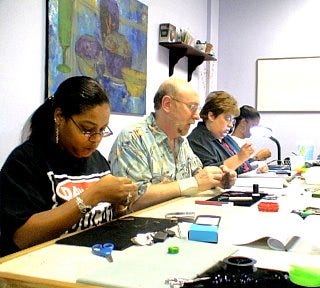
QUESTION: At what point did you realize you were addicted to beads?
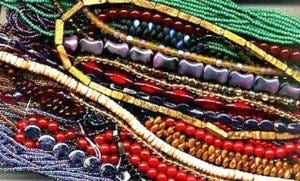
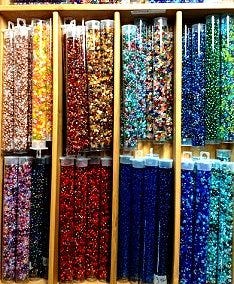
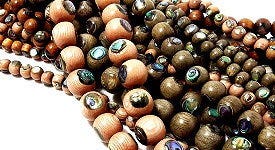
People are always saying how addicting beads are. They express surprise that the pull of beads is so strong. They can’t stop buying and accumulating beads. They can’t go anywhere without stopping at the local bead store for a bead fix. They find themselves intentionally fooling or deceiving themselves about how many beads they actually have, or how much money they have spent on them.
Yes, beads are very addicting. Even though your drawers are full, you never have enough.
We asked our students, customers and colleagues to complete this sentence:
I never knew how addicting this was until….
…My car automatically turned into the parking lot in front of the bead store.
…I was laying in bed looking at my ceiling tiles and realized they were done in a “Peyote” stitch pattern!
…I made my beaded fish in progress into a screen-saver. It is all about the process, when will I finish? who cares… I have this beautiful thing to handle and see as I work. Such a pleasure!
… I began hiding a stash of money to buy beads: “It’s not like I’m sleeping around….I’m just buying beads.”
… I went shopping for clothes, but came back with only one bag — a bag of mixed beads.
…. I used 3 checks to pay for my order — one from a joint account with my husband, a second from an account in my name only, and a 3rd from my son’s account — luckily I had his checkbook in my purse. So now, my husband will think that I’m only spending a little bit, I can fool myself, and my son doesn’t care one way or the other.
… I converted my dining room to a bead room, and made my family eat in the den on TV trays.
… I found that despite my long and mostly constant love of fabric — I am after all a lifetime seamstress, having been comforted by the smell and color of fabric stores and the chush, chush, chushing of my mom’s Kenmore machine since first memories — could not resist the magnetic pull into the unknown. There, standing at the front door of my local craft store with nothing on my mind or agenda but 2 yards of multi-colored backing fabric for a client’s project, I saw the front of my wobbly plastic basket steering to the Northwest (Fabric is definitely to the Southwest) with such abandon that the lovely glass shelves in the center front of the store were in danger!
…I turned to beads for solace and a quiet focus. I have been going through a very hard time trying to keep a very ailing relationship together and when I could have been stressed out and worrying, I spent the time quietly beading. When I just wanted to go to bed and stay there for days, I was able to sit in my living room with my son and do bead work. To him, I was being with him and calm; to me, I was hiding in my beadwork and being near him. Beads have been my refuge. I have even read where hand needle work is a stress reliever, I am a living testament to that!
…I saw seed beads in what I scooped out of my cat box! I took my bead work and worked in the car on vacation. Every time I vacuum the sound of beads is heard. It seems every purse I clean out has some beads in it. I find beads on the back porch, when I sweep. It is a really tough decision, when I come to the off ramp which leads to the bead store and I really need to get home! I have more beads than projects for them!
…I gave up a Shoe Addiction for this…it better be worth it!
Today, it is imperative that that any jewelry designer who wants to sell their pieces must have an online presence. This could be as simple as a listing in a online directory like Yelp. You might have a Facebook page or Instagram account or a Pinterest board. You might have a website that functions like a billboard. Or you may have a website with its own commercial shopping cart.
Many jewelry designers, however, choose to place their business on one of the many craft marketplaces online. Etsy, perhaps, is the most widely known. Like anything else, this approach has some pros and some cons. Below I list some things to think about before choosing one or more sites. It is a smart move, however, to be located on more than one marketplace site.
I have found that many people get frustrated with these sites, in that sales can be minimal, or the numbers of people they are competing with seems daunting. But I have found these same people not doing all the necessary “good business” tasks, such as some intensive and persistent marketing of their wares, and smart photo and text detail for their pieces.
Question: WHAT KINDS OF EXPERIENCES HAVE YOU HAD, and WHAT KINDS OF TIPS CAN YOU OFFER?
Here’s some of the things I have found.
First, there are many, many online marketplaces to choose from. Some let you set up your own website, and others show your merchandise as part of a larger marketplace. Each has pros and cons. Perhaps one lesson is: “Don’t put all your eggs in one basket.”
The PROS to look for with any site: – low commission on sales – good traffic – ease of setting up your shop – having a lot of control over how your shop looks; how customizable it is – no monthly fees – web host does a lot of promotion – site has a good search function – site has good statistics, and lets you easily track traffic and what has sold, at what price point, and when, for both of your specific merchandise, as well as for all merchants with similar merchandise
The CONS to look for with any site: – high commissions and/or fees – when site is too big, may be difficult to get noticed – host limits how you list and present your items – host restricts your contact with your customers
Other types of questions to ask:
– Does site handle the billing and payments for you? – What kind of marketing does the site do? – Is it relatively easy to set up your site and keep it updated? – Are there any limitations on the numbers of items you might list at one time? – Are there any limitations on the number or size of photos you can include on your site? – How and where will your items appear in a search listing on the host’s site?
NOTE: Many sites put you at the front of the line for the first 30 days you have registered with them. Then they apply their regular ranking and rating algorithm, which, when you are new, puts you toward the bottom of the listing.
– What payment methods/options are allowed? – Does the site restrict items to “Handmade” only, and how is “Handmade” defined? You do not want to compete with cheap, imported, machine made jewelry. – How easy is it to contact customer service? Do they provide a lot of easy-to-follow tutorials for setting up and managing your site?
Different types of fees that might be assessed: 1. Listing fee 2. Sales commissions, usually as a percent of sale 3. Renewal fees (when listings are time limited) 4. Monthly site maintenance fees 5. Share of advertising fees 6. An extra shipping or postage charge to use when they handle your shipping, or enable you to purchase and print out a shipping label on the website
Some Tips and Advice:
(1) Your items should be different enough from others to set you apart, and get you remembered (2) If your items are similar to others, you might consider competing on price (3) Do NOT depend on the host to promote your site; you must actively — that means, almost every day — do things to promote your site. (4) Don’t just list your items and let them sit there (5) Excellent photos are a must (6) Treat your online shop as a business, not a hobby (7) Categorize and label your jewelry and jewelry lines; picture the words someone might type into a search bar in order to find this jewelry, and use those as key words in your labeling (8) Let your passion shine
Many, many people you will be competing with do not necessarily have good business sense, particularly when it comes to pricing their jewelry. People, in general, tend to underprice their pieces. They go out of business quickly. But while they’re in business, you are competing with them, and often you find it hard to compete on price.
This is a given. That means you have to spend more energy on marketing your competitive advantages, in order to justify the prices you need to charge, in order to stay in business. Some of this will come down to better presentation — more facts and great detailed images about your jewelry, and more details about the how your jewelry will benefit your customer. Better presentation equals more trust; more trust should translate into more sales. Some more competitive advantages: your jewelry is better made; it uses better materials; your line of jewelry is broader; you have better customer care policies; your style is more unique; your jewelry supports as “cause”.
And many, many more people you will be competing with have very good business sense. There are over 6 million items of jewelry on sale on Etsy at any one time — many by sharp, savvy artists. To get seen, heard and responded to takes emphasizing your competitive advantages, as well as persistent, broadly targeted marketing.
While I occasionally use armatures in my beadwork projects, I have a psychological aversion to them as somehow contaminating my beadwork, making it less pure, taking the sacred and making it profane. I think what I viscerally react to is how often, the way people use the armatures, makes the piece look more crafty or less finished.
Nevertheless, when you need your beadwork to hold a shape, what other things can you resort to?
What kinds of experiences do you have with armatures? What kinds of materials have you used, and which to you like to use best?
How do you marry the beadwork with the armature? Camouflage?
About Armature
Armature is used to create and preserve shape within a piece. It is a type of “skeleton” or internal structure.
Your goals, as a bead artist and jewelry designer, are to select an appropriate material and size of the armature, so that it does not compete or detract from your finished piece. You do not want your piece to look or feel “crafty.” You want it to look and feel artistic and well-designed. You do not want your piece to feel weak, or somehow insufficient, given the wearer’s and the viewer’s expectations.
You do not want the essence of the armature’s materials in any way to work against the essence of the material(s) your beads are made of. Usually, but not always, this means hiding the armature inside the piece.
In making your selection of armature, you need to understand the design-relationships between those sections of the piece requiring armature, and why they require it.
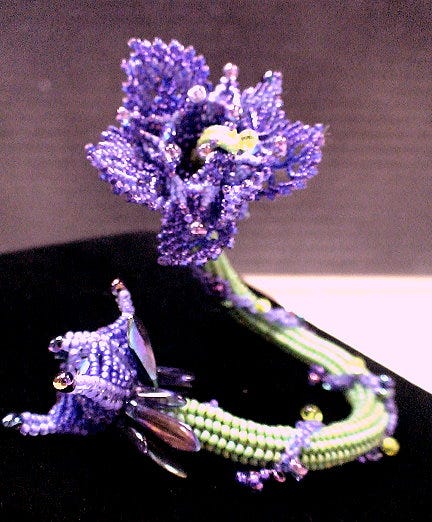
One reason is to create or preserve a Shape. In Autumn’s End (pictured), Kathleen Lynam wanted to turn the somewhat soft, floppy and flimsy Ndebele tube into a solid, 3-dimensional tube which maintained a consistence 3-D s cylindrical shape.
A second reason to use an armature is to Pose. In Autumn’s End, she wanted the Ndebele tube to make a circle around a person’s wrist, and, once there, stay in form and place. Thus, our armature needs some degree of flexibility, but at the same time, it must be able to hold the pose, as well.
A third reason has to do with Action. She was concerned with Action, when a part of her piece had to be animated in some way. This is somewhat important with Autumn’s End, in that our wearer will have to pull open and push closed on the wristlet, to get it on and off, and to position it comfortably on the wrist..
There are many types of materials bead artists and jewelry designers use to make armatures. Sometimes this involves stuffing with cotton or fiber fill. It might involve using tin foil. Othertimes, we might use a toothpick, dowel, straw, tubing, wire, or metal rod. We can also create the armature using glue or floor wax to create a solid or stiffened structure. We can also create our armature from sculpted clay, like polymer clay or metal clay or plastic wood.
Given the shape and pose requirements of Autumn’s End, her choices came down to plastic aquarium tubing, a thick-gauge wire, or plumber’s solder. The tubing would not have met her “pose” and “action” requirements anywhere near as well as the solder does. Nor would a thick gauge wire.
In this piece, she used the idea of “Armature” in a secondary way. She painted the flowers and leaves with acrylic floor wax. This stiffened the threads — what would be considered the canvas of the piece — so that these threads, too, turned into a type of armature preserving “shape” and “pose”.
Sometimes, jewelry must conform to a type of numerology — odds or evens or multiples of some number, like the number 3 — related to the numbers of beads or the numbers of strands or the numbers of drops.
Do you have a personal preference for ODDS or EVENS?
Such as,
— The number of beads on a strand?
— The number of strands in a necklace or bracelet?
— Or the number of bangle bracelets you wear on one arm?
— Or the number of beads you use to begin a peyote stitch project?
— Or the number of drops you include in your piece, or dangles you include in an earring?
— Or the number of colors or elements repeated in a pattern or jewelry segment?
— Or the number of fringes on an earring?
Is this ODDS/EVENS preference consistent all the time?
Or is it situational? That is, in certain circumstances you prefer ODDS, and in others, EVENS.
Is there any experiential, aesthetic or hypothetical basis for your preferences?
If you have a preference for one over the other, has does that affect your design process?
Do you get more compliments, when you are wearing one- or three-strand necklaces, than when you are wearing a two-strand or four-strand necklace?
Historically in Europe, it was considered bad luck and inappropriate to have an EVEN number of strands in a necklace. If you had a very long necklace that you would occasionally wrap around your neck multiple times, then it had to be long enough so that you could wrap it around an ODD number of times — such as tripled, never doubled. Even today, in etiquette books, such as “Miss Manners”, the rule is “Always Wear Odd Numbers of Strands of Pearls.” No explanation is given.
Russians even believe that you should never give an even number of flowers to your wife or girlfriend!
In ancient Babylon, even numbers were believed to be unlucky and somewhat demonic. To them, something should never be repeated an even number of times.
An ODD number of beads lets you define a specific center and focus.
Cognitively we prefer things with clear pointers and with clear symmetry.
But we also like balance and harmony and things to be distributed EVENLY.
Where do you come down in this ODDS vs. EVENS debate?
Abstract: Creativity isn’t found, it is developed. Creativity is a phenomenon where both something new and, at the same time, somehow valuable is created. While some people come to creativity naturally, in fact, everyone can develop their creative ability. Thinking creatively involves the integration and leveraging of three different kinds of ideas — insight and inspiration, establishing value, and implementing something. We work through creative thinking through divergence (that is, generating many possibilities), and convergence (that is, reducing the number of these possibilities). There are ten attributes associated with creative problem solving: fluency, flexibility, elaboration, originality, complexity, risk-taking, imagination, curiosity, assessment, and implementation. Last, different strategies are discussed for enhancing creativity and overcoming creative blocks.
CREATIVITY ISN’T FOUND, IT’S DEVELOPED
Kierkegaard — and I apologize for getting a little show-off-y with my reference — once described Creativity as “a passionate sense of the potential.” And I love this definition. Passion is very important. Passion and creativity can be summed up as some kind of intuitive sense made operational by bringing all your capabilities and wonderings and technical know-how to the fore. All your mechanical, imaginative and knowledge and skills grow over time, as do your abilities for creative thinking and applications. Creativity isn’t inherently natural. It is something that is developed over time as you get more and more experience designing jewelry.
You sit down, and you ask, what should I create? For most people, especially those getting started, they look for patterns and instructions in bead magazines or how-to books or websites online. They let someone else make all the creative choices for them. The singular creative choice here is picking what you want to make. And, when you’re starting, this is OK.
When you feel more comfortable with the materials and the techniques, you can begin to make additional choices. You can choose your own colors. You can make simple adaptations, such as changing out the bead, or changing the dimensions, or changing out a row, or adding a different clasp.
Eventually, however, you will want to confront the Creativity issue head on. You will want to decide that pursuing your innermost jewelry designer, no matter what pathway this takes you along, is the next thing, and right thing, to do. That means you want your jewelry and your beadwork to reflect your artistic hand. You want to develop a personal style. You want to come up with your own projects.
But applying yourself creatively is also work. It can be fun at times, but scary at others. There is an element of risk. You might not like what you end up doing. Your friends might not like it. Nor your family. You might not finish it. Or you might do it wrong. It always will seem easier to go with someone else’s project, already proven to be liked and tested — because it’s been published, and passed around, and done over and over again by many different people. Sometimes it seems insurmountable, after finishing one project, to decide what to do next. Exercising your creative abilities can sometimes be a bear.
But it’s important to keep pushing on. Challenging yourself. Developing yourself. Turning yourself into a bead artist or jewelry designer. And pursuing opportunities to exercise your creative talents even more, as you enter the world of design.
What Is Creativity?
We create. Invent. Discover. Imagine. Suppose. Predict. Delve into unknown or unpredictable situations and figure out fix-it strategies for resolution and to move forward. All of these are examples of creativity. We synthesize. Generate new or novel ideas. Find new arrangements of things. Seek out challenging tasks. Broaden our knowledge. Surround ourselves with interesting objects and interesting people. Again, these are examples of creativity.
Yet, creativity scares people. They are afraid they don’t have it. Or not enough of it. Or not as much as those other people, whom they think are creative, have. They don’t know how to bring it to the fore, or apply it.
But creativity shouldn’t scare you. Everyone has some creative abilities within themselves. For most people, they need to develop it. Cultivate it. Nourish it. They need to learn various tools and skills and understandings for developing it, applying it and managing it. Creativity is a process. We think, we try, we explore, we fall down and pick ourselves up again. Creativity involves work and commitment. It requires a lot of self-awareness — what we call metacognition. It takes some knowledge, skill and understanding. It can overwhelm at times. It can be blocked at other times.
But it is nothing to be scared about. Creativity is something we want to embrace because it can bring so much self-fulfillment, as well as bring joy and fulfillment to others. Creativity is not some divine gift. It is actually the skilled application of knowledge in new and exciting ways to create something which is valued. Creativity can be acquired and honed at any age or any experience level.
For the jewelry designer, it’s all about how to think creatively. Thinking creatively involves the integration and leveraging of three different kinds of ideas — insight and inspiration, establishing value, and implementing something.
(1) Seeing something out of nothing (perception). Technically, we talk about this as controlling the relationship of space to mass. You begin with a negative space. Within this space, you add points, lines, planes and shapes. As you add and arrange more stuff, the mass takes on meaning and content. The designer has to apply creative thinking in finding inspiration, choosing design elements, arranging them, constructing them, and manipulating them.
(2) Valuing something (cognition). Connections are made. Meaning and content, when experienced by people, result in a sense of appeal and value. We refer to this as desire and expression. Value can relate to the worth or cost of the materials, the intuitive application of ideas and techniques by the artist, the usefulness or functionality of the piece, or something rare about the piece. Value can center on the power to leverage the strengths of materials or techniques, and minimize their weaknesses. The designer has to apply creative thinking to anticipate how various audiences will judge the piece.
(3) Implementing something (acceptance). Jewelry design occurs within a particular interactive context and dialog. The designer translates inspirations into aspirations. Aspirations are then translated into design ideas. Design ideas are implemented, refined, changed, and implemented again until the finished product is introduced publicly. The design process has to be managed. When problems or road-blocks arise, fix-it strategies and solutions need to be accessed and applied. All this occurs in anticipation of how various audiences will respond to the jewelry, and convey their reactions to the artist, their friends, family and acquaintances, and make choices about wearing it and buying it and displaying it publicly. The designer has to apply creative thinking in determining why anyone would like the piece, want the piece, buy the piece, wear the piece, wear it publicly, and wear it again and again, or give it as a gift to someone else.
Types of Creativity
Creativity has two primary components: (1) originality, and (2) functionality or value.
The idea of originality can be off-putting. It doesn’t have to be. The jewelry, so creatively designed, does not have to be a totally and completely new and original design. The included design elements and arrangements do not have to be solely unique and never been done before.
Originality can be seen in making something stimulating, interesting or unusual. It can represent an incremental change which makes something better or more personal or a fresh perspective. It can be something that is a clever or unexpected rearrangement, or a great idea, insight, meaningful interpretation or emotion which shines through. It can include the design of new patterns and textures. It can accomplish connections between seemingly unrelated phenomena, and generate solutions. It can be a variation on a technique or how material gets used. It can be something that enhances the functionality or value of the piece.
Creativity in jewelry design marries that which is original to that which is functional, valued, useful, worthwhile, desired. These things are co-dependent, if any creative project is to be seen as successful. For jewelry designers, creativity is not the sketch or computer aided drawing. It is not the inspiration. It is not the piece which never sees the light of day, because then it would represent a mere object, not jewelry. Creativity requires implementation. And for jewelry designers, implementation is a very public enterprise.
What Does It Take To Be Creative?
Creative people tend to possess a high level of energy, intuitiveness, and discipline. They are also comfortable spending a great deal of time quietly thinking and reflecting. They understand what it means to cultivate emotions, both within themselves, as well as relative to the various audiences they interact with. They are able to stay engaged with their piece for as long as it takes to bring it to completion. They fall in love with their work and their work process.
Creativity is not something that you can use up. To the contrary, the more you use your creativity, the more you have it. It is developmental, and for the better jewelry designer, development is a continual, life long process of learning, playing, experimenting and doing.
To be creative, one must have the ability to identify new problems, rather than depending on others to define them. The designer must be good at transferring knowledge gained in one context to another in order to solve a problem or overcome something that is unknown. I call this developing a designer tool box of fix-it strategies which the designer takes everywhere. The designer is very goal-oriented and determined in his or her pursuit. But, at the same time, the jewelry designer also understands and expects that the design process is very incremental with a lot of non-linear, back-and-forth thinking and application. There is an underlying confidence and belief, however, that eventually all of this effort will lead to success.
How Do We Create?
It’s not what we create, but how we create!
The creative process involves managing the interplay of two types of thinking — Convergence and Divergence. Both are necessary for thinking creatively.
Divergent thinking is defined as the ability to generate or expand upon options and alternatives, no matter the goal, situation or context.
Convergent thinking is the opposite. This is defined as the ability to narrow down all these options and alternatives.
The fluent jewelry designer is able to comfortably weave back and forth between divergence and convergence, and know when the final choices are parsimonious and the piece is finished, and when the final choices will be judged as resonant and successful.
Brainstorming is a great example of how creative thinking is used. We ask ourselves What If…? How about…? Could we try this or that idea…? The primary exercise here is to think of all the possibilities, then whittle these down to a small set of solutions.
Creative Thinking
Creative thinking first involves cultivating divergent thinking skills and exposing ourselves to the new, the different, the unknown, the unexpected. It is, in part, a learning process. Then next, through our set of convergent thinking skills, we criticize, and meld, and synthesize, and connect ideas, and blend, and analyze, and test practicality, as we steer our thinking towards a singular, realistic, do-able solution in design.
Partly, what we always need to remember, is that this process of creative thinking in jewelry design also assists us finding that potential audience or audiences — weaver, buyer, exhibitor, collector — for our creative work. Jewelry is one of those special art forms which require going beyond a set of ideas, to recognizing how these ideas will be used. Jewelry is only art only when it is worn. Otherwise, it is a sculptural object.
There are 10 aspects to creative thought. Each should be considered as a separate set of skills, both for divergent as well as convergent thinking, which the jewelry designer wants to develop within him- or herself. Initially, the designer wants to learn, experiment with and apply these skills. Over time, the designer wants to develop a level of comprehension and fluency to the point that the application of each of this skills is somewhat automatic.
Fluency: Having a basic vocabulary in jewelry design, and the ability to see how these concepts and design elements are present (decoding) and arranged (composition, construction and manipulation). Divergence: to generate as many possible elements and combinations to increase number of possible designs.
Flexibility: Ability to adapt selections and arrangements, given new, unfamiliar or unknown situations. Divergence: generate a range and variety of possible configurations leading to same solution.
Elaboration: Ability to add to, embellish or build upon ideas incorporated into any jewelry design. Divergence: generate the widest variety of attributes of design elements and combinations which have value-added qualities, given a particular design.
Originality: Ability to create something new or different which has usefulness and value. Divergence: to delineate many ideas and concepts which are both new and have value.
Complexity: Ability to conceptualize difficult, multi-faceted, intricate, many-layered ideas and designs. Divergence: to take a solution and break it down or reinterpret it into as many multiple facets or multiple layers as possible.
Risk-Taking: Willingness to try new things or think of new possibilities in order to show the artist’s hand publicly and stand apart. Divergence: to elaborate the widest possible scenarios for publicly introducing the piece, given various design options, as well as all the ways these potential audiences might interact and use the jewelry, and all the ways these audiences might influence others, as well.
Imagination: Ability to be inspired, and to translate that inspiration into an aspiration. Divergence: to think of many ways an inspiration might be described, interpreted, or experienced physically and emotionally, and to identify the many different ways inspirations might be interpreted into a jewelry design.
Curiosity: Ability to probe, question, search, wanting to know more about something. Divergence: questioning the situation from many angles and perspectives.
Assessment: Ability to anticipate shared understandings, values and desires of various audiences for any piece of jewelry. Divergence: identifying all the possible audiences a piece of jewelry might have, and all the different ways they might judge the piece as finished (parsimonious) and successful (resonant).
Implementation: Ability to translate aspirations into a finished jewelry design and design process. Divergence: delineating all the possibilities an aspiration might get translated into a design, evaluated against all the possibilities the design could be successfully, practically and realistically implemented.
Enhancing Creativity and Overcoming Creativity Block
So, what kinds of creative advice can I offer you about enhancing your creativity? How can you nurture your creative impulses? How can you overcome roadblocks that might impede you?
Here is some of my advice:
Success Stories. While you are fiddling with beads and wire and clasps and everything else, try to be as aware as you can of why your successes are successful. What are all the things you did to succeed? On what points does everyone agree the project succeeds?
Un-Block. Don’t set up any road blocks. Many people, rather than venture onto an unknown highway of creativity, put up walls to delay their path. If they just had the right beads. Or the right colors. Or sufficient time. Or had learned one more technique. Or had taken one more class. Or could find a better clasp. These are excuses. Excuses to avoid getting creative.
Adapt. Anticipate contingencies. It amazes me how many people come into my shop with a picture out of a magazine. We probably can find over half the components, but for the remaining components pictured which we don’t have in stock, we suggest substitutes. But, NO, the customer has to have it exactly like the picture, or not at all. Not every store has every bead and component. Many beads and components are not made all the time. Many colors vary from batch to batch. Many established companies have components especially made up for them — and not available to the general public. The supplies of many beads and components are very limited — not unlimited. Always be prepared to make substitutions and adapt.
Play. Be a kid again. Let your imagination run wild. Try things. Try anything. If the world says your color combination is ugly, don’t listen to them. Do it anyway. Ignore all restrictions. Forget about social and art conventions.
Be Curious. Play “What If…” games. What if a different color? What if a different technique? What if a different width or length? What if a different style of clasp. Re-arrange things. Tweak. Take out a bead board, and lay out beads and findings on the board, and re-order everything — Ask yourself: More or less satisfying?
Embrace the New / Challenge yourself. Don’t do the same project over and over again, simply because you have proven to yourself that you can make it. While you might want to repeat a project, with some variations, to learn more things, too much doing of the same-ole, same-ole, can be very stifling.
Create An Imaginative Working Space / Manage Disruptions and Disruptors. You need comfortable seating, good lighting, smart organization of parts and tools and projects-in-process. Some people like music playing. If family or friends tend to interrupt you, explain to them you need some boundaries at certain times of the day or days of the week.
Evaluate / Be metacognitive. Learn from failures. You have invested time, money and effort into making these pieces. And not everything works out, or works out well. Figure out why, and turn these failed pieces into lessons and insights. Give yourself permission to be wrong. Build up your skills for self-awareness, self-management and self-assessment.
Take a break / Break your daily routine / Incubate it / Sleep on it. And if you suddenly find your productivity interrupted by Bead-Block and Artist-Block and Jeweler’s-Block, put your project down. Take a break. Mull on things awhile. Put yourself in a different environment. Take a walk. Sleep. A period of interruption or rest from a problem may aid creative problem-solving in that it lets us let go of or forget some misleading cues, thoughts, feelings and ideas.
Network / Connect With Other Jewelry Designers and Artists / Collaborate on a Project. Here you want to tap into and absorb someone else’s energy, knowledge and insights. Surround yourself with interesting and creative people. Learn different ways of knowing and doing. Get encouragement. Find a mentor. The fastest way to become creative is to hang around with creative people.
Do something out of the ordinary. Something unexpected. Or something just not done. This will shock your system to think in different ways. To see things in a new light. To recognize contradictions. Robert Alan Black gives great advice. He shouts at the blocked: Break A Crayon. He shouts again: Draw Outside The Lines. And I would add and shout: Stick your hands into a bowl full of mud or jello.
These are all great advice.
Make creativity a habit. Make it routine in your daily life.
– Keep a journal. Write down your thoughts and experiences and insights.
– As you create a new piece, keep a running written log of all the choices you are making.
– Challenge yourself. Change colors, arrangements, sizes and shapes. Create forms and new components. Think of different silhouettes.
– Expand your knowledge base and skills. Look for connections with other disciplines.
-Surround yourself with interesting things and interesting people. Get together regularly. Collaborate. Take a field trip together.
What Should I Create?
The process of jewelry making begins with the question, What Should I Create?
You want to create something which results in an emotional engagement. That means, when you or someone else interacts with your piece, they should feel some kind of connection. They might see something as useful. It may have meaning. Or it may speak to a personal desire. It may increase a sense of self-esteem. It may persuade someone to buy it. It may feel especially powerful or beautiful or entertaining. They may want to share it with someone else.
You want to create something that you care about. It should not be about following trends. It should be about reflecting your inner artist and designer — what you like, how you see the world, what you want to do. Love what you are making. Otherwise, you run the risk of burning out.
It is easier to create work with someone specific in mind. This is called backwards design. You anticipate how someone else would like what you do, want to wear it, buy it, and then let this influence you in your selection about materials, techniques and composition. This might be a specific person, or a type of person, such as a potential class of buyers.
Keep things simple and parsimonious. Edit your ideas. You do not want to over-do or under-do your pieces. You do not have to include everything in one piece. You can do several pieces. Showing restraint allows for better communication with your audiences. Each piece you make should not look like you are frantically trying to prove yourself. They should look like you have given a lot of thought about how others should emotionally engage with your piece.
There is always a lot of pressure to brand yourself. That means sticking with certain themes, designs or materials. But this can be a little stifling, if you want to develop your creativity. Take the time to explore new avenues of work.
You want to give yourself some time to find inspirations. A walk in nature. A visit to a museum. Involvement with a social cause. Participation in a ritual or ceremony. Studying color samples at a paint store. A dream. A sense of spirituality or other feeling. A translation of something verbal into something visual. Inspirations are all around you.
Final Words of Wisdom
We don’t learn to be creative We become creative. We develop a host of creative thinking skills. We reflect and make ourselves aware of all the various choices we make, the connections we see, the reactions we get, and the implications which result.
We need to be open to possibility.
We need to have a comfort level in taking the unknown or unexpected, and bridging the differences. That is, connecting what we know and feel and project to ideas for integrating all the pieces before us into a completed jewelry design. We need to become good translators, managing our choices from inspiration to aspiration to completed design.
We need to be able to hold on to the paradoxes between mass and space, form and freedom, thought and feeling, long enough so that we can complete each jewelry making project. We need to be comfortable while designing during what often become long periods of solitude.
We need to know jewelry and jewelry making materials and techniques inside and out. We need to know how to maximize their strengths and minimize their weaknesses. We need to be able to discover new ways of designing with them. It is critical that we put ourselves on a path towards greater fluency, flexibility and originality.
We must be willing to give and receive criticism.
We must be aware, not only of our desires, goals and understandings, but those of our various audiences, as well.
Be motivated by the design process itself, and not its possible and potential external rewards.
We must be very reflective and metacognitive of how we think, speak and work as jewelry designers.
We need to give ourselves permission to make mistakes.
We must design things we care about.
_________________________________________
FOOTNOTES
Besemer, S.P. and D.J. Treffinger. Analysis of Creative Products: Review and Synthesis. Wiley Online Library, (1981).
Maital, Shlomo. “How IBM’s Executive School Fostered Creativity,” Global Crisis Blog, April 7, 2014. Summarizes Louis R. Mobley’s writings on creativity, 1956.
March, Anna Craft. Creativity in Education. Report prepared for the Qualifications and Curriculum Authority, March, 2001.
Seltzer, Kimberly and Tom Bentley. The Creative Age: Knowledge and Skills for the New Economy. Demos, 1999.
Torrance, E. P. The Torrance Tests of Creative Thinking-Norms-Technical Manual Research Edition- Verbal Tests, Forms A and B-Figural Tests, Forms A and B. Princeton, NJ: Personnel Press, 1966.
Torrance, E. P. The Torrance Tests of Creative Thinking-Norms-Technical Manual Research Edition- Verbal Tests, Forms A and B- Figural Tests, Forms A and B. Princeton, NJ: Personnel Press, 1974.
Turak, August. “Can Creativity Be Taught,” Forbes, May 22, 2011.
The Jewelry Designer makes many choices when creating a piece of jewelry. Lots of things to manage and accomplish.
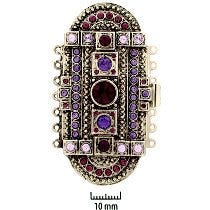
Probably the two most important choices, right up front, in creating a wearable art-piece that will be around for future generations are your: (1) Stringing Material, and (2) Clasp
When you work with so many customers in a store, and so many students in classes, you begin to see that people are not necessarily that great in selecting clasps. Many are in a clasps-rut — they use the same clasp over and over again.
Others pick out clasps they find appealing, whether or not they would visually or functionally work with the piece they have made.
Few people anticipate how they are going to attach the clasp to their beadwork, often resulting in an overly long, awkwardly connected clasp assembly.
So, how to you go about choosing clasps?
Clasps always seem like they’ve been someone’s last thought. They should be the first thought. Or at least thought about concurrently with the design of the piece. But they should never be the last thought.
As clasps should be thought of in their entirety — as clasp assemblies. Clasp assemblies include all the rings, loops and other hardware necessary to attach the clasp to the beadwork. The clasp itself may be beautiful, but the entire clasp assembly may not be.
But many people get so excited creating their beadwork, that they forget about the clasp — until the last moment. You can tell when the jewelry maker hasn’t put much thought into their choice of clasp in many ways. Often, the clasp doesn’t look like it was meant to go with the bead work or general design. It might be out of proportion. It might be a different texture or sensibility. Its function — how you open and close it, while wearing your jewelry — might seem odd, perhaps unnatural. And not only does the choice of clasp seem as an after-thought, but how to attach to the bead work to that clasp seems un-thought out, as well.
So it’s not surprising, that when we were repairing jewelry on a regular basis, about 80% of the pieces to be fixed had broken at the clasp.
It is best to, in part, build your design around your clasp. If your piece has a centerpiece or focal point, then how does this link up to or coordinate with the clasp. At the least, when visualizing your beadwork, include an image of the clasp and how it is attached at both ends. The world is full of clasps. Not every clasp is a jeweler’s best friend. But it depends.
The clasp needs to visually fit with the beadwork. It needs to function as the artist intended. It needs to function in a way the wearer can relate to, use and handle. It needs to be appropriate for the piece and the context in which it is too be worn. It should not compete with the beadwork. It should complement it. Ideally, at least from a design perspective, your clasp should look and feel as if it were an integral part of the entire piece.
In a Gallery setting, if you are selling your jewelry there, you usually want a very functional, but not overwhelming, clasp. You are selling your beadwork, and you don’t want your clasp to compete with this.
In a Department Store, setting, however, often the clasp sells the piece. In this setting, choosing a clasp requires a different kind of logic, thinking and anticipation.
Some clasp-types are “expected” to be a part of the piece — even if the particular choice of type would not be the best choice in the world. Traditions dictate clasp choices in some situations.
The former owner of a local Tennessee pearl company was very frustrated with clasps. She sold a lot of finished pearl jewelry at very high prices, and had been using 14KT gold pearl and safety clasps. Her customers sent a lot of their pearl necklaces and bracelets back for repairs, because their clasps broke. And this company felt, because the prices of these pieces were very high, that they were obligated to replace the clasps and re-string these pearl-knotted pieces at no additional charge. 14KT clasps — particularly the pearl, safety and filigree box clasps — do not hold up well, because gold is a very soft metal.
Replacing clasps on a pearl-knotted piece is quite some job. You have to cut up the piece to free up each bead, and then you begin the knotting and finishing off processes again. It turns out, the 14KT clasps were not the only expensive part of the bracelets — making the knots between each pearl was the time-consuming and costly part.
She desperately wanted to reduce the number of repairs. Her first idea was to replace the pearl and safety clasps with other styles which were sturdier. However, these pieces didn’t sell. People wanted the pearl and filigree clasps. The designs of these clasps were so traditional and so locked into their expectations for what pearl-knotted jewelry should look like, that they would not compromise.
Her second effort, she tried replacing the 14KT pearl and filigree clasps with gold-filled ones which were stronger, but this made her customers very angry — they wanted 14KT gold.
So, her final strategy, she returned to using 14KT gold pearl clasps, and doubled her prices. She built in the cost of one repair into the prices she charged. And only then could she present her happy face to her customers, and her somewhat-happy face to herself when she was in private.
A LESSON IN USING COLOR SIMULTANEITY EFFECTS: The Contemporized Etruscan Collar
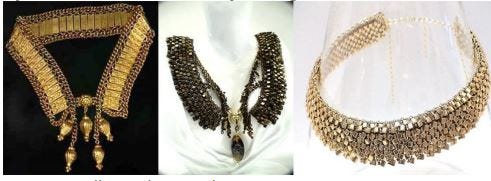
Several years ago, I had been asked to do a week-long jewelry design workshop in Cortona, Italy. The topic I selected was on Contemporizing Traditional Etruscan Jewelry. One of the projects I developed for the workshop was this Contemporized Etruscan Collar. The challenge, here for me, was to create a sophisticated, wearable, and attractive piece that exemplified concepts about contemporizing traditional jewelry.
Contemporizing Traditional Jewelry has to do with how you take particular traditional forms and techniques, and both add your personal style to the pieces, as well as make them more relevant to today’s sense of fashion and style. The challenge for the designer is how to keep traditional ideas essential and alive for today’s audience.
Things clicked. I found a traditional Etruscan Collar that I immediately connected with.
The Contemporized Etruscan Collar
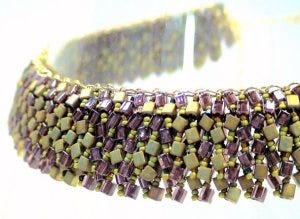
The contemporized piece basically consists of two staggered and overlapping bead-woven strips. The bead-woven technique used is the Ndebele Stitch (sometimes called Herringbone).
There are many design theory elements incorporated into this piece, including dimensionality, curvature, malleability, and movement. One of the more interesting theories I applied here has to do with color simultaneity effects.
Color Simultaneity Effects
Picking colors is about making strategic choices. Picking colors is very revealing about the jewelry artist’s understanding of how the bead asserts its needs for color. One set of color-theories employed to make these kinds of choices has to do with Simultaneity Effects. Colors in the presence of other colors get perceived differently, depending on the color combination.
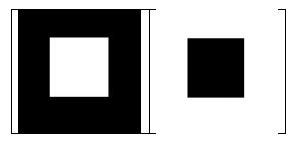
For example, a White Square on a Black background looks bigger than a Black Square on a white background. White reaches out and overflows the boundary; black contracts.
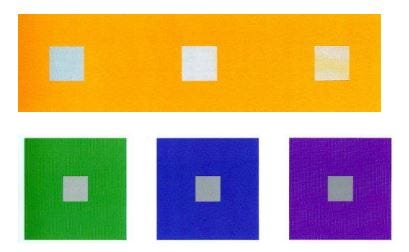
Another example: Gray always picks up some of the color characteristics of other colors around it. Gray next to orange will appear to have an orange tone to it. Gray next to green will appear to have a green tone to it. A “Gray” bead is one, the color of which, has a strong gray or black tone to it.
Besides the obvious “gray”, these other colors function as a “gray”: montana blue, alexandrite, colorado topaz, prairie green. Many color-lined and silver-lined beads can function as a “gray”, particularly when the glass color is other than clear. Many metallic or otherwise reflective surface beads can function as a “gray”.
A final example of simultaneity effects has to do with how people sense whether colors are warm or cool. In one composition, depending on the color mix, a particular color might be felt as “warm”. In a second composition, with a different color mix, that same color might be felt as “cool”. You can picture a yellow square surrounded by white feels lighter, brighter and a different temperature than its counterpart surrounded by black. A red square surrounded by black feels darker, duller, and a different temperature than its counterpart surrounded by white.
Existence of these simultaneity effects is a great piece of information for the designer. There will be gaps of color and light between beads. Many bead colors are imperfect, particularly in combination. Playing with simultaneity effects gives the designer tools to overcome some of the color limitations associated with the bead and the gaps of light between beads. These allow you to “blend” and build “bridges” and create “transitions.”
Look back at the images of the Ndebele-stitched piece. When you work with beads, there are always gaps between them. In the Ndebele-stitch, there are many and very pronounced gaps of light between beads. This can be very threatening to a viewer. People are pre-wired to avoid things which might harm them, such as snakes and spiders. This is our fear- or anxiety-response.
We can summarize most color theories as a set of principles the brain uses — both in perception and cognition — to find a state of color or colors which are harmonious. That is, people like to see and feel comfortable and safe with colors which harmonize and go together. When we start to lose that harmonious state of color, this makes the brain edgy. When the brain starts to get edgy, we start to interpret pieces as boring, monotonous, scary, dangerous, will cause death. We innately reject, as part of our pre-wired fear response, that which does not follow good principles of color.
Any viewer’s brain will immediately try to interpret what it sees and make sense of it. This includes jewelry. The viewer’s brain needs to know immediately whether to approach or flee. Each time the eye/brain comes to the end of the bead and is confronted with a gap of light separating it from the next bead, it’s similar to a person approaching a cliff, and getting asked to jump off of that cliff.
No one wants to jump off a cliff. And no one’s eye/brain wants to jump over a gap of light between two beads. It’s risky. It’s work. Things don’t feel harmonious.
We have to fool ourselves, that is, our brain, in some way. Color theories offer us many possible ideas on how to do this. I find using simultaneity effects works especially well in jewelry compositions using beads. Certain colors, when juxtaposed, create their own meanings, and fool the brain into thinking it sees something in these gaps, or is somehow more motivated to fill in the gaps, and proceed from one bead to the next.
In this Etruscan Collar project, many of my color choices were based on an understanding of simultaneity effects.
The DESIGN PERSPECTIVE is very focused on teaching beaders and jewelry makers how to make choices. Choices about what materials to include, and not to include. Choices about strategies and techniques of construction. Choices about mechanics. Choices about aesthetics. Choices about how best to evoke emotions.
These choices must also reflect an understanding of the bead and its related components. How do all these pieces, in conjunction with stringing materials, assert their needs? Their needs for color, light and shadow. Their needs for durability, flexibility, drape, movement and wearability. Their needs for social or psychological or cultural or contextual appropriateness — an appropriateness that has to do with satisfaction, beauty, fashion and style, as well as power and influence.
This DESIGN PERSPECTIVE contrasts with the more predominant Craft Approach, where the beader or jewelry maker merely follows a set of steps and ends up with something. Here, in this step-by-step approach, all the choices have been made for them. They never learn the implications of using one bead vs. another, one stringing material vs. another or one clasp vs. another.
And this DESIGN PERSPECTIVE also contrasts with another widespread approach to beading and jewelry making — the Art Tradition — which focuses on achieving ideals of beauty, whether the jewelry is worn or not. Here the beader or jewelry maker learns to apply art theories learned by painters and sculptors, and assumed to apply equally to beads and jewelry, as well. Jewelry is judged as it sits on a mannequin or easel. Functionality is subsumed under Appeal. Things like the strap, clasp assembly and bail are merely seen as supplemental to the piece, as a frame is to a painting or a pedestal to sculpture.
The Craft Approach and the Art Tradition ignore too much of the functional and contextual essence of jewelry. Because of this, they often steer the beader and jewelry maker in the wrong directions. Making the wrong choices. Exercising the wrong judgments. Applying the wrong tradeoffs between aesthetics and functionality and context.
The focus of the DESIGN PERSPECTIVE is strategic thinking. At the core of this thinking are a series of design principles and their skillful applications. These principles go beyond a set of techniques. These principles and the strategies for applying them provide the beader and jewelry maker with some clarity in a muddled world.
Learning about Design begins with the belief that there are many different kinds of information that must come together and be applied to make a finished and successful piece of jewelry. Art. Architecture. Physical mechanics. Sociology, Anthropology and Psychology. Some Business. Even some Party Planning. It is impossible to clearly learn and integrate all this information all at once.
When all this knowledge which needs to come to bear in creating and constructing a piece of jewelry is learned haphazardly or randomly, as most people do, it becomes problematic. It becomes more difficult or too confusing to successfully bring into play all these kinds of things the beader or jewelry maker needs to know when designing and constructing a piece of jewelry in the moment.
Thus, the beader and jewelry maker best learn all this related yet disparate information in an developmental, hierarchical order, based on some coherent grammar or set of rules of design. Seemingly disparate skills are learned as interrelated, integrated clusters. By learning within this organized structure and informational hierarchy, the jewelry artist best sees how everything interrelates and comes together. The designer develops the ability to decode expressive information, and to fluently organize and arrange it. This is how disciplinary literacy is developed within the DESIGN PERSPECTIVE.
So, we begin with a Core set of skills and concepts, and how these are interrelated and applied. Then we move on to a Second Set of skills and concepts, their interrelationships and applications, and identifying how they are related to the Core. And onward again to a Third Set of skills and concepts, their interrelationships and applications and relationship to the Second Set and the Core, and so forth.
In the DESIGN PERSPECTIVE, “Jewelry” is understood as Art, but is only Art as it is worn. It is not considered Art when sitting on a mannequin or easel. Because of this, the principles learned through Craft or Art are important, but not sufficient for learning good jewelry design and fashioning good jewelry.
Learning good jewelry design creates its own challenges. All jewelry functions in a 3-dimensional space, particularly sensitive to position, volume and scale. Jewelry must stand on its own as an object of art. But it must also exist as an object of art which interacts with people (and a person’s body), movement, personality, and quirks of the wearer, and of the viewer, as well as the environment and context. Jewelry serves many purposes, some aesthetic, some functional, some social and cultural, some psychological.
The focus of the DESIGN PERSPECTIVE is on the parts and their construction. How do you choose parts? How should they be used, and not be used? How do you assemble them and combine them in such a way that the whole is greater than the sum of the parts? How do you create and build in support systems within your jewelry to enable that greater movement, more flexibility, better draping, longer durability? How do you anticipate stresses and strains? How do you parsimoniously use all these parts, making them resonate and evoking that emotional response from your audience to your style, vision and creative hand that you so desire?
The beader and jewelry maker are seen as multi-functional professionals, similar to an architect who builds houses and an engineer who builds bridges. In all these cases, the professional must bring a lot of very different kinds of skills and abilities to bear, when constructing, whether house or bridge or jewelry. The professional has to be able to manage artistic design, functionality, and the interaction of the object with the person and that person’s environment.
Women don’t just wear pieces of jewelry — they inhabit them.
Buying a piece of jewelry for yourself — a necklace, a bracelet, earrings, a brooch, something else — isn’t a task easily given to someone else. It’s often not a spur of the moment thing either. You just don’t rush off to the local boutique or the local Wal-Mart, grab whatever you see, and go home.
I’m not talking about that impulse buy during your leisurely visit to the mall. I’m referring to purchasing those pieces of jewelry you know will have to do a lot of the hard work to accessorize your wardrobe and help you get the compliments and notice of your family, friends and co-workers you comport with and compete with each and every day.
No, buying a piece of jewelry for yourself is a multi-purposed moment, one which must be thought through carefully and one which must be savored. Lest you buy the wrong piece. That doesn’t really go with what you intend to wear. Or is over-priced. Or poorly made. Or conveys the wrong impression about status. Or is out of fashion. Or something one of your friends already has.
The jewelry you buy has to conform to quite a long list of essential criteria before you could ever think of buying it. It is something you will wear more than once. As such, it is your companion. Your necklace is not merely lying around your neck. Or your bracelet around your wrist. Or your earrings dangling from your ears.
Jewelry can cause you to lose face with others. It can irritate or scratch your skin, or get caught up in your hair. It might weigh you down or stretch or tear your ear lobes. Jewelry can break without warning in the most unexpected and embarrassing of places. It can get caught on things, sometimes hurting you in the process.
Jewelry conveys to the world something about who you really are, or think you are. As such, jewelry is very personal. Your private, innermost, most soul searching choices made very public for all to see.
As you caress it, as you touch the smooth or faceted or creviced beads and metal parts or the clasp or the material the beads are strung on, when you twist and move the piece within your hand, you are confirming to yourself the extent to which your jewelry is doing its job.
When you buy new jewelry, the dilemmas multiply. How will the new compare to the old? Will it be able to handle all these responsibilities — looking good, representing you, fitting in with your wardrobe, meeting the expectations of others? Like divorcing, then remarrying, changing your jewelry can take some time for readjustment.
And you do not want to be seen as noncommittal to your jewelry. This would sort of be like going to a hotel, but not unpacking your suitcase while staying in the room. Conveying some sort of social or psychological distance from your jewelry can be very unsettling for others.
So you need to inhabit it. You need to inhabit your jewelry, wear it with conviction, pride and satisfaction. Be one with it.
Inhabiting jewelry often comes with a price. There becomes so much pressure to buy the “right” pieces, given all the roles we demand our jewelry to play, that we too often stick with the same brands, the same colors, the same styles, the same silhouettes. We get stuck in this rut and are afraid to step out of it.
Or we wear too many pieces of jewelry. The long earrings, plus the cuff bracelets on both arms, plus the head band, plus the hair ornament, plus the 7-strand necklace, plus the 5 rings. We are ever uncertain which piece or pieces will succeed at what, so hopefully, at least some combination or subset of what we wear will work out.
In a similar way, we wear over-embellished pieces — lots of charms, lots of dangles, lots of fringe, lots of strands. Something will surely be the right color, the right fit and proportion, the right fashion, the right power statement, the right reflection of me.
And our need to inhabit our jewelry comes with one more price. We are too willing to overpay for poorly made pieces in our desperation to have that right look. The $100.00 of beads strung on elastic string. The poorly dyed stones which fade in the light. The poorly crimped and overly stiff pieces with little ease for accommodating movement and frequent wear.
It is OK to inhabit our jewelry. In fact, it is necessary, given all we want jewelry to do for us. But we need to be smart about it. We need to learn to recognize better designs and better designers.
To what extent do (and should) business concerns influence the artistic choices bead and jewelry artists make?
I’d say “A Lot!”
But this isn’t what a lot of artists like to hear.
You have to market to audiences. You may have to standardize things to be able to make the same thing over and over again. You may have to work in a production mode and repeat making certain designs, rather than freely create and design anew each time. You have to price things so that they will sell, and you have to price things so that you can make a sufficient profit. You can’t undersell yourself, like offering discounts to family, friends and co-workers.
You have to conform to prevalent styles and colors and forms. You have to make things which will photograph well for sale online. You have to make things that local stores want and are willing to buy or put on consignment. You may end up with a lot of “one size fits all.”
You find that if you want to make your jewelry design into a successful business, you may have to compromise with yourself, your artistic drives and sensibilities. You may have to limit what you offer. In order to make that sale. In order to make a profit. And stay in business.
Business involves: – Putting your artwork on a sound cost/revenue footing – Developing market-driven strategies (as opposed to product-driven ones) – Pricing your pieces for sale – Implementing various selling strategies – Compromising artistic and design choices, in the interest of the business — Understanding how the creative marketplace works
Over and over again, I have seen one jewelry artist after another fail as a business. The reasons repeat themselves as well.
1. A reluctance to learn how to conduct oneself as a business.
Many jewelry artists get so excited after selling their first piece, that they think they don’t have to get too involved with business principles. They understand their “business” as a “necklace-by-necklace” endeavor. Make something, sell it. Doesn’t matter what the price. Doesn’t matter to whom. Doesn’t matter if making the piece in the first place is in line with the resources you currently have to make the piece, or will drive you in debt in order to get those resources.
Artists need to focus on what’s called “Velocity” — the rate of sales, rather than the number of sales. You need to have in place sufficient strategies for keeping the money turning over at a constant rate. If you can’t maintain this rate, you go in the hole. You make something. You sell it. You reallocate the money you just made to reinvesting in more inventory, replacing the inventory you sold, evaluating the pros and cons of the sale that just happened, adjusting accordingly, and strategizing how to keep this velocity going at a constant, or ever-increasing, velocity.
And artists need to keep good records, and implement good accounting principles.
2. Gets Bored.
People who get started are very excited. They’ve made a lot of pretty pieces, and someone has bought some of them. But then you need to leave your creative mode, and enter a production mode. You need to discipline yourself to make the same things over and over again. Many artists quickly lose interest.
3. A fear of marketing your own things
You won’t succeed without marketing. Marketing is more than advertising. It includes all forms of self-promotion. It includes doing research on your markets and market niches, how to reach them, how to get their attention, how to get them to translate this attention into needs and wants and desires, and how to get them to part with some money.
Many artists are shy about self-promotion. Time to train yourself, if this is you, to get over it.
4. Trying to please all audiences
When people get started, they are reluctant to use the “No” word. They want to please everyone. But when you get started, you can’t. It will put you out of business.
Let’s say you have some jewelry that is predominantly purple. Someone at work loves the jewelry, but asks if you can make it in red. If you don’t have an inventory of red beads, and will have to go out and buy them, it may make this sale foolish, from a business standpoint. You can’t buy just one bead at a time; you need to buy strands or packages of these beads. You will have a lot left over.
When you start, you need to pursue a strategy of depth, rather than breadth. You want to buy a limited number of pieces in large quantities to get adequate price breaks. So, initially, your designs will be limited, as well. You need to be able to say No. No to your family. No to your friends. No to the people you work with.
In my experience, such as the situation with red vs purple beads above, when you say No, the potential customer tends to make a face. Pitiful. Angry. Frustrated. Sad. Pleading. If you can wait 60 seconds, in almost every case, the customer stops making this face, and says, “OK, I’ll take what you have in purple.” But so many jewelry artists can’t wait that 60 seconds.
And don’t give these people discounts. They’re already getting it cheaper, than if they bought the same piece in a store. One major way your business will get built up is word-of-mouth. You don’t want some of that information to include extremely low price expectations that will never be self-supporting in your business.
5. Doesn’t do homework on the competition
You need to understand how other jewelry artists you compete with function as a business.
How do they define their markets? How do they price things? What kinds of inventory do they carry? What kinds do they NOT carry? Where do they advertise? How do they promote themselves? How do they define their competitive advantage — that is, all the reasons people should buy from them, rather than from anyone else, like you? Where do they sell things — stores, shows, fairs, online, etc? What seems to work better for them?
You can find a lot of this out by Googling. You can look for jewelry designers. Directories of jewelry designers. You can plug in a jewelry designer’s website, and see where they are listed, and who lists them.
6. Doesn’t Educate Self About The Business Marketplace
You already know that you want to sell your pieces. But why would someone else want to sell them for you?
What’s in it for that gallery or consignment shop or boutique? How do they make money? What’s their customer base? Why do they shop there? What are their preferences? What is the feel and flavor of what the businesses carry in their shops?
Most businesses spend years establishing a reputation and brand. They attract customers who, in turn, are attracted to that brand identify. So they are looking for certain similar things they already carry or fit with the theme or perspective of their business. But, at the same time, they don’t want the exact same things. They already have those things. They want things that coordinate and compliment. If your style is avant garde, and the business style is Victorian romantic, there is not going to be a fit. It won’t work out for you in this location.
“She’s CHEATING ME!” the woman from Rhode Island screamed into the phone. She could hardly catch her breath, the anger overtaking her ability to explain why she was calling.
“I read your article about Pricing and Selling, and I’m not getting my $70.00 for my piece.”
She didn’t have to say anymore. I knew right off the bat she was talking about CONSIGNMENT.
I recognize the anger. The frustration. The feeling that someone put something over on you, and you’re powerless to correct the situation. You don’t know what to do. You know the sweat, time and cost you put into all the pieces you let some stranger have, and now what do you do?
“I put 10 of my pieces of jewelry in her shop in Northern Rhode Island — not a big shop, no sales, except, this one piece sold, not in a major place,” she continued, taking breath after breath, to get it all out, in some way that made sense, and some way that kept her from losing it.
“What do I Do?” “She sold my piece for $70.00, and didn’t give me my money?” “Should she have given me my money right away?” “Should I take my jewelry out of her shop?” “Should I never do consignment again?” She peppered me with questions, not waiting for an answer.
She indicated that the store owner told her that she paid her artists 30 days after a sale. Her customers had 30 days to return something. If the store owner paid before that time, she would be out the money. Store owners can set whatever policies they want, and in this case, I told the woman it was reasonable to wait 30 days, given the policy.
Of course, it had already been 7 weeks.
“Should she call her?” Her husband told her not to call yet. He didn’t want her to make waves, or ruin this opportunity to sell her jewelry.
“Call her,” I said. If the store owner said 30 days, then 30 days it should be.
Consignment may be a necessary evil, especially when you are getting started in the jewelry making business. But consignment is not the best situation to be in. Most stores that accept consignment do not understand the consignment business. As a result, when the time comes to pay the artists, there’s no cash flow.
In Consignment, the store is at greater risk than the artist. The store has to make space available for the pieces, and forgo the opportunity to get something else in that retail-real-estate that might do better. The store has to display the pieces, and keep them clean and presentable. The store has to train its sales staff so that they have sufficient information and motivation to make the sale. And, of course, there’s the tracking and accounting that goes with every consignment piece on sale.
Your best clue to whether a particular consignment situation is a good or better one, is the percentage split between the store or gallery owner and the artist. Given the level of risk each party assumes, the optimum distribution is 60/40 with the store or gallery getting the larger amount. But if the split is 40/60 or 50/50, this would be a acceptable sign as well.
However, when the split is 70/30 or 30/70 or outside this 60 and 40 range, yellow flags should go up. This shows that the store or gallery owner is not aware of the level of risk in their business. You probably won’t get paid on time, and not get paid without a lot of time spent yelling on the phone. Your pieces won’t be maintained. They won’t be displayed in a prominent place. No one will be trained or motivated to sell your pieces.
Just because you confront a potentially bad consignment situation doesn’t necessarily mean that you should walk away. There are a few prominent boutiques in Nashville that offer a 70/30 split between the store and the artist. They rarely pay their artists when the pieces sell. It takes a lot of screaming, “Bloody Murder!” before you get paid. But these are very prominent shops. Letting other stores and galleries know that you have pieces in these shops will open many doors for you. You might view the delayed payments and the effort to get your money as “marketing expenses.”
Other reasons you might settle for a bad situation: – You’re just getting started, and saying your pieces are in a shop anywhere has some marketing cache that goes with this – You can direct customers to this shop. At least you have a place to send people. You might not have a central base from which to work. Your main business might be doing craft shows, and here you can direct people to your jewelry between shows. – This might be the only game in town.
But otherwise, if consignment doesn’t have some added value for you, you want to minimize your consignment exposure.
When you negotiate consignment terms with a shop, try to:
Get a feel for the amount of consignment they do (and how long they have been doing this), the range of artists, the range of types of merchandise on consignment, and the types of customers they have
Get a 60/40, 50/50 or 40/60 split
Work with store or gallery owner on final retail pricing of your pieces.
Get a written contract
Get in writing if possible, but an oral agreement would suffice, to convert the situation to “wholesale terms”, if you pieces sell well. (Be sure to define what “selling well” might mean.)
Determine a specific date when to take your pieces out, or trade them out for new pieces. Usually it’s good to trade them out every 3–6 months.
Determine exactly how and when you will get paid, after any one piece sells. A 30-day waiting period is reasonable.
I often get many questions about what glue to use with rhinestones and other beading and jewelry-making projects. I design jewelry. I do some silversmithing, wire working, bead stringing, bead weaving, kumihimo, and other techniques in my designs. I have been beading and making jewelry for over 30 years, and own a bead shop in Nashville, Tennessee.
When you make jewelry and need an adhesive to attach one component to another, to embellish a piece with stones, to secure a clasp, or to finish off or begin a new stringing material, you have certain issues you need to contend with.
First, all jewelry moves when worn. This results in a tremendous amount of force placed on the jewelry, increasing stresses and strains. You want the glue-bond to be able to resist, or better accommodate, these forces.
Second, you do not want your glue-bond to expand when dry.
Third, you want your glue-bond to dry clear.
Fourth, you want your glue-bond to withstand the very cold and very hot extremes of temperature where you live.
You want your glue to be able to bond to the materials you are working with.
You want to easily wipe off and remove the excess glue from your piece.
Nothing is perfect, but based on our experiences, here are some good tips:
(1) Always experiment with your adhesives first, before you use an adhesive on your final project. No one glue works with every project.
(2) Glues vary widely in terms of which materials they stick to, how well they form a bond between two smooth surfaces, and how the glue bond ages, both in terms of durability and color, and whether the glue expands in volume after it dries, or not.
(3) Clean the excess glue off your piece before you display or sell it.
(4) You will probably have to rely on more than one type of glue to accommodate all your types of projects.
Jeweler’s glues are the perfect choice in most situations. Jeweler’s glues dry like rubber, so the bond acts as a shock absorber. They also dry clear and without expansion. Jeweler’s glues take 24 hours to dry hard. They begin to set in 10 minutes, so you can move things and re-position them, if you want, during these 10 minutes. At 20 minutes, the consistency is like rubber cement. Excess glue can easily be rubbed off with your fingers or pulled off with a tweezers.
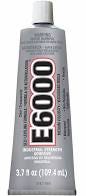
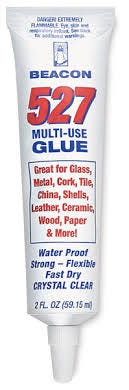
The two brands I use the most are E6000 and Beacon 527. The glues are very similar. E6000 is very thick. Beacon 527 is very runny. Beacon 527 begins to set a little faster.
E6000 and Beacon 527
My favorite glue is referred to as a 1-part epoxy (but it’s not really an epoxy). “1-part” means that you don’t have to mix anything to make the glue — it just comes out of a tube. One brand is called E6000, and this version of the glue is thick in consistency. Another version of the glue is called Beacon 527. This glue is runny. Some people prefer one or the other. E6000 is the first one I used, and I prefer that one. But I actually use both where I think the thickness or the runnyness might be an advantage. There are other brands as well.
Perfect for attaching findings to base metal and costume jewelry pieces. Also, use E-6000 on bead strands to seal end knots and to provide a strong, flexible seal that won’t become brittle or damage the bead cord. E-6000 is safe for use with virtually every type of gemstone and works on wood, leather, vinyl, and canvas.
Non-corrosive and self-leveling, E-6000 adheres in 5 to 10 minutes, and hardens to a clear, waterproof cure in 24 hours. This means you have about 10 minutes to position and reposition whatever you are gluing. After about 20 minutes, you can take your finger and/or a tweezers and rub off any glue that has oozed out from any edges or around any pieces. If you are making jewelry, you should let the piece dry “hard” overnight, before you wear it.
E-6000 dries like rubber, so the glue acts like a shock absorber, as your jewelry moves.
Drawbacks: It doesn’t bond well between two smooth pieces of glass. Here it’s a good idea to rough up the surface a bit with steel wood or sand paper or metal file. It doesn’t bond well to very oily surfaces.
Superglue
Superglue is not our favorite! Superglue has very few uses in jewelry design. It often ruins rhinestones (it discolors them and makes them cloudy) and other pieces we use in jewelry-making. It’s bond is tough, but it breaks easily when pieces move. Superglue dries like glass, and the bond shatters like glass. Moreover, the shattered bond looks like a piece of broken glass, so if any stringing material is nearby, the bond can cut it. It is terrible with elastic string.
We do, however, use superglue occasionally.
Cement or Glue?
A glue works by surrounding or closing in on an object. As the solvent in the glue evaporates, it’s “collar” gets tighter and tighter.
A cement works by adhering to all the individual fibers or elements of the materials you are using.
G-S Hypo Cement
This is the jeweler’s version of superglue. It doesn’t dry instantly like superglue. It takes about 20 minutes to set. It’s bond is like that of superglue.
We often use it to seal end knots, or coat a frayed strand of cord. We sometimes use it on crimp beads to enhance the closure. Unlike its super glue cousin, G-S Hypo Cement takes several minutes to set, so you can move things around during this time.
This glue has a very ultrathin needle point to get into very tight spaces.
G-S Hypo Fabric Cement
This version of g-s hypo cement is perfect for gluing knots in fibrous materials, especially silk. Great with any bead cord or stringing material made with natural materials.
Fabric Glue or Fabri Tac
Fabric and bead cords are made up of many, many micro fibers. It is important for the glue to bond to all these fibers, else, the bond won’t hold. While I prefer the G-S Hypo Fabric Cement, these glues are a good substitute.
Hot Glue Guns
Hot glue guns are easy and fun to use. When the materials you are using are large and bulky, hot glue guns make the projects go faster.
The glue’s bond will not last forever. The glue will yellow with age. The bond weakens at body temperature. If you made a dangly pair of earrings, and hot-glued a rhinestone to the piece that touches the ear, the rhinestone will likely pop off when the earring is worn. If you hot-glued stuff on the dangle, you won’t have the same problem.
Gorilla Glues
This line of glues is very, very strong. However, the bond expands as the glue dries. Most versions do not dry clear. They discolor with age.
Elmers Glue and School Glue
These glues are safe for kids. They work OK, but the bonds weaken when wet, through washing or sweating.
About Gluing Rhinestones, Marcasites, and other Stones or Components
Your goals for gluing rhinestones into or onto a piece of jewelry or cloth or other surface are simple:
A bond that sticks and is durable.
A bond that does not ruin the materials you are using.
A bond which dries clear and ages clear.
Glue which will not show outside or over the edges of the stone.
Glue where you can easily remove any excess glue that extends beyond the boundaries of the stone.
Glue which does not expand when it dries.
Glue can adversely affect your materials, so you always want to do some pretesting! Also, some of the rhinestone and other glues you may use might be soluble in soapy water, such as when you wash your hands or wash dishes.
Rhinestones are foiled back pieces of acrylic, glass or crystal. Some glues will pull the foil off or make it crinkle. Some glues may make the rhinestones cloudy. This is especially true with acrylic and glass rhinestones, but not necessarily with crystal rhinestones.
I prefer to use E6000 when gluing these into settings, onto fabric, or onto other surfaces. This creates the strongest bond. Most E6000-stones glued onto fabric will survive the washing machine several times.
When we use E6000 with rhinestones, we put a little drop of glue on the end of a pin. Then we touch the glue to the back of the rhinestone. We maneuver the pin-glue-rhinestone over the place where we want the stone to be. Then we push the rhinestone in place with our finger, and simultaneously pull the pin away from the stone. After about 20 minutes, we rub the stone and around the stone with our finger or the pin to get any excess glue off.
Some additional suggestions about glues
A great book to buy is The Crafter’s Guide To Glues by Tammy Young. In it she discusses all the types of glues, including the following:
White glues, such as Elmer’s Glue All
– bond is not strong, so useful for lightweight objects only
– bond is not flexible, so not useful for things where there is movement
– may not dry clear
-materials used must be porous
Tacky glues, like hot glue gun
– usually dry clear and are flexible, but can wash out
– body temperature can weaken bond
Clear Craft Glues
– wash out easily
– for lightweight projects
Super Glue
– instant adhesive, that works with many smooth surfaces, but not well with smooth glass surfaces
– will cloud rhinestones
– especially good with plastic pieces
– water resistant, but not best choice for washable projects
– inflexible; does not work well where there is movement
High Tech Adhesives, like E6000 and Beacon 527
– not water soluble
– bonds to both porous and non-porous materials
– does not bond well to rubber
– sets slowly, so you can re-position things
– dries clear
Fabric Glues, like No-Sew
– holds up through several dry cleaning cycles
– formulated to glue fabric to fabric
– make also work well to glue various embellishments to fabric
Fusibles, where you melt the glue with an iron or another heat source, such as a transfer
– for applying appliques or transfers
– prewash all materials before fusing
Aquarium Glue (glass cements)
– great for bonding two smooth surfaces of glass
Clear Cements, like G-S Hypo Tube or Watch Crystal Cement
– Doesn’t dry as fast as super glue, so can do some re-positioning, but bonds strong like super glue
– Good to use for sealing knots in jewelry projects
– Not as strong as epoxies or high tech adhesives
– water resistant and not affected by temperature
As with anything you do as a bead and jewelry artist, you want to ask lots of questions and get lots of advice. You want to play with a wide variety of tools and glues and stringing materials and metals and beads. You want to experiment. Let yourself try and err.
This is a lot of information. But this Orientation is important. Very important. Making jewelry is very similar to building a bridge — you must be familiar with many kinds of materials, how the materials interrelate, and how you link and connect these materials in a durable and appealing piece which wears well, and moves well with the wearer.
It always amazes me about how many people (studies show that 25% of the population) think that when their sterling silver jewelry turns black, it’s Dead and they throw it out. So, especially if you are selling your stuff, you always need to educate people about cleaning sterling silver.
Sterling Silver tarnishes from the interaction of silver and sulfides in the air. First the tarnish will take on a golden hue, and eventually, it will turn the piece black. This is a natural process.
Higher sulfide levels are associated with humidity and/or pollution. Remember, the more humid the climate, the faster sterling will tarnish. On a summer day in Miami, Florida, all you have to do is walk out the door and the sterling starts turning black very quickly.
Sterling Silver will polish up by rubbing or buffing it with a soft cotton cloth. The best cloth to use is a piece of denim. Yes, rub it on your pants.
Jewelry stores either sell or give away what is called a Rouge Cloth. This is a little bit gimmicky, in that what is taking the tarnish off is the rubbing, not the rouge. In most cases, denim works better. Both denim and the rouge cloth are 100% cotton. Denim has ridges on it. The rouge cloth is smooth.
The ridges of the denim get inside the links on chains. The ridges get into the crevices in your jewelry. The rouge cloth is terrible for chains. However, if you want the crevices in your jewelry to remain black, the rouge cloth, which is a smooth surface, will work better.
You might also invest in what is called a Sunshine Cloth. Many bead stores and jewelry stores sell these. The Sunshine Cloth has a chemical in it that eats the tarnish but does not harm gemstones. And that’s its greatest selling point — it does not harm gemstones.
Sterling Silver dips are fast and easy, but are not the best choices here. Ideally you would never use a dip, or only use a dip in an emergency. First, many dips will take the color and the polish off many gemstones. Second, the dips work by pulling silver out your jewelry and creating a silver salt. The salt is usually white, sometimes black. This salt or residue gets caught inside the links of chains. It gets caught in the crevices in your jewelry. It is difficult to pick it out.
If you do have to use a dip, the way you use this dip is that you take your piece of jewelry, and put it in, and immediately take it out and rinse it off. If not clean enough, repeat. Never leave your jewelry in the dip. Then buff your jewelry with a soft cotton cloth. The buffing brings out more of the shine, and helps take off any residue left on the piece.
Most silver polishes do not work well with sterling silver jewelry. Repeated uses usually cut the shine and leave a white color to the sterling silver in jewelry. They primarily are used for silver plated kitchen ware and utensils. One exception, which I like, is Tarni-Shield — a silicon polish. Tarni-Shield will keep the piece of jewelry shiny until the shield wears off. We primarily us this product when we make a lot of jewelry that has to be on display for a long time, such as when we’re selling our pieces at an arts and crafts fair.
There are lacquer dips which coat your jewelry in order to keep the shine. (This is similar to painting clear nail polish on your jewelry). The lacquer, however, wears off unevenly, allowing some places to tarnish and others not. As the lacquer coating loosens in some areas, the silver will tarnish underneath it, but this area will still be inaccessible to your polishing cloth, until that lacquer actually chips or peels off. This can leave your pieces unsightly. If the piece is a chain, or a filigree, the lacquer will form a film within the openings and cracks. This obviously makes the piece ugly.
If you have some heavy duty tarnishing to deal with, then the easiest thing to do is to make a paste of baking soda and warm water, use a soft bristle toothbrush and scrub and rinse.
Even dry baking soda will take the tarnish off. You ruby your jewelry back and forth into a pile of dry baking soda, then use a cosmetic brush to pat the jewelry to get the powder off.
The effects of the baking sod, whether dry or as a paste, are almost instantaneous. You can also use baking powder. You can use baking soda toothpaste. If you have a large tea-pot, you can make a dip instead of a paste.
Some people sell set-ups using baking soda and tin foil, or baking soda and a sonic bath. These are gimmicks. What’s taking the tarnish off is the baking soda. That’s all you need.
Some Additional Advice
Never use a cleaner with ammonia or sulphur in it.
Sterling Silver is best stored in an air-tight, zip lock plastic bag, and in a drawer or somewhere out of the light. When you put the silver into the plastic bag, be sure to push out all the air before sealing the bag.
[Note: Sometimes you can restore that oily polished look on gemstones by rubbing them with men’s black shoe wax.]
Kathryn was so very excited! She had just finished speaking with a reporter for a local arts magazine. He wanted to do a story about her as a jewelry designer. The magazine was 4-color, very substantial and distributed widely in her hometown area. Moreover, the reporter promised he’d include 5 pictures in the article. They made an appointment to meet in the middle of next week. And Kathryn was thrilled!
The reporter met her at her home. She greeted him, somewhat giddy, not sure what to say, or say next. She thought she would let him lead the conversation and interview. She gave him a short tour of her house — her beading room, her den, her living room. The reporter marveled at her collection of Pez dispensers and puppets. A short time later, a photographer joined them.
After 2 hours, the reporter and photographer had left. Kathryn was satisfied that they had seen several of her bead-woven jewelry pieces. She felt that she had given them a good history of how she got into jewelry making. The photographer had taken at least 20 shots of her around the house. The article was to come out in 3 weeks.
Three weeks later, and there it was.
A 4-color article. In a prominent local art magazine. About her wonderful Pez collection. And the long staircase from the street level to the living level in her house. And all her puppets. And information about her moving from Connecticut to Tennessee and having lived in Georgia. And she had three children.
And no pictures of her jewelry.
Or her bead room.
Or her making jewelry.
And no pictures, surprisingly, of her Pez collection or her puppets, given how prominently these were featured in the article.
There was a picture of her staircase. Three pictures of her sitting on a couch or chair. And a picture of a treasured vase, and quite beautiful.
Kathryn had these high hopes — Now Nashville will know about her jewelry making and design prowess.
Until she saw the article.
And knew now she’d be known for Pez dispensers.
The opportunity to get featured in a newscast or newspaper or magazine doesn’t come around often. However, when the opportunity does knock, this can have a big and positive impact on your jewelry making business. But you have to be prepared.
You Have To Remain In Control
You have to remain in control — even if this leads to a little tension between you and the reporter.
Jewelry Designers At Workshop with Warren Feld, Photo, Feld, 2013
First, pre-prepare.
MAJOR POINTS: Determine the 4 or 5 or so major points you want to make about yourself as a designer and about your jewelry.
No matter what questions the reporter asks, turn the conversation back to your major points. During the interview, keep making the major points. When the reporter returns to his notes to quote you, this will be all the material he has to draw from.
WHAT YOU SHOW AND DON’T SHOW: If you give a reporter a tour of your home, only take him to the design-relevant points of interest. Where you make the jewelry (or other product or project). Where you display your work. Where you have people try on your jewelry or use your products. Where you get inspiration for your designs. And if there’s a photographer or cameraman there, direct and narrow their attention and focus as well.
WHAT PICTURES WOULD BE MOST STRATEGIC: Pre-think what will be the 5 or so most strategic pictures that should be taken. Definitely have an “action” shot that shows you making or manipulating your designs. Perhaps another “action” shot that shows you fitting someone with your product, or them using one of your designs. Have some of your products or projects “staged” so that they are photo-ready, with great background, foreground and pedestal. Don’t wait to take your product out of a box or to boot-up your computer to show your work. If what you design is very detailed or uses very small parts or objects, these might not photograph well. Show the photographer the parts of your work that lend themselves to detailed close-ups.
Make your points. Get your images.
Second, set the stage.
YOU SHOULD BE INTERVIEWING THEM AS MUCH AS THEY WILL BE INTERVIEWING YOU: When the reporter (and photographer or cameraman) arrives, butter them up, and find out how deep and wide their knowledge is about the design work you do. If they only have a shallow understanding, educate them. How do you find the parts? How do you determine how the pieces or projects should be constructed? Do you use specialized tools? How does someone learn to do what you do?
Also, ask them about the “audience.” What kinds of things do they think that their “audience” would most like to know about the design work you do?
Given all the things you have learned from them, you might want to modify parts of your game strategy.
Third, before they begin, ask for tips.
Get them to prepare you so that you look the best, your design work will look its best, your voice will sound the best, and so forth. They are the experts. Use their expertise.
If this is getting filmed, ask about how you should stand, (or sit), the direction you should look at, and any do’s and don’ts, as they see it.
What kinds of things do they like to see/hear in an interview?
Last, when you are done, ask to get a copy.
Be sure you will be sent copies of the written articles, or DVD or video copies of any filming. Don’t assume they will automatically send you something.
Don’t be self-conscious. Don’t think all this will make you seem too pushy.
Remember: Everyone will be happy if the story comes out great!
Often, I have found, creative-types can be shy when it comes to self-promotion and marketing.
If you are a jewelry designer who has ambitions to have your work publicized in books or magazines, or to be accepted into a juried show or exhibit, or to sell your things in a store or gallery, you need to be able to promote your work.
ASK YOURSELF THESE QUESTIONS… Write Your Answers Down On A Sheet of Paper
What insights, from your own experiences, can you offer your fellow jewelry designers about self-promotion?
What kinds of things help you to overcome any fears about marketing your work?
How do you handle criticism and other rejection like getting the dreaded “No”?
From an article I wrote….
Jewelry designers often find a self-satisfaction in working intensely on a project, often in isolation or solitude. But when it comes to tooting their own horns — this is not as easy or satisfying for them. There is a discomfort here. You might want to show your pieces to others, perhaps submitting them for review or a juried competition, or perhaps wanting a store or gallery to accept your pieces for sale.
Then humility kicks in. Or perhaps a lack of confidence in yourself. Or a fear of criticism. Or a rejection. Hearing: No, we don’t want your pieces.
We don’t want to appear desperate for a sale, or too eager for acceptance.
But, if you don’t believe in yourself and your products, no one will. Your fantasy of striking out on your own will never materialize, if you don’t find it within yourself to do some self-promotion.
Promote Your Value
And the first step is understanding and recognizing:
that to promote yourself means promoting your value.
Your jewelry has VALUE to them, why….?
If something has value to someone, then they typically want to know about it. Your jewelry has value to them because it solves a problem for them. It might make them happier, more beautiful, more enriched, more satisfied, more powerful, more socially accepted, more understanding of construction or technique or art and aesthetics. It might be better than other jewelry they see or wear or think about buying.
For a store or gallery, your jewelry might be more saleable, more attractive as displayed, better constructed, more artistic, more stylish or fashionable, a better fit with their customer base, with good price points.
You promote the value of your jewelry to your audience. You do not have to brag. You do not have to be shameless. You do not have to do or say anything embarrassing.
Just speak the truth about value.
Share examples of your work and what you have done, not your ego.
Speaking
And that brings up the second point — speaking.
People who are more comfortable speaking about themselves and their products tend to be more successful in their careers.
Products don’t sell themselves. People need to be nudged.
This “speaking-about-themselves and their products” is a basic communication process. This communication process is a process of sharing information.
You want to educate the right people, in the right way at the right time. You want to speak about who you are, and what you make. The values your jewelry has to offer them. And how you would like to develop your relationship — whether designer/client or designer/retailer or designer/jury — so that you may both benefit.
Fundamentally self-promotion is about communication. Communicators frame the narrative. Communicators start the conversation. They begin on favorable terms.
They would not say: Would you like to see my jewelry?
Instead, they would say: I have jewelry you are going to love.
Be Relevant
And this brings up the third point — be relevant.
Know your audience, what their needs are, what their problems are that need solving. You may have created the original piece to satisfying some personal yearning and desire. But if you want someone to buy the piece, wear the piece or sell the piece, you need to anticipate why. Why would they want to buy, wear, review or sell your piece of jewelry?
Do not assume they will figure all this out on their own. You will need to help them along in this process. You will need to communicate about the value your jewelry will have for them. You will need to do some self-promotion.
Inspire People
The last point — inspire people to spread your message.
Your best marketing and promotion will be what is called “word-of-mouth”. So you want to create supporters and fans and collaborators and colleagues. And you want them to be inspired enough about you, your creativity and your jewelry, so that they tell others about you. You inspire your current network of family and friends. You might make a presentation or teach a class. You might share images of your work on social media like FaceBook or Instagram or Twitter or Pinterest. You want to regularly connect with people, so that you and your work are frequently in their thoughts.
There are many self-promotion strategies that you can do. You don’t need to do everything at once. You might try one or two ideas first, and do those, then pick a third, and so on.
Self-Promotion Strategies
Some Self-Promotion Strategies That Have Worked Well For Others
1. Wear your jewelry all the time, and don’t be shy about saying you made it!
2. Have attractive business cards made, perhaps a brochure. Vistaprints online is a good place to start.
3. Have an active presence on social media, particularly Instagram, FaceBook, Twitter, and Pinterest; participate in discussions; get people to click on those LIKE buttons (or similar thumbs-up registers) next to your images and your discussions.
NOTE: When a person hits the LIKE button or adds a comment, look them up on the social media site. Find something about their background or their own creative work, and respond to them: (a) First, re-state their name at the top of your response, (b) thank them for the like or comment, (c) comment on what you learned about them, (d) type your name and perhaps a link to your website or your social media site.
4. Have a website, either as a “billboard”, or as a full-fledged e-commerce site
5. Get your website listed in as many online directories and search engines as you can
6. Generate an emailing list and use it regularly, such as sending out a newsletter; get into the habit of asking people if you can add them to your mailing list
NOTE: Try to maintain some more routine follow-up contacts with at least 50 people on your emailing list. Always point out something of interest about them to you.
7. Collect testimonials about your work, and post them publicly
8. Always speak and act passionately when discussing or showing your work.
NOTE: You don’t want to be sales’y. Simply show your excitement and passion and story about making the piece.
9. Organize your own discussion groups on FaceBook or LinkedIn, or begin a blog (WORDPRESS is a good place to start a blog)
10. Post video tutorials or videos showing you making things on YouTube
11. Submit images of your pieces to bead, craft and jewelry magazines
12. Teach courses, either locally, or as a connection with one of the many websites promoting teachers online
13. List yourself with websites that list custom jewelry makers for hire, such as Custommade.com
14. If your jewelry has done well for a store, convince them to carry more of it and let it take up more display space
15. Doing the occasional craft show, bazaar or flea market is also a good form of advertising and getting your message out to a large number of people you probably would never have met otherwise
16. Create a good, rememberable image to use as your avatar, on such websites as FaceBook
17. Follow up with customers and contacts, such as after a purchase, or after someone accepting to include you piece in a magazine, or sell their pieces in a shop. Thank them. Reinforce your personal brand with a short comment about the value of your pieces for them.
18. Have a clear personal style that you can point to in your jewelry, and that you can speak about.
19. Have a clear idea of what is called your “competitive advantage”. What are those 5–10 things about you and your work that sets you apart from, and perhaps makes you better than, the competition.
20. Search for companies or people that may want to see or buy your work. Use directories on Yahoo, Yelp and Google. Use LinkedIn.com. Search Twitter looking for people who are saying they need custom jewelry work done.
21. Network with other jewelry designers, both in your local area, as well as online. Ask for feedback on the self-promotional activities you are doing. Have any of these worked well for them? Are they doing other things you haven’t thought of?
22. Get out of your studio and meet people in the flesh.
23. Attend trade shows, networking events and charity events, or other types of places where your clients might also attend.
24. Offer something — one time only — for free. A free class, a free repair, a free pair of earrings.
25. Publish or self-publish a book or book-on-CD, and promote that
26. Develop your “elevator story”. Pretend you are stuck in an elevator with someone, and you have 30 seconds to say something about yourself which is very impressionable and relatable. This will prepare you for the frequently asked question: What do you do?