Let Business Concerns Influence Your Artistic Choices
To what extent do (and should) business concerns influence the artistic choices bead and jewelry artists make?
I’d say, “A Lot!” But this isn’t what a lot of artists like to hear.
You have to market to audiences. You may have to standardize things to be able to make the same thing over and over again. You may have to work in a production mode and repeat making certain designs, rather than freely create and design anew each time. You have to price things so that they will sell, and you have to price things so that you can make a sufficient profit. You can’t undersell yourself, like offering discounts to family, friends and co-workers.
You have to conform to prevalent styles and colors and forms. You have to make things that will photograph well for sale online. You have to make things that local stores want and are willing to buy or put on consignment. You may end up with a lot of “one size fits all,” because producing too much variety in sizes, shapes, colors and sizes could overwhelm you financially.
You find that if you want to make your jewelry design into a successful business, you may have to compromise with yourself, your artistic drives and sensibilities. You may have to limit what you offer. In order to make that sale. In order to make a profit. And stay in business.
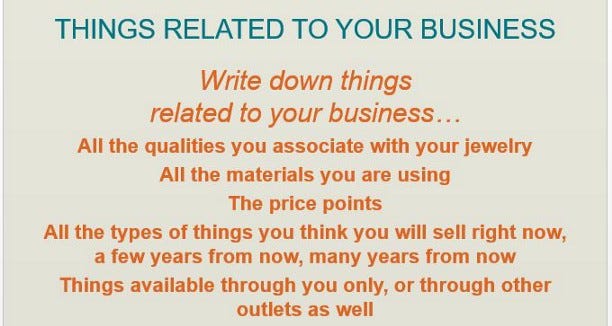
Business involves: — Putting your artwork on a sound cost/revenue footing — Developing market-driven strategies (as opposed to product-driven ones) — Pricing your pieces for sale — Implementing various selling strategies — Compromising artistic and design choices, in the interest of the business
Why Artists Fail In Business: Some Key Reasons
Over and over again, I have seen one jewelry artist after another fail as a business. The reasons repeat themselves as well.
1. A reluctance to learn how to conduct oneself as a business
2. Gets bored
3. A fear of marketing your own things
4. Trying to please all audiences
5. Doesn’t do homework on the competition
A reluctance to learn how to conduct oneself as a business.
Many jewelry artists get so excited after selling their first piece, that they think they don’t have to get too involved with business principles. They understand their “business” as a “necklace-by-necklace” endeavor. Make something, sell it. Doesn’t matter what the price. Doesn’t matter to whom. Doesn’t matter if making the piece in the first place is in line with the resources you currently have to make the piece, or will drive you in debt in order to get those resources. All that matters is the count — the number of pieces you have sold.
Artists need to focus, instead of the count, on what’s called Velocity. You need to have in place sufficient strategies for keeping the money turning over at a constant rate. If you can’t maintain this rate, you go in the hole. You make something. You sell it. You reallocate the money you just made to reinvesting in more inventory, replacing the inventory you sold, evaluating the pros and cons of the sale that just happened, adjusting accordingly, and strategizing how to keep this velocity going at a constant, or ever-increasing, velocity or rate.
And artists need to keep good records, and implement good accounting principles.
2. Gets Bored.
People who get started are very excited. They’ve made a lot of pretty pieces, and someone has bought some of them. But then you need to leave your creative mode, and enter a production mode. You need to discipline yourself to make the same things over and over again, particularly in the first 2 or 3 years of your business. Many artists quickly lose interest.
3. A fear of marketing your own things
You won’t succeed without marketing. Marketing is more than advertising. It includes all forms of self-promotion. It includes doing research on your markets and market niches, how to reach them, how to get their attention, how to get them to translate this attention into needs and wants and desires, and how to get them to part with some money.
Many artists are shy about self-promotion. Time to train yourself, if this is you, to get over it.
4. Trying to please all audiences
When people get started, they are reluctant to use the “No” word. They want to please everyone. But when you get started, you can’t. It will put you out of business.
Let’s say you have some jewelry that is predominantly purple. Someone at work loves the jewelry, but asks if you can make it in red. If you don’t have an inventory of red beads, and will have to go out and buy them, it may make this sale foolish, from a business standpoint. You can’t buy just one bead at a time; you need to buy strands or packages of these beads.
When you start, you need to pursue a strategy of depth, rather than breadth. You want to buy a limited number of pieces, colors, sizes and shapes in large enough quantities to get adequate price breaks. So, initially, your designs will be limited, as well. You need to be able to say No!. No! to your family. No! to your friends. No! to the people you work with.
In my experience, such as the situation with red vs purple beads above, when you say No!, the potential customer tends to make a face. Pitiful. Angry. Frustrated. Sad. Pleading. If you can wait 60 seconds, in almost every case, the customer stops making this face, and says, “OK, I’ll take what you have in purple.” 60-seconds. That’s how long you have to wait without responding. Only 60-seconds before that person gives up and stops making the Face. It always amazes me, but so many jewelry artists can’t wait that 60 seconds.
And don’t give these people discounts. They’re already getting it cheaper, than if they bought the same piece in a store. One major way your business will get built up is word-of-mouth. You don’t want some of that information to include extremely low price expectations. If your stuck giving low prices, you will never be self-supporting in your business.
5. Doesn’t do homework on the competition
You need to understand how other jewelry artists you compete with function as a business.
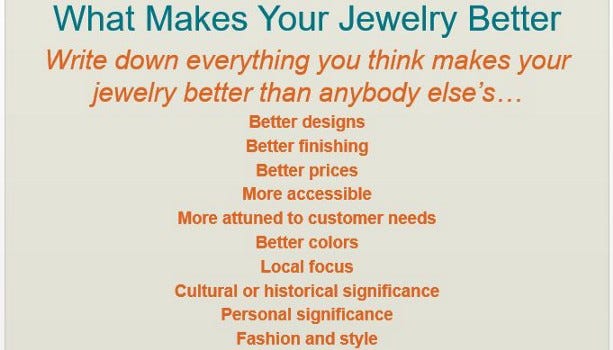
How do they define their markets? How do they price things? What kinds of inventory do they carry? What kinds do they NOT carry? Where do they advertise? How do they promote themselves? How do they define their competitive advantage — that is, all the reasons people should buy from them, rather than from anyone else, like you? Where do they sell things — stores, shows, fairs, online, etc? What seems to work better for them? How do they figure out the best place — real or virtual — to link their product and product message to the customers most likely to need, want and buy their jewelry?
You can find a lot of this out by Googling. You can look for jewelry designers. Directories of jewelry designers. You can plug in a jewelry designer’s website, and see where they are listed, and who lists them.
Can I Make Money?
Some jewelry designers are only interested in selling the occasional piece. Others want to create a steady flow of some extra income. Still others want to be financially self-sufficient as a jewelry designer.
Whatever your personal goal and commitment, can you make money? The answer is YES… That is, if you are smart about it.
Your friends and relatives might tell you that jewelry design “Is not practical,” or a warning “Don’t quit your day job.”
I won’t lie to you. It’s tough. Requires commitment and perseverance. It requires some introverted skills and some extroverted skills. It requires managing a process that includes some creative elements and some business and administrative ones. But you can do it.
First, sit down and write down some do-able sets of goals for your business. Some sets of goals will be on the creative side; others on the business side.
One set of goals should answer the question: How are you going to manage the design process (from inspiration to aspiration to finished product to marketing and selling your products)?
Another set of these goals should answer the question: How are you going to maintain your cash flow throughout the whole year? After you start implementing your goals, at some point you should be able to ask a friend: Did I achieve my goals or not?
Second, organize your time. You need to spend a certain amount of time with creative activity. Another block of time on business, administrative and marketing activities. And a certain amount of time for reflection and evaluation and self-care. You need to maintain balance between the personal and the professional, and between the creative and the administrative.
Third, do not try to do too many different projects or work with too many different kinds of colors and parts at the same time — particularly in your first 3 years in business.
Fourth, do not go for roofs before setting foundations. Learn about materials and techniques in a developmental order. Things will make much more sense, and be easier to accomplish, this way as you advance your skills and endeavors.
Last, you can’t do everything by yourself. Find compatriots. Find a mentor. Share or coordinate some workloads. Be sure you structure in ways to be accountable and get feedback.
Teaching literacy in jewelry design is a lot like teaching literacy in reading and writing. We want our students to comprehend. We want them to be able to be self-directed in organizing and implementing their basic tasks. We want them to be able to function in unfamiliar situations and respond when problems arise. We want them to make reasonable judgements on marrying aesthetics to functionality. We want them to develop an originality in their work. We want them to think like designers. And, we want a high level of automaticity in all this. The basic jewelry design curriculum does not accomplish this. There is an absence of strategy and strategic thinking. There is a weak commitment to jewelry design as a discipline, with its own vocabulary and ways of thinking through and doing and responding to different, often unfamiliar, situations as they arise. Without a commitment to embed the teaching of a disciplinary literacy within the standard curriculum, we will fail to impart that necessary learned awareness about fluency, flexibility, originality, and comprehension the designer needs to bring to the design process.
TEACHING DISCIPLINARY LITERACY
She said it wasn’t her job!
This prominent jewelry instructor told me that it wasn’t her job to teach anything beyond the basic steps for getting a project done. It was not her responsibility to share any insights, choices, compromises, fix-it solutions or design considerations she herself made when creating the original project — now taught as a class with a kit and a set of step-by-step instructions. If a student asked a specific question, she would gladly answer it. But otherwise, it was not her job.
This attitude is so prevalent in the standard jewelry making curriculum and education. Teachers stick very closely to the standard, basic curriculum. Facts, not ideas. Absolutes, not what-ifs. Step-by-steps, not creative thinking. Teachers rarely explain the implications for using one bead vs. another, or one stringing material vs. another, or one clasp vs. another, or one material vs. another, or one technique vs. another. They rarely discuss the deeper meanings and potentialities underlying various problematic situations. They ignore the role and power of jewelry to influence human relations.
They have the student gloss over things as if, once seen and memorized, the student will automatically be able to make the right choices over and over, again and again. The teachers see themselves as easily transferring knowledge, skills and understandings to the student as if inoculating them as you would with a vaccine and a syringe. And the student becomes a star jewelry designer. Or not.
Teachers too often see jewelry making and design as a basic set of skills, easily adaptable and applicable to all kinds of jewelry making situations. They assume that the challenge of improving jewelry making skills would primarily be a function of making more and more jewelry.
This might be true for the novice student, but as the student moves from basic decoding to fluency, flexibility and originality in design, what was learned initially becomes less generally useful. For example, the student may learn about basic color schemes, but not how to adapt these in different situations, or leverage them to achieve an even more resonant result, or be more deliberate and intentional when choosing colors and determining how to use them.
There is an absence of strategy and strategic thinking. There is a weak commitment to jewelry design as its own discipline, with its own vocabulary and ways of thinking through and doing and responding to different, often unfamiliar, situations as they arise.
Jewelry, in the standard, traditional design education model, is understood as an object. We can speak about and learn about it as an object. This object is distanced from the creative spark that created it. It is divorced from desire. Apart from the wearer or the viewer. Ignorant of context or situation. There are no deeper explanations, no pointing out implications, no experimenting with situational contingencies, no debating synergistic or other external effects. The student is run through color theories, materials composition, step-by-step jewelry construction as if learning a basic lexicon is sufficient and enough.
This whole traditional process of standard jewelry designer education ignores the required disciplinary literacy. It assumes the student is creative, or not. It approaches jewelry design as if it were a subset of some other discipline, usually art, or more specifically, painting or sculpture. It ignores architectural requirements allowing jewelry to move, drape and flow as it is worn. It forgets that jewelry has personal, situational and social consequences. It pretends that jewelry design does not have any disciplinary requirements of its own. There are no specialized knowledges or ways of thinking unique to jewelry design alone.
It is weak at teaching the student, from a design perspective, how to decode design elements and how to combine them into compositions apart from basic art theory. It pretends there are no architectural issues underlying how jewelry functions. It ignores the fact that jewelry gains much of its appeal and power only as it is worn, and not as it sits on a mannequin or easel. It totally avoids confronting the fact that much of the power of jewelry results from how it instigates and sustains relationships — artist to self, artist to wearer, wearer to viewer, artist to seller, exhibitor to client, artist to collector, and so forth. And, it fails to impart that necessary learned awareness about fluency, flexibility, originality and comprehension the designer needs to bring to the design process.
It’s not their job. It’s not their job to assist the student’s developing creative thinking or applying that creative spark towards better jewelry design.
It’s not their job.
But, in fact, it is!
What Is Disciplinary Literacy?
Disciplinary Literacy1 assumes there are real differences in the way professionals across fields participate and communicate. Without this, students and professionals in a particular field would flounder and fail. Disciplinary literacy encompasses those techniques and strategies used to teach designers to think like designers (or historians like historians or scientists like scientists, and so forth)2.
Disciplinary literacy refers to how the particular discipline creates, disseminates, and evaluates knowledge. Each discipline has its own way of looking at the world, defining things using a specific vocabulary, gathering information, specifying understandings, posing questions and problems, delineating solutions and using evidence to justify their ideas and conclusions.
An artist looking at jewelry, or a craftsperson looking at jewelry, for instance, would have different thought and interpretive processes than a jewelry designer looking at jewelry. Jewelry, after all, is different than a painting or sculpture or simple functional object. Jewelry is only art as it is worn. It must satisfy the requirements of both aesthetics and functionality. It exists in a 3-dimensional space. It is worn on the body. It establishes special relationships between designer and wearer, wearer and viewer, designer and seller, designer and collector. It encapsulates situational and socio-cultural meanings. To evaluate whether a piece of jewelry is finished and successful requires a different thought process than art or craft alone would provide.
There are key disciplinary differences in how a jewelry designer…
Chooses and evaluates evidence
Relates evidence to a perspective
Gains understanding
Visualizes things
Manipulates things
Creates a truth and achieves an error- free solution
Introduces things publicly
Training in jewelry design should teach students the unique challenges they face within their discipline as they think through design and create jewelry. At each increment within the jewelry design process, they need to think like a designer.Not as an artist, nor like a craftsperson.As a designer.Finding evidence whether a piece is finished and successful.Linking causes to effects. Understanding how inspiration resulted in a finished design.Developing knowledge, understandings and skills to the level where they can transfer these to others.Generating a large number of ideas.Making inferences about the implications of any one choice.Producing things which are original.Responding to problematic or unanticipated situations.Finding new ways to adapt existing ideas to new conditions.Anticipating shared understandings about how their work will be evaluated, assessed and judged.Knowing when something is parsimonious and finished, and knowing when something resonates and is successful.
Types of Literacy
There are three different types of literacy — Basic, Intermediate, and Disciplinary. The standard jewelry design curriculum typically focuses on Basic literacy, with some nod toward Intermediate. Disciplinary literacy is usually ignored, but it should be incorporated and integrated within Basic and Intermediate literacy instruction.
Basic Literacy
Basic literacy refers to the degree the student learns knowledge of high frequency concepts that underlie virtually all jewelry design and jewelry making tasks. These concepts are typically universally recognized and understood by artist and client alike. Here jewelry is understood as an object. An object has literal characteristics which the student can identify and list.
The student demonstrates this basic literacy by an ability to decode. The student can decode things like color use, rules of composition, materials selection, technique implementation and the like. The student picks up the basic words and definitions, links the vocabulary to relevant objects, and can identify their presence and use within any piece of jewelry. Each element and principle of design can be graphically represented, and the student begins to make connections between word and graphic. The student begins to recognize which design elements can stand alone, and which are dependent on the presence of other elements. The student can identify harmonious and balanced clusters of these design elements within compositions. The goal is an automaticity in decoding.
Intermediate Literacy
Here the student develops the knowledge to make more complex jewelry forms and designs. There is more comprehension. The student recognizes that the various design elements and principles have a range of variations in meaning and expression. In a similar way, the student begins to recognize that clusters of design elements and principles can also show variations in meaning and expression.
The student learns about different materials and what they can and cannot be used to achieve. Materials have names, places of origins, stories about how they get from one place to another, processes.
The student is introduced to variations in techniques and technologies. There is more than one way to accomplish things. There are more things that can be created using familiar techniques.
The student learns to problem-solve with various “fix-it” procedures, like re-doing, changing tools, requesting help, looking things up, drawing analogies.
The student learns to process-plan. S/he begins to relate inspirations, aspirations and intentions to more critically evaluate their choices or the choices of others. Students are more able to stick with things and maintain attention to a more extended design process.
The student begins to learn how to design for an audience. This might be a client, or a purchaser, or an exhibitor, or a collector. This begins the developing understanding of how to meld personal held preferences with those of others.
Students monitor and reflect on their own comprehension. The goal is an automaticity in fluency.[4] Here jewelry is understood as content. As content, the jewelry as designed conveys meanings and expressions which the student can derive. The jewelry and its compositional design is still, however, mostly viewed objectively, as if sitting on an easel, not as it is worn.
Disciplinary Literacy
This involves a way of thinking and doing specific to the discipline. The student learns specialized literacy skills relevant to jewelry design as the jewelry is introduced and worn publicly. The student learns how parsimony and resonance as outcomes expressed in design differ from harmony and variety as expressed in art.
The student learns to anticipate shared understandings[5] and the role of desire among the many audiences the student works with, works in, and relates to. These include clients, sellers, exhibitors, collectors, wearers, viewers, and the artist him- or herself.
Much of the design process takes on the qualities of backwards design.[7] The designer begins the process by articulating the essential shared understandings and desires against which their work will be evaluated and judged. The designer starts with questions about assessment, and then allows this understanding to influence all other choices going forward.”
The student has an ability to conceptualize and explain what jewelry means, how it is more an action than an object, and how this meaning emerges dialectically, as the jewelry is introduced publicly, worn, shared and displayed.
The student learns to recognize the dynamics of coherency,decoherency, and contagion. The artist’s coherent choices about design become contagious, attracting someone to want to touch the piece, wear it, or buy it. To the extent others share the artist’s ideas about coherence, the more likely the work will be judged finished and successful. Jewelry becomes more than an expression of meanings, but rather, it becomes an expression of meanings within context.
The process of coherence continues with the wearer, who introduces the piece into a larger context. There is more contagion. When efforts at design are less than successful, we begin to have decoherence. Decoherence may come in the forms of bad feedback, inappropriate feedback, less than satisfying feedback, or no feedback at all. The wearer may not get that sense of self s/he seeks. S/he may feel less motivated to wear the piece, or may store it, or give it away.
The student can comfortably and flexibly respond in unfamiliar situations or to new materials, techniques, technologies and requests, and take on larger challenges arising from higher levels of ambiguity, abstraction, subtlety, and contradiction. The student can find new ways to adapt existing ideas to new situations and requirements.
The student learns how to inspire to. That is, the student learns how to translate an inspiration into a design in such a way that the wearer and viewer are inspired to, not merely inspired by. They don’t simply react emotionally by saying the piece is “beautiful.” The piece resonates for them. They react by saying they “want to wear” it or “want to buy it” or “want to make something like it”. They come to feel and see and sense the artist’s hand.
The student learns how to manage a very involved, and often very long and time-consuming process of jewelry design, beginning with inspiration, then aspiration, then execution, and presenting the piece publicly for exhibit or sale. The student also picks up the skills and attitudes necessary to stick with what can be a very long process.
The goal is an automaticity in design flexibility and originality. Jewelry is understood as both intent and dialectic communication. Here the student can visualize, anticipate, and respond to all the things which might happen when the jewelry is introduced publicly and its value and worth is judged and determined.
Literacy in Jewelry Design
Teaching literacy in jewelry design is a lot like teaching literacy in reading and writing. We want our students to comprehend. We want them to be able to be self-directed in organizing and implementing their basic tasks. We want them to be able to function in unfamiliar situations and respond when problems arise. We want them to make reasonable judgements on marrying aesthetics to functionality. We want them to develop an originality in their work. We want them to think like designers. And, we want a high level of automaticity in all this.
Using literacy techniques, goals and concepts, we teach students to read, write, express and express in context when understanding jewelry and its design.
We teach the student to “read” jewelry. That means learning a basic vocabulary, as well as the various design elements, and how these design elements can either function on their own, or be arranged and clustered together within a design. They learn to describe the piece, including the name of the artist and the name of the piece, the style of the piece, when the piece was created, the materials used, the construction technique, and the use of design elements such as point, line, shape, form, space, texture, color, value and pattern.
We teach the student to “write” jewelry. The student constructs (or anticipates how a particular designer has constructed), then reflects, upon the choices made. That means learning various principles of composition, construction and manipulation. These affect arrangements as well as the juxtaposition and clustering of design elements, materials and techniques. They learn to how the placement and organization of elements, materials and techniques results in things like harmony, balance, contrast, variety, unity, emphasis, movement, depth, rhythm, focus, and proportions.
We further teach the student to be more “expressive” with jewelry. That means learning how jewelry signifies various meanings and evokes emotions. They learn to question and ponder through answers to questions like What did they think the designer was trying to say? Or What kind of reaction(s) would you expect to this piece of jewelry? What feelings does the jewelry convey? In what context would wearing the piece be especially relevant and appropriate? Are there things in the piece which might be symbolic or otherwise signify things which transcend the piece of jewelry itself?
Last, we teach the student to be “expressive within a context”. That means understanding how jewelry functions communicatively, socially and psychologically within any context or situation. That means learning how various artists and various audiences use jewelry as a means of self-identity and self-esteem, and how the interaction of the artist with various audiences affects the success (or failure) of their continued relationship oriented around (and perhaps anchored to) the jewelry. It means delving into the how and why the jewelry would be valued or worth determined or evaluative judgements made, and, furthermore, how such judgements and determinations might be contingent in their expression. It also means understanding what jewelry is as it is worn, and the required artistic, functional and design choices and compromises which must be made, if the piece of jewelry is to be judged finished and successful.
Literacy in jewelry design includes such things as:
Learning art and design vocabulary, including design elements, principles of composition, manipulation and construction, and basic vocabulary words
Developing an understanding of a range of materials, how these are selected, and the possibilities for their use, or mis-use, in any one project
Developing a range of technical and technological knowledges and skills, how to vary them, and when to apply them and when not to apply them
Translating inspirations into aspirations into specific designs and execution
Choosing media, technique and strategy to convey concepts, forms and themes
Organizing, managing and controlling a jewelry design process, from start to finish, especially over an extended period of time
Deciphering the graphic representation of ideas
Communicating these ideas through critique and analysis of jewelry genres, styles, media use, and artist/designer intent
Reconciling tensions and conflicts between appeal and functionality, especially as the jewelry is worn
Introducing their work to others, coordinating artist goals with marketing goals, and exhibiting or selling publicly
Working with various client audiences, and translating, influencing or mitigating their understandings and desires about jewelry with those of the designer, whether a piece should be judged as finished and successful
Figuring out “fix-it” strategies where things do not turn out as desired, are uncertain, or things go wrong
Reflecting on one’s own thought processes and choices, increasing that metacognitive awareness of what things lead to better design
Developing a personal style and originality and strategies for how these get reflected in the artist’s finished compositions
Why Do We Need More Fluent Designers?
The standard curriculum and approach for teaching the making and designing of jewelry is commonly viewed as teaching basic literacy. This includes teaching a basic set of skills, widely adaptable and applicable to all kinds of jewelry making situations. These basic skills are highly generalizable and adaptable.
In the standard curriculum, it is assumed that the challenge of improving jewelry making skills is a function of making more and more jewelry. The designer, thus over time, would automatically evolve into a better designer with better, more satisfying, more appealing designs. We refer to this as the vaccination conception of teaching.
In some sense here, these ideas about teaching basic literacy are partly right. All students need a basic vocabulary. All jewelry designers need these basic perceptual and decoding skills which are very connected to early learning. These are entailed in all jewelry designs and crafting tasks.
However, as the designer moves from basic decoding to fluency, flexibility and originality, the basics which were learned become less generally useful. For example, the designer may learn basic color schemes, but not learn how to adapt these in different situations, with components which do not easily match colors on the color wheel, and which present differently when used in combination, or under different lighting or contextual situations.
Our standard teaching curriculum, if that is all we teach, becomes less than useful. We rely on a bad assumption: If we only provide adequate basic skills, so we assume, from that point forward, the student with adequate background knowledge will be able to design and make anything successfully. When the emphasis is on giving out more information and instructions rather than on discussion and challenge, students have little chance to learn to think as a fluent jewelry designer.
But this also begs the question: Why do we need more fluent designers?
Isn’t turning out basic technicians sufficient? Aren’t there enough designers meeting everyone’s jewelry needs? Even if there are not, are there enough clients and customers who would want to see and purchase better, more insightful, jewelry designs?
My answer, obviously, is Yes! We need more fluent designers who have been taught and are fluent in a disciplinary literacy. That is because there are many things going on around us which increase the need for all this.
These include,
The need to adapt to more global competition, better ride the ever-faster waves and changes of fashion and style trends, and more strategically confront and challenge global “sameness” in design
The need to adapt, and adapt more quickly, to changes in technologies and materials
Automaticity in how designers more easily and successfully meet their various client needs — self, wearer, viewer, seller, exhibiter, and collector
Creating a clearer, publicly sanctioned professionalization of the jewelry design discipline
Expanding the connectedness and networking of jewelry designers in today’s world
Increasing opportunities for more attention, visibility, communication, support, demand and income
Encouraging individual student pursuits, diversity and experimentation
How Should Disciplinary Literacy Be Incorporated Into Jewelry Design Education?
Jewelry Design is rarely taught at this disciplinary level.
There is a need to identify what an advanced literacy curriculum in jewelry design might be, how it differs from that in art or craft, and how best to implement it.
We need to move away from the ideas of “teacher of art” or “teacher of craft”, and begin to understand the role of teacher as “teacher of disciplinary literacy in jewelry design”. How can we best prepare all jewelry design students for the thinking, the making, and the critically reflecting upon required by more intermediate and advanced work? How can we prepare students to be independent thinkers? Self-starters? What program of authentic learning more closely reflects what a jewelry designer does in the field?
A disciplinary literacy program should not, however, be understood as a separate curriculum. It is not something supplemental. Rather, disciplinary literacy should be a part of and embedded within all existing instruction, from basic to advanced. Disciplinary literacy should support the standard curriculum with literacy tools uniquely tailored to jewelry design.
Some ideas for integration…
Build more depth into what is already taught and increase student engagement
Leverage a wide range of resources — popular articles and images, academic articles, interviews, gallery exhibits and their presentation and marketing materials, online videos, bead and jewelry making magazines
Task students with communicating what they read, viewed, experienced and attempted to do, and elaborate more on their understandings
Ask questions which encourage students to think like jewelry designers
Model design strategies and fix-it strategies
Allow students to do more problem-solving and experimentation
As teachers of jewelry design, we want to build up our students’ design knowledge and skills through literacy. This means such things as,
Building prior knowledge — showing connections between what they are expected to do now with what they have done or experienced before
Building a specialized vocabulary and how to use this in context
Learning, applying, varying and experimenting with different materials, techniques and technologies
Practicing translating inspirations into aspirations
Learning to deconstruct complex visual representations of ideas which each piece of jewelry encapsulates
Using knowledge of artistic design elements and genres to identify main and subordinate ideas expressed within any piece
Articulating what the graphic representations mean and how they are used within a piece of jewelry, and how this supports the artist’s intent
Posing disciplinary relevant questions
Critically comparing one piece of jewelry to others
Using reasoning with jewelry design, such as searching for alternatives, or selecting evidence to evaluate claims of finish and success
Enabling students to be metacognitive — that is, become aware of the ways in which they think, learn, create and problem-solve, and aware of how they overcome those times of creativity block
Anticipating shared understandings about what it means for a piece to be finished and successful
Bridging creative learning to the creative marketplace
What Are Some Specific Useful Techniques?
We should teach students to design jewelry, not draw it, not sculpt it, not craft it. And that should be our primary goal as teachers: developing our students’ Fluency, Flexibility and Originality with design.
This involves:
a developmental approach and organization of knowledges, skills and understandings to be taught, usually taught as sets of interrelated, integrated skill sets, rather than one skill at a time
a multi-method teaching plan and program with a shared goal of teaching disciplinary literacy,
a rubric specifying degrees of accomplishment and the criteria of evaluation — all shared with the student
a willingness to adjust teaching styles because different students rely on different senses and strategies for learning
I am going to touch on each of these below, but you will find numerous articles in print and online which go into much more detail.
Developmental Approach
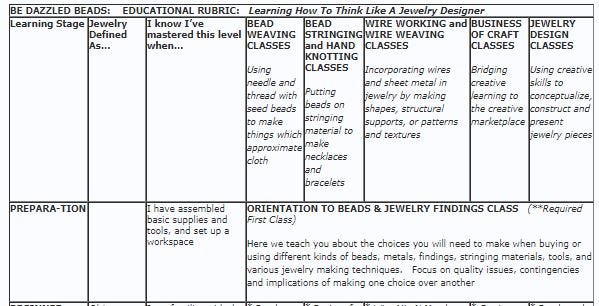
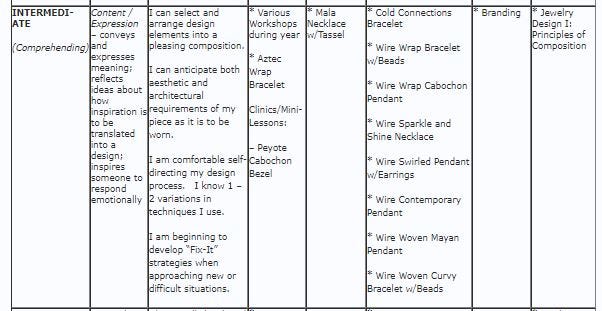
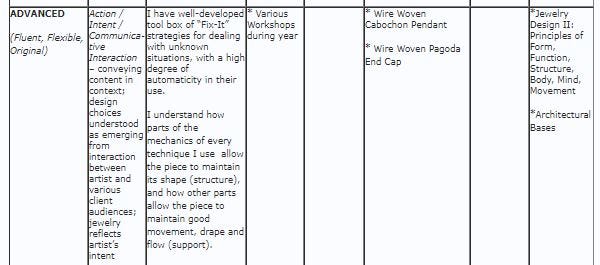
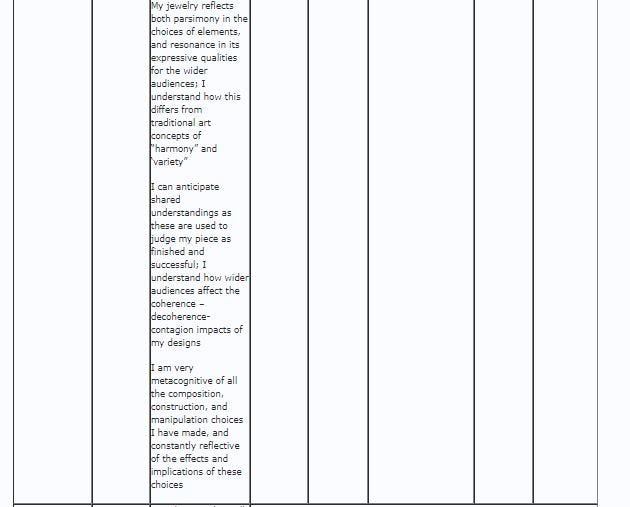
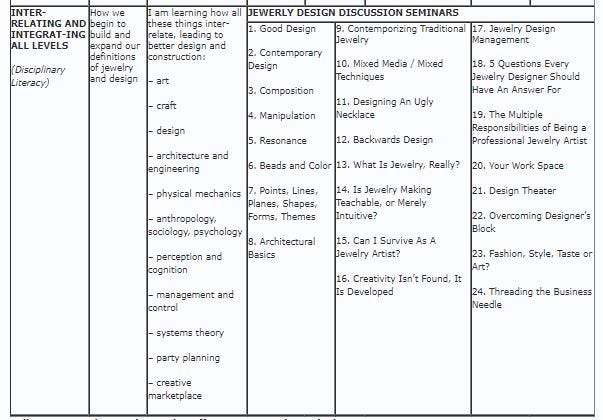
Think of jewelry design as a large matrix. The rows are the various knowledges, skills and understandings students need to master. The columns represent ordered stages of learning, indicating what needs to be learned first, second and third, etc.
In the example below, learning objectives were specified for an introductory bead stringing class. The learning objectives were characterized by skill level needed. These objectives were clustered together and taught as a set. The student could identify what things were learned at what level, and what things needed to be learned in another class. Emphasis was placed during the instruction to visibly point out to the student how each learning objective was interrelated to the others.
At the conclusion of the class, students were asked to self-evaluate what they learned about each learning objective, and what else they would like to know or learn about it. What were their take-aways, and what would they like to do next.
When taking a developmental approach, you teach groups of integrated knowledges, skills and understandings. You teach technical mechanics concurrently with art and craft history, and concurrently with discipline-specific literacy. We want our students to be able to think strategically and critically, deal with unfamiliar or problematic situations, and be self directed.
In the Developmental Approach, you start with a cluster of a core set of skills. You show, demonstrate, and have the student apply, communicate about, and experiment with how these skills inter-relate in jewelry design.
You then introduce another cluster of knowledges, skills, and understandings. As with the core, you show, demonstrate, and have the student apply, communicate about, and experiment with how all these inter-relate. Then you repeat all this by teaching how this second cluster of things inter-relates to the core.
And again, you introduce a third cluster, and link to the second, then link to the core. And so forth.
Jewelry design covers a wide range of factors beyond the physical and structural aspects of jewelry. It incorporates aesthetics, structure, value systems, philosophies, sustainability, technologies, and their integrations. Thus the jewelry designer has to know some things about art, and some things about architecture, and about physical mechanics, and anthropology and psychology and sociology, and engineering, and be a bit of a party planner. Here, this developmental approach serves them well. It helps the student learn the inter-connectedness and inter-dependencies of them all, in a gradual, developmental, building-up-to-something sort of way.
Multi-Method Teaching Plan
Students need to come at jewelry design problems from different angles. Within each lesson, teachers need to gradually relinquish control over the learning process to the student. Using a single teaching method, such as having students keep rehearsing a series of steps, or relying on a single textbook won’t cut it. We also need to infuse opportunities for reflection within virtually every activity.
Some of things I find especially useful include,
(a) Guided Thinking
(b) Thinking Routines
c) Developing an effective questioning strategy
(d) Application, practice and experimentation
One approach is called “Guided Thinking”. Here, within each lesson, the teacher begins with controlling the information and how it is presented. This involves some lecture, some demonstration, some modelling. The teacher never insists that there is only one way to accomplish any task. Over the course of the lesson, the teacher gradually relinquishes more and more control to the student for directing the learning activity.
For example, we might encourage students to construct and feel and touch similar pieces made with different materials, beads or techniques, and have them tell us what differences they perceive. We should guide them in thinking through the implications for these differences. When teaching a stitch, I typically have students make samples using two different beads — say a cylinder bead and a seed bead, and try two different stringing materials, say Fireline and Nymo threads.
We also should guide them in thinking through all the management and control issues they were experiencing. Very often beginning students have difficulty finding a comfortable way to hold their pieces while working them. I let them work a little on a project, stop them, and then ask them to explain what was difficult and what was not. I suggest some alternative solutions — but do not impose a one-best-way — and have them try these solutions. Then we discuss them, fine-tuning our thinking.
After some trial-and-error and experimentation, I begin to introduce some goals. They had identified some management and control issues, and had some observations about what they were trying to do. I link these developing discussions to these goals. These are issues because…. And I let them fill in the blanks. What do they think needs to be happening here?
I begin to put words to feelings. I guide them in articulating some concrete goals. We want good thread tension management for a bead woven piece. We want the beads to lay correctly within the piece. We want the piece to feel fluid. We want an easier way to work the piece and hold it, so it doesn’t feel so awkward.
We return to Guided Thinking. I summarize all the choices we have made in order to begin the project: type of bead, size of bead, shape of bead, type of thread, strategy for holding the piece while working it, strategy for bringing the new bead to the work in progress. I ask the students what ideas are emerging in their minds about how to bring all they have done so far together.
At this point, I usually would interject a Mini-Lesson, where I demonstrate, given the discussions, the smarter way to begin and execute the Project. In the Mini-Lesson, I “Think Aloud” so that my students can see and hear how I am approaching our Project.
And then I continue with Guided Thinking as we work through various sections of the Project towards completion. Whatever we do — select materials, select and apply techniques, set goals, anticipate how we want the Project to end up — is shown as resulting from a managed process of thinking through our design.
In “Guided Thinking”, I would prompt my students to try to explain what is/is not going on, what is/is not working as desired, where the student hopes to end up, what seems to be enhancing/impeding getting there.
As the lesson proceeds, I reduce the amount of direction and information I provide. I relinquish this responsibility gradually to the student. The student is asked to try out a technique or strategy, then try an alternative. The student is asked to communicate the differences, their preferences, their explanations why, and what they might try to do next.
Experimentation with evaluation is encouraged. The student is asked to develop a more concrete jewelry project, and explain the various choices involved. What-if and what-next questions are posed. The student is allowed to follow a pathway that might be not as efficient, or even a dead-end. More discussion about what occurs begins. If the student asks me what would happen if, I tell them to try it and see, and then discuss their experience and observations.
Towards the end of the lesson, I prompt the student to communicate what they have done and what they have discovered. I ask them, in various ways, what take-aways they have from the class, or how they think they might apply what they learned in the future. I suggest the “what next.” I identify different options and pathways they might pursue next. Metacognition and reflection are important skills for any jewelry designer to have.
And we’re ready for the next lesson.
Another approach is called “Thinking Routines”. With guidance, demonstration and repetition, it is my hope that these experiences become a series of Thinking Routines my students resort to when starting a new project. As students develop and internalize more Thinking Routines, they develop greater Fluency with design.
Thinking Routines are different strategies for structuring a set of steps which lead a person’s thinking. “They are the patterns by which we operate and go about the job of learning and working together in a classroom environment. A routine can be thought of as any procedure, process, or pattern of action that is used repeatedly to manage and facilitate the accomplishment of specific goals or tasks. Classrooms have routines that serve to manage student behavior and interactions, to organizing the work of learning, and to establish rules for communication and discourse. Classrooms also have routines that structure the way students go about the process of learning. These learning routines can be simple structures, such as reading from a text and answering the questions at the end of the chapter, or they may be designed to promote students’ thinking, such as asking students what they know, what they want to know, and what they have learned as part of a unit of study.”[3]
Some examples:
What Do You See…..What Do You Think…..What Do You Know
Think — Pair — Share
What Makes You Think That?
I used to think… Now I think…
Connect — Extend — Challenge
True for Who?
Look — Score — Explain
We use Thinking Routines mirror the kinds of thinking and analytic practices common to the discipline of jewelry design. We encourage students to reflect on what they were thinking. We ask how they were anticipating getting to the point where they would call their piece finished. We ask them whether there was some kind of order or routine to their process. We ask them what criteria they would use to know that they were successful. We ask them to anticipate what others would think, and whether others would agree that the piece was finished and successful.
These are some of the kinds of situations we want our students to develop thinking routines for:
a. Exploration of experience for a purpose; translating inspiration into designs
b. Search for meaning as conveyed by various design elements alone, clustered together, or arranged within a composition
c. Formulating how to deal with unfamiliar tasks or roadblocks preventing the finishing of a task
d. Completing well practiced technical tasks
e. Varying well practiced technical tasks
f. Contingent thinking and fix-it strategies
g. Incorporating the shared understandings of others into the thinking about what constitutes a finished and successful design
h. Introducing jewelry publicly, such as for exhibit or for sale
Another approach I want to point out is having an Effective Questioning Strategy. Students need to be engaged in thinking and talking about jewelry and its design and its powers when worn. The questions we ask them, and the way we phrase them, can have a big impact on this.
Questions should lead the student towards greater understanding. Ask questions which encourage students to think like jewelry designers and understand jewelry design as a series of problems to be solved.
Decode piece of jewelry; measure jewelry’s impact; relate to artist intent
Correlation or causation when explaining and identifying design issues
What q’s weren’t answered; ability to assess the information at hand relevant to the design problem
Do the results solve the design problem and support the conclusions
Other explanations for the results
Given an artist intent, sketch a jewelry design
Given a piece of jewelry to be sold, develop a sales pitch
Some pointers:
Avoid questions with Yes/No answers
Avoid questions which contain the answers, such as “don’t you think the designer did a good job?”
Avoid questions which seem to have a particular answer in mind, such as “how did the designer use materials to represent the upper class?”
Do elicit questions with multiple answers.
Do elicit questions which incorporate each of our senses, not just the visual, such as “what sounds do you think this piece of jewelry would make?”
Do elicit questions of varying levels of difficulty and rigor.
Do elicit personal interpretations of ideas and feelings, coupled with questions about what evidence the student used to come to these conclusions.
Do elicit questions about how to value or judge worth, and how such values might differ among different audiences, and why.
Do elicit questions about contingent situations — if such and such a variable or piece of information changed, how would our thoughts, feelings and understandings change?
Do elicit follow-up questions.
If no one responds immediately to a question, pause and wait about 5 seconds.
Encourage conversation among all participants in the room.
Encourage students to generate their own questions.
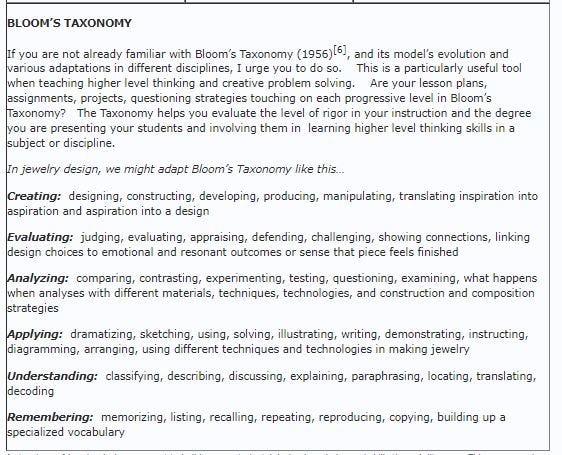
When looking at a piece of jewelry, students might be asked (in reference to Bloom’s Taxonomy)[6] to:
DESCRIBE IT: What do you see? What else do you see? If you were describing this to another person who has not seen it, what would you say?
RELATE IT: What things do you recognize? Do you feel connected to the piece in any way? Would you buy it? Would you wear it? How does this piece of jewelry relate (to any other piece of jewelry)? What interests you the most in this piece? If you passed this piece of jewelry onto your children or grandchildren, do you think they would relate to it in the same way you did; explain? Would this jewelry be successful or appropriate in any culture or situation; explain with examples?
ANALYZE IT: What can you tell me about the design elements used in this piece of jewelry? About the arrangement and composition? About its construction? What type of person would wear this piece and why? What is the most critical part of this piece of jewelry which leads to its success (or failure)? What questions would you want to ask the designer? What internal or external forces will positively or negatively impact the piece? What about the piece creates good support, enabling it to move, drape and flow? What about the piece creates good structure, enable it to keep its shape and integrity when worn?
INTERPRET IT: What name would you give this piece of jewelry, and why did you pick this name? What sounds do you think this piece of jewelry would make? What role(s) would this piece of jewelry serve for the wearer, and why? Why do you think the designer made this piece of jewelry, and made it this way?
EVALUATE IT: Does this piece seem finished; explain? Would you see this piece as successful; explain? Would this piece evoke an emotion, and how? Does this piece resonate, and how? Does this piece feel parsimonious — that is, if you added (or subtracted) one more thing, would it make the piece seem less finished or successful? How has the artist selected and applied materials, techniques and technologies, and could better choices have been made and why? What do you think is worth remembering about this piece? What do you think other people would say about this piece? If you were selling this piece, what would be the selling points; explain? In what ways might this piece have value and worth for various audiences? Anticipating the artist’s purpose and intent, to what degree was the artist successful? What would make the piece better, and what would make it worse?
RE-CREATE IT: If you were making a similar piece, what would you do similarly and what would you do differently; explain why? If you wanted to re-create something similar, but for a different audience or context than you thought it was originally made, what kinds of things might you do; explain? What would you change about the piece to make it more appealing to you? What would you change about the piece to change the “sound” it seems to make? How could we make the piece more Traditional? Or Avant Garde? How could you build in more or better support or structure? How might your own work be influenced (or not) by this piece? Have you learned something from this piece that would influence you to do something differently in your own work in the future? If a particular color / material / finding had not been available, what could you substitute instead?
One last approach is encouraging lots of opportunities for Application, Practice, and Experimentation.
Jewelry design students need time to create various understandings, correct or not, and to put these understandings to the test. They should be encouraged to imagine, experiment, play, practice and apply their emerging knowledges and skills. We need to ween them off the standard design-by-number curriculum. We should provide opportunities for students to develop the skills to work intuitively and practically in context.
Towards this end, we should
Provide space/time for artistic creativity and discovery
Provide opportunities to discuss, reflect and critique about the design, management and control issues which arose
Have students actively anticipate, through discussion and/or writing, what kinds of reactions various audiences might have to various design and composition choices
Ask students to compare and contrast various designs or design approaches, including what is appealing (or not) and wearable (or not) and representative of an artist’s ideas and intent (or not)
Students should be given various pieces to decode; that is, breaking them down into their essential design elements and compositional arrangements
Students should be asked to reflect upon how the jewelry would hold up or be evaluated in different situations or cultures
Students can be given different open-ended design tasks, such as creating a piece of jewelry that celebrates the student; or having students write “recipes” for the ingredients in a piece of jewelry and give these to other students to see what they come up with; or creating jewelry with social or political content; of develop a marketing and promotion strategy with a sales pitch for a particular piece of jewelry; or write a poem or short story about a piece of jewelry
A Rubric RUBRIC[8] AS THINKING ROUTINE
Students who plan on becoming jewelry designers need a simple map to all these ideas about literacy and fluency — something they can easily review and determine where their strengths and weaknesses are, what kinds of courses they need to take, what kinds of learning goals they need to set in order to grow within the profession and gain proficiency and fluency in design over time. One type of map is a rubric.
A rubric is a table of criteria used to rate and rank understanding and/or performance. A rubric answers the question by what criteria understanding and/or performance should be judged. The rubric provides insightful clues for the kinds of evidence we need to make such assessments. The rubric helps us distinguish degrees of understanding and/or performance, from the sophisticated to the naïve. The rubric encapsulates what an authentic jewelry design education and performance would look like.
Here is one rubric we provide students to give them insight to the educational curriculum we offer in our program. We divide the program into Skill Levels, from preparation to beginner, intermediate, advanced, and integrated. We identify how jewelry is defined and conceptualized at each level. We specify the kinds of learning goals at each level — that is, what the students needs to have mastered before continuing on to the next level. We list the classes a student could take at each Skill Level.
Willingness To Adjust Styles To The Different Ways Students Think
Students learn in different ways. Some are more visual, some more oral, some more tactile, some more experiential. It is important that teachers vary their styles within each lesson.
For example, better instructions are presented not only with written steps, but also images illustrating each step, and diagrams or patterns explaining each step.
It is important to provide opportunities for students to reflect on what they did, and evaluate the thinking, management and control issues they confronted, and what they attempted to do to overcome these.
Last, it is just as important for the teacher to model (and think aloud) their own thought processes when attempting to design or construct a piece of jewelry.
Why Should The Teacher Be Motivated To Take A Disciplinary Approach?
The unwillingness of instructors to break out of that mold of standard craft or art content curriculum is rooted in many things.
For one, it is not very lucrative. Teaching disciplinary literacy on top of the standard content curriculum is more work. It requires more thought and integration. Initially, it requires more effort and planning. Yet the earned instructional fees would remain the same had the instructor not made the additional effort.
Teaching disciplinary literacy involves making very public and visible the teacher’s design thinking and choices. The teacher is expected to model design behaviors. The teacher will introduce think-alouds, experimentation, thinking routines. The teacher, within each lesson, gradually relinquishes control of the teaching task to the student. The student takes over the design process, making more and more choices, whether good or bad, right or wrong. The student then evaluates, citing evidence, what appears to be working, what not working, some reasons why, and some possible consequences. These disciplinary literacy techniques might make the teacher feel very exposed, vulnerable and uneasy where such thinking and choices of the teacher might be questioned or challenged, or where the student begins to take over and assert control over learning about design.
Teachers must also expand their training and learning to go beyond art and craft. They must more clearly incorporate ideas about architecture and functionality into their teaching. They must train their students to be aware of how jewelry design is a process of communicative interaction.
Teacher reluctance to incorporate disciplinary learning into the standard curriculum might also be due to the fact that there is little professional recognition. The recognition that tends to exist gets very tied to criteria based on a standard content which understands jewelry as an object, not a dialectic between artist and relevant other. Jewelry design is an occupation becoming a profession, and it may feel safer for the teacher to remain in craft or art, rather than design, because the criteria for teacher evaluation is more well defined and agreed-upon.
And there is no student demand. Jewelry design is often viewed more as an avocation or occupation, rather than a professional pursuit. It’s a way to exercise creative thoughts. A way to earn some extra money. A way to have fun. Jewelry design is not seen in professional terms with specialized knowledge and specific responsibilities.
Partly demand reflects low student expectations. There are assumptions that you cannot teach creativity — you have it or you don’t. There are assumptions that anyone can make jewelry, and that once you learn some basic vocabulary and techniques, better design skills will naturally evolve over time. And these assumptions get affirmed because all students ever see and experience is good ole basic craft or art education.
Partly demand reflects some realities of the marketplace. Most people who buy jewelry have little understanding about quality issues, art and design considerations, who the artists are and what their reputations are. They don’t know better so they don’t demand better. Jewelry purchases skew heavily toward the upper classes. However, this does not mean that we should assume that better designed jewelry has to equate to more expensive jewelry.
It is my firm belief, however, that if instructors integrate disciplinary literacy — thinking routines for how designers think design — into the standard curriculum, both student and client demand will follow, as well as teacher pay and recognition.
As teachers of jewelry design, we should be motivated to create that demand for deeper, disciplinary learning. We need to support the professionalization of the field. We should want to make jewelry design even more fulfilling for our students.
Towards this end, we should teach jewelry design knowledge and skills development which lead to greater fluency, comprehension, self-direction, flexibility, originality and automaticity in design. This means developing our students as architects, as well as artists. It means helping our students develop those critical thinking skills so they can adapt to different design situations, and more easily problem-solve when things go awry. It means enabling our students to evaluate situations and contexts in ways which make clear how the shared understandings of others impact the jewelry design process. It means giving our students a clear understanding of how creative thinking relates to the creative marketplace. It means teaching our students to be able to assert their worth — the worth of the pieces they create, their skills, their ideas, and their labor. Only in these ways will we play an active part in enhancing the ability of our students to make a living from their artistry and design work. Only in this way, moreover, will we elevate contemporary jewelry design so that it has a life outside the studio, and so that it doesn’t get whipped by the whims of fashion or seen only as a design accessory.
How Should We Measure Successful Teaching?
In the standard design curriculum, it is relatively easy to measure our success as teachers. We can gauge how many students take our classes. We can refer to the number of concepts learned. We can count the number of successfully completed steps students have completed. We can get a sense of how many students are able to sell or exhibit their pieces.
What is more difficult to measure, from a disciplinary literacy standpoint, is how well our students are able to think, analyze, reflect, create and engage in jewelry design, given variation and variability in audience, client, context, situation, society and culture.
It is difficult, as well, to gauge the degree we have been able to elevate the importance of jewelry design as a profession. Something beyond craft. Something beyond occupation. Something even beyond art.
_________________________________________
FOOTNOTES
[1] T. Shanahan, C. Shanahan. “Teaching disciplinary literacy to adolescents: Rethinking content-area literacy,” Harvard Educational Review, 2008.
[2] Historians gathering evidence like letters, journals, newspaper articles, photographs, analyze them and compare then. They look for patterns and corroboration. From that they infer understanding and conclusions. The historian may take many paths and turns to discover information that may or may not be factual, but may be helpful.
Scientists set up controlled experiments, typically using information they consider facts, and interrelated these facts mathematically in order to establish understandings and conclusions. They go about things following the scientific method and approach, beginning with observations, formulating hypotheses, setting experiment and collecting data, and so forth.
Jewelry designers manage tensions between appeal and functionality. The successful managing of these tensions involves adequately anticipating the shared understandings of various client groups about whether a piece should be considered finished and successful. The designer is able to establish something in and about the piece which signals such anticipation and understanding.
[3]Thinking Routines. I teach jewelry design. I find it useful to engage students with various ways of thinking out loud. They need to hear me think out loud about what choices I am making and what things I am considering when making those choices. They need to hear themselves think out loud so that they can develop strategies for getting more organized and strategic in dealing with information and making decisions. My inspiration here was based on the work done by Visible Thinking by Project Zero at Harvard Graduate School of Education . http://www.visiblethinkingpz.org/VisibleThinking_html_files/VisibleThinking1.html
[4] Fluency. I took two graduate education courses in Literacy. The primary text we used was Literacy: Helping Students Construct Meaning by J. David Cooper, M. Robinson, J.A. Slansky and N. Kiger, 9th Edition, Cengage Learning, 2015. Even though the text was not about jewelry designing per se, it provides an excellent framework for understanding what fluency is all about, and how fluency with language develops over a period of years. I have relied on many of the ideas in the text to develop my own ideas about a disciplinary literacy for jewelry design.
[5] Shared Understandings. In another graduate education class, the major text reviewed the differences between understanding and knowledge. The question was how to teach understanding. Worth the read to gain many insights about how to structure teaching to get sufficient understanding to enrich learning. Understanding by Designby Grant Wiggins and Jay McTighe, 2nd Edition, Association for Supervision and Curriculum Development, 2005.
[6] Bloom’s Taxonomy.
Bloom, Benjamin S. 1956. Taxonomy of educational objectives; the classification of educational goals. New York: Longmans, Green.
Anderson, L. W., Krathwohl, D. R., & Bloom, B. S. (2001). A taxonomy for learning, teaching, and assessing: A revision of Bloom’s Taxonomy of educational objectives (Complete ed.). New York: Longman.
Bloom’s Taxonomy and the Arts. Incredible Art Department. As referenced at
[7] Backwards Design. I had taken two graduate education courses in Literacy and one in Planning that were very influential in my approach to disciplinary literacy. One of the big take-aways from Understanding by Design by Grant Wiggins and Jay McTighe, 2nd Edition, Association for Supervision and Curriculum Development, 2005, was the idea they introduced of “backwards design”. Their point is that you can better teach understanding if you anticipate the evidence others will use in their assessments of what you are trying to do. When coupled with ideas about teaching literacy and fluency (see Literacy: Helping Students Construct Meaning by J. David Cooper, M. Robinson, J.A. Slansky and N. Kiger, 9th Edition, Cengage Learning, 2015), you can begin to introduce ideas about managing the design process in a coherent and alignable way.
Not Just One Type Of Person Wants To Become A Jewelry Designer
There is not just one type of person who becomes a jewelry designer. There are many, many types of people who find jewelry design a common passion. They may have different ambitions. They may prefer to use different techniques and materials. They may have different levels of financial success. They may have different compulsions for creating jewelry.
We can differentiate people who become jewelry designers by their aspirations (1 Neuendorf, 2016) — why they became jewelry designers. Some jewelry designers fit one type of aspiration; others, more than one. Which one are you?
Social Interactants
Creatives often seek out other creatives and form a social network. They may be makers. They may be sellers or exhibiters or collectors. But they look for ways to interact and meet and share close-knot social ties. Part of the reason is to learn new ideas. Another part is to get feedback and critique. The social group and network will offer support, advice, career and business opportunities and direction. These are people you can lean on when times get tough. There might even be some shared glamour and celebrity, depending on the artists and their group.
Social Interactants typically seek recognition for their efforts and their works. The success of any piece of jewelry depends on the judgements of the various audiences which interact with it. Social interactants allocate a good deal of their time anticipating how others will understand and react to any piece of jewelry. They spend time seeking out opportunities to display their works publicly.
Compulsive Creators
There is this innate, compulsive, don’t-fight-it desire that some jewelry designers have for creating jewelry. Composing, constructing and manipulating design elements is intrinsically rewarding. There is a strong, profound commitment to jewelry design, and this directed energy is often associated with productivity and success.
Compulsive Creators love what they do. It allows them to think creatively. They allocate a lot of their time towards achieving a high level of quality and sophistication.
Lifestyle of Freedom Seekers
These designers like to set their own pace, establish their own routines, work when the spirit moves them. A regular 9 to 5 job is not for them. They like to make their own rules and be self-directive. Any financial insecurity and uncertainty that comes with this is worth the price to pay for a lifestyle of freedom.
These designers believe that this freedom allows them to experience the world around them in a greater depth and to a greater degree. In turn, they have more understandings for how to find and then turn inspirations into finished jewelry designs.
Financial Success Achievers
Successful jewelry designers can do quite well for themselves, but it takes a lot of drive, organization and business and marketing sense. Jewelry design can be a lucrative career with such determination, gaining visibility, and a little bit of being in the right place at the right time.
But many designers primarily look for money to supplement their income or retirement. Some look to make enough money to pay for their supplies.
Sometimes, designers make jewelry to seek wealth, rather than income. They accumulate many pieces of jewelry and many unusual supplies and components to achieve wealth as success.
Financial Success Achievers typically try to create a business around their jewelry.
Happenstance and Chance
Not everyone who becomes a jewelry designer aspired to be one. Sometimes people fall into it. They need a piece of jewelry to match an outfit and decide to make something themselves, then get hooked. They watch someone make jewelry, then get intrigued. They try to repair a broken piece of jewelry by themselves. They accompany a friend to a jewelry making class, then want to try it out.
Many Ambition Types
Aspirations and ambitions vary. There is no best way or right way. It becomes a matter of the designer finding that balance of design, self, and other-life which works for them, and drives their passion.
Jewelry designers were motivated to become designers for many different reasons. But motivations are only a start. These make up only a small part of what it truly takes to be a successful designer. Designers need to develop skills and techniques, creative thinking, design process management, and disciplinary literacy, to continue on their pathway to success.
There are many ways to learn beading and jewelry making.
Rote Memory
Analogously
Contradictions
Assimilation
Constructing Meanings
Most people learn by Rote Memory. They follow a set of steps, and they end up with something. They memorize all the steps. In this approach, all the choices have been made for them. So they never get a chance to learn the implications of their choices. Why one bead over another? Why one stringing material over another? How would you use the same technique in a different situation? You pick up a lot of techniques, but not necessarily many skills.
Other people learn Analogously. They have experiences with other crafts, such as sewing or knitting or other craft, and they draw analogies. Such and Such is similar to Whatnot, so I do Whatnot the same way I do Such and Such. This can work to a point. However, beading and jewelry making can often be much more involved, requiring making many more types of choices, than in other crafts. And there are still the issues of understanding the quality of the pieces you use, and what happens to them, both when jewelry is worn, as well as when jewelry is worn over time.
Yet another way people learn is through Contradictions. They see cheap jewelry and expensive jewelry, and analyze the differences. They see jewelry people are happy with, and jewelry people are not happy with, and analyze the differences. They see fashion jewelry looked down upon by artists, and art jewelry looked down upon by fashionistas, and they analyze the differences.
Assimilation is a learning approach that combines Analogous Learning and Learning Through Contradictions. People pursue more than one craft, keeping one foot in one arena, and another foot in the other. They teach themselves by analogy and contradiction. This assumes that multiple media mix, and mix easily. Often, however, this is not true. Usually one medium has to predominate for any one project to be successful. So assimilative learning can lead to confusion and poor products, trying to meet the special concerns and structures of each craft simultaneously. It is challenging to mix media. Often the fundamentals of each particular craft need to be learned and understood in and of themselves.
The last approach to learning a craft is called Constructing Meanings. In this approach, you learn groups of things, and how to apply an active or thematic label to that grouping. For example, you might learn about beading threads, such as Nymo, C-Lon and FireLine, and, at the same time, learn to evaluate each one’s strengths and weaknesses in terms of Managing Thread Tension or allowing movement, drape and flow. You might learn about crystal beads, Czech glass beads, and lampwork beads, and then, again concurrently and in comparison, learn the pros and cons of each, in terms of achieving good color blending strategies. You might learn peyote stitch and ndebele stitch, and how to combine them within the same project.
The Reality
In reality, you learn a little in each of these different learning styles. The Constructing Meanings approach, what is often referred to as the Art & Design Tradition, usually is associated with more successful and satisfying learning. This approach provides you with the tools for making sense of a whole lot of information — all the information you need to bring to bear to make a successful piece of jewelry, one that is both aesthetically pleasing and optimally functioning.
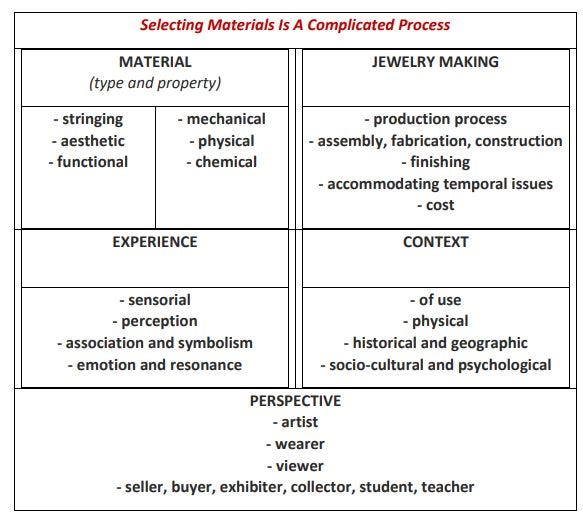
There are no perfect jewelry making materials for every project. Selecting materials is about making smart, strategic choices. This means relating your materials choices to your design and marketing goals. It also frequently means having to make tradeoffs and judgment calls between aesthetics and functionality. Materials differ in quality and value. They differ in their sensorial effects on people. They differ in how people perceive them. They differ in the associational and emotional connections which they evoke. They differ in their functional efficiency and effectiveness to lend pieces an ability to retain a shape, while at the same time, an ability to move, drape and flow. They differ in cost and durability. Last, materials may have different relationships with the designer, wearer or viewer depending on how they are intended to be used, and the situational or cultural contexts.
JEWELRY MAKING MATERIALS: Knowing What To Know
The materials I use are alive
The world of jewelry design and the materials used can be complex, especially for jewelry designers just starting out in their careers. The novice, but also the more experienced designer, as well, often run up against some terms and properties of materials they have not dealt with before. Materials affect the appeal of the piece. They affect its structural integrity. They affect the cost. They affect how people view, sense, desire and understand the piece.
You Would Be Very Aware Of…
If you want to gain an understanding of materials, you would be very aware of where they come from, how they are described, sold and marketed. You would be very aware of the beads and jewelry findings and stringing materials and tools, their qualities, when they are useful and when they are not, and what happens to them when they age. You would be very aware of what country the material is made or found in, how the material is manufactured, synthesized or gotten at, if it is modified or changed in any way, and how it comes to market. You would be very aware if the product is sold at different levels of quality, even if this is not differentiated on the product’s label. It is also important to be very aware how any of these aspects of the material have changed over time, or might change over time in the future.
You would be very aware that there is no such thing as the perfect material. There are only better materials, given your situation and goals. There is no perfect bead for every situation. No perfect clasp. No perfect stringing material. Every choice you make as a jewelry designer will require some tradeoffs and judgment calls. The more you understand the quality of the materials in the pieces you are working with are made of, and the clearer you are about your design goals, and if you are selling things, your marketing goals, as well, the more prepared you will be to make these kinds of choices.
You would be very aware that materials have different values and life spans, and this must relate to your project goals. You would not want to use metalized plastic beads, for example, in a piece you call an heirloom bracelet. Metalized plastic beads are a metal shell around a milky white plastic bead. The shell will chip easily. On the other hand, when doing fashion jewelry, these very inexpensive beads, and which have a short life-span, would be perfect. Not only are they cheap, but because they are cheap, there are lots and lots of designs and shapes and textures.
If your goal is to create more investment quality pieces, then you would not want to buy lampwork beads which have not been appropriately annealed (that is, if not cooled down correctly, they will fracture and break easily). You would buy appropriately annealed ones, but which are considerably more expensive. This may affect the look of your pieces. For an inexpensive, fashion oriented piece, your necklace made up entirely of lampwork beads which have not been appropriately annealed might be very affordable. It would have that great handmade, artisan look. It might sell for only $60.00. With more investment quality lampwork beads, however, you might just use one, or perhaps three lampwork beads, and have a lot of cord showing, or a lot of filler beads, to keep the piece affordable. This would be a very different design look and style. If the necklace was made up of all quality lampwork beads, — to have the same look and style as its inexpensive cousin — it might have to retail for $600–800.00.
Again, for an investment quality piece, you would want to use crystal beads manufactured in Austria or the Czech Republic, and not ones manufactured elsewhere. And you would not let yourself be fooled when the front of the package says “Austrian Crystal” when the back says “Made In China”. Crystal beads made in China are not as bright, there are more production issues and flaws in the beads, and the holes are often drilled off-center when compared to their “Made In Austria” counterparts. But crystal beads more appropriate for that investment quality piece might be overkill for a fashion piece where you want to add a pop of brightness without a lot of additional cost.
You would want to be very aware of the treatments of beads and metals. Some things are radiated, heated, reconstituted, partly synthesized, lacquered or dyed. Sometimes this is a good thing and these treatments enhance the quality of materials in appearance and durability. Othertimes this is a bad thing, negatively affecting the quality of materials.
You would be very aware that many of the materials you use are described in ways that do not provide you with sufficient information to make a choice. Take the material gold-filled. The definition of gold-filled is that the material is a measurable layer of real gold fused to brass, sometimes copper. But the legal definition does not tell you how thick the gold has to be over the brass for the material to be called gold-filled. So in the market, some gold-filled has very little gold and will lose its gold very quickly, and other gold-filled has a thicker layer and will keep its gold, its shine and its shape for decades.
Or sterling silver. Sterling silver is supposed to be 92.5% silver (marked .925). The alloy, that is the remaining 7.5%, is supposed to contain, by law, a lot of copper. However, many manufacturers substitute some nickel for the copper to keep the cost down. This makes the sterling silver less expensive, yes, but it also makes it more brittle. It is the difference between being able to open and close the loop on an ear wire, off of which to hang the dangle, many, many times or only two or three times before the wire loop breaks.
Lots of sterling silver items get marked .925. And in jewelry making, many of the pieces we use are so small, there is no .925 stamp on them. Besides a change of what is in the alloy affecting the usefulness and value, many other things happen in the marketplace, as well. Many sterling silver items have been cast. What frequently happens is that some of the silver is lost in the casting process, so it is no longer at 92.5%. Manufacturers are supposed to make note of this, but many just stamp .925 on these items. Some shops label items as sterling silver, but in reality, are selling you pieces that are nickel. And some places will sell you something silver plated, and put sterling silver .925 tag which is marked .925 on it off the clasp. The tag is sterling; the jewelry is not. I’ve seen some major craft stores and some major jewelry stores sell metalized plastic jewelry and jewelry components and label it .925.
Flexible, nylon coated cable wires are one of the primary types of stringing materials. The measure of cable wire strength is called tensile strength. This has to do with what the wires are made of, what the nylon sheathing is made of, and how thick that nylon sheathing is. What makes the wire strong is the nylon sheathing’s ability to maintain the twist in the wire. As soon as the integrity of the nylon sheathing is violated, the wire untwists and immediately breaks. You will not see tensile strength referenced on the labels of these products. The information that is referenced (number of strands, wire thickness) gives you some information needed to make a choice, but insufficient to make an actual choice. Even when they list the number of strands, this doesn’t give you enough factual information to depend on. One brand’s high-end, 7-strand is stronger and more supple than that same brand’s 49-strand middle range product. This same brand’s middle range 49-strand product is stronger and more supple than another brand’s high end 49-strand product.
You would also be very aware that you cannot assume that there is consistency and uniformity for any given product. There are many production issues that arise in the manufacture of glass beads, for example. Some beads are perfect. Some have flaws. These flaws might include some flat surfaces when everything should be rounded. The color not going all the way through. Holes drilled off-centered. Bead sizes and hole sizes inconsistent from bead to bead. Some bead holes that are especially sharp. Some beads which have coated coloration which is poorly applied and chips off quickly. In clothing, these beads with flaws would be labeled irregulars, but they are not so labeled in beads. Some companies specialize in selling you perfect manufactured glass beads; other companies specialize in selling you the irregulars. They don’t advertise that fact. Either quality looks the same when you buy it; they just don’t hold up the same in close examination or from wear.
You would be aware that fabricated and stamped metal pieces are more durable than cast metal pieces, but a lot more expensive, and with a smaller palette of designs for the artist. You would be aware that the measure of pound strength on any label is the weakest piece of information to grab onto. The law only defines how pound strength should be measured. Since most products are manufactured abroad, little care is taken to guarantee the validity of this information.
You would be aware that there are a lot of things to know about the materials used in jewelry design.
It Is All About Choices
Materials play a significant role in jewelry design. You need to relate and justify the choices you make about selecting and using materials to your design goals (and your marketing goals, as well). Sometimes your choices are preformulated and planned; othertimes, these choices are spontaneous and emerge within your process of design. But these are all choices to be made, with inevitable impacts and consequences.
It is through the characteristics and qualities of the materials that the designer comes to keenly and fully appreciate values, intents, desires, and understandings associated with any design.
It is also through the most effective presentation specific to the materials that the designer experiences the piece to its best advantage and potential. The effectiveness results from the designer’s ability to maximize the strengths of each material, while minimizing its weaknesses. This is called leveraging.
It is a useful exercise, as well, to attempt to simplify the materials and reflect upon whether the piece feels more satisfying and successful, or less so. One key goal of any designer is to reach a point of parsimony where enough is enough.
Appreciation of materials, their selection, use and arrangement lead the designer to see, feel, think and listen to the visual poetry laid out before them. Jewelry is more than functional adornment. It resonates. Materials contribute to this. This appreciation allows the artist to share inspiration and intent with other audiences, the wearer and viewer included. The materials influence the artist in discovery, expression, invention, re-invention, and originality. They become part of the human experience in jewelry design.
For example, you might be in a situation having decide whether to purchase an $80.00 strand of 6mm round garnet beads, or a $28.00 strand of these same beads.
In that $80.00 strand, all the beads actually measure 6mm. They are all perfectly round. The holes are drilled well, and drilled through the center. There are no chips at the hole. There is good coloration, and the coloration from bead to bead is very consistent.
In that $28.00 strand, none of the beads measure 6mm. They are a bit smaller, perhaps 5.5mm. The beads from bead to bead on the strand are not consistent. Sizes are approximate, not exact. Several beads on the strand are not perfectly round. Some have flat surfaces on them. There are many chips at the hole, suggesting that they are not drilled well. Some are drilled off-center. The coloration is good from afar, but a close exam reveals that some beads are less desirable than others.
This situation doesn’t present an easy choice, however. If you are making fashion jewelry, the less expensive strand might be the best choice. Fashion jewelry is not worn for a long time. It is not an investment. It is a look. These beads are less expensive. In this context, the flaws, in this case, may not be so much as a flaw, as more a variation. The variations might enhance the fashion piece, adding a sense of fun, surprise and funkiness. The poorly drilled holes might mean that these beads will crack and break from wear, but given that fashion jewelry is not worn for a long time, this is a non-issue.
If you are making a more investment quality piece, the more expensive garnet beads might be the better choice. They have more value, resulting from the higher quality. The consistency in quality results in a more classic, timeless look. These beads will last a long time. Here, the inconsistencies in the less expensive strand of beads definitely would be viewed as flaws, not variations.
Types of Materials
One of the most fundamental and practical aspects of jewelry design is the importance of the materials. The choices jewelry designers make when selecting materials influence the form, content and movement of their pieces. Every material brings something special to the creative process and the finished jewelry pieces. The material influences, not only the designer, but the wearer and viewer themselves, how they perceive it, the values they place on it, and the extent they desire it.
The types of materials jewelry designers might choose are only limited by the imagination of the designer, and that designer’s budget. I have compiled a short listing of the more prevalent materials used in jewelry design. I distinguish those materials called
– Stringing Materials –
which are used to form the canvas of our jewelry,
from those materials called
– Aesthetic Materials –
which form the primary visual vocabulary and expressiveness of the piece, but also may contribute some functionality,
from those materials called
– Functional Materials –
which solely or primarily have practical value, but only sometimes, most likely inadvertently, add to the aesthetic expression of the piece.
STRINGING MATERIALS (The Canvas)
The canvas is the part of the piece of jewelry onto which things are placed. The canvas is usually some kind of stringing material, and the things placed on it typically are beads and charms. The canvas supports the piece, its shaping and its silhouette. It may or may not be visible in the piece. But the canvas can be anything, including fabric and ribbon, wire mesh, chains, and the like. It can be like a string, or it can be like a flat sheet.
The designer selects the canvas or stringing material based on a vision of the structure of the piece, including both its supportive requirements as well as its appearance-related qualities. The particular selection will also impact the durability of the structure. Sometimes the selection of canvas takes on a symbolic meaning, such as using hemp in friendship bracelets or antiwar jewelry, or using leather in biker jewelry.
(1)Beading thread: Typically shaped like a typewriter ribbon, made from bonded nylon. It is something we wax before using it. Materials are strung onto thread using a beading needle. The thread is attached to the clasp assembly by tying knots. Glue should never be applied to these knots. If the beading thread is twisted, rather than bonded, it will break very easily.
Structure: Piece is very supple and moves, drapes and flows very easily. Provides little resistance to the weight of materials placed on it
Durability: Very durable when waxed, unless the holes of beads are very sharp
(2) Cable thread: This is a material where threads are braided together and encased in a nylon sheathing. Used similarly as beading thread. You use a needle. Waxing is optional, but strongly suggested. You tie knots to the clasp assembly. Glue should never be applied to these knots. Cable thread sold in bead stores is non-biodegradable. That sold in fishing stores or fishing departments is biodegradable.
Structure: Piece is very supple and moves, drapes and flows easily, but not as easily as with beading thread.
Durability: Very durable, but the nylon sheathing can be compromised easily from body oils, perfume oils, and cosmetics. Waxing will protect the nylon sheathing.
(3) Bead cord, hemp, knotting cord: This is a material where threads or fibers are braided or twisted together so that they look pretty. This cord is used when you want the stringing material to show, such as putting knots between beads, or where you have a cluster of beads, then the cord showing, another cluster of beads, the cord showing, and so forth. You use this material to macramé, knot, braid, knit, and crochet. You do not wax this material. That would make it look ugly. The primary purpose is to make your piece look attractive when the stringing material is to show. Bead cord may be nylon or silk. You use silk with real pearls, but, I suggest using the nylon with other materials. You will need a needle, usually a collapsible eye or big eye needle. You tie knots to secure the cord to a clasp assembly. You minimize the use of glue applied to knots, but you usually need to apply glue to the final knot.
Structure: Piece is a little stiffer than with bead thread or cable thread, but still feels supple. Will drape well, but respond imperfectly to the movement of the body.
Durability: Silk naturally deteriorates in 3–5 years; nylon does not. Bead cord made from other natural materials will also deteriorate over a relatively short period of time.
(4) Cable Wires: This flexible stringing material consists of wires braided together and encased in nylon. The strength comes from the ability of the nylon sheathing to keep the twist in the wires. If the nylon sheathing is compromised in any way, the wires will immediately untwist and the cable will break at that point. The wire is stiff enough to be its own needle. You use crimp beads to secure the cable wire to a clasp assembly because it is more difficult to tie a secure knot with the cable wire. A crushed crimp adds a more pleasing appearance than tying a knot, but it adds risk. A crushed crimp is like razor blade, always trying to saw right through the cable when the jewelry is worn.
Structure: Piece will be stiff, and never take the shape of the body. Piece will typically rotate in the opposite direction from the movement of the body or arm it rests on.
Durability: Very durable. The nylon sheathing can be compromised easily from body oils, perfume oils, and cosmetics. Usually crimp beads are used to secure the clasp, and these increase the risk the cable will break at the crimp, when compared to the durability of tying a knot.
(5) Stretchy Cords, like elastic string, gossamer floss, elastic cord: These materials are not particularly durable and lose their elasticity over time. People like these because they hate clasps, and you don’t use clasps with these. You secure these by tying knots, and putting glue (any glue except superglue) on the knots. Be sure to coat the bottom of the knot, as well as the top of the knot. Elastic cord is fabric covered around an elastic thong or floss.
Structure: Piece will stretch and return back to its original shape and size.
Durability: Material deteriorates and loses both its integrity as well as its memory over time, especially if left exposed to the air, or worn frequently. The round elastic string is the most durable among the stretchy cords. The floss is the least durable.
(6) Thicker cords like leather, waxed cotton, ultra suede lace, rubber thong, and rat tail (satin cord): These cords are stiff enough to be their own needle. You usually need special jewelry findings, such as crimp ends, end caps, or cones with larger interior openings, to prepare the ends of the thicker cord, so that you can attach a clasp assembly. Some are glued on; some crimped.
Structure: Similar to bead cord, but little stiffer.
Durability: Some cords, like leather, dry out over time and crack. Other cords, like waxed cotton and ultra suede, last a very long time. The rat tail tends to shred.
(7) Hard Wire: Hard wire is not a stringing wire, per se. You can use it to make a chain or bead-chain. You can use it to make shapes, like clasps and ear wires. You can bundle it so that it might be stiff enough to retain the shape of a bracelet or cuff. You can weave it or knit it to create patterns and textures. You create loops and rings to attach hard wire to a clasp assembly.
Structure: Wire stiffness comes as dead soft, half hard and hard. You determine, given how much manipulation of the wire you plan on doing, how stiff you want the wire to be when you begin your project, so that it will hold and retain its shape. Each time you manipulate the wire, it becomes stiffer and stiffer and stiffer, until it becomes brittle and breaks.
Durability: Very durable. Wire 18 gauge or thicker has little risk of losing its shape, distorting, breaking, opening up or pulling apart. As you get thinner, the risk increases dramatically. Dead soft wire requires a lot more manipulation until it can hold its shape, than half hard or hard hard wire.
(8) Chain:Wire is bent into links of various shapes and sizes, and these are interlinked together into a chain. Sometimes the links are soldered closed. Usually they are not. You can string things onto the chain. You can use the chain as part of the clasp assembly, often to make the size adjustable. You can use the chain as a design element throughout your piece.
Structure: Thinner chains will be less able to keep their shape.
Durability: Chains can be very durable, particularly ones that have soldered links, wider links, and/or links created from thicker gauge wires.
(9) Ribbon, fabric:These wider cords are sometimes used as a stringing material. They are secured at each end with ribbon or bar clamps, which then form either side of your clasp assembly.
Structure: Usually, these don’t by themselves support a shape.
Durability: More aesthetic than functional
(10) Lacy’s Stiff Stuff, Stiff Felt, Ultra suede sheet, Paper, Card Board, Poster Board, Rolled Out Polymer or Metal Clay, Brass Cuff Blank:The canvas or stringing material does not have to be a narrow cord. It can be a wide, flat surface, off of which to bead, glue, stitch, embroider, carve, or sculpt. This type of canvas needs to have some amount of stiffness to hold a shape, but not too much that the jewelry made with it feels uncomfortable, or does not move naturally with the person.
Structure: If you were creating a pendant, you might want your canvas o be a little stiffer than if you were creating a bracelet.
Durability: Average durability
(11) Fused Glass:Sometimes the flat canvas is a piece of glass. Other pieces of glass are fused onto this, using a kiln, in order to create a pattern or image.
Structure: Rigid shape.
Durability: Same as any other piece of glass.
(12) Metal Sheet and Wire:Sometimes we fabricate a piece of jewelry, either using soldering, stamping, molding, casting, 3-D printing, or cold connections. Part of the sheet and/or wire becomes our canvas or stringing material.
Structure: These are very reliable materials for creating and maintaining shapes.
Durability: Soldered and stamped pieces are much more durable than molded or cast ones. 3-D printed materials would be used with casting. Cold connections could be used with any technique.
AESTHETIC MATERIALS
The canvas either passes through various aesthetic materials, or these are applied to the canvas or attached off the canvas in some way. These aesthetic materials are used for the yoke, the clasp assembly, the frame, the focal point, the center piece, the strap, and the bail.
Aesthetic Materials are expressive. They are part of the visual vocabulary and grammar of the jewelry. While some play functional roles, as well, they are usually selected for their expressive powers. Some materials evoke sensory or symbolic responses, as well. A touch, a feel, a color sense, sometimes a smell, which extends beyond its factual elements.
Any type of material can be selected to use as an aesthetic material. It can be something very specific, or a found object, or some kind of combobulation of things.
Aesthetic Materials we see often include,
Glass, Fused glass, lampwork glass, blown glass
Metals and Plated Metals
Fibers
Natural (gemstones, wood, bone, horn)
Synthetic (plastic)
Polymer and Precious Metal Clay
Ceramic, Porcelain, Clay, Raku
Paper, lacquered paper
Oxidizers, Patinas, Paints, Fabric Dyes and Paints, Stains, Metal Paints and Rouges
Platings, Coatings
Enameling
These aesthetic materials can be selected for their qualities of
(a) Appeal
(b) Functionality
c) Sensations or symbolism extending beyond the physical and decorative bases underlying these materials
Aesthetic Materials: Appeal
The idea of appeal is a broad concept. It is sometimes universal. But often subjective.
There are many variables underlying the ideas of appeal and beauty. These include things like,
Some materials function better than others in certain situations. For example, sterling silver is very malleable, nickel is more brittle. Bending, shaping, coiling, weaving sterling silver requires much less effort, and with this, can lead to more artistic and design success, than using nickel or other wire material that is stiffer and harder than sterling.
Another example: Using needle and thread as your stringing material is very time consuming. It is awkward using needle and thread. You have to wax it. You want to pass through each bead a minimum of three times. Using a cable wire, instead, lets you go much faster. The cable wire is a self needle. You don’t wax it. You only have to go through each bead once. If you are selling your pieces, it is virtually impossible to get your labor out of a needle and thread project. You almost have to use a cable wire, if you don’t want to commit yourself to a life of slave labor.
Aesthetic Materials: Sensations and Symbolism
Materials have sensory and symbolic powers which extend beyond the materials themselves. Obviously, this can be very subjective. It might have psychological roots, sociological roots and/or cultural roots.
Things may feel warm, cold, soft, rough, oily, weighty. Things may represent romance, power, membership, religiosity, status.
Vanderbilt University’s colors are gold and black, so using those colors in the Nashville, TN area might evoke a different emotional response than when used elsewhere. And here’s that very-difficult-to-design-with University of Tennessee orange, again, in the Nashville area will evoke a very different response than elsewhere.
Materials like amber and bone and crystal are things people like to touch, not just look at. The sensation extends beyond the visual grammar.
FUNCTIONAL MATERIALS
These materials are used in practical terms. They help things hold together. They help pieces stay in place. They help make pieces adjustable in size. They help polish, finish things off, assist materials through stages in their processing and development. They may be used to prevent or retard a change in color, such as a lacquer finish or rhodium plating over sterling to prevent tarnishing. They help capture a form or shape. They are not a part of the visual and expressive vocabulary and grammar of the piece. Nor are they any kind of canvas.
Functional Materials which are more prominent include,
·Adhesives
·Solders
·Pickling, Flux
·Molding compounds
·Bead release
·Fixatives (like Krylon, lacquering, special platings, waxes, other things which create a protective barrier over something else).
It is especially important to know a lot about adhesives. Many people reach for a tube of Superglue for everything. Superglue has few uses in jewelry design. This glue dries like glass, so the bond is like a piece of glass. When the jewelry moves, the bond shatters like glass, and the bond looks like a broken piece of glass. All jewelry moves when worn, so not a good choice.
Another glue many people reach for is hot glue. This glue melts at body temperature, so not a wise choice for necklaces, bracelets and pendants.
The best glue to use is jeweler’s glue. Two brands are E6000 and Beacon 527. Basically the same glue, but the former is thick and the latter is runny. These glues take 10 minutes to set, so you can move things around for 10 minutes. At about 20 minutes, the consistency is like rubber cement and you can use your finger or a tweezers to take off any excess glue. Both glues take 24 hours to dry hard. They dry clear and remain clear over time. The bond does not expand.
If using fabric, particularly silk (ribbon, bead cord, thread), you want to use a cement, rather than a glue. Glues work by forming a collar around an object, then tighten up as the water or other solvent evaporates. Cements work by adhering to each individual fiber. Glue on fabric, as opposed to cement, will lose its grip, so to speak. With silk, I suggest either G-S Hypo Fabric Cement, or any fabric glue.
Before using a glue, you want to know the characteristics of the bond, once dried. These include things like,
– hardness
– whether dries clear, or yellows
– whether yellows with age
– whether it expands or not when it dries
– what materials it is most useful for
– whether you have to prepare the material’s surface before using
– how long it takes to fully set
– how easy it is to wipe away and remove any excess glue
– whether where-ever you purchase the particular brand of glue, such as at a craft store or discount store or bead store, that this brand of glue is the same quality product
– how long the glue will last in its container before hardening or drying out
Mechanical properties describe how a material reacts to an applied force. These include,
Strength: It’s ability not to break under stress or strain
Hardness: How easily it can be scratched, faceted, carved, sculpted, cut, sand blasted
Elasticity: The ability to regain its shape after a stress has been applied to it
Plasticity and Malleability: How much force it takes to make a material permanently deform without breaking
Stiffness and Brittleness: At some point, these materials will be so brittle, they will not bend, and will just break in response to force. Wire materials, for example, get stiffer and more brittle, the more they are worked, such as from twisting, pulling, hammering, coiling and the like. Crystal is much more brittle than glass, so it more likely to break from movement or other force.
Fatigue: When the material fails, after repeated wear and use
Impact Strength: how much a material can withstand an impact
Abrasion Resistance: When two materials rub against each other, what is the resistance before one or both break
Creep: the slow movement of a material over time
Physical Properties
Physical properties describe the inherent nature of the material. Some more important ones related to materials used in jewelry include:
Density: mass and volume
Porosity: the quality of being full of tiny holes; these might hold in something, like a perfume oil, or that something might easily leach out through washing or sweating, like a dye or lead
Water: absorption, permeability and solubility
Softening and Compression: how material holds up under different conditions
Resistance to Heat and Fire
Resistance to Cold
Resistance to a number of cycles of sharp temperature variations without failing
Changing form from solid to liquid to gas
Chemical Properties
Chemical properties refer to how well the material holds up when exposed to chemicals. These chemicals may be in the air. They may be present in cosmetics, perfumes or hair sprays. They may be present in a person’s sweat. These include,
-Corrosion
· Melting, Dissolving, Removing
·Etching
·Colorizing, Oxidizing, Patinas
· Platings
· Bonding, Adherring
· Biodegrading
We have looked at types of materials and their properties. Now we need to understand how materials help establish the viability, finish and success of jewelry. Here, our materials selection process begins to incorporate some value judgments.
Materials Help Establish the Viability, Finish and Success of The Jewelry
Jewelry has character and personality. People intuitively or consciously recognize when it is finished, that is, when the addition or subtraction of any one design element would make the piece seem less satisfying or desirable. Jewelry is judged as successful, to the extent it can maintain its shape while concurrently feeling comfortable, and moving, draping and flowing with the person, as the person wears the jewelry and moves with it on.
Every piece of jewelry has its artistic and individual character due to the many facets from which it is constructed. Stringing, Aesthetic and Functional Materials are three of these facets. Mechanical, Physical and Chemical Properties add some additional facets. These among other additional material choices determine both what can be made, as well as the character of what is made.
Material selection in jewelry design is not only about choosing the most attractive, or most obvious, or most affordable, or most durable materials available. Designers also choose materials for their sensual sensations, like warmth, their formal appearance, like classical, their functional practicality, like a clamp, or their geo-locality, like using materials found locally.
The material selection process is complex. It is influenced by many preconditions, choices made, and considerations to accommodate. Too often, however, designers focus mainly on the visual aspects of the materials, and not enough on other factors. In order to make well-considered and smart choices about materials, jewelry designers need a lot more information. They need information about the entirety of the material, as created or constructed, as visually impactful, as functionally helpful, as perceptually and cognitively understood and as symbolically relevant for designer, wearer and viewer.
Stringing, Aesthetic, and sometimes, Functional Materials, coupled with their various Mechanical, Physical and Chemical properties, help to:
(1)Establish a relationship between visual quality and structural stability (physical properties, shape, silhouette)
(2)Establish a relationship between visual quality and support or jointedness (movement, drape and flow)
(3)Influence the selection of the appropriate technique
(4)Provide character and visual appeal
(5)Reflect the time, era, and socio-cultural context and historical value of the piece
(6)Mix aesthetic elements with functional ones
(7)Highlight a theme or concept expressed in the design
(8)Link the piece to a particular geography or location
(9)Link the piece to its appropriate placement on the body
(10) Determine the budget for the piece
(11) Establish the relationship between quantity and quality, that is, how many similar pieces can be made
(12) Best combine the materialistic qualities with the non-materialistic qualities of the project
(1) Establish a relationship between visual quality and structural stability (physical properties, shape, silhouette)
Jewelry making materials signify structural significance. This may relate to the physical properties of the materials, such as hardness, brittleness, softness, pliability, porousness, and this list can go on and on. This may relate to the shapes of the materials, and the placement and interaction of the shapes within the piece, or the final silhouette. The same may be said for size, weight and volume. This may relate to the stability of the material or its color or finish over time.
The choices and arrangement of materials within a piece of jewelry determines its structure. Structure means shape and material integrity. Shape in jewelry may refer to the silhouette of the piece as a whole, or to individual shapes which occupy one or more sections of our finished piece of jewelry. It may refer to the positioning of positive and negatives areas within the piece. When we refer to structure and shape and material, we imply structural integrity, and the degree we are able to maintain any shape, color or finish while the jewelry is worn over some period of time.
Example 1: We may create a bracelet using Austrian crystal beads strung on a beading thread. We achieve a high visual quality, at least initially. But these beads will cut through the threads when the bracelet is worn, thus ending with a very low structural stability.
Example 2: Sometimes a clam-shell bead tip is used to finish off each end of bead cord, when that is the stringing material. The bead cord, at its end, is tied into a knot, which sits inside the clam-shell, the cord coming out a hole in the bottom of the clam shell. We do not want the knot to work itself loose and slip through the hole. So we glue it. If we use a jeweler’s glue, like E6000 or Beacon 527, these glues dry like rubber. With these glues, the knot can actually contort and work itself through the hole. If we use a glue like Superglue or G-S Hypo Cement, the knot will remain stiff and not be able to slip through the hole. However, the stiff knot reduces what is called support. It reduces the piece’s jointedness, or ability to respond to stress and strain, thus an ability to best move, drape and flow. An alternative to glue is to thread an 11/0 seed bead, passing through the bead twice, before bringing the cord through the hole. This is secure. No glue is used as all. Full support is preserved.
Example 3: How long a metal plated finish lasts depends partly on the metal underneath it, and if it bonds to that metal. Metal plating bonds well to brass, so it lasts a long time before it fades away. Metal plating does not bond at all to aluminum, so it quickly chips off.
(2)Establish a relationship between visual quality and support or jointedness (movement, drape and flow)
Jewelry making materials enhance or impede support or jointedness. The selection and placement of materials, their density, weight, shape, and the like may enable the jewelry to take the shape of the body and move with the body, or not.
Things strung on beading thread will always take the shape of the body and move with the body; things strung on cable wire will not. But the designer has at their disposal several jewelry design tricks in construction which will make the cable wire function closer to needle and thread.
Example 1: A bracelet made up of very large beads, that when encircling the wrist, create a very stiff circle, with much strain and stress on each bead, on the stringing material and on the clasp assembly. If the designer reworks the piece, to include small round spacer beads between each very large bead, the designer, in effect, has added what is called a rotator support system. Each very large bead can freely respond to stresses and strain which result from adjusting to the body and its movement by rotating and pivoting around the spacer bead.
Example 2: People usually pick a clasp after they have designed their piece. They look for something that will make do, perhaps easier to get on and off, and hopefully have some match to the piece. A clasp, however, should be understood as more than a clasp. It should be understood as a clasp assembly, which is a type of support system. S-clasps are very attractive and a S-clasp design can always be found that feels an organic extension of the jewelry. An S-clasp needs a soldered ring off of each arm, and, if stringing on cable wire, a loop in the wire where it connects to the soldered ring. The crimp is never pushed all the way up to the clasp or ring. Each ring or loop is a support system, so our S-clasp needs 4 support systems in this case, to function correctly. With 4 supports on the S-clasp in a necklace, the clasp will always remain on the back of the neck, no matter how the person moves. Without 4 supports, it will not, and the necklace will keep turning around.
(3)Influence the selection of the appropriate technique
The designer must coordinate the selection of Stringing, Aesthetic and Functional Materials, and their inherent Mechanical, Physical and Chemical properties, so that they work in harmony with a particular technique used to assemble, weave, or otherwise secure them together in a finished piece of jewelry.
Conversely, the technique might dictate which materials will work best, and which will not. Bead weaving works with thread or cable thread, but not as easily with elastic string or cable wire.
There was a time when the materials used in any one piece were restricted to a few. Today any material can be used, as well as any combination of materials, without losing any appeal or value or desire.
Examples: A Czech glass bead with a hole size of .8mm would not slip a leather cord with a diameter of 1.5mm. It would be very difficult to create a loomed piece with beads of widely varying sizes. If mixing metals (say, silver, gold and brass) in a fabricated and soldered bracelet, care must be taken in the soldering strategy because each metal melts at a different temperature. You could not begin a wire weaving project using hard hard-wire. We may select cable wire for our canvas. This would not be a suitable stringing material if the technique we wanted to apply was bead weaving.
(4)Provide character and visual appeal
The surface of a material has many characteristics which the jewelry designer leverages within the finished piece. Light might reflect off this surface, such as with opaque glass or shiny metal. Light might be brought into and below the surface before reflected back, such as with many gemstones and opalescent glass. Light might refract through the piece at different angles, even creating a prism effect.
The surface might be a solid color. It might be a mix of colors. It might be matte. It may have inclusions or markings. It may have fired on coloration effects. There may be tonal differences. There may be pattern or textural differences. It may have movement. It may have depth.
Example: It is often difficult to mix gemstone beads with glass beads. However, if you use glass beads which have a translucent quality to them, this glass mimics the relationship of light reflecting back to the eye with that of the gemstones. The finished piece will feel harmonious.
(5)Reflect the time, era, and socio-cultural context and historical value of the piece
Jewelry and its design and materials used can be iconic.
Jewelry can relate the symbolic value of the piece to certain historical themes and ideas, or to specific functions.
Jewelry can be used to preserve, conserve or restore certain cultural or historical values. The material(s) selected may glorify these. Their availability may be closely tied to the time and place. Their use within a piece may be socially subscribed.
Our understanding of how jewelry relates to these contexts can be used to document how jewelry and its design has evolved and spread.
Name an historical period, and you can visualize many of the materials used and design sense. Roman. Victorian. Prehistoric. Modern.
Name a socio-cultural context. Religious. Wedding. Military. American Southwest. Any rite of passage.
Example 1: Pearl knotted jewelry is very strongly associated with silk bead cord, pearl clasps, and bead tips. It is also very associated with Victorian jewelry. It would be difficult to substitute other materials and pieces, such as a different kind of clasp, or not knotting between beads, without the piece losing its appeal.
Example 2: A rosary is made as a bead chain, with a certain number of beads, often a certain size and material of bead, with a Y-shaped connector at its center. The rosary assists the wearer in prayer and religiosity. It’s specific design and use of materials differentiates Catholicism from other religions.
(6)Mix aesthetic elements with functional ones
Jewelry is art only as it is worn. Its aesthetic elements must tightly coordinate with its functional ones, if the piece is to maintain its shape and silhouette, and move with the person, without distorting, feeling uncomfortable or breaking. Thus, its quality and durability are dependent upon how the designer successfully maneuvers the tradeoffs required between function and appeal. A good part of this success stems from how materials are selected, combined and arranged.
Jewelry and its design preserve the aesthetic qualities, without disrupting and losing focus of the practical ones.
Example: The clasp assembly on a piece of jewelry can be very organic, feeling an integral part of the piece. Or it can be very disruptive and annoying, as if it were a last choice and consideration, and the designer found a clasp that would make do. For an S-clasp to function appropriately, it needs at least one soldered ring off of the arm on each side of the clasp. This will force the clasp assembly to take up more space and volume in the piece. This too might end up detracting from the overall appeal of the piece.
(7)Highlight a theme or concept expressed in the design
Materials may be selected, combined and arranged into forms and themes so that they represent larger meanings and concepts. Often this comes down to color, shape, placement, and arrangement. The materials bring out the theme or concept in the design.
Example: You create a piece of jewelry with a blue color scheme, using 4 shades of blue. If the piece is to be worn, say, going clubbing in the evening, you might select 4 shades of blue (metallic blue iris, montana blue, blue quartz, cornflower) which vary in intensity. That means, varying how bright or dull they are by selecting tones with more or less underlying black, gray or white. If the piece is to be worn, say, at work during the day, you might select 4 shades of blue (cobalt, sapphire, light sapphire, ultralight sapphire) which vary in value. That means, varying how light or dark they are by selecting tones that are basically the same, but some are lighter or darker than others.
(8)Link the piece to a particular geography or location
Materials may be strongly associated with a particular geography or location. Lapis is strongly associated with Afghanistan. Paint Rock with Tennessee.
Example: A necklace by a Tennessee designer made entirely with lampwork beads made by Tennessee artisans.
(9)Link the piece to its appropriate placement on the body
Jewelry can only be judged successful at the boundary between jewelry and the body. It must be able to conform to the body’s shape. It must be able to comfortably move, drape and flow as the person moves and shifts positions.
Materials selection might begin with what materials would be most appropriate for a given type of jewelry. Or it might begin with what materials would be most appropriate for a certain body shape or size or placement.
Example: Very heavy beads used in earrings can make them uncomfortable. Creating a 4” earring dangle on a 4” head pin is not quite as a good a strategy as making a 4” earring dangle chain using eye pins. Think about what happens to the former vs. the latter when the wearer bends her head, then returns to the upright position.
(10) Determine the budget for the piece
The total expenditure incurred while designing a piece of jewelry might be, to a large extent, determined by the materials used. A designer often selects the material type based on a budget for the project. [Techniques can also have a big impact on the cost, particularly when accounting for the time it takes to design and construct a piece of jewelry.]
Example: A necklace made entirely of lapis lazuli beads might retail for $150.00. A similar necklace made entirely of lapis color glass beads might retail for $25.00. Both would look similar and take the same time to make.
(11) Establish the relationship between quantity and quality, that is, how many similar pieces can be made
The choice of materials affects the quality of the elements. Within a given project budget, and within a particular design goal, the quality of the materials may limit the number of similar pieces to be made, or the complexity or elaborateness of the design of any one piece.
Example: A stretchy bracelet made with lava beads might retail for $15.00. The materials — elastic string, lava beads, glue — are readily available and inexpensive. The designer could easily make 50 of these to sell, and stay within a reasonable budget. Change the materials to cable wire, crimp bead, horseshoe wire protector, crimp cover, black onyx beads, toggle clasp, and the investment in parts is considerably more. We have more materials and more expensive materials. This bracelet might have to retail for $45.00. Staying within the same budget framework, the designer would only be able to make 16 of these.
(12)Best combine the materialistic qualities with the non-materialistic qualities of the project
Every material has two over-arching qualities. The obvious is its physical properties and physicality. Let’s call this materialistic. It is something that is measurable. In the realm of the mystic, it is ordinary or profane.
But the material also has qualities that extend beyond this. They can be sensory. They can be symbolic. They can be psychological. They can be contextual. Let’s call this non-materialistic. It is something that is non-measurable. In the realm of the mystic, it is extraordinary and sacred.
Both properties must be considered when designing a piece of jewelry. They have equal importance, when selecting, placing and arranging materials and design elements within a piece.
Example: Take a Chakra bracelet strung on cable wire with a clasp. The beads used are gemstones. Each gemstone has spiritual and healing properties. Each gemstone has a coloration, and each different coloration, too, is associated with certain spiritual and healing properties. Moreover, every individual has their own unique needs for which set of gemstones and which assortment of colorations are best and most appropriate. This can get even more complicated in that each situation and context may have its own requirements. The person may end up needing several Chakra bracelets for different occasions. The designer could have used glass or acrylic beads, instead, which have less non-materialistic value, and might be less durable over time. The designer could have strung the beads on elastic string without using a clasp, again, less non-materialistic value and durability.
LESSONS LEARNED
Selecting materials involves a complicated set of choices, some tangible, some intangible, some personal, some in anticipation of the perceptions of others.
Some lessons learned…
1.You can use any material you want when designing jewelry
2.Material selection is a complicated decision making process
3.No material is perfect for every project
4.Don’t assume you know what you know
5.Be skeptical
6.Always ask questions
7.Select materials on both their aesthetic as well as functional properties
8.Don’t sacrifice functionality for aesthetics
9.Anticipate what might happen to your materials over time as the jewelry is worn
10.Anticipate how your various audiences will respond to your selections of materials
11.Work within a budget
12.Match the quality of material to your design (and marketing) goals
_______________________________
FOOTNOTES
(1) WASTIELS, Lisa and WOUTERS, Ine. Material Considerations in Architectural Design: A Study of the Aspects Identified by Architects for Selecting Materials. July, 2008.
Kathleen was one of our bead-weaving instructors at the shop. Her primary sources of inspiration came from nature. I wrote this marketing intro for her jewelry making business she did on the side:
Intuitive. Inspired by Nature and the world around me. Translating feelings and senses and vague images into beautiful jewelry, wonderful beadwork, exciting wearable pieces of art. Beyond following step by step. We’re on the edge and we’re high strung about it.
Kathleen wrote:
Nature inspires all great art, including bead weaving.
Flowers, leaves, vines, and butterflies, (to name a few), are fairly common examples of attempts by bead weavers to transform nature into beadwork. Some are spectacular, like Diane Fitzgerald’s “Ginkgo Leaves.”
Along with other design elements, the color of your beads and the size of your beads and the materials of your beads play major roles in how successful your piece turns out. I have told my students that a solid foundation in the stitches, like we teach at our Stitch of the Month at The Center For Beadwork and Jewelry Arts / Be Dazzled Beads, will allow them the freedom to choose the best stitch for the project. This is particularly true when designing your own piece.
The following is an example of how I was inspired by nature and the resulting Poke Berry Lariat piece.
During a walk one day, I saw some poke weeds. I had so much fun playing with these when I was a child — I love making ink out of the berries! So I went over for a closer look.
Beading is always on my mind, as I examined the stem and berries. It could be done! At least, I could try and re-create this glorious work of nature using beads. I broke off the stem (a bright magenta) and the berries (both purple and green). I took the stem and berries to the bead shop to match up the colors.
The berriesThe stem of the poke plant
The shape of the berries resembled some freshwater pearls. Again I used the actual berries (purple and bright green) to match up the colors with the pearls.
I already had certain stitches in mind. I decided to make this a lariat necklace. Bead crochet was my obvious stitch of choice for the vine-like rope. I decided to use size 8/0 seed beads for the crochet rope to provide strength and a balance to the berry clusters that I would add on to the rope.
For the berry clusters, Ndebele would have strength, provide movement and mimic the way the real clusters are attached to the vine. Using the same magenta color as the crocheted rope, I switched to size 11/0 Japanese seed beads.
The tubular Ndebele stitch was easy to begin right off the crochet rope — both from the ends and a berry cluster about 4 inches from one end. From this Ndebele base, the last stitch, fringe, was used to attach the pearls.
To represent the ripening of the berries, I used a combination of green and purple pearls on 2 of the berry clusters. I decided not to add any leaves. My “Poke Berry” necklace was ready to be worn.
A BEAD is anything that has a hole in it. And you can do a lot of things with things that have holes.
You can put these things on string.
You can sew these things onto fabric.
You can weave these things together with threads.
You can knot or braid or knit or crochet these things together.
You can combine and wrap and en-cage these things with metal wires and metal sheets.
You can work these things into projects with clay, polymer clay and metal clay.
You can embellish whatever you can think of — dolls, tapestries, clothes, shoes, scrapbooks, pillows, containers, and vases.
You can incorporate these things into basket weaving, wood work, and kumihimo.
You can use these as money or for trade.
You can use these things in scientific experiments.
You can fuse these things together.
You can incorporate these things into projects involving stained glass, mosaics, or multi-media art.
You can use these to make yourself look prettier through adornment.
You can decorate your house and your household things with these things.
You can texture surfaces with these things, using glues, cements or resins.
You can use them as game pieces.
You can use these as ornamental or decorative objects.
You can sort them and organize them and stack them and arrange them and assemble them once or twice or over and over again.
Beads can become an armature to support the structure of something else.
You can use these symbolically by colors, shapes or sizes to signify emotions, spiritual connections, and life’s rights of passage.
You can construct models with these, such as architectural or biological or chemical.
Beads can be used to communicate emotions, beliefs, status and power, and social acceptability.
You can establish fashions and styles with these, or use these to measure the level of someone’s taste.
You can buy these pre-made, or make your own.
You can do a lot of things with beads. Most people begin by Stringing beads, and graduate to things like Weaving beads, Embellishing with beads on Fiber, Knotting and Braiding with beads, and Wire Working with beads. A few people learn to hand-make Lampwork glass beads, or learn to sculpt with Polymer Clay or Precious Metal Clay, or learn to solder using Silver-Smithing techniques.
And you can feel self-satisfied and secure in the knowledge that, should everything else in the world around you go to pot, we will all be back to bartering with beads.
Everyone has a Getting-Started story. Some people were always crafty, and beading was a natural extension to what they were doing. Others were driven by the allure of beads and jewelry. They saw fabulous earrings and necklaces and bracelets in magazines, department stores and boutiques at prices out of reach, and they said to themselves: I can do this — and for less. Some didn’t want to pay to have jewelry repaired by a jeweler. And still others were drawn by the beads themselves — beautiful objects to be adorned. And played with. And fondled.
Vanessa told me how she got started. She had bought a strand of beads. She possessed them. They possessed her. She kept them with her at all times. In her pocket. In her purse. Between her hands. Inside a zip-lock bag. Then outside the zip-lock bag. And back into the zip-lock bag. After weeks of taking them out, putting them away, and then taking them out again, she sat herself down at her kitchen table. She lay the strand of beads on the table, ever-so-gently. She reached for the sharpened scissors. And cut the strand.
The beads rolled all over the table. Vanessa’s eyes got wide. She told me she couldn’t stop looking at them and touching them and playing with them. The look on her face was sinful, almost pornographic.
Vanessa returned to the local bead store. And bought some more beads.
Terry had been crafty her whole life, ever since she was a little girl. She didn’t remember when she first started making jewelry. But she did remember when she was lucky enough to get paid for it. She made more jewelry. She sold more jewelry. And made more. And sold more.
Hessie loved to watch the jewelry home shopping network. She imagined herself modeling the jewelry on TV, and telling her audience how wonderful the beads and the colors and the stones and the designers all were. She began watching the craft shows on cable, and studying the instructors and every little thing they said and did. She started bead stringing jewelry and learning some wirework.
If you had walked into Renee’s bedroom, you would have seen boxes and boxes of jewelry — all in need of repair. She kept meaning to fix each piece, but the cost and inconvenience were too high. Finally, she convinced herself, “I can do this myself.”
Darita was a fiber artist. She had become frustrated, a bit, because she wanted more life in her projects. By a happy accident — a shattered car window and shards of glass sticking into several fiber projects on the front seat of her car — she discovered she could add beads. These beads added light and interplays on light. Darita was very happy with the results.
I always find myself asking our customers and students how they got started. Here’s how some of them finished the sentence, “When I started beading…”
“… I needed jewelry for my prom.”
“… My neighbor made me do it.”
“… A friend wanted a pair of earrings.”
“… I visited my first bead shop.”
“… I needed someone to repair a necklace, and couldn’t find anyone to do it.”
“… I needed to make some extra money.”
“… I was thinking about what to do after I retired.”
“… I ordered a kit on-line.”
“… I dreamed about beads and designed in my sleep.”
“… My dad brought me a beaded Indian doll, and I had to learn how to make something so similar.”
“… I was recuperating in the hospital from some surgery, and the volunteer brought me some beadwork to keep me busy.”
“… I begged a friend of mine to make me a bracelet like hers, but she never did. So I made one for myself.”
“… I decorated a scrapbook with some beads, and suddenly found myself switching craft careers.”
“… I needed an escape, something relaxing, something meditative.”
“… I was a baby in diapers learning to walk by following my mother holding some big beads dangling from a string.”
When I started beading in the late 1980’s, there were no major bead magazines — like Bead & Button or Beadwork. There were very few stringing material options, and in fact, many people used dental floss or sewing thread or fishing line. There were few choices of clasps and other findings — especially for stringing on thicker cords like leather or waxed cotton. I had to go to hardware stores and sewing notion stores and antique stores and flea markets to find things, and make them work. I cannibalized a lot of old jewelry for their parts.
I was in Nashville, Tennessee, at the time. There wasn’t much of a beading culture here. It was difficult to find advice and direction. This was pre-Internet. I mostly strung beads, and got hooked early on. Probably because I sold so much of what I made. Selling your stuff gets you addicted very fast.
Very fast.
But initially, that’s all beading and jewelry meant to me. Money.
Not too long ago, I tried to link one of our web-pages — the announcement about our Beaded Tapestry Contest — to a crochet-themed web-ring. I received an email from this web-ring manager that she had received my request, and had visited our web-site. She discovered that we were linked to several Art-themed web-rings, as well. This, she pointed out, was unacceptable. She indicated that her web-ring was “G” rated, and that Art web-rings allowed pornography.
There was no more elaboration. I was wondering what she meant by pornography. It was difficult to imagine that any real XXX sites were linked in these ART web-rings. These websites allowed various artists in many different media to showcase their works. It was much more likely that some of the art-related sites had images that showed portions of the female or male body, perhaps in erotic poses, perhaps not.
I didn’t consider these kinds of things pornographic. She gave me the option either to delete myself from these Art-web-rings, or unsubscribe from hers. So I asked her to unsubscribe me from her web-ring. I guess she was a bit taken aback from my response. She emailed me a few more times to clarify my decision. I had picked Art over her. Supposedly porn over craft.
Geesh!
I replied “let’s just unsubscribe me.” Nothing more. I kept it short, simple, unemotional. I didn’t ask for any more clarification on her views. I didn’t share any of my views. If that’s how she defined “G” rated, fine. I didn’t define it the same way.
And of course, she got a little retaliatory, as I found out after the weekend, that I had been removed from four more crochet-oriented web-rings, without any explanation.
I’m sorry, people, you can’t separate JEWELRY from SEX and SEXUALITY. Playing with beads and designing jewelry is not ColorForms. It’s not dressing up paper dolls. There’s nothing one dimensional about it. There’s nothing asexual about it. You can’t separate jewelry from sex and sexuality.
It can’t be done.
It can’t.
Sex.
Get used to it.
As a jewelry designer, you have to be very aware of the roles jewelry plays in sex and sexuality. These include,
(1) The Peacock Role (2) The Gender Role (3) Safe Sex Role
One sexual role of jewelry is the “Peacock Role”. People wear personal adornment to attract the viewer’s attention. This means that the jewelry not only needs to be flashy enough, but also must contain culturally meaningful elements that the viewer will recognize and be sufficiently meaningful as to motivate the viewer to focus his attention on the jewelry and who is wearing it.
These culturally meaningful elements might include the use of color(s), talismans, shapes, forms. They clue the viewer to what is good, appealing, appropriate, and to what is not. But the jewelry must also provide clues to the individuality of the wearer — her (or his) personal style, social or cultural preferences, personal senses of the situation in which they find themselves in.
Another of these sexuality roles — The Gender Role — is to define gender and gender-rooted culture. Certain jewelry, jewelry styles, and ways of wearing jewelry are associated with females, and others with males. You can easily label which jewelry looks more masculine, and which more feminine. Some jewelry is associated with heterosexuality, and others with homosexuality. I remember when men, in a big way, started wearing one earring stud, it was critical to remember whether to wear the stud in the left ear lobe (hetero) or the right one (gay). For engaged and married women, it’s important to recognize which style of ring is more appropriate, and which hand and finger to wear these on.
One of the most important sexuality roles, however, — The Safe Sex Role — concerns the placement of jewelry on the body. Such placement is suggestive of where it is safe, and where it is unsafe to look at or touch the person wearing it. The length of the necklace, relative to the neck, the breast, and below the breast. How long the earring extends below the lobe of the ear. Whether the person wears bracelets. The size of the belt buckle. If a person has body piercings, where these are — the navel, the eyebrow, the nose, the lip.
Jewelry calls attention to areas of the body the wearer feels are safe. It’s like taking a sharpie marker and drawing a boundary line across the body. Jewelry gives the viewer permission to look at these areas, say above the line, and not others. Jewelry may give the viewer permission to touch these areas, as well. The wearer may want to call attention to the face, the neck, the hands, the ankle, but also to the breasts, the naval, the genital area.
We know that certain areas of the body are more sexually arousing than others. We know that different people are more or less comfortable with these areas on the body, or with someone sexually arousing these areas on the body. But how does the wearer communicate that? How does the wearer communicate her (or his) personal views of what is sexually acceptable without having to physically and verbally interact with someone in order for that person to find out?
Jewelry. How jewelry is worn is one of the most critical and strategic ways for achieving this Safe-Sex goal. The line of the jewelry imposes a boundary line on the body. Do not cross it. And make no mistake, this boundary line separates the permissible from the impermissible, the non-erotic from the erotic, the safe from the unsafe. Jewelry is not just a style preference thing. It’s a safe-sex preference thing, as well.
When news of the AIDS epidemic first burst on-stage, you saw a very dramatic change in jewelry and how it was worn. We’re going back to the 1970’s. Right before the AIDS epidemic, large long earrings were in style. Remember shoulder dusters. But as awareness of AIDS spread, most women stopped wearing earrings for awhile. Then gradually, they began wearing studs. Then very small hoops. It wasn’t until around 2004, that some women wore the “new” chandelier earrings, and you saw longer earrings on actresses as they paraded down the red carpets of one award show after another.
Prior to AIDS, the necklace style was for longer necklaces — 24” to 36” long. The necklaces were full — multi-strand, lots of charms and dangles. Again, as awareness of AIDS spread, the necklace profile changed rapidly to no necklace at all, or to thin, short chains and chokers. You would typically find ONE charm, not many, on a necklace. Attention was pulled away from the genital area, the navel and the breasts, all the way back up to the face.
Prior to AIDS, necklaces and earrings were the best-sellers in the shop. After AIDS, it became bracelets. Holding hands. Not necking. Not fondling. Not sexual intercourse. Holding hands was now the acceptable norm. This was safe.
Body piercings came into major vogue during the 1970s. And look at what typically got pierced. Noses, belly buttons, eyebrows, lips. Think of this as a big Body Chart for safe sex.
As society became more understanding of AIDS and how it is spread, the jewelry became larger. It extended to more areas of the body. People wore more of it. But in 2009, it was stilled restrained, when compared to what people wore before the 1970s.
In the sexual hunt between the sexes, jewelry plays an important boundary-defining role. Let’s not forget about this. Jewelry, in some sense, is an embodiment of desire. Jewelry communicates to others how the wearer comes to define what desire might mean for the self. It communicates through placement, content and elaboration.
Jewelry does not have to be visibly erotic, or include visual representations of sexual symbols, in order to play a role in sexuality and desire — a role that helps the hunter and the hunted define some acceptable rules for interacting without verbal communication.
(Begin Top Left) Bead Stringing, Bead Weaving, Wire Working, Metalsmithing
Abstract: Jewelry Making Techniques bring materials together within a composition. Techniques construct the interrelationship among parts so that they preserve a shape, yet still allow the piece of jewelry to move with the person as the jewelry is worn. And Techniques manipulate the essence of the whole of the piece so as to convey the artist’s intent and match it to the desires of wearer, viewer, buyer, seller, exhibitor, collector, student and teacher. Technique is more than mechanics. It is a philosophy. Thoughts transformed into choices. Part of this philosophy is understanding the role of technique to interrelate Space and Mass. Space and Mass are the raw materials of jewelry forms. Technique reduces the contrast between them in a controlled way and with significance for designer and client. Techniques have special relationships to light, texture and ornamentation. Technology enables us to expand our technical prowess with new materials, processes, styles and forms
TECHNIQUES AND TECHNOLOGIES: Knowing What To Do Technique is Knowledge, Value, Creation
Jewelry Making Techniques are more than mechanics.
Techniques are ways to implement ideas. To transform thoughts and feelings into choices.
Techniques are knowledge, value and creation.
Jewelry Making Techniques bring materials together within a composition. Techniques construct the interrelationship among parts so that they preserve a shape, yet still allow the piece of jewelry to move with the person as the jewelry is worn. And Techniques manipulate the essence of the whole of the piece so as to convey the artist’s intent and match it to the desires of wearer, viewer, buyer, seller, exhibitor, collector, student and teacher.
There are many different kinds of jewelry making techniques, as well as strategies and variations for implementing them. In fact, the jewelry designer has no proscriptions, no prescriptions, no expectations, no limits on how she or he decides to compose, construct and manipulate materials and structures and supports. It can be a technique that is learned. It can be one approximated. It can be totally new, emergent and spontaneous. It can be socially acceptable or not. The designer can pull, tug, press, cut, carve, sculpt, emboss, embellish, embroider, sew, knit, weave, coil, bend, fold, twist, heat, cool, assemble, combine, dissolve, destruct, cast, wrap, solder, glue, wind, blow, or hammer.
In reality, it is impossible to discuss meaningfully the technique apart from the ideas, abilities and experiences of each jewelry designer, particularly in reference to knowing when a piece should be considered finished and successful. There will be some variations in how any designer applies a technique. This is called skill. One might pull harder or hammer harder than another. One might allow some more ease or looseness than another. One might use easy solder where another might choose hard solder. One might prefer a thinner thickness or gauge of stringing material, and another a thicker one. One might leverage the structural properties of one material, while another might choose other materials with different properties towards the same end. One might apply the technique, following Step XYZ before Step ABC, and another, apply the technique in reverse, altering the steps to be XYA and ABZ.
But our primary focus here is on technique apart from skill. This lets us see why some designers are masterful at technique, while others are not.
While there are a lot of different methods and applications designers can choose from, all too often, however, when selecting techniques, jewelry designers fail themselves (and their clients). They disappoint. They do not understand how to select techniques. They do not fully understand the basic mechanics. They do not fully understand the expressive powers of techniques.
Because of this, they are unaware of the responsibilities, as artist and designer, which come with them. In turn, they make inadequate choices. They might choose the simple, the handy, the already learned. They might choose what they see other designers using. They might choose what they see in magazines and books and videos which get spelled out in Step1-Step2-Step3 fashion.
But often they are naïve in their choices. They lack an understanding of technique and its philosophy. They do not understand that there are lot of things more to any technique beyond its simple mechanics. Techniques are not step-by-step. They are a collection of knowledge, skill, understanding, choices, decisions, tradeoffs, intents with implication and consequence. Techniques anticipate shared understandings between artist and audience about finish and success.
Moreover, jewelry designers often do not recognize that each and every technique can and should be varied, experimented and played with. They do not understand that techniques do not work or accommodate every situation. That is, jewelry designing is not a “Have-Technique-Will-Travel” type of professional endeavor. Techniques need to be selected and adapted to the problems or contexts at hand.
They do not understand that there is more to techniques than securing an arrangement of elements. They do not understand that techniques must find some balance or tradeoffs between maintaining shape(s) and managing support(s), that is movement, drape and flow.
They do not understand how their choice of technique, and the decisions they make about how to apply it, influence the response of others to jewelry materials and forms they create. Technique, compounded by skill, can be very determinative of outcome.
SPACE AND MASS AND A PHILOSOPHY OF TECHNIQUE
Space and Mass are the raw materials of jewelry form. Space is void. Mass is something. Some jewelry depends more on the expression of Space; others more on the expression of Mass. Whatever the designer’s goals and intents, Technique permits a reduction of the contrast between space and mass. Towards this end, Technique communicates the significance of a mass within a space by controlling it. Publicly demonstrating this control communicates intent, meaning and expressiveness.
The jewelry artist begins by confronting a void. There is space, but there is nothing in it. Space.
Into this space or void, the artist introduces mass. This may begin with a point or a line or a plane or a specific shape or color or texture or pattern. More mass is added. Mass.
The designer sets boundaries, places and distributes things, brings things together, determines the scale, signifies directions and dimensions. The designer begins to co-relate the mass to the space around, within, or through it. Mass on Space.
The designer regulates the relationship and relative importance of the surface of the mass to the entirety of the mass itself. Sometimes the mass (or its surface) is expected to be static. Sometimes it is expected to move. Occasionally ornamentation is added. In the context of jewelry, some of this mass should be able to hold a shape; other of this mass should be able to move, drape and flow when worn. Mass on Mass.
Technique makes something out of nothingness. It is designed. It is constructed. The act of implementing a technique — that is, revealing a pattern of choice behaviors — is communicative. It has intent. Mass, Space, Intent.
Eventually, the designer applies Technique to this mass, and in so doing, creates composition. Things are assembled. They are pulled together. The mass suddenly has order. It has organization. It is communicative. It interacts with the desires others place on it. It evokes an emotional response. It references a context or situation in which it is to be worn. Mass, Space, Intent, Content.
Thus, things placed within the space are pulled together, juxtaposed, connected, inter-related in some way. We call this composition. Composition might mean how the jewelry designer
– Treats the surface
– Emphasizes dimension
– Joins units
– Impresses into things, onto things or through things
– Pulls or Stretches or Twists things
– Covers, embellishes, frames or exposes things
– Asserts or changes the scale
– Determines sizes, shapes and volumes
– Arranges, Places, Distributes things
– Relates positive to negative space
– Creates a rhythm, form or theme
– Expects things to move or be static
– Anticipates who might wear it, how it might be worn, and where it might be worn
A piece of jewelry becomes a wholly finite environment within what otherwise would have been nothingness. But filling this space with form is not enough. It is not the end of the designer’s role and responsibility.
With order, organization and communication come significance, meaning, implication, connectedness and consequence for everyone around it. Expression occurs. An explanation or story emerges.
The designer must give this mass-in-space a quality other than emptiness. It must have content, meaning, purpose. The designer must allow this mass-in-space to be enjoyed. Again, expressed. Much of this comes down to materials and techniques.
That means the designer must impose upon this space some personal Philosophy of Technique — hopefully employing artistic and design knowledge, skill and understanding. This philosophy is how this designer thinks-like-a-designer. It becomes a key part of the designer’s fluency, adaptability, and originality as a professional. It is how the designer touches things and brings things together. This is a philosophy of selection, implementation and management of mass-in-space which
– Balances, equalizes, meditates
– Restricts
– Releases
– Senses and newly senses
– Becomes a standpoint, a flashpoint, or a jumping off point
– Sees new possibilities, forecasts, anticipates or expects
– Creates and re-creates feelings
– Plays with tolerances, stresses and strains
– Makes things parsimonious where enough is enough
– Results in things which are finished, successful and resonant
The mass has form and arrangement within space. It begins to convey sensation and feelings and content and meaning. But the designer still has not completed the job. Jewelry cannot be fully experienced in anticipation. It must be worn. It must be inhabited. It must communicate, interact, connect. Any philosophy of technique must account for all of this. Mass, Space, Intent, Content, Dialectic.
The elemental parts and their pleasing arrangement into a whole must allow it to be enjoyed by others. Be influenced by it. Persuaded. A desire to touch it. See it. Wear it. Buy it. Display it. Show it to others. Others, on some level, must accept the designer’s Philosophy of Technique, that is, the designer’s definition with intent for manipulating mass within space, in order to
– Recognize how to look at it and react to it
– Understand how to wear it
– Be inspired as the artist was inspired
– Feel the balance, harmony, variety, cacophony, continuity, interdependence among spaces and masses
– Anticipate the effects of movement, drape and flow
– Get a sense of psycho-socio-cultural release
– Get a sense of psycho-socio-cultural restriction
– Know when the piece is finished and successful
– Judge the piece in terms of value and worth
– Assess the risk within some context of wearing or purchasing it
– Assess the risk within some context of sharing it with others
Designers over time gain fluency in their philosophies of several techniques. Such fluency is recognized and comes to the fore when Techniques serve the desires, understandings and values of both designer and client. Techniques and the philosophies (ways of thinking) which underly them must fully communicate the particular intent, concepts and experiences expressed by the jewelry designer. They must anticipate, as well, the particular shared understandings others have about whether the piece will be judged finished and successful.
Designer and client have a special relationship which comes to light within the composed, constructed and manipulated piece of jewelry as it is introduced and expressed publicly.
Through Technique. Through Skill. And a Philosophy.
TECHNIQUES INVOLVE RELATIONSHIPS
Techniques, and the relative skill in applying them, are used to resolve the relational tensions underlying the craftmanship, artistry and design of any piece of jewelry. How these relationships are implemented and managed affect how the finished jewelry will be perceived sensorially, sensually, and symbolically. These will affect how the wearer/viewer recognizes the artist’s intent. These will affect how the wearer/viewer sees their desires reflected within the piece, thus the value and worth of the piece to them.
In design terms, this is called Expression. Expression in design is the communication of quality and meaning. The designer expresses quality and meaning through the selection, implementation and application of technique. We sometimes refer to this as skill. A technique will have a function. It will have a set of mechanics and processes. It will have purpose. There will be variations in how the mechanics and processes will be put into effect. Sometimes it will require a stiffening up; othertimes a loosening up. A pressing or pulling harder or softer. A curving or straightening. A transformation from 2 dimensions to 3 dimensions. Repositioning. Altering texture.
The technique, its function and application will further get interpreted and transformed, that is, expressed, into wearable art. Similar to how sounds are made into music. And how words are made into literature. There is an underlying vocabulary and grammar to jewelry design, from decoding to comprehension to fluency.
Some aspects of expression are universal, but perhaps most are very subjective, reflective of the interpretations and intents (philosophies) of the artist, the wearer/viewer, and the general culture. Because of this, each and every expression of design through technique will have to resolve some underlying tensions. Of special concern are these tensions and relationships:
Aesthetic (beauty) vs. Architectural (function)
Should Parts Be Considered Center Stage or Supplemental
Special Relationship to Light and Shadow
Special Relationship to Texture
Special Relationship to Color and Ornamentation
Aesthetic vs.Architectural
Jewelry Design all too often is viewed apart from the human body, as if we were creating sculptures, rather than wearable art. Yet its successful creation and implementation is not independent of the body, but moreso dependent upon it. It must feel good, move with the body, minimize the stresses and strains on the components and materials. And look good at the same time.
This sets up a tension in the relationship between the Aesthetic and the Architectural. The problems of jewelry design extend beyond the organizing of space and mass(es) within it. The designer must plan for and create a harmonious and expressive relationship between object and body and between object and person as the object is worn. This often means compromising. Trading off some of the aesthetics for more functionality.
Before you choose and implement any technique…
STOP ASK YOURSELF: What about this technique and the steps involved in implementing this technique will help my piece maintain its shape (structure)?
Before you choose and implement any technique…
STOP ASK YOURSELF: What about this technique and the steps involved in implementing this technique will help my piece move, drape and low (support)?
2. Should Parts Be Considered Center Stage or Supplemental
The question becomes how the various parts or segments of the jewelry should relate to one another. We might have strap, a yoke, a centerpiece or focal point, a bail, and a clasp assembly. The tension here becomes whether the jewelry as a whole should be judged critically as an expression of art and design, or only the centerpiece or focal point should be so judged.
With the latter, the non-center/focus parts of the jewelry are seen merely as supplemental. This is similar to how a frame functions for painting or a pedestal for a sculpture.
With the former, each segment or component part cannot exist or be expressive apart from any other. The piece must be judged as a whole. The whole must be more resonant or evocative than the sum of its parts.
Here we begin to question what exactly technique is. Is it only that set of mechanics and processes applied to only a section of the whole piece of jewelry? Or is it how the designer makes choices about construction and manipulation from getting from one end of the piece of jewelry to the other?
3. Special Relationship To Light And Shadow
Light and shadow are both critical design elements to be manipulated as a part of the jewelry designer’s active decision making process. Yet, light and shadow affect the experience of any piece of jewelry in ways which are outside that designer’s scope and control, as well.
Light and shadow are necessary for the expression of the artist’s intent and inspiration in jewelry. Because light and shadow move, change character, and come and go with their source, light and shadow have the power to give that mass of component parts a living quality. This effect is compounded (or foiled) as the wearer moves, changes position, travels from room to room or inside to outside.
The designer cannot control all this, but should be able to predict a lot of this behavior, and make appropriate design choices accordingly.
The designer can channel light through the selection of materials and their reflective, absorptive and refractive properties. The designer can play with color, pattern and texture. The designer can be strategic about the placement of positive and negative spaces. The designer can arrange or embellish surfaces in anticipation of all this. The designer can diffuse light or transform or distort colors. The designer can add movement or dimensionality to enliven their forms. The designer can even use light or shadow to hide things which might negatively affect the overall aesthetic.
The points, lines, planes and shapes incorporated into any piece of jewelry become receptacles of light and shadow which can change in character or form as time progresses, people move and contexts change. An important part in the success of jewelry designs is played by the quality and intensity of light (and shadow) within context.
4. Special RelationshipTo Texture
Jewelry is experienced both tactilely and visually.
Sometimes these complement each other; othertimes, they compete or conflict. Texture plays a major role here. On the one hand, it expresses something about the quality of the materials used. On the other, it gives a particular quality to light and shadow, and their interplay with the piece as worn.
Designers often select materials partly based on their tactile textures. They might also alter these textures to expand on the variety of expressive qualities that might be offered. The stone might be used as is. It might be smoothed and polished. It might be roughed up, carved or chiseled. The material might end up expressing something about the natural state or about refinement and sophistication.
Visually, the designer makes many choices about how to employ the materials. They may emphasize verticality over horizontality. Projecting over recession. Slow or fast rhythm. Opacity may be altered. The designer produces differing visual expressions based on patterns and how lighting of the surface conveys the sensory experience of these patterns.
A single texture, whether the goal is tactile or visual, is rarely employed alone in jewelry design. The actual variety of materials and treatments produces a complex of textures that must be composed and harmonized and resonant into the jewelry’s expressive and consistent whole.
5. Special Relationship To Color and Ornament
Color is a characteristic of all jewelry making materials. It is a constant feature of any piece of jewelry. Materials might be selected for their color and visual appeal. Techniques might be selected for their ability to enhance or play with color and its visual appeal.
Yet, on the other hand, other jewelry making materials and techniques might be selected primarily for their structural properties — that is, their ability to be used to create, maintain, and retain shape or silhouette. They might be used as mere armature or to create that armature. The colors of these materials or the effects resulting from how techniques manipulated them may not be suited to the expressive goals of the designer. Because of the nature of jewelry making techniques and components, there also may be an unintended or unwanted absence of color, such as gaps of light between beads.
Thus, because of these kinds of things, materials with more suitable expressive colors, either as is or as manipulated, are added to the surface as embellishment and ornamentation. Sometimes these materials are dyes or coatings or fired-on chemicals. Sometimes these materials are more substantive materials like glass, gemstone, wood or shell.
These ornamental materials may cover parts of the surface or hide the entire surface of the piece. They may disguise it. They may be used to alter how color is perceived and experienced. They may completely change the experience. But without technique, and a philosophy of technique, these ornamental options may make it impossible to achieve the sensory, visual or structural powers the ornamentation is meant to provide.
The tension arises when the designer makes choices whether the ornamentation is to be used to enhance the expressiveness of the piece as originally designed (applied ornamentation), or, whether the ornamentation is to be used to create a completely different meaning, decorative motif, or symbolic expression, regardless of appropriateness to that original design (mimetic ornamentation).
Applied ornamentation enhances the designer’s power and control to assert intent and inspiration within the jewelry. Often applied ornamentation makes some reference to the underlying structures behind it. But the designer needs to be careful that this doesn’t turn into merely applied decoration. As ornament, whatever is done is integral to the piece. As decoration, it is not.
Mimetic ornamentation is often used to make a piece more familiar, more accepting, more reassuring to various audiences. It might be used to disguise something. It might have symbolic value. Here, too, the designer needs to be careful that this doesn’t turn into merely applied decoration.
A third consideration is whether the ornamentation is critical to the jewelry’s functioning or materials (inherent ornamentation). It is important that it be organic to the piece. That is, it should derive directly from and be a function of the nature of the jewelry and the materials used. It may allow size adjustment. Its placement may reinforce to overcome vulnerabilities. It may redistribute stresses and strains. It may aid in movement. It may assist in maintaining a shape. It may rationalize color, texture and/or pattern within and throughout the piece.
SURVEY OF JEWELRY MAKING TECHNIQUES
There are many, many different types of techniques used in jewelry making. Each encompasses basic mechanics. Each is implemented within a procedure or process. Each is a form of expression.
These techniques or forms of expression differ from each other in terms of the choices the designer makes about how mass should get related to space for creating composition. They differ in how structure (shape) is created and preserved, and in how support (movement, drape and flow) is built in, achieved and maintained. They differ in how pattern and texture is created or added. These techniques differ, apart from the materials used, in how people interact with them, aesthetically, functionally, sensorially and sensually.
These techniques are not mutually exclusive, and are often combined. It is up to the designer to select the technique or techniques to be used, maximizing the strengths and minimizing the weaknesses of each. Usually, the designer, when combining techniques, will want one technique to predominate. The designer does not want the underlying philosophies of two or more techniques to conflict, compete, or not coordinate.
Stringing, Bead Weaving
Beads and other components are assembled together into a composition and silhouette. The stringing materials range from the very narrow, like beading thread, cable thread and cable wire, to thicker, like bead cord, leather, waxed cotton, ribbon, satin cord, and braided leather. The stringing materials are often hidden, and typically play a supplemental role to the beads and other components within any composition.
Philosophy of Technique: Objects are placed and assembled together within a space in relationship to the direction and linearity of some type of stringing material or canvas. There is great attention to the use of points and lines, usually within a singular plane. Shapes are basic, often only in reference to a silhouette. Minimal attention is paid to dimensionality.
A piece is made stable by the rigidity of the stringing material or canvas. The stringing material or canvas is able to withstand tension and compression.
Often, designers place too much reliance on the clasp assembly to provide support (movement, drape and flow), instead of embedding support elements (rings, loops, unglued-knots, hinges, springs, coils, rivets, rotators) throughout the piece. In a similar way, often designers place too much reliance on the placement of objects on the canvas (that is, stringing material) for maintaining structure (shape), instead of other elements that could be used to maintain shape, while mitigating against stress and strain.
Each stringing and bead weaving technique and its procedures and processes for implementation rely on part of the implementation to maintain a shape, and on part of the implementation to allow for movement, drape and flow. The particular technique used to assemble the beads (and related components) sets the tone in pattern, shape, form and texture. Some stringing and bead weaving techniques are great at maintaining shapes. Other techniques are good at allowing for movement. The better techniques are good at accommodating both structure and support.
Knotting, Braiding, Knitting, Crocheting
The stringing materials take center stage, either in combination with other elements, or alone. The composition may or may not include beads and other components. Occasionally glue is used, but its use should be minimized.
Philosophy of Technique: Within a space, the artist places and intertwines various types of stringing materials. The artist varies tightness and looseness, placement and distribution of sizes, volumes and mass to achieve the dual goals of structure and support.
A piece is made stable by the rigidity of the intertwining (knotting, chaining, braiding) of the stringing material or canvas. The intertwined stringing material or canvas is able to withstand tension and compression.
Each strategy for knotting or braiding attempts to simultaneously achieve structure and support. The technique might vary the placement of fixed points with the use of chaining to create lines, forms and planes within the composition. Considerable attention is paid to the positioning of positive and negative spaces.
There is a lot of attention to the use of line. These techniques allow for incorporation of various strategies for achieving a sense of dimensionality. The shapes may be allowed to stretch or contract, allowing easy response to issues resulting from stress or strain. Texture is a major emphasis.
Embroidery, Embellishment, Fringing
Elements are attached to the surface of the canvas. This surface is often referred to as the foundation or base. These elements may be glued or sewn or woven on. The canvas typically plays a diminished or supplemental role, though this is not a requirement.
Philosophy of Technique: The space available has been defined by a particular canvas. This might be a string. This might be a flat surface. Elements are placed on and secured to this surface; the mechanics here relate to structural goals. The pliability, manipulability, and/or maneuverability of the canvas relate to support goals.
A piece is made stable by the rigidity of the stringing material or canvas. The stringing material or canvas is able to withstand tension and compression.
The embellishment may be used to create a particular image, or pattern, or texture. Often it is used to add a sense of dimensionality and/or movement to a piece. It invites people to want to touch the composition because it adds a very sensual quality to a piece beyond the characteristics of the materials or colors used.
Stamping, Engraving, Etching
Elements are embedded on or worked into the surface of the canvas. The canvas may be comprised of any material.
Philosophy of Technique: The space available has been defined by a particular canvas. This is typically a flat surface of some kind, but not limited to any one material. Structural, as well as support, goals depend on the physical, functional and chemical properties of the canvas. Sometimes these properties are altered through the application of the techniques. Texture and pattern are major focuses.
A piece is made stable by the rigidity and material strength of the canvas coupled with that canvas’s ability to maintain its integrity after it has been physically or chemically altered. The resulting canvas is able to with stand tension and compression.
Wire Working, Wire Wrapping, Wire Weaving
Hard Wire is manipulated into forms which hold their shape, serve as structural supports, or create pleasing patterns and textures.
Philosophy of Technique: The designer places wires into a space. The wires may be bent to form lines, planes, shapes and forms. The wires may be interwoven, bundled together, coiled, or otherwise anchored or tied together to create a canvas and form the basic foundation of a piece of jewelry.
During the process of applying a wire technique and creating a piece of jewelry, the physical properties of the wire must be changed. The designer takes wire, applies a technique to it, and continues to apply the technique until the wire is stiff enough to hold a shape. Each time you manipulate wire, it gets harder and harder and harder. If you manipulate it too much, it will become brittle and break. The wire can be pulled, coiled, bent, twisted, or hammered.
A piece is made stable by the stiffness or hardness of the canvas and its material strength, where it is stiff enough to hold a shape, but not so stiff as to become brittle and break. The resulting canvas is able towithstand tension and compression.
Considerable attention must be paid to strategies of support, that is, how things get joined and jointed. That is, whatever the piece of jewelry, it must be able to move freely, and withstand all sources of stress or strain.
For example, hard wire would not be used as a stringing material. If you put beads on the hard wire to create a bracelet or necklace, the wire would distort in shape when the piece is worn, but not return to its original shape. In this case, you would have to create several segments or components using the wire, and then make some kind of chain to create that jointedness and support. Picture a rosary which is a bead chain made of wire.
Metalsmithing, Fabrication, Cold Connections
Here metal is shaped and formed into a broad, layered canvas or a series of canvases we call components. Layers of sheet, wire and granules, or a series of components may be combined in some way, either to create a more complex composition, increase a sense of dimensionality or movement, or allow for jointedness, connectivity and support. The designer might use heat and solder — fabrication. Or the designer might use rivets, hinges, loops, rings, rotators — cold connections. The layers or the series of components may be textured or not.
Philosophy of Technique: Into a space, the designer places pieces of metal. These pieces of metal may sit side-by-side, on top of each other, overlap, sit perpendicular or at an angle. The components are attached together, using heat and solder, glue, or cold connections. Each layered canvas or component is a composition unto itself.
Canvases and components are rigid shapes and are constructed to withstand stress and strain. When constructing a piece of jewelry, typically the designer interconnects various components in a way which allows movement, drape and flow.
Interconnected components may be thematic or tell a story.
A piece is made stable by the rigidity and material strength of the canvas after it has been successfully altered through shaping, heat, soldered connection, glue or cold connection. The resulting canvas is able to withstand tension and compression, up until the point it bends or dents. Usually, if that happens, the piece can be unbent or undented. Considerable attention must be paid to strategies of support, that is, how things get joined and jointed.
Casting, Modeling, Molding, Carving, Shaping
Here a material is reconfigured and altered into some kind of shape or form. The material may be rigid, like wood or stone. It may be malleable like clay or casting material. The material, once altered, may or may not be subject to additional actions to change its physical, functional or chemical properties, such as the application of heat or cold or a chemical bath.
Philosophy of Technique: The material is positioned within a space. As it is manipulated, it most likely will alter its relationship to that space. It will be able to play many roles from point to line to plane, and from shape to form to theme. The designer must be critically aware of how the technique will alter this relationship between space and mass, and light and shadow, and how these in turn, will affect form and composition.
A piece is made stable by the rigidity of the canvas after it has been shaped. Cast pieces have difficulty responding to strong forces. The resulting canvas is able to withstand tension and compression only to that point before it crumbles and breaks.
Structure and support considerations can either be built into the resulting component, or components may be treated in similar ways as in metalsmithing.
Lampworking, Wound Glass, Encasing
Rods and stringers of glass are heated by a torch and wound around a steel rod called a mandrel. Sometimes shards of glass, sometimes with abstract patterns, sometimes representative of realistic images, are laid on the hot glass, and covered (encased) by a transparent glass wound over them. The result is a bead or pendant or a small sculpture.
Philosophy of Technique: The material slowly enters and occupies a defined space. The artist plays with different types of glass, glass colors and transparencies, rods of glass, pieces of glass, ground up glass, and metallic foils. Things are placed and layered and spiraled. Surfaces can be altered by tools. Once begun, the artist must take the technique to completion. Thus, the artist’s ideas, focus, and intent are very concentrated and intense. Glass as a material requires the manipulation of the interpenetration of mass with space.
A piece is made stable by the properties of the glass. The resulting canvas is able to withstand tension and compression to the extent the properties of the glass will allow.
Glass Blowing
Air is forced through a steel straw. At the end of this straw is a blob of molten glass. The air forces it to hollow out. As this happens, the artist rolls it, hammers it, textures it, domes it, otherwise shapes it until it is a finished piece. The artist may roll the glass over other pieces of glass, to melt them into the piece. As the glass cools, the result might be a bead or a pendant or a small sculpture.
Philosophy of Technique: The material expands within a space. This space may be very narrow and defined, or very expansive, perhaps ill-defined. The resulting object has surface and interior and exterior spaces. The qualities of the surface create a play between mass and space, and their interpenetration.
A piece is made stable by the properties of the glass. The resulting canvas is able to withstand tension and compression to the extent the properties of the glass walls will allow.
Computer Aided Design (CAD), 3-D Printing
Here the artist uses computers to aid in the creation, modification, analysis, or optimization of a design. The output is typically in the form of electronic files or technical drawings for 3-D printing, machining or other manufacturing operation. 3-D printing takes a CAD model and builds it, material layer by layer in an additive manufacturing fashion. Frequently, the 3-D printed object is a casting mold, rather than the finished piece.
Philosophy of Technique: CAD can place points, lines and curves within a 2-dimensional space, or curves, surfaces and solids within a 3-dimensional space. CAD can simulate motion and its impact on any object. It can take into account other parameters and constraints. The final technical output must convey more than information about shape. It must convey information about the extents to which various materials may be used in the design, their dimensions and tolerances. It must convey information about the pros and cons of processes the artist might use in the design.
One pay-off for the artist is that the computer can detail many more ways, and many more unexpected ways, to relate mass to space than typically thought of without it.
HOW TO LEARN TECHNIQUE
A good design, poorly executed, is not worth all that much.
So, how do we learn techniques is ways which help us develop ourselves as designers and be fluent in how we select, implement and apply them?
We need to be very aware of what influences us in our
o Selection of Technique
o Implementation of Technique
o Application of Technique
Selection: Anticipating What Will Happen If And When
We begin to develop our fluency in technique at the point of selection. To select a technique is to anticipate what will happen to the piece of jewelry after it is designed, constructed and worn. This involves all our senses from thought to touch to sight.
When we touch a piece constructed using a particular technique, how will it feel? Will it curve or bend? Will it curve or bend in the direction we need it to? Will it drape nicely on the body? Move easily with the body? Feel comfortable when worn? Will it hold its shape?
When we see a piece constructed using a particular technique, what will be the resulting pattern and texture? What will be the interplay of light and shadow? Will it look good from all sides when sitting on an easel? Will it look good from all sides when someone is wearing it? When that person is moving? Will all color issues be resolved?
We play a What-If game. What-If we used a variation on the technique? What-If we used another technique? What-If we combined techniques or sequenced them or staggered them? What-if we settled for a little less beauty to achieve better movement, drape and flow?
We might do some research. Has the technique been used by another artist or in another project you were attracted to? Was it used successfully? Did it work well in terms of structure and support? Did it contribute to (or at least not detract from) the visual appearance of the piece?
We might do some pre-testing. Will the technique hold up to our expectations? Will it still work with some variation? Will it work under differing circumstances?
We are honest with ourselves about our biases. Will we pick something only because we have done it before? Or we are very familiar with it? Or it is the easiest or path of least resistance?
Implementation: Basic Mechanics and Processes
We want to learn the basic mechanics of each technique in a way which highlights their philosophies — that is, how we think them through. We think about managing:
– Structure and Support
– How To Hold The Piece To Work It
– How To Distribute Stresses and Points of Vulnerability
– How To Create A Clasp Assembly
– How To Finish Off The Piece
Structure and Support. To begin, we know that each and every technique has as part of its mechanics and processes some aspects which help us create and maintain structures (shape). And each and everytechnique has some aspects which help us create and maintain support (movement, drape and flow). We want to be able to break down any technique so that we can recognize what results in what.
Holding The Piece To Work It. Next, the basic mechanics also includes strategies for how to hold the piece while you work it.
Picture yourself as an artist. An artist has an easel and something to use as a clamp to hold things in place.
A bead weaver would use their forefinger on one hand as an easel, pressing the developing bead work project against it, and then take their thumb on that same hand, and clamp down over the work to keep it in place.
A silversmith might use a steel bench block as an easel, and a vice as a clamp.
Someone doing braiding or knotting might use a clipboard as an easel and a bulldog clip as a clamp.
Your challenge is to hold the piece in such a way that you maximize your ability to implement a technique all the while maximizing the strengths of that technique and minimizing its weaknesses. This is called leveraging. You use whatever it is that is equivalent to the artist’s easel and clamp in such a way that you can successfully leverage the technique for your purposes.
Holding your piece correctly also sends signals to your hands telling you when each individual step is completed, and when you are finished.
Distribute Stresses and Points of Vulnerability.
In any piece of jewelry, it can be expected that the stress-bearing and strain-bearing strengths and weaknesses of each component will be unevenly distributed throughout the pieces. That is, there will be some areas or points in the piece of jewelry which will be vulnerable to stresses and strains. This may cause the piece to break or lose its shape or otherwise disrupt its integrity.
The jewelry designer needs to be able to easily look at a piece or its sketch or design plan and identify all the points of vulnerability. After identifying these, the designer will need to figure out ways to compensate for these weaknesses in design.
Usually points of vulnerability occur in these places or situations:
Where the clasp assembly is attached to the piece
At the beginning and the end of the piece
Along the edges
Corners and inside corners
Where components have very sharp holes or edges
When using materials which degrade, deteriorate, bleed, rub off, distort, are too soft
Where there is not an exact fit between two pieces or elements
Where there is insufficient support or jointedness
These points of vulnerability may need reinforcement. More support or structural elements may need to be added. Things may need to be re-located or positioned within the design. They may need to be eliminated from the design.
Most often, places of vulnerability occur where the structures or supports in place take on the shapes of either H, L, T, or U. Think of these shapes as hazards. These shapes tend to split when confronted with external or internal forces. They tend to split because each leg is often confronted with different levels or directions of force. The legs are not braced. These hazardous shapes cry out for additional reinforcements or support or structural systems.
The Clasp Assembly. The “CLASP ASSEMBLY” usually consists of several parts. It includes everything it takes to attach the clasp to your beadwork. Besides the Clasp itself, there are probably jump rings and connectors, crimp beads, clamps, cones, end caps or other jewelry findings.
Visually, the Clasp Assembly is part of the vernacular of the piece. Ideally, it should seem organically related to the piece or at least a logical inclusion.
Structurally, the Clasp Assembly should hold the piece together as the piece is worn. It may have some impact on maintaining the shape of the silhouette.
Most importantly, the Clasp Assembly should be put together as a support system. It is the most important support system in any piece of jewelry. Support systems used in a necklace or bracelet are similar tothe joints in your body. They aid in movement. They prevent any one piece from being adversely affected by the forces this movement brings to the piece. They keep the piece from being stiff. They make the piece look and feel better, when worn.
The Clasp Assembly of any piece of jewelry should be designed first before the rest of the piece is designed, or designed currently with the rest of the piece. Too often, jewelry designers select the clasp after they have finished the rest of the piece. They do not seem to understand how the clasp assembly is an integral part of the implementation of any technique. In this case, not only does the clasp assembly look like it was the last choice, but it usually falls short of meeting its visual, structural and support roles.
Finishing Off The Piece. We always need to step back and reflect whether the piece as designed and implemented will be judged as finished and successful by each of the myriad audiences we hope to please. Will their judgments confirm or reject our philosophy of the particular technique(s) we used?
It is the challenge for the designer not to make the piece under-done or over-done. Each and every material and component part should be integral to the piece as a whole.
Application: Achieving Expressiveness
Expressiveness refers to the power of the piece of jewelry to fit with both the designer’s as well as all other’s expectations about desire, connectedness, power, value and worth. This is one and the same thing as measuring the extent to which both materials and techniques can be seen to have been leveraged, to maximize their strengths and minimize their weaknesses.
A technique has been applied in the most expressive way at that point where the design elements and the materials selected have been composed, manipulated and constructed in the most optimum way. We can judge the degree of expressiveness by honing in on two concepts: Parsimony and Resonance.
Parsimony (maximum applied impact):Parsimony is when you know enough is enough. When the finished and successful piece is parsimonious, the relationship of all the Design Elements and their expressed attributes will be so strong, that to add or remove any one thing would diminish, not just the design, but rather the significance of the design.
Parsimony is sometimes referred to in art and design as Economy, but the idea of economy is reserved for the visual effects. For jewelry designers, we want that economy or parsimony to apply to functional and situational effects, as well. The designer needs to be able to decide when enough is enough.
Parsimony… – forces explanation; its forced-choice nature is most revealing about the artist’s understandings and intentions
– relies on evidence moreso than assumptions to get at criticality
– focuses examination of the few elements that make a difference
Resonance (coherency of applied impact):Resonance is some level of felt energy that is a little more than an emotional response. The difference between saying that piece of jewelry is “beautiful” vs. saying that piece of jewelry “makes me want to wear it”. Or that “I want to touch it”. Or “My friends need to see this.”
Resonance is something more than emotion. It is some kind of additional energy we see, feel and otherwise experience. Emotion is very reactive. Resonance is intuitive, involving, identifying. Resonance is an empathetic response where artist and audience realize a shared (or contradictory) understanding without losing sight of whose views and feelings belong to whom.
Resonance results from how the artist applies technique to control light, shadow, and their characteristics of warmth and cold, receding and approaching, bright and dull, light and dark. Resonance results from how the artist leverages the strengths of materials and techniques and minimizes their weaknesses. Resonance results from social, cultural and situational cues. Resonance results from how the artist takes us to the edge of universal, objective understandings, and pushes us every so slightly, but not too, too far, beyond that edge.
Jewelry which resonates…– is communicative and authentic
– shows the artist’s hand as intention, not instinct
– evokes both an emotional as well as energetic response from wearer and viewer
– shows both degrees of control, as well as moments of the unexpected
– makes something noteworthy from something ordinary
– finds the whole greater than the sum of the parts
– lets the materials and techniques speak
– anticipates shared understandings of many different audiences about design elements and principles, and some obvious inclusion, exclusion or intentional violation of them
– results from a design process that appears to have been more systemic (e.g., ingrained within an integrated process) than systematic (e.g., a step-by-step approach)
– both appeals and functions at the boundary where jewelry meets person
TECHNOLOGY AND JEWELRY DESIGN
The potential of technology merged with craft is infinite.
Technology includes things like,
– New methods, processes and materials
– New ways to implement ideas
– Ability to generate new styles
– Opportunity to create meaningful forms
– Unseen contributions to aesthetic structure and composition
– Less costly and/or more production-friendly methods for creating pieces, especially for projects which might not otherwise get implemented
New materials and composites are created and enter the marketplace every year.
New ways of extracting, shaping, finishing, stabilizing materials come on line each year.
Computer Aided Design (CAD) and 3-D printing provide the tools to jewelry designers to create things beyond their imaginations.
Electroforming enables the creation of lightweight pieces from various metals.
Lasers are used to weld, cut and decorate.
Laser-Sintering melts powdered metal, layer by layer, into a finished piece.
Jewelry makers and beaders frequently come up with new techniques, mechanics and processes for creating jewelry. Technology provides creatives with original ways of expression.
“Smart” elements are getting introduced into some designs, transforming your jewelry into a smart device. These might measure health and fitness; might change color and appearance to suit different environments or clothing; might warm or cool the body.
TO WHAT EXTENT SHOULD JEWELRY DESIGNERS RESPOND TO TECHNOLOGY?
Technology is a very powerful tool. Combined with craftmanship, it can create a new language of shape, object, and sensation. We have to be careful, however, that we use technology to support jewelry which is hand-made, and not supplant it.
The use of technology allows the designer to create new forms and materials that otherwise would not exist. Technology often translates into convenience and more rapid production. In today’s globalized world, this might offer a competitive edge. Technology also enables more customization, and faster customization. Again, in a globalized world, this would offer a competitive advantage. Technology encourages us to look forward, rather than back, for our inspirations and insights.
Again, it is important to emphasize that we do not want all this technological efficiency to diminish the act of “creativity”. We don’t want to standardize everything and reduce everything into a set of how-to instructions. We want to expand our creative abilities. We want to increase the power of the designer to produce pieces reflective of the artist’s hand. We want our jewelry to be as expressive as possible of the needs, wants and desires of our various clientele.
The impact of jewelry on our professional practice. Whether we use new technologies in our professional practice, or not, we cannot escape them. We must be up-to-date and aware of technological impacts on what we do and how we do it.
The impact of technology on work and jobs was the focus of an opinion piece in the New York Times by David H. Autor and David Dorn.
As jewelry designers, we are living through and with all the positives and negatives that arise through this technological change.
How has technology affected what we do as designers?
How has it affected what we do to survive and thrive as designers?
Have we mechanized and computerized the jewelry design business into obsolescence?
How have you had to organize your jewelry designer lives differently? given the rise of
-The internet, -Ebay, Etsy and Amazon.com -Blogs, Facebook, Twitter, Pinterest, Instagram -New technologies and materials like precious metal clay, polymer clay, crystal clay, 3-D printing
What has happened to your local bead stores? Jewelry stores? Boutiques?
What has happened to bead and jewelry making magazines?
If you teach classes for pay, or sell kits and instructions, how do you compete against the literally millions of online tutorials, classes, instructions and kits offered for free? How does this affect what you teach or design to sell as kits?
If you sell jewelry, how do you compete against the 60,000,000 other people who sell jewelry online? How does this affect your marketing, your pricing, your designs?
If you make part of your living doing the arts and crafts show circuit, will there still be a need for this in the future?
_________________________________________
FOOTNOTES
Autor, David H. and Dorn, David. “How Technology Wrecks the Middle Class”, New York Times, August 24, 2013.
(Begin Top Left) Bead Stringing, Bead Weaving, Wire Working, Metalsmithing
Abstract: Jewelry Making Techniques bring materials together within a composition. Techniques construct the interrelationship among parts so that they preserve a shape, yet still allow the piece of jewelry to move with the person as the jewelry is worn. And Techniques manipulate the essence of the whole of the piece so as to convey the artist’s intent and match it to the desires of wearer, viewer, buyer, seller, exhibitor, collector, student and teacher. Technique is more than mechanics. It is a philosophy. Thoughts transformed into choices. Part of this philosophy is understanding the role of technique to interrelate Space and Mass. Space and Mass are the raw materials of jewelry forms. Technique reduces the contrast between them in a controlled way and with significance for designer and client. Techniques have special relationships to light, texture and ornamentation. Technology enables us to expand our technical prowess with new materials, processes, styles and forms
TECHNIQUES AND TECHNOLOGIES: Knowing What To Do
Technique is Knowledge, Value, Creation
Jewelry Making Techniques are more than mechanics.
Techniques are ways to implement ideas. To transform thoughts and feelings into choices.
Techniques are knowledge, value and creation.
Jewelry Making Techniques bring materials together within a composition. Techniques construct the interrelationship among parts so that they preserve a shape, yet still allow the piece of jewelry to move with the person as the jewelry is worn. And Techniques manipulate the essence of the whole of the piece so as to convey the artist’s intent and match it to the desires of wearer, viewer, buyer, seller, exhibitor, collector, student and teacher.
There are many different kinds of jewelry making techniques, as well as strategies and variations for implementing them. In fact, the jewelry designer has no proscriptions, no prescriptions, no expectations, no limits on how she or he decides to compose, construct and manipulate materials and structures and supports. It can be a technique that is learned. It can be one approximated. It can be totally new, emergent and spontaneous. It can be socially acceptable or not. The designer can pull, tug, press, cut, carve, sculpt, emboss, embellish, embroider, sew, knit, weave, coil, bend, fold, twist, heat, cool, assemble, combine, dissolve, destruct, cast, wrap, solder, glue, wind, blow, or hammer.
In reality, it is impossible to discuss meaningfully the technique apart from the ideas, abilities and experiences of each jewelry designer, particularly in reference to knowing when a piece should be considered finished and successful. There will be some variations in how any designer applies a technique. This is called skill. One might pull harder or hammer harder than another. One might allow some more ease or looseness than another. One might use easy solder where another might choose hard solder. One might prefer a thinner thickness or gauge of stringing material, and another a thicker one. One might leverage the structural properties of one material, while another might choose other materials with different properties towards the same end. One might apply the technique, following Step XYZ before Step ABC, and another, apply the technique in reverse, altering the steps to be XYA and ABZ.
But our primary focus here is on technique apart from skill. This lets us see why some designers are masterful at technique, while others are not.
While there are a lot of different methods and applications designers can choose from, all too often, however, when selecting techniques, jewelry designers fail themselves (and their clients). They disappoint. They do not understand how to select techniques. They do not fully understand the basic mechanics. They do not fully understand the expressive powers of techniques.
Because of this, they are unaware of the responsibilities, as artist and designer, which come with them. In turn, they make inadequate choices. They might choose the simple, the handy, the already learned. They might choose what they see other designers using. They might choose what they see in magazines and books and videos which get spelled out in Step1-Step2-Step3 fashion.
But often they are naïve in their choices. They lack an understanding of technique and its philosophy. They do not understand that there are lot of things more to any technique beyond its simple mechanics. Techniques are not step-by-step. They are a collection of knowledge, skill, understanding, choices, decisions, tradeoffs, intents with implication and consequence. Techniques anticipate shared understandings between artist and audience about finish and success.
Moreover, jewelry designers often do not recognize that each and every technique can and should be varied, experimented and played with. They do not understand that techniques do not work or accommodate every situation. That is, jewelry designing is not a “Have-Technique-Will-Travel” type of professional endeavor. Techniques need to be selected and adapted to the problems or contexts at hand.
They do not understand that there is more to techniques than securing an arrangement of elements. They do not understand that techniques must find some balance or tradeoffs between maintaining shape(s) and managing support(s), that is movement, drape and flow.
They do not understand how their choice of technique, and the decisions they make about how to apply it, influence the response of others to jewelry materials and forms they create. Technique, compounded by skill, can be very determinative of outcome.
SPACE AND MASS AND A PHILOSOPHY OF TECHNIQUE
Space and Mass are the raw materials of jewelry form. Space is void. Mass is something. Some jewelry depends more on the expression of Space; others more on the expression of Mass. Whatever the designer’s goals and intents, Technique permits a reduction of the contrast between space and mass. Towards this end, Technique communicates the significance of a mass within a space by controlling it. Publicly demonstrating this control communicates intent, meaning and expressiveness.
The jewelry artist begins by confronting a void. There is space, but there is nothing in it. Space.
Into this space or void, the artist introduces mass. This may begin with a point or a line or a plane or a specific shape or color or texture or pattern. More mass is added. Mass.
The designer sets boundaries, places and distributes things, brings things together, determines the scale, signifies directions and dimensions. The designer begins to co-relate the mass to the space around, within, or through it. Mass on Space.
The designer regulates the relationship and relative importance of the surface of the mass to the entirety of the mass itself. Sometimes the mass (or its surface) is expected to be static. Sometimes it is expected to move. Occasionally ornamentation is added. In the context of jewelry, some of this mass should be able to hold a shape; other of this mass should be able to move, drape and flow when worn. Mass on Mass.
Technique makes something out of nothingness. It is designed. It is constructed. The act of implementing a technique – that is, revealing a pattern of choice behaviors — is communicative. It has intent. Mass, Space, Intent.
Eventually, the designer applies Technique to this mass, and in so doing, creates composition. Things are assembled. They are pulled together. The mass suddenly has order. It has organization. It is communicative. It interacts with the desires others place on it. It evokes an emotional response. It references a context or situation in which it is to be worn. Mass, Space, Intent, Content.
Thus, things placed within the space are pulled together, juxtaposed, connected, inter-related in some way. We call this composition. Composition might mean how the jewelry designer
– Treats the surface
– Emphasizes dimension
– Joins units
– Impresses into things, onto things or through things
– Pulls or Stretches or Twists things
– Covers, embellishes, frames or exposes things
– Asserts or changes the scale
– Determines sizes, shapes and volumes
– Arranges, Places, Distributes things
– Relates positive to negative space
– Creates a rhythm, form or theme
– Expects things to move or be static
– Anticipates who might wear it, how it might be worn, and where it might be worn
A piece of jewelry becomes a wholly finite environment within what otherwise would have been nothingness. But filling this space with form is not enough. It is not the end of the designer’s role and responsibility.
With order, organization and communication come significance, meaning, implication, connectedness and consequence for everyone around it. Expression occurs. An explanation or story emerges.
The designer must give this mass-in-space a quality other than emptiness. It must have content, meaning, purpose. The designer must allow this mass-in-space to be enjoyed. Again, expressed. Much of this comes down to materials and techniques.
That means the designer must impose upon this space some personal Philosophy of Technique—hopefully employing artistic and design knowledge, skill and understanding. This philosophy is how this designer thinks-like-a-designer. It becomes a key part of the designer’s fluency, adaptability, and originality as a professional. It is how the designer touches things and brings things together. This is a philosophy of selection, implementation and management of mass-in-space which
– Balances, equalizes, meditates
– Restricts
– Releases
– Senses and newly senses
– Becomes a standpoint, a flashpoint, or a jumping off point
– Sees new possibilities, forecasts, anticipates or expects
– Creates and re-creates feelings
– Plays with tolerances, stresses and strains
– Makes things parsimonious where enough is enough
– Results in things which are finished, successful and resonant
The mass has form and arrangement within space. It begins to convey sensation and feelings and content and meaning. But the designer still has not completed the job. Jewelry cannot be fully experienced in anticipation. It must be worn. It must be inhabited. It must communicate, interact, connect. Any philosophy of technique must account for all of this. Mass, Space, Intent, Content, Dialectic.
The elemental parts and their pleasing arrangement into a whole must allow it to be enjoyed by others. Be influenced by it. Persuaded. A desire to touch it. See it. Wear it. Buy it. Display it. Show it to others. Others, on some level, must accept the designer’s Philosophy of Technique, that is, the designer’s definition with intent for manipulating mass within space, in order to
– Recognize how to look at it and react to it
– Understand how to wear it
– Be inspired as the artist was inspired
– Feel the balance, harmony, variety, cacophony, continuity, interdependence among spaces and masses
– Anticipate the effects of movement, drape and flow
– Get a sense of psycho-socio-cultural release
– Get a sense of psycho-socio-cultural restriction
– Know when the piece is finished and successful
– Judge the piece in terms of value and worth
– Assess the risk within some context of wearing or purchasing it
– Assess the risk within some context of sharing it with others
Designers over time gain fluency in their philosophies of several techniques. Such fluency is recognized and comes to the fore when Techniques serve the desires, understandings and values of both designer and client. Techniques and the philosophies (ways of thinking) which underly them must fully communicate the particular intent, concepts and experiences expressed by the jewelry designer. They must anticipate, as well, the particular shared understandings others have about whether the piece will be judged finished and successful.
Designer and client have a special relationship which comes to light within the composed, constructed and manipulated piece of jewelry as it is introduced and expressed publicly.
Through Technique. Through Skill. And a Philosophy.
TECHNIQUES INVOLVE RELATIONSHIPS
Techniques, and the relative skill in applying them, are used to resolve the relational tensions underlying the craftmanship, artistry and design of any piece of jewelry. How these relationships are implemented and managed affect how the finished jewelry will be perceived sensorially, sensually, and symbolically. These will affect how the wearer/viewer recognizes the artist’s intent. These will affect how the wearer/viewer sees their desires reflected within the piece, thus the value and worth of the piece to them.
In design terms, this is called Expression. Expression in design is the communication of quality and meaning. The designer expresses quality and meaning through the selection, implementation and application of technique. We sometimes refer to this as skill. A technique will have a function. It will have a set of mechanics and processes. It will have purpose. There will be variations in how the mechanics and processes will be put into effect. Sometimes it will require a stiffening up; othertimes a loosening up. A pressing or pulling harder or softer. A curving or straightening. A transformation from 2 dimensions to 3 dimensions. Repositioning. Altering texture.
The technique, its function and application will further get interpreted and transformed, that is, expressed, into wearable art. Similar to how sounds are made into music. And how words are made into literature. There is an underlying vocabulary and grammar to jewelry design, from decoding to comprehension to fluency.
Some aspects of expression are universal, but perhaps most are very subjective, reflective of the interpretations and intents (philosophies) of the artist, the wearer/viewer, and the general culture. Because of this, each and every expression of design through technique will have to resolve some underlying tensions. Of special concern are these tensions and relationships:
Aesthetic (beauty) vs. Architectural (function)
Should Parts Be Considered Center Stage or Supplemental
Special Relationship to Light and Shadow
Special Relationship to Texture
Special Relationship to Color and Ornamentation
Aesthetic vs.Architectural
Jewelry Design all too often is viewed apart from the human body, as if we were creating sculptures, rather than wearable art. Yet its successful creation and implementation is not independent of the body, but moreso dependent upon it. It must feel good, move with the body, minimize the stresses and strains on the components and materials. And look good at the same time.
This sets up a tension in the relationship between the Aesthetic and the Architectural. The problems of jewelry design extend beyond the organizing of space and mass(es) within it. The designer must plan for and create a harmonious and expressive relationship between object and body and between object and person as the object is worn. This often means compromising. Trading off some of the aesthetics for more functionality.
Before you choose and implement any technique…
STOP
ASK YOURSELF: What about this technique and the steps involved in implementing this technique will help my piece maintain its shape (structure)?
Before you choose and implement any technique…
STOP
ASK YOURSELF: What about this technique and the steps involved in implementing this technique will help my piece move, drape and low (support)?
Should Parts Be Considered Center Stage or Supplemental
The question becomes how the various parts or segments of the jewelry should relate to one another. We might have strap, a yoke, a centerpiece or focal point, a bail, and a clasp assembly. The tension here becomes whether the jewelry as a whole should be judged critically as an expression of art and design, or only the centerpiece or focal point should be so judged.
With the latter, the non-center/focus parts of the jewelry are seen merely as supplemental. This is similar to how a frame functions for painting or a pedestal for a sculpture.
With the former, each segment or component part cannot exist or be expressive apart from any other. The piece must be judged as a whole. The whole must be more resonant or evocative than the sum of its parts.
Here we begin to question what exactly technique is. Is it only that set of mechanics and processes applied to only a section of the whole piece of jewelry? Or is it how the designer makes choices about construction and manipulation from getting from one end of the piece of jewelry to the other?
Special RelationshipTo Light And Shadow
Light and shadow are both critical design elements to be manipulated as a part of the jewelry designer’s active decision making process. Yet, light and shadow affect the experience of any piece of jewelry in ways which are outside that designer’s scope and control, as well.
Light and shadow are necessary for the expression of the artist’s intent and inspiration in jewelry. Because light and shadow move, change character, and come and go with their source, light and shadow have the power to give that mass of component parts a living quality. This effect is compounded (or foiled) as the wearer moves, changes position, travels from room to room or inside to outside.
The designer cannot control all this, but should be able to predict a lot of this behavior, and make appropriate design choices accordingly.
The designer can channel light through the selection of materials and their reflective, absorptive and refractive properties. The designer can play with color, pattern and texture. The designer can be strategic about the placement of positive and negative spaces. The designer can arrange or embellish surfaces in anticipation of all this. The designer can diffuse light or transform or distort colors. The designer can add movement or dimensionality to enliven their forms. The designer can even use light or shadow to hide things which might negatively affect the overall aesthetic.
The points, lines, planes and shapes incorporated into any piece of jewelry become receptacles of light and shadow which can change in character or form as time progresses, people move and contexts change. An important part in the success of jewelry designs is played by the quality and intensity of light (and shadow) within context.
Special RelationshipTo Texture
Jewelry is experienced both tactilely and visually.
Sometimes these complement each other; othertimes, they compete or conflict. Texture plays a major role here. On the one hand, it expresses something about the quality of the materials used. On the other, it gives a particular quality to light and shadow, and their interplay with the piece as worn.
Designers often select materials partly based on their tactile textures. They might also alter these textures to expand on the variety of expressive qualities that might be offered. The stone might be used as is. It might be smoothed and polished. It might be roughed up, carved or chiseled. The material might end up expressing something about the natural state or about refinement and sophistication.
Visually, the designer makes many choices about how to employ the materials. They may emphasize verticality over horizontality. Projecting over recession. Slow or fast rhythm. Opacity may be altered. The designer produces differing visual expressions based on patterns and how lighting of the surface conveys the sensory experience of these patterns.
A single texture, whether the goal is tactile or visual, is rarely employed alone in jewelry design. The actual variety of materials and treatments produces a complex of textures that must be composed and harmonized and resonant into the jewelry’s expressive and consistent whole.
Special Relationship To Color and Ornament
Color is a characteristic of all jewelry making materials. It is a constant feature of any piece of jewelry. Materials might be selected for their color and visual appeal. Techniques might be selected for their ability to enhance or play with color and its visual appeal.
Yet, on the other hand, other jewelry making materials and techniques might be selected primarily for their structural properties – that is, their ability to be used to create, maintain, and retain shape or silhouette. They might be used as mere armature or to create that armature. The colors of these materials or the effects resulting from how techniques manipulated them may not be suited to the expressive goals of the designer. Because of the nature of jewelry making techniques and components, there also may be an unintended or unwanted absence of color, such as gaps of light between beads.
Thus, because of these kinds of things, materials with more suitable expressive colors, either as is or as manipulated, are added to the surface as embellishment and ornamentation. Sometimes these materials are dyes or coatings or fired-on chemicals. Sometimes these materials are more substantive materials like glass, gemstone, wood or shell.
These ornamental materials may cover parts of the surface or hide the entire surface of the piece. They may disguise it. They may be used to alter how color is perceived and experienced. They may completely change the experience. But without technique, and a philosophy of technique, these ornamental options may make it impossible to achieve the sensory, visual or structural powers the ornamentation is meant to provide.
The tension arises when the designer makes choices whether the ornamentation is to be used to enhance the expressiveness of the piece as originally designed (applied ornamentation), or, whether the ornamentation is to be used to create a completely different meaning, decorative motif, or symbolic expression, regardless of appropriateness to that original design (mimetic ornamentation).
Applied ornamentation enhances the designer’s power and control to assert intent and inspiration within the jewelry. Often applied ornamentation makes some reference to the underlying structures behind it. But the designer needs to be careful that this doesn’t turn into merely applied decoration. As ornament, whatever is done is integral to the piece. As decoration, it is not.
Mimetic ornamentation is often used to make a piece more familiar, more accepting, more reassuring to various audiences. It might be used to disguise something. It might have symbolic value. Here, too, the designer needs to be careful that this doesn’t turn into merely applied decoration.
A third consideration is whether the ornamentation is critical to the jewelry’s functioning or materials (inherent ornamentation). It is important that it be organic to the piece. That is, it should derive directly from and be a function of the nature of the jewelry and the materials used. It may allow size adjustment. Its placement may reinforce to overcome vulnerabilities. It may redistribute stresses and strains. It may aid in movement. It may assist in maintaining a shape. It may rationalize color, texture and/or pattern within and throughout the piece.
SURVEY OF JEWELRY MAKING TECHNIQUES
There are many, many different types of techniques used in jewelry making. Each encompasses basic mechanics. Each is implemented within a procedure or process. Each is a form of expression.
These techniques or forms of expression differ from each other in terms of the choices the designer makes about how mass should get related to space for creating composition. They differ in how structure (shape) is created and preserved, and in how support (movement, drape and flow) is built in, achieved and maintained. They differ in how pattern and texture is created or added. These techniques differ, apart from the materials used, in how people interact with them, aesthetically, functionally, sensorially and sensually.
These techniques are not mutually exclusive, and are often combined. It is up to the designer to select the technique or techniques to be used, maximizing the strengths and minimizing the weaknesses of each. Usually, the designer, when combining techniques, will want one technique to predominate. The designer does not want the underlying philosophies of two or more techniques to conflict, compete, or not coordinate.
Stringing, Bead Weaving
Beads and other components are assembled together into a composition and silhouette. The stringing materials range from the very narrow, like beading thread, cable thread and cable wire, to thicker, like bead cord, leather, waxed cotton, ribbon, satin cord, and braided leather. The stringing materials are often hidden, and typically play a supplemental role to the beads and other components within any composition.
Philosophy of Technique: Objects are placed and assembled together within a space in relationship to the direction and linearity of some type of stringing material or canvas. There is great attention to the use of points and lines, usually within a singular plane. Shapes are basic, often only in reference to a silhouette. Minimal attention is paid to dimensionality.
A piece is made stable by the rigidity of the stringing material or canvas. The stringing material or canvas is able to withstand tension and compression.
Often, designers place too much reliance on the clasp assembly to provide support (movement, drape and flow), instead of embedding support elements (rings, loops, unglued-knots, hinges, springs, coils, rivets, rotators) throughout the piece. In a similar way, often designers place too much reliance on the placement of objects on the canvas (that is, stringing material) for maintaining structure (shape), instead of other elements that could be used to maintain shape, while mitigating against stress and strain.
Each stringing and bead weaving technique and its procedures and processes for implementation rely on part of the implementation to maintain a shape, and on part of the implementation to allow for movement, drape and flow. The particular technique used to assemble the beads (and related components) sets the tone in pattern, shape, form and texture. Some stringing and bead weaving techniques are great at maintaining shapes. Other techniques are good at allowing for movement. The better techniques are good at accommodating both structure and support.
Knotting, Braiding, Knitting, Crocheting
The stringing materials take center stage, either in combination with other elements, or alone. The composition may or may not include beads and other components. Occasionally glue is used, but its use should be minimized.
Philosophy of Technique: Within a space, the artist places and intertwines various types of stringing materials. The artist varies tightness and looseness, placement and distribution of sizes, volumes and mass to achieve the dual goals of structure and support.
A piece is made stable by the rigidity of the intertwining (knotting, chaining, braiding) of the stringing material or canvas. The intertwined stringing material or canvas is able to withstand tension and compression.
Each strategy for knotting or braiding attempts to simultaneously achieve structure and support. The technique might vary the placement of fixed points with the use of chaining to create lines, forms and planes within the composition. Considerable attention is paid to the positioning of positive and negative spaces.
There is a lot of attention to the use of line. These techniques allow for incorporation of various strategies for achieving a sense of dimensionality. The shapes may be allowed to stretch or contract, allowing easy response to issues resulting from stress or strain. Texture is a major emphasis.
Embroidery, Embellishment, Fringing
Elements are attached to the surface of the canvas. This surface is often referred to as the foundation or base. These elements may be glued or sewn or woven on. The canvas typically plays a diminished or supplemental role, though this is not a requirement.
Philosophy of Technique: The space available has been defined by a particular canvas. This might be a string. This might be a flat surface. Elements are placed on and secured to this surface; the mechanics here relate to structural goals. The pliability, manipulability, and/or maneuverability of the canvas relate to support goals.
A piece is made stable by the rigidity of the stringing material or canvas. The stringing material or canvas is able to withstand tension and compression.
The embellishment may be used to create a particular image, or pattern, or texture. Often it is used to add a sense of dimensionality and/or movement to a piece. It invites people to want to touch the composition because it adds a very sensual quality to a piece beyond the characteristics of the materials or colors used.
Stamping, Engraving, Etching
Elements are embedded on or worked into the surface of the canvas. The canvas may be comprised of any material.
Philosophy of Technique: The space available has been defined by a particular canvas. This is typically a flat surface of some kind, but not limited to any one material. Structural, as well as support, goals depend on the physical, functional and chemical properties of the canvas. Sometimes these properties are altered through the application of the techniques. Texture and pattern are major focuses.
A piece is made stable by the rigidity and material strength of the canvas coupled with that canvas’s ability to maintain its integrity after it has been physically or chemically altered. The resulting canvas is able to with stand tension and compression.
Wire Working, Wire Wrapping, Wire Weaving
Hard Wire is manipulated into forms which hold their shape, serve as structural supports, or create pleasing patterns and textures.
Philosophy of Technique: The designer places wires into a space. The wires may be bent to form lines, planes, shapes and forms. The wires may be interwoven, bundled together, coiled, or otherwise anchored or tied together to create a canvas and form the basic foundation of a piece of jewelry.
During the process of applying a wire technique and creating a piece of jewelry, the physical properties of the wire must be changed. The designer takes wire, applies a technique to it, and continues to apply the technique until the wire is stiff enough to hold a shape. Each time you manipulate wire, it gets harder and harder and harder. If you manipulate it too much, it will become brittle and break. The wire can be pulled, coiled, bent, twisted, or hammered.
A piece is made stable by the stiffness or hardness of the canvas and its material strength, where it is stiff enough to hold a shape, but not so stiff as to become brittle and break. The resulting canvas is able towithstand tension and compression.
Considerable attention must be paid to strategies of support, that is, how things get joined and jointed. That is, whatever the piece of jewelry, it must be able to move freely, and withstand all sources of stress or strain.
For example, hard wire would not be used as a stringing material. If you put beads on the hard wire to create a bracelet or necklace, the wire would distort in shape when the piece is worn, but not return to its original shape. In this case, you would have to create several segments or components using the wire, and then make some kind of chain to create that jointedness and support. Picture a rosary which is a bead chain made of wire.
Metalsmithing, Fabrication, Cold Connections
Here metal is shaped and formed into a broad, layered canvas or a series of canvases we call components. Layers of sheet, wire and granules, or a series of components may be combined in some way, either to create a more complex composition, increase a sense of dimensionality or movement, or allow for jointedness, connectivity and support. The designer might use heat and solder – fabrication. Or the designer might use rivets, hinges, loops, rings, rotators – cold connections. The layers or the series of components may be textured or not.
Philosophy of Technique: Into a space, the designer places pieces of metal. These pieces of metal may sit side-by-side, on top of each other, overlap, sit perpendicular or at an angle. The components are attached together, using heat and solder, glue, or cold connections. Each layered canvas or component is a composition unto itself.
Canvases and components are rigid shapes and are constructed to withstand stress and strain. When constructing a piece of jewelry, typically the designer interconnects various components in a way which allows movement, drape and flow.
Interconnected components may be thematic or tell a story.
A piece is made stable by the rigidity and material strength of the canvas after it has been successfully altered through shaping, heat, soldered connection, glue or cold connection. The resulting canvas is able to withstand tension and compression, up until the point it bends or dents. Usually, if that happens, the piece can be unbent or undented. Considerable attention must be paid to strategies of support, that is, how things get joined and jointed.
Casting, Modeling, Molding, Carving, Shaping
Here a material is reconfigured and altered into some kind of shape or form. The material may be rigid, like wood or stone. It may be malleable like clay or casting material. The material, once altered, may or may not be subject to additional actions to change its physical, functional or chemical properties, such as the application of heat or cold or a chemical bath.
Philosophy of Technique: The material is positioned within a space. As it is manipulated, it most likely will alter its relationship to that space. It will be able to play many roles from point to line to plane, and from shape to form to theme. The designer must be critically aware of how the technique will alter this relationship between space and mass, and light and shadow, and how these in turn, will affect form and composition.
A piece is made stable by the rigidity of the canvas after it has been shaped. Cast pieces have difficulty responding to strong forces. The resulting canvas is able to withstand tension and compression only to that point before it crumbles and breaks.
Structure and support considerations can either be built into the resulting component, or components may be treated in similar ways as in metalsmithing.
Lampworking, Wound Glass, Encasing
Rods and stringers of glass are heated by a torch and wound around a steel rod called a mandrel. Sometimes shards of glass, sometimes with abstract patterns, sometimes representative of realistic images, are laid on the hot glass, and covered (encased) by a transparent glass wound over them. The result is a bead or pendant or a small sculpture.
Philosophy of Technique: The material slowly enters and occupies a defined space. The artist plays with different types of glass, glass colors and transparencies, rods of glass, pieces of glass, ground up glass, and metallic foils. Things are placed and layered and spiraled. Surfaces can be altered by tools. Once begun, the artist must take the technique to completion. Thus, the artist’s ideas, focus, and intent are very concentrated and intense. Glass as a material requires the manipulation of the interpenetration of mass with space.
A piece is made stable by the properties of the glass. The resulting canvas is able to withstand tension and compression to the extent the properties of the glass will allow.
Glass Blowing
Air is forced through a steel straw. At the end of this straw is a blob of molten glass. The air forces it to hollow out. As this happens, the artist rolls it, hammers it, textures it, domes it, otherwise shapes it until it is a finished piece. The artist may roll the glass over other pieces of glass, to melt them into the piece. As the glass cools, the result might be a bead or a pendant or a small sculpture.
Philosophy of Technique: The material expands within a space. This space may be very narrow and defined, or very expansive, perhaps ill-defined. The resulting object has surface and interior and exterior spaces. The qualities of the surface create a play between mass and space, and their interpenetration.
A piece is made stable by the properties of the glass. The resulting canvas is able to withstand tension and compression to the extent the properties of the glass walls will allow.
Computer Aided Design (CAD), 3-D Printing
Here the artist uses computers to aid in the creation, modification, analysis, or optimization of a design. The output is typically in the form of electronic files or technical drawings for 3-D printing, machining or other manufacturing operation. 3-D printing takes a CAD model and builds it, material layer by layer in an additive manufacturing fashion. Frequently, the 3-D printed object is a casting mold, rather than the finished piece.
Philosophy of Technique: CAD can place points, lines and curves within a 2-dimensional space, or curves, surfaces and solids within a 3-dimensional space. CAD can simulate motion and its impact on any object. It can take into account other parameters and constraints. The final technical output must convey more than information about shape. It must convey information about the extents to which various materials may be used in the design, their dimensions and tolerances. It must convey information about the pros and cons of processes the artist might use in the design.
One pay-off for the artist is that the computer can detail many more ways, and many more unexpected ways, to relate mass to space than typically thought of without it.
HOW TO LEARN TECHNIQUE
A good design, poorly executed, is not worth all that much.
So, how do we learn techniques is ways which help us develop ourselves as designers and be fluent in how we select, implement and apply them?
We need to be very aware of what influences us in our
o Selection of Technique
o Implementation of Technique
o Application of Technique
Selection: Anticipating What Will Happen If And When
We begin to develop our fluency in technique at the point of selection. To select a technique is to anticipate what will happen to the piece of jewelry after it is designed, constructed and worn. This involves all our senses from thought to touch to sight.
When we touch a piece constructed using a particular technique, how will it feel? Will it curve or bend? Will it curve or bend in the direction we need it to? Will it drape nicely on the body? Move easily with the body? Feel comfortable when worn? Will it hold its shape?
When we see a piece constructed using a particular technique, what will be the resulting pattern and texture? What will be the interplay of light and shadow? Will it look good from all sides when sitting on an easel? Will it look good from all sides when someone is wearing it? When that person is moving? Will all color issues be resolved?
We play a What-If game. What-If we used a variation on the technique? What-If we used another technique? What-If we combined techniques or sequenced them or staggered them? What-if we settled for a little less beauty to achieve better movement, drape and flow?
We might do some research. Has the technique been used by another artist or in another project you were attracted to? Was it used successfully? Did it work well in terms of structure and support? Did it contribute to (or at least not detract from) the visual appearance of the piece?
We might do some pre-testing. Will the technique hold up to our expectations? Will it still work with some variation? Will it work under differing circumstances?
We are honest with ourselves about our biases. Will we pick something only because we have done it before? Or we are very familiar with it? Or it is the easiest or path of least resistance?
Implementation: Basic Mechanics and Processes
We want to learn the basic mechanics of each technique in a way which highlights their philosophies – that is, how we think them through. We think about managing:
– Structure and Support
– How To Hold The Piece To Work It
– How To Distribute Stresses and Points of Vulnerability
– How To Create A Clasp Assembly
– How To Finish Off The Piece
Structure and Support. To begin, we know that each and every technique has as part of its mechanics and processes some aspects which help us create and maintain structures (shape). And each and everytechnique has some aspects which help us create and maintain support (movement, drape and flow). We want to be able to break down any technique so that we can recognize what results in what.
Holding The Piece To Work It. Next, the basic mechanics also includes strategies for how to hold the piece while you work it.
Picture yourself as an artist. An artist has an easel and something to use as a clamp to hold things in place.
A bead weaver would use their forefinger on one hand as an easel, pressing the developing bead work project against it, and then take their thumb on that same hand, and clamp down over the work to keep it in place.
A silversmith might use a steel bench block as an easel, and a vice as a clamp.
Someone doing braiding or knotting might use a clipboard as an easel and a bulldog clip as a clamp.
Your challenge is to hold the piece in such a way that you maximize your ability to implement a technique all the while maximizing the strengths of that technique and minimizing its weaknesses. This is called leveraging. You use whatever it is that is equivalent to the artist’s easel and clamp in such a way that you can successfully leverage the technique for your purposes.
Holding your piece correctly also sends signals to your hands telling you when each individual step is completed, and when you are finished.
Distribute Stresses and Points of Vulnerability.
In any piece of jewelry, it can be expected that the stress-bearing and strain-bearing strengths and weaknesses of each component will be unevenly distributed throughout the pieces. That is, there will be some areas or points in the piece of jewelry which will be vulnerable to stresses and strains. This may cause the piece to break or lose its shape or otherwise disrupt its integrity.
The jewelry designer needs to be able to easily look at a piece or its sketch or design plan and identify all the points of vulnerability. After identifying these, the designer will need to figure out ways to compensate for these weaknesses in design.
Usually points of vulnerability occur in these places or situations:
Where the clasp assembly is attached to the piece
At the beginning and the end of the piece
Along the edges
Corners and inside corners
Where components have very sharp holes or edges
When using materials which degrade, deteriorate, bleed, rub off, distort, are too soft
Where there is not an exact fit between two pieces or elements
Where there is insufficient support or jointedness
These points of vulnerability may need reinforcement. More support or structural elements may need to be added. Things may need to be re-located or positioned within the design. They may need to be eliminated from the design.
Most often, places of vulnerability occur where the structures or supports in place take on the shapes of either H, L, T, or U. Think of these shapes as hazards. These shapes tend to split when confronted with external or internal forces. They tend to split because each leg is often confronted with different levels or directions of force. The legs are not braced. These hazardous shapes cry out for additional reinforcements or support or structural systems.
The Clasp Assembly.The “CLASP ASSEMBLY” usually consists of several parts. It includes everything it takes to attach the clasp to your beadwork. Besides the Clasp itself, there are probably jump rings and connectors, crimp beads, clamps, cones, end caps or other jewelry findings.
Visually, the Clasp Assembly is part of the vernacular of the piece. Ideally, it should seem organically related to the piece or at least a logical inclusion.
Structurally, the Clasp Assembly should hold the piece together as the piece is worn. It may have some impact on maintaining the shape of the silhouette.
Most importantly, the Clasp Assembly should be put together as a support system. It is the most important support system in any piece of jewelry. Support systems used in a necklace or bracelet are similar tothe joints in your body. They aid in movement. They prevent any one piece from being adversely affected by the forces this movement brings to the piece. They keep the piece from being stiff. They make the piece look and feel better, when worn.
The Clasp Assembly of any piece of jewelry should be designed first before the rest of the piece is designed, or designed currently with the rest of the piece. Too often, jewelry designers select the clasp after they have finished the rest of the piece. They do not seem to understand how the clasp assembly is an integral part of the implementation of any technique. In this case, not only does the clasp assembly look like it was the last choice, but it usually falls short of meeting its visual, structural and support roles.
Finishing Off The Piece. We always need to step back and reflect whether the piece as designed and implemented will be judged as finished and successful by each of the myriad audiences we hope to please. Will their judgments confirm or reject our philosophy of the particular technique(s) we used?
It is the challenge for the designer not to make the piece under-done or over-done. Each and every material and component part should be integral to the piece as a whole.
Application: Achieving Expressiveness
Expressiveness refers to the power of the piece of jewelry to fit with both the designer’s as well as all other’s expectations about desire, connectedness, power, value and worth. This is one and the same thing as measuring the extent to which both materials and techniques can be seen to have been leveraged, to maximize their strengths and minimize their weaknesses.
A technique has been applied in the most expressive way at that point where the design elements and the materials selected have been composed, manipulated and constructed in the most optimum way. We can judge the degree of expressiveness by honing in on two concepts: Parsimony and Resonance.
Parsimony (maximum applied impact):Parsimony is when you know enough is enough. When the finished and successful piece is parsimonious, the relationship of all the Design Elements and their expressed attributes will be so strong, that to add or remove any one thing would diminish, not just the design, but rather the significance of the design.
Parsimony is sometimes referred to in art and design as Economy, but the idea of economy is reserved for the visual effects. For jewelry designers, we want that economy or parsimony to apply to functional and situational effects, as well. The designer needs to be able to decide when enough is enough.
Parsimony… – forces explanation; its forced-choice nature is most revealing about the artist’s understandings and intentions
– relies on evidence moreso than assumptions to get at criticality
– focuses examination of the few elements that make a difference
Resonance (coherency of applied impact):Resonance is some level of felt energy that is a little more than an emotional response. The difference between saying that piece of jewelry is “beautiful” vs. saying that piece of jewelry “makes me want to wear it”. Or that “I want to touch it”. Or “My friends need to see this.”
Resonance is something more than emotion. It is some kind of additional energy we see, feel and otherwise experience. Emotion is very reactive. Resonance is intuitive, involving, identifying. Resonance is an empathetic response where artist and audience realize a shared (or contradictory) understanding without losing sight of whose views and feelings belong to whom.
Resonance results from how the artist applies technique to control light, shadow, and their characteristics of warmth and cold, receding and approaching, bright and dull, light and dark. Resonance results from how the artist leverages the strengths of materials and techniques and minimizes their weaknesses. Resonance results from social, cultural and situational cues. Resonance results from how the artist takes us to the edge of universal, objective understandings, and pushes us every so slightly, but not too, too far, beyond that edge.
Jewelry which resonates…
– is communicative and authentic
– shows the artist’s hand as intention, not instinct
– evokes both an emotional as well as energetic response from wearer and viewer
– shows both degrees of control, as well as moments of the unexpected
– makes something noteworthy from something ordinary
– finds the whole greater than the sum of the parts
– lets the materials and techniques speak
– anticipates shared understandings of many different audiences about design elements and principles, and some obvious inclusion, exclusion or intentional violation of them
– results from a design process that appears to have been more systemic (e.g., ingrained within an integrated process) than systematic (e.g., a step-by-step approach)
– both appeals and functions at the boundary where jewelry meets person
TECHNOLOGY AND JEWELRY DESIGN
The potential of technology merged with craft is infinite.
Technology includes things like,
– New methods, processes and materials
– New ways to implement ideas
– Ability to generate new styles
– Opportunity to create meaningful forms
– Unseen contributions to aesthetic structure and composition
– Less costly and/or more production-friendly methods for creating pieces, especially for projects which might not otherwise get implemented
New materials and composites are created and enter the marketplace every year.
New ways of extracting, shaping, finishing, stabilizing materials come on line each year.
Computer Aided Design (CAD) and 3-D printing provide the tools to jewelry designers to create things beyond their imaginations.
Electroforming enables the creation of lightweight pieces from various metals.
Lasers are used to weld, cut and decorate.
Laser-Sintering melts powdered metal, layer by layer, into a finished piece.
Jewelry makers and beaders frequently come up with new techniques, mechanics and processes for creating jewelry. Technology provides creatives with original ways of expression.
“Smart” elements are getting introduced into some designs, transforming your jewelry into a smart device. These might measure health and fitness; might change color and appearance to suit different environments or clothing; might warm or cool the body.
TO WHAT EXTENT SHOULD JEWELRY DESIGNERS
RESPOND TO TECHNOLOGY?
Technology is a very powerful tool. Combined with craftmanship, it can create a new language of shape, object, and sensation. We have to be careful, however, that we use technology to support jewelry which is hand-made, and not supplant it.
The use of technology allows the designer to create new forms and materials that otherwise would not exist. Technology often translates into convenience and more rapid production. In today’s globalized world, this might offer a competitive edge. Technology also enables more customization, and faster customization. Again, in a globalized world, this would offer a competitive advantage. Technology encourages us to look forward, rather than back, for our inspirations and insights.
Again, it is important to emphasize that we do not want all this technological efficiency to diminish the act of “creativity”. We don’t want to standardize everything and reduce everything into a set of how-to instructions. We want to expand our creative abilities. We want to increase the power of the designer to produce pieces reflective of the artist’s hand. We want our jewelry to be as expressive as possible of the needs, wants and desires of our various clientele.
The impact of jewelry on our professional practice. Whether we use new technologies in our professional practice, or not, we cannot escape them. We must be up-to-date and aware of technological impacts on what we do and how we do it.
The impact of technology on work and jobs was the focus of an opinion piece in the New York Times by David H. Autor and David Dorn.
As jewelry designers, we are living through and with all the positives and negatives that arise through this technological change.
How has technology affected what we do as designers?
How has it affected what we do to survive and thrive as designers?
Have we mechanized and computerized the jewelry design business into obsolescence?
How have you had to organize your jewelry designer lives differently?
given the rise of
-The internet,
-Ebay, Etsy and Amazon.com
-Blogs, Facebook, Twitter, Pinterest, Instagram
-New technologies and materials like precious metal clay, polymer clay, crystal clay, 3-D printing
What has happened to your local bead stores? Jewelry stores? Boutiques?
What has happened to bead and jewelry making magazines?
If you teach classes for pay, or sell kits and instructions, how do you compete against the literally millions of online tutorials, classes, instructions and kits offered for free? How does this affect what you teach or design to sell as kits?
If you sell jewelry, how do you compete against the 60,000,000 other people who sell jewelry online? How does this affect your marketing, your pricing, your designs?
If you make part of your living doing the arts and crafts show circuit, will there still be a need for this in the future?
_________________________________________
FOOTNOTES
Autor, David H. and Dorn, David. “How Technology Wrecks the Middle Class”, New York Times, August 24, 2013.
It’s a strongly held belief of mine that Beaders and Jewelry Designers should be taught and learn and practice as if they were Architects.
Beaders and Jewelry Designers and Architects impose shape, light, shadow, aesthetics and function onto an otherwise empty space. The scale might be different, and the purposes might vary, but they all do the same thing, requiring the same kinds of thinking and insights.
The knowledge base and insights required are many. Beaders and Jewelry Designers need to understand the consequences which result from their selection of materials. They need to know what works and doesn’t work when specific techniques and processes of construction are implemented.
They also need to recognize, given any design goal, how these kinds of choices enhance or impede movement, drape, flow, and durability. As well, they need to be aware how these choices affect the creation and retention of shapes and forms. The need to understand the roles of stresses and strains on the continued success of jewelry over time. Last they need to be capable in making choices about aesthetics and function, fully comfortable with the tradeoffs one must make before one completes the finished piece.
I like my students to be fully aware how they physically build a piece of jewelry. Structurally so it holds a shape. Mechanically so it moves, drapes and flows as intended. Functionally so that it withstands the tests of stress, strain, time and place. Aesthetically so that the surface and surface treatments resonate.
So, this is a start — a Statement of Opinion.
I want to spend some time and effort teasing out this Opinion into more concrete terms. If we were establishing a professional program of Beading and Jewelry Design, and wanted to get beyond Craft, and beyond the confines and limitations of traditional Art theory, how would we began to generate that language and vocabulary of Design which our students would be taught? I think the discipline of Architecture offers a lot of clues and insights.
Let’s begin the discussion and see where it goes.
And a first question would involve generating more awareness where a knowledge of how choices about structure and materials can affect “shape” or “movement”.
QUESTION 1: WHAT CAN YOU ACHIEVE WITH SOME TECHNIQUES OR MATERIALS THAT YOU CAN’T ACHIEVE WITH OTHERS?
For example, I prefer to use Fireline with right angle weave stitch, and a more traditional beading thread with peyote stitch. The Fireline gives me more control over maintaining a tighter and more even thread tension with RAW, but I find it often makes my peyote pieces too stiff.
I find that the type of joint created with brick stitch allows me to make a much greater and often more satisfying range of shapes than if I tried to make the same shapes with peyote stitch — the architectural joints created with peyote don’t allow the same multi-directional movement as those with brick.
Coated and galvanized beads often do not work well in bracelets. The coatings chip off too easily.
It is more difficult to achieve a satisfying outcome, when mixing different kinds of materials rather than using a single type of material in the same piece.
Beth Katz S. I completely agree with your thoughts about the architecture correlation. I have a friend who is a landscape architect. The name of his company escapes me (so what else is new?), but it ends with “chitecture.” When I told him that many of my pieces are structural in nature and that I am often inspired by various types of architecture, he suggested I use the name “beaditecture,” but I thought I was a mouthful. No do, however, like the idea.
Lynn D. The structural practicalities of any beading piece are very important, particularly if the piece is sculptural and/or wearable. I often see beadwork that is stunningly beautiful but that wouldn’t survive if worn regularly… or that would be hideously uncomfortable for the wearer. Even the small practical things like whether a bead is top- or side-drilled can be very important when you’re connecting things together and want them to hang the right way round!
Susan Lifton S. I definitely agree that architects and beaders/jewelry designers share similar skills — I’ve been an architect for over 20 years and only began beading 4 years ago. I picked up beading very quickly as I already had skills in math, design, color, spacial relationships, geometry, structure and problem solving.
Continuing the discussion…
QUESTION 2: IF THE BEADER/JEWELRY MAKER SAW THEIR PROJECTS AS AN ARCHITECT WOULD, WHAT KINDS OF WORDS AND PHRASES WOULD THEY USE TO DESCRIBE THE PROJECT, OR HOW THEY WERE APPLYING THE TECHNIQUE OR WHAT THEY WERE TRYING TO ACCOMPLISH?
For example, when I teach a stitch, like circular peyote or tubular Ndebele, where we start the stitch by making a circle of beads, I now refer to this circle as a 1-stack column. I want my students to recognize this circle as a necessary supporting structure. So I use the word “column”.
In some projects, where I have my students attach two components with say, a bead between them, I now refer to this connecting bead as a “supporting joint”. I want my students to recognize that this connector has important structural purposes. It has to both hold the two components together and allow them to maintain a shape and silhouette, as well as allow them to move, or self-adjust to the varying forces of movement when the piece is worn, somewhat independently or co-dependently.
In the piece under construction and pictured, the joint is made up of a 2-hole superduo. To be effective, the distance between the holes of the superduo have to align perfectly with the corner holes of two tila beads. In this piece, I would have preferred to use 2-hole Czechmate Tile beads instead of Tilas, because they make the piece look richer and more attractive, but the hole alignment doesn’t work. Because of this mis-alignment, with the Czechmate Tiles, too much stress is placed at the joint, working against my structural goals and necessities.
In teaching dimensional beadwork, I now differentiate between the parts of the piece which serve to provide structure or shape — usually two “arms” crossing somewhat perpendicularly — , and the other parts of the piece which merely fill in the “space” between these supports.
ARCHITECTURAL LANGUAGE
Architects have an established way of visual thinking and methodical communication. They have meaningful ways for relating design intent to visual representation and context.
Architects talk about such things as construction and construction materials, they refer to columns, arches, walls, floors, structures, load weights, slabs, foundations, spatial relationships, building blocks, shapes, posts and beams, frameworks, platforms, scale.
Architects might reinterpret any piece of jewelry in terms of its structural anatomy.
They might see a piece of jewelry having a footprint.
They would be concerned with the effects of movement, drape and flexibility, thinking about things like static, strength, stiffness, comfort, bending, stretching, shifting, light and shadow, lateral structural systems, beams and columns.
They would confront the consequences and implications of force, stress, and strain.
Architects would think about how best to manage the visual presentation, seeing it as somehow a skin or surface supported internally or externally by various structures which help it hold its shape and enhance its visual presentation.
Daisy V. Yes , we are Architects , always building something with ALL the differents shapes available . THATS THE MAGIC OF WORKIN WITH BEADS !! Let our imagination run wild !!
Continuing the discussion…
QUESTION 3: CAN YOU THINK OF WAYS IN WHICH THE SMART MANAGEMENT OF THREAD TENSION EITHER (1) INCREASED YOUR ABILITY TO MAINTAIN A PARTICULAR SHAPE OR POSITIONING OF AN ELEMENT OR A CURVATURE WITHIN YOUR PIECE, OR, (2) ENHANCED THE MOVEMENT, DRAPE AND FLOW OF YOUR PIECE?
Your thread (or, similarly for any other stringing material like cord, cable wire, hard wire or elastic string) is your canvas. We often don’t think about this. However, we should. As the canvas, your thread serves several functions. Foremost, it serves to keep your piece’s shape.
The more thread you stitch into the holes of your beads, the more power your canvas has to maintain this shape in the face of forces resulting from movement.
The way you stitch this thread through various pathways in and around your beads enhances or impedes the ability of your piece, or parts of your piece, to move, drape and flow.
How you prepare your canvas before you use it affects its durability and integrity. You might stretch it. You might wax it. You might color it with a marker. You might twist it when making twisted fringe so it holds its twist.
The canvas and how it is used may determine a piece’s silhouette. It may force upon your piece a sense of boundaries and frames, verticals and horizontals, straight lines and curves.
Whether you want any parts of the canvas to show, or whether you want to hide all the canvas within the holes of your beads.
Architecturally, we would want to have the best understanding of how the canvas works, at each and every point of our piece. How it works at the clasp. How it works at the point of focus. How it works along less embellished areas. How it works along more embellished areas.
And we would want to know how the management of our canvas — that is, the management of thread tension — affects each different type of stitch. And what opportunities and limitations each different type of creates for managing our canvas.
We frequently talk about (and compare ourselves to others) in terms of whether our personal tension is towards the tighter or the looser, but, otherwise, we often don’t see that managing tension has more implications for the success of our pieces. We need to be able to switch back and forth between tighter and looser, to accomplish our architectural goals for our pieces.
Right Angle Weave Stitch Sample
So, for example, I discovered that right angle weave requires both tight and looser thread tension throughout. For right angle weave to function architecturally — it functions like a spring mattress — the beads within the RAW unit need to be very tightly bound together so that the beads within the unit function as one. The tension needs to be looser within the connecting beads between RAW units, so that each unit can move somewhat independently and self-adjust to the forces of movement. This architectural understanding influences how I design my thread pathways in projects where I incorporate right angle weave.
Peyote Stitch Sample
Nancy Cain had a very informative article about mastering thread tension for tubular peyote stitch in the June/July 2015 Beadwork. She wrote, “Learning and understanding the foundation aspect of peyote stitch and the role of thread tension is the key to starting a structural shape….The first five rounds are the most important for setting tension for the entire piece.”
[ I’ve also found that if you don’t get the first 3 rows very tight, you can lose control over the tension in the rest of your piece. For me, these organization of these rows forms a “column” and must conform to the structural requirements, as such. ]
Nancy covers a lot of relevant ground in her article which is very worth reading.
THE EVOLVING POSITION STATEMENT: Architectural Basis of Jewelry Design
It’s a strongly held belief of mine that Beaders and Jewelry Designers should be taught as if they were Architects. Beaders and Jewelry Designers and Architects impose shape, light, shadow, aesthetics and function onto an otherwise empty space. The scale might be different, and the purposes might vary, but they all do the same thing, requiring the same kinds of thinking and insights.
The knowledge base and insights required are many. Beaders and Jewelry Designers need to understand the consequences which result from their selection of materials. They need to know what works and doesn’t work when specific techniques and processes of construction are implemented. They also need to recognize, given any design goal, how these kinds of choices enhance or impede movement, drape, flow, and durability. As well, they need to be aware how these choices affect the creation and retention of shapes and forms. Last they need to be capable in making choices about aesthetics and function, fully comfortable with the tradeoffs one must make before one completes the finished piece.
I like my students to be fully aware how they physically build a piece of jewelry. Structurally so it holds a shape. Mechanically so it moves, drapes and flows as intended. Functionally so that it withstands the tests of time and place. Aesthetically so that the surface and surface treatments resonate.
7. DON’T SETTLE ON THE FIRST NAME YOU COME UP WITH
8. PICKING YOUR BUSINESS NAME (final drafty)
9. PROTECTING YOUR BUSINESS NAME
10. CREATING A TAG LINE
11. WRITE UP SHORT DESCRIPTIONS ABOUT YOUR BUSINESS
12. NAME YOUR JEWELRY
13. WRITING A STORY AND ELEVATOR PITCH ABOUT YOUR BUSINESS
14. GO FORTH AND PROSPER
Right off the bat….
List your initial, first-things-coming-to-mind business name or range of business name ideas here:
NAMING YOUR BUSINESS: WHAT’S INVOLVED
It’s Really Difficult To Pick A Business Name
Would you ever buy a Swarovski necklace or a bead crocheted rope lariat from a company called “Flan”?
The “FLAN CORPORATION” sells handcrafted, bead strung and bead woven jewelry.
The name “FLAN” doesn’t suggest anything associated with “jewelry” or the “emotions jewelry should evoke”. The name “FLAN” doesn’t connect in any way with people who might be looking to buy some jewelry. The name “FLAN” doesn’t lend itself very well to the kinds of imagery you might use in a logo, or on a business card or on a website. The name doesn’t really make you want to find out more information about the company.
As the people at the FLAN CORPORATION discovered every early on in their new, budding jewelry business, as new customers failed to knock down their doors…
IT’S REALLY DIFFICULT TO PICK A BUSINESS NAME
Your name choice can make your business the talk of the town, or doom it to obscurity.
Picking a business name can be harder than naming your child.
It can be harder than naming your dog.
I’ve tried many times to come up with business names with varying degrees of success.
And the first business name you pick might seem great and work great at the beginning, but will it evolve with your business as well? Maybe yes, maybe not.
People often make snap judgments about your business based on your business name.
Your business name can often make or break your success.
What’s important is not only how good your business name sounds, and how appealing it is today, but also how adaptable it is over time, as you grow or change your business.
TYPES OF BUSINESS NAMES There are all types of business names.
Some are ABSTRACT — a blank slate upon which to create an image, suggestive of what your business is about.
Some are INFORMATIVE — so that customers immediately know what your business is, where it is, who owns it.
One problem that businesses which select an Informative name run into is that the name can become a straight-jacket. If your name is a niche business name, and you change or outgrow your business, your name might not grow with it. You don’t want to outgrow your business name. What if Amazon had been named Bookstore.com — books were the primary item they were selling when they first started? They would be limited to selling books.
One name that outgrew itself is Burlington Coat Factory. When they were naming their store, they didn’t think far enough into the future. When they expanded their product offerings, they had to change their tagline to, “We’re more than just coats.” (They also always have to have a legal disclaimer in their ads that says, “Not affiliated with Burlington Industries.” Ouch.)
Some are COINED — names that come from made-up words, usually to try to evoke an emotional feeling or to make your business more memorable.
If you invent a new “word” for your name, be careful that it doesn’t sound unnatural. Mashing two words together or mixing up a bunch of letters to form a new word rarely appears or sounds smooth. And be cautious using trendy suffixes to make up a new word. Sprayology, Teaosophy and Perfumania are all train wrecks.
Watch out that you don’t run into a trap where you try to be Mysterious with your Coined business name.
A sure-fire way to annoy people is to choose a name that’s completely random and seemingly meaningless. One I wonder about a lot is Vungle. I have no idea what this company does, and I don’t want to know. Likewise, can you guess what companies Qdoba, Magoosh, Iggli, Kiip, Zippil, or Zumper do?
Blindly following naming trends will lead to nothing but trouble down the road. But don’t just take my word for it. Ask the founders of Xobni, Svbtle, anddel.icio.us.
Some Coined Names involve NEW FORMS — new ways of spelling traditional words, like YRNGS for Earrings, to make your business more memorable and have qualities of innovation or with-it-ness.
The problem with having a name like Naymz, Takkle, Flickr, or Speesees is that you will forever have to spell it when you say it, because it isn’t spelled how people hear it. (Think about how often you have to spell your own first and last name. Why would you want to have to do this with your brand name, too?)
Plus, Siri and other voice recognition software do not understand names that are not spelled naturally. And if you and your employees have to spell your name out loud for people, you are wasting everyone’s time and apologizing for it, over and over again.
SELF-MARKETING ANALYSIS
Be Brutally Honest About What Your Business Is (And Will Be) All About.
You first need to know: What Do You Want To Communicate?
Over the years, I have had to come up with many business names for different types of businesses, some more, some less successful.
Take the business name, “Land of Odds”.
The name was always received well by customers, and was memorable.
Originally (starting in 1980), I used the name for a hobby business where I restored antique lamps and sold some antiques.
Years later, with my partner Jayden, we opened up a retail store (in 1989) that sold all kinds of handmade jewelry and unusual collectibles and beads. The name still had a good fit.
Eventually, Land of Odds evolved from a bricks and mortar operation to an internet e-commerce store. Here visibility and recognition depended on how well the website got indexed by search engines. We were not selling LAND. We were not selling ODDS. Our name, which had served us so well over many, many years, became a bit of a handicap.
We also opened (in 1999) a retail store we called “Be Dazzled”. At first, Be Dazzled sold finished jewelry, collectibles, some clothing, greeting cards, and beads. But at its location, mostly the beads sold, and nothing else. So we narrowed the operation to beads.
The name was always popular and attractive, but there are many bead stores across the country that called themselves some version of “Bead Dazzled”, and there were many hair salons across the country that called themselves some version of “Be Dazzled”. People frequently confused us with other businesses.
Again, as more and more business, directly or indirectly, moved online, I wished we had formally named our business “Be Dazzled Beads”, so it would be more easily indexed.
And for awhile, one business opened up a few miles from us in Nashville, and named their business, “BeadDazzled”. Nothing we could do about that.
On-line, however, I called our website’s domain name www.bedazzledbeads.com . Had to get that word “beads” in there so that search engines would index us correctly, and customers specifically interested in beads would find us.
Several years ago, I began making high end, handcrafted jewelry. Coming up with a name for this business was difficult, as well. I settled on Warren Feld Jewelry — www.warrenfeldjewelry.com.
Several things went into consideration here. I wanted to create a strong brand identity associated with my name. I wanted to make it difficult for other people to copy my business name. Since I anticipated that most of my business would be conducted on-line, I wanted a key word that search engines would see and associate with my business.
However, I settled for a name configuration that is so common among jewelry designers — Your Name Jewelry — that it was not a name that would stand out as much, set me off from the pack as much, or be as memorable as much — not like Land of Odds has been. [Same issue with Your Name Designs.]
Also, if I ever entertained thoughts of selling this business, having my name in the business name would probably be a negative.
Self-Marketing Analysis means that you take some time and write down what you think your business is today, and what it will evolve into tomorrow.
This includes:
BUSINESS ATTRIBUTES: What Is Your Business Today (Real or Anticipated)?
What do I want a name to accomplish for my company? What do you want your name to accomplish for you? A name can help separate you from competitors and reinforce your company’s image, says Steve Manning, founder of Sausalito, Calif.-based Igor, a naming agency. He suggests clearly defining your brand positioning before choosing a name, as Apple did to differentiate itself from corporate sounding names like IBM and NEC. “They were looking for a name that supported a brand positioning strategy that was to be perceived as simple, warm, human, approachable and different,” Manning says.
Exercise: DISCUSS Name Options, In light of each evaluative question posed below…
Will the name be too limiting? Don’t box yourself in, says Phoenix-based Martin Zwilling, CEO and founder of Startup Professionals Inc., an advisor to early-stage startups. Avoid picking names that could limit your business from enlarging its product line or expanding to new locations, he says, citing the example of Angelsoft.com, a company formed in 2004 to help connect startup companies with angel investors. A couple of years ago, the company realized it needed to appeal equally to venture capital and other types of investors. So, it did a costly rebranding to Gust.com, which is less specific and evokes a nice “wind in the sails” image.
Does the name make sense for my business? For most companies, it’s best to adopt a name that provides some information about their products and services. That doesn’t mean it can’t also have a catchy ring. Lawn and Order, for example, is a good name for a landscaping business because it gets people’s attention and also clearly relates to the company’s services, Zwilling says. While unusual words like Yahoo and Fogdog sometimes work, quirky names are always a crapshoot.
Is the name easy to remember? The shorter the name, the better, Zwilling says, suggesting that business owners limit it to two syllables and avoid using hyphens or other special characters. He also recommends skipping acronyms, which mean nothing to most people, and picking a name whose first letter is closer to A than Z because certain algorithms and directory listings work alphabetically. “When choosing an identity for a company or a product, simple and straightforward are back in style and cost less to brand,” he says.
Is the name easy for people to spell? That may seem to be a given, but some companies purposely select names that consumers can’t easily spell. It’s a risky strategy to try to make a company stand out, and some naming consultants recommend against it. “If your name looks like a typo, scratch it off the list,” says Alexandra Watkins, founder and chief innovation officer of Eat My Words, a naming service based in San Francisco. She also believes that it’s important that your name be spelled exactly as it sounds. Otherwise, you will forever have to spell it out for people when saying the name or your company’s email or website address aloud. “Think of how often you have to spell your own first or last name for people,” she says. “Why would you want a brand name with the same problem?”
How will potential customers first encounter your name? Some naming experts believe there are exceptions to the easy-to-spell rule, especially if most people will see your name for the first time in a print or online ad. For example, consider Zulily, the online company offering daily deals for moms, babies and kids. “If you just heard that name, you might not guess how to spell it, but the company’s aggressive online ad campaign has meant that most people first see it spelled out,” says Chris Johnson, a naming consultant in Seattle and author of The Name Inspector blog, who came up with the name Zulily. “The payoff is that the unusual sound and spelling of the name have helped them create a very distinctive brand.”
Does the name sound good and is it easy to pronounce? Manning says the sound of the name is important in conveying a feeling of energy and excitement. You also must be sure potential customers can easily pronounce your company’s name. “It is a hard fact that people are able to spell, pronounce and remember names that they are familiar with,” he says, pointing to Apple, Stingray, Oracle and Virgin as strong names. But he doesn’t like such company names as Chordiant, Livent and Naviant. “These names are impossible to spell or remember without a huge advertising budget, and the look, rhythm and sound of them cast a cold, impersonal persona,” he says.
Is your name meaningful only to yourself? A name with hidden or personal meanings evokes nothing about your brand, and you won’t be there to explain it when most people encounter it. “Refrain from Swahili, words spelled backwards, and naming things after your dog,” Watkins says. She gives the example of Lynette Hoy, who was using her first and last name for her PR firm in Bainbridge Island, Wash. The name didn’t work because it failed to evoke Hoy’s fiery personality and passion, Watkins says. So, the company was rebranded Firetalker PR, and Hoy took the title of Fire Chief. She called her office The Firehouse, and began offering PR packages such as Inferno, Controlled Burn and The Matchbox. “Her entire brand is built around that name and lends itself to endless ways to extend the name,” Watkins says. “Her prior name didn’t lend itself to any theme or wordplay.”
Is the name visually appealing? You also want to consider how the name looks in a logo, ad or a billboard, Manning says. He points to Gogo, the inflight Internet service provider, as a good name for design purposes. “It’s the balance of the letters, all rounded and friendly, versus a word with hard, angular letters like Ks and Ts and Rs,” Manning says. Other visually appealing names include Volvo because it has no low-hanging letters and Xerox for the symmetry of beginning and ending with the same letter.
How will your name look? — On the web, as part of a logo, in an email address, on social media, on packaging.
What connotations does it evoke? — Is your name too corporate or not corporate enough? Does it reflect your business philosophy and culture? Does it appeal to your market?
Is it unique? — Pick a name that hasn’t been claimed by others, online or offline. A quick web search and domain name search (more on this below) will alert you to any existing use. When naming a business, you need to think about your potential customers. What’s their appetite for embracing the new? Or should you place emphasis on tradition and history?
DELINEATING ALL THE NAMING POSSIBILITIES
Initially, at least, Don’t Limit Yourself.
How did you come up with your current business name, or list of business name possibilities?
If you were starting from scratch, and trying to name your jewelry-making business, what things could you do?
What factors are important?
What do you want your name to communicate?
Do you like how certain words sound or look printed on a page?
DISCUSSION Q: How does your business name, or name possibilities relate to what you wrote about your jewelry above?
Start by deciding what you want your name to communicate. It should reinforce the key elements of your business. Your work in developing a niche and a mission statement will help you pinpoint the elements you want to emphasize in your name.
The more your name communicates to consumers about your business, the less effort you must exert to explain it. According to naming experts, entrepreneurs should give priority to real words or combinations of words over fabricated words. People prefer words they can relate to and understand. That’s why professional namers universally condemn strings of numbers or initials as a bad choice.
BRAINSTORM PROCESS: You first brainstorm with yourself only.
First, write down every name, word, partial word which comes to your mind?
Second, What inspired you, or inspires you? Why did you get into this business?
Third, look at your jewelry and think about every word that might be used to describe it.
What are your styles of jewelry? Sophisticated, every day, novelty? Gemstone, crystal, glass? Only one of a kind, or more mass-produced? In what settings will you sell your jewelry?
Fourth, think about your work process — how you organize your jewelry making supplies, how you apply your craft, how you finish off your projects. What are all the words which come to mind here?
Fifth, think about your potential customers, markets and niche markets. Who are they? How will your jewelry benefit them? What are all the words which come to mind here?
Sixth, find out what types of business names are jewelry designers currently using?
USE YOUR RESOURCES…
If you do a Google search on “jewelry designers” or “directories jewelry”, you can come up with lists of names other people use. Most use the artist’s name and either the word “design” or the word “jewelry”. Susan Fein Designs. Susan Fein Jewelry. Susan Fein Jewelry Designs. Susan Fein Designed Jewelry.
The Google search will also show you other types of business names jewelry designers use. You might also page through jewelry popular and trade magazines.
Play With Words And Word Combinations
Write down all the words and phrases that appeal to you.
BRAINSTORMING (with other people)
Now, involve other people in this “coming-up-with-names” process.
Similar to what you did “inside” your head. Now see how other people think, react and understand what you are trying to do.
At this point, you come up with every word, phrase and idea that has any possibility.
Share your lists of words and names with others.
See what additional words and names they can come up with.
Brainstorm with EVERYONE. As many family, friends and strangers (who may be potential customers) you can. Don’t be shy about this.
Brainstorm. When making the decision about words and names, brainstorm a lot. Brainstorm with yourself. Your friends and family. Potential customers. In this initial part of the naming process, don’t reject anything. You want to pull out as many ideas as possible. You never know what combination of words and phrases might click.
How would they describe your work and your design abilities?
Why do they think you wanted to get into this business?
What do they think inspires you?
What qualities do they think people will associate with your jewelry?
What target markets do they think you should go after?
How do they see your products benefiting others?
When choosing a business name, keep the following tips in mind:
· Choose a name that appeals not only to you but also to the kind of customers you are trying to attract.
· Choose a comforting or familiar name that conjures up pleasant memories so customers respond to your business on an emotional level.
· Don’t pick a name that is long or confusing.
· Stay away from cute puns that only you understand.
· Don’t use the word “Inc.” after your name unless your company is actually incorporated.
Here are five of my most lucrative brainstorming tools and techniques:
Open the thesaurus treasure chest.
Begin your online brainstorming on a thesaurus website, where you can find a jackpot of synonyms and related words. My go-to one is Thesaurus.com. When a consultant I know had to come up with fresh name ideas for a hip frozen yogurt franchise in Utah that was targeted at teenagers, he hit the jackpot when he typed in the word “cold” and found these three fun names:
Bitter: With one of the two yogurt flavors being tart, it was self-deprecating and fun Goosebumps: Perfect for their target audience of hormonal teenagers Frigid: Playful and fun. He actually used this later as the name of an ice cream store
2. Comb through glossaries of terms.
Every sport, hobby and industry has its own lingo of fun words and phrases. You can find pages and pages of them online by searching for “glossaries,” “lingo,” “vernacular,” “jargon,” “dictionaries,” “thesaurus,” “terms,” “words” or “slang,” which are essentially the same thing but will turn up different results in searches. While brainstorming frozen yogurt store names, my consultant friend looked at snowboarder glossaries and stumbled upon the word “Chatter,” which was perfect for this business, as it evokes teens socializing with each other.
3. Go “Googlestorming.”
There are endless ways to utilize Google for brainstorming, or as I call it, “Googlestorming.” For the frozen yogurt store, my friend searched for “coldest places on earth.” He found a small town “deep Siberian wilderness.” The word Siberian jumped out at him. “Siberia,” sounds hip, is relatable, and has an underlying humor to it. Great name for an ice cream or frozen yogurt shop.
4. Tune into iTunes.
Song titles make super sticky names, because just like the songs themselves, they get stuck in our head.
5. Search stock photos and Google images.
A picture says a thousand words. Photos can inspire awesome names, which is why I always do image searches to fuel my creativity. Stock photo websites such as Bigstock and Getty Images are fantastic places to get ideas and search for concepts related what you’re naming.
There are many word and image resources online to help stimulate your creativity. Try the ones above and poke around to find others. You’ll have the freedom to come up with ideas without anyone shooting them down. And you won’t have to buy anyone dinner.
6. Online Business Name Generators
FILTERING
PUT WORDS TOGETHER INTO PHRASES
See how combinations of words might work for you…
Then, filter
Start Putting Words Together Into Phrases. From this list of potential key words and tags, start putting words together in various combinations. Say them out loud. Plug in some of these words into the GOOGLE or Yahoo browser bar, and see what other suggested key words they are associated with.
For some of your favorite words, you might look these up in different languages — French or Spanish or German or Italian or Chinese or whatever.
Check these words in a Thesaurus to find related words. For each 2 or 3 or more word combinations, do a Google or Yahoo search on them, and see what comes up. Are these the kinds of businesses you want your own to pop up with in an internet search? See any other words other businesses use that relate? Does it appear that no other business is using the same name you want to use?
Filter
Begin to group the words and names into categories, such as GREAT, GOOD, FAIR and BAD.
If you are marketing to a multi-lingual audience, will the words you use be recognized in more than one language, and will they be seen as positive and have no negative connotations?
Some better business names function on more than one level of understanding — a play on words. That is, a word or part of a word can convey more than one meaning, and each meaning can be appreciated. A business called “JewelryWorks” or “DesignWorks” suggests that the jewelry is handcrafted, as well as successful — it works! — for the wearer.
Names that begin with hard sounds — K, — usually work better.
Find words or pairings with a rhythm or semantic flow, which helps to avoid leaving someone with a hard stop. This tends to create alliteration, such as Freaky Friday or Sunny Shores.
People are most likely to remember how something makes them feel. This means that beautiful-sounding names have a better chance of encoding into long-term memory. Interesting fact: “Cellar Door” has been rated as the most phonetically beautiful pairing of words.
Names with letters that have high point values in Scrabble — J, K, Q, V, W, X, Y and Z — tend to be more memorable, likely because they are less commonly found in western languages. This less commonly found attribute makes a name more distinct for encoding into memory.
Letter form beauty. Brand names are more often seen in writing than any other form, so having a name translated into visual language, such as a logo, is an important next step. Take OXO and xpedx for example.
Context is important. A name should feel like a fit for the category it is going to occupy. Do this by being relatable through contextual meaning. For example, naming a small pillow company Microsoft today would be odd, but 100 years ago it may have worked.
The more physical and tangible a word is, the easier it will be to remember. The reason? It gives someone an image in their mind and helps to store it as a memory. Take “mossy rock” vs. “soft place” as an example. One is an object and the other is a concept. Guess which one someone would remember tomorrow?
Not every name is going to encompass all of these factors, but considering them gives a better sense of how memorable a name may be when it reaches the eyes and ears of a brand’s audiences.
Avoid tongue twisters. “Six Thistles Jewelry”, looks pretty on paper, offers many graphic illustration options, but is very difficult to say aloud.
Don’t Settle On The First Name You Come Up With
The best approach is to generate 3–5 business names, and start pre-testing them.
Again, search Google, domain name registries and trademark offices.
Again, bring your friends and families into a brainstorming session. Show your friends and family members all 3–5 names, and ask them to pick their favorites, and tell you why.
REALITY TEST
Subject your 3–5 choices to some rigorous and extensive reality-testing…
THE PRINTED WORDS. Type out the names, using different type-font faces. You can easily do this in your word processing or web-page editing software. How does it visually appear on the page, and do you like it or not? Besides the overall look, be sure that anyone reading your typed out name (or domain name or email address) won’t confuse lower case “L” with the number “1” or a capital “I”, or Zeroes and “O’s” or Fives and “S’s” or underscores with hyphens or blanks when the name or email address is shown as a highlighted, underlined link.
THE DIGITAL ENVIRONMENT. Type in your business name and domain name into a web browser and search engine. How does it look in the location bar at the top of the browser. In the search list, how does it appear, where does it come up, and what other businesses come up with it?
Type your email address into the TO section of an email.
Make sure you haven’t picked a name where, when you write it down, some letters slur together, making it illegible for others to read.
On the screen, it’s difficult to read “ill” , for example. Again, Besides the overall look, be sure that anyone reading your typed out name (or domain name or email address) won’t confuse lower case “L” with the number “1” or a capital “I”, or Zeroes and “O’s” or Fives and “S’s” or underscores with hyphens or blanks when the name or email address is shown as a highlighted, underlined link.
Some online applications may reject anything with a non-letter symbol, like a hyphen or slash or exclamation point.
Online applications will not typically recognize letters in different colors.
How long will it take or how difficult will it be for someone to type out your email address?
Does your business name lend itself to a logo.
A long time ago, I had done some consulting with a friend — Marje Feinson. We called ourselves Feinson-Feld Planning Associates. “Feinson-Feld” was easy to say, sounded professional and established, and we liked it.
We had a terrible logo, however. We took the “F” of both of our last names, and had one F upright and one F facing down, to form a right-leaning box, and people would frequently ask which one of us was the upside down F. (Of course, it was me!)
Hold your jewelry next to your name. Match? Mismatch?
Say your business name out loud. How easy is it to say and pronounce and be understood? Have other people say your business name out loud.
Your name pronunciation is not güd. Your name should be approachable and intuitive to pronounce in your brand’s country of origin. Don’t rely on punctuation marks or letters in different colors to aid in pronunciation. Your name will not appear in color in the press or in search-engine results and people go batty trying to find accent marks and umlauts on their keyboard.
DISCUSSION: Relate business name/names to questions below…
Can people spell your business name?
Can people remember your business name?
When people hear your business name, will they know what your business is about?
Does the name seem as workable for a physical bricks and mortar business, as it does for an online business?
Think about how you intend to market your business — brochures, directories, ads, email campaigns, signage — does your name feel good and fit with these marketing strategies?
If your primary means of marketing is a listing in the Yellow Pages or some other directory, then the first letter of the name might be important. Should your business start with the letter “A”? Should your business name avoid the “a”, “an” and/or “the”?
Do certain words in your name make different people react in different ways? I remember a gemstone shop named Art By God. On the one hand, gemstones are literally Art by “God”. Lots of people can appreciate that. On the other hand, whenever you use “God” in a name, it may seem that you’re diminishing something some see as sacred. I don’t think I’d feel comfortable naming one of my businesses, “Land of Gods”. And I remember the TV commercial where a woman names her new shoe store “Clothing Optional”, and attracts a hoard of nudists.
If you have an identifiable major competitor, does your business name sufficiently distinguish you from them?
Using “DESIGN” or “JEWELRY” as part of the business name…..This has pros and cons. On the positive side, it’s important to get your name associated with the jewelry you make, and the certain style, look and/or quality of your jewelry. This is called branding. You always need to keep re-emphasizing your name. In terms of both positive and negative, this gives the search engines something to work with when indexing. The name is user friendly in that it is easy to interpret and understand.
On the negative side, it seems that almost everyone you are competing with uses the same naming construct. If a potential customer is paging through the yellow pages, or scrolling down a list of designers in a search engine, you can get lost in the crowd.
Sample potential customers.
What will the future bring?
Where do you see yourself in 3 years, 5 years, 10 years, 20 years? What will you be selling, to whom, at what price? Will it be the same merchandise you began with, or very different merchandise?
Will the name limit you in any way over time? Have you chosen something like Tennessee Jewls, and may want to sell outside Tennessee, or have non-Tennessee products to sell? Do you think you might want to expand beyond jewelry?
PICK YOUR BUSINESS NAME (consider thisa working title for now)
Now you are ready to choose the ONE…
KEEP IT SIMPLE
Double meanings often work best, such as in DesignWorks or DesignedExpressions.
DON’T SETTLE ON THE FIRST NAME YOU COME UP WITH
That first name you come up with probably won’t be the chosen name…
PICK. Pick your business name. (final draft)
Now, how do you make your final decision?
Recall all your initial criteria. Which name best fits your objectives? Which name most accurately describes the company you have in mind?
Some entrepreneurs arrive at a final decision by going with their gut or by doing consumer research or testing with focus groups to see how the names are perceived. You can doodle an idea of what each name will look like on a sign or on business stationery. Read each name aloud, paying attention to the way it sounds if you foresee radio advertising or telemarketing in your future. Use any or all of these criteria.
PROTECT YOUR BUSINESS NAME
Registration, Trademark, Service Mark, Copyright…
Register Your New Business Name
Registering a business name is a confusing area for new business owners. What does it mean and what are you required to do?
Registering your business name involves a process known as registering a “Doing Business As (DBA)” name or trade name. This process shouldn’t be confused with incorporation and it doesn’t provide trademark protection.
Registering your “Doing Business As” name is simply the process of letting your state government know that you are doing business as a name other than your personal name or the legal name of your partnership or corporation. If you are operating under your own name, although you can skip the process, it is still a strategically sound idea to register your name. In some states, you may have to register your name at the City and County level, as well as with the State.
A trademark protects words, names, symbols, and logos that distinguish goods and services. Your name is one of your most valuable business assets, so it’s worth protecting. You can file for a trademark for less than $300. Learn how to trademark your business name.
When it comes to starting a business, there’s often some confusion about the process of business name registration. How are trade names and trademarks different? Does a trade name afford any legal branding protection? Can your trade name be the same as your trademark?
Simply put, a trade name is the official name under which a company does business. It is also known as a “doing business as” name, assumed name, or fictitious name. A trade name does not afford any brand name protection or provide you with unlimited rights for the use of that name. However, registering a trade name is an important step for some — but not all — businesses (more on this below).
A trademark is used to protect your brand name and can also be associated with your trade name. A trademark can also protect symbols, logos and slogans. Your name is one of your most valuable business assets, so it’s worth protecting.
An important reason to distinguish between trade names and trademarks is that if a business starts to use its trade name to identify products and services, it could be perceived that the trade name is now functioning as a trademark, which could potentially infringe on existing trademarks.
NOTE: You cannot trademark adjectives.
Registering a Trade Name
Naming your business is an important branding exercise. If you choose to name your business as anything other than your own personal name (i.e. a “trade name”), then you’ll need to register it with the appropriate authority as a “doing business as” (DBA) name.
Consider this scenario: John Smith sets up a painting business and chooses to name it “John Smith Painting.” Because “John Smith Paining” is considered a DBA name (or trade name), John will need to register it as a fictitious business name with a government agency.
You need a DBA in the following scenarios:
Sole Proprietors or Partnerships — If you wish to start a business under any name other than your real one, you’ll need to register a DBA name so you can do business under the DBA name.
Existing Corporations or LLCs — If your business is already incorporated and you want to do business under a different name, you will need to register a DBA.
Note that many sole proprietors maintain a DBA or trade name to give their business a professional image, yet still use their own name on tax forms and invoices.
Depending on where your business is located, you’ll need to register your DBA name through either your county clerk’s office or your state government. Note: Not all states require fictitious business names or DBA registration. SBA’s Business Name Registration page has more information about the process, plus links to the registration authorities in each state.
Registering Your Trademark
Choosing to register a trademark is up to you, but your business name and identity is one of its most valuable assets, so it’s worth protecting.
Registering a trademark guarantees exclusive use, establishes legally that your mark is not already being used, and provides government protection from any liability or infringement issues that may arise. Being cautious in the beginning can certainly save you trouble in the long run. You may choose to personally apply for trademark registration or hire an intellectual property lawyer to register for you.
Trademarks can be registered on both federal and state levels. Federal trademarks can be registered through the United States Patent and Trademark Office. Applications can be submitted online, by using the Trademark Electronic Application System (TEAS), or by requesting a hard copy application and mailing in a paper form. Although both methods are acceptable, filing online is a faster and more cost-effective process (less than $300).
It usually is more expensive to get a US Trademark. This can be confusing, and I would suggest consulting with a trademark attorney.
It is usually less expensive to get a Trademark in the state you do business with. The process is usually very simple, and usually you would not need the services of a trademark attorney.
Tip: Before you register, you’ll need to follow these steps:
Determine whether your product is eligible for a trademark
Conduct a trademark search using TESS (Trademark Electronic Search System)
Because it can be tricky with US Trademarks to identify potential infringement or clashes, and the penalties for doing so are high, it’s worth talking to a good intellectual property lawyer to ensure you cover all bases.
As with trade names, registering a trademark at the state level varies from state to state. Check out the USPTO’s State Trademark Information page for links to your state’s trademark office.
As you begin to narrow down a name, check with the US Trademark office to be sure no one else has used these names. Go to www.uspto.gov , and search the business names. Your state trademarks office may also have a searchable list.
Protect your business name by registering the name (and logo, if you have one) as a trademark or service mark. Also copyright your brochures and advertising copy, and any sets of instructions, if you create these.
As soon as you pick your business name, register it as a trade or service mark with your state trademark office. Each State you do business in, as well as the US as a whole, offer opportunities to protect your trade or service mark. It may or may not make sense to trademark in multiple states, or for the US as a whole.
In Tennessee, this process is especially inexpensive — around $40.00 per trade or service mark. You can prevent someone else from using your business name, or product name, by registering this name with the state(s), or US. You would put a TM next to the name you’ve trademarked, such as Be Dazzled BeadsTM .
Have I conducted a proper trademark search? A great name is worthless if someone else already has laid claim to it. Start with some free resources like Trademarkia.com or USPTO.gov to do a cursory search to see if the name is already in use. Then, hire a trademark attorney to do a more thorough screening, and if the name isn’t taken, to register it with the U.S. Patent and Trademark Office. “Get it right the first time,” Watkins says. “A third of our business comes from companies who are being threatened with trademark infringement.”
Or you can send a copy to yourself in a Registered letter, write on the outside of the envelop what is inside, and don’t open the envelop when you receive it back in the mail. This is a proof of date, should you need to challenge anyone.
REGISTER ONLINE DOMAIN NAME
Check to see if anyone has registered your business name online as a registered domain name. Go to www.networksolutions.com/ or www.GoDaddy.com and type in the name you want. If the name you want is taken, you can always vary the domain type, such as “.net” or “biz” instead of “.com”. You can vary a name by adding punctuation like a hyphen or period or deleting a space between words. You can vary a name by making it plural. You can vary the name by playing with the spelling of certain words — even making up your own creative spelling for some words.
Next, register a business domain name, so that you protect your business name from other people who might use it on-line. In translating your business name to an internet domain name, keep in mind that your email address will include that domain name. You want people to be able to easily and quickly type in your email address into an email. You do not want people to confuse the spelling or any added punctuation.
Pointers: The business name does not have to match your domain name. The .com extension would be best, even though there are many other choices. If possible, the domain name should be rich in key words. Avoid using punctuation as part of the business name.
To find out if your business name has been claimed online, do a simple web search to see if anyone is already using that name.
Next, check whether a domain name (or web address) is available. You can do this using the WHOIS database of domain names. If it is available, be sure to claim it right away. This guide explains how to register a domain name.
SET UP YOUR EMAIL ADDRESSES
Determine how you want emails to be directed to you. Never use “info@yourname.com” or “customerservice@yourname.com” or “webmaster@yourname.com” or “store@yourname.com” or “mail@yourname.com” or “contact@yourname.com” or “ask@yourname.com” and generic things like that. These too often are challenged by spam prevention systems as spam. You don’t want your customers’ email systems automatically deleting your emails.
Claim Your Social Media Identity
It’s a good idea to claim your social media name early in the naming process — even if you are not sure which sites you intend to use. A name for your Facebook page can be set up and changed, but you can only claim a vanity URL or custom URL once you’ve got 25 fans or “likes.” This custom URL name must be unique, or un-claimed.
Along with the URL for the business name, you’ll want to check and make sure there are places on Facebook, LinkedIn,Twitter, and Instagram (at the minimum) to claim early on.
You will want your business listed as a business in various search engines, like Google and Bing, and various directories, like Yelp.
Being active on public social media platforms such as Facebook, Instagram, LinkedIn, and Twitter in addition to your own business blog, is almost an essential part of any business marketing toolkit. These tools can have enormous benefits, but they also have their dangers.
For example, some businesses jump on social networking sites only to discover that someone has already registered their company or product names on Facebook and Twitter and is misrepresenting their brand as a consequence. Likewise someone might be out there reproducing your copyrighted web copy, blogs, photographs and videos (all that good multi-media stuff that social networks love to propagate) — without your knowledge.
CREATE A TAG LINE
Use a catchy phrase to summarize your business and get people’s attention…
Create A Tag Line
On written documents, brochures, stationery, envelopes and on online documents with titles, headings and the like, you have an opportunity to present more “words”, that is “meanings”, about your business. This gives you a second opportunity to convey things about your business that perhaps your specific business name falls short on, or needs more emphasis.
After you’ve come up with a business name, return to your lists of key words, and not-so-key words, and think of a tag line. Think of it as a “subtitle”.
Your Tag Line is a marketing opportunity, and should be worded in a catchy way.
Great tag line for taxidermy business: “the only game in town”
A great tagline captures the essence of the value you provide to your customer in one or two concise sentences.
For my shop, Be Dazzled, “Don’t be Frazzled, Be Dazzled”
For my shop, Land of Odds, “Your Partner In Design”
Creating a tagline is a powerful exercise, as it forces you to think about exactly what it is you do for your customers that is unique. I call this a business’s Unique Advantage Point (UAP). It’s the perfect place to start when developing a tagline for your business.
First write a 9 words or less tag line. You need to be able to tell someone, in 1-sentence, preferably seven to nine words, who you are as a jewelry designer. What’s your style? What’s your approach? What’s your uniqueness? What’s your competitive advantage?
No qualifiers. No further supporting detail and elaboration. 1-Sentence.
It might be helpful to fill in this blank: “You want to buy/sell my jewelry because….(blank)….”
Or, “My jewelry is different and more relevant and better than everyone else’s because… (blank) …. “
A tagline doesn’t need to be overly clever or cute to be effective. A good tagline is primarily functional. It should explain the unique value that your business offers as clearly as possible.
Sure, many classic taglines are pretty smart. “Let your fingers do the walking” is a clever play on words for a telephone directory company. But it also clearly evokes the value that the Yellow Pages offers: easy access to reliable information.
Don’t Worry About Being Too Cute
Make It Memorable
Inject a Little Personality
Settle on a final draft.
Some examples of tag lines / slogans:
De Beers. A diamond is forever. Citizen. Beyond precision. Crystal gets closer to the body than ever before. Diamonds by the Yard. Every kiss begins with Kay. Live the moment. Perpetual spirit. Quality is Remembered Long After the Price is Forgotten. The crown jewellers for 150 years. The Jeweller of Kings. The right time for life. The added value of the first impression. Where Maryland gets engaged. For those who want more. Honesty, my addiction. Getting rid of headaches since 1888. Ring on your finger, necklace on your neck, and men on their knees. Diamonds. Divas. Desire. Love’s embrace. Want honesty? She only has two things on her list. Unleashing the beauty of the stone. Unstoppable. Our reputation shines as brightly as our diamonds. Beautiful, masterful design never goes out of fashion. Walk down our aisles first. Hearts on fire. The ultimate in luxury and style.
NEXT WRITTEN EXERCISE: Write Up Short Descriptions of Your Business
At this point, you have done a lot of work generating terms, key words, phrases all very relevant to your business. Take a little more time to generate some descriptions of your business which you can cut and paste into forms, such as the application forms for getting listed in various online directories.
Then, come up with a 250 word description of your business.
Then, come up with a 100 word description of your business.
Last, come up with a 25 word description of your business.
All these will be useful, when creating written documents, as well as web-pages, and, just as important, will be useful for filling out forms to register your business name with various search engines and directories online.
NAME YOUR JEWELRY
Naming your jewelry will increase your sales…
I was filling out an entry form the other day for a jewelry contest sponsored by Beading Daily, a part of Interweave Press. I was submitting my Duchess Aiko Necklace under the Czech Glass category. On the entry form, they asked you to name your piece, and I’m glad I had.
This piece was very classical looking, very European sic Roman sic Greek sic British aristocracy and French bureaucracy. Stuffy, Uppity, and Refined. Hence the “Duchess”.
I have frequently used a variation on a Japanese jewelry design technique and motif called a bundle of straw. The bundle of straw allows some interlacing, some interpenetration of forward, center and receding spaces, and some simple movements. I used a variation of this technique with a narrow tube bead that slipped through the larger holes of two positioned rondelle separator bars, and underneath two 14mm faceted and frosted carnelian discs. This had the effect of pushing the upper disc forward, increasing the dimensionality of the piece, as well. Hence, the “Aiko”.
I kept thinking how important it was to name all your pieces, and how I had named them — The E. Taylor (a take-off on a multimillion dollar piece worn by Elizabeth Taylor), the Barcelona Necklace (a translation of contemporary Spanish jewelry fashions and techniques), the Etruscan Vestment (a contemporary interpretation of an Etruscan collar), and Blue Waterfall (for a piece in silvers and a multitude of blues that felt very much like a moving waterfall).
The point here is, Name Your Jewelry. I find it useful in increasing attention and sales to name my jewelry. I name each piece of jewelry, and organize similar pieces of jewelry into collections and series, to which I assign names, as well.
This helps people relate to the various pieces I make. They get connected to my pieces because the “titles” give them meanings to relate to. Naming allows me to segment all the jewelry I make into smaller subsets. This enables me to explain techniques and materials pertinent to particular pieces, so I don’t end up, in my sales pitches, making broad generalizations about what I sell. And I find people often like to own more than one piece within any series or collection. People are natural “collectors.” The familiarity these names generate seems to encourage people to want to own a second or third piece of mine.
Pointers: Keep your names short. Relate the names to your design work, but not necessarily too literally. Have fun with your names.
WRITE A STORY ABOUT YOUR BUSINESS Sell yourself as an artist by telling your story…
Write A Short Story About Your Business and Your Biography as an Artist
Sell yourself, the jewelry artist, as well as your jewelry creations.
Buyers of your jewelry and other craft creations will want to know a lot about your craft or jewelry background. They will want to know about the piece, how you thought about it, what kinds of techniques you used to make it, where the materials come from, what makes the piece special or original. The more they know about you, the more connected they feel towards you. And the more comfortable they will feel about doing business with you.
They might want to know who taught you and how you learned your craft. They might want to know if you make your items full-time or part-time. They might be interested to learn where else you sell or have sold your pieces.
Write up a 3–4 paragraph story about yourself. It could be a true story, or it could be a fantasy you want associated with your products. This story, or parts of it, may end up in your brochures. It may end up on your packaging, such as earring cards, bags or gift boxes. It may end up on your web-site. It will be something you should be prepared to tell orally, as well.
Then re-write these paragraphs as 3 short, concise, distinct sentences. You won’t be able to tell everything about yourself. You won’t be able to go into your creative process.
Things that will work well in this 3-sentence structure are titles of articles you’ve written, awards won, specialized training programs, classes you teach, your website address, specialties you concentrate on, state where you are from.
ELEVATOR PITCH
Last, translate your short story and 3-sentence summary into a 30-second Elevator Pitch. Picture yourself on an elevator with a potential client, and you have 30 seconds to “make the sale”, so to speak.
While you are at it, ….
GO FORTH AND PROSPER
Once your decision is made, start building your enthusiasm for the new name immediately. Your name is your first step toward building a strong company identity, one that should last as long as you’re in business.
Part of the success of your business name is how you effectively use it in your marketing plans.
Right or wrong, the name you choose, or don’t choose, speaks volumes about your business savvy and understanding of the world you are about to enter.
Recently, one of my jewelry making friends, while attempting to attach a clasp to a bracelet she was making, exclaimed in frustration: “I MAKE ALL THE MISTAKES IN THE BOOK!”
My first thought was, What are these mistakes?
And that led me to ask this question of my readers:
QUESTION:
WHAT ARE SOME OF THE MISTAKES THAT YOU HAVE MADE THAT SHOULD BE IN THE BOOK?
From me: I am usually working on projects and waiting on customers or answering their questions at the same time. What I have done, more times than I can count is one of two things. I either pick up my work to continue the project, and head in the wrong direction. Or, I repeat the last step I did rather than continue with the next step.
Those are the most common mistakes I make too. Another one I make is one there’s no excuse for. I pick up 2 beads instead of one and don’t notice until I get back around to the mistake in the next row or round.
Skipping a bead, or leaving thread around the edge of a bead and only realising you have done so after you have woven in the ends, I had to redo a beaded bezel this afternoon after doing the first one. 😦
I sometimes think I will be able to back out my thread by stitching in reverse instead of taking off the needle and pulling the thread out. Bites me in the behind every time.
Kate McKinnon, author of “Contemporary Geometric Beadwork”, recommends breaking the offending double bead (delicas, or seed beads) by pushing a map pin through it and into a rubber eraser. Works great. Once I tried using a needle nose pliers to break the bead, but the glass sliced through the Fireline thread, so that move is too risky for me!
The only thing about doing that, Evelyn is that you end up with a little bit of loose visible thread where the extra bead was, if you don’t burst the thread. If it is on the inside, or will be covered by layers of embellishment then you may be able to get away with it, but may be obvious on a simpler piece.
It would for that technique because you can take it down into the columns of herringbone between the sections of peyote. The problem I had today was with a peyote bezel, I tried doing that but it wouldn’t lie flat and I had the extra bulk from the second thread, so I just redid the bezel — I’m just fussy about the finish.
What are all the mistakes in the book that you make? Share in the comments section.
People think that they can copyright their designs, and this single act will be sufficient to prevent people from copying their work. However, to prove that someone has violated the copyright, and to sue them in court, is difficult, time-consuming and expensive to do.
A copyright is a grant from the United States Government for a specific jewelry design. It can cover the actual piece and the drawings for the piece, but cannot cover a specific idea or concept. You can only copyright something that is tangible.
Your registration covers the specific design, and may be flexible to cover a color change. However, if there is any obvious change in the piece — different shapes, different patterns, different sense of dimensionality — , you would want to register each variation on a core design.
You can also copyright a “collection of jewelry”, but you can’t add new designs to the collection, without getting new copyrights. In the collection, the pieces would need to share design elements and sensibilities, and these would need to be obvious.
Copyrights last for the life of the designer plus 70 years. Use form VA (Visual Arts). It usually takes about a year for the paperwork to go through, but your piece is considered copyrighted from the date you submitted your application.
The US Copyright Office will often reject jewelry designs for lacking authorship because they consist of common or usual shapes and forms. When submitting your application, you should present a well-reasoned argument, based on basic principles of jewelry design composition, form and function, as to why your jewelry and patterns should be copyrighted.
To bring a lawsuit, you must formally register your copyright with the US Library of Congress.
Federal law specifies the amount of damages you can sue for. In 2006, if your copyright registration was filed at least 3 months before the infringement, damages could range from $750 to $30,000 per infringement up to $150,000 maximum without having to prove that you had lost any profit. If your registration was last minute, you can only sue for your lost profit, and/or your infringer’s profits.
When is a copy an infringement? The standard is that the piece must be substantially similar and that the infringer copied the piece. There is a general idea that if the piece is 10% different, it is not an infringement. However, this is not a legal principle or standard. It’s “infringement” whether the person copied your design directly, or copied it from a photo or other image that someone had taken of your piece.
If you want to pursue any legal action, consult a copyright lawyer. A lawsuit can easily set you back $2,000–4,000.
The Mess over Copyright
It’s true. Many people copy other people’s jewelry. A large number of these folks want to copy other people’s jewelry exactly, bead by bead, clasp by clasp, part by part. They come into the store with pages torn from fashion or bead magazines, and want to make the same thing. They try to take photographs or make sketches of finished art-jewelry in our Open Window Gallery. They try to duplicate what they see others wearing — particularly the news ladies on the various programs on TV.
Over the years, beader after beader, and jewelry-maker after jewelry-maker, stood before us, plain scared that, if anyone saw their pieces, their designs would be stolen. After all, they saw it happening daily all around them. For too many of these artists, this was an insurmountable mountain. One of our friends would bring her pieces for us to see, but if another customer walked up to the counter, our friend would cover her pieces with her hands — shielding them from the potential design-thief. Over the 15 years we knew her, our friend was determined to launch herself into the jewelry design business — a business based on not allowing anyone to see her merchandise, for fear they would steal her designs. I’m sure she’ll be at this business enterprise of hers for 15 more years, as well. And not getting any further ahead.
If you want to sell your stuff, you have to put it out there. People will try to duplicate your pieces. So what? Successful businesses are successful, not just because they have great jewelry to sell, but because they’ve marketed well, placed their products well, priced their products fairly, distributed their products in a timely manner, and kept a tight control over the financial management of their businesses. They work, market, and invest in themselves so that eventually they create a “brand” recognition for their jewelry.
Jayden once took a lampworking class where the instructor was teaching one of her signature beads. However, in her instructions, she left out three pieces of critical information, which prevented her students from duplicating her work. The water of the lampwork-aquarium did not glisten blue. The dimensional arrangement of fish and plants could not be achieved. The students were very upset, because their pieces were inferior, by comparison, to those of the teacher. The students blamed themselves. But this teacher had been very dishonest and deceitful with them. She hadn’t really taught them how to make the bead they came to this class to learn to make.
If you want to teach classes or publish your work in a magazine or book, you have to put your instructions out there, (as well as present them so that anyone following them can come up with a result that is similar to the original as pictured). People will follow your instructions. They may teach your instructions. They may try to publish your instructions as their own in another book. So what? Successful instructors are successful, not just because they have great patterns to sell, but because they’ve marketed them well, placed them to maximize their visibility, priced them fairly, and created a steadfast brand loyalty on the part of their students and readers, who begin to associate particular looks, styles, steps and designs with particular designers.
If you don’t want the public to “consume your intellectual property,” don’t teach and don’t publish. I always felt that if you teach or publish instructions for the consumable public, then it’s like making a contract with them that they can follow and use those instructions. It’s no longer exclusively yours. As a teacher, it should be a natural part of the lesson to show your students how they might vary the instructions and make the piece their own. And ethically, it would be appropriate for any student or jewelry designer to reference the source of their ideas, if not their own, or not primarily their own.
This issue percolates to the surface every couple of years. Most notably was the shot heard around the world, when the editor, Mindy Brookes, at Bead & Button magazine wrote an editorial (June 2006 issue) about “When, if ever, is it acceptable to sell or teach another person’s designs?
From the editorial:
That’s a question we hear frequently at Bead & Button, and it tells us that many of our readers care about the ethical and legal issues involved when it comes to the money-making aspects of beading. Unfortunately, we also have first hand experience with beading’s darker side — the dishonest few who cause heartache and financial harm by cashing, in on another person’s original work. And when unethical people profit from ideas that don’t belong to them, it hurts us all.
Maybe it was inevitable that as beading became more popular, people would look for shortcuts to exploit the growing number of lucrative opportunities, and maybe there is nothing one editor one editorial can do to change that. So, it’s gratifying to know that my concerns about the ethics of beading are shared by the editors of other beading magazines, including Cathy Jakicic of BeadStyle, Marlene Blessing of Beadwork, Pamela Hawkins of BeadUnique, and Leslie Rogalski of Step by Step Beads. They will also be covering this topic in upcoming issues of their publications.
To address the question presented at the start of this editorial, Bead & Button’s position on copying designs is as follows:
It is unethical to copy an artist’s work to sell without the artist’s permission.
It is unethical to copy any work that has appeared in a magazine, book, or website and represent it in any venue as an original design.
It is unethical to teach a beading project that has appeared in a magazine, book, or website without the artist’s permission.
It is unethical to teach a beading project learned in another teacher’s class without the teacher’s permission.
If you agree, please help disseminate this message by including a copy of these statements with your class materials, your kits, and the pieces you sell. You can download a copyright-free version at beadandbutton.com.
The reactions of our customers, teachers and students in the store were strong, worried, concerned, angry, frustrated, soul-searching, and very questioning of the Bead & Button manifesto. The primary concern was that most people liked to try out the patterns in the magazine. Was this unethical? Many teachers took cues from the magazines about fun projects to teach. Was this now unethical?
How much, in percent, of a project would have to have been copied, to suggest that this copying was unethical?
If determining the correct percentage, what did you count? Color? Bead? Style? Stringing material? Pattern?
How many original designs can people truly come up with? What if the originators were some tribal or provincial group hundreds of years ago? With 54,000,000 people who bead or design jewelry in the United States, how many original ideas can there actually be?
What if someone created an important variation on someone else’s design? Who’s project would the project be, and would that variation have to be suppressed?
Should there be a distinction between “copying” and “learning new techniques”?
How could anyone find out what was already copyrighted in jewelry? Copyrights are filed by title, not design elements. There is no searchable database. There are so many books and magazines and so many hundreds of years of beading.
I had read of a court battle in Washington State of a glass artist suing two of his apprentices, who went off and started their own business. The original artist claimed that he had sole rights to create certain curvatures in glass. Can you really copyright or patent a curvature in glass — how many curvatures can there be, before the glass breaks? The original artist claimed that the work of the two apprentices was too similar to his own. To complicate the situation, the original artist had been physically unable to make his own pieces. He designed them, oversaw the work of the apprentices, and signed the pieces. If the original artist were to win in court, would this force all other glass artists out of business, because they would no longer have the rights to make certain curvatures in glass?
By trying to clarify the issue, I think Bead & Button muddied the water more. They confused the moral value of copying someone else’s work, with the legal value of copyrighted material.
What I say:
1. Don’t be a jewelry designer, teacher or craft-writer, if you don’t want people to copy your work.
2. Don’t copy someone else’s work and sell it or teach it, without at least referencing or acknowledging your source material.
3. When teaching or designing based on someone else’s work, set a goal for yourself to try to “make it your own”, by personalizing or varying the piece.