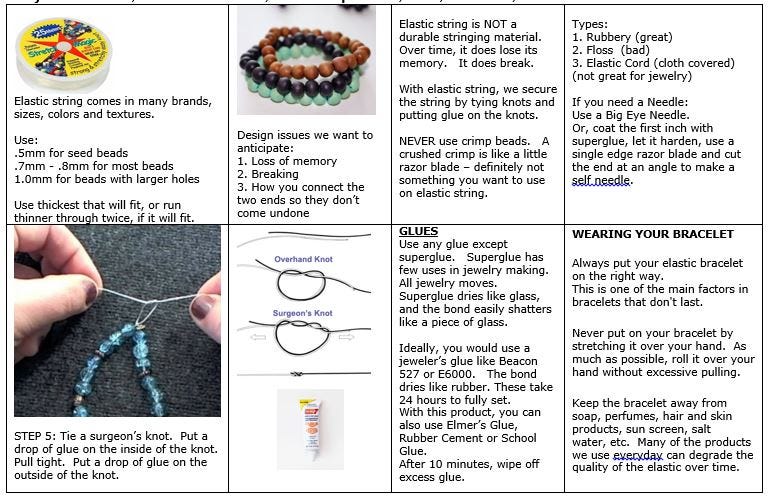
Warren Feld Jewelry

Taking Jewelry Making Beyond Craft

HOW TO CRIMP THE WAY BETTER DESIGNERS DO: Using Crimp Beads, a Crimp Pliers and Flex Wire

Posted by learntobead on April 25, 2020

How to Crimp Using Crimp Beads, a Crimp Pliers and Flex Wire

Crimping is a technique for securing a clasp to beads strung on cable wires. Here crimp beads are used instead of tying knots.

Mechanically, crimping does three things:
 
 In the first steps in crimping, you need to separate two wires that lead to the clasp component. One wire is your spine — what your beads are strung on. The other wire is your tail — extra wire you will need to cut off.
 
 Second, you need to create a lock to literally lock the two wires in place.

Last, you need to make it pretty. The crushed crimp is ugly, and you need to make it look more like a bead again.

So with your pliers and your crimp bead, you separate the wires and create a lock and make things pretty again. The process is relatively simple and requires only a little practice.

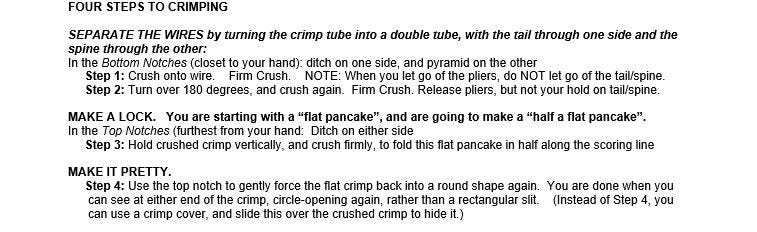
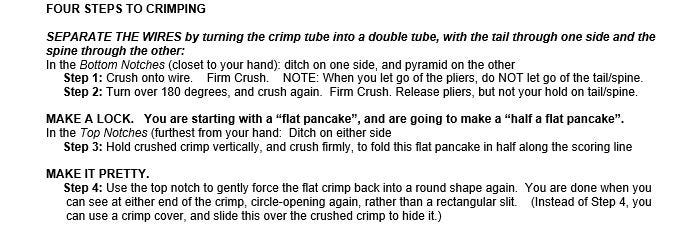
If using a traditional crimping pliers, you would follow the 4-Steps listed below.

However, you can also use what is called a One-Step Crimper. This crimping pliers does all four steps in one step. If crimping is a technique that you will be doing often, then I suggest investing in a One-Step Crimper.

My warnings to you:

(a)Usually the instructions on the package that comes with your crimping pliers is inadequate to the task. Better designers know this from experience. Less experienced designers, however, rely on these inadequate instructions.

(b) There are over 55 different crimping pliers on the market. The only ones that truly work are the original and the more recent One-Step Crimper. The originals are made in China. I’ve noticed that the major craft stores now sell copies of the original ones. These are made in India. Total disaster. They don’t do the job at all because they have a poor configuration of the jaws.

(c ) When students and customers say they are having trouble crimping, they usually blame themselves or the pliers. What I have found is that have bought cheap crimp beads, usually from one of the craft stores. With crimp beads, you get what you pay for. The plated aluminum ones sold in craft stores break when you crush them. The cheap sterling ones have nickel in the alloy (sterling is 92.5% silver and 7.5% something else we call an alloy), which makes the sterling brittle. Sterling is supposed to have copper in the alloy, which makes it malleable, but many manufacturers substitute nickel to keep the cost of sterling down.

Successful crimping requires that you understand the following:

1 . Which cable wires are best for which projects

2 . How the materials you use affect your success

3. The mechanical process itself, how it works, why it works, and why we do each step

CABLE WIRES
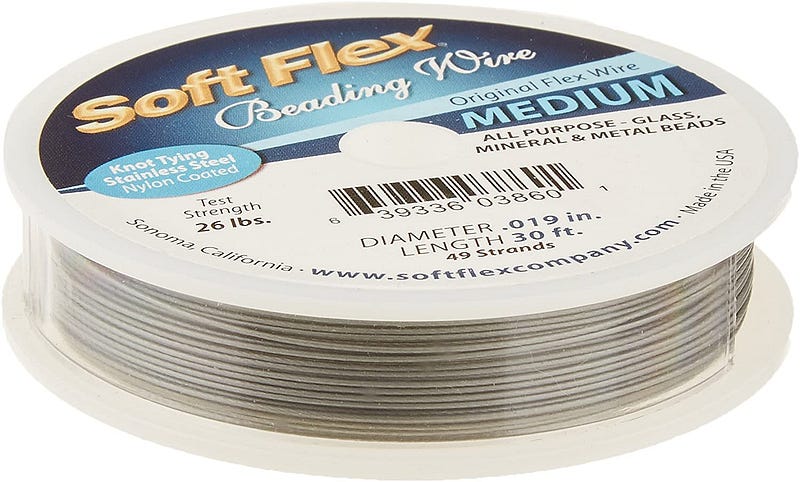
Cable wires are nylon coated, braided wires and are very flexible. These are made for stringing.

[What is called Hard Wire — wire that is not braided and is not encased in nylon — in contrast, is not meant for stringing.]

Cable Wires come in 3 quality grades.

Tiger Tail.The low end is called Tiger Tail. Tiger Tail was the original cable wire product. Today it is the low end of the cable wire line. Most spools of Tiger Tail do not have the words “tiger tail” on their labels. You know it is Tiger Tail because of the price — typically $5.99 or less for a 30ft spool you would find in a bead or craft store.

Tiger Tail wire breaks very easily in and of itself. It kinks easily, and even with the beads on the wire, the kink often shows. The way you attach Tiger Tail to a clasp is that you take the wire through the loop on the clasp, and tie an over-hand knot. You can tie a single knot or a double knot. This actually gives you a very secure connection to the clasp. This is one positive of Tiger Tail.

Unfortunately, when you use crimp beads with Tiger Tail, they too easily cut into the Tiger Tail and make it break. So that is why we suggest tying knots. If you do not like the look of the knotted cable wire here, you can either use beads on each end and which have larger holes so that they swallow the knots. Or, you can slide a crimp cover over the knots, press the two ends on the cover together, and you have something that looks a like a bead to hide your knots.

Flex Wire. The middle quality level — what I suggest people start with, if they want to use cable wire as their stringing material — is called Flex Wire. This wire does not break easily. It does not kink easily. However, it is difficult to tie into a knot. So, we use a crimp bead to secure the wire in place.

The price on this is considerably more than the Tiger Tail. It will start between $10.00 and $20.00 for that 30-foot spool.

Professional or Artistic Wire. The top of the line is referred to as Professional or Artistic Wire. Most of these wires are very expensive, and we don’t suggest this level as the place to start.

There are many brands of cable wire. I am particularly fond of two brands — Soft Flex and Flexrite. I find the wire of other brands too stiff, and sometimes not strong enough.

Cable Wires come in different diameters or widths, usually stated in inches.

We recommend the following:

.014″ — .015″ for necklaces: here you want the best drape you can get, and still have a durable piece

.018″ — .019″ for bracelets: here you want the most durability, yet your piece still feels good when worn

.019″ — .024″ for eyeglass leashes: here durability is you primary factor

About Selecting Cable Wires

There is a lot of information on the labels of cable wires. However, while most of this information is necessary, it is not sufficient for determining which wire is best.

The only true measure of cable wire strength is called Tensile Strength, and you will not find this information on the labels. The strength of a cable wire will come from what the wire is made of, what the nylon sheathing is made of, and how thick that nylon sheathing is. You cannot assume that a 49-strand product is stronger than a 21-strand product, without knowing more about the wire composition and the sheathing. That 49-strand product may actually be weaker.

Nor can you assume that a product, the label of which indicates 20-pound strength is necessarily stronger than a product that indicates 10-pound strength. “Pound Strength” is very unreliable as a measure. In most cases, these pound strength numbers on the label are somewhat made up.

Governments provide two definitions for pound strength — what it takes to hold up a fish of a certain weight, and what it takes to reel in a fish of a certain weight. But they leave it up to the factory to determine exactly how to measure and report pound strength. So you are at the mercy of some factory worker in a place like Taiwan, high on Toluene, having the motivation to maintain a pound strength standard.

On most cable wire products, measures of pound strength are not included. Many years ago, pound strength was listed on all cable wires. The people at the factories responsible for the labels, however, could never get the same pound strength listed from batch to batch. One time it might list 20 pounds; another 2 pounds; another 6 pounds; then back to 20 pounds. So the manufacturers told them to leave this information off.

It is very difficult to compare cable wires across brands. Each company organizes its line, from low end to high end, differently. Some companies, like Beadalon, use 7-strands for Tiger Tail, 19-strands for Flex wire, and 49-strands for their Professional wire. But other companies do not use this ordered arrangement of number of strands to quality. In the Soft Flex line, their top-of-the-line 7-strand product is stronger than their 49-strand middle-range product. And don’t assume one brand’s 49-strand wire is equivalent to another’s. They are not. The Soft Flex 49-strand middle range produce is stronger and more subtle than Beadalon’s top of the line 49-strand product.

I actually only recommend 2 brands — Soft Flex and Flex Rite. These are considerably stronger and more subtle than other brands.

Know this: What makes cable wire strong is the nylon sheathing’s ability to maintain the twist in the cable wire. As soon as the integrity of the nylon sheathing is violated, the wires inside immediately untwist and break. I find that the nylon sheathing on most brands is very thin, sometimes porous, and weak chemically.

CRIMP BEADS, CRIMP COVERS, and HORSESHOE WIRE PROTECTORS

Crimp Beads
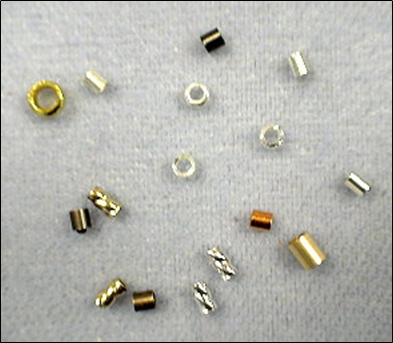
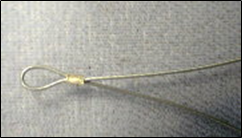
Crimp beads come in many styles, sizes and finishes. These are used to secure cable wires to clasps. You take your cable wire up through the crimp bead, through the loop on the clasp, and back down through the crimp, forming a loop. The crimping process involves crushing the crimp onto the cable wire loop, first, separating the tail and spine wires, then, locking them in place, and finally, re-shaping the crushed crimp so it looks like a bead again.

Sterling silver crimps are usually made the best, especially ones you buy in places other than the big craft stores. For plated crimps, if they are plated over brass (and years ago, they all were plated over brass), than they were very good. Brass is your best jewelry metal. The major issue was that the plating would wear off and you would have a black crimp (basically, tarnished brass). Now, most plated crimps are over aluminum. These break easily when crimped.

I tend to use sterling silver crimps for every piece, though my crimp covers and horseshoes may or may not be sterling, based on the value of the piece, and the finish colors I want to end up with.

Crimp Covers
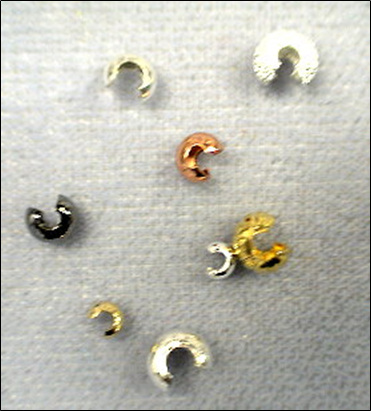
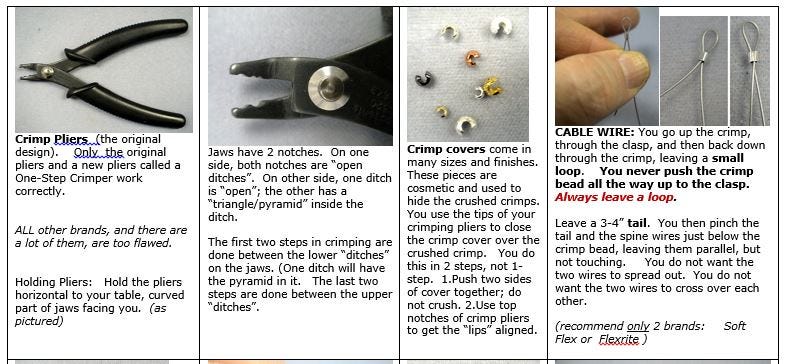
These are U-shaped parts that slip over the crushed crimp. You can slide crimp covers over your crushed crimps. You can also use these to slide over any knots, to hide the knots. Crimp covers come in different sizes, finishes, and texturing. Crimp covers are optional pieces. They act as lamp-shades to hide something ugly, but they serve no structural role, per se.

Closing a crimp cover is done in 2-steps, not one.

(1) Using the tips of your crimping pliers, you push the two sides of the U together, so you have a pretty bead. These are made of a soft metal, so you don’t want to push too hard, or you will crush them. After you get the two sides to meet, you’ll find that the lip on either side doesn’t meet up perfectly, line up perfectly or close perfectly.

(2) At this point, you return the crimp cover to your crimping pliers, this time resting it between the top notch in each jaw. Gently push the jaws to force the lips to meet more perfectly. Sometimes you have to position the pliers in an awkward or odd position, in order to push in the desired direction. The two half-cup shaped ditches in the top position on each jaw helps to keep your crimp cover rounded while you apply pressure to it and shift the relative positioning of each open side.

Horseshoe Wire Protectors
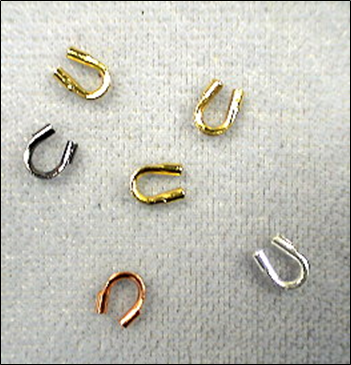
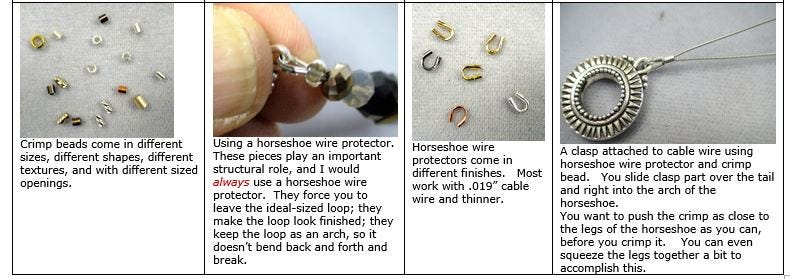
This part is basically a bent tube, with the top of the tube at the arch cut out. These come in many finishes and metals. There is some variation in size relative to how wide an opening the tube has.

Using these serve several purposes.

It forces you to leave the correct size loop in the cable wire, so that you have the appropriate support system or jointedness. Without the loop, you would be pushing the crimp all the way to the clasp. This is a No-No. You never push the crimp all the way to the clasp — this creates stiffness with metal parts, and general movement would cause these to break.

The horseshoe also makes the loop more finished looking — better than a bare-wire loop. Your eye/brain wants you to push the crimp all the way to the clasp. It hates a bare, exposed loop. The horseshoe fools the eye/brain here, making it think that the loop is finished and more organically a part of the whole composition.

The horseshoe prevents the cable wire from folding into a “V-shape” over a period of time and wear. If the wire were to change from an arched loop to a V-loop, the wire then would more easily bend back and forth and eventually break.

You will find that the legs of some horseshoes you will buy have too-narrow openings and won’t fit your cablewire. Also, the thickness of the cablewire along its length will vary somewhat. And sometimes where you cut your cablewire, it sometimes broadens or flattens out the end, making it too big to shove up into the leg. The morals here: have extra horseshoes on hand, and be prepared to cut off some more of the cablewire to get to that area on the wire that has the perfect width.

There are many choices to make when selecting crimp beads:

– Do you want to use a tube shape or a round shape

A crimp is a crimp. There is no difference in “holdability” between the tube and the round, but most people prefer the tubes. They sense that the tube covers more area, so it will be more secure.

A round bead actually starts as a tube. They blow air into the tube to puff it up and make it look round.

– If you want to maintain a silver color, how do you do that?

You have several choices here, each with pros and cons. You can use a sterling silver crimp. Sterling silver softens at body temperature. If your sterling crimp rests on the wrist or the neck, there is some risk that it will soften and release its hold. From experience, this risk, if you have crimped correctly, is very small, but the risk exists.

Another option is to use a silver-plated crimp. Silver plated crimps are plated usually over brass. Brass is your best jewelry design metal. Once you crush that brass, you never have to lose any sleep over it. Unfortunately, the plating wears away somewhat quickly, and you are left with a black crimp — basically tarnished brass.

Some people use silver plated crimps and slide sterling crimp covers over them. This adds about $0.90 per piece.

Another option: Use an argentium silver crimp. Both argentium silver and sterling silver are 92.5% silver. It’s the alloy that is different. Argentium is more expensive. There is no risk of argentium silver softening at body temperature.

– How do you achieve a satisfactorily re-rounded bead?

In the traditional crimping processing, you flatten the crimp and then you re-round it so that it looks like a bead again. You do not end up with a great look. Some people can live with this; for others, they are bothered by not seeing a perfectly round bead again.

There is a crimping pliers, which I do not recommend, called the Magical Crimping Pliers. This re-rounds that bead perfectly, but I find, in doing so, it weakens the hold.

You can always crush your crimp bead, and then slide a crimp cover over it, to get that pretty look.

– How many crimp beads should you use on each end — 1 crimp or more than one?

If you have crimped correctly, using 1 crimp on each end of your piece is more than sufficient, even if your beads are very heavy.

Using more than 1 crimp on each end is too risky. Sometimes your mind, or your best friend, thinks that if 1 is good, 2 or more would be better. No! When you crush your crimp onto the wire, it becomes like a little razor blade. All jewelry moves, so your crimp is constantly trying to saw through the cable. Using more than one crimp on each end increases the chances that one will saw through. All you are doing is adding razor blades.

– Should you use a plain tube or a twisted tube?

The twisted tubes (sometimes called Tornado or Cyclone crimps) are a little more expensive than the plain ones. When you crush the twisted tubes, they look decorative enough that you don’t have to re-round them. You definitely need to re-round the plain ones.

– Should you use regular and long tubes or short and half tubes?

Short tubes or half tubes are primarily used in pieces like illusion necklaces, where you have a cluster of beads, and the cord shows, another cluster of beads, the cord shows, etc. Half tubes are used on either side of the clusters to keep the beads in place. When you crush the half tube, the volume of space it takes up is not noticeable. When you crush the regular sized tube, its volume of space is too noticeable and detracts from the general look of the piece.

One mistake people make with the short or half tubes, is that, when they use them to finish off the ends of jewelry, their mind tells them, since these are shorter than usual, to use 2 or 3 of them so that they will “hold better.” A crimp is a crimp, and if you crimped correctly, there is no difference in holdability between the short and longer tubes. Each crushed crimp you add becomes like a little razor blade. All jewelry moves, so you’re increasing the chances one of these crimps will cut through the cable wire. One crimp on either end is enough.

– Are there differences or variations on quality/grade of crimp beads?

The short answer is Yes! Basically, you get what you pay for!

Here’s how crimp beads are made: You start with a sheet of metal. You roll the metal into a tube. You buff along the seam where the two sides meet, so that it looks like it’s been soldered together. However, there’s really a seam there.

So often, people come into our shop and tell sad tales of failed crimps and broken bracelets and necklaces. They blame themselves. They blame the pliers. But they never blame the crimp beads. In most cases, the crimp is at fault.

Cheap crimps, usually bought in small packages, usually at craft stores, are not made well. When you crush these, they tend to split along the seam. Sometimes you can see the split. Othertimes, you can’t quite see that the two sides of the tube have started to separate. Your cable wires pull out. Or your crimp edges have cut into the cable wire.

An A- grade crimp, usually costing about 3 times what the cheap crimps cost, can hold up to your initial crushing, as well as another 8 or so clamping down on it during the re-rounding process.

There are heavy-duty or A+ grade crimps. These run about 6–8 times what the cheap crimps do. You don’t have to worry about any splitting, no matter how much you work the crimp bead with your pliers.

– How do you know what size of crimp bead to buy?

Manufacturers are inconsistent in how they label the sizes of crimp beads. In general, although you may not know exactly what their measurement refers to, when they list:

2mm, this is the average size For .014, .015, .018, .019 cable wires

1.5mm, this is small For .010 and .012 cable wires

2.5mm, this is slightly more than average For .019 and .024 cable wires

3.0mm and 4.0mm, these are large for .024 cable wires, or thicker cords, or bringing more than 1 strand through at a time

LET’S PRACTICE OUR CRIMPING

How to Crimp Using Crimp Beads, a Crimp Pliers and Flex Wire

Supplies:
 2mm sterling silver crimp tubes
 silver plated crimp cover
 silver-plated horseshoe wire protectors
 .019” soft flex cable wire
 toggle clasp
 enough beads to make a bracelet
 
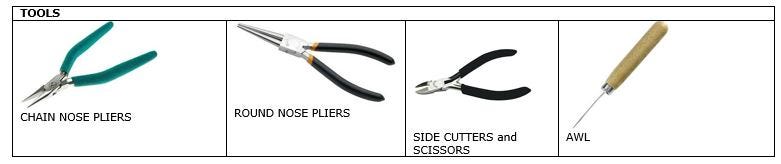
 Chain Nose Pliers
 Crimping Pliers
 Flush Cutters or Cable Wire Cutters

Work Surface
 Bracelet Sizing Cone
 Bead Board
 Bead Stoppers or Hemostats

Before we get started on our bracelet, we are going to practice crimping.

The Traditional Crimping “Pliers”
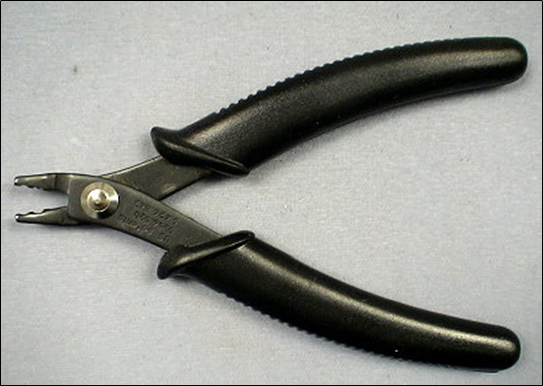
The traditional crimping pliers works with all sizes of crimp beads. In fact, I find it works better than most other types of crimping pliers, whether the micro-crimpers, macro-crimpers or magical crimpers.
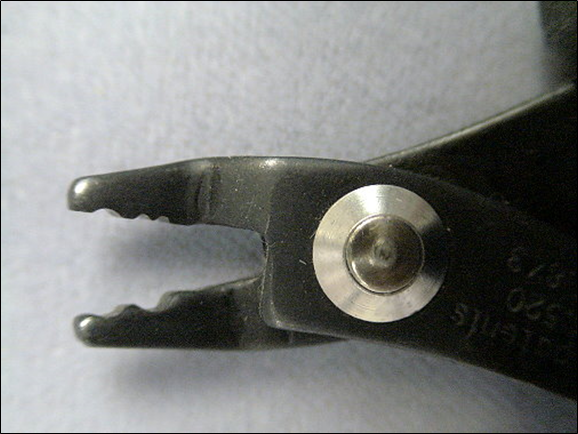
If you look closely at the jaws, you will see that each jaw has two notches or ditches on it. The bottom notch or ditch in each jaw (those closest to your hand) is a full ditch on one side, and a ditch with a pyramid or triangle in it on the other side. It is important that you be able to see that pyramid. This is critical to the crimping process. Sometimes when you buy these, and other times when you use these awhile, the pyramid isn’t there or wears away.

The top notch in each jaw (furthest from your hand) has a full ditch on either side.

There are four steps in the crimping process. Basically, you use the crimping pliers first to separate the two wires (spine and tail), then second, to lock them in place. The last step is to make things pretty again.

We do the first two steps using the bottom notch in each jaw. We do the last two steps using the top notch in each jaw.

Hold your pliers parallel to the table, with curved part of jaws facing you.
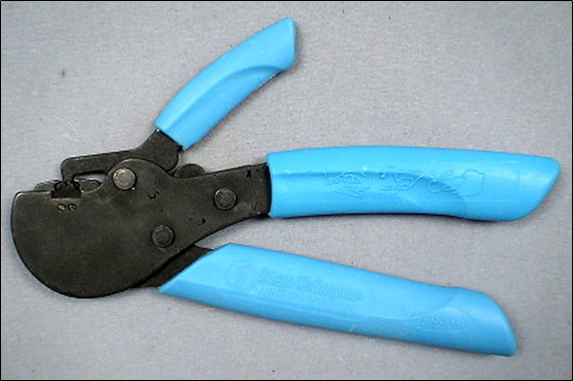
[NOTE: There is also a new 1-step crimping pliers which works very well.]

The “Loop”

Position the crimp and the wires, so you leave an adequate “loop” (joint).

The clasp should be able to move freely.

You never push the crimp bead all the way up to the clasp.

Your eye/brain cognition wants you to push the crimp all the way up to the clasp; it sees the bare loop as ugly. You must fight your inner self on this, in order to build in appropriate level of support or jointedness. You are going to have to sacrifice some beauty in order to build in more durability and adaptability to movement.

When crimp/wire/clasp are too tight, and can’t move, then you basically have stiff metal bending back and forth against itself, and it breaks. If the bare loop bothers you, you can always cover the loop with 15/0 or 11/0 seed beads, or 13/0 charlottes.

Or you can use a horseshoe wire protector to cover the loop. What I like about the horseshoe wire protector is that it forces you to leave an ideal sized loop, and also makes what was a bare loop look very finished and appealing.

The “Tail”
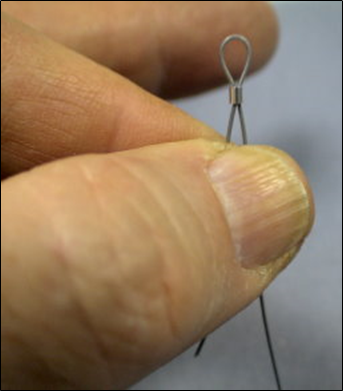
You need to leave about a 3–4” tail on either side. You want to hold the tail so that it runs parallel to the spine, though not touching.

When you crimp by closing and letting go of your pliers, don’t let go of the tail. This is a mistake many people make. When they let go of the pliers, they let go of the tail. Don’t do this. If you let go of the tail at the same time, the tail will either bend over far to one side, creating a “V” with it and the spine. Or, it will cross over the spine.

When we trim our tails, we do not cut them off at the crimp. Instead, we feed back the tail through at least the first (or last) bead, and preferably several other beads, and then cut the tail as close to the hole of the bead it is exiting as possible. You want to be sure that at least your first bead and your last bead have large enough holes, so that they can slip over both the spine and the tail.

Tail sticking out too far and tail crossing over wire:
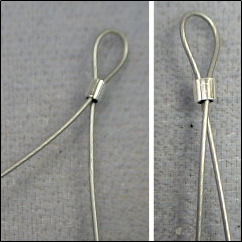
Finishing Your Piece Off and TrimmingThe Tails

On the first side of your bracelet or necklace, you secure your clasp component with your crimped wire. You then string on your beads. You want at least the first bead, and preferably several beads to slip over both the spine and the tail wires. When you get to the other side, you will add your crimp bead and horseshoe wire protector, slide your remaining clasp component over the tail up into the horseshoe. You need to have a 3–4″ tail remaining. Grab your tail, and bring it back through (top to bottom) of your crimp bead, and through at least your last bead, and preferably several beads.

Now you want to pull things tight, but not too tight, before you crimp that second crimp bead. Hold onto your clasp (or your horseshoe wire protector ) with one hand, and pull the wire with the other, to get everything tight, but not too tight. You do not want your bracelet to have poor “ease” and be too stiff. You should test the length of the bracelet one more time, using a sizing cone or someone’s wrist. Make any necessary adjustments to ease and length.

If your tail is showing on your first side of the bracelet, then trim it off now. Flush cutters or cable wire cutters work well here. If you pull your tail away from the bead, this creates a bit of tension, and when you cut the wire, the wire coming out your bead will pull back a bit into the hole of the bead.

If you haven’t been able to cut the wire flush enough with the bead, and some wire is poking out, work it with your fingers into the hole of the next bead on the string.

Re-check your length and ease.

Now crimp your ending side. Trim the remaining tail as close to the hole of your bead as possible.

NOTE: If you can’t work the tail back through the first bead, then cut it off as close to the crimp as possible. There will be two sharp edges. One will be the crushed crimp itself. The other will be the cable wire. You can’t really cut the wire totally flush with the crimp, so a little bit of a nipple will be protruding. Use an emery board or nail file or metal file and smooth out the rough edges of the crimp, and sharp point of the cable wire. Feel with your finger, until it is smooth. This is not your best option. Your piece will look less finished and be less secure.
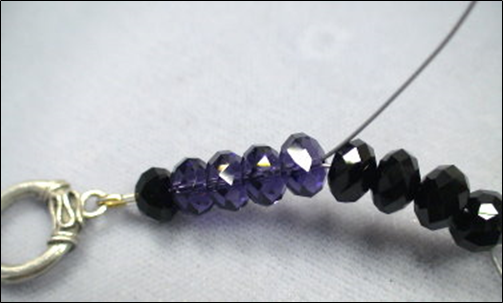
Camouflaging the Crimp Bead

You can always make your crimp beads the second and next to last beads, instead of the first and last. In this case, the crimp will look like it is part of a pattern. The ends will look very finished.
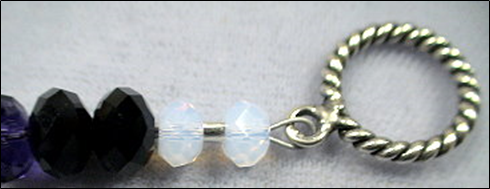
Let’s Crimp: A Practice Exercise

Cut a 15″ length of cable wire.

Horseshoe on first. Take your horseshoe wire protector, holding it so that the arch is toward the ceiling and the legs are to the floor. Take your wire from floor to ceiling, up into the leg, over the arch, and back down through the over leg. Give yourself a 3–4″ tail past the horseshoe.

Slide on clasp component. Take your tail wire through the loop on the ring end of your Toggle clasp, and slide that ring’s loop right up into the horseshoe.

Add Crimp Bead. Slide a crimp bead onto the spine of your cable wire, and bring it all the way up to the legs of the horseshoe. As you get close to the tail, you want your crimp to slide over both the spine and the tail.

Pinch the legs of the horseshoe closer together, and get your crimp as close to the legs as possible. You can use your fingers or the tips of your crimping pliers to pinch the horseshoe legs.

Be sure your have left yourself as 3–4″ tail. Make any adjustments.

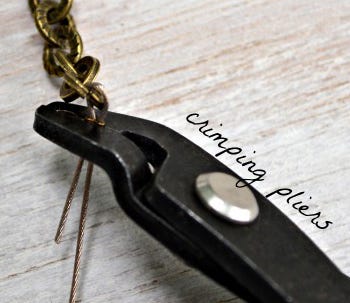
Crimp. Now grab your crimping pliers, holding them parallel to your table, curved part of the jaws bending towards you.

Pinch the tail and spine near to your crimp bead with your thumb and forefinger, making sure that your tail is parallel, but not touching, the spine.
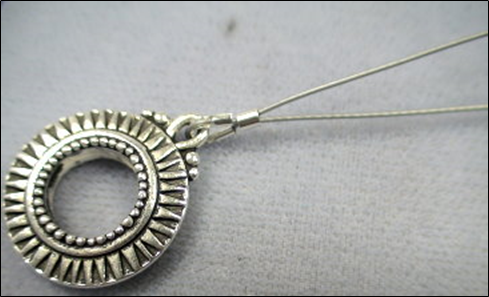
In Bottom Notches (closet to your hand): 
ditch on one side, and pyramid on the other

STEPS 1 and 2: Your goal is to separate the wires. The pyramid in your pliers jaw pushes the wires apart, and makes a scoring line down the middle of your crimp, turning it into a double-tube, one wire in each channel.

Step 1: Crush

Sit your crimp bead between the bottom notches in each side. The loop/horseshoe should be laying horizontally, parallel to the table.

Crush the pliers all the way down onto the crimp bead, and let go of the pliers (but not the tail).
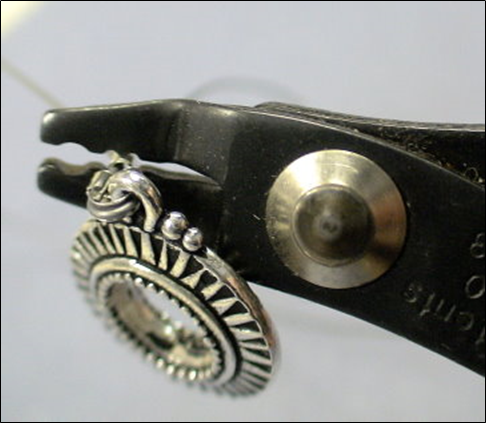
Step 2: Turn over 180 degrees, and crush again

When we crushed the first time, the part of the crimp closest to our hand crushed down, but the part furthest from our hand actually flared out a bit. In Step 2, we crush down the part that had flared up.

You end up with a flat pancake. If you look at this flat pancake, you will see a scoring line down the middle. This line was made by our pyramid.

So we turn the crimp over to its other side, and crush again.
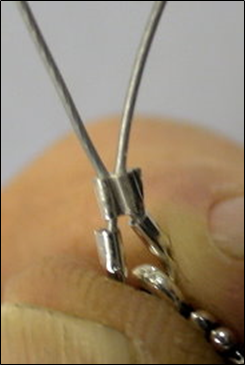
In Top Notches (furthest from your hand): Ditch on either side

STEP 3: The goal is to create a lock.

Step 3: Fold flat pancake to make half-a-flat pancake

Sit your crimp bead between the top pair of notches. Hold so that your loop/horseshoe is vertical, thus perpendicular to the table.

Hold the crushed crimp vertically, and crush, to fold this flat pancake in half along the scoring line. You end up with half a flat pancake.
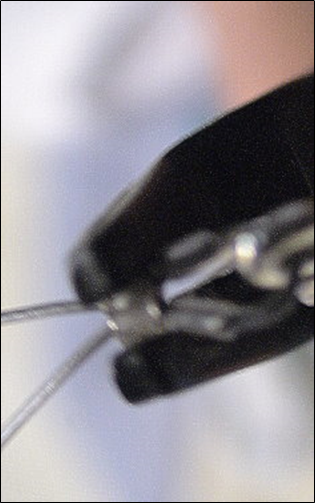
STEP 4: Your goal here is to make things pretty.

Step 4: Re-Round

Use the top notches to gently force and push the flat crimp back into a rounded tube shape again. If you look at either end of the crimp — from the loop end and from the tail end — you want to see a circular shape again, rather than a rectangular slit. It’s best to keep your pliers steady in one place, and turn your wire/crimp bead as you work the pliers. You do not CRUSH; you PUSH on the metal with your pliers to re-round.

Now, your crimp bead is wider than the width of the jaws the pliers. So, you will have to work the top and bottom of the crimp a little bit independently, so that both ends are round again.
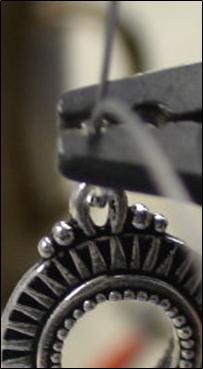
NOTE: Instead of Step 4, you can use a crimp cover, and slide this over the crushed crimp to hide it.

But if using a crimp cover, be sure to do Steps 1 thru 3.

Putting The Beads On.

If you were creating a piece from scratch, and not following a pattern, you would probably use something like clamps, hemostats or bead stoppers. You would cut a length of cable wire — about 12″ more than the bracelet or necklace length you want to end up with. You lay out all your beads and the parts of the clasp assembly on a bead board or other work surface. Then you would clamp one end of your cable wire, slide beads on, and clamp the other end. This would let you add and subtract beads, or change your mind about the patterning, before you finished off the ends with the clasp assembly.
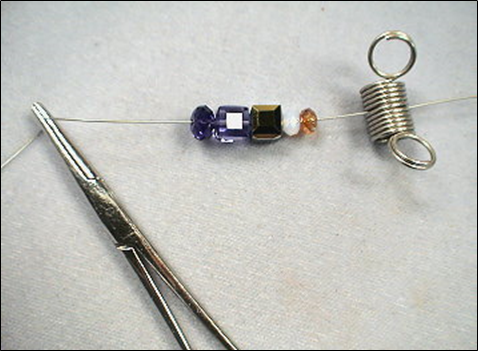
Otherwise, if you are following a particular pattern, you would start by securing one end with a crimp bead, and stringing the rest of the beads on. You would cut your cable wire — about 12″ more than the bracelet length you want to end up with.

Lay out all your beads and the clasp assembly parts on the bead board or some other work surface, in the order they are to be used.

You would attach the largest part of your clasp first — with Toggles, this is the ring — on one end, crimping it in place, and leaving a 3–4″ tail.

Slide on your beads, following the pattern. At least your first bead should slide over both the spine and the tail.

Determine the fit — both length and ease — by clamping or holding with your fingers the open end, and encircling a sizing cone or someone’s wrist with your bracelet. Remember here that the other end of the clasp will add another 1/2″ to this length.

“Ease” — You do not want to pull the cable wire too tight, making it stiff, thus uncomfortable to wear. And you do not want to pull the cable not tight enough, thus allowing the cable wire to show between the beads and the beads and the clasp.
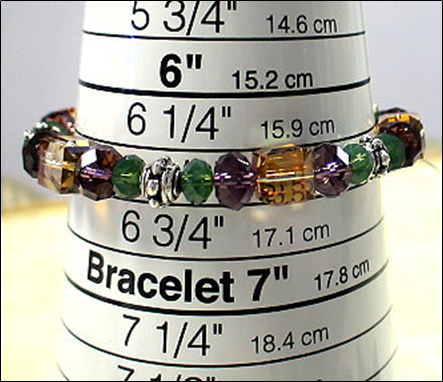
Adjust the number of beads, if necessary.

Add your crimp bead, horseshoe wire protector, the other end of the clasp — in our case, the bar.
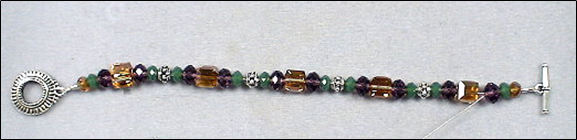
Don’t actually crimp things on this side, or trim your tail yet.

Slide the tail back through some beads. Pull tight enough to get an acceptable ease. Test the length and ease again.
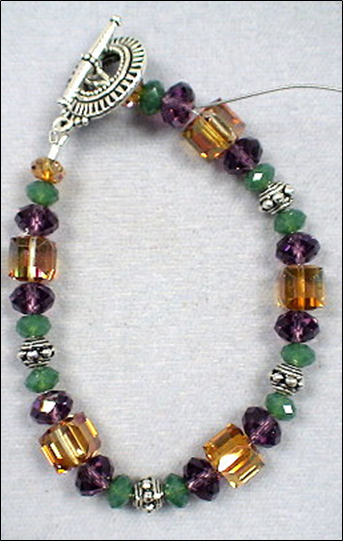
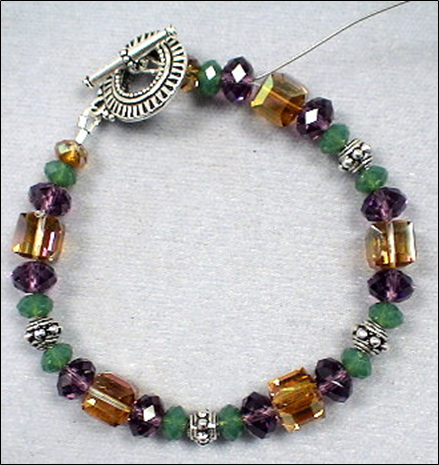
POOR EASE
GOOD EASE

When satisfactory, do your final crimping. Slide the tail through some more beads, if possible. Trim the tails on both ends.

Using a Crimp Cover
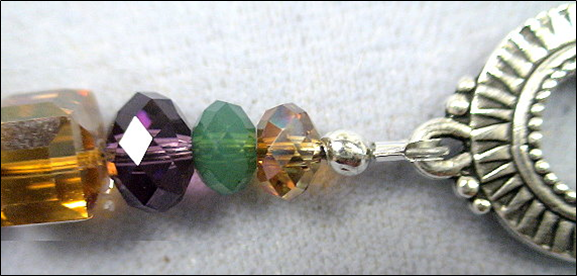
Use your pointer finger as an easel and your thumb as a clamp.

Sit your crimp cover on the top of the pad on your pointer finger, as if the cover were a cradle (open side up).

Set your crushed crimp on your cable wire right inside the crimp cover.

Immediately, clamp down over the loop/clasp part with your thumb. Your thumb is pushing down on the wire loop/clasp, so that the crimp cover can’t move.
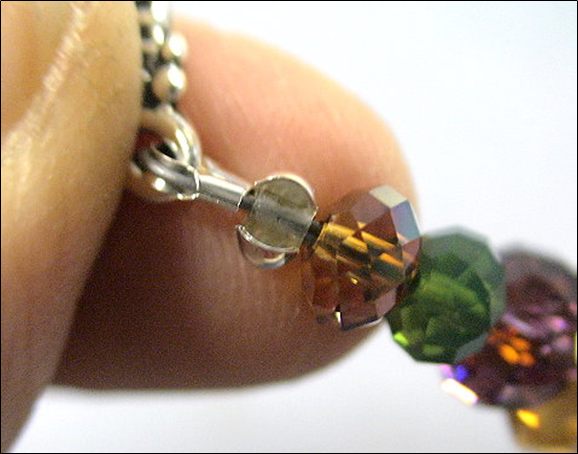
We close the crimp cover in 2 steps.

Take your crimping pliers, and use the tips of each jaw. With these tips, push the opening of the crimp cover closed as best as you can. Press firm but gently. It is easy to crush these crimp covers. The two lips on each side will not meet perfectly, will not be aligned, and there may be a gap.

The second step is to put the crimp cover between the two top ditches on your crimp pliers (both ditches are open), and gently push to get things in place.

You may have to orient your pliers in some weird angles to get the two halves of your crimp covered lined up correctly.

Give It The Once Over…

Once your bracelet is done, look it over carefully. Be sure your cable wire isn’t showing. Be sure that it has sufficient ease.

Other Articles of Interest by Warren Feld:

Cleaning Sterling Silver Jewelry: What Works!

What Glue Should I Use When Making Jewelry?

Why Am I So Addicted To Beads?

A Very Abbreviated, But Not Totally Fractured, History of Beads

The Martha Stewart Beaded Wreath Project

When Choosing Colors Has You Down, Check Out The Magic Of Simultaneity Effects

The Use of Armature In Jewelry: Legitimate or Not?

Pearl Knotting Warren’s Way

Organizing Your Craft Workspace…Some Smart Pointers

You Don’t Choose Clasps, You Choose Clasp Assemblies

Know Your Anatomy Of A Necklace

Mini Lesson: Making Stretchy Bracelets

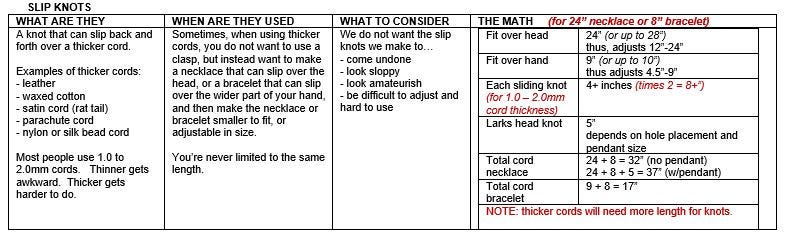
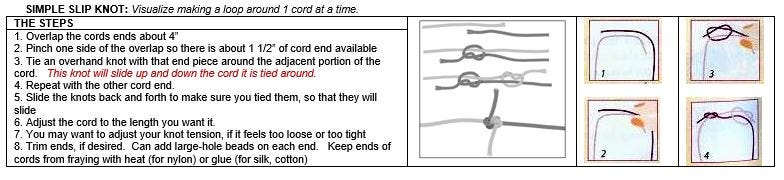
Mini Lesson: Making Adjustable Slip Knots With Thicker Cords

Mini Lesson: How To Crimp

Mini Lesson: Attaching End Caps, Cones, Crimp Ends

Mini Lesson: Brick Stitch

Mini Lesson: Flat Even Count Peyote

Mini Lesson: Ndebele Stitch

Mini Lesson: Petersburg Chain

Mini Lesson: Right Angle Weave

Jewelry, Sex and Sexuality

Everyone Has A Getting Started Story

The Nature-Inspired Creations of Kathleen

The Jewelry Designer’s Orientation To Glass Beads

The Jewelry Designer’s Orientation To Lampwork Beads

The Jewelry Designer’s Orientation To Crystal Beads

The Jewelry Designer’s Orientation To Seed and Cylinder Beads

The Jewelry Designer’s Orientation To Choosing and Using Clasps

I hope you found this article useful. Be sure to click the CLAP HANDS icon at the bottom of this article.

Also, check out my website (www.warrenfeldjewelry.com).

Subscribe to my Learn To Bead blog (https://blog.landofodds.com).

Visit Land of Odds online (https://www.landofodds.com)for all your jewelry making supplies.

Enroll in my jewelry design and business of craft video tutorials online.

Add your name to my email list.
Posted in Stitch 'n Bitch | Tagged: , , , , | Leave a Comment »

Mini-Lesson: RIGHT ANGLE WEAVE STITCH

Posted by learntobead on April 24, 2020

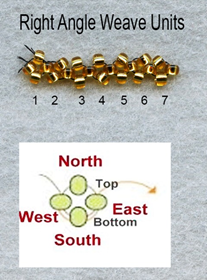
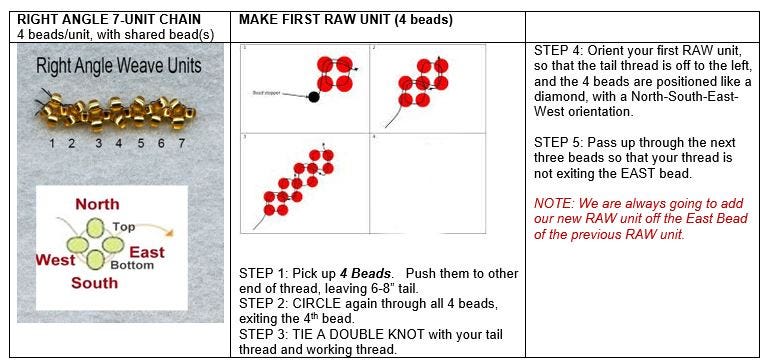
The RAW Stitch typically is a circle of 4 beads (a Right Angle Weave Unit) connected to another circle of 4 beads (a second RAW unit), with one bead shared. The thread path follows a “figure 8” pathway. As you add units, you will find yourself going up and around in one direction, then going down and around to add the next couple units, then up and around, and then down and around, and so forth, always following that figure 8. At no point should the thread show within the negative space surrounded by our 4 beads. This is the reason for the more convoluted Figure 8 pathway which underlies the stitch. NOTE: We can use more than 4 beads in each unit. Many people use more than 4 beads to hide the threads from showing between each bead.

Other Articles of Interest by Warren Feld:

Cleaning Sterling Silver Jewelry: What Works!

What Glue Should I Use When Making Jewelry?

Why Am I So Addicted To Beads?

A Very Abbreviated, But Not Totally Fractured, History of Beads

The Martha Stewart Beaded Wreath Project

When Choosing Colors Has You Down, Check Out The Magic Of Simultaneity Effects

The Use of Armature In Jewelry: Legitimate or Not?

Pearl Knotting Warren’s Way

Organizing Your Craft Workspace…Some Smart Pointers

You Don’t Choose Clasps, You Choose Clasp Assemblies

Know Your Anatomy Of A Necklace

Mini Lesson: Making Stretchy Bracelets

Mini Lesson: Making Adjustable Slip Knots With Thicker Cords

Mini Lesson: How To Crimp

Mini Lesson: Attaching End Caps, Cones, Crimp Ends

Mini Lesson: Brick Stitch

Mini Lesson: Flat Even Count Peyote

Mini Lesson: Ndebele Stitch

Mini Lesson: Petersburg Chain

Mini Lesson: Right Angle Weave

Jewelry, Sex and Sexuality

Everyone Has A Getting Started Story

The Nature-Inspired Creations of Kathleen

The Jewelry Designer’s Orientation To Glass Beads

The Jewelry Designer’s Orientation To Lampwork Beads

The Jewelry Designer’s Orientation To Crystal Beads

The Jewelry Designer’s Orientation To Seed and Cylinder Beads

The Jewelry Designer’s Orientation To Choosing and Using Clasps

How To Design An Ugly Necklace: The Ultimate Designer Challenge

I hope you found this article useful. Be sure to click the CLAP HANDS icon at the bottom of this article.

Also, check out my website (www.warrenfeldjewelry.com).

Subscribe to my Learn To Bead blog (https://blog.landofodds.com).

Visit Land of Odds online (https://www.landofodds.com)for all your jewelry making supplies.

Enroll in my jewelry design and business of craft video tutorials online.

Add your name to my email list.
Posted in Stitch 'n Bitch | Tagged: , , , , | Leave a Comment »

Mini-Lesson: PETERSBURG CHAIN STITCH

Posted by learntobead on April 24, 2020

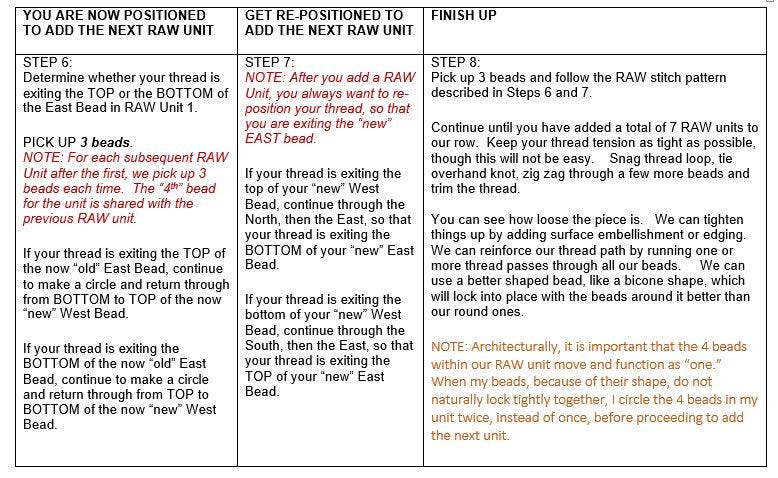
The St. Petersburg Chain stitch is a relatively simple stitch that generates a long, thin, flat length of beadwork. Traditionally, two lengths are created and connected together up and down the inside edges with a decorative bead.

Other Articles of Interest by Warren Feld:

Cleaning Sterling Silver Jewelry: What Works!

What Glue Should I Use When Making Jewelry?

Why Am I So Addicted To Beads?

A Very Abbreviated, But Not Totally Fractured, History of Beads

The Martha Stewart Beaded Wreath Project

When Choosing Colors Has You Down, Check Out The Magic Of Simultaneity Effects

The Use of Armature In Jewelry: Legitimate or Not?

Pearl Knotting Warren’s Way

Organizing Your Craft Workspace…Some Smart Pointers

You Don’t Choose Clasps, You Choose Clasp Assemblies

Know Your Anatomy Of A Necklace

Mini Lesson: Making Stretchy Bracelets

Mini Lesson: Making Adjustable Slip Knots With Thicker Cords

Mini Lesson: How To Crimp

Mini Lesson: Attaching End Caps, Cones, Crimp Ends

Mini Lesson: Brick Stitch

Mini Lesson: Flat Even Count Peyote

Mini Lesson: Ndebele Stitch

Mini Lesson: Petersburg Chain

Mini Lesson: Right Angle Weave

Jewelry, Sex and Sexuality

Everyone Has A Getting Started Story

The Nature-Inspired Creations of Kathleen

The Jewelry Designer’s Orientation To Glass Beads

The Jewelry Designer’s Orientation To Lampwork Beads

The Jewelry Designer’s Orientation To Crystal Beads

The Jewelry Designer’s Orientation To Seed and Cylinder Beads

The Jewelry Designer’s Orientation To Choosing and Using Clasps

How To Design An Ugly Necklace: The Ultimate Designer Challenge

I hope you found this article useful. Be sure to click the CLAP HANDS icon at the bottom of this article.

Also, check out my website (www.warrenfeldjewelry.com).

Subscribe to my Learn To Bead blog (https://blog.landofodds.com).

Visit Land of Odds online (https://www.landofodds.com)for all your jewelry making supplies.

Enroll in my jewelry design and business of craft video tutorials online.

Add your name to my email list.
Posted in Stitch 'n Bitch | Tagged: , , , , | Leave a Comment »

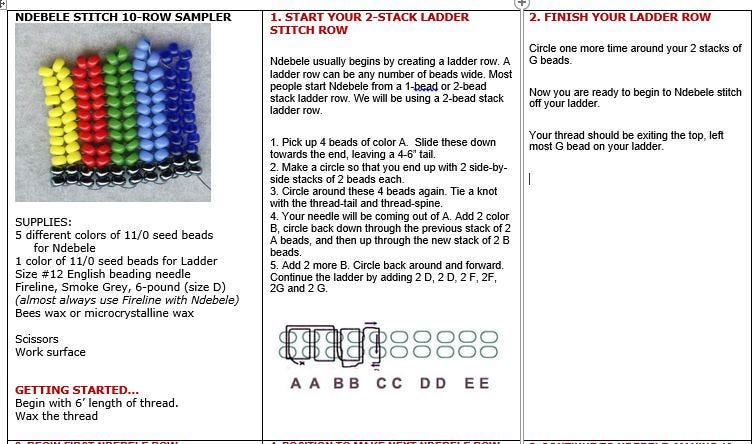
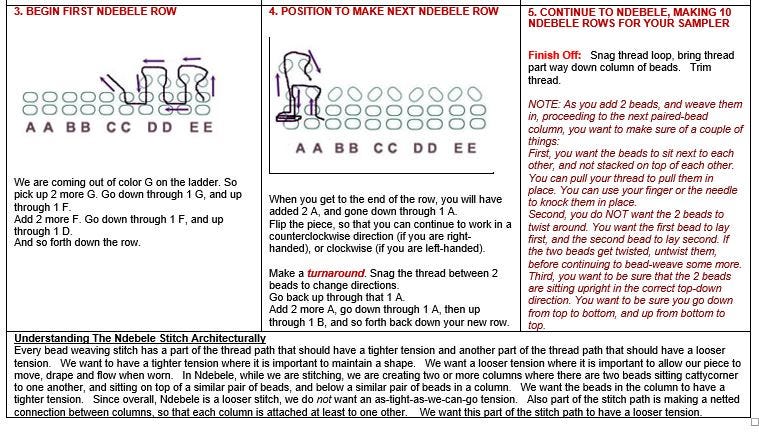
Mini-Lesson: Ndebele Stitch

Posted by learntobead on April 24, 2020

This stitch is known by the herringbone or zig-zag pattern the beads make when stitched together. The stitch is very soft and fluid. It results in a very beautiful texturing and patterning. A lot of thread shows in this stitch, and, in this case, is a charming part of the whole effect. The beads sit in regular columns in angled pairs, forming a “V” (thus, herringbone,) shape.

Other Articles of Interest by Warren Feld:

Cleaning Sterling Silver Jewelry: What Works!

What Glue Should I Use When Making Jewelry?

Why Am I So Addicted To Beads?

A Very Abbreviated, But Not Totally Fractured, History of Beads

The Martha Stewart Beaded Wreath Project

When Choosing Colors Has You Down, Check Out The Magic Of Simultaneity Effects

The Use of Armature In Jewelry: Legitimate or Not?

Pearl Knotting Warren’s Way

Organizing Your Craft Workspace…Some Smart Pointers

You Don’t Choose Clasps, You Choose Clasp Assemblies

Know Your Anatomy Of A Necklace

Mini Lesson: Making Stretchy Bracelets

Mini Lesson: Making Adjustable Slip Knots With Thicker Cords

Mini Lesson: How To Crimp

Mini Lesson: Attaching End Caps, Cones, Crimp Ends

Mini Lesson: Brick Stitch

Mini Lesson: Flat Even Count Peyote

Mini Lesson: Ndebele Stitch

Mini Lesson: Petersburg Chain

Mini Lesson: Right Angle Weave

Jewelry, Sex and Sexuality

Everyone Has A Getting Started Story

The Nature-Inspired Creations of Kathleen

The Jewelry Designer’s Orientation To Glass Beads

The Jewelry Designer’s Orientation To Lampwork Beads

The Jewelry Designer’s Orientation To Crystal Beads

The Jewelry Designer’s Orientation To Seed and Cylinder Beads

The Jewelry Designer’s Orientation To Choosing and Using Clasps

How To Design An Ugly Necklace: The Ultimate Designer Challenge

I hope you found this article useful. Be sure to click the CLAP HANDS icon at the bottom of this article.

Also, check out my website (www.warrenfeldjewelry.com).

Subscribe to my Learn To Bead blog (https://blog.landofodds.com).

Visit Land of Odds online (https://www.landofodds.com)for all your jewelry making supplies.

Enroll in my jewelry design and business of craft video tutorials online.

Add your name to my email list.

Posted in Stitch 'n Bitch | Tagged: , , , | Leave a Comment »

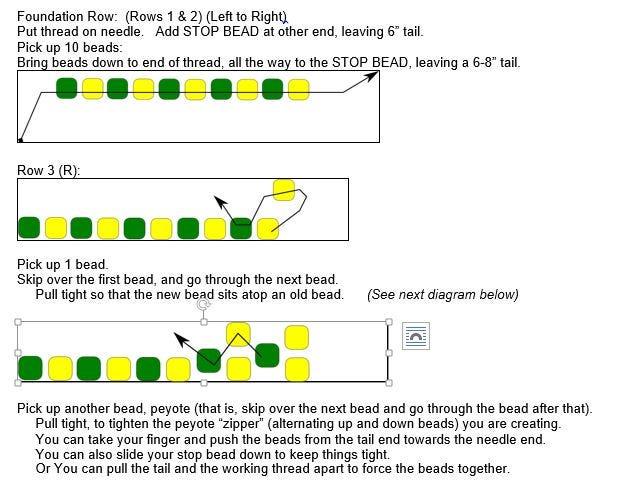
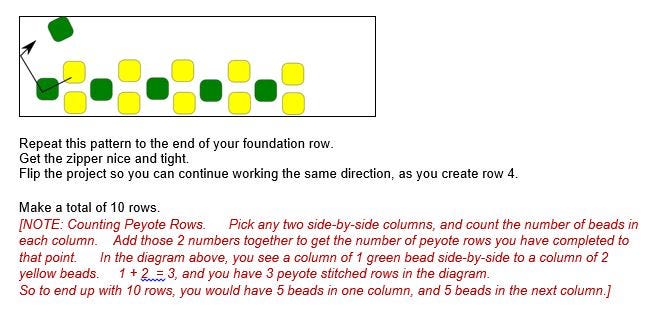
Mini-Lesson: FLAT, EVEN COUNT PEYOTE

Posted by learntobead on April 24, 2020

Other Articles of Interest by Warren Feld:

Cleaning Sterling Silver Jewelry: What Works!

What Glue Should I Use When Making Jewelry?

Why Am I So Addicted To Beads?

A Very Abbreviated, But Not Totally Fractured, History of Beads

The Martha Stewart Beaded Wreath Project

When Choosing Colors Has You Down, Check Out The Magic Of Simultaneity Effects

The Use of Armature In Jewelry: Legitimate or Not?

Pearl Knotting Warren’s Way

Organizing Your Craft Workspace…Some Smart Pointers

You Don’t Choose Clasps, You Choose Clasp Assemblies

Know Your Anatomy Of A Necklace

Mini Lesson: Making Stretchy Bracelets

Mini Lesson: Making Adjustable Slip Knots With Thicker Cords

Mini Lesson: How To Crimp

Mini Lesson: Attaching End Caps, Cones, Crimp Ends

Mini Lesson: Brick Stitch

Mini Lesson: Flat Even Count Peyote

Mini Lesson: Ndebele Stitch

Mini Lesson: Petersburg Chain

Mini Lesson: Right Angle Weave

Jewelry, Sex and Sexuality

Everyone Has A Getting Started Story

The Nature-Inspired Creations of Kathleen

The Jewelry Designer’s Orientation To Glass Beads

The Jewelry Designer’s Orientation To Lampwork Beads

The Jewelry Designer’s Orientation To Crystal Beads

The Jewelry Designer’s Orientation To Seed and Cylinder Beads

The Jewelry Designer’s Orientation To Choosing and Using Clasps

How To Design An Ugly Necklace: The Ultimate Designer Challenge

I hope you found this article useful. Be sure to click the CLAP HANDS icon at the bottom of this article.

Also, check out my website (www.warrenfeldjewelry.com).

Subscribe to my Learn To Bead blog (https://blog.landofodds.com).

Visit Land of Odds online (https://www.landofodds.com)for all your jewelry making supplies.

Enroll in my jewelry design and business of craft video tutorials online.

Add your name to my email list.

Posted in Stitch 'n Bitch | Tagged: , , , , | Leave a Comment »

Mini-Lesson: Crimping

Posted by learntobead on April 24, 2020

Other Articles of Interest by Warren Feld:

Cleaning Sterling Silver Jewelry: What Works!

What Glue Should I Use When Making Jewelry?

Why Am I So Addicted To Beads?

A Very Abbreviated, But Not Totally Fractured, History of Beads

The Martha Stewart Beaded Wreath Project

When Choosing Colors Has You Down, Check Out The Magic Of Simultaneity Effects

The Use of Armature In Jewelry: Legitimate or Not?

Pearl Knotting Warren’s Way

Organizing Your Craft Workspace…Some Smart Pointers

You Don’t Choose Clasps, You Choose Clasp Assemblies

Know Your Anatomy Of A Necklace

Mini Lesson: Making Stretchy Bracelets

Mini Lesson: Making Adjustable Slip Knots With Thicker Cords

Mini Lesson: How To Crimp

Mini Lesson: Attaching End Caps, Cones, Crimp Ends

Mini Lesson: Brick Stitch

Mini Lesson: Flat Even Count Peyote

Mini Lesson: Ndebele Stitch

Mini Lesson: Petersburg Chain

Mini Lesson: Right Angle Weave

Jewelry, Sex and Sexuality

Everyone Has A Getting Started Story

The Nature-Inspired Creations of Kathleen

The Jewelry Designer’s Orientation To Glass Beads

The Jewelry Designer’s Orientation To Lampwork Beads

The Jewelry Designer’s Orientation To Crystal Beads

The Jewelry Designer’s Orientation To Seed and Cylinder Beads

The Jewelry Designer’s Orientation To Choosing and Using Clasps

How To Design An Ugly Necklace: The Ultimate Designer Challenge

I hope you found this article useful. Be sure to click the CLAP HANDS icon at the bottom of this article.

Also, check out my website (www.warrenfeldjewelry.com).

Subscribe to my Learn To Bead blog (https://blog.landofodds.com).

Visit Land of Odds online (https://www.landofodds.com)for all your jewelry making supplies.

Enroll in my jewelry design and business of craft video tutorials online.

Add your name to my email list.
Posted in Stitch 'n Bitch | Tagged: , , , , | Leave a Comment »

Mini-Lesson: Brick Stitch

Posted by learntobead on April 24, 2020

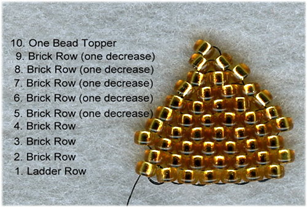
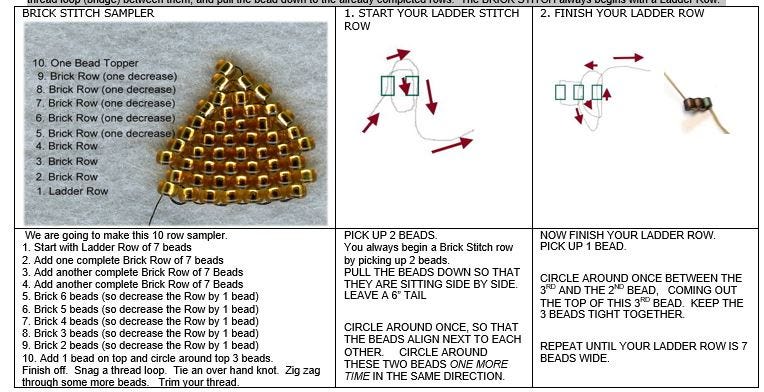
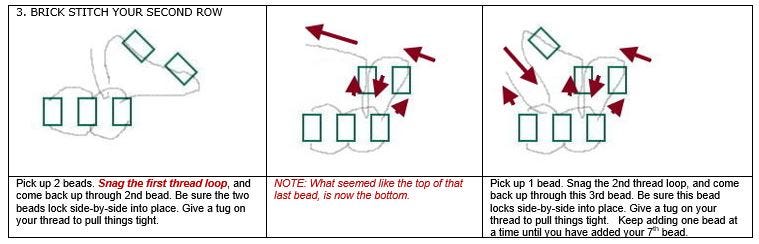
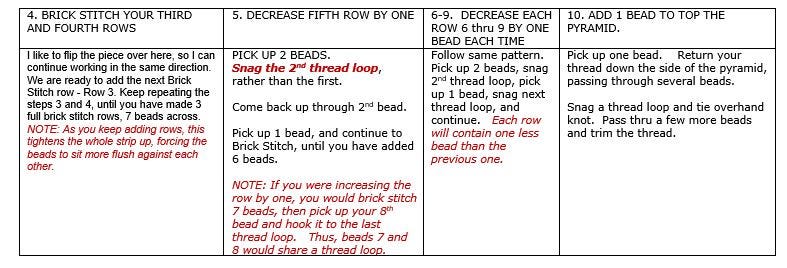
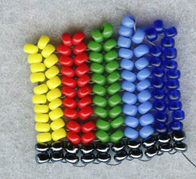
With BRICK STITCH, beads are woven and locked into place by snagging the thread loops between them. As you add a new bead, you snag the thread loop (bridge) between them, and pull the bead down to the already completed rows. The BRICK STITCH always begins with a Ladder Row.

Other Articles of Interest by Warren Feld:

Cleaning Sterling Silver Jewelry: What Works!

What Glue Should I Use When Making Jewelry?

Why Am I So Addicted To Beads?

A Very Abbreviated, But Not Totally Fractured, History of Beads

The Martha Stewart Beaded Wreath Project

When Choosing Colors Has You Down, Check Out The Magic Of Simultaneity Effects

The Use of Armature In Jewelry: Legitimate or Not?

Pearl Knotting Warren’s Way

Organizing Your Craft Workspace…Some Smart Pointers

You Don’t Choose Clasps, You Choose Clasp Assemblies

Know Your Anatomy Of A Necklace

Mini Lesson: Making Stretchy Bracelets

Mini Lesson: Making Adjustable Slip Knots With Thicker Cords

Mini Lesson: How To Crimp

Mini Lesson: Attaching End Caps, Cones, Crimp Ends

Mini Lesson: Brick Stitch

Mini Lesson: Flat Even Count Peyote

Mini Lesson: Ndebele Stitch

Mini Lesson: Petersburg Chain

Mini Lesson: Right Angle Weave

Jewelry, Sex and Sexuality

Everyone Has A Getting Started Story

The Nature-Inspired Creations of Kathleen

The Jewelry Designer’s Orientation To Glass Beads

The Jewelry Designer’s Orientation To Lampwork Beads

The Jewelry Designer’s Orientation To Crystal Beads

The Jewelry Designer’s Orientation To Seed and Cylinder Beads

The Jewelry Designer’s Orientation To Choosing and Using Clasps

How To Design An Ugly Necklace: The Ultimate Designer Challenge

I hope you found this article useful. Be sure to click the CLAP HANDS icon at the bottom of this article.

Also, check out my website (www.warrenfeldjewelry.com).

Subscribe to my Learn To Bead blog (https://blog.landofodds.com).

Visit Land of Odds online (https://www.landofodds.com)for all your jewelry making supplies.

Enroll in my jewelry design and business of craft video tutorials online.

Add your name to my email list.
Posted in Stitch 'n Bitch | Tagged: , , , , | Leave a Comment »

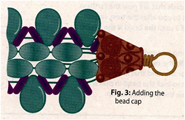
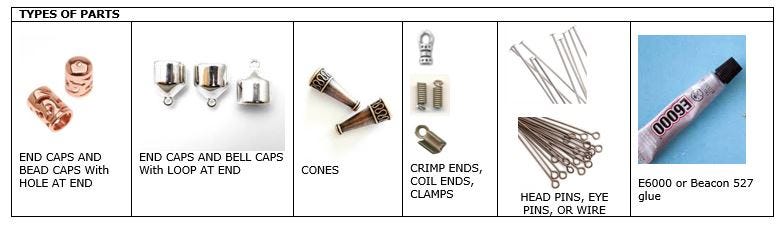
Mini-Lesson: ATTACHING END CAPS, CONES, CRIMP ENDS

Posted by learntobead on April 24, 2020

Other Articles of Interest by Warren Feld:

Cleaning Sterling Silver Jewelry: What Works!

What Glue Should I Use When Making Jewelry?

Why Am I So Addicted To Beads?

A Very Abbreviated, But Not Totally Fractured, History of Beads

The Martha Stewart Beaded Wreath Project

When Choosing Colors Has You Down, Check Out The Magic Of Simultaneity Effects

The Use of Armature In Jewelry: Legitimate or Not?

Pearl Knotting Warren’s Way

Organizing Your Craft Workspace…Some Smart Pointers

You Don’t Choose Clasps, You Choose Clasp Assemblies

Know Your Anatomy Of A Necklace

Mini Lesson: Making Stretchy Bracelets

Mini Lesson: Making Adjustable Slip Knots With Thicker Cords

Mini Lesson: How To Crimp

Mini Lesson: Attaching End Caps, Cones, Crimp Ends

Mini Lesson: Brick Stitch

Mini Lesson: Flat Even Count Peyote

Mini Lesson: Ndebele Stitch

Mini Lesson: Petersburg Chain

Mini Lesson: Right Angle Weave

Jewelry, Sex and Sexuality

Everyone Has A Getting Started Story

The Nature-Inspired Creations of Kathleen

The Jewelry Designer’s Orientation To Glass Beads

The Jewelry Designer’s Orientation To Lampwork Beads

The Jewelry Designer’s Orientation To Crystal Beads

The Jewelry Designer’s Orientation To Seed and Cylinder Beads

The Jewelry Designer’s Orientation To Choosing and Using Clasps

How To Design An Ugly Necklace: The Ultimate Designer Challenge

I hope you found this article useful. Be sure to click the CLAP HANDS icon at the bottom of this article.

Also, check out my website (www.warrenfeldjewelry.com).

Subscribe to my Learn To Bead blog (https://blog.landofodds.com).

Visit Land of Odds online (https://www.landofodds.com)for all your jewelry making supplies.

Enroll in my jewelry design and business of craft video tutorials online.

Add your name to my email list.
Posted in Stitch 'n Bitch | Tagged: , , , , | Leave a Comment »

Contemplative Ode To A Bead

Posted by learntobead on April 23, 2020

Contemplation

You stare at a bead, and ask what it is. You put some thread on a needle, then the bead on the needle, and ask what to do. You stitch a few beads together, and wonder what will become of this. You create a necklace, and ask how it will be worn. And you stare at each bead again, and think where do all these feelings welling up within you come from — beauty, peace and calm, satisfaction, magic, appeal, a sensuousness and sexuality. Your brain and eye enter into this fantastic dance, a fugue of focusing, refocusing, gauging and re-gauging light, color, shadow, a shadow’s shadow, harmony, and discord.

You don’t just bead.

There’s a lot involved here. You have to buy beads, organize them, buy some extra parts, think about them, create with them, live with some failed creations, and go from there. If there wasn’t something special about how beads translate light into color, shade and shadow, then beading would simply be work. But it’s not.

You have to put one next to another…..and then another. And when you put two beads next to each other, or one on top of the other, you’re doing God’s work. There’s nothing as spectacular as painting and sculpting with light.

This bead before me — why is it so enticing? Why do I beg it to let me be addicted? An object with a hole. How ridiculous its power. Some curving, some faceting, some coloration, some crevicing or texturing, some shadow, some bending of light. That’s all it is. Yet I’m am drawn to it in a slap-silly sort of way.

When I arrange many beads, the excitement explodes geometrically in my being. Two beads together are so much more than one. Four beads so much more than two. A hundred beads so much more than four. The pleasure is uncontainable.

I feel so powerful. Creative. I can make more of what I have than with what I started with.

And the assembling — another gift. String through the hole, pull, tug, align, and string through the hole, pull, tug, align, and string through the hole, pull, tug, align, and string through the hole, pull, tug, align. So meditative. Calming. How could beads be so stress-relieving, other-worldly-visiting, and creative-exciting at the same time?

Contemplation.

To contemplate the bead is to enter the deep reaches of your mind where emotion is one with geometry, and geometry is one with art, and art is one with physics, and beads are one with self.

So these days, I confront my innermost feelings about beads. What I enjoy, and what I do not. What I have learned, and what I have not. What I want to achieve, and what I fear I cannot.

It’s not that, originally, I wanted to bead much of anything. I imagined what I wanted to create, and quickly found I couldn’t create it. This became my Rogue Elephant — the sum of all my jewelry design ambitions, and my fluency and ultimate success with it.

I had very specific ideas of what my beadwork should look like, and how it should function. I did not want to be considered a painter who uses beads, or a sculptor who uses beads. I wanted to be considered a bead artist. A bead artist who legitimately uses beads, and not paints, and not clays or stone. This was my dilemma.

Alas, this was the basis of all my fears. Could bead artists intentionally design with light in a fundamentally different way than painters use paint, or sculptors use clay or stone? If I beaded a mannequin, I’d be painting or sculpting.

But what if I beaded a Rogue Elephant? Something that moved. Something that reacted differently in different situations. Something that appeared in different contexts. Would my beadwork stand up to some test of grammar, poetry, art, vision and even love?

I was tentative, at first, about beading, but that Rogue Elephant kept getting in my way. To tame it, to get rid of it, to make sense of it, I had to bead it.

But how? Should I? Could I? Would I? It’s huge! It’s fast! It’s ornery!

Should I make my Elephant some kind of necklace or anklet to wear? How about a little hat? I can tubular peyote around its trunk OK, but what about its ears? What do I do there? That mid-section is awfully rotund. Fringe would be pretty, hanging around some kind of blanket. But, alas, wouldn’t it just drag along the ground?

The main problem is, though, that this beast keeps moving. How am I ever going to get anything to look good, and stay looking good, on this Elephant if it keeps moving? After all, Rogue Elephants don’t Pose. They’re not “Vogue” Elephants. They’re “Rogue” Elephants. They’re too busy tossing their heads at everything else in sight.

If I use large beads, I can accomplish this feat faster, but not necessarily as elegantly. Should my Elephant be elegant? Sophisticated? Earthy? Adventurous? Bohemian? Fashion-aware or fashion-I-don’t-care?

I can not get this Rogue Elephant out of my mind. The thoughts of beading it seem insurmountable, unconquerable. My eyes strain, my hands ache, my back stiffens at these thoughts. It will never get done. I won’t finish it. I won’t do it. I most certainly don’t have the time. I’ll try something easier, like a toy rabbit or a stick. A small stick. A very small, very straight, perfectly round stick. Surely not an Elephant, a Rogue one at that.

Calm down, I say to myself. Stop hyperventilating. Wipe those clammy palms. Don’t let the task before you scare you before you even start.

I grit my teeth. I stand up straight. I squeeze my hands into a fist. I hold my fisted-hands stiffly and tightly against my right and left sides. I lift my chin up ever-so-slightly until my eyes meet his. I stare that Rogue Elephant right into the face for those few seconds it stands in my field of vision. I will bead you. I will bead you. I will bead you.

I set my mantra going. I try to focus on my inner self. I reach way back to grab my inner being, setting its life force and motivation on track to complete this awesome task.

I will bead you. I can bead. I will bead you. I can bead. I will bead you. I can bead. I will bead you. I can bead.

Glue. Thank God someone invented glue. I could corner that Elephant, pour buckets of glue on him, and use a leaf blower to blow a pile of beads right onto that beast. They’ll stick. I’ll be done. Whatever happens, happens. That’s what I’ll do.

But I wouldn’t be happy. And that Elephant would probably want to scratch and itch. Beads would pop off. The glue would yellow. That Elephant wouldn’t be able to walk with any sense of style or grace. It might trip. It would probably fall down, actually. And not be able to get up. Pitiful. It would lose its Rogue-ness. It’s essence of being. I would tame it, yet more than humble it. Where’s the excitement? Glue just won’t do.

I will bead you. I can bead. I will bead you. I can bead. I will bead you. I can bead. I will bead you. I can bead.

How about Mardi Gras beads? These beads, already ironed into place onto a string, could be wrapped around and around and around. Purple Iris’s. Topaz AB’s. Olivine Lusters. They’d be colorful. They’d shine. They’d sparkle. It would be like lassoing a steer — over and over again. I don’t know if my Elephant would stand still for that. Perhaps I could corral him. I could tape one end of the bead string to the tail. Then go around and around and around his body until I reached the other end of the trunk. I’d parade the Elephant in front of all the other Elephants out there, and they’d all want to look as dapper. Everyone the Elephant meets, in fact, will want to be wrapped in bead-ropes. How easy, how simple, how divine.

Once I let my Elephant out of the corral, however, I fear the bead-ropes will reposition themselves and slip off and look sloppy. My Elephant would have to lose its Rogue-ness to pull off this look. My Elephant would have to stand still and pose. I don’t think my Elephant would stand for that. In fact, I know he wouldn’t. The jungle is not a circus, and the banks of the jungle watering hole do not provide a level pedestal for such an event. My elephant would be perplexed. And the result would not be satisfactory beadwork. He’d be off in an instant. This would be a mess — a big Mardi Gras mess. Only sanitation workers in New Orleans getting paid much overtime would have any determined appreciation.

I will bead you. I can bead. I will bead you. I can bead. I will bead you. I can bead. I will bead you. I can bead.

Just what is the recipe then? Take needle and thread, add beads, mix lightly, separate whites and darks, bake, turn once, and voila? Do I have to have a recipe? A determined strategy? A plan of action? Can’t I just bead it? Do I have to think about how to get the beadwork to stay in place? Look good? Look great? Must the Elephant still be able to run with the beadwork on? If the Elephant runs, must the beadwork stay on? And still look good? Oh, dear, my head is beginning to hurt. I don’t know if I can do all this. And be satisfied.

And the poor Elephant. It looks at me one more time. It’s green eyes dart on me. Challenging me. Daring me. Perhaps fearing me and my determination. Perhaps pondering the why’s and wherefores of my insistence that he be beaded — in totality, Rogue-ness and all. The Elephant turns its head, touching his long torso from shoulder to belly with his trunk. His tusks shift uncomfortably. I’m sure the Elephant is wondering How! — How would the beads go on? How would they be arranged? How could he continue to walk and drink and eat and talk? How would the other Elephants react? How could anyone ever begin to bead a Rogue Elephant?

My Elephant looks at me one more time — staring directly into my eyes. It’s more than a glance. He stares, as if to say, it can’t be done. My Elephant lifts its trunk, extends its ears, snorts, shakes its tail, turns and darts away toward the horizon.

I will bead you. I can bead. I will bead you. I can bead. I will bead you. I can bead. I will bead you. I can bead.

I follow him.

Other Articles of Interest by Warren Feld:

Do You Know Where Your Beading Needles Are?

Consignment Selling: A Last Resort

Odds or Evens? What’s Your Preference?

My Clasp, My Clasp, My Kingdom For A Clasp

Why Am I So Addicted To Beads?

The Bead Spill: My Horrifying Initiation

The Artists At The Party

How To Bead A Rogue Elephant

You Can Never Have Enough Containers For Your Stuff

Beading While Traveling On A Plane

Contemplative Ode To A Bead

How To Bead In A Car

My Aunt Gert: Illustrating Some Lessons In Business Smarts

A Jewelry Designer’s Day Dream

A Dog’s Life by Lily

I Make All The Mistakes In The Book

How Sparkle Enters People’s Lives

Upstairs, Downstairs At The Bead Store

Beads and Race

Were The Ways of Women or of Men Better At Fostering How To Make Jewelry

Women and Their Husbands When Shopping For Beads

Women Making Choices In The Pursuit Of Fashion

Existing As A Jewelry Designer: What Befuddlement!

The Bridesmaid Bracelets

How To Design An Ugly Necklace: The Ultimate Designer Challenge

I hope you found this article useful. Be sure to click the CLAP HANDS icon at the bottom of this article.

Also, check out my website (www.warrenfeldjewelry.com).

Subscribe to my Learn To Bead blog (https://blog.landofodds.com).

Visit Land of Odds online (https://www.landofodds.com)for all your jewelry making supplies.

Enroll in my jewelry design and business of craft video tutorials online.

Add your name to my email list.
Posted in Stitch 'n Bitch | Tagged: , , , , | Leave a Comment »

Mini-Lesson: HOW TO CRIMP

Posted by learntobead on April 23, 2020

CRIMPING

Other Articles of Interest by Warren Feld:

Cleaning Sterling Silver Jewelry: What Works!

What Glue Should I Use When Making Jewelry?

Why Am I So Addicted To Beads?

A Very Abbreviated, But Not Totally Fractured, History of Beads

The Martha Stewart Beaded Wreath Project

When Choosing Colors Has You Down, Check Out The Magic Of Simultaneity Effects

The Use of Armature In Jewelry: Legitimate or Not?

Pearl Knotting Warren’s Way

Organizing Your Craft Workspace…Some Smart Pointers

You Don’t Choose Clasps, You Choose Clasp Assemblies

Know Your Anatomy Of A Necklace

Mini Lesson: Making Stretchy Bracelets

Mini Lesson: Making Adjustable Slip Knots With Thicker Cords

Mini Lesson: How To Crimp

Mini Lesson: Attaching End Caps, Cones, Crimp Ends

Mini Lesson: Brick Stitch

Mini Lesson: Flat Even Count Peyote

Mini Lesson: Ndebele Stitch

Mini Lesson: Petersburg Chain

Mini Lesson: Right Angle Weave

Jewelry, Sex and Sexuality

Everyone Has A Getting Started Story

The Nature-Inspired Creations of Kathleen

The Jewelry Designer’s Orientation To Glass Beads

The Jewelry Designer’s Orientation To Lampwork Beads

The Jewelry Designer’s Orientation To Crystal Beads

The Jewelry Designer’s Orientation To Seed and Cylinder Beads

The Jewelry Designer’s Orientation To Choosing and Using Clasps

How To Design An Ugly Necklace: The Ultimate Designer Challenge

I hope you found this article useful. Be sure to click the CLAP HANDS icon at the bottom of this article.

Also, check out my website (www.warrenfeldjewelry.com).

Subscribe to my Learn To Bead blog (https://blog.landofodds.com).

Visit Land of Odds online (https://www.landofodds.com)for all your jewelry making supplies.

Enroll in my jewelry design and business of craft video tutorials online.

Add your name to my email list.

Posted in Stitch 'n Bitch | Tagged: , , , | Leave a Comment »

Mini-Lesson: Making Adjustable Slip Knots With Thicker Cords

Posted by learntobead on April 23, 2020

Other Articles of Interest by Warren Feld:

Pearl Knotting Warren’s Way

Mini Lesson: Making Stretchy Bracelets

Mini Lesson: Making Adjustable Slip Knots With Thicker Cords

Mini Lesson: How To Crimp

Mini Lesson: Attaching End Caps, Cones, Crimp Ends

Mini Lesson: Brick Stitch

Mini Lesson: Flat Even Count Peyote

Mini Lesson: Ndebele Stitch

Mini Lesson: Petersburg Chain

Mini Lesson: Right Angle Weave

I hope you found this article useful. Be sure to click the CLAP HANDS icon at the bottom of this article.

Also, check out my website (www.warrenfeldjewelry.com).

Subscribe to my Learn To Bead blog (https://blog.landofodds.com).

Visit Land of Odds online (https://www.landofodds.com)for all your jewelry making supplies.

Enroll in my jewelry design and business of craft video tutorials online.

Add your name to my email list.
Posted in Stitch 'n Bitch | Tagged: , , , , | Leave a Comment »

Mini-Lesson: MAKING STRETCHY BRACELETS

Posted by learntobead on April 23, 2020

MAKING STRETCHY BRACELETS USING ELASTIC STRING

STRETCHY BRACELET STEPS

  1. Cut 12–15” of elastic string for bracelet.

You want to use round thong elastic string. You do NOT want to use the flat, elastic floss. It shreads. The cloth covered elastic cord is not a great choice. It’s meant to be sewn into fabric, like for a waste-band, but not to be exposed as in jewelry.

2. Grab each end. Stretch it 25 times, by pulling on it firmly, but NOT with all your strength. Yes, that number is 25. Get your daily exercise in.

3. String on your beads; make sure it’s the correct size for your wrist. Avoid very heavy beads.

NOTE: If a CENTER-POINT or DROP, make this center of bracelet, opposite side of knot.

NOTE: If creating a pattern, remember that both ends of bracelet will be brought back together.

4. Tie an overhand knot and pull tight to pull your beads together.

Overhand knot: One end goes over the other, then back through the loop.

5. Tie a surgeon’s knot to secure the knot. We do this in 2 steps:

Surgeons’ knot: Similar to overhand knot, but you go over the other side twice. So, one end goes over the other, then over the other again, and then back through the loop. This prevents you from tying a knot which will slip.

a. As you are pulling the knot together, you want to put a drop of glue on the inside of the knot (any glue except superglue).

b. Pull the knot tight. Put another drop of glue on the outside of the knot (any glue except superglue). In 10 minutes, wipe off excess glue. Allow the glue to dry (about 20 minutes).

6. Now you want to finish the piece off.

a. If you can thread one of the tails through the bead next to the knot, do so. Pull the tail through. 
 Put a drop of glue (any glue except superglue) on the knot. Use the tail to pull the knot into the hole of the bead next to it, and let it dry inside the hole (about 20 minutes). In 10 minutes, wipe off excess glue. After it dries, trim the tails.

b. If you cannot thread one of the tails through the bead next to the knot, but you can pull the knot into that hole, follow these steps. Put a drop of glue (any glue except superglue) on the knot. 
 Use the elastic string between two beads on your bracelet to pull the knot into the hole. Let it dry inside the hole (about 20 minutes). In 10 minutes, wipe off excess glue. After it dries, trim the tails.

c. If you cannot even get the knot into the hole of the bead next to it, then put a drop of glue on the knot (any glue except superglue), let it dry 20 minutes, then, after it dries, cut both tails close to but not all the way to the knot. If you don’t like the look of the knot, put a drop of glue on the knot, and then you can slide a crimp cover over it. In 10 minutes, wipe off excess glue.

Other Articles of Interest by Warren Feld:

Pearl Knotting Warren’s Way

Mini Lesson: Making Stretchy Bracelets

Mini Lesson: Making Adjustable Slip Knots With Thicker Cords

Mini Lesson: How To Crimp

Mini Lesson: Attaching End Caps, Cones, Crimp Ends

Mini Lesson: Brick Stitch

Mini Lesson: Flat Even Count Peyote

Mini Lesson: Ndebele Stitch

Mini Lesson: Petersburg Chain

Mini Lesson: Right Angle Weave

I hope you found this article useful. Be sure to click the CLAP HANDS icon at the bottom of this article.

Also, check out my website (www.warrenfeldjewelry.com).

Subscribe to my Learn To Bead blog (https://blog.landofodds.com).

Visit Land of Odds online (https://www.landofodds.com)for all your jewelry making supplies.

Enroll in my jewelry design and business of craft video tutorials online.

Add your name to my email list.
Posted in Stitch 'n Bitch | Tagged: , , , , | Leave a Comment »

Are You Familiar With All These Types of Clasps?

Posted by learntobead on April 23, 2020

Types of Clasps

I never knew there were so many choices.

I never knew.

There were so many.

Choices.

So many little parts. So many little things. Are you supposed to know what to do with them all? Do you really need that many? I never learned how to use all these things. What are they for?

I thought, when I started, there was just one kind of clasp. Or maybe two. I didn’t even know how to use these things.

Too many choices.

When I started stringing beads, I always used my favorite clasp at the time — the lobster claw. I put a lobster claw on everything, and any old lobster claw I could find, no matter what it was made of. The guy-proof special. The student-proof special. The special that always worked and that everyone knew how to operate.

The tricky part, though, was what to put on the other side. It needed a ring, but what kind of ring? If you used a jump ring, the split in it was often difficult to adjust so that there was no gap. Even if you adjusted it so there was no gap, after wearing your necklace a few times, suddenly there was a gap. The string pulled through. Or the lobster claw pulled through. The top of the lobster claw broke or bent out easily. You couldn’t always manipulate and operate the thing. That mechanical mechanism inside was designed for people with very small hands, long and narrow fingers and even longer finger nails.

I never liked the barrel clasps — another very guy-proof special. The threads always stripped on me. Or they would unscrew themselves, as my body moved my necklace, and the necklace moved the clasp. Some had eye-lets, and these would always break — again from moving back and forth, and up and down, and back and forth and up and down. Metal breaks when you bend it back and forth. These broke.

At one point, I graduated to toggle clasps. These were and are considered the best clasps. They are considered the easiest to get on and off and the most secure. But I never really liked them personally because they were always out of proportion to my necklace and bracelet designs. Always too big. Always un-sexy. And the less expensive ones broke. Virtually all toggles are cast, and cast pieces break when confronted with excess force. They crumble and break. Especially the cheaper ones.

Most people, however, buy either Toggle Clasps or Lobster Claws.

Over the years, I discovered that there are many other types of clasps, and each has pros and cons in terms of usability and durability. My personal favorites are variations on the Hook & Eye Clasp. These don’t compete with my beadwork. You can always find something that coordinates with the beads, so that the viewer is not impeded from cognitively “making that complete circle.” That is, the clasp feels organically a part of the piece. They pass the “Guy Test” — guys can figure out how to open and close them. But these are my choices I make for myself. Everyone needs to decide which types of clasps they prefer and under what circumstances. There really isn’t a perfect clasp for every situation.

And that’s an important lesson: There isn’t a perfect clasp for every situation.

For most clasps, you usually attach your bead work to separate rings on each end (preferably a soldered ring, if this will work), and then attach the rings to either side of the clasp.

In a similar way, if using a cable wire, you don’t want to push your crimp bead all the way up to the clasp. You want to allow a small loop in the cable wire between the crimp and the clasp. This allows what is called support — things which enable your pieces to move, drape and flow.

You want to build in support, jointedness and movement. You want the clasp to be able to rest on the neck (or the wrist), and not move when the wearer moves. You want the beadwork, on the other hand, to be able to move freely and independently of the clasp, as the wearer moves. If there is any resistance to movement in your piece, if things are too stiff, if there are too many stresses and strains, everything breaks — the clasp breaks, the string breaks, the beads break. If you can’t build in sufficient support systems into your piece, you might as well have a mannequin for a client.

Another lesson: The best clasps are ones that have no moving parts.

A toggle has no moving parts. An S-clasp has no moving parts.

When we talk about moving parts, in jewelry design, there are the obvious mechanical mechanisms, like in a spring ring or lobster claw.

Then the more subtle things in jewelry design we call moving parts. Whenever we have a metal piece that must bend back and force when used, we consider this a moving part, because through movement, it can break. For example, a box clasp has 2 moving parts. It has the tongue which gets pushed in and out. And it has a mechanism inside the box which holds the tongue in place, and gets pushed in and out.

Now, it doesn’t mean you don’t use clasps with moving parts. It just means, that if your clasp has moving parts, you need to do addition design things, such as adding more support components, to compensate for any potential vulnerabilities.

Some more clasps:

SPRING RING

This is the cheapest and worst clasp. I really hate these. Its mechanical mechanism breaks easily. Too easily. But, on the other hand, it is also sleek and dainty, and there are few other clasps which are. If you are making a dainty piece, and you know it will only be worn occasionally, you might get away with using this clasp. Otherwise, if you’ve bought a piece with a spring ring clasp, you’ll probably want to replace it before it breaks.

LOBSTER CLAW

This is a very popular style, but it has some weak design elements. The lip (top curved part) is not designed to handle excess force that comes from tugging or pulling or getting your jewelry caught on something. Its mechanical mechanism breaks easily. Often the levers are difficult to maneuver. However, this clasp does pass the guy test. Guys can figure out how to open and close it.

It’s relatively inexpensive. There are many styles of lobster claws, so you usually can always find something which can work organically with the design and flow of your piece. These clasps are OK for inexpensive to moderate pieces. They are inappropriate for more expensive pieces of jewelry, say over $200.00. When I see lobster claws on expensive pieces of jewelry, this is usually a sign that there are other construction flaws in the piece.

PEARL or SAFETY CLASP

These are clasps that if the hook comes undone, something (ie, a bar inside the other piece of the clasp) catches it before the necklace or bracelet falls off. Very popular clasp, and a traditional element in many pieces, such as a pearl-knotted necklace or a Victorian style necklace. In fact, you would be hard-pressed to use an alternative clasp in a pearl-knotted necklace or vintage piece, because people expect to see this type, or similar type of clasp, such as a filigree box clasp. Not a great design, however. The hook element must be bent back and forth many times as it is taken in and out of the clasp. It’s a moving part. This causes it to break sooner than later.

TOGGLE and BUTTON CLASPS

If the Toggle Clasp visually fits with your design, this is considered the best clasp. It is considered the easiest to get on and off, and the most secure. Almost every toggle has been cast, and the ring and the bar are very tightly engineered to work with each other. NEVER mix and match rings and bars. Always use these as a set.

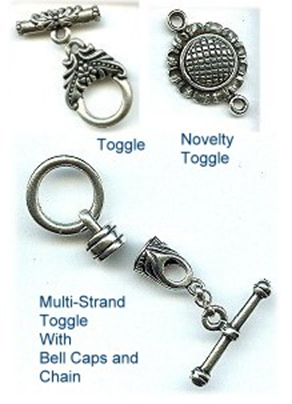
The main drawback, for me, of the toggle clasp, is that they tend to look bulky, often presenting a visual issue for me. They do make novelty toggles, such as the sunflower one pictured above, or a leaf and stem or flower and stem or butterfly and butterfly wing. These work. Also, in some simpler designs, the toggle clasp becomes that visual center — the natural focal point we like to design in to our pieces .

Another major thing to keep in mind with toggle clasps is that the last half inch or so of beads on the side of the piece connected to the bar, must be small enough to slip the width of the bar PLUS the width of these beads far enough through the ring part of the toggle, that you can seat the bar correctly, like in a saddle. When using larger beads in your piece, you might need to begin and end your strand with smaller beads.

For multiple strand pieces, you would typically add a string of jump rings or a piece of chain to the bar side, and stagger each strand up the chain. Say you have a 3-strand necklace. You could add a 3-link piece of chain to the bar side. You would attach one strand to the top link; the second strand to the middle link; and the third strand to the bottom link. In this way, when you pull the bar through the ring, you are only pulling 1 thickness of beads plus the bar through the hole — not three multiple thicknesses of beads. You do not need to do this on the ring side, but many people do, for symmetry purposes.

Most people use toggles. What a lot of people don’t know is that you should not mix and match your rings and bars. Toggles should always be used as a set. When you go into a store to buy these, if they sell them mix-and-match, you don’t want to buy there. In a large store like ours, if you’re putting a bunch of toggles on a tray, be sure you know what goes with what. When they get bagged up at the register, be sure there’s no confusion about what goes with what. And store them so that there is no confusion about what goes with what.

Button

You can make your own toggle-style clasps, using buttons or large beads. You have so many more colors, looks, textures to play with, when using buttons and beads, rather than the pre-made clasps you would find in the store. One side of your piece is a button and the other side is a loop. The button can be a real button, or a large bead. The great thing about button clasps is that you can incorporate the clasp as part of the design of the piece. You can match colors and beads that blend right in with the piece itself.

In a bead strung piece, you would tie off a button or large bead at one end, string your beads on, and make a loop with your stringing material at the other end. You would come back through about 2–3” through the beads in your piece, to anchor off your stringing material. To make this loop attractive, people cover it with seed beads, like size 11/0, 8/0 or 15/0 seed beads. Some designers use 15/0 or 13/0 sized charlottes. Charlottes are seed beads with one facet on one side of each bead. Using charlottes ups the visual perception of the value of the piece, though not the cost of doing so.

For bead-woven bracelets, the button clasp (a form of a toggle) sometimes works better from a design standpoint.

Making the button clasp:

The hardest part in making a button clasp is the button hole. If the hole is too small, it’s hard to get the button or bead in and out. If the hole is too large, the button or bead can slide out and the piece will be lost.

To make the button hole (loop), attach a thread to the piece, preferably a little further back from the end of the piece. Where exactly you locate the button loop depends on your design; however, in most pieces, stepping back from the edge ends up with a better looking and more durable product.

After anchoring the thread to the piece where you want it, now string several small beads — usually size 11/0 or size 8/0 seed beads — until you have a line of beads when looped, will fit snugly over your button or bead. Some designers like to use size 13/0 charlottes to cover the loop. This makes the loop feel like it’s an attractive metal piece.

Bring the needle and thread around and anchor the loop to the piece.

Tie it. Now bring your needle and thread back through the loop, one or more additional times (until it’s getting very tight inside the bead), reinforcing the bead hole.

Now tie it off, and weave the loop end into the piece, hiding the end of the thread.

Now, take your bead or button, and attach it to the other end of your bracelet. Ideally, you want to step the bead or button a bit back from the edge. When choosing a bead, it must be large enough for the loop to be secured underneath it.

Do not attach a bead or button flush to the surface of the piece. Allow enough space for the loop to clasp underneath it. This is easily achieved by placing a size 11/0 or 8/0 seed bead between your piece and the bead or button. Or make a tight loop of beads to connect the surface of the piece through the button shank. When making this kind of loop, usually size 15/0 seed beads work best.

If the bead is elongated, you must anchor it at the center, not through either end. Otherwise, there would be no place for the loop to clasp beneath the bead.

There is not a sure-fire way to measure a loop to fit perfectly over a button or bead. So don’t beat yourself up if you don’t get it right the first time or two. As a general rule of thumb, the loop should be a bit more than twice the diameter of the button or bead. Keep practicing and you will get to a point where it will work by instinct.

So, to repeat, you would preferably locate the loop and the button a little bit back from each edge of the piece. When you start at the edge, this is the weakest part of the piece, and the pulls and tugs on the clasp will start to tear at this edge. Also, if you start at each edge, when you put the loop over the button, you’ll have an area of skin showing. Hence, the viewer won’t be able to make a circle around the piece. When you set both the loop and button back a ways from the edge, when you put the loop over the button, it draws the two edges together. This makes it easier for the viewer to make that complete circle.

If we look at the button from the side of the piece, you would want to put an 11/0 or 8/0 seed bead between the button and the surface of the piece. This accomplishes two things. First, when the loop goes over the button, it will rub on a bead, not the threads. This prevents these threads from fraying. It also turns out that when the loop goes over the button and rests on a bead, it sits it better, thus reducing the amount of back and forth movement that occurs as the bracelet is worn on the wrist.

S-CLASPS

From a functional standpoint, this is a great necklace clasp. From a usability standpoint, however, it’s a disaster. Most people don’t know how to use these properly. When you don’t use them properly, they don’t function as well.

The simple S-Clasp Assembly consists of an S-shaped piece and 2 soldered rings (one on each side). These rings are your “support system” or “jointedness”. They allow the S-clasp to maintain its position behind the neck, and the beadwork to move freely, as the wearer moves.

Using these: First you do your beadwork. Then you tie off each end to the soldered rings. Then you position each hook-arm relative to the spine. On one side of the “S”, you should position the hook-arm so the O-ring cannot slide out, as if the arm had been soldered to the spine. On the other side of the “S”, you need to position the hook-arm so that the O-ring can slide out, but only with some resistance by the hook.

Most people are clueless about the need to position the hook-arms, and how you do it. So they end up bending each arm back and forth, and they break off, or they slip off the soldered rings. If the arms are not positioned correctly, the S-clasp doesn’t rest securely behind the neck, or allow the beadwork to move freely as the person moves.

S-clasps come in a wide range of styles and prices. You can always find something that allows the viewer to make the complete circle.

HOOK & EYE CLASPS

This is a very good clasp for necklaces, but not as functionally good as the toggle or s-clasps. This is the type of clasp that I prefer to use on my pieces. It is very user friendly. I can always find a design that allows that organic fit. These don’t compete with my beadwork as “art.”

The hook and eye clasp consists of two parts — a hook and a ring or figure 8. If you can position the hook so that the O-ring can slide out, but only with some resistance by the hook, you can use this both on bracelets and necklaces. If the hook-arm is a cast piece and will not move, they tend to only work with necklaces.

Always assume your wearer is right handed. When the wearer reaches back behind her neck for the hook, she should be grabbing this with her right hand.

These come in many styles and price points. You can always find something that will allow your viewer to make that complete circle.

People can usually and easily figure out how to use these. They don’t compete with the artistry of your beadwork.

They have a slight functional flaw in that the hook can work itself free from the ring, when the piece is worn. If you can do this with your piece, you want the hook to face up, (not down).

A choker clasp is special kind of hook and eye clasp. These are usually for multiple strand pieces. The “ring” side is a length of chain, so that the hook can attach in more than one place. This makes the length adjustable.

I find it useful to build in some length-adjustability into all my pieces. This is easy to do with hook and eye clasps by adding a short piece of chain on one side.

MAGNETIC CLASPS

People in general hate clasps, so they love these. These work well in necklaces. While people love these for bracelets, functionally they pose some issues.

To open and close a magnetic clasp, you never pull on them. This weakens the settings for the magnets, and the magnets eventually pop out. Instead, slide the two sides apart, or crack them open like a nut, or as if one side was on a hinge. Never pull.

You can see on a bracelet how the wearer might be tempted to pull them open. The bracelet wearer may also pull on the beadwork itself to open the clasp, thus weakening the bracelet.

Always do some extra reinforcement on the two ends of your pieces where they attach to the clasp.

Magnets come in different strengths, but are not labeled as such. You need to test the strength before you use them.

I suggest adding a safety chain to a bracelet. We hear over and over again stories of how people lost their bracelets to the ravages of an all-too-metallic environment. They’ve lost them to the refrigerator door. One woman lost hers to a car door on her visit to the mall. Luckily for her, when she returned to her car — There it was!

SNAP CLASPS

Snap clasps are like the snaps you have on a blouse or pair of pants. These are usually used in bead woven pieces, but they can be used on strung pieces. They are generally easy to get open and closed. They become part of the piece and its design itself, thus not competing with the artistry of the bead weaving. These clasps do wear out, as they are repeatedly opened and closed. There are many manufacturers and brands of these clasps, and variations in styles. The best ones are made of brass or steel, and have the “male” part be as square-ish as possible. If the base is too narrow, the ring slips off easily.

BARREL CLASPS AND SCREW CLASPS

Barrel clasps are very popular with college age and early 20’s. Never use a sterling silver barrel clasp. As the silver softens at body temperature, the threads soften and strip. Barrel clasps have a weak design element on each end where the clasp is to be connected to the ends of the piece. Most barrel clasps use a type of eye pin/head pin, and these break as they get bent back and forth from movement. So, not a good idea to attach your beadwork directly to the clasp. With barrel clasps, you should always use another intervening ring — a jump ring, split ring or soldered ring — to attach your beadwork to the clasp.

For most types of clasps and other jewelry findings, though not all, you need to use an intervening ring — a soldered ring, a split ring or a jump ring . You attach your beadwork to the ring and the ring to the clasp or finding. Only in this way will you get enough support and jointedness.

Screw clasps tend to look like a bead with a loop on either side.

Usually, one side, sometimes both sides, screw open. These are very attractive and work very well to maintain the organic flow of your piece — making that complete circle. However, the threads strip easily, and it’s difficult to readily figure out how to screw/unscrew the loop out from the bead. Usually the wearer ends up ruining the clasp after a few wearings, since it’s difficult to figure out which way to turn each screw-end — especially while wearing the piece — and the threads strip.

FOLDOVER CLASP

These clasps are found on a lot of jewelry. They are pretty easy to attach. They are pretty easy for the wearer to use them. On one side of the clasp, there is a closed loop. This is attached to one end of the piece, usually with a jump ring. It is fixed. The other end is a tongue that snaps over a base and is held in place by friction. This tongue slips over a ring on the other side of the piece, and then tightly onto its base. After opening and closing this clasp several times, the tongue tends to bend upward, thus losing its friction-based tight close. You can use a chain-nose pliers to push the tongue back and regain the friction. Eventually this tongue breaks off.

FRICTION CLASP or BAYONETTE CLASP

Here a curved wire on one side slips into a curved tube on the other, and is held in place by friction. Or a straight pin is pushed into a rubber tube, where the tube fits snugly around the pin, holding it in place. These come long and sleek, or squat and fat.

The friction clasp pictured above looks great on sleek pieces. For most of these, it’s easy to slip beads or charms over the clasp without having to partially or fully dis-assemble it. These are usually soldered or glued and clamped on to the piece. You need to pay attention to the size of the internal diameter of the opening. You want your cable wire or cord to fit snugly into this opening. Put some glue (any glue except Super Glue, and preferably a jewelers glue like E6000 or Beacon 527) on the cable wire or cord. Stick it in. Use a chain nose pliers to clamp the ends down snug. Don’t clamp them flat. When you clamp them flat, it looks weird and annoying .

Super Glue has few uses in jewelry. The jeweler’s version of Super Glue is called G-S Hypo Cement, which takes longer to set. Super Glue dries like glass, so the bond becomes like a piece of glass. Movement causes the bond to shatter like a piece of glass. And the broken bond looks like a broken piece of glass.

The jeweler’s glues, like E6000 and Beacon 527 dry like rubber. The bond acts like a shock absorber.

BOX CLASP

The basic design here is a box where a bent piece of metal (called a tongue) slips into one side of the box, and is held in place by an internal latch. We consider the tongue and the internal latch moving parts, since these can break.

Box Clasps often look great, but they don’t last a long time. The internal latch often wears out. The tongue is bent up and down each time it is place in or removed from the clasp. After too many times, the metal breaks. It’s hard to find replacements. What’s nice about these are that they come in a wide range of prices and styles, and can adapt easily to the organic sensibility of your piece. Great for moderately priced jewelry. Functionally a bit of a risk for more expensive jewelry, but visually may be just what the designer ordered.

Sterling box clasps pose a problem, if the clasp rests on the wrist or neck. Sterling softens at body temperature. When the internal latch softens, it releases the tongue. Jewelry coming out of Mexico is notorious for this happening. Say you have a problematic clasp. You don’t have to throw it away. You can use larger beads on either side of the clasp, so that it never rests on the skin.

LANYARD CLASP

This is a wire that is bent into a clasp shape. One end of the wire overlaps that of the other side, and is “springy”. These clasps will lose their “springy-ness” over time. You see these a lot with name badge jewelry. I like to use these clasps with hemp necklaces. They work well with thick cords. They have a primal feel about them.

From a design theory perspective, the base of the clasp is an interesting element. It is basically an arch pinched at its base. This completely changes the mechanical properties of the arch, turning it into a spring. The spring absorbs all the force of the arm, when the arm is bent back and forth to open and close the clasp. If this arch were a V-shape, bending it back and forth would break it. In the Curved-Shape, bending back and forth will also break it. But pinching it, the movement is accommodated by and the forces absorbed by the clasp.

Lanyard clasps come very functional like that pictured. They come fancier, as well. Some of the fancier ones are good substitutes for lobster claws. Lanyard clasps are widely used in name-badge lariats and necklaces.

SLIDE CLASP

These are made for multi-strand necklaces and bracelets, from 2-strand to 9-strand. They are basically two inter-fitting tubes with loops soldered onto them. They are very sleek. They come plain and patterned. They work with friction. They don’t compete with your beadwork. They work for bracelets and necklaces. This is one of the only clasps that has been coming down in price over time. The market is telling you that this is a good clasp, and I agree with the market.

I especially like these clasps for bracelets. They have a way of keeping all the strands of a multi-strand piece laying nicely and separately and spread out. With a lot of other clasps, the multiple strands overlap, get entangled, and don’t lay as well as intended. Usually, one person, wearing a bracelet using these slide clasps, can maneuver these on and off without much difficulty. Another plus.

In many flat, wide beadwoven pieces, I often suggest sewing these in place to use as the clasp.

You do not need to use any intervening rings with this clasp.

DOOR KNOCKER CLASPS

Here we have a loop with a slight opening, with a bar and knob that moves from the base of the loop, over and into the slight opening. These are attractive. They are relatively easy to use. They do loose their friction in holding the knob into the opening.

With these, two removable loops (soldered rings) hold the beadwork in place. You could make many strands of bead work, ending each with a soldered ring wide enough to slip the clasp, and use them interchangeably with this clasp. Or you could use this clasp when you want to change the number of strands of beads you want to wear at one time.

Picture: One Clasp plus a set of necklaces, worn singly, or together.

Other Articles of Interest by Warren Feld:

Best Way To Thread Your Needle

Bead Stringing With Needle and Thread

Beading Threads vs. Bead Cord

Turning Silver and Copper Metals Black: Some Oxidizing Techniques

Color Blending; A Management Approach

Cleaning Sterling Silver Jewelry: What Works!

What Glue Should I Use When Making Jewelry?

When Choosing Colors Has You Down, Check Out The Magic Of Simultaneity Effects

The Color Effects of Threads

Wax, Wax, Wax

When You Attend A Bead Show…

When Your Cord Doesn’t Come With A Needle…What You Can Do

Duct Tape Your Pliers

What To Know About Gluing Rhinestones

Know Your Anatomy Of A Necklace

How Does The Jewelry Designer Make Asymmetry Work?

I hope you found this article useful. Be sure to click the CLAP HANDS icon at the bottom of this article.

Also, check out my website (www.warrenfeldjewelry.com).

Subscribe to my Learn To Bead blog (https://blog.landofodds.com).

Visit Land of Odds online (https://www.landofodds.com)for all your jewelry making supplies.

Enroll in my jewelry design and business of craft video tutorials online.

Add your name to my email list.

Posted in Stitch 'n Bitch | Tagged: , , , , | 2 Comments »

Two Insightful Psych Phenomena Every Jewelry Maker Needs To Know

Posted by learntobead on April 23, 2020

The First Cognitive Thing The Viewer Wants To Do Is Make A Complete Circle

The Cognitive Processes of the Viewer

As a Designer, one thing you need to anticipate is how the piece will be viewed and understood. It turns out that jewelry plays some very important psychological functions for both the wearer and the viewer. By understanding these perceptual and cognitive processes, you the designer have some powerful information to play with. Here I discuss two cognitive processes that happen immediately when the viewer first interacts with a piece of jewelry.

When a viewer walks into a room, and in the room is a stranger who also happens to be wearing a necklace, the viewer has to very quickly determine whether the situation is safe or not. We are pre-wired with an anxiety response, so that we can assess the situation almost instantaneously, and flee or fight, so to speak. The eye/brain looks for clues. One clue is provided by the necklace the stranger in the room is wearing. The eye/brain focuses on the jewelry and performs two simple tests.

When our viewer first cognitively interacts with the piece, her eye/brain tries to “make a complete circle around the piece”. Very simple: Make a Complete Circle. If something about the piece slows her down, or otherwise disrupts this natural cognitive process of trying to visualize a complete circle, she begins to feel some anxiety or discomfort or edginess. This might be a clasp that doesn’t coordinate well with the beadwork. It might be an inappropriate or poor use of color, shape, texture, pattern, or size. It might be a clasp assembly that takes up too much space along the yoke of the piece.

The eye/brain looks to see a complete circle. The viewer, in turn, begins to react to and translate this situation, where things get in the way of or somehow disrupt the process of visualizing that complete circle, as seeing the piece as monotonous or boring or ugly or some other negative, less satisfying characteristic or scary or will cause death. If the brain gets edgy, then the interpretation of the stimuli becomes a negative emotion-laden response. The viewer’s anxiety response is telling this person that it may be time to consider turning around and fleeing, instead of going forward, approaching or even fighting.

These negative traits of the jewelry quickly get associated by implication, with the wearer. The wearer begins to get defined as monotonous or boring or ugly or some other negative, less satisfying characteristic or scary or will cause death. As a designer, you don’t want this to happen.

The Second Cognitive Thing The Brain Wants To Do Is Find A Natural Place For The Eye To Come To Rest

The second thing the brain tries to do, after making that complete circle, is “come to rest.” The eye/brain looks for a natural place to come to rest.

We usually achieve this by creating a focal point. We might use a pendant. We might graduate the size of the beads, or graduate the color intensity or value.

In a very simple piece, the clasp assembly itself might be the natural place for the eye/brain to come to rest. In pieces where there is not a natural place for the eye/brain to make a complete circle and then come to rest, the brain starts to get edgy and feel some anxiety. The piece, in turn, begins to get interpreted as monotonous, boring, ugly, some other negative, less satisfying characteristic, scary, will cause death.

As the piece gets labeled, so does the wearer. Again, you don’t want this to happen. Not to the wearer when wearing one of your pieces. As the viewer runs screaming from the room.

People are prewired with an avoidance response. This occurs in our brain-stem. This protects the viewer from things like snakes and spiders, by making them want to avoid things which are ugly or dangerous.

When someone views the jewelry for the first time, they have to interpret it. One cultural and often subconscious reason people wear jewelry is to make people feel comfortable around them.

As a designer, you can anticipate all this. You now know that the viewer, cognitively when interacting with a piece of jewelry, will first try to make a complete circle, and then will want the eye to come to rest. Otherwise, the brain will start to get edgy and feel anxiety. The person might want to turn around and flee.

The eye/brain wants to make a complete circle, then come to rest.

Design accordingly.

Just one more note: Our brains process a lot of information at once — what we call parallel processing. Other perceptions cognitions co-occuring withthe anxiety response might mitigate the viewer’s reaction. Or might amplify it. Who knows?

Below are two images of one of the entries to our The Ugly Necklace Contest, which somewhat illustrates the point about what happens cognitively. The image on the left shows the whole necklace. The image on the right shows the lower half of the necklace. Look at each image. For each, get a feeling for how motivated you are to make the complete circle, or how satisfied you feel about the necklace.

NECKLACE FULL VERSION: With these beads and this rhythm and configuration, are you less motivated to make the complete circle around the whole piece, or less satisfied when doing so?
NECKLACE CUT IN HALF VERSION: With the necklace shown shorter, with these beads and this rhythm and configuration, are you more motivated to make the complete circle around the whole piece, or more satisfied when doing so?

People typically find that the full version takes more work to motivate yourself to make the complete circle. While the beads vary a bit, they are basically the same color tone. A pattern is set in the lower half of the piece, and the upper half adds little or no new information to excite the viewer. It becomes more work to make that complete circle. It becomes boring.

In the half version, people feel a little more satisfied with it. The artist has made her point, without additional repetition of what feels like monotonous components. People see it as less monotonous, less boring, less ugly. (…And of course, less scary and less likely to cause death.)

In this necklace, the designer created a pendant drop as the natural place rest. There is some awkward treatment, positioning and placement of the protruding elements near the bottom of the necklace, which makes the place to come to rest it a little less satisfying.

Other Articles of Interest by Warren Feld:

Oy Ve! The Challenges of Custom Work

The Importance of Self-Promotion: Don’t Be Shy

Are You Prepared For When The Reporter Comes A-Calling?

Don’t Just Wear Your Jewelry…Inhabit It!

Two Insightful Psych Phenomena Every Jewelry Designer Needs To Know

A Dog’s Life by Lily

Copyrighting Your Pieces: Let’s Not Confuse The Moral With The Legal Issues

Jewelry, Sex and Sexuality

Jewelry Design: An Occupation In Search Of A Profession

Teaching Discplinary Literacy: Strategic Thinking In Jewelry Design

Contemporary Jewelry Is Not A “Look” — It’s A Way Of Thinking

Beads and Race

Were The Ways of Women or of Men Better At Fostering How To Make Jewelry

The Bridesmaid Bracelets

I hope you found this article useful. Be sure to click the CLAP HANDS icon at the bottom of this article.

Also, check out my website (www.warrenfeldjewelry.com).

Subscribe to my Learn To Bead blog (https://blog.landofodds.com).

Visit Land of Odds online (https://www.landofodds.com)for all your jewelry making supplies.

Enroll in my jewelry design and business of craft video tutorials online.

Add your name to my email list.
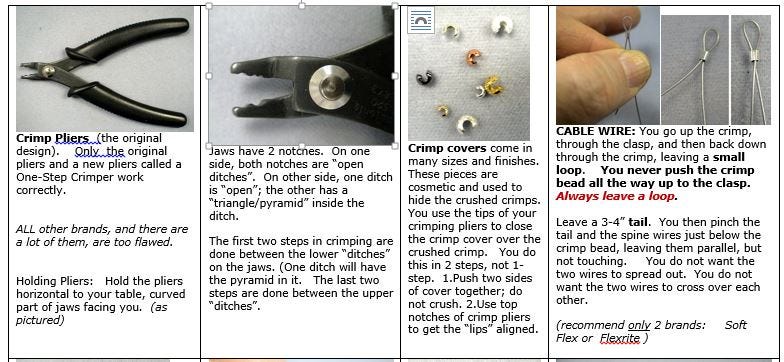
Posted in Stitch 'n Bitch | Tagged: , , , , | Leave a Comment »

Know Your Anatomy Of A Necklace

Posted by learntobead on April 22, 2020

A necklace, or any type of jewelry, has a structure and an anatomy. Each part has its own set of purposes, functions and aesthetics. Understanding each type of structure or physical part is important to the designer.

If we looked at these sections of a necklace from solely an Art standpoint, we might primarily focus on the centerpiece of the jewelry and consider The Strap (and most other parts) as supplemental and less important to the piece, in a similar relationship as the frame to a painting or the pedestal to a sculpture.

However, jewelry is a 3-dimensional object serving both aesthetic as well as functional purposes. As such, we need to be more sensitive to the entire jewelry-anatomy and both its Art and Architectural reason for being. This kind of thinking is at the core of what makes jewelry design, as a discipline, different than art.

Typical structural parts of a necklace might include,

The Strap: The entire linear component of the piece, comprising Yoke, Clasp Assembly, and Frame

The Yoke: The part of The Strap behind the neck, typically 6–7” including clasp assembly

The Clasp Assembly: Part of The Yoke, and includes, not only the clasp itself, but rather all the pieces it takes to attach your Strap to the Clasp, including clasp, rings, loops or knots or crimps at ends of stringing material

The Frame: The visually accessible part of The Strap, connecting to The Yoke at The Break point. On a 16” necklace, The Frame might be 9–10”

The Break: The point where The Yoke connects to The Frame, often at the collar bone on either side of the neck. Very often, this point is one of a critical change in vector — that means, the angle The Frame lays radically changes from the angle of The Yoke. Think of this as an inflection point.

The Bail: A separate part which drops the centerpiece or pendant drop below the line of the Frame

The Focal Point, Centerpiece, or Pendant Drop: A part which emphasizes or focuses the eye, usually dropped below the line of The Frame, but is sometimes a separate treatment of The Frame itself

The Canvas: Typically the stringing material or foundation of the piece

The Embellishment: Things added to the surface or edge of The Canvas, The Strap, or the Centerpiece which serve as decorative, rather than structural or supportive roles

Each part of the body of a necklace poses its own special design challenges for the jewelry artist. These involve strategies for resolving such issues as:

— Making connections

— Determining angularity, curvature, and roundedness

— Transitioning color, pattern and texture

— Placing objects

— Extending lengths

— Adding extensions

— Creating balance and coherency

— Anticipating issues about compression, stretching, bending, load-bearing, and distortion

— Anticipating issues related to physical mechanics, both when the piece is static (not moving when worn) and dynamic (moving when worn)

— Keeping things organic, so nothing looks like an afterthought, or an outlier, or out of place, or something designed by a committee

— Determining which parts are critical to understanding the piece of jewelry as art as it is worn, and which parts are merely supplemental to the piece

The Strap

The Strap is that continuous line that extends from one end of the clasp to the other. The Strap may or may not consist of the exposed Canvas. The Strap typically delineates a silhouette or boundary. This usually sends the message to the viewer about where they may comfortably and appropriately place their gaze on the wearer’s body.

The Strap is a type of funicular structure. A funicular structure is one where something like a string or chain or cable is held up at two points, and one or more loads are placed on it. Loads increase tension. Loads lead to compression.

The placement can be centered or off-centered. If more than one object is placed on The Strap, each object can vary in mass, volume and weight. We do not want The Strap to break because of the weight or placement of any load or loads. We do want to control the resulting shape of the silhouette or curvature of The Strap which results from the weight or placement of any load or loads.

The span of The Strap is very sensitive to force and stress. A piece of jewelry may have more than one Strap. In this case, the span of each Strap, and their built in support and structural systems, must be tightly coordinated, if to respond optimally to forces and stresses.

The Yoke

The Yoke is one section of the Strap which is the part around the back of the neck, typically including The Clasp Assembly. The length of The Yoke, and whether the beginning and end parts of The Yoke should be exposed on the front of the body is something to be determined by the designer. The designer must also determine the proportional size of The Yoke relative to the remaining part of The Strap. The designer must determine what role the elements, such as beads, which comprise The Yoke, will play, and whether they should be an active part of the visual composition, and/or a critical part in the functional success of the piece, or merely supplemental. The Yoke balances the load requirements of the remaining Strap (The Frame), Bail and Pendant.

The Break

At the point The Yoke connects to the remaining Strap (called The Break leading to The Frame) on either side of the neck, this is a point of vulnerability, often assisted and reduced with the addition of support elements. Because it is at this point — The Break — where The Strap may alter its vector position in a dramatic way — that is, the angular positioning of the Strap at the point of The Break may vary a lot as The Strap continues around the front of the body — this is a major point of vulnerability.

There are always transitional issues at The Break. The designer needs to have strategies for managing these transitions. This might involve using visual cues and doing something with color or pattern/texture or rhythm or sizes. The designer might add support systems, such as rings, at this point. The designer must decide the degree The Frame should be visually distinct from The Yoke.

The Clasp Assembly

The Clasp Assembly is most often part of The Yoke. The Clasp Assembly includes, not just the clasp itself, but also all the other parts necessary to attach it to the Strap. There might be some additional soldered rings. There might be loops left at the ends of the stringing material. There might be crimp beads or knots or glue or solder.

Whenever choosing a clasp, it is more important to think in terms of choosing a clasp assembly. You might want to use a very attractive clasp, but it may take so many parts and turns to attach it to your beadwork, that you end up with a visually ugly clasp assembly.

Occasionally, The Clasp Assembly is part of The Frame. This will present a different set of architectural issues and considerations.

The Frame

The Frame is that part of The Strap which connects to either side of The Yoke at The Break.

Too often, when the designer does not recognize the Yoke as distinct from The Frame — even if the transition is to be very subtle — less-than-satisfying things happen. Proportions may be off. The piece may not lay or sit as envisioned. The Strap may have too much embellishment going too high up The Strap. Sometimes the balance between Yoke and Frame is off — too much Yoke and not enough Frame. The change in vector angles between The Yoke and The Frame may pose many architectural issues for the designer.

Bi-Furcated Frame: A Frame visually split in half, usually at the center and in two equal parts, with a centerpiece focal bead or pendant drop in the middle. Here the designer needs to think whether the two lengths should move in a coordinated fashion, or not.

The Focal Point, Centerpiece or Pendant Drop

While not every necklace has a focal point, centerpiece or pendant drop, most do. The Focal Point gives the viewer’s eye a place to rest or focus. Usually this is done with a Centerpiece or Pendant Drop.

Othertimes, The Focal Point is more integrated with The Strap. This might be created by graduating the sizes or beads or playing with color or playing with rhythm or playing with fringe.

A Centerpiece would be a part that extends beyond the line of The Frame, usually below it, around it, or in front of it. This forces transitional concerns between it and The Frame.

There should be a natural visual as well as functional transition from The Strap to The Focal Point, Centerpiece or Pendant Drop.

The Bail

The Bail is a part that drops the Centerpiece below the Frame, forcing additional transitional visual and functional concerns among Centerpiece, Bail and Frame. We are concerned about its impact on emphasis, harmony, balance, distribution of size and proportion, point, line, plane and shape. We are concerned about its ability to maintain stability, given the effects of gravity, the weight of the drop, and its relationship with and fit to The Frame of The Strap. Most Bails would be considered vertical structures.

The Canvas

The Canvas typically refers to the stringing materials. However, in a layered piece, may refer to any created “background or foundation” off of which or around which the main composition is built. The Canvas might be either a horizontal structure (like an arch or truss) or a vertical structure (like a wall or frame). It might be exposed, partially covered, or fully covered. It might change materials or construction systems along its length, such as transitioning from a cable wire to a chain.

It is important to know what The Canvas is made of, and how its function and appeal might improve or weaken as its Span is lengthened or shortened, widened or narrowed, over time. The steepness of its slope or positioning might also affect its integrity.

Sometimes more than one Canvas are interconnected. You can picture a necklace with additional strands crossing the chest from one side of The Strap to the other. You might also have a necklace where strands radiate out at angles from the neck and across the chest.

Architecturally, additional Canvases which span from one side to the other of a piece of jewelry operate like Trusses, Arches or Support Beams. These types of structures are referred to as Horizontal Structures.

The Embellishment

The Embellishment includes things like fringe, edging and surface decoration. Embellishments are decorative elements added for purposes of improving the visual appeal of a piece. Embellishments typically do not play any support or structural roles.

Other Articles of Interest by Warren Feld:

The Jewelry Design Philosophy: Not Craft, Not Art, But Design

What Is Jewelry, Really?

The Jewelry Design Philosophy

Creativity: How Do You Get It? How Do You Enhance It?

Disciplinary Literacy and Fluency In Design

Becoming The Bead Artist and Jewelry Designer

5 Essential Questions Every Jewelry Designer Should Have An Answer For

Getting Started / Channeling Your Excitement

Getting Started / Developing Your Passion

Getting Started / Cultivating Your Practice

Becoming One With What Inspires You

Architectural Basics of Jewelry Design

Doubt / Self Doubt: Major Pitfalls For The Jewelry Designer

Techniques and Technologies: Knowing What To Do

Jewelry, Sex and Sexuality

Jewelry Making Materials: Knowing What To Do

Teaching Discplinary Literacy: Strategic Thinking In Jewelry Design

The Jewelry Designer’s Approach To Color

Point, Line, Plane, Shape, Form, Theme: Creating Something Out Of Nothing

The Jewelry Designer’s Path To Resonance

Jewelry Design Principles: Composing, Constructing, Manipulating

Jewelry Design Composition: Playing With Building Blocks Called Design Elements

Contemporary Jewelry Is Not A “Look” — It’s A Way Of Thinking

I hope you found this article useful. Be sure to click the CLAP HANDS icon at the bottom of this article.

Also, check out my website (www.warrenfeldjewelry.com).

Subscribe to my Learn To Bead blog (https://blog.landofodds.com).

Visit Land of Odds online (https://www.landofodds.com)for all your jewelry making supplies.

Enroll in my jewelry design and business of craft video tutorials online.

Add your name to my email list.
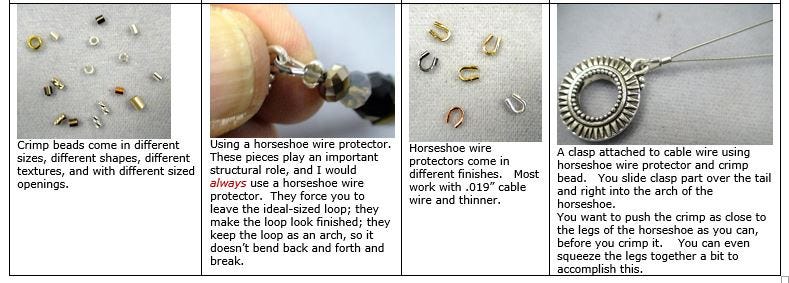
Posted in Stitch 'n Bitch | Tagged: , , , , | Leave a Comment »