“She’s CHEATING ME!” the woman from Rhode Island screamed into the phone. She could hardly catch her breath, the anger overtaking her ability to explain why she was calling.
“I read your article about Pricing and Selling, and I’m not getting my $70.00 for my piece.”
She didn’t have to say anymore. I knew right off the bat she was talking about CONSIGNMENT.
I recognize the anger. The frustration. The feeling that someone put something over on you, and you’re powerless to correct the situation. You don’t know what to do. You know the sweat, time and cost you put into all the pieces you let some stranger have, and now what do you do?
“I put 10 of my pieces of jewelry in her shop in Northern Rhode Island — not a big shop, no sales, except, this one piece sold, not in a major place,” she continued, taking breath after breath, to get it all out, in some way that made sense, and some way that kept her from losing it.
“What do I Do?” “She sold my piece for $70.00, and didn’t give me my money?” “Should she have given me my money right away?” “Should I take my jewelry out of her shop?” “Should I never do consignment again?” She peppered me with questions, not waiting for an answer.
She indicated that the store owner told her that she paid her artists 30 days after a sale. Her customers had 30 days to return something. If the store owner paid before that time, she would be out the money. Store owners can set whatever policies they want, and in this case, I told the woman it was reasonable to wait 30 days, given the policy.
Of course, it had already been 7 weeks.
“Should she call her?” Her husband told her not to call yet. He didn’t want her to make waves, or ruin this opportunity to sell her jewelry.
“Call her,” I said. If the store owner said 30 days, then 30 days it should be.
Consignment may be a necessary evil, especially when you are getting started in the jewelry making business. But consignment is not the best situation to be in. Most stores that accept consignment do not understand the consignment business. As a result, when the time comes to pay the artists, there’s no cash flow.
In Consignment, the store is at greater risk than the artist. The store has to make space available for the pieces, and forgo the opportunity to get something else in that retail-real-estate that might do better. The store has to display the pieces, and keep them clean and presentable. The store has to train its sales staff so that they have sufficient information and motivation to make the sale. And, of course, there’s the tracking and accounting that goes with every consignment piece on sale.
Your best clue to whether a particular consignment situation is a good or better one, is the percentage split between the store or gallery owner and the artist. Given the level of risk each party assumes, the optimum distribution is 60/40 with the store or gallery getting the larger amount. But if the split is 40/60 or 50/50, this would be a acceptable sign as well.
However, when the split is 70/30 or 30/70 or outside this 60 and 40 range, yellow flags should go up. This shows that the store or gallery owner is not aware of the level of risk in their business. You probably won’t get paid on time, and not get paid without a lot of time spent yelling on the phone. Your pieces won’t be maintained. They won’t be displayed in a prominent place. No one will be trained or motivated to sell your pieces.
Just because you confront a potentially bad consignment situation doesn’t necessarily mean that you should walk away. There are a few prominent boutiques in Nashville that offer a 70/30 split between the store and the artist. They rarely pay their artists when the pieces sell. It takes a lot of screaming, “Bloody Murder!” before you get paid. But these are very prominent shops. Letting other stores and galleries know that you have pieces in these shops will open many doors for you. You might view the delayed payments and the effort to get your money as “marketing expenses.”
Other reasons you might settle for a bad situation: – You’re just getting started, and saying your pieces are in a shop anywhere has some marketing cache that goes with this – You can direct customers to this shop. At least you have a place to send people. You might not have a central base from which to work. Your main business might be doing craft shows, and here you can direct people to your jewelry between shows. – This might be the only game in town.
But otherwise, if consignment doesn’t have some added value for you, you want to minimize your consignment exposure.
When you negotiate consignment terms with a shop, try to:
Get a feel for the amount of consignment they do (and how long they have been doing this), the range of artists, the range of types of merchandise on consignment, and the types of customers they have
Get a 60/40, 50/50 or 40/60 split
Work with store or gallery owner on final retail pricing of your pieces.
Get a written contract
Get in writing if possible, but an oral agreement would suffice, to convert the situation to “wholesale terms”, if you pieces sell well. (Be sure to define what “selling well” might mean.)
Determine a specific date when to take your pieces out, or trade them out for new pieces. Usually it’s good to trade them out every 3–6 months.
Determine exactly how and when you will get paid, after any one piece sells. A 30-day waiting period is reasonable.
I often get many questions about what glue to use with rhinestones and other beading and jewelry-making projects. I design jewelry. I do some silversmithing, wire working, bead stringing, bead weaving, kumihimo, and other techniques in my designs. I have been beading and making jewelry for over 30 years, and own a bead shop in Nashville, Tennessee.
When you make jewelry and need an adhesive to attach one component to another, to embellish a piece with stones, to secure a clasp, or to finish off or begin a new stringing material, you have certain issues you need to contend with.
First, all jewelry moves when worn. This results in a tremendous amount of force placed on the jewelry, increasing stresses and strains. You want the glue-bond to be able to resist, or better accommodate, these forces.
Second, you do not want your glue-bond to expand when dry.
Third, you want your glue-bond to dry clear.
Fourth, you want your glue-bond to withstand the very cold and very hot extremes of temperature where you live.
You want your glue to be able to bond to the materials you are working with.
You want to easily wipe off and remove the excess glue from your piece.
Nothing is perfect, but based on our experiences, here are some good tips:
(1) Always experiment with your adhesives first, before you use an adhesive on your final project. No one glue works with every project.
(2) Glues vary widely in terms of which materials they stick to, how well they form a bond between two smooth surfaces, and how the glue bond ages, both in terms of durability and color, and whether the glue expands in volume after it dries, or not.
(3) Clean the excess glue off your piece before you display or sell it.
(4) You will probably have to rely on more than one type of glue to accommodate all your types of projects.
Jeweler’s glues are the perfect choice in most situations. Jeweler’s glues dry like rubber, so the bond acts as a shock absorber. They also dry clear and without expansion. Jeweler’s glues take 24 hours to dry hard. They begin to set in 10 minutes, so you can move things and re-position them, if you want, during these 10 minutes. At 20 minutes, the consistency is like rubber cement. Excess glue can easily be rubbed off with your fingers or pulled off with a tweezers.
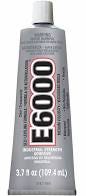
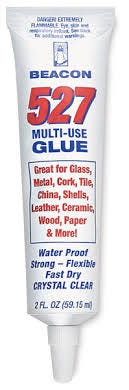
The two brands I use the most are E6000 and Beacon 527. The glues are very similar. E6000 is very thick. Beacon 527 is very runny. Beacon 527 begins to set a little faster.
E6000 and Beacon 527
My favorite glue is referred to as a 1-part epoxy (but it’s not really an epoxy). “1-part” means that you don’t have to mix anything to make the glue — it just comes out of a tube. One brand is called E6000, and this version of the glue is thick in consistency. Another version of the glue is called Beacon 527. This glue is runny. Some people prefer one or the other. E6000 is the first one I used, and I prefer that one. But I actually use both where I think the thickness or the runnyness might be an advantage. There are other brands as well.
Perfect for attaching findings to base metal and costume jewelry pieces. Also, use E-6000 on bead strands to seal end knots and to provide a strong, flexible seal that won’t become brittle or damage the bead cord. E-6000 is safe for use with virtually every type of gemstone and works on wood, leather, vinyl, and canvas.
Non-corrosive and self-leveling, E-6000 adheres in 5 to 10 minutes, and hardens to a clear, waterproof cure in 24 hours. This means you have about 10 minutes to position and reposition whatever you are gluing. After about 20 minutes, you can take your finger and/or a tweezers and rub off any glue that has oozed out from any edges or around any pieces. If you are making jewelry, you should let the piece dry “hard” overnight, before you wear it.
E-6000 dries like rubber, so the glue acts like a shock absorber, as your jewelry moves.
Drawbacks: It doesn’t bond well between two smooth pieces of glass. Here it’s a good idea to rough up the surface a bit with steel wood or sand paper or metal file. It doesn’t bond well to very oily surfaces.
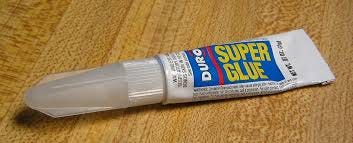
Superglue
Superglue is not our favorite! Superglue has very few uses in jewelry design. It often ruins rhinestones (it discolors them and makes them cloudy) and other pieces we use in jewelry-making. It’s bond is tough, but it breaks easily when pieces move. Superglue dries like glass, and the bond shatters like glass. Moreover, the shattered bond looks like a piece of broken glass, so if any stringing material is nearby, the bond can cut it. It is terrible with elastic string.
We do, however, use superglue occasionally.
Cement or Glue?
A glue works by surrounding or closing in on an object. As the solvent in the glue evaporates, it’s “collar” gets tighter and tighter.
A cement works by adhering to all the individual fibers or elements of the materials you are using.
G-S Hypo Cement
This is the jeweler’s version of superglue. It doesn’t dry instantly like superglue. It takes about 20 minutes to set. It’s bond is like that of superglue.
We often use it to seal end knots, or coat a frayed strand of cord. We sometimes use it on crimp beads to enhance the closure. Unlike its super glue cousin, G-S Hypo Cement takes several minutes to set, so you can move things around during this time.
This glue has a very ultrathin needle point to get into very tight spaces.
G-S Hypo Fabric Cement
This version of g-s hypo cement is perfect for gluing knots in fibrous materials, especially silk. Great with any bead cord or stringing material made with natural materials.
Fabric Glue or Fabri Tac
Fabric and bead cords are made up of many, many micro fibers. It is important for the glue to bond to all these fibers, else, the bond won’t hold. While I prefer the G-S Hypo Fabric Cement, these glues are a good substitute.
Hot Glue Guns
Hot glue guns are easy and fun to use. When the materials you are using are large and bulky, hot glue guns make the projects go faster.
The glue’s bond will not last forever. The glue will yellow with age. The bond weakens at body temperature. If you made a dangly pair of earrings, and hot-glued a rhinestone to the piece that touches the ear, the rhinestone will likely pop off when the earring is worn. If you hot-glued stuff on the dangle, you won’t have the same problem.
Gorilla Glues
This line of glues is very, very strong. However, the bond expands as the glue dries. Most versions do not dry clear. They discolor with age.
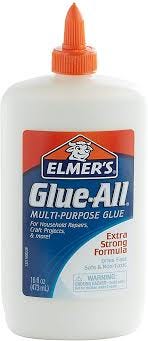
Elmers Glue and School Glue
These glues are safe for kids. They work OK, but the bonds weaken when wet, through washing or sweating.
About Gluing Rhinestones, Marcasites, and other Stones or Components
Your goals for gluing rhinestones into or onto a piece of jewelry or cloth or other surface are simple:
A bond that sticks and is durable.
A bond that does not ruin the materials you are using.
A bond which dries clear and ages clear.
Glue which will not show outside or over the edges of the stone.
Glue where you can easily remove any excess glue that extends beyond the boundaries of the stone.
Glue which does not expand when it dries.
Glue can adversely affect your materials, so you always want to do some pretesting! Also, some of the rhinestone and other glues you may use might be soluble in soapy water, such as when you wash your hands or wash dishes.
Rhinestones are foiled back pieces of acrylic, glass or crystal. Some glues will pull the foil off or make it crinkle. Some glues may make the rhinestones cloudy. This is especially true with acrylic and glass rhinestones, but not necessarily with crystal rhinestones.
I prefer to use E6000 when gluing these into settings, onto fabric, or onto other surfaces. This creates the strongest bond. Most E6000-stones glued onto fabric will survive the washing machine several times.
When we use E6000 with rhinestones, we put a little drop of glue on the end of a pin. Then we touch the glue to the back of the rhinestone. We maneuver the pin-glue-rhinestone over the place where we want the stone to be. Then we push the rhinestone in place with our finger, and simultaneously pull the pin away from the stone. After about 20 minutes, we rub the stone and around the stone with our finger or the pin to get any excess glue off.
Some additional suggestions about glues
A great book to buy is The Crafter’s Guide To Glues by Tammy Young. In it she discusses all the types of glues, including the following:
White glues, such as Elmer’s Glue All
– bond is not strong, so useful for lightweight objects only
– bond is not flexible, so not useful for things where there is movement
– may not dry clear
-materials used must be porous
Tacky glues, like hot glue gun
– usually dry clear and are flexible, but can wash out
– body temperature can weaken bond
Clear Craft Glues
– wash out easily
– for lightweight projects
Super Glue
– instant adhesive, that works with many smooth surfaces, but not well with smooth glass surfaces
– will cloud rhinestones
– especially good with plastic pieces
– water resistant, but not best choice for washable projects
– inflexible; does not work well where there is movement
High Tech Adhesives, like E6000 and Beacon 527
– not water soluble
– bonds to both porous and non-porous materials
– does not bond well to rubber
– sets slowly, so you can re-position things
– dries clear
Fabric Glues, like No-Sew
– holds up through several dry cleaning cycles
– formulated to glue fabric to fabric
– make also work well to glue various embellishments to fabric
Fusibles, where you melt the glue with an iron or another heat source, such as a transfer
– for applying appliques or transfers
– prewash all materials before fusing
Aquarium Glue (glass cements)
– great for bonding two smooth surfaces of glass
Clear Cements, like G-S Hypo Tube or Watch Crystal Cement
– Doesn’t dry as fast as super glue, so can do some re-positioning, but bonds strong like super glue
– Good to use for sealing knots in jewelry projects
– Not as strong as epoxies or high tech adhesives
– water resistant and not affected by temperature
As with anything you do as a bead and jewelry artist, you want to ask lots of questions and get lots of advice. You want to play with a wide variety of tools and glues and stringing materials and metals and beads. You want to experiment. Let yourself try and err.
This is a lot of information. But this Orientation is important. Very important. Making jewelry is very similar to building a bridge — you must be familiar with many kinds of materials, how the materials interrelate, and how you link and connect these materials in a durable and appealing piece which wears well, and moves well with the wearer.
It always amazes me about how many people (studies show that 25% of the population) think that when their sterling silver jewelry turns black, it’s Dead and they throw it out. So, especially if you are selling your stuff, you always need to educate people about cleaning sterling silver.
Sterling Silver tarnishes from the interaction of silver and sulfides in the air. First the tarnish will take on a golden hue, and eventually, it will turn the piece black. This is a natural process.
Higher sulfide levels are associated with humidity and/or pollution. Remember, the more humid the climate, the faster sterling will tarnish. On a summer day in Miami, Florida, all you have to do is walk out the door and the sterling starts turning black very quickly.
Sterling Silver will polish up by rubbing or buffing it with a soft cotton cloth. The best cloth to use is a piece of denim. Yes, rub it on your pants.
Jewelry stores either sell or give away what is called a Rouge Cloth. This is a little bit gimmicky, in that what is taking the tarnish off is the rubbing, not the rouge. In most cases, denim works better. Both denim and the rouge cloth are 100% cotton. Denim has ridges on it. The rouge cloth is smooth.
The ridges of the denim get inside the links on chains. The ridges get into the crevices in your jewelry. The rouge cloth is terrible for chains. However, if you want the crevices in your jewelry to remain black, the rouge cloth, which is a smooth surface, will work better.
You might also invest in what is called a Sunshine Cloth. Many bead stores and jewelry stores sell these. The Sunshine Cloth has a chemical in it that eats the tarnish but does not harm gemstones. And that’s its greatest selling point — it does not harm gemstones.
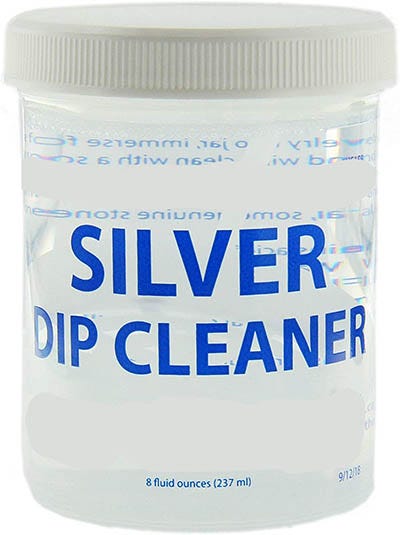
Sterling Silver dips are fast and easy, but are not the best choices here. Ideally you would never use a dip, or only use a dip in an emergency. First, many dips will take the color and the polish off many gemstones. Second, the dips work by pulling silver out your jewelry and creating a silver salt. The salt is usually white, sometimes black. This salt or residue gets caught inside the links of chains. It gets caught in the crevices in your jewelry. It is difficult to pick it out.
If you do have to use a dip, the way you use this dip is that you take your piece of jewelry, and put it in, and immediately take it out and rinse it off. If not clean enough, repeat. Never leave your jewelry in the dip. Then buff your jewelry with a soft cotton cloth. The buffing brings out more of the shine, and helps take off any residue left on the piece.
Most silver polishes do not work well with sterling silver jewelry. Repeated uses usually cut the shine and leave a white color to the sterling silver in jewelry. They primarily are used for silver plated kitchen ware and utensils. One exception, which I like, is Tarni-Shield — a silicon polish. Tarni-Shield will keep the piece of jewelry shiny until the shield wears off. We primarily us this product when we make a lot of jewelry that has to be on display for a long time, such as when we’re selling our pieces at an arts and crafts fair.
There are lacquer dips which coat your jewelry in order to keep the shine. (This is similar to painting clear nail polish on your jewelry). The lacquer, however, wears off unevenly, allowing some places to tarnish and others not. As the lacquer coating loosens in some areas, the silver will tarnish underneath it, but this area will still be inaccessible to your polishing cloth, until that lacquer actually chips or peels off. This can leave your pieces unsightly. If the piece is a chain, or a filigree, the lacquer will form a film within the openings and cracks. This obviously makes the piece ugly.
If you have some heavy duty tarnishing to deal with, then the easiest thing to do is to make a paste of baking soda and warm water, use a soft bristle toothbrush and scrub and rinse.
Even dry baking soda will take the tarnish off. You ruby your jewelry back and forth into a pile of dry baking soda, then use a cosmetic brush to pat the jewelry to get the powder off.
The effects of the baking sod, whether dry or as a paste, are almost instantaneous. You can also use baking powder. You can use baking soda toothpaste. If you have a large tea-pot, you can make a dip instead of a paste.
Some people sell set-ups using baking soda and tin foil, or baking soda and a sonic bath. These are gimmicks. What’s taking the tarnish off is the baking soda. That’s all you need.
Some Additional Advice
Never use a cleaner with ammonia or sulphur in it.
Sterling Silver is best stored in an air-tight, zip lock plastic bag, and in a drawer or somewhere out of the light. When you put the silver into the plastic bag, be sure to push out all the air before sealing the bag.
[Note: Sometimes you can restore that oily polished look on gemstones by rubbing them with men’s black shoe wax.]
Kathryn was so very excited! She had just finished speaking with a reporter for a local arts magazine. He wanted to do a story about her as a jewelry designer. The magazine was 4-color, very substantial and distributed widely in her hometown area. Moreover, the reporter promised he’d include 5 pictures in the article. They made an appointment to meet in the middle of next week. And Kathryn was thrilled!
The reporter met her at her home. She greeted him, somewhat giddy, not sure what to say, or say next. She thought she would let him lead the conversation and interview. She gave him a short tour of her house — her beading room, her den, her living room. The reporter marveled at her collection of Pez dispensers and puppets. A short time later, a photographer joined them.
After 2 hours, the reporter and photographer had left. Kathryn was satisfied that they had seen several of her bead-woven jewelry pieces. She felt that she had given them a good history of how she got into jewelry making. The photographer had taken at least 20 shots of her around the house. The article was to come out in 3 weeks.
Three weeks later, and there it was.
A 4-color article. In a prominent local art magazine. About her wonderful Pez collection. And the long staircase from the street level to the living level in her house. And all her puppets. And information about her moving from Connecticut to Tennessee and having lived in Georgia. And she had three children.
And no pictures of her jewelry.
Or her bead room.
Or her making jewelry.
And no pictures, surprisingly, of her Pez collection or her puppets, given how prominently these were featured in the article.
There was a picture of her staircase. Three pictures of her sitting on a couch or chair. And a picture of a treasured vase, and quite beautiful.
Kathryn had these high hopes — Now Nashville will know about her jewelry making and design prowess.
Until she saw the article.
And knew now she’d be known for Pez dispensers.
The opportunity to get featured in a newscast or newspaper or magazine doesn’t come around often. However, when the opportunity does knock, this can have a big and positive impact on your jewelry making business. But you have to be prepared.
You Have To Remain In Control
You have to remain in control — even if this leads to a little tension between you and the reporter.
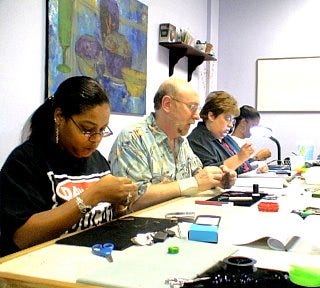
Jewelry Designers At Workshop with Warren Feld, Photo, Feld, 2013
First, pre-prepare.
MAJOR POINTS: Determine the 4 or 5 or so major points you want to make about yourself as a designer and about your jewelry.
No matter what questions the reporter asks, turn the conversation back to your major points. During the interview, keep making the major points. When the reporter returns to his notes to quote you, this will be all the material he has to draw from.
WHAT YOU SHOW AND DON’T SHOW: If you give a reporter a tour of your home, only take him to the design-relevant points of interest. Where you make the jewelry (or other product or project). Where you display your work. Where you have people try on your jewelry or use your products. Where you get inspiration for your designs. And if there’s a photographer or cameraman there, direct and narrow their attention and focus as well.
WHAT PICTURES WOULD BE MOST STRATEGIC: Pre-think what will be the 5 or so most strategic pictures that should be taken. Definitely have an “action” shot that shows you making or manipulating your designs. Perhaps another “action” shot that shows you fitting someone with your product, or them using one of your designs. Have some of your products or projects “staged” so that they are photo-ready, with great background, foreground and pedestal. Don’t wait to take your product out of a box or to boot-up your computer to show your work. If what you design is very detailed or uses very small parts or objects, these might not photograph well. Show the photographer the parts of your work that lend themselves to detailed close-ups.
Make your points. Get your images.
Second, set the stage.
YOU SHOULD BE INTERVIEWING THEM AS MUCH AS THEY WILL BE INTERVIEWING YOU: When the reporter (and photographer or cameraman) arrives, butter them up, and find out how deep and wide their knowledge is about the design work you do. If they only have a shallow understanding, educate them. How do you find the parts? How do you determine how the pieces or projects should be constructed? Do you use specialized tools? How does someone learn to do what you do?
Also, ask them about the “audience.” What kinds of things do they think that their “audience” would most like to know about the design work you do?
Given all the things you have learned from them, you might want to modify parts of your game strategy.
Third, before they begin, ask for tips.
Get them to prepare you so that you look the best, your design work will look its best, your voice will sound the best, and so forth. They are the experts. Use their expertise.
If this is getting filmed, ask about how you should stand, (or sit), the direction you should look at, and any do’s and don’ts, as they see it.
What kinds of things do they like to see/hear in an interview?
Last, when you are done, ask to get a copy.
Be sure you will be sent copies of the written articles, or DVD or video copies of any filming. Don’t assume they will automatically send you something.
Don’t be self-conscious. Don’t think all this will make you seem too pushy.
Remember: Everyone will be happy if the story comes out great!
Often, I have found, creative-types can be shy when it comes to self-promotion and marketing.
If you are a jewelry designer who has ambitions to have your work publicized in books or magazines, or to be accepted into a juried show or exhibit, or to sell your things in a store or gallery, you need to be able to promote your work.
ASK YOURSELF THESE QUESTIONS… Write Your Answers Down On A Sheet of Paper
What insights, from your own experiences, can you offer your fellow jewelry designers about self-promotion?
What kinds of things help you to overcome any fears about marketing your work?
How do you handle criticism and other rejection like getting the dreaded “No”?
From an article I wrote….
Jewelry designers often find a self-satisfaction in working intensely on a project, often in isolation or solitude. But when it comes to tooting their own horns — this is not as easy or satisfying for them. There is a discomfort here. You might want to show your pieces to others, perhaps submitting them for review or a juried competition, or perhaps wanting a store or gallery to accept your pieces for sale.
Then humility kicks in. Or perhaps a lack of confidence in yourself. Or a fear of criticism. Or a rejection. Hearing: No, we don’t want your pieces.
We don’t want to appear desperate for a sale, or too eager for acceptance.
But, if you don’t believe in yourself and your products, no one will. Your fantasy of striking out on your own will never materialize, if you don’t find it within yourself to do some self-promotion.
Promote Your Value
And the first step is understanding and recognizing:
that to promote yourself means promoting your value.
Your jewelry has VALUE to them, why….?
If something has value to someone, then they typically want to know about it. Your jewelry has value to them because it solves a problem for them. It might make them happier, more beautiful, more enriched, more satisfied, more powerful, more socially accepted, more understanding of construction or technique or art and aesthetics. It might be better than other jewelry they see or wear or think about buying.
For a store or gallery, your jewelry might be more saleable, more attractive as displayed, better constructed, more artistic, more stylish or fashionable, a better fit with their customer base, with good price points.
You promote the value of your jewelry to your audience. You do not have to brag. You do not have to be shameless. You do not have to do or say anything embarrassing.
Just speak the truth about value.
Share examples of your work and what you have done, not your ego.
Speaking
And that brings up the second point — speaking.
People who are more comfortable speaking about themselves and their products tend to be more successful in their careers.
Products don’t sell themselves. People need to be nudged.
This “speaking-about-themselves and their products” is a basic communication process. This communication process is a process of sharing information.
You want to educate the right people, in the right way at the right time. You want to speak about who you are, and what you make. The values your jewelry has to offer them. And how you would like to develop your relationship — whether designer/client or designer/retailer or designer/jury — so that you may both benefit.
Fundamentally self-promotion is about communication. Communicators frame the narrative. Communicators start the conversation. They begin on favorable terms.
They would not say: Would you like to see my jewelry?
Instead, they would say: I have jewelry you are going to love.
Be Relevant
And this brings up the third point — be relevant.
Know your audience, what their needs are, what their problems are that need solving. You may have created the original piece to satisfying some personal yearning and desire. But if you want someone to buy the piece, wear the piece or sell the piece, you need to anticipate why. Why would they want to buy, wear, review or sell your piece of jewelry?
Do not assume they will figure all this out on their own. You will need to help them along in this process. You will need to communicate about the value your jewelry will have for them. You will need to do some self-promotion.
Inspire People
The last point — inspire people to spread your message.
Your best marketing and promotion will be what is called “word-of-mouth”. So you want to create supporters and fans and collaborators and colleagues. And you want them to be inspired enough about you, your creativity and your jewelry, so that they tell others about you. You inspire your current network of family and friends. You might make a presentation or teach a class. You might share images of your work on social media like FaceBook or Instagram or Twitter or Pinterest. You want to regularly connect with people, so that you and your work are frequently in their thoughts.
There are many self-promotion strategies that you can do. You don’t need to do everything at once. You might try one or two ideas first, and do those, then pick a third, and so on.
Self-Promotion Strategies
Some Self-Promotion Strategies That Have Worked Well For Others
1. Wear your jewelry all the time, and don’t be shy about saying you made it!
2. Have attractive business cards made, perhaps a brochure. Vistaprints online is a good place to start.
3. Have an active presence on social media, particularly Instagram, FaceBook, Twitter, and Pinterest; participate in discussions; get people to click on those LIKE buttons (or similar thumbs-up registers) next to your images and your discussions.
NOTE: When a person hits the LIKE button or adds a comment, look them up on the social media site. Find something about their background or their own creative work, and respond to them: (a) First, re-state their name at the top of your response, (b) thank them for the like or comment, (c) comment on what you learned about them, (d) type your name and perhaps a link to your website or your social media site.
4. Have a website, either as a “billboard”, or as a full-fledged e-commerce site
5. Get your website listed in as many online directories and search engines as you can
6. Generate an emailing list and use it regularly, such as sending out a newsletter; get into the habit of asking people if you can add them to your mailing list
NOTE: Try to maintain some more routine follow-up contacts with at least 50 people on your emailing list. Always point out something of interest about them to you.
7. Collect testimonials about your work, and post them publicly
8. Always speak and act passionately when discussing or showing your work.
NOTE: You don’t want to be sales’y. Simply show your excitement and passion and story about making the piece.
9. Organize your own discussion groups on FaceBook or LinkedIn, or begin a blog (WORDPRESS is a good place to start a blog)
10. Post video tutorials or videos showing you making things on YouTube
11. Submit images of your pieces to bead, craft and jewelry magazines
12. Teach courses, either locally, or as a connection with one of the many websites promoting teachers online
13. List yourself with websites that list custom jewelry makers for hire, such as Custommade.com
14. If your jewelry has done well for a store, convince them to carry more of it and let it take up more display space
15. Doing the occasional craft show, bazaar or flea market is also a good form of advertising and getting your message out to a large number of people you probably would never have met otherwise
16. Create a good, rememberable image to use as your avatar, on such websites as FaceBook
17. Follow up with customers and contacts, such as after a purchase, or after someone accepting to include you piece in a magazine, or sell their pieces in a shop. Thank them. Reinforce your personal brand with a short comment about the value of your pieces for them.
18. Have a clear personal style that you can point to in your jewelry, and that you can speak about.
19. Have a clear idea of what is called your “competitive advantage”. What are those 5–10 things about you and your work that sets you apart from, and perhaps makes you better than, the competition.
20. Search for companies or people that may want to see or buy your work. Use directories on Yahoo, Yelp and Google. Use LinkedIn.com. Search Twitter looking for people who are saying they need custom jewelry work done.
21. Network with other jewelry designers, both in your local area, as well as online. Ask for feedback on the self-promotional activities you are doing. Have any of these worked well for them? Are they doing other things you haven’t thought of?
22. Get out of your studio and meet people in the flesh.
23. Attend trade shows, networking events and charity events, or other types of places where your clients might also attend.
24. Offer something — one time only — for free. A free class, a free repair, a free pair of earrings.
25. Publish or self-publish a book or book-on-CD, and promote that
26. Develop your “elevator story”. Pretend you are stuck in an elevator with someone, and you have 30 seconds to say something about yourself which is very impressionable and relatable. This will prepare you for the frequently asked question: What do you do?
In this article, I discuss critical choices jewelry designers need to make when doing craft shows. That means, understanding everything involved, and asking the right questions.
[Pardon the all capital letters used below in the article. This is a script of a webinar I do.]
Learn How To… …Find, Evaluate and Select Craft Shows Right For You …Set Realistic Goals …Compute a Simple Break-Even Analysis …Best Way to Develop Your Applications and Apply …Understand How Much Inventory To Bring …Best Promote and Operate Your Craft Show Business
Doing craft shows is a wonderful experience. You can make a lot of money. You meet new people. You have new adventures. And you learn a lot about business and arts and crafts designing. That’s how I got started at Land of Odds. We made up a lot of jewelry. We put together some glass covered display boxes. We set up for the public, hoped for great weather, and prayed that our spread-the-word campaign would pay off. And it did. We repeated our success over and over again, with only a few exceptions — what we call “learning experiences.”
16 LESSONS I LEARNED DOING CRAFTSHOWS How To Find Them Lesson 1: Not Every Craft Show Is Alike Lesson 2: Research All Your Possibilities Lesson 3: Know Which Craft Shows Are For You, and, Which Are NOT For You Lesson 4: Set Realistic Goals — Breakeven Analysis Lesson 5: Get Those Applications In Early
How To Operate At Them Lesson 6: Promote, Promote, Promote Lesson 7: Set Up For Success Lesson 8: Bring Enough Inventory To Sell Lesson 9: Sell Yourself And Your Craft At The Show Lesson 10: Make A List Of Things To Bring Lesson 11: Be Prepared To Accept Credit Cards Lesson 12: Price Things To Sell, Minimize Discounting and Haggling Lesson 13: Keep Your Money Safe — Record Keeping Lesson 14: Focus Your Strategies For Generating Follow-Up Sales Lesson 15: Take Care Of Yourself Lesson 16: Be Nice To Your Neighbors
i. Final words of advice ii. Resource links
Lesson 1: Not Every Craft Show Is Alike
IT IS VERY IMPORTANT FOR ANYONE THINKING ABOUT SELLING AT CRAFT SHOWS, FESTIVALS, BAZAARS, MARKETS, OR SIMILAR SETTINGS TO BE SMART ABOUT IT. THAT MEANS, UNDERSTANDING EVERYTHING INVOLVED, AND, ASKING THE RIGHT QUESTIONS.
THERE ARE MANY ADVANTAGES TO DOING CRAFT SHOWS. YOU CAN MAKE GOOD MONEY. YOU CAN JUMP-START AND ENHANCE YOUR REPUTATION YOU CAN LEARN A LOT OF GOOD BUSINESS TRICKS AND FIND OUT ABOUT A LOT OF GOOD RESOURCES IF,… AND THAT’S A BIG, “IF”! YOU KNOW WHAT YOU’RE DOING.
ALL TOO OFTEN, JEWELRY DESIGNERS WHO WANT TO DO CRAFT SHOWS HAVE NOT DONE THEIR HOMEWORK. THEY HAVE NOT RESEARCHED AND EVALUATED WHICH SHOWS TO DO, AND WHICH NOT TO DO. THEY HAVE NOT FIGURED OUT HOW BEST TO SET UP THEIR BOOTHS AND DISPLAYS. THEY ARE CLUELESS ABOUT WHAT INVENTORY TO MAKE, AND TO BRING, AND HOW TO PRICE IT. THEY ARE UNPREPARED TO PROMOTE, TO MARKET AND TO SELL.
MEET ROLAND AND ROLANDA. NEW TO THE JEWELRY DESIGNING TRADE.
WHEN THEY STARTED, THEY DECIDED TO APPLY TO EVERY LOCAL CRAFT SHOW AND FESTIVAL AND FLEA MARKET THEY COULD FIND. THEY SET UP AT THE ST. BERNARD’S FESTIVAL. AND THE METRO ARTS COMMISSION “IN THE PARK” PROGRAM, AND THE SOUTH 2ND STREET FLEA MARKET. AND THE FLEA MARKET AT HOUSER LAKE. AND THE TENNESSEE ARTS COMMISSION FAIR. AND THE CRAFT SHOW OF THE AMERICAS.
ROLAND AND ROLANDA DID NOT UNDERSTAND THAT EVERY CRAFT SHOW WAS NOT ALIKE. THEY WERE NOT PREPARED FOR THE CONFLICTING DEMANDS. AND THEIR BUSINESS SUFFERED FOR IT.
CRAFT SHOWS AND SIMILAR VENUES ARE PLACES WHERE YOU CAN BRING YOUR MERCHANDISE, SET UP SOME KIND OF DISPLAY AND SELL TO PEOPLE WALKING BY. CRAFT SHOWS ARE A GREAT WAY TO MAKE MONEY. PEOPLE COME TO CRAFT SHOWS TO BUY. CRAFT SHOWS ARE A GREAT WAY TO GET BROAD EXPOSURE TO A LARGE CUSTOMER BASE. THEY ARE A GREAT WAY TO JUMP-START, RE-START AND RE-ENERGIZE YOUR JEWELRY DESIGN BUSINESS. AND, SOMETIMES YOU WILL MEET PEOPLE THERE WHO OWN BUSINESSES WHERE THEY WANT TO BUY YOUR ITEMS FOR RE-SALE.
CRAFT SHOWS ALLOW YOU TO HAVE LITTLE INVESTMENT IN OVERHEAD, LIKE RENT, INSURANCE AND THE LIKE THAT COMES WITH A PHYSICAL STORE. CRAFT SHOWS MEANS YOU DO NOT HAVE TO SHARE YOUR PROFITS WITH A STORE OR GALLERY.
NOT EVERY CRAFT SHOW IS ALIKE. THERE ARE: ARTS AND CRAFTS SHOWS FLEA MARKETS AND BAZAARS FESTIVALS AND FAIRS JURIED VS. OPEN INDOOR VS. OUTDOOR HOLIDAY OR THEMED LARGE VS. SMALL OPERATIONS WALK-BY-BOOTH SETUPS VS. WALK-IN-BOOTH SETUPS MIXED MERCHANDISE VS. JEWELRY ONLY SHOWS
ARTS AND CRAFTS SHOWS ONE TYPE IS AN ARTS AND CRAFTS SHOW. THESE ARE PROFESSIONALLY PRODUCED SHOWS WHICH PROMOTE THE SALES OF HANDCRAFTED ART AND OTHER CRAFT ITEMS. THESE CAN BE INSIDE OR OUTSIDE. YOU FIND THEM IN A WIDE ASSORTMENT OF SETTINGS, FROM PARKS TO COMMUNITY CENTERS TO SHOPPING MALLS. SOME FOCUS ON ART TO THE EXCLUSION OF CRAFT. OTHERS HAVE A BROADER FOCUS.
THIS TYPE OF SHOW WORKS WELL FOR JEWELRY ARTISTS. ARTS AND CRAFTS SHOWS ATTRACT A LOT OF PEOPLE WHO EXPECT TO PAY FOR QUALITY AND WHO COME TO BUY. BUT BE CAREFUL THAT THESE SHOWS ARE NOT “TOP-HEAVY” WITH JEWELRY VENDORS, UNLESS, OF COURSE, IT IS A JEWELRY-ONLY SHOW. THE APPLICATION PROCESS IS OFTEN FORMAL, AND SOMETIMES JURIED. SOME ENTRY FEES ARE VERY LOW. OTHERS ARE VERY HIGH.
FLEA MARKETS AND BAZAARS FLEA MARKETS AND BAZAARS ARE TYPICALLY ORGANIZED BY CHURCHES, SCHOOLS, CLUBS OR ORGANIZATIONS, OFTEN WITH A FUND-RAISING PURPOSE IN MIND. THERE ARE ALSO BUSINESSES IN MANY COMMUNITIES THAT, FOR A SMALL FEE, OFFER A PLACE FOR ANYONE TO COME TO SELL THEIR WARES. THERE ARE FEW RULES FOR ENTRY, AND FEES TEND TO BE VERY LOW.
THE MIX OF WHAT IS FOR SALE CAN BE VERY HAPHAZARD. PEOPLE OFTEN COME LOOKING FOR BARGAINS, OR TO BROWSE. IN MANY CASES, THE ATTENDANCE WILL HAVE HIGHS AND LOWS DURING EACH DAY
THIS TYPE OF SHOW WORKS WELL FOR THE CRAFTER OR HOBBYIST WHO MAKES THINGS DURING THE YEAR, AND WANTS A ONCE-A-YEAR SALES OUTLET. USUALLY, I FIND THAT THE RETURN-ON-INVESTMENT FOR THESE KINDS OF SHOWS IS NOT VERY GOOD. HOWEVER, IT DEPENDS ON HISTORY, TIMING, WEATHER AND LOCATION.
FOR EXAMPLE, A BAZAAR SETS UP EVERY TWO MONTHS AT A LOCAL UNIVERSITY WHERE I LIVE, THEY CHARGE $25.00 FOR A WEEKEND BOOTH RENTAL.AND PEOPLE DOING THE BAZAAR USUALLY MAKE A KILLING.
FESTIVALS AND FAIRS FESTIVALS AND FAIRS ARE “SPECIAL EVENTS”, SPONSORED BY TOWNS, CIVIC GROUPS, OR NEIGHBORHOOD ASSOCIATIONS, AND OFTEN PUT ON BY A SPECIAL PROMOTER. THESE ARE WELL-ORGANIZED, WELL-PUBLICIZED AND ATTRACT LOTS OF PEOPLE. SOMETIMES THESE WILL TAKE THE FORM OF AN ARTS AND CRAFTS SHOW, AND THAT WILL BE THEIR CENTRAL PURPOSE. OTHERTIMES, THE MAIN PURPOSE IS SOME KIND OF ENTERTAINMENT, AND THEY HAVE AN AREA SET ASIDE FOR PEOPLE TO SELL THEIR WARES.
IF THE PROMOTERS EMPHASIZE THE ARTS AND CRAFTS PART OF THE FESTIVAL, THEN YOU CAN DO WELL HERE. PEOPLE AT FESTIVALS ARE TYPICALLY WILLING TO SPEND AT MID-RANGE PRICES. IF THERE IS VERY LITTLE PROMOTION OF ARTS AND CRAFTS, OR, IF THAT AREA SET ASIDE FOR ARTS AND CRAFTS SALES IS FAR FROM THE MAIN ACTION, THEN THIS MAY NOT WORK OUT WELL FOR YOU.
JURIED OR OPEN ADMISSION SOME SHOWS ARE OPEN TO ALL TAKERS WHO PAY THE ENTRY FEE. OTHER SHOWS ARE JURIED. THAT IS, THEY REQUIRE THAT YOU SUBMIT IMAGES OF YOUR WORK, AND PERHAPS, SOME KIND OF ARTIST STATEMENT A PANEL OF JUDGES REVIEWS YOUR WORK, AND DECIDES WHOM TO ADMIT TO THE SHOW. JURIED SHOWS MAY ALSO REQUIRE THAT YOU SUBMIT IMAGES OF YOUR BOOTH AND DISPLAY SET UP.
JURIED SHOWS HAVE GOOD CONTROL OVER THE QUALITY OF VENDORS, AS WELL AS THE MIX OF MERCHANDISE AVAILABLE FOR SALE. THE FEES CAN BE STEEP. IF THESE JURIED SHOWS HAVE A GOOD REPUTATION AND HISTORY, THEY CAN BE VERY LUCRATIVE. THEY ARE BIG REPUTATION BUILDERS.
INDOOR OR OUTDOOR SOME SHOWS ARE HELD INDOORS. HERE YOU HAVE SOME PROTECTION FROM THE WEATHER. OTHER SHOWS ARE HELD OUTDOORS, WHERE YOU DO NOT. ON GOOD WEATHER DAYS, PEOPLE LIKE TO BE OUTDOORS. ON BAD WEATHER DAYS, PEOPLE LIKE TO BE INDOORS.
WHAT YOU BRING AND HOW YOU SET UP WILL VARY A BIT BETWEEN INDOOR AND OUTDOOR. YOU CAN OFTEN SPREAD OUT A LITTLE MORE, WHEN OUTDOORS. YOU WILL HAVE DIFFERENT SPECIAL LIGHTING NEEDS INDOORS THAN OUTDOORS. IF THE INDOOR SHOW IS VERY WELL ATTENDED, IT CAN GET VERY CLAUSTROPHIC, DUSTY AND HOT. IF THE WEATHER GETS REALLY BAD OR UNPREDICTABLE, YOU MIGHT HAVE A POOR SHOWING AT AN OUTDOOR SHOW. BE SURE TO ASK THE SHOW PROMOTERS WHAT THEIR POLICY IS FOR INCLEMENT WEATHER, IF THE SHOW IS OUTDOORS.
HOLIDAY, THEMED OR TIMING SENSITIVE SHOWS SOME SHOWS HAVE A STRONG THEME WHICH SETS A VERY IMPORTANT TONE AND DIRECTION FOR THE SHOW. YOU NEED TO PAY CLOSE ATTENTION TO THIS THEME. THERE ARE CHRISTMAS SHOWS AND WESTERN SHOWS AND NATIVE AMERICAN SHOWS. THERE ARE SUMMER CELEBRATIONS AND WINTER CELEBRATIONS. THERE ARE ETHNIC FESTIVALS. TOWN HISTORY FESTIVALS. HISTORICAL RE-ENACTMENTS.
LOTS OF SHOWS AND FESTIVALS AND BAZAARS WITH A HOLIDAY OR OTHER THEME, OR SOMETHING WHICH ARE TIED TO A SPECIFIC TIME OR EVENT. MAKE SURE THE MERCHANDISE YOU BRING, AND HOW YOU SET UP YOUR DISPLAYS AND SIGNAGE, AND EVEN THE WAY YOU PRESENT YOURSELF AS AN ARTIST AND CRAFTSPERSON, COORDINATES WELL WITH THE THEME.
LARGE VS. SMALL OPERATION SOME OPERATIONS ARE LARGE, OTHERS ARE SMALL. OBVIOUSLY, THE LARGER THEY ARE, THE MORE PEOPLE THEY WILL ATTRACT AND THE MORE LIKELY THEY WILL SUSTAIN THEMSELVES OVER TIME. THAT MEANS LESS RISK FOR YOU. HOWEVER, IF THE OPERATION IS SMALL,SUCH AS A SMALL NUMBER OF VENDORS, OR, A LIMITED RANGE OR QUANTITY OF MERCHANDISE, OR, A SMALLER EXPECTED ATTENDANCE, OR, MINIMAL ADVERTISING AND PROMOTION,
THEN, IT POSES MORE RISK, FROM A BUSINESS SENSE, SO, WHEN SETTING UP AT A SMALL OPERATION, BE SURE THERE ARE SOME OTHER COMPENSATING FACTORS. SUCH AS A SPECIAL LOCATION OR THAT IT IS LINKED TO A VERY SPECIAL EVENT OR THAT THE ATTENDEES ARE PRIMED TO SPEND, AND SPEND A LOT.
WALK-BY OR WALK-IN BOOTHS SOME SHOWS LET YOU SET UP SOME KIND OF BOOTH, WHERE CUSTOMERS CAN WALK INTO, WE CALL THIS A WALK-IN SETUP. OTHER SHOWS LINE UP ROWS OF TABLES. YOU RENT ONE OR MORE TABLES. THE TABLES, FROM VENDOR TO VENDOR, USUALLY MERGE WITH ONE ANOTHER. CUSTOMERS WORK THEIR WAY PAST THE FRONT OF THESE ROWS OF TABLES. WE CALL THIS A WALK-BY SETUP.
I PREFER WALK-IN SET-UPS. THESE GIVE YOU MUCH BETTER CONTROL AND MANAGEMENT OF CUSTOMERS AND THE BUYING SITUATION. THEY MORE CLEARLY DELINEATE THE BOUDARIES OF YOUR BOOTH, FROM THOSE OF YOUR NEIGHBORS.
IF DOING A WALK-BY SET-UP, THEN IF YOU CAN SECURE A CORNER SPACE, OR A CENTRAL AISLE INTERSECTION OR A SPOT NEAR THE MAIN ENTRANCE, THESE WORK BETTER. THEY GIVE YOU MORE VISIBILITY.
IF YOU CAN AFFORD TO RENT MORE THAN 1 TABLE AND HAVE THE INVENTORY TO DISPLAY ON MORE THAN 1 TABLE, THIS GIVES YOU EVEN MORE VISIBILITY. THE MORE VISIBILITY YOU HAVE, THE BETTER YOUR SALES.
JEWELRY ONLY VS. MIX OF MERCHANDISE MOST SHOWS SHOWCASE A MIX OF MERCHANDISE. HOWEVER, SOME SHOWS ARE JEWELRY ONLY. WHEN IT IS JEWELRY-ONLY, THE SHOW ATTRACTS BUYERS SPECIFICALLY INTERESTED IN JEWELRY BUT WILL ATTRACT A SMALLER NUMBER OF BUYERS. IF YOU ARE SELLING AT A JEWELRY ONLY SHOW, BE SURE SOMETHING ABOUT YOUR WORK SETS YOU APART FROM THE CROWD.
WHEN IT IS A MIX OF MERCHANDISE, IT MAY BE A LITTLE MORE DIFFICULT TO LINK UP TO YOUR TARGET CUSTOMER. HOWEVER, THERE WILL BE MORE POTENTIAL CUSTOMERS OVERALL. SHOWS WHICH HAVE A MIX OF MERCHANDISE OFTEN HAVE TO LIMIT THE NUMBER OF JEWELRY VENDORS — JEWELRY IS AN ESPECIALLY POPULAR CATEGORY.
LARGE MARKETING, ADVERTISING AND PROMOTION BUDGETS VS. SMALL BUDGETS AT THE SHOW, YOU ARE DEPENDENT ON ATTENDANCE. THAT MEANS, YOU ARE DEPENDENT ON HOW WELL THE SHOW PROMOTERS DELIVER THE GOODS. HOW MUCH MONEY DO THEY SPEND ON ADVERTISING AND MARKETING … TO GET THE WORD OUT? … HOW MUCH EFFORT ARE THEY MAKING TO EARN A GOOD REPUTATION?
SO, SHOWS WITH LARGE MARKETING BUDGETS DO BETTER THAN THOSE WITH SMALL ONES ESTABLISHED SHOWS DO MUCH, MUCH BETTER THAN 1ST YEAR SHOWS. IN FACT, I WOULD AVOID DOING SHOWS IN THEIR 1ST OR 2ND YEARS, UNTIL I SAW THAT THEY WERE SUCCEEDING ON SOME LEVEL.
I WOULD ALSO CLOSELY EXAMINE THE SHOW’S MARKETING BUDGET. IT MAY BE LARGE, BUT THEY MAY BE PLANNING TO SPEND ALL THEIR MONEY ON A SINGLE BILLBOARD ALONG THE INTERSTATE HIGHWAY. THIS IS NOT ENOUGH. YOU WANT TO SEE THE SHOW PROMOTERS UNDERTAKING A MULTIMETHOD MARKETING PLAN.
WHOLESALE TRADE VS. RETAIL TRADE FINALLY, WHILE MOST SHOWS WOULD BE CONSIDERED “RETAIL” SHOWS, THAT IS, TARGETED AT THE GENERAL PUBLIC. SOME SHOWS ARE FOR THE WHOLESALE TRADE. THAT IS, BUSINESSES WHO SHOP WHOLESALE SHOWS ARE LOOKING FOR LINES OF MERCHANDISE TO CARRY. THESE BUSINESSES HAVE THEIR OWN RETAIL OUTLETS FOR RE-SELLING YOUR WORK. THE FEES FOR THESE SHOWS ARE USUALLY VERY STEEP. YOU NEED TO BE PREPARED TO ACCEPT AND DELIVER ON LARGE ORDERS. OFTEN, TWO OR MORE BUSINESSES WILL SHARE THE COSTS OF A SINGLE BOOTH.
Lesson 2: Research All Your Possibilities
“I HEARD IT THROUGH THE GRAPEVINE”
THAT SHOULD BE IMOGENE MCALLISTER ROSENSTEIN’S SONG. BECAUSE THAT’S HOW SHE FINDS HER CRAFT SHOWS. BY WORD OF MOUTH BY TWEET BY FACEBOOK POST FROM FRIENDS AND FRIENDS OF FRIENDS AND FAMILY OF FRIENDS OF FRIENDS. LIKE I SAID, SHE HEARD IT THROUGH THE GRAPEVINE.
SHE KEPT SAYING TO ME, “I HEARD SUCH AND SUCH A SHOW WAS GREAT,” “HAVE YOU HEARD ANYTHING ABOUT IT?” RARELY EVER. SHE WOULD SIGN UP FOR THINGS IN PARTS OF TOWN THAT NONE OF HER CUSTOMERS WOULD GO TO. SHE WAS LITERALLY ALL OVER THE PLACE.
THERE ARE PLENTY OF TOOLS AND RESOURCES FOR FINDING OUT WHICH CRAFT SHOWS ARE RIGHT FOR YOU. YOU JUST HAVE TO MAKE YOURSELF AWARE OF THESE…AND USE THEM.
FINDING THEM: CRAFT SHOW DIRECTORIES
At the end of this handout, is a list of on-line craft show listings and databases. You can search these databases to see what shows are available where and when. You can determine what application rules and fees exist. You should follow up on this research by trying to find and talk with vendors who’ve attended these shows before. See if you can uncover an exhibitors/vendors list. If you can visit the show and check it out beforehand, that would be great.
Examine the mix of items offered at the show. Will your inventory complement and fit in? You want to be unique and different, yet you also want your products to have a good fit with whatever else is there. It’s the synergistic effect of all the vendors together which brings the crowds in, and this effect is greater when there are a lot of related things there for sale. Does the show’s style or theme fit well with that of your merchandise and your business? If you’re selling fashion jewelry, you don’t necessarily want to be set up at a country crafts show.
Find out the general attendance at the show, and the number of vendors exhibiting there. Evaluate the numbers with a critical eye. For example, a show without an admission fee might have a large attendance, but many of those attending might not necessarily be there to buy. Another example, all the booths might be full, but many of the vendors might be somehow associated with the event promoters and primarily there to give the appearance of filling up the spaces. Ask questions that get to the core issue: What are the qualities of the customers? What are the qualities of the vendors?
Find out how long the show has been in existence, and how it seems to have fared over time. Shows in their first year or two may not do well, because many people may be unfamiliar with the show. A show’s long-time staying power might reflect on its strength. Conversely, it might reflect on people needlessly holding onto tradition.
Ask about what kinds of marketing the show operators plan to do, and how systematically they’ve evaluated the strengths and weaknesses of past marketing strategies. Hopefully, they plan to do more than putting up a few signs. Successful show marketing requires a multi-method approach, lot of sustained effort and follow-through.
Critically assess the location of the show. Would your customers venture out to this location? Are there parking issues, finding-the-place issues, or related concerns? What are your specific options for a booth location within the show itself? Very often, newcomers start in the least desirable areas. Will customers at the show still find you? Will you be near complementary booths — ones with items that will attract customers you want to attract to your own booth?
Is the show held in conjunction with other activities? Are there entertainment or educational activities? Are there food concessions? Are there adequate bathroom facilities?
If possible, talk with other exhibitors who have done the show. Has it met their expectations? What kinds of people attend the show, and what types of products do they seem to buy? How much does a typical person spend at a booth? How is the traffic flow, and what, if any, peculiarities are there? What is the quality of the merchandise at the show?
If you determine that a particular show is a good fit for you, you should give it more than one chance. You might not do well your first time out because your own marketing efforts or inventory selection might be deficient. Sometimes even a good show has an off year.
THERE ARE MANY ONLINE CRAFT SHOW DIRECTORIES
– CONSUMER CRAFT AND BEADING MAGAZINES
– CRAFT AND ART ORGANIZATIONS, ASSOCIATIONS AND CLUBS IN THEIR NEWSLETTERS, ON THEIR WEBSITES AND FACEBOOK PAGES
– SOMETIMES CRAFT SHOWS WILL TAKE OUT ADS IN LOCAL PAPERS LOOKING FOR VENDORS
YOU CAN ALSO ATTEND LOCAL SHOWS AND TALK WITH MANAGEMENT YOU CAN TALK TO VARIOUS VENDORS AT LOCAL SHOWS. YOU CAN CONTACT LOCAL CRAFT AND FINE ARTISTS.
THERE ARE ALSO SERVICES ONLINE WHICH HELP CRAFT SHOWS FIND YOU. FOR EXAMPLE, JURIED ART SERVICES OR ZAPPLICATION. THESE DIGITAL JURIED AND APPLICATION SYSTEMS ALLOW YOU TO POST A PROFILE WITH IMAGES ONLINE. THEY SEND OUT EMAIL CALLS FOR APPLICATIONS FROM CRAFTS SHOWS THEY REPRESENT. AND THEY ALLOW YOU TO TAILOR FIT YOUR APPLICATION TO THE REQUIREMENTS OF THAT SPECIFIC SHOW.
YOU REGISTER WITH THESE ONLINE, UPLOADING IMAGES OF YOUR WORK, IMAGES OF YOUR BOOTH AND DISPLAY, AND VARIOUS WRITE-UPS.
LESSON 3: NOT EVERY CRAFT SHOW IS FOR YOU
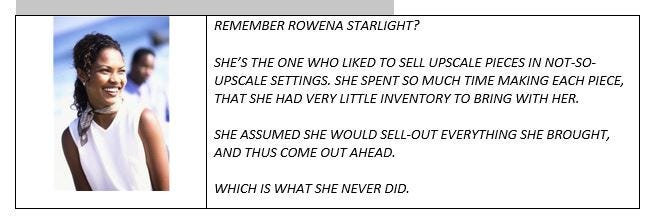
ROWENA STARLIGHT LIKED TO TELL EVERYONE SHE LIVED ON LIGHTHOUSE ROAD.
SHE MIGHT AS WELL HAVE BEEN LIVING IN OUTER MONGOLIA. SHE WAS DETERMINED TO SELL HIGH-END JEWELRY IN LOW-BROW SETTINGS. SHE SPENT SO MUCH TIME MAKING EACH PIECE OF JEWELRY, AND SO LITTLE TIME RESEARCHING WHERE TO SELL IT. SHE RARELY SOLD ANYTHING, SAD FOR HER, SHE COULDN’T FIGURE OUT WHY.
NOT EVERY CRAFT SHOW WILL BE FOR YOU. WHEN YOU RESEARCH SHOW OPPORTUNITIES, ASK YOURSELF: IS THERE A GOOD FIT WITH
= YOUR MERCHANDISE, = YOUR GOALS, = YOUR EXPECTATIONS, “ = YOUR CUSTOMERS?
EVALUATE ALL YOUR SHOW OPTIONS BEFORE SELECTING ONE OR MORE OF THEM. MAKE SITE VISITS. SCOPE IT OUT BEFORE COMMITTING TO IT. IF YOU CAN’T ATTEND A SHOW PRIOR TO APPLYING, ASK THE PROMOTER FOR NAMES AND PHONE NUMBERS OR EMAIL ADDRESSES OF A FEW OF THE EXHIBITORS THAT HAVE DONE THE SHOW BEFORE, AND ARE RETURNING AGAIN.
YOU WANT TO ASK AND HAVE ANSWERED A SERIES OF QUESTIONS. QUESTIONS TO ASK YOURSELF. QUESTIONS TO ASK OTHER VENDORS. QUESTIONS TO ASK THE SHOW PROMOTERS.
WHEN YOU ARE ON YOUR SITE VISIT… CAREFULLY OBSERVE AND ASK YOURSELF THESE QUESTIONS? — IS THE VENDOR AREA THE FOCUS OF THE SHOW, OR A PART OF A LARGER ENTERTAINMENT VENUE? — IS THERE ENTERTAINMENT? — ARE THERE FOOD VENDORS? — WHO IS THE CUSTOMER? — IS THERE GOOD ATTENDANCE? — IS THERE AN ADMISSION CHARGE? — IS THERE ADEQUATE CUSTOMER PARKING? — ARE THE CUSTOMERS BUYING OR BROWSING? — WHAT IS THE MERCHANDISE MIX, AND HOW MUCH IS JEWELRY? — WHAT IS THE QUALITY OF THE MERCHANDISE LIKE? — IS THE MERCHANDISE HAND-CRAFTED ONLY, MOSTLY HAND-CRAFTED, OR NOT?
SPEAK WITH THE VENDORS, AND ASK THEM: — HOW WELL DOES THIS SHOW WORK FOR THEM? — HOW DID THEY FIND OUT ABOUT THE SHOW? — ARE THEY SATISFIED WITH THE MANAGEMENT AND MARKETING OF THE SHOW? — ARE THERE OTHER VENDORS, PERHAPS TOO MANY OTHER VENDORS, SELLING THE SAME KIND OF THING? — WHAT ARE THE BEST SHOWS THEY HAVE DONE, AND HOW DOES THIS ONE COMPARE? — WOULD THEY RETURN TO THIS SHOW AND DO IT AGAIN?
IF YOU CAN, SPEAK WITH THE PROMOTERS. — HOW LONG HAVE THEY BEEN DOING SHOWS, AND THIS SHOW IN PARTICULAR? — WHAT ARE THEIR GOALS FOR THE SHOW? — WHAT KIND OF MARKETING AND PROMOTION DO THEY DO? — WHAT IS THE AVERAGE ATTENDANCE? — WHAT AMOUNT DOES THE TYPICAL CUSTOMER SPEND? — WHAT ARE THE FEES? — DO YOU TAKE ANY ADDITIONAL COMMISIONS, SUCH AS A PERCENT OF SALES? — ARE THERE ANY INSURANCE REQUIREMENTS? — WHAT IS INVOLVED WITH THE APPLICATION PROCESS? — TELL THEM WHAT YOU SELL, AND ASK THEM IF THEY THINK YOU WOULD FIT IN? — IF YOU WANT TO DO THE NEXT SHOW, WHEN SHOULD YOU APPLY? — CAN YOU CHOOSE YOUR BOOTH LOCATION? — CAN YOU DO DEMONSTRATIONS IN YOUR BOOTH?
ASK THEM TO ADD YOUR NAME TO THEIR MAILING LIST.
THEN, CHECK FOR SHOW REVIEWS, RATINGS AND EXPERIENCES ONLINE. DO SOME SOCIAL NETWORKING. AND THINK!
THINK ABOUT… HOW COMFORTABLE ARE YOU WITH THE LOCATION, THE SETTING, THE LAY-OUT? THE OPPORTUNITY? THE POSSIBILITIES TO MAKE A PROFIT? HOW DOES YOUR MERCHANDISE STACK UP AGAINST THAT WHICH YOU HAVE SEEN?
TRY TO VISUALIZE THE EVENT IN YOUR MIND WITH AS MUCH INFORMATION YOU HAVE GATHERED. IS THIS PARTICULAR EVENT FOR YOU? DOES THIS SHOW ATTRACT THE TYPES OF CUSTOMERS MOST LIKELY TO BUY WHAT YOU MAKE?
craft show traffic flow
LESSON 4: SET REALISTIC GOALS
MAKING MONEY AT FAIRS AND SHOWS ISN’T AS EASY AS IT SEEMS.
AS ROLAND AND ROLANDA QUICKLY FOUND OUT. THEY THOUGHT ALL IT TOOK WAS TO RENT A TABLE AT ANY SHOW OR FAIR LAY OUT THEIR JEWELRY, WAIT FOR CUSTOMERS TO COME BY AND PURCHASE THEIR STUFF.
ALL THROUGH THE SHOWS, THEY SAT ON CHAIRS READING BOOKS, WAITING FOR PEOPLE TO COME BY. THEY SPENT MORE MONEY ON INVENTORY, PACKING, DISPLAYS AND TRAVEL THAN THEY EVER MADE. AND THEY NEVER DEVELOPED ANY KIND OF PLAN OF ACTION.
ROLAND AND ROLANDA NEEDED TO SET REALISTIC GOALS:
– (1) HOW MUCH MONEY DID THEY HAVE TO GET STARTED AND SUSTAIN THEMSELVES?
– (2) WHAT WAS THEIR BREAK-EVEN POINT?
– (3) WHAT DID THEY NEED TO PREPARE THEMSELVES TO “SELL”?
(4) WHAT AMOUNT OF REPEAT BUSINESS AND FOLLOW-UP SALES WERE THEY LOOKING FOR?
Defining Your Business / Setting Your Goals / Getting Started
Before you get started in your craft business, you need to do some thinking and reflecting. You need to have a clear idea of the types of products you want to sell, and what you think people will be willing to pay for them.
Then you need to research craft show opportunities. We suggest you start small, and start locally. Check out crafts fairs sponsored by local Arts and Park Commissions, churches and synagogues, non-profit organizations and schools. Your local craft and bead stores may know of craft shows, as well. YOU OBVIOUSLY WANT TO KEEP YOUR EXPENSES TO A MINIMUM, AND THERE CAN BE SOME STEEP UP-FRONT COSTS, SUCH AS CREATING A SUFFICIENT INVENTORY.STARTING SMALL GIVES YOU A CHANCE TO TEST OUT YOUR IDEAS ABOUT COSTS. WHEN YOU START, YOU MIGHT BE ABLE TO SHARE BOOTH SPACE WITH ANOTHER FRIEND WHO HAS A BUSINESS. AND SHARE SOME OF THOSE OTHER FIXED COSTS, LIKE TRAVEL AND FEES.
Next, set some business goals. How much are you willing to spend to be included in a Craft Show? How much money do you want to make? To what degree is it important that you make a profit at your first craft show(s)? In what ways can you leverage your efforts to increase your business later on — such as, strategies for getting repeat business, or increasing your mailing list, or finding information from other vendors about other show opportunities or other sources of craft supplies?
Then think about yourself, your personality, energy levels, levels of patience. Is there a good fit, and if not, what kinds of self-improvement things do you need to do to get that good fit? IT REQUIRES AN ABILITY TO KEEP UP A GOOD “RETAIL PERSONALITY” WHILE STANDING ON YOUR FEET FOR LONG HOURS, SOMETIMES WHEN IT’S TOO HOT OR TOO COLD OR TOO WINDY AND DUSTY. “SELLING JEWELRY” REQUIRES A DIFFERENT MIND-SET THAN “CREATING JEWELRY.” IF YOU DON’T HAVE THE PERSONALITY FOR “SELLING”, YOU MIGHT BRING A FRIEND WITH YOU WHO DOES.
Set goals about WHAT AMOUNT OF REPEAT BUSINESS AND FOLLOW-UP SALES SHOULD YOU LOOK FOR? A GOOD GOAL TO SET IS TO GENERATE REPEAT BUSINESS EQUAL TO 25%.SO, IF YOU HAD 10 SALES AT THE SHOW, YOUR GOAL WOULD BE TO GET 3 REPEAT SALES. THESE COULD OCCUR WHEN THE CUSTOMER CONTACTS YOU BETWEEN SHOWS. THESE COULD ALSO OCCUR AT THE NEXT SHOW YOU DO, WHEN THE CUSTOMER BUYS FROM YOU AGAIN. YOU WILL MAKE A MUCH HIGHER PROFIT AND EXPERIENCE BETTER LONG-TERM OUTCOMES, THROUGH REPEAT BUSINESS. WITH REPEAT BUSINESS, YOU CAN CONSIDERABLY LOWER YOUR VARIABLE COSTS, PARTICULARLY THOSE ASSOCIATED WITH MARKETING.BECAUSE OF THIS, THAT 2ND OR FOLLOW-UP SALE IS OFTEN MORE IMPORTANT THAN THAT 1ST SALE AT THE SHOW.
BREAKEVEN ANALYSIS
HOW MUCH MONEY WILL YOU NEED?
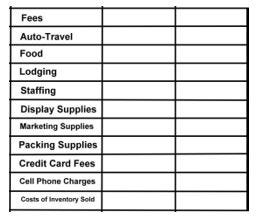
MAKE A LIST OF ALL POSSIBLE COSTS. THERE ARE THE OBVIOUS LIKE TRANSPORTATION, LODGING AND MEALS. AND THE COSTS OF DISPLAYS, PACKING AND MARKETING. AND THE COSTS OF THE PARTS USED TO MAKE THE PIECES WHICH SELL.
ENTRY FEES WILL VARY WIDELY FROM SHOW TO SHOW. THEY COULD COST $25/DAY UP TO $400 AND UP PER DAY. THEY COULD GO AS HIGH AS $5000 PER DAY.
IF YOU HAVE A SPECIFIC CRAFT SHOW IN MIND, REVIEW THEIR RULES, AND WHAT THEIR ENTRY FEES COVER, AND DO NOT COVER. WHAT ARE THE COSTS OF EXTRAS, LIKE ELECTRICITY, TABLES, SPECIAL LIGHTING? DO THEY ALSO COLLECT A PERCENT OF SALES? DO THEY OFFER SPECIAL SERVICES, LIKE BOOTH SITTING, FOR EXTRA FEES? IS PARKING FREE, OR DO THEY CHARGE? DO YOU NEED TO PROVIDE ADDITIONAL INSURANCE? WILL YOU NEED TO PURCHASE SPECIAL LICENSES, REGISTRATIONS AND PERMITS, SUCH AS AN OUT OF STATE WHOLESALE LICENSE?
YOU NEED TO PREPARE A PLAN AND A BUDGET… …TO BE SURE YOU CAN PAY FOR WHAT YOU ARE COMMITTING YOURSELF TO.
(1)Understand different types of costs and how to account for them
(2)Learn to apply simple Breakeven Analysis Formula
(3)Set revenue goals
(4)Determine how much inventory you need to bring with you
(5)Think about reinvestment
4.1. Types of Costs
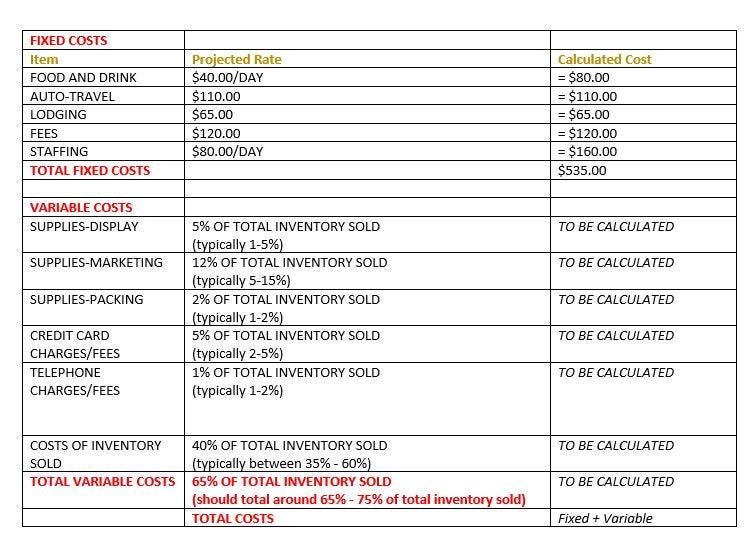
FIXED COSTS: FIXED COSTS ARE COSTS THAT REMAIN THE SAME, REGARDLESS OF HOW MANY ITEMS YOU SELL AT YOUR CRAFT FAIR.
FIXED COSTS INCLUDE THINGS LIKE FEES, TRAVEL, FOOD, AND STAFFING. AGAIN, YOU HAVE TO LAY OUT THIS MONEY FOR FIXED COSTS, WHETHER YOU MADE NO MONEY AT ALL, OR MADE A BUCKET FULL OF MONEY AT YOUR CRAFT FAIR.
VARIABLE COSTS: VARIABLE COSTS ARE COSTS THAT GET INCURRED WHEN EACH UNIT IS SOLD.
THUS, VARIABLE COSTS FLUCTUATE BASED ON THE NUMBER OF UNITS SOLD. IF YOU SELL VERY FEW PIECES, YOUR VARIABLE COSTS ARE SMALL, IF YOU SELL A LOT OF PIECES, YOUR VARIABLE COSTS WILL BE MUCH HIGHER.
VARIABLE COSTS INCLUDE SPECIAL PACKAGING AND DISPLAYS, BROCHURES AND BUSINESS CARDS HANDED OUT WITH EACH SALE, CREDIT CARD FEES YOU ARE CHARGED BY THE BANKS AFTER EACH SALE, AND THE COST OF THE PARTS USED TO MAKE EACH PIECE THAT HAS SOLD.
WE ESTIMATE VARIABLE COSTS USING SOME INDUSTRY STANDARDS ABOUT THE PERCENT OF TOTAL SALES (USING RETAIL PRICES) THESE COSTS ARE ASSOCIATED WITH.
WHEN WE CALCULATE THE COST OF INVENTORY, WE DIFFERENTIATE BETWEEN THE COST OF THOSE PIECES WHICH WE HAVE SOLD FROM THE COST OF THOSE PIECES WE DID NOT SELL.
FOR PURPOSES OF DEVELOPING A BUDGET AND CALCULATING A BREAK-EVEN ANALYSIS, TO HELP US DECIDE WHETHER A PARTICULAR CRAFT SHOW IS WORTH THE RISK, WE FOCUS ONLY ON THE ESTIMATES BASED ON WHAT WE SELL.
NOTE: There are two other costs we do not deal with in a breakeven analysis, but have big impacts on your business decisions: 1. INVENTORY COSTS. Breakeven Analysis deals with the costs of your inventory which has sold. But you have to bring a lot more pieces with you, and will only sell a proportion of them, typically 25% is a good goal. You will still have to come up with enough cash to cover the full cost of putting together an inventory.
2. REINVESTMENT COSTS. Out of your profits, you will want to reserve some money to buy more jewelry making supplies beyond what you already have and beyond what you need to replace the items sold. You will also want to invest in new displays, packaging, additional marketing and the like. For new businesses, these reinvestments are usually 20–25% or more of your profit. If you think you need to make $100.00 to cover your business and personal costs, perhaps, with an eye on reinvestment, you need to up that goal to $125.00.
4.2Learn to apply simple Breakeven Analysis Formula
BREAKEVEN ANALYSIS
I WANT TO INTRODUCE YOU TO A QUICK AND DIRTY BREAKEVEN ANALYSIS. I CALL THIS “QUICK AND DIRTY” BECAUSE WE ARE USING IMPERFECT INFORMATION. HOWEVER, THIS IMPERFECT INFORMATION IS GOOD ENOUGH TO HELP US MAKE A DECISION WHETHER A PARTICULAR CRAFT SHOW IS WORTH THE RISK.
YOUR BREAKEVEN POINT IS WHERE YOU HAVE SOLD ENOUGH INVENTORY TO COVER YOUR FIXED AND VARIABLE COSTS. WE EQUATE “INVENTORY” WITH THE TOTAL RETAIL DOLLARS TAKEN IN.
WE USE OUR QUICK AND DIRTY BREAKEVEN ANALSIS TO ANSWER THE QUESTION: HOW MUCH INVENTORY DO I NEED TO SELL IN ORDER TO BREAK EVEN?
LET’S FAMILIARIZE OURSELVES MORE WITH THE COMPONENTS OF THE FORMULA, AND THEN REVIEW THE MATH.
EXAMPLE: 2-Day Craft Show, 200 miles away, and you need 1 extra person
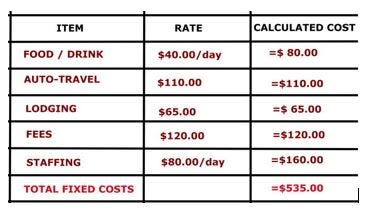
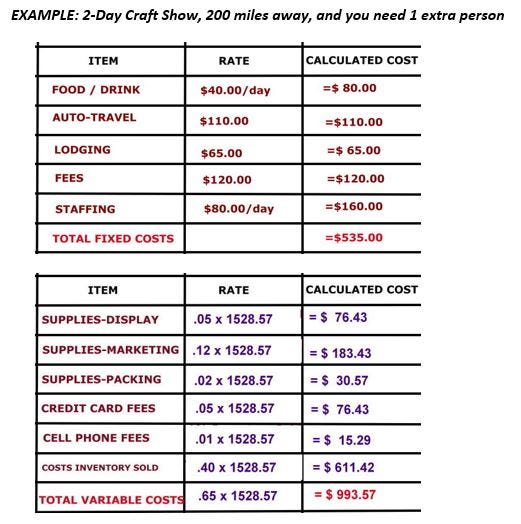
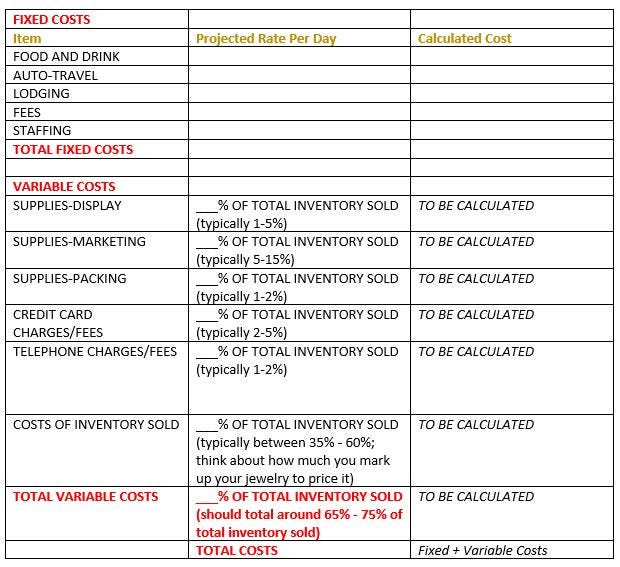
SAY YOU WILL BE DOING A 2-DAY CRAFT SHOW OUT OF TOWN, 200 MILES AWAY FROM HOME. AND YOU WILL NEED TO HIRE 1 PERSON TO HELP YOU. LET’S LOOK AT OUR BUDGET FOR DOING THIS PARTICULAR CRAFT SHOW. YOU HAVE BUDGETED FOR YOUR FIXED AND VARIABLE COSTS AS SHOWN IN THE TABLE. I HAVE PLUGGED IN SOME TYPICAL NUMBERS INTO THIS BUDGET TABLE.
OUR FIXED COSTS ARE RELATIVELY EASY TO FIGURE OUT.
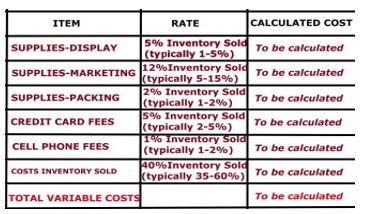
OUR VARIABLE COSTS, HOWEVER, WILL HAVE TO BE ESTIMATED.
THESE VARIABLE COSTS ARE KEYED OFF THE ESTIMATED SALES DATA (KEYED OFF OF RETAIL PRICES YOU SET FOR YOUR JEWELRY). In the chart above, $1528.57 is the estimated sales we think we will get at the craft show, stated in total retail prices. [We can estimate our sales because we expect to sell 25% of the total inventory brought. In this case, we would have brought 4*1528.57 or $6114.28 (at retail pricing). ] [So, if we marked up our inventory by 3, in this case, our wholesale costs for these sales would have been $1528.57/3 or $509.52, but the cost to us of all the inventory we brought with us would be $6114.28/3 or $2038.09.]
WE WILL USE SOME INDUSTRY PERCENT OF ITEMS SOLD PRICE STANDARDS, These are usually stated as some percent of every dollar sold (at retail pricing). AS WELL AS OUR BREAKEVEN ANALYSIS FORMULA TO HELP US FIGURE OUT THE “TO BE CALCULATED” VARIABLE COSTS IN OUR BUDGET TABLE.
FOR EXAMPLE, I HAVE USED 12% AS THE PROPORTION OF THE TOTAL RETAIL PRICE THAT WOULD BE SPENT ON MARKETING COSTS. THE COSTS WOULD INCLUDE BROCHURES, BUSINESS CARDS, A POST CARD MAILING, SOME PROMOTIONAL ADS, AND SOME EFFORT TO CONTACT PREVIOUS CUSTOMERS TO LET THEM KNOW YOU WILL BE AT THIS CRAFT SHOW. THE INDUSTRY STANDARD FOR MARKETING RANGES BETWEEN 5 AND 15 PER CENT. IF YOU ARE GETTING STARTED, YOU CAN USE MY NUMBERS PRESENTED IN THIS TABLE. AFTER YOU HAVE DONE A FEW CRAFT SHOWS, YOU CAN BEGIN TO ANALYZE YOUR OWN SALES AND COST DATA, TO DEVELOP WHAT ARE CALLED MULTIPLIERS FOR EACH VARIABLE LINE-ITEM CATEGORY.
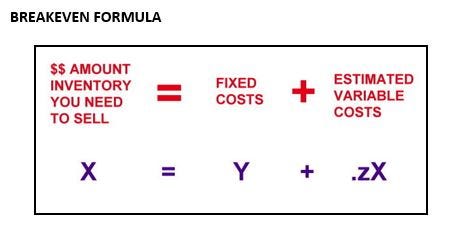
BREAKEVEN FORMULA
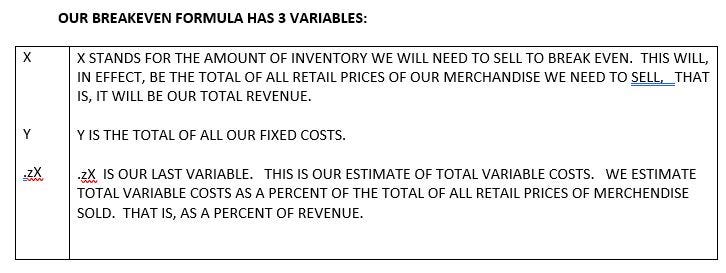
OUR BREAKEVEN FORMULA HAS 3 VARIABLES:
LET’S TRY SOME MATH:
LOOK BACK AT OUR DEVELOPING BUDGET TABLE.
Y, WHICH IS OUR FIXED COSTS TOTAL = $535.00 .z IS THAT PERCENT OF REVENUE REPRESENTING TOTAL VARIABLE COSTS.
.z= .65 (.65 IS SUM OF OUR MULTIPLERS IN OUR BUDGET TABLE .05+.12+.02+.05+.01+.40)
SOLVE FOR X
NEXT, USING OUR BREAKEVEN FORMULA, WE SOLVE FOR X
TO SOLVE FOR X, WE NEED TO RE-ORGANIZE OUR FORMULA SO THAT THE X VARIABLE, WHICH OCCURS TWICE IN OUR FORMULA, IS ALL PUT ON ONE SIDE OF THE EQUATION.
THIS IS HOW WE SOLVE THIS FORMULA:
a. WE START WITH: X = 535.00 + .65X
b. WE MOVE THE .65X TO THE LEFT SIDE, BY SUBTRACTING IT FROM BOTH SIDES X-.65X = 535.00
c. WE COMBINE BOTH X VARIABLES, WHICH IN EFFECT, LET’S US SUBTRACT THE .65X FROM 1X, LEAVING US WITH .35X .35X = 535.00
d. WE DIVIDE BOTH SIDES OF THE EQUATION BY .35, TO GIVE US 1X X = 535/.35
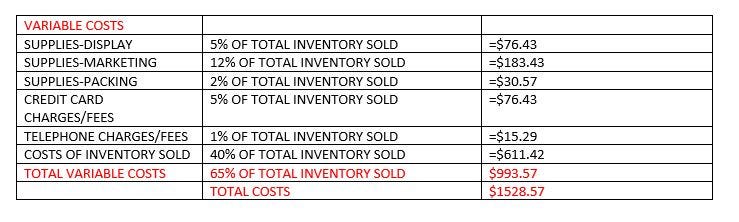
e. AND WE GET OUR BREAKEVEN POINT X = $1528.57 (total inventory at retail price we need to sell to break even, given our fixed and variable costs)
SO, TO BREAK EVEN, WE WOULD NEED TO SELL A RETAIL TOTAL OF $1528.57 OF MERCHANDISE AT OUR 2-DAY SHOW. TO SELL THAT MUCH INVENTORY, WE WOULD NEED TO BRING ABOUT 4 TIMES THAT MUCH, OR $6,000.00 OF INVENTORY WITH US.
LET’S LOOK AT OUR RESULTING VARIABLE COSTS CALCULATIONS.
NOW, LET’S REVIEW OUR BREAKEVEN ANALYSIS WITH ANOTHER EXAMPLE.
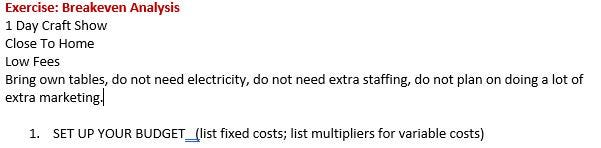
SAY YOU ARE DOING A 1-DAY CRAFT SHOW CLOSE TO HOME, LOW FEES, YOU BRING YOUR OWN TABLES, DON’T NEED ELECTRICITY, AND DON’T NEED EXTRA STAFFING. YOU DON’T PLAN ON DOING A LOT OF MARKETING.
FIRST, YOU BEGIN TO SET UP A BUDGET.
HERE WE HAVE FIXED COSTS EQUAL TO $70.00. OUR VARIABLE COSTS WE ESTIMATE TO BE 54% OF OUR TOTAL REVENUES.
NEXT, WE CALCULATE OUR BREAKEVEN POINT, USING OUR QUICK AND DIRTY FORMULA.
WE SEE OUR BREAKEVEN POINT IS $152.17. AND, USING OUR RULE OF THUMB ABOUT HOW MUCH INVENTORY TO BRING, WE NEED TO BRING 4 X $152.17, OR ABOUT $600.00 OF INVENTORY.
4.3Set Revenue Goals
First, you do a BREAKEVEN ANALYSIS to determine the minimum amount of revenue you need to generate, in order to cover all your fixed and variable costs.
After you reach your Breakeven Point, you begin to generate a Profit. At this point, you have already covered all your fixed costs. For each additional piece of jewelry you sell, you mostly will only have to cover the variable costs. If your fixed costs in your breakeven analysis were 35% of your sales, then your profit will be roughly 35% of your sales, above this breakeven point.
HOW MUCH OF A PROFIT GOAL YOU WANT TO SET IS YOUR PERSONAL CHOICE. HOWEVER, I LIKE TO TELL STUDENTS THAT BREAKING EVEN AT THE SHOW ITSELF IS OK, IF YOU ALSO HAVE STRATEGIES IN PLACE TO GENERATE FOLLOW-UP SALES, EITHER THROUGH REPEAT SALES BETWEEN SHOWS, OR REPEAT SALES AT THE NEXT SHOW.
4.4Determine How Much Inventory You Need To Bring
A GOOD RULE OF THUMB FOR FIGURING OUT HOW MUCH INVENTORY TO BRING IS THIS: YOU WILL NEED TO BRING WITH YOU, AT A MINIMUM, 4 TIMES THE INVENTORY YOU HOPE TO SELL.
FOR EXAMPLE, IF YOU NEED TO SELL $200.00 OF MERCHANDISE TO BREAKEVEN, YOU WILL NEED TO BRING $800.00 OF MERCHANDISE WITH YOU. AGAIN, $800.00 IS THE TOTAL OF ALL THE RETAIL PRICES OF WHAT YOU BRING.
CONTINUE THIS EXAMPLE: IF YOU WANT TO TAKE IN ANOTHER $100.00 OF SALES ON TOP OF YOUR BREAKEVEN, THEN YOU WILL NEED TO SELL $300.00 OF MERCHANDISE, THEN, YOU WILL NEED TO BRING A TOTAL OF $1200.00 OF INVENTORY. THIS IS $400.00 MORE INVENTORY THAT YOU WOULD NEED TO BRING TO MAKE ONE HUNDRED MORE DOLLARS OVER YOUR BREAKEVEN POINT. AGAIN, $1200.00 IS THE TOTAL OF ALL THE RETAIL PRICES.
WE ARE GOING TO TALK ABOUT INVENTORY IN TERMS OF RETAIL PRICES, NOT IN TERMS OF NUMBERS OF ITEMS, AND NOT IN TERMS OF WHOLESALE COSTS.. OUR TOTAL INVENTORY WOULD EQUAL THE TOTAL OF ALL RETAIL PRICES, IF EVERY PIECE SOLD.
4.5 Think about reinvestment
AS WE GO BEYOND OUR BREAKEVEN POINT, AND BECOME PROFITABLE
WE COULD HAVE USED THAT REMAINING 35 CENTS OUT OF EACH DOLLAR OF ADDITIONAL REVENUE TO PAY FOR SOME OF OUR INVESTMENT COSTS, AS WELL AS PAY OURSELVES SOMETHING.
INVESTMENT COSTS ARE THINGS YOU PAY FOR WHICH EITHER HAVE TO LAST A VERY LONG TIME, AND WHICH YOU WILL USE AT MANY, MANY CRAFT SHOWS, OR WHICH INVOLVE EXPANDING YOUR CORE JEWELRY MAKING SUPPLIES INVENTORY BEYOND WHAT YOU NEED TO REPLACE THE PARTS REPRESENTED BY THE ITEMS SOLD.
THESE INCLUDE “LONG TERM ASSETS”, SUCH AS BUYING TABLES AND CHAIRS, A TENT, AND DISPLAY CASES. THESE ALSO INCLUDE “LONG TERM LIABILITIES”, SUCH AS PAYING DOWN LOANS AND CREDIT CARD CHARGES.
WE DO NOT INCLUDE THESE INVESTMENT COSTS IN OUR BREAK-EVEN ANALYSES.
application form example
LESSON 5: GET THOSE APPLICATIONS IN EARLY
JOHN JACOB THOUGHT HE COULD SET UP ANYWHERE AND ANYTIME.
SO HE MISSED THE APRIL 30TH DEADLINE FOR THE RED HILLS FAIR. AND HE SENT IN AN INCOMPLETE APPLICATION WITHOUT THE REQUIRED PICTURES TO NAPA SWEETS FESTIVAL.
AND HE DIDN’T TAKE SERIOUSLY THE FACT THAT NAPLES SYMPHONY DAYS WAS A JURIED COMPETITION. AND HE COULDN’T UNDERSTAND HOW ADDING ONE MORE JEWELRY VENDOR TO THE ROCKY MOUNTAIN SHOWROOM WOULD MAKE MUCH OF A DIFFERENCE.
HE HAD CALCULATED THAT HE NEEDED TO DO 4 SHOWS A YEAR TO MAKE A LIVING. BUT FOR SEVERAL YEARS NOW, ALTHOUGH HE HAD APPLIED TO AT LEAST 12 SHOWS EACH YEAR, HE RARELY WAS APPROVED FOR MORE THAN 2.
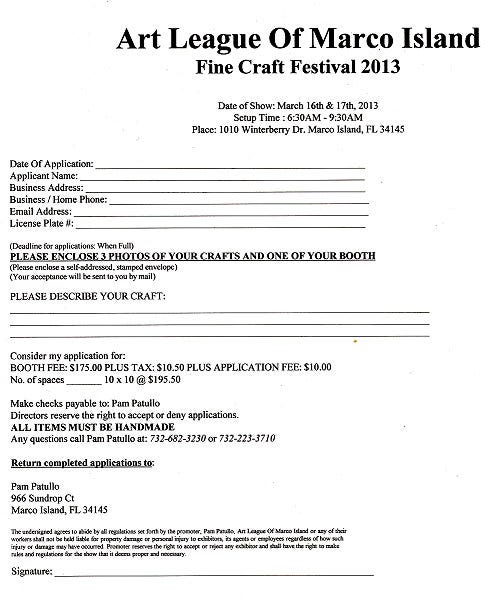
Application/Acceptance Process
Read ALL THE FINE PRINT.COMPLETE the Application forms COMPLETELY.Be sure to meet all DEADLINES. Include your CHECK/MONEY ORDER for all required PREPAYMENTS and DEPOSITS.
If you need special arrangements, be sure to negotiate these up front. Do you need electricity or special lighting or special access? Do you prefer to have a particular location or table arrangement? Will your displays conform to the show’s expectations, requirements and limitations? If you will be doing demonstrations, will all your equipment and tools meet show requirements or not? Do you need to be on a corner?
Is this a juried show? Are there additional costs besides the booth rental, such as required advertising expenses, parking fees, electricity fees, tables and chairs, insurance requirements, and the like? Are there are restrictions as to the type of merchandise allowed, such as a requirement that all merchandise be hand-crafted by the artist. Are promotional materials such as brochures or postcards provided to exhibitors? Be sure to find out ahead of time,
– what times you have to be ready and fully set up in your booth
– what time you have to wait until before you can take down your booth
how early you can begin to set up your booth
Application form example 2
THE APPLICATION
1. PREPARE A GENERIC APPLICATION
2. UNDERSTAND THE JURIED SELECTION PROCESS
3. SUBMIT APPLICATIONS AND FOLLOW-UP ON THEM
4. SCHEDULE YOURSELF FOR THE YEAR
5.1. PREPARE A GENERIC APPLICATION
SOME ORGANIZATIONS HAVE A FORMAL, PRINTED APPLICATION FORM TO FILL OUT. MORE AND MORE, HOWEVER, ORGANIZATIONS ARE USING ON-LINE APPLICATION SERVICES. I SUGGEST CREATING A GENERIC APPLICATION FORM, FROM WHICH YOU CAN CUT AND PASTE INTO THESE PRINTED OR ONLINE APPLICATION FORMS.
THEY MAY ASK YOU FOR THESE TYPES OF INFORMATION:
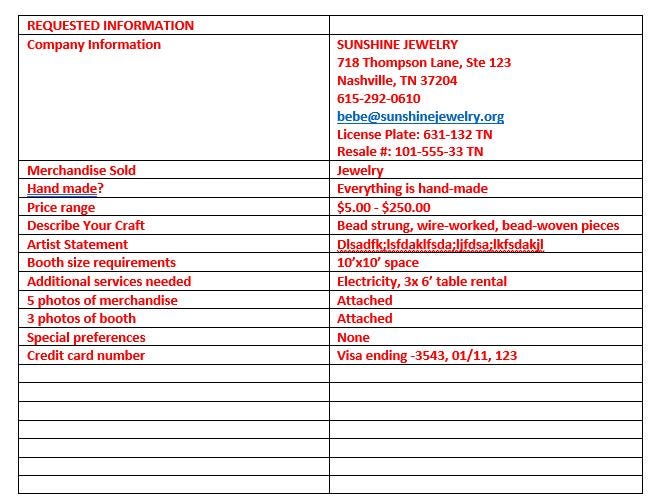
1. COMPANY INFORMATION, ADDRESS, PHONE, EMAIL, CONTACT PHONE, ONSITE-CONTACT PHONE, WEBSITE, LICENSE PLATE #, RE-SALE OR TAX NUMBER AND STATE WHICH ISSUED IT
2. TYPE OF MERCHANDISE TO BE SOLD
3. HAND-MADE?
4. HIGH AND LOW PRICE RANGE OF MERCHANDISE
5. DESCRIBE YOUR CRAFT (TECHNIQUES, MATERIALS, DESIGNS)
6. ARTIST STATEMENT (ABOUT 150–250 WORDS)
7. BOOTH SIZE REQUIREMENTS (WILL YOU NEED MORE THAN ONE 10’X10’ BOOTH SPACE?)
8. REQUIREMENTS FOR ADDITIONAL SERVICES, SUCH AS ELECTRICITY, TABLE AND CHAIR RENTAL, TENT
9. 5 (five) PHOTOS OF YOUR CRAFTS (BE SURE YOUR PHOTOS ARE SHARP AND ATTRACTIVE, AS IF THEY WERE PUBLISHED IN A BOOK. NO DARK PHOTOS.) WITH PHOTOS, YOU MIGHT NEED SLIDES, OR YOU MIGHT NEED .jpg IMAGES THAT ARE 72–96 dpi, OR YOU MIGHT NEED HI-RESOLUTION .jpg IMAGES WHICH ARE 300 OR 600 dpi. They may need to be in 8-bit color or 16-bit color. They may need to use a RGB color scale or another color scale. They might specify a specific width and height in pixels. BE PREPARED WITH EACH OF THESE.
10. 3 (three) PHOTOS OF YOUR BOOTH SET-UP (THEY WANT VISUALLY APPEALING, CUSTOMER ENTICING, USER FRIENDLY BOOTH SET-UPS. AGAIN, NO DARK PHOTOS.)
11. LIST OF SPECIAL PREFERENCES, SUCH AS “CORNER BOOTH, IF AVAILABLE”
12. CREDIT CARD NUMBER, EXPIRATION DATE, SECURITY CODE NUMBER (THEY WILL PROBABLY WANT THIS NUMBER TO KEEP ON FILE)
5.2. UNDERSTAND THE JURIED SELECTION PROCESS
AT THIS POINT, YOU HAVE SELECTED SHOWS WHICH YOU FEEL ARE A GOOD FIT WITH YOUR BUSINESS.NOW, DETERMINE IF YOU ARE ELIGIBLE FOR THEM. DO THEY PUT ANY LIMITATIONS ON WHO CAN AND CANNOT APPLY? DO THEY REQUIRE THAT YOUR CREATIVE WORK BE JURIED?
MOST CRAFT SHOWS MAKE SIMPLE ACCEPTANCE DECISIONS BASED ON — SUBMITTING AN APPLICATION FORM, AND — PAYING THE FEE
SOME MAY RESTRICT THE NUMBER OF JEWELRY VENDORS THEY ACCEPT, BECAUSE THEY WANT A BALANCE OF TYPES OF MERCHANDISE, AND OFTEN, TOO MANY JEWELRY VENDORS APPLY.
OTHER SHOWS WANT TO MAINTAIN SOME LEVEL OF MERCHANDISE QUALITY STANDARDS. THEY SUBJECT THE APPLICANT TO A MORE INTENSIVE JURY-REVIEW PROCESS. THE JURY PROCESS IS PROBABLY WHAT YOU WOULD EXPECT. USUALLY A FEW PEOPLE REVIEW ALL THE APPLICATIONS AND SCORE THEM AGAINST A SET OF CRITERIA. THEY CHOOSE THE ONES WHICH SCORE HIGHEST.
SOME TYPICAL CRITERIA THEY USE:
– PRODUCTS CONSIDERED BEST FOR THE SHOW
– AETHETICS AND VISUAL APPEAL
– FUNCTIONALITY
– CREATIVITY
– ORIGINALITY
– TECHNIQUE
– MARKETABILITY
– QUALITY OF WORK
– BOOTH DESIGN
THEY WANT TO END UP WITH VENDORS WHOSE WARES WILL SELL, WHERE THERE WON’T BE MUCH DUPLICATION, AND WHOSE PRESENCE AND SET-UP IS EXCITING FOR THE PEOPLE WHO ATTEND THE SHOW. YOUR SHORT WRITE-UP AND SUBMITTED PHOTOGRAPHS NEED TO MAKE YOUR CASE. WHAT DOES IT MEAN WHEN A JUROR SAYS “NO!”? MOST REJECTIONS ARE BASED ON THE LIMITED NUMBER OF OPENINGS — PARTICULARLY FOR JEWELRY VENDORS. ANOTHER MAJOR REASON FOR REJECTIONS IS THE POOR QUALITY OF PHOTOS SUBMITTED. LOOK AT YOUR PHOTOS. SHARE THEM WITH SOME FRIENDS. JUDGE THEM ACCORDING TO THE PREVIOUSLY DISCUSSED JUDGING CRITERIA. HOW WELL DO THEY MAKE YOUR CASE? ARE THEY CLEAR, FOCUSED, BRIGHT?
5.3. SUBMIT APPLICATIONS AND FOLLOW-UP ON THEM
YOU HAVE CREATED YOUR LIST OF POSSIBLE SHOWS, BASED ON YOUR SENSE OF FIT, THE GOALS YOU HAVE SET FOR YOURSELF, AND YOUR BUDGET, GIVEN THE COSTS INVOLVED. YOU HAVE DETERMINED WHETHER YOU ARE ELIGIBLE FOR THEM. DECIDE ABOUT HOW MANY SHOWS YOU WANT TO DO A YEAR. SELECT 5–10 MORE SHOWS IN ADDITION TO THE NUMBER YOU WANT TO DO. ANOTHER RULE OF THUMB IS TO SELECT 3 EVENTS TO APPLY TO FOR EACH WEEKEND YOU WANT TO WORK.
GET THEIR APPLICATION FORMS, AND REVIEW THE RULES AND APPLICATION DEADLINES. READ ALL THE RULES!
DETERMINE HOW LONG THEIR REVIEW PROCESSES ARE, AND FIGURE OUT WHEN YOU SHOULD KNOW WHETHER YOUR HAVE BEEN ACCEPTED.
CALL OR EMAIL EACH ONE, AND VERIFY THAT ALL THE INFORMATION YOU HAVE — DATES, FEES, APPLICATION REQUIREMENTS, DEADLINES — ARE TRUE.
**NOTE: THINGS CHANGE. THINGS GET PRINTED WRONG.
5.4. SCHEDULE YOURSELF FOR THE YEAR
ORGANIZATION IS CRITICAL HERE. GET A GOOD 3-YEAR CALENDAR. MAP EVERY DATE OUT. APPLICATION DEADLINE. APPLICATION ACCEPTANCE NOTIFICATION. DEADLINE FOR NOTIFYING THEM, CONFIRMING YOUR ACCEPTANCE, AND SUBMITTING ANY UP-FRONT FEES. SHOW DATES, INCLUDING SET-UP AND BREAK-DOWN DATES AND TIMES. REMEMBER, FOR MANY CRAFT SHOWS, YOU WILL BE APPLYING 6–12 MONTHS AHEAD OF TIME.
IT TAKES A LOT OF COORDINATED EFFORT TO KEEP EVERYTHING ON TRACK.YOU MIGHT SET UP A SPREAD-SHEET OR DATA-BASE. I USE THE ONLINE CALENDAR APPLICATION THAT COMES WITH MY EMAIL PROGRAM. I SET UP AUTOMATIC REMINDERS, SO THEY POP UP WHEN I NEED TO TAKE ACTION.
AFTER YOU SEND IN YOUR FEES, FOLLOW-UP IN 2 WEEKS TO BE SURE THEY RECEIVED YOUR APPLICATION AND PAYMENT.
5.5. BEFORE SAYING YES!…
RE-REVIEW YOUR
FIT WITH THE SHOW — BREAK-EVEN ANALYSIS — CALENDAR SCHEDULE — THE MONEY NEEDED UP-FRONT AND, — WHETHER THERE ARE ANY CANCELLATION PENALTIES OR RULES — WHAT KINDS OF LOCAL AND STATE LICENSES, CERTIFICATES AND PERMITS YOU WILL NEED,AND IF THE SHOW PROMOTERS ASSIST YOU IN OBTAINING TEMPORARY ONES FOR THE DURATION OF THE SHOW
LESSON 6: PROMOTE, PROMOTE, PROMOTE
YOU NEED TO ACTIVELY PROMOTE YOURSELF BOTH BEFORE AND AFTER THE SHOW. DO NOT RELY ON THE SHOW PROMOTERS TO DO ALL THE MARKETING.
ABOUT 2–4 WEEKS BEFORE THE SHOW: a. CONTACT YOUR EXISTING CUSTOMERS — EMAIL, MAIL, SOCIAL NETWORK SITES
b. PROMOTE YOUR MESSAGE TO POTENTIAL CUSTOMERS. LEAVE FLYERS AND BROCHURES AT RELEVANT BUSINESSES OR ORGANIZATIONS/ POST MESSAGES ON SOCIAL NETWORK SITES/ POST MESSAGES ON YOUR OWN WEBSITE OR BLOG/ GET LISTED ON COMMUNITY CALENDARS/ TELL PEOPLE YOU INTERACT WITH. IN YOUR PROMOTIONS, BE SURE YOU HAVE ALL THE DETAILS LISTED CORRECTLY. IN A SHORT, CATCHY PHRASE OR SENTENCE, TELL WHY THIS EVENT WOULD BE OF PARTICULAR INTEREST TO THEM. YOU MIGHT OFFER SPECIAL DISCOUNTS, IF THEY PRESENT YOUR CARD OR EMAIL NOTICE.
c. BE SURE YOU ARE GOING TO LOOK PRESENTABLE. IF YOU NEED A HAIR-CUT, GET IT. BE SURE YOU HAVE ALL THE CLOTHES YOU NEED. CHECK YOUR SUPPLY OF BUSINESS CARDS, BROCHURES, OTHER PROMOTIONAL MATERIALS. PRACTICE SAYING YOUR SELLING POINTS. BE STRATEGIC ABOUT WHICH PIECES OF JEWELRY YOU ARE GOING TO WEAR AT THE SHOW.
AT THE SHOW: HAVE YOUR BUSINESS CARDS, AND ANY BROCHURES, IF YOU HAVE THEM, OUT FOR THE TAKING. IT HELPS IF YOUR BUSINESS CARDS HAVE AN IMAGE OF YOUR JEWELRY ON THEM. TO HELP PEOPLE REMEMBER YOU.
HAVE A BOOK OR SIGN-UP SHEET WHERE PEOPLE CAN LIST THEIR NAMES, MAILING AND EMAILING ADDRESSES.
AFTER THE SHOW: UPDATE YOUR CUSTOMER DATABASE. STAY IN TOUCH WITH YOUR NEW CUSTOMERS, SUCH AS WITH A FOLLOW-UP MAILING OR EMAILING. DIRECT YOUR NEW CUSTOMERS TO YOUR WEBSITE OR OTHER WAYS OF CONTACTING YOU AND SEEING YOUR PIECES WHICH ARE FOR SALE.
LESSON 7: SET UP FOR SUCCESS
IMOGENE MCALLISTER ROSENSTEIN. REMEMBER SHE HAD NO PLAN OR STRATEGY FOR CHOOSING SHOWS. AND, GUESS WHAT, SHE HAD NO PLAN OR STRATEGY FOR SETTING UP AT SHOWS, EITHER.
IMOGENE, BLESS HER HEART, LOVED PLAIDS. SHE WOULD SET UP A TABLE, AND COVER IT WITH A DARK, PLAID CLOTH, AND LAY HER JEWELRY ONTO THE CLOTH. SHE LIKED TO PUSH HER TABLE UP TO THE FRONT OF THE BOOTH, AND SIT IN A CHAIR BEHIND IT.
HER BOXES OF SUPPLIES AND INVENTORY, WERE STACKED UP AGAINST THE BACK OF HER BOOTH, NO EFFORT TO DISGUISE OR HIDE THEM.
YOUR BOOTH IS YOUR SHOP.IT SHOULD BE COHESIVE, VISUALLY INTERESTING, FUNCTIONAL. YOU DO NOT WANT YOUR BOOTH TO BE DISORGANIZED, DIS-INVITING, INTIMDATING.
SETTING UP FOR SUCCESS MEANS HAVING A GOOD UNDERSTANDING OF
7.1. BOOTH DESIGN 7.2. LAY-OUT AND TABLE SET UP 7.3. MERCHANDISE DISPLAY 7.4. SIGNAGE 7.5. LOADING AND UN-LOADING
front-loadedislandL-shapeU-shape
WALLS: FIRST, WILL THIS SPACE BE ENCLOSED IN SOME WAY — WALLS, PARTITIONS, INSIDE A TENT?
DO YOU WANT TO HAVE WALLS? DO THE WALLS NEED TO BE FABRIC, WOOD, WIRE GRIDS OR CHICKEN WIRE? WHAT ARE YOU GOING TO DO WITH THE WALLS? CAN THINGS BE HUNG. HOW DO THESE WALLS AFFECT THE VISIBILITY OF YOUR BOOTH SPACE AND YOUR INVENTORY?
AS BEST AS I CAN, I LIKE TO USE MATERIALS AND FURNISHINGS WHICH WILL NOT DIMINISH THE VISIBILITY OF MY BOOTH, AND WHICH CAN DO DOUBLE-TIME. I OFTEN USE WINDOW SHUTTERS OR WIRE GRIDS FOR WALLS AND RACKS, SO THAT I CAN HANG THINGS FROM THEM.
THE CONTAINERS I USE TO TOTE MY INVENTORY AND SUPPLIES GET USED FOR DISPLAYS, OR AS SUPPORT COLUMNS FOR DISPLAYS.
TENT: IF YOU NEED A TENT, SOME SHOWS PROVIDE THEM OR RENT THEM. SOME SHOWS HAVE DETAILED REQUIREMENTS FOR WHAT TENTS SHOULD LOOK LIKE. SOMETIMES THEY WANT ALL TENTS TO BE WHITE. YOU CAN FIND ONLINE SOURCES FOR BUYING TENTS. YOU WANT A TENT WHERE YOU CAN ROLL THE WALLS UP AND DOWN. BE SURE YOU HAVE TENT WEIGHTS, TO DEAL WITH WINDY WEATHER. SOMETIMES, IF THE AIR IS HOT AND HUMID, AND THE TENT WALLS ARE DOWN, THE AIR IN YOUR BOOTH BECOMES STALE AND HEAVY. DON’T LET THIS HAPPEN.
TABLE: SECOND, IF YOU ARE TO BE PROVIDED WITH TABLES, HOW MANY AND OF WHAT SIZE WILL THEY BE? I FIND 6’ BY 2’ TABLES TO BE ESPECIALLY EASY TO MANEUVER AND MANAGE.
FOR EACH TABLE, I HAVE CUT UP PVC PIPE — TO STICK THE LEGS OF MY TABLES IN, AND TO ALLOW ME TO RAISE THE HEIGHT OF THE TABLES ABOUT 6–9” SO CUSTOMERS DO NOT TO HAVE TO BEND DOWN SO FAR TO VIEW THE INVENTORY.
I DON’T LIKE TABLES FLUSH WITH THE AISLE. IN SOME SETTINGS, THIS IS YOUR ONLY CHOICE. BUT THIS MAKES IT UNCOMFORTABLE FOR PEOPLE TO STAND THERE AND LOOK AT YOUR STUFF. THEY ARE TOO CONCERNED THEY MAY BLOCK SOMEONE IN THE AISLE. IF POSSIBLE, MOVE THE TABLES INWARD, SO YOU GET THEM TO FEEL LIKE THEY HAVE STEPPED INTO YOUR BOOTH.
ADDITIONAL FURNISHINGS: THIRD, WHAT KINDS OF ADDITIONAL FURNISHINGS WILL YOU NEED TO BRING? DO THINGS NEED TO GO ON SHELVES? IS THERE ROOM FOR SOME KIND OF RACK? DO YOU WANT TO PUT A RUG ON THE FLOOR, OR IN FRONT OF YOUR BOOTH? DO YOU WANT TO BRING BOX FANS (OR SPACE HEATERS)? WHAT WILL YOU USE TO STORE THINGS YOU NEED ACCESS TO DURING THE SHOW? BRING A MIRROR FOR YOUR CUSTOMERS.
LIGHTING: FOURTH, WHAT IS YOUR LIGHTING PLAN, AND TOWARDS THIS END, WILL YOU HAVE ACCESS TO ELECTRICITY? HAVING LIGHTING MAKES A BIG DIFFERENCE IN YOUR SALES RESULTS. BRIGHT LED LIGHTS, AT 4100k TO 5500k, ARE BEST. THIS KELVIN MEASURE WILL GIVE YOU A BLUISH WHITE LIGHT. BRING POWER STRIPS AND LONG EXTENSION CORDS. THERE MAY BE ELECTRICITY, BUT THE SOURCE OF THIS POWER MAY BE LOCATED FAR FROM YOUR BOOTH. IF THERE IS NO ELECTRICITY, YOU CAN PURCHASE BATTERY OPERATED LED LIGHTS
OPTIMUM FLOOR PLAN: FIFTH, GIVEN THE SPACE, WHAT IS THE OPTIMUM FLOOR PLAN FOR YOUR BOOTH? IF POSSIBLE, I PREFER TO ALLOW MY CUSTOMERS TO WALK INTO PART OF MY BOOTH. TOWARDS THIS END, AGAIN IF POSSIBLE, I LIKE TO SET THE TABLES UP EITHER IN AN “L-SHAPE” OR A “U-SHAPE”.
People don’t like to stand in a place where they feel someone might brush against their behind while walking by.
PRACTICE PRACTICE PRACTICE: LAST, PRACTICE SETTING EVERYTHING UP. PRACTICE PACKING YOUR THINGS, TRANSPORTING YOUR THINGS, AND UN-PACKING YOUR THINGS. IF YOU WILL BE USING A TENT, PRACTICE SETTING THIS UP. CAN YOU DO ALL THIS BY YOURSELF? GIVEN THE DISTANCE BETWEEN WHERE YOU WILL HAVE TO PARK, AND WHERE YOUR BOOTH IS, CAN YOU MANAGE TRANSPORTING ALL YOUR STUFF THIS DISTANCE.
ANTICIPATE THE TRAFFIC FLOW BOTH IN FRONT OF YOUR BOOTH, AS WELL AS INSIDE YOUR BOOTH, IF YOU CAN SET UP TO ALLOW PEOPLE TO COME INSIDE. REMEMBER: YOUR SPACE AND CUSTOMER FLOW GO BEYOND THE BOUNDARIES OF YOUR TABLE. REMEMBER: VISUALIZE HOW TRAFFIC WILL FLOW TO AND FROM EACH OF YOUR NEIGHBORS.
AS SHOPPERS WALK BY YOUR BOOTH, HOW MUCH OF IT CAN THEY SEE? ARE THERE THINGS, AND ENOUGH THINGS, TO CATCH THEIR EYE, AND ENTICE THEM TO STOP AND LOOK?
BE SURE THE DÉCOR OF YOUR BOOTH COORDINATES WELL WITH THE JEWELRY YOU ARE SELLING. IT MUST COORDINATE WITH THE SHOW, AS WELL. YOU DON’T WANT BEACH DÉCOR AT A CHRISTMAS HOLIDAY SHOW.
CAN CUSTOMERS…
– ENTER AND EXIT EASILY
– SHOP EASILY
– PAY EASILY
– NOT FEEL TRAPPED, WHEN A LOT OF PEOPLE ARE IN YOUR BOOTH
PREVENT THE “SCRATCHED TUSH” SYNDROME. CUSTOMERS AVOID STANDING WHERE THEY FEAR SOMEONE WILL BRUSH AGAINST THEIR BACK-SIDES.
SET UP A PAYMENT STATION WHERE CUSTOMERS CAN MAKE THEIR PURCHASES OUT OF THE WAY OF OTHER SHOPPERS BUT WHERE YOU CAN STILL KEEP AN EYE ON THINGS. AT YOUR PAYMENT STATION, YOU WILL NEED TO ACCEPT PAYMENT AND MAKE CHANGE, AND YOU WILL NEED TO BE ABLE TO WRITE SOME KIND OF CUSTOMER RECEIPT. YOU MAY NEED TO WRAP UP OR PACKAGE AN ITEM,
SOME ADDITIONAL QUICK POINTERS:
– COVER YOUR TABLES WITH FABRIC
– DON’T USE DARK COLORS. THESE BRING THE MOOD DOWN, AND OFTEN DON’T ENHANCE YOUR JEWELRY IN THESE VERY OPEN SETTINGS.
– CHOOSE COLORS WHICH ADD TO YOUR PRODUCT, BUT DO NOT COMPETE WITH THEM
– CUSTOMERS LIKE TO USE ALL THEIR SENSES WHEN THEY SHOP: SEE, TOUCH, THINK
– SUBTLY USE PROPS AND MIRRORS TO HELP THE CUSTOMER VISUALIZE HOW THE PRODUCT MIGHT USED OR WORN
– I LIKE TO MAKE MY BOOTH FEEL HOMEY.
– I LIKE TO HAVE RUGS INSIDE AS WELL AS IN FRONT OF MY BOOTH
– I LIKE TO HAVE CHAIRS OR A BENCH NEAR THE FRONT OF MY BOOTH, TO ATTRACT PEOPLE TO SIT AND LINGER, AND SO IT ALWAYS LOOKS LIKE PEOPLE ARE LOOKING AT MY BOOTH
– IN HOT WEATHER, I LIKE TO HAVE A FAN CIRCULATING AIR WHERE THE CUSTOMERS ARE STANDING, NOT JUST ON ME.
– IN COLD WEATHER, I HAVE A HEATER GOING.
– NO GARBAGE SHOULD BE VISIBLE.
– EVERYTHING SHOULD BE STORED AND NEAT
– HAVE ENOUGH SIGNAGE TO GET PEOPLE’S ATTENTION, AND EDUCATE THEM ABOUT YOUR PRODUCTS
DISPLAY YOUR PRICES CLEARLY
ANTICIPATE THE WEATHER IS IT…
– HOT AND HUMID
– COLD
– RAINY OR STORMY
– WINDY
– DUSTY
HAVE DROP CLOTHS TO PROTECT YOUR MERCHANDISE AND DISPLAYS. I KEEP LARGE PIECES OF CARDBOARD THAT I CAN LAY ON WET GROUND, WHEN MY BOOTH IS OUTSIDE. SOMETIMES I TAKE A BALE OR TWO OF STRAW THAT I PURCHASED AT THE LOCAL HARDWARE STORE OR GARDEN CENTER, TO COVER WET GROUND. I HAVE PLENTY OF CLEANING AIDS, TO KEEP THE MERCHANDISE LOOKING FRESH AND SALEABLE ALL DURING THE SHOW.
I WEAR LAYERS OF CLOTHING. I BRING SUNGLASSES, GLOVES, HATS, A BATTERY-POWERED HAND-HELD FAN, WHATEVER IT TAKES TO KEEP ME PERKY, HAPPY AND COMFORTABLE.
DISPLAYING YOUR MERCHANDISE: SOME POINTERS
COVER YOUR TABLES WITH ATTACTIVE FABRIC, IN A SOLID COLOR WHICH COMPLEMENTS YOUR PIECES. IN CRAFT SHOW SETTINGS, YOU WILL FIND THAT LIGHTER COLORS WORK BETTER THAN DARKER ONES. I THINK IT IS BETTER TO COVER THE FULL FRONT OF THE TABLE WITH A CLOTH, NOT JUST THE TOP OF THE TABLE.
HAVE PRETTY CONTAINERS TO HOLD YOUR WARES.
THINK OF DISPLAY IN TERMS OF LEVELS. YOU DO NOT WANT EVERYTHING LYING FLAT ON A TABLE. IN YOUR BOOTH, YOU MIGHT HAVE A MIX OF LOW TABLES, HIGHER TABLES, TALL HEIGHTS, STANDS, PEDESTALS, HANGING ITEMS
COORDINATE YOUR USE OF COLOR WITH THE COLORS PROMINENT IN YOUR BUSINESS CARDS, BROCHURES AND SIGNAGE.
A WARM, AIRY FEELING IS MUCH BETTER THAN A DARK, CAVE FEELING.
OPEN BOOK CASES WORK BETTER THAN ONES WITH CLOSED BACKS.
BE CAREFUL, IF USING DISPLAYS WHICH ARE GLASS ENCLOSED, THAT THE GLASS REFLECTION DOES NOT DIMINISH THE ABILITY TO VIEW JEWELRY INSIDE THESE DISPLAYS.
KEEP THINGS CREATIVE, BUT NOT COMPLEX OR CLUTTERED. DON’T LET THINGS GET BARREN, EITHER, — WHAT I CALL A “TOOTHLESS LOOK”
YOUR DISPLAYS SHOULD BE ATTRACTIVE, BUT SHOULD NOT COMPETE FOR ATTENTION WITH YOUR JEWELRY.ITH THIS IN MIND, YOU DO NOT NECESSARILY HAVE TO PUT ALL YOUR INVENTORY OUT AT ONCE.
CREATE NATURAL PLACES FOR THE CUSTOMER’S EYE TO SETTLE. BUILD DISPLAYS AROUND THESE NATURAL FOCAL POINTS.
CLEAN. KEEP YOUR GLASS CLEAN. KEEP YOUR JEWELRY SHINY. KEEP YOUR BOOTH TIDY. YOU WANT THAT CUSTOMER AT 4PM SUNDAY TO BE AS EXCITED AS THAT CUSTOMER WAS AT 1PM THE DAY BEFORE.
7.4. SIGNAGE
FIRST AND FOREMOST, FOLLOW THE SHOW PROMOTER’S RULES ABOUT SIGNAGE.
Signs should generate interest and help sell your products. Don’t use “superlatives” like best, most, cheapest, largest and the like. In as few words as possible, tell the customer how your product will solve his or her problem, or meet his or her needs. Be positive and diplomatic in your wording. Writing “unruly kids will be sold as slaves” makes the point much better than “No Kids”.
Explain that which is not obvious. What’s it made of? When using the product, what must be avoided — such as getting it wet? Are there any disclaimers or conditions? What are the advantages of your product over others?
Use colors, typefaces, and images on your sign which have the same feel as your merchandise. Don’t overdo your signage, so that the signs overwhelm your inventory.
Be sure you have a clear, prominent sign that includes the name of your business. If your booths are number, this number should appear on the sign.
YOUR SIGN OR SIGNS SHOULD BE VISIBLE FROM ALL SIDES OF YOUR BOOTH FROM WHICH CUSTOMER WILL BE APPROACHING. IF THE BACK OF YOUR BOOTH WILL BE VISIBLE, PUT A SIGN THERE. PUT A SIGN ON THE INSIDE OF YOUR BOOTH. I LIKE TO HANG A POSTER-SIZED IMAGE OF SOMEONE WEARING A PIECE OF MY JEWELRY. I IMPRINT MY BUSINESS NAME ON THE POSTER.
YOUR SIGNS SHOULD BE SIMPLE, CLEAN AND WITH A CLEAR FONT. THE COLORS RED AND YELLOW ARE SEEN FROM THE FURTHEST DISTANCE AWAY.
YOUR SIGN SHOULD SAY WHAT YOU SELL, NOT NECESSARILY YOUR BUSINESS NAME FOR EXAMPLE: “JEWELRY TO LOVE” IS MUCH BETTER THAN “IMOGENE’S CREATIONS”
EVERYTHING IN YOUR BOOTH SHOULD BE TAGGED, LABELED, PRICED AND IDENTIFIED FOR THE CUSTOMER. INFORMATION IS IMPORTANT.
YOU MIGHT HAVE FRAMED LITTLE WRITE-UPS SITTING WITH VARIOUS DISPLAYS AND TELLING THE CUSTOMER SOMETHING ABOUT YOURSELF, YOUR TECHNIQUE OR YOUR JEWELRY.
WITHOUT GOOD AND PROMINENTLY VISIBLE INFORMATION, CUSTOMERS OFTEN WALK AWAY WITHOUT ASKING FOR HELP.
PRICE TAGS ARE A MUST. IF YOU HAVE THE TIME AND CAN AFFORD IT,USE PROFESSIONALLY-PRINTED PRICE TAGS.YOU CAN BUY LABEL MAKERS NOW AT STATIONERY STORES AND WITH WHICH YOU CAN GENERATE PRINTED PRICE TAGS. PRICE TAGS GIVE CREDANCE TO THE PRICE, AND REDUCE THE TIMES CUSTOMERS MAY TRY TO HAGGLE.
HAVE BUSINESS CARDS, POSTCARDS, BROCHURES, AND NEWSLETTERS EASILY AVAILABLE.
PUT OUT A SIGN-UP BOOK OR SIGN-UP SHEETS TO EXPAND YOUR MAILING AND EMAILING LISTS.
7.5. LOADING AND UN-LOADING
ALLOW YOURSELF PLENTY OF TIME TO UNLOAD AND SET UP YOUR BOOTH. IF ALLOWED TO DRIVE INTO THE VENUE TO UNLOAD, BE COURTEOUS AND UNLOAD AS QUICKLY AS POSSIBLE. THEN MOVE YOUR VEHICLE BEFORE CONTINUING TO SETUP.
I LIKE TO MODULAR-IZE EVERYTHING. THAT IS, I LIKE TO USE SIMILAR SIZED AND SHAPED CONTAINERS TO CARRY EVERYTHING IN. THEY ARE STURDY, EASY FOR ONE PERSON TO CARRY. THE CONTAINERS ARE STACKABLE. EACH CONTAINER IS CLEARLY LABELED ON THE OUTSIDE TO WHAT IS ON THE INSIDE. SOME OF MY CONTAINERS DO DOUBLE-TIME AS PEDESTALS OR SUPPORTS FOR DISPLAYS. I USE OTHER CONTAINTERS FOR ACTIVE STORAGE DURING THE SHOW.BUT EASILY STORABLE, OUT OF SIGHT OF THE CUSTOMERS.
IF YOU NEED A VAN OR TRUCK, AND DON’T OWN ONE, THESE ARE EASILY AND VERY INEXPENSIVELY RENTABLE AT A LOCAL U-HAUL OR SIMILAR BUSINESS.
LESSON 8: BRING ENOUGH INVENTORY TO SELL
INVENTORY
1. BRING ENOUGH INVENTORY TO SELL, TYPICALLY 4X WHAT YOU HOPE TO SELL.THUS, IF YOU WANT TO SELL $200.00 OF STUFF, YOU WOULD WANT TO BRING $800.00 OF MERCHANDISE.
2. DON’T NECESSARILY PUT EVERYTHING OUT AT ONCE.YOU WANT YOUR BOOTH TO LOOK FULL, ABUNDANT AND COMPLETE, BUT NOT CLUTTERED OR OVERWHELMING. AT THE SAME TIME, YOU DON’T WANT “EMPTY SPACES” WHERE IT LOOKS LIKE YOU HAVE RUN OUT OF THINGS TO SELL. IF YOU STARTED WITH A LARGE BOWL OF LOOSE ITEMS, AND YOU HAVE SOLD OUT HALF OF THEM, REPLACE THAT BOWL WITH A SMALLER BOWL.
3. HAVE MERCHANDISE WITH A VARIETY OF PRICE POINTS. YOU WILL WANT TO HAVE A MIX OF IMPULSE ITEMS, AS WELL AS MORE EXPENSIVE THINGS, AND PERHAPS 2 OR 3 VERY HIGH END ART PIECES.
THINK WHAT KINDS OF JEWELRY SELLS THE MOST, AND WHAT SELLS THE LEAST. USUALLY EARRINGS AND BRACELETS SELL THE MOST, AND NECKLACES AND SPECIALIZED ITEMS SELL THE LEAST. BUT THIS ALL DEPENDS SOMEWHAT ON CURRENT FASHIONS.
PEOPLE CARRY AROUND WITH THEM $1 BILLS, $5 BILLS, $10.00 BILLS, $20’S, $50’S AND $100’S. THE IMPULSE BUYER IS MORE LIKELY TO PURCHASE SOMETHING IN THESE DENOMINATIONS.
4. SELL THINGS YOU LOVE.
LESSON 9: SELL YOURSELF AND YOUR CRAFT AT THE SHOW
AT THE SHOW, YOU ARE NOT ONLY SELLING YOUR PRODUCTS. YOU ARE SELLING YOURSELF. YOURSELF AS A JEWELRY DESIGNER. YOUR CREATIVITY. YOUR PERSONALITY. THE ESSENCE OF YOUR ARTISTIC SOUL.
YOU SELL YOURSELF TO MOTIVATE YOUR CUSTOMERS. YOU WANT TO MOTIVATE PEOPLE TO STOP BY YOUR BOOTH AND LINGER. YOU WANT TO MOTIVATE PEOPLE TO BUY. YOU WANT TO MOTIVATE THEM TO REMEMBER YOU AND YOUR WORK. YOU WANT THEM TO PURCHASE FROM YOU AGAIN.
ALL THIS MOTIVATING WILL TAKE A LOT OF WORK ON YOUR PART.
(1) BODY LANGUAGE
(2) TELLING YOUR STORY
(3) DEMONSTRATING YOUR SKILLS
(4) MAKING THE SALE WORK FOR THEM
(9.1) BODY LANGUAGE THE WAY YOU SIT, THE WAY YOU STAND, YOUR FACIAL EXPRESSIONS, HOW YOU GREET CUSTOMERS, HOW YOU CONVERSE WITH CUSTOMERS, HOW YOU DESCRIBE YOUR WORK, AND YOUR TECHNIQUE, THESE ALL SUBTLY AFFECT THE SHOPPING EXPERIENCES AND BEHAVIORS OF YOUR CUSTOMERS.
PART OF THE SELLING PROCESS IS PURE THEATER. YOU NEED TO PUT ON A GOOD SHOW. AFTER ALL,YOU WANT TO ATTRACT CUSTOMERS TO YOUR BOOTH. YOU WANT THEM TO LINGER. YOU WANT THEM TO ASK FOR HELP, AND ASK OTHER QUESTIONS. YOU WANT THEM TO REMEMBER YOU AND WHAT YOU SELL.
FIRST, STAND, DON’T SIT. IF YOU DO NEED TO SIT, SIT AT AN ANGLE TO YOUR BOOTH OR DISPLAY TABLE. RATHER THAN SITTING DIRECTLY CENTERED, FACING FORWARD. IN THIS WAY, PEOPLE CAN APPROACH YOUR DISPLAY WITHOUT FEELING YOU ARE WATCHING THEIR EVERY STEP AS THEY MAKE THEIR WAY TO YOUR BOOTH. IF IT’S GOING TO BE A LONG DAY AND A LONG WEEKEND, YOU MIGHT RESORT TO A HIGHER DIRECTOR’S CHAIR OR STOOL, AS A SORT OF COMPROMISE BETWEEN STANDING AND SITTING TO TAKE SHORT BREAKS.
YOUR FACIAL EXPRESSIONS ARE IMPORTANT. DON’T LOOK BORED. DON’T STARE OFF INTO SPACE. DON’T LOOK LIKE YOU WOULD RATHER BE SOMEWHERE ELSE. DON’T STAND WITH YOUR ARMS FOLDED, OR YOUR HANDS IN YOUR POCKETS. DON’T LOOK LIKE YOUR PRIMARY MISSION IS TO GUARD YOUR BOOTH. LOOK HAPPY. LOOK EAGER TO MEET NEW PEOPLE, GREET FAMILIAR FACES, AND SHARE YOUR STORIES AND YOUR WORK.
BE VISIBLE, DON’T HIDE.
LOOK BUSY. WHEN IT’S SLOW, DO BUSINESS-RELATED ACTIVITIES: CLEAN, DUST, RE-ARRANGE, CHANGE OUT MERCHANDISE, PRICE, MAKE SOME MORE JEWELRY, INVENTORY THINGS, TAKE PICTURES.
ENGAGE PEOPLE AS THEY WALK BY OR APPROACH YOUR BOOTH. CATCH THEIR EYES. SAY “GOOD DAY”, OR “BEAUTIFUL DAY OUT TODAY” COMPLMENT PEOPLE, LIKE SAYING “LOVE THAT NECKLACE,” OR “BEAUTIFUL SHOES.” IF YOU HAVE DIFFICULTY TALKING WITH PEOPLE, HIRE SOMEONE TO WORK WITH YOU WHO CAN.
GIVE YOUR CUSTOMERS SOME SPACE TO SHOP. YES, YOU DO HAVE TO WORRY ABOUT SHOP-LIFTING, BUT YOU DON’T WANT TO MAKE EVERY CUSTOMER FEEL LIKE YOU THINK THEY ARE A CROOK. DON’T HOVER OVER THEM. DON’T FORCE CONVERSATIONS ON THEM. DON’T TAKE AWAY THEIR FUN OF SHOPPING.
BUT ALSO, DO NOT IGNORE THEM. GREET THEM. ASK THEM IF THEY NEED ASSISTANCE. ASK THEM IF THEY WOULD LIKE TO TRY A PIECE ON. ASK THEM HOW THE SHOW HAS BEEN GOING FOR THEM.
DRESS THE PART. BE WELL-GROOMED. BE PRESENTABLE. SMELL GOOD. BUT DON’T BATH YOURSELF IN COLOGNE.DON’T GET CAUGHT WITH BAD BREATH. AND, IN A SIMILAR VEIN, DON’T EAT THINGS WHICH RESULTS IN BAD BREADTH, LIKE ONIONS AND TUNA FISH.
WEAR YOUR JEWELRY.
WEAR A NAME BADGE.
DON’T EAT IN YOUR BOOTH.
DON’T TALK ON THE PHONE.
DON’T TEXT.
DON’T SMOKE.
DON’T DRINK ALCOHOLIC BEVERAGES.
DON’T READ OR SLEEP.
DON’T GET LOST IN CONVERSATION WITH YOUR PARTNER OR STAFF, TO THE EXCLUSION OF YOUR CUSTOMERS.
DON’T BLOCK THE ENTRANCE TO YOUR BOOTH
IT’S A GOOD IDEA TO TAKE BREAKS ABOUT EVERY 4 HOURS. BUT DON’T LEAVE YOUR BOOTH FOR MORE THAN 20 MINUTES AT A TIME. PEOPLE WANT TO MEET THE ARTIST. YOUR PRESENCE IS ONE OF YOUR MAIN SELLING POINTS.
WHEN IT’S CROWDED, AND YOU HAVE CUSTOMERS COMPETING FOR YOUR ATTENTION, ACKNOWLEDGE EACH ONE, LET THEM KNOW ABOUT HOW LONG IT WILL BE BEFORE YOU FINISH WITH YOUR EXISTING CUSTOMER, AND CAN WAIT ON THEM.
PRIORITIZE.THE PERSON YOU MAY BE HELPING MIGHT REQUIRE A LOT OF TIME. THE NEXT PERSON MIGHT REQUIRE JUST A FEW MINUTES. EXCUSE YOURSELF FROM THE FIRST PERSON, AND WAIT ON THE SECOND.
IF YOU HAVE A CHATTY CUSTOMER, LEARN HOW TO POLITELY INTERRUPT, AND RE-DIRECT THE CONVERSATION, SO THAT YOU CAN SMOOTHLY TRANSITION TO THE NEXT CUSTOMER.
THANK YOUR CUSTOMERS FOR COMING OVER TO YOUR BOOTH.
BE SURE THEY SIGN A GUEST REGISTER. BE SURE THEY LEAVE WITH SOME PROMOTIONAL MATERIAL. BE SURE THEY KNOW HOW TO CONTACT YOU AFTER THE SHOW.
IF SOMEONE HAS PURCHASED SOMETHING FROM YOU, THANK THEM, THEN SAY SOMETHING LIKE, “THAT NECKLACE WILL LOOK GREAT ON YOU,” OR, “THAT’S SUCHA THOUGHTFUL GIFT YOU ARE BUYING,” WHICH REINFORCES THE GOOD FEELINGS THEY HAVE ABOUT THE PURCHASE, AS THEY HAND YOU THE MONEY.
(9.2) TELL YOUR STORY
WHEN YOU ESTABLISH A VERY PERSONAL CONNECTION WITH YOUR CUSTOMER,YOU WILL MORE LIKELY MAKE THE SALE.
PEOPLE ARE NOT JUST BUYING YOUR WORK. THEY ARE BUYING AN EXPERIENCE. THE MORE THEY KNOW ABOUT YOU, YOUR TECHNIQUES AND THE PARTICULARS OF THE WORK, THE MORE LIKELY THEY ARE TO BUY SOMETHING. YOU, IN EFFECT, ARE BUILDING A BRAND.THE BRAND IS YOU. YOUR STORY SHOULD BE REAL, RELEVANT TO WHAT YOU ARE SELLING, AND REPEATABLE.
SO, YOUR STORY COULD INCLUDE
– IMPORTANT MILESTONES IN YOUR DEVELOPMENT AS AN ARTIST
– HOW YOU GOT STARTED
– HOW YOU LEARNED YOUR “CRAFT”
– WHO TAUGHT YOU
– THE REASONS YOU ARE PASSIONATE ABOUT YOUR WORK
– DO YOU MAKE THINGS FULL TIME OR PART TIME
– YOUR INSPIRATIONS
– INTERESTING FACTS ABOUT THE MATERIALS YOU USE, and WHERE YOU FIND THEM
– SOME HUMOROUS TALES OF THINGS THAT HAPPENED TO YOU, IN THE CONTEXT OF YOUR WORK
– THE KINDS OF THINGS WHICH DIFFERENTIATE YOURSELF FROM OTHER JEWELRY DESIGNERS
– THE KINDS OF THINGS WHICH ARE CRITICAL TO YOUR SUCCESS
– HOW YOU MANAGE A REGULAR JOB AND YOUR “CRAFT”
– WHERE ELSE DO YOU SELL YOUR PIECES
IF YOU ARE UNCOMFORTABLE TALKING ABOUT YOURSELF AND YOUR JEWELRY, PRACTICE, PRACTICE, PRACTICE. WRITE UP A STORY. MAKE THIS WRITE-UP PART OF YOUR PROMOTIONAL MATERIALS. TELL YOUR STORY TO FRIENDS AND RELATIVES. EVENTUALLY TELLING YOUR STORY WILL BECOME SECOND-NATURE.
(9.3) DEMONSTRATING YOUR SKILLS IF THE SHOW PROMOTERS ALLOW DEMONSTRATIONS, FIND OUT THEIR RULES.
DEMONSTRATIONS ARE GREAT MARKETING TOOLS. THEY ALWAYS ATTRACT CUSTOMERS. THEY GET PEOPLE TO LINGER. THEY SHOW YOU REALLY DO MAKE YOUR OWN PRODUCTS.
(9.4) MAKE THE SALE WORK FOR THEM
HELP THE CUSTOMER JUSTIFY THE PURCHASE. MAKE IT WORK. HAVE TOOLS HANDY TO TAKE OUT A LINK OR ADD A LINK TO SHORTEN OR LENGTHEN THAT PIECE OF JEWELRY.
YOU MAY NOT HAVE EXACTLY WHAT THEY WANT. PERHAPS YOU HAVE IT IN YOUR INVENTORY AT HOME, AND YOU CAN MAIL ORDER THE SALE.
OR, IF YOU DO COMMISSION WORK, LET PEOPLE KNOW ABOUT THIS. EXPLAIN TO THEM WHAT COMMISSION WORK MEANS, AND WHAT YOUR TERMS ARE.
Children CHILDREN CAN DISRUPT THE SALES PROCESS. THEY CAN COMPETE FOR THE ATTENTION OF YOUR CUSTOMER THEY CAN SOMETIMES REEK HAVOK WITH YOUR MERCHANDISE AND YOUR DISPLAYS. I ALWAYS HAVE SOME SMALL ITEMS TO DISTRACT THEM, OR SOMETHING THEY CAN FIDDLE OR PLAY WITH.
body language
LESSON 10: MAKE A LIST OF THINGS TO BRING
MAKING LISTS IS ONE OF THE ONLY WAYS I KNOW TO KEEP UP WITH ALL THE DETAILS.
MAKE LISTS OF THINGS TO BRING FOR EACH OF THE FOLLOWING:
1.PACKING AND UNPACKING: storage bins, hand-trucks, bubblewrap
2. BOOTH SET-UP INCLUDING FURNISHINGS AND EQUIPMENT, LIGHTING AND EXTENSION CORDS
11. MONEY, CREDIT CARD AND SALES MANAGEMENT INCLUDING CASH AND CHANGE, FORMS, CELL PHONE, CREDIT CARD EQUIPMENT CREDIT CARD AUTHORIZATION PHONE NUMBERS, SALES TAX CERTIFICATE, BUSINESS LICENSE
12. WEATHER AND OTHER CONTINGENCIES SUPPLIES SUCH AS SAFETY PINS, BUNGEE CORDS, ZIP TIES, SCISSORS, TWINE, TAPE, TENT WEIGHTS, PLASTIC DROP CLOTHS OR TARPS, TOOL KIT FOR REPAIRS, BUG SPRAY, HAT, SUNGLASSES
13. CLEANING SUPPLIES INCLUDING PAPER TOWELS, GLASS CLEANER, JEWELRY CLEANER, GARBAGE BAGS
14. SHOW RELATED SUCH AS COPY OF ALL CORRESPONDENCE WITH SHOW PROMOTER, YOUR APPLICATION FORM
15. DEMONSTRATION SUPPLIES INCLUDING TOOLS, SUPPLIES, SAMPLES
CAMERA: BE SURE TO BRING A CAMERA.TAKE PICTURES OF YOUR FINAL BOOTH SET-UP. TAKE PICTURES OF YOUR MERCHANDISE DISPLAYS.TAKE PICTURES OF ITEMS THAT SEEM TO BE SELLING WELL.
LESSON 11: BE PREPARED TO ACCEPT CREDIT CARDS
YOU WILL DEFINITELY LOSE SALES, IF YOU DO NOT HAVE A WAY TO ACCEPT CREDIT CARDS.
TODAY, THERE ARE SEVERAL SYSTEMS THAT ALLOW YOU TO PUT A SMALL ATTACHMENT ONTO YOUR CELL PHONE. THEY ALLOW YOU TO RUN CREDIT CARDS WITH VERY SMALL FINANCE CHARGES TO YOU. IT IS VERY QUICK AND EASY TO GET APPROVED. YOUR CELL PHONE COMPANY MAY HAVE A PRODUCT FOR YOU. OR YOU CAN RUN CHARGES DIRECTLY ON YOUR CELL PHONE OR TABLET.
ALSO, THERE ARE COMPANIES WITH SIMILAR PRODUCTS LIKE SQUARE GOPAYMENT PAYANYWHERE
LESSON 12: PRICE THINGS TO SELL
CUSTOMERS WHO ATTEND DIFFERENT KINDS OF SHOWS HAVE DIFFERENT KINDS OF EXPECTATIONS ABOUT PRICE. PEOPLE EXPECT TO PAY HIGHER PRICES AT ARTS AND CRAFTS SHOWS, AND LOWER PRICES AT FLEA MARKETS AND BAZAARS.
YOU ALWAYS BEGIN BY SETTING FAIR AND REASONABLE PRICES
AT HIGHER END SHOWS, YOU WANT TO MINIMIZE ANY DISCOUNTING OR HAGGLING.AT FLEA MARKETS, BE PREPARED TO HAGGLE. WHEN YOU HAGGLE ON PRICE, IN ANY SETTING, YOU WOULD TYPICALLY BE PREPARED TO SELL FOR ABOUT 15% LESS THAN THE MARKED PRICE.
IT’S OK TO SAY “NO”, TO A CUSTOMER IF THE CUSTOMER ONLY SEEMS WILLING TO PAY A VERY LOW AMOUNT. YOU WOULD BE OUT OF BUSINESS IF YOU SOLD ALL YOUR STUFF BELOW WHAT IT COSTS YOU TO MAKE.
LESSON 13: KEEP YOUR MONEY SAFE
YOU NEED TO MANAGE YOUR TRANSACTIONS.
KEEP YOUR MONEY SAFE
SET UP AN EFFICIENT PAYMENT STATION.
HAVE ENOUGH MONEY ON HAND TO MAKE CHANGE — 1 AND 5 DOLLAR BILLS, AND QUARTERS, DIMES, NICKELS AND PENNIES.
WITH ALL THE PEOPLE AROUND, COMPETING FOR YOUR ATTENTION, IT GETS TOO EASY FOR SHOP-LIFTERS TO STEAL YOUR MONEY BOX, OR TO STEAL YOUR PURSE, BEFORE YOU NOTICE IT.
I LIKE TO WEAR AN APRON WITH POCKETS. I KEEP ENOUGH MONEY IN THE APRON POCKETS TO HANDLE A FEW HOURS WORTH OF SALES. I KEEP THE REST OF THE MONEY IN PANTS POCKETS OR A MONEY BELT OR FANNY PACK ON MY PERSON.
BE ESPECIALLY ALERT AT SET-UP AND BREAK-DOWN, WHEN THERE IS A LOT OF COMMOTION.
ACCEPTING CHECKS LOTS OF PEOPLE PASS BAD CHECKS. SOME PEOPLE MAKE A CAREER OF THIS. BECAUSE OF THIS, I AM ALWAYS LEERY OF ACCEPTING CHECKS. LUCKILY TODAY, MANY PEOPLE USE THEIR DEBIT CARDS, IN LIEU OF CHECKS, AND THESE ARE MUCH SAFER. IF SOMEONE ASKS IF THEY CAN WRITE A CHECK, I TRY TO DISCOURAGE IT. I ASK THEM IF THEY CAN USE A DEBIT OR CREDIT CARD, INSTEAD.
OCCASIONALLY I DO ACCEPT CHECKS. IF ACCEPTING CHECKS, SOME YELLOW FLAGS TO WATCH OUT FOR:
– CHECK SEQUENCE NUMBERS BELOW 300
– ANY CHECK FROM ANYONE IN THE MILITARY
– STARTER CHECKS, WHERE THE ADDRESS IS NOT IMPRINTED
– OUT OF STATE CHECKS
– WHERE THE WRITER SHOWS A COLLEGE ID, OR THE ADDRESS IS A COLLEGE DORM
VERIFY THE CUSTOMER’S PHONE NUMBER, AND WRITE THIS ON THE CHECK. ALSO, CHECK THE CUSTOMER’S DRIVER’S LICENSE, WITH PICTURE AND SIGNATURE. AND WRITE DOWN THE CUSTOMER’S DRIVER’S LICENSE ON THE CHECK.
MOST BANKS NO LONGER ALLOW YOU TO VERIFY WHETHER THE CUSTOMER HAS ENOUGH MONEY IN THEIR ACCOUNT TO COVER THE CHECK. THE FEW BANKS THAT STILL PROVIDE THIS SERVICE, OFTEN CHARGE YOU $5.00 TO $10.00 PER VERIFICATION.
SHOPLIFTING CRAFT SHOWS ATTRACT SHOPLIFTERS. THERE ARE LOTS OF PEOPLE, LOTS OF COMMOTION, AND LOTS OF DISTRACTIONS. YOU FIND YOURSELF IN A NEW, UNFAMILIAR ENVIRONMENT. THESE KINDS OF THINGS MAKE SHOPLIFTING EASIER TO GET AWAY WITH.
SHOPLIFTERS COME IN ALL SIZES, SHAPES, AGES, GENDERS AND COLORS. THEY MAY TRY TO STUFF SOME JEWELRY INTO A LARGE PURSE OR BAG OR COAT POCKET, AND WALK AWAY WITH OUT PAYING. THEY MAY TRY A PIECE OF JEWELRY ON, AND WALK AWAY WITHOUT PAYING. THEY MAY GRAB AND RUN. OFTEN, THEY WORK IN PAIRS, ONE PERSON TO DISTRACT YOU, AND THE OTHER PERSON TO STEAL YOU BLIND WHILE YOU ARE NOT LOOKING.
TELL-TALE CHARACTERISTICS OF SHOPLIFTERS: — SEEM NERVOUS, REFUSE OFFERS OF ASSISTANCE — SPEND AN INORDINATE AMOUNT OF TIME WATCHING SALES STAFF, RATHER THAN LOOKING AT MERCHNDISE — MAKE AN ESPECIALLY HURRIED EXIT — WEAR OVERCOATS, BAGGY CLOTHES, CARRY OVERSIZED PURSES — GROUPS OF TEENAGERS OR TWEEN-AGERS SHOPPING TOGETHER — LOITER
SHOPLIFTERS REQUIRE SOME LEVEL OF PRIVACY IN ORDER TO CONCEAL MERCHANDISE. So… — MAXIMIZE VISIBILITY — MINIMIZE BLIND SPOTS — FROM WHERE YOU ARE STANDING OR SITTING, YOU SHOULD HAVE GOOD SIGHT LINES THROUGHOUT THE AREAS IN YOUR BOOTH YOUR CUSTOMER HAS ACCESS TO
LOCK UP SHOPLIFTER ATTRACTIVE MERCHANDISE, OR KEEP IT BEHIND THE COUNTER
AS A GENERAL RULE, THE SMALLER AND MORE VALUABLE AN ITEM, THE MORE ATTRACTIVE TARGET IT IS
WHAT PROPORTION OF MERCHANDISE SHOULD YOU KEEP UNDER GLASS? THERE IS NO RULE OF THUMB HERE. YOU HAVE TO USE YOUR JUDGMENT.
KEEP EVERYTHING IN ITS PLACE. THIS MAKES IT EASIER TO MONITOR THINGS, BECAUSE, IF EVERYTHING HAS ITS PLACE, AND YOU KEEP PUTTING THINGS BACK IN THE SAME PLACE, YOU ARE MORE LIKELY TO NOTICE, AND NOTICE MORE QUICKLY, IF THINGS ARE OUT OF ORDER.
IF YOU PUT ITEMS IN A BAG, STAPLE IT CLOSED. STAPLE THE RECEIPT TO THE BAG. YOU CAN EVEN STAPLE ONE OF YOUR BUSINESS CARDS TO THE BAG.
REQUIRE A RECEIPTS FOR ALL RETURNS. — ONE THING SOME SHOPLIFTERS LIKE TO DO IS STEAL SOMETHING, AND THEN RETURN IT FOR CASH.
THE MOST EFFECTIVE THING YOU CAN DO TO PREVENT SHOPLIFTING IS TO PROVIDE EXCEPTIONAL CUSTOMER SERVICE. — ACKNOWLEDGE EACH CUSTOMER — ASK IF THEY NEED ASSISTANCE
IF YOU SUSPECT OR CATCH A SHOPLIFTER, IMMEDIATELY NOTIFY THE SHOW’S SECURITY. YOU WANT TO DESCRIBE THE SUSPECT, WHETHER YOU THINK HE OR SHE IS STILL PRESENT, WHETHER THEY MIGHT BE CAUSING TROUBLE, AND WHAT THE SUSPECTS LOOKS LIKE AND IS WEARING.
JEWELERS SELLING FINE JEWELRY, PARTICULARLY WITH GOLD AND PRECIOUS STONES, NEED TO TAKE SPECIAL PRECAUTIONS. DON’T WORK ALONE. YOU SHOULD HAVE ONE OR MORE PEOPLE WITH YOU IN THE BOOTH AT ALL TIMES. IF YOU FEEL THAT ANYONE IS CASING YOU, ALERT THE SHOW AUTHORITIES.
YOU MIGHT TAKE A PICTURE OF ANYONE SUSPICIOUS WITH YOUR CELL PHONE OR DISPOSABLE CAMERA.
DON’T REGISTER AT THE HOTEL USING YOUR BUSINESS NAME. DON’T TAKE A FIRST FLOOR ROOM. DON’T TAKE A ROOM NEAR AN ELEVATOR OR STAIRS.
WHEN YOU CHECKOUT OF THE HOTEL, YOU WANT TO DRIVE A LONG DISTANCE BEFORE STOPPING FOR FOOD OR GAS. SO BE SURE YOUR HAVE A FULL GAS-TANK BEFORE THAT LAST DAY AT THE SHOW.
KEEP YOUR MONEY ON YOUR PERSON. IF YOU HAVE VALUABLE MERCHANDISE OR MONEY IN CONTAINERS, KEEP THESE CHAINED TO SOMETHING IMMOVABLE, LIKE A SUPPORT COLUMN IN THE ROOM.
ABOUT HIRING HELP BE CAREFUL ABOUT HIRING NON-SHOW PEOPLE, WHO HAPPEN TO BE AROUND THE SHOW AT SET-UP, AND OFFER TO HELP FOR MONEY.
IF YOU NEED TO HIRE EXTRA HELP, TRY TO ARRANGE THIS AHEAD OF TIME. DOES THE SHOW PROMOTER KEEP OF LIST OF LOCAL PEOPLE TO CONTACT? CAN YOU CONTACT LOCAL CRAFT, BEAD OR JEWELRY STORES TO ASK FOR RECOMMENDATIONS? HOW ABOUT A LOCAL CRAFT ASSOCIATION OR BEAD SOCIETY? HOW ABOUT OTHER VENDORS — DO THEY KNOW SOMEONE LOCALLY THAT THEY USED BEFORE?
YOU CAN ALSO CONTACT SOME LOCAL TEMPORARY SERVICES
OTHER SECURITY CONCERNS: DON’T LEAVE TEMPTING ITEMS IN YOUR BOOTH OVERNIGHT.
LOCK YOUR VEHICLE. BE SURE ALL THE DOORS ARE LOCKED — FRONT, BACK, SIDES
RECORD KEEPING RECORD KEEPING IS VERY IMPORTANT. KEEP GOOD RECORDS OF YOUR SALES. KEEP GOOD RECORDS OF CUSTOMER MAIL, EMAIL ADDRESSES. KEEP GOOD RECORDS AND RECEIPTS OF EXPENSES INCURRED AND OTHER ASSOCIATED COSTS. KEEP GOOD RECORDS OF CAR MILEAGE ASSOCIATED WITH YOUR SHOW RELATED TRAVEL.
IF YOU WILL BE COLLECTING SALES TAXES, BE SURE YOU ARE COLLECTING ALL THE INFORMATION YOU NEED TO FILL OUT ANY GOVERNMENT SALE TAX FORMS.
IF YOU ARE SELLING WHOLESALE, BE SURE YOUR CUSTOMERS ARE PRESENTING YOU WITH THE CORRECT TAX ID NUMBERS AND DOCUMENTATION.
IF YOU ARE IN A STATE THAT COLLECTS SALES TAXES, YOU WILL NEED TO COLLECT SALES TAXES AT THE SHOW. YOU MAY HAVE A PERMANENT RE-SALE NUMBER IN THAT STATE. SOME STATES CALL THESE TAX NUMBERS OR WHOLESALE NUMBERS. IF SO, YOU WOULD PAY THE SALES TAXES YOU HAVE COLLECTED TO THE STATE, AS YOU ALWAYS DO.
IF YOU HAVE A TEMPORARY STATE RE-SALE LICENSE THAT COVERS YOUR TIME AT THE SHOW, YOU WILL BE GIVEN A FORM BY THE STATE WITH WHICH TO TRANSMIT PAYMENT FOR COLLECTED TAXES.
SOMETIMES, STATE OFFICIALS WILL BE AT THE SHOW, GOING BOOTH TO BOOTH, TO COLLECT YOUR SALES TAXES. IF SO, THEY EXPECT YOU TO HAVE COMPLETED YOUR FORM, MEANING YOU HAVE CALCULATED ALL YOUR TAXABLE AND NON-TAXABLE SALES, AS WELL AS THE TOTAL SALES TAXES OWED AS YOU ARE CLOSING DOWN YOUR BOOTH, AND BEGINNING TO PACK UP.
OTHERTIMES, YOU ARE EXPECTED TO SUBMIT THAT FORM WITH PAYMENT USUALLY WITHIN 2–4 WEEKS OF THE SHOW. NOWADAYS, A LOT OF THIS PROCESS IS DONE ONLINE. BE SURE YOU HAVE THE INSTRUCTIONS ABOUT WHAT YOU NEED TO DO WHEN.
LESSON 14: ALWAYS THINK OF WAYS TO GENERATE FOLLOW-UP SALES
YOU MAKE YOUR REAL MONEY THROUGH REPEAT BUSINESS. MUCH OF THIS REPEAT BUSINESS OCCURS BETWEEN SHOWS. SOME OF IT OCCURS WHEN PEOPLE, WHO BOUGHT FROM YOU AT ONE SHOW, RETURN TO YOUR BOOTH AT THE NEXT ONE.
BEFORE THE SHOW…
– NOTIFY YOUR EXISTING CUSTOMERS WHERE YOU WILL BE WHEN EITHER EMAILING THEM OR MAILING OUT POSTCARDS WORKS FINE. FOR REGULAR OR VERY GOOD CUSTOMERS, YOU MIGHT TRY PHONING THEM.
ALSO, YOU SHOULD HAVE SOME KIND OF WEB PRESENCE WHERE THE CUSTOMER CAN EASILY FIND YOU BETWEEN SHOWS.
DURING THE SHOW…
– HAVE A GUEST REGISTER OR SIGN-UP SHEET, TO GENERATE MAIL AND EMAIL ADDRESSES
– HAVE AT LEAST 2–3 TAKEAWAY PROMOTIONAL ITEMS, SUCH AS BUSINESS CARDS, BROCHURES, POSTCARDS
BE SURE, ON EACH OF YOUR PROMOTIONAL HANDOUTS, YOU CLEARLY LIST HOW THE CUSTOMER CAN GET IN TOUCH WITH YOU BETWEEN SHOWS.
ALSO, I LIKE TO HAVE SOME KIND OF GIVE-AWAY, WHERE PEOPLE FILL OUT A FORM WITH THEIR ADDRESS INFORMATION,SAY TO WIN A FREE PIECE OF JEWELRY.
SOME PEOPLE LIKE TO GIVE AWAY PROMOTIONAL ITEMS WITH THEIR BUSINESS NAMES IMPRINTED ON THEM.
AFTER THE SHOW…
– UPDATE YOUR MAILING AND EMAILING DATABASES
– FOLLOW UP AT LEAST WITH THOSE CUSTOMERS WHO MADE A PURCHASE, USING EMAIL OR MAIL, AND THANKING THEM
– DO SOME EVALUATION. WRITE DOWN WHAT THINGS TO KEEP OR KEEP DOING, AND WHAT THINGS DID NOT SELL THAT WELL. ASK YOURSELF WHY AND WHY NOT?
RETURN TO YOUR BREAKEVEN ANALYSIS. HOW MUCH MONEY DID YOU ACTUALLY MAKE? WAS IT WORTHWHILE? IF YOU SPENT $1,000, DID YOU MAKE AT LEAST $1,000 BACK?
LESSON 15: TAKE CARE OF YOURSELF
TAKE CARE OF YOURSELF AT THE SHOW. SHOWS ARE EXCITING, BUT ALSO CAN BE PHYSICALLY AND EMOTIONALLY EXHAUSTING.
IF IT’S POSSIBLE TO BRING SOMEONE ALONG TO HELP YOU, DO SO.
BE SURE YOU WORK OUT THE DETAILS FOR FOOD BREAKS AND BATHROOM BREAKS.
BRING FOOD TO SNACK ON, WATER TO DRINK, ANY MEDICATIONS YOU NEED, AT THE LEAST, SOME ASPIRIN.
ANTICIPATE THE WEATHER, AND WHETHER IT WILL CHANGE DURING THE DAY, OR OVER THE DAYS OF THE SHOW.
AND BRING CLOTHES, HATS, SUNGLASSES, SWEATERS, SUN-BLOCK, BUG-SPRAY — WHATEVER.
ALWAYS THINK IN TERMS OF LAYERS OF CLOTHING.
YOU MAY WANT DIFFERENT CLOTHES TO WEAR WHEN SETTING UP, THAN WHEN STAFFING YOUR BOOTH.
I CAN’T EMPHASIZE ENOUGH: WEAR COMFORTABLE SHOES.
YOU MAY WANT A CHANGE OF CLOTHES, PARTICULARLY IF THE DAYS ARE HOT AND HUMID.
LESSON 16: BE NICE TO YOUR NEIGHBORS
MAKE FRIENDS WITH YOUR NEIGHBORS. YOUR NEIGHBORS MAY BECOME SOME OF YOUR BEST BUSINESS RESOURCES. ASK ABOUT THEIR PRODUCTS. ASK ABOUT THEIR EXPERIENCES WITH CRAFT SHOWS. SEND CUSTOMERS THEIR WAY. EXCHANGE BUSINESS HINTS AND CRAFT SHOW OPPORTUNITIES. OFFER TO WATCH THEIR BOOTHS WHEN THEY NEED TO TAKE A BREAK. LISTEN TO HOW THEY MANAGE SALES AND CUSTOMERS. AS YOU WALK AROUND THE SHOW, PAY ATTENTION TO GOOD BOOTH AND DISPLAY IDEAS.
FOLLOW CRAFT SHOW RULES: OPEN YOUR BOOTH ON TIME. DON’T START PACKING UP AND CLOSING YOUR BOOTH UNTIL THE SHOW OFFICIALLY CLOSES. BE SENSITIVE TO THE NEEDS OF THE HANDICAPPED. STICK WITHIN THE “LINES” OF YOUR SPACE BE SURE YOU HAVE CONFORMED TO LOCAL, STATE AND FEDERAL RULES. RESPECT LIMITS ON SMOKING, DRINKING, EATING AND PLAYING MUSIC.
Booth Etiquette / Following Event Guidelines
If you sign a contract to do a show, you are agreeing to follow all the guidelines and stipulations. Don’t whine or complain. The show owners have a lot to deal with. You don’t want to get yourself banned from future shows.
Stay within your space. If you need a slightly large space, either “buy it” ahead of time from the show promoters, or negotiate an arrangement with your neighbor. You don’t want to make enemies with your neighbors. You don’t want to make it difficult and uncomfortable for your customers to view your merchandise. You don’t want to alienate the show’s promoters.
Don’t pack up early. Wait until the very end of the show.
Be aware of any restrictions about smoking and eating in your booth, or in the general exhibit area.
i. SOME FINAL WORDS OF ADVICE
DOING CRAFT SHOWS IS A WONDERFUL EXPERIENCE. YOU CAN MAKE A LOT OF MONEY AT CRAFT SHOWS, YOU MEET NEW PEOPLE, YOU HAVE NEW ADVENTURES. YOU LEARN A LOT ABOUT BUSINESS AND ARTS AND CRAFTS DESIGNING.
IF… YOU DO YOUR HOMEWORK WHEN SELECTING THEM, AND VERIFY ALL INFORMATION, AND, IF… YOU ARE VERY ORGANIZED IN PREPARING FOR THEM, SETTING UP, SELLING AND RE-PACKING UP, AND, IF… YOU PROMOTE, PROMOTE, PROMOTE.
ONE OF THE FIRST THINGS I TELL ANYONE WHO WANTS TO GET INTO THIS BUSINESS IS TO GIVE IT 3 YEARS. IF YOU ARE STILL STRUGGLING AFTER 3 YEARS, PERHAPS CRAFTS SHOWS ARE NOT FOR YOU.
EACH YEAR, YOU WILL DO SOME SHOWS, AND SOME WILL WORK, AND OTHERS MIGHT NOT.
AVOID FIRST TIME EVENTS. I USUALLY AVOID SHOWS IN EXISTENCE LESS THAN 3 YEARS.
TRY TO DO EVENTS OTHERS HAVE TOLD YOU HAVE BEEN SUCCESSFUL FOR THEM.
I GIVE MANY SHOWS A SECOND CHANCE IF I FEEL THE MAJOR ISSUES FOR SLOW SALES, WERE TIMING OR WEATHER.
DON’T FEEL DISAPPOINTED IF YOU DIDN’T MAKE A FORTUNE YOUR FIRST TIME OUT.
REMEMBER, IT’S THAT REPEAT BUSINESS WHERE YOU MAKE THE MOST MONEY.
5 Essential Questions Every Jewelry Designer Should Have An Answer For
Interested in trying your hand at jewelry design?
Before you begin, consider the following 5 questions I pose for you…
Is what you do Art, Craft or Design?
How do you decide what you want to create?
What materials (or techniques) work well together, and which do not?
What things do you do so that your finished piece evokes an emotional response?
How do you know when your piece is done?
Many people begin to explore jewelry designing as a hobby, avocation, business or career. This requires, not only strong creativity skills, but also persistence and perseverance. It means understanding that jewelry can only be judged as finished and successful as the piece is worn. Jewelry design is more than the application of a set of techniques; it is a mind-set, as well. It is a way of thinking like a designer.
A lot of the achievement and accomplishment in this pursuit of jewelry design comes down to ability to make and follow through on many artistic and design decisions. Some have to do with managing a process, which can take an extended period of time. It also comes down to being fluent, flexible and original in your thinking through design. The greater your disciplinary literacy, the more empowered and confident you become in your design work.
Susan is one example of what happens when uncertainty — that paralysis or deer-in-the-headlights feeling that we so often face — sets in. Susan felt very unsure of herself. And unsure of her jewelry. Would people like it? Was the color mix appropriate? Was the construction secure? Was the price smart and fair? She allowed all this uncertainty to affect her design work — she had difficulty finishing pieces she was working on, starting new projects, and getting her work out there.
Like many of my jewelry design and beadwork students, Susan needed to be fluent as a designer. With fluency comes empowerment, confidence and success.
Fluency and Empowerment
The fluent jewelry designer is able to think like a designer. The jewelry designer is more than a craftsperson and more than an artist. The jewelry designer must learn a specialized language, and specialized way of balancing the needs for appeal with the needs for functionality. The jewelry designer must intimately recognize and understand the roles jewelry plays for individuals as well as the society as a whole. The designer must learn how art, architecture, physical mechanics, engineering, sociology, psychology, context, even party planning, all must come together and get expressed at the point where jewelry meets the boundary of the person.
And to gain that fluency, the designer must commit to learning a lot of vocabulary, ideas and terms, and how these imply content and meaning through expression. The designer will need to be very aware of personal thoughts and thinking as these get reflected in all the choices made in design. The designer will have to be good at anticipating the understandings and judgements of many different audiences, including the wearer, viewer, seller, exhibitor, client, and collector.
With fluency comes empowerment. The empowered designer has a confidence that whatever needs to be done, or whatever must come next, the designer can get through it. Empowermentis about making and managing choices. These choices could be as simple as whether to finish a piece or not. Or whether to begin a second piece. The designer will make choices about how to draw someone’s attention to the piece, or present the piece to a larger audience. She or he may decide to submit the piece to a magazine or contest. She or he may want to sell the piece and market it. The designer will make choices about how a piece might be worn, or who might wear it, or when it might be worn, in what context.
And for all these choices, the jewelry designer might need to overcome a sense of fear, boredom, or resistance. The designer might need to overcome anxiety, a sense of giving up, having designer’s block, feeling unchallenged, and even laziness.
In order to make better artistic and design choices, the Fluent and Empowered Jewelry Designer should have answers to these 5 critical questions:
Question 1: Should BEADWORK and JEWELRY MAKING be considered ART or CRAFT or DESIGN?
The jewelry designer confronts a world which is unsure whether jewelry is “craft” or “art” or its own special thing I’ll call “design”. This can get very confusing and unsettling. Each approach has its own separate ideas about how the designer should work, and how he or she should be judged.
When defined as “craft,” jewelry is seen as something that anyone can do — no special powers are needed to be a jewelry designer. As “craft”, there is somewhat of a pejorative meaning — it’s looked down upon, thought of as something less than art. The craft piece has functional value but limited aesthetic value.
But as “craft”, we still recognize the interplay of the artist’s hand with the piece and the storytelling underlying it. We honor the technical prowess. People love to bring art into their personal worlds, and the craftsperson offers them functional objects which have some artistic sensibilities.
When defined as “art”, jewelry is seen as something which transcends itself and its design. It is not something that anyone can do without special insights and training.
“Jewelry as art” evokes an emotional response. Functionality should play no role at all, or, if an object has some functional purpose, then its functional reason-for-being should merely be supplemental. For example, the strap on a necklace is comparable to the frame around a painting, or the pedestal for a sculpture. It is not included with nor judged as part of the art work.
When defined as “design”, you begin to focus more on construction and functionality issues. You often find yourself making tradeoffs between appeal and functionality. You incorporate situational relevance into your designs. You see “choice” as more multidimensional and contingent. You define success only in reference to the jewelry as it is worn.
How you define your work as ART or CRAFT or DESIGN will determine what skills you learn, how you apply them, and how you introduce your pieces to a wider audience. [The bias in this book is to define jewelry as DESIGN, with its own disciplinary-specific, specialized knowledge and skills base, where jewelry is judged as art only at the point it is worn, and where jewelry-making is seen as a communicative process.]
QUESTION 2: How do you decide what you want to create? What kinds of things do you do to translate your passions and inspirations into jewelry? What is your creative process?
Applying yourself creatively can be fun at times, but scary at other times. It is work. You are creating something out of nothing. There is an element of risk. You might not like what you end up doing. Your friends might not like it. Nor your family. You might not finish it. Or you might do it wrong. It may seem easier to go with someone else’s project.
Applying creativity means developing abilities to generate options and alternatives, and narrowing these down to specific choices. It means developing an ease and comfort generating fix-it strategies when approaching unknown situations or problematic ones. It means figuring out how to translate inspiration into design in a way that inspires others and taps into their desires. It means differentiating yourself from other jewelry designers as a measure of your originality. Creative people…
Set no boundaries and set no rules. They go with the flow. Don’t conform to expectations.
Play. They pretend they are kids again.
Experiment. They take the time to do a lot of What Ifs and Variations On A Theme and Trial and Error.
Keep good records. They make good notes and sketches of what seems to work, and what seems to not work.
Evaluate. They learn from their successes and mistakes.
As jewelry designers gain more and more creative experiences, they begin to assemble what I call a Designer’s Tool Box. In this virtual box are a set of thinking routines, strategies and fix-it strategies that have worked well in the past, are very workable in and of themselves, and are highly adaptive when used in unfamiliar situations. Every jewelry designer should develop their own Tool Box. This vastly contributes to success in creative thinking and application.
QUESTION 3: What kinds of MATERIALS work well together, and which ones do not? This applies to TECHNIQUES as well. What kinds of TECHNIQUES (or combinations of techniques) work well when, and which ones do not?
The choice of materials, including beads, clasps, and stringing materials, and the choice of techniques, including stringing, weaving, wire working, glassworks, metalworks, clayworks, set the tone and chances of success for your piece.
There are many implications of choice. There are light/shadow issues, pattern, texture, rhythm, dimensionality and color issues. There are mechanics, shapes, forms, durability, drape, flow and movement issues. There are positive and negative space issues.
It is important to know what happens to all these materials over time. It is important to know how each technique enhances or impedes architectural requirements, such as allowing the piece to move and drape, or assisting the piece in maintaining a shape. Each material and technique has strengths and weaknesses, pros and cons, and contingencies affecting their utilization. The designer needs to leverage the strengths and minimize the weaknesses.
All of these choices: … affect the look … affect the drape … affect the feel … affect the durability … affect both the wearer’s and viewer’s responses … relate to the context
Question 4: Beyond applying basic techniques and selecting quality materials, how does the Jewelry Designer evoke an emotional and resonant response to their jewelry? What skill-sets do Designers need in order to think through powerful designs?
An artistic and well-designed piece of jewelry should evoke an emotional response. In fact, ideally, it should go beyond this a bit, and have what we call “resonance”. The difference between an emotional response and resonance is reflected in the difference between someone saying, “That’s beautiful,” from saying “I need to wear that piece,” or, “I need to buy that piece.” Quite simply: If no emotional response, and preferably, resonance, is evoked, then the jewelry is poorly designed. Evoking an emotional and resonant response takes the successful selection and arrangement of materials, the successful application of techniques as well as the successful management of skills.
Unfortunately, beaders and jewelry makers too often focus on materials or techniques and not often enough on skills. It is important to draw distinctions here.
Materials and techniques are necessary but not sufficient to get you there. You need skills.
The classic analogy comparing materials, techniques and skills references cutting bread with a knife. Material: bread and knife. Technique: How to hold the knife relative to the bread in order to cut it. Skill: The force applied so that the bread gets cut successfully.
Skills are the kinds of things the jewelry designer applies which enhance his or her capacity to control for bad workmanship and know when the piece is finished. Skills, not techniques, are what empower the designer to evoke emotional and resonant responses to their work.
These skills include:
— Judgment — Presentation — Care and dexterity — Knowing when “enough is enough” — Understanding how art theory applies to the “bead” and to “jewelry when worn” — Understanding the architectural underpinnings of each technique, and how these enhance, or impede, what you are trying to do — Taking risks — Anticipating the desires, values, and shared understandings all client audiences of the designer have about when a piece should be considered finished and successful — Recognizing that jewelry is art only as it is worn
QUESTION #5: When is enough enough? How does the jewelry artist know when the piece is done? Overdone? Or underdone? How do you edit? What fix-it strategies do you come up with and employ?
In the bead and jewelry arenas, you see piece after piece that is either over-embellished or under-done. Things may get too repetitive with the elements and materials. Or the pieces don’t feel that they are quite there yet.
For every piece of jewelry there will be that point of parsimony when enough is enough. We want to find that point where experiencing the “whole” is more satisfying than experiencing any of the parts. That point of parsimony is where, if we added (or subtracted) one more thing, we would detract from the whole of our design.
Knowing that point of parsimony is also related to anticipating how and when others will judge the piece as successful. And what to do about it when judged unfinished or unsuccessful.
There is no one best way — only your way
The fluent and empowered jewelry designer will have answers to these 5 essential questions, though not every designer will have the same answers, nor is there one best answer.
Yet it is unacceptable to avoid answering any of these 5 questions, for fear you might not like the answer.
The fluent and empowered jewelry designer will have learned the skills for making good choices. He or she will recognize that jewelry design is a process of management and communication. The fluent and empowered designer manages how choices are made. These choices include making judgments about selecting and combining materials, both physical and aesthetic, and techniques, both alone or in tandem, into wearable art forms and adornment, expressive of the desires of self and others. The artist’s hand will be very visible in their work.
This is jewelry making and design.
This is at the core of how jewelry designers think like jewelry designers.
This is the substantive basis which informs how the designer introduces jewelry publicly.
CANYON SUNRISE for music artist attending awards ceremony. Piece had to reflect nature.
I am a jewelry designer, and have been doing custom jewelry design for over 30 years. It’s challenging. It’s fun. But it can be a headache. Here are some lessons I have learned which I want to share with you.
When I began my jewelry making career, one of the smartest things I did was take on repairs. I learned so much. With each repair, I was able to re-construct in my mind the steps the jewelry designer made when creating this piece of jewelry — choices about stringing materials, clasps, beads, and how to connect everything up. And at the same time, I could see where these choices were inadequate. I could see where the piece broke or wore down. I could question the customer about how the piece was worn, and what happened when it broke.
And with each repair, I gained more knowledge from yet another jewelry designer’s attempt to fashion a piece of jewelry.
All these repairs resulted in more self-confidence about designing jewelry and designing jewelry for others. And, just as important, it led to more custom work.
28 COINS NECKLACE for poker player, includes coin pearls and jade good fortune carving
When you do custom work, I think you need an especially steeled personality to deal with everything that can go awry.
First comes the fitting. You take some initial measurements, but after the piece is made, the perspective changes, and so do the desired measurements.
Then comes a lot of customer indecision — colors, lengths, beads, silhouettes, overall design. They have a sense of what they want, but often have difficulty articulating the specifics.
Or they want to use several gemstones, but want them all to have the exact same markings and coloration.
Or they want to use several colors which really don’t harmonize well with each other.
Or they want to use components which are not easily available.
And not to forget to mention the sometimes questionable taste.
Or the possibilities of infringement of other jeweler’s designs, when the customer wants you to re-produce something they saw in a magazine or on-line. Identically.
And then time-frame. Can I finish the piece by the time the customer wants it done?
SOUNDTRACK::Color for folk musician who wanted something similar to a piece worn by Alanis Morissette. Client wanted all these colors (with raspberry as the dominant color) incorporated into this micro-macrame piece.
We discuss pricing, where all-to-often many customers seem resistant to paying anything for my time, which for custom designed pieces, is considerable. I walk them through the detailed process ad nauseum so they get the gist of all the work involved.
And last, payment. It’s not so easy to get some people to pay.
I still do a lot of custom work. But I delay a bit, sitting down and actually constructing the piece. I have a lot of discussions with the client. If there are color or materials questions, I usually present the client only 3 colors or materials at a time, and ask them to choose which they prefer. Then another 3-at-a-time forced-choice exercise, until things get narrowed down.
I photo-shop a lot of images — different colors, designs, beads — with the client, and get a lot of feedback. As I assemble all the information, I sketch/photo-shop what a final piece might look like. I superimpose this image on a mannequin to show the customer what it might look like. I have the customer formally sign-off on a final design. And only then, do I begin to construct the piece.
I try to develop in my mind a type of behavioral profile on each client. I pay attention to the styles of clothing they wear, the colors, how much jewelry they wear, and what that looks like. I spend time asking where, when and how they will be wearing the jewelry. I ask if they any expectations about the reactions they want or expect from others, when wearing the jewelry. I try to elicit the reasons why they are purchasing this custom piece, and whether it is filling any gaps they perceive in their wardrobe. I try to get a sense of how elaborate or simple they want the finished piece to be.
I give the client a realistic deadline. If the client needs the piece sooner, we discuss right up front where I will need to make process changes, in order to meet the reduced deadline.
It’s important to make everything about the design process and my management steps which I need to take predictable and clear right up-front. I don’t want to present the client with any surprises.
I require a 50% deposit up front.
I agree to make some adjustments for 6 months after the customer has the piece in hand.
I have a .pdf Certificate of Authenticity which I sign and give to the client. I name each piece (and if it is part of a series, that series will have a name as well), and this information is included in the Certificate. The Certificate also states my 6-months of adjustments policy.
There are no perfect jewelry making materials for every project. Selecting materials is about making smart, strategic choices. This means relating your materials choices to your design and marketing goals. It also frequently means having to make tradeoffs and judgment calls between aesthetics and functionality. Materials differ in quality and value. They differ in their sensorial effects on people. They differ in how people perceive them. They differ in the associational and emotional connections which they evoke. They differ in their functional efficiency and effectiveness to lend pieces an ability to retain a shape, while at the same time, an ability to move, drape and flow. They differ in cost and durability. Last, materials may have different relationships with the designer, wearer or viewer depending on how they are intended to be used, and the situational or cultural contexts.
JEWELRY MAKING MATERIALS: Knowing What To Know
The materials I use are alive
The world of jewelry design and the materials used can be complex, especially for jewelry designers just starting out in their careers. The novice, but also the more experienced designer, as well, often run up against some terms and properties of materials they have not dealt with before. Materials affect the appeal of the piece. They affect its structural
integrity. They affect the cost. They affect how people view, sense, desire and understand the piece.
You Would Be Very Aware Of…
If you want to gain an understanding of materials, you would be very aware of where they come from, how they are described, sold and marketed. You would be very aware of the beads and jewelry findings and stringing materials and tools, their qualities, when they are useful and when they are not, and what happens to them when they age. You would be very aware of what country the material is made or found in, how the material is manufactured, synthesized or gotten at, if it is modified or changed in any way, and how it comes to market. You would be very aware if the product is sold at different levels of quality, even if this is not differentiated on the product’s label. It is also important to be very aware how any of these aspects of the material have changed over time, or might change over time in the future.
You would be very aware that there is no such thing as the perfect material. There are only better materials, given your situation and goals. There is no perfect bead for every situation. No perfect clasp. No perfect stringing material. Every choice you make as a jewelry designer will require some tradeoffs and judgment calls. The more you understand the quality of the materials in the pieces you are working with are made of, and the clearer you are about your design goals, and if you are selling things, your marketing goals, as well, the more prepared you will be to make these kinds of choices.
You would be very aware that materials have different values and life spans, and this must relate to your project goals. You would not want to use metalized plastic beads, for example, in a piece you call an heirloom bracelet. Metalized plastic beads are a metal shell around a milky white plastic bead. The shell will chip easily. On the other hand, when doing fashion jewelry, these very inexpensive beads, and which have a short life-span, would be perfect. Not only are they cheap, but because they are cheap, there are lots and lots of designs and shapes and textures.
If your goal is to create more investment quality pieces, then you would not want to buy lampwork beads which have not been appropriately annealed (that is, if not cooled down correctly, they will fracture and break easily). You would buy appropriately annealed ones, but which are considerably more expensive. This may affect the look of your pieces. For an inexpensive, fashion oriented piece, your necklace made up entirely of lampwork beads which have not been appropriately annealed might be very affordable. It would have that great handmade, artisan look. It might sell for only $60.00. With more investment quality lampwork beads, however, you might just use one, or perhaps three lampwork beads, and
have a lot of cord showing, or a lot of filler beads, to keep the piece
affordable. This would be a very different design look and style. If the
necklace was made up of all quality lampwork beads, — to have the same look and style as its inexpensive cousin — it might have to retail for $600-800.00.
Again, for an investment quality piece, you would want to use crystal beads manufactured in Austria or the Czech Republic, and not ones manufactured elsewhere. And you would not let yourself be fooled when the front of the package says “Austrian Crystal” when the back says “Made In China”. Crystal beads made in China are not as bright, there are more production issues and flaws in the beads, and the holes are often drilled off-center when compared to their “Made In Austria” counterparts. But crystal beads more appropriate for that investment quality piece might be overkill for a fashion piece where you want to add a pop of brightness without a lot of additional cost.
You would want to be very aware of the treatments of beads and metals. Some things are radiated, heated, reconstituted, partly synthesized, lacquered or dyed. Sometimes this is a good thing and these treatments enhance the quality of materials in appearance and durability. Othertimes this is a bad thing, negatively affecting the quality of materials.
You would be very aware that many of the materials you use are described in ways that do not provide you with sufficient information to make a choice. Take the material gold-filled. The definition of gold-filled is that the material is a measurable layer of real gold fused to brass, sometimes copper. But the legal definition does not tell you how thick the gold has to be over the brass for the material to be called gold-filled. So in the market, some gold-filled has very little gold and will lose its gold very quickly, and other gold-filled has a thicker layer and will keep its gold, its shine and its shape for decades.
Or sterling silver. Sterling silver is supposed to be 92.5% silver (marked .925). The alloy, that is the remaining 7.5%, is supposed to contain, by law, a lot of copper. However, many manufacturers substitute some nickel for the copper to keep the cost down. This makes the sterling silver less expensive, yes, but it also makes it more brittle. It is the difference between being able to open and close the loop on an ear wire, off of which to hang the dangle, many, many times or only two or three times before the wire loop breaks.
Lots of sterling silver items get marked .925. And in jewelry making, many of the pieces we use are so small, there is no .925 stamp on them. Besides a change of what is in the alloy affecting the usefulness and value, many other things happen in the marketplace, as well. Many sterling silver items have been cast. What frequently happens is that some of the silver is lost in the casting process, so it is no longer at 92.5%. Manufacturers are supposed to make note of this, but many just stamp .925 on these items. Some shops label items as sterling silver, but in reality, are selling you pieces that are nickel. And some places will sell you something silver plated, and put sterling silver .925 tag which is marked .925 on it off the clasp. The tag is sterling; the jewelry is not. I’ve seen some major craft stores and some major jewelry stores sell metalized plastic jewelry and jewelry components and label it .925.
Flexible, nylon coated cable wires are one of the primary types of stringing materials. The measure of cable wire strength is called tensile strength. This has to do with what the wires are made of, what the nylon sheathing is made of, and how thick that nylon sheathing is. What makes the wire strong is the nylon sheathing’s ability to maintain the twist in the wire. As soon as the integrity of the nylon sheathing is violated, the wire untwists and immediately breaks. You will not see tensile strength referenced on the labels of these products. The information that is referenced (number of strands, wire thickness) gives you some information needed to make a choice, but insufficient to make an actual choice. Even when they list the number of strands, this doesn’t give you enough factual information to depend on. One brand’s high-end, 7-strand is stronger and more supple than that same brand’s 49-strand middle range product. This same brand’s middle range 49-strand product is stronger and more supple than another brand’s high end 49-strand product.
You would also be very aware that you cannot assume that there is consistency and uniformity for any given product. There are many production issues that arise in the manufacture of glass beads, for example. Some beads are perfect. Some have flaws. These flaws might include some flat surfaces when everything should be rounded. The color not going all the way through. Holes drilled off-centered. Bead sizes and hole sizes inconsistent from bead to bead. Some bead holes that are especially sharp. Some beads which have coated coloration which is poorly applied and chips off quickly. In clothing, these beads with flaws would be labeled irregulars, but they are not so labeled in beads. Some companies specialize in selling you perfect manufactured glass beads; other companies specialize in selling you the irregulars. They don’t advertise that fact. Either quality looks the same when you buy it; they just don’t hold up the same in close examination or from wear.
You would be aware that fabricated and stamped metal pieces are more durable than cast metal pieces, but a lot more expensive, and with a smaller palette of designs for the artist. You would be aware that the measure of pound strength on any label is the weakest piece of information to grab onto. The law only defines how pound strength should be measured. Since most products are manufactured abroad, little care is taken to guarantee the validity of this information.
You would be aware that there are a lot of things to know about the materials used in jewelry design.
It Is All About Choices
Materials play a significant role in jewelry design. You need to relate and justify the choices you make about selecting and using materials to your design goals (and your marketing goals, as well). Sometimes your choices are preformulated and planned; othertimes, these choices are spontaneous and emerge within your process of design. But these are all choices to be made, with inevitable impacts and consequences.
It is through the characteristics and qualities of the materials that the designer comes to keenly and fully appreciate values, intents, desires, and understandings associated with any design.
It is also through the most effective presentation specific to the materials that the designer experiences the piece to its best advantage and potential. The effectiveness results from the designer’s ability to maximize the strengths of each material, while minimizing its weaknesses. This is called leveraging.
It is a useful exercise, as well, to attempt to simplify the materials and reflect upon whether the piece feels more satisfying and successful, or less so. One key goal of any designer is to reach a point of parsimony where enough is enough.
Appreciation of materials, their selection, use and arrangement lead the designer to see, feel, think and listen to the visual poetry laid out before them. Jewelry is more than functional adornment. It resonates. Materials contribute to this. This appreciation allows the artist to share inspiration and intent with other audiences, the wearer and viewer included. The materials influence the artist in discovery, expression, invention, re-invention, and originality. They become part of the human experience in jewelry design.
For example, you might be in a situation having decide whether to purchase an $80.00 strand of 6mm round garnet beads, or a $28.00 strand of these same beads.
In that $80.00 strand, all the beads actually measure 6mm. They are all perfectly round. The holes are drilled well, and drilled through the center. There are no chips at the hole. There is good coloration, and the coloration from bead to bead is very consistent.
In that $28.00 strand, none of the beads measure 6mm. They are a bit smaller, perhaps 5.5mm. The beads from bead to bead on the strand are not consistent. Sizes are approximate, not exact. Several beads on the strand are not perfectly round. Some have flat surfaces on them. There are many chips at the hole, suggesting that they are not drilled well. Some are drilled off-center. The coloration is good from afar, but a close exam reveals that some beads are less desirable than others.
This situation doesn’t present an easy choice, however. If you are making fashion jewelry, the less expensive strand might be the best choice. Fashion jewelry is not worn for a long time. It is not an investment. It is a look. These beads are less expensive. In this context, the flaws, in this case, may not be so much as a flaw, as more a variation. The variations might enhance the fashion piece, adding a sense of fun, surprise and funkiness. The poorly drilled holes might mean that these beads will crack and break from wear, but given that fashion jewelry is not worn for a long time, this is a non-issue.
If you are making a more investment quality piece, the more expensive garnet beads might be the better choice. They have more value, resulting from the higher quality. The consistency in quality results in a more classic, timeless look. These beads will last a long time. Here, the inconsistencies in the less expensive strand of beads definitely would be viewed as flaws, not variations.
Types of Materials
One of the most fundamental and practical aspects of jewelry design is the importance of the materials. The choices jewelry designers make when selecting materials influence the form, content and movement of their pieces. Every material brings something special to the creative process and the finished jewelry pieces. The material influences, not only the designer, but the wearer and viewer themselves, how they perceive it, the values they place on it, and the extent they desire it.
The types of materials jewelry designers might choose are only limited by the imagination of the designer, and that designer’s budget. I have compiled a short listing of the more prevalent materials used in jewelry design. I distinguish those materials called
– Stringing Materials –
which are used to form the canvas of our jewelry,
from those materials called
– Aesthetic Materials –
which form the primary visual vocabulary and expressiveness of the piece, but also may contribute some functionality,
from those materials called
– Functional Materials –
which solely or primarily have practical value, but only sometimes, most likely inadvertently, add to the aesthetic expression of the piece.
STRINGING MATERIALS (The Canvas)
The canvas is the part of the piece of jewelry onto which things are placed. The canvas is usually some kind of stringing material, and the things placed on it typically are beads and charms. The canvas supports the piece, its shaping and its silhouette. It may or may not be visible in the piece. But the canvas can be anything, including fabric and ribbon, wire mesh, chains, and the like. It can be like a string, or it can be like a flat sheet.
The designer selects the canvas or stringing material based on a vision of the structure of the piece, including both its supportive requirements as well as its appearance-related qualities. The particular selection will also impact the durability of the structure. Sometimes the selection of canvas takes on a symbolic meaning, such as using hemp in friendship bracelets or antiwar jewelry, or using leather in biker jewelry.
( (1)Beading thread: Typically shaped like a typewriter ribbon, made from bonded nylon. It is something we wax before using it. Materials are strung onto thread using a beading needle. The thread is attached to the clasp assembly by tying knots. Glue should never be applied to these knots. If the beading thread is twisted, rather than bonded, it will break very easily.
Structure: Piece is very supple and moves, drapes and flows very easily. Provides little resistance to the weight of materials placed on it
Durability: Very durable when waxed, unless the holes of beads are very sharp
(2) Cable thread: This is a material where threads are braided together and encased in a nylon sheathing. Used similarly as beading thread. You use a needle. Waxing is optional, but strongly suggested. You tie knots to the clasp assembly. Glue should never be applied to these knots. Cable thread sold in bead stores is non-biodegradable. That sold in fishing stores or fishing departments is biodegradable.
Structure: Piece is very supple and moves, drapes and flows easily, but
not as easily as with beading thread.
Durability: Very durable, but the nylon sheathing can be compromised easily from body oils, perfume oils, and cosmetics. Waxing will protect the nylon sheathing.
(3) Bead cord, hemp, knotting cord: This is a material where threads or
fibers are braided or twisted together so that they look pretty. This cord
is used when you want the stringing material to show, such as putting knots
between beads, or where you have a cluster of beads, then the cord showing, another cluster of beads, the cord showing, and so forth. You use this material to macramé, knot, braid, knit, and crochet. You do not wax this material. That would make it look ugly. The primary purpose is to make your piece look attractive when the stringing material is to show. Bead cord may be nylon or silk. You use silk with real pearls, but, I suggest using the nylon with other materials. You will need a needle, usually a collapsible eye or big eye needle. You tie knots to secure the cord to a clasp assembly. You minimize the use of glue applied to knots, but you usually need to apply glue to the final knot.
Structure: Piece is a little stiffer than with bead thread or cable
thread, but still feels supple. Will drape well, but respond imperfectly to
the movement of the body.
Durability: Silk naturally deteriorates in 3-5 years; nylon does not. Bead cord made from other natural materials will also deteriorate over a relatively short period of time.
(4) Cable Wires: This flexible stringing material consists of wires braided together and encased in nylon. The strength comes from the ability of the nylon sheathing to keep the twist in the wires. If the nylon sheathing is compromised in any way, the wires will immediately untwist and the cable will break at that point. The wire is stiff enough to be its own needle. You use crimp beads to secure the cable wire to a clasp assembly because it is more difficult to tie a secure knot with the cable wire. A crushed crimp adds a more pleasing appearance than tying a knot, but it adds risk. A crushed crimp is like razor blade, always trying to saw right through the cable when the jewelry is worn.
Structure: Piece will be stiff, and never take the shape of the body. Piece will typically rotate in the opposite direction from the movement of the body or arm it rests on.
Durability: Very durable. The nylon sheathing can be compromised easily from body oils, perfume oils, and cosmetics. Usually crimp beads are used to secure the clasp, and these increase the risk the cable will break at the crimp, when compared to the durability of tying a knot.
(5) Stretchy Cords, like elastic string,
gossamer floss, elastic cord: These materials are not particularly durable and lose their elasticity over time. People like these because they hate clasps, and you don’t use clasps with these. You secure these by tying knots, and putting glue (any glue except superglue) on the knots. Be sure
to coat the bottom of the knot, as well as the top of the knot. Elastic
cord is fabric covered around an elastic thong or floss.
Structure: Piece will stretch and return back to its original shape and size.
Durability: Material deteriorates and loses both its integrity as well as its memory over time, especially if left exposed to the air, or worn frequently. The round elastic string is the most durable among the stretchy cords. The floss is the least durable.
(6) Thicker cords like leather, waxed
cotton, ultra suede lace, rubber thong, and rat tail (satin cord): These cords are stiff enough to be their own needle. You usually need special jewelry findings, such as crimp ends, end caps, or cones with larger interior openings, to prepare the ends of the thicker cord, so that you can attach a clasp assembly. Some are glued on; some crimped.
Structure: Similar to bead cord, but little stiffer.
Durability: Some cords, like leather, dry out over time and crack. Other cords, like waxed cotton and ultra suede, last a very long time. The rat tail tends to shred.
(7) Hard Wire: Hard wire is not a stringing wire, per se. You can use it to make a chain or bead-chain. You can use it to make shapes, like clasps and ear wires. You can bundle it so that it might be stiff enough to retain the shape of a bracelet or cuff. You can weave it or knit it to create patterns and textures. You create loops and rings to attach hard wire to a clasp assembly.
Structure: Wire stiffness comes as dead soft, half hard and hard. You determine, given how much manipulation of the wire you plan on doing, how stiff you want the wire to be when you begin your project, so that it will hold and retain its shape. Each time you manipulate the wire, it becomes stiffer and stiffer and stiffer, until it becomes brittle and breaks.
Durability: Very durable. Wire 18 gauge or thicker has little risk of losing its shape, distorting, breaking, opening up or pulling apart. As you get thinner, the risk increases dramatically. Dead soft wire requires a lot more manipulation until it can hold its shape, than half hard or hard hard wire.
(8) Chain:Wire is bent into links of various shapes and sizes, and
these are interlinked together into a chain. Sometimes the links are soldered closed. Usually they are not. You can string things onto the chain. You can use the chain as part of the clasp assembly, often to make the size adjustable. You can use the chain as a design element throughout your piece.
Structure: Thinner chains will be less able to keep their shape.
Durability: Chains can be very durable, particularly ones that have soldered links, wider links, and/or links created from thicker gauge wires.
(9) Ribbon, fabric:These wider cords are sometimes used as a stringing
material. They are secured at each end with ribbon or bar clamps, which then form either side of your clasp assembly.
Structure: Usually, these don’t by themselves support a shape.
Durability: More aesthetic than functional
(10) Lacy’s Stiff Stuff, Stiff Felt, Ultra suede sheet, Paper, Card Board, Poster Board, Rolled Out Polymer or Metal Clay, Brass Cuff Blank:The canvas or stringing material does not have to be a narrow cord. It can be a wide, flat surface, off of which to bead, glue, stitch, embroider, carve, or sculpt. This type of canvas needs to have some amount of stiffness to hold a shape, but not too much that the jewelry made with it feels uncomfortable, or does not move naturally with the person.
Structure: If you were creating a pendant, you might want your
canvas o be a little stiffer than if you were creating a bracelet.
Durability: Average durability
(11) Fused Glass:Sometimes the flat canvas is a piece of
glass. Other pieces of glass are fused onto this, using a kiln, in order to create a pattern or image.
Structure: Rigid shape.
Durability: Same as any other piece of glass.
(12) Metal Sheet and Wire:Sometimes we fabricate a piece of
jewelry, either using soldering, stamping, molding, casting, 3-D printing, or cold connections. Part of the sheet and/or wire becomes our canvas or stringing material.
Structure: These are very reliable materials for creating and maintaining
shapes.
Durability: Soldered and stamped pieces are much more durable than molded or cast ones. 3-D printed materials would be used with casting. Cold connections could be used with any technique.
AESTHETIC MATERIALS
The canvas either passes through various aesthetic materials, or these are applied to the canvas or attached off the canvas in some way. These aesthetic materials are used for the yoke, the clasp assembly, the frame, the focal point, the center piece, the strap, and the bail.
Aesthetic Materials are expressive. They are part of the visual vocabulary and grammar of the jewelry. While some play functional roles, as well, they are usually selected for their expressive powers. Some materials evoke sensory or symbolic responses, as well. A touch, a feel, a color sense, sometimes a smell, which extends beyond its factual elements.
Any type of material can be selected to use as an aesthetic material. It can be something very specific, or a found object, or some kind of combobulation of things.
Aesthetic Materials we see often include,
· Glass, Fused glass, lampwork glass, blown glass
Metals and Plated Metals
· Fibers
Natural (gemstones, wood, bone, horn)
Synthetic (plastic)
Polymer and Precious Metal Clay
Ceramic, Porcelain, Clay, Raku
Paper, lacquered paper
Oxidizers, Patinas, Paints, Fabric Dyes and Paints, Stains, Metal Paints and Rouges
Platings, Coatings
Enameling
These aesthetic materials can be selected for their qualities of
(a) Appeal
(b) Functionality
(c) Sensations or symbolism extending beyond the physical and decorative bases underlying these materials
Aesthetic Materials: Appeal
The idea of appeal is a broad concept. It is sometimes universal. But often subjective.
There are many variables underlying the ideas of appeal and beauty. These include things like,
Some materials function better than others in certain situations. For example, sterling silver is very malleable, nickel is more brittle. Bending, shaping, coiling, weaving sterling silver requires much less effort, and with this, can lead to more artistic and design success, than using nickel or other wire material that is stiffer and harder than sterling.
Another example: Using needle and thread as your stringing material is very time consuming. It is awkward using needle and thread. You have to wax it. You want to pass through each bead a minimum of three times. Using a cable wire, instead, lets you go much faster. The cable wire is a self needle. You don’t wax it. You only have to go through each bead once. If you are selling your pieces, it is virtually impossible to get your labor out of a needle and thread project. You almost have to use a cable wire, if you don’t want to commit yourself to a life of slave labor.
Aesthetic Materials: Sensations and Symbolism
Materials have sensory and symbolic powers which extend beyond the materials themselves. Obviously, this can be very subjective. It might have psychological roots, sociological roots and/or cultural roots.
Things may feel warm, cold, soft, rough, oily, weighty. Things may represent romance, power, membership, religiosity, status.
Vanderbilt University’s colors are gold and black, so using those colors in the Nashville, TN area might evoke a different emotional response than when used elsewhere. And here’s that very-difficult-to-design-with University of Tennessee orange, again, in the Nashville area will evoke a very different response than elsewhere.
Materials like amber and bone and crystal are things people like to touch, not just look at. The sensation extends beyond the visual grammar.
FUNCTIONAL MATERIALS
These materials are used in practical terms. They help things hold together. They help pieces stay in place. They help make pieces adjustable in size. They help polish, finish things off, assist materials through stages in their processing and development. They may be used to prevent or retard a change in color, such as a lacquer finish or rhodium plating over sterling to prevent tarnishing. They help capture a form or shape. They are not a part of the visual and expressive vocabulary and grammar of the piece. Nor are they any kind of canvas.
Functional Materials which are more prominent include,
· Adhesives
·Solders
·Pickling, Flux
·Molding compounds
·Bead release
·Fixatives (like Krylon, lacquering, special platings, waxes, other things which create a protective barrier over something else).
It is especially important to know a lot about adhesives. Many people reach for a tube of Superglue for everything. Superglue has few uses in jewelry design. This glue dries like glass, so the bond is like a piece of glass. When the jewelry moves, the bond shatters like glass, and the bond looks like a broken piece of glass. All jewelry moves when worn, so not a good choice.
Another glue many people reach for is hot glue. This glue melts at body temperature, so not a wise choice for necklaces, bracelets and pendants.
The best glue to use is jeweler’s glue. Two brands are E6000 and Beacon 527. Basically the same glue, but the former is thick and the latter is runny. These glues take 10 minutes to set, so you can move things around for 10 minutes. At about 20 minutes, the consistency is like rubber cement and you can use your finger or a tweezers to take off any excess glue. Both glues take 24 hours to dry hard. They dry clear and remain clear over time. The bond does not expand.
If using fabric, particularly silk (ribbon, bead cord, thread), you want to use a cement, rather than a glue. Glues work by forming a collar around an object, then tighten up as the water or other solvent evaporates. Cements work by adhering to each individual fiber. Glue on fabric, as opposed to cement, will lose its grip, so to speak. With silk, I suggest either G-S Hypo Fabric Cement, or any fabric glue.
Before using a glue, you want to know the characteristics of the bond, once dried. These include things like,
– hardness
– whether dries clear, or yellows
– whether yellows with age
– whether it expands or not when it dries
– what materials it is most useful for
– whether you have to prepare the material’s surface before using
– how long it takes to fully set
– how easy it is to wipe away and remove any excess glue
– whether where-ever you purchase the particular brand of glue, such as at a craft store or discount store or bead store, that this brand of glue is the same quality product
– how long the glue will last in its container before hardening or drying out
Besides the importance of knowing the types of materials, it is also important to know the properties of materials. These include (a) mechanical properties, (b) physical properties, and (c) chemical properties.
Mechanical Properties
Mechanical properties describe how a material reacts to an applied force. These include,
· Strength: It’s ability not to break under stress or strain
· Hardness: How easily it can be scratched, faceted, carved, sculpted, cut, sand blasted
· Elasticity: The ability to regain its shape after a stress has been applied to it
· Plasticity and Malleability: How much force it takes to make a material permanently deform without breaking
· Stiffness and Brittleness: At some point, these materials will be so brittle, they will not bend, and will just break in response to force. Wire materials, for example, get stiffer and more brittle, the more they are worked, such as from twisting, pulling, hammering, coiling and the like. Crystal is much more brittle than glass, so it more likely to break from movement or other force.
· Fatigue: When the material fails, after repeated wear and use
· Impact Strength: how much a material can withstand an impact
· Abrasion Resistance: When two materials rub against each other, what is the resistance before one or both break
· Creep: the slow movement of a material over time
Physical Properties
Physical properties
describe the inherent nature of the material. Some more important ones
related to materials used in jewelry include:
· Density: mass and volume
· Porosity: the quality of being full of tiny holes;
these might hold in something, like a perfume oil, or that something might
easily leach out through washing or sweating, like a dye or lead
· Water
absorption, permeability and solubility
· Softening and
Compression: how
material holds up under different conditions
· Resistance to
Heat and Fire
· Resistance to
Cold
· Resistance to
a number of cycles of sharp temperature variations without failing
· Changing form
from solid to liquid to gas
Chemical Properties
Chemical properties refer to how well the material holds up when exposed to chemicals. These chemicals may be in the air. They may be present in cosmetics, perfumes or hair sprays. They may be present in a person’s sweat. These include,
Corrosion
· Melting, Dissolving, Removing
· Etching
· Colorizing, Oxidizing, Patinas
· Platings
· Bonding, Adherring
· Biodegrading
We have looked at types of materials and their properties. Now we need to understand how materials help establish the viability, finish and success of jewelry. Here, our materials selection process begins to incorporate some value judgments.
Materials Help Establish
the Viability, Finish and Success of The Jewelry
Jewelry has character and personality. People intuitively or consciously recognize when it is finished, that is, when the addition or subtraction of any one design element would make the piece seem less satisfying or desirable. Jewelry is judged as successful, to the extent it can maintain its shape while concurrently feeling comfortable, and moving, draping and flowing with the person, as the person wears the jewelry and moves with it on.
Every piece of jewelry has its artistic and individual character due to the many facets from which it is constructed. Stringing, Aesthetic and Functional Materials are three of these facets. Mechanical, Physical and Chemical Properties add some additional facets. These among other additional material choices determine both what can be made, as well as the character of what is made.
Material selection in jewelry design is not only about choosing the most attractive, or most obvious, or most affordable, or most durable materials available. Designers also choose materials for their sensual sensations, like warmth, their formal appearance, like classical, their functional practicality, like a clamp, or their geo-locality, like using materials found locally.
The material selection process is complex. It is influenced by many preconditions, choices made, and considerations to accommodate. Too often, however, designers focus mainly on the visual aspects of the materials, and not enough on other factors. In order to make well-considered and smart choices about materials, jewelry designers need a lot more information. They need information about the entirety of the material, as created or constructed, as visually impactful, as functionally helpful, as perceptually and cognitively understood and as symbolically relevant for designer, wearer and viewer.
Stringing, Aesthetic, and sometimes, Functional Materials, coupled with their various Mechanical, Physical and Chemical properties, help to:
(1)Establish a relationship between visual quality and structural stability (physical properties, shape, silhouette)
(2)Establish a relationship between visual quality and support or jointedness (movement, drape and flow)
(3)Influence the selection of the appropriate technique
(4)Provide character and visual appeal
(5)Reflect the time, era, and socio-cultural context and historical value of the piece
(6)Mix aesthetic elements with functional ones
(7)Highlight a theme or concept expressed in the design
(8)Link the piece to a particular geography or location
(9)Link the piece to its appropriate placement on the body
(10) Determine the budget for the piece
(11) Establish the relationship between quantity and quality, that is, how many similar pieces can be made
(12) Best combine the materialistic qualities with the non-materialistic qualities of the project
(1) Establish a relationship between visual quality and structural stability (physical properties, shape, silhouette)
Jewelry making materials signify structural significance. This may relate to the physical properties of the materials, such as hardness, brittleness, softness, pliability, porousness, and this list can go on and on. This may relate to the shapes of the materials, and the placement and interaction of the shapes within the piece, or the final silhouette. The same may be said for size, weight and volume. This may relate to the stability of the material or its color or finish over time.
The choices and arrangement of materials within a piece of jewelry determines its structure. Structure means shape and material integrity. Shape in jewelry may refer to the silhouette of the piece as a whole, or to individual shapes which occupy one or more sections of our finished piece of jewelry. It may refer to the positioning of positive and negatives areas within the piece. When we refer to structure and shape and material, we imply structural integrity, and the degree we are able to maintain any shape, color or finish while the jewelry is worn over some period of time.
Example 1: We may create a bracelet using Austrian crystal beads strung on a beading thread. We achieve a high visual quality, at least initially. But these beads will cut through the threads when the bracelet is worn, thus ending with a very low structural stability.
Example 2: Sometimes a clam-shell bead tip is used to finish off each end of bead cord, when that is the stringing material. The bead cord, at its end, is tied into a knot, which sits inside the clam-shell, the cord coming out a hole in the bottom of the clam shell. We do not want the knot to work itself loose and slip through the hole. So we glue it. If we use a jeweler’s glue, like E6000 or Beacon 527, these glues dry like rubber. With these glues, the knot can actually contort and work itself through the hole. If we use a glue like Superglue or G-S Hypo Cement,
the knot will remain stiff and not be able to slip through the hole. However, the stiff knot reduces what is called support. It reduces the piece’s jointedness, or ability to respond to stress and strain, thus an ability to best move, drape and flow. An alternative to glue is to thread an 11/0 seed bead, passing through the bead twice, before bringing the cord through the hole. This is secure. No glue is used as all. Full support is preserved.
Example 3: How long a metal plated finish lasts depends partly on the metal underneath it, and if it bonds to that metal. Metal plating bonds well to brass, so it lasts a long time before it fades away. Metal plating does not bond at all to aluminum, so it quickly chips off.
(2)Establish a relationship between visual quality and support or jointedness (movement, drape and flow)
Jewelry making materials enhance or impede support or jointedness. The selection and placement of materials, their density, weight, shape, and the like may enable the jewelry to take the shape of the body and move with the body, or not.
Things strung on beading thread will always take the shape of the body and move with the body; things strung on cable wire will not. But the designer has at their disposal several jewelry design tricks in construction which will make the cable wire function closer to needle and thread.
Example 1: A bracelet made up of very large beads, that when encircling the wrist, create a very stiff circle, with much strain and stress on each bead, on the stringing material and on the clasp assembly. If the designer reworks the piece, to include small round spacer beads between each very large bead, the designer, in effect, has added what is called a rotator support system. Each very large bead can freely respond to stresses and strain which result from adjusting to the body and its movement by rotating and pivoting around the spacer bead.
Example 2: People usually pick a clasp after they have designed their piece. They look for something that will make do, perhaps easier to get on and off, and hopefully have some match to the piece. A clasp, however, should be understood as more than a clasp. It should be understood as a clasp assembly, which is a type of support system.
S-clasps are very attractive and a S-clasp design can always be found that feels an organic extension of the jewelry. An S-clasp needs a soldered ring off of each arm, and, if stringing on cable wire, a loop in the wire where it connects to the soldered ring. The crimp is never pushed all the way up to the clasp or ring. Each ring or loop is a support system, so our S-clasp needs 4 support systems in this case, to function correctly. With 4 supports on the S-clasp in a necklace, the clasp will always remain on the back of the neck, no matter how the person moves. Without 4 supports, it will not, and the necklace will keep turning around.
(3)Influence the selection of the appropriate technique
The designer must coordinate the selection of Stringing, Aesthetic and Functional Materials, and their inherent Mechanical, Physical and Chemical properties, so that they work in harmony with a particular technique used to assemble, weave, or otherwise secure them together in a finished piece of jewelry.
Conversely, the technique might dictate which materials will work best, and which will not. Bead weaving works with thread or cable thread, but not as easily with elastic string or cable wire.
There was a time when the materials used in any one piece were restricted to a few. Today any material can be used, as well as any combination of materials, without losing any appeal or value or desire.
Examples: A Czech glass bead with a hole size of .8mm would not slip a leather cord with a diameter of 1.5mm. It would be very difficult to create a loomed piece with beads of widely varying sizes. If mixing metals (say, silver, gold and brass) in a fabricated and soldered bracelet, care must be taken in the soldering strategy because each metal melts at a different temperature. You could not begin a wire weaving project using hard hard-wire. We may select cable wire for our canvas. This would not be a suitable stringing material if the technique we wanted to apply was bead weaving.
(4)Provide character and visual appeal
The surface of a material has many characteristics which the jewelry designer leverages within the finished piece. Light might reflect off this surface, such as with opaque glass or shiny metal. Light might be brought into and below the surface before reflected back, such as with many gemstones and opalescent glass. Light might refract through the piece at different angles, even creating a prism effect.
The surface might be a solid color. It might be a mix of colors. It might be matte. It may have inclusions or markings. It may have fired on coloration effects. There may be tonal differences. There may be pattern or textural differences. It may have movement. It may have depth.
Example: It is often difficult to mix gemstone beads with glass beads. However, if you use glass beads which have a translucent quality to them, this glass mimics the relationship of light reflecting
back to the eye with that of the gemstones. The finished piece will feel
harmonious.
(5)Reflect the time, era, and socio-cultural context and historical value of the piece
Jewelry and its design and materials used can be iconic.
Jewelry can relate the symbolic value of the piece to certain historical themes and ideas, or to specific functions.
Jewelry can be used to preserve, conserve or restore certain cultural or historical values. The material(s) selected may glorify these. Their availability may be closely tied to the time and place. Their use within a piece may be socially subscribed.
Our understanding of how jewelry relates to these contexts can be used to document how jewelry and its design has evolved and spread.
Name an historical period, and you can visualize many of the materials used and design sense. Roman. Victorian. Prehistoric. Modern.
Name a socio-cultural context. Religious. Wedding. Military. American Southwest. Any rite of passage.
Example 1: Pearl knotted jewelry is very strongly associated with silk bead cord, pearl clasps, and bead tips. It is also very associated with Victorian jewelry. It would be difficult to substitute other materials and pieces, such as a different kind of clasp, or not knotting between beads, without the piece losing its appeal.
Example 2: A rosary is made as a bead chain, with a certain number of beads, often a certain size and material of bead, with a Y-shaped connector at its center. The rosary assists the wearer
in prayer and religiosity. It’s specific design and use of materials
differentiates Catholicism from other religions.
(6)Mix aesthetic elements with functional ones
Jewelry is art only as it is worn. Its aesthetic elements must tightly coordinate with its functional ones, if the piece is to maintain its shape and silhouette, and move with the person, without distorting, feeling uncomfortable or breaking. Thus, its quality and durability are dependent upon how the designer successfully maneuvers the tradeoffs required between function and appeal. A good part of this success stems from how materials are selected, combined and arranged.
Jewelry and its design preserve the aesthetic qualities, without disrupting and losing focus of the practical ones.
Example: The clasp assembly on a piece of jewelry can be very organic, feeling an integral part of the piece. Or it can be very disruptive and annoying, as if it were a last choice and consideration, and the designer found a clasp that would make do. For an S-clasp to function appropriately, it needs at least one soldered ring off of the arm on each side
of the clasp. This will force the clasp assembly to take up more space and
volume in the piece. This too might end up detracting from the overall appeal of the piece.
(7)Highlight a theme or concept expressed in the design
Materials may be selected, combined and arranged into forms and themes so that they represent larger meanings and concepts. Often this comes down to color, shape, placement, and arrangement. The materials bring out the theme or concept in the design.
Example: You create a piece of jewelry with a blue color scheme, using 4 shades of blue. If the piece is to be worn, say, going clubbing in the evening, you might select 4 shades of blue (metallic blue iris, montana blue, blue quartz, cornflower) which vary in intensity. That means, varying how bright or dull they are by selecting tones with more or less underlying black, gray or white. If the piece is to be worn, say, at work during the day, you might select 4 shades of blue (cobalt, sapphire, light sapphire, ultralight sapphire) which vary in value. That means, varying how light or dark they are by selecting tones that are basically the same, but some
are lighter or darker than others.
(8)Link the piece to a particular geography or location
Materials may be strongly associated with a particular geography or location. Lapis is strongly associated with Afghanistan. Paint Rock with Tennessee.
Example: A necklace by a Tennessee designer made entirely with lampwork beads made by Tennessee artisans.
(9)Link the piece to its appropriate placement on the body
Jewelry can only be judged successful at the boundary between jewelry and the body. It must be able to conform to the body’s shape. It must be able to comfortably move, drape and flow as the person moves and shifts positions.
Materials selection might begin with what materials would be most appropriate for a given type of jewelry. Or it might begin with what materials would be most appropriate for a certain body shape or size or placement.
Example: Very heavy beads used in earrings can make them uncomfortable. Creating a 4” earring dangle on a 4” head pin is not quite as a good a strategy as making a 4” earring dangle chain using eye pins. Think about what happens to the former vs. the latter when the wearer bends her head, then returns to the upright position.
(10) Determine the budget for the piece
The total expenditure incurred while designing a piece of jewelry might be, to a large extent, determined by the materials used. A designer often selects the material type based on a budget for the project. [Techniques can also have a big impact on the cost, particularly when accounting for the time it takes to design and construct a piece of jewelry.]
Example: A necklace made entirely of lapis lazuli beads might retail for $150.00. A similar necklace made entirely of lapis color glass beads might retail for $25.00. Both would look similar and take the same time to make.
(11) Establish the relationship between quantity and quality, that is, how many similar pieces can be made
The choice of materials affects the quality of the elements. Within a given project budget, and within a particular design goal, the quality of the materials may limit the number of similar pieces to be made, or the complexity or elaborateness of the design of any one piece.
Example: A stretchy bracelet made with lava beads might retail for $15.00. The materials – elastic string, lava beads, glue – are readily available and inexpensive. The designer could easily make 50 of these to sell, and stay within a reasonable budget. Change the materials to cable wire, crimp bead, horseshoe wire protector, crimp cover, black onyx beads, toggle clasp, and the investment in parts is considerably more. We have more materials and more expensive materials. This bracelet might have to retail for $45.00. Staying within the same budget framework, the designer would only be able to make 16 of these.
(12)Best combine the materialistic qualities with the non-materialistic qualities of the project
Every material has two over-arching qualities. The obvious is its physical properties and physicality. Let’s call this materialistic. It is something that is measurable. In the realm of the mystic, it is ordinary or profane.
But the material also has qualities that extend beyond this. They can be sensory. They can be symbolic. They can be psychological. They can be contextual. Let’s call this non-materialistic. It is something that is non-measurable. In the realm of the mystic, it is extraordinary and sacred.
Both properties must be considered when designing a piece of jewelry. They have equal importance, when selecting, placing and arranging materials and design elements within a piece.
Example: Take a Chakra bracelet strung on cable wire with a clasp. The beads used are gemstones. Each gemstone has spiritual and healing properties. Each gemstone has a coloration, and each different coloration, too, is associated with certain spiritual and healing properties. Moreover, every individual has their own unique needs
for which set of gemstones and which assortment of colorations are best and most appropriate. This can get even more complicated in that each situation and context may have its own requirements. The person may end up needing several Chakra bracelets for different occasions. The designer could have used glass or acrylic beads, instead, which have less non-materialistic value, and might be less durable over time. The designer could have strung the beads on elastic string without using a clasp, again, less non-materialistic value and durability.
LESSONS LEARNED
Selecting materials involves a complicated set of choices, some tangible, some intangible, some personal, some in anticipation of the perceptions of others.
Some lessons learned…
1.You can use any material you want when designing jewelry
2.Material selection is a complicated decision making process
3.No material is perfect for every project
4.Don’t assume you know what you know
5.Be skeptical
6.Always ask questions
7.Select materials on both their aesthetic as well as functional properties
8.Don’t sacrifice functionality for aesthetics
9.Anticipate what might happen to your materials over time as the jewelry is worn
10.Anticipate how your various audiences will respond to your selections of materials
11.Work within a budget
12.Match the quality of material to your design (and marketing) goals
Warren Feld,
Jewelry Designer
For Warren Feld, Jewelry Designer, (www.warrenfeldjewelry.com), beading and jewelry making have been wonderful adventures. These adventures have taken Warren from the basics of bead stringing and bead weaving, to pearl knotting, micro-macrame, wire
working, wire weaving and silversmithing, and onward to more complex jewelry designs which build on the strengths of a full range of technical skills and experiences.
In 2000, Warren founded The Center for Beadwork & Jewelry Arts (CBJA) as the educational program
for Be Dazzled Beads-Land of Odds. The program approaches education from a Design Perspective.
There is a strong focus on skills development. There is a major emphasis on
teaching how to make better choices when selecting beads, other parts and
stringing materials, and how to bring these altogether into a beautiful, yet
functional, piece of jewelry. There are requirements for sequencing classes –
that is, taking classes in a developmental order.
Theory is tightly wedded to applications throughout the program, from beginner to
advanced classes. Since jewelry, unlike painting and sculpture, must
interrelate aesthetics, function and context, much attention is paid to how
such relationships should influence the designer. Jewelry Design is seen as
an authentic performance task. As such, the student explores ideas about
artistic intent, shared understandings among all audiences, and developing
evidence in design sufficient for determining whether a piece is finished and
successful. The design educational program is envisioned as preparing the
student towards gaining a disciplinary literacy in design — one that begins
with how to decode the expressive attributes associated with Design Elements to
a fluency in the management of Principles of Composition, Construction and
Manipulation, as well as the systems management of the design process itself.
Warrenleads a group of instructors at Be Dazzled Beads (www.bedazzledbeads.com). He teaches many of the bead-weaving, bead-stringing, wire weaving, jewelry design and business-oriented courses. He
works with people just getting started with beading and jewelry making, as well
as those with more experience.
His pieces have appeared in beading and jewelry magazines and books, including
Perlen Posie (“Gwynian Ropes Bracelet”, No. 21, 2014), Showcase 500 Beaded
Jewelry (“Little Tapestries: Ghindia”, Lark Publications, 2012). One piece
(“Canyon Sunrise”), which won 4th place in Swarovski’s Naturally
Inspired Competition (2008), is in the Swarovski museum in Innsbruck,
Austria. His work has been written up in The Beader’s Guide to Jewelry
Design (Margie Deeb, Lark Publications, 2014). He has been a faculty member
at CraftArtEdu.com, developing video tutorials.
He has been selected as an instructor for the Bead & Button Show, June, 2019,
teaching 3 pieces – Japanese Garden Bracelet, Etruscan Square Stitch Bracelet,
and ColorBlock Bracelet. In March 2020, Warren will be leading a
travel-enrichment program on Celebrity Cruise Lines, centered on jewelry
making, beginning with a cruise from Miami to Cozumel and Key West.
Personal style: multi-method, intricate color play, adaptive of traditions to
contemporary design, experimental.
Warren is currently working on a book tentatively titled: SO YOU WANT TO BE A JEWELRY
DESIGNER… Merging Your Voice With Form.
Owner, Be Dazzled Beads in Nashville, and Land of Odds (www.landofodds.com).
He is probably best known for creating the international The Ugly Necklace Contest,
where good jewelry designers attempt to overcome our pre-wired brains’ fear
response for resisting anything Ugly. He has also sponsored All Dolled Up: Beaded
Art Doll Competition and The Illustrative Beader: Beaded Tapestry Competition.
Workshop Leader, Your World Of Jewelry Making Cruises, Celebrity Cruise Line,
2019-2020
_______________________________
FOOTNOTES
(1) WASTIELS, Lisa and WOUTERS, Ine. Material Considerations in Architectural Design: A Study of the Aspects Identified by Architects for Selecting Materials. July, 2008.
There are many ways to learn beading and jewelry making.
Rote Memory
Analogously
Contradictions
Assimilation
Constructing Meanings
Most people learn by Rote Memory. They follow a set of steps, and they end up with something. They memorize all the steps. In this approach, all the choices have been made for them. So they never get a chance to learn the implications of their choices. Why one bead over another? Why one stringing material over another? How would you use the same technique in a different situation? You pick up a lot of techniques, but not necessarily many skills.
Other people learn Analogously. They have experiences with other crafts, such as sewing or knitting or other craft, and they draw analogies. Such and Such is similar to Whatnot, so I do Whatnot the same way I do Such and Such. This can work to a point. However, beading and jewelry making can often be much more involved, requiring making many more types of choices, than in other crafts. And there are still the issues of understanding the quality of the pieces you use, and what happens to them, both when jewelry is worn, as well as when jewelry is worn over time.
Yet another way people learn is through Contradictions. They see cheap jewelry and expensive jewelry, and analyze the differences. They see jewelry people are happy with, and jewelry people are not happy with, and analyze the differences. They see fashion jewelry looked down upon by artists, and art jewelry looked down upon by fashionistas, and they analyze the differences.
Assimilation is a learning approach that combines Analogous Learning and Learning Through Contradictions. People pursue more than one craft, keeping one foot in one arena, and another foot in the other. They teach themselves by analogy and contradiction. This assumes that multiple media mix, and mix easily. Often, however, this is not true. Usually one medium has to predominate for any one project to be successful. So assimilative learning can lead to confusion and poor products, trying to meet the special concerns and structures of each craft simultaneously. It is challenging to mix media. Often the fundamentals of each particular craft need to be learned and understood in and of themselves.
The last approach to learning a craft is called Constructing Meanings. In this approach, you learn groups of things, and how to apply an active or thematic label to that grouping. For example, you might learn about beading threads, such as Nymo, C-Lon and FireLine, and, at the same time, learn to evaluate each one’s strengths and weaknesses in terms of Managing Thread Tension or allowing movement, drape and flow. You might learn about crystal beads, Czech glass beads, and lampwork beads, and then, again concurrently and in comparison, learn the pros and cons of each, in terms of achieving good color blending strategies. You might learn peyote stitch and ndebele stitch, and how to combine them within the same project.
In reality, you learn a little in each of these different learning styles. The Constructing Meanings approach, what is often referred to as the Art & Design Tradition, usually is associated with more successful and satisfying learning. This approach provides you with the tools for making sense of a whole lot of information – all the information you need to bring to bear to make a successful piece of jewelry, one that is both aesthetically pleasing and optimally functioning.
There is not just one type of person who becomes a jewelry designer. There are many, many types of people who find jewelry design a common passion. They may have different ambitions. They may prefer to use different techniques and materials. They may have different levels of financial success. They may have different compulsions for creating jewelry.
We can differentiate people who become jewelry designers by their aspirations (1 Neuendorf, 2016) – why they became jewelry designers. Some jewelry designers fit one type of aspiration; others, more than one.
Social Interactants
Creatives often seek out other creatives and form a social network. They may be makers. They may be sellers or exhibiters or collectors. But they look for ways to interact and meet and share close-knot social ties. Part of the reason is to learn new ideas. Another part is to get feedback and critique. The social group and network will offer support, advice, career and business opportunities and direction. These are people you can lean on when times get tough. There might even be some shared glamour and celebrity, depending on the artists and their group.
Social Interactants typically seek recognition for their efforts and their works. The success of any piece of jewelry depends on the judgements of the various audiences which interact with it. Social interactants allocate a good deal of their time anticipating how others will understand and react to any piece of jewelry. They spend time seeking out opportunities to display their works publicly.
Compulsive Creators
There is this innate, compulsive, don’t-fight-it desire that some jewelry designers have for creating jewelry. Composing, constructing and manipulating design elements is intrinsically rewarding. There is a strong, profound commitment to jewelry design, and this directed energy is often associated with productivity and success.
Compulsive Creators love what they do. It allows them to think creatively. They allocate a lot of their time towards achieving a high level of quality and sophistication.
Lifestyle of Freedom Seekers
These designers like to set their own pace, establish their own routines, work when the spirit moves them. A regular 9 to 5 job is not for them. They like to make their own rules and be self-directive. Any financial insecurity and uncertainty that comes with this is worth the price to pay for a lifestyle of freedom.
These designers believe that this freedom allows them to experience the world around them in a greater depth and to a greater degree. In turn, they have more understandings for how to find and then turn inspirations into finished jewelry designs.
Financial Success Achievers
Successful jewelry designers can do quite well for themselves, but it takes a lot of drive, organization and business and marketing sense. Jewelry design can be a lucrative career with such determination, gaining visibility, and a little bit of being in the right place at the right time.
But many designers primarily look for money to supplement their income or retirement. Some look to make enough money to pay for their supplies.
Sometimes, designers make jewelry to seek wealth, rather than income. They accumulate many pieces of jewelry and many unusual supplies and components to achieve wealth as success.
Financial Success Achievers typically try to create a business around their jewelry.
Happenstance and Chance
Not everyone who becomes a jewelry designer aspired to be one. Sometimes people fall into it. They need a piece of jewelry to match an outfit and decide to make something themselves, then get hooked. They watch someone make jewelry, then get intrigued. They try to repair a broken piece of jewelry by themselves. They accompany a friend to a jewelry making class, then want to try it out.
Aspirations and ambitions vary. There is no best way or right way. It becomes a matter of the designer finding that balance of design, self, and other-life which works for them, and drives their passion.
Jewelry designers were motivated to become designers for many different reasons. But motivations are only a start. These make up only a small part of what it truly takes to be a successful designer. Designers need to develop skills and techniques, creative thinking, design process management, and disciplinary literacy, to continue on their pathway to success.
JEWELRY DESIGN: An Occupation In Search Of A Profession
Jewelry design is an activity which occupies your time.
How the world understands what you do when you occupy that time, however, is in a state of flux and confusion, and which often can be puzzling or disorienting for the jewelry artist, as well.
Is what you are doing merely a hobby or an avocation? Is it something anyone can do, anytime they want, without much preparation and learning?
Is what you do an occupation? Does it require learning specialized technical skills? Is it something that involves your interaction with others? Is it something you are paid to do?
Or is what you do a profession? Is there a specialized body of knowledge, perspectives and values, not just mechanical skills, to learn and apply? Do you provide a service to the public? Do you need to learn and acquire certain insights which enable you to serve the needs of others?
Are you part of another occupation or profession, or have your own? Is jewelry design merely a craft, where you make things by following sets of steps?
Is jewelry design an art, where your personal inspirations and artistic sense is employed to create things of aesthetic beauty for others to admire, as if they were sculptures? Is the jewelry you create to be judged as something separate and apart from the person wearing it?
Or is jewelry design its own thing. Is it a design activity where you learn specialized knowledge, skills and understandings in how to integrate aesthetics and functionality, and where your success can only be judged at the boundary between jewelry and person – that is, only as the jewelry is worn?
The line of demarcation between occupation and profession is thin, often blurred, but for the jewelry designer, this distinction is very important. It feeds into our sense of self and self-esteem. It guides us in the choices we make to become better and better at our craft, art and trade. It influences how we introduce our jewelry to the public, and how we influence the public to view, wear, exhibit, purchase or collect the things we make.
What does it mean to become a professional?
At the heart of this question is whether we are paid and rewarded solely for the number of jewelry pieces that we make, or for the skill, knowledge and intent underlying our jewelry designs.
If the former, we do not need much training. Entry into the activity of jewelry design would be very open, with a low bar. Our responsibility would be to turn out pieces of jewelry. We would not encumber ourselves too much with art theory or design theory.
If the latter, we would need a lot of specialized training and experience. Entry into the activity of jewelry design would be more controlled, most likely staged from novice to master. Our responsibility would be to translate our inspirations into aspirations into designs. It would also be to influence others viewing our work to be inspired to think about and reflect and emote those things which have excited the artist, as represented by the jewelry itself. And it would also be to enable others to find personal success and satisfaction when wearing or purchasing this piece of jewelry.
To become a professional jewelry designer is to learn, apply and experience a way of thinking like a designer. Fluent in terms about materials, techniques and technologies. Flexible in the applications of techniques and the organizing of design elements into compositions which excite people. Able to develop workable design strategies in unfamiliar or difficult situations. Communicative about intent, desire, purpose, no matter the context or situation within which the designer and his various audiences find themselves. Original in how concepts are introduced, organized and manipulated.
The designs of artisans who make jewelry reflect and refract cultural norms, societal expectations, historical explanations and justifications, psychological precepts individuals apply to make sense of themselves within a larger setting. As such, the jewelry designer has a major responsibility, both to the individual client, as well as to the larger social setting or society, to foster that the ability for the client to fulfill that hierarchy of needs, and to foster the coherency and rationality of the community-at-large.
All this can happen in a very small, narrow way, or a very large and profound way. In either case, the professional roles of the jewelry designer remain the same. Successfully learning how to play these roles – fluency, flexibility, communication, originality – becomes the basis for how the jewelry designer is judged and the extent of his or her recognition and success.
Jeremy thought that the only thing he could do in life was design jewelry. He loved it. So it was not a question of “if” or “when” or “how”. But he told me it was always important not to get tricked by fashion. It was mandatory not to seek the trendy object. Not to turn away from that odd thing. And to pay very close attention to the details of how jewelry designers think, act, speak and reflect.
I thought about his advice a lot over the years of my own career as a jewelry designer. The disciplined designer needs to be attuned to the discipline way of seeing the world, understanding it, responding to it, and asserting that creative spark within it.
Yet jewelry design does not yet exist as an established discipline. It is claimed by art. It is claimed by craft. It is claimed by design. And each of these more established disciplines offer conflicting advice about what is expected of the designer. How should she think? How should she organize her tasks? How should she tap into her creative self? How should she select materials, techniques and technologies? How should she assert her creativity and introduce her ideas and objects to others? How much does she need to know about how and why people wear and inhabit jewelry? What impact should she strive to have on others or the more general culture and society as a whole?
In this book, I try to formulate a disciplinary literacy unique and special and legitimate for jewelry designers. Such literacy encompasses a basic vocabulary about materials, techniques, color and other design elements and rules of composition. It also includes the kinds of thinking routines and strategies jewelry designers need to know in order to be fluent, flexible and original. These routines and strategies are at the heart of the designer’s knowledges, skills and understandings related to creativity, elaboration, embellishment, reflection, critique and metacognition.
At the heart of this disciplinary literacy are the strategies designers use to think through and make choices which optimize aesthetics and functionality within a specific context. These enable the designer to create something out of nothing, to translate inspiration into aspiration, and to influence content and meaning in context.
There are four sets of routines and strategies which designers employ to determine how to create, what to create, how to know a piece is finished and how to know a piece is successful. These are,
Decoding
Composing, Constructing and Manipulating
Expressing Intent and Content
Contextual Analysis of Shared Understandings as these relate to Desire, and in line with that, Determining Value and Worth
You don’t become a jewelry designer to be something.
You become a jewelry designer to do something.
The question becomes: How do you learn to do something?
How do you learn to be fluent, flexible and original in design? And develop an automaticity? And self-direction?
We call this ‘literacy’. For the jewelry designer, literacy means developing the abilities to think like a designer. These include,
Reading a piece of jewelry. Here you the designer are able to break down and decode a piece of jewelry into its essential graphical and design elements. This aspect of fluency and literacy is very descriptive.
Writing a piece of jewelry. Here you the designer are able to identify, create or change the arrangement of these design elements within a composition. Fluency and literacy are very analytical.
Expressing a piece of jewelry. Here you the designer use the design elements and principles underlying any arrangement to convey content and meaning. Fluency and literacy are very interpretive.
Expressing a piece of jewelry in context. Here you the designer are able to anticipate, reflect upon and incorporate into your own thinking the reactions of various client groups to the piece, the degree they desire and value the piece, and whether they see the piece as finished and successful. The designer comfortably moves back and forth between the objective and subjective, and the universal and the specific. Fluency and literacy are very judgmental.
Everyone knows that anyone can put beads and other pieces together on a string and make a necklace. But can anyone make a necklace that draws attention? That evokes some kind of emotional response? That resonates with someone where they say, not merely “I like that”, but, more importantly, say “I want to wear that!”? That wears well, drapes well, moves well as the person wearing it moves? That is durable, supportive and keeps its silhouette and shape? That doesn’t feel underdone or over done? That is appropriate for a given context, situation, culture or society?
True, anyone can put beads on a string. But that does not make them artists or designers. From artists and designers, we expect jewelry which is something more. More than parts. More than an assemblage of colors, shapes, lines, points and other design elements. More than simple arrangements of lights and darks, rounds and squares, longs and shorts. We expect to see the artist’s hand. We expect the jewelry to be impactful for the wearer. We expect both wearer and viewer, and seller and buyer, to share expectations for what makes the jewelry finished and successful.
Jewelry design is an occupation in the process of professionalization. That means, when the designer seeks answers to things like what goes together well, or what would happen if, or what would things be like if I had made different choices, the designer still has to rely on contradictory advice and answers. Should s/he follow the Craft Approach? Or rely on Art Tradition? Or take cues from the Design Perspective? Each larger paradigm, so to speak, would take the designer in different directions. This can be confusing. Frustrating. Unsettling.
As a whole, the profession has become strong in identifying things which go together well. There are color schemes, and proven ideas about shapes, and balance, and distribution, and proportions. But when we try to factor in the individualistic characteristics associated with the designer and his or her intent, things get muddied. And when we try to anticipate the subjective reactions of all our audiences, as we introduce our creative products into the creative marketplace, things get more muddied still. What should govern our judgments about success and failure, right and wrong? What should guide us? What can we look to for helping us answer the what would happen if or what would things be like if questions?
JEWELRY DESIGN: An Occupation In Search Of A Profession
Jewelry design is an activity which occupies your time.
How the world understands what you do when you occupy that time, however, is in a state of flux and confusion.
Is what you are doing merely a hobby or avocation? Is it something anyone can do, anytime they want, without much preparation and learning?
Is what you do an occupation? Does it required learning specialized skills? Is it something that involves your interaction with others? Is it something you are payed to do?
Or is what you do a profession? Is there a specialized body of knowledge, perspectives and values to learn and apply? Do you provide a service to the public? Do you need to learn and acquire certain insights which enable you to serve the needs of others?
Are you part of another occupation or profession, or have your own? Is jewelry design merely a craft, where you make things by following sets of steps?
Is jewelry design an art, where your personal inspirations and artistic sense is employed to create things of aesthetic beauty for others to admire, as if they were sculptures? Is the jewelry you create to be judged as something separate and apart from the person wearing it?
Or is jewelry design its own thing. Is it a design activity where you learn specialized knowledge in how to integrate aesthetics and functionality, and where your success can only be judged at the boundary between jewelry and person – that is, only as the jewelry is worn?
The line of demarcation between occupation and profession is thin, often blurred, but for the jewelry designer, this distinction is very important. It feeds into our sense of self and self-esteem. It guides us in the choices we make to become better and better at our craft, art and trade. It influences how we introduce our jewelry to the public, and how we influence the public to view, wear, exhibit, purchase or collect the things we make.
What does it mean to become a professional?
At the heart of this question is whether we are paid and rewarded solely for the number of jewelry pieces that we make, or for the skill, knowledge and intent underlying our jewelry designs.
If the former, we do not need much training. Entry into the activity of jewelry design is very open, with a low bar. Our responsibility is to turn out pieces of jewelry. We do not encumber ourselves too much with art theory or design theory.
If the latter, we need a lot of specialized training and experience. Entry into the activity of jewelry design is more controlled, most likely staged from novice to master. Our responsibility it to translate our inspirations into aspirations into designs. It is also to influence others viewing our work to be inspired to think about and reflect and emote those things which have excited the artist, as represented by the jewelry itself. And it is also to enable others to find personal success and satisfaction when wearing or purchasing this piece of jewelry.
To become a professional jewelry designer is learn, apply and experience a way of thinking like a designer. Fluent in terms about materials, techniques and technologies. Flexible in the applications of techniques and the organizing of design elements into compositions which excite people. Able to develop workable design strategies in unfamiliar or difficult situations. Communicative about intent, desire, purpose, no matter the context or situation within which the designer and his various audiences find themselves. Original in how concepts are introduced, organized and manipulated.
The designs of artisans who make jewelry reflect and refract cultural norms, societal expectations, historical explanations and justifications, psychological precepts individuals apply to make sense of themselves within a larger setting. As such, the jewelry designer has a major responsibility, both to the individual client, as well as to the larger social setting or society, to foster that the ability for the client to fulfill that hierarchy of needs, and to foster the coherency and rationality of the community-at-large.
All this can happen in a very small, narrow way, or a very large and profound way. In either case, the professional roles of the jewelry designer remain the same. Successfully learning how to play these roles – fluency, flexibility, communication, originality – becomes the basis for how the jewelry designer is judged and the extent of his recognition and success.
BECOMING THE BEAD ARTIST AND JEWELRY DESIGNER:
The Ongoing Tension Between Inspiration and Form
As a jewelry designer, you have a purpose. Your purpose is to figure out, untangle and solve, with each new piece of jewelry you make, how both you, as well as the wearer, will understand your inspirations and the design elements and forms you chose to express them. Not as easy as it might first appear.
You will want the piece to be beautiful and appealing. So you will be applying a lot of art theories about color, perspective, composition and the like. You will quickly discover that much about color use and the use of lines and planes and shapes and so forth in art is very subjective. People see things differently. They may bring with them some biases to the situation. Many of the physical materials you will use may not reflect or refract the color and other artistic effects more easily achieved with paints.
You want the piece to be durable. So you will be applying a lot of theories and practices of architects and engineers. You will need to intuitively and intrinsically understand what about your choices leads to the jewelry keeping its shape, and what about your choices allows the jewelry to move, drape and flow. You also will be attentive to issues of physical mechanics, particularly how jewelry responds to forces of stress, strain and movement.
You want the piece to be satisfying and accepted by various wearing and viewing audiences. So you will have some understanding of the role jewelry plays in different people’s lives. Jewelry is more than some object to them; jewelry is something they inhabit — reflective of soul, culture, status, aspiration. You will recognize that people ascribe the qualities of the jewelry to the qualities of the person wearing it. You will bring to the forefront ideas underlying psychology and anthropology and sociology, and even party planning, while designing your jewelry or introducing it publicly.
BECOMING THE BEAD ARTIST AND JEWELRY DESIGNER
Sometimes becoming a designer begins by touching some beads. Or running a strand of pearls through your hand. Or the sight of something perfectly worn around the wrist, upon the breast, or up near the neck.
Jewelry designers are extraordinarily blessed to do what they love for a living. For many, they have turned a hobby into an avocation into a lifestyle.
But it’s not like a regular job. There are many intangibles. Such as, what exactly is creativity? What are all the things that have to come together to recognize that creative spark when it hits you in your heart, groin or head, and how to translate that into something real, with beauty, with function, and with purpose? How do you mesh your view of aesthetics and functionality with those of your many audiences – wearer, viewer, buyer, seller, collector, exhibiter, teacher and student?
What exactly does it mean to design jewelry, and how do you know it is the right path for you? This is a tough question. You may love jewelry, but not know how to make it. You may get off on creative problem solving or be a color addict but not know what specific techniques and skills you need to learn, in what organized way, with what direction, leading you towards becoming that better jewelry designer. You may feel the motivation, but not know what the jewelry designer really has to do each day.
You may be taking classes and getting some training, but how do you know when you have arrived? How do you know when you have emerged as a successful professional jewelry designer? And what are your responsibilities and obligations, once you get there?
THERE IS SO MUCH TO KNOW
There is so much to know, and so many types of choices to make. Which clasp? Which stringing material? Which technique? Which beads? Which strategy of construction? What aesthetic you want to achieve? How you want to achieve it? Drape, movement, context, durability? How to organize and manage the design process?
And this is the essence of this book – a way to learn all the kinds of things you need to bring to bear, in order to create a wonderful and functional piece of jewelry. When you are just beginning your beading or jewelry making avocation, or have been beading and making jewelry awhile – time spent with the material in these segments will be very useful. You’ll learn the critical skills and ideas. You’ll learn how these inter-relate. And you’ll learn how to make better choices.
Everyone knows that anyone can put beads and other pieces together on a string and make a necklace. But can anyone make a necklace that draws attention? That evokes some kind of emotional response? That resonates with someone where they say, I want to wear that!? That wears well, drapes well, moves well as the person wearing it moves? That is durable, supportive and keeps its silhouette and shape? That doesn’t feel underdone or over done? That is appropriate for a given context, situation, culture or society?
True, anyone can put beads on a string. But that does not make them artists or designers. From artists and designers, we expect jewelry which is something more. More than parts. More than an assemblage of colors, shapes, lines, points and other design elements. More than simple arrangements of lights and darks, rounds and squares, longs and shorts. We expect to see the artist’s hand. We expect the jewelry to be impactful for the wearer.
We want to gauge how the designer grows within the craft, and takes on the challenges during their professional lives. This involves an ongoing effort to merge voice with form. Often this effort is challenging. Sometimes paralyzing. Always fulfilling and rewarding.
Jewelry design is a conversation. The conversation in ongoing, perhaps never-ending. The conversation is partly a reflection about process, refinement, questioning, translating feelings into form, impressions into arrangements; life influences into choice. It touches on desire. It reflects value and values. Aesthetics matter. Architecture and function matters. Context and situation matter.
Jewelry focuses attention. Inward for the artist. Outward for the wearer and viewer. In many directions socially and culturally. Jewelry is a voice which must be expressed and heard, and hopefully, responded to.
At first that voice might not find that fit with its audience. There is some back and forth in expression, as the jewelry is designed, refined, redesigned, and re-introduced publicly. But jewelry, and its design, has great power. It has the power to synthesize a great many voices and expectations into something exciting and resonant.