EMPOWERING THE JEWELRY DESIGNER
5 Questions Every Jewelry Designer Should Have An Answer For
Before I begin any discussion, it is important to understand something about Empowerment. Empowering — why do you think it is important to Empower the Jewelry Designer? What kinds of powers do we want the Jewelry Designer to have? What kinds of things happen when the Jewelry Designer is not empowered?
It is important that the Jewelry Designer feel comfortable and confident in making choices. These kinds of choices could be as simple as whether to finish a piece, or not. Or whether to begin a second piece after finishing the first one. The designer will make choices about how to draw someone’s attention to the piece, or present the piece to a larger audience. She or he may decide to submit the piece to a magazine or contest. She or he may want to sell the piece and market it. The designer will make choices about how a piece might be worn, or who might wear it, or when it might be worn, in what context.
And for all these choices, the Jewelry Designer might need to overcome a sense of fear, or boredom, or resistance. The Designer might need to overcome anxiety, a sense of giving up, having jeweler’s block, feeling unchallenged, even laziness.
We want the Jewelry Designer to be empowered to be able to make the necessary choices, in the face of everything that might slow him or her down, or prevent any kind of progress toward a satisfactory end.
And there are other powers we want the Jewelry Designer to have. We want the designer to be primed to learn more, and be aware of more. We want our Designer to make smart choices about construction.
We want our Designer to be empowered to better able handle contingencies — to fix problems and make substitutions, as the needs arise.
Our Designer should be empowered to be better able to create an aura of resonance resonating from the piece of jewelry, perhaps giving an edge to it. The Designer wants to evoke an emotional response from the audience. This is accomplished by the choices the Designer makes to better use color or a more controlled use of line or a better and more frequent use of forms, themes and components, or a better mixing of materials.
One more critical power we want our Designer to have. We want the Designer to be better able to have the jewelry reflect the artist’s hand and style.
The successful Jewelry Designer should be very empowered.
The empowered Jewelry Designer should have answers to 5 critical questions. These have to do with:
1) Art vs. Craft?
2) How To Decide What To Create?
3) What Materials Work Well Together?
4) How To Evoke Emotional Responses To Their Work?
5) When Is Enough Enough?
Let’s start with the first question.
Question 1: Should BEADWORK and JEWELRY MAKING be considered ART or CRAFT?
What do you think is going on here — why the distinction between Art and Craft, particularly as it applies to jewelry design and beading? Why is this distinction important? How does this distinction affect what we do as jewelry designers?
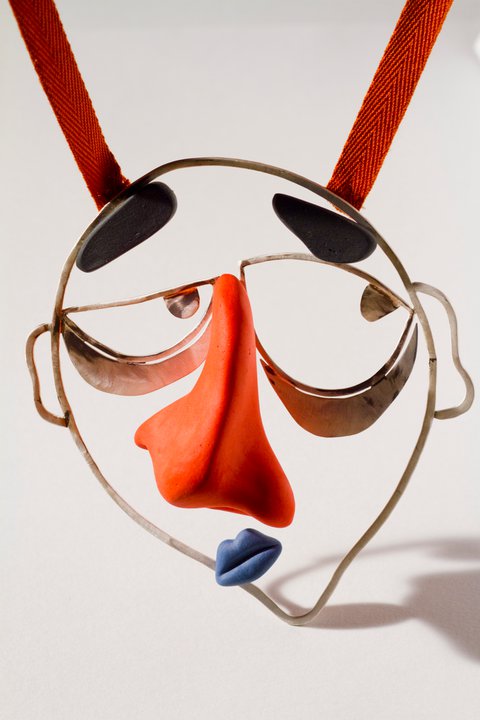
The Jewelry Designer confronts a world that is unsure whether jewelry is “craft” or “art”. When defined as “craft”, jewelry is seen as something that anyone can do — no special powers are needed to be a Jewelry Designer. As “craft”, there is somewhat of a pejorative meaning — it’s looked down upon, thought of as something less than art. But as “craft”, we recognize the interplay of the artist’s hand with the piece and the story-telling underlying it. We honor the technical prowess. People love to bring art into their personal worlds, and the craftsperson offers them functional objects that have artistic sensibilities.
When defined as “art”, jewelry is seen as something which transcends itself and its design. It evokes an emotional response from the viewer. It has more of a sense of clarity of purpose and choice, a sense of presence. Functionality should play no role at all, or as a compromise, merely be supplemental.
The Jewelry Designer must be clear on why his or her work should be categorized as “art” or “craft”, or as both as “art” and “craft”.
The Art World accepts jewelry as art from an aesthetic point of view. It sees jewelry as a subset of painting or sculpture. It judges its success as if it were sitting on an easel or perched on a mannequin. It teaches the Jewelry Designer that the only important choices to make are ones associated with art theories. The Art World often exhibits so much disdain for Craft, that it ignores functional considerations entirely.
With jewelry, ignoring function — durability, movement, flow, drape, structural integrity, context, psychology, sociology, anthropology, sexuality — can lead to disaster. Jewelry should be judged as art, but only as it is worn. The choices the Jewelry Artist needs to make are much broader than art, and all choices are equally as critical.
The more appropriate skills involved here are ones of design, where aesthetics are balanced with function, and where conflicts between art and craft are resolved in a satisfactory way, but sometimes to the detriment of aesthetics.
The Jewelry Designer should be very aware of how she or he has applied themselves to their work. This brings up the next question.
QUESTION 2: How do you decide what you want to create?
What kinds of things do you do to translate your passions and inspirations into jewelry? What is your creative process? How is it organized? How do you know it’s working best for you?
Applying yourself creatively can be fun at times, but scary at others. It is work. There is an element of risk. You might not like what you end up doing. Your friends might not like it. Nor your family. You might not finish it. Or you might do it wrong.
It always will seem easier to go with someone else’s project, already proven to be liked and tested — because it’s been published, and passed around, and done over and over again by many different people.
Sometimes it seems insurmountable, after finishing one project, to decide what to do next.
The Jewelry Designer needs to be confident and comfortable making creative choices. So, some advice here.
Set no boundaries and set no rules.
Be free. Go with the flow. Don’t conform to expectations.
Play.
Pretend you’re a kid again. Have fun. Get the giggles.
Experiment.
Take the time to do a lot of What If’s and Variations On A Theme and Trial and Error.
Keep Good Records
Make good notes and sketches of what seems to work, and what seems to not work.
Evaluate.
Learn from your successes and mistakes. Figure out the Why did something work, and the Why Nots.
As you play and experiment and evaluate with all the parts, you will become more familiar with the characteristics of the materials. This brings us to the third question.
QUESTION 3: What kinds of MATERIALS work well together, and which ones do not?
Why is this?
The choice of materials, including beads, clasps and stringing materials, set the tone and chances of success for your piece. These choices
…affect the Look
…affect the Drape
…affect the Feel
…relate to the Context
These choices involved such things as:
– Type of material(s)
– Thickness and other physical parameters of the parts, such as whether they have been stamped, fabricated or cast; interaction with sunlight, ultraviolet light, heat and cold; how the pieces have been finished off
– Cost of materials
– Durability of materials
– Compatibility of different types of materials
– Structural integrity and integration of materials, particularly in multi-media art jewelry or related pieces.
I always suggest using the highest quality materials your budget will allow.
When you try to mix different kinds of materials, the strengths and weaknesses of each material become more apparent. Mixing different materials and achieving successful pairings is hard to do. It is difficult to mix glass and gemstone. It is difficult to mix glass and crystal. Or glass and plastic.
There are textural issues. There are color issues. There are issues related to the reflection and refraction of light. There are issues how one material changes the perception of another material, when put side by side — simultaneity effects.
Take, for example, mixing glass and gemstones. Usually this doesn’t work. When the eye/brain interacts with most glass, the light hits the surface of the material and is reflected back. When the eye/brain interacts with most gemstone, the light both hits the surface as well as is drawn into the bead below the surface, and then reflected back. Going from glass bead to gemstone bead can be very irritating for the eye/brain. So as best as you can duplicate the eye/brain interaction with gemstone with the eye/brain interaction with glass, the more satisfying the mixture will become. So you might use opalescent glass or color lined glass, which mimics the light/eye/brain interactions of gemstone.
Mixing media present another example. Usually, when you mix media, say fibers and beads, you need to let one media predominate in your piece. Each media has its own material properties and structural characteristics, and compete with one another.
The power to making creative choices about materials and their arrangements is a core skill of the Designer. And this leads us to the next question.
Question 4: Beyond applying basic techniques, how does the Jewelry Designer evoke an emotional response to their jewelry?
Beyond learning basic techniques, what kinds of choices does the successful jewelry designer need to make?
A related question: Beaders and Jewelry Makers focus too often on Techniques and not often enough on Skills. They learn techniques; they don’t learn skills. How can we get away from focusing too much on Technique, and instead, focus more on Skill?
It is important to draw distinctions between Techniques and Skills. What distinctions? Why? What kinds of skills do we bring, as Jewelry Designers, to our pieces, which make them Resonate?
What is Technique? What is Skill? What are your Skills?
An artistic and well-designed piece of jewelry should evoke an emotional response. Techniques are necessary but not sufficient to get you there. You need Skills.
The classic analogy comparing Techniques and Skills references cutting bread with a knife.
Technique: How to hold the knife relative to the bread in order to cut it.
Skill: The force applied so that the bread gets cut successfully.
Skills are the kinds of things the Jewelry Designer applies which enhances his or her capacity to control for bad workmanship. These include things like
– Judgment
– Presentation
– Care and dexterity
– Taking risks
So we can see our skillful Jewelry Designer choosing materials and colors. Or marketing. Or managing thread or string tension. Color blending. Mixing materials. Developing variations on techniques. Having a personal style. Trying out something new.
Classic Art Theory holds, that if you need to talk too much about Technique underlying your piece, your piece is not art, it is craft. And in our classes and discussion groups, the conversations are terribly concentrated on Technique as if there were nothing else to discuss. I blame the bead magazines for ignoring the role of choice in writing instructions. Everything is presented so mechanically. But jewelry design is so much more. And Jewelry Designers need to aim for the ‘so much more.’
It is this process of linking the technique to the materials that is “art”. A successful process requires an understanding of the intrinsic values of the materials. It requires an understanding of how to manipulate the materials to elicit a positive response from others. It is expressive, intuitive and evokes emotions. The critical focus is not on the techniques. The critical focus is on the linking of technique and material to create something that others emotionally interactive with.
Creative engagement with materials. Expressive. Imaginative. A sense of audience.
Jewelry Design is an avocation which requires you to know a lot of things. You need to know a lot about materials. You need to know a lot about quality issues underlying these materials, and what happens to these materials over time. You need to be mechanical and comfortable using tools to construct things. You need to learn many basic techniques. You need to understand physical mechanics and what happens to all these materials and pieces, when jewelry is worn. You need to be familiar with art theories and their applications. You need to understand people, their psychology, the dynamics of the groups they find themselves in, and their cultural rules which get them through the day.
The Jewelry Designer, when creating a piece of jewelry, has a lot to do, and has a lot of skills to bring to bear on the project. And this leads to our 5th and last question.
QUESTION #5: When Is Enough Enough?
How does the Jewelry Artist know when the piece is done? Overdone? Or Underdone? How do you edit?
In the bead and jewelry arenas, you see piece after piece that is over-embellished, or gets too repetitive with the elements and materials. If 5 fringe look good, 20 fringe would be better. If 6 colors are appealing, 9 colors would be better. If 6 repeats of a pattern looks good, 8 repeats would look better.
On the other hand, you often see pieces that can be described as ‘not quite there’. They need something else. A tweak. A change in arrangement. Some additional material or color. A better or smarter clasp and clasp assembly. Pretty, but they don’t resonate. They don’t sufficiently touch their audiences.
For every piece of jewelry there will be that point of Parsimony. Where adding or subtracting one more piece will make the experiencing of the whole somewhat less than the sum of its parts.
To get to this point, the Jewelry Designer must exercise great skill and great technique. The Designer must show restraint and control.
And to get to this point, the Jewelry Designer must have a point of view, and a clear understanding of the point she or he wants to make through this piece of jewelry.
In this way, the Jewelry Designer can show nuance. The Jewelry Designer can most satisfactorily arrive at a design which makes the ordinary ‘noteworthy’.
And this concludes our discussion of 5 questions every Jewelry Designer should have answers for. The Empowered Jewelry Designer will have these answers, though not every Designer will have the same answers, nor is there one best answer. And it is unacceptable to avoid answering any of these 5 questions, for fear you might not like the answer.
Each Jewelry Designer needs to answer these kinds of questions for themselves, in a way that is satisfying and motivating. The answers they come up with influence how they present themselves and their work to others.
These 5 questions, in effect, define the who and what and how a Jewelry Designer is, and how to empower them. Jewelry Designers have definable sets of interrelated skills which can be taught, creatively applied, and further developed. These skills can be used to create and enhance color, shape, texture, sensibility, perception, sensuousness and emotion. They can be applied to bring meaning, cognition, culture, connectivity and wisdom to a situation. They can be used to create the tangible from the intangible, and the object from nothingness.
The skills of combining materials of physical and/or aesthetic wealth into wearable art forms and adornment — this is Jewelry Making and Design.
Empowered Jewelry Designers
Creatively combine and manipulate
Materials and components
By applying interrelated skills, and
Exercising judgment how best to enhance experience and meaning