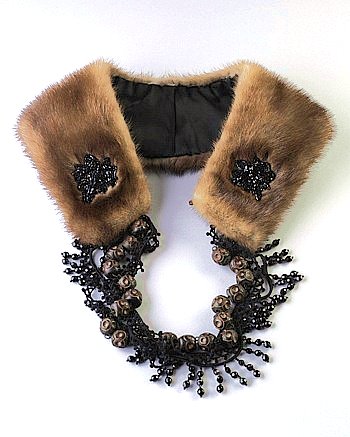


LARK PUBLICATIONS CALL FOR ENTRIES 8/1/2012 deadline I received the following email from Ray Hemachandra of Lark Publications. They are requesting submissions to possible be included ina book to be published called Showcase 500 Necklaces. -- Warren "I'm pleased to announce a two-month call for entries for a new 500 Series gallery book of handmade contemporary jewelry from Lark Books: Showcase 500 Necklaces. The opportunity closes on August 1, 2012. That is a short window of time, so I ask you please to share the call for entries promptly with your entire jewelry-making community, including peers, associations, schools, students, and all online forums as well as social media like Twitter and Facebook, and to respond to it yourself in a timely way. As always, we hope to receive a wide array of entries from around the world. I'm also pleased to report Lark has converted to using an online entry system; entries are now online only, through a portal provided by Juried Art Services. Here is the link for the informational prospectus and to enter: http://bit.ly/NmsmQmYou'll find all the information you need at that link, so please follow the instructions carefully, but here are some key points: We'll accept jewelry in all materials with all techniques and design styles, including both wearable and conceptual but biasing toward the wearable, simply because most readers prefer seeing wearable jewelry in these books. Jurying will favor more recent work, and so we ask you to submit very recent or current work from no earlier than 2010. The submission limit is two pieces (one photo of each, with an option of one or two alternate or detail photos per piece). 'Necklaces' can include neckpieces, chokers, torques, collars, operas, ropes, chains, bibs, etc. There is no charge for entry for this book; Lark is covering the Juried Art Services cost. We strongly prefer work that has not been previously published in book form. The JAS form will walk you through the process, but a few notes: 1. No need to complete the Artist Statement section. 2. Please read and follow Lark's Digital Image Submission Guidelines. 3. We encourage early entries, especially to avoid having any last-minute difficulties with the new entry process: Complete the process ahead of the deadline so you're assured of having time to resolve any technical issues you might encounter. For questions about registering with Juried Art Services or uploading your material to the site, contact support@jurying.net. For other questions about the book, please direct them to Hannah Doyle at hannah@larkbooks.com. And please be sure to join Lark Jewelry & Beading on Facebook at https://www.facebook.com/LarkJewelryBeading for updates and future calls for entries. We invite you to copy the web ad for the book at http://www.larkcrafts.com/submit/calls-for-submissions/ for your own website or blog, or to share it on your Facebook page, linking either to that link or to the JAS page at http://bit.ly/NmsmQm, whichever you prefer. We are very excited about this book, the third jewelry book since the 500 series evolved into 'Showcase 500'. Showcase 500 Rings (http://amzn.to/yEERZm ) just published in May, and Showcase 500 Beaded Jewelry (http://amzn.to/z6tZH2) will publish in August. We know Showcase 500 Necklaces will be a book devoted to work of creative excellence and innovation, and we invite and welcome your contribution to the book. Thank you very much. Sincerely, Ray Join us on Facebook: facebook.com/LarkJewelryBeading Follow us on Pinterest: pinterest.com/larkjewelry Ray Hemachandra Team Lead and Business Manager Lark Jewelry & Beading 67 Broadway Asheville, North Carolina 28801 (828) 253-0467 ext. 762 ray@larkbooks.com http://www.larkcrafts.com/jewelry-beading"
Archive for the ‘bead weaving’ Category
LARK PUBLICATIONS: Call For Entries
Posted by learntobead on June 10, 2012

Posted in bead weaving, beads, beadwork, jewelry design, jewelry making | Tagged: book submission, juried jewelry | 2 Comments »
Go VOTE – Beaded Tapestry Competition
Posted by learntobead on November 4, 2011
Semi-Finalists Chosen!
Beaded Tapestry Competition
GO VOTE OnLine: Voting ends 1/14/2012
Visit the web-pages of each of our 4 Beaded Tapestry Competition Semi-Finalists.
International 2011
THE ILLUSTRATIVE BEADER:
BEADED TAPESTRY COMPETITION
Theme: Mystery Genre Book Covers
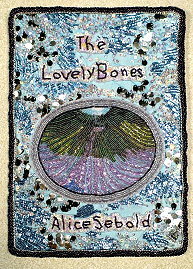
#1. KAY FIELDEN
Auckland, New Zealand
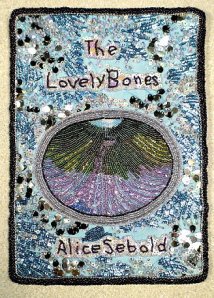
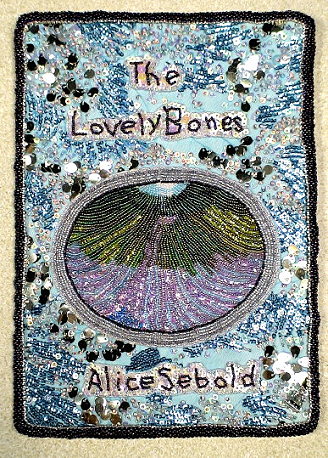
“The Lovely Bones” by Alice Sebold
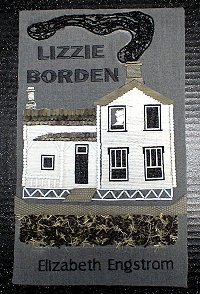
#2. JUNE JACKSON and JAMIE BRUNS
Bryan, Texas
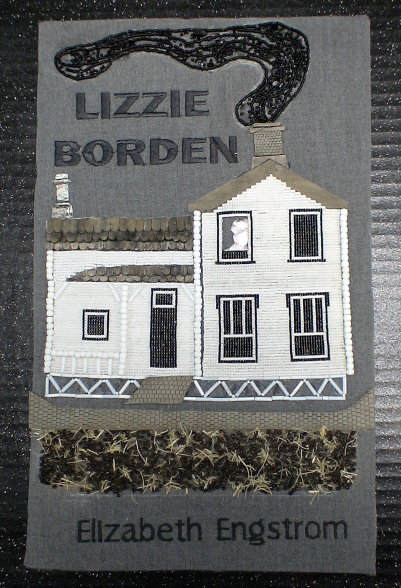
“Lizzie Borden” by Elizabeth Engstrom
#3. DOT LEWALLEN
Westerville, Ohio
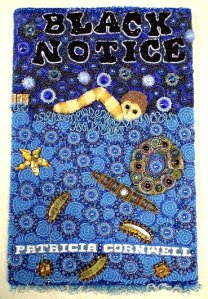
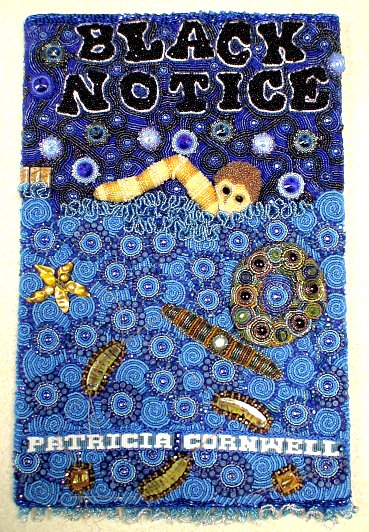
“Black Notice” by Patricia Cornwell
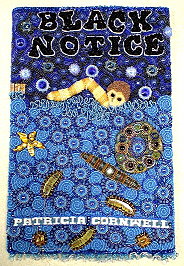
#4. PATTY ROCKHILL
O’Brien, Florida
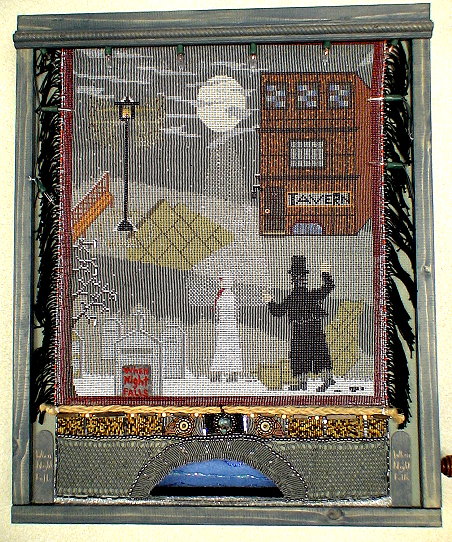
“When Night Falls”
by Jenna Ryan
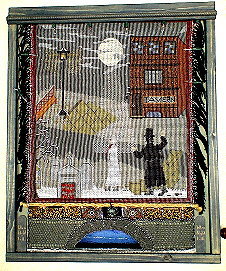
Evaluate their images, their write-ups, and their materials and techniques.
Then use the on-line form you will find at the bottom of each of their web-pages
to Score them in terms of
Visual Appeal,
Artist Insight,
Artist Technique, and
Use of Beads in the Design.
The judges were blown away by the quality of all 4 semifinalists. It was truly amazing how well each artist captured the essence of their book. Each artist brought these books to life within their book cover design. Yet each artist’s approach was different. These artists should commend themselves on the amount of thought, insight, and coordination of ideas and techniques which went into producing their Beaded Tapestry pieces. Bravo!
Here we use the concept of “Tapestry” in its broadest sense as a stitched, sewn and/or woven wall hanging. Your tapestry may be woven, loomed, stitched, quilted, cross-stitched, crocheted, knitted, sewn, braided, knotted, embroidered, macrame’d, beaded and the like. Your tapestry will combine fibers/threads/and/or cloth and beads in some way, and the surface area must consist of at least 70% beads. Beads may be used in many ways, such as forming the background canvas of your piece, and/or embellishing your canvas, and/or as fringe, and/or as stitchery covering parts of your piece. Your piece should be mounted or framed in some way, ready for hanging on a wall. Your tapestry may utilize many different techniques.
GO VOTE OnLine: Voting ends 1/14/2012
http://www.landofodds.com/store/tapestry1contest.htm
Posted in bead weaving, beads, beadwork, Contests | Leave a Comment »
SNAKES – Claire Kahn
Posted by learntobead on October 25, 2011
SNAKES
“Snakes” are popular jewelry themes and forms.

Claire Kahn
The undulating body form.
The sharp, threatening teeth.
The relationship to the Adam and Eve story.
The use of the snake in various cultural myths and mythologies.
The patterning of the skin.
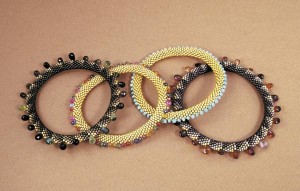
Claire Kahn
The snake evokes something primal within us. It has an aesthetic that we all recognize and share, perhaps sensuous, perhaps threatening, yet always steeped in beauty.
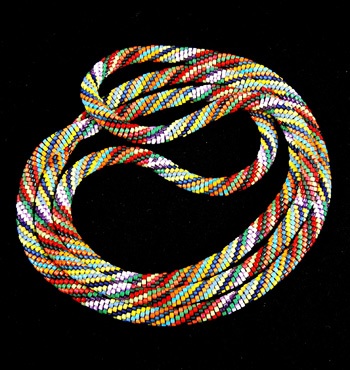
Claire Kahn
Many of our students and customers love making snakes. Snake necklaces. Snake bracelets. Snake cuffs. Snake rings.

Claire Kahn
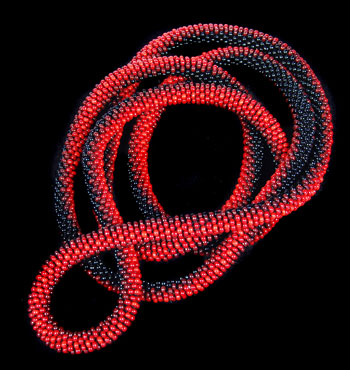
Claire Kahn‘s work recently caught my eye.
http://clairekahndesign.com/
Claire Kahn
Her website displays many beautiful, detailed images of her pieces.
Posted in bead weaving, jewelry design | Tagged: beaded snakes, claire kahn, snake jewelry, snakes | Leave a Comment »
BEADED TAPESTRY COMPETITION SEMI-FINALISTS SELECTED
Posted by learntobead on October 21, 2011
BEADED TAPESTRY COMPETITION SEMI-FINALISTS SELECTED
Images of our semifinalists entries posted on facebook
The Illustrative Beader: Beaded Tapestry Competition, 2011
Theme: Mystery Genre Book Covers
http://www.facebook.com/pages/The-Illustrative-Beader-Beaded-Tapestry-Competition/176006269128968?sk=wall
KAY FIELDEN
Auckland, New Zealand
“The Lovely Bones”
by Alice Sebold
JUNE JACKSON and JAMIE BRUNS
Bryan, Texas
“Lizzie Borden”
by Elizabeth Engstrom
DOT LEWALLEN
Westerville, Ohio
“Black Notice”
by Patricia Cornwell
PATTY ROCKHILL
O’Brien, Florida
“When Night Falls”
by Jenna Ryan
Voting online for the winner will begin around 11/7/2011 on the land of odds website —
Posted in bead weaving, Contests | Tagged: bead embroidery, bead weaving, beaded tapestr, beaded tapestry, stitching, tapestry | Leave a Comment »
EMPOWERING THE JEWELRY DESIGNER
Posted by learntobead on October 12, 2011
EMPOWERING THE JEWELRY DESIGNER
5 Questions Every Jewelry Designer Should Have An Answer For
Before I begin any discussion, it is important to understand something about Empowerment. Empowering — why do you think it is important to Empower the Jewelry Designer? What kinds of powers do we want the Jewelry Designer to have? What kinds of things happen when the Jewelry Designer is not empowered?
It is important that the Jewelry Designer feel comfortable and confident in making choices. These kinds of choices could be as simple as whether to finish a piece, or not. Or whether to begin a second piece after finishing the first one. The designer will make choices about how to draw someone’s attention to the piece, or present the piece to a larger audience. She or he may decide to submit the piece to a magazine or contest. She or he may want to sell the piece and market it. The designer will make choices about how a piece might be worn, or who might wear it, or when it might be worn, in what context.
And for all these choices, the Jewelry Designer might need to overcome a sense of fear, or boredom, or resistance. The Designer might need to overcome anxiety, a sense of giving up, having jeweler’s block, feeling unchallenged, even laziness.
We want the Jewelry Designer to be empowered to be able to make the necessary choices, in the face of everything that might slow him or her down, or prevent any kind of progress toward a satisfactory end.
And there are other powers we want the Jewelry Designer to have. We want the designer to be primed to learn more, and be aware of more. We want our Designer to make smart choices about construction.
We want our Designer to be empowered to better able handle contingencies — to fix problems and make substitutions, as the needs arise.
Our Designer should be empowered to be better able to create an aura of resonance resonating from the piece of jewelry, perhaps giving an edge to it. The Designer wants to evoke an emotional response from the audience. This is accomplished by the choices the Designer makes to better use color or a more controlled use of line or a better and more frequent use of forms, themes and components, or a better mixing of materials.
One more critical power we want our Designer to have. We want the Designer to be better able to have the jewelry reflect the artist’s hand and style.
The successful Jewelry Designer should be very empowered.
The empowered Jewelry Designer should have answers to 5 critical questions. These have to do with:
1) Art vs. Craft?
2) How To Decide What To Create?
3) What Materials Work Well Together?
4) How To Evoke Emotional Responses To Their Work?
5) When Is Enough Enough?
Let’s start with the first question.
Question 1: Should BEADWORK and JEWELRY MAKING be considered ART or CRAFT?
What do you think is going on here — why the distinction between Art and Craft, particularly as it applies to jewelry design and beading? Why is this distinction important? How does this distinction affect what we do as jewelry designers?
The Jewelry Designer confronts a world that is unsure whether jewelry is “craft” or “art”. When defined as “craft”, jewelry is seen as something that anyone can do — no special powers are needed to be a Jewelry Designer. As “craft”, there is somewhat of a pejorative meaning — it’s looked down upon, thought of as something less than art. But as “craft”, we recognize the interplay of the artist’s hand with the piece and the story-telling underlying it. We honor the technical prowess. People love to bring art into their personal worlds, and the craftsperson offers them functional objects that have artistic sensibilities.
When defined as “art”, jewelry is seen as something which transcends itself and its design. It evokes an emotional response from the viewer. It has more of a sense of clarity of purpose and choice, a sense of presence. Functionality should play no role at all, or as a compromise, merely be supplemental.
The Jewelry Designer must be clear on why his or her work should be categorized as “art” or “craft”, or as both as “art” and “craft”.
The Art World accepts jewelry as art from an aesthetic point of view. It sees jewelry as a subset of painting or sculpture. It judges its success as if it were sitting on an easel or perched on a mannequin. It teaches the Jewelry Designer that the only important choices to make are ones associated with art theories. The Art World often exhibits so much disdain for Craft, that it ignores functional considerations entirely.
With jewelry, ignoring function — durability, movement, flow, drape, structural integrity, context, psychology, sociology, anthropology, sexuality — can lead to disaster. Jewelry should be judged as art, but only as it is worn. The choices the Jewelry Artist needs to make are much broader than art, and all choices are equally as critical.
The more appropriate skills involved here are ones of design, where aesthetics are balanced with function, and where conflicts between art and craft are resolved in a satisfactory way, but sometimes to the detriment of aesthetics.
The Jewelry Designer should be very aware of how she or he has applied themselves to their work. This brings up the next question.
QUESTION 2: How do you decide what you want to create?
What kinds of things do you do to translate your passions and inspirations into jewelry? What is your creative process? How is it organized? How do you know it’s working best for you?
Applying yourself creatively can be fun at times, but scary at others. It is work. There is an element of risk. You might not like what you end up doing. Your friends might not like it. Nor your family. You might not finish it. Or you might do it wrong.
It always will seem easier to go with someone else’s project, already proven to be liked and tested — because it’s been published, and passed around, and done over and over again by many different people.
Sometimes it seems insurmountable, after finishing one project, to decide what to do next.
The Jewelry Designer needs to be confident and comfortable making creative choices. So, some advice here.
Set no boundaries and set no rules.
Be free. Go with the flow. Don’t conform to expectations.
Play.
Pretend you’re a kid again. Have fun. Get the giggles.
Experiment.
Take the time to do a lot of What If’s and Variations On A Theme and Trial and Error.
Keep Good Records
Make good notes and sketches of what seems to work, and what seems to not work.
Evaluate.
Learn from your successes and mistakes. Figure out the Why did something work, and the Why Nots.
As you play and experiment and evaluate with all the parts, you will become more familiar with the characteristics of the materials. This brings us to the third question.
QUESTION 3: What kinds of MATERIALS work well together, and which ones do not?
Why is this?
The choice of materials, including beads, clasps and stringing materials, set the tone and chances of success for your piece. These choices
…affect the Look
…affect the Drape
…affect the Feel
…relate to the Context
These choices involved such things as:
– Type of material(s)
– Thickness and other physical parameters of the parts, such as whether they have been stamped, fabricated or cast; interaction with sunlight, ultraviolet light, heat and cold; how the pieces have been finished off
– Cost of materials
– Durability of materials
– Compatibility of different types of materials
– Structural integrity and integration of materials, particularly in multi-media art jewelry or related pieces.
I always suggest using the highest quality materials your budget will allow.
When you try to mix different kinds of materials, the strengths and weaknesses of each material become more apparent. Mixing different materials and achieving successful pairings is hard to do. It is difficult to mix glass and gemstone. It is difficult to mix glass and crystal. Or glass and plastic.
There are textural issues. There are color issues. There are issues related to the reflection and refraction of light. There are issues how one material changes the perception of another material, when put side by side — simultaneity effects.
Take, for example, mixing glass and gemstones. Usually this doesn’t work. When the eye/brain interacts with most glass, the light hits the surface of the material and is reflected back. When the eye/brain interacts with most gemstone, the light both hits the surface as well as is drawn into the bead below the surface, and then reflected back. Going from glass bead to gemstone bead can be very irritating for the eye/brain. So as best as you can duplicate the eye/brain interaction with gemstone with the eye/brain interaction with glass, the more satisfying the mixture will become. So you might use opalescent glass or color lined glass, which mimics the light/eye/brain interactions of gemstone.
Mixing media present another example. Usually, when you mix media, say fibers and beads, you need to let one media predominate in your piece. Each media has its own material properties and structural characteristics, and compete with one another.
The power to making creative choices about materials and their arrangements is a core skill of the Designer. And this leads us to the next question.
Question 4: Beyond applying basic techniques, how does the Jewelry Designer evoke an emotional response to their jewelry?
Beyond learning basic techniques, what kinds of choices does the successful jewelry designer need to make?
A related question: Beaders and Jewelry Makers focus too often on Techniques and not often enough on Skills. They learn techniques; they don’t learn skills. How can we get away from focusing too much on Technique, and instead, focus more on Skill?
It is important to draw distinctions between Techniques and Skills. What distinctions? Why? What kinds of skills do we bring, as Jewelry Designers, to our pieces, which make them Resonate?
What is Technique? What is Skill? What are your Skills?
An artistic and well-designed piece of jewelry should evoke an emotional response. Techniques are necessary but not sufficient to get you there. You need Skills.
The classic analogy comparing Techniques and Skills references cutting bread with a knife.
Technique: How to hold the knife relative to the bread in order to cut it.
Skill: The force applied so that the bread gets cut successfully.
Skills are the kinds of things the Jewelry Designer applies which enhances his or her capacity to control for bad workmanship. These include things like
– Judgment
– Presentation
– Care and dexterity
– Taking risks
So we can see our skillful Jewelry Designer choosing materials and colors. Or marketing. Or managing thread or string tension. Color blending. Mixing materials. Developing variations on techniques. Having a personal style. Trying out something new.
Classic Art Theory holds, that if you need to talk too much about Technique underlying your piece, your piece is not art, it is craft. And in our classes and discussion groups, the conversations are terribly concentrated on Technique as if there were nothing else to discuss. I blame the bead magazines for ignoring the role of choice in writing instructions. Everything is presented so mechanically. But jewelry design is so much more. And Jewelry Designers need to aim for the ‘so much more.’
It is this process of linking the technique to the materials that is “art”. A successful process requires an understanding of the intrinsic values of the materials. It requires an understanding of how to manipulate the materials to elicit a positive response from others. It is expressive, intuitive and evokes emotions. The critical focus is not on the techniques. The critical focus is on the linking of technique and material to create something that others emotionally interactive with.
Creative engagement with materials. Expressive. Imaginative. A sense of audience.
Jewelry Design is an avocation which requires you to know a lot of things. You need to know a lot about materials. You need to know a lot about quality issues underlying these materials, and what happens to these materials over time. You need to be mechanical and comfortable using tools to construct things. You need to learn many basic techniques. You need to understand physical mechanics and what happens to all these materials and pieces, when jewelry is worn. You need to be familiar with art theories and their applications. You need to understand people, their psychology, the dynamics of the groups they find themselves in, and their cultural rules which get them through the day.
The Jewelry Designer, when creating a piece of jewelry, has a lot to do, and has a lot of skills to bring to bear on the project. And this leads to our 5th and last question.
QUESTION #5: When Is Enough Enough?
How does the Jewelry Artist know when the piece is done? Overdone? Or Underdone? How do you edit?
In the bead and jewelry arenas, you see piece after piece that is over-embellished, or gets too repetitive with the elements and materials. If 5 fringe look good, 20 fringe would be better. If 6 colors are appealing, 9 colors would be better. If 6 repeats of a pattern looks good, 8 repeats would look better.
On the other hand, you often see pieces that can be described as ‘not quite there’. They need something else. A tweak. A change in arrangement. Some additional material or color. A better or smarter clasp and clasp assembly. Pretty, but they don’t resonate. They don’t sufficiently touch their audiences.
For every piece of jewelry there will be that point of Parsimony. Where adding or subtracting one more piece will make the experiencing of the whole somewhat less than the sum of its parts.
To get to this point, the Jewelry Designer must exercise great skill and great technique. The Designer must show restraint and control.
And to get to this point, the Jewelry Designer must have a point of view, and a clear understanding of the point she or he wants to make through this piece of jewelry.
In this way, the Jewelry Designer can show nuance. The Jewelry Designer can most satisfactorily arrive at a design which makes the ordinary ‘noteworthy’.
And this concludes our discussion of 5 questions every Jewelry Designer should have answers for. The Empowered Jewelry Designer will have these answers, though not every Designer will have the same answers, nor is there one best answer. And it is unacceptable to avoid answering any of these 5 questions, for fear you might not like the answer.
Each Jewelry Designer needs to answer these kinds of questions for themselves, in a way that is satisfying and motivating. The answers they come up with influence how they present themselves and their work to others.
These 5 questions, in effect, define the who and what and how a Jewelry Designer is, and how to empower them. Jewelry Designers have definable sets of interrelated skills which can be taught, creatively applied, and further developed. These skills can be used to create and enhance color, shape, texture, sensibility, perception, sensuousness and emotion. They can be applied to bring meaning, cognition, culture, connectivity and wisdom to a situation. They can be used to create the tangible from the intangible, and the object from nothingness.
The skills of combining materials of physical and/or aesthetic wealth into wearable art forms and adornment — this is Jewelry Making and Design.
Empowered Jewelry Designers
Creatively combine and manipulate
Materials and components
By applying interrelated skills, and
Exercising judgment how best to enhance experience and meaning
Posted in bead weaving, beadwork, jewelry design, jewelry making | Leave a Comment »
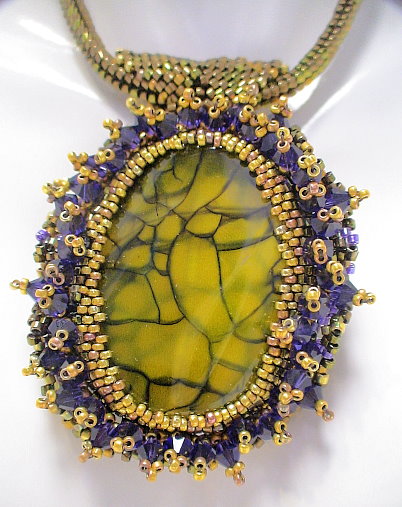
New Column Posted to “How To Bead A Rogue Elephant”
Posted by learntobead on September 2, 2011
New Column Posted
“How To Bead A Rogue Elephant”
Getting Started in Beading and Jewelry Making
Excerpts from this book on the following topics…
Click here
– Catching the “Bead-Bug”
– What Can You Do With Beads
– Getting Started
– Finding Inspirations
– Shopping for Beads
– What To Look For In A Bead
– How Not To Shop
– Be A Good Customer
– Buyer Beware
– Tips for Buying Beads At A Bead Show
– What Should I Create?
– Planning Your Necklace
– Anatomy of a Necklace
– Measurements You Need to Know
– Working from a Palette
– How Do You Learn?
– The Types of Things You Need to Learn
– On My Own, Through Books, or Through Classes?
– Reading Patterns and Instructions
– Self-Esteem — Making Choices
– Selling vs. Keeping
– Beading Aphorisms
Posted in bead weaving, beads, beadwork, jewelry design, Learn To Bead | 2 Comments »
Beading For Children Focuses The Mind
Posted by learntobead on January 3, 2011
Beading for Children Focuses The Mind
Cherly McMahan of the Icenhower Intermediate School, Mansifield ISD, in Arlington, Texas, shared this article she recently wrote. The article was about Instructions for children’s beading projects for use in project based learning and therapy for children with autism.
http://knol.google.com/k/cheryl-mcmahan/just-bead-it/1bvwxgiggyj0d/25#view
I thought you would enjoy reading it.
Posted in bead weaving, Learn To Bead | Tagged: autism, bead projects for children, beading with children | Leave a Comment »
Loom Work of Douglas Johnson
Posted by learntobead on July 1, 2010
LOOM WORK
Of Douglas Johnson
http://www.douglaswjohnson.com/index.html
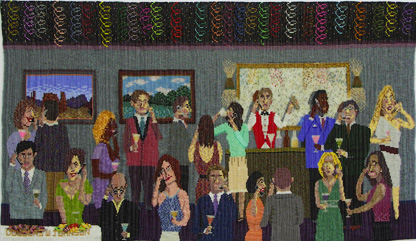
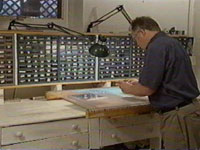
The loom work of artist Douglas Johnson is breathtaking and very large. If you’ve ever worked on a loom, creating Large pieces can be quite a challenge. Many people sew panels together, and you can always see the seam. Others create larger and larger looms and strategies for managing large projects. This is what Douglas Johnson has done.
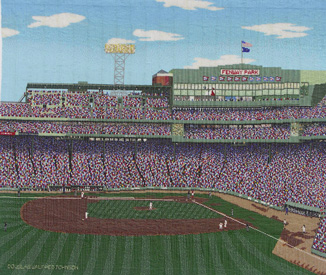
“I first came in contact with seed beads in 1970. At first I strung them into necklaces using different patterns of color. I loved the colors and was soon shown how to weave them on a loom.
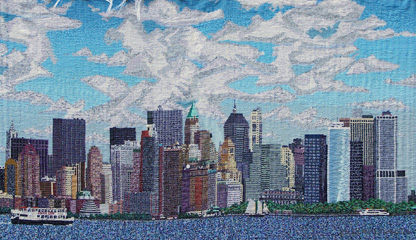
Being a guitar player at the time I decided to make a guitar strap out of beads. So I built a long loom and started weaving a strip of beads to be sewn onto leather. As I was weaving this long strap, I thought it would be nice to get wilder and make a scene out of beads. Imagine a house and barn or even a little village.
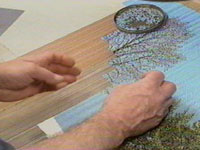
So I built a loom that could hold four strips in a row, each strip was 25 beads wide (like my guitar strap) so I ended up with a piece 100 beads wide. I wove each strip separately and sewed them together when they were done.
It was not until 1990 that I figured out how to connect the rows on the loom ending up with a solid piece when taken off the loom.”
Posted in bead weaving | Tagged: bead art, bead weaving, douglas johnson, loom, loomwork, seed beads | 2 Comments »
Last Chance to Vote OnLine – Beaded Dolls
Posted by learntobead on January 5, 2010
ALL DOLLED UP: Beaded Art Doll Competition
Last Chance To Vote On-Line:
Voting for our 6 semi-finalists ends 1/15/10
http://www.landofodds.com/store/alldolledup2009contest.htm
Artists around the nation were asked to create a Beaded Art Doll by manipulating beads and forms into an imaginative tactile and visual 3-dimensional representation of this year’s theme:Earthen Mother .
And then writing a Short Story (between 1000-2000 words) about your Beaded Art Doll, what it represents, and how it was created, starting with the sentence:
“The mirror reflects more than my hands can feel.
Lines, edges, shadings, a weariness under the eyes, an awkward stance.
Yet, not reflected is a certain vibrancy —
a compassion and wisdom and wonder so many people rely on.
Only you, my beaded art doll,
capture the fullness of me as I age in place .
You embody changes I want to make, so I aptly name you…”
The Fourth Bi-Annual 2009 ALL DOLLED UP: BEADED ART DOLL COMPETITION is offering a first prize of a $1000.00 shopping spree on the Land of Odds web-site (www.landofodds.com), and a Runner-Up prize of a $400.00 shopping spree on the web-site.
Our SemiFinalists:
Kathy Ford, Deep Gap, North Carolina
Vera Fox-Bond, LaVergne, Tennessee
Cathy Helmers, Dayton, Ohio
Ralonda Patterson, Decatur, Texas
Dot Lewallen, Westerville, Ohio
Joan Cromley, Sedro Woolley, Washington
Other programs of interest:
The Ugly Necklace Contest – A Jewelry Design Competition with a Twist
http://www.landofodds.com/store/uglynecklace.htm
THE ILLUSTRATIVE BEADER: Beaded Tapestry Competition
http://www.landofodds.com/store/tapestry.htm
LEARN TO BEAD Blog
http://blog.landofodds.com
Posted in bead weaving, beadwork, Contests | Tagged: beaded art doll, beading, beadwork, doll, multimedia art | Leave a Comment »
ALL DOLLED UP: Beaded Art Doll Competition
Posted by learntobead on October 2, 2009
ALL DOLLED UP: Beaded Art Doll Competition
6 Semi-Finalists Announced
OnLine Voting begins around 11/07/09
www.landofodds.com/store/alldolledup.htm
Synopsis:
Creating a Beaded Art Doll requires an extraordinary mix of multi-media talents by the successful artist. It involves the design of a 3-dimensional doll form. It requires an imaginative application and manipulation of beads resulting in a tactile, visual and emotional representation of the artist’s goals. This year, these goals are focused on the theme: EARTHEN MOTHER.
The Fourth Bi-Annual 2009 All Dolled Up: Beaded Art Doll Competition — sponsored by Land of Odds, Be Dazzled Beads, The Open Window Gallery and The Center for Beadwork & Jewelry Arts in Nashville, TN — sought out beaded art doll artists nationwide. This competition primarily focuses on the design skills of the doll artists; it’s not merely a beauty pageant.
Each entrant created a beaded art doll, and then wrote a story about it, beginning with this sentence:
“The mirror reflects more than my hands can feel.
Lines, edges, shadings, a weariness under the eyes, an awkward stance.
Yet, not reflected is a certain vibrancy —
a compassion and wisdom and wonder so many people rely on.
Only you, my beaded art doll,
capture the fullness of me as I age in place .
You embody changes I want to make, so I aptly name you…”
Six semi-finalists were chosen by a panel of experts from The Center for Beadwork & Jewelry Arts from 12 wonderful entries. Images and stories will be displayed online around November 7th on the Land of Odds website (www.landofodds.com ). Visitors will be asked to vote and evaluate each doll, to help select the Winner and Runner-up. The winner receives a $1,000 shopping spree on the website; the Runner-up receives a $400 shopping spree).
These semi-finalists are,
Kathy Ford
Deep Gap, North Carolina
“Jolyma”
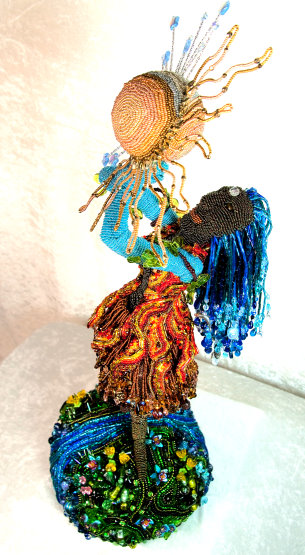
“As a child you spoke to me from mud as I sat at the far end of the garden patting earthen cakes between my palms. And how luminous that mud like the color of your skin could be. Chocolate, gold and olive green the fertile soil in which you breathe. Life survives and thrives in your rich ground….
…In this guise she embodies life as celebration. My life as celebration.”
Vera Fox-Bond
LaVergne, Tennessee
“Ta Dah”
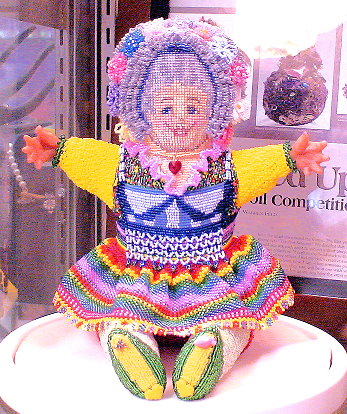
“I shall tell my story through TA DAH or TA for short. TA had been to the beauty shop for a new perm and the latest gossip. Her curls turned out to be a bit much and she stepped on bubble gum on her way to the car. What a day! Upon arriving home, TA looked in the bathroom mirror at her new do and the mirror changed her life and mine forever….
…Don’t discard the older things of this world as they contain their own kind of beauty, wisdom and peacefulness….”
Cathy Helmers
Dayton, Ohio
“Aikatrine”
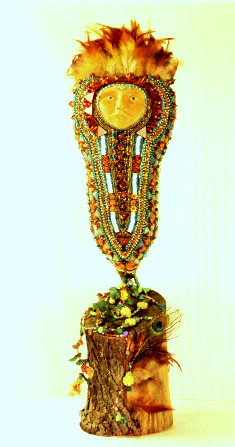
“You embody changes I want to make, so I aptly name you Aikaterine, meaning each of the two….
Life-giver, life-taker.
powerful, fragile
serene, chaotic
forgiving, harsh
Compassionate, rageful
…But Aikatrine has no time for self-reflection.
She is busy with self-regeneration.”
Ralonda Patterson
Decatur, Texas
“Willow”
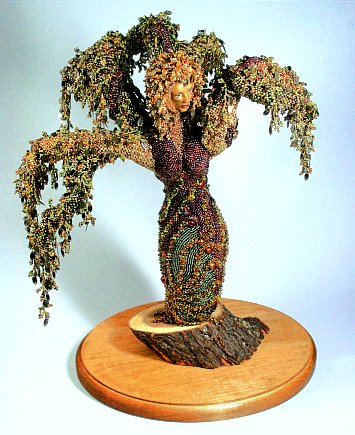
You were not always as you appear this day. You were fearful and lonely. You turned to learning for a safe haven, a place for you to be acknowledged in a positive light. Then sprang the hunger to be taught, a desire that was placed within the seed from which you sprang. Your roots began to thrive in the fertile soil that had been plowed by your ancestors’ faith. They grew deeper and had tapped into the eternal spring of the Spirit and from it came an understanding….
Now with such poise, you stand in the garden while showers of blessing rain down. You are forgiven and redeemed, a most beloved creation of the Heavenly Father. He gives you rest from your enemies and an eternity in the most beautiful garden of all.”
Dot Lewallen
Westerville, Ohio
“Rachel’s Dream”
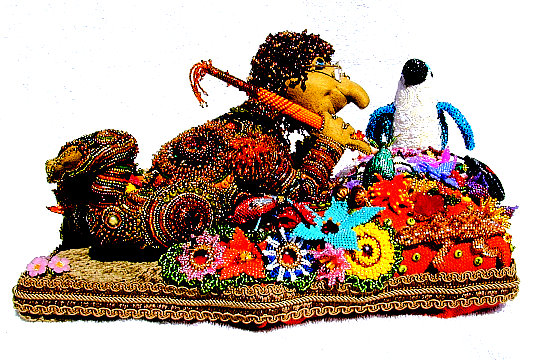
I close my eyes and am transported to a dream world. My fingers tingle with a sound permeating the forest as my ears hear the sharp crackling of the pine leaves I step upon. My nose is being teased with a plethora of smells dancing and embracing with a promise of more if I would follow deeper into the woods….Mother Earth takes time to heal one small flower…
Then I am awake lying in my own bed….I touch the place where the dream woman had kissed me, and can still feel the moisture from her breath. I know this woman. I’ve seen her before….The woman was Rachel Carson the author of Silent Sprint, and I had followed her into her dream….
We should all take the mirror we see ourselves in, wipe away the fog, and view our beautiful World with a childlike thrill….”
Joan M. Cromley
Sedro Woolley, Washington
“Yamka Wuti Kachina (Flowering Woman Spirit)”
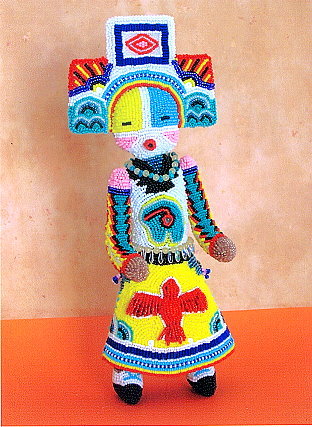
“As I sit here and prepare you for your future, you represent not just me, but also my mother, my daughter, all the women of the past, present and future….As the sacred Bead Keeper for the women of our village, my job is to perform the ceremonies and rituals in creating our precious beaded treasures. …
Just as my mother made my kachina for my puberty rite, so I am making you for my daughter. When she comes of age and goes through the Beadway Blessing, you will remind her of all the things she has within her, and all the things she can call on as a woman….”
About Beaded Art Dolls
A Beaded Art Doll is a physical representation in three dimensions, using human figural and expressive characteristics, through the creative use and manipulation of beads. Beads are a unique art medium, allowing multidimensional surface treatment, and phenomenal opportunities for interplay among colors, light, shadow, texture and pattern. Beaded Art Dolls submitted as entries for this Competition should be immediately recognizable as a “Doll” as defined above.
That said, Beaded Art Dolls submitted as entries for this competition may be realistic, surrealistic, whimsical or imaginary. They may be humanistic, animalistic, caricatures, cartoons, impressions or abstractions. The doll may take many forms, including a figure, purse, box, vessel, puppet, marionette, or pop-up figure.
Beaded Art Dolls should be between 8” and 36” in size. The surface area of the doll must be at least 80% composed of beads.
The doll’s internal form and structure may result from many techniques, materials and strategies. The bead stitches themselves might be used to create the skeletal structure. Various forms of cloth dolls might be stitched or embellished with beads. The underlying structure might be made of polymer clay, wood, ceramic, porcelain, Styrofoam, wire, corn husk, basket weaving, yarns, cardboard, paper, cotton, or some combination of materials. It might be a found form or object.
The Artist is given wide leeway in techniques for how the doll is to be beaded, and may use one particular technique or several. Techniques, for example, may include bead weaving stitches, bead embellishment, bead appliqué, bead knitting, bead crochet, bead embroidery, lampworking. For the 80% of the surface area that must be beaded, these would NOT include the application of rhinestones, sequins, nailheads or studs. The beads may be of any size, shape, color and material.
The Artist may include a doll stand or display support with the Art Doll, though this is not a requirement. This stand or support may be an off-the-shelf piece, or created from scratch by the Artist. It may be a base, a created setting, a decorative box, or frame. The stand or display support need not be beaded.
The Artist may interpret and apply the theme any way she or he chooses. The Beaded Art Doll might be thought of as a plaything; or as a visual representation of a person, feeling, spirit or thing; or as a tool for teaching; or as a method for stimulating emotional development or healing.
As an object of art, the goal of the Doll should be to make a statement, evoking an emotional, cultural or social response, either by the Artist her/himself or by others.
The Doll must be an original work, and may be the work of one Artist or a Collaboration.
Dolls have been a part of human existence for many thousands of years. Whether part of a ritual or part of child’s play, dolls function as symbols for meaning. Sometimes these meanings are broad social and cultural references; other times, these meanings focus on an individual’s relationship with oneself.
ALL DOLLED UP: BEADED ART DOLL COMPETITION is more than a beauty pageant. It is a design competition. The Competition will take into account the Artist’s intentions and how well these are incorporated into the design.
ALL DOLLED UP: Beaded Art Doll Competition
www.landofodds.com/store/alldolledup.htm
Posted in bead weaving, Contests | Tagged: aging in place, art doll, bead weaving, beaded art, beaded doll, Contests, cromley, doll, doll artist, earthen mother, fox-bond, helmers, kathy ford, lewallen, mother earth, multi-media art, rachel carson, ralonda patterson, sculpture | Leave a Comment »
Vintage Interpretations
Posted by learntobead on September 15, 2009
Vintage Interpretations
Our bead study group is about to embark on a new series of studies involving bead weaving interpretations of vintage costume jewelry of the 1920’s thru 1950’s.
Walid is a contemporary jewelry designer I came across while researching materials for our new study unit. He’s very into the interpreting of vintage approach, using bead embroidery, beaded fringe, lace applique.
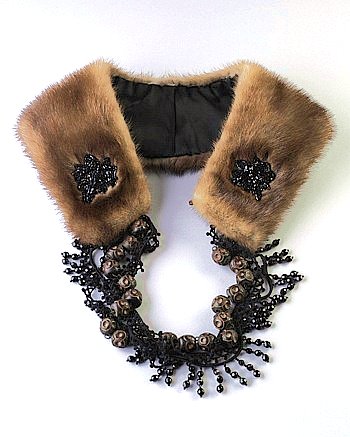
Walid for CoutureLab
When interpreting vintage pieces, it is important to understand the materials, and their contribution to the success of the piece. You would probably want to use Czech seed beads, rather than Japanese, because the Czech seed beads are more irregular. They would convey a more hand-done, rather than machine-done, sensibility to your piece. You might rely on hand-cut beads rather than pressed glass, and older color palettes, rather than new ones, for similar reasons.
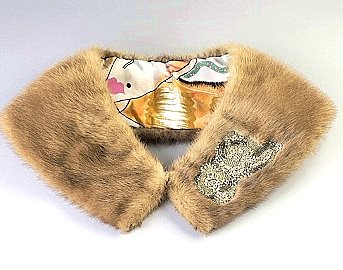
Walid for CoutureLab
Historically, people wore jewelry for many reasons. This included mourning, commemoration, fun, and imitating fine jewelry.
What were the goals of vintage styles?
– appreciation of hand craft
– to be “wealthy” was to be “elegant”
– decadence
– class distinctions
– eccentricy
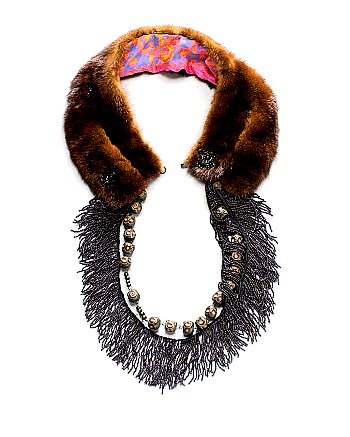
Walid for CoutureLab
People today are attracted to vintage pieces, because these pieces demonstrated great “hand” skill. Working in vintage styles feels a lot like recapturing lost treasures. These proven vintage styles seem to transcend fashion. Wearing vintage jewelry always makes the wearer feel very special because these are always conversation pieces.
So, here were are trying to restore life to forgotten styles. We want to try to be unique in a cookie cutter era.
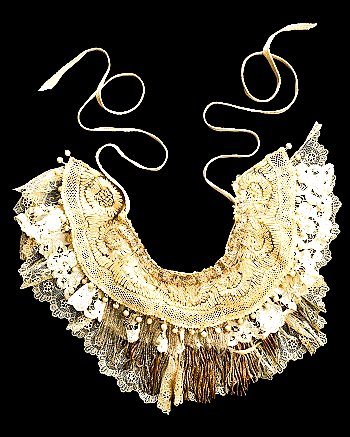
Walid for CoutureLab
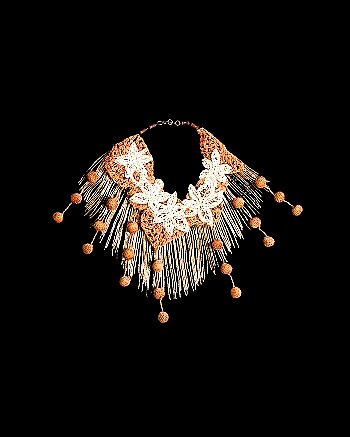
Walid for CoutureLab
Some links of interest:
http://www.couturelab.com/editorial/story-walid.heml#1
Posted in bead weaving | Tagged: art interpretation, bead weaving, bead work, carole tanenbaum, christie romero, couturelab, jewelry design, vintage jewelry, walid | Leave a Comment »
All Dolled Up: Beaded Art Doll Competition
Posted by learntobead on August 6, 2009
All Dolled Up: Beaded Art Doll Competition
www.landofodds.com/store/alldolledup.htm
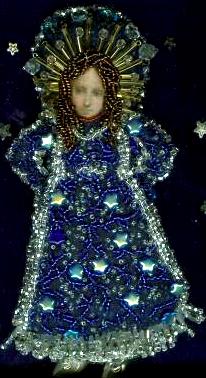
St. Fedupia by Kathleen Lynam
Every other year, Land of Odds and The Center for Beadwork & Jewelry Arts sponsors a beaded art doll competition. This year’s deadline is August 31, 2009.
The theme is Earthen Mother. Each artist submits images of their doll. And each artist has to write a short story about their doll, starting with this sentence:
“The mirror reflects more than my hands can feel.
Lines, edges, shadings, a weariness under the eyes, an awkward stance.
Yet, not reflected is a certain vibrancy —
a compassion and wisdom and wonder so many people rely on.
Only you, my beaded art doll,
capture the fullness of me as I age in place .
You embody changes I want to make, so I aptly name you…”
Here our images of our first three submissions:
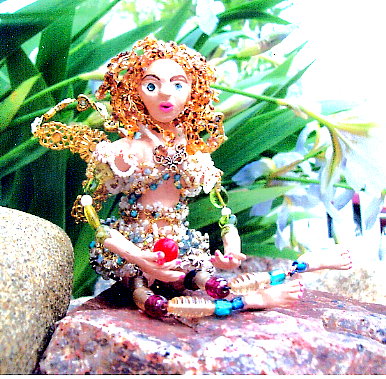
by Dawn Ott
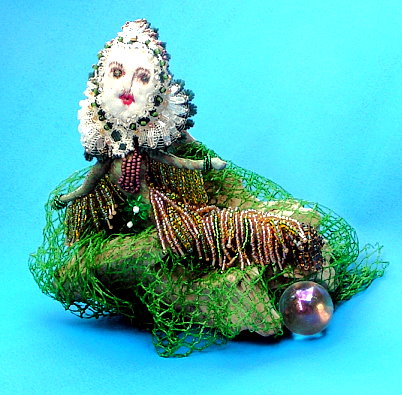
by Bonnie Prebula
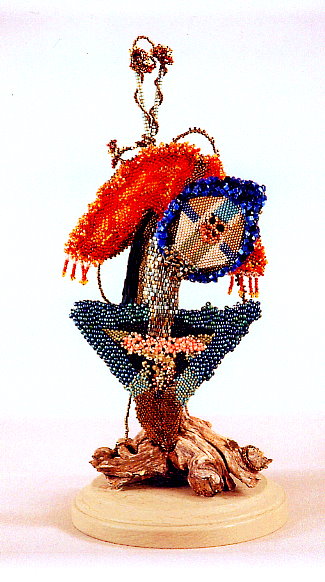
by Gabriella DeLawey
Posted in bead weaving, beadwork, Contests | Tagged: beaded art doll, beadwork, bonnie prebula, contest, dawn ott, doll artist, gabriella delawey, kathleen lynam, multi-media art, sculpture | Leave a Comment »
Beading Needles – What Do You Prefer?
Posted by learntobead on April 29, 2009
4/29/09
Connie posted the following on ALL ABOUT BEADS group, and got some of these responses. What do you think?
Warren I posted on All About Beads about the needles, and so far these are the answer
At my bead group – we have been discussing beading needles. I know that is a subject with as many opinions as thread. So could you please tell what kind of a needle you use and why you like them.
I will go first – for general beading such as peyote, etc. I use Pony needles, or John James – which ever I grab first. I use long needles 99% of the time, but when I do bead embroidery I use short beading sharp size 12.
CONNIE
I use long size 12 loom needles when I loom (which I haven’t done for a while and should think about), and John James long size 12 or 13 needles for everything else. (What I really need is sewing needles because I keep using beading needles for mending.)
Marilee
| 8867.3 in reply to 8867.1 | ||||||||||||||||
I too prefer John James and size 12. Carol Perrenoud from BEADCATS in Wilsonville, OR just gave a presentation to our bead society (Bead Society of Northern California) on the History of Beading Needles and it was amazing. The one thing that she told us that I had NEVER heard before is to match the shape of your needle’s eye to the “thread” you are using. Most beading needles have skinny oval eyes which is best for NYMO-type threads that compress. BUT if you use FIRELINE which is more rounded and has a coating, to pick a needle that has a more oval eye. The needle that she had, I had never seen before ~ they are called STRAW NEEDLES. The issue is that the skinny oval eye will squish/remove the coating on the fireline which can cause it to twist, kink, and eventually even break with the coating gone. I wish I had picked up more packets. marilyn
Size 12 John James are my standard needle of choice. If I must stray I’ll use a Size 12 Pony, but I hate how brittle they can be. And I am super near-sighted so will take my glasses off and bring my work right up to my face to get a “magnified” look. When those puppies break it is a scary moment for sure! I also like the Mary Arden needles…they are apparently made in the same factory as the John James, just in a prettier package. When the project calls for it, I’ll move down to a size 13 John James. I don’t like Sharps…I can’t seem to get a good grip on them. But I have noticed over the years that customers with small, thin fingers enjoy working with them better than a standard length. We were introduced to Straw Needles last fall.
I’m still looking for them.
I am sold out again….much to Thom’s disappointment. =o/
|
For beadweaving, I prefer the John James 12’s, for dolls I like the John James 12 sharps. For most other work, I think the John James 13’s are what I use. I may try some of the straw needles, if I can figure out the sizing. May have to buy a packet of each of two sizes to see which direction they go… are the large numbers smaller needles, or vice versa?
| 8867.17 in reply to 8867.4 | ||||
| I love straw needles. They don’t bend and break easily and they have an easy to thread eye.They are also known as milliner’s needles and I like the size 11.Both Richard Hemmings and John James make these and they are easily available on the internet for about $1.95 to $3.00 a pack.
Highly recommended. Sylvia
|
Some people like the Japanese beading needles because they are stiffer. Some people think that the John James needles went downhill in quality when they started making them in China, instead of England. I prefer the John James regular English Beading Needles, and try to use size 10 and size 12. I like that they are not super stiff. The sharps needs are too small for my hand — my hand cramps when I use them. — Warren
I’m like Sandi, in that I like to use the thickest needle I can get away with. I do prefer long needles, though, it seems easier to pick up my beads with a long needle. Most of my things are done using a John James size 10 needle. I keep some JJ 13’s around as well as a couple big eye needles, but I only like the big eye for loom work and sometimes fringe. I’ve never tried a size 12 long or short, but I don’t care for the 13’s as they seem very fragile and never last very long for me.
I tend to muscle up on my needles, so they get very bendy. I can usually straighten them out by rolling them between my big anvil and a slab of steel I keep around. It does make them brittle, but I get a little more life out of them.
Jen
| I prefer sharps (10?12?) for bead embroidery, unless I’m using charlottes and then I have to use a beading needle. As several people have said, I use the largest needle I can get away with – 10 or 12. For awhile I was using size 15 seed beads a lot and used the 15 needles – crispy critters! I’ve had a bad batch of larger John James needles also. That’s when I tried Pony needles, which I liked. And about the same time a friend who sells historical reproduction items for re-enactors gave me some beading needles – I think they are English, but I don’t know if they are JJ. They might be Japanese. They were great though. I really should get some more from her. The most of JJ needles I bought seem to be fine. I have more problems with losing needles than I do breaking them!Cathy
Fortunately, I don’t often lose needles. Stepping on a few has made me very careful. I tend to use JJ 12s and 13s most of the time and the 15s when necessary (for some charlottes and gemstones). I will occasionally use the cheap Indian needles. For me, they work as well and last as long as the JJ. I have some sharps but I don’t care for them. I’ve tried the big eye needles, but the ones I’ve tried have been too large for the beads I use (mostly 15s and charlottes). I just accept that the 13s and 15s won’t last that long. Needles aren’t that pricey, so that’s just the way it is.
|
from John James Company:
The John James factory was sold to new owners who are Chinese. They did have a couple of batches of needles that were incorrectly annealed and snapped very easily. They seem to have gotten that back under control again and are producing quality needles again. We accepted bad needles back and exchanged them. We also went through our stock and threw out any bad packages. We lost a bit of money, but it’s nothing short of frustrating to work with bad tools and we were happy to make sure that the products functioned the way they were supposed to.
Posted in bead weaving, beadwork | Tagged: bead stringing, bead weaving, beading, beading needles, beading thread, fireline, john james english beading needles, nymo thread, pony needles, sharps needles | 2 Comments »
Huib Petersen Workshops Scheduled
Posted by learntobead on March 31, 2009
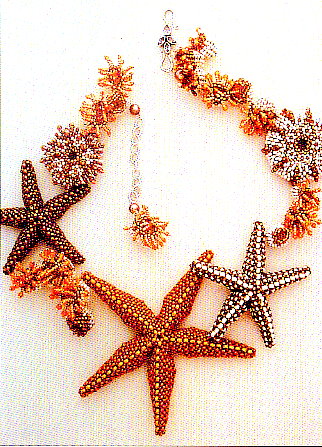
Huib Petersen – Bead Weaving Artist
Huib Petersen visited the shop yesterday, and we had a very nice visit. He brought with him many of his wonderful pieces.
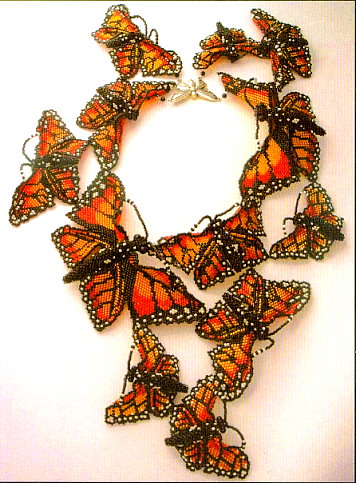
He has one series of work that is very nature-inspired. I love the way he can manipulate his peyote stitch work to get the natural curves and twirls in the butterfly wings. And his use of color placement is superb. With these techniques, he gets very realistic-looking pieces, with a strong sense of dimensionality, with beauty and wearability. Unfortunately, computer images can’t show the detail and the dimensionality.
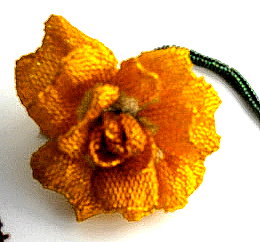
Another series of pieces he’s begun working on involves tubular right angle weave in cubic forms. In one piece, he layered one tubular right angle rope/chain (line of open square donuts done as a continuous rope) over another rope/chain. In appearance, it looked like he had used basket-weaving techniques to intertwine the rope/chains, but in reality, it was just how they were layed one on top of the other.
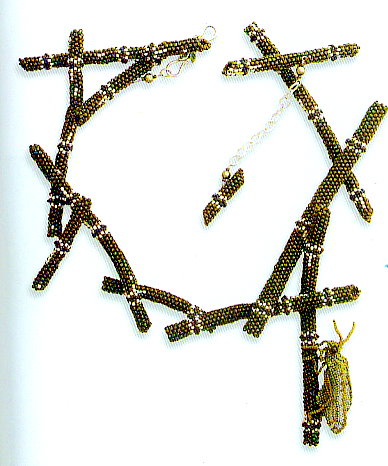
Huib will be with us May 20-22, 2011.
His website:
www.petersenarts.com
Posted in bead weaving, Workshops, Classes, Exhibits | Tagged: bead weaving, beadwork, butterflies, classes, huib petersen, jewelry, peyote stitch, workshops | 1 Comment »