Warren Feld Jewelry

Taking Jewelry Making Beyond Craft

Archive for the ‘jewelry making’ Category

HOW DO YOU STAY FOCUSED?

Posted by learntobead on July 13, 2013


HOW DO YOU STAY FOCUSED?

It is easy to get distracted.   Dagmar sent me an email with a link to a picture of a bead woven piece she liked.    At first, I reacted with some resistance, to click the link.   I needed to finish up several projects, and didn’t want to cloud my thinking, or add one more image or one more pattern I liked, or color I liked, or technique I liked, to that mix of ideas and tasks and things swirling around and around in my head.

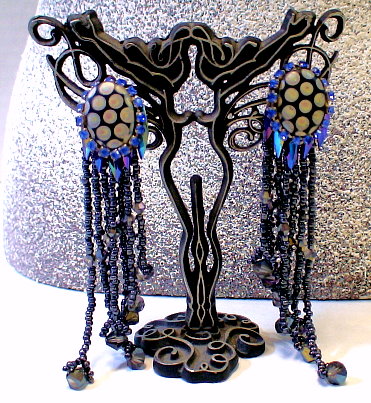
earring1

But, you guessed it, I clicked.   The piece was beautiful, intriguing, and l discovered many more of this artist’s work on display online.    I spent time with each piece.   I read the artist’s statement because I wanted to learn more about her inspiration.    She had many embedded links in her statement.  Which led me to many other websites.   One concept was discussed, and I did a Google search on that.     And then an images.google.com search on it as well.    Which somehow got me over to Amazon, then Wikipedia, and over to some other bead artist’s website.


Three hours later – how does time pass away so quickly?    A simple click three hours earlier had led me through the looking glass and down the rabbit hole, through, what must have looked like to others, some torturous pathways, meeting all kinds of strangers.

I am always working on several projects at a time.     So in my head, are several sets of instructions, several color palettes, several understandings of inspiration.    And I want to keep some focus.   And I want to finish all of these projects.    And I want to be able to conceptualize and invent my next projects, which involves lots of trial and error experimentation.    I want to have the time and clear head space for all this.

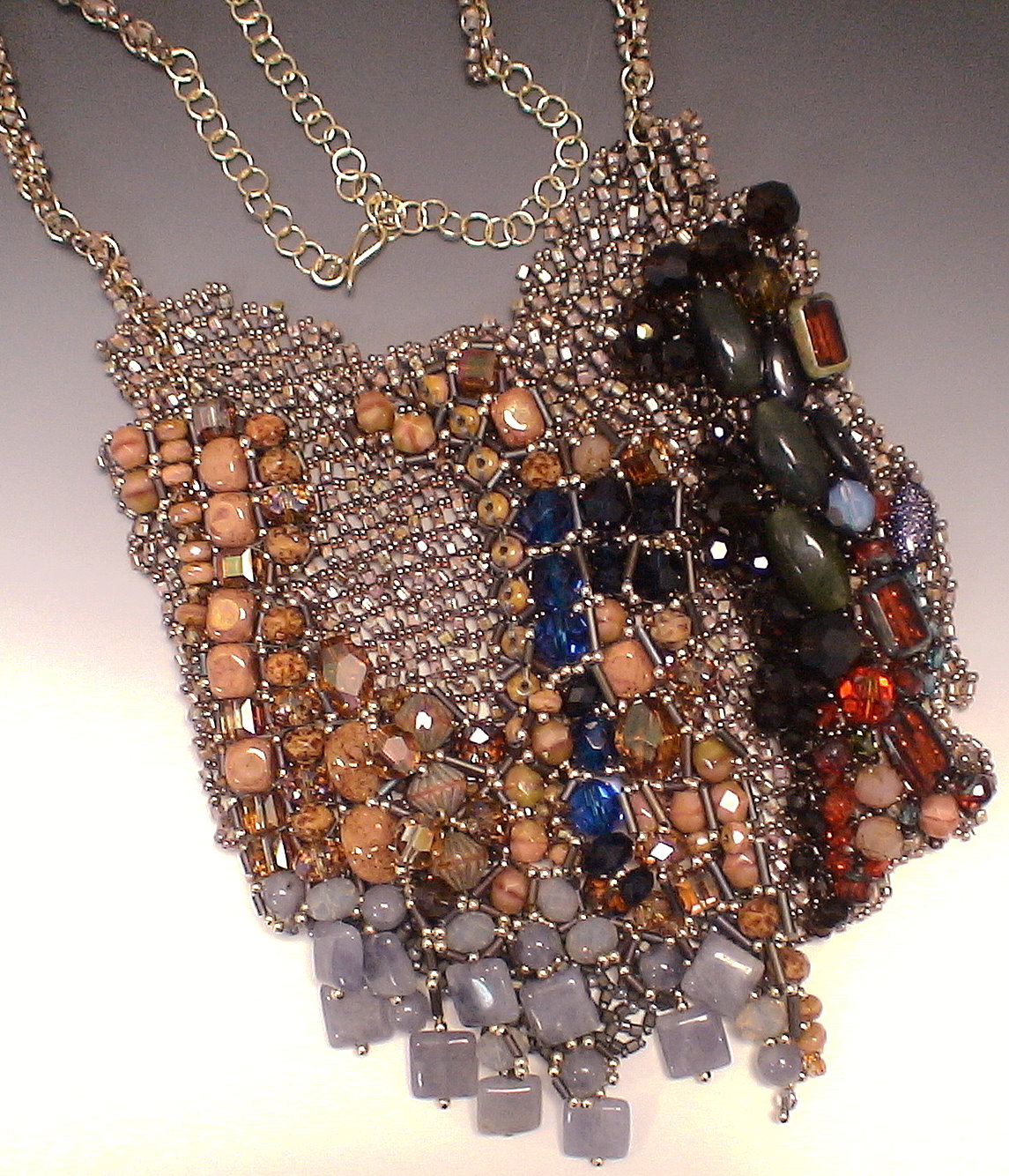
romari1-hires-full-moneyshot


And yet, there are so many easily accessible distractions.

I know I’m not alone, so the question I put forward to you:

How do you stay focused?


And perhaps, I should phrase the question differently:   Can you stay focused?

Or, in the face of so many great examples of jewelry and bead art, so many evolving changes in styles and fashions, the introduction of many new colors and new bead shapes and new techniques – in the face of so much wonderfully inspiring, so many things to learn and educate yourself about – how do you keep in touch with your inner designer self, and find the time and energy for self-expression?


Posted in beadwork, jewelry design, jewelry making | Tagged: , , , , | 2 Comments »

HOW NOT TO SHOP IN A BEAD STORE

Posted by learntobead on June 9, 2013

HOW NOT TO SHOP IN A BEAD STORE

newbdfront5

Shopping in a bead store presents many overwhelming challenges — all the parts, all the colors, all the sizes, all the project possibilities. Many customers, when confronted with all these options, freeze up and get frustrated.

So, how SHOULD you shop, and how SHOULD YOU NOT shop in a bead store?

Any interesting stories out there?

What was your first trip to a bead store like.

beads4

From an article I wrote….
— Warren

HOW NOT TO SHOP

To the consternation of staff, many a Bead Warrior, as they prepare to arrive at the field of bead-selection-battle, have not properly armed themselves.

They arrive by car. They arrive by taxi. They arrive on foot. But rarely do they arrive with a design plan in hand.

They arrive with ideas swimming in their heads, from magazine articles they’ve recently read, or advertisements they’ve seen, or dreams they’ve had. And it’s all in their heads.

And when they arrive at the door, then cross the threshold, there are too many intimidating choices confronting them, attacking them from the right and the left and forward and behind, and off to the side, and down the aisle, and over and around the corner.

The knitted scarf lady ready to conquer the bead world and find that blue bead for her fringe. But no yarn in hand. And there are so many blue beads. No sense of which blue will match. No sense of hole size. No idea what needle to use. Or how to get the beads on. Which “blue?” I asked, pointing to the 37 choices. Without a word, without any response to my question, she grabbed her purse and walked out.

A woman had a list of 17 items she needed for a project. We had 16 of these items in stock. The one thing we didn’t have was one color of a delica bead. I suggested some good substitutions. After all, there are almost 2000 colors of delica beads to choose from. She put all 16 items back, and walked out.

The fashion icon determined to turn a brief visit to the bead store into ultimate world conquest, withOUT her recently perused copy of the latest of the latest from the best of the best style magazine. But no picture in hand. And there are so many beads and chains to choose from. No remembrance of what she had seen. No idea of how to attach things. No clue about finishing off the piece.

The bead-weaver, knowing full well that success is just over that hill, a straight march, and that her right-angle-weave necklace will hup-two appear without much of a scuffle. Or tussle. Or hassle. Or, whatever else might get in her way. Yet no instructions. No supply list. No knowledge of stringing materials or tools.

The woman in need of jewelry repairs. No jewelry with her. Wants that bead or rhinestone or clasp to make her jewelry complete. Which is at home. And she can’t remember. Doesn’t know sizes. Vague on colors. Forgets materials. Clueless on attachments.

The woman who returns everything she doesn’t use – and then buys the same items for the next project which happens to use the same pieces. She frequently makes the 25-mile round trip to return even 1 bead not used. And then re-buys this very same bead on her very next trip on the very next week.

The student who wants a bail for a pendant, has left that pendant at home, and doesn’t remember which direction the hole is drilled.

The knowledge is all to be won – at the bead store. The field of battle. Shock and awe. Little preparation. Few soldiers. Few weapons. A daunting walk across the entrance, and that’s all it will take. To win. To accomplish. To finish. To conquer.

The lesson, not to be lost here, is that you need to come prepared. Sufficiently armed. Some forethought. Some planning. Some thought-through concept. Some willingness to make compromises.

The field of battle is very large. The opposing forces are onerous. Over 6,000 specifically named colors. Thousands of styles and sizes and shapes of beads. Nearly 20,000 individually named metal parts. Fifteen different kinds of metals. Forty-two possibilities of metal finishes. Nearly 500 choices of stringing materials. Sixteen separate types of needles. Too numerous to count issues of quality and pricing.

Posted in business of craft, jewelry making | Tagged: , , | 4 Comments »

WAX YOUR THREAD, CONDITION IT, OR DON’T

Posted by learntobead on June 4, 2013

WAX YOUR THREAD, CONDITION IT, OR DON’T

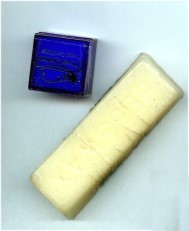
microcrystalline-wax

We are always debating here whether to wax your thread or not, and if so, what wax or thread conditioner to use.

I have some strong opinions about this.

How about you?

Some people never wax.
Some people think it makes no difference as to whether the thread breaks.
Some people think it ruins the beads.

sun1mornbeeswax

By the way, my opinions:
With beading thread, like Nymo or C-Lon, always wax.
Always use microcrystalline wax
Never use Thread Heaven.

With cable threads, like FireLine, sometimes wax.
I wax when the stitch I am doing is a loose one, like Ndebele or Right Angle Weave. The stickiness of the wax helps me maintain a tight thread tension.

Never use pre-waxed thread like Silamide.
Silamide is not abrasion-resistant, so it breaks too easily with beads. The holes of most beads are pretty sharp.

Waxing keeps the beading thread from fraying.
It’s stickiness allows greater control over managing thread tension.
The process of waxing stretches the thread a bit before you use it.
The waxy buildup helps fill in the jagged rim of the holes of your beads, making them a little less likely to cut into your stringing material.

Posted in beadwork, jewelry making | Tagged: , , , , | 2 Comments »

HOW DO YOU GO ABOUT CHOOSING CLASPS?

Posted by learntobead on May 28, 2013

HOW DO YOU GO ABOUT CHOOSING CLASPS?

clasp7strand

The Jewelry Designer makes many choices when creating a piece of jewelry. Lots of things to manage and accomplish.

Probably the two most important choices, right up front, in creating a wearable art-piece that will be around for future generations are your:
(1) Stringing Material, and
(2) Clasp


When you work with so many customers in a store, and so many students in classes, you begin to see that people are not necessarily that great in selecting clasps. Many are in a clasps-rut — they use the same clasp over and over again. Others pick out clasps they find appealing, whether or not they would visually or functionally work with the piece they have made. Few people anticipate how they are going to attach the clasp to their beadwork, often resulting in an overly long, awkwardly connected clasp assembly. So, how to you go about choosing clasps?


From an article I had written…


Clasps always seem like they’ve been someone’s last thought. They should be the first thought. But many people get so excited creating their beadwork, that they forget about the clasp – until the last moment. You can tell when the jewelry maker hasn’t put much thought into their choice of clasp in many ways. Often, the clasp doesn’t look like it was meant to go with the bead work or general design. It might be out of proportion. It might be a different texture or sensibility. Its function – how you open and close it, while wearing your jewelry — might seem odd, perhaps unnatural. And not only does the choice of clasp seem as an after-thought, but how to attach to the bead work to that clasp seems un-thought out, as well.

So it’s not surprising, that when we were repairing jewelry on a regular basis, about 80% of the pieces to be fixed had broken at the clasp.

It is best to, in part, build your design around your clasp. If your piece has a centerpiece or focal point, then how does this link up to or coordinate with the clasp. At the least, when visualizing your beadwork, include an image of the clasp and how it is attached at both ends. The world is full of clasps. Not every clasp is a jeweler’s best friend. But it depends.

The clasp needs to visually fit with the beadwork. It needs to function as the artist intended. It needs to function in a way the wearer can relate to, use and handle. It needs to be appropriate for the piece and the context in which it is too be worn. It should not compete with the beadwork. It should complement it. Ideally, at least from a design perspective, your clasp should look and feel as if it were an integral part of the entire piece.

In a Gallery setting, if you are selling your jewelry there, you usually want a very functional, but not overwhelming, clasp. You are selling your beadwork, and you don’t want your clasp to compete with this.

In a Department Store, setting, however, often the clasp sells the piece. In this setting, choosing a clasp requires a different kind of logic, thinking and anticipation. Some clasp-types are “expected” to be a part of the piece – even if the particular choice of type would not be the best choice in the world.

The former owner of a local Tennessee pearl company was very frustrated with clasps. She sold a lot of finished pearl jewelry at very high prices, and had been using 14KT gold pearl and safety clasps. Her customers sent a lot of their pearl necklaces and bracelets back for repairs, because their clasps broke. And this company felt, because the prices of these pieces were very high, that they were obligated to replace the clasps and re-string these pearl-knotted pieces at no additional charge. 14KT clasps – particularly the pearl, safety and filigree box clasps — do not hold up well, because gold is a very soft metal.

Replacing clasps on a pearl-knotted piece is quite some job. You have to cut up the piece to free up each bead, and then you begin the knotting and finishing off processes again. It turns out, the 14KT clasps were not the only expensive part of the bracelets – making the knots between each pearl was the time-consuming and costly part. She desperately wanted to reduce the number of repairs. Her first idea was to replace the pearl and safety clasps with other styles which were sturdier. However, these pieces didn’t sell. People wanted the pearl and filigree clasps. The designs of these clasps were so traditional and so locked into their expectations for what pearl-knotted jewelry should look like, that they would not compromise.

Her second effort, she tried replacing the 14KT pearl and filigree clasps with gold-filled ones which were stronger, but this made her customers very angry – they wanted 14KT gold.

So, her final strategy, she returned to using 14KT gold, and doubled her prices. She built in the cost of one repair into the prices she charged. And only then could she present her happy face to her customers, and her somewhat-happy face to herself when she was in private.


Posted in bead weaving, jewelry making | Tagged: , , , | 2 Comments »

WHAT SHAPE ARE YOU?

Posted by learntobead on May 14, 2013

WHAT “SHAPE” ARE YOU?
— Spiral, Cross, Triangle, Round or Square?

shapes

Signs of Life: The Five Universal Shapes and How to Use Them, by Angelese Arrien

Diane Fitzgerald had pointed this out as an interesting book about shapes, I think in her book SHAPED BEADWORK. I read the book. Fascinating and goes into a lot of interesting detail.

In this book, the author, who is a cultural anthropologist, studied shapes, and searched for universals. She found that cross-culturally, people use 5 particular shapes to describe and understand themselves in relationship to others within their culture.

These shapes were:

Circle, Square, Triangle, Cross and Spiral

She developed what she calls the Preferential Shapes Test.

Take this test, and use Arrien’s book to interpret the results.

I’m going to oversimplify this test and paraphrase her words, so you can try it, if you haven’t already. However, to read more details about interpretations and to read stories about people who fit various patterns, I’d suggest you visit this book.

STEP 1:
On a piece of paper, write the numbers 1 thru 5 across the page.

Here are the shapes to play with:

SPIRAL, CROSS, TRIANGLE, ROUND, or SQUARE.

STEP 2:
Under the first position number, put your favorite shape.
Under the 2nd position number, put your second favorite shape.
Under the 3rd position, your third favorite shape
Under the 4th position, your fourth favorite
Under the 5th position, your least favorite.

STEP 3:
Use the information below to interpret the results:

POSITION 1: Where you Think You Are
This is where you think you are today or want to go in the future, but not necessarily the most accurate indicator of where you actually are right now.

POSITION 2: Your Strengths
An inherent strength predominant in you at this time, whether you know it or not. Often, this is how other people see you.

POSITION 3: Where You Are
This is the most significant shape.
This shape shows your true current self.

Think of the goldilocks story – the porridge is too hot, the next too cold, the third just right.

POSITION 4: Your Motivation
This shape points to past events or things which motivated or provoked you to get to Position 3.

POSITION 5: Old, Unfinished Business
A process you have outgrown, dislike, resist, or are judging. Unresolved issues you want to put aside.

CIRCLE: wholeness
Position 1: desire to be independent and self-sufficient
Position 2: strengths are self-reliance and resourcefulness
Position 3: process of achieving independence is at core of your nature
Position 4: something in your past motivated you to become responsible and self-reliant
Position 5: you may be resisting or denying this process of individuation

CROSS: relationships
Position 1: forming relationships is most important to you
Position 2: you rely on good people skills
Position 3: forming relationships is something deep within your nature
Position 4: a past shared journey inspired you to become who you are today
Position 5: you may want to ignore or dismiss relationships

SPIRAL: growth and change
Position 1: change holds great importance to you
Position 2: easy for you to handle change
Position 3: you are profoundly engaged in process of change
Position 4: your were challenged in your past to make significant changes in your life
Position 5:you are unlikely to show interest in process of change and growth

TRIANGLE: goals, dreams, visions
Position 1:process of envisioning seems especially important to you now
Position 2:you carry the gift of vision naturally, whether you are fully aware of this or not
Position 3:the process of envisioning is central to your current development
Position 4:your process of following dreams in your past motivated you to change your life
Position 5:you are resisting the process of honoring your dreams and establishing goals

SQUARE: stability
Position 1:stability and authenticity are inspirational to you
Position 2:you are responsible, authentic, and fully committed when you give your word
Position 3:it is vitally important to you to stabilize and implement your creative endeavors
Position 4:past issues of responsibility and accountability led you to make changes in your life
Position 5:you may be denying process of stability and responsibility

Posted in jewelry design, jewelry making | Tagged: , , , , | Leave a Comment »

HOW DO YOU PLAY WITH SHAPES?

Posted by learntobead on May 14, 2013

SHAPES — HOW DO YOU PLAY WITH SHAPES?

bw3nb01-amethystsage-show-2-strips-opening-up

How has “shape” entered into your design thinking, your design work, and your design frameworks?

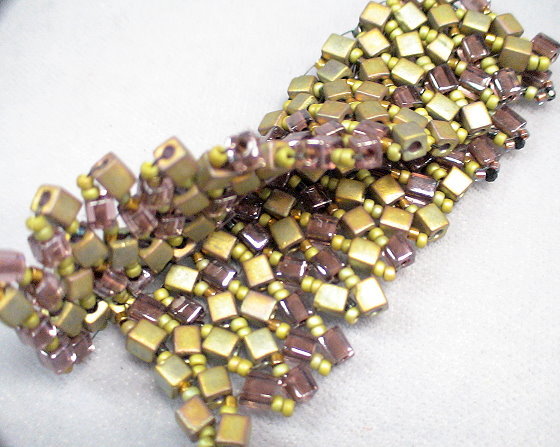
Over the past few months, I’ve been intrigued with all the new shapes of seed beads coming out on the market. I’ve been trying, really struggling, with ideas for using them in compositions — pieces that have a lot of dimensionality to them, great interest, some levels of complexity. And I’ve been trying to mix the shapes within the same composition, things like long magatamas, superduos, mini fringe drops, peanuts, tila beads. … And of course, it’s always fun to think about ways to bead-weave beads into larger shapes.


gwynian-wine-detail2-medium

SHAPE

The shape of the bead and the orientation of its hole or holes is critical to the success of a piece. These are the “building blocks”. Connecting the blocks affects what the piece looks like, how light and shadow impact the aesthetic, how it moves, how it drapes and feels, and how it holds up in its entirety as a composition.

Around 2010, the various bead companies in Japan and The Czech Republic began introducing many new shapes of seed beads. I began experimenting with how to push these new shapes to their limits.

Then there are the shapes created by assembling beads into ever greater shapes.

Shape differs from the use of “line” or the use of “point”. Shapes serve to provide positioning, direction and orientation to the pieces, often better than lines and points.

Shapes are often the basis of many strategies for adding more dimensionality to your pieces. And you can embellish these shapes with other beads, or overlap shapes, to achieve even greater dimensional effects. You can combine different kinds of shapes.

The Designer must ask these kinds of questions, when using shapes:
How do we position each bead?
How do we link them?
How do we stack them or layer them?
When visual impact does each have, given which side or “face” is seen?
How do we use shape to create appealing textures and patterns?
How do we create “forms” and “themes” with them.

Playing with shapes can be both an encumbrance, as well as an opportunity for the designer.

How has the playing with shapes affected your work?

Posted in jewelry making | Tagged: , , , | Leave a Comment »

So You Want To Do Craft Shows…

Posted by learntobead on May 8, 2013

SO YOU WANT TO DO CRAFT SHOWS…
New CraftArtEdu.com Video Tutorial By Warren Feld
http://www.craftartedu.com/warren-feld-so-you-want-to-do-craft-shows

cf-naples-fair2
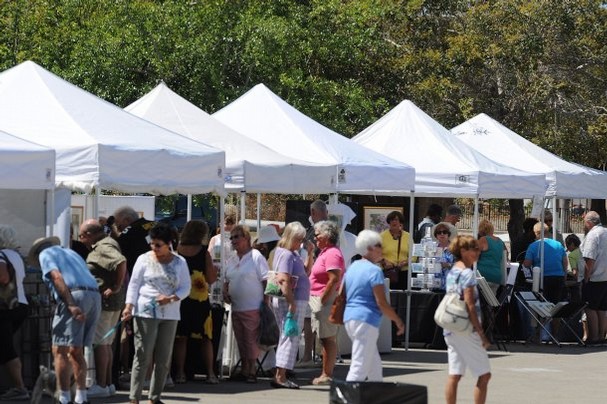
In this class, presented in 6 parts with 16 lessons, artist and businessman, Warren Feld, will fill you in on the ins and outs, the dos and the don’ts of selling at craft shows and fairs. Which are best for you, which may be a waste of your time. How to compute the revenue you must earn to justify participating in an event. This is a must see class for anyone thinking of entering the art and craft show world and will maximize your chances of success in these venues. 6 Broadcasts.
Price:
$30
Level: All Levels
Duration: 113:58

Posted in bead weaving, beads, beadwork, business of craft, jewelry making, Resources | Tagged: , , , , , | Leave a Comment »

FASHION AND JEWELRY DESIGN

Posted by learntobead on May 6, 2013

TO WHAT DEGREE DOES/SHOULD “FASHION” INFLUENCE OUR JEWELRY DESIGN DECISIONS?

reposted from my Jewelry Design Discussion Group on FaceBook
https://www.facebook.com/groups/jewelrydesign/

pearl10-full-moneyshot-hi-res-medium

In our store, I am asked repeatedly about what the current fashion colors are? Did I see what so-and-so was wearing on TV or at an awards show? But usually, at least in Nashville, TN, a sense of fashion plays a small part in the day-to-day decisions most people make about the jewelry they want to wear.

What are your feelings and views? What are your experiences? What role should “Fashion” play? How important is Fashion to jewelry design? Should we take our design “cues” from New York and Los Angeles? To what extent do you think Fashion influences the average woman’s choices she makes, when purchasing or wearing a piece of jewelry?

Warren Feld

ctamayadetail1

From an article I wrote… APPLIED FASHION Women don’t just wear pieces of jewelry – they inhabit them.

Buying a piece of jewelry for yourself – a necklace, a bracelet, earrings, a brooch, something else – isn’t a task easily given to someone else. It’s often not a spur of the moment thing either. You just don’t rush off to the local boutique or the local Wal-Mart, grab whatever you see, and go home. I’m not talking about that impulse buy during your leisurely visit to the mall. I’m referring to purchasing those pieces of jewelry you know will have to do a lot of the hard work to accessorize your wardrobe and help you get the compliments and notice of your family, friends and   co-workers you comport with and compete with each and every day.

No, buying a piece of jewelry for yourself is a multi-purposed moment, one which must be thought through carefully and one which must be savored. Lest you buy the wrong piece. That doesn’t really go with what you intend to wear. Or is over-priced. Or poorly made. Or conveys the wrong impression about status. Or is out of fashion. Or something one of your friends already has.

The jewelry you buy has to conform to quite a long list of essential criteria before you could ever think of buying it. It is something you will wear more than once. As such, it is your companion. Your necklace is not merely lying around your neck. Or your bracelet around your wrist. Or your earrings dangling from your ears. Jewelry can cause you to lose face with others. It can irritate or scratch your skin, or get caught up in your hair. It might weigh you down or stretch or tear your ear lobes. Jewelry can break without warning in the most unexpected and embarrassing of places. It can get caught on things, sometimes hurting you in the process.

Jewelry conveys to the world something about who you really are, or think you are. As such, jewelry is very personal. Your private, innermost, most soul searching choices made very public for all to see. As you caress it, as you touch the smooth or faceted or crevice’d beads and metal parts or the clasp or the material the beads are strung on, when you twist and move the piece within your hand, you are confirming to yourself the extent to which your jewelry is doing its job.

When you buy new jewelry, the dilemmas multiply. How will the new compare to the old? Will it be able to handle all these responsibilities – looking good, representing you, fitting in with your wardrobe, meeting the expectations of others? Like divorcing, then remarrying, changing your jewelry can take some time for readjustment. And you do not want to be seen as noncommittal to your jewelry. This would sort of be like going to a hotel, but not unpacking your suitcase while staying in the room.

Conveying some sort of social or psychological distance from your jewelry can be very unsettling for others. So you need to inhabit it. You need to inhabit your jewelry, wear it with conviction, pride and satisfaction. Be one with it. Inhabiting jewelry often comes with a price. There becomes so much pressure to buy the “right” pieces, given all the roles we demand our jewelry to play, that we too often stick with the same brands, the same colors, the same styles, the same silhouettes.

We get stuck in this rut and are afraid to step out of it. Or we wear too many pieces of jewelry. The long earrings, plus the cuff bracelets on both arms, plus the head band, plus the hair ornament, plus the 7-strand necklace, plus the 5 rings. We are ever uncertain which piece or pieces will succeed at what, so hopefully, at least some combination or subset of what we wear will work out.

In a similar way, we wear over-embellished pieces – lots of charms, lots of dangles, lots of fringe, lots of strands. Something will surely be the right color, the right fit and proportion, the right fashion, the right power statement, the right reflection of me.

And our need to inhabit our jewelry comes with one more price. We are too willing to overpay for poorly made pieces in our desperation to have that right look. The $100.00 of beads strung on elastic string. The poorly dyed stones which fade in the light. The poorly crimped and overly stiff pieces with little ease for accommodating movement and frequent wear. It is OK to inhabit our jewelry. In fact, it is necessary, given all we want jewelry to do for us. But we need to be smart about it. We need to learn to recognize better designs and better designers.

This need not be expensive at all.

Just smarter.

Posted in bead weaving, beads, beadwork, jewelry design, jewelry making | Tagged: , , | 3 Comments »

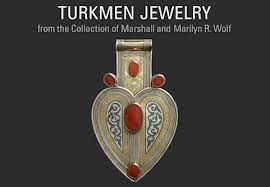
TURKMEN JEWELRY

Posted by learntobead on February 13, 2013

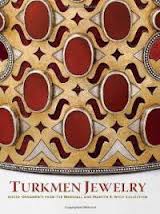
Turkmen Jewelry from the Marshall and
Marilyn R. Wolf Collection

Exhibit at the NY Metropolitan Museum of Art
Closing 2/24/13

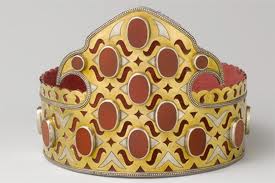
turkmen1

This exhibit displays the metal and stone-set jewelry of the nomadic Turkmen people of Central Asia.

turkmen2

Turkmen women’s jewelry consisted of headgear in the form of crowns, caps, headbands, and braid ornaments; pendants attached to headdresses and suspended on either side of the head; earrings; pectoral and dorsal ornaments; amulet holders; appliqués for clothing; armbands; and rings.

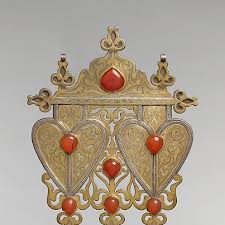
turkmen3

The exhibition is organized according to the principal techniques employed by Turkmen silversmiths. One grouping shows fire gilding, a technique in which gold filings—possibly obtained from coins—were combined with mercury in a paste that was brushed onto prepared silver; heat drove off the mercury, and the remaining gold was burnished to a brilliant sheen.

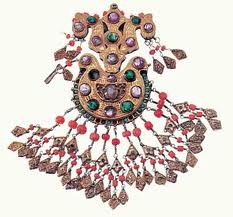
turkmen4


Other items feature stamped beading that was produced by stamping metal from behind to obtain the appearance of individual beads or granulation on the front.

turkmen5


A third section focuses on the inlay of carnelian and turquoise using bezels.

The fourth major technique— openwork decoration—involved the use of a chisel or fine fret saw to cut through silver sheets.

turkmen6

The surface decoration is typically represented by a repetition of objects or motifs — such as lozenges, squares, ovals and diamonds.    There are style variations from tribal group to tribal group within this vast area the Turkmen people occupy.

I always like to get inspired by ethnic designs, ornamentation and construction techniques.


Posted in jewelry making | Tagged: | Leave a Comment »

Learn To Pearl Knot

Posted by learntobead on January 21, 2013

Pearl Knotting with Warren Feld
By: Warren Feld
http://www.craftartedu.com/warren-feld-pearl-knotting-with-warren-feld
pearl10-full-moneyshot-hi-res-medium

New video tutorail on CraftArtEdu.com.

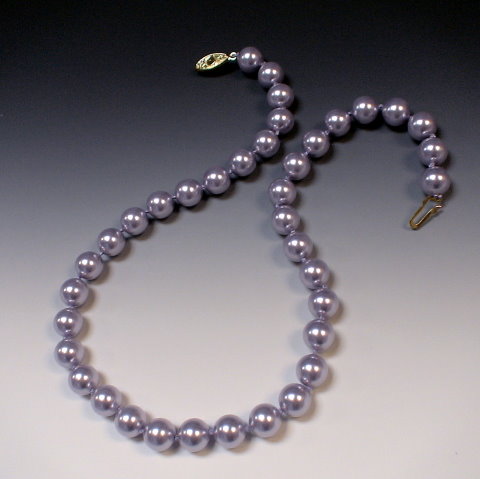
Everything you need to know for successfully designing with pearls, including knotting – traditional vs non traditional methods, attaching clasps, finishing, care of your pearls, repair and types of pearls, the nature of the pearl. Jewelry designer Warren Feld will lead you through this comprehensive CraftArtEdu class that is all about pearls. 6 Broadcasts.
Price:
$40
Level: All Levels
Duration: 106:17

Posted in beads, jewelry making, Workshops, Classes, Exhibits | Leave a Comment »

THE STORY OF JEWELRY: See Kickstarter Campaign

Posted by learntobead on October 22, 2012

A STORY TO WEAR
http://www.kickstarter.com/projects/1326391752/a-story-to-wear-a-documentary-about-jewelry-histor

I wanted to share this email from the ASJRA about a film project seeking funds on Kickstarter.com.

— Warren


FROM ASJRA:

Through a small grant from the Association for the Study of Jewelry & Related Arts (ASJRA) LLC, director Nicolas Cuellar has created a 3-minute “trailer” for what he hopes will become a full documentary on why it is important and fascinating to study the history of jewelry. Some of you got to see it at our conference on October 7.

Whether you are a jewelry lover, collector, artist,  appraiser, dealer, gemologist, auction house, curator, or in the retail jewelry business, this film will help bring education about the world of jewelry to a wider audience and benefit all of us.

The Association for the Study of Jewelry & Related Arts will make the completed film available to any jewelry organization that would like to screen it as well as to all college metals/jewelry and art history departments…free of charge. It will also be on the internet for the general public to see.

Please go to www.storytowear.com  and click on the photograph on the home page. This will take you to kickstarter.com where you can view the trailer and help support the film…even the smallest donation can help the filmmakers to reach their goal (even $1 will help) You will also find the rewards that are being offered for donations.

Although you make your pledge which is processed through Amazon.com, the filmmakers do not get a penny (and you are not charged) unless they reach their stated financial goal and they only have 30 days to do it!

The budget for the film will be $50-$70,000 but they are only looking to raise the first $10,000 on kickstarter.com. If they raise more than their goal they will get the full amount (minus the fee kickstarter and Amazon takes for processing the pledges). So please have a look today…the clock is ticking!


FROM THE PERSPECTUS ON KICKSTARTER:

Studying jewelry is a window into the history of cultures. Jewelry is the most personal of adornments and has signifcance in our lives.
Launched: Oct 21, 2012
Funding ends: Nov 20, 2012
Remind Me

We are creating a documentary film on the study of the history of jewelry. It’s probably something you never thought about but…

Did you know that:

–the earliest known jewelry is 100,000 years old?

–during many wars precious metals were in short demand and jewelry was made of alternative materials?

–the Victorians mounted hummingbird heads as jewelry? And Brazilian beetles?

–many cultures wear jewelry to ward off evil spirits?

–the famed jewelry firm of Cartier bought the townhouse where their headquarters is located in New York City by trading the owner for an incredible necklace of natural pearls? (Natural pearls are rare today since cultured pearls arrived on the scene circa 1900.)

–that diamonds can naturally be found in many colors?

–that in earlier times men wore more jewelry than women?

–that Harry Winston mailed the famed Hope Diamond to the Smithsonian Institute by U.S. Mail? And that it was walked to the White House in a gentleman’s pants pocket for the Shah of Iran to see?

These fascinating facts are just a very small part of what you might learn if you study the history of jewelry. We view jewelry studies as a “window” into the history of the world and a fun way to learn about our own and other cultures.

Jewelry is not only a form of adornment and self-expression, it is a part of one’s family history, and a form of portable wealth. Its ownership is intricately involved in our lives.

And anyone can join in learning…it doesn’t take a lot of specialized knowledge to understand this fascinating subject. If you are interested in fashion, world events, anthropology, art, archaeology—any number of subjects—you can relate to learning about jewelry.

Our personal jewelry does many things—represents the happiest and sometimes the saddest moments in our lives, can signal our achievements, tell others where we went to college, indicates our religious beliefs, and can even relay our sense of fun. It can tell others, without a word, how we view ourselves.

It is so universal that if two women who don’t know each other stand in an elevator one may comment on the other’s jewelry.

The Association for the Study of Jewelry and Related Arts, LLC (ASJRA) is an organization dedicated to the advancement of jewelry studies. ASJRA takes a broad approach to the subject, seeking to understand and place jewelry within a variety of contexts, including costume, the decorative arts, and fine art among others.

We publish Adornment, the Magazine of Jewelry and Related Arts (a quarterly), an extensive monthly newsletter on everything that is happening in the jewelry world, and organize an annual conference as a forum for curators, historians, researchers, and artists to present new and interesting
information about jewelry.

My co-director Yvonne Markowitz and I also consider it our mission to encourage the inclusion of courses in jewelry history at the college and graduate level for both applied jewelry students and decorative arts majors and provide aid to institutions in that pursuit. It promotes the development of study programs for jewelry design and jewelry history students at museums.

ASJRA is also working to make available previously inaccessible publications and information for educators, researchers, and collectors.

But right now we are, “preaching to the choir.” Our members know how exciting it is to delve into centuries of jewelry lore as well keep an eye on the inventive and unique contemporary jewelry being made today by studio artists and important fine jewelry firms.

This film will help a much wider audience gain an appreciation of how much can be learned and how interesting learning more about jewelry can be.

Documentary film maker Nicolas Cuellar, producer Harris Karlin, and Elyse Zorn Karlin, the co-director of ASJRA, have teamed up to educate the public on the story of jewelry and its place in our lives in the film “A Story to Wear.” We invite you to support this documentary film and get some great rewards to show our appreciation for your donation.

Once the film is completed it will be available to any organization with an interest in jewelry to show to its members, as well as to colleges and universities that have metals’ programs (jewelry making) and art history courses. We will also put it online so the general public can enjoy and learn from it as well. Help us tell the world about a subject that touches all of our lives without us realizing it…think about what your favorite piece of jewelry is and what it means to you!

Nicolas and Harris have extensive credits in the film world and Elyse is a well-known jewelry historian, author, lecturer and freelance curator. Together we will create a film to bring the fascinating world of jewelry to everyone.
Risks and challenges Learn about accountability on Kickstarter

Our biggest challenge will to keep the film on schedule…we hope to finish by spring or summer 2013. We are going to be working with diverse people to present a balanced story and scheduling them for interviewing with their busy schedules and still manage to shoot in several venues in one city in a short time (we can’t afford to pay the crew for extra days) will be a challenge.

Posted in jewelry collecting, jewelry making | Tagged: , | 1 Comment »

Pricing And Selling Your Jewelry – Video Class OnLine

Posted by learntobead on October 4, 2012

PRICING AND SELLING YOUR JEWELRY

Our class is now available online at CraftArtEdu.com

Learn how to achieve “fair pricing” for your art with businessman/ artist, Warren Feld. Understand your role in the world of jewelry commerce and how to make money by doing what you love, through fair pricing of your work. No handout is included in this class.

“TODAY’S LESSON IS ABOUT ONE KEY TO SUCCESS: SMART PRICING.

WE DISCUSS WHY JEWELRY SELLS.

WE GO OVER DIFFERENT KINDS OF PRICING STRATEGIES USED BY JEWELRY DESIGNERS AND THE JEWELRY INDUSTRY.

I PRESENT A SIMPLE MATHEMATICAL PRICING FORMULA.

I EXPLAIN THE FORMULA, AND BREAK THIS DOWN INTO LITTLE STEPS.

THEN WE PRACTICE APPLYING THE FORMULA AND PRICING SOME PIECES OF JEWELRY.

AT THE END OF THE LESSON, I DISCUSS THE DIFFERENCES AMONG RETAIL, WHOLESALE AND CONSIGNMENT.

I BRIEFLY DISCUSS SOME KEY BUSINESS STRATEGIES WHICH ARE VERY RELATED TO PRICING.

AND I OFFER SOME FINAL WORDS OF ADVICE.

Price: $15
Media: Jewelry
Level: Beginner
Duration: 51:09

Posted in business of craft, jewelry making, Workshops, Classes, Exhibits | Tagged: , , , | Leave a Comment »

LARK PUBLICATIONS: Call For Entries

Posted by learntobead on June 10, 2012

LARK PUBLICATIONS
CALL FOR ENTRIES
8/1/2012 deadline
I received the following email from Ray Hemachandra of Lark Publications. They are
requesting submissions to possible be included ina book to be published called Showcase
500 Necklaces. -- Warren
"I'm pleased to announce a two-month call for entries for a new 500 Series gallery book of handmade contemporary jewelry from Lark Books: Showcase 500 Necklaces. The opportunity closes on August 1, 2012. That is a short window of time, so I ask you please to share the call for entries promptly with your entire jewelry-making community, including peers, associations, schools, students, and all online forums as well as social media like Twitter and Facebook, and to respond to it yourself in a timely way. As always, we hope to receive a wide array of entries from around the world. I'm also pleased to report Lark has converted to using an online entry system; entries are now online only, through a portal provided by Juried Art Services. Here is the link for the informational prospectus and to enter: http://bit.ly/NmsmQm


You'll find all the information you need at that link, so please follow the instructions carefully, but here are some key points: We'll accept jewelry in all materials with all techniques and design styles, including both wearable and conceptual but biasing toward the wearable, simply because most readers prefer seeing wearable jewelry in these books. Jurying will favor more recent work, and so we ask you to submit very recent or current work from no earlier than 2010. The submission limit is two pieces (one photo of each, with an option of one or two alternate or detail photos per piece). 'Necklaces' can include neckpieces, chokers, torques, collars, operas, ropes, chains, bibs, etc. There is no charge for entry for this book; Lark is covering the Juried Art Services cost. We strongly prefer work that has not been previously published in book form. The JAS form will walk you through the process, but a few notes: 1. No need to complete the Artist Statement section. 2. Please read and follow Lark's Digital Image Submission Guidelines. 3. We encourage early entries, especially to avoid having any last-minute difficulties with the new entry process: Complete the process ahead of the deadline so you're assured of having time to resolve any technical issues you might encounter. For questions about registering with Juried Art Services or uploading your material to the site, contact support@jurying.net. For other questions about the book, please direct them to Hannah Doyle at hannah@larkbooks.com. And please be sure to join Lark Jewelry & Beading on Facebook at https://www.facebook.com/LarkJewelryBeading for updates and future calls for entries. We invite you to copy the web ad for the book at http://www.larkcrafts.com/submit/calls-for-submissions/ for your own website or blog, or to share it on your Facebook page, linking either to that link or to the JAS page at http://bit.ly/NmsmQm, whichever you prefer. We are very excited about this book, the third jewelry book since the 500 series evolved into 'Showcase 500'. Showcase 500 Rings (http://amzn.to/yEERZm ) just published in May, and Showcase 500 Beaded Jewelry (http://amzn.to/z6tZH2) will publish in August. We know Showcase 500 Necklaces will be a book devoted to work of creative excellence and innovation, and we invite and welcome your contribution to the book. Thank you very much. Sincerely, Ray Join us on Facebook: facebook.com/LarkJewelryBeading Follow us on Pinterest: pinterest.com/larkjewelry Ray Hemachandra Team Lead and Business Manager Lark Jewelry & Beading 67 Broadway Asheville, North Carolina 28801 (828) 253-0467 ext. 762 ray@larkbooks.com
http://www.larkcrafts.com/jewelry-beading"

Posted in bead weaving, beads, beadwork, jewelry design, jewelry making | Tagged: , | 2 Comments »

Posted by learntobead on May 30, 2012

PRESS RELEASE –5/31/12
TOPIC:

OnLine Voting Begins!
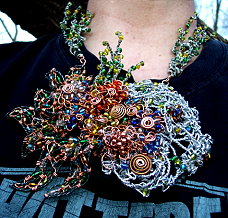
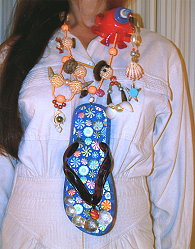
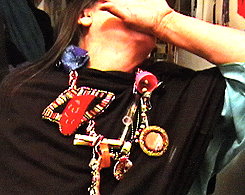
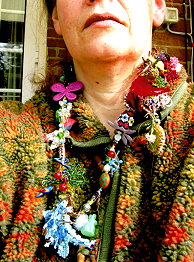
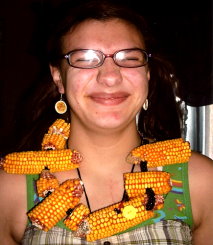
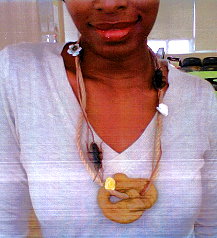
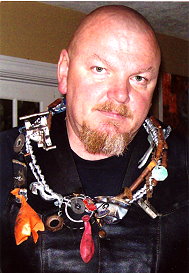
9th International 2012 The Ugly Necklace Contest
– A Jewelry Design Competition With A Twist

Eight Jewelry Artists from around the world have been selected as Semi-Finalists of The 9th International 2012 The Ugly Necklace Contest – A Jewelry Design Competition With A Twist, by a panel of four judges from The Center for Beadwork & Jewelry Arts and Land of Odds.

Vote Online for your favorites, and help determine who will win the Grand Prize – a $992.93 shopping spree on the Land of Odds web-site (http://www.landofodds.com). Runner Up Prize: $399.07 shopping spree. Voting Ends June 30th, 2012
More details and images on-line at:
http://www.landofodds.com/store/ugly9contest.htm


Our 2012 Semi-Finalists Announced:

Nivya Raju, Dubai, United Arab Emerates


Juli Brown, Wells, Minnesota
 

Joan Veres, Norwood, New York


Corrine Zephier, Kyle, South Dakota

Lynn Margaret Davy, Dorset, United Kingdom


Pamela Orians, Zanesville, Ohio


Quisha Saunders, Atlanta, Georgia


Brenda Donaldson, Mesa, Arizona


Synopsis:
It’s not easy to do Ugly!

So the many jewelry designers from across America and around the Globe who entered our 9th International 2012 The Ugly Necklace Contest — A Jewelry Design Competition With A Twist , found this contest especially challenging. After all, your brain is pre-wired to avoid and reject things which are ugly. Think of snakes and spiders. And even if you start your necklace with a bunch of ugly pieces, once you organize them into a circle, the very nature of an ordered round form makes it difficult to achieve Ugly. Yes, “Ugly” is easier said than done.
Who will win? We need the public’s help to influence our panel of judges.

Our respected judges evaluated these creatively-designed pieces in terms of hideousness, use of materials and clasp, the number of jewelry design principles violated, and the designer’s artistic control. Extra points were awarded for artists’ use of smaller beads, because it’s much more difficult to do Ugly with these.

Now it’s time for America and the World to help finalize the decision about which of these 8 semi-finalists’ Ugly Necklaces to vote for. The winner will truly be an exceptional jewelry designer. The losers….well….this isn’t a contest where you really can “lose”.

Come see these and the other semi-finalists’ pieces at www.landofodds.com, and vote your choice for the Ugliest Necklace, 2012.

And if you are in the Nashville, Tennessee area, please stop by The Open Windows Gallery (fine art jewelry) at Be Dazzled Beads, where the 8 semi-finalists’ Ugly Necklaces are on display through September 15, 2012.

CONTACT INFORMATION:
LAND OF ODDS
Attention: Warren Feld
www.landofodds.com
718 Thompson Lane, Ste 123, Nashville, TN 37204
Phone: 615-292-0610; Fax: 615-460-7001
Email: warren@landofodds.com

ABOUT UGLY NECKLACES

The UGLY NECKLACE CONTEST (www.landofodds.com/store/uglynecklace.htm) is a jewelry design competition with a twist. The contest presents a challenge not often tackled — at least intentionally. The contest draws the jewelry designer into an alternative universe where beautiful artists create ugly necklaces. It’s not easy to do.

“Ugly” is more involved than simple surface treatment. It is not just laying out a bunch of ugly parts into a circle. It turns out that “Ugly” is something more than that. “Ugly” is the result of the interplay among Designer, Wearer, and Viewer. “Ugly” is very much a result of how a necklace is designed and constructed. “Ugly” is something the viewer actively tries to avoid and move away from. “Ugly” has deep-rooted psychological, cognitive, perceptual, sociological and anthropological functions and purposes.

As research into color and design has shown, your eye and brain compensate for imbalances in color or in the positioning of pieces and objects – they try to correct and harmonize them. They try to neutralize anything out of place or not quite right. You are pre-wired to subconsciously avoid anything that is disorienting, disturbing or distracting. Your mind and eye won’t let you go here. This is considered part of the fear response, where your brain actively attempts to avoid things like snakes and spiders…. and ugly necklaces.

This means that jewelry designers, if they are to create beautiful, wearable art, have to be more deeply involved with their pieces beyond “surface”. Or their pieces will be less successful, thus less beautiful, thus more disturbing or distracting or disorienting, thus more Ugly.  Luckily, for the jewelry designer, we are pre-wired to avoid these negative things. This makes it easier to end up with pieces that look good. Beauty, in some sense, then, is very intuitive. On the other hand, it makes it more difficult to end up with pieces that look bad. You see, Ugly goes against our nature. It’s hard to do.

The Ugly Necklace Contest is one of the many programs at The Center for Beadwork & Jewelry Arts in Nashville, Tennessee, that encourage beadwork and jewelry makers to test their design skills, have fun, and learn some fundamentals about jewelry design in the process.
To add your name to our email list associated with The Ugly Necklace Contest,
send an email to: oddsian@landofodds.com
and Write “Ugly Necklace Email List” in the subject line.
Sponsors:
Land of Odds www.landofodds.com,
Phone: 615-292-0610; Email :warren@landofodds.com
Land of Odds provides bead and jewelry making artists with virtually all their beads, supplies, books and jewelry findings needs, with over 35,000 products. Retail/Discounts/Wholesale.

Be Dazzled Beads www.bedazzledbeads.com
Nashville’s premier bead store.

Center for Beadwork & Jewelry Arts www.landofodds.com/beadschool/
Educating beaders and jewelry makers in the Design Perspective.

Other Programs at Land of Odds:
ALL DOLLED UP: Beaded Art Doll Competition
www.landofodds.com/store/alldolledup.htm

JEWELRY DESIGN CAMP
www.warrenfeldjewelry.com/jewelrydesigncamp/

Learn To Bead Blog
Start your education with our ORIENTATION TO BEADS & JEWELRY FINDINGS
http://blog.landofodds.com

Posted in beadwork, Contests, jewelry design, jewelry making | Tagged: | Leave a Comment »

APPLIED FASHION

Posted by learntobead on November 14, 2011

APPLIED FASHION

Women don’t just wear pieces of jewelry – they inhabit them.

Buying a piece of jewelry for yourself – a necklace, a bracelet, earrings, a brooch, something else – isn’t a task easily given to someone else.  It’s often not a spur of the moment thing either.  You just don’t rush off to the local boutique or the local Wal-Mart, grab whatever you see, and go home.

I’m not talking about that impulse buy during your leisurely visit to the mall.   I’m referring to purchasing those pieces of jewelry you know will have to do a lot of the hard work to accessorize your wardrobe and help you get the compliments and notice of your family, friends and c o-workers you comport with and compete with each and every day.

No, buying a piece of jewelry for yourself is a multi-purposed moment, one which must be thought through carefully and one which must be savored.  Lest you buy the wrong piece.  That doesn’t really go with what you intend to wear.  Or is over-priced.  Or poorly made.  Or conveys the wrong impression about status.  Or is out of fashion.  Or something one of your friends already has.

The jewelry you buy has to conform to quite a long list of essential criteria before you could ever think of buying it.  It is something you will wear more than once.  As such, it is your companion.  Your necklace is not merely lying around your neck.  Or your bracelet around your wrist.  Or your earrings dangling from your ears.

Jewelry can cause you to lose face with others.  It can irritate or scratch your skin, or get caught up in your hair.  It might weigh you down or stretch or tear your ear lobes.  Jewelry can break without warning in the most unexpected and embarrassing of places.  It can get caught on things, sometimes hurting you in the process.

Jewelry conveys to the world something about who you really are, or think you are.  As such, jewelry is very personal.  Your private, innermost, most soul searching choices made very public for all to see.

As you caress it, as you touch the smooth or faceted or creviced beads and metal parts or the clasp or the material the beads are strung on, when you twist and move the piece within your hand, you are confirming to yourself the extent to which your jewelry is doing its job.

When you buy new jewelry, the dilemmas multiply.  How will  the new compare to the old?  Will it be able to handle all these responsibilities – looking good, representing you, fitting in with your wardrobe, meeting the expectations of others?  Like divorcing, then remarrying, changing your jewelry can take some time for readjustment.

And you do not want to be seen as noncommittal to your jewelry.  This would sort of be like going to  a hotel, but not unpacking your suitcase while staying in the room.   Conveying some sort of social or psychological distance from your jewelry can be very unsettling for others.

So you need to inhabit it.  You need to inhabit your jewelry, wear it with conviction, pride and satisfaction.  Be one with it.

Inhabiting jewelry often comes with a price.  There becomes so much pressure to buy the “right” pieces, given all the roles we demand our jewelry to play, that we too often stick with the same brands, the same colors, the same styles, the same silhouettes.  We get stuck in this rut and are afraid to step out of it.

Or we wear too many pieces of jewelry.  The long earrings, plus the cuff bracelets on both arms, plus the head band, plus the hair ornament, plus the 7-strand necklace, plus the 5 rings.  We are ever uncertain which piece or pieces will succeed at what, so hopefully, at least some combination or subset of what we wear will work out.

In a similar way, we wear over-embellished pieces – lots of charms, lots of dangles, lots of fringe, lots of strands.  Something will surely be the right color, the right fit and proportion, the right fashion, the right power statement, the right reflection of me.

And our need to inhabit our jewelry comes with one more price.  We are too willing to overpay for poorly made pieces in our desperation to have that right look.  The $100.00 of beads strung on elastic string.  The poorly dyed stones which fade in the light.  The poorly crimped and overly stiff pieces with little ease for accommodating movement and frequent wear.

It is OK to inhabit our jewelry.  In fact, it is necessary, given all we want jewelry to do for us.   But we need to be smart about it.  We need to learn to recognize better designs and better designers.

This need not be expensive at all.

Just smarter.

Posted in beads, jewelry making | Tagged: , , , | 1 Comment »