Beading requires a lot of mind-body coordination. That takes work. It is work.
Calisthenics are exercises you can do to improve and tone your mind-body coordination when bead weaving.
You have to be able to get from your fingers to the needle to the beads, back along the thread to the needle to the fingers, hands, arms, eyes, mind. And then again. And again. Over and over, one more time. You need to get into a rhythm. All these working parts need to be working. No time for cramping. No time to get tired. No time to lose concentration.
A rhythm. Needle, pick up bead, pull down along thread, check the tension, pick up a bead, pull down along thread, check the tension, pick up a bead….
I noticed that different instructors had various techniques and strategies for maintaining this rhythm. Yes, music was involved sometimes. Othertimes simple meditation or creative reading and discourse. Some people had some stretching exercises that they did. Others tested themselves before proceeding with their big project. Still others did small things to reconfirm their learning.
Throughout this Series, I introduce some of the beading calisthenics that I experienced along the way. If you want to gather materials up so that you can follow along with these calisthenics, here’s the list.
MATERIALS NEEDED FOR ALL THE CALISTHENIC EXERCISES (SUPPLY LIST):
notebook, pencil 1 tube each of Japanese 11/0 seed beads in gray, 3 different colors of orange, black, white, any other 4 colors 1 tube each of Japanese 8/0 seed beads in gray or silver, black, white, orange, any other 4 colors 1 tube each of Japanese 6/0 seed beads in gray or silver, black, white, orange, any other 4 colors 5 gray-scale colors of delicas or 11/0 seed beads Nymo D or C-Lon D thread in black Nymo D or C-Lon D thread in yellow two toggle clasps .018” or .019” flexible cable wire assorted 4mm, 6mm and 8mm beads in various coordinating colors, including grays and oranges in your mix, as well big bowl and a bowl-full of assorted beads Size 10 English beading needles Bees wax scissors beading dishes or trays any kind of graph paper work surface or pad colored pencils a few clasps, (toggles are easy to work with) some crimp beads crimping pliers
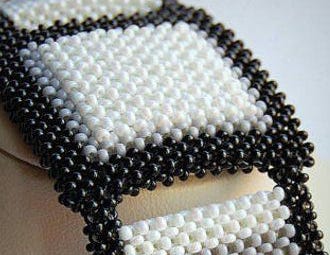
BEADING CALISTHENICS #7: Composition in Gray and Gray
5 gray-scale colors of delicas or 11/0 seed beads gray colored Nymo or C-lon thread, size D yellow colored Nymo or C-lon thread, size D
You can use an existing peyote, brick stitch or loom pattern, or create your own. Try to use or create a pattern that is about 3 inches square. Assign your colors using your 5 gray-scale colors of delicas or 11/0 seed beads.
Evaluate your resulting bead-weaving:
To what extent have you been able to create obvious or desired boundaries between sections or forms within the piece?
To what extent have you been able to create a sense of dimensionality, or forward/receding qualities?
To what extent have you had control over the lines, forms, sections and other design elements, using only gray?
To what extent have you been able to achieve an energy/vitality within the piece, as if it had been multi-colored?
Additional Exercises:
1. Repeat the pattern, using your 5-gray-scale bead colors, and use a bright yellow Nymo or C-Lon Size D thread
2. Repeat the pattern, and substitute a rich colored blue or red bead for one of the grays, plus the other original 4 colors of gray, and the gray Nymo or C-Lon thread
Beading requires a lot of mind-body coordination. That takes work. It is work.
Calisthenics are exercises you can do to improve and tone your mind-body coordination when bead weaving.
You have to be able to get from your fingers to the needle to the beads, back along the thread to the needle to the fingers, hands, arms, eyes, mind. And then again. And again. Over and over, one more time. You need to get into a rhythm. All these working parts need to be working. No time for cramping. No time to get tired. No time to lose concentration.
A rhythm. Needle, pick up bead, pull down along thread, check the tension, pick up a bead, pull down along thread, check the tension, pick up a bead….
I noticed that different instructors had various techniques and strategies for maintaining this rhythm. Yes, music was involved sometimes. Othertimes simple meditation or creative reading and discourse. Some people had some stretching exercises that they did. Others tested themselves before proceeding with their big project. Still others did small things to reconfirm their learning.
Throughout this Series, I introduce some of the beading calisthenics that I experienced along the way. If you want to gather materials up so that you can follow along with these calisthenics, here’s the list.
MATERIALS NEEDED FOR ALL THE CALISTHENIC EXERCISES (SUPPLY LIST):
notebook, pencil 1 tube each of Japanese 11/0 seed beads in gray, 3 different colors of orange, black, white, any other 4 colors 1 tube each of Japanese 8/0 seed beads in gray or silver, black, white, orange, any other 4 colors 1 tube each of Japanese 6/0 seed beads in gray or silver, black, white, orange, any other 4 colors 5 gray-scale colors of delicas or 11/0 seed beads Nymo D or C-Lon D thread in black Nymo D or C-Lon D thread in yellow two toggle clasps .018” or .019” flexible cable wire assorted 4mm, 6mm and 8mm beads in various coordinating colors, including grays and oranges in your mix, as well big bowl and a bowl-full of assorted beads Size 10 English beading needles Bees wax scissors beading dishes or trays any kind of graph paper work surface or pad colored pencils a few clasps, (toggles are easy to work with) some crimp beads crimping pliers
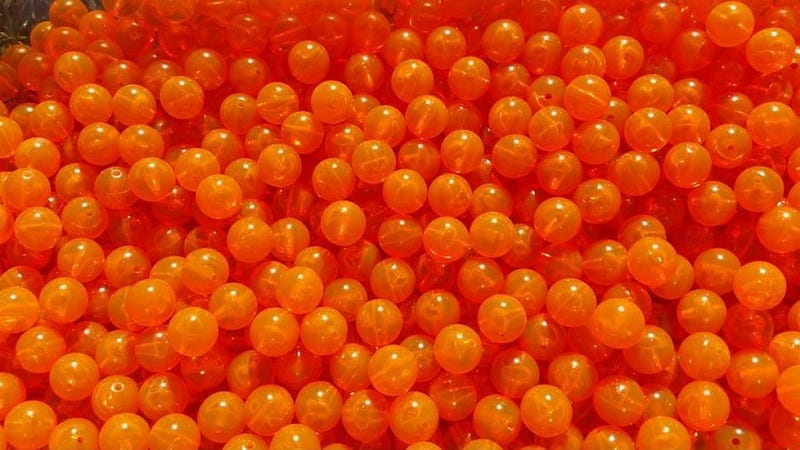
BEADING CALISTHENICS #6: Aren’t You Glad You Used Orange
Orange is a difficult color for most people to work with. So this challenge is a simple bead stringing one.
Create an appealing, satisfying necklace, using at least 30 or more 4–6mm beads in orange, and 30 or more 4–6mm beads in each of two other colors.
Stand back from your piece and examine it. If you added or subtracted any one color, could you make the necklace more satisfying?
What makes the particular combination that you ended up with the best combination?
Beading requires a lot of mind-body coordination. That takes work. It is work.
Calisthenics are exercises you can do to improve and tone your mind-body coordination when bead weaving.
You have to be able to get from your fingers to the needle to the beads, back along the thread to the needle to the fingers, hands, arms, eyes, mind. And then again. And again. Over and over, one more time. You need to get into a rhythm. All these working parts need to be working. No time for cramping. No time to get tired. No time to lose concentration.
A rhythm. Needle, pick up bead, pull down along thread, check the tension, pick up a bead, pull down along thread, check the tension, pick up a bead….
I noticed that different instructors had various techniques and strategies for maintaining this rhythm. Yes, music was involved sometimes. Othertimes simple meditation or creative reading and discourse. Some people had some stretching exercises that they did. Others tested themselves before proceeding with their big project. Still others did small things to reconfirm their learning.
Throughout this Series, I introduce some of the beading calisthenics that I experienced along the way. If you want to gather materials up so that you can follow along with these calisthenics, here’s the list.
MATERIALS NEEDED FOR ALL THE CALISTHENIC EXERCISES (SUPPLY LIST):
notebook, pencil 1 tube each of Japanese 11/0 seed beads in gray, 3 different colors of orange, black, white, any other 4 colors 1 tube each of Japanese 8/0 seed beads in gray or silver, black, white, orange, any other 4 colors 1 tube each of Japanese 6/0 seed beads in gray or silver, black, white, orange, any other 4 colors 5 gray-scale colors of delicas or 11/0 seed beads Nymo D or C-Lon D thread in black Nymo D or C-Lon D thread in yellow two toggle clasps .018” or .019” flexible cable wire assorted 4mm, 6mm and 8mm beads in various coordinating colors, including grays and oranges in your mix, as well big bowl and a bowl-full of assorted beads Size 10 English beading needles Bees wax scissors beading dishes or trays any kind of graph paper work surface or pad colored pencils a few clasps, (toggles are easy to work with) some crimp beads crimping pliers
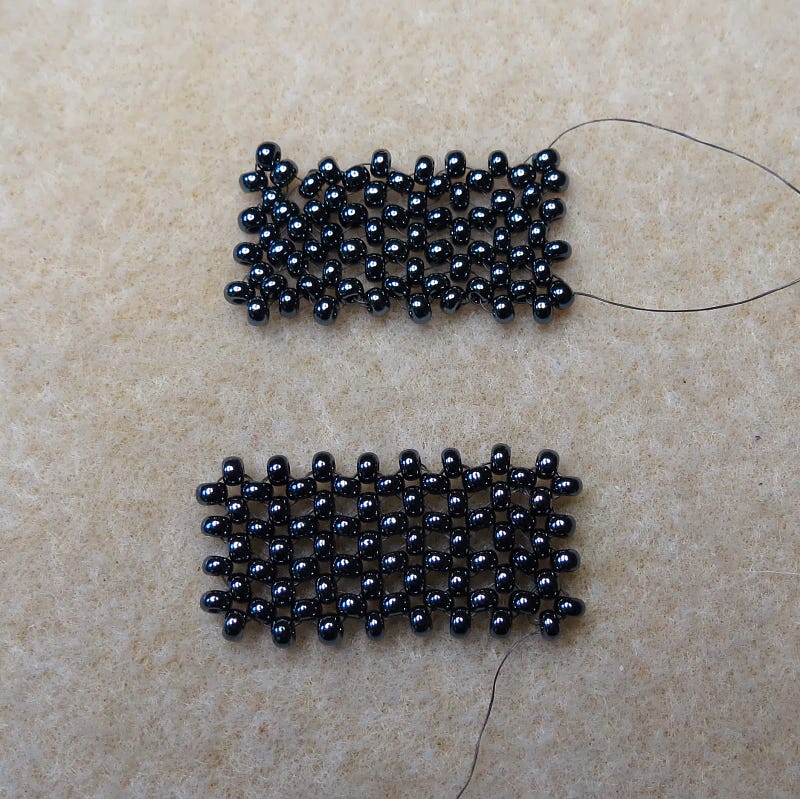
The goal here is to learn a little about managing thread tension.
Pick a favorite bead weaving stitch, such as Peyote, Brick or Ndbele (Herringbone). Plan out how to make a flat length of the weave, about ½” wide and 6” long. You can also do 6 separate pieces about ½” wide and 1” long.
For the first inch, keep a tight tension. For the 2nd inch, make the tension tighter. For the 3rd inch, make it even tighter. For the tightest tension, you might even want to reinforce your stitching, by going through each bead again and again with your thread.
For the fourth inch, try to get a tension a little looser than you typically use. Then the next inch, get even looser. For your final inch, make this the loosest of all.
Now pick a stitch like the Chevron Stitch or the Right Angle Weave Stitch. Work it for a length of 3–4”. These stitches start out very loose.
What different kinds of strategies can you employ to tighten the tension? — Reinforcement? Reinforcement after each small segment of stitches? Or Reinforcement after you’ve completed the whole piece? Changing the type of stringing material you are using? Stitching over a solid form, such as a dowel, pencil or straw or vase or ball? Adding additional beads at key joints? There are these and lots of possibilities. Try them out.
Beading requires a lot of mind-body coordination. That takes work. It is work.
Calisthenics are exercises you can do to improve and tone your mind-body coordination when bead weaving.
You have to be able to get from your fingers to the needle to the beads, back along the thread to the needle to the fingers, hands, arms, eyes, mind. And then again. And again. Over and over, one more time. You need to get into a rhythm. All these working parts need to be working. No time for cramping. No time to get tired. No time to lose concentration.
A rhythm. Needle, pick up bead, pull down along thread, check the tension, pick up a bead, pull down along thread, check the tension, pick up a bead….
I noticed that different instructors had various techniques and strategies for maintaining this rhythm. Yes, music was involved sometimes. Othertimes simple meditation or creative reading and discourse. Some people had some stretching exercises that they did. Others tested themselves before proceeding with their big project. Still others did small things to reconfirm their learning.
Throughout this Series, I introduce some of the beading calisthenics that I experienced along the way. If you want to gather materials up so that you can follow along with these calisthenics, here’s the list.
MATERIALS NEEDED FOR ALL THE CALISTHENIC EXERCISES (SUPPLY LIST):
notebook, pencil 1 tube each of Japanese 11/0 seed beads in gray, 3 different colors of orange, black, white, any other 4 colors 1 tube each of Japanese 8/0 seed beads in gray or silver, black, white, orange, any other 4 colors 1 tube each of Japanese 6/0 seed beads in gray or silver, black, white, orange, any other 4 colors 5 gray-scale colors of delicas or 11/0 seed beads Nymo D or C-Lon D thread in black Nymo D or C-Lon D thread in yellow two toggle clasps .018” or .019” flexible cable wire assorted 4mm, 6mm and 8mm beads in various coordinating colors, including grays and oranges in your mix, as well big bowl and a bowl-full of assorted beads Size 10 English beading needles Bees wax scissors beading dishes or trays any kind of graph paper work surface or pad colored pencils a few clasps, (toggles are easy to work with) some crimp beads crimping pliers
BEADING CALISTHENICS #4: Two-Needle Race Up The Ladder
For each person:2 size #10 English beading needles Nymo D or C-Lon D thread Size 8/0 Japanese seed beads
Here, you need two or more people, or you can compete against yourself. This is a race.
We are going to use two needles and one length of thread to work up through the ladder stitch.
The ladder technique: Double your length of thread. Thread a needle on the end of each side. Pick up the same number of beads on the two needles. Pass the needles in opposite directions through the top beads on each needle. Pull the tension tight. For your first loop (or rung), you’ll need one extra bead on each needle, than for subsequent loops (rungs).
You might start with 4 beads on each needle for the first rung, then 3 beads on each needle for each additional run. Pick up 4 on each needle, crossover. Pull the tension tight. Pick up 3 on each needle, crossover. Pull the tension tight. Keep repeating with 3 beads on each needle.
The ladder looks like this:
Run the race to see who can be the first to make a ladder that is 12 inches long.
Beading requires a lot of mind-body coordination. That takes work. It is work.
Calisthenics are exercises you can do to improve and tone your mind-body coordination when bead weaving.
You have to be able to get from your fingers to the needle to the beads, back along the thread to the needle to the fingers, hands, arms, eyes, mind. And then again. And again. Over and over, one more time. You need to get into a rhythm. All these working parts need to be working. No time for cramping. No time to get tired. No time to lose concentration.
A rhythm. Needle, pick up bead, pull down along thread, check the tension, pick up a bead, pull down along thread, check the tension, pick up a bead….
I noticed that different instructors had various techniques and strategies for maintaining this rhythm. Yes, music was involved sometimes. Othertimes simple meditation or creative reading and discourse. Some people had some stretching exercises that they did. Others tested themselves before proceeding with their big project. Still others did small things to reconfirm their learning.
Throughout this Series, I introduce some of the beading calisthenics that I experienced along the way. If you want to gather materials up so that you can follow along with these calisthenics, here’s the list.
MATERIALS NEEDED FOR ALL THE CALISTHENIC EXERCISES (SUPPLY LIST):
notebook, pencil 1 tube each of Japanese 11/0 seed beads in gray, 3 different colors of orange, black, white, any other 4 colors 1 tube each of Japanese 8/0 seed beads in gray or silver, black, white, orange, any other 4 colors 1 tube each of Japanese 6/0 seed beads in gray or silver, black, white, orange, any other 4 colors 5 gray-scale colors of delicas or 11/0 seed beads Nymo D or C-Lon D thread in black Nymo D or C-Lon D thread in yellow two toggle clasps .018” or .019” flexible cable wire assorted 4mm, 6mm and 8mm beads in various coordinating colors, including grays and oranges in your mix, as well big bowl and a bowl-full of assorted beads Size 10 English beading needles Bees wax scissors beading dishes or trays any kind of graph paper work surface or pad colored pencils a few clasps, (toggles are easy to work with) some crimp beads crimping pliers
BEADING CALISTHENICS #3: Head Turning / Turning Beads
Enough 4mm-8mm beads to make an 18” necklace Nymo D or C-Lon D thread .019” or .018” thick flexible cable wire, such as Soft Flex or Flexrite 2 toggle clasps
Using any sized and color beads, string an 18” necklace using Nymo D or C-Lon D thread and a toggle clasp.
Using the same number, size and color beads, string an 18” necklace using .018” or .019” flexible cable wire, crimp beads and a toggle clasp.
Put on the necklace strung on the thread. Bend over as if you were picking up something off the ground. Stand straight, then twist your body to the left. Note the positioning of the clasp. Note how the necklace feels on, and feels when you move. Take the necklace off.
Put on the necklace strung on the cable wire. Again, bend down as if you were picking up something off the ground. Stand straight, then twist your body to the left. Note the positioning of the clasp. Note how the necklace feels on, and feels when you move. Take the necklace off.
Typically, when you use needle and thread in stringing, the piece conforms to the body and moves in the same direction as the body.
Typically, when you use cable wire, the piece does not conform to the body, and will move in the opposite direction the body moves in.
Beading requires a lot of mind-body coordination. That takes work. It is work.
Calisthenics are exercises you can do to improve and tone your mind-body coordination when bead weaving.
You have to be able to get from your fingers to the needle to the beads, back along the thread to the needle to the fingers, hands, arms, eyes, mind. And then again. And again. Over and over, one more time. You need to get into a rhythm. All these working parts need to be working. No time for cramping. No time to get tired. No time to lose concentration.
A rhythm. Needle, pick up bead, pull down along thread, check the tension, pick up a bead, pull down along thread, check the tension, pick up a bead….
I noticed that different instructors had various techniques and strategies for maintaining this rhythm. Yes, music was involved sometimes. Othertimes simple meditation or creative reading and discourse. Some people had some stretching exercises that they did. Others tested themselves before proceeding with their big project. Still others did small things to reconfirm their learning.
Throughout this Series, I introduce some of the beading calisthenics that I experienced along the way. If you want to gather materials up so that you can follow along with these calisthenics, here’s the list.
MATERIALS NEEDED FOR ALL THE CALISTHENIC EXERCISES (SUPPLY LIST):
notebook, pencil 1 tube each of Japanese 11/0 seed beads in gray, 3 different colors of orange, black, white, any other 4 colors 1 tube each of Japanese 8/0 seed beads in gray or silver, black, white, orange, any other 4 colors 1 tube each of Japanese 6/0 seed beads in gray or silver, black, white, orange, any other 4 colors 5 gray-scale colors of delicas or 11/0 seed beads Nymo D or C-Lon D thread in black Nymo D or C-Lon D thread in yellow two toggle clasps .018” or .019” flexible cable wire assorted 4mm, 6mm and 8mm beads in various coordinating colors, including grays and oranges in your mix, as well big bowl and a bowl-full of assorted beads Size 10 English beading needles Bees wax scissors beading dishes or trays any kind of graph paper work surface or pad colored pencils a few clasps, (toggles are easy to work with) some crimp beads crimping pliers
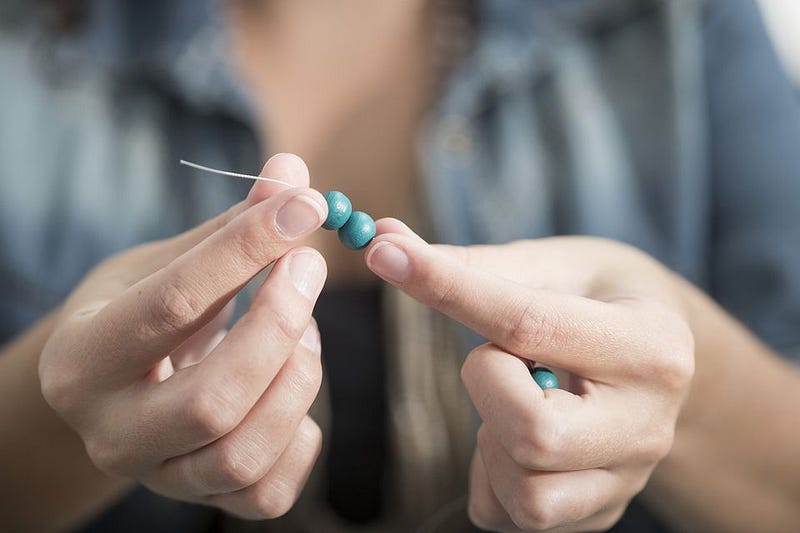
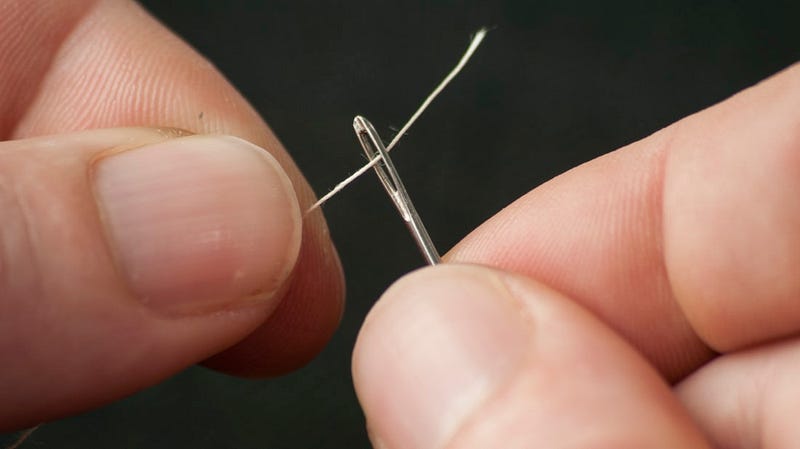
BEADING CALISTHENICS #2: Zen Needle Threading
Take a length of Nymo size D thread and a size #10 English beading needle. Thread the needle the way you are accustomed to doing this. Take the thread end, and thread it again. You may have to trim the tip of the thread.
Now try to thread your needle, this time keeping your eyes closed.
Visualize in your mind what you had just seen with your eyes.
Feel with your hands and body what you had just felt with your hands and body.
Unsuccessful? Then try again. Thread the needle twice with eyes open. Close your eyes. Try again. Visualize. Make your body and mind one with the needle and one with the thread.
Beading requires a lot of mind-body coordination. That takes work. It is work.
Calisthenics are exercises you can do to improve and tone your mind-body coordination when bead weaving.
You have to be able to get from your fingers to the needle to the beads, back along the thread to the needle to the fingers, hands, arms, eyes, mind. And then again. And again. Over and over, one more time. You need to get into a rhythm. All these working parts need to be working. No time for cramping. No time to get tired. No time to lose concentration.
A rhythm. Needle, pick up bead, pull down along thread, check the tension, pick up a bead, pull down along thread, check the tension, pick up a bead….
I noticed that different instructors had various techniques and strategies for maintaining this rhythm. Yes, music was involved sometimes. Othertimes simple meditation or creative reading and discourse. Some people had some stretching exercises that they did. Others tested themselves before proceeding with their big project. Still others did small things to reconfirm their learning.
Throughout this Series, I introduce some of the beading calisthenics that I experienced along the way. If you want to gather materials up so that you can follow along with these calisthenics, here’s the list.
MATERIALS NEEDED FOR ALL THE CALISTHENIC EXERCISES (SUPPLY LIST):
notebook, pencil 1 tube each of Japanese 11/0 seed beads in gray, 3 different colors of orange, black, white, any other 4 colors 1 tube each of Japanese 8/0 seed beads in gray or silver, black, white, orange, any other 4 colors 1 tube each of Japanese 6/0 seed beads in gray or silver, black, white, orange, any other 4 colors 5 gray-scale colors of delicas or 11/0 seed beads Nymo D or C-Lon D thread in black Nymo D or C-Lon D thread in yellow two toggle clasps .018” or .019” flexible cable wire assorted 4mm, 6mm and 8mm beads in various coordinating colors, including grays and oranges in your mix, as well big bowl and a bowl-full of assorted beads Size 10 English beading needles Bees wax scissors beading dishes or trays any kind of graph paper work surface or pad colored pencils a few clasps, (toggles are easy to work with) some crimp beads crimping pliers
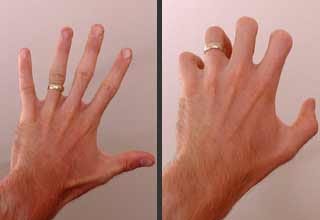
BEADING CALISTHENICS #1: 5-Finger Stretchies
This exercise is used to prevent your fingers from cramping. Often, when beading, you are holding your hand and fingers in a very tight, controlled, sometimes unnatural or uncomfortable position. You should stop periodically, and do 5-Finger Stretchies. This is a wonderful exercise which relaxes the muscles in your hands.
Take one hand and hold it arm out, palm forward. Your arm is parallel to the floor. Your palm, fingers up, is perpendicular to the floor. Tighten every muscle in every finger, and pull each finger inward and downwards towards the point they meet the palm, but don’t touch the palm. Picture making a claw with your pulled back fingers.
Squeeze the tension, release. Squeeze, release. Squeeze, release. Do this rapidly, perhaps 4 squeeze/releases a second. Do this for 10 seconds.
Many beaders love to bead, but lack the time, focus or motivation. They get too busy. They work on several projects at once. They end up with a lot of unfinished projects. Often achieving success gets too frustrating. Paralyzing. There are too many competing demands.
Beading and craft projects can take a long time. You have to maintain your interest over this extended period.
Most of us are like this. So I wanted to know what kinds of things do you do to increase your patience. How do you construct and manage the situations you are in — with all these competing demands for your time and energy — so that you can bead?
Are there some strategic short-cuts you take, when beading or designing, so you can speed things up?
What are your Patience Boosters?
“When I'm working my "day" job, I have a 3 X 5 note pad I carry with me and use it to write or draw ideas until I can get back to the beads.
When I get home I fix supper and bead until bed time. Then on Saturday I pick any projects that I want to get finished and do completion work then.
I find that projects in the "Lost interest category" never get finished and every so often I cut them up and reclaim the beads.”
Infuriating! That’s how many people, beginners and advanced alike, feel when they try to understand patterns and instructions.
Know up-front that most patterns are poorly drawn, and most instructions are poorly written. The instructors who write these often leave out critical steps — especially for new beaders and jewelry makers who are unfamiliar with many of the things these instructors assume that you know. Most often, they leave out critical information showing you the pathway, and how to negotiate that pathway, from where you are to where you are going next. It’s obvious to the instructor. But not so obvious to you.
In patterns, this “where-am-I, where-am-I-going-next” information is frequently unclear or omitted. You did Step 1 OK. You understand what Step 2 is about. But you don’t know how to get from Step 1 to Step 2. Othertimes, the patterns are overly complex, often, in the editorial interest of reducing the number of printed pages. Instead of showing a separate pattern or diagram for each step, the editors frequently try to show you three, four, five or more steps in the same diagram. So you have a bird’s nest of lines, and a spider-web’s road map — and you’re no where.
I tell people, that you need to re-write the instructions and re-draw the patterns or diagrams in a way you personally understand. This is very helpful.
Reading Patterns: Usually patterns are organized starting at the bottom with row 1 or step 1, first moving left to right, and then moving up bottom to the top. Othertimes, but less frequenlty, patterns are drawn so that you move in the opposite direction, starting at the top, moving left to right, then working down towards the bottom. When reading a pattern, you first need to locate whether the pattern goes bottom-up or top-down, or left-right or right-left.
Next, determine the directional flow of the work. Are you moving left to right and then right to left? Are you moving left to right, and then flipping the piece over, so you can continue moving left to right? Are you starting in the middle?
Most patterns and instructions are written from the Right-Handed person’s perspective. Right-Handed people usually work counter-clockwise. If you are Left-Handed, you may want to redraw the pattern or rewrite the instructions. Left-Handed people usually work clockwise.
Now, look at all the special symbols on the pattern, if any. Decipher what each one means before you begin your work. If you don’t know what “11/0” or “cylinder bead” means, for example, use the internet or your local bead or craft store, as a resource for finding out.
Clearly delineate, even draw an outline on the pattern itself with a pen, the thread, string or wire path. Be sure whether you are following a straight line path, or not.
Determine if you are creating one line or row at a time, or more than one line or row at a time.
Sometimes it is helpful to use a post-it note and place it right below the row you are working on. This helps you not lose your place.
If the pattern is fuzzy on how you proceed from one step to the next, try to draw in your own pattern, based on the written instructions, or on what you intuitively feel needs to happen next.
To draw your own patterns, you can find several sources of free graph paper on line. Usually the graph paper is available for a wide range of bead weaving stitches and techniques.
Many people who begin to bead want to rush to the finish line. They want to learn everything at once.
They buy beads and parts indiscriminately. They purchase every book they can find. They take classes on anything that interests them or catches their eye, no matter what the skill levels involved. Many people are not unlike a customer of ours — Lulu Betty — who contracted to make almost 50 pieces of complex jewelry, before ever having made even one piece before. She came into the store, and wanted someone to teach her everything — crimping, stringing, needle and thread work, wire working, silversmithing — in 2 hours.
Beading and jewelry making are not things to rush into. These are not things to learn haphazardly. Not everything is something you can easily pick up without having someone else show you.
This is a hobby and avocation that requires you to know a lot of things. You need to know a lot about materials. You need to know a lot about quality issues underlying these materials, and what happens to these materials over time. You need to be mechanical and comfortable using tools to construct things. You need to learn many basic techniques. You need to understand physical mechanics and what happens to all these materials and pieces, when jewelry is worn. You need to be familiar with art theories and their applications. You need to understand people, their psychology, the dynamics of the groups they find themselves in, and their cultural rules which get them through the day. You need to even be a little bit of a party planner, because often jewelry is worn in a specific context or for a specific occasion.
There is so much to learn, that you can’t learn it all at once. And there is so much to bring to bear, when making a piece of jewelry, that it is difficult to access all this information, if you haven’t learned how everything is interrelated and interdependent.
It’s important to learn in an organized, developmental way. Learn a core set of skills. Then learn another set of skills, and how these link back to the core. Then learn yet another set of skills, how they link back to the first set, and then link back to the core. And so forth. Always ask your self how all these things are inter-related and mutually dependent. Only in this way will you begin to know if you are learning the right way, and learning the right things.
There Are Many Styles of Learning
There are many ways to learn beading and jewelry making.
Most people learn by Rote Memory. They follow a set of steps, and they end up with something. They memorize all the steps. In this approach, all the choices have been made for them. So they never get a chance to learn the implications of their choices. Why one bead over another? Why one stringing material over another? How would you use the same technique in a different situation? You pick up a lot of techniques, but not necessarily many skills.
Other people learn Analogously. They have experiences with other crafts, such as sewing or knitting or other craft, and they draw analogies. Such and Such is similar to Whatnot, so I do Whatnot the same way I do Such and Such. This can work to a point. However, beading and jewelry making can often be much more involved, requiring making many more types of choices, than in other crafts. And there are still the issues of understanding the quality of the pieces you use, and what happens to them, both when jewelry is worn, as well as when jewelry is worn over time.
Yet another way people learn is through Contradictions. They see cheap jewelry and expensive jewelry, and analyze the differences. They see jewelry people are happy with, and jewelry people are not happy with, and analyze the differences. They see fashion jewelry looked down upon by artists, and art jewelry looked down upon by fashionistas, and they analyze the differences.
Assimilation is a learning approach that combines Analogous Learning and Learning Through Contradictions. People pursue more than one craft, keeping one foot in one arena, and another foot in the other. They teach themselves by analogy and contradiction. This assumes that multiple media mix, and mix easily. Often, however, this is not true. Usually one medium has to predominate for any one project to be successful. So assimilative learning can lead to confusion and poor products, trying to meet the special concerns and structures of each craft simultaneously. It is challenging to mix media. Often the fundamentals of each particular craft need to be learned and understood in and of themselves.
Constructing Meanings is one last approach to learning a craft. In this approach, you learn groups of things, and how to apply an active or thematic label to that grouping. For example, you might learn about beading threads, such as Nymo, C-Lon and FireLine, and, at the same time, learn to evaluate each one’s strengths and weaknesses in terms of Managing Thread Tension. You might learn about crystal beads, Czech glass beads, and lampwork beads, and then, again concurrently and in comparison, learn the pros and cons of each, in terms of achieving good color blending strategies. You might learn peyote stitch and Ndebele stitch, and how to combine them within the same project.
In reality, you learn a little in each of these ways. The Constructing Meanings approach, what is often referred to as the Art & Design Tradition, usually is associated with more successful and satisfying learning. This approach provides you with the tools for making sense of a whole lot of information — all the information you need to bring to bear to make a successful piece of jewelry, one that is both aesthetically pleasing and optimally functioning.
You usually have to buy more beads than you will use for any particular project. It’s infrequent that you can buy one bead at a time. So you have lots of little bits of little things left over.
Having a little of a lot of different beads might be disconcerting to some. “It’s gotten to the point,” Neva admitted, “where I’m running out of people to give gifts to … to justify my bead stash.” However, for Neva, as well as others, this stash of beads should be seen and treated as treasure. It’s not a burden. It should open up new possibilities for you as you think through new projects and designs.
Your stash can be used in fringes or as embellishment. You can use it to finish off the edges in your pieces. You can use these as spacer beads in bead stringing projects.
You can organize bead swaps with your friends, and trade off part of your stash for that of another’s.
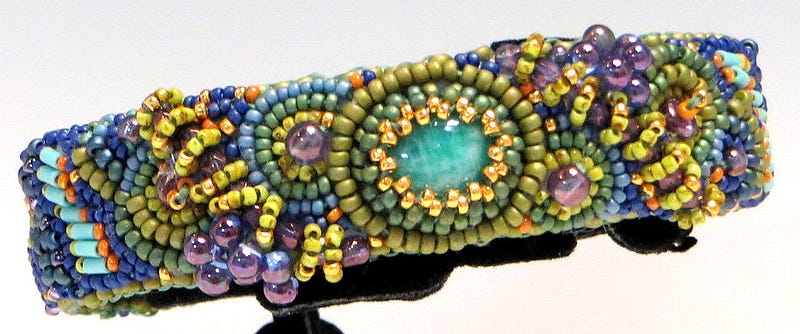
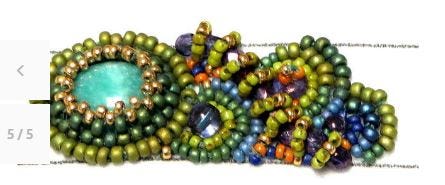
I was so determined to create a project for using up my bead stash, that I even developed a graphic embroidery pattern to assist me. Since I was somewhat new to bead embroidery, this was an accomplishment in and of itself. In my stash, I had a little of everything — 11/0’s, 15/0’s, drops, bugles. But not enough of any one color to make a project with them. I thought and thought and thought what to do.
The result: Hapua Reef Cuff. I laid out a graphic pattern, and colored in each section with beads. And used very few beads of many, many colors. And used up part of my bead stash.
INSPIRATION AND ASPIRATION “In the beginning, there was the idea.”
The words creativity, inspiration and aspiration are often used interchangeably, and I think it’s important that we draw a clearer distinction.
Creative people don’t just sit around and wait for inspiration to strike. Inspiration is not the source of creativity. Rather, inspiration is the motivated response to the creative impulse. Aspiration, in turn, is the motivated response by the artist to actualize inspiration.
Creativity is “a phenomenon where both something new and, at the same time, somehow valuable is created.”
Inspiration is defined as, “the process of being mentally stimulated to do or feel something.”
Aspiration is, “a hope or ambition of achieving something.”
There are many dichotomies. Stimulation versus ambition. Excitement versus action. Idea versus value. And most significantly, external versus internal.
Inspiration is something we seek to ingest from outside. Aspiration is something we cultivate within ourselves.
I have been inspired by an extraordinary number of people over the course of my life. My mentors in college when I was struggling to decide between becoming an archaeologist or a psychologist. In my first job at New Brunswick Tomorrow where I guided a board of health care providers in creating a health plan for the city. In a subsequent job by government officials with a clear vision for health care in Tennessee. Finding inspirations has never been a challenge for me.
But I had never really aspired to be like anyone until I dropped out of the corporate race, and turned to jewelry designing. It had never excited me or got my juices flowing before in the same way. But with jewelry design, I felt I could accomplish these wonderful designs, And, as my aspirations came into fruition, I began to feel that I could shape the field and profession of jewelry design and change the way jewelry makers work in some way. I was filled with aspirations to be heard and to make a difference. The response to my aspirations, from students or people reacting to my written articles, inspired me. If filled me with aspirations, and I had to figure the details out. I had to be very self-directed to continue as a jewelry designer and begin to transform how it is understood as a professional endeavor all its own — apart from craft and apart from art.
INSPIRATION: Becoming One with What Inspires You
Inspirations are sacred revelations you want to share through art and design.
The word inspiration comes from the Latin roots meaning “to breathe into.” But before you can breathe your inspiration into your jewelry, you need to become one with it.
There are these wonderfully exciting, sensually terrific, incredibly fulfilling things that you find as you try to imagine the jewelry you will create. They come from many sources: ideas, nature, images, people, behaviors. They might be realistic or abstract. They may be the particular color or pattern or texture or the way the light hits it and casts a shadow. They may be a need for order over chaos. They may be points of view. They may flow from some inner imagination.
For some reason, these inspirations take on a divine, sacred revelation for you — so meaningful that you want to incorporate them somehow into what you do. A fire in your soul. You want to translate these inspirations into colors, shapes, lines, patterns and textures. You want to impose an organization on them. You want to recapture their energy and power they have had over you. You feel compelled to bring these feelings into ideas, and these ideas into material objects.
There are many challenges to inspiration. That which we call “inspiring” can often be somewhat fuzzy. It might be a feeling. It might be a piece of an idea, or a small spot on an image. You might feel inspired, but, cannot put the What or the Why into words or images. On the surface, it may seem important to you, but unimportant to others. You the artist may not feel in control of the inspiration in that it seems like it is something that is evoked, not necessarily directed, by you.
When inspired, artists perceive new possibilities that transcend that which is ordinary around them. Too often, the artist feels passive in this process. This transcendence does not feel like a willfully generated idea. However, it needs to be.
The successful artist — one who eventually can achieve a level of resonance — is one who is not only inspired by, but also inspired to. This all requires a great deal of metacognitive self-awareness. The artist must be able to perceive the intrinsic value of the inspiring object, and how to extend this value in design, where the piece of jewelry becomes its expression.
Inspiration is motivating. Inspiration is not the source of creativity; creativity does not come from it. Inspiration, instead, should be viewed as a motivational response to creativity. It motivates the artist, through jewelry and its design, to connect this inspiration with others. It serves as a mediator between the self and the anticipated shared understandings of others. The jewelry encapsulates the artist’s ability to make this connection. When the connection is well-made, resonance follows.
But finding inspirations is not only personal, but more importantly, it is an effort to influence others. It is an act of translating the emotions which resonate in you into some object of art which, in turn, will inspire and resonate with others. How does the inspiration occur to you, and how do you anticipate how this inspiration might occur to others?
Too often we lose sight of the importance of inspiration to the authentic performance task of creating jewelry. We operate with the belief that anyone can be inspired by anything. There’s nothing more to it. Moreover, inspiration gets downplayed when put next to the discussion of the effort of making jewelry itself.
But it should not. Inspiration awakens us to new possibilities. It allows us to transcend the ordinary, surface experiences. It propels us to design. In transforms how we perceive what we do and what we can do. Inspiration is not something that should be overlooked just because it is somewhat fuzzy and elusive.
Inspiration is not less important than perspiration. It plays an equal role in the creative process. The artist’s clarity about why something is inspiring, and why this inspiration motivates the artist to respond, will be critical for achieving success, that is resonance.
The Core Aspects of Inspiration
In psychology, inspiration is seen to have three key qualities:
– Evocation
– Transcendence, and
– Approach motivation
Evocation. Inspiration is evoked. It feels spontaneous. Unintentional.
Transcendence: Inspiration transcends the ordinary to the noteworthy. It involves a moment of clarity, or at least a bit of clarity, which makes us aware of new possibilities. The moment itself may be vivid, very emotional, even passionate.
Approach motivation: The person strives to transmit, express or actualize their inspiration. The person, for whatever reason, wants to act on that inspiration.
Inspired people are more open to experience. They are not necessarily conscience about it. It just happens. It isn’t willed. Inspired people appear to be more self-directed. They want to master their work. They do not consider inspiration a competitive sport, at least most don’t. Inspired people focus on the subjective, intrinsic value of an object, not its external, objective worth.
Where Do You Find Inspirations?
Inspirations matter a lot. This may cause you to feel pressure to become inspired and find new topics and projects to work on, and feel helpless when you can’t. But remember, inspirations cannot be willed. They are more spontaneous and transcendent. This does not mean, however, that inspiration is completely out of your control. If you put yourself in situations where you are more likely to find inspiration, you will find inspirations. You always need to be working towards finding it.
1. Look Around You
Notice something different. Focus on something and ask yourself why it exists, in the form that it is in, in the place your find it, in the uses you put to it. What if it wasn’t there? What if it was different? When was the last time you used it? Could something else substitute for it? In your workspace, surround yourself with inspiring images.
2. Go For A Walk
Try to find the things you don’t often see or focus on. Try to declutter your mind, and fill it with new observations. Walk the same path at different times during the day, or when the weather changes. Find other pathways you think are similar or different and walk those, evaluating the similarities or differences.
3. Meet New People
Surround yourself with other inspiring and creative people. Go out of your way to meet them. Talk. Discuss. Dialog. Share an experience. Collaborate. Show genuine interest in what they do, how they do, why they do.
4. Get Lost
Take a wrong turn on the highway. Visit a place you have never been to before. Take it all in. What are your thoughts? Feelings? Emotions? Are you excited, scared, bored, in wonder?
5. Read or Watch Something New and Inspirational
The internet provides all kinds of resources to lose yourself in. Visit a museum. Change the channel on the TV. Check out a bookstore. But deviate from the same-ole, same-ole.
6. Change Your Routine
If you have a schedule, deviate from it. If you are a morning person, try being a night person for a few days. If you like to think and work in one setting, change the setting.
7. Learn Something New
Take a class. Do a tutorial. Try a different technique. Use different materials. Try something you are not good at.
How Does Inspiration Relate To Design?
Jewelry design is an extended process. Some of the process is planned, and some of it is spontaneous. At the beginning of the process we have Inspiration. We make choices, then question our choices, relating inspiration to aspirations to designs. We are critical, in a positive sense, and slowly maintain our attention and work through what is a more extended design process.
What is most important here is that you learn, not only to inspire others by, but how to inspire others to. That is, you want to learn how to translate an inspiration into a design in such a way that the wearer and the viewer are inspired to emotionally connect with the pieces as if they were following and identifying with your own thoughts and feelings.
They don’t simply react emotionally by saying the piece is “beautiful.” The piece conveys more power than that. It resonates for them. They react by saying they “want to touch it“ or want to wear it” or “want to buy it” or “want to make something like it”. They come to feel and see and sense the artist’s hand.
What Is Aspiration?
Aspiration is the motivational basis for wanting to translate your inspiration into a design. To aspire is to rise up to a great plan, an abundance of hope and desire. To aspire is to bring others into this plan, hope and desire. Aspiration is a inspired-related search for possibilities.
There are certain objective aspects to it. The artist is translating the inspiration into concrete concepts, such as color choice, material choice, and the choices of techniques and composition. The concepts are goal-oriented and have universally shared meanings. They are reasonable.
And there are certain subjective aspects to it. It is the artist who wants the thing, and finds pleasure in all this. It is the artist who wants others to experience the emotional content of the inspirations as the artist does. These subjective aspects are rationale.
ASPIRATION: Translating Creativity into A Technical Product Design
Aspiration motivates the artist to actualize inspiration.
Aspiration is where the artist translates inspiration into an expressive design concept. The artist begins to control and regulate what happens next. This involves selecting Design Elements[1] and clustering them to formulate meaningful expressions. The greater value the artist places on resonance, the stronger the aspiration will be to achieve it.
Aspiration is future-oriented. It requires a stick-to-it-ness. The artist must be sufficiently motivated to invest the time, energy and money into designing and making the jewelry that will not necessarily be finished, displayed or sold right away. It may require some additional learning and skills-development time. The artist may need to find a level of creativity within, and discover the kinds of skills, techniques and insights necessary for bringing this creativity to the aspired task at hand.
Aspiration requires the calculus: Is it worth it? It adds a level of risk to the project. It forces the artist to pay attention to the world around her or him. This world presents dynamic clues — what I discuss below as shared understandings — about opportunities, constraints, risks, contingencies, consequences, strategies and goals, and likely successes.
For some artists, motivation primarily is seen as instinctual. Think of seat-of-the-pants. Emergent, not controlled. A search for harmony, balance, rhythm, unity as something that feels right and looks right and seems right with the universe. Expressive, yes. Imaginative, yes. But not necessarily resonant.
Achieving resonance, however, is, for the most part, more than instinctual. It has some deliberate quality to it. It is communicative. It requires a purposeful act on the part of the artist. It is a different type of motivation — intentional. The artist might want to convey a specific emotion. Or advocate for some change. Or illustrate a point of view. The artist may want to entertain or teach. Heal. Attract mates. Propagandize. Where a jewelry’s design is not reflective of an artist’s intent, there can be no resonance.
What Is The Relationship of Aspiration to Resonance?
We achieve Resonance by gaining a comfort and ease in communicating about design. This comfort and ease, or disciplinary fluency, has to do with how we translate our inspirations and aspirations into all our compositional, constructive and manipulative choices. It is empowering. Our pieces resonate. We achieve success.
Resonance, communication, success, fluency — these are all words that stand in place for an intimacy between the designer and the materials, the designer and the techniques, the designer and inspiration. They reflect the designer’s aspirations. They reflect the shared understandings of everyone the designer’s jewelry is expected to touch. They reflect the designer’s managerial prowess in bringing all these things together.
Anticipating Shared Understandings
Shared understandings dictate opportunities, contingencies and constraints.
The question of whether the audience correctly infers the presence of the artist’s inspiration, and the sense of how the artist’s hand comes into play within the design, remains. The answer revolves around a dynamic interaction between artist and audience, as they anticipate understandings they share, and ones they do not.
Abstract: What you do as an artist and designer may involve several different kinds of tasks. Your Practice, and how you define and live it depends on gaining some clarity in terms of (1) Having a definition of what success as a designer means to you, (2) Developing a production (and marketing) routine, (3) Creating a consistent and coherent body of work, (4) Being very organized, (5) If selling or exhibiting, taking a multi-venue approach, (6) Developing a Criticality where you are reflecting, evaluating, validating, legitimizing, being very metacognitive, (7) Self-Care and finding balance in your life
GETTING STARTED: CULTIVATING YOUR PRACTICE Building that relevance into your work
What Is Your Practice?
What do you (or will you) say to people who ask you what you do for a living? When you say, “Jewelry Designer”, you probably get a “That’s nice” or “Oh, you make jewelry,” and perhaps a far-away look. Most people can’t imagine exactly what you do. Their images and experiences with jewelry and what it can look like, the materials available to use, the techniques applied are somewhat limited. Not everyone knows you can craft jewelry by hand, not just by machine.
It can be difficult to define jewelry design. What you do as an artist and designer may involve several different kinds of tasks. Your process may be conventional or unconventional. And it’s not just the “What do you do” aspect of the question, but the concurrently implied “Can you make a living at this” aspect of the question, as well. It’s almost as if they are about to say, “What do you really do?”
The response you want to come up with is your personal understanding and recognition about your passion for design, and all the things that drive this passion. Your excitement in telling your story will become infectious, and, while they still might not comprehend everything you do or the how and why you do it, they will certainly see that you are a jewelry designer, one who is intent on achieving some level of success within the profession.
Your Practice, and how you define and live and succeed in it depends on gaining some clarity in terms of1…,
(1) Having a definition of what success as a designer means to you
(2) Developing a production (and marketing) routine
(3) Creating a consistent and coherent body of work
(4) Being very organized
(5) If selling or exhibiting, taking a multi-venue approach
(6) Developing a Criticality where you are reflecting, evaluating, validating, legitimizing, being very metacognitive
(7) Self-Care and finding balance in your life
(1) Defining Success
Not every designer is going to define success in the same way. In fact, there will be dramatic differences. Some people may want to focus on applying their creative skills. They search for artistic excellence. Others may want to make money. They want monetary gain and, perhaps, financial stability. Still others may want to be a part of a social network of other creative types. They might want a support network, seek collaboration, or find recognition.
Some people want to do this full time, and others part time. Some want to earn enough money to pay for their habit; others want to make money to supplement their income; still others want to make enough money to be self-supporting.
Success is all about you. What do you want? How much effort and organization will it take to match your ambition and goals? How much time and money do you want to invest in your education and development? Are you aiming to be a crafter, an artist, or a designer?
Success depends on many factors. But key to all, and foremost, is that you brainstorm with yourself, be brutally honest, and list the goals you prefer and want to achieve. Prioritize these. More successful designers find some balance among creativity, business, and recognition. But your ambitions may be different, and just as legitimate in finding success.
Know that achieving any level or definition of success will take time and effort, often sacrifices. The jewelry designer should set expectations and work strategies accordingly.
Periodically, evaluate your process. Are there things you can do to improve your efficiency or effectiveness? Can you better manage your productivity? Do you work better at a certain time of day, or day of the week? Have you programmed in breaks? Is there a comfortable balance between work time and break time? Would it be helpful to take the last 15 minutes of your day to set up for tomorrow?
Plot out your weekly schedule on a calendar or spreadsheet. Set some objectives about how many pieces you want to finish per week or per month. If interruptions, say from friends or family, get too annoying, make them aware of your schedule and ask them to help you protect your creative time and space.
It is important to note here that there is a fundamental tension between productivity and creativity. The former tries to put you in a box. The latter tries to keep you from getting stuck in a box. This can be frustrating.
Yet artists and designers, overall, who are able to provide some structure to their creative time tend to be more successful in their practice. These artists and designers set a routine and schedule for both making jewelry time as well as thinking about designing time. They also structure in time for introducing their ideas publicly as well as reflecting on the efficiency and effectiveness of everything they do — tangible and otherwise.
(3) Creating A Consistent and Coherent Body Of Work
Jewelry designers are free to create whatever they want. And usually, novices would be wise to try out a lot of different techniques, and use a lot of different materials, and create a lot of different designs. Think of this as play and experimentation. It’s how you learn to be a designer.
But as you develop more as a designer, it makes more sense to set some limits and begin to define a personal style, coherency and brand identity.
Your style reflects what you are passionate about. It may focus on a particular technique, material or design. Or it may focus on integrating and combining several things. But with all the things you do, there is some coherence to it. It becomes more associated and identified with you and you become more recognized with it. The consistency ties you to your work.
This doesn’t limit variation and creativity in your work. It primarily means that wearers and buyers and collectors of your jewelry can sense the artist’s hand, that is you, reflected by the pieces you create.
Coherency has several dimensions to it. The designer achieves a level of coherency in how the majority of these dimensions, not necessarily all dimensions, are reflected in any one piece. Thus, the designer still has a lot of room for variation in their work and style.
These dimensions of coherency about which designers are selective include,
– The choice of materials
– The choice of techniques
– How pieces are presented, displayed, organized, situated with other pieces
– How pieces and collections are named
– Packaging
– Color palettes
– The use of forms and themes
– Personalization, differentiation and originality
– The use of negative vs. positive space
– The use of point, line, plane and shape
– Arrangements, placements, distributions of design elements within the piece
– Control over light, shadow, bright, dull
– The marriage and resulting tradeoffs between aesthetics and functionality
– Silhouettes
– Quality in materials, quality in craftsmanship, quality in finish, quality in presentation
(4) Organization
Good organization involves
(a) Inventory (how you organize, track and replenish it)
(b) Work space (how you create productive areas for work, business and creative reflection)
(d) Business logistics, such as researching venues, getting to venues, tracking your pieces, shipping, marketing, web-presence and social media management (how you manage the other business aspects of what you do)
Good organization will help you avoid a lot of frustration and disarray. Learn to use spreadsheets and apps. These will save you a lot of time and minimize a lot of grief and worry. You’ll have more time to create, and need less time to keep things organized and up-to-date.
Think of and treat your inventory of materials, and all that it takes to achieve a satisfactory level of quality in your pieces, as investments, rather than costs. It gets more productive to reflect on What Is Your Return On Investment (ROI)?, rather than on What Does This Cost? This will go a long way in clarifying for you what is important, and what is less so, and how to prioritize things in the face of limits on time and other resources.
Your workspace might be a part of a room, it might be an entire room in your home, or even a complete studio space outside your home.
Divide your “work space” into three distinct areas: where you create, where you handle all the business things, and where you relax, think and reflect.
As you develop your work and related spaces, you should try to anticipate what it will take to scale each of these up, as you get more established as a jewelry designer. Are your spreadsheets and computer apps robust enough to grow with your developing career and business, as well?
(5) A Multi-Venue Approach Towards The Creative Marketplace
Successful jewelry designers are able to get the visibility and legitimacy they want and deserve. They know what to expect when exposing their work publicly within the creative marketplace.
They are good at communicating their ideas and their value, when approaching art and craft show vendors, stores and boutiques, galleries, and buyers and collectors, or applying for art grants or doing demonstrations. They are able to get articles written about them in blogs, newspapers, magazines and jewelry editorials. And, very importantly, they use a multi-venue approach (diversification) when introducing their jewelry into the marketplace. At a minimum, this multi-venue approach will include both an on-line strategy and a bricks-and-mortar strategy.
Legitimacy as an artist requires massive exposure, most often in diverse locations and venues. It is unusual for a single venue or location, whether you are looking for exhibitions or for sales, to be sufficient for a designer to become successful. You will need to have your jewelry pieces in many venues.
There are many online directories and other resources to help you find the wide variety of venues useful to the further development of your jewelry design career.
What To Expect When Exposing Your Work Publicly
No jewelry designer works in a vacuum, and no piece of jewelry is complete until it has been shared with an audience.
No wearer or purchaser of jewelry is going to see the piece as merely an object of adornment. They will interact with the piece in a much more intimate way, and very much so influenced by the jewelry creator and all the choices made in design.
Part of the jewelry designer’s development as a professional involves an ability to anticipate and understand how various audiences express desire and how various audiences judge a piece of jewelry to be finished and successful. Jewelry is here to amaze and intrigue. It is here to entice someone to wear it, purchase it, show it around. It is here to share the inspiration and prowess of the designer with those who see, feel, touch and inhabit it.
The more successful designer takes the time to explore how an audience is engaged with the piece. The designer learns insights in how any piece of jewelry evokes emotions and resonates with others. The designer is very sensitive to the experience people have at the point of purchase or gifting. Finish and presentation are very important. Acquiring jewelry is special and unique a process. Jewelry is not something we must have to meet some innate need; rather, it is something we desire because it stirs something in us.
Approaching Stores and Galleries
Although some jewelry designers may feel uneasy mixing art with business, for most it is a necessity. You do not have to sacrifice wonder for reality. Most designers sell their pieces, so recognizing the things about coordinating art with business become very important.
Typically small stores and boutiques, websites and online sales platforms, and galleries will sell your jewelry, either outright, or on consignment. Their goal is to turn a profit, and they are at greater risk than the artist. It is the venue that displays, promotes, prices, trains employees to talk about your jewelry to customers, and keeps the pieces clean. Available selling-space is always limited. When your jewelry takes up space in these venues, it is an opportunity cost to the business — they lose the opportunity to carry someone else’s work which might be more appropriate to the setting, or might sell better.
There are different types of stores, websites and galleries. Each satisfies a different market niche for jewelry. Each has a different level of understanding about what jewelry really is, and all the choices the jewelry designer has made to design and create each piece.
When approaching stores or galleries to display and sell your pieces, it is critical that the artist understand how these venues function, who their audiences are, and what the attendant risks to them are, should they decide to exhibit and/or sell your pieces.
The first step is to be your authentic, passionate self. Your jewelry will not speak for itself. So, in spite of any feelings of vulnerability you might have when approaching stores and galleries, you will need to talk about yourself and your jewelry. You do not want to feel “salesy” when speaking with business or gallery owners and representatives. You do not want to feel pushy. Or desperate. But you want them to get to Yes.
You speak to them on their terms. They want to know the real you. What excites you. The history behind the design choices you make. Your understanding of yourself as an artist, and your understanding of your virtual client, her desires, wants and motivations. How do you connect to your audience through your jewelry?
o Who are your best customers likely to be? o How would you describe them: demographics, shopping behaviors, wants and desires? o Why are they attracted to your work? o How and where do they find out about you and your work? o What is your Getting Started story? o How would you go about persuading someone to buy a piece of jewelry you made — what’s in it for them? How does it connect with them emotionally? How would it make their lives better?
Do some research ahead of time. The internet has a wealth of information you can pull up. Before you meet with them, get an understanding of the types of jewelry artists and their materials they carry in their venues. These venues are always on the lookout for new talent. They are most likely to say Yes to a jewelry designer whose style and materials fit in, but do not duplicate, what they already are showing.
Also research who their customer base is. They are most likely to say Yes to a jewelry designer whose audience either mirrors their existing customer base, or incrementally adds to and expands it at the margin. They most likely will not want to spend resources (and add risk) by going after a completely new and different customer base.
One more thing. You can either push your way in, or use pull to get in. For most of us, particularly when we are getting started, have only push at our disposal. We might cold call, or set up a formal interview, or initiate a conversation with someone at a gallery opening or art show.
But pull always works better. Here we leverage something or someone to get to the right place or person at the right time. An established designer or academic might set up an appointment for you with one of their contacts, for example.
Influencers
In today’s world, there is a manic competition for attention. Then, also, a frenetic effort to retain and manipulate that attention. Attention creates value. Often, it is difficult for the individual jewelry artist to get a leg up in this world without some significant help. Again, as mentioned above, if you can use pull, you’ll go farther, faster than if you have to rely on push.
Influencers are one of the backbones of internet culture and one way to use pull. Their business model centers on ways to shape everything we do in our lives from how we shop to how we learn to how we dress. Influencers are part micro-celebrity and part entrepreneur. They are opinion leaders and have been able to garner a large audience. They have proven themselves to be able to exploit how people distribute their time and attention.
Influencers typically work on a quid-pro-quo basis. In exchange for some products you give them, they promote them. Sometimes a fee may be involved. They take photos, they interact with audiences, they get your message out on different platforms, they sponsor content.
The Value of Collaboration
It can be so easy for any jewelry designer to get so wrapped up in creating things that they isolate themselves. But this is not the ideal situation.
At a minimum, it is very helpful, and very healthy, to have a support group. People you can talk to and talk things out with. People who can give you good feedback.
It is also very invigorating to collaborate on a project with someone else — A2A, that is, artist to artist. You can get an infusion of new ideas, sensibilities and strategies. You can get challenged. You become more self-aware of your own styles and preferences. You come up with new ideas about coordinating your own authentic, creative self with that of someone else.
Maintaining A Client Base
Much of any jewelry designer’s success comes down to maintaining a high level of visibility. Regularly keeping in touch with your client base is extremely important here.
Keep good documentation about who bought your pieces, when, why, for how much, and their address, email, phone numbers.
Maintain a web presence, either as a unique website, and/or a presence on social media platforms.
Create a mailing/emailing list, and use it frequently.
Have business cards handy at all times.
Do promotions to expand your mailing/emailing lists. Call to actions are very effective, such as offering a ‘discount coupon good for the next 7 days’. Or directing them to see your new pieces online by clicking a link.
Keep them up-to-date about where your pieces may be found, and what you are working on now.
(6) Criticality
Criticality is something you want to build into your Practice. It is not something to avoid or minimize.
Criticality is about making choices. It is about separating and confronting and going beyond your piece in order to build in that relevance jewelry needs as it gets exposed to the public.
Criticality helps you close the distance between the jewelry you create and the person it has been created for.
Criticality aids you in revealing the implications and consequences of all your choices. About materials. About techniques. About colors and patterns and textures and forms. Each form of jewelry requires endless and constant adjustments, and you should be very critically aware of what, why and how.
Criticality is necessary for you to continue to grow and develop as a professional jewelry designer.
Criticality is not a put-down of the artist. Rather it is a way of reflecting, evaluating and being very metacognitive of all the choices made in design and construction, and a lot of what-if envisioning and analysis of possible alternative choices. It is an exploratory thing. It adds understanding and comprehension.
Criticality assists in creating a dialog between artist and all the various audiences with whom the artist interacts. Towards that end, it is helpful to actively bring others into that criticality discussion, where we now have the prospects of many voices merging into a form. It can be difficult to be objective about your own work. And you may not be aware of how the quality of your work stacks up with others, and where it needs to be.
Legitimacy
Your legitimacy as a jewelry designer, your reputation, your visibility, your opportunities, to some degree, flow from this process of criticality. Legitimacy comes from both local and more general validation. Validation results from these processes of critical observation and analysis of your work and of how you conduct yourself within your practice.
Your various audiences that view your work critically, in turn, bring your work in contact with the external world. They look for a high level of coherence within the design and its execution. They describe it critically as to its qualifications for matching desire, establishing appeal, having personal or general value and meaning. For successful jewelry designers, this contagion continues, diffuses, and grows.
Legitimacy engenders a deeper level of confidence among artist, wearer and viewer. The relationships are stimulated, enriched, given more and more value. Jewelry is more than a simple object; it is a catalyst for interaction, for relationships, for engagement, for emotion. Legitimacy results in trust and validation.
With globalization and rapid technological changes, the jewelry designer is confronted with additional burdens, making the effort to achieve legitimacy ever more difficult. That is because these larger forces bring about more and more standardization of jewelry. They rapidly bring fashions and styles to the fore, only to scrap them, in the seemingly blink of an eye, for the next hot thing. They channel images of jewelry pieces around and around the world taking on a sameness, and lowering people’s expectations to what jewelry could be about.
If the products around the world are essentially the same, then the only thing the customer will care about is price. They won’t care who made it. They won’t care about quality.
Innovation begins to disappear. With its disappearance, the role of the jewelry designer diminishes. The jewelry designer becomes more a technician with no professional identity or concerns. The jewelry simply becomes the sum of its parts — the market value of the beads, metals and other components. There are few, if any, pathways to legitimacy.
That’s not what we want. And that makes it ever more important that jewelry designers see themselves as professionals, and develop their disciplinary literacy — fluency, flexibility and originality in design. Aspects of design which cannot be globalized. Or standardized. Or accomplished without the work, knowledge, skills, understandings and insights of a professional jewelry designer.
(7) Finding Balance — Self Care
Making jewelry and living a creative life can wear and tear on both your physical, as well as mental, health. It’s important that you have a plan of self-care and balance that you have thought about and structured ahead of time.
Take breaks. Play. Experiment. Take walks. Don’t isolate yourself. Develop a support system.
Exercise. Take good care of your hands, finger nails, wrists, arms, neck, back and eyes. If you need to read with glasses, then you need to make jewelry with glasses. There are lots of different tools specific to different situations — use them all. Elastic wrist bands, thumb-support gloves, elbow bands do great to preserve your fingers, wrists and elbows. There are lots of ergonomic tools and chairs and lighting. With a lot of metalsmithing and lampworking, you’ll need goggles, perhaps special lenses to filter out the glare of torch flames. Make these your friends.
There will be creative aspects to what you do, and administrative aspects to what you do. Find some balance between your right brain and your left brain.
Spend a lot of time feeding your creative well with ideas, inspirations, motivations and a deep appreciation for what artists do well.
Take some time to explore new materials, techniques and technologies.
There will be slow times and seasonal ups and downs. Plan ahead of time how you will occupy yourself during slow periods.
There will be times you will have designer’s block. You will be stuck, usually difficulty getting started, or if your piece is getting developed over a long period of time, some difficulty staying motivated. Develop strategies you can refer to on how to stay motivated, and on how to stop yourself from sabotaging your progress. It is important to know what you can and cannot control.
Train yourself with a mindset for rejection. Not everyone will like what you do. Not everyone will want to wear or buy the pieces you’ve invested your heart and soul in. That’s not your problem. It’s their problem. Don’t make it yours.
Get involved with your profession.
Finding A Job Which Utilizes Your Jewelry Making Experience
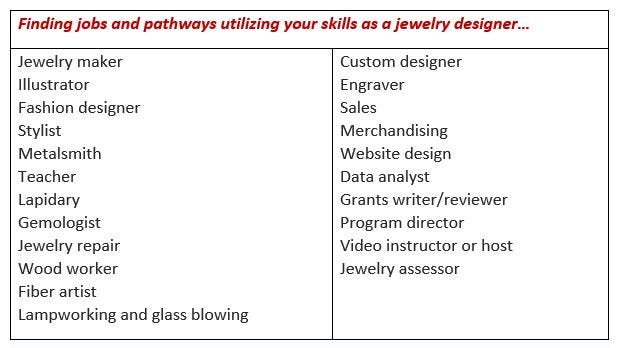
There are actually many career pathways for people who have backgrounds in jewelry making and bead working. Besides the obvious pathways of making jewelry to sell, or teaching jewelry making, there are still many job and career opportunities for you.
You may have to do a little more leg work, and a little more tree-shaking. Don’t assume, however, when the linear pathway is blocked, that all pathways are blocked. They are not.
Some types of jobs/careers which might use your talents….
There are a lot of private companies, nonprofit agencies, government agencies, and foundations and philanthropic agencies that work with disadvantaged groups, and need people to provide technical assistance to these groups. These groups might be inner city. They might be rural. They might be overseas.
Very often, projects these businesses and organizations work on have a craft-angle to them. They may need people to teach crafts, to teach people to transfer their craft skills into marketable skills, or to assist people in applying for loans to start up businesses, usually small loans and usually things associated with selling crafts.
Banks have found it profitable to make “micro-loans”. These loans are very small amounts, and usually given to women in developing countries, to help them leverage their skills — often craft skills — to make a business out of them. Banks need personnel to — develop loan forms, documentation and procedures — find opportunities for making these loans — working with people to teach them how to apply for these loans — working with people to teach them how to be more accountable with loan moneys — working with people to teach them how to translate their craft skills into marketable skills (called transfer of technology). Often this means helping them find resources to get materials, make choices about materials and what would be most cost-effective, and how to market their products — working with people to find markets for, and otherwise promote, their products — helping people form cooperatives so that they can buy materials more cheaply, and sell and market their products cooperatively
Government and International Agencies need people to…. — determine where — what communities, what demographics — they can most likely leverage local talents to better people’s lives. Crafts, particularly beading, provide very useful talents around which to leverage — evaluate local technologies — and these include all craft technologies — in terms of readiness and/or capability for cost-effective technology transfer — do some community organizing to make local people aware of governmental assistance (or other assistance), and to help them complete applications for this assistance — evaluate these kinds of programs to determine success, and make recommendations about how to increase these successes — document craft technologies, particularly among native, tribal, or isolated groups that are in danger of becoming extinct — similarly, to create ways to preserve craft technologies which are in danger of becoming extinct, or which became extinct a long time ago, and which be restored. A good example is how South Korea restored the art of celadon pottery making, or China’s work at preserving Yixing Tea Pot making.
Military Agencies do similar things as governmental ones, except from a slightly different perspective. They want to know, in an anthropological sense, how people value different local technologies — including craft technologies –, and which ones can military and related civilian advisors assist the locals with, to improve their economy and security.
Philanthropic Foundations have many missions. One mission is to improve and secure the health, welfare, and social economy of particular areas or population groups. Crafts are one way of accomplishing this, particularly if working with disadvantaged populations or areas.
Crafts are things people do all the time, that are attractive as products (and services if you are teaching), improve the quality of life, and form the roots of good businesses — especially start-ups.
Another mission of Philanthropic organizations is to pre-test different strategies for social and economic development. Again crafts, and beads especially, can form the basis of many strategies for business development, empowerment of minorities and women, assistance for the elderly, technology transfer, and the like.
Philanthropic organizations need people who can… — develop grants, rules and applications — find community organizations to apply for these grants — evaluate the success of grants — work with academics and consultant experts to generate experimental ideas to be tested through grants — work with local, state and national government agencies to find cost-sharing ways of testing out these “ideas” — in similar way, find and negotiate public-private partnerships towards this end
Information technology and website development companies, with Google a prime example, are in the business of translating reality into tables of data that can easily be accessed and assessed. These types of companies need people who can — translate craft terms and activities into categories for which data can be consistently collected, organized, stored and analyzed — work with museums and galleries which buy, own, exhibit, store or display crafts, to develop ways to collect and categorize routine data on these collections and their importance to different types of people and groups — sell the use of these craft-specific databases to companies or individuals that will use them — work with craft magazines, museums, schools, galleries and the like to help standardize some of the terminologies and valuations associated with various crafts, to make it easier to collect and sort data about them — assist craft artists in development of websites — assist craft artists in marketing their websites, especially through social media sites — develop blogs — develop advertising and marketing materials — develop packaging and branding materials — digitize images of craft items
Museums, Galleries and Libraries employ craft artists to… — catalog and digitize collections — document quality of items — restore aged or otherwise damaged pieces — write brochures and promotional materials — organize exhibits — raise funds for exhibits — advocate for funds among government agencies and philanthropic groups — organize a “crafts” section where none has existed before — promote fine crafts — organize a craft show to raise money and/or awareness
Many museums, galleries and libraries have tons of things in storage that have only loosely been documented, and need much more documentation and organization.
Non-Profit Groups employ all kinds of people with all kinds of backgrounds. They always need help with many fund-raising or program-targeting things. Your craft knowledge can play a very useful role here.
For example, take your local breast cancer society. Think of all the kinds of craft-type things you can make, and for which they can sell, to raise money. You could organize a craft brain trust among your friends, and turn out item after item with breast cancer awareness themes and colors. Or you could scour the internet for breast cancer awareness craft items, and make them work for you. And you could repeat this success for many other local nonprofit groups.
One of my friends went to the Atlanta Gift Show, and identified vendors that had products that could easily be adapted for breast cancer awareness. She worked out with each one what the minimum orders would be, how much lead time would be needed between placing an order and receiving the merchandise, and price. Then she went to local breast cancer groups and presented them with the options. She added 15% to the prices as her commission. These organizations fund raise all the time, and are in major need of new things to sell and promote. My friend had to lay out very little money — basically the cost of a trip to Atlanta, some phone calls and paperwork — and generated a very lucrative business for herself.
I remember spending some time in Sloan Kettering Memorial Hospital in New York City. This hospital specializes in cancer treatment. I was observing patient activities. One of these activities involved volunteers pushing a cart around with various craft activities for patients to do.
Most of the patients in the rooms in the Ward I was on could barely move their bodies, arms and hands. They were very medicated, and had many needles and IV’s stuck into them during their stay. All the craft projects on these carts required considerable manual dexterity — knitting, beading with seed beads, crocheting. The volunteers would cheerily come into the room, announce themselves, and ask if the patient wanted any of these fun crafts to do. The patients would shake their heads No, and grunt. The patients could barely move. And the volunteers left the room, unconcerned.
I took a trip to FAO Schwartz — the toy store — and came back with sets of interlocking building blocks. The blocks were made from different colors of plastic. They were different shapes. A patient could easily hold one or two pieces in their hands without requiring much manual dexterity. The pieces fit together easily by interlocking two pieces, where a slot had been cut out in each. These were a big hit on the Ward. They allowed creativity, without much manual dexterity. The pieces were large enough, that the patient could manipulate them with their hands, and not worry about losing any, if they dropped to the floor.
In hospitals and health care settings, I’ve helped create programs to assist occupational therapists with improving manual dexterity with the elderly, therapists with improving attention spans with children, conducting memory agility tests with patients, and many more programs, utilizing crafts materials and technics.
There are plenty of social and community problems to solve, many different kinds of businesses and organizations responsible for solving these problems, and many solutions which require crafts — materials or technologies which are workable, do-able, saleable, and implementable. There most likely won’t be advertised positions for these kinds of things. But you would be surprised how easy it can be to create your own job opportunities and ones which utilize your craft experiences and knowledge.
When Approaching These Potential Employers and Consultants, Be Sure To…
1. Be able to clearly define how your craft knowledge/experience can help your prospective employer solve some of her/his (NOT YOUR) problematic situations.
2. Research prospective employers, their websites and marketing materials. Identify the key words and buzz words in their materials. Be sure to include these in your written and oral presentations to them.
3. Approach the prospective employer by phone or in person first. Then follow-up with a resume and cover letter. Don’t assume that, because you can make the intellectual link between job and solution, that the employer will see this link when reading a resume. You’ll probably have to educate the employer a bit. This really doesn’t take much effort.
4. Cite examples of what kinds of things you can do. If you can identify other programs or individuals with success stories, do so.
5. If you make your “job search” also a “mission to educate people about crafts”, you’ll be surprised how much energy and excitement you bring to the job interview situation.
_______________________________________
FOOTNOTES
(1) Horejs, Jason. “5 Strategies Successful Artists Follow to Thrive in Their Careers,” RedDotBlog, 2/21/19.
Abstract: While you may be passionate about making jewelry, you are not born with the knowledge, skill and understandings necessary for jewelry design. These must be learned and developed over time. It is through this process of investment in self that the designer’s passions emerge and expand. It is important to know the kinds of things you need to learn, and how you need to guide your education.
GETTING STARTED: DEVELOPING YOUR PASSION Passions Aren’t Found, They Are Developed!
Design is about knowledge, skill and understanding. Knowledge requires time and preciseness. Skill requires care and attention. Understanding requires empathy and insight.
You are not born with the knowledge, skill and understandings necessary for jewelry design. These must be learned and developed over time. Anyone and everyone can learn these. Everyone has a creative capacity within them. There are many different ways to express things creatively. But one has to learn
to express their thoughts and feelings creatively, step by step, developmentally over a period of time. It is through this process of investment in self that the designer’s passions emerge and expand.
It is important not to give up too easily, if designing and making jewelry seems too difficult at first. Difficulty does not equate to a lack of passion. It does not equate to a lack of ability. It does not equate to a lack of creativity. Many things will be difficult, particularly at first.
Nor does any waxing and waning of motivation imply that jewelry design is not for you. It’s natural that jewelry design does not provide an endless, infinite, always-there motivation. This does not mean you have lost your passion for it.
Passions must be cultivated. As do technical abilities and creative thinking. These all must be developed.
HOW DO YOU LEARN?
Many people who begin to bead and make jewelry want to rush to the finish line. They want to learn everything at once. They buy beads and parts indiscriminately. They try to use stringing and other materials insufficient to meet their design goals. They fail to anticipate how to finish off the clasp assembly. Their choices of colors often less than appealing. They don’t have the right tools. They purchase every book they can find. They take classes and view video tutorials on anything that interests them or catches their eye, no matter what the skill levels involved. They want to create those perfect, elaborate pieces Now. Not later. Now.
Beading and jewelry making are not things to rush into, however. These are not things to learn haphazardly. Not everything is something you can easily pick up without having someone else show you.
This is a hobby and avocation that requires you to know a lot of things. You need to know a lot about materials. You need to know a lot about quality issues underlying these materials, and what happens to these materials over time. You need to be mechanical and comfortable using tools to construct things. You need to learn many basic techniques. You need to understand physical mechanics and what happens to all these materials and pieces, when jewelry is worn. You need to be familiar with art theories and design theories and their applications. You must be aware of some architectural basics and physical mechanics which inform you how things keep their shape and how things move, drape and flow. You need to understand people, their psychology, the dynamics of the groups they find themselves in, and their cultural rules which get them through the day.
There is so much to learn, that you can’t learn it all at once. And there is so much to bring to bear, when making a piece of jewelry, that it is difficult to access all this information, if you haven’t learned how everything is interrelated and interdependent.
It’s important to learn in an organized, developmental way. You want to be always asking how things are interrelated. What depends on what? You want to pose what-if questions so that you can train yourself to anticipate the implications and consequences of making one choice over another. What happens If? What happens When? What enhances? What impedes? Why synergizes? What can be leveraged, and toward what objective? You want to reflect on your outcomes.
Towards this end, you learn a core set of integrated and inter-dependent skills. Then learn another set of integrated and inter-dependent skills, perhaps at a slightly higher skill level, and how these link back to the core. Then learn yet another set of skills, again, increasing the skill level, how they link back to the first set, and then link back to the core. And so forth. Only in this way will you begin to know if you are learning the right way, and learning the right things.
There Are Many Ways To Learn
People apply different learning styles, when developing their beading and jewelry-making knowledge, skills and understandings. Each has pros and cons. Different people come to learn with different strategies or combinations of strategies. These learning styles and strategies include:
(1)Rote Memory
(2)Analogously
(3)Contradictions
(4)Assimilation
(5) Constructing Meanings
Most people learn by Rote Memory. They follow a set of steps, and they end up with something. They memorize all the steps. In this approach, all the choices have been made for them. So they never get a chance to learn the implications of their choices. Why one bead over another? Why one stringing material over another? How would you use the same technique in a different situation? You pick up a lot of techniques, but not necessarily many skills.
Other people learn Analogously. They have experiences with other crafts, such as sewing or knitting or other craft, and they draw analogies. Such and Such is similar to Whatnot, so I do Whatnot the same way I do Such and Such. This can work to a point. However, beading and jewelry making can often be much more involved, requiring making many more types of choices, than in other crafts. And there are still the issues of understanding the quality of the pieces you use, and what happens to them, both when jewelry is worn, as well as when jewelry is worn over time.
Yet another way people learn is through Contradictions. They see cheap jewelry and expensive jewelry, and analyze the differences. They see jewelry people are happy with, and jewelry people are not happy with, and analyze the differences. They see fashion jewelry looked down upon by artists, and art jewelry looked down upon by fashionistas, and they analyze the differences.
Assimilation is a learning approach that combines Analogous Learning and Learning Through Contradictions. People pursue more than one craft, keeping one foot in one arena, and another foot in the other. They teach themselves by analogy and contradiction. This assumes that multiple media and multiple techniques mix, and mix easily. Often, however, this is not true. Philosophies of design and technique differ. That means, the thinking about how a media and technique assert needs for shape and drape will have a different basis, not necessarily compatible. Usually one medium (or technique) has to predominate for any one project to be successful. So assimilative learning can lead to confusion and poor products, trying to meet the special concerns and structures of each craft simultaneously. It is challenging to mix media and/or techniques. Often the fundamentals of each particular craft need to be learned and understood in and of themselves.
The last approach to learning a craft is called Constructing Meanings. In this approach, you learn groups of things, and how to apply an active or thematic label to that grouping. For example, you might learn about beading threads, such as Nymo, C-Lon and FireLine, and, at the same time, learn to evaluate each one’s strengths and weaknesses in terms of Managing Thread Tension or allowing movement, drape and flow. You might learn about crystal beads, Czech glass beads, and lampwork beads, and then, again concurrently and in comparison, learn the pros and cons of each, in terms of achieving good color blending strategies. You might learn peyote stitch and Ndebele stitch, and how to combine them within the same project.
In reality, you learn a little in each of these different learning styles and strategies. The Constructing Meanings approach, what is often referred to as the Art & Design Tradition, usually is associated with more successful and satisfying learning. This approach provides you with the tools for making sense of a whole lot of information — all the information you need to bring to bear to make a successful piece of jewelry, one that is both aesthetically pleasing and optimally functioning.
The Types of Things You Need To Learn
There is so much to know, and so many types of choices to make. Which clasp? Which stringing material? Which technique? Which beads? Which strategy of construction? What aesthetic you want to achieve? How you want to achieve it? Drape, movement, context, durability.
Lots to know. One mistake most people make is that they learn everything randomly. Some things on their own. Some from books. Some from friends. In no special order. Without any plan.
And because there are so many things that you need to bring to bear, when creating a piece of jewelry, that it is difficult to see how everything links up. How everything is inter-related and mutually dependent. And how to make the best, most strategic and most satisfying series of inter-related choices.
And this is the essence of this series of articles — a way to learn all the kinds of things you need to bring to bear, in order to create a wonderful and functional piece of jewelry. When you are just beginning your beading or jewelry making avocation, or have been beading and making jewelry awhile — time spent with the material in these segments will be very useful. You’ll learn the critical skills and ideas. You’ll learn how these inter-relate and are mutually inter-dependent. And you’ll learn how to make better choices — fluent, flexible and original.
Progress in our education program is conceptualized in this Learning Rubric we use, and might provide you with a way to steer your learning process:
On My Own, Through Books and Video Tutorials, Or Through Classes?
I always tell people it is easier to start by having someone show you what to do, either with a friend, or in a class, than trying to teach yourself out of a book or video tutorial. Books and videos are good at teaching you basic mechanics. But they are poor in teaching you the artistry and design skills you will need as a jewelry artist and designer. After working with a person, then go back to the books and online tutorials. You’ll get more out of them this way.
Particularly important to learn, and what you pick up best from another human being, include:
– how to hold the piece while working it — how to manage when you need to have firmer tension, and when you need to relax your tension, as you hold the piece — what about the technique allows your project to maintain its shape, and what about the technique allows your project to move, drape and flow — how to attach a clasp assembly or otherwise finish off your project — what materials are most suited to the project, and which are not — whether this, or another technique, is best suited to the project goals — how to prepare your materials, if necessary, before you use them — which tools you should be using, and how to hold them and use them — how to size things — how to read instructions, diagrams, and figures
Try to learn things in a developmental order. Start with beginner projects, graduate to advanced beginner and intermediate, then finally, to advanced. Take your time. Don’t rush to the finish line. You will learn more and be a better designer for it.
Reading Patterns and Instructions
Infuriating! That’s how many people, beginners and advanced alike, feel when they try to understand patterns and instructions.
Know up-front that most diagrams and figures are poorly drawn, and most instructions are poorly written. The instructors who write these often leave out critical steps — especially for new beaders and jewelry makers who are unfamiliar with many of the things these instructors assume that you know. Most often, they leave out critical information showing you the pathway, and how to negotiate that pathway, from where you are to where you are going next. It’s obvious to the instructor. But not so obvious to you.
In patterns, this “where-am-I, where-am-I-going-next” information is frequently unclear or omitted. You did Step 1 OK. You understand what Step 2 is about. But you don’t know how to get from Step 1 to Step 2. Othertimes, the patterns are overly complex, often, in the editorial interest of reducing the number of printed pages. Instead of showing a separate pattern or diagram for each step, the editors frequently try to show you three, four, five or more steps in the same diagram. So you have a bird’s nest of lines, and a spider-web’s road map — and you’re nowhere.
I tell people, that you need to re-write the instructions and re-draw the patterns or diagrams in a way you personally understand. This is very helpful.
Self Esteem — Making Choices
Crafts enhance people’s self esteem. This is good.
You make a piece of jewelry. People like it, and express this to you.
However, sometimes people let the craft substitute for their personal identities. Friends and family praise the jewelry, thus praise the jewelry maker. It’s nice to have your ego stroked. But you need to remember that there is more to you than the pieces you have made.
And you don’t want to put yourself into a tightly bounded box, where you shy away from risks. You don’t want to find yourself making the same piece over and over again, afraid to try something else, should someone not like it. You also don’t want to find yourself making kit after kit after kit, without any personalizing of someone else’s creativity, or better yet, without venturing off to create your own patterns and ideas.
The primary source of “self-esteem” should come from within you. Not external to you. When someone says they don’t like your design, or they don’t like your choice of colors, they are not saying they don’t like you. They like you, or they wouldn’t express an honest opinion about your work.
The true Artist and Designer come from this inner place. They are able to bring their integral sense of self-esteem, a part of their very being, to the fore, when designing and constructing a piece of jewelry as art.
Their choices are informed by a sense of self. And that sense of self is self-validated within each piece of jewelry they create. No matter what anyone else thinks — good, bad or indifferent.
Selling vs. Keeping
It is so difficult to part with pieces you have made. There is a natural attraction. You have poured time, money, and effort towards completing them. You put off other things you could have done, in order to finish them.
I remember submitting an entry to a Swarovski Create Your Own Style contest. First, all I had to send was a picture and a write-up. This was exciting — the anticipation of winning, connecting on some level to Swarovski — like connecting to a celebrity.
And I waited and waited to hear from them. And I did. One day an email popped up on my computer, indicating that I had made the semi-finals. The next step was to send in the actual piece.
My initial elation soon deteriorated into a type of grief. I had spent over 150 hours and over $1500.00 creating this piece. I did not want to let it go. Once sent, Swarovski kept them. I knew I wouldn’t get it back.
Although I could have wrapped and packaged my piece in a part of a day, it took me a week. I’d wrap and unwrap. Put it in one display box, then decide that wasn’t good enough. Another display box, and didn’t like how it sat in the box. Some reconfiguring the positioning, and then I had to close the box. Wanted to see it one more time, then closed the lid again.
I put the display box into the shipping box, but couldn’t seal it up. I left the shipping box open and sitting on a table in my studio. Had to see the piece several more times.
Then, I didn’t like the way the display box sat in the shipping box. Changed shipping boxes. Tried setting the display box several different ways.
Finally closed the shipping box. Labeled it clearly. Ran the shipping on UPS. Felt I needed more documentation and insurance, should the box get lost.
Took a deep breath. Drove the box to the UPS office. Dropped it off.
And felt like I had lost my best friend. I was scared. Empty. Totally disconnected from the excitement of getting selected as a semi-finalist by Swarovski.
Finding Compatriots
While you bead and make jewelry alone a good part of the time, it’s no fun to always bead and make jewelry alone. It’s good to become part of a support network — even build your own.
Some people form informal beading groups and hold meetings once or twice a week at their homes. Others join more formal local bead societies and clubs and collaborations. People take classes and workshops. They find like-minded people in social networks and forums and message groups online, and share images and stories with them.
You will also find compatriots by attending bead and jewelry shows. Some are local. Some are geared to a national audience, like a convention.
There are national societies and guilds for jewelry and beading, which you can join. You can find these listed online.
You learn a lot from compatriots. Everyone does things just a little differently. Everyone’s interests take you places you never thought of before.
_____________________
FOOTNOTES
(1) Olga Khazan, Find Your Passion’ Is Awful Advice, The Atlantic, 7/12/18 As referenced in:
Abstract: Why are you, or why do you, want to become, a jewelry artist? What drives you? How do you channel your excitement? Is it something to do with what type of person you are? How you view the world? How you want to fill your time? It turns out there are many types of people who become jewelry designers. Although they may have different aspirations and ambitions underlying their excitement about jewelry design, they find common ground and a common way of thinking about making and designing jewelry. But because jewelry design has not yet become a full-fledged, recognizable discipline all its own, it sometimes becomes difficult to get clarity on how to channel your excitement into an avocation or career. Your support group is often made up of a polyglot of crafters and artists, some who do not fully understand jewelry making and design. Advice can be diffuse. Clients have difficulty evaluating the value of your work, frequently expressing misunderstandings about what is good. This can lead to self-doubt, which better designers learn to manage and overcome.
GETTING STARTED: CHANNELING YOUR EXCITEMENT What drives you to pursue your passion for jewelry?
“Why Are You A Jewelry Artist?”
As if you had a choice…
It often is difficult for others to understand why you consider yourself a jewelry artist. How did this come to be? How did you get started? Were you always artistic? Is your family crafty? How did you learn these things? Why jewelry? Why do you get so excited about all this? Do you want to make a living out of it? Can you really sell things?
They don’t really feel these things like you do. They don’t feel this pulsing heart, this urge to create, and this passion to make jewelry. When you get started making jewelry, it’s hard to stop. It becomes ingrained in you. What may have begun as a hobby evolves into something you cannot live without. Applying your creative self becomes habit, almost addicting, often relaxing and self-affirming … and painful to do without.
As a jewelry artist, you have a purpose in life. It is something you do because you must do it. It is what helps you function in life. You make new amazing pieces, share these, and make some more new amazing pieces. You have those little conversations with yourself about the various choices you are making, when designing a piece of jewelry, and this can be therapeutic, informative, reaffirming. And, you are ever in search of developing those insightful, smart strategies for merging voice with form, aesthetics with function, your intent with the desires of others.
Jewelry designers are extraordinarily blessed to do what they love for a living. For many, they have turned a hobby into an avocation into a lifestyle.
But it’s not like a regular job. There are many intangibles. Such as, what exactly is creativity, and how do you apply it? What are all the things which have to come together to recognize that creative spark when it hits you in your heart, gut or head, and how to translate that into something real, with beauty, with function, and with purpose? How do you mesh your view of aesthetics and functionality with those of your many audiences — wearer, viewer, buyer, seller, exhibiter, collector, teacher and student?
What exactly does it mean to design jewelry, and how do you know it is the right path for you? This is a tough question. You may love jewelry, but not know how to make it. You may get off on creative problem solving or be a color addict but not know what specific techniques and skills you need to learn, in what organized way, with what direction, leading you towards becoming that better jewelry designer. You may feel the motivation, but not know what the jewelry designer really has to do each day.
You may be taking classes and getting some training, but how do you know when you have arrived? How do you know when you have emerged as a successful professional jewelry designer? How do you know you have mastered the necessary disciplinary literacy — fluency, flexibility, originality? And what are your responsibilities and obligations, once you get there?
Surviving and thriving as a jewelry designer requires an understanding of the way things work and how you will fit into all this — making, presenting, selling, reflecting and critiquing.
Not Just One Type Of Person
There is not just one type of person who becomes a jewelry designer. There are many, many types of people who find jewelry design a common passion. They may have different ambitions. They may prefer to use different techniques and materials. They may have different levels of financial success. They may have different compulsions for creating jewelry. But the excitement is there for each of them.
We can differentiate people who become jewelry designers by their aspirations (1 Neuendorf, 2016) — why they became jewelry designers. Some jewelry designers fit one type of aspiration; others, more than one. But the contour of their lives brings them to similar places within jewelry and its design.
There are 5 basic types of Creatives: o Social Interactants o Compulsive Creators o Lifestyle of Freedom Seekers o Financial Success Achievers o Happenstance and Chance
Social Interactants
This type of Creative often seeks out other creatives and forms a social network. Social Interactants may be makers. They may be sellers or exhibiters or collectors. But their excitement comes, in part, by looking for ways to interact and meet and share close-knit social ties. Part of the reason is to learn new ideas. Another part is to get feedback and critique. The social group and network will offer support, advice, career and business opportunities and direction. These are people you can lean on when times get tough. There might even be some shared glamour and celebrity, depending on the artists and their group.
Social Interactants typically seek recognition for their efforts and their works. The success of any piece of jewelry depends on the judgements of the various audiences which interact with it. Social interactants allocate a good deal of their time anticipating how others will understand and react to any piece of jewelry. They spend time seeking out opportunities to display their works publicly.
Compulsive Creators
There is this innate, compulsive, don’t-fight-it desire that some jewelry designers have for creating jewelry. This is the Compulsive Creator. Applying creative thinking is at the core of their excitement. Composing, constructing and manipulating design elements is intrinsically rewarding. There is a strong, profound commitment to jewelry design, and this directed energy is often associated with productivity and success.
Compulsive Creators love what they do. It allows them to think creatively. They allocate a lot of their time towards achieving a high level of quality and sophistication.
Lifestyle of Freedom Seekers
These Freedom Seeker designers like to set their own pace, establish their own routines, work when the spirit moves them. A regular 9 to 5 job is not for them. They like to make their own rules and be self-directed. Any financial insecurity and uncertainty that comes with this is worth the price to pay for a lifestyle of freedom.
Excitement equals freedom and the strategies for incorporating whatever comes. These designers believe that this freedom allows them to experience the world around them in a greater depth and to a greater degree. In turn, they have more understandings for how to find and then turn inspirations into finished jewelry designs.
Financial Success Achievers
Financially Successful jewelry designers can do quite well for themselves, but it takes a lot of drive, organization and business and marketing sense. Jewelry design can be a lucrative career with such determination, gaining visibility, and a little bit of being in the right place at the right time. Accumulating money or wealth is a big part of the excitement.
Some designers seek to make jewelry design a self-supporting career. However, many designers primarily look for money to supplement their income or retirement. Some look to make enough money to pay for their supplies.
Sometimes, designers make jewelry to seek wealth, rather than income. They accumulate many pieces of jewelry and many unusual supplies and components to achieve wealth as success.
Financial Success Achievers typically try to create a business around their jewelry.
Happenstance and Chance
Not everyone who becomes a jewelry designer aspired to be one. Sometimes people fall into it. They need a piece of jewelry to match an outfit and decide to make something themselves, then get hooked. They watch someone make jewelry, then get intrigued. They try to repair a broken piece of jewelry by themselves. They accompany a friend to a jewelry making class, then want to try it out. Their excitement evolves over time.
A Myriad of Aspirations and Ambitions
Aspirations and ambitions vary. There is no best way or right way. It becomes a matter of the designer finding that balance of design, self, and other-life which works for them, and drives their passion.
Jewelry designers are motivated to become designers for many different reasons. But motivations are only a start at channeling one’s excitement. These make up only a small part of what it truly takes to be a successful designer. Designers need to develop skills and techniques, creative thinking, design process management, and disciplinary literacy, to continue on their pathway to success.
BECOMING THE BEAD ARTIST AND JEWELRY DESIGNER: Your Getting Started Story
When did you first realize you had a passion for designing jewelry?
[While you are thinking about this, now is a good time to get out your pen and paper and jot down some thoughts.]
Everyone has a “Getting Started” story. This is a story you tell over and over again. In it, you express your wonderment and passion. You talk about your excitement, and how you decided to channel it. You go over the steps you went through to discover what it is that drives you to create. You recall who influenced you, when and why. You remember different pathways and crossroads, where you decided to pursue your interests in one direction or another. You reflect on your expectations before you got started, and how these evolved or changed as you began to make and design jewelry.
Sometimes your story begins by touching some beads. Or running a strand of pearls through your hand. Or the sight of something perfectly worn around the wrist, upon the breast, or up near the neck. Othertimes, it may begin by taking a class, or deciding to make a special pair of earrings to match a particular outfit. Or thinking you want to make a piece of jewelry you saw someone wearing on TV or in a photospread in some magazine.
Your Getting Started story is a measure of what you have discovered, and what you need to discover still. It is a foil against which to measure your successes, and some not-so-successful things. It represents your insight and foresight when making both personal development and jewelry design choices.
And, it is very important to be cognizant and aware of how your Getting Started story follows you throughout your career in your marketing and exhibiting. It is part of your business name, your brochures, your advertising. It is part of your description, your elevator pitch, your tag line. It underlies how you talk about yourself and your jewelry. It becomes one of the major ways other people get to know you, get interested in you, and want to wear or display things made by you. You will always need to have a Getting Started story, and you will always come to rely on this story to further your literacy development in design, as well as your creative and business ambitions.
Better designers are very metacognitive of what they do. That is, they are very aware of all the choices they’ve made, and their implications and consequences. This means reflection. It means evaluation. It means critiquing.
Writing your Getting Started story is a necessary, early first step towards developing your metacognitive abilities as a designer.
Doubt / Self-doubt
For the novice, all that excitement at the beginning, when thinking about making jewelry and making some pieces, sometimes collides with a wall of developing self-doubt. It’s not easy to quiet a doubt.
The jewelry artist organizes their life around an inspiration. There is some fuzziness here. That inspiration has some elements of ideas, but not necessarily crystal clear ones. That inspiration has some elements of emotions — it makes you feel something — but not necessarily something you can put into words or images or fully explain. You then need to translate this fuzzy inspiration into materials, into techniques, into color, into arrangements, into a coherent whole.
You start to make something, but realize you don’t know how to do it. But you want to do it, and do it now. However, to pick up the needed skills, you realize you can’t learn things all at once. You can’t do everything you want to do all at once. That initial excitement often hits a wall. Things take time to learn. There are a lot of trial and error moments, with a lot of errors. Pieces break. Combining colors and other design elements feels very awkward. Silhouettes are confusing. You might get the right shape for your piece, but it is difficult to get the right movement, drape and flow, without compromising that shape.
To add to this stress and strain, you need to show your jewelry off. You might want someone to like it. To want it. To need it. To buy it. To wear it. To wear it more than once. To wear it often. To exhibit it. To collect it. And how will all these other people recognize your creative spark, and your abilities to translate that spark into a wonderful, beautiful, functional piece of jewelry, appropriate for the wearer and appropriate for the situation?
Frequently, because of all this, the artist experiences some sense of doubt and self-doubt. Some paralysis. Can’t get started. Can’t finish something. Wondering why they became a jewelry designer in the first place.
Doubt holds you back from seizing your opportunities.
It makes getting started or finishing things harder than they need to be.
It adds uncertainty.
It makes you question yourself.
It blocks your excitement, perhaps diminishing it.
While sometimes doubt and self-doubt can be useful in forcing you to think about and question your choices, it mostly holds you back.
Having doubt and self-doubt is common among all artistic types. What becomes important is how to manage and overcome it, hence, my idea of Channeling Your Excitement, so that doubts do not get in the way of your creative process and disciplinary development.
There are 8 major ways in which jewelry artists get caught beginning to fall into that abyss we call self-doubt:
1)What If I’m Not Creative Enough or Original Enough or Cannot Learn or Master or Don’t Know a Particular Technique?
2)What If No One Likes What I Make?
3)What If No One Takes Me Seriously As An Artist And Designer?
4)I Overthink Things and Am A Bit of a Perfectionist.
5)How Can I Stay Inspired?
6)Won’t People Steal My Work?
7)Being Over Confident or Under Confident
8)Role Confusion
1.What If I’m Not Creative Enough or Original Enough or Cannot Learn or Master or Don’t Know a Particular Technique?
Everyone has some creativity baked into their being. It is a matter of developing your way of thinking and doing so that you can apply it. This takes time.
So does originality. At first, you’ll try different ways of personalizing projects. There are always things you can do to bring some aspects of originality to your pieces. This might be the choice of colors, or using a special clasp, or rearranging some elements in your composition. Again, as with creativity, the ability to be more and more original will evolve over time. It is helpful to think of originality, not necessarily as coming up with something completely new, but rather as differentiation — how you differentiate yourself from other jewelry designers.
For almost everyone, you don’t begin your design career at the height of your levels of creativity and originality. Yes, if you look around you, other people are more creative and original than you or have more skills than you. Don’t let these observations be a barrier to your own development as a jewelry designer. You get there through persistence and hard work. You handle your inner critic. You may not be there, yet — the key word here is yet. But you will be.
2. What If No One Likes What I Make?
We all have fears about how our creativity and originality are going to be evaluated and judged. We project our self-doubts to the doubts we think we see and feel from others. What if no one wants to wear my pieces, or buy my works?
We can’t let these outsider reactions dictate our lives and creative selves. A key part of successful jewelry design is learning how to introduce what we do publicly. At the least, it is the core nature of the things we create that they are to be worn on the body. Jewelry is a very public thing.
Turn negative comments into positive ideas, motivators, insights, explorations. Allow yourself some give and take, some needs to step back awhile, some needs to tweak. Jewelry design and jewelry making are iterative processes. They in no way are linear. Your outcomes and their success are more evolutionary, than guaranteed.
Distressing about what others may think of your work can be very damaging to your self-esteem. It can amplify your worries. Don’t go there.
Don’t become your worst critic.
3. What If No One Takes Me Seriously As An Artist And Designer?
Jewelry design is an occupation in search of a profession. You will find that a lot of people won’t recognize your passion and commitment. They may think anyone can design jewelry. They may think of jewelry making as a craft or some subset of art, not as something unique and important in and of itself. They may wonder how you can make a living at this.
The bottom line: if you don’t take yourself seriously as a jewelry designer, no one else will.
People will take you seriously as they see all the steps you are taking to master your craft and develop yourself as a professional.
4. I Over Think Things And Am A Bit Of A Perfectionist
Some designers let a sense that their work is not as good as imagined get in the way. They never finish anything. They let doubt eat away at them.
Perfectionism is the enemy of the good. It’s great to be meticulous, but emotionally, we get wrecked when anything goes astray, or any little thing is missing, or you don’t have that exact color or part you originally wanted.
Go ahead and plan. Planning is good. It’s insightful. It can be strategic. But also be sure to be adaptable and realistic. Each piece is a stepping stone to something that will come next.
The better jewelry designer develops a Designer’s Toolbox — a collection of fix-it strategies to deal with the unfamiliar or the problematic.
Overthinking can be very detrimental. You can’t keep changing your mind, trying out every option, thinking that somewhere, someplace there exists a better option. Make a choice and get on with it. You can tweak things later.
Yes, attention to detail is important. But so is the value of your time. You do not want to waste too much time on trivial details.
Be aware when you begin over-analyzing things. Stop, take a breath, make a decision, and move on.
5. How Can I Stay Inspired?
Designing a piece of jewelry takes time, sometimes a long time. That initial inspirational spark might feel like it’s a dying ember.
Don’t let that happen.
Translate that inspiration into images, colors, words, sample designs, and surround your work space with these.
Talk about your inspiration in detail with family and friends.
6. Won’t People Steal My Work?
Many jewelry designers fear that if they show their work publicly, people will steal their ideas. So they stop designing.
Yet jewelry design is a very communicative process which requires introducing your work publicly. If you are not doing this, then you are creating simple sculptures, not jewelry.
Yes, other people may copy your work. See this source of doubt as an excuse. It is a self-imposed, but unnecessary, barrier we might impose to prevent us from experiencing that excitement as a jewelry designer. Other people will never be able to copy your design prowess — how you translate inspiration into a finished piece. That is unique and special to you, and why the general public responds positively to you and your work.
7. Over Confidence can blind you to the things you need to be doing and learning, and Under Confidence can hinder your development as a designer.
Too often, we allow under confidence to deter us from the jewelry design and making tasks at hand. We always question our lack of ability and technical prowess for accomplishing the necessary tasks at hand. It is important, however, to believe in yourself. To believe that you can work things out when confronted with unfamiliar or problematic situations. It is important to develop your skills for thinking like a designer. Fluency. Flexibility. Originality. There is a vocabulary to learn. Techniques to learn. Strategies to learn. These develop over time with practice and experience. You need to believe in your abilities to develop as a designer over time.
With over confidence comes a naivete. You close off the wisdom to listen to what others have to say or offer. You stunt your development as an artist. You overlook important factors about materials and techniques to the detriment of your final designs and products. You close yourself off to doubt and self-doubt, which is unfortunate. Doubt and self-doubt are tools for asking questions and questioning things. These help you grow and develop as an artist and designer. These influence your ability to make good, professional choices in your career.
8. Role Confusion Jewelry artists play many roles and wear different hats. Each has its own set of opportunities, requirements, and pressures that the artist must cope with. It’s a balancing act extraordinaire.
First, people who make jewelry wear different hats: Artist and Designer, Manufacturer, Distributor, Retailer, and Exhibitor.
Second, people who make jewelry have different needs: Artistic Excellence, Recognition, Monetary Gain, or Financial Stability.
Third, the artist needs to please and satisfy themselves, as well as other various clients.
Fourth, the artist constructs pieces which need to function in different settings: Situational, Cultural, Sociological, Psychological.
Last, the artist must negotiate a betwixt and between situation — a rite of passage — as they relinquish control over the piece and its underlying inspirations to the wearer and the viewer, who have their own needs, desires and expectations.
This gets confusing. It affects how you pick materials and supplies. Which techniques you use. What marketing strategies you employ. How you value and price things. And the list goes on.
It is important to be aware (metacognitive) of what role(s) you play when, and why. Given the role, it is important to understand the types of choices you need to make, when constructing a piece of jewelry. It is critical to understand the tradeoffs you will invariably end up making, and their consequences for the aesthetic, emotional and functional success of your pieces.
Some Advice
While doubt and self-doubt can hinder our development as jewelry designers, some degree of these may be helpful, as well.
To develop yourself as a jewelry designer, and to continue to grow and expand in your profession, you must have a balanced amount of both doubt and self-doubt. Uncertainty leads to questioning. A search for knowledge. Some acceptance of trial and error and experimentation. A yearning for more reliable information and feedback.
Jewelry design uses a great deal of emotion as a Way of Knowing. Emotions cloud or distort how we perceive things. They may lead to more doubt and worry and lack of confidence. But they also enhance our excitement when translating inspirations into designs.
· Don’t let your inner doubts spin out of control. Be aware and suppress them.
· Be real with yourself and your abilities.
· Keep a journal. Detail what your doubts are and the things you are doing to overcome them.
· Create a developmental plan for yourself. Identify the knowledge, skills and understandings you want to develop and grow into.
· Remember what happened in the past the last time doubt got in your way. Remember what you did to overcome this doubt. Remember that probably nothing negative actually happened.
· Talk to people. These can be friends, relatives and colleagues. Don’t keep
doubts unto yourself.
· Don’t compare yourself to others. This is a trap. Self-reflect and self-evaluate you on your own terms.
· Worrying about what others think? The truth is that people don’t really care that much about what you do or not do.
· Don’t beat yourself up.
· Get re-inspired. This might mean surrounding yourself with images and photos of things. It might mean a walk in nature. It might me letting someone else’s excitement flow over to you.
· Take breaks.
· See setbacks as temporary.
· Celebrate small steps.
· Keep developing your skills.
· Set goals for yourself.
Surviving As A Jewelry Designer
Designers focus their attention inward, looking, listening, sensing and searching themselves at length, only later to redirect their findings outward, creating jewelry to be displayed publicly or worn by others or sold. Doing this well often requires having several coping strategies.
Designers have to bridge the gap between inspiration and execution. This requires a lot of thought, understanding and skill.
Having both right- (creative) and left- (administrative) brain skills is a good place to be.
Don’t let the craft substitute for your personal identity. It’s always great to get compliments on what you make. This bolsters your self-esteem. But you should have good self-esteem based on who you are as a person, not on the pieces of jewelry you make. Self-esteem should come from within you, not external to you. Related to all this is that you do not want to take negative comments about your work personally. Evaluate and use the feedback objectively.
Take risks. Play. Experiment. Don’t be afraid to try new colors, new arrangements, new techniques, or place yourself in new settings with new people. Don’t be afraid to fail. Don’t get stuck in a rut making the same things over and over again. You may find yourself not growing as an artist and as a person.
As best as you can, avoid comparing yourself to others.
Learn to recognize when enough is enough. You can’t be all things to all people for all designs for all situations for all contingencies. You need to set some limits and boundaries for yourself so you don’t get too frustrated or burnt out. You will never have enough parts or enough time or enough creative energy to make everything people ask you to make.
Successful artists are able to define what “success” means to them. They don’t get caught up with what other people might define as “success”.
Successful artists typically dedicate a specific time and place for creating. They develop a routine. They don’t work all hours of the day, or in a disorganized environment.
Create a consistent, coherent body of design work. Encapsulate this in a PORTFOLIO, Artist Resume, and Artist Statement.
Keep some kind of journal documenting your thoughts, design ideas, problems and solutions. This can be something very formal, or something loosely organized.
Usually, if you want to make a living at jewelry design, you’ll need a multi-method, multi-venue approach.
Merging Voice and Inspiration With Form
Jewelry design is an ongoing process of finding how to merge your artistic voice and inspiration with form. As you become more fluent and comfortable with all the vocabulary and materials and techniques, you take on more and more challenges.
Jewelry design is a conversation. It is a quiet conversation between what you come to feel and understand as inspiration, and what logical options you might bring to bear on translating that inspiration into a design. It is a conversation between you the designer and someone else as the wearer. It might also be a conversation between you the maker with someone else as the viewer, buyer, seller, exhibiter or collector.
The conversation is never done. It is a dialog. It is a back-and-forth process of refining, questioning and translating your feelings, impressions, ideas, influences into a visual grammar, forms and arrangements, and content, intent and meanings. Everything comes into play, and everything matters.
Some of the conversation is inward, and some of the conversation is very interactional. Part of the conversation focuses on generating a lot of possibilities. Another part concentrates on narrowing down those possibilities. During all this iteration, your artistic voice gets closer and closer to merging with that final jewelry form.
As your fluency in jewelry design grows, you find that all this conversation and all divergence and convergence of ideas and feelings and choices, gets reflected and sensed within your jewelry designs. This is how you develop and channel your excitement and passion.