Materials needed: .014”/.015” or .018”/.019” cable wire enough of a mix of seed beads and Czech glass beads (3mm — 6mm in size) to
cover 36” of cable wire crimp beads horseshoe wire protectors crimp covers end caps or bead caps or cones (2 of them) head pins (2 of them) 2 decorative beads, perhaps teardrop shaped, about 18mm in size
Tools needed: crimping pliers chain nose pliers flat nose pliers scissors side cutters or flush cutters bead board ruler paper pencil
work surface
A lariat is a long, usually beaded, string, which a person wraps around their neck, and lets the tails hang.
The tails can be tied in a loose overhand knot together.
Or one tail may have a large loop or ring or donut, through which the other tail slips into.
Or the lariat can be wrapped around the neck once or twice, and the tails allowed to dangle.
With some designs, the part of the lariat which becomes the focal point, can be varied.
Lariats may be all beaded, partially beaded, or not beaded at all.
In fact, this versatility is the popularity of the lariat. You can create many different silhouettes. And you do not have to bother with a clasp.
And you can make a multi-strand lariat, if you want. The design choices are endless.
DESIGN ISSUES
The design issues associated with the lariat include:
1. Stringing material
2. Length
3. Whether to use a fixed connection point
4. Silhouette flexibility
5. Finishing off the ends
6. Maintaining the tension on your beads, while allowing sufficient ease
STRINGING MATERIAL
Many different types of stringing materials will work well with lariats.
You can use:
· Needle and thread.
· Cable wire
· Bead cord
· Leather or waxed cotton
· Leather lace
· Chain
· Even fabric or ribbon
LENGTH
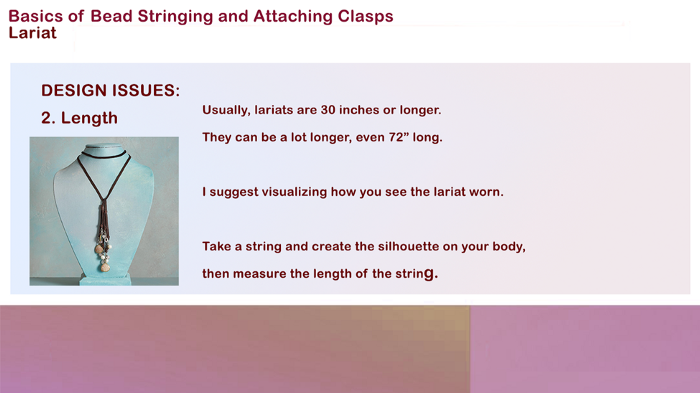
Usually, lariats are 30 inches or longer.
They can be a lot longer, even 72” long.
I suggest visualizing how you see the lariat worn. Take a string and create the silhouette on your body, then measure the length OF THE STRING.
WHETHER THERE IS A FIXED POINT OF CONNECTION, SUCH AS A LOOP OR RING OR DONUT ON ONE SIDE
This is a personal design choice.
Many lariats do not have fixed points of connection.
One option is to fold the lariat in half, and use the bend as the point of connection, and slip the two legs through the bend.
Another option is to tie a loose overhand knot with the two legs.
Still another option is to wrap it around the neck, and, let the legs dangle.
If you have a point of connection on one side, then you need to be sure that the other tail will be able to slip through the opening.
SILHOUETTE FLEXIBILITY
As a designer, you need to anticipate the various ways your design may be worn.
Then ask yourself:
· Will my design be long enough to accommodate the various ways i visualize it getting worn?
· Is the arrangement of beads, given the various silhouettes, optimal?
· Given the various silhouettes, will the lariat drape well and move in place with the person as the person moves?
HOW TO FINISH OFF THE ENDS
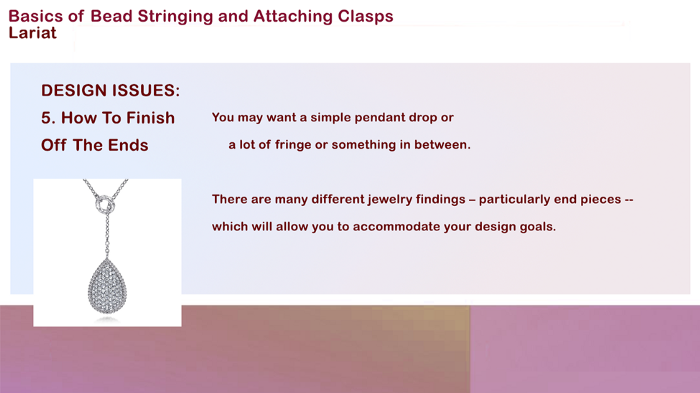
You may want a simple pendant drop or a lot of fringe or something in between.
There are many different jewelry findings — particularly end pieces — which will allow you to accommodate your design goals.
MAINTAINING THE TENSION ON YOUR BEADS, WHILE ALLOWING SUFFICIENT EASE
You are working with a long string of beads.
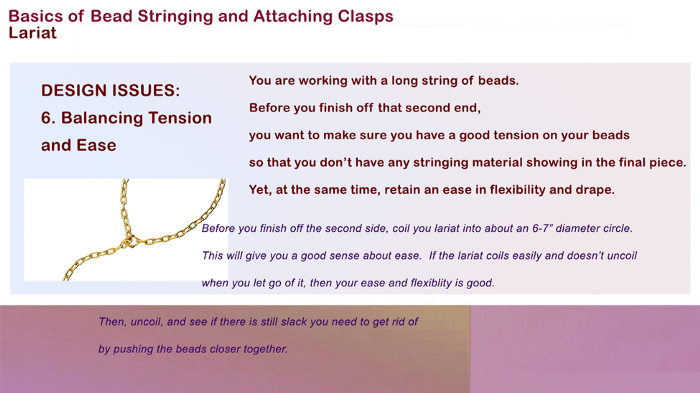
Before you finish off that second end, you want to make sure you have a good tension on your beads so that you don’t have any stringing material showing in the final piece. Yet, at the same time, retain an ease in flexibility and drape.
Towards this end, before you finish off the second side, coil your lariat into about an 6–7” diameter circle. This will give you a good sense about ease. If the lariat coils easily and doesn’t uncoil when you let go of it, then your ease and flexibility is good.
Then, uncoil, and see if there is still slack you need to get rid of by pushing the beads closer together. If there is slack, you’ll notice a lot of the stringing material showing.
If you need to tighten the tension, do so, then coil again, so that you are finding that optimum tension and ease.
____________________________________
CONQUERING THE CREATIVE MARKETPLACE: Between the Fickleness of Business and the Pursuit of Design
How dreams are made between the fickleness of business and the pursuit of jewelry design
This guidebook is a must-have for anyone serious about making money selling jewelry. I focus on straightforward, workable strategies for integrating business practices with the creative design process. These strategies make balancing your creative self with your productive self easier and more fluid.
Based both on the creation and development of my own jewelry design business, as well as teaching countless students over the past 35+ years about business and craft, I address what should be some of your key concerns and uncertainties. I help you plan your road map.
Whether you are a hobbyist or a self-supporting business, success as a jewelry designer involves many things to think about, know and do. I share with you the kinds of things it takes to start your own jewelry business, run it, anticipate risks and rewards, and lead it to a level of success you feel is right for you, including
· Marketing, Promoting, Branding: competitor analysis, developing message, establishing emotional connections to your products, social media marketing
· Selling: linking product to buyer among many venues, such as store, department store, online, trunk show, home show, trade show, sales reps and showrooms, catalogs, TV shopping, galleries, advertising, cold calling, making the pitch
· Resiliency: building business, professional and psychological resiliency
· Professional Responsibilities: preparing artist statement, portfolio, look book, resume, biographical sketch, profile, FAQ, self-care
SO YOU WANT TO BE A JEWELRY DESIGNER Merging Your Voice With Form
So You Want To Be A Jewelry Designer reinterprets how to apply techniques and modify art theories from the Jewelry Designer’s perspective. To go beyond craft, the jewelry designer needs to become literate in this discipline called Jewelry Design. Literacy means understanding how to answer the question: Why do some pieces of jewelry draw your attention, and others do not? How to develop the authentic, creative self, someone who is fluent, flexible and original. How to gain the necessary design skills and be able to apply them, whether the situation is familiar or not.
The Jewelry Journey Podcast “Building Jewelry That Works: Why Jewelry Design Is Like Architecture” Podcast, Part 1 Podcast, Part 2
PEARL KNOTTING…Warren’s Way Easy. Simple. No tools. Anyone Can Do!
I developed a nontraditional technique which does not use tools because I found tools get in the way of tying good and well-positioned knots. I decided to bring two cords through the bead to minimize any negative effects resulting from the pearl rotating around the cord. I only have you glue one knot in the piece. I use a simple overhand knot which is easily centered. I developed a rule for choosing the thickness of your bead cord. I lay out different steps for starting and ending a piece, based on how you want to attach the piece to your clasp assembly.
SO YOU WANT TO DO CRAFT SHOWS:16 Lessons I Learned Doing Craft Shows
In this book, I discuss 16 lessons I learned, Including How To (1) Find, Evaluate and Select Craft Shows Right for You, (2) Determine a Set of Realistic Goals, (3) Compute a Simple Break-Even Analysis, (4) Develop Your Applications and Apply in the Smartest Ways, (5) Understand How Much Inventory to Bring, (6) Set Up and Present Both Yourself and Your Wares, (7) Best Promote and Operate Your Craft Show Business before, during and after the show.
“You Motherf — — -, you Motherf — — -, “ he shouted at her. One curse word after another.
There we were — three of us — crammed into a small office. Seated on three seats in front of a desk, knees nearly touching. The director of the Center for Disease Control and Prevention, Environmental Division, in Atlanta, Georgia, was particularly angry at our 9:00 am meeting that morning. He unloaded on my boss. It was relentless. After about 15 minutes of this, I cut in and said that where I’m from, this kind of language is very inappropriate. He told me to Shut Up!, and continued his barrage.
In the early 1980s, I was a policy planner for the Tennessee Department of Health and Environment. One of my responsibilities was to carry out a CDC grant to the Department. The purpose of this grant was to interrelate all the Department’s health data with its environmental data, and determine if living near a toxic waste site (Superfund site) was hazardous to your health. Tall order, bad data, weak data, microscopic parts per billion data. Highly unlikely that any scientific statistical analysis could show any relationship. But I had some success. In two parts of the state — Clinton, TN outside Oak Ridge, and New Johnsonville and Waverly, TN on the western leg of the Tennessee River.
The issues for us at that time were preventing unnecessary severe illness and death. The question: should our initial findings trigger either state or federal action to investigate these areas in more detail. To me, this was a moral question. To the federal representatives, not so much so.
Jewelry designing, on the surface, seems so divorced from moral quandaries. Spending time selecting and arranging beautiful things, well, we shouldn’t have to think about ethics. Ethics shouldn’t contaminate what we do. And, yet.
Design is choice. The choices could be about colors. Or materials. Or techniques and how they should be implemented. Choices might focus on silhouette or customer type or customer desires. Choices might be made to be sensitive to a certain situation or context.
Making choices means that you pick something over something else. The choices made could be rational, meaning that you have weighed the options, and one is factually better than any alternative. The choices could be moral, meaning that the choice will unquestionably and without any doubt or circumstance serve the designer and the wearer or buyer more appropriately than any other choice and without harm. The choice could be ethical, meaning that the choice will enhance any moral judgement about whatever transpires. The choice could be ethical from a business sense, meaning that the choice results in the designer going away happy and the wearer or buyer going away happy, as long as no one gets harmed, whether they actually were served better, or not.
Because designing jewelry involves making choices about materials, techniques, and how the pieces are introduced publicly, design poses, by its very nature, moral, ethical and business ethical judgments. That’s the rub. Even surrounded by extreme beauty and rainbows of color and sensual objects, I have found that moral dilemmas pop up often, even in my bead store, and even in situations involving my jewelry.
Sometimes, morality with design is simple and straightforward. I make a custom piece for someone. Say, the piece breaks where the beadwork is connected to the clasp. Who is responsible for fixing it? With each custom piece I make, the client gets a Certificate of Authenticity. On the Certificate, it states that repairs not due to negligence on the client’s part will be repaired up until 6 months after purchase at my expense. After that that point, it is the client’s responsibility to pay for repairs.
We do a lot of repair work. On one repair, for example, the bracelet was created using a technique called micro-macrame. The original artist was extremely talented, using very thin bead cord, almost like threads, with very tight, closely placed knots. The bracelet was made with 8 separate cords, all of which had to be brought down through 2mm beads and encased in macrame knots. The bracelet had broken and needed to be redone from one end to the other. The repair eventually required 8 hours to complete. Expensive for the customer. Before I began the repair, I mapped out what needed to be done. I reviewed this with the customer. I very clearly told the customer that my talent was noticeably less-than that of the original artist. She approved my going ahead with the repair anyway.
Morality and ethics come up in small and large ways in the jewelry design business. But, usually with less drama than I experienced at the CDC and Tennessee Department of Health and Environment, but with drama and concerns nonetheless.
The CDC contract with Tennessee specified that a type of statistical analysis called regression analysis be done. I had been hired during the second year of the contract. I knew from the start that regression analysis — a type of parametric statistic — would be inadequate to the task. It is not robust enough and powerful enough to analyze bad, very small numbers data. Environmental data usually include things like parts per billion. That’s a small number.
Instead, I substituted a nonparametric statistic, and one that I had developed a few years earlier, for the analysis. Using a mapping program, I divided the state of Tennessee into roughly 7 x 7 mile squares. I allocated the health data and environmental data to each square. Then I ran my nonparametric statistic, I had called this ridit analysis, on the data. Nonparametric statistics are perfect for bad, small numbers data. They do not establish whether there is a strong correlation between variables. They identify the chances something weird is happening and deserves more attention.
I found something. I thought that was good and would be well-received. But obviously not.
I am just a bad boy. I keep pointing out these moral issues because they bother me, and I get frustrated when they don’t bother other people — at the least, bother them enough to result in some changes in behaviors and procedures.
Many things have happened in my jewelry design world. I always get concerned when materials used or techniques used in creating any piece of jewelry are somehow misrepresented in terms of value, durability or price.
For example, this situation happens more than you would think. On one occasion, the first thing the customer said as she laid out all the beads and findings on the counter in my shop: I am a jewelry designer from New York. There in a pile on the counter were Austrian crystal beads and ones which were metalized plastic. There were sterling silver, silver plated and stainless steel beads and findings. Low end tiger tail wire. Some elastic string. I only do higher end, she reassured me, and I already have crimp beads I purchased from Michael’s.
I started to point out some inconsistences: metalized plastic, tiger tail and elastic string are not durable products. Sterling will stay silver, silver plated will not. Some crimp beads are manufactured differently than others. Crimp beads cut right through tiger tail wire and elastic string. The plating on metalized plastic chips off after little wear. I was trying to be helpful. But she would not have any of it. She almost cupped my mouth to silence me. I am a jewelry designer from New York, she repeated. I know all this stuff, probably better than you.
I make a quarterly trip to Michael’s to see what they are selling. They change out their lines about every three months, and it’s important to me to know what they are selling. At one point, they were selling a brand of plated findings. On the package label, it said “S. Silver.” It didn’t say sterling silver, but their customers might assume as much. Another time, they had packages of 2” head pins at 10 cents each. The label said .925, indicating that these were sterling silver. A foot of raw sterling silver at that time sold for $6.00. Two inch head pins in my own store were selling for $2.25. How did Michael’s get down to 10 cents?
On a visit to Claire’s at the mall, there was a rack of earrings. In English, the sign said “sterling silver.” In Spanish, the sign said “silver plated”. The earrings were $5.99 a pair.
A competitor of mine was selling Greek raku-fired clay beads as gemstones. He had a whole routine worked out. He told customers these needed to be weighed and sold by the gram. The result: something that should have sold for about $1.00 ended up costing the customer $25.00.
Michael’s sells a beading needle kit with a needle threader in it. Beading thread is like a typewriter ribbon — flat — and the eye of a beading needle is a rectangular slit. You can get the needle threader into the eye, but after you thread your thread through the threader, it won’t pull back through. It will never pull back through. I can just picture how many of their customers struggle with pulling the thread back through, then give up, and never take up this wonderful bead weaving and jewelry making craft again.
If you go on Etsy or Ebay, or many places online, you will see a lot of turquoise beads for sale. In most cases, they are not turquoise. They are either magnesite or howlite dyed turquoise. But none of them say that. People think they are buying real turquoise.
One supplier of mine sold chasing hammers, with a metal head stapled with only one staple to a wooden handle. As soon as you tried to hammer something, the head flew off the handle. I called this to the attention of the supplier. The supplier never fixed the problem and to this day, sells the same, dangerous chasing hammer.
And I can go on and on.
But, I want to go back to the CDC, Tennessee and the early 1980s. The science folks at this division of the CDC misrepresented regression analysis as the right method to use. They surely knew it was not. Why were they so resistant to changing the method to something they surely knew would be better in this situation?
Clinton, Tennessee is down wind and down river from Oak Ridge. Oak Ridge is where there is a lot of radioactive waste. It is the home of a federal facility that has dealt with, for decades, radioactive materials. The cancer rate in Clinton was hundreds of times that of the state average. A few of us took a trip to Oak Ridge.
It turns out that when you mix federal waste with other waste, all of it is considered federal waste. Federal waste is regulated by the US Department of Energy. Local waste haulers were mixing non-federal waste with federal waste, then driving it to the river’s edge and dumping it. If it were all non-federal waste, this would have been illegal in Tennessee. Dumping in the river, at least at that time, was not prevented by USDE regulations and procedures. As federal waste, Tennessee could do nothing but watch. As we did. We watched near the river’s edge as an unending line of waste trucks were lined up waiting to dump their waste into the river. We felt our options for any further investigation and mitigation were limited.
In New Johnsonville and Waverly, the adverse maternal pregnancy outcomes were 300 times the state average. These included miscarriages, still births, premature births and maternal deaths. It could have been a lousy doctor effect in these largely rural areas. Or something else. There was a Superfund toxic waste site next to the river in New Johnsonville. Toxic waste could have been contaminating the water supply.
We sent a report to the CDC, and in two days, two project officers rushed to meet with us in Nashville. In a large conference room, we all sat at the end of a well-worn wooden table. I was about to explain what we had found and propose some options for further investigation. Before I could get a few words out, the lead project office said stop what we were doing. Return to regression analysis. Cover up anything we had found to date. Yes, he used the words, Cover Up. They left immediately to return to Atlanta. I told my boss that You can’t use the words cover up and professional in the same sentence. Yes you can, she retorted.
And, if that wasn’t awkward and unpleasant enough, the director of the Environmental Division of the CDC demanded our immediate presence in Atlanta.
One of my competitors, another bead shop in Nashville, a husband and wife team, does a lot of things which, to me, are morally wrong and unethical, but maybe not from a business ethics standpoint. I don’t know. But this competitor always gives me a lot of things to marvel at and talk about.
I had arranged a precious metal clay certification workshop at my store. The instructor lived in Wichita, Kansas. The wife drove from Nashville to Wichita and knocked on this instructor’s home door. She said she was driving through and had a lot of Czech glass beads for sale. Would the instructor like to look at her stuff? The instructor let her in.
Rather than show any Czech glass beads, the wife immediately went into influence and persuasion mode. She explained, quite untruthfully, how their shop was much more sophisticated than ours, had a better student clientele, and, in almost demanding terms, told the instructor that the certification workshop should be held there. The instructor ushered her out the door.
On another occasion, I was holding a bead weaving workshop in the store at the end of June one year. The instructor was from California. A few weeks before the workshop date, the husband from my competition phoned her. He asked her for her flight information. He told her he would pick her up at the airport. Of course she found that odd, and declined his invitation. He sent out a notice to his customer list announcing her workshop at his shop. Even though the workshop was at my shop. And the weekend of the workshop, he parked his car in the lot outside my shop. He kept his headlights on. It seemed like he was there to take names. Some of the participants even went out to his car to say Hello. Creepy.
Whatever.
My boss and I drove down to Atlanta. At 9am, we found ourselves in the office of the Director. And his tirade began immediately. It lasted almost 30 minutes, at which point, we were ushered into a conference room.
On one side of the table sat several CDC staff members and a transcriber. My boss and I sat on the other side. They ordered us to change the methodology to regression.
I said, No. Regression is not sufficient, given the study they were paying us to do. Look at how much we already uncovered using my methodology.
Regression.
No.
Regression.
No.
The lead project office stood up and went to the blackboard. He wrote out the regression formula and sat down.
I went up to the blackboard. I erased the regression formula and wrote the ridit formula. I sat down.
The project officer was back up at the blackboard, and re-wrote the regression formula.
I got up again.
This went on until 12:00 pm noon. We took a break for lunch.
In the world of the absurd, lunch was absurd. One of the most absurd things I’ve ever been a part of.
We all went out to lunch together, as if we were buddy-buddy colleagues. We sat around a large round table. The talk was friendly and covered several topics, none of which related to this project-in-question or any health care or environmental topic. Lunch lasted 1 hour.
Back to the CDC offices. And the conference room. Lunch a distant, forgettable memory. Until 4:00pm, it was the same. Project officer up to the board, then back down. And me back to the board, then back down.
Meeting over. No words exchanged. My boss and I got back in her car and headed to Nashville.
That was true in Atlanta, and that is very true in jewelry world.
Swarovski sells crystal beads made in Austria, and allows crystal beads made in China to carry the same Swarovski label. But there are obvious quality differences: not as bright, more misshapen pieces in a package, holes drilled off-center, finishes which should be permanent flaking off to the touch.
Toho sends their lower quality beads to China, they get repackaged and sold in craft stores like Michael’s. But all under the Toho label. Just like the high quality ones produced and packaged in Japan and sold in bead stores.
Sterling silver is supposed to have copper in the alloy, but manufacturers sometimes substitute nickel for copper to keep the cost down. But both get labeled .925 sterling silver (92.5 percent silver, the rest is the alloy). Sterling with nickel in it is more brittle. Picture an ear wire. There is a loop at the bottom which gets opened up, a dangle put on, then the loop is closed. With nickel in the alloy, you can do this maybe 2–3 times before the loop breaks. You don’t have to worry about the loop breaking with copper.
I joke in my classes that this only affects women, and no one cares. But yes I do. Yes we should.
On the drive back from Atlanta to Nashville, my boss and I were both very quiet. We didn’t speak. A bit in shock. As we got closer to home, I asked my boss if we could return the grant to the CDC. There has to be some hidden agenda we weren’t aware of. This didn’t reflect well on our office in Tennessee.
The next morning, my boss met with the Tennessee Commissioner of Health & Environment. He told her he would replace the money lost from the grant with other money. Everyone in the office would be allowed to keep their jobs. He invited me up to speak with him. He asked me, if he were talking to the press, could he say with certainty that there were problems in these locales. I had to say, No, the analysis I did does not prove anything. It merely presents a flag for looking at something more closely.
For awhile, there was a Bead Society in Nashville. We were active participants. In fact, we gave anyone who joined a 50% discount in our store which would last for a month from their join-date. We worked with members to write by-laws and set organizational goals. One goal was to meet the conditions for non-profit status.
Around eight years after we joined, new officers were elected and radically changed the culture of the Society. The President, Vice President and Secretary formed a tight group. They would not even allow the Treasurer to have access to the bank account. They would not allow the Program Committee Chairperson to plan or participate in any events. The three officers handled all the money. The three officers planned the events. All things they were personally interested in, and all money losers. There was a bylaw stating that if any program were anticipated to lose money, the membership would have to vote whether to continue with it. They ignored the bylaw. The officers spent Bead Society funds lavishly on gifts for themselves. We dropped out of the Bead Society.
Back at the Department office, I remember the phone started ringing. Over and over again. The CDC Environment Director, the lead project officer, other project officers were taking turns calling my boss. One call would be threatening. The next polite. One pleading. Back to threatening. Then polite. After 3 days of calls, my boss was about to cave in. But I told her: They hate us. We’re not doing what they want. They could easily get another state to take the money. Why are they so persistently wanting us to take the money back? It was like a light bulb went off above her head. Suddenly, she realized she had some leverage. We just didn’t know why.
The calls went on for almost a week. One last call was from the CDC auditor. It turned out that when a grant is turned back, it precipitates an audit. The Environmental Division had been skimming over $1,000,000 off the grant which was supposed to go to the state of Tennessee.
Morality is an interesting concept. It is not fixed, I discovered. It can be a moving compass. While working for the state, my own compass kept moving further and further away from that moral center. I was ambitious. I wanted to do great things. But to be included with the powers that be and the activities ongoing, I found I began to accept more and more things as ethical — things I would not have labeled as such years earlier.
I found myself very willing to work with people like my project officer to whom cover up and professional could be used in the same sentence. My own boss liked to access private state databases which listed AIDs patients, people accused as sex offenders, doctors and pharmacists and psychiatrists and other professionals whose credentials and behaviors were under review by the various boards. As sport, and almost daily, she would share one or more of the names with people or organizations not particularly friendly or aligned with these people. I looked the other way. I discovered that instigating a federal audit would automatically stop a state audit. I stopped state audits of several Tennessee officials under investigation for abusing funds. To me, I let it feel OK. I was doing my job.
I’m not sure I would have recognized that my moral compass was shifting a bit too much, were it not for a friend who pointed this out to me.
We didn’t take the grant. The final outcomes from our adventure with the CDC grant mostly came down to things I was told happened, but did not know directly.
· A few weeks earlier, one of our staff came back from lunch and told us she met the most interesting person. It was a lawyer from a prominent chemical company. The lawyer had asked a lot about the kinds of things we did in our office. However, no staff knew any of the details of what was happening except myself and my boss.
· This prominent chemical company, as I was told, owned a superfund site on the Tennessee River at New Johnsonville. They had a deep well where they disposed of chemicals. Four years earlier, unbeknownst to anyone except the company executives, their well had cracked. Toxic chemicals were leaking into the river. The river was the main source of the water supply.
· The chemical company met with the Commissioner. They agreed to fix things. The Commissioner agreed to keep things private.
· The Assistant Commissioner for the Environment, the Tennessee official responsible for monitoring situations like these, resigned the very next day. He took a job with that chemical company.
· I was told the CDC-Environmental division was under pressure to prove that living near a hazardous waste site was not hazardous to your health. The administration in Washington, DC at the time, in order to reduce the budget, wanted to cut back dollars allocated to cleaning up Superfund sites. They needed proof why.
· I took another job.
· The State eventually did do a special investigation in New Johnsonville. In their report, they found nothing.
The idea of morality gets mixed up with ideas about deception, misrepresentation, someone not knowing something, something inadvertent, something right from one perspective and wrong from another, something omitted. It can be a difficult concept to pin down.
But if we view jewelry designers as professionals, then we want to include some reasonable idea about morality into what they do. Or at least, their intent. Jewelry designers, and in fact, government officials as well, are free to make the choices they want to make and determine their own destinies. They are free to stay true to their own values and beliefs. But they need to take a level of responsibility for these choices and where these choices take them. And own up to the consequences.
Moral, ethical and business ethical choices should lead to better impacts on the stakeholders. These include the designer him- or herself, the wearer, the viewer, the buyer, the seller, the exhibitor, the collector, the teacher, the student, the colleague. These impacts involve the experience and sensing of beauty, the comfort and wearability of the pieces, the affirmations these pieces provide, the gaining of something of value, the satisfying of desire, and the sharing of the artist’s understandings, inspirations and visions.
Authenticity is important here. A person should not succumb to broader social and organizational norms. They should be true to themselves. I probably was not sufficiently authentic when I worked for the state of Tennessee. As a jewelry designer now, authenticity is key.
And, while pursuing my Rogue Elephant, it would be amoral and unethical to harm it unnecessarily. It would be just as wrong to halt my pursuit or turn around and head the other way. Pursuing my Rogue Elephant is perhaps the most authentic and moral thing I, or for that matter, any jewelry designer, can do.
CONQUERING THE CREATIVE MARKETPLACE: Between the Fickleness of Business and the Pursuit of Design
How dreams are made between the fickleness of business and the pursuit of jewelry design
This guidebook is a must-have for anyone serious about making money selling jewelry. I focus on straightforward, workable strategies for integrating business practices with the creative design process. These strategies make balancing your creative self with your productive self easier and more fluid.
Based both on the creation and development of my own jewelry design business, as well as teaching countless students over the past 35+ years about business and craft, I address what should be some of your key concerns and uncertainties. I help you plan your road map.
Whether you are a hobbyist or a self-supporting business, success as a jewelry designer involves many things to think about, know and do. I share with you the kinds of things it takes to start your own jewelry business, run it, anticipate risks and rewards, and lead it to a level of success you feel is right for you, including
· Marketing, Promoting, Branding: competitor analysis, developing message, establishing emotional connections to your products, social media marketing
· Selling: linking product to buyer among many venues, such as store, department store, online, trunk show, home show, trade show, sales reps and showrooms, catalogs, TV shopping, galleries, advertising, cold calling, making the pitch
· Resiliency: building business, professional and psychological resiliency
· Professional Responsibilities: preparing artist statement, portfolio, look book, resume, biographical sketch, profile, FAQ, self-care
SO YOU WANT TO BE A JEWELRY DESIGNER Merging Your Voice With Form
So You Want To Be A Jewelry Designer reinterprets how to apply techniques and modify art theories from the Jewelry Designer’s perspective. To go beyond craft, the jewelry designer needs to become literate in this discipline called Jewelry Design. Literacy means understanding how to answer the question: Why do some pieces of jewelry draw your attention, and others do not? How to develop the authentic, creative self, someone who is fluent, flexible and original. How to gain the necessary design skills and be able to apply them, whether the situation is familiar or not.
The Jewelry Journey Podcast “Building Jewelry That Works: Why Jewelry Design Is Like Architecture” Podcast, Part 1 Podcast, Part 2
PEARL KNOTTING…Warren’s Way Easy. Simple. No tools. Anyone Can Do!
I developed a nontraditional technique which does not use tools because I found tools get in the way of tying good and well-positioned knots. I decided to bring two cords through the bead to minimize any negative effects resulting from the pearl rotating around the cord. I only have you glue one knot in the piece. I use a simple overhand knot which is easily centered. I developed a rule for choosing the thickness of your bead cord. I lay out different steps for starting and ending a piece, based on how you want to attach the piece to your clasp assembly.
SO YOU WANT TO DO CRAFT SHOWS:16 Lessons I Learned Doing Craft Shows
In this book, I discuss 16 lessons I learned, Including How To (1) Find, Evaluate and Select Craft Shows Right for You, (2) Determine a Set of Realistic Goals, (3) Compute a Simple Break-Even Analysis, (4) Develop Your Applications and Apply in the Smartest Ways, (5) Understand How Much Inventory to Bring, (6) Set Up and Present Both Yourself and Your Wares, (7) Best Promote and Operate Your Craft Show Business before, during and after the show.
How To Design, Take Measurements For And Finish Off Multi-Strand Pieces
Multi-strand bracelets and necklaces are always in style and always in demand.
Many designers quickly find out, however, that they are not so easy to construct, and often do not lay on the body the way the designer initially envisioned.
Part of the problem has to do with measurement.
· How long should each strand be?
· How long if the strands are sequential, that is, do not overlap? Here, you will want strands each of a different length.
· How long if the strands do overlap? Usually, if you want overlap, the strands will approximately be the same length.
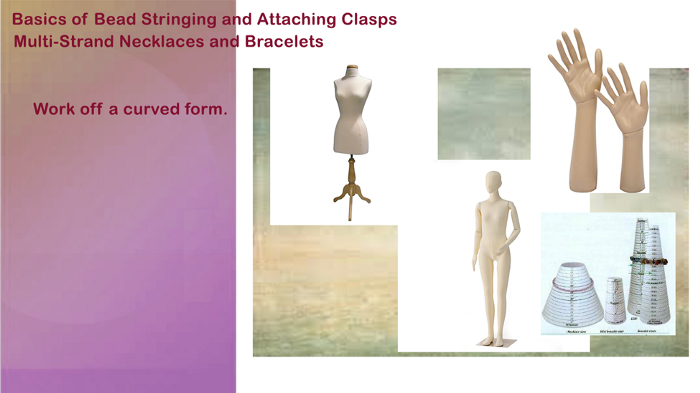
Related to measurement is some confusion about what you are really measuring — the linear length against a ruler or on a bead board, or, — the circumference length using a person or mannequin or sizing cone.
Actual linear length will vary, based on the diameter sizes of the beads, whether you are dealing with any gradations in bead sizes, and how far apart on the body you want each strand to lay.
Only circumference length will serve you well here. But this means you will be planning and constructing around a curved surface or plane.
Another part of the problem is choosing the wrong clasps and jewelry findings. Different findings work well under differing situations and circumstances.
Or, related to this, part of the problem could be how the clasp assembly was constructed without sufficient support.
How long should each strand be?
Let me re-phrase this question:
How wide do you want the negative spaces to be measuring at the center of each strand?
Usually, your goal is to have a good consistency in the width of the negative spaces between each strand.
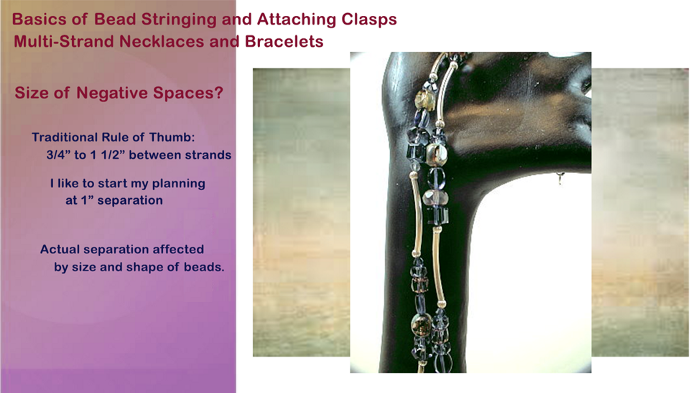
A traditional rule of thumb is that you want each subsequent strand to be 3/4″ to 1 1/2” longer than the previous one. I like to start my planning with 1” separations.
So, if the first strand is 16”, which of course, includes the 1–2” length the clasp assembly will add, then the second will be 17”, the third 18”, and so forth.
This rule of thumb is a good starting point for planning your piece. You will have to modify it based on the characteristics and sizes of the actual beads and components you will be using. Larger beads will take up more of the volume of negative space than smaller beads.
When your beads on the strand are graduated in size, you want to measure and work off your largest bead in each strand.
To get things right, and not get too frustrated, it is easiest to work off of a mannequin or sizing cone or an especially life-size necklace easel.
Working on a flat surface just doesn’t cut it.
You will also only attach things temporarily until you get all the strand lengths and negative spaces widths the way you want them.
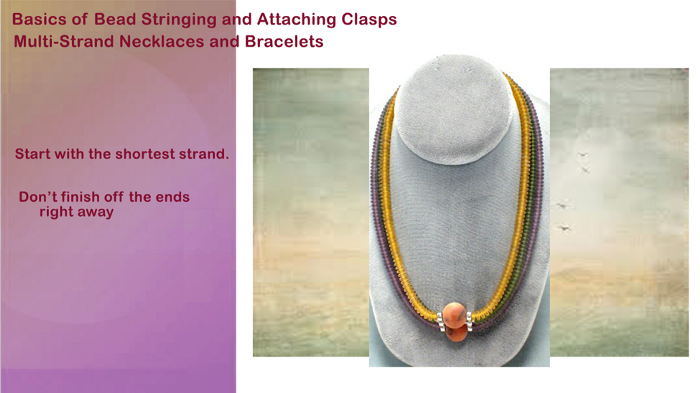
I always begin with the shortest length strand.
If I’m working with cable wires, I end each side with a horseshoe wire protector. This lets me secure the beads on the strand pretty well, and gives me the equivalent of a hook to temporarily hook into my clasp. And it lets me remove the horseshoe wire protector if I want to add or subtract any beads on the cable.
I do not secure the clasp to the horseshoe wire protector or do any crimping until I have all the strands on the necklace arranged the way I want them.
I next try to complete the second smallest strand, and temporarily hook it to the clasp.
I work my way down until the longest strand.
When I am satisfied with everything and how it lays, I begin to finish the connection of each strand to the clasp assembly.
I finish off the first and smallest strand, connecting the clasp permanently, and crimping things in place.
Most likely, I will need to do some adjusting with the next strand. Things don’t work out 100% perfectly in the real world.
I do any necessary adjusting, then I connect that strand to the clasp permanently, and crimp things in place.
I go to the third strand. Most likely, I will need to do some adjusting. When I’m satisfied, usually focusing on the width of the negative space, I crimp.
And so forth down the necklace until the last strand.
With some styles of clasps, I like to use a strong, intervening jump ring, connecting the horseshoe wire protector to the fixed rings on the clasp.
All my jump rings will be the same size.
So, when I am testing things out, I hook the wire protectors (without the extra intervening jump rings) into the fixed rings on the clasp.
When I am ready to make things permanent, I crimp the crimp bead under the horseshoe, then attach the horseshoe to the jump ring and the jump ring to the clasp.
Say you are using a single strand clasp for a multi-strand necklace.
One approach:
You attach a large intervening ring to the clasp, and then attach each string to this large intervening ring.
The size of the ring should allow enough support or jointedness so that the multiple strands do not put too much stress or strain on one another at this point of connection.
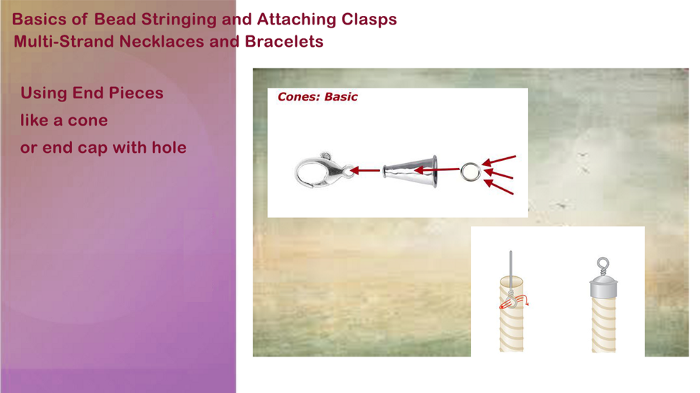
Again, another strategy when using a single strand clasp for a multi-strand necklace, is to use some kind of end piece, like a cone or end cap with a hole.
In this case, you would attach each strand to a soldered ring — that is a ring with no gaps in it. The size of the ring would have to coordinate with the interior diameter of your end piece.
You never pull all the strands through the end pieces. This would put too much strain at that point where they exited the end piece, and attached to the clasp assembly.
You need this soldered ring to work as a support system and absorb and self-adjust to this strain, so your strands won’t break.
So, you attach all the strands to one side of the soldered ring. Then you take another piece of stringing material to the other side of the ring. You pull everything through the opening of the end piece, all the way back so your mess of knots doesn’t show. And you then construct the rest of your clasp assembly.
The soldering ring is your support system. Either the crushed crimps with the required loops, or the series of knots, depending on your stringing material are ugly. Your end pieces act like a lampshade hiding the mess, and making your piece visually appealing.
Still one more strategy is to use an end bar on each side of your piece, which has the number or rings on one side equal to the number of strands in your multi-strand piece, and a single hole on the other side.
You do the rest of your clasp assembly off the one ring on each end bar.
Be sure to use an intervening ring off each single end bar ring, before connecting the clasp.
Let’s say you have a 5-strand necklace, but only a 3-strand clasp.
It is ok to attach more than one strand to a single ring on the clasp. Just be sure this is sufficient support or jointedness.
If not, use a larger intervening ring, like a jump or split ring.
CONQUERING THE CREATIVE MARKETPLACE: Between the Fickleness of Business and the Pursuit of Design
How dreams are made between the fickleness of business and the pursuit of jewelry design
This guidebook is a must-have for anyone serious about making money selling jewelry. I focus on straightforward, workable strategies for integrating business practices with the creative design process. These strategies make balancing your creative self with your productive self easier and more fluid.
Based both on the creation and development of my own jewelry design business, as well as teaching countless students over the past 35+ years about business and craft, I address what should be some of your key concerns and uncertainties. I help you plan your road map.
Whether you are a hobbyist or a self-supporting business, success as a jewelry designer involves many things to think about, know and do. I share with you the kinds of things it takes to start your own jewelry business, run it, anticipate risks and rewards, and lead it to a level of success you feel is right for you, including
· Marketing, Promoting, Branding: competitor analysis, developing message, establishing emotional connections to your products, social media marketing
· Selling: linking product to buyer among many venues, such as store, department store, online, trunk show, home show, trade show, sales reps and showrooms, catalogs, TV shopping, galleries, advertising, cold calling, making the pitch
· Resiliency: building business, professional and psychological resiliency
· Professional Responsibilities: preparing artist statement, portfolio, look book, resume, biographical sketch, profile, FAQ, self-care
SO YOU WANT TO BE A JEWELRY DESIGNER Merging Your Voice With Form
So You Want To Be A Jewelry Designer reinterprets how to apply techniques and modify art theories from the Jewelry Designer’s perspective. To go beyond craft, the jewelry designer needs to become literate in this discipline called Jewelry Design. Literacy means understanding how to answer the question: Why do some pieces of jewelry draw your attention, and others do not? How to develop the authentic, creative self, someone who is fluent, flexible and original. How to gain the necessary design skills and be able to apply them, whether the situation is familiar or not.
The Jewelry Journey Podcast “Building Jewelry That Works: Why Jewelry Design Is Like Architecture” Podcast, Part 1 Podcast, Part 2
PEARL KNOTTING…Warren’s Way Easy. Simple. No tools. Anyone Can Do!
I developed a nontraditional technique which does not use tools because I found tools get in the way of tying good and well-positioned knots. I decided to bring two cords through the bead to minimize any negative effects resulting from the pearl rotating around the cord. I only have you glue one knot in the piece. I use a simple overhand knot which is easily centered. I developed a rule for choosing the thickness of your bead cord. I lay out different steps for starting and ending a piece, based on how you want to attach the piece to your clasp assembly.
SO YOU WANT TO DO CRAFT SHOWS:16 Lessons I Learned Doing Craft Shows
In this book, I discuss 16 lessons I learned, Including How To (1) Find, Evaluate and Select Craft Shows Right for You, (2) Determine a Set of Realistic Goals, (3) Compute a Simple Break-Even Analysis, (4) Develop Your Applications and Apply in the Smartest Ways, (5) Understand How Much Inventory to Bring, (6) Set Up and Present Both Yourself and Your Wares, (7) Best Promote and Operate Your Craft Show Business before, during and after the show.
As I pursue the pathways which have led me to my Rogue Elephant, for the most part, I feel free. I feel I can take responsibilities for the choices I am making, whether to go this way or that. I’m on that road to explore, to critique, to reflect, to ponder, to plan, to strategize, to move on. I feel within myself a purpose in life. This is all good. And right. I feel I have the tools to overcome the unfamiliar and the unknown. Clear. Confident. Not cocky.
However, during most of my childhood, youth and young adult life, my relationships with my relatives sometimes interfered. Irritated. Distracted. Distorted. Got me frustrated. Made me scared. Made me angry.
They are relatives. This is different than relationships with strangers or friends or colleagues. I too easily allowed my relatives to get inside my head. Too easily to be too sensitive and responsive to their own values, beliefs and expectations they placed on me. It made it difficult for me to stay on that path. And search for my Rogue Elephant.
It is that blood connection. That almost primal need for family, clan, tribe. You can’t pull away so easily. Distance yourself from them. Even if you barely know them. Even if you do not share their beliefs and values. Even if you detest them.
The Bridesmaids’ Bracelets
For years, I fretted. I worried, and fretted, and paced up and down, and down and up. I rubbed my hands in the way that worried people rub their hands. I shouldn’t go. I would not go.
To my niece’s wedding.
My only niece.
Of my only sister.
My niece who I had hoped and prayed and prayed some more that she would never get married. Why couldn’t she just live with the guy? Why marry? Marriage is an encumbrance. It’s an outdated, Middle Ages kind of thing that denigrates women under the guise of protecting them. They sign a contract giving themselves over to the man, vowing to obey. Respect. Follow. Bear babies. Cook. Clean. Even earn a living, if he can’t.
Yet the man keeps the power. His voice to God. Her voice through his to God.
Marriage. Not for me.
And I didn’t want to go.
Too afraid I’d say something or do something to upset people.
Because they would be there.
Those cousins.
And their children.
And their children’s children.
Too many of them, and only one of me.
But my cousins had rejected me because I was gay.
And that hurt.
And then that rejection became an idea of rejection and a symbol of rejection, and I thought how often in life, from when I was very young, to when I was much, much older, — how often in life had I been rejected for some label or category or reason having nothing to do with me. Rejected as a Jew. Rejected as gay. Rejected by friends. Rejected by strangers. Rejected by family.
So toxic.
Didn’t want to deal with this.
Preferred avoidance.
Thought over and over again what excuses I could give my sister.
I thought about this when my niece was 13.
I thought about this when she was 18.
Then 20, and 23, and 24 and finally 28, when I had to make a choice.
My sister and her family were very close to these cousins, closer to them in most ways than to me. Years ago, my sister used to invite me for Thanksgiving and for Passover. And she invited all these cousins, as well. She liked to give a party.
Partying with these cousins was too toxic for me, so I made excuses. Too busy at work. Things too slow in business so couldn’t afford it. Had other things scheduled.
For me to feel comfortable, my sister’s choice would have to have been “ME”, not “THEM”. I felt bad. I felt guilty. I didn’t want to put my sister in this situation. It was easier to come up with an excuse.
But year after year, the situation took its toll. Rejection — a symbol, but painful nonetheless. Not because of the act itself, but the symbolic power of the act to affect me — Rejection — put a wedge between my sister and myself. I did not have the self-confidence, and I didn’t value myself enough, to prevent caving in before this symbolically powerful act of rejection because I was gay.
I was always looking for love and connection, but when around my relatives, all I felt was isolated, confused and in despair.
I didn’t have to deal with this as long as I stayed hundreds of miles away from New Jersey and Maryland and Virginia and Florida. Tucked safely in middle Tennessee.
I Had To Go / I Wanted To Go
The wedding was in March.
The previous summer, I decided I would go. Not exactly sure what changed my mind, perhaps a feeling of familial obligation, perhaps putting my sense of self to the test, perhaps wanting to try out all that good food and cake and drink specially prepared for the occasion. My sister plans the best parties.
I offered to make bracelets for all the bridesmaids.
I wasn’t just being a good guy here. Jewelry and design are at the core of my identity. The jewelry I design is the result of my choices. Choices about colors. Choices about the placement of lines, shapes and forms. Choices about the clasp and how to attach it. Choices about materials and techniques.
My inner being. On display. Irrefutable.
My choices have little to nothing to do with the label “JEW”.
Nor do my choices have much to do with the label “GAY”.
They are about me. A Designer.
Reflected in my jewelry.
And would be on display.
Accept or reject my jewelry.
And you accept or reject me.
On my terms.
My own terms.
Me.
My essence.
My resonance.
My jewelry.
This was my chance to shine. I was going to create a special bead woven design for these bracelets. Something frilly and girly for a wedding, but something also indicative of my style. Something that would not take too much work, but would look very rich and substantial.
I designed what I thought would be the perfect bracelet. A mix of stitches. Great looking beads. Had movement and dimension. But I was struggling to find the perfect color palette. The bracelet was made up of 4 colors, and a 4-color color scheme is one of the most difficult to work with — especially when it comes to beads, which are not available in all colors, let alone 4 colors which could specifically work in a specific color scheme in this specific bracelet.
While I was struggling to pick colors, Dara, my niece, had been doing a little online research, as well. She found two bead-strung bracelets on Etsy that she particularly liked, and shared these with me.
No, No, No!!!
My first reaction was Horror! Oh No!, she wants something bead strung and so non-artisan looking. Making these up would not signify to my terrible cousins nor to my good cousins, who I was all about. As Jayden, my partner, said, buy all the parts and do it quick. You’re not close to your niece, so who cares. But to me, although the work involved would be minimal — it would not be enough of a gift for the wedding.
Don’t get me wrong. The two bracelets Dara picked out were very attractive. They were just so out of sync with everything I wanted to do, and everything I wanted to accomplish. And I had to ask myself: give Dara what she wants, or go off in a different direction?
The question was kind of rhetorical. Of course, I’d give Dara what she wanted. But what to do. How can I construe, mold, fashion, arrange the bracelet to be reflective of me? Jewelry designer Me. Bead artist Me. Worthy cousin to be awed and ooh’ed over Me.
Dara’s Bracelet
The bracelet Dara wanted was 3 strands of 6mm round fire polish beads in two coordinating colors which matched the color of her bridesmaid dresses. The beads were staggered in a V-shape like bowling pins, each section separated by a diagonally placed 3-hole spacer bar.
I thought long and hard about how I could make this general design my own.
A few weeks passed. And an idea came to me. I could bead weave the spacer bars. I could alternate right angle weave and flat peyote to create a stable, rectangular shape. The right angle weave sections would be the two sides, which would allow me to build in the holes. The flat peyote would be the top and the bottom, which would allow me to build in a shape-supporting structure. I would embellish the tops of the bars with 2mm round Austrian crystal beads, and I would create bead woven end caps on either side of the bar, to give the bars a finished and polished look. Then I would use needle and thread to string everything up.
That was my answer.
It was a good one.
So, first, I set about coming up with the bead woven pattern for my spacer bars. This did not take very long because I had a clear idea about what I wanted in my head. What was not in my head, however, was how long to make the bars and how many holes each should have. And would they work in the whole composition.
I ended up making 5 test bracelets, each requiring 11 spacer bars, and each with some variety in the design or placement of the spacer bars, and in the attachment strategy for the clasp.
Now I had three key tasks finished: (1) The design of the spacer bars (2) The construction plan for the bracelet (3) The construction plan for attaching the clasp
Next, selecting the right colors of beads.
First off, I wanted to use 6mm round Austrian crystal beads, instead of Czech glass.
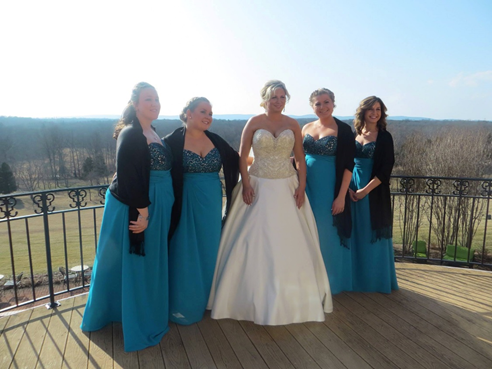
There were images of the bridesmaid dresses on line, but the actual color skirted that area between blue teal and green teal, and not every computer screen showed the color exactly. It became critical to the choice of colors, given some limited choices available in the Swarovski line in this range, whether the dress was more on the green side or more on the blue side.
My sister said Blue.
My niece said Green.
My sister was supposed to send me a fabric sample, but she lost it.
I mocked up 3 bracelets, one all blue teal, one a mix of blue and green teal, and one more green teal.
My sister picked the green.
My niece picked the mix of blue and green.
And my gut, from looking at the computer images, was telling me it should be all blue.
Impasse.
I went with my gut, and settled on all blue, actually a mix of capri blue and Caribbean opal.
There were four bridesmaids. I asked my niece to get their wrist measurements. One the bridesmaids had a very, very thin wrist. Would my design work for her? I agonized over it. The sections were very rigidly organized, and I’d have to remove a whole section at a time. Luckily, this worked OK.
The only other hitch that came up had to do with the availability of the parts.
I designed the piece in September. The wedding was in March. In November, I tried to acquire enough clasps and end bars for the clasp assembly, and found out that both the clasp and end bar I had chosen were either out of stock until the following April, or no longer manufactured.
So began the desperate hunt for these parts. The end bars had to be 22mm wide, or very close to that, with 3 holes and 3 holes spaced out evenly across the bar. Most 3-hole end bars were around 15mm wide. Found some in Israel, which while no longer manufactured, the supplier had just the amount I needed left in stock. Easily found a substitute clasp.
Then there were the beads. Again, I’m in November. The capri beads were out of stock from my supplier, and 2 of my alternative suppliers, but due back by December. The Caribbean opal beads were out of stock, and not due back anytime soon. I found a supplier who charged a little bit more for these, but got enough for my needs.
Whew!
Was Standing In The Same Room As My Relatives The Right Choice?
It was a few weeks before the wedding, and I was wondering if my choice to attend was the right one. Over and over and over again, I played out in my head what I would or would not say to my very inconsiderate, selfish, self-centered, inhospitable, unsympathetic, narrow-minded, prejudiced relatives. One part of me wanted me to be pleasant but distant. Another part of me wanted me to say something pointed and ugly.
I asked each of my friends, what they would do. I wanted so badly to be pointed and ugly. I was leaning in that direction. Of course, I didn’t want to upset my sister or my niece.
I thought back on the event that started it all. It was really so insignificant. An expected invitation to a cousin’s wedding never came. But I hadn’t planned on going. I did expect to receive an invitation, however. Because everyone expected me to receive an invitation. We all had been planning vacations and things to do around this invitation. For well over a year at that point. We had been planning. All of us. When we were going to arrive, where we were going to stay, and what we were going to do. And while I didn’t plan on going, I expected the invitation.
Rogue Elephants Are Shy And Hide In The Presence of Self-Doubt And Life Crises
I’m a firm believer that every few years, we each go through a life crisis. When we are babies, we have to resolve a crisis of finding out who to trust, and who not to. A few life crises later, we’re in puberty, having to resolve whether we’re still a kid, or some kind of adult. Several life crises after puberty, we go through the mother of all life crisis — what we call, cue the digital billboard, the Mid-Life Crisis. This crisis is filled with anger, frustration, regret, disappointment, fear.
My mid-life crisis arrived several years before Dara’s wedding. Eventually I came to terms with mid-life. That’s what I did. And then, immediately after my mid-life crisis, as if the mid-life crisis wasn’t traumatic enough, I had a sudden, almost primal, no, yes it was full-on primal, urge to reconnect with my family. I had grown apart from my sister and father and brother. From my first cousins in Florida and those in New Jersey, New York and Maryland. And from their children, my new second cousins. And I was feeling the need to re-connect. Post mid-life I urgently felt the need to re-connect. Like it was life or death. Connection. Affirmation. Completeness.
And I reconnected.
I slowly began to let everyone know I was gay. They kinda knew and suspected already. But I made it official. Pretty much everyone except my sister was supportive at some level. Eventually she got used to it.
I was invited to my cousin Michele’s oldest son’s wedding. And then, over the next few years, to some other weddings and bar and bat mitzvahs and special occasions. I re-connected. I was happy. Soon there were the occasional phone calls and emails. A few of my cousins sent out the periodic mass emails, and I was on their lists. I kept up with their newsy news and not-so-newsy news, their shared successes, their joys in life, and the every-so-often sadnesses. I felt included. Supported.
It was important to everyone, and you could tell, because they spent so much time doing it, to anticipate the next event we’d all attend. The next event was the marriage of my cousin Michele’s middle son.
It was to be a June wedding. I got a phone call sometime in April from my sister. “Did you get your invitation yet?” And a day later, from my cousin Leslie. “Did you get your invitation yet?” And obviously the answer was, No! Not yet. I kept checking the mail for several days, and then it began to dawn on me that I wasn’t invited. I wasn’t going to be invited. And if not getting invited to an event that I wasn’t planning on going to wasn’t enough of a jolt and shock, both my cousins Michele and Paulette dropped me from their almost daily mass email lists.
I was person non-grata. Why?
I asked myself, Why?
And I asked some cousins, Why?
And it became known that the Why was because I was gay.
And that was that.
Excluded again.
Of course, I wanted my sister to make the choice not to go.
She went.
And that put a wedge in our relationship that never really healed, because it was irreconcilable.
And I got very depressed for a few months afterwards.
There Is A Long History
I do not have to think very long or very hard to realize that my relationships with my relatives soured many years ago. There were slights. Special occasions arranged on dates my family could not attend. Arguments over matzah balls (hard or soft) and Thanksgiving dinners (traditional food or non) and inappropriate racist remarks and jokes. It was my uncle Sid, when asked to stop telling black (N-word) jokes, said, OK!, then began telling polish (P-word) jokes.
There were very barbed comments about home décor, kitchen counters, brands of appliances, whether a kitchen island or not. There were my religious cousins who would not visit New Jersey because they believed the ground outside the New York City metropolitan area was unholy. Who would not eat Kosher food prepared by my mom because she could never prepare food Kosher enough. There were the complaints that there was never enough food. And the constant, mean-spirited gossip relatives vomited out of their mouths about other relatives.
If something happened to me or to either of my parents or to my sister or brother, I could never turn to these relatives for practical or emotional support and help. I felt too alienated from them. They alienated me from them.
So I wasn’t invited to a wedding. So my relationship with my sister and her family never became close — at least for a long while. So I no longer kept up with my cousins and second cousins and all their offspring. So I had some issues with my parents and my school and the dominant Christian culture. That’s largely behind me. Not an obsession. But the oncoming wedding of my sister’s daughter forced me to focus on these things again.
Thank God the wedding only lasted a weekend.
Wedding Weekend
True to form, my sister threw a grand event people are probably still talking about.
In the few months leading up to the wedding, I concentrated on designing the bridesmaids’ bracelets. As I determined how I would make the pieces my own, I got very excited. I developed a very clever and professional way to bead weave the 3-hole separator bars. I combined Right Angle Weave and Flat Peyote, using the structural and inherent properties of each in a strategic way. This allowed be to create holes in the sides through when to thread the strands, and structural support to allow the bars to keep their shape.
I kept thinking that, while the bridesmaids would find the bracelets appealing and desirable, they would never appreciate the amount of thought, work and insight involved in their construction. So, I decided I would later turn this piece into a kit and a workshop. This piece was a great example of my evolving ideas and writings about the architectural bases of bead weaving stitches.
The wedding itself was beautiful, and went off without a hitch. The food was terrific. The location romantic. The flowers and bridal gown beautiful. There were over 200 guests. And about 60 of those I was trying to avoid. Relatives!
I arrived a day earlier. One of my cousins, whom I do speak with occasionally, arrived at the airport at the same time. After we checked in at our hotel, we went to lunch and unloaded about all the relatives. She and I have similar opinions about these people.
In the late afternoon, I stopped by the Bridal Suite, where they had set up to greet guests arriving early and staying at the hotel. You walked into the equivalent of a living room. Off to the left were a bedroom, kitchenette and bathroom. Off to the right were a dining room and an outdoor patio. It was in the 30’s and wet and snowy, so no one went out on the patio.
As more and more people gathered in the Suite, I found myself talking to some folks in the dining room. And then, one by one, two by two, three by three, these cousins I wanted to avoid started filling up the center room. And I found myself backing up against the far dining room wall, seemingly pushing myself into the wall and through it, or so it felt to me. My mind left the room and merged into the wall. I desperately looked for an opening where I could run through the living room and out the door. But more and more people came flooding in. I was having trouble catching my breath, slowly going into panic.
At last, an opening. I escaped. Hyperventilating. I went up to my room, and waited until I regained some composure. My panic attack had run its course.
Twenty minutes later, I returned to the Bridal Suite, bridesmaids’ bracelets in hand. I had put each into its own jewelry box, with the name of the bridesmaid written on a card in each box. They were going to take the bridal pictures in the morning, and I wanted to be sure they were wearing their bracelets. And I secretly wanted a lot of these people crowding this Bridal Suite to get a glimpse of what I had made.
As I had thought, they loved the bracelets — they were beautiful — but were clueless about design. That “full” feedback is so very important to me, but often missing.
Luckily the colors of the bracelet perfectly matched the dresses.
My job was done.
It was many years later, that I was able to distance myself emotionally from these people. Underlying, gnawing tensions here led, forced might be a better word for it, the way towards finding new meanings in life for myself. A source of growth and discovery. I eventually found my Rogue Elephant and beaded him. A crutch, perhaps. A diversion from family, maybe. Or a hand-knee-trunk up. A connection. A purpose.
CONQUERING THE CREATIVE MARKETPLACE: Between the Fickleness of Business and the Pursuit of Design
How dreams are made between the fickleness of business and the pursuit of jewelry design
This guidebook is a must-have for anyone serious about making money selling jewelry. I focus on straightforward, workable strategies for integrating business practices with the creative design process. These strategies make balancing your creative self with your productive self easier and more fluid.
Based both on the creation and development of my own jewelry design business, as well as teaching countless students over the past 35+ years about business and craft, I address what should be some of your key concerns and uncertainties. I help you plan your road map.
Whether you are a hobbyist or a self-supporting business, success as a jewelry designer involves many things to think about, know and do. I share with you the kinds of things it takes to start your own jewelry business, run it, anticipate risks and rewards, and lead it to a level of success you feel is right for you, including
· Marketing, Promoting, Branding: competitor analysis, developing message, establishing emotional connections to your products, social media marketing
· Selling: linking product to buyer among many venues, such as store, department store, online, trunk show, home show, trade show, sales reps and showrooms, catalogs, TV shopping, galleries, advertising, cold calling, making the pitch
· Resiliency: building business, professional and psychological resiliency
· Professional Responsibilities: preparing artist statement, portfolio, look book, resume, biographical sketch, profile, FAQ, self-care
SO YOU WANT TO BE A JEWELRY DESIGNER Merging Your Voice With Form
So You Want To Be A Jewelry Designer reinterprets how to apply techniques and modify art theories from the Jewelry Designer’s perspective. To go beyond craft, the jewelry designer needs to become literate in this discipline called Jewelry Design. Literacy means understanding how to answer the question: Why do some pieces of jewelry draw your attention, and others do not? How to develop the authentic, creative self, someone who is fluent, flexible and original. How to gain the necessary design skills and be able to apply them, whether the situation is familiar or not.
The Jewelry Journey Podcast “Building Jewelry That Works: Why Jewelry Design Is Like Architecture” Podcast, Part 1 Podcast, Part 2
PEARL KNOTTING…Warren’s Way Easy. Simple. No tools. Anyone Can Do!
I developed a nontraditional technique which does not use tools because I found tools get in the way of tying good and well-positioned knots. I decided to bring two cords through the bead to minimize any negative effects resulting from the pearl rotating around the cord. I only have you glue one knot in the piece. I use a simple overhand knot which is easily centered. I developed a rule for choosing the thickness of your bead cord. I lay out different steps for starting and ending a piece, based on how you want to attach the piece to your clasp assembly.
SO YOU WANT TO DO CRAFT SHOWS:16 Lessons I Learned Doing Craft Shows
In this book, I discuss 16 lessons I learned, Including How To (1) Find, Evaluate and Select Craft Shows Right for You, (2) Determine a Set of Realistic Goals, (3) Compute a Simple Break-Even Analysis, (4) Develop Your Applications and Apply in the Smartest Ways, (5) Understand How Much Inventory to Bring, (6) Set Up and Present Both Yourself and Your Wares, (7) Best Promote and Operate Your Craft Show Business before, during and after the show.
I thought I heard some swish sound of something moving in the air. Something from the back of the room. Headed toward the front of the room. And a sudden click, perhaps a bounce, then another click, click, perhaps another bounce, another click, a rolling sound, and yes, something hit the guy speaking in the front of the room. That guy was my father. That noise I heard was the sound of a plastic pharmacy bottle and its plastic safety cap making a bee-line towards that guy in the front of the room. And bull’s-eye!
My father, you see, at the time, was President of the New Jersey Pharmaceutical Association. He had higher ambitions to get appointed as a Commissioner of Pharmacy on the New Jersey Pharmacy Board. The Board, knowing that, politely volunteered him to introduce the new safety-capped prescription bottles to the pharmacy association’s members. So here he was.
And it just wasn’t one bottle that came flying. I was so peeved. I had taken the time to go up and down the aisles of this auditorium, handing sample bottles to each and every pharmacist there. Now these bottles, one after one after one after one, were getting thrown to the front of the room. My father dodged most, but not all. Yet, at no time, did my father deviate from his presentation. He kept talking from his notes from start to finish.
The original safety capped bottles were difficult to open, to say the least. The standard was that it should take an adult 3 minutes or less to open, and a child 5 minutes or less. Forget about it if you were elderly. Opening these wasn’t going to happen. And most elderly, once they got the caps off, left them off. When my father quoted this standard, that’s when most of the bottles flew up into the air, along a curved trajectory, and ever-so-slightly towards the dais. Plastic hitting tile or concrete or whatever.
And my father’s final line: Within 3 months’ time, the state will require all pharmacies to use only these new safety capped prescription bottles. You’d have thought the room was filled with cows with slight speech defects. Boooooo…..! Boooooo…..! Boooooo…..!
I internalized all this. My father modeled what it meant to be a professional. I model for my jewelry making and beading students what it means to be a professional. My father stuck to maintaining high expectations and standards. To the chagrin of many of my students, I hold them up to high expectations and standards. Although I don’t get plastic bottles thrown at me, I have had to confront a lot of resistance when trying to have my students, my clients, my customers, my colleagues live up to that label I call professional.
There is a widespread belief that crafters and makers are not professionals. There is no law about this. Or regulation. Or rule. It is more of an assumption. Laziness. Low expectations. Low self-esteem. A lack of understanding of the role of a jewelry designer. I refuse, however, to succumb to anything less.
The very nature of jewelry itself necessitates the designer’s role as professional. Jewelry is made to a quality standard. Since jewelry is to be worn and bought and sold, the needs and desires of both designer and wearer must be taken into account. In fact, each piece of jewelry, introduced publicly in whatever way and in whatever circumstance, by definition, triggers conversation. Defines relationships. Exposes desire. Sets possibilities as well as boundaries on participation.
The designer has key responsibilities here, given all the choices which need to be made, when translating inspiration into aspiration into an actual piece of jewelry. The designer can be nothing but a professional. Whether she or he believes it or not. Or acts like it or not. Designers cannot barricade their doors to their Rogue Elephants. My point: They have to bead them.
The whole prescription bottle thing was a mess. One of the things professionals learn to get good at is in anticipating their client’s needs, then shaping what they say and what they do accordingly. It’s about establishing relationships which help clarify what each other knows, assumes, wants, desires, can or cannot do. As a professional, the preference should not be on relying on the law to force these pharmacists to comply. The preference should be to reach an understanding so that the pharmacists, no matter how skeptical or reluctant, will comply on their own. My father presented his message, but it wasn’t received well. As a professional during this time, my father needed a little more development.
The Audacity
In 1998, I created a school to teach jewelry making and beading using a professional model of education. I was literally ANGRY, and very frustrated, that so many of our shop customers had taken so many classes around town, but still could not really do much on their own. I wanted them to be more informed. To do more than making the same project over and over again. To challenge themselves. To experiment. To play. I knew Rogue Elephants loved to play.
My professional training had been in planning and design. While it was health planning and urban design, and although I hadn’t worked in this particular professional capacity for 20 years, everything I learned seemed very appropriate for jewelry design and beading.
But what I saw around me in Bead World — the types of classes taught and the types of books available and the types of articles in beading and jewelry magazines — none of these things seemed quite on the mark. None of them taught about design. None of them challenged the beader or jewelry maker to step out of some very constricted boundaries and rules. None of them seemed to result in teaching beaders and jewelry makers a set of transferable skills. None of them guided beaders and jewelry makers to develop their Designer Tool Boxes — those sets of hard and soft skills which would allow them to resolve unfamiliar or difficult problems in design.
In the jewelry making world, everything seemed oriented around sets of steps. Buy books with sets of steps. Take classes to learn sets of steps. Take more and more sets of steps. The more steps you complete, the more supposedly you learn. How many steps do you have to climb before you reach the top?
But, no matter how many steps you complete, you really don’t learn how to recognize the kinds of implications and to make the kinds of choices you need to make, in order to decide what to include, and what not to include, how to proceed, and how not to proceed, in your pieces of beadwork and jewelry. You do not learn how to make the necessary tradeoffs between beauty and function, appeal and wearability, shape and movement. You do not learn how to create jewelry with a recognition of how that jewelry sets a tone. Triggers a conversation. Defines a relationship. Fulfills needs and desires.
I kept thinking of an idea of a Jewelry Making and Bead School that provided classes and other learning opportunities more in line with my own professional training in health care and urban design. Not to teach sets of steps. But to teach skills. Not to learn things randomly and at will. But to learn things in an integrated ordering. However, I didn’t have the depth of beading and jewelry making experience to pull this off. It was a BIG project, and I wasn’t sure I wanted to take something like this on.
And there was that headline — Little beading experience, wants to form School. I found that people thought I was very presumptuous. That I was treading into areas I had not earned the right to be in. That whatever I did, was too complex — either why bother, or why struggle? That there were enough classes at the other beading shops in Nashville, and there would not be any measurable demand for something different, more involved, more demanding.
Who did I think I was? This situation I found myself in reminded me of Picasso’s drive to create cubism. It took him 10 years to define it well enough, create enough attractive and desirable examples, and get it accepted as a force in art. I had visited the Picasso Museum in Barcelona, Spain several years ago. Picasso spent his boyhood years in Barcelona. The museum showcased his early-early work through his “blue” period, and up to before the cubism painting style everyone knows him by so well. It showed the development of Picasso’s inner drive to create something great and to be famous.
What the Museum’s story told was that Picasso was basically a shit in search of a reason. Pushy, arrogant, intense. He’d work a color or motif to death. He was intent on fame, or perhaps validation. As a young man, he moved to Paris for awhile, and associated with all the new exciting artists that Paris attracted in the late 1800s, early 1900s. He learned from them, socialized with them, fraternized with them, shared political and artistic views with them, imitated some of their works, and intently developed rules for a new personal artistic style.
At one point, he was determined to create and define a new style of painting. He collaborated with George Braque over 10 years to refine ideas about cubism. At that point, he was discovered, and became the primary focus of cubism as an artistic style.
I don’t mean, in telling the story about our beadwork and jewelry making school, to compare myself to Picasso. The audacity. I don’t think I was a shit. Though I imagine some of the people I worked with thought so. I never thought it would take so long to feel that our program ideas had “clicked.” It took 7–8 years. Or that I would stay the course, despite set-backs and estrangements. Perhaps that’s for posterity to decide, or another writer, like myself, writing about me.
All About Choices and Responsibility
In my father’s drug store, I stood by the register counter one day. My father was in the pharmacy section on the phone. I eavesdropped.
He was trying to get through to a physician. He wasn’t having much luck getting beyond the first line of defense — the nurse receptionist. He was explaining, trying to, sometimes calm, sometimes with anger, often with concern, that the doctor wrote an adult dosage for a baby, and that this dosage would surely kill the baby. He wanted to ask the doctor to change the dosage. The doctor refused. And refused again.
The law in New Jersey at that time forbid pharmacists from questioning any doctor’s orders. Even my father’s phone call to the physician could be a chargeable offense. By law he was required to fill the prescription.
So my father had a difficult choice: follow the law and let the baby die, or break the law.
Although the jewelry designer is not in this kind of precarious situation, there are still choices to be made and responsibilities to be taken for their choices. Jewelry is to be worn. It may be bought. It may be exhibited and collected. In short, the designer serves someone else. The designer makes that person’s life somehow better. More satisfying. More self-affirming. More culturally-affirming. While a miscalculation in design and construction choices will not lead to death, it can still have many negative consequences. As a professional, the designer will want to anticipate, mitigate or alleviate any possibilities for negative consequences.
And what happened to the baby?
My father resorted to a little bit of civil disobedience. He called every pharmacy in a 5-county area. He got every pharmacist to agree not to fill any and all prescriptions written by this doctor. The doctor’s patients were not happy about this. But, the doctor got the message. The medical society in New Jersey got the message. The Medical Board got the message. The state legislature changed the law to give pharmacists more professional responsibility in this kind of situation.
I always wanted — probably may never succeed — in changing how jewelry makers and beaders learn their craft. It’s about high expectations, professionalism, choices, responsibilities — and developing a literacy and fluency in design and building up that Designer’s Tool Box. This makes so much sense to me … why not to everyone else, I ask myself.
I don’t know if I’m copying my father, paying homage to him, genetically predisposed to who he was. But I bring all this insight — some say, baggage — to the design of jewelry. How it is made. How it is sold. How it is taught.
It Takes A Lot Of Push and Determination
I was talking with a nationally prominent jewelry instructor about my ideas for educating jewelry makers and beaders. She thought it was a waste of time. Most students only want to follow a set of steps and end up with something. Given what they want, that’s all the effort she wanted to make into teaching them. If a student wanted to go further, she would gladly answer their questions. But it was not her job or responsibility to instill professional values, expectations, or higher level skills in her students.
I found the same attitude among local teachers. I had an extensive curriculum and needed teachers to teach the courses. I required written instructions for all classes. Teachers refused. I required that teachers provide samples of the projects in each class. Teachers refused. I required that core tasks be taught with one or more variations. Teachers refused. What really gored me was that the few teachers that agreed to create classes according to my requirements, in reality, did not. They told me one thing, and did something else. After several months, I began to notice that students were not learning what was spelled out in the curriculum. As one teacher I fired told me, she could do less work and get paid the same. I said, Goodbye, Good Luck, Good Riddance.
I began to teach many of the classes myself. Had to learn a lot quickly. Over time, I regained the upper hand. I worked individually with each new teacher. I required that they create 4 interrelated, progressive courses. They had to specify how the goals for the next, related to the preceding course. This strategy worked.
At first, it was also difficult to attract students. They could take classes elsewhere that didn’t have prerequisites and requirements. Pay the same amount. End up with a finished project they could take home. Have fun, that was that. Again, over time, I regained the upper hand. I created a local demand for something more. I did not have to lower any curriculum expectations.
For me, it is such a high to learn things. Develop myself. Conquer new challenges in design, manipulation and construction. Leverage the strengths of materials and techniques, and minimize their weaknesses. I will never get it: Why others don’t share this excitement. Yet I am driven. Whether this relates somehow to my father, or not. I am driven.
In the late 1960s, my father was driven, as well. He wanted New Jersey to allow pharmacists to give injectables in the pharmacy. This could be flu shots, vaccinations, things like that. The law prohibited this. Through a lot of political manipulations, and with the support of both the New Jersey Pharmacists Association and the New Jersey Nurses Association, he convinced the Medical Board to allow a pilot test. He pushed the project forward.
A date was set. A number of pharmacies in the county agreed to participate. Pharmacists were trained. Announcements went out.
Three days before, however: another in a long line of road blocks. The Medical Board reneged on their agreement. Pharmacists would not be allowed to administer injectables. My father knew they could not, however, stop nurse practitioners from doing so. A nurse practitioner was lined up for each drug store.
The Medical Board put up another roadblock 2 days before the event. Now, injectables could only be administered in a separate area devoted to the activity, with a detail of space requirements — roughly 6’x 6’. In our store, we took down a display gondola. We took a wooden door and sat it atop two file cabinets to create a desk. A chair on either side. We put into effect all the other little required details.
The event occurred with great success. The legislature changed the professional standards to now allow pharmacists to administer injectables. Every time I walk into a Walgreens pharmacy to get my flu or COVID or whatever shot, this all started with my father, his ambition, his professionalism and his concern for good health care delivery.
The Professional
As I see it, and as I only allow myself to see it, jewelry design is not merely an activity which occupies your time. It is not something that anyone can do. It requires training, development, experience, more experience. It requires learning specialized skills.
Part of the jewelry designer’s development as a professional involves an ability to anticipate and understand how various audiences express desire and how various audiences judge a piece of jewelry to be finished and successful. Jewelry is here to amaze and intrigue. It is here to entice someone to wear it, purchase it, show it around. It is here to share the inspiration and prowess of the designer with those who see, feel, touch and inhabit it.
The more professional designer takes the time to explore how an audience is engaged with the piece. The designer learns insights in how any piece of jewelry evokes emotions and resonates with others. The designer is very sensitive to the experience people have at the point of purchase or gifting. Finish and presentation are very important. Acquiring jewelry is special and unique a process. Jewelry is not something we must have to meet some innate need; rather, it is something we desire because it stirs something within us.
At the heart of my questioning is whether we are paid and rewarded either solely for the number of jewelry pieces which we make, or rather for the skill, knowledge and intent underlying our jewelry designs.
If the former, we do not need to call ourselves professionals. We do not need much training. Entry into the activity of jewelry design would be very open, with a low bar. Our responsibility would be to turn out pieces of jewelry. We would not encumber ourselves too much with art theory or design theory. We would not concern ourselves, in any great depth, and certainly not struggle with jewelry’s psycho-socio-cultural impacts.
If the latter, we would see ourselves as professionals. We would need a lot of specialized training and experience. Entry into the activity of jewelry design would be more controlled, most likely staged from novice to master. Our responsibility would be to translate our inspirations into aspirations into designs. It would also be to influence others viewing our work to be inspired to think about and reflect and emote those things which have excited the designer, as represented by the jewelry itself. And it would also be to enable others to find personal, and even social and cultural, success and satisfaction when wearing or purchasing this piece of jewelry.
To become a professional jewelry designer is to learn, apply and experience a way of thinking like a designer. Fluent in terms about materials, techniques and technologies. Flexible in the applications of techniques and the organizing of design elements into compositions which excite people. Able to develop workable design strategies in unfamiliar or difficult situations. Communicative about intent, desire, purpose, no matter the context or situation within which the designer and their various audiences find themselves. Original in how concepts are introduced, organized and manipulated, and in how the designer differentiates themselves from other designers.
When I think about beading a Rogue Elephant, I think about taking ownership of my own design process. I think about finding personal meaning, and how through jewelry, this affects others. I think of myself as a professional. I think of my Rogue Elephant as something reachable. Attainable. A creative challenge. My muse.
CONQUERING THE CREATIVE MARKETPLACE: Between the Fickleness of Business and the Pursuit of Design
How dreams are made between the fickleness of business and the pursuit of jewelry design
This guidebook is a must-have for anyone serious about making money selling jewelry. I focus on straightforward, workable strategies for integrating business practices with the creative design process. These strategies make balancing your creative self with your productive self easier and more fluid.
Based both on the creation and development of my own jewelry design business, as well as teaching countless students over the past 35+ years about business and craft, I address what should be some of your key concerns and uncertainties. I help you plan your road map.
Whether you are a hobbyist or a self-supporting business, success as a jewelry designer involves many things to think about, know and do. I share with you the kinds of things it takes to start your own jewelry business, run it, anticipate risks and rewards, and lead it to a level of success you feel is right for you, including
· Marketing, Promoting, Branding: competitor analysis, developing message, establishing emotional connections to your products, social media marketing
· Selling: linking product to buyer among many venues, such as store, department store, online, trunk show, home show, trade show, sales reps and showrooms, catalogs, TV shopping, galleries, advertising, cold calling, making the pitch
· Resiliency: building business, professional and psychological resiliency
· Professional Responsibilities: preparing artist statement, portfolio, look book, resume, biographical sketch, profile, FAQ, self-care
SO YOU WANT TO BE A JEWELRY DESIGNER Merging Your Voice With Form
So You Want To Be A Jewelry Designer reinterprets how to apply techniques and modify art theories from the Jewelry Designer’s perspective. To go beyond craft, the jewelry designer needs to become literate in this discipline called Jewelry Design. Literacy means understanding how to answer the question: Why do some pieces of jewelry draw your attention, and others do not? How to develop the authentic, creative self, someone who is fluent, flexible and original. How to gain the necessary design skills and be able to apply them, whether the situation is familiar or not.
The Jewelry Journey Podcast “Building Jewelry That Works: Why Jewelry Design Is Like Architecture” Podcast, Part 1 Podcast, Part 2
PEARL KNOTTING…Warren’s Way Easy. Simple. No tools. Anyone Can Do!
I developed a nontraditional technique which does not use tools because I found tools get in the way of tying good and well-positioned knots. I decided to bring two cords through the bead to minimize any negative effects resulting from the pearl rotating around the cord. I only have you glue one knot in the piece. I use a simple overhand knot which is easily centered. I developed a rule for choosing the thickness of your bead cord. I lay out different steps for starting and ending a piece, based on how you want to attach the piece to your clasp assembly.
SO YOU WANT TO DO CRAFT SHOWS:16 Lessons I Learned Doing Craft Shows
In this book, I discuss 16 lessons I learned, Including How To (1) Find, Evaluate and Select Craft Shows Right for You, (2) Determine a Set of Realistic Goals, (3) Compute a Simple Break-Even Analysis, (4) Develop Your Applications and Apply in the Smartest Ways, (5) Understand How Much Inventory to Bring, (6) Set Up and Present Both Yourself and Your Wares, (7) Best Promote and Operate Your Craft Show Business before, during and after the show.
CONQUERING THE CREATIVE MARKETPLACE: Between the Fickleness of Business and the Pursuit of Design
How dreams are made between the fickleness of business and the pursuit of jewelry design
This guidebook is a must-have for anyone serious about making money selling jewelry. I focus on straightforward, workable strategies for integrating business practices with the creative design process. These strategies make balancing your creative self with your productive self easier and more fluid.
Based both on the creation and development of my own jewelry design business, as well as teaching countless students over the past 35+ years about business and craft, I address what should be some of your key concerns and uncertainties. I help you plan your road map.
Whether you are a hobbyist or a self-supporting business, success as a jewelry designer involves many things to think about, know and do. I share with you the kinds of things it takes to start your own jewelry business, run it, anticipate risks and rewards, and lead it to a level of success you feel is right for you, including
Marketing, Promoting, Branding: competitor analysis, developing message, establishing emotional connections to your products, social media marketing
Selling: linking product to buyer among many venues, such as store, department store, online, trunk show, home show, trade show, sales reps and showrooms, catalogs, TV shopping, galleries, advertising, cold calling, making the pitch
Resiliency: building business, professional and psychological resiliency
Professional Responsibilities: preparing artist statement, portfolio, look book, resume, biographical sketch, profile, FAQ, self-care
SO YOU WANT TO BE A JEWELRY DESIGNER Merging Your Voice With Form
So You Want To Be A Jewelry Designer reinterprets how to apply techniques and modify art theories from the Jewelry Designer’s perspective. To go beyond craft, the jewelry designer needs to become literate in this discipline called Jewelry Design. Literacy means understanding how to answer the question: Why do some pieces of jewelry draw your attention, and others do not? How to develop the authentic, creative self, someone who is fluent, flexible and original. How to gain the necessary design skills and be able to apply them, whether the situation is familiar or not.
The Jewelry Journey Podcast “Building Jewelry That Works: Why Jewelry Design Is Like Architecture” Podcast, Part 1 Podcast, Part 2
PEARL KNOTTING…Warren’s Way Easy. Simple. No tools. Anyone Can Do!
I developed a nontraditional technique which does not use tools because I found tools get in the way of tying good and well-positioned knots. I decided to bring two cords through the bead to minimize any negative effects resulting from the pearl rotating around the cord. I only have you glue one knot in the piece. I use a simple overhand knot which is easily centered. I developed a rule for choosing the thickness of your bead cord. I lay out different steps for starting and ending a piece, based on how you want to attach the piece to your clasp assembly.
SO YOU WANT TO DO CRAFT SHOWS:16 Lessons I Learned Doing Craft Shows
In this book, I discuss 16 lessons I learned, Including How To (1) Find, Evaluate and Select Craft Shows Right for You, (2) Determine a Set of Realistic Goals, (3) Compute a Simple Break-Even Analysis, (4) Develop Your Applications and Apply in the Smartest Ways, (5) Understand How Much Inventory to Bring, (6) Set Up and Present Both Yourself and Your Wares, (7) Best Promote and Operate Your Craft Show Business before, during and after the show.
Your Portfolio will most likely be the first impression a gallery, store, or collection gets of your work. You want to make it a positive and lasting one.
As with the Artist Statement, you do not want to follow anyone’s template when designing your Portfolio. This won’t serve you well. In reality, too many Portfolios look the same.
You will most likely want several versions, say 3 or 4, of your Portfolio in anticipate of different audiences and different ways you might use this. Specifically, you might want versions differentiated by one or more of these characteristics:
· Document without dates for jewelry pieces
· Document with dates for jewelry pieces
· Organized by theme
· Organized by audience
· Only those pieces representative of the brand you are trying to sell to a particular venue
· All your pieces
· Digital, including an online copy, an online copy with some graphical animations, an ebook, or a video online
NOTE: Your digital versions should be responsive. That means they are created in such a way that no matter what browser or what device (computer, tablet, phone, TV) they are viewed on, they will look good.
NOTE: I suggest sharing your digital copy with a URL link to where it would be posted online, say on your website. I suggest not sending a digital copy on a CD, disc or flash drive. I think the potential viewer might get annoyed having to set up their computer to ready it to read the digital copy off these formats.
· Print, including something you print yourself off an office printer, or something available from a bookseller as a print-on-demand.
· Presentation folder: basically a binder with plastic sheet holders, into which you can place sheets of printed images of your work and related text.
· PowerPoint slide show. Can easily be shared on a Tablet or Computer or Notebook Computer.
· With or without prices
Your Portfolio will include images, short text descriptions of each piece, its materials, techniques, and inspirations. You might include your Artist Statement, Testimonials, resume, copy of a significant press article about you. Of course, you would have all you contact information present.
A Look Book is a more focused portfolio. It includes a limited number of your best pieces and pieces representative of your brand. The images are the stars. There is limited text, most often in the form of captioning or a short relevant quote. The Look Book should feel cohesive and feel like it targets a very specific audience.
Look Book by Laura McCabe, coverLook Book by Laura McCabe, inside pages
In Print: These days it is easy and very inexpensive to develop a print-on-demand book for your Portfolio. You have many size options. It can be printed in high quality color. You can have a hard cover and/or a soft cover. You can go with a high quality paper if you want. A printed Portfolio is something that you can give away or sell. This format ups your legitimacy and credibility significantly. You only have to print one copy at a time. It is not difficult to keep the book updated.
· Front cover art, back cover art, and side binding art
· Back cover text
· Bar code
· ISBN number
· Library of Congress number
· Your content with images
Designing Your Portfolio
STEP 1:Decide who this is for.
Research and delineate who their audiences are and to which they have to be responsive. For example, a gallery and its collector patrons. Or a store and its core customer base.
Given who it is for, what format and content would they prefer? How do you want them to respond after they view your Portfolio; what action (of course in your interest) do you want them to take?
STEP 2:Select your content.
Ask yourself:
· How consistent and coherent is my content? Have I described each project from inspiration to aspiration to designed outcome to production and distribution? If it is important to present yourself as a brand, how well does your selected content support your brand image?
· Does my content clearly show and demonstrate how I think and problem solve when designing jewelry? Have I identified the design challenges for each project, and how I solved them? Some design challenges might be time constraints, selecting materials, selecting techniques, availability of technologies and tools, consistency with fashion and style expectations.
· Does my text support my images, and vice versa?
· You do not want to settle for a laundry list of projects. You want a set of projects and their related content with which you can create a story.
STEP 3:Organize your content.
Does your organization reaffirm your communication and presentation skills? Have you made clear your style, process and design philosophy? Do the substance, look and feel support an image of you as a professional jewelry designer? Does your organization tell a story, with a beginning, middle, and end, and some takeaways or learnings? Does it have a good narrative flow?
You might organize by theme or color or technique or silhouette. You might organize by price point. You might organize by the context in or types of outfits with which the jewelry might be worn.
NOTE: Cognitively, it is much easier for the reader to digest 3 or 4 pieces of information at a time. So, you might group projects into collections of 3 or 4 pieces. For each piece, you might present 3 or 4 critical pieces of information. And so forth.
STEP 4:Design the cover.
This can be all image, all text, or a mix of image and text. How well does the cover coordinate with your jewelry and brand image?
STEP 5: Evaluation.
Does anything seem too vague or incomplete? Are the words you use strong, active, sufficiently descriptive and powerful? Does the narrative flow make sense, or can it be improved?
Ask yourself and some of your designer friends whether your Portfolio, given your audience and how you want them to act in response, prove that you are the right fit.
Given your audience, what questions can you anticipate that you think they might ask you? Example, what was difficult? What might you do differently if doing the piece again? Why would someone want to buy this piece? What kinds of related designs have you considered?
Some Advice
· Layout doesn’t matter nearly as much as the content and how you present your work
· Include some photos which demonstrate the scale of your work and the wearability of your work
· For a gallery, retail venue, or agency, show the retail prices you believe your work should sell for. Don’t include dates. A buyer might wonder, given an earlier date, why the piece hadn’t sold. For other audiences, you can decide whether or not to include either prices and/or dates. You might want to show your evolution and history as a jewelry designer.
· Keep images separated from text. Don’t interrupt a series of images about a particular piece with text. The viewer will have a visual journey that is a very different experience than a reading journey.
· Keep only 1–2 images per page.
· Make it easy for the viewer to know what you are showing them: detail name of piece, materials, size, technique, price.
· You might include several SOLD pieces, clearly marked as sold.
· Back up all your digital files!
· Unless asked to, I would suggest not sending images on 35mm slides.
· A vertical (portrait), rather than a horizontal (landscape), format will work best. If one of your pieces looks best presented horizontally, take that horizontal image and embed it on a vertical formatted page.
· Include a TITLE PAGE after your COVER. Acts as a visual transition to the images of your pieces. The Title Page should have the artist’s name and some kind of tag line or catchy informative heading.
· 8 ½ x 11” is always a good size, but you do not have to limit yourself to these dimensions.
· A white background will work well, but you do not have to limit yourself to white. Be sure your font colors will easily be seen when printed on a color other than white.
· Where using text, always have a HEADING LINE, which usually is a larger font, than the text you use in paragraphs.
· Start each piece on its own page. Usually, consistency in page/text/image formats from piece to piece will be more pleasing to the reader.
· Ideally, showing 20–30 pieces is a good goal. Depending on how you intend to use the Portfolio and who your audience is, you might present more pieces, but not less than 20.
· Create a BACK PAGE or BACK COVER. This might include a photo of yourself, some biographical information, and contact information.
CONQUERING THE CREATIVE MARKETPLACE: Between the Fickleness of Business and the Pursuit of Design
This guidebook is a must-have for anyone serious about making money selling jewelry. I share with you the kinds of things it takes to start your own jewelry business, run it, anticipate risks and rewards, and lead it to a level of success you feel is right for you, including Getting Started, Financial Management, Product Development,Marketing, Selling, Resiliency, Professional Responsibilities.
SO YOU WANT TO BE A JEWELRY DESIGNER Merging Your Voice With Form
So You Want To Be A Jewelry Designer reinterprets how to apply techniques and modify art theories from the Jewelry Designer’s perspective. To go beyond craft, the jewelry designer needs to become literate in this discipline called Jewelry Design. Literacy means understanding how to answer the question: Why do some pieces of jewelry draw your attention, and others do not? How to develop the authentic, creative self, someone who is fluent, flexible and original. How to gain the necessary design skills and be able to apply them, whether the situation is familiar or not.
The Jewelry Journey Podcast “Building Jewelry That Works: Why Jewelry Design Is Like Architecture” Podcast, Part 1 Podcast, Part 2
PEARL KNOTTING…Warren’s Way Easy. Simple. No tools. Anyone Can Do!
I developed a nontraditional technique which does not use tools because I found tools get in the way of tying good and well-positioned knots. I decided to bring two cords through the bead to minimize any negative effects resulting from the pearl rotating around the cord. I only have you glue one knot in the piece. I use a simple overhand knot which is easily centered. I developed a rule for choosing the thickness of your bead cord. I lay out different steps for starting and ending a piece, based on how you want to attach the piece to your clasp assembly.
In this book, I discuss 16 lessons I learned, Including How To (1) Find, Evaluate and Select Craft Shows Right for You, (2) Determine a Set of Realistic Goals, (3) Compute a Simple Break-Even Analysis, (4) Develop Your Applications and Apply in the Smartest Ways, (5) Understand How Much Inventory to Bring, (6) Set Up and Present Both Yourself and Your Wares, (7) Best Promote and Operate Your Craft Show Business before, during and after the show.
Guiding Questions? 1. What is an Artist Statement? 2. How do I write one?
Your Artist Statement
Simply, your Artist Statement is a description of you, your work and your design philosophy. It is usually 1–2 pages, with the first 3 sentences able to stand on their own and substitute for the longer version. Note: some applications will set a 200–250 word limit.
Your design philosophy is all about how you think through the designing process. You make choices about materials, techniques, styles, silhouettes, colors, patterns, construction. You anticipate the kinds of customers who will wear and purchase your pieces. What are all these choices? Explain what you think about when making these kinds of choices. How does making these kinds of choices lead to pieces which are appealing, wearable, collectible, situationally appropriate, whatever?
When writing your Artist Statement, you do not want to follow anyone’s template. This won’t serve you well. In reality, too many Artist Statements sound the same.
Make the Statement deeply personal. You want the Statement to feel like you are speaking to a client, but maintaining a professional tone of voice. Visually, you want the look to be comparable in relation to your brand identity.
You share your Artist Statement with venues in which you want to sell your jewelry, such as a boutique or gallery. You share it with sales reps and agencies. You share it with your customers and collectors. You share it with the press. You share it in print. You share it online. It can be written from the first person (that is you) or the third person (referring to you).
Your Artist Statement tells your audience who you are, what is significant about your work, your methods and techniques.
As with most things in business, you will probably want to have more than one version of your Artist Statement — one for galleries, one for stores, one for the press, and one for submissions to juried contests, competitions, shows and other venues.
Topics which might be included and get you thinking:
1. How you got started
2. Your inspiration(s)
3. Your design approach and process and philosophy
4. The challenges you face as a designer
5. Artistic influences
6. How people understand you and your work
7. What about you and your jewelry makes you stand out from the crowd
8. The materials you use
9. The techniques and technologies you use
10.What makes your jewelry a collection?
Start by thinking about these topics, and make a long list of keywords that you free-associate with these topics.
If you have difficulty thinking of keywords, write down 5 questions you would like an interviewer or reporter to ask you about yourself as a designer and about your work.
KEYWORDS (generate at least 25–30)
Next, organize these key words into 2–3 sentences.
2–3 Opening Sentences
Next, elaborate on each thought, perhaps over 1–2 written pages.
Last, edit. Remove cliches, any jargon, repetitions, and tangents which do not fit or flow.
Strengthen weakly sounding adjectives and adverbs. Your words should be descriptive, visual, active, colorful, powerful.
Can anything be re-written or expanded up to help your audience even better understand you and your work?
Keep things focused, consistent and coherent.
You want to avoid using words like unique or best or other superlatives.
If your work is very varied, do not try to encompass everything with one particular Artist Statement.
Expect to have to generate multiple drafts before you settle on a finished Statement.
Periodically, review your Artist Statement and revise it to reflect what is currently happening in your artistic life.
CONQUERING THE CREATIVE MARKETPLACE: Between the Fickleness of Business and the Pursuit of Design
This guidebook is a must-have for anyone serious about making money selling jewelry. I share with you the kinds of things it takes to start your own jewelry business, run it, anticipate risks and rewards, and lead it to a level of success you feel is right for you, including Getting Started, Financial Management, Product Development,Marketing, Selling, Resiliency, Professional Responsibilities.
SO YOU WANT TO BE A JEWELRY DESIGNER Merging Your Voice With Form
So You Want To Be A Jewelry Designer reinterprets how to apply techniques and modify art theories from the Jewelry Designer’s perspective. To go beyond craft, the jewelry designer needs to become literate in this discipline called Jewelry Design. Literacy means understanding how to answer the question: Why do some pieces of jewelry draw your attention, and others do not? How to develop the authentic, creative self, someone who is fluent, flexible and original. How to gain the necessary design skills and be able to apply them, whether the situation is familiar or not.
The Jewelry Journey Podcast “Building Jewelry That Works: Why Jewelry Design Is Like Architecture” Podcast, Part 1 Podcast, Part 2
PEARL KNOTTING…Warren’s Way Easy. Simple. No tools. Anyone Can Do!
I developed a nontraditional technique which does not use tools because I found tools get in the way of tying good and well-positioned knots. I decided to bring two cords through the bead to minimize any negative effects resulting from the pearl rotating around the cord. I only have you glue one knot in the piece. I use a simple overhand knot which is easily centered. I developed a rule for choosing the thickness of your bead cord. I lay out different steps for starting and ending a piece, based on how you want to attach the piece to your clasp assembly.
In this book, I discuss 16 lessons I learned, Including How To (1) Find, Evaluate and Select Craft Shows Right for You, (2) Determine a Set of Realistic Goals, (3) Compute a Simple Break-Even Analysis, (4) Develop Your Applications and Apply in the Smartest Ways, (5) Understand How Much Inventory to Bring, (6) Set Up and Present Both Yourself and Your Wares, (7) Best Promote and Operate Your Craft Show Business before, during and after the show.
Before the pandemic, I was trying to arrange some Enrichment Travel tours. One was to Rome. This was part of the itinerary. If any group wants me to lead a Jewelry Discovery Tour to Rome or elsewhere, I would be happy to talk with you about this. — Warren@warrenfeldjewelry.com
Some favorite sites and studios in Instanbul:1. Topkapi Museum, Treasury Section Guided Tour
Once the palace of the Sultans of the Ottoman Empire, Topkapi is a vast treasury of Islamic culture, jewelry, costumes, science and weaponry. This tour is of the Treasury section (7 Halls of Exhibits) of the Topkapi Palace Museum (3rd courtyard) where you will find masterpieces of Turkish art of jewelry from different centuries and exquisite creations from the Far East, India and Europe.(2 hours guided tour of Treasury Section; 1–2 hours free time for guests to wander other parts of museum on their own.) Open every day except Tues, 9am-4:45pm (til 6:45 in april- october) 2015: most of Treasury Section is under restoration and is closed; check back for when work is finished)
WALKING TOUR OF ARTISAN JEWELRY GALLERIES IN NISANTASI / TESVIKIYE AREA Nisantasi / Tesvikiye is one of the best shopping districts of Istanbul. It contains designer label stores, very nice restaurants and cafes, a beautiful mall, and a few outstanding hotels. It is home to several galleries showcasing the best of Turkish jewelry artists and artisan jewelry. The store hours in this district are typically 11–7pm Tuesday through Saturday. Need to verify Monday and Sunday hours.
Urart (abdi ipekci Cad. 18/1)
One of Turkey’s most established jewelry companies, Urart makes re-creations, and also chic interpretations, of ancient Anatolian designs and motifs, Hittite symbols of noblesse and glory, the arabesques of Islamic art speaking to the infinity, Seljuk tiles echoing the dreams of the Silk Road or fluid objects of modern life… Design commits to matter, not only the striking form but also the wisdom that abides at the heart of a culture.
İn her first years, Zeynep Erol was mainly inspired by nature and created forms with her own modern interpretation. İn later years however, her designs have become more geometrical. Zeynep Erol’s Jewelry reflects her spiritual inner world, affections, relations, feelings, desires and change in the philosophy of life. The main materials used by Zeynep Erol in creating her pieces are; green, white and red gold (18k) together with silver (950). The selection of the remaining materials and the precious stones are chosen differently for each particular theme she wants to get across. A wide range of materials such as coconut shells, pearls, brilliants, sapphire, ruby, emeralds, quartz, glass, rose cut and uncut diamonds, sandalwood and feathers are used by her as necessary.
Based in Istanbul, jeweller and sculptor Aida Bergsen creates jewellery with different themes that reflect traces of her hometown and its multi-layered cultural fibre. She Draws inspiration mainly from mythological heroes, organic forms and the human anatomy. Each of her wearable sculptures are meticulously crafted in wax then transformed into timeless jewels using traditional techniques.”I try to re-inerprate traditional crafts and skills in jewellery making in order to create a more contemporary approach. I like to have a play on the contrast between light and shadow as I believe it is key in capturing form at a deeper level.”Aida
Bergsen was awarded with the “étoile de mode” at BIJHORCA in Paris and she was named the first runner- up for the very prestigious Couture Show Las Vegas in 2011 and 2014.
ECNP Gallery is a contemporary jewelry gallery showing the designs and collections of Ela Cindoruk and Nazan Pak. Partners since 1989, Ela and Nazan’s designs and creative process have reflected their philosophy of ‘less is more’. The duo have participated in numerous fairs in Turkey and abroad; their works can be found in many museum shops and galleries. Ela has received the 2012 Red Rot Design Award. Same year, the creative duo was awarded 2012 Jewelry Designer of the Year Award of Elle Style Awards. On September 2014, the designers opened their new showroom and studio, on the 21st year work anniversary. The showroom also has a gallery under its roof, Ela and Nazan’s a long time dream, a reflection of their commitment to design and aesthetic and their ambition to this gallery hosts design exhibits and aims at becoming a meeting point for the design/art world.
SODA, founded in 2010, focuses on contemporary trends in art, particularly of jewelry artists. They are interested in showcasing the use of new materials and design concepts. Some permanent artist representations as well as rotating exhbitis.
7. Alef(Tesvikiye Mh, Haci Emin Efendi Sokak, No:4)
This goldsmith adapts classical goldsmith principles to contemporary techniques and designs. Alef’s founder, jewelry designer Yeşim Yüksek,
BoyBeyi is a family-run business that has been around for more than 100 years, their collection features many traditional rose-cut diamonds, as well as modern and colorful pieces, all inspired by the Turkish culture.
WALKING TOUR OF JEWELRY GALLERIES, JEWELRY AND BEAD SHOPS IN AND NEAR THE GRAND BAZAAR
This walking tour takes you in and around the Grand Bazaar, discovering jewelry galleries displaying works by local artists, as well as a myriad of stores in the Grand Bazaar which sell jewelry, beads and beading supplies.
Tiara(yavuz Sinan mah., rakip gumus pala cad. No; 69)
Antique jewelry, award-winning designs, modern designs that reflect trends in the world, some might find at Tiara Jewelry … Byzantine, Roman and Ottoman cultures, inspired by the collections, since the ancient civilizations in history has produced reflections of jewelry. Traditional hand-made items by craftsmen in the production of valuable, native jewelry lovers to win the admiration of the foreign guests
Widely considered to be one of Istanbul’s top jewellers, with several locations throughout the city. The cuffs are studded with precious stones, the necklaces are vintage-inspired, and the gold rings are topped with enormous yellow diamonds. The Bazaar outpost is Kafkas’ first store, and you’ll often find the owners presiding behind the glittering displays.
Sevan Bıçakçı has started his journey as a jeweler when he was only 12 years old as an intern in Hovsep Çatak’s workshop. His first personal collection that he created in 2002 was inspired by the historical Grand Bazaar — Sultanahmet area where he spends a considerable part of his daily life. Since then his unique designs that require intensive craftsmanship have been attracting the attention of collectors as well as some distinguished stores.
4. Walk up Nuruosmaniye Caddessi Past the heart of jewelry and bead stores in the Grand Bazaar
There are piles and piles of antique rings, bracelets, necklaces, and earrings from Central Asia, as well as walls covered in strands of colorful beads made out of precious and semiprecious stones.
OPTIONAL: 3 block side trip to http://www.haciburhan.com) aka Emin Bead Company, Sterling Silver Handcrafted Turkish Beads. Sell different silver jewelry, beads and accessories for silver jewelry. Wholesale. Eminsinan Mah. Yeniceriler Cad. Evkaf Sok. No: 15 (Formerly 9) Cemberlitas, Fatih (verify store hours)
5. Angel Old Jewellery (kiliccilar sok., cuhaci han No: 36)
When you’re visiting this tiny, poorly lit (the blindingly bright interior doesn’t do their products any justice) store, you will be transformed into a museum where you can purchase anything you want from a collection of princess-worthy jewelry. From tiaras to necklaces, brooches to bracelets, these elegant pieces are bedecked with intricate, precious stones like diamonds. This store has both antique pieces, as well as new jewelry that looks vintage due to a special ageing method they use.
In the Grand Bazaar’s Cevahir Bedestani, Bagus sells the proprietor’s own reasonably priced collection of handmade jewelry made with silver and semiprecious stones as well as intriguing pieces imported from countries including India, Nepal, Thailand, and Indonesia.
Before the pandemic, I was trying to arrange some Enrichment Travel tours. One was to Rome. This was part of the itinerary. If any group wants me to lead a Jewelry Discovery Tour to Rome or elsewhere, I would be happy to talk with you about this.
ROME 1. JEWELRY GALLERIES WALKING TOUR, ROME. There are several stores/galleries specializing in artisan jewelry, with both some very famous local jewelry designers, as well as some less known between the Piazza di Spagna (Spanish Steps) and Piazza del Orologi. This is a 1.25 mile (2.1km) leisurely jewelry shopping tour along ancient walking streets in the heart of historic Rome, where we discover the works of local jewelry artisans. (5 hour walking tour with dinner break; begin at 3pm (any day except Monday) when these shops are most likely to be open. Typical hours: open 10-1:30pm and 3:30-7:30pm).
Damiani, via condotti 84 (All Damiani collection jewels are exclusive and unique creations, combining the allure of Italian jewelry with the unmistakable, always modern and fashionable Damiani taste.)
4. Melis Massimo Maria, via dell’Orso 57 (ancient techniques reproduced in gold)
5. Studio Giorelleria R. Quattrocolo, via della Scrofa 54 (both antique jewelry and jewelry produced in their own workshop studio, including their line of micro-mosaics)
6. Alternatives, via della Chiesa Nuova 10 (Specializes in contemporary. Avant guard jewelry and is dedicated to the promotion of both newcomers and internationally established artists from all over the world)
7. Del Fina Delettrez, via Governo Vecchio 67 (Delfina Delettrez Fendi is a designer and jeweller based in Rome. Original use of figurative surrealism and natural iconography including hands, eyes, bees, and lips.)
~~~~~~~~~~~~~~~~~~~~~~~~~~
ROME 2. SHOPPING TRIP TO ARTISAN MARKET IN ROME. Visit to Mercato Monti, 30+ artisans selling fashions, jewelry and accessories, first 3 Sundays and last Saturday of the month, 8am-8pm, inside exhibit hall of Palatino Hotel, via Leonina 46. (4 hours)
Getting paid for your work can range from the straight-forward to the nightmare. People love your work, but often, you will find that people will be slow or resistant to pay for it. You run into this with consignment shops. you run into this with custom work for clients. You run into this with retail shops to whom you’ve offered net 30 terms. You run into this with contract and grant work, particularly with government agencies and non-profits. You run into this with people who pay you by check. (NOTE: I don’t accept checks for payment in my own design work.)
You need to get paid so you can move on to the next project.
No money, no inventory, no once-in-a-blue-moon fancy dinner.
Structuring Payments
If you are doing a lot of custom work, your clients will probably pay you in increments, say 50% up front, and 50% upon completion.
If you are doing a lot of consignment, the shops may pay for anything of yours that sells perhaps quarterly. Beware that often consignment shops are slow to pay their consignees.
If you are selling wholesale to other retailers, you might have extended them terms, say Net 30, where you expect to get paid at the end of the term period. If you extend terms to someone, get them to complete a credit application ahead of time.
For each piece sold, or for several pieces sold at the same time, you will be generating some kind of invoice.
Each month, you might also be following up with your customers with a statement form, showing what has been paid, and what still needs to be paid.
INVOICE or STATEMENT FORMS (2-part forms — one for you and one for your customer). You can get a blank pad at a local stationery store, or have these pre-printed with your business name, address and phone.
More Advice
1. Establish a clear payment policy, put it in writing, post it on your website.
2. Find out in advance when the client or business will pay you.
3. Ask if the client needs a W9 form from you in order to pay you.
4. Be clear on whom in the company is responsible for paying you, and be sure to send your invoice to that particular person. If there are also special procedures for you to follow, in order to get paid, get clarity on these right up front.
5. Don’t be shy about using a collection service — even if this means you’ll only receive a portion (say 50%) of the money originally owed you.
6. Invoice your customers promptly.
7. Stay on top of your receivables. If a customer is late, send a reminder note. If a customer is very late, assess a penalty, say 1.5 or 2% per month. Be sure if you charge penalties that these are clearly specified in your written and posted payment policies.
8. Don’t worry about losing the customer. If you are polite but firm, the customer will probably stay with you. If the customer is a dead-bead, then you do not need to continue to do business with them.
9. For large orders, you might ask for a deposit, say 25–50%.
10.Accept multiple payment options. If someone is having difficulty paying you on time, perhaps they can pay you with a credit card.
11.You might offer early payment discounts.
12.Do not payout any commissions or royalties to sales or design staff until the full invoice is paid by the customer.
Abstract Balancing work and life is a challenge for everyone, but particularly for creatives. Designing pieces of jewelry involves a complicated process of finding inspiration and translating often-fuzzy images and ideas into aspirations and then finished designs. The designer usually creates each piece of jewelry over an extended period of time, often in solitude and isolation. Moreover, the designer, by the very nature of jewelry, must introduce their pieces to the public, opening the designer to feedback and critique. Balancing work and life can be very stressful, both mentally and physically. If in the business of selling jewelry, then there can be additional financial stresses. Suggested are a series of things the jewelry designer can do to manage the balancing act. These things have to do with acting, organizing, thinking, nourishing, and relating.
SELF-CARE
Finding Work-Life Balance
There is always one more thing to do. One more piece to make. One more component to buy. One more social media post. One more supplier to talk to. One more client to get. One more family’ or friend’s demands to deal with. It’s never-ending and can overwhelm you mentally, physically and financially. There is struggle. Slumps. Getting overwhelmed. Burn-out.
So the problems and resolutions depend on your ability to set boundaries. Limits on the use of your time. Allocations on the use your time. The places where you want to use any of your time. The people you want to interact with and share your time. Work-Life balance is never fully achieved; it’s a continual give and take. More a balancing, than a balance.
This requires a high degree of honesty with yourself. Some facing of the realities of limited resources. Some confronting of your fears to get them out of the way. Some feeding of your soul — your creative self.
We call this self-care. Self-care is a management strategy for managing the ever-present tensions between work and life. Everyone needs a plan and program of self-care for themselves. This can be very formal or informal. It means recognizing when the balance has tilted too far in one or the other direction. It requires a self-care tool box of strategies to employ to correct any imbalances. But you need that balance and a plan and program for maintaining it. You want joy from jewelry creation. You want productivity. You want people to want to wear your jewelry, perhaps buying it. Below I discuss some ideas that you might incorporate into your own self-care routines.
Because creatives love what they do, they may be especially vulnerable to putting in too many work hours. They may isolate themselves too freely or for too long. Yes, you might get a lot of projects finished, but you are also shortchanging yourself. It is not a positive thing to be unbalanced. You need enrichment. You need time to reflect and relax. You need to feel connected to others.
Self-Care Can Be Hard
Self-Care might feel like a long list of to-do’s. Eat. Take breaks. Phone calls, meetings and get-togethers. Time at the gym or salon. Adequate sleep. And so forth. This list might never get done to completion or satisfaction. It might feel burdensome. You might find yourself keep adding things to the list. This list, in and of itself, does not really resolved the tensions between work and life.
Knowing everything you need to do and should do is not the same as doing these. A more selective list where you can see the connections between your wellness and the activity will always make more sense.
Self-care takes work. It uses up time. It is one more thing to keep up with. Exerting effort can feel like a tall order — even when you know you will feel better after doing it. Again, a more realistic set of activities will be more manageable and effective.
For some people, taking time out for self-care generates a sense of guilt and shame. They feel they will be seen as avoiding work, instead of using self-care to enhance their work. Self-care should not be confused with an indulgence.
Handling Stress
One of the greatest challenges jewelry designers have is handling stress. There is the stress of finding inspiration. The stress of translating that inspiration into a concrete design. The stress of finding and selecting beads and other components, as well as colors, patterns and textures. The stress of placing mass within a negative space. The stress of construction. The stress of showing your jewelry to others. If you are selling your pieces, the added stresses of promotion, marketing, pricing and selling. You do not want all these stresses to add up to the point you become paralyzed — unable to start your project, finish your project or introduce it into the creative marketplace.
Stress can be both mental and physical. You need self-care for both.
Mental stress is often associated with doubt and self-doubt. Doubt holds you back from seizing your opportunities. It makes getting started or finishing things harder than they need to be. It adds uncertainty. It makes you question yourself. It blocks your excitement, perhaps diminishing it. You begin to question how to measure your progress and success, perhaps unfairly comparing yourself to other jewelry designers. You begin to fear criticism and rejection, whether real or imagined. While sometimes doubt and self-doubt can be useful in forcing you to think about and question your choices, it mostly holds you back.
Mental stress can be associated with pain. It begins to build and amplify when you think that mental and/or physical pain means you no longer will be able to make jewelry, at least the designs you prefer to make. Put a stop to these thoughts. With tools, physical aids and ergonomic solutions, and a good self-care plan of operation, you will be able to continue to design and make any jewelry you want.
The creative process can result in our feeling vulnerable. Not everything is clear at first. More fuzzy. More experimental. The creative process is messy. Nonlinear. A lot of back and forth iteration. Eventually creative ideas coalesce within a completed piece of jewelry. But this creative process may extend for long periods of time. Living with vulnerabilities is part of any jewelry designer’s daily process. It is something to get used to. It makes having that good support system all that more important.
Making jewelry can take a physical toll on your body. Physical stresses begin as occasional pain, but eventually become major flare-ups. You might find yourself using your fingernails as tools, such as opening a split ring, or forcing a closure, or opening and closing a jump ring. After awhile, your fingernails start to split and crack and break. You might be do the same physical operation with your hands over and over again, slowing getting repetitive motion injuries, where your wrists hurt, the joints in your fingers hurt, your elbows hurt, your neck hurts. Your fingers may cramp up. You may be sitting in one position for a very long time, and over time, you begin to develop neck and back problems and knee problems and leg and foot problems. You may hate to wear your eyeglasses when you make jewelry. You forget the maxim: If you need glasses to read, you need glass to make jewelry.
The immediate solution to physical stresses is to stop making jewelry. Give yourself a rest. Take time off. I know you want to be making jewelry, but you need to listen to your body. It is telling you it needs some time for healing.
The long term solution is to rely on tools and ergonomic furnishings. Tools are an extension of your hands (and other parts of your body). They reduce the stress on your hands (and other parts of your body). Ergonomic designs reduce the stresses and strains placed on your body and channel the negative energy elsewhere. There are ergonomic chairs, arm rests, arm rest and pulley systems, and the like. Also be sure seating is comfortable and lighting is good.
When returning to jewelry making, pace yourself. Take breaks. Do finger, arm and leg stretching exercises. Wear braces to support the wrist, thumb and elbow.
Solutions and Resolutions
How You Act
Work-life balance is really a balancing act.
Look for places to pause your work.
Train yourself to be able to put down your work before it is completed without the stress of leaving it unfinished or undone.
Leave the house. Change locations. Take a walk or a drive. Take the day off.
Take time off to relax and disconnect.
How You Organize
Good organization leads to more efficiency and effectiveness and better work-life balance.
Designate one area of your house for your creative work, a different area for business work, and yet another area for thinking, meditating, reflecting and relaxing.
Schedule sufficient times for creativity, times for business, and times for reflection.
Keep your work area neat and generally organized, but not necessarily perfectly organized. Remember: Perfection is the enemy of the Good.
Budget for things to go wrong. Don’t put yourself on such a tight financial rope that any mistake or any supply issue or other business related issue creates panic.
Plan for enough time in your schedule to acquire materials and supplies, learn a new technique if necessary, and communicate and work with clients, if this is part of your practice.
Keep your website (and other promotional venues) up-to-date.
How You Think
Applying your creativity and finding work-life balance are actually sets of thinking routines where you explore choices, narrow them down, and make selections.
Remember that creativity involves more than staying seated in front of beads and other jewelry components in your work space. Creativity also involves looking for inspirations. It involves thinking through all the options for translating those inspirations into aspirations and then into specific design.
Recognize that taking time away from work for self-care is a positive reflection on you. It is not something to hide or be ashamed of.
It is not hard to set yourself up for failure. Set your expectations that are reasonable and realistic for you.
Set attainable goals and objectives. Revisit these often as you work on any project.
Remind yourself periodically why you like to create and make jewelry.
Make sure you have something to get excited about — an activity or event, a book or movie, an exploration about jewelry design, exercising, yoga, whatever.
How You Nourish Mind and Body
A healthy mind and body will keep your creative juices flowing and make that work-life balance easier to maintain.
Don’t skip meals or avoid satisfying any hungry feelings when they occur.
Hydrate often.
It is difficult to make good jewelry design choices when you are tired. Be aware of times when you are overextended.
Exercise. Take frequent breaks to move around a bit.
Do some focused breathing exercises.
Meditate.
Go somewhere where you can let out your primal scream.
Take a nap.
Do something out of the ordinary for you. Make jewelry using your non-dominant hand. Stick your hands into a bowl of mud.
How You Relate
Most jewelry is created in solitude. Feelings of isolation may build up. If not careful, this can negatively affect your work-life balance.
Surround yourself with people who inspire you. Avoid people who are negative and toxic. Don’t isolate yourself for too long a period.
Spend time with real friends. Build up and maintain a supportive social network.
Don’t compare yourself and compete with others. Keep the focus on yourself.
Talk things out. With others as sounding boards and informers, help each other see what matters and what does not.
Attach yourself to a group, say an online jewelry making group, or a local artist community group. But don’t take up residence there. Moderation, moderation.
Detach yourself from the online world for awhile, if you are spending too much time living there.
Don’t take criticisms personally.
If in business, evaluate your pricing, selling and marketing strategies. Is the price you are getting for your jewelry reflective of your worth as a designer? Are your target markets in line with the styles and prices of your pieces?
If in business, keep your clients aware of your progress.
Jewelry plays a lot of psychological functions for both the wearer and the viewer, so it is important to understand some things about perception and cognition and how the brain processes information. The jewelry designer plays with various design elements, let’s call these parts. The designer arranges these parts into a composition, let’s refer to this as the whole. The brain takes in information about, that is, attends to each part, and information about the whole, and assigns a meaning to these. The designer must anticipate all this, especially understanding Gestalt behavior. So the designer is not only dealing with aesthetic and functional considerations in their designs, but also the psycho-social-emotional triggers and filters these may represent. Some of these emotions may evoke a sense of sex, sexuality and sensuality. Last, jewelry designers must be very aware — metacognitive — of how they think through design, and be able to turn their experiences into thinking routines.
DESIGNING WITH THE BRAIN IN MIND
Jewelry plays a lot of psychological functions for the wearer, the viewer, and the buyer, so it is important to understand some things about perception and cognition and how the brain processes information. Jewelry is used to meet the individual’s needs for self-esteem and self-actualization. A sense of oneness and uniqueness. Or conversely, a sense of being a part of a larger group or community. A sense of survival and protection. A re-affirmation of values and perspectives. A connection to a higher power or spirituality. A sense of fantasy. An orientation to what is up and what is down and what is left and what is right.
The jewelry designer plays with various design elements, let’s call these parts. The designer arranges these parts into a composition, let’s refer to this as the whole. The brain takes in information about, that is, attends to each part, one by one, and then gathers information about the whole, and assigns a meaning to all these. Because of how the brain works, there may be several meanings that rise up to the surface, so the brain has to filter and prioritize these somehow. The resulting assigned meaning(s) results in some type of behavior. At its simplest level, the behavior is either one of placing attention or one of suggesting movement. The behavior, whatever it is, reaffirms for the observer that their goals are getting met or that there is some consistency and coherency with personal values and desires.
The designer must anticipate all this. So the designer is not only dealing with aesthetic and functional considerations in their designs, but also the psycho-social-emotional triggers and filters these may incur. Some of these emotions may evoke a sense of sex, sexuality and sensuality. Jewelry has sensual qualities. It has gender associations. It may symbolically represent what is safe and what is not to view or to touch.
PERCEPTION
Perceptions are ways of regarding, understanding or interpreting something. We perceive using our senses. We touch, we see, we feel, we hear, we smell, we sense positioning. Perceptions are subjective, and each person has their own subtle differences, even when responding to the same design or event. In fact, different people may have very different perceptions about the same design or event. Their assumptions, expectations and values may further color their perceptions.
Each person filters their perceptions with each move, each conversation, and each situation. Such filters may contingently alter perceptions. Perceptions are not fixed. They are very sensitive to the context and the situation. Any type of filter may result in selectively perceiving some things, but not others. In design work, our clients might selectively focus on brighter lights, louder sounds, stronger odors, sharper textures, silhouettes, proportions, placements and distributions, balance, harmony and variety. Selective perception can add some more muddiness to the interaction especially as designer and client try to find and develop the shared understandings necessary for success.
Adequately sharing understandings within a situation and among the people in it depends on the amount of information available to each person and how correctly they interpret it. Perception is one of the critical psychological abilities we have in order to survive in any environment.
The designer needs to be open to understanding how the client perceives the design tasks and proposed outcomes, and to adjust their own perceptions when the management of the relationship calls for this. There is no formula here. Each situation requires its own management strategy. Each designer is left with their own inventiveness, sensitivity, and introspective skills to deal with perceptions. But it comes down to asking the right questions and actively listening.
How does the client begin to understand your product or service? Can the client describe what they think you will be doing and what the piece or product might look like when finished? Can the client tell you how the finished piece or product will meet their needs and feelings? Can the client tell you about different options? How will they interpret what you want them to know? What impressions do you want to leave with them? Do they perceive a connection between you as a designer and your design work as proposed? What levels of agreement and disagreement exist between your perceptions and theirs? Can you get at any reasons which might explain their perceptions, and any agreement or difference? Can you clear up any misperceptions?
The jewelry designer needs to distinguish between how the jewelry is perceived when it is not worn from when it is worn. When not worn, jewelry is an object admired and perceived more in art or sculptural terms. When worn, jewelry is an intent where perceptions about the jewelry as object are intertwined, complicated, distorted, amplified, subjugated — you get the idea — with the needs and desires of the individual as that person presents the self and the jewelry as worn in context. Either set of perceptions may support one another, or they may be contradictory.
COGNITION
Cognition involves how the brain processes our perceptions, particularly when these perceptions are incomplete or contradictory or otherwise messy or unresolvable. Cognition focuses on how the brain takes in existing knowledge and creates new knowledge. Cognition is both conscious or unconscious, concrete or abstract, intuitive or conceptual. Cognition may influence or determine someone’s emotions. Metacognition is your own awareness of your strategies and methods of thinking and problem-solving.
The brain takes in a lot of information all at once. The brain looks for clues. It compares clues to information stored in memory. Typically different parts of the brain will simultaneously process (e.g., parallel processing) either different clues or the same clues in different ways. Some information will have greater relevance or resonance than others. Some information will be rejected. Some information will be recategorized or reinterpreted.
You can think of all these mental processes going on in the brain as a huge, self-organizing undertaking, but happening within minute fractions of a second. What happens is very context- or situation-specific. The goal is the creation of some kind of understanding. This understanding will have some logic to it. It will be compatible with and reaffirm the individual’s memories, assumptions, expectations, values and desires. This understanding will typically result in some kind of behavioral response. The response will most often be related to attention or movement. The understanding and the behavioral response will likely get stored in memory.
Attention
The cognitive process starts with attention. Attention has to do with how we focus on some perceptual information, and not on others. A key function of attention is how to identify irrelevant data and filter it out, enabling other more significant data to be distributed to other parts of the brain for further processing.
Picture a piece of jewelry. This jewelry will present many stimuli — color, placement, proportion, balance, volume, positioning, its relation to the human body, the context within which it is worn, perhaps how comfortable it feels, symmetry, and the list can go on and on. Which perceptual clues are most important to the person who needs to decide whether to wear or buy it? Attention is the first cognitive step in determining how to answer this, though the observer does not always consciously grasp the specifics of what is going on.
There are two types of attention: (1) Orienting, and (2) Directing.
Orienting Attention works more reflexively. For example, we are prewired in our brainstem with a fear or anxiety response. This helps us reflexively avoid snakes and spiders. This anxiety response has major implications for how people initially respond to jewelry as it is worn.
Say a stranger is in a room and wearing a necklace. You approach the entrance to this room. You see the stranger who is wearing the jewelry. Your brain has to instantaneously evaluate the situation and determine if it is safe for you to approach and continue to enter the room, or whether you need to be fearful and turn around and flee. Jewelry can play a key role here.
The jewelry signals the primary information the brain needs to make this judgment. Perceptions are filtered to the very basic and very elemental. First the viewer wants to be able to make a complete circle around the jewelry. Anything which impedes this — an ugly clasp assembly, poor rhythm, colors that don’t work together, uncomfortable negative spaces — makes the brain edgy. If the brain gest edgy, the jewelry will start to get interpreted as boring, monotonous, unsatisfying, ugly, and we can go all the way to will cause death.
After the viewer makes that complete circle, a second perception kicks in and becomes key to whether the brain will signal it’s either OK to approach or, instead, you better flee. This second perception is a search for a natural place for the eye/brain to come to rest. In jewelry we achieve this by such things as placing a pendant in the center or graduating the sizes of the beads or doing something with colors.
In slightly more technical terms, the jewelry draws the observer to a focal point at which they can sense an equilibrium in all directions. The viewer feels physically oriented. The jewelry composition presents a coordinated form which connects spaces and masses within something that feels / looks / seems like a unique harmony. The observer is made to feel, as she or he is attenuating to how mass relates to space within the composition, that not only is each element of the jewelry related to the ones preceding or following it, but that each element is contributing to the concept of the whole — the jewelry form is greater than the sum of its parts. There is continuity. There is coherence. Space and mass are interdependent. The distinction among parts is removed. The brain likes this. It searches for it. It makes it restful.
The full experience of the jewelry only gains its full meaning within its total expression. The significance of the total jewelry composition unfolds as the observer moves about its separate parts. This expression, in turn, as it relates to the attention processes of cognition, gets reduced to the confluence of the two clues of (a) making a complete circle, and (b) finding a place to come to rest. If the two clues are satisfying, the jewelry is viewed as finished and successful, and the immediate environment is seen as safe.
The jewelry designer controls the limits and the possibilities for attention. If jewelry design were merely a matter of organizing a certain number of parts, the process would be very mechanical and not at all creative. All jewelry design would be equally good (or more likely, bad). The purpose of good jewelry design is to express particular meanings and experiences for the wearer, viewer or buyer to attend to. Jewelry design is only successful to the extent these are fully communicated to the observer, and are fully sensitive to how perception and cognition play out in our brains. That is, how the jewelry, through its design, enhances or impedes perception and cognition.
Directing Attention, the other type of attention, signals to the observer the possibilities for or constraints on movement. It is more deliberate rather than reflexive. It can divide one’s attention so that the person can pay attention to more than one thing at the same time. Using our example, there could be several strangers in the room, each wearing a different style and design of necklaces. As our observer walks into the room, attention can be shifted from one person / jewelry to another, or focused on one person / jewelry alone.
Directing Attention determines the potential for movement, so that the observer can anticipate the possibilities, or conceive the limits. With whatever piece of jewelry is worn, how freely or easily can the person shift positions, stand, run, dance, lay down? Will any type of movement change the appeal of the jewelry as worn? Is there anything about the design of the jewelry which anticipates different kinds of movements and positioning? Will the appeal of the jewelry remain should the wearer move to a different type of lighted situation or into a shadow? How much ease should be built into the construction of the piece?
The aesthetics of mass and space, such as the interplay of points, lines, planes and shapes, are rooted in a person’s psychology in order to arouse predictable patterns of experience. There seems to be a constant human need to perceive and attend to spatial relationships which distinguish harmony from cacophony. This psychological response to form most likely is connected to a person’s mechanisms for balance, movement and stature.
On the simplest level, observers use jewelry to assist them in knowing what is up and what is down, and what is left and what is right. Jewelry is used similarly in this directing sense as the floors, walls and ceilings are used towards this end in a room, or the horizon, landscape and trees are used outside. Without any clues about positioning, a human being would fall down and not be able to get up.
Picture, for example, how you might feel when the person standing next to you has one earring stuck in a 90 degree angle, or is only wearing one earring, or has a necklace mispositioned and slightly turned around the neck. You most likely feel a bit uncomfortable, perhaps uncomfortable enough to let the person know the jewelry needs to be adjusted in position, or that they seem to be missing an earring. Or perhaps not so comfortable to raise the issue publicly.
GESTALT: The Whole Vs. The Parts
One mechanism of cognition is called a Gestalt. At its root, Gestalt means that the whole composition is more meaningful than the meanings of its individual parts. There is a chicken and egg type of debate within the field about whether the person attends to the parts first with a stronger emergent whole, or whether the person needs to understand the whole first and use this understanding to interpret the parts. But for jewelry designers, we do not have to get into the debate here. Jewelry designers need to recognize that the resulting whole composition should always be more resonant, more finished-feeling and more successful than any of the individual design elements incorporated into the piece.
At its core, people are motivated to recognize entire patterns or configurations. If there are any gaps or flaws or mis-directions, the brain, cognitively, has a tendency to fill in the gaps or ignore the flaws or mis-directions. Where perceptual information does not exist or is somehow incomplete, the brain will fill in the blanks, so to speak, using perceptions about proximity, similarity, figure-ground, continuity, closure, and connection. This all involves work on the part of the brain. The brain may generate resistance towards this end, unless somehow coerced or tricked by aspects of the design choices themselves.
Jewelry will have a lot of gaps of light throughout. The individual beads and components do not blend into each other. They are distinct points of information. Instead, from the brain’s point of view, there are the equivalent of cliffs between each one. The brain, in effect, is asked to jump each cliff. It may be resistant to do so. The brain wants harmony. The brain wants to connect the dots into a smooth line. Or, if the composition were separate lines, the brain wants to connect the lines into a smooth, coherent plane. Or, if there were several distinct lines and planes, the brain wants to integrate these into a recognizable shape or form. But again, all this is not automatic. The brain will resist to do any more work than necessary. The designer will need to make smart, influencing, persuading choices in the design. The Gestalt mechanism is a set of these kinds of choices.
The brain needs to be sufficiently motivated to make the effort to harmonize the pattern or configuration. Gestalt is one of the cognitive, motivating, innate forces the brain uses. In music, when the brain hears part of a melody, it not only hears the notes, but also something else, let’s, for simplicity, call this a tune. This something else allows the brain to anticipate how the melody will continue. If the melody at this point changes key, the brain anticipates how the melody will play out in the new key as a similar tune but with different notes before it is played. How the brain interacts with a piece of jewelry has parallels.
One obvious example is the use of color simultaneity effects. Here the color of the next bead is affected by the color of the previous bead. Place a grey bead next to an orange bead, and the grey bead will take on some orange tones. Both beads get perceived as blended or bridged, even though, in reality, they are not. The observer generalizes the relationship between the two stimuli rather than the absolute properties of each. Take three beads, one emerald, one olivine and one grey. You would not normally find these two greens within the same composition. Place the grey bead between the two greens and, because of simultaneity effects, the two greens will harmonize as the grey forces a blending or bridging.
Jewelry designers need to learn the basic principles or laws of Gestalt. This allows them to predict the interpretation of sensation and explain the way someone will see their compositions. It allows them to anticipate how their jewelry will arouse predictable patterns of emotions and responses in others.
These laws can be used as guides for improving the design outcomes. They can be used to influence what design elements should be included. In what forms / volumes / placements / other attributes these design elements should take. How design elements should be arranged. How construction and function should best relate to aesthetics. How the jewelry should be worn. How the jewelry might coordinate with other clothes and accessories or contexts.
These principles are based on the following:
Principle of Proximity: In an assortment of elements, some which are closer together are perceived as forming groups. Emphasizes which aspects of elements are associated.
Principle of Similarity: Elements within an assortment are grouped together if similar. This similarity could be by color or shape or other quality. If the assortment is comprised of many elements, some similar and some dissimilar, the brain will sort this out so that the similar ones, no matter where placed within the assortment, will be perceived and grouped together.
Principle of Closure: People tend to perceive objects as complete, even when incomplete, rather than focusing on any gaps or negative spaces. When parts of the whole are missing, people tend to fill in the missing parts. The brain is preset to attempt to increase the regularity of sensation or the equilibrium within an experience or event.
Principle of Symmetry:The mind perceives objects as being symmetrical and forming around a center or focal point. Similar symmetrical elements will be grouped as one. The brain will attempt to make something which is asymmetric be perceived as symmetric as best as it can. The brain equates symmetry to coherency.
Principle of Common Fate: Elements are perceived as lines which move along the smoothest path. We perceive objects as having trends of motion. In jewelry design, think about something like rhythm. The beads are not moving in reality, but we perceive a direction and a quality of movement.
Principle of Continuity: Elements of objects tend to be grouped together, and therefore integrated into perceptual wholes, if they are aligned with an object. If two objects are next to each other or overlap, the brain tends to see each object distinctly as two separate wholes, if the elements within each object are aligned and continuous. Picture a 2-strand necklace. The brain will be primed to see these as 2 separate strands or wholes, rather than one whole necklace. Objects with abrupt and sharp directional changes will less likely be perceived as a whole.
Principle of Past Experience: Under some circumstances, visual stimuli are categorized according to past experience. Especially when faced with unknown or unfamiliar objects, the brain will resort to using past experience as a means for interpretation and whether to group elements within the objects as a whole.
DESIGNS CREATE EMOTIONS
There is a growing body of knowledge of the mechanics of sensory processes in cognition. A good design creates positive emotions for the viewer, wearer and/or buyer. Jewelry designers need a deeper understanding of types of emotions and their psychological underpinnings. People develop emotions with jewelry on three levels: (1) visceral (intrinsic), (2) behavioral (behavior), and reflective (reflection).
(1) Visceral (wants to feel): attractiveness, first impressions, feelings
(2) Behavioral (wants to do): usability, function, performance, effectiveness
(3) Reflective (wants to be): meaning, impact, shared experience, psycho-socio-cultural fit
METACOGNITION
Metacognition is an awareness of your own thought and problem-solving processes. It involves a search for patterns and the meanings behind them. It involves a lot of reflection. It involves a sensitivity to the choices made when confronting any unfamiliar or unknown situation. It concerns an awareness of why some choices worked better than others, or not at all.
For jewelry designers, it is important to take metacognition one step further. It is important to turn your experiences into thinking routines. These routines are fix-it strategies you bring with you when overcoming difficult or unfamiliar situations.
SEX, SEXUALITY, AND SENSUALITY
As a jewelry designer, you have to be very aware of the roles jewelry plays in sex, sexuality and sensuality. The act of sex. Everything leading up to it. Eroticism. Sex, however, differs from sensuality. Sensuality is how the jewelry brings out the sensual — the gratification of the appetite for visuals, sounds, tastes, smells and touch. Sensuality always makes jewelry desirable. But perhaps no two people experience the sensuality of a piece of jewelry in the same way.
These sex-sexuality-sensuality roles include,
(1)The Peacock Role
(2)The Gender Role
(3)The Safe Sex Role
One sexual role of jewelry is the Peacock Role. People wear personal adornment to attract the viewer’s attention. This means that the jewelry not only needs to be flashy enough, but also must contain culturally meaningful elements that the viewer will recognize and be sufficiently meaningful as to motivate the viewer to focus his or her attention on the jewelry and who is wearing it.
These culturally meaningful elements might include the use of color(s), talismans, shapes, forms. They clue the viewer to what is good, appealing, appropriate, and to what is not. But the jewelry must also provide clues to the individuality of the wearer — her (or his) personal style, social or cultural preferences, personal senses of the situation in which they find themselves.
Another of these sexuality roles — The Gender Role — is to define gender and gender-rooted culture. Certain jewelry, jewelry styles, and ways of wearing jewelry are associated with females, and others with males. Some are used to signal androgyny, others polyamory or gender fluidity. You can easily label which jewelry looks more masculine, and which more feminine. Some jewelry is associated with heterosexuality, and others with homosexuality. I remember when men, in a big way, started wearing one earring stud, it was critical to remember whether to wear the stud in the left ear lobe (hetero) or the right one (gay). For engaged and married women, it is important to recognize which style of ring is more appropriate, and which hand and finger to wear these on.
One of the most important sexuality roles, however — The Safe Sex Role — concerns the placement of jewelry on the body. Such placement is suggestive of where it is safe, and where it is unsafe, to look at or to touch the person wearing it. The length of the necklace, relative to the neck, the breast, or below the breast. How long the earring extends below the lobe of the ear. Whether the person wears bracelets. The size of the belt buckle. If a person has body piercings, where these are — the navel, the eyebrow, the nose, the lip.
Jewelry calls attention to areas of the body the wearer feels are safe to view or touch. It’s like taking a sharpie marker and drawing a boundary line across the body. Jewelry gives the viewer permission to look at these areas, say above the line, and not others below the line. Jewelry may give the viewer permission to touch these areas, as well. The wearer may want to call attention to the face, the neck, the hands, the ankle, but also to the breasts, the naval, the genital area.
We know that certain areas of the body are more sexually arousing than others. We know that different people are more or less comfortable with these areas on the body. But how does the wearer communicate that? How does the wearer communicate her (or his) personal views of what is sexually acceptable without having to physically and verbally interact with someone in order for that person to find out?
Jewelry. How jewelry is worn is one of the most critical and strategic ways for achieving this Safe-Sex goal. The linear form of the jewelry imposes a boundary line on the body. Do not cross it. And make no mistake, this boundary line separates the permissible from the impermissible, the non-erotic from the erotic, the safe from the unsafe. In a similar way the centerpiece focuses attention as if it were an arrow pointing the way. Jewelry is not just a style preference thing. It’s a safe-sex preference thing, as well.
When news of the AIDS epidemic first burst on-stage in the 1980s, you witnessed a very dramatic change in jewelry and how it was worn. Right before the AIDS epidemic, large long earrings were style. Remember shoulder dusters. But as awareness of AIDS spread, most women stopped wearing earrings for awhile. Then gradually, they began wearing studs. Then very small hoops. It wasn’t until around 2004 that some women wore the new chandelier earrings, and you saw longer earrings on actresses as they paraded down the red carpets of one award show after another.
Prior to AIDS, the necklace style was for longer necklaces — 24” to 36” long. The necklaces were full — multi-strand, lots of charms and dangles. Again, as awareness of AIDS spread, the necklace profile changed rapidly to no necklace at all, or to thin, short chains and chokers. You would typically find ONE charm, not many, on a necklace. Attention was pulled away from the genital area, the navel and the breasts, all the way back up to the face.
Prior to AIDS, necklaces and earrings were the best-sellers in my store. After AIDS, it became bracelets. Holding hands. Not necking. Not fondling. Not sexual intercourse. Holding hands was now the acceptable norm. This was safe.
Body piercings came into major vogue during the 1980s. And look what typically got pierced. Noses, belly buttons, eyebrows, lips. This of this as a big Body Chart for safe sex.
As society became more understanding of AIDS and how it spread, the jewelry became larger. It extended to more areas of the body. People wore more of it. But in 2009, it was still restrained, when compared to what people wore before the 1980s.
In the sexual hunt between the sexes, jewelry plays an important boundary-defining role. Let’s not forget about this. Jewelry, in some sense, is an embodiment of desire. Jewelry communicates to others how the wearer comes to define what desire might mean for the self. It communicates through placement, content, embellishment and elaboration.
Jewelry does not have to be visibly erotic, or include visual representations of sexual symbols, in order to play a role in sexuality and desire — a role that helps the hunter and the hunted define some acceptable rules for interacting without verbal communication.
___________________________________
FOOTNOTES
Canel, Melissa. The Role of Perceptions in Conflict. April 9, 2016. As referenced:
One of the most difficult things I have to do as a designer is say Good-Bye! to my pieces. I make something. I put it out there for sale. Someone buys it. I will probably never see it again. Yes, I can make another one, but that’s not the same thing. That’s not the point.
I submitted the necklace piece pictured above to a Swarovski Create Your Style Contest in 2008. The theme was be naturally inspired. My inspiration was this sunrise image of the Grand Canyon.
Grand Canyon at sunrise
I was selected as a Finalist. I was invited to their offices in New York City to attend the awards ceremony. I was so excited.
I had poured my all into this piece. Hours upon hours upon hours perfecting the stitching. Experimenting with using the stitching in a 3-dimensional way. Creating a curvature along the upper sides where normally it would be a sharp edge. Selecting a 5-color scheme and figuring out how to create sharper boundaries between colors when using Swarovski crystal beads. Varying the shape, size and type of beads used within the stitch. Designing a clasp assembly which I hoped looked like a mirror of the rising sun. None of these were easy tasks. Because the fully completed piece took about 100 hours to do and contained over $1500 worth of parts, I did all this experimentation and trial and error using 3″ long samples.
I had to send off my piece to New York prior to the ceremony. And from there, my piece would be flown to Innsbruck, Austria to reside in their Swarovski Museum.
I was proud. Got the big head and paraded it around. Shared my news widely, of course.
But when the day came to pack my piece up, … not a good day.
This day actually dragged on for a week.
First, I started with one jewelry box to place the piece in. Not satisfied. So another box. Not satisfied. And another box. Still not satisfied. I combed my jewelry packaging catalogs, and found 3 more choices I thought would work. I ordered these and had them shipped overnight.
Success. One of the three was perfect.
Next, I had to put this jewelry box into a larger shipping box. Easy to find a box. But my stupid brain could not come to grips with how I wanted to place the jewelry box into the shipping box. How much filler would I need? What type — paper, styrofoam, bubble wrap. Normally, I do not have difficulty making these kinds of choices. But not this time.
I would line the shipping box, sit the jewelry box in one direction, then stop. I would remove the jewelry box, change how I lined the shipping box, replace the jewelry box in another direction, then stop. I would remove the jewelry box, again decide differently how it was to lay in the shipping box, then try to line the box, cover the jewelry box, add some paper work, and seal the shipping box. Plastic tape or paper tape? Another delay while I decided.
I did not want to let go of my beautifully designed piece of jewelry. I let my next choice create a particularly high barrier. Which shipper?
The postal service was less expensive, but less reliable.
UPS was very expensive, more reliable, but what if they weren’t? It was going to New York City. How does any shipper reliability ship to New York City?
FedEx? Maybe, but I was not familiar enough with them.
Insure the package? For how much?
Certified? Signature required?
I struggled considerably over each choice. And I never struggle over these kinds of choices.
Well, at this point, my piece was in its jewelry box. My jewelry box was in its shipping box. My shipping box was sealed. I took my jewelry cum jewelry box cum sealed shipping box to UPS. The clerk had to pull it out of my hand.
And there it went.
Good-bye!
Don’t worry, it arrived safely.
I traveled to New York City for the ceremony. There was champagne and hor d’oeuvres. There were the other finalists mostly from America, but from other parts of the world, as well. There was even the Brazilian consulate general there to represent an artist from Brazil. We were all packed in the very, very bright and sparkly offices of Swarovski.
There was my piece. My Canyon Sunrise. Sitting pretty among the other pieces. Reassuring it was still there. It was in good company. I enjoyed listening to the comments of people as they admired it. I learned a lot from speaking and sharing with the other jewelry designers.
Canyon Sunrise won 4th place.
And, I had a chance to say Good-bye! one more time.
When I returned home, I immediately went to work on recreating my piece, but this time with another challenge. I took the same 5 colors I used in the original piece, and shifted the proportions around. I did not add a pendant drop in the center, nor did I recreate the elaborate clasp assembly in the back. But I had a physical piece — a cousin — to put on display with my other jewelry pieces. I could show people more than a photograph of the original piece. This was very satisfying. I was ready to move on to other projects.
Canyon Twilight, necklace by Warren Feld, 2008
Relinquishing Your Jewelry Design To Others: A Rite of Passage
One of the most emotionally difficult things designers do is saying Good-bye! to their designs as they hand them over to their client or otherwise expose their work publicly. The designer has contributed so much thinking and has spent so much time (and sometimes so much money) to the project that it is like ripping away an integral part of your being.
This is the moment where you want to maintain the conversation and engage with your audience, but look at this from a different perspective. Your relationship with your design is evolving and you need to evolve with it. Its innate intimacy is shifting away from you and getting taken over by someone else.
But you still have needs here. You want that client to ask you to design something else for them. You want the client to share your design with others, expanding your audience, your potential clients, your validation and legitimacy as a designer. And you want to prepare yourself emotionally to take on the next project.
Relinquishing control over your design is a rite of passage. At the heart of this rite of passage are shared understandings and how they must shift in content and perspective. Rites of passage are ceremonies of sorts. Marking the passage from one status to another. There are three stages:
(1)Separation
You pass your design to others. You become an orphan. You have made a sacrifice and want something emotionally powerful and equal to happen to you in return. Things feel incomplete or missing. There is a void wanting to be fulfilled. You realize you are no longer sure about and confident in the shared understandings under which you had been operating .
(2)Transition (a betwixt and between)
There is a separation, a journey, a sacrifice. The designer is somewhat removed from the object or project, but not fully. The shared understandings constructed around the original project become fuzzy. Something to be questioned. Wondering whether to hold on to them or let go. Pondering what to do next. Playing out in your head different variations in or changes to these shared understandings. Attempting to assess the implications and consequences for any change.
These original shared understandings must undergo some type of symbolic ritual death if the designer is to move on. Leverage the experience. Start again. As simple as putting all the project papers in a box to be filed away. Or having a launch party. Or deleting files and images on a computer. Or accepting payment. Or getting a compliment. Or having a closure-meeting with the client to review the process after it has been completed.
(3)Reincorporation
The designer redefines him- or her-self vis-à-vis the designed object or project. The designer acquires new knowledge and new shared understandings. There is some reaffirmation. Triumph. This usually involves a new resolve, confidence and strategy for starting new projects, attracting new clients, and seeking wider acceptance of that designer’s skills and fluency in design.
The designer has passed through the rite of passage. The jewelry or other designed object or project has been relinquished. The designer is ready to start again.
But as a designer, you will always be managing shared understandings. These most likely will have shifted or changed after the design is gone. And new ones will have to be constructed as you take on new assignments.
Jewelry designers do not necessarily think of efficiencies when organizing and arranging their designs. They primarily focus their thinking and energies on how to effectively and successfully go from one end to the other. But the next question becomes: Is this efficient, as well as effective? Could the same piece be done just as well in less time? With less effort? Component Based Design is a process of building a piece of jewelry in pieces, sections or segments. A component is a something well-defined that feels like a whole unto itself. It can be a form. It can be a shape. It can be an object. It can be a set of steps or procedures. It has these kinds of characteristics: modularity, replaceability, portability and re-usability. Component Based Design unifies the design process and reduces variability in the numbers and types of choices we have to make as designers. It helps us tackle Design Debt. Design Debt refers to all the inefficiencies in the design process which add more time and effort to what you are trying to accomplish. This article finishes with discussion about how to create a Component Based Design System for jewelry designers.
Can Jewelry Designs Be Both Effective And Efficient?
Jewelry designers do not necessarily think of efficiency when organizing and arranging their designs. They ponder how to go from one end to the other, focusing their efforts on achieving an effective level of satisfaction and appeal. They think a lot about the use and placement of colors, textures and patterns. They figure out ways to attach a clasp. They jump from selecting design components to arranging them. And in this sense, visually, they tend to see their designs as a Gestalt - that is, they appreciate and evaluate their satisfaction with the piece as a whole. That piece as a whole should evoke a greater satisfaction, sense of finish and success moreso than the individual parts. And in general, that’s the way it should be. Designers want to be effective as designers. This is what effectiveness is about.
But the next question becomes is this efficient, as well as effective? Could the same piece have been done just as well in less time? With less effort? With less thought about design elements and their arrangement? With less investment in all the beads and other pieces which eventually become finished pieces of jewelry? Is this a piece which could be created over and over again for multiple clients and larger productions? Could we be just as creative and just as effective by building in more efficiency into the process of design? Would adding an intervening step - that is, using design components to build components and then using components to build compositions - be smarter?
Re-thinking the design process in terms of components and component design systems provides one intriguing set of answers. Approaching design as a Component Based Design System is an especially good option for designers to incorporate, and for those designers who want to build their designing into a profitable business. Even if you are not headed in a business direction, thinking of design in terms of components and component systems offers a whole new way of creative thinking and design possibilities.
What Is A Component?
A component is a something well-defined that feels like a whole unto itself. It can be a form. It can be a shape. It can be an object. It can be a set of steps or procedures. It has these kinds of characteristics:
· Modularity · Replaceability · Portability · Re-usability · Functionality encapsulated within the component’s design · Is minimally dependent on the use or presence of other components · Anticipates its implementation · Intended to interface and interact with other components · Not context specific · Can be combined with other components to create new possibilities
If we think of a piece of jewelry as an architectural object, then it would be made up of a set of components which in some way conform to one another and interact with one another in a common, predictable way. The designer would create sets of components. Then any finished composition and design would be assembled from these components. Components will range in complexity. In general, the more complex the component, the more limited its applications. The more re-usable your components are, the easier they are to design with. The more re-usable your components are, the easier it will be to scale your projects larger or smaller, longer or shorter, more volume or less volume. Components allow you to take something apart which isn’t selling or no longer useful, and re-use all the parts.
What Is Component Based Design?
Component Based Design is a process of building a piece of jewelry in pieces, sections or segments. These pieces are combinations of design elements.
These combinations of design elements become a set of smaller, manageable parts, which themselves are assembled into a piece of jewelry.
Systems of re-usable design components will allow any number of design possibilities. A component based design system provides a commonality within a visual language.
Instead of focusing on designing a particular product, the designer concentrates on creating a design system. The designer’s principal responsibility in the formation of style is to create meaningful forms. These forms are more than shapes. These forms contain the essential elements which contribute to the jewelry’s aesthetic and functional structure and composition. Some forms will be able to stand on their own; others, may be dependent on the presence and organization of others.
Component Based Design Systems enable the designer to build better products faster by making design re-usable. Re-usability allows designs to more easily be adapted to different body types, context-requirements, and/or scales. Component Based Design Systems require clear documentation for each component, and a set of rules or standards for their use and assembly. Standards govern the purpose, style, and usage of these components. Documentation and standards help the designer avoid situations where you find yourself reinventing the wheel, so to speak. It helps the designer deal with such things as backlog, adapting different versions of a particular design, and concurrently managing both short-term and long-term goals and aspirations. It allows the designer to spend more time and focus on the trickier and more difficult part of coming up with designs specific or unique to each client.
How Is Component Design Helpful For Jewelry Designers?
Component Design allows for the designer to… – Design consistently – Prototype faster – Iterate more quickly – Improve usability
Design consistently. Standardized components used consistently and repetitively create a more predictable outcome. Standardized components also allow designers to spend less time focused on style, and more time developing a better user-experience and client outcome.
Prototype faster.Working within a coherent design system allows you to more quickly and easily organize your work flows. It allows you to experiment over and over again with the amount of prototypes and variants. Working with and within a design system should also provider greater and faster insights into design dilemmas and solutions. Iterate more quickly. Design systems reduce the effort in design, from having to try out myriad colors, patterns, textures, scales and other design elements, to only having to try out a few components in the design system.
Improve usability. Should reduce inconsistent, unworkable or illogical combinations of things within any composition. In return, this should increase client satisfaction when wearing any piece of jewelry so created.
Design Systems Do Not Limit Creativity Or Design
Creating a design system does not limit or restrain the designer. In fact, it opens up more possibilities, more easily attainable. Design systems will also allow pieces to be easily customized and adapted to different situations. Design systems take away a lot of the worry about what to do next.
Design systems do not limit creativity. They offer a different way of allowing the designer to assert their creativity. The designer is still free to experiment, evolve, play, adapt. Design systems improve efficiency; they save time. Design systems do not constrain, restrain or otherwise limit the designer to work and think and speak and play as a designer. Design systems can evolve and adapt to changes in styles and fashions. In fact, these systems trigger insights more easily apparent, as to how things need to change. After all, a change in one component will automatically define what changes need to be made in all other components it will interface and interact with.
Component based design systems are not one-shot, one-time deals. They are never complete. The work to create and maintain and improve them is ongoing. These systems are living. But because a change in one component will trigger changes in others, the effort it takes to maintain and grow these system can be many times less than what happens when the designer does not rely on such a system.
Design Debt: Something Serious Which Needs To Be Managed
In more jargoned, but eye-opening, language, Component Based Design Systems reduce what is called Design Debt. Design Debt refers to all the inefficiencies in your design process which adds more time and effort to what you are trying to accomplish, as you are designing any piece of jewelry. Design Debt continues to accumulate and increase as a project matures over time. Even after the designer has relinquished the project to the client, Design Debt will continue to accumulate if the designer fails to deal with it head on.
Design Debt includes things like… – Taking too much time to meet your goals – Having to do too much research or experimentation when figuring out how to proceed – Spending too much time thinking how to make a particular piece of jewelry unique or special for a certain client
Design Debt also includes all the good design concepts or solutions you skipped in order to complete your project on time. Design Debt includes all the additional time and effort you will have to make, should you have a backlog of projects which keep accumulating and accumulating as you are trying to finish the particular project you are now working on.
Some designers might approach the ever-accumulating Design Debt by cutting corners or relinquishing the project to the client prematurely. The designer might settle for a lower fee or less profitability. The designer might find that negative word-of-mouth is building too quickly with unsatisfied clients or demanding business stakeholders.
There are many sources of Design Debt, some very tangible, others less so. Examples of these sources of Design Debt include…
· The designer relies on an overabundance of non-reusable materials, or too much variation in inventory, or, inconsistent styles and conventions, all difficult to maintain
· The designer might start a project with assumptions, rather than research
· The designer might not have sufficient time or budget to implement each choice and step with care
· The designer might not have a full understanding of how each design element, form and component should best be arranged and interact within a particular composition
· The designer might be working with a partner or assistant, with incomplete information passing hands, as each works on the project
· The designer might not have a chance to test a design before its implementation or sale
· The designer might not get the opportunity to find out what happens with a particular piece after it has left the studio and the client wears it
· The designer might not have in place any formal or informal time and procedure for reflection and evaluation, in order to understand how various choices led to good or bad designs, or whether there is an improvement or degradation in the designer’s brand due to good or bad performance
· The designer might rely on published patterns without the wherewithal to adapt or customize them, or otherwise approach unfamiliar situations
Ultimately, Design Debt is measured in how satisfied our clients are with the products we design, and how that satisfaction affects what is referred to as contagion - the spread of word of mouth and its positive or negative impacts on our brand and reputation. Over time, Design Debt accumulates and becomes a great burden on any designer and design business.
Component Based Design Systems Help Us Tackle Design Debt
Anything which unifies the design process and reduces variability in the numbers and types of choices we make as designers will help us tackle Design Debt. That is what Component Based Design Systems are all about. Component Based Design allows the designer to deal with a smaller number of pieces and variables at any one time. Component Based Design leverages previous thinking and exploring, reducing the number of tasks which have to be done for each subsequent piece of jewelry.
And Component Based Design allows the designer to more easily and directly relate any kind of feedback to specific project design choices.
Creating A Component Based Design System
A Component Based Design System has… · Visual elements · Modular elements · Standards · A voice and tone · A relationship to client needs
Your Component Based Design System can either be (a) decoupled from any specific project, which is effective for establishing a brand identity, or (b) coupled to a specific project, which is more effective for developing a line of jewelry made up of individual pieces.
Creating a Component Based Design System involves Six Key Task-Activities, which are… (1) Conducting Visual Audit of Current Designs / Inventory (2) Determining Your Voice and Tone / Brand Identity (3) Designing A Component / Modular Elements (4) Creating Component Based Design System(s) / Library of Documentation and Standards (5) Defining Rules of Scale / Size, Volume, Distribution and Placement (6) Relating To Customer Needs / Shared Understandings
(1) Visual Audit of Current Designs / Inventory
You will need to carefully review the visual elements you use in your current jewelry design practice. You want to create a visual design language of discernable design elements, shapes, forms and components you are using now.
You will in effect be creating two inventories: · First, a Visual Inventory of design elements which are visual features, and · Second, a Functional Inventory of those beads, findings, shapes, forms and/or other component parts which are functional and interface with the wearer, such as clasp assemblies or things which allow a piece to move, drape and flow, or things which make a piece of jewelry adjustable, or things which allow a piece of jewelry to maintain a shape or position.
For each discernable set of design elements, (such as, color, pattern, shape, form, movement, dimensionality) or completely formed component, you would generate a description based on auditing the following design elements: a. color, finish, pattern, texture b. point, line, plane, shape, form, theme (typology) c. sizing and spacing and scale (2–4 sets of standards of utilization; or by body type) d. movement and dimensionality e. canvas (stringing materials; foundation) f. principles of composition, construction, manipulation; layouts g. support systems (allows movement, drape and flow), structural systems (allows maintaining shapes or positions) and other functional elements h. plans, guidelines, icons
Your inventories can be a simple check-list, or more narrative descriptions.
By creating a 2-layer Inventory of Design, you will be able to visualize the possible design components and patterns you might have at your disposal, as well as quantify what you are working with. Cataloging these details puts you in a better management/control position. This makes visible many of the consequences of your choices and selections in terms of managing Design Debt.
After you have finished creating your initial Inventory, review it. Identify where inconsistencies are. What things are must-haves? What things are superfluous?
Then look for things which go together or will be used together. Develop a simple system of categories to group things into. Keep the number of categories short. Examples of categories might include Patterns, Templates, Themes, User Interface, Foundations, Center Pieces, Color Palettes, Linkability.
(2) Determine Your Voice and Tone / Brand Identity
You want your parts, components and groupings of components, when used in the design of a piece of jewelry, to give the impression of you as a designer and/or your business’s personality.
Look at your inventory and ask yourself: What are the more emotional, intangible qualities these seem to evoke? Do they evoke things, not only about my design sense today, but about what I aspire to be as a designer? How do I want my clients to respond to my pieces?
There should be a high level of coherence within your groupings of components. They should express a voice and tone, either of your entire brand, or of a particular line of jewelry you have created.
If there is not a high level of coherence, determine why not. What adjustments do you need to make in your inventory to achieve this?
(3) Design A Component / Modular Elements
Begin to take your visual inventory and re-imagine it as one or more collections of components.
Types of components to think about: – Re-usable – Repeatable – Build-upon / Connectible / Linkable – Scale-able – Evolvable over time – Has necessary function – Has necessary shape, form or theme – Can easily interface with customer as the jewelry is worn
Some components will be modular and self-contained, thus not dependent on the presence of other components. Some components will be compositional in that they fit or coordinate well with others. Some components will be generic, thus usable in many different kinds of situations. And some components will be flexible because they can be tweaked and made to work in a variety of situations.
Now, actually begin to develop components. Towards this end, start with developing one component.
1st: List the key design elements, such as color, pattern, texture, shape, movement, dimensionality, and the like. These are the particular design elements you want associated with your core brand identity. 2nd: Define the smallest re-usable parts, such as beads, bead clusters, connectable links, stringing material and the like. 3rd: Scale up and define a complete component 4th: Scale up and define a composition consisting of several arranged components 5th: Fully layout the piece of jewelry, which will consist of one or more components and one or more compositions.
As you develop components, you will always need to keep in mind two things: a) How you want the component to behave within your piece, and b) How you want the component to interface with the client wearing the jewelry
CHAIN LINK COMPONENTS A Simplified Example of Component Design G-CLEF COMPONENT
I have a basic component I call a G-Clef Component. It is a simple chain link which is very connectable to other things. I use this as a simple example of a Component Based Design System.
I use this in several ways. I can use these as links in a standard chain. I can easily adapt two of these links to function as a hook and eye clasp. I can add beads between each link. I can use this as the basis for creating a pendant center piece. I can use this for earring dangles.
The general infinity shape and reference to music (I’m based in Nashville, Tennessee - ”Music City USA”) are easily incorporated into several lines of my jewelry, though there is one particular line of jewelry totally focused on this link component.
My documentation for this component is as follows:
Two Other Examples Of Jewelry Designed Based On Components
(4) Component Based Design Systems / Library of Documentation and Standards
Your design system is much more than a pattern library. It is a collection of re-usable components which can be assembled together in any number of ways, and used to clearly signal and cement the identify of your brand as a whole, or of a particular line of jewelry you have developed.
As such, the system has meaning. It has structure. It embodies a system of concepts relevant to and representative of you as a designer and your design business or avocation. It is resilient.
Towards this end, to build in these meanings and intentions and expectations, you will develop a set of standards. Adhering to standards is how we manage and maintain consistency with how these meanings / intensions / expectations are expressed within any piece of jewelry we create. Following the standards is how we influence our clients to consistently come to share these understandings. Standards remove a lot of the arbitrariness in our design decisions. These standards should be put in writing, and be part of your documentation library. Regardless of what materials, tools and techniques specific to your jewelry design practice, a successful design system will follow a core set of standards developed by you. These standards will inform you how components should be designed and how they should be organized within any composition.
These standards will focus on the following:
Brand touch points. What design elements or their arrangements evoke immediate associations with your jewelry designs?
Consistent client experience. What design elements, components or their arrangements result in a consistent client experience? When your client buys your jewelry and wears it, how does the client feel? How does the client want others to react, and does the client in fact get these reactions? When you client wears your jewelry, what needs, wants and desires does s/he want to be fulfilled, and how successful has your jewelry been towards this end? How do you maintain consistency in construction, functionality and durability of your pieces?
Coherent collection.To what extent do all the pieces in your collection similarly represent your brand and result in a similar, consistent client experience?
Naming conventions.What names should we give to our components, our pieces of jewelry, our lines of jewelry, our business and brand identity as a whole? How will these names resonate with our clients? Which names do you want to be universal, and which iconic?
Emphasis. What aspects of your jewelry do you want the client to focus on? Which aspects of your jewelry are most likely to trigger a conversation between you and the client, and between the client and that person’s various audiences? Is that the conversation about your jewelry you want people to have?
Utility. What is each component, and how should you use it? What rules should you follow for building modular, composable, generic and flexible components? For linking and connecting them? How do you manage modifying any one component?
Potential. What determines if a component is to have a high potential value? Does the component have great commonality in use and/or re-use? Does the component have great business potential, whether or not it can be commonly used? Does the component have great potential in creating patterns or textures or shapes or forms or themes? Is the component technically feasible to create? Can this component be created within a certain timeframe, if there are time constraints? Does this component have the potential to excite others?
Codify, thus standardize, how components are described and detailed. Include information about basic design elements, such as color, pattern, texture, finishes. Give your component a name. Describe how you can adjust for scale - making something larger, smaller, with more volume, with less volume. Elaborate on any assembly considerations. Also anticipate in writing any situational or contingency requirements. Provide insights into how this component fits in with other components, or becomes the core component from which additional components might be fashioned. Write some notes about how the component is consistent with the standards for your brand / jewelry lines which you have developed. Last, take a picture of your component and include this image in your database.
(5) Scale / Size, Volume, Distribution and Placement
Scalability has to do with size and volume, and your strategies for adapting your component to different scales. You might think about a larger version for a necklace and a smaller version for a bracelet. You might think of modifying the component to increase its volume for use as a center piece pendant.
Scalability in jewelry will also refer to the ease of placing or distributing variations in size and/or volume.
Scalability begins with taking a modular approach to your jewelry design work. Additionally, your component must express some characteristics which are both generic as well as flexible. You want your components to be able to grow and shrink with the content of your pieces. I like to develop both a larger and a smaller version of each component, which I get very specific on and document. This usually gives me enough information should I still want to change size or volume.
(6) Relate To Customer Needs / Shared Understandings
For any design, it is a long journey from idea to implementation. This journey involves different people at different times along the way. The designer’s ability to solve what is, in effect, a complex problem or puzzle becomes a performance of sorts, where the designer ferrets out in various ways - deliberate or otherwise - what the end users will perceive as making sense, having value and eliciting a desire powerful enough to motivate them to wear a piece of jewelry, buy it, utilize it, exhibit it or collect it. The designer, however, wants one more critical thing to result from this performance - recognition and validation of all the creative and managerial choices he or she made during the design process.
People will not use a design if their agendas and understandings do not converge in some way. They will interact with the designer to answer the question: Do You Know What I Know? If they get a sense, even figure out, that the answer is Yes, they share understandings! - they then become willing to collaborate (or at least become complicit) with the designer and the developing design.
A Component Based Design System forces the designer to incorporate these shared understandings into the development and organization of components. Component choices must be justified according to a set of standards. This set of standards relates design choices to how the client will perceive and respond to your brand identity or the identity you want any line of jewelry to reflect. A Component Design System creates tight guidance and boundaries, increasing not only the efficiency of your operation, but your effectiveness at developing jewelry which is consistent, coherent, user-friendly, user-desirable, and contagious.
Re-orienting your design practice towards a Component Based Design System may seem daunting, at first. But it gets easier and faster as the system grows and evolves. It is well worth the effort.