QUESTION: What was your initiation into that phenomenon called “Bead Spill”?
This was mine..
“Yikes!” she screamed, shaking the ground, the store, the parking lot, in fact, the whole wide world, and I was, to everyone’s regret, caught in that earth-shattering scream. I was carefully balancing twelve trays of loose beads, moving them to their new shelves when, behind my back, I heard that cry for help, that screech of fear, that siren of bead hell.
I instinctively turned. It wasn’t something I thought out and planned rationally. It wasn’t something that arose intuitively from my gut. It was pure animal instinct. Stimulus-Response. Lust. Fear. Gluttony. Raw Emotion. I tried to juggle the twelve trays as they fled my nurturing hands and arms.
And I urgently called to the beads. Which had been in the trays. Which were now flying out of my hands.
As if to calm them, I said, “Beads, you won’t fall.” You won’t get hurt. You won’t leave the safety and sanctity of these trays. Good beads. Good, good beads.
And, for a brief moment, I thought I had saved all these little, little, beautiful, beautiful, very round, very round beads from a fate almost worse than death. The trays were juggling and for a moment, I believed they had started to re-stack themselves. They were home free. One back on top of another on top of another….
If it weren’t for that scream and that deep primal instinct ripping my fear and anxiety from the depths of my soul, and the fact that it is hard to pivot wearing sneakers on a hard wood floor, juggle twelve trays of ever-more terrified loose glass beads, and respond to a lady in distress, the situation would have come to a pleasant end.
But alas, that was not to be.
With some shame, some guilt, much surprise and yes, a lot of embarrassment, this was to be my grand initiation into the phenomenon commonly known as The Bead Spill. What a mess!
I know a lot of people have a fantasy where they are bathing in a tub of beads. It’s sensuous. Caressing. You’re at one with the God of the Beads.
This wasn’t like that. This was thousands of round objects falling and running and spreading every which way. Along the walls, behind the legs of chairs and tables, under people’s feet. In with the dust, the dog hairs, and previously spilled beads or beads that had mysteriously escaped their trays.
She should have whispered, “Shoo Fly!”
Not screamed “Yikes!”.
YIKES!
I’ve never carried twelve trays of loose beads at once again.
Bead spills are not rare occurrences. In fact, some people spill beads like other people drink water.
There are the people who like to carry big purses in small places. These people are prone to sudden turns and distractions. Guaranteed spills!
These people need to understand the interrelationships between space, lack of space and time. Simple physics. Bead spills have physics, and I’m sure could easily be considered a science. Like, if you drop a bead, in what direction does it go? How far does it go? How fast does it travel? Do red beads behave similarly as blue beads? If someone dropped you from the top of a building, would you end up going in the same direction, and as far? Probably not.
So what is it about beads that makes things happen like dropping them off to the right, and finding them off to the left? Bead spills do not have the same physics as pick-up-sticks. That is for sure. They have laws of gravity and mass and energy all of their own.
Then there are the people who are torn between their love of beads and their love for their pets. It doesn’t matter if it’s a cat, a dog, a parrot or a fish. Beads spill. It could be a monkey or a ferret or even a Rogue Elephant. Beads spill. Sometimes it’s a dog AND a cat or a parrot AND a ferret. Beads spill.
People need to understand that animals understand the situation. Animals do not want to share their love — especially with beads. Beads are beautiful, but don’t need water or food. Beads are comforting to touch, but don’t need grooming. Beads are glorious in their splendor, but will not bite. It should come, then, as no surprise, that animals, when near any pile of beads, will instinctively have the urge to make them spill in ways you never thought of. Animals spill beads, but for more selfish reasons than humans.
The strategies of animals are legend, and have been written down in a secret book — Bead Spill Techniques for Dogs and Cats. You’ve seen these techniques in practice. Your cat angling for attention, moves toward you to sit in your lap — of course, moves toward you over your tray of beads. Your dog taking the pose to beg for treats while you’re moving your tray of beads from one end of the table to the other. Your pet actually eating those particular beads you’re working with right now. You catch them, but suddenly their tail goes swoof, and you are down on your hands and knees again picking up millions and millions of tiny, very small, eye-straining beads.
These animal-based-skills are very practiced and endless. Animals do not like playing second fiddle to beads. And if the pile of beads has been organized to accommodate the needs of a particular project, well, so much the better. They score more bead spill points.
Picking up spilled beads is a familiar routine. There’s nothing like dropping 14KT gold delica seed beads onto a gold shag carpet, getting on your hands and knees, and delving into product reclamation. Picking up bead spills works better when set to jazzercise music, but no music will suffice as well. Some people get crafty, and stretch a nylon stocking across the intake collection valve of a vacuum cleaner. Other people, however, are just plain tired of picking up beads. They let them stay where they fall. On the floors. In the couches. In clothing, in boxes, in food, in pots and pans.
New beaders seem especially concerned and anal-compulsive about spilled beads. They spot an errant bead, and rush to pick it up and place it in a container somewhere. Seasoned beaders have learned to live with such minor nuisances as combing beads out of their hair.
Sometimes, jewelry must conform to a type of numerology — odds or evens or multiples of some number, like the number 3 — related to the numbers of beads or the numbers of strands or the numbers of drops.
Do you have a personal preference for ODDS or EVENS?
Such as,
— The number of beads on a strand?
— The number of strands in a necklace or bracelet?
— Or the number of bangle bracelets you wear on one arm?
— Or the number of beads you use to begin a peyote stitch project?
— Or the number of drops you include in your piece, or dangles you include in an earring?
— Or the number of colors or elements repeated in a pattern or jewelry segment?
— Or the number of fringes on an earring?
Is this ODDS/EVENS preference consistent all the time?
Or is it situational? That is, in certain circumstances you prefer ODDS, and in others, EVENS.
Is there any experiential, aesthetic or hypothetical basis for your preferences?
If you have a preference for one over the other, has does that affect your design process?
Do you get more compliments, when you are wearing one- or three-strand necklaces, than when you are wearing a two-strand or four-strand necklace?
Historically in Europe, it was considered bad luck and inappropriate to have an EVEN number of strands in a necklace. If you had a very long necklace that you would occasionally wrap around your neck multiple times, then it had to be long enough so that you could wrap it around an ODD number of times — such as tripled, never doubled. Even today, in etiquette books, such as “Miss Manners”, the rule is “Always Wear Odd Numbers of Strands of Pearls.” No explanation is given.
Russians even believe that you should never give an even number of flowers to your wife or girlfriend!
In ancient Babylon, even numbers were believed to be unlucky and somewhat demonic. To them, something should never be repeated an even number of times.
An ODD number of beads lets you define a specific center and focus.
Cognitively we prefer things with clear pointers and with clear symmetry.
But we also like balance and harmony and things to be distributed EVENLY.
Where do you come down in this ODDS vs. EVENS debate?
5 Essential Questions Every Jewelry Designer Should Have An Answer For
Interested in trying your hand at jewelry design?
Before you begin, consider the following 5 questions I pose for you…
Is what you do Art, Craft or Design?
How do you decide what you want to create?
What materials (or techniques) work well together, and which do not?
What things do you do so that your finished piece evokes an emotional response?
How do you know when your piece is done?
Many people begin to explore jewelry designing as a hobby, avocation, business or career. This requires, not only strong creativity skills, but also persistence and perseverance. It means understanding that jewelry can only be judged as finished and successful as the piece is worn. Jewelry design is more than the application of a set of techniques; it is a mind-set, as well. It is a way of thinking like a designer.
A lot of the achievement and accomplishment in this pursuit of jewelry design comes down to ability to make and follow through on many artistic and design decisions. Some have to do with managing a process, which can take an extended period of time. It also comes down to being fluent, flexible and original in your thinking through design. The greater your disciplinary literacy, the more empowered and confident you become in your design work.
Susan is one example of what happens when uncertainty — that paralysis or deer-in-the-headlights feeling that we so often face — sets in. Susan felt very unsure of herself. And unsure of her jewelry. Would people like it? Was the color mix appropriate? Was the construction secure? Was the price smart and fair? She allowed all this uncertainty to affect her design work — she had difficulty finishing pieces she was working on, starting new projects, and getting her work out there.
Like many of my jewelry design and beadwork students, Susan needed to be fluent as a designer. With fluency comes empowerment, confidence and success.
Fluency and Empowerment
The fluent jewelry designer is able to think like a designer. The jewelry designer is more than a craftsperson and more than an artist. The jewelry designer must learn a specialized language, and specialized way of balancing the needs for appeal with the needs for functionality. The jewelry designer must intimately recognize and understand the roles jewelry plays for individuals as well as the society as a whole. The designer must learn how art, architecture, physical mechanics, engineering, sociology, psychology, context, even party planning, all must come together and get expressed at the point where jewelry meets the boundary of the person.
And to gain that fluency, the designer must commit to learning a lot of vocabulary, ideas and terms, and how these imply content and meaning through expression. The designer will need to be very aware of personal thoughts and thinking as these get reflected in all the choices made in design. The designer will have to be good at anticipating the understandings and judgements of many different audiences, including the wearer, viewer, seller, exhibitor, client, and collector.
With fluency comes empowerment. The empowered designer has a confidence that whatever needs to be done, or whatever must come next, the designer can get through it. Empowermentis about making and managing choices. These choices could be as simple as whether to finish a piece or not. Or whether to begin a second piece. The designer will make choices about how to draw someone’s attention to the piece, or present the piece to a larger audience. She or he may decide to submit the piece to a magazine or contest. She or he may want to sell the piece and market it. The designer will make choices about how a piece might be worn, or who might wear it, or when it might be worn, in what context.
And for all these choices, the jewelry designer might need to overcome a sense of fear, boredom, or resistance. The designer might need to overcome anxiety, a sense of giving up, having designer’s block, feeling unchallenged, and even laziness.
In order to make better artistic and design choices, the Fluent and Empowered Jewelry Designer should have answers to these 5 critical questions:
Question 1: Should BEADWORK and JEWELRY MAKING be considered ART or CRAFT or DESIGN?
The jewelry designer confronts a world which is unsure whether jewelry is “craft” or “art” or its own special thing I’ll call “design”. This can get very confusing and unsettling. Each approach has its own separate ideas about how the designer should work, and how he or she should be judged.
When defined as “craft,” jewelry is seen as something that anyone can do — no special powers are needed to be a jewelry designer. As “craft”, there is somewhat of a pejorative meaning — it’s looked down upon, thought of as something less than art. The craft piece has functional value but limited aesthetic value.
But as “craft”, we still recognize the interplay of the artist’s hand with the piece and the storytelling underlying it. We honor the technical prowess. People love to bring art into their personal worlds, and the craftsperson offers them functional objects which have some artistic sensibilities.
When defined as “art”, jewelry is seen as something which transcends itself and its design. It is not something that anyone can do without special insights and training.
“Jewelry as art” evokes an emotional response. Functionality should play no role at all, or, if an object has some functional purpose, then its functional reason-for-being should merely be supplemental. For example, the strap on a necklace is comparable to the frame around a painting, or the pedestal for a sculpture. It is not included with nor judged as part of the art work.
When defined as “design”, you begin to focus more on construction and functionality issues. You often find yourself making tradeoffs between appeal and functionality. You incorporate situational relevance into your designs. You see “choice” as more multidimensional and contingent. You define success only in reference to the jewelry as it is worn.
How you define your work as ART or CRAFT or DESIGN will determine what skills you learn, how you apply them, and how you introduce your pieces to a wider audience. [The bias in this book is to define jewelry as DESIGN, with its own disciplinary-specific, specialized knowledge and skills base, where jewelry is judged as art only at the point it is worn, and where jewelry-making is seen as a communicative process.]
QUESTION 2: How do you decide what you want to create? What kinds of things do you do to translate your passions and inspirations into jewelry? What is your creative process?
Applying yourself creatively can be fun at times, but scary at other times. It is work. You are creating something out of nothing. There is an element of risk. You might not like what you end up doing. Your friends might not like it. Nor your family. You might not finish it. Or you might do it wrong. It may seem easier to go with someone else’s project.
Applying creativity means developing abilities to generate options and alternatives, and narrowing these down to specific choices. It means developing an ease and comfort generating fix-it strategies when approaching unknown situations or problematic ones. It means figuring out how to translate inspiration into design in a way that inspires others and taps into their desires. It means differentiating yourself from other jewelry designers as a measure of your originality. Creative people…
Set no boundaries and set no rules. They go with the flow. Don’t conform to expectations.
Play. They pretend they are kids again.
Experiment. They take the time to do a lot of What Ifs and Variations On A Theme and Trial and Error.
Keep good records. They make good notes and sketches of what seems to work, and what seems to not work.
Evaluate. They learn from their successes and mistakes.
As jewelry designers gain more and more creative experiences, they begin to assemble what I call a Designer’s Tool Box. In this virtual box are a set of thinking routines, strategies and fix-it strategies that have worked well in the past, are very workable in and of themselves, and are highly adaptive when used in unfamiliar situations. Every jewelry designer should develop their own Tool Box. This vastly contributes to success in creative thinking and application.
QUESTION 3: What kinds of MATERIALS work well together, and which ones do not? This applies to TECHNIQUES as well. What kinds of TECHNIQUES (or combinations of techniques) work well when, and which ones do not?
The choice of materials, including beads, clasps, and stringing materials, and the choice of techniques, including stringing, weaving, wire working, glassworks, metalworks, clayworks, set the tone and chances of success for your piece.
There are many implications of choice. There are light/shadow issues, pattern, texture, rhythm, dimensionality and color issues. There are mechanics, shapes, forms, durability, drape, flow and movement issues. There are positive and negative space issues.
It is important to know what happens to all these materials over time. It is important to know how each technique enhances or impedes architectural requirements, such as allowing the piece to move and drape, or assisting the piece in maintaining a shape. Each material and technique has strengths and weaknesses, pros and cons, and contingencies affecting their utilization. The designer needs to leverage the strengths and minimize the weaknesses.
All of these choices: … affect the look … affect the drape … affect the feel … affect the durability … affect both the wearer’s and viewer’s responses … relate to the context
Question 4: Beyond applying basic techniques and selecting quality materials, how does the Jewelry Designer evoke an emotional and resonant response to their jewelry? What skill-sets do Designers need in order to think through powerful designs?
An artistic and well-designed piece of jewelry should evoke an emotional response. In fact, ideally, it should go beyond this a bit, and have what we call “resonance”. The difference between an emotional response and resonance is reflected in the difference between someone saying, “That’s beautiful,” from saying “I need to wear that piece,” or, “I need to buy that piece.” Quite simply: If no emotional response, and preferably, resonance, is evoked, then the jewelry is poorly designed. Evoking an emotional and resonant response takes the successful selection and arrangement of materials, the successful application of techniques as well as the successful management of skills.
Unfortunately, beaders and jewelry makers too often focus on materials or techniques and not often enough on skills. It is important to draw distinctions here.
Materials and techniques are necessary but not sufficient to get you there. You need skills.
The classic analogy comparing materials, techniques and skills references cutting bread with a knife. Material: bread and knife. Technique: How to hold the knife relative to the bread in order to cut it. Skill: The force applied so that the bread gets cut successfully.
Skills are the kinds of things the jewelry designer applies which enhance his or her capacity to control for bad workmanship and know when the piece is finished. Skills, not techniques, are what empower the designer to evoke emotional and resonant responses to their work.
These skills include:
— Judgment — Presentation — Care and dexterity — Knowing when “enough is enough” — Understanding how art theory applies to the “bead” and to “jewelry when worn” — Understanding the architectural underpinnings of each technique, and how these enhance, or impede, what you are trying to do — Taking risks — Anticipating the desires, values, and shared understandings all client audiences of the designer have about when a piece should be considered finished and successful — Recognizing that jewelry is art only as it is worn
QUESTION #5: When is enough enough? How does the jewelry artist know when the piece is done? Overdone? Or underdone? How do you edit? What fix-it strategies do you come up with and employ?
In the bead and jewelry arenas, you see piece after piece that is either over-embellished or under-done. Things may get too repetitive with the elements and materials. Or the pieces don’t feel that they are quite there yet.
For every piece of jewelry there will be that point of parsimony when enough is enough. We want to find that point where experiencing the “whole” is more satisfying than experiencing any of the parts. That point of parsimony is where, if we added (or subtracted) one more thing, we would detract from the whole of our design.
Knowing that point of parsimony is also related to anticipating how and when others will judge the piece as successful. And what to do about it when judged unfinished or unsuccessful.
There is no one best way — only your way
The fluent and empowered jewelry designer will have answers to these 5 essential questions, though not every designer will have the same answers, nor is there one best answer.
Yet it is unacceptable to avoid answering any of these 5 questions, for fear you might not like the answer.
The fluent and empowered jewelry designer will have learned the skills for making good choices. He or she will recognize that jewelry design is a process of management and communication. The fluent and empowered designer manages how choices are made. These choices include making judgments about selecting and combining materials, both physical and aesthetic, and techniques, both alone or in tandem, into wearable art forms and adornment, expressive of the desires of self and others. The artist’s hand will be very visible in their work.
This is jewelry making and design.
This is at the core of how jewelry designers think like jewelry designers.
This is the substantive basis which informs how the designer introduces jewelry publicly.
Since its humble origins during the 20th century’s final year, this annual event has swiftly transformed from small trade show to “the largest consumer bead show event in the world.” Hosted by Bead & Button Magazine, which is the crown jewel of Waukesha-based Kalmbach Publishing Company.
Hope you will be able to join us in Milwaukee to kick off your summer for great jewelry-making classes and shopping. Beads, metal, enamel, wire, polymer, gems, stones, fiber and more!
Classes are offered in a huge variety of techniques, skill levels and price points. The Expo had all the supplies and materials you need to make your own jewelry, plus so much unique finished jewelry directly from the artists.
Join jewelry designer Warren Feld,
who will be teaching these three classes:
JAPANESE GARDEN BRACELET
Saturday, 6/8, 9am-Noon
ETRUSCAN SQUARE STITCH BRACELET
Friday, 6/7,6-9pm
COLORBLOCK BRACELET
Saturday, 6/8, 1-4pm
Show Catalog (download .pdf file)
Online Browsing opens on December 11th, 2018
Registration opens at NOON CST on January 8th, 2019
Join our NASHVILLE BEADING AND JEWELRY DESIGN GROUP on line
to get announcements about our Wednesday afternoons
and once-a-month Saturday beading/jewelry making get-togethers.
No fees.
We are always debating here whether to wax your thread or not, and if so, what wax or thread conditioner to use.
I have some strong opinions about this.
How about you?
Some people never wax.
Some people think it makes no difference as to whether the thread breaks.
Some people think it ruins the beads.
By the way, my opinions:
With beading thread, like Nymo or C-Lon, always wax.
Always use microcrystalline wax
Never use Thread Heaven.
With cable threads, like FireLine, sometimes wax.
I wax when the stitch I am doing is a loose one, like Ndebele or Right Angle Weave. The stickiness of the wax helps me maintain a tight thread tension.
Never use pre-waxed thread like Silamide.
Silamide is not abrasion-resistant, so it breaks too easily with beads. The holes of most beads are pretty sharp.
Waxing keeps the beading thread from fraying.
It’s stickiness allows greater control over managing thread tension.
The process of waxing stretches the thread a bit before you use it.
The waxy buildup helps fill in the jagged rim of the holes of your beads, making them a little less likely to cut into your stringing material.
The DESIGN Perspective On Beading and Jewelry Making
The DESIGN PERSPECTIVE is very focused on teaching beaders and jewelry makers how to make choices. Choices about what materials to include, and not to include. Choices about strategies and techniques of construction. Choices about mechanics. Choices about aesthetics. Choices about how best to evoke emotions.
These choices must also reflect an understanding of the bead and its related components, and how all these pieces, in conjunction with stringing materials, assert their needs. Their needs for color, light and shadow. Their needs for durability, flexibility, drape, movement and wearability. Their needs for social and psychological and cultural and contextual appropriateness, satisfaction, beauty, fashion, style, power and influence.
This DESIGN PERSPECTIVE contrasts with the more predominant Craft Approach, where the beader or jewelry maker merely follows a set of steps and ends up with something. Here, in this step-by-step approach, all the choices have been made for them.
And this DESIGN PERSPECTIVE also contrasts with another widespread approach – the Art Tradition – which focuses on achieving ideals of beauty, whether the jewelry is worn or not. Here the beader or jewelry maker learns to apply art theories learned by painters and sculptors, and assumed to apply equally to beads and jewelry, as well.
The Craft Approach and the Art Tradition ignore too much of the functional essence of jewelry. Because of this, they often steer the beader and jewelry maker in the wrong directions. Making the wrong choices. Exercising the wrong judgments. Applying the wrong tradeoffs between aesthetics and functionality.
The focus of the DESIGN PERSPECTIVE is strategic thinking. At the core of this thinking are a series of design principles and their applications. These principles provide the beader and jewelry maker with some clarity in a muddled world.
The belief here is that, since there are so many different kinds of information to be learned and applied, it is impossible to clearly integrate this information all at once. When learned haphazardly or randomly, it becomes too difficult or confusing to bring to bear all these kinds of things the beader or jewelry maker needs to do when designing and constructing a piece of jewelry. Thus, the beader and jewelry maker best learn all this related yet disparate information in a developmental order, based on some coherent grammer or set of rules of design. This is the DESIGN PERSPECTIVE.
So, we begin with a Core set of skills and concepts, and how these are interrelated and applied. Then we move on to a Second Set of skills and concepts, their interrelationships and applications, and identifying how they are related to the Core. And onward again to a Third Set of skills and concepts, their interrelationships and applications and relationship to the Second Set and the Core, and so forth.
In the DESIGN PERSPECTIVE, “Jewelry” is understood as Art, but is only Art as it is worn. It is not considered Art when sitting on a mannequin or easel. Because of this, the principles learned through Craft or Art are important, but not sufficient for learning good jewelry design and fashioning good jewelry.
Learning good jewelry design creates its own challenges. All jewelry functions in a 3-dimensional space, particularly sensitive to position, volume and scale. Jewelry must stand on its own as an object of art. But it must also exist as an object of art which interacts with people (and a person’s body), movement, personality, and quirks of the wearer, and of the viewer, as well as the environment and context. Jewelry serves many purposes, some aesthetic, some functional, some social and cultural, some psychological.
The focus of the DESIGN PERSPECTIVE is on the parts. How do you choose them? How should they be used, and not be used? How do you assemble them and combine them in such a way that the whole is greater than the sum of the parts? How do you create and build in support systems within your jewelry to enable that greater movement, more flexibility, better draping, longer durability? How do you best use all these parts, making them resonate and evoking that emotional response from your audience to your style, vision and creative hand that you so desire?
The beader and jewelry maker is seen as a multi-functional professional, similar to an architect who builds houses and an engineer who builds bridges. In all these cases, the professional must bring a lot of very different kinds of skills and abilities to bear, when constructing, whether house or bridge or jewelry. The professional has to be able to manage artistic design, functionality, and the interaction of the object with the person and that person’s environment.
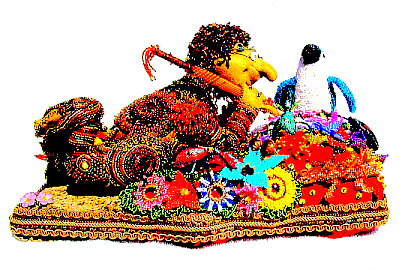
Create a Beaded Art Doll by manipulating beads and forms into an imaginative tactile and visual 3-dimensional representation of this year’s theme: Transformations .
And then writing a Short Story (between 1000-2000 words) about your Beaded Art Doll, what it represents, and how it was created, starting with the sentence:
“As she turns towards me, her hands no longer seem familiar;
her face, once recognizable, now unexpected;
her aura, a palette of changed colors,
I want to share, but can’t all at once.
She is transforming, before my eyes, as if I wished it to happen,
for whatever reason — fun, mundane or sinister — I’m not sure.
But as she moves and evolves, a special insight occurs to me,
so I name her… “
The Fifth 2013 ALL DOLLED UP: BEADED ART DOLL COMPETITION is offering a first prize of a $1000.00 shopping spree on the Land of Odds web-site (www.landofodds.com), and a Runner-Up prize of a $400.00 shopping spree on the web-site.
Entries will be judged by a panel from The Center for Beadwork & Jewelry Arts. These distinguished Beadwork and Jewelry Artist instructors will judge each doll based on
1. INSIGHT: The Bead Artist’s inner awareness and powers of self-expression through sculptural beadwork, particularly in terms of how well this year’s Competition theme is incorporated into the piece.
2. TECHNIQUE(S):
a. Primarily, how well a particular stitch or stitches (or any other technique for applying the beads and embellishing the doll) is (are) executed within and around the piece.
b. Secondarily, how cleverly the internal structure/form/body of the doll has been created/constructed/chosen in relation to the artist’s goals.
3. USE OF BEADS/BEADING AS ARTISTIC MEDIUM: To what extent the doll may be viewed as a work of “art”, rather than “craft”; has the artist fully utilized the power of the “bead/beading stitch” as a medium for art — an expression of color, light, tactile sense and emotion; to what degree does the piece make you want to view the doll from all sides?
4. VISUAL APPEAL: The overall visual appeal of the doll.
5. QUALITY OF WRITTEN STORY: How well the written short story enhances an appreciation of the Beaded Art Doll, as well as the Artist’s talents in design, insight and implementation.
We Need Submissions!
A Beaded Art Doll is a physical representation in three dimensions, using human figural and expressive characteristics, through the creative use and manipulation of beads. Beads are a unique art medium, allowing multidimensional surface treatment, and phenomenal opportunities for interplay among colors, light, shadow, texture and pattern. Beaded Art Dolls submitted as entries for this Competition should be immediately recognizable as a “Doll” as defined above.
That said, Beaded Art Dolls submitted as entries for this competition may be realistic, surrealistic, whimsical or imaginary. They may be humanistic, animalistic, caricatures, cartoons, impressions or abstractions. The doll may take many forms, including a figure, purse, box, vessel, puppet, marionette, or pop-up figure.
Beaded Art Dolls should be between 8” and 36” in size. The surface area of the doll must be at least 80% composed of beads.
The doll’s internal form and structure may result from many techniques, materials and strategies. The bead stitches themselves might be used to create the skeletal structure. Various forms of cloth dolls might be stitched or embellished with beads. The underlying structure might be made of polymer clay, wood, ceramic, porcelain, Styrofoam, wire, corn husk, gourd, basket weaving, yarns, cardboard, paper, cotton, or some combination of materials. It might be a found form or object.
The Artist is given wide leeway in techniques for how the doll is to be beaded, and may use one particular technique or several. Techniques, for example, may include bead weaving stitches, bead embellishment, bead appliqué, bead knitting, bead crochet, bead embroidery, lampworking. For the 80% of the surface area that must be beaded, these would NOT include the application of rhinestones, sequins, nailheads or studs. The beads may be of any size, shape, color and material. [For the remaining 20%, any material is OK, including rhinestones, sequins, nailheads or studs.]
The Artist may include a doll stand or display support with the Art Doll, though this is not a requirement. This stand or support may be an off-the-shelf piece, or created from scratch by the Artist. It may be a base, a created setting, a decorative box, or frame. The stand or display support need not be beaded.
The Artist may interpret and apply the theme “Transformations” any way she or he chooses. The Beaded Art Doll might be thought of as a plaything; or as a visual representation of a person, feeling, spirit or thing; or as a tool for teaching; or as a method for stimulating emotional development or healing.
As an object of art, the goal of the Doll should be to make a statement, evoking an emotional, cultural or social response, either by the Artist her/himself or by others.
The Doll must be an original work, and may be the work of one Artist or a Collaboration.
Dolls have been a part of human existence for many thousands of years. Whether part of a ritual or part of child’s play, dolls function as symbols for meaning. Sometimes these meanings are broad social and cultural references; other times, these meanings focus on an individual’s relationship with oneself.
ALL DOLLED UP: BEADED ART DOLL COMPETITION is more than a beauty pageant. It is a design competition. The Competition will take into account the Artist’s intentions and how well these are incorporated into the design, both in terms of the use of beads/beading, as well as the construction of the doll’s form.
The Fifth 2013 ALL DOLLED UP: BEADED ART DOLL COMPETITION is offering a first prize of a $1000.00 shopping spree on the Land of Odds web-site (www.landofodds.com), and a Runner-Up prize of a $400.00 shopping spree on the web-site.
In the article Kristof discusses the work of BeadforLife.
Here two women created an economic support system based on the talents of African women who make beads from trash, and the profit-motive — selling the beads in finished jewelry at home parties in America, and reinvesting this money back in the local enterprises in Africa.
Moreover, they developed an educational program about Africa for American schools. The motivation was marketing, but the outcomes far exceed that.
Fascinating story and case study. I meet many people each year who work with local villagers around the world, to help them find markets for their jewelry, better beading supplies for their craft, and strategies for improving productivity in their efforts. Here’s a very full and flushed out operation to learn from.
Wikipedia defines “conceptual art” as “art in which the concept(s) or idea(s) involved in the work take precedence over traditional aesthetic and material concerns.”
Conceptual art, as a movement, has been around a long time, since the 1960’s. But its influence on jewelry has not been as great as with painting or sculpture. Usually conceptual art requires a lot of narrative text and background information, for the viewer to understand what’s going on. Because jewelry is only art as it’s worn, this makes it awkward to have all this textual material tag along with the wearer.
But it is important that artists be able to incorporate conceptual ideas within their pieces, and have these pieces reflect these ideas, as part of the overall aesthetic and appreciation of the piece. How does the artist accomplish this? How does the artist influence how the viewers interpret the pieces and the associated concepts?
Is it sufficient for jewelry to be ‘intellectually stimulating’? Or must it be beautiful and appealing, as well?
If concepts and meanings change over time, is this something the artist can anticipate or control? Or does the artist have to settle perhaps for achieving ‘success’ in the present moment, but ‘failure’ over time?
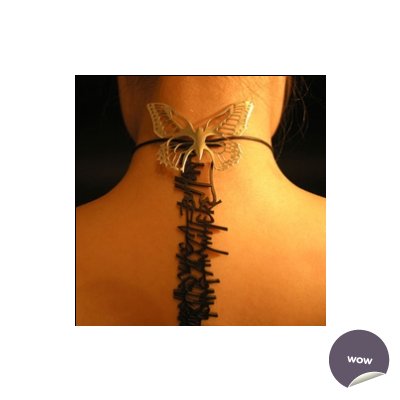
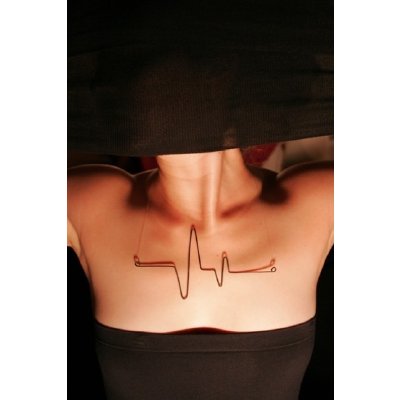
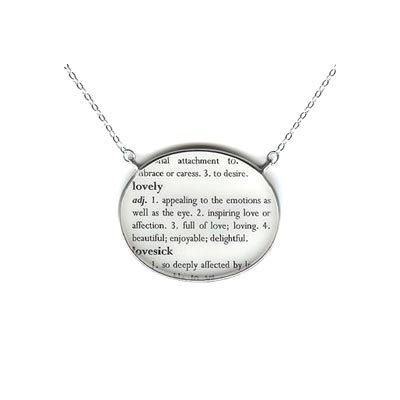
Lahutter lists several items of Concept Jewelry, including these 3:
1. Laura Bezant Jewelry
2. Beats Necklace
3. Definition Necklace
To me, these pieces are more 1-trick ponies, kinda surface’y, not deep, concept but not conceptual. Not subtle, not elegant, good ideas without the resonance associated with good design.
Let’s continue to web-surf.
On this CRAFTHAUS BLOG, there is a long discussion about what conceptual jewelry is, should be, and is not.
One person in this discussion asks, if the piece is still “jewelry”, if you need a narrative contextual explanation of social, political, or otherwise conceptual meanings? Great question. At one point in my life, I had founded and directed The Social Movement Gallery — an art gallery devoted to social and political art. We used the art to trigger social and community discussion and action. But we found that the art lost it’s punch outside the exhibit and its timeframe. Even art about the struggles of women seemed dated one year later, as the discussions and vernacular of these discussions changed as the issue changed with new times and challenges.
Another great discussion of conceptual jewelry and art can be found on this blog Conceptual Metalsmithing. “When we look at jewelry, we don’t see through it to look at the content it contains, we look at it directly. We look at its objectness, we look at its craftsmanship, we covet it, we are seduced by AN OBJECT. If we attempt to communicate or infuse content into our jewelry for the sake of the viewer/wearer we are often thwarted because of the inherent preciousness and objectness of the medium. Further, it will take quite some undoing in order to retrain jewelry viewers to see more than just the jewel.”
To what extent can Jewelry communicate content? Or be made to communicate content?
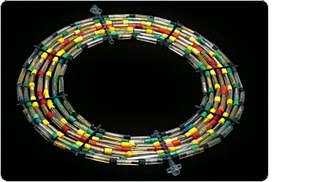
This piece of jewelry is made with discarded pills and capsules, and the artist intends to communicate something about drug use:
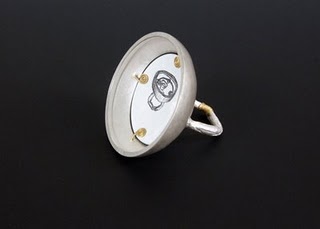
Here, a picture of the ring is inserted into the ring itself. The artist intends to convey a sense of narcissim.
Continuing surfing the web, we encounter many jewelry sites, where the label “concept” is used in a way to show that the artist had some special kind of insight when combining materials and shapes. Should we equate “concept” with “creativity” or “intuitive insightfulness”? Don’t know.
I visited one artist’s website – So Young Park – where she took simple concepts and enfused them with artistic vitality, in some unexpected, yet appealing ways. Her pieces are not there to change minds and move worlds. Her pieces are there to allow the viewer to experience concepts by experiencing the art itself.
Some of her pieces:
1. BLOOMING
2. GLOWING
3. NATIVITY
4. SPROUTING
So Young Park divides her pieces up between “HANDCRAFTED” and “CONCEPTUAL”. So, she loses me here a little bit.
Is she trying to say that one category is more saleable, more wearable, more approachable, and the other category is not? Does Conceptual, then, mean that the piece does not have to be wearable, or as wearable, if it were not?
Her pieces are wonderful, and these two non-conceptual, yet handcrafted necklaces below, earn but a Number. Not a concept. Not a title. They are beautiful anyway. And seem conceptual to me nonetheless. Has the artist a sense of fear by avoiding assigning them a concept or conceptual underpinning? Or is this strategy? Or some sense of good business? Or does the artist view these pieces as without concept? Or where concept should be subordinate to aesthetic and material concerns?
No. 155
No. 149
Sorry, I think if you call yourself a Jewelry Designer, and see the works you create as resulting from a sense of design, you can’t but not have applied concepts in their creation, and these concepts are at least as equally as important as aesthetic, material or technique.
Has the flow of information on the Internet
affected how we think creatively?
I recently finished reading a compilation of scientific studies on this subject. Some scientists say No, and others say Yes, without any definitive coalescing of ideas on this subject. But the subject is intriguing, nonetheless.
As a Jewelry Designer, do we think through our projects and our artistic lives differently today, than say, we would have 20 years ago before the Internet? Has the Internet changed your way of thinking as a Jewelry Designer?
Here’s what the Internet might do to our thinking:
1. Attention Span
Supposedly out attention spans are shorter, and we expect things to come to us in smaller bits or packages. Do we find, as a Jewelry Designer, it getting more difficult to stay focused on one thing, one theme, one technique, for too long before bopping off to something else? Have our projects become simpler, less embellished, more dependent on a spectacular clasp or a particular gemstone, to the detriment of other “design” possibilities within the rest of the piece?
Or have we learned to be more “liquid” in our thinking, able to take in more facts, more ideas, and organize these more coherently? Do our Jewelry Designs emerge from greater control over more ideas, and ideas coming and changing faster? Is this more intricate complexity? Are we more able to incorporate ideas cross-culturally and cross-nationally? Are we able to design more, for more?
2. Information Overload
The Internet is a chaotic collection of boundless information. Are we too aware of too many styles, materials, techniques, fashions, trends? Is our ability to draw with billions of colors on a computer screen paralyzing when it comes to choosing among the more restrictive colors of available beads? Do we seem to end up with more unfinished projects, because we don’t have enough time to start the next new idea, if we finished? Do we end up buying too many materials and too many types of materials because we’re less and less sure what will be relevant when, and because we keep findings out about new materials and new techniques and new fun things to do and with which to experiment? Do we too often try to mix media within our pieces, to the success of none of the different types of materials? Does all this information become paralyzing to the extent that it halts us from working on our designing and making?
Or, do our designs seem more coherent, more integrated, sexier because we have more information available to make us think, keep us aware, help us integrate complex ideas? Are we more willing to do and more successful in doing multi-media projects? Does mastery over more ideas make us feel more powerful, more motivated, more experimental?
3. Time Wasted on Email, Facebook, Twitter and the Like
We spend more and more time socially interacting on-line. Do you find spending time on emails, message boards, forums, facebook, twitter and the like is time you could have spent on designing and making jewelry? Is a lot of this time redundant, goal-less, wasteful? Does time spent with these online social networks end up pulling you in even more directions, than if you were not so socially connected?
Or, does the time spent here help you design better, or help you sell your pieces better, or make you a better consumer of the parts you use in your pieces? Do you feel you can problem-solve faster with this broader access to more people and more frequently? Does this broader access help you narrow down your choices to a manageable few?
We are used to getting information in small bits, scanning tons of information briefly and superficially, and making choices based on insufficient information — no analysis, no indepth questioning, in very disconnected ways. Are you less interested in finding meaning, history, depth in the designs, techniques or materials that you use? Are your designs becoming more simple or straightforward or less challenging? Do you care less about your pieces beyond following a set of steps and completing your projects? Do you feel that the title “Jewelry Designer” has less credibility, less currency, less status, less importance relative to your work designing jewelry? Do you think less about the place of your jewelry in the world? Is it less important that your jewelry resonate with feeling, or impact people’s lives? Are you less interested in references from the vintage or traditional past, and overly concerned with the “hot” idea of the moment?
Or, do you feel more forced or encouraged to try more difficult and challenging designs? Does the Internet make you ask more questions of your work and find more relevant information – history, culture, personality, fashion – and the like? Are you more likely to contemporize traditional designs, revitalize vintage pieces, or adapt traditional techniques?
5. More Confidence, Less Continued Confidence
The Internet gives us a sense of power and place, but it is very fleeting. Do you feel more important, more established, more credible because you have your own website or are selling on Etsy? But do you, at the same time, feel this confidence and credibility is more fragile, more easily challenged, more here today and gone tomorrow? Does selling your pieces on line make you feel stronger, more powerful, more relevant than selling your pieces in a local store? But at the same time, does selling on line make you feel more vulnerable, less established, more easily and likely to be challenged by many people around the world?
Or, do you see the Internet as opening up new markets for yourself that you can conquer, ad infinitum? Has it motivated you to do things where before you felt stuck or afraid?
6. More Competitive With Time
The speed of information on the Internet is much faster than the ebb and flow of information and time around you. So do you feel, in today’s world, it is much more difficult to keep up? Do fashions, styles and techniques change faster than you can adapt to these changes? Do you feel your competitive market getting further and further from you, at a faster and faster pace? Do you feel your Jewelry Designs, and your strategies for selling these designs, become “yesterdays” all too quickly?
Or, does the rapid pace of the Internet, somehow set a more rapid, directed pace for yourself? Do you see more possibilities, and feel more motivated to keep up with them? Do you see time as a challenge, and go for it? When we see the term “hyperlinked”, are we more apt to focus on the “linked”, rather than the “hyper”?
The Internet may make it seem that the framework for good jewelry design is somehow larger. The information more extensive. And changing. Very rapidly. There seem to be fewer clues on how to weed through all this information, to reject what is irrelevant or unnecessary. It feels too easy to get caught up in this ever-speeding-up whirlwind of stuff.
The Good Jewelry Designer will continue to learn the fundamentals and make choices accordingly. We always want to let in the environmental influences around us. But these influences still need to be managed. As always.
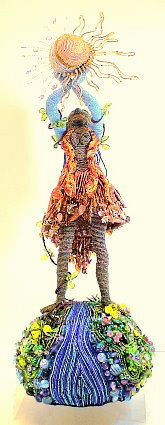
Artists around the nation were asked to create a Beaded Art Doll by manipulating beads and forms into an imaginative tactile and visual 3-dimensional representation of this year’s theme:Earthen Mother .
And then writing a Short Story (between 1000-2000 words) about your Beaded Art Doll, what it represents, and how it was created, starting with the sentence:
“The mirror reflects more than my hands can feel.
Lines, edges, shadings, a weariness under the eyes, an awkward stance.
Yet, not reflected is a certain vibrancy —
a compassion and wisdom and wonder so many people rely on.
Only you, my beaded art doll,
capture the fullness of me as I age in place .
You embody changes I want to make, so I aptly name you…”
The Fourth Bi-Annual 2009 ALL DOLLED UP: BEADED ART DOLL COMPETITION is offering a first prize of a $1000.00 shopping spree on the Land of Odds web-site (www.landofodds.com), and a Runner-Up prize of a $400.00 shopping spree on the web-site.
Our SemiFinalists:
Kathy Ford, Deep Gap, North Carolina
Vera Fox-Bond, LaVergne, Tennessee
Cathy Helmers, Dayton, Ohio
Ralonda Patterson, Decatur, Texas
Dot Lewallen, Westerville, Ohio
Joan Cromley, Sedro Woolley, Washington
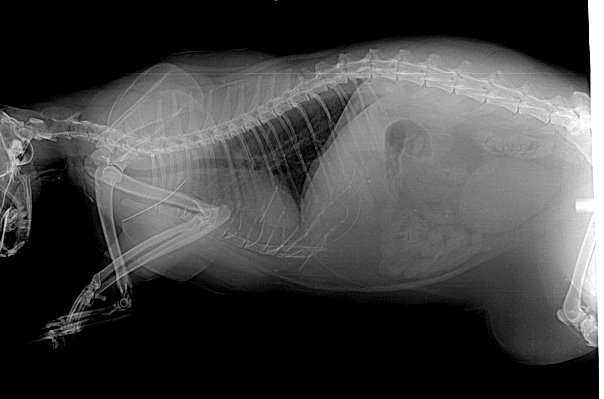
Cleo is a cat owned by one of our customers. She has a propensity, or is it proclivity, or is it pronounced desire for, or something which attracts her to beading needles. It turns out that cats especially are attracted to things like beading needles….And they swallow them.
I’m sure they have the mechanical physics wrong in their brains — after all, cats aren’t specifically trained in physics. Because instead of passing all the way through their digestive systems — like other things they eat that they are not supposed to — beading needles pass through the esophageal walls, and lodge into other organs, muscles and bones.
Here is one of Cleo’s recent X-rays. You can see the needle on the left side of the image, near her heart.
So, do you know where all your beading needles are today? Be sure to keep them out of sight of your cat.
The Illustrative Beader:
Beaded Tapestry Competition Deadline 8/31/2011 Download Official Rules
by Land of Odds, Be Dazzled Beads, The Open Window Gallery, and The Center for Beadwork & Jewelry Arts
CALL FOR ENTRIES
The Illustrative Beader:
Beaded Tapestry Competition
Create a Beaded Tapestry by manipulating beads, cloth and fibers into an imaginative detailed, tactile and visual representation of this year’s theme:Mystery Genre Book Covers .
And then write a short Artist Statement (between 1000-2000 words) about the general story-line of the book which the cover represents, how you made choices about what things to include on your cover, the materials and techniques you used in creating your book cover tapestry, and your strategies for adding a sense of dimensionality to the book cover tapestry.
The First Bi-Annual 2011 THE ILLUSTRATIVE BEADER: BEADED TAPESTRY COMPETITION is offering a first prize of a $1000.00 shopping spree on the Land of Odds web-site (www.landofodds.com), and a Runner-Up prize of a $400.00 shopping spree on the web-site.
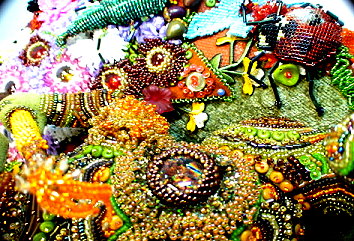
Here we use the concept of “Tapestry” in its broadest sense as a stitched, sewn and/or woven wall hanging. Your tapestry may be woven, loomed, stitched, quilted, cross-stitched, crocheted, knitted, sewn, braided, knotted, embroidered, macramed, beaded and the like. Your tapestry will combine fibers/threads/and/or cloth and beads in some way, and must consist of at least 70% beads. Beads may form the background canvas of your piece, and/or may be used to embellish your canvas, and/or as fringe, and/or as stitchery covering parts of your piece. Your piece should be mounted or framed in some way, ready for hanging on a wall. Your tapestry may utilize many different techniques. In addition, as a “Mystery Genre Book Cover”, your Beaded Tapestry should woo and entice the viewer to want open that cover and read the book!
Entries will be judged by a panel from The Center for Beadwork & Jewelry Arts. These distinguished Beadwork and Jewelry Artist instructors will judge each beaded tapestry based on
1. INSIGHT: The Artist’s inner awareness and powers of self-expression through needle arts and stitchery, fiber arts and beadwork, particularly in terms of how well this year’s Competition theme is incorporated into the piece.
2. TECHNIQUE(S):
a. The range of techniques employed within the piece, and how these are combined and executed.
b. The degree the Artist is successfully able to incorporate 3-Dimensional elements and give depth to the finished piece — layering, embellishment, embroidery, movement, optical effects, color tricks, shapes, textures, patterns, and other structures
c. The strategic and parisomonious placement of visual elements throughout the piece
d. The details — how creatively, strategically, and to what extent story details are presented within the Tapestry
3. USE OF BEADS/BEADING AS ARTISTIC MEDIUM: To what extent the Beaded Tapestry may be viewed as a work of “art”, rather than “craft”; has the Artist fully utilized the power of the “bead” as a medium for art — an expression of color, light, shadow, tactile sense and emotion
4. VISUAL APPEAL: The overall visual appeal of the Beaded Tapestry, and how well it tells a story and seems to grab the Viewer’s attention and motivate the Viewer to want to, in this year’s case, read the book.
5. QUALITY OF WRITTEN ARTIST STATEMENT: How well the Artist’s write-up enhances an appreciation of the Beaded Tapestry, how it captures the theme, as well as the Artist’s talents in design, insight and implementation.
REQUIREMENTS
A. Length and Width: The Beaded Tapestry may be oriented vertically or horizontally. One dimensional leg should be shorter than the other, but no shorter than 8″. The other dimensional leg should be longer than the other, but no longer than 25″. The relative lengths of the shorter and longer dimensions should approximate The Golden Ratio where the longer side is 1.60 times the length of the shorter side (L=1.6*S). Thus, the smallest possible piece would be approximately 8″x13″, and the largest possible piece would be approximately 16″x25″.
B. Backing and Framing: The Beaded Tapestry should be afixed to a secure backing, from which to attach a hanging mechanism, and which is secure enough to support the Tapestry, as it hangs on a wall. This can be as simple as using a piece of foam core or wood panel, or can be more elaborate. The piece may be supported with a frame, and a paper or cloth backing. Any backing/framing/matting will not be counted in the measurement rules and limitations. Thus, if the Beaded Tapestry were 16″x25″, and a frame and matte resulted in a finished piece that was 20″x29″, that would be OK. If the Tapestry is meant to hang like a curtain on a rod, using backing would be optional, depending on whether the backing will help or hinder your piece.
C. Hanging Mechanism: The Beaded Tapestry should have all the mechanical attachments affixed to the backing/frame that allow it to be hung. This might be picture wire strung across the back, or a picture hook, or a dowel that slides through the piece at the top like a curtain.
D. The Tapestry Canvas: The Beaded Tapestry will work off a canvas of some sort. What this canvas is and how it is created, would be up to the Artist. The canvas might be loomed (or stitched in some way) with threads, other fibers, cloth, or beads, or might be a stretched cloth, or might be some kind of surface (or webbing, netting or string-curtain) off of which to work your Tapestry, like bead embroidery off of ultra-suede.
E. The “Cartoon”: The cartoon is the designed image/sketch for your piece. This image should be original, and not have been submitted to any other contests or competitions. The judges are especially interested in how you transfer your cartoon to your tapestry, how you incorporate details, and how you bring dimensionality to your piece. The cartoon, thus final Tapestry as well, must include the Title of your chosen book.
F. The Use of Beads and Fibers: Beads must comprise at least 70% of the the surface of your Beaded Tapestry. A bead is an object with a hole in it. It may be applied to the Tapestry with stitching or sewing. It may be glued. It may be wired. It may be encapsulated. Your final Tapestry may be done with 100% beads, or with a mix of beads and fibers. The judges are especially interested in seeing a mix of techniques within your piece.
G. Relating Your Tapestry To This Year’s Competition Theme – Mystery Genre Book Covers
1. Based on a real book: Your Book Cover must relate to a real, published book.
2. Interpretation of Cover Design must be your own. While it’s logical that you might use elements from an existing cover, it must NOT be a copy of the book’s existing cover.
3. The Title of the Book must be incorporated into your Tapestry design
4. Your Artist statement should reference the book’s title, author, publishing company, and date of publication.
5. “Mystery Genre” refers to fictional and non-fictional books which deal with the solving of a crime.
H. The Artist’s Statement: Write a short Artist Statement (between 1000-2000 words), covering the following topics:
1. List the Title of your book, the author, the publishing company, and date of publication.
2. A synopsis of the general story-line of your book. Tell us the story progression. Highlight key characters including the hero or heroine, the victim, clues, mysteries, double-entendres, the murder weapon, the solution/resolution and the like.
3. Why did you choose this book?
4. How did the story-line influence you in your book cover design choices? What details did you decide to highlight on the tapestry? What details in the story line did you decide Not to highlight on the tapestry?
5. What materials did you use to create your book cover tapestry, backing and framing, hanging mechanism, canvas?
6. How did you transfer your Cartoon sketch to your finished Tapestry?
7 . What techniques did you use in creating your book cover tapestry
8 . What were your strategies for creating the Title on the tapestry — fonts, sizes, materials, placement/positioning?
9 . What were your strategies for adding a sense of dimensionality to your book cover tapestry?
I. Your Book Cover Tapestry may be done either as an individual or as a collaboration. If a collaboration, please list all the “collaborators” with your submission. Identify one person of the group to be the lead and contact person.
We Need Submissions!
A Tapestry is a form of textile art, traditionally woven on a vertical loom, and composed of two sets of interlaced threads. Threads running parallel to the piece create the tension. Threads running back and across along the width create the pattern or image. It is these threads which show in the traditional tapestry. Tapestries were very portable. They could also be draped on the walls of castles for insulation during winter. They could be hung as decorative interior elements and displays of wealth. The “Cartoon” — that is, the design image — ranged from the purely decorative to tales of heroicism, mysticism, or religiosity. Often, to make these loomed pieces feel more 3-dimensional, they were embellished with beads, pieces of glass, and pieces of mirrored glass, which would create fascinating interplays with light. The beads might be used to create border fringes, or might be sewn into or embroidered onto the tapestries themselves.
In our The Illustrative Beader: Beaded Tapestry Competition, we define the idea of a “Tapestry” very broadly, to include any stitched, sewn and/or woven wall hanging which combines some kind of fiber and beads. Fiber might consist only of the threads used to stitch the beads, or it might include quilted materials, yarn, cord, of anything that might broadly be called Fiber. The Tapestry might be loomed with fibers and embellished with beads. It might be loomed with all beads. The Tapestry does not necessarily have to be loomed in the traditional sense. It might also be knitted and embellished with beads, or quilted or cross-stitched or crocheted or braided and somehow combined with beads. The Tapestry canvas might begin with stretched, appliqued, or quilted cloth. The surface area of the finished Tapestry must be 70% made from beads.
THE ILLUSTRATIVE BEADER: BEADED TAPESTRY COMPETITION: is more than a beauty pageant. It is a design competition. The Competition will take into account the Artist’s intentions and how well these are incorporated into the theme, the design, the materials, the use of techniques, the use of details and elements which create dimensionality.








 GROUP
GROUP