

An authentic life is a limitless life.
So what prevents so many jewelry makers and other artist types from living their authentic lives? What prevents so many designers from making choices and taking advantage of opportunities which are not limited by anyone — not limited by friend or family or boss or colleague or perceptions of cultural and social norms?
Aloise was sitting there, fidgeting, only half listening to the discussion in my class about jewelry design, when, suddenly, unusually with a forceful voice and expression, she said, No one likes her stuff. No positive feedback in response to seeing any of her necklaces or bracelets or earrings. She loved her designs, she stated plainly, convincingly. But no one else seemed to. Her designs did not resonate with her friends and the people around her. She loved making jewelry. She loved her style. She loved the pieces and materials she was using. But, because of the nil-to-negative feedback, she never felt authentic as an artist.
If you saw her pieces, you would immediately come to the conclusion that there was no reason for the negative feedback, except, perhaps, that her pieces did not reflect the current fashion. Well conceived. Well-made. Clearly a point of view.
My response to her was simple: They are not the judge, you are. The problem for you is not your design skills. The problem is that you need to either to connect with a different audience, or, much more difficult, you need to learn how better to express what makes sense and has value for you in your own jewelry design work to your current audience. It’s like thinking your design process out loud — how you made choices about materials, techniques and composition.
Design Is A Tool For Expressing Authenticity
Authenticity and design are integral to each other. Design is a tool for expressing your authenticity. You will have difficulty feeling and expressing your authentic self in public without reference to good design. And, ultimately, you can’t have good design without an ability to express your authentic self. Cannot have one without the other.
Authenticity means conveying a sense of your being genuine. Real. True to your values. Consistent and coherent in how you relate your inspiration to your aspiration when creating a piece of jewelry. Then, continuing to be consistent and coherent as you implement your aspiration, understandably making changes and tweaks along the way, into your finished jewelry design. This requires a lot of honesty with yourself. A lot of self-reflection and what is called metacognition. Your jewelry becomes a sincere expression of you and you-the-creator’s vision.
That’s authenticity. The sum of all your choices in the design process. Technical. Artistic. Social. Philosophical. Each piece of jewelry you make is evidence to the world about all the choices you have made. Choices about translating vision into a tangible form. Selection of visual elements, product functionality, technology and technique. Accepting or rejecting client desires and hoped for experiences. Steering your business towards particular ideas about branding. Design can enhance. It can amplify. It can set boundaries. It can increase accessibility. Engage. Impact.
Gennifer refused! She refused to listen to me about how important it is to relate the materials you choose to your design goals. She made wrap bracelets, usually two bands around the wrist. She sold them for $300 each. Took her about 2 hours to make each one. The materials she used were cheap. If the price tag you put on your jewelry has no relationship to the effort and materials you put into it, you’re not being authentic.
A wrap bracelet consists of beads ladder-stitched between two pieces of leather. She used Indian leather, which dries out and cracks easily. Does not hold up. She stitched her beads with fishing line. Fishing line in sunlight and heat dries out and cracks. Very quickly. She used glass beads from China. Glass beads from China typically are a clear bead with a color coating. The side of all her beads along the full almost 20” length of the bracelet which touched the skin had lost their color. Originally black, they were now white with peeling black. No reinforcement was placed on either end, so, on either end, again pretty quickly, the stitching would start to break and the two supporting strands of leather would come apart.
Gennifer’s wrap bracelets probably had $10–12 of materials in them plus two hours of labor. Her $300 price tag was not representative of appropriate design. She should have upped the quality of her materials: Greek leather, Czech glass or gemstone beads, micro bead cord for the stitching. She should have reinforced both ends, such as using a silk wrap technique. Then her pieces would be durable and justify the price tag, and be much more authentic to herself as a designer. Or, she should charge what her pieces are really worth: perhaps $75–100. I’ve yet to meet one of her customers who has gotten more than six months of use out of her pieces. To me, if Gennifer thinks she is being authentic, I’d tell her it’s contrived.
About Authenticity
Authenticity is multiplex. It functions on several planes.
You have material authenticity. Given the value you want to assign to your piece, your choice of materials, and how you leverage them, should be the highest, appropriate quality in durability, sustainability and craftsmanship.
You have technical and technological authenticity. Your choice of techniques and technologies, and how you leverage them, should bring your design to that optimum (sometimes called parsimonious) point of efficiency and effectiveness. That is, that perfect point where you can maintain both shape and suppleness.
There is emotional authenticity. Good jewelry should resonate with the customer. It should evoke genuine emotions in line with your audience’s intended desire(s).
There is cultural authenticity. Good jewelry shows respect and acknowledges any cultural influences and inspirations, when design elements are borrowed or otherwise represented.
There is contemporary design authenticity. In contemporary design, the designer substitutes personal values and understandings for those of traditional socio-cultural norms and values which influence more traditional design. You must always show respect for tradition while concurrently using your own authentic self as the measure and rationale for successful design choices within any designing process. You must overcome pressures to conform and present a curated version of yourself.
Another type is personal authenticity. As a jewelry designer, you always have something to say. It can be simple such as what you think might be beautiful or wearable or appropriate for a certain situation. It might be more complex where you make a series of interrelated choices relating your values and desires to those of your client.
Dilemmas For The Designer
For me, I grew up with both parents and teachers discouraging me from pursuing my creative self through the arts. Doctor or lawyer. Basically, those were the two allowed choices, as I was steered and tracked and encouraged (or discouraged) over all my young and teenage years. [Parents, if your child tells you who they are, support them!]
Finally, in my early 20’s, having achieved some separation from my overbearing career police, I made an attempt for a few years to paint. Pretty. Ok technique. No reflection of who I was as a person except perhaps, in the choice of subject matter. I tried to convey emotions and meanings, but, primarily ended up with pretty paintings to decorate my apartment. Friends and family loved them. Sold a few. But none of this was coming together as a reflection of my authentic self. I was in my 20’s but hadn’t found anything authentic about me.
Twenty years later, when I began to make jewelry, I felt a strong connection. With jewelry, I had to create something meaningful for both myself and my client. Both our understandings. Both our values. Both our desires. Jewelry by its nature requires this kind of dialogue. That challenge stirred me. It forced me to come to grips by reflecting on what I wanted the object I created to be, and how that compared to what someone else wanted. Add on top of this was the fact the design had to account for the fact that the wearer moves around and never wants to look clownish. Jewelry design, under these circumstances, becomes very complex. And, as a result of all this thinking and concerning and anticipating and interacting, my sense of authenticity began to grow and clarify and grow and clarify some more.
From my experiences, and those of my students and colleagues, I can identify several dilemmas and challenges for the designer who wants to find their authentic self and successfully express it through the designing of jewelry.
The originality dilemma. You don’t design in a vacuum. And most certainly, many of the design choices you make have been influenced by other designers around you. Finding a balance between originality and the influence of others can be daunting. But think about it this way. Define ‘originality’ as differentiation. Your authenticity will emerge and shine by the way you differentiate yourself from other designers and influencers.
The art market dilemma. For many of us, we want some level of commercial success. Often this means compromising our integrity as we bow to things like fashion, market trends, client expectations, commercial requirements and limitations. Sometimes, when commercializing what we do, we use the label “authentic” to commodify our jewelry, when we are really stretching the imagination and legitimacy here. The challenge is to find balance between making a living and maintaining true authenticity.
The shared understanding dilemma. Successful design emerges from the insights and applications of the values and desires of the artist in coordination and conjunction with the assumptions, values and desires of the client. That might mean some compromising. Some give and take. Some less authenticity. The designer must decide to what degree personal integrity will be compromised in the design process.
The vulnerability dilemma. Since jewelry must be introduced publicly — for someone to wear, to be exhibited, to be sold, to be collected — the designer, of necessity, must open themselves up. Be exposed. Be given critique and criticism. There is doubt and self-doubt. There is a questioning of whether you are truly genuine. The designer is faced with determining how to overcome feelings of vulnerability and how much ego-self-protection they want to build into what they do.
The evolution dilemma. You grow, you learn, you change over time. What you thought was your authentic self (and all that that meant) earlier in your career may be different than what it is now and how you want to express it now. In a similar way, your authentic self may vary a bit from one context to another. This might result in a tension between the consistency and coherency of your body of work as these relate to your authentic self as you see / feel / sense it in the moment. The designer, in this case, must grapple with whether to change or not, or if so, how much to change. If you are already an established business with a strong brand identity, this becomes especially difficult to deal with. Changing your brand identity is especially hard. You don’t want to be rejected by or confuse your audience.
During my jewelry designing career, all these challenges confronted me. I can honestly say that there is a give and take, from piece to piece that I have designed, between achieving that authentic self, and having to make some compromises. Often, when I find I have had to compromise too much — usually to conform to my client’s wishes — I concurrently design a piece in the abstract, one I can create which majorly resonates with many aspects of my personal authenticity as an artist.
One last point. Look around at all the jewelry available for sale and that people wear. There is a lot of sameness. Standardization. Very machine-made looking. In some sense, lacking in personality and individuality. Infusing your jewelry design with your authentic self helps you differentiate yourself from mass-produced or superficial alternatives.
How someone actually goes about finding and expressing their authentic self varies from person to person. This isn’t a straightforward process. You the designer must be guided by your own self-reflection, empathy and commitment to your core values, beliefs and desires. You must strive to align your choices about design with your inner convictions.
And remember: Rogue Elephants are always authentic. They can be no other way.
_______________________________
I hope you found this article useful. Please consider sharing. Thank you for clicking the CLAP HANDS icon at the bottom of this article.
I’d welcome any suggestions for topics (warren@warrenfeldjewelry.com)
Also, check out my website (www.warrenfeldjewelry.com).
Enroll in my jewelry design and business of craft Video Tutorials online. Begin with my ORIENTATION TO BEADS & JEWELRY FINDINGS COURSE.
Follow my articles on Medium.com.
Check out my books on Amazon.com
Subscribe to my Learn To Bead blog (https://blog.landofodds.com).
Follow my series HOW TO BEAD A ROGUE ELEPHANT.
Visit Land of Odds online (https://www.landofodds.com)for all your jewelry making supplies.
Check out my Jewelry Making and Beadwork Kits.
Add your name to my email list.
_________________________________________________________________
CONQUERING THE CREATIVE MARKETPLACE: Between the Fickleness of Business and the Pursuit of Design

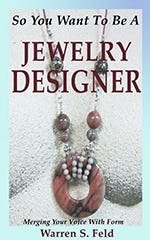
SO YOU WANT TO BE A JEWELRY DESIGNER
Merging Your Voice With Form

Ebook , Kindle or Print formats
The Jewelry Journey Podcast
“Building Jewelry That Works: Why Jewelry Design Is Like Architecture”
Podcast, Part 1
Podcast, Part 2
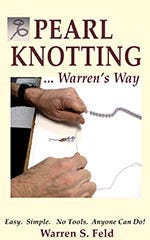
PEARL KNOTTING…Warren’s Way
Easy. Simple. No tools. Anyone Can Do!

SO YOU WANT TO DO CRAFT SHOWS: 16 Lessons I Learned Doing Craft Shows

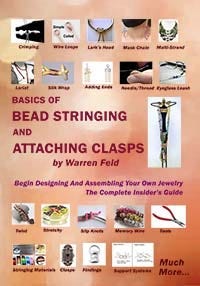
BASICS OF BEAD STRINGING AND ATTACHING CLASPS

___________________________________________