Warren Feld Jewelry

Taking Jewelry Making Beyond Craft

Posts Tagged ‘jewelry design’

So You Want To Be A Jewelry Designer … Becoming The Bead Artist and Jewelry Designer

Posted by learntobead on April 20, 2020

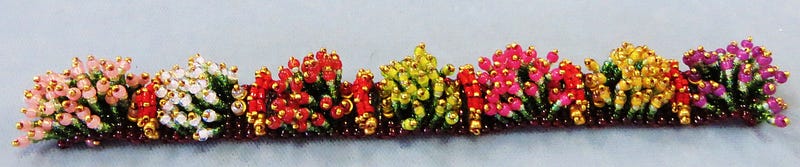
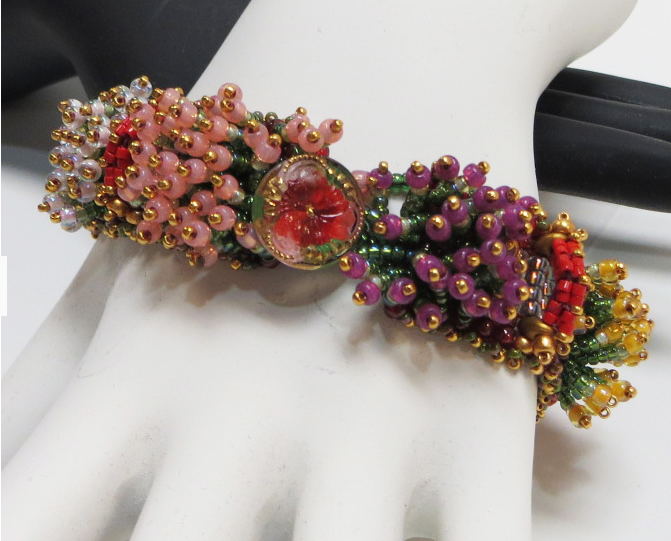
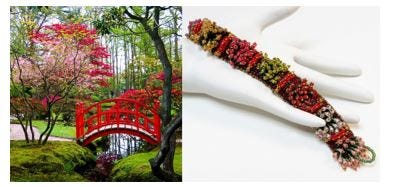
“Japanese Fragrance Garden Bracelet”, piece and inspiration, FELD, 2018

BECOMING THE BEAD ARTIST AND JEWELRY DESIGNER:
 The Ongoing Tensions Between Inspiration and Form

Abstract: As a jewelry designer, you have a purpose. Your purpose is to figure out, untangle and solve, with each new piece of jewelry you make, how both you, as well as the wearer, will understand your inspirations and the design elements and forms you chose to express them, and why this piece of jewelry is right for them. Not as easy as it might first appear. This involves an ongoing effort, on many levels, to merge voice and inspiration with form. Often challenging, but very rewarding.

BECOMING THE BEAD ARTIST AND JEWELRY DESIGNER:
 The Ongoing Tensions Between Inspiration and Form

As a jewelry designer, you have a purpose. Your purpose is to figure out, untangle and solve, with each new piece of jewelry you make, how both you, as well as the wearer, will understand your inspirations and the design elements and forms you chose to express them, and why this particular piece of jewelry is right for them. Not as easy as it might first appear.

You will want the piece to be beautiful and appealing. So you will be applying a lot of art theories about color, perspective, composition and the like. You will quickly discover that much about color use and the use of lines and planes and shapes and so forth in art is very subjective. People see things differently. They may bring with them some biases to the situation. Many of the physical materials you will use may not reflect or refract the color and other artistic effects more easily achieved with paints.

You want the piece to be durable. So you will be applying a lot of theories and practices of architects and engineers and mechanical physicists. You will need to intuitively and intrinsically understand what about your choices leads to the jewelry keeping its shape, and what about your choices allows the jewelry to move, drape and flow. You also will be attentive to issues of physical mechanics, particularly how jewelry responds to forces of stress, strain and movement. This may mean making tradeoffs between beauty and function, appeal and durability, desire and acceptance.

You want the piece to be satisfying and accepted by various wearing and viewing audiences. So you will have to have some understanding of the role jewelry plays in different people’s lives. Jewelry is more than some object to them; jewelry is something they inhabit — reflective of soul, culture, status, aspiration. You will recognize that people ascribe the qualities of the jewelry to the qualities of the person wearing it. You will bring to the forefront ideas underlying psychology and anthropology and sociology, and even party planning, while designing your jewelry or introducing it publicly. You may find the necessity to compromise part of your vision for something socially acceptable, or in some degree of conformance with a client’s taste or style.

BECOMING THE BEAD ARTIST AND JEWELRY DESIGNER

Sometimes becoming a designer begins by touching some beads. Or running a strand of pearls through your hand. Or the sight of something perfectly worn around the wrist, or upon the breast, or up near the neck. Or trying to accessorize an outfit. Or finding something for a special occasion.

Jewelry designers are extraordinarily blessed to do what they love for a living. For many, they have turned a hobby into an avocation into a lifestyle.

But it’s not like a regular job. There are many intangibles. Such as, what exactly is creativity and creative thinking? What are all the things that have to come together to recognize that creative spark when it hits you in your heart, gut or head, and how to translate that into something real, with beauty, with function, and with purpose? How do you mesh your views of and desires for aesthetics and functionality with those of your many audiences — wearer, viewer, buyer, seller, collector, exhibiter, teacher and student?

What exactly does it mean to design jewelry, and how do you know it is the right path for you? This is a tough question. You may love jewelry, but not know how to make it. You may get off on creative problem solving or be a color addict but not know what specific techniques and skills you need to learn, in what organized way, with what direction, leading you towards becoming that better jewelry designer. You may wonder what it means and what it takes to be successful as a designer. You may feel the motivation, but not know what the jewelry designer really has to do each day.

You may be taking classes and getting some training, but how do you know when you have arrived? How do you know when you have emerged as a successful professional jewelry designer? And what are your responsibilities and obligations, once you get there?

THERE IS SO MUCH TO KNOW

There is so much to know, and so many types of choices to make. Which clasp? Which stringing material? Which technique? Which beads? Which strategy of construction? Which silhouette? What aesthetic you want to achieve? How you want to achieve it? Drape, movement, context, durability? How to organize and manage the design process?

And this is the essence of this series of articles — a way to learn all the kinds of things you need to bring to bear, in order to create a wonderful and functional piece of jewelry. Whether you are just beginning your beading or jewelry making avocation, or have been beading and making jewelry awhile — time spent with the material in these segments will be very useful. You’ll learn the critical skills and ideas. You’ll learn how these inter-relate. And you’ll learn how to make better choices.

Everyone knows that anyone can put beads and other pieces together on a string and make a necklace. But can anyone make a necklace that draws attention? That evokes some kind of emotional response? That resonates with someone where they say, I want to wear that! or, I want to buy that!? Which wears well, drapes well, moves well as the person wearing it moves? Which is durable, supportive and keeps its silhouette and shape? Which doesn’t feel underdone or over done? Which is appropriate for a given context, situation, culture or society?

True, anyone can put beads on a string. But that does not make them artists or designers. From artists and designers, we expect jewelry which is something more. More than parts. More than an assemblage of colors, shapes, lines, points and other design elements. More than simple arrangements of lights and darks, rounds and squares, longs and shorts, negative and positive spaces. We expect to see the artist’s hand. We expect the jewelry to be impactful for the wearer.

We want to gauge how the designer grows within the craft, and takes on the challenges during their professional lives. This involves an ongoing effort to merge voice and inspiration with form. Often this effort is challenging. Sometimes paralyzing. Always fulfilling and rewarding.

Jewelry design is a conversation. The conversation in ongoing, perhaps never-ending. The conversation is partly internal and partly external. The conversation is partly a reflection about process, refinement, questioning, translating feelings into form, impressions into arrangements, life influences into choice. It touches on desire. It reflects value and values. Aesthetics matter. Architecture and function matters. People matter. Context and situation matter.

Jewelry focuses attention. Inward for the artist. Outward for the wearer and viewer. In many directions socially and culturally and situationally. Jewelry is a voice which must be expressed and heard, and hopefully, responded to.

At first that voice might not find that exact fit with its audience. There is some back and forth in expression, as the jewelry is designed, refined, redesigned, and re-introduced publicly. But jewelry, and its design, have great power. They have the power to synthesize a great many voices and expectations into something exciting and resonant.

JEWELRY DESIGN: An Occupation In Search Of A Profession

Jewelry design is an activity which occupies your time.

How the world understands what you do when you occupy that time, however, is in a state of flux and confusion, and which often can be puzzling or disorienting for the jewelry artist, as well.

Is what you are doing merely a hobby or an avocation? Is it something anyone can do, anytime they want, without much preparation and learning?

Is what you do an occupation? Does it require learning specialized technical skills? Is it something that involves your interaction with others? Is it something you are paid to do?

Or is what you do a profession? Is there a specialized body of knowledge, perspectives and values, not just mechanical skills, to learn and apply? Do you provide a service to the public? Do you need to learn and acquire certain insights which enable you to serve the needs of others?

Are you part of another occupation or profession, or do you have your own? Is jewelry design merely a craft, where you make things by following sets of steps?

Is jewelry design an art, where your personal inspirations and artistic sense is employed to create things of aesthetic beauty for others to admire, as if they were sculptures? Is the jewelry you create to be judged as something separate and apart from the person wearing it?

Or is jewelry design its own thing. Is it a design activity where you learn specialized knowledge, skills and understandings in how to integrate aesthetics and functionality, and where your success can only be judged at the boundary between jewelry and person — that is, only as the jewelry is worn?

The line of demarcation between occupation and profession is thin, often blurred, but for the jewelry designer, this distinction is very important. It feeds into our sense of self and self-esteem. It guides us in the choices we make to become better and better at our craft, art and trade. It influences how we introduce our jewelry to the public, and how we influence the public to view, wear, exhibit, purchase or collect the things we make.

What Does It Mean To Become A Professional?

At the heart of this question is whether we are paid and rewarded either solely for the number of jewelry pieces which we make, or rather for the skill, knowledge and intent underlying our jewelry designs.

If the former, we do not need much training. Entry into the activity of jewelry design would be very open, with a low bar. Our responsibility would be to turn out pieces of jewelry. We would not encumber ourselves too much with art theory or design theory. We would not concern ourselves, in any great depth, and certainly not struggle with jewelry’s psycho-socio-cultural impacts.

If the latter, we would need a lot of specialized training and experience. Entry into the activity of jewelry design would be more controlled, most likely staged from novice to master. Our responsibility would be to translate our inspirations into aspirations into designs. It would also be to influence others viewing our work to be inspired to think about and reflect and emote those things which have excited the artist, as represented by the jewelry itself. And it would also be to enable others to find personal, and even social and cultural, success and satisfaction when wearing or purchasing this piece of jewelry.

To become a professional jewelry designer is to learn, apply and experience a way of thinking like a designer. Fluent in terms about materials, techniques and technologies. Flexible in the applications of techniques and the organizing of design elements into compositions which excite people. Able to develop workable design strategies in unfamiliar or difficult situations. Communicative about intent, desire, purpose, no matter the context or situation within which the designer and their various audiences find themselves. Original in how concepts are introduced, organized and manipulated, and in how the designer differentiates themselves from other designers.

The designs of artisans who make jewelry reflect and refract cultural norms, societal expectations, historical explanations and justifications, psychological precepts individuals apply to make sense of themselves within a larger setting. As such, the jewelry designer has a major responsibility, both to the individual client, as well as to the larger social setting or society, to foster that the ability for the client to fulfill that hierarchy of needs, and to foster the coherency and rationality of the community-at-large.

All this can happen in a very small, narrow way, or a very large and profound way. In either case, the professional roles of the jewelry designer remain the same. Successfully learning how to play these roles — fluency, flexibility, communication, originality — becomes the basis for how the jewelry designer is judged and the extent of his or her recognition and success.

Why People Like To Bead and Make Jewelry

Most people, when they get started beading or making jewelry, don’t have this overwhelming urge to become a star jewelry designer. On the contrary, fame and fortune as a designer are some of the furthest things from their minds. Most people look to jewelry making and beading to fulfill other needs.

Over the years I’ve seen many people pick up beading and jewelry making as a hobby. They are drawn to these for many reasons, but most often, to make fashionable jewelry at a much lower cost than they would find for the same pieces in a Department store, or to repair jewelry pieces they especially love. When you start with the parts, and the labor is all your own, it is considerably less expensive than the retail prices you would find in a store for the same pieces.

Some people want to make jewelry for themselves. Others want to make handmade gifts. Giving someone something of great value, that reflects a personal expression of creativity, and a labor of love — you can’t beat it. And everyone loves jewelry.

When people get into beading and jewelry making, they discover it’s fun. They tap into their inner-creative-self. They see challenges, and find ways to meet them. They take classes. They buy books and magazines. They join beading groups and bead societies and jewelry making collaboratives. They have beading and jewelry making parties with their friends. They scour web-sites on-line looking for images of and patterns for jewelry. They comb the web and the various beading, jewelry-making and craft magazines, looking for sources and resources. They join on-line jewelry and bead boards, on-line forums, on-line web-rings, on-line ezines, groups, and on-line blogs. They take shopping trips to malls and boutiques and like little good Agatha Christies and Sherlock Holmes, they spy, looking for fashions, fashion trends, and fashionistas. They attend traveling bead shows. And every town they visit, they schedule some free time to check out the local bead stores and boutiques.

As people get more into beading and jewelry making, some discover that these avocations are not only sources of artistic self-expression, but also have many meditative qualities. They are relaxing. They take your mind off the here and now, and transport you to a very calming place.

Still, for others, beading and jewelry making become a way to earn some extra income. They might be to supplement what you’re making now. They might be ways to generate some extra dollars after you retire. They might be the start of your own business as a designer of jewelry. They might be a sense of independence and self-reliance. Having someone pay you for something you made is often the hook that gets people addicted to beadwork and jewelry making.

Most people, however, are content just to make jewelry. There are no professional Design paths to pursue. They may realize that they are out there somewhere, but don’t particularly care. Or sometimes they are unfamiliar with or can’t see all the possibilities. Perhaps they get stuck. No mentor, no book, no magazine, no project to entice them or spark an interest in something more than what they are doing now.

For those fewer people, however, who get a whiff of what it means to design jewelry, and jewelry which resonates, well, what a trip they are in for.

Do You Chase The Idea or The Material?

It is important up front to ask yourself, as a jewelry artist, what is more important to you: the piece of jewelry itself, or the reason why it was made? The idea? Or the material object?

The idea is about cause and effect. How the inspiration resulted in choices about colors, materials and techniques. How the artist’s intent is revealed through choices about composition, arrangements and manipulation of design elements. How the jewelry relates to the person and to the body? How the artist anticipates how others will understand whether a piece is finished and successful, and whether the piece incorporates these shared understandings into the choices made about design.

As solely a material object, the jewelry so designed shies away from resonance. It becomes something to be judged apart from the wearer. It too often gets co-opted by global forces tending towards standardization and same-old-same-old designs. The designer’s mastery is barely referenced or attended to. The designers voice is reduced to noise. The very real fear is that, with globalization and standardization, the designer’s voice will no longer be needed.

Jewelry as idea fosters communication and connection between the artist and his or her various audiences. It bridges thinking. It bridges emotion. It bridges social, cultural and/or situational ties. It goes beyond simple adornment and ornamentation. It becomes interactive, and emerges from a co-dependency between artist and audience, reflective and indicative of both.

Analyzing reasons, finding connections, and conceptualizing forms, components and arrangements are the primary functions of jewelry designer survival.

Otherwise, why make jewelry? Why make something so permanent to reflect your inner motivations, efforts, even struggles, to translate inspiration into this object? Why make something wearable, especially when each piece is usually not worn all the time? Why make something that might have such an intimate relationship with the body and mind? Why make something that can have real consequences for the wearer as the jewelry is worn in social, cultural or specific situational settings?

The Challenging Moments

Developing yourself as a jewelry designer has several challenging moments. You want to maintain high expectations and goals for yourself, and see these through. Some challenging moments include the following:

1. Learning your craft and continually growing and developing within your profession

2. Recognizing how jewelry design goes beyond basic mechanics and aesthetics, thus, differs from craft and differs from art, and then learning and working accordingly.

3. Getting Inspired

4. Translating Inspiration into a design

5. Implementing that design both artistically and architecturally by finding that balance between beauty (must look good) and functionality (must wear well)

6. Organizing your work space and all your stuff

7. Managing a design process

8. Introducing your pieces publicly, and anticipating how others (wearer, viewer, seller, marketer, exhibitor, collector, teacher, student, for example) will desire your pieces, as well as judge your pieces as finished (parsimonious) and successful (resonant)

9. Infusing your pieces with a sense of yourself, your values, your aesthetics, your originality

10. Developing a fluency and flexibility when working with new materials, new techniques and technologies, and new design expectations, including well-established ideas about fix-it strategies when confronted with unfamiliar situations

11. Differentiating your jewelry and yourself from other jewelry designers

12. If selling your pieces, then linking up to and connecting with those who will market and buy your pieces

Some Bottom-Line Advice For The Newly Emerging Jewelry Designer

Always keep working and working hard. Set up a routine, and do at least one thing every day.

Find a comfortable place to work in your home or apartment. Develop strategies for organizing the projects, your supplies and your tools, and for keeping things generally organized over time. But don’t overdue the organizing thing. A little chaos can be OK, and even, sometimes, trigger new ideas.

Give yourself permission to play, experiment, go down many paths. Everything you work on doesn’t have to meet the criterion of perfection, be cool, or become the next Rembrandt. A key part of the learning process is trial and error, hypothesis, test, and conclusion. This helps you develop fix-it strategies so that you can overcome unfamiliar or problematic situations, enhancing your skills as a designer.

Don’t let self-doubt and any sense of impending failure take over you, and paralyze you. Designer’s block, while it may happen occasionally, should be temporary. Jewelry projects usually evolve, and involve some give and take, change and rearrangement. Often the time to complete a project can be lengthy, and you have to maintain your interest and inspiration over this extended time period.

Don’t get stuck in a rut. Try new materials. Try new designs. Try new styles. Try to add variation, new arrangements, smart embellishments. Learn new techniques and technologies.

Other Articles of Interest by Warren Feld:

The Jewelry Design Philosophy: Not Craft, Not Art, But Design

What Is Jewelry, Really?

The Jewelry Design Philosophy

Creativity: How Do You Get It? How Do You Enhance It?

Disciplinary Literacy and Fluency In Design

Becoming The Bead Artist and Jewelry Designer

5 Essential Questions Every Jewelry Designer Should Have An Answer For

Getting Started / Channeling Your Excitement

Getting Started / Developing Your Passion

Getting Started / Cultivating Your Practice

Becoming One With What Inspires You

Architectural Basics of Jewelry Design

Doubt / Self Doubt: Major Pitfalls For The Jewelry Designer

Techniques and Technologies: Knowing What To Do

Jewelry, Sex and Sexuality

Jewelry Making Materials: Knowing What To Do

Teaching Discplinary Literacy: Strategic Thinking In Jewelry Design

The Jewelry Designer’s Approach To Color

Point, Line, Plane, Shape, Form, Theme: Creating Something Out Of Nothing

The Jewelry Designer’s Path To Resonance

Jewelry Design Principles: Composing, Constructing, Manipulating

Jewelry Design Composition: Playing With Building Blocks Called Design Elements

Contemporary Jewelry Is Not A “Look” — It’s A Way Of Thinking

I hope you found this article useful. Be sure to click the CLAP HANDS icon at the bottom of this article.

Also, check out my website (www.warrenfeldjewelry.com).

Subscribe to my Learn To Bead blog (https://blog.landofodds.com).

Visit Land of Odds online (https://www.landofodds.com)for all your jewelry making supplies.

Enroll in my jewelry design and business of craft video tutorials online.

Add your name to my email list.

Posted in Stitch 'n Bitch | Tagged: , , , , | Leave a Comment »

So You Want To Be A Jewelry Designer… Discipinary Literacy and Fluency in Design

Posted by learntobead on April 20, 2020

“Canyon Sunrise”, FELD, 2008

DISCIPLINARY LITERACY AND FLUENCY IN DESIGN
An Introduction To This Series of Articles

Abstract: Jewelry Design is an occupation in search of a profession. Long thought merely a craft, or a subset of art, painting and sculpture, we have begun to recognize that Jewelry Design is something more. Jewelry making encapsulates the designer’s anticipation, not only of aesthetic requirements, but also those of function and context, as well. Creating jewelry means understanding how to make strategic design choices at the boundary between jewelry and person. Translating inspirations and aspirations into designs and finished products requires an intuitive, integrative sensitivity to shared understandings brought to the design situation by the artist and all the audiences ultimately invested in the product. The better designer is able to bring a high level of coherence and consistency to the process of managing all this — shared understandings, knowledge and skills, evaluative review, and reflection and adjustment. This is called ‘fluency’ in design. For the jewelry designer, there is a defined set of concepts and principles which revolve around this disciplinary literacy — the professional way of thinking through design, production, communication and critique — and how to be proficient at this. This is what this series of articles is all about.

DISCIPLINARY LITERACY AND FLUENCY IN DESIGN
 
 
Jeremy thought that the only thing he could do in life was design jewelry. He loved it. So it was not a question of “if” or “when” or “how”. But he told me it was always important not to get tricked by fashion. It was mandatory not to seek the trendy object. Not to turn away from that odd thing. And to pay very close attention to the details of how jewelry designers think, act, speak and reflect.

I thought about his advice a lot over the years of my own career as a jewelry designer. The disciplined designer needs to be attuned to the discipline way of seeing the world, understanding it, responding to it, and asserting that creative spark within it.

Yet jewelry design does not yet exist as an established discipline. It is claimed by art. It is claimed by craft. It is claimed by design. And each of these more established disciplines offer conflicting advice about what is expected of the designer. How should she think? How should she organize her tasks? How should she tap into her creative self? How should she select materials, techniques and technologies? How should she assert her creativity and introduce her ideas and objects to others? How much does she need to know about how and why people wear and inhabit jewelry? What impact should she strive to have on others or the more general culture and society as a whole?

In this book series, I try to formulate a disciplinary literacy unique and special and legitimate for jewelry designers. Such literacy encompasses a basic vocabulary about materials, techniques, color and other design elements and rules of composition. It also includes the kinds of thinking routines and strategies jewelry designers need to know in order to be fluent, flexible and original. These routines and strategies are at the heart of the designer’s knowledges, skills and understandings related to creativity, elaboration, embellishment, reflection, critique and metacognition.

At the heart of this disciplinary literacy are the strategies designers use to think through and make choices which optimize aesthetics and functionality within a specific context. These enable the designer to create something out of nothing, to translate inspiration into aspiration, and to influence content and meaning in context.

There are four sets of routines and strategies which designers employ to determine how to create, what to create, how to know a piece is finished and how to know a piece is successful. These are,

(1) Decoding

(2) Composing, Constructing and Manipulating

(3) Expressing Intent and Content

(4) Expressing Intent and Content within a Context

You don’t become a jewelry designer to be something.

You become a jewelry designer to do something.

The question becomes: How do you learn to do something?

How do you learn to be fluent, flexible and original in design? And develop an automaticity? And self-direction?

We call this ‘literacy’. For the jewelry designer, literacy means developing the abilities to think like a designer. These include,

o Reading a piece of jewelry. Here you the designer are able to break down and decode a piece of jewelry into its essential graphical and design elements. This aspect of fluency and literacy is very descriptive.

o Writing a piece of jewelry. Here you the designer are able to identify, create or change the arrangement of these design elements within a composition. Fluency and literacy are very analytical.

o Expressing a piece of jewelry. Here you the designer use the design elements and principles underlying any arrangement to convey content and meaning. Fluency and literacy are very interpretive.

o Expressing a piece of jewelry in context. Here you the designer are able to anticipate, reflect upon and incorporate into your own thinking the understandings and reactions of various client groups to the piece, the degree they desire and value the piece, and whether they see the piece as finished and successful. The designer comfortably moves back and forth between the objective and subjective, and the universal and the specific. The designer analyzes contextual variables, particularly the shared understandings as these relate to desire, and in line with that, thus determining value and worth. Fluency and literacy are very judgmental.

Everyone knows that anyone can put beads and other pieces together on a string and make a necklace. But can anyone make a necklace that draws attention? That evokes some kind of emotional response? That resonates with someone where they say, not merely “I like that”, but, more importantly, say “I want to wear that!” or “I want to buy that!”? Which wears well, drapes well, moves well as the person wearing it moves? Which is durable, supportive and keeps its silhouette and shape? Which doesn’t feel underdone or over done? Which is appropriate for a given context, situation, culture or society?

True, anyone can put beads on a string. But that does not make them artists or designers. From artists and designers, we expect jewelry which is something more. More than parts. More than an assemblage of colors, shapes, lines, points and other design elements. More than simple arrangements of lights and darks, rounds and squares, longs and shorts, negative and positive spaces. We expect to see the artist’s hand. We expect the jewelry to be impactful for the wearer. We expect both wearer and viewer, and seller and buyer, to share expectations for what makes the jewelry finished and successful.

Jewelry design is an occupation in the process of professionalization. That means, when the designer seeks answers to things like what goes together well, or what would happen if, or what would things be like if I had made different choices, the designer still has to rely on contradictory advice and answers. Should s/he follow the Craft Approach? Or rely on Art Tradition? Or take cues from the Design Perspective? Each larger paradigm, so to speak, would take the designer in different directions. This can be confusing. Frustrating. Unsettling.

As a whole, the profession has become strong in identifying things which go together well. There are color schemes, and proven ideas about shapes, and balance, and distribution, and proportions. But when we try to factor in the individualistic characteristics associated with the designer and his or her intent, things get muddied. And when we try to anticipate the subjective reactions of all our audiences, as we introduce our creative products into the creative marketplace, things get more muddied still. What should govern our judgments about success and failure, right and wrong? What should guide us? What can we look to for helping us answer the what would happen if or what would things be like if questions?

ESSENTIAL QUESTIONS ABOUT JEWELRY DESIGN WORTH ANSWERING

As you work your way through the articles in this series, it is important to recognize and understand the larger social and professional contexts within which jewelry design is but a part, and your place in it. Towards this end, I have formulated some essential questions every designer needs to have answers for and have deeper understandings about.

(1) Why are there disciplinary conflicts between art and craft, and between art and design?

(2) How do you resolve tensions between aesthetics and functionality within an object like jewelry?

(3) What is jewelry, and what is it for?

(4) Is jewelry necessary?

(5) What does it mean to be successful as a jewelry artist working today?

(6) What does it mean to think like a jewelry designer? How does this differ from thinking like an artist or thinking like a craftsperson?

(7) How does the jewelry designer know when a piece is finished and successful?

(8) How do you place a value on a piece of jewelry?

(9) Why does some jewelry draw your attention, and others do not?

(10) What does it mean to be a contemporary jewelry designer?

Other Articles of Interest by Warren Feld:

The Jewelry Design Philosophy: Not Craft, Not Art, But Design

What Is Jewelry, Really?

The Jewelry Design Philosophy

Creativity: How Do You Get It? How Do You Enhance It?

Disciplinary Literacy and Fluency In Design

Becoming The Bead Artist and Jewelry Designer

5 Essential Questions Every Jewelry Designer Should Have An Answer For

Getting Started / Channeling Your Excitement

Getting Started / Developing Your Passion

Getting Started / Cultivating Your Practice

Becoming One With What Inspires You

Architectural Basics of Jewelry Design

Doubt / Self Doubt: Major Pitfalls For The Jewelry Designer

Techniques and Technologies: Knowing What To Do

Jewelry, Sex and Sexuality

Jewelry Making Materials: Knowing What To Do

Teaching Discplinary Literacy: Strategic Thinking In Jewelry Design

The Jewelry Designer’s Approach To Color

Point, Line, Plane, Shape, Form, Theme: Creating Something Out Of Nothing

The Jewelry Designer’s Path To Resonance

Jewelry Design Principles: Composing, Constructing, Manipulating

Jewelry Design Composition: Playing With Building Blocks Called Design Elements

Contemporary Jewelry Is Not A “Look” — It’s A Way Of Thinking

I hope you found this article useful. Be sure to click the CLAP HANDS icon at the bottom of this article.

Also, check out my website (www.warrenfeldjewelry.com).

Subscribe to my Learn To Bead blog (https://blog.landofodds.com).

Visit Land of Odds online (https://www.landofodds.com)for all your jewelry making supplies.

Enroll in my jewelry design and business of craft video tutorials online.

Add your name to my email list.
Posted in Stitch 'n Bitch | Tagged: , , , , | Leave a Comment »

WHAT IS JEWELRY … Really?

Posted by learntobead on April 18, 2020

“Tibetan Dreams”, Feld, 2010

Abstract: We create and wear jewelry because we do not want to feel alone. But “not wanting to feel alone” can mean different things to different people. The jewelry artist must have insight here. The artist needs to understand what jewelry really is in order to make the kinds of successful choices about forms, materials, design elements, inspirations, techniques, arrangements, public presentations and exhibitions and the like. There are different frameworks from which the artist might draw such understanding, including the sensation of jewelry as OBJECT, CONTENT, INTENT or DIALECTIC. All these lenses share one thing in common — communication. Although jewelry can be described in the absence of communicative interaction, the artist can never begin to truly understand what jewelry really is without some knowledge about its creation and without somehow referencing the artist, the wearer, the viewer and the context.

WHAT IS JEWELRY, Really?

Simply put, we create and wear jewelry because we do not want to feel alone.

But “not wanting to feel alone” can mean different things to different people. The jewelry designer, in order to make the best choices and the most strategic choices throughout the process of designing a piece of jewelry, requires some detail and clarity here. What does it mean to say that we create and wear jewelry so we do not want to feel alone?

We might want to reaffirm that we are similar (or different) than someone else or some other group or culture. We might want to signal some connection (or disconnection or mal-connection) with a higher power or mystical source or sense of well-being or with some idea, concept or meaning. We might want to express an intent or feeling or emotion.

We might want to differentiate what it means to be yourself relative to something else, whether animate or inanimate, functional or artistic, part of a dialectic conversation with self or other. We might want to signal or differentiate status, intelligence, awareness, and resolution. We might want to separate ourselves from that which is sacred and that which is profane.

Whatever the situation, jewelry becomes something more than simple decoration or adornment. It becomes more than an object which is worn merely because this is something that we do. It becomes more than a functional object used to hold things together. It is communicative. It is connective. It is intentional. And concurrently, it must be functional and appealing and be seen as the result of an artist’s application of technique and technology.

The word jewelry derives from the Latin “jocale” meaning plaything. It is traditionally defined as a personal adornment or decoration. It is usually assumed to be constructed from durable items, though exceptions are often made for the use of real flowers. It is usually made up of materials that have some perceived value. It can be used to adorn nearly every part of the body.

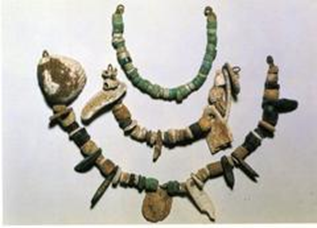
Prehistoric Necklaces 40000 B.C

One of the earliest evidences of jewelry was that of a Neanderthal man some 115,000 years ago. What was it — and we really need to think about this and think this through — which made him craft the piece of jewelry and want to wear it? Mere decoration? Did it represent some kind of status? Or religious belief? Or position or role? Or sexuality and sensuality? Or was it symbolic of something else? Was this a simplified form or representation of something else?

Did this Neanderthal have concerns about craft and technique? Did the making of it require some special or innovative technology? Did the cost of materials come into play? Was this an expression of art? Self? Power? A show of intelligence and prowess? A confirmation of shared beliefs, experiences and values? Was it something he made himself, or was it something given to him as a gift or token of recognition?

Picture yourself there at this very moment. What happened at the point this Neanderthal man put this piece of jewelry on? Did this reduce or increase social and cultural barriers between himself and others? Did this define a new way of expression or a new way of defining the self? Did this impact or change any kind of outcome? Did this represent a divergence between craft and art? Was this piece of jewelry something that had to be worn all the time? Were the purposes and experiences of this Neanderthal man similar to why and how we design and adorn ourselves with jewelry today?

We know that this Neanderthal man was not the last person to wear a piece of jewelry. Jewelry continued in importance over time. Jewelry mattered. It was an object we touched. And it was an object we allowed to touch our bodies. The object had form. The form encapsulated meaning. We allowed others to view the jewelry as we wore it, and when we did not.

Making and wearing jewelry became very widespread about 5,000 years ago, especially in India and Mesopotamia, but worldwide as well. While some cultures banned jewelry or limited its forms and uses (see medieval Japan or ancient Rome, for example), they could not maintain these restrictions over time. People want to support the making of jewelry, the wearing of it, the exhibiting of it in public, and the accumulating of it. People want to touch it. Display it. Comment about it. Talk about it with others. Collect it, trade it, buy it, sell it.

As jewelry designers, we need to understand the why’s … Why make jewelry at all? Why develop different techniques and use different materials and come up with different arrangements? Why do people want to wear jewelry and buy jewelry?

We observe that jewelry is everywhere, worn by all types of people, on various parts of the body, in many different kinds of situations. Jewelry must possess a kind of inherent value for the artist, the wearer, the viewer and the society as a whole.

So we have to continue to wonder, Why is jewelry so coveted universally? Why is it important? How is understanding ‘what jewelry is really’ necessary for making the kinds of successful choices about forms, materials, design elements, inspirations, techniques, arrangements, public presentations and exhibitions and the like?

Let us review the range of definitions and justifications for jewelry before fine-tuning any ideas and conclusions. Each understanding leads us in different directions when filling in the blanks of this constructive phrasing:

Jewelry means to me …..… therefore, 
 These are the types of choices I need to make as a designer 
 to know my pieces are finished and successful, 
 including things like ……… .

These different definitional frameworks about jewelry are things characterized by sensations the jewelry evokes in designer, wearer and viewer.

These frameworks for defining what jewelry really is include,

SENSATION OF JEWELRY AS OBJECT:

1. ROUTINE: Something that we do with little or no reflection

2. MATERIAL: Objects that we use as materials characterized or sorted by design elements, such as color, pattern, texture, volume, weight, reflective and refractive properties

3. ARRANGEMENT AND FORMS: Materials are sorted by various Principles of Composition into arrangements and forms, expressing things like rhythm, focus, and juxtaposition of lines and planes

4. TECHNIQUE: Steps or routines we use to assemble and construct

5. FUNCTIONALITY: Things which have a useful purpose and practicality

SENSATION OF JEWELRY AS CONTENT:

6. MEANING: Things to which we assign meaning(s), especially where such meaning(s) transcends materials, functions and techniques

7. VALUE: Things to which we assign monetary and economic value, particularly materials

SENSATION OF JEWELRY AS INTENT:

8. ORDER OUT OF CHAOS: A sense-making attempt to control and order the world

9. SELF-IDENTITY: An agent of personality

SENSATION OF JEWELRY AS DIALECTIC:

10. INTERACTION AND SHARED UNDERSTANDINGS: A way to create, confirm and retain connections through interaction, desires, and shared understandings

Yet, no matter what the framework we use to try to make sense about what jewelry really is, all these lenses share one thing in common — jewelry is more than ornament and decoration; it is sensation and communication, as well. Although we can describe jewelry in the absence of knowledge about its creation, we cannot begin to understand what jewelry really is without somehow referencing the artist, the wearer, the viewer and the context.

SENSATION OF JEWELRY AS OBJECT

“Tibetan Dreams”, detail, FELD, 2010

Too often, ideas about communication and meaning and intent get too messy and complicated. We seek a simpler framework within which to understand what jewelry is all about. We try to fit the idea of jewelry into the confines of a box we call “object”. It is decoration. Sculptural adornment. Jewelry succeeds as “object” to the extent that everyone everywhere universally agrees to what it is, how it is made, what it is made from, why it was made, and in what ways it is used.

This universality in defining and evaluating jewelry helps us not to feel alone.

Jewelry As Something That We Do. Wearing jewelry might simply be something that we do. We put on earrings. We slip a ring onto a finger. We clasp a necklace around our neck or a bracelet around our wrist. It is habit. Routine. Not something to stop and ask why. A necklace is a necklace. An earring is an earring. We mechanically interact with decorative objects we call jewelry.

Jewelry As A Material. Sometimes we want to get a little more specific and describe what this object or ‘box’ is made of. It is some kind of material. Jewelry encompasses all types of stones and metals, in various shades and colors, and light-impacting properties, which the artist has taken tools to them to shape and sharpen. Sometimes we want to further delineate the character of materials within and around this box. We refer to this as selecting various design elements such as color, pattern, texture.

Jewelry As Arrangements and Forms. Sometimes we want to even further elaborate on our placement of materials within our pieces in terms of Principles of Composition. These Principles refer to arrangements and organized forms to create movement, rhythm, focal point, balance, distribution. We apply this framework in a static way. Jewelry is reduced to an object, somehow apart from its creator and disconnected from any wearer or viewer.

Jewelry As The Application of Technique(s). We can also understand jewelry as object in a more dynamic sense. It is something which is created by the application of one or more techniques. The techniques are applications of ideas often corralled into routines. The object is seen to evolve from a starting point to a finishing point. As object, it is reduced to a series of organized steps. These steps are disconnected from insight, inspiration, aspiration or desire. There is no human governance or interference.

Jewelry As Function and Practicality. In a similar dynamic way, the object may be seen to have function. It may hold up something, or keep something closed. It may, in a decorative sense, embellish a piece of clothing. It may assist in the movement of something else. It is not understood to have any meaning beyond its function. As it coordinates the requirements of form to the requirements of function, it plays a supportive, practical role, not a substantive role. As such, it is unimportant. It might allow the wearer to change position of the necklace on the neck. It might better enable the piece to move with the body. But it should not demand much insight or reflection by creator, wearer, or viewer.

SENSATION OF JEWELRY AS CONTENT

“Tibetan Dreams”, detail, FELD, 2010

However, as we get closer to defining the object as one that is sensed and experienced and which evokes an emotional response, it becomes more difficult to maintain that the object does not reflect meaning, does not result from some kind of thought process and intent, and does not communicate quite a lot about the designer, the wearer, the viewer and the situation. Jewelry when worn and which succeeds becomes a sort of identifier or locator, which can inform the wearer and the viewer about particular qualities or content, such as where you belong, or what you are about, or what your needs are.

Jewelry without content, after all, can skew to the superficial, boring, monotonous, and unsatisfying. Without meaning and value, jewelry has little to offer.

These shared recognitions and valuing of meanings helps us not to feel alone.

Jewelry As Meaning. Jewelry when worn signals, signifies or symbolizes something else. It is a type of recognizable short-hand. It is a powerful language of definition and expression. By representing meaning, it takes responsibility for instigating shared understandings, such as membership in a group or delineating the good from the bad. It might summarize difficult to express concepts or emotions, such as God, love, loyalty, fidelity. It might be a stand-in marker for status, power, wealth, connection and commitment. It might visually represent the completion or fulfillment of a rite of passage — puberty, adulthood, marriage, birthing, and death.

Sometimes, the sensation of jewelry as meaning derives from energy and powers we believe can transfer from the meaning of the materials the jewelry is made of to ourselves. These might be good luck, or good fortune, or good health, or good love, or good faith or protection from harm. Various gemstones, metals and other materials are seen to have mystical, magical and supernatural qualities that, when touching the body, allow us to incorporate these powers with our own.

Jewelry As Value. When we refer to meaning as having power, sacredness, respect, significance, we are beginning to assign a value to it. A sensation of value may emerge from how rare the item is — its material rarity or the rarity of how it was constructed or where it came from or who made it or who was allowed to wear it. It may emerge from how bright it is or the noteworthy arrangement of its elements. Its value may emerge from how pliable or workable the material is. Its value might be set from how tradable it is for other materials, objects, access or activities.

By assigning value, we determine things like importance, uniqueness, appeal, status, need, want, and demand. We establish control over how and how often a piece of jewelry will change hands. We establish some regulation over how individuals in a group, culture or society interact and transact with one another.

SENSATION OF JEWELRY AS INTENT

“Tibetan Dreams”, detail, FELD, 2010

Someone has to infuse the object with all this content, and this proactive act leads us to the idea of intent. Often this imposition of meaning begins with the jewelry artist. Jewelry becomes a means of self-expression. The artist, in effect, tells the world who the artist is, and what the artist wants to happen next.

The artist might be subdued or bold, colorful or monochromatic, simple or complex, extravagant or economical, logical or romantic, deliberate or spontaneous. The artist might be direct or indirect in how meanings get communicated. It is important, in order to understand the meaning of an object, to begin by delineating the artist’s inspiration, aspiration and intent.

The jewelry artist begins with nothing and creates something. The unknown, the unknowable, the nothingness is made more accessible.

The artist fills in a negative space with points, lines, planes, shapes, forms and themes. Color, pattern and texture are added. Things get organized and arranged.

Though often unstated, it becomes obvious that of all the possible choices the artist could have made in design, that some choices were ignored and excluded, while others were not. Some negative space is left so. Some positive space has direction, motion, weightiness. Somethings are abstract; other things realistic. These and related choices have implications and consequences.

The question becomes, what influences that artist’s selections? Successful jewelry reveals the artist’s hand.

Our perceptions of the coherence in the artist’s inspiration and intent, as reflected in our interpretations of that artist’s jewelry, helps us not to feel alone. We may see coherence as a subjective thing or a universally understoodthing. It doesn’t matter which. If we believe we can make sense of things, if the jewelry feels and seems coherent in some way, we feel safe, and that we have reduced the risks in life. We do not feel so left alone.

Jewelry As Creating Order Out Of Chaos. Partly, what the artist does is attempt to order the world. The artist looks for clues within him- or herself (inspiration and intent). The artist formulates concepts and a plan for translating inspiration and intent into a design. The artist determines whether to take into account the expectations of others (shared understandings) about what would be judged as finished and successful.

Jewelry is an object created out of chaos and which has an order to it. The order has content, meaning and value. It has coherency based on color and texture and arrangement.

Jewelry as an organized, ordered, coherent object reflects the hypotheses the artist comes up with about how to translate inspiration into aspiration, and do this in such a way that the derived jewelry is judged positively. The artist anticipates how others might experience and sense the object on an emotional level.

It reflects the shared understandings among artist, wearer and viewer about emotions, desires, inherent tensions and yearnings and how these play out in everyday life.

The artist makes the ordered chaos more coherent, and this coherence becomes contagious through the artist’s choices about creative production and design. The artist lets this contagion spread. To the extent that others share the artist’s ideas about coherence, the more likely the work will be judged finished and successful. And no one — not the artist, not the wearer, not the viewer — will feel alone.

The process of bringing order to chaos continues with the wearer. The wearer introduces the piece of jewelry into a larger context. We have more contagion. The jewelry as worn causes more, ever-expanding tension and efforts at balance and resolution. There is an effort to figure out the original artist intent and ideas about coherence as reflected in design.

Unsuccessful efforts at design, where the artist’s intent becomes obscured, reverse the process, and the object — our piece of jewelry — then brings about decoherence. Decoherence may come in the forms of bad feedback, inappropriate feedback, less than satisfying feedback, or no feedback at all.

Decoherence means the wearer may not get that sense of self s/he seeks. S/he may feel less motivated to wear the piece. S/he may store the piece or give the piece away. As this decoherence filters down to the level of the artist, any necessary support in design may be lost. There will be fewer clients, fewer opportunities to display the works publicly, and fewer sales. The artist’s motivation may diminish.

Jewelry As An Agent of Personality. People wear jewelry because they like it. It becomes an extension of themselves. It is self-confirming, self-identifying and self-reconfirming. Liking a piece of jewelry gets equated with liking oneself, or as a strategy for getting others to express their like for you. Jewelry makes us feel more like ourselves. We might use jewelry to help us feel emotionally independent, or we might come to rely on jewelry for emotional support and feedback, leading us down the path to emotional dependency.

Jewelry may have personal significance, linking one to their past, or one to their family, or one to their group. It may be a way to integrate history with the present. It is a tool to help us satisfy our need to affiliate.

Jewelry may help us differentiate ourselves from others. It may assist us in standing out from the crowds. Conversely, we may use it to blend into those multitudes, as well.

Jewelry fulfills our needs. If we look at Maslow’s Hierarchy of Needs, after meeting our basic physiological needs such as for food and water, and our safety needs, such as for shelter, we can turn to jewelry to meet our additional social needs for love and belonging and self-esteem. Designing and creating jewelry can form an additional basis for our needs for self-actualization.

We may derive our personality and sense of soul and spirit from the qualities we assign the jewelry we wear. We do not merely wear jewelry as some object; more specifically, we inhabit jewelry. If ruby jewelry symbolizes passion, we may feel passion when wearing it. We may use jewelry as an expressive display of who we feel we are and want to be seen as in order to attract mates and sexual partners. We use jewelry in a narcissistic way to influence the alignment of the interests and desires among artist, weaver, viewer, collector, exhibiter, and seller.

In similar ways, we may derive our sense of belief, devotion and faith to a higher power or spiritual being or God from wearing jewelry. It may help us feel more connected to that religious, spiritual something within ourselves. It may remind us to stay on our religious path.

As an agent of our psychological selves, jewelry is used to resolve those core conflicts — Who are we? Why do we exist? How should we relate to other people around us? Jewelry orients us in coming to grips with our self-perceived place within critical contradictions around us. Trust and mistrust. Living and dying. Good and evil. Pleasure and pain. Permission and denial. Love and hate. Experience and expectation. Traditional and contemporary. Rational and reasonable.

SENSATION OF JEWELRY AS DIALECTIC
 
Jewelry As Interaction and Shared Understandings

“Tibetan Dreams”, FELD, 2010

Jewelry is a two-way street. It is a way to create, confirm and retain connections. At its very core, it is interactive and communicative. It is more an action than an object. Jewelry can start a conversation. Jewelry encapsulates a very public, ongoing matrix of choices and interactions among artist, wearer and viewer, with the purpose of getting responses. It is a dialectic.

The optimum position to view jewelry is on a person’s body, where and when its dialectical power is greatest. Again, it is very public, yet concurrently, very intimate. We exhibit jewelry. It forces reaction, response and reciprocity. Jewelry helps us negotiate, in relatively non-threatening ways, those critical tensions and contradictions in life, not merely define them.

It very publicly forces us to reveal our values, delineate tensions and contradictions which might result, and resolve all those betwixt and between qualities which occur as the artist, wearer, viewer, marketer, seller, exhibitor and collector try to make sense of it all. Conversely, jewelry, as worn, may signal that any negotiation would be futile, but this is a dialectic, communicative act, as well.

Jewelry expresses or implies things, the relevance of which emerges through interactions. There is an exchange of meaning. There is some reciprocity between the artist expressing an inspiration with the desire for a reaction, and the wearer evaluating the success of the piece and impacting the artist, in return. We have those coherence-contagion-decoherence behavioral patterns discussed above.

Jewelry is persuasive. It allows for the negotiation of influence and power in subtle, often soft-pedalled ways. It helps smooth the way for support or control. Compliance or challenge. Wealth and success or poverty and failure. High or low status. Social recognition. An expression of who you know, and who might know you. Jewelry is a tool for managing the dynamics between any two people.

Jewelry is emotional and feeling, with attempts by the artist to direct these, and with opportunities for others to experience these. It is not that we react emotionally to the beauty of an object. It is not mechanical or fleeting. It is more of a dialectic. The jewelry is an expression of an artist’s inspiration and intent. We react emotionally to what we sense as that expression as it resonates from the object itself. This resonance ebbs and flows, waxes and wanes, over time as the object is worn in many different situations.

Jewelry draws attention. It becomes a virtual contract between artist and wearer. The artist agrees to design something that will call attention to the wearer and that wearer’s preferred sense of self. The wearer agrees to wear something that reaffirms the artist’s insights for all to witness and experience and draw support.

Jewelry may cue the rules for sexual and sensual interactions. Nurturing and desire. Necklaces draw attention to the breasts. Earrings to the ear and neck. Rings to the hands. Jewelry, such as a wedding band, may confirm a relationship, and signal permission for various forms of touching that otherwise would not be appropriate. The silhouettes and placements of jewelry on the body indicate where it may be appropriate for the viewer to place his gaze, and where it would not.

We don’t feel alone because we have opportunities to have a dialectic experience — a dialogue between self and artist, self and others, self and self — all catalyzed by the piece of jewelry, and our sensation of all the choices that had to be made in order for it to exist, in order for it to feel coherent, in order for it for fulfill desire, and in order for all of this to somehow feel contagious and resonant. We don’t feel alone because the jewelry taps into something inside us that makes us want to wear it, buy it and share it.

Jewelry Ages In Place With Us

Jewelry comforts us as we age in place. The bracelet we got for graduation still worn on an occasion when we are 65. The ring he bought her when she was in her 20’s still worn on the day she passed away.

With jewelry, we will never feel alone as we grow older. As our body changes in pallor and texture. As we gain weight or lose weight. As we change our styles of clothing or hair or activity.

This constellation of material objects, distributed across the human body, reflects transformation, movement, growth, and behavior. These reflect the life we live, and how we lived it. These are a story of how we performed our lives over time. They reveal an otherwise unseen perspective on life as the body ages, and we live through time. They show that not all lived lives have been ad libbed.

The jewelry will also show its age over time. Changes in color, perhaps fading, perhaps becoming duller or spotty. A clasp may have been replaced. The piece may have been restrung. It may have been shortened or lengthened. It may have been worn a lot. Or lost for a while. Or given away. Its associative or symbolic value may have changed.

Jewelry is life performed. Both are observable. Both indicative of our place — our aura — in the world around us as time goes on. Both an experience — often changing — of a point of view from the hand that crafted the piece in the first place, and the desires of the person who wore the piece over time. We possess it and wear it so it reminds us that we are not alone.

Knowing What Jewelry Really Is
 Translates Into Artistic and Design Choices

Knowing what jewelry really is better connects the artist to the various audiences the artist seeks to reach. It results in better outcomes. More exhibits. More sales. More collections. Better self-esteem. Better representation of self in various contexts and situations.

Jewelry asks the artist, the wearer and the viewer to participate in its existence. In a somewhat subtle way, by allowing communication, dialog, evaluation, and emotion, jewelry allows each one not to feel alone. It allows each one to express intent, establish a sense of self, and introduce these intents and self-expressions into a larger social context.

Jewelry judged as finished and successful results from these shared understandings and desires among artist, viewer and wearer, and how these influence their subsequent choices. These choices extend to materials and arrangements. They extend to how the artist determines what is to be achieved, and how the work is talked about and presented to others. These anticipate the reactions of others, beliefs about saleability, assumptions about possible inclusions in exhibitions, knowing what is appealing or collectible.

The artist is always omnipresent in the jewelry s/he creates. The artist, through the jewelry, and how it is worn on the body, to some extent, arbitrates how other sets of relationships interact, transfer feelings, ideas and emotions, reduce ambiguity, influence one another, and make sense of the world around them.

These sets of relationships, through which jewelry serves as a conduit, include:

artist and wearer
 wearer and viewer
 artist and self
 artist and seller
 seller and client
 artist and exhibiter
 artist and collector
 exhibiter and collector

In the abstract, jewelry is a simple object. We make it. We wear it. We sell it. We buy it. We exhibit it. We collect it. But in reality, jewelry channels all the artist’s and wearer’s and viewer’s energy — the creative sparks, the tensions, the worries, the aspirations, the representations, the assessments of risks and rewards, the anticipations of influence and affect. Jewelry becomes the touchstone for all these relationships. It is transformational. It is a manifestation of their internal worlds. An essence resonant in context. A comforting togetherness, inclusion, reaffirmation.

The better jewelry designer is one who anticipates these shared understandings about what makes a piece of jewelry finished and successful, and can incorporate these understandings within the jewelry design process s/he undertakes. Knowing what jewelry really is forms a critical aspect of what sets jewelry design as a discipline apart from that of art or craft. Knowing what jewelry really is and how it helps us not feel alone forms the basis of the professional identity and disciplinary literacy of the jewelry designer.

_________________________________________

FOOTNOTES

(1) Grosz, Stephen, The Examined Life: How We Lose and Find Ourselves, NY: 
 W.W.Norton & Company, 2014.

(2) Pravu Mazumdar, Jewellery as Performance: on Gisbert Stach’s Experiments with 
 Jewellery and Life
, Klimt02, 11/22/2019

As referenced:

Other Articles of Interest by Warren Feld:

The Jewelry Design Philosophy: Not Craft, Not Art, But Design

What Is Jewelry, Really?

The Jewelry Design Philosophy

Creativity: How Do You Get It? How Do You Enhance It?

Disciplinary Literacy and Fluency In Design

Becoming The Bead Artist and Jewelry Designer

5 Essential Questions Every Jewelry Designer Should Have An Answer For

Getting Started / Channeling Your Excitement

Getting Started / Developing Your Passion

Getting Started / Cultivating Your Practice

Becoming One With What Inspires You

Architectural Basics of Jewelry Design

Doubt / Self Doubt: Major Pitfalls For The Jewelry Designer

Techniques and Technologies: Knowing What To Do

Jewelry, Sex and Sexuality

Jewelry Making Materials: Knowing What To Do

Teaching Discplinary Literacy: Strategic Thinking In Jewelry Design

The Jewelry Designer’s Approach To Color

Point, Line, Plane, Shape, Form, Theme: Creating Something Out Of Nothing

The Jewelry Designer’s Path To Resonance

Jewelry Design Principles: Composing, Constructing, Manipulating

Jewelry Design Composition: Playing With Building Blocks Called Design Elements

Contemporary Jewelry Is Not A “Look” — It’s A Way Of Thinking

I hope you found this article useful.

Also, check out my website (www.warrenfeldjewelry.com).

Subscribe to my Learn To Bead blog (https://blog.landofodds.com).

Visit Land of Odds online (https://www.landofodds.com)for all your jewelry making supplies.

Enroll in my jewelry design and business of craft video tutorials online.

Add your name to my email list.
Posted in Stitch 'n Bitch | Tagged: , , , , | Leave a Comment »

Bead Weaving An Arch -The Japanese Fragrance Garden Bracelet Project

Posted by learntobead on April 17, 2020

JAPANESE FRAGRANCE GARDEN BRACELET

PLANNING YOUR PROJECT
 Thinking about the types of choices made for this project

The Japanese Garden Bracelet is a fun project that students love. It is for students who have some familiarity with bead weaving. I had been experimenting with various strategies for bead weaving an “arch” shape (parabolic arch) which can keep its physical shape while the bracelet is worn. Not an easy task. It has required hours and hours of trial and error. The final choices here were influenced by the architecture of Antonio Gaudi, building a column in segments, and then forcing it into a tight arch configuration.

This project is also a good example of how you can use a natural setting for inspiration. This setting influences color choice, color positioning, as well as shape and its placement. This is the image that inspired this piece.

In this fragrance garden landscape, we see the red moon bridge over a glistening pond of water. Commonly used Japanese garden plants that unfurl flowers include peony, chrysanthemum and, near water features, Japanese water iris. Flowering shrubs include azalea, camellia and hydrangea, all of which provide strong winter interest.

We feel that each plant, walkway, stone and other related elements have been deliberately placed, some shaped and others allowed to grow at will. Japanese gardens are designed to express their cultural values and philosophies. The gardens express the fragility of existence as well as time’s unstoppable advance. I believe the Japanese Fragrance Garden Bracelet captures all this.

It is important, I believe, for a contemporary piece of jewelry to have a sense of dimensionality, movement, and a strong use of color. In contemporary pieces, we also want some sense of the violation of straight lines and flat planes.

MANAGING SUPPORT SYSTEMS AND OTHER ARCHITECTURAL ISSUES

Whenever you create a piece of jewelry, it is important to try to anticipate how your choice of techniques and materials might positively or negatively affect how the piece moves and feels when worn, as well as your piece’s overall durability.

Towards this end, it is important to redefine your techniques and materials in architectural terms. The important term or concept we think about when we begin our piece is called a “Support System”. A support system is anything that gives your piece “jointedness”, that is, allows the piece to move easily when worn, and allows the piece to adapt to the negative forces any movement places on your piece, making your piece feel more comfortable to wear and more durable.

The bridges are basically parabolic arches.

Parabolic Arch
Parabolic Arches by Antonio Gaudi

Antonio Gaudi is a famous architecture from Barcelona, Spain. Much of his fantastical work is organized around and supported by parabolic arches.

The arch is made up of a series of stacked stones, each fitted together, then shaped. They way these segments are pieced together supports the shape, and this shape supports the weight of the structures resting on them. I tried to mimic his architectural/construction ideas with bead weaving.

After a lot of trial and error, my “arch” (which is called a “bridge” in this project) is constructed using 2-stack ladder stitch. It is made up of 4 ladder stitched components. Within each component, all the beads need to be very tightly stitched together. Between any two components, the stitched connection needs to be looser. When the bridge is attached to the foundation of the bracelet, a 15/0 seed bead is wedged between each of the 4 ladder stitched components to force that arching shape, and keep that arching shape, no matter the stresses or strains put on the bracelet when worn.

The Ladder Stitch and the Bridge Construction

The bridge is constructed using a 2-drop ladder stitch. “2-drop” means that we pick up 2 beads at a time, and treat them as “one”.

Each 2 beads or drops is referred to as a “stack”.

The ladder stitch is used to connect stacks.

The bridge consists of 4 connected stacks.

The 4 connected stacks are, in turn, connected together into what is called a “Column Segment”.

Each bridge consists of 4 connected Column Segments.

All the beads in any one column segment should be tight enough to “move as one”.

The connection between any two column segments is looser, so they can move somewhat independently, and thus be able to bend into an arch.

STEP:Making the Bridge

Column Segment Component 1 of 4

Start with 3–4’ of thread. Wax your thread.

Pick up 4 COLOR Q (11/0 delicas).

Slide these beads down to one end, leaving 6” tail.

STEP: Create 2 Stacks

Return through the first bead added, and continue through the other three beads to make a circle.

DOUBLE CHECK that you still have your 6” tail.

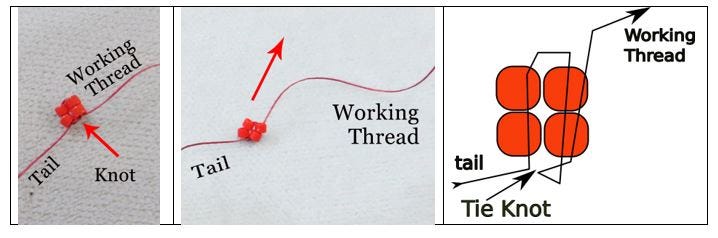
With your fingers, push beads together so that you have 2 stacks of 2 beads side by side.

Take the tail and the working thread and tie an overhand knot. This will make getting started to create your column segment easier to manage.

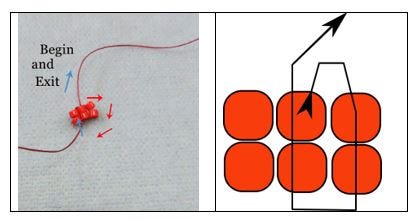
Take your needle through 1 stack so it is exiting the opposite side from the tail.

STEP: Add 3rd Stack, Column Segment One

Pick up 2 more COLOR Q.

Make a “circle” by returning through the opposite side, exiting where you started.

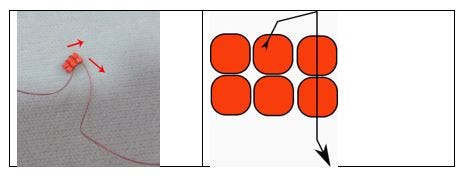
STEP: Secure 3rd Stack

Continue your “circle” through the 2-bead-stack you just added.

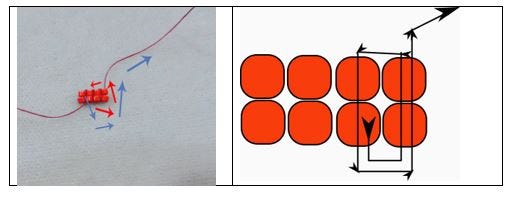
STEP: Add 4th Stack, Column Segment One

Add 1 more 2-bead-Stack.

Pick up 2 beads.

“Circle” back through the previous Stack.

Return through the new stack.

STEP: Connect 4th Stack to the 1st Stack To Finish Column Segment Component

Attach the last Stack to the first to create a column segment.

Fold the stacks so that two stacks are sitting in front of the other two stacks.

“Circle” through first 2-bead stack, back through the last 2-bead stack.

NOTE: If you are not on the opposite side of the tail, keep circling until you are.

Tighten this up.

You are now positioned to add the 2nd column segment to our bridge component.

Create Column Segment 2 of 4

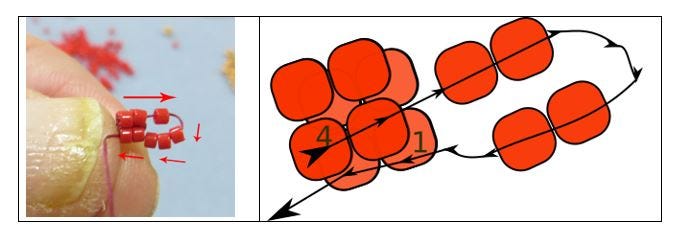
STEP: Create 2nd Column segment

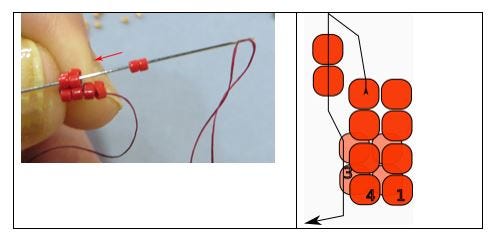
Pick up 4Q.

Return back down the previous stack.
 [Pick up 4 beads]
 [Down 2 beads]

Pull tight.

You should have 2 new stacks sitting on top of 2 existing stacks.

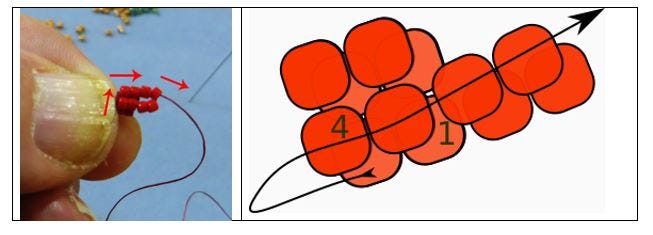
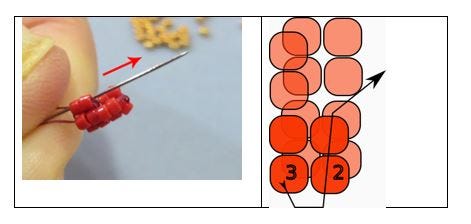
STEP: Return

Return back up the original stack, and the new 2-bead stack.
 [Up 4 beads]

STEP: Circle around two new Stacks

Circle around the 2 new stacks, exiting where you started.
 [Down 2 beads, 
 then up 2 beads]

Pull tight.
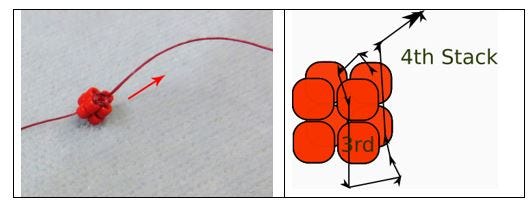
 You can push the new paired stacks towards the first column segment beneath it.

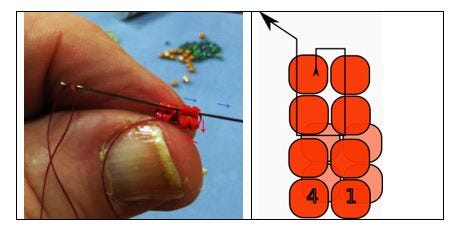
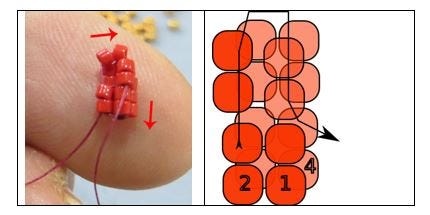
STEP: Add 3rd Stack to 2nd Column Segment

Pick up 2Q.

Return back down through (un-topped) Stack in previous column segment, (in this case, 1st column segment).
 [Pick up 2 beads]
 [Down 2 beads]

STEP: Return

Return up through remaining “untopped” Stack in previous column segment (in this case 1st column segment).
 [Up 2 beads]

STEP: Add 4th Stack to Column Segment 2

Add 4th Stack to 2nd column segment.

Pick up 2Q.

Return through previous stack in new column segment (in this case segment 2)

[Pick up 2 beads]
 [Down 2 beads]

NOTE: Do NOT travel all the way down through column segment one.

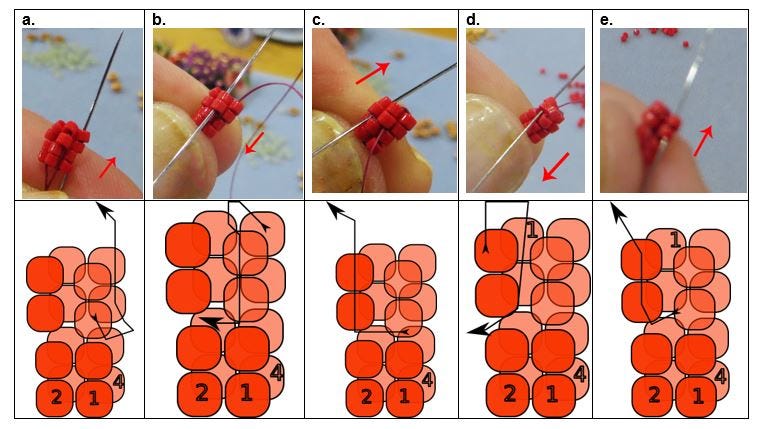
STEP: Secure Stacks

Your thread is exiting the bottom of a 2-bead stack.

a. Return back one more stack to the previous stack. Come up this stack.

b. Come forward one stack. Go down this stack.

c. Go forward and up the next stack.

d. Continue forward, going down the next stack.

e. Return back one stack. Go up this stack.

[BACK ONE, FORWARD THREE, BACK ONE:

Return back one stack.
 Up 2.
 Go forward one stack.
 Down 2.
 Go forward one stack.
 Up 2.
 Go forward one more stack.
 Down 2.
 Return back.
 Up 2
 ]

  • *REALITY CHECK:
     If you created the thread path correctly, all 4 stacks in new segment (in this case segment 2) should be connected.
     You cannot push any stack aside like you would opening a curtain drape.

STEP 29: Add 3rd and 4th column segments

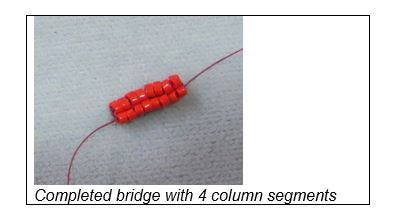
Completed bridge with 4 column segments

Repeat the pattern in STEPS 22–28.

NOTE: Remember: You are securing the new column segment to the previous column segment only.

NOTE: So, when adding 3rd column segment, you begin by picking up 4Q, returning back down 2-bead stack in column segment 2.

DO NOT go all the way back through column segment 1.

Other Articles of Interest by Warren Feld:

Pearl Knotting Warren’s Way

Mini Lesson: Making Stretchy Bracelets

Mini Lesson: Making Adjustable Slip Knots With Thicker Cords

Mini Lesson: How To Crimp

Mini Lesson: Attaching End Caps, Cones, Crimp Ends

Mini Lesson: Brick Stitch

Mini Lesson: Flat Even Count Peyote

Mini Lesson: Ndebele Stitch

Mini Lesson: Petersburg Chain

Mini Lesson: Right Angle Weave

I hope you found this article useful. Be sure to click the CLAP HANDS icon at the bottom of this article.

Also, check out my website (www.warrenfeldjewelry.com).

Subscribe to my Learn To Bead blog (https://blog.landofodds.com).

Visit Land of Odds online (https://www.landofodds.com)for all your jewelry making supplies.

Enroll in my jewelry design and business of craft video tutorials online.

Add your name to my email list.
This Japanese Garden Bracelet is available as a kit from Land of Odds online.

Posted in Stitch 'n Bitch | Tagged: , , , , | Leave a Comment »

How To Bead A Rogue Elephant

Posted by learntobead on April 17, 2020

HOW TO BEAD A ROGUE ELEPHANT

…A Guide For The Aspiring Bead Artist

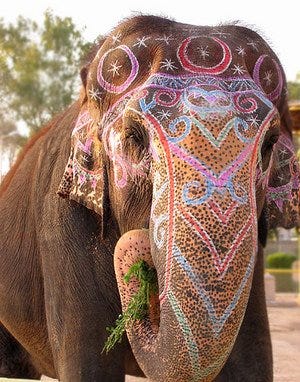
I don’t mean to drag a poor Elephant by its tail, kicking and screaming, into our bead world against its wishes. Nor do I perceive the elephant to be a threat, like you might see an Elephant in the boudoir, or the fine china store. And I don’t want you to shut your eyes and pretend not to notice that this Elephant is here, standing shoulder to shoulder with every beader and jewelry maker around.

The Elephant is not a joke. And the fact that it is “Rogue” makes it more important than ever to figure out why it’s here, among size #10 English beading needles, and Czech size 11/0 seed beads, and Austrian crystal beads. It seems so worldly, yet other-worldly, our Elephant. It’s not our muse. It’s not our Cassandra. It has no secret plan or strategy. It does not depend on its size to make its point. It does not hesitate to stomp and chomp and clomp because the beads before it are raku or glass or gemstone or crystal or metal or plastic. But a Rogue Elephant in the middle of our craft room forces upon us a completely different logic, so that we can make sense of it all.

Only the beader or jewelry artist who is willing to submerge her- or him-self completely in this wonderfully off-centered picture — Rogue Elephant, beads, stringing materials, clasps and all — will really get the fullness of this humor, this wisdom, and the splendor of beading and jewelry making as a form of art that is worn.

And that’s what happened with me. Though not all at once. Struggling excitedly, creative frustration, wondrous illusion — that’s how I would describe my over 30 years stringing beads, weaving beads, combining wire with beads, soldering silver with beads, entangling fibers with beads.

Somewhere along the way I felt that Rogue Elephant staring at me from a distance. I moved closer to him. And all the applications and all the techniques and all the materials and all the making-selling-making-selling-making-selling began to cohere into something very real. Very meaningful. Integrally resonant. I discovered my Rogue Elephant and beaded him.

How do you stop an elephant from passing through the eye of a needle?

Tie a knot in its tail.

The issues and inspirations that drive the artist

This is a fable for all jewelry artists who aspire to become one with Design. How to Bead a Rogue Elephant becomes an evolving tale and collection of personal perspectives and experiences on the issues and inspirations that drive me, and that drive other bead and jewelry-making artist in their designs.

“Design” is the operative word here. A Rogue Elephant does not present an obstacle, nor create any opportunities, for the artist, unless that artist understands, follows through and is committed to Jewelry as an Art Form, and realizes that jewelry is art only as it is worn.

Jewelry as art isn’t a happenstance. It is made up of a lot of different kinds of parts. These must be strategically and thoughtfully brought together. They are brought together as a kind of construction project. The results of this project must be beautiful and appealing. They must be functional and wearable. And this all comes about through design. Jewelry must be designed. And designed it is.

Rogue Elephants are big, and jewelry design is a big task. Rogue Elephants move in unpredictable, yet forceful ways. And jewelry must be designed with movement in mind. Rogue Elephants come with a surface scape, texture and environment, against which the jewelry must look good. And again, good jewelry emerges primarily from the design perspective and the control of the bead, and all the other incumbent parts by the jewelry artist.

Most beaders and jewelry makers don’t get to the point where they can fully answer Why some pieces of their jewelry get good attention, and others do not? They have fun making things. They match outfits. They give gifts. They sell a few pieces. They use pretty beads and other components. And sometimes they get compliments. Other times they do not.

Thus, they don’t necessarily know what to do with the pieces they are playing with. They don’t control these pieces, or the process of combining them. They follow patterns and instructions. And do these again. And again and again. Their artistic goals are to complete the steps and end up with something. They might stick to one or a few techniques they feel comfortable with. There is an unfamiliarity with the “bead” –What is it? Where did it come from? What makes it special as a medium of art and light and shadow? How does it relate to other beads or clasps or stringing materials or jewelry findings? What happens to the bead over time? When they look at the bead, what do they see?

But luckily, beading for many artists is an evolving obsession. This obsession leads them to contemplate the bead and its use. The bead and its use in art. The bead and its use in jewelry. The bead and its relationship to the artist’s studio. Beads are addictive. Their addictiveness leads the beader or jewelry maker to seek out that Rogue Elephant that haunts them along the distant horizon. They know they want to bead it. They’re not sure how. But they steer themselves along the pathway to find out. This pathway isn’t particularly straight, level or passable. But it’s a pathway nonetheless. And the ensuing possibilities for learning and growing as an artist and designer along the way reap many worthwhile and satisfying rewards. I call this CONTEMPLATION.

The first step in this pathway is to figure out how to get started with beads and jewelry making. You need supplies. You need work spaces and storage strategies and understanding how to get everything organized. You need to anticipate bead spills and many unfinished projects. You need to learn to plan your pieces. You need to get a handle on the beads (and all the other pieces), and how to use them. I call this PLAY.

Whatever the reason, most beaders and jewelry makers don’t get past PLAY. They are content following patterns and making lots of pieces, according to the step-by-step instructions in these patterns. They might fear testing themselves against broader rules of artistic expression. They might not want to expend the mental and physical energy it takes to get into design. They just want to have fun. And if they never notice that Rogue Elephant hugging the horizon, that’s fine with them.

At some point, some beaders and jewelry makers will want to start educating themselves to get a little below the surface. Rather than mechanically following a set of steps, or randomly assembling things bead by bead, you want to know more about what is really going on. How do I hold my piece to work it? How do I manage my thread tension? How do I select colors? What clasp might work best? If you find yourself at this point, PLAY is not enough. You need to start DABBLING.

But for those beaders and jewelry makers for whom the Rogue Elephant is very disturbing, no matter how far away he may be, there are these wonderfully exciting, sensually terrific, incredibly fulfilling things that you find as you try to bead your Rogue Elephant, ear, trunk, feet, bodice and all. You learn to play with and dabble with and control the interplay of light and shadow, texture and pattern, dimensionality and perspective, strategy and technique, form and function, structure and purpose. You begin sharing your designs with friends and strangers, perhaps even teaching classes about how to make your favorite project, or do your preferred technique. You might also create a small business for yourself and sell your pieces. Your sense of artistry, your business acumen, your developing design perspective — you need all this, if you are to have any chance of catching up with your Rogue Elephant, let alone beading him. As you begin to evolve beyond the simple craft perspective to one of artistry and then design, you enter the stage I call CREATE.

As your jewelry pieces become more the result of your design intuition and acuity, you begin to wonder how other artists capture, be-jewel, and release their own Rogue Elephants. How did they get started? What was their inspiration? What motivated them to delve into beading, stick with it, and take it to the next level? Do they make their pieces for show or for sale? You begin to recognize how some pieces of beadwork and jewelry are merely “craft”, and others are “art”. You get frustrated with beautiful pieces that are unwearable and fashionable pieces that lack durability and pieces that sell that are poorly constructed. You see many good ideas, some well-executed, but many not. I call this SAFARI.

Part of this SAFARI is historical. And the more recent socio-cultural-artistic history of beading in America is a fantastic tale of curiosity, grit, creative expression, ambition and technological advances in materials. Beading exploded across America in the late 1980s and 1990s and owes much to its many fore-mothers and a few fore-fathers that began their beadwork careers at this time, as well as those who founded the many beadwork magazines so prominent today. The other part of the SAFARI is learning life’s lessons, and incorporating these into beadwork and jewelry making approaches and designs.

As you begin to articulate what works and does not work in various pieces in terms of form, structure, art theory, relationships to the body, relationships to psychological and cultural and sociological constructs, you complete your evolution as a jewelry designer. You add a body of design theory and practice to your already honed skills in art, color, bead-stringing, bead-weaving and wire working. You find and bead your Rogue Elephant. I call this GALLERY HOPPING.

As you compare yourself as Designer to other jewelry designers all over the world, this is partly a personal adventure as you self-experience your intellectual growth as an artist. And it is partly an adventure of evaluating how well other artists have succeeded in this same quest, as well. One very revealing pathway is following how artists contemporize traditional designs. Still another follows the artist who revives vintage styles. Or the pathway that finds the artist elevating fringe, edging, strap, bail and surface embellishment to the same level of “art” as the centerpiece. And yet another pathway which looks at multimedia beadwork, and how artists seek to maintain the integrity of each medium within the same piece. You might explore that pathway which involves collaboration. I call this stage DESIGN MANAGEMENT.

Your adventure along this pathway towards design — your success at beading your Rogue Elephant — is very fulfilling. Whether you walk, run, skip or crawl or some mix of the above, it’s a pathway worth following. You’ve learned to transcend the physicality and limitations of your workplace, tools and supplies. You’ve learned to multi-task and organize and construct your project as if you were architecting or engineering a bridge. You have discovered how to dress and present yourself for success, including strategies for self-promotion. You’re a Designer. You have learned to present yourself and promote yourself as a Jewelry Artist. You’ve evolved as a Beader and Jewelry-Designer and are feeling a true SATISFACTION.

Other Articles of Interest by Warren Feld:

Do You Know Where Your Beading Needles Are?

Consignment Selling: A Last Resort

Odds or Evens? What’s Your Preference?

My Clasp, My Clasp, My Kingdom For A Clasp

Why Am I So Addicted To Beads?

The Bead Spill: My Horrifying Initiation

The Artists At The Party

How To Bead A Rogue Elephant

You Can Never Have Enough Containers For Your Stuff

Beading While Traveling On A Plane

Contemplative Ode To A Bead

How To Bead In A Car

My Aunt Gert: Illustrating Some Lessons In Business Smarts

A Jewelry Designer’s Day Dream

A Dog’s Life by Lily

I Make All The Mistakes In The Book

How Sparkle Enters People’s Lives

Upstairs, Downstairs At The Bead Store

Beads and Race

Were The Ways of Women or of Men Better At Fostering How To Make Jewelry

Women and Their Husbands When Shopping For Beads

Women Making Choices In The Pursuit Of Fashion

Existing As A Jewelry Designer: What Befuddlement!

The Bridesmaid Bracelets

How To Design An Ugly Necklace: The Ultimate Designer Challenge

I hope you found this article useful. Be sure to click the CLAP HANDS icon at the bottom of this article.

Also, check out my website (www.warrenfeldjewelry.com).

Subscribe to my Learn To Bead blog (https://blog.landofodds.com).

Visit Land of Odds online (https://www.landofodds.com)for all your jewelry making supplies.

Enroll in my jewelry design and business of craft video tutorials online.

Add your name to my email list.

Posted in Stitch 'n Bitch | Tagged: , , , , | Leave a Comment »

The New Vintage Fashion Jewelry — Learn To Recognize Quality Pros and Cons

Posted by learntobead on April 17, 2020

THE NEW VINTAGE FASHION JEWELRY

At several jewelry shows over the past 5 years, we have marveled at a continually evolving fashion trend towards reproduction vintage looks using new, more recently available materials.

It is important to understand, however, that, when purchasing fashion jewelry, there is more to consider than how a piece looks. You need to understand something about the materials used and the overall construction. Only in this way can you be sure that you are purchasing what we would call “collectible costume jewelry.”

The reproduction vintage looks are obvious — a reference to the stylish pieces of the 1930s, 40s, 50s and 60s, using modern materials and construction technologies. Great colors. Strong and soft colors. Lots of faceting and sparkle.

The use of new materials includes higher end acrylics, new metallic composites, specialized glass and Chinese crystal.

These green components, in the piece shown above, are made out of Chinese crystal, not plastic. To the naked eye, you might see a similar piece where the components are plastic, looking like but definitely not crystal. The eye can deceive itself. Simple test: click bead against a stiff surface or front teeth. If crystal or glass, you will hear a sharp click; if plastic, you will hear a dull click.

These new fashion pieces should be considered “collectable” costume jewelry. But, again, it is important to understand what you are buying. There are many lower quality copies — what we’d call “disposable jewelry” — you’ll find at discount stores and online. You want to be sure you are buying the quality we would call “collectible”. The price will reflect whether the jewelry is “collectible” or “disposable.”

So, You Want Your Fashion Jewelry To Be Made With…

* Glass, Crystal and/or Advanced Plastics

Typically, you will find a mix of materials within you piece. Materials you do not want would include enameled or colored ceramics or regular plastic or metalized plastic or plastic pearls.

* Advanced Plastics, if any components are plastic

Just like with things like wood or metal, there are many grades of quality among plastics. The differences between advanced plastics and regular plastics can be as widely divergent as between metals like gold and aluminum.

The higher end plastics, even when up close, look very similar to the gemstones or crystals they are meant to resemble. Jade plastic looks like real jade. Plastic opals look like real opal. And so forth.

For high end costume jewelry, the “point-hardness” of these advanced plastics, that is, how easily the material can be scratched, will be much higher, thus less easily scratched, than cheaper plastics.

When you see patterns or designs in regular plastic, these typically are decals applied to the surface, or just under a clear encasing at the surface. With advanced plastics, these patterns or designs flow throughout the entire piece.

  • Better metal composites and finishes, with more substance and realistic finishes

In these lines of jewelry, whether higher end or lower end, very little is real 100% metal these days. The chains are composites. The settings for the stones are composites.

In the metal-composite chains and settings used in the lower quality jewelry, at close inspection, you will find them to be cheap, flimsy and light-weight. The metal finishes flake or wear off quickly. Moreover, the metallic finish-colors are off the mark and look somewhat fake. For example, the actual color that may be representing gold, when compared to other quality pieces, may not look like gold at all. There may be rough spots that can get caught on clothing or scratch the skin.

In higher end pieces, manufacturers check their quality, to make sure there are no rough spots. The durability and the finishes hold up well over time. It is difficult to distinguish the composite from the actual metal it is imitating and approximating.

But always inspect your jewelry before you leave the store. When purchasing any piece of costume jewelry, you should feel all over the piece to be sure there are no rough spots

* Better set stones

Stones are typically glued in. If the setting does not have much surface area, the glue will not hold for very long.

In some pieces, the designs give the illusion of “prong-set” stones. In the lower end, the prongs have very sharp points. In the higher end, the prongs have smooth or balled-up tips.

Things To Do To Increase Longevity Of Your New Fashion Jewelry

After purchasing your new pieces of Fashion Jewelry, you will have the option to do two things to make them more durable and lasting:

  1. If the piece has stones which have been glued in, and have open settings on the backs, apply some more glue to the backs of the settings, all along the edges. Use a glue like E6000 or Beacon 527. This will keep the stones from ever popping out. Reason: The glue manufacturers typically use dries hard, with no flexibility. If the pieces are accidentally dropped or hit against something, the shock can make the stone pop away from the hard glue.

By reinforcing them with the E6000 or Beacon 527, these bonds dry like rubber and act like a shock absorber. Thus the stones are less likely to pop off.

Necklace with stones set in settings with open backs

Open back on set stones in necklace

2. On all areas which have metal plated finishes and which will be touching the skin, apply two coats of clear nail polish to these surfaces. This will preserve the plated finishes for a very long time, yet doesn’t affect the shine or sheen of the metal underneath it.

NOTE: This is very generalized advice. Every person’s body oils and chemistry have different effects on the metal finishes. A person may be able to wear a piece of costume jewelry for months and years and it may not disintegrate on them; another person might wear it for a few months, and the metal finishes deteriorate

3. Unfortunately, much of this jewelry is strung on monofilament (clear fishing line). This stringing material dries out and cracks from exposure to ultraviolet light and heat — basically from sunshine.

If you have the change re-string these pieces on cable wire (which is a flexible, nylon coated stringing wire). Two brands of cable wire I especially recommend are Soft Flex and Flexrite. (Most other brands of cable wire have other issues which make them considerably less desirable to use in jewelry).

Cleaning

All jewelry has to be maintained and kept clean. Follow this simple advice for keeping your new jewelry pieces clean and sparkling.

Periodically, give your jewelry a quick bath. In a bowl, mix a very-little-amount of baby shampoo and cold water. Immerse the whole piece of jewelry in this bath, just long enough to loosen any dirt. Take it out.

Under cold water, rinse it off. Take a paper towel or cloth, and dry the piece off. NOTE: “Pat Dry” with the towel. Don’t “Rub”.

Then, you might take a hair dryer, setting it on the lowest setting, and keeping it 6–8” away from your piece, and blow dry. DON’T LET YOUR PIECES GET TOO HOT. An alternative strategy is to put your piece of jewelry in front of a small fan.

Dry both sides. Leave your piece out in the open air over night, to be sure there is no moisture trapped in closed crevices.

Always remember that the side laying against the towel or cloth may still be more damp than the side facing up. So, before storing your piece, check and be sure it is dry.

Store your piece flat in a zip lock plastic bag. Be sure to push the air out of bag before sealing bag. One simple way to do this is to insert a straw into the bag, and seal the top as close to the straw as you can get. Suck out the air, remove the straw, and finish sealing the zip-lock bag closed.

Then lay your bagged up piece on flat surface. You do not want your piece to be jumbled into a pile. You do not want to hang your jewelry on a stand. The weight of the beads will stretch out the stringing material.

Put your pieces in a cool, dry place out of sunlight. Never store two pieces on top of each other without something to separate them. Don’t pile up jewelry on top of other jewelry.

At a restaurant, if you drip gravy on your necklace, how do you clean it off? If it is something that has caked or dried on it, you may have to soak it in a solution of a very-little-amount of baby shampoo and cold water. Use a q-tip to clean away the spotted areas.

Your Reproduction Vintage Pieces Should Be Around For 30, 40, even 50 years

Your goal is to have your reproduction vintage to be around 30, 40, 50 years from now. It will keep its value. These pieces should not be disposable.

Go to your antique stores, ask to see their vintage jewelry from the 1930s, 40s to 60s, and look and see at the availability, quantity and cost of high-end costume jewelry. This will give you an idea of what you’re getting with your investment.

In these older pieces, some were made from Lucite or other high-end plastics of the time. And other pieces were copies crafted in regular plastic. Lucite is a glass-like acrylic resin. It has a resilience, a hardness, and a malleability which made it perfect for costume jewelry. Regular plastic lacks the clarity and sparkle, yellows with age, and scratches much more easily.

Your new higher-end fashion jewelry — better made, more attractive, more appealing — will increase in value over the decades instead of ending up in the trash.

Other Articles of Interest by Warren Feld:

Oy Ve! The Challenges of Custom Work

The Importance of Self-Promotion: Don’t Be Shy

Are You Prepared For When The Reporter Comes A-Calling?

Don’t Just Wear Your Jewelry…Inhabit It!

Two Insightful Psych Phenomena Every Jewelry Designer Needs To Know

A Dog’s Life by Lily

Copyrighting Your Pieces: Let’s Not Confuse The Moral With The Legal Issues

Jewelry, Sex and Sexuality

Jewelry Design: An Occupation In Search Of A Profession

Teaching Discplinary Literacy: Strategic Thinking In Jewelry Design

Contemporary Jewelry Is Not A “Look” — It’s A Way Of Thinking

Beads and Race

Were The Ways of Women or of Men Better At Fostering How To Make Jewelry

The Bridesmaid Bracelets

How To Design An Ugly Necklace: The Ultimate Designer Challenge

I hope you found this article useful. Be sure to click the CLAP HANDS icon at the bottom of this article.

Also, check out my website (www.warrenfeldjewelry.com).

Subscribe to my Learn To Bead blog (https://blog.landofodds.com).

Visit Land of Odds online (https://www.landofodds.com)for all your jewelry making supplies.

Enroll in my jewelry design and business of craft video tutorials online.

Add your name to my email list.
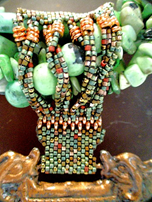
Posted in Stitch 'n Bitch | Tagged: , , , , | Leave a Comment »

Don’t Be The Teacher Known For Bad Instructions! Some Pointers.

Posted by learntobead on April 17, 2020

Eleven of us followed the instructions!@#%

WHEN INSTRUCTIONS ARE BAD…

I again find myself writing a set of instructions for a piece to appear in a bead magazine later this year. It can be such a frustrating process for ME — the writer. And that’s because I don’t want it to be a frustrating process for anyone else. This is not easy to do.

Because this is for a magazine, I have to considerably stream-line my instructions and diagrams. Often that means assuming the reader has some experience and understanding with certain techniques or certain materials. Sometimes this means leaving out some things which are thought to be “obvious”. And it means leaving out a lot of the “Why.”

With this particular project, I don’t have space to explain why I chose FireLine rather than regular beading thread, though this was a critical choice to the success of the piece. I don’t have space to explain why I use peanut beads the way I do, though this too is critical for success. You could not substitute another bead for the peanut beads because this particular shape plays an important structural role in the piece. But no one reading the instructions will know this.

There is no room allowed for explaining why I changed the right angle weave thread-path from the traditional approach. And I don’t have any space to detail all the inspirational factors and color theory choices which influenced my design. If someone knew these, they probably could do more than merely re-make my piece. They could make my piece their own.

Diagrams are often critical for understanding how to proceed. Hopefully not in this case, but with other magazine articles, the editors have taken five or more separate diagrams and combined them into one. Try following the thread paths and you get vertigo. You get a searing headache. You get Jackson Pollock’s version of bead weaving on a page.

It is difficult enough to write instructions without them getting edited down to 2 or 3 magazine pages.

But for the instructions I give to my students in my classes, I no longer worry about page-length. I use some of the narrative to “think aloud” so my students can see the selection criteria I use and the choices I make. I present each step three ways: (1) written out, (2) photograph of piece at that stage, and (3) a diagram.

Some pointers I’ve learned for writing, at least, better instructions:

1) People learn in different ways. Some can read the text. Some need to look at a series of progressive images. Others are great at following diagrams. You need to be good at all three.

2) Include pictures of critical points in the project’s progress. Also include a picture of the finished piece.

3) Know how to begin the process. Include more details, images and diagrams related to beginning the process.

4) Write the steps logically and in order.

5) Keep each Step “short and simple”, and manageable.

6) Do not over-assume about your reader’s ability.

7) More problems occur for the reader when moving from one step to the next step, than accomplishing each particular step itself.

8) Provide encouragement along the way.

9) Show milestones and ways for people to track their progress.

10) Anticipate problems that might occur, or where your reader might get lost.

11) Pretest your instructions.

12) Clearly list all materials and tools needed. If some materials might be difficult or too pricey for someone to acquire, list substitutes.

13) If there are more than 7–10 steps to do, then categorize and group the steps into sets that are no longer than 7–10 steps.

14) Provide informational warnings so that people will be able to figure out if they have done something incorrectly or have started down the wrong track.

Instructions are often some of the worst-written documents you can find. Like me, you have probably had many infuriating experiences with badly written instructions.

By the point in your career where you become comfortable creating your own projects, and writing your own instructions, you probably have a lot of what is called “assumptive knowledge.” These are the kinds of things you do over and over again, to the point where you no longer think about them. They don’t end up getting included in your instructions because of this phenomenon. But these “assumptive knowledge” steps are often the key things novice jewelry makers trip up on. They need to be spelled out.

The piece pictured was supposed to be a straight line of beadwork, to be connected into a consistently-sized tube. Our local bead group was making this piece, and 10 of 11 of us did it wrong. All our tubes started to look snake-like and crooked. These instructions jumped from Step 1 to Step 4, back to Step 2, then over to Step 9. They were full of contingencies — do Step 1 if such and such is happening, but Step 5 if something else is happening. Almost each step had its own set of footnotes. There were 25 Steps and only 2 diagrams summarizing all the steps, each illustrating about 15 separate thread paths.

Other Articles of Interest by Warren Feld:

Pearl Knotting Warren’s Way

Mini Lesson: Making Stretchy Bracelets

Mini Lesson: Making Adjustable Slip Knots With Thicker Cords

Mini Lesson: How To Crimp

Mini Lesson: Attaching End Caps, Cones, Crimp Ends

Mini Lesson: Brick Stitch

Mini Lesson: Flat Even Count Peyote

Mini Lesson: Ndebele Stitch

Mini Lesson: Petersburg Chain

Mini Lesson: Right Angle Weave

I hope you found this article useful. Be sure to click the CLAP HANDS icon at the bottom of this article.

Also, check out my website (www.warrenfeldjewelry.com).

Subscribe to my Learn To Bead blog (https://blog.landofodds.com).

Visit Land of Odds online (https://www.landofodds.com)for all your jewelry making supplies.

Enroll in my jewelry design and business of craft video tutorials online.

Add your name to my email list.
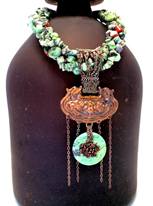
Posted in Stitch 'n Bitch | Tagged: , , , , | Leave a Comment »

ODDS or EVENS … What’s Your Preference?

Posted by learntobead on April 17, 2020

Sometimes, jewelry must conform to a type of numerology — odds or evens or multiples of some number, like the number 3 — related to the numbers of beads or the numbers of strands or the numbers of drops.

Do you have a personal preference for ODDS or EVENS?

Such as,

— The number of beads on a strand?

— The number of strands in a necklace or bracelet?

— Or the number of bangle bracelets you wear on one arm?

— Or the number of beads you use to begin a peyote stitch project?

— Or the number of drops you include in your piece, or dangles you include in an earring?

— Or the number of colors or elements repeated in a pattern or jewelry segment?

— Or the number of fringes on an earring?

Is this ODDS/EVENS preference consistent all the time?

Or is it situational? That is, in certain circumstances you prefer ODDS, and in others, EVENS.

Is there any experiential, aesthetic or hypothetical basis for your preferences?

If you have a preference for one over the other, has does that affect your design process?

Do you get more compliments, when you are wearing one- or three-strand necklaces, than when you are wearing a two-strand or four-strand necklace?

Historically in Europe, it was considered bad luck and inappropriate to have an EVEN number of strands in a necklace. If you had a very long necklace that you would occasionally wrap around your neck multiple times, then it had to be long enough so that you could wrap it around an ODD number of times — such as tripled, never doubled. Even today, in etiquette books, such as “Miss Manners”, the rule is “Always Wear Odd Numbers of Strands of Pearls.” No explanation is given.

Russians even believe that you should never give an even number of flowers to your wife or girlfriend!

In ancient Babylon, even numbers were believed to be unlucky and somewhat demonic. To them, something should never be repeated an even number of times.

An ODD number of beads lets you define a specific center and focus.

Cognitively we prefer things with clear pointers and with clear symmetry.

But we also like balance and harmony and things to be distributed EVENLY.

Where do you come down in this ODDS vs. EVENS debate?

Other Articles of Interest by Warren Feld:

Do You Know Where Your Beading Needles Are?

Consignment Selling: A Last Resort

Odds or Evens? What’s Your Preference?

My Clasp, My Clasp, My Kingdom For A Clasp

Why Am I So Addicted To Beads?

The Bead Spill: My Horrifying Initiation

The Artists At The Party

How To Bead A Rogue Elephant

You Can Never Have Enough Containers For Your Stuff

Beading While Traveling On A Plane

Contemplative Ode To A Bead

How To Bead In A Car

My Aunt Gert: Illustrating Some Lessons In Business Smarts

A Jewelry Designer’s Day Dream

A Dog’s Life by Lily

I Make All The Mistakes In The Book

How Sparkle Enters People’s Lives

Upstairs, Downstairs At The Bead Store

Beads and Race

Were The Ways of Women or of Men Better At Fostering How To Make Jewelry

Women and Their Husbands When Shopping For Beads

Women Making Choices In The Pursuit Of Fashion

Existing As A Jewelry Designer: What Befuddlement!

The Bridesmaid Bracelets

How To Design An Ugly Necklace: The Ultimate Designer Challenge

I hope you found this article useful. Be sure to click the CLAP HANDS icon at the bottom of this article.

Also, check out my website (www.warrenfeldjewelry.com).

Subscribe to my Learn To Bead blog (https://blog.landofodds.com).

Visit Land of Odds online (https://www.landofodds.com)for all your jewelry making supplies.

Enroll in my jewelry design and business of craft video tutorials online.

Add your name to my email list.
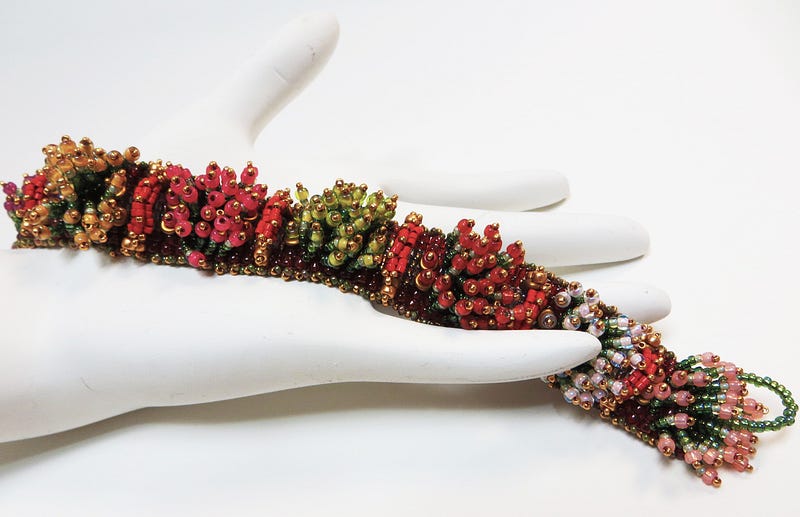
Posted in Stitch 'n Bitch | Tagged: , , , , | Leave a Comment »

Creativity: How Do You Get It, How Do You Enhance It?

Posted by learntobead on April 16, 2020

Caterpillar Espiritu, FELD, (2014)

Abstract: Creativity isn’t found, it is developed. Creativity is a phenomenon where both something new and, at the same time, somehow valuable is created. While some people come to creativity naturally, in fact, everyone can develop their creative ability. Thinking creatively involves the integration and leveraging of three different kinds of ideas — insight and inspiration, establishing value, and implementing something. We work through creative thinking through divergence (that is, generating many possibilities), and convergence (that is, reducing the number of these possibilities). There are ten attributes associated with creative problem solving: fluency, flexibility, elaboration, originality, complexity, risk-taking, imagination, curiosity, assessment, and implementation. Last, different strategies are discussed for enhancing creativity and overcoming creative blocks.

CREATIVITY ISN’T FOUND, IT’S DEVELOPED

Kierkegaard — and I apologize for getting a little show-off-y with my reference — once described Creativity as “a passionate sense of the potential.” And I love this definition. Passion is very important. Passion and creativity can be summed up as some kind of intuitive sense made operational by bringing all your capabilities and wonderings and technical know-how to the fore. All your mechanical, imaginative and knowledge and skills grow over time, as do your abilities for creative thinking and applications. Creativity isn’t inherently natural. It is something that is developed over time as you get more and more experience designing jewelry.

You sit down, and you ask, what should I create? For most people, especially those getting started, they look for patterns and instructions in bead magazines or how-to books or websites online. They let someone else make all the creative choices for them. The singular creative choice here is picking what you want to make. And, when you’re starting, this is OK.

When you feel more comfortable with the materials and the techniques, you can begin to make additional choices. You can choose your own colors. You can make simple adaptations, such as changing out the bead, or changing the dimensions, or changing out a row, or adding a different clasp.

Eventually, however, you will want to confront the Creativity issue head on. You will want to decide that pursuing your innermost jewelry designer, no matter what pathway this takes you along, is the next thing, and right thing, to do. That means you want your jewelry and your beadwork to reflect your artistic hand. You want to develop a personal style. You want to come up with your own projects.

But applying yourself creatively is also work. It can be fun at times, but scary at others. There is an element of risk. You might not like what you end up doing. Your friends might not like it. Nor your family. You might not finish it. Or you might do it wrong. It always will seem easier to go with someone else’s project, already proven to be liked and tested — because it’s been published, and passed around, and done over and over again by many different people. Sometimes it seems insurmountable, after finishing one project, to decide what to do next. Exercising your creative abilities can sometimes be a bear.

But it’s important to keep pushing on. Challenging yourself. Developing yourself. Turning yourself into a bead artist or jewelry designer. And pursuing opportunities to exercise your creative talents even more, as you enter the world of design.

What Is Creativity?

We create. Invent. Discover. Imagine. Suppose. Predict. Delve into unknown or unpredictable situations and figure out fix-it strategies for resolution and to move forward. All of these are examples of creativity. We synthesize. Generate new or novel ideas. Find new arrangements of things. Seek out challenging tasks. Broaden our knowledge. Surround ourselves with interesting objects and interesting people. Again, these are examples of creativity.

Yet, creativity scares people. They are afraid they don’t have it. Or not enough of it. Or not as much as those other people, whom they think are creative, have. They don’t know how to bring it to the fore, or apply it.

But creativity shouldn’t scare you. Everyone has some creative abilities within themselves. For most people, they need to develop it. Cultivate it. Nourish it. They need to learn various tools and skills and understandings for developing it, applying it and managing it. Creativity is a process. We think, we try, we explore, we fall down and pick ourselves up again. Creativity involves work and commitment. It requires a lot of self-awareness — what we call metacognition. It takes some knowledge, skill and understanding. It can overwhelm at times. It can be blocked at other times.

But it is nothing to be scared about. Creativity is something we want to embrace because it can bring so much self-fulfillment, as well as bring joy and fulfillment to others. Creativity is not some divine gift. It is actually the skilled application of knowledge in new and exciting ways to create something which is valued. Creativity can be acquired and honed at any age or any experience level.

For the jewelry designer, it’s all about how to think creatively. Thinking creatively involves the integration and leveraging of three different kinds of ideas — insight and inspiration, establishing value, and implementing something.

(1) Seeing something out of nothing (perception). Technically, we talk about this as controlling the relationship of space to mass. You begin with a negative space. Within this space, you add points, lines, planes and shapes. As you add and arrange more stuff, the mass takes on meaning and content. The designer has to apply creative thinking in finding inspiration, choosing design elements, arranging them, constructing them, and manipulating them.

(2) Valuing something (cognition). Connections are made. Meaning and content, when experienced by people, result in a sense of appeal and value. We refer to this as desire and expression. Value can relate to the worth or cost of the materials, the intuitive application of ideas and techniques by the artist, the usefulness or functionality of the piece, or something rare about the piece. Value can center on the power to leverage the strengths of materials or techniques, and minimize their weaknesses. The designer has to apply creative thinking to anticipate how various audiences will judge the piece.

(3) Implementing something (acceptance). Jewelry design occurs within a particular interactive context and dialog. The designer translates inspirations into aspirations. Aspirations are then translated into design ideas. Design ideas are implemented, refined, changed, and implemented again until the finished product is introduced publicly. The design process has to be managed. When problems or road-blocks arise, fix-it strategies and solutions need to be accessed and applied. All this occurs in anticipation of how various audiences will respond to the jewelry, and convey their reactions to the artist, their friends, family and acquaintances, and make choices about wearing it and buying it and displaying it publicly. The designer has to apply creative thinking in determining why anyone would like the piece, want the piece, buy the piece, wear the piece, wear it publicly, and wear it again and again, or give it as a gift to someone else.

Types of Creativity

Creativity has two primary components: (1) originality, and (2) functionality or value.

The idea of originality can be off-putting. It doesn’t have to be. The jewelry, so creatively designed, does not have to be a totally and completely new and original design. The included design elements and arrangements do not have to be solely unique and never been done before.

Originality can be seen in making something stimulating, interesting or unusual. It can represent an incremental change which makes something better or more personal or a fresh perspective. It can be something that is a clever or unexpected rearrangement, or a great idea, insight, meaningful interpretation or emotion which shines through. It can include the design of new patterns and textures. It can accomplish connections between seemingly unrelated phenomena, and generate solutions. It can be a variation on a technique or how material gets used. It can be something that enhances the functionality or value of the piece.

Creativity in jewelry design marries that which is original to that which is functional, valued, useful, worthwhile, desired. These things are co-dependent, if any creative project is to be seen as successful. For jewelry designers, creativity is not the sketch or computer aided drawing. It is not the inspiration. It is not the piece which never sees the light of day, because then it would represent a mere object, not jewelry. Creativity requires implementation. And for jewelry designers, implementation is a very public enterprise.

What Does It Take To Be Creative?

Creative people tend to possess a high level of energy, intuitiveness, and discipline. They are also comfortable spending a great deal of time quietly thinking and reflecting. They understand what it means to cultivate emotions, both within themselves, as well as relative to the various audiences they interact with. They are able to stay engaged with their piece for as long as it takes to bring it to completion. They fall in love with their work and their work process.

Creativity is not something that you can use up. To the contrary, the more you use your creativity, the more you have it. It is developmental, and for the better jewelry designer, development is a continual, life long process of learning, playing, experimenting and doing.

To be creative, one must have the ability to identify new problems, rather than depending on others to define them. The designer must be good at transferring knowledge gained in one context to another in order to solve a problem or overcome something that is unknown. I call this developing a designer tool box of fix-it strategies which the designer takes everywhere. The designer is very goal-oriented and determined in his or her pursuit. But, at the same time, the jewelry designer also understands and expects that the design process is very incremental with a lot of non-linear, back-and-forth thinking and application. There is an underlying confidence and belief, however, that eventually all of this effort will lead to success.

How Do We Create?

It’s not what we create, but how we create!

The creative process involves managing the interplay of two types of thinking — Convergence and Divergence. Both are necessary for thinking creatively.

Divergent thinking is defined as the ability to generate or expand upon options and alternatives, no matter the goal, situation or context.

Convergent thinking is the opposite. This is defined as the ability to narrow down all these options and alternatives.

The fluent jewelry designer is able to comfortably weave back and forth between divergence and convergence, and know when the final choices are parsimonious and the piece is finished, and when the final choices will be judged as resonant and successful.

Brainstorming is a great example of how creative thinking is used. We ask ourselves What If…? How about…? Could we try this or that idea…? The primary exercise here is to think of all the possibilities, then whittle these down to a small set of solutions.

Creative Thinking

Creative thinking first involves cultivating divergent thinking skills and exposing ourselves to the new, the different, the unknown, the unexpected. It is, in part, a learning process. Then next, through our set of convergent thinking skills, we criticize, and meld, and synthesize, and connect ideas, and blend, and analyze, and test practicality, as we steer our thinking towards a singular, realistic, do-able solution in design.

Partly, what we always need to remember, is that this process of creative thinking in jewelry design also assists us finding that potential audience or audiences — weaver, buyer, exhibitor, collector — for our creative work. Jewelry is one of those special art forms which require going beyond a set of ideas, to recognizing how these ideas will be used. Jewelry is only art only when it is worn. Otherwise, it is a sculptural object.

There are 10 aspects to creative thought. Each should be considered as a separate set of skills, both for divergent as well as convergent thinking, which the jewelry designer wants to develop within him- or herself. Initially, the designer wants to learn, experiment with and apply these skills. Over time, the designer wants to develop a level of comprehension and fluency to the point that the application of each of this skills is somewhat automatic.

Fluency: Having a basic vocabulary in jewelry design, and the ability to see how these concepts and design elements are present (decoding) and arranged (composition, construction and manipulation). 
 Divergence: to generate as many possible elements and combinations to increase number of possible designs.

Flexibility: Ability to adapt selections and arrangements, given new, unfamiliar or unknown situations. 
 Divergence: generate a range and variety of possible configurations leading to same solution.

Elaboration: Ability to add to, embellish or build upon ideas incorporated into any jewelry design. 
 Divergence: generate the widest variety of attributes of design elements and combinations which have value-added qualities, given a particular design.

Originality: Ability to create something new or different which has usefulness and value. 
 Divergence: to delineate many ideas and concepts which are both new and have value.

Complexity: Ability to conceptualize difficult, multi-faceted, intricate, many-layered ideas and designs. 
 Divergence: to take a solution and break it down or reinterpret it into as many multiple facets or multiple layers as possible.

Risk-Taking: Willingness to try new things or think of new possibilities in order to show the artist’s hand publicly and stand apart. 
 Divergence: to elaborate the widest possible scenarios for publicly introducing the piece, given various design options, as well as all the ways these potential audiences might interact and use the jewelry, and all the ways these audiences might influence others, as well.

Imagination: Ability to be inspired, and to translate that inspiration into an aspiration. 
 Divergence: to think of many ways an inspiration might be described, interpreted, or experienced physically and emotionally, and to identify the many different ways inspirations might be interpreted into a jewelry design.

Curiosity: Ability to probe, question, search, wanting to know more about something. 
 Divergence: questioning the situation from many angles and perspectives.

Assessment: Ability to anticipate shared understandings, values and desires of various audiences for any piece of jewelry. 
 Divergence: identifying all the possible audiences a piece of jewelry might have, and all the different ways they might judge the piece as finished (parsimonious) and successful (resonant).

Implementation: Ability to translate aspirations into a finished jewelry design and design process. 
 Divergence: delineating all the possibilities an aspiration might get translated into a design, evaluated against all the possibilities the design could be successfully, practically and realistically implemented.

Enhancing Creativity and Overcoming Creativity Block

So, what kinds of creative advice can I offer you about enhancing your creativity? How can you nurture your creative impulses? How can you overcome roadblocks that might impede you?

Here is some of my advice:

Success Stories. While you are fiddling with beads and wire and clasps and everything else, try to be as aware as you can of why your successes are successful. What are all the things you did to succeed? On what points does everyone agree the project succeeds?

Un-Block. Don’t set up any road blocks. Many people, rather than venture onto an unknown highway of creativity, put up walls to delay their path. If they just had the right beads. Or the right colors. Or sufficient time. Or had learned one more technique. Or had taken one more class. Or could find a better clasp. These are excuses. Excuses to avoid getting creative.

Adapt. Anticipate contingencies. It amazes me how many people come into my shop with a picture out of a magazine. We probably can find over half the components, but for the remaining components pictured which we don’t have in stock, we suggest substitutes. But, NO, the customer has to have it exactly like the picture, or not at all. Not every store has every bead and component. Many beads and components are not made all the time. Many colors vary from batch to batch. Many established companies have components especially made up for them — and not available to the general public. The supplies of many beads and components are very limited — not unlimited. Always be prepared to make substitutions and adapt.

Play. Be a kid again. Let your imagination run wild. Try things. Try anything. If the world says your color combination is ugly, don’t listen to them. Do it anyway. Ignore all restrictions. Forget about social and art conventions.

Be Curious. Play “What If…” games. What if a different color? What if a different technique? What if a different width or length? What if a different style of clasp. Re-arrange things. Tweak. Take out a bead board, and lay out beads and findings on the board, and re-order everything — Ask yourself: More or less satisfying?

Embrace the New / Challenge yourself. Don’t do the same project over and over again, simply because you have proven to yourself that you can make it. While you might want to repeat a project, with some variations, to learn more things, too much doing of the same-ole, same-ole, can be very stifling.

Create An Imaginative Working Space / Manage Disruptions and Disruptors. You need comfortable seating, good lighting, smart organization of parts and tools and projects-in-process. Some people like music playing. If family or friends tend to interrupt you, explain to them you need some boundaries at certain times of the day or days of the week.

Evaluate / Be metacognitive. Learn from failures. You have invested time, money and effort into making these pieces. And not everything works out, or works out well. Figure out why, and turn these failed pieces into lessons and insights. Give yourself permission to be wrong. Build up your skills for self-awareness, self-management and self-assessment.

Take a break / Break your daily routine / Incubate it / Sleep on it. And if you suddenly find your productivity interrupted by Bead-Block and Artist-Block and Jeweler’s-Block, put your project down. Take a break. Mull on things awhile. Put yourself in a different environment. Take a walk. Sleep. A period of interruption or rest from a problem may aid creative problem-solving in that it lets us let go of or forget some misleading cues, thoughts, feelings and ideas.

Network / Connect With Other Jewelry Designers and Artists / Collaborate on a Project. Here you want to tap into and absorb someone else’s energy, knowledge and insights. Surround yourself with interesting and creative people. Learn different ways of knowing and doing. Get encouragement. Find a mentor. The fastest way to become creative is to hang around with creative people.

Do something out of the ordinary. Something unexpected. Or something just not done. This will shock your system to think in different ways. To see things in a new light. To recognize contradictions. Robert Alan Black gives great advice. 
 He shouts at the blocked: Break A Crayon. 
 He shouts again: Draw Outside The Lines. 
 And I would add and shout: Stick your hands into a bowl full of mud or jello.

These are all great advice.

Make creativity a habit. Make it routine in your daily life.

– Keep a journal. Write down your thoughts and experiences and insights.

– As you create a new piece, keep a running written log of all the choices you are making.

– Challenge yourself. Change colors, arrangements, sizes and shapes. Create forms and new components. Think of different silhouettes.

– Expand your knowledge base and skills. Look for connections with other disciplines.

-Surround yourself with interesting things and interesting people. Get together regularly. Collaborate. Take a field trip together.

What Should I Create?

The process of jewelry making begins with the question, What Should I Create?

You want to create something which results in an emotional engagement. That means, when you or someone else interacts with your piece, they should feel some kind of connection. They might see something as useful. It may have meaning. Or it may speak to a personal desire. It may increase a sense of self-esteem. It may persuade someone to buy it. It may feel especially powerful or beautiful or entertaining. They may want to share it with someone else.

You want to create something that you care about. It should not be about following trends. It should be about reflecting your inner artist and designer — what you like, how you see the world, what you want to do. Love what you are making. Otherwise, you run the risk of burning out.

It is easier to create work with someone specific in mind. This is called backwards design. You anticipate how someone else would like what you do, want to wear it, buy it, and then let this influence you in your selection about materials, techniques and composition. This might be a specific person, or a type of person, such as a potential class of buyers.

Keep things simple and parsimonious. Edit your ideas. You do not want to over-do or under-do your pieces. You do not have to include everything in one piece. You can do several pieces. Showing restraint allows for better communication with your audiences. Each piece you make should not look like you are frantically trying to prove yourself. They should look like you have given a lot of thought about how others should emotionally engage with your piece.

There is always a lot of pressure to brand yourself. That means sticking with certain themes, designs or materials. But this can be a little stifling, if you want to develop your creativity. Take the time to explore new avenues of work.

You want to give yourself some time to find inspirations. A walk in nature. A visit to a museum. Involvement with a social cause. Participation in a ritual or ceremony. Studying color samples at a paint store. A dream. A sense of spirituality or other feeling. A translation of something verbal into something visual. Inspirations are all around you.

Final Words of Wisdom

We don’t learn to be creative We become creative. We develop a host of creative thinking skills. We reflect and make ourselves aware of all the various choices we make, the connections we see, the reactions we get, and the implications which result.

We need to be open to possibility.

We need to have a comfort level in taking the unknown or unexpected, and bridging the differences. That is, connecting what we know and feel and project to ideas for integrating all the pieces before us into a completed jewelry design. We need to become good translators, managing our choices from inspiration to aspiration to completed design.

We need to be able to hold on to the paradoxes between mass and space, form and freedom, thought and feeling, long enough so that we can complete each jewelry making project. We need to be comfortable while designing during what often become long periods of solitude.

We need to know jewelry and jewelry making materials and techniques inside and out. We need to know how to maximize their strengths and minimize their weaknesses. We need to be able to discover new ways of designing with them. It is critical that we put ourselves on a path towards greater fluency, flexibility and originality.

We must be willing to give and receive criticism.

We must be aware, not only of our desires, goals and understandings, but those of our various audiences, as well.

Be motivated by the design process itself, and not its possible and potential external rewards.

We must be very reflective and metacognitive of how we think, speak and work as jewelry designers.

We need to give ourselves permission to make mistakes.

We must design things we care about.

_________________________________________

FOOTNOTES

Besemer, S.P. and D.J. Treffinger. Analysis of Creative Products: Review and Synthesis. Wiley Online 
 Library, (1981).

Black, Robert Alan. Blog: http://www.cre8ng.com/blog/

Csikszentmihalyi, Mihaly. Creativity: Flow and the Psychology of Discovery and Invention. Harper 
 Perennial; Reprint edition (August 6, 2013)

Guilford, J.P. Creativity. American Psychologist, 5, 444–454, 1950.

Koestler, Arthur. The Act of Creation. Last Century Media (April 1, 2014).

Lucy Lamp. “Inspiration in Visual Art Where Do Artists Get Their Ideas. As reference in: 
 https://www.sophia.org/tutorials/inspiration-in-visual-art-where-do-artists-get-the

Maital, Shlomo. “How IBM’s Executive School Fostered Creativity,” Global Crisis Blog, April 7, 2014.
 Summarizes Louis R. Mobley’s writings on creativity, 1956.

March, Anna Craft. Creativity in Education. Report prepared for the Qualifications and Curriculum 
 Authority, March, 2001.

Seltzer, Kimberly and Tom Bentley. The Creative Age: Knowledge and Skills for the New Economy. 
 Demos, 1999.

Torrance, E. P. The Torrance Tests of Creative Thinking-Norms-Technical Manual Research Edition-
 Verbal Tests, Forms A and B-Figural Tests, Forms A and B. Princeton, NJ: Personnel Press, 1966.

Torrance, E. P. The Torrance Tests of Creative Thinking-Norms-Technical Manual Research Edition-
 Verbal Tests, Forms A and B- Figural Tests, Forms A and B. Princeton, NJ: Personnel Press, 1974.

Turak, August. “Can Creativity Be Taught,” Forbes, May 22, 2011.

Other Articles of Interest by Warren Feld:

Disciplinary Literacy and Fluency In Design

Backward Design is Forward Thinking

How Creatives Can Successfully Survive In Business

Part I: The First Essential Question Every Designer Should Be Able To Answer: Is What I do Craft, Art or Design?

Part 2: The Second Essential Question Every Designer Should Be Able To Answer: What Should I Create?

Part 3: The Third Essential Question Every Designer Should Be Able To Answer: What Materials (and Techniques) Work Best?

Part 4: The Fourth Essential Question Every Designer Should Be Able To Answer: How Do I Evoke A Resonant Response To My Work?

Part 5: The Firth Essential Question Every Designer Should Be Able To Answer: How Do I Know My Design Is Finished?

Doubt / Self-Doubt: 8 Pitfalls Designers Fall Into…And What To Do About Them

Part 1: Your Passion For Design: Is It Necessary To Have A Passion?

Part 2: Your Passion For Design: Do You Have To Be Passionate To Be Creative?

Part 3: Your Passion For Design: How Does Being Passionate Make You A Better Designer?

Part 1: SHARED UNDERSTANDINGS: THE CONVERSATION CENTERED WITHIN A DESIGN What Are Shared Understandings?

Part 2: SHARED UNDERSTANDINGS: THE CONVERSATION CENTERED WITHIN A DESIGN What Does The Designer Need To Know?

Part 3: SHARED UNDERSTANDINGS: THE CONVERSATION CENTERED WITHIN A DESIGN How Assumptions, Perceptions, Expectations and Values Come Into Play?

Part 4: SHARED UNDERSTANDINGS: THE CONVERSATION CENTERED WITHIN A DESIGN How Does The Designer Establish Shared Understandings?

I hope you found this article useful. Be sure to click the CLAP HANDS icon at the bottom of this article.

Also, check out my website (www.warrenfeldjewelry.com).

Subscribe to my Learn To Bead blog (https://blog.landofodds.com).

Visit Land of Odds online (https://www.landofodds.com)for all your jewelry making supplies.

Enroll in my jewelry design and business of craft video tutorials online.

Add your name to my email list.
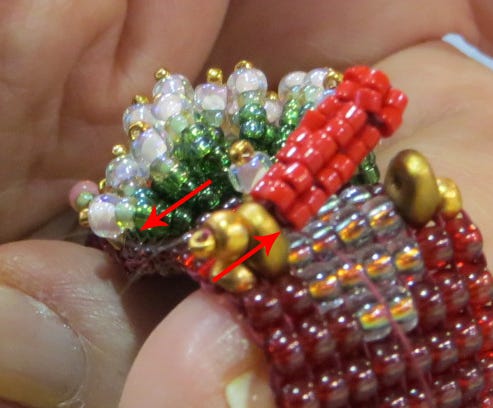
Posted in Stitch 'n Bitch | Tagged: , , , , | Leave a Comment »

My Clasp, My Clasp, My Kingdom For A Clasp!

Posted by learntobead on April 16, 2020

The Jewelry Designer makes many choices when creating a piece of jewelry. Lots of things to manage and accomplish.

Probably the two most important choices, right up front, in creating a wearable art-piece that will be around for future generations are your:
(1) Stringing Material, and
(2) Clasp

When you work with so many customers in a store, and so many students in classes, you begin to see that people are not necessarily that great in selecting clasps. Many are in a clasps-rut — they use the same clasp over and over again.

Others pick out clasps they find appealing, whether or not they would visually or functionally work with the piece they have made.

Few people anticipate how they are going to attach the clasp to their beadwork, often resulting in an overly long, awkwardly connected clasp assembly.

So, how to you go about choosing clasps?

Clasps always seem like they’ve been someone’s last thought. They should be the first thought. Or at least thought about concurrently with the design of the piece. But they should never be the last thought.

As clasps should be thought of in their entirety — as clasp assemblies. Clasp assemblies include all the rings, loops and other hardware necessary to attach the clasp to the beadwork. The clasp itself may be beautiful, but the entire clasp assembly may not be.

But many people get so excited creating their beadwork, that they forget about the clasp — until the last moment. You can tell when the jewelry maker hasn’t put much thought into their choice of clasp in many ways. Often, the clasp doesn’t look like it was meant to go with the bead work or general design. It might be out of proportion. It might be a different texture or sensibility. Its function — how you open and close it, while wearing your jewelry — might seem odd, perhaps unnatural. And not only does the choice of clasp seem as an after-thought, but how to attach to the bead work to that clasp seems un-thought out, as well.

So it’s not surprising, that when we were repairing jewelry on a regular basis, about 80% of the pieces to be fixed had broken at the clasp.

It is best to, in part, build your design around your clasp. If your piece has a centerpiece or focal point, then how does this link up to or coordinate with the clasp. At the least, when visualizing your beadwork, include an image of the clasp and how it is attached at both ends. The world is full of clasps. Not every clasp is a jeweler’s best friend. But it depends.

The clasp needs to visually fit with the beadwork. It needs to function as the artist intended. It needs to function in a way the wearer can relate to, use and handle. It needs to be appropriate for the piece and the context in which it is too be worn. It should not compete with the beadwork. It should complement it. Ideally, at least from a design perspective, your clasp should look and feel as if it were an integral part of the entire piece.

In a Gallery setting, if you are selling your jewelry there, you usually want a very functional, but not overwhelming, clasp. You are selling your beadwork, and you don’t want your clasp to compete with this.

In a Department Store, setting, however, often the clasp sells the piece. In this setting, choosing a clasp requires a different kind of logic, thinking and anticipation.

Some clasp-types are “expected” to be a part of the piece — even if the particular choice of type would not be the best choice in the world. Traditions dictate clasp choices in some situations.

The former owner of a local Tennessee pearl company was very frustrated with clasps. She sold a lot of finished pearl jewelry at very high prices, and had been using 14KT gold pearl and safety clasps. Her customers sent a lot of their pearl necklaces and bracelets back for repairs, because their clasps broke. And this company felt, because the prices of these pieces were very high, that they were obligated to replace the clasps and re-string these pearl-knotted pieces at no additional charge. 14KT clasps — particularly the pearl, safety and filigree box clasps — do not hold up well, because gold is a very soft metal.

Replacing clasps on a pearl-knotted piece is quite some job. You have to cut up the piece to free up each bead, and then you begin the knotting and finishing off processes again. It turns out, the 14KT clasps were not the only expensive part of the bracelets — making the knots between each pearl was the time-consuming and costly part.

She desperately wanted to reduce the number of repairs. Her first idea was to replace the pearl and safety clasps with other styles which were sturdier. However, these pieces didn’t sell. People wanted the pearl and filigree clasps. The designs of these clasps were so traditional and so locked into their expectations for what pearl-knotted jewelry should look like, that they would not compromise.

Her second effort, she tried replacing the 14KT pearl and filigree clasps with gold-filled ones which were stronger, but this made her customers very angry — they wanted 14KT gold.

So, her final strategy, she returned to using 14KT gold pearl clasps, and doubled her prices. She built in the cost of one repair into the prices she charged. And only then could she present her happy face to her customers, and her somewhat-happy face to herself when she was in private.

Other Articles of Interest by Warren Feld:

Oy Ve! The Challenges of Custom Work

The Importance of Self-Promotion: Don’t Be Shy

Are You Prepared For When The Reporter Comes A-Calling?

Don’t Just Wear Your Jewelry…Inhabit It!

Two Insightful Psych Phenomena Every Jewelry Designer Needs To Know

A Dog’s Life by Lily

Copyrighting Your Pieces: Let’s Not Confuse The Moral With The Legal Issues

Jewelry, Sex and Sexuality

Jewelry Design: An Occupation In Search Of A Profession

Teaching Discplinary Literacy: Strategic Thinking In Jewelry Design

Contemporary Jewelry Is Not A “Look” — It’s A Way Of Thinking

Beads and Race

Were The Ways of Women or of Men Better At Fostering How To Make Jewelry

The Bridesmaid Bracelets

How To Design An Ugly Necklace: The Ultimate Designer Challenge

I hope you found this article useful. Be sure to click the CLAP HANDS icon at the bottom of this article.

Also, check out my website (www.warrenfeldjewelry.com).

Subscribe to my Learn To Bead blog (https://blog.landofodds.com).

Visit Land of Odds online (https://www.landofodds.com)for all your jewelry making clasps and other supplies.

Enroll in my jewelry design and business of craft video tutorials online.

Add your name to my email list.
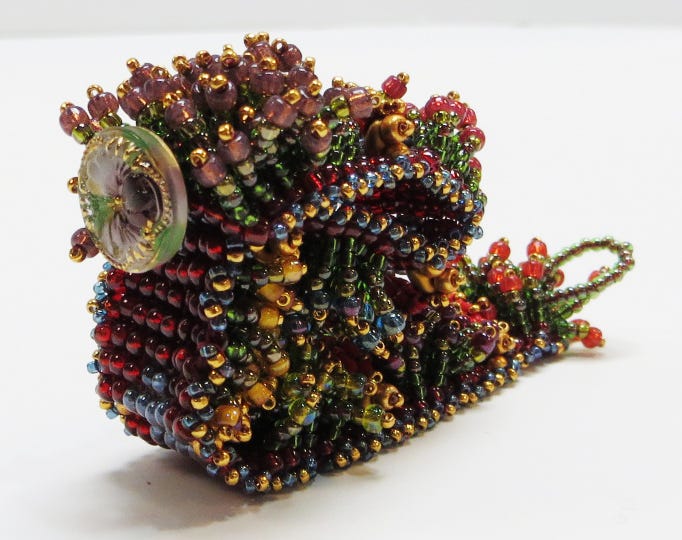
Posted in Stitch 'n Bitch | Tagged: , , , , | Leave a Comment »

When Choosing Colors Has You Down, Check Out The Magic Of Simultaneity Effects!

Posted by learntobead on April 16, 2020

A LESSON IN USING COLOR SIMULTANEITY EFFECTS:
The Contemporized Etruscan Collar

Several years ago, I had been asked to do a week-long jewelry design workshop in Cortona, Italy. The topic I selected was on Contemporizing Traditional Etruscan Jewelry. One of the projects I developed for the workshop was this Contemporized Etruscan Collar. The challenge, here for me, was to create a sophisticated, wearable, and attractive piece that exemplified concepts about contemporizing traditional jewelry.

Contemporizing Traditional Jewelry has to do with how you take particular traditional forms and techniques, and both add your personal style to the pieces, as well as make them more relevant to today’s sense of fashion and style. The challenge for the designer is how to keep traditional ideas essential and alive for today’s audience.

Things clicked. I found a traditional Etruscan Collar that I immediately connected with.

The Contemporized Etruscan Collar

The contemporized piece basically consists of two staggered and overlapping bead-woven strips. The bead-woven technique used is the Ndebele Stitch (sometimes called Herringbone).

There are many design theory elements incorporated into this piece, including dimensionality, curvature, malleability, and movement. One of the more interesting theories I applied here has to do with color simultaneity effects.

Color Simultaneity Effects

Picking colors is about making strategic choices. Picking colors is very revealing about the jewelry artist’s understanding of how the bead asserts its needs for color. One set of color-theories employed to make these kinds of choices has to do with Simultaneity Effects. Colors in the presence of other colors get perceived differently, depending on the color combination.

For example, a White Square on a Black background looks bigger than a Black Square on a white background. White reaches out and overflows the boundary; black contracts.

Another example: Gray always picks up some of the color characteristics of other colors around it. Gray next to orange will appear to have an orange tone to it. Gray next to green will appear to have a green tone to it. A “Gray” bead is one, the color of which, has a strong gray or black tone to it.

Besides the obvious “gray”, these other colors function as a “gray”: montana blue, alexandrite, colorado topaz, prairie green. Many color-lined and silver-lined beads can function as a “gray”, particularly when the glass color is other than clear. Many metallic or otherwise reflective surface beads can function as a “gray”.

A final example of simultaneity effects has to do with how people sense whether colors are warm or cool. In one composition, depending on the color mix, a particular color might be felt as “warm”. In a second composition, with a different color mix, that same color might be felt as “cool”. You can picture a yellow square surrounded by white feels lighter, brighter and a different temperature than its counterpart surrounded by black. A red square surrounded by black feels darker, duller, and a different temperature than its counterpart surrounded by white.

Existence of these simultaneity effects is a great piece of information for the designer. There will be gaps of color and light between beads. Many bead colors are imperfect, particularly in combination. Playing with simultaneity effects gives the designer tools to overcome some of the color limitations associated with the bead and the gaps of light between beads. These allow you to “blend” and build “bridges” and create “transitions.”

Look back at the images of the Ndebele-stitched piece. When you work with beads, there are always gaps between them. In the Ndebele-stitch, there are many and very pronounced gaps of light between beads. This can be very threatening to a viewer. People are pre-wired to avoid things which might harm them, such as snakes and spiders. This is our fear- or anxiety-response.

We can summarize most color theories as a set of principles the brain uses — both in perception and cognition — to find a state of color or colors which are harmonious. That is, people like to see and feel comfortable and safe with colors which harmonize and go together. When we start to lose that harmonious state of color, this makes the brain edgy. When the brain starts to get edgy, we start to interpret pieces as boring, monotonous, scary, dangerous, will cause death. We innately reject, as part of our pre-wired fear response, that which does not follow good principles of color.

Any viewer’s brain will immediately try to interpret what it sees and make sense of it. This includes jewelry. The viewer’s brain needs to know immediately whether to approach or flee. Each time the eye/brain comes to the end of the bead and is confronted with a gap of light separating it from the next bead, it’s similar to a person approaching a cliff, and getting asked to jump off of that cliff.

No one wants to jump off a cliff. And no one’s eye/brain wants to jump over a gap of light between two beads. It’s risky. It’s work. Things don’t feel harmonious.

We have to fool ourselves, that is, our brain, in some way. Color theories offer us many possible ideas on how to do this. I find using simultaneity effects works especially well in jewelry compositions using beads. Certain colors, when juxtaposed, create their own meanings, and fool the brain into thinking it sees something in these gaps, or is somehow more motivated to fill in the gaps, and proceed from one bead to the next.

In this Etruscan Collar project, many of my color choices were based on an understanding of simultaneity effects.

Other Articles of Interest by Warren Feld:

Best Way To Thread Your Needle

Bead Stringing With Needle and Thread

Beading Threads vs. Bead Cord

Turning Silver and Copper Metals Black: Some Oxidizing Techniques

Color Blending; A Management Approach

Cleaning Sterling Silver Jewelry: What Works!

What Glue Should I Use When Making Jewelry?

When Choosing Colors Has You Down, Check Out The Magic Of Simultaneity Effects

The Color Effects of Threads

Wax, Wax, Wax

When You Attend A Bead Show…

When Your Cord Doesn’t Come With A Needle…What You Can Do

Duct Tape Your Pliers

What To Know About Gluing Rhinestones

Know Your Anatomy Of A Necklace

How Does The Jewelry Designer Make Asymmetry Work?

How To Design An Ugly Necklace: The Ultimate Designer Challenge

I hope you found this article useful. Be sure to click the CLAP HANDS icon at the bottom of this article.

Also, check out my website (www.warrenfeldjewelry.com).

Subscribe to my Learn To Bead blog (https://blog.landofodds.com).

Visit Land of Odds online (https://www.landofodds.com)for all your jewelry making supplies.

The ETRUSCAN COLLAR is available as a kit from Land of Odds.

Enroll in my jewelry design and business of craft video tutorials online.
Of special interest: My video tutorial THE JEWELRY DESIGNER’S APPROACH TO COLOR

Add your name to my email list.

Posted in Stitch 'n Bitch | Tagged: , , , , | Leave a Comment »

The Jewelry Design Philosophy: Not Art, Not Craft, But Design!

Posted by learntobead on April 16, 2020

DESIGN APPROACH AND PHILOSOPHY
IN JEWELRY DESIGN

The DESIGN PERSPECTIVE is very focused on teaching beaders and jewelry makers how to make choices. Choices about what materials to include, and not to include. Choices about strategies and techniques of construction. Choices about mechanics. Choices about aesthetics. Choices about how best to evoke emotions.

These choices must also reflect an understanding of the bead and its related components. How do all these pieces, in conjunction with stringing materials, assert their needs? Their needs for color, light and shadow. Their needs for durability, flexibility, drape, movement and wearability. Their needs for social or psychological or cultural or contextual appropriateness — an appropriateness that has to do with satisfaction, beauty, fashion and style, as well as power and influence.

This DESIGN PERSPECTIVE contrasts with the more predominant Craft Approach, where the beader or jewelry maker merely follows a set of steps and ends up with something. Here, in this step-by-step approach, all the choices have been made for them. They never learn the implications of using one bead vs. another, one stringing material vs. another or one clasp vs. another.

And this DESIGN PERSPECTIVE also contrasts with another widespread approach to beading and jewelry making — the Art Tradition — which focuses on achieving ideals of beauty, whether the jewelry is worn or not. Here the beader or jewelry maker learns to apply art theories learned by painters and sculptors, and assumed to apply equally to beads and jewelry, as well. Jewelry is judged as it sits on a mannequin or easel. Functionality is subsumed under Appeal. Things like the strap, clasp assembly and bail are merely seen as supplemental to the piece, as a frame is to a painting or a pedestal to sculpture.

The Craft Approach and the Art Tradition ignore too much of the functional and contextual essence of jewelry. Because of this, they often steer the beader and jewelry maker in the wrong directions. Making the wrong choices. Exercising the wrong judgments. Applying the wrong tradeoffs between aesthetics and functionality and context.

The focus of the DESIGN PERSPECTIVE is strategic thinking. At the core of this thinking are a series of design principles and their skillful applications. These principles go beyond a set of techniques. These principles and the strategies for applying them provide the beader and jewelry maker with some clarity in a muddled world.

Learning about Design begins with the belief that there are many different kinds of information that must come together and be applied to make a finished and successful piece of jewelry. Art. Architecture. Physical mechanics. Sociology, Anthropology and Psychology. Some Business. Even some Party Planning. It is impossible to clearly learn and integrate all this information all at once.

When all this knowledge which needs to come to bear in creating and constructing a piece of jewelry is learned haphazardly or randomly, as most people do, it becomes problematic. It becomes more difficult or too confusing to successfully bring into play all these kinds of things the beader or jewelry maker needs to know when designing and constructing a piece of jewelry in the moment.

Thus, the beader and jewelry maker best learn all this related yet disparate information in an developmental, hierarchical order, based on some coherent grammar or set of rules of design. Seemingly disparate skills are learned as interrelated, integrated clusters. By learning within this organized structure and informational hierarchy, the jewelry artist best sees how everything interrelates and comes together. The designer develops the ability to decode expressive information, and to fluently organize and arrange it. This is how disciplinary literacy is developed within the DESIGN PERSPECTIVE.

So, we begin with a Core set of skills and concepts, and how these are interrelated and applied. Then we move on to a Second Set of skills and concepts, their interrelationships and applications, and identifying how they are related to the Core. And onward again to a Third Set of skills and concepts, their interrelationships and applications and relationship to the Second Set and the Core, and so forth.

In the DESIGN PERSPECTIVE, “Jewelry” is understood as Art, but is only Art as it is worn. It is not considered Art when sitting on a mannequin or easel. Because of this, the principles learned through Craft or Art are important, but not sufficient for learning good jewelry design and fashioning good jewelry.

Learning good jewelry design creates its own challenges. All jewelry functions in a 3-dimensional space, particularly sensitive to position, volume and scale. Jewelry must stand on its own as an object of art. But it must also exist as an object of art which interacts with people (and a person’s body), movement, personality, and quirks of the wearer, and of the viewer, as well as the environment and context. Jewelry serves many purposes, some aesthetic, some functional, some social and cultural, some psychological.

The focus of the DESIGN PERSPECTIVE is on the parts and their construction. How do you choose parts? How should they be used, and not be used? How do you assemble them and combine them in such a way that the whole is greater than the sum of the parts? How do you create and build in support systems within your jewelry to enable that greater movement, more flexibility, better draping, longer durability? How do you anticipate stresses and strains? How do you parsimoniously use all these parts, making them resonate and evoking that emotional response from your audience to your style, vision and creative hand that you so desire?

The beader and jewelry maker are seen as multi-functional professionals, similar to an architect who builds houses and an engineer who builds bridges. In all these cases, the professional must bring a lot of very different kinds of skills and abilities to bear, when constructing, whether house or bridge or jewelry. The professional has to be able to manage artistic design, functionality, and the interaction of the object with the person and that person’s environment.

Other Articles of Interest by Warren Feld:

The Jewelry Design Philosophy: Not Craft, Not Art, But Design

What Is Jewelry, Really?

The Jewelry Design Philosophy

Creativity: How Do You Get It? How Do You Enhance It?

Disciplinary Literacy and Fluency In Design

Becoming The Bead Artist and Jewelry Designer

5 Essential Questions Every Jewelry Designer Should Have An Answer For

Getting Started / Channeling Your Excitement

Getting Started / Developing Your Passion

Getting Started / Cultivating Your Practice

Becoming One With What Inspires You

Architectural Basics of Jewelry Design

Doubt / Self Doubt: Major Pitfalls For The Jewelry Designer

Techniques and Technologies: Knowing What To Do

Jewelry, Sex and Sexuality

Jewelry Making Materials: Knowing What To Do

Teaching Discplinary Literacy: Strategic Thinking In Jewelry Design

The Jewelry Designer’s Approach To Color

Point, Line, Plane, Shape, Form, Theme: Creating Something Out Of Nothing

The Jewelry Designer’s Path To Resonance

Jewelry Design Principles: Composing, Constructing, Manipulating

Jewelry Design Composition: Playing With Building Blocks Called Design Elements

Contemporary Jewelry Is Not A “Look” — It’s A Way Of Thinking

How To Design An Ugly Necklace: The Ultimate Designer Challenge

I hope you found this article useful. Be sure to click the CLAP HANDS icon at the bottom of this article.

Also, check out my website (www.warrenfeldjewelry.com).

Subscribe to my Learn To Bead blog (https://blog.landofodds.com).

Visit Land of Odds online (https://www.landofodds.com)for all your jewelry making supplies.

Enroll in my jewelry design and business of craft video tutorials online.

Add your name to my email list.

Posted in Stitch 'n Bitch | Tagged: , , , , | Leave a Comment »

Why Jewelry Artists Fail At Business

Posted by learntobead on April 16, 2020

BUSINESS AND JEWELRY ART

To what extent do (and should) business concerns influence the artistic choices bead and jewelry artists make?

I’d say “A Lot!”

But this isn’t what a lot of artists like to hear.

You have to market to audiences. You may have to standardize things to be able to make the same thing over and over again. You may have to work in a production mode and repeat making certain designs, rather than freely create and design anew each time. You have to price things so that they will sell, and you have to price things so that you can make a sufficient profit. You can’t undersell yourself, like offering discounts to family, friends and co-workers.

You have to conform to prevalent styles and colors and forms. You have to make things which will photograph well for sale online. You have to make things that local stores want and are willing to buy or put on consignment. You may end up with a lot of “one size fits all.”

You find that if you want to make your jewelry design into a successful business, you may have to compromise with yourself, your artistic drives and sensibilities. You may have to limit what you offer. In order to make that sale. In order to make a profit. And stay in business.

Business involves:
– Putting your artwork on a sound cost/revenue footing
– Developing market-driven strategies (as opposed to product-driven ones)
– Pricing your pieces for sale
– Implementing various selling strategies
– Compromising artistic and design choices, in the interest of the business
 — Understanding how the creative marketplace works

Over and over again, I have seen one jewelry artist after another fail as a business. The reasons repeat themselves as well.

1. A reluctance to learn how to conduct oneself as a business.

Many jewelry artists get so excited after selling their first piece, that they think they don’t have to get too involved with business principles. They understand their “business” as a “necklace-by-necklace” endeavor. Make something, sell it. Doesn’t matter what the price. Doesn’t matter to whom. Doesn’t matter if making the piece in the first place is in line with the resources you currently have to make the piece, or will drive you in debt in order to get those resources.

Artists need to focus on what’s called “Velocity” — the rate of sales, rather than the number of sales. You need to have in place sufficient strategies for keeping the money turning over at a constant rate. If you can’t maintain this rate, you go in the hole. You make something. You sell it. You reallocate the money you just made to reinvesting in more inventory, replacing the inventory you sold, evaluating the pros and cons of the sale that just happened, adjusting accordingly, and strategizing how to keep this velocity going at a constant, or ever-increasing, velocity.

And artists need to keep good records, and implement good accounting principles.

2. Gets Bored.

People who get started are very excited. They’ve made a lot of pretty pieces, and someone has bought some of them. But then you need to leave your creative mode, and enter a production mode. You need to discipline yourself to make the same things over and over again. Many artists quickly lose interest.

3. A fear of marketing your own things

You won’t succeed without marketing. Marketing is more than advertising. It includes all forms of self-promotion. It includes doing research on your markets and market niches, how to reach them, how to get their attention, how to get them to translate this attention into needs and wants and desires, and how to get them to part with some money.

Many artists are shy about self-promotion. Time to train yourself, if this is you, to get over it.

4. Trying to please all audiences

When people get started, they are reluctant to use the “No” word. They want to please everyone. But when you get started, you can’t. It will put you out of business.

Let’s say you have some jewelry that is predominantly purple. Someone at work loves the jewelry, but asks if you can make it in red. If you don’t have an inventory of red beads, and will have to go out and buy them, it may make this sale foolish, from a business standpoint. You can’t buy just one bead at a time; you need to buy strands or packages of these beads. You will have a lot left over.

When you start, you need to pursue a strategy of depth, rather than breadth. You want to buy a limited number of pieces in large quantities to get adequate price breaks. So, initially, your designs will be limited, as well. You need to be able to say No. No to your family. No to your friends. No to the people you work with.

In my experience, such as the situation with red vs purple beads above, when you say No, the potential customer tends to make a face. Pitiful. Angry. Frustrated. Sad. Pleading. If you can wait 60 seconds, in almost every case, the customer stops making this face, and says, “OK, I’ll take what you have in purple.” But so many jewelry artists can’t wait that 60 seconds.

And don’t give these people discounts. They’re already getting it cheaper, than if they bought the same piece in a store. One major way your business will get built up is word-of-mouth. You don’t want some of that information to include extremely low price expectations that will never be self-supporting in your business.

5. Doesn’t do homework on the competition

You need to understand how other jewelry artists you compete with function as a business.

How do they define their markets?
How do they price things?
What kinds of inventory do they carry? What kinds do they NOT carry?
Where do they advertise? How do they promote themselves?
How do they define their competitive advantage — that is, all the reasons people should buy from them, rather than from anyone else, like you?
Where do they sell things — stores, shows, fairs, online, etc? What seems to work better for them?

You can find a lot of this out by Googling. You can look for jewelry designers. Directories of jewelry designers. You can plug in a jewelry designer’s website, and see where they are listed, and who lists them.

6. Doesn’t Educate Self About The Business Marketplace

You already know that you want to sell your pieces. But why would someone else want to sell them for you?

What’s in it for that gallery or consignment shop or boutique? How do they make money? What’s their customer base? Why do they shop there? What are their preferences? What is the feel and flavor of what the businesses carry in their shops?

Most businesses spend years establishing a reputation and brand. They attract customers who, in turn, are attracted to that brand identify. So they are looking for certain similar things they already carry or fit with the theme or perspective of their business. But, at the same time, they don’t want the exact same things. They already have those things. They want things that coordinate and compliment. If your style is avant garde, and the business style is Victorian romantic, there is not going to be a fit. It won’t work out for you in this location.

Other Articles of Interest by Warren Feld:

Should I Set Up My Craft Business On A Marketplace Online?

The Importance of Self-Promotion: Don’t Be Shy

Are You Prepared For When The Reporter Comes A-Calling?

A Fool-Proof Formula For Pricing And Selling Your Jewelry

Designer Connect Profile: Tony Perrin, Jewelry Designer

My Aunt Gert: Illustrating Some Lessons In Business Smarts

Copyrighting Your Pieces: Let’s Not Confuse The Moral With The Legal Issues

Naming Your Business / Naming Your Jewelry

Jewelry Making Materials: Knowing What To Do

To What Extent Should Business Concerns Influence Artistic and Jewelry Design Choices

How Creatives Can Successfully Survive In Business

Getting Started In Business: What You Do First To Make It Official

I hope you found this article useful. Be sure to click the CLAP HANDS icon at the bottom of this article.

Also, check out my website (www.warrenfeldjewelry.com).

Subscribe to my Learn To Bead blog (https://blog.landofodds.com).

Visit Land of Odds online (https://www.landofodds.com)for all your jewelry making supplies.

Enroll in my jewelry design and business of craft video tutorials online.

Add your name to my email list.
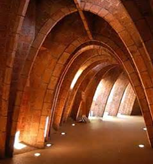
Posted in Stitch 'n Bitch | Tagged: , , , , | Leave a Comment »

5 Essential Questions Every Jewelry Designer Should Have An Answer For

Posted by learntobead on April 14, 2020

5 Essential Questions Every Jewelry Designer
 Should Have An Answer For

Interested in trying your hand at jewelry design? 
 
 Before you begin, consider the following 5 questions I pose for you…

  1. Is what you do Art, Craft or Design?
  2. How do you decide what you want to create?
  3. What materials (or techniques) work well together, and which do not?
  4. What things do you do so that your finished piece evokes an emotional response?
  5. How do you know when your piece is done?

Many people begin to explore jewelry designing as a hobby, avocation, business or career. This requires, not only strong creativity skills, but also persistence and perseverance. It means understanding that jewelry can only be judged as finished and successful as the piece is worn. Jewelry design is more than the application of a set of techniques; it is a mind-set, as well. It is a way of thinking like a designer.

A lot of the achievement and accomplishment in this pursuit of jewelry design comes down to ability to make and follow through on many artistic and design decisions. Some have to do with managing a process, which can take an extended period of time. It also comes down to being fluent, flexible and original in your thinking through design. The greater your disciplinary literacy, the more empowered and confident you become in your design work.

Susan is one example of what happens when uncertainty — that paralysis or deer-in-the-headlights feeling that we so often face — sets in. Susan felt very unsure of herself. And unsure of her jewelry. Would people like it? Was the color mix appropriate? Was the construction secure? Was the price smart and fair? She allowed all this uncertainty to affect her design work — she had difficulty finishing pieces she was working on, starting new projects, and getting her work out there.
 
 
Like many of my jewelry design and beadwork students, Susan needed to be fluent as a designer. With fluency comes empowerment, confidence and success.

Fluency and Empowerment

The fluent jewelry designer is able to think like a designer. The jewelry designer is more than a craftsperson and more than an artist. The jewelry designer must learn a specialized language, and specialized way of balancing the needs for appeal with the needs for functionality. The jewelry designer must intimately recognize and understand the roles jewelry plays for individuals as well as the society as a whole. The designer must learn how art, architecture, physical mechanics, engineering, sociology, psychology, context, even party planning, all must come together and get expressed at the point where jewelry meets the boundary of the person.

And to gain that fluency, the designer must commit to learning a lot of vocabulary, ideas and terms, and how these imply content and meaning through expression. The designer will need to be very aware of personal thoughts and thinking as these get reflected in all the choices made in design. The designer will have to be good at anticipating the understandings and judgements of many different audiences, including the wearer, viewer, seller, exhibitor, client, and collector.

With fluency comes empowerment. The empowered designer has a confidence that whatever needs to be done, or whatever must come next, the designer can get through it. Empowerment is about making and managing choices. These choices could be as simple as whether to finish a piece or not. Or whether to begin a second piece. The designer will make choices about how to draw someone’s attention to the piece, or present the piece to a larger audience. She or he may decide to submit the piece to a magazine or contest. She or he may want to sell the piece and market it. The designer will make choices about how a piece might be worn, or who might wear it, or when it might be worn, in what context.
 
 
And for all these choices, the jewelry designer might need to overcome a sense of fear, boredom, or resistance. The designer might need to overcome anxiety, a sense of giving up, having designer’s block, feeling unchallenged, and even laziness.

In order to make better artistic and design choices, the Fluent and Empowered Jewelry Designer should have answers to these 5 critical questions:

Question 1: Should BEADWORK and JEWELRY MAKING be considered ART or CRAFT or DESIGN?

The jewelry designer confronts a world which is unsure whether jewelry is “craft” or “art” or its own special thing I’ll call “design”. This can get very confusing and unsettling. Each approach has its own separate ideas about how the designer should work, and how he or she should be judged.
 
 
When defined as “craft,” jewelry is seen as something that anyone can do — no special powers are needed to be a jewelry designer. As “craft”, there is somewhat of a pejorative meaning — it’s looked down upon, thought of as something less than art. The craft piece has functional value but limited aesthetic value.
 
 
But as “craft”, we still recognize the interplay of the artist’s hand with the piece and the storytelling underlying it. We honor the technical prowess. People love to bring art into their personal worlds, and the craftsperson offers them functional objects which have some artistic sensibilities.
 
 
When defined as “art”, jewelry is seen as something which transcends itself and its design. It is not something that anyone can do without special insights and training.
 
 “Jewelry as art”
evokes an emotional response. Functionality should play no role at all, or, if an object has some functional purpose, then its functional reason-for-being should merely be supplemental. For example, the strap on a necklace is comparable to the frame around a painting, or the pedestal for a sculpture. It is not included with nor judged as part of the art work.

When defined as “design”, you begin to focus more on construction and functionality issues. You often find yourself making tradeoffs between appeal and functionality. You incorporate situational relevance into your designs. You see “choice” as more multidimensional and contingent. You define success only in reference to the jewelry as it is worn.

How you define your work as ART or CRAFT or DESIGN will determine what skills you learn, how you apply them, and how you introduce your pieces to a wider audience. [The bias in this book is to define jewelry as DESIGN, with its own disciplinary-specific, specialized knowledge and skills base, where jewelry is judged as art only at the point it is worn, and where jewelry-making is seen as a communicative process.]

QUESTION 2: How do you decide what you want to create? What kinds of things do you do to translate your passions and inspirations into jewelry? What is your creative process?

Applying yourself creatively can be fun at times, but scary at other times. It is work. You are creating something out of nothing. There is an element of risk. You might not like what you end up doing. Your friends might not like it. Nor your family. You might not finish it. Or you might do it wrong. It may seem easier to go with someone else’s project.

Applying creativity means developing abilities to generate options and alternatives, and narrowing these down to specific choices. It means developing an ease and comfort generating fix-it strategies when approaching unknown situations or problematic ones. It means figuring out how to translate inspiration into design in a way that inspires others and taps into their desires. It means differentiating yourself from other jewelry designers as a measure of your originality.
 

 Creative people…

Set no boundaries and set no rules. They go with the flow. Don’t conform to expectations.
 
 Play.
They pretend they are kids again.
 
 Experiment.
They take the time to do a lot of What Ifs and Variations On A Theme and Trial and Error.
 
 Keep good records.
They make good notes and sketches of what seems to work, and what seems to not work.
 
 Evaluate.
They learn from their successes and mistakes.

As jewelry designers gain more and more creative experiences, they begin to assemble what I call a Designer’s Tool Box. In this virtual box are a set of thinking routines, strategies and fix-it strategies that have worked well in the past, are very workable in and of themselves, and are highly adaptive when used in unfamiliar situations. Every jewelry designer should develop their own Tool Box. This vastly contributes to success in creative thinking and application.

QUESTION 3: What kinds of MATERIALS work well together, and which ones do not? This applies to TECHNIQUES as well. What kinds of TECHNIQUES (or combinations of techniques) work well when, and which ones do not?

The choice of materials, including beads, clasps, and stringing materials, and the choice of techniques, including stringing, weaving, wire working, glassworks, metalworks, clayworks, set the tone and chances of success for your piece.

There are many implications of choice. There are light/shadow issues, pattern, texture, rhythm, dimensionality and color issues. There are mechanics, shapes, forms, durability, drape, flow and movement issues. There are positive and negative space issues.

It is important to know what happens to all these materials over time. It is important to know how each technique enhances or impedes architectural requirements, such as allowing the piece to move and drape, or assisting the piece in maintaining a shape. Each material and technique has strengths and weaknesses, pros and cons, and contingencies affecting their utilization. The designer needs to leverage the strengths and minimize the weaknesses.

All of these choices:
 
… affect the look
 … affect the drape
 … affect the feel
 … affect the durability
 … affect both the wearer’s and viewer’s responses
 … relate to the context

Question 4: Beyond applying basic techniques and selecting quality materials, how does the Jewelry Designer evoke an emotional and resonant response to their jewelry? What skill-sets do Designers need in order to think through powerful designs?

An artistic and well-designed piece of jewelry should evoke an emotional response. In fact, ideally, it should go beyond this a bit, and have what we call “resonance”. The difference between an emotional response and resonance is reflected in the difference between someone saying, “That’s beautiful,” from saying “I need to wear that piece,” or, “I need to buy that piece.” 
 
 
Quite simply: If no emotional response, and preferably, resonance, is evoked, then the jewelry is poorly designed. Evoking an emotional and resonant response takes the successful selection and arrangement of materials, the successful application of techniques as well as the successful management of skills.
 
 
Unfortunately, beaders and jewelry makers too often focus on materials or techniques and not often enough on skills. It is important to draw distinctions here.
 
 
Materials and techniques are necessary but not sufficient to get you there. You need skills.
 
 
The classic analogy comparing materials, techniques and skills references cutting bread with a knife. Material: bread and knife. Technique: How to hold the knife relative to the bread in order to cut it. Skill: The force applied so that the bread gets cut successfully.
 
 
Skills are the kinds of things the jewelry designer applies which enhance his or her capacity to control for bad workmanship and know when the piece is finished. Skills, not techniques, are what empower the designer to evoke emotional and resonant responses to their work.

These skills include:
 
— Judgment
 — Presentation
 — Care and dexterity
 — Knowing when “enough is enough”
 — Understanding how art theory applies to the “bead” and to “jewelry when worn”
 — Understanding the architectural underpinnings of each technique, and how these enhance, or impede, what you are trying to do
 — Taking risks
 — Anticipating the desires, values, and shared understandings all client audiences of the designer have about when a piece should be considered finished and successful
 — Recognizing that jewelry is art only as it is worn

QUESTION #5: When is enough enough? How does the jewelry artist know when the piece is done? Overdone? Or underdone? How do you edit? What fix-it strategies do you come up with and employ?

In the bead and jewelry arenas, you see piece after piece that is either over-embellished or under-done. Things may get too repetitive with the elements and materials. Or the pieces don’t feel that they are quite there yet.
 
 
For every piece of jewelry there will be that point of parsimony when enough is enough. We want to find that point where experiencing the “whole” is more satisfying than experiencing any of the parts. That point of parsimony is where, if we added (or subtracted) one more thing, we would detract from the whole of our design.

Knowing that point of parsimony is also related to anticipating how and when others will judge the piece as successful. And what to do about it when judged unfinished or unsuccessful.

There is no one best way — only your way

The fluent and empowered jewelry designer will have answers to these 5 essential questions, though not every designer will have the same answers, nor is there one best answer.
 
 
Yet it is unacceptable to avoid answering any of these 5 questions, for fear you might not like the answer.
 
 
The fluent and empowered jewelry designer will have learned the skills for making good choices. He or she will recognize that jewelry design is a process of management and communication. The fluent and empowered designer manages how choices are made. These choices include making judgments about selecting and combining materials, both physical and aesthetic, and techniques, both alone or in tandem, into wearable art forms and adornment, expressive of the desires of self and others. The artist’s hand will be very visible in their work.
 
 
This is jewelry making and design.

This is at the core of how jewelry designers think like jewelry designers.

This is the substantive basis which informs how the designer introduces jewelry publicly.

Other Articles of Interest by Warren Feld:

The Jewelry Design Philosophy: Not Craft, Not Art, But Design

What Is Jewelry, Really?

The Jewelry Design Philosophy

Creativity: How Do You Get It? How Do You Enhance It?

Disciplinary Literacy and Fluency In Design

Becoming The Bead Artist and Jewelry Designer

5 Essential Questions Every Jewelry Designer Should Have An Answer For

Getting Started / Channeling Your Excitement

Getting Started / Developing Your Passion

Getting Started / Cultivating Your Practice

Becoming One With What Inspires You

Architectural Basics of Jewelry Design

Doubt / Self Doubt: Major Pitfalls For The Jewelry Designer

Techniques and Technologies: Knowing What To Do

Jewelry, Sex and Sexuality

Jewelry Making Materials: Knowing What To Do

Teaching Discplinary Literacy: Strategic Thinking In Jewelry Design

The Jewelry Designer’s Approach To Color

Point, Line, Plane, Shape, Form, Theme: Creating Something Out Of Nothing

The Jewelry Designer’s Path To Resonance

Jewelry Design Principles: Composing, Constructing, Manipulating

Jewelry Design Composition: Playing With Building Blocks Called Design Elements

Contemporary Jewelry Is Not A “Look” — It’s A Way Of Thinking

I hope you found this article useful. Be sure to click the CLAP HANDS icon at the bottom of this article.

Also, check out my website (www.warrenfeldjewelry.com).

Subscribe to my Learn To Bead blog (https://blog.landofodds.com).

Visit Land of Odds online (https://www.landofodds.com)for all your jewelry making supplies.

Enroll in my jewelry design and business of craft video tutorials online.

Add your name to my email list.
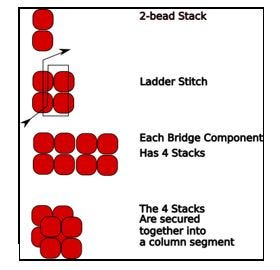
Posted in Stitch 'n Bitch | Tagged: , , , , | Leave a Comment »

Oy Ve! The Challenges of Custom Work

Posted by learntobead on April 14, 2020

CANYON SUNRISE for music artist attending awards ceremony. Piece had to reflect nature.

I am a jewelry designer, and have been doing custom jewelry design for over 30 years. It’s challenging. It’s fun. But it can be a headache. Here are some lessons I have learned which I want to share with you.

When I began my jewelry making career, one of the smartest things I did was take on repairs. I learned so much. With each repair, I was able to re-construct in my mind the steps the jewelry designer made when creating this piece of jewelry — choices about stringing materials, clasps, beads, and how to connect everything up. And at the same time, I could see where these choices were inadequate. I could see where the piece broke or wore down. I could question the customer about how the piece was worn, and what happened when it broke.

And with each repair, I gained more knowledge from yet another jewelry designer’s attempt to fashion a piece of jewelry.

All these repairs resulted in more self-confidence about designing jewelry and designing jewelry for others. And, just as important, it led to more custom work.

28 COINS NECKLACE for poker player, includes coin pearls and jade good fortune carving

When you do custom work, I think you need an especially steeled personality to deal with everything that can go awry.

First comes the fitting. You take some initial measurements, but after the piece is made, the perspective changes, and so do the desired measurements.

Then comes a lot of customer indecision — colors, lengths, beads, silhouettes, overall design. They have a sense of what they want, but often have difficulty articulating the specifics.

Or they want to use several gemstones, but want them all to have the exact same markings and coloration.

Or they want to use several colors which really don’t harmonize well with each other.

Or they want to use components which are not easily available.

And not to forget to mention the sometimes questionable taste.

Or the possibilities of infringement of other jeweler’s designs, when the customer wants you to re-produce something they saw in a magazine or on-line. Identically.

And then time-frame. Can I finish the piece by the time the customer wants it done?

SOUNDTRACK::Color for folk musician who wanted something similar to a piece worn by Alanis Morissette. Client wanted all these colors (with raspberry as the dominant color) incorporated into this micro-macrame piece.

We discuss pricing, where all-to-often many customers seem resistant to paying anything for my time, which for custom designed pieces, is considerable. I walk them through the detailed process ad nauseum so they get the gist of all the work involved.

And last, payment. It’s not so easy to get some people to pay.

I still do a lot of custom work. But I delay a bit, sitting down and actually constructing the piece. I have a lot of discussions with the client. If there are color or materials questions, I usually present the client only 3 colors or materials at a time, and ask them to choose which they prefer. Then another 3-at-a-time forced-choice exercise, until things get narrowed down.

I photo-shop a lot of images — different colors, designs, beads — with the client, and get a lot of feedback. As I assemble all the information, I sketch/photo-shop what a final piece might look like. I superimpose this image on a mannequin to show the customer what it might look like. I have the customer formally sign-off on a final design. And only then, do I begin to construct the piece.

I try to develop in my mind a type of behavioral profile on each client. I pay attention to the styles of clothing they wear, the colors, how much jewelry they wear, and what that looks like. I spend time asking where, when and how they will be wearing the jewelry. I ask if they any expectations about the reactions they want or expect from others, when wearing the jewelry. I try to elicit the reasons why they are purchasing this custom piece, and whether it is filling any gaps they perceive in their wardrobe. I try to get a sense of how elaborate or simple they want the finished piece to be.

I give the client a realistic deadline. If the client needs the piece sooner, we discuss right up front where I will need to make process changes, in order to meet the reduced deadline.

It’s important to make everything about the design process and my management steps which I need to take predictable and clear right up-front. I don’t want to present the client with any surprises.

I require a 50% deposit up front.

I agree to make some adjustments for 6 months after the customer has the piece in hand.

I have a .pdf Certificate of Authenticity which I sign and give to the client. I name each piece (and if it is part of a series, that series will have a name as well), and this information is included in the Certificate. The Certificate also states my 6-months of adjustments policy.

Other Articles of Interest by Warren Feld:

Oy Ve! The Challenges of Custom Work

The Importance of Self-Promotion: Don’t Be Shy

Are You Prepared For When The Reporter Comes A-Calling?

Don’t Just Wear Your Jewelry…Inhabit It!

Two Insightful Psych Phenomena Every Jewelry Designer Needs To Know

A Dog’s Life by Lily

Copyrighting Your Pieces: Let’s Not Confuse The Moral With The Legal Issues

Jewelry, Sex and Sexuality

Jewelry Design: An Occupation In Search Of A Profession

Teaching Discplinary Literacy: Strategic Thinking In Jewelry Design

Contemporary Jewelry Is Not A “Look” — It’s A Way Of Thinking

Beads and Race

Were The Ways of Women or of Men Better At Fostering How To Make Jewelry

The Bridesmaid Bracelets

I hope you found this article useful. Be sure to click the CLAP HANDS icon at the bottom of this article.

Also, check out my website (www.warrenfeldjewelry.com).

Subscribe to my Learn To Bead blog (https://blog.landofodds.com).

Visit Land of Odds online (https://www.landofodds.com)for all your jewelry making supplies.

Enroll in my jewelry design and business of craft video tutorials online.

Add your name to my email list.

Posted in Stitch 'n Bitch | Tagged: , , , , | Leave a Comment »