Warren Feld Jewelry

Taking Jewelry Making Beyond Craft

Bead Stringing With Needle and Thread

Posted by learntobead on May 14, 2020

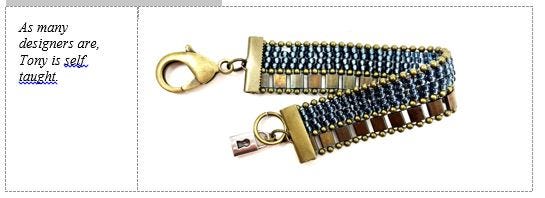
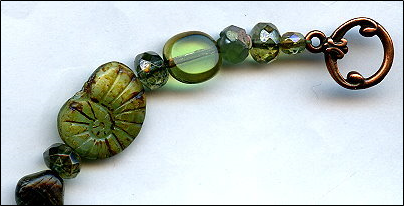
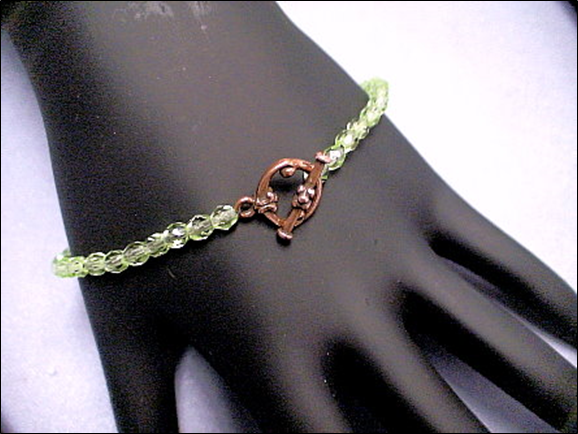
Bracelet strung on thread

Needle and thread were very intimidating, and frankly, scared me. I could barely sew a button back on a shirt. My hands seemed so big and bulky — how could I hold onto these extremely thin beading needles? And thread the eye of the needle? And control things? The few times I had hemmed some torn pants, my thread path was more modern art, than functional perfection.

Jayden loved needle and thread. She made everything with it. She kept trying to force me to learn, but I resisted. For years. Resisted for many years. At one point, she retired, and I had to take over teaching her Attaching Clasps class. In that class, she taught both crimping and needle and thread bead stringing. So I had to learn it.

Not as painful as I anticipated. And the resulting pieces felt and moved and looked so much better than cable wires, that I took to it very quickly, and made it my own, so to speak. Needle and thread became my preferred approach. But when I made things to sell, I often reverted back to the cable wires. When cable threads, like FireLine, came along, these became a good compromise, at least for some projects, though not all of them.

HOW TO USE NEEDLE AND THREAD
 To String a Bracelet, Including How to Wax Your Thread

There are many different types of stringing materials. The best outcomes, from the Art and Design Tradition, are achieved using needle and thread. Beading threads are nylon. Most are shaped like a thin ribbon, rather than round, like sewing thread. Most are bonded, rather than twisted, fibers, which adds a lot of what is called “abrasion resistance.” Twisted fibers have zero abrasion resistance.

With beading threads, your stringing will be the strongest, it will last a long time, it will feel supple and soft, and it will drape and wear the best. It will take the shape of the body, and move the best with the body. With needle and thread, you tie knots to secure your clasps. You do not use crimp beads.

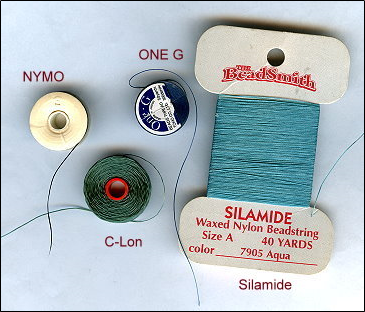
Prominent beading threads including Nymo, C-Lon and One-G. One thread, Silamide, is twisted, rather than bonded, which means it has no abrasion resistance. Beads have very sharp holes — picture broken glass — and Silamide breaks easily. Although it is pre-waxed and little easier to manipulate through your beads, I don’t recommend it. I’m not big on anything that breaks easily.

Using needle and thread does add a lot of time to the creation of a piece. You have to use a needle, which can be awkward. You need to wax your thread, which takes more time. You need to go through your piece THREE times. If you are selling your pieces, very often you won’t be able to recoup your labor, when using needle and thread.
One alternative is to use a cable wire. This goes very quickly and is easy to do. The cable wire is stiff enough to be its own needle. You don’t wax. You only have to go through your piece ONE time. The better cable wires are very strong. There is a stiffness to them that makes the pieces not feel as good when worn, in comparison to thread. You also have to use a crimp bead to hold the cable wires in place, and this is a weaker and somewhat riskier design element than tying a knot in the Clasp Assembly. Cable wire brands that I particularly like and recommend include Soft Flex and Flexrite.

Pieces done on cable wire move in the opposite direction that your body moves. If I wear a needle/thread bracelet on my wrist, and move my wrist to the left, the bracelet will move with me. If I wear a cable wire bracelet on my wrist, and move my wrist to the left, the bracelet will actually move in the opposite direction to the right. The cable wire bracelet does not conform to and take the shape of your wrist, when worn. This becomes a major design problem not always dealt with easily.

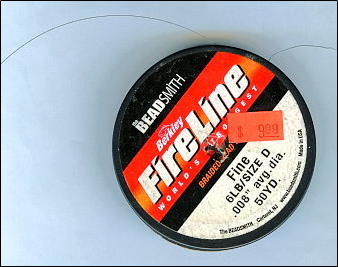
Another alternative to beading thread is to use a hybrid cable thread, such as FireLine or PowerPro or Spiderwire. Cable threads are threads braided together and encased in nylon. Originally these were used as fishing line and adapted by craftspersons for stringing and weaving. You use needles with these cable threads, but you only have to go through your piece one time, instead of 3 times, as you do with thread. You can go through your piece more than once to make your piece stiffer, but you don’t have to. You do not have to wax these cable threads. You can wax them, however, if you want, to increase your thread tension, and add more security against the sharp bead-holes cutting the cable thread.

The cable thread pieces are stiffer than the regular beading threads, but drape better than the cable wires. You tie knots with the cable threads, like with regular beading threads, to secure your clasp. Since you still rely on a needle, using the cable threads goes more slowly than using the cable wires. The PowerPro is a little awkward to use. I really like the FireLine and Spiderwire.
Threads (nylon beading thread)

Unfortunately for me, and for many beginning jewelry artists, the choices were not only about choosing thread instead of cable thread or cable wire. There were many types and brands of beading threads, each with some pros and each with some cons.

The original nylon beading thread is Nymo. Nymo was first developed by the shoe industry to attach the bottom of your shoe to the top of your shoe. It is widely used in upholstery. In the 1980s and earlier, if you wanted to buy Nymo, you bought it on a gigantic wheel — a five lifetime’s supply for us. As beading got more popular, Nymo packaged their thread on smaller and smaller entities, starting with a cone (a little bigger than a fist), then a spool (a little bigger than a thumb), and then a small bobbin. More recently the spool has been replaced by a large bobbin.

It turns out that the company could not get the same product onto a small bobbin. So, the thread on the small bobbin is weaker than the thread on the large bobbin, spool and cone. However, usually only white and black colors are available on the entities larger than the small bobbin.

Nymo is very strong. I suggest, if you have never worked with Nymo, to cut off about a 3 foot length, and try to pull on it and break it between your hands. It will break, but you’ll feel how tough it is. And in bead stringing, we typically go through each bead at least 3 times, so you have 3 thicknesses of this thread inside your piece.

When they make Nymo thread, it is a beige color. To make black, they dye the thread. The black dye tightens the thread, and makes it stronger. To make white, they bleach the thread. The bleach weakens the thread, so white is weaker than black. To make a color thread, they first bleach the thread white and then add a color dye. These color dyes further weaken the thread. So colors are weaker than white, and thus weaker than black. The colors of the thread, however, are consistent from batch to batch.

Nymo comes in many sizes. From smallest to largest, these include: OO, O, A, B, D, F, and G. The most popular and often used size is D (.008″). For a few years, the manufacturer, which had been stamping the size on the bobbin’s side, decided not to stamp any size on the bobbin. I guess people complained, understandably so, and they returned to their original practice.

C-Lon is a newer thread. When they make C-Lon, whatever color it is, that is the color the thread starts as. So, all the colors AND the white AND the black are equally as strong. However, the color from batch to batch will vary, sometimes widely. Overall, we like C-Lon better, particularly for the white and the colors. Black C-Lon is equivalent in strength to the Black Nymo. For white and colors in C-lon, these are stronger than their Nymo compatriots. One drawback to C-Lon is that the ends of the thread fray easily, making it more difficult to get your thread into the eye-hole of the needle, than with Nymo. C-Lon only comes in two sizes — AA (smallest) and D (thickest).

ONE-G is a premium beading thread and is similar in strength to C-Lon. I think its best attribute is that it has a spring-i-ness to it, that makes it much less tiring to use, than Nymo or C-Lon. ONE-G only comes in size D and only in about 12 colors.

Silamide is a pre-waxed thread. The pre-waxing allows the thread to get less tangled up when you use it. However, Silamide breaks very easily, so I don’t recommend it. Why put in all that time into a project if there is a good chance your thread will break?

Beading thread is shaped flat like a ribbon. Sewing thread is shaped round. Sewing threads are not strong enough to use in beadwork.

When choosing a thread to use, sometimes you have to make some compromises and trade-offs.

From one beader:

After finishing the pendant, I thought the necklace needed something more — like individual seed bead daisies attached to a handful of the beads in the necklace. I was working on the necklace on a Sunday night and told my friend I’d have it for her at work on Monday. I had limited thread options at hand: white Nymo or brown embroidery thread. The Nymo would have been a better thread choice, but the white was not aesthetically pleasing against the dark beads. So, I went with the brown embroidery thread. How bad could it be? Ugh! It was so hard to handle and kept fraying. Once the piece came back from photography, I did end up redoing it with brown Nymo.

I find myself switching thread brands and colors from project to project. For bead stringing, I rarely use any other size than D. I most often use the color black, and when I want to use black, I usually grab my ONE-G or Nymo. When I use a color thread, I go for ONE-G, if they have a good color; otherwise, I use C-Lon. If my piece uses any kind of crystal bead, I use FireLine or Spiderwire. There is a cable-thread product called C-Thru-B, which goes in and out of production, but is an excellent product to use with crystal beads and other beads with especially sharp holes.

Color Effects of Thread

Thread color affects the viewer’s perception and evaluation of the piece. People see the thread at the knots. They subconsciously see the threads between each bead. If you are using transparent or translucent beads, the thread color will affect the color of these beads. You can do the same piece using different colored threads, and each of these pieces will look very different.
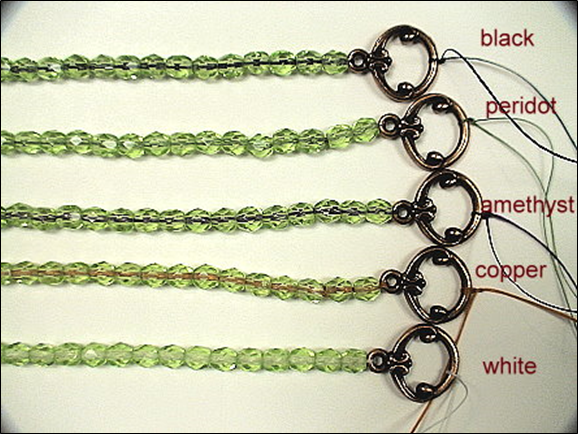
Same bead, different colors of thread

Black always works. Can’t see the knots, only shadows. This makes your piece seem older, richer, more traditional. It gives your piece a patina.

White makes your pieces brighter, sharper, more contemporary looking.

Colors: Most people select a color that is the same or similar to the predominant color in the piece. In this case, there is no color affect. However, you can pick contrasting or complimentary colors, such as using an amethyst colored thread to string peridot colored beads. You can also change the colors of your thread as you work thru your piece.
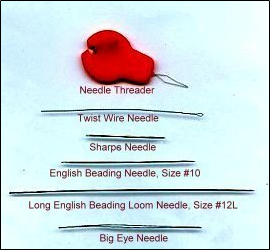
Needles

The eye of a beading needle is shaped like a rectangular funnel (the opening on one side of this funnel is larger than the opening on the other). Beading thread is shaped like a ribbon.

The eye of a sewing needle is round or a larger, rounder opening. Cotton sewing thread is round.

There are many styles of beading needles. The most used ones include:

English Beading Needles
(Size #10 is good for bead stringing projects; 
 Sizes #10 and #12 are used most often in bead weaving. There’s also a size #11.)

I like these because they have a little, but not too much, bend to them. They are stiff enough to push through your beads, but can bend a little to take some corners, or to get into the holes between two beads on a string.

Some people like to use Pony brand, rather than the English Beading Needles. Pony needles are made in India. They are a fraction of the cost of the English ones. However, they break very easily. I get too frustrated with my needles breaking too frequently, so I use the English.

Other people like to us Japanese beading needles. These have similar durability to the English ones, but are very stiff and lack that useful “bending” property that I prefer.

These needles come in many sizes. The #10 is the biggest, and the size of the eye hole relative to the needle is proportionately much bigger than that in the thinner sizes. You will also find Size #12, Size #13 and Size #15.

TULIP needles:
These are the top of the line quality needles. They are made in such a way that they bend easily when you want to maneuver them through a bead, but straighten out after you have made your thread pass. A little pricey, but worth it, in my opinion. These come in several varieties and sizes.

Sharps Needles (shorts)
Sharps needles are English but are shorter and considerably stiffer than regular English Beading Needles. These needles are primarily used in bead embroidery, where you have to push the needle through fabric, and a stiffer needle works better here. Some people like to use these for everything, but these are a bit too small for my hand. My hand cramps up when I use them.

These come in Size #10 and Size #12.

Loom Needles (long)
Loom needles are longer than regular English beading needles. When you do loom work, you want to get as many beads on your needle as you can, when passing back and forth, to minimize the chances of snagging a warp thread with your needle.

These come in Size #12.

Big Eye Needles
When your stringing material is ribbon or fabric or yarn or string, you would use a Big Eye Needle. This needle consists of two flexible needles, soldered at each end, and which open up to form a big eye. You wedge the end of your stringing material into one end, and this becomes your trailing end as you string your beads.

These come in a 2” length and a 5” length.

Twist Wire Needles
Twist Wire Needles, sometimes called Collapsible Eye Needles, are used when you can’t get your stiff needle through, and you need to pass through a bead-hole one more time. You take your stiff needle off your thread, and re-thread on the Twist Wire Needle. This will usually go through a hole about three more times, before it begins to unravel. These needles come in many sizes, from Very Fine, Fine and Medium to Heavy and Extra Heavy.

Needle Threaders 
These work with sewing thread and needles, but not really with beading thread and needles. When you buy a kit of beading needles at a craft store, they usually come with needle threaders. These won’t work with beading needles. You can get the threader through the eye of the beading needle; however, when you try to pull it back through with the thread, it’s too thick and won’t come back out.

It’s always a good idea to have two or more beading needles on hand. They break. You don’t want to find yourself in the middle of your project and having to run to the store get another needle.

And you will occasionally poke yourself with the needle. Occupational hazard.

Hiding The Knot. When using thread, the knots are so small, that you don’t see them on the finished piece. This is especially true when using Black thread. With black thread, people see a shadow.

When using thicker cords and stringing materials, if you want to hide the knot, use a bead with a larger hole on either end, so that the hole swallows the knot. Or slide a crimp cover over the knot, so it seems like there is a bead there.

Getting Your Thread Onto Your Needle

Most people try to push the needle onto the thread. This works, but it takes a lot longer than what I am going to suggest. I like to hold the needle steady and pop the thread into the eye of the needle.

First, when using thread as your bead stringing material, you always begin with a wing-span (arm-to-arm’s) length, which is about 6 feet. Six feet of thread will make an 8”-bracelet.

Next, on one end of your length of thread, pinch it between your thumb and forefinger, with a little bit of the tail sticking up.
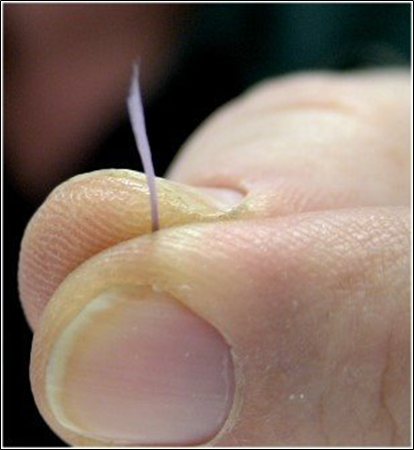
Pull the thread slowly down so that the top of the thread is at the same level as the top of your forefinger.
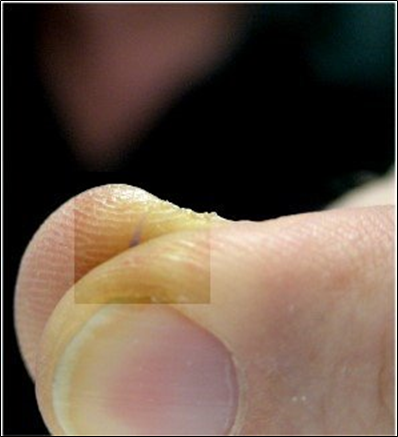
We are going to play with this thread. Pinch the thread to pop it up higher, and then pinch the thread to pop it back lower, just below the surface of your forefinger. Do this a couple times so that you can lock into your mind an image of where the thread will pop up..

Bring your needle down parallel with your forefinger. Hold the eye of your needle right above where your thread will pop up. Don’t move your needle. Pinch the thread to pop it right into the eye hole of your needle.
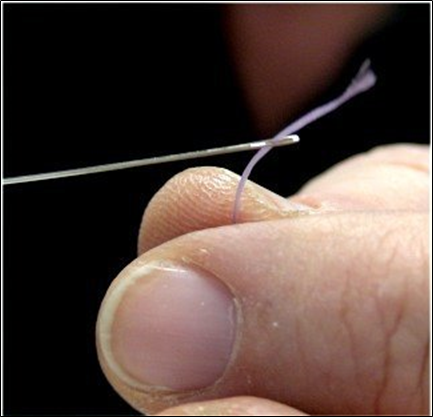
When threading your needle, often it is useful, if your thread is a dark color, to work over a light-colored surface, and if your thread is a light color, to work over a dark-colored surface.

NOTE: If you are using a cable thread like FireLine, this cable thread is round, not flat. To get it on the beading needle, you often have to flatten the end of the cable thread a bit. Run the end between your finger nails, or a tweezer, or a chain nose or flat nose pliers. Don’t pull it through your teeth; it can cut into your teeth.
Wax. Wax. Wax.

A really good artist will wax their thread. Even if the thread says it’s been pre-waxed, you want to re-wax this thread.

We wax our thread to make it strong, less likely to fray, to straighten and stretch it a bit before using, to waterproof and protect the thread from weird body chemistries, from cosmetics, perfumes and hair sprays and from pollutants in the area, as well as to glide through the beads better, and to fill in the jagged edges of the hole of a bead to make it less likely to cut the thread.

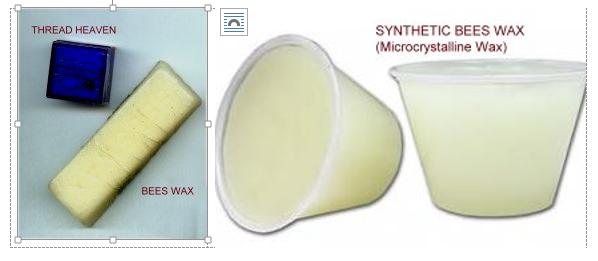
There are different types of threads and conditioners. The primary choices are among pure beeswax, synthetic beeswax (also called microcrystalline wax), and a product called Thread Heaven, which is a thread conditioner, not a wax.

Thread Conditions make the thread less likely to get tangled up and knotted, while you ware working it. Each time you pull the thread through the bead, static electricity builds up. The conditioner prevents this from happening. But it is not a wax. It doesn’t do anything the wax will do.

I suggest you always use beeswax, either pure or synthetic. I do not recommend thread heaven. Natural bees wax will protect the thread for 150 years. The synthetic wax is a little more expensive than the pure wax, but I prefer it. The synthetic does everything the pure one does, only better, and lasts an even much longer time.

Waxing the thread takes very little time, and it can add years to the life of your bead art.

When waxing, we pull our thread through the wax two times. Then we take our two fingers, pinching the thread, and slowing moving down the full length of our thread. Our body temperature melts the wax into the thread. Our fingers also knock off any excess wax on the thread. Always pull by the thread, not by your needle, when waxing.

To feel the effects of waxing, try this:

Take an arm’s length (about 6 feet) of nymo D or C-Lon D

Thread it onto a Size #10 English beading needle.
 Double it up, so that you now have your length of thread in half, with two equal lengths extending from either side of your needle’s eye hole.
 At the needle end, wrap the thread around your forefinger a couple times. When we pull the thread through the wax, we want to pull by the thread, and NOT by the needle.

Wax the thread twice, then take your two fingers and slowly go down the thread, allowing your body temperature to melt the wax into the thread.
 Now un-double your thread. Move your needle up to one end, leaving about an 8–10” tail.
 Take your two fingers, pinching the thread, and feel down the length of the thread to find the area that was wrapped around your finger, and did not get waxed. Your fingers will slip.
 Now wax two more times from that area on down. Pinch your thread at one end, moving your fingers down the length to melt the wax into the thread.

DOUBLING YOUR THREAD

Some people like to work with a doubled thread. I find this awkward and difficult to control. However, I leave this up to you.

ADDING THREAD

If you are making a piece, like a necklace, at some point, you will run out of thread. After all, 6’ of thread does about an 8” bracelet.

When the length of your thread looks like it will be too short to continue, then you need to tie off and anchor this thread. If you are at one end of your piece, you can tie the thread off to your clasp component. If you are somewhere in the middle of your piece, you would tie off your thread to the spine (that is, the thread already running through your piece. It is good to tie a double knot (two overhand knots).

You never cut your thread at the knot. So, after you have tied your knots, you will run your remaining thread through some beads. Then cut the thread as close to the bead-hole you can get. When you are adding new thread, you will go through a few beads before tying that knot.

MAKING A BRACELET USING NEEDLE AND THREAD

Basic Steps

We are going to string a simple strand of beads, using needle and thread. If you wanted to do some planning and design work, for a fancier arrangement, you would play with your beads on a Bead Board, and temporarily string them, using bead stoppers or hemostats on either end, to secure them in place, until you are satisfied with your layout and design.

We are going to do everything in 3’s. We are going to go through the beads three times. We are going to tie 3 knots each time we reach and/or return to an end.

Supplies:
 1 strand 4mm round fire polish or druk beads
 Nymo, Size D thread in black
 2 size #10 English Beading Needles
 Toggle Clasp
 Bees Wax
 
 Scissors
 Work Surface
 OPTIONAL: Bracelet Sizing Cone
 OPTIONAL: Bead Board
 OPTIONAL: Bead Stoppers or Hemostats

LAY OUT YOUR BEADS ON A BEAD BOARD OR WORK SURFACE.

1. THREAD. Cut a length of thread measured from hand to hand of your outstretched hands. (about 6 feet)

2. NEEDLE. Thread onto a #10 English beading needle. Leave an 8–10” tail. You will need this length of tail in order to finish off your piece.

NOTE: Unlike with cable wire, where you deal with your tails immediately, you deal with the tails from needle/thread work at the very end of your project. So these tails will always be annoyingly in the way while you are making your piece.

3. WAX. Wax your thread

4. ATTACH FIRST CLASP PART. On the end opposite the one with the needle, string on the largest piece of your clasp set. Leave about 8–10” of a tail. Don’t short-change yourself on the tail length. You will need 8–10” to finish off your piece at the end.

Tie 3 over-hand knots. Thus, you take the tail, go over the spine, under the spine, and back up through this developing loop. Pull tight.
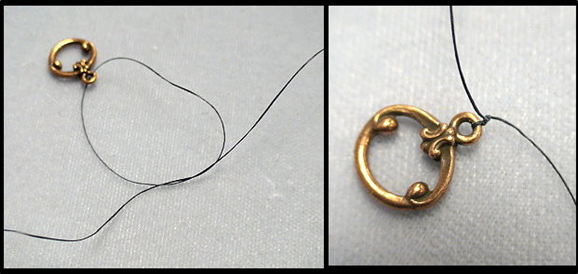
5. STRING YOUR BEADS. Using your needle, put enough beads on the thread until you have made the correct bracelet length, as you want it. Push these beads down so they are flush against the clasp.

The best way to get the beads on the needle, is to use one hand, hold your needle, and spear the hole of your target bead, lifting it up and letting it slide down a bit of your needle. Do this again and again, until you have 4 or more beads on the needle.
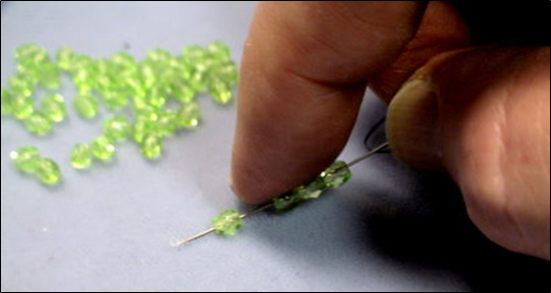
Then take your other hand, and push the beads all the way down to your clasp, tied off on the other end. If you can use only one and to pop your beads onto your needle, then you will increase your speed. But if you have to use two hands to get your beads on the needle, that’s OK.

Do NOT string the beads over the tail. The beads, with needle and thread, are strung over the spine only. We deal with the tails at the very end of the process. [This is unlike with cable wire, where we cover both the spine and the tail at this point.]
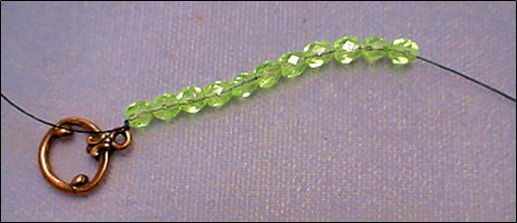
6. TEST LENGTH. Test the length of the bracelet on your wrist or against a sizing cone before tying off the second end. Make any necessary adjustments, such as adding or subtracting beads.

Remember, when you add the 2nd clasp part, you could be adding more length to your piece. With a toggle clasp, you will be adding about 1/2″ more to the length of your piece at this point.
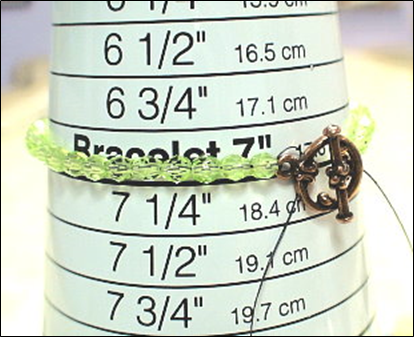
7. ATTACH 2nd CLASP PART. You will be taking the second (and smaller) part of the clasp set and tying this off.

REMEMBER: After this point, you will not be able to make any changes in design, length or ease.

You need to maintain your tension on the beads while doing this. We are going to be using a fancier version of the simple overhand knot. This fancier version gives you more control over your thread tension. If you don’t want to do this, or forget how to do this, you can always tie simple overhand knots.

Let’s begin.

You are the artist.
 Your finger is your easel.
 Your thumb is your clamp.
 The thread is your canvas.
 The beads are your paints.

a. Put the length of beads over your forefinger, (from over there towards you) with the already tied-off part of the clasp at the top, and laying in front of your finger, closest to your body.

b. Push the clasp part off to the side, and clamp the beads, the clasp part, and the tension all in place with your thumb.
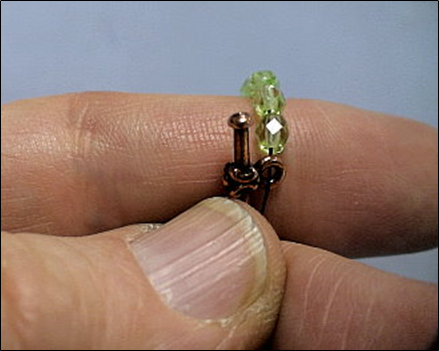
2. Make a U shape with your thread, and tuck under your thumb to hold in place. The U is actually part of your knot.
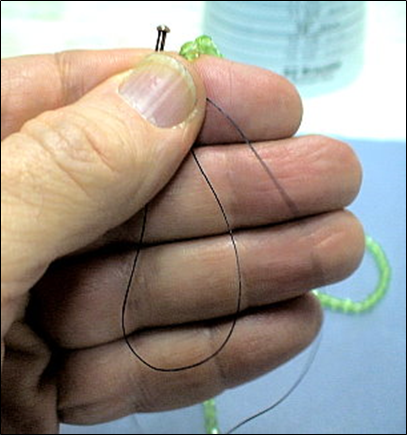
d. Take the end with the needle, and come from behind the string of beads (from outer space towards you), and under the beadwork, but stay over the U-thread and your working thread.

DO NOT take your needle through the U. The U is part of the knot, and you don’t want to tangle up your working thread with your knot.

Don’t pull your bracelet up into the air while working on it. Leave most of it resting on your work surface, pulling the end you are working on up towards you a bit.
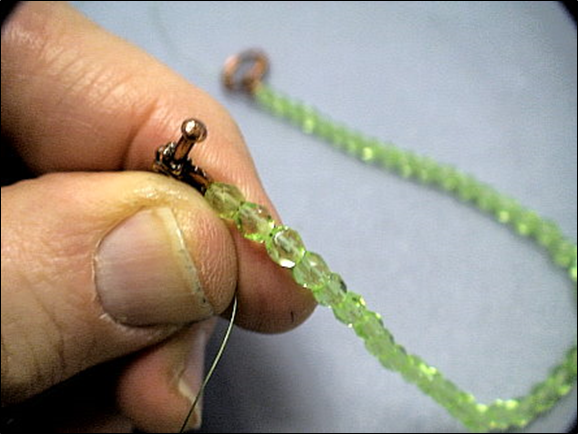
e. Pull, pull, pull, pull, pull and watch the loop getting smaller. Before it gets too small, put your needle down, and work the rest with your hand. Move this ever-decreasing-in-size loop in place between your first bead and the clasp part. You’ll have to let go with your thumb until you have the loop positioned. Clamp down again with your thumb.
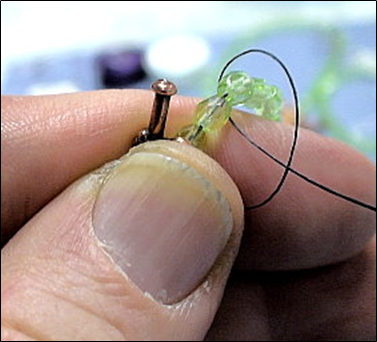
f. Pull tight, and pull out the U.

g. One more pull — give the thread a good tug — to tighten things up. With your fingers on one hand, pinch the clasp part and hold tight and steady. With the fingers on your other hand, grab your working thread and pull the clasp part tightly against the first beads. You don’t want any thread to be showing.

The first time you do this step is the most important. After this, your clasp is locked in place close to that first bead.

h. This is your first knot.

i. Repeat this fancy version of an overhead knot two more times

NOTE: Your knots are tied around the thread or your previous knot. You could also, instead, have gone back through the loop coming off your clasp component, but this is not necessary. With our instructions, less thread and knots will show at the clasp.

8. 2nd Pass With Needle/Thread. Take your needle, and thread all the way back to the other side of your bracelet (where the larger part of your clasp is).

You cannot do this in one step. You will have to pull your needle out every inch or two. When you pull your needle out, give your thread a tug. You don’t want it to bunch up inside the bead holes.

9. Three More Fancy Knots. Tie three of these special knots with the U.

When you get to your second side, there will be an 8–10” tail annoyingly in the way. Push this behind your hand, so it doesn’t get tangled up with your working thread, as you are trying to tie this fancy knot.

10. 3rd Pass With Needle/Thread. Take your needle, and thread all the way back to the other side.

11. Three More Fancy Knots. Tie three more of these special knots with the U.

12. Finishing Off The Tail. Take you needle and thread, and thread back about 2–3” of beads, and pull your thread through.

At this point, you have a lot of thread and knots near and in the hole of that first bead next to the clasp. You may have to push your needle through and out of that first bead first, and then go back through several other beads.

13. Can You Pop The Knot Back Into The Hole Of The First Bead? Pinch the beads right below the clasp end with your thumb and forefinger. Push these away from you, and, at the same time, pull the tail-thread towards you. You are trying to have the knots next to the clasp pop into the hole of the first bead. Usually you’ll hear and feel a pop. But not always. If you were able to maintain a very tight tension throughout, there may not be a pop.
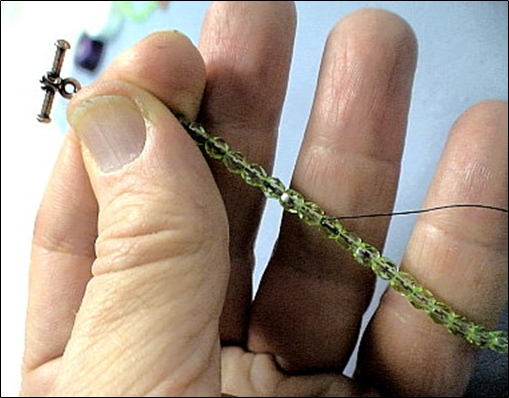
14. Trim The Tail. Pull the thread away from you, and cut it as close to the bead hole as you can get.

15. Finish Off The Tail On The Other Side. Take your needle off the thread, and put the remaining tail of thread onto your needle.

Repeat steps 12 thru 14.

Give It The Once Over…

Once your bracelet is done, look it over carefully. Be sure your thread, where you trimmed your tails, isn’t showing. Be sure that it has sufficient ease.

Needle and thread work loosens up a bit with wear. If your tension is a little on the tighter side, then this will loosen up. If your tension is loose at this point, you may want to run another thread through your piece, anchoring it to both ends, to tighten things up.
Other Articles of Interest by Warren Feld:

Cleaning Sterling Silver Jewelry: What Works!

What Glue Should I Use When Making Jewelry?

Why Am I So Addicted To Beads?

A Very Abbreviated, But Not Totally Fractured, History of Beads

The Martha Stewart Beaded Wreath Project

When Choosing Colors Has You Down, Check Out The Magic Of Simultaneity Effects

The Use of Armature In Jewelry: Legitimate or Not?

Pearl Knotting Warren’s Way

Organizing Your Craft Workspace…Some Smart Pointers

You Don’t Choose Clasps, You Choose Clasp Assemblies

Know Your Anatomy Of A Necklace

Mini Lesson: Making Stretchy Bracelets

Mini Lesson: Making Adjustable Slip Knots With Thicker Cords

Mini Lesson: How To Crimp

Mini Lesson: Attaching End Caps, Cones, Crimp Ends

Mini Lesson: Brick Stitch

Mini Lesson: Flat Even Count Peyote

Mini Lesson: Ndebele Stitch

Mini Lesson: Petersburg Chain

Mini Lesson: Right Angle Weave

Jewelry, Sex and Sexuality

Everyone Has A Getting Started Story

The Nature-Inspired Creations of Kathleen

The Jewelry Designer’s Orientation To Glass Beads

The Jewelry Designer’s Orientation To Lampwork Beads

The Jewelry Designer’s Orientation To Crystal Beads

The Jewelry Designer’s Orientation To Seed and Cylinder Beads

The Jewelry Designer’s Orientation To Choosing and Using Clasps

How To Design An Ugly Necklace: The Ultimate Designer Challenge

I hope you found this article useful. Be sure to click the CLAP HANDS icon at the bottom of this article.

Also, check out my website (www.warrenfeldjewelry.com).

Subscribe to my Learn To Bead blog (https://blog.landofodds.com).

Visit Land of Odds online (https://www.landofodds.com)for all your jewelry making supplies.

Enroll in my jewelry design and business of craft video tutorials online.

Add your name to my email list.
Posted in Stitch 'n Bitch | Tagged: , , , , | Leave a Comment »

When You Tell Someone You Are A Jewelry Designer, Do They Fully Understand What You Do?

Posted by learntobead on May 9, 2020

main

How Do You Clarify What You Do 
In Your Practice As A Jewelry Designer? 
Building that relevance into your work

What do you (or will you) say to people who ask you what you do for a living? When you say, “Jewelry Designer”, you probably get a “That’s nice” or “Oh, you make jewelry,” and perhaps a far-away look. Most people can’t imagine exactly what you do. Their images and experiences with jewelry and what it can look like, the materials available to use, the techniques applied are somewhat limited. Not everyone knows you can craft jewelry by hand, not just by machine.

It can be difficult to define jewelry design. What you do as an artist and designer may involve several different kinds of tasks. Your process may be conventional or unconventional. And it’s not just the “What do you do” aspect of the question, but the concurrently implied “Can you make a living at this” aspect of the question, as well. It’s almost as if they are about to say, “What do you really do?”

The response you want to come up with is your personal understanding and recognition about your passion for design, and all the things that drive this passion. Your excitement in telling your story will become infectious, and, while they still might not comprehend everything you do or the how and why you do it, they will certainly see that you are a jewelry designer, one who is intent on achieving some level of success within the profession.

Your Practice, and how you define and live and succeed in it depends on gaining some clarity in terms of…,

(1) Having a definition of what success as a designer means to you

(2) Developing a production (and marketing) routine

(3) Creating a consistent and coherent body of work

(4) Being very organized

(5) If selling or exhibiting, taking a multi-venue approach

(6) Developing a Criticality where you are reflecting, evaluating, validating, legitimizing, being very metacognitive

(7) Self-Care and finding balance in your life

(1) Defining Success

Not every designer is going to define success in the same way. In fact, there will be dramatic differences. Some people may want to focus on applying their creative skills. They search for artistic excellence. Others may want to make money. They want monetary gain and, perhaps, financial stability. Still others may want to be a part of a social network of other creative types. They might want a support network, seek collaboration, or find recognition.

Some people want to do this full time, and others part time. Some want to earn enough money to pay for their habit; others want to make money to supplement their income; still others want to make enough money to be self-supporting.

Success is all about you. What do you want? How much effort and organization will it take to match your ambition and goals? How much time and money do you want to invest in your education and development? Are you aiming to be a crafter, an artist, or a designer?

Success depends on many factors. But key to all, and foremost, is that you brainstorm with yourself, be brutally honest, and list the goals you prefer and want to achieve. Prioritize these. More successful designers find some balance among creativity, business, and recognition. But your ambitions may be different, and just as legitimate in finding success.

Know that achieving any level or definition of success will take time and effort, often sacrifices. The jewelry designer should set expectations and work strategies accordingly.

(2) The Day-To-Day Routine

While everyone has their own process and their own flow, more successful designers establish some kind of work routine. They allocate a specific work space within which to create. They keep their inventory of parts and finished pieces very organized. And, key here, they set up a schedule for (a) researching ideas and inspirations, (b) working in a production mode, c) presenting or marketing their work to others, (d) reflecting on their practice.

Periodically, evaluate your process. Are there things you can do to improve your efficiency or effectiveness? Can you better manage your productivity? Do you work better at a certain time of day, or day of the week? Have you programmed in breaks? Is there a comfortable balance between work time and break time? Would it be helpful to take the last 15 minutes of your day to set up for tomorrow?

Plot out your weekly schedule on a calendar or spreadsheet. Set some objectives about how many pieces you want to finish per week or per month. If interruptions, say from friends or family, get too annoying, make them aware of your schedule and ask them to help you protect your creative time and space.

It is important to note here that there is a fundamental tension between productivity and creativity. The former tries to put you in a box. The latter tries to keep you from getting stuck in a box. This can be frustrating.

Yet artists and designers, overall, who are able to provide some structure to their creative time tend to be more successful in their practice. These artists and designers set a routine and schedule for both making jewelry time as well as thinking about designing time. They also structure in time for introducing their ideas publicly as well as reflecting on the efficiency and effectiveness of everything they do — tangible and otherwise.

(3) Creating A Consistent and Coherent Body Of Work

Jewelry designers are free to create whatever they want. And usually, novices would be wise to try out a lot of different techniques, and use a lot of different materials, and create a lot of different designs. Think of this as play and experimentation. It’s how you learn to be a designer.

But as you develop more as a designer, it makes more sense to set some limits and begin to define a personal style, coherency and brand identity.

Your style reflects what you are passionate about. It may focus on a particular technique, material or design. Or it may focus on integrating and combining several things. But with all the things you do, there is some coherence to it. It becomes more associated and identified with you and you become more recognized with it. The consistency ties you to your work.

This doesn’t limit variation and creativity in your work. It primarily means that wearers and buyers and collectors of your jewelry can sense the artist’s hand, that is you, reflected by the pieces you create.

Coherency has several dimensions to it. The designer achieves a level of coherency in how the majority of these dimensions, not necessarily all dimensions, are reflected in any one piece. Thus, the designer still has a lot of room for variation in their work and style.

These dimensions of coherency about which designers are selective include,

– The choice of materials

– The choice of techniques

– How pieces are presented, displayed, organized, situated with other pieces

– How pieces and collections are named

– Packaging

– Color palettes

– The use of forms and themes

– Personalization, differentiation and originality

– The use of negative vs. positive space

– The use of point, line, plane and shape

– Arrangements, placements, distributions of design elements within the piece

– Control over light, shadow, bright, dull

– The marriage and resulting tradeoffs between aesthetics and functionality

– Silhouettes

– Quality in materials, quality in craftsmanship, quality in finish, quality in presentation

(4) Organization

Good organization involves

(a) Inventory (how you organize, track and replenish it)

(b) Work space (how you create productive areas for creative work, business and creative reflection)

c) Bookkeeping and accounting (how you manage your finances)

(d) Business logistics, such as researching venues, getting to venues, tracking your pieces, shipping, marketing, web-presence and social media management (how you manage the other business aspects of what you do)

Good organization will help you avoid a lot of frustration and disarray. Learn to use spreadsheets and apps. These will save you a lot of time and minimize a lot of grief and worry. You’ll have more time to create, and need less time to keep things organized and up-to-date.

Think of and treat your inventory of materials, and all that it takes to achieve a satisfactory level of quality in your pieces, as investments, rather than costs. It gets more productive to reflect on What Is Your Return On Investment (ROI)?, rather than on What Does This Cost? This will go a long way in clarifying for you what is important, and what is less so, and how to prioritize things in the face of limits on time and other resources.

Your workspace might be a part of a room, it might be an entire room in your home, or even a complete studio space outside your home.

Divide your “work space” into three distinct areas: where you create, where you handle all the business things, and where you relax, think and reflect.

As you develop your work and related spaces, you should try to anticipate what it will take to scale each of these up, as you get more established as a jewelry designer. Are your spreadsheets and computer apps robust enough to grow with your developing career and business, as well?

(5) A Multi-Venue Approach Towards The Creative Marketplace

Successful jewelry designers are able to get the visibility and legitimacy they want and deserve. They know what to expect when exposing their work publicly within the creative marketplace.

They are good at communicating their ideas and their value, when approaching art and craft show vendors, stores and boutiques, galleries, and buyers and collectors, or applying for art grants or doing demonstrations. They are able to get articles written about them in blogs, newspapers, magazines and jewelry editorials. And, very importantly, they use a multi-venue approach (diversification) when introducing their jewelry into the marketplace. At a minimum, this multi-venue approach will include both an on-line strategy and a bricks-and-mortar strategy.

Legitimacy as an artist requires massive exposure, most often in diverse locations and venues. It is unusual for a single venue or location, whether you are looking for exhibitions or for sales, to be sufficient for a designer to become successful. You will need to have your jewelry pieces in many venues. There are many online directories and other resources to help you find the wide variety of venues useful to the further development of your jewelry design career.

What To Expect When Exposing Your Work Publicly

No jewelry designer works in a vacuum, and no piece of jewelry is complete until it has been shared with an audience.

No wearer or purchaser of jewelry is going to see the piece as merely an object of adornment. They will interact with the piece in a much more intimate way, and very much so influenced by the jewelry creator and all the choices made in design.

Part of the jewelry designer’s development as a professional involves an ability to anticipate and understand how various audiences express desire and how various audiences judge a piece of jewelry to be finished and successful. Jewelry is here to amaze and intrigue. It is here to entice someone to wear it, purchase it, show it around. It is here to share the inspiration and prowess of the designer with those who see, feel, touch and inhabit it.

The more successful designer takes the time to explore how an audience is engaged with the piece. The designer learns insights in how any piece of jewelry evokes emotions and resonates with others. The designer is very sensitive to the experience people have at the point of purchase or gifting. Finish and presentation are very important. Acquiring jewelry is special and unique a process. Jewelry is not something we must have to meet some innate need; rather, it is something we desire because it stirs something in us.

Approaching Stores and Galleries

Although some jewelry designers may feel uneasy mixing art with business, for most it is a necessity. You do not have to sacrifice wonder for reality. Most designers sell their pieces, so recognizing the things about coordinating art with business become very important.

Typically small stores and boutiques, websites and online sales platforms, and galleries will sell your jewelry, either outright, or on consignment. Their goal is to turn a profit, and they are at greater risk than the artist. It is the venue that displays, promotes, prices, trains employees to talk about your jewelry to customers, and keeps the pieces clean. Available selling-space is always limited. When your jewelry takes up space in these venues, it is an opportunity cost to the business — they lose the opportunity to carry someone else’s work which might be more appropriate to the setting, or might sell better.

There are different types of stores, websites and galleries. Each satisfies a different market niche for jewelry. Each has a different level of understanding about what jewelry really is, and all the choices the jewelry designer has made to design and create each piece.

When approaching stores or galleries to display and sell your pieces, it is critical that the artist understand how each specific venue functions, who their audiences are, and what the attendant risks to them are, should they decide to exhibit and/or sell your pieces.

The first step is to be your authentic, passionate self. Your jewelry will not speak for itself. So, in spite of any feelings of vulnerability you might have when approaching stores and galleries, you will need to talk about yourself and your jewelry. You do not want to feel “salesy” when speaking with business or gallery owners and representatives. You do not want to feel pushy. Or desperate. But you want them to get to Yes.

You speak to them on their terms. They want to know the real you. What excites you. The history behind the design choices you make. Your understanding of yourself as an artist, and your understanding of your virtual client, her desires, wants and motivations. How do you connect to your audience through your jewelry?

o Who are your best customers likely to be? 
o How would you describe them: demographics, shopping behaviors, wants and desires?
 o Why are they attracted to your work? 
o How and where do they find out about you and your work?
o What is your Getting Started story? 
o How would you go about persuading someone to buy a piece of jewelry you made — what’s in it for them? How does it connect with them emotionally? How would it make their lives better?

Do some research ahead of time. The internet has a wealth of information you can pull up. Before you meet with them, get an understanding of the types of jewelry artists and their materials they carry in their venues. These venues are always on the lookout for new talent. They are most likely to say Yes to a jewelry designer whose style and materials fit in, but do not duplicate, what they already are showing.

Also research who their customer base is. They are most likely to say Yes to a jewelry designer whose audience either mirrors their existing customer base, or incrementally adds to and expands it at the margin. They most likely will not want to spend resources (and add risk) by going after a completely new and different customer base.

One more thing. You can either push your way in, or use pull to get in. For most of us, particularly when we are getting started, have only push at our disposal. We might cold call, or set up a formal interview, or initiate a conversation with someone at a gallery opening or art show.

But pull always works better. Here we leverage something or someone to get to the right place or person at the right time. An established designer or academic might set up an appointment for you with one of their contacts, for example.

Influencers

In today’s world, there is a manic competition for attention. Then, also, a frenetic effort to retain and manipulate that attention. Attention creates value. Often, it is difficult for the individual jewelry artist to get a leg up in this world without some significant help. Again, as mentioned above, if you can use pull, you’ll go farther, faster than if you have to rely on push.

Influencers are one of the backbones of internet culture and one way to use pull. Their business model centers on ways to shape everything we do in our lives from how we shop to how we learn to how we dress. Influencers are part micro-celebrity and part entrepreneur. They are opinion leaders and have been able to garner a large audience. They have proven themselves to be able to exploit how people distribute their time and attention.

Influencers typically work on a quid-pro-quo basis. In exchange for some products you give them, they promote them. Sometimes a fee may be involved. They take photos, they interact with audiences, they get your message out on different platforms, they sponsor content.

The Value of Collaboration

It can be so easy for any jewelry designer to get so wrapped up in creating things that they isolate themselves. But this is not the ideal situation.

At a minimum, it is very helpful, and very healthy, to have a support group. People you can talk to and talk things out with. People who can give you good feedback.

It is also very invigorating to collaborate on a project with someone else — A2A, that is, artist to artist. You can get an infusion of new ideas, sensibilities and strategies. You can get challenged. You become more self-aware of your own styles and preferences. You come up with new ideas about coordinating your own authentic, creative self with that of someone else.

Maintaining A Client Base

Much of any jewelry designer’s success comes down to maintaining a high level of visibility. Regularly keeping in touch with your client base is extremely important here.

Keep good documentation about who bought your pieces, when, why, for how much, and their address, email, phone numbers.

Maintain a web presence, either as a unique website, and/or a presence on social media platforms.

Create a mailing/emailing list, and use it frequently.

Have business cards handy at all times.

Do promotions to expand your mailing/emailing lists. Call to actions are very effective, such as offering a ‘discount coupon good for the next 7 days’. Or directing them to see your new pieces online by clicking a link.

Keep them up-to-date about where your pieces may be found, and what you are working on now.

(6) Criticality

Criticality is something you want to build into your Practice. It is not something to avoid or minimize.

Criticality is about making choices. It is about separating and confronting and going beyond your piece in order to build in that relevance jewelry needs as it gets exposed to the public.

Criticality helps you close the distance between the jewelry you create and the person it has been created for.

Criticality aids you in revealing the implications and consequences of all your choices. About materials. About techniques. About colors and patterns and textures and forms. Each form of jewelry requires endless and constant adjustments, and you should be very critically aware of what, why and how.

Criticality is necessary for you to continue to grow and develop as a professional jewelry designer.

Criticality is not a put-down of the artist. Rather it is a way of reflecting, evaluating and being very metacognitive of all the choices made in design and construction, and a lot of what-if envisioning and analysis of possible alternative choices. It is an exploratory thing. It adds understanding and comprehension.

Criticality assists in creating a dialog between artist and all the various audiences with whom the artist interacts. Towards that end, it is helpful to actively bring others into that criticality discussion, where we now have the prospects of many voices merging into a form. It can be difficult to be objective about your own work. And you may not be aware of how the quality of your work stacks up with others, and where it needs to be.

Legitimacy

Your legitimacy as a jewelry designer, your reputation, your visibility, your opportunities, to some degree, flow from this process of criticality. Legitimacy comes from both local and more general validation. Validation results from these processes of critical observation and analysis of your work and of how you conduct yourself within your practice.

Your various audiences that view your work critically, in turn, bring your work in contact with the external world. They look for a high level of coherence within the design and its execution. They describe it critically as to its qualifications for matching desire, establishing appeal, having personal or general value and meaning. For successful jewelry designers, this contagion continues, diffuses, and grows.

Legitimacy engenders a deeper level of confidence among artist, wearer and viewer. The relationships are stimulated, enriched, given more and more value. Jewelry is more than a simple object; it is a catalyst for interaction, for relationships, for engagement, for emotion. Legitimacy results in trust and validation.

With globalization and rapid technological changes, the jewelry designer is confronted with additional burdens, making the effort to achieve legitimacy ever more difficult. That is because these larger forces bring about more and more standardization of jewelry. They rapidly bring fashions and styles to the fore, only to scrap them, in the seemingly blink of an eye, for the next hot thing. They channel images of jewelry pieces around and around the world taking on a sameness, and lowering people’s expectations to what jewelry could be about.

If the products around the world are essentially the same, then the only thing the customer will care about is price. They won’t care who made it. They won’t care about quality.

Innovation begins to disappear. With its disappearance, the role of the jewelry designer diminishes. The jewelry designer becomes more a technician with no professional identity or concerns. The jewelry simply becomes the sum of its parts — the market value of the beads, metals and other components. There are few, if any, pathways to legitimacy.

That’s not what we want. And that makes it ever more important that jewelry designers see themselves as professionals, and develop their disciplinary literacy — fluency, flexibility and originality in design. Aspects of design which cannot be globalized. Or standardized. Or accomplished without the work, knowledge, skills, understandings and insights of a professional jewelry designer.

(7) Finding Balance — Self Care

Making jewelry and living a creative life can wear and tear on both your physical, as well as mental, health. It’s important that you have a plan of self-care and balance that you have thought about and structured ahead of time.

Take breaks. Play. Experiment. Take walks. Don’t isolate yourself. Develop a support system.

Exercise. Take good care of your hands, finger nails, wrists, arms, neck, back and eyes. If you need to read with glasses, then you need to make jewelry with glasses. There are lots of different tools specific to different situations — use them all. Elastic wrist bands, thumb-support gloves, elbow bands do great to preserve your fingers, wrists and elbows. There are lots of ergonomic tools and chairs and lighting. With a lot of metalsmithing and lampworking, you’ll need goggles, perhaps special lenses to filter out the glare of torch flames. Make these your friends.

There will be creative aspects to what you do, and administrative aspects to what you do. Find some balance between your right brain and your left brain.

Spend a lot of time feeding your creative well with ideas, inspirations, motivations and a deep appreciation for what artists do well.

Take some time to explore new materials, techniques and technologies.

There will be slow times and seasonal ups and downs. Plan ahead of time how you will occupy yourself during slow periods.

There will be times you will have designer’s block. You will be stuck, usually difficulty getting started, or if your piece is getting developed over a long period of time, some difficulty staying motivated. Develop strategies you can refer to on how to stay motivated, and on how to stop yourself from sabotaging your progress. It is important to know what you can and cannot control.

Train yourself with a mindset for rejection. Not everyone will like what you do. Not everyone will want to wear or buy the pieces you’ve invested your heart and soul in. That’s not your problem. It’s their problem. Don’t make it yours.

Get involved with your profession.

Other Articles of Interest by Warren Feld:

The Jewelry Design Philosophy: Not Craft, Not Art, But Design

What Is Jewelry, Really?

The Jewelry Design Philosophy

Creativity: How Do You Get It? How Do You Enhance It?

Disciplinary Literacy and Fluency In Design

Becoming The Bead Artist and Jewelry Designer

5 Essential Questions Every Jewelry Designer Should Have An Answer For

Getting Started / Channeling Your Excitement

Getting Started / Developing Your Passion

Getting Started / Cultivating Your Practice

Becoming One With What Inspires You

Architectural Basics of Jewelry Design

Doubt / Self Doubt: Major Pitfalls For The Jewelry Designer

Techniques and Technologies: Knowing What To Do

Jewelry, Sex and Sexuality

Jewelry Making Materials: Knowing What To Do

Teaching Discplinary Literacy: Strategic Thinking In Jewelry Design

The Jewelry Designer’s Approach To Color

Point, Line, Plane, Shape, Form, Theme: Creating Something Out Of Nothing

The Jewelry Designer’s Path To Resonance

Jewelry Design Principles: Composing, Constructing, Manipulating

Jewelry Design Composition: Playing With Building Blocks Called Design Elements

Contemporary Jewelry Is Not A “Look” — It’s A Way Of Thinking

How To Design An Ugly Necklace: The Ultimate Designer Challenge

I hope you found this article useful. Be sure to click the CLAP HANDS icon at the bottom of this article.

Also, check out my website (www.warrenfeldjewelry.com).

Subscribe to my Learn To Bead blog (https://blog.landofodds.com).

Visit Land of Odds online (https://www.landofodds.com)for all your jewelry making supplies.

Enroll in my jewelry design and business of craft video tutorials online.

Add your name to my email list.

Posted in Stitch 'n Bitch | Tagged: , , , , | Leave a Comment »

Doubt / Self-Doubt: 8 Major Pitfalls For The Jewelry Artist… And What To Do About Them

Posted by learntobead on May 8, 2020

For the novice, all that excitement at the beginning, when thinking about making jewelry and making some pieces, sometimes collides with a wall of developing self-doubt. It’s not easy to quiet a doubt.

The jewelry artist organizes their life around an inspiration. There is some fuzziness here. That inspiration has some elements of ideas, but not necessarily crystal clear ones. That inspiration has some elements of emotions — it makes you feel something — but not necessarily something you can put into words or images or fully explain. You then need to translate this fuzzy inspiration into materials, into techniques, into color, into arrangements, into a coherent whole.

You start to make something, but realize you don’t know how to do it. But you want to do it, and do it now. However, to pick up the needed skills, you realize you can’t learn things all at once. You can’t do everything you want to do all at once. That initial excitement often hits a wall. Things take time to learn. There are a lot of trial and error moments, with a lot of errors. Pieces break. Combining colors and other design elements feels very awkward. Silhouettes are confusing. You might get the right shape for your piece, but it is difficult to get the right movement, drape and flow, without compromising that shape. Things take time to do.

To add to this stress and strain, you need to show your jewelry off. You might want someone to like it. To want it. To need it. To buy it. To wear it. To wear it more than once. To wear it often. To exhibit it. To collect it. And how will all these other people recognize your creative spark, and your abilities to translate that spark into a wonderful, beautiful, functional piece of jewelry, appropriate for the wearer and appropriate for the situation? Things need to be shared.

Frequently, because of all this, the artist experiences some sense of doubt and self-doubt. Some paralysis. Can’t get started. Can’t finish something. Wondering why they became a jewelry designer in the first place.

Doubt holds you back from seizing your opportunities.

It makes getting started or finishing things harder than they need to be.

It adds uncertainty.

It makes you question yourself.

It blocks your excitement, perhaps diminishing it.

While sometimes doubt and self-doubt can be useful in forcing you to think about and question your choices, it mostly holds you back.

Having doubt and self-doubt is common among all artistic types. What becomes important is how to manage and overcome it, hence, my idea of Channeling Your Excitement, so that doubts do not get in the way of your creative process and disciplinary development.

8 MAJOR WAYS JEWELRY ARTISTS FALL INTO SELF-DOUBT

There are 8 major ways in which jewelry artists get caught beginning to fall into that abyss we call self-doubt:

1) What If I’m Not Creative Enough or Original Enough or Cannot Learn or Master or Don’t Know a Particular Technique?

2) What If No One Likes What I Make?

3) What If No One Takes Me Seriously As An Artist And Designer?

4) I Overthink Things and Am A Bit of a Perfectionist.

5) How Can I Stay Inspired?

6) Won’t People Steal My Work?

7) Being Over Confident or Under Confident

8) Role Confusion

1. What If I’m Not Creative Enough or Original Enough or Cannot Learn or Master or Don’t Know a Particular Technique?

Everyone has some creativity baked into their being. It is a matter of developing your way of thinking and doing so that you can apply it. This takes time.

So does originality. At first, you’ll try different ways of personalizing projects. There are always things you can do to bring some aspects of originality to your pieces. This might be the choice of colors, or using a special clasp, or rearranging some elements in your composition. Again, as with creativity, the ability to be more and more original will evolve over time. It is helpful to think of originality, not necessarily as coming up with something completely new, but rather as differentiation — how you differentiate yourself from other jewelry designers.

For almost everyone, you don’t begin your design career at the height of your levels of creativity and originality. Yes, if you look around you, other people are more creative and original than you or have more skills than you. Don’t let these observations be a barrier to your own development as a jewelry designer. You get there through persistence and hard work. You handle your inner critic. You may not be there, yet — the key word here is yet. But you will be.

2. What If No One Likes What I Make?

We all have fears about how our creativity and originality are going to be evaluated and judged. We project our self-doubts to the doubts we think we see and feel from others. What if no one wants to wear my pieces, or buy my works?

We can’t let these outsider reactions dictate our lives and creative selves. A key part of successful jewelry design is learning how to introduce what we do publicly. At the least, it is the core nature of the things we create that they are to be worn on the body. Jewelry is a very public thing.

Turn negative comments into positive ideas, motivators, insights, explorations. Allow yourself some give and take, some needs to step back awhile, some needs to tweak. Jewelry design and jewelry making are iterative processes. They in no way are linear. Your outcomes and their success are more evolutionary, than guaranteed.

Distressing about what others may think of your work can be very damaging to your self-esteem. It can amplify your worries. Don’t go there.

Don’t become your worst critic.

3. What If No One Takes Me Seriously As An Artist And Designer?

Jewelry design is an occupation in search of a profession. You will find that a lot of people won’t recognize your passion and commitment. They may think anyone can design jewelry. They may think of jewelry making as a craft or some subset of art, not as something unique and important in and of itself. They may wonder how you can make a living at this.

The bottom line: if you don’t take yourself seriously as a jewelry designer, no one else will.

People will take you seriously as they see all the steps you are taking to master your craft and develop yourself as a professional.

4. I Over Think Things And Am A Bit Of A Perfectionist

Some designers let a sense that their work is not as good as imagined get in the way. They never finish anything. They let doubt eat away at them.

Perfectionism is the enemy of the good. It’s great to be meticulous, but emotionally, we get wrecked when anything goes astray, or any little thing is missing, or you don’t have that exact color or part you originally wanted.

Go ahead and plan. Planning is good. It’s insightful. It can be strategic. But also be sure to be adaptable and realistic. Each piece is a stepping stone to something that will come next.

The better jewelry designer develops a Designer’s Toolbox — a collection of fix-it strategies to deal with the unfamiliar or the problematic.

Overthinking can be very detrimental. You can’t keep changing your mind, trying out every option, thinking that somewhere, someplace there exists a better option. Make a choice and get on with it. You can tweak things later.

Yes, attention to detail is important. But so is the value of your time. You do not want to waste too much time on trivial details.

Be aware when you begin over-analyzing things. Stop, take a breath, make a decision, and move on.

5. How Can I Stay Inspired?

Designing a piece of jewelry takes time, sometimes a long time. That initial inspirational spark might feel like it’s a dying ember.

Don’t let that happen.

Translate that inspiration into images, colors, words, sample designs, and surround your work space with these.

Talk about your inspiration in detail with family and friends.

6. Won’t People Steal My Work?

Many jewelry designers fear that if they show their work publicly, people will steal their ideas. So they stop designing.

Yet jewelry design is a very communicative process which requires introducing your work publicly. If you are not doing this, then you are creating simple sculptures, not jewelry.

Yes, other people may copy your work. See this source of doubt as an excuse. It is a self-imposed, but unnecessary, barrier we might impose to prevent us from experiencing that excitement as a jewelry designer. Other people will never be able to copy your design prowess — how you translate inspiration into a finished piece. That is unique and special to you, and why the general public responds positively to you and your work.

7. Over Confidence can blind you to the things you need to be doing and learning, and Under Confidence can hinder your development as a designer.

Too often, we allow under confidence to deter us from the jewelry design and making tasks at hand. We always question our lack of ability and technical prowess for accomplishing the necessary tasks at hand. It is important, however, to believe in yourself. To believe that you can work things out when confronted with unfamiliar or problematic situations. It is important to develop your skills for thinking like a designer. Fluency. Flexibility. Originality. There is a vocabulary to learn. Techniques to learn. Strategies to learn. These develop over time with practice and experience. You need to believe in your abilities to develop as a designer over time.

With over confidence comes a naivete. You close off the wisdom to listen to what others have to say or offer. You stunt your development as an artist. You overlook important factors about materials and techniques to the detriment of your final designs and products. You close yourself off to doubt and self-doubt, which is unfortunate. Doubt and self-doubt are tools for asking questions and questioning things. These help you grow and develop as an artist and designer. These influence your ability to make good, professional choices in your career.

8. Role Confusion


Jewelry artists play many roles and wear different hats. Each has its own set of opportunities, requirements, and pressures that the artist must cope with. It’s a balancing act extraordinaire.

First, people who make jewelry wear different hats: Artist and Designer, Manufacturer, Distributor, Retailer, and Exhibitor.

Second, people who make jewelry have different needs: Artistic Excellence, Recognition, Monetary Gain, or Financial Stability.

Third, the artist needs to please and satisfy themselves, as well as other various clients.

Fourth, the artist constructs pieces which need to function in different settings: Situational, Cultural, Sociological, Psychological.

Last, the artist must negotiate a betwixt and between situation — a rite of passage — as they relinquish control over the piece and its underlying inspirations to the wearer and the viewer, who have their own needs, desires and expectations.

This gets confusing. It affects how you pick materials and supplies. Which techniques you use. What marketing strategies you employ. How you value and price things. And the list goes on.

It is important to be aware (metacognitive) of what role(s) you play when, and why. Given the role, it is important to understand the types of choices you need to make, when constructing a piece of jewelry. It is critical to understand the tradeoffs you will invariably end up making, and their consequences for the aesthetic, emotional and functional success of your pieces.

Some Advice

While doubt and self-doubt can hinder our development as jewelry designers, some degree of these may be helpful, as well.

To develop yourself as a jewelry designer, and to continue to grow and expand in your profession, you must have a balanced amount of both doubt and self-doubt. Uncertainty leads to questioning. A search for knowledge. Some acceptance of trial and error and experimentation. A yearning for more reliable information and feedback.

Jewelry design uses a great deal of emotion as a Way of Knowing. Emotions cloud or distort how we perceive things. They may lead to more doubt and worry and lack of confidence. But they also enhance our excitement when translating inspirations into designs.

· Don’t let your inner doubts spin out of control. Be aware and suppress them.

· Be real with yourself and your abilities.

· Keep a journal. Detail what your doubts are and the things you are doing to overcome them.

· Create a developmental plan for yourself. Identify the knowledge, skills and understandings you want to develop and grow into.

· Remember what happened in the past the last time doubt got in your way. Remember what you did to overcome this doubt. Remember that probably nothing negative actually happened.

· Talk to people. These can be friends, relatives and colleagues. Don’t keep

doubts unto yourself.

· Don’t compare yourself to others. This is a trap. Self-reflect and self-evaluate you on your own terms.

· Worrying about what others think? The truth is that people don’t really care that much about what you do or not do.

· Don’t beat yourself up.

· Get re-inspired. This might mean surrounding yourself with images and photos of things. It might mean a walk in nature. It might me letting someone else’s excitement flow over to you.

· Take breaks.

· See setbacks as temporary.

· Celebrate small steps.

· Keep developing your skills.

· Set goals for yourself.

Other Articles of Interest by Warren Feld:

The Jewelry Design Philosophy: Not Craft, Not Art, But Design

What Is Jewelry, Really?

The Jewelry Design Philosophy

Creativity: How Do You Get It? How Do You Enhance It?

Disciplinary Literacy and Fluency In Design

Becoming The Bead Artist and Jewelry Designer

5 Essential Questions Every Jewelry Designer Should Have An Answer For

Getting Started / Channeling Your Excitement

Getting Started / Developing Your Passion

Getting Started / Cultivating Your Practice

Becoming One With What Inspires You

Architectural Basics of Jewelry Design

Doubt / Self Doubt: Major Pitfalls For The Jewelry Designer

Techniques and Technologies: Knowing What To Do

Jewelry, Sex and Sexuality

Jewelry Making Materials: Knowing What To Do

Teaching Discplinary Literacy: Strategic Thinking In Jewelry Design

The Jewelry Designer’s Approach To Color

Point, Line, Plane, Shape, Form, Theme: Creating Something Out Of Nothing

The Jewelry Designer’s Path To Resonance

Jewelry Design Principles: Composing, Constructing, Manipulating

Jewelry Design Composition: Playing With Building Blocks Called Design Elements

Contemporary Jewelry Is Not A “Look” — It’s A Way Of Thinking

I hope you found this article useful. Be sure to click the CLAP HANDS icon at the bottom of this article.

Also, check out my website (www.warrenfeldjewelry.com).

Subscribe to my Learn To Bead blog (https://blog.landofodds.com).

Visit Land of Odds online (https://www.landofodds.com)for all your jewelry making supplies.

Enroll in my jewelry design and business of craft video tutorials online.

Add your name to my email list.
Posted in Stitch 'n Bitch | Tagged: , , , , | Leave a Comment »

STYLES AND LENGTHS OF PEARL NECKLACES

Posted by learntobead on May 7, 2020

Because the history of pearls has been very much a part of the history of nobility, there have been many customs and social expectations that have arisen around pearls. One of these has to do with styles and lengths.

Graduated: Beads are graduated in size, with the largest in the center, and decreasing in size on either side towards the clasp.

Uniform: All the pearls are within .5mm of each other in size.

Choker: One or more strands worn just above the collarbone, typically 15 1/2″ to 16 1/2″.

Princess: 18″ length

Matinee: 22–24″ length

Opera: 30–32″ length

Continuous Strand: A necklace without a clasp, typically over 26″ in length so that it can slip over someone’s head.

Bib: A necklace with many strands, each one longer than the one above it.

Rope: 45″ or longer, sometimes referred to as a lariat.

A necklace enhancer, sometimes referred to as a “necklace shortener”, is like a ring with a latch on one side and a hinge on the other, which lets you open and securely close it. These are most often used with ropes, where you circle the rope over your head 2 or 3 times, to wear like a multi-strand choker. The necklace enhancer clips over the knots in the encircling strands, to secure them together and in place. If you cannot find a necklace enhancer, you might be able to use an S-clasp to achieve the same end.

Odd vs. Even number of strands: This is a personal choice. Traditionally, it was believed that an even number of strands was inappropriate and bad luck. It would be very unusual to see any royalty wear an even number of strands.

Other Articles of Interest by Warren Feld:

Cleaning Sterling Silver Jewelry: What Works!

What Glue Should I Use When Making Jewelry?

Why Am I So Addicted To Beads?

A Very Abbreviated, But Not Totally Fractured, History of Beads

The Martha Stewart Beaded Wreath Project

When Choosing Colors Has You Down, Check Out The Magic Of Simultaneity Effects

The Use of Armature In Jewelry: Legitimate or Not?

Pearl Knotting Warren’s Way

Organizing Your Craft Workspace…Some Smart Pointers

You Don’t Choose Clasps, You Choose Clasp Assemblies

Know Your Anatomy Of A Necklace

Mini Lesson: Making Stretchy Bracelets

Mini Lesson: Making Adjustable Slip Knots With Thicker Cords

Mini Lesson: How To Crimp

Mini Lesson: Attaching End Caps, Cones, Crimp Ends

Mini Lesson: Brick Stitch

Mini Lesson: Flat Even Count Peyote

Mini Lesson: Ndebele Stitch

Mini Lesson: Petersburg Chain

Mini Lesson: Right Angle Weave

Jewelry, Sex and Sexuality

Everyone Has A Getting Started Story

The Nature-Inspired Creations of Kathleen

The Jewelry Designer’s Orientation To Glass Beads

The Jewelry Designer’s Orientation To Lampwork Beads

The Jewelry Designer’s Orientation To Crystal Beads

The Jewelry Designer’s Orientation To Seed and Cylinder Beads

The Jewelry Designer’s Orientation To Choosing and Using Clasps

How To Design An Ugly Necklace: The Ultimate Designer Challenge

About Pearls In History: Or Why The Indians Sided With The French

About Pearls: Choosing The Rights Ones

About Pearl Knotting Jewelry: Choosing Clasps

Re-Stringing Pearls: 5 Tell-Tale Signs Your Pearls Need Re-Stringing

A Note About Caring For Pearls: 10 Things You Should Know

Styles and Lengths of Pearl Necklaces

I hope you found this article useful. Be sure to click the CLAP HANDS icon at the bottom of this article.

Also, check out my website (www.warrenfeldjewelry.com).

Subscribe to my Learn To Bead blog (https://blog.landofodds.com).

Visit Land of Odds online (https://www.landofodds.com)for all your jewelry making supplies.

Enroll in my jewelry design and business of craft video tutorials online.

Add your name to my email list.
Posted in Stitch 'n Bitch | Tagged: , , , , | Leave a Comment »

A NOTE ABOUT CARING FOR PEARLS: 10 Things You Should Know About

Posted by learntobead on May 7, 2020

Pearls will last a lifetime and beyond, if cared for properly.

  1. Exposure to heat (such as the top of a TV set or near a stove or fire place), sunlight, and chemicals (such as those in hair spray, cosmetics and perfumes) can damage the nacre of pearls.
  2. How do I safely clean pearls? Use a gentle detergent soap or mild shampoo without dyes and warm water. Be sure to clean around the hole of each pearl. Rinse thoroughly and let dry on a damp cloth overnight. Hot water can permanently damage your pearls. Do not let your pearls soak in the water. Let the pearls and string dry out for 24 hours before wearing.
  3. Never wear your pearls when the string is still wet . Never hang the strand when wet.
  4. Pearls are softer than other gemstones. Always wipe them with a soft cloth after wearing. Perfume oils, makeup, hair sprays and perfumes can spot and weaken their surfaces, as well as the cords they are strung on. Pearls should be put on after the application of cosmetics, perfume or hair spray. They should be the LAST THINGS PUT ON and the FIRST THINGS TAKEN OFF.
  5. Pearls should be kept away from hard or sharp jewelry that could scratch them.
  6. Pearls are best stored in a soft cloth pouch, or in a separately lined segment of a jewelry box, and out of the air and sunlight. Do not store in a plastic bag. The plastic emits a chemical which makes the pearl surface deteriorate.
  7. Do not shower or swim in your pearl jewelry.
  8. Ammonia and alcohol will ruin pearls. They both draw out the oils in the pearls which give them their luster. Keep pearls away from metal cleaners and tarnish removers.
  9. The more you wear your pearls, the more beautiful they become. Pearls’ luster is maximized when worn often because the oils from the skin react with the surface of the pearl. However, you want your pearls to glow, not yourself; perspiration can be slightly acidic, and eat away at the pearl.
  10. The air in many safes and security deposit boxes is very dry, and can cause pearls to crack or discolor.

Other Articles of Interest by Warren Feld:

Cleaning Sterling Silver Jewelry: What Works!

What Glue Should I Use When Making Jewelry?

Why Am I So Addicted To Beads?

A Very Abbreviated, But Not Totally Fractured, History of Beads

The Martha Stewart Beaded Wreath Project

When Choosing Colors Has You Down, Check Out The Magic Of Simultaneity Effects

The Use of Armature In Jewelry: Legitimate or Not?

Pearl Knotting Warren’s Way

Organizing Your Craft Workspace…Some Smart Pointers

You Don’t Choose Clasps, You Choose Clasp Assemblies

Know Your Anatomy Of A Necklace

Mini Lesson: Making Stretchy Bracelets

Mini Lesson: Making Adjustable Slip Knots With Thicker Cords

Mini Lesson: How To Crimp

Mini Lesson: Attaching End Caps, Cones, Crimp Ends

Mini Lesson: Brick Stitch

Mini Lesson: Flat Even Count Peyote

Mini Lesson: Ndebele Stitch

Mini Lesson: Petersburg Chain

Mini Lesson: Right Angle Weave

Jewelry, Sex and Sexuality

Everyone Has A Getting Started Story

The Nature-Inspired Creations of Kathleen

The Jewelry Designer’s Orientation To Glass Beads

The Jewelry Designer’s Orientation To Lampwork Beads

The Jewelry Designer’s Orientation To Crystal Beads

The Jewelry Designer’s Orientation To Seed and Cylinder Beads

The Jewelry Designer’s Orientation To Choosing and Using Clasps

How To Design An Ugly Necklace: The Ultimate Designer Challenge

About Pearls In History: Or Why The Indians Sided With The French

About Pearls: Choosing The Rights Ones

About Pearl Knotting Jewelry: Choosing Clasps

Re-Stringing Pearls: 5 Tell-Tale Signs Your Pearls Need Re-Stringing

A Note About Caring For Pearls: 10 Things You Should Know

Styles and Lengths of Pearl Necklaces

I hope you found this article useful. Be sure to click the CLAP HANDS icon at the bottom of this article.

Also, check out my website (www.warrenfeldjewelry.com).

Subscribe to my Learn To Bead blog (https://blog.landofodds.com).

Visit Land of Odds online (https://www.landofodds.com)for all your jewelry making supplies.

Enroll in my jewelry design and business of craft video tutorials online.

Add your name to my email list.
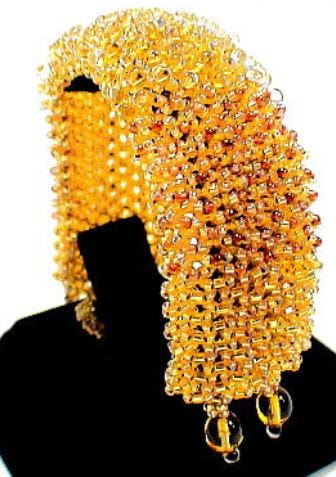
Posted in Stitch 'n Bitch | Tagged: , , , , | Leave a Comment »

RE-STRINGING PEARLS: 5 Tell-Tale Signs Your Pearls Need Re-Stringing

Posted by learntobead on May 7, 2020

Know when to restring your pearls.

There are 5 tell-tale signs:

DIRT

CHIPPING

STRETCH

DETERIORATION

CLASP FAILURE

DIRT. Re-string if the knots between your pearls are looking soiled or discolored. Silk, in particular, absorbs body oils and grime. Pearls are porous. They can absorb dirt and become permanently discolored. Sometimes, if there are no knots between beads, your pearls might adversely be affected by the beads next to them. For example, gold beads can blacken pearls, at the point they come in contact.

CHIPPING. Re-string if your pearls become chipped, scratched or broken. Pearls are soft and can easily scratch, chip and break. Some of your pearls may need to be replaced, before re-stringing. Once the nacre starts to chip, especially at or near the hole, it will set off a chain reaction and start chipping all over the pearl. Be sure to string your natural pearls on silk cord. Nylon cord will cut into the pearl at the hole.

STRETCH. Re-string if your pearls are moving around too freely between the knots. Silk stretches over time. Cord which shows, thus is uncovered, increases the chances it will break. Your necklace also may get longer over time, and that extra length may no longer meet your fashion needs. The hole of a pearl is very sharp. If the pearl moves back and forth between knots because of slack, or rotates too freely around the cord because there is not enough thickness of cord within the hole, the sharp holes will shred the cord, especially if it is silk.

DETERIORATION. Re-string if your stringing material breaks. Silk cord naturally deteriorates in 3–5 years. It breaks easily, and literally begins to turn to dust.

CLASP FAILURE. Re-string if your clasp breaks. Pearl clasps and box clasps break easily.But these clasps provide the “look” that people prefer with pearl knotted jewelry.

How often do pearls need to be re-strung? This depends on how often you wear them, what they were strung on, and how they were stored and cared for.

In general, pearls need to be re-strung every 3–5 years. If you wear your pearls every day, you will need to re-string them annually. If they were strung on silk bead cord, which is our preference, then silk naturally deteriorates in 3–5 years, and you want to re-string them before the silk starts turning to dust. If they were strung on nylon bead cord or flexible cable wires, these materials do not easily break down, and you might wait 10 years before re-stringing. But these non-silk stringing materials can ruin your pearls by cutting into the pearl at the hole.

If you store your pearls in an air-tight bag, and out of the air and sunlight, you may only have to re-string them every 10–15 years, even when strung on silk beading cord. Make sure the bag is a natural material like silk or cotton. Plastic bags actually ruin pearls. There is a negative chemical reaction between the plastic and the pearl.

Before Re-Stringing, You Need To Clean Them

Before you re-string your pearls, you would need to clean them.

First, you should gently wash your pearls while they are still on the old string, with mild soap and warm water. Remove any dirt and hardened oils around the pearls, particularly near the holes. Rinse extremely well so that there is no soapy residue. While you are cleaning your pearls, you want to anticipate what might happen, should the string break. Be sure the drain is covered. You might want to wash the pearls by working inside a colander in your sink.

Next, you must carefully cut the pearls off the old string. To start, place your scissors on the knot between two pearls and cut through the middle of the knot. You don’t want to start on either side of the first knot because the knot could slip inside a pearl and be quite difficult to remove. For the rest of the pearls, snip each knot off by placing the scissors behind each knot and in front of the pearl. Again, work over a surface, where, if you dropped a pearl, you would not lose it.

If there is a pattern to the arrangement of the pearls on your necklace, you might want to lay them out in this pattern, as you cut each one off the string, say on a bead board.

Other Articles of Interest by Warren Feld:

Cleaning Sterling Silver Jewelry: What Works!

What Glue Should I Use When Making Jewelry?

Why Am I So Addicted To Beads?

A Very Abbreviated, But Not Totally Fractured, History of Beads

The Martha Stewart Beaded Wreath Project

When Choosing Colors Has You Down, Check Out The Magic Of Simultaneity Effects

The Use of Armature In Jewelry: Legitimate or Not?

Pearl Knotting Warren’s Way

Organizing Your Craft Workspace…Some Smart Pointers

You Don’t Choose Clasps, You Choose Clasp Assemblies

Know Your Anatomy Of A Necklace

Mini Lesson: Making Stretchy Bracelets

Mini Lesson: Making Adjustable Slip Knots With Thicker Cords

Mini Lesson: How To Crimp

Mini Lesson: Attaching End Caps, Cones, Crimp Ends

Mini Lesson: Brick Stitch

Mini Lesson: Flat Even Count Peyote

Mini Lesson: Ndebele Stitch

Mini Lesson: Petersburg Chain

Mini Lesson: Right Angle Weave

Jewelry, Sex and Sexuality

Everyone Has A Getting Started Story

The Nature-Inspired Creations of Kathleen

The Jewelry Designer’s Orientation To Glass Beads

The Jewelry Designer’s Orientation To Lampwork Beads

The Jewelry Designer’s Orientation To Crystal Beads

The Jewelry Designer’s Orientation To Seed and Cylinder Beads

The Jewelry Designer’s Orientation To Choosing and Using Clasps

How To Design An Ugly Necklace: The Ultimate Designer Challenge

About Pearls In History: Or Why The Indians Sided With The French

About Pearls: Choosing The Rights Ones

About Pearl Knotting Jewelry: Choosing Clasps

Re-Stringing Pearls: 5 Tell-Tale Signs Your Pearls Need Re-Stringing

A Note About Caring For Pearls: 10 Things You Should Know

Styles and Lengths of Pearl Necklaces

I hope you found this article useful. Be sure to click the CLAP HANDS icon at the bottom of this article.

Also, check out my website (www.warrenfeldjewelry.com).

Subscribe to my Learn To Bead blog (https://blog.landofodds.com).

Visit Land of Odds online (https://www.landofodds.com)for all your jewelry making supplies.

Enroll in my jewelry design and business of craft video tutorials online.

Add your name to my email list.
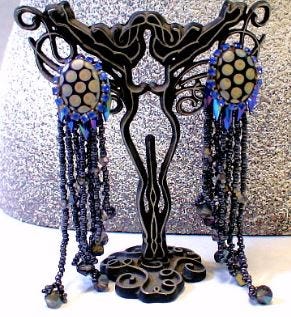
Posted in Stitch 'n Bitch | Tagged: , , , , | Leave a Comment »

ABOUT PEARL KNOTTED JEWELRY: CHOOSING CLASPS

Posted by learntobead on May 7, 2020

pearl clasp

You can use any type of clasp that you prefer.

However, pearl knotted jewelry is very strongly associated with what are called pearl clasps or safety clasps. These are often marquis-shaped clasps, with a hook like tongue that pushes inside them. If the tongue should somehow come undone and slip out, it would catch on a bar in the clasp, saving you from losing your string of pearls.

box clasps

In terms of that vintage-type look, other widely used clasps are filigree or other box clasps. These are pretty, but not as secure as safety clasps.

Usually, you will want your clasp to compliment and not compete visually with your pearl knotted piece. If you decide to use a very show’y clasp, it should blend organically with the rest of your piece.

You will be attaching your bead cord, either to the loop(s) on the clasp itself, or to soldered rings attached to these loops. You want both these loops, as well as any rings attached to them, to be closed, that is soldered — thus have no gaps in them. If there are attached rings, and they are open, you will want to remove these, and attach the cord to the closed loops on the clasp.

Whatever Your Preference, 
You Would Be Hard Pressed Not To Use A Pearl Clasp

If you are making pearl knotted pieces for re-sale, you would be hard pressed Not to use a pearl or safety clasp, or some similar looking clasp.

The woman who originally owned the American Pearl Company in Tennessee was always looking for a clasp that would be durable, but attractive to her customers. The American Pearl Company made a lot of its money by selling finished jewelry.

Pearl and Safety clasps, particularly those made of 14KT gold, break easily. The tongue bends and breaks, and no longer can wedge into its marquis shaped home. Her biggest frustration was that the clasps on the necklaces and bracelets she sold broke too easily, and the pieces came back for repair. It’s a big effort to re-string pearl knotted pieces, since you have to cut off each pearl individually, and then re-knot between each bead. And there is some obligation within a reasonable amount of time (say, 3–6 months), where it is the seller’s responsibility to cover the costs of repair.

At first she tried switching to other types of clasps, like toggle clasps and lobster claws. But these pieces did not sell. People wanted pearl/safety clasps.

Next, she tried switching from 14KT gold to gold-filled clasps. Gold-filled is real gold fused to brass, sometimes copper. Gold-filled has the value of real gold, but is very durable, retaining the color, shine, shape and value over many years, even decades. These did not sell either. People wanted 14KT.

Finally, she gave in somewhat. She returned to the 14KT gold pearl/safety clasps. But she doubled her prices, to build in the cost of one re-stringing.

Other Articles of Interest by Warren Feld:

Cleaning Sterling Silver Jewelry: What Works!

What Glue Should I Use When Making Jewelry?

Why Am I So Addicted To Beads?

A Very Abbreviated, But Not Totally Fractured, History of Beads

The Martha Stewart Beaded Wreath Project

When Choosing Colors Has You Down, Check Out The Magic Of Simultaneity Effects

The Use of Armature In Jewelry: Legitimate or Not?

Pearl Knotting Warren’s Way

Organizing Your Craft Workspace…Some Smart Pointers

You Don’t Choose Clasps, You Choose Clasp Assemblies

Know Your Anatomy Of A Necklace

Mini Lesson: Making Stretchy Bracelets

Mini Lesson: Making Adjustable Slip Knots With Thicker Cords

Mini Lesson: How To Crimp

Mini Lesson: Attaching End Caps, Cones, Crimp Ends

Mini Lesson: Brick Stitch

Mini Lesson: Flat Even Count Peyote

Mini Lesson: Ndebele Stitch

Mini Lesson: Petersburg Chain

Mini Lesson: Right Angle Weave

Jewelry, Sex and Sexuality

Everyone Has A Getting Started Story

The Nature-Inspired Creations of Kathleen

The Jewelry Designer’s Orientation To Glass Beads

The Jewelry Designer’s Orientation To Lampwork Beads

The Jewelry Designer’s Orientation To Crystal Beads

The Jewelry Designer’s Orientation To Seed and Cylinder Beads

The Jewelry Designer’s Orientation To Choosing and Using Clasps

How To Design An Ugly Necklace: The Ultimate Designer Challenge

About Pearls In History: Or Why The Indians Sided With The French

About Pearls: Choosing The Rights Ones

About Pearl Knotting Jewelry: Choosing Clasps

Re-Stringing Pearls: 5 Tell-Tale Signs Your Pearls Need Re-Stringing

A Note About Caring For Pearls: 10 Things You Should Know

Styles and Lengths of Pearl Necklaces

I hope you found this article useful. Be sure to click the CLAP HANDS icon at the bottom of this article.

Also, check out my website (www.warrenfeldjewelry.com).

Subscribe to my Learn To Bead blog (https://blog.landofodds.com).

Visit Land of Odds online (https://www.landofodds.com)for all your jewelry making supplies.

Enroll in my jewelry design and business of craft video tutorials online.

Add your name to my email list.
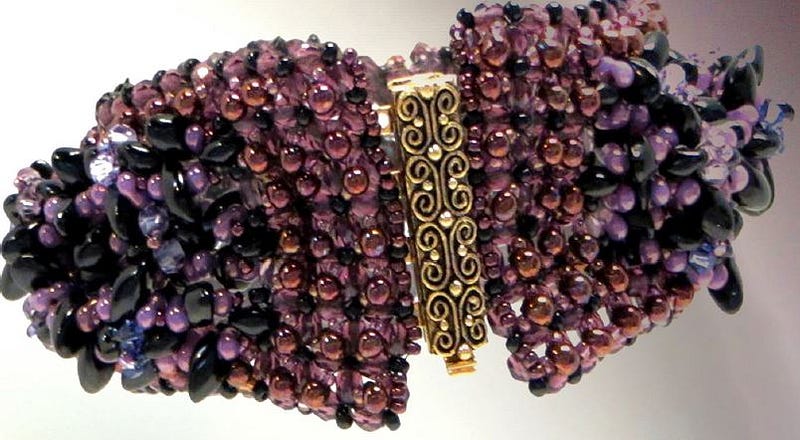
Posted in Stitch 'n Bitch | Tagged: , , , , | Leave a Comment »

ABOUT PEARLS: Choosing The Right Ones, and Knowing The Differences Between Real and Faux

Posted by learntobead on May 7, 2020

Pearls come in different sizes and shapes, and a myriad of colors.

Some pearls are from nature. These include freshwater pearls (from mussels) and saltwater pearls (from oysters). Pearls can be naturally occurring, or cultured, where people have intervened in the process by introducing an irritant inside the mollusk shell.

Other pearls are “faux” or imitation. These are some kind of core bead with a pearlized finish around it. These are typically described by what makes up the core of the bead. The core could be plastic, glass, shell, ceramic or crystal. These are made in different countries around the world and vary in quality.

To differentiate between natural and faux pearls, try these things:

A) Always when buying pearls, check the hole.

Most natural pearls have very small holes. The holes usually appear relatively smooth, but not perfectly smooth, round and centered as the holes in faux pearls do.

The finishes on many faux pearls are not well applied, particularly at the hole. You often can see the finish chipping off or peeling away from the hole.

Look inside the hole. In natural pearls, the hole will seem to be a solid tube all the way through. In faux pearls, usually you will see a thin rim, and the hole past the rim seems hollow.

B) Rub the pearls against your front teeth.

Faux pearls have very smooth surfaces. Natural pearls will have bumps and slightly uneven surfaces. You can feel the differences, when rubbed against your front teeth.

Grades or Qualities of Pearls

Pearls are typically described in terms of :

luster
  1. Luster: the way pearls seem to glow from within.

It’s based on the depth of reflection due to the layering of the aragonite crystal.

overtones

2. Overtone: the translucent “coating” of color that some pearls have.

A silver pearl may have a blue overtone or a green overtone, for example.

3. Orient (sometimes called iridescent orient):

The variable play of colors across the surface of the pearl like a rainbow.’

Other Articles of Interest by Warren Feld:

Cleaning Sterling Silver Jewelry: What Works!

What Glue Should I Use When Making Jewelry?

Why Am I So Addicted To Beads?

A Very Abbreviated, But Not Totally Fractured, History of Beads

The Martha Stewart Beaded Wreath Project

When Choosing Colors Has You Down, Check Out The Magic Of Simultaneity Effects

The Use of Armature In Jewelry: Legitimate or Not?

Pearl Knotting Warren’s Way

Organizing Your Craft Workspace…Some Smart Pointers

You Don’t Choose Clasps, You Choose Clasp Assemblies

Know Your Anatomy Of A Necklace

Mini Lesson: Making Stretchy Bracelets

Mini Lesson: Making Adjustable Slip Knots With Thicker Cords

Mini Lesson: How To Crimp

Mini Lesson: Attaching End Caps, Cones, Crimp Ends

Mini Lesson: Brick Stitch

Mini Lesson: Flat Even Count Peyote

Mini Lesson: Ndebele Stitch

Mini Lesson: Petersburg Chain

Mini Lesson: Right Angle Weave

Jewelry, Sex and Sexuality

Everyone Has A Getting Started Story

The Nature-Inspired Creations of Kathleen

The Jewelry Designer’s Orientation To Glass Beads

The Jewelry Designer’s Orientation To Lampwork Beads

The Jewelry Designer’s Orientation To Crystal Beads

The Jewelry Designer’s Orientation To Seed and Cylinder Beads

The Jewelry Designer’s Orientation To Choosing and Using Clasps

How To Design An Ugly Necklace: The Ultimate Designer Challenge

About Pearls In History: Or Why The Indians Sided With The French

About Pearls: Choosing The Rights Ones

About Pearl Knotting Jewelry: Choosing Clasps

Re-Stringing Pearls: 5 Tell-Tale Signs Your Pearls Need Re-Stringing

A Note About Caring For Pearls: 10 Things You Should Know

Styles and Lengths of Pearl Necklaces

I hope you found this article useful. Be sure to click the CLAP HANDS icon at the bottom of this article.

Also, check out my website (www.warrenfeldjewelry.com).

Subscribe to my Learn To Bead blog (https://blog.landofodds.com).

Visit Land of Odds online (https://www.landofodds.com)for all your jewelry making supplies.

Enroll in my jewelry design and business of craft video tutorials online.

Add your name to my email list.
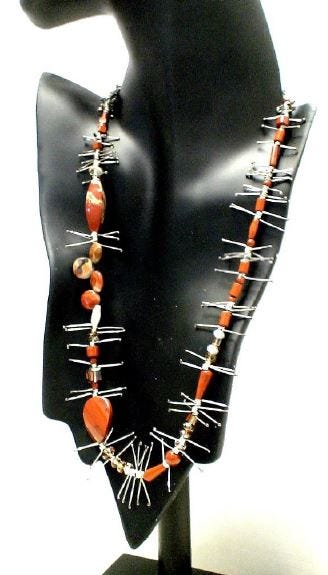
Posted in Stitch 'n Bitch | Tagged: , , , , | Leave a Comment »

ABOUT PEARLS IN HISTORY: Or Why The Indians Sided With The French During The French & Indian War

Posted by learntobead on May 7, 2020

I live in Tennessee, which has a special connection to freshwater pearls. Four and five hundred years ago, when French explorers came down through Canada and down the Mississippi River, they discovered that the Mississippi Indians in Tennessee collected pearls embedded in the local mussels which lived along the banks of the Tennessee River. The explorers traded for these pearls, and shipped them back to Europe, where they were reserved for royalty only, and were called “Royal Pearls”.

Before the creation of cultured pearls in the early 1900s, natural pearls were rare and expensive. A jewelry item that today might be taken for granted, say, a 16-inch strand of perhaps 50 pearls, often cost between $500 and $5,000 at the time. Pearls are found in jewelry and mosaics as far back as Egypt, 4200 B.C. At the height of the Roman Empire, when pearl fever reached its peak, the historian Suetonius wrote that the Roman general Vitellius financed an entire military campaign by selling just one of his mother’s pearl earrings.

While Tennessee freshwater pearls are available to anyone today, many royal families in Europe continue to import these pearls. It is the custom, among many royals, and dating back to the time of these French explorers, to have a freshwater pearl sewn into their undergarments. The belief is, if the pearl touches your skin, you will continue to be prosperous and wealthy.

Pearls are harvested in both fresh water (from mussels) and sea water (from oysters). The pearls created by both types of mollusks are made of the same substance, nacre. Nacre is secreted by the mantle tissues of the mollusk. This secretion hardens. When the hardened nacre coats the inside of the shell, we call this Mother of Pearl. When the nacre forms around some irritant, forming a ball-like structure, these become Pearls. Saltwater pearls typically have some kind of bead nucleus around which the nacre forms and hardens. Freshwater pearls typically do not. Besides Tennessee, other major sources of pearls are Japan and China.

Cultured pearls are real pearls produced by inserting a piece of mussel shell (or some other irritant) into the tissue of a mollusk. The mollusk coats this with nacre, creating the pearl. The more coats of nacre the mollusk produces, the more lustrous and pricey the pearl becomes. Mikimoto developed this process in Japan in the early 1900’s.

So, if you take your imagination back to 1763, and look at the United States and Canada mostly East of the Mississippi River, you see French traders and Indians in a partnership of buying and selling freshwater pearls and Czech glass beads and beaver pelts and guns and other supplies. The British are only concerned with kicking the Indians off their land.

And so it went….

Some More Articles Of Interest By Warren Feld:

Cleaning Sterling Silver Jewelry: What Works!

What Glue Should I Use When Making Jewelry?

Why Am I So Addicted To Beads?

A Very Abbreviated, But Not Totally Fractured, History of Beads

The Martha Stewart Beaded Wreath Project

When Choosing Colors Has You Down, Check Out The Magic Of Simultaneity Effects

The Use of Armature In Jewelry: Legitimate or Not?

Pearl Knotting Warren’s Way

Organizing Your Craft Workspace…Some Smart Pointers

You Don’t Choose Clasps, You Choose Clasp Assemblies

Know Your Anatomy Of A Necklace

Mini Lesson: Making Stretchy Bracelets

Mini Lesson: Making Adjustable Slip Knots With Thicker Cords

Mini Lesson: How To Crimp

Mini Lesson: Attaching End Caps, Cones, Crimp Ends

Mini Lesson: Brick Stitch

Mini Lesson: Flat Even Count Peyote

Mini Lesson: Ndebele Stitch

Mini Lesson: Petersburg Chain

Mini Lesson: Right Angle Weave

Jewelry, Sex and Sexuality

Everyone Has A Getting Started Story

The Nature-Inspired Creations of Kathleen

The Jewelry Designer’s Orientation To Glass Beads

The Jewelry Designer’s Orientation To Lampwork Beads

The Jewelry Designer’s Orientation To Crystal Beads

The Jewelry Designer’s Orientation To Seed and Cylinder Beads

The Jewelry Designer’s Orientation To Choosing and Using Clasps

How To Design An Ugly Necklace: The Ultimate Designer Challenge

About Pearls In History: Or Why The Indians Sided With The French

About Pearls: Choosing The Rights Ones

About Pearl Knotting Jewelry: Choosing Clasps

Re-Stringing Pearls: 5 Tell-Tale Signs Your Pearls Need Re-Stringing

A Note About Caring For Pearls: 10 Things You Should Know

Styles and Lengths of Pearl Necklaces

I hope you found this article useful. Be sure to click the CLAP HANDS icon at the bottom of this article.

Also, check out my website (www.warrenfeldjewelry.com).

Subscribe to my Learn To Bead blog (https://blog.landofodds.com).

Visit Land of Odds online (https://www.landofodds.com)for all your jewelry making supplies.

Enroll in my jewelry design and business of craft video tutorials online.

Add your name to my email list.
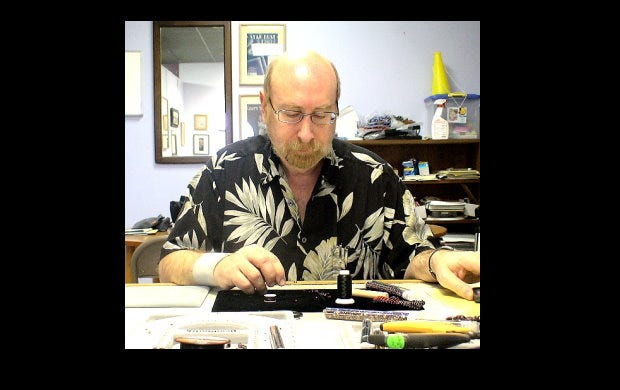
Posted in Stitch 'n Bitch | Tagged: , , , , | Leave a Comment »

DOGS LIFE by Lily, a store dog

Posted by learntobead on April 30, 2020

I’m a store dog, from a long line of store dogs.
My name is Lily. I’m part Chihuahua and part Shiatsu.
Other store dogs have it much easier than I do, because I work in a Bead Shop.
Wherever I try to lay down, there are beads.
In the classroom, people are talking, talking, talking and waiving those needles all around.
In the front, everyone wants to pet me and make nice — not my thing.
And, try as I may, and feign as I might, I don’t think I’ll ever master this — beading and jewelry making.

5/5

Warren took me aside, and held me tight. He told me Connie had died yesterday.

I am so sad. I lost my best friend.
I know Connie is together with Rosie by her side.
– Lily

5/1
Thunder and lightning all day.
Sorry Warren, No McCabe workshop for you.
I come first.
– Lily

4/27
Again, Daisy. Jayden dropped Daisy off at the store.
And what is the first thing she does when she walks into the store? She runs to everyone, one at a time, and kisses each of them.
Daisy, THOSE ARE MY PEOPLE!!!!!
Paws off!
– Lily

4/25
It was Daisy all week. Daisy on Monday. Daisy on Tuesday. Daisy on Wednesday. Daisy on Thursday and Friday and Saturday.
All she does is sleep in her green cushioned chair in the front of the store.
She slept right through Attaching Clasps and Bead Study and Wire Clinic and Pearl Knotting.
And I saw Vera sneak Daisy and extra treat.
– Lily

4/20
Have you ever gotten a bead stuck in the matted hair on your snout just below your eyes?
Quite a perspective.
– Lily

4/18
Daisy, dastardly daisy doodle, got in trouble yesterday. She jumped up on the bead table, and was taken to the dark bathroom for time out.

A Vanderbilt professor did a study that showed that dogs didn’t really smile.
Then, what’s this!
-Lily

4/17
They waxed the floors last night.

Wheeeeeeeeeeeee!!!! #^Vdkla@)(!%

Oooh, they missed a bead.
– Lily

4/15
These substitute UPS drivers don’t get it.

Nip or Treat!

No treat, you get nipped.
– Lily

4/12
“Do you think we should give Lily a T.R.E.A.T.?”
That means, Bark twice, Whine moderately, and Paw up.
Mmmmmm…
– Lily

4/10
Thunder and lightning, Oh My!

The only safe place to hide is under Warren’s chair.

Too bad it’s on wheels.
– Lily

4/8
Connie was worth waiting for!

I love Connie!
– Lily

4/7
Tomorrow is Bead Study. Can’t wait. Connie takes good care of me. That’s why I like to jump up on the seat next to her, and curl up and look cute.

She’s very good about not dropping beads on top of me.
– Lily

4/4
Becky came to the store again today. I thought she was shy. Now she’s all store dog — barking, greeting, kissing.

A lady came in, bent over, and Becky kissed her! No, no, no, that’s not how it’s supposed to be done. I’m the only kissy-face around here!
– Lily

4/3
I laid on my back, my soft tummy up waiting for someone to rub it. 20 minutes. 30 minutes. Nothing.

I know what to do in this situation.

“Lily, WHEWWWW!!!!”
– Lily

4/1 — even later
I was playing with my baby toy, as I do after work each day. Somehow, I fell over off the chair, and rolled a bit. A bit too far, and right into Jayden’s TV tray, where she was working. It’s too high up to see.

The tray fell over, and now I see what she was working on — very pretty.

And Jayden smiled a big smile. Or was it a frown? I can’t tell this far away on the ground. I know she loves me.
– Lily

4/1 — later
Daisy came to work today. I don’t know why she bothers. You could slap her up and down the side of the snout with beads, and she wouldn’t care.

I’ve dug a secret hole for Daisy in the back yard, near the rear fence and the bamboo. She’s stronger than I am, so I’m a bit afraid to push her in.

But consider her warned…..
– Lily

4/1
Richard stuck a red price tag on the hair on the back of my neck. He said it showed everyone how precious I am. Then why were they laughing?
– Lily

3/31
Jayden likes to play dress-up with dogs and anyone else around her. I’ve been through it all — bows, hair clips, ribbons, Austrian crystal necklaces, Austrian crystal leashes, sweaters, embellished sweaters and embellished sweaters with further embellishment. Thank God I don’t have any lips, or she’d be putting lipstick on me.

Recently, she’s been struggling about how to dress-up Daisy. Her hair is too short for hair clips and bows. And her breast is broad and large, but her neck is tiny and narrow. She can’t pull off those necklaces of hers.
– Lily

3/30
I have a pronounced underbite. Girls think it’s cute. It goes with my pug nose. I’m still able to crush the crimp onto the wire, though, but I can’t get my jaw and teeth to re-round them.
– Lily

3/29
Oooh! Some of my hair got sewn into one of Warren’s works.

I hope he doesn’t notice.
– Lily

3/28
Got myself tangled up here in black Nymo thread.
Around my paws a few times, and my tail, and it feels like it’s cutting up into my butt. I’ve been chewing at it for hours now.

Thank God it’s the Nymo on the bobbin and not on the spool. I’d never be able to chew through that.
– Lily

3/24
I sat through another Orientation class of Warren’s.

Rosie, one of the last store dogs, went to every class and soaked in all the material.

I can’t help it if she mastered tubular peyote after two years. That damn step up.

In a bead store, “adorable” just gets you so far.

Mastering the step up — now that will get you put on a doggy pedestal for life.- -Lily

3/18
I can’t believe Warren got even smaller treats.

I expect everyone to give me a treat every day, or at least, ever time they come in.

That means, Marje and Richard and Nola and Linda and Nancy and Tiffany and Connie and Vera and Cecilia and Bonnie and Ethel and Mary and Andrea and The Postman and The UPS Man and The FedEx Man and Beverly and Kathleen (even though she doesn’t like dogs) and Susan and Susie and Dagmar and Terry and Sandy and Warren and Jayden.
-Lily

3/17
Richard put a green self-stick label on me, so I could wear the green like everyone else.

At least, I think that’s why he did it.
-Lily

2/24
Ronnie brought Becky today and Jayden left Daisy at the store.

NO NOT AGAIN.

Becky is too big to play with. Daisy gets all the attention, and she doesn’t even like to bead.
-Lily

2/24— later
Becky found Daisy’s bone and hid it.

Daisy found it. And hid it somewhere else.

Becky found it. [“It’s there, you big dog,” I said.] Then hid it.

Daisy found it again, and took it somewhere else.

Fun to watch, but they’re both slobbering over all the beads on the floor.
-Lily

2/3
Stepped on another needle today.

I guess Size #10 needles ARE bigger than Size #12’s.
– Lily

1/11
Dastardly Daisy Doodle came to work again today. I don’t know why she doesn’t stay home. She doesn’t like to bead.

Today, as usual, Daisy slipped her rubber bone with the wheel on it into Vera’s larger than life, at least larger than Daisy, canvas bag.

And in return, copped one of Vera’s peyote stitched pieces. I wonder how long it will take Vera to notice.
-Lily

1/7
Geesh, they talked about Rosie again today.

Rosie, Rosie, Rosie. Everyone loves Rosie.

I can’t help it if she could Square Stitch. After all, she had a much larger snout than I do.

It was much easier for her to thread the needle.
-Lily

1/4
I snorted a bead today. It was an 11/0 Japanese Miyuki seed bead in turquoise luster.

I guess it’s true what they say about seed beads. They are not all exactly the same size. The 11/0 aqua transparent I snorted yesterday was much smaller.
-Lily

Other Articles of Interest by Warren Feld:

Do You Know Where Your Beading Needles Are?

Consignment Selling: A Last Resort

Odds or Evens? What’s Your Preference?

My Clasp, My Clasp, My Kingdom For A Clasp

Why Am I So Addicted To Beads?

The Bead Spill: My Horrifying Initiation

The Artists At The Party

How To Bead A Rogue Elephant

You Can Never Have Enough Containers For Your Stuff

Beading While Traveling On A Plane

Contemplative Ode To A Bead

How To Bead In A Car

My Aunt Gert: Illustrating Some Lessons In Business Smarts

A Jewelry Designer’s Day Dream

A Dog’s Life by Lily

I Make All The Mistakes In The Book

How Sparkle Enters People’s Lives

Upstairs, Downstairs At The Bead Store

Beads and Race

Were The Ways of Women or of Men Better At Fostering How To Make Jewelry

Women and Their Husbands When Shopping For Beads

Women Making Choices In The Pursuit Of Fashion

Existing As A Jewelry Designer: What Befuddlement!

The Bridesmaid Bracelets

How To Design An Ugly Necklace: The Ultimate Designer Challenge

I hope you found this article useful. Be sure to click the CLAP HANDS icon at the bottom of this article.

Also, check out my website (www.warrenfeldjewelry.com).

Subscribe to my Learn To Bead blog (https://blog.landofodds.com).

Visit Land of Odds online (https://www.landofodds.com)for all your jewelry making supplies.

Enroll in my jewelry design and business of craft video tutorials online.

Add your name to my email list.
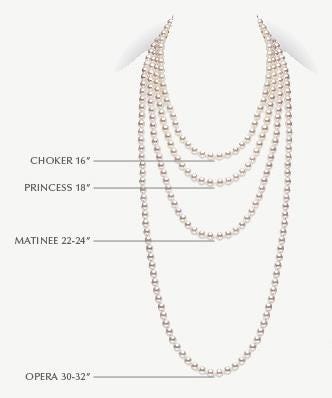
Posted in Stitch 'n Bitch | Tagged: , , , , | Leave a Comment »

A JEWELRY DESIGNER’S DAY-DREAM: A Glimpse

Posted by learntobead on April 30, 2020

I was driving down the interstate, not really going anywhere, but enjoying the ride. As the billboards passed, and the cows passed, and the gas-stations passed, and as I passed car after car and truck after truck, I began to begin to suppose — suppose I used some particular beads, with these other beads, in this configuration, with this design. Just suppose.

My mind wandered a bit for a moment, distracted by something along the side of the road I caught in the corner of my eye, and then I returned to thinking about my piece and its design. I needed a sense of the clasp and how it fit with my visualization of the beads. I wanted to evoke a feeling. An emotion. A sensibility. A restrained elegance. Something different than for my sweaty body, somewhat tired and disheveled, somewhat stiff, driving an older car along a long stretch of road. Flat. The same grass, bush, tree, grass, bush, tree, grass, bush, tree over and over again.

I wanted to create five segments, each with a subtle color and pattern variation. The clasp had to fit in with that pattern. Should I string it on cable wire, thread or FireLine (a cable thread)? This one would be FireLine. I’d go through three times to steady the beads from wobbling on the line. Black FireLine. Black was important this time.

I wanted to try to bead-weave off the bead-strung piece. I’d need to subtly build in some delicas into the patterning, and some way to drop them down from the line of the string, so I could weave off them. I wanted to use some shapes I hadn’t made much use of before — 15mm angel wings, 12x6mm bell flowers, and fireballs or crystals. Police lights in the distance. A purple-y blue. Blinking rapidly. In succession. I slowed down. And slowed down some more. I lost my train of thought and wondered for a few seconds to remember what I had been thinking about.

My lady wearing my necklace would be in a long, slimming gown, with a low cut neckline, and hair pulled back. She was busty, but not too busty. She would be walking rapidly down ramps and stairs, through rooms and parties, turning frequently to talk to one person, then another. My necklace had to move with her, like a natural extension of her persona. That meant colors would have to flash and sparkle from every angle of every bead, and from every segment of beads.

But too much sparkle would be overwhelming, so I’d need some subtle color shadings and blendings that would catch the eye, but not hurt it. That would intrigue, and not disappoint. That would flatter, and not make clownish. And that necklace would have to stay in one place. That means thread or FireLine, and a well-jointed and supported clasp assembly, starting with a simple hook and eye.

It was an accident.

Oh, no, not my fantastic fantasy of a necklace. The cars, police lights, police cars, fire engine, and the police, and a few by-standers. My necklace would be no accident. It would be a star upon a star upon a star. Whoops, I’m veering a little bit off the roadway here. I’m still within eye-sight of those police troopers, so I don’t want to do that. Got to pay more attention to the road. Stop designing jewelry in my head. At least, for now.

I’ll soon be at the next big town on the map, to check out all the bead stores there.

DESIGN — MORE THAN A BUMP IN THE ROAD

Design is more than a road trip. It’s more than a day-dream interrupted by a bump in the road. It’s not triggered by flashing lights, nor disrupted by them. Design doesn’t suddenly drape itself around you because you’ve visited every bead store between here and there. It doesn’t become a part of you because you’ve attended X-number of bead shows and taken Y-number of jewelry making workshops. Design is something more.

Design means having some intention in life. It means screaming Here I Am without having to scream. It means interpreting the inner you for the outer them. To Design with Beads makes this process wondrous. It means capturing light and shifting shadows within colors and shapes and sizes and materials, front, left, center, curve and crevice, inside-out and outside-in. Design doesn’t get any better than designing with beads.

But there is a self-awareness factor. As an artist. A creator. Someone who esteems themselves. With courage. And direction. And meaning. With curiosity. Attention. And detail.

It’s something more than calling yourself a Jewelry Designer. And it’s something more than other people, upon seeing your work, calling you a Jewelry Designer — only because that is what you call yourself. Designers are artists who find their inner designer self — creating resplendently, appropriately, exuding desire, fantasy and a certain edginess in appeal. Their designs may speak loudly or softly, but in each case, they resonate.

Most people who call themselves Designers, avoid design. They might follow trends or fads. They might shy away from choosing colors or patterns. They might rely on simple rhythms, unthreatening, un-announcing, un-tantalizing, un-sexy. They might resort to simple lines, instead of shapes and forms. They compensate for a lack of understanding of contemporary jewelry design principles by over-embellishing, or using overly-expensive materials, or placing their jewelry in overwhelming packages with tissues and informational cards and business cards and perfumed essences of something.

How many times, I cannot tell you, have I walked through craft shows and jewelry shows, or paged through jewelry and bead magazines, or examined the pictures of the winners and runners-up of numerous and prominent jewelry design competitions, and been disappointed. Dull. Unwearable. Inappropriate materials, clasps and components. Unimaginative. Seemingly copied. Weak color choice. Boring rhythms. Balance for the sake of balance, symmetry for the sake of symmetry. Predictable. Safe. Unreflective of the artist’s unique human hand. Overly embellished. Ignorant of the art in craft, or the craft in art.

The good designer sees jewelry as art as it is worn. No matter where the person is. No matter what the person looks like. No matter what the person is doing. Jewelry must hold up as art as it is worn. It can only do so if the artist has attended to design principles.

Design Principles help us understand why people find some jewelry attractive, and other jewelry not. The first set of these design principles we call Rules of Composition. Using these rules is more a conviction, than an established, conscious fact.

But way, way before you get to these rules, you go through a trial and error, almost happenstance, process of discovery. It’s in the little things, some clever strategy, some fortuitous decision, some working down an unknown pathway to see what happens. This is how you begin to discover the designer in you. This is how a few jewelry designers discovered art and design for themselves.

For Arynthia, today a prominent jewelry designer and instructor, she felt she crossed that initial threshold with her bead woven garden urn. She created a vessel with little beads that kept its shape. No easy feat, especially at the time.

Her vessel took hundreds of hours in figuring out how to create it. And she created and re-created it many, many times. Three dimensional bead woven pieces tend to collapse on themselves from the weight of the beads, and the lack of structural supports to keep their shapes. Most bead woven vessels and 3-dimensional objects are woven over another object — a jar, a vase, a ball, a piece of wood or Styrofoam — to keep the shape.

With Arynthia’s urn, she gave it four shoulders. Arynthia had always sewn. She was adept at making jackets that kept their shape at the sleeves and shoulders. She applied these insights to her bead weaving strategy in making her garden urn. She created a shoulder at the North, East, South and West points at the top of her circular urn. It worked. She had solved the core design problem before her.

The first time she made her successfully structured garden urn, she said it looked like a strawberry. So there were more design decisions to come, before she claimed final success — an urn that held its shape and looked like a garden urn. She had told me that the garden urn evolved through 25 or so versions, until she was satisfied with the design. And she, as a designer, evolved with her piece, as well.

Lanie, (another noted jewelry instructor), took a different path in her design evolution. When she initially got into beading, she would deconstruct existing pieces, and analyze the stitches. When she began her career, there were few contemporary bead weaving artists. There were many Native Americans and Africans creating bead weavings, and they provided most of her examples. How did they hold the piece together? How did they function? What about the stitchery allowed the piece to flow, curve, and move without breaking? What were the specific steps involving in stitching? Were there any commonalities and universals among pieces from different bead weaving artists?

Lanie translated what she saw into contemporary designs. Her observations about structure became explanations about structuring bead woven pieces. Things clicked. She became a designer.

And finally, we have Geoff. Geoff had no particular goals or aspirations when he started making jewelry. It was something that kept him busy. Kept his mind from wandering and his attention focused and grounded. Allowed him to be creative. He tried every technique — bead stringing, netting, peyote, brick, right angle weave. He went back and forth. Beading is somewhat addictive, and he found himself addicted. But nothing at the moment felt like self-expression.

Geoff began to teach the peyote stitch. He was rigorous. He drove his students to try more and more things. And then more things. He was never satisfied. He wanted to achieve something he could not articulate. His students suffered for it. He was disappointed in them. And he distanced himself from them.

While playing with another stitch — the right angle weave — he found he could build upon the stitch, and layer it. Not only could he layer it, but he could give it dimension and shape. He constructed mattresses filled with coils of beads which formed multidimensional objects — a certain realism and sculpture-like precision. With this same stitch, it was easy to create layers of beads over these mattresses, resulting in beautiful forms and objects. He broke out of his box with these discoveries in techniques.

With this more dimensional and sculptural right angle weave as his base, he found his calling. His new insights created more new insights as he applied his ideas in different situations, with different goals and with different materials. He began blossoming as a designer.

As the Jewelry Artist comes to know jewelry and discovers their personal take on style or technique, the Jewelry Artist comes face to face with Design. Every artist’s pathway is different.

Jewelry Design is the application of basic principles of artistic expression. These principles involve:

1. COMPOSITION
2. MOVEMENT, Flow, Drapery, and Torque
3. FORMS in Relationship to the Body and the Mind,
including Functionality and Support
4. TECHNIQUES and MATERIALS

These principles are merely rules for making choices about how to proceed, or not to proceed. About what to include in your pieces, and what not to include. How to anticipate wearer and viewer issues, and how not to screw up here. What techniques will work best, and which will not.

The jewelry designer delineates the Design Process, something that works for her or him, and something that allows her/him to apply the rules.

The jewelry designer articulates for her- or himself an Inspiration, sometimes very specifically, but other times vaguely.

The jewelry designer Plans out his or her designs, with the rules in mind.

S/he sets Goals for the piece — its attributes and their justification for why they must be included, and other attributes excluded, in the piece, and again, with the rules in mind.

S/he defines Standards about quality, wearability, context-sensitivity, timeliness and the like, with the rules in mind.

The jewelry designer then sets up a Schedule and a Routine, things that work for her or him, and begins to work.

And day-dreaming about jewelry design can take you to all sorts of places.

Other Articles of Interest by Warren Feld:

Do You Know Where Your Beading Needles Are?

Consignment Selling: A Last Resort

Odds or Evens? What’s Your Preference?

My Clasp, My Clasp, My Kingdom For A Clasp

Why Am I So Addicted To Beads?

The Bead Spill: My Horrifying Initiation

The Artists At The Party

How To Bead A Rogue Elephant

You Can Never Have Enough Containers For Your Stuff

Beading While Traveling On A Plane

Contemplative Ode To A Bead

How To Bead In A Car

My Aunt Gert: Illustrating Some Lessons In Business Smarts

A Jewelry Designer’s Day Dream

A Dog’s Life by Lily

I Make All The Mistakes In The Book

How Sparkle Enters People’s Lives

Upstairs, Downstairs At The Bead Store

Beads and Race

Were The Ways of Women or of Men Better At Fostering How To Make Jewelry

Women and Their Husbands When Shopping For Beads

Women Making Choices In The Pursuit Of Fashion

Existing As A Jewelry Designer: What Befuddlement!

The Bridesmaid Bracelets

How To Design An Ugly Necklace: The Ultimate Designer Challenge

I hope you found this article useful. Be sure to click the CLAP HANDS icon at the bottom of this article.

Also, check out my website (www.warrenfeldjewelry.com).

Subscribe to my Learn To Bead blog (https://blog.landofodds.com).

Visit Land of Odds online (https://www.landofodds.com)for all your jewelry making supplies.

Enroll in my jewelry design and business of craft video tutorials online.

Add your name to my email list.
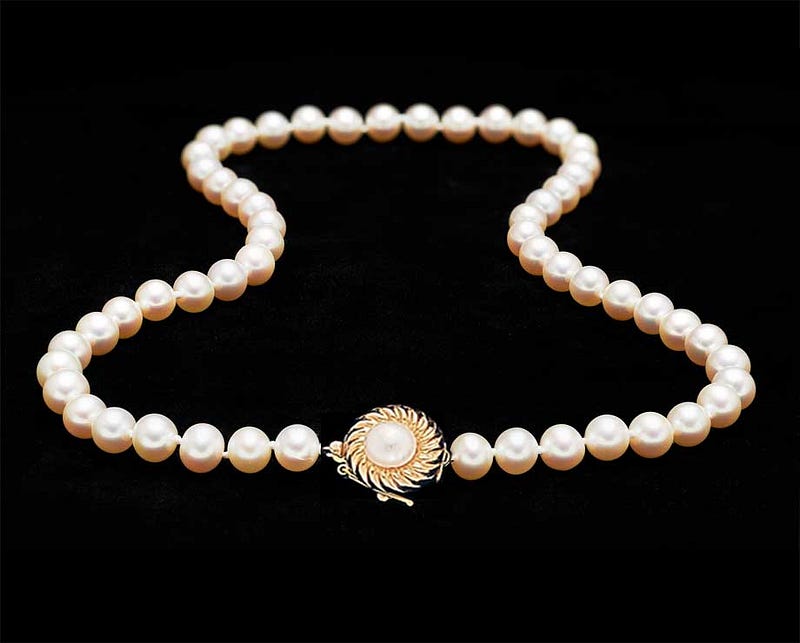
Posted in Stitch 'n Bitch | Tagged: , , , , | Leave a Comment »

When’s It Going To End? When Is This !@#% Quarantine Going To End?

Posted by learntobead on April 30, 2020

I swear I keep sticking my needle into my finger to reality-check that I’m still alive. Good, Red … I’m still alive. That this mess of a jewelry making project before me, one I keep starting, then stopping, then starting, then putting it away, and then retrieving it, and starting it again is more than a blur, a fog of my imagination. I have this great, intricate beaded necklace to make. And I can’t seem to get it done.

I’ve gone through two packs of 25 beading needles. I pick another one up. I bend it. The needle-hole catches my eye. My eye twitches a bit. Why would I ever want to thread this needle and start this project one more time? Bend now. I can’t wait for you to bend when I’m in the middle of things.

Oh, and the guilt. Everytime I stop, I think I’m being selfish. If I go outside, someone will get sick. If I complain that I’m BORED, CLIMBING UP THE WALLS, SAYING NASTY THINGS ABOUT JESUS, someone will die.

And I love beading and making jewelry. I do it all the time. Almost every day. Hours a day. Never one iota of boredom. Mind never wandering. Until now. Until I’m forced to stay inside.

I can’t focus. I can’t read. I am even getting tired of complaining to my husband. Who doesn’t care. Has never pierced his finger with a needle. And should he ever, he wouldn’t know what to do, anyway. [You know I just want to take this needle and see how he reacts. But I won’t.]

I can’t believe, and you won’t believe, what I just did. For the 8th time just in the last couple hours. I ali-kazam’d with my fingers and commanded the beads to usher themselves into this spectacular, wonderful, beautimous piece of jewelry. And did they? No. Out of spite? Now I’m losing focus again.

My house has become the Hanoi Hilton Hotel. John McCain is in the cell next to mine. He has a window. But the floors lay at a 30-degree angle. My floors are flat. But he has a window. I’ve managed to chip off over 60 pieces of brick off the walls. I’ve spent the last 375 days trying to drill holes in them with whatever I can find. A shard of glass. A rusted nail. A piece of metal I’ve wedged off the bars. I’ve slowly, with cleverly pinched fingers, positioned just so, manipulated the threads in my pants, rolling them, working them off in long threads. I am so sure I can drill those holes. My confidence has me believing I can secure the material to string them on.

But I digress.

They say you can survive a quarantine with a smile. I’m better off than a Neanderthal because I have a roof over my head and a grocery that delivers. That should make me smile. Neanderthals lived and hunted and played in packs. I am free to live and hunt and play by myself. This should make me smile. Neanderthals never knew what was going to happen next. I don’t know what’s going to happen next either. This should make me smile. Neanderthals never expected perfection. I do. I’m not smiling.

The news is making me crazy. So I turn it off. Now no news is making me crazy. I spend more time with my friends on Facebook. My friends are getting whiny and beginning to repeat themselves — over and over again. So I stopped linking on to Facebook. I miss my friends. I made a schedule for myself to keep me occupied and, frankly, feeling some sense of safety and security. I cannot keep to it for the life of me. So I threw it out. And made another schedule.

They say sit back and relax. There have been worse times in our history. Be helpful to one another. Show kindness, understanding. Be flexible. Get outside, if possible. Eat well. Get enough sleep. Try to connect with one person each day. Be positive.

I’m trying.

I decided to do small beading projects — ones I can finish in a few hours. This keeps me from getting overwhelmed. It gives me a feeling of accomplishment. I can sense I am living each day by day, instead of feeling I’m losing touch with time.

I do other things between projects, instead of one project after another. I go outside. Make a phone call. Bake something.

I pick projects which will develop a skill I’m unfamiliar with, or further develop a skill that I already know. Learning is very rewarding, and keeps me focused and happy.

And instead of keeping to a routine per se, I spend some time re-organizing my supplies and workroom. I feel better in my re-organizing mode, rather than following a schedule.

Stay safe and healthy.

Other Articles of Interest by Warren Feld:

Do You Know Where Your Beading Needles Are?

Consignment Selling: A Last Resort

Odds or Evens? What’s Your Preference?

My Clasp, My Clasp, My Kingdom For A Clasp

Why Am I So Addicted To Beads?

The Bead Spill: My Horrifying Initiation

The Artists At The Party

How To Bead A Rogue Elephant

You Can Never Have Enough Containers For Your Stuff

Beading While Traveling On A Plane

Contemplative Ode To A Bead

How To Bead In A Car

My Aunt Gert: Illustrating Some Lessons In Business Smarts

A Jewelry Designer’s Day Dream

A Dog’s Life by Lily

I Make All The Mistakes In The Book

How Sparkle Enters People’s Lives

Upstairs, Downstairs At The Bead Store

Beads and Race

Were The Ways of Women or of Men Better At Fostering How To Make Jewelry

Women and Their Husbands When Shopping For Beads

Women Making Choices In The Pursuit Of Fashion

Existing As A Jewelry Designer: What Befuddlement!

The Bridesmaid Bracelets

How To Design An Ugly Necklace: The Ultimate Designer Challenge

I hope you found this article useful. Be sure to click the CLAP HANDS icon at the bottom of this article.

Also, check out my website (www.warrenfeldjewelry.com).

Subscribe to my Learn To Bead blog (https://blog.landofodds.com).

Visit Land of Odds online (https://www.landofodds.com)for all your jewelry making supplies.

Enroll in my jewelry design and business of craft video tutorials online.

Add your name to my email list.
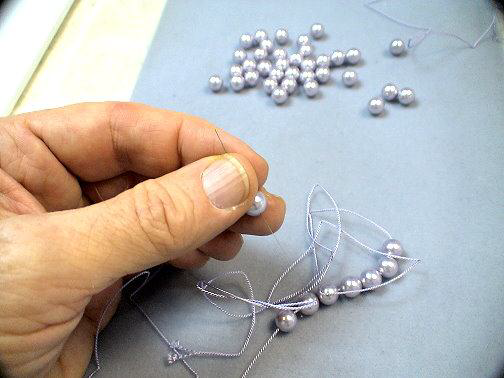
Posted in Stitch 'n Bitch | Tagged: , , , , | Leave a Comment »

MY AUNT GERT: Illustrating Some Lessons In Business Smarts

Posted by learntobead on April 28, 2020

My Aunt Gert

My Aunt Gert had, what some people call “Chutzpah” and others “Cajones”. She could always make a business situation work to her advantage. She had no self-doubt, some would say no self-restraint. One time, she came up from Florida to visit us in New Jersey, where I grew up. An A&P grocery store was going out of business. Aunt Gert prepared herself for the kill.

At the beginning of the week, the A&P had a big banner on the outside of the store — “25% OFF EVERYTHING”. My Aunt Gert moved rapidly towards the entrance, grabbing two, not one, but two shopping carts, and rushed to the meat section first. When the carts were both full — a matter of minutes, it seemed — she approached one of the managers, and asked him, since she was getting so much, could he do better on the price.

With little hesitation, the manager agreed. He told her to grab him when she was ready to checkout, and he’d give her another 50% off at the register. My Aunt Gert filled two more shopping carts that day, and at the register, they first took 25% off, then another 50%.

Exciting, great, good deal, almost war-winning. Yes?

No, Aunt Gert wasn’t quite finished. She went back the next day, got her 25% then 50% off. And the next day — 25% then 50% off.

On the fourth day, the A&P now displayed a banner that read “50% OFF EVERYTHING”. This only egged my Aunt Gert to get more eggs and cheese and canned meats and vegetables. Another 2 shopping carts worth. And at the register, they first gave her 50% off, and as she pointed the cashier to look in the manager’s direction, she reminded her that she was to be given another 50% off. And another 50% off it was.

And Aunt Gert went back on the 5th day, and got 50% then 50%, and on the 6th day, and got 50%, then 50% off, and to her glee and the store manager’s dread, she came back once more on the 7th day. But now the banner read “75% OFF EVERYTHING”. And, I’m not sure how she found enough to fill another 4 shopping carts worth of food, but when she got to the cash register, they very reluctantly gave her the 75% off, then her extra special, the-manager-was-very-nice-to-be-giving-her her additional 50% off.

Well, my Aunt Gert lived in Florida, so virtually everything she bought was for us. But she was determined to bring back her 276 cans of tuna fish, that she had paid $0.04 per can, with her back on the plane. She stuffed these into two large leather suitcases.

When we got to the airport, an airport attendant offered to get her two cases out of the trunk. Was he ever surprised? I wish I had a camera to capture his face. And at the ticket counter — the ticket counter lady tried to lift the bags onto the conveyor belt. She’s probably still going to the Chiropractor.

This story doesn’t have anything to do with jewelry, which is my thing, I know, but I love my Aunt Gert, and always love to tell her stories. But, in her week-long grocery shopping business, she does illustrate a point and some lessons about business which can serve you well. Negotiating, price consciousness, and persistence are keys to success. Very often “creative” types are uncomfortable with these more business oriented skills. But these are important to your success.

Whenever I feel uncomfortable in a business situation, I role play. I suppress who I am, and try to become someone else. Very often, I pretend to be my Aunt Gert.

Other Articles of Interest by Warren Feld:

Should I Set Up My Craft Business On A Marketplace Online?

The Importance of Self-Promotion: Don’t Be Shy

Are You Prepared For When The Reporter Comes A-Calling?

A Fool-Proof Formula For Pricing And Selling Your Jewelry

Designer Connect Profile: Tony Perrin, Jewelry Designer

My Aunt Gert: Illustrating Some Lessons In Business Smarts

Copyrighting Your Pieces: Let’s Not Confuse The Moral With The Legal Issues

Naming Your Business / Naming Your Jewelry

Jewelry Making Materials: Knowing What To Do

To What Extent Should Business Concerns Influence Artistic and Jewelry Design Choices

How Creatives Can Successfully Survive In Business

Getting Started In Business: What You Do First To Make It Official

I hope you found this article useful. Be sure to click the CLAP HANDS icon at the bottom of this article.

Also, check out my website (www.warrenfeldjewelry.com).

Subscribe to my Learn To Bead blog (https://blog.landofodds.com).

Visit Land of Odds online (https://www.landofodds.com)for all your jewelry making supplies.

Enroll in my jewelry design and business of craft video tutorials online.

Add your name to my email list.
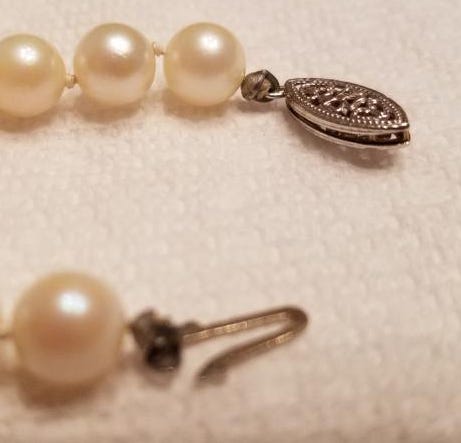
Posted in Stitch 'n Bitch | Tagged: , , , , | Leave a Comment »

How To Bead In A Car

Posted by learntobead on April 27, 2020

How To Bead In A Car

If we’re to cope with our beading addiction, we may have to figure out, at least part of the way, how to bead in a car. We’re not talking water beading on the car when it gets wet. We are talking about taking beads and stringing material and clasps and all those other little pieces, and making jewelry, while traveling in a car. As the passenger. Not the driver. Or, I think not the driver. Addictions can be very powerful.

So, this all begs the question: How DO you bead in a car?

Most people say, “Don’t!”

Or, “Only if the light is Red!”

But others say it is possible under certain circumstances.

Bonnie’s Advice:

Put two pillows on your lap, and wedge them between you and the dash board, to create a type of table and shock absorber.

Use a “lap desk” that has ridges around it. Lay fleece on it.

If also using dishes or containers, put fleece in each one, as well. The fleece “holds the beads”. Regular material does not work.

The pillows absorb a lot of the bumps.

Don’t put too many beads out at a time.

For bead stringing, use long bracelet gift boxes, or something with a deep groove in it.

You can also take a piece of fleece and put it OVER your beadwork as you’re working. Or you can put your beadwork into a ziplock sandwich bag, and work on it at the opening of the bag.

Vera’s Advice:

Put beads in a fleece-lined Frisbee.

Have a towel folded up on you on the other side of the console to cushion the frisbee, so it doesn’t move.

Kathleen’s Advice:
 As the passenger, for bead crochet: Real easy. Use a tray lined with fleece. Pray to God you don’t hit bumps and stuff.

Pullencreek:

It is not easy beading in a car as a passenger but it can be done if you are persistent and determined. I use a shoebox lid with soft suede underneath my beadwork but it is difficult to thread while riding down the road.

Satine:
 Definitely NOPT while you are driving! LOL

I’ve tried beading in a car. First off, take a lot, a lot, a lot of extra beads, unless you want to spend most of your trip trying to pick them up off the floor, under the seats, in the water cup holders, in fact, they fly everywhere. Don’t bother. Just bring a lot of beads.

Learn how to shift your hands in sequence and harmony with bumps. You let them move up and back down at the same time, and with the same rhythm as your car goes up, and then back down. If one arm moves at a different rate, or to one side or the other, instead of straight up and down, it can be all over. You have to start again. And if both arms move too fast or too slow, OOPS, you have to start again.

A few times, I tried to incorporate a lot of double-sided tape and some velcro to keep things in place. Especially on those side roads. They are a killer. Doesn’t work as good as shifting your body up and down in sync with the car over it goes over humps and bumps and pot holes and changes from asphalt to concrete.

Be sure to be stern with the driver. You cannot have them hollering at you to stop. Or laughing at you. Or giving you directions. They need to be quiet.

Don’t work on major, massive projects. Keep things simple. Do things in very, very small steps. And for God’s sake, don’t worry about perfection.

You might first practice with make-up. See if you can put on lipstick and mascara and face powder while traveling in a car. If you master that, making jewelry won’t seem so hard.

But, if you’re OCD, and can’t stand things being out of place, don’t even think about bringing your beads and beading supplies into your car!

Other Articles of Interest by Warren Feld:

Do You Know Where Your Beading Needles Are?

Consignment Selling: A Last Resort

Odds or Evens? What’s Your Preference?

My Clasp, My Clasp, My Kingdom For A Clasp

Why Am I So Addicted To Beads?

The Bead Spill: My Horrifying Initiation

The Artists At The Party

How To Bead A Rogue Elephant

You Can Never Have Enough Containers For Your Stuff

Beading While Traveling On A Plane

Contemplative Ode To A Bead

How To Bead In A Car

My Aunt Gert: Illustrating Some Lessons In Business Smarts

A Jewelry Designer’s Day Dream

A Dog’s Life by Lily

I Make All The Mistakes In The Book

How Sparkle Enters People’s Lives

Upstairs, Downstairs At The Bead Store

Beads and Race

Were The Ways of Women or of Men Better At Fostering How To Make Jewelry

Women and Their Husbands When Shopping For Beads

Women Making Choices In The Pursuit Of Fashion

Existing As A Jewelry Designer: What Befuddlement!

The Bridesmaid Bracelets

How To Design An Ugly Necklace: The Ultimate Designer Challenge

I hope you found this article useful. Be sure to click the CLAP HANDS icon at the bottom of this article.

Also, check out my website (www.warrenfeldjewelry.com).

Subscribe to my Learn To Bead blog (https://blog.landofodds.com).

Visit Land of Odds online (https://www.landofodds.com)for all your jewelry making supplies.

Enroll in my jewelry design and business of craft video tutorials online.

Add your name to my email list.
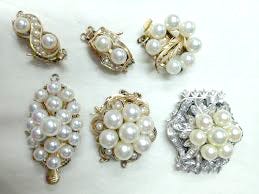
Posted in Stitch 'n Bitch | Tagged: , , , , | Leave a Comment »

DESIGNER CONNECT PROFILE

Posted by learntobead on April 27, 2020

Tony Perrin, Jewelry Designer

Founder and Designer, Lock & Key (www.lockandkeydesign.com)

STARTING OUT

Tony: “I have memories of always being surrounded by the arts.” 
 
 Tony comes from a family that was very arts-oriented, and very supportive of him pursuing the arts and crafts — wherever it took him. His mom was a watercolorwatercolorist and oil painter. His father was a small business owner as well as a photographer. His dad’s dad sculpted for Lockheed, and even was a street dancer. He had a great uncle in New York who had a jewelry business, and Tony remembers, even at age 5 or 6, his uncle was always making jewelry for everyone in the family. 
 
 Starting out with gymnastics, Tony graduated to dancing (because his older sister danced). As a dancer, he had to teach himself to sew for costumes as his Mom was much better with a glue gun then a needle. He remembers his family always making things — food, pastry, lapidary, painting. He has fond memories of always being surrounded by art and creativity. 
 
 A family friend — Frank — taught him how to bead weave the summer he was ten. That Summer Frank and his wife exposed Tony to the artisan craft as well lapidary, jewelry festivals and much more.

Warren: “Do you think now, with all the creative things you are doing, that you, in some respects are re-creating your childhood?” 
 
 Tony: “Oh, for sure! I would say that’s part of a goal I have. I swore I would never be a teacher, but kids gravitate towards me like a moth to a flame. I realized it is because I am ‘5’. Kids get me, which should be the other way around. I am young at heart. I think trying to retain that naivete, that sort of blissful ignorance, especially as a Creative, just allows you to be a little more free with your aspirations. All of a sudden you grow up. It’s like Peter Pan. You lose that sense of innocence and exploration.” 
 
 Tony grew up in Los Angeles, spent some time pursuing a career in fashion in New York City. He moved back to Los Angeles for a few years. And then he came to Nashville with his wife who is a singer-songwriter. Today Tony wears several hats: Jewelry Designer, Dance Educator, Choreographer, Costume Designer, Jewelry Design Educator. 
 
 Tony: “Growing Up, I always thought I had to do one of these things, or the other. Before I moved to Nashville, jewelry making was just a hobby. When I moved here, one of my goals was how do I interweave all of the creative aspects that make me whole. I think a lot of creatives are creative in more than one discipline, as well. So I’m just trying to figure out how to make it one — one happy world.”

KEEPING GOING

Warren:”Today, how would you describe what your jewelry making is like today?” 
 
 Tony:”I describe Lock & Key as a modern interpretation honoring an artisan craft. I am doing something that is ancient in terms of its art, as a form of communication and expression. The loom that I use is about 80 years old at this point, so it’s touched many different hands and many different stories. It’s definitely art jewelry. I describe what I do as boho eclecticism. Tribal influences, so I say it is international in feel. One of the main feedbacks I get is that it is fashion, but not trendy.” 
 
 Tony continues by describing his core consumer.
 
 Tony:”My core consumer is 40+. Is a woman who appreciates artisan product, as well as pieces which make them feel modern with a sense of timeless appeal.” 
 
 Warren:”So, that first day you decided to become a business. What was that like?” 
 
 Tony’s first piece, done around 1998, was a custom piece. He was asked to design a piece for the head designer at Betsey Johnson, a New York fashion designer of clothes and accessories. It was a loomed piece, 1 1/2″ wide choker with multi-colored skulls in it and dangling feathers. He was excited, to say the least. He shared the story about making this one piece, which inspired other people to ask him to design a piece. People responded to his authenticity, and then it became all about the product. 
 
 When Tony moved to Nashville, he decided to focus on jewelry. It was part, what was he going to do to make a living? Part, honoring his childhood mentor who had made the Indian jewelry. Part passion about his loom, and gradually adding precious metal clay to the mix of media he relied on for his jewelry designs.
 
 Tony:”And I still love it. Exhausted. Up until 3am getting production ready. Fingers chewed up by my drill bits. But I absolutely still love it!

CREATIVE PROCESS

In describing a typical piece, Tony begins with multi-media. This includes some loom bead weaving. He incorporates ball and chain. He likes to use a lot of color and texture, and mix matte and glossy. People respond well to his color sensibility. He uses many square shaped beads with round beads. With the beadwork, he includes a piece of metal, like a sculpted metal clay piece, either an integral part of the piece, or as a pendant. He often includes semi-precious stones. He likes to mix metal finishes.”Silver and Gold is the same conversation as Navy and Black. If it is well-balanced, it makes it very versatile.”

Tony mentions that, to understand his creative process, you have to go back to his goal of trying to meld together all his creative worlds. His creative process is not a linear process.
 
 He cites as an example a very successful pair of earrings he designed which are precious metal clay based. But they were flowers, which is very specific seasonal iconography. When he started thinking about what he wanted to do the next season, he thought about how he could adapt these earrings. He mentioned that a lot of his pieces and his bead weaving have an almost art deco or art nouveau feeling to them. At the time, there was an Egyptian revival style that was prominent because of a world wide tour of Egyptian antiquities. 
 
 He reflected on his artistic style and the current revival trend, and asked himself: This was a successful piece. I’m thinking business here. How do I creatively then come up with the next version of it? So for the Fall holiday he explored hieroglyphics and lotus flower motifs. And for the following Spring, he thought about incorporating the scarab and other Egyptian touches. 
 
 Tony: “Things started to trend in High Fashion — snakes, beetles, insects, and bees. I have a scarab beetle tattooed on my back that is about 14” long, the whole width of my back. It’s an icon that is important to me. It symbolizes the sun god Ra. It represents newness and renewal, and I have chronic back pain, so it was interconnected. It started from something that was authentic and meaningful for me, and which started to become a trend years after I had gotten my tattoo. I introduced this sculpt and coupled it with beadwork. People responded to it. Then I started thinking how to tie this all up from a business perspective. If we’re just creating ‘pretty’, who cares? You have to be able to speak to an audience.” 
 
 Tony discussed that jewelry artists have to be able to synergize the Business-Creative Mind. Both worlds need to be respected. It’s a hard business, he agrees. Artists have to monetize their creative output and still remain authentic to themselves.
 
 Frequently, he asks himself: Do I need to break up with my design? It is OK, he indicated, to say Yes! His scarab beetle was a good idea, but some reality testing was in order. Was it too early before the trend? Would it be marketable? 
 
 On a second business level, Tony poses the question: Can I stand behind my product?Can the store that sells his pieces be able to stand behind his products? 
 
 A third major consideration is whether he has successfully differentiated his products from the mass market. That is one reason he incorporates glass seed beads and Czech beads within his work. Glass beads allow him to inject colors, where more mass market pieces are mostly metal and look very machine made.

MOVING ALONG

Tony reflects daily how art jewelry, as opposed to jewelry mass produced overseas, will be accepted by the general public.

He sees that consumer demand for artisan jewelry is on the rise, but there are still nagging questions whether you can make a viable business out of it. Can you make enough product? Can you do it efficiently? Can you transition from a one person designer business to having staff make the pieces, as well? Meeting business goals gets more complicated if you are not going to produce your jewelry overseas. 
 
 One of his biggest challenges coming up is to create sufficient infrastructure — studio space, supplies and personnel — to be able to easily kick out 30 pieces of 20 styles on demand.

MARKETING

Tony is natural marketer, so I asked him what kinds of things he does to reach his target audience. The extent of things he does can provide a lot of ideas and insights for all of us.
 
 Tony:”I always try to make marketing creative so I still enjoy it.”

FUTURE PLANNING

Tony is a planner. He’s developed a clear vision for the future. Some of the things he wants to accomplish over the next 3 years include,
 
 — maintaining a 60% year-over-year rate of growth
 — grow from a more regional line to a national one
 — focus on his infrastructure — studio space, materials and personnel — to keep production, shipping/receiving, website and marketing all on track
 
 The big questions before him: How does he meet demand that he has created for his jewelry? How does he enhance his brand? How does he grow his ability to distribute his products?
 
 He wants to contine to be flexible, given the instability of our economy. He wants to maintain his constant rate of sales so his business can sustain itself. He sees, perhaps, his line represented in a showroom. Perhaps he can gain more presence in museum shops. 
 
 Tony:”I have a lot of jobs right now and it would be great to have one focus. Or add a couple hours to the day.”

FINAL WORDS

Tony: “The true test of a good designer is an ability to sell it.” 
 
 Tony: “If I don’t get that gut feeling that my piece is going to be successful, it’s time to move on.” 
 
 Tony has had to create the opportunities himself. This has involved a lot of reflection, reality testing and planning. He has created a business plan framework with year over year goals for design, production, and distribution. 
 
 Tony:”In today’s world, you always have to be creating your own rules to stay on your feet. There is wide competition. Email inundation. I like the challenge but it’s exhausting.” 
 
 Tony: “Whether or not these jewelry artists work professionally, they need patrons, and that sometimes is even more important than being an artist.” 
 
 Tony wishes there was more of a connected jewelry designer/artist community in Nashville. It is still very fragmented. He finds that politics gets in the way of creative collaboration.
 
 Tony:”There’s room at the table for everyone.” 
 
 He wants to call artists attention to the Arts and Business Council of Nashville, as well as their Periscope program. There are opportunities for networking, expanded contacts, a support system of creatives and their ideas, developing business skills and confidence.
 
 Jewelry designers in Nashville still need a more functional, consistent support system, particularly to thread the business-needle better. Help to find studio space. Getting a small business loan. Finding an angel investor. Connecting to mentors. This is all important, and we need more organized systems to make these kinds of things easier, smoother and more reliable.

WHERE TO FIND TONY’S JEWELRY

Tony has taken a shot-gun approach to getting his jewelry out there. He does a little direct retail through an e-commerce site. He finds that this is a great billboard for him, but not a great selling outlet. He does art and craft festivals. He likes to focus on juried or well-curated shows in particular. 
 
 He wholesales his products to stores. Sometimes this involves cold-calling on stores, with product in hand. But he also does wholesale markets, like the Atlanta Gift and Apparel Market. In 2017, he did 2 shows there; in 2018, he plans on doing 4 shows. His pieces currently are in 28 stores in the United States and the Virgin Islands. He is looking at other wholesale markets. He is exploring options to lock in with a jewelry rep or a jewelry show room. 
 
 You may find Tony’s jewelry locally at:
 
 Two Old Hippies (the Gulch)
 401 12th Ave S, Nashville, TN 37203 
 
 Stacey Rhodes Boutique (Brentwood)
 144 Franklin Rd Suite A, Brentwood, TN 37027 
 
 T. Nesbitt & Co. (Franklin)
 2nd Ave N, Franklin, TN 37064 
 
 Kitty (East Nashville)
 521 Gallatin Ave #2, Nashville, TN 37206 
 
 
 Tony has an eye out to find his ideal studio-showroom. He pictures it full of natural light. Small and intimate. A low wall separating the front from the studio. Inspirational and calming. A sancturary.
 
 Find Tony online at www.lockandkeydesign.com

Be Dazzled Beads is a community of Creatives. Some people use our beads to make jewelry. Some to do mosaics. Some to adorn and embellish costumes. Some to enhance things like wine classes or drapes or mirrors or sweaters or cross stitch patterns. Some to embellish paintings or sculptures. Some actually use our beads in science experiments. To us, all Creatives are Designers. That is, they make artistic and functional choices about how to incorporate the types of supplies we sell into personal visions. Some design for themselves. Some design for friends and family. Some design as a business. It is not as much fun to work alone or isolated when you realize you are part of the larger Be Dazzled, Land of Odds and Nashville communities. We can learn a lot of insights from each other. We can support each other. It’s all about Connection!

Other Articles of Interest by Warren Feld:

Should I Set Up My Craft Business On A Marketplace Online?

The Importance of Self-Promotion: Don’t Be Shy

Are You Prepared For When The Reporter Comes A-Calling?

A Fool-Proof Formula For Pricing And Selling Your Jewelry

Designer Connect Profile: Tony Perrin, Jewelry Designer

My Aunt Gert: Illustrating Some Lessons In Business Smarts

Copyrighting Your Pieces: Let’s Not Confuse The Moral With The Legal Issues

Naming Your Business / Naming Your Jewelry

Jewelry Making Materials: Knowing What To Do

To What Extent Should Business Concerns Influence Artistic and Jewelry Design Choices

How Creatives Can Successfully Survive In Business

Getting Started In Business: What You Do First To Make It Official

I hope you found this article useful. Be sure to click the CLAP HANDS icon at the bottom of this article.

Also, check out my website (www.warrenfeldjewelry.com).

Subscribe to my Learn To Bead blog (https://blog.landofodds.com).

Visit Land of Odds online (https://www.landofodds.com)for all your jewelry making supplies.

Enroll in my jewelry design and business of craft video tutorials online.

Add your name to my email list.
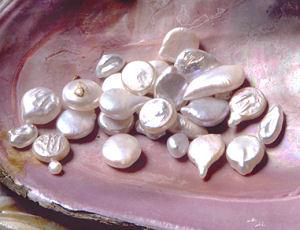
Posted in Stitch 'n Bitch | Tagged: , , , , | Leave a Comment »