Warren Feld Jewelry

Taking Jewelry Making Beyond Craft

Giovanni Corvaja

Posted by learntobead on April 15, 2010

Giovanni Corvaja

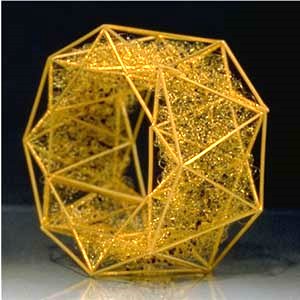
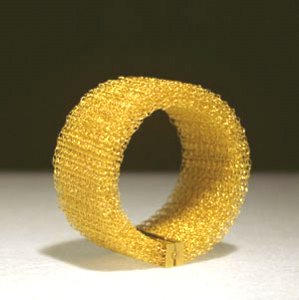
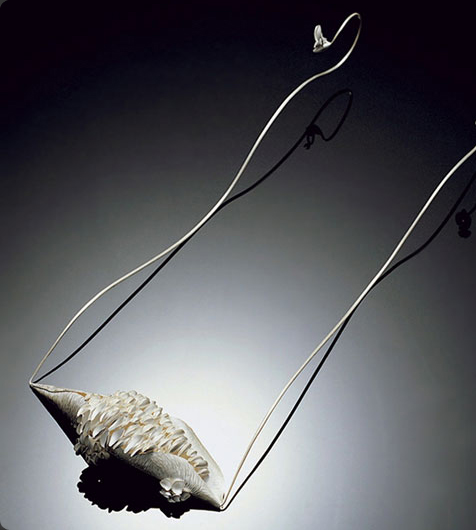
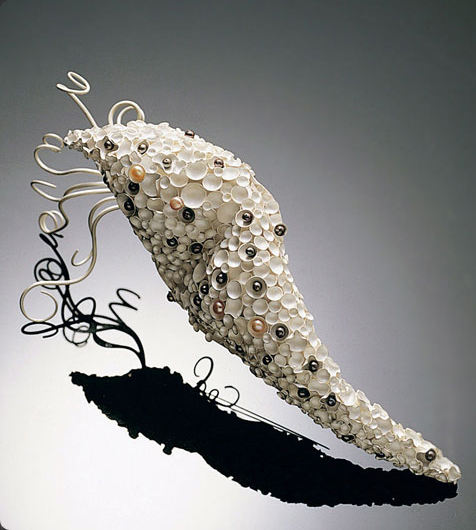
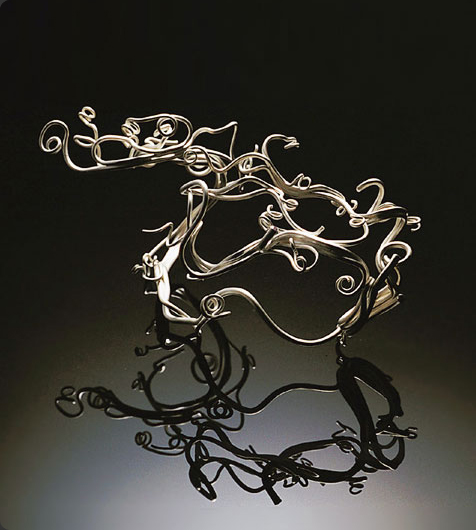
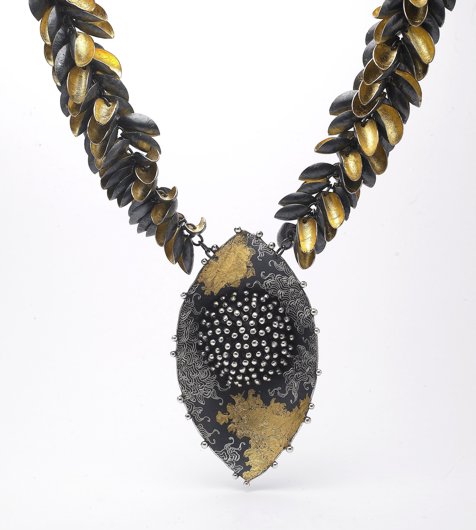
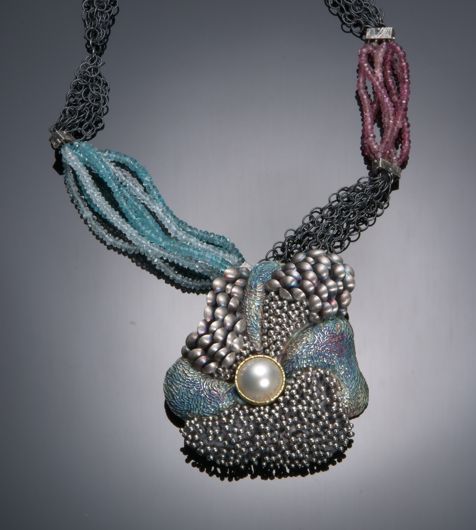
Inspired by looking at fibers and sponges through a microscope, Italian goldsmith Giovanni Corvaja pushes finely spun precious metal to its limits.
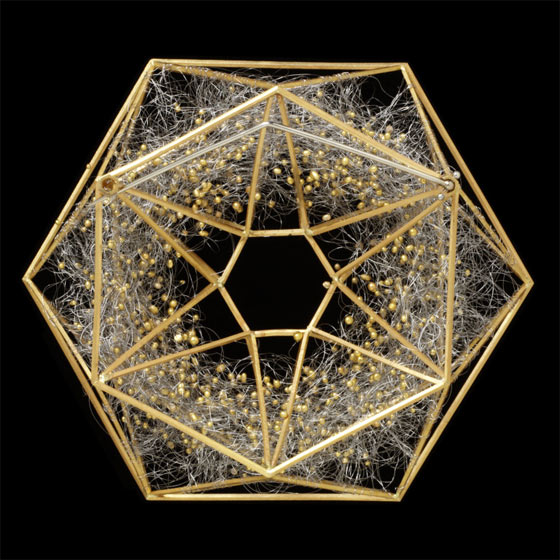
The jewelry is intricate.   Seems gossamer floss thin.    Otherworldly.    He uses a variety of techniques, including knitting, micro welding and granulation to form wisps of gold into sculptural jewelry.

I think part of the successes of these pieces is that he creates this chaotic micro-world, but locks in tightly within a very clear, concise, geometric form or series of lines.


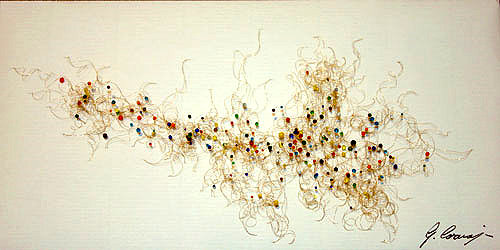
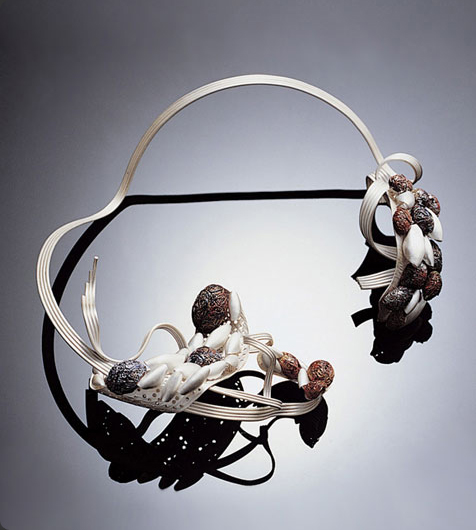
I think this piece below is less satisfying because it lacks that juxtaposition of clear and chaotic forms.

Posted in jewelry design | Tagged: , , | 1 Comment »

Ideation – Jewelry

Posted by learntobead on April 15, 2010

IDEATION – JEWELRY

How do you begin to create the idea of a piece of jewelry in your mind?   What do you start with?   How does the drawing or sketch of the piece begin to emerge?

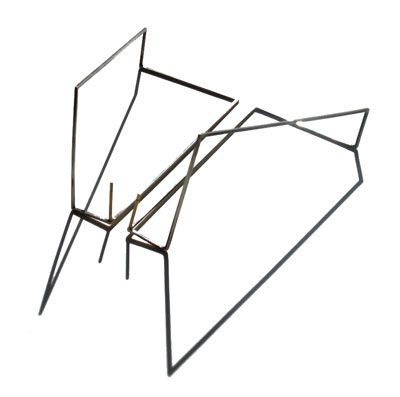
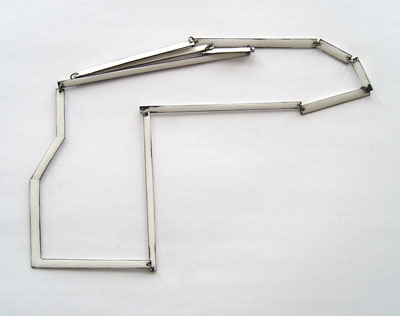
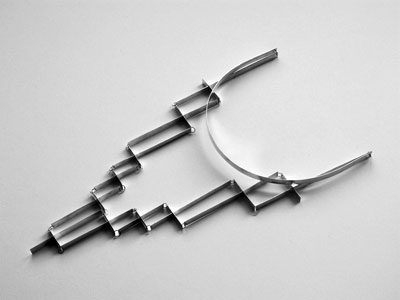
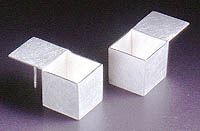
Noam Elyashiv is a metalsmith and jewelry artist.   Her reputation is based on focusing intently and intellectually on the process of this “jewelry ideation”, and seeing what kinds of pieces of jewelry emerge.   

Her ideation process begins with the exploration of correlations and interactions between line, plane and volume through the composition of her form-related jewelry. 

pair of earrings

She is graduated of the Bezalel Academy of Art & Design, Jerusalem, Israel, Elyashiv’s work is regularly exhibited and published internationally. She has won several awards — among them the America Israel Cultural Foundation Award, the Absolute Vodka Emerging Artists Award and a Rhode Island State Council for the Arts Artist Fellowship in Crafts. Most recently her work was honored by the Art Jewelry Forum.


Her current exhibition is  at:

Gallery Loupe for Contemporary Art Jewelry


I’m not sure that if you begin your ideation process with lines and geometric shapes, that your jewelry has to be tightly bound to these ideas.      But here Noam is making a scholarly and academic point.

And I personally think that the good jewelry designer is one who has a personally elaborated and developed ideation process of her or his own.


Posted in jewelry design | Tagged: , , , | Leave a Comment »

FIRST DIBS SALE – LAND OF ODDS

Posted by learntobead on April 13, 2010

Next FIRST DIBS SALE is On
at Land of Odds
Sale ends Mon, 4/19/2010

http://www.landofodds.com/store/firstdibson.htm

Usually when we order gemstones and pearls, and sometimes when we order Czech glass and jewelry findings, we have to order by containers. We have a general idea of what we will be getting, but not a full idea. That’s because when we order this way, all we do is provide the suppliers with a wish list, and we get what we get. This usually means we also get a lot more of some items than we can move in a short time. We have to prepare the merchandise for resale and we have to store much of it. These kinds of things add to our “cost”, and get reflected in the final prices. So here’s your chance to get a jump start on the merchandise before it gets priced.

CLICK HERE to receive notices about future First Dibs Sales.


Posted in Resources | Tagged: , | Leave a Comment »

Conceptual Jewelry

Posted by learntobead on March 17, 2010

Conceptual Jewelry

Wikipedia defines “conceptual art”  as “art in which the concept(s) or idea(s) involved in the work take precedence over traditional aesthetic and material concerns.”

Conceptual art, as a movement, has been around a long time, since the 1960’s.    But its influence on jewelry has not been as great as with painting or sculpture.   Usually conceptual art requires a lot of narrative text and background information, for the viewer to understand what’s going on.    Because jewelry is only art as it’s worn, this makes it awkward to have all this textual material tag along with the wearer.

But it is important that artists be able to incorporate conceptual ideas within their pieces, and have these pieces reflect these ideas, as part of the overall aesthetic and appreciation of the piece.      How does the artist accomplish this?      How does the artist influence how the viewers interpret the pieces and the associated concepts?

Is it sufficient for jewelry to be ‘intellectually stimulating’?   Or must it be beautiful and appealing, as well?

If concepts and meanings change over time, is this something the artist can anticipate or control?    Or does the artist have to settle perhaps for achieving ‘success’ in the present moment, but ‘failure’ over time?

What do we find online about conceptual jewelry?

Conceptual jewelry – a list by lahutter – BLOG
http://www.thisnext.com/list/7B23931F/Conceptual-jewelry

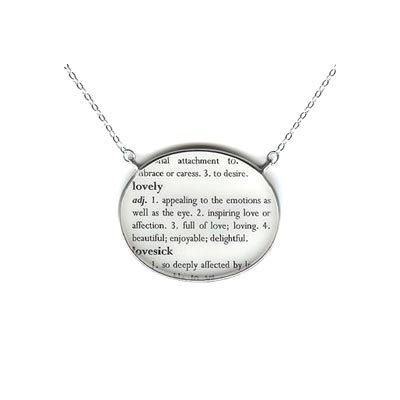
Lahutter lists several items of Concept Jewelry, including these 3:
1. Laura Bezant Jewelry

2. Beats Necklace

3. Definition Necklace

To me, these pieces are more 1-trick ponies, kinda surface’y, not deep, concept but not conceptual.    Not subtle, not elegant, good ideas without the resonance associated with good design.

Let’s continue to web-surf.

On this CRAFTHAUS BLOG, there is a long discussion about what conceptual jewelry is, should be, and is not.

One person in this discussion asks, if the piece is still “jewelry”, if you need a narrative contextual explanation of social, political, or otherwise conceptual meanings?    Great question.   At one point in my life, I had founded and directed The Social Movement Gallery — an art gallery devoted to social and political art.    We used the art to trigger social and community discussion and action.    But we found that the art lost it’s punch outside the exhibit and its timeframe.   Even art about the struggles of women seemed dated one year later, as the discussions and vernacular of these discussions changed as the issue changed with new times and challenges.

Another great discussion of conceptual jewelry and art can be found on this blog Conceptual Metalsmithing.    “When we look at jewelry, we don’t see through it to look at the content it contains, we look at it directly. We look at its objectness, we look at its craftsmanship, we covet it, we are seduced by AN OBJECT. If we attempt to communicate or infuse content into our jewelry for the sake of the viewer/wearer we are often thwarted because of the inherent preciousness and objectness of the medium. Further, it will take quite some undoing in order to retrain jewelry viewers to see more than just the jewel.”

To what extent can Jewelry communicate content?   Or be made to communicate content?

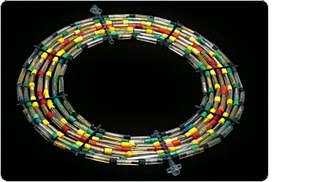
This piece of jewelry is made with discarded pills and capsules, and the artist intends to communicate something about drug use:

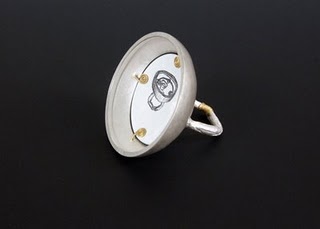
Here, a picture of the ring is inserted into the ring itself.    The artist intends to convey a sense of narcissim.

Continuing surfing the web, we encounter many jewelry sites, where the label “concept” is used in a way to show that the artist had some special kind of insight when combining materials and shapes.     Should we equate “concept” with “creativity” or “intuitive insightfulness”?    Don’t know.

I visited one artist’s website – So Young Park – where she took simple concepts and enfused them with artistic vitality, in some unexpected, yet appealing ways.     Her pieces are not there to change minds and move worlds.     Her pieces are there to allow the viewer to experience concepts by experiencing the art itself.

Some of her pieces:
1. BLOOMING

2. GLOWING

3. NATIVITY

4. SPROUTING

So Young Park divides her pieces up between “HANDCRAFTED” and “CONCEPTUAL”.    So, she loses me here a little bit.

Is she trying to say that one category is more saleable, more wearable, more approachable, and the other category is not?     Does Conceptual, then, mean that the piece does not have to be wearable, or as wearable, if it were not?

Her pieces are wonderful, and these two non-conceptual, yet handcrafted necklaces below, earn but a Number.   Not a concept.  Not a title.   They are beautiful anyway.    And seem conceptual to me nonetheless.   Has the artist a sense of fear by avoiding assigning them a concept or conceptual underpinning?    Or is this strategy?   Or some sense of good business?    Or does the artist view these pieces as without concept?   Or where concept should be subordinate to aesthetic and material concerns?

No. 155

No. 149

Sorry, I think if you call yourself a Jewelry Designer, and see the works you create as resulting from a sense of design, you can’t but not have applied concepts in their creation, and these concepts are at least as equally as important as aesthetic, material or technique.

Posted in jewelry design | Tagged: , , , , , , , , | Leave a Comment »

WOMEN and men

Posted by learntobead on March 6, 2010

WOMEN and men

New article posted under Rogue Elephant.  

Click HERE.

… Women get together and bead in classes.    They get together and bead around the dining room tables in their homes.    They attend workshops, and sit in a circle and bead.   They join bead societies, and sit in a circle and bead.    They arrange retreats so that they can sit in circles and bead.     Why do so many woman like to sit around in a circle and talk and bead?   

But anthropologists tell us this was always so.    Women sat in circles and talked and crafted.     The circles provided a measure of convenience.   They provided a sense of safety.   They allowed women to reconfirm their places within the group.    They allowed women to learn the basic rituals in life, and to transfer this knowledge to their children.   They offered women some sharing of responsibilities, especially for child raising.

It was because women so frequently came together to sit, circular, with one another, and because the tasks they did, while in these circles, were so involved and complex, that language was born.  ….

Click HERE.

Posted in beadwork, jewelry design | Tagged: , , , , , | Leave a Comment »

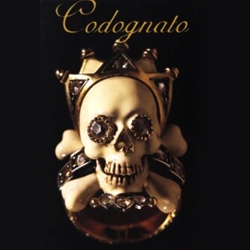
Skulls of Codognato

Posted by learntobead on March 4, 2010

Skulls of Codognato

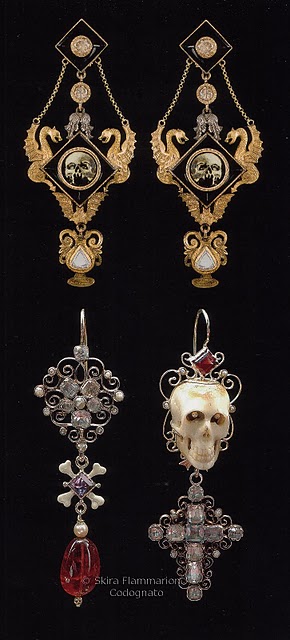
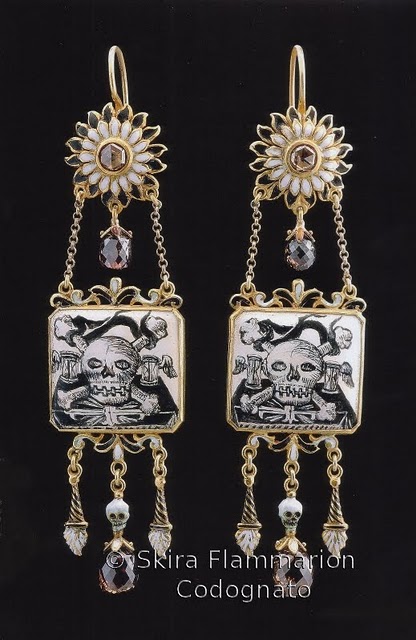
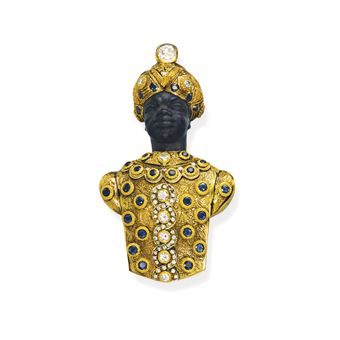
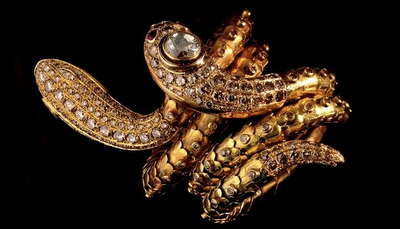
The House of Codognato, a jewelry house in Venice, is known for its skull-themed jewelry, among other pieces.    The skull motif has been a favorite of theirs since they began in the latter half of the 19th century.   The skull motif, to this jewelry house, represents a positive symbol:   Live life to the fullest now before you die.

Now on display in Paris within a large exibit about vanities in art.

Click Here for more information about this exhibit.

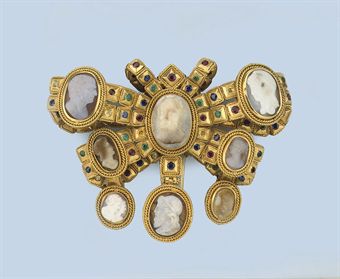
SOME OTHER JEWELRY
From The House of Codognato

Posted in jewelry design | Tagged: , , , , | 4 Comments »

Pearls

Posted by learntobead on February 25, 2010

PEARLS

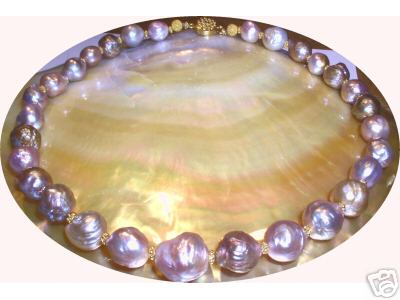
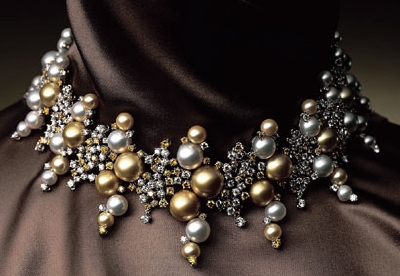
There is a major international exhibition of pearls at the Qatar Museum.   The exhibition covers the range of types of pearls, the history of pearls and the pearl industry, designer jewelry made from pearls.   Unfortunatetly, it’s been difficult to find any images of pieces on display.

The Qatar Pearl Monument

I have been able to find some images of the types of things on display.

Melo Collection of Myanmar Pearls
Black Pearls from Mexico
Mikimoto Pearls
Yagumura Pearl Jewelry
Work by Professor Henry Hanni
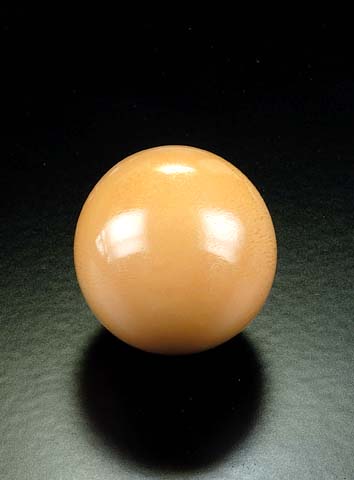
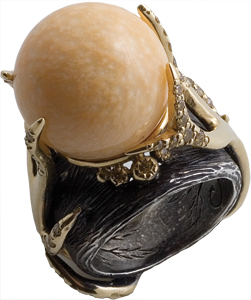
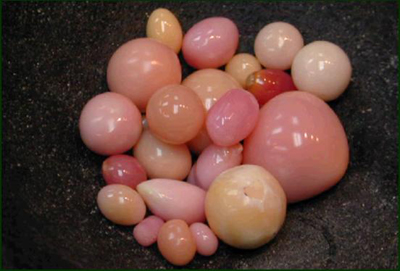
Conch Pearls
Harvesting Oysters for Pearls

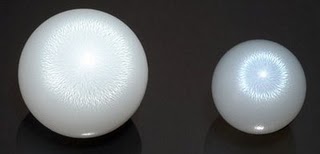
Melo Pearl


Melo pearl in ring

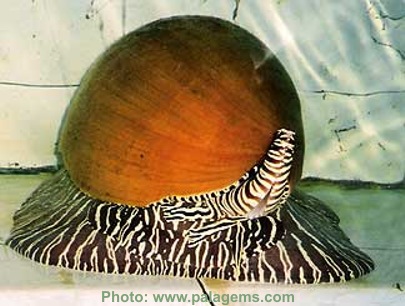
Snail with Melo Pearl

Nautalus Pearls

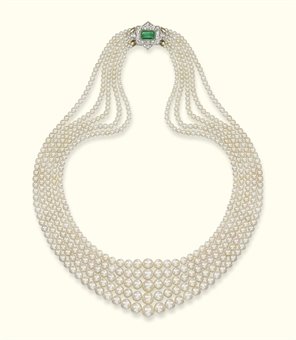
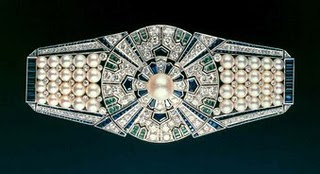
Deco Pearl Necklace

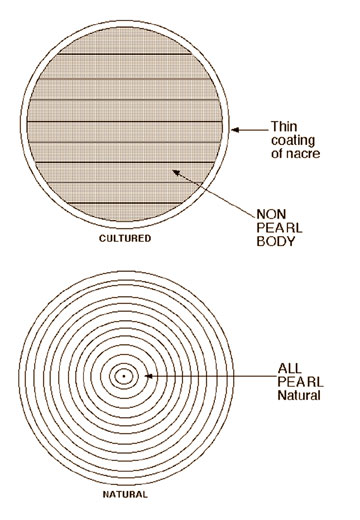
Cross section of  a pearl

South seas pearls

Mikimoto Necklace

Yagumura bracelet

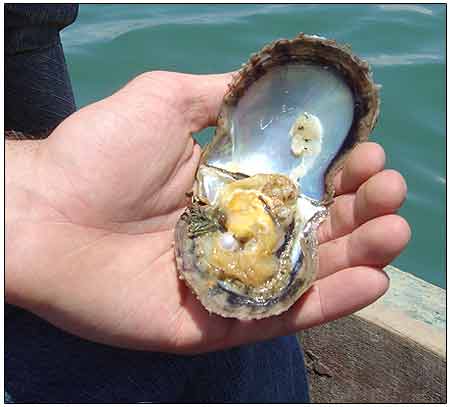
Pearl in the oyster shell

Conch Pearls

Posted in beads | Tagged: , , , , , , , , , | 1 Comment »

Consignment Selling – A Last Resort

Posted by learntobead on February 22, 2010

Over At The Consignment Shop

“She’s CHEATING ME!” the woman from Rhode Island screamed into the phone.    She could hardly catch her breath, the anger overtaking her ability to explain why she was calling.

“I read your article about Pricing and Selling on-line, and I’m not getting my $70.00 for my piece.”

She didn’t have to say anymore.   I knew right off the bat she was talking about CONSIGNMENT.     I recognize the anger.  The frustration.   The feeling that someone put something over on you, and you’re powerless to correct the situation.    You don’t know what to do.    You know the sweat, time and cost you put into all the pieces you let some stranger have, and now what do you do?

“I put 10 of my pieces of jewelry in her shop in Northern Rhode Island – not a big shop, no sales, except, this one piece sold, not in a major place,”  she continued, taking breath after breath, to get it all out, in some way that made sense, and some way that kept her from losing it.

“What do I Do?”   “She sold my piece for $70.00, and didn’t give me my money?”    “Should she have given me my money right away?”   “Should I take my jewelry out of her shop?”   “Should I never do consignment again?”   She peppered me with questions, not waiting for an answer.

She indicated that the store owner told her that she paid her artists 30 days after a sale.   Her customers had 30 days to return something.    If the store owner paid before that time, she would be out the money.     Store owners can set whatever policies they want, and in this case, I told the woman it was reasonable to wait 30 days, given the policy.

Of course, it had already been 7 weeks.

“Should she call her?”   Her husband told her not to call yet.   He didn’t want her to make waves, or ruin this opportunity to sell her jewelry.

“Call her,” I said.   If the store owner said 30 days, then 30 days it should be.

Consignment may be a necessary evil, especially when you are getting started in the jewelry making business.   But consignment is not the best situation to be in.    Most stores that accept consignment do not understand the consignment business.    As a result, when the time comes to pay the artists, there’s no cash flow.

In Consignment, the store is at greater risk than the artist.   The store has to make space available for the pieces, and forgo the opportunity to get something else in that retail-real-estate that might do better.    The store has to display the pieces, and keep them clean and presentable.   The store has to train its sales staff so that they have sufficient information and motivation to make the sale.   And, of course, there’s the tracking and accounting that goes with every consignment piece on sale.

Your best clue to whether a particular consignment situation is a good or better one, is the percentage split between the store or gallery owner and the artist.    Given the level of risk each party assumes, the optimum distribution is 60/40 with the store or gallery getting the larger amount.     But if the split is 40/60 or 50/50, this would be a acceptable sign as well.

However, when the split is 70/30 or 30/70 or outside this 60 and 40 range, yellow flags should go up.    This shows that the store or gallery owner is not aware of the level of risk in their business.    You probably won’t get paid on time, and not get paid without a lot of time spent yelling on the phone.    Your pieces won’t be maintained.  They won’t be displayed in a prominent place.   No one will be trained or motivated to sell your pieces.

Just because you confront a potentially bad consignment situation doesn’t necessarily mean that you should walk away.     There are a few prominent boutiques in Nashville that offer a 70/30 split between the store and the artist.    They rarely pay their artists when the pieces sell.     It takes a lot of screaming, “Bloody Murder!” before you get paid.    But these are very prominent shops.     Letting other stores and galleries know that you have pieces in these shops will open many doors for you.    You might view the delayed payments and the effort to get your money as “marketing expenses.”

Other reasons you might settle for a bad situation:
– You’re just getting started, and saying your pieces are in a shop anywhere has some marketing cache that goes with this
– You can direct customers to this shop.     At least you have a place to send people.   You might not have a central base from which to work.   Your main business might be doing craft shows, and here you can direct people to your jewelry between shows.
– This might be the only game in town.

But otherwise, if consignment doesn’t have some added value for you, you want to minimize your consignment exposure.

When you negotiate consignment terms with a shop, try to:

1) Get a feel for the amount of consignment they do (and how long they have been doing this), the range of artists, the range of types of merchandise on consignment, and the types of customers they have
2) Get a 60/40, 50/50 or 40/60 split
3) Work with store or gallery owner on final retail pricing of your pieces.
4) Get a written contract
5) Get in writing if possible, but an oral agreement would suffice, to convert the situation to “wholesale terms”, if you pieces sell well.   (Be sure to define what “selling well” might mean.)

6) Determine a specific date when to take your pieces out, or trade them out for new pieces.   Usually it’s good to trade them out every 3-6 months.
7) Determine exactly how and when you will get paid, after any one piece sells.    A 30-day waiting period is reasonable.

Posted in business of craft | Tagged: , , , | Leave a Comment »

Ugly Beads

Posted by learntobead on February 22, 2010

Ugly Beads

The deadline for our The Ugly Necklace Contest is fast approaching — 3/15/10.

I thought I’d do a Google search on “ugly beads” and see what I came up with.   While a necklace made from all ugly beads might necessarily be “ugly”, I thought it would be fun nonetheless to see what I ugly beads I could find.

Lo and behold! – an ugly bead contest! called Share Your Shame.    A fun read about the origins of the contest, and the winner and other submissions.

Sig Wynne-Evans writes a blog and bemoans her collection of ugly beads, to which she’s given them a new home — a bead jar.

One friend-seeker named herself Ugly Beads Need Love.    She posted her profile on freeganmagazine.com

And we have a fashion report that shows that “ugly” may be contextual.    These beads are ugly relative to the dress.

And as one bead artist writes on her website:

“Even an ugly bead can unlock another door….”

Posted in beads | Tagged: , , , | 1 Comment »

The Designers Gazette, Winter 2010

Posted by learntobead on February 2, 2010

THE DESIGNERS GAZETTE
Winter 2010

Click HERE to pull up this issue.

**Receive The Designers Gazette quarterly newsletter,
and Announcements about Special Sales at Land of Odds (www.landofodds.com)
REGISTER HERE

Posted in jewelry design | Tagged: , , | Leave a Comment »

The Geek Jewelry Challenge

Posted by learntobead on January 21, 2010

The Geek Jewelry Challenge

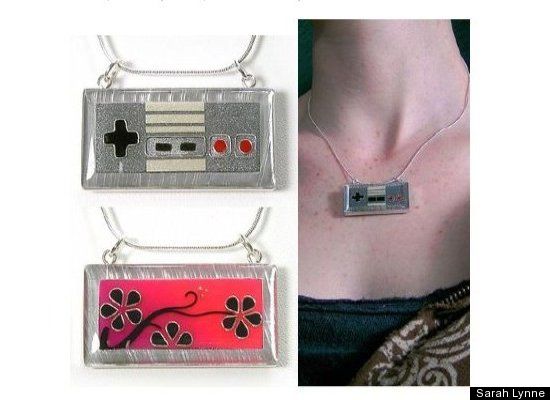
The HUFFINGTON POST offers this Geek Jewelry Challenge.
 
Have you created, purchased, or worn geeky jewelry? Or just know other awesome nerdy accessories? Show us!

click the PARTICIPATE button, upload your images.
You can also click through the current submissions and rate each one on a scale of 1-10, Weak to Chic!

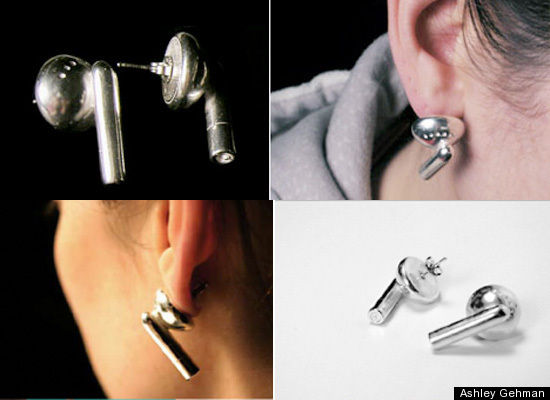
Industrial designer Ashley Gehman created sterling silver earrings modeled after Apple's iconic earbud earphones.

Jewelry maker Sarah Lynne created a (reversible) Nintendo necklace for proud girl gamers to show off their nerdy side.

Posted in jewelry design | Tagged: , , , , | Leave a Comment »

A Moment in Jewelry History…

Posted by learntobead on January 20, 2010

A Moment In Jewelry History…
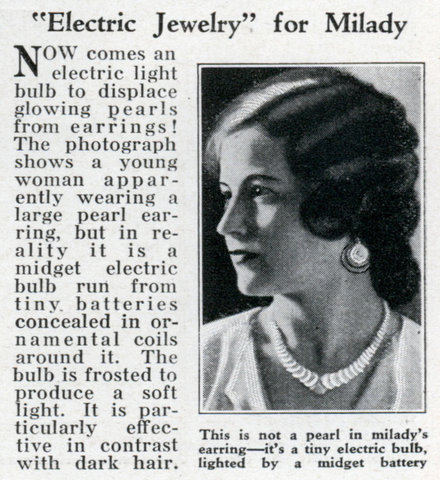
19th Century French Electric Jewelry

http://vimeo.com//8769022

The Association for the Study of Jewelry and Related Arts (ASJRA) put out this 2 minute video clip about 19th c. French electric jewelry.

It’s amazing that the types of electric novelty pins we take for granted at Halloween and Christmas, as well as other holidays, can be traced back to the 1870’s.

Of course, it’s difficult at the same time to appreciate the amazement and wonderment people in the 1870’s had, when they first saw this electric jewelry.

Here’s an ad for electric earrings from 1932:

Posted in jewelry design | Tagged: , | Leave a Comment »

And the Winner Is….

Posted by learntobead on January 19, 2010

ALL DOLLED UP: Beaded Art Doll Competition
Winner and Runner-Up Announced

ALL DOLLED UP: Beaded Art Doll Competition

Congratulations to…

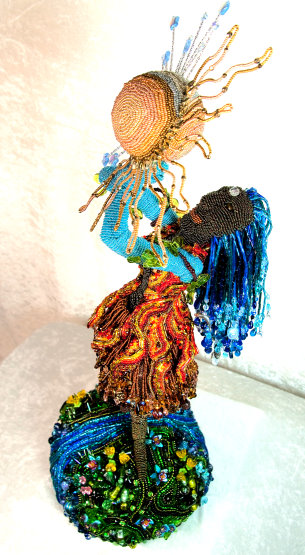
Kathy Ford, Winner, “Jolyma”

Jolyma

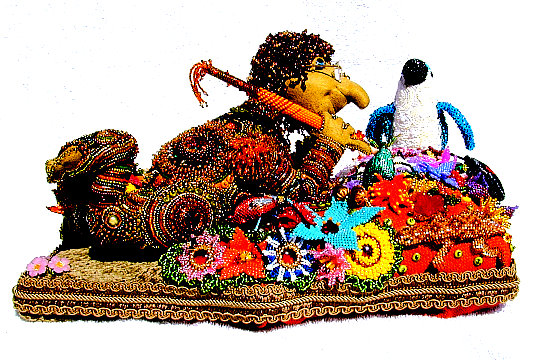
Dot Lewallen, Runner-Up, “Rachel’s Dream”

Rachel's Dream

Posted in beadwork, Contests | Tagged: , , | 1 Comment »

Does The Internet Affect Creative Thought?

Posted by learntobead on January 10, 2010

Has the flow of information on the Internet
affected how we think creatively?

I recently finished reading a compilation of scientific studies on this subject.    Some scientists say No, and others say Yes, without any definitive coalescing of ideas on this subject.    But the subject is intriguing, nonetheless.    

As a Jewelry Designer, do we think through our projects and our artistic lives differently today, than say, we would have 20 years ago before the Internet?   Has the Internet changed your way of thinking as a Jewelry Designer?

Here’s what the Internet might do to our thinking:

1. Attention Span

Supposedly out attention spans are shorter, and we expect things to come to us in smaller bits or packages.    Do we find, as a Jewelry Designer, it getting more difficult to stay focused on one thing, one theme, one technique, for too long before bopping off to something else?    Have our projects become simpler, less embellished, more dependent on a spectacular clasp or a particular gemstone, to the detriment of other “design” possibilities within the rest of the piece?

Or have we learned to be more “liquid” in our thinking, able to take in more facts, more ideas, and organize these more coherently?    Do our Jewelry Designs emerge from greater control over more ideas, and ideas coming and changing faster?     Is this more intricate complexity?   Are we more able to incorporate ideas cross-culturally and cross-nationally?     Are we able to design more, for more?

2.   Information Overload

The Internet is a chaotic collection of boundless information.   Are we too aware of too many styles, materials, techniques, fashions, trends?     Is our ability to draw with billions of colors on a computer screen paralyzing when it comes to choosing among the more restrictive colors of available beads?    Do we seem to end up with more unfinished projects, because we don’t have enough time to start the next new idea, if we finished?     Do we end up buying too many materials and too many types of materials because we’re less and less sure what will be relevant when, and because we keep findings out about new materials and new techniques and new fun things to do and with which to experiment?    Do we too often try to mix media within our pieces, to the success of none of the different types of materials?   Does all this information become paralyzing to the extent that it halts us from working on our designing and making?

Or, do our designs seem more coherent, more integrated, sexier because we have more information available to make us think, keep us aware, help us integrate complex ideas?    Are we more willing to do and more successful in doing multi-media projects?    Does mastery over more ideas make us feel more powerful, more motivated, more experimental?

3.  Time Wasted on Email, Facebook, Twitter and the Like

We spend more and more time socially interacting on-line.    Do you find spending time on emails, message boards, forums, facebook, twitter and the like is time you could have spent on designing and making jewelry?    Is a lot of this time redundant, goal-less, wasteful?    Does time spent with these online social networks end up pulling you in even more directions, than if you were not so socially connected?   

Or, does the time spent here help you design better, or help you sell your pieces better, or make you a better consumer of the parts you use in your pieces?    Do you feel you can problem-solve faster with this broader access to more people and more frequently?   Does this broader access help you narrow down your choices to a manageable few?

4.  Fostering Shallowness, Distraction, Credibility

We are used to getting information in small bits, scanning tons of information briefly and superficially, and making choices based on insufficient information — no analysis, no indepth questioning, in very disconnected ways.    Are you less interested in finding meaning, history, depth in the designs, techniques or materials that you use?   Are your designs becoming more simple or straightforward or less challenging?     Do you care less about your pieces beyond following a set of steps and completing your projects?    Do you feel that the title “Jewelry Designer” has less credibility, less currency, less status, less importance relative to your work designing jewelry?   Do you think less about the place of your jewelry in the world?   Is it less important that your jewelry resonate with feeling, or impact people’s lives?     Are you less interested in references from the vintage or traditional past, and overly concerned with the “hot” idea of the moment?   

Or, do you feel more forced or encouraged to try more difficult and challenging designs?    Does the Internet make you ask more questions of your work and find more relevant information – history, culture, personality, fashion – and the like?     Are you more likely to contemporize traditional designs, revitalize vintage pieces, or adapt traditional techniques?

5.  More Confidence, Less Continued Confidence

The Internet gives us a sense of power and place, but it is very fleeting.    Do you feel more important, more established, more credible because you have your own website or are selling on Etsy?    But do you, at the same time, feel this confidence and credibility is more fragile, more easily challenged, more here today and gone tomorrow?    Does selling your pieces on line make you feel stronger, more powerful, more relevant than selling your pieces in a local store?    But at the same time, does selling on line make you feel more vulnerable, less established, more easily and likely to be challenged by many people around the world?

Or, do you see the Internet as opening up new markets for yourself that you can conquer, ad infinitum?   Has it motivated you to do things where before you felt stuck or afraid?  


6.   More Competitive With Time

The speed of information on the Internet is much faster than the ebb and flow of information and time around you.      So do you feel, in today’s world, it is much more difficult to keep up?    Do fashions, styles and techniques change faster than you can adapt to these changes?   Do you feel your competitive market getting further and further from you, at a faster and faster pace?    Do you feel your Jewelry Designs, and your strategies for selling these designs, become “yesterdays” all too quickly?   

Or, does the rapid pace of the Internet, somehow set a more rapid, directed pace for yourself?    Do you see more possibilities, and feel more motivated to keep up with them?   Do you see time as a challenge, and go for it?    When we see the term “hyperlinked”, are we more apt to focus on the “linked”, rather than the “hyper”?

The Internet may make it seem that the framework for good jewelry design is somehow larger.    The information more extensive.    And changing.   Very rapidly.   There seem to be fewer clues on how to weed through all this information, to reject what is irrelevant or unnecessary.   It feels too easy to get caught up in this ever-speeding-up whirlwind of stuff.

The Good Jewelry Designer will continue to learn the fundamentals and make choices accordingly.    We always want to let in the environmental influences around us.    But these influences still need to be managed.   As always.

Posted in jewelry design | Tagged: , , , , | 1 Comment »

2010 Calendar from Diane Fitzgerald

Posted by learntobead on January 7, 2010

2010 BEAD CALENDAR
Compliments of Diane Fitzgerald
You can download Diane’s newest calendar by clicking on this link:
http://dianefitzgerald.com/images/2010calendar.pdf

Posted in beadwork | Tagged: , , , | 1 Comment »