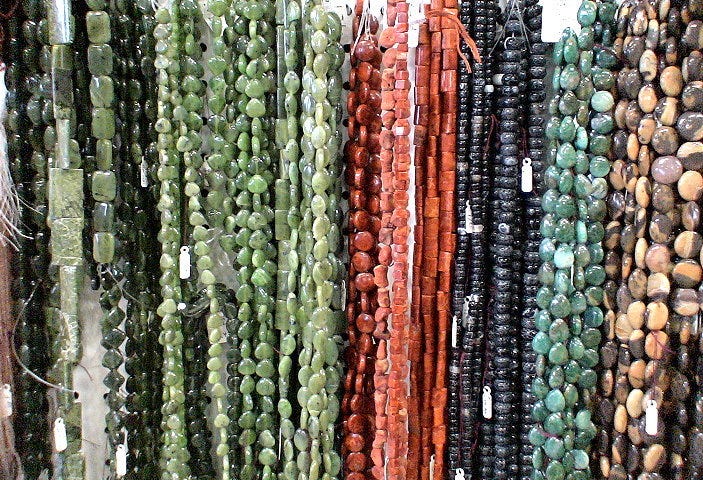
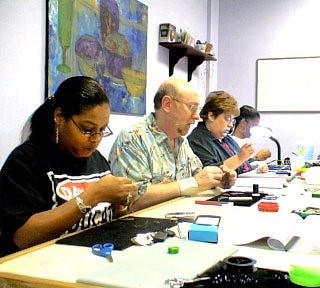
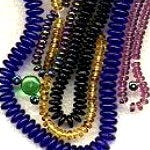
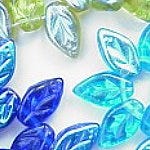
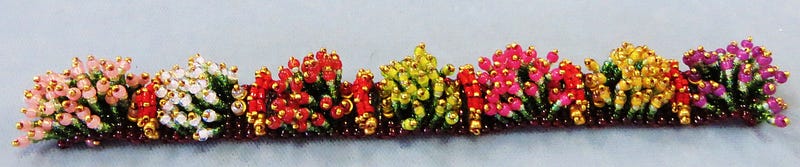
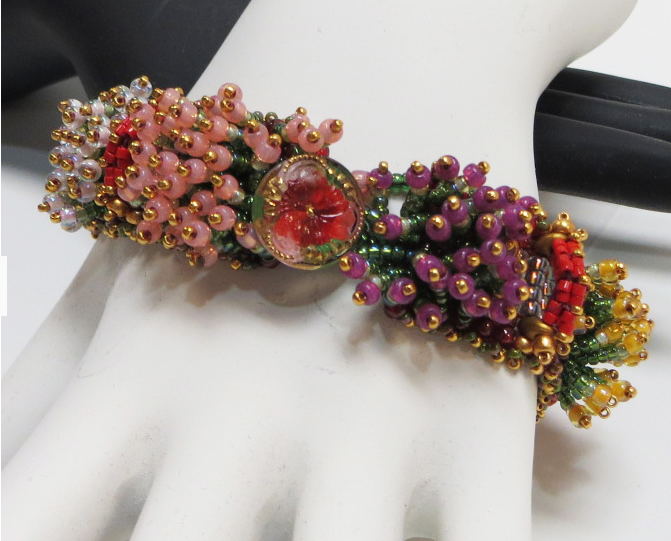
Bead shows travel across the country, back and forth, and come to many of the mid-sized and larger cities and towns across the US, as well as some smaller places.
Bead shows showcase many vendors who sell beads, gemstones, cabochons, findings, books, supplies, and other things related to beading and jewelry making. Some are small and may have 20 vendors; others are very large and have hundreds of vendors. The bead show of all bead shows occurs in Tucson, Arizona every January/February, with a smaller, though not by any means ‘small’, repeat in September.
The bead shows are there to overwhelm you with choices, and get you to part with all your money — the money you brought with you, that you found hidden away under the pillows in your couch, or planned to use to buy something else in the future. Very ENTICING. Fun. Exciting. Thrilling. Exhausting. This is one of those settings where you could easily use the phrase, “the energy in the room was palpable.”
I remember my first bead show visit. There were beads everywhere. I couldn’t catch my breath. I didn’t know where to start.
To get through these shows, to be sure you’ve seen the most important stuff for you, and to be sure you survive with some change left over for buying dinner, I offer a few tips:
o Wear comfortable shoes
o Bring copies of your tax form, if you buy wholesale
o Have a mix of cash, checks and credit cards. Some vendors might take cash, but not checks or credit cards. Others some different arrangement.
o Bring a tote bag.
o Bring a small ruler or gauge
o Wear your glasses. You might also bring a magnifier.
o Bring a small notebook and pen.
o Bring a bottle of water.
Do a Walk-Through first. Get the lay of the land, so to speak.
Set a budget and stick to this budget.
Collect business cards from all the vendors. If they have a website, be sure you leave with that information.
Ask the vendors you bought things from how you can re-order items from them.
Ask the vendors you bought things from when they might expect to be back in your town.
Especially if you are buying something directly from an artist, such as a lampwork artist, take some time to talk and get to know that person. You’ll learn a lot. It’s not often you get direct access to artists.
Play close attention to the quality of what you are buying. At these shows, quality varies widely. The prices of things are often lower than what you would find in your local bead store — but the quality might vary too.
A really good artist will wax their beading thread (Nymo, C-Lon, One-G) or cable thread (Fireline). Even if the thread says it’s been pre-waxed, you want to re-wax this thread.
We wax our thread to make it strong, less likely to fray, to straighten and stretch it a bit before using, to waterproof and protect the thread from weird body chemistries as well as cosmetics, perfumes and perfume oils and hair sprays, and pollutants in the air, to glide through the beads better, and to fill in the jagged edges of the hole of a bead to make it less likely to cut the thread.
There are different types of threads and conditioners.
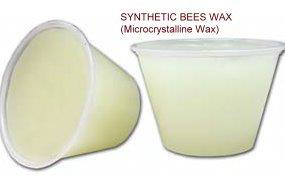
The primary choices are among pure beeswax, synthetic beeswax (also called microcrystalline wax), and a thread conditioner, like Thread Heaven. I suggest you always use beeswax, either pure or synthetic. I do not recommend a thread conditioner.
Thread conditioners reduce the chances your thread will get tangled or knotted up while you are weaving or stringing with it. It reduces the static electricity that builds up each time you pull the thread or cable thread through a bead. But it doesn’t have any of the positive impacts that wax does. It’s an either or choice. So I choose wax.
The synthetic wax is a little more expensive than the pure wax, but I prefer it. The synthetic does everything the pure one does, only better.
Waxing the thread takes very little time, and it can add years to the life of your bead art. Regular bees wax will protect your thread for 150 years. Synthetic bees way many more times this.
When waxing, we pull our thread through the wax two times. Then we take our two fingers, pinching the thread, and slowing moving down the full length of our thread. Our body temperature melts the wax into the thread. Our fingers also knock off any excess wax on the thread. Always pull by the thread, not by your needle, when waxing.
To feel the effects of waxing, try this:
Take an arm’s length (about 6 feet) of Nymo D or C-Lon D Thread it onto a Size #10 English beading needle.
Double it up, so that you now have your length of thread in half, with two equal lengths extending from either side of your needle’s eye hole.
At the needle end, wrap the thread around your forefinger a couple times. When we pull the thread through the wax, we want to pull by the thread, and NOT by the needle.
Wax the thread twice, then take your two fingers and go down the thread, allowing your body temperature to melt the wax into the thread.
Now un-double your thread.
Move your needle up to one end, leaving about an 8–10” tail.
Take your two fingers, pinching the thread, and feel down the length of the thread to find the area that was wrapped around your finger, and did not get waxed. Your fingers will slip.
Now wax two more times from that area on down.
Pinch your thread at one end, moving your fingers down the length to melt the wax into the thread.
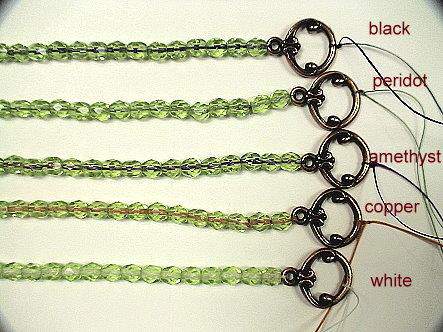
Thread color affects the viewer’s perception and evaluation of the piece.
People see the thread at the knots. They subconsciously see the threads between each bead. If you are using transparent or translucent beads, the thread color will affect the color of these beads. You can do the same piece using different colored threads, and each of these pieces will look very different.
Black always works. Can’t see the knots, only shadows. This makes your piece seem older, richer, more traditional. It gives your piece a patina.
White makes your pieces brighter, sharper, more contemporary looking.
Colors: Most people select a color that is the same or similar to the predominant color in the piece. In this case, there is no color affect. However, you can pick contrasting or complimentary colors, such as using an amethyst colored thread to string peridot colored beads. You can also change the colors of your thread as you work thru your piece.
Beading Threads are very thin ribbons, and are meant to be fully covered with beads, thus hidden within your pieces. They are typically waxed with beeswax to keep them from fraying. Threads, once waxed, are actually stronger and more durable than bead cords, but they are unsightly.
Threads are used in both bead weaving and bead stringing projects.
Beading Cords are threads that are braided together, to make them visually attractive. But you don’t wax bead cords — this would make them ugly. So Bead Cords will have problems of fraying and stretching that waxed Threads will not. When Bead Cord is waxed, the exposed waxed cord also picks up dirt and body oils, making it dirty and unsightly, and furthering weakening the cord.
Bead Cords are used for projects where you want the cord to show, like putting knots between beads, or tin cup necklaces where you have a cluster of beads, then a length of cord showing, and then another cluster of beads, then the cord, and so forth.
If you do not want your cord to show, then you would use a waxed Bead Thread or Cable Wire, which are much more durable than Bead Cords.
There are many types of stringing materials to choose from. Each has its own pros and cons. These types include,
o Beading Thread o Flexible Nylon Coated Cable Wires o Cable Threads (a hybrid between the cable wires and the beading threads, such as FireLine) o Bead Cord o Elastic String o Hard Wire
The primary choice is between needle and thread vs. cable wire.
You always get your best design or functional outcome with needle and beading thread. Projects strung on thread always take the shape of your body, so they move with the body, drape the best, feel the best. Needle and thread, however, is very involved — you have to use a needle, you have to wax the thread, you typically go through each bead at least 3 times. If you are trying to sell your pieces, it is almost impossible to get your labor out of a needle and thread project.
Flexible, nylon coated Cable Wires are much simpler and quicker to use. But the outcomes tend to be stiff, not move as well, or drape as well. However, by adding support systems, such as rings and loops, within your piece — ways to increase jointedness — you can make your cable wire project function a little more closely to that of needle and thread.
In terms of other stringing materials, cable threads (such as FireLine) often offer a good compromise between the functional qualities and marketing concerns of needle/thread and cable wire projects.
Bead Cords are threads braided together so they look pretty. Bead Cord is used when you want your stringing materials to show, such as when putting knots between beads, or doing something like a Tin-Cup necklace, where you have a cluster of beads, and the cord shows, another cluster of beads, the cord, and so forth. Bead Cord trades off durability for visual appearance. If you were covering the whole string with beads, you would not want to use bead cord.
Elastic String is very popular, and avoids the issues of attaching clasps; however, it is not a durable product and loses its “memory” over time.
A last choice is hard wire. Hard wire is not a stringing wire. You can’t put a strand of beads on hard wire and attach a clasp; the metal wire will bend, kink and break from bending back and forth. Hard wire is used to create structural components, chains or shapes, which you can begin to link up, that is, build in support systems, in order to construct a bracelet or necklace.
Basic Steps: Using Needle and Thread to String Beads
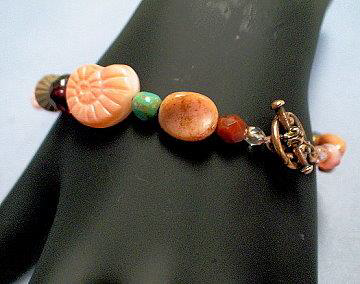
Needle/Thread Bead stringing is a technique for securing a clasp to beads strung on beading thread or cable thread. Here you tie knots to secure your beadwork to your clasp. The process is relatively simple and requires only a little practice.
Successful Needle/Thread Bead Stringing requires that you understand the following: 1. Which threads or cable threads are best for which projects 2. Which needles work best 3. How to wax your thread 4 . How the materials you use affect your success 5 . The mechanical process itself, how it works, why it works, and why we do each step
THE BASIC STEPS:
With needle and thread, you always go through your beads 3 times. In a bead strung piece,that means you are going to take your needle and thread back and forth 3 times.
In fact, we are going to do everything in 3’s. We are going to go back and forth 3 times. As we get to each end,we are going to tie 3 knots.
Create your pattern.
2. You would cut your thread — about 6′ (a wingspan).
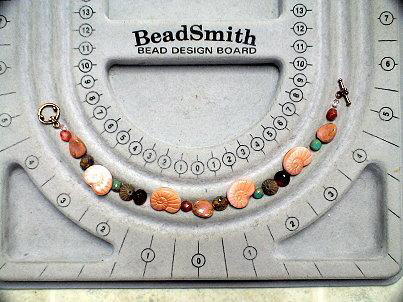
3. Lay out all your beads and the clasp assembly parts on the bead board or some other work surface, in the order they are to be used.
4. Thread your needle.
5. Wax your thread.
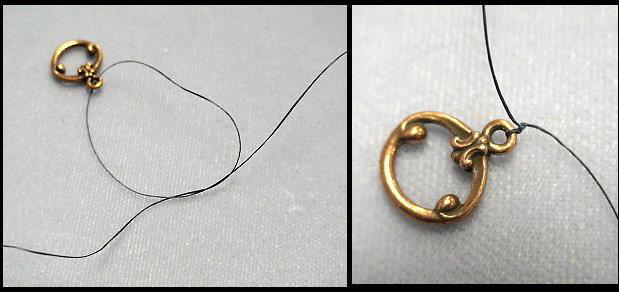
6. You would attach the largest part of your clasp — with Toggles, this is the ring — on one end, tying three overhand knots, and leaving a 8–10″ tail.
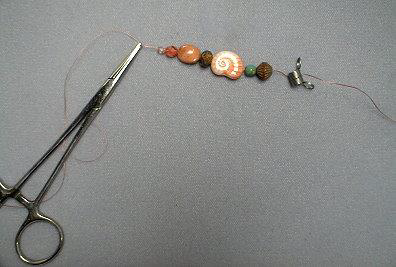
7. Slide on your beads, following the pattern.
NOTE: We only slide the beads over the thread spine, not the tail. With needle/thread work, we deal with the tails at the very end. They will be annoyingly in the way until then.
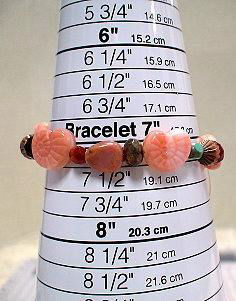
8. Determine the fit — both length and ease — by clamping or holding with your fingers the open end, and encircling a sizing cone or someone’s wrist with your bracelet. Remember here that the other end of the clasp will add another 1/2″ to this length.
Adjust the number or patterning of beads, if necessary.
NOTE: You need to make all your size and patterning adjustments BEFORE you attach the 2nd part of the clasp.
9. Tie off the other clasp-component — with the Toggle, this is the bar — making three knots.
10. Bring your needle/thread back to the ring side, and tie three more knots.
11. Bring your needle/thread one more time back to the bar side.
12. Tie three more knots.
13. Bring your needle/thread back through towards the ring about 1 1/2″ to 2″.
14. Tie 3 more knots.
15. Finishing off the tail. We want to see if we can pop any excess threads or knots which are showing back into the hole of that first bead.
Pinch the beads under the clasp and pull away from you while you grasp your thread and pull this towards you. Sometimes you will feel or see a pop.
Trim the tail.
16. Thread the tail on the other side of the bracelet onto a needle, and repeat these last two steps.
HOW TO USE NEEDLE AND THREAD To String a Bracelet, Including How to Wax Your Thread
There are many different types of stringing materials. The best outcomes are achieved using needle and thread. Beading threads are nylon. Most are shaped like a thin ribbon, rather than round, like sewing thread. Most are bonded, rather than twisted, fibers, which adds a lot of what is called “abrasion resistance.”
With beading threads, your stringing will be the strongest, it will last a long time, it will feel supple and soft, and it will drape and wear the best. It will take the shape of the body, and move the best with the body. These jewelry qualities are referred to as “ease.” Needle/Thread projects have a natural ease to them. Achieving good ease is much more problematic with other stringing materials.
With needle and thread, you tie knots to secure your clasps. Prominent beading threads including Nymo, C-Lon and One-G. One thread, Silamide is a pre-waxed thread and it is twisted, rather than bonded, which means it has no abrasion resistance. Although it is pre-waxed and little easier to manipulate through your beads, I don’t recommend it. I’m not big on anything that breaks easily.
Using needle and thread does add a lot of time to the creation of a piece. You have to use a needle, which can be awkward. You need to wax your thread, which takes more time. You need to go through your piece THREE times. If you are selling your pieces, very often it is difficult to recoup your labor costs, when using needle and thread. In this case, people often revert to using a cable wire as their stringing material.
Bead Stringing with cable wires goes very quickly and is easy to do. The cable wire is stiff enough to be its own needle. You don’t wax. You only have to go through your piece ONE time. The better cable wires are very strong. There is a stiffness to them that makes the pieces not feel as good when worn, in comparison to thread. You also have to use a crimp bead to hold the cable wires in place, and this is a weaker and somewhat riskier design element than tying a knot in the Clasp Assembly. Cable wire brands that I like include Soft Flex and Flexrite.
Pieces done on cable wire move in the opposite direction that your body moves. If I wear a needle/thread bracelet on my wrist, and move my wrist to the left, the bracelet will move with me. If I wear a cable wire bracelet on my wrist, and move my wrist to the left, the bracelet will actually move in the opposite direction to the right. The cable wire bracelet does not conform to and take the shape of your wrist, when worn. This becomes a major design problem not always dealt with easily.
Another alternative to beading thread is to use a hybrid cable thread, such as FireLine or PowerPro or Spiderwire. Cable threads are threads braided together and encased in nylon. Originally these were used as fishing line and adapted by craftspersons for stringing and weaving. You use needles with these cable threads, but you only have to go through your piece one time, instead of 3 times, as you do with thread. You can go through your piece more than once to make your piece stiffer, but you don’t have to. You do not have to wax these cable threads. You can wax them, however, if you want, to increase your thread tension, and add more security against the sharp bead-holes cutting the cable thread.
The cable thread pieces are stiffer than the regular beading threads, but drape better than the cable wires. You tie knots with the cable threads, like with regular beading threads, to secure your clasp. Since you still rely on a needle, using the cable threads goes more slowly than using the cable wires. The PowerPro is a little awkward to use. I really like the FireLine and Spiderwire.
Threads (nylon beading thread)
There are many types and brands of beading threads, each with some pros and each with some cons.
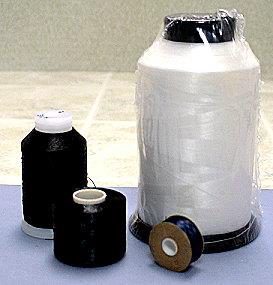
The original nylon beading thread is Nymo. Nymo was first developed by the shoe industry to attach the bottom of your shoe to the top of your shoe. It is widely used in upholstery. In the 1980s and earlier, if you wanted to buy Nymo, you bought it on a gigantic wheel — a five lifetime’s supply for us. As beading got more popular, Nymo packaged their thread on smaller and smaller entities, starting with a cone (a little bigger than a fist), then a spool (a little bigger than a thumb), and then a small bobbin. More recently the spool has been replaced by a large bobbin.
It turns out that the company could not get the same product onto a small bobbin. So, the thread on the small bobbin is weaker than the thread on the large bobbin, spool and cone. However, usually only white and black colors are available on the entities larger than the small bobbin.
Nymo is very strong. I suggest, if you have never worked with Nymo, to cut off about a 3 foot length, and try to pull on it and break it between your hands. It will break, but you’ll feel how tough it is. And in bead stringing, we typically go through each bead at least 3 times, so you have 3 thicknesses of this thread inside your piece.
When they make Nymo thread, it is a beige color. To make black, they dye the thread. The black dye tightens the thread, and makes it stronger. To make white, they bleach the thread. The bleach weakens the thread, so white is weaker than black. To make a color thread, they first bleach the thread white and then add a color dye. These color dyes further weaken the thread. So colors are weaker than white, and thus weaker than black. The colors of the thread, however, are consistent from batch to batch.
Nymo comes in many sizes. From smallest to largest, these include: OO, O, A, B, D, F, and G. The most popular and most often used size is D.
C-Lon is a newer thread. When they make C-Lon, whatever color it is, that is the color the thread starts as. So, all the colors AND the white AND the black are equally as strong. However, the color from batch to batch will vary, sometimes widely. Overall, we like C-Lon better, particularly for the white and the colors. Black C-Lon is equivalent in strength to the Black Nymo. For everything else, it is stronger. One drawback to C-Lon is that the ends of the thread fray easily, making it more difficult to get your thread into the eye-hole of the needle, than with Nymo. C-Lon only comes in two sizes — AA (smallest) and D (thickest).
ONE-G is a premium beading thread and is similar in strength to C-Lon. I think its best attribute is that it has a spring-i-ness to it, that makes it much less tiring to use, than Nymo or C-Lon. ONE-G only comes in size D and only in about 12 colors.
Silamide is a pre-waxed thread. The pre-waxing allows the thread to get less tangled up when you use it. However, Silamide breaks very easily, so I don’t recommend it. Why put in all that time into a project if there is a good chance your thread will break?
Beading thread is shaped flat like a ribbon. Sewing thread is shaped round. Sewing threads are not strong enough to use in beadwork.
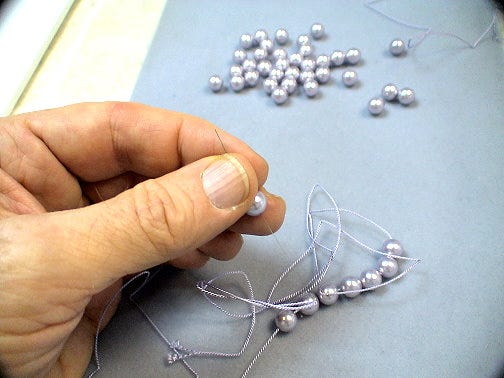
There are two ways to thread a needle. The logical way, the way your mind and brain and eyeball and heart and gut all say to do is this:
– Take the thread in one hand, and the needle in the other. Push the needle onto the thread. Keep poking the thread with the needle until the thread meets the hole and slips through. Then pull on the thread.
The illogical, but more correct way, is to pop the thread into the needle:
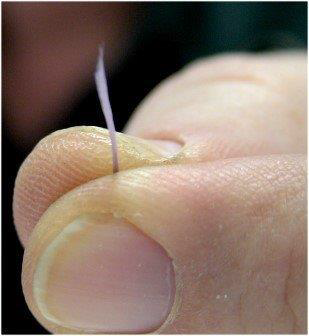
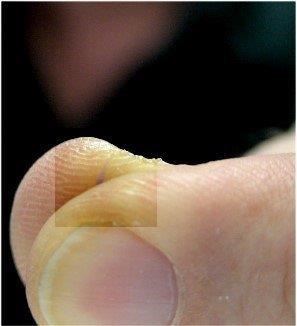
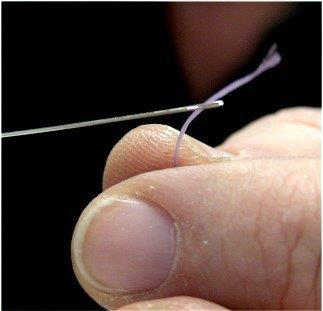
Put the thread between your thumb and fore-finger, and pinch it. Pull it down between your fingers so that the end slips just below the top surface of your fingers. Place the needle over your fingers, lining up the eye hole just above the gap between your two fingers where the thread is hiding, and keep the needle from moving. Squeeze your thumb and forefinger together, so that the thread pops straight up and into the eye-hole. Voila! Magic. Then pull on the thread.
When cutting your thread off the bobbin or spool, if you cut at a slight angle, it makes it easier to get the thread through the eye hole of the needle.
Another trick: Rather than wet the top end of your thread with spit by placing the thread in your mouth, wet the eye hole of your needle. The water that gets trapped in the eye hole will draw up the thread, as you put it to the hole.
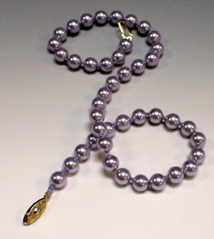
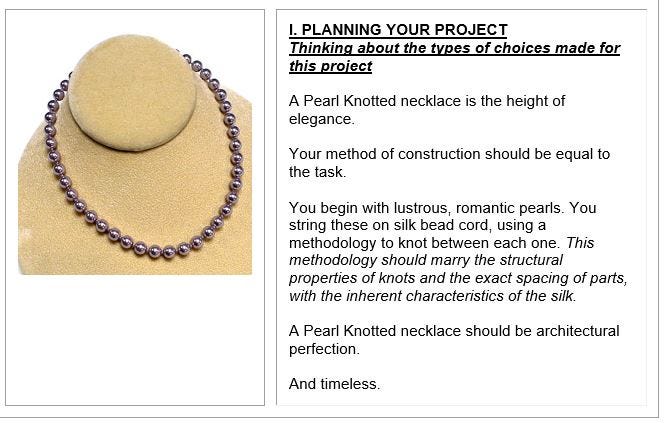
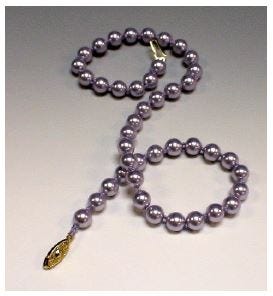
Classic Elegance! Timeless! Architectural Perfection! Learn a simple Pearl Knotting technique anyone can do. No special tools. Beautiful. Durable. Wearable. Easy.
“Over the years, I have found it very difficult for most students (and even my instructors) to get good knots and good hand-knotted construction using a traditional hand-knotting technique with tools. It is difficult to maneuver the knot close to the bead, and it is difficult to keep sufficient tension on your bead cords, as you make the knot. After much trial and experimentation, I developed this set of non-traditional steps. My students usually master this approach on their very first try!” — Warren
Pearl Knotting
Pearl knotting is a relatively easy technique. There are many variations in how to implement the technique. Here I present the steps for a non-traditional approach to pearl knotting. I feel that, for most people, the traditional approach, without a lot of practice, can be a bit awkward, and result in a less-than-desired functional outcome. The non-traditional approach I present here is easier to achieve a better outcome.
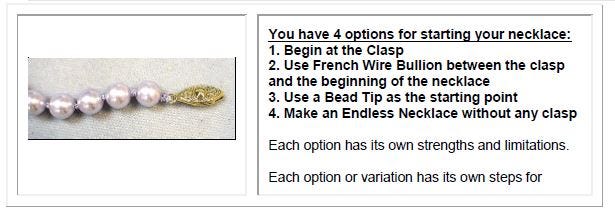
There are 4 different ways for starting and finishing off your pearl-knotted piece.
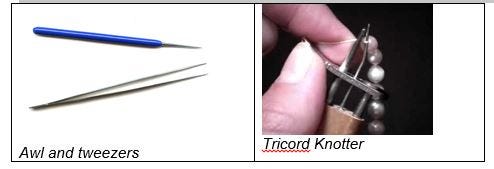
In this non traditional approach, we do NOT use any tools — like tweezers, awls, or tri-cord knotters — to make our knots. We do, however, pull two thicknesses of bead cord through each bead, as does the classical version of the traditional methodology. We minimize the use of glue.
Supplies:
16″ strand of pearls, faux pearls or other beads, approximately 8mm in size, (44–45 beads)
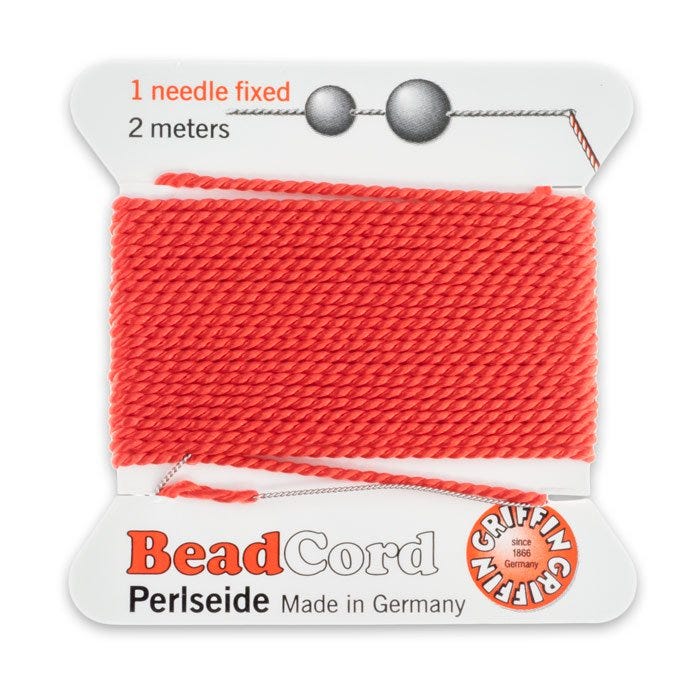
Silk or nylon bead cord with needle attached to one end, matching color, (one 2-meter card). With 8mm Swarovski crystal pearls, you would need a bead cord between .65mm and .70mm in diameter, which, in the Griffin line, is a size 5 or 6.
Twist wire needles (also called Collapsible Eye Needles), size Fine, (2–3 on hand)
Pearl clasp, single strand, approximately 18–20mm long, (1 clasp)
T-pins (or U-pins)
A pad into which you can stick the T-pin (or U-pin)
Scissors.
G-S hypo fabric cement (if your cord is silk)
Either a bic lighter or Beacon 527 glue (if your cord is nylon)
An awl
Chain nose pliers
Ruler
Necklace sizing cone
PEARL KNOTTED NECKLACE
ABOUT PEARLS IN HISTORY
I live in Tennessee, which has a special connection to freshwater pearls. Four and five hundred years ago, when French explorers came down through Canada and down the Mississippi River, they discovered that the Mississippi Indians in Tennessee collected pearls embedded in the local mussels which lived along the banks of the Tennessee River. The explorers traded for these pearls, and shipped them back to Europe, where they were reserved for royalty only, and were called “Royal Pearls”.
Tennessee River Pearls
Before the creation of cultured pearls in the early 1900s, natural pearls were rare and expensive. A jewelry item that today might be taken for granted, say, a 16-inch strand of perhaps 50 pearls, often cost between $500 and $5,000 at the time. Pearls are found in jewelry and mosaics as far back as Egypt, 4200 B.C. At the height of the Roman Empire, when pearl fever reached its peak, the historian Suetonius wrote that the Roman general Vitellius financed an entire military campaign by selling just one of his mother’s pearl earrings.
While Tennessee freshwater pearls are available to anyone today, many royal families in Europe continue to import these pearls. It is the custom, among many royals, and dating back to the time of these French explorers, to have a freshwater pearl sewn into their undergarments. The belief is, if the pearl touches your skin, you will continue to be prosperous and wealthy.
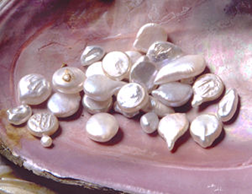
Pearls are harvested in both fresh water (from mussels) and sea water (from oysters). The pearls created by both types of mollusks are made of the same substance, nacre. Nacre is secreted by the mantle tissues of the mollusk. This secretion hardens. When the hardened nacre coats the inside of the shell, we call this Mother of Pearl. When the nacre forms around some irritant, forming a ball-like structure, these become Pearls. Saltwater pearls typically have some kind of bead nucleus around which the nacre forms and hardens. Freshwater pearls typically do not. Besides Tennessee, other major sources of pearls are Japan and China.
Nacre
Cultured pearls are real pearls produced by inserting a piece of mussel shell (or some other irritant) into the tissue of a mollusk. The mollusk coats this with nacre, creating the pearl. The more coats of nacre the mollusk produces, the more lustrous and pricey the pearl becomes. Mikimoto developed this process in Japan in the early 1900’s.
Pearls are soft and they absorb, as well as, reflect light.
NON-TRADITIONAL vs. TRADITIONAL PEARL KNOTTING TECHNIQUES
Hand-Knotting. We put knots between pearls for many reasons. Some reasons have to do with visual aesthetics; others, with structural and architectural concerns.
The knots protect the pearls, should the necklace break. When it breaks, you would lose only one pearl, not all the pearls on the piece.
Pearls are soft, and the surface can easily chip and scratch. Pearls are particularly vulnerable at the hole, where the forces from movement, when the jewelry is worn, force the stringing material to push against the vulnerable edges of the nacre, exposed around the hole of the pearl. Silk cord is very soft, and does not pose a major threat. All other stringing materials — such as nylon bead cord, nylon beading thread, and cable wires — do pose a threat. The knots provide some protection.
Without knots, the pearl’s integrity is threatened, not only by the stringing material, but by the next bead it bumps up against. Other adjacent pearl beads can cause scratches and chips. Metal beads and glass beads will work like hammers against the pearl, as the jewelry moves, when worn.
Knots, when done correctly, are visually attractive. We want our knots to be big enough so that they will not slip into the holes of our beads. We want our knots small enough so that they do not compete with the look of our pearls. The pearls, at all times, should attract the viewer’s focus. The pearls are the star of the piece. Nothing should distract. We want our knots to appear centered over the holes of our beads.
Visually, knots also set off each pearl, as if bracketing them or framing them. For the viewer, this heightens the visually attractiveness of each pearl, moreso, than had the necklace not been knotted.
Structurally, having a knot on either side of the bead, tied tightly in place, so that the bead cannot move freely. Bead cord frays easily,especially if it is silk. We want to restrict the ability of the pearl to move back and forth because of any slack between two knots. We want to restrict the pearl from rotating around the bead cord.
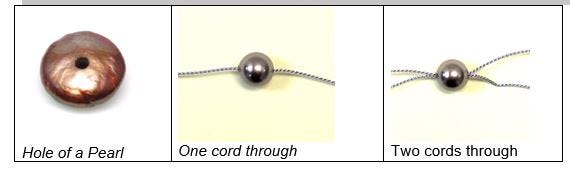
* First, the knots, plus the fact that we will be bringing two cords through each pearl, rather than one, keep the pearl from moving both up and down the cord, as well as around and around the cord, as the jewelry is worn. Pearl holes are very sharp. Picture a broken sea shell, and how sharp it feels as you move your finger along the edge. This is what the hole looks like. If the bead is allowed to move freely, the hole will quickly fray the cord, even cutting it.
Broken mussel shell
* Second, it forces the necklace, as it is subjected to punishing forces resulting from movement, to channel those forces towards the un-glued knots. These un-glued knots easily absorb this force, allowing the necklace to more easily conform to the body, and move with the body. Thus, the force is re-directed around the stringing material, that is, around the knot, instead of directly into it, forcing it against the sharp hole of the pearl. Again, the knots help preserve the integrity of your piece.
NOTE: When using karat gold beads, we do NOT knot on either side of these beads. The knots often force the karat gold beads to dent and squish, when the jewelry is worn. This is also true of many thinner-walled sterling silver beads.
NOTE: When using French wire bullion, we do NOT place a knot between the pearl and the bullion. Instead, we try to anchor the ends of the bullion into the opening of the hole in the pearl.
A Comparison of Traditional and Non-Traditional Techniques.
There are many, many variations on Pearl Knotting techniques.
The major difference between traditional and non-traditional methods is in how the knots are made. Traditional methods use tools, like tri-cord knotters, tweezers or awls, to guide the knots into place. Non-traditional methods do not.
Over the years, I have found it very difficult for most students to get good knots and good hand-knotted construction using tools. It is difficult to maneuver the knot close to the bead, and it is difficult to keep sufficient tension on your bead cords, as you make the knot. This is why I prefer the non-traditional method, which students master much more readily.
If using a traditional technique, I would suggest using a tri-cord knotter, and not a tweezers or awl.
Other Types of Variations Among Techniques:
(1) How many cords are pulled through the bead
I pull two cords through each bead. Some techniques pull only one.
I found that, with only one cord, you don’t get enough resistance to the bead spinning around the cord, when worn. This makes it more likely for the bead’s sharp hole to fray and cut into the cord.
Two cord approaches work best when the hole size from pearl to pearl are relatively consistent. One cord approaches work best when there is noticeable variation in hole size from pearl to pearl.
(2) How many cord thicknesses make up the knot
I pull two cords through the bead, and use one of the cords to tie an overhand knot over the other cord. So, my knot is two cords thick around the core. Some techniques tie a knot using both cords at once, and resulting in a 4-cord thickness knot around the core.
I find that 4-cord-thick knot to be too big, visually competing with the pearls, instead of complementing them. The size of the knot, however, does not impact its structural functionality. Best functionality is achieved with a non-glued knot, and with simpler knots like larks head or overhand knots.
(3) How knots are tied
I use an overhand (half hitch) knot for the knots between beads, but a Larks Head knot to connect the piece to either side of the clasp. Some people use a Larks Head knot for all the knots.
I find that the Larks Head knot, when used between beads, often gets off-center. When the knots are too off-centered, not only can this be visually annoying, but it can force the pearls to sit crookedly all along the necklace line.
My final knot is a square knot, which secures both cords which I have pulled through my beads, and centers this knot between the last two pearls.
(4) How knots are tightened
After you make each knot, you need to be sure to bring the knot as close and as tightly against the pearl as you can.
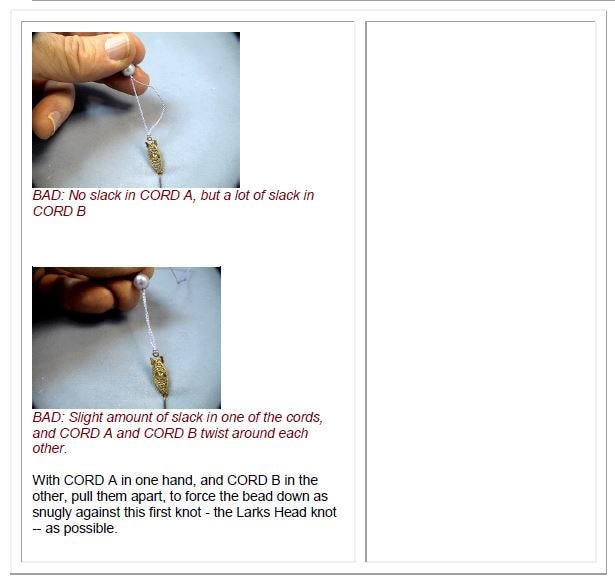
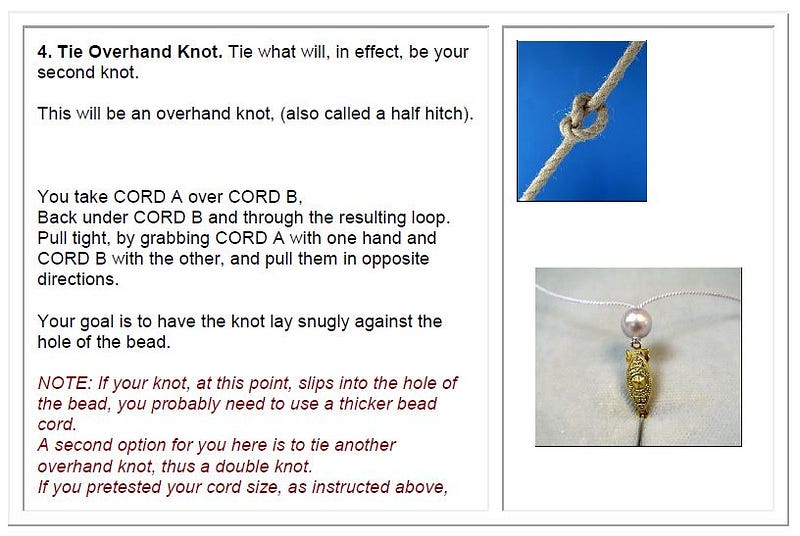
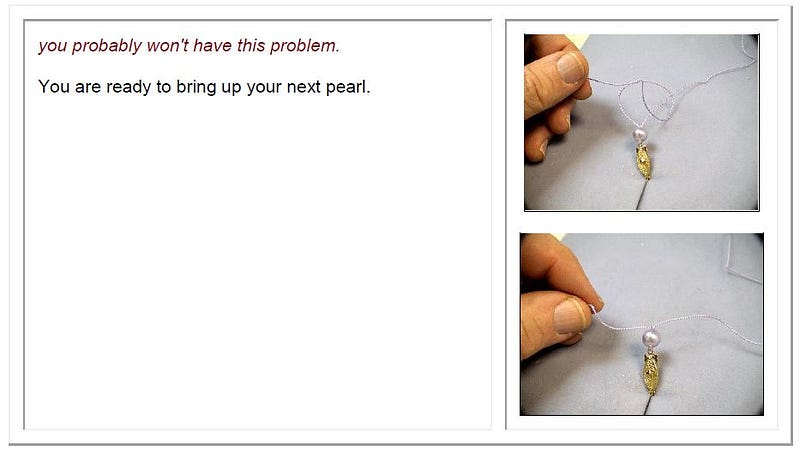
Visualize:I have two cords exiting the hole of my pearl. First, I take each of my two cords, and I pull them tightly away from each other. This pushes the pearl against the knot below it. Second, I tie an overhand knot and pull tight. Last, I grab each cord and tightly pull them away from each other one more time to be sure the knot is tight and abuts the top of the pearl.
Some techniques have you take your thumbnail, or the tip of your tweezers or awl, and push the knot towards the pearl’s hole. Traditionalists worry that by pulling the two cords apart, you will force the knot into the hole of the bead. However, by selecting the appropriate thickness of cord, and bringing two cords up through the hole of the bead, you will not have this problem.
I find that the thumbnail push doesn’t get close or tight enough. The use of the tools can fray and break the fibers in the cord. It’s one thing to use the tools to guide the knot into place. It’s another thing to use the tools to push and tighten the knots into place.
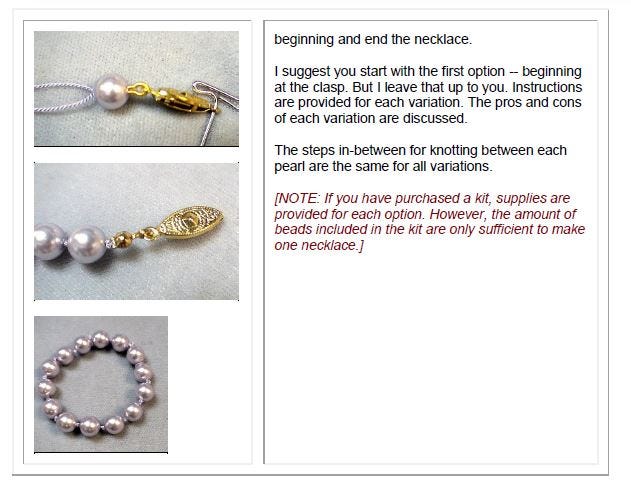
(5) Whether the piece begins and ends at the clasp, or with French wire bullion between the necklace and the clasp, or with bead tips between the necklace and the clasp, or with no clasp at all.
How you start and end your piece will vary a little bit, depending on whether you are attaching the piece directly to a clasp, using bullion or beads tips intervening between the piece and clasp, or using no clasp at all.
You connect the clasp differently in each case. You make your beginning and final knots differently in each case.
This is a personal choice.
Attaching the cord directly to the clasp is the most difficult. It uses the most technique, so, when I teach this class, this is the approach I use.
Using French wire bullion is a little easier. It looks very finished and pretty when your necklace is completed. But the bullion doesn’t age well. It gets black and dirty.
Using clam-shell bead tips is very easy and the most versatile. It extends the length of the clasp assembly, so there is some visual competition which might be annoying in some cases.
Making a continuous necklace is not that difficult, and allows you to make a long rope that does not need a clasp.
Whatever you do, you want to be sure that your resulting clasp assembly — that is, the clasp and all it takes to attach your beadwork to it — does not visually compete with the beauty of your pearls.
(6) How and where that last knot or last two knots are made
You can attach your last knot directly to the clasp, or bring your cord back through one or two beads, and then tie a knot.
You can run through steps for that last knot, which have you tying one cord off in one place, and tying the second cord off in another place.
You will find other instructions for tying off your cords in one place together.
When you make your last knot, you can tie a single knot, a double knot or a triple knot.
I approach this in a few different ways, depending on whether using a clasp only, or bullion, or bead tip, or no clasp.
If the final knot is going to show, I prefer NOT to end directly to the clasp, but to bring it back through one bead and tie it off between the last two beads.
My final knot is a square knot. This is the only knot in my pieces where I apply glue.
(7) Which Glue and How the Glue is Applied to the Knots
I prefer a “cement” over a regular “glue”. Cements bond immediately with the materials they are applied to. The bonds of most other types of glues are formed as the solvent in the glue evaporates into the air.
With silk, I prefer a fabric cement. I would never use super glue.
With nylon, I prefer to use a jeweler’s glue called Beacon 527 or hold it near a flame to melt the ends.
I prefer to place a very small drop of glue on the inside of the knot. I pull the knot tight, and put another drop of glue on the outside of the knot. This coats the bottom and the top of the knot. I let the glue set for 20–30 minutes. Then, I trim the tails very close to, but NOT right at the knot. Put another drop of glue on each tail, and tamp down on the tails with a tweezers or awl, so the tail-ends appear as part of that final knot, and make the knot pretty.
I try to minimize my use of glue, since glue will considerably diminish some of the structural support properties of the knot. I prefer to apply glue to only one knot in my piece — the very last knot made.
NOTE: With nylon bead cord, you can use a thread zapper or bic lighter to melt the ends of the cords. Where glue is to be used at the ends of the cords to keep them from unraveling, with nylon bead cord, you can melt the ends instead.
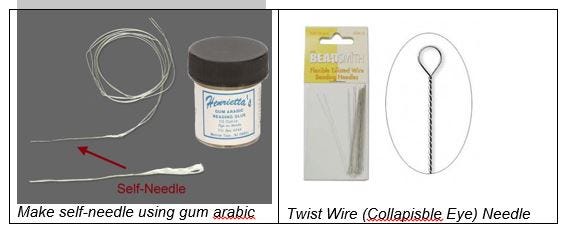
(8) Whether you use a flexible metal wire (steel or brass) needle, or make a self needle from the cord itself, using gum arabic.
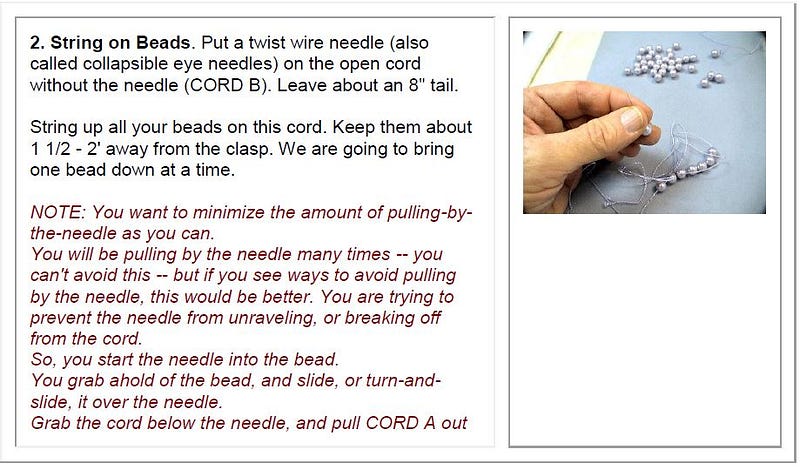
Here we are using the wire needle that comes attached to the cord, plus a second twist wire (collapsible eye) needle.
What some pearl-knotters worry about is the metal needle snagging the bead cord, during the pearl knotting process. This weakens the cord.
To make a thread-needle, you would take a paring knife and shave the threads at the first 1 1/2″ at the end of your cord. Gently guide the paring knife over the cord until the nubs have been removed from the silk, and the thread has thinned. The more you shave, the thinner your needle will be. With an awl or tweezers, dab a small drop of gum arabic on the ends, and twist the threads between your fingers to make the needle. Cut off any stray fibers. Let dry for a few minutes until stiff.
I prefer the wire needle, because I find it easier to use, and longer lasting. Be aware, that should your wire needle begin to catch on the silk cord running through your bead, pull it out a bit, and then push it back through. It is not that difficult to minimize this problem. It is a lot easier to use the wire needle than your own home-made self-needle.
CHOOSING BEADS
Pearls come in different sizes and shapes, and a myriad of colors.
Some pearls are from nature. These include freshwater pearls (from mussels) and saltwater pearls (from oysters). Pearls can be naturally occurring, or cultured, where people have intervened in the process by introducing an irritant inside the mollusk shell.
Other pearls are “faux” or imitation. These are some kind of core bead with a pearlized finish around it. These are typically described by what makes up the core of the bead. The core could be plastic, glass, shell, or crystal. These are made in different countries around the world and vary in quality.
To differentiate between natural and faux pearls, try these things:
A) Always when buying pearls, check the hole. Most natural pearls have very small holes. The holes usually appear relatively smooth, but not perfectly smooth, round and centered as the holes in faux pearls do. The finishes on many faux pearls are not well applied, particularly at the hole. You often can see the finish chipping off or peeling away from the hole.
B) Rub the pearls against your front teeth. Faux pearls have very smooth surfaces. Natural pearls will have bumps and slightly uneven surfaces. You can feel the differences, when rubbed against your front teeth.
Pearls are typically described in terms of :
Luster: the way pearls seem to glow from within. It’s based on the depth of reflection due to the layering of the aragonite crystal.
Overtone: the translucent “coating” of color that some pearls have. A silver pearl may have a blue overtone or a green overtone, for example.
Orient (sometimes called iridescent orient): the variable play of colors across the surface of the pearl like a rainbow.
Shapes
Thanks to some new nucleating techniques, freshwater pearls can be found in a nearly endless variety of shapes, but the more traditional shapes include:
Round — Perfectly spherical, or very nearly so. These are primarily saltwater pearls. Stick — Long and thin with many irregularities. Rice — Small ovals drilled lengthwise. Potato — Often lumpy, these are typically rounder than rice pearls and may be drilled either lengthwise or widthwise. Nugget — Usually a little more square or pebble shaped than rice or potato pearls and almost always having a flat side. Coin — Large, circular and flat, often about the size of a dime, with the hole drilled end-to-end. Coin shapes include hearts, squares, ovals and large pears and drops. Keishi — Sometimes called “cornflake”, these are flat and highly irregular. Drop — Teardrop, pear or even peanut shapes, drilled either lengthwise, or widthwise at the narrowest end. Button — Rondelle shaped, often with a flatter side, and drilled through the “hub” of the wheel. Blister pearls — pearls that are still attached to the shell of the mollusk.
Colors
Most pearls are color enhanced to become a specific color. First they are bleached, then dyed.
Sizes
Pearl bead sizes are given in millimeters There are 25mm in an inch. Rulers are marked in inches on one side and millimeters on the other.
Hole Sizes
Hole sizes on pearls usually run smaller than on most other beads. The size of the hole is NOT in proportion to the size of the bead. Therefore, when selecting bead cord, you need to have one of your pearls handy, so that you can match the hole size to the cord.
CHOOSING CLASPS AND CLASP ASSEMBLIES
You can use any type of clasp that you prefer.
However, pearl knotted jewelry is very strongly associated with what are called pearl clasps or safety clasps. These are often marquis-shaped clasps, with a hook like tongue that pushes inside them. If the tongue should somehow come undone and slip out, it would catch on a bar in the clasp, saving you from losing your string of pearls.
In terms of that vintage-type look, other widely used clasps are filigree or other box clasps. These are pretty, but not as secure as safety clasps.
Usually, you will want your clasp to compliment and not compete visually with your pearl knotted piece. If you decide to use a very show’y clasp, it should blend organically with the rest of your piece.
You will be attaching your bead cord, either to the loop(s) on the clasp itself, or to soldered rings attached to these loops. You want both these loops, as well as any rings attached to them, to be closed, that is soldered — thus have no gaps in them. If there are attached rings, and they are open, you will want to remove these, and attach the cord to the closed loops on the clasp.
If you are making pearl knotted pieces for re-sale, you would be hard pressed Not to use a pearl or safety clasp, or some similar looking clasp.
The woman who originally owned the American Pearl Company in Tennessee was always looking for a clasp that would be durable, but attractive to her customers. The American Pearl Company made a lot of its money by selling finished jewelry. Safety clasps, particularly those made of 14KT gold, break easily. The tongue bends and breaks, and no longer can wedge into its marquis shaped home. Her biggest frustration was that the clasps on the necklaces and bracelets she sold broke too easily, and the pieces came back for repair. It’s a big effort to re-string pearl knotted pieces, since you have to cut off each pearl individually.
At first she tried switching to other types of clasps, like toggle clasps and lobster claws. But these pieces did not sell. People wanted pearl/safety clasps.
Next, she tried switching from 14KT gold to gold-filled clasps. These did not sell either. People wanted 14KT.
Finally, she gave in somewhat. She returned to the 14KT gold pearl/safety clasps. But she doubled her prices, to build in the cost of one re-stringing.
CHOOSING STRINGING MATERIALS
We recommend, if your project is all pearls, or mostly pearls, that you use silk beading cord.
If your project is very few pearls, or no pearls, say using glass, faux pearls or gemstones, that you use nylon beading cord.
Unfortunately, while nylon bead cord is much, much more durable than silk, nylon ruins pearls. Nylon cuts into the pearl at the bead hole, making the nacre start to chip and flake off. Silk does not do this.
Beading cords are threads which are braided together to make them look pretty. Beading cords are used in projects where you want your stringing material to show. Beading cords are less durable than waxed threads or flexible cable wires. We do not wax beading cord, because this would make the cord look ugly. Waxed beading threads and cable wires can cut into the pearls at the hole, and ruin them. By using beading cords, you are trading off visual appearance for durability.
Silk and nylon bead cord can be purchased in 2-meter (6 feet) lengths on cards with a needle attached, as well as on larger spools without a needle attached. Usually the silk or nylon on spools is a higher quality cord than that on cards. However, most people use the cards because of the convenience of having a needle attached.
At the same quality level, silk beading cord and nylon beading cord have the same pros and cons. They stretch the same, fray the same, get dirty the same — only the silk deteriorates, and the nylon does not.
You can pick a bead cord which matches the color of your beads, or which contrasts or otherwise highlights the color of your beads. In either case, the color should visually compliment, not compete, with the pearls themselves.
A NOTE ABOUT KNOTS AND THEIR FUNCTION
When we knot between beads, the un-glued knot becomes what is called a “support system”. Support systems in jewelry allow what is called “jointedness.” Un-glued knots are support systems, as are loops and rings, hinges and rivets. In this project, the pearls can rotate around the knots, and the knots can contract and expand in response to stresses and strains placed on the necklace when worn.
Support systems allow the piece, as worn, to move freely. When jewelry moves when worn, this puts a tremendous amount of force on each of the components. Support systems allow this force to be absorbed and dissipated, before anything bad happens.
If the piece is too stiff, such as when the knot has been glued, and cannot move freely, the components will break — the cord will break, the clasp will break, the beads will chip, crack and break.
A NOTE ABOUT GLUES AND GLUE-ING
Glue is usually the enemy of good design. We want to minimize its use.
Unfortunately, with hand-knotting, we need to secure the last knot, and, in some cases, the last two knots, with glue. When we finally trim the cord where we have tied that last knot, we use the glue for two reasons, (1) to keep the end of the cut cord from unraveling, and (2) to keep the knot from loosening up and coming un-done.
With silk beading cord, we suggest using a fabric cement. “Cement” is a type of glue which bonds instantly with the cord, when applied. With cement, the bond adheres to all the microfibers that make up the bead cord. “Glue” without the label cement on the package, usually bonds over a period of time while the solvent in the glue evaporates into the air and the bond dries. With glue, the bond tightens like a collar. In this project we suggest G-S Hypo Fabric Cement, because it has a very narrow applicator tip. But any fabric cement will do. You can purchase these at most craft stores and some bead stores.
With nylon beading cord, we suggest a jeweler’s glue like Beacon 527. This glue dries like rubber, and the bond acts like a shock absorber when confronted with excess force. This glue does not come with that great narrow tip, so we suggest applying the glue with a pin or toothpick. This glue dries quickly. Another widely used glue is G-S Hypo Cement which does come with that great tip, but doesn’t dry quickly enough, and I find the fully set bond too stiff. I would never use super glue for this purpose.
In selecting a glue, you want it to — dry quickly — dry clear — not harm the pearls (or other types of beads you are using) — be washable
While some glues dry quickly, most take about 24 hours to set and dry hard. You would not wear your pieces for 24 hours after gluing.
WHAT TOOLS DO I NEED?
In traditional pearl knotting, you use a tool to help you make and secure your knots. This tool would either be a tri-cord knotter, which works well. Or it might be a very pointed tweezers or awl, which are awkward for most people to use, without a lot of practice.
In our non-traditional approach, we do not use tools for knotting. Occasionally, we might use a chain nose pliers or a tweezers, to give us some more leverage, when pulling a cord through a bead. We use scissors to cut the cord. If using French wire bullion, we use a flush cutters to cut this. But we use only our hands to make our knots, position the knots, and tighten the knots.
Over the many, many years I have been in the beading and jewelry making business, I have seen few students able to get the knots done satisfactorily, using the tools, and following the traditional methods. A few students have practiced over and over again to master the technique. But most students give up long before they get to that point. The non-traditional method is mastered in one or two tries. That is one of the reasons we advocate for the non-traditional approach.
Also note, if you squeeze the cord too tightly with tools, you can damage the cord.
RE-STRINGING PEARLS
Know when to restring your pearls.
There are 5 tell-tale signs:
DIRT CHIPPING STRETCH DETERIORATION CLASP FAILURE
Re-string if the knots between your pearls are looking soiled or discolored. Silk, in particular, absorbs body oils and grime. Pearls are porous. They can absorb dirt and become permanently discolored. Sometimes, if there are no knots between beads, your pearls might adversely be affected by the beads next to them. For example, gold beads can blacken pearls, at the point they come in contact.
Re-string if your pearls become chipped, scratched or broken. Pearls are soft and can easily scratch, chip and break. Some of your pearls may need to be replaced, before re-stringing.
Re-string if your pearls are moving around too freely between the knots. Silk stretches over time. Cord which shows, thus is uncovered, increases the chances it will break. Your necklace also may get longer over time, and that extra length may no longer meet your fashion needs.
Re-string if your stringing material breaks.
Re-string if your clasp breaks.
How often do pearls need to be re-strung? This depends on how often you wear them, what they were strung on, and how they were stored and cared for.
In general, pearls need to be re-strung every 3–5 years. If you wear your pearls every day, you will need to re-string them annually. If they were strung on silk bead cord, which is our preference, then silk naturally deteriorates in 3–5 years, and you want to re-string them before the silk starts turning to dust. If they were strung on nylon bead cord or flexible cable wires, these materials do not easily break down, and you might wait 10 years before re-stringing.
If you store your pearls in an air-tight bag, and out of the air and sunlight, you may only have to re-string them every 10–15 years, even when strung on silk beading cord. The bag should be made of a natural material like silk or cotton. Plastic bags chemically interact with the pearl, and will ruin your pearls.
Before you re-string your pearls, you would need to clean them.
First, you should gently wash your pearls while they are still on the old string, with mild soap and warm water. Remove any dirt and hardened oils around the pearls, particularly near the holes. Rinse extremely well so that there is no soapy residue. While you are cleaning your pearls, you want to anticipate what might happen, should the string break. Be sure the drain is covered. You might want to wash the pearls by working inside a colander in your sink.
Next, you must carefully cut the pearls off the old string. To start, place your scissors on the knot between two pearls and cut through the middle of the knot. You don’t want to start on either side of the first knot because the knot could slip inside a pearl and be quite difficult to remove. For the rest of the pearls, snip each knot off by placing the scissors behind each knot and in front of the pearl. Again, work over a surface, where, if you dropped a pearl, you would not lose it.
If there is a pattern to the arrangement of the pearls on your necklace, you might want to lay them out in this pattern, as you cut each one off the string, say on a bead board.
A NOTE ABOUT BUYING PEARLS
When buying pearls, you want to examine:
— Shape — Consistency of shape along your strand. Either very round, or a very interesting shape is considered better. — Size — Consistency of size — either similarity of size or consistency of gradations in size — along your strand. Usually, the larger the pearl, the more valuable it is. — Color — A pleasing blending of color all around the bead, from every angle. Consistency of color along your strand. Rose or silver/white pearls tend to look best on fair skin tones, while cream and gold tones look better on darker complexions. — Luster — High luster and translucency is better than dull or chalky — Surface quality — Few blemishes is better than one with many irregularities. Absence of disfiguring spots, bumps or cracks. — Hole quality — If you see chips around the hole, this is a bad sign and indicative of other problems. Some hole sizes may be so small, that they would be extremely difficult to work with. — Nacre thickness — Thicker is better
A NOTE ABOUT CARING FOR PEARLS
Pearls will last a lifetime and beyond, if cared for properly.
Exposure to heat (such as the top of a TV set or near a stove or fire place), sunlight, and chemicals (such as those in hair spray, cosmetics and perfumes) can damage the nacre of pearls.
How do I safely clean pearls? Use a gentle detergent soap or mild shampoo without dyes and warm water. Be sure to clean around the hole of each pearl. Rinse thoroughly and let dry on a damp cloth overnight. Hot water can permanently damage your pearls. Do not let your pearls soak in the water. Let the pearls and string dry out for 24 hours before wearing.
Never wear your pearls when the string is still wet . Never hang the strand when wet.
Pearls are softer than other gemstones. Always wipe them with a soft cloth after wearing. Perfume oils, makeup, hair sprays and perfumes can spot and weaken their surfaces, as well as the cords they are strung on.
Pearls should be put on after the application of cosmetics, perfume or hair spray. They should be the LAST THINGS PUT ON and the FIRST THINGS TAKEN OFF.
Pearls should be kept away from hard or sharp jewelry that could scratch them.
Pearls are best stored in a soft cloth pouch, or in a separately lined segment of a jewelry box, and out of the air and sunlight. Do not store in a plastic bag. The plastic emits a chemical which makes the pearl surface deteriorate.
Do not shower or swim in your pearl jewelry.
Ammonia and alcohol will ruin pearls. They both draw out the oils in the pearls which give them their luster. Keep pearls away from metal cleaners and tarnish removers.
The more you wear your pearls, the more beautiful they become. Pearls’ luster is maximized when worn often because the oils from the skin react with the surface of the pearl. However, you want your pearls to glow, not yourself; perspiration can be slightly acidic, and eat away at the pearl.
The air in many safes and security deposit boxes is very dry, and can cause pearls to crack or discolor.
A NOTE ABOUT DRILLING PEARL HOLES TO MAKE THEM LARGER
Pearls typically have very small holes. The holes are small because it is too easy to chip and crack the nacre around the holes, when drilling them.
You can, however, make the holes a little larger. You would use a hand-held or battery-operated bead reamer to make the holes in your pearls larger. You want your drill beads to be diamond coated.
You want to work slowly but steadily.
Wear safety goggles. Pearl dust can adversely affect your eye-sight.
Until the 1970s, pearl holes were typically drilled by hand. Pearl companies from Japan would often have boys in India drill holes in pearls. They would hire and train boys who were 9 years old. By the time the boys were 14, many had lost their eye-sight. Thankfully, with the advent of mechanized ways to drill pearls, this practice no longer continues today.
STYLES AND LENGTHS OF PEARL NECKLACES
Because the history of pearls has been very much a part of the history of nobility, there have been many customs and social expectations that have arisen around pearls. One of these has to do with styles and lengths.
Graduated: Beads are graduated in size, with the largest in the center, and decreasing in size on either side towards the clasp.
Uniform: All the pearls are within .5mm of each other in size.
Choker: One or more strands worn just above the collarbone, typically 15 1/2″ to 16 1/2″.
Princess: 18″ length
Matinee: 22–24″ length
Opera: 30–32″ length
Continuous Strand: A necklace without a clasp, typically over 26″ in length so that it can slip over someone’s head.
Bib: A necklace with many strands, each one longer than the one above it.
Rope: 45″ or longer, sometimes referred to as a lariat.
A necklace enhancer, sometimes referred to as a “necklace shortener”, is like a ring with a latch on one side and a hinge on the other, which lets you open and securely close it. These are most often used with ropes, where you circle the rope over your head 2 or 3 times, to wear like a multi-strand choker. The necklace enhancer clips over the knots in the encircling strands, to secure them together and in place. If you cannot find a necklace enhancer, you might be able to use an S-clasp to achieve the same end.
Odd vs. Even number of strands: This is a personal choice. Traditionally, it was believed that an even number of strands was inappropriate and bad luck. It would be very unusual to see any royalty wear an even number of strands.
SELLING YOUR PEARL KNOTTING SKILLS
Selling your pearl knotting skills is a great way to make some money.
Most jewelry stores charge their customers to re-string their pearls between $4.00 and $6.00 per inch.
Most independent jewelry designers charge between $2.50 and $3.50 per inch. These designers re-string pearls on their own, or sub-contract with jewelry stores.
I have also found, when doing craft shows, that I can quickly hand-knot strands of attractive-looking beads, not necessarily pearls, and use these knotted pieces to fill out my inventory. These pieces sell very well, and are very profitable.
BEGINNING YOUR PROJECT
Pearl Knotting Basic Steps
Selecting and Testing Bead Cord 2. Variation #1: Attaching Clasp to Beginning of Necklace 3. Bringing Up The First Pearl and Tying the Knot 4. Continue Pearl Knotting To Get the Length You Want, But Stringing Last Two Beads Without Knotting Between Them 5. Attaching the Other Part of Your Clasp to the End of the Necklace, and Making the Final Knots
Selecting and Testing Bead Cord
We are going to pull two thicknesses of cord through our beads. The bead will be strung on one cord, and we will be pulling a second cord through the hole. We want noticeable resistance to this. Resistance to the point where we feel we need to direct our hand to pull a little harder than we first thought. You might need a chain nose pliers to help you pull the needle through.
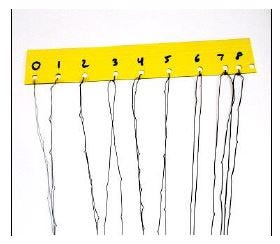
You might want to prepare a sample Cord-Size Tester, like I have. Here I have attached cords between sizes 00 and 08. Each cord is doubled. One leg of each cord has a needle attached, and the other leg does not. This lets me test out both cord thickness, as well as knot size.
Most freshwater and saltwater pearls have very small holes. The sizes most used here are between 00 (.3mm) and 03 (.5mm), with 02 (.45mm) the most common.
Most glass beads and gemstone beads require cords between 04 (.6mm) and 08 (.8mm), with the most common 06 (.7mm).
When The Beads Have Different Size Holes…
You always want to start with beads that have very similarly sized holes.
If you buy a strand of real pearls, there is a good chance that the hole sizes might vary. You might need to work from 2 strands of beads to cull enough beads with similar size holes, to pearl-knot.
Another thing you might do, especially if there is a big variation in hole sizes, say when mixing both pearls, glass, metal and/or gemstone beads. You do not necessarily have to put knots between all your beads. You can separate the beads in terms of hole sizes, create a patterned layout, where you plan to knot between beads with similar hole sizes, and not knot between the rest.
It is also very typical that the hole on one side of the bead will be slightly larger than on the other. Picture a drill press. The drill bit pushes down into the bead to make this hole, with the thinner tip end of the bit coming out the other end. It’s risky to drill pearls, so they don’t take bit all the way through.
Another thing you might try: Match the cord size to the smallest hole size. Make double-knots between each bead instead of single knots.
What Length of Cord Will You Need…
The actual length of cord will depend on the size of your beads, thus how many knots you need to make along the length of your cord, as well as your specific hand-knotting technique.
In the traditional rule of thumb, you multiply the length of the necklace you want to make and multiply that by 4 and add 15″. This will give you enough cord to make the necklace, as well as about 15″ or so of cord to hold onto.
For example, using this traditional rule, a 16 1/2″ necklace would need about 81″ of cord. On the cord-on-cards, you get 2 meters or about 79″.
In our non-traditional method, we use about 12″ less of cord, so multiplying your length by 4 and adding 3″ would be the math. So, in our example, for a 16 1/2″ necklace, we would need about 69″ of cord.
With the non-traditional technique instructions below, you can get a 22″ necklace made up of 8mm beads from this 2-meter card.
NOTE: With your silk cord in particular, the last several inches near the attached needle get too frayed during the pearl knotting process, to be useful for your finished piece.
2. VARIATION #1: Attaching Clasp to Beginning of Necklace
Attaching The Clasp To The Beginning Of The Necklace
Open up your bead cord on the card, and unravel the cord off the card.
The cord will be kinky. Pinch the cord between your thumb and forefinger. Run your 2 fingers up and down the length of the cord a few times, pull the cord a bit as you do this, to smooth the kinks out. You do not have to get this perfectly smooth.
You can also run the cord over the edge of a table.
[For a project like a tin cup necklace, where a lot of the cord will show, you can steam iron the cord. Put a towel over the cord before you steam it.]
Test The Length
Let’s test the size of our necklace out, to be sure we have it long enough.
Use a necklace sizing cone or someone’s neck.
Hold the necklace around the cone or neck. Don’t forget to account for any additional length the final part of your clasp will add to your piece. One part of this clasp is already attached to the beginning of the necklace. The other part of the clasp may or may not add additional length.
You will also be making additional knots — at least 2 — and this will add 1/16″ per knot in length.
Necklace Sizing Cone
If you need to add additional beads, you can slide these onto cord B. Review the measurement table at the start of our instructions to determine how many more beads you might need to add.
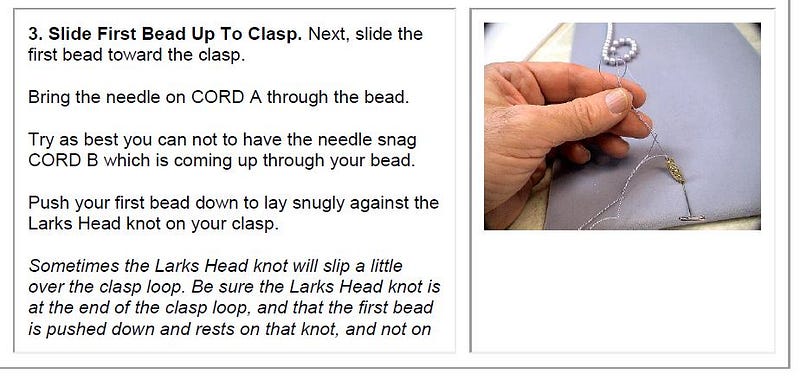
Maneuver Cord A back down through that last bead, so you can tie a knot where you skipped a bead. Tie additional knots until you get to your last 2 beads.
Attaching the Other Part of Your Clasp to the End of the Necklace, and Making the Final Knots
The Process:
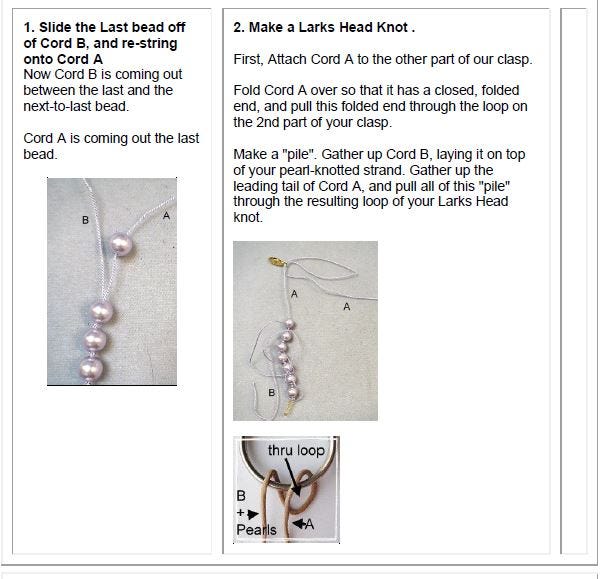
o We will slide the last bead off of Cord B, and re-string it onto Cord A.
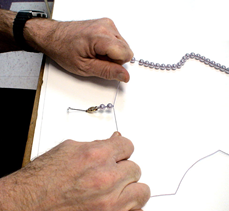
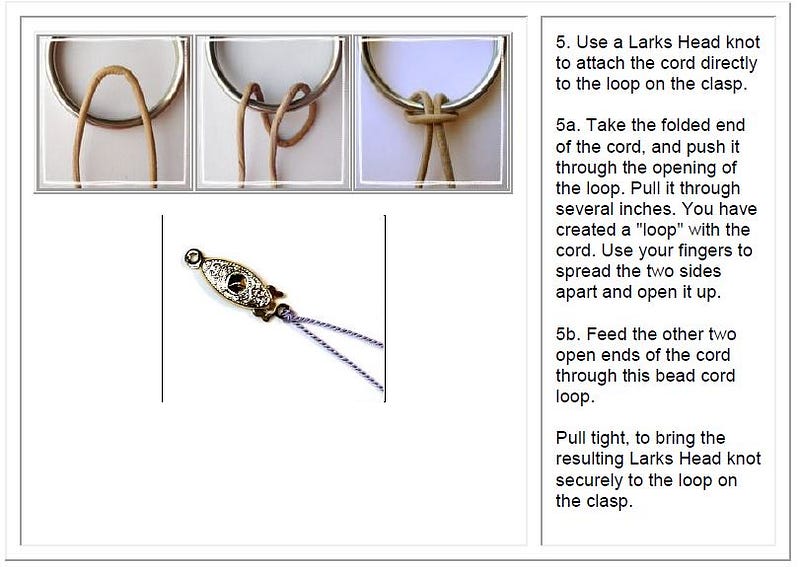
o Begin to tie Cord A off to the clasp using a Larks Head knot. Fold Cord A in half about midway between the last bead and the end of the cord. Slip that folded spot through the ring on the clasp, and pull it through, to begin forming your loop.
o Un-anchor your pearl knotted strand.
o Make a “pile: your Cord B, the pearl knotted strand, and Cord A several inches below the clasp and Larks Head knot.
o Pull this “pile” through your Larks Head loop.
o Get everything orderly again: Cord B off to the side, re-anchored pearl knotting strand, clasp with beginnings of Larks Head knot with a big loop that will need to be closed above your pearl knotted strand, and your Cord A off to the other side.
THE CHEAT WAY: Instead of bringing this whole pile through the loop, just take the clasp itself through the loop.
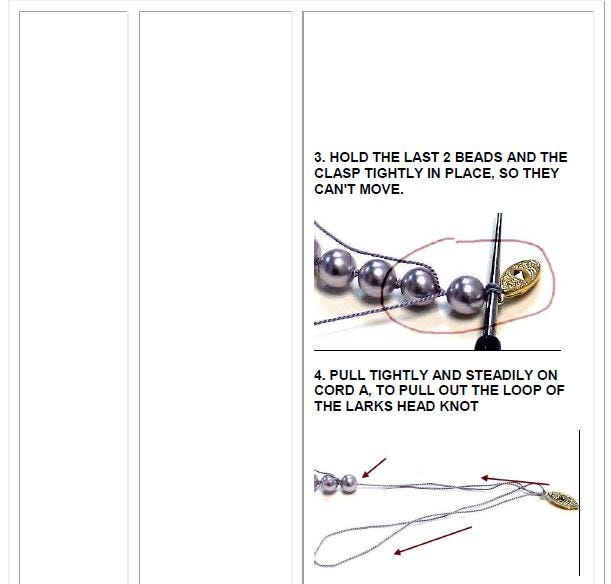
o Bring Cord A back down through that last bead towards the next to last bead. Slip an awl or a tweezers through the loop on your Larks Head knot, preventing that loop from closing all the way onto the clasp. You are now positioned to begin to tighten that Larks Head knot.
o Carefully pull everything more and more tightly — all the beads abutting each other and the clasp.
You cannot do this in one step.
THIS IS HOW I LIKE TO DO THIS:
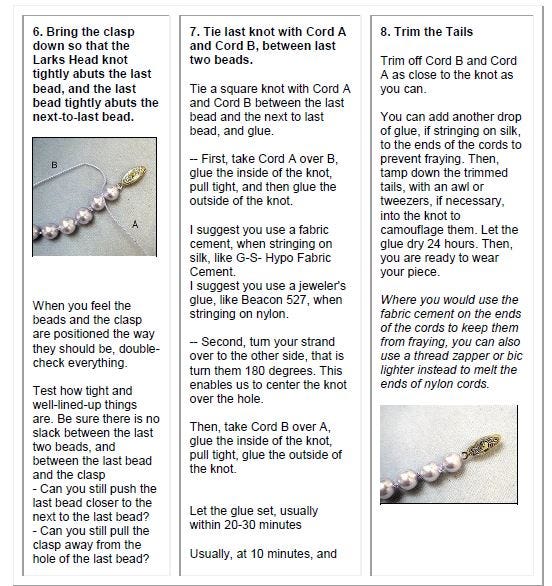
POSITION THE LAST BEAD SO IT SITS SNUGLY AGAINST THE NEXT-TO-LAST-BEAD
PULL ON THE LOOP, SO THAT YOU FORCE THE CLASP DOWN, SO THAT THE LOOP WITH THE CORD THROUGH IT SITS SNUGLY AGAINST THE LAST BEAD.
HOLD and push down on THE LAST 2 BEADS AND THE CLASP TIGHTLY IN PLACE, SO THEY CAN’T MOVE.
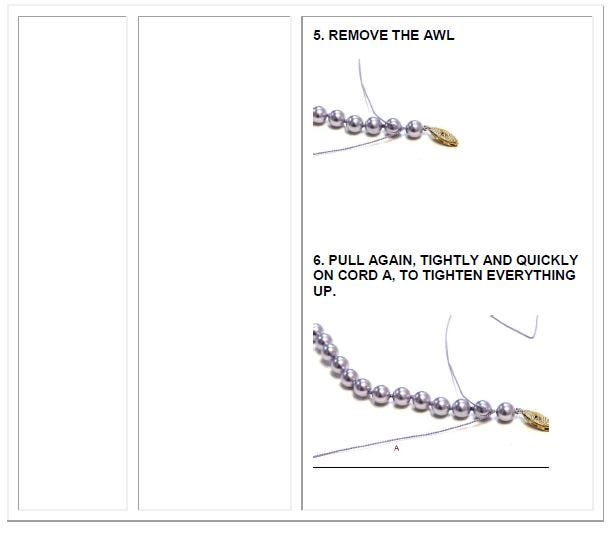
PULL TIGHTLY AND STEADILY ON CORD A, TO PULL OUT THE LOOP OF THE LARKS HEAD KNOT
REMOVE THE AWL
PULL AGAIN, TIGHTLY AND QUICKLY ON CORD A, TO TIGHTEN EVERYTHING UP.
o Double check that everything is tight, especially the clasp relative to the last bead, and the last bead relative to the bead before it.
o Tie a square knot with Cord A and Cord B between the last bead and next to last bead, and glue.
— First take Cord A over B, glue the inside of the knot, pull tight, glue the outside of the knot
— Second, flip the beads over to the other side (180 degrees) so our square knots ends up centered, rather than off to one side.
— Third take Cord B over A, glue the inside of the knot, pull tight, glue the outside of the knot
o Let the glue set, usually within 20–30 minutes.
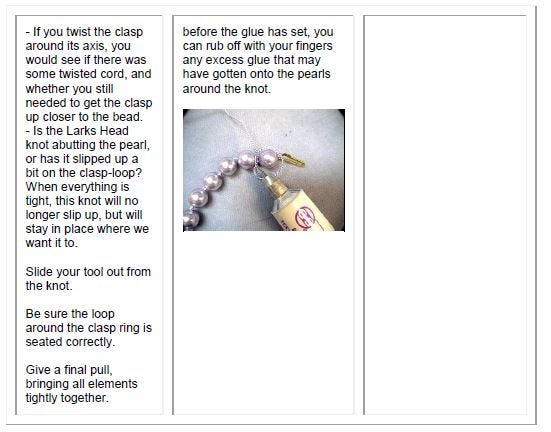
o At about 10 minutes, and before the glue sets, rub off any excess glue that may have gotten onto the pearls, on either side of the knot.
o Trim off Cord B and Cord A as close to the knot as you can. You can add drop of glue to end of the cords to prevent fraying.
Then, tamp down the trimmed tails, with the awl or chain nose pliers or tweezers or your finger nails, if necessary, into the knot to camouflage them.
o At about 10 minutes, and before the glue sets, rub off any excess glue that may have gotten onto the pearls, on either side of the knot.
Abstract: We create and wear jewelry because we do not want to feel alone. But “not wanting to feel alone” can mean different things to different people.The jewelry artist must have insight here. The artist needs to understand what jewelry really is in order to make the kinds of successful choices about forms, materials, design elements, inspirations, techniques, arrangements, public presentations and exhibitions and the like. There are different frameworks from which the artist might draw such understanding, including the sensation of jewelry as OBJECT, CONTENT, INTENT or DIALECTIC. All these lenses share one thing in common — communication. Although jewelry can be described in the absence of communicative interaction, the artist can never begin to truly understand what jewelry really is without some knowledge about its creation and without somehow referencing the artist, the wearer, the viewer and the context.
WHAT IS JEWELRY, Really?
Simply put, we create and wear jewelry because we do not want to feel alone.
But “not wanting to feel alone” can mean different things to different people. The jewelry designer, in order to make the best choices and the most strategic choices throughout the process of designing a piece of jewelry, requires some detail and clarity here. What does it mean to say that we create and wear jewelry so we do not want to feel alone?
We might want to reaffirm that we are similar (or different) than someone else or some other group or culture. We might want to signal some connection (or disconnection or mal-connection) with a higher power or mystical source or sense of well-being or with some idea, concept or meaning. We might want to express an intent or feeling or emotion.
We might want to differentiate what it means to be yourself relative to something else, whether animate or inanimate, functional or artistic, part of a dialectic conversation with self or other. We might want to signal or differentiate status, intelligence, awareness, and resolution. We might want to separate ourselves from that which is sacred and that which is profane.
Whatever the situation, jewelry becomes something more than simple decoration or adornment. It becomes more than an object which is worn merely because this is something that we do. It becomes more than a functional object used to hold things together. It is communicative. It is connective. It is intentional. And concurrently, it must be functional and appealing and be seen as the result of an artist’s application of technique and technology.
The word jewelry derives from the Latin “jocale” meaning plaything. It is traditionally defined as a personal adornment or decoration. It is usually assumed to be constructed from durable items, though exceptions are often made for the use of real flowers. It is usually made up of materials that have some perceived value. It can be used to adorn nearly every part of the body.
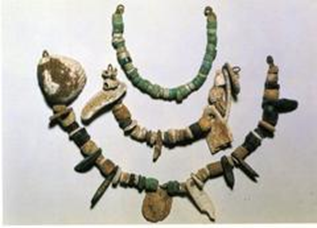
Prehistoric Necklaces 40000 B.C
One of the earliest evidences of jewelry was that of a Neanderthal man some 115,000 years ago. What was it — and we really need to think about this and think this through — which made him craft the piece of jewelry and want to wear it? Mere decoration? Did it represent some kind of status? Or religious belief? Or position or role? Or sexuality and sensuality? Or was it symbolic of something else? Was this a simplified form or representation of something else?
Did this Neanderthal have concerns about craft and technique? Did the making of it require some special or innovative technology? Did the cost of materials come into play? Was this an expression of art? Self? Power? A show of intelligence and prowess? A confirmation of shared beliefs, experiences and values? Was it something he made himself, or was it something given to him as a gift or token of recognition?
Picture yourself there at this very moment. What happened at the point this Neanderthal man put this piece of jewelry on? Did this reduce or increase social and cultural barriers between himself and others? Did this define a new way of expression or a new way of defining the self? Did this impact or change any kind of outcome? Did this represent a divergence between craft and art? Was this piece of jewelry something that had to be worn all the time? Were the purposes and experiences of this Neanderthal man similar to why and how we design and adorn ourselves with jewelry today?
We know that this Neanderthal man was not the last person to wear a piece of jewelry. Jewelry continued in importance over time. Jewelry mattered. It was an object we touched. And it was an object we allowed to touch our bodies. The object had form. The form encapsulated meaning. We allowed others to view the jewelry as we wore it, and when we did not.
Making and wearing jewelry became very widespread about 5,000 years ago, especially in India and Mesopotamia, but worldwide as well. While some cultures banned jewelry or limited its forms and uses (see medieval Japan or ancient Rome, for example), they could not maintain these restrictions over time. People want to support the making of jewelry, the wearing of it, the exhibiting of it in public, and the accumulating of it. People want to touch it. Display it. Comment about it. Talk about it with others. Collect it, trade it, buy it, sell it.
As jewelry designers, we need to understand the why’s … Why make jewelry at all? Why develop different techniques and use different materials and come up with different arrangements? Why do people want to wear jewelry and buy jewelry?
We observe that jewelry is everywhere, worn by all types of people, on various parts of the body, in many different kinds of situations. Jewelry must possess a kind of inherent value for the artist, the wearer, the viewer and the society as a whole.
So we have to continue to wonder, Why is jewelry so coveted universally? Why is it important? How is understanding ‘what jewelry is really’ necessary for making the kinds of successful choices about forms, materials, design elements, inspirations, techniques, arrangements, public presentations and exhibitions and the like?
Let us review the range of definitions and justifications for jewelry before fine-tuning any ideas and conclusions. Each understanding leads us in different directions when filling in the blanks of this constructive phrasing:
Jewelry means to me …..… therefore, These are the types of choices I need to make as a designer to know my pieces are finished and successful, including things like ……… .
These different definitional frameworks about jewelry are things characterized by sensations the jewelry evokes in designer, wearer and viewer.
These frameworks for defining what jewelry really is include,
SENSATION OF JEWELRY AS OBJECT:
1.ROUTINE: Something that we do with little or no reflection
2.MATERIAL: Objects that we use as materials characterized or sorted by design elements, such as color, pattern, texture, volume, weight, reflective and refractive properties
3.ARRANGEMENT AND FORMS: Materials are sorted by various Principles of Composition into arrangements and forms, expressing things like rhythm, focus, and juxtaposition of lines and planes
4.TECHNIQUE: Steps or routines we use to assemble and construct
5.FUNCTIONALITY: Things which have a useful purpose and practicality
SENSATION OF JEWELRY AS CONTENT:
6.MEANING: Things to which we assign meaning(s), especially where such meaning(s) transcends materials, functions and techniques
7.VALUE: Things to which we assign monetary and economic value, particularly materials
SENSATION OF JEWELRY AS INTENT:
8.ORDER OUT OF CHAOS: A sense-making attempt to control and order the world
9.SELF-IDENTITY: An agent of personality
SENSATION OF JEWELRY AS DIALECTIC:
10. INTERACTION AND SHARED UNDERSTANDINGS: A way to create, confirm and retain connections through interaction, desires, and shared understandings
Yet, no matter what the framework we use to try to make sense about what jewelry really is, all these lenses share one thing in common — jewelry is more than ornament and decoration; it is sensation and communication, as well. Although we can describe jewelry in the absence of knowledge about its creation, we cannot begin to understand what jewelry really is without somehow referencing the artist, the wearer, the viewer and the context.
SENSATION OF JEWELRY AS OBJECT
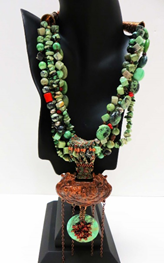
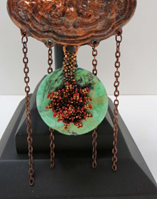
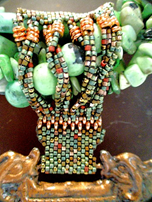
“Tibetan Dreams”, detail, FELD, 2010
Too often, ideas about communication and meaning and intent get too messy and complicated. We seek a simpler framework within which to understand what jewelry is all about. We try to fit the idea of jewelry into the confines of a box we call “object”. It is decoration. Sculptural adornment. Jewelry succeeds as “object” to the extent that everyone everywhere universally agrees to what it is, how it is made, what it is made from, why it was made, and in what ways it is used.
This universality in defining and evaluating jewelry helps us not to feel alone.
Jewelry As Something That We Do. Wearing jewelry might simply be something that we do. We put on earrings. We slip a ring onto a finger. We clasp a necklace around our neck or a bracelet around our wrist. It is habit. Routine. Not something to stop and ask why. A necklace is a necklace. An earring is an earring. We mechanically interact with decorative objects we call jewelry.
Jewelry As A Material. Sometimes we want to get a little more specific and describe what this object or ‘box’ is made of. It is some kind of material. Jewelry encompasses all types of stones and metals, in various shades and colors, and light-impacting properties, which the artist has taken tools to them to shape and sharpen. Sometimes we want to further delineate the character of materials within and around this box. We refer to this as selecting various design elements such as color, pattern, texture.
Jewelry As Arrangements and Forms. Sometimes we want to even further elaborate on our placement of materials within our pieces in terms of Principles of Composition. These Principles refer to arrangements and organized forms to create movement, rhythm, focal point, balance, distribution. We apply this framework in a static way. Jewelry is reduced to an object, somehow apart from its creator and disconnected from any wearer or viewer.
Jewelry As The Application of Technique(s). We can also understand jewelry as object in a more dynamic sense. It is something which is created by the application of one or more techniques. The techniques are applications of ideas often corralled into routines. The object is seen to evolve from a starting point to a finishing point. As object, it is reduced to a series of organized steps. These steps are disconnected from insight, inspiration, aspiration or desire. There is no human governance or interference.
Jewelry As Function and Practicality. In a similar dynamic way, the object may be seen to have function. It may hold up something, or keep something closed. It may, in a decorative sense, embellish a piece of clothing. It may assist in the movement of something else. It is not understood to have any meaning beyond its function. As it coordinates the requirements of form to the requirements of function, it plays a supportive, practical role, not a substantive role. As such, it is unimportant. It might allow the wearer to change position of the necklace on the neck. It might better enable the piece to move with the body. But it should not demand much insight or reflection by creator, wearer, or viewer.
SENSATION OF JEWELRY AS CONTENT
“Tibetan Dreams”, detail, FELD, 2010
However, as we get closer to defining the object as one that is sensed and experienced and which evokes an emotional response, it becomes more difficult to maintain that the object does not reflect meaning, does not result from some kind of thought process and intent, and does not communicate quite a lot about the designer, the wearer, the viewer and the situation. Jewelry when worn and which succeeds becomes a sort of identifier or locator, which can inform the wearer and the viewer about particular qualities or content, such as where you belong, or what you are about, or what your needs are.
Jewelry without content, after all, can skew to the superficial, boring, monotonous, and unsatisfying. Without meaning and value, jewelry has little to offer.
These shared recognitions and valuing of meanings helps us not to feel alone.
Jewelry As Meaning. Jewelry when worn signals, signifies or symbolizes something else. It is a type of recognizable short-hand. It is a powerful language of definition and expression. By representing meaning, it takes responsibility for instigating shared understandings, such as membership in a group or delineating the good from the bad. It might summarize difficult to express concepts or emotions, such as God, love, loyalty, fidelity. It might be a stand-in marker for status, power, wealth, connection and commitment. It might visually represent the completion or fulfillment of a rite of passage — puberty, adulthood, marriage, birthing, and death.
Sometimes, the sensation of jewelry as meaning derives from energy and powers we believe can transfer from the meaning of the materials the jewelry is made of to ourselves. These might be good luck, or good fortune, or good health, or good love, or good faith or protection from harm. Various gemstones, metals and other materials are seen to have mystical, magical and supernatural qualities that, when touching the body, allow us to incorporate these powers with our own.
Jewelry As Value. When we refer to meaning as having power, sacredness, respect, significance, we are beginning to assign a value to it. A sensation of value may emerge from how rare the item is — its material rarity or the rarity of how it was constructed or where it came from or who made it or who was allowed to wear it. It may emerge from how bright it is or the noteworthy arrangement of its elements. Its value may emerge from how pliable or workable the material is. Its value might be set from how tradable it is for other materials, objects, access or activities.
By assigning value, we determine things like importance, uniqueness, appeal, status, need, want, and demand. We establish control over how and how often a piece of jewelry will change hands. We establish some regulation over how individuals in a group, culture or society interact and transact with one another.
SENSATION OF JEWELRY AS INTENT
“Tibetan Dreams”, detail, FELD, 2010
Someone has to infuse the object with all this content, and this proactive act leads us to the idea of intent. Often this imposition of meaning begins with the jewelry artist. Jewelry becomes a means of self-expression. The artist, in effect, tells the world who the artist is, and what the artist wants to happen next.
The artist might be subdued or bold, colorful or monochromatic, simple or complex, extravagant or economical, logical or romantic, deliberate or spontaneous. The artist might be direct or indirect in how meanings get communicated. It is important, in order to understand the meaning of an object, to begin by delineating the artist’s inspiration, aspiration and intent.
The jewelry artist begins with nothing and creates something. The unknown, the unknowable, the nothingness is made more accessible.
The artist fills in a negative space with points, lines, planes, shapes, forms and themes. Color, pattern and texture are added. Things get organized and arranged.
Though often unstated, it becomes obvious that of all the possible choices the artist could have made in design, that some choices were ignored and excluded, while others were not. Some negative space is left so. Some positive space has direction, motion, weightiness. Somethings are abstract; other things realistic. These and related choices have implications and consequences.
The question becomes, what influences that artist’s selections? Successful jewelry reveals the artist’s hand.
Our perceptions of the coherence in the artist’s inspiration and intent, as reflected in our interpretations of that artist’s jewelry, helps us not to feel alone. We may see coherence as a subjective thing or a universally understoodthing. It doesn’t matter which. If we believe we can make sense of things, if the jewelry feels and seems coherent in some way, we feel safe, and that we have reduced the risks in life. We do not feel so left alone.
Jewelry As Creating Order Out Of Chaos. Partly, what the artist does is attempt to order the world. The artist looks for clues within him- or herself (inspiration and intent). The artist formulates concepts and a plan for translating inspiration and intent into a design. The artist determines whether to take into account the expectations of others (shared understandings) about what would be judged as finished and successful.
Jewelry is an object created out of chaos and which has an order to it. The order has content, meaning and value. It has coherency based on color and texture and arrangement.
Jewelry as an organized, ordered, coherent object reflects the hypotheses the artist comes up with about how to translate inspiration into aspiration, and do this in such a way that the derived jewelry is judged positively. The artist anticipates how others might experience and sense the object on an emotional level.
It reflects the shared understandings among artist, wearer and viewer about emotions, desires, inherent tensions and yearnings and how these play out in everyday life.
The artist makes the ordered chaos more coherent, and this coherence becomes contagious through the artist’s choices about creative production and design. The artist lets this contagion spread. To the extent that others share the artist’s ideas about coherence, the more likely the work will be judged finished and successful. And no one — not the artist, not the wearer, not the viewer — will feel alone.
The process of bringing order to chaos continues with the wearer. The wearer introduces the piece of jewelry into a larger context. We have more contagion. The jewelry as worn causes more, ever-expanding tension and efforts at balance and resolution. There is an effort to figure out the original artist intent and ideas about coherence as reflected in design.
Unsuccessful efforts at design, where the artist’s intent becomes obscured, reverse the process, and the object — our piece of jewelry — then brings about decoherence. Decoherence may come in the forms of bad feedback, inappropriate feedback, less than satisfying feedback, or no feedback at all.
Decoherence means the wearer may not get that sense of self s/he seeks. S/he may feel less motivated to wear the piece. S/he may store the piece or give the piece away. As this decoherence filters down to the level of the artist, any necessary support in design may be lost. There will be fewer clients, fewer opportunities to display the works publicly, and fewer sales. The artist’s motivation may diminish.
Jewelry As An Agent of Personality. People wear jewelry because they like it. It becomes an extension of themselves. It is self-confirming, self-identifying and self-reconfirming. Liking a piece of jewelry gets equated with liking oneself, or as a strategy for getting others to express their like for you. Jewelry makes us feel more like ourselves. We might use jewelry to help us feel emotionally independent, or we might come to rely on jewelry for emotional support and feedback, leading us down the path to emotional dependency.
Jewelry may have personal significance, linking one to their past, or one to their family, or one to their group. It may be a way to integrate history with the present. It is a tool to help us satisfy our need to affiliate.
Jewelry may help us differentiate ourselves from others. It may assist us in standing out from the crowds. Conversely, we may use it to blend into those multitudes, as well.
Jewelry fulfills our needs. If we look at Maslow’s Hierarchy of Needs, after meeting our basic physiological needs such as for food and water, and our safety needs, such as for shelter, we can turn to jewelry to meet our additional social needs for love and belonging and self-esteem. Designing and creating jewelry can form an additional basis for our needs for self-actualization.
We may derive our personality and sense of soul and spirit from the qualities we assign the jewelry we wear. We do not merely wear jewelry as some object; more specifically, we inhabit jewelry. If ruby jewelry symbolizes passion, we may feel passion when wearing it. We may use jewelry as an expressive display of who we feel we are and want to be seen as in order to attract mates and sexual partners. We use jewelry in a narcissistic way to influence the alignment of the interests and desires among artist, weaver, viewer, collector, exhibiter, and seller.
In similar ways, we may derive our sense of belief, devotion and faith to a higher power or spiritual being or God from wearing jewelry. It may help us feel more connected to that religious, spiritual something within ourselves. It may remind us to stay on our religious path.
As an agent of our psychological selves, jewelry is used to resolve those core conflicts — Who are we? Why do we exist? How should we relate to other people around us? Jewelry orients us in coming to grips with our self-perceived place within critical contradictions around us. Trust and mistrust. Living and dying. Good and evil. Pleasure and pain. Permission and denial. Love and hate. Experience and expectation. Traditional and contemporary. Rational and reasonable.
SENSATION OF JEWELRY AS DIALECTIC Jewelry As Interaction and Shared Understandings
“Tibetan Dreams”, FELD, 2010
Jewelry is a two-way street. It is a way to create, confirm and retain connections. At its very core, it is interactive and communicative. It is more an action than an object. Jewelry can start a conversation. Jewelry encapsulates a very public, ongoing matrix of choices and interactions among artist, wearer and viewer, with the purpose of getting responses. It is a dialectic.
The optimum position to view jewelry is on a person’s body, where and when its dialectical power is greatest. Again, it is very public, yet concurrently, very intimate. We exhibit jewelry. It forces reaction, response and reciprocity. Jewelry helps us negotiate, in relatively non-threatening ways, those critical tensions and contradictions in life, not merely define them.
It very publicly forces us to reveal our values, delineate tensions and contradictions which might result, and resolve all those betwixt and between qualities which occur as the artist, wearer, viewer, marketer, seller, exhibitor and collector try to make sense of it all. Conversely, jewelry, as worn, may signal that any negotiation would be futile, but this is a dialectic, communicative act, as well.
Jewelry expresses or implies things, the relevance of which emerges through interactions. There is an exchange of meaning. There is some reciprocity between the artist expressing an inspiration with the desire for a reaction, and the wearer evaluating the success of the piece and impacting the artist, in return. We have those coherence-contagion-decoherence behavioral patterns discussed above.
Jewelry is persuasive. It allows for the negotiation of influence and power in subtle, often soft-pedalled ways. It helps smooth the way for support or control. Compliance or challenge. Wealth and success or poverty and failure. High or low status. Social recognition. An expression of who you know, and who might know you. Jewelry is a tool for managing the dynamics between any two people.
Jewelry is emotional and feeling, with attempts by the artist to direct these, and with opportunities for others to experience these. It is not that we react emotionally to the beauty of an object. It is not mechanical or fleeting. It is more of a dialectic. The jewelry is an expression of an artist’s inspiration and intent. We react emotionally to what we sense as that expression as it resonates from the object itself. This resonance ebbs and flows, waxes and wanes, over time as the object is worn in many different situations.
Jewelry draws attention. It becomes a virtual contract between artist and wearer. The artist agrees to design something that will call attention to the wearer and that wearer’s preferred sense of self. The wearer agrees to wear something that reaffirms the artist’s insights for all to witness and experience and draw support.
Jewelry may cue the rules for sexual and sensual interactions. Nurturing and desire. Necklaces draw attention to the breasts. Earrings to the ear and neck. Rings to the hands. Jewelry, such as a wedding band, may confirm a relationship, and signal permission for various forms of touching that otherwise would not be appropriate. The silhouettes and placements of jewelry on the body indicate where it may be appropriate for the viewer to place his gaze, and where it would not.
We don’t feel alone because we have opportunities to have a dialectic experience — a dialogue between self and artist, self and others, self and self — all catalyzed by the piece of jewelry, and our sensation of all the choices that had to be made in order for it to exist, in order for it to feel coherent, in order for it for fulfill desire, and in order for all of this to somehow feel contagious and resonant. We don’t feel alone because the jewelry taps into something inside us that makes us want to wear it, buy it and share it.
Jewelry Ages In Place With Us
Jewelry comforts us as we age in place. The bracelet we got for graduation still worn on an occasion when we are 65. The ring he bought her when she was in her 20’s still worn on the day she passed away.
With jewelry, we will never feel alone as we grow older. As our body changes in pallor and texture. As we gain weight or lose weight. As we change our styles of clothing or hair or activity.
This constellation of material objects, distributed across the human body, reflects transformation, movement, growth, and behavior. These reflect the life we live, and how we lived it. These are a story of how we performed our lives over time. They reveal an otherwise unseen perspective on life as the body ages, and we live through time. They show that not all lived lives have been ad libbed.
The jewelry will also show its age over time. Changes in color, perhaps fading, perhaps becoming duller or spotty. A clasp may have been replaced. The piece may have been restrung. It may have been shortened or lengthened. It may have been worn a lot. Or lost for a while. Or given away. Its associative or symbolic value may have changed.
Jewelry is life performed. Both are observable. Both indicative of our place — our aura — in the world around us as time goes on. Both an experience — often changing — of a point of view from the hand that crafted the piece in the first place, and the desires of the person who wore the piece over time. We possess it and wear it so it reminds us that we are not alone.
Knowing What Jewelry Really Is Translates Into Artistic and Design Choices
Knowing what jewelry really is better connects the artist to the various audiences the artist seeks to reach. It results in better outcomes. More exhibits. More sales. More collections. Better self-esteem. Better representation of self in various contexts and situations.
Jewelry asks the artist, the wearer and the viewer to participate in its existence. In a somewhat subtle way, by allowing communication, dialog, evaluation, and emotion, jewelry allows each one not to feel alone. It allows each one to express intent, establish a sense of self, and introduce these intents and self-expressions into a larger social context.
Jewelry judged as finished and successful results from these shared understandings and desires among artist, viewer and wearer, and how these influence their subsequent choices. These choices extend to materials and arrangements. They extend to how the artist determines what is to be achieved, and how the work is talked about and presented to others. These anticipate the reactions of others, beliefs about saleability, assumptions about possible inclusions in exhibitions, knowing what is appealing or collectible.
The artist is always omnipresent in the jewelry s/he creates. The artist, through the jewelry, and how it is worn on the body, to some extent, arbitrates how other sets of relationships interact, transfer feelings, ideas and emotions, reduce ambiguity, influence one another, and make sense of the world around them.
These sets of relationships, through which jewelry serves as a conduit, include:
artist and wearer wearer and viewer artist and self artist and seller seller and client artist and exhibiter artist and collector exhibiter and collector
In the abstract, jewelry is a simple object. We make it. We wear it. We sell it. We buy it. We exhibit it. We collect it. But in reality, jewelry channels all the artist’s and wearer’s and viewer’s energy — the creative sparks, the tensions, the worries, the aspirations, the representations, the assessments of risks and rewards, the anticipations of influence and affect. Jewelry becomes the touchstone for all these relationships. It is transformational. It is a manifestation of their internal worlds. An essence resonant in context. A comforting togetherness, inclusion, reaffirmation.
The better jewelry designer is one who anticipates these shared understandings about what makes a piece of jewelry finished and successful, and can incorporate these understandings within the jewelry design process s/he undertakes. Knowing what jewelry really is forms a critical aspect of what sets jewelry design as a discipline apart from that of art or craft. Knowing what jewelry really is and how it helps us not feel alone forms the basis of the professional identity and disciplinary literacy of the jewelry designer.
_________________________________________
FOOTNOTES
(1) Grosz, Stephen, The Examined Life: How We Lose and Find Ourselves, NY: W.W.Norton & Company, 2014.
(2) Pravu Mazumdar, Jewellery as Performance: on Gisbert Stach’s Experiments with Jewellery and Life, Klimt02, 11/22/2019
OXIDIZING TECHNIQUES (Use bare wire, if you intend to oxidize it; this means it has no protective lacquer finish on it to prevent it from tarnishing)
Liver of Sulfur solid form
1. USING LIVER OF SULFUR
Step 1 Preferably work outside when using Liver of Sulfur (LOS). Make sure you wear gloves and designate glass or ceramic containers that will be used solely for this purpose.
Step 2 Clean the silver before you begin. Any polishing residues, wax or fingerprints could affect the consistency of the oxidation. Hot soapy water and an old toothbrush work well.
Step 3 Make a neutralizing bath. You will use this later to neutralize the silver once you have finished oxidizing.
Step 4 To make the neutralizing bath: Using one Mason jar, mix two teaspoons of baking soda in one cup of cold water.
Step 5 Stir solution until the baking soda is dissolved. Set aside for later.
Step 6 Prepare your workstation. You need two mason jars with one cup of hot water in the LOS solution, the neutralizing bath you just made, Liver of Sulfur, the silver you wish to oxidize, a pair of gloves, a plastic spoon and some paper towels. (Hot water (not boiling): 30 seconds in microwave) (Use glass jars, not plastic)
In the one with the piece you wish to oxidize, if you use hot water, oxidation will occur very quickly. If you use room temperature or even ice water, the oxidation will take longer to occur. With silver, this will give you an opportunity to control what color tone the final piece will have. But with copper, the metal darkens extremely fast.
Step 7 Drop the silver into the water (hot, room temp or cold) of one Mason jar.
Step 8 In the other Mason jar add 1 pea sized lump of LOS to the hot water. The hotter the solution, the faster the oxidation. Alternative: Room temperature LOS solution, and put silver in ice-cold water. A greater temperature difference slows patina process, and can get more variation in colors with blues and golds, not just blacks.
Liver of Sulfur gel form
Liver of Sulfur gel can be brushed on using a small paint brush, or you can make a solution. To make a solution, coat half a teaspoon with the gel and allow the excess to drip off. Then dip the spoon in a container of hot water and allow to dissolve.
Step 9 Mix thoroughly.
Step 10 Remove the silver from the water and carefully place the silver into the LOS solution trying not to splash.
Step 11 Leave the silver in the LOS solution until it reaches the desired color, stirring occasionally to get an even finish. [This can happen within seconds, within 5 minutes, within 15 minutes, or within 1 hour, depending on the piece and how dark you want it, and the differences in solution temperatures.]
Step 12 Remove the silver from the LOS solution and place the silver in the neutralizing bath. This will stop any further oxidation of the silver.
Step 13 Remove the silver form the neutralizing bath and dry slightly with the paper towel.
Step 14 You can either tumble the silver to polish and seal the oxidized finish or you can use a polishing cloth. You can try rough paper towels. You can try 0000 steel wool. Be careful not to completely rub off the oxidation.
Step 15 Put two teaspoons of baking soda into the LOS solution to neutralize it.
Step 16 Loosely seal the Mason jar that contains the LOS solution and leave the jar out doors, out of the reach of children or animals. The LOS will degrade and eventually turn clear. Once it is clear it is no longer toxic and you can dispose of it by diluting the solution and flushing it down the drain.
Black Max (liquid)
2. USING BLACK MAX (Contains hydrochloric acid and tellurium)
The result from Black Max is a bit shinier black finish than Liver of Sulphur, which is more matte. With liver of Sulphur, oxidation does not wear off as fast. Can’t get the range of oxidations colors with Black Max, as you can with LOS.
For silver, immerse in or apply Black Max with a cloth or applicator until the desired finish is obtained (20–30 seconds is the norm). Enough solution in jar to cover your piece.
Do not heat solution or piece.
Otherwise, you will follow similar steps as with LOS, including the baking soda solution to neutralize the reaction.
3. USING HARD BOILED EGG (using Sulphur to oxidize silver or copper)
Boil the egg, and peel the shell. Put the peeled egg inside a zip lock bag. Use your fingers to crush the peeled egg inside the bag. Put your piece of silver inside the bag and into the crushed egg pieces. Check every 15 minutes to see if it is sufficiently oxidized for you. Can easily take 1 hour. Rinse with warm water and some dish detergent. Use paper towel or 0000 steel wool to brush off any excess oxidation.
Antiquing Solution
4. ANTIQUING or VARNISH SOLUTION
Another thing you can do is to buy an antiquing solution, or use a dark color varnish.
You paint this on, and then rub it off with a soft cloth. Let it dry for about 20 minutes, and repeat, if you need the antiquing to be darker.
This leaves a glossy black finish. Here, again, you usually want to leave some gradations of color on the metal, so that the top surfaces are shinier than the crevices.
Anything with ammonia in it
5. AMMONIA
If you want to speed up the tarnishing process, but do not want to turn your product black, spray your metal with Windex with Ammonia.
The ammonia will turn the silver black, and the low amount of ammonia in this product will make the process very gradual. With more ammonia concentration, the faster and the blacker it will turn.
6. OTHER CHOICES
You will find online a wide range of patina’s. These typically are in liquid form. Different patinas work with different metals. Different patinas have different final coloration results. You can get ones that do blues or purples or golds or rainbow effects.
Steel Wool
FINISHING YOUR PIECE OFF AFTER YOU OXIDIZE IT
After you have oxidized and patina’d your piece, you probably want to let some of the higher areas get a little shinier again, leaving the recessed areas dark.
Easy to do.
Take some steel wool (#0000) or a rougher paper towel, or a soft bristle toothbrush, and gently rub over the surface. Like an artist, you will control where you want highlights and where you want lowlights.
Think you went to far? Then oxidize again. Not a problem.
Supplies needed: 8″ — 10″ floral wreath styrofoam form 3 or 4 sizes of round druk beads (6mm, 8mm, 10mm and 12mm) Straight pins like you would use when sewing Red nail polish (to paint over the pin heads) Red wrapping tape or ribbon for wrapping the styrofoam form Wide ribbon or cloth for a bow
The Martha Stewart Wreath
In 1999, Martha Stewart, on her TV show, demonstrated how to make a Christmas Wreath, using round druk beads. (“Druk” means plain, smooth, roundish beads.) And she started an avalanche of orders. Her powers to send millions of women to their bead stores was, and still is, enormous. So big, in fact, that it is difficult to visualize. With this project, there were not enough red druk beads in the entire world to fill the demand in 1999 and several years afterward.
This first year saw over 2800 orders to our Land of Odds website. We were able to fill about 1700 of them before the beads started running out. In both 1999 and 2000, (and now, by this time, the instructions also had been published in a Martha Stewart Christmas Projects book), our suppliers ran out of the 10mm size druks around October, and we were unable to fill orders past the first few days of December. The 10mm beads started coming back in stock in February or March. The 12mm size ran out soon after, but wasn’t available again until much later. (NOTE: There are 25mm in an inch.)
Traditionally, there has never been a large supply of larger beads — 10mm and 12mm — in any color, because the main purpose of beads is to be used in jewelry, and these larger sizes tend to be heavy, and usually not in style. When a particular bead in size and color runs out, it usually takes 3 or more months before it is back in stock.
This is because these beads come from the Czech Republic and must be imported, and also because every color, type and size of bead is not always in production all the time. Beads are usually produced from lightest to darkest. That is, they try to make clear and light colors first in the kiln, and gradually over the course of a few months make darker and darker beads. In this way, they can use the kiln for the longest period of time before having to clean it out.
Martha Stewart provided one set of directions in 1999, and a new set of directions in 2000. In both, we believe she underestimated the number of beads needed, so with some interpretation, your two design choices are:
Design Option A. 300 each of 6mm, 8mm and 10mm for a 10-inch wreath (the original 1999 version)
Design Option B. 200 each of 6mm, 8mm, 10mm and 12mm for an 8-inch wreath (the new 2000 version)
We have a personal preference for choice “A”.
Colors: Ruby (also called Siam) is the color of choice. A slightly lighter Light Siam works well also. For a contrast, either Red Opal or Garnet will work.
Red is one of the most expensive colors to make, so there are few color choices in this area for the druk line of round beads. Many of the reds that exist are very close in color in this particular bead, so do not provide much if any contrast. We offer ruby (also called siam), and suggest either garnet (very dark, almost black), and/or red opal (a translucent red), as workable contrasting or complimentary colors. There is a cherry red, but this doesn’t have the same effect as the transparent and translucent colors. There is also a dark ruby (or dark siam, sometimes called light garnet) which we do not offer.
Using the smaller 4mm beads, such as in a 4–6–8mm configuration, doesn’t work very well. It doesn’t look realistic enough.
NOTE: It is also important to get your styrofoam wreath form. Stores run out of these as well. Try these types of places: Wal-Mart, K-Mart, craft stores, floral shops and floral supply places. We prefer the 10-inch wreath that is a half dome in shape. On this wreath, you only cover the domed part, not the back of the wreath. You can also use a completely round (tube) wreath, which you would cover entirely with beads.
How many people throughout time have heard the sound of a dropped bead on the floor?
Or the sharp whoosh of air that comes from the cutting of a cord?
Or the dull oomph you hear when you crush a metal clasp into place?
Or the feel of the tug and pull of the thread as the needle is pulled through the cloth?
Or the resistance of the tensile strength of the wire as it is bent into a shape?
Did they see a sudden flash of light, a sudden recognition of artistic achievement? Probably not.
But it meant something to them. Subtle. Unconscious. The exercise of the hand in craft often taps into some sense of self-expression or –awareness. Creativity rewards you. It reaffirms who you are. Your worth, your value, your artistry. It is fulfilling, fun, happy, reassuring, exciting, introspective.
The exercise of your hand in craft, art and design often reconfirms that you are part of some larger group or culture, as well. You have a shared sense of what expression and awareness mean. You repeat the same steps in creation. You choose similar parts or design compatible patterns. People recognize your creative efforts when they see or wear your pieces.
Hand Craft. The feel on the fingertips and on the palm of your hand. The pattern of light that registers on your eye and then gets translated by your brain. The anticipated weight and movement of the piece as it’s worn.
The shared implications of all this, and the full range of possibilities are understood by everyone. This mutual understanding helps you cement relationships with other groups or individuals. Relationships and meanings are extensions of your hand in craft.
Hand Crafts. Beads and Jewelry. Beads and Jewelry. Beads and Jewelry. Beads and Jewelry as Hand Crafts. Beads and Jewelry have been used all throughout time. They appear in every culture in the world. Although they are not always used in the same ways or for the same reasons.
Wampum
SOMETIMES BEADS ARE USED INSTEAD OF MONEY
Sometimes beads are used instead of Money. When people look at beads, they have an intrinsic value that people seem to recognize and share. In many cultures, people place more confidence in using their beads as their Money, instead of their own coins and currency.
And in our own world, this is often true as well, as we go to bead swaps, or swap one piece of jewelry for something else of value. We barter with beads. We do this all the time. Beads and beaded jewelry have a monetary life all their own. “I’ll give you this______ , if I can have the beaded bracelet you are wearing.”
And so many times, people will come in the shop and ask to work for beads. And we have plenty for them to do.
Trade Beads
BEADS WERE USED IN TRADE
In a similar way, beads were used in Trade. This is more true historically than today, but a little bit today. When two groups want to trade with each other, it’s hard to come to terms. Because people, for whatever reasons, seem to be able to come to agreement on the value of beads, beads were used in various ways during the negotiation process.
Global Trade Routes
About 300, and 400 and 500 years ago, explorers set out from various European countries, and visited far-away places like China and India and Africa, and North and South America. When they set off on their explorations, they brought with them what we call Trade Beads. These were glass beads that were made in Venice, Bohemia and the Netherlands.
In Europe at this time, the folks looked down on glass beads. They used them in projects involving bead embroidery and mimicking tapestries where they could get a more 3-dimensional look with the beads than they could with the fibers.
But they shied away from glass beads in jewelry. Too cheap. Too low class. Glass was trash. For jewelry, they preferred the high test octane beads made from gemstones and precious metals. But those darn glassmakers in Venice and Bohemia and The Netherlands kept churning glass beads out. I think there were some technological improvements that occurred at this time, that made it easier/cheaper/ more efficient to make glass beads, but I don’t know this for a fact. Still, no one really wanted them.
The explorers took these glass beads with them, and at first gave them away as gifts. They assumed that people from other, “less sophisticated” cultures, would dismiss these glass beads as well. But alas and alack, these other “less worldly” men and women did not. They liked the glass beads. They liked them a lot. Some cultures even saw spiritual qualities in these glass beads.
It wasn’t long before the explorers started trading these beads, instead of giving them away. Some of the trade beads made in Europe were very generic; others were more specialized designs, colorations or etchings specific to certain countries or regions, like Africa or Persia.
When these explorers came to North America, the Indians here, at first, wanted blue beads. You see, they couldn’t easily make a blue color with the natural materials they were using — stones, shells, antler and wood. The explorers were thrilled about this. Blue was the cheapest color to make. So, the explorers found this trade to be very profitable. It wasn’t too long, however, before the Indians met their needs for blue, and started asking for yellow and red. You see, it takes real gold to make the colors yellow and red. And the trading became nearer and dearer for the explorers.
These French Traders continued their explorations down the Missouri and Mississippi Rivers. They discovered the freshwater pearl cultures of the Mississippi Indians in the area around Tennessee, and traded beads for these pearls which they sent back to Europe. These freshwater pearls soon earned the name “Royal Pearls”, and were restricted for use and wear by the royalty across Europe.
Even today, royal families continue to import Tennessee freshwater pearls. They have these sewn into their undergarments. After all, it’s widely believed that wearing a pearl against your skin ensures your future wealth.
And, I always wondered if you could speculate why the Indians sided with the French in the French and Indian Wars, against the British. Could it have been that the French supplied them with beads, and the British did not?
People With The More Beads Have The More Power!
ANOTHER WAY PEOPLE USE BEADS IS FOR POWER
Another way people use beads is for reasons of Power. People with the more beads have the more power. When you get into beading, you learn this very quickly. Who has the most beads? The most Reds? The most Purples? The most delicas? Beads, in this sense, define social relationships, who’s more important than whom, and pathways of success.
Ogalala Sioux Indian Reservation Lands
About 400 years ago, among the Oglala Sioux Indians in the Dakotas, there was a big women’s movement. The women of this tribe wanted greater say and control over tribal matters, they saw an opportunity to assert themselves, which they did, and they won. This whole incident was oriented around beads.
So what happened four hundred years ago? You had French traders traveling through Canada, and coming down into the Dakotas. They brought with them these glass Trade Beads, and traded them for pelts. One of the major roles of women in Indian tribes was to make beads. They would spend all day, every day, making beads out of stones and wood and antlers and shells. When these French traders came with these pre-made beads, it freed up a lot of time. And in this one tribal group, the women took advantage of this free time, asserted themselves, and won.
Sioux bead embroidery
One of the things the women did to mark their success was to change the costuming of the men. Before the movement, men wore beaded embroidery strips tacked down linearly along their sleeves. After the movement, the women tacked down only part of the embroidery strips — the rest allowed to flow out like ribbons. So when the men went off hunting or fighting or whatever they did, they wore the mark of the women — their ribbons would flow.
Rosary
SOMETIMES BEADS ARE USED FOR SPIRITUAL AND RELIGIOUS REASONS
Sometimes, beads are used for Spiritual and Religious Reasons. You can picture a rosary in the Catholic Church. By touching and moving your hand along this bead chain, it helps you feel closer to God. It helps you feel more spiritual. It helps you remember the rituals. In Buddhism, they use something like a rosary. In Confucianism in China they use something like a rosary called Immortal Beads.
The threatened Pope
During the Middle Ages in Europe, only priests were allowed to wear rosaries and have beaded adornments. Priests had their parishioners make them rosaries and beaded this and beaded that. After awhile, the priests with the more rosaries and the more elaborate rosaries, gained higher status. So they kept accumulating, and accumulating, and accumulating, until, at one point, one of the Popes felt very threatened. Many priests were becoming as adorned as he was. So the Pope issued an edict that said everyone could wear rosaries and have beaded adornments.
The fact that you can wear beaded jewelry today, instead of making them for your priest or minister or rabbi or imam or whatever, goes back to the insecurity of one of those Popes.
Zulu Beadwork
LAST, BEADS ARE USED FOR PURPOSES OF COMMUNICATION
Last, beads are sometimes used for Communication. They are used symbolically. Different colors have different meanings. Different patterns have different meanings. Different shapes have different meanings.
Among the Zulu Tribes in South Africa during Apartheid, you had some Zulu tribes who adopted Christianity and identified with the colonialists. And you had other tribes that did not. Among the tribes that did not, they developed a very elaborate communication system using beads. Besides what colors were next to each other, they used a lot of triangles in their patterns. It was important if the triangle faced down, or up, and again what the colors were.
SPEAKING WITH BEADS. Zulu Arts from Southern Africa. by J. (photographs), E. Whyte. Morris New York , 1994
These folks might bead a necklace, or a loin-cloth. They might do a beaded doll, or a hat, or a blanket or tapestry. Something beaded. They would come out during the day, and flash the results of their secrecy, plotting and chicanery. They might say something very general with their beadwork, like “I’m mad at the world today”. Or they might get very specific, such as “I’d like to get together with you tomorrow night at 8:00, but not before I’ve met with your brother.”
These Zulu tribes kept up this communication system for about 70–80 years — all during Colonialism and Apartheid. When Apartheid ended, no one carried on the tradition. Not a complete surprise.
Today Zulu beadwork is very fashionable, particularly in Europe. But no one knows what they are saying. They are just doing pretty patterns.
Beading in the United States Today
A Social Movement Dating Back to the 1960s
Today, beading in the United States has been part of an ever-growing social movement that began in the 1960s, and, whether you know it or not, you are caught up in it, even unto today.
In the early 1960s, two new stringing materials were developed and introduced to beading. The first — NYMO Thread — was a nylon thread created by the shoe industry to attach the bottom of the shoe to the top of the shoe. This is widely used in upholstery. The second was called Tiger Tail. This was a flexible, nylon-coated cable wire. Cable wires are wires that are braided together and encased in nylon.
Before the 1960s, there really wasn’t a durable stringing material. People mostly used either cotton or silk thread, or nylon fishing line. Cotton and silk thread naturally deteriorate in about 3–5 years, so anything done on these has to be re-done every 3–5 years. Fishing line dries out and cracks when exposed to ultraviolet light and heat, that is, sunshine.
Because there was not a durable stringing material, beading, for the most part historically, was viewed as just a home craft. It did not attract artists. It did not attract fine craftspersons. It did not attract academics. It did not encourage people to experiment and push the envelop with the craft.
While occasionally in history, if you look back, you do see elaborate bead work, such as Russian bead embroidery during the 1800s and French beaded purses in the 1920’s, — this intricate beadwork was most often done by people who were slaves, or serfs or indentured servants. When they were freed, their beadwork stopped or diminished. So, when the Czar was deposed at the turn of the century, there began a major decline in Russian bead embroidery. Or when France passed labor laws in the late 1930’s, there were no more beaded purses. A rational person doesn’t want to spend all that money on beads, and take all that time making something, if it is going to fall apart.
With the introduction of Nymo and Tiger Tail in the 1960s — materials that do not break down easily — beading began to attract academics and artists and fine craftspersons. This movement began in Southern California, and gradually spread across the country. The first bead society was founded in Los Angeles in the 1960s. Today there are over 200 bead societies across the United States. The explosion in the availability of bead magazines didn’t begin until the latter part of the 1990s. The fact that you can get very excited about beads today, even thinking about selling jewelry made with them — 40 to 50 years ago, you wouldn’t have had those thoughts.
Beading has a very different energy and dynamic than a lot of other crafts, because it is only very recently begun to be thought of as an art form.
Getting Started Beading and Making Jewelry “Channeling your excitement”
CATCHING THE “BEAD-BUG”
As someone once told me, “I bought some beads, dumped them all out on the table, and I was hooked!”
She began making simple bracelets and necklaces, and was hooked some more.
And then she learned wire working, and made wire bezels and bails, wire clasps and ear-wires, and wire-constructed bracelets, and yes, she was hooked some more.
She sold several pieces, and now, even her husband started getting hooked.
And she learned bead weaving and some silversmithing, some polymer clay and metal clay, some kumihimo and micro-macrame, and now, not just herself and her husband, but her three children and her mother and her next-door neighbor were hooked.
She spent hours and hours organizing her beads. And organizing some more, as her beads and her ongoing projects took up more and more room in her house.
She was overwhelmed by choices. And was very hooked. And, although she kept buying up bead after bead, and learning technique after technique, and organizing workspace after workspace, she allowed very little time for “design.”
Yet, we need to give her a chance to get started. To catch her breath. To learn how to learn. To learn how to organize and work. To learn how to manage all the emotions and anxieties which come with so many choices, and so many colors, and so many parts, and so many different ways to go about making jewelry and beadwork. Before she is ready to wander that path. And bump into her Inner Designer.
What Can You Do With Beads?
A BEAD is anything that has a hole in it. And you can do a lot of things with things that have holes.
You can put these things on string.
You can sew these things onto fabric.
You can weave these things together with threads.
You can knot or braid or knit or crochet these things together.
You can combine and wrap and en-cage these things with metal wires and metal sheets.
You can work these things into projects with clay, polymer clay and metal clay.
You can embellish whatever you can think of — dolls, tapestries, clothes, shoes, scrapbooks, pillows, containers, and vases.
You can use these things in scientific experiments.
You can fuse these things together.
You can incorporate these things into projects involving stained glass, mosaics, or multi-media art.
You can decorate your house and your household things with these things.
You can texture surfaces with these things, using glues, cements or resins.
You can buy these pre-made, or make your own.
You can do a lot of things with beads.
Most people begin by Stringing beads, and graduate to things like Weaving beads, Embellishing with beads on Fiber, Knotting and Braiding with beads, and Wire Working with beads. A few people learn to hand-make Lampwork glass beads, or learn to sculpt with Polymer Clay or Precious Metal Clay, or learn to solder using Silver-Smithing techniques.
And you can feel self-satisfied and secure in the knowledge that, should everything else in the world around you go to pot, we will all be back to bartering with beads.
And you will have them.
So, beads are good.
Getting Started
Everyone has a Getting-Started story. Some people were always crafty, and beading was a natural extension to what they were doing. Others were driven by the allure of beads and jewelry. They saw fabulous earrings and necklaces and bracelets in magazines, department stores and boutiques at prices out of reach, and they said to themselves: I can do this — and for less. And still others were drawn by the beads themselves — beautiful objects to be adorned. And played with. And fondled.
Vanessa told me how she got started. She had bought a strand of beads. She possessed them. They possessed her. She kept them with her at all times. In her pocket. In her purse. Between her hands. Inside a zip-lock bag. Then outside the zip-lock bag. And back into the zip-lock bag. After weeks of taking them out, putting them away, and then taking them out again, she sat herself down at her kitchen table. She lay the strand of beads on the table, ever-so-gently. She reached for the sharpened scissors. And cut the strand.
The beads rolled all over the table. Vaness’s eyes got wide. She told me she couldn’t stop looking at them and touching them and playing with them. The look on her face was sinful, almost pornographic.
Vanessa returned to the local bead store. And bought some more beads.
Terry had been crafty her whole life, ever since she was a little girl. She didn’t remember when she first started making jewelry. But she did remember when she was lucky enough to get paid for it. She made more jewelry. She sold more jewelry. And made more. And sold more.
Hessie loved to watch the jewelry home shopping network. She imagined herself modeling the jewelry on TV, and telling her audience how wonderful the beads and the colors and the stones and the designers all were. She began watching the craft shows on cable, and studying the instructors and every little thing they said and did. She started bead stringing jewelry and learning some wirework.
If you had walked into Renee’s bedroom, you would have seen boxes and boxes of jewelry — all in need of repair. She kept meaning to fix each piece, but the cost and inconvenience were too high. Finally, she convinced herself, “I can do this myself.”
Darita was a fiber artist. She had become frustrated, a bit, because she wanted more life in her projects. By a happy accident — a shattered car window and shards of glass sticking into several fiber projects on the front seat of her car — she discovered she could add beads. These beads added light and interplays on light. Darita was very happy with the results.
I always find myself asking our customers and students how they got started. Here’s how some of them finished the sentence, “When I started beading…”
“… I needed jewelry for my prom.”
“… My neighbor made me do it.”
“… A friend wanted a pair of earrings.”
“… I visited my first bead shop.”
“… I needed someone to repair a necklace, and couldn’t find anyone to do it.”
“… I needed to make some extra money.”
“… I was thinking about what to do after I retired.”
“… I ordered a kit on-line.”
“… I dreamed about beads and designed in my sleep.”
“… My dad brought me a beaded Indian doll, and I had to learn how to make something so similar.”
“… I was recuperating in the hospital from some surgery, and the volunteer brought me some beadwork to keep me busy.”
“… I begged a friend of mine to make me a bracelet like hers, but she never did. So I made one for myself.”
“… I decorated a scrapbook with some beads, and suddenly found myself switching craft careers.”
“… I needed an escape, something relaxing, something meditative.”
“… I was a baby in diapers learning to walk by following my mother holding some big beads dangling from a string.”
When I started beading in the late 1980’s, there were no major bead magazines — like Bead & Button or Beadwork. There were very few stringing material options, and in fact, many people used dental floss or sewing thread or fishing line. There were few choices of clasps and other findings — especially for stringing on thicker cords like leather or waxed cotton. I had to go to hardware stores and sewing notion stores and antique stores and flea markets to find things, and make them work. I cannibalized a lot of old jewelry for their parts.
I was in Nashville, Tennessee, at the time. There wasn’t much of a beading culture here. It was difficult to find advice and direction. This was pre-Internet. I mostly strung beads, and got hooked early on. Probably because I sold so much of what I made. Selling your stuff gets you addicted very fast.
Life Has A Way of Linking You Up To Beads
I grew up in a semi-rural part of New Jersey, where every year they published the Farms Report. The Report indicated how many farms were left in each county in New Jersey. There were 300 farms left in Somerset County when I left for college in Massachusetts. The year was 1971. My parents owned a small independent pharmacy. Their business could be traced back to before the Civil War, though it moved up and down the street several times on what was called The Old York Road. I worked in the store from when I was very young, and always loved the retail setting. Healthcare, my professional occupation, not so much.
As most upwardly mobile young adolescents do in the New Jersey/New York corridor, I pursued a professional track. I studied anthropology and psychology at Brandeis. I pursed a masters degree in City and Regional Planning at Rutgers. Got a job as a city health planner in New Brunswick, NJ. And eventually went on to get my doctorate in Public Health at the University of North Carolina.
I held a series of progressively more responsible jobs in healthcare. Initially, I was an assistant professor at Ole Miss in Oxford, Mississippi. I taught graduate students health law, medical anthropology, epidemiology, and health planning. Loved Ole Miss. Loved Oxford. Loved Mississippi. At the time, however, I wasn’t so keen on teaching, and was never a big fan of working in the healthcare field.
I went on to become a health policy planner for the State of Tennessee. That’s how I got to Nashville. And then director of the Tennessee Primary Care Association. But, at that point, I could push myself to stay in healthcare no more. In spite of the great pay. In spite of the prestige. In spite of the power base I had created for myself. In spite of wanting to help people get access to care. I finally reached a point where I no longer cared as much about the money. And I cared much more about bringing back some more authenticity in my life. Some other “Fool” could step in and take over all these professional responsibilities. I had paid my dues to society.
So, I took the plunge.
With my partner Jayden, we opened a bead shop. We sold all the parts, as well as finished pieces we made. We repaired jewelry. Jayden did some teaching and instruction. We were in the right place with the right products at the right time. Business sky-rocketed. I had assumed that I would have had to continue doing some healthcare consulting, mostly with HCA, and some teaching at the graduate program with Meharry Medical College and Tennessee State University.
But I never had to. And, over the next 30+ years, never had to again.
Connie Welch was the greatest bead lover you could ever meet. She was one of our first store customers. She was instrumental in our success — on many levels. In 2009, she passed away.
It seems like only yesterday morning, Connie Welch and I were chatting about our very successful and exciting Laura McCabe workshops over the weekend before Connie’s death. We had all been together with our closest friends and bead-mates, and had met several more we immediately included with our group.
Connie had been very excited about the workshops. She loved the projects. They were fun, challenging and appealing. She learned many new things. She couldn’t wait to ask Laura to come back to Nashville again. Connie and I remarked how the workshop reflected the results of so many years she, I and others had spent creating and developing and fostering and participating in The Center for Beadwork & Jewelry Arts — the name we gave our educational program at Be Dazzled Beads.
Connie was instrumental in bringing a professional bent to beadwork in Nashville. She played very key roles in helping Jayden and I grow our business and raise all our dogs, especially Rosie.
So you can imagine how shocked and saddened Jayden and I were to learn that Connie had passed away. We miss her deeply.
Connie was part of our original advisory groups which researched beading education around the world, distilled this information into sets of critical ideas, and then wove these ideas into our educational program at CBJA and Be Dazzled Beads. The first things Connie worked on were identifying critical bead-weaving skills, like managing thread tension. She worked with the group to developmentally order these skills, and then link them to specific courses. But her proudest moment and claim to fame was her development of our Advanced Bead Studies program. Connie took the leadership role in organizing these Bead Studies over 9 years.
Connie had shopped in our stores since our beginnings. She took it upon herself to make sure that we were always in the know about major things happening in the bead world. She was our “deputized” market researcher. She followed bead trends, bead magazines, bead websites and bead artists. She brought her knowledge of color and graphics to the fore. She made us aware of the local bead scene in Nashville, the major players, the stores, the groups and opportunities.
And Connie made sure that all our store dogs — Rosie, Dottie, Stormy, Lily and Daisy — were treated like royalty. Connie loved all our dogs, but had a special place in her heart for Rosie. And Rosie had a special series of sounds to announce each time that Connie was arriving at our store’s front door.
Connie loved to bead. She loved beads, beaders and anything beading related.
Connie’s enthusiasm affected all around her — almost as if she imbued them with all the visual and textural and sensual and emotional powers of the beads she so lovingly contemplated herself. Connie made everyone want to bead. And she made everyone want to share in the addiction.
I received this note about Connie after her death:
“I knew Connie from the AOL boards from years ago. I live in the Phoenix area and when she’d come in Sept, or then Aug, for the fiber convention, my job was to, on Fridays, drive to Walgreens, buy coke for her, hit the hotel, and she would yell at Jim (her husband) and I all afternoon as we tore up the hotel room, reinvented the furniture, and set up the displays to her satisfaction.
“She took us to dinner at a place called Sam’s every time, for working for her. Saturdays I would return and spend all day with her, beading, showing our stuff to each other, and she often shared stories of the Land of Odds, and the folks she met and the classes she took there.
“She told me some great stuff over the few years we did this. I’d return on Sundays and we’d visit again, but then Jim and I had to tear down and repack all of the show supplies to Connie’s barked orders.
“One time she sent me to another vendor to identify some stone beads. As it turned out, the woman was new to beading so I ended up giving her all sorts of information, and leads on other local stores besides where she had obtained said beads. The other vendor and her daughter spent much of that show buying the beads and buttons I had just learned to make along with things I had hauled in from Tucson, and ended up trading some beads for some silk ribbons I had. I’d had no idea what they were worth. I just showed them to her, and her eyes got big as saucers.
“While sitting in Connie’s showroom, we used to laugh hard and bead, and this drew in the “bead curious” who would have otherwise walked past her salesroom.
“Sometimes it would result in a sale, sometimes potential customers for either one of us as one time she let me display some beads in there — I just recalled that. But always Connie ramped up that person’s enthusiasm for beads, or learning to incorporate beads into their fiber work. When there was no one around, she loved to tell stories of beads and beading and however Cleo (her cat) got involved.
“Connie was generous with information and she was also really curious about how I figured things out. I was a self-taught beader and to date have still only ever taken 2 classes, maybe 3. Admiring her beautiful work inspired me to go further with my freeform work. She taught me now to make the little “boats” to start a freeform peyote pouch, and I have had some good success with that project.”
QUESTION: Can you make serious money by making jewelry?
ANSWER: Yes you can, but you have to be smart about it.
I offer a series of business of craft classes in Nashville. One of my most popular classes is called PRICING AND SELLING YOUR JEWELRY. In it, I go over a pricing formula that is easy to do, accounts for costs of PARTS, LABOR and OVERHEAD, and fits with the realities the jewelry designer faces, most notably, that they wear different hats — manufacturer, wholesale and retailer — and each “hat” requires a different way or related costs to prices.
I also go over various business and marketing strategies very related to Pricing.
In this article, I go over…
BUSINESS STRATEGIES 2. PRICING STRATEGIES 3. APPLYING PRICING FORMULA 4. PROFIT and POST-PROFIT 5. MARKETING YOUR JEWELRY 6. RETAIL, CONSIGNMENT, WHOLESALE 7. BRANDING
BUSINESS STRATEGIES
a.Buy Parts Cheaply When starting, go after depth rather than breadth of inventory. Buy a limited selection of parts, colors, sizes, so you can purchase in greater volume, thus getting a lower price
Don’t try to meet every contingency. If someone wants the piece in red, and you only have purple, don’t try to get the pieces in red. You won’t be able to buy them in volume and get a good price on them.
Learn how to say “NO!” to the face.
“Pretty Please, Pretty Please, Pretty Please”
“Do It For Me” “I’m your best friend.” “I’m your sister”
“I’ll show everyone what you made for me”
“Please please please!!!!”
You have to hold your ground for 60 seconds. Just 60 seconds. Then the person usually says, OK, I’ll take it in the color you have. (Most people cannot hold their ground for 60 seconds …. But, you have to.)
Initially, you will move from a creative mode to a production mode. A lot of jewelry artists give up and fail right at this point.
When in “production” mode, you will need to develop strategies to keep from getting “bored”. After 1 year of selling, you can begin to change strategies. You can add another color or size and expand your inventory. Eventually, you will be able to add colors/styles and have more fun, freedom and flexibility to create.
b.Know Your Market
Who are your customers? What are they willing to pay? What will it cost you to link up with this market (travel, displays, packaging, timing)?
c.Know Your Competition Check out similar merchandise in places your customer base goes to. What are they charging? How are they merchandising and marketing their products? How are they presenting their competitive advantages? What is their reputation?
d.Mark Up and Price To Make A Sufficient Profit
A sufficient profit… …covers ALL costs …gives yourself some payment …allows you to reinvest 15–25% into expanding your inventory …means your customer feels they got a fair deal
NOTE: It is always easier to lower a price than to raise it. So it’s better to start on the high end, than on the low end, when you decide on a price.
e.Don’t discount to family, friends and co-workers Through word of mouth, this ends up spreading expectations about getting low prices from you. It is easy to lower prices, but very difficult to raise them.
They are already getting a discount. Your price will be much lower than if they bought the same piece in a boutique or department store.
2. PRICING STRATEGIES
Most jewelry designers (and other craft artists) are not smart about pricing their jewelry.
Often, they “underprice” their pieces. They give friends, relatives and co-workers discounts. They don’t charge for their labor. They feel awkward asking for a higher price.
Othertimes, designers and artists “overprice” their pieces. They see high prices in high end boutiques, and think they should match these prices. They sometimes overvalue their labor.
In either case, there is a lack of knowledge about the true costs of all the parts and activities that go into creating a piece of jewelry, and how to manage all these costs. Also making things confusing is that the artist often wears 3 hats: manufacturer, distributor, and retailer.
3 Pricing Strategies:
A. Keystone B. What Market Will Bear C. Fair Value
A. Keystone-ing (multiply cost by 2x) Triple Keystone = multiply cost by 3x)
Works well for a gift store or jewelry store where the owner buys already made pieces and puts them out for sale. Does not work so well for jewelry designer who has to accommodate having to make items, have parts inventory on hand, and has to market items.
B. What the market will bear (highest price you think you can get)
Works well in tourist areas where customers are not regulars, and expect to pay somewhat higher prices. Very short term strategy. While at time of sale, seller and customer are happy, when the customer returns home and finds out they paid too much for an item, they may, even if never returning to the area, may spread bad word of mouth.
C. Fair Value (both seller and customer get good value, leave the transaction happy, and stay happy) This method is more long term. This method forces the artist to account for all costs involved, and in the process, forces the artist to more realistically evaluate whether a particular piece of jewelry will sell at a particular price.
This is the formula I teach, and what is discussed and outlined below.
3. APPLYING PRICING FORMULA
THE BASIC RETAIL FORMULA (To compute “minimum” fair retail price (MinFRP)
P = “typical” cost of parts
L = labor
O = overhead estimate
NOTE:”typical cost” is what you’d normally expect to pay; if you purchased at discount, you do NOT use that discounted price. “Labor” is make-it time, NOT design-it time. “Overhead” stands for everything else: rent, electricity, wear and tear on equipment, admin time, etc.
So, MinFRP = 2P+L+.2(P+L)
If parts cost $15.00, you spent 43 minutes making the piece, then,
We have 5 variables. We list these in a column. We fill in correct information after each “=” sign.
where the variables in the formula are… P = parts L = labor Overhead estimated with .2(P+L)
FIRST, write these 5 pieces of variable information into a column:
*ROW 1: One times P =
*ROW 2: Two times P =
*ROW 3: Labor = Usually figured as $10/hour, charged off in 15 minute intervals. Thus, 12 minutes = $2.50 17 minutes = $5.00
*ROW 4: Sum of one times P plus one times L)
*ROW 5: 2/10 times the sum of P plus L
SECOND, plug these numbers into our FORMULA, and compute a MINIMUM FAIR PRICE:
The FORMULA uses ROW 2 + ROW 3 + ROW 5 pieces of information.
THIRD: Use the BASIC RETAIL FORMULA TO COMPUTE A MAXIMUM FAIR PRICE. (To compute a “maximum” fair retail price)
We multiply the “minimum fair price” by 1.5.
Thus, we end up with a range of possible acceptable and fair prices, and we pick a price within this range.
If the price we think we can get in reality is either below or above this range, we need to do some re-thinking. We cannot just charge a lower (or higher price) outside our range, because then the price would no longer be fair.
So, we have to re-think our project.
We can do different things to bring the lower (or higher) price within an acceptable range. The formula actually tells us what we can manipulate. Change quality of parts. Charge less or more for labor. Change the setting we are manufacturing things in. Change our target market niche. Change our design. Change packaging.
THE BASIC WHOLESALE FORMULA
(To compute a range of fair wholesale prices)
So, we multiply the cost of our parts by 1.4 instead of 2.
To get the maximum fair wholesale price, we multiply the minimum by 1.5.
WHEN TO USE RETAIL vs WHOLESALE:
1. If you are selling less than 10 similar pieces at one time, use the RETAIL FORMULA …even if you are selling to another business for re-sale
2. If you are selling more than 10 similar pieces at one time, use the WHOLESALE FORMULA
PRACTICE MAKES PERFECT
Example 1: Bead Strung Piece
Example 1: Bead Strung Piece
Let’s practice applying the Pricing Formula. 2P + L + .2(P + L) = Minimum Fair Retail Price 1.5 (Minimum Fair Retail Price) = Maximum Fair Retail Price
Minimum Fair Retail Price =
Maximum Fair Retail Price =
Example 2: Bead Woven Piece
Example 2: Bead Woven Piece
Let’s practice applying the Pricing Formula. 2P + L + .2(P + L) = Minimum Fair Retail Price 1.5 (Minimum Fair Retail Price) = Maximum Fair Retail Price
Minimum Fair Retail Price =
Maximum Fair Retail Price =
Example 3: Wire Work Piece
Example 3: Wire Work Piece
Let’s practice applying the Pricing Formula. 2P + L + .2(P + L) = Minimum Fair Retail Price 1.5 (Minimum Fair Retail Price) = Maximum Fair Retail Price
Let’s also compute the minimum and maximum wholesale prices.
Can the artist sell this piece to the retailer at a fair wholesale price so that the retailer can sell it at a fair retail price?
You know ahead of time that the retailer will want to at least double the cost of the piece (that is, the price the retailer will pay you).
If you set a price within the fair range of the wholesale prices you are going to charge the retailer, what would his world look like? You can determine that by applying the retail formula, because that represents what the retailer would think about. Assuming the retailer will double what he pays you, will he end up with a fair price he can charge his customers?
4. PROFIT and POST-PROFIT
Many people think that if a necklace cost them $5.00 to make, and they sold it for $20.00, that they have $15.00 profit to put in their pockets. However, they do not. This $15.00 represents “Pre-Profit”. Typically, the true, bottom line profit will be about 8–15% of your gross sales. So in this case, there are a lot of Post-Profit costs that will leave you with about $1.60 to $3.00 of money you can put in your pocket.
PRE-PROFIT COSTS
Costs of inputs (inventory, supplies, equipment, personnel)
Costs of throughputs (travel, phone, time, brochures, business cards, costs of getting suppliers; costs of getting personnel; costs of doing marketing or selling)
POST-PROFIT COSTS
Costs of outputs (pay off credit card debt and interest; pay sales taxes; pay income taxes; pay bank loan/interest; reinvest profits to expand inventory; repair, upkeep, replace equipment and tools; pay overhead like rent and utilities)
All these costs will have to be accounted for when you are setting prices for your merchandise.
Maintaining a level of “Velocity” in your sales. Velocity represents the rate of turn, from making pieces to selling pieces to making more pieces to sell and then selling them and so forth. Maintaining a constant (or increasing) velocity will keep you from having cash flow issues and going out of business. With jewelry (and other crafts), there are usually seasonal variations in velocity. You need to have strategies about how to bring in money during those times when the velocity has slowed down too much.
Your Profit: PRICE — TOTAL OF ALL COSTS = PROFIT
5. MARKETING YOUR JEWELRY
A lot of your success will come down to how well you market. Marketing is more than advertising. There are several steps or components to marketing. You need to become an expert in each one.
a.Product Goals: Your product is designed to meet what customer need(s)?
What are your customer’s needs, and how can this product meet those needs? What is your “competitive advantage”? That is, why should your product be perceived as better than anyone else’s? (attractiveness, price, access, uniqueness, other)
b. Target Market/Niche: What are your customer shopping behaviors? Where do your customers live and shop? What are their typical shopping behaviors? What are your market boundaries? (by location, by age, by lifestyle) Are you targeting a more narrow market segment within these boundaries?
c. Product Development: What aspects of your product are critical in attracting attention, and what are the associated costs involved in attracting that attention? What are your product’s attributes? What are your product’s benefits? What are the costs associated with your product? What kinds of things (tangible and intangible) have to be in place in order to make your product? What should product be named? Should product be part of series or collection?
d. Product Distribution: Where will your products be sold, and how will they get there? Where will your product be sold? How will it get there?
e. Promote/Position Your Product: How will you gain visibility for your product? How will your target market come to know about your product, and be able to buy it? What is your target message — those words/images/phrases that will motivate your target market to make the effort to buy your product?
Set your promotional budget: Your promotional budget is usually 5–20% of your product costs. Example: If you are trying to sell 50 pieces which cost you $5.00 each, your promotional budget will be between $12.50 and $50.00 (.05 * $250.00 to .20 * $250.00). f. Pricing To Sell: How will you determine a fair price? Use the pricing formula to compute a minimum and maximum fair retail price. Then step back. The formula is a guide, not an absolute. What influences the price in your local market? If you think your target market is not willing to spend the minimum fair price, then what kinds of things can you change, to bring the price in line with this market? If you think your target market is willing to spend more than the maximum fair price, then what kinds of things can you change, to bring the price in line with this market?
Things you can change:
g. Evaluation and Feedback: How will you get feedback about whether you are on the right track, or not? Formally and/or informally, get your customers’ reactions to your product. Think about things you can measure: survey, likes, feedback, returns of merchandise, repeat sales. Get your own reactions to your product. Are there improvements in efficiency or effectiveness that you can make?
MORE PRACTICE
STRETCHY BRACELET
2. BOHEMIAN NECKLACE
6. RETAIL, CONSIGNMENT, WHOLESALE
It is important to understand the differences among retail, consignment and wholesale.
Retail: Here, you have an original manufacturer (called the jobber), usually a go-between called a distributor or rep (called the wholesaler), and a seller, in this case, a retailer. Wholesalers buy from jobbers, usually at a mark-up of 25–40% (that is, the wholesale price is 25–40% above the jobber price). Retailers buy from wholesalers, usually at a mark-up of 100 or more % (that is, the retail price is typically at least twice what the wholesale price was — this is called “keystone”). In jewelry, the retail mark-up is often 3x the wholesale cost (this is called “triple keystone”).
Consignment: Here you bring items to a shop or gallery, and work out a deal with the shop’s owner. In exchange for the shop taking a risk and taking up shelf space (and in a few cases, costing advertising dollars) with your pieces(s), you agree to receive a certain percentage when the piece sells. You don’t get any money up front, and it may be months before you get any money. A typical “deal” is to get 40% and the store keeps 60%. In consignment, the store always is taking the greater risk. Any split greater than 40/60 or 60/40, such as 70/30 or 30/70, is a yellow flag. It suggests the business owner does not understand consignment and its risk for their store. Because of this, it suggests to the artist that s/he may never get paid, or that the business won’t put any effort towards selling/marketing your pieces, or even keeping them clean and displayed well.
Consignment may be the only option for getting started. If your pieces do well on consignment at a particular location, try to re-negotiate your arrangement to a wholesale one.
Wholesale: When you sell wholesale, you usually drop your price (thus, gross profit), considerably, in exchange for selling more pieces (volume). When you sell wholesale, there is a great savings to you in selling more pieces, and knowing ahead of time that you will be selling more pieces. So, it’s easier to lower your price in exchange for volume.
As a guide, you are ready to sell “wholesale” when you are selling 10 or more similar pieces at a time to a particular business.
7. BRANDING
One of the most important marketing goals for a designer is to be “branded”.
This means positioning yourself so that you stick out among the competition. This means building relationships and emotional connections with your customers.
Marketing is what you do. Branding is what you are. You can market, market, market without success because you failed to have a branding strategy.
Branding includes…
…developing a signature style and unique design approach
…coherency and consistency among your products in terms of materials, styles, prices, ways they are packaged and displayed
…telling your story (or other techniques) to form an emotional attachment between your customer and your products
…having great business name, product names and logo
…delivering to your customer what they expect to be delivered — quality, emotional connection, connection to you the artist, an understanding of your vision as an artist
…rewarding your customers who love your brand, to cultivate loyalty and have them spread positive word-of-mouth about you
…staying relevant and flexible — well managed brands always make adjustments; branding is an ongoing process
…measure its effectiveness
Develop Your Elevator Pitch Develop catchy elevator pitch — a 30 second summary of you, your work and personality -o- just in case you meet some body really important in the elevator and have his or her full attention. This pitch should be reflected in your marketing materials and “personal story”. It should be something that you can enthusiastically repeat over and over again.
Develop Your Tag Line Develop a killer tag line. This has to be concise and clear, pronounceable and sound pleasant to the ear. It has got to be less than a mouthful. Remember this will be repeated over and over and over again. It has to make your customer say “Ohhhhh!” or “Sweeeeet!” or “Yes!!!”. The tag line represents your brand image and gives it a voice.
Here’s to your continued Jewelry Business successs!!!!
PLANNING YOUR PROJECT Thinking about the types of choices made for this project
The Japanese Garden Bracelet is a fun project that students love. It is for students who have some familiarity with bead weaving. I had been experimenting with various strategies for bead weaving an “arch” shape (parabolic arch) which can keep its physical shape while the bracelet is worn. Not an easy task. It has required hours and hours of trial and error. The final choices here were influenced by the architecture of Antonio Gaudi, building a column in segments, and then forcing it into a tight arch configuration.
This project is also a good example of how you can use a natural setting for inspiration. This setting influences color choice, color positioning, as well as shape and its placement. This is the image that inspired this piece.
In this fragrance garden landscape, we see the red moon bridge over a glistening pond of water. Commonly used Japanese garden plants that unfurl flowers include peony, chrysanthemum and, near water features, Japanese water iris. Flowering shrubs include azalea, camellia and hydrangea, all of which provide strong winter interest.
We feel that each plant, walkway, stone and other related elements have been deliberately placed, some shaped and others allowed to grow at will. Japanese gardens are designed to express their cultural values and philosophies. The gardens express the fragility of existence as well as time’s unstoppable advance. I believe the Japanese Fragrance Garden Bracelet captures all this.
It is important, I believe, for a contemporary piece of jewelry to have a sense of dimensionality, movement, and a strong use of color. In contemporary pieces, we also want some sense of the violation of straight lines and flat planes.
MANAGING SUPPORT SYSTEMS AND OTHER ARCHITECTURAL ISSUES
Whenever you create a piece of jewelry, it is important to try to anticipate how your choice of techniques and materials might positively or negatively affect how the piece moves and feels when worn, as well as your piece’s overall durability.
Towards this end, it is important to redefine your techniques and materials in architectural terms. The important term or concept we think about when we begin our piece is called a “Support System”. A support system is anything that gives your piece “jointedness”, that is, allows the piece to move easily when worn, and allows the piece to adapt to the negative forces any movement places on your piece, making your piece feel more comfortable to wear and more durable.
The bridges are basically parabolic arches.
Parabolic ArchParabolic Arches by Antonio Gaudi
Antonio Gaudi is a famous architecture from Barcelona, Spain. Much of his fantastical work is organized around and supported by parabolic arches.
The arch is made up of a series of stacked stones, each fitted together, then shaped. They way these segments are pieced together supports the shape, and this shape supports the weight of the structures resting on them. I tried to mimic his architectural/construction ideas with bead weaving.
After a lot of trial and error, my “arch” (which is called a “bridge” in this project) is constructed using 2-stack ladder stitch. It is made up of 4 ladder stitched components. Within each component, all the beads need to be very tightly stitched together. Between any two components, the stitched connection needs to be looser. When the bridge is attached to the foundation of the bracelet, a 15/0 seed bead is wedged between each of the 4 ladder stitched components to force that arching shape, and keep that arching shape, no matter the stresses or strains put on the bracelet when worn.
The Ladder Stitch and the Bridge Construction
The bridge is constructed using a 2-drop ladder stitch. “2-drop” means that we pick up 2 beads at a time, and treat them as “one”.
Each 2 beads or drops is referred to as a “stack”.
The ladder stitch is used to connect stacks.
The bridge consists of 4 connected stacks.
The 4 connected stacks are, in turn, connected together into what is called a “Column Segment”.
Each bridge consists of 4 connected Column Segments.
All the beads in any one column segment should be tight enough to “move as one”.
The connection between any two column segments is looser, so they can move somewhat independently, and thus be able to bend into an arch.
STEP:Making the Bridge
Column Segment Component 1 of 4
Start with 3–4’ of thread. Wax your thread.
Pick up 4 COLOR Q (11/0 delicas).
Slide these beads down to one end, leaving 6” tail.
STEP: Create 2 Stacks
Return through the first bead added, and continue through the other three beads to make a circle.
DOUBLE CHECK that you still have your 6” tail.
With your fingers, push beads together so that you have 2 stacks of 2 beads side by side.
Take the tail and the working thread and tie an overhand knot. This will make getting started to create your column segment easier to manage.
Take your needle through 1 stack so it is exiting the opposite side from the tail.
STEP: Add 3rd Stack, Column Segment One
Pick up 2 more COLOR Q.
Make a “circle” by returning through the opposite side, exiting where you started.
STEP: Secure 3rd Stack
Continue your “circle” through the 2-bead-stack you just added.
STEP: Add 4th Stack, Column Segment One
Add 1 more 2-bead-Stack.
Pick up 2 beads.
“Circle” back through the previous Stack.
Return through the new stack.
STEP: Connect 4th Stack to the 1st Stack To Finish Column Segment Component
Attach the last Stack to the first to create a column segment.
Fold the stacks so that two stacks are sitting in front of the other two stacks.
“Circle” through first 2-bead stack, back through the last 2-bead stack.
NOTE: If you are not on the opposite side of the tail, keep circling until you are.
Tighten this up.
You are now positioned to add the 2nd column segment to our bridge component.
Create Column Segment 2 of 4
STEP: Create 2nd Column segment
Pick up 4Q.
Return back down the previous stack. [Pick up 4 beads] [Down 2 beads]
Pull tight.
You should have 2 new stacks sitting on top of 2 existing stacks.
STEP: Return
Return back up the original stack, and the new 2-bead stack. [Up 4 beads]
STEP: Circle around two new Stacks
Circle around the 2 new stacks, exiting where you started. [Down 2 beads, then up 2 beads]
Pull tight. You can push the new paired stacks towards the first column segment beneath it.
STEP: Add 3rd Stack to 2nd Column Segment
Pick up 2Q.
Return back down through (un-topped) Stack in previous column segment, (in this case, 1st column segment). [Pick up 2 beads] [Down 2 beads]
STEP: Return
Return up through remaining “untopped” Stack in previous column segment (in this case 1st column segment). [Up 2 beads]
STEP: Add 4th Stack to Column Segment 2
Add 4th Stack to 2nd column segment.
Pick up 2Q.
Return through previous stack in new column segment (in this case segment 2)
[Pick up 2 beads] [Down 2 beads]
NOTE: Do NOT travel all the way down through column segment one.
STEP: Secure Stacks
Your thread is exiting the bottom of a 2-bead stack.
a. Return back one more stack to the previous stack. Come up this stack.
b. Come forward one stack. Go down this stack.
c. Go forward and up the next stack.
d. Continue forward, going down the next stack.
e. Return back one stack. Go up this stack.
[BACK ONE, FORWARD THREE, BACK ONE:
Return back one stack. Up 2. Go forward one stack. Down 2. Go forward one stack. Up 2. Go forward one more stack. Down 2. Return back. Up 2 ]
*REALITY CHECK: If you created the thread path correctly, all 4 stacks in new segment (in this case segment 2) should be connected. You cannot push any stack aside like you would opening a curtain drape.
STEP 29: Add 3rd and 4th column segments
Completed bridge with 4 column segments
Repeat the pattern in STEPS 22–28.
NOTE: Remember: You are securing the new column segment to the previous column segment only.
NOTE: So, when adding 3rd column segment, you begin by picking up 4Q, returning back down 2-bead stack in column segment 2.
DO NOT go all the way back through column segment 1.