Not sure how I got this way. I can remember when I was 10 or 11 years old, my friend Gary and I, and sometimes Ira, who was sometimes a friend, sometimes someone we bullied, used to set fires, and then try to put them out. We would set fire to this field behind the Ford dealership on Rt. 22. We would set fire to homes and businesses under construction. We would set fires, let them burn awhile and then try to put them out by stamping them with our feet, putting blankets over them, pouring water on them.
We set fires until we were caught. By the police. Punished severely by our parents who could not figure out why we were setting fires. The word because was insufficient for them. We did it because we could. The fields and buildings were there waiting to be used. We used them the way we knew how. That gave us some fun. A feeling of power. And that was that.
That was that for Gary and Ira. Actually, not for me. I became mesmerized. The colors. The contrasts. The saturation and vibrancy. The interplay. The movement and rapid color changes. The certainty when it was all over.
My gaze locked in, never wavering, staring as the light tans and beiges of the tall field grasses, very still, began undulating with reds and oranges, some blues, some maroons, the fiery colors taking over, first a small area, then more and more, until the colors were more powerful than the heat generated by the fire. Once the fire was put out, I literally felt the strong juxtaposition between charcoal and beige, at once listless and lifeless, yet exuding a powerful finality.
Color is such a powerful influencer. I never set fires again, but, at the same time, I had no one to share my very personal, very emotional, very primal color experiences with until I was in my late 20’s. In school, I was always tracked with the more intelligent kids. This meant rewards for math and science, and some put downs for art and music. My parents did not want to hear about anything else besides lawyer and doctor.
Soon after Gary and Ira and I were caught, I moved away.
But I doubt color was in their forethoughts as we set fires to things.
The Jewelry Designer Colors Differently Than The Artist
You cannot paint with beads and other jewelry components.
I am going to repeat this: You cannot paint with beads and other jewelry components.
When you take color class after color class rooted in art, they are teaching you how to paint. You can’t do this with jewelry and beads.
I give this warning to all my students. I repeat it frequently in the articles I write. I follow it carefully when designing my own pieces. I have been challenged frequently by people who make jewelry and consider themselves artists. But to create successful jewelry takes you beyond art, its ideas, constructs and precepts. Jewelry has some roots in art, which is true. But it also has roots in craft. It is very comparable to architecture. Its product — the outcome — plays a different role and must conform to different social and physical tensions than paintings and sculptures. I repeat: You cannot paint with beads.
As frustrating as this can be, you cannot ignore the fact that Color is the single most important Design Element. Colors, their selection, use and arrangement, are believed to have universal powers to get people to see things as harmonious and appealing. Color attracts attention. A great use of color within an object, not only makes that object more coherent, it can make it more contagious, as well. Using colors that do not work well together, or using too many colors or not enough colors, or using colors which look good on paper but distort in reality can put people off.
Jewelry Designers can learn the artistic basics of Color concepts and theories. They can reference this visual language of color to influence how they go about making choices, including those about picking and using colors. However, jewelry artists who are fluent in design will be very aware of the limitations this artistic, painterly language imposes on them. They will have to learn how to decode, adjust and leverage their thinking to anticipate how the bead and other related and integrated materials assert their needs for color, and how to strategically compose, construct and manipulate them.
Jewelry, unlike painting or sculpture, has certain characteristics and requirements which rely on the management and control of color, its sensation and its variability with a slightly different emphasis than learned in a traditional art class. Jewelry is a 3-dimensional object, composed of a range of materials. Jewelry situates, moves and adjusts in relation to the human body and what that body is doing at the moment.
To get the attention their jewelry deserves, jewelry artists must become fluent with color selection and application from their own disciplinary perspective. We must understand color in jewelry as the jewelry is worn, and worn in a particular context or situation. Ever-changing directions and intensities of light and shadow, reflection, absorption and refraction. The observation that color may be present, even projected (the color shadow), outside the boundaries of the bead or jewelry component itself.
Beads [here I use ‘beads’ as a stand-in for all the component parts and stringing and canvas materials used in a piece of jewelry] are curved or faceted or otherwise shaped, and the shape and texture and material and dimensionality and even the hole through it affect the color, its variation and its placement and movement on the bead’s surface. They affect how light reflects and refracts, so depending on the angle at which you are standing, and how you are looking at the bead, you get some unexpected, unanticipated, sometimes unwanted colors in your piece of jewelry.
Additionally, you need to anticipate how the bead, when worn, can alter its color, depending on the source and positioning of light, the type and pace of movement of the wearer, and how the eye interacts with the bead at any point of time or positioning. There are many more color tensions that come from the interrelationships between positive and negative spaces. There are many gaps of light between each pair of beads, and you can’t paint these in. The colors don’t blend, don’t merge, don’t spill over, don’t integrate. You can’t create the millions of subtle color variations that you can with paint.
I’m not suggesting that beaders and jewelry makers be afraid of colors. Rather, they should embrace them. They should learn insights into understanding colors. They should be inspired by colors. They should express their artistic and creative selves through color. They should use color palettes to their fullest. They should recognize how their various audiences see and claim and interact with color.
It is most important that jewelry designers understand color, its use and application from their own disciplinary standpoint. In some sense, however, the approaches of most bead artists and jewelry designers too often remain somewhat painterly — too rooted in the Art Model.
The Art Model ignores things about functionality and context. The Art Model does not anticipate all the additional management and control issues which arise with jewelry creation and how /where / when it is worn. The Art Model diminishes how the individuality of the designer, and the subjective responses of the wearer and viewer affect each other. In many respects, these are synergetic, mutually dependent and reciprocal. The Art Model understands the success of jewelry only as if the jewelry were sitting on an easel, not as it is worn. When jewelry is treated as an inanimate object, apart from when it is worn, then traditional art color theories would suffice and apply.
As a result, when the use of color is solely dictated by art theory, then color theories get oversimplified for the jewelry artist. “Value” is barely differentiated from “Intensity”. Color selection focuses too much on harmony and variety, and too little on resonance and edginess. Color training too often steers jewelry designers towards a step-by-step, paint-by-number sort of approach to color selection and application. Color theory seeks to explain the universal, and paintings, given that they are immobile, hung on a wall, give time and space for the viewer to experience these universals.
Jewelry, on the other hand, requires an understanding of how color can be adapted to more subjective experiences. It does not stay in the same place. It is not desired in the same way across individuals who view it and wear it. As such, the co-dependent relationship between Color and other Jewelry Design Elements is downplayed and glossed over. This is a major disservice.
Designers need to think of colors as building blocks, and the process of using colors, as one of Creative Construction. Creative Construction requires focusing on how color (and multiple co-existing colors) is (are) sensed, and sensed by various audiences which include the artist him- or herself, and the wearer and the viewer, and the exhibitor, collector, and the seller, if need be. Creative Construction also requires anticipating how color is sensed within those context(s) and situation(s) the jewelry will be worn. Creative Construction includes an ability to anticipate how the various audiences of the designer use color to assume, perceive, understand, express, value and desire jewelry within any context.
All jewelry designers, including myself, are challenged with tasks like controlling the presentation of color(s) along a jewelry object’s silhouette. Or in blending colors among fixed physical objects awkwardly aligning or misaligning within some positive and negative spaces. Or having two or more colors co-exist within the same space or form which may or may not harmonize, given the reality that beads and other jewelry objects do not come in every possible and desirable color, nor consistently express any particular color over their entire surface.
I have found the use of simultaneity effects especially useful here. The one I use the most is that of grays. Gray takes on the colors around it. If I line up an orange bead, then a gray bead, then a blue bead, the middle gray bead will create the perception of a blended orange to blue form. Any bead with an underlying gray or black tone, strategically placed, will accomplish some color blending otherwise problematic.
I often play with other simultaneity effects. Some colors in combination emphasize warmth, and others cold. A sense of temperature (for example a red square embedded within a white square vs. that same red square embedded within a black square) can sometimes be used to divert the mind’s attention from whether the colors correctly harmonize.
In a similar way, some colors in combination (example a yellow square within a black square vs. within a white square) can create the illusion of either projecting or receding, and this too can be used to divert the mind’s attention from whether the colors correctly harmonize.
In my pieces, you will often find colors which, if not used strategically in combination and placement, would not seem to go together. They don’t fit a color scheme. They do not perfectly conform to a mathematical algorithm. They might even clash. More often, however, they just seem off in some way. But by smartly using simultaneity effects, they feel whole, consistent, coherent, right in some way. But also intriguing as the viewer’s mind tries to make sense of them. The colors resonate and are edgy in some way, yet feel harmonious, and the viewers can never figure out why. I intentionally create an object which lacks inherent meaning in order to trap the viewer into trying to find inherent meaning. Fun stuff. And something which often draws the viewer’s attention to my pieces, and keeps their attention there.
I like to play with color proportions. There are ideal proportions of the presence of any two or more colors. Red should appear in equal proportions to green. There should be one orange for any two blues. In art, we would strive to achieve the perfect proportions. In jewelry design, however, I would want to play with imperfections in proportions to give an edginess to my piece. This edginess, if not gone too far, enhances how the jewelry resonates emotionally for the wearer or buyer. We want our jewelry to have a little bit of edginess, or else it may feel harmonious yet boring and banal.
I believe the jewelry designer needs to be able to apply the careful of consideration of color with the goal of evoking resonance in the viewer. Something beyond harmony. Something represented by the difference of the viewer saying I like it, from the viewer saying I want to wear it, or I want to buy it. The designer is here to perhaps emphasize a little bit of the absurdity in life, some playfulness, some inquisitiveness which result from tensions between order and chaos, meaning and meaninglessness.
The designer is there, in part, to challenge the viewer’s subjective interpretations. This is especially true as the jewelry is worn and the wearer moves from different situations, contexts, and lighting. The use of color in jewelry designer often fails when the designer merely tries to duplicate a perfect color scheme, given perfect lighting and no movement. Jewelry is not a painting or sculpture to be displayed in fixed position. It’s much more. Using color from the designer’s viewpoint, rather than of the artist, is a very useful tool.
All these and similar color tricks I use as a jewelry designer contribute to how my jewelry expresses and reflects my authenticity. They add the cachet to my pieces as contemporary. Uninhibited by social norms encapsulated in art theory rules for the use of color. Creating more of a sense of freedom in my pieces, a sense which affects the feelings of freedom the wearer has. Transcendence. A re-imagining. Revelation, connection, awakening.
That’s what my Rogue Elephant needs, wants, demands. In this chaotic and indifferent universe, that rogue-ness could not have it any other way.
_______________________________
I hope you found this article useful. Please consider sharing. Thank you for clicking the CLAP HANDS icon at the bottom of this article.
So what prevents so many jewelry makers and other artist types from living their authentic lives? What prevents so many designers from making choices and taking advantage of opportunities which are not limited by anyone — not limited by friend or family or boss or colleague or perceptions of cultural and social norms?
Aloise was sitting there, fidgeting, only half listening to the discussion in my class about jewelry design, when, suddenly, unusually with a forceful voice and expression, she said, No one likes her stuff. No positive feedback in response to seeing any of her necklaces or bracelets or earrings. She loved her designs, she stated plainly, convincingly. But no one else seemed to. Her designs did not resonate with her friends and the people around her. She loved making jewelry. She loved her style. She loved the pieces and materials she was using. But, because of the nil-to-negative feedback, she never felt authentic as an artist.
If you saw her pieces, you would immediately come to the conclusion that there was no reason for the negative feedback, except, perhaps, that her pieces did not reflect the current fashion. Well conceived. Well-made. Clearly a point of view.
My response to her was simple: They are not the judge, you are. The problem for you is not your design skills. The problem is that you need to either to connect with a different audience, or, much more difficult, you need to learn how better to express what makes sense and has value for you in your own jewelry design work to your current audience. It’s like thinking your design process out loud — how you made choices about materials, techniques and composition.
Design Is A Tool For Expressing Authenticity
Authenticity and design are integral to each other. Design is a tool for expressing your authenticity. You will have difficulty feeling and expressing your authentic self in public without reference to good design. And, ultimately, you can’t have good design without an ability to express your authentic self. Cannot have one without the other.
Authenticity means conveying a sense of your being genuine. Real. True to your values. Consistent and coherent in how you relate your inspiration to your aspiration when creating a piece of jewelry. Then, continuing to be consistent and coherent as you implement your aspiration, understandably making changes and tweaks along the way, into your finished jewelry design. This requires a lot of honesty with yourself. A lot of self-reflection and what is called metacognition. Your jewelry becomes a sincere expression of you and you-the-creator’s vision.
That’s authenticity. The sum of all your choices in the design process. Technical. Artistic. Social. Philosophical. Each piece of jewelry you make is evidence to the world about all the choices you have made. Choices about translating vision into a tangible form. Selection of visual elements, product functionality, technology and technique. Accepting or rejecting client desires and hoped for experiences. Steering your business towards particular ideas about branding. Design can enhance. It can amplify. It can set boundaries. It can increase accessibility. Engage. Impact.
Gennifer refused! She refused to listen to me about how important it is to relate the materials you choose to your design goals. She made wrap bracelets, usually two bands around the wrist. She sold them for $300 each. Took her about 2 hours to make each one. The materials she used were cheap. If the price tag you put on your jewelry has no relationship to the effort and materials you put into it, you’re not being authentic.
A wrap bracelet consists of beads ladder-stitched between two pieces of leather. She used Indian leather, which dries out and cracks easily. Does not hold up. She stitched her beads with fishing line. Fishing line in sunlight and heat dries out and cracks. Very quickly. She used glass beads from China. Glass beads from China typically are a clear bead with a color coating. The side of all her beads along the full almost 20” length of the bracelet which touched the skin had lost their color. Originally black, they were now white with peeling black. No reinforcement was placed on either end, so, on either end, again pretty quickly, the stitching would start to break and the two supporting strands of leather would come apart.
Gennifer’s wrap bracelets probably had $10–12 of materials in them plus two hours of labor. Her $300 price tag was not representative of appropriate design. She should have upped the quality of her materials: Greek leather, Czech glass or gemstone beads, micro bead cord for the stitching. She should have reinforced both ends, such as using a silk wrap technique. Then her pieces would be durable and justify the price tag, and be much more authentic to herself as a designer. Or, she should charge what her pieces are really worth: perhaps $75–100. I’ve yet to meet one of her customers who has gotten more than six months of use out of her pieces. To me, if Gennifer thinks she is being authentic, I’d tell her it’s contrived.
About Authenticity
Authenticity is multiplex. It functions on several planes.
You have material authenticity. Given the value you want to assign to your piece, your choice of materials, and how you leverage them, should be the highest, appropriate quality in durability, sustainability and craftsmanship.
You have technical and technological authenticity. Your choice of techniques and technologies, and how you leverage them, should bring your design to that optimum (sometimes called parsimonious) point of efficiency and effectiveness. That is, that perfect point where you can maintain both shape and suppleness.
There is emotional authenticity. Good jewelry should resonate with the customer. It should evoke genuine emotions in line with your audience’s intended desire(s).
There is cultural authenticity. Good jewelry shows respect and acknowledges any cultural influences and inspirations, when design elements are borrowed or otherwise represented.
There is contemporary design authenticity. In contemporary design, the designer substitutes personal values and understandings for those of traditional socio-cultural norms and values which influence more traditional design. You must always show respect for tradition while concurrently using your own authentic self as the measure and rationale for successful design choices within any designing process. You must overcome pressures to conform and present a curated version of yourself.
Another type is personal authenticity. As a jewelry designer, you always have something to say. It can be simple such as what you think might be beautiful or wearable or appropriate for a certain situation. It might be more complex where you make a series of interrelated choices relating your values and desires to those of your client.
Dilemmas For The Designer
For me, I grew up with both parents and teachers discouraging me from pursuing my creative self through the arts. Doctor or lawyer. Basically, those were the two allowed choices, as I was steered and tracked and encouraged (or discouraged) over all my young and teenage years. [Parents, if your child tells you who they are, support them!]
Finally, in my early 20’s, having achieved some separation from my overbearing career police, I made an attempt for a few years to paint. Pretty. Ok technique. No reflection of who I was as a person except perhaps, in the choice of subject matter. I tried to convey emotions and meanings, but, primarily ended up with pretty paintings to decorate my apartment. Friends and family loved them. Sold a few. But none of this was coming together as a reflection of my authentic self. I was in my 20’s but hadn’t found anything authentic about me.
Twenty years later, when I began to make jewelry, I felt a strong connection. With jewelry, I had to create something meaningful for both myself and my client. Both our understandings. Both our values. Both our desires. Jewelry by its nature requires this kind of dialogue. That challenge stirred me. It forced me to come to grips by reflecting on what I wanted the object I created to be, and how that compared to what someone else wanted. Add on top of this was the fact the design had to account for the fact that the wearer moves around and never wants to look clownish. Jewelry design, under these circumstances, becomes very complex. And, as a result of all this thinking and concerning and anticipating and interacting, my sense of authenticity began to grow and clarify and grow and clarify some more.
From my experiences, and those of my students and colleagues, I can identify several dilemmas and challenges for the designer who wants to find their authentic self and successfully express it through the designing of jewelry.
The originality dilemma. You don’t design in a vacuum. And most certainly, many of the design choices you make have been influenced by other designers around you. Finding a balance between originality and the influence of others can be daunting. But think about it this way. Define ‘originality’ as differentiation. Your authenticity will emerge and shine by the way you differentiate yourself from other designers and influencers.
The art market dilemma. For many of us, we want some level of commercial success. Often this means compromising our integrity as we bow to things like fashion, market trends, client expectations, commercial requirements and limitations. Sometimes, when commercializing what we do, we use the label “authentic” to commodify our jewelry, when we are really stretching the imagination and legitimacy here. The challenge is to find balance between making a living and maintaining true authenticity.
The shared understanding dilemma. Successful design emerges from the insights and applications of the values and desires of the artist in coordination and conjunction with the assumptions, values and desires of the client. That might mean some compromising. Some give and take. Some less authenticity. The designer must decide to what degree personal integrity will be compromised in the design process.
The vulnerability dilemma. Since jewelry must be introduced publicly — for someone to wear, to be exhibited, to be sold, to be collected — the designer, of necessity, must open themselves up. Be exposed. Be given critique and criticism. There is doubt and self-doubt. There is a questioning of whether you are truly genuine. The designer is faced with determining how to overcome feelings of vulnerability and how much ego-self-protection they want to build into what they do.
The evolution dilemma. You grow, you learn, you change over time. What you thought was your authentic self (and all that that meant) earlier in your career may be different than what it is now and how you want to express it now. In a similar way, your authentic self may vary a bit from one context to another. This might result in a tension between the consistency and coherency of your body of work as these relate to your authentic self as you see / feel / sense it in the moment. The designer, in this case, must grapple with whether to change or not, or if so, how much to change. If you are already an established business with a strong brand identity, this becomes especially difficult to deal with. Changing your brand identity is especially hard. You don’t want to be rejected by or confuse your audience.
During my jewelry designing career, all these challenges confronted me. I can honestly say that there is a give and take, from piece to piece that I have designed, between achieving that authentic self, and having to make some compromises. Often, when I find I have had to compromise too much — usually to conform to my client’s wishes — I concurrently design a piece in the abstract, one I can create which majorly resonates with many aspects of my personal authenticity as an artist.
One last point. Look around at all the jewelry available for sale and that people wear. There is a lot of sameness. Standardization. Very machine-made looking. In some sense, lacking in personality and individuality. Infusing your jewelry design with your authentic self helps you differentiate yourself from mass-produced or superficial alternatives.
How someone actually goes about finding and expressing their authentic self varies from person to person. This isn’t a straightforward process. You the designer must be guided by your own self-reflection, empathy and commitment to your core values, beliefs and desires. You must strive to align your choices about design with your inner convictions.
And remember: Rogue Elephants are always authentic. They can be no other way.
_______________________________
I hope you found this article useful. Please consider sharing. Thank you for clicking the CLAP HANDS icon at the bottom of this article.
Keep From Letting ‘Doubt’ Paralyze You As A Jewelry Designer
For the novice, all that excitement at the beginning, when thinking about making jewelry and making some pieces, sometimes collides with a wall of developing self-doubt.
It’s not easy to quiet a doubt.
As a jewelry artist, you organize your life around an inspiration. There is some fuzziness here. That inspiration has some elements of ideas, but not necessarily crystal clear ones. That inspiration has some elements of emotions — it makes you feel something — but not necessarily something you can put into words or images or fully explain. You then need to translate this fuzzy inspiration into materials, into techniques, into color, into arrangements, into a coherent whole.
You start to make something, but realize you don’t know how to do it. But you want to do it, and do it now. However, to pick up the needed skills, you realize you can’t learn things all at once. You can’t do everything you want to do all at once. That initial excitement often hits a wall. Things take time to learn. There are a lot of trial and error moments, with a lot of errors. Pieces break. Combining colors and other design elements feels very awkward. Picking the right clasps and rings and connectors and stringing materials is fraught with implications. Silhouettes are confusing. You might get the right shape for your piece, but it is difficult to get the right movement, drape and flow, without compromising that shape.
To add to this stress and strain, you need to show your jewelry off. You might want someone to like it. To want it. To need it. To desire it. To buy it. To wear it. To wear it more than once. To wear it often. To exhibit it. To collect it. To show and talk about it with others. And how will all these other people recognize your creative spark, and your abilities to translate that spark into a wonderful, beautiful, functional piece of jewelry, appropriate for the wearer and appropriate for the situation?
Frequently, because of all this, the artist experiences some sense of doubt and self-doubt. Some paralysis. Can’t get started. Can’t finish something. Avoiding showing your pieces to others. Wondering why you became a jewelry designer in the first place.
Doubt holds you back from seizing your opportunities.
It makes getting started or finishing things harder than they need to be.
It adds uncertainty.
It makes you question yourself.
It blocks your excitement, perhaps diminishing it.
Doubt and Self-Doubt should be useful in forcing you to think about and question your choices. However, for many jewelry designers, it mostly holds them back.
Having doubt and self-doubt is common among all artistic types. After all, for much of what you do and how you spend your time, you’re mostly alone with your thoughts.
What becomes important is how you manage and overcome it. You do not want your doubts to get in the way of your creative process and disciplinary development. You want your doubts, rather, to inform them.
8 Major Ways Doubts Can Force You Into That Abyss
There are 8 major ways in which jewelry designers get caught beginning to fall into that abyss we call self-doubt:
1) What If I’m Not Creative Enough or Original Enough or Cannot Learn or Master or Don’t Know a Particular Technique?
2) What If No One Likes What I Make?
3) What If No One Takes Me Seriously As An Artist And Designer?
4) I Overthink Things and Am A Bit of a Perfectionist.
5) How Can I Stay Inspired?
6) Won’t People Steal My Work?
7) Being Over Confident or Under Confident
8) Role Confusion
1. What If I’m Not Creative Enough or Original Enough or Cannot Learn or Master or Don’t Know a Particular Technique?
Everyone has some creativity baked into their being. It is a matter of developing your way of thinking and doing so that you can apply it. This takes time.
So does originality. The word originality can be very off-putting, but it does not have to be.
At first, when you are getting started making jewelry, originality will mean that you will try different ways of personalizing projects. There are always things you can do to bring some aspects of originality to your pieces. This might be the choice of colors, or using a special clasp, or rearranging some elements in your composition.
Again, as with creativity, the ability to be more and more original will evolve over time. It is helpful to think of originality, not necessarily as coming up with something completely new, but rather as differentiation — how you differentiate yourself from other jewelry designers.
For almost everyone, you don’t begin your design career at the height of your levels of creativity and originality. Yes, if you look around you, other people are more creative and original than you or have more skills than you. Don’t let these observations be a barrier to your own development as a jewelry designer. You get there through persistence and hard work. You handle your inner critic. You may not be there, yet — the key word here is yet. But you will be.
2. What If No One Likes What I Make?
We all have fears about how our creativity and originality are going to be evaluated and judged. We project our self-doubts to the doubts we think we see and feel from others. What if no one wants to wear my pieces, or buy my works?
We can’t let these outsider reactions dictate our lives and creative selves. A key part of successful jewelry design is learning how to introduce what we do publicly. At the least, it is the core nature of the things we create that they are to be worn on the body. Jewelry is a very public thing.
Turn negative comments into positive ideas, motivators, insights, explorations. Allow yourself some give and take, some needs to step back awhile, some needs to tweak. Jewelry design and jewelry making are iterative processes. They in no way are linear. Your outcomes and their success are more evolutionary, than guaranteed.
Distressing about what others may think of your work can be very damaging to your self-esteem. It can amplify your worries. Don’t go there.
Don’t become your worst critic.
3. What If No One Takes Me Seriously As An Artist And Designer?
Jewelry design is an occupation in search of a profession. You will find that a lot of people won’t recognize your passion and commitment. They may think anyone can design jewelry. They may think of jewelry making as a craft or some subset of art, not as something unique and important in and of itself. They may wonder how you can make a living at this.
The bottom line: if you don’t take yourself seriously as a jewelry designer, no one else will.
People will take you seriously as they see all the steps you are taking to master your craft and develop yourself as a professional.
4. I Over Think Things And Am A Bit Of A Perfectionist
Some designers let a sense that their work is not as good as imagined get in the way. They never finish anything. They let doubt eat away at them.
Perfectionism is the enemy of the good. It’s great to be meticulous, but emotionally, we get wrecked when anything goes astray, or any little thing is missing, or you don’t have that exact color or part you originally wanted.
Go ahead and plan. Planning is good. It’s insightful. It can be strategic. But also be sure to be adaptable and realistic. Each piece is a stepping stone to something that will come next.
The better jewelry designer develops a Designer’s Toolbox — a collection of fix-it strategies to deal with the unfamiliar or the problematic.
Overthinking can be very detrimental. You can’t keep changing your mind, trying out every option, thinking that somewhere, someplace there exists a better option. Make a choice and get on with it. You can tweak things later.
Yes, attention to detail is important. But so is the value of your time. You do not want to waste too much time on trivial details.
Be aware when you begin over-analyzing things. Stop, take a breath, make a decision, and move on.
5. How Can I Stay Inspired?
Designing a piece of jewelry takes time, sometimes a long time. That initial inspirational spark might feel like it’s a dying ember.
Don’t let that happen.
Translate that inspiration into images, colors, words, sample designs, and surround your work space with these.
Talk about your inspiration in detail with family and friends.
6. Won’t People Steal My Work?
Many jewelry designers fear that if they show their work publicly, people will steal their ideas. So they stop designing.
Yet jewelry design is a very communicative process which requires introducing your work publicly. If you are not doing this, then you are creating simple sculptures, not jewelry.
Yes, other people may copy your work. See this source of doubt as an excuse. It is a self-imposed, but unnecessary, barrier we might impose to prevent us from experiencing that excitement as a jewelry designer. Other people will never be able to copy your design prowess — how you translate inspiration into a finished piece. That is unique and special to you. It is why the general public responds positively to you and your work.
7. Over Confidence can blind you to the things you need to be doing and learning, and Under Confidence can hinder your development as a designer.
Too often, we allow under confidence to deter us from the jewelry design and making tasks at hand. We always question our lack of ability and technical prowess for accomplishing the necessary tasks at hand. It is important, however, to believe in yourself. To believe that you can work things out when confronted with unfamiliar or problematic situations. It is important to develop your skills for thinking like a designer. Fluency. Flexibility. Originality. There is a vocabulary to learn. Techniques to learn. Strategies to learn. These develop over time with practice and experience. You need to believe in your abilities to develop as a designer over time.
With over confidence comes a naivete. You close off the wisdom to listen to what others have to say or offer. You stunt your development as an artist. You overlook important factors about materials and techniques to the detriment of your final designs and products. You close yourself off to doubt and self-doubt, which is unfortunate. Doubt and self-doubt are tools for asking questions and questioning things. These help you grow and develop as an artist and designer. These influence your ability to make good, professional choices in your career.
8. Role Confusion
Jewelry artists play many roles and wear different hats. Each has its own set of opportunities, requirements, and pressures that the artist must cope with. It’s a balancing act extraordinaire.
First, people who make jewelry wear different hats: Artist and Designer, Manufacturer, Distributor, Retailer, and Exhibitor.
Second, people who make jewelry have different needs: Artistic Excellence, Recognition, Monetary Gain, or Financial Stability.
Third, the artist needs to please and satisfy themselves, as well as other various clients.
Fourth, the artist constructs pieces which need to function in different settings: Situational, Cultural, Sociological, Psychological.
Last, the artist must negotiate a betwixt and between situation — a rite of passage — as they relinquish control over the piece and its underlying inspirations to the wearer and the viewer, who have their own needs, desires and expectations.
This gets confusing. It affects how you pick materials and supplies. Which techniques you use. What marketing strategies you employ. How you value and price things. Anticipating who your audience is. And the list goes on.
It is important to be aware (metacognitive) of what role(s) you play when, and why. Given the role, it is important to understand the types of choices you need to make, when constructing a piece of jewelry. It is critical to understand the tradeoffs you will invariably end up making, and their consequences for the aesthetic, emotional and functional success of your pieces.
Some Advice
While doubt and self-doubt can hinder our development as jewelry designers, some degree of these may be helpful, as well.
To develop yourself as a jewelry designer, and to continue to grow and expand in your profession, you must have a balanced amount of both doubt and self-doubt. Uncertainty leads to questioning. A search for knowledge. Some acceptance of trial and error and experimentation. A yearning for more reliable information and feedback.
Jewelry design uses a great deal of emotion as a Way of Knowing. Emotions cloud or distort how we perceive things. They may lead to more doubt and worry and lack of confidence. But they also enhance our excitement when translating inspirations into designs.
· Don’t let your inner doubts spin out of control. Be aware and suppress them.
· Be real with yourself and your abilities.
· Keep a journal. Detail what your doubts are and the things you are doing to overcome them.
· Create a developmental plan for yourself. Identify the knowledge, skills and understandings you want to develop and grow into.
· Remember what happened in the past the last time doubt got in your way. Remember what you did to overcome this doubt. Remember that probably nothing negative actually happened.
· Talk to people. These can be friends, relatives and colleagues. Don’t keep doubts unto yourself.
· Don’t compare yourself to others. This is a trap. Self-reflect and self-evaluate you on your own terms.
· Worrying about what others think? The truth is that people don’t really care that much about what you do or not do.
· Don’t beat yourself up.
· Get re-inspired. This might mean surrounding yourself with images and photos of things. It might mean a walk in nature. It might me letting someone else’s excitement flow over to you.
It’s important to learn in an organized, developmental way. You want to be always asking how things are interrelated. What depends on what? You want to pose what-if questions so that you can train yourself to anticipate the implications and consequences of making one choice over another. What happens If? What happens When? What enhances? What impedes? What synergizes? What can be leveraged, and toward what objective? You want to reflect on your outcomes.
Some places for learning:
Local craft or bead store Community college University (art, fiber arts, metalsmithing, fashion) Jewelry design program Fashion schools Bead and Jewelry Making Magazines Social media groups Self-taught, crafting at home On-the-job training Certifications Art institutes Art grants How-to books Video tutorials Networking with other craft artists
Types of Beading and Jewelry Making
There is so much to know, and so many types of choices to make. Which clasp? Which stringing material? Which technique? Which beads? Which strategy of construction? What aesthetic you want to achieve? How you want to achieve it? Drape, movement, context, durability.
Sample of Techniques:
Stringing Assembling Bead Weaving Bead Working Wire Working Wire Wrapping Wire Weaving Silversmithing, Metal Work Cold Connections Fabrication Casting Fiber Arts, Knitting, Crochet Micro-Macrame Bead Embroidery Kumihimo, Knotting, Braiding CAD (Computer Aided Design) Enameling Lampworking and Glass Blowing Stamping Engraving Polymer Clay, Precious Metal Clay, Sculpting Lapidary Woodwork, Carving
Types of Tasks Jewelry Makers and Beaders Do
Adjust, reshape, resize, create and attach clasp assemblies Cutting stones, setting stones, determining value and authenticity of stones CAD (Computer Aided Design), 3-D Printing Fabrication, stamping, engraving, casting, soldering, cold connections, shaping metal wire and sheet, annealing Model and mold building, sculpting Manage thread tension, create self-supporting shapes, manage movement, drape and flow String, weave, netting, embellish, embroider, knit, crochet, braid, knot, wrap, assemble Understand jewelry-making as a process, from beginning to end Select color, proportion, volume, shape, forms, size, silhouettes, themes Place and Arrange design elements and components Read patterns, figures, graphs Select materials and techniques Determine measurements Assess stress, strain, strength, suppleness, stability and synergy Understand and access the creative marketplace, introduce their pieces publicly
Learning Objectives
A. Technical Mechanics
1. Managing tension, whether using thread, cord, string or wire
2. Holding your piece to work it
3. Reading simple patterns, figures, graphs
4. Selecting appropriate materials
5. Identifying areas of potential weakness, and strategies for dealing with these
6. Determining measurements, including width and length of a piece, especially in relationship to bead and other component sizes
7. Extending your piece, such as adding thread or wire
8. Finishing off your piece and adding the clasp assembly
B. Understanding Craft Basis of Technique or Stitch
Starting the technique or stitch
Implementing the basic technique or stitch
3. Finishing off the basic technique or stitch
4. Learning variations on the technique or stitch
5. Embellishing the Stitch, including fringe, edge, bail, strap, connectors
C. Understanding Art & Design Basis of Technique or Stitch
1. Learning implications when choosing different sizes/shapes of beads or other components, or using different stringing materials
2. Understanding relationship of the technique or stitch in comparison to other techniques or stitches
3. Understanding how bead asserts its need for color
4. Creating your own design with this technique or stitch, in reference to design elements and jewelry design principles of composition
5. Creating shapes, components and forms with this technique or stitch, and establishing themes
6. Building in structural supports, and other support elements, into the design
D. Becoming a Bead Weaving or Jewelry Making Designer
1. Developing a personal style
2. Valuing or pricing your work
3. Teaching others the technique or stitch
4. Promoting yourself and your work
5. Advocating for jewelry as “Art” and as “Design”
Types of Tools Needed To Get Started
Scissors Chain nose pliers (inside of jaws smooth) Flat Nose Pliers Side Cutters Flush Cutters Tweezers and Awl Assorted sizes of hard wire, cable wire, bead cord and bead, thread, elastic string Ruler Crimping pliers Hammers and mallets Steel block plate Doming block, anvil Sizing cones Hand held torch and fire-proof work surface Bead stoppers / clamps Color wheel Work Surface or Pad Bead board Round nose pliers Ring, Jump Ring, and bracelet mandrels Needles, wax Jeweler’s saw and blades Good lighting Comfortable seating
Finding jobs and pathways utilizing your skills as a jewelry designer…
There are actually many career pathways for people who have backgrounds in jewelry making and bead working. Besides the obvious pathways of making jewelry to sell, or teaching jewelry making, there are still many job and career opportunities for you.
Jewelry maker Illustrator Fashion designer Stylist Metalsmith Teacher Lapidary Gemologist Jewelry repair Wood worker Fiber artist Lampworking and glass blowing Physical and Occupational Therapist Counseling Custom designer Engraver Sales Merchandising Website design Data analyst Grants writer/reviewer Program director Video instructor or host Jewelry assessor Display and Packaging Influencer Writer Business Developer
I am writing an article about how jewelry designers began their careers/hobbies/avocations.
I would be interested in you sharing your stories.
Some of the questions I want to explore in my article:
1) How did you get started making jewelry? motivations, intentions, whether the start was very dramatic or mundane, whether you thought it was fate, destiny, luck, personal choice. Was there a particular point in time, or some kind of evolution?
2) What was your first moment of validation like? Not when you started making jewelry per se, but when you started telling people and feeling like an ‘artist’ or ‘designer’. It might have been a quiet admission, coming out to yourself as an artist. It might have been something public, like selling a piece, exhibiting it, some reaction from a client. It might have been some kind of break-through or finding newness or inspiration. It might have been a feeling of originality. A lot of people make jewelry, and can be very talented at it, but do not consider themselves as ‘artists’ or ‘designers’.
3) To what extent did beginning as a jewelry artist/designer feel like a response to society or family or local culture? Art doesn’t exist only because of feelings and emotions. There is a complex infrastructure within which the jewelry designer needs in order to survive. How would you describe this infrastructure within which you work and because of it you can survive. To what extent does it help you to enhance your work and vocation? To what extent does it impede you?
4) Were there special circumstances that were critical in your beginning and development as a jewelry artist/designer? Were there specific excitements, anxieties, challenges you faced?
5) For you, was there a beginning, and then a beginning again? Describe how difficult it was to begin again. How did it feel/seem to question or know whether you could create again?
6) What kinds of things have enabled you to keep going as a jewelry artist/designer? What contributed to your ability to survive your creative life?
I may or may not reference what you share in my final article. Unless you specifically tell me it’s OK, I will not use anyone’s real name in my article.
I appreciate you taking the time to share. I know a lot of jewelry designers and would-be jewelry designers can learn a lot from your experiences.
That’s it for now! There is a lot of creative expression all around the world right now. Hope you get to experience a lot of it, either first hand, or through social media online.
Ceramic jewelry, including clay, porcelain, earthenware, and stoneware, can relieve stress, aid relaxation, improve circulation, and balance energy flow throughout the body, making it a flexible and holistic tool for enhancing overall well-being. Clay, with its grounding and stabilizing qualities, fosters a sense of rootedness within the wearer, while porcelain’s smooth and delicate texture similarly imparts a calming and harmonizing energy, encouraging relaxation and tranquility. Earthenware’s rustic charm, on the other hand, nurtures a connection with the natural world, promoting balance and vitality, while stoneware, renowned for being strong and durable, provides a solid foundation for stability and endurance, so you can navigate life’s challenges with resilience and grace. So, whether you’re seeking inner peace, improved circulation, or balanced energy flow, ceramic jewelry offers a holistic approach to self-care and empowerment.
Finding peace with ceramic jewelry
Ceramic jewelry, including stoneware and clay pieces, alleviates stress and anxiety through its grounding qualities, tactile nature, and connection to the natural world, offering wearers a soothing respite from the pressures of daily life. In particular, clay jewelry’s natural, earthy qualities have a soothing effect on the mind and body. The tactile experience of wearing clay pieces encourages you to focus on the present moment and serves as a grounding, anchoring force amidst the whirlwind of untamed thoughts and emotions. Clay’s inherent warmth and texture is also comforting, creating a sense of connection to the natural world and offering a moment of respite from daily stressors. Similarly, stoneware jewelry also has a grounding effect thanks to its rugged texture and earthy hues. This material promotes emotional resilience and confidence, helping you retain a sense of inner calm amidst life’s challenges. In particular, the tactile experience of handling stoneware pieces serves as a tangible reminder of the earth’s enduring resilience, offering comfort and reassurance in times of uncertainty.
Boosting blood flow for wellness
Since ceramic jewelry promotes relaxation, it can also aid blood flow throughout the body, which results in better oxygenation of the body’s tissues, faster healing of injuries, and a greater sense of vitality and well-being (when the body’s relaxed, blood vessels dilate, allowing for smoother blood flow throughout the body). In particular, earthenware, with its warm and rustic texture, offers comfort that, in turn, encourages relaxation, therefore helping to promote better blood circulation. Porcelain, on the other hand, has a smooth, delicate surface and gentle touch that encourages relaxation and reduces tension in the skin and muscles. This can help improve circulation without causing irritation, making porcelain a great option for individuals with sensitive skin. Moreover, porcelain jewelry’s circulatory benefits can also help lower inflammation in the body. Enhanced blood flow and oxygenation encourage the delivery of vital nutrients and immune cells to inflamed tissues, accelerating healing and diminishing swelling and discomfort. This reduction in inflammation is especially advantageous for individuals with inflammatory conditions like arthritis, tendonitis, or muscle strains. By enhancing circulation, porcelain jewelry not only alleviates pain but also promotes healing in affected areas, offering relief and improved well-being.
Exploring ceramic jewelry’s energetic properties
Drawing from principles of Traditional Chinese Medicine, ceramic jewelry is also believed to possess inherent energetic properties that help harmonize and regulate the body’s subtle energy systems, therefore promoting balance, vitality, and overall well being. Specifically, ceramic jewelry interacts with the body’s energy systems to rectify imbalances or blockages in the flow of chi (vital life or energy force flowing throughout the body). So, for example, porcelain, with its smooth and refined surface, is associated with a gentle and harmonious energy flow, promoting relaxation and tranquility. It’s a great choice for anyone seeking a sense of inner peace and serenity in their daily lives. Clay, on the other hand, possesses an earthy warmth and grounding qualities believed to help anchor chi and promote stability and resilience. As a result, clay jewelry offers wearers a holistic approach to well-being, nurturing both inner strength and a deeper connection to the world around them.
Ceramic jewelry, including clay, porcelain, earthenware, and stoneware, can relieve stress, aid relaxation, improve circulation, and balance energy flow throughout the body. With their innate healing qualities, these pieces become not just accessories, but transformative tools for holistic well-being, inviting wearers to begin a path of self-care and empowerment.
_______________________________
I hope you found this article useful. Please consider sharing.
From my book: SO YOU WANT TO BE A JEWELRY DESIGNER Merging Your Voice With Form,Ebook , Kindle or Print formats
Abstract:
For some jewelry designs, the incorporation of mixed media or mixed techniques can have a synergistic effect — increasing the appeal and/or functionality of the piece better than any one media or technique alone. It can feel more playful and experimental and fun to mix media or techniques. But there may be adverse effects, as well. Each media or technique will have its own structural and support requirements — that is, its own special characteristics and its own philosophy of technique. Each will react differently to various physical forces impacting the piece when worn. So it becomes more difficult for the designer to successfully coordinate and integrate more than one media or technique.
MIXED MEDIA / MIXED TECHNIQUES
It’s my belief that you cannot combine two different media or two different techniques to make a piece of jewelry without letting one of them predominate over the other.
Whether combining fiber with beads or metal with beads or paint and sculpture with beads, or braiding with beads or metalwork with glasswork or glass beads with gemstone beads, it is difficult to have a successful, satisfying outcome, without letting one of the media or technique be dominant over the other.
Each media and technique has its own set of structural rules and requirements — that is, its own special characteristics and its own philosophy of technique. Each interacts with light and shadow very differently; that is, the materials and techniques associated with a particular media reflect, absorb and refract light differently. Each has different problems with and responses to physical mechanical forces impacting the piece internally and externally with different stresses and strains. Each requires different strategies for managing tradeoffs between aesthetics and functionality. Each triggers differing responses by wearers and viewers as to sensory, sensual and/or symbolic impressions.
These kinds of things make the viewer’s experience and interaction with the media or technique and its resulting products different, from media to media and technique to technique.
So, you can have a “knitting” project that incorporates some beads, or a “beading” project that uses a knitting stitch and/or some yarn. In the former, knitting would predominate, with more focus on the fibers; in the latter, beading would predominate, with more focus on the beads. You can have a wire project which incorporates some beads, or a beading project which incorporates some wire elements.
But it is rare that you can look at a project, and say it concurrently meets the criteria for finish and success of both media — so, both a successful, satisfying knitting AND beading project, and both a successful wire AND beading project. It is difficult to preserve the integrity of either media if you force them to be co-equals.
It is difficult to mix materials within the same project. For example, it is difficult to mix glass and acrylic beads, or glass and gemstone beads…. Unless, you let one material become predominant over the other, or one technique become predominant over the other.
But all of this is very challenging, almost off-putting, to the jewelry designer who wants to combine media techniques and materials.
Types of Mixed Media / Mixed Technique Jewelry Projects
There are four distinct types of mixed media / mixed techniques projects.
Collage: Different materials or techniques are combined in an additive fashion. Often we create a foundation or base out of one material or technique, and embellish on top of it with another material or technique. It is very 2-dimensional.
Assemblage: This is a variant of the collage, where different materials or techniques are used to enhance the dimensionality or movement within a piece. The result is very 3-dimensional, sculptural and is very multiplicative.
Found Object: Various objects which are found and used by jewelry designers within their pieces because of their perceived artistic value.
Altered: An existing piece of jewelry will be reused and altered or modified physically, resulting in a different piece with a different sensibility. The original piece might be added to, cut up and re-arranged, materials changed, different techniques applied to reconstruct the piece.
How Can Two Things Come Together For Artistic Success?
For some jewelry designs, the incorporation of mixed media or mixed techniques can have a synergistic effect — increasing the appeal and/or functionality of the piece better than any one media or technique alone.
It can feel more playful and experimental and fun to mix media or techniques.
But there may be adverse effects, as well. Each media or technique will have its own structural and support requirements. Each will react differently to various physical forces impacting the piece when worn. So it becomes more difficult for the designer to successfully coordinate and integrate more than one media or technique.
Ask yourself,
How will you match tasks and/or materials?
How will you switch between them?
How will you adapt should one restrict or impede the flow of action?
How will you adapt should one alter or otherwise impede a shape or shapes within your piece?
What if it is easier to finish off the piece with one but not the other?
Typically, what works best overall is if you allow one media or technique to predominate. There its conformance to various art and design requirements will shine through without any sense of competition, incompleteness or discordance.
_______________________________
I hope you found this article useful. Please consider sharing.
CONQUERING THE CREATIVE MARKETPLACE: Between the Fickleness of Business and the Pursuit of Design
How dreams are made between the fickleness of business and the pursuit of jewelry design
This guidebook is a must-have for anyone serious about making money selling jewelry. I focus on straightforward, workable strategies for integrating business practices with the creative design process. These strategies make balancing your creative self with your productive self easier and more fluid.
Based both on the creation and development of my own jewelry design business, as well as teaching countless students over the past 35+ years about business and craft, I address what should be some of your key concerns and uncertainties. I help you plan your road map.
Whether you are a hobbyist or a self-supporting business, success as a jewelry designer involves many things to think about, know and do. I share with you the kinds of things it takes to start your own jewelry business, run it, anticipate risks and rewards, and lead it to a level of success you feel is right for you, including
· Marketing, Promoting, Branding: competitor analysis, developing message, establishing emotional connections to your products, social media marketing
· Selling: linking product to buyer among many venues, such as store, department store, online, trunk show, home show, trade show, sales reps and showrooms, catalogs, TV shopping, galleries, advertising, cold calling, making the pitch
· Resiliency: building business, professional and psychological resiliency
· Professional Responsibilities: preparing artist statement, portfolio, look book, resume, biographical sketch, profile, FAQ, self-care
SO YOU WANT TO BE A JEWELRY DESIGNER Merging Your Voice With Form
So You Want To Be A Jewelry Designer reinterprets how to apply techniques and modify art theories from the Jewelry Designer’s perspective. To go beyond craft, the jewelry designer needs to become literate in this discipline called Jewelry Design. Literacy means understanding how to answer the question: Why do some pieces of jewelry draw your attention, and others do not? How to develop the authentic, creative self, someone who is fluent, flexible and original. How to gain the necessary design skills and be able to apply them, whether the situation is familiar or not.
The Jewelry Journey Podcast “Building Jewelry That Works: Why Jewelry Design Is Like Architecture” Podcast, Part 1 Podcast, Part 2
PEARL KNOTTING…Warren’s Way Easy. Simple. No tools. Anyone Can Do!
I developed a nontraditional technique which does not use tools because I found tools get in the way of tying good and well-positioned knots. I decided to bring two cords through the bead to minimize any negative effects resulting from the pearl rotating around the cord. I only have you glue one knot in the piece. I use a simple overhand knot which is easily centered. I developed a rule for choosing the thickness of your bead cord. I lay out different steps for starting and ending a piece, based on how you want to attach the piece to your clasp assembly.
SO YOU WANT TO DO CRAFT SHOWS: 16 Lessons I Learned Doing Craft Shows
In this book, I discuss 16 lessons I learned, Including How To (1) Find, Evaluate and Select Craft Shows Right for You, (2) Determine a Set of Realistic Goals, (3) Compute a Simple Break-Even Analysis, (4) Develop Your Applications and Apply in the Smartest Ways, (5) Understand How Much Inventory to Bring, (6) Set Up and Present Both Yourself and Your Wares, (7) Best Promote and Operate Your Craft Show Business before, during and after the show.
Learning Bead Stringing Is More Than Putting Beads On A String And Tying On A Clasp
There is an art and skill to stringing beads. First, of course, is the selection of beads for a design, and the selection of the appropriate stringing material. Then is the selection of a clasp or closure, appropriate to the design and use of the piece.
You want your pieces to be appealing. You want them to wear well. You want someone to wear them or buy them. This means understanding the basic techniques, not only in terms of craft and art, but also with considerations about architecture, mechanics, and some sociology, anthropology and psychology.
In this book, I go into depth about: (1) Choosing stringing materials, and the pros and cons of each type, (2) Choosing clasps, and the pros and cons of different clasps, (3) All about the different jewelry findings and how you use them, (4) Architectural considerations and how to build these into your pieces, (5) How better designers use cable wires and crimp, as well as, use needle and thread to string beads, (6) How best to make stretchy bracelets, (7) How to make adjustable slip knots, coiled wire loops, and silk wraps, (8) How to finish off the ends of thicker cords or ropes, so that you can attach a clasp, (9) How to construct such projects as eyeglass leashes, mask chains, lariats, multi-strand pieces, twist multi-strand pieces, and memory wire bracelets, (10) How different teaching paradigms — craft vs. art vs. design — might influence the types of choices you make.
452 pp, many images, illustrations, diagrams, Ebook, Kindle or Print
Design and Assemble Your Own Jewelry, The Complete Insider’s Guide
New book by Warren Feld
Learning Bead Stringing Is More Than Putting Beads On A String, And Tying On A Clasp
There is an art and skill to stringing beads. First, of course, is the selection of beads for a design, and the selection of the appropriate stringing material. Then is the selection of a clasp or closure, appropriate to the design and use of the piece.
You want your pieces to be appealing. You want them to wear well. You want someone to wear them or buy them. This means understanding the basic techniques, not only in terms of craft and art, but also with considerations about architecture, mechanics, and some sociology, anthropology and psychology.
In this book, I go into depth about:
1. Choosing stringing materials, and the pros and cons of each type
2. Choosing clasps, and the pros and cons of different clasps
3. All about the different jewelry findings and how you use them
4. Architectural considerations and how to build these into your pieces
5. How better designers use cable wires and crimp, as well as, use needle and thread to string beads
6. How best to make stretchy bracelets
7. How to make adjustable slip knots, coiled wire loops, and silk wraps
8. How to finish off the ends of thicker cords or ropes, so that you can attach a clasp
9. How to construct such projects as eyeglass leashes, mask chains, lariats, multi-strand pieces, twist multi-strand pieces, and memory wire bracelets
10. How different teaching paradigms — craft vs. art vs. design — might influence the types of choices you make
For Warren Feld, Jewelry Designer, (www.warrenfeldjewelry.com), beading and jewelry making have been wonderful adventures over 36+ years. These adventures have taken Warren from the basics of bead stringing and bead weaving, to pearl knotting, micro-macrame, wire working, wire weaving and silversmithing, and onward to more complex jewelry designs which build on the strengths of a full range of technical skills and experiences. http://www.warrenfeldjewelry.com
It is very difficult to differentiate among sex, sensuality and sexuality. Are they the same? Does one precede the other? Do you have to have one in order to have another? Can you have one without either of the others? Are these experienced universally? Subjectively? Do we have to experience any one of them at all?
This becomes even more confusing when we add the idea of jewelry to the mix. Does jewelry make sex or sensuousness or sexuality more obvious, less obvious? An invitation? A warning? A restriction? An assistive guide for caressing? A symbolic assertion about beliefs? A signal about desire? A confidence booster for self-esteem and self-expression through sex? A gender marker?
We let jewelry touch our body, though not necessarily everywhere. Its placement on the body tells a story. We often use it to attract the gaze of others, but can as easily use it to restrict that gaze or redirect it or cause it to be forbidden entirely. Jewelry can be inviting to the touch, or disinviting. We can use jewelry to demand respect. We can use jewelry to demand consent.
Jewelry is something we desire for its look, its value, but most importantly, for how it serves our needs and desires. Jewelry, indeed, can express our desires publicly without our having to articulate them out loud to anyone. These desires can be very sexual and sensual. Or not. These desires can be directed at certain people with certain traits, and hidden from others.
Take the necklace. In one culture it can signal that the viewer must keep his gaze above the silhouette boundary line. In another culture, it affirms for the viewer, as if it were a pointer, that it was OK to touch the breast, even encouraging it. In still another culture, the colors of the necklace determine if the situation is sacred (that is, no sex now), or is profane (sex now). The design, composition and color choices within the necklace might demonstrate which characteristics of any viewer were desirable, or not. The necklace might indicate if the woman was married and unavailable, married and available, or unmarried and, yes, available. It might broadcast femininity or masculinity.
The jewelry designer is one of the few types of professionals, typically healers, that people allow to touch their bodies. The jewelry designer is allowed to measure the wrist or the neck. Allowed to position the piece relative to the breasts. Allowed to dress the body, putting the earring on their ear, or the necklace around their neck, or the bracelet around their wrist, or the anklet around the ankle. Allowed to push them towards one emotional direction or another.
Everyone has their own personal journey learning about sex, experiencing it, becoming aware of what feels sensual and what feels sexual. People set some boundaries about what they find appealing and what they find repugnant. And they often rely on jewelry to signify all this.
My Personal Journey
My personal journey has had ups and downs and ins and outs and this ways and that ways. I consider myself gay. But I am still attracted to women, including having sex with women — I always have been so — but I like sex with men better, so I label myself gay. Not bi, not poly, not sapio, not asexual nor unisexual, not heteroflexible nor homoflexible, not fluid nor a switch. I did not consider myself gay, though, until I was in my 20’s.
When I was 7 or 8, I used to fool around with Jay Smith. We would hide in the basement. Drop our pants. Grab each other’s genitals. This wasn’t gay. This was play. Homoerotic sexually, but not sensually. There was no desire here. No passion. We stopped playing when we were 9, but kept this a secret between us.
When I was 10 or 11, I would stop at a gas station on my way walking home from school. The gas station had a little convenience store attached to it. In the store, there was a rack of porn books (hetero only, of course). I shop-lifted many on many occasions. And what I did with them, well, I’d probably make Portnoy in Portnoy’s Complaint blush. Of course, both Portnoy and I had the mother thing — the complaint! — in common. My mother did catch me with these porno books once. She made me return them. [A lot of material here for another book, but I digress.] I re-stocked later on. Would you have expected any less of me?
From the first grade, when I was 6, until the sixth grade, when I was 12, I always remember having at least one girlfriend. Sometimes it was the same girl — that’s you, Arlene — but at different times in different grades. Sometimes it was two or three girls in my class. I repeatedly tried to kiss them on many occasions. This would probably be labeled some kind of date rape today. But it, too, was play. I always thought that I’d settle down with a woman, have two kids, a house, a dog and a yard.
The only jarring disruption occurred in second grade. The teacher was Miss O’Neal. She was very sensual, I could not help noticing, even at my young age. Miss O’Neal loved David. I was extremely jealous. I wanted her to love me. My second grade teacher was hot, what can I say. All through the school year, I wanted her to love on me, as she repeatedly did to David. She would gently place her hands on David’s face, covering each cheek with one hand. She would stare into his eyes and say, “Oohhhhhh…. David!” The words came out slowly, softly, deliberately, as if their sound struggled to never end. She slowly raised David’s head up closer to hers. Her lips would meet his. I tried every Machiavellian thing I could think of at my age of 7 to try to get her to gently stroke my cheeks, and say, “Oohhhhh… Warren!”, and share that kiss. Never happened. Could care less that this teacher was most likely a pedophile. “Oohhhhhh…. David!” Damn David.
JEWELRY DESIGNS CREATE EMOTIONS
As a child, you are never certain about what your emotions are. How they came to be. How they get expressed. What they mean. But as you age, the recognition — conscious, subconscious or otherwise –of senses and their relationship to desires, sex and sexuality gets ever clearer. Sex with sensuality.
A good jewelry designer helps steer the wearer and the buyer towards positive emotions. And in turn, positive emotions often form the core of the designer’s inspirations.
Because of this, jewelry designers need a deeper understanding of types of emotions and their psychological underpinnings. They need to be in touch with themselves about how they experience and reflect sexuality and sensuousness. They need to be able to translate these emotions into jewelry designs where their wearers and buyers share similar emotional understandings.
Jewelry, on one level, encapsulates sensuality. Even the plainest, simplest pieces wreak of it. People sense this emotionally as they interact with their jewelry as worn. The sensations of the wearing of jewelry and the touching of jewelry and the seeing of jewelry can feel good.
People, in fact, develop emotions with jewelry on three levels of sensuality: (1) visceral (intrinsic), (2) behavioral (behavior), and reflective (reflection).
(1) Visceral (wants to feel): attractiveness, first impressions, feelings
(2) Behavioral (wants to do): usability, function, performance, effectiveness
(3) Reflective (wants to be): meaning, impact, shared experience, psycho-socio-cultural fit
People use their mastery of sensuality to attract others. These might be friends. These might be mates. This mastery might hold over time, or be ephemeral within a particular situation. Wearing jewelry, buying jewelry, making jewelry all contribute to making this mastery simpler, easier to apply and manipulate. And spill over into sex, if the wearer wants that.
Yes, I Did Go To The Prom
Junior high and high school, for me, were almost a complete sexual bust. I fooled around with some girls, but there was always this racial barrier. I was Jewish, and that was a deal breaker over and over again. I attended some Jewish youth groups parties and mixers, but these were far away from where I lived. There was sex, but no sustained relationships.
In my senior year in high school, I did have a girlfriend for awhile. Her name was Jean. She was Church of Christ, and her parents were very, very wary of me. They said so. And while they were not liberal in any sense of the term, they let their daughter date me. They were unaware that we had sexual relations. I took her to the prom. Never saw her again after I graduated.
Also, when I was a senior in high school, I became very close to another student — Geoff. We had a very deep, platonic, male-to-male relationship. One night, we were outside talking, and he turned me around, and for no other reason than an especially strong feeling of closeness, he kissed me.
My reaction was quick. I turned stiff. I pulled away sharply. This was very disgusting to me. Two guys kissing. Made me very uncomfortable.
Over the next few weeks, I found that I was disappointed in myself. Why shouldn’t two people, regardless of gender, be able to express their closeness with a kiss? I struggled with this. But a few weeks later, again later at night, outdoors, talking about whatever, I turned to him and kissed him. I felt OK about this.
SEX, SEXUALITY, AND SENSUALITY
As a jewelry designer, you have to be very aware of the roles jewelry plays in sex, sexuality and sensuality. The act of sex. Everything leading up to it. Attraction. Intimacy. Pleasure. Eroticism. The sensations experienced and summed up by the label sensuality. The sexuality as an interpretation about how one wants to express their sensuality within the sexual act.
It is important to differentiate sex from sensuality. Sensuality is how the jewelry brings out the sensual — the gratification of the appetite for visuals, sounds, tastes, smells and touch. Sensuality always makes jewelry desirable. More attractive. More intimate. More pleasurable. More erotic. But perhaps no two people experience the sensuality of a piece of jewelry in the same way.
Sex, on the other hand, is sex. It can be mechanical, but more preferably, passionate. It can be a simple kiss, or completion of an act. The desire here is simple and limited. It’s simply a desire to maximize the biological. Sensuality adds emotion to this. Intimacy. Sexuality is how we desire to express sex and sensuality publicly. We need sex, sexuality and sensuality as human beings. We need to manage these through our choices about composition, construction and manipulation as designers.
Part of managing sex, sensuality and sexuality is to understand the different roles jewelry plays in their expression. These sex-sexuality-sensuality roles, among others, include,
(1)The Peacock Role
(2)The Gender Role
(3)The Safe Sex Role
See if you recognize any of these.
One sexual-sensual role of jewelry is the Peacock Role. People wear personal adornment to attract the viewer’s attention. This means that the jewelry not only needs to be flashy enough, or at least stylishly coherent, but also must contain culturally meaningful elements that the viewer will recognize and be sufficiently meaningful as to motivate the viewer to focus his or her attention on the jewelry and who is wearing it.
These culturally meaningful elements might include the use of color(s), talismans, shapes, forms. They clue the viewer to what is good, appealing, appropriate, and to what is not. But the jewelry must also provide clues to the individuality of the wearer — her (or his) personal style, social or cultural preferences, personal senses of the situation in which they find themselves.
Another of these sexuality-sensuality roles — The Gender Role — is to define gender and gender-rooted culture. Certain jewelry, jewelry styles, and ways of wearing jewelry are associated with females, and others with males. Some are used to signal androgyny, others non-binary identity, polyamory or gender fluidity. You can easily label which jewelry looks more masculine, and which more feminine. Some jewelry is associated with heterosexuality, and others with homosexuality. I remember when men, in a big way, started wearing one earring stud, it was critical to remember whether to wear the stud in the left ear lobe (hetero) or the right one (gay). For engaged and married women, it is important to recognize which style of ring is more appropriate, and which hand and finger to wear these on.
One of the most important sexuality-sensuality roles, however — The Safe Sex Role — concerns the placement of jewelry on the body. Placement will garner either attention or movement or both. Such placement is suggestive of where it is safe, and where it is unsafe, to look at (attention) or to touch (movement) the person wearing it. The length of the necklace, relative to the neck, the breast, or below the breast. How long the earring extends below the lobe of the ear. Whether the person wears bracelets. The size of the belt buckle. If a person has body piercings, where these are — the navel, the eyebrow, the nose, the lip.
Jewelry calls attention to areas of the body the wearer feels are safe to view or touch. It’s like taking a sharpie marker and drawing a boundary line across the body. Jewelry gives the viewer permission to look at these areas, say above the line, and not others below the line. Jewelry may give the viewer permission to touch these areas, as well. The wearer may want to call attention to the face, the neck, the hands, the ankle, but also to the breasts, the naval, the genital area.
We know that certain areas of the body are more sexually arousing than others. We know that different people are more or less comfortable with these areas on the body. But how does the wearer communicate that? How does the wearer communicate her (or his) personal views of what is sexually acceptable without having to physically and verbally interact with someone in order for that person to find out? Taking many minutes and 10’s of minutes before interacting and using this time to espouse your personal sexual philosophy of life can really be a buzz kill.
Jewelry. How jewelry is worn is one of the most critical and strategic ways for achieving this Safe-Sex goal. The linear form of the jewelry imposes a boundary line on the body. Do not cross it. And make no mistake, this boundary line separates the permissible from the impermissible, the non-erotic from the erotic, the safe from the unsafe. In a similar way the centerpiece focuses attention as if it were an arrow pointing the way. Jewelry is not just a style preference thing. It’s a safe-sex preference thing, as well.
When news of the AIDS epidemic first burst on-stage in the 1980s, you witnessed a very dramatic change in jewelry and how it was worn. Right before the AIDS epidemic, large, long earrings were in style. Remember shoulder dusters. But as awareness of AIDS spread, most women stopped wearing earrings for awhile. Then gradually, they began wearing studs. Then very small hoops. It wasn’t until around 2004 that some women wore the new chandelier earrings, and you saw longer earrings on actresses as they paraded down the red carpets of one award show after another.
Prior to AIDS, the necklace style was for longer necklaces — 24” to 36” long. The necklaces were full — multi-strand, lots of charms and dangles. Again, as awareness of AIDS spread, the necklace profile changed rapidly to no necklace at all, or to thin, short chains and chokers. You would typically find ONE tiny charm, not many, on a necklace. Attention was pulled away from the genital area, the navel and the breasts, all the way back up to the face.
Prior to AIDS, necklaces and earrings were the best-sellers in my store. After AIDS, it became bracelets. Holding hands. Not necking. Not fondling. Not kissing the neck. Not sexual intercourse. Holding hands was now the acceptable norm. This was safe.
Body piercings came into major vogue during the 1980s. And look what typically got pierced in this decade. Noses, belly buttons, eyebrows, lips. Think of this as a big Body Chart for safe sex. It was not until the early 2000’s that nipple piercings and genital piercings became widespread.
As society became more understanding of AIDS and how it spread, the jewelry became larger. It extended to more areas of the body. People wore more of it. But in 2009, it was still restrained, when compared to what people wore before the 1980s.
In the sexual hunt between the sexes, jewelry plays an important boundary-defining role. Let’s not forget about this. Jewelry, in some sense, is an embodiment of desire. Jewelry communicates to others how the wearer comes to define what desire might mean for the self. It communicates through placement, content, embellishment and elaboration.
Jewelry does not have to be visibly erotic, or include visual representations of sexual symbols, in order to play a role in sexuality and desire — a role that helps the hunter and the hunted define some acceptable rules for interacting without verbal communication.
College
I went to Brandeis University for college. This was a Jewish sponsored but secular institution. A large Jewish student body.
During my freshman year in college, I was a sexual pig. You would not have liked me. Or respected me. I showed little respect to women. It was all about sex and conquest. I pushed boundaries. Inappropriately. I formed untenable attachments. I pushed a friend too far, and I knew it. But did it anyway. And lost a friend.
Losing this friend bothered me a lot. I’m still atoning for that.
I changed my ways.
When I was a junior, I became very serious as a student. I studied all the time. I was eager to learn things. Philosophically. Practically. Artistically.
After awhile, however, I could no longer suppress my sexual desires. My academic self was fighting my sexual self. My academic self was losing. I did not have time to form relationships. And I no longer felt comfortable taking sexual advantage of the girls around me.
For several months, I began to visit the red light district of Boston. I’d visit the gay movie theaters and have random sex. It was fun. It was a release.
Then I tired of it.
Adornment and Sexuality
Jewelry has been intertwined with sexuality and sensuality throughout history. Some cultures linked them with abandon; others feared such linkage. The movement of Buddhism from its origin in India to further east through Indochina, China and eventually Japan, is a key example of all this. In India, Buddhism was strongly linked to sexuality, and jewelry was very intricate, elaborate and elaborated and adorned all parts of the body. By the time Buddhism arrived in Japan, it had become more and more detached. In Japan, they passed a law forbidding the wearing of any jewelry that was anything but functional. Wearing jewelry as a belt buckle (netsuke) or as in the hair to keep it in place was acceptable; wearing jewelry for other than functional reasons was not, and was punishable by the authorities.
Functionality, however, could not fully contain the power of jewelry to excite, entice, attract. Functional jewelry was still made from valued materials like gold and jade and ivory. Functional jewelry still had sparkle and combinations of colors and patterns and textures of which people desired to see and touch and bring that experience into their inner selves. Functional jewelry could still be used to enhance a person’s physical features. Functional jewelry could not suppress the needs of people to interact sexually and sensuously, no matter how hard the authorities tried to make it.
Jewelry as adornment is a symbol of desire. And the exchange of desires. Whether a wedding ring or a gift to adorn the neck, jewelry makes it impossible to escape this symbolism.
Jewelry can be used to articulate eroticism. It can be very obvious like a nipple ring, or more subtle, such as where the jewelry, in its design, points to an erotic zone on your body. The sensation and perception of jewelry can influence the experience of pleasure, arousal, and intimacy in sexual and sensual contexts.
Jewelry can be used to signify someone’s gender or gender identity. It might take the look of a rainbow LBGTQ+ form. It might incorporate symbols specific to female or male genders, or specific to sexual preferences.
Wearing jewelry may be empowering. It may lead an individual to feel more confident in sex or in their sexuality and self-expression.
Jewelry has a power to physically and emotionally pull one person towards another. It can be used to overcome any shyness or hesitancy in initiating a relationship or following through on any attraction.
When I Design Jewelry
I design jewelry for all kinds of people for all kinds of events and situations. Often, when I am not doing custom work for a client, and I get to design something I want from scratch, I try to visualize a woman wearing the piece in context. I want the woman to feel that, by wearing my jewelry, she is somehow more attractive, more sensual, more powerful. I want my sense of desire to match her sense of desire.
My woman is in her late 30s / early 40s. She has some kind of career. She likes to dance. I always picture my woman wearing my piece on the dance floor. In a nightclub. Fast, not slow dancing. No matter what vantage point anyone else in the room is, and no matter what positioning of her body is in while she dances, my jewelry is designed to attract. To draw attention. To hold that attention. To experience that sensuality of the piece as she might experience it.
My jewelry is not garish. It is subtle. Parts of it are to be seen head-on. Other parts to be noticed from the sides. The parts comprising the whole composition form a vernacular that can be easily articulated. Other parts are designed to heighten experiences only. I visualize the necklace moving side to side, front and back, up and down, as she moves on the dance floor. And I want it always to look good, no matter its orientation relative to the other vantages points around the room.
There is always a subtle edginess. But not too much. The colors extend just beyond the boundaries of a color scheme. The textures vary always a step too far. A pattern will need more than a few words to describe. A concurrent formality and informality. I use adaptable elements so my pieces can work for more than one body type or for more than one situation.
My pieces must feel good to wear. I am always aware of that sense of touch. They must be comfortable, so I spend a great deal of thinking and reflection time about how to build in architectural features to make this so.
My woman wants to wear my jewelry over and over again. Not because she has to. Not because she is told to. Not because she is conforming to some social or cultural norm. But because it makes her feel good about herself. It is transformative. It projects a sensual, sexual, positive self-image to those around her.
To Exist Is To Be Sexual
To be authentic, to feel free, a person must be allowed to make choices about how to sexually express themselves, and to what degree such expression morphs into desire, identity and orientation. The contemporary jewelry designer has to rise above any societal or cultural norms which impact on or restrict this expression. The designer must be supremely cognitive of how that designer’s personal framework on life gets imposed on their jewelry all the while maintaining that sense of authenticity critical to whether someone will want to wear or buy their pieces.
Jewelry design becomes an act of reconciliation. There are the designer’s sexual and sensual preferences. There is the jewelry as a reflection of these things. There are the wearer’, viewer’, buyer’, exhibitor’, collector’, teacher’, student’s sexual and sensual preferences. There is the jewelry so designed in anticipation of these other preferences. Choices about silhouette, shapes, colors, forms, patterns, textures, themes. These choices lead to this reconciliation. Jewelry, and how it influences attention and movement, has a major role to play, triggering all this.
To be sexual is to grapple with questions about intimacy. Jewelry assists in setting the stage for such intimacy between two individuals. What jewelry is. What it is made of. How it is worn. When it is worn. Jewelry may lead these individuals to conclusions about the significance of their relationship, and the role of intimacy within it. Or it may fail to do that. In this latter case, the designer, in many respects, has failed in their design. The designer is a professional. She or he has a professional obligation to design jewelry in line with the values and desires of the client. Intimacy is one critical, valued desire which the jewelry design must design for.
In a concurrent way, jewelry should affect the situation between any two, intimate individuals whereby the experience of intimacy is pleasant, positive, fulfilling. Jewelry should reduce the anxiety and dread which can arise from thinking about sex, sensuality, sexuality and their expression through intimacy. The experience of sex can be fleeting. But the desire is that it be intimate and enduring. Jewelry can secure that desire. It makes things feel permanent, rather than impermanent. Persisting, rather than temporary. Impactful within a relationship, rather than chaotic or destructive.
As sex transforms into the sensual, this brings more pleasure, engagement, a heightened physical experience, a more aesthetic quality to the relationship. Jewelry plays a significant role in shaping a person’s subjective experience of existence, in this case, sex. Jewelry brings to the fore all those unarticulated, unformulated feelings, visions, tastes, smells, sensations of being alive. This allows the individual to transcend any narrow definitions they may have about the meaning and purpose of their lives. It allows them to surpass the limits of their everyday existence. That increased sensuality, which the jewelry has assisted in triggering, forces the individual to question how all this pleasure aligns with their sense of authenticity. In other words, jewelry impacts an individuals’ relationship with their desires, pleasures and bodily experiences.
My Decision To Be Gay
When I was 21, my mother was diagnosed with ovarian cancer. She survived one more year. The last four months of her life were spent in Sloan Kettering Hospital in Manhattan. I lived in New Brunswick, NJ at the time, was attending Rutgers University to get a Masters in City and Regional Planning. I was also serving as a health planner in New Brunswick.
I would take every opportunity to take the train into New York, and spend time with my mother. She was on high dosages of morphine. She lay quietly on her bed, darkened skin shrunk tightly on her skeletal body. I sat there. Sad, scared, horrified, in denial. She once suddenly sat up and shouted, “Ike,” then lay back down in a drug-induced slumber. I guess she liked Ike.
When I would leave the hospital, I made my way down to the red light district. Just as I had done in Boston. It was a way to leave the real world and pretend nothing bad was happening. It was a way to relieve all the stresses which overwhelmed every part of my conscious and physical being.
Back in New Brunswick, I had been dating two women. At various times, I had considered marriage to each. But the timing was all wrong. I was trying to get established in a career. I was dealing with family dynamics and responsibilities now turned topsy turvy because of my mom’s illness and eventual death. Neither Jeanne nor Robin was sufficiently empathetic to my plight. The emotional distance between each of them and myself kept widening.
I cannot put all the blame on them. I was a lousy communicator. I never articulated what was going on in my head. I hid half my sexual self. I’m sure these unspoken things irritated them.
When I moved to North Carolina to get my doctorate, one relationship ended, and the other I allowed, but shouldn’t have allowed, to slowly, over many years, die on the vine.
I continued this pattern of dating women and running off to the gay bars for several years. Then the AIDS epidemic came, beginning on the coasts, but eventually working its way to the South and Midwest. I was a professor at Ole Miss with an apartment in Memphis when AIDS began to color my life.
There were many friends and many sex-partners in Memphis who came down with AIDS and died. One after another after another. I slammed the breaks on sex, though it took awhile to slow down.
Now I was living in Nashville. I had taken a job as a health policy planner with the state of Tennessee. I was lonely. Bored with the women and the men I was dating. I had a little conversation with myself: the next interesting and creative person I meet — man or woman — that’s the path I’m going to follow.
I met James.
Sex And The Single Rogue Elephant
Let me get this straight, right up front. Finding your Rogue Elephant doesn’t mean to have sex with him. Nothing could be further from the truth.
But, on the other hand, this is not to make your Rogue Elephant asexual. He is not.
He likes his ears stroked. A gently pressure applied with both hands, one on one side and the other on the other, with a slow movement toward the ear’s end, can feel very sensual for him. With a warm attachment to you.
Playfully petting him, and playfully twirling the hair on his body, is all so sensuous for him.
His trunk can be warm and wet, or rough and dry.
He doesn’t stand there waiting for you to comfort him.
Comfort comes in the details.
As you bead him.
And as he roams.
_______________________________
I hope you found this article useful. Please consider sharing.
CONQUERING THE CREATIVE MARKETPLACE: Between the Fickleness of Business and the Pursuit of Design
How dreams are made between the fickleness of business and the pursuit of jewelry design
This guidebook is a must-have for anyone serious about making money selling jewelry. I focus on straightforward, workable strategies for integrating business practices with the creative design process. These strategies make balancing your creative self with your productive self easier and more fluid.
Based both on the creation and development of my own jewelry design business, as well as teaching countless students over the past 35+ years about business and craft, I address what should be some of your key concerns and uncertainties. I help you plan your road map.
Whether you are a hobbyist or a self-supporting business, success as a jewelry designer involves many things to think about, know and do. I share with you the kinds of things it takes to start your own jewelry business, run it, anticipate risks and rewards, and lead it to a level of success you feel is right for you, including
· Marketing, Promoting, Branding: competitor analysis, developing message, establishing emotional connections to your products, social media marketing
· Selling: linking product to buyer among many venues, such as store, department store, online, trunk show, home show, trade show, sales reps and showrooms, catalogs, TV shopping, galleries, advertising, cold calling, making the pitch
· Resiliency: building business, professional and psychological resiliency
· Professional Responsibilities: preparing artist statement, portfolio, look book, resume, biographical sketch, profile, FAQ, self-care
SO YOU WANT TO BE A JEWELRY DESIGNER Merging Your Voice With Form
So You Want To Be A Jewelry Designer reinterprets how to apply techniques and modify art theories from the Jewelry Designer’s perspective. To go beyond craft, the jewelry designer needs to become literate in this discipline called Jewelry Design. Literacy means understanding how to answer the question: Why do some pieces of jewelry draw your attention, and others do not? How to develop the authentic, creative self, someone who is fluent, flexible and original. How to gain the necessary design skills and be able to apply them, whether the situation is familiar or not.
The Jewelry Journey Podcast “Building Jewelry That Works: Why Jewelry Design Is Like Architecture” Podcast, Part 1 Podcast, Part 2
PEARL KNOTTING…Warren’s Way Easy. Simple. No tools. Anyone Can Do!
I developed a nontraditional technique which does not use tools because I found tools get in the way of tying good and well-positioned knots. I decided to bring two cords through the bead to minimize any negative effects resulting from the pearl rotating around the cord. I only have you glue one knot in the piece. I use a simple overhand knot which is easily centered. I developed a rule for choosing the thickness of your bead cord. I lay out different steps for starting and ending a piece, based on how you want to attach the piece to your clasp assembly.
SO YOU WANT TO DO CRAFT SHOWS: 16 Lessons I Learned Doing Craft Shows
In this book, I discuss 16 lessons I learned, Including How To (1) Find, Evaluate and Select Craft Shows Right for You, (2) Determine a Set of Realistic Goals, (3) Compute a Simple Break-Even Analysis, (4) Develop Your Applications and Apply in the Smartest Ways, (5) Understand How Much Inventory to Bring, (6) Set Up and Present Both Yourself and Your Wares, (7) Best Promote and Operate Your Craft Show Business before, during and after the show.
Learning Bead Stringing Is More Than Putting Beads On A String And Tying On A Clasp
There is an art and skill to stringing beads. First, of course, is the selection of beads for a design, and the selection of the appropriate stringing material. Then is the selection of a clasp or closure, appropriate to the design and use of the piece.
You want your pieces to be appealing. You want them to wear well. You want someone to wear them or buy them. This means understanding the basic techniques, not only in terms of craft and art, but also with considerations about architecture, mechanics, and some sociology, anthropology and psychology.
In this book, I go into depth about: (1) Choosing stringing materials, and the pros and cons of each type, (2) Choosing clasps, and the pros and cons of different clasps, (3) All about the different jewelry findings and how you use them, (4) Architectural considerations and how to build these into your pieces, (5) How better designers use cable wires and crimp, as well as, use needle and thread to string beads, (6) How best to make stretchy bracelets, (7) How to make adjustable slip knots, coiled wire loops, and silk wraps, (8) How to finish off the ends of thicker cords or ropes, so that you can attach a clasp, (9) How to construct such projects as eyeglass leashes, mask chains, lariats, multi-strand pieces, twist multi-strand pieces, and memory wire bracelets, (10) How different teaching paradigms — craft vs. art vs. design — might influence the types of choices you make.
452 pp, many images, illustrations, diagrams, Ebook, Kindle or Print
I looked around, and there was no one whose life I wanted.
No one’s routine. No one’s status or power or celebrity. No one’s legacy.
And yet, I wanted others to want my life, my values, my perspectives, my convictions. Even, though. Even, though. Even, though. Even, though, I was yet to live my full life or fully define and clarify my values, my perspectives, my too-often changing convictions.
I’m not poor, but I’m not wealthy either. I’m not wealthy enough to get a building named after me at some university, or to be included in those all-too-often pay-to-play opportunities such as getting a board seat in a prominent nonprofit organization. I can’t use money, position or power to impose my legacy on anyone. Of course, I fantasize that I can, but I can’t.
But I can try to live out my life in a purposeful way, and hope that some kind of legacy emerges from that. Results from that. Takes over from that. I have doubts that it will.
In any case, I have not lived my life in a straight-forward purposeful way. While there’s always some kind of purpose in the background, it doesn’t feel like I’m in charge. I might be too insignificant. Survival has probably been the biggest purpose. But there is no flow to my existence. There’s a dart in one way, then another. A jumping off a cliff or two. A few dead ends.
When I was 9 years old, I had an ultimate purpose. I thought I would fail as an adult guy if I didn’t get hairy arms. My friend Gary had hairy arms, but I did not. That bothered me. A lot. Gary would get to high school and be OK. I would not, at least with my currently hairless arms. No one would notice me. Listen to me. Let me participate with them in anything. Connect with me. No one. Not without hairy arms.
One day, I asked Gary how he got such hairy arms. He told me he ate a lot of peanut butter sandwiches. Well, I could do that. So, for the next several months, I ate a lot of peanut butter sandwiches. Every day. Sometimes 20 sandwiches a day. I didn’t get hairy arms, at least not then. But I did get fat.
My legacy.
Legacy And The Jewelry Designer
I didn’t begin making jewelry in order to leave a legacy. I began making jewelry to make money. That’s it. Didn’t care about beauty. Didn’t care about durability. Could care less if the buyer fulfilled their wishes and desires. Just give me the money.
But as I began to sense that Rogue Elephant somewhere out there waiting for me, things began to change. I designed some pieces for which I wanted to document — written patterns and sketches, photos, some sharing of information and photos. Then more pieces I wanted to preserve in memory.
As I created more custom pieces for people, particularly celebrity musicians and actors, I wanted to preserve these pieces rather than hand them off, so I made duplicates of these and showcased them.
My jewelry designs became more expressive. Impactful for people who wore or bought them. I created more ways to showcase them. Personal and business pages on all the social media sites. My own website. More frequent online posts. An artist statement and a portfolio. Workshops and kits to show others how to recreate these pieces. My jewelry was powerful enough to express my vision about the world and why people wear jewelry. My jewelry became a means for exploring how people become fluent in design. My jewelry became a framework through which to challenge and inspire others to think differently than craftsmen and differently than artists when designing their own jewelry creations.
I often wonder who will inherit my jewelry once I am gone. Will I be remembered for my design work and my design philosophy? Will my ideas endure?
When I received my own copy of this book and found the image for Little Tapestries/Ghindia, I felt a lot like in the movie Working Girl. There’s that last shot before the credits roll. The heroine finally gets into the executive suite and gets her own office. The camera focuses first on the window outside her office. Then it slowly pans back, eventually revealing hundreds and hundreds of office windows stacked up on the side of a tall skyscraper.
It turns out, it is not easy to do Ugly! Our brains are prewired with an anxiety response. We are preset to avoid snakes and spiders and anything that might harm us. So it is very difficult to design an ugly necklace. We are biased towards beauty and harmony and things which won’t upset us. To achieve a truly hideous result, you have to be a very accomplished jewelry designer. You gotta know your stuff. Intimately. Fluently.
Moreover, necklaces are arranged in a circle. The circle shape itself errs on the side of beauty, and anything arranged, ordered or organized, such as the component parts of a necklace, will err on the side of beauty.
To top things off, we required the necklace to be wearable. Design-wise, this was another push away from Ugly.
The contest had been inspired by some work I was doing. In the late 1990s, our business collapsed and we went bankrupt. One of the things we did was to start up the jewelry and bead business again from scratch. While we did that, to pay the bills, I worked remotely with two companies as a website marketer. One company was in New Hope, Pennsylvania; the other in Vancouver, British Columbia. I was in Nashville. Both companies would link me up to various clients, and I would optimize their websites for search engines and do various online promotions to get them more visibility.
One client was SureFit that made slip covers for chairs and couches. Every year, they held an Ugly Couch contest. I was involved with some of the marketing for their contest. This was the origin of my idea for ugly necklaces. While the criteria for the Ugly Couch contest were simply color / pattern / texture, the criteria for judging jewelry could be so much more elaborated. I took this contest and its judging criteria further into the realm of physiology, cognition and design. But still in ‘English’. Still focusing on the fun. But subtly introducing the design philosophy ideas.
We launched the first The Ugly Necklace Contest in 2002, and held it 10 times over the next 15 years.
Designers were asked to push themselves to make hard choices, such things as:
· Can I push myself to use more yellow than the purple warrants, and mix in some orange?
· Can I make the piece off-sided or disorienting, or not have a clear beginning, middle or end?
· Can I disrupt my pattern in a way that, rather than “jazz,” results in “discord?”
· Can I work with colors and materials and patterns and textures and placements and proportions I don’t like?
· Can I design something I do not personally like, and perhaps am unwilling, to wear around my neck?
· Can I create a piece of jewelry that represents some awful feeling, emotion or experience I’m uncomfortable with?
· Can I make something I know that others won’t like, and may ridicule me for it?
Because answering questions like these is not something people like to do, and in fact, avoid, jewelry designers who attempt to achieve “Ugly,” have to have a lot of control and discipline to override, perhaps overcome, intuitive, internally integrated principles of artistic beauty. The best jewelry designers, therefore, will be those designers who can prove that they can design a truly Ugly Necklace. These are designers who can break the boundaries of form, material and technique. That was the crux of the contest.
We often like to say that beauty (and by inference, ugly) is in the eye of the beholder. But once we utter that phrase, we deny the possibilities of design — and the perspective on beauty or ugly from the eye of the designer. If we are preset to create things that have some beauty to them, perhaps anyone then could create appealing jewelry. But, if we take away too much power to create from the designer — something beautiful or something ugly — we begin to deny the need for the designer in the first place. We leave too much to the situation, and too little to our abilities as jewelry designers to translate inspiration into aspiration into finished designs which emotionally affect those around us. We lose the experiencing of each individual designer’s choices in taking inspirations into finished designs. The challenge of designing an Ugly Necklace shows us that without the designer, there can be no design, no resonant beauty, no parsimonious attention to appeal, no true and full authenticity underlying a piece of jewelry.
We made the contest international. We launched it on-line. Our goal was to politely influence the entire beading and jewelry making communities to think in different terms and to try to work outside the box. We also wanted very actively to stimulate discussion about whether there are universal and practical design theories which underlie beadwork and jewelry design, and which can be taught. Or was everything merely a matter of subjective interpretation.
Very enlightening for me, for our judges, for our students, for the participants and the larger jewelry making community.
Definitely a legacy. Most definitely a lot of fun. But still not enough for me. I still felt I had so many disparate things to bring together under the banner Jewelry Designer. I didn’t know what. I didn’t know where to find it. Wasn’t sure what I was doing. My felt purpose was still cloudy.
Living Out Other People’s Legacies
I had to reach a much older age before I began to seriously think about my legacy. Yet, over the years, looking back, I think, for the most part, I was living out other people’s legacies. Sometimes perfectly, other times rejecting them.
My grandfather — my father’s father — in heavily accented, broken English, would say every time he saw me: You be pharmacist. All you need is one clerk. I’m sure that was my father’s wish as well. He wanted me to be a pharmacist and take over his pharmacy once he retired. I was always a big disappointment. Never even tried to become a pharmacist.
I attended Brandeis University in Waltham, Massachusetts, for my undergraduate work. It is a university made up primarily of minorities — Jews, blacks, Latinos, Asians, poor whites. The students colloquially called Brandeis a second rate Jewish Harvard, because whether student or professor or employee, as Jews (or, this extends to other oppressed minorities), when Brandeis was founded in the 1950s, Harvard’s doors were closed to them.
Brandeis has a strong commitment to social justice. It saturates you with that commitment. An infusion. You are told and guided and influenced and challenged to find Truth Until Its Innermost Parts. An emphasis on the importance of authenticity and integrity. A yearning for social justice seeps into your brain and blood and pores. You can never shake it off. It never leaves you. It has never left me.
But perhaps the most important and sustaining other person’s legacy I have been living has been that of my life partner, Jayden. Jayden and I were together over 36 years.
When I met Jayden, Jayden was James. We met in a local bar in Nashville. At the time, I had lived in Nashville a couple of years. I was trying to find friends and trying to date and was always disappointed. The people I was meeting were kind of dull. Not particularly worldly. And definitely not very creative. At the time, most Nashvillians my age left Nashville for other places where they were more likely to find a spouse. And then they would return to Nashville. People my age that I worked with or met here in Nashville were already married.
I dated both men and women. Virtually all of them were waiters, waitresses or hair dressers. At one point, I was so frustrated and so in need of a close human relationship, that I had a little conversation with God in my head. God, I said, the next very creative person I meet — man or woman — will be the way I want to go. I met James. I became gay.
James was the epitome of creativity. So was his whole family. Every craft you could think of, he was an accomplished artist. Leatherwork. Jewelry. Construction. Interior design. I could learn so much from him. He could teach me so much.
Originally from Alabama, James moved to Nashville. He was driving a truck at the time. It was during a recession, and he was having difficulty finding another job. At one point I asked what he could do, and he said he could design jewelry. I said, we could build a business around that.
During this same time, I was directing a nonprofit healthcare organization, and was burnt out. Feeling very disconnected, and wanting to do something else. I quit my job. Jumped into retail. The rest is history: garage sale to flea market to physical store to the addition of an online catalog (www.landofodds.com ).
Our relationship was always contentious. Lots of heated back and forth. Disagreements about life, about business, about friends and relationships. James had grown up in a home where physical and emotional abuse was the rule of the day. Both his father and his mother punished him, broke bones, poured grits on the floor and made him kneel on them for hours. His father was an iterant preacher, and when James was a boy, his father, in exchange for work or money, let other preachers sexually abuse him. James never had any sense of basic trust for anyone. As an adult, he had difficulty relinquishing control. Sometimes, I feel, he confused me with his father.
When we were together about 23 years, James decided he needed to become Jayden. He underwent all the surgeries, and lived the rest of life as a woman. By that time, our relationship long since had ceased to become romantic or sexual. We were very close friends. Business partners. We stayed together. Friends, therapists always questioned my continued loyalty. Given all the tensions in our relationship, why did I remain loyal? Why didn’t I just leave?
Jayden had opened up the world I needed to live in. I learned from her until the point where, to continue to develop as a professional and as an artist, I needed to rely on myself. Legacy was no longer imitation. It had become inspiration. I was becoming the jewelry designer Jayden had wanted to become, but lacked the skills, insights, and energy. I was living out her legacy. But I was finding my own path, too.
Her health was deteriorating rapidly.
I stayed.
Is Legacy The Same As Celebrity Status?
Professionally, I hit a spot where many people knew of me. I had a very positive, shining reputation. But I lacked that magnetic force which would bring people to me. I could offer a workshop, but not fill it with students. I could start an online discussion about jewelry design, but not get enough people to continue to discuss things.
Part of the problem was me. I was a slave to my retail store. I did not have enough free hours to get outside the store and network, whether in the Nashville area, or nationally, or even internationally. Perhaps, if I were out there more, I would have developed that magnetic force which I wanted.
One summer, I applied and was invited to do two workshops at the Bead & Button convention in Milwaukee. I did three workshops, one Japanese Fragrance Garden Bracelet, one ColorBlock Bracelet, and the other, Etruscan Square Stitch Bracelet. When we arrived and I began meeting people at the hotel, everyone knew who I was. In fact, they quoted back to me several of the things I had done, such as a jewelry design workshop in Cortona, Italy many, many years earlier. I was a little off guard. Very unexpected. Played well to my ego.
One of the participants in another contest we held through the store — All Dolled Up: Beaded Art Doll Competition — had made me a bead woven dreidel as a gift of appreciation. She told me how I had changed her life. Given her confidence as a designer. Allowed her to open doors for herself.
Another prominent national instructor, in a back-handed sort of way, forcefully told me she disagreed with my article about jewelry design and color (https://medium.com/@warren-29626/the-jewelry-designers-approach-to-color-bcd9754a83c3 ). In the article, I wrote you cannot paint with beads. She felt she could. I stick by my assessment: you can’t. Beads do not come in all colors. You cannot blend them. Because jewelry is worn and moves with the wearer, the impacts of light and shadow keep changing, and affect the appeal of the piece, given the context. A painting hangs on a wall. It doesn’t move.
I was surprised how many attendees at this conference, whom I never met, followed my career and activities — workshops in Cortona, Italy, other workshops, articles I had written, kits I had developed, TV programs I had been a guest on, enrichment travel cruise.
I got a little taste of the celebrity status I was looking for. But as a legacy, I do not know. I had some influence, some power to create a positive legacy. But I was still insignificant. I returned from Bead & Button, and back to my status: great reputation, but no magnetism. I still did not know what kind of legacy I wanted to leave. There were bits and parts floating around in my head and in the environment, but not coming together.
Why Do I Want To Leave A Legacy?
In college, I thought I wanted to be an urban planner. I was going to work for the Rouse Company — a company that built two planned urban developments — Columbia in Maryland and Reston in Virginia. I had a strong belief in physical determinism. I was going to physically create urban spaces for living, working, playing, entertaining, relaxing, vacationing. All these spaces would define for anyone who interacted with them the meaning of life.
I would have this visual representation of my legacy. I could gaze at it at my leisure. Or purposefully. I could watch people successfully living their lives as people within my physically-designed spaces. Immortality. Fulfillment. What a legacy!
That legacy was not to be. And it was probably a fallacy anyway. A pipe dream. A false prophet.
When I was 62, I applied and got accepted to Teach For America. I thought that perhaps here I might create my legacy as a teacher in an underserved school. After all, teachers have a big impact on their students.
Teach For America trains people, who do not necessarily have a degree in education, to become teachers in low income communities. The goal is to promote educational equity. If you ever get a chance to do this, I highly recommend it. It was one of the most rewarding and challenging things I ever did. And probably one of the most humiliating.
I ended up teaching middle school science and social studies. I was promised a science room, but ended up in a regular classroom. As a science teacher, I was responsible for conducting experiments. My classroom, however, did not have running water, any safety equipment, or other things necessary. I had 32 seats, but my class sizes ranged from 40 to 50. There were no supplies for conducting experiments. I had to buy these on my own. There were no aprons or goggles. Another teacher lent me some of hers which she had had to buy on her own.
As a teacher, I tried to do all the things my various instructors, as well as experienced teachers I interacted with, suggested I do. That first quarter, everything I did, and which they suggested, back-fired. I tried to assert some control, and my students took this as a challenge. I tried to present the required information, but my students never connected to it. They threw candy and pens at me while I was trying to teach. They were always talking. Playing with their cellphones. One student took a gallon of sanitary hand lotion, threw it out the 2nd story window, and busted out the windshield of a parked car below.
The administrators wanted me to teach SEL — Social Emotional Learning. I had no idea what that was. No one could give me a clear idea about it. Got lots of suggestions of things to try, and tried them, but never to the satisfaction of my administrators. They wanted me to coordinate with the other science and social studies teachers. That meant, teaching to the same standards on any particular day, and coordinating exams.
That was a problem for me. The standards, particularly in social studies, were so broad as to make them meaningless. For example, I had to teach the American Revolutionary War in 2 class sessions. In the first session, I was expected to cover 10 different battles. Ten battles in 50 minutes. The same amount of time it took Paul Revere to saddle up his horse.
Before the 3rd quarter started, I rebelled. My goals, by the end of the year, were to feel I was on the path towards becoming a good teacher, and that at least one student would learn one thing from me. I decided to reinterpret all the standards from the students’ point of view. I realized that I needed to find connections to each standard which the students could relate to. Not easy. Their life experiences were much more limited than I imagined. Even though we were in a city like Nashville with lots of accessible resources, my students’ worlds tended to be bounded by the couple of city blocks surrounding their homes. I would cover all the standards, but not everything each standard wanted me to cover. I would not coordinate with the other teachers.
I began to find my footing. By the end of the 4th quarter, literally the last week of the 4th quarter, I felt I was getting there. I found my teacher face and voice. Some students did learn some things from me. Overall, I loved the experience. Learned a lot about me. Became an even better teacher. I had hoped there was a legacy here that I could develop and leave. Not really. I was able, however, to incorporate many of the things I learned into teaching jewelry design, and ultimately writing articles and books about it.
Contemporizing Traditional Jewelry
A jewelry designer must deal with the rational and the reasonable. Those choices which are rational are based on reasons. The choices involve things like which design elements to include and exclude, how to include them, how to create compositional arrangements, and how to manipulate these parts and arrangements to create a satisfying whole which is both appealing and functional, how to introduce your pieces publicly.
Reasons justify everyday life. With traditional jewelry, those reasons are provided as well as bounded by social and cultural norms. These norms prescribe fixed frameworks and predetermined rules of composition. These norms prescribe how materials and techniques are to be selected and used. The focus is on universals. The norms allow emotional responses to beautiful, harmonious jewelry, but begin to restrict responses which get too edgy, too dramatic, too rebellious, too radical. Here one purpose of jewelry is to reconnect the individual with the broader goals and restrictions of society.
With contemporary jewelry, the designer substitutes that designer’s own reasons upon which to base rational choices for those found in culture and society. Contemporary does NOT necessarily refer to the use of unusual materials or unexpected compositions and silhouettes. Contemporary encompasses Anything reflective of a certain way of thinking. Here the designer’s personal values, desires, assumptions and perspectives inform what is rational. The client also, by wearing the jewelry, is expected to connect to the personal, not the societal or cultural. The key to design is the management of the subjective.
Towards this end, the designer might either rely on fixed, established rules of composition, or on violating them in some way. Materials and techniques become things to push to their limits. Responses to jewelry must go beyond emotions and enter the realm of resonance. One purpose of contemporary jewelry is to reconnect the individual with their inner self, their personal culture. It is the designer’s ability to channel his or her personal culture, and that of the client. Within the jewelry so created, these abilities form the basis of professional responsibilities and possibilities.
The contemporary jewelry designer is especially positioned to serve at the nexus of all this culture. The designer’s ability to think through and define what contemporary means becomes instrumental for everyone wearing their jewelry to successfully negotiate the day-to-day cultural demands of the community they live in. Designers have a unique ability to dignify and make people feel valued, respected, honored and seen. Each wearer and buyer stands at that precipice of acceptance or not, relevance or not. The jewelry designer has the power to push someone in one direction, or another. It is the jewelry designer who assists the client in transitioning from conformity to individuality.
This is a power that can form the basis of any designer’s legacy. We can most easily see this power in the designer’s attempts to contemporize traditional jewelry. Here we can begin to recognize and understand how the designer substitutes personal reason for that of the broader socio-cultural one.
I was contracted to do a series of workshops in Cortona, Italy regarding Contemporizing Etruscan Jewelry with Toscana Americana (http://www.toscanaamericana.com) . I began with examining several pieces of Etruscan jewelry. For the Etruscans, jewelry was a display of wealth and a depository of someone’s wealth maintained and preserved as jewelry. Jewelry tended to be worn for very special occasions and was buried with the individual upon her or his death. One piece, an Etruscan Collar (http://www.warrenfeldjewelry.com/wfjecollar.htm ), was one I immediately connected with.
The challenge, here for me, was to create a sophisticated, wearable, and attractive piece that exemplified concepts about contemporizing traditional jewelry. I began to interpret and analyze it. I first broke it down in terms of its traditional components and sensibility. Next, I had to re-interpret the piece in terms of its characteristics and parts. These are the kinds of things the designer can control: colors, materials, shapes, scale, positioning, balance, proportions, # of elements, use of line/plane/point, silhouette, etc.
The designer would also try to surmise who, why and when someone might wear the piece. A final assessment would be made about how finished and successful the traditional piece would have been seen at the time it was made.
I researched what jewelry meant to the Etruscans, and how their jewelry compared to other societies around them. There is considerable artistry and craftsmanship underlying Etruscan jewelry. They brought to their designs clever techniques of texturing, ornamentation, color, relief, filigree, granulation and geometric, floral and figurative patterning. While their techniques were borrowed from the Greeks and other Mediterranean cultures, the Etruscans perfected these to a level of sophistication not seen before, and not often even today.
I designed each of these two contemporized pieces, each taking me in a slightly different direction in what it means to Contemporize Traditional Jewelry. The Vestment (http://www.warrenfeldjewelry.com/wfjecollar.htm) is definitely more literal, with a mix of Revival and Contemporized approaches. The Collar (http://www.warrenfeldjewelry.com/wfjecollar.htm) is more contemporized. The core technique for both was the Ndebele stitch.
I worked with glass beads for the Cortona workshop. Then I took the Collar to the next level. I entered Swarovski’s 2008 Create-Your-Own-Style contest.
In the version I created for Swarovski, I used crystal beads instead of glass beads which posed additional problems. I could define distinct boundaries between colors when using glass. The crystal colors, however, tended to blend together. I needed distinct boundaries. I began by trying to create an Amber/Purple/Olivine (yellow-orange, violet and yellow-green) color palette. I found it very difficult to find a green to go with the amethyst and topaz. I tried olivine, light olivine, peridot, erinite, tourmaline, green tourmaline, and finally settled on lime. I’m not a big fan of lime — I tend to be yellow-phobic and lime is very yellow. But it was the only green that had the same underlying shades and tints as the amethyst and topaz. I added a lot of 2mm black crystal beads to my mix, to create a sense of framing and shadows.
No one says you have to leave a legacy. This may not be important to you. No crime, no foul. You can still find meaning and purpose in life. You can still pursue your Rogue Elephant without pursuing a legacy. For me, there is something I had wanted to happen, a purpose, a justification, a legacy. And I had wanted to see something reassuring in this direction before I died.
I am 70 when I am writing this. In a year I will be closing my shop and semi-retiring. Still working, but getting a chunk of responsibilities off my shoulders. I have mixed emotions. I am confronting that What Is My Purpose? thing. It isn’t easy to walk away from a prestigious position as a business owner in the community. Who am I, if I am no longer important around here?
Jewelry design has been more than a way to fill my time. It’s been, in great part, a mission. It’s been a mission to define it as a professional endeavor, with clear choices, responsibilities, and desired impacts. An authentic performance task. I have spent years clarifying technique, passion, and values. I want those understandings to be shared and continued. Legacy.
The future is always uncertain and unpredictable. There is no guarantee that the purpose and values I found in life, specifically as a jewelry designer, will continue beyond my death. But I feel responsible for at least trying.
I have turned my wanting a legacy into a rite of passage. Through writing, teaching and demonstration, I have attempted to transition from a life focused primarily on me, my goals and achievements, to one focused on leaving a lasting impression on the world. Challenging. Lots of time and resources devoted to this — something that may or may not happen. But all of this has not been a waste. It’s led to considerable personal growth, transformation and development.
Should I Leave A Legacy In A World I Do Not Respect?
One final question. The world at the moment is kind of messed up. I have to ask: Will my Rogue Elephant be here forever? With poaching, climate change, unchecked urbanization and deforestation, censorship, the rise of authoritarianism, displacements and migrations of tens of millions of people, I have to wonder. It feels like forces throughout the world are robbing people of core abilities underlying humanity: critical thinking, empathy, tolerance, and compassion. It is punishing any kind of questioning. It is turning people into technicians and allowing machines to take over many creative tasks.
I may leave a legacy, but it may not be a good fit anymore. It may fail.
It may not.
I will have to leave the answers to future generations.
CONQUERING THE CREATIVE MARKETPLACE: Between the Fickleness of Business and the Pursuit of Design
How dreams are made between the fickleness of business and the pursuit of jewelry design
This guidebook is a must-have for anyone serious about making money selling jewelry. I focus on straightforward, workable strategies for integrating business practices with the creative design process. These strategies make balancing your creative self with your productive self easier and more fluid.
Based both on the creation and development of my own jewelry design business, as well as teaching countless students over the past 35+ years about business and craft, I address what should be some of your key concerns and uncertainties. I help you plan your road map.
Whether you are a hobbyist or a self-supporting business, success as a jewelry designer involves many things to think about, know and do. I share with you the kinds of things it takes to start your own jewelry business, run it, anticipate risks and rewards, and lead it to a level of success you feel is right for you, including
· Marketing, Promoting, Branding: competitor analysis, developing message, establishing emotional connections to your products, social media marketing
· Selling: linking product to buyer among many venues, such as store, department store, online, trunk show, home show, trade show, sales reps and showrooms, catalogs, TV shopping, galleries, advertising, cold calling, making the pitch
· Resiliency: building business, professional and psychological resiliency
· Professional Responsibilities: preparing artist statement, portfolio, look book, resume, biographical sketch, profile, FAQ, self-care
SO YOU WANT TO BE A JEWELRY DESIGNER Merging Your Voice With Form
So You Want To Be A Jewelry Designer reinterprets how to apply techniques and modify art theories from the Jewelry Designer’s perspective. To go beyond craft, the jewelry designer needs to become literate in this discipline called Jewelry Design. Literacy means understanding how to answer the question: Why do some pieces of jewelry draw your attention, and others do not? How to develop the authentic, creative self, someone who is fluent, flexible and original. How to gain the necessary design skills and be able to apply them, whether the situation is familiar or not.
The Jewelry Journey Podcast “Building Jewelry That Works: Why Jewelry Design Is Like Architecture” Podcast, Part 1 Podcast, Part 2
PEARL KNOTTING…Warren’s Way Easy. Simple. No tools. Anyone Can Do!
I developed a nontraditional technique which does not use tools because I found tools get in the way of tying good and well-positioned knots. I decided to bring two cords through the bead to minimize any negative effects resulting from the pearl rotating around the cord. I only have you glue one knot in the piece. I use a simple overhand knot which is easily centered. I developed a rule for choosing the thickness of your bead cord. I lay out different steps for starting and ending a piece, based on how you want to attach the piece to your clasp assembly.
SO YOU WANT TO DO CRAFT SHOWS:16 Lessons I Learned Doing Craft Shows
In this book, I discuss 16 lessons I learned, Including How To (1) Find, Evaluate and Select Craft Shows Right for You, (2) Determine a Set of Realistic Goals, (3) Compute a Simple Break-Even Analysis, (4) Develop Your Applications and Apply in the Smartest Ways, (5) Understand How Much Inventory to Bring, (6) Set Up and Present Both Yourself and Your Wares, (7) Best Promote and Operate Your Craft Show Business before, during and after the show.
CONQUERING THE CREATIVE MARKETPLACE: Between the Fickleness of Business and the Pursuit of Design
How dreams are made between the fickleness of business and the pursuit of jewelry design
This guidebook is a must-have for anyone serious about making money selling jewelry. I focus on straightforward, workable strategies for integrating business practices with the creative design process. These strategies make balancing your creative self with your productive self easier and more fluid.
Based both on the creation and development of my own jewelry design business, as well as teaching countless students over the past 35+ years about business and craft, I address what should be some of your key concerns and uncertainties. I help you plan your road map.
Whether you are a hobbyist or a self-supporting business, success as a jewelry designer involves many things to think about, know and do. I share with you the kinds of things it takes to start your own jewelry business, run it, anticipate risks and rewards, and lead it to a level of success you feel is right for you, including
· Marketing, Promoting, Branding: competitor analysis, developing message, establishing emotional connections to your products, social media marketing
· Selling: linking product to buyer among many venues, such as store, department store, online, trunk show, home show, trade show, sales reps and showrooms, catalogs, TV shopping, galleries, advertising, cold calling, making the pitch
· Resiliency: building business, professional and psychological resiliency
· Professional Responsibilities: preparing artist statement, portfolio, look book, resume, biographical sketch, profile, FAQ, self-care
SO YOU WANT TO BE A JEWELRY DESIGNER Merging Your Voice With Form
So You Want To Be A Jewelry Designer reinterprets how to apply techniques and modify art theories from the Jewelry Designer’s perspective. To go beyond craft, the jewelry designer needs to become literate in this discipline called Jewelry Design. Literacy means understanding how to answer the question: Why do some pieces of jewelry draw your attention, and others do not? How to develop the authentic, creative self, someone who is fluent, flexible and original. How to gain the necessary design skills and be able to apply them, whether the situation is familiar or not.
The Jewelry Journey Podcast “Building Jewelry That Works: Why Jewelry Design Is Like Architecture” Podcast, Part 1 Podcast, Part 2
PEARL KNOTTING…Warren’s Way Easy. Simple. No tools. Anyone Can Do!
I developed a nontraditional technique which does not use tools because I found tools get in the way of tying good and well-positioned knots. I decided to bring two cords through the bead to minimize any negative effects resulting from the pearl rotating around the cord. I only have you glue one knot in the piece. I use a simple overhand knot which is easily centered. I developed a rule for choosing the thickness of your bead cord. I lay out different steps for starting and ending a piece, based on how you want to attach the piece to your clasp assembly.
SO YOU WANT TO DO CRAFT SHOWS:16 Lessons I Learned Doing Craft Shows
In this book, I discuss 16 lessons I learned, Including How To (1) Find, Evaluate and Select Craft Shows Right for You, (2) Determine a Set of Realistic Goals, (3) Compute a Simple Break-Even Analysis, (4) Develop Your Applications and Apply in the Smartest Ways, (5) Understand How Much Inventory to Bring, (6) Set Up and Present Both Yourself and Your Wares, (7) Best Promote and Operate Your Craft Show Business before, during and after the show.
In the beginning, and you know how it goes, created the heavens and the earth. Create. In the first section of Genesis, the word create gets used over and over and over again, as if, not only to emphasize its importance, but to marvel at the concept. A beautiful universe is created. Humankind is created. Animals are created. There’s a flood and a re-creation. Create, create, create.
There are two Hebrew words used in Genesis which hold the idea of create within them: bara, meaning to create, and asah, meaning to make or do. They are used interchangeably. Sometimes reserved to represent God and supernatural powers. Other times to represent the impacts of people creating things and what happens over time. The meaning of one word is not more important than the meaning of the other.
And I think those folks who compiled the various stories into the Bible tried to interrelate the idea of a God with the power to create with the idea of humans having the power to create. Create, create, create. As if they kept writing and writing and writing in an attempt to clarify and come to grips with for themselves what the awesome power of creation was inside themselves, and how to use that power. There is a freedom to be your authentic self, and that was celebrated.
And this is what I spoke about in the first sermon I gave as the unofficial, untrained, never-seeking-to-be, rabbi in Oxford, Mississippi.
The Jewish congregation in Oxford varied between 20 and 40 individuals over the 5 years I was there. Some were Jewish and some only interested in Judaism. Did not matter. Vinnie and Ralph had a beautiful home there, and converted part of their home to a sanctuary. Temples in Memphis and Jackson, Mississippi lent the temple a torah and several other religious items, and a collection of prayer books. The person who was serving as rabbi was a professor who was about to move away the year I came to Oxford. I spoke Hebrew and that was my only qualification. I become the rabbi. I officiated over a wedding, a bar and bat mitzvah, and services once a month.
CREATIVITY ISN’T FOUND, IT’S DEVELOPED
Kierkegaard — and I apologize for getting a little show-off-y with my reference — once described Creativity as “a passionate sense of the potential.” And I love this definition. Passion is very important. It is motivating. Creativity obviously important because it’s a way of thinking through things.
Passion and creativity can be summed up as some kind of intuitive sense made operational by bringing all your capabilities and wonderings and technical know-how to the fore. All your mechanical, imaginative and knowledge and skills grow over time, as do your abilities for creative thinking and applications. Creativity isn’t inherently natural. It is something that is developed over time as you get more and more experience designing jewelry.
You sit down, and you ask, what should I create? For most people, especially those getting started, they look for patterns and instructions in bead magazines or how-to books or websites online. They let someone else make all the creative choices for them. The singular creative choice here is picking what you want to make. And, when you’re starting, this is OK.
When you feel more comfortable with the materials and the techniques, you can begin to make additional choices. You can choose your own colors. You can make simple adaptations, such as changing out the bead, or changing the dimensions, or changing out a row, or adding a different clasp.
Eventually, however, you will want to confront the Creativity issue head on. You will want to decide that pursuing your innermost jewelry designer, no matter what pathway this takes you along, is the next thing, and right thing, to do. That means you want your jewelry and your beadwork to reflect your artistic hand. You want to develop a personal style. You want to come up with your own projects.
But applying yourself creatively is also work. It can be fun at times, but scary at others. There is an element of risk. You might not like what you end up doing. Your friends might not like it. Nor your family. Nor your client. You might not finish it. Or you might do it wrong. It always will seem easier to go with someone else’s project, already proven to be liked and tested — because it’s been published, and passed around, and done over and over again by many different people. Sometimes it seems insurmountable, after finishing one project, to decide what to do next. Exercising your creative abilities can sometimes be a bear.
But it’s important to keep pushing on. Challenging yourself. Developing yourself. Turning yourself into a bead artist or jewelry designer. And pursuing opportunities to exercise your creative talents even more, as you enter the world of design.
That describes me. I look for inspirations in the designs of other jewelry makers, in nature, in art, in tapestries, in textures and patterns which present themselves, usually in unexpected places.
Then I go through the mental gymnastics about how to translate these inspirations into a workable jewelry design. I write out a plan of action, and begin. As I incorporate changes, or reject first ideas, I document these. There is always a notepad and pen next to me as I create. When I come to an intellectual or technical fork in the road, I document this as well, and proceed, first down one leg, then back and down the other. I reflect on what works or works better, and document my thoughts.
I keep updating and improving on my original plan of action. Towards the completion of my project, I seek out the opinion of others. Is it satisfying to look at? To wear? To reconstruct following my notes? Can you see my original inspiration within my piece? To what extent does the piece reflect my style?
I Found Myself In Mississippi
I was a New Jersey boy, educated there and in Boston. My first move to the South was to North Carolina — Chapel Hill and Durham area — for my doctoral work in Public Health. Never thought I’d end up in Mississippi. Glad I did.
As I was finishing up my doctoral work in Public Health Administration, I applied for several jobs. My dream job was to work for a prominent consulting firm in Philadelphia. These people were always at the table with many government agencies to assist them developing requests for proposals. And, as a result, were at the front of the line in applying for and receiving grant funds. Most importantly, they specialized in both physical as well as social planning. I saw this as a chance to get closer to the urban development and physical planning activities I was more interested in than health care.
I got the job. Yeah! But 6 weeks later, they rescinded the offer. Reagan had just gotten elected as President. He immediately cut out many of the social and physical planning programs that this firm specialized in (and for which I had steered my training and education). This consulting firm felt it was not a good time to expand, and in fact, one year later, they closed their doors.
I thought it safest to apply for a teaching job at a university somewhere. I would wait things out. Surely, after Reagan, the next President would bring these programs back. Of course, they never came back. I decided if I was going to teach, which was not something I wanted to do at the time, I would make it into an adventure. I would locate myself in a place that I would not normally reside in. I concentrated on applying to the University of Iowa and to the University of Mississippi. Got offers from both, and I liked both, but I liked Mississippi a little better.
I lived in Mississippi for five years. I loved it!
What Is Creativity?
If you are going to become someone who makes things, then it is of the essence that you be very clear about what the concept of creativity is all about — about for yourself, about for your various audiences, about for anyone else who will critically interact with the objects you make.
We create. Invent. Discover. Imagine. Suppose. Predict. Delve into unknown or unpredictable situations and figure out fix-it strategies for resolution and to move forward. All of these are examples of creativity. We synthesize. Generate new or novel ideas. Find new arrangements of things. Seek out challenging tasks. Broaden our knowledge. Surround ourselves with interesting objects and interesting people. Again, these are examples of creativity.
Yet, creativity scares people. They are afraid they don’t have it. Or not enough of it. Or not as much as those other people, whom they think are creative, have. They don’t know how to bring it to the fore, or apply it.
But creativity shouldn’t scare you. Everyone has some creative abilities within themselves. For most people, they need to develop it. Cultivate it. Nourish it. They need to learn various tools and skills and understandings for developing it, applying it and managing it. Creativity is a process. We think, we try, we explore, we fall down and pick ourselves up again. Creativity involves work and commitment. It requires a lot of self-awareness — what we call metacognition — extremely important for all designers. It takes some knowledge, skill and understanding. It can overwhelm at times. It can be blocked at other times.
But it is nothing to be scared about. Creativity is something we want to embrace because it can bring so much self-fulfillment, as well as bring joy and fulfillment to others. Creativity is not some divine gift. It is actually the skilled application of knowledge in new and exciting ways to create something which is valued. Creativity can be acquired and honed at any age or any experience level.
For the jewelry designer, it’s all about how to think creatively. Thinking creatively involves the integration and leveraging of three different kinds of ideas — insight and inspiration, establishing value, and implementing something.
Insight. You see something out of nothing. You relate mass to space and space to mass. You begin with a negative space. Within this space, you add points, lines, planes and shapes. Forms and themes may emerge. As you add and arrange more stuff, the mass takes on meaning and content.
Value. You make connections which have meaning, purpose and value. All of a sudden there is desire. Desire hits you in the face. You express. Your expressions hit your various audiences in the face.
Implementation. You make something. You refine it. You change it. You introduce it publicly.
Every Little Mississippi Town Celebrates Creativity
Every little town and every city and every person and every business in Mississippi celebrated creativity. Fully engaged in the act of creating. In fact, they worshipped it. I worship it. I felt very connected. Liberated.
Oxford celebrates Faulkner. You go into the supermarket, and there is a Faulkner corner. Dress shop — Faulkner corner. Souvenir shop — Faulkner corner. Talk to any local native, and they can quote Faulkner, just like someone might quote the Bible. And as you travel around the state, you notice that every town has their artist-writer-musician celebrity. And they celebrate that person. They know that person’s biography intimately. Their works as if they had created them themselves. Cleveland has McCarty potters. Jackson has Eudora Welty. Indianola has B.B. King, who gave a free concert at the local high school every year, then took everyone to a local speakeasy for an after hours party. A hoot.
Edwards, Mississippi, between Jackson and Natchez, had the Mississippi Academy of Ancient Music. Tougaloo College decades ago took in a Polish communist academic refugee when no other institution would. In honor of this music professor, several people associated with the college bought an old, run down plantation home. They held chamber music concerts almost daily. In exchange for some southern hospitality, a room to sleep in and some food, musicians donated some strength and resolve to renovate and refurbish various parts of the plantation home. The Academy become a destination point for all the great musicians across America. Usually a chamber music performance every day, most of the day and some of the night. Perhaps taking a break or two to visit the black busy bee (speakeasy) down the block to imbibe, enjoy a different form of music, snooze a little, and dance.
I traveled up and down the Natchez Trace between Tupelo in the north and Natchez in the southeast. Each connected village and town showcased some craft or art or writer. Even a religious Mennonite colony showed that they too appreciate the human act of creation in honeys and cakes. In a sacred way. Not just for commercialization.
Types of Creativity
The idea of creativity gets all entangled with the idea of originality. Artists and designers can be so fickle about the idea of originality. Fickle to the point of not creating anything, for fear it would be seen as a copy of someone else’s work, perhaps someone who inspired them. Or for fear that someone would steal their ideas and designs. But originality is not a fixed idea when it comes to creativity. It is a flexible idea, contingent on the experience level of the designer.
The idea of originality can be off-putting. It doesn’t have to be. The jewelry, so creatively designed, does not have to be a totally and completely new and original design. The included design elements and arrangements do not have to be solely unique and never been done before.
Originality can be seen in making something stimulating, interesting or unusual. It can represent an incremental change which makes something better or more personal or a fresh perspective. It can be something that is a clever or unexpected rearrangement, or a great idea, insight, meaningful interpretation or emotion which shines through. It can include the design of new patterns and textures. It can accomplish connections among seemingly unrelated phenomena, and generate solutions. It can be a variation on a technique or how material gets used. It can be something that enhances the functionality or value of the piece.
Creativity in jewelry design marries that which is original to that which is functional, valued, useful, worthwhile, desired. These things are co-dependent — originality with value — if any creative project is to be seen as successful. For jewelry designers, creativity is not the sketch or computer aided drawing. It is not the inspiration. It is not the piece which never sees the light of day, because then it would represent a mere object, not jewelry.
Creativity requires implementation. And for jewelry designers, implementation is a very public enterprise.
I First Began To Paint
It was in Mississippi where I first began to paint.
I felt safe there. I had been told so many times that I had no artistic talent, or that I should concentrate on things other than art because I would not be able to make a living at it. Part of my brain told me I could not. Another part told me I could. I finally felt safe enough — I was in my early 20s — to try.
I felt the first painting I did was successful. The inspiration was a deteriorating Black Power poster stapled to a telephone pole. I painted what I saw, and embellished it a little to bring in a little more drama. I was pleased with it.
Now I wanted to see how realistically I could draw. Not something I’m great at. If I go very, very slowly, and concentrate deeply, I can draw realistically. But I’m impatient. It’s difficult for me. But I started a second piece. I created a collage of newspaper articles related to pharmacy. Then I drew, in different locations on the canvas, a pharmacist, the plant foxglove, a blood pressure cuff around a shoulder, and a glass mortar and pestle. Using oils, I painted these in. Unless you look closely, these become indistinguishable from the newsprint. Another success.
Several more paintings later, I felt positive that I had talent. But I began to get a little bored with painting. I had gotten into that doing something blue to hang above a blue couch mode. I wanted to have an impact on people. I wanted both to communicate my perspective on life, and see others responding to this. I wanted to respond to others responding to me. To get a deeper understanding of myself. To convey this deeper understanding in my art.
Painting wasn’t accomplishing that.
It didn’t move. It avoided changes in light, shadow, brightness, dimness, saturation, shading that I love so much with jewelry as it is worn.
I wasn’t passionate about painting.
What Shapes Your Creative Process?
Creative people, at least from my perspective, tend to possess a high level of energy, intuitiveness, and discipline. They are also comfortable spending a great deal of time quietly thinking and reflecting. They understand what it means to cultivate emotions, both within themselves, as well as relative to the various audiences they interact with. They are able to stay engaged with their piece for as long as it takes to bring it to completion. They fall in love with their work and their work process.
Creativity is not something that you can use up. To the contrary, the more you use your creativity, the more you have it. It is developmental, and for the better jewelry designer, development is a continual, life-long process of learning, playing, experimenting and doing.
To be creative, one must have the ability to identify new problems, rather than depending on others to define them. The designer must be good at transferring knowledge gained in one context to another in order to solve a problem or overcome something that is unknown. I call this developing a Designer Tool Box of fix-it strategies which the designer takes everywhere.
The designer is very goal-oriented and determined in his or her pursuit. But, at the same time, the jewelry designer also understands and expects that the design process is very incremental with a lot of non-linear, back-and-forth thinking and application. There is an underlying confidence and belief, however, that eventually all of this effort will lead to success.
I found I had all the necessary ingredients to become a very creative person. But I lacked context. Lacked direction. Lacked purpose. Lacked support. I was trying on lots of different contexts, but no Ta Dah’s! It was not until my late 30s, when I met my future partner Jayden, that I discovered jewelry. And it was a few years later after that, that designing and making jewelry tapped into my creative self in a way in which I found my passion. My impact. My context. My creativity. My Rogue Elephant.
How Do We Create?
It’s not what we create, but how we create!
The creative process, at its core, can be reduced to managing the interplay of two types of thinking — Convergence and Divergence. Both are necessary for thinking creatively.
Divergent thinking is defined as the ability to generate or expand upon options and alternatives, no matter the goal, situation or context.
Convergent thinking is the opposite. This is defined as the ability to narrow down all these options and alternatives.
Creativity then is questioning things. Setting things up apart from social norms, and determining whether social norms should apply. Setting things up in line with personal desires, preferences and assumptions, and determining if any of these should still make sense, given the context. Dealing and coping and understanding one’s creativity, as merely questioning and relating, questioning and categorizing, questioning and rejecting, becomes simple. Accessible. Do-able. Not so scary.
The fluent jewelry designer is able to comfortably weave back and forth between divergence and convergence, and know when the final choices are parsimonious, finished, and will be judged as resonant and successful.
Brainstorming is a great example of how creative thinking is used. We ask ourselves What If…? How about…? Could we try this or that idea…? The primary exercise here is to think of all the possibilities, then whittle these down to a small set of solutions.
Creative thinking, first, involves cultivating divergent thinking skills and exposing ourselves to the new, the different, the unknown, the unexpected. It is, in part, a learning process. Then, next, through our set of convergent thinking skills, we criticize, and meld, and synthesize, and connect ideas, and blend, and analyze, and test practicality, as we steer our thinking towards a singular, realistic, do-able solution in design.
Partly, what we always need to remember, is that this process of creative thinking in jewelry design also assists us finding that potential audience or audiences — weaver, buyer, exhibitor, collector, student, colleague — for our creative work. Jewelry is one of those special art forms which require going beyond a set of ideas, to recognizing how these ideas will be used. Jewelry is art only when it is worn. Otherwise, it is a sculptural object.
What Should I Create?
The process of jewelry making begins with the question, What Should I Create?
You want to create something which results in an emotional engagement. That means, when you or someone else interacts with your piece, they should feel some kind of connection. That connection will have some value for them. They might see something as useful. It may have meaning. Or it may speak to a personal desire. It may increase a sense of self-esteem. It may persuade someone to buy it. It may feel especially powerful or beautiful or entertaining. They may want to share it with someone else.
You want to create something that you care about. It should not be about following trends. It should be about reflecting your inner artist and designer — what you like, how you see the world, what you want to do. Love what you are making. Otherwise, you run the risk of burning out.
It is easier to create work with someone specific in mind. This is called backwards design. You anticipate how someone else would like what you do, want to wear it, buy it, and then let this influence you in your selection about materials, techniques and composition. This might be a specific person, or a type of person, such as a potential class of buyers.
Keep things simple and parsimonious. Edit your ideas. You do not want to over-do or under-do your pieces. You do not have to include everything in one piece. You can do several pieces. Showing restraint allows for better communication with your audiences. Each piece you make should not look like you are frantically trying to prove yourself. They should look like you have given a lot of thought about how others should emotionally engage with your piece.
There is always a lot of pressure to brand yourself. That means sticking with certain themes, designs or materials. But this can be a little stifling, if you want to develop your creativity. Take the time to explore new avenues of work.
You want to give yourself some time to find inspirations. A walk in nature. A visit to a museum. Involvement with a social cause. Participation in a ritual or ceremony. Studying color samples at a paint store. A dream. A sense of spirituality or other feeling. A translation of something verbal into something visual. Inspirations are all around you.
Permit Me Some Final Words
I continually am amazed that my passion honed in on the creation of jewelry. I don’t wear jewelry. I find it uncomfortable. I find it becomes a curtain and shield to who I am as a person. It’s an embellishment and I don’t want to be embellished. Yes, I am attracted to gemstones and their powerful emergent energies. But I prefer to touch them and hold them in my hand, much moreso than wearing them around my wrist or neck.
But that creative process of designing and making jewelry makes me feel so connected to other people. Fulfilling desires. Sometimes to the point of healing. This is so inherently satisfying to me. Driving me. Sustaining me for those pieces that take a very, very long time to conceptualize and make into a reality.
I also especially like taking something and making it more contemporary. More relevant to today’s expectations about what is more pleasing, more appealing, more satisfying. This means adding in more dimensionality, more movement, more tension between positive and negatives spaces, more incremental violations of color and other art theories. This means having intimate understandings of both materials and techniques, and how to leverage their strengths and minimize their weaknesses.
I never learned to be creative. I become creative slowly, developmentally, over-coming criticism and complaint. It took a lot of effort to recognize that I had various choices within which to express my creative impulses. It was almost happenstance that jewelry making became my passion. I’m grateful that it did.
CONQUERING THE CREATIVE MARKETPLACE: Between the Fickleness of Business and the Pursuit of Design
How dreams are made between the fickleness of business and the pursuit of jewelry design
This guidebook is a must-have for anyone serious about making money selling jewelry. I focus on straightforward, workable strategies for integrating business practices with the creative design process. These strategies make balancing your creative self with your productive self easier and more fluid.
Based both on the creation and development of my own jewelry design business, as well as teaching countless students over the past 35+ years about business and craft, I address what should be some of your key concerns and uncertainties. I help you plan your road map.
Whether you are a hobbyist or a self-supporting business, success as a jewelry designer involves many things to think about, know and do. I share with you the kinds of things it takes to start your own jewelry business, run it, anticipate risks and rewards, and lead it to a level of success you feel is right for you, including
· Marketing, Promoting, Branding: competitor analysis, developing message, establishing emotional connections to your products, social media marketing
· Selling: linking product to buyer among many venues, such as store, department store, online, trunk show, home show, trade show, sales reps and showrooms, catalogs, TV shopping, galleries, advertising, cold calling, making the pitch
· Resiliency: building business, professional and psychological resiliency
· Professional Responsibilities: preparing artist statement, portfolio, look book, resume, biographical sketch, profile, FAQ, self-care
SO YOU WANT TO BE A JEWELRY DESIGNER Merging Your Voice With Form
So You Want To Be A Jewelry Designer reinterprets how to apply techniques and modify art theories from the Jewelry Designer’s perspective. To go beyond craft, the jewelry designer needs to become literate in this discipline called Jewelry Design. Literacy means understanding how to answer the question: Why do some pieces of jewelry draw your attention, and others do not? How to develop the authentic, creative self, someone who is fluent, flexible and original. How to gain the necessary design skills and be able to apply them, whether the situation is familiar or not.
The Jewelry Journey Podcast “Building Jewelry That Works: Why Jewelry Design Is Like Architecture” Podcast, Part 1 Podcast, Part 2
PEARL KNOTTING…Warren’s Way Easy. Simple. No tools. Anyone Can Do!
I developed a nontraditional technique which does not use tools because I found tools get in the way of tying good and well-positioned knots. I decided to bring two cords through the bead to minimize any negative effects resulting from the pearl rotating around the cord. I only have you glue one knot in the piece. I use a simple overhand knot which is easily centered. I developed a rule for choosing the thickness of your bead cord. I lay out different steps for starting and ending a piece, based on how you want to attach the piece to your clasp assembly.
SO YOU WANT TO DO CRAFT SHOWS:16 Lessons I Learned Doing Craft Shows
In this book, I discuss 16 lessons I learned, Including How To (1) Find, Evaluate and Select Craft Shows Right for You, (2) Determine a Set of Realistic Goals, (3) Compute a Simple Break-Even Analysis, (4) Develop Your Applications and Apply in the Smartest Ways, (5) Understand How Much Inventory to Bring, (6) Set Up and Present Both Yourself and Your Wares, (7) Best Promote and Operate Your Craft Show Business before, during and after the show.
Sometimes I get so sick and tired of this question. I get perplexed. What does it really mean? What are people really telling me when they say I should follow my passion?
What job or career or avocation should I pursue? Do I have an intense interest in anything? Does anything drive me? Motivate me? Capture my undivided attention? What do I wish I would have done? Or should have done? Or could have done? Is something to do with design the answer? Passion! That word is spoken so often.
Follow your passion! Follow your passion! Follow your passion!
You get told this over and over again so many times that you begin to question whether anyone has ever really been successful, or even been substantially motivated, to follow their passions. Especially those people who tell you to do so — surely, they have not actually found their passion. It seems so hard to find. A good goal, but let’s get real. Insurmountable. There are lots of things I like and get very enthusiastic about, but I can’t say I’m passionate about them. And you can’t forget you have to earn a living, whether you are passionate about what you do or not.
You hear and read about finding your passion, so much so, that you feel if you haven’t found yours, something must be wrong with you. And, certainly you think no one else has, either. The pressure, the pressure. Why is it so important to my family and friends and my inner still voice that I be passionate about something?
Their admonitions take different tones, from command, to pleading, to expressing concern and sorrow, to lowering their expectations for you. You see / feel/ know what they are really trying to say to you — sympathy, empathy, pity — by those variations on the memes they throw at you.
You don’t have to make a decision about a career until you find your passion!
Don’t worry, you’ll find something to be passionate about!
Not everyone finds their passion.
You begin to feel like a failure in life for not finding your passion. Or that so-and-so you went to school with found theirs… and you didn’t.
The only way to stave all these folks off is to get a job that makes a lot of money. Pursuing money apparently is seen as a legitimate substitute for following your passion.
And that’s what I did.
For almost 40 years.
I pursued money.
Until I found my passion.
In my late 30’s.
My passion for design.
Specifically, jewelry design.
What Is Passion?
Passion, I have discovered over many years in the design world, is something key to a more fulfilling and successful career.
Passion makes sense for design.
Passion is an emotion.
Passion provides the fuel firing you to action.
Almost in spite of yourself.
Passion is often equated with determination, motivation, and conviction — all moving you in a particular direction. But these three concepts do not adequately capture what passion is all about. Passion challenges you. It is intriguing. It provides the principle around which you organize your life.
Passion is something more than a strong interest. Passion is a bit more energetic, directional. And when you want to change direction, emotionally, passion makes this very difficult. Passion is simultaneously a response somewhat divorced from any reason, but in the service of reason, as well. Once you have it, passion can be very sticky and hard to shake off.
Passion puts you to work. It helps you overcome those times when you get frustrated. Or bored. Or anxious.
Passion reveals what you are willing to sacrifice other pleasures for.
Passion is what helps you overcome those times when you get frustrated when something isn’t working out exactly as you want, or when you are anxious about your ability to do something, or you get bored with what you are trying to do at the moment.
But passion is somewhat amorphous. Intangible. Not something solid enough or clear enough to grab and grip and get ahold of.
Is it Necessary To Have A Passion For Design?
In high school, I decided that my passion would be archaeology. I read books and articles about Middle East history and settlement patterns. I loved the idea of traveling. I loved history. I selected a college that had an excellent and extensive archaeology program.
That first fall semester, I took two archaeology classes. In one of these classes, week after week for 18 weeks, I sat through the examinations and resultant reports looking at the remains of a small grouping of houses in Iran. I saw the partial remains of some walls. An area the remains of which suggested it was a kitchen. And lots of dust and dirt and not much else.
The archaeological reports were each done by teams from different countries. From the scant evidence, the Russian report found the settlement to be communal and socialist. They based their conclusions on the positioning of the walls, the proximity of the kitchen area to the walls, and the remains mostly consisting of chicken bones. The German report found the settlement to be more democratic but still communal. Their evidence was based on the positioning of the walls, the proximity of the kitchen area to the walls, and the remains mostly consisting of chicken bones. And the American report found the settlement to be an early example of democracy and capitalism. Their evidence — can you guess? — was based on the positioning of the walls, the proximity of the kitchen area to the walls, and the remains mostly consisting of chicken bones.
I made a discovery in myself and about myself that first semester of college. Archaeology was not my passion. I changed majors. But still no passion.
I still yearned to be passionate about something, however. A goal. A Task. An activity. A career. Anything. My search took almost another 20 years.
Not having a passion did not affect my ability to work and do my job. But I felt some distance from it. Some disconnection. Something missing and less satisfying.
While it took me a long time to find my passion, for others it happens very quickly. You never know. In either case, passion is not something that falls down from the sky and hits you on the head. It is something that has to be pursued, developed and cultivated over time.
Pursuing your passion has many advantages. When you are passionate about something, you can more easily accomplish things which are difficult and hard. Your work and job and life feel more fulfilling. You feel you are impacting the world around you.
A passion for design enables you to become the best designer you can be. It builds within you a more stick-to-it-iveness, while you develop yourself as a designer over many years, and as you learn the intricacies of your trade and profession. Having a passion for design is a necessity if you are to come to an understanding of yourself as a professional practicing a discipline.
Passion gives us purpose. It attaches a feeling to our thoughts, intensifying our emotions. It is transformative. Empowering. Passion allows us to realize a vision within any context we find ourselves.
A passion for design allows us to navigate those tensions between the pursuit of beauty and the pursuit of functionality. It allows us to incorporate the opinions and desires of our clients into our own design work, without sacrificing our identities and integrities as designers. In a sense, it allows our design choices to reaffirm our ideas and concepts, tempering them with the needs, desires, and understandings of our client and the client’s various audiences. It allows us, through our design decisions, to manage the vagaries in any situation and, ultimately, to get the professional recognition we seek.
Where Did My Passion Come From?
It was always just a whispered aside. Something quiet. A glance in one direction, then back so no one would notice. A comment. And the only comment ever said out loud. But hushed. Always and only in that hushed voice. A voice conveying alarm. Embarrassment. Bravery. Humiliation. Horror. Survival. History. Culture.
“She has a number tattooed on her arm. Did you see it?”
And I had. It was difficult to hide. Everyone spoke with so many gestures and drama, whatever the subject, and the sleeves pulled up on their arms.
And not another word was said about it. It — the situation. The larger situation. I never knew their specific experiences. Nor their views. Nor their feelings. Nor their understandings.
They never shared their terror. Or spoke about their anxiety. Or explained what they thought had happened, or how they had managed to survive.
I could not see anything in their faces. Or their eyes. There was nothing different about their skin. Their height. Their weight. The way they walked. Or talked.
There were those in the room who escaped to America during or immediately after the war. There were those in the room who had escaped similar horrors, but many decades earlier, fleeing Poland and Russia and the Middle East. There were their children. And there were their children’s children, I being one of them.
And while I was only 4 or 5 or 6 years old, I remember the collective feeling — even 60 years later — of the hushed voice and the tattooed numbers. I was never privy to any person’s history. I never heard about anyone’s experience. It was inappropriate to talk about it. But that one memory conveyed it all. The full story. It sparked my curiosity. I had to make sense of things. I wrote the full story in my mind. And attached all the full emotions.
My curiosity grew and drove me to make sense of a lot of things as I grew up. Eventually, I found myself curious about jewelry, and began making jewelry. As many of my creations were less than satisfying and successful, I found myself more curious about design. And more emotionally attached to finding answers. My passion grew from there.
Passion Starts With Curiosity
It is the little things that come up every so often that imbues a curiosity in you. That makes you want to make sense of the world. Find understanding. Make sense of things where you do not know all the details. Or where things are headed. But you fill in the blanks anyway. And keep asking questions. To clarify. To intensify. To soften. To connect with other stories your curiosity has led you to.
Passion starts with curiosity. But not just curiosity. Passion is sparked by curiosity, but goes further. It creates this emotional energy within you to make meaning out of ambiguity. For passion to continually grow and develop, such derived meaning must be understood within a particular context, and all the people, actually or virtually present, who concurrently interact with that context, and your place in it.
Passion involves insights. Passion is about finding connections. Connections to insights and meanings. Connections to things which are pleasing to you. Connections to things which are contradictory. Connections to things which are unfamiliar or ambiguous. Connections to others around you. And finding them again. And reconnecting with them again. And again and again.
Passion requires reflection. It demands an awareness of why you make certain choices rather than others. Why particular designs draw your attention, and others do not. Why you are attracted to certain people (or activities), and others not.
Passion affects how you look at things and people. It is dynamic. It is communicative. It affects all your interactions.
Passion is not innate. You are not born with it. It is not set at birth waiting to be discovered. It is something to find and cultivate.
The elemental roots of my passion were present at a very early age. I was very curious. I tried to impose a sensibility on things. While I wanted people around me to like me, that wasn’t really a part of my motivation. I wanted people to understand me as a thinking human being. And I was always that way.
In some respects, this situation when I was around 5 years old has been an example of the root of my passion. My jewelry designs resonate with that hushed, quiet voice. That voice conveys my intent through the subtle choices I make about color and proportion and arrangement and materials and techniques. I usually start each design activity by anticipating how others will come to understand what I hope to achieve. How they might recognize the intent in my designs. How my intent might coordinate with their desires.
My jewelry design pushes limits. It seeks to find the strengths in materials and techniques and leverage them, while minimizing any weaknesses. Passion sustains the energy it takes to push limits.
My jewelry designs tell stories. They tell my stories. They tell my stories so that other people might be a little curious as well and connect with them. And understand my passion for design.
Are Passion and Creativity the Same Thing?
As designers, we bring our creative assets to every situation. But we must not confuse these with the passion within us. Passion and creativity are not the same thing. We do not need passion to be creative. Nor do we need passion to be motivated to create something.
Passion is the love of design. Creating is making an object or structuring a project.
Passion is the love of jewelry. Creating is making a necklace.
Passion is the love of color. Creating is using a color scheme within a project.
Passion is the love of fashion. Creating is making a dress.
After college, I had some great jobs. Lots of creativity. Not much passion.
I was a college administrator for a year. I was hired to organize the student orientation program. As new students arrived at the university in the fall, I created social activities, like dances and mixers and discussions. I arranged for greet and meets in each of the dorms. I worked with each club to generate their first meetings and some of the marketing materials. I set up religious orientations and services for Jewish, Christian and Islamic students. I set up orientations for women’s affinity groups, black groups, latino groups, and many others. I wrote, photographed and published an orientation handbook and a new faces book. I even planned the food services menus for the first week. I did a lot. I loved it. It was very creative.
But not my passion.
I also had an opportunity to become the Assistant Editor of the American Anthropologist for a year. The regular Assistant wanted to go on a sabbatical. The Editor knew me and asked if I wanted to do her job for a year. I edited and saw to the publication of 2 ½ issues. I worked with anthropologists all over the world in helping them translate their work into publishable articles. I loved this job too. I did a lot. It was very creative.
But not my passion.
I decided to pursue a degree in City and Regional Planning. I was getting an inkling that I liked things associated with the word “design.” I liked the idea of designing cities and neighborhoods and community developments. I was intrigued with transportation systems and building systems and urban development.
I was about to enter graduate training in City Planning, which meant moving from where I lived, but a family crisis came up. Physical planning — buildings, cities, roads, neighborhoods — had captured my interest. But I resigned myself, in order to accommodate family needs, to attend a graduate program close to home which emphasized social and health planning, instead.
I got a job as a city health planner, and worked for a private revitalization agency. I assisted in getting government approval for a rehabilitation center. I developed a local maternal-child health system. I guided a group of health care professionals in developing a health care plan for New Brunswick, New Jersey. I organized a health fair. I loved this job. I did a lot. It was very creative.
But not my passion.
As I have come to believe over many careers and many years, the better designer needs both passion and creativity. They reinforce each other. They accentuate. When both are appropriately harnessed, the joys and stresses of passion fuel creativity, innovation and design. Passion inspires. It is insightful. It motivates. Creativity translates that emotional imaging and feeling into a design. Creativity is opportunistic. It transforms things. It generates ideas. It translates inspirations into aspirations into finished projects.
The design process usually takes place over an extended period of time. There can be several humps and bumps. Passion gets us through this. It is that energizing, emotional, motivating resource for creative work. Passion is that strong desire and pressing need to get something done. Passion helps us, almost forces us, in fact, to build our professional identities around that activity we call design.
Passion reveals an insatiability for self discovery and self development. But this sense of self is always contingent upon the acceptance of others. Sounds a lot like the design process and working with clients. You don’t need to be passionate to do design and do it well. You need passion to do design better and more coherently. You need passion to have more impact on yourself and others.
How Is Your Passion For Design Developed?
I continued working in the health care field, teaching graduate school, doing consulting, government health policy planning, and, my last professional job, directing a nonprofit membership organization of primary health care centers.
Working in health care had become such a hollow experience for me, that I jumped off the corporate ladder when I was 36 years old. With a partner, we opened up a retail operation, in Nashville, Tennessee, where we sold finished jewelry, most of it custom made, as well as selling all the parts for other people interested in making jewelry themselves.
Originally, my partner was the creative one, and the design aspects of the business were organized around her work. I was the business person. I made some jewelry to sell, but my motivation was purely monetary. No passion yet.
During the first few years, it was painfully obvious that my jewelry construction techniques were poor, at best. The jewelry I made broke too easily. This bothered me. I was determined to figure out how to do it better.
This was pre-internet. There were no established jewelry making magazines at that time. In Nashville, there was a very small jewelry / beading craft community. No experience, no support. So I did a lot of trial-and-error. Lots of experimentation.
In these early years in our retail jewelry business, two critical things happened which started steering me in the direction of pursuing my jewelry design passion.
First, our store was located in a tourist area near the downtown convention center. Many people attending conventions lived in areas, especially California, where there were major jewelry making and beading communities. They shopped in our store, and from watching their shopping behaviors, seeing what they liked and did not like, and talking with them, I learned many insights about where to direct my energies.
Second, I began taking in jewelry repairs. It became almost like an apprenticeship. I got to see what design choices other jewelry makers made, and I looked for patterns. I got to see where things broke, and I looked for patterns. I spoke with the customers to get a sense of what happened when the jewelry broke, and I looked for patterns. I put into effect my developing insights about jewelry construction and materials selection when doing repairs, and I looked for patterns.
No passion yet, but I took one more big step. And passion was beginning to show itself on the horizon.
I was developing all this knowledge and experience about design theory and applications. Suddenly, I wanted to share this. I wanted to teach. But I wanted to have some high level of coherency underlying my curriculum. My budding passion for design saw design as a profession, not a hobby. I did not want to teach a step-by-step, paint-by-number class. I wanted to teach a way of thinking through design. I wanted my students to develop a literacy and fluency in design.
I inadvertently cultivated my passion for design over time. I did not really follow one. It was a journey. My passion for the idea of design did not necessarily match a particular job. I coordinated it with the job I had been doing. And over time, my job and my passion became more and more intertwined and coherent. For me, it was a long process. I honed my abilities. I leveraged them to create value — personal satisfaction and some monetary remuneration. My passion became my lifestyle. My lifestyle resonated with me.
Passion involves deep introspection. It requires you to be metacognitive — always aware of the things underlying your choices. It requires talking with people and testing out how different ideas or activities resonate with you. What do you care about? What changes in the world do you want to make? What is driving you? What if this or that? Are you willing to give up something else for this? Would people respect me if…?
During this journey, you will systematically test your assumptions about what you think your personal sense of purpose should be. For the most part, there may not be a single answer or one that will last forever. But you reach progressive levels of clarity which give you a sense of direction and fulfillment.
As a designer, it is more important to focus on personal connections represented in your passion, rather than on creating some material thing. You can steer your job to spend more time exploring the tasks you are passionate about and the people you like to share your passion with. Look for inspirations. Reflect on what you care about. It is a good idea to know yourself as a designer and why you are enthusiastic about it. Self-discipline and management go hand-in-hand with passion so that you maintain perspective and continue to create designs. You won’t necessarily love everything you do, but your passion will keep you motivated to do it.
It’s a cycle of self-discovery. But don’t sit around waiting for the cycle to show up and start rotating. Keep trying new things. Exploring. Taking charge of your life. Revisiting things which interested you when you were younger. Thinking about things you never tire of doing. Thinking about things you do well. Recognizing things you like learning about.
What Are The Characteristics of a Passionate Designer?
A prominent country music star and her six-person entourage entered my store. They had heard about our jewelry design work, and were eager to see what we could make for the singer.
She had some specifics in mind. A necklace. It had to be all black. She wanted crosses all around it. Each cross had to be different. Each cross had to be black.
We accepted the challenge.
We began laying out some different ideas and options on the work table. The singer said No! to each idea. The entourage chimed in like a Greek chorus. (Admittedly a little weird and unnerving.) We weren’t really getting anywhere, so we set another meeting date. We would put together more options, and get their opinions. Agreed.
The color of black was easily accomplished. We could string black beads or use black chain or black cord. It would be a challenge to find or design a lot of black crosses, but not impossible.
We put in a lot of hours gathering materials and developing some more prototype options.
The second meeting was no more fruitful than the first. The artist and her entourage could offer no additional insights about what they wanted. Our mock-ups were unacceptable.
We ended the meeting.
We were not, however, going to throw in the towel. Our passion would not let us.
In fact, we were intrigued by the puzzling puzzle put before us. Our passion energized us to continue the chase and find the solution.
We decided we needed more information about why this country music artist wanted this necklace, what outfit and styling she would wear it with, and why an assortment of differing black crosses was important to her.
We put on our anthropology, psychology and sociology hats and played Sherlock Holmes. We approached members of her entourage individually. Her entourage was made up of her stylists. We were able to fill in a lot of the blanks by talking with them. She was going to wear this piece on the road, performing in several concert venues. We got into some discussions about her religion, more specifically, how she practiced it. The best way to describe this was a pagan-influenced Christianity. We had enough information to go by. This was particularly important in picking out crosses, and arranging them around the necklace.
They loved our prototype, and we only had to do a little tweaking.
Three Types Of Passions For Design
It took awhile, and it was always confusing, but I came to realize that not everyone’s passion is the same.
Some designers are passionate about making things. This designer’s passion is focused on an activity. They believe it is possible to make something out of nothing. Designers do, see, touch, compose, arrange, construct, manipulate. This passion is very hands-on and mechanical. Its drive is orderly, methodical, systematic, and directional.
Other designers are passionate about beauty and appeal. They believe it is possible to do whatever it takes to create or develop something of beauty. Designers select, feel, sense, compose, arrange, construct, manipulate. This passion is very emotional and feeling. Its drive follows the senses, the intuitive, the inspiration with an eye always on the ultimate outcome — beauty and appeal.
Still other designers are passionate about making things make sense — coherency. This designer’s passion is focused on resolving tensions, typically between the need for beauty concurrently with the need for functionality. They believe it is possible to resolve these tensions. Designers think, analyze, reflect, organize, present, resolve, solve. This passion is very intellectual. Its drive is meaning, content, sense-making, conflict resolution and balance. This is the type of passion that drives me.
How Does Being Passionate Make You A Better Designer?
I discovered that not every professional designer is passionate about what they do. Nor do they have to be in order to do a good job and make money.
It is not necessary to pursue your Rogue Elephant in order to do a good job. Part of me hopes that such pursuit is a necessity toward this end, but, alas, it has become clear to me that it is not. And pursuing your Rogue Elephant does not solve any problems at work — the stresses, the difficult interpersonal relationships, the need to find people to pay you for what you do.
Instead, Rogue Elephants guide you to better resolve problems. They make the work extra special. The work becomes less a job, and more a process of continual growth and self-actualization. Pursuing your Rogue Elephant helps you more easily clarify the ambiguous and unfamiliar. More readily overcome obstacles. Assist you in finding that sweet spot between fulfilling your needs and intents, and meeting those of others who work with you, pay you for what you do, critique, evaluate and recommend you.
Having a passion for something, that is, pursuing your Rogue Elephant, does not equate to having a professional career. Careers don’t necessarily happen because you have a passion for them. But it is great to have your career and passion co-align. This imbues you with the freedom to create your own meaning and purpose as reflected in the jewelry you design. Deeper thinking. Liberating. Breaking out of the confines of everyday living. Fully engaged. Your authentic self. Confronting the questions about your existence. You are more ready and able to pursue your design without compromise. Expressing your emotions and experiences through design.
CONQUERING THE CREATIVE MARKETPLACE: Between the Fickleness of Business and the Pursuit of Design
How dreams are made between the fickleness of business and the pursuit of jewelry design
This guidebook is a must-have for anyone serious about making money selling jewelry. I focus on straightforward, workable strategies for integrating business practices with the creative design process. These strategies make balancing your creative self with your productive self easier and more fluid.
Based both on the creation and development of my own jewelry design business, as well as teaching countless students over the past 35+ years about business and craft, I address what should be some of your key concerns and uncertainties. I help you plan your road map.
Whether you are a hobbyist or a self-supporting business, success as a jewelry designer involves many things to think about, know and do. I share with you the kinds of things it takes to start your own jewelry business, run it, anticipate risks and rewards, and lead it to a level of success you feel is right for you, including
· Marketing, Promoting, Branding: competitor analysis, developing message, establishing emotional connections to your products, social media marketing
· Selling: linking product to buyer among many venues, such as store, department store, online, trunk show, home show, trade show, sales reps and showrooms, catalogs, TV shopping, galleries, advertising, cold calling, making the pitch
· Resiliency: building business, professional and psychological resiliency
· Professional Responsibilities: preparing artist statement, portfolio, look book, resume, biographical sketch, profile, FAQ, self-care
SO YOU WANT TO BE A JEWELRY DESIGNER Merging Your Voice With Form
So You Want To Be A Jewelry Designer reinterprets how to apply techniques and modify art theories from the Jewelry Designer’s perspective. To go beyond craft, the jewelry designer needs to become literate in this discipline called Jewelry Design. Literacy means understanding how to answer the question: Why do some pieces of jewelry draw your attention, and others do not? How to develop the authentic, creative self, someone who is fluent, flexible and original. How to gain the necessary design skills and be able to apply them, whether the situation is familiar or not.
The Jewelry Journey Podcast “Building Jewelry That Works: Why Jewelry Design Is Like Architecture” Podcast, Part 1 Podcast, Part 2
PEARL KNOTTING…Warren’s Way Easy. Simple. No tools. Anyone Can Do!
I developed a nontraditional technique which does not use tools because I found tools get in the way of tying good and well-positioned knots. I decided to bring two cords through the bead to minimize any negative effects resulting from the pearl rotating around the cord. I only have you glue one knot in the piece. I use a simple overhand knot which is easily centered. I developed a rule for choosing the thickness of your bead cord. I lay out different steps for starting and ending a piece, based on how you want to attach the piece to your clasp assembly.
SO YOU WANT TO DO CRAFT SHOWS:16 Lessons I Learned Doing Craft Shows
In this book, I discuss 16 lessons I learned, Including How To (1) Find, Evaluate and Select Craft Shows Right for You, (2) Determine a Set of Realistic Goals, (3) Compute a Simple Break-Even Analysis, (4) Develop Your Applications and Apply in the Smartest Ways, (5) Understand How Much Inventory to Bring, (6) Set Up and Present Both Yourself and Your Wares, (7) Best Promote and Operate Your Craft Show Business before, during and after the show.
2 one-foot lengths of thicker cord, like 1–2mm leather or waxed cotton 3 ft of bead cord, about .5–1.0mm thick
Tools needed: Clip board or bulldog clip Bic lighter or thread zapper Glue like G-S Hypo Fabric Cement or Beacon 527 or E6000 Chain nose pliers
SILK WRAP
Sometimes, the ends of your pieces are messy. There may be a lot of knots there. Or glue. Or something else you would like to hide.
You might use one of the jewelry findings called ends to hide and cover this messiness up.
Or you might do what is called a silk wrap, and use a cord to coil over the mess, and make the ends look pretty.
Silk wraps result in a very finished, professional look.
The silk wrap will also provide some extra support there, if you think the ends of your pieces might be weak points of vulnerability, or, you want to make the clasp assembly easier to open and close.
I want to review how to make a 10-coil silk wrap.
NOTE: 10-coil is a good goal, but it can be more or less, depending on how it looks visually, and the actual volume of the space needed to be wrapped.
I am going to make a silk wrap for a 2-strand necklace strung on leather cord.
Where the two cords come together at each end, I have attached my clasp, and, in addition, I have bound the two leather cords together with some thread tied into a bunch of knots. I have put a drop of glue there.
I am going to use some size #18 bead cord, which is a .5mm thick, choosing a bead cord in a complimentary color to the leather, and make a silk wrap to hide the threads, knots and glue.
I start with a 10” — 12” piece of size #18 bead cord.
Step 1:
Make a loop towards one end, leaving a short tail off this loop (about 1 ½”).
This gives you a loop, a short tail and a long tail.
Step 2:
Lay the loop over the 2 leather legs, about 1” from the end of the leather cords where the clasp is attached.
The short tail is the shorter tail off the loop. The short tail should extend past the position where the clasp is connected to the two leather cords.
We are going to call the rest of the 10” silk wrap cord the long tail.
So, the short tail should lay next to and side-by-side with the leather stringing cord along its outer or top surface.
The long tail will run along the bottom surface of our stringing cord.
The end of the long tail is closest to the end of the stringing cord and the clasp.
Step 3:
We are going to use the long tail to make 10 coils around our 2 leather stringing cords, starting from the clasp end, and working towards the loop we have created with our silk wrap cord.
Your long tail should be below the two leather cords. We are going to coil clockwise.
NOTE: If it is more comfortable, you can coil counter-clockwise.
We want to end up with the coils tightly bumped up against each other, with no gaps between them.
Again, our first coil is closest to our clasp. And we are moving away from the clasp towards the loop end.
So, to begin, let’s make that first coil. Take the long tail, go up, over and around the short tail.
Continue going behind both leather stringing cords, and back down below the leather stringing cords.
Making this first coil wrap is the most difficult. At about the 3rd coil, you can gain a lot of management control, tightening the first three coils, and then continuing to add additional coils.
As you continue making coils, keep the tension tight on your long tail as you do the coiling, so that the coils do not loosen up and unravel.
Step 4:
Make the rest of the coils.
Continue wrapping the long tail around the short tail and the 2 leather stringing cords, headed away from the clasp end.
Make about 10 coil wraps.
Again, be sure the coils are tight.
Compress them (which means close the gaps between any two coils) together with your fingers or use a chain nose pliers to slide along the leather stringing cords and bump up against the coils.
Step 5:
Clamp everything tight between your fingers.
Bring the long tail through the loop, going from front to back, or top to bottom, depending on how you are holding your piece.
Step 6:
We are going to create a knot.
Hold onto the long tail, and pull on the short tail. It might be easier for you to pull the long tail away from you and the short tail towards you.
Keep pulling on the short tail. You want to pull the loop inside the coil wraps, but not yet all the way.
Bring the loop just under that first coil.
Step 7:
Put a drop of glue, preferably G-S Hypo Fabric Cement, where the loop and long tail connect right at that first coil wrap.
Step 8:
Using your fingers or a chain nose pliers, pull on the short tail and pull the loop all the way into the coil wraps,
To finish off our knot.
Step 9:
Cut the tails.
In this demonstration, I’ve used a nylon cord. I can hold the ends of the trimmed tails near a flame, like from a bic lighter or thread zapper, and melt the ends.
With other materials, I would use a drop of glue on each trimmed tail end. Preferably G-S- Hypo Fabric Cement.
CONQUERING THE CREATIVE MARKETPLACE: Between the Fickleness of Business and the Pursuit of Design
How dreams are made between the fickleness of business and the pursuit of jewelry design
This guidebook is a must-have for anyone serious about making money selling jewelry. I focus on straightforward, workable strategies for integrating business practices with the creative design process. These strategies make balancing your creative self with your productive self easier and more fluid.
Based both on the creation and development of my own jewelry design business, as well as teaching countless students over the past 35+ years about business and craft, I address what should be some of your key concerns and uncertainties. I help you plan your road map.
Whether you are a hobbyist or a self-supporting business, success as a jewelry designer involves many things to think about, know and do. I share with you the kinds of things it takes to start your own jewelry business, run it, anticipate risks and rewards, and lead it to a level of success you feel is right for you, including
· Marketing, Promoting, Branding: competitor analysis, developing message, establishing emotional connections to your products, social media marketing
· Selling: linking product to buyer among many venues, such as store, department store, online, trunk show, home show, trade show, sales reps and showrooms, catalogs, TV shopping, galleries, advertising, cold calling, making the pitch
· Resiliency: building business, professional and psychological resiliency
· Professional Responsibilities: preparing artist statement, portfolio, look book, resume, biographical sketch, profile, FAQ, self-care
SO YOU WANT TO BE A JEWELRY DESIGNER Merging Your Voice With Form
So You Want To Be A Jewelry Designer reinterprets how to apply techniques and modify art theories from the Jewelry Designer’s perspective. To go beyond craft, the jewelry designer needs to become literate in this discipline called Jewelry Design. Literacy means understanding how to answer the question: Why do some pieces of jewelry draw your attention, and others do not? How to develop the authentic, creative self, someone who is fluent, flexible and original. How to gain the necessary design skills and be able to apply them, whether the situation is familiar or not.
The Jewelry Journey Podcast “Building Jewelry That Works: Why Jewelry Design Is Like Architecture” Podcast, Part 1 Podcast, Part 2
PEARL KNOTTING…Warren’s Way Easy. Simple. No tools. Anyone Can Do!
I developed a nontraditional technique which does not use tools because I found tools get in the way of tying good and well-positioned knots. I decided to bring two cords through the bead to minimize any negative effects resulting from the pearl rotating around the cord. I only have you glue one knot in the piece. I use a simple overhand knot which is easily centered. I developed a rule for choosing the thickness of your bead cord. I lay out different steps for starting and ending a piece, based on how you want to attach the piece to your clasp assembly.
SO YOU WANT TO DO CRAFT SHOWS:16 Lessons I Learned Doing Craft Shows
In this book, I discuss 16 lessons I learned, Including How To (1) Find, Evaluate and Select Craft Shows Right for You, (2) Determine a Set of Realistic Goals, (3) Compute a Simple Break-Even Analysis, (4) Develop Your Applications and Apply in the Smartest Ways, (5) Understand How Much Inventory to Bring, (6) Set Up and Present Both Yourself and Your Wares, (7) Best Promote and Operate Your Craft Show Business before, during and after the show.
My academic advisor in my graduate Urban Planning program at Rutgers University was black. I probably should say happened to be black. Black has nothing to do with her working as a professor or as my advisor. The English language and our Culture and Society do not provide us with better words and phrases to distinguish someone’s characteristics and heritage without implied value judgments and stereotypes and assumptions. This is an article about racism, so her ethnicity is important, but has no relationship to the professorship or advisor-ship. The better words fail me.
In any case, I loved her dearly. She was so instrumental in guiding me through health planning theory and applications. She was a much-needed sounding board in my job as a health planner for a private revitalization agency in New Brunswick, NJ called New Brunswick Tomorrow. I could not have assisted the ushering in of a rehabilitation center, or designing a maternal-child health system, or leading a community board in developing a health plan, without her. I would not have left my job to pursue a doctorate degree in Public Health in Chapel Hill at the University of North Carolina without her encouragement and advice.
A few years later, while I was still in my doctoral program, she happened to be in Chapel Hill. Her husband was interviewing for a professorship at UNC, and as the wife, and a professional in her own right, the University set up job interviews for her in the Epidemiology Department at the School of Public Health. She told me what occurred.
She walked into a classroom in the Department. The chairs were arranged in a circle. She was directed to one chair. The rest of the chairs were filled by the faculty and the department chair and a few graduate students. The department chair stood up, and began to introduce himself and the program. And then he said, in a thoughtful way for him, and a condescending way for her: As an African-American and a woman, we would not expect to hold you to the same standards as everyone else.
Whew!
Well, one thing we knew. He hadn’t read her resume (called a CV or curriculum vitae for academics). She had published articles and program development experiences out the wazoo. She had been a nurse practitioner before becoming a college professor. She had already met and exceeded all those standards everyone was expected to meet. But the chairman saw black and female gender. That’s all he felt he needed to know.
Is There Racism In Beading?
I asked my Advanced Bead Study group, “Is there racism in beading?”
“No,” yelled the white beader chick carefully stitching her beadwork to perfection.
“But I’m not sure about that. I don’t think there’s racism with a capital ‘R’, but maybe some things with a little ‘r’”.
Look around. Very, very, very few, virtually none, Black bead artists in America. Or Latino. Or Asian. Look at the major national instructors. We have Joyce Scott. Who else?
Look at the faces of the women and men who contribute articles to the various bead magazines. White, white, white.
Look at the complexion of the attendees at bead shows, or the customers, staff and owners of bead shops, or the members of the local bead societies. Or at the entrants to all our national and international contests sponsored by Land of Odds and The Center for Beadwork & Jewelry Arts — The Ugly Necklace Contest, All Dolled Up: Beaded Art Doll Competition or The Illustrative Beader: Beaded Tapestry Competition.
Does this mean, from a color palette sense, that beading is primarily monochromatic, with no color clash, contrast, coordination or complementarity — mostly of interest to white folks, and not black, brown, or yellow? I have my doubts. I imagine everyone loves jewelry, and the same proportions of people within any cultural group probably like to make jewelry as much as any other group, as well.
One of my friends told me that in New York and New Jersey, there is a diversity of culture and complexion, and one that is very natural. But this diversity doesn’t extend across the country. Certainly not in Nashville, Tennessee.
Is It Beauty Or Cultural Appropriation?
Personally, I love ethnic beads, trinkets and jewelry. They seem powerful. Obviously hand made. Artistic to the core. A sense of history and culture. Something different that most other people admire but do not wear. But some people define these ethnic pieces as stolen. Ethnically originated, and stolen. Ethnically flavored, and stolen.
We have all seen women (and men) wear jewelry that is culturally significant to another group without a proper understanding or appreciation of the cultural significance behind the jewelry. Disrespectful. Offensive. They dishonor. When you speak with them, it is obvious they made no effort to explore its original cultural purpose, tradition, value and history. They reduce meaningful objects to mere fashion accessories.
However, I can look at things from a different perspective. Some people define wearing jewelry made up of objects from a minority or less developed culture as freedom. When adopting and using cultural elements from other cultures, the person expresses their personal style, value and self-image. It is not about cultural appropriation. It’s about the expression of individual freedom and choice. Ethnic pieces are merely a means toward this end.
I’m not sure it is for me to judge. But I can get very judge’y. I believe that if you are going to wear ethnic beads, trinkets and jewelry, you should take the time to learn something about them. In a moral, ethical sense, wearing ethnic jewelry can perpetuate harmful power dynamics between dominant and marginalized cultures. It has been too easy historically for members of dominant cultures to exploit the cultural riches from marginalized cultures. These members from dominant cultures do not face the same kinds of discrimination and marginalization that members of those cultures do. There are some aspects of the sacred when these ethnic pieces are worn. Some reverence here, always.
On the other hand, I do not share the belief that any particular culture owns all its artifacts and is the only group entitled to wear them. There is obviously a power dynamic going on here. Unhealthy. Jewelry designers and people who wear and buy jewelry should acknowledge that they have a responsibility to others, and to minimize any negative consequences resulting from the impact of them wearing these pieces. But they should be able to wear them. They should be able to use these adornments as their own personal expression.
Should We Avoid Making Jewelry Inspired By Other Cultures?
If all there was to Jewelry Design was following a set of instructions and mimicking someone else’s work, a concern about diversity would not be that important. You follow the steps. You get the job done. No socio-cultural issues influencing any of your choices.
But for people who design things, this isn’t the case. Design is about creative construction. Design is where you take ideas and you take emotions and you apply your hands. Segregating ideas by race weakens your own. Segregating ideas by race results in failed opportunities to interact with others who are not like yourself. Segregating ideas by race are failed opportunities to learn new designs. They are failed opportunities for manipulating design elements in ways you’ve never thought about.
As a designer, you want to have many and varied experiences all through life. These experiences influence your recognition of colors, your choices for linking beads and pieces to stringing materials, your ideas about styles and looks and lengths and fashions. You don’t want to close yourself off to any part of the world. If you did, you would short-change your creative spirit. That essence within you and from which your jewelry resonates.
Yes, I know, you often bead and make jewelry as a type of escape from the real world. A meditative, relaxing, no problemo means of production. But you can’t escape the real world entirely. And you shouldn’t want to.
Around the year 2000, I formed what we called an Advanced Bead Group. There were up to 20 of us. The purpose of the group was to delve deeper into bead weaving and jewelry design techniques. We began with Horace Goodhue’s book about Native American beadwork. He documented over 200 different bead weaving stitches developed by many different Native American tribes across America. We took them one by one. First, we tried to learn the stitch. We found, in order to understand what Goodhue tried to document, we had to re-write each of the patterns. Then, we explored the history of each tribe, particularly information about their crafts, their values, and the materials they chose to use.
When learning the Oglala Butterfly stitch, we discovered that there was a Oglala Women’s Movement that had a lot to do with beads. About 400 years ago, French traders traveled through Canada and then down into the Dakotas. They brought with them glass trade beads, which had been manufactured in the Czech Republic, Bohemia and the Netherlands, and traded them for pelts. One of the major roles of women in Indian tribes was to make beads. They spent all day, every day, making beads out of stones and wood and antlers and shells. When these French traders came with these premade beads, it freed up a lot of time. And the women took advantage of that time.
To show that they won, the women changed the costuming of the men. Before the movement, the men wore bead embroidery strips tacked down linearly along their sleeves. After the movement, the women stitched only part of the embroidery strip to the sleeve, and let the rest hang down like a ribbon. So when the men went off to war or hunting or whatever, they would wear the mark of the women because the ribbons would flow.
Our Advanced Bead Group also studied Zulu bead weaving stitches as documented by Diane Fitzgerald. As we learned each technique, we talked about how to make the pieces visually look more contemporary. For example, by twisting a Zulu-stitched square tube, it took on a more contemporary feel — greater sense of movement and dimension. We learned a lot about the symbolic, communicative information various Zulu tribes wove into their pieces during that 70–80 year period of colonialism and apartheid.
Jewelry Making And Beading Shape Who We Are And How We Identify
Jewelry and beads are imbued with meaning, history and cultural significance. They influence our development as individuals with self-perspective, self-esteem, and an understanding how to live day by day and relate to other people. They are more than fashion. They are existence.
No one wants their ornaments and adornments misused or used against them. I can site many examples where the use of beads and jewelry has not always been positive. One thing, for instance, that saddened me, was the exploitation of Native American jewelry by factories in Asia.
Downtown Santa Fe, New Mexico, is a commercial square with wide side walks on every side. Positioned on the sidewalks are Native American artisans plying their wares. Earrings. Bracelets. Cuffs. Necklaces. Beaded. Silver-smithed. With Turquoise and shell and coral and jasper. In the 1970s and 1980s, when I would visit, I couldn’t get enough, I was so excited about what I saw. In the 1990s, however, Asian knock-offs had hit the markets all across the United States — at retail prices way below the actual costs of materials for these pieces in the United States.
The square in Santa Fe was no longer that designer’s dream. There were fewer artisans. You can see the choices — and I considered them poor choices — that these artisans made to try to make their products competitive. Several added Austrian crystal beads to their pieces. They incorporated non-Native fashion styles and silhouettes. They used synthetic materials. Much of the jewelry I saw for sale no longer had any cultural significance. Profit became the sole motive. Fashion became the vehicle. These strategies did not work.
Race Issues Are Not New Problems
Race issues aren’t new problems that suddenly appeared circa 2023. They have historical roots, and an unsettling lingering quality to them.
I remember when I was in high school, there were only 7 other Jewish-Americans and only 1 other Chinese-American in the entire school. Everyone else was white. All 9 of us were all called the N-word by our peers. They used the N-word because they didn’t know the K-word or the C-word. The N-word would do. It was uncomfortable and awkward to go to school, and, as a result, I learned, at least while I was in high school, to see an anti-Semite under every rock, whether there was one or not.
I wanted to apply to Cornell University and Princeton University. At a college day at my high school, recruiters from many universities and colleges came to meet with students one by one. Earlier in the morning, I met with the recruiter from Cornell. We exchanged some pleasantries, to start off the conversation, but then he immediately, starkly, with sincere concern that I not waste my time and energy, told me that Cornell doesn’t accept many Jewish students, and that I would be wasting my time to apply. Didn’t matter that I had a straight A average. Didn’t matter that I had many leadership experiences. My Jewish nose extended outside the lines of their facial template. Don’t apply. I did, but got rejected.
I already wasn’t having a good day, when not that much longer in the day afterwards, I met with the recruiter for Princeton. I did not want to hear it. I knew it was coming. I grew up near Princeton. I knew their reputation. I let the recruiter speak. Without much chit chat, and no questioning of me, my goals, my experiences, my motivations for wanting to attend Princeton, he could have just as easily worked for Cornell. Princeton, he pointed out, accepts very few Jewish students, and it would be a waste of my time to apply. I didn’t apply.
I can remember, also, and this was decades ago, when I was young and in junior high and high school, that my dad had to manage racial issues on a different level. It wasn’t discrimination against him. It was he discriminating against others — a perhaps necessary discrimination, from a business standpoint.
My dad owned a small pharmacy in a very small town called Raritan, New Jersey. Raritan was inhabited mostly by old world Italians, and was very insular. There were no black people in town. The people in town wouldn’t allow it. I remember once that a black family had bought a house there. A week later, before this family had moved in, it was suspiciously burnt to the ground. No one knew who did this, and everyone knew who did this. This family did not rebuild.
My father was not racist. Yet he would never hire a black person as a clerk or as a delivery driver. A black clerk, he feared, would keep his customers away. And a black driver, he feared, would be shot dead.
All these tensions in the air did not mean that we had no black customers. In fact, we had many black customers. They boarded the bus — during the day, not at night — and traveled the 2 miles from the next town over — Somerville. There were two drugstores in Somerville at the time. Blacks perceived that they were discriminated against at these stores, and not at ours. As I said, my father was not a racist.
[Just an aside: In the early 1900s, Italians in America were viewed as nonwhite. The Italian folks of Raritan, New Jersey, raised a lot of money for the WWI war effort. The US Navy benefited so much from the townsfolk efforts that they named a ship after the town. But because the money came from Italians, the US Government felt they could not name the ship The Raritan. Instead, they reversed the letters so no one would know the origin and history of the name. The ship was named The Natirar.]
Similar race issues still arise. And while not as emotionally charged as when I was young, they’re still a bit emotionally charged. Owning the bead store means I can’t run and hide and bury myself. I have to deal with uncomfortable situations involving race. And I do.
It wasn’t until around 2009–22 years after starting this business — that we seemed to have some regular, repeat customers who were black, and Latino, and Asian. But still very few. Definitely not enough. I can’t imagine that there are not many, many more minority beaders and jewelry makers in town.
Each time we advertise to fill a staff position, we try to go out of our way to attract qualified minority applicants. We talk to our minority customers. We contact newspapers and agencies that target various minority communities. We contact the state’s Job Service. We get very few minority applicants, and fewer qualified ones. We pay well. The job is very interesting and rarely boring. While I’ve offered jobs to minority applicants, I’ve only had one taker. Whether I project this onto the situation, or it’s real, I get a sense of ill-ease, some risk, some discomfort.
Minority customers seem to self-select where they shop, where they look for jobs, and where they take classes. They seem to go to the large craft stores and discount stores, rather than the small bead and craft shops. This is understandable. As a minority, you are more likely to get discriminated against in a mom-and-pop shop in the South, than you are in a large corporate retail setting. You more likely have to deviate from the major roads or what are safe neighborhoods for you in order to visit these mom-and-pop shops. The odds are against you of getting hired in these small shops, because, just like with my dad, even if the owners are not racist, they have to be realists.
It doesn’t take much to make someone feel uncomfortable and ill-at-ease. Perceived slights are everywhere. Not getting asked if you need some help. A too-abrupt explanation of classes. A question which reveals that assumptions have been made about you, because of your ethnicity. Often an expected level of service rises and falls with the energy-level of the staff, or how pressured they have been during the day, or other things going on in their personal lives. It rarely rises and falls because of race. But it’s not always perceived or understood that way.
I had one minority student who tried to register for one of my advanced jewelry design classes — a class with 3 other prerequisites — and I turned her down. She was furious. She explained that she had taken all these other classes at other bead stores. I told her that our classes are not the same as at other beads stores. They teach steps; we teach theory and applications. I asked her a couple of design-theory questions — things I cover in my other classes — and she was clueless. My first question is always “Do you know the difference between gold-filled and gold-plated?” Rarely does anyone know the answer, and she did not either. I explained to her that I make everyone start at the beginning of our curriculum, including experienced beaders and jewelry makers, because classes elsewhere are craft-oriented project classes, and our classes are skills-based and more academic. I told her she would be wasting her money starting with this advanced class. She took it to mean that, as a minority, I felt she was incapable of learning. I tried to reason with her, but to no avail. Lost a student, garnered more bad word of mouth, and felt I was not heard nor understood.
On another occasion, a minority customer walked into the store, and was not greeted by staff. She walked in at a moment where the staff member who would have greeted her, had gotten sick and was throwing up in the bathroom, two other staff working on internet orders had been dealing with a problem with a customer on the phone, and another staff was getting some inventory from the back room. She expected to be greeted. She assumed the lack of any attention — and she did not even have a staff member glance her way and smile — was because she was black. She complained vociferously to me. Barely stretching my voice over her anger, I explained in great detail what was happening around her. Eventually, she calmed down. She has remained a customer. But she could as easily have gone elsewhere. She did not have to complain to me, and in effect, challenge her first assumptions. But she did. And this was a subject I did not want to deal with — not at all. But glad we had that conversation.
People make assumptions about other people based on their race. This is an unfortunate, but rationale thing that people do. It can be both funny and tragic. Someone puts you into a box in terms of the types of beading or jewelry making they expect you to do, because of your skin color or the slant of your eyes. Someone assumes that your level of jewelry-making proficiency must be based on your cultural and social and biological history.
Time and again over the years, I’ve introduced minority students to one of our bead study groups or jewelry making classes. The groups and classes are very inviting. But how many times I’ve overheard them peppering the person with questions, assuming, for instance, a black person would automatically be interested in Zulu beadwork, tribal jewelry and motifs, or African Trade Beads. And they’re not. Or that an Asian student would only be interested in bead weaving or pearl knotting, and only with Japanese seed beads or Japanese pearls. And they’re not. Or that a Latino student would prefer to use very bright colors. When they’re not. Or a Native American student would only be interested in traditional Native American styles and never contemporary ones. When they’re not. And they get asked all these questions, including the Where are you from? question, implying they are from some other place than America, and which re-emphasizes that they are not necessarily among friends. And they don’t come back.
While these occurrences are the exception, rather than the rule, they happen often enough to make you think about the relationship of beads to race, beading to race, and bead stores to race. We don’t want to contribute to a hostile environment, even if this sense of hostility is very slight, often unintended. We want to contribute to a free flowing and overflowing multitudinous outpouring of ideas.
Racism Can Be Both Individualistic And Systemic
Beads have been used for centuries. They were symbols of life, expression and identity. We see this clearly across Native American tribal groups in the United States. Or, they were symbols of the afterlife, such as when they were used in burial ceremonies in ancient Egypt. Or, these were a form of currency in many cultures around the world. They were traded by Europeans for slaves in Africa. They can signify social status, with certain colors, like royal purple, and designs reserved for the upper classes or royalty themselves. They can be used to represent continuity across generations.
Beads are embedded within the culture. The same can be said for racism. Cornell and Princeton restricted where, as a Jew, I could go to school. Exclusionary, restrictive deeds in New Jersey limited where my parents could live. Exclusionary policies at country clubs and hotels and restaurants restricted where I could socialize, play, vacation and eat. I remember all of these. No Jews, No Blacks, No Catholics. This was the New Jersey way.
These limits and restrictions and exclusions, while many no longer set in law, still existed throughout my life. In many cases, it becomes obvious when you apply for a job, whether your race becomes an issue residing just below the surface. When I got my job with the state of Tennessee, one of the first things said to me over and over again was how unusual it was for the state to hire someone who wasn’t Southern Baptist or Church of Christ. Someone I worked with got all worked up every day, worried that I would go to hell unless I converted. I asked the powers that be to get her to stop trying to convert me, but they would not. When I was director of a primary care association representing health care clinics across Tennessee, one clinic director told me she liked me, but didn’t think she could work with me because I didn’t accept Christ. I was a talented, personable individual, but there were (are) all these barriers and boundaries and limitations imposed on me which I have to accept and live with. As one person, I can try, but, in truth, I cannot change these things alone.
There are two camps in America which want to impose their understanding of racism and how to deal with it on everyone else — the it’s systemic camp and the it’s individualistic camp.
One camp feels that racism is systemic — that is, it is embedded within the structural underpinnings of culture and society. Racism is not necessarily tied to intentional beliefs or actions of individuals, but rather is embedded within the very fabric of society and perpetuated through institutions and systems. It becomes impossible for anyone from a marginalized group to find freedom, equality and happiness without these structural underpinnings getting replaced. In fact, because of this, marginalized groups can become further alienated and disconnected from the larger society.
With jewelry, the fashion industry can continue to appropriate cultural elements in their designs without giving proper credit or compensation. Materials used in jewelry can be sourced from countries with a history of colonization and exploitation, perpetuating systemic inequalities. The lack of diversity in the jewelry industry can be perpetuated through its history, practices, assumptions, and lack of diverse representation. This lack of diversity and representation can lead to narrow and limited views of what is considered beautiful or desirable. It can result in the exclusion of certain designs, styles, and color combinations which might be significant or meaningful to minority communities. The marketing and advertising of jewelry can perpetuate harmful stereotypes, such as through the choice of models, their body types, facial characteristics and skin tone.
It would take many individuals and many companies and many industries to work together towards inclusivity and equity for all communities. Truly work. Not just lip service. This costs money, time, even reputations and the effort to preserve networks of businesses and customers, or allow them to disintegrate. It means giving credit where credit is due. It means giving reasonable compensation. It means publicly recognizing cultural and social meanings and purposes. It means open and continuing compensation and dialog.
From the systemic view, those who refuse to recognize and confront systemic racism are in fact racist themselves.
The other second camp in America believes that racism resides at the level of individual and individual interaction. Racism is only based in individual actions and beliefs. Everyone is free to make choices. Everyone faces barriers to implementing these choices. In a Darwinian sense, the stronger overcome these barriers. The weaker do not. There is nothing systemic about these barriers. It is obvious that some individuals from marginalized communities have been able to overcome these barriers, so, perhaps, racism is no longer widespread nor is it systemic.
In the late 1970s, I was a professor at Ole Miss. Loved my time there. It was a very special place. I had befriended one of my African American students, a guy who was a freshman and had taken one of my classes. We would have lunch together a few times a year. When he was a Junior, we were having lunch, and he began to talk about Louis Farrakhan, and how inspiring he was. And then how dangerous Jews were. I interrupted him. I told him that I was Jewish. Did he think I fit any of those stereotypes he had learned? He looked at me quizzically. You can’t be Jewish, he said. I told him most Jews were like me. I patted my head. I didn’t have any horns, because he had learned that Jews have horns. I hoped, through our one-on-one interaction, he would change his views.
For the fun of it, before I left New Jersey for North Carolina (mid 1970s), I took the required academic course track for police in New Jersey. It was part of their licensure requirements. The classes were offered at the local community college. Really good teacher. Learned a lot about how the law gets implemented in the community and some of the concerns and fears of police. Mid-semester in the first class, the topic turned to race. This teacher was very adept at opening up the discussion. Which was heated. Very heated. Between black officers and white officers. At one point, they were starting to rise up from their seats. The teacher calmed things down. Then he made several points. One important one: you have to talk to each other to overcome racism.
In this individualistic perspective on racism, beads and jewelry are seen more as distractions. Things to adorn. Things to play with. Things to which anyone, no matter their origin, can attach meaning and purpose to. If something is seen as racist or culturally appropriated in a bad way, these are understood as artificial constructs. Beads and jewelry in and of themselves cannot be racist. And people playing with beads and making jewelry cannot be understood as racist. These objects reflect beauty, and through beauty and its contrast with harsh reality, many might view racism in the world. But the objects themselves, and the people playing with them, cannot be racist.
Both camps accuse the other of falsehood. But both perspectives have truth to them. Giving up some ideology for practicality means giving up some power — that’s something a lot of people do not like to do.
I’m Sick Of Racist Stereotypes
The elementary school my sister attended hired its first black teacher. In fact, she was the first black teacher the whole school district had hired. My sister was assigned to her class. The parents of one third of my sister’s classmates pulled their children out of the class and out of the school. Obviously because the teacher was black. They knew nothing about her credentials. Or how she was as a teacher. All they knew was that she was black.
My sister liked her new teacher. My mother decided one day to invite the teacher to our house for dinner. And then my mother got nervous. What would the neighbors think? She visited each neighbor — eight in all — to tell them, forewarn them, that a black woman would be coming to dinner. Nothing to be scared about. Nothing to call the police about. Nothing to scorn our family about. I thought it odd that my mother felt this need to talk to the neighbors. I thank God she served a beautiful meal, and not fried chicken and watermelon.
I find, too often, that the fashion industry resorts to stereotypes. There are beadworks and talismans and cross-stitch patterns and advertising campaigns which caricature Native Americans or African Americans in a distasteful way. We can appreciate the beauty of the beads and the appeal of the jewelry, but have to question the consequences.
The Complexity Of The Human Experience Reflected In Beads And Jewelry
Rogue Elephants know nothing about racism. It’s a human thing. It is one of those things which can prevent you from ever meeting up with your Rogue Elephant. Or find that passion within yourself to find him. Or discover meaning and purpose in your life.
Beads and jewelry play many roles within any culture and society. Sometimes these roles can be associated with racism. Their existence for many of us can raise questions about the meaning and purpose of life. They can affect our authenticity and what we want to recognize as authentic.
Too often beads and jewelry become tools with which to exploit or exoticize others. Others become those with less power, less wealth, less centrality within a culture or society. Beads and jewelry, somehow precious to these others, can be commodified for the benefit of the powerful, the wealthy, those central members to the detriment of others who are not. Cultural objects can be used to perpetuate harmful narratives and stereotypes.
The beader’s and jewelry maker’s job is not to solve the problems of the world. But in a quest for good design, the beader and jewelry maker have to let some of the world in — problems and all.
CONQUERING THE CREATIVE MARKETPLACE: Between the Fickleness of Business and the Pursuit of Design
How dreams are made between the fickleness of business and the pursuit of jewelry design
This guidebook is a must-have for anyone serious about making money selling jewelry. I focus on straightforward, workable strategies for integrating business practices with the creative design process. These strategies make balancing your creative self with your productive self easier and more fluid.
Based both on the creation and development of my own jewelry design business, as well as teaching countless students over the past 35+ years about business and craft, I address what should be some of your key concerns and uncertainties. I help you plan your road map.
Whether you are a hobbyist or a self-supporting business, success as a jewelry designer involves many things to think about, know and do. I share with you the kinds of things it takes to start your own jewelry business, run it, anticipate risks and rewards, and lead it to a level of success you feel is right for you, including
· Marketing, Promoting, Branding: competitor analysis, developing message, establishing emotional connections to your products, social media marketing
· Selling: linking product to buyer among many venues, such as store, department store, online, trunk show, home show, trade show, sales reps and showrooms, catalogs, TV shopping, galleries, advertising, cold calling, making the pitch
· Resiliency: building business, professional and psychological resiliency
· Professional Responsibilities: preparing artist statement, portfolio, look book, resume, biographical sketch, profile, FAQ, self-care
SO YOU WANT TO BE A JEWELRY DESIGNER Merging Your Voice With Form
So You Want To Be A Jewelry Designer reinterprets how to apply techniques and modify art theories from the Jewelry Designer’s perspective. To go beyond craft, the jewelry designer needs to become literate in this discipline called Jewelry Design. Literacy means understanding how to answer the question: Why do some pieces of jewelry draw your attention, and others do not? How to develop the authentic, creative self, someone who is fluent, flexible and original. How to gain the necessary design skills and be able to apply them, whether the situation is familiar or not.
The Jewelry Journey Podcast “Building Jewelry That Works: Why Jewelry Design Is Like Architecture” Podcast, Part 1 Podcast, Part 2
PEARL KNOTTING…Warren’s Way Easy. Simple. No tools. Anyone Can Do!
I developed a nontraditional technique which does not use tools because I found tools get in the way of tying good and well-positioned knots. I decided to bring two cords through the bead to minimize any negative effects resulting from the pearl rotating around the cord. I only have you glue one knot in the piece. I use a simple overhand knot which is easily centered. I developed a rule for choosing the thickness of your bead cord. I lay out different steps for starting and ending a piece, based on how you want to attach the piece to your clasp assembly.
SO YOU WANT TO DO CRAFT SHOWS:16 Lessons I Learned Doing Craft Shows
In this book, I discuss 16 lessons I learned, Including How To (1) Find, Evaluate and Select Craft Shows Right for You, (2) Determine a Set of Realistic Goals, (3) Compute a Simple Break-Even Analysis, (4) Develop Your Applications and Apply in the Smartest Ways, (5) Understand How Much Inventory to Bring, (6) Set Up and Present Both Yourself and Your Wares, (7) Best Promote and Operate Your Craft Show Business before, during and after the show.
I don’t mean to drag a poor Elephant by its tail, kicking and screaming, into our bead and jewelry world against its wishes. Nor do I perceive the elephant to be a threat, like you might see if you found an Elephant in the boudoir, or the fine China store. And I don’t want you to shut your eyes and pretend not to notice that this Elephant is here, standing shoulder to shoulder with every beader and jewelry maker around.
The Elephant is not a joke. And the fact that it is Rogue makes it more important than ever to figure out why it’s here, why it keeps glaring at me, whether on the far horizon or close enough to feel its breath. Why it teases me. Why it commands and monopolizes my attention. Why I have to catch it. Corral it. Adorn it as it charges across the countryside with jewelry which flows this way and that way and up and down and sideways and towards you and away from you and always looks perfect — a Rogue Elephant perfection.
So absurd. A Rogue Elephant among size #10 English beading needles, and Czech size 11/0 seed beads, and Austrian crystal beads. It seems so worldly, yet other-worldly, my Elephant. It’s not my muse. It’s not my Cassandra. It has no secret plan or strategy. It does not depend on its size to make its point. It does not hesitate to stomp and chomp and clomp because the beads before it are raku or glass or gemstone or crystal or metal or plastic. But a Rogue Elephant in the middle of my craft room forces upon me a completely different logic, so that I can make sense of it all.
And that’s what happened with me. Though not all at once. Struggling excitedly, often clueless, creative frustration, wonderous illusion — that’s how I would describe my over 35 plus years stringing beads, weaving beads, combining wire with beads, soldering silver with beads, entangling fibers with beads. Somewhere along the way I felt that Rogue Elephant staring at me from a distance. I moved closer to him. And all the applications and all the techniques and all the materials and all the making-selling-making-selling-making-selling began to cohere into something very real. Very meaningful. Integrally resonant. Purposeful. I discovered my Rogue Elephant and beaded him.
You Cannot Separate The Parts From The Design
You stare at a bead, and ask what it is. You put some thread on a needle, then the bead on the needle, and ask what to do. You stitch a few beads together, and wonder what will become of this. You create a necklace, and ask how it will be worn. And you stare at each bead again, and think where do all these feelings welling up within you come from — beauty, peace and calm, satisfaction, magic, appeal, a sensuousness and sexuality. Your brain and eye enter into this fantastic dance, a fugue of focusing, refocusing, gauging and re-gauging light, color, shadow, a shadow’s shadow, harmony, and discord.
You don’t just string beads on string and voila a necklace. There’s a lot involved here.
You have to buy beads, organize them, buy some extra parts, think about them, create with them, live with some failed creations, and go from there. If there wasn’t something special about how beads translate light into color, shade and shadow, then beading would simply be work. But it’s not. You have to put one next to another…..and then another. And when you put two beads next to each other, or one on top of the other, you’re doing God’s work. There’s nothing as spectacular as painting and sculpting with light.
This bead before me — why is it so enticing? Why do I beg it to let me be addicted? An object with a hole. How ridiculous its power. Some curving, some faceting, some coloration, some crevicing or texturing, some shadow, some bending of light. That’s all it is. Yet I am drawn to it in a slap-silly sort of way.
When I arrange many beads, the excitement explodes geometrically in my being. Two beads together are so much more than one. Four beads so much more than two. A hundred beads so much more than twenty-five times four. The pleasure is uncontainable. I feel so powerful. Creative. I can make more of what I have than with what I started.
And the assembling — another gift. String through the hole, pull, tug, align, and string through the hole, pull, tug, align, and string through the hole, pull, tug, align, and string through the hole, pull, tug, align. So meditative. Calming. How could beads be so stress-relieving, other-worldly-visiting, and creative-exciting at the same time?
Contemplation. To contemplate the bead is to enter the deep reaches of your mind where emotion is one with geometry, and geometry is one with art, and art is one with physics, and beads are one with self.
So these days, I confront my innermost feelings about beads. What I enjoy, and what I do not. What I have learned, and what I have not. What I want to achieve, and what I fear I cannot.
It’s not that, originally, I wanted to bead much of anything. I imagined what I wanted to create, and quickly found I couldn’t create it. This is when I sensed my Rogue Elephant somewhere out there. An abundance of creativity coupled with frustration and doubt sent out some kind of aroma attracting him. Unintentional. Unplanned. Probably not wanted at that time. An Elephant and a pheromonal response, nonetheless.
I had very specific ideas of what my beadwork should look like, how it should be put together, and how it should function. I did not want to be considered a painter who uses beads, or a sculptor who uses beads. I visualized myself more than an artist. I wanted to be considered a jewelry designer. A jewelry designer who legitimately uses beads, and not paints, and not clays or stone. A designer who makes things for people to wear, not merely admire as something hung on a wall, or resting on an easel, or sitting on a pedestal. This was my dilemma.
Alas, this was the basis of all my fears. Could jewelry designers intentionally design with light in a fundamentally different way than painters use paint, or sculptors use clay or stone? If I beaded a mannequin, I’d be painting or sculpting. But what if I beaded a Rogue Elephant? Something that moved. Something that reacted differently in different situations. Something that appeared in different contexts. Something that would have to look good and make my Rogue Elephant look good, no matter what. Would my beadwork stand up to some test of grammar, poetry, art, vision and even love?
I was tentative, at first, about beading, but that Rogue Elephant kept getting in my way. To tame it, to get rid of it, to make sense of it, I had to bead it.
But how? Should I? Could I? Would I? It’s huge! It’s fast! It’s ornery!
Should I make my Elephant some kind of necklace or anklet to wear? How about a little hat? I can tubular peyote around its trunk OK, but what about its ears? What do I do there? That mid-section is awfully rotund. Fringe would be pretty, hanging around some kind of blanket. But, alas, wouldn’t it just drag along the ground?
The main problem is, though, that this beast keeps moving. How am I ever going to get anything to look good, and stay looking good, on this Elephant if it keeps moving? After all, Rogue Elephants don’t Pose. They’re not “Vogue” Elephants. They’re “Rogue” Elephants. They’re too busy tossing their heads at everything else in sight.
If I use large beads, I can accomplish this feat faster, but not necessarily as elegantly. Should my Elephant be elegant? Sophisticated? Earthy? Adventurous? Bohemian? Fashion-aware or fashion-I-don’t-care?
I cannot get this Rogue Elephant out of my mind. The thoughts of beading it seem insurmountable, unconquerable. My eyes strain, my hands ache, my back stiffens at these thoughts. It will never get done. I won’t finish it. I won’t do it. I most certainly don’t have the time. I’ll try something easier, like a toy rabbit or a stick. A small stick. A very small, very straight, perfectly round stick. Surely not an Elephant, a Rogue one at that.
Calm down, I say to myself. Stop hyperventilating. Wipe those clammy palms. Don’t let the task before you scare you before you even start.
I grit my teeth. I stand up straight. I squeeze my hands into a fist. I hold my fisted-hands stiffly and tightly against my right and left sides. I lift my chin up ever-so-slightly until my eyes meet his. I stare that Rogue Elephant right into the face for those few seconds it stands in my field of vision. I will bead you. I will bead you. I will bead you. I set my mantra going. I try to focus on my inner self. I reach way back to grab my inner being, setting its life force and motivation on track to complete this awesome task.
I will bead you. I can bead. I will bead you. I can bead. I will bead you. I can bead. I will bead you. I can bead.
Glue. Thank God someone invented glue. I could corner that Elephant, pour buckets of glue on him, and use a leaf blower to blow a pile of beads right onto that beast. They’ll stick. I’ll be done. Whatever happens, happens. That’s what I’ll do.
But I wouldn’t be happy. And that Elephant would probably want to scratch and itch. Beads would pop off. The glue would yellow. That Elephant wouldn’t be able to walk with any sense of style or grace. It might trip. It would probably fall down, actually. And not be able to get up. Pitiful. It would lose its Rogue-ness. It’s essence of being. I would tame it, yet more than humble it. Where’s the excitement? Glue just won’t do.
I will bead you. I can bead. I will bead you. I can bead. I will bead you. I can bead. I will bead you. I can bead.
How about Mardi Gras beads? These beads, already ironed into place onto a string, could be wrapped around and around and around. Purple Iris’s. Topaz AB’s. Olivine Lusters. They’d be colorful. They’d shine. They’d sparkle. It would be like lassoing a steer — over and over again. I don’t know if my Elephant would stand still for that. Perhaps I could corral him. I could tape one end of the bead string to the tail. Then go around and around and around his body until I reached the other end of the trunk. I’d parade the Elephant in front of all the other Elephants out there, and they’d all want to look as dapper. Everyone the Elephant meets, in fact, will want to be wrapped in bead-ropes. How easy, how simple, how divine.
Once I let my Elephant out of the corral, however, I fear the bead-ropes will reposition themselves and slip off and look sloppy. My Elephant would have to lose its Rogue-ness to pull off this look. My Elephant would have to stand still and pose. I don’t think my Elephant would stand for that. In fact, I know he wouldn’t. The jungle is not a circus, and the banks of the jungle watering hole do not provide a level pedestal for such an event. My elephant would be perplexed. And the result would not be satisfactory beadwork. He’d be off in an instant. This would be a mess — a big Mardi Gras mess. Only sanitation workers in New Orleans getting paid much overtime would have any determined appreciation.
I will bead you. I can bead. I will bead you. I can bead. I will bead you. I can bead. I will bead you. I can bead.
Just what is the recipe then? Take needle and thread, add beads, mix lightly, separate whites and darks, bake, turn once, and voila? Do I have to have a recipe? A determined strategy? A plan of action? Can’t I just bead it? Do I have to think about how to get the beadwork to stay in place? Look good? Look great? Must the Elephant still be able to run with the beadwork on? If the Elephant runs, must the beadwork stay on? And still look good? Oh, dear, my head is beginning to hurt. I don’t know if I can do all this. And be satisfied.
And the poor Elephant. It looks at me one more time. It’s green eyes dart on me. Challenging me. Daring me. Perhaps fearing me and my determination. Perhaps pondering the why’s and wherefores of my insistence that he be beaded — in totality, Rogue-ness and all. The Elephant turns its head, touching his long torso from shoulder to belly with his trunk. His tusks shift uncomfortably. I’m sure the Elephant is wondering How! — How would the beads go on? How would they be arranged? How could he continue to walk and drink and eat and talk? How would the other Elephants react? How could anyone ever begin to bead a Rogue Elephant?
My Elephant looks at me one more time — staring directly into my eyes. It’s more than a glance. He stares, as if to say, it can’t be done. My Elephant lifts its trunk, extends its ears, snorts, shakes its tail, turns and darts away toward the horizon.
I have only one regret from that time. I assumed my Elephant had no desires. Only my desires which was to adorn him. But, Elephants are smart. They have feelings. They think about things. They do have desires. And these should influence what I do.
But that chant in my head, an ear worm, I can’t let it go.
I will bead you. I can bead. I will bead you. I can bead. I will bead you. I can bead. I will bead you. I can bead.
I follow him.
It Has Been A Journey
I wanted to be great all at once. It didn’t work out that way. The first three years, I was only into it for the money. Selling jewelry is always a high. Began doing a lot of repairs and getting interested in things from a more academic perspective — why things broke and why things didn’t. Besides bead stringing, I began to learn wire wrapping, then silver smithing, and it was at that point, when I was creating sterling silver pieces through fabrication and soldering that I began to hear and smell and feel that Rogue Elephant, still forever in the distance.
I created a shopping lady brooch. A mix of sterling and brass. Her legs moved. In one hand, I made a shopping bag, which moved. Some layering, some riveting.
Then, my Maori mask brooch. I wanted to experiment using hard, medium and easy solder in the same piece. I created 3 layers. I cut out different parts of each sheet of silver to create an overlay of positive and negatives spaces. I wanted to duplicate the face tattoo, and give it a lot of dimensionality. I hammered the piece to create a concave curve. Then soldered the pin back to it. I created what felt like a true piece of art.
I came late to bead weaving. I only learned the various bead weaving stitches because I was creating a school where that would be one of the foci. Such small beads. Vowed never to use size 15/0 seed beads — so tiny. [Of course, I couldn’t keep that vow.] I had difficulty finding instructors willing to teach from what I call the Design Perspective. Required too much thinking. Too much work. As I was told often, they could make just as much money teaching a step-by-step approach than the way I wanted them to teach. So, I took on the responsibility for teaching these classes myself. Found out I loved bead weaving.
Now when I was in about year 11 of my journey, I found design. I felt compelled to find and bead and bejewel my Rogue Elephant. I wanted to find / bead / bejewel my bead strung pieces, my wire wrapped pieces, my metal fabricated pieces, and my bead woven pieces. Everything.
My journey unfolded in stages.
Contemplation
This is my story. A fable for all jewelry artists who aspire to become one with Design. How to Bead a Rogue Elephant is a collection of personal perspectives and experiences on the issues and inspirations that drove me, and that drive other bead and jewelry-making artists in their designs.
Design is the operative word here. A Rogue Elephant does not present an obstacle, nor create any opportunities, for the jewelry designer, unless that designer understands, follows through and is committed to Jewelry as an Art Form, and realizes that jewelry is art only as it is worn.
Jewelry as art isn’t a happenstance. It is made up of a lot of different kinds of parts. These must be strategically and thoughtfully brought together. They are brought together as a kind of construction project. The results of this project must be beautiful and appealing. They must be functional and wearable. The result should be more appealing and more satisfying and more better in every way than its parts. And this all comes about through design. Jewelry must be designed. And designed it is.
Rogue Elephants are big, and jewelry design is a big task. Rogue Elephants move in unpredictable, yet forceful ways. And jewelry must be designed with movement in mind. Rogue Elephants come with a surface scape, texture and environment, against which the jewelry must look good. And again, good jewelry emerges primarily from the design perspective and the control of the bead, and all the other incumbent parts by the jewelry artist. And as I mentioned before, I learned this over time, Rogue Elephants are not stupid. They want something from you in return for letting you bead them. They have desires. They seek value, and wander off when they think there is none. The jewelry designer cannot ignore all this. Or substitute their own values for his.
Most beaders and jewelry makers don’t pursue their Rogue Elephants. They don’t even think about getting into the hunt. They never get to the point where they can fully answer the question: Why some pieces of their jewelry get good attention, and others do not? And they don’t think about this question. They have fun making things. They match outfits. They give gifts. They sell a few pieces. They use pretty beads and other components. And sometimes they get compliments. Other times they do not.
Also, they don’t necessarily know what to do with the pieces they are playing with. What are they made of? What happens to them over time? Should they be included within the same piece of jewelry? What should they be strung on? Will anyone appreciate the materials? Are the materials appropriate for the technique? What happens when the shade and positioning of the light source changes? If necessary, what can be substituted for some pieces preferred, but not found?
These jewelry makers don’t control these pieces, or the process of combining them. They follow patterns and instructions. And do these again. And again and again. Their artistic goals are to complete the steps and end up with something. They might stick to one or a few techniques they feel comfortable with. There is an unfamiliarity with the bead –What is it? Where did it come from? What makes it special as a medium of art and light and shadow? How does it relate to other beads or clasps or stringing materials or jewelry findings? When they look at the bead, what do they see? Will the wearer and viewer experience the same sense and sensibility? In order to bead their Rogue Elephant, they will have to know how to leverage the strengths of the materials they are using and the strengths of the techniques they want to employ, and minimize any weaknesses.
Luckily, beading and jewelry making for many jewelry designers is an evolving obsession. It’s not something learned all at once. This obsession leads them to contemplate the bead and its use. The bead and its use in art. The bead and its use in jewelry. The bead and its use in design. The bead and its relationship to the designer’s studio. Beads are addictive. Their addictiveness, hopefully, eventually leads the beader or jewelry maker to seek out that Rogue Elephant that haunts them along the distant horizon. They know they want to bead it. They’re not sure how. But they steer themselves along the pathway to find out. This pathway isn’t particularly straight, level or passable. But it’s a pathway nonetheless. And the ensuing possibilities for learning and growing as an artist and designer along the way reap many worthwhile and satisfying rewards.
They may not have their Rogue Elephant on their radar screen. Yet. Yet, is the operative word here.
PLAY
The first step in this journey is to figure out how to get started with beads and jewelry making. You need supplies. You need workspaces and storage strategies and understanding how to get everything organized. You need to anticipate bead spills and many unfinished projects. You need to learn to plan your pieces. You need to get a handle on the beads (and all the other pieces), and how to use them.
DABBLING
Whatever the reason, most beaders and jewelry makers don’t get past PLAY. They are content following patterns and making lots of pieces, according to the step-by-step instructions in these patterns. They might fear testing themselves against broader rules of artistic expression. They might not want to expend the mental and physical energy it takes to get into design. They just want to have fun. And if they never notice that Rogue Elephant hugging the horizon, that’s fine with them.
At some point, however, some beaders and jewelry makers will want to start educating themselves to get a little below the surface. That is always my hope. Rather than mechanically following a set of steps, or randomly assembling things bead by bead, you want to know more about what is really going on. How do I hold my piece to work it? How do I manage my thread tension? How do I select colors? What clasp might work best? If you find yourself at this point, PLAY is not enough. You need to start tapping more into your inner, creative self and capabilities.
CREATE
For those beaders and jewelry makers for whom the Rogue Elephant is very disturbing, no matter how far away he may be, there are these wonderfully exciting, sensually terrific, incredibly fulfilling things that you find as you try to bead your Rogue Elephant, ear, trunk, feet, bodice and all.
You learn to play with and dabble with and create arrangements and control the interplay of light and shadow, texture and pattern, dimensionality and perspective, strategy and technique, form and function, structure and purpose. You begin sharing your designs with friends and strangers, perhaps even teaching classes about how to make your favorite project, or do your preferred technique. You might also create a small business for yourself and sell your pieces. Your sense of artistry, your business acumen, your developing design perspective — you need all this, if you are to have any chance of catching up with your Rogue Elephant, let alone beading him.
You question things about the jewelry you make. What is jewelry? What do I want it to express? What do I want it to do? How is the design of jewelry related to perceptions, cognitions, assumptions, values, and desires? Why do people admire it? Wear it? Collect it? Pay for it?
As you begin to evolve beyond the simple craft perspective to one of artistry and then design, you begin developing your creative soft and hard skills.
SAFARI
As your jewelry pieces become more the result of your design intuition and acuity, you begin to wonder how other artists capture, be-jewel, and release their own Rogue Elephants. How did they get started? What was their inspiration? What motivated them to delve into beading, stick with it, and take it to the next level? Do they make their pieces for show or for sale?
You begin to find your passion. This passion sustains you over however long it takes you make any piece of jewelry. You begin to recognize how some pieces of beadwork and jewelry are merely craft, and others are art. You get frustrated with beautiful pieces that are unwearable and fashionable pieces that lack durability and pieces that sell that are poorly constructed. You see many good ideas, some well-executed, but many not.
As you compare yourself as Designer to other jewelry designers all over the world, this is partly a personal adventure as you self-experience your intellectual growth as a designer. And it is partly an adventure of evaluating how well other designers have succeeded in this same quest, as well. You find there are many quests and many pathways. Nothing is perfect. Nothing is preset. There are no social norms or cultural rules you have to conform to, if you don’t want to. For the most part, you are on your own.
One very revealing pathway is following how designers contemporize traditional designs. Still another follows the designer who revives vintage styles. Or the pathway that finds the artist elevating fringe, edging, strap, bail and surface embellishment to the same level of art as the centerpiece. And yet another pathway which looks at multimedia beadwork, and how designers seek to maintain the integrity of each medium within the same piece. You might explore that pathway which involves collaboration.
LITERACY
As you begin to articulate what works and does not work in various pieces in terms of form, structure, art theory, relationships to the body, relationships to psychological and cultural and sociological constructs, you complete your evolution as a jewelry designer. You add a body of design theory and practice to your already honed skills in art, color, bead-stringing, bead-weaving, fabrication and wire working. You create for yourself a Designer’s Tool Box — a set of hard and soft skills and strategies for conquering the unknown, the problematic, and the unfamiliar. You become fluent in design. Flexible in your approach. Original in that you are able to distinguish your works from those of others. You set yourself clearly on the path to find and bead your Rogue Elephant.
FULFILLMENT
Your adventure along this pathway towards design — your success at beading your Rogue Elephant — is very fulfilling. Whether you walk, run, skip or crawl or some mix of the above, it’s a pathway worth following. You’ve learned to transcend the physicality and limitations of your workplace, tools and supplies. You’ve learned to multi-task and organize and construct your project as if you were architecting or engineering a bridge. You have discovered how to dress and present yourself for success, including strategies for self-promotion. You have learned to anticipate how your various audiences — wearer, viewer, buyer, exhibitor, collector, student, teacher, colleague — will critically determine whether your piece feels finished and successful. You get experience incorporating all this knowledge into how you organize and manage your design process, its plan, its rhythm, its operation.
You’re a Designer. You have learned to present yourself and promote yourself as a Jewelry Designer. You’ve evolved as a Beader and Jewelry-Designer and are feeling a true satisfaction.
____________________________________
CONQUERING THE CREATIVE MARKETPLACE: Between the Fickleness of Business and the Pursuit of Design
How dreams are made between the fickleness of business and the pursuit of jewelry design
This guidebook is a must-have for anyone serious about making money selling jewelry. I focus on straightforward, workable strategies for integrating business practices with the creative design process. These strategies make balancing your creative self with your productive self easier and more fluid.
Based both on the creation and development of my own jewelry design business, as well as teaching countless students over the past 35+ years about business and craft, I address what should be some of your key concerns and uncertainties. I help you plan your road map.
Whether you are a hobbyist or a self-supporting business, success as a jewelry designer involves many things to think about, know and do. I share with you the kinds of things it takes to start your own jewelry business, run it, anticipate risks and rewards, and lead it to a level of success you feel is right for you, including
· Marketing, Promoting, Branding: competitor analysis, developing message, establishing emotional connections to your products, social media marketing
· Selling: linking product to buyer among many venues, such as store, department store, online, trunk show, home show, trade show, sales reps and showrooms, catalogs, TV shopping, galleries, advertising, cold calling, making the pitch
· Resiliency: building business, professional and psychological resiliency
· Professional Responsibilities: preparing artist statement, portfolio, look book, resume, biographical sketch, profile, FAQ, self-care
SO YOU WANT TO BE A JEWELRY DESIGNER Merging Your Voice With Form
So You Want To Be A Jewelry Designer reinterprets how to apply techniques and modify art theories from the Jewelry Designer’s perspective. To go beyond craft, the jewelry designer needs to become literate in this discipline called Jewelry Design. Literacy means understanding how to answer the question: Why do some pieces of jewelry draw your attention, and others do not? How to develop the authentic, creative self, someone who is fluent, flexible and original. How to gain the necessary design skills and be able to apply them, whether the situation is familiar or not.
The Jewelry Journey Podcast “Building Jewelry That Works: Why Jewelry Design Is Like Architecture” Podcast, Part 1 Podcast, Part 2
PEARL KNOTTING…Warren’s Way Easy. Simple. No tools. Anyone Can Do!
I developed a nontraditional technique which does not use tools because I found tools get in the way of tying good and well-positioned knots. I decided to bring two cords through the bead to minimize any negative effects resulting from the pearl rotating around the cord. I only have you glue one knot in the piece. I use a simple overhand knot which is easily centered. I developed a rule for choosing the thickness of your bead cord. I lay out different steps for starting and ending a piece, based on how you want to attach the piece to your clasp assembly.
SO YOU WANT TO DO CRAFT SHOWS:16 Lessons I Learned Doing Craft Shows
In this book, I discuss 16 lessons I learned, Including How To (1) Find, Evaluate and Select Craft Shows Right for You, (2) Determine a Set of Realistic Goals, (3) Compute a Simple Break-Even Analysis, (4) Develop Your Applications and Apply in the Smartest Ways, (5) Understand How Much Inventory to Bring, (6) Set Up and Present Both Yourself and Your Wares, (7) Best Promote and Operate Your Craft Show Business before, during and after the show.
Materials needed: .014”/.015” or .018”/.019” cable wire enough of a mix of seed beads and Czech glass beads (3mm — 6mm in size) to
cover 36” of cable wire crimp beads horseshoe wire protectors crimp covers end caps or bead caps or cones (2 of them) head pins (2 of them) 2 decorative beads, perhaps teardrop shaped, about 18mm in size
Tools needed: crimping pliers chain nose pliers flat nose pliers scissors side cutters or flush cutters bead board ruler paper pencil
work surface
A lariat is a long, usually beaded, string, which a person wraps around their neck, and lets the tails hang.
The tails can be tied in a loose overhand knot together.
Or one tail may have a large loop or ring or donut, through which the other tail slips into.
Or the lariat can be wrapped around the neck once or twice, and the tails allowed to dangle.
With some designs, the part of the lariat which becomes the focal point, can be varied.
Lariats may be all beaded, partially beaded, or not beaded at all.
In fact, this versatility is the popularity of the lariat. You can create many different silhouettes. And you do not have to bother with a clasp.
And you can make a multi-strand lariat, if you want. The design choices are endless.
DESIGN ISSUES
The design issues associated with the lariat include:
1. Stringing material
2. Length
3. Whether to use a fixed connection point
4. Silhouette flexibility
5. Finishing off the ends
6. Maintaining the tension on your beads, while allowing sufficient ease
STRINGING MATERIAL
Many different types of stringing materials will work well with lariats.
You can use:
· Needle and thread.
· Cable wire
· Bead cord
· Leather or waxed cotton
· Leather lace
· Chain
· Even fabric or ribbon
LENGTH
Usually, lariats are 30 inches or longer.
They can be a lot longer, even 72” long.
I suggest visualizing how you see the lariat worn. Take a string and create the silhouette on your body, then measure the length OF THE STRING.
WHETHER THERE IS A FIXED POINT OF CONNECTION, SUCH AS A LOOP OR RING OR DONUT ON ONE SIDE
This is a personal design choice.
Many lariats do not have fixed points of connection.
One option is to fold the lariat in half, and use the bend as the point of connection, and slip the two legs through the bend.
Another option is to tie a loose overhand knot with the two legs.
Still another option is to wrap it around the neck, and, let the legs dangle.
If you have a point of connection on one side, then you need to be sure that the other tail will be able to slip through the opening.
SILHOUETTE FLEXIBILITY
As a designer, you need to anticipate the various ways your design may be worn.
Then ask yourself:
· Will my design be long enough to accommodate the various ways i visualize it getting worn?
· Is the arrangement of beads, given the various silhouettes, optimal?
· Given the various silhouettes, will the lariat drape well and move in place with the person as the person moves?
HOW TO FINISH OFF THE ENDS
You may want a simple pendant drop or a lot of fringe or something in between.
There are many different jewelry findings — particularly end pieces — which will allow you to accommodate your design goals.
MAINTAINING THE TENSION ON YOUR BEADS, WHILE ALLOWING SUFFICIENT EASE
You are working with a long string of beads.
Before you finish off that second end, you want to make sure you have a good tension on your beads so that you don’t have any stringing material showing in the final piece. Yet, at the same time, retain an ease in flexibility and drape.
Towards this end, before you finish off the second side, coil your lariat into about an 6–7” diameter circle. This will give you a good sense about ease. If the lariat coils easily and doesn’t uncoil when you let go of it, then your ease and flexibility is good.
Then, uncoil, and see if there is still slack you need to get rid of by pushing the beads closer together. If there is slack, you’ll notice a lot of the stringing material showing.
If you need to tighten the tension, do so, then coil again, so that you are finding that optimum tension and ease.
____________________________________
CONQUERING THE CREATIVE MARKETPLACE: Between the Fickleness of Business and the Pursuit of Design
How dreams are made between the fickleness of business and the pursuit of jewelry design
This guidebook is a must-have for anyone serious about making money selling jewelry. I focus on straightforward, workable strategies for integrating business practices with the creative design process. These strategies make balancing your creative self with your productive self easier and more fluid.
Based both on the creation and development of my own jewelry design business, as well as teaching countless students over the past 35+ years about business and craft, I address what should be some of your key concerns and uncertainties. I help you plan your road map.
Whether you are a hobbyist or a self-supporting business, success as a jewelry designer involves many things to think about, know and do. I share with you the kinds of things it takes to start your own jewelry business, run it, anticipate risks and rewards, and lead it to a level of success you feel is right for you, including
· Marketing, Promoting, Branding: competitor analysis, developing message, establishing emotional connections to your products, social media marketing
· Selling: linking product to buyer among many venues, such as store, department store, online, trunk show, home show, trade show, sales reps and showrooms, catalogs, TV shopping, galleries, advertising, cold calling, making the pitch
· Resiliency: building business, professional and psychological resiliency
· Professional Responsibilities: preparing artist statement, portfolio, look book, resume, biographical sketch, profile, FAQ, self-care
SO YOU WANT TO BE A JEWELRY DESIGNER Merging Your Voice With Form
So You Want To Be A Jewelry Designer reinterprets how to apply techniques and modify art theories from the Jewelry Designer’s perspective. To go beyond craft, the jewelry designer needs to become literate in this discipline called Jewelry Design. Literacy means understanding how to answer the question: Why do some pieces of jewelry draw your attention, and others do not? How to develop the authentic, creative self, someone who is fluent, flexible and original. How to gain the necessary design skills and be able to apply them, whether the situation is familiar or not.
The Jewelry Journey Podcast “Building Jewelry That Works: Why Jewelry Design Is Like Architecture” Podcast, Part 1 Podcast, Part 2
PEARL KNOTTING…Warren’s Way Easy. Simple. No tools. Anyone Can Do!
I developed a nontraditional technique which does not use tools because I found tools get in the way of tying good and well-positioned knots. I decided to bring two cords through the bead to minimize any negative effects resulting from the pearl rotating around the cord. I only have you glue one knot in the piece. I use a simple overhand knot which is easily centered. I developed a rule for choosing the thickness of your bead cord. I lay out different steps for starting and ending a piece, based on how you want to attach the piece to your clasp assembly.
SO YOU WANT TO DO CRAFT SHOWS:16 Lessons I Learned Doing Craft Shows
In this book, I discuss 16 lessons I learned, Including How To (1) Find, Evaluate and Select Craft Shows Right for You, (2) Determine a Set of Realistic Goals, (3) Compute a Simple Break-Even Analysis, (4) Develop Your Applications and Apply in the Smartest Ways, (5) Understand How Much Inventory to Bring, (6) Set Up and Present Both Yourself and Your Wares, (7) Best Promote and Operate Your Craft Show Business before, during and after the show.
“You Motherf — — -, you Motherf — — -, “ he shouted at her. One curse word after another.
There we were — three of us — crammed into a small office. Seated on three seats in front of a desk, knees nearly touching. The director of the Center for Disease Control and Prevention, Environmental Division, in Atlanta, Georgia, was particularly angry at our 9:00 am meeting that morning. He unloaded on my boss. It was relentless. After about 15 minutes of this, I cut in and said that where I’m from, this kind of language is very inappropriate. He told me to Shut Up!, and continued his barrage.
In the early 1980s, I was a policy planner for the Tennessee Department of Health and Environment. One of my responsibilities was to carry out a CDC grant to the Department. The purpose of this grant was to interrelate all the Department’s health data with its environmental data, and determine if living near a toxic waste site (Superfund site) was hazardous to your health. Tall order, bad data, weak data, microscopic parts per billion data. Highly unlikely that any scientific statistical analysis could show any relationship. But I had some success. In two parts of the state — Clinton, TN outside Oak Ridge, and New Johnsonville and Waverly, TN on the western leg of the Tennessee River.
The issues for us at that time were preventing unnecessary severe illness and death. The question: should our initial findings trigger either state or federal action to investigate these areas in more detail. To me, this was a moral question. To the federal representatives, not so much so.
Jewelry designing, on the surface, seems so divorced from moral quandaries. Spending time selecting and arranging beautiful things, well, we shouldn’t have to think about ethics. Ethics shouldn’t contaminate what we do. And, yet.
Design is choice. The choices could be about colors. Or materials. Or techniques and how they should be implemented. Choices might focus on silhouette or customer type or customer desires. Choices might be made to be sensitive to a certain situation or context.
Making choices means that you pick something over something else. The choices made could be rational, meaning that you have weighed the options, and one is factually better than any alternative. The choices could be moral, meaning that the choice will unquestionably and without any doubt or circumstance serve the designer and the wearer or buyer more appropriately than any other choice and without harm. The choice could be ethical, meaning that the choice will enhance any moral judgement about whatever transpires. The choice could be ethical from a business sense, meaning that the choice results in the designer going away happy and the wearer or buyer going away happy, as long as no one gets harmed, whether they actually were served better, or not.
Because designing jewelry involves making choices about materials, techniques, and how the pieces are introduced publicly, design poses, by its very nature, moral, ethical and business ethical judgments. That’s the rub. Even surrounded by extreme beauty and rainbows of color and sensual objects, I have found that moral dilemmas pop up often, even in my bead store, and even in situations involving my jewelry.
Sometimes, morality with design is simple and straightforward. I make a custom piece for someone. Say, the piece breaks where the beadwork is connected to the clasp. Who is responsible for fixing it? With each custom piece I make, the client gets a Certificate of Authenticity. On the Certificate, it states that repairs not due to negligence on the client’s part will be repaired up until 6 months after purchase at my expense. After that that point, it is the client’s responsibility to pay for repairs.
We do a lot of repair work. On one repair, for example, the bracelet was created using a technique called micro-macrame. The original artist was extremely talented, using very thin bead cord, almost like threads, with very tight, closely placed knots. The bracelet was made with 8 separate cords, all of which had to be brought down through 2mm beads and encased in macrame knots. The bracelet had broken and needed to be redone from one end to the other. The repair eventually required 8 hours to complete. Expensive for the customer. Before I began the repair, I mapped out what needed to be done. I reviewed this with the customer. I very clearly told the customer that my talent was noticeably less-than that of the original artist. She approved my going ahead with the repair anyway.
Morality and ethics come up in small and large ways in the jewelry design business. But, usually with less drama than I experienced at the CDC and Tennessee Department of Health and Environment, but with drama and concerns nonetheless.
The CDC contract with Tennessee specified that a type of statistical analysis called regression analysis be done. I had been hired during the second year of the contract. I knew from the start that regression analysis — a type of parametric statistic — would be inadequate to the task. It is not robust enough and powerful enough to analyze bad, very small numbers data. Environmental data usually include things like parts per billion. That’s a small number.
Instead, I substituted a nonparametric statistic, and one that I had developed a few years earlier, for the analysis. Using a mapping program, I divided the state of Tennessee into roughly 7 x 7 mile squares. I allocated the health data and environmental data to each square. Then I ran my nonparametric statistic, I had called this ridit analysis, on the data. Nonparametric statistics are perfect for bad, small numbers data. They do not establish whether there is a strong correlation between variables. They identify the chances something weird is happening and deserves more attention.
I found something. I thought that was good and would be well-received. But obviously not.
I am just a bad boy. I keep pointing out these moral issues because they bother me, and I get frustrated when they don’t bother other people — at the least, bother them enough to result in some changes in behaviors and procedures.
Many things have happened in my jewelry design world. I always get concerned when materials used or techniques used in creating any piece of jewelry are somehow misrepresented in terms of value, durability or price.
For example, this situation happens more than you would think. On one occasion, the first thing the customer said as she laid out all the beads and findings on the counter in my shop: I am a jewelry designer from New York. There in a pile on the counter were Austrian crystal beads and ones which were metalized plastic. There were sterling silver, silver plated and stainless steel beads and findings. Low end tiger tail wire. Some elastic string. I only do higher end, she reassured me, and I already have crimp beads I purchased from Michael’s.
I started to point out some inconsistences: metalized plastic, tiger tail and elastic string are not durable products. Sterling will stay silver, silver plated will not. Some crimp beads are manufactured differently than others. Crimp beads cut right through tiger tail wire and elastic string. The plating on metalized plastic chips off after little wear. I was trying to be helpful. But she would not have any of it. She almost cupped my mouth to silence me. I am a jewelry designer from New York, she repeated. I know all this stuff, probably better than you.
I make a quarterly trip to Michael’s to see what they are selling. They change out their lines about every three months, and it’s important to me to know what they are selling. At one point, they were selling a brand of plated findings. On the package label, it said “S. Silver.” It didn’t say sterling silver, but their customers might assume as much. Another time, they had packages of 2” head pins at 10 cents each. The label said .925, indicating that these were sterling silver. A foot of raw sterling silver at that time sold for $6.00. Two inch head pins in my own store were selling for $2.25. How did Michael’s get down to 10 cents?
On a visit to Claire’s at the mall, there was a rack of earrings. In English, the sign said “sterling silver.” In Spanish, the sign said “silver plated”. The earrings were $5.99 a pair.
A competitor of mine was selling Greek raku-fired clay beads as gemstones. He had a whole routine worked out. He told customers these needed to be weighed and sold by the gram. The result: something that should have sold for about $1.00 ended up costing the customer $25.00.
Michael’s sells a beading needle kit with a needle threader in it. Beading thread is like a typewriter ribbon — flat — and the eye of a beading needle is a rectangular slit. You can get the needle threader into the eye, but after you thread your thread through the threader, it won’t pull back through. It will never pull back through. I can just picture how many of their customers struggle with pulling the thread back through, then give up, and never take up this wonderful bead weaving and jewelry making craft again.
If you go on Etsy or Ebay, or many places online, you will see a lot of turquoise beads for sale. In most cases, they are not turquoise. They are either magnesite or howlite dyed turquoise. But none of them say that. People think they are buying real turquoise.
One supplier of mine sold chasing hammers, with a metal head stapled with only one staple to a wooden handle. As soon as you tried to hammer something, the head flew off the handle. I called this to the attention of the supplier. The supplier never fixed the problem and to this day, sells the same, dangerous chasing hammer.
And I can go on and on.
But, I want to go back to the CDC, Tennessee and the early 1980s. The science folks at this division of the CDC misrepresented regression analysis as the right method to use. They surely knew it was not. Why were they so resistant to changing the method to something they surely knew would be better in this situation?
Clinton, Tennessee is down wind and down river from Oak Ridge. Oak Ridge is where there is a lot of radioactive waste. It is the home of a federal facility that has dealt with, for decades, radioactive materials. The cancer rate in Clinton was hundreds of times that of the state average. A few of us took a trip to Oak Ridge.
It turns out that when you mix federal waste with other waste, all of it is considered federal waste. Federal waste is regulated by the US Department of Energy. Local waste haulers were mixing non-federal waste with federal waste, then driving it to the river’s edge and dumping it. If it were all non-federal waste, this would have been illegal in Tennessee. Dumping in the river, at least at that time, was not prevented by USDE regulations and procedures. As federal waste, Tennessee could do nothing but watch. As we did. We watched near the river’s edge as an unending line of waste trucks were lined up waiting to dump their waste into the river. We felt our options for any further investigation and mitigation were limited.
In New Johnsonville and Waverly, the adverse maternal pregnancy outcomes were 300 times the state average. These included miscarriages, still births, premature births and maternal deaths. It could have been a lousy doctor effect in these largely rural areas. Or something else. There was a Superfund toxic waste site next to the river in New Johnsonville. Toxic waste could have been contaminating the water supply.
We sent a report to the CDC, and in two days, two project officers rushed to meet with us in Nashville. In a large conference room, we all sat at the end of a well-worn wooden table. I was about to explain what we had found and propose some options for further investigation. Before I could get a few words out, the lead project office said stop what we were doing. Return to regression analysis. Cover up anything we had found to date. Yes, he used the words, Cover Up. They left immediately to return to Atlanta. I told my boss that You can’t use the words cover up and professional in the same sentence. Yes you can, she retorted.
And, if that wasn’t awkward and unpleasant enough, the director of the Environmental Division of the CDC demanded our immediate presence in Atlanta.
One of my competitors, another bead shop in Nashville, a husband and wife team, does a lot of things which, to me, are morally wrong and unethical, but maybe not from a business ethics standpoint. I don’t know. But this competitor always gives me a lot of things to marvel at and talk about.
I had arranged a precious metal clay certification workshop at my store. The instructor lived in Wichita, Kansas. The wife drove from Nashville to Wichita and knocked on this instructor’s home door. She said she was driving through and had a lot of Czech glass beads for sale. Would the instructor like to look at her stuff? The instructor let her in.
Rather than show any Czech glass beads, the wife immediately went into influence and persuasion mode. She explained, quite untruthfully, how their shop was much more sophisticated than ours, had a better student clientele, and, in almost demanding terms, told the instructor that the certification workshop should be held there. The instructor ushered her out the door.
On another occasion, I was holding a bead weaving workshop in the store at the end of June one year. The instructor was from California. A few weeks before the workshop date, the husband from my competition phoned her. He asked her for her flight information. He told her he would pick her up at the airport. Of course she found that odd, and declined his invitation. He sent out a notice to his customer list announcing her workshop at his shop. Even though the workshop was at my shop. And the weekend of the workshop, he parked his car in the lot outside my shop. He kept his headlights on. It seemed like he was there to take names. Some of the participants even went out to his car to say Hello. Creepy.
Whatever.
My boss and I drove down to Atlanta. At 9am, we found ourselves in the office of the Director. And his tirade began immediately. It lasted almost 30 minutes, at which point, we were ushered into a conference room.
On one side of the table sat several CDC staff members and a transcriber. My boss and I sat on the other side. They ordered us to change the methodology to regression.
I said, No. Regression is not sufficient, given the study they were paying us to do. Look at how much we already uncovered using my methodology.
Regression.
No.
Regression.
No.
The lead project office stood up and went to the blackboard. He wrote out the regression formula and sat down.
I went up to the blackboard. I erased the regression formula and wrote the ridit formula. I sat down.
The project officer was back up at the blackboard, and re-wrote the regression formula.
I got up again.
This went on until 12:00 pm noon. We took a break for lunch.
In the world of the absurd, lunch was absurd. One of the most absurd things I’ve ever been a part of.
We all went out to lunch together, as if we were buddy-buddy colleagues. We sat around a large round table. The talk was friendly and covered several topics, none of which related to this project-in-question or any health care or environmental topic. Lunch lasted 1 hour.
Back to the CDC offices. And the conference room. Lunch a distant, forgettable memory. Until 4:00pm, it was the same. Project officer up to the board, then back down. And me back to the board, then back down.
Meeting over. No words exchanged. My boss and I got back in her car and headed to Nashville.
That was true in Atlanta, and that is very true in jewelry world.
Swarovski sells crystal beads made in Austria, and allows crystal beads made in China to carry the same Swarovski label. But there are obvious quality differences: not as bright, more misshapen pieces in a package, holes drilled off-center, finishes which should be permanent flaking off to the touch.
Toho sends their lower quality beads to China, they get repackaged and sold in craft stores like Michael’s. But all under the Toho label. Just like the high quality ones produced and packaged in Japan and sold in bead stores.
Sterling silver is supposed to have copper in the alloy, but manufacturers sometimes substitute nickel for copper to keep the cost down. But both get labeled .925 sterling silver (92.5 percent silver, the rest is the alloy). Sterling with nickel in it is more brittle. Picture an ear wire. There is a loop at the bottom which gets opened up, a dangle put on, then the loop is closed. With nickel in the alloy, you can do this maybe 2–3 times before the loop breaks. You don’t have to worry about the loop breaking with copper.
I joke in my classes that this only affects women, and no one cares. But yes I do. Yes we should.
On the drive back from Atlanta to Nashville, my boss and I were both very quiet. We didn’t speak. A bit in shock. As we got closer to home, I asked my boss if we could return the grant to the CDC. There has to be some hidden agenda we weren’t aware of. This didn’t reflect well on our office in Tennessee.
The next morning, my boss met with the Tennessee Commissioner of Health & Environment. He told her he would replace the money lost from the grant with other money. Everyone in the office would be allowed to keep their jobs. He invited me up to speak with him. He asked me, if he were talking to the press, could he say with certainty that there were problems in these locales. I had to say, No, the analysis I did does not prove anything. It merely presents a flag for looking at something more closely.
For awhile, there was a Bead Society in Nashville. We were active participants. In fact, we gave anyone who joined a 50% discount in our store which would last for a month from their join-date. We worked with members to write by-laws and set organizational goals. One goal was to meet the conditions for non-profit status.
Around eight years after we joined, new officers were elected and radically changed the culture of the Society. The President, Vice President and Secretary formed a tight group. They would not even allow the Treasurer to have access to the bank account. They would not allow the Program Committee Chairperson to plan or participate in any events. The three officers handled all the money. The three officers planned the events. All things they were personally interested in, and all money losers. There was a bylaw stating that if any program were anticipated to lose money, the membership would have to vote whether to continue with it. They ignored the bylaw. The officers spent Bead Society funds lavishly on gifts for themselves. We dropped out of the Bead Society.
Back at the Department office, I remember the phone started ringing. Over and over again. The CDC Environment Director, the lead project officer, other project officers were taking turns calling my boss. One call would be threatening. The next polite. One pleading. Back to threatening. Then polite. After 3 days of calls, my boss was about to cave in. But I told her: They hate us. We’re not doing what they want. They could easily get another state to take the money. Why are they so persistently wanting us to take the money back? It was like a light bulb went off above her head. Suddenly, she realized she had some leverage. We just didn’t know why.
The calls went on for almost a week. One last call was from the CDC auditor. It turned out that when a grant is turned back, it precipitates an audit. The Environmental Division had been skimming over $1,000,000 off the grant which was supposed to go to the state of Tennessee.
Morality is an interesting concept. It is not fixed, I discovered. It can be a moving compass. While working for the state, my own compass kept moving further and further away from that moral center. I was ambitious. I wanted to do great things. But to be included with the powers that be and the activities ongoing, I found I began to accept more and more things as ethical — things I would not have labeled as such years earlier.
I found myself very willing to work with people like my project officer to whom cover up and professional could be used in the same sentence. My own boss liked to access private state databases which listed AIDs patients, people accused as sex offenders, doctors and pharmacists and psychiatrists and other professionals whose credentials and behaviors were under review by the various boards. As sport, and almost daily, she would share one or more of the names with people or organizations not particularly friendly or aligned with these people. I looked the other way. I discovered that instigating a federal audit would automatically stop a state audit. I stopped state audits of several Tennessee officials under investigation for abusing funds. To me, I let it feel OK. I was doing my job.
I’m not sure I would have recognized that my moral compass was shifting a bit too much, were it not for a friend who pointed this out to me.
We didn’t take the grant. The final outcomes from our adventure with the CDC grant mostly came down to things I was told happened, but did not know directly.
· A few weeks earlier, one of our staff came back from lunch and told us she met the most interesting person. It was a lawyer from a prominent chemical company. The lawyer had asked a lot about the kinds of things we did in our office. However, no staff knew any of the details of what was happening except myself and my boss.
· This prominent chemical company, as I was told, owned a superfund site on the Tennessee River at New Johnsonville. They had a deep well where they disposed of chemicals. Four years earlier, unbeknownst to anyone except the company executives, their well had cracked. Toxic chemicals were leaking into the river. The river was the main source of the water supply.
· The chemical company met with the Commissioner. They agreed to fix things. The Commissioner agreed to keep things private.
· The Assistant Commissioner for the Environment, the Tennessee official responsible for monitoring situations like these, resigned the very next day. He took a job with that chemical company.
· I was told the CDC-Environmental division was under pressure to prove that living near a hazardous waste site was not hazardous to your health. The administration in Washington, DC at the time, in order to reduce the budget, wanted to cut back dollars allocated to cleaning up Superfund sites. They needed proof why.
· I took another job.
· The State eventually did do a special investigation in New Johnsonville. In their report, they found nothing.
The idea of morality gets mixed up with ideas about deception, misrepresentation, someone not knowing something, something inadvertent, something right from one perspective and wrong from another, something omitted. It can be a difficult concept to pin down.
But if we view jewelry designers as professionals, then we want to include some reasonable idea about morality into what they do. Or at least, their intent. Jewelry designers, and in fact, government officials as well, are free to make the choices they want to make and determine their own destinies. They are free to stay true to their own values and beliefs. But they need to take a level of responsibility for these choices and where these choices take them. And own up to the consequences.
Moral, ethical and business ethical choices should lead to better impacts on the stakeholders. These include the designer him- or herself, the wearer, the viewer, the buyer, the seller, the exhibitor, the collector, the teacher, the student, the colleague. These impacts involve the experience and sensing of beauty, the comfort and wearability of the pieces, the affirmations these pieces provide, the gaining of something of value, the satisfying of desire, and the sharing of the artist’s understandings, inspirations and visions.
Authenticity is important here. A person should not succumb to broader social and organizational norms. They should be true to themselves. I probably was not sufficiently authentic when I worked for the state of Tennessee. As a jewelry designer now, authenticity is key.
And, while pursuing my Rogue Elephant, it would be amoral and unethical to harm it unnecessarily. It would be just as wrong to halt my pursuit or turn around and head the other way. Pursuing my Rogue Elephant is perhaps the most authentic and moral thing I, or for that matter, any jewelry designer, can do.
CONQUERING THE CREATIVE MARKETPLACE: Between the Fickleness of Business and the Pursuit of Design
How dreams are made between the fickleness of business and the pursuit of jewelry design
This guidebook is a must-have for anyone serious about making money selling jewelry. I focus on straightforward, workable strategies for integrating business practices with the creative design process. These strategies make balancing your creative self with your productive self easier and more fluid.
Based both on the creation and development of my own jewelry design business, as well as teaching countless students over the past 35+ years about business and craft, I address what should be some of your key concerns and uncertainties. I help you plan your road map.
Whether you are a hobbyist or a self-supporting business, success as a jewelry designer involves many things to think about, know and do. I share with you the kinds of things it takes to start your own jewelry business, run it, anticipate risks and rewards, and lead it to a level of success you feel is right for you, including
· Marketing, Promoting, Branding: competitor analysis, developing message, establishing emotional connections to your products, social media marketing
· Selling: linking product to buyer among many venues, such as store, department store, online, trunk show, home show, trade show, sales reps and showrooms, catalogs, TV shopping, galleries, advertising, cold calling, making the pitch
· Resiliency: building business, professional and psychological resiliency
· Professional Responsibilities: preparing artist statement, portfolio, look book, resume, biographical sketch, profile, FAQ, self-care
SO YOU WANT TO BE A JEWELRY DESIGNER Merging Your Voice With Form
So You Want To Be A Jewelry Designer reinterprets how to apply techniques and modify art theories from the Jewelry Designer’s perspective. To go beyond craft, the jewelry designer needs to become literate in this discipline called Jewelry Design. Literacy means understanding how to answer the question: Why do some pieces of jewelry draw your attention, and others do not? How to develop the authentic, creative self, someone who is fluent, flexible and original. How to gain the necessary design skills and be able to apply them, whether the situation is familiar or not.
The Jewelry Journey Podcast “Building Jewelry That Works: Why Jewelry Design Is Like Architecture” Podcast, Part 1 Podcast, Part 2
PEARL KNOTTING…Warren’s Way Easy. Simple. No tools. Anyone Can Do!
I developed a nontraditional technique which does not use tools because I found tools get in the way of tying good and well-positioned knots. I decided to bring two cords through the bead to minimize any negative effects resulting from the pearl rotating around the cord. I only have you glue one knot in the piece. I use a simple overhand knot which is easily centered. I developed a rule for choosing the thickness of your bead cord. I lay out different steps for starting and ending a piece, based on how you want to attach the piece to your clasp assembly.
SO YOU WANT TO DO CRAFT SHOWS:16 Lessons I Learned Doing Craft Shows
In this book, I discuss 16 lessons I learned, Including How To (1) Find, Evaluate and Select Craft Shows Right for You, (2) Determine a Set of Realistic Goals, (3) Compute a Simple Break-Even Analysis, (4) Develop Your Applications and Apply in the Smartest Ways, (5) Understand How Much Inventory to Bring, (6) Set Up and Present Both Yourself and Your Wares, (7) Best Promote and Operate Your Craft Show Business before, during and after the show.
How To Design, Take Measurements For And Finish Off Multi-Strand Pieces
Multi-strand bracelets and necklaces are always in style and always in demand.
Many designers quickly find out, however, that they are not so easy to construct, and often do not lay on the body the way the designer initially envisioned.
Part of the problem has to do with measurement.
· How long should each strand be?
· How long if the strands are sequential, that is, do not overlap? Here, you will want strands each of a different length.
· How long if the strands do overlap? Usually, if you want overlap, the strands will approximately be the same length.
Related to measurement is some confusion about what you are really measuring — the linear length against a ruler or on a bead board, or, — the circumference length using a person or mannequin or sizing cone.
Actual linear length will vary, based on the diameter sizes of the beads, whether you are dealing with any gradations in bead sizes, and how far apart on the body you want each strand to lay.
Only circumference length will serve you well here. But this means you will be planning and constructing around a curved surface or plane.
Another part of the problem is choosing the wrong clasps and jewelry findings. Different findings work well under differing situations and circumstances.
Or, related to this, part of the problem could be how the clasp assembly was constructed without sufficient support.
How long should each strand be?
Let me re-phrase this question:
How wide do you want the negative spaces to be measuring at the center of each strand?
Usually, your goal is to have a good consistency in the width of the negative spaces between each strand.
A traditional rule of thumb is that you want each subsequent strand to be 3/4″ to 1 1/2” longer than the previous one. I like to start my planning with 1” separations.
So, if the first strand is 16”, which of course, includes the 1–2” length the clasp assembly will add, then the second will be 17”, the third 18”, and so forth.
This rule of thumb is a good starting point for planning your piece. You will have to modify it based on the characteristics and sizes of the actual beads and components you will be using. Larger beads will take up more of the volume of negative space than smaller beads.
When your beads on the strand are graduated in size, you want to measure and work off your largest bead in each strand.
To get things right, and not get too frustrated, it is easiest to work off of a mannequin or sizing cone or an especially life-size necklace easel.
Working on a flat surface just doesn’t cut it.
You will also only attach things temporarily until you get all the strand lengths and negative spaces widths the way you want them.
I always begin with the shortest length strand.
If I’m working with cable wires, I end each side with a horseshoe wire protector. This lets me secure the beads on the strand pretty well, and gives me the equivalent of a hook to temporarily hook into my clasp. And it lets me remove the horseshoe wire protector if I want to add or subtract any beads on the cable.
I do not secure the clasp to the horseshoe wire protector or do any crimping until I have all the strands on the necklace arranged the way I want them.
I next try to complete the second smallest strand, and temporarily hook it to the clasp.
I work my way down until the longest strand.
When I am satisfied with everything and how it lays, I begin to finish the connection of each strand to the clasp assembly.
I finish off the first and smallest strand, connecting the clasp permanently, and crimping things in place.
Most likely, I will need to do some adjusting with the next strand. Things don’t work out 100% perfectly in the real world.
I do any necessary adjusting, then I connect that strand to the clasp permanently, and crimp things in place.
I go to the third strand. Most likely, I will need to do some adjusting. When I’m satisfied, usually focusing on the width of the negative space, I crimp.
And so forth down the necklace until the last strand.
With some styles of clasps, I like to use a strong, intervening jump ring, connecting the horseshoe wire protector to the fixed rings on the clasp.
All my jump rings will be the same size.
So, when I am testing things out, I hook the wire protectors (without the extra intervening jump rings) into the fixed rings on the clasp.
When I am ready to make things permanent, I crimp the crimp bead under the horseshoe, then attach the horseshoe to the jump ring and the jump ring to the clasp.
Say you are using a single strand clasp for a multi-strand necklace.
One approach:
You attach a large intervening ring to the clasp, and then attach each string to this large intervening ring.
The size of the ring should allow enough support or jointedness so that the multiple strands do not put too much stress or strain on one another at this point of connection.
Again, another strategy when using a single strand clasp for a multi-strand necklace, is to use some kind of end piece, like a cone or end cap with a hole.
In this case, you would attach each strand to a soldered ring — that is a ring with no gaps in it. The size of the ring would have to coordinate with the interior diameter of your end piece.
You never pull all the strands through the end pieces. This would put too much strain at that point where they exited the end piece, and attached to the clasp assembly.
You need this soldered ring to work as a support system and absorb and self-adjust to this strain, so your strands won’t break.
So, you attach all the strands to one side of the soldered ring. Then you take another piece of stringing material to the other side of the ring. You pull everything through the opening of the end piece, all the way back so your mess of knots doesn’t show. And you then construct the rest of your clasp assembly.
The soldering ring is your support system. Either the crushed crimps with the required loops, or the series of knots, depending on your stringing material are ugly. Your end pieces act like a lampshade hiding the mess, and making your piece visually appealing.
Still one more strategy is to use an end bar on each side of your piece, which has the number or rings on one side equal to the number of strands in your multi-strand piece, and a single hole on the other side.
You do the rest of your clasp assembly off the one ring on each end bar.
Be sure to use an intervening ring off each single end bar ring, before connecting the clasp.
Let’s say you have a 5-strand necklace, but only a 3-strand clasp.
It is ok to attach more than one strand to a single ring on the clasp. Just be sure this is sufficient support or jointedness.
If not, use a larger intervening ring, like a jump or split ring.
CONQUERING THE CREATIVE MARKETPLACE: Between the Fickleness of Business and the Pursuit of Design
How dreams are made between the fickleness of business and the pursuit of jewelry design
This guidebook is a must-have for anyone serious about making money selling jewelry. I focus on straightforward, workable strategies for integrating business practices with the creative design process. These strategies make balancing your creative self with your productive self easier and more fluid.
Based both on the creation and development of my own jewelry design business, as well as teaching countless students over the past 35+ years about business and craft, I address what should be some of your key concerns and uncertainties. I help you plan your road map.
Whether you are a hobbyist or a self-supporting business, success as a jewelry designer involves many things to think about, know and do. I share with you the kinds of things it takes to start your own jewelry business, run it, anticipate risks and rewards, and lead it to a level of success you feel is right for you, including
· Marketing, Promoting, Branding: competitor analysis, developing message, establishing emotional connections to your products, social media marketing
· Selling: linking product to buyer among many venues, such as store, department store, online, trunk show, home show, trade show, sales reps and showrooms, catalogs, TV shopping, galleries, advertising, cold calling, making the pitch
· Resiliency: building business, professional and psychological resiliency
· Professional Responsibilities: preparing artist statement, portfolio, look book, resume, biographical sketch, profile, FAQ, self-care
SO YOU WANT TO BE A JEWELRY DESIGNER Merging Your Voice With Form
So You Want To Be A Jewelry Designer reinterprets how to apply techniques and modify art theories from the Jewelry Designer’s perspective. To go beyond craft, the jewelry designer needs to become literate in this discipline called Jewelry Design. Literacy means understanding how to answer the question: Why do some pieces of jewelry draw your attention, and others do not? How to develop the authentic, creative self, someone who is fluent, flexible and original. How to gain the necessary design skills and be able to apply them, whether the situation is familiar or not.
The Jewelry Journey Podcast “Building Jewelry That Works: Why Jewelry Design Is Like Architecture” Podcast, Part 1 Podcast, Part 2
PEARL KNOTTING…Warren’s Way Easy. Simple. No tools. Anyone Can Do!
I developed a nontraditional technique which does not use tools because I found tools get in the way of tying good and well-positioned knots. I decided to bring two cords through the bead to minimize any negative effects resulting from the pearl rotating around the cord. I only have you glue one knot in the piece. I use a simple overhand knot which is easily centered. I developed a rule for choosing the thickness of your bead cord. I lay out different steps for starting and ending a piece, based on how you want to attach the piece to your clasp assembly.
SO YOU WANT TO DO CRAFT SHOWS:16 Lessons I Learned Doing Craft Shows
In this book, I discuss 16 lessons I learned, Including How To (1) Find, Evaluate and Select Craft Shows Right for You, (2) Determine a Set of Realistic Goals, (3) Compute a Simple Break-Even Analysis, (4) Develop Your Applications and Apply in the Smartest Ways, (5) Understand How Much Inventory to Bring, (6) Set Up and Present Both Yourself and Your Wares, (7) Best Promote and Operate Your Craft Show Business before, during and after the show.
As I pursue the pathways which have led me to my Rogue Elephant, for the most part, I feel free. I feel I can take responsibilities for the choices I am making, whether to go this way or that. I’m on that road to explore, to critique, to reflect, to ponder, to plan, to strategize, to move on. I feel within myself a purpose in life. This is all good. And right. I feel I have the tools to overcome the unfamiliar and the unknown. Clear. Confident. Not cocky.
However, during most of my childhood, youth and young adult life, my relationships with my relatives sometimes interfered. Irritated. Distracted. Distorted. Got me frustrated. Made me scared. Made me angry.
They are relatives. This is different than relationships with strangers or friends or colleagues. I too easily allowed my relatives to get inside my head. Too easily to be too sensitive and responsive to their own values, beliefs and expectations they placed on me. It made it difficult for me to stay on that path. And search for my Rogue Elephant.
It is that blood connection. That almost primal need for family, clan, tribe. You can’t pull away so easily. Distance yourself from them. Even if you barely know them. Even if you do not share their beliefs and values. Even if you detest them.
The Bridesmaids’ Bracelets
For years, I fretted. I worried, and fretted, and paced up and down, and down and up. I rubbed my hands in the way that worried people rub their hands. I shouldn’t go. I would not go.
To my niece’s wedding.
My only niece.
Of my only sister.
My niece who I had hoped and prayed and prayed some more that she would never get married. Why couldn’t she just live with the guy? Why marry? Marriage is an encumbrance. It’s an outdated, Middle Ages kind of thing that denigrates women under the guise of protecting them. They sign a contract giving themselves over to the man, vowing to obey. Respect. Follow. Bear babies. Cook. Clean. Even earn a living, if he can’t.
Yet the man keeps the power. His voice to God. Her voice through his to God.
Marriage. Not for me.
And I didn’t want to go.
Too afraid I’d say something or do something to upset people.
Because they would be there.
Those cousins.
And their children.
And their children’s children.
Too many of them, and only one of me.
But my cousins had rejected me because I was gay.
And that hurt.
And then that rejection became an idea of rejection and a symbol of rejection, and I thought how often in life, from when I was very young, to when I was much, much older, — how often in life had I been rejected for some label or category or reason having nothing to do with me. Rejected as a Jew. Rejected as gay. Rejected by friends. Rejected by strangers. Rejected by family.
So toxic.
Didn’t want to deal with this.
Preferred avoidance.
Thought over and over again what excuses I could give my sister.
I thought about this when my niece was 13.
I thought about this when she was 18.
Then 20, and 23, and 24 and finally 28, when I had to make a choice.
My sister and her family were very close to these cousins, closer to them in most ways than to me. Years ago, my sister used to invite me for Thanksgiving and for Passover. And she invited all these cousins, as well. She liked to give a party.
Partying with these cousins was too toxic for me, so I made excuses. Too busy at work. Things too slow in business so couldn’t afford it. Had other things scheduled.
For me to feel comfortable, my sister’s choice would have to have been “ME”, not “THEM”. I felt bad. I felt guilty. I didn’t want to put my sister in this situation. It was easier to come up with an excuse.
But year after year, the situation took its toll. Rejection — a symbol, but painful nonetheless. Not because of the act itself, but the symbolic power of the act to affect me — Rejection — put a wedge between my sister and myself. I did not have the self-confidence, and I didn’t value myself enough, to prevent caving in before this symbolically powerful act of rejection because I was gay.
I was always looking for love and connection, but when around my relatives, all I felt was isolated, confused and in despair.
I didn’t have to deal with this as long as I stayed hundreds of miles away from New Jersey and Maryland and Virginia and Florida. Tucked safely in middle Tennessee.
I Had To Go / I Wanted To Go
The wedding was in March.
The previous summer, I decided I would go. Not exactly sure what changed my mind, perhaps a feeling of familial obligation, perhaps putting my sense of self to the test, perhaps wanting to try out all that good food and cake and drink specially prepared for the occasion. My sister plans the best parties.
I offered to make bracelets for all the bridesmaids.
I wasn’t just being a good guy here. Jewelry and design are at the core of my identity. The jewelry I design is the result of my choices. Choices about colors. Choices about the placement of lines, shapes and forms. Choices about the clasp and how to attach it. Choices about materials and techniques.
My inner being. On display. Irrefutable.
My choices have little to nothing to do with the label “JEW”.
Nor do my choices have much to do with the label “GAY”.
They are about me. A Designer.
Reflected in my jewelry.
And would be on display.
Accept or reject my jewelry.
And you accept or reject me.
On my terms.
My own terms.
Me.
My essence.
My resonance.
My jewelry.
This was my chance to shine. I was going to create a special bead woven design for these bracelets. Something frilly and girly for a wedding, but something also indicative of my style. Something that would not take too much work, but would look very rich and substantial.
I designed what I thought would be the perfect bracelet. A mix of stitches. Great looking beads. Had movement and dimension. But I was struggling to find the perfect color palette. The bracelet was made up of 4 colors, and a 4-color color scheme is one of the most difficult to work with — especially when it comes to beads, which are not available in all colors, let alone 4 colors which could specifically work in a specific color scheme in this specific bracelet.
While I was struggling to pick colors, Dara, my niece, had been doing a little online research, as well. She found two bead-strung bracelets on Etsy that she particularly liked, and shared these with me.
No, No, No!!!
My first reaction was Horror! Oh No!, she wants something bead strung and so non-artisan looking. Making these up would not signify to my terrible cousins nor to my good cousins, who I was all about. As Jayden, my partner, said, buy all the parts and do it quick. You’re not close to your niece, so who cares. But to me, although the work involved would be minimal — it would not be enough of a gift for the wedding.
Don’t get me wrong. The two bracelets Dara picked out were very attractive. They were just so out of sync with everything I wanted to do, and everything I wanted to accomplish. And I had to ask myself: give Dara what she wants, or go off in a different direction?
The question was kind of rhetorical. Of course, I’d give Dara what she wanted. But what to do. How can I construe, mold, fashion, arrange the bracelet to be reflective of me? Jewelry designer Me. Bead artist Me. Worthy cousin to be awed and ooh’ed over Me.
Dara’s Bracelet
The bracelet Dara wanted was 3 strands of 6mm round fire polish beads in two coordinating colors which matched the color of her bridesmaid dresses. The beads were staggered in a V-shape like bowling pins, each section separated by a diagonally placed 3-hole spacer bar.
I thought long and hard about how I could make this general design my own.
A few weeks passed. And an idea came to me. I could bead weave the spacer bars. I could alternate right angle weave and flat peyote to create a stable, rectangular shape. The right angle weave sections would be the two sides, which would allow me to build in the holes. The flat peyote would be the top and the bottom, which would allow me to build in a shape-supporting structure. I would embellish the tops of the bars with 2mm round Austrian crystal beads, and I would create bead woven end caps on either side of the bar, to give the bars a finished and polished look. Then I would use needle and thread to string everything up.
That was my answer.
It was a good one.
So, first, I set about coming up with the bead woven pattern for my spacer bars. This did not take very long because I had a clear idea about what I wanted in my head. What was not in my head, however, was how long to make the bars and how many holes each should have. And would they work in the whole composition.
I ended up making 5 test bracelets, each requiring 11 spacer bars, and each with some variety in the design or placement of the spacer bars, and in the attachment strategy for the clasp.
Now I had three key tasks finished: (1) The design of the spacer bars (2) The construction plan for the bracelet (3) The construction plan for attaching the clasp
Next, selecting the right colors of beads.
First off, I wanted to use 6mm round Austrian crystal beads, instead of Czech glass.
There were images of the bridesmaid dresses on line, but the actual color skirted that area between blue teal and green teal, and not every computer screen showed the color exactly. It became critical to the choice of colors, given some limited choices available in the Swarovski line in this range, whether the dress was more on the green side or more on the blue side.
My sister said Blue.
My niece said Green.
My sister was supposed to send me a fabric sample, but she lost it.
I mocked up 3 bracelets, one all blue teal, one a mix of blue and green teal, and one more green teal.
My sister picked the green.
My niece picked the mix of blue and green.
And my gut, from looking at the computer images, was telling me it should be all blue.
Impasse.
I went with my gut, and settled on all blue, actually a mix of capri blue and Caribbean opal.
There were four bridesmaids. I asked my niece to get their wrist measurements. One the bridesmaids had a very, very thin wrist. Would my design work for her? I agonized over it. The sections were very rigidly organized, and I’d have to remove a whole section at a time. Luckily, this worked OK.
The only other hitch that came up had to do with the availability of the parts.
I designed the piece in September. The wedding was in March. In November, I tried to acquire enough clasps and end bars for the clasp assembly, and found out that both the clasp and end bar I had chosen were either out of stock until the following April, or no longer manufactured.
So began the desperate hunt for these parts. The end bars had to be 22mm wide, or very close to that, with 3 holes and 3 holes spaced out evenly across the bar. Most 3-hole end bars were around 15mm wide. Found some in Israel, which while no longer manufactured, the supplier had just the amount I needed left in stock. Easily found a substitute clasp.
Then there were the beads. Again, I’m in November. The capri beads were out of stock from my supplier, and 2 of my alternative suppliers, but due back by December. The Caribbean opal beads were out of stock, and not due back anytime soon. I found a supplier who charged a little bit more for these, but got enough for my needs.
Whew!
Was Standing In The Same Room As My Relatives The Right Choice?
It was a few weeks before the wedding, and I was wondering if my choice to attend was the right one. Over and over and over again, I played out in my head what I would or would not say to my very inconsiderate, selfish, self-centered, inhospitable, unsympathetic, narrow-minded, prejudiced relatives. One part of me wanted me to be pleasant but distant. Another part of me wanted me to say something pointed and ugly.
I asked each of my friends, what they would do. I wanted so badly to be pointed and ugly. I was leaning in that direction. Of course, I didn’t want to upset my sister or my niece.
I thought back on the event that started it all. It was really so insignificant. An expected invitation to a cousin’s wedding never came. But I hadn’t planned on going. I did expect to receive an invitation, however. Because everyone expected me to receive an invitation. We all had been planning vacations and things to do around this invitation. For well over a year at that point. We had been planning. All of us. When we were going to arrive, where we were going to stay, and what we were going to do. And while I didn’t plan on going, I expected the invitation.
Rogue Elephants Are Shy And Hide In The Presence of Self-Doubt And Life Crises
I’m a firm believer that every few years, we each go through a life crisis. When we are babies, we have to resolve a crisis of finding out who to trust, and who not to. A few life crises later, we’re in puberty, having to resolve whether we’re still a kid, or some kind of adult. Several life crises after puberty, we go through the mother of all life crisis — what we call, cue the digital billboard, the Mid-Life Crisis. This crisis is filled with anger, frustration, regret, disappointment, fear.
My mid-life crisis arrived several years before Dara’s wedding. Eventually I came to terms with mid-life. That’s what I did. And then, immediately after my mid-life crisis, as if the mid-life crisis wasn’t traumatic enough, I had a sudden, almost primal, no, yes it was full-on primal, urge to reconnect with my family. I had grown apart from my sister and father and brother. From my first cousins in Florida and those in New Jersey, New York and Maryland. And from their children, my new second cousins. And I was feeling the need to re-connect. Post mid-life I urgently felt the need to re-connect. Like it was life or death. Connection. Affirmation. Completeness.
And I reconnected.
I slowly began to let everyone know I was gay. They kinda knew and suspected already. But I made it official. Pretty much everyone except my sister was supportive at some level. Eventually she got used to it.
I was invited to my cousin Michele’s oldest son’s wedding. And then, over the next few years, to some other weddings and bar and bat mitzvahs and special occasions. I re-connected. I was happy. Soon there were the occasional phone calls and emails. A few of my cousins sent out the periodic mass emails, and I was on their lists. I kept up with their newsy news and not-so-newsy news, their shared successes, their joys in life, and the every-so-often sadnesses. I felt included. Supported.
It was important to everyone, and you could tell, because they spent so much time doing it, to anticipate the next event we’d all attend. The next event was the marriage of my cousin Michele’s middle son.
It was to be a June wedding. I got a phone call sometime in April from my sister. “Did you get your invitation yet?” And a day later, from my cousin Leslie. “Did you get your invitation yet?” And obviously the answer was, No! Not yet. I kept checking the mail for several days, and then it began to dawn on me that I wasn’t invited. I wasn’t going to be invited. And if not getting invited to an event that I wasn’t planning on going to wasn’t enough of a jolt and shock, both my cousins Michele and Paulette dropped me from their almost daily mass email lists.
I was person non-grata. Why?
I asked myself, Why?
And I asked some cousins, Why?
And it became known that the Why was because I was gay.
And that was that.
Excluded again.
Of course, I wanted my sister to make the choice not to go.
She went.
And that put a wedge in our relationship that never really healed, because it was irreconcilable.
And I got very depressed for a few months afterwards.
There Is A Long History
I do not have to think very long or very hard to realize that my relationships with my relatives soured many years ago. There were slights. Special occasions arranged on dates my family could not attend. Arguments over matzah balls (hard or soft) and Thanksgiving dinners (traditional food or non) and inappropriate racist remarks and jokes. It was my uncle Sid, when asked to stop telling black (N-word) jokes, said, OK!, then began telling polish (P-word) jokes.
There were very barbed comments about home décor, kitchen counters, brands of appliances, whether a kitchen island or not. There were my religious cousins who would not visit New Jersey because they believed the ground outside the New York City metropolitan area was unholy. Who would not eat Kosher food prepared by my mom because she could never prepare food Kosher enough. There were the complaints that there was never enough food. And the constant, mean-spirited gossip relatives vomited out of their mouths about other relatives.
If something happened to me or to either of my parents or to my sister or brother, I could never turn to these relatives for practical or emotional support and help. I felt too alienated from them. They alienated me from them.
So I wasn’t invited to a wedding. So my relationship with my sister and her family never became close — at least for a long while. So I no longer kept up with my cousins and second cousins and all their offspring. So I had some issues with my parents and my school and the dominant Christian culture. That’s largely behind me. Not an obsession. But the oncoming wedding of my sister’s daughter forced me to focus on these things again.
Thank God the wedding only lasted a weekend.
Wedding Weekend
True to form, my sister threw a grand event people are probably still talking about.
In the few months leading up to the wedding, I concentrated on designing the bridesmaids’ bracelets. As I determined how I would make the pieces my own, I got very excited. I developed a very clever and professional way to bead weave the 3-hole separator bars. I combined Right Angle Weave and Flat Peyote, using the structural and inherent properties of each in a strategic way. This allowed be to create holes in the sides through when to thread the strands, and structural support to allow the bars to keep their shape.
I kept thinking that, while the bridesmaids would find the bracelets appealing and desirable, they would never appreciate the amount of thought, work and insight involved in their construction. So, I decided I would later turn this piece into a kit and a workshop. This piece was a great example of my evolving ideas and writings about the architectural bases of bead weaving stitches.
The wedding itself was beautiful, and went off without a hitch. The food was terrific. The location romantic. The flowers and bridal gown beautiful. There were over 200 guests. And about 60 of those I was trying to avoid. Relatives!
I arrived a day earlier. One of my cousins, whom I do speak with occasionally, arrived at the airport at the same time. After we checked in at our hotel, we went to lunch and unloaded about all the relatives. She and I have similar opinions about these people.
In the late afternoon, I stopped by the Bridal Suite, where they had set up to greet guests arriving early and staying at the hotel. You walked into the equivalent of a living room. Off to the left were a bedroom, kitchenette and bathroom. Off to the right were a dining room and an outdoor patio. It was in the 30’s and wet and snowy, so no one went out on the patio.
As more and more people gathered in the Suite, I found myself talking to some folks in the dining room. And then, one by one, two by two, three by three, these cousins I wanted to avoid started filling up the center room. And I found myself backing up against the far dining room wall, seemingly pushing myself into the wall and through it, or so it felt to me. My mind left the room and merged into the wall. I desperately looked for an opening where I could run through the living room and out the door. But more and more people came flooding in. I was having trouble catching my breath, slowly going into panic.
At last, an opening. I escaped. Hyperventilating. I went up to my room, and waited until I regained some composure. My panic attack had run its course.
Twenty minutes later, I returned to the Bridal Suite, bridesmaids’ bracelets in hand. I had put each into its own jewelry box, with the name of the bridesmaid written on a card in each box. They were going to take the bridal pictures in the morning, and I wanted to be sure they were wearing their bracelets. And I secretly wanted a lot of these people crowding this Bridal Suite to get a glimpse of what I had made.
As I had thought, they loved the bracelets — they were beautiful — but were clueless about design. That “full” feedback is so very important to me, but often missing.
Luckily the colors of the bracelet perfectly matched the dresses.
My job was done.
It was many years later, that I was able to distance myself emotionally from these people. Underlying, gnawing tensions here led, forced might be a better word for it, the way towards finding new meanings in life for myself. A source of growth and discovery. I eventually found my Rogue Elephant and beaded him. A crutch, perhaps. A diversion from family, maybe. Or a hand-knee-trunk up. A connection. A purpose.
CONQUERING THE CREATIVE MARKETPLACE: Between the Fickleness of Business and the Pursuit of Design
How dreams are made between the fickleness of business and the pursuit of jewelry design
This guidebook is a must-have for anyone serious about making money selling jewelry. I focus on straightforward, workable strategies for integrating business practices with the creative design process. These strategies make balancing your creative self with your productive self easier and more fluid.
Based both on the creation and development of my own jewelry design business, as well as teaching countless students over the past 35+ years about business and craft, I address what should be some of your key concerns and uncertainties. I help you plan your road map.
Whether you are a hobbyist or a self-supporting business, success as a jewelry designer involves many things to think about, know and do. I share with you the kinds of things it takes to start your own jewelry business, run it, anticipate risks and rewards, and lead it to a level of success you feel is right for you, including
· Marketing, Promoting, Branding: competitor analysis, developing message, establishing emotional connections to your products, social media marketing
· Selling: linking product to buyer among many venues, such as store, department store, online, trunk show, home show, trade show, sales reps and showrooms, catalogs, TV shopping, galleries, advertising, cold calling, making the pitch
· Resiliency: building business, professional and psychological resiliency
· Professional Responsibilities: preparing artist statement, portfolio, look book, resume, biographical sketch, profile, FAQ, self-care
SO YOU WANT TO BE A JEWELRY DESIGNER Merging Your Voice With Form
So You Want To Be A Jewelry Designer reinterprets how to apply techniques and modify art theories from the Jewelry Designer’s perspective. To go beyond craft, the jewelry designer needs to become literate in this discipline called Jewelry Design. Literacy means understanding how to answer the question: Why do some pieces of jewelry draw your attention, and others do not? How to develop the authentic, creative self, someone who is fluent, flexible and original. How to gain the necessary design skills and be able to apply them, whether the situation is familiar or not.
The Jewelry Journey Podcast “Building Jewelry That Works: Why Jewelry Design Is Like Architecture” Podcast, Part 1 Podcast, Part 2
PEARL KNOTTING…Warren’s Way Easy. Simple. No tools. Anyone Can Do!
I developed a nontraditional technique which does not use tools because I found tools get in the way of tying good and well-positioned knots. I decided to bring two cords through the bead to minimize any negative effects resulting from the pearl rotating around the cord. I only have you glue one knot in the piece. I use a simple overhand knot which is easily centered. I developed a rule for choosing the thickness of your bead cord. I lay out different steps for starting and ending a piece, based on how you want to attach the piece to your clasp assembly.
SO YOU WANT TO DO CRAFT SHOWS:16 Lessons I Learned Doing Craft Shows
In this book, I discuss 16 lessons I learned, Including How To (1) Find, Evaluate and Select Craft Shows Right for You, (2) Determine a Set of Realistic Goals, (3) Compute a Simple Break-Even Analysis, (4) Develop Your Applications and Apply in the Smartest Ways, (5) Understand How Much Inventory to Bring, (6) Set Up and Present Both Yourself and Your Wares, (7) Best Promote and Operate Your Craft Show Business before, during and after the show.
I thought I heard some swish sound of something moving in the air. Something from the back of the room. Headed toward the front of the room. And a sudden click, perhaps a bounce, then another click, click, perhaps another bounce, another click, a rolling sound, and yes, something hit the guy speaking in the front of the room. That guy was my father. That noise I heard was the sound of a plastic pharmacy bottle and its plastic safety cap making a bee-line towards that guy in the front of the room. And bull’s-eye!
My father, you see, at the time, was President of the New Jersey Pharmaceutical Association. He had higher ambitions to get appointed as a Commissioner of Pharmacy on the New Jersey Pharmacy Board. The Board, knowing that, politely volunteered him to introduce the new safety-capped prescription bottles to the pharmacy association’s members. So here he was.
And it just wasn’t one bottle that came flying. I was so peeved. I had taken the time to go up and down the aisles of this auditorium, handing sample bottles to each and every pharmacist there. Now these bottles, one after one after one after one, were getting thrown to the front of the room. My father dodged most, but not all. Yet, at no time, did my father deviate from his presentation. He kept talking from his notes from start to finish.
The original safety capped bottles were difficult to open, to say the least. The standard was that it should take an adult 3 minutes or less to open, and a child 5 minutes or less. Forget about it if you were elderly. Opening these wasn’t going to happen. And most elderly, once they got the caps off, left them off. When my father quoted this standard, that’s when most of the bottles flew up into the air, along a curved trajectory, and ever-so-slightly towards the dais. Plastic hitting tile or concrete or whatever.
And my father’s final line: Within 3 months’ time, the state will require all pharmacies to use only these new safety capped prescription bottles. You’d have thought the room was filled with cows with slight speech defects. Boooooo…..! Boooooo…..! Boooooo…..!
I internalized all this. My father modeled what it meant to be a professional. I model for my jewelry making and beading students what it means to be a professional. My father stuck to maintaining high expectations and standards. To the chagrin of many of my students, I hold them up to high expectations and standards. Although I don’t get plastic bottles thrown at me, I have had to confront a lot of resistance when trying to have my students, my clients, my customers, my colleagues live up to that label I call professional.
There is a widespread belief that crafters and makers are not professionals. There is no law about this. Or regulation. Or rule. It is more of an assumption. Laziness. Low expectations. Low self-esteem. A lack of understanding of the role of a jewelry designer. I refuse, however, to succumb to anything less.
The very nature of jewelry itself necessitates the designer’s role as professional. Jewelry is made to a quality standard. Since jewelry is to be worn and bought and sold, the needs and desires of both designer and wearer must be taken into account. In fact, each piece of jewelry, introduced publicly in whatever way and in whatever circumstance, by definition, triggers conversation. Defines relationships. Exposes desire. Sets possibilities as well as boundaries on participation.
The designer has key responsibilities here, given all the choices which need to be made, when translating inspiration into aspiration into an actual piece of jewelry. The designer can be nothing but a professional. Whether she or he believes it or not. Or acts like it or not. Designers cannot barricade their doors to their Rogue Elephants. My point: They have to bead them.
The whole prescription bottle thing was a mess. One of the things professionals learn to get good at is in anticipating their client’s needs, then shaping what they say and what they do accordingly. It’s about establishing relationships which help clarify what each other knows, assumes, wants, desires, can or cannot do. As a professional, the preference should not be on relying on the law to force these pharmacists to comply. The preference should be to reach an understanding so that the pharmacists, no matter how skeptical or reluctant, will comply on their own. My father presented his message, but it wasn’t received well. As a professional during this time, my father needed a little more development.
The Audacity
In 1998, I created a school to teach jewelry making and beading using a professional model of education. I was literally ANGRY, and very frustrated, that so many of our shop customers had taken so many classes around town, but still could not really do much on their own. I wanted them to be more informed. To do more than making the same project over and over again. To challenge themselves. To experiment. To play. I knew Rogue Elephants loved to play.
My professional training had been in planning and design. While it was health planning and urban design, and although I hadn’t worked in this particular professional capacity for 20 years, everything I learned seemed very appropriate for jewelry design and beading.
But what I saw around me in Bead World — the types of classes taught and the types of books available and the types of articles in beading and jewelry magazines — none of these things seemed quite on the mark. None of them taught about design. None of them challenged the beader or jewelry maker to step out of some very constricted boundaries and rules. None of them seemed to result in teaching beaders and jewelry makers a set of transferable skills. None of them guided beaders and jewelry makers to develop their Designer Tool Boxes — those sets of hard and soft skills which would allow them to resolve unfamiliar or difficult problems in design.
In the jewelry making world, everything seemed oriented around sets of steps. Buy books with sets of steps. Take classes to learn sets of steps. Take more and more sets of steps. The more steps you complete, the more supposedly you learn. How many steps do you have to climb before you reach the top?
But, no matter how many steps you complete, you really don’t learn how to recognize the kinds of implications and to make the kinds of choices you need to make, in order to decide what to include, and what not to include, how to proceed, and how not to proceed, in your pieces of beadwork and jewelry. You do not learn how to make the necessary tradeoffs between beauty and function, appeal and wearability, shape and movement. You do not learn how to create jewelry with a recognition of how that jewelry sets a tone. Triggers a conversation. Defines a relationship. Fulfills needs and desires.
I kept thinking of an idea of a Jewelry Making and Bead School that provided classes and other learning opportunities more in line with my own professional training in health care and urban design. Not to teach sets of steps. But to teach skills. Not to learn things randomly and at will. But to learn things in an integrated ordering. However, I didn’t have the depth of beading and jewelry making experience to pull this off. It was a BIG project, and I wasn’t sure I wanted to take something like this on.
And there was that headline — Little beading experience, wants to form School. I found that people thought I was very presumptuous. That I was treading into areas I had not earned the right to be in. That whatever I did, was too complex — either why bother, or why struggle? That there were enough classes at the other beading shops in Nashville, and there would not be any measurable demand for something different, more involved, more demanding.
Who did I think I was? This situation I found myself in reminded me of Picasso’s drive to create cubism. It took him 10 years to define it well enough, create enough attractive and desirable examples, and get it accepted as a force in art. I had visited the Picasso Museum in Barcelona, Spain several years ago. Picasso spent his boyhood years in Barcelona. The museum showcased his early-early work through his “blue” period, and up to before the cubism painting style everyone knows him by so well. It showed the development of Picasso’s inner drive to create something great and to be famous.
What the Museum’s story told was that Picasso was basically a shit in search of a reason. Pushy, arrogant, intense. He’d work a color or motif to death. He was intent on fame, or perhaps validation. As a young man, he moved to Paris for awhile, and associated with all the new exciting artists that Paris attracted in the late 1800s, early 1900s. He learned from them, socialized with them, fraternized with them, shared political and artistic views with them, imitated some of their works, and intently developed rules for a new personal artistic style.
At one point, he was determined to create and define a new style of painting. He collaborated with George Braque over 10 years to refine ideas about cubism. At that point, he was discovered, and became the primary focus of cubism as an artistic style.
I don’t mean, in telling the story about our beadwork and jewelry making school, to compare myself to Picasso. The audacity. I don’t think I was a shit. Though I imagine some of the people I worked with thought so. I never thought it would take so long to feel that our program ideas had “clicked.” It took 7–8 years. Or that I would stay the course, despite set-backs and estrangements. Perhaps that’s for posterity to decide, or another writer, like myself, writing about me.
All About Choices and Responsibility
In my father’s drug store, I stood by the register counter one day. My father was in the pharmacy section on the phone. I eavesdropped.
He was trying to get through to a physician. He wasn’t having much luck getting beyond the first line of defense — the nurse receptionist. He was explaining, trying to, sometimes calm, sometimes with anger, often with concern, that the doctor wrote an adult dosage for a baby, and that this dosage would surely kill the baby. He wanted to ask the doctor to change the dosage. The doctor refused. And refused again.
The law in New Jersey at that time forbid pharmacists from questioning any doctor’s orders. Even my father’s phone call to the physician could be a chargeable offense. By law he was required to fill the prescription.
So my father had a difficult choice: follow the law and let the baby die, or break the law.
Although the jewelry designer is not in this kind of precarious situation, there are still choices to be made and responsibilities to be taken for their choices. Jewelry is to be worn. It may be bought. It may be exhibited and collected. In short, the designer serves someone else. The designer makes that person’s life somehow better. More satisfying. More self-affirming. More culturally-affirming. While a miscalculation in design and construction choices will not lead to death, it can still have many negative consequences. As a professional, the designer will want to anticipate, mitigate or alleviate any possibilities for negative consequences.
And what happened to the baby?
My father resorted to a little bit of civil disobedience. He called every pharmacy in a 5-county area. He got every pharmacist to agree not to fill any and all prescriptions written by this doctor. The doctor’s patients were not happy about this. But, the doctor got the message. The medical society in New Jersey got the message. The Medical Board got the message. The state legislature changed the law to give pharmacists more professional responsibility in this kind of situation.
I always wanted — probably may never succeed — in changing how jewelry makers and beaders learn their craft. It’s about high expectations, professionalism, choices, responsibilities — and developing a literacy and fluency in design and building up that Designer’s Tool Box. This makes so much sense to me … why not to everyone else, I ask myself.
I don’t know if I’m copying my father, paying homage to him, genetically predisposed to who he was. But I bring all this insight — some say, baggage — to the design of jewelry. How it is made. How it is sold. How it is taught.
It Takes A Lot Of Push and Determination
I was talking with a nationally prominent jewelry instructor about my ideas for educating jewelry makers and beaders. She thought it was a waste of time. Most students only want to follow a set of steps and end up with something. Given what they want, that’s all the effort she wanted to make into teaching them. If a student wanted to go further, she would gladly answer their questions. But it was not her job or responsibility to instill professional values, expectations, or higher level skills in her students.
I found the same attitude among local teachers. I had an extensive curriculum and needed teachers to teach the courses. I required written instructions for all classes. Teachers refused. I required that teachers provide samples of the projects in each class. Teachers refused. I required that core tasks be taught with one or more variations. Teachers refused. What really gored me was that the few teachers that agreed to create classes according to my requirements, in reality, did not. They told me one thing, and did something else. After several months, I began to notice that students were not learning what was spelled out in the curriculum. As one teacher I fired told me, she could do less work and get paid the same. I said, Goodbye, Good Luck, Good Riddance.
I began to teach many of the classes myself. Had to learn a lot quickly. Over time, I regained the upper hand. I worked individually with each new teacher. I required that they create 4 interrelated, progressive courses. They had to specify how the goals for the next, related to the preceding course. This strategy worked.
At first, it was also difficult to attract students. They could take classes elsewhere that didn’t have prerequisites and requirements. Pay the same amount. End up with a finished project they could take home. Have fun, that was that. Again, over time, I regained the upper hand. I created a local demand for something more. I did not have to lower any curriculum expectations.
For me, it is such a high to learn things. Develop myself. Conquer new challenges in design, manipulation and construction. Leverage the strengths of materials and techniques, and minimize their weaknesses. I will never get it: Why others don’t share this excitement. Yet I am driven. Whether this relates somehow to my father, or not. I am driven.
In the late 1960s, my father was driven, as well. He wanted New Jersey to allow pharmacists to give injectables in the pharmacy. This could be flu shots, vaccinations, things like that. The law prohibited this. Through a lot of political manipulations, and with the support of both the New Jersey Pharmacists Association and the New Jersey Nurses Association, he convinced the Medical Board to allow a pilot test. He pushed the project forward.
A date was set. A number of pharmacies in the county agreed to participate. Pharmacists were trained. Announcements went out.
Three days before, however: another in a long line of road blocks. The Medical Board reneged on their agreement. Pharmacists would not be allowed to administer injectables. My father knew they could not, however, stop nurse practitioners from doing so. A nurse practitioner was lined up for each drug store.
The Medical Board put up another roadblock 2 days before the event. Now, injectables could only be administered in a separate area devoted to the activity, with a detail of space requirements — roughly 6’x 6’. In our store, we took down a display gondola. We took a wooden door and sat it atop two file cabinets to create a desk. A chair on either side. We put into effect all the other little required details.
The event occurred with great success. The legislature changed the professional standards to now allow pharmacists to administer injectables. Every time I walk into a Walgreens pharmacy to get my flu or COVID or whatever shot, this all started with my father, his ambition, his professionalism and his concern for good health care delivery.
The Professional
As I see it, and as I only allow myself to see it, jewelry design is not merely an activity which occupies your time. It is not something that anyone can do. It requires training, development, experience, more experience. It requires learning specialized skills.
Part of the jewelry designer’s development as a professional involves an ability to anticipate and understand how various audiences express desire and how various audiences judge a piece of jewelry to be finished and successful. Jewelry is here to amaze and intrigue. It is here to entice someone to wear it, purchase it, show it around. It is here to share the inspiration and prowess of the designer with those who see, feel, touch and inhabit it.
The more professional designer takes the time to explore how an audience is engaged with the piece. The designer learns insights in how any piece of jewelry evokes emotions and resonates with others. The designer is very sensitive to the experience people have at the point of purchase or gifting. Finish and presentation are very important. Acquiring jewelry is special and unique a process. Jewelry is not something we must have to meet some innate need; rather, it is something we desire because it stirs something within us.
At the heart of my questioning is whether we are paid and rewarded either solely for the number of jewelry pieces which we make, or rather for the skill, knowledge and intent underlying our jewelry designs.
If the former, we do not need to call ourselves professionals. We do not need much training. Entry into the activity of jewelry design would be very open, with a low bar. Our responsibility would be to turn out pieces of jewelry. We would not encumber ourselves too much with art theory or design theory. We would not concern ourselves, in any great depth, and certainly not struggle with jewelry’s psycho-socio-cultural impacts.
If the latter, we would see ourselves as professionals. We would need a lot of specialized training and experience. Entry into the activity of jewelry design would be more controlled, most likely staged from novice to master. Our responsibility would be to translate our inspirations into aspirations into designs. It would also be to influence others viewing our work to be inspired to think about and reflect and emote those things which have excited the designer, as represented by the jewelry itself. And it would also be to enable others to find personal, and even social and cultural, success and satisfaction when wearing or purchasing this piece of jewelry.
To become a professional jewelry designer is to learn, apply and experience a way of thinking like a designer. Fluent in terms about materials, techniques and technologies. Flexible in the applications of techniques and the organizing of design elements into compositions which excite people. Able to develop workable design strategies in unfamiliar or difficult situations. Communicative about intent, desire, purpose, no matter the context or situation within which the designer and their various audiences find themselves. Original in how concepts are introduced, organized and manipulated, and in how the designer differentiates themselves from other designers.
When I think about beading a Rogue Elephant, I think about taking ownership of my own design process. I think about finding personal meaning, and how through jewelry, this affects others. I think of myself as a professional. I think of my Rogue Elephant as something reachable. Attainable. A creative challenge. My muse.
CONQUERING THE CREATIVE MARKETPLACE: Between the Fickleness of Business and the Pursuit of Design
How dreams are made between the fickleness of business and the pursuit of jewelry design
This guidebook is a must-have for anyone serious about making money selling jewelry. I focus on straightforward, workable strategies for integrating business practices with the creative design process. These strategies make balancing your creative self with your productive self easier and more fluid.
Based both on the creation and development of my own jewelry design business, as well as teaching countless students over the past 35+ years about business and craft, I address what should be some of your key concerns and uncertainties. I help you plan your road map.
Whether you are a hobbyist or a self-supporting business, success as a jewelry designer involves many things to think about, know and do. I share with you the kinds of things it takes to start your own jewelry business, run it, anticipate risks and rewards, and lead it to a level of success you feel is right for you, including
· Marketing, Promoting, Branding: competitor analysis, developing message, establishing emotional connections to your products, social media marketing
· Selling: linking product to buyer among many venues, such as store, department store, online, trunk show, home show, trade show, sales reps and showrooms, catalogs, TV shopping, galleries, advertising, cold calling, making the pitch
· Resiliency: building business, professional and psychological resiliency
· Professional Responsibilities: preparing artist statement, portfolio, look book, resume, biographical sketch, profile, FAQ, self-care
SO YOU WANT TO BE A JEWELRY DESIGNER Merging Your Voice With Form
So You Want To Be A Jewelry Designer reinterprets how to apply techniques and modify art theories from the Jewelry Designer’s perspective. To go beyond craft, the jewelry designer needs to become literate in this discipline called Jewelry Design. Literacy means understanding how to answer the question: Why do some pieces of jewelry draw your attention, and others do not? How to develop the authentic, creative self, someone who is fluent, flexible and original. How to gain the necessary design skills and be able to apply them, whether the situation is familiar or not.
The Jewelry Journey Podcast “Building Jewelry That Works: Why Jewelry Design Is Like Architecture” Podcast, Part 1 Podcast, Part 2
PEARL KNOTTING…Warren’s Way Easy. Simple. No tools. Anyone Can Do!
I developed a nontraditional technique which does not use tools because I found tools get in the way of tying good and well-positioned knots. I decided to bring two cords through the bead to minimize any negative effects resulting from the pearl rotating around the cord. I only have you glue one knot in the piece. I use a simple overhand knot which is easily centered. I developed a rule for choosing the thickness of your bead cord. I lay out different steps for starting and ending a piece, based on how you want to attach the piece to your clasp assembly.
SO YOU WANT TO DO CRAFT SHOWS:16 Lessons I Learned Doing Craft Shows
In this book, I discuss 16 lessons I learned, Including How To (1) Find, Evaluate and Select Craft Shows Right for You, (2) Determine a Set of Realistic Goals, (3) Compute a Simple Break-Even Analysis, (4) Develop Your Applications and Apply in the Smartest Ways, (5) Understand How Much Inventory to Bring, (6) Set Up and Present Both Yourself and Your Wares, (7) Best Promote and Operate Your Craft Show Business before, during and after the show.
I could see through the panes in the door this tall man heading towards me. I waited anxiously, obviously her father, to greet me and let me in to wait for his daughter and our date. Excited. Nervous. Eager to see her and lead her to our transportation, some dinner, a movie, perhaps something else. I had prepared for this moment. Though one can never fully prepare. And I heard him turn the knob and begin to open the door.
He opened the door violently. Violently. As if it were very heavy. Or difficult to open, you know, when you add that extra pull or push. His face was stern. Angry. Full of frustration. He was winding up. Something I wasn’t prepared for, and hoped would never happen.
“Get out of here!” “Stay away from my daughter!”
And the door slammed in my face.
This had happened too many times before with other planned-for dates that never materialized. In junior high. In high school.
Arlene, that was her name, had accepted my invitation for a date, I thought, because she wanted to go out with me. I liked her. I thought she liked me. We shared high school classes. We talked often. I felt an attraction. But Arlene, like Anne, and Sue, and Mary, and Ginny before her, had one objective. To get back at her parents by bringing a Jewish boy into their lives.
That Jewish boy. Walking up the front walkway. Up the 3 stairs. Ringing the doorbell. Unsuspecting — the parents that is, not caring whether the boy suspected or not.
Slap. Bang. Slam.
The outcome was always the same.
I crawled back to my car. My mother the driver prepared to take us wherever we wanted to go. She sat there speechless. Quiet. Blinders on. “Let’s go back home,” I said quietly with rejection.
My parents never reacted. They never confronted. Never stood up for me in a very public way. “We live in a Christian society, and have to accept that fact.” That was the rule they lived by. That was the rule they wanted me to live by.
The rule was cruel. I rued it. I resented my parents for it. Yes, they loved me, but never enough to protect me.
Arlene, over the next three years, never spoke to me at school again.
We would all bury this encounter deep within our memories. Hoping it would be forgotten.
Outward Or Inward
Someone once told me, that at the point we are ready to enter the world of life and things, we have to make a choice. A choice between heading outward or inward. We might head for a job in the corporate world. Or do something very singular and private. We might surround ourselves with networks of friends. Or find ourself to be our best, perhaps only friend. We might organize group activities likes sports or shopping or travel with many friends, eager to make new friends and acquaintances, and feeling very comfortable at it. Or we might explore the world on our own, hike the Appalachian Trail, set up a small business, exercise at home, a bit uncomfortable, even fearful, should we have to interact with any human encountered.
In the summer after my 18th birthday, I turned very inward. Inward was an escape. An escape from a world that told me over and over again that, as a Jew, I was ugly. Less than. Dangerous. To be kept at a distance. Not worthy of reward. Not worthy of attention. Uncomfortable to be around. I was tired of trying to fit in. Exhausted competing and defending myself. Wary of getting hurt. Punished for something to which I did not know how to relate.
Left alone, leaving myself alone, I thought about becoming an artist, or at least to explore that side of me. In my freshman year in high school, I took an art class. I needed to see whether what I felt inside of me could actually be channeled into some creative expression. I was sure I had talent, but I never tested this. I knew my parents would disapprove. Because they disapproved.
I remember when one adult — Risa — whom I met through a community program in the next town befriended me. She saw a lot of talent in me. She asked to meet with my parents. She had many connections in the creative community in New York City. She asked their permission to take me to New York and introduce me. My parents said, “No.” That ended that.
Over the next several months, my parents would ask me over and over again, to reaffirm that I believed their decision was right. I succumbed. They told me I couldn’t make a living at art, and I shouldn’t try. I was insecure. I felt unsupported in every other aspect of life, and this would be another one. Art was not to be given a chance. I would not give it a chance. Not then.
Inward. More inward. Ever inward. There had to be something in me that I would discover by turning inward. I was a kid. A young adult. This was too tall a task at the time. To go inward. All that was there were a bunch of emotions. Not well managed. Fear. Anger. Doubt. Disappointment. Rejection. Uselessness. But, as I saw it, turning inward, I had no other choice.
That art class in high school, well, that didn’t help. My art teacher was obsessed with noses — Jewish noses, to be exact. Every figure I drew and every figure I sculpted was never acceptable to him. While I was creating these works of art, he kept asking me why my figures did not have Jewish noses. On the finished works of art, he down-graded me because my figures did not have Jewish noses.
I had a Jewish nose, at least at the time before I thought rhinoplasty would solve all my problems. By the way, it did not. I remember the doctor probing to make sure that the nose job was for cosmetic reasons, not deeply concerning psychological ones. I never let on. Nose job done. I was still Jewish. Same problems. It wasn’t the nose.
In any event, I did not want to draw or sculpt figures with Jewish noses. My Jewish nose was a testament to all my Jewish problems of fitting in, being accepted, getting along with others, finding respect, getting any kind of positive attention. I did not want any of these things reflected in the figures I drew or sculpted.
High school was like that. I suffered what we call micro-aggressions, again and again, from most of my teachers. My guidance counselor. The principal of the school. Other students. Their families. Businesses in town. School was not a safe space. Nor was the town I lived in. Neither was my family.
I never took another art class again. Even in college, I would try to visualize taking some studio art classes, but was always too intimidated, too fretful, too fearful, too angry to register for them.
Inward. I could never find a direction where I felt safe. With meaning. With purpose.
I thought Archaeology would be a good profession. I pictured myself working alone. Spending hours carefully brushing away dirt and sand, hoping to uncover that special object. Out somewhere in a location not close to any other. Inward meant alone. Control. Not in the public eye or sphere. An easy specifiable task with a beginning, middle and rewarding end which no one could refute.
My parents supported Archaeology, but I never really knew why. I guess it sounded important to them. It had to have been, because their plan was doctor or lawyer, perhaps pharmacist. And there was no resistance to Archaeology. But secretly, I wanted Architecture. But I feared it. It seemed so public and outward. It smacked of Art, and I couldn’t bring myself, I had no internal energy, to confront every thing that I imagined I would have to confront if I ever brought my very being close to Art. I couldn’t do it. A choice I’ve always regretted.
I made it through college. Took an Archaeology class, and hated it, and said Goodbye to Archaeology. A good choice, one I have never regretted.
Out into the real world and my own apartment. I was in my early 20’s. I wanted to decorate my apartment. This was the right time, a safer time, less threatening, I thought, to see if I had any artistic talent at all. I wanted to try doing some paintings. Would they have that special appeal, and sufficient appeal, that I would take the risk of hanging them up. Exposing my apartment to something I created. Where other people might see what I created. And react to them. Then react to me. Relate the artworks to me. Relate me to the artworks.
I didn’t think, I just did. I purchased some acrylic paints, some brushes, an easel, some sketch paper and a set of colored pencils and a soft drawing pencil. I set the easel up in front of my couch, to where I could still see the TV.
The inspiration for my very first painting was a deteriorating black power poster that had been stapled to a telephone pole. I sketched what I saw directly onto the canvas with a soft pencil. I painted within the lines. Some areas white, others black. An exact replica. But lacking. There was no anger in the painting. Or a sense of defeat, because I felt their cause was defeated. I was angry. My cause was defeated. Intellectually I was set on making the connection, but it wasn’t coming across.
I propped the painting up against the wall, next to the TV. I pondered. I fretted. I started letting some self-doubt rise within my core. This wasn’t working for me. Failure. I was a Jew and I couldn’t paint. Yes, I could draw. I could illustrate. I could copy. But not enough. Not enough to want to hang this on the wall. To let others see it. They’d reject the painting. They’d reject me. Because I was a Jew, talentless, ugly, awful, unacceptable. It was no good. I was no good.
There it sat. Propped up. For months. I had to see it every time I sat down on my couch. My uncomfortable couch.
I brought the painting back up to my easel. I brushed in, with thickly applied, yet narrow, thin strokes, up and down the sides of the areas which were black. In dark red. Mustard. Black. More texture. More dimension. More randomness. More power. I had added something suggestive of blood and vomit and sweat. My painting was saying something to the world. There was no longer a sense that movement, that effort to sway society toward something else, was defeated. It was a work in progress, and with a sensibility of blood, and vomit and sweat, and with dimension, texture and, yes, direction and purpose, there was a chance. A chance that things could change. For what that poster stood for. For what I wanted for myself.
Inward. But a different inward. Nothing I could articulate about or draw boundaries around it. But a different inward, nonetheless.
I painted the tension between country and city folks because I had to find my way both within the country and within the city. I painted my Aunt Gert, a frenetic, conniving individual, sitting serenely on a city park bench. I painted an abstract rendering of chaos behind two skew lines representing measurement. I painted a furious Greek god against the ravages of AIDS. A pregnant woman within a environment marred by human revenge. A woman’s gloved hand grasping binoculars, staring out in the distance at some romantic encounter, thinking about the fun they would have.
I had lots of paintings with which to decorate the walls of my apartment. Expressive. Appealing. Meaningful. Of which I was happy to share publicly.
And many years later, however, through a confluence of seemingly fateful events, I began making jewelry. Not yet designing, but making. Making jewelry had a special fascination for me, moreso than painting. More real, authentic, touchable, something residing on the body, connected to my inner soul. More expressive and meaningful — what I wanted those drawn and sculpted figures I had created in that high school class to have been. I found myself on a pathway towards finding my Rogue Elephant, inwards or outwards, not sure, and beading him.
CONQUERING THE CREATIVE MARKETPLACE: Between the Fickleness of Business and the Pursuit of Design
How dreams are made between the fickleness of business and the pursuit of jewelry design
This guidebook is a must-have for anyone serious about making money selling jewelry. I focus on straightforward, workable strategies for integrating business practices with the creative design process. These strategies make balancing your creative self with your productive self easier and more fluid.
Based both on the creation and development of my own jewelry design business, as well as teaching countless students over the past 35+ years about business and craft, I address what should be some of your key concerns and uncertainties. I help you plan your road map.
Whether you are a hobbyist or a self-supporting business, success as a jewelry designer involves many things to think about, know and do. I share with you the kinds of things it takes to start your own jewelry business, run it, anticipate risks and rewards, and lead it to a level of success you feel is right for you, including
· Marketing, Promoting, Branding: competitor analysis, developing message, establishing emotional connections to your products, social media marketing
· Selling: linking product to buyer among many venues, such as store, department store, online, trunk show, home show, trade show, sales reps and showrooms, catalogs, TV shopping, galleries, advertising, cold calling, making the pitch
· Resiliency: building business, professional and psychological resiliency
· Professional Responsibilities: preparing artist statement, portfolio, look book, resume, biographical sketch, profile, FAQ, self-care
SO YOU WANT TO BE A JEWELRY DESIGNER Merging Your Voice With Form
So You Want To Be A Jewelry Designer reinterprets how to apply techniques and modify art theories from the Jewelry Designer’s perspective. To go beyond craft, the jewelry designer needs to become literate in this discipline called Jewelry Design. Literacy means understanding how to answer the question: Why do some pieces of jewelry draw your attention, and others do not? How to develop the authentic, creative self, someone who is fluent, flexible and original. How to gain the necessary design skills and be able to apply them, whether the situation is familiar or not.
The Jewelry Journey Podcast “Building Jewelry That Works: Why Jewelry Design Is Like Architecture” Podcast, Part 1 Podcast, Part 2
PEARL KNOTTING…Warren’s Way Easy. Simple. No tools. Anyone Can Do!
I developed a nontraditional technique which does not use tools because I found tools get in the way of tying good and well-positioned knots. I decided to bring two cords through the bead to minimize any negative effects resulting from the pearl rotating around the cord. I only have you glue one knot in the piece. I use a simple overhand knot which is easily centered. I developed a rule for choosing the thickness of your bead cord. I lay out different steps for starting and ending a piece, based on how you want to attach the piece to your clasp assembly.
SO YOU WANT TO DO CRAFT SHOWS:16 Lessons I Learned Doing Craft Shows
In this book, I discuss 16 lessons I learned, Including How To (1) Find, Evaluate and Select Craft Shows Right for You, (2) Determine a Set of Realistic Goals, (3) Compute a Simple Break-Even Analysis, (4) Develop Your Applications and Apply in the Smartest Ways, (5) Understand How Much Inventory to Bring, (6) Set Up and Present Both Yourself and Your Wares, (7) Best Promote and Operate Your Craft Show Business before, during and after the show.
CONQUERING THE CREATIVE MARKETPLACE: Between the Fickleness of Business and the Pursuit of Design
How dreams are made between the fickleness of business and the pursuit of jewelry design
This guidebook is a must-have for anyone serious about making money selling jewelry. I focus on straightforward, workable strategies for integrating business practices with the creative design process. These strategies make balancing your creative self with your productive self easier and more fluid.
Based both on the creation and development of my own jewelry design business, as well as teaching countless students over the past 35+ years about business and craft, I address what should be some of your key concerns and uncertainties. I help you plan your road map.
Whether you are a hobbyist or a self-supporting business, success as a jewelry designer involves many things to think about, know and do. I share with you the kinds of things it takes to start your own jewelry business, run it, anticipate risks and rewards, and lead it to a level of success you feel is right for you, including
Marketing, Promoting, Branding: competitor analysis, developing message, establishing emotional connections to your products, social media marketing
Selling: linking product to buyer among many venues, such as store, department store, online, trunk show, home show, trade show, sales reps and showrooms, catalogs, TV shopping, galleries, advertising, cold calling, making the pitch
Resiliency: building business, professional and psychological resiliency
Professional Responsibilities: preparing artist statement, portfolio, look book, resume, biographical sketch, profile, FAQ, self-care
SO YOU WANT TO BE A JEWELRY DESIGNER Merging Your Voice With Form
So You Want To Be A Jewelry Designer reinterprets how to apply techniques and modify art theories from the Jewelry Designer’s perspective. To go beyond craft, the jewelry designer needs to become literate in this discipline called Jewelry Design. Literacy means understanding how to answer the question: Why do some pieces of jewelry draw your attention, and others do not? How to develop the authentic, creative self, someone who is fluent, flexible and original. How to gain the necessary design skills and be able to apply them, whether the situation is familiar or not.
The Jewelry Journey Podcast “Building Jewelry That Works: Why Jewelry Design Is Like Architecture” Podcast, Part 1 Podcast, Part 2
PEARL KNOTTING…Warren’s Way Easy. Simple. No tools. Anyone Can Do!
I developed a nontraditional technique which does not use tools because I found tools get in the way of tying good and well-positioned knots. I decided to bring two cords through the bead to minimize any negative effects resulting from the pearl rotating around the cord. I only have you glue one knot in the piece. I use a simple overhand knot which is easily centered. I developed a rule for choosing the thickness of your bead cord. I lay out different steps for starting and ending a piece, based on how you want to attach the piece to your clasp assembly.
SO YOU WANT TO DO CRAFT SHOWS:16 Lessons I Learned Doing Craft Shows
In this book, I discuss 16 lessons I learned, Including How To (1) Find, Evaluate and Select Craft Shows Right for You, (2) Determine a Set of Realistic Goals, (3) Compute a Simple Break-Even Analysis, (4) Develop Your Applications and Apply in the Smartest Ways, (5) Understand How Much Inventory to Bring, (6) Set Up and Present Both Yourself and Your Wares, (7) Best Promote and Operate Your Craft Show Business before, during and after the show.
Your Portfolio will most likely be the first impression a gallery, store, or collection gets of your work. You want to make it a positive and lasting one.
As with the Artist Statement, you do not want to follow anyone’s template when designing your Portfolio. This won’t serve you well. In reality, too many Portfolios look the same.
You will most likely want several versions, say 3 or 4, of your Portfolio in anticipate of different audiences and different ways you might use this. Specifically, you might want versions differentiated by one or more of these characteristics:
· Document without dates for jewelry pieces
· Document with dates for jewelry pieces
· Organized by theme
· Organized by audience
· Only those pieces representative of the brand you are trying to sell to a particular venue
· All your pieces
· Digital, including an online copy, an online copy with some graphical animations, an ebook, or a video online
NOTE: Your digital versions should be responsive. That means they are created in such a way that no matter what browser or what device (computer, tablet, phone, TV) they are viewed on, they will look good.
NOTE: I suggest sharing your digital copy with a URL link to where it would be posted online, say on your website. I suggest not sending a digital copy on a CD, disc or flash drive. I think the potential viewer might get annoyed having to set up their computer to ready it to read the digital copy off these formats.
· Print, including something you print yourself off an office printer, or something available from a bookseller as a print-on-demand.
· Presentation folder: basically a binder with plastic sheet holders, into which you can place sheets of printed images of your work and related text.
· PowerPoint slide show. Can easily be shared on a Tablet or Computer or Notebook Computer.
· With or without prices
Your Portfolio will include images, short text descriptions of each piece, its materials, techniques, and inspirations. You might include your Artist Statement, Testimonials, resume, copy of a significant press article about you. Of course, you would have all you contact information present.
A Look Book is a more focused portfolio. It includes a limited number of your best pieces and pieces representative of your brand. The images are the stars. There is limited text, most often in the form of captioning or a short relevant quote. The Look Book should feel cohesive and feel like it targets a very specific audience.
Look Book by Laura McCabe, coverLook Book by Laura McCabe, inside pages
In Print: These days it is easy and very inexpensive to develop a print-on-demand book for your Portfolio. You have many size options. It can be printed in high quality color. You can have a hard cover and/or a soft cover. You can go with a high quality paper if you want. A printed Portfolio is something that you can give away or sell. This format ups your legitimacy and credibility significantly. You only have to print one copy at a time. It is not difficult to keep the book updated.
· Front cover art, back cover art, and side binding art
· Back cover text
· Bar code
· ISBN number
· Library of Congress number
· Your content with images
Designing Your Portfolio
STEP 1:Decide who this is for.
Research and delineate who their audiences are and to which they have to be responsive. For example, a gallery and its collector patrons. Or a store and its core customer base.
Given who it is for, what format and content would they prefer? How do you want them to respond after they view your Portfolio; what action (of course in your interest) do you want them to take?
STEP 2:Select your content.
Ask yourself:
· How consistent and coherent is my content? Have I described each project from inspiration to aspiration to designed outcome to production and distribution? If it is important to present yourself as a brand, how well does your selected content support your brand image?
· Does my content clearly show and demonstrate how I think and problem solve when designing jewelry? Have I identified the design challenges for each project, and how I solved them? Some design challenges might be time constraints, selecting materials, selecting techniques, availability of technologies and tools, consistency with fashion and style expectations.
· Does my text support my images, and vice versa?
· You do not want to settle for a laundry list of projects. You want a set of projects and their related content with which you can create a story.
STEP 3:Organize your content.
Does your organization reaffirm your communication and presentation skills? Have you made clear your style, process and design philosophy? Do the substance, look and feel support an image of you as a professional jewelry designer? Does your organization tell a story, with a beginning, middle, and end, and some takeaways or learnings? Does it have a good narrative flow?
You might organize by theme or color or technique or silhouette. You might organize by price point. You might organize by the context in or types of outfits with which the jewelry might be worn.
NOTE: Cognitively, it is much easier for the reader to digest 3 or 4 pieces of information at a time. So, you might group projects into collections of 3 or 4 pieces. For each piece, you might present 3 or 4 critical pieces of information. And so forth.
STEP 4:Design the cover.
This can be all image, all text, or a mix of image and text. How well does the cover coordinate with your jewelry and brand image?
STEP 5: Evaluation.
Does anything seem too vague or incomplete? Are the words you use strong, active, sufficiently descriptive and powerful? Does the narrative flow make sense, or can it be improved?
Ask yourself and some of your designer friends whether your Portfolio, given your audience and how you want them to act in response, prove that you are the right fit.
Given your audience, what questions can you anticipate that you think they might ask you? Example, what was difficult? What might you do differently if doing the piece again? Why would someone want to buy this piece? What kinds of related designs have you considered?
Some Advice
· Layout doesn’t matter nearly as much as the content and how you present your work
· Include some photos which demonstrate the scale of your work and the wearability of your work
· For a gallery, retail venue, or agency, show the retail prices you believe your work should sell for. Don’t include dates. A buyer might wonder, given an earlier date, why the piece hadn’t sold. For other audiences, you can decide whether or not to include either prices and/or dates. You might want to show your evolution and history as a jewelry designer.
· Keep images separated from text. Don’t interrupt a series of images about a particular piece with text. The viewer will have a visual journey that is a very different experience than a reading journey.
· Keep only 1–2 images per page.
· Make it easy for the viewer to know what you are showing them: detail name of piece, materials, size, technique, price.
· You might include several SOLD pieces, clearly marked as sold.
· Back up all your digital files!
· Unless asked to, I would suggest not sending images on 35mm slides.
· A vertical (portrait), rather than a horizontal (landscape), format will work best. If one of your pieces looks best presented horizontally, take that horizontal image and embed it on a vertical formatted page.
· Include a TITLE PAGE after your COVER. Acts as a visual transition to the images of your pieces. The Title Page should have the artist’s name and some kind of tag line or catchy informative heading.
· 8 ½ x 11” is always a good size, but you do not have to limit yourself to these dimensions.
· A white background will work well, but you do not have to limit yourself to white. Be sure your font colors will easily be seen when printed on a color other than white.
· Where using text, always have a HEADING LINE, which usually is a larger font, than the text you use in paragraphs.
· Start each piece on its own page. Usually, consistency in page/text/image formats from piece to piece will be more pleasing to the reader.
· Ideally, showing 20–30 pieces is a good goal. Depending on how you intend to use the Portfolio and who your audience is, you might present more pieces, but not less than 20.
· Create a BACK PAGE or BACK COVER. This might include a photo of yourself, some biographical information, and contact information.
CONQUERING THE CREATIVE MARKETPLACE: Between the Fickleness of Business and the Pursuit of Design
This guidebook is a must-have for anyone serious about making money selling jewelry. I share with you the kinds of things it takes to start your own jewelry business, run it, anticipate risks and rewards, and lead it to a level of success you feel is right for you, including Getting Started, Financial Management, Product Development,Marketing, Selling, Resiliency, Professional Responsibilities.
SO YOU WANT TO BE A JEWELRY DESIGNER Merging Your Voice With Form
So You Want To Be A Jewelry Designer reinterprets how to apply techniques and modify art theories from the Jewelry Designer’s perspective. To go beyond craft, the jewelry designer needs to become literate in this discipline called Jewelry Design. Literacy means understanding how to answer the question: Why do some pieces of jewelry draw your attention, and others do not? How to develop the authentic, creative self, someone who is fluent, flexible and original. How to gain the necessary design skills and be able to apply them, whether the situation is familiar or not.
The Jewelry Journey Podcast “Building Jewelry That Works: Why Jewelry Design Is Like Architecture” Podcast, Part 1 Podcast, Part 2
PEARL KNOTTING…Warren’s Way Easy. Simple. No tools. Anyone Can Do!
I developed a nontraditional technique which does not use tools because I found tools get in the way of tying good and well-positioned knots. I decided to bring two cords through the bead to minimize any negative effects resulting from the pearl rotating around the cord. I only have you glue one knot in the piece. I use a simple overhand knot which is easily centered. I developed a rule for choosing the thickness of your bead cord. I lay out different steps for starting and ending a piece, based on how you want to attach the piece to your clasp assembly.
In this book, I discuss 16 lessons I learned, Including How To (1) Find, Evaluate and Select Craft Shows Right for You, (2) Determine a Set of Realistic Goals, (3) Compute a Simple Break-Even Analysis, (4) Develop Your Applications and Apply in the Smartest Ways, (5) Understand How Much Inventory to Bring, (6) Set Up and Present Both Yourself and Your Wares, (7) Best Promote and Operate Your Craft Show Business before, during and after the show.
Guiding Questions? 1. What is an Artist Statement? 2. How do I write one?
Your Artist Statement
Simply, your Artist Statement is a description of you, your work and your design philosophy. It is usually 1–2 pages, with the first 3 sentences able to stand on their own and substitute for the longer version. Note: some applications will set a 200–250 word limit.
Your design philosophy is all about how you think through the designing process. You make choices about materials, techniques, styles, silhouettes, colors, patterns, construction. You anticipate the kinds of customers who will wear and purchase your pieces. What are all these choices? Explain what you think about when making these kinds of choices. How does making these kinds of choices lead to pieces which are appealing, wearable, collectible, situationally appropriate, whatever?
When writing your Artist Statement, you do not want to follow anyone’s template. This won’t serve you well. In reality, too many Artist Statements sound the same.
Make the Statement deeply personal. You want the Statement to feel like you are speaking to a client, but maintaining a professional tone of voice. Visually, you want the look to be comparable in relation to your brand identity.
You share your Artist Statement with venues in which you want to sell your jewelry, such as a boutique or gallery. You share it with sales reps and agencies. You share it with your customers and collectors. You share it with the press. You share it in print. You share it online. It can be written from the first person (that is you) or the third person (referring to you).
Your Artist Statement tells your audience who you are, what is significant about your work, your methods and techniques.
As with most things in business, you will probably want to have more than one version of your Artist Statement — one for galleries, one for stores, one for the press, and one for submissions to juried contests, competitions, shows and other venues.
Topics which might be included and get you thinking:
1. How you got started
2. Your inspiration(s)
3. Your design approach and process and philosophy
4. The challenges you face as a designer
5. Artistic influences
6. How people understand you and your work
7. What about you and your jewelry makes you stand out from the crowd
8. The materials you use
9. The techniques and technologies you use
10.What makes your jewelry a collection?
Start by thinking about these topics, and make a long list of keywords that you free-associate with these topics.
If you have difficulty thinking of keywords, write down 5 questions you would like an interviewer or reporter to ask you about yourself as a designer and about your work.
KEYWORDS (generate at least 25–30)
Next, organize these key words into 2–3 sentences.
2–3 Opening Sentences
Next, elaborate on each thought, perhaps over 1–2 written pages.
Last, edit. Remove cliches, any jargon, repetitions, and tangents which do not fit or flow.
Strengthen weakly sounding adjectives and adverbs. Your words should be descriptive, visual, active, colorful, powerful.
Can anything be re-written or expanded up to help your audience even better understand you and your work?
Keep things focused, consistent and coherent.
You want to avoid using words like unique or best or other superlatives.
If your work is very varied, do not try to encompass everything with one particular Artist Statement.
Expect to have to generate multiple drafts before you settle on a finished Statement.
Periodically, review your Artist Statement and revise it to reflect what is currently happening in your artistic life.
CONQUERING THE CREATIVE MARKETPLACE: Between the Fickleness of Business and the Pursuit of Design
This guidebook is a must-have for anyone serious about making money selling jewelry. I share with you the kinds of things it takes to start your own jewelry business, run it, anticipate risks and rewards, and lead it to a level of success you feel is right for you, including Getting Started, Financial Management, Product Development,Marketing, Selling, Resiliency, Professional Responsibilities.
SO YOU WANT TO BE A JEWELRY DESIGNER Merging Your Voice With Form
So You Want To Be A Jewelry Designer reinterprets how to apply techniques and modify art theories from the Jewelry Designer’s perspective. To go beyond craft, the jewelry designer needs to become literate in this discipline called Jewelry Design. Literacy means understanding how to answer the question: Why do some pieces of jewelry draw your attention, and others do not? How to develop the authentic, creative self, someone who is fluent, flexible and original. How to gain the necessary design skills and be able to apply them, whether the situation is familiar or not.
The Jewelry Journey Podcast “Building Jewelry That Works: Why Jewelry Design Is Like Architecture” Podcast, Part 1 Podcast, Part 2
PEARL KNOTTING…Warren’s Way Easy. Simple. No tools. Anyone Can Do!
I developed a nontraditional technique which does not use tools because I found tools get in the way of tying good and well-positioned knots. I decided to bring two cords through the bead to minimize any negative effects resulting from the pearl rotating around the cord. I only have you glue one knot in the piece. I use a simple overhand knot which is easily centered. I developed a rule for choosing the thickness of your bead cord. I lay out different steps for starting and ending a piece, based on how you want to attach the piece to your clasp assembly.
In this book, I discuss 16 lessons I learned, Including How To (1) Find, Evaluate and Select Craft Shows Right for You, (2) Determine a Set of Realistic Goals, (3) Compute a Simple Break-Even Analysis, (4) Develop Your Applications and Apply in the Smartest Ways, (5) Understand How Much Inventory to Bring, (6) Set Up and Present Both Yourself and Your Wares, (7) Best Promote and Operate Your Craft Show Business before, during and after the show.
For most jewelry designers, the primary focus on their work is on creating pieces which are beautiful and desirable. The focus is on effectiveness. But as a business, you have to repeatedly ask yourself, But At What Cost? That is, you need to think about efficiencies in the design and production processes, if you are to make a sufficient profit and survive and thrive as a business.
Design Debt: Something Serious Which Needs To Be Managed
In more jargoned, but eye-opening, language, things the jewelry designer can do to increase efficiency will also reduce what is called Design Debt.
Design Debt refers to all the inefficiencies in your design and production processes which add more time and effort to what you are trying to accomplish, as you are designing or producing any piece of jewelry. Design Debt continues to accumulate and increase as a project matures over time. Even after the designer has relinquished the project to the client, Design Debt will continue to accumulate if the designer fails to deal with it head on.
Design Debt includes things like…
Taking too much time to meet your goals
Having to do too much research or experimentation when figuring out how to proceed
Spending too much time thinking how to make a particular piece of jewelry unique or special for a certain client
Failure to adequately streamline the steps in the production process
Failure to match each step in production with the skill and pay level of the person doing it
Design Debt also includes all the good design concepts or solutions you skipped in order to complete your project on time. Design Debt includes all the additional time and effort you will have to make, should you have a backlog of projects which keep accumulating and accumulating as you are trying to finish the particular project you are now working on.
Some designers might approach the ever-accumulating Design Debt by cutting corners or relinquishing the project to the client prematurely. The designer might settle for a lower fee or less profitability. The designer might find that negative word-of-mouth is building too quickly with unsatisfied clients or demanding business stakeholders.
There are many sources of Design Debt, some very tangible, others less so. Examples of these sources of Design Debt include…
The designer relies on an overabundance of non-reusable materials, or too much variation in inventory, or, inconsistent styles and conventions, all difficult to maintain
The designer might start a project with assumptions, rather than research
The designer might not have sufficient time or budget to implement each choice and step with care
The designer might not have a full understanding of how each design element, form and component should best be arranged and interact within a particular composition
The designer might be working with a partner or assistant, with incomplete information passing hands, as each works on the project
The designer might not have a chance to test a design before its implementation or sale
The designer might not get the opportunity to find out what happens with a particular piece after it has left the studio and the client wears it
The designer might not have in place any formal or informal time and procedure for reflection and evaluation, in order to understand how various choices led to good or bad designs, or whether there is an improvement or degradation in the designer’s brand due to good or bad performance
The designer might rely on published patterns without the wherewithal to adapt or customize them, or otherwise approach unfamiliar situations
Ultimately, Design Debt is measured in how satisfied our clients are with the products we design, (also understood as revenues and profits) and how that satisfaction affects what is referred to as contagion — the spread of word of mouth and its positive or negative impacts on our brand and reputation (again, also understood as revenues and profits). Over time, Design Debt accumulates and becomes a great burden on any designer and design business.
Anything which unifies the design process and reduces variability in the numbers and types of choices we make as designers will help us tackle Design Debt.
CONQUERING THE CREATIVE MARKETPLACE: Between the Fickleness of Business and the Pursuit of Design
This guidebook is a must-have for anyone serious about making money selling jewelry. I share with you the kinds of things it takes to start your own jewelry business, run it, anticipate risks and rewards, and lead it to a level of success you feel is right for you, including Getting Started, Financial Management, Product Development,Marketing, Selling, Resiliency, Professional Responsibilities.
SO YOU WANT TO BE A JEWELRY DESIGNER Merging Your Voice With Form
So You Want To Be A Jewelry Designer reinterprets how to apply techniques and modify art theories from the Jewelry Designer’s perspective. To go beyond craft, the jewelry designer needs to become literate in this discipline called Jewelry Design. Literacy means understanding how to answer the question: Why do some pieces of jewelry draw your attention, and others do not? How to develop the authentic, creative self, someone who is fluent, flexible and original. How to gain the necessary design skills and be able to apply them, whether the situation is familiar or not.
The Jewelry Journey Podcast “Building Jewelry That Works: Why Jewelry Design Is Like Architecture” Podcast, Part 1 Podcast, Part 2
PEARL KNOTTING…Warren’s Way Easy. Simple. No tools. Anyone Can Do!
I developed a nontraditional technique which does not use tools because I found tools get in the way of tying good and well-positioned knots. I decided to bring two cords through the bead to minimize any negative effects resulting from the pearl rotating around the cord. I only have you glue one knot in the piece. I use a simple overhand knot which is easily centered. I developed a rule for choosing the thickness of your bead cord. I lay out different steps for starting and ending a piece, based on how you want to attach the piece to your clasp assembly.
In this book, I discuss 16 lessons I learned, Including How To (1) Find, Evaluate and Select Craft Shows Right for You, (2) Determine a Set of Realistic Goals, (3) Compute a Simple Break-Even Analysis, (4) Develop Your Applications and Apply in the Smartest Ways, (5) Understand How Much Inventory to Bring, (6) Set Up and Present Both Yourself and Your Wares, (7) Best Promote and Operate Your Craft Show Business before, during and after the show.
Advertising includes all the means of communication for getting your product or service’s marketing message across to potential customers in your target market in order to attract attention, recognition, legitimacy and sales.
There are many types of advertisements. The most obvious are messages you see in print in newspapers and magazines. You also see ads on TV or on computer monitors, or hear them on the radio or streaming web broadcast. You pass by billboards, murals, banners, flags, and people twirling signs along the roadway. You may be reading articles written with subtle but intentional slants about a particular brand.
You may hear a jingle, perhaps staying in your mind as an ear-worm. Or read a slogan, perhaps repeating to yourself because it has some rhythm or metaphor that resonates with you.
Ads may involve some recognition of sponsorship for an event or program. They may be found on signs posted in stores, on lawns, on telephone poles, just about everywhere.
You might come across a social media post or pop-up or review or comment. Or several. Maybe hundreds.
You may have seen product placements in TV programs, movies or on YouTube.
The average person is exposed to over 5,000 advertisements every single day.
Ads communicate.
They influence and persuade.
They remind, reassure, explain, guide.
They focus on customer needs, benefits, problems solved or to be solved.
They may be generally targeted, narrowly targeted, or specially targeted at one individual.
Someone has to have paid for them in some say.
There is no-one-size-fits-all advertisement. In fact, you will probably be using several different kinds of advertising channels to get your message across. Go slow, however. Be deliberate.
Advertising can be expensive. So, similar to all the other business and promotion activities you do, you always want to build in an evaluative component. Given the cost of a particular ad, are you getting a sufficient return on investment? What is the unit cost of an ad — that is, what is the cost per person reached? Per person who responds to the ad? Per person, in response to the ad, actually purchases something?
If you have in any way begun to establish your business as a brand, all advertising becomes much easier and more effective.
Conversion Tunnel
In any of your campaigns, you most likely will want to plan for a series of ads. Collectively, the ads in the series build upon one another. They serve to gradually tighten up the message and narrow the target audience.
The first in the series will be very general, and the last in the series will be a very specific call to action.
Basically, you can’t hit your customer over the head with too much information, and you cannot expect your customer to respond to your ad the first time they see it. Hence, you develop a strategic series.
· Awareness: Your first ad: Gain customer awareness of you and your product.
· Interest: Second ad: Guide the customer into recognizing how you and your product meets one of their major needs.
· Desire: Third ad: Entice the customer to want to buy your product.
· Action: Fourth ad: Turn your potential customer into an actual customer.
Writing Promotional Copy
Your promotional copy should be simple, obvious and direct. It should focus on the benefits to the customer, not the features of your product or service per se. It should validate how your customer thinks about their needs, desires, problems, and potential solutions. Don’t give the customer a laundry list of things. Be sure to anticipate the customer’s level of awareness.
Jewelry purchase needs include,
· Fill out a wardrobe
· Match a dress
· Something for a special occasion
· Feel good about themselves
· Make a power statement
· Compete with someone
· Signal that you are a bona fide member of a group or culture
· A memento
· A reward for a job well done
· Make yourself more attractive
· Connect with a mate
· Wants an heirloom
· Remember a special event, moment, date, occasion
Visualize, as you are creating your promotional copy, that you are talking to a specific customer. Tell them what they need the most, and how you are the right person, business, event to fulfill that need. In your ad, validate their thinking / feelings / understandings / desires.
Next, reinforce what you just wrote. There is an important need. Yes, the customer is thinking about this need. Yes, the possible solution is an idea shared by both you and the customer. Yes, you are there to meet this need when, where, and how the customer needs you to meet this need. Again, you want highlights, not an exhaustive listing.
Print vs. Online Advertising
Online Advertising Channels
SEO Optimization
Content Marketing
Social Media Marketing
Affiliate Marketing
Radio and Web Streaming
Influencer Marketing
Email Marketing
Your own website
SEO Optimization
SEO stands for search engine optimization. All the search engines, like Google and Bing, send out robots constantly to search the internet for information that can be categorized — identified, ranked and rated. Your online presence may extend to Facebook, Instagram, a personal website, Etsy, a blog post, a comment on a post, and just about everywhere in cyberspace. But you are nothing — not known, not seen, not heard, not acknowledged — if you don’t get indexed by the various search engines.
You want to be well-indexed. This means you need things wherever you are present online which are indexable. These include things like,
· Keywords and keyword phrases
· Captions for images
· Comments on posts
· When you/your business is tagged or hash-tagged
· Links back to your website
· Listings of your business in directories
· Reviews of your business and your products
This increases the chances that when someone searches for products like you carry or businesses like your own, you are more likely to be found.
71% of online jewelry sales begin with a Google search!
Selecting Keywords and Keyword Phrases. Do some research here. You can plug in a keyword into a search engine search bar. Typically, a drop down menu will appear that shows other words that come up when people look for that keyword. These become keyword phrases. Keyword phrases (2–3 words) will have better visibility outcomes for you than single keywords. That is because as you add words to a phrase, you begin to narrow down the relevant possible sites that might get flagged and presented.
Check the key words your competitor is using. Look at their websites and what words/phrases them emphasize. Plug their name into the search engine search bar, and see what comes up.
Content Marketing
Here you write an article or review or response to an online post, or create images and videos, and place these somewhere online. This might be a social media site, a site specializing in hosting articles, your own website, or a blog. You include somewhere (top, within, or at the end) links back to you and your website or your products listed online.
With this content, you are trying to educate the reader in some way. Your content in some way is providing a solution or answer to a problem or question the reader might have.
The better connection between you and the reader, the more likely the reader is to create a link to your content. More links to your content means greater SEO optimization.
Another type of content is when you are presenting one of your products or a type of jewelry product, and you do a soft-sell. You explain how to wear it, how it was made, interesting facts about it, how it fits with current fashions, or other interesting characteristic about it. Don’t list a price. List a link to where the reader can find more information about it.
As with most things, this is not a one-shot, one-time approach. You want to post content on a regular basis, probably daily.
Social Media Marketing
You can leverage the power of various social media sites, like Facebook, Tik Tok, LinkedIn, Pinterest, YouTube and Instagram.
These sites have
· Pages you can set up a profile on (for your personal page as well as separately for your business page)
· Postings you can place.
· Postings you can respond to.
· Events you can participate in or create.
· Groups you can join or set up.
· Targeted Ad programs you can take advantage of (You might be able to target your audience by location, language, education, work, age, gender, birthday, relationship status, likes and interest).
In some cases, you can tack on a short commercial message or signature to the end of your posts. In other cases, commercial messages may be forbidden, but you can create a signature that generates enough interest and curiosity so that someone might link back to your site.
Some social media sites limit how many places or times you can use the same ad-copy-post. That limit might be 3 places or times. If you want to do more than that, you will have to modify your ad-copy-posts.
A lot of the advertising tactics you use here are free. It just takes a lot of time.
Other tactics will cost you. Targeted ad programs let you send a message to some demographically limited group which you define. You set a budget. You either pay for the number of click-throughs (someone has clicked a link in your ad), or the number of impressions (someone has visited the page where your ad appears). Some jargon: PPC for pay for click or PPI for pay for impression. You may also want to measure the click-through rate (5% is great, below 2% is not great).
You can use both your personal page as well as your business page to tell your story and get your products seen. Soft-pedalling the message will work better than any hard sell. For example, creating seven consecutive posts following you as you create a piece from inspiration to finish — of course with images — will get you better responses than creating what looks like a magazine ad for a specific piece of jewelry. A friend posted an image of her wearing a piece of jewelry she just made with her hair all messed up. She gave the image a simple caption: Bad Hair Day — What Do You Think? And sold 43 pieces in response. People feel more connected when they feel you are sharing your life with them.
Images are important. Short videos are the best.
If someone responds to any of your posts. Thank them. Always repeat their first name in your response.
You can use your personal and business profile pages to have conversations with your customers.
Think about reposting your customers’ pictures wearing your jewelry.
Or, create a branded hashtag (or two or three) and always list this at the bottom of all your posts. Think of something like: #warrensgems, or, #jewelrybywarren, or, #warrendesigns.
You want to post at least one thing every day. Most likely this is physically impossible time-wise to do this for every social media site. So, create a presence on as many social media sites as possible. Then concentrate on two of them with your daily posts.
Keep your ads short, and the messages well targeted to your intended audience.
If paying for ads, the social media site should also have some statistical information you can access to gauge how well your ads are doing.
Affiliate Marketing
Here you invite another party — referred to as third party — to drive sales for your business. This might be an influencer, a thought leader, a celebrity, another shop which sells accessories or clothing. You rely partly on the reputation and networking of some other business to advertise and advocate for your jewelry.
You might work out a co-marketing arrangement and split costs. You might pay them a commission or a percent of the sale.
Radio and Web Broadcast Streaming
Radio has always been an effective channel for advertising jewelry. It is a lot less expensive than TV, and has a loyal audience. It is very targeted at a local audience. Today, however, you might use the internet to place ads similar to the ones you might have used for radio.
Webcasts offer you an on-demand and more targeted connection to your intended audience. They allow you to reach a broader and more internet-savvy audience.
Influencer Marketing
Rely on one of the many influencers in fashion and jewelry to promote your stuff. Most established influencers have media kits to share with you so you can get an idea of the kinds of things they promote and who their target audience is.
Or, make yourself into an influencer. Create an online audience on one or more social media sites which follows you and pays attention to your recommendations. The key to becoming an influencer is to establish a clear brand identify for yourself. Create a branded hashtag. Encourage your customers to use your hashtag when sharing images, videos and advice from your own feed.
Email Marketing
Email marketing is one of the most effective marketing methods in existence. It keeps your business in front of your customers on a regular basis.
The key is to grow your email list. So you need to make your emails special in some way. Your emails might include what is called gated content. They might include special discounts. They might present advanced notice for sales or other special events. They might include content that your customers may want to save, such as explanations about what certain gemstones mean or how to clean sterling silver jewelry. You might give first access to a new product.
Be sure you have secured permissions from each contact on your email list. You can create simple forms that can be posted online on your website or blog, and simple print forms to hand out to people.
Emails are effective, but you do not want to overdo them. People get annoyed if they get too many emails in their box.
I suggest using an email service like MAILCHIMP. Not only do they make creating and sending emails easier, they offer some tracking and analytic services, as well.
Your Own Website
Build a site that supports your business. Be sure it is optimized for search engine indexing. Decide whether your website serves primarily as a billboard — a place to find you. Or decide whether you want to include a shopping cart system and make your website an ecommerce site for your jewelry.
You can have your own domain name, or be part of a larger web-hosting company which may or may not allow you to use your own domain name.
Having your own website gives you credibility. It allows people to more easily find you and contact you. It gives you another channel for selling your jewelry.
Be sure to add an analytics package to your site. Some will be available for free. You always want to build in evaluative components with whatever you do.
____________________
FOOTNOTES
Arias, Aaron. Six Ways to Advertise Your Online Boutique. 12/7/21.
Designers need to get the approval of and payment from their clients. That means the client has to recognize and share the choices the designer made when creating the piece of jewelry. It all comes down to two aspects of marketing: persuasion and influence. Marketing is about creating persuasive arguments which can influence a person’s beliefs, attitudes, motivations, intentions and behaviors. Influence comes with knowing what the best outcome that the marketer should seek. Persuasion includes the tools you use to get there. Persuasion can take many forms. The marketer’s success depends on a handful of persuasive factors. Marketing strategies follow one or more of eight universal principles of persuasion. Information within any successful persuasive argument is best presented in a certain order.
Influence and Persuasion
Marketing is about creating persuasive arguments which can influence a person’s beliefs, attitudes, motivations, intentions and behaviors. The marketer wants to be able to persuade the client to focus their attention on the jewelry product line, to approach it, touch it, try it on, buy it, exhibit it, share it with others, then, moreover, to further persuade these others (thus making the marketing message contagious) to want to buy it. Influence comes with knowing what the best outcome that the marketer should seek. Persuasion includes the tools you use to get there.
When we are trying to persuade someone, we might be trying to get them to change their mind about something. We might want them to change the weight, ranking or priority they give one thing over another. We might want them to see the interrelationship among two or more otherwise unrelated things. We might want them to re-evaluate the cost and reward calculus they use when deciding to make a purchase.
When trust is present, influence increases and persuasion ends in more positive outcomes.
Persuasion can take many forms. It can be…
· Coercive, done aggressively through direct commands, threats, fear mongering, shaming.
· Informational, spread as biased in some way towards a particular position or idea.
· Leveraging a belief by appeals to logic and reasoning.
· Leveraging a belief by appeals to feelings and emotions.
· Establishing a high level of credibility or character.
A marketer or jewelry designer is not born as persuasive. It is something to be learned, practiced, applied and applied again. The strength of the marketer’s influence centers on a handful of persuasive factors, such as:
1. Commonalities: People like people like themselves.
2. Logic and Rationality: When you see data, it tells a recognizable story.
3. The Target Audience’s Needs, Wants, Values and Desires: It is important to pay attention and hone in on these.
4. Attractiveness: Attractive people are more persuasive.
5. Confidence / Charisma: Confident /Charismatic people are more persuasive.
6. Preparation: Learning, Practicing and Preparing are how you place yourself in a powerful, persuasive position.
Persuasion and Marketing
Persuasion in marketing involves the ability not just to influence people’s actions, but their attitude as well.
Persuasion is a matter of establishing mutual trust or shared understandings. You develop that sense of trust in your client. That means, they believe that you will deliver on any and all your promises, and that your product will solve their problems, needs and/or desires. The marketer presents some type of evidence which the client must interpret as relevant and valid for themselves, whatever that might mean.
Marketing campaigns are various strategies attempting to influence, direct or change client behaviors by eliciting reactions. Marketing campaigns rely on imagery and word associations tied to emotional responses.
To be persuasive, the marketing message must have value and relevance for your target client. She or he might see a reward or a minimization of costs and agree to change their behavior. She or he might be trying to shield themselves from anything which refutes their sense of self and self-esteem. She or he might derive pleasure when they can align their self-concept with that of the emotional message associated with the product. She or he might find that they can meet their needs for understanding and control by finding out more information about your product.
In response to any marketing campaign, the client can do one of three things:
1. Accept
2. Non-commit or remain indifferent
3. Reject
And it is important to think of persuasion as a continual process. You might be able to persuade someone to purchase your product once, but will they purchase your product again?
The Designer As Marketer Should Have A Detailed Familiarity With Everything Involved With Consumer Behavior
What causes clients to purchase certain products and brands, and reject others? It is important to begin to document client shopping behaviors, motivations and their psychological and sociological underpinnings.
The marketer will want to get a handle on the target audience in terms of
· Psychological Factors: How assumptions, perceptions, understandings, values and desires affect responses to the marketing message.
· Personal Factors: How demographic characteristics, such as age, culture, profession, gender play roles in forming responses to the marketing message.
· Social Factors: How socio-cultural groups, such as income, geographic residence, education level, affect shopping behaviors and responses to the marketing message.
How Can Marketing Affect Client Shopping Behaviors? The Eight Universal Principles of Persuasion
Persuasion works when the client feels that, by purchasing your product, you and your product have made a positive contribution to their life. There are different ways or principles marketers follow for establishing that sense of positivity.
There are eight universal principles of persuasion the marketer can resort to in order to influence client shopping behaviors. These are,
1.Reciprocity
2.Commitment
3.Consensus
4.Authority
5.Affinity
6.Scarcity
7.Visibility of Consequences
8.Information Exposure
Reciprocity
If you do this for me, I’ll do this for you.
People tend to feel the need to return the favor. You offer or remove incentives and play with client’s natural tendency to be grateful and want to do something for you in return. You might offer them discounts or a free sample. You might put them in a frequent shopper rewards program. You might do a special customization. You might offer them a gift. You might offer something special to first time buyers or to clients who register for your email list.
Commitment
I am a loyal customer.
Once someone is engaged with something, they are more likely to stick to it and commit. They become loyal to the designer, the designer’s business and the designer’s brand. The marketer would do those things which enhance customer loyalty. You might have a special showing or trunk show. You might include them on your email list. You might make them aware a way ahead of time of some deals or opportunities.
Consensus
If it’s OK with them, it’s OK with me.
Sometimes this is referred to as the herd response. If the client sees others doing it, they are more likely to do it as well. The marketer here would demonstrate the popularity of their products with other clients and client groups.
Authority
If such-and-such expert tells me it’s OK, I’ll think it’s OK.
Clients are more likely to listen to an expert they trust, than anyone else. The marketer would have the marketing message put forth by trusted experts who could be seen as authority figures. These authority figures are seen as having already established proof of their knowledges and beliefs. Authority might be actual or implied. Thus, their advice is recognized as trustworthy. You might seek endorsements from well-known figures. You might create an ad where the expert is delivering the message. You might rely on influencers online to spread your marketing message.
Affinity
She bought it, and she’s a lot like me, so I’ll buy it as well.
The client is more willing to follow through on the marketing message and goal if she or he knows someone who is similar to themselves who bought the product. Similarly might be by gender or age or economic class. Similarly might be people who belong to the same church or shop at the same store or attend the same events. The marketer would emphasize shared interests. The marketer would present reasons why conformity is the best choice here.
Scarcity
I better get it right away, if I’m to get it at all.
People tend to want what they think they might not be able to have. When something is scarce, clients tend to assign it more value. Defining the context becomes very important for this principle of persuasion. It might be something that is exclusive. It might be in limited supply. It might have some sense of rarity. It might be subtle clues provided in how the products are displayed to make it seem like you are running out of stock (such as, a very large container with a few items left in the bottom). The product might not be available from any other competitor. The product might be temporarily on sale or only available for a limited amount of time. The marketer might emphasize that this product does what no other product can do. The marketer might emphasize that if the client doesn’t act quickly, the likelihood that they could ever purchase the product will be very low.
Visibility of Consequences
I know what will happen when I purchase and use this product.
The client is more likely to purchase a product if they can anticipate the consequences of their choice. Every purchase is a risk. Will it work? Will it hold up? Will it be appropriate? Will I get the reactions I want? Here the marketer would highlight evidence which makes the consequences obvious, and then more evidence which minimizes the likelihood that any risk and uncertainty might occur. The marketer might emphasize the positive results, and minimize any negative ones. They might point to past successes of this or similar products. They might present the pros and cons and comparative imaging of future outcomes. They might present the pros and cons by comparing antecedents. They might explain that the client will have emotion regrets of they don’t make the purchase.
Information Exposure
I was told it was important now to act.
Clients often have to make choices when they have more limited information upon which to rely. How and when the client is exposed to certain information, prompts, triggers and cues may affect their choice whether to buy a product or not. The client might be distracted. There might be time / timing / seasonal considerations where they pay more attention, say to holiday merchandise during Christmas season, than at other times of the year. Some information may have increased salience, depending on the context. For example, what the jeweler says when standing behind the jewelry counter may have more salience than what that same person says about the same product when randomly meeting that person on the street.
The marketer might present or withhold information based on timing considerations. The message might be different presented during the day from presented during the evening. It might be different in the Spring from the Fall. The marketer might try to connect positive emotional information the client already holds to the product the marketer is trying to sell. This could be a positive memory such as a song or image or experience. The marketer might stress how even with this limited information the client can still anticipate a level of success. The marketer might emphasize negative information about a competitor or competitor’s products. The marketer might use popular phrases and words that have a particular emotional or cognitive association with the target audience.
The Persuasive Argument
Whatever principle of persuasion the designer follows, the presentation of information in their persuasive argument follows a pattern. That is, informational content, when presented in a certain order, makes for a more persuasive argument. This order is presented in the table below.
A Few Cautions
When marketing your products, you have a professional responsibility not to cross the line between influence and manipulation. You might be successful in manipulation in the short term, but this will probably spell disaster for you mid- and long-term. People are willing to be influenced and persuaded, but resent getting manipulated. And if manipulated, they usually find out.
Don’t present yourself falsely in any way. Don’t claim to be an expert when you are not, for example.
Last, don’t over emphasis economic factors — price, discounts, and the like — in your marketing messages. Rely more on one or more of the universal principles of persuasion where you play towards emotions, perceptions and desires.
_________________
FOOTNOTES
Abelson, Herbert I. Persuasion: How Opinions and Attitudes are Changed. Spring Publishing, 1965.
Clements, Jon. The Power Of Influence and Persuasion in Business.
Typically, an art gallery is a small business which exhibits and sells art. Galleries attract different kinds of clientele. Some people who purchase art might want to have something to hang in their home or business. Others would be considered art enthusiasts and collectors. They purchase art as investments. The profits the gallery takes in need to be sufficient to cover the cost to run the business, and have money left over to live on and play with.
The gallery owner, in effect, curates what is shown. The gallery will want to have some variety, but also some consistency in what is shown. Galleries tend to have reputations around what they specialize in. The gallery owner is typically very knowledgeable about art and how art connects with the current culture. Many galleries are biased against jewelry because jewelry is not understood universally as an art form. When you research galleries, you will want to document which ones would be more amenable to carry your jewelry pieces.
Most galleries have physical store spaces, but with a website presence. There are also digital galleries and online sales platforms. Some are open to all artists; some specialize in gallery shop membership. There are auction houses both physical and online. Also places like Amazon and Ebay have fine art and collectibles sections. Most sales are conducted in physical spaces, but more and more online.
Before you approach any gallery, be sure you have answered two important questions up front:
1. Does your work and your needs fit the gallery? Do some research. Look at the lines represented, the artists represented, how things are organized. Contact some of those artists and ask about their experiences with the gallery and how exhibiting there works for them.
2. What benefit(s) does your work offer the gallery, in other words, why should they represent you? It is important to establish and define your professional relationship with the gallery. Determine what the gallery needs from you to make things work out for both of you.
When you work is represented by a gallery, regular communication is important. Be on time with deadlines and materials needed. In a big sense, your relationship is a collaboration.
Gallery representation will increase your reputation, credibility and legitimacy. It will lead to you getting higher prices for your work. It will increase your visibility. It will enhance your brand.
Your Goals
The gallery needs to represent and promote you when you are not around. They will need to know a lot about you, and feel good about you as a designer and as a person.
That means your goals will be to:
· Research galleries which are a good fit between you, your jewelry, and their clients.
· Research artists/designers they represent and visit their websites; make note of their selection, styles, pricing and possible pricing formula they might have used.
· Create a strategy for presenting yourself and your work.
· Make your pitch to the gallery.
· Place your jewelry in a gallery for sale, priced so that you receive a good return.
· Create a collaborative relationship with the gallery owner around how best to serve the gallery’s clientele and collector base.
· Maintain good and frequent communication.
· Create jewelry for the gallery which has a high degree of consistency and coherency with you as a designer and the brand you are promoting.
· Have a high enough level of productivity so that the gallery can be confident you will always have enough jewelry (usually 30–35 pieces available at any one time) for them to sell, particularly if they want to replace pieces which have sold.
First, A Self-Assessment: Is Selling In A Gallery Right For You?
Step back for awhile and answer these kinds of questions about you as a designer and your work. Be honest with yourself.
1. Is your jewelry consistent and cohesive? Have you developed a distinctive designer style and is this consistently reflected in the jewelry you want to place in a gallery?
2. Is your jewelry made of quality materials?
3. Have you implemented the best standards of technique, technology and craftsmanship?
4. Are your pieces appropriately finished from end to end?
5. How marketable are your pieces? Which are most marketable?
6. How should you refer to your jewelry style and aesthetic in marketing when talking with galleries and collectors? What labels would you give these? How accessible are these labels to galleries and collectors?
7. Where should you concentrate your efforts to find galleries and promote your jewelry to them?
8. Would your pieces fit in the highest-quality surroundings?
9. Are your presentation materials — portfolio, artist statement, business card, jewelry displays — professional and engaging?
Do this simple exercise. Imagine who the typical collector of a particular gallery might be. How does your jewelry look through their eyes? What would the collector think and feel and see when trying on a piece of your jewelry? What are their needs and desires, and how does your jewelry help them to meet these?
Make a good list of anything you can do to improve.
Also, you might get an objective opinion, say from another jewelry designer, or even a gallery representative. What kinds of things do they see which could enhance the appearance and marketability of your work?
Build Consistency Into Your Work
Consistent work makes it easier for the gallery owner to represent, market and sell your work. It makes it easier for the collector to connect with your body of work and purchase it. Consistency means that your jewelry is immediately recognized as designed by you.
Consistency can mean many things. If you are consistent on 3 or 4 factors listed below, then you have some wiggle room with the others.
Consistency can be conveyed by:
· Color, pattern, texture
· Use of point, line, plane and/or shape
· Theme
· Forms
· Rhythm, balance, volume, size/shape distribution
· Medium
· Materials
· Techniques and technologies
· References to history, time, place, situation, culture
· How your pieces are finished off
· Signature elements, like a certain bead or tag, included with your pieces
· Comfort, movement, drape and flow
· Predominant silhouettes
· How your pieces feel and look when draped on the body
· Size adjustability
· Selection of clasp and design of clasp assembly
· Display and presentation
Getting Your Portfolio and Presentation In Order
You will be bringing several pieces of information with you when making your pitch, whether in person, through email or online. At the lease, these will include an Artist Statement, a Portfolio, and a business card or resume or biographical profile, and sample pieces and or images.
Some pointers:
1. Everything should be well organized and reaffirm your designer style and brand
2. You should have very clear images of your pieces; in a few of your pictures you want to demonstrate the scale of your pieces, such as sitting them next to a recognizable object or being worn on the body or laying on your work bench as you construct it
3. You want to have up-to-date information about pricing and sold works
4. In your portfolio, you may want to include current prices, but you also may want to leave off dates; track the dates for yourself in other records not to be shared with the gallery; always refer to your prices in retail values, not wholesale
5. Your pricing strategy should be consistent from piece to piece; it should be based on both the cost of creating a piece as well as your current brand value; it should be based on a simple formula that can be explained to others.
6. The images in your portfolio should represent you as a jewelry designer today
7. If visiting in person, you want to always have samples of your work with you. The samples should be representative of the kinds of things you would want to place in this gallery.
Have A Clear Image About The Typical Buyer Of Your Work
You should be keeping good records of your buyers.
Who are they?
· Average age
· From particular neighborhood, city, area
· Buying for a business or for personal
· Situations in which they wear your jewelry
· Price points they favor
· Income / wealth
· Married / single
· Male / female
Why would your buyer come to a gallery rather than another setting to purchase jewelry?
Why would they come to this particular gallery you are targeting?
Some Notes About Pricing
Use a formula. Keep it simple and explainable.
Don’t undersell your piece. You need to make a profit.
Don’t underprice your piece. This disvalues it.
Keep your prices competitive with those of other designers you are competing with.
In a gallery setting, you want national or international prices. If you live in a lower cost locale, you do not want to base your prices on their expectations.
Don’t overprice. You won’t get repeat business that way. Keep your prices competitive.
Review your pricing regularly.
As you make more and more sales, adjust your prices upward for all your pieces accordingly.
It is better to suggest pricing to the gallery owner rather than ask their opinion of what prices to set. In this way, you come across as a more established, experienced designer. Depending too much on the gallery owner to set prices might make you come off as a novice with unproven market value.
Finding Target Galleries
Do online searches. Ask other jewelry designers.
Begin with galleries that are nearby to you. Do not limit yourself to the most prominent galleries. If at all possible, visit each gallery in person.
You want to answer for yourself these kinds of questions:
· Is the location good, bad or indifferent?
· Are the staff friendly and approachable?
· Are the staff knowledgeable about the pieces in the gallery?
· Do I like the way the pieces are displayed and labeled?
· Would the gallery be a good fit for my work?
· Does your work fall out of the general pricing of other jewelry in the gallery?
Making The Pitch
You can make your pitch by email, phone, online, or in-person. In-person is the best, if possible. Creating a personal connection with a gallery will make them more likely to want to work with you. Getting recommended to the gallery by an artist, designer or collector can often open doors for you.
Emailing:
Start your emails by asking them if they are currently seeking new jewelry designers.
In your first email, do not include attachments. This makes it too easy for them to reject you. Instead, use this first email opportunity to establish a personal connection. If you get a positive response, follow-through with attached documents.
Galleries can be overwhelmed with emails, so this is probably your weakest strategy for contact. It is easy for the gallery to send a thanks-but-no-thanks form letter in response to an email.
Online Submission Through Their Website
The gallery will present you with guidelines and a form to fill out. This helps them weed out designers who might not be a good fit. This helps the gallery discourage designers from approaching them. It may get you some attention, but do not depend on this approach.
In-Person:
Make sure ahead of time that the gallery is a good fit for your work. Otherwise this will be a waste of time.
If feasible, you might shoe-horn yourself into their operations. Be around. Visit the gallery. Attend their openings. Strike up conversations. Talk to the designers they represent. Ask them how they came to be represented by the gallery. Talk to the clients walking around the gallery and looking at the pieces, particularly the jewelry. Ask them what they particularly like about the jewelry they are viewing. Casually mention you are a jewelry designer looking for galleries in which to place your work. Don’t be sales’y. Perhaps email them after a visit thanking them for the showing or giving your take-aways about the show.
If cold calling or making a specific appointment, be sure your portfolio and presentation are in order. Make the talk very conversational. Try to elicit things which connect you and your experiences to those of the gallery owner. Be prepared with several questions. Also ask the gallery owner for feedback on your work and on your presentation.
NOTE: It is easier for the gallery to reject you if you try to make an appointment by phone, and more difficult to ignore you if you cold call.
Hand the gallery owner your portfolio. Give them space to review it. Don’t do a running commentary as they page through this.
Always make eye contact. Don’t be shy. Don’t look away or look down when you are speaking with someone. Use their first name and repeat it during your conversation.
The gallery owner, if interested in your work, will ask you a series of questions. Always be upbeat in your answers. Keep your answers short and to the point. Often the style of how you answer will be just as important as the content of your answer.
Depending on where your target galleries are, you most likely will be making your pitch in all these different ways. So your materials have to be adaptable — file structure, size, both digital and print files.
One thing the gallery, if representing you, will want to do is tell your story over and over again. Part of your pitch will be some subtle introductory training of them towards this end. Your story should be easy to understand and easy to repeat.
Emphasize the consistency in your work.
Show how your work will fit with other designers the gallery represents, yet at the same time offer something different and special. Tell them how your work can be distinguished from your competition.
Demonstrate your in-depth knowledge of their clientele and their needs and desires. Explain how your jewelry will meet their needs and desires.
Demonstrate that you are serious about your work, and are always striving to improve your technique and further hone your style.
Even if you get a positive reaction to your work at one gallery, do not stop approaching other galleries until you have a firm offer.
Be persistent.
After each interaction, send a thank you note.
Now Your Work Is In A Gallery What Do You Do Next?
Maintain frequent communication with the gallery.
Keep the gallery informed of your new work. New work often sells best.
If your pieces are in more than one gallery, rotate them from gallery to gallery.
If you have ideas for the gallery, such as changes in displays, offer them as suggestions, not demands.
Frequent thank you notes are a good strategy.
If your pieces are getting a lot of positive responses, you might ask the gallery owner to do a show or special event for you and your work.
Ask the gallery for a letter of recommendation. The gallery owner should mention how great you are to work with, how buyers appreciate your work, and how sales of your pieces have done for them.
____________________
FOOTNOTES
Denter, Carlin. Between Commerce and Art. About Galleries and Market. Art Jewelry Forum, 01/29/2019.
Horejs, Jason. A Post For Gallery Owners | How To Work Successfully With Artists. RedDotBlog, 10/4/2021.
Horejs, Jason. “Starving” To Successful. The Artist’s Guide to Getting Into Galleries and Selling More Art.
Your competitive advantage (one or more) is what influences someone to buy something from you rather than one of your competitors. Do you make something of higher quality? Or less cost? Or especially noteworthy. Or use rare materials? What is it that sets you apart, or as Heather Bunker puts it, what is your secret sauce?
Competitive advantage is your ability to outperform your competition. It is you way to design, create, produce, distribute, market and/or sell products and services better than anyone else. It is something that cannot be easily replicated, or, if it is at some point, you can build back better.
There are all types of competitive advantages. Businesses might emphasize one, or several. Some examples of competitive advantages that jewelry design businesses might claim:
1. Authenticity and honesty
2. Rarity
3. Individuality, tailor-made, custom
4. Material quality
5. Technical prowess
6. Access, Location, Visibility
7. Timeliness
8. Special occasions (ready for those …weddings, etc.)
9. Financing, payment plans
10. Innovation
11. Extensive knowledge about materials and techniques
12. Environmentally friendly, sustainable
13. Socio-culturally friendly, sensitive
14. Prominence / reputation of designer
15. Mass quantity production
16. Service Orientation: repairs, custom work, style consultation
17. Pricing, discounts
18. Concurrently maintaining both quality and prices
19. Use of technology
20. Unusual designs
21. Brand loyalty
22. Ownership of copyright
23. Where differences from your competitors, such as different product mix or material use or better craftsmanship, might make you appear superior to them
Why Is Having A Competitive Advantage Important To You?
Competitive advantage is what makes your products and services more desirable to customers than any of your rivals. When you customers recognize these competitive advantages, you are more likely to make sales and more likely to be profitable. You are more likely to grow your business and enjoy greater customer loyalty.
The jewelry design business is very saturated worldwide. On Etsy on any day, there are over 6,000,000 (that’s 6 million) pieces of jewelry for sale. Don’t see this as a defeat. See this as a challenge. Your competitive advantage will help get you that edge, and make you more memorable.
Your competitive advantage is something that you can repeat or allude to in your business name, how you name your jewelry and jewelry lines, your tag line, your elevator pitch, your domain name, your marketing and branding strategies. It might influence how you design your products, distribute them, and put boundaries around your target market.
What Are The Components Underlying Any Competitive Advantage?
You use your competitive advantage as a means of communication. As such, to establish any competitive advantage, you must know 3 things:
1.VALUE PROPOSITION
2.TARGET MARKET
3.COMPETITION
1. Value Proposition
You must clearly identify what attributes of your products or services make them desirable to your customers. What is the value to them? Why does this value motivate them sufficiently to touch, wear, buy and/or collect your jewelry? What things might further get them to show off and talk about your jewelry to their friends, acquaintances and relatives?
2. Target Market
Your advantages will not be seen and understood equally by all people. And you don’t really care about all people. You care specifically about your more narrow market audience or market niche focus. What does your advantage look like to them? Why will it motivate them? What evidence are you using to know this?
You might take the time to ask some of your customers why they buy from you and not your competition?
3. Competition
Your competitive advantage is always in reference to some other business or designer. It is comparative. It differentiates you. It influences a choice of you over others. You competition might be traditional. It might be non-traditional. It might be emerging.
How does your competition look like from your customer’s viewpoint?
How Do You Determine Your Competitive Advantage(s)?
First, think about your strengths.
Second, think about the strengths and weaknesses of your major competitors. These competitors might be in your same geographic location, or they may be online.
Search on Google and Etsy for jewelry makers. How do they present themselves? What qualities do they emphasize? What competitive advantages do they claim? Based on what evidence? How do they link their idea of competitive advantage to their assessments of customer needs, wants and desires?
Last, list what things you are better at than your competitors.
____________________
FOOTNOTES
Bunker, Heather. What Is Your Handmade Business’s Secret Sauce — Or Differentiator? 5/6/2020.
The ultimate goal and priority for any successful business is branding. Here your clients have an emotional connection to your work as a designer. They immediately recognize your style. Your choices in design. Your sensibilities. Your value and desirability for them. Branding is about what your customers perceive about you, and how you make them feel.
Your brand has ingredients; many moving parts which consist of the following:
The quality of your product or service
How it offers more value (for example, better quality, easier access, and/or lower price) than your competition
The speed at which you deliver it
The support you give your existing customers
The tone/look/feel of your product, copy, and advertising
How many different contexts and situations in which it is used
Jewelry designers who are successful know how to build your brand. In this chapter, I discuss this in more detail.
What Is Branding?
Branding is your product’s personality. You. Your voice. Your message. Your commitment. Your look. Your artist’s hand. But always remember, with branding, consistency is the real driving force behind it.
Your jewelry will have a personality. It may project one or more of these characteristics: handcrafted, artistic, sophisticated, human, enduring, novel, playful, versatile, fashionable, well-constructed, noticeable, enviable. These are the kinds of things you think your customer wants, desires or needs. These are the kinds of things customers buy jewelry for — to make their life a little better, a little bit more fun, a little bit more authentic. These are the kinds of things your customers want to feel when purchasing and wearing your jewelry.
Your brand is the name, term, design, symbol, or any other feature that identifies your product as distinct from those of others. Brand is often the most valuable asset of a company. As such, it needs to be groomed and managed carefully. Good branding will result in higher sales and greater longevity for the business. Good branding can make it easier to introduce new products. Good brand management seeks to make your product or service relevant to your target audience.
Your brand will be used in several contexts — in a store, on stationery, on websites, in posts, as signatures in email, with image captions. As such, it should be what is called scale-able — that is, it is flexible and adaptable enough to function in many contexts.
I am often asked: What if you want to make a lot of different kinds and styles of jewelry? If they are so different that they feel like they are different brands, you will either have to narrow your interests, or develop separate branding strategies for each set of products.
If you want to sell other types of products along with your jewelry, if they feel like a part of the same brand, then your branding strategy should be something that encompasses all the variations in products available. If they feel like separate brands, then you need a unique branding strategy for each one.
How Does Branding Differ From Marketing?
Businesses often make the mistake of talking about marketing, advertising and branding interchangeably. So people often confuse them. This confusion is unfortunate.
Marketing is what you do. Marketing efforts make people aware of you.
Advertising is a tool or technique. It is one of the many, many things marketers do.
Branding is what you are. Branding efforts create an emotional and enduring connection to you.
You cannot do effective marketing without a clear idea of your brand, and the words, look and feel needed to convey it. Branding should both precede and underlie any marketing effort. The brand is bigger than any particular marketing effort. The brand is what sticks in your customer’s mind about your product or company, whether they purchased your product or not.
Marketing may convince someone to buy. Branding will convince someone to be loyal.
Marketing will unearth buyers. Branding will make them advocate for you.
Why Is Branding Important?
Everything you do will have the effect of either inspiring or deterring your customer. Every thought, price, design choice, marketing promotion, merchandising decision, product placement — all of these lead up to your customer recognizing (or not) you and your jewelry as a brand. Branding is the essential foundation to a successful jewelry design business.
You should be in brand-building-mode from day 1!
Your Successful Branding Campaign
What drives you? Passion? Values? Purpose? People who create great brands are usually seeking to fulfill some inner longing of their own, some dream of how they want to live their lives.
How do you want your customer to perceive you? What is your long-term vision? What will your business look like when you are done? Can you track your progress? Can you create clear milestones to help you know if you are on tract? Why would someone do business with you rather than someone else?
Most successful brands use very human strategies in their communication and relationship building. You need to see and understand your business in relationship terms, not transactional ones. Give you brand an aura. Inspire your customer. How will you serve them? How will you solve their problems through the jewelry you design? What do you stand for? What differentiates you from your competition? What types of products and services can your customers expect from you?
A successful jewelry designer would not merely say “I make jewelry.” She would be more focused, more specific and more enthusiastic. She might say, “I create beautiful works of art to adorn people.” She might say, “I make people ooh and aah!” She might say, “I help people find that right décor accent they have been looking for.”
Your customer needs to know:
1. What you have to sell
2. How your jewelry changes something in their lives, and
3. What they have to do to get one of those
Try to emphasis specificity and avoid generic statements.
Who Are You Targeting With Your Branding Campaign?
You want to target four key audiences with your branding campaign. These include:
1. New Customers
2. Influencers
3. Current Customers
4. Purchase Decision Makers
Your Business Name Should Reflect Your Brand
How does your business name relate to your product and brand identity? Does your tag line support your brand identity?
If you plan on selling more products than just jewelry, you do not need the word jewelry in your name. Anticipate the future of your business as best as you can.
Before you select that name,
· Settle on a tone.
· Research that brand names you want are available.
· English is not the only language option for you.
· Getting feedback is your best friend.
The Names Your Call Your Jewelry And Lines Of Jewelry Should Reflect Your Brand
Giving names to your jewelry and jewelry lines allows you to amplify your company name and brand, as well as their impacts and effects. But you must tie your naming strategies back into your primary brand identity.
Your LOGO and Other Graphics Designs Should Reflect Your Brand
Does your logo relate to your products and values? Does the logo help people remember you?
You want effective visual brand identity. Fonts, colors, images, packaging, displays, use of particular visual elements to create distinction all should support your brand.
Your ELEVATOR PITCH and TAG Lines Should Reflect Your Brand
Your Elevator Pitch and your Tag Line make it easier not only for your audience to understand exactly what your product is, but also gives them something easy and simple to share. Shareable information is spreadable. It can be posted, tweeted, texted and talked about. These give your brand a voice.
The Look of Your Pieces Should Reflect Your Brand
You play with shapes, colors, sounds, scents, tastes, movements, textures, patterns, compositions, silhouettes, packaging, displays, constructions — are all of these supporting your brand?
Your Website and Online Social Profiles Should Reflect Your Brand
Your website and online social profiles should look like your work — similar in look, feel and tone. Your work and your presence need to reflect on one another and be compatible.
Always include CALLS TO ACTION and/or LESSONS LEARNED throughout.
Your Portfolio Should Reflect Your Brand
If you have a varied set of pieces to include in your Portfolio, organize them in such a way that your brand identity still shines through. This might involve placement, naming, descriptive text, sizing and layout.
Delivering Your Message Clearly
It goes without saying that you can have a lot of things organized and in place, but the crux comes in how you deliver your brand message clearly.
Think about: Why do things catch on? Why do people talk about you? How do you generate a buzz?
Developing your marketing message, pretesting it, pretesting again, testing, testing again is very important. Your message needs to be consistent and coherent and resonate with people. Your customer should be able to anticipate that your brand is going to deliver the same essence of a thing each and every time.
It is very tempting to try to be everything to everyone. And you may have different kinds of customers. But, at the end of the day, they all should have the same impression of your values and your products.
Your core message needs to have both an emotional side and a rational side. Example: You make jewelry that lasts.
Your core message needs to be believable. Example: Your jewelry is worn by the queen. [True or not true?]
Your core message needs to be relevant. Example: I sell wedding jewelry. [Only relevant for people who need jewelry for a wedding; if that’s not your customer, this message won’t work.]
Your core message needs to be simple. If your customer cannot understand, remember or repeat your one thing, it is too complicated. It won’t stick in the person’s mind.
Give people things to talk about. Make things fun.
You will be using a multi-method approach towards getting your branding messages out. Advertising. Social Media. Attending events. Sponsorships. Selling in stores. Website. Donations. Packaging. Displays. You want your message to be reinforced over and over again from many angles and points of view.
Your marketing message should promise what you know you can actually deliver. Authenticity reconfirms actions, and in term, resonates well with customers.
Confirming Your Credibility
Tell and share your story in a way that creates a connection with your customer. Think about how things in your life led up to your success, how this relates to the brand identity you are trying to create, and, last, how the customer will relate to your story. You may find you have to re-write your story to meet your branding goals, and this is OK.
Your jewelry can be explained by your values and beliefs, your experiences and lifestyle. Put into words who you are, what your values and beliefs are, also your goals and how you approach the jewelry design process.
Show and tell the customer, in simple words and phrases, what the consequences (positive and/or negative) for them might be if they bought and wore your jewelry, and what the likelihood of any of these consequences occurring.
Offer any evidence that your assessment of consequences and their likelihood of occurring will happen.
People always trust word-of-mouth, so generating this is always important.
Commit to serving your customer over and over again, and they will learn to trust and rely on you.
Connecting To Your Clients Emotionally
Always work to market that emotional connection with your customers. Inspire affection. Create fantasy.
People need to see your business as a solution to their problems. So you want to make your competitive advantages (over all your other competitors) very visible and apparent. Show and tell them how you intend to minimize their risk should they choose your products to solve their problems. Not generic problems, but the actual concerns of your real and potential customers.
Customer concerns and problems may be one or more of the following:
· Want peace of mind
· Want to feel a part of a group or family
· Want to feel they make good choices
· Want to make life easier
· Want their questions answered
· Want to minimize any sense of risk or consequences
· Want to be the focus of attention
· Want to fit into a particular situation, context, event
· Want power and influence
· Want reassurance about something
· Want greater self-esteem
· Want meaning in their life
Listen to feedback. What are your better customers saying about your brand — positive, negative and everything in between? Show them that you hear what they are saying.
Always respond in meaningful ways. Follow-up on everything. The more you can repeat your customer’s first name in your follow-ups, the better their response.
Motivate Your Buyer, and Secure Your Customer’s Loyalty
Recognize loyalty. Reward and cultivate. Give them access to new products and services first. Involve customers in your business. Let them test your products. Turn them into brand ambassadors and encourage them to spread word of mouth. Get feedback on your marketing strategies. Give them a sense of brand ownership. Engage in conversations. Respond to needs. Make them feel good. Give out referral rewards. Encourage them to post reviews online, and then thank them for these. Feature them on your website or blog. Follow-up after purchases.
SUCCESSFUL BRANDING STRATEGIES
There are many types of branding strategies, and you will be using several of these. These include,
1. Making new rules
2. Marketing a belief
3. Creating connection and belonging
4. Enabling expression
5. Creating culture
6. Leveraging tension
7. Using scarcity
8. Encouraging play
Since a lot of your business will occur online, you will be doing a lot of social media marketing.
Anticipate Problems
Your brand loyalty can disappear in almost an instant. You have to be diligent in anticipating or dealing with after the fact, things like
· Service interruptions
· Too many options diluting the brand
· Mixed messages confusing customers
· Negative publicity or negative word-of-mouth
· New competitors or existing competitors upping their game
The jewelry market is always big enough to attract new competitors as well as provide opportunities for existing competitors to deliver better, faster, cheaper. Face the challenge to elevate your marketing and branding strategies and tactics and deliver more value.
Brands Evolve
As time goes on, things come in and go out of fashion. Styles, colors, silhouettes. Your customers might begin to get bored or even dislike your brand. Stay relevant and flexible. A well-managed brand is always making adjustments.
You want to be ready to deal with this kind of thing before it happens. That means, it is important to be ready to re-brand. It is important to seek out and enter new markets. It is critical that you be in touch at all times with your customers’ goals and values.
Periodically, reality test.
For instance, visualize someone else taking over your business. Could they succeed at maintaining your brand?
Did your product deliver the experience the customer was looking for?
Have you maintained quality standards?
Did your employees and sales staff and sales agents understand your brand and sound like they know what they are talking about when interacting with customers?
Did you respond to phone calls and emails in a timely manner?
Do you customers believe you have their best interests at heart?
Measure Your Effectiveness
It is always important to build in evaluative and feedback components to all your business activities. Branding is no exception.
How well is your business (you and your employees) inspired to execute all your proposed marketing and branding activities?
Given the time and money you are spending, are you getting that Return On Investment (ROI)?
Does your brand resonate with your customers? Does this translate into sales and profitability?
Plan to do some experimenting by testing out different ideas before settling on one. Be sure your ideas fit your brand authenticity and align with your strategies.
MARKETING / PROMOTION / POSITIONING: Social Media Marketing For The Jewelry Designer
Social Media Marketing For Very Small Businesses … That Works!
Today’s successful jewelry-designers and other very small business entrepreneurs maintain a very visible presence on the internet. You must have an online way for people to find you and your products. There are many options. These options vary in terms of who controls the site, the costs to be there and update as necessary, and what limitations are imposed on the site or because of how the site operates.
They may have a website that functions simply as a billboard or business card. They may list merchandise on their site, with prices, and information about how to order it. They may present their jewelry on Ebay or other auction houses, or on sites like Etsy or Supadupa. They may let someone else promote their jewelry on-line in exchange for a commission or royalty. They may post images or videos on sites like Instagram and TikTok. They may have a business page on Facebook, Google or Bing. Or they may have a fully functioning shopping cart system on their own dot.com.
Whatever their level of involvement online, they must put into place active and deliberate marketing strategies for creating visibility for their site and their products, and for maintaining and enhancing that visibility over time. It’s all about recruiting and retaining eyeballs, whatever it takes. Take advantage of social medias’ powers for networking.
Digital marketing is not one thing; it is a set of different strategies and pathways for connecting with and influencing people. While initially a lot of what you do will be hit or miss and trial and error, you eventually want to get very organized, developing internet marketing goals, objectives and encapsulating them into a coherent plan. You want to be represented broadly across many platforms, but concentrate your energies narrowly on perhaps 2 platforms only.
You want your website and any web presence to be:
· Optimized for search engines and directories
· Attractive
· Navigate-able and User friendly
· Enticing to first time visitors as well as repeat customers
· As broadly visible and findable as possible
· Broadly bookmarked and linked to
Successful marketing of any kind means:
· Getting Seen
· Getting Known
· Getting Your Competitive Advantage Recognized
· Making the Sale
Make them stop. Make them stay.
To achieve these marketing goals online requires putting into effect various internet marketing strategies, some technical, others not.
Towards this end, I provide insights about the following:
1. Conducting an initial marketing audit of your online presence
2. Optimizing your front door and landing pages
3. Choosing and placing key words and hashtags
4. Optimizing your social profiles
5. Site usability and navigation concerns
6. Intensive site placement and linkages
7. Inexpensive things you can do to get noticed
8. Social media posts marketing
9. On-line advertising
10.Generating an email list and conducting email campaigns
11.Creating visual images and video content
12.Garner online reviews
13.Getting customer feedback
14.Competitor surveillance
15.Establishing baseline site-activity indicators
16.Have a FAQ page which summarizes all your policies and procedures
17.Have a testimonials page
18.Create relationships with online influencers to market your jewelry
You want to choose the right tools and use them in the right way. If the wrong tools, you can waste a lot of time and money and find yourself serving the wrong customers.
1. Conducting An Initial Marketing Audit of Your Online Presence
1. Assessing current marketing materials, brochures, business cards, stationery, listings, keywords, descriptions, click through ad campaigns, email lists, efforts and activities,
2. Assessing current web-site strengths and weaknesses, from a marketing standpoint, that is, how you are in sync with target customer needs, wants, desires and shopping behaviors, and
3. Setting reasonable and attainable online marketing goals and objectives.
Do all your printed materials reference your website and/or your email address?
Is this information prominent and readily accessible, or is it buried?
Does it convey a sense of pride in your online efforts, or shame and embarrassment?
Do you routinely mention your website to your customers or clients?
Do all your emails end with a business signature, that includes your business name, address, phone, fax, and email?
Does your website clearly and concisely express what your business is all about, and how to contact you — particularly in terms of the information on the front page, any other landing pages, near the top, that would appear in the first screen that your customer would see?
Is your navigation bar/system/strategy easy to manipulate by any customer?
Is each link labeled clearly and strategically?
Does the set of all your links clearly and easily get your customer to each section of your website?
Have you minimized the number of links it takes to get to any one of your product pages?
Is your front page indexable by search engine robots?
Is there sufficient information on this page to index?
Is the organization of keywords on your front page presented to your advantage, or disadvantage, given search engine indexing schemes?
Does your front page load relatively quickly?
Have you kept your graphics on your front page to a reasonable amount so they don’t slow down page loading or obscure any keyword information?
Does your website have the kinds of things that will encourage customers to remain on your site more than a few seconds?
Is it relatively easy to keep your website up-to-date, such as changing information, uploading new images, creating new layouts?
Is your website responsive — that is, will load and be easily readable on any browser and any device, no matter screen size or preset layout parameters?
Now, GOOGLE YOURSELF. This way you have a starting point for how visible you are on the internet.
2. Optimizing Your Front Door and Landing Pages
Your front door page (or any landing page) is your most strategic website asset. It should be optimized in form and content so that it anticipates the indexing and ranking schemes (algorithms) of the major search engines. While these schemes get altered on a regular basis, there are some pointers which will be generally helpful all the time.
1. Don’t use frames. Try to use DIV instead of TABLE html commands. Try to use a CSS style sheet along with HTML5 (or most recent version) coding. Make your webpage responsive, so that it will load up perfectly no matter the browser or screen size of the device.
2. Don’t use a visually wonderful, but indexability awful splash page. You should settle for a slightly less visually appealing page, as a tradeoff for making it more indexable and rank-able.
3. You are selling things. The average person will have the average computer system or cell phone setup. That means, you can’t use the most up-to-date, exciting website technology available. Your pages won’t load up for everyone, some may take too long to load up, and some may even lock up your device. Save the best-of-current-tech for your personal home page.
4. If you are using a template-based host’s WYSIWYG (what you see is what you get) website design editor, be sure the final result will be responsive. Also be sure your website will be easy to update and maintain.
5. TITLE: Your title should be about 9 words (not more, not less), with your most important key word first. Don’t repeat the same word twice in a row; separate it by another word. Use lower case letters for your key words.
For example: “beads, jewelry findings, beading supplies — Land of Odds” is better than “Land of Odds — beads, jewelry findings, beading supplies”. [Most important keyword is first.]
For example: “beads, jewelry findings, beading supplies” is better than “Beads, beading supplies, jewelry findings.” [Here bead is capitalized once, and appears as what would be judged as twice in a row.]
6. FIRST TEXT LINE: Your first line of the page (and this will appear after the BODY tag if you are hand coding), should be about 10 words, again repeating your major keywords, not putting the same word twice next to each other, and listing the words from most to least important. Never start the page with a TABLE or Graphic file. Start with words.
7. LINK AND PAGE NAMES: Be strategic in the names you give your active links and webpages. Use your keywords in these LINK DESCRIPTIONS (link-text) and URL ADDRESSES (url-text).
For example: Call your gemstone necklace page “gemstonenecklace.htm” rather than something like “AC402.htm”.
In creating the link descriptions on your page, write something like “Gemstone Necklaces” rather than “Products Page”.
8. PARAGRAPHS: Have about 3 paragraphs of text on your front-door page. Each paragraph might have 3 or so sentences.
Your major keywords should appear in this pattern:
– At the top of paragraph #1
– In the middle of paragraph #2
– Not at all in paragraph #3
If you don’t like the look of all those words on your front door page, you can always put the paragraphs at the bottom of your webpage.
9. IMAGES: For all your images, use the ALT tag. For the ALT tag, use your keywords to describe the image. By using the ALT tag, when someone places the cursor over the image, a yellow box will appear with the ALT tag words appearing. These are also very indexable.
Make your original images into .jpg or .tif or .gif files. The original images should be a minimum of 500 x 500 pixels and 72–96 dpi resolution. Within your webpage, you can adjust image sizes. Preference for using the percent (%) adjustment rather than setting particular pixel width and height sizes.
10.HEADINGS: Set up 2 or 3 heading on your front door page, and use your keywords in the heading text. Sometimes what you code as a heading is the first thing indexed, and sometimes the only thing indexed. On subsequent pages, use more headings, if these make sense for the page.
11.COMMENT TAGS: Put in at least one COMMENT tag using your keywords. In the HTML code, comments start with <! — and end with → . COMMENT tags cannot be seen on your page. They are hidden within the code. There is a 1000 character limit to COMMENT tags. Words in COMMENT tags are very indexable.
12.DOMAIN NAME: If you haven’t already selected a website domain name, you might try to create one using your most important keyword in the URL-text. There are many sites online that sell domain names. Compare their prices which can be all over the place. Compare the amount of space they offer you, any email limits, and whether you can add a shopping cart. For example, “beadsatlandofodds.com” would do far better than “landofodds.com” in search engine indexing.
You can also envision having more than one front-door or landing page for your website. You might have different kinds of customers, and may want to set up an entrance very tailored to each of them. From the search engine’s standpoint, they do not like to see virtually the same page used more than once. You will lose points here if this is your approach. But you can set up differently designed pages as front entrances, and based on how you get your site listed, you can use any of these as the link-reference point.
3. Choosing and Placing Key Words and Hash Tags
Generate a keyword list of 1000 characters. You can use a word processing program like WORD, which has a character counter. In this list, you would include variations on upper case and lower case spellings, as well as common misspellings.
Think about the words and phrases your customers might use to find you, to understand what you do as a jewelry designer, and how your jewelry will satisfy their needs and desires.
To research keywords, you can go to various search engines, plug in the major keywords you’re interested in, and check out what keywords other sites which pop up in the search engines search, have used. On each site’s front door page, review what words they see to use on this page. Also, you can use the browser’s VIEW button to bring up the Source Code image of a page, and check out what keywords other people have listed in their META TAGS (which are otherwise hidden from view). You can use Google’s ad words program to generate keyword lists.
Hash Tags
A hashtag is a word or keyword phrase preceded by a hash symbol (#). It’s used within a post on social media to help those who may be interested in your topic to be able to find it when they search for a keyword or particular hashtag. It helps to draw attention to your posts and encourage interaction.
If you are using a phrase, do not put spaces between the words.
You want to use hashtags that you think people will search on.
You don’t want to be too general and you don’t want to be too obscure. You can check out what influencers in your area of interest are using on their posts.
You should, if possible, include a branded hashtag, such as #yourname, #yourbusinessname, or #nameoflineofjewelry .
Different social media platforms have different expectations for the number of hashtags they view as optimal. Use that number, not more or less, if you can.
Facebook (1 to 2 at most)
LinkedIn (1 to 3 at most; place them within the body of your post, rather than at the end)
Instagram (10 or 11 is best, but you can use up to 30 hashtags)
Tik Tok (100 characters maximum)
Pinterest (1 or 2 at most)
I would suggest using hashtags in all your posts.
4. Optimizing Your Social Profiles
In various social media sites, directories and other places you list your business, you want to have a great, professional social profile about yourself. Think about…
Username: This is the identity of your business in one simple or compound word. If you have the opportunity to verify your name within any site, do so. This builds trust.
Biography: You want a short introduction to yourself and your business. [Refer to your Getting Started Story in an earlier chapter.] List important information about yourself and your business. Tell the reader how you and your design work solved problems for them. Establish some indicators of credibility and legitimacy. Make your business sound approachable.
Photos: Get a good headshot of yourself and another shot of your working at making jewelry. Get another image that defines your business, such as store front, store displays, or a group of employees serving customers. Last take some appealing images of some of the pieces you make and which represent your brand or style. Include photos showing someone wearing your pieces. Photos should be in .jpg format, 500×500 pixels minimum size, and 300dpi (for print) and 72–96dpi (for screen).
Headline or Tag Line: Usually you have an opportunity to add a short line of text after your name or the name of your business. 7–9 words is good. This line should suggest your keywords and hashtag words. This line should be catchy. Test out a few examples and see which ones get the best reactions.
Content: A lot of informative content on your profiles is always a plus. Research what other jewelry designers are posting on blogs and on Facebook for ideas.
When you update your social profile, let all your followers know. This is a good way to keep them engaged with your business.
5. Site Usability and Navigation Concerns
How usable is your website to:
– New customers
– Returning customers
Websites need very clear Navigation systems.
Websites need strategies to keep them from becoming boring. After someone visits a site a few times, and it only takes a few times, the sites become stale and boring to them.
Websites need all your contact information — address, phone, fax, email — right on your first page. Or at least a very visible link/button to CONTACT INFORMATION. Don’t make your customers hunt for contact information.
Navigation System
There is a series of research about the Magical Number 7 plus or minus 3. When people are confronted with 7 or more choices, they psychologically need to re-categorize them, such as into one group of 3 and another group of 4, in order to deal with all this information. Otherwise they get paralyzed and stumped. People can easily handle 4 pieces (7 minus 3) of information, but start to get uncomfortable with 7 pieces, and can also be forced to deal with 10 separate pieces (7 plus 3) information, but that’s pushing it.
From a website design standpoint, you do not want to make someone have to travel more than 4 links to get to the product information they want. As the required number of links to click on gets greater than 4 clicks, your customers will begin to get paralyzed, and not make the next click. Wherever you find you have more than 4 clicks to get to a product, you can re-categorize, so you have fewer links to navigate.
For example, suppose it takes 5 clicks to get from your section on Jewelry to your section on Amethyst Beaded Necklaces:
PRODUCTS — click 1 to — JEWELRY — click 2 to — NECKLACES — click 3 to — BEADED NECKLACES — click 4 to — GEMSTONE BEADED NECKLACES — click 5 to — AMETHYST BEADED NECKLACES.
You might reduce the number of clicks the customer has to travel by reducing the number of webpages they have to traverse:
PRODUCTS/JEWELRY — click 1 to — NECKLACES/BEADED NECKLACES — click 2 to — GEMSTONE BEADED NECKLACES/AMETHYST.
On the PRODUCTS page, you list all your types of products. On your NECKLACES page, you list all your types of necklaces. On your GEMSTONE BEADED NECKLACES page, you list all the types of gemstones.
Avoiding Boredom
Websites get stale fast. Unfortunately, to keep things re-designed and very fresh takes a lot of time and effort. So, you want to come up with some simple, less time-consuming tricks that you can do to keep your website appearing fresh.
One trick is to put something on the page that moves. Build in some kind of “movement” on your front-door page. You can use a .gif animation file, or create mouse-overs and other simple fun things which move using Javascripts.
Another trick is to create a sense of Interactivity — forms, polls, message boards, chat lines, email sign-up, email link, contests, games, ezines, links/resources page listing other sites of interest.
A third trick is to run specials and/or have a What’s New section.
Contact Information
Preferably on the first page, include your address, email, phone, fax, and other important identifying contact information.
If you have a separate CONTACT PAGE, be sure that the link/button to the page is prominently displayed at the top of your front door page.
If you use a CONTACT FORM, I think it is also helpful to list your email address on this same page, as well. If concerned about robots collecting email addresses off websites to use in spam, you can write you email address like this: warren (@) landofodds (dot) com .
Many of your regular customers or clients will begin to use your website like a rolodex entry. Make it easy for them.
Caution: many anti-spam programs reject emails that begin with Info, Contact, Shop and other very generic terms.
6. Intensive Site Placement and Linkages
It is important that you get listed with all the major search engines, directories and social media sites, as well as specialty directories associated with your specific business.
To make this process go as quickly as possible, it is important to have all your information together in one place, where you can cut and paste the information into the online forms, as requested.
Besides having about 12–20 of your most important keywords or keyword phrases handy, also have about 12 hashtags ready. You will also want to create 25-word, 50-word, 100-word and 200-word descriptions of your site, heavy on keywords, but no side-by-side keyword repetitions. One more thing: have a 7 to 9-word part description / part tag line for your business. Make this catchy.
Do NOT pay for or use any of the multiple submission services. Take the time to submit your site to each search engine and directory, one at a time. A site submitted through a multiple submission service can get assigned a low ranking by the search engines.
You can use Yahoo or Google or Bing to find specialized directories. Get listed in as many as these as possible.
Many search engines and some directories now charge you for a listing, either as a flat fee, or as a click-through rate. You may not be able to afford all the opportunities, but you might want to follow through on the major ones.
Some search engines will let you buy key words. When someone searches on a keyword, a link to your site will appear. If someone clicks through on that link, you’re charged a per click fee. Google ad words and Facebook ads work this way.
Also, link up with web-rings, web-malls, and other affinity arrangements online. You might create your own affinity arrangement with others businesses you know.
There are many sites which list local resources. Get listed. Facebook’s Graph Search allows you to search for businesses both by location as well as friend’s recommendations. It shows you which businesses your friends have frequented. Yelp and Trip Advisor are critical for local businesses.
You can do a search on the URL web-address of your competitors, as well as on their names, to see where they are listed.
Some of your suppliers may list you on their websites. Some of your customers or clients may list you on their websites.
To get a high ranking, search engines do three things:
a) CATEGORIZE your site in relation to certain keywords, by indexing words on your site,
b) RATE your link-popularity, by checking how often someone clicks on a link to your site, and
c) RANK the link-relevancy of your site based on how long the person stays on your site, once they’ve clicked on their way there.
So, the more places that maintain a link to your website, the more likely someone is to click through to it. The better designed your website is, the more likely someone is to hang around awhile. The better indexed you are (called SEO optimization), the more visible you are in any search.
7. Inexpensive Things You Can Do To Get Noticed
There are many low-cost or free things you can do to increase your visibility online. Some suggestions:
a. Get reciprocal links — “I’ll list you if you list me.” There are your friends and personal associates; other similar businesses; affinity sites such as shopping malls, specialized directories, awards programs.
b. Create educational and information content. Share it with other sites in exchange for a link back to your site. In fact, there are Free Content sites online that act as a repository and exchange for free content articles. Submit your articles there.
c. Respond to people’s questions in forums, newsgroups, message boards, reviews and the like. Start each of your responses by repeating their first name. Include a business signature with a link back to your site at the end of your response.
d. Write articles for online ezines, newsgroups, forums, specialized portals and the like.
e. Join affinity groups.
f. Include a lot of explanatory and how-to information next to each of your products.
g. Run a contest.
h. Set up a group and form your own community within one or more of the social media sites.
i. Set up a business page on one or more of the social media sites, as well as the major search engines such as Google and Bing.
j. Create your own online newsletter.
k. Post images on all the social media sites.
l. Post short videos to You Tube, as well as other social media sites, particularly Instagram and Tik Tok. Videos will generate more interest than images.
m. Create a blog. Keep it active. You can also use micro-blogging posts to lesson your workload. Micro blog posts are short links to other websites or posts online you find of interest. Here you make a statement about why the reader should pay attention to this link. Write the link. Suggest that the reader come back to your blog and offer some feedback.
n. Create an email campaign for your email-opt-in customers.
o. Send birthday wishes to your followers; include an image of your jewelry; tag the follower.
p. Create both business and personal profile pages on various social media sites.
q. Run promotions and discount offers.
r. Bundle 2 or more pieces of jewelry and run a promotion.
s. Shine a spotlight on your employees.
t. Show off your space.
u. Run a contest.
v. Re-share content from other sites.
w. Recognize loyalty; feature your super customers in blog posts or posts on social media channels; give them first access to new products; create a brand loyalty program.
x. Invite customers to react to and test out new ideas before you implement them.
y. Reward referrals.
z. On social media, position yourself as a subject matter expert.
aa. Use social media to find cross-promotional partners.
One thing I do NOT recommend is to send mass e-mailings where your target audience has not previously opted in to receive emails from you. Mass e-mailings generate a lot of positive responses, but they generate a lot of negative responses, as well, from people overwhelmed with spam.
There will always be new tools every year to take advantage of. Sharing text, image, video and audio will always remain in style.
However, you decide to attract attention and increase your visibility, you will pay with either your time or your money. At first, you will probably take a shot-gun approach — that is, trying everything. But in the interests of time and money, you will want to narrow your efforts.
8. Social Media Posts Marketing
Post everywhere. React to other people’s posts. Answer queries. Suggest how-to solutions. Include an image with your post, 1–3 hashtags, and a link back to your website or online presence.
Create a presence on all social media sites, and post to them all. However, select 2 of them to concentrate your marketing efforts.
Things which improve responses to posts: touches of humor, quality of information, your excitement, something weird, something the evokes an emotional response, a feeling of connection.
Keep your posts short. Yes, you are marketing yourself and your designs, but more subtly. You do not want to sound salesy.
Engage your viewer. For example, ask “Which of these 3 is your favorite?” or “A and B are perfect together — Agree?”.
If at all possible, end each post with either a CALL TO ACTION or a TAKE-AWAY / LESSONS LEARNED.
Share photos of events. Share photos of what’s new?
If someone responds to your post, respond back to them. At a minimum, thank them for their post. Remember to cite their first names in your responses.
Pay attention to the number of responses you get, and whether you get more or fewer responses depending on the site, the day of the week or the time of the day.
Plan to make posts on a regular basis. You might plan to use the same posts on different media sites. If using the same post for placement on the same social media site, say in several interest groups on that site, try to limit the same post to, in this example, 3 interest groups.
Instagram has been especially useful, productive and responsive to jewelry maker posts. With Instagram, I suggest planning to post at least once every single day. Remember that those captions are important and you want to make them clever or very personal in some way.
Quality will matter more than quantity.
9. Online Advertising
There are many opportunities for online advertising. For each opportunity, you want to carefully think through the costs and benefits. How many impressions (# of eyeballs) will your ad achieve? For each impression, how many of those people will follow through (click-thru rate) and link to your site? What words, keywords, terms seem to influence people to click-thru more often? What is a reasonable cost per click through?
The first types of advertising you should do are the basic, cheap and obvious. Include your website address and/or email address on your stationery, business cards, business checks, brochures, other handouts.
You add some marketing highlights, address and email as your “signature” for all the emails you send.
You might send out a Press release to your local papers and magazines, or to regional and national publications pertinent to your business. You will want to approach them with a good angle, that you think would be of interest to their readers.
Many search engines, like Google, directories and social media sites sell keywords. You pay a certain amount of money for each click thru to your site. You can set a limit to how much you want to spend each month. It could be as low as a few dollars, or as high as you want to go. When one of their visitors does a search on the particular keyword (or keyword phrase), your name appears with the search results, with a clickable link back to your site. You pay when someone clicks on that link and visits your site. Using a keyword phrase of 2 or more words, rather than a single word keyword will narrow your target audience, but at the same time increase the chances one of these people will click through.
Instead of using keywords, you might also be able to target customers by demographic data, such as age, gender, and geographic location.
You might purchase a banner ad to place on other people’s sites.
You can also purchase ad space or sponsorship listings on various online ezines, magazine and websites.
You can place classified ads. Many search engines have classified sections. There are many specialized websites hosting classified ads.
In a similar way, you can post several of your products on Ebay or other auction sites. Marketing on Ebay is very similar to taking out an ad, but probably more effective.
Note: Social media sites and search engines tend to favor paid posts and ads. These sites probably have applications which help you narrow your target audience, thus maximizing your costs-per-click-thru.
10. Generating An Email List and Conducting Email Campaigns
It is critical to generate an email list of customers. You want them to very formally and visibly opt-in to the list. You can generate sign-up sheets, online forms, and the like towards this end.
You can segment your email list into smaller, targeted groups.
A monthly contact is reasonable.
Caution: many anti-spam programs reject emails that begin with Info, Contact, Shop and other very generic terms.
11. Creating Visual Images and Video Content
Images: Images get better responses than text. Make your original images into .jpg or .tif or .gif files. The original images should be a minimum of 500 x 500 pixels and 72–96 dpi resolution. Within your webpage, you can adjust image sizes. Preference for using the percent (%) adjustment rather than setting particular pixel width and height sizes.
Show images of your finished pieces. Of you at working making things. Of someone wearing your pieces. Of the inspirations for your pieces. Of works in progress. Of close-up details of your pieces.
Encourage customers to share images of them wearing your jewelry.
Create a slide show of a series of images to tell a story.
Infographics generate lots of discussion.
Write captions for all your images. Don’t just tell them what the image is. Tell them how and why what is photographed will be important to them. Try to use humor and irony. Make the captions authentic. Bring out your personality in the captions. For example: “The bracelet you always wanted to go with that blue dress,” or, “One of a kind necklace which will no longer be available after the 1st.”
More examples:
“My color-picking frustrations paid off this time!”
“Need to finish this ASAP. Didn’t even take the time to brush my hair today!”
“So tribal … What do you think?”
“I think I’ve made a necklace to match the picture I hung in my room. Didn’t even think about that. Or did I?”
“I made all this jewelry today, and now have to leave it to do some vacuuming. I can’t stop looking at it though.”
Videos: Videos are the best way to get attention on the internet. They catch the eye. They can convey emotions. They make demonstrations easy to follow.
There are many formats. The safest one to use is MP4. When you upload to a site, like You Tube, the sites convert your video to their format. Consider purchasing video editing software. For the most part, keep your videos short — either the 1–3 minute version or the 10–20 minute version.
Each social media platform has its own rules and pros and cons for hosting videos. Check out: Facebook, Instagram, Pinterest, You Tube, Twitter, LinkedIn, Tik Tok, Snapchat. Most require a screen resolution of 1920 x1080 pixels, and a widescreen (16:9) format. You would set up a page or channel on each site. It’s a good idea to create a short introduction video explaining what your page or channel is all about.
You Tube: Host all your videos. On You Tube, you can also live stream video. This is useful to make spot announcements, present new products, and the like. Videos available to everyone. People most often look for “how-to”, “demonstrations”, “product reviews.”
Facebook: Videos can only be seen by your friends and followers. People on this site want videos that are entertaining or inspirational. 85% of viewers watch the videos with the sound off. Video size recommended is 1280×720 pixels.
LinkedIn: People like career-oriented videos as well as corporate and business promotions and interviews and conference broadcasts.
Twitter: Videos are very, very short. Usually off-the-cuff remarks shared by cell phone.
Instagram: Videos are square by default. Optimal size: 1080 x 1350 pixels. You want your videos to tell a story, with a beginning, middle, climax, denouement and conclusion.
Pinterest: Similar to You Tube.
Tik Tok: The standard video length is 3 minutes, though you can go up to 10 minutes. Sound is essential. The orientation is vertical, so you want the size of your video to be 1080 x 1920 pixels.
Pointers:
· Keep the viewer in mind. Aim to meet their needs, whether seeking to solve problems, learn something, be entertained, or be inspired.
· In the first 5–10 seconds, be sure the video content is an attention-grabber with a solid hook. Get your name out and your purpose out. Viewership drops dramatically after 10 seconds.
· Make the video mobile-friendly. Make any text large enough to be seen on a small cell phone screen. Make sure there is good contrast between text and the background it is imposed on.
· Always add either a CALL TO ACTION or a TAKE AWAY / LESSONS LEARNED before the video ends.
· Add captions to your video throughout because many people view videos with the sound off.
· Embed all your posted videos on your own website as well.
12. Garner Online Reviews
Online reviews will always be important.
I widely post links throughout my online pages and emails to the various review sites like Google, Yelp, Facebook and Travel Advisor. Periodically I send out an email to my customer list asking them to post a review.
Respond to every single post, positive or negative. Always begin your responses by writing the reviewer’s first name. Real and authentic responses, rather than canned responses, keep the conversation going and allow you to glean more valuable insights from your customers.
Occasionally the reviews might be negative. I know it’s difficult not to take negative comments personally, but it’s only personal if you allow them to be. Still, even negative comments are opportunities for dialog. Respond to them in a sensitive, understanding way, perhaps suggesting something like, (a) a future discount or reward, or, (b) being grateful for calling something to your attention — that this will change your behavior in the future. Thank them for their review.
One contributing factor to a higher search engine ranking is the number of positive reviews for your site.
Make sure you have set up business profiles on Google and Bing so that your customers can see the reviews posted on either search engine site.
13. Getting Customer Feedback
It is important to get customer feedback about your website, your marketing efforts and your products/product mix. Regularly connecting with customers will help you retain them. It will help you keep their information updated. Asking for feedback will get them more invested in your business. It will help you uncover any customer issues which need to be resolved.
When people email or call you, you might ask some evaluative questions of them, while you have their attention. Also ask them how they found you originally.
You can set up a free poll or survey online. There are many websites that offer free online polls and surveys.
Ask your customers for leads.
14. Competitor Surveillance
The internet provides myriad opportunities for you to view your competitors’ marketing strategies. You can analyze specific competitors you know of in your immediate environment. Or you can focus on 3–5 competitors that are prominent in your business.
Think about what they are doing and their performance relative to what you are doing and your performance.
In the search engine locator box, you can:
– Type a keyword, and look more closely at the first 3–5 competitors whose websites pop up
– Type in the name of a specific competitor, and see which websites mention their name
– Type in the URL address of a specific competitor and see which websites maintain active links to them, or have reviews of them
You can:
– Analyze their website and product line
– Determine what keywords are important to them
– Find out who lists them and links to them
– Check their visibility and rankings
What is their business model?
What assumptions do they make about the market for their products?
Where do they think their customers are?
How do they think their customers will find them?
Where do they advertise?
What is their product mix?
What kinds of pricing strategies have they put into action?
Listening tools (from LinkedIn Share): Some online sites which help you monitor competitors, blogs, comments, videos, tips and the like:
Bing: Internet Search
Commentful: Monitors comments on blog postings
BlogPulse: Identifies daily blog post patterns
Complete Blog: Monitors how people use the internet
Cotweet: Monitors discussions about businesses and their brands on Twitter and Facebook
Digg: Members vote on which web content should be shared
Feedky: Scans and indexes video websites
FourWhere: Finds tips and comments on Yelp, Foursquare and Gowalla.
Google News: Highlights news items about businesses and brands
HootSuite: Customized analytics relative to various social media sites
Klout: Rates and ranks brands based on engagement levels in various social media sites
OpenBook: Searches real-time posts in Facebook
SamePoint: Enables you to connect your business to various social media sites
Sideline: Topic search application for Yahoo
Technorati: measures particular position and influence of any website
Trackur: Lets you watch your reputation, mentions, and promotional campaigns
Trendpedia: Monitors social media sites and what people are saying about you and your brand
UserrnameCheck: Find where your username has been registered
Website Grader: Measures the marketing effectiveness of your website
Yahoo Pipes: Helps you aggregate information from all over the internet
It is important to track the activity on your website, and to try to gauge whether this activity level is affected by any marketing effort you might launch.
There should be a statistics package that comes with your website. You can also link to Google Analytics or other available statistical packages online.
From this information, you should gather the following stats:
· # of unique visitors
· Average visitors per day
· Average length on site per vistor
· # of sales per week
· Average doll per sale
· Percent of unique visitors resulting in actual orders
· # of abandoned shopping carts
NOTE: You can easily find out similar information for all your competitors using many apps available online for this purpose.
16. Have a FAQ page which summarizes all your policies and procedures
Create one page, called a FAQ page, which summarizes those policies and procedures relevant to your customer base. Anticipate the kinds of questions your customers will ask you, and provide the answers here.
So, at the least, your customers will ask about:
· Ordering procedures
· Turnaround times
· Shipping time and costs
· Customization
· What to do about lost or damaged merchandise
· Repairs
· Returns and exchanges
· Backorders
· Copyrights, Trademarks
· Disclaimers
· Lead content or other information about materials
· Gift certificates
· Discounts
· Minimum orders
· Exchanging links
· International orders
· Security of site for online payments
· Other payment methods
· Sales taxes
· Wholesale orders or arrangements
17. Have a testimonials page (also can include pages for Press Articles, List of Retailers Who Sell Your Jewelry, Upcoming Events)
Periodically, gather testimonials from your customers who have purchased your product. Set up a webpage listing all these testimonials.
18. Create relationships with online influencers to market your jewelry
There are many people online that function as influencers. Many will market and promote your products in exchange for something. Sometimes this is money. Sometimes this is product. Sometimes this is some other reciprocal arrangement. [See chapter on INFLUENCERS for more details.]
They might share images of your jewelry. They might wear it. They will create a buzz for it.
Start by creating a relationship with an influencer who is relevant to your product line. Follow them everywhere. Interact with their posts. Show that you are interested in what they have to say.
Then pitch a collaboration.
______________
FOOTNOTES
Amin, Arshad. 16 Social Media Optimization Tips You Need To Know, medium.com, 1/18/22.
As a marketer, you will be developing and organizing a series of communication strategies and tactics. You will also be combining things into coherent marketing campaigns with defined goals and methods for collecting evidence from which you can evaluate success. This article discusses the importance of spreading word-of-mouth and some ideas towards this end. Also discussed are some additional marketing ideas workable for the designer.
Marketing Strategies
As a marketer, you will be developing and organizing a series of communication strategies and tactics. You will also be combining things into coherent marketing campaigns with defined goals and methods for collecting evidence from which you can evaluate success.
Your strategies will hone in on the 4 P’s: product, price, promotion and place.
· Product: serves a need not being met or provides a novel experience
· Price: set a fair price both to you as well as your customer
· Promotion: your marketing message and how you get the word out
· Place: where your product is available and your distribution arrangements
Whatever marketing strategies and tactics you resort to, remember this.
· You need to be different and refreshing.
· You need to do something your target audience(s) will talk about.
· You need to make your product approachable, accessible, and memorable.
· You need to enhance the emotional connection among client, product and designer.
· You need to be patient and focused.
· You need to be creative.
· You need to be authentic.
· You need to be market-driven, not product-driven. [It might be a great product, but there needs to be a market for it.]
Some marketing tasks you will direct and take charge of yourself. With some, you will work with an agency and turn over responsibility to them. You might rely on online influencers and bloggers. Some things will be in print. Some will be images and/or posts online. Some will be messages to your email followers. You might coordinate your marketing with similar or complimentary products of other businesses (called co-marketing). You might donate items to organizations which will publicize your donations. You will have business cards, brochures, jewelry name cards, guest books, packaging, letterhead stationery, websites, domain names. You might be able to get articles written about you or invitations to participate in podcasts.
You will find that, with jewelry, you will need to use a multi-method approach to your marketing. Any one particular approach won’t be sufficient to reach enough potential clients and influence enough buying decisions to keep you in business.
The Importance of Word of Mouth: The Biggest Source of New Customers
If your client has had a positive experience with you and your products, it is highly likely they will share this with someone else. This is called word of mouth. Word of mouth might result from a conversation. It might result from an online or print review. It might be generated from comments to an online post. It might be a mention in an article. Word of mouth usually accounts for 3 of every 4 jewelry sales in the United States.
Things which drive word of mouth:
· Thanking your customer
· Asking your customer if they get compliments on your pieces they wear, and if so, can they mention that in a review or post online
· Ask your customers to talk about you, such as mentioning you on Facebook.
· Offer a discount to a customer who refers another to you.
· Image and Video posts on Instagram and other social media sites, and concurrently responding to all LIKES and COMMENTS. Note: Always repeating the person’s first name in our response comments.
· Join social media sites groups, and comment on various posts.
· Hold a customer appreciation event.
· Do some co-marketing with similar businesses in town.
· Follow-up on sales to make sure customers are happy.
· Bring a friend campaign.
· Give out business cards.
· Show something special to clients which I know they will want to tell others about.
· In-store giveaways.
· Be involved in the community.
· Supporting nonprofit fund-raising events, usually by offering a gift certificate or a showy piece of jewelry
· Create how-to handouts and/or post videos online (or other educational content) you can give to customers for free.
Some Marketing Ideas
1. Educate with your content
2. Personalize your marketing messages
3. Be data driven
4. Keep your messages and content updated
5. Be visible in your community and online
6. Manage active and frequent email campaigns, along with implementing strategies to expand your email list
7. Rely on credible influencers
8. Concentrate on one, perhaps two, social networks only, and give it your all
9. Create opt-in offers
10. End all your marketing and promotional messages with a call to action
11. Be a strategic user of key works in webpage designs and promotions
12. Teach
13. Do repairs
14. Survey, listen and learn
15. Sponsor a charitable event
16. Donate products or services to a charity event
17. Co-market with other small businesses
18. Do presentations or webinars to enable your audience to get to know, like and trust you
19. Provide free consultations or demonstrations
20. Write articles
21. Build a website optimized for search
______________
FOOTNOTES
Coursera. The 4 Ps of Marketing: What They Are and How to Use Them. 8/10/2022.
Marketing is about creating persuasive arguments which can influence a person’s beliefs, attitudes, motivations, intentions and behaviors. Influence comes with knowing what the best outcome that the marketer should seek. Persuasion includes the tools you use to get there. Persuasion can take many forms. The marketer’s success depends on a handful of persuasive factors. Marketing strategies follow one or more of eight universal principles of persuasion. Information within any successful persuasive argument is best presented in a certain order.
Influence and Persuasion
Marketing is about creating persuasive arguments which can influence a person’s beliefs, attitudes, motivations, intentions and behaviors. The marketer wants to be able to persuade the client to focus their attention on the jewelry product line, to approach it, touch it, try it on, buy it, exhibit it, share it with others, then, moreover, to further persuade these others (thus making the marketing message contagious) to want to buy it. Influence comes with knowing what the best outcome that the marketer should seek. Persuasion includes the tools you use to get there.
When we are trying to persuade someone, we might be trying to get them to change their mind about something. We might want them to change the weight, ranking or priority they give one thing over another. We might want them to see the interrelationship among two or more otherwise unrelated things. We might want them to re-evaluate the cost and reward calculus they use when deciding to make a purchase.
When trust is present, influence increases and persuasion ends in more positive outcomes.
Persuasion can take many forms. It can be…
· Coercive, done aggressively through direct commands, threats, fear mongering, shaming.
· Informational, spread as biased in some way towards a particular position or idea.
· Leveraging a belief by appeals to logic and reasoning.
· Leveraging a belief by appeals to feelings and emotions.
· Establishing a high level of credibility or character.
A marketer or jewelry designer is not born as persuasive. It is something to be learned, practiced, applied and applied again. The strength of the marketer’s influence centers on a handful of persuasive factors, such as:
1. Commonalities: People like people like themselves.
2. Logic and Rationality: When you see data, it tells a recognizable story.
3. The Target Audience’s Needs, Wants, Values and Desires: It is important to pay attention and hone in on these.
4. Attractiveness: Attractive people are more persuasive.
5. Confidence / Charisma: Confident /Charismatic people are more persuasive.
6. Preparation: Learning, Practicing and Preparing are how you place yourself in a powerful, persuasive position.
Persuasion and Marketing
Persuasion in marketing involves the ability not just to influence people’s actions, but their attitude as well.
Persuasion is a matter of establishing mutual trust or shared understandings. You develop that sense of trust in your client. That means, they believe that you will deliver on any and all your promises, and that your product will solve their problems, needs and/or desires. The marketer presents some type of evidence which the client must interpret as relevant and valid for themselves, whatever that might mean.
Marketing campaigns are various strategies attempting to influence, direct or change client behaviors by eliciting reactions. Marketing campaigns rely on imagery and word associations tied to emotional responses.
To be persuasive, the marketing message must have value and relevance for your target client. She or he might see a reward or a minimization of costs and agree to change their behavior. She or he might be trying to shield themselves from anything which refutes their sense of self and self-esteem. She or he might derive pleasure when they can align their self-concept with that of the emotional message associated with the product. She or he might find that they can meet their needs for understanding and control by finding out more information about your product.
In response to any marketing campaign, the client can do one of three things:
1. Accept
2. Non-commit or remain indifferent
3. Reject
And it is important to think of persuasion as a continual process. You might be able to persuade someone to purchase your product once, but will they purchase your product again?
The Marketer Should Have A Detailed Familiarity With Everything Involved With Consumer Behavior
What causes clients to purchase certain products and brands, and reject others? It is important to begin to document client shopping behaviors, motivations and their psychological and sociological underpinnings.
The marketer will want to get a handle on the target audience in terms of
· Psychological Factors: How assumptions, perceptions, understandings, values and desires affect responses to the marketing message.
· Personal Factors: How demographic characteristics, such as age, culture, profession, gender play roles in forming responses to the marketing message.
· Social Factors: How socio-cultural groups, such as income, geographic residence, education level, affect shopping behaviors and responses to the marketing message.
How Can Marketing Affect Client Shopping Behaviors? The Eight Universal Principles of Persuasion
Persuasion works when the client feels that, by purchasing your product, you and your product have made a positive contribution to their life. There are different ways or principles marketers follow for establishing that sense of positivity.
There are eight universal principles of persuasion the marketer can resort to in order to influence client shopping behaviors. These are,
1.Reciprocity
2.Commitment
3.Consensus
4.Authority
5.Affinity
6.Scarcity
7.Visibility of Consequences
8.Information Exposure
Reciprocity
If you do this for me, I’ll do this for you.
People tend to feel the need to return the favor. You offer or remove incentives and play with client’s natural tendency to be grateful and want to do something for you in return. You might offer them discounts or a free sample. You might put them in a frequent shopper rewards program. You might do a special customization. You might offer them a gift. You might offer something special to first time buyers or to clients who register for your email list.
Commitment
I am a loyal customer.
Once someone is engaged with something, they are more likely to stick to it and commit. They become loyal to the designer, the designer’s business and the designer’s brand. The marketer would do those things which enhance customer loyalty. You might have a special showing or trunk show. You might include them on your email list. You might make them aware a way ahead of time of some deals or opportunities.
Consensus
If it’s OK with them, it’s OK with me.
Sometimes this is referred to as the herd response. If the client sees others doing it, they are more likely to do it as well. The marketer here would demonstrate the popularity of their products with other clients and client groups.
Authority
If such-and-such expert tells me it’s OK, I’ll think it’s OK.
Clients are more likely to listen to an expert they trust, than anyone else. The marketer would have the marketing message put forth by trusted experts who could be seen as authority figures. These authority figures are seen as having already established proof of their knowledges and beliefs. Authority might be actual or implied. Thus, their advice is recognized as trustworthy. You might seek endorsements from well-known figures. You might create an ad where the expert is delivering the message. You might rely on influencers online to spread your marketing message.
Affinity
She bought it, and she’s a lot like me, so I’ll buy it as well.
The client is more willing to follow through on the marketing message and goal if she or he knows someone who is similar to themselves who bought the product. Similarly might be by gender or age or economic class. Similarly might be people who belong to the same church or shop at the same store or attend the same events. The marketer would emphasize shared interests. The marketer would present reasons why conformity is the best choice here.
Scarcity
I better get it right away, if I’m to get it at all.
People tend to want what they think they might not be able to have. When something is scarce, clients tend to assign it more value. Defining the context becomes very important for this principle of persuasion. It might be something that is exclusive. It might be in limited supply. It might have some sense of rarity. It might be subtle clues provided in how the products are displayed to make it seem like you are running out of stock (such as, a very large container with a few items left in the bottom). The product might not be available from any other competitor. The product might be temporarily on sale or only available for a limited amount of time. The marketer might emphasize that this product does what no other product can do. The marketer might emphasize that if the client doesn’t act quickly, the likelihood that they could ever purchase the product will be very low.
Visibility of Consequences
I know what will happen when I purchase and use this product.
The client is more likely to purchase a product if they can anticipate the consequences of their choice. Every purchase is a risk. Will it work? Will it hold up? Will it be appropriate? Will I get the reactions I want? Here the marketer would highlight evidence which makes the consequences obvious, and then more evidence which minimizes the likelihood that any risk and uncertainty might occur. The marketer might emphasize the positive results, and minimize any negative ones. They might point to past successes of this or similar products. They might present the pros and cons and comparative imaging of future outcomes. They might present the pros and cons by comparing antecedents. They might explain that the client will have emotion regrets of they don’t make the purchase.
Information Exposure
I was told it was important now to act.
Clients often have to make choices when they have more limited information upon which to rely. How and when the client is exposed to certain information, prompts, triggers and cues may affect their choice whether to buy a product or not. The client might be distracted. There might be time / timing / seasonal considerations where they pay more attention, say to holiday merchandise during Christmas season, than at other times of the year. Some information may have increased salience, depending on the context. For example, what the jeweler says when standing behind the jewelry counter may have more salience than what that same person says about the same product when randomly meeting that person on the street.
The marketer might present or withhold information based on timing considerations. The message might be different presented during the day from presented during the evening. It might be different in the Spring from the Fall. The marketer might try to connect positive emotional information the client already holds to the product the marketer is trying to sell. This could be a positive memory such as a song or image or experience. The marketer might stress how even with this limited information the client can still anticipate a level of success. The marketer might emphasize negative information about a competitor or competitor’s products. The marketer might use popular phrases and words that have a particular emotional or cognitive association with the target audience.
The Persuasive Argument
Whatever principle of persuasion the marketer follows, the presentation of information in their persuasive argument follows a pattern. That is, informational content, when presented in a certain order, makes for a more persuasive argument. This order is presented in the table below.
A Few Cautions
When marketing your products, you have a professional responsibility not to cross the line between influence and manipulation. You might be successful in manipulation in the short term, but this will probably spell disaster for you mid- and long-term. People are willing to be influenced and persuaded, but resent getting manipulated. And if manipulated, they usually find out.
Don’t present yourself falsely in any way. Don’t claim to be an expert when you are not, for example.
Last, don’t over emphasis economic factors — price, discounts, and the like — in your marketing messages. Rely more on one or more of the universal principles of persuasion where you play towards emotions, perceptions and desires.
_________________
FOOTNOTES
Abelson, Herbert I. Persuasion: How Opinions and Attitudes are Changed. Spring Publishing, 1965.
Clements, Jon. The Power Of Influence and Persuasion in Business.
I’d estimate that 25–30% of my students are in the jewelry making /design hobby to make some extra money. Some see a way to supplement their income. Some see it as a retirement strategy. Others see it as a career transition. Whatever their goals, some have been successful, and others less so. Here are some of their stories.
Cindy
Cindy saw it as a career transition. She made and sold jewelry, went to craft shows and church bazaars, put her stuff on consignment all over the metropolitan area, did home shows, whatever.
After about two to two-and-a-half years, she took the giant leap and quit her full-time legal aid job to be a full-time jewelry artist/entrepreneur. She was successful because she knew how to promote herself, and was very comfortable at this.
Her designs were fashion-current, but not bizarre. One business that had her stuff on consignment told me how great she was to work with.
My only concerns were that she often short-changed some of the quality of materials, and perhaps pushed the pricing a bit too high. But I marvel at her success. if you stick to it, and are confident in yourself, you’ll get there.
Mona
Mona refurbished old pieces into new. She took old brooches, fixed them up, restored missing stones, polished or colored damaged edges. She turned them into pendants, and then created necklaces with the same sensibilities, colors, textures, bulk, and patterns to go with them.
Sold like hot-cakes. She took old, gaudy belt buckles, glued on Austrian crystal rhinestones, found leather belts to go with them, fashioned some tpe of bail, and voila! She had great stories to go with each piece. She also was great at self-promotion. She was very confident. And she got her pieces into all the major stores in the area. She also formed great connections to power-fashion-players, including many people in the music business.
Sharon
Sharon made lampwork beads, and turned these into necklaces and bracelets. She was shy. She tried to sell them to friends and family. She tried to get them into one store on consignment. She tried selling them on EBay. She’s still trying.
Yanxi
Yanxi made Native American style earrings mostly, but some chokers and bracelets, as well. She relied on traditional bead weaving styles of Peyote and Brick. She used traditional materials including Czech seed beads, beading thread, sinew. She used traditional colors and designs. She sold in stores. She sold at markets. She was doing very well for many years.
Until around the later 1990s. Chinese businesses began copying Native American jewelry, and selling their pieces at prices so low, that Native Americans could no longer afford to make a living at making jewelry.
Yanxi’s business faded away to nothing. She was unable to adapt to the changes in the business environment. She could have gone more upscale in the choice of materials and the elaborateness in the designs. But she did not recognize that as a pathway.
Veronica
Veronica made high-end clothing with an edge to her designs. At one point, with her clothing, she decided to create accessories, including jewelry. Necklaces out of old men’s ties. Bracelets out of leather suspender straps from Germany. Odd beads which always catch your eye dangling from old, antiqued, large-linked chain.
She had an acute sense of what jewelry women — of all shapes, ages, sizes, body shapes — could wear to empower themselves. Attract that kind of attention which borders on admiration.
At first, she sold her jewelry pieces to individual stores in various cities she visited. They sold her pieces very quickly. In response, she began working in more of a production mode. She sent these stores boxes of her pieces to be sold as special trunk shows. That idea worked well.
She then worked on setting up a shop-within-a-shop. Several stores were eager to have her store-within-a-store. She envisioned taking over a 6’x8′ area. She created display cabinets, display pieces, and an organizational plan for displaying her pieces. She went to hotel foreclosure sales and purchased old odds and ends to use for displays, such as old wooden clothes hangers which had the hotel logo or name etched in them.
Her jewelry lines overtook her clothing lines.
Debby
Debby made beautiful, elegant, dainty jewelry from bracelets to necklaces to eyeglass leashes. She put them in a few stores. She had been an airline stewardess, and frequently brought her jewelry with her to sell at get-togethers and conventions with past and current airline employees.
Everyone loved her pieces. Everything she made sold. She was reluctant, however, to place them in many stores. She was afraid people would copy her designs. One person, in fact, had copied some of her designs.
Debby wanted to mass-market her pieces to high end boutiques and department stores. She spent years making contacts and connections, which she was very successful at. But she couldn’t reel in the opportunities. Her fears overcame her — people would copy her designs, or they would not manufacture her pieces to her quality expectations, or the manufacturers wanted to make pieces with more mass appeal.
There was always something that got in the way of her making a living by making jewelry. She built walls. She couldn’t climb over them.
Larry
Larry approached Barneys New York about his line of jewelry. He had a personal connection there. He had a marketing strategy for them, which included explaining why the lines of jewelry they currently carried, were not working for them.
He showed them a very full line — jeweler’s tray after jeweler’s tray after jeweler’s tray of jewelry.
With each tray he showed them photographs of jewelry which were carried by their major competitors in New York, as well as fashion spreads in major magazines.
He kept making the point: His jewelry is better, and this is why. His jewelry is better, and this is why. His jewelry is better, and this is why.
Success!
Kiki
Kiki wanted to sell on-line. She knew she needed a web-site with a shopping cart. But she shied away from the $50.00 per month price tag. She knew she would have to hire someone to design her website, but again, the $500.00 quoted price seemed daunting to her. She spent year after year researching web-hosts and web-designers, each time finding something that made her more and more uncertain.
Virtual jewelry, virtual business.
Rosie
Rosie lived in the wealthiest part of town — Belle Meade. She custom made jewelry for the rich for them to wear at special occasions. Her biggest obstacles to overcome: many of her clients were not sure that anyone could actually make jewelry. Jewelry was something that you bought in New York. Not Nashville. Somehow it could only be made in New York and probably by machine. Her clients hesitated, not sure how anyone, let alone anyone local, could actually make jewelry for them.
She took their naivete in stride. She made the making of jewelry seem straightforward. She made the custom designing seem specialized and right up her alley.
She made a necklace and earring set for someone to wear at the Swan Ball.
She made a very unattractive, yet very appreciated by the customer, necklace to wear at a horse race. the colors had to match the specific colors in the horse’s blanket — navy, white and rose. The rose was a special color rose associated with some Queen’s rose somewhere. On the face of things, navy, white and rose don’t usually result in something rich, elegant and status’y looking. But Rosie did a fabulous job. She would not, however, have ever worn this particular necklace herself.
She made a lariat for someone to wear on a cruise. Plus, 5 different sets of earrings, each coordinating with the lariat. Plus, 10 different bracelets, each having a different clasp, and again, coordinating with the lariat.
Rosie’s willingness to adapt to the peculiar needs of her customer base made her a success. And to her customer base, money was no object.
Alejandro
Alejandro didn’t want to design jewelry per se. He wanted to find jewelry designed by others and find places that might sell this jewelry. His mom had gotten breast-cancer (she’s a survivor). And he had this brainstorm.
He visited the Dallas Merchandise Mart. He found about a dozen vendors who represented lines Alejandro thought would do well in the various fundraising events the state’s Breast Cancer Society sponsored.
From these vendors, he gathered information about the products, the minimum units which needed to be purchased at a time, the unit cost, and the suggested retail price.
He determined what kind of commission he needed to make this work and wanted to get.
He sat down with the marketing executives at the Breast Cancer Society. He showed them pictures of the various products and the numbers. He negotiated a deal and a plan.
This is what you call a Win-Win-Win. The vendor wins. The client wins. and Alejandro wins.
Getting Started In Business
You need to look yourself in the mirror, and be very, very, very honest with yourself. Getting started in business is a big step. It’s not all fun and games. There’s paperwork, repetition, tradeoffs to be made. Be honest with yourself.
Ask yourself:
o Why do I want to start a business?
o What type of business do I want?
o What kinds of things do I want to sell?
o What kind of time and energy commitments do I want to commit?
o Where will the money come from to get started?
o Where will I work — kitchen table? craft studio? at a store?
o What will I name my business?
o Where will I get my jewelry making supplies?
o Do I want to do this alone, or with a partner(s)?
There are many different kinds of jewelry you can sell. Necklaces. Bracelets. Earrings. Eyeglass leashes. Name badge jewelry. Rings. Anklets. Ear cuffs. Body jewelry. Jewelry for dogs and cats. Jewelry representing social causes. Beaded jewelry. Wire jewelry. Polymer and metal clay jewelry. Fabricated jewelry, such as with silver smithing techniques. Lampwork jewelry. Blown glass jewelry. Micro macrame and hemp jewelry. Jewel-decorated objects like pillows, lampshades, dinner ware.
There are many different approaches and venues for selling jewelry. these include selling to friends, co-workers and family. Selling at home shows. Selling at craft shows or trunk shows. Selling online. Selling in stores and galleries, either retail, consignment or wholesale. Selling in a truck, driving from city to city, parking, and opening your truck doors for people to come into your mini-showroom. Selling in print catalogs. Designing and/or selling for promotions and events, such as a fund-raiser for breast cancer. Doing repairs.
Whatever the approach and venue, you need to step back, and be sure it is on a solid business basis. This means delving into some bureaucracy and administrivia. You can’t get around this.
Yes, you can make money selling jewelry. But you have to be smart about it.
Before the pandemic, I was trying to arrange some Enrichment Travel tours. One was to Rome. This was part of the itinerary. If any group wants me to lead a Jewelry Discovery Tour to Rome or elsewhere, I would be happy to talk with you about this.
BARCELONA
1. BEAD STORE SHOPPING
There are about 11 bead shops very close to each other on Carrer del Call / Carrer de la Boqueria off the Rambla in the Gothic Quarter (Barri Gotic). Most of these stores specialize in gemstone beads, and some of these stores specialize in jewelry findings and stringing materials. Some have finished jewelry. Most allow retail sales, some are primarily wholesale, where I would use my wholesale license. (3 hour walking tour; less than 1 mile; begin at 3pm (any day except Monday or Sunday) when these shops are most likely to be open)
BARCELONA 2. ART JEWELRY GALLERY TOUR
Visit prominent art jewelry galleries in Barcelona, including those shown below. About 5 hours with lunch break. Need bus. About 6 miles between furthest points.
A. Masriera Gallery Passeig de Gracia, 41) (hours mon-sat, 10am-8:00pm)(
The Bagués dynasty has bejeweled Barcelonians since 1839. While they stock much that glitters, the Lluís Masriera line of original Art Nouveau pieces is truly unique; intricate flying nymphs, lifelike golden insects, and other easily recognizable motifs from the period take on a new depth of beauty when executed in the translucent enameling process that Masriera himself developed.
B. Klimt02 SL Gallery (Carrer de la Riera de Sant Miguel, 65) (Hours Tues-Fri, 5–8pm)
The gallery show in Barcelona the work of the best international jewelry artists; as well as showing it to the international community, thanks to our gallery website. Avant garde artists. It is owned by Amador Bertomeu and Leo Caballero and has become an influential and informative source of information for everyone interested in contemporary jewelry.
The other day, I looked up some quotes that Art Critics and Art Theorists have had to say about beaded jewelry and jewelry artists. What do you think?
(1)
“Anything done with beads is not art.”
Here the art critic equates “beads/beadwork” with the canvas of a painting, and not the painting itself. To the critic, beads are merely decoration. In this point of view, it is impossible to use beads in any way so that the finished project would be seen as art.
(2)
“Beading speaks for that branch of culture which is too homey, too functional, too archaic, for the name of ‘art’ to extend to it.”
To this reviewer, art is associated with clarity of choice and purpose, a sense of presence, and the evoking of an emotional response (or unleashing psychological content). To this reviewer, these kinds of things are not associated with beadwork and jewelry. In fact, to this reviewer, they can never be. Thus, beadwork and jewelry are not “art.”
(3)
“Beading as Art Brut — The work of children, asylum patients, and others untouched by artistic culture.”
My local paper in Nashville — The Tennessean — refuses to cover anything that is not fine art in their art pages. Many galleries and museums refuse to display bead art, often justifying this by saying there is no audience for bead art.
(4)
“Objects may only be valued as ‘art’ if they have a link to the academic setting.”
Many galleries and art critics only recognize the art of those artists with formal credentials. The reputation of the schooling of the artist is directly related to the judged “artistic” value of their work. However, there really are very few academic programs in beading/jewelry making. These are mostly involved with technical training, rather than theory and investigation. There are no professional journals where ideas and theories are proposed, discussed, tested and proven. In this model, beaders/jewelry makers stand little chance of getting judged as true artists.
(5)
“An object is ‘art’ if someone is willing to pay for it as ‘art’.”
In this sense, making a distinction between craft and art, or trying to blur the distinction between craft and art, becomes irrelevant. Within this definition, a lot of what gets sold as beadwork and jewelry, which many people would not value as ‘art’, will get included within the concept. When a piece of jewelry can get labeled as ‘art’, and retain this label, it becomes more valuable. It can sell for more. More people will indicate that it is good, rather than not good. It (and the artist) have more power.
(6)
“There’s nothing conceptual about jewelry. It’s mere hedonism.”
Jewelry is seen as visual spectacle. There are no self-reflective qualities to jewelry. There is no artist’ hand involved in its creation.
It seems that the more beadwork mimics painting or sculputre, the more it gets acceptable as ‘art’. A beaded tapestry or a beaded art doll is much more readily accepted as art, than jewelry.
(7)
“The object is ‘art’ if the object shows the artist’s process of conceptualization in its final form.”
Somehow, we must be able to recognize how the artist conceived of the piece, and how the artist implemented his/her conceptions. How did the artist tewst the limits of the materials — in this case, beads? How did the artist exploit the possibilities through the use of beads? How did the artist compose and design the piece?
Within this framework, all the parts of the jewelry — the center piece, the fringe, the strap, the bail, the surface embellishment — are critical to the appreciation of the jewelry as an object of art. Each of these elements of the piece of jewelry require the artist to exploit the possibilities of the material — the beads. Only with this fuller understanding of the piece in its entirety than Classical Art Theory would allow, can the artist, through the jewelry, create something where the whole is more than the sum of its parts. And this, then, is jewelry as art. In Classical Art Theory, the strap, fringe, bail would have to be seen to be subservient to the centerpiece.
Should I Still Call Myself An Artist… …If The Critics Say I’m Not?
Classical Art Theory is often at odds with my self-image as a jewelry artist and designer. It often denies the very essence of my artistic being, relegating what I do to some secondary status. Who is more right, I often ask myself.
Classical Art Theory holds that if, when talking about a piece, you talk or focus to much on ‘technique’, your piece is not Art. It’s Craft.
Craft is seen as having nothing to do with aesthetics. It is merely a creative engagement with materials.
With paint, the technique to apply it, is seen as virtually irrelevant. What matters with painting is what it says, not how it was made.
If the sense of ‘technique’ supersedes an object of art’s ‘statement’, then the art is really craft, thus a failure… and an embarrassment. Craft is an affront to art.
Art is exploring the expressive qualities of the medium, stoking the imagination of its audience. In fact, crafters supposedly do not play to an audience; art does.
Art critics would want us to talk about beadwork or jewelry making without speaking about technique. With a minimal reference to functionality. With a focus on the central part of the piece, not its strap or fringe or other noncentral embellishment. Apart from our audience as they are wearing our pieces.
The prominence of these are critics and their ideas and beliefs are some of the key reasons people are more willing to pay $5,000 for a painting, but not for most beadwork. They are why these critics see something special about the artist, but nothing special after the craftsperson. There is the pernicious assumption that the jewelry maker does not have to exercise judgment, does not have to worry about presentation, does not need to bring a high level of care and dexterity to the project, uses technique but not really skill, and does not need to take many risks.
Of course, I don’t buy into any of these Classical Art Critics and what they have to say. I know I am an artist. I know my pieces should be judged as a whole, and judged as the pieces are worn.
It is the process of linking the technique to the materials that is “art.” A successful process of jewelry making and design requires an understanding of the intrinsic values of the materials. It requires an understanding of how to manipulate the materials to elicit a positive response from others. It is expressive, intuitive and evokes emotions. The critical focus is not on the techniques. The critical focus in on the linking of technique and material to create something that others emotionally interact with.
At what point did I first begin to call myself a Jewelry Artist?
Coming out as a jewelry artist is similar, though not exactly the same, as someone coming out as gay. It is fraught with fear and dread. It means very visibly presenting yourself with a new public identity. It means preparing your ego to receive some negative comments, critiques, reviews, perhaps doubt or disbelief, and in some rarer instances, rejection or denial. It means asking others to accept and support you in your new role as Jewelry Designer.
There is a betwixt and between aspect to this coming out process — a rite of passage. And the unknown time and feelings and situations, between the before and afterwards, is often a span of uncertainty too great for many an artist to transcend. Many who want to be jewelry designers, are somewhat afraid to present themselves as such. These closet artists tell their family and friends such things as, “I dabble in this and that, including jewelry-making.” Or, “I consider myself a bank teller slash jewelry artist (and you can substitute whatever profession you are in for the words bank teller).” Or, “I’m making some things for fun or gifts, but not selling things.”
There is some hesitation. “I am a jewelry designer.” Can’t quite get the words out.
“I am a jewelry designer.” But I wasn’t trained and educated to be one. It was not my original passion, though I am passionate about it now.
“I am a jewelry designer.” Keep wanting to say “but” or add some qualification, so other people don’t say, with mocking and astonishment, “You’re a what?!@#$” “Can you make a living at that?”
“I am a jewelry designer,” you whisper to yourself over and over, but don’t tell anyone else.
When you step out of the closet, however, you show others you want respect. As a jewelry designer. You demand from others an understanding. As a jewelry designer. You present yourself as someone with self-esteem and confidence. As a jewelry designer.
After multiple levels of transition, I realize that the only thing that would diminish me as a jewelry artist is if I turned my back on it.
Translating thoughts, feelings, emotions into color, form, structure. Can never get enough of this. But where does all this creativity come from?
I remember in college — way back when — I took a physiological psychiatry class with a professor name Ina Samuels. Dr. Samuels was one of my mentors. She discussed what was new-thinking then, how the brain is this self-actualizing entity. Thoughts reside less in certain defined areas of the brain, and are more a collection of organized chemical-electrical pathways traversing the brain, all around and within it. Memories are more defined pathways that get traversed a lot.
The brain has the ability to invent, and re-invent itself. It is self-stimulative. The brain pleasures itself with creative thoughts over and over and over again each day. Sexy. Sensual. The act of creating is almost masturbatory. The brain discovers, organizes, reinforces and remembers.
Of course, I did not wax so eloquently on my final exam in Dr. Samuel’s class. She gave me a C, and I was embarrassed to have performed so poorly. I got carried away with creatively building upon my understanding of neural pathways, synapses, and thinking — too much so, that my thoughts were way off course. I carried the discussion to mechanics of three way connections and power boosters and revolving tracks — all ideas never before expressed in texts or classes or on final exams.
Yes, I let my creativity carry the day. While it didn’t earn me a good grade at the time, it sure was fun. To be wrapped up in my insights, imaginations, and good ole fashioned, solid in an organizing way, brain sex.
One of my clients, Jan, had taken a few of my classes, was very excited about beading and jewelry making. She began selling her pieces to the people she worked with. She was a traveling salesperson for a health care company, and met lots of people on her travels. And everyone wanted her pieces.
Week after week, Jan would return to the shop and buy a few hundred dollars of beads. and week after week, she enthusiastically reported that she was selling her pieces right and left. After several months, she remarked that she needed to take my Pricing class. As she continued to talk and elaborate about her pricing strategies, she remarked that she typically added $15.00 to the cost of her materials, and that sometimes, her prices were probably lower than the cost of her materials.
Hmmmm….
So if she paid $55.00 for the materials in her piece, she might price it at $70–75.00. A great deal for her customer. But not so great for Jan. I told her to raise her prices.
My niece’s 6-year old daughter told me the other day, “Warren, I wish I could get a job where I can make bracelets all day!” How cute! She definitely would have a lot of fun making jewelry. She most certainly could make money doing it. But I don’t think she was old enough to appreciate the amount of work, strategic thinking, and marketing and good business sense involved, in order to succeed.
But maybe she did. Jewelry making tapes into our creative souls, our artistic essence. The fact that you can make money at it, moreover, serves to heighten the experience.
Two girls — one 12 and one 13 years old — were determined to make money that summer. They had had some experience setting up a lemonade stand last year, but they were ready to make the big bucks. So they turned to jewelry. They created an attractive shelter along the side of the road, and posted clever signs — REFRESHING SPARKLES — to catch drivers going and coming in either direction. Instead of lemonade, however, their customers found cool earrings, and breezy necklaces, and yummy bracelets. And the two girls found success!
While there are many business challenges for jewelry designers, — young and old, alike — you can most assuredly answer the question — Can You Really Make Money Selling Jewelry? — with a resounding YES! It takes some planning. Some Moxie. Some start-up money. Some marketing. And some luck. But it can be done.
For people who sell their jewelry, their art is both a business as well as a source of creativity and self-expression. To be successful, they need to bring an understanding of business fundamentals to the business, and they need to find enthusiasm for business in similar ways to how they found their passion for jewelry. There will be ups and downs, as the economy changes or fashions and styles change. They will wear multiple hats — designer, distributor, manufacturer, retailer — and not always be sure which hat to wear when. They will need to understand marketing, pricing and selling. They will need to have a feel for reading and understanding people.
Successful jewelry design businesses today share several traits. They have a focus on what they do as a business model. They are comfortable working long stretches in a production mode — even though this can be very boring for the artist. They have some comfort level with both bricks and clicks. I don’t think you can have a successful business today without both a real physical presence somewhere and some on-line visibility as well.
Jewelry businesses today also must learn to quickly adapt to competition. This is not only competition from other local, regional or national jewelry designers, but from overseas, as well. Remember in the 1970s, when Asian manufacturers started selling low cost Native American jewelry, they almost put the Native American jewelry makers out of business. Today Chinese lampwork companies are wiping out the opportunities for low-end, simple, basic lampwork glass beads made in America. And adapt is the key word here. It may mean having to specialize in higher quality items, or relying on materials or designs unique to your locale. It may mean having to provide more educational and informational materials with your products to give them a competitive advantage.
Your market today may be international. if you have images of your pieces on-line, then someone in Taiwan or France can view posted images just as easily as someone in Nashville or San Francisco. They may buy your designs. They may copy your designs. Reality, what a concept here.
Successful jewelry designers keep their work fresh and relevant. They build in evaluative components into their business. They do a lot of product and ideas research. They experiment with concepts and other markets. They acutely know their competition. They strive to create a brand identify for their pieces. Branding not only best secures your client to you as a designer, but makes it that much difficult for other jewelry makers to copy your work and present it as their own.
How many times have you heard a jewelry artist say…
I can’t bear to part with my pieces.
My jewelry is too precious to me.
I only give a few pieces that I make away as gifts to friends and family.
I’ve never sold anything.
Selling would take the fun out of it.
And then, someone offers to buy a piece she is wearing, and the rest is history. A sale! Sold! They paid so much more than it cost me! Right off her wrist! Gotta make another! That was so fast! That was so easy!
My friend Connie used to make things only for friends. She always wore the things she made. At one point, she was repeatedly approched in various stores around town by women who wanted to buy the pieces aroundher neck.
At first, Connie quoted them, what she thought were outlandish prices. No one hesitated. Connie was awe-struck, but didn’t say No. I don’t know if she secretly wore a sign on her back — JEWELRY FOR SALE — or, somehow stuck out her cheek in such a way, as if asking to be kissed, that people came over to her, but she was getting quite good at attracting buyers. At TJMAX, at TARGET, at MACY’s, at DILLARDS, at SEARS, at KROGERS and PUBLIX. She kepy upping her prices each time, and no one had yet to blink!
Jona had made many things before, but had never sold anything. Then she had one of those weeks. It started in a Dalt’s restaurant. The waitress had to have them. She had to have Jona’s earrings. She had to have them now. Any price. So Jona suggests a price, the waitress laid the money on the table, and Jona slowly removed each earring from each ear, and said a silent Good-bye. Later that week, one of her friends was desperate. The wedding was this weekend. The piece of jewelry she had purchased for herself went lost. She remembered one of Jona’s pairs, and asked for it, and insisted on paying for it.
Elizabeth wanted to show her best friend at work the kinds of jewelry she was making. One day, she brought a box of jewelry in with her to work. At lunch time, they spread all the pieces out on a table. All of a sudden, the table was mobbed by other women in the lunch room. They were grabbing, trying on, and throwing money down right and left.
Ingren had a box of her mother’s jewelry stored away in a closet. She didn’t particularly like these pieces, and would never wear them, but knew they had some value. She took pictures of each one, and placed them on EBAY to see if she could auction them off. She sold all but one within a week’s time.
Those first jewelry sales can result in a big high. They are thrilling. Exciting. Very motivating. Selling that first piece feels like it can change your life.
But it’s that second sale that begins to determine if you can make a business out of it. Can you do it again? Is it as much fun? Now all of a sudden you have to think about record keeping, government forms, tracking inventory, maing enough product, adequately pricing your stuff, and marketing to recruit and retain customers.
The situation doesn’t seem quite the same anymore.
But believe me, it’s not as onerous as it might appear at first.
And selling your jewelry keeps getting better and better and better!
Before the pandemic, I was trying to arrange some Enrichment Travel tours. One was to Rome. This was part of the itinerary. If any group wants me to lead a Jewelry Discovery Tour to Rome or elsewhere, I would be happy to talk with you about this. — Warren@warrenfeldjewelry.com
Some favorite sites and studios in Instanbul:1. Topkapi Museum, Treasury Section Guided Tour
Once the palace of the Sultans of the Ottoman Empire, Topkapi is a vast treasury of Islamic culture, jewelry, costumes, science and weaponry. This tour is of the Treasury section (7 Halls of Exhibits) of the Topkapi Palace Museum (3rd courtyard) where you will find masterpieces of Turkish art of jewelry from different centuries and exquisite creations from the Far East, India and Europe.(2 hours guided tour of Treasury Section; 1–2 hours free time for guests to wander other parts of museum on their own.) Open every day except Tues, 9am-4:45pm (til 6:45 in april- october) 2015: most of Treasury Section is under restoration and is closed; check back for when work is finished)
WALKING TOUR OF ARTISAN JEWELRY GALLERIES IN NISANTASI / TESVIKIYE AREA Nisantasi / Tesvikiye is one of the best shopping districts of Istanbul. It contains designer label stores, very nice restaurants and cafes, a beautiful mall, and a few outstanding hotels. It is home to several galleries showcasing the best of Turkish jewelry artists and artisan jewelry. The store hours in this district are typically 11–7pm Tuesday through Saturday. Need to verify Monday and Sunday hours.
Urart (abdi ipekci Cad. 18/1)
One of Turkey’s most established jewelry companies, Urart makes re-creations, and also chic interpretations, of ancient Anatolian designs and motifs, Hittite symbols of noblesse and glory, the arabesques of Islamic art speaking to the infinity, Seljuk tiles echoing the dreams of the Silk Road or fluid objects of modern life… Design commits to matter, not only the striking form but also the wisdom that abides at the heart of a culture.
İn her first years, Zeynep Erol was mainly inspired by nature and created forms with her own modern interpretation. İn later years however, her designs have become more geometrical. Zeynep Erol’s Jewelry reflects her spiritual inner world, affections, relations, feelings, desires and change in the philosophy of life. The main materials used by Zeynep Erol in creating her pieces are; green, white and red gold (18k) together with silver (950). The selection of the remaining materials and the precious stones are chosen differently for each particular theme she wants to get across. A wide range of materials such as coconut shells, pearls, brilliants, sapphire, ruby, emeralds, quartz, glass, rose cut and uncut diamonds, sandalwood and feathers are used by her as necessary.
Based in Istanbul, jeweller and sculptor Aida Bergsen creates jewellery with different themes that reflect traces of her hometown and its multi-layered cultural fibre. She Draws inspiration mainly from mythological heroes, organic forms and the human anatomy. Each of her wearable sculptures are meticulously crafted in wax then transformed into timeless jewels using traditional techniques.”I try to re-inerprate traditional crafts and skills in jewellery making in order to create a more contemporary approach. I like to have a play on the contrast between light and shadow as I believe it is key in capturing form at a deeper level.”Aida
Bergsen was awarded with the “étoile de mode” at BIJHORCA in Paris and she was named the first runner- up for the very prestigious Couture Show Las Vegas in 2011 and 2014.
ECNP Gallery is a contemporary jewelry gallery showing the designs and collections of Ela Cindoruk and Nazan Pak. Partners since 1989, Ela and Nazan’s designs and creative process have reflected their philosophy of ‘less is more’. The duo have participated in numerous fairs in Turkey and abroad; their works can be found in many museum shops and galleries. Ela has received the 2012 Red Rot Design Award. Same year, the creative duo was awarded 2012 Jewelry Designer of the Year Award of Elle Style Awards. On September 2014, the designers opened their new showroom and studio, on the 21st year work anniversary. The showroom also has a gallery under its roof, Ela and Nazan’s a long time dream, a reflection of their commitment to design and aesthetic and their ambition to this gallery hosts design exhibits and aims at becoming a meeting point for the design/art world.
SODA, founded in 2010, focuses on contemporary trends in art, particularly of jewelry artists. They are interested in showcasing the use of new materials and design concepts. Some permanent artist representations as well as rotating exhbitis.
7. Alef(Tesvikiye Mh, Haci Emin Efendi Sokak, No:4)
This goldsmith adapts classical goldsmith principles to contemporary techniques and designs. Alef’s founder, jewelry designer Yeşim Yüksek,
BoyBeyi is a family-run business that has been around for more than 100 years, their collection features many traditional rose-cut diamonds, as well as modern and colorful pieces, all inspired by the Turkish culture.
WALKING TOUR OF JEWELRY GALLERIES, JEWELRY AND BEAD SHOPS IN AND NEAR THE GRAND BAZAAR
This walking tour takes you in and around the Grand Bazaar, discovering jewelry galleries displaying works by local artists, as well as a myriad of stores in the Grand Bazaar which sell jewelry, beads and beading supplies.
Tiara(yavuz Sinan mah., rakip gumus pala cad. No; 69)
Antique jewelry, award-winning designs, modern designs that reflect trends in the world, some might find at Tiara Jewelry … Byzantine, Roman and Ottoman cultures, inspired by the collections, since the ancient civilizations in history has produced reflections of jewelry. Traditional hand-made items by craftsmen in the production of valuable, native jewelry lovers to win the admiration of the foreign guests
Widely considered to be one of Istanbul’s top jewellers, with several locations throughout the city. The cuffs are studded with precious stones, the necklaces are vintage-inspired, and the gold rings are topped with enormous yellow diamonds. The Bazaar outpost is Kafkas’ first store, and you’ll often find the owners presiding behind the glittering displays.
Sevan Bıçakçı has started his journey as a jeweler when he was only 12 years old as an intern in Hovsep Çatak’s workshop. His first personal collection that he created in 2002 was inspired by the historical Grand Bazaar — Sultanahmet area where he spends a considerable part of his daily life. Since then his unique designs that require intensive craftsmanship have been attracting the attention of collectors as well as some distinguished stores.
4. Walk up Nuruosmaniye Caddessi Past the heart of jewelry and bead stores in the Grand Bazaar
There are piles and piles of antique rings, bracelets, necklaces, and earrings from Central Asia, as well as walls covered in strands of colorful beads made out of precious and semiprecious stones.
OPTIONAL: 3 block side trip to http://www.haciburhan.com) aka Emin Bead Company, Sterling Silver Handcrafted Turkish Beads. Sell different silver jewelry, beads and accessories for silver jewelry. Wholesale. Eminsinan Mah. Yeniceriler Cad. Evkaf Sok. No: 15 (Formerly 9) Cemberlitas, Fatih (verify store hours)
5. Angel Old Jewellery (kiliccilar sok., cuhaci han No: 36)
When you’re visiting this tiny, poorly lit (the blindingly bright interior doesn’t do their products any justice) store, you will be transformed into a museum where you can purchase anything you want from a collection of princess-worthy jewelry. From tiaras to necklaces, brooches to bracelets, these elegant pieces are bedecked with intricate, precious stones like diamonds. This store has both antique pieces, as well as new jewelry that looks vintage due to a special ageing method they use.
In the Grand Bazaar’s Cevahir Bedestani, Bagus sells the proprietor’s own reasonably priced collection of handmade jewelry made with silver and semiprecious stones as well as intriguing pieces imported from countries including India, Nepal, Thailand, and Indonesia.
Before the pandemic, I was trying to arrange some Enrichment Travel tours. One was to Rome. This was part of the itinerary. If any group wants me to lead a Jewelry Discovery Tour to Rome or elsewhere, I would be happy to talk with you about this.
ROME 1. JEWELRY GALLERIES WALKING TOUR, ROME. There are several stores/galleries specializing in artisan jewelry, with both some very famous local jewelry designers, as well as some less known between the Piazza di Spagna (Spanish Steps) and Piazza del Orologi. This is a 1.25 mile (2.1km) leisurely jewelry shopping tour along ancient walking streets in the heart of historic Rome, where we discover the works of local jewelry artisans. (5 hour walking tour with dinner break; begin at 3pm (any day except Monday) when these shops are most likely to be open. Typical hours: open 10-1:30pm and 3:30-7:30pm).
Damiani, via condotti 84 (All Damiani collection jewels are exclusive and unique creations, combining the allure of Italian jewelry with the unmistakable, always modern and fashionable Damiani taste.)
4. Melis Massimo Maria, via dell’Orso 57 (ancient techniques reproduced in gold)
5. Studio Giorelleria R. Quattrocolo, via della Scrofa 54 (both antique jewelry and jewelry produced in their own workshop studio, including their line of micro-mosaics)
6. Alternatives, via della Chiesa Nuova 10 (Specializes in contemporary. Avant guard jewelry and is dedicated to the promotion of both newcomers and internationally established artists from all over the world)
7. Del Fina Delettrez, via Governo Vecchio 67 (Delfina Delettrez Fendi is a designer and jeweller based in Rome. Original use of figurative surrealism and natural iconography including hands, eyes, bees, and lips.)
~~~~~~~~~~~~~~~~~~~~~~~~~~
ROME 2. SHOPPING TRIP TO ARTISAN MARKET IN ROME. Visit to Mercato Monti, 30+ artisans selling fashions, jewelry and accessories, first 3 Sundays and last Saturday of the month, 8am-8pm, inside exhibit hall of Palatino Hotel, via Leonina 46. (4 hours)
Whenever possible, I suggest trying to get net terms with your suppliers. Net terms is a form of trade credit. Instead of paying upfront for your supplies, your suppliers will give you some predetermined period of time to pay for these goods. You get your supplies right away without having to pay until an agreed-upon future date.
Usually, you would get Net 30 terms, meaning you would pay within 30 days. Sometimes, if you have not paid within the terms set, you might get assessed a penalty fee.
To apply for net terms with any supplier, you would submit a Credit Sheet.
CREDIT SHEET
You will want to prepare a Credit Sheet which lists the following information. You give this sheet to businesses where you want to apply for terms.
When you buy things from businesses, you can pay cash (sometimes check or credit card) — this is considered Pre-Payment.
You can pay COD (cash on delivery), but there is usually an extra COD charge tacked on.
Or you can pay on terms or “on account”, usually signified as Net 30 or Net 10, where you would have 30 or 10 days to pay your bill. If you don’t pay within that time, the business may take away your privilege to buy on terms, or charge you a late fee.
Getting paid for your work can range from the straight-forward to the nightmare. People love your work, but often, you will find that people will be slow or resistant to pay for it. You run into this with consignment shops. you run into this with custom work for clients. You run into this with retail shops to whom you’ve offered net 30 terms. You run into this with contract and grant work, particularly with government agencies and non-profits. You run into this with people who pay you by check. (NOTE: I don’t accept checks for payment in my own design work.)
You need to get paid so you can move on to the next project.
No money, no inventory, no once-in-a-blue-moon fancy dinner.
Structuring Payments
If you are doing a lot of custom work, your clients will probably pay you in increments, say 50% up front, and 50% upon completion.
If you are doing a lot of consignment, the shops may pay for anything of yours that sells perhaps quarterly. Beware that often consignment shops are slow to pay their consignees.
If you are selling wholesale to other retailers, you might have extended them terms, say Net 30, where you expect to get paid at the end of the term period. If you extend terms to someone, get them to complete a credit application ahead of time.
For each piece sold, or for several pieces sold at the same time, you will be generating some kind of invoice.
Each month, you might also be following up with your customers with a statement form, showing what has been paid, and what still needs to be paid.
INVOICE or STATEMENT FORMS (2-part forms — one for you and one for your customer). You can get a blank pad at a local stationery store, or have these pre-printed with your business name, address and phone.
More Advice
1. Establish a clear payment policy, put it in writing, post it on your website.
2. Find out in advance when the client or business will pay you.
3. Ask if the client needs a W9 form from you in order to pay you.
4. Be clear on whom in the company is responsible for paying you, and be sure to send your invoice to that particular person. If there are also special procedures for you to follow, in order to get paid, get clarity on these right up front.
5. Don’t be shy about using a collection service — even if this means you’ll only receive a portion (say 50%) of the money originally owed you.
6. Invoice your customers promptly.
7. Stay on top of your receivables. If a customer is late, send a reminder note. If a customer is very late, assess a penalty, say 1.5 or 2% per month. Be sure if you charge penalties that these are clearly specified in your written and posted payment policies.
8. Don’t worry about losing the customer. If you are polite but firm, the customer will probably stay with you. If the customer is a dead-bead, then you do not need to continue to do business with them.
9. For large orders, you might ask for a deposit, say 25–50%.
10.Accept multiple payment options. If someone is having difficulty paying you on time, perhaps they can pay you with a credit card.
11.You might offer early payment discounts.
12.Do not payout any commissions or royalties to sales or design staff until the full invoice is paid by the customer.
Check out this new book by Warren Feld Ebook or Print
Doing craft shows is a wonderful experience. You can make a lot of money at craft shows, you meet new people, you have new adventures. You learn a lot about business and arts and crafts designing.
IF… you do your homework when selecting them, and verify all information
IF… you are very organized in preparing for them, setting up, selling and re-packing up
IF… you promote, promote, promote.
In this book, I discuss 16 lessons I learned, Including How To
(1) Find, Evaluate and Select Craft Shows Right for You,
(2) Determine a Set of Realistic Goals,
(3) Compute a Simple Break-Even Analysis,
(4) Develop Your Applications and Apply in the Smartest Ways,
(5) Understand How Much Inventory to Bring,
(6) Set Up and Present Both Yourself and Your Wares,
(7) Best Promote and Operate Your Craft Show Business.
Table of Contents
What You Will Learn, p. 1
Intro to Book and Acknowledgements, p. 3
LESSON 1: Not Every Craft Show Is Alike, p. 13
LESSON 2: Research All Your Possibilities, p. 27
LESSON 3: Know Which Craft Shows Are For You, p. 31
LESSON 4: Set Realistic Goals / Determine Break-Even Point, p. 39 LESSON 5: Get Those Applications In Early, p. 71
LESSON 6: Promote, Promote, Promote, p. 83
LESSON 7: Set Up For Success, p. 87
LESSON 8: Bring Enough Inventory To Sell, p. 121
LESSON 9: Sell Yourself And Your Craft At The Show, p. 125
LESSON 10: Make A List Of Things To Bring, p. 141
LESSON 11: Be Prepared To Accept Credit Cards, p. 145
LESSON 12: Price Things To Sell, p. 147
LESSON 13: Keep Your Money Safe, p. 151
LESSON 14: Generate Follow-Up Sales, p. 163
LESSON 15: Take Care Of Yourself, p. 167
LESSON 16: Be Nice To Your Neighbors, p. 169
Some Final Words Of Advice, p. 173
Helpful Resources, p. 175
~~~~~~~
SO YOU WANT TO DO CRAFT SHOWS 16 Lessons I Learned Doing Craft Shows
But when you think jewelry and speak jewelry and work jewelry, this is what you have become. This is your purpose.
Becoming a Jewelry Designer is exciting. With each piece, you are challenged with this profound question: Why does some jewelry draw people’s attention, and others do not? When designers turn to how-to books or art theory texts, however, these do not uncover the necessary answers. They do not show you how to make trade-offs between beauty and function. Nor how to introduce your pieces publicly. You get insufficient practical guidance about knowing when your piece is finished and successful. In short, you do not learn about design. You do not learn the essentials about how to go beyond basic mechanics, anticipate the wearer’s understandings and desires, or gain management control over the process.
So You Want To Be A Jewelry Designer reinterprets how to apply techniques and modify art theories from the Jewelry Designer’s perspective. This very detailed book, by jewelry designer Warren S. Feld, reveals how to become literate and fluent in jewelry design.
Section 1-JEWELRY BEYOND CRAFT, p. 19 1. Jewelry Beyond Craft, p. 21
Section 2-GETTING STARTED, p. 27 2a. Becoming the Bead Artist and Jewelry Designer, p. 29 2b. 5 Questions Every Jewelry Designer Should Have An Answer For, p. 39 2c. Channeling Excitement, p. 51 2d. Developing Your Passion, p. 65 2e. Cultivating Practice, p. 79
Section 3-WHAT IS JEWELRY, p. 97 3. What Is Jewelry, Really?, p. 99
Section 4-MATERIALS, TECHNIQUES AND TECHNOLOGIES, p. 113 4a. Materials — Knowing What To Know, p. 115 4b. Techniques and Technologies — Knowing What To Do, p. 143 4c. Mixed Media, Mixed Techniques, p. 175
Section 5-RULES OF COMPOSITION, CONSTRUCTION, AND MANIPULATION, p. 179 5a. Composition — Playing With Blocks Called Design Elements, p. 181 5b. The Jewelry Designer’s Approach To Color, p. 197 5c. Point Line Plane Shape Form Theme, p. 231 5d. Jewelry Design Principles: Composing, Constructing, Manipulating, p. 253 5e. How To Design An Ugly Necklace — The Ultimate Challenge, p. 289 5f. Architectural Basics, p. 309
5g. Architectural Basics — Anatomy of a Necklace, p. 335 5h. Architectural Basics — Sizing, p. 343
Section 6-DESIGN MANAGEMENT, p. 349 6a. The Proficient Designer: The Path To Resonance, p. 351 6b. Jewelry Design: A Managed Process, p. 377 6c. Designing With Components, p. 387
Section 7-INTRODUCING YOUR DESIGNS PUBLICLY, p. 407 7a. Shared Understandings and Desires, p. 409 7b. Backward-Design Is Forwards Thinking, p. 437
Section 8-DEVELOPING THOSE INTUITIVE SKILLS WITHIN, p. 445 8a. Creativity Isn’t Found, It’s Developed, p. 447 8b. Inspiration and Aspiration, p. 459 8c. Your Passion For Design, p. 467
Section 9-JEWELRY IN CONTEXT, p. 483 9a. Contemporary Jewelry Is Not A Look — It’s A Way Of Thinking, p. 485 9b. Contemporizing Traditional Jewelry, p. 499 9c Fashion Style Taste Art Design, p. 513 9d. Designing With The Brain In Mind: Perception, Cognition, Sexuality, p. 523 9e. Self-Care, p. 535
Section 10-TEACHING DISCIPLINARY LITERACY, p. 543 10. Teaching Disciplinary Literacy In Jewelry Design, p. 545
Final Words of Advice, p. 579 Thank You, p. 581 About Warren Feld, p. 583 Other Articles and Tutorials, p. 587
In this very detailed book, with thoroughly-explained instructions and pictures, you are taught a non-traditional Pearl Knotting technique which is very easy for anyone to learn and do. Does not use special tools. Goes slowly step-by-step. Presents a simple way to tie knots and position the knots to securely abut the bead. Anticipates both appeal and functionality. Shows clearly how to attach your clasp and finish off your cords. And achieves that timeless, architectural perfection we want in our pearl knotted pieces.
Most traditional techniques are very frustrating. These can get overly complicated and awkward. They rely on tools for making and positioning the knots. When attempting to follow traditional techniques, people often find they cannot tie the knots, make good knots, get the knots close enough to the beads, nor centered between them. How to attach the piece to the clasp gets simplified or glossed over.
Fortunately, Pearl Knotting doesn’t need to be this hard.
Pearl Knotting…Warren’s Way teaches you how to:
· Hand-knot without tools
· Select stringing materials
· Begin and finish pieces by (1) attaching directly to the clasp, (2) using French wire bullion, (3), using clam shell bead tips, or, (4) making a continuous piece without a clasp
· Add cord
· Buy pearls, care for them, string and restring them, store them
By the end of this book, you will have mastered hand-knotting pearls.
Abstract Balancing work and life is a challenge for everyone, but particularly for creatives. Designing pieces of jewelry involves a complicated process of finding inspiration and translating often-fuzzy images and ideas into aspirations and then finished designs. The designer usually creates each piece of jewelry over an extended period of time, often in solitude and isolation. Moreover, the designer, by the very nature of jewelry, must introduce their pieces to the public, opening the designer to feedback and critique. Balancing work and life can be very stressful, both mentally and physically. If in the business of selling jewelry, then there can be additional financial stresses. Suggested are a series of things the jewelry designer can do to manage the balancing act. These things have to do with acting, organizing, thinking, nourishing, and relating.
SELF-CARE
Finding Work-Life Balance
There is always one more thing to do. One more piece to make. One more component to buy. One more social media post. One more supplier to talk to. One more client to get. One more family’ or friend’s demands to deal with. It’s never-ending and can overwhelm you mentally, physically and financially. There is struggle. Slumps. Getting overwhelmed. Burn-out.
So the problems and resolutions depend on your ability to set boundaries. Limits on the use of your time. Allocations on the use your time. The places where you want to use any of your time. The people you want to interact with and share your time. Work-Life balance is never fully achieved; it’s a continual give and take. More a balancing, than a balance.
This requires a high degree of honesty with yourself. Some facing of the realities of limited resources. Some confronting of your fears to get them out of the way. Some feeding of your soul — your creative self.
We call this self-care. Self-care is a management strategy for managing the ever-present tensions between work and life. Everyone needs a plan and program of self-care for themselves. This can be very formal or informal. It means recognizing when the balance has tilted too far in one or the other direction. It requires a self-care tool box of strategies to employ to correct any imbalances. But you need that balance and a plan and program for maintaining it. You want joy from jewelry creation. You want productivity. You want people to want to wear your jewelry, perhaps buying it. Below I discuss some ideas that you might incorporate into your own self-care routines.
Because creatives love what they do, they may be especially vulnerable to putting in too many work hours. They may isolate themselves too freely or for too long. Yes, you might get a lot of projects finished, but you are also shortchanging yourself. It is not a positive thing to be unbalanced. You need enrichment. You need time to reflect and relax. You need to feel connected to others.
Self-Care Can Be Hard
Self-Care might feel like a long list of to-do’s. Eat. Take breaks. Phone calls, meetings and get-togethers. Time at the gym or salon. Adequate sleep. And so forth. This list might never get done to completion or satisfaction. It might feel burdensome. You might find yourself keep adding things to the list. This list, in and of itself, does not really resolved the tensions between work and life.
Knowing everything you need to do and should do is not the same as doing these. A more selective list where you can see the connections between your wellness and the activity will always make more sense.
Self-care takes work. It uses up time. It is one more thing to keep up with. Exerting effort can feel like a tall order — even when you know you will feel better after doing it. Again, a more realistic set of activities will be more manageable and effective.
For some people, taking time out for self-care generates a sense of guilt and shame. They feel they will be seen as avoiding work, instead of using self-care to enhance their work. Self-care should not be confused with an indulgence.
Handling Stress
One of the greatest challenges jewelry designers have is handling stress. There is the stress of finding inspiration. The stress of translating that inspiration into a concrete design. The stress of finding and selecting beads and other components, as well as colors, patterns and textures. The stress of placing mass within a negative space. The stress of construction. The stress of showing your jewelry to others. If you are selling your pieces, the added stresses of promotion, marketing, pricing and selling. You do not want all these stresses to add up to the point you become paralyzed — unable to start your project, finish your project or introduce it into the creative marketplace.
Stress can be both mental and physical. You need self-care for both.
Mental stress is often associated with doubt and self-doubt. Doubt holds you back from seizing your opportunities. It makes getting started or finishing things harder than they need to be. It adds uncertainty. It makes you question yourself. It blocks your excitement, perhaps diminishing it. You begin to question how to measure your progress and success, perhaps unfairly comparing yourself to other jewelry designers. You begin to fear criticism and rejection, whether real or imagined. While sometimes doubt and self-doubt can be useful in forcing you to think about and question your choices, it mostly holds you back.
Mental stress can be associated with pain. It begins to build and amplify when you think that mental and/or physical pain means you no longer will be able to make jewelry, at least the designs you prefer to make. Put a stop to these thoughts. With tools, physical aids and ergonomic solutions, and a good self-care plan of operation, you will be able to continue to design and make any jewelry you want.
The creative process can result in our feeling vulnerable. Not everything is clear at first. More fuzzy. More experimental. The creative process is messy. Nonlinear. A lot of back and forth iteration. Eventually creative ideas coalesce within a completed piece of jewelry. But this creative process may extend for long periods of time. Living with vulnerabilities is part of any jewelry designer’s daily process. It is something to get used to. It makes having that good support system all that more important.
Making jewelry can take a physical toll on your body. Physical stresses begin as occasional pain, but eventually become major flare-ups. You might find yourself using your fingernails as tools, such as opening a split ring, or forcing a closure, or opening and closing a jump ring. After awhile, your fingernails start to split and crack and break. You might be do the same physical operation with your hands over and over again, slowing getting repetitive motion injuries, where your wrists hurt, the joints in your fingers hurt, your elbows hurt, your neck hurts. Your fingers may cramp up. You may be sitting in one position for a very long time, and over time, you begin to develop neck and back problems and knee problems and leg and foot problems. You may hate to wear your eyeglasses when you make jewelry. You forget the maxim: If you need glasses to read, you need glass to make jewelry.
The immediate solution to physical stresses is to stop making jewelry. Give yourself a rest. Take time off. I know you want to be making jewelry, but you need to listen to your body. It is telling you it needs some time for healing.
The long term solution is to rely on tools and ergonomic furnishings. Tools are an extension of your hands (and other parts of your body). They reduce the stress on your hands (and other parts of your body). Ergonomic designs reduce the stresses and strains placed on your body and channel the negative energy elsewhere. There are ergonomic chairs, arm rests, arm rest and pulley systems, and the like. Also be sure seating is comfortable and lighting is good.
When returning to jewelry making, pace yourself. Take breaks. Do finger, arm and leg stretching exercises. Wear braces to support the wrist, thumb and elbow.
Solutions and Resolutions
How You Act
Work-life balance is really a balancing act.
Look for places to pause your work.
Train yourself to be able to put down your work before it is completed without the stress of leaving it unfinished or undone.
Leave the house. Change locations. Take a walk or a drive. Take the day off.
Take time off to relax and disconnect.
How You Organize
Good organization leads to more efficiency and effectiveness and better work-life balance.
Designate one area of your house for your creative work, a different area for business work, and yet another area for thinking, meditating, reflecting and relaxing.
Schedule sufficient times for creativity, times for business, and times for reflection.
Keep your work area neat and generally organized, but not necessarily perfectly organized. Remember: Perfection is the enemy of the Good.
Budget for things to go wrong. Don’t put yourself on such a tight financial rope that any mistake or any supply issue or other business related issue creates panic.
Plan for enough time in your schedule to acquire materials and supplies, learn a new technique if necessary, and communicate and work with clients, if this is part of your practice.
Keep your website (and other promotional venues) up-to-date.
How You Think
Applying your creativity and finding work-life balance are actually sets of thinking routines where you explore choices, narrow them down, and make selections.
Remember that creativity involves more than staying seated in front of beads and other jewelry components in your work space. Creativity also involves looking for inspirations. It involves thinking through all the options for translating those inspirations into aspirations and then into specific design.
Recognize that taking time away from work for self-care is a positive reflection on you. It is not something to hide or be ashamed of.
It is not hard to set yourself up for failure. Set your expectations that are reasonable and realistic for you.
Set attainable goals and objectives. Revisit these often as you work on any project.
Remind yourself periodically why you like to create and make jewelry.
Make sure you have something to get excited about — an activity or event, a book or movie, an exploration about jewelry design, exercising, yoga, whatever.
How You Nourish Mind and Body
A healthy mind and body will keep your creative juices flowing and make that work-life balance easier to maintain.
Don’t skip meals or avoid satisfying any hungry feelings when they occur.
Hydrate often.
It is difficult to make good jewelry design choices when you are tired. Be aware of times when you are overextended.
Exercise. Take frequent breaks to move around a bit.
Do some focused breathing exercises.
Meditate.
Go somewhere where you can let out your primal scream.
Take a nap.
Do something out of the ordinary for you. Make jewelry using your non-dominant hand. Stick your hands into a bowl of mud.
How You Relate
Most jewelry is created in solitude. Feelings of isolation may build up. If not careful, this can negatively affect your work-life balance.
Surround yourself with people who inspire you. Avoid people who are negative and toxic. Don’t isolate yourself for too long a period.
Spend time with real friends. Build up and maintain a supportive social network.
Don’t compare yourself and compete with others. Keep the focus on yourself.
Talk things out. With others as sounding boards and informers, help each other see what matters and what does not.
Attach yourself to a group, say an online jewelry making group, or a local artist community group. But don’t take up residence there. Moderation, moderation.
Detach yourself from the online world for awhile, if you are spending too much time living there.
Don’t take criticisms personally.
If in business, evaluate your pricing, selling and marketing strategies. Is the price you are getting for your jewelry reflective of your worth as a designer? Are your target markets in line with the styles and prices of your pieces?
If in business, keep your clients aware of your progress.
I am so excited to share my online video tutorial with you!
USE THIS COUPON CODE FOR 25% DISCOUNT:25PERCENTOFF
Learning bead stringing is more than putting beads on a string and tying on a clasp.
Successful designers need to bring a lot of knowledge to bear, when creating a successful piece of jewelry — one which is appealing, functional, satisfying to the client, and durable.
Jewelry designers need to become skilled at making tradeoffs between beauty and functionality, and designer intent and client desire, Jewelry you make needs to be appealing, comfortable, move with the person as the person moves, and be appropriate for the situation or context.
Jewelry designers have to know some things about:
Materials
Techniques
Some architecture and physical mechanics
Some sociology and anthropology and psychology
Even some things about party planning
In my explanations about bead stringing and the various stringing techniques in how jewelry is made, I reference all these things. It is important that you have more insights and understandings about bead stringing and jewelry design.
This series of video tutorials takes a comprehensive look at the things you need to know to string beads and make jewelry.
In this video tutorial series, I go into depth about:
Choosing stringing materials, and the pros and cons of each type
Choosing clasps, and the pros and cons of different clasps
All about the different jewelry findings and how you use them
Architectural considerations and how to build these into your pieces
On our bead stringing journey, I teach you several different bead stringing techniques. In particular, you will learn:
How better designers use cable wires and crimp
How designers use needle and thread to string beads
How best to make stretchy bracelets
How to make adjustable slip knots, coiled wire loops, and silk wraps
How to finish off the ends of thicker cords or ropes, so that you can attach a clasp
How to construct such projects as eyeglass leashes, mask chains, lariats, multi-strand pieces, twist multi-strand pieces, and memory wire pieces.





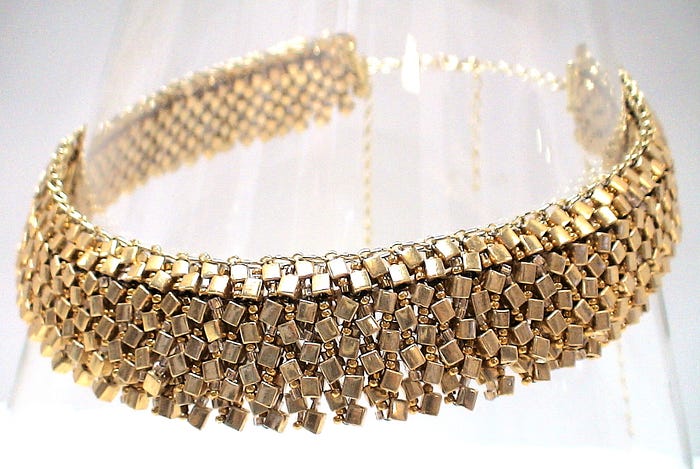










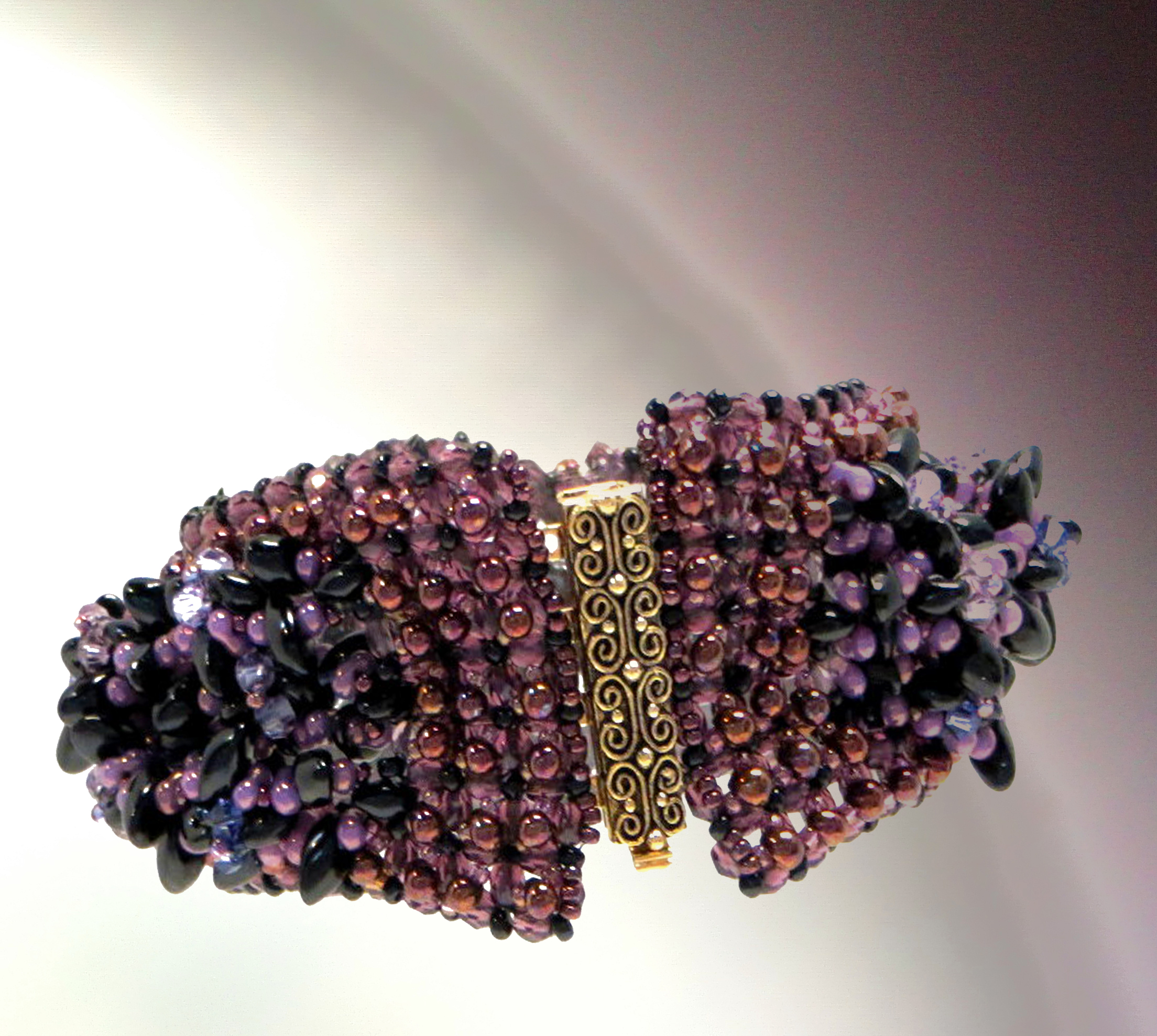



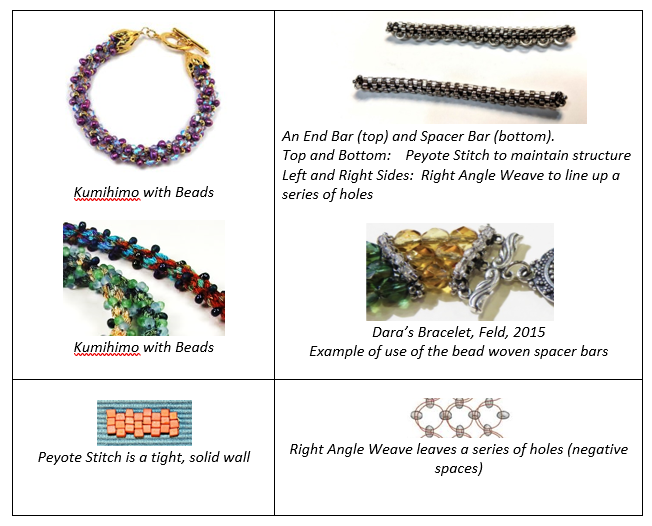
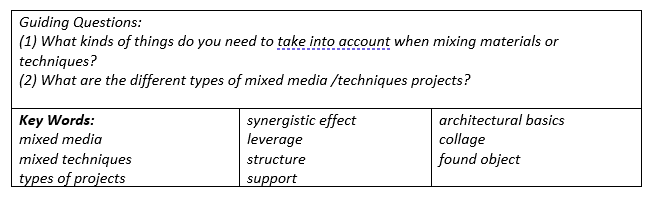
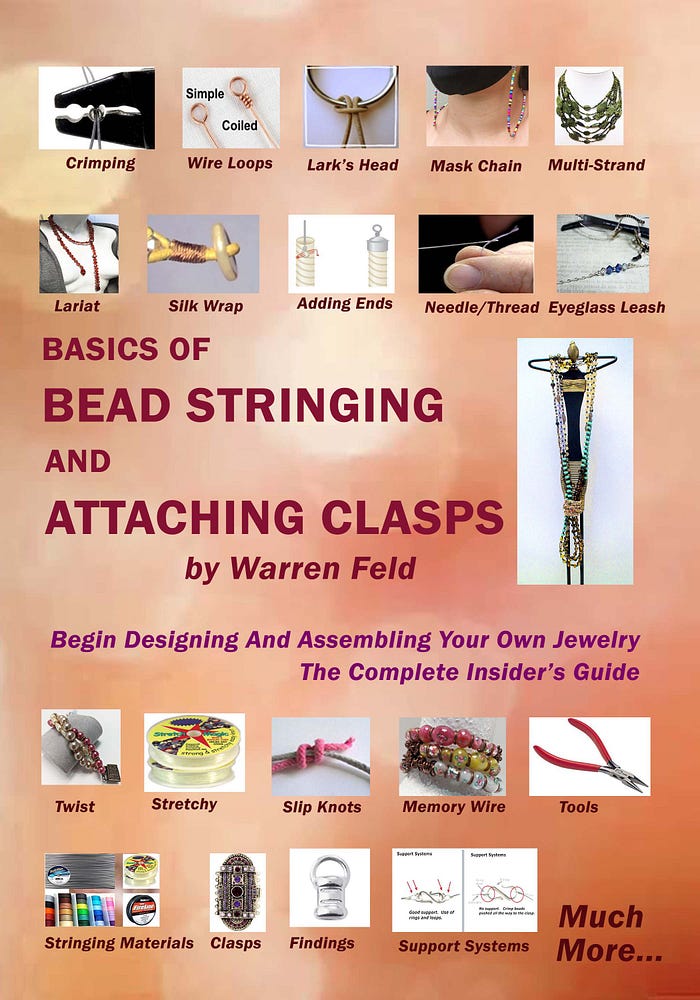
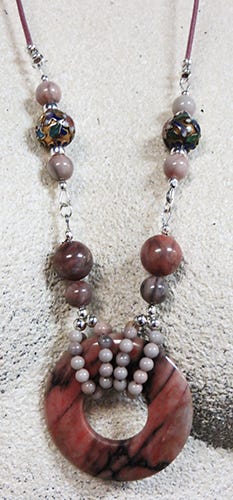

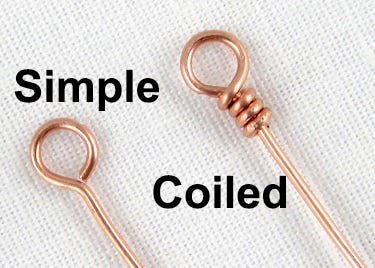
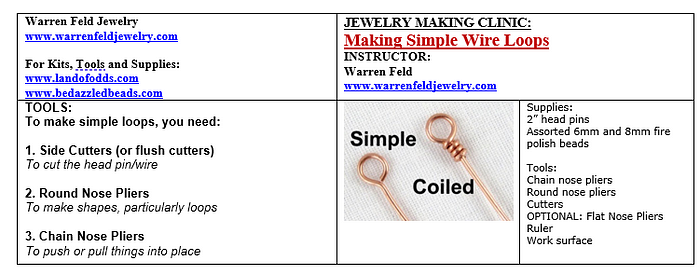

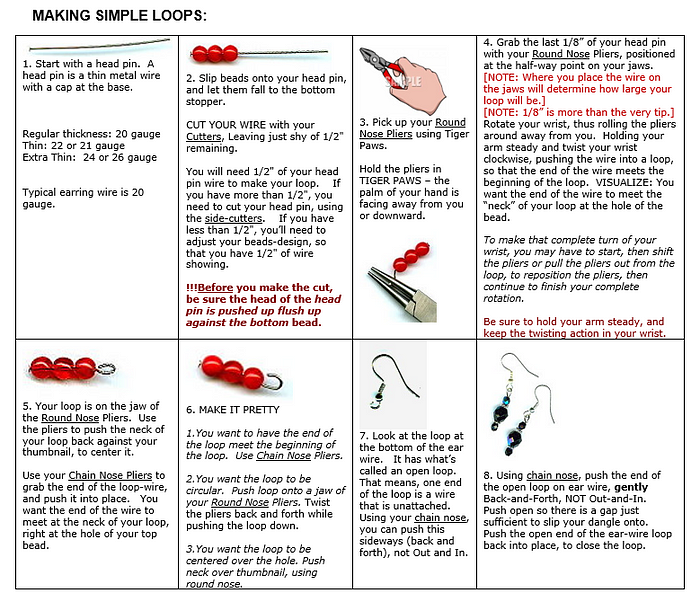
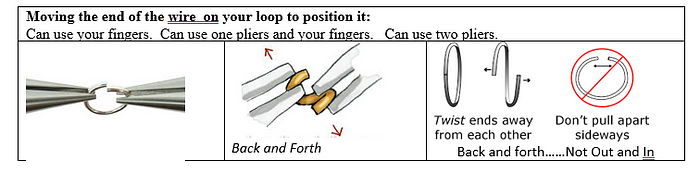
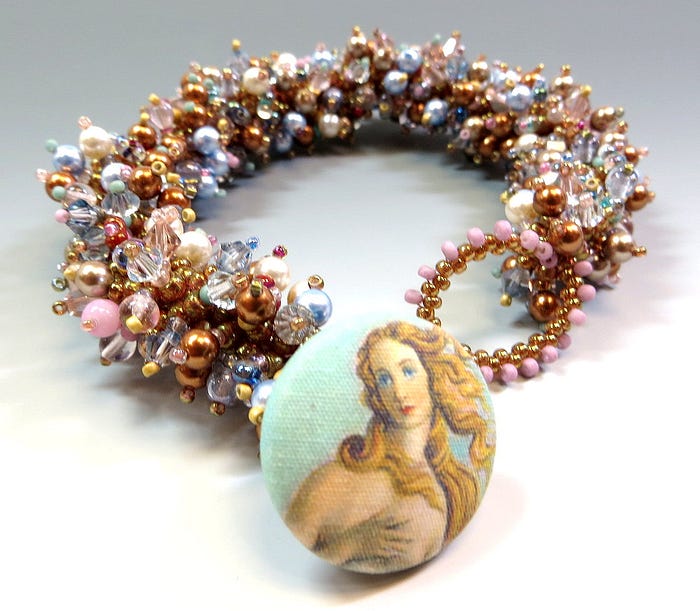
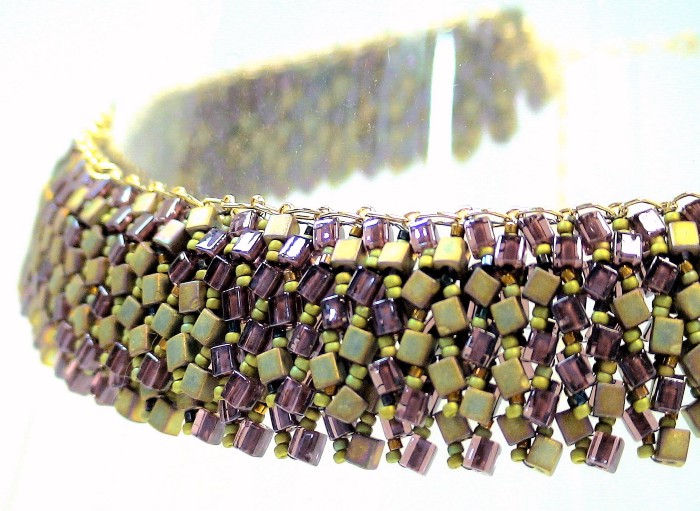


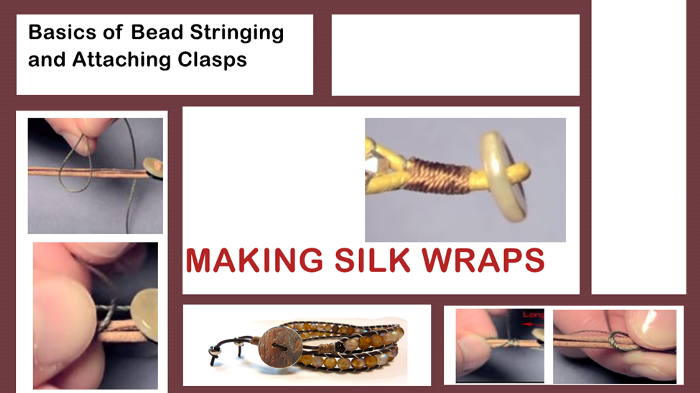
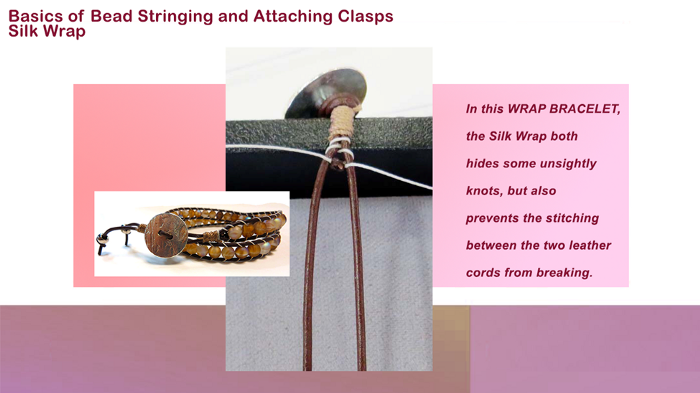

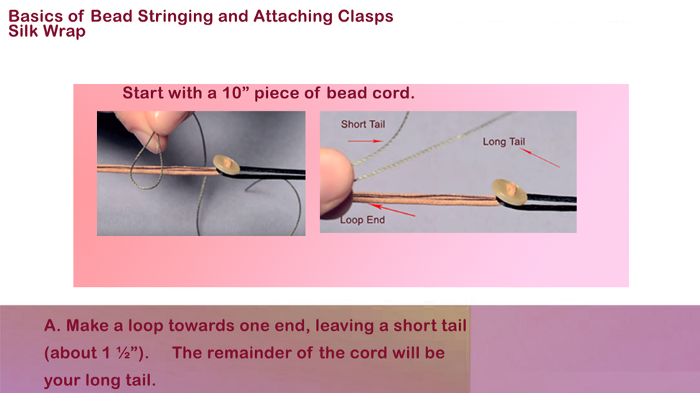
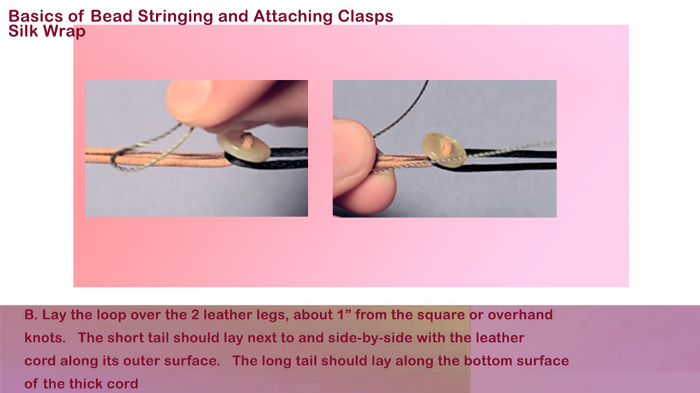


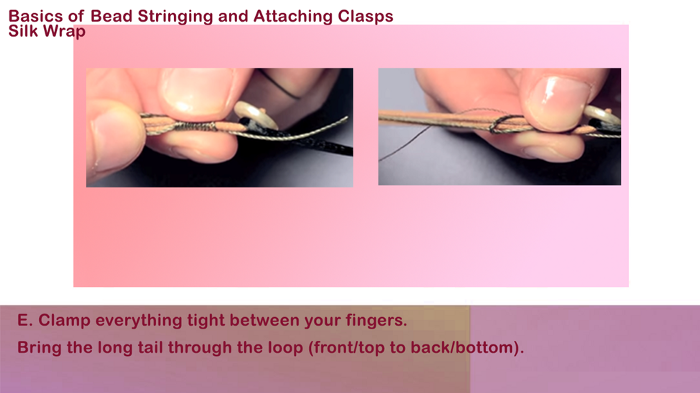
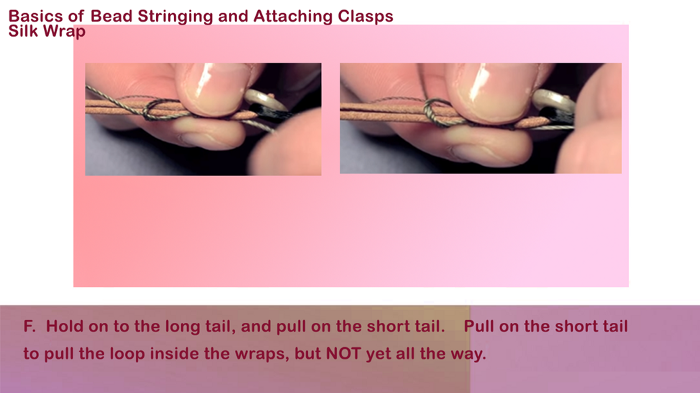
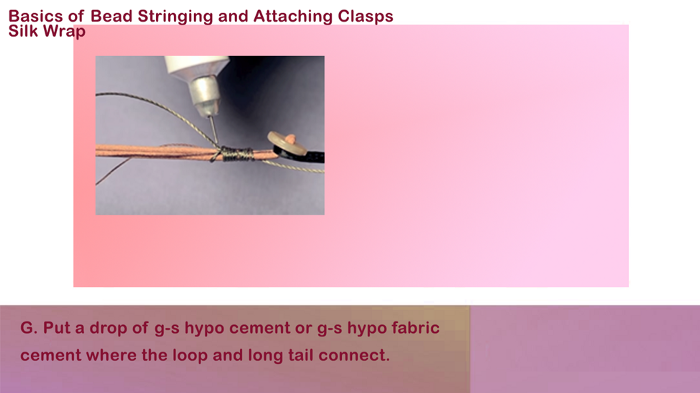

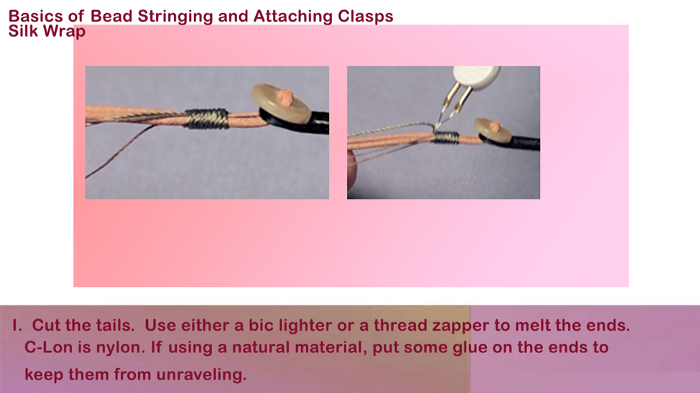


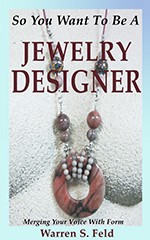


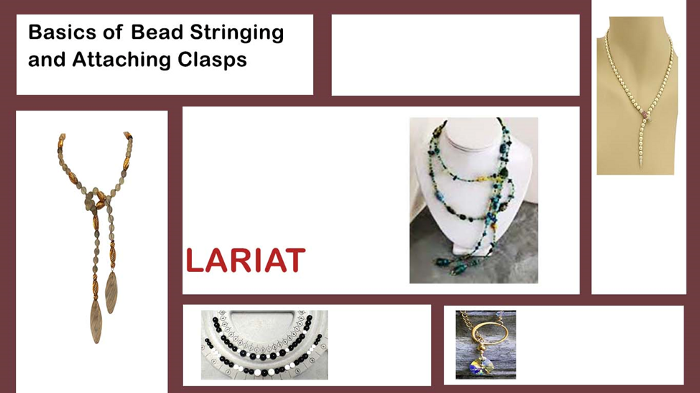


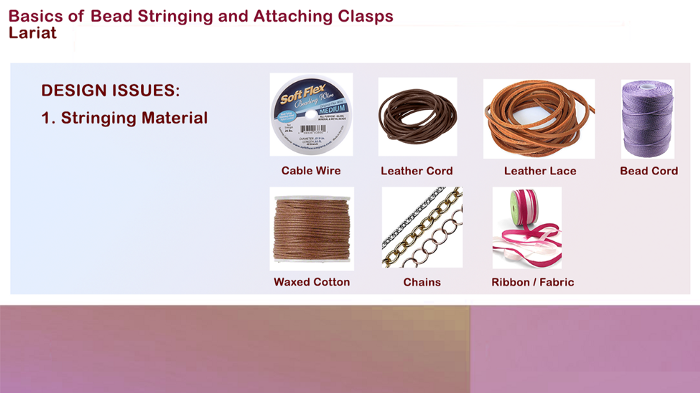
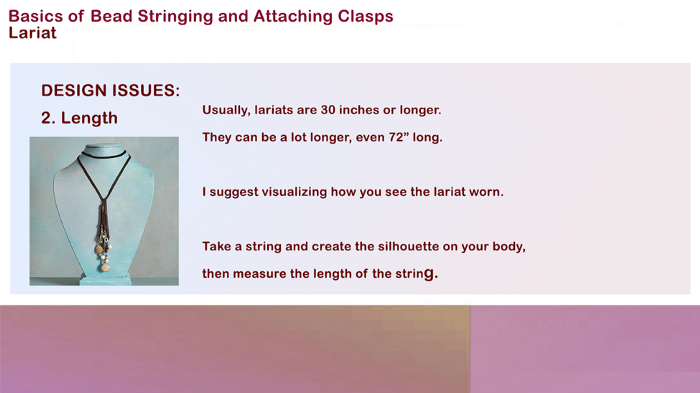
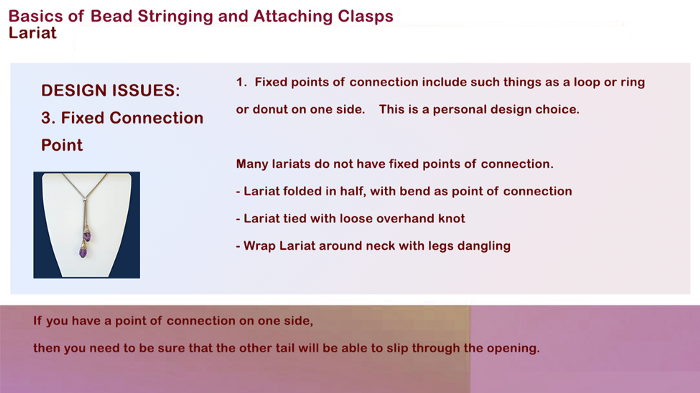


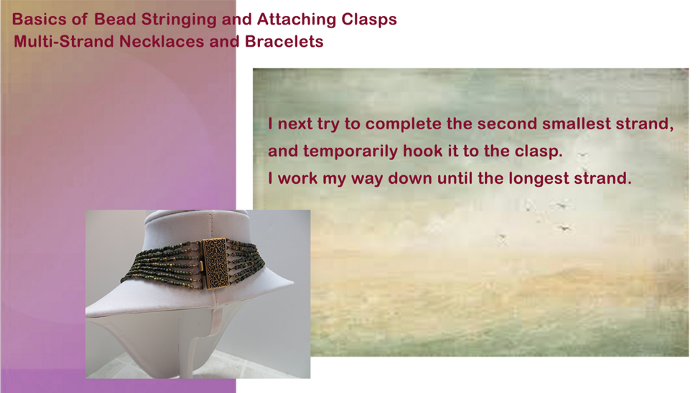
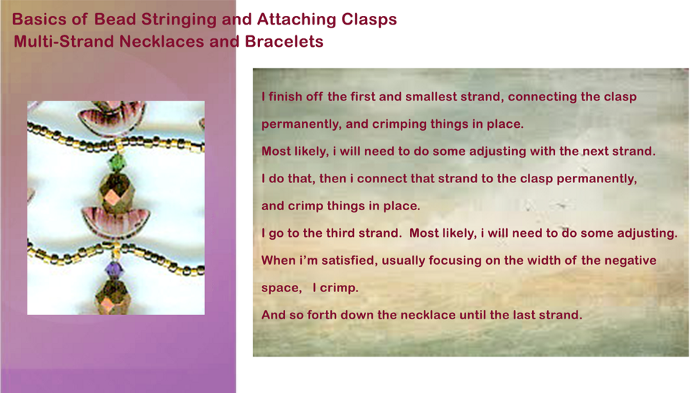
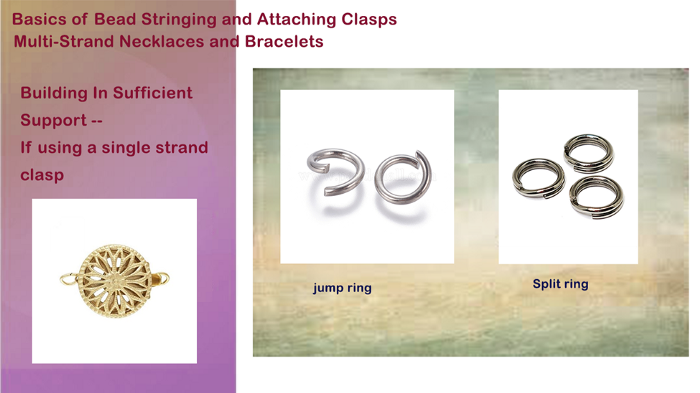
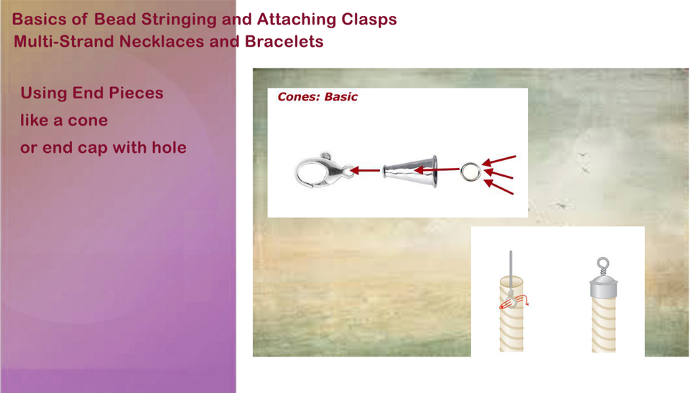

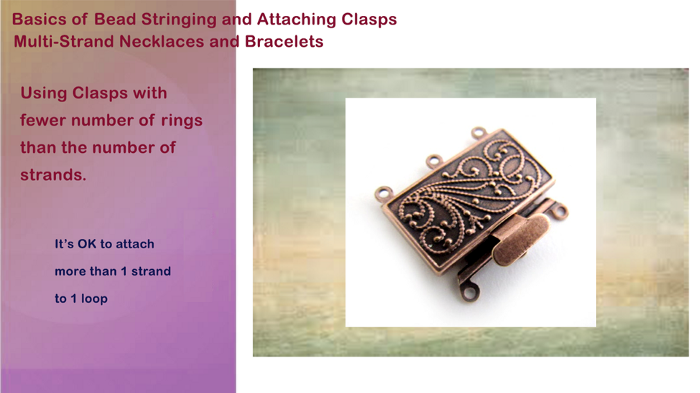


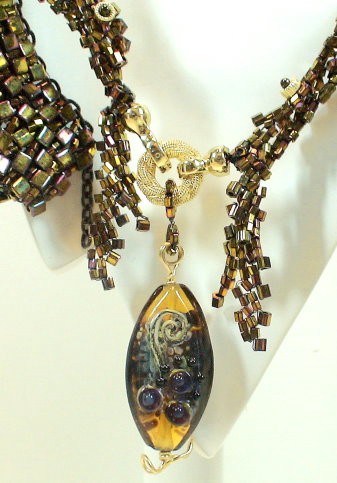

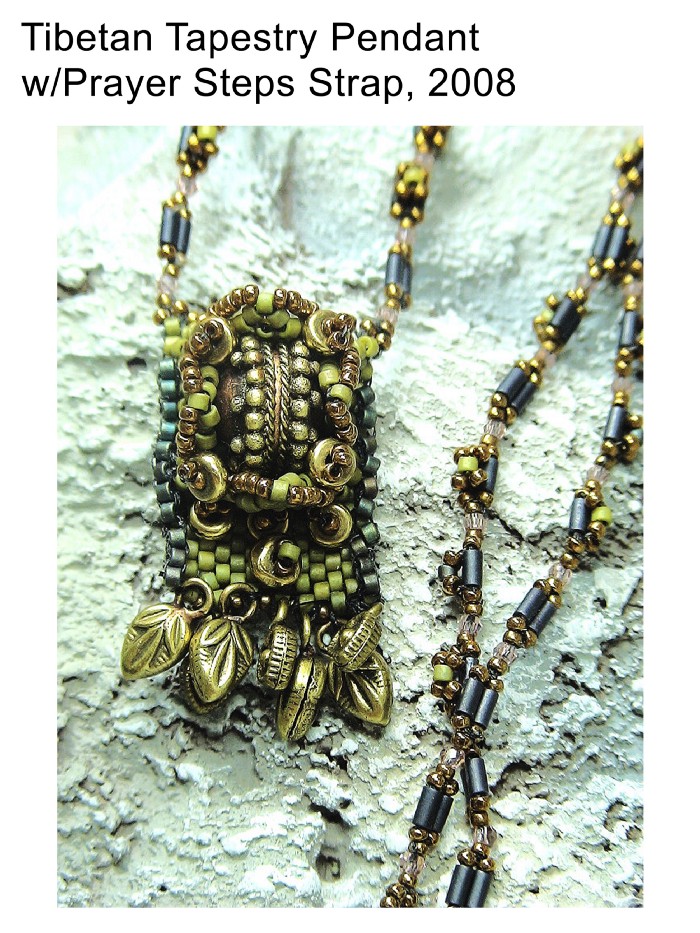
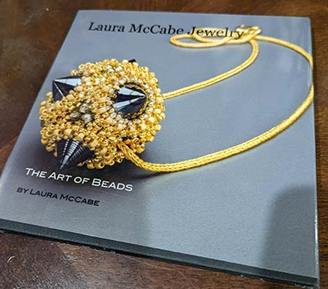




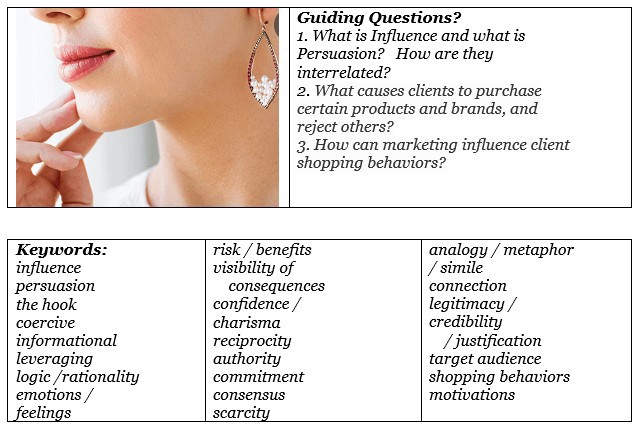
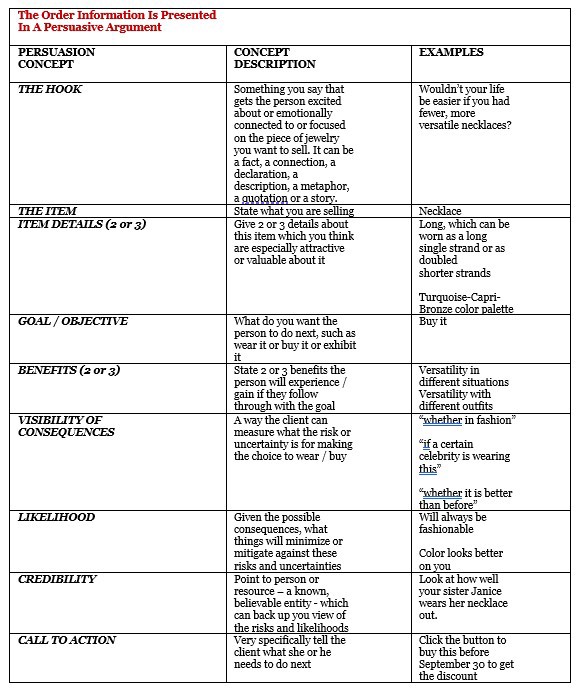



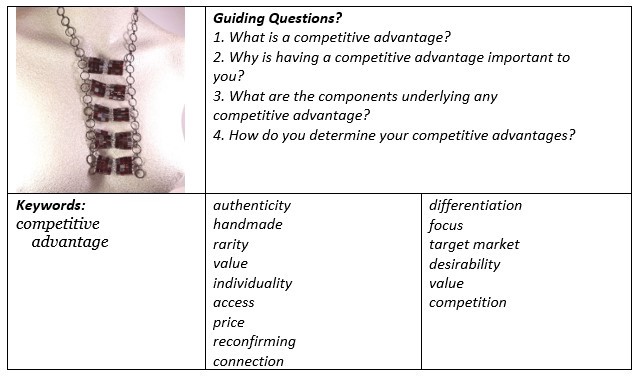





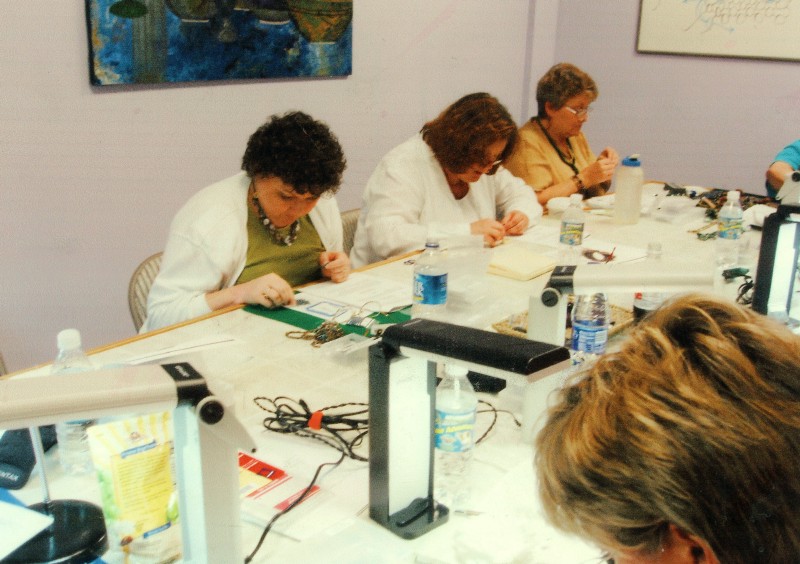


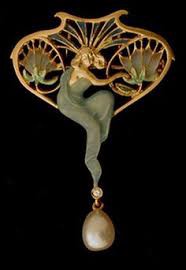




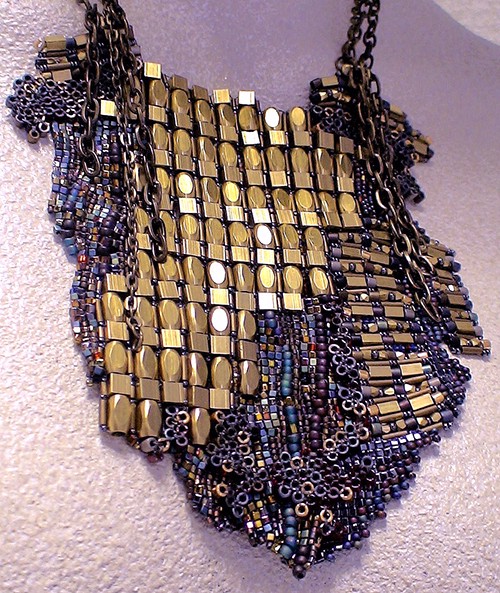
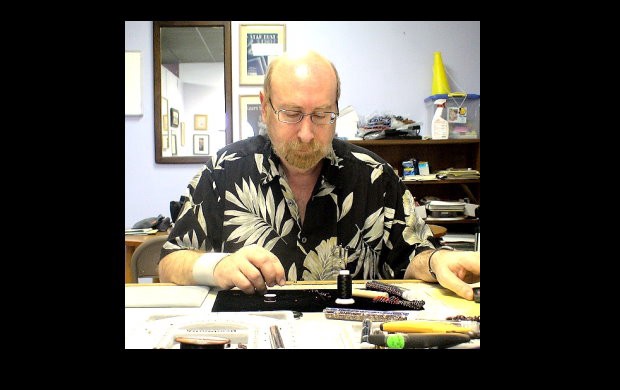

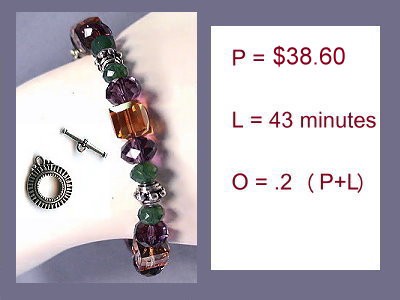




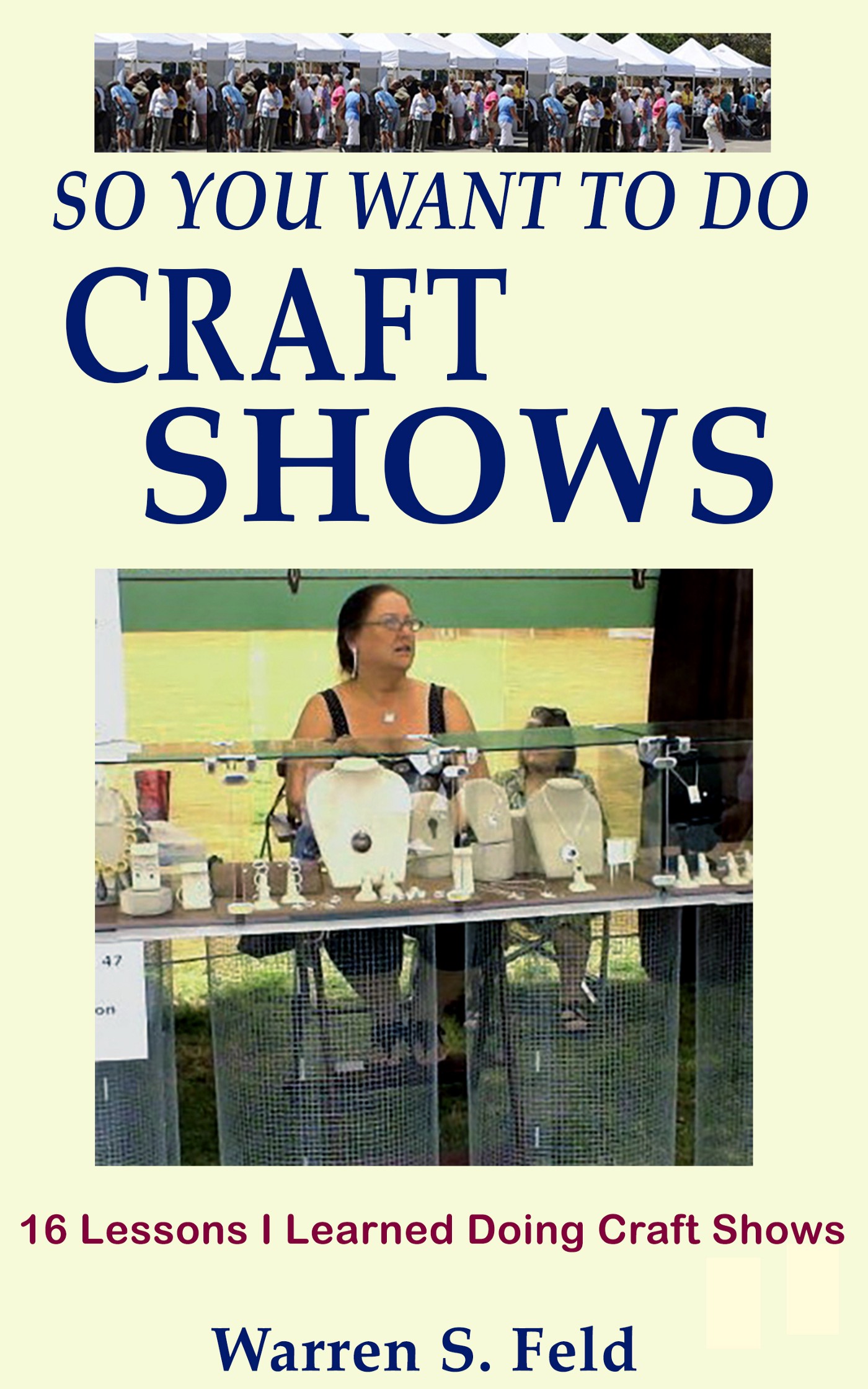
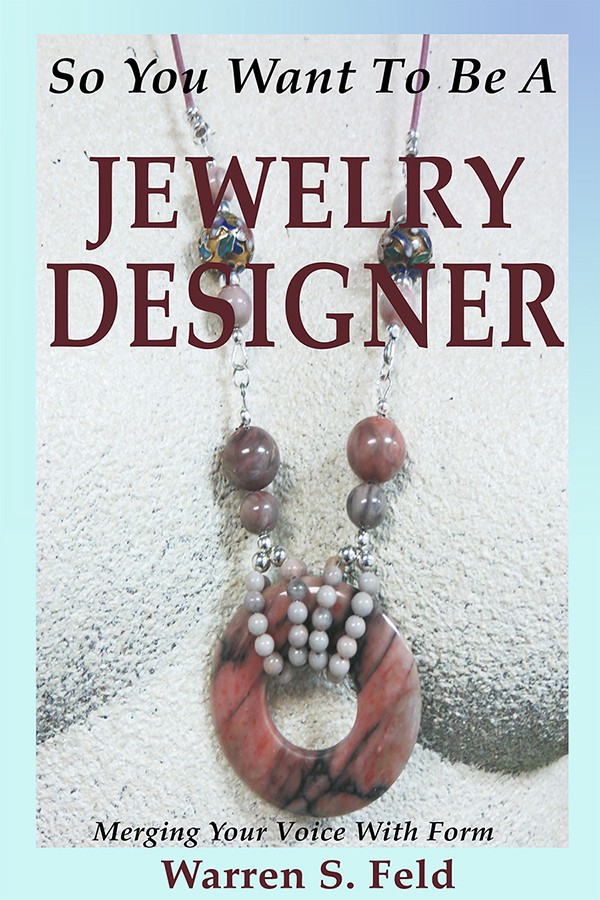




 Warren Feld Jewelry